Martin Luther
Augustinian friar whose Ninety-Five Theses sparked the Protestant Reformation. His translation of the Bible into German and his hymns shaped Protestant worship and theology for centuries.
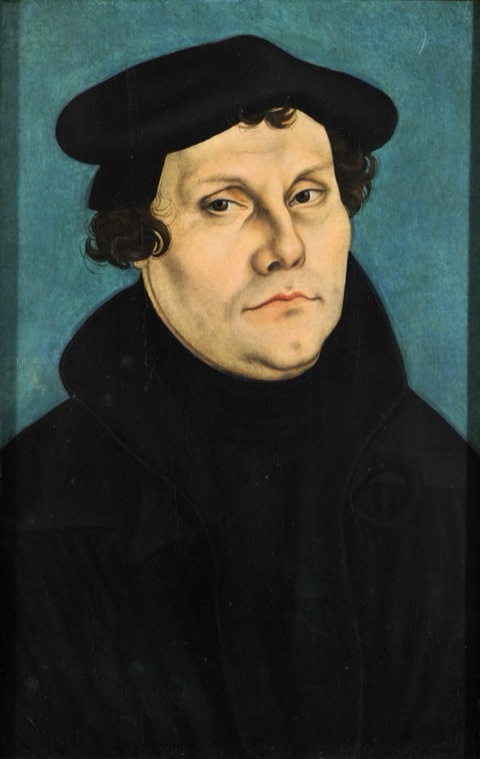
1483–1546
Biography
Martin Luther was born on November 10, 1483, in Eisleben, Saxony, the son of a copper miner. He entered the University of Erfurt in 1501, intending to study law, but after a terrifying encounter with a thunderstorm in July 1505, he entered the Augustinian monastery at Erfurt.
Luther was ordained in 1507 and sent to study theology at the new University of Wittenberg, where he became a professor of biblical studies in 1512. His intensive study of the Psalms, Romans, and Galatians between 1513 and 1518 led him to what he later called his "tower experience," the realization that the righteousness of God mentioned in Romans 1:17 was not a standard by which God judges sinners but a gift by which God justifies them through faith.
On October 31, 1517, Luther posted his Ninety-Five Theses against the sale of indulgences. The theses spread rapidly through the new printing technology and made Luther a public figure across Europe within weeks. Over the next four years, a series of public debates, papal condemnations, and political confrontations culminated in Luther's appearance before the Diet of Worms in April 1521, where he refused to recant.
Protected by the Elector of Saxony, Luther spent the next twenty-five years at Wittenberg, writing, lecturing, and organizing the new evangelical churches. He translated the entire Bible into German (New Testament 1522, complete Bible 1534), wrote catechisms, composed hymns, and produced a vast body of theological, polemical, and pastoral literature.
Luther married Katharina von Bora, a former nun, in 1525. They had six children. Luther's health declined in his later years, and his writing became increasingly harsh, particularly against the Jews, the papacy, and the radical reformers. He died on February 18, 1546, in Eisleben, the town where he was born.
Life & Career
Why Luther Matters
Luther's central theological contribution was the recovery of justification by faith alone. His insight that the sinner is declared righteous before God not by works or merit but solely through faith in Christ became the organizing principle of Protestant theology.
Luther also articulated the principle of sola scriptura, the claim that Scripture alone is the final authority for Christian faith and practice. This challenged the medieval Catholic system in which Scripture and church tradition carried equal weight.
His theology of the cross (theologia crucis) argued that God reveals himself not in power and glory but in suffering and weakness. This framework shaped Protestant spirituality in lasting ways, particularly the emphasis on the hidden work of God and the value of suffering in the Christian life.
Luther's Bible translation was a cultural achievement that helped standardize the German language and made Scripture directly accessible to ordinary people. His hymns, including "A Mighty Fortress Is Our God," established congregational singing as a central element of Protestant worship.