Richard Sibbes
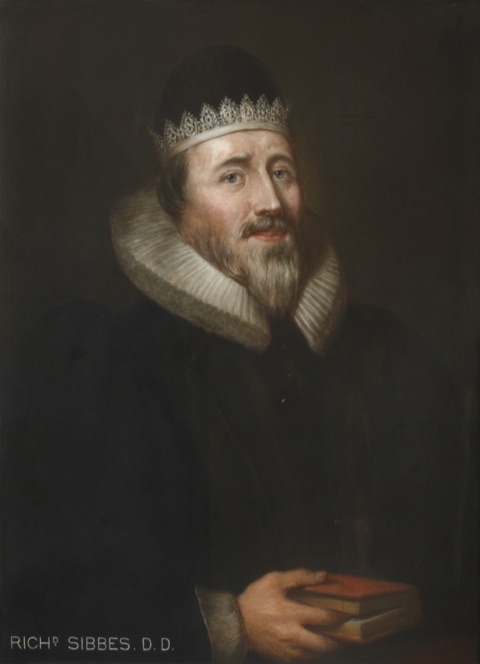
Called "the heavenly Doctor Sibbes" by his contemporaries. His preaching on Christ's tenderness toward weak believers converted Richard Baxter and shaped English Puritanism for a century.
1577–1635
Biography
Richard Sibbes was born in 1577 in Tostock, Suffolk, the son of a wheelwright. He entered St John's College, Cambridge, in 1595, where he was converted under the preaching of Paul Baynes, who held the lectureship at Great St Andrew's Church that William Perkins had made famous. Sibbes took his BA in 1599, his MA in 1602, and was ordained around 1603.
He became a fellow of St John's and soon gained a reputation as a preacher. In 1610 he was appointed Lecturer at Holy Trinity Church, Cambridge, a position that gave him a large and attentive audience of students and townspeople. His preaching was marked by warmth, directness, and a persistent emphasis on the grace of Christ toward weak and struggling believers.
In 1617 Sibbes moved to London to become Preacher at Gray's Inn, one of the Inns of Court, where he preached to lawyers, politicians, and men of influence for the rest of his life. In 1626 he was also appointed Master of Catharine Hall, Cambridge, holding both positions simultaneously. He used the Mastership to promote godly scholarship and to place Reformed ministers in parish livings.
Sibbes never married. He lived simply and gave generously, spending much of his income supporting students and ministers. His contemporaries called him "the sweet dropper" and "the heavenly Doctor Sibbes" for the quality of his preaching, which avoided controversy and focused on the person of Christ and the experience of the believer.
Most of Sibbes's published works were sermons edited and printed by friends after his death. His most famous work, The Bruised Reed, began as a series of sermons on Matthew 12:20 and became one of the most widely read devotional works of the 17th century. It was instrumental in the conversion of Richard Baxter, who found a copy among his father's books.
Sibbes remained within the Church of England throughout his life, though he sympathized with the Puritan desire for further reformation. He died on July 5, 1635, in Cambridge, and was buried at Holy Trinity Church.
Life & Career
Why Sibbes Matters
Sibbes's theology centers on the relationship between Christ and the believer. Where other Puritan writers emphasized law, duty, and the terrors of conscience, Sibbes consistently returned to the tenderness of Christ. His characteristic move was to take a passage about Christ's compassion and press it into service for the discouraged Christian.
His most distinctive contribution was his treatment of spiritual weakness as something Christ accommodates rather than condemns. In The Bruised Reed, he argued that Christ does not reject those with small faith but nurses that faith until it grows. This was not softness or sentimentality. Sibbes understood the doctrine of sin as well as any Puritan. But he believed the gospel's power lay in attraction, not coercion, and that weak believers needed encouragement more than rebuke.
Sibbes also developed what later writers called the "marriage theology" of Christ and the church. His sermons on the Song of Solomon (published as Bowels Opened) explored the mutual love between Christ and believers using the language of intimacy and desire. This approach influenced a long line of devotional writers, including Samuel Rutherford and Jonathan Edwards.
His practical impact was enormous. He mentored a generation of Puritan ministers, helped fund the publication of Reformed literature, and shaped the devotional sensibility of English Protestantism for a century after his death.