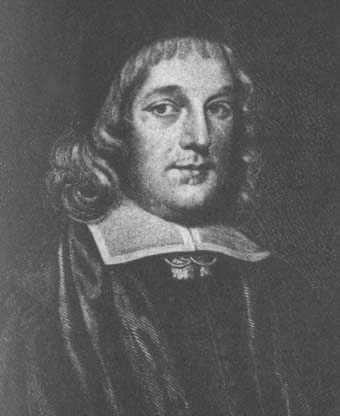
Stephen Charnock
English Puritan minister whose Discourses upon the Existence and Attributes of God, preached at Crosby Hall in London and published posthumously in 1682, remains the most extensive Puritan treatment of the doctrine of God.
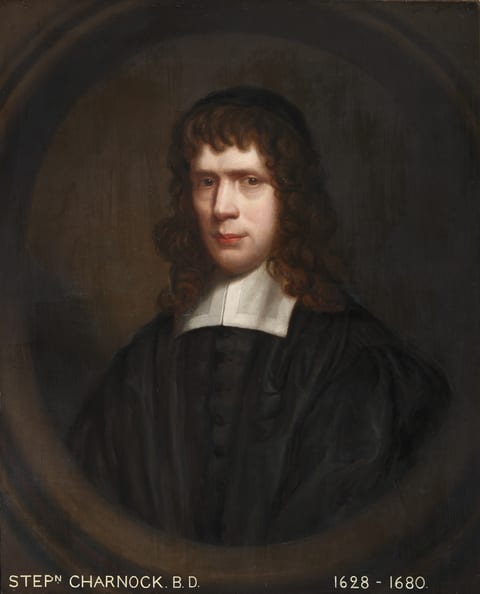
1628–1680
Biography
Stephen Charnock (1628 to 1680) was an English Puritan minister whose lectures on the being and attributes of God, delivered to his London congregation and published after his death, became the fullest treatment of the doctrine of God produced by an English Puritan.
He was born in 1628 in the London parish of St Katherine Cree, where his father, Richard Charnock, worked as a solicitor. He entered Emmanuel College, Cambridge, at an early age, studying under William Sancroft, who would later become Archbishop of Canterbury. It was at Cambridge that Charnock adopted the Puritan convictions he held for the rest of his life. He began preaching while still young, apparently somewhere in Southwark, before leaving the ministry there for the university again.
In 1649 Charnock moved to Oxford, and in 1650 he was elected to a fellowship at New College. He was incorporated Master of Arts in 1652 and served as a proctor of the university in 1654, during the years when Oliver Cromwell was chancellor and John Owen vice-chancellor.
He left Oxford for Ireland as chaplain to Henry Cromwell, Oliver's son, who governed the country as lord deputy. Charnock preached regularly in Dublin, at St Werburgh's and at Christ Church, to hearers drawn from different classes and different denominations, and was widely respected even by those who did not share his views.
Henry Cromwell's removal from office ended that work. Charnock returned to London, and after the Restoration of the monarchy in 1660 the laws governing public worship barred him from a settled charge. For roughly fifteen years he held no regular pastorate. He preached where he could, spent time in France and Holland, and gave himself largely to study, though he lost his entire library in the Great Fire of London in 1666.
In 1675 he was appointed joint pastor, with Thomas Watson, of a large Presbyterian congregation meeting at Crosby Hall in Bishopsgate Street. The discourses on God's existence and attributes were preached there over his last five years and were left unfinished when he died. He died on July 27, 1680, at a house in Whitechapel, and was buried three days later at St Michael's, Cornhill.
Only one book, The Sinfulness and Cure of Evil Thoughts, appeared during his lifetime. Everything else was transcribed from his manuscripts by two admirers, Richard Adams and Edward Veal, who copied and edited two large folio volumes over several years. The Existence and Attributes of God was published posthumously in 1682.
Life & Career
Why Charnock Matters
English Puritan writing is best known for practical divinity: books on conversion, temptation, assurance, the household, the conscience. Charnock took the same tradition and turned it on the doctrine of God itself. The Existence and Attributes of God works through God's existence, the folly of practical atheism, and then the attributes one at a time — spirituality, eternity, immutability, omnipresence, knowledge, wisdom, power, holiness, goodness, dominion, patience — at a length no other Puritan attempted on the subject.
The method is the ordinary Puritan sermon structure carried out on an unusual scale. Each discourse opens from a single text of Scripture, states the doctrine drawn from it, proves and explains that doctrine under numbered heads, and then turns to the "use" — what the doctrine requires of the hearer in worship, in prayer, in repentance, in daily conduct. The result is that the attributes are never left as bare definitions. Charnock argues that a doctrine of God which changes nothing about how a person lives has not actually been believed.
That conviction produced his most distinctive material: the treatment of practical atheism. Charnock's target was not the professed unbeliever, who was rare in seventeenth-century England, but the person who affirms God's existence and then lives as though God were absent, ignorant, or powerless. He traced that inconsistency through prayer, through the conduct of business, through the conscience, and treated it as the ordinary condition of the human heart rather than an unusual failure.
He also argued for God's existence rather than assuming it, drawing on the order of creation, the testimony of conscience, and the near-universal consent of nations. Those arguments are set in the science of his own day, which dates parts of the discussion, but they mark the work as apologetic as well as devotional — a combination uncommon in Puritan preaching.
The book kept its readership long after the circumstances that produced it had passed. It was reissued repeatedly in the nineteenth century, including in Nichols's Series of Standard Divines in 1860 with an introduction by James McCosh, later president of Princeton, and it has remained continuously in print since. Among Reformed readers it is still the standard reference on the attributes, cited by systematic theologians who otherwise draw little from Puritan sermon literature.