The second of two volumes drawn from Charnock's first published series: four discourses on the immutability, the omnipresence, the knowledge, and the wisdom of God. It closes with the discourse on wisdom, in which Justice and Mercy argue opposing cases over the fate of fallen man.
One free account opens 250+ books and saves your place on every device. Google sign-in or an email link. No card.
You’re on the list — we’ll email you if this goes to print.
The Existence and Attributes of God · 4 volumes:Vol. 1Vol. 2Vol. 3Vol. 4
Included with your free account
This book, and 250+ more, free to read
A free account opens the whole library to read online, on your phone or at your desk. Open a book on one device and it is waiting at the same page on the next. The PDF and EPUB of every book are yours to keep, and audiobooks play in the same app.
250+ modernized editionsNot samples. The whole work, free.
Your place, on every devicePhone, tablet or desktop, same page.
131 audiobooksFrom $4.99 each, or all of them with a $50 gift.
The Existence and Attributes of God, Volume Two collects four of Stephen Charnock's Puritan discourses, on the immutability, omnipresence, knowledge, and wisdom of God. He argues that God cannot change, is present everywhere by his essence, knows all things in one act, and showed his deepest wisdom in redemption.
How the argument unfolds
01
The immutability of God. Charnock opens on Psalm 102:26–27: “God is unchangeable in his essence, nature, and perfections.” Unchangeableness is not one attribute among several but “the center in which they all unite.”
02
Six propositions on apparent change. Creation, the incarnation, the repentance Scripture ascribes to God, unfulfilled predictions, the turn from love to anger, and the changing of laws are each shown to leave God unaltered.
03
God's omnipresence. On Jeremiah 23:24, “I fill heaven and earth” means essence, not knowledge or authority: “knowledge alone does not constitute presence,” and the verse offers presence as the proof of knowledge.
04
God's knowledge. On Psalm 147:5, what God knows, down to things merely possible and future contingencies, and how, in one act by his own essence. Certainty compels nothing: “the knowledge of future things imposes no necessity on them as they approach.”
05
The wisdom of God. On Romans 16:27, the longest discourse of the nine, tracing wisdom through the frame of creation and then through God's government of a world disordered by sin.
06
Justice and Mercy. Wisdom appears most in redemption. Charnock stages a debate over fallen man in which “justice votes for destruction, and mercy votes for salvation,” and wisdom answers both pleas.
07
The uses. Every discourse ends in application, and the volume closes by asking readers to be “worshipers, not critics,” waiting for the outcome of works too large to judge here.
Key themes
Immutability as the seal on every attribute. “There is not one perfection of which it may not truly be said, it is immutable.” Without it, mercy could turn to wrath and power could weaken.
Presence by essence. God is not merely near all things but in them, filling heaven and earth wholly rather than in parts: “nothing can be far from his eyes, since everything is so near to his being.”
Knowledge that lays no necessity on the creature. God knows all things independently of the things known, and Charnock takes care that this certainty settles nothing about what creatures freely do.
Wisdom disclosed in redemption. “The works of creation are the footprints of his wisdom; the work of redemption is the face of his wisdom.” Redemption is where the attributes are seen reconciled.
The Immutability of God
(Ps 102:26–27) “They shall perish, but thou shalt endure: yea, all of them shall wax old as a garment; as a vesture shalt thou change them, and they shall be changed: But thou art the same, and thy years shall have no end.”
This Psalm contains a complaint from a people pressed with a great calamity. Some think it describes the Jewish church in Babylon; others think the Psalmist here speaks for mankind lying under a state of corruption, since he longs for the coming of the Messiah to accomplish the redemption God promised and they needed. The title of the Psalm is “A prayer of the afflicted when he is overwhelmed, and pours out his complaint before the Lord,” whether afflicted by the sense of corruption or the sense of oppression. This psalm speaks of the redemption by the Messiah, which the ancient church looked to as the source of their deliverance from a sinful or servile bondage. It appoints a set time for the display of his mercy to Zion (Ps 102:13), an appearance in glory to build up Zion (Ps 102:16), the loosing of the prisoner through redemption and of those appointed to death (Ps 102:20), the calling of the Gentiles (Ps 102:22).
The latter part of the psalm, containing the verses I have read, is applied to Christ in Hebrews 1. Whatever the psalm’s overall design, it weaves in much that concerns the kingdom of the Messiah and redemption through Christ.
Some divide the psalm into three parts.
1. A petition plainly stated (Ps 102:1–2): “Hear my prayer, O Lord, and let my cry come unto thee,” etc.
2. The petition strongly and argumentatively pressed (Ps 102:3), from the psalmist’s own misery and the reproach of his enemies.
3. An act of faith, expecting an answer in the general redemption promised (Ps 102:12–13): “But thou, O Lord, shalt endure forever; thou shalt arise and have mercy upon Sion; the heathen shall fear thy name.” The first part is the petition pleaded; the second is the petition answered, with assurance that full deliverance would come in time. The writer’s aim is to confirm the church in the truth of God’s promises (Pareus). Though the foundations of the world should be torn up, the heavens crash together, and the whole structure be unpinned and fall to pieces with its firmest parts dissolved, the church would still stand. It does not rest on the changeableness of creatures but is built on the immutable rock of God’s truth, which is no more subject to change than his own essence.
“They shall perish, thou shalt change them.” Just as he earlier ascribed to God the “foundation of heaven and earth” (Ps 102:25), he now ascribes to God their destruction. Both the beginning and end of the world are settled here. Nothing in the present appearance of things demonstrates that the world will end. Heaven and earth stand firm; the heavenly bodies move as they always have, their beauty undiminished; individuals decay, but the species and kinds remain. The seasons keep their due order. But the sin of man makes it necessary to change the present form of the world, in order to accomplish God’s design for the glory of his elect. The heavens do not naturally perish, as some once imagined an “old age” of the world in which it must decay like the bodies of animals, or that fragments of the heavens, broken off by rubbing against one another in their motion and falling to earth, become the seeds of things that grow among us (Pliny, Natural History).
The earth and heavens. He names here the most stable and beautiful parts of creation, those most free from decay and change, in order to illustrate God’s immutability by them. Though the heavens and earth hold a special claim to fixedness above other parts of the world and the creatures that live below, though the heavens remain as they were at creation and the earth’s core keeps its stability, and though they seem as fresh and beautiful in their age as in their youth long ago (despite the elements changing, fire and water often turning into air, so that little of the air first created may remain, given the constant transformation), still, this firmness of earth and heavens is nothing compared to the fixedness of God’s being. Just as their beauty falls short of the glory of his being, so their firmness falls short of his stability.
Some take “heavens and earth” to mean the creatures that live on earth and in the air (which Scripture often calls “heaven”), but since the ruin and decay of such creatures is seen every day, that reading would offer a poor illustration of God’s unchangeableness.
They shall perish, they shall be changed.
1. Some say they may perish; they do not owe their continued existence to themselves but to God, who gave them an incorruptible nature. They would perish if he spoke the word; he could destroy them as easily as he created them. But the Psalmist is not speaking of the possibility of their perishing, but its certainty.
2. Others say they will perish in their qualities and motion, not in their substance. They will cease the motion proper to generating and destroying things on earth, but their substance and beauty will remain, much as when the springs or gears of a clock are removed, the material parts still remain even though its motion, and its use for telling the time, ceases (Cocceius, on this passage). To “perish” does not always mean falling into nothing, an annihilation in which both matter and form are destroyed. It can mean the ending of a present appearance, a ceasing to be what something now is. A man is said to perish when he dies, though the better part of him does not cease to exist. The body’s form crumbles away and its matter returns to dust, but the soul, being immortal, does not cease to act; it is only that the body, lacking the soul, becomes incapable of acting.
So the heavens will perish: their present appearance will vanish, and a more glorious, incorruptible frame will be raised up by the power and goodness of God. The dissolution of heaven and earth is what the word perish means; the raising of a new frame is what changed signifies. It is as if the Spirit of God intended to head off any wrong reading of perish by softening its sense with another word signifying only a change, as when we exchange an old garment for a new one, discarding the old to receive the new.
“As a garment, as a vesture. Thou shalt change them”; in the Septuagint, “thou shalt fold them up.” The heavens are compared to a curtain (Ps 104:2), and in due time will be folded up like clothes or curtains. Just as a garment covers the whole body, so the heavens encircle the earth (Estius, on Hebrews 1). Some say that just as a garment is folded up to be set aside until needed again, so God will fold up the heavens like a garment, so that when they are restored he may stretch them out again over the earth. He will fold them up so that what once appeared will no longer appear. This can be pictured by the image of a scroll or book, which the Spirit of God uses elsewhere (Isa 34:4, Rev 6:14): “The heavens departed as a scroll when it is rolled together.” When a book is rolled up or closed, nothing in it can be read until it is opened again.
So the face of the heavens, where the stars are like letters declaring the glory of God, will be shut or rolled up so that nothing appears, until it is opened again in renewal. As a garment, it will be changed, not to be used in the same fashion or for the same purpose again.
This seems, on the surface, to describe something for the worse. An old garment is not changed except into rags, put to other uses, and eventually thrown on the dunghill. But comparisons should not be pressed too far, and this one does not fit the new heavens and new earth, whether taken physically or merely as a figure. It is not likely the heavens will be put to a worse use than God intended for them at creation. Rather, a change “as a garment” speaks not of total corruption but of an alteration in qualities, a garment no longer used in its old fashion. We may note that the world is probably not to be annihilated but refined. It will lose its present form and fashion, but not its foundation. Certainly, just as God raised it from nothing, he could reduce it back to nothing. But it does not appear that God will annihilate it, utterly destroying both its matter and its form.
The Wisdom of God in Redemption
The wisdom of God appears most wonderfully in redemption. His wisdom in creation captivates the eye and the understanding; his wisdom in providence no less moves a careful observer of how the means are linked and joined together. But his wisdom in redemption raises the mind to still greater astonishment. The works of creation are the footprints of his wisdom; the work of redemption is the face of his wisdom. A person is better known by the features of a face than by the print of a footstep. We, with “open face,” or a revealed face, are “beholding the glory of the Lord” (2 Cor 3:18); face there refers to God, not to us. The glory of God’s wisdom is now uncovered, no longer veiled behind the shadows of the law.
Think of how light appears, scattered through the air before the sun rises, but far more gloriously once gathered into the sun itself as it begins its course across the sky. All of God’s wisdom shown in creation, and in the variety of laws by which he governs, was like the light of the first three days of creation, spread thinly across the world. But on the fourth day it grew more glorious, gathered into the body of the sun (Gen 1:4, 16). In the same way, the light of divine wisdom and glory was once scattered abroad, dim and diffuse, until the fourth divine “day” of the world’s history, around the four-thousandth year, when it was gathered into one body, the Sun of Righteousness, and shone out with far greater glory to both men and angels. Everything is weaker the more thinly it is spread, and stronger the more it is united and compacted into one body.
In Christ, in the whole plan carried out through him as well as in his person, were “hid all the treasures of wisdom and knowledge” (Col 2:3). Small portions of wisdom were given out in creation, but its full treasures were opened in redemption, the highest degree of wisdom God has ever displayed in the world. Christ is therefore called the “wisdom of God,” as well as the “power of God” (1 Cor 1:24), and the gospel too is called the “wisdom of God.” Christ is the wisdom of God in the primary sense, and the gospel in the instrumental sense, just as the gospel is the power of God instrumentally, in that it subdues the heart to him. This wisdom is wrapped up in the appointing of Christ as Redeemer, and opened to us through the gospel’s revelation of it.
1. It is a hidden wisdom. In this regard, God is called in the text only wise. It is called a “hidden wisdom” (1 Tim 1:17) and “wisdom in a mystery” (1 Cor 2:7), beyond the grasp of an ordinary angel’s understanding, just as the hidden properties of created things lie beyond the understanding of man. No wisdom, human or angelic, can trace every vein of this mine, follow every thread of this weaving, or grasp its full brilliance. They are as far from fully comprehending it as they were, at first, from being able to devise it. Only the wisdom that invented it can fully comprehend it. Only in the uncreated understanding is there light with no trace of shadow. We fall as far short of fully grasping it as a child falls short of understanding the counsel of the wisest ruler.
It is so hidden from us that, without revelation, we could never have imagined it at all. And even now that it is revealed, we cannot fully fathom it without an infinite understanding. It is a work of divine wisdom so profound that the angels themselves had never seen its full unveiling until it was made known to the world (Eph 3:10): “to the intent that now unto principalities and powers in heavenly places might be known by the church the manifold wisdom of God.” It was made known to them then, not before, and made known to them “in the heavenly places.” They did not possess knowledge of every heavenly mystery, even though they already possessed heavenly glory. They knew the prophecies of it as written, but did not attain a clear understanding of those prophecies until the things foretold actually came to pass.
2. It is called manifold wisdom, as manifold as it is mysterious. There is variety within the mystery, and mystery within every part of the variety. It was not one single act, but a gathering of counsels: a conjunction of excellent ends and excellent means. Those ends included the glory of God, the salvation of man, the defeat of the apostate angels, and the display of the blessed Trinity in their nature, their operations, and their combined and distinct acts and expressions of goodness. The means include the union of two natures infinitely distinct from one another, the union of eternity and time, of mortality and immortality. Death becomes the way to life, and shame the path to glory. The weakness of the cross becomes the repair of man, and the creature is made wise by the “foolishness of preaching.” Fallen man grows rich by the poverty of the Redeemer, and man is filled by the emptiness of God. The heir of hell is made a son of God, by God’s taking on him the “form of a servant.”
The son of man is raised to the highest honor, by the Son of God becoming of “no reputation.”
This is called “abundance of wisdom and prudence” (Eph 1:8). Wisdom belongs to the eternal counsel, contriving a way. Prudence belongs to its temporary revelation, ordering all affairs and events in the world to achieve the end of that counsel. Wisdom refers to the mystery itself; prudence, to its manifestation in fitting ways and convenient seasons. Wisdom concerns the contrivance and order; prudence, the execution and accomplishment. In all things God acted as befits a wise and just Governor of the world (Heb 2:10). Whether God’s wisdom might have found some other way, or whether the necessity and nature of his justice bound him to this one, is not the question here. What is beyond question is that this is the best and wisest way to display his glory.
This wisdom appears in the different interests it reconciles: in the subject, the second person of the Trinity, in whom they were reconciled; in the two natures, through which he accomplished it. By this, God is made known to man in his glory, sin is eternally condemned, and the repenting and believing sinner is eternally rescued. The honor and righteousness of the law are vindicated both in its precept and its penalty. The devil’s empire is overthrown by the very nature he had overturned, and hell’s cunning defeated by the nature it had ruined. The creature is drawn, in the very act, to the highest obedience and humility, so that just as God appears as God upon his throne, the creature might appear in the lowest posture of a creature, in the depths of resignation and dependence. All this is proclaimed in the gospel by ways fitting to the wisdom shown in the execution of his counsel, and the conditions for enjoying its fruit are most wise and reasonable.
1. The greatest opposing interests are reconciled here: justice in punishing, and mercy in pardoning. Man had broken the law and plunged himself into a gulf of misery. The sword of vengeance was drawn by justice to punish the criminal, while the depths of compassion were stirred in mercy to rescue the miserable. Justice looks severely on the sin, and mercy looks with compassion on the misery. Two opposing claims are brought by these attributes: justice votes for destruction, and mercy votes for salvation. Justice would draw the sword and drench it in the offender’s blood; mercy would stop the sword and turn it from the sinner’s breast. Justice would sharpen it, and mercy would blunt it. The arguments are strong on both sides.
1.) Justice pleads.
“I bring before your tribunal a rebel who was the glorious work of your hands, the center of your rich goodness, a counterpart of your own image. He is indeed miserable, which might stir your compassion, but he is not miserable without being guilty. You created him able to do otherwise; the riches of your generosity only deepen the darkness of his crime. He rebelled not from necessity, but by will. What compelled him to listen to the counsel of God’s enemy? No creature can force or constrain another’s will. Ignorance cannot excuse him: the law was not vague but plainly stated, both in precept and penalty, and written legibly in his very nature. Even if he had felt some grievance after his creation, that would not excuse his rebellion, since as Sovereign you owed your creature nothing. You had provided richly for him; he was crowned with glory and honor. Your infinite power gave him a richly furnished home and servants of every kind to attend him.
“Everything he saw around him and within himself marked your divine generosity, meant to draw him to obedience. Even if there had been some real grievance, it could not outweigh the kindness that already obliged him. And he had received no favor at all from the fallen angel that would justify defecting to his camp.
“Was it not enough that one of your creatures stripped you of glory in heaven? Must this one also rob you of the glory on earth that was due you as his Creator? Can he plead that the command was too hard? No, it was well within his strength, if anything beneath it. He might rather complain it was not harder, so that his obedience and gratitude could have had a wider field to move in than so light a command as abstaining from one fruit in the garden. What excuse can he offer for preferring the appetite of his senses to the dictates of reason and the claims of his own creation?
“The law you gave him was righteous and reasonable. Shall righteousness and reason be rejected by the supreme and infallible Reason, just because the rebellious creature trampled on them? Must God erase his holy law because the creature despised it? What would that say about the wisdom that made the law, and the justice of its command and penalty? Either man must suffer, or the holy law must be struck out and made void forever. Is it not better that man should suffer eternally for his crime than that any dishonor of unrighteousness or foolishness fall on the law and its Lawgiver? Failing to punish would approve the devil’s lie and justify the creature’s revolt. It would condemn your own law as unjust, and your own wisdom as unwise. Better that man bear the punishment of his offense forever than that God bear the dishonor of his own attributes; better that man be miserable than that God appear unrighteous, unwise, false, and tamely stripped of his sovereignty.
“And what would be gained by pardoning the offender to satisfy mercy? Beyond the irreparable dishonor to the law and the betrayal of your own truthfulness in not carrying out the threatened penalty, he would be emboldened by such grace to defy your sovereignty further, and to keep sinning against your holiness in hope of escaping punishment. If the creature is restored, can we expect one who fared so well after breaking the law to be careful in keeping it afterward? His easy readmission would only encourage him to repeat his offense, and you would soon find he had cast off all moral dependence on you. Shall he be restored with no condition, no covenant? He is a creature that cannot be governed without law, and law cannot be enacted without penalty. What regard will he have for your commands, or fear of your warnings, if his crime is so lightly overlooked? What confidence can he place in the stability of your word, once he has seen you disregard it yourself?
“Your truthfulness in future warnings will carry no weight with one who has already seen you set it aside once. It is necessary, then, that the rebellious creature be punished, to preserve the honor of the law and of the Lawgiver, and of all the perfections bound up in it.”
2.) Mercy is not without its own plea.
Questions
What is The Existence and Attributes of God, Volume Two about?+
The Existence and Attributes of God, Volume Two contains four of Stephen Charnock's discourses on what God is in himself, from the series he preached in London. Each argues one doctrine from a single verse through every objection Charnock can raise, then turns to its practical use.
What does Charnock mean when he says God is unchangeable?+
Charnock means that God's essence, nature, and perfections admit no addition, loss, or alteration whatsoever. He distinguishes this from eternity, which measures duration rather than state, and holds that unchangeableness belongs to God alone.
How does Charnock argue that God is present everywhere?+
Charnock argues from Jeremiah 23:24 that God fills heaven and earth by his essence, not by his knowledge or authority. A man in London knows much of Paris without being there, and the verse offers presence as the proof of knowledge, so the two differ.
What is the debate between Justice and Mercy?+
The debate between Justice and Mercy is a passage in the discourse on wisdom where Charnock dramatizes the fall as a case argued by two of God's own attributes. Justice pleads that the law is void if the rebel goes unpunished, Mercy that creation is in vain if man is ruined; wisdom transfers the penalty to a surety.
Do I need to read Volume One first?+
Volume One is not required before Volume Two, because each discourse begins from its own text and carries one doctrine through to its use. Reading the series in order gives the fuller picture, but this volume stands alone.
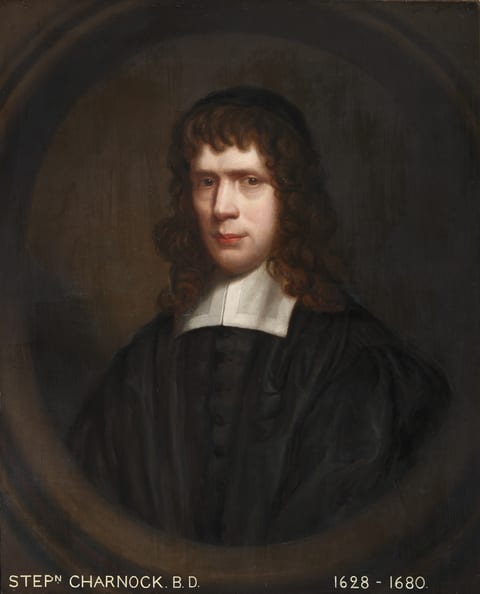
Stephen Charnock (1628 to 1680) was a Puritan minister who served in Dublin in the 1650s before returning to London, where he preached at Crosby Hall for the rest of his life. The discourses gathered as The Existence and Attributes of God were delivered there, transcribed from his own manuscripts by his friends Richard Adams and Edward Veal, and published in 1682, two years after his death.
“Updated Works has been an incredible blessing to my Christian life and ministry… remarkably faithful to the original authors while making these timeless treasures understandable for modern readers.”