The first five of Charnock's discourses on God: his existence, the practical atheism of ordinary conduct, God as a Spirit, the spiritual worship that follows from it, and the eternity of God.
One free account opens 250+ books and saves your place on every device. Google sign-in or an email link. No card.
You’re on the list — we’ll email you if this goes to print.
The Existence and Attributes of God · 4 volumes:Vol. 1Vol. 2Vol. 3Vol. 4
Included with your free account
This book, and 250+ more, free to read
A free account opens the whole library to read online, on your phone or at your desk. Open a book on one device and it is waiting at the same page on the next. The PDF and EPUB of every book are yours to keep, and audiobooks play in the same app.
250+ modernized editionsNot samples. The whole work, free.
Your place, on every devicePhone, tablet or desktop, same page.
131 audiobooksFrom $4.99 each, or all of them with a $50 gift.
The Existence and Attributes of God, Volume One gathers the first five of Stephen Charnock's discourses on God, preached in London and published in 1682. It argues that denying God is folly, that a practical atheism shapes the conduct of everyone, and that God, being a Spirit and eternal, must be worshiped in spirit.
How the argument unfolds
01
The text. Everything proceeds from Psalm 14:1, “The fool hath said in his heart, There is no God,” which Charnock reads clause by clause before drawing three doctrines from it.
02
The existence of God. The first discourse calls denial folly on four grounds: the agreement of every nation, the created world, the frame of body and conscience, and extraordinary judgments and deliverances.
03
Practical atheism. The second and longest discourse moves from what people say to what they do. “Atheism is the spirit behind every sin”: man would be his own rule and his own happiness in God's place.
04
God is a Spirit. From John 4:24 Charnock argues that God has no bodily parts, then draws seven inferences, among them that nothing bodily can defile him and that only our spirits can meet him.
05
Spiritual worship. The same verse yields a much longer discourse on worship: seven propositions on why it must be spiritual, an account of what that means, then uses of information, examination, comfort and exhortation.
06
The eternity of God. The volume ends on Psalm 90:2. “Eternity is a negative attribute,” denying God any beginning, end or change, and it belongs to God alone, which Charnock turns into an argument for the deity of Christ.
Key themes
Atheism as a failure of reason. Charnock answers denial with evidence he takes to be available to anyone: “There is a natural as well as a revealed knowledge of God.”
Sin as hidden atheism. Every sin, on his reading, makes a claim about God: “Every sin invades God’s rights and strips him of one perfection or another.”
Worship fitted to God's nature. Because God is a Spirit, worship must engage understanding and will; outward performance without them is, in Charnock's phrase, “brutish worship.”
Eternity as ground of comfort. Charnock does not leave eternity abstract. He uses it to argue that the covenant lasts as long as its maker, who swore it by his own life.
The Existence of God
(Ps 14:1) “The fool hath said in his heart, There is no God. They are corrupt, they have done abominable works, there is none that doeth good.”
This psalm describes the deplorable corruption by nature of every child of Adam, ever since that common root withered. Some limit it to the Gentiles, treating it as a wilderness of briers and thorns and denying that it concerns the Jews, God’s own garden, planted by his grace and watered by the dew of heaven. But the apostle, the best interpreter, corrects this by extending it by name to Jews as well as Gentiles: “We have before proved both Jews and Gentiles, that they are all under sin” (Rom 3:9). In verses 10-12 he cites part of this psalm and other passages of Scripture as further evidence, concluding that every person in the world, Jew or Gentile, is naturally in this state of corruption.
The psalmist first declares the corruption of the soul’s faculties, “The fool hath said in his heart,” and then the streams flowing from it, they are corrupt, and so on. The first is atheistic belief, the other unworthy practice. He traces all the evil, tyranny, lust, and persecution among men (as though the world existed only for their sake) back to their neglect of God, the atheism nursed in their hearts.
The fool is a scriptural term for a wicked man, also used by the heathen philosophers to mean a vicious person. The Hebrew word (nabal), from the root meaning the extinction of life in people, animals, and plants, is applied to a plant that has lost all the sap that made it lovely and useful. It is the word Isaiah uses when he says “the flower fadeth” (Isa 40:7; Isa 28:1). So a fool is one who has lost his wisdom and his right sense of God and divine things, which were given to man at creation. He is one dead in sin, not so much lacking rational faculties as lacking grace in the use of them. He does not lack reason; he abuses it. In Scripture the word carries this sense of foolishness; Muis points to Moses’ rebuke, “O foolish people and unwise” (Deut 32:6).
Said in his heart means he thinks, or doubts, or wishes. The thoughts of the heart function like words to God, even though they are not words to other people. The same phrase is used of the atheistic person elsewhere: “He hath said in his heart, God hath forgotten; he hath said in his heart, Thou wilt not require it” (Ps 10:11, 13). He does not, as Calvin puts it, form a reasoned argument that there is no God. He does not dare openly declare it, though he dares secretly think it. He cannot erase the thought of a Deity, though he tries to blot out those traces of God in his soul. He has doubts about whether there is a God; he wishes there were not; and sometimes he hopes there is none at all. He could not convince himself with arguments solid enough to bring before the world, but he worked on his own heart until he talked himself into it, smothering in himself those inward notices of a Deity.
This is so plainly against the light of nature that such a man may rightly be called a fool for it.
There is no God: the Chaldee renders this “there is no power of the Lord.” The name used here is not Jehovah, which signifies the essence of God as the first and supreme being, but Eloah, which signifies God’s providence, God as ruler and judge. The fool does not deny the existence of a supreme being who created the world, but rather God’s regard for his creatures, his governing of the world, and consequently his rewarding of the righteous or punishing of the wicked (Muis).
There is a threefold denial of God (Cocceius).
1. Denial as to existence: this is absolute atheism.
2. Denial as to providence, that is, of God’s oversight or care for the affairs of the world, confining him to the heavens.
3. Denial as to nature, regarding one or another of the perfections that belong to him.
Most take this text to concern the denial of God’s providence, without excluding either the absolute atheist (as Diagoras is said to have been) or the skeptical atheist who merely doubted whether there was a God (as Protagoras did), the sort who would not acknowledge him as, in the Egyptians’ phrase, a God present within the world (Eugubinus, on this passage). Those who deny the providence of God in effect deny his very being, for they strip him of the wisdom, goodness, tenderness, mercy, justice, and righteousness that make up the glory of the Deity. The same greedy desire to be free from restraint in their lusts, which drives men to deny Providence so as to stifle the seeds of fear that infect and embitter their sinful pleasures, could just as easily lead them to deny that there is any such being as God at all, so that with one blow their fears might be dashed to pieces by removing the very foundation.
It is like men who want the freedom to do their dark deeds: they would not merely dim the lights in the house, they would put them out entirely. What men say against Providence, because they want no restraint on their lusts, they might as easily say in their hearts against the existence of God, on the very same grounds. There is little difference between disowning one and disowning the other.
“They are corrupt, they have done abominable works, there is none that doeth good.” The psalmist speaks of the atheist in the singular, “the fool,” but of the corruption that flows out into life in the plural. He implies that although only a few may smother the sense of God and his providence in their hearts and flatly deny them, there is some secret atheism in everyone, which is the source of the evil practices in their lives. This is not always an outright denial of God’s existence, but a denial or doubting of some aspect of his nature. When men deny the God of purity, they inevitably grow polluted in soul and body and become brutish in their actions. When the sense of religion is shaken off, people rush eagerly into every kind of wickedness, until they become as loathsome to God as rotting corpses are to men. Such a principle does not produce merely one or two evil actions; it corrupts the whole course of a person’s life and makes it detestable.
Absolute atheism, in most people’s judgment, is not present in everyone, but practical atheism is present in everyone’s actions. The apostle in Romans applies the latter part of this description to all mankind, though not the former, as the word translated corrupt suggests.
No one is exempt from some trace of atheism because of the depravity of human nature, which the psalmist implies in saying, “there is none that doeth good.” Though there remain indelible convictions of God’s existence, so that people cannot flatly deny it, there are still atheistic impulses bubbling in the hearts of men, and these show themselves in their actions. As the apostle says, “They profess that they know God; but in works they deny him” (Titus 1:16). Evil works are dust stirred up by an atheistic breath. Someone who indulges habitually in some sordid lust can hardly be said to seriously and firmly believe that there is a God. Notice too that the apostle does not say that such people know God, but that they profess to know him: true knowledge and the mere profession of knowledge are different things. This also points to the unreasonableness of atheism in its consequences.
On Practical Atheism
(Ps 14:1) “The fool hath said in his heart, There is no God. They are corrupt, they have done abominable works, there is none that doeth good.”
Practical atheism is natural to man in his depraved state, and it is very common in the hearts and lives of men. “The fool hath said in his heart, There is no God.” He regards God as little as if God had no being at all. He said this in his heart, not with his tongue or even fully in his head. He never firmly thought it, nor openly asserted it. Shame barred him from the first, and natural reason from the second. Yet perhaps he sometimes doubted whether there was a God, wished there were not, and even hoped at times that there were none at all. He could not erase the notion of a Deity from his mind, but he neglected to fix any true sense of God in his heart, and made it his business to deface and blot out those marks of God in his soul that had survived, however ruined, from his original nature. Men may have atheistic hearts without atheistic minds.
Their reason may defend the notion of a Deity even while their hearts hold no affection for that Deity. Job’s children could curse God in their hearts though not with their lips (Job 1:5).
There is no God. Most understand this as a denial of God’s providence, as I explained in opening the previous doctrine. The fool denies some essential attribute of God, or the exercise of that attribute in the world. The Chaldee paraphrase reads it as “there is no power,” denying God’s authority in the world. Whoever denies an essential attribute of God may fairly be said to deny God’s very being. Whoever denies that angels or men have reason and will denies their very nature as angels or men, since understanding and will are essential to both. Neither angel nor man could exist without them. No nature can exist apart from the perfections essential to it, and God cannot rightly be conceived of apart from his. The apostle tells us that the Gentiles were “without God in the world” (Eph 2:12). In this sense, all unbelievers might be called atheists, since by rejecting the Mediator appointed by God, they reject the God who appointed him.
But this goes beyond my present scope, since natural atheism alone is my subject, though it follows from it. The title “atheist” belongs not only to those who deny God’s existence, or who despise all sense of a Deity and would tear reverence for God out of their souls.
It also belongs to those who fail to give God the worship due to him, who worship many gods, or who worship one God in a false and superstitious manner, lacking right conceptions of him and failing to adore him according to the excellence of his nature. All who are indifferent to any particular religion fall under this description. Though they acknowledge a God in general, they are willing to accept whatever god is coined by the powers under whom they live. The Gentiles were without God in the world, meaning without the true notion of God, not without some god of their own making. This general, practical atheism is natural to men.
1. Not natural by created nature, but by corrupted nature. It is contrary to nature as nature came from the hand of God, but it is universal in nature as nature has been corrupted and infected by the serpent’s breath. Failing to consider God, or misrepresenting his nature, comes as naturally to corrupt humanity as denying God’s existence outright is contrary to common reason. God is not denied by nature, but by our vices, as Augustine observes in The City of God.
2. It is universally natural. “The wicked are estranged from the womb” (Ps 58:3). “They go astray as soon as they be born: their poison is like the poison of a serpent.” The wicked, and who by birth has a better claim to that name, go astray from the dictates of God and the rule of their creation as soon as they are born. Their poison is like the poison of a serpent, which is essentially the same across the whole species. It is present seminally and fundamentally in all men, though a divine hand may restrain it more strongly in some than in others. This principle runs through the whole stream of human nature. The natural bent of every heart is away from God. When we attempt anything pleasing to God, it is like climbing a hill against nature. When we do anything displeasing to him, it flows like a current running down its natural channel.
When we attempt something that acknowledges God’s holiness, we must fight our way through, weapons in hand, against a crowd of natural passions and the opposition of our own sensual appetites. How easily we sink into whatever sets us at a greater distance from God! By nature there is no active, powerful, effective sense of God at all. “The heart of the sons of men is fully set in them to do evil” (Eccl 8:11). The heart, in the singular, as if there were but one common heart beating in all mankind, bent as with a single pulse, by joint consent and force, toward wickedness, with no sense of God’s authority in the earth, as though one heart moved every man in the world. The great apostle cites this text to confirm the charge he brings against all mankind (Rom 3:9–12). In his reading, the Jews, who acknowledged one God and were marked out with special privileges, fall under this description just as much as the Gentiles who worshiped many gods.
The apostle leaves out the first part of the text, “The fool hath said in his heart,” but takes up the latter part and the verses that follow. He charges all, because every one of them was under sin: “There is none that seeks God.” And in verse 19 he adds that what the law says, it speaks to those under the law, so that no one should imagine he meant only the Gentiles and exempted the Jews from this description. The leprosy of atheism had infected the whole of human nature. No one, Jew or Gentile, naturally sought God, and so all were empty of any spark of the practical sense of the Deity. The outward effects of this atheism are not equal in everyone, but at the root, in its fundamentals, there is not a hair’s difference between the best and worst men who ever walked the earth. The difference lies either in common grace, which bounds and suppresses it, or in special grace, which kills and crucifies it.
In every person it is either reigning or deposed, triumphant or under attack. No one is born with any more sensible acknowledgment of God than he is born with clear knowledge of the stars in the heavens or the plants on the earth. None seek after God. As Cocceius reads it, none seek God as their rule, their end, or their happiness, though this is a debt every creature naturally owes to God. The natural man desires no communion with God. He places his happiness in something beneath God, prefers everything to God, and glorifies everything above him. He takes no delight in knowing God, and pays no attention to the paths that lead to him. He loves his own filth better than God’s holiness. His actions are stained and colored by self-interest, and empty of the respect he owes to God.
Man’s noblest faculty, the understanding, in which the remaining traces of God’s image are still visible, produces its highest operation in wisdom. Yet even this, in the judgment of the Spirit of God, is devilish when it is merely earthly and sensual (Jas 3:15). By nature, even the wisest man’s wisdom is no better. A legion of impure spirits possesses it, devilish as the devil himself, who, though he believes there is a God, acts as if there were none, and wishes he had no superior to prescribe him a law or inflict on him the punishment his crimes deserve. This is why man’s natural poison is compared to the poison of a serpent (Ps 58:4), alluding to that serpentine temptation which first infected mankind and reshaped human nature into the likeness of the devil’s own.
So even though the harmony of the world presents men not only with evidence of God’s existence but also flashes of insight into his power and eternity, human thoughts and reasonings are so corrupt that they may rightly be called diabolical, as contrary to God’s perfection and to the original law of our nature as the devil’s own actions are. Every natural man is a child of the devil, moved by the diabolical spirit, and so must share that nature, infused with the same venom possessed by the spirit that moves him, though various circumstances may restrain its full display (Eph 2:2). To conclude: though no man, or very few, ever arrive at a plain, positive conclusion in their hearts that there is no God, yet no man naturally has in his heart any true reverence for God. Having stated this in general, before I turn to particular proof, let me set down some propositions.
Questions
What is The Existence and Attributes of God about?+
The Existence and Attributes of God is a series of discourses by the Puritan minister Stephen Charnock on what God is and what follows from it. Volume One carries the first five: God's existence, practical atheism, God as a Spirit, spiritual worship, and the eternity of God.
What does Charnock mean by practical atheism?+
Practical atheism, in Charnock's usage, is living as though God did not exist while still granting that he does. He states it as “Men may have atheistic hearts without atheistic minds,” and holds that a course of action is a better index of belief than anything a person says.
Does Volume One stand on its own?+
Volume One stands on its own, since each discourse is a complete treatment of one subject built on a single text of Scripture. The second volume continues with the immutability, omnipresence, knowledge and wisdom of God.
Did Charnock publish the work himself?+
Charnock did not publish the work himself. He died in 1680, and the discourses were transcribed from his own manuscripts and issued in 1682 by his friends Richard Adams and Edward Veal.
How does Charnock argue?+
Charnock argues in the manner of the schools: he opens a verse clause by clause, lays down numbered propositions, answers objections as they come up, and closes each discourse with uses of information, examination, comfort and exhortation.
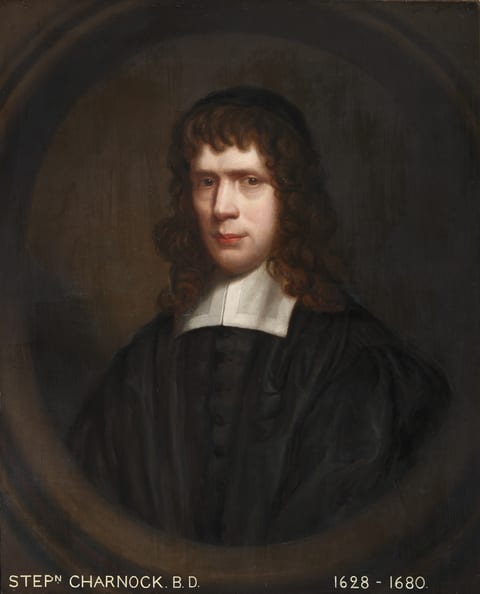
Stephen Charnock (1628 to 1680) was a Puritan minister who served in Dublin as chaplain to Henry Cromwell before returning to England, and spent his last years preaching to a London congregation at Crosby Hall. The discourses on the existence and attributes of God were delivered there and published posthumously in 1682, transcribed from his own manuscripts by his friends Richard Adams and Edward Veal.
“Updated Works has been an incredible blessing to my Christian life and ministry… remarkably faithful to the original authors while making these timeless treasures understandable for modern readers.”