John Jewel
Bishop of Salisbury and author of the Apology of the Church of England (1562), the first full public defense of the Elizabethan church, and of the Challenge Sermon appealing to the first six hundred years of the church.
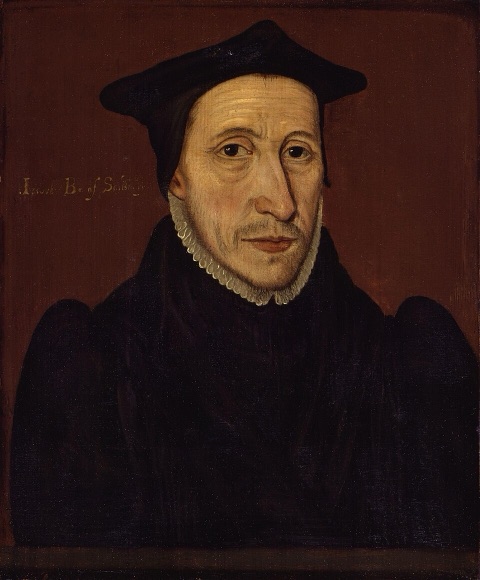
1522–1571
Biography
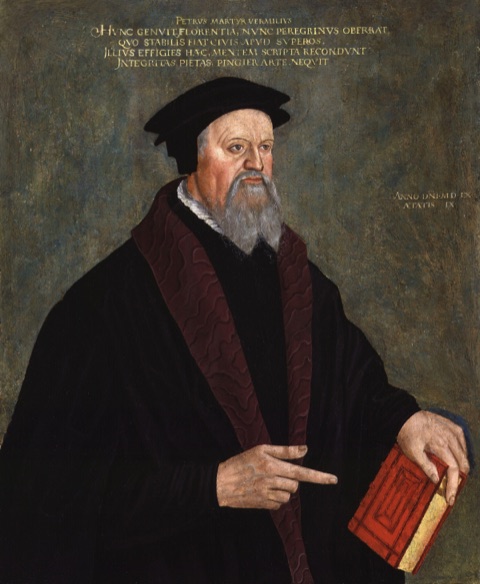
John Jewel was born in 1522 AD in north Devon, and went up to Oxford as a boy, first to Merton College and then to Corpus Christi College, where he became a fellow and a respected teacher of rhetoric. His Oxford years coincided with the arrival of the Italian reformer Peter Martyr Vermigli as Regius Professor of Divinity under Edward VI, and Jewel became one of Martyr's closest disciples, a friendship that lasted for the rest of his life.
The accession of Mary I in 1553 AD ended his career at Oxford. In 1554 he served as a notary at the disputations in which Thomas Cranmer and Nicholas Ridley were examined before their condemnation. Under heavy pressure he then signed a set of Catholic articles, a lapse he afterward confessed publicly with grief, and fled abroad. He lived among the English Protestant exiles at Frankfurt and then joined Peter Martyr at Strasbourg and Zurich, where he spent the rest of Mary's reign studying the fathers and the councils.
When Elizabeth I came to the throne, Jewel returned to England in 1559 AD and was quickly drawn into the work of settling the reformed church. That November he preached his Challenge Sermon at Paul's Cross in London, offering to yield if his opponents could prove any one of their distinctive doctrines, such as private masses or communion in one kind, from Scripture, the ancient fathers or the general councils of the first six hundred years. In January 1560 he was consecrated Bishop of Salisbury, an office he held until his death.
In 1562 AD he published in Latin the Apologia Ecclesiae Anglicanae, a defense of the Church of England written in the name of the whole church, timed to answer the reconvening of the Council of Trent. Lady Anne Bacon's English translation followed in 1564, approved by Archbishop Matthew Parker. The Challenge Sermon and the Apology drew a long reply from Thomas Harding, a former Oxford colleague who had become a Catholic exile at Louvain, and Jewel answered him at length in his Reply (1565) and in the massive Defence of the Apology (1567).
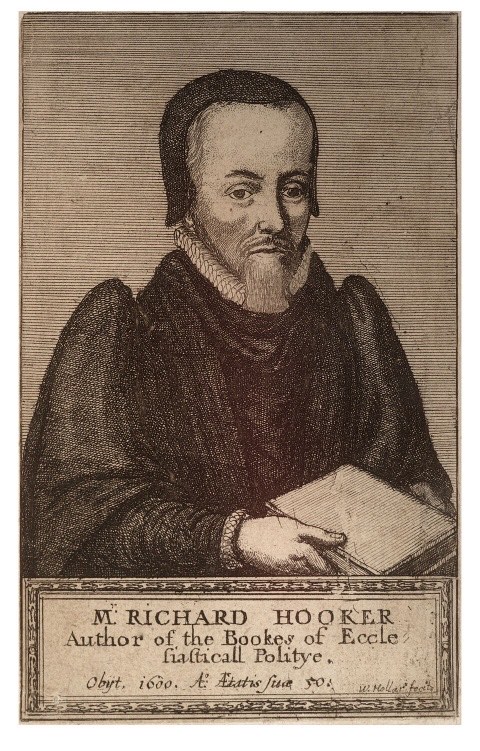
As bishop, Jewel preached regularly through his diocese, rebuilt the cathedral library at Salisbury, and took an interest in promising poor scholars. One of them was the young Richard Hooker, a fellow Devon man, whom Jewel sent to Corpus Christi College at his own charge. Worn out by study, travel and controversy, Jewel died at Monkton Farleigh in Wiltshire in September 1571 AD and was buried in Salisbury Cathedral.
Life & Career
Why Jewel Matters
Jewel gave the Elizabethan Church of England its first authoritative public voice. The Apology speaks not as one theologian but as the church itself, setting out a confession of faith and answering the charges that the English were heretics, schismatics and rebels. Its argument rests on two foundations. The first is Scripture, which Jewel calls the sure and infallible rule by which the church itself must be tested. The second is the primitive church: the apostles, the fathers and the general councils of the early centuries, whose teaching and practice he set against medieval and Tridentine Rome point by point.
That appeal to antiquity became the signature of English Protestant apologetic. In the Challenge Sermon and the Apology, Jewel turned the charge of novelty back on his opponents, arguing that private masses, communion in one kind, prayer in an unknown tongue, purgatory and the universal jurisdiction of the bishop of Rome could not be found in the church of the first six centuries. The reformed church, on this account, had not left the catholic church but returned to it. His doctrine of the Lord's Supper, that believers truly feed on Christ by faith while his body remains in heaven, placed the English church alongside the Reformed churches of Zurich and Geneva, where he had spent his exile.
Jewel also gave classic form to the English case for reform by national authority. Against a council closed to Protestants and bound to the pope, he defended the right of a provincial synod to reform its own churches, and the duty of the Christian prince, charged with both tables of the law, to restore true worship as David, Hezekiah and Josiah had done. Through his controversy with Thomas Harding, through Richard Hooker, whom he sponsored at Oxford, and through the long use of his works as a standard defense of the English church, Jewel's arguments shaped Anglican self-understanding for generations.