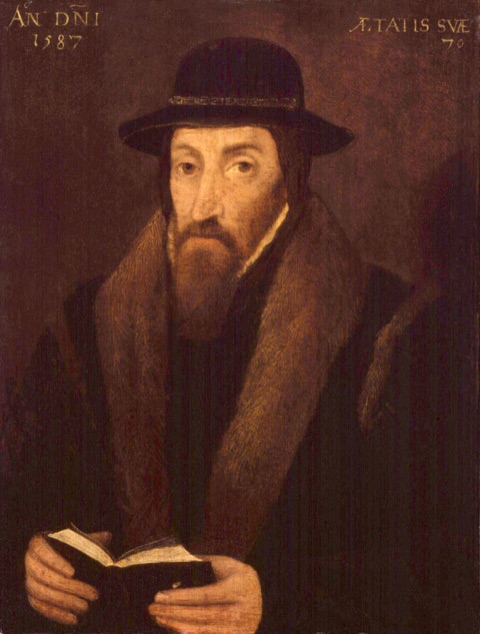
Alexander Nowell
Dean of St Paul's Cathedral in London for forty-two years and author of the catechisms, commissioned by Convocation, that taught Reformed doctrine across Elizabethan England.
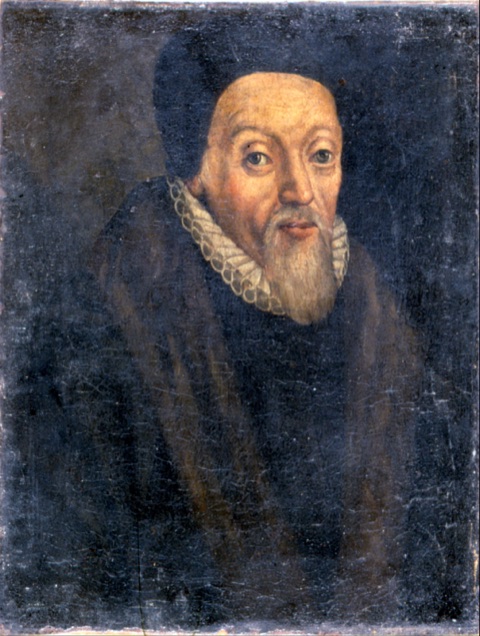
1507–1602
Biography
Alexander Nowell (around 1507 to 1602) was an English clergyman who served as Dean of St Paul's Cathedral in London for forty-two years and wrote the catechisms that instructed Elizabethan England in Reformed doctrine. He was born at Read Hall in the parish of Whalley, Lancashire, and educated at Brasenose College, Oxford, where he was elected a fellow. Around 1543 he became head master of Westminster School, a post he held for a decade.
In 1553 Nowell was elected to Parliament for the Cornish borough of Looe, but the House of Commons expelled him on the grounds that, as a prebendary of Westminster, he already held a seat in Convocation and could not sit in both assemblies at once. The ruling was cited long afterward in disputes over whether clergy could serve in the Commons. That same year, with the accession of the Catholic Mary I, Nowell left England and joined the community of Protestant exiles on the Continent, living at Frankfurt and Strasbourg until Mary's death.
He returned to England after Elizabeth I came to the throne and in 1560 was appointed Dean of St Paul's, an office he retained until he died. From the cathedral he became a prominent preacher and a working member of the Elizabethan church establishment. In 1563 he served as prolocutor of the Lower House of Convocation, the body that oversaw the doctrinal and disciplinary shape of the new settlement.
Nowell's main work was catechetical. Convocation charged him with preparing an authoritative statement of Christian teaching for the English church, and he produced three catechisms of differing lengths — commonly called the large, middle, and small. The largest appeared in Latin as the Catechismus in 1570 and was translated into English the same year by Thomas Norton, the co-author of the tragedy Gorboduc. Cast in the traditional question-and-answer form, the catechisms took a learner through the Apostles' Creed, the Ten Commandments, the Lord's Prayer, and the sacraments, drawing on the theology of John Calvin and the Continental Reformed churches. The shorter catechism was widely printed and used to prepare the young for confirmation.
In his long final decades Nowell remained a benefactor of the schools and colleges that had formed him, endowing scholarships at his old Oxford college, Brasenose. A keen angler, he is shown in a Brasenose portrait with his fishing tackle beside him. He died on 13 February 1602 and was buried in St Paul's Cathedral, one of the last survivors of the first generation of English reformers.
Life & Career
Why Nowell Matters
Nowell's catechisms were among the instruments through which the Elizabethan Church of England defined and transmitted its beliefs. Alongside the Book of Common Prayer and the Thirty-Nine Articles, they gave the reformed English church a common body of teaching, and because they carried the approval of Convocation they functioned as a semi-official standard rather than one man's private manual. Their question-and-answer structure made them practical tools in grammar schools and parishes, where memorization was the ordinary method of instruction.
Their theology placed the English church within the Reformed tradition of the mid-sixteenth century. On the central disputed questions — the authority of Scripture, justification, and the meaning of the Lord's Supper — Nowell followed the Continental reformers and especially Calvin, whose own Geneva catechism was one of his models. In this his work belongs beside the Heidelberg Catechism of 1563 as part of a wider European effort to fix Protestant teaching in a form that ordinary Christians could learn and repeat.
As Dean of St Paul's for more than forty years, Nowell was also a figure of continuity. He had known the church of Cranmer and the Marian exile firsthand, and he lived to see the settlement of Elizabeth's reign mature into an established institution, providing a personal link between the first English reformers and the church of the early seventeenth century. His expulsion from the Commons in 1553, though a matter of parliamentary procedure rather than doctrine, left a precedent that outlasted the immediate quarrel and kept his name in later constitutional argument over the place of the clergy in Parliament.