Peter Martyr Vermigli
An Italian-born Reformed theologian who taught at Strasbourg, Oxford, and Zurich and helped shape the English Reformation under Edward VI. He is remembered above all for his Reformed account of the Lord's Supper and for the theological writings later gathered into his Loci Communes.
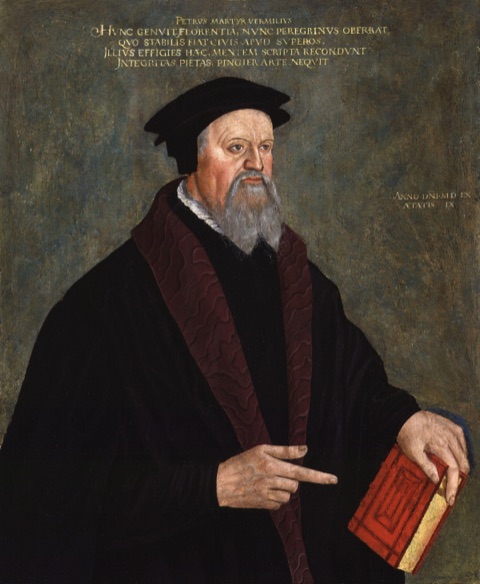
1499–1562
Biography
Peter Martyr Vermigli (1499 to 1562) was an Italian-born Reformed theologian and biblical scholar who, after leaving his monastic order, taught at Strasbourg, Oxford, and Zurich and became one of the leading Protestant scholars of the sixteenth century. Born in Florence and christened Pietro Martire after the medieval preacher Peter of Verona, he entered the Augustinian Congregation of the Lateran as a young man and studied at the University of Padua, where he absorbed the scholastic learning and the biblical languages that marked all his later work.
Within his order he rose quickly, holding office as abbot at Spoleto and as prior of houses in Naples and Lucca. At Naples in the late 1530s he joined the circle around the Spanish reformer Juan de Valdés and read the writings of Martin Bucer and Huldrych Zwingli, works that turned him toward Protestant convictions on justification and the sacraments. As prior of San Frediano in Lucca he introduced reforms that drew the attention of church authorities, and when the Roman Inquisition was reorganized in 1542 he left Italy rather than face examination.
His flight took him through Zurich and Basel to Strasbourg, where Bucer secured him a post teaching the Old Testament. In 1547 Thomas Cranmer invited him to England, and he was made Regius Professor of Divinity at Oxford. There he lectured on the Pauline epistles and, in 1549, took part in a public disputation on the Eucharist that set out his rejection of transubstantiation. He was consulted on the doctrinal settlement of Edward VI's reign, giving the English Reformation one of its most learned continental voices.
The accession of the Catholic Mary I in 1553 ended his English career. Permitted to leave the country, he returned to Strasbourg and resumed teaching, and in 1556 he moved to Zurich to succeed Konrad Pellikan as professor of Hebrew. From Zurich he corresponded widely with reformers across Europe and defended the Reformed position in the eucharistic controversies that divided Protestants from one another as much as from Rome. In 1561 he traveled to France as a Reformed representative at the Colloquy of Poissy, an attempt to reconcile Catholics and Protestants that ended without agreement.
Vermigli died in Zurich in 1562. His writings on doctrine were later arranged under theological headings and published as the Loci Communes, a compendium that carried his teaching into Reformed churches in Switzerland, Germany, England, and beyond. His biblical commentaries and his treatise on the Eucharist circulated alongside it, placing him among the theologians who defined Reformed teaching in the generation after Zwingli and alongside John Calvin.
Life & Career
Why Vermigli Matters
Vermigli mattered to the Reformation as a scholar who brought the training of an Italian Augustinian into the service of Protestant theology. His Padua training in Aristotle, the church fathers, and the biblical languages shaped his lectures and commentaries on Scripture, which became standard references for later Reformed divines.
His most consequential work lay in the doctrine of the Lord's Supper. Against the Catholic teaching of transubstantiation and against Lutheran accounts of a bodily presence, he argued for a real but spiritual feeding on Christ received by faith. The Oxford disputation of 1549 and his subsequent treatise on the Eucharist set out this position in detail, and his agreement with the Zurich reformers helped consolidate the Reformed view that prevailed in the churches of Switzerland and among the English Protestants.
In England his influence was direct. As Regius Professor of Divinity at Oxford and a collaborator of Cranmer, he took part in shaping the Edwardian formularies, including the articles of religion that preceded the later Thirty-Nine Articles. Through these documents his eucharistic theology entered the foundations of the reformed Church of England.
The posthumous Loci Communes, compiled from his writings after his death, extended his reach further. Organized as a system of theological topics, it was reprinted repeatedly and read across Protestant Europe, making Vermigli one of the sources by which Reformed teaching was transmitted to students who never heard him lecture.