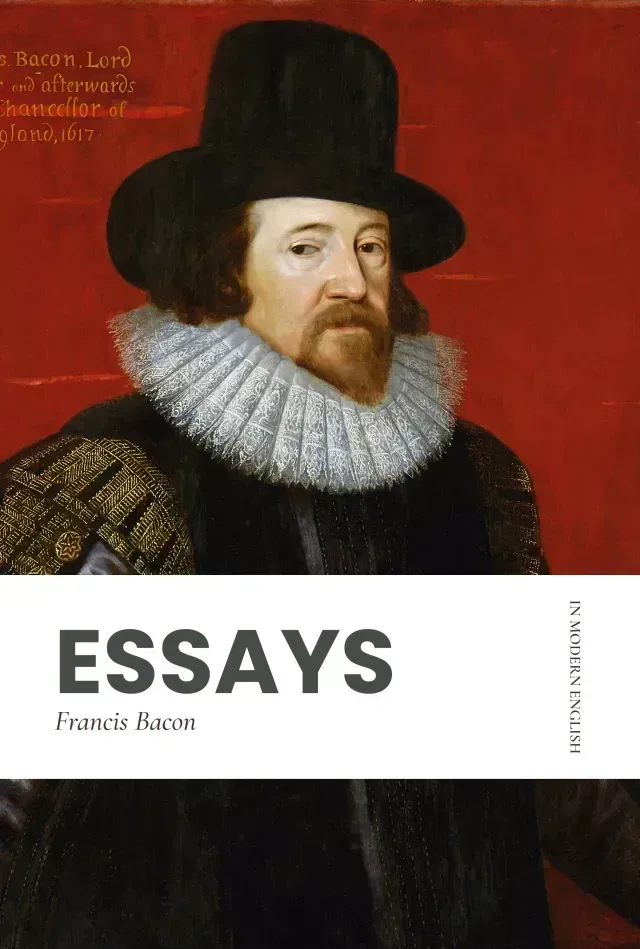
Francis Bacon
English philosopher and statesman who argued that knowledge should be built from systematic observation and experiment, and whose Essays remain among the most quoted works of English prose.
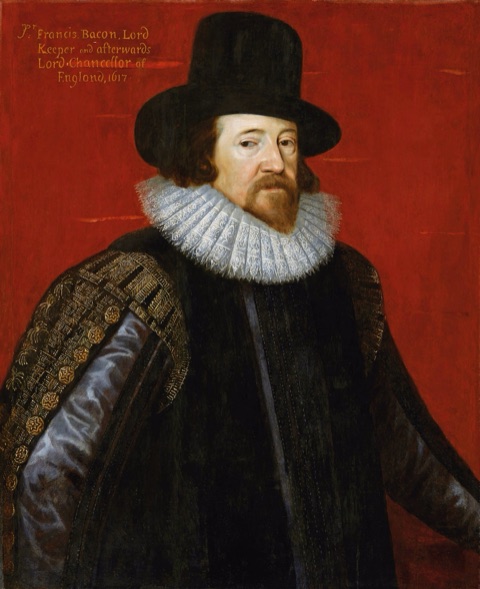
1561–1626
Biography
Francis Bacon (1561 to 1626) was an English philosopher, lawyer, and statesman who rose to become Lord Chancellor of England while advancing a program to rebuild human knowledge on the foundation of observation and experiment. He was born on January 22, 1561, at York House on the Strand in London, the youngest son of Sir Nicholas Bacon, Lord Keeper of the Great Seal to Elizabeth I. His mother, Anne Cooke Bacon, was an accomplished scholar and translator, and his aunt was married to William Cecil, Lord Burghley, the queen's chief minister, which placed the young Bacon close to the center of Elizabethan power.
At the age of twelve he entered Trinity College, Cambridge, where he formed an early distaste for the Aristotelian curriculum that dominated the schools. He was admitted to Gray's Inn to study law and spent time in France in the household of the English ambassador before his father's death in 1579 left him with limited means and a need to earn his living. He was called to the bar and entered the House of Commons in 1581, beginning a parliamentary career that would run for decades.
Bacon's advancement was slow under Elizabeth I but rapid under James I, who came to the English throne in 1603 and knighted him that same year. He was appointed Solicitor General in 1607, Attorney General in 1613, Lord Keeper in 1617, and Lord Chancellor in 1618, the year he was created Baron Verulam. In January 1621 he was raised further to Viscount St Alban. His prosecutorial work included the trial of the Earl of Essex, his former patron.
Alongside his public offices, Bacon pursued the intellectual project that defined his reputation. In 1605 he published The Advancement of Learning, a survey of the state of human knowledge and its deficiencies. In 1620 came Novum Organum, the "new instrument" meant to replace Aristotle's Organon, in which he set out a method of induction built from careful, recorded experience rather than inherited authority. Both works belonged to a larger unfinished plan he called the Instauratio Magna, or Great Instauration, a projected reconstruction of the sciences.
His most widely read book was the Essays, short reflections on subjects such as truth, death, ambition, gardens, studies, and negotiation. First published in 1597 as a slim volume of ten pieces, it grew through editions of 1612 and 1625 into fifty-eight essays written in a compressed, aphoristic style. He also wrote the History of the Reign of King Henry VII (1622) and left the utopian fable New Atlantis, published after his death, which imagined a research institution called Salomon's House.
Bacon's political career ended abruptly in 1621, when a parliamentary inquiry charged him with accepting gifts from litigants who had cases before his court. He confessed, was fined forty thousand pounds, briefly held in the Tower of London, and barred from office. Freed from public duties, he devoted his last years to writing. He died on April 9, 1626, at Highgate, north of London, after a chill contracted while, by an early account, he stuffed a fowl with snow to observe how cold preserved flesh.
Life & Career
Why Bacon Matters
Bacon reframed the purpose and the method of knowledge. Where the universities of his day taught students to reason deductively from the authority of Aristotle and other ancient writers, Bacon insisted that reliable understanding had to be assembled from the ground up, through the patient collection of observed facts and controlled experiments. His method of induction, laid out in Novum Organum, called for gathering instances, arranging them in tables, and gradually rising to general conclusions rather than starting from received first principles. This inversion is why he is often called a founder of the modern scientific method.
He was equally concerned with what stops people from seeing clearly. In Novum Organum he described four "idols" that distort human judgment: the Idols of the Tribe, rooted in human nature itself; the Idols of the Cave, arising from individual temperament and upbringing; the Idols of the Marketplace, produced by the confusions of language; and the Idols of the Theatre, inherited from false systems of philosophy. This analysis of the mind's built-in errors gave later thinkers a vocabulary for the problem of bias in inquiry.
Bacon's vision of organized, collaborative research outlived him directly. The New Atlantis, with its Salomon's House dedicated to experiment and invention, was cited by the founders of the Royal Society of London in 1660 as an inspiration for their program of collective empirical work. Through the Society and its European counterparts, Bacon's argument that knowledge should produce practical benefit — "for the relief of man's estate" — helped shape the institutions of the Scientific Revolution.
His literary influence runs on a separate track. The Essays established a durable form in English prose, and their terse, quotable sentences have kept them in continuous print for more than four centuries. The debate over whether such polished writing could have come from a working lawyer even fed the fringe theory, never accepted by scholars, that Bacon authored the plays of Shakespeare.