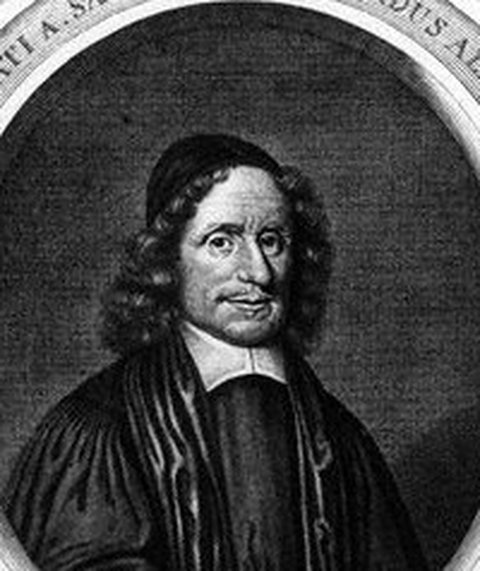
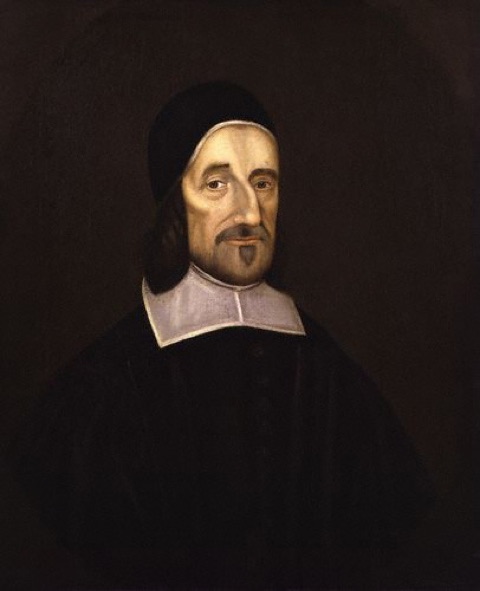
Jeremy Taylor
Church of England bishop and prose stylist, author of the devotional companions Holy Living (1650) and Holy Dying (1651), of The Liberty of Prophesying, and of Ductor Dubitantium (1660).
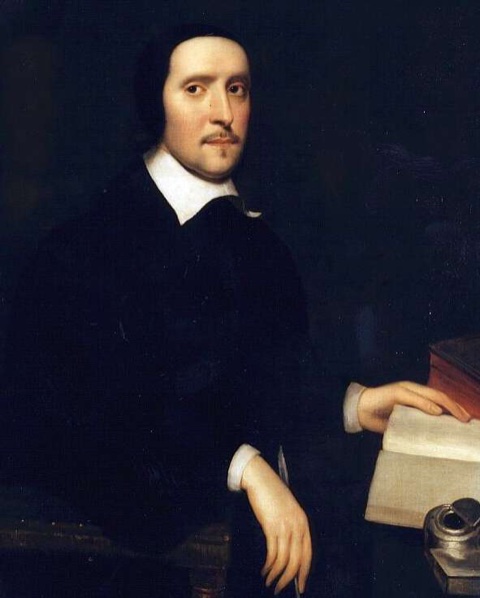
1613–1667
Biography
Jeremy Taylor was baptized at Holy Trinity Church, Cambridge, on 15 August 1613 AD, the son of Nathaniel Taylor, a barber, who taught him grammar and mathematics himself. He attended the Perse School and was admitted to Gonville and Caius College in 1626 as a sizar, a student who paid his way with lesser duties. He became a fellow of the college and took holy orders before the usual age.
A short spell preaching in place of a friend at St Paul's in London brought him to the notice of William Laud, Archbishop of Canterbury. Laud sent him to Oxford, secured him a fellowship at All Souls College in 1635 over the objections of its warden, and made him his chaplain. Taylor was soon also a chaplain in ordinary to Charles I. In 1638 he became rector of Uppingham in Rutland, where he settled to parish work, and the next year he married Phoebe Langsdale. His friendship with the Franciscan Christopher Davenport, together with his tie to Laud, raised suspicions that he leaned toward Rome, and his Gunpowder Plot sermon at Oxford in 1638 was in part an answer to them.
The Civil War ended that life. Taylor published a defense of bishops, Of the Sacred Order and Offices of Episcopacy, in 1642, the year Oxford made him a doctor of divinity by royal mandate. His living at Uppingham was sequestered in 1644, and in February 1645 he was taken prisoner with royalist forces at Cardigan, though he was not held for long. He then settled in Carmarthenshire, helped run a school at Newton Hall, and became chaplain to Richard Vaughan, Earl of Carbery, at his house of Golden Grove.
The years at Golden Grove produced his best-known work, written while the Church of England's bishops and Prayer Book were proscribed. They include A Discourse of the Liberty of Prophesying, The Great Exemplar (1649), a life of Christ, The Rule and Exercises of Holy Living (1650), and The Rule and Exercises of Holy Dying (1651). Holy Dying came after the death of Frances, Countess of Carbery, in 1650, and Taylor's own wife died early in 1651. Two collections of sermons preached at Golden Grove followed, along with The Golden Grove, a manual of prayers. He married again, to Joanna Bridges, who held an estate at Mandinam in Carmarthenshire. He was held prisoner more than once under the Protectorate, including at Chepstow from May to October 1655, and in the winter of 1656 to 1657 two of his sons died of smallpox.
In 1658, at the invitation of Edward, Viscount Conway, he moved to Ireland to take a lectureship at Lisburn and lived at Portmore, near Lough Neagh. There he finished Ductor Dubitantium, or the Rule of Conscience, his large treatise of Christian casuistry, published in 1660 and dedicated to Charles II. At the Restoration he was named Bishop of Down and Connor and was consecrated in Dublin in January 1661. He soon received charge of the neighboring diocese of Dromore, and he also served as vice-chancellor of the University of Dublin, where he reformed the rules for admission and conduct.
His episcopate was hard. The north of Ireland was largely Scottish Presbyterian, and its ministers would not accept his authority; at his first visitation thirty-six churches were declared vacant because their incumbents lacked episcopal ordination. He asked more than once to be moved to another see, without success. At the request of the Irish bishops he wrote A Dissuasive from Popery, published in 1664. On 24 July 1667 he visited a fever patient at Lisburn and caught the fever himself. He died at Lisburn on 13 August 1667 AD and was buried at Dromore.
Life & Career
Why Taylor Matters
Taylor is the leading devotional writer of the Church of England in its years of defeat. With its bishops gone and its liturgy forbidden, he wrote for lay people who no longer had a parish priest to guide them. Holy Living sets out the Christian life under three headings, sobriety, justice and religion, and prepares for them with three general instruments of holy living: the care of our time, purity of intention, and the practice of the presence of God. Holy Dying then treats the shortness of life, daily preparation for death, the temptations of sickness, and the ministry to the dying. Their rules, examinations and prayers make holiness a matter of daily habit, and for Taylor the test of faith is a changed life.
He was a moral theologian as much as a devotional one. Ductor Dubitantium was his attempt to give the Church of England a full guide to cases of conscience. His insistence on repentance and obedience led him in Unum Necessarium (1655) to a treatment of original sin that went against the Reformed doctrine and drew objections, and he defended it in Deus Justificatus (1656).
The Liberty of Prophesying is his chief contribution to political thought. Taylor argued that reason must weigh the evidence in matters of Christian belief, that on disputed questions no one can be certain his own judgment is better than another's, and that a person living a good life should not be punished as a heretic for an honest error. It was an important early English plea for toleration among Christians, and it left the laws of the church's governors in place.
His influence ran well beyond his own party. John Wesley recorded that reading Holy Living and Holy Dying in 1725 shaped his resolve to give his whole life to God, and he later printed extracts from Taylor in his Christian Library. Samuel Taylor Coleridge studied him closely as a master of English style, and his richly imaged prose earned him the name the Shakespeare of Divines. The Church of England and other Anglican churches remember him on 13 August.