George Herbert
The poet of The Temple (1633) and rector of Bemerton, whose Country Parson (written 1632, published 1652) became the classic English portrait of the faithful parish pastor.
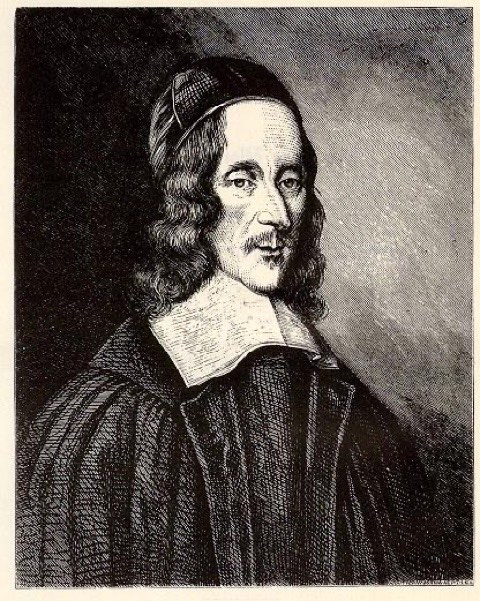
1593–1633
Biography
George Herbert was born in 1593 AD at Montgomery in Wales, into one of the great noble families of the Welsh border. His father died when he was a small child, and he was raised by his mother, Magdalen Herbert, a woman of strong piety and learning who was a friend of the poet and preacher John Donne. His eldest brother was Edward Herbert, later Lord Herbert of Cherbury, the philosopher and diplomat. After his mother remarried Sir John Danvers, the family's circle moved between London, Oxford and the court.
Herbert was educated at Westminster School and entered Trinity College, Cambridge, in 1609. He became a fellow of the college and in 1620 was chosen Public Orator of the University, the official who spoke and wrote in Latin on its behalf before the king and great visitors. The post was a recognized road to advancement at court, and for some years Herbert seemed bound for public life. He won the notice of James I and sat in Parliament for Montgomery in 1624. The deaths of the king and of several powerful patrons in the years that followed closed that road, and Herbert turned toward the ministry of the Church of England.
He was ordained deacon and in 1626 was made a prebendary of Leighton Bromswold in Huntingdonshire, where he set about rebuilding the ruined church. Nearby lived Nicholas Ferrar, whose household at Little Gidding kept a disciplined round of prayer, and the two men became close friends. In 1629 Herbert married Jane Danvers, a kinswoman of his stepfather, and in 1630 he became rector of Fugglestone with Bemerton, a small country parish near Salisbury, and was ordained priest. There he spent the rest of his short life, preaching, catechizing, repairing the church and parsonage, and writing. Izaak Walton's Life of Herbert, published in 1670, gathered the stories of his ministry that made him a model of the English country pastor.
Herbert died of consumption at Bemerton on 1 March 1633, a month before his fortieth birthday, and was buried in his own church. On his deathbed he sent the manuscript of his English poems to Ferrar, asking him to publish them if they might help any dejected poor soul, or else to burn them. Ferrar published them that year at Cambridge as The Temple, and the book went through edition after edition in the seventeenth century. Its poems, among them The Altar, Easter Wings, The Collar, The Pulley and Love, are among the best-loved religious verse in English, and several are sung as hymns, including Teach me, my God and King and Let all the world in every corner sing. His prose portrait of a pastor, A Priest to the Temple, or The Country Parson, which he finished in 1632, was published in 1652 among his Remains.
Life & Career
Why Herbert Matters
Herbert belongs to the early seventeenth-century Church of England at its most devout: loyal to the Book of Common Prayer, the Church Catechism, the canons and the bishops, and at the same time grounded in Scripture and in the Protestant doctrine of grace. The Country Parson shows that settlement in practice. Herbert's parson reads the service with reverence, catechizes from the Prayer Book, signs the child with the cross at Baptism and has the people kneel at Communion, and he keeps his church clean and decent in order to hold what Herbert calls the middle way between superstition and slovenliness. Yet the center of his ministry is the Word, read with prayer and a holy life, preached for holiness rather than wit, and pressed home in every household of the parish.
The book is above all a work of pastoral theology. Herbert defines the minister as Christ's deputy, sent to bring people back into obedience to God, and draws from that definition a whole way of life: the parson's study and prayer, his household as a model for the parish, his charity, his visiting, his catechizing by questions, his judgment in cases of conscience, his comfort for the tempted and the despairing. Its insistence that the pastor's own life is his first sermon, and that nothing is little in God's service, has given it a place beside Richard Baxter's Reformed Pastor as one of the two classic English accounts of the ministry.
Herbert's poems carried the same devotion further. The Temple traces the soul's dealings with God, its rebellions, afflictions and restorations, with a plainness and honesty that won readers across the divisions of the century. Puritans such as Richard Baxter valued his verse, and the poet Henry Vaughan credited Herbert for his own turn to God. The Church of England remembers Herbert in its calendar on 27 February.