Volume 1 of 2 · Full text in modern English · Free PDF/EPUB
On Natural Theology: Volume 1 in Modern English
Want the file? The PDF/EPUB is free with an account.
This volume
- Vol. 1 · Preliminary Views, Matter and Mind
- Vol. 2 · Adaptation and the Limits of Nature
What is in On Natural Theology, Volume 1?
On Natural Theology is Thomas Chalmers's treatise on what the light of nature can and cannot show about God, completed at Edinburgh in December 1835. He clears away weak metaphysical proofs, answers Hume on experiential ground, and rests the case for God on the arrangements of matter and the moral constitution of the mind. This first of two volumes contains his Preface; all of Book 1, Preliminary Views, in five chapters on the ethics and objects of theology, the duty laid on us by the bare idea of God, Clarke's a priori argument, Hume's objection to the design argument, and the hypothesis of an eternal world; all of Book 2, in three chapters on the laws and dispositions of matter, geology, and the strength of the evidence in visible nature; and the first four chapters of Book 3, on the mind, conscience, the pleasures of virtue, and habit.
- 01
The two orders of theology. Teaching theology downward from God's decrees or upward from the conscience, and the plan of all five books.
Jump to it ↓ - 02
Preliminary views. Book 1: the ethics and objects of theology, the duty laid on us by the idea of God, Clarke's a priori argument, Hume's objection, and an eternal world.
Jump to it ↓ - 03
Design in the arrangements of matter. Book 2: the laws of matter set against its dispositions, the geological proof that living species began, and the strength of the evidence in visible nature.
Jump to it ↓ - 04
Conscience and the mind. Book 3: the features of mental evidence, the supremacy of conscience, the pleasure of virtue and misery of vice, and the power of habit.
Jump to it ↓
Read the full summary of Volume 1Show less
On Natural Theology is Thomas Chalmers's 1835 treatise on the evidence for God open to unaided reason. This first volume sets aside Clarke's a priori proof, answers Hume's objection to the design argument, finds the strongest material evidence in the arrangements of matter and the beginning of living species, and turns to conscience as nature's clearest witness to God's righteousness.
How the argument unfolds
- 01
The Ethics and Objects of Theology. Our sense of what is owed to God works like mathematics, which needs data but not new principles. Revelation supplies new objects to an ethics we already possess.
- 02
The Duty Laid on Us by the Idea of God. No one can reasonably go beyond atheism to antitheism, and even the bare possibility of a God lays a duty to inquire, with consequences for judgment, education and preaching.
- 03
Clarke's A Priori Argument. Clarke confuses logical with physical necessity and cannot pass from space and time to God. Nature shows design in the shaping of matter; only revelation teaches its creation from nothing.
- 04
Hume's Objection. The world is not a singular effect in the respect that matters. Adaptation to an end is daily seen joined to a designing mind, so the inference to God rests on experience.
- 05
An Eternal World. The present order of the world shows a beginning and the mind behind it does not. Sacred history, tested like any history, may be brought into natural theology.
- 06
Laws and Dispositions of Matter. Laws run a machine but do not build it. The evidence lies in the placing and shaping of parts, and it is denser in the eye than in the solar system.
- 07
Geology and Visible Nature. Successive formations, no spontaneous generation, and fixed species prove that living races began. The objection from chance fails because no harmless misfits appear.
- 08
Mental Evidence and Conscience. The mind reveals God's character more than his existence. Conscience claims rightful rule over every passion, which a wicked Creator would never have arranged.
- 09
Virtue, Vice and Habit. Good affections are sweet in themselves and grow with use; evil ones are bitter and burn out. Habit fixes character and points toward a future state.
Key themes
- Ethics without theology. People can know right from wrong while ignorant of God, which is why they are without excuse: “there can be mathematics without astronomy, and there can be ethics without theology”.
- The duty to inquire. The first hints of a God bind the will before they compel belief: “If such presumptions are not yet demands on our belief, they are at least demands on our attention.”
- Arrangement as the mark of design. Chalmers rests the material argument on the setting up of the world, not its running: “The laws of nature can keep the machinery running, but they did not and could not set up the machine.”
- Right against might. The passions may overpower conscience but never displace its claim. “They hold the might, but not the right. Conscience holds the right, though not the might.”
- The growth of good affections. Kindness deepens toward those it has helped, while revenge ends when it is paid, so that “the history of benevolence is a series of accumulations, while the history of revenge is a series of extinctions”.
Reader questions (9)Hide the questions
Questions about On Natural Theology: Volume 1
Is there a modern English version of On Natural Theology: Volume 1?
Yes. This is On Natural Theology: Volume 1 by Thomas Chalmers in modern English. The language is modernized and the author's order and argument are kept. The full modernized text is free to read on this page.
Can I read On Natural Theology: Volume 1 online for free?
Yes. The complete text of this modern English edition is on this page, with no sign-up or paywall.
Is there a free PDF of On Natural Theology: Volume 1?
Yes. The PDF and EPUB of this edition are free with an Updated Works account. Sign in with Google or an email link; no card is needed.
What is On Natural Theology: Volume 1 by Thomas Chalmers about?
It examines how far reason and nature can establish the existence and character of God. Chalmers discards weak metaphysical proofs, answers Hume, argues from the arrangements of matter and the geological beginning of living species, and then turns to the human mind, conscience, the pleasures of virtue and the force of habit.
How does this volume relate to Volume 2?
The Preface plans five books. This volume holds Books 1 and 2 and the first four chapters of Book 3. The Preface assigns to later parts the adaptation of external nature to the human mind and an account of the reach and limits of natural light, including the origin of evil and prayer.
Why does Chalmers reject Clarke's a priori argument?
He thinks it treats our inability to conceive a contradiction as a test of what must exist, and that it cannot move from the necessity of space and time to a Being in whom they inhere. He agrees with Thomas Brown that a weak argument harms the cause it serves.
Can nature prove that matter was created from nothing?
Chalmers says it cannot. Nature shows a mind that arranged matter, but creation out of nothing is known by revelation: “He not only molded the clay; he made it, and made it out of nothing.”
How does Chalmers reconcile geology with Genesis?
He reads the first verse and the first half of the second as describing an original creation and a later chaos, leaving room for an ancient earth, while holding the six days as a real week of creative work that raised the present order.
Why does Chalmers rank conscience above the design argument?
Because it carries more weight with ordinary people than any formal proof. The inference from a judge within to a Judge above takes a single step, and it speaks to God's righteousness, which the arrangements of matter leave uncertain.
On Natural Theology: Volume 1 in Modern English · Full text
Preface
The science of theology, taken in its broadest sense to include both natural and revealed theology, can be presented to the student in two different orders. While the choice of order does not alter the substance of its arguments, it changes the sequence in which they appear.
According to the first method, we begin at the very fountainhead of the subject: the being, nature, and character of God. From that starting point, the argument follows the timeline of divine governance, moving from the earliest purposes of the uncreated mind to the final outcomes of his rule in eternity. Most Christian writers who construct a complete system of theology choose this path. They descend from the heights of past eternity. Often they treat pre-creation topics, such as the mysteries of the divine essence and the eternal decrees of God, before turning to the creation of the universe and its moral history through to the consummation of all things.
You cannot read the chapter titles of our greatest systematic theologians without noticing how closely they follow the chronological history of God’s government. After laying down those opening doctrines, they typically guide us through a familiar sequence. They begin with the creation of humanity, its original innocence, the entrance of moral evil at the fall, and the resulting guilt and corruption of our race. Next come the remedy for this universal disease in the appointment of a Mediator, the atonement he made to free his followers from the penalty of sin, and the work of a regenerating Spirit to deliver them from its power.
From there, they move to the free offers of reconciliation and renewal extended to the world. They trace the great moral change experienced by all who accept those offers, their duties in this life, and their blessed hope for the next. On the other side stands the fearful doom of all who reject the Christian message. Finally come the judgment to which both the obedient and the rebellious will be summoned at the end of the world, and the eternal destinies awaiting each when the present order passes away.
This arrangement tracks the chronological unfolding of God’s rule and matches the great turning points in humanity’s collective history. It has clear advantages of its own. Yet there is another arrangement, governed by a different principle and carrying distinct benefits of another kind. Instead of presenting theology in the order of God’s rule over the whole universe of created minds, or even over the whole human family, we may present it in the order of the questions that arise naturally in an awakened individual soul. It starts at the very dawn of religious earnestness, when the felt authority of conscience speaks of a Law and a Lawgiver. At that moment, a person’s sense of countless failures before a higher and holier standard of righteousness brings the conviction of guilt and the dread expectation of coming judgment.
This second approach produces a very different order from a different starting point. Although it overlaps with the first in several places, it reverses the sequence of certain topics. In particular, it shifts to a much later stage some of the opening themes of the first method. When discussed too early, those topics cast an obscure and abstract shadow over the very threshold of the science.
By the first arrangement, we descend synthetically from principles rooted in the nature and character of the Godhead, carrying our thoughts back into eternity past. This happens in systems of Christian theology where the doctrines of the Trinity and predestination come ahead of every theme within human grasp or immediately tied to human desires and actions. By the second arrangement, we ascend in the order of human fears and our efforts to find relief from them. We begin with that sense of God so promptly and powerfully suggested to everyone by our own moral nature. Moved by anxious, conscious guilt, we then ask what must be done to escape its consequences, and what remedy, if any, exists for the deep disease afflicting humanity.
With such a starting point for a system of theology, human depravity, the moral character and government of God, and the demands and penalties of his law naturally appear early. Since a professed revelation proposes a remedy in the atonement, the mind naturally moves next to the claims and credentials of this embassy from heaven. Prompted by a longing for relief, we pass from the contemplation of our danger to the refuge opened for us in the gospel. From there we turn to the new life required of all its disciples, and then to the promised help of strength and grace from above to fulfill our obedience. Next come the eternal consequences of our repentance and faith. Only at the end, after settling everything practical and urgent, do we take up the deep difficulties tackled at the outset of the first scheme. In this second plan, their fuller scientific treatment waits until learners leave behind the first principles of discipleship and press on toward maturity and deeper mysteries.
The first method lets theology look more like a formal science, descending step by step from the highest principles the mind can reach. Yet starting from the primeval designs of the Godhead or the hidden depths of his nature gives the whole inquiry a speculative, presumptuous, and a priori air. The second method, beginning with the promptings and fears of human conscience, is far more practical. If it is less suited to formal exposition, it far better mirrors the actual path of discovery.
Even natural theology, considered by itself, admits of both treatments. It can be studied as a theology of academic proof, or traced in its lived unfolding as the theology of conscience. In that second form, it moves from the first stirrings of human feeling or imagination on the question of a God to the fullest discoveries the light of nature can yield about his existence, his character, and his ways.
In the following treatise, we do not bind ourselves rigidly to either method. Still, we believe it is our duty to clear away the harmful metaphysics with which certain writers of the first school have clouded theology from its very first lessons. At the same time, we have tried to trace those earliest, foundational tendencies of the human spirit that guide students of the second school forward along the path of inquiry.
These tasks occupy Book 1, titled Preliminary Views. I must ask the patience of my readers for what some may consider excessive illustration in its first two chapters, and what others may feel to be the daunting, impenetrable difficulty of its next two chapters. The second complaint belongs, I think, not to the author but to the demands of the subject itself. To the first charge, however, I must plead guilty. It may even risk tiring readers of quick and powerful minds, whose taste runs more to the profound than to the plain, however vital the truth being taught may be and however desirable it is to grasp it clearly and feel it deeply. Even at that cost, I would count it a joy to serve beginners, giving them the simplest and clearest signposts along their way at the outset of their religious earnestness.
The later books of this treatise will be less open to either extreme. Indeed, a reader might dive straight into them and treat Book 1 the way people often treat a long, wearisome preface, skipping it altogether. I must confess, however, that I hope thoughtful readers will weigh the fourth chapter of Book 1, which examines a distinctive argument by Hume on the side of atheism.
The truth is that I do not think this philosopher’s skepticism has ever been answered adequately by any of his opponents, whether on the existence of God or on the truth of Christianity. In both controversies, defenders have felt obliged to invent a new principle just to refute his particular fallacies. They have thus made two unnecessary and, in my view, very questionable additions to the philosophy of mind. They proposed two separate, innate laws of human understanding that had never been heard of before Hume’s writings, and probably never would have been, had they not seemed useful in the battles of the faith.
I rely on neither of these props. Instead, I work from Hume’s own premises, or at least use nothing beyond humanity’s universal, settled trust in the lessons of experience. On that ground, I examine first his atheistic argument and later his deistic one. The first rests on the alleged uniqueness of the world as an effect; the second rests on the alleged inability of human testimony to establish a miracle. I hope to show that each contains a clear fallacy. Better still, the two fallacies contradict one another in a way that destroys both, a contradiction that must either have escaped the keen eye or been disguised by the skill of this most subtle metaphysician and reasoner.
Once Book 1 has disposed of these introductory and general matters, Book 2 examines the proofs for the existence of God found in the arrangements of matter. Book 3 turns to the proofs not merely for the existence, but for the existence and character of God, as displayed in the constitution of the human mind. Remarkably, it has recently been claimed that little or no evidence has yet been gathered from this field to defend or illustrate natural theology. Book 4 presents further evidence for God in the adaptation of external nature to the mental constitution of humanity. Finally, Book 5 seeks to measure both the real reach and the dimness and limits of the light of nature in uncovering the character, and still more the purposes and ways, of God.
In that concluding book, I trace what philosophy has attempted, and how far it has failed, in solving that most overwhelming and terrifying of all mysteries, the origin of evil. I also attempt to reconcile both special providence and the effectiveness of prayer with the constancy of visible nature. It is right to demonstrate not only the successes of natural theology, but also its shortcomings. Doing so makes both its helplessness and its usefulness unmistakable. It is helpless if trusted as a guide or teacher along the road to heaven. Yet it is deeply useful if, through a keen sense of its own inadequacy, it moves us to seek wider room and leads us onward to the higher revelations of Christianity.
Edinburgh, December 15, 1835.
Book 1: Preliminary Views
Chapter 1
The Ethics and Objects of Theology
Our first observation about the science of theology is that its objects seem out of reach because they are so distant and so exalted. The objects of the other sciences lie closer at hand. Those of the physical sciences fall within the range of our senses, while those of the science of mind meet us even more directly through consciousness. Yet “no man hath seen God at any time” (John 1:18). We “have neither heard his voice nor seen his shape” (John 5:37). Nor do the felt workings of our own busy, restless minds announce themselves immediately as the stirrings of the divine within us.
Thus the knowledge of that Being whose existence, character, and ways it is the task of theology to investigate, and its high purpose to establish, stands apart from all other knowledge in how it reaches us. We do not feel him. We do not see him. No matter how plainly he stands forth to our convictions through the proper evidences that this science unfolds, it remains certain that we cannot perceive him directly through either our outward senses or our inward awareness.
While the spiritual nature of God places him beyond our direct perception, other essential attributes of his nature place him beyond our comprehension altogether. Consider the past eternity of God. We can picture a future that flows on forever without end, but who can climb backward into the dim depths of the infinite behind us? Who can travel in thought along the trail of bygone generations until overtaking the eternity that lies in that direction? Who can look back across millions of elapsed ages, take a farther vantage point, and gaze back again across still more centuries, finding at every further step in this series of retrospects an antiquity as remote and boundless as before?
If, by some number of giant strides across these vast stretches of time, we could finally reach the fountainhead of duration, our minds might find rest. Yet think of duration with no fountainhead, and of time with no beginning. Try to lift the imagination along the heights of an antiquity that has no summit at all, soaring those upward steeps until dizziness overcomes you and you can stay on the wing no longer. Make flight after flight from pinnacle to pinnacle, only to fall baffled at the foot of the mysterious ascent, or lose yourself in the long, receding depths of that primeval distance until it merges into a fathomless unknown.
Such an exercise utterly overwhelms our small human faculties. We are called to rouse ourselves and take hold of God, yet the “clouds and darkness which are round about him” (Ps 97:2) seem to turn the effort back as hopeless. Overwhelmed by a sense of our own smallness, we feel as though nothing remains but to bow all our faculties in prostrate reverence before him.
If we consider God in relation to space rather than time, the mystery of his being proves just as impenetrable and overwhelming. We will not again attempt to grasp anything so inconceivable as boundless immensity, even though its reality presses irresistibly upon the mind. Nor will we hazard a guess on a question we have no way to settle: whether the universe has outer boundaries. If it does, then however stupendous it looks to our eyes, its very finitude shrinks it to a mere atom amid the empty, unpeopled vastness around it.
Let us content ourselves with a humbler flight and push our thought no further than our senses have gone. Let us simply take account of the suns and systems that the telescope has revealed, even though for all we know myriads of more distant suns and systems may lie beyond its farthest reach. Staying within the circle of actual discovery, inside the bounds of a scene we know to be filled with real worlds, let us not try to stretch our imagination into the infinity beyond it. Let us merely picture God reigning in majesty and supreme sovereignty over millions of worlds besides our own.
If this earth, which we know so imperfectly, makes up so tiny a fraction of his works, how forcefully that drives home the lesson that we know only a tiny fraction of his ways! “These are part of his ways,” said a holy man of old, “but how little a portion is heard of him” (Job 26:14). Here the discoveries of modern astronomy agree with the direct spiritual revelations of an ancient age. On this point at least, the patriarch and the philosopher are of one mind, and the highest science stands in harmony with the deepest reverence. Whether we draw our lesson from space or from time, the conclusion is the same. In one case, the argument rests on the brief experience of our fleeting day; in the other, on the narrow observation of our tiny globe. Both alike remind us of the vast distance between humanity and the infinite, everlasting God.
Yet we can clear away much of this felt obscurity, and give greater clarity and precision to this lofty inquiry, if we draw a careful distinction between the ethics of theology and the objects of theology.
Ethics, Facts, and the Mathematical Analogy
To grasp this distinction, picture a definite relationship between two people, such as a benefactor and a dependent, or someone who has shown kindness and someone who has received it. A clear moral obligation springs from this relationship: the recipient owes gratitude to the giver. Gratitude is the required virtue in this case, and the benefactor is the object of that virtue.
Now, to feel the truth of this ethical principle, it does not matter whether a person has met many benefactors or only a few. In fact, it does not even matter whether there are many benefactors or few in the world. The moral fitness of gratitude belongs to the relationship between benefactor and dependent, and it holds just as firmly whether that relationship occurs rarely or often. Indeed, gratitude would remain the proper virtue of that relationship even if it were never actually illustrated in real life.
The ethical truth that gratitude is virtuous does not depend on the actual existence of a real benefactor. Suppose a benefactor truly exists. Gratitude is due to him. Suppose a benefactor is merely imagined to exist. We affirm just as readily that gratitude would be due to him. We recognize the moral duty equally whether we look at a real person or picture a hypothetical one. Rightness does not hinge on whether a concrete object exists to receive it. The virtue of gratitude would remain a fixed truth of ethical science even if, never once realized in the living world, we knew it only as a possibility in an ideal world of relationships.
This explains why someone can hold a clear, vivid grasp of a virtue regardless of how little acquaintance they have with its actual objects. A villager whose whole life is confined to a single small homestead can recognize the rightness of gratitude, justice, and truth just as accurately, and feel them just as keenly, as someone who has traveled through a sphere of human society a thousand times wider. By broadening our field of observation, we enlarge our knowledge of the objects of moral science. Yet that wider observation is not at all necessary for knowing its ethics. To judge the moral obligation belonging to a given relationship, we do not need to multiply real-life examples of it. Ethics is not a matter of empirical observation in the way facts are, and therefore it does not fall under the Baconian or inductive method in the same way. Our knowledge of the objects belongs to the philosophy of facts. Our knowledge of ethics belongs to a separate and distinct philosophy.
Too much has been claimed for Lord Bacon’s philosophy in our day. “What is?” is the only question it can answer. Through observation we discover what objects exist in nature and what events occur or have occurred in nature’s history. Yet there is another question wholly distinct from this: “What ought to be?” Here we are guided by a different light than experience. This question lies outside the domain of inductive philosophy, and the science that handles it shines by its own immediate evidence. Sound and luminous ethics existed even in eras when experimental science was widely neglected. Conversely, the role of experimental philosophy is to correct and expand physical science, not to correct and expand moral science.
We do not mean to deny the legitimate place of Bacon’s philosophy in mental science, which is a different discipline from moral science. The philosophy that governs the investigation of facts deals with the facts and phenomena of mind just as much as with those of matter. Reid and Stewart had high hopes that applying the inductive method to the mind would produce a vast expansion in mental science. Although those bright hopes have not been fully realized, the philosophy dedicated to determining “what is” across every field of observable truth still covers both mental and material facts and classifies both.
Yet the mind’s feelings and intentions considered simply as observable events present a completely different subject of inquiry from those same feelings and intentions judged in terms of right and wrong. The latter belongs to moral science. So when we say that Lord Bacon’s philosophy serves to correct and expand physical science rather than moral science, we include under “physical” all observable facts and phenomena wherever they appear. That explicitly covers our spiritual and intellectual nature: the physics of the mind, the mental physiology of Dr. Thomas Brown, and what an older generation called pneumatology, the study of spirit and mind.
An illuminating analogy from another field sharpens this distinction between the objects and the ethics of moral philosophy (using moral philosophy here in its broadest sense, embracing our duties to God in heaven as well as to our fellow human beings on earth). That analogy is the distinction between the mathematics and the objects of natural philosophy.
The objects of natural philosophy are the facts or data of the science, and we can learn them only through observation. Jupiter placed at a certain distance from the sun, moving in a specific direction at a specific speed, is an object. Its moons, with their positions and orbits, are likewise objects. Any piece of matter, together with the traits natural philosophy examines, such as weight, size, motion, and position, is an object of this science. Taken together, these make up its concrete, existing realities. Lord Bacon rendered a great service by proving that to know these realities we must submit entirely to the reports of experience. To learn the visible traits of material things, we must look at them. To learn their tangible traits, we must touch them. To learn their weights, motions, or distances, we must measure them.
That is where the Baconian method stops, and it goes no further. Once observation has established the facts or objects of the science, we perceive mathematical relationships among them from which we can deduce countless truths and properties. At that stage, experience no longer leads us from one truth to the next. Observation supplies the data, while mathematics advances on evidence of its own, yielding sound, reliable conclusions whether the starting data are real or hypothetical.
The moral obligations grounded in fairness between one person and another would stand as permanent truths of ethics even if the entire human race vanished and no one remained to illustrate them. In the exact same way, the mathematical truths grounded in the equality of lines would endure as eternal laws of geometry even if all matter disappeared from the universe and no physical bodies remained whose positions or distances could be measured. We have already seen that we do not need to widen our field of observation to gain a clear, accurate grasp of moral obligations. We can now add that we do not need to widen our field of observation to gain a clear, accurate grasp of mathematical properties.
If we draw straight lines connecting the centers of the earth, the sun, and Jupiter, they form a triangle whose properties can yield vital truths about the relations of those three bodies. Yet everything purely mathematical in those truths would remain valid even if it were never illustrated, or even if those three bodies did not exist. Indeed, that single triangle serves as a pattern for an infinite number of triangles, needing only an infinite supply of objects for the abstract truth to represent an endless host of real, concrete cases. In both sciences, inductive observation is required to establish the objects. Yet by a moral light in the one and a mathematical light in the other, we reach the ethics of the first science and the mathematics of the second without help from inductive philosophy.
It is worth noticing what Lord Bacon himself said on this point. In his English treatise The Advancement of Learning, he says that “in mathematics I can report no deficiency.” Thus the great pioneer of the experimental method, who reshaped the philosophy of facts, had no improvement to suggest for mathematical inquiry. He made a similar observation in his fuller Latin treatise on the same subject, De Augmentis Scientiarum, where he surveys the entire field of human knowledge. Speaking of geometry and arithmetic, he writes that they “have certainly been investigated and handled with much acuteness and industry; despite this, nothing has been added to the labors of Euclid in geometry by those who have followed him, that is worthy of so long a series of ages.”
The proper line to draw in natural philosophy, then, separates the facts or data of the science from the relationships that mathematics draws out of those data. Observation determines the facts. Once that is done, observation lends no further help while we carry out the reasoning that often brings weighty and far-reaching discoveries in its wake. Think of how much mathematics accomplishes in this process, and how distinct its role is from broad, far-ranging observation. By the light it strikes out within the small chamber of a thinker’s own mind, it carries us from one principle and discovery to the next.
Three distant points in the sky form a triangle governed by the exact same mathematics we apply to a triangle sketched by hand on a sheet of paper. Whether the positions and distances lie within the borders of a small diagram or stretch across vast immensity, one and the same geometry takes a few simple, verified data and leads the inquirer to the rich relationships of both. Once observation has done its work and handed over its gathered materials to mathematics, mathematics opens the road to countless discoveries and applications. Without casting one more glance at the sky, focusing solely on the lines and symbols laid out in a small space on a desk, a student can unravel the entire mystery and mechanism of the heavens.
Let us keep separate what is truly separate. The objects of the science did not give the observer his mathematics. Those objects were simply brought before a mathematical capacity he already possessed independently, and through that mathematics he could accurately determine the relationships among them. In fact, those objects might have remained forever hidden and unknown to him. In that case, he would have lacked an application he now enjoys for his mathematics, yet the mathematics itself would have remained just as accessible and just as much within his power to master. His mathematical nature, so to speak, would have remained completely intact, with the same clear grasp of mathematical relations and the same keen power to follow them to their conclusions.
Things might easily have been arranged so that every star in the sky lay beyond the reach of the naked eye. Even more plausibly, the fortunate invention that laid bare the wonders of the deeper heavens might never have been made. Still, neither the eye nor the telescope supplied humanity with geometry; they only supplied data for geometry. Thus, while the objects of astronomy reach us by light traveling from afar, an essential part of the science, the mathematics of astronomy, is grasped immediately in the light of our own minds. To master its lessons, a thinker need not take a single journey in thought beyond the walls of a small room.
Moving from Terrestrial to Celestial Knowledge
What holds true of mathematical relations holds equally true of moral relations. We can perceive these relations whether real objects fill them or not, and even while remaining ignorant of those objects. Suppose I imagine that an inhabitant of Jupiter somehow knew all my movements and held a mysterious power to guide and protect me, watching over me with steady goodwill and acting constantly as my friend and guardian. I could state immediately the gratitude and warm regard I would owe in return. If that fancy turned out to be real and were reliably made known to me, I already carry within my heart a moral nature, an inward law, that tells me how to respond.
The example is fanciful, yet it reveals at once what must come to us from outside and what we already possess within to meet it. Objects become known either through direct observation or, if they lie beyond observation, through the trustworthy testimony or revelation of others. Yet once they are made known, they encounter a prior, ready-made ethics already present in us. The objects themselves may lie outside human experience, so news of their existence must arrive from afar. Nevertheless, a sense of the moral duties owed to them springs up spontaneously within our hearts. However the mind receives its knowledge of their reality, there shines within the quiet cell of its own thoughts and feelings a light that discloses the proper ethics even toward the most distant beings in the universe.
This insight helps clarify a question that belongs at the very threshold of natural theology. Using this distinction between the ethics and the objects of the science, we can go a good way toward marking out the respective spheres of the light of nature and the light of revelation. To see how, let us return briefly to our illustration from astronomy.
Natural philosophy has two great branches, one celestial and the other terrestrial. Moving from the earthly to the heavenly branch can seem like a lofty leap, a transition made altogether in a single bound. That is true, yet only with respect to the objects of the science. Celestial objects occupy a far higher realm than terrestrial ones. It certainly represents a sweeping leap when, instead of aiming a telescope at a high mountain peak still anchored to the earth’s surface, we turn it toward a planet floating in the heavens at an unimaginably greater distance. We truly make a giant leap when moving from the facts and data of the earthly branch to the facts and data of the heavenly branch.
Yet there is no such leap when moving from the mathematics of the one branch to the mathematics of the other. In one sense, of course, the shift is huge. Instead of a triangle whose baseline is measured with a pair of compasses on a Gunter scale, or surveyed with a chain across the ground, we analyze a triangle whose baseline is the diameter of the earth, or even the diameter of the earth’s orbit. The shift in objects between terrestrial and celestial physics is immense. Instead of three fine dots on a sheet of parchment or three signal flags waving on neighboring mountaintops, we deal with three planetary bodies that, vast as they are in themselves, shrink to specks beside the huge spaces separating them. The arenas of observation are worlds apart, yet the exact same trigonometry solves the resulting triangles.
Sublime as the climb may be from the data of the one calculation to the data of the other, there is no vast or impossible stride in their mathematics. If we can trace certain curves on the page in front of us, we can also chart the cycles of the heavens. Far removed as the discoveries of astronomy are from our ordinary everyday experience, grant us the facts, and familiar, ordinary mathematics lifts the mind straight up to them. Thus, even if we never set foot outside the quiet valley where we were born, we can hold within the storehouse of our own thoughts principles that guide us to certainties at the outer edges of creation. Within the small home of our own minds lie powers that, without traveling a single mile, accomplish as much as if we had crossed the depths of space with a plumb line in hand or carried the torch of discovery around the universe.
At first glance, it looks like a marvel and a mystery how humanity can scale the steep ascent from terrestrial to celestial physics. Yet the mystery begins to clear as soon as we distinguish the facts of the science from its mathematics. That distinction pinpoints where the real leap occurs. It shows us that if we can find any way to observe the motions and sizes belonging to the upper realms of astronomy, we already have within reach an instrument capable of determining their laws with precision.
The same pattern holds in moral philosophy as in natural philosophy. Natural philosophy has its objects, whose properties are learned by observation. Those objects stand in mathematical relations, most of which are discovered without further observation through solitary, abstract reasoning on the data already gathered. Terrestrial and celestial physics differ dramatically in how we obtain their data. In one field, the objects lie close at hand, never outside the globe we inhabit. In the other, they dwell at immense distances away from us. To search for them, the eye must lift itself above everything earthly. Often lying far beyond our natural sight, they would have remained forever unknown had not the telescope, that mighty instrument of revelation, brought them down to our world from the hidden depths where they had rested for ages.
Yet however wide the gap between terrestrial and celestial physics in how we gather their data, there is no such gap in how mathematical reasoning draws truths from those data. It makes no difference whether the analyst feeds into a formula the measurements of a local land survey or the observed positions of a distant planet. As an observer, he took a far higher flight when shifting from the landmarks of an earthly landscape to the bodies of the upper sky. Yet he made no comparable shift when passing from the mathematics of the one study to the mathematics of the other.
Even while working out the shape or timing of a heavenly orbit, his mind engages only with the symbols of his formula or the lines and angles of the little diagram right before his eyes. It is enough that a triangle spanning a few square inches of paper obeys the exact same relations and properties as a triangle spanning a vast stretch of space. It is enough that whatever holds true of a line a few inches long holds equally true of that line extended to the edges of creation. Once observation has done its work and assembled the facts of astronomy, the human mind, using nothing beyond what fits on a tabletop, can unravel the laws of that vast mechanism. Inside the quiet chamber of thought, it builds a theory that faithfully mirrors the universe and proves true in its farthest reaches.
Where, then, did the thinker obtain the mathematics behind so marvelous an achievement? For our purpose, it is enough to answer that he did not have to travel abroad for it. It may have enabled him to map the cycles of the sky, yet heaven’s lofty dome was certainly not the textbook from which he drew his geometry. To acquire the needed mathematics, he never had to step outside his modest room. Even if he had never left the secluded valley around his home, this homegrown instrument has power enough to carry his mind through the remotest provinces of nature and give him intellectual mastery over them.
He did not need to walk half a mile in search of conceptions that fit neatly within his own mind. Some dim, elementary act of observation may have taken place at the very start of his mental life, before his ideas of line, number, and quantity took shape. Yet all that observation could have happened inside a cell or a hermitage. The key point is that these ideas, humble and homegrown in origin though they are, work just as well in celestial physics as in terrestrial physics. Once observation supplies the data for each field, the same mathematics applies to both.
It is the exact same way in moral philosophy. This science has its objects, ascertained by observation, and alongside them its ethics, by which it determines the moral relationships connecting those objects. The facts of moral philosophy are just as distinct from its ethics as the facts of natural philosophy are from its mathematics. Observation tells us specific details about the situation or life history of two human beings. Then, without any further observation, ethical principles alone enable us to judge the moral relationship between them and the duties that belong to it.
Picture three concrete cases. In one, a person is a kind, unselfish benefactor and another depends on his generosity. In another, a generous lender faces a debtor who promised to repay and is now able to do so. In a third, an injured person stands before a humbled offender who honestly offers full restitution and pours out heartfelt confessions and vows of sincere remorse. These are the facts of three distinct cases, brought before us either by our own eyes or by the credible testimony of others. We do not need any further observation or additional facts to know the moral duties belonging to each case.
In both natural and moral philosophy, observation supplies only the data. We draw our conclusions from those data by mathematics in the one case and by ethics in the other. The gratitude owed to a benefactor, the honesty owed to a creditor, and the forgiveness owed to a repentant offender are no more lessons of mere observation than are the axioms or proved theorems of geometry. Just as in natural philosophy we must separate the facts of every question from its mathematics, so in moral philosophy we must separate the facts of every question from its ethics.
While stressing this distinction between the ethics and the objects of theology, someone may ask where our knowledge of ethics originally came from, and how its origin differs from our knowledge of the objects. As noted earlier, some dim, rudimentary observation may well have played a part in first awakening both our ethical and our mathematical concepts. Yet once those concepts formed, no further observation was needed to build out the full system of either science. Had we never interacted through sight or touch with physical objects, we might never have gained our ideas of position, direction, or quantity, and our mathematical faculties might have lain dormant forever. Just as likely, had we never interacted with other conscious beings like ourselves, we might never have formed our ideas of fairness or other moral relations, and our moral faculties might likewise have remained dormant.
These principles are ultimate facts of human nature. They are not poured into us from external objects, but awakened into active, conscious exercise through contact with those objects. Observing things outside us did not plant these principles in our minds, even though without such observation our ethical and mathematical faculties might never have stirred into action or been recognized. Still, whether observation first supplied these principles or merely awakened them does not affect the reality or importance of our distinction. It is enough that natural philosophy somehow possesses a mathematics that guides the inquiring mind by its own distinct light from truth to truth, without further observation. That mathematics yields principles applicable to thousands of known objects and an infinity of unknown ones. Likewise, it is enough that moral philosophy somehow possesses an ethics that guides us by its own light from one moral truth to another. It applies equally to beings already within our knowledge and to beings beyond it who, once revealed to us, call forth the very moral duties and responses long familiar to our hearts.
Dr. Whately’s distinction between truths received by information and truths received by instruction, far from clashing with this view, illustrates and confirms it. Truths of mere information have no logical dependence on one another. Each requires its own separate evidence. The fact that Jupiter exists does not prove that Uranus must exist. Discovering Uranus required an independent act of observation. Such informational truths form the proper field of inductive philosophy.
Truths of instruction, by contrast, are reached not through separate observations, but through unfolding and deducing what already lies contained within primary, comprehensive principles. They wait for moral or mathematical reasoning to bring each truth into clear view. Thus, while a fresh observation was required to inform us of the previously unknown planet Uranus, no new mathematics was required to calculate its orbital period or the shape of its path. In the same way, although wholly new information is needed to make us aware of the living Person of Jesus Christ, no new ethics is needed for us to recognize the obedience we owe him, or the reverence and gratitude that rightfully belong to him.
This clarifies the exact nature of the transition when we move from the terrestrial to the celestial sphere of moral science. We move to new data, yet we keep the same ethics. In the exact same way, when physical science lifts our eyes from the ground beneath our feet to the majestic movements of astronomy, we move to new data while keeping the same mathematics. Anyone who can solve a triangle whose corners are tiny dots on a piece of paper can solve a triangle whose corners are planets in the sky. He needs only the facts or objects of celestial physics to put his mathematics to work in the heavens just as effectively as he already has on earth.
Likewise, anyone who can discern the duties binding a dependent family to an earthly benefactor can discern the duties binding the human race to our heavenly Benefactor. He has no new ethics to learn. He needs only the facts or objects of this higher relationship to apply the ethics he already possesses to the moral philosophy of heaven above, just as he has already applied them to the moral philosophy of earth below.
Celestial physics is a loftier, more awe-inspiring subject than terrestrial physics, yet that loftiness lies solely in its facts, not in its mathematics. So too, the celestial side of moral philosophy is loftier than the terrestrial, yet that loftiness lies solely in its facts, not in its ethics. To gather the data of celestial physics, humanity struck out a new and distinctive tool of discovery: the telescope was invented. Many heavenly bodies lay beyond our natural vision, and nature received an aid without which much of celestial physics would have remained forever hidden.
Perhaps the same holds true for celestial ethics. Perhaps many of its facts could never have been discovered without a special means of disclosure. Unaided human faculties may have been unequal to the task, so that what the telescope has done for us in the material heavens, a living messenger may have done for us in the moral and spiritual order. Think of the vast leap in astronomy. We pass from earthly distances measured by a surveyor’s chain, or marked by fluttering flags raised by human hands, out across the immense voids separating rolling worlds. There the telescope lets us gaze on moons and planets that eye had not seen, nor ear heard of, nor had it entered into the human heart to conceive.
No less vast is the leap when we pass from the terrestrial to the celestial objects of moral philosophy: from the living society around us to the Great Unseen above us. Perhaps we could never have known him except through the voice of a messenger sent from the dwelling place of his special presence. In celestial ethics, such a messenger does what the telescope does in celestial mechanics, drawing out from the obscurity of ages realities of which the world had been unaware. Yet once those realities are made known, the world already possesses a moral sense ready to respond to them. Just so, when astronomy revealed new facts, humanity already possessed the mathematics needed to draw sound and vital conclusions from them.
The telescope gave humanity no geometry, though it supplied data for countless geometrical proofs. In the same way, a teacher from heaven might confine himself purely to revealing facts and beings long hidden in mystery. He might simply lift the veil from the unseen and bring from the upper sanctuary a view of a spiritual landscape previously dim or invisible. Even without announcing a single new moral principle, he would reveal facts that immediately awaken and engage a moral discernment already alive in the world.
Revelation and the Moral Sense
The shift from the terrestrial to the celestial thus follows the same pattern in moral philosophy as in natural philosophy. By making this shift, we look at different objects, and perhaps use different instruments of vision. In moral philosophy especially, we turn from our fellow human beings, with whom we interact directly through our senses, to a far greater object. That supreme object is a Being whom no one has ever seen, a Being we perceive either reflected in the mirror of his own handiwork or revealed to our earthly homes through a direct embassy from heaven.
On earth, gratitude to a human benefactor is familiar, and humanity universally recognizes the virtue of that feeling. When truth, goodness, and purity appear in a fellow mortal, they win spontaneous respect from every observer. Within the bounds of our world, the claims of honor, kindness, and justice are widely felt. Now suppose a new object is set before us from heaven, or an object previously seen only dimly is now displayed in brighter light. Suppose he is made known as the God whose hands formed and fashioned us, and whose right hand sustains us continually.
Suppose fresh light shines on his character and ways, giving a previously unheard-of demonstration of a holiness that makes no compromise with sin, paired with a love that all the sin of his creatures cannot quench. Let him stand forth in the radiance of his high attributes, each shedding glory on the others, while mercy triumphs over them all. Let this Being, at once so lovely and so awe-inspiring, be presented to us as the Father of the human family. Imagine him sending across the world he has so richly adorned a wide invitation calling his wandering children back to his forgiveness, so that he may once again hold a secure place in their trust and love.
We do not need some brand-new principle added to our existing ethics to respond to such a revelation. From human nature as it is already constituted, a moral echo can answer back to him who speaks from heaven. People need only behold the manifested God for their hearts to feel the love, or their consciences to confirm the obedience, that rightly belong to him.
Nor is there anything in the infinity of God, or in the distance at which he stands above us, to baffle our ethics. Once we grant that he is our Benefactor and our Owner, on that relationship alone we confidently rest our duties of both gratitude and service. In the exact same way, neither the vast distance nor the overwhelming mass of the sun baffles our mathematics. The size of a quantity never alters the rules governing quantities; it simply produces a larger figure in the calculation.
The same holds true for moral relationships. The Being who stands at the other end of the relationship may be exalted to the highest degree. His kindness may infinitely outweigh everything our fellow human beings have ever done for us. Yet nothing in that greatness upsets the conclusion that we owe him a return. It only strengthens that conclusion and proportionally enlarges the measure of the return we owe. Instead of a partial offering, it calls for the dedication of all our powers and the consecration of all our habits as the only fitting expression of our loyalty. Rising from terrestrial to celestial ethics brings higher gifts and a higher Giver into view, yet the bond between goodwill on one side and gratitude on the other remains unchanged. The sole effect of this ascent on morality is to establish the duty of an even deeper reverence and a still more faithful, wholehearted obedience.
Observation may indeed have been the original starting point of all our mathematics. My acceptance of Euclid’s axioms may have grown out of my sensory contact with the external world. Without using my eyes and sense of touch on visible, tangible objects, I might never have formed the idea of lines or shapes bounded by lines. That may well be true. Yet it is equally true that every basic idea of mathematics can be grasped early in life from a very narrow range of observation, and we never need to widen that range.
Without adding a single new fact or experience, the human mind can advance from those first principles and explore the entire terrain of geometry and mathematical analysis. Specifically, with only the sliver of observation needed to understand a single triangle, and nothing more, we can master thousands of properties belonging to every member of the infinite set of triangles formed by countless points in space. Thus, as I move from one proof to the next on a tiny diagram in front of me, without borrowing a single extra ray of light from observation, I am actually storing up truths that govern the highest reaches of astronomy.
In the same way, someone might argue that observation is the original source of all our ethics, though I would prefer to say it provides the occasion that awakens our ethical faculties. Either way, I may have needed to witness an act of kindness between two people before realizing that gratitude is the proper response. Yet once I grasp and accept the moral fitness of that relationship, that understanding equips me for every instance of kindness I will ever encounter afterward. Moral truth admits of just as wide and confident an application as mathematical truth. Grant me only enough ethics to see that when goodwill flows from one person to another, gratitude ought to flow back. Then, given simply the fact that God exists and is a God of kindness, the very same ethics that taught me what I owe a generous neighbor tells me what I owe a generous God.
We can now see clearly what kind of climb we make in passing from the terrestrial to the celestial realm of moral philosophy. Distinguish the objects of the science from its ethics, and notice that these two stand to each other exactly as the objects of natural philosophy stand to its mathematics. It helps enormously to recognize that a revelation of new facts can by itself accomplish this passage from the lower to the higher level, without sending us on a quest for new moral principles. This insight frees us from imagining some impenetrable mystery in the process, or at least shows us the exact stepping-stones by which the ascent is made.
In natural philosophy, the disclosures of the telescope were added to the vision of the naked eye, making what was already visible clearer and bringing into sight what had been wholly invisible. Likewise, in moral philosophy, understood in its widest sense as embracing all discoverable relationships of the moral universe, a new and special revelation may have been added to the natural powers of human perception. Through it, we both see more brightly what before was dim and learn truths wholly beyond the reach of unaided human reason. Even so, it is chiefly the distinctive facts or data that set the celestial apart from the terrestrial in moral philosophy. The difference lies in the facts, not in the ethics.
The decisive question, then, is this: “What are the facts, and how are they verified?” We already possess an ethics fitted to every object we know, and ready to adjust to further objects the moment they are placed before us. With the mathematics already in our hands, we could calculate orbits for any conceivable law of gravitational attraction. Observation has established just one such law, and its mathematical consequence is the elliptical path of every planet within range of our instruments. If we learned as a fact that gravity operated at a different rate in some distant region of the universe, our existing mathematics would already tell us the paths and speeds of every body moving under it. If a new moon of Jupiter were discovered tomorrow, the mathematics is already waiting to chart the orbit it must follow.
Extend this point from the physical to the moral world. Suppose I received solid, reliable proof of a hidden bond between some inhabitant of Jupiter and myself: that his heart felt deep sympathy for me and his hands held power over me. Suppose he watched all my steps and, by some mysterious talisman, could read every feeling and shifting mood of my heart. Suppose he was my watchful, tireless friend, and that every timely thought of comfort in distress or wise counsel in perplexity was actually the quiet whisper of his voice. Such a fact would lie completely outside all our present experience. Yet once established as fact, it would not lie outside our existing ethics. The gratitude I would owe this kind though unseen guardian of my path is a sure verdict of our settled morality. It rests on the exact same footing as the gratitude I owe to the caregiver who tended my infancy, or to the mentor who guided me step by step into the bright promise of adulthood.
To determine whether there truly is a celestial ethics, therefore, we must search for facts, not for new principles. We have no new moral system to invent. Within our own hearts already live capacities of moral judgment and feeling, awakened by the crowded world of objects immediately around us. The question is whether other objects also exist beyond our world. Once they are presented convincingly to our minds as real, do they not immediately appeal to our sense of duty and persuade us that there is something we ought to feel or do?
Natural Conscience and Human Depravity
We are well aware that alongside the total moral corruption of humanity, many have also attributed to humanity a total darkness. Yet I feel quite sure that in the sweeping, heated way this charge has often been made, people have not paid enough attention to the distinction between the objects and the ethics of theology. Humanity suffers no such blindness toward moral distinctions as it suffers toward beings placed beyond sensory observation in a spiritual, unseen world.
Admittedly, moral sentiment varies somewhat among human beings. Alongside a broad recognition of the same basic moral standards across different ages and nations, certain notable variations have appeared. Dr. Thomas Brown accounted well for many of these in one of his lectures on the subject. He showed how passion can temporarily blind an individual mind and cloud its grasp of moral truth, an insight that applies equally to whole generations swept away by unchecked vengeance or sunk deep in sensuality. Yet even the worst of such people judge rightly on the vast majority of ethical questions.
When the grip of vice or passion loosens for any reason, it is striking how accurately virtue is recognized and how genuinely it commands respect. That loosening may come through the solemn shock of new realities revealed from heaven, or simply from stepping back for a season from the influences that darken the mind only because they corrupt the heart. Thousands of proofs of this could be drawn, not from the frivolous and corrupt writings of Greece and Rome, but certainly from their serious and instructive authors. Beyond the borders of Christendom, the distinctive gospel truths about past events and unseen realities are almost completely unknown. Even there, hearts can be found all over the world that would grant the homage of acknowledgment, if not of obedience, to its truth, purity, kindness, and generous self-sacrifice.
This is precisely the pervasive flaw in Leland’s book on the necessity of revelation. From beginning to end, there is not a trace of the distinction we have been urging, nor any recognition of the difference between ignorance rooted in moral perversity and ignorance rooted in simple lack of knowledge. Still, it is a book worth reading, though more for its remarkably rich store of scholarly learning than for sound or illuminating principles.
We would not have dwelt so long on this distinction between the objects and the ethics of theology were we not convinced of its vital usefulness. It helps us weigh the validity and force of the various evidences for religion, and especially helps us mark out the proper provinces of the light of nature and the light of revelation. We often hear talk of applying Baconian philosophy to the case for Christianity. I believe that this philosophy, rightly honored in modern times and responsible for the stability and towering achievements of experimental science, can indeed be applied with great benefit to the debate between unbelievers and believers. Yet we must discriminate carefully, identifying where Bacon’s method applies in the debate and where it does not. It holds supreme authority on questions of fact and real objects. On questions of ethics, however, it has no more place than it has in mathematics. By keeping it within its rightful boundaries, we not only apply it more accurately, we also make it far more effective in serving the cause of truth.
Our first conclusion from this argument is clear. Suppose the objects of theology lay in total darkness for humanity, with an impenetrable curtain hanging between our minds here below and the unseen beings in heaven. Even then, we could hold an ethics in reserve that would respond justly and vividly the moment that curtain was drawn back. There can be mathematics without astronomy, ready for instant use the moment astronomical objects are unveiled. Likewise, there can be morality without theology, ready on the bare presentation of theological objects to recognize at once the rightful reverence and duties owed to them.
We often speak loosely of the darkness of human nature. Yet darkness regarding ethics need not match the degree of darkness regarding the objects of theology. We can easily conceive of total darkness regarding the objects paired with only a twilight dimness in ethics, a dimness that needs only the disclosure of the relevant facts to blaze into full light. Moral light can coexist with complete ignorance of heavenly realities; in that case, of course, no heavenly application is possible. Yet toward the nearby, tangible, everyday realities of earthly life, that same moral light can prove deeply useful in the affairs of human society.
This is how we understand the apostle Paul when he speaks of the work of the law written on the hearts of the Gentiles, who are a law to themselves (Rom 2:14-15). That inward light gave conscience enough clarity for them to accuse or else excuse one another. Here Paul grants to human nature a knowledge, if not of the objects of theology, at least of its ethics. A revelation may be needed before moral devotion can rise toward God. Yet even without such a revelation, and without any thought of God, moral feelings can still operate reciprocally among people. They still share a standard of fairness and moral judgment, a common rule of reference evident alike in their mutual praise and their mutual blame.
Anyone familiar with ancient history and literature should find this plain enough. Admittedly, to explain every feature even of pagan conscience and moral feeling, we must allow some knowledge, or at least some notion, of certain objects of theology. Yet it is equally true that apart from theology altogether, with nothing before the mind except the visible world and our fellow human beings, there existed a broad sense of right and wrong. On the one hand, occasional acts of noble, heroic virtue drew applause and admiration; on the other, blatant villainy triggered immediate indignation in human hearts and condemnation on human lips.
We are not arguing for the practical power of morality in those ancient times, though we could point to the self-sacrifice of Regulus, the self-restraint of Scipio, and other noble offerings laid at the shrine of principle or patriotism. Our goal is simply to demonstrate not the power of morality, but the awareness and recognition of it: that people felt the nobility of these deeds, honored them with public praise, and watched historians celebrate and poets sing the glories of illustrious virtue. We are not claiming a moral nature strong enough to achieve righteousness in practice, only a moral nature able to discern the principles of righteousness.
In short, a natural ethics existed among humanity, a capacity both to feel and to perceive the moral line between good and evil. The works of Horace, Juvenal, and above all Cicero prove this abundantly. Indeed, I know of nothing finer or more importantly true in the whole literature of moral science than this passage from Cicero:
“True law is indeed right reason, in agreement with nature, diffused among all people, unchanging and everlasting. By its commands it summons us to duty, and by its prohibitions it turns us away from wrongdoing. Yet it neither commands nor forbids the upright in vain, nor does it move the wicked by its commands or prohibitions. It is not right to set aside this law, nor is it permissible to repeal any part of it, nor can it be abolished altogether. Neither the senate nor the people can release us from it, and we need look for no other expositor or interpreter of it.
“There will not be one law at Rome and another at Athens, or one law now and another hereafter. Rather, one eternal and immortal law will bind all nations and all times, and there will be one common master and ruler, as it were, over all, namely God. He is the author, judge, and giver of this law. Whoever does not obey it flees from himself and despises human nature. By that very act he will pay the heaviest penalty, even if he escapes all other punishments.”
Such is a pagan writer’s witness to the law within the human breast. It is a law armed with such power of enforcement that, even apart from the judgments of a living, reigning Judge, a person cannot violate its authority without immediately suffering the severest of all penalties through the violence done to his own nature.
We have drawn a clear line between ontology and deontology: between knowing what exists and knowing what we owe. We have separated the light by which we perceive God’s being from the light by which we perceive the service and love due to him. Yet let no one imagine that by granting human nature the power to perceive virtue, we grant it such a possession of virtue as to soften the Bible’s sweeping charge of total, universal depravity. Nor should anyone think we credit human nature with an unclouded grasp of ethics. We do not claim that revelation has nothing left to do except add knowledge of new objects, leaving us able to pass instantly and cleanly from knowing the truth to knowing our duty.
We believe that Christianity does more than place previously unknown realities before the minds of its followers. It also awakens and enlightens their sense of right and wrong, making their moral judgment sharper and their moral sensitivity more tender (a subject that calls for fuller discussion when examining the internal evidence of Christianity). Remember, however, that Christianity itself presupposes this natural moral sense, not to lighten the indictment of human ruin, but actually to intensify it. Had nature possessed no such sense, all moral responsibility would have vanished. Where there is no law, there is no transgression. It is precisely because people in every age and every land are a law to themselves that the sweeping condemnation of Scripture reaches universally across every son and daughter of our race.
Far from undermining it, this distinction between the ethics and the objects of theology helps us defend the great biblical doctrine of human depravity rightly. It enables us to see that there can be morality without godliness, just as there can be mathematics without astronomy. When we discriminate carefully, we can readily admit that honesty and kindness may mark our dealings with one another, even while the great unseen Being with whom we have most decisively to do is forgotten and disowned. We finally see how, alongside the lively exchange of many earthly virtues in this lower world, we can remain completely dead, simply through heedlessness of theology’s objects, to all the heavenly virtues that fit us for a higher and better world. We will abandon any treacherous self-satisfaction in natural generosity or uprightness. Never again will we let the presence of social virtue on earth deceive us into imagining we hold the slightest claim to that heaven from whose height and holiness all the children of humanity have fallen so immeasurably far.
So far from excusing human depravity, the measure of natural light we have defended forms the very ground on which the apostle Paul concluded that all, both Jews and Gentiles, are under sin. His verdict from the universal presence of conscience among humanity is “so that they are without excuse” (Rom 1:20). People are not held guilty because they are completely blind; rather, because they see to some degree, their sin remains with them.
Indeed, this perspective can serve directly in the defense of orthodoxy whenever the light of conscience and the natural virtues of a person’s life are pleaded to soften the deep, desperate wickedness Scripture attributes to humanity. It furnishes a ready answer: there can be mathematics without astronomy, and there can be ethics without theology. Even though the phenomena of the visible heavens lie open to human observation, if we refuse to study them, we may still possess an earthly geometry while completely lacking a celestial one, indeed having willfully put it away from us. In the exact same way, we may be capable of real glimpses and discoveries concerning God, yet if we refuse to pursue them, we may retain an earthly morality while living in practical atheism. The surface of human society may occasionally brighten with the patriotism, generosity, and honor exchanged among members of the human family. Yet all the while, people may remain sunk in the deepest indifference toward their common Father in heaven, all living without God in the world.
Chapter 2
The Duty Laid on Us by the Idea of God
We have already seen that even if the objects of theology lay in total obscurity, its ethics could still operate distinctly and vigorously. Those ethics would stay active among the visible, earthly realities around us. They would stand ready to engage unseen, heavenly realities the moment they are revealed.
Yet this picture does not accurately reflect the actual state of nature. We believe that in no age or country have the objects of theology lain hidden in complete, unqualified darkness. Among all nations there is at least a twilight glimmering regarding them. The question, then, is what kind of moral rule or responsibility rests on a person whose only guide in theology is a very indistinct view of its objects, paired with a much clearer sense of its ethics.
This brings us to consider the duty laid upon us by the probability, or even the bare imagination, of a God.
It must now be abundantly clear that nature can discern the ethics of theology while still laboring under comparative blindness toward its objects. On the assumption that a God actually exists, human consciences may feel an urgent sense of the gratitude and obedience owed to him. Yet even when that ethical grasp is vivid, conviction about the truth of the assumption itself may be either bright or dim.
We must distinguish things that are genuinely distinct. We may rightly perceive the duties belonging to certain moral relations, while still leaving unresolved whether any real, living beings in the universe actually fill those relations. What is right within certain moral relations, supposing them to be occupied, is one question. What actually exists in nature or the universe to occupy them is another.
Nature’s ability to speak clearly and confidently on the first question does not mean she can speak just as confidently on the second. The two inquiries proceed on different principles. Their two kinds of evidence differ as sharply as the light of mathematical proof differs from the light of observation in natural science. We have already granted that nature possesses moral light enough to understand the ethics of theology to a considerable extent. Now we must ask how far she can guide herself in seeking its objects.
The main object of theology is God.
Atheism and Antitheism
Going back to our earliest mental conceptions on this subject, we must first mark the real, logical distinction between unbelief and disbelief. Having no ground to affirm that there is a God is very different from having ground to affirm that there is no God. The former, we believe, is the farthest reach of the atheistic verdict on the question of God.
The atheist does not labor to prove that there is no God. Instead, he labors to prove that there is no adequate evidence for one. He does not positively assert that God does not exist; he asserts the lack of evidence that God does exist. Judging by the drift and effect of his arguments, an atheist does not flatly deny that a God may exist. Rather, he insists that God has not revealed himself, either by the sound of his voice in audible revelation or by the imprint of his hand on visible nature. His verdict on the doctrine of God is only that it is not proven, not that it is disproven. He is only an atheist, not an antitheist.
One consideration gives the inquirer a remarkably clear and commanding position at the start of this great question. Without blatantly violating every principle of experimental science, we cannot retreat any farther from the doctrine of God than simple atheism. We do not need to start farther back in the territory of antitheism. No one can enter that territory except by an act of tremendous presumption. It would be premature to denounce that presumption as impious, yet we have the authority of all modern science to denounce it as unphilosophical.
Picture a strictly Baconian mind, so slow, cautious, and hesitant that it demands more proof before accepting that a God certainly exists. By those very same habits, if that mind is sincere and consistent, it will be at least equally slow to accept that a God certainly does not exist. Such a mind will neither assert nor deny on this subject. It will settle in ignorance or unbelief, which is quite another thing from disbelief.
It will occupy a middle ground of skepticism. If the evidence before it does not warrant affirming that God exists, it will feel at least equally unwarranted in affirming that God does not exist. To make this plain, we need only contrast two intellectual states, not theism and atheism, but theism and antitheism. We need only compare the two processes by which alone we can logically and legitimately reach them.
To say that there is a God, we may only need to look out on some definite territory and point to traces of his power and presence somewhere. To say that there is no God, we must walk the whole expanse of infinity and verify by observation that such traces exist nowhere.
Suppose no trace of him appears in the small region our weak eyes have explored. Does it follow that across all immensity a Being with the essence and sovereignty of God is nowhere to be found? Through our narrow loopholes onto the small slice of external nature before us, we may not have seen or verified a God. Must we therefore conclude that no Divinity exists in any unknown, untrodden vastness of this boundless universe? Or suppose these heavens have not once broken silence during the brief span of our little day. Does that authorize us to speak for all the ages of eternity behind us, declaring that God has never come forth with unmistakable tokens of his existence?
To say that there is a God, we must have seen the print of his footsteps on the part of nature open to us. Or we must have received direct word from him, or been satisfied by authentic records of his dealings with humanity in former days.
To say that there is no God demands far more. We must have roamed across all nature and seen that no mark of a divine footstep was there. We must have grown intimate with every living spirit in the universe and learned from each that no revelation of Deity ever visited it. We must have searched not merely the records of one solitary planet, but the archives of all worlds. Only then could we declare that across the wide realms of immensity, not one manifestation of a living, reigning God has ever occurred.
Atheism may plead a lack of evidence within its own field of observation. Antitheism pronounces on both what lies inside that field and what lies outside it. It breaks past all the boundaries that sound empirical philosophy sets on our restless minds. With the most tremendous presumption imaginable, usurping all space and all time, it affirms that there is no God.
To make that claim good, we would have to travel across the entire universe until we had exhausted it, and search backward through every hidden recess of eternity. We would have to cross the plains of infinity in every direction and sweep the borders of endless space. Then we would have to bring back to our little world the report of a universal blank, where we met not one manifestation or movement of a presiding God. For a person not to know of a God, he need only sink beneath the level of our common nature. To deny him, he must be a god himself. He must claim the omnipresence and omniscience of the Godhead.
Foster has powerfully expressed this same idea in a passage from one of his essays:
“The wonder turns on the great process, by which a man could grow to the immense intelligence that can know there is no God. What ages and what lights are requisite for this attainment? This intelligence involves the very attributes of Divinity, while a God is denied. For unless this man is omnipresent, unless he is at this moment in every place in the universe, he cannot know but there may be in some place manifestations of a Deity by which even he would be overpowered. If he does not absolutely know every agent in the universe, the one that he does not know may be God. If he is not himself the chief agent in the universe, and does not know what is so, that which is so may be God. If he is not in absolute possession of all the propositions that constitute universal truth, the one which he lacks may be that there is a God. If he cannot with certainty assign the cause of all that he perceives to exist, that cause may be a God. If he does not know everything that has been done in the immeasurable ages that are past, some things may have been done by a God. Thus unless he knows all things, that is, precludes another Deity by being one himself, he cannot know that the Being whose existence he rejects does not exist.”
This gives us a firm starting point for our investigation. We cannot retreat farther from the doctrine under study than simple ignorance or unbelief. Without violating the soundest principles of evidence, we cannot take a single step backward from unbelief into disbelief. An inquirer may take his stand in midway atheism, yet he cannot advance from there toward antitheism without defying the entire philosophy of evidence.
A clear intellectual principle forbids him from moving in that direction. An equally clear principle, not intellectual now, but moral, urges him, if not to move, at least to look in the opposite direction. Situated where he is, we are not asking him to believe in God. For now, we expect a friendly decision no more than we want a hostile one. Our only demand at present is that he entertain the question.
To press that demand, we believe an effective appeal can be made to his own moral nature. We still suppose him to be an atheist, yet nothing more than an atheist. By all sound Baconian logic, the farthest point from theism to which a lack of evidence can carry anyone is simple neutrality. We may take this point as the utmost extreme of alienation from the doctrine of a Creator to which a creature’s mind can legitimately go. We cannot move from it toward antitheism without doing violence to sound philosophy. So we may begin by asking whether, even in this lowest state of knowledge and proof, anything should lead us to move, or at least to look, in the opposite direction.
Duty Toward a Possible Benefactor
Even when completely without an argument, or even the semblance of an argument, that God exists, the mind may still owe a dutiful response to the bare suggestion that God may exist. An object in moral science may remain wholly unseen while the ethics tied to that object are still felt. The certainty of an actual God binds us to clear, undoubted duties. The imagination of a possible God may do so as well. In that case, the very idea of God, even in its most hypothetical form, lays a real responsibility even upon atheists.
Here, then, is one tangible use for the distinction between the ethics and the objects of theology, or between its deontology and its ontology. We can possess a moral nature for the one even while wholly blind to the other. The bare conception of the objects is enough to set the ethics in motion. Though we are in the dark about whether God exists, on the mere imagination of a God we are not at all in the dark about the gratitude and obedience due to him. There is moral light in the midst of intellectual darkness, an ethics waiting only for its objects to appear.
The very idea of God, even in its most hypothetical form, brings an instant sense of the moral duties that would be owed to him. If an actual God were revealed, we clearly feel there is something we ought to be and do in response. Even more than that, if a possible God is merely imagined, there is something we not only feel we would owe, but actually ought to be and do right now because that thought has visited us. The thought of God does not merely suggest what our obligations would be once his existence became clear. It reveals obligations that begin with the thought itself, even before the earliest dawn of evidence for a Deity. We hold that such obligations exist, and our aim now is to define them.
To make this concrete, imagine a family suffering in extreme poverty, lifted all at once into comfort or wealth by an anonymous gift. If the benefactor were known, the gratitude owed to him would be obvious. Every conscience would judge nothing more shameful than for the recipient to feast on the riches poured out for him while walking carelessly past the giver.
Yet does not a share of that same guilt fall on the person who does not know the hand that rescued him, and does not care to find out? Not knowing the hand that sustains him does not release him from all obligation. He incurs guilt if he does not want to know. It convicts him of serious moral failure if he eagerly seizes the generosity left secretly at his door, yet never asks where it came from. He prefers that the giver’s hand remain forever hidden, wanting no discovery that would lay a clear claim or duty upon him. He lives wholly on another’s bounty, yet would rather keep living without the burden of any gratitude or service in return.
His ignorance of the benefactor might soften the charge of ingratitude. Yet the charge revives at once if he chooses to stay ignorant and shuns information that could dispel it. Even toward this undiscovered patron of his family, he can display genuine ingratitude. He can reveal a spirit unmoved by kindness, withholding the moral response that kindness calls for. He can revel selfishly in the gifts while completely indifferent to the giver. That indifference shows itself just as clearly in the person who never searches for an unknown friend as in the person who slights him after finding him.
Moreover, this ingratitude has degrees. It can exist even in total uncertainty about the giver, without the slightest clue to discovering him. Yet if a clue is placed in the recipient’s hand and he refuses to follow it, his ingratitude deepens. His baseness grows worse if an opening toward discovery appears and he turns away from it. It worsens still if a likelihood crosses his path that could lead him to the unseen hand stretched out for him, and he shuts his eyes against it.
Satisfied with the bounty, he is not merely content to live without knowing his benefactor; he ignores every hint that surfaces about him. He loves darkness rather than light on this question. He prefers to wallow in the gifts without the burden of gratitude toward a giver he would rather keep hidden.
There is unmistakable moral corruption in all of this, and it grows plainer still if he flatly rejects appeals urging him to look into the matter. A grateful person would never act that way. He would grow restless not knowing who saved his family. He would feel the ache of a heart whose deepest longing had no known object.
Thus, before we know the giver, and long before we reach full certainty about him, the moral duties arising from his gifts already come into play. Even at this early stage, right and wrong exist toward the one still unknown. We may show the worth of a grateful spirit, or we may incur the guilt of its opposite. Under a moral system of rewards and penalties that upholds virtue, one person might be honored for his fitting sensibilities toward someone he never saw. Another might be held accountable for his conduct toward someone of whom he remained completely ignorant.
In this way an ethics tied to theology can operate before we have any clear view of its objects. In particular, we do not need to be sure of God before we ought to have certain feelings, or at least certain longings, toward him. We do not need to believe fully and absolutely that God exists. It is enough that our minds cannot settle fully and absolutely in the claim that God does not exist.
To fall under this argument, we do not need to have explored the part of nature within our reach and proved a God from traces of a designer’s hand. It is enough that we have not traveled every corner of boundless space or scaled the mysterious heights of past eternity. It is enough that we have not searched there in vain for a Divinity and reached the positive, final conclusion that no God exists. In short, it is enough that we are finite creatures who have not yet examined whether God exists, and have not ranged across all space and time to prove that he does not. Even without proof, the possibility remains that God may exist.
A clear and binding moral duty attaches to that condition. It is to go in search of the unseen benefactor who, for all I know, brought me into existence and spread this glorious panorama around me. It is to probe the secret of my being and my birth. I must discover, if possible, whether a benefactor’s hand indeed brought me out of nothingness and gave me a home and welcome in this radiant world, lit up with the hopes and happiness of living people.
Thus the bare conception of God carries responsibility in its wake. Solemn, imperative duty accompanies the thought of a possible Deity, just as it accompanies the sight of a present Deity standing openly before us. Even before all knowledge of God, or when that knowledge is only in embryo, there is already a path of irreligion and a path of piety. The moral law that condemns the one and approves the other finds a fit subject for its judgments even in someone still in total darkness about his origin and destiny. He cannot be charged with disobeying the will of a God he has already found. Yet his is the guilt of impiety, for he has disregarded the knowledge of a God whom every tie of gratitude bound him to seek. That duty does not wait for finished proofs of God’s existence; even the slightest presumptions ought to awaken it.
Who can deny that, before any close study of the proofs, many presumptions for a God already meet every observer’s eye? Is anyone bold enough to deny that the intricate workmanship of the human body may have had a designer and an architect? Ten thousand independent conditions must align for us to enjoy a single moment of ease, and the failure of any one would bring agony. Can anyone deny that they may not have met by chance, but may have been joined into one wondrous harmony by a skillful, unseen hand that never stops upholding it? Can anyone deny that a real, living Artist may have shaped the order of actual things and marvelously fitted everything around us to our senses and capacities for enjoyment?
Without asserting anything as proven, consider the air we breathe and the beautiful light in which we move freely. Consider the elements of sight and sound, so exquisitely suited to the organs of the human body. Surely these may have been provided by one who kindly planned for our well-being. Look at the countless beauties spread across our world and the glorious vault of heaven arching over us. Look at the welcome round of seasons, which like nature’s shifting panorama continually brings fresh pleasure and delight to our eyes. For all we know, these may spring from a creative mind that originated our race and designed this universe as our dwelling.
View these things not as proofs, but simply as modest presumptions for a God. Even then, they are enough to convict us of the worst ingratitude if we do not set out in search of a still unknown, yet possible or likely, benefactor. They may not settle the question of God. Yet they cast the heaviest reproach on our apathy toward it. They show that even before assured belief in his existence, we stand under an urgent duty to “stir ourselves up that we may lay hold of him.”
If such presumptions are not yet demands on our belief, they are at least demands on our attention. For all a person knows, the presumptions calling him to inquire may grow stronger and stronger until they brighten into proofs that compel his conviction.
The initial evidence for a God may not suffice to decide the question, yet it ought at least to decide us to examine it. Think how slight a change, in ourselves or in external nature, separates physical enjoyment from the most piercing, appalling agony. Think how delicate that balance is, yet how steadily it is maintained, so that most creatures not only live in comfort, but often overflow with sheer gladness. Think of the pleasant sensations that brighten every hour, and how deeply the most familiar moments of life are woven with happiness. Think of food, recreation, study, companionship, and work, each carrying its own fitting zest that seasons most of our earthly life with enjoyment. Instead of enduring constant, grievous irritation to every sense, we awoke in a world finely tuned to our faculties, pouring music into our ears and manifold beauty before our eyes.
To reflect on all these clear, precious adaptations and yet not care whether any being in this wide universe had a hand in them is a profound moral failure. To feast and indulge ourselves amid such abundance without sending out a single earnest inquiry after the Benevolence that, for all we know, laid it at our feet outrages the ethics of the question from the very start, however dim its object may remain.
If the thin, translucent veil hiding God from our direct sight were lifted and we then spurned the revealed God, that would be open, glaring impiety. Yet impiety can exist before the veil is ever lifted. It is impiety to be wholly absorbed in the busy pursuits and pleasures of life while caring nothing about whether a great and good Spirit kindly sustains that life. This great Spirit does not need to display himself in dazzling signs that force our attention before our guilt begins. Ours is the guilt of impiety when we refuse to lift our attention toward God and seek him, hoping that we may find him.
A person is not to blame for being an atheist because proof was unavailable. He is to blame if he is an atheist because he shut his eyes. He is not to blame if evidence for God escaped him because none lay within his field of view. He is to blame if he missed the evidence because he turned his attention away from it. To keep the question of God unsettled in his mind, all he needs to do is refuse the question a hearing. He may remain without conviction of a God if he chooses, yet that very choice brings condemnation.
To resist God after knowing him is a crime against him. To be content that he should remain unknown is a crime of the same kind. There is a moral perversity in the person who gladly enjoys countless objects of pleasure without a single object of gratitude.
Thus, even in ignorance of God, responsibility toward God remains. The Discerner of the heart sees whether, for the countless blessings strewn across every human path, he is treated like an unknown benefactor diligently sought or like one never cared for at all. At least in longing after God, the very same distinction of character appears between one person and another, whether God is wrapped in mystery or revealed in full clarity to our world.
Even if a cloak of deepest obscurity covered the question of his existence, it would not erase the line between piety and impiety. Piety strives and reaches after him. Impiety never misses the evidence it did not want, and grovels in its own sensuality and selfishness. A heavenly witness sees all these differences. Whether darkness or dislike has kept a people ignorant of God, he possesses a clear principle of judgment that reaches even to the outer fringes of atheism.
It appears, then, that however veiled the objects of theology may be, our moral nature still lets us feel and recognize something of its ethics. Even at this earliest stage on the question of God, an urging force acts on the conscience. We ought to obey it, and we incur guilt by resisting it. We are not speaking here of the full light shining at the end of the inquirer’s path, but of the fledgling, rudimentary light glimmering at its start. That faint light at least marks the beginning of the road. For all the traveler knows, it may brighten as he walks on into the blaze of a full, finished revelation.
At no point along this path does “the trumpet give an uncertain sound.” We trust we have already shown antitheism to be wildly irrational. Even if this call does not reach those standing on the ground of antitheism, it reaches those standing on the ground of atheism. They may be strangers to conviction of a Deity, yet they are certainly not strangers to the idea of one.
It is of the utmost practical importance that even such people do not stand outside a plain moral jurisdiction. A valid, binding call can reach people far back in the realm of irreligion and ignorance. It is deeply instructive to know what moral force should summon even an atheist from the stronghold he occupies. We must know what signs he ought to answer by coming forth with open eyes and a willing mind to this great inquiry. We must also know what demerit he incurs by resisting them, a demerit that can be clearly weighed and righteously condemned. The “fishers of men” ought to know the farthest reach of their argument. If religion has any truth and authority at all, its voice can be heard everywhere. Even the most distant families of the earth, if not won back by it, fall under a just sentence.
Three Practical Applications
Upon this doctrine of the moral forces operating even in our deepest ignorance of God, we can ground three important applications.
First, all people, under every possible degree of spiritual light, remain fit subjects for moral judgment. When summoned to the universal reckoning, the Discerner of the heart will be at no loss for a principle by which to judge them all. Corresponding to even a very dim perception of the objects of religion, enough of its ethics still operates to lay clear responsibility on the most untutored of nature’s children.
Within the entire human family, not a single isolated tribe stands beyond a moral reckoning at the bar of heaven’s justice. That holds true even if no light from the upper sanctuary has ever shone upon them and no light of science or civilization has risen among them. In every untutored heart lie the elements of a moral nature. Each person’s true character would appear in how he responded to the revelation of a Deity.
Even when visited only by the thought or suspicion of a Deity, that same character appears in how he responds to the thought. Each receives it in his own way. In the vague, earnest longings rising toward heaven from a lonely wilderness, someone may show as real an affinity for God and godliness as appears in the enlightened praises ascending from the temples of Christendom. Thus the Searcher of the inner person will find grounds for reckoning among every tribe on earth. Nowhere on our globe does spiritual light glimmer so faintly that it fails to supply the materials for a coming judgment on every member of the human race.
Even among the most remote and unlettered peoples, human beings everywhere are accountable before a day of judgment. Scanty though their belief may be, it carries a corresponding morality that they either honor or neglect, and by which they can be fairly judged. They possess few facts of theology, seen through the hazy medium of dim, imperfect evidence, or perhaps only sketched by imagination. Their theology may rise no higher than the passing thought of a God. It may be a mere surmise about an unseen spirit who watches over their footsteps, guards them through the perils of the trackless wilderness, supplies all the food the earth yields, and has lit up the heavens in their glory.
Yet even in this fleeting thought, in these uncertain glimpses of a truth or a possibility, there is something to which their moral nature can respond. They do not share the exemption from all responsibility granted to someone sunk in severe mental incapacity or to a newborn infant. Even on the sparse framework of a pagan creed, a pure or perverse morality can take root. It appears in the vague, earnest longings of one who feels an inner pull toward God and godliness. Or it appears in the indifference of one who, careless about an unknown benefactor, would have been just as careless if God had stood revealed before his eyes with all the light and evidence of Christendom.
These contrasts reveal what a person is under the dim order of paganism. They also show what he would be under the bright order of a full revelation. The Searcher of hearts thus finds ample data for judgment even among the simplest peoples, or among those whose spiritual light burns most dimly. Faint and feeble as that light is, it tests the character of the one it visits, revealing whether he brushes its promptings lightly from his mind or pauses in grateful reverence. Even the simple theology of the desert supplies materials for judgment. The Discerner of the inner person can tell who acts and feels faithfully up to the light he has and the realities before his mind. He will lack no clear, righteous standard by which to try every generation on earth.
We read in the letter to the Romans of a day when God will judge the secrets of human hearts. Both the Jews, who will be judged by the written law, and the Gentiles, who have the work of the law written in their hearts and are a law to themselves, will face that judgment. Perhaps we can now understand more clearly how that can be. True, the more clearly we know God, the more tightly the duty of godliness binds us. Yet no one is so far removed from the knowledge of God as to stand free of all obligation.
A sense of Divinity dwells in every mind, and matching that sense is a morality that the will either obeys or resists. Across every variation of knowledge and creed among the nations, either genuine religiousness or real impiety can take shape. The heavenly witness on high sees in every case whether the dim idea of a great invisible power, floating vaguely in so many hearts yet nowhere wholly erased, calls forth the dutiful reverence of heart and conduct that morality requires.
From that single test come ample grounds to evaluate and judge every person. The Searcher of hearts knows how to build a clear, righteous verdict even on the moral responses of people living in the deepest paganism. Condemnation will fall lightest where ignorance was deepest and genuinely involuntary. Still, we believe no one of our race is sunk so deep in blindness or folly regarding God that he cannot be summoned before the bar of heaven’s justice and met with a clear principle of condemnation.
The second important application of this principle bears on religious education. What is true of an untutored person in the wilderness is also true of a child. A child can rightly feel the ethics of his relationship with God before he can rationally grasp the object of that relationship. His moral light can run ahead of his argumentative light. Long before he is capable of reasoned conviction about God’s character or existence, he can respond with true, fitting feeling to the mere idea of him.
On this principle, we hold that the practice of early, even infant religious education can be fully and philosophically defended against the attacks of Rousseau and others. Even if the object of faith turned out to be illusory, on that lowest assumption no moral harm occurs. Quite the opposite: real good comes from an education that trains the heart in right affections, even toward an imagined being.
If the object is real, however, this early approach holds an immense advantage. Presenting God to the minds of the young before they can examine the arguments intelligently may not immediately enlighten them on the question of God, yet it awakens them to the question. Long before they can weigh the proofs that settle the issue, it is a great gain that they already sense the moral duty to treat the subject with seriousness and respect.
Before well-grounded belief in the realities of religion arrives, there is a preparatory season of religious learning. It begins in childhood and stretches forward through the growing stages of the intellect. It is an early, valuable season of longings and inquiries prompted by a sense of duty even toward a still unknown God. Nowhere do the ethics and the objects of theology stand out more clearly from each other. At the very moment the objects remain unknown, a clear ethical imperative already moves the spirit, urging us to seek the knowledge of them.
Early religious education can be defended not only in principle, but also by its effects. Whether or not it gives full understanding right away, it prepares the mind for the brighter illumination suited to a more mature intellect. If it does not yet bring rational conviction, it at least establishes a clear responsibility, though not an automatic guarantee, for the attention that precedes conviction. It does not finish the process, yet because the moral precedes the intellectual, it lays the essential groundwork.
As a result, in every Christian land, young people and adults alike are accountable for their belief because they are accountable for how they use or neglect the inquiry that ought to shape it. No one is so complete a stranger to the name and concept of God as to stand outside this obligation. All have heard of God from infancy. Many have been taught to think of him amid a thousand associations of reverence. Under a devout roof, some spoke their earliest childhood prayers to this unseen Being and grew familiar with his name through the repeated cadence of morning and evening prayers.
Even those who have grown up wild through a neglected youth stand well within the reach of the responsibility we are defending. They at least carry an impression of God. When his name is spoken in their hearing, they are not startled as if by something unheard of and strange. They possess, if not the certainty, at least the idea of a great eternal Sovereign whose kingdom is the universe and on whose will all its workings depend.
Whoever has escaped a full, practical belief in such a Being has certainly not escaped the idea of him. The very curses of profanity may have taught it to him. The very Sundays he spends in carousing and blasphemy still remind him of God. The bell of the church he never enters brings to his mind, if not the truth itself, at least an image of the truth.
In all these ways and many more, an awareness of God presses on his spirit. Even if no overwhelming proof has forced upon his mind the certainty that God is, enough hints have reached him that he cannot escape the thought that God may be. In spite of himself, that thought catches up with him. If it does not arrest him with a sense of duty, it leaves guilt on his soul. It may not make him a believer, yet it ought to make him an inquirer. In his indifference lies the very essence of sin, even though it is directed against a God he does not know.
Third, this principle helps us weigh the excuse by which irreligious people in every rank of society try to soften their carelessness. That excuse appears in the humble peasant who pleads his lack of education. It also appears in the pleasure-loving, dissolute sensualist who, entrenched in willful darkness, considers himself beyond judgment because he demands stronger evidence for religion than has ever yet reached his mind.
Because the ethics of theology precede belief in its objects, even if not the bare conception of them, all these people stand under the jurisdiction of a principle whose violation brings guilt and danger in its train. Instead of waiting for an overpowering flash of revelation to descend upon them, their duty is to turn their attention toward the light already offered. Never having found the truth that would have saved them will not clear them of blame if their own consciences testify that they never earnestly sought it.
Their carelessness toward an unknown yet possible God reflects the exact same moral perversity that would make them careless toward a fully proven God. However crude and unsettled they consider their theology, it is enough to make them accountable for deep seriousness about God. If they lack that seriousness, it is enough to convict them of blatant impiety. This principle applies with force from the very outset of a minister’s work among the most rustic congregations. Ignorant as they may be of the formal proofs of religion, their untutored minds still hold a sense of probability. While not enough to settle the question, it ought to summon all their faculties to give it a respectful hearing.
We can now see where a religious teacher finds an opening for his message, even in minds at the lowest level of moral and intellectual degradation. At the start of his ministry, such listeners may not have within them what it takes to settle the question of God. Yet they do have within them what ought to summon their attention to it. They possess at least enough sense of the Divine that their own consciences tell them to turn toward it with earnest moral inquiry.
This clear principle operates at the very beginning of a religious life. It prompts the first shift from the darkness and numbness of an alienated nature to serious thought and attention. Everywhere there exists a rudimentary theology on which the lessons of a higher theology can be grafted, enough to condemn nature’s apathy even if not enough by itself to cure it.
What we said earlier about the father of a starving household and the giver of an anonymous donation applies equally to all people in relation to an unseen, anonymous God. Even in complete darkness, without a single token or clue to guide discovery, real moral differences can still appear among people. Even then, all the elements of morality can be active and every test of moral integrity can be proven. That becomes all the clearer once certain likelihoods emerge or a hopeful opening appears for investigating the secret of God.
One cannot imagine a sharper moral contrast than that between the person who gazes with intense scrutiny at those likelihoods and the one who turns away in carelessness or aversion. It is the gulf between the person who seizes the opening and follows the inquiry to the end, and the one who pulls back from any discovery that might burden him with the sense and service of a great obligation.
The same moral force that starts this inquiry also sustains and carries it forward. If the bare idea of God has power to create the duty of seeking him, that power grows stronger with every step we advance in the great investigation. The thought of a merely possible Deity rightly awakens a sense of duty to take up the question. The sight of a probable Deity deepens that sense and makes the claim on our attention even more urgent than before.
Every new likelihood makes the call louder and the demand more binding. The guilt of resisting further signs and revelations of that mighty Being with whom we have so closely to do rises in exact proportion to the light we have already gained. Moved by a right principle, we should press on to know God. We should continue until, having done full justice to our opportunities and abilities, we have made the most of all available evidence and gained all the knowledge open to us.
Terrestrial and Celestial Ethics
We will dwell no longer on the popular and practical applications of this principle, important as they are. Now we turn back to the distinction between the ethics and the objects of theology. It will help us illustrate, through a clear analogy, how natural theology and Christian theology stand in relation to each other.
First, by virtue of our moral nature as it stands, we can sense moral duties belonging to human relationships without any thought of God at all. Suppose this world were transported beyond the reach of the divine government. Suppose the Supreme Being fixed all our present physical and mental laws permanently and then abandoned the world forever, banishing it to some distant, solitary corner under the reign of atheism. Suppose he left untouched both the outer surroundings that sustain us and the inner faculties within our hearts. Let there be only one change: every awareness of a ruling Divinity is erased, while all our processes of thought, imagination, and feeling continue on their old principles.
Even then, morality would survive among human beings. We would recognize the difference between right and wrong just as clearly and decisively as the difference between beauty and deformity. Nothing in shifting humanity into that godless state would break the link between seeing lovely scenery and admiring it with taste, or between seeing integrity of character and approving its worth and rectitude. By our assumption, aesthetic taste remains intact, so presenting it with the same objects affects it just as before. Likewise, our moral nature remains intact, so presenting it with the proper objects draws out its familiar responses just as before.
The sole difference is that one object has been removed. God is now unheeded and unknown, never present before the mind’s eye to awaken dutiful reverence in the heart. Yet in the total absence of every thought and piece of knowledge about God, plenty of other objects remain on which our unchanged moral feelings and faculties would find proper exercise.
The mutual duties of human life would still operate. The same link would hold between injury and indignation, and between kindness and gratitude. Guilt toward a neighbor, if not toward God, would still bring the sting of self-reproach, and the exposure of villainy or baseness would still provoke the outcry of public condemnation. The voice of the inner monitor would still be heard. The voice of society, whether applauding or condemning, would still be heard. People would still accuse or excuse one another. Our entire system of law could remain as it is, backed by both the court of conscience and the court of public opinion. Even after the world had been stripped of every sense of God, a natural order of morality would still hold together.
Let a mathematician keep his geometric powers and perceptions intact. Even if he becomes an atheist, he will still grasp a question of equality between one line and another. Let anyone keep his moral powers and perceptions intact. Even if he becomes an atheist, he will still grasp a question of fairness between one person and another. Atheism does not prevent the resentment he feels at a provocation, nor the instinctive pity he feels at the sight of distress. It does not prevent the quick, vivid approval with which he greets an act of virtue, nor the recoil of his moral judgment, with all its strong antipathy, from a scene of treachery or violence.
Even if utterly cut loose from heaven, the same play of moral action and reaction would continue on earth. Both the duty of legal right and the approval of moral rightness would still be felt. Within the chamber of a person’s own heart, remorse would still follow hard on wrongdoing, and from society’s tribunal a voice of rebuke would still descend upon it. Moral obligations would still carry real meaning. Apart from any thought of God, people would still retain both a feeling for moral duty and an understanding of it.
With the geometrician’s current access to the planets and motions on high, his mathematics equips him for the calculations of a lofty astronomy. Block that access, and his mathematics still serves him as before for all earthly positions and distances. So too with the access that either peasant or philosopher has to the knowledge of God: his moral sense serves to point out the gratitude and obedience owed to God. Intercept that access and shroud the face of Divinity in impenetrable darkness until the very concept of him vanishes from our world. Even then, an earthly morality would remain to govern earthly relationships as before.
In the first case, the astronomer might shrink into a land surveyor. In the second, the aspiring candidate for heaven might shrink into a mere citizen of earth. Yet both a surviving mathematics and a surviving morality would remain. Cutting off our view of the upper sanctuary would no more erase the distinction between right and wrong than destroying the telescope, and wiping all its wondrous discoveries from human memory, would cancel the distinction between east and west. The earth under our feet would still serve as a stage for displaying and practicing moral duties. Just as in ancient Greece and Rome, an age of distorted theology, so too in an age of completely extinct theology, virtue would still be felt both in its rightness and in its binding force.
When Sir Isaac Newton first learned of the moons of Jupiter, he did not have to invent an essentially new mathematics to work out the law of their orbits. The novelty lay only in the facts, not in the principles he applied to them. The geometry that guided him across those heavenly bodies was the exact same geometry by which he traced a projectile’s arc across the surface of our own planet. To take the true measure of those intricate heavens newly opened to his gaze, he simply transferred the mathematics he already knew to a new set of data.
The exact same thing holds true when a higher moral order is revealed, just as with a higher physical order. Revelation brings not new moral principles, but new objects addressed to our existing principles. The ethics long practiced in familiar dealings with things already known are ready to engage realities offered for the first time to our minds. That holds true even for things our eyes had never seen, our ears had never heard, and our hearts had never imagined.
The very ethics that call for gratitude toward an earthly benefactor also call for the far higher gratitude and deeper devotion owed to the Benefactor on high. In the same way, the arithmetic that counts the single units of an earthly distance also measures the millions of a heavenly one. Heaven’s revelations thus meet a law already written in human hearts on earth. Throughout the entire morality of our relationship with our Maker, we find clear analogies to the morality of people who live without God in the world.
Thus there is a natural philosophy that, when dealing with earthly objects alone, may be called the science of terrestrial physics. In the same way, there is a moral philosophy that, when dealing with earthly objects alone, such as the beings who inhabit this globe, may be called the science of terrestrial ethics.
Yet even within reach of the unaided human eye, heavenly bodies appear whose paths and motions we can trace and subject to mathematical description and reasoning. When an observer lifts his gaze to them, he enters a science distinct from the first, though joined with it under the broad heading of natural philosophy: what we may call the science of celestial physics. So long as he pursues this science without instruments to extend his vision, he is studying natural astronomy. Such an astronomy existed before the telescope was invented. Even today, we can draw a boundary between the truths of astronomy within reach of the naked eye and those beyond the naked eye, within reach only of the telescope.
The same holds true for moral philosophy. Within the mind’s natural vision, we not only clearly perceive the moral realities placed directly around us on earth, but also perceive, however dimly and hazily, one heavenly object of the science. The light of nature reaches a certain distance into the realm of celestial ethics. Thus there is a natural theology that, however dull or imperfect the medium through which we see it, offers something quite different from total darkness. A book of observation lies open to everyone. In its characters, faint though they are, we can read if not unmistakable signs, at least real symptoms of a Divinity. If those traces are not enough for clear sight, they are at least enough to make us accountable for which way we are looking.
The doctrines of this natural theology may not carry the decisive stamp of proven certainties, so as conclusions for full, settled belief they may have limited value. Yet they stand out clearly as genuine probabilities, and as summonses to attention and further inquiry they are deeply valuable. Such a theology existed before the Christian revelation. Even today, a real though not sharply definable boundary separates the truths of theology within nature’s reach from those beyond nature’s reach, lying only within the reach of revelation.
Finally, the telescope has expanded the domain of astronomy beyond all measure. Objects once glimpsed only faintly within the range of human sight now shine in vivid clarity. An immensity teeming with previously undiscoverable secrets has unfolded before human contemplation. A world has expanded into a universe. Natural astronomy shrinks into a very small thing beside the mighty system revealed by this great instrument of modern discovery.
What an injustice an expositor of this noble science would commit if he confined himself to what the naked eye reports and refused even to mention the powers and discoveries of the telescope! What a cramped, meager account of astronomy he would present if he limited himself to naked-eye appearances! Whether through ignorance of the telescope or willful contempt for its findings, he would shut himself off from the glories of the higher astronomy.
This completes our analogy. Through what we may also call an instrument of discovery, a spiritual telescope, the science of theology has been expanded far beyond its natural limits. Through the word of God, the realities of heaven have been brought near to us, opening to our view the mysteries of a farther realm utterly unreachable by human sight. The boundary where the light of nature ends and the light of revelation begins marks the dividing line between moral philosophy and Christian theology.
When we establish the credentials of Scripture, we authenticate, so to speak, the reports of the telescope. When we expound the contents of Scripture, we lay out the substance of those reports. We testify to the vast enlargement that has come to theology through both the richness and the number of regions opened to us that would otherwise have remained wholly inaccessible. Some people glory in the discoveries of modern science while looking down on the gospel of Jesus Christ. Yet their academic theism, for all the pomp of its arguments, is truly meager. Suppressing the doctrines of the gospel inflicts the exact same mutilation on celestial ethics that astronomy would suffer by suppressing the discoveries of the telescope.
From Natural Presumptions to Christian Inquiry
We would not have dwelt so long on this distinction between the ethics and the objects of theology if we did not feel pressed by the supreme importance of a principle that ought to be made plain to every mind. From the very first germ of religious thought or feeling, even in the simplest state of humanity, a moving moral force acts on the human spirit. If a person obeys it, it leads him forward through successive disclosures toward a right religious belief for his circumstances. If he resists it, it provides the grounds for his righteous condemnation.
It ought to be clear that under no circumstances is anyone outside heaven’s jurisdiction. Whether or not a person has enough light for full intellectual certainty, he has light enough to test his disposition toward God. That light is enough both to stir his longing for him and to direct his search after him. Even on the modest platform of terrestrial ethics, this principle goes to work. By its force, every mind that feels and aspires as it ought will at least be set in motion and move toward all the light within its reach.
“He that doeth truth,” says the Savior, “cometh to the light” (John 3:21). Whoever responds rightly to the ethics of the question comes to its objects. In this way he enters the field of celestial ethics and takes hold of at least its first province, natural theology. Once he has crossed that territory and the farther realm of revealed theology comes into view, we hold that the exact same impulse that carried him to the first will carry him on to the second. We will therefore return to this principle once we have finished our treatment of natural, or academic, theism. Next in importance to the question “What are the conclusive proofs for religion that make it our duty to believe?” stands the question “What are the initial presumptions that make it our duty to inquire?”
It is impossible to measure exactly how much or how little evidence for God lies in these first surmises, these vague, shadowy impressions of the mind concerning him. Even so, they serve a great moral purpose. When welcomed and followed, they propel us toward further inquiry; when resisted, they fasten upon us the guilt of impiety.
An argument for God’s existence has often been built on the fact that this impression is universal. We may not be able to measure the exact force of that argument, yet that does not lessen the importance of the fact itself. It serves a mighty purpose in God’s moral governance, bringing a moral pressure to bear on every human spirit and bringing all people within the scope of a righteous reckoning.
This applies to the entire system of natural theology. It can be of priceless value even if it falls short of full proof. We may never fully grasp the exact weight or force of its arguments. Yet that does not keep them from carrying real, substantial weight, nor does it lessen the moral unfairness of resisting them, a degree of guilt known to God even when unknown to us. It is enough if natural theology challenges our serious attention, even should it not compel our full, settled belief. Natural theology may or may not offer a decisive proof that settles the question of religion outright. Either way, it still performs a high office if it presents a preliminary case strong enough to lay on us the duty of looking further into it.
After crossing the field of natural theology and reaching its farther border, we will discover something remarkable. Though still ignorant of everything awaiting us in Christianity, we will feel the same moving moral force urging us forward into its claims that now binds us to pursue the inquiry after God. Now it is morally binding on us to follow up the faintest early hints of a Deity. Then it will be equally binding to follow up similar signs of a professed, and seemingly credible, messenger from the sanctuary of his special dwelling.
That is precisely what comes into view once we finish the lessons of natural theism. A historical personage then stands before our eyes, bearing such a credible appearance and such a strong semblance of a divine commission that we cannot brush him aside by summary dismissal without violating the ethical principles of the inquiry. In revealed religion, just as in natural religion, there is initial evidence. If it does not yet establish a claim on our belief, it certainly establishes a claim on our attention.
The materials for a complete proof may not be placed in our hands immediately so as to demand a favorable verdict at once. Yet materials for a valid preliminary case are placed in our hands, enough to demand a fair trial. Revealed religion may not announce itself at first glance as worthy of immediate conviction, and what question in science or history ever does? Still, it announces itself as worthy of an immediate hearing. If at the very outset there is not enough certainty of truth to compel us to accept it, there is at least enough appearance of truth to compel us to listen and examine it.
Look at the stamp of moral honesty resting on the character and sayings of Jesus Christ. Cast even a brief, general glance at the testimony, sufferings, and evident integrity of those who followed him. Anyone who sees this and still refuses to inquire more closely incurs a grave moral guilt. It is the exact same guilt we have already charged against the person who walks open-eyed amid the glories of creation yet feels neither gratitude nor curiosity enough to ask about a Creator.
There is one further special advantage in studying the natural argument before turning to the Christian argument. It may not equip us to evaluate the external credentials of the embassy, yet it enables us to recognize other credentials woven into the very substance and message of that embassy. When the natural theology of the schools has done its utmost, it leaves us with certain deep, unmet needs. Left unanswered, those needs abandon humanity to utter poverty and despair.
Suppose, on the other hand, those unmet needs are answered by the matching doctrines of Christianity. Suppose the unresolved problems of the first theology find their solution and harmony in the revelations of the second. One cannot imagine a more inviting presumption in favor of Christianity. That presumption may eventually brighten into overwhelming proof. It can give solid conviction even to someone who is a complete stranger to scholarship and history, yet finds enough evidence struck out between his Bible and his conscience to light his path.
This is an internal evidence whose first lessons we are already learning as we study natural theology. For all its defects, natural theology performs a noble preliminary role. Through its dim, dawning probabilities, it rightfully lays upon us, if not the obligation to believe, at least the obligation to inquire. Out of its very imperfections, a powerful argument emerges in favor of that higher theology, in whose promises and truths every imperfection of nature meets its fitting, all-sufficient remedy.
Whether at the start of the first inquiry or the second, then, let us enter upon it in the spirit Seneca so admirably described: “If we enter temples with composure, if we lower our gaze as we approach the sacrifices, if we assume every mark of humility, how much more ought we to do this when we discuss the constellations, the stars, and the nature of the gods, so that we do not rashly or shamelessly assert what we do not know, or knowingly tell a lie.”
Chapter 3
Clarke’s A Priori Argument for God
Everyone has heard of Dr. Clarke’s famous a priori argument for the being of God. Dr. Reid pays tribute to it as the speculation of superior minds, though he confesses himself wholly unable to decide whether it is as solid as it is sublime. (As Dr. Reid writes, “These are the speculations of men of superior genius; but whether they be solid as they are sublime, or whether they be the wanderings of imagination into a region beyond the limits of the human understanding, I am unable to determine.”)
On this subject, Dr. Thomas Brown is far more confident. “I conceive,” he tells us, “the abstract arguments which have been adduced to show that it is impossible for matter to have existed from eternity (by reasoning on what has been termed necessary existence, and the incompatibility of this necessary existence with the qualities of matter) to be relics of the mere verbal logic of the schools, as little capable of producing conviction as any of the wildest and most absurd of the technical scholastic reasonings, on the properties, or supposed properties, of entity and nonentity.”
Still, we should not dismiss this argument without examining it. It deeply shaped the theistic literature of England throughout the first half of the last century.
What we take to be the first questionable assumption in Dr. Clarke’s reasoning is his apparent confusion of physical necessity with logical or mathematical necessity. We have no difficulty granting him the necessary existence of whatever has existed from eternity. We also grant that the necessity for its existence must reside in itself, not in anything apart from itself.
Whatever has been created by something else came into being, and we may admit continues in being, by virtue of a power outside itself. We must look to that external power for the ground of both its origin and its continued existence. Yet whatever has existed forever must also have some ground on which it continues to exist, rather than ceasing to be or falling into annihilation. The ground on which it continues to exist at present must be the same ground on which it continued to exist at any past moment.
If it never had a beginning, that ground or principle of existence must have been everlasting. In fact, the present ground on which it continues to exist has remained with it through the whole of its past eternity as the ground on which it exists at all. Since we cannot look for this ground in the decree of another, we must look for it in the necessity of its own nature. It contains within itself the necessity for its own existence.
Now, what inference does Dr. Clarke draw from this necessity? The word necessity is applied to speculative truths as well as to real, substantive things. The truth of a proposition is often necessarily bound up in its terms or their definitions, just as the properties of a circle lie wrapped inside the description of a circle. Indeed, a proposition may be framed so that its opposite presents an obvious logical absurdity at first sight. The mind cannot possibly apprehend or even imagine that opposite.
Such a truth is tied necessarily to its very terms. We might say that it contains its own evidence within itself, or rather that it carries within itself the necessity of being admitted among the established truths of philosophy. Even if the mind wanted to, it could not banish such a truth from its belief or dislodge it from the domain of necessary and universal truth.
Dr. Clarke takes this test of logical or mathematical necessity in speculative truths and makes it the test of physical necessity in the real things of actual nature. In our view, he confuses a logical impossibility with an actual impossibility. On his view, if conceiving the nonexistence of an actual thing involves no logical impossibility, then that thing does not exist necessarily. He applies the same test to things claimed to exist necessarily as to propositions claimed to be necessarily true.
According to Clarke, if a thing truly exists necessarily, we cannot conceive of it not existing, just as when a proposition has axiomatic certainty, we cannot conceive of it being false. Conversely, if we can conceive of an existing thing not being there, then by his reasoning it exists, yet does not exist necessarily. It does not hold the ground of its existence within itself the way a necessary truth holds the ground of its truth within itself. By his logic, the ground of its existence must therefore lie in something else apart from itself. It must have had a beginning, and it could not have existed from eternity.
We can see at once how, armed with such an instrument of proof, Clarke could use a mere logical category to survey the entire populated universe. On that basis alone, he could pronounce that all its matter, and every mind except the one universal Mind, must have been created. We can easily conceive of them not existing, without feeling any of the mental violence that strikes us when asked to accept a plain logical or mathematical contradiction.
In his Demonstration of the Being and Attributes of God, Clarke puts the principle plainly. “The only true idea,” he says, “of a self-existent or necessarily existing Being, is the idea of a Being the supposition of whose not existing is an express contradiction.” Afterward he adds, “But the material world cannot possibly be such a being,” because “unless the material world exists necessarily, by an absolute necessity in its own nature, so as that it must be an express contradiction to suppose it not to exist; it cannot be independent and of itself eternal.” He repeats the same argument in these terms: “It is manifest the material world cannot exist necessarily, if without a contradiction we can conceive it either not to be or to be in any respect otherwise than it now is.”
Throughout his reasoning, Clarke assumes that there is no necessity in the real existence of things unless denying their existence involves a logical contradiction in terms. Even more, if we can imagine any variation in the modes or forms of matter without such a contradiction, that alone suffices in his mind to strip matter of self-existence. Before we can grant matter that property, “it must,” he says, “be a contradiction in terms to suppose more or fewer stars, more or fewer planets, or to suppose their size, figure, or motion, different from what it now is, or to suppose more or fewer plants and animals upon the earth, or the present ones of different shape and bigness from what they now are.”
At this rate, notice what follows. Suppose we imagine only five planets, without falling into a contradiction like saying three and four make five. Clarke treats that alone as proof that the actual state of the planetary system, and of the matter to which it belongs, is not necessary. Matter, by his inference, cannot be necessarily self-existent. In the same way, he holds that the motion of matter is not necessary because there is no contradiction in terms in supposing any piece of matter to be at rest.
Throughout the argument, our inward powers and possibilities of conception serve as his measure and basis for judging the realities of outward being. He denies the necessary existence of matter simply because we can conceive of it not existing. He denies the necessity of motion because we can conceive of motion running in other directions than those it actually takes. He denies any necessity in the actual order, number, or shape of material things because we can imagine them otherwise without logical absurdity.
We may indeed discover the necessary truth of eternal propositions by seeing that the opposite proposition contains a contradiction in its terms. Clarke insists that we discover the necessary existence of eternal things in the very same way, by seeing a like contradiction in any statement denying their existence. On that premise, whenever the opposite of an existing thing can be imagined without contradiction, it does not exist necessarily and is not eternal of itself. Logical necessity is equated with actual or physical necessity, or made its test and measure. The two are confounded, and this we consider the first fallacy of the a priori argument.
On the strength of this fallacy, the puny human mind has claimed an intellectual empire over the vast realities of immensity and eternity. It subjects the laws of nature across all her wide expanse to the laws of human thought. Within the tiny cell of its own musings, it claims to find the means for a marvelous feat: pronouncing judgment alike on every object in infinite space and every event in infinite time.
By this line of reasoning, because I can imagine Jupiter as a sphere rather than a spheroid without any logical absurdity, Jupiter must have been created. Because Jupiter has only four moons, while I can picture it having ten without committing the arithmetical falsehood of saying three plus one equals ten, all its moons must have had a beginning. I can picture matter arranged differently, with other motions, sizes, and shapes, filling more or less of space. In short, the universe is not a single universal plenum with all its parts immovably at rest. Yet in this alone, Dr. Clarke sees sufficient ground for a historical fact. He infers that there was a time when matter did not exist, or at least that matter owes its place and real being in our universe to the power of another apart from itself.
We must confess that such reasoning does not impress us. For all I know, or can be brought to believe by the light of nature, matter might still possess within itself the necessity of its own existence, despite all those arrangements Clarke calls arbitrary. That necessity would be neither logical nor mathematical. It could be a physical necessity whose ground I do not understand, because it sits far above my perceptions and powers, or lies immeasurably beyond the reach of my narrow and brief observation.
Space, Time, and the Positive Argument
So far we have touched only on what may be called the negative side of the a priori argument, the part that strips matter of self-existence. From the stepping-stone of actual matter, existing yet not self-existent, we might indeed move by inference to a higher and prior Being from whom it sprang. Yet that would be descending to the a posteriori argument.
The lofty claim of the a priori method is quite different. By the very same principle that denies self-existence to all matter, it claims to grasp a self-existent God directly. It purports to do so without relying on any derived or created thing as an intermediary. This forms what we might call the positive side of the a priori argument.
The reasoning runs like this: if matter is not self-existent because supposing its nonexistence produces no felt and irresistible contradiction, then supposing the nonexistence of what truly is self-existent must produce just such a contradiction. “This necessity must,” in Dr. Clarke’s words, “force itself upon us whether we will or no, even when we are endeavoring to suppose that no such Being exists.” This is the same principle we have already criticized, yet its application here seems to introduce a second and distinct fallacy.
What is there in the entire range of thought whose existence forces itself upon the mind, and whose nonexistence involves a contradiction that the mind, with all its efforts, cannot possibly accept? The answer is space and time. We can imagine matter swept away while the space it occupied remains behind, but we cannot imagine that space itself swept away. We can no more suppose immensity or eternity removed from the universe than we can remove the equality between twice two and four.
“To suppose,” Clarke adds, “immensity removed out of the universe or not necessarily eternal is an express contradiction.” Again he writes, “To suppose any part of space removed, is to suppose it removed from and out of itself; and to suppose the whole to be taken away, is supposing it to be taken away from itself, that is, to be taken away while it still remains, which is a contradiction in terms.” Sir Isaac Newton speaks to the same effect: “If the parts of space were moved out of their places, they would be moved (so to speak) out of themselves.”
Here, then, is a “something,” if you choose to call either space or time by that name, that fulfills what Clarke declares to be the essential mark of necessary existence. Its nonexistence involves a contradiction the mind cannot receive. Its existence forces itself on the mind with a necessity as strong as any logical or mathematical necessity.
It is in the transition from the necessary existence of space and time to the necessary existence of God that we believe the second fallacy lies. Eternity and immensity, Clarke grants, are not substances. They are only attributes, and because they cannot exist by themselves, they supposedly require a substantive Being in whom they inhere. “For modes and attributes,” says Dr. Clarke, “exist only by the existence of the substance to which they belong.”
On this basis, denying such a Being is treated as equivalent to denying both infinite space and everlasting successive duration, and thus as involving a contradiction. To Clarke, denying immensity and eternity is a contradiction in terms. Therefore, he concludes, supposing there is no Being in the universe who possesses these necessary attributes or modes is equally a contradiction in terms.
Here, in our judgment, is where the non sequitur lies. We do not see how boundless space and boundless duration imply either a material or an immaterial substratum in which they must reside as mere modes or qualities. We can conceive of unlimited space standing empty, and empty forever, of every substance whether material or immaterial. We see neither logical nor mathematical impossibility in the way of that thought.
We do not share Dr. Clarke’s conviction that viewing immense space as absolutely nothing is an express contradiction. Nor do we find anything persuasive in the scholastic plausibility of sentences like this: “For nothing is that which has no properties or modes whatever. That is to say, it is that of which nothing can truly be affirmed, and of which everything can truly be denied, which is not the case of immensity or space.”
In spite of this, we can imagine a universe with no eternal and infinite Being in it. We can imagine an infinite nothing. Nor do we feel that by doing so we are imagining eternity and immensity removed from the universe while remaining there at the same time. To us, there is nothing in this scholastic jingle about modes and substances that builds any firm or solid pathway to the stupendous conclusion that God exists.
Both space and time can be conceived without a substance of which they are mere attributes, nor is it at all clear that these modes imply a substantive Being to whom they belong. (Sir Isaac Newton seems to have written the following sentences in his General Scholium under some such conception as this: “God is not eternity and infinity, but eternal and infinite; he is not duration or space, but he endures and is present, and by existing always and everywhere, he constitutes duration and space, eternity and infinity.”)
The mainstay of the a priori argument is that eternity and immensity are modes, and that because we cannot shake off the thought of a stable existence in those modes, we cannot shake off the thought of an existing substance to which they belong. We repeat that we have no confidence in the product of such abstract speculation. We would no more build a system of theism upon it than subordinate the realities of history or nature to the mere technical jargon of the Schoolmen.
Critics, Followers, and Enduring Value
Interesting as Dr. Reid’s modesty is on the subject of the a priori argument, we cannot help regarding the judgment of the younger metaphysician, Thomas Brown, as far the sounder of the two. His verdict may carry a certain air of confident boldness, especially since he declares the defects of the argument without laying them out in detail. Yet whenever a weak or inconclusive argument has been devised to support religion, it is a real service to discard it from the debate altogether.
Removing such an argument detaches an element of weakness from the cause. A doctrine stands all the firmer when it rests on a compact and unified foundation, instead of standing on a pedestal that, like the feet of Nebuchadnezzar’s statue, is partly clay and partly iron. Let us be sure that a weak or mistaken reason is not merely no gain to the cause of truth, but a positive harm to it. Dr. Brown pointed out this very harm in the following sentences:
“Still more superfluous must be all those reasonings with respect to the existence of the Deity, from the nature of certain conceptions of our mind, independent of the phenomena of design, which are commonly termed reasonings a priori, reasonings, that if strictly analyzed, are found to proceed on some assumption of the very truth for which they contend, and that, instead of throwing additional light on the argument for a Creator of the universe, have served only to throw on it a sort of darkness, by leading us to conceive that there must be some obscurity in truths, which could give an occasion to reasonings so obscure. God and the world which he has formed: these are our great objects. Everything which we strive to place between these is nothing. We see the universe, and, seeing it, we believe in its Maker. It is the universe, therefore, which is our argument, and our only argument; and as it is powerful to convince us, God is, or is not, an object of our belief.”
And again Dr. Brown writes: “The arguments commonly termed metaphysical, on this subject, I have always regarded, as absolutely void of force, unless in so far as they proceed on a tacit assumption of the physical argument, and, indeed, it seems to me no small corroborative proof of the force of this physical argument, that its remaining impression on our mind has been sufficient to save us from any doubt, as to that existence, which the obscure and laborious reasonings, a priori, in support of it, would have led us to doubt, rather than to believe.”
We will not survey all the unsatisfactory metaphysics of that period, of which Dr. Clarke is by far the ablest advocate and exponent. For the sake of intellectual discipline, however, it is well to grow familiar with his celebrated Demonstration. Although it is undermined by the one or two assumptions we have identified, it remains an admirable example of tight, consecutive reasoning.
With such formidable dialectic powers, it is no marvel that Clarke colored nearly all the writing on natural theology in that era with his own spirit. In time, the method fell into the weak hands of his followers and imitators, where it lost all credibility. Stripped of the redeeming strengths that sustained this great master’s own work, it could not survive. Those strengths alone have preserved Clarke’s treatise as a standard classic down to our own day.
The entire Boyle lectureship, for instance, was deeply steeped in this approach for many years. Bentley, though so capable in other fields, gives us in his sermons on the subject what we can only call a complete caricature of this a priori extravagance. At times it even mars the pages of Foster, who is the most eloquent and perhaps the best writer of that age on natural religion. As for Abernethy, his book enjoyed a high reputation some fifty years ago. Yet we find it so utterly meager and insipid that a reader cannot read straight through it without feeling all his mental energy drain away. It scarcely matters, then, how much favor he shows the a priori argument in his pages of cold and feeble reasoning.
Of greater significance is the fact that Wollaston also championed the argument. In his Religion of Nature Delineated, he follows Clarke in making our ignorance of the “how” the foundation of a positive proof. “If matter,” he says, “be self-existent, I do not see how it comes to be restrained to a place of certain capacity, how it comes to be limited in other respects, or why it should not exist in a manner that is in all respects perfect.”
Simply because he does not see how, Wollaston concludes that matter must derive its existence from some other being who makes it just what it is. We do not see why matter was placed here rather than there in boundless space. We cannot state the specific cause of its varied forms, changes, and movements. We cannot explore the hidden depths of the past to uncover the necessary ground, if any exists, for the being and properties of every planet and every particle. Are we therefore to infer that no such ground exists, for no better reason than that we cannot discover it?
Wollaston’s reasoning boils down to this: because we do not see how matter came to be confined to a particular place, it could not have been so confined by an eternal necessity. Our own conclusion would be the exact opposite. Because we do not see how, we should not claim to say how. It is a strange argument that Clarke and Wollaston build on the weakness and limits of the human mind. They treat our very ignorance as a license to issue confident, dogmatic rulings on the deep mysteries of primeval being and primeval causation.
Dr. Clarke’s style of reasoning on this subject has now fallen into complete disfavor and disuse. He himself renounced the old scholastic methods of argument, yet much of his own reasoning now ranks alongside the unworkable subtleties of the Middle Ages. He deals in the categories of a higher realm altogether unfamiliar to human experience. He tries to prove that matter is not eternal, and that spirit alone possesses primeval necessity and self-existence. When he does so, we fear he leaves behind the world of sense and observation. Yet that is the only sphere in which the human mind is presently able to move freely.
After Dr. Reid’s modest confession, it might seem presumptuous for us to pronounce a swift and sweeping rejection of this argument. Still, we may at least admit that it has made no impression whatever on our understanding. With all our preference for the a posteriori argument, we agree with Paley that a far wiser course lies open to us. We need not grope for evidence of God among the abstract generalities of time, space, matter, and spirit. We need not try to prove necessary, eternal existence for spirit while observing only change and contingency in matter. Instead, we do better simply to open our eyes on the real, populated world around us.
We may also explore the wondrous constitution of our own spirits. There we can try to read, as in a book of clear and illuminated letters, the traces and workings of a creative Mind. That Mind stands prior to matter, or at least distinct from it, having arranged matter in its present order and continuing to govern its processes.
Even so, let us once again recommend reading Clarke’s Demonstration. It leaves one feeling stationed on the border of lofty, transcendent conceptions, the forms of an ideal world that minds of a different cast might imagine, and perhaps even behold as realities. One thing is certain: the very presence of such high thoughts in the human mind may be viewed as a presentiment and promise of a noble destiny.
We may be unable to follow Clarke or Newton when they turn our ideas of infinity and eternity into the building blocks of the proof they bequeathed to the world. Even so, nothing could be more fitting or beautiful than Dugald Stewart’s words when he treats these same ideas as pledges of our coming immortality:
“Important use may also be made of these conceptions of immensity and eternity, in stating the argument for the future existence of the soul. For why was the mind of man rendered capable of extending his views in point of time, beyond the limit of human transactions; and, in point of space, beyond the limits of the visible universe, if all our prospects are to terminate here; or why was the glimpse of so magnificent a scene disclosed to a being, the period of whose animal existence bears so small a proportion to the vastness of his desires? Surely this conception of the necessary existence of space and time, of immensity and eternity, was not forced continually upon the thoughts of man for no purpose whatever? And to what purpose can we suppose it to be subservient, but to remind those who make a proper use of their reason of the trifling value of some of those objects we at present pursue, when compared with the scenes on which we may afterward enter; and to animate us in the pursuit of wisdom and virtue, by affording us the prospect of an indefinite progression?”
Existence, Design, and Revelation
Before leaving this subject, we should mention a secondary use of the a priori argument, aimed not at proving the existence of God, but at proving his attributes. Dr. Clarke himself admits that divine intelligence cannot be proved in this way. With that exception, however, he attempts an a priori proof for the other natural attributes of the Godhead. His reasoning certainly grows clearer and more persuasive as he carries it forward from those natural attributes to the moral ones.
The goodness, truth, and justice of God, for example, may be inferred not only by rising from the works and ways of God, but also by deriving them from his power, unity, and wisdom. From the fullness of his natural attributes, thinkers infer an equal fullness in his moral character. They judge him above falsehood because he is free from the temptations of weakness. They judge him above malice because he is free from the temptations of rivalry. And they judge him above caprice because the perfection of his wisdom guarantees that he always does what is best.
We offer these merely as samples of a line of reasoning we will not pause to evaluate. Instead of trying any further to deduce a Deity through abstract speculation, let us now ask whether any reflection of him shines back from the mirror of the universe he has formed.
It may be a humbler enterprise, yet we consider it far safer. Rather than groping through the mysteries of the a priori realm, let us hold fast to the certainties spread before us in the realm of sense and observation. Let us examine the actual order of things and gather whatever traces of handiwork announce a designer’s hand. Let us travel up and down this living scene, which human feet can tread and human eyes can behold. There let us look for the stamp, if any exists, of the intelligent power that either called it into being or arranged the materials that compose it.
Yet our examination of a priori reasoning will not be wasted if it helps us separate the weak parts of the theistic argument from the strong. Above all, it should help us distinguish between an inference grounded on the actual existence of matter and an inference grounded on the orderly arrangements of matter.
We regard the argument for God drawn from the mere existence of matter, colored as it is throughout with the a priori spirit, as altogether mystical and meaningless. Indeed, to establish the doctrine of an original creation of matter, we believe the light of revelation must be added to the dim, flickering light, or perhaps impenetrable darkness, of nature. We agree with Dr. Brown in thinking “that matter as an unformed mass, existing without relation of parts, would not of itself have suggested the notion of a Creator, since in every hypothesis something material or mental must have existed uncaused, and since existence, therefore, is not necessarily a mark of previous causation, unless we take for granted an infinite series of causes.”
In the bare existence of an unshaped, unorganized mass, we see nothing that points to a beginning or to derivation from a prior mind. On the other hand, suppose nature led us to think that the matter of earth and heaven had existed from everlasting. Even then, the well-ordered distribution of its parts could still warrant a solid conclusion. It would still show that Mind has been at work on this primeval matter, drawing from it the materials to build many a wise and benevolent mechanism.
It is good that revelation has settled for us a mystery otherwise beyond our reach. It teaches us plainly that matter owes not only its countless useful and fitting combinations, but also its very existence and laws, to the decree of a great eternal Spirit. Without revealed theology, we hold that we would never have known of the creation of matter out of nothing. By natural theology alone, however, we could still infer a God from the purposeful arrangement of its parts.
It is wise to know where an argument’s strong positions lie, to entrench ourselves there, and to surrender freely whatever cannot be defended. Reckless defenders do not help natural theology when they push it into a task beyond its strength; they discredit it. Nothing convincing can be made of obscure scholastic claims that matter is incompatible with eternity. Nor do they prove that matter arose from nothing through a creative mind responsible not only for its harmonies and adaptations, but for its very substance.
We want a firmer stepping-stone than that to reach the conclusion that God exists. For that reason, we separate the argument built on the bare existence of matter from the argument built on the relations among its parts. The two strike the human mind as differently as a randomly shaped stone lying on the ground strikes an observer differently from a watch. The bare existence of matter, by itself, indicates nothing. Only its forms, its combinations, and its organic structures speak to us of a Divinity. In the same way, it is not the raw clay, but the shape into which it has been molded, that bears the mark of a designer’s hand.
The metaphysical argument we wish to drop from this debate completely lacks, in our judgment, the quality of obviousness. We can well afford to give it up. In truth, it is a dead weight on the cause. Using it is like hunting for the marks of an artist’s hand in the crude, raw material he works on. Instead, we can see those marks immediately in the finished work of exquisite creations that irresistibly display design, and thus a designer. (As Dr. Fiddes judiciously observes in his Theologia Speculativa, or a Body of Divinity, “But to discover the weakness of any argument in particular which may be brought to prove a fundamental article of religion is not, as some pious men have supposed, to do religion disservice, but only shows it does not stand in need of any artifices and has nothing to fear from a fair, ingenuous, and free examination.”)
In opposing an argument for a doctrine, we are not opposing the doctrine itself. Dr. Clarke has failed, we think, in his attempt to prove that matter is not eternal. Yet it does not follow that by exposing his failure we are defending the eternity of matter. Fortunately, our belief in the truths of religion does not stand or fall with the success or failure of any human exponent.
We happen to think that on the abstract question of creating matter out of nothing, the light of nature offers no clear and decisive proof. To establish what we hold to be the true and orthodox position on this point, not only the a priori argument, but every argument unaided human reason can devise, falls short. We do not wonder, for example, that Aristotle, unblessed and unvisited by any communication from heaven, accepted both eternal matter and an eternal mind in his creed. In truth, the brightest and most convincing evidence for an eternal mind might, for all we know, be compatible with the primordial and everlasting presence of matter in our universe.
As we shall see afterward, those evidences rest not on the existence of matter, but on the order and arrangement of its parts. They do not show that an intelligent spirit must have willed matter itself into being. Rather, they point to an intelligent spirit who willed it into all the beautiful and beneficial arrangements we behold everywhere around us.
Revelation alone, we believe, has completely settled and established this truth. God not only shaped our universe into its present mechanism and form; he also created the materials of which it is made. He not only molded the clay; he made it, and made it out of nothing. Nature perhaps cannot speak decisively about the making. Yet of the exquisite molding, and of the fine arrangements and structures that point to design and a designer, nature takes full account. No one can look intelligently into any field of observation or science without receiving a powerful impression that the hand of a Divinity has been there.
Chapter 4
Hume’s Objection to the Design Argument
The doctrine of innate ideas in the mind differs completely from the doctrine of innate tendencies in the mind. Those tendencies may lie undeveloped until some occasion calls them forth. A newly formed mind holds no idea of nature or of any single object in nature. Yet the moment an object appears or an event occurs, the mind shows its tendency to expect nature to be constant.
As far back as observation can reach, this mental law is already fully at work. Let an infant strike a table with a spoon for the first time in its life. Pleased with the sound, the child repeats the blow with every sign of confident expectation that the sound will return. It counts on the steady regularity by which the same consequent follows the same antecedent. In Dr. Thomas Brown’s terms, these two elements form a sequence, and there appears to exist in the human spirit not a derived faith, but an original faith in the uniformity of nature’s sequences.
This instinctive expectation of constancy in the succession of events is not the product of experience. It comes before experience. In truth, experience does not strengthen this instinct of the understanding, as it has been called; rather, experience modifies and restrains it. The child who drew a pleasing noise from striking its spoon on the table would at first expect the same result from striking any material surface spread before it, such as the smooth, level sand of a seashore.
Here experience corrects the child’s early, unbridled expectations. In time the child stops expecting that sound from striking sand, clay, or water, and looks for it instead from wood, stone, or metal. The role of experience here is not to strengthen our faith in the uniformity of nature’s sequences, but to discover what those sequences actually are. Experience does not create this faith; rather, it adds knowledge to faith.
At the outset of experience, a child’s confidence in nature’s uniformity is unbounded. As experience progresses, the child encounters facts that limit and qualify that confidence. The mind goes out to meet the external world already armed with an expectation that nature’s antecedents and consequents are invariable. Yet it often makes mistakes in identifying what the true antecedents and consequents are.
Uncovering those true terms is the great work of experience. The main purpose of repeating experiments is not to strengthen our confidence in the constancy of nature’s sequences, but to identify the real and exact terms of each sequence. That is why experiments are varied. Amid the cluster of simultaneous circumstances surrounding any result, we often cannot tell at first which element is the strict, proper antecedent. To find out, we remove certain familiar circumstances from the group and add new ones until we precisely separate what is essential to the process from what is merely accessory.
This predisposition to count on the uniformity of nature is an original law of the mind, not the product of observing that uniformity. Dr. Brown put the point well: there is no more logical dependence between the statements that a stone has fallen to the earth a thousand times and that a stone will always fall to the earth than between the statements that a stone has fallen once and that it will always fall. “At whatever link of the chain we begin,” he says, “we must always meet with the same difficulty, the conversion of the past into the future. If it be absurd to make this conversion at one stage of inquiry, it is just as absurd to make it at any other stage; and, as far as our memory extends, there never was a time at which we did not make the instant conversion.”
The truth is that experience teaches only the past, not the future. It tells us what has happened up to the present moment. Inferring from this what will happen next requires a distinct principle, namely the instinctive principle of belief for whose reality we are arguing.
Nature’s constancy and human faith in that constancy are not connected like the terms of a logical proposition, nor as cause and effect. A deeply beneficent harmony links the material law and the mental law, yet it is an altogether contingent harmony. The fitting of one to the other is perhaps the most precious evidence within the reach of our own unaided reason for a presiding intelligence in the forming and ordering of the universe.
Dr. Paley’s argument, unfolded with marvelous grace and power, rests chiefly on the fitnesses united in the human body and on how its parts match external nature. Our mental constitution offers nothing so intricate or tangible on which to build a comparable argument. Yet can we point to a more remarkable adjustment, or one richer in benefit to our race, than the match between the unbroken uniformity of nature’s processes and the prior, independent tendency in the human heart to count on that uniformity and act upon it without faltering?
Without this match, humanity would remain forever lost and bewildered among surrounding appearances, and no experience could ever untangle the confusion. Nature’s regularity up to the present moment would be useless without faith that it will continue. Only through this instinctive anticipation do memories of the past serve as guideposts through the future that lies ahead.
The striking correspondence is that such an expectation should be lodged in every human heart, and that from every quarter of accessible creation it should receive the echo of one vast, unbroken fulfillment. It is like a whisper to the human heart of a universal promise that only a hand of universal power can keep. It is as though the same Being who breathed the hope within also sent a pervasive energy abroad, calling forth an unfailing answer from every expanse of creation and providence.
This intuitive faith is not acquired from experience; rather, it is given as if by a touch of inspiration to stamp experience with all its worth. It is not gathered from observing the outer world. Yet it forms an original part of our own nature in glorious harmony with everything around us. Across the countless sequences of nature, we are never once disappointed or deceived by trusting her constancy. So steadfast are nature’s manifold processes that nature never fails in her constancy. So strong is our mental instinct that we never falter in our confidence. Without the union of both, humanity would have been incapable of wisdom. The establishing of both declares at once the wisdom and the faithfulness of God.
This harmony between the human mind and the general order of nature serves not only theology; it also strengthens the foundations of philosophy. It demonstrates how safely we may trust our ultimate, original principles of belief. We have experiential proof of this safety in the complete fulfillment of our expectation that nature is constant. That expectation does not spring from experience, yet experience verifies it. It is an instinct of the understanding, and its universal confirmation across creation sounds like a chorus of testimony from all inanimate things to the Creator’s faithfulness.
Seeing that one instinctive tendency of the mind is so clearly validated from outside, we may trust its other instinctive tendencies as though following an infallible guide. A certain skepticism looks suspiciously on our original, universal principles in judgment, taste, and morals, treating them as false lights or, at best, the products of an arbitrary makeup. Yet from the example before us, it is plain that the author of our constitution, the designer of our spiritual frame, has strikingly fitted it to the constitution and frame of external things. The hope and belief of constancy in one meets rigid, invariable fulfillment in the other.
No stronger practical defense can be imagined for placing unshaken confidence in the primary, instinctive promptings of our nature. It restores to our intellectual work the sense of security that David Hume’s philosophy labored so hard to unsettle. We recover comfort and confidence in the use of reason when reassured that reason’s stepping-stones are solid, and that the first principles from which all argument rises possess substantive truth and certainty.
Hume’s Objection and the Appeal to Intuition
Mentioning David Hume brings us to the atheistic argument associated with his name. This argument does not deny the regularity of nature’s sequences. Instead, it proceeds on the admission of that regularity and assumes only that experience is needed to discover what the sequences actually are.
Hume’s argument runs as follows. Once we have observed the conjunction of two terms in an invariable sequence, observing either term lets us conclude the existence of the other without seeing it. From a perceived antecedent we can predict an unseen consequent; conversely, from a perceived consequent we can infer an unseen antecedent. Having once observed the two terms A and B and their causal link, seeing A alone warrants expecting B, and seeing B alone warrants inferring A.
Yet any such inference requires that we have observed or experienced, at least once, both terms and their conjunction. If we have seen a watch made even once in our lives, emerging from a watchmaker’s hands, then forever after we can see a watch alone and infer a watchmaker. In the question of God, however, this full experience of both terms is said to be missing. We may have experience covering both terms in watchmaking, but we have no such experience in world-making.
Had we seen a world made even once, springing forth from the observed command of an intelligent Deity, then seeing any other world might have justified inferring that it too must have had a world-maker. The lack of that completed observation, so familiar in human machinery, is said to be the fatal flaw in the standard argument for God from nature’s mechanism. Because the world is to us a singular effect, we have perceived only the consequent (a world) and never the alleged antecedent (a Creator’s command bringing another world into being). Having witnessed only one term of a sequence and never its union with a prior term, we are supposedly barred from ever reaching a sound, legitimate conclusion that God exists.
Here are several passages from Hume presenting this argument in his own words, beginning with his Essay on Providence and a Future State:
“But it is only when two species of objects are found to be constantly conjoined that we can infer the one from the other; and were an effect presented which was entirely singular and could not be comprehended under any known species, I do not see that we could form any conjecture or inference at all concerning its cause. If experience and observation and analogy be indeed the only guides which we can reasonably follow in inferences of this nature, both the effect and cause must bear a similarity and resemblance to other effects and causes which we know, and which we have found in many instances to be conjoined with each other.”
In his Dialogues Concerning Natural Religion, Hume presses the same objection further:
“If we see a house, we conclude with the greatest certainty that it had an architect or builder; because this is precisely that species of effect, which we have experienced to proceed from that species of cause. But surely you will not affirm that the universe bears such a resemblance to a house, that we can with the same certainty infer a similar cause, or that the analogy is here entire and perfect. The dissimilitude is so striking, that the utmost you can here pretend to is a guess, a conjecture, a presumption concerning a similar cause; and how that pretension will be received in the world I leave you to consider.”
He continues:
“When two species of objects have always been observed to be conjoined together, I can infer by custom the existence of one, wherever I see the existence of the other; and this I call an argument from experience. But how this argument can have place, where the objects, as in the present case, are single, individual, without parallels or specific resemblance, may be difficult to explain. And will any man tell me with a serious countenance, that an orderly universe must arise from some thought and act, like the human, because we have experience of it? To establish this reasoning, it would be requisite that we had experience of the origin of worlds; and it is not sufficient surely, that we have seen ships and cities arise from human art and contrivance.”
And again:
“Can you pretend to show any such similarity between the fabric of a house, and the generation of a universe? Have you ever seen nature in any such situation as resembles the first arrangement of the elements? Have worlds ever been formed under your eye? And have you had leisure to observe the whole progress of the phenomena, from the first appearance of order to its final consummation? If you have, then cite your experience and deliver your theory.”
In our judgment, none of Hume’s opponents has met this argument rightly. Instead of standing up to it, they have retreated from it and paid him the tribute of conceding the very principle on which it rests. They have let him carry off one of the chief supports of natural theism, and to repair the loss they have tried to substitute another support that I regard as altogether precarious.
Hume denies that we have any experiential evidence for God’s existence simply because we have no experience in making worlds. Had we observed the sequence of A and B once or more, observing B alone would warrant inferring A; had we once seen a God making a world, seeing another world would warrant inferring a God. Since we have never had that observation, Hume concludes that the argument for God is not grounded in experience.
How do Thomas Reid and Dugald Stewart answer this? By conceding that the argument for God is not an experiential argument at all, claiming that inferring design from its effects comes neither from reasoning nor from experience. When asked what the inference rests on instead, they give their usual answer in difficulties of this kind, a convenient refuge they have taken more than once: that it rests on an intuitive judgment of the mind.
To say the least, this evasion seems to us wholly unnecessary. Without calling in any separate mental principle, we can dispose of Hume’s argument satisfactorily on the very same ground by which we ordinarily reason from like consequents to the like antecedents that preceded them.
In fact, these philosophers have needlessly mystified the argument for God and misrepresented the true case. Reid and Stewart try to turn the inference of design into an original principle distinct from our ordinary habit of inferring causes from observed conjunctions. Their reasons for doing so seem singularly weak and inconclusive. They argue that we can infer design in a fellow human only intuitively, because we never directly perceive another person’s mind and thus see only the consequent, never the antecedent.
Yet we possess the evidence of consciousness, the strongest evidence of all, for the existence of our own mind. In that one case we have both the antecedent and the consequent, both the design and its effects, whenever we ourselves are the designers. From the likeness between effects produced by us and effects produced by our neighbors, we have ample experiential ground to infer design and a designing mind in them as well.
It comes especially poorly from Stewart to claim that we know nothing of mind except through its operations and effects. He himself has repeatedly insisted that all our knowledge of matter arrives in the very same way. As he affirms, the properties reported by our senses provide no better evidence for the real existence of matter than the properties reported by consciousness provide for the real existence of mind.
Even if we granted that, apart from experiential reasoning from ourselves to others, we know other human minds by a direct, instinctive perception, no true analogy connects that case with inferring the divine mind from evidences of design in nature. God does not display himself through his workmanship in visible personhood as our fellow human beings do. He has placed before us a thousand specimens of skillful and beautiful mechanism, but he has left us to inspect them apart from himself.
Reid and Stewart would have us infer a designing God from nature’s works the way we infer a designing human mind from watching a person in the act of working, rather than from the person’s finished works. That treats the divine Spirit as though he animated nature just as the human spirit animates the body surrounding it. The proper analogy is to examine a finished piece of human workmanship apart from the artisan and compare it with nature’s workmanship viewed apart from God. We recognize the first as human work simply because we have previously seen human beings produce such work. That recognition rests wholly on experience. What we must now determine is how far experience warrants concluding a designing cause for the workmanship of nature.
We maintain that this conclusion also rests strictly on experience, even though Stewart surrendered the point in his reply to Hume in Philosophy of the Moral and Active Powers:
“The argument, as is manifest, proceeds entirely on the supposition that our inferences of design are in every case the result of experience, the contrary of which has been already sufficiently shown, and which indeed (as Dr. Reid has remarked), if it be admitted as a general truth, leads to this conclusion: that no man can have any evidence of the existence of any intelligent being but himself.”
In that treatise, Stewart mostly presents the opinions of others rather than stepping forward in his own person with a sustained argument of his own. As in most of his writings, instead of wrestling directly with the question, he gives us the literature of the question. His work consists more of history than of argument, offering little more than an outline of what other thinkers have said and reasoned, graced by a few slight yet elegant touches from his own pen.
Still, we by no means agree with those who think that because Stewart made few substantive additions to philosophy, his philosophical reputation was unearned. True, he did not add much to the storehouse of knowledge. Yet by the glow of his eloquence and the purity and nobility of his sentiments, he cast a halo around the cause and richly upheld its honors. We see something similar in high society when men far below others in birth and fortune do not seize the highest place by force, but receive it willingly by universal consent through a lofty bearing upheld by innate grace and dignity.
So it was with Stewart in the world of letters. His rank and reputation rested neither on the number nor on the weight of his discoveries. He possessed what many discoverers lack: the sustained, lofty spirit of a high-minded scholar. Never did any child of science or poetry breathe a purer, more ethereal air. That elusive charm of manner wields no greater spell in fashionable society than the indescribable grace of Stewart’s rare, elevated genius exercised over our literary circles. Remembering the reverence and esteem he drew from society at large, we can only hope that many successors will arise in his likeness to build an aristocracy of learning, infusing into life a finer spirit than the coarse aristocracies of wealth or power have ever produced.
Common Ground on the Uniformity of Nature
Let us now return to our observations on the human mind’s strong instinctive confidence in the uniformity of nature, and apply them to Hume’s seemingly formidable objection.
We have already noted the complete agreement between nature’s constancy and our instinctive belief in that constancy. No necessary connection binds the two together. For all we know, things could have been otherwise. The human mind might have been inclined to expect like events in like circumstances while the actual world thwarted that expectation at every turn with capricious, unpredictable shifts. Or nature might have maintained its present uniformity while we lacked any built-in tendency to rely on it. In either case, we could never have learned from experience. Memory of the past would have given us no material to ground or guide our expectations of the future.
Wisdom cannot grow out of observation simply because nature is constant. It grows because of two things together: nature is constant, and we have been endowed with an irresistible faith in that constancy. Because two elements that could have been separated actually concur, and because the human mind is fitted to the general order of things surrounding it, we can build knowledge upon observation. Looking at appearances before our eyes, we can reason backward to what preceded them and forward to what will follow.
Our expectation that nature will stay constant in all future time, because we have found it constant in all past time, is not a deduction of reason. It is an immediate, irresistible principle of belief woven into the human constitution, no more the product of argument than a sensation or an emotion. When we observe an event in given circumstances and confidently expect the same event in the same circumstances, that expectation serves as the assumed starting point of countless arguments, not as a conclusion reached by reasoning. It is an underived, intuitive belief rather than one reached step by step, and so far as we can tell, it is just as strong in infancy as in mature adulthood.
It is pointless to claim that nature’s constancy through every past generation is a logical reason for its constancy through every future generation. Those are two separate statements, and no logical necessity demands that because the first is true, the second must be true as well. Yet without any chain of reasoning, observing and believing the first leads us irresistibly to anticipate and believe the second.
A contingent harmony unites our strong instinctive conviction that nature will stay constant with its unfailing universal fulfillment. The strongest principle of human understanding is answered faithfully by the surest operations of external nature. This adaptation owes nothing to our will or our reasoning, yet without it reasoning would have no footing at all. It is perhaps the clearest proof that even when a thinker strides in intellectual pride along the high road of philosophy, he remains the creature of an instinct that would constantly mislead him if God had not ordered the laws and arrangements of the universe to match it.
Even while defending the mutual independence of these two laws (the inner, subjective law of our instinctive faith and the outer, objective law of nature’s constancy), we must make one point completely clear. Our answer to Hume’s atheistic argument does not depend on any metaphysical theory about where this universal belief comes from. Whether it is independent of experience or produced by experience, that is not the ground on which we meet our opponent.
Thinkers may disagree about the origin of our belief in the uniformity of nature’s sequences, and we demand no particular view on that point. It is enough that we agree on the soundness of the belief, whatever its source. Humanity universally judges that the same consequents are always preceded by the same antecedents, and two entirely separate questions face us: where does that judgment come from, and is that judgment true? We may agree or differ on the first. What matters is agreeing on the second, which forms the very basis of Hume’s reasoning.
We grant Hume his own premises. We grant that we have no right to infer an antecedent from its consequent unless we have previously observed both terms and the succession between them. We decline the help of any new or questionable principles in answering his objection. Instead, we will rest the argument from effects to their cause for the existence of God on a strictly experiential foundation.
The uniformity of nature consists in this: the same antecedents are always followed by the same consequents. If the antecedents agree in every respect, the consequents will agree in every respect. This invariable following of one event by another is called a sequence, and no feature of nature is more unfailing or universal than the constancy of these sequences.
For the argument of this chapter, it suffices that both we and our opponents believe in the constancy of these sequences. Still, those who share our view that this belief is instinctive cannot help marveling at the coincidence between constancy itself and the fact that from the earliest dawn of perception the mind relies upon it. The mind does not wait to experience nature’s constancy before expecting it. Even if it did wait and observe that constancy for years, we would still need to explain why we infer the same constancy for the years ahead.
Because nature has kept a steady course throughout our entire past experience, it does not logically follow that it must keep the same course throughout our entire future. One fact does not necessarily entail the other. Nature has shown unbroken constancy through past years, yet no assignable necessity requires that it show equal constancy through coming years. It might or it might not. Nevertheless, every person holds the firm, unshakable conviction that it certainly will, and this universal anticipation meets unbroken fulfillment.
Heat at a given temperature will always melt ice. An impulse that once imparted direction and speed will always, in the same circumstances, produce motion. A body lifted from the earth’s surface and left unsupported will always fall. The moon’s position in a given quarter of the heavens will always be answered by rising or falling tides along our shores.
These antecedents may combine in countless ways to yield varied results, yet the exact same combination of antecedents will always produce the same consequents. Our personal experience may be confined to a few square miles of the earth beneath our feet. Even so, nothing stops us from carrying our faith in nature’s unchanging order confidently across the entire globe. We rely on this constancy far beyond anything we have ever observed, and it remains a cause for wonder and gratitude that so instinctive a belief meets so sure a fulfillment.
We will not expand further on the point that our faith in nature’s future constancy is intuitive rather than deduced by any reasoning, however brief, from its past constancy. Here we gladly recommend Dr. Thomas Brown’s masterly treatise on Cause and Effect. Despite occasional oversights in the ethical portion of his lectures, Brown shed a flood of rich, original light on the mysteries of the human understanding and grappled successfully with a problem once as dark and tangled as the metaphysics of the medieval Schoolmen.
Without dwelling further on the origin of this belief, and without placing any argumentative weight on it in what follows, let it suffice for now that this belief exists in our minds and answers to a matching reality in nature.
Essential Terms and Accidental Circumstances
Two processes of inference, identical in principle, can still be distinguished from each other. Whenever an invariable link connects certain antecedents with certain consequents, seeing the antecedents leads us to expect the consequents, and seeing the consequents leads us to conclude that their proper antecedents preceded them. Often, however, several antecedents mingle together at the same time. Some influence the outcome while others have no effect at all. The mind must therefore untangle these threads and identify which exact terms stand to one another in an invariable sequence.
Let us step down from abstract generalities to a concrete example: a watchmaker and a watch. The watchmaker is the antecedent, and the watch is the consequent. If we have ever seen a watch made, we have observed both terms and their actual conjunction.
Looking first at the antecedent, we must distinguish between what is essential and what is accidental. It would be wrong to claim that the antecedent includes every detail gathered together in the watchmaker’s person. It has nothing to do with the color of his hair, the quality of his clothing, his height, his facial features, or his age and stage of life. The strict, proper antecedent is separate from every one of these traits. It lies wrapped inside a bundle of simultaneous circumstances that have nothing to do with making a watch.
In reality, the watch is the consequent of a purposing mind exerting itself to build a timekeeping mechanism and possessing the skill and power to carry it out. The observer’s mind separates the essential from the accessory. If the observer ever encounters that same essential antecedent again, he will expect the same consequent again, even if he never again sees it surrounded by the same accessories.
The next watchmaker may differ from every watchmaker he has seen before in age, height, dress, general appearance, and a thousand other respects too numerous to list. How obviously absurd it would be to expect something other than a watch because of these accidental differences! The watch does not follow from any of them. It follows solely from a purposing mind with adequate skill and power, and that element is common to both the first watchmaker and the second.
The next time we see a watchmaker turning to his craft, there is little chance we will find in him the exact same set of personal traits we saw in any other member of his trade. Yet how absurd to claim that we are looking at a wholly new antecedent! How absurd to say that, just as Hume calls the world a singular effect, we are witnessing a singular cause in this watchmaker and therefore cannot predict what sort of object will emerge from his hands!
Certainly, if we count all the circumstantial details about the man as part of the antecedent, they form a singular antecedent. In the strict, essential antecedent, however, there is no singularity at all. We see a purposing mind resolved to make a watch and able to achieve that goal. That is what we see now, and that is what we saw before. Despite the genuine singularity of the entire compound bundle, we expect the exact same consequent as before.
What holds true of the antecedent holds equally true of the consequent. Any number of accessory and accidental features may accompany the strict posterior term of the sequence. In a watch, the true consequent to the watchmaker’s purposing thought and action is the adaptation of rightly shaped parts to a clearly recognizable end, the measurement of time.
Yet that watch also contains a thousand collateral traits that form no part of the essential consequent, even though together they may create a combination never seen before, making a singular watch. There is the color of the materials, their exact weight and size, and the kind of metal used. Each of these stands apart from that single feature of form and arrangement which points to an artisan’s contrivance. If those very same materials, with all their properties intact, were set before me in a jumbled heap, the inference of a designing cause would vanish on the spot.
The arrangement of parts, obviously shaped and fitted to measure time, is the sole consequent. Rather than including all those circumstantial details, it lies enveloped in the midst of them. Very likely those circumstances were never combined in precisely this way before. Probably there was never this exact color united with this exact weight, this exact size, and this exact layout of parts as in the individual watch before me. Viewed in the aggregate, then, it may be called a singular effect.
Yet everyone can see that this singularity does not weaken the inference of a designing cause in the slightest. As a whole the watch may be singular, but something within it is not singular. It displays the same arrangement of parts found in every other watch, and on that alone rests the inference that an artisan with skill to plan and power to execute produced it. The observer singles out that feature from all the collateral details before his eyes.
In the effect, the strict, proper consequent is the adjustment and adaptation of parts to an obvious end. In the cause, the strict, proper antecedent is a designing intelligence. That intelligence may be joined with a thousand unknown traits of person, voice, and manner, none of which we need to know in order to establish the sequence between an unseen purposing mind and the visible mechanism.
Before we bring this reasoning to bear on Hume’s atheism, one further abstraction is needed. So far we have separated the essential consequent in a watch from its accessories. Although each watch is singular when all its accessories are taken together, all watches share the essential consequent from which we infer design: the adaptation of parts to the specific end the machine serves, namely the measurement of time.
We must now recognize something further. To infer design, the end served by an arrangement does not have to be one particular, familiar end. To justify the inference, it is enough that the arrangement clearly serves some end, any end. Seeing what the specific end is tells us the particular goal the artisan had in view. To warrant the general conclusion that an artisan had something in view, however, it does not matter what that specific end is. It is enough that there is some end, and that the machine’s structure or operation clearly announces it.
In a watch, the paired terms of the sequence stand as follows. The consequent is a mechanism adapted for the measurement of time. Its counterpart antecedent is an intelligent designer exercising ability and skill to produce a mechanism for the measurement of time. Yet even if we trim away the measurement of time, that specific end, from both terms and replace it with an end in general, any end whatever, the inference of an intelligent designer holds just as firmly.
The consequent then becomes a mechanism adapted for some end or other (an end discovered by examining the mechanism itself), and its counterpart antecedent becomes an intelligent designer acting for that end. Whether we draw the narrower inference or the broader one, we arrive equally at an intelligent designer. When we focus in the consequent on what the specific end is, we narrow the antecedent correspondingly to an intelligent mind bent on achieving that specific end. When we recognize more broadly that the consequent serves some end, our conclusion is equally broad: an intelligent mind bent on achieving that end.
We can capture this whole point clearly by stressing the distinction between the adaptation of parts for the end and the adaptation of parts for an end. The second is in fact the only essential consequent to a purposing mind, and whenever it appears we are entitled to infer that antecedent. Keeping this distinction in view shows us just how far the argument from final causes can legitimately reach.
Answering Hume on Experiential Grounds
We already see how watching one watch being made entitles us to infer a maker for a second watch, even if the second differs widely in its accessories and therefore differs widely as a compound whole. Across all their incidental differences, the two machines share one crucial feature: adaptation of parts for the end of measuring and indicating time. That justifies inferring a common antecedent, a purposing mind with that specific aim in view.
In all sound logic, however, we are justified in carrying the inference further. We may extend it not merely to a second watch, but to a second machine of any kind, even if its purpose differs completely from a watch’s. Suppose that instead of a mechanism marking a sequence of hours, we encounter a mechanism producing a sequence of musical harmonies. We would infer an intelligent artisan just as confidently in the second case as in the first, even if we had only ever seen a watch made and had never seen a harmonicon made.
The truth is that the particular end of either machine is not what leads us to infer an intelligent maker. The inference rests squarely and solely on the presence of parts adapted to any end at all. Two watches share the common consequent of adaptation for the end, and on that basis we conclude that design and a designer shaped both. A watch and a musical device also share a common consequent: not adaptation for the end, but adaptation for an end. On that basis we are equally justified in concluding that design shaped both.
The definite article always includes the indefinite: wherever there is the end, there is always an end. The indefinite does not include the definite in the same way: an adaptation serving an end may not serve the specific end we witnessed in any earlier device. Still, that makes no difference. We may not be inferring a mind purposing the specific product we saw made before, yet inferring a mind purposing something, a purposing mind, remains just as valid as ever.
Enveloped in the watch, then, is the adaptation of parts for the end, but also enveloped there is the adaptation of parts for an end. We perceive the latter just as clearly in the music box as in the timepiece. Looking at the music box, we know we have never before witnessed intelligence adapting parts for the end of playing tunes. In that respect there is novelty. At the same time, we know very well that in watches and countless other things we have witnessed a thousand times the work of intelligence adapting parts for an end. In that respect there is no novelty at all. Whether we look at the watch we saw made or the music box we never saw made, both rest on the same firm basis of sure, repeated experience for concluding an intelligent maker.
Consequently, we do not even need special experience in watchmaking to apply the argument from final causes to watches or to any other machines. There may be a thousand distinct works of craft and skill where our observation reaches only the posterior term and never the prior term. We see the product without ever seeing the production or the producer. Even so, we hold a firm experiential ground for inferring that a producer existed, equipped with skill to plan and power to execute.
Every day of our lives, perhaps every hour, we witness the adaptation of means to an end joined with design and a designer. We may never have witnessed adaptation to the specific end of hundreds of distinct machines we could name, which are in that sense singular effects to us. Yet each machine contains adaptation to an end alongside adaptation to the end. It therefore contains the very posterior term whose link to an intelligent cause we observe daily.
The inference rests not on a device’s adaptation with respect to the end, but on its adaptation with respect to an end. Seeing a watch, a gunlock, a cotton mill, or a steam engine for the very first time, we are just as certain that intelligence produced each of them as if we had stood by a thousand times during their manufacture. In truth, we have stood by many thousands of times. We were not present at the making of those particular machines, yet we were present at other processes sharing enough in common to yield an experiential argument every bit as strong. Every day of our lives trains us to recognize the marks of arrangements pointing to a mind acting for a purpose, even when not for the same purpose. That makes no difference. The conclusion stands just as firm. Upon reflection, it is the valid conclusion not of a clever subtlety, but of sound and substantial reasoning.
If we can thus infer design in a watchmaker without ever seeing a watch made, on the very same ground we can infer design in a world-maker without ever seeing a world made. We concede to our opponents that when reasoning from consequent to antecedent, we must have observed both terms in conjunction before; otherwise we have no warrant to infer one from the other. We know how they deploy this rule. They argue that we cannot reason from a world to a God because the world, if an effect, is a singular effect. We have no experience in making worlds as we may have in making watches. Had we seen a world made with God at work upon it, then upon seeing another world we could infer God’s agency; and that, they insist, is as far as experience can take us.
Yet they miss the distinction between what is essential in the consequent and what is merely circumstantial, and right there lies their entire mistake. We have seen the essential consequent produced, and seen it united with its proper antecedent, a thousand times. Thus we would confidently infer a designing artisan from looking at a watch even if we had as little experience making watches as making worlds.
We may never have seen a watch made, yet in the watch before us we see the clear adaptation of means to an end. We have witnessed that posterior term repeatedly in connection with its prior term: a purposing mind putting forth insight and skill. We have not seen the whole consequent called a watch produced by the whole antecedent called a watchmaker. What we have seen, daily and familiarly, is that which is in the watch (adaptation of means to an end) produced by that which is in the watchmaker (a designing intellect). Because we have observed those two terms constantly conjoined in thousands of other cases, abundant experience warrants inferring that they were conjoined here as well.
We carry the inference no further than the artisan’s skill and power. That element alone serves as the antecedent for the observed consequent before us. We may never have seen a watchmaker working on a watch, yet we have often seen the effort and skill of a designing mind shaping useful, coordinated means. From either term of that frequently observed sequence we may infer the other. The consequent, the adaptation of useful, coordinated means, lies wrapped inside the watch. We therefore infer that the antecedent, the effort and skill of a designing mind, lies wrapped inside a watchmaker. Even if we had never seen a watch made or a watchmaker at work, we still have more than enough experience to infer from the mechanism the wisdom that guided its construction.
In the case of God and the world, only one term of the sequence stands before us. We see the world, but we have never seen God, and still less have we seen him engaged in forming a world. We never saw the whole consequent, a world, brought forth by the whole antecedent, God. Yet both in the world’s overall mechanism and in the countless products teeming within it, we see the adaptation of means to desirable ends. And that we have seen brought forth in hundreds of instances by a purposing mind as its strict, proper antecedent.
We are therefore thoroughly schooled to infer a God, and on the basis of a full experience rather than a partial one. We carry the argument upward from nature’s adaptations to a contriving intellect simply because we have often witnessed similar adaptations linked with a prior wisdom that planned and executed them. Because we possess abundant observation covering both terms of the sequence, from the one term before us (the adaptations nature displays) we infer the other term: a designing mind by whose will, power, and wisdom they were brought into being.
We have never seen an entire natural order brought into existence. Taken as a whole, it may indeed be called a singular effect, just as a watch seen for the first time is, taken as a whole, a singular effect. Yet in neither case does any singularity belong to the essential consequent. Singularity belongs only to circumstantial details that play no proper role in the argument and can be set aside completely when proving antecedent wisdom.
In what the mind strictly examines for this argument, there is no singularity at all. Time after time we have seen what lies within the watch: parts fitted to a desirable end. Whenever we were also in a position to observe the antecedent term, it was uniformly the mind of someone who devised and intended that end. By the very principle that validates all reasoning from experience, we infer such a mind’s agency in forming a watch we never saw made.
The same holds for this world, even though we never saw a world made. Our present state lets us see the posterior term, all visible creation spread before us. Our past history gave us no opportunity to watch creation itself or to witness the anterior term, the agency that accomplished it. Yet throughout our experience we have seen countless adaptations joined to a prior agency that in every single case was a planning, skillful intellect. Just as we reason not from the watch as a whole, but from the adaptations within it, so we reason not from the world as a whole, but from the adaptations within it. Grounded in accumulated experience covering both terms of many observed sequences, we infer a world-maker who conceived and devised the ends served by such manifest coordination of parts across the universe around us.
The Strange Logic of Atheism and a Purified Theism
When all is said and done, the system of atheism would be a very strange one. Our mental constitution leads us at all times to count on the uniformity of nature, and that expectation never deceives us. We expect the same consequents from the same antecedents and infer the same antecedents from the same consequents, finding an unfailing harmony between external truth and this inward trust of our own hearts.
Within the bounds of sensory observation we meet no disappointment. From this fitting of mind to matter we should not only argue for an intelligent Designer, but also recognize both his benevolence and his truthfulness. He so ordered the succession of all objects and events as to provide universal fulfillment for the universal conviction he himself planted in every human heart.
How strange it would be if this lesson of nature’s invariableness, repeated so often and never once failing within visible nature, served only to trap us in one vast deception the moment we reason from nature to nature’s God! How strange if, in taking that upward step connecting the universe with its originating cause, we suddenly hit a breakdown of the very principle that the entire observable universe so gloriously verifies!
Across all phenomena in creation we find not a single exception to the constancy and uniformity of sequences. It would be astonishing indeed if the great phenomenon of creation itself stood as the sole exception to a law it exemplifies everywhere across all its diversities and details. Throughout human history, every produced adaptation has involved contrivance and a contriver. How strange if the world itself, brimming with vast and varied adaptations, were not one grand contrivance, but the product of blind necessity or some chance unfolding of unconscious elements with no sovereign mind to create or govern them!
Notice too that the very abstraction required to defend our cause against Hume’s skeptical objection also yields one of the truest refinements of rational theism. To preserve our argument, we stripped away all accessories from what works of nature and works of art share, generalizing the consequent into adaptation for an end. In the same way, we should strip away everything merely accessory from the authors of nature and art, generalizing the antecedent into what is common to both: an intelligent, purposing mind.
When we narrow our focus to the strict, proper consequent, we narrow it likewise to the strict, proper antecedent. All we are entitled to conclude about the antecedent in an argument thus generalized and purified is that it is purely mental. That is the only likeness between God and humanity to which this argument carries us. It sweeps away the crude imaginings of anthropomorphism. The very reasoning that establishes God’s reality also refines and elevates our understanding of him.
In this way we answer Hume’s claim that the world is a singular effect. We have already noted that even if we could not demonstrate an original creation of matter out of nothing, we would still find abundant proof of God in the original arrangement of its parts. We now add that we cannot claim to have watched the original construction of any natural mechanism. We have never seen an artisan’s hand placing and fitting parts for the specific end of any such structure. Yet every day from infancy we observe adaptations for an end linked with an antecedent mind that devised them. We therefore have ample experience to ground the inference of a living, intelligent God.
Comparing a work of nature with a work of human craft, we uncover a common posterior term: not adaptation for the end, since each has its own distinct use, but adaptation for an end. On the strength of that likeness, we carry the inference of a designing cause from seen to unseen works of human hands. By an equally solid stepping-stone, we carry it from the seen handiwork of humanity to the unseen handiwork of God. In each we observe not service to the same end, but service to an end. From that generality in the consequent, we infer a matching generality in the antecedent: a mind possessing commensurate wisdom to devise and commensurate power to execute either structure placed before our eyes.
Brute matter lying in lumpish, misshapen masses does not point to a Deity. What points to him is matter set in orderly arrangement, as in the vast mechanism of the heavens, or matter finely and completely organized, as in the exquisite structures of the animal and plant kingdoms. True, we never saw such works being made. Yet we have seen other works being made, different from these only in the specific end of their making, yet like them in serving an end. They differ in what does not matter to our argument, and agree in what fully suffices for it.
Overlooking this distinction is precisely where the atheistic fallacy lies. The singularity charged against the world belongs to circumstantial details that have no place in our premises and are unnecessary for our conclusion. In the essential premises there is no singularity. The forming of the whole world resembles nothing we have ever seen, yet the forming of everything in the world that teaches us of a Divinity closely resembles what we have seen again and again.
Times and ways without number, we have experienced both terms in the adaptation of parts to an end. On that experience, the experience of a completed sequence, reason builds its conclusions. With physical eyes we have never seen a creature issue directly from its Creator’s command. Yet we have often seen the sequence between a mind at work and its workmanship in a fashioned, well-adjusted material structure.
Therefore, all the thousand intricate structures across the face of our world bear so legibly the stamp of a governing Spirit and speak so loudly to reason of a God. We see it in the trees, the flowers, the insects, the feathered birds, and the four-footed animals grazing on the earth. We see it in the fish of the sea, whose distinctive forms and habits fit them to populate an otherwise desolate waste of mighty waters. Lastly, amid this fullness of animal and plant life, we see it in upright, intelligent humanity. Intricately equipped in body and mind with capacities matching every object of external nature, we find the crowded, glowing scene around us turned into a theater of busy interest and enjoyment.
By reasoning in this way, we avoid having to invent a new mental principle to turn back an assault of unbelief. Unless such a principle is completely self-evident, appealing to it makes the argument fragile and invites distrust. Both Reid and Stewart perhaps leaned toward multiplying original laws of the human mind too freely. They indulged that tendency all the more readily because it echoed the unflinching Baconian philosophy from which they expected so much when applied to the science of mind. Resisting the lure of oversimplification, that method sought to learn the number of ultimate facts in mind or matter from observation alone.
Certainly, it is wise to accept any phenomenon such as magnetism as a distinct, ultimate principle for which no deeper account can yet be given, so long as it resists every attempt of analysis to resolve it into a more general, comprehensive phenomenon. Yet that is very different from multiplying first principles needlessly, and still more different from confidently asserting a principle never heard of until invented for a single special job. Resting the theistic argument on a unique, standalone principle for inferring design puts it on a very precarious footing. In reality, it is simply one case among many where, by a broader principle, we infer the same antecedent whenever the same consequent recurs. We strongly advise against introducing such an auxiliary, since it is bound to give a mystical and arbitrary air to the philosophy of religion. We render a far better service to the cause when we let it rest plainly on no other principles than those recognized and known by everyone.
Chapter 5
The Hypothesis of an Eternal World
After all this, someone may still ask whether the world is an effect at all. May it not have lasted forever? Might not the whole train of its present sequences have moved in perpetual, unvaried order from all eternity?
In our reasoning about antecedents and consequents, we have assumed that the world is a consequent. If we could be sure of that, an objector might grant our earlier principle. Based on our previous chapter, the world’s intricate adaptations to thousands of desirable ends would then point to a designing cause. Repeated experience would confirm that cause as its strict and proper antecedent.
Yet how do we know that the world is a consequent at all? Is there any greater absurdity in supposing it existed just as it is millions of ages ago than in seeing it exist at this moment? Does what we suppose might have been back then imply any greater absurdity than what we actually see today?
Might not the same question be pushed back to any point of time, however remote? In other words, might we not dispense with a beginning for the world altogether?
An objector might concede that our world, if it truly is a consequent, would require a designing cause as its antecedent. Yet why resort to the idea of its being a consequent at all? Why not simply take the eternity of the world for granted? That seems simpler than supposing it to be the product of another being and then taking the eternity of his existence for granted.
On that view, the eternity of our world is only one unproven assumption instead of two. As for the difficulty of conceiving it, the theory of a God does not free us from that burden. Can we comprehend God’s past eternity any better than the past eternity of matter? Can we grasp everlasting processes of thought any more easily than everlasting processes of a material order?
Consider an endless cycle of feeling, thought, purpose, and action in an original mind. That seems no easier to imagine than the revolution of planets, or the cycle of water through air, earth, and ocean. Nor is it easier to picture than a beginningless succession of animal and vegetable generations in an original physical system. At this rate, supposing an intelligent Creator might only shift the difficulty from an eternal nature to an eternal Author of nature. If nature is clearly shown to be a consequent, its abundant adaptations may indeed point to an intelligent, designing cause. Until that is proved, the objector contends, we may just as well rest in eternal harmonies within a universe as in eternal harmonies within the mind of the one who framed it.
On this subject we have nothing to quote from Mirabaud. His work System of Nature is marked more by grandiloquence than by true grandeur, and more by plausibility than by power. With its sweeping generalizations about nature, truth, and the universe, it easily makes a strong impression on an unpracticed reader. A certain style of phrasing strikes some minds as sublime and seductive eloquence. In others it provokes utter distaste, leaving them thoroughly sick of its emptiness and verbiage.
Mirabaud’s book comes from Germany and has been well known on the European continent for more than fifty years. Recently the unbelieving press of our own country has widely expanded its circulation. We understand it is doing real harm among the half-educated classes of British society. We know nothing of its author’s personal history. In real strength and substance of thought, however, he is a mere sentimental weakling compared with Hume. From Hume’s Dialogues Concerning Natural Religion we will quote one or two passages on the argument now before us.
Hume writes, “For all we can know a priori, matter may contain the source or spring of order originally within itself as well as mind does; and there is no more difficulty in conceiving that the several elements from an internal unknown cause may fall into the most exquisite arrangement, than to conceive that their ideas in the great universal mind from a like internal unknown cause fall into that arrangement. The equal possibility of both these suppositions is allowed.”
Again, Hume argues: “If the material world rests upon a similar ideal world, this ideal world must rest upon some other, and so on without end. It would be better, therefore, never to look beyond the present material world. By supposing it to contain the principle of its order within itself, we really assert it to be God; and the sooner we arrive at that divine being, so much the better. When you go one step beyond the mundane system, you only excite an inquisitive humor, which it is impossible ever to satisfy. To say that the different ideas which compose the reason of the Supreme fall into order of themselves and by their own nature is really to talk without any precise meaning. If it has a meaning, I would gladly know why it is not as good sense to say that the parts of the material world fall into order of themselves and by their own nature. Can the one opinion be intelligible while the other is not so?”
Lastly, he states: “An ideal system arranged of itself without a preceding design is not a bit more explicable than a material which attains its order in like manner; nor is there any more difficulty in the latter supposition than in the former.” He adds, “A mental world or universe of ideas requires a cause as much as does a material world or universe of objects; and if similar in its arrangement, must require a similar cause.”
Answering Hume and Framing the True Question
This objection is stated with great clarity, and we believe it admits of an equally clear and decisive reply. The atheist sees no reason why a material order, shown in the world, could not arrange itself just as easily as a mental order, shown in God. The precise difference between the two is straightforward. We have proof, as we will try to show, that our present material order had a beginning. We have no such proof that the mental order preceding it ever began.
There is real room to ask how the material system of things came into its present order. We have good grounds to believe it has not existed in that order from eternity. There is no similar basis for asking why the material order could not have arranged itself just like the mental order thought to precede it. We have no reason to believe that this mental order was ever anything other than what it is now.
The atheist’s question assumes that the mental order actually fell into arrangement on its own. That is the same as assuming that God had a beginning. In the material order, clear traces before our eyes show that it had an origin, meaning it is a consequent. Experience also teaches us what produces every similar consequent we can fully observe. Whenever parts are adapted to an end as amply as in our world, the antecedent has always been a purposing mind that desired the end and devised the means to achieve it.
We might never have been called to take even a single step upward in causation if the world stood before us as unchanging. Instead, both history and observation tell of a definite beginning to the present order. They compel us to treat this order as the posterior term of a sequence. In reasoning about the prior term, we simply follow the light of experience. We move upward from the world to an intelligent mind that ordained it.
This carries us back one step, from the world to God. We do not push the regression further back beyond God because we have found no sign that he ever had a beginning. In the case of the material system, a beginning is forced upon our convictions. We stand on the solid ground of experience when we infer that it originated in the plans of an antecedent mind. In the case of that antecedent mind, no beginning is forced upon us, so we are not called to explain one.
Our duty is to explain an established difficulty as far as we can, certainly not an imagined one. We must have some reason to believe a difficulty exists before we are required to solve it. We have ample reason to regard this world as a posterior term and search for its antecedent. We have no such reason to treat that antecedent as a posterior term and look for a still higher antecedent behind it.
The one we see to be a changeable, recent world. The other, for all we know, may be an unchangeable and everlasting God. So when someone asks why the material order could not arrange itself just as well as the mental order we say caused it, our answer is simple. Far from that mental order falling into arrangement on its own, we have yet to learn that it ever had to fall into order at all. We know the material order has not existed from eternity. The mental order, which all experience and analogy show must have preceded it, shows no sign we can discover of ever having needed a still remoter system to call it into being.
At the same time, we must make an honest admission about this debate between the eternity of matter and the eternity of mind. Defenders of theism have advanced a great deal of speculation and argument that fails to convince us. We have already explained why we have no confidence in the a priori argument, even though both Sir Isaac Newton and Dr. Samuel Clarke helped, we believe, to construct it.
Beyond that lies a vast body of uncertain metaphysics claiming that mind is needed to originate motion in the universe. According to those writers, if nothing existed but matter, all space would be evenly filled with it, inert and immovable. We have already offered one sample of this baseless style of argument from Wollaston. Without quoting further from other writers of that era, we may say generally that we find little intellectual sympathy with much that has been written in defense of natural religion.
For example, we see nothing solid or effective in reasoning built on comparing mind in the abstract with matter in the abstract. Equally unconvincing is any argument that infers an antecedent intelligence from the bare existence of matter apart from its ordered arrangements. The tangible argument for God, grounded in visible nature, lies not in the existence of matter, but in the arrangement of its parts. That arrangement offers a far firmer stepping-stone to the conclusion than trying to leap from the mere existence of physical substance to the prior existence of spiritual substance.
To us, calling forth the beautiful and beneficent order of our world from the womb of chaos marks the voice of God far more clearly than calling forth its raw substance from the chambers of nothingness. We know that the voice of God called forth both. Yet it is the first voice that sounds so audibly and distinctly in reason’s ear. Of the second we have been told, and we believe we needed to be told, by revelation.
The question to be settled, then, is not whether the matter of the world had a beginning, but whether the present order of the world had a beginning.
Among the various reasons offered for such a beginning, we advance some with much greater confidence than others. One argument by Dr. Paley does not seem satisfactory to us, and in stating it, he becomes for once metaphysically obscure. In his Natural Theology, he sets it down as a general rule that wherever an organic structure adapts complex means to an end, the cause of its existence must lie outside and apart from itself. That claim, at least, does not command the immediate assent of a self-evident truth.
Nor would we rest our case on another argument, though we consider it very impressive. Each living being can be explained by descent from a parent like itself. Yet some argue we still cannot settle for an infinite series of generations stretching backward into eternity. Settling for such an infinite series does seem irrational. Imagine an iron chain rising straight upward from the earth’s surface, with its upper end too distant to see. Claiming that an endless chain could support itself simply because each link hangs from the one above it makes no sense.
An eternal race of humans or animals seems as impossible as a chain rising infinitely upward from the earth and hanging upon nothing. We have good reason to believe a suspending power must hold up the entire chain, no matter how high it reaches. There seems to be equally good reason to believe a prime originating power must account for the entire species, no matter how ancient its origin. Yet even this argument we will set aside for now. We believe the non-eternity of our animal and vegetable species rests on proof at least as solid as this, and far more tangible.
Historical Testimony and Observational Science
This proof is of two kinds. By the recency of the present order of things, or the recency of the world, we do not mean the bare existence of the matter forming its foundation. We mean the dispositions of matter, especially as seen in the structures of the animal and vegetable kingdoms, which form its existing system. (Indeed, an ordered arrangement is the proper and original meaning of both the Greek and Latin words for the world.) The beginning of the world in this sense may be learned either from the evidence of history or from the evidence of observation.
If a creation took place, it belongs to the class of historical events. Like any other historical event, it can become the subject of historical testimony, tested by the rules and judgment of ordinary criticism. In this respect, there is no difference between the origin of a world and the origin of a kingdom. Both can be attested by competent, contemporary witnesses and passed down through oral or written tradition. Anyone skilled in historical scholarship can weigh both the continuity and the credibility of that record.
This evidence differs from direct scientific observation just as a written record of a past event differs from what our own senses witness. We might hold documentary proof of the exact year a house was built. Or we might conclude from marks and appearances right before our eyes that it was built within the last century. In the same way, we may have evidence that the present system of visible things was put together at some point in time, even without knowing the exact year or century. That is all our present argument requires. In this preliminary chapter we will consider only the historical evidence for a beginning of the present material order. We postpone the observational evidence to the next book, where we examine the proofs for God’s existence in the dispositions of matter.
One principle should never be forgotten when investigating the evidence of religion, or any evidence bearing on questions of fact. We mean the sound, sterling value of evidence that is either historical or empirical. In truth, genuine historical evidence resolves itself into empirical evidence. The only difference is that it substitutes the observation of others for our own. We receive through our ears what the marks of credible testimony assure us those witnesses saw with their own eyes.
Historical evidence therefore shares the nature of observational evidence. In proportion to how well it is verified, it ought to carry the same weight. At its root, it is the evidence of the senses, and no one can dispute the supreme authority of sensory evidence over every plausible theory of speculation. The principle is obvious, though often forgotten in the pride and prejudice of debate. What one pair of human eyes has actually seen outweighs all that a thousand human minds have guessed or theorized.
This is simply the Baconian principle in science, and all we ask is its faithful, scrupulous application to religion. Here we want religion to make common cause with philosophy. In forming our creed, we should be just as reluctant as philosophy’s most enlightened disciples to build an airy hypothesis on an unsubstantial foundation.
We have no desire to invent a system by our own imagination. In that respect we stand alongside the most patient physical researchers who interrogate nature in their laboratories. Upon a single contrary result, they are ready to dislodge a theory that ruled the schools for a thousand years. They look for truth on the field of experiment alone. If an opinion cannot survive that test, neither its beauty nor its long-held prestige will save it from overthrow.
Such is the deference they pay to observation, and such is the deference we would pay to it as well. In every question of fact, observation is everything. It holds true in science, and it holds true in sacred matters. We would examine both not through imagination, but through evidence. That holds whether we judge a question of theology or a question of geology, whether we study the past history and present state of the divine government or the past physical history and actual state of our globe. In either field, we value the real findings of one observer above the splendid fancies of a thousand theorists.
Consider geology, for example. We may hold one theory about the erosion of hills and another about the advance or retreat of the sea. We may hold a third about the relation between rock strata and the fossils found inside them. In the third case, theory must clearly yield to observation whenever the two conflict. In the first two cases, historical evidence can just as clearly overturn speculation.
Suppose we possessed authentic records of a trigonometrical survey made two thousand years ago, backed by the same guarantees of accuracy we use in modern surveys. Who would not prefer the data of that document to all the plausible guesses of every theorist? It reflects the very spirit of modern science to learn mountain heights and coastline boundaries from those who measured them then, rather than from those arguing about them now. All sound philosophy of actual being in the universe must rest on facts. Honoring that rule means scientific doctrines lack an indispensable support whenever they fail to square with the sure testimony of history.
Strictly speaking, then, the geological speculations of our day ought to be brought before the tribunal and touchstone of authentic history. People speak confidently today about the physical records carved in rock by the finger of nature, recording the antiquity and revolutions of the globe. Yet we must not overlook the records handed down from past ages through human testimony, which may attest to the recency of our present world.
If a credible, authentic historical record stands in the way of a theory, ignoring it without answering it does violence to the philosophy of observation. Those who race wildly down some unbridled track of speculation, shutting their eyes to legitimate evidence, are not taking a comprehensive view. In questions of fact, history bearing the usual marks of truth is not only a valid witness. In most cases it is the best authority we can appeal to.
Baconian logic requires one’s own observation to govern one’s own imagination. It equally requires the observation and findings of one person to govern the imagination of another. History is simply the vehicle carrying others’ observations to us, whether across a distance in space or a distance in time. Those observers may be people of foreign countries or of bygone ages. If history is not direct observation, it is at least derivative observation. When properly verified, it is simply observation at a distance rather than observation on the spot.
Setting aside such evidence puts an end to all solid philosophy. It clears the field for the mere caprice of the human mind. That spirit would gladly substitute its own inventions for everything observation clearly shows or history audibly declares about God’s creation. At that rate, the fair domain of science is thrown open once again, as in the days of the medieval Schoolmen, to the misrule and wild fancies of an undisciplined imagination.
For this reason, amid the dimness of unaided reason and nature’s light, we place the highest value on every historical record indicating that the world had a beginning. Natural theism faces real ambiguities, with plausible claims offered on both sides. The debate stands between an eternal universe whose laws and processes have always been as they are, and an eternal God who ordained those laws and still governs those processes. In such a debate, there is no evidence we desire more than the observational kind. We want the question rescued from the fog of metaphysics and placed under the clear, factual light of authentic, credible history.
Suppose documents and records from earlier ages could establish even the bare fact that, somehow or other, the world had a beginning. That alone would open the door to arguing that it began in the plans of a purposeful mind. Once it is shown that the world really is a consequent, we can reason from what we observe in this consequent to its antecedent. From its abundant adaptations to clear, tangible ends, we can reason to a mind that designed those adaptations because it desired those ends. From the beauties and benefits of its orderly arrangement, we can reason to an intelligent being. Such a being must possess the taste to conceive what is lovely, the benevolence to establish what is useful, and both the power and the wisdom to frame a harmonious mechanism pouring out abundant happiness upon the host of sentient creatures across the earth.
Give us only evidence, whether in nature or in history, to dispose of the hypothesis that this world with all its present laws and harmonies must be eternal. Stepping upward from a world so beautifully ordered and bountifully filled, we may then rise to the sound conclusion of an eternal Mind from whom this universe proceeds. That gives full scope to a posteriori reasoning, carrying us directly from the marks of design to a primary Designer. All we need is satisfactory proof that these marks are not from eternity. We need proof that the intricate mechanism of our bodies, for instance, has not always existed and been passed down across generations by an everlasting law. In short, we need proof that things have not continued as they are now, not from the beginning of the creation, since creation is the very fact we seek to prove, but from eternity.
Sacred History as Evidence for Creation
Before going further, we want to introduce one more principle as a preliminary proposition on the general doctrine of religious evidence. Whatever force belongs to the argument for revealed theology adds clear strength to key propositions of natural theology, such as the existence of God and the immortality of the soul.
Yet a certain habit of thought among religion’s defenders tends to disguise the real strength of our cause. On the one hand, we often read that Christianity rests upon natural religion, as though the one could only be built after the other was first established. On the other hand, people regard it as illogical and absurd to argue for natural theism on any grounds other than the light of nature alone. Treating natural religion as the foundation and Christianity as the superstructure, while insisting their evidences stay completely separate, has needlessly weakened the defenses of religion.
We contend that it is logically sound to take some of the cement that binds the superstructure and use it to strengthen and solidify the foundation. Whatever evidence supports the authority of the Jewish Scriptures, we have every right to use for natural theology, insofar as natural theology’s truths appear in those writings. If an equally large and credible line of authors had arisen in any other nation instead of among the Jews, we would have used them without hesitation.
Suppose we had a continuous chain of credible, well-supported testimony reaching back through respected classical writers in Rome, Greece, and Egypt. Imagine each writer passing down from predecessors a consistent account of early patriarchs, an ancient flood, and a creation at the outset. Their history would have been admitted as proof and prized as a vital witness on the question of God. What we maintain is that, however insensitive people may be to its weight and value, we actually possess just such a proof. By every rule of sound criticism, it is no less valid or impressive because it serves a double purpose. It supports both the leading truths of natural theology and the distinctive doctrines of the Jewish and Christian faiths.
It is always legitimate to examine the existence of God as a separate proposition. We may gather from every quarter all the arguments, whether of reason or testimony, that bear upon it. Even if natural religion is indeed the base and Christianity the structure rising from it, the same source may still supply material to strengthen both. The entire fabric of religion suffers when we restrict ourselves to only a partial use of that material. We would have eagerly seized upon these testimonies to the world’s recency on behalf of natural theism had they reached us through secular history. We should not forfeit their help now unless someone can explain how they became worthless simply by coming through sacred history.
This artificial division of the argument has created what we might call an artificial scarcity of proof for natural religion. In truth, there is no real scarcity. Across the firm, frequent stepping-stones of a continuous history, we can ascend to observational evidence of a creation and a Creator. Yet the standard practice of our guides holds us back from taking that path at this stage of our inquiry.
Creation is strictly a historical fact and can therefore be proved by historical evidence, if any exists. Every mark of valid, uncorrupted testimony directs us to a specific place and people among whom the records of both creation and providence were preserved. Yet when the existence of God is discussed as an opening question, these primary credentials are kept out of sight. Instead, we are offered only their dim, secondary reflections in the oral traditions of other lands and peoples, or the faint, distant echoes of nations scattered across the face of the earth.
As a result, the foundational arguments of a theological course are deprived of the strength that rightfully belongs to them. We hunt for vague mythological allusions in ancient pagan writers. Whenever we catch some remote echo of the Mosaic account in Greek or Hindu literature, we celebrate it as though it were a treasure richer than everything we already hold. Yet whatever shadows appear there, the substance of the argument lies in the succession of Jewish and Christian writers.
We ask no special favor for them. Let them be tested just like any other authors. Before accepting them as chroniclers of past ages, let them undergo the exact same scrutiny. In that way we can trace, milestone by milestone, the great central stream of history stretching from the beginning of our present world down to our own day. Only then can our minds adequately grasp the richness and power of the historical evidence for God.
In section 16 of Book 1 of On the Truth of the Christian Religion, Grotius provides an excellent summary of the parallels between secular authors and the Mosaic history. Backed by abundant examples in his notes, he shows that the oldest traditions of all nations closely agree with the religion of Moses. To support this, he quotes from the surviving fragments of Phoenician histories and accounts handed down from the Indians and Egyptians. He also draws many compelling specimens from his vast and varied learning across Greek, Latin, Jewish, and Christian writers.
The accounts Grotius gathers from these diverse sources deal chiefly with the chaos out of which our present system was formed, the making of animals, the creation of humanity in the divine image, and human dominion over the creatures. They mention the power of the divine word in producing all things and the priority of darkness to light. They speak of the Spirit of God breathing life into all living things, the forming of man from the matter of the earth, and the division of time into weeks, along with the special honor paid by distinct nations to the seventh day. Further confirming the harmony between secular and sacred history are allusions to humanity’s original nakedness, the innocence, simplicity, and happiness of a golden age, the story of Adam’s fall, and the great longevity of the patriarchs.
To these must be added the almost universal tradition of a great flood. Ancient authors preserve detailed gleanings about the ark that saved a few human beings and other animal species, the place where it rested, and the sending out of a dove and a raven. Resemblances also appear between ancient legends and the biblical accounts of the tower of Babel, the rite of circumcision, the lives of Abraham, Isaac, Jacob, Joseph, and Moses, and the later scriptural narratives concerning Elijah, Elisha, and Moses. It is good that these shadowy reflections contain no contradiction that weakens the truth and authority of sacred history. Yet consider the weight and number of our direct testimonies, the continuity and strength of their proof, and both the internal and external marks that establish the Bible’s authenticity. In light of all that, it is astonishing that inquirers feel more convinced by these hazy reflections of truth than when viewing it in its own direct, primary radiance.
We do not mean to suggest that, apart from the direct testimony of the sacred writings, there are no other records of the world’s recency worthy of attention. Even within nature’s own scope, real probabilities point to a recent creation, or at least to a first origin of things, however remote. They show that we live within a derived system rather than an everlasting one. Many of the exquisite structures arresting our eyes and admiration are truly consequents, with no possible antecedent other than the fiat of an intelligent Creator.
Many such traces have been gathered and cited. Writers note the recency of science and the short span of our historical traditions, reaching back only a few thousand years. They contrast the vast capacity of the human species for collective progress with how little progress has yet been made, suggesting a comparatively recent origin for the human family. They also point to the expansive power of population, which still falls far short of filling a globe whose territory and resources could support hundreds of millions more. These arguments, along with others from the history of nations and the migration of tribes reflected in the spread and likeness of related languages, have been pressed hard to raise a barrier against the tide of a desolating atheism. We grant that they have some value. Even if they are not major or decisive confirmations on their own, they agree well with the main narrative. They cast a fainter light on the question, yet nothing they show contradicts the light of direct testimony.
After all, it is the direct testimony passed down through the stream of Jewish and Christian writers that supplies the main strength and solidity of the historical argument for creation. There may be better places later to examine this evidence in detail. Yet it is fitting even now to note its strongest points.
Tracing this record backward from our own day, we move along a firm, unbroken line of authors to the period when the Christian story was sealed by thousands of dying martyrs. At that same moment, the Old Testament Scriptures, the repositories of Jewish history, gained a remarkable addition to their credibility that more than makes up for their distance from our age. We refer to the split between two distinct, independent, and indeed bitterly hostile bodies of witnesses at the dawn of the Christian era.
The main force of the argument for our later Scriptures rests on three facts. First is the public nature of the New Testament miracles. Second is the unmistakable sincerity of those who attested them, proved by cruel suffering endured not for opinions they thought true, but for facts they perceived with their own senses. Third is the silence of hardened, passionate enemies who would gladly have handed down a decisive refutation to modern times if they could. Beyond the abundant references by which the New Testament lends its full authority to the Old Testament, we also have the added testimony of an entire nation standing in zealous hostility against the Christian faith and bent on its overthrow.
Anyone experienced in legal practice, or thoughtful about the philosophy of evidence, knows the power of agreeing testimonies where collusion is impossible. That power grows stronger still when one party burns with hatred and rivalry toward the other. Such an opponent would almost accept its own disgrace just to drag its adversaries down into discredit alongside it. This stamps a character and authority on the archives of Jewish history unmatched anywhere else in the whole range of human learning.
The Jews had no selfish motive to preserve these records of our race, which largely chronicled their own stubbornness and dishonor. Yet those records had been handed down by unchallenged tradition from earlier ages and woven into the shared faith of the entire people. When Jews and Christians split apart, they diverged sharply on every other point of belief. Still, they stood in firm agreement on the complete integrity of at least the historical Scriptures.
If there had been fraud here, why did an enraged priesthood not step forward to expose it? Doing so would have shattered the alleged prophecies that formed a main pillar of the Christian case. Amid the fierce clashes of such heated partisanship, how could a secret deception played upon human credulity fail to come out, if deception there had been? Suppose impostors were really waging bitter warfare to foist present miracles or ancient records on the world. Out of that collision, would not an explosion have erupted strong enough to sweep both fraudulent religions from the face of the earth?
It speaks volumes for the truth of both the Christian story and the Hebrew records that they survived that storm. Even more striking, before the observances of the Mosaic ritual passed away, the nation gave overwhelming proof of its faith in those documents. Those writings bound the solemn rites of Jewish religion directly to the events of Jewish history. The power of an institution like the Passover to authenticate the narrative in which it claims to have begun, and of which it stands as a lasting memorial, has been ably demonstrated by Leslie and others.
In this way we are carried upward through clear historical light to the age of the patriarchs. Yet even if we never climb that ladder at all, and stay right at the bottom, we find in the Jewish people of today the marks of a remarkable nation proclaiming them a living monument to ancient revelations. They have kept their distinct identity, as no other nation ever has, through the storms and upheavals that have surrounded them for two thousand years. Today they stand before us as living evidence of their own history. They are equally evidence that through the long, restless turmoil of the world’s wars and politics across so many centuries, the governing hand of God has truly been at work in human affairs.
The truth of the continuous narrative making up this remarkable people’s history would prove far more than what we are presently seeking. It proves that the world had a beginning. More precisely, it proves that many of the world’s present living structures had a beginning, and have not been passed down endlessly from one generation to the next by the laws of generational transmission now operating across the animal and vegetable kingdoms.
We hold the Jewish Scriptures to be authentic records of this fact. We will find a better place later to examine the contents of both the Jewish and Christian revelations. Yet amid all the claims made for the sufficiency of the natural argument, we cannot refrain from paying passing tribute to these greater and lesser lights of our moral hemisphere. Together, they have poured a flood of radiance across the field of natural religion, bringing clearly into view many truths that the eye of nature alone would have seen only dimly.
We believe the surest philosophy rests on well-verified facts. In fairness to our own scientific view of the question, we must say that the accounts even of the Old Testament satisfy us far more deeply than all the boasted theorems of academic demonstration. One great reigning spirit marks and harmonizes the varied authorship of that book. Writings scattered across many centuries display a striking unity of design and purpose. A stately, steady march moves from the first dawnings of this singular history toward that grand culmination in which all the prophecy and priesthood of the consecrated land converged and reached their fulfillment.
Over this ancient record rests an air of simple, venerable greatness. Its poetry rises with remarkable loftiness. Obvious marks of truth, holiness, and moral earnestness run through every part of it, adding the deepest weight of internal testimony to the outward historical evidence that supports it. We may unfold this more fully later. Yet even at this stage of our inquiry, we cannot withhold mention of a book whose very face bears the stamp of unfeigned honesty, and whose disclosures offer us lessons in the most sublime theism.
Book 2: Proofs for God in the Dispositions of Matter
Chapter 1
Laws of Matter and Dispositions of Matter
We have already noted the style of reasoning used to prove the creation of matter from its bare existence. We charged that argument with the same obscurity and lack of obviousness that mark a priori reasoning. Observing an unshapen mass, we cannot see how its being alone yields any clear inference that it is not eternal. Simply because matter now exists does not by itself prove there was a time when it did not exist. We cannot read a prior nonexistence or an original beginning in the bare entity of matter. Something more must be affirmed of matter than merely that it exists before we can discern an artist’s mind or hand at work on it.
More than this, matter might display many properties without pointing to a maker. It could be an organized solid or a soft, yielding fluid gathered at random in whatever holds it. Even then, it might obey various laws without announcing that either a creative power or an intelligent purpose shaped it. What would it prove toward such a conclusion if an isolated lump possessed hardness, solidity, or weight? What if we detected in it the law of cohesion, the law of impulse, and the law of gravitation? All these laws might appear in a single body, or across a cluster of bodies scattered in crude disorder. Yet they would show no trace of a first creation at a living sovereign’s command, nor of any later arrangement guided by a skillful, planning intellect.
Matter must have some properties to certify its existence to us. We recognize matter through its properties alone, never by a direct view of its bare underlying substance. To know of matter at all, it must possess some properties or other. Those properties could be conceived in many different ways. Every actual law of the material system, whether chemical, optical, magnetic, or mechanical, might be discovered in a confused medley strewn about with no principle of order. Yet studying those laws alone would yield no argument for a God who either called matter into being or endowed it with its attributes.
The main evidence for God, so far as visible nature supplies it, lies neither in the existence of matter nor in its laws. It lies in its dispositions. Theists have overlooked this distinction between the laws and the dispositions of matter, or at least have failed to give it enough prominence. Yet it is essential. It both presents the argument in its full strength and shields it from the sophistry of unbelievers.
It is not easy to isolate, or to name in a single word, what it is in matter apart from laws that provides the chief argument for God. It is not enough to contrast the properties of matter with the mere collocation, or spatial placing, of its parts. No doubt a very large share of our evidence lies in the right placing of things. Still, placing is not the whole of it. It is only one specimen of our meaning, not the full and general pattern.
We do not infer God simply because some matter is harder than other matter. We see evidence for God when harder material is placed where it is most effective for a useful end, as in the nails, claws, and teeth of animals. Likewise, the optical law of refraction does not by itself reveal a designer. We see a striking display of him in the position of the eye’s lenses and the retina behind them, arranged so that rays of light converge into the picture indispensable for vision.
In the same way, we do not argue for God from the bare law of muscular contraction in animal tissue. We argue from how that property is put to work. Wherever fibers with this property appear in a living creature’s intricate frame, the moving force is always paired with something movable and with motions serving a useful end. Alongside an apparatus of moving forces stands a matching apparatus of parts to be moved, fitted with the necessary joints and hinges. We find not only the right powers, but the right mechanics to give those powers effect.
All these examples can be cited as adaptations of place, and thus as wise and beneficial collocations. Yet right placing alone does not account for every beneficial adaptation. Parts must also be rightly shaped and rightly proportioned. Looking at laws and forces alone, keep every other arrangement of our present world unchanged and alter only the strength of those forces, and grievous maladjustments would follow. Imagine gravity pulling ten times harder toward the earth’s center while its inhabitants kept only their current powers of movement. Imagine stronger forces of cohesion binding the materials within human reach. Or imagine an atmosphere and light-bearing ether of different elasticity from those now so finely matched to our capacities for sound and sight. (In his truly admirable Bridgewater Treatise, Whewell distinguishes between the force of a law and its intensity or rate, noting that the latter is an arbitrary magnitude.)
These examples prove that the word collocation cannot carry the whole distinction we have in view. A different centrifugal impulse on each planet of our solar system might have given it an elongated rather than a nearly circular orbit. The benefits of a circular orbit cannot therefore be credited to placement alone. The word collocation can serve as a single term contrasted with “law,” yet a better term may be found. It does not encompass everything that marks design at the first setting up of a system.
Decisive proof of design appears not merely in placing the parts of matter. It appears in parts shaped and sized in the most beneficial way, and endowed with the exact forces or motions best suited to their circumstances. Beyond the original placement of Jupiter and its satellites, the argument for intelligence must weigh the original direction and intensity of the motions given to them. Beyond the position of parts in an anatomical mechanism, we must consider both their form and their size. Rather than collocations, then, it is better to contrast the dispositions of matter with its laws. That broader term covers all the arbitrary arrangements of matter.
To see clearly where the main strength of the natural argument for God lies, standing stripped and alone, we must draw two lines. We must distinguish not only between the existence of matter and its dispositions, but also between the laws of matter and its dispositions. As we have already noted, we strip an element of weakness from our case when we set aside the argument built on the bare existence of matter. We also bring the argument’s chief strength into sharper relief when we separate the evidence for divine wisdom in the laws of matter from the evidence in the disposition of its parts.
If matter has existed from eternity, critics ask, it must have had properties of some kind. Why not its actual properties as easily as any others? Laplace goes so far as to build an atheistic insinuation on a doctrine he claims to prove. He argues that every force radiating from a central point weakens with the square of the distance. From this he concludes that if gravitation is a property at all, the actual law of gravitation is an essential property of matter. Yet too few people notice that we can afford to concede the evidence drawn from laws alone. The evidence drawn from the collocations of matter far surpasses it. Laws by themselves would say nothing whatever of the hand or mind of a maker.
The truth is that with laws and without collocations or dispositions, we would still have nothing but a heaving, turbid, disorderly chaos. Only collocations adapted to those laws give decisive signs of counsel and contrivance. Imagine every current law of matter operating in full force. Simply for lack of a right local arrangement of parts, the universe could still be a wild, undigested medley showing not a single trace of a designing architect.
Bodies might have gravitated from all eternity across the wide expanse of nature just as they do now. Light might have radiated from various sources at its present speed. Fluids might have mingled with solids, and every class of substances might have possessed the exact properties it has today. Every force of mechanics, chemistry, and even physiology might have resided in the substances of nature. Yet out of the random interplay of all those physical energies, nothing might ever have emerged except chaos. It would give no hint of a presiding mind directing the principles and processes of this vast universe toward any conceivable goal.
A headlong gravitation might have collapsed all the matter of the universe into one mass. Whatever liquid or gaseous matter it contained might have buoyed the lighter substances to the outer rim of that crude cosmic heap. Ceaseless chemical reactions might have created uneven temperatures that stirred up motion. That motion, passed along by impact or checked by resistance, might have been renewed again and again as released heat acted unevenly on the shifting fluids of that turbid, ever-heaving mass making up the whole universe.
In this way, a perpetual vortex of motion could have been sustained, all guided by the very laws that modern science seeks to uncover. A vast, unwieldy sphere might have rotated, its parts held together by attraction and alive with chemical activity. Even vegetative or animal tendencies might have existed inside it. With a proper assortment of substances, those tendencies could have produced the two great families of the living kingdom. Without that assortment, they repeatedly fell short and failed to form a single complete organism.
All of this is conceivable with our present laws, if only our present collocations were missing. In fact, every single law of matter now observed by investigators could have operated in the random, undirected turbulence of a chaos, if left without an arrangement suiting the parts of matter to one another. The laws of matter sustain its movements. Its dispositions guide those movements. Laws carry forward the processes and operations of a framework. Collocation built the framework itself.
In other words, design is not revealed by the bare properties of matter, but by the right placing of its parts. One can imagine every property of matter already existing before the Spirit of God moved on the face of the waters and summoned those parts into the order and harmony now before our eyes. Even then, in the void and formless abyss, there might have been luminousness in one set of bodies, transparency in another, and opaque solidity in a third. A fourth set might even have held a tendency to crystallize or run into organic harmonies. Light might have radiated from wherever it resided, reflecting and refracting by the very laws governing optics today. Yet instead of an ordered world like ours, there could have been nothing but a wild, indescribable medley. It would have hummed with every activity of our present system, yet lacked one sign of purpose or aim in any of its arrangements.
Take a single example. The refraction of light passing from a rarer into a denser medium could have occurred in a chaos just as well as in a world. The wisdom visible in the eye is not shown properly by the law itself, but by how the organ’s parts are adapted to the law. It appears not in the property of refraction, but in the placement of the refracting fluids. Those fluids bend rays coming from external points so that they meet at corresponding points within.
Nor does the law linking vision to the formation of a picture from those points indicate a purpose on its own. We recognize that purpose at once in the placement of the retina. Spread out at the exact spot where the refracted light gathers, it supplies a canvas to receive the indispensable image. Likewise, the law of varying refraction, by which the image’s distance behind the pupil shifts with the pupil’s curvature or the object’s distance, does not by itself reveal the hand of intelligence. The decisive sign lies in the muscles intricately set around the organ. Some round or flatten the pupil, while others draw the retina closer to the front of the eye or pull it farther back.
The word convenience means utility, and it no doubt arose because utility comes from the coming together of parts. It is precisely this coming together of the parts in the eye’s mechanism that gives the impression of a maker’s hand. It tells us that the eye was shaped as it is, and placed where it is, for the exact purpose it so clearly serves.
Human Workmanship and Natural Design
In every work of human craftsmanship, dispositions, and especially collocations, alone announce the design behind its making. They are the sufficient indication, because in truth they are the sole indication, of the artist’s mind that planned and the artist’s hand that built. We do not credit the craftsman with creating the raw materials. Nor do we credit him with establishing the laws and properties of matter. He did not invent those properties; he only took advantage of them by rightly arranging material parts. He did not institute the laws, yet he turns them to his purpose. That purpose is revealed not by the laws themselves, but by placing solid, tangible things right in the path of each law’s operation.
The watchmaker did not give the mainspring its elasticity. Yet he coiled it and placed it in the barrel to produce a rotary motion. He did not give matter its power of cohesion. Yet he used that power when he linked the barrel by a chain to the fusee, transmitting circular motion to it. He did not give the lever its mechanical law. Yet a maker clearly kept that law in view when he set a train of geared wheels, a sequence of revolving levers, between the driving force and the balance wheel, giving a steady, regulated pace to the hands of the dial. Nor did he give glass its transparency. Yet he used that property as a cover that protects the watch face without hiding it.
Design is not shown by any one of these laws, but by a collocation of pieces that makes the laws conspire toward an unmistakable end. If all the parts of this fine machinery were misshapen and detached from one another, they could be jumbled into a little chaos. Examining each piece, one could still detect every physical principle that drives a timepiece. Yet design is gathered purely from how the materials are arranged.
Why do we infer contrivance in a watch? An elastic spring sits here, and a fusee joined to it by a chain sits there. The varying diameters of that cone match the changing tension of the spring, equalizing the motion of the whole. Placed in the exact order that favors so many different laws, the toothed wheels interlock with one another alongside the regulator, the oscillating balance, the hands on the outer face, and the glass that shields the dial while keeping it visible. In short, we recognize a designer’s hand not because things have certain properties, all of which could be found in a heap of crude, unshaped materials. We recognize it because shape and arrangement enlist those properties toward a useful accomplishment.
Adaptation, and adaptation alone, produces the impression of a designing cause. For that impression to be complete and fully warranted, we do not need to think of the designer as having created a substance or endowed it with properties. It is enough that he turned the substance and its properties to account through collocation. What is true of a watch is true of a world. We do not need to prove that matter is not eternal. We do not need to entangle ourselves in debates over the essential versus arbitrary properties of matter. We make our single appeal to its dispositions. In these we behold the finger of God, and in these lies the clearest stamp of the mind that presided over the formation of all things.
In works of human art, the argument for design based on the useful laws of matter stands completely separate from the argument based on its useful dispositions. In every tool or mechanism built by human hands, the marks of contrivance lie wholly and exclusively in the dispositions, apart from the laws. We do not credit human beings with establishing a single law of matter. Yet a craftsman leaves abundant traces of intelligence in how he arranges matter. He gives matter none of its properties, yet by shaping and assembling its parts he stamps his workmanship with undeniable proof of design. His skill lies not in imparting powers to matter, but in intelligently enlisting those powers and directing them to an obviously beneficial result.
The watchmaker did not give elasticity to the mainspring, regularity to the balance wheel, transparency to the glass, or varying leverage to the gears of his mechanism. Still, the finished piece brims with marks of intelligence. It announces throughout the hand of a maker who kept all those properties in view and assigned each part its exact place and adjustment to measure and indicate time.
The very same distinction holds in every specimen of natural mechanism. True, we credit the Author of nature with creating matter and ordaining its laws as well as its dispositions. Yet the clearest displays of skill, and the chief argument for a divine mind, still lie in the dispositions rather than the laws. Mere laws without collocations would offer no safeguard against a turbid, disorderly chaos. Think again of all the parts that go into a watch. Huddled together without shape or arrangement into a confused medley, they would keep every physical property while losing every trace of skill.
It is the same with all the substantive things that make up a world. Strip away their forms and collocations, and this magnificent universe would instantly lapse into a heaving, disorderly chaos, without losing a single physical property or power. The laws of impulse, gravitation, magnetism, heat, light, and chemistry might still operate in random, undirected turmoil. Even those physiological tendencies might persist that, however abortive in a primitive, unformed state before the Spirit of God moved on the face of the waters, waited only for a right distribution of matter to unfold into the full animal and vegetable kingdoms.
What is needed to bring an orderly, beneficial system out of such a chaos is not endowing matter with the right properties. It is shaping matter into things of the right form and size, and marshaling them into their right places. That alone would bring harmony out of confusion. Setting aside the first question altogether, we need not wade into the metaphysical obscurity of how matter originated or which of its properties are essential and which arbitrary. In the bare arrangements of matter, we can read the clearest and most decisive signatures of the Artist’s hand.
In this way, I believe, we can clear away the more obscure parts of the argument for God from the clearer ones. Laws without collocations could never rescue the universe from the anarchy of chaos. All the existing laws of the actual universe could not do it. Even more, if the present collocations were destroyed, we see nothing in the present laws with even the slightest tendency to restore them.
Suppose, for instance, that the human species were wiped out. So far as we can observe, no force or combination of forces in nature could replace that living creature, constructed as he is of such intricate and manifold collocations. Outside the established line of descent from parent to offspring, we do not see even a failed attempt toward forming any distinct organism, whether animal or vegetable. If by some chance our race were extinguished, then apart from the creative command of a Maker, our globe would remain forever emptied of all its rational generations. If we can prove, therefore, whether from nature or from history, that there was a time when the human species did not exist, we hold a sure stepping-stone to the proof of God.
In any work of human art, the evidence for design rests exclusively on the shapes and collocations of things. It never presupposes that the craftsman created matter or infused it with properties. We can possess that exact same evidence in full within the workmanship of nature, whatever obscurities surround the eternity of matter or its essential, inseparable qualities. One cannot escape this evidence by attributing self-existence to matter and asking why its present properties might not have existed from eternity. There remains ample proof of an overruling mind if the present arrangements have not existed from eternity. When those arrangements began, the properties of matter were directed through a new adaptation of parts toward specific ends. In that alone we have the very same complete proof of design that we find in works of human intelligence.
Grant that light may have existed from all eternity, and that fluids capable of bending its rays may have existed from eternity too. Still, if there was ever a time when humanity did not exist, we ask a pointed question. How did those fluids come to be arranged in the eye’s pupil, with the retina set at the exact distance behind them, so that converging beams of light meet on that visual tablet and spread out a picture of nature for the living observer within? What gathered the many muscles around this delicate, intricate organ? What placed each muscle in its exact spot and gave each the exact range and path needed to perfect this instrument of sight?
It is not enough to answer that the animal kingdom is sustained by the law of heredity, through which each parent transmits its likeness across all generations. We are speaking on the supposition of a first parent, a point we shall substantiate later. Regarding that first human being, we do not ask who instituted the laws of life, nourishment, sensation, and thought. We ask who brought together such a countless multitude of conditions and, by fitting each to all the rest, enabled a living creature to exercise all his functions and faculties.
Who organized him with such intricate skill, fitting every part to every other part and fitting the whole frame to the constitution of external things? Who gave him lungs that can breathe no other atmosphere? Who gave him eyes that a brighter daylight than ours would have overwhelmed with utter blindness? Who gave him ears that might easily have been deaf to the actual sounds of nature, or else tortured by an unbearable loudness? Who gave him a sense of touch that, in a random world, might have been far too delicate for rough exposure to the elements, or too dull to register even the hardest collision?
How did so complex an anatomy come into being, made up of more than ten thousand parts, the lack of any one of which would bring discomfort or utter destruction on the creature? The laws of nature can explain the sequence of events once a system exists. They do not tell us how so many distinct things were arranged and brought together so that the working of those laws achieves a result that, without the adaptation of part to part, would have been utterly thwarted.
Dispositions in Astronomy and Anatomy
This distinction between the laws of matter and the dispositions of matter carries great weight in argument. In astronomy, when examining the mechanism of the planetary system, we would cite at most two laws. Those are the law of gravitation and perhaps the law of persistence, by which all bodies stay in a state of rest or motion until interrupted by an external cause. Yet to state the dispositions of matter in the planetary system, we would have to list many more particulars.
We would have to describe how its parts are arranged in position, size, and shape. There is a huge, luminous mass at the center. Vastly smaller, opaque masses revolve around it at distances that keep them from interfering with one another. Still smaller secondary bodies revolve around the planets. We would also have to include the impulses given to these moving bodies in one direction and nearly in one plane, regulated so as to keep each planet in an orbit of small eccentricity. The dispositions of matter in the planetary system were fixed when the machine was first set up. The laws of matter were ordained to keep it running. The dispositions make up the framework, or apparatus, of the system; the laws sustain its performance.
Atheistic writers tend to reason exclusively about the laws of matter and overlook its dispositions. If all the beauties and benefits of the astronomical system could be credited to the single law of gravitation, the argument for a designing cause would be much weaker. As if to reinforce the atheism of that speculation, Laplace tried to prove that gravitation’s inverse-square law, diminishing with the square of the distance from the center, is an essential property of matter. Lagrange had earlier shown that without this exact proportion, even a deviation of one thousandth part would throw the planetary system into disorder. The law as it stands, in other words, was essential to the stability of our world’s structure.
Laplace wanted to credit the unconscious, unintelligent law, which in his view was a product of blind necessity, with this entire noble and beautiful result. Yet he overlooked what Lagrange himself held to be indispensable concurring elements in his proof. Alongside the law stood specific dispositions: the movement of all the planets in one direction, nearly in one plane, and in nearly circular orbits. We know that according to the findings, or perhaps the guesses, of some later analysts, those three conditions might be dispensed with. Even without them, they say, the planetary system’s deviations would remain periodic, oscillating under the single law around an indestructible, everlasting mean state.
If that ever becomes a settled doctrine of science, we admit it will weaken the argument for a designing cause in the formation of the planetary system. Yet it will not destroy that argument. Undeniable utilities remain in the dispositions as well as the laws of the solar system, acknowledged by every astronomer. Consider the vastly superior weight and mass gathered at the center, and the placement there of that great fountain of light and heat from which the surrounding worlds receive an even, steady supply along their entire course. What a maladjustment it would have been if the luminous and opaque matter had traded places in the heavens! Or imagine if elongated orbits had exposed the planets to swings of temperature that, on our earth at least, would have destroyed both the animal and vegetable kingdoms.
We hold that there is strong evidence for a beginning of our planetary system, though we will not lay out that proof here. We pass over it all the more readily because there is far stronger evidence for the beginning of the organic systems in our animal and vegetable kingdoms. Those living systems brim with far richer marks of design than the mechanism of the heavens revealed by astronomy. For now, let us simply assume a beginning for our solar system. Even if we could not disprove the eternity of matter, or deny that its laws and properties have existed from everlasting, those laws and properties cannot explain how its parts were originally arranged. They may be quite sufficient to explain how the planetary machine runs, yet they cannot account for its construction.
Laws may explain the operation of a machine, but not its fabrication. Once we have evidence that the system was set up at a point in time, we are completely ignorant of any law requiring it to be assembled in its present form. Why, for instance, should all the luminous matter have gathered at the center? Why should the fountainhead of light and heat be enthroned in the exact place from which it can pour its gracious influence most effectively on the worlds bound to it by its superior gravitational pull? Instead of this great central fire giving orbiting planets a nearly even share of warmth and light along their whole path, why might there not have been a fixed, dark, opaque mass at the center of that planetary system now so gorgeously lit? Wandering suns, moving like comets, might then have scorched it and left it to freeze by turns.
Consider the other adaptations as well. Each planet rotates on its axis, giving a welcome alternation of day and night. Forward motion in space, combined with the tilt of the axis to the orbital plane, leads the seasons through their beneficent round. Satellites reflect light they do not emit, casting a pale but useful luster over the wintry, darkened regions of the worlds they circle. And the planets are spaced far enough apart to leave ample, unobstructed room to move without collision or hurtful disturbance from their mutual gravity. These are a few simple yet contingent conditions that might or might not have occurred. Through their actual meeting, those worlds share with our own certain great features indispensable to the life and survival of all living generations.
We know of no force now acting in nature that could have carried these planets out to their respective distances from the sun. None could then have projected them roughly at right angles to the line joining them to that great luminary, instead of letting them fall straight back into its mass. None could have aimed those impulses so that most planets gained an axis tilted to their orbital plane. None could have tempered their centrifugal velocity so finely as to give each a nearly circular path, or similarly launched the satellites around their parent planets. Together, these arrangements produced a beautiful and beneficent mechanism that natural laws can keep in action, but that no natural laws within our reach could ever have framed or assembled.
To constitute a machine is one thing; to keep it running is another. The second may follow from the properties of matter, while the first cannot be traced to any material agent within our knowledge. Suppose we concede to atheists that the laws of matter long preceded the formation of the planetary system. Still, a system formed to work with those laws through a precise adjustment of its parts, an adjustment no blind, unconscious forces known to us could produce, displays clear evidence of design. In its magnificent fabrication, we see the purpose of an Artist’s mind and the work of an Artist’s hand.
Whatever weakness or uncertainty may linger in the evidence from the heavens is amply made up for in a far more accessible mechanism close at hand. In the astronomical system, the dispositions may seem so few, or the demonstrable results of its single law so independent of them, that the agency of design rather than necessity or chance appears less obvious than it otherwise would. Nothing, on the other hand, can exceed the concentrated force of proof packed to a marvelous degree within the anatomical system. That is why we draw a far weightier argument for God from the construction of an eye than from the construction of a planetary system. Here it is plain that the main strength of the argument lies in the dispositions of matter more than in its laws, even though we hear much more about the wisdom of nature’s laws than about the wisdom of her collocations.
Atheistic writers consistently overlook this distinction between the laws and the collocations of matter. Take this specimen from Mirabaud’s System of Nature: “These prejudiced dreamers,” speaking of believers in God, “are in an ecstasy at the sight of the periodical motion of the planets; at the order of the stars; at the various productions of the earth; at the astonishing harmony in the component parts of animals. In that moment, however, they forget the laws of motion; the power of gravitation; the forces of attraction and repulsion; they assign all these striking phenomena to unknown causes, of which they have no one substantive idea.”
In a similar way, Professor Robison grew alarmed at Laplace’s attempted proof that the law of gravitation is an essential property of matter, fearing it might endanger natural theology. He might have remembered that the main evidence for a divine Creator lies not in the laws of matter, but in their collocations. Existing laws are wholly inadequate to have originated the existing collocations of the material world. If there was ever a time when those collocations did not exist, no power in the laws can account for their beginning or replace the creative command of God.
Now, it is true that the law of refraction is indispensable to sight. Yet the laws required for vision are vastly outnumbered by the dispositions required for it. Think of the rightly sized and shaped lenses of the eye. Think of the rightly placed retina spread behind them at the exact distance where the picture of external nature forms for the observer within. Think too of the variety and placement of the numerous muscles, each entrusted with an important task and all working together to perfect this intricate, multifaceted organ. It is not so much endowing matter with properties as arranging matter into specific parts that signals an artist’s hand here.
The same holds true across every department of anatomy. What convinces us of contrivance is not merely the chemical property of gastric juice. It is the presence of gastric juice in the exact place from which it flows to act effectively on food entering the stomach, digesting it to nourish the living body. It pays to keep these two things distinct. If we say only that matter possesses powers suited to useful results, we hold back the strongest and most unassailable part of the argument for God.
It is far more pointed and convincing to say that matter is distributed into parts that give its powers a right direction and a beneficial application. We discern the aims of intelligence less in establishing certain laws of matter than in dispositions that place matter where those laws can act upon it usefully. Even if we conceded to the atheist both the eternity of matter and the inherent necessity of all its laws, we could still point to the manifold adjustments of place, shape, and size in matter as the most impressive signatures of a divine Author.
What a countless variety of such adjustments lies within a single animal or even a plant! What an extraordinary concentration of evidence for God shines in the workmanship of the human body! If people would only open their eyes, what bright and convincing lessons of theology they could read on their own person. The human frame is a microcosm of divine art where, as in the sentences of a perfect summary, every feature and limb bears the finger and authorship of the Godhead.
Probability, Complexity, and Cosmic Order
This explains why the evidence for God differs so sharply in strength from one department of nature to another. Its force varies with the number of independent conditions that must meet to produce a given end. If a useful outcome requires ten such conditions to concur, the argument for design carries inconceivably greater force than if it requires only three or four. By the doctrine of chances, the evidence grows in a rapid, multiplying ratio as the number of contingent elements indispensable to an arrangement increases.
For that exact reason, anatomy yields a far richer argument for God than astronomy. The anatomical system holds a vastly greater number of independent parts and relationships than we can see in the broad, general view to which we are limited when studying the heavens. Far more concentrated proof of contrivance lies within the tiny compass of an eye than an astronomer finds across the vast sweep of the planetary system.
That is why the great movements of astronomy yield slimmer evidence for God. The number of independent conditions meeting on the stage of this wondrous science is comparatively small. There is a massive body in the center, held by the single law of gravitation that binds revolving worlds to it. There is a single impulse on each world producing both its forward and rotational motions, though finely regulated to give all of them nearly circular orbits. There is the tilt of the axis in most of them to its orbital plane, which could itself depend on the random spot where that first impulse struck. Each satellite received similar treatment, while comets were struck either with a more unequal force for their distance from the sun or at a sharper angle to the radius vector of their orbits.
These make up the few simple contingencies on whose union the mechanism of our celestial system was first framed and is still maintained. Because they are so few, there is more room to imagine that their combination might have been accidental. Astronomy is therefore not the best medium for proving the agency of an intelligent Creator. Yet, in the words of Dr. Paley, once his existence is proved by other means, astronomy displays beyond all other sciences the magnificence of his operations.
Whenever we reduce the number of contingent elements in a useful combination, we weaken the argument that it arose from design. Suppose a planet’s rotation and orbital motion had required three separate impulses: two equal and opposite forces to spin it on its axis, plus a forward thrust to send it along its path. That would have offered all the stronger evidence for the hand of God. Instead, both motions, along with the tilt of the axis to the orbital plane, can all be achieved by one impulse striking obliquely against the planet’s surface. To that extent, this weakens the direct proof of divine agency in assembling this marvelous framework.
Yet remarkably, the very consideration that reduces the proof of God’s existence enlarges the display of his greatness once his existence is established on other grounds. Reducing forward and rotational motion to a single impulse ushers our minds into grander views of the universe. The sun itself is known to rotate on its own axis. Unless that spin was given by two equal, opposing forces leaving it stationary in space, it points to a single force that must also drive the sun forward.
If the sun is moving forward through immensity, it must carry the whole planetary system along with it, just as Jupiter carries its secondary system of satellites around the sun. This points toward the common center of a still higher system, around which suns with their attendant planets revolve. We have grown used to viewing the orbit of Uranus as the grandest sweep within our direct observation. Yet it may be only a humble epicycle within a vast circuit where all the suns of our universe, with their orbiting systems, travel together on the scale of a higher astronomy.
The primary, or at least the usual, subject of the design argument is the obvious adaptation of means to beneficial ends that fills creation from border to border. Clearly, that argument gains strength with the number and complexity of those means. The more independent conditions must coincide to produce a useful result, the less likely it is that their meeting happened by chance, and the stronger the evidence that it stems from design.
A beneficial combination of three independent elements is neither as striking nor as strong an argument for a divine Creator as a similar combination of six or ten. Every mathematician familiar with probability knows how rapidly the argument intensifies with each added element, growing by a steep, multiplying ratio. When we reach the intricate, layered conjunctions of organic structures, if we can trace them back to a historical beginning, calculation alone makes the case overwhelming. It rules out chance and points decisively to a planning, skillful Maker.
We can apply this principle across different departments of nature. In astronomy, the independent elements required to build a planetary system seem few and simple. One uniform law of gravitation, paired with a projecting force delivered by a single impulse to each body, can account for planets orbiting the sun and satellites orbiting their planets. It can also account for each body’s daily rotation and the varying tilts of their axes to their orbital planes. Out of so few contingencies the actual celestial mechanism of the heavens was framed.
Turn to anatomy for the opposite illustration. What a dense, crowded combination of individual elements must first come together to form a single eye! Completing that mechanism requires more separate laws, such as refraction, muscular action, and secretion. It also requires a vastly greater number of distinct parts: the lenses, the retina, the optic nerve, the eyelid and eyelashes, and the many muscles intricately arrayed around this delicate organ, every one of them vital to its perfection and proper function. It is utterly astonishing that we find more intense evidence for God in the structure of an eye than in the structure of the mighty planetary system. Within less than a handbreadth on this lower earth, we read a richer, clearer inscription of the Creator than can be gathered from a sweeping survey of the skies, bright as they are with all the glories and wonders of astronomy.
Nothing is clearer than that proof of design grows stronger in proportion to the number of separate, independent elements brought together for a useful purpose. Yet we have long considered it vital to the theistic argument to set out clearly the neglected distinction we have now expounded between dispositions and laws in the material world.
Our argument so far has been that even if matter and all its properties had existed from eternity, there would still be room to trace a great master spirit in the arrangements that turn matter’s properties to desirable ends. We have no doubt that this overruling Spirit both created matter and established its properties. Still, the cause of theism can afford to set that point aside and still find enough in the order and adaptation of things to prove that the hand of God has been at work.
We admit there is less of this evidence in the movements of astronomy, given the few distinct, independent elements involved. Yet despite the atheistic evasion built on it, we cannot pass over the actual law of gravitation, which acts in inverse proportion to the square of the distance. Laplace and others claim it is an essential property of matter that any force radiating from a center diminishes in exactly that ratio. In doing so, they would rob us of any argument for God grounded in the contingency of this law. Nevertheless, having abundant evidence for God from other quarters, we may rightly assign the honors of this law as well to the presiding Intelligence who ordained it.
Lagrange made the beautiful discovery that this inverse-square law is the only law compatible with the permanence of the planetary system. Had the mutual attraction between its bodies deviated by even a thousandth part from the actual rule, the gravitational tugs among the planets would eventually have deranged their entire system of motion. Errors would have accumulated in one direction until the planets either plunged into the sun or drifted away beyond recovery. Under the actual law, however, those errors alternate between one side and the other. Reaching a maximum they can never cross, they swing back again, staying gently to the right or left of a constant mean state. That invariable, indestructible average preserves a system which, under any other law of gravity, would have carried within itself the seeds of its own dissolution.
Natural History, Natural Philosophy, and Geology
Armed with this distinction between the laws of matter and its dispositions, we can free ourselves from a subtle atheistic mindset. Without taking the form of an explicit doctrine or formal claim, it often holds sway over the thoughts and imagination of physical scientists. Creating matter out of nothing is an inscrutable mystery. On the other hand, if matter has existed from eternity, why might it not, as unchanging in character as in existence, have held its present properties from everlasting? On that view, all the phenomena of our material universe are simply the unfolding of those properties.
What this outlook misses is the distinction between the phenomena of successive nature and the phenomena of contemporaneous nature. On that exact distinction, Professor Robison of Edinburgh built his definitions of natural philosophy and natural history. He assigned to one the task of classifying resemblances among the events of the material universe, and to the other the task of classifying resemblances among the objects of the material universe.
Imagine an eye opening for a single indivisible instant. Suppose that at that moment every sense of a fully alert, intelligent observer took in all the perceptible qualities of everything in external nature. Recording and organizing every property perceived on the instant would form the work of natural history. If completed, it would catalog the color, form, weight, taste, sound, and texture of everything that exists, and lastly the structure or collocation of its parts. If we then introduce the element of time into our observation of nature, we immediately see ceaseless changes unfolding all around us. Recording and classifying those changes is the business of the other sciences.
Now our claim is this: the powers studied by our existing natural philosophy did not give rise to the arrangements of our existing natural history. Even more, if those arrangements were destroyed, those powers could not replace them. Physical laws can explain how substances unfold once they are already arranged in a certain way, yet they did not originate the arrangements. Suppose we can prove there was ever a time when the mechanisms now running, or the organic systems now sustaining the life and enjoyment of millions, did not exist. At their beginning, we require the creative command of God: the intervention of a living, purposeful Agent who molded the forms and joined the parts of the noble structures now before our eyes.
Robison’s fine generalization divides all physical inquiry into two sciences: the science of contemporaneous nature and the science of successive nature. Viewed this way, the whole study of contemporaneous phenomena falls under the general heading of natural history. It examines every feature of external nature that coexists at a single instant and can be described without reference to time. That includes smell, color, size, weight, shape, and the relation of parts, whether in simple inorganic forms or complex organic structures.
Once time and motion enter the picture, we meet the phenomena of successive nature, and the science embracing them is called natural philosophy in its broadest sense. This field subdivides further into two branches. Natural philosophy, in the strict and usual sense, investigates changes brought about by perceptible, measurable motions. Chemistry studies changes brought about by motions that are imperceptible, or at least unmeasurable, and therefore beyond mathematical calculation. Chemistry in this wider sense divides once more into two fields. Chemistry, in the strict and usual sense, studies changes produced by imperceptible motion in inorganic matter, while physiology investigates similar changes inside organic bodies across the animal and vegetable kingdoms.
We can state this divide between contemporaneous and successive nature even more simply. Natural history deals with objects; natural philosophy, in its widest sense, deals with events. Clearly, the dispositions of matter belong to the first science. The laws of matter, the various moving forces that drive it, belong properly to the second.
Using these terms, we repeat a crucial assertion for natural theology. If all the present arrangements of our existing natural history were destroyed, there is no power in the laws of our existing natural philosophy able to replace them. Put another way, if there was ever a time when the structures and dispositions of our present world did not exist, no known force in nature, and no combination of forces, can account for how they began. The laws of nature can keep the machinery running, but they did not and could not set up the machine. The human species, for instance, can be sustained through indefinite ages by the established law of reproduction. Yet if humanity were wiped out, no observed powers of nature could ever bring it into being again. We might imagine natural laws sufficient to continue the system and its operations, yet its first construction unmistakably calls for the intervention of an artificer and powerfully proves the word and finger of God.
This distinction between nature’s laws and nature’s collocations is largely forgotten in those geological speculations that try to explain how new systems rose from the wreckage of old ones. Such theories assume that natural laws alone could build our present order out of the ruins of an earlier natural order overthrown by the last great physical catastrophe on earth. Granted, all the forces that now sustain our present world’s processes still resided in those ruins, viewed as raw materials for a rebuilt world. Yet geologists assign those forces a wholly different function when they labor to prove that laws, and laws alone, assembled the framework of our present order.
In doing so, they would shut God’s agency out of the transition from one system or formation to another. Yet that transition is the very moment when divine agency is most clearly and uniquely called for. We feel sure that the need for divine intervention, and the proof of it, would have stood out far more clearly had writers on natural theism stated and applied this distinction between the laws and collocations of matter more explicitly.
Yet this very distinction must have been present to the mind of our great Newton. He expressly affirmed that a mechanism of wonderful structure could not arise by the bare laws of nature. In his third printed letter to Bentley, Newton writes that “the growth of new systems out of old ones, without the mediation of a divine power, seems to me apparently absurd,” and that “the system of nature was set in order in the beginning, with respect to size, figure, proportions, and properties, by the counsels of God’s own intelligence.”
Near the end of the third book of Newton’s Optics, we find equally clear testimony on this point: “For it became him who created them to set them in order. And if he did so, it is unphilosophical to seek for any other origin of the world; or to pretend that it might arise out of a chaos by the mere laws of nature; though being once formed, it may continue by those laws for many ages.” This urge to dissolve collocations into the laws of nature reveals, in the expressive words of Granville Penn, how strenuously not “physical science,” but only some of its disciples, have “labored to exclude the Creator from the details of his own creation; straining every nerve of ingenuity to ascribe them all to secondary causes.”
One precious fruit of recent geological discoveries is their testimony to the destruction of so many past terrestrial worlds and the substitution of our present order in their place. If there is any truth in the speculations of this science, nothing seems more decisively established by them than a definite origin and beginning for our present animal and vegetable species. We know what sustains the whole living system now before our eyes: the steady descent of each individual from a parent of its own kind. Yet we see no force in nature, and no combination of forces, able to tell us what originated that system.
At this turning point in the history of nature, we meet rich evidence for the intervention of a designing cause. That evidence carries immense density and force once we reckon the vast number and variety of adjustments in shape, size, and relative position that go into completing any organic structure. The superior proof offered by dispositions over laws lies precisely in how far the distinct collocations outnumber the distinct laws of matter. Still, we do not deny that there is also an argument for God in the number of beneficial, distinct, and independent laws with which matter is endowed.
Chapter 2
Geological Proofs for a Beginning
We have already traced the historical argument for the non-eternity of our present world. That argument has come into collision with the speculations of naturalists who build their theories on the vestiges of past revolutions across our globe. We turn to this subject now not to defend the Mosaic account, but to set forth the geological argument for a Deity.
Many thinkers, and perhaps a growing number, believe we may grant geologists an indefinite antiquity for the matter of our globe without violating even the strict literal statements of Genesis. Apart from plain allowances for popular language, they would not yield a single literal statement of Genesis to any theory philosophy has yet proposed. On their view, the first chapter of Genesis positively affirms only a great primary act of creation at an unspecified, remote period. Afterward, our world may have been the stage of many changes and successive natural orders whose memorials remain visible today.
On one hand, this reading leaves ample scope for geologists investigating those memorials, provided the Mosaic narrative fixes only the antiquity of our present living races and not the antiquity of the earth itself. On the other hand, we must not tamper with the record by allegorizing its passages or phrases. We should not stretch the six days into six geological ages, as if a drawn-out natural process could hide the creative decree of God. That direct fiat offends the taste of some philosophers more than anything else, and they are eager to be rid of it. We hold that the week of Genesis 1 was literally a week of miracles. It was a season of great creative intervention in which, through successive stages, the present order rose out of the wreck and materials of the order before it.
Yet we need not settle that controversy here. However the debate turns out, an argument for God remains. First, suppose the Mosaic account is held to supersede all geological theories that stretch the earth’s antiquity beyond the creation of humanity. That defers directly to the historical testimony of the Old Testament, the book that speaks most directly for God and serves as the formal register of creation.
Second, suppose the sacred writer fixes only the antiquity of our species and not of our globe. That leaves the historical argument intact while letting us add the geological proof drawn from terrestrial changes recognized across all geological systems.
Third, suppose geology is held to supersede Scripture, an idea we naturally reject. Even then, the argument for creative intervention would not be banished from our world. It is this third position that we now aim to establish. We have long believed that certain alleged processes in geology, if true, unmistakably reveal the marks and footsteps of a Divinity. Some, we know, have built a melancholy deism upon them. Our task now is to show that even in this field of inquiry, abused as it has been for reckless speculation, we meet nature’s strongest evidence against a still more dismal and wretched atheism.
Let us state at the outset that our argument does not rest on any single geological theory. It is enough that forces of decay and destruction are at work today, undermining the present harmony of things. Those same forces must have ended any order that came before it. All who hold that our globe existed and underwent physical changes before the scriptural era agree on this point. We need not meddle in geological disputes when we can prove the necessity of creative intervention from a belief shared by almost all of them.
We take no responsibility for any single theory, even though we pick one for illustration. Our case does not rest on the distinctive features of any pre-Mosaic system, but on an assumption common to nearly every one of them. Broadly speaking, all proceed on the rise and fall of distinct, successive orders of nature on our globe. The decay or ruin of each implies the extinction of at least a number of the animal and plant species belonging to its era. On this alone our argument stands. We have no need to champion one geological system over another, because our proof rests on one article accepted almost universally among them.
Our purpose in surveying geological theory is to point to a moment in the earth’s physical history when, by every rule of accepted philosophy, a special intervention of God is required. We want to present what we have long viewed as the closest approach to a direct, empirical display of a creative process. We want to establish a time when the finest living organisms now filling our world did not exist. That proves they are an effect from which we are fully justified in reasoning back to their cause.
We know of no stronger weapon for defeating the atheistic fantasy that animal and plant life hangs on an endless chain, lost forward in the haze of the distant future and lost backward in the still deeper recesses of past eternity. It is enough if the loose, unsettled speculations of geology generally agree on one point: the chain is not endless, but had a definite beginning. Therefore, our present species must have originated in a way altogether different from the ordinary succession of generations that now sustains them.
Successive Natural Orders in Earth’s Strata
Let us now outline this argument using Cuvier’s theory of the earth, not to rest our proof on it, but simply to illustrate it.
The water of our present ocean holds various substances in solution, suiting it to sustain specific marine animals. Conceivably, that solution may change, either by contacting and dissolving new substances or by shifting the balance of its current ingredients. Once those changes pass a certain point in ocean waters, the existing generation of marine animals can no longer survive there. Species formed in delicate dependence on the makeup of their element would perish first under its gradual shifts. Hardier kinds would follow. After the lapse of ages, the altered element might bring about the total extinction of the existing genera.
Every year, the remains of marine animals pile up on the ocean floor. That is not the only deposit forming there. Countless rivers incessantly carry down sediment worn away from the varied materials of the land. Solid matter may also precipitate chemically from the seawater itself. All these deposits spread across the seabed in successive layers, or strata, and harden under prolonged pressure into stone. Thousands of shells become embedded in them. Even the forms of softer fish can survive through petrifaction, preserved for distant ages to examine.
All this unfolds in the vast, hidden solitudes of the deep. How, then, can traces of such a process ever come before human eyes? The ocean can change its place. Known physical causes are fully able to bring that about. What is now dry land may be submerged, while the abandoned seabed becomes the home of land animals. By an act of creative power, the sea may be stocked with new generations fitted to its altered waters. By another act of creative power, the newly risen land may be populated with living creatures.
If a rational being like man lives among those land creatures, he can study the traces left by the previous era of earth’s history. From marine remains locked inside stratified rock, he learns that the ground beneath his feet once lay under the sea. Comparing specimens dug from surrounding fossils with the fish of the present ocean, he reaches a startling conclusion. The former species were extinguished and replaced by a new, wholly dissimilar generation.
Nor does the story end there. Tribes of land animals multiply, die, and leave their remains in the very region already filled with marine deposits from an earlier era. Not all river sediment reaches the sea right away. Much settles along the way, building soil along riverbanks or forming alluvial plains at river mouths. Skeletons of land animals are buried within these mineral deposits. The ocean, having shifted once, may shift again. It may surge back over the land and sweep whole genera of living creatures from the globe. The newly exposed surface may then be repopulated by a few survivors of the catastrophe. Or an ever-watchful Deity may intervene once more, peopling the new land with fresh generations through another act of creative power.
In this way, remains of land and sea animals gather in the same neighborhood. Repeated retreats and incursions of the ocean produce not one shift, but a long series of alternations. The strata around us reveal their relative age by their position and preserve the remains of their own distinct creatures. They thus serve a double role, recording the great revolutions both in the animal and plant kingdoms and across the surface of our globe.
Even without violent shifts in the ocean’s bed, the earth’s surface is plainly not permanent. The land wears down without pause. Even its hardest stone cannot forever withstand the steady action of air, moisture, and frost. The mighty continent would eventually grow old and vanish, turning the world we inhabit into a howling solitude of waters.
Toward that outcome the earth now moves. To all appearance it would stay submerged forever unless the ocean shifted its place, an event that might happen long before the land wore down to sea level. A slight shift in the earth’s axis would be fully enough to cause it. We owe the globe’s departure from a perfect sphere to its daily rotation. The earth is so flattened at the poles and raised at the equator that the poles lie closer to the earth’s center than the equator by many English miles.
What would happen if the earth’s axis suddenly shifted? If the polar and equatorial regions traded places, the surface would tend to rise by those miles in one zone and sink just as far in the other. The most mobile parts of the earth would obey that pull first. The ocean would rush toward the new equator. Solid rock would likely offer feeble resistance and yield to that mighty impulse. The earth would not settle back into rest until a new, elevated equator formed at right angles to the old one, running through the present poles.
We need not suppose a complete reversal of the axis to trigger a drastic change in sea level, nor could a single impulse accomplish so total a shift. Moving the poles just a few degrees would unleash a sudden, violent revolution large enough to mark a new physical era in earth’s history. A sea-level shift of even a quarter of a mile would drown its fairest regions and destroy the vast majority of its living animals.
To show that we fear nothing from unbelieving science, let us quote Laplace, the ablest and most eminent of its devotees. In his book The System of the World, he reasons on the likelihood that a comet might strike our earth over the course of ages, and then pictures the collision:
“It is easy to represent the effect of such a shock upon the earth: the axis and motion of rotation changed; the waters abandoning their ancient position to precipitate themselves toward the new equator; the greater part of men and animals drowned in a universal deluge, or destroyed by the violence of the shock given to the terrestrial globe; whole species destroyed; all the monuments of human industry reversed. Such are the effects which the shock of a comet would produce.”
“… We see then why the ocean has abandoned the highest mountains on which it has left incontestable marks of its former abode. We see why the animals and plants of the south may be transported into the climates of the north, where their relics and impressions are still to be found. Lastly, it explains the short period of the existence of the moral world, whose earliest monuments do not go much farther back than three thousand years. The human race reduced to a small number of individuals in the most deplorable state, occupied only with the immediate care of their subsistence, must necessarily have lost the remembrance of all sciences and of every art; and when the progress of civilization has again created new wants, everything was to be done again as if man had been just placed upon the earth. But whatever may be the cause assigned by philosophers to these phenomena, we may be perfectly at ease with respect to such a catastrophe during the short period of human life.”
We can now understand what geologists mean by a formation. One is taking shape right now on the floor of our present ocean. Rivers deliver muddy sediment layer upon layer to build, supposedly, the strata of a future continent. Mixed into it is a steady buildup of shells and skeletons. Rapid, abundant generations of marine life continually add bony matter to that seabed deposit. A coming catastrophe may eventually lift it into the dry land of the next geological era.
Both forming and hardening are going forward beneath the deep. When the waters shift, a continent will rise with the same firm, solid texture as the one we inhabit. Upheaval across the globe will heave parts of it into Alpine heights. Plainly, that new land will be built mainly from the waste and ruin of our own, fed by matter swept off the continents by rivers and carried into ocean basins.
In geological terms, our present continent thus becomes the father of a new one. It has itself had a father and a grandfather, and that ancient ancestor claims an even older lineage. Across the face of our world, then, we find markings that trace the pedigree of successive formations. The youngest formation is the one preceding the last catastrophe. The intervals between catastrophes mark the distinct eras of a globe that, for all we know, has been the stage of many revolutions.
Fossil Evidence and the Origin of Species
Now let us move closer to our central argument. Geologists use rock strata to arrange these formations in order of age. Alongside them, another group of specialists, comparative anatomists, have studied fossil remains on their own. They believe they have identified many of the species and genera of creatures that inhabited the world during each era of its physical history.
Conceivably, a few stragglers survived one catastrophe and passed their genera and species into the next era, leaving a thin sprinkling of the same remains in the next formation. Yet Cuvier and others observe a far starker pattern. While an occasional species may have weathered one or two revolutions, each catastrophe wiped out the vast majority of existing genera. A few more catastrophes erased every trace of them from the earth.
In none of the older formations has Cuvier found any trace of a human skeleton, confirming the recent origin of our species. Only in the latest formations has he found traces of any living animal genera at all. As he pushes backward into older strata, every likeness to the known creatures inhabiting our earth disappears. Yet those older rocks still hold a distinct, varied, well-established population whose remains crowd the strata. They differ wholly from the animals of our present system. In short, at each new catastrophe old races perished, and the world was stocked with new races altogether unlike the former ones.
To this specific inquiry the celebrated Cuvier devoted his research. Onto the geologists’ findings about the placement and sequence of strata, he grafts his own study of their fossils. He finds that the older the strata, the greater the difference between their fossils and modern genera.
Speaking of marine animal remains, he writes “that their species and even their genera change with the strata; and although the same species occasionally recurs at small distances, it is generally the case that the shells of the ancient strata have forms peculiar to themselves; that they gradually disappear till they are not to be seen at all in the recent strata, still less in the existing seas, in which indeed we never discover their corresponding species, and where several even of their genera are not to be found; that on the contrary the shells of the recent strata resemble, as it respects the genera, those which still exist in the sea; and that in the last-formed and loosest of these strata, there are some species which the eye of the most expert naturalist cannot distinguish from those which at present inhabit the ocean.”
From this account it is clear that the alleged revolutions were numerous. Marks of speed and violence in the rocks show they were also sudden. As evidence, one may cite fractured and overturned strata, along with heaps of debris and rounded pebbles buried among solid layers in many places.
At last we can bring our argument to a point. Combine these geological findings with two doctrines now ranked among the most firmly established truths of natural history.
First, setting aside a few obscure puzzles hard to settle, the old theory of spontaneous or equivocal generation has been thoroughly overturned. As far as direct observation can establish with certainty, no animal or plant comes into being except by descent from an animal or plant of the same species. Many cases once thought to show otherwise have, under closer scrutiny, turned out to follow the ordinary course of reproduction. The more closely scientists search, the more every apparent exception vanishes.
It is now nearly the universal creed of naturalists that across both the animal and plant kingdoms, every individual has a parent of its own likeness. At the very least, this holds safely for all the distinct, well-defined species that make up the great bulk of our era’s zoology and botany. Across every species known to propagate itself, no one has observed the faintest tendency for individuals to arise by any means other than ordinary generation.
Unsettled questions may linger in obscure or microscopic cases. They do not touch the universality of this law for well-known members of the plant and animal worlds: visible trees and plants on one side, and visible four-footed beasts and birds on the other, such as the lion, horse, dog, or elephant. Whatever discoveries remain unmade in microscopic or hidden corners of nature, an obvious, unchallenged truth holds for the vast majority of living things. Among all the intricate workings of fermentation, decay, electricity, and chemistry inside nature’s vast laboratory, not one comes close to forming such organisms. Every creature is a link in a chain of like links, formed solely through descent along a line of successive generations.
Consider how many exquisite, complex structures depend on a precise collocation of parts. A known physical law transmits that collocation, yet no known physical law can originate it. We see not the faintest drift toward spontaneous formation. Every member of our living animal and plant races emerges along an established line of descent in full organic order. Outside that line, we never see even the smallest partial or miscarried approach toward them. Blend mechanical and chemical forces however you please, their products never once cross into physiology, at least in creatures like these. Prove a beginning for any such independent races in the living world, and we gain the closest glimpse within creation of the direct fiat of God.
Our second doctrine is held just as universally by naturalists: species do not blend into one another. Permanent, unbreakable barriers keep them apart. Even when two closely related species interbreed, the ability to pass on that anomaly stops with the immediate offspring, as in the mule. Nature thus places an instant check against transformations that might merge species together or turn them into new races unlike their ancestors. Within the bounds of a species, manifold varieties may arise. Yet those boundaries can never be crossed to produce another distinct, enduring animal species.
Now combine these two doctrines. For almost every living race, if not all, there is no spontaneous generation. In every living generation, therefore, we see the latest link of a chain whose earlier links all resembled the one before our eyes. There is no passage from one species into another. Species therefore form so many separate chains that have stayed separate throughout their entire history. They neither branch into new species nor attach themselves to another line.
They must either have had distinct origins or have existed separately from eternity. Had they existed from eternity, they could scarcely have survived an endless series of catastrophes. Each upheaval could wipe whole genera from the earth and leave the globe desolate, apart from new collocations no observed law can supply. Yet the proof is stronger than mere probability. Older formations show no trace of our present genera. Our present world, and even the latest formations, show no trace of the older genera. A few earlier species may have survived one or two of the dreadful shocks our planet endured. Overall, however, the record is unmistakable: ancient species were completely swept away, and wholly distinct, dissimilar species replaced them.
The older chains of succession ended abruptly, snapped off at their lower ends. Nor can the newer chains be traced back through the tumult of a geological tempest into older strata, for those earlier records contain no sign of them. After a catastrophe, the newer chains had their first, definite beginning.
The question now presses upon us: who or what originated them? All the busy processes of nature around us cannot produce even one organism able to reproduce itself. Every combination human ingenuity devises fails at the task. Outside the reproductive bond linking one generation to the next, all known resources of nature and art offer no other way to make such a creature. How, then, are the first links to be explained?
Can anything in the blind, violent upheaval of a physical catastrophe generate the exquisite organisms passed down in peaceful succession to our own day? Think of the rush, turbulence, and roaring clash of mighty elements when an ocean heaves from its resting place and lifts its waves above the Alps and Andes of a former continent. What is there in such fury to coax into life the embryos of an infant creation that will repopulate a ruined world?
In the sweeping rage of that elemental war we see power enough to erase every former generation. We see nothing able to cradle a single new generation into being, or make life and beauty bloom across the ocean’s abandoned floor. At no point in earth’s history is the intervention of Deity more unmistakable than here. We cannot better account for so fair a creation rising again into life and beauty from the wreck of the old than to say that the Spirit of God moved upon the face of the chaos. Turned by the last catastrophe into a wilderness, nature was repeopled at the utterance of his word.
The rocks stacked in the order of their formation, each stamped with its own distinctive fossils, have been called nature’s archives, where she records the revolutions of our globe. They act like scrolls or inscriptions revealing the grand steps by which earth reached its present state. If those archives of nature are faithfully deciphered, we have no fear of setting them beside the archives of revelation. It is unmanly to flinch from light, no matter which field of inquiry brings it. Those are not Christianity’s best friends who feel resentment or alarm when the torch of science or the torch of history is held up to the Bible.
For our part, we do not dread seeing an intrepid eye, guided by sound philosophy, search every page of Scripture closely. We fear no clash between the doctrines of Scripture and the discoveries of science. Whatever story geologists uncover engraved on the volume of nature will only confirm the story engraved on the volume of revelation:
“And God said, Let the waters bring forth abundantly the moving creature that hath life, and fowl that may fly above the earth in the open firmament of heaven. And God created great whales, and every living creature that moveth, which the waters brought forth abundantly after their kind, and every winged fowl after his kind: and God saw that it was good. And God blessed them, saying, Be fruitful, and multiply, and fill the waters in the seas, and let fowl multiply in the earth. And the evening and the morning were the fifth day.
“And God said, Let the earth bring forth the living creature after his kind, cattle, and creeping thing, and the beast of the earth after his kind: and it was so. And God made the beast of the earth after his kind, and the cattle after their kind, and every thing that creepeth upon the earth after his kind; and God saw that it was good. And God said, Let us make man in our image, after our likeness; and let them have dominion over the fish of the sea, and over the fowl of the air, and over the cattle, and over all the earth, and over every creeping thing that creepeth upon the earth. So God created man in his own image; in the image of God created he him: male and female created he them” (Gen 1:20-27).
Let us repeat once more that our reasoning applies not to one pre-Mosaic theory alone, but to all of them. For our case to stand, we need only assume that the world underwent revolutions or violent shocks severe enough to wipe out entire species that once lived on its surface. Everyone agrees that clear vestiges of such events exist. That gives solid ground to conclude that, in an eternal world, all species living at any remote period must eventually have been swept away by repeated destructive causes.
The same question then meets us: where did the species now living come from? Clearly they have not existed from eternity. All nature and experience protest against their spontaneous generation. Only one conclusion remains: organic structures built on such manifold, exquisite collocations could have sprung only from the hand of a designer, from the fiat of God.
Reconciling Geology with Genesis
Many writers on natural theology shrink from acknowledging Scripture at all, as though doing so mixed wholly unrelated subjects. We will not call it a lack of good feeling, but there is certainly a lack of good philosophy in that attitude, unless a writer’s express, limited aim is to measure how much evidence for God comes from nature alone. Overall, the case for religion often suffers from this guarded, deliberate separation of truth in one field from truth in another. We believe there is not conflict between them, but mutual confirmation. We therefore turn once more to the Mosaic account of creation, especially because reconciling that history with an indefinite antiquity of the globe appears quite possible without doing violence to any literal statement of the record.
The first two verses of Genesis read: “In the beginning God created the heaven and the earth. And the earth was without form, and void; and darkness was upon the face of the deep: and the Spirit of God moved upon the face of the waters” (Gen 1:1-2). Suppose the work of the first day in the Mosaic account begins with the Spirit of God moving upon the face of the waters. The detailed narrative of creation in Genesis 1 then starts midway through the second verse. What precedes it forms an introductory sentence. It aptly tells us two things: God created all things in the beginning, and afterward, across an unspecified span of time, the earth lapsed into chaos. From that darkness and disorder, the present system of things was called forth.
On this view, neither the first verse nor the first half of the second verse belongs to the first day’s operations. Together they serve as a preparatory statement. They disclose both the initial act of creation at some remote, undefined time and the chaotic state of the globe at the start of those creative acts that brought nature’s present harmony out of crude, unformed materials. Between that first creation and the six-day account of Genesis, the world may, for all we know, have witnessed many revolutions. Geology investigates their traces and appeals to them as the remains of vanished continents.
Unbelief has claimed an empty triumph from these theories. First, the historical evidence of Scripture stands completely untouched by purported discoveries of natural science. Second, even if those discoveries prove solid, they do not collide with the narrative of Moses. If the reading we have offered holds up, it grants geological inquiry indefinite scope without taking undue liberties with the first chapter of Genesis.
Apart from allowances for popular language, no argument would tempt us to tamper with the literal statements of that ancient and authoritative record. Its chief difficulty lies in the fourth day, when God is said to have made two great lights, the greater to rule the day and the lesser to rule the night, along with the stars. Yet even this can be met by a principle that Granville Penn himself found necessary to harmonize his views, though he is a fierce and, we think, needless alarmist on this issue. He holds that the Mosaic description follows the optical order rather than the actual order of creation. In other words, the sun and moon were not first created on the fourth day, but first made visible then.
We still warmly recommend reading his mineral and Mosaic geologies. Our recommendation rests not on great trust in his skill as a naturalist, but on the admirable soundness of many of his purely theological insights. If he erred in the one science, weighty maxims he set forth in the other redeem much of the work. Still, he does not pay enough respect to the testimony of nature and experience. Pushing that disregard too far can weaken some of our strongest arguments for theism.
If fossil remains, for instance, are not accepted as relics of once-living creatures, it follows that forms showing delicate, purposeful adaptation can arise without any purpose and turn out wholly meaningless. We may safely assume that nature never fashioned real shells without the design of housing an animal. Whenever we uncover a shell or a tooth, however unexpected its setting, we should confidently refer the one to the creature it enclosed and the other to the jawbone in which it sat. Otherwise we lend support to the atheist’s claim that animals themselves could be chance productions.
On this question of Genesis and geology, Bishop Patrick likewise proposed an elemental chaos. At the start of his commentary, he argues for such a chaos, imagining an indefinite interval between its first production and the creation of light, followed by a six-day work. Rosenmüller, the German commentator and critic, also conceives of an earlier earth, or a first production followed by a later renovation.
The chief difficulty facing that view is the work of the fourth day. Our translation renders it thus: “Let there be lights in the firmament of the heaven to divide the day from the night; and let them be for signs, and for seasons, and for days, and years: and let them be for lights in the firmament of the heaven to give light upon the earth: and it was so. And God made two great lights; the greater light to rule the day, and the lesser light to rule the night: he made the stars also. And God set them in the firmament of the heaven to give light upon the earth, and to rule over the day, and over the night, and to divide the light from the darkness: and God saw that it was good. And the evening and the morning were the fourth day” (Gen 1:14-19). Even Granville Penn helps meet this difficulty by explaining that Genesis 1 follows the optical order rather than the actual order of creation.
Yet the most complete solution we know comes from Rosenmüller. Speaking of the fourth day, he says that “if anyone who is conversant with the genius of the Hebrew, and free from any previous bias of his judgment, will read the words of this article in their natural connection, he will immediately perceive that they import a direction or determination of the heavenly bodies to certain uses which they were to supply to the earth.”
He continues: “The Hebrew words for ‘let there be lights’ (in the 14th verse) are not to be separated from the rest, or to be rendered ‘let there be lights,’ that is, ‘let lights be made’; but rather ‘let lights be,’ that is, ‘serve in the expanse of heaven’ for distinguishing between day and night, and let them be or serve for signs and for seasons, and for days and years. For we are to observe that the Hebrew verb ‘to be,’ in construction with the prefix ‘for,’ is generally employed to express the direction or determination of a thing to an end, and not the production of the thing, for example, Numbers 10:31, Zechariah 8:19, and in many other places.”
He carries the argument further: “But the difference between the singular verb and the plural verb in the 14th verse demands a corresponding difference in the interpretation; and, therefore, if we would make that difference literally apparent we must thus literally interpret: ‘Let it be, that the lights in the firmament of heaven, for dividing between day and night, may serve for signs, and for seasons, and for days, and for years, and may serve to give light upon the earth.’ That is, ‘Let it be that the lights serve for signs, and so on, and to give light, and so on.’ The Hebrew conjunction signifies ‘so that’ in three hundred passages, and the plural form with that conjunction signifies ‘so that they may be’ in several of them.
“This interpretation therefore yields this literal sense in our language: ‘Let it be, that the lights in the firmament of heaven, for dividing between the day and the night, be for signs, and for seasons, and for days, and years.’ That is finally: ‘Let the lights in the firmament of heaven, for dividing between the day and the night, be for signs, and for seasons, and for days, and years; and let them be for lights in the firmament of heaven to give light upon the earth: and it was so.’”
Rosenmüller’s conclusion from the grammar of this passage is clear. The narrative in these verses concerns the appointment of the heavenly bodies to perform specific uses for the earth, not the original production of those bodies.
We regret that Penn, Gisborne, and other scriptural geologists entered this debate without enough grounding in natural science. Worse, they staked so much weight on their arguments as if the entire truth and authority of revelation depended on them. The cause of truth has often suffered from the misguided zeal of its defenders. Fighting anxiously over every contested detail, they sometimes expose themselves to humiliating defeat and ridicule from opponents.
They weaken their line of defense by stretching it too far. They multiply vulnerable points by scattering detachments and outworks over too wide a field when they could have concentrated their strength inside an impregnable fortress. They sound too loud an alarm and rush to guard some minor outpost that could safely be yielded. When attackers seize it, the enemy’s shout of triumph matches the misplaced dread and fury of the defenders.
Meanwhile, the citadel abides in its ancient security, as commanding in position and as strong in every vital battlement as ever. Knowing that strength, defenders looking out from its turrets can view with full tolerance, even calm satisfaction, the small skirmishes breaking out along the distant outskirts. Vigilance is good, yet wasting the strength or credibility of a sound cause on an untenable position is wrong, especially when that position is trivial. In intellectual tactics, wisdom holds fast to the strongholds of an argument and refuses to load minor or side points with more weight than they can bear.
We have long viewed the clash between revelation and unbelieving geological schools as a mere skirmish of outposts whose outcome leaves the core strength of the Christian argument untouched. Without violating the literal statements of Moses, the indefinite antiquity of the globe can safely be handed over to naturalists as an arena for their playful fancies or endless intellectual duels. On that view, the six-day work narrated by Moses marks the steps by which our present terrestrial order was raised, roughly six thousand years ago, upon an earth then without form and void. For all the Bible tells us, the earth itself may earlier have been the stage of long processes and vanished natural orders. Their traces remain today to the needless alarm of Christianity’s friends and the groundless triumph of its foes.
Let us never leave the strongholds of the Christian case to gamble on a mere outpost skirmish unless we are certain of our footing. Overzealous defenders of Christianity have harmed the cause in just this way. They waste credibility and hand religion’s enemies a needless triumph whenever they expose their ignorance defending a side position. Even if that position is surrendered, Christianity still rests as firmly as ever on its true foundation: the miraculous, prophetic, and experiential proofs confirming the Bible as an authentic message from heaven to earth. It was written by holy men of God charged not with physical science, but with the far higher matters of our species’ moral guidance and moral destiny.
Yet while wise strategy matters in presenting the Christian case, there is no reason whatever for timid dismay. Our cause may suffer brief, partial discredit from the blunders of its friends. Not all the power and subtlety of its ablest foes, however, can ever overthrow it permanently. The days of triumphant expectation for enemies of the cross have passed, those days when the wit of Voltaire, the eloquence of Rousseau, and the sophistry of Hume joined forces menacingly for unbelief.
All of them have been met and answered right on the arena of literary and intellectual debate. Feats of formidable defense have turned back wave after wave of attacks mounted against the faith under the disguise of philosophy. A disguise is all it ever was. That half-unbelieving spirit, which for a generation or two held sway in the seats of philosophy, rose to power only when we sank into an age of small men. The great master-spirits of an earlier era, followed by the pygmies of a second-rate philosophy, were wholly free from it. In the days of proudest achievement and colossal minds, unbelief was scarcely known. Far from viewing Christianity as a disgrace or a step downward, the illustrious names of Newton, Locke, Bacon, and Boyle all stand linked with its defense and illustration.
Chapter 3
The Strength of Evidence in Visible Nature
Among the phenomena of external nature we include everything open to human sight, and therefore the structure and mechanism of our own bodies as well. There is a distinct, additional proof for God, and in our view the strongest and most influential of all. It rests on a purely mental phenomenon falling within the realm of consciousness alone. We shall turn to that later. First, let us briefly review the strong points of the theistic argument developed so far, so a condensed view may show clearly where the main force of our reasoning lies.
The first strong point rests on the distinction we have sought to make unmistakable between the laws of matter and the collocations of matter. In arguing for God from the bare existence of matter, we see no strong ground at all. Once the argument from matter’s existence is dropped, another murky, inconclusive debate remains over its properties: which belong to matter essentially, and which were imparted by the will and appointment of a devising, purposeful, intelligent Being.
So long as the argument lingers over either the existence or the laws of matter, it has not yet reached clear or decisive ground. At that point in the inquiry, natural theology has suffered from advocates combining confidence with obscure reasoning. We perform a major service to the cause by separating what is decisive from what is doubtful.
It is the collocations of matter, then, that offer by far the clearest tokens of a Divinity in the material world. We use the term in a broader sense than its bare etymology conveys. We mean not only that parts of matter are positioned in right relation to one another. We also mean that those parts are rightly sized and rightly shaped for a clearly beneficial end, and that forces of exact intensity and direction are brought together to produce a desirable result.
The world overflows with such collocations. The decisive point is that no known law of matter could ever have produced them. If any of them were destroyed this instant, nothing in those laws could possibly replace them. Admittedly, in astronomy the argument from collocations feels less overwhelming because relatively few independent adjustments suffice to complete the astronomical system.
Yet that concurrence is indispensable. Only through these exact arrangements has the planetary system been shaped so that it never strays far from a mean state. It oscillates slightly to either side instead of carrying within itself the seeds of its own destruction. How revealing of the atheistic bent that Laplace attributed this splendid result to a law rather than to collocations! Throughout his writings he seems to have sensed where the plausibility of atheism chiefly lay. By the same stroke, he shows us where the main strength of the argument for a Divinity lies. No doubt the law is indispensable and enters the calculation as one factor. Yet the collocations are equally indispensable and enter as separate factors. If there was ever a time when those collocations did not exist, if the present order of the heavens had a beginning, no discovered law or force of matter could have originated them. They point solely to the fiat and finger of God.
The argument gains immense force as we descend from celestial to terrestrial collocations, from contingencies meeting in an astronomical system to those meeting in an anatomical system. We move from the simple mechanism of the heavens, requiring so few simple elements, to complex living mechanisms requiring a prodigiously varied, intricate combination of parts. Could we only prove a beginning for these organisms, the argument for God rises nearly to infinite force.
Escaping the belief in such a beginning seems impossible, whatever view one takes of the historical records testifying to creation. If we defer to those authorities, no further practical reasoning is needed. If, on the other hand, those records are set aside on the strength of geological theories, our case still stands complete if those very theories prove that our present order began in time. That is what we have aimed to show, not from any distrust of Moses as a historian, but because we think it right to display every side of our argument. Sound all around, it can meet every style of speculation and win converts to its noble cause among disciples of every science.
The crucial stepping-stone of this argument is a doctrine now nearly universal among naturalists: there is no spontaneous generation, at least for the vast majority of known species. To this we add an equally accepted doctrine: there is no transmutation of species. More than a century has passed since evidence against spontaneous generation became clear enough to stand as settled philosophy. Theists of that day saw its importance at once. Bentley and others celebrated it, and with good reason.
It sets an impassable barrier between physiology on one side and chemistry or mechanics on the other. Across all chemical processes and all principles of physical science, we have never found one that even approaches forming a living organism, certainly not one capable of reproducing itself. Among nearly all living races, we observe not even a rudimentary or miscarried drift toward such a formation.
Had equivocal generation ever occurred, and had our present animal and plant species arisen through some lucky combination favoring full growth, then for every success we would have seen a thousand thwarted along the way. Nature would have teemed with countless miscarried forms. For every new species brought to completion before our eyes, millions would have fallen short at the outset and at every stage of growth. Embryos would lie stifled in the bud, and half-finished monsters would be stopped dead by hostile forces on the path to life.
Across the whole range of observation, no such sights appear. We never see any familiar species emerging in that way, and we wait in vain for unfinished buddings of animal or plant life. Every actual variety across the known living world is complete in its kind. Each arises along a fixed, unchanging line of descent and never outside it.
If we can prove a beginning for all or even any of these lines, we reach a moment when a skillful, complete, richly varied collocation took place. It happened by means that nature, that great goddess of unbelieving philosophy, does not hold in any of her storehouses so far as philosophy has ever searched. We would witness matter arranged into collocations by something other than any known physical law. Comparing the intricate fitness of the collocations with the helplessness of the laws gives us the closest empirical proof possible for the power of a creative word, for the fiat and active workings of a Deity.
Establishing a beginning for even one of our animal or plant races would therefore settle the question. Let us learn by any means that even one living lineage had a first, definite origin, and that fact alone demonstrates God. Properly speaking, the right evidence for this or any historical fact is historical evidence. Overlooking the weight of such evidence for creation in the Jewish Scriptures is neither Christian nor philosophical.
Yet of late that historical testimony has been challenged with the air and apparent sanction of philosophy. Plausible geological theories and speculations have been marshaled against it. Instead of reading Scripture’s narrative, we are directed to prolonged physical processes offered by science to displace the authority of Moses. Yet in those very processes we read, in vivid and unmistakable characters, the footsteps of a Deity. Trying to flee Christianity, geologists have entangled themselves more surely than ever in theism.
Under every system granting matter an indefinite antiquity, each successive natural order on earth either carries seeds of its own decay or faces violent, destructive upheavals. This battered, restless globe is pictured as the theater of revolutions so fierce that while the earth survives in material substance, the fragile living creatures on its surface could not.
It makes no difference how those alleged catastrophes occurred. They may have come by central fire, or by an ocean heaved from its bed to sweep in an irresistible tide, like a broom of destruction, over continents where earlier animals dwelt undisturbed for thousands of ages. It is enough that one catastrophe wiped out whole species or genera, and that an indefinite number of them across past eternity must have erased every genus once inhabiting the earth.
The question remains unanswered: where did our present species come from? Not from spontaneous generation, as natural science teaches in one of its most authoritative lessons. Not from the transmutation of old species into new ones, as another of its lessons confirms. Not from any observed combination of all known powers and principles in nature. Thus we trace the creatures displaying nature’s most exquisite, manifold collocations most surely to a definite beginning and most directly to the finger of a Creator.
Answering the Objection from Chance
Another strong point in the theistic case has been turned to great effect by its defenders. Faced with the symmetry and practical fitness of the animal body, unbelievers have offered a clever evasion. They claim that most alleged adaptations in an organism are essential not only to comfort, but to life itself. Because no species could survive without them, the opposite defects could never appear in any living specimen we observe.
On this view, living species are simply the fortunate relics that, across an infinity of chances, happened to hit upon the conditions required to sustain life and pass it down to offspring. They are the lucky few that probability theory would lead us to expect amid a countless throng of failures and miscarried attempts. Any defect incompatible with life cannot, by the nature of the case, remain visible to observation, so atheistic reasoners cannot cite it. They complain of this as an unfair handicap. Their opponents, they claim, appeal confidently to random survivors expected in an infinity of trials, making the worse argument appear the better one.
Our first reply has already been anticipated. We have never once witnessed any of those embryonic attempts. Outside the established line of reproduction, no department of nature shows even a first tentative move toward producing animals or plants able to reproduce themselves. Across all combinations of chemistry and mechanics, aided by every blend of physical forces, we see no half-formed organism advancing toward completion and falling back because it lacked some vital sense or organ. The objection pictures nature teeming with miscarried forms. Across the entire compass of nature, however, not one such failed beginning, nor even a drift toward one, has ever been found.
Yet our second reply is even more decisive. One can easily imagine thousands of maladjustments that would destroy comfort without destroying life, yet we never see a single one realized. The atheist’s objection assumes that every bodily adaptation we cite as proof of design is strictly necessary for survival. It is not.
Consider fingernails at the tips of our fingers. We trace their placement to collocation; atheists trace it to blind physical law. Yet they might have grown elsewhere without threatening human life or wiping out our race. They could have sprouted as separate horny ridges around the wrist instead of sitting right where they serve us best. Likewise, our teeth could have been positioned far less conveniently than they are. The cutting teeth and grinding teeth might have traded places instead of standing fixed for maximum effectiveness.
Going piece by piece over the human body, we could easily point out thousands of alterations that would cause severe trouble and misery without endangering individual life or species survival. How, then, do we account for the actual optimal design of the human body? Why can no change in shape or placement be proposed that would not worsen the mechanism?
Admittedly, a limit exists beyond which changes become fatal and erase a specimen from view. Yet why, between that lethal limit and the actual condition of every living species, do we find nothing clumsy, nothing misplaced, nothing needing repair? Why are there none of the awkward defects or disproportions that blind nature or playful, capricious chance would infallibly have generated by the millions? Why are there no useless growths cluttering these intricate systems? Why does every part fit in exquisite harmony with the whole?
What besides wide experience taught the anatomist to draw confident conclusions about the use of every structure he uncovers in an animal’s body? Why does reasoning from final causes put him on the surest track to advancing his science, except because real design actually presided over these structures? Where does the almost axiomatic certainty come from that nothing in the anatomical frame is useless?
Anatomists never reason more safely than when they assume universal usefulness. Far from misleading them, as it inevitably would in a random world, that principle has repeatedly served as an instrument of anatomical discovery. Could that hold under a regime of headlong forces or lucky accidents? Would not the monstrous, the grotesque, and the ill-matched constantly thrust themselves into view? When instead we find purposeful meaning in every organ and every physiological function, does that not speak most clearly of God?
The lower creation supplies endless examples to the same effect. For one instance among many, wings belong to creatures small and light enough to profit from them. Why not wings on horses or other heavy animals, which could manage well enough to survive even though they could never use them?
Here we also meet a striking case of anatomical proportion that greatly serves an animal’s convenience while proved by experience in a familiar case to be unnecessary for mere survival. As the giraffe displays so magnificently, the necks of four-footed animals generally match the length of their forelegs. The same proportion holds in birds, especially grass-feeders, plainly designed so their bills can reach the ground comfortably.
Land birds admit no exception to this rule linking neck length to leg length, yet water birds that feed along lake bottoms do. The swan’s neck is far longer in proportion than its legs, and so is the goose’s, since both gather food from the muddy beds of lakes and ponds. Now the goose happens to be able to live on land with its long neck and short legs. That disproportion gives its look and walk an obvious awkwardness and no doubt causes some inconvenience in feeding.
Here, then, is a concrete example of an awkward disproportion compatible with life. It gives us full right to ask why a random, unintelligent world does not overflow with countless similar cases among living creatures. Notice too that while this example powerfully illustrates our point, it poses no exception to the Creator’s wisdom. The goose is amphibious. Its true habitat is the margin of lakes. It can live on land, yet it also lives on water, and its long neck equips it for the extra food gathered from that element.
Before leaving this point, observe that the exception to neck-and-leg proportion belongs specifically to web-footed birds. We may ask: is there anything in a mismatch between neck and legs suited by blind physical force to produce webbed feet? Can the coordination of parts so distant and unrelated be traced to anything except purposeful collocation?
A most pleasing report recently appeared in a lively book of travels by Mr. Waterton concerning the sloth. This animal creeps across the ground showing every sign of distress, as if burdened by the pain and awkwardness of some grievous maladjustment. According to this adventurous traveler’s narrative, that seeming exception to the universal rule of perfect adaptation in the animal kingdom has been cleared up.
On the ground, it turns out, the sloth is simply out of its element. Its natural home is among tree branches, which interlace into a continuous highway for hundreds of miles across the vast forests of South America. Its feet were never built to press against the earth, but to clasp around horizontal boughs, suspending the animal upside down as it pulls itself along from tree to tree.
Once back in its natural setting, it instantly recovers its native briskness. It trades the agony of an unnatural posture for the ease and enjoyment of a creature completely at home. Its frame and habits prove just as perfectly suited to its proper sphere as those of any other animal. That removes any obstacle to the general truth that every creature is perfect in its kind and all very good.
Dr. Buckland has treated this subject scientifically in a recent paper, On the Adaptation of the Structure of the Sloths to Their Peculiar Mode of Life. He demonstrates that, far from being chargeable with imperfection or monstrosity, the sloth’s structure “adds another striking case to the endless instances of perfect mechanism and contrivance, which we find pervading every organ of every creature, when viewed in relation to the office it is destined to fulfill; and affords a new exemplification of the principle, which has been so admirably illustrated by the judicious Paley, ‘that the animal is fitted to its state.’”
The Richness of Nature and Paley’s Argument
To savor the full richness and force of the theistic argument, one must dive into its details. Doing anything like justice to the theme would mean walking piecemeal across this vast, crowded creation. We would have to show how the delicate texture of every leaf, hair, and membrane reveals contrivance in every recess of nature, proclaiming a Master’s workmanship in the tiny as clearly as in the magnificent.
We cannot attempt an inventory of so wide and overflowing a realm. The variety in which we would lose ourselves is what the Psalmist expressively called “manifold” (Ps 104:24), lighting up the full force of that scriptural phrase, “the manifold wisdom of God” (Eph 3:10). To us, that variety is endless. A naturalist could discourse for weeks on the habits and design of a single insect. Imagine, then, how immense a labor it would be to cross the entire breadth of a domain so thickly covered with the marks of a planning, presiding Deity.
It would mean encompassing all philosophy and writing the encyclopedia of human knowledge. We would gather spoils from every field of study to offer them to him who, as has been eloquently said, sits enthroned on the riches of the universe. It would mean tracing the footsteps of a Being who wields with giant strength the spheres of immensity, yet paints every flower on earth and hangs a thousand dewdrops around it. At one moment, or rather at the very same moment, he walks in majesty among the wonders of the heavens while scattering countless hues and inimitable touches of beauty around our humble dwellings.
He has lighted up most gloriously the canopy above our heads and poured boundless grace and ornament across the earthly stage beneath us. Yet these are only parts of his ways; who can fathom the whole of his productiveness and power? That will be the occupation of eternity: amid a diversity of operations that now baffles us, to trace the counsels of the God who works all in all.
Our limits do not permit us even to enter that vast field, so let us commend the writers who have ventured into it with greater or lesser success. Mixed with the unsatisfactory metaphysics of their era, readers will still find much solid argument in the sermons preached around the beginning of the last century for the Boyle Lectureship. On this subject, however, we confess we prize the works of Ray and Derham above them all put together.
Even those have now been surpassed by the masterly work of Dr. Paley. It is no exaggeration to say that he has done more than any other individual to bring the defense of both natural and Christian theology within reach of the general mind of our times. In particular, he has illuminated with rare skill and power the argument for God drawn from final causes visible in nature. Though he confined himself mainly to anatomy, that field is by far the richest source of such evidence, and from it he built a deeply impressive case for theism.
Paley makes no bid for eloquence, yet all the force of eloquence lives in his vivid portrayal of natural scenes and objects. A painter of the Flemish school may lack inventive genius, yet through sheer fidelity of imitation he awakens in viewers every emotion of the sublime and the beautiful. Paley moves us through accuracy alone. He has nothing of the imaginative or ethereal about him. Simply through the just impression external things make on his mind, and the clear truth with which he reflects them back, he acts as a faithful copyist. By that plain fidelity he conveys a fuller sense of the argument’s richness than all the flourishes of ambitious oratory could ever achieve.
It may be said of him, with as much justice as of any writer who ever lived, that there is no nonsense about him. Every conception fits the topic in hand, clothed in words alive with meaning and striking precision. His work is spoiled neither in style by a single phrase of empty verbiage nor in substance by a single intrusion of restless, misplaced fancy.
Judgment is his dominant faculty. He therefore seizes unerringly on the strong, relevant points of an argument. They never lose force in his hands because, to use a plain but expressive phrase, they are always exceedingly well put. His utter freedom from pose and affectation is a mighty advantage. Plainly his sole aim is to set down, as clearly and accurately as possible, the impressions that nature and truth spontaneously stamped upon his vigorous understanding.
On the whole, then, we would describe Paley’s mind as decidedly prosaic and practical. We would be hard-pressed to find poetry in his temperament and doubt whether any poetic elements lived in him at all. He never wanders into sentiment, metaphysics, or any lofty transcendental path of reason or fancy. Yet faculties of a very high order unquestionably belonged to him.
His most original book is Horae Paulinae, yet even there he displays observation more than invention. After all, he opened a fresh path of observation rather than devising a brand-new kind of reasoning that might immortalize him like the discovery of a new calculus in mathematics. All of Paley’s mental work stays within the bounds of sense and experience, and no one would think of awarding him the prize of genius.
Yet the core substance of his thought held something better than genius. It was the sturdy, homebred fruit of a sound, well-balanced intellect that dealt in the solid substance of truth and prized usefulness over ornament in the dress he gave it. Granted, he lacked the faculty for high poetry or deep metaphysics, and might well have recoiled from both as meaningless mysticism from which nothing solid could be drawn. Still, he possessed remarkably effective faculties nonetheless. The volumes he gave the world are plain, clear, and vigorous like his own mind. Packed with meaning, and lit not by the gorgeous colors of fancy but by the clear light of truth itself, they rank among the most precious gifts added to our nation’s theological literature in the past half century.
It has been said that nothing is more uncommon than common sense. The perfection of his common sense makes Paley a rare and precious specimen of our nature. The traits of his mind form a fascinating combination, making him a genuine literary phenomenon. One delights in watching the interplay of unlike minds. It would be intriguing to know how he would have reacted to reading a volume of Kant or a volume of Lake poetry.
We imagine he would have liked Franklin. Coming down to our own day, Cobbett’s sheer vigor would have held a redeeming quality making even his coarseness palatable to Paley. He would have detested all German sentimentalism. As for Clarke’s a priori argument, he would have lacked insight into it chiefly because he lacked patience for it. His appetite for truth and plain sense made him intolerant of anything that failed to engage his discerning faculties. With the sheer force and briskness of decided judgment, he would cast aside at once whatever felt alien to them.
The solid weight of his mind anchored him, as if by gravity, on the solid ground of experience, checking any flight into transcendental speculation. Yet Coleridge pays homage to him. Molded as differently as those two men were, that tribute from the distinguished metaphysician and poet does honor to both.
Having dwelt as long as our space permits on the proofs of design in external nature, we must add one vital closing observation. Countless luminous indications of design shine in particular instances, yet an impenetrable mystery may still hang over the overarching design of creation. The lesson that a presiding Intelligence governs the universe may blaze forth vividly in its details, while the drift, or what we might call the overall policy of the universe, remains wrapped in deepest secrecy.
The world may overflow everywhere with signs of contrivance. Yet the ultimate aim the Contriver had in view, the motive that moved him to form the world, or the final destiny awaiting it may wholly baffle human comprehension. That remains true even for those who read the inscription of manifold, marvelous wisdom on every page of nature’s volume. Overpowering light can thus stand right beside hopeless, unconquerable darkness.
In nature’s workmanship we see an infinity of special adaptations to special ends, each proclaiming a sovereign mind that plans and purposes. Yet deepest obscurity may still shroud the question: what is the plan or purpose of this workmanship as a whole? Looking at an individual human being, we cannot help recognizing an architect’s design in the teeth, eyes, and hands, and in every part so clearly serving his life. Yet we remain unable to solve the enigma of his existence or fathom the Deity’s overall purpose in bringing forth a creature to live in restless vanity and die in despair.
What holds for an individual holds equally for a species or a universe. Throughout, and in every separate part, it may teem with notices of a Divinity. Yet regarding both its creation and its government, the principle from which it sprang and the consummation toward which it moves, an overhanging mystery may remain. Humanity, altogether clear and confident on the truth that God exists, may nevertheless abide in deepest ignorance of his purposes and his ways.
Book 3: Proofs for God in the Human Mind
Chapter 1
Distinct Features of Mental Evidence for God
The evidence for God given by the constitution of the human body differs in many respects from the evidence given by the constitution of the human spirit. We are now concerned primarily with this latter evidence. At present, however, we will note only a few of its distinct and special characteristics. The subject will eventually open into greater detail and fuller development. Still, a brief preliminary sketch may prove useful at the outset, even if it only conveys some sense of the difficulties and distinctive features of this branch of the argument.
A leading distinction between material and mental works is the far greater complexity of the material, at least to all human observation. Consider the system of means formed for the purpose of seeing. At least twenty separate conditions enter into it, and the absence of any one of them would either impair the proper function of the eye or destroy it altogether. By contrast, we have no access to anything like the observation of a mental structure. All that our consciousness reveals to us is a succession of mental phenomena.
In these phenomena, we are aware of nothing more than a very simple antecedent followed, generally on the instant, by an equally simple consequent. The feeling, and still more the purpose, of benevolence is followed by quiet inward satisfaction. The feeling or purpose of malice, and still more the act itself or the memory of it, is followed by remorse. The physical apparatus that enables us to see an external object is richly manifold. Yet the moment sight ceases to be the end of a material chain and becomes the starting point of a mental one, it passes from the complex into the simple. Thus the sight of distress is followed immediately by a feeling of compassion, without the intervention of any intricately constructed mechanism that we are aware of. These examples suffice to mark a sharp distinction between the two inquiries, showing that their arguments must be built from very different materials.
There are two distinct ways of viewing the mind. They represent different ways of conceiving it rather than rival scientific doctrines. We may regard the mind either as a collection of different faculties, or as a simple and indivisible substance capable of passing into different states. Under the first view, memory, judgment, conscience, and will are conceived as distinct, coexisting parts of the mind. This portrays the mind much like an organic structure with separate organs, each carrying out its own mental function.
Under the second view, which we consider the more fitting one, these distinct mental acts are not assigned to separate parts of the mind. Instead, they are seen as distinct acts of the whole mind. The whole mind remembers, the whole mind judges, and the whole mind wills. In short, the entire mind passes into various intellectual or emotional states according to the circumstances around it or the work occupying it at the moment.
We may therefore treat the study of the mind as a study of coexisting nature, sketching its various parts as a kind of natural history. Or we may treat it as a study of successive nature, describing its shifting states as a kind of natural philosophy. When philosophers speak of the “anatomy of the human mind,” we can safely guess that they favor the first conception. (Under this same view, writers also propose drawing a map of the human faculties.) When they speak instead of the “physiology of the human mind,” they are most likely guided by the second. In this spirit, Dr. Thomas Brown calls the science of mind “mental physiology.” For him, it is wholly a science of sequences, and his analysis examines results rather than compounds.
Under either view of our mental constitution, the evidence for God carries the same strength. It makes no difference here whether we see the mind as made of many useful parts or as endowed with many useful properties. In either case, it is the number of those parts or properties that builds the cumulative proof of a designing cause. The only reason the useful arrangements of matter yield far more of this evidence than the useful laws of matter is that the arrangements vastly outnumber the laws.
Take the twenty independent conditions that work together to form an eye. That every single one stands in its optimal position, with none in a neutral or harmful position, speaks powerfully against random distribution and in favor of intelligent order. Yet the eye is only one among countless similar specimens that fill the living body in marvelous profusion. According to the doctrine of probabilities, even on many individual organs of the human frame, the mathematical evidence weighs far more than a million to one in favor of intelligence over chance.
We do not claim that the human mind is so devoid of complexity and variety as to lack this kind of evidence altogether. Suppose there were only six laws or ultimate facts in our mental constitution, each of them beneficial. That alone would supply a substantial amount of precise, calculable proof that our mental makeup is the product of design rather than chance or blind necessity. Still, it is immediately clear why the mind, simply because it is simpler than matter, contributes far less of that definite, mathematical evidence for natural theism that rests on complex combination.
Even so, while the mental realm offers a weaker version of that mathematical argument than the material realm does, it supplies a distinctive argument of its own. Though not built on numerical calculation or drawn out through a long chain of logic, it is highly effective and practical all the same. The fact that it takes only a single step from premise to conclusion does not diminish its substance, even if it has far less of the formal appearance of proof. It cannot be stated more briefly, clearly, or forcefully than in these words: “He that formed the eye, shall he not see? He that planted the ear, shall he not hear? He that teacheth man knowledge, shall he not know?” (Ps 94:9-10).
That the originating cause of intelligent beings must itself be intelligent is a maxim of remarkable power. Even if it cannot be proven by formal logic, its very statement commands the assent of nearly every human spirit. It produces instant conviction, seen in its own light rather than reached through long and laborious argument. Critics may dismiss it as a mere impression, yet most minds accept it as readily as they move from one contiguous step to the next in a stately chain of reasoning. If it cannot stand as the conclusion of a syllogism, that is only because it has an inherent right to stand there as the major premise.
To reject every such truth merely because it cannot be deduced would throw away the first principles of all reasoning. It would banish the authority of intuition and reduce all philosophy and knowledge to universal skepticism. After all, what is the starting point of every argument except an intuition, and what are its successive stepping-stones except a series of intuitions? We would soon trap ourselves in helpless perplexity and darkness if we demanded that everything be proved and nothing assumed. Valid assumptions are the raw materials of truth. The sole office of argument is to weave them together into instruction that improves and enlightens humanity.
We should not measure the strength or clarity of the natural theology held by ordinary people by how deeply our scientific arguments impress them, whether those arguments are metaphysical or drawn from external nature. Whether or not people grasp the reasoning grounded in the arrangements of the material world, they live in direct contact with other phenomena that suggest God much more promptly and convince them much more powerfully. For all the limits ascribed to the realm of mind as a less fertile source of combination proofs than matter, the most influential evidence for God actually resides here.
Mental proofs may be harder to unfold formally than material ones, yet they lose none of their force on the popular mind. Without any formal process of inference, even the most unlettered person recognizes a presiding Deity in the felt workings of the human spirit, and above all in the felt supremacy of conscience within. There seems to be only one step from awareness of the mind we feel within us to conviction of the Mind that originated it. That blind, unconscious matter cannot by any combination generate the phenomena of mind is a truth seen in its own immediate light. It is felt to be true with all the speed and certainty of an axiom.
More than to any other source, we owe the existence of natural theology among humanity to truths like this, which win instant and nearly universal consent. Yet because skeptics charge such conviction with obscure mysticism, it is a great blessing that our cause commands such rich and varied arguments. In its service, we can construct syllogisms, explore wide fields of induction, and gather vast stores of evidence. From the useful arrangements of matter alone, we can build probability calculations for an intelligent Maker that are large enough to silence and satisfy the most demanding reasoners.
Even among philosophers and ordinary people alike, belief in God may still be entirely a matter of inference rather than direct intuition, and perhaps it is safer to confine ourselves to that view. Still, let us briefly and incidentally consider the idea that all people carry a certain immediate and irresistible sense of God. We are by no means certain that they do not. At the very least, we believe that from a single fact held in the intimate conviction of every person, by a single step of inference, we reach the most powerful and practical impression of God that nature affords. That fact is the felt supremacy of conscience within us, and its conclusion is the actual supremacy of a living Judge and Ruler over us.
We will not claim to know whether there is an even quicker discernment than this, perhaps an instantaneous view of God through a still more direct manifestation. Making any confident claim to such an intuition would expose us to the charge of mysticism. Yet we can at least say this about innate thoughts and impressions of the Divinity: if they exist, it is no mysticism to affirm that they exert great practical power in religion, even if we cannot pinpoint them. They are no less influential for being unseen, and no less powerful morally even if metaphysics never analyzes them or cannot reach them. Even if they awaken no more than the mere thought of a God, they still carry weight in theology. They place every person under a direct obligation to examine the subject, and they fasten serious moral guilt upon an irreligious neglect of it.
How the Mind Reveals God’s Moral Character
There is one inquiry in natural theology that the constitution of the mind, along with its adaptation to the external world, is uniquely fitted to illuminate: the character of God. We hold that the material universe offers decisive testimony to his natural perfections, yet leaves his moral perfections wrapped in the deepest mystery. Consider the mechanism of a serpent’s fang, clearly built to inflict pain and death on its victims. It speaks just as plainly for the power and intelligence of its Maker as do teeth formed for simple chewing in a gentle and benevolent order.
An apparatus of suffering and torture can give just as clear an indication of design, though a design of cruelty, as an apparatus built for enjoyment gives of design, though a design of benevolence. If we confined our study to the material order of things, we would confront an enigma of perplexing and contradictory appearances. We hope to show that studying the mental constitution greatly eases this enigma, if it does not resolve it completely. At the very least, this distinctive realm of evidence holds the fullest and clearest demonstrations that nature ever gives of both the benevolence and the righteousness of God.
If, in some respects, the phenomena of mind speak less decisively than the phenomena of matter about the existence of God, they speak far more clearly and decisively about his attributes. As we have already noted, the simplicity of the mental system gives us less of the design evidence that rests on complex combination, where many parts must be properly adjusted to achieve a desirable end. Consequently, the processes of mind are not the best vehicle for proving the divine existence through complex combination.
Once we know on other grounds that God exists, however, the phenomena of mind are the finest evidence in all of nature for revealing his character. Once convinced that God is, it makes no difference how simple the cause and effect in a mental sequence may be. It is enough to know the two terms of the sequence, and to see what outcome God has willed to follow a given experience. The character of an ordinance, and therefore the character of its Ordainer, depends on the terms linked together, not on whether the mechanism connecting them is simple or complex.
When either term in the sequence, whether antecedent or consequent, is a moral feeling or trait of mind, the inference becomes sharp and decisive. That the sight of distress is followed by compassion is clearly a provision of benevolence, not cruelty, on the part of him who framed our minds. Likewise, consider how a feeling of kindness in the heart is followed by quiet inward satisfaction. Every virtuous affection gladdens and harmonizes the soul, and conscious purity or uprightness always brings inner peace.
On the other hand, malice, moral license, and the awareness of any transgression always trouble and sometimes agonize the human spirit. That our nature actually works this way speaks clearly, we believe, for the general righteousness of him who built its frame and set its laws. An omnipotent patron of vice would have crafted creatures with a different constitution and opposite moral tendencies. He would have established different sequences altogether. We would see the exact reverse of our present moral life. Gone would be that oil of gladness that distills upon the upright as if from a secret spring of satisfaction, along with the bitterness and unrest that now attend every form of wrongdoing. We would find a species whose minds fell into wild disorder whenever they burned with noble resolves, and felt happiest and most harmonious when plotting dishonesty or raging with hatred and revenge.
Along this path of observation, we gain the materials for a far more convincing demonstration of the divine attributes than we could ever gather from the ambiguous phenomena of the external world. In short, mental phenomena testify more plainly and decisively to the character of God than material phenomena do. We must also remember that whatever reveals God’s character confirms his existence as well. The character whose signatures are stamped on nature is no mere abstraction. It must belong to a real, substantive Being who has left a transcript of himself in the work of his own hands.
Thus, even though the study of mind yields less evidence for God from the skillful arrangement of many parts, it suffers no shortage of another kind of proof. The mind abounds with unmistakable tokens of a moral character. Because a character is bound by a simple yet powerful link of proof to an actual being, the study of mind alone provides a firm stepping-stone to the existence of God.
Our universe is sometimes called the mirror of its Maker. Yet every optical reflection points to the reality that produced it. When we see in it the expression of a reigning benevolence or a reigning justice, we cannot treat these as airy, fanciful personifications of abstract qualities. They are substantial proofs of a just, benevolent, and living God. If the constitution of our moral nature bears decisive marks of God’s character, it must at the same time bear strong marks of his being. Discovering a character implies discovering an existence. We cannot detach qualities of any kind from the real substance in which they reside. When we observe absolute goodness and rightness woven into the order of the universe, we cannot separate those attributes from belief in a good, righteous, and living Governor in whom they are realized.
Secondary Laws and the Mind’s Fit with Nature
Beyond this distinctive mental evidence for God’s existence, studying the mind’s phenomena and laws also reveals abundant evidence of the other kind. We meet the happy convergence of many separate elements working together to accomplish a clear, beneficial end in one specific way and no other. Simple as the human mind may be in itself, and correspondingly limited as a source of proofs built from many assorted parts or principles, closer reflection shows that materials for this very argument abound here as well.
Besides examining the human mind in itself, we can examine its adaptation to external nature. We can show not only that the mind is rightly formed within, but also that it is placed in a fitting theater for exercising its powers. We can demonstrate that the world and its objects match the capacities of this moral and intelligent inhabitant. It is plain that the things around him stand in a fitting relationship to the laws and properties within him.
Here there is ample scope for the evidence of purposeful arrangement. Still, one contrast remains between man’s mental and bodily systems. In the body, the evidence of arrangement is even richer and more varied inside the bodily structure itself than in its many complex adaptations to the outer world. (Paley does devote a very interesting chapter to the adaptations of external nature to the human frame, though the main strength and abundance of his argument lie in the anatomy of the frame itself.) In the realm of mind, the reverse is true. The evidence of arrangement within the subjective mind alone is meager compared with its varied adjustments and fitness to the objective universe around it. We see that fitness both in how our moral constitution suits human society and in how our intellect suits the objects of physical inquiry.
The great aim of philosophy is to discover the simple, ultimate principles into which all natural phenomena can be resolved by analysis. Often, however, philosophy stops short at a secondary law that further analysis might prove to be a complex derivative of deeper, elementary laws. Until that analysis is complete, we frequently mistake what is compound for what is simple, both in the philosophy of mind and in the philosophy of matter. In both fields, we encounter stubborn substances and phenomena that long resist every scientific effort to break them down.
The time has not yet come, and may never come, when we fully know all the simple elements and laws of matter. The same holds for the elementary laws, sometimes called the ultimate facts, of the human mind. Yet we do not need to wait for that complete discovery before we can trace the wisdom and goodness of God in either field. Many material and mental processes are plainly rich in usefulness, and therefore rich in evidence for God, long before we finish analyzing them.
The truth is that even if a secondary law does not add a new useful principle to the proof of design, it still supplies proof through a distinct, useful arrangement of parts. Generally speaking, a secondary law arises when a primary law operates under particular new circumstances. Take the law of the tides, which is a secondary law resolvable into a broader, more elementary one: the law of gravitation.
Imagine a world where discovering that connection was impossible. Suppose the sky were permanently veiled in thick clouds that let through the light of the sun and moon while hiding those bodies from direct view. Under those conditions, even though the law of the tides and the law of gravitation are identical in reality, we could never have linked them. We would have attributed this healthy stirring of the sea and atmosphere to a separate power in nature, viewing it as a clear mark of a kind and intelligent Creator.
Now, discovering the true connection does not destroy or even weaken that inference. Even if the benefits of ocean tides and atmospheric tides do not stem from a separate law, they still stem from a special arrangement of bodies in space. The same principle applies to all useful secondary laws in the material world. If they cannot testify to the number of beneficial principles in nature, they still testify to the number of nature’s beneficial arrangements. If they do not prove a multitude of useful properties, they still prove a multitude of useful parts, distributed with skill guided by benevolence. Physical science is far from perfected, and not all of its phenomena and secondary laws have been traced back to their primary principles. Long before that happens, the obvious and immediate usefulness of those phenomena and laws alone lets us detect as many separate proofs of a wise and benevolent God as there are separate facts in nature.
The same holds true for secondary laws in the mental world. Where they do not represent separate beneficial principles within the mind itself, they result from separate beneficial arrangements in the objects and circumstances surrounding it. We do not have to wait for the completion of an even subtler and more difficult mental analysis before seeing the rich signs of benevolent design both in the mind’s own structure and in external nature’s fit with it.
Some thinkers argue, for example, that the laws of taste are not primary but secondary. They contend that our admiration for beauty in physical objects can be traced back to other, original emotions, and especially, through the principle of association, to our admiration for moral excellence. Suppose this theory is entirely sound. Its only effect on our argument is to shift where we see God’s benevolence in multiplying our joys. Instead of pointing to a separate mental law that tunes the mind to its surroundings, it points to how God has arranged external objects and clothed them with qualities suited to the mind’s existing constitution.
It shows that he has penciled them with the very colors and molded them into the very shapes that recall what is graceful or noble in human character. He has given the violet its hue of modesty, clothed the lily in its robe of purest innocence, and shaped the trees of the forest into postures of strength or delicacy. He has made the whole face of nature a bright reflection of the virtues first radiated by the human mind and character.
If this comes not from implanting a special law in the mind, it comes at least from a special arrangement of tints and forms in external nature. By that arrangement, he has spread such varied loveliness across the panorama of visible things, laid out so many paths of enchantment around us, and turned the sights and sounds of the countryside into ministers of exquisite pleasure. He has caused the outer world of matter to mirror in abundance the very qualities that first delighted or moved us in the inner world of consciousness and thought. Circumstances transform a primary law into a secondary one. If the blessings we receive under it cannot be credited to a distinct principle built into human nature, they must at least be credited to a useful arrangement of circumstances in the theater around us.
In the same way, some thinkers treat our sense of property as an original instinct, an ultimate fact in our mental makeup. They then cite it as a distinct example of wise and beneficial design, rightfully linking to it all the social benefits that flow from desiring and respecting property. Others believe they can trace this impulse to acquire and hold possessions back to a simpler, more basic law.
Yet reducing it does not destroy the evidence of design. Even if it is not a separate principle built into human nature, it is still a distinct outcome of that nature placed in circumstances that evoke this particular attachment. And it serves the unmistakable good of whole communities, spurring industry and creating the order and security that come from a distribution of goods that people generally accept.
The same point applies to family affections. We may view them either as distinct instincts of our nature or as variations of a simpler nature shaped by special circumstances. On either view, we can still recognize the wisdom of God. If not in framing additional mental laws by implanting so many separate original feelings in the human heart, we see it at least in his wise arrangement of human life, ordering the human race into distinct families.
Thus, when scientific discovery reduces two or more subordinate laws to simpler, prior ones, it does not actually weaken the argument for God, despite what many fear. If analysis trims the number of distinct beneficial properties in matter or mind, it makes up for that apparent loss to theism by revealing an equal number of beneficial arrangements in nature.
It is also worth noting that a craftsman can display wisdom in two distinct ways. He may either create a substance and endow it with suitable properties, or take a substance with given properties and arrange it skillfully to achieve a desired goal. We ascribe both powers to the Divine Artificer, whom we regard as both the Creator and the Disposer of all things. Only the second belongs to a human craftsman, who creates no substance and establishes no natural properties. He receives materials with their properties already fixed, and from that raw stock he shapes his tools and builds structures of varied design and workmanship.
It has become a widely accepted, almost universal maxim that the highest mark of wisdom is achieving the greatest good through the fewest means and the simplest machinery. Apply this standard to the laws of nature, and our sense of divine intelligence deepens. A single law like gravitation commands a host of vital phenomena from a central eminence, letting one parent property generate a vast family of beneficial results. Applied to arrangements in nature or human craft, the same standard highlights wisdom when a great end is achieved with less cumbersome machinery. We see this whenever an inventor simplifies a machine with a clever linkage or wheel, making the device just as effective, or more so, while less bulky and less intricate than before.
Yet there is also a way in which extreme mechanical complexity conveys the impression of the highest skill and power. This happens when an elaborate, painstaking mechanism makes the triumph of craftsmanship all the more striking because a marvelous result has been wrung out of very unpromising materials. Even here, our admiration would grow higher still if a clever improvement achieved the same or a better result while eliminating unnecessary parts and windings without harming the final effect.
Still, the raw material of a machine or product may seem so stubborn that it sets an absolute limit on further simplification, making all that intricate contrivance strictly necessary. When that thought dominates our mind, the complexity we see does not lessen our admiration for the designer. Instead, it deepens our sense of the depth of his wisdom and the wondrous breadth and variety of his resources.
Look at the exquisite organisms of the animal and plant kingdoms. It is precisely the vast gulf between the sluggishness of inert matter and the fineness of physiological results that heightens our awe for the great Architect of Nature. (Dr. Paley would state the problem this way: given the laws of matter, how to organize it so that it produces or sustains the phenomena of vegetation or of life.) These two displays of wisdom are wholly distinct, yet each can be perfect in its own kind. The first shines when one far-reaching law scatters a myriad of benefits in its train. The second shines when an indefinite complexity of means and countless combinations accomplish a single end, such as sustaining life in plants or animals. Creation offers us specimens of both in marvelous abundance, confirming the truth and illuminating the meaning of Scripture when it speaks of the manifold wisdom of God (Eph 3:10).
The Mystery of Complexity and the Dignity of Mind
On a principle we have already often recognized, every additional condition needed to reach a given goal strengthens the argument for God, because each one renders the hypothesis of chance even more violently improbable. Yet we must not hide the fact that this very complexity deepens a transcendental mystery and leaves it unresolved. We can readily understand why a human craftsman resorts to complex machinery and roundabout processes: he must overcome the stubborn resistance of inert matter and bend it to his purposes.
Why the Divine Artist, who created matter and ordained its laws in the first place, should employ the same complexity to achieve his purposes is far harder to fathom. That such elaborate workmanship should be needed to produce sight and hearing in living creatures looks very much like a lavish display of ingenuity spent overcoming a difficulty he himself created. True, it does serve the immediate purpose we just noted, setting before inquiring eyes a more manifold inscription of the Divinity. Yet if God had chosen to reveal himself directly rather than through inference, this indirect, roundabout method of disclosure would have been wholly unnecessary merely to make himself known to his creatures.
We gladly and thankfully acknowledge that within the actual system of creation, through its actual proofs, God has made his existence decisively known to us. Yet when we compare the actual creation with other conceivable systems God might have made, we must admit a paradox. The very features that brighten and strengthen the evidence of his being within the existing order also cast deeper secrecy over the broader policy of his government and ways.
This is only one of many difficulties that unbridled speculators, ignoring the sound philosophy that stays within the bounds of human observation, can easily raise on the field of natural theism. An omnipotent God could have attached every capacity of thought and feeling to a single elementary atom. That he chose instead to house the human soul inside so intricate and complicated a frame certainly looks like an insoluble riddle.
What a variegated structure man’s physical body is! What an apparatus of vessels, bones, and ligaments! What a complex mechanism, and what an elaborate chemistry! What a multitude of parts in its anatomy and of processes in its physiology! What a medley, we might almost say what a package of contents! What an unwearied play of secretions, circulations, and countless incessant changes! In short, what a laborious complication, all to sustain a living principle! One might think it could have sprung forth at once by a simple command of omnipotence from the great source and center of the spiritual world. It could have mingled immediately with the realm of spirits, just as each new particle of light darts out from a sunbeam to play and glisten across fields of radiance.
Let us recall ourselves, however, from this digression into what might have been, and return to the realities of the mental system as it actually is. Before closing the general observations of this chapter, we should briefly note one analogy between the realities of the mental system and those of the bodily system. Investigators of the human body have found it genuinely helpful to their science to keep final causes in view alongside their observations. Reasoning about the likely use of an anatomical part has sometimes suggested or guided lines of inquiry that were later confirmed by discovery.
We believe that reasoning about the likely or obvious uses of a principle in the human mind can likewise lead, if not to new discoveries, at least to the confirmation of important truths. This may happen less within mental science itself than in closely related fields. For instance, it should help correct errors in law and political economy whenever we can show that certain policies violate undoubted laws of human nature and thus do violence to the clear designs of the Author of Nature. We do not think it out of place to note one or two such instances later. Studied alongside the evident purposes of him who ordained all its principles and processes, the philosophy of mind can enlighten legislation. More specifically, it can help test the wisdom of arrangements aimed at society’s economic well-being.
Think what you will of the relative strength of the arguments for God drawn from the material world and from the mental world. We cannot help feeling that the mental argument carries, if not greater force, at least a higher and surpassing dignity. Moralists have often spoken eloquently about the superiority of mind over matter. What would all the wonders and glories of the material world amount to without a watching mind able to understand them intelligently and admire them with taste?
Close every eye forever, and you might as well annihilate the element of light throughout nature. In the same way, extinguish the light of all consciousness in the world of mind, and the material world would be reduced to a virtual nonentity, even though it remained as rich in beauty and in the means of benevolence as before. Under those conditions, rekindling even a single mind would restore existence, or at least meaning, to that material world, which remained physically untouched yet stood empty of every being in whom it could spark reflection or awaken enjoyment. It would be equivalent to a second creation. In other words, one living, intelligent spirit is of higher worth and greater consequence than a dead universe.
Chapter 2
The Supremacy of Conscience
An abstract question in morals is distinct from a question about the constitution of human moral nature. We should no more confuse the two than we would confuse the truths of geometry with the reasoning mind that grasps them. The virtuousness of justice was a settled truth of ethics before humanity existed, and it would remain so even if humanity perished. In the same way, the properties of a triangle are enduring truths of mathematics even if no matter had ever been created to display geometric shapes.
The objective nature of virtue is one thing. The subjective nature of the human mind, by which virtue is felt and recognized, is another. We cannot demonstrate the existence or attributes of God from objective virtue any more than from the eternal truths of geometry. We demonstrate them from the human mind. The mind belongs to the facts of a creation proceeding from his will, and therefore it bears the stamp of his character.
Virtue is not a creation of the divine will; it has dwelt everlastingly in the nature of the Godhead. The human mind, however, is a creation. By its characteristics, it reveals the character of him to whose decree and active will it owes its being. We must often touch on ethical principles in this discussion, yet our argument does not properly rest on an abstract system of ethics. It rests on the phenomena and laws of actual human nature. That nature stands among the great facts of creation, bearing the imprint of the mind that brought creation forth.
Still further, our task does not require us to settle the entire philosophy of human nature. Many questions in that field remain unresolved, yet our specific argument need not wait for their final settlement. Philosophers often debate which laws of the human constitution are primary and which are secondary. Yet if a law is plainly beneficial, its very existence and working provide evidence for God. That holds true regardless of its rank or its relation to other principles in our inner mechanism.
A single law can support a clear theological inference even while an obscure philosophical speculation surrounds it. We do well to separate the two. Above all, we must keep our evidence clear. The decisive testimony that any part of our nature bears to divine goodness should not get tangled in the metaphysical mist of unrelated debates. Apart from any theory of their causation, the facts of our human constitution demonstrate the wisdom and benevolence of him who framed it. We should follow philosophical inquiry as far as its light is sure. Yet where the final purpose is clear as day, even if the immediate cause lies hidden in deep mystery, we must never confuse darkness with light or light with darkness.
Keeping this distinction in mind will save us from a thousand irrelevancies and obscurities. It applies with special force to a great fact of the mind that deserves a foremost place in our proof: the felt supremacy of conscience. Natural theism has rarely given this fact the weight and prominence it merits. Without it, surrounded by countless natural processes and endlessly varied effects, we would feel lost in a world of riddles. Yet conscience, standing alone, serves as a great light that overrules the conflicting hints of lesser lights.
Some philosophers have tried to break conscience down into earlier or more basic mental principles. In doing so, they deny it a place among our original, uncompounded faculties. Sir James Mackintosh writes about how human conscience develops, aiming not only to state its felt supremacy within us, but to explain it. Dr. Adam Smith likewise traces a pedigree for our moral judgments. Yet for all his distinctive theories about how conscience’s verdicts arise, he never once disputes their authority. Nor does he deny that the general consent of humanity grants them authority in sentiment and opinion. In The Theory of Moral Sentiments, Dr. Smith observes:
“Upon whatever we suppose our moral faculties to be founded, whether upon a certain modification of reason, upon an original instinct called a moral sense, or upon some other principle of our nature, it cannot be doubted that they were given us for the direction of our conduct in this life. They carry along with them the most evident badges of this authority, which denote that they were set up within us to be the supreme arbiters of all our actions, to superintend all our senses, passions, and appetites, and to judge how far each of them was either to be indulged or restrained. It is the peculiar office of these faculties to judge, to bestow censure or applause upon all the other principles of our nature.”
Such philosophical debates resemble an antiquarian dispute over the first founding and later history of a court of law whose rightful authority everyone already recognizes. Philosophers have argued over the court of conscience, asking what materials built it and from what earlier mental principles it descended. Yet most of them admit its rightful sovereignty as master and arbiter over all the appetites, desires, and active forces of human nature. Anyone eccentric enough to deny this defies the common sense and ordinary speech of humanity. Our very language compels us to affirm that the commands of conscience carry supreme authority. Its distinct role is to declare what all people should or ought to do.
Notice carefully what we are actually asserting. We are not arguing merely that the duties of virtue are binding, but that people possess a conscience telling them those duties are binding. We are not arguing that justice, truth, and kindness are doctrines of an abstract moral system, but that they are dictates of human moral nature. We are not arguing simply that they compose moral uprightness in themselves, but that a voice inside every heart pronounces on them.
Our proper subject is not morality viewed objectively as a system of doctrine. It is the constitution of the human spirit, viewed as the seat of observable phenomena and laws. More specifically, it is one great psychological fact: the homage our nature pays to the supremacy of conscience. In short, we are speaking not of a category, but of a creation. A category can tell us nothing about the divine character, whereas a creation can give clear and decisive evidence of it. We could never prove divine purposes from a bare ethical category any more than from a logical or mathematical one. It is quite different with an actual creation, whether in mind or in matter. A mechanism of unmistakable design points back to the purpose, and therefore to the disposition and character, of the Being whose spirit devised it and whose hand framed it.
Conscience as the Rightful Sovereign
We are not debating an abstract problem in moral philosophy. We are examining a question of fact regarding human moral nature, to be settled by observation just like the properties of any real object. We learn this fact the same way we learn the structure of a watch: by inspecting its mechanism. Conscience in a human being is as much an object of observation as the regulator in a watch. Its truth therefore rests on independent, lasting evidence of its own, untouched by shifting theories about the nature of virtue.
When we speak of the supremacy of conscience, we state a truth not about virtue, but about human nature. In every human heart resides a faculty that may lack actual power, yet holds the just and rightful claim to sit as judge and master over all conduct. Other impulses can exert too much sway. The moral impulse never can, because presiding over all our affairs legitimately belongs to it. Under anger, a person may be driven too strongly toward retaliation. Under sensuality, he may be pushed too strongly toward indulgence. Under greed, he may be too absorbed in chasing wealth. Even under friendship, he may lean too far toward partiality. Yet under conscience, he can never be inclined too strongly to be as he ought and to do as he ought.
We might say of a watch that its mainspring is too strong, but we would never say its regulator is too strong. We might complain that any other part exerts too much pull on the rest, but never the part whose job is to govern and fix the watch’s pace. Just as a watch cannot keep time too regularly, a person cannot live too conscientiously. The watch cannot obey its regulator too closely, and a person cannot obey his conscience too fully.
Conscience, in other words, is the rightful sovereign within us. If any ruling passion seizes the throne instead, it is a usurper. Under conscience, the mind feels properly ordered and healthy; under a usurping passion, it feels plunged into anarchy. Yet even in that anarchy, stripped of its power, conscience still raises its protesting claims. Deprived of its rights, it continues to assert them. Long after losing practical dominion over a person, it keeps its dwelling in his heart. Even when most disregarded in daily life, it makes itself felt and heard.
Dr. Thomas Brown does not seem to have paid enough attention to this supremacy. He treats moral feeling as one individual emotion listed alongside others, rather than as the master emotion unsatisfied until it governs them all. We should not picture it as a single fighter in a crowd of rivals, winning only when it happens to have greater raw force. Rather, it stands apart from every other feeling by its own felt, built-in claim of authority over them. Each emotion has its own proper object that satisfies it. The specific object of conscience is the regulation of all the soul’s active powers, and without that mastery it cannot rest.
Here the wise distinction drawn by Bishop Butler between the power of a principle and its authority proves invaluable. Amid all the actual disorders of our nature, it lets us see the exact place conscience naturally and rightfully occupies. The desire to act virtuously, which follows our sense of right and wrong, may prove weaker than the desire for some sinful indulgence. In practice, evil may outweigh good. Because the faculty claiming ascendancy is weak, the inner life can be thrown into turmoil and disorder. The same thing happens in civil government whenever real power breaks away from rightful authority. Even then, rightful authority still exists somewhere, though it lacks the physical force to carry out its commands.
So it is with the government inside us. Pride, passion, sensuality, love of ease, and a thousand other desires each have their own object and their own strength. Alongside them stands a conscience claiming supremacy over them all. Often weaker than they are, it allows them to lord over a domain of which it is the rightful owner and master. Mastery belongs to it, even when wrongfully taken away.
Look at the marks that confirm its place. We feel an urgent, inescapable sense of wrong, along with remorse and self-dissatisfaction, whenever we disobey conscience. We feel inner happiness and harmony when its voice of authority also speaks with power. We experience the healthy order of the soul when the moral faculty overrules and subordinates everything else. All these are badges of conscience’s native supremacy. They prove that its office in our moral mechanism is to regulate the whole.
We are not claiming that conscience actually directs human affairs in every instance, for all experience proves otherwise. The point is not that everyone obeys its commands, but that everyone feels he ought to obey them. Those commands are often ignored in practice, so conscience is not the de facto sovereign, the ruler in actual fact. Yet a voice in every heart insists that conscience is the de jure sovereign, the ruler by right. Command belongs to it rightfully, even when it does not hold actual power.
In a time of national anarchy, actual power and legitimate authority often split apart. The lawful monarch may be dethroned and lose his might. Yet he still possesses, and is recognized across his kingdom as possessing, the right to rule. Even under a reign of violence, people still distinguish between the usurper and the lawful king. A parallel distinction holds among the powers of human nature when lower impulses rebel against the higher. After being dethroned from mastery and control, conscience is still felt to be the supreme faculty within us. It may fall from dominion, yet it still wears the badges of a fallen sovereign. It keeps its acknowledged right of authority even when enforcement power has been torn from its hands.
Lawless appetites may trample all its prerogatives, yet never without an inner sense that an outrage and a wrong have been committed. From within rises a protesting voice that objects to the violation. In the uproar of their wild mutiny, the insurgent lower impulses may shout louder and more effectively than the still, small voice of conscience. They hold the might, but not the right. Conscience holds the right, though not the might. The legislative office properly belongs to it, even when the executive power to enforce its decrees is lacking. By the supremacy of conscience, then, we do not mean its reigning force. We mean its rightful authority, acknowledged by all our higher feelings and awarded to it by universal human consent.
At this point, it is vital to distinguish an original, proper tendency from a later aberration. The watch’s regulator illustrates this well. Its primary office and design, made plain by how it connects to the rest of the mechanism, is to control the speed of the watch’s motion. We would still recognize that intended purpose even if accident or decay had robbed it of the command it once held. We would not misread the watchmaker’s goal simply because wear or damage now frustrated it. We could read his design right in the structure of the mechanism.
Even while looking at a watch that keeps irregular time, we can see that it was originally built to move regularly. The mere presence and placement of the regulator show this, even if worn parts or an outside jolt have left it powerless. In that state, the regulator retains the right, though not the power, to govern the timepiece. Losing its power does not erase the traces of its right. By inspecting the machinery alone, we discover two things at once. We see the injury the watch has suffered, and we see the condition in which it first left its maker’s hand: a state where the regulator held actual as well as rightful supremacy over every movement.
We make the same discovery by examining the parts and principles of the human moral system. There we see ambition, aiming at power and unsatisfied without it. We see greed, aiming at wealth and unsatisfied without it. We see benevolence, aiming at the good of others and unsatisfied without it. We see the love of reputation, aiming at applause and unsatisfied without it. Finally, without listing every drive, we see conscience surveying and overseeing the whole person. Its distinct, proper object is full command over both inward desires and outward actions, and without that command it is thwarted and left unsatisfied. Every appetite or affection has its own distinct target, and this mastery is the target of conscience, our moral affection.
The station it occupies, or rather is felt to deserve and naturally holds, is that of a governor. It claims superiority and directs every other power and passion in humanity. When that superiority is denied, our whole inner order suffers a felt violence. We sense that things are not as they should be. Even after some later disorder forces conscience from its rightful throne, we can still separate original design from later breakdown. Inspecting a malfunctioning watch and its regulator lets us declare it was made to keep regular time. In the same way, inspecting our mental order and the place conscience holds there lets us affirm, even of someone who refuses to obey it, that he was made to live conscientiously.
The distinction we are pressing between conscience and our other inner principles does not concern which one happens to be stronger at a given moment. It concerns the universal verdict our very constitution passes whenever a contest breaks out between them: which one should prevail? We affirm only this. When conscience prevails over other impulses, our internal makeup leads every person to feel this is as it ought to be. When other impulses override conscience, we feel this is not as it ought to be.
Everyone recognizes that a person can be too ambitious, or too obsessed with wealth and fame. A person can be too resentful of injury, or even too indiscriminate in benevolence when generosity becomes unwise and harmful. Yet no one ever thinks a person with sound, enlightened views of morality can be too conscientious. In asserting this, we simply echo the homage all humanity pays to conscience as the rightful, if not actual, superior among all our feelings and faculties. The truth may seem too simple for elaborate proof, yet like many of our deepest and surest convictions, it is recognized at once. To state the supremacy of conscience as we have explained it is simply to state what all people feel. Our only proof, and the only proof possible, is an appeal to universal human experience.
Bishop Butler has often been called the first discoverer of this great principle in our nature, though strictly speaking no one discovers what everyone already knows. Yet he certainly was the first to make the natural supremacy of conscience the focus of full, deliberate reflection. By that achievement alone, he made one of the greatest contributions ever offered to moral science. It forms the core of his first three sermons, in a volume that may safely be called the richest storehouse of sound ethical principles in any language. As Dugald Stewart observes, the authority of conscience, “although beautifully described by many of the ancient moralists, was not sufficiently attended to by modern writers, as a fundamental principle in the science of ethics, till the time of Dr. Butler.”
At the very heart of this principle lies the distinction between the actual force of conscience and its rightful authority. The two can drift apart, just as in civil government actual ruling power can split away during anarchy from the supreme court or magistrate who rightfully holds it. You cannot adequately describe a political system merely by listing its parts. You must also describe how those parts relate to one another, especially the overriding authority and direction that the governing branch holds over the whole. In the same way, you cannot adequately describe the human constitution merely by naming its parts in sequence: passions, appetites, affections, moral sense, and mental abilities. You must explain not only each component by itself, but its connection and bearing on the rest. Otherwise you have not described a system at all.
In making that description, we must neither overlook conscience nor miss its place among our other faculties. Its place is the seat of command. It claims mastery and regulation over the whole person. Every other desire ends in its own narrow object: love of fame in applause, hunger in food, and revenge in inflicting pain. Personal affection likewise rests in the happiness and company of someone loved. The object of the moral sense, however, is to arbitrate and direct among all those inclinations.
Conscience claims the station and authority of a sovereign over them. Its distinct duty is oversight, and we feel a sense of violence and disorder whenever its mandates go unheeded. Every affection in us is satisfied by the object suited to it; conscience is satisfied only when the whole person bows to its dictates. Without that subordination, it remains unappeased and robbed of its rights. It is not one isolated faculty sitting alongside others. Its true role is guide, governor, and ruling power, prescribing that a person be as he ought and do as he ought. Rather than elaborating further in our own words, let us listen to a few brief passages from Butler himself, that great and invaluable interpreter of human nature and moral science:
“That principle by which we survey, and either approve or disapprove our own heart, temper, and actions, is not only to be considered as what in its turn is to have some influence, which may be said of every passion, of the basest appetites; but likewise as being superior, as from its very nature manifestly claiming superiority over all others, insomuch that you cannot form a notion of this faculty conscience, without taking in judgment, direction, and superintendency. This is a constituent part of the idea, that is, of the faculty itself; and to preside and govern, from the very economy and constitution of man, belongs to it. Had it strength, as it has right; had it power, as it has manifest authority; it would absolutely govern the world.”
“This faculty was placed within us to be our proper governor, to direct and regulate all under-principles, passions, and motives of action. This is its right and office. Thus sacred is its authority. And however often men violate and rebelliously refuse to submit to it, for supposed interest which they cannot otherwise obtain, or for the sake of passion which they cannot otherwise gratify, this makes no alteration as to the natural right and office of conscience.”
“As the idea of a civil constitution implies in it united strength, various subordinations under one direction, that of the supreme authority, the different strength of each particular member of the society not coming into the idea; whereas if you leave out the subordination, the union, and the one direction, you lose it; so reason, several appetites, passions, and affections, prevailing in different degrees of strength, is not that idea or notion of human nature which is meant when virtue is said to consist in following it, and vice in deviating from it; but that nature consists in these several principles considered as having a natural respect to each other, in the several passions being naturally subordinate to the one superior principle of reflection or conscience. Every bias, instinct, propensity within is a real part of our nature, but not the whole. Add to these the superior faculty, whose office it is to adjust, manage, and preside over them, and take in this its natural superiority, and you complete the idea of human nature.“And as in civil government the constitution is broken in upon and violated by power and strength prevailing over authority, so the constitution of man is broken in upon and violated by the lower faculties or principles within prevailing over that which is in its nature supreme over them all. Thus when it is said by ancient writers that tortures and death are not so contrary to human nature as injustice, by this, to be sure, is not meant that the aversion to the former in mankind is less strong and prevalent than their aversion to the latter, but that the former is only contrary to our nature considered in a partial view, and which takes in only the lowest part of it, that which we have in common with the brutes; whereas the latter is contrary to our nature, considered in a higher sense, as a system and constitution, contrary to the whole economy of man.”
His conclusion on the whole is that “man cannot be considered as a creature left by his Maker to act at random, and live at large up to the extent of his natural power, as passion, whim, willfulness, happen to carry him, which is the condition brute creatures are in; but that from his make, constitution, or nature, he is, in the strictest and most proper sense, a law to himself. He has the rule of right within; what is lacking is only that he honestly attend to it.”
Witness to a Righteous Creator
In these facts of conscience, nature offers by far its strongest argument for the moral character of God. Had God been an unrighteous Being himself, would he have given humanity’s plainly highest faculty so clear and authoritative a voice for righteousness? Would he have designed our species so as to plant in every heart a protesting witness against himself? Would he have carved the sentence of his own condemnation on the tablet of every heart? Is that not just as unlikely as his writing it openly across every person’s forehead? Would he have shaped the work of his own hands in such a way? Imagine a God of cruelty, injustice, and falsehood. Would such a God have placed in the seat of master and judge a faculty that, felt to be the noblest part of our nature, prompts a generous, high-minded revolt of all our sentiments against the Being who made us?
From a God of that kind, we would surely expect a very differently molded humanity. Looking instead at the actual human constitution, we listen to the testimonies for righteousness voiced by the appointed deputy within the heart. From them, we infer the righteousness of the Sovereign who placed it there. He would never have set up a conscience inside us, clothed it with a monitor’s authority, and given it clear legislative and judicial powers, only to design it against himself. He would never have made all its decisions side with the virtue he rejected and condemn the vice he embodied.
This evidence for God’s righteousness stands its ground amid all human disorder and wrongdoing. Our moral failures can no more drown it out than occasional outbreaks of crime and violence can silence the rightful authority of public opinion in society. During seasons of misrule when might overrides right, public opinion may be forcibly stripped of the practical sway it ought to hold. Yet the very conviction that it ought to hold sway gives us reason to believe the world was originally formed for virtue to rule it. Look similarly at the conscience placed in every human heart with the clear design of acting as guide and commander. Whatever partial outrages virtue suffers, it is hard not to believe that the public mind of the universe stands on its side. Therefore, he who is the Maker and Ruler of such a universe is a God of righteousness.
Amid every later breakdown and error, the original design of both a disordered watch and a disordered human nature remains equally clear. First, the watchmaker meant its motions to keep pace with time. Second, the Maker of humanity meant our actions to harmonize with truth and righteousness. In most cases, we can separate an aberration from an original law. We can distinguish a direct, primary tendency from the disturbing force that blocks and overrides it. So it is with human nature. It may now look loosened and out of proportion, yet we can still trace its original structure. Just as we reconstruct a building’s complete design from capital to base out of scattered ruins, we can trace the original frame of the soul. However low conscience may have fallen, we still recognize its native preeminence as both lawgiver and judge of our moral system. That remains true even though the system’s executive powers have mutinied against it and plunged the whole into anarchy.
By studying the constitution, or what Butler calls the “make” of anything, we can discern the Maker’s purpose. No one mistakes the craftsman’s intention in placing a regulator inside a watch: it was to make the watch run regularly. Just as clearly, we should not mistake the Creator’s intention in placing a conscience in the human heart: it was to make us live conscientiously. Even when mechanical damage strips a regulator of actual control, its design for control keeps its original purpose plain. Likewise, though the unhinging of our moral nature has cast conscience from actual power, it still proclaims itself a fallen sovereign whose native, rightful seat is the throne. Whenever the obvious regulating part loses its grip, whether in a physical machine or a spiritual one, we recognize at once that it is disordered rather than natural. In the watch, that disorder comes from worn parts or a physical shock. In humanity, it comes either from some outside disturbance or from an inherent frailty and defect clinging to the creature.
Deep mystery surrounds everything connected with the existence and origin of evil in creation. Yet even in the fiercest storm of our passions, conscience, even in its softest whispers, bears undying witness to the supremacy of uprightness. Its light still shines in a dark place. Its unquelled voice is still heard above the loudest clamor of rebellious appetites. Together, these form the strongest argument within reach of the human mind that, despite partial and temporary disorder, Supreme Power and Supreme Goodness are one.
Rebellious humanity has indeed trampled boldly on the lessons of conscience. Yet why, in spite of all human perversity, can conscience still raise so piercing and powerful a voice to protest the wrong and reclaim the honors due to it? How is it that amid the mutiny and uproar of our lower impulses, the one faculty bearing the stamp of the highest stays firmly on the side of truth and holiness? Would a false and evil spirit have shaped humanity like this? Would he have committed such self-defeating folly as to implant in every member of our race a principle that turns our noblest instincts against him? Under such a Creator, a person would feel the deepest quiet satisfaction in his own uprightness at the very moment he felt the highest indignation and revulsion against the Being who gave him life.
Conscience does not merely take a seat among our other faculties; it takes the seat of a governor. Even when someone refuses to obey its prompting, he still acknowledges its rights in spite of himself. It is a mighty argument for the goodness of the Governor above that every law and command of the governor below stands on the side of virtue. It is as if God left this representative and remaining witness for himself in a world that cast off its allegiance. From the voice of the inward judge, we learn the will and character of him who clothed its verdicts with such authority.
This witness speaks far more decisively for the rule of a righteous God over human affairs than for impure or wicked demons. It triumphs over them just as Aaron’s rod proved God’s supremacy when it swallowed the rods of Egypt’s enchanters and magicians. In the wildest anarchy of insurgent appetites and sins, a protesting voice endures. Even when ignored in practice, it is impossible not to acknowledge it. At the very moment we refuse our obedience, we find we cannot refuse it the homage of what we ourselves recognize as the best and highest principles of our nature.
The question, then, is clear. Would any Being other than a righteous God have created humanity with such a moral constitution at the beginning? And however inexplicable its later breakdown may be, would he have left in every heart a conscience testifying so powerfully to the worth and enduring authority of morality? Shadowed as the original lines of human character now are, and dethroned as virtue is from actual rule, does not a general, abiding sense of its rightful sovereignty remain among us?
Would even this imperfect yet universal homage survive if a wicked Being presided over the great family of nature, or breathed life, spirit, and feeling into the human frame? Would he have planted so deeply inside us a faculty that compels us with moral force to revere supreme goodness? After all, that goodness is in every trait the exact opposite and antithesis of his own nature. Would he have endowed the creatures he made with admiration for everything most opposed to himself? If he were unrighteous, how could he have fixed in every breast an indelible sense of the obligation and priority of righteousness?
Righteousness does not hold unchallenged actual rule in the world. Yet a conscience in every person proclaims it ought to rule, and recognizes that whatever strips it of power belongs to forces naturally inferior. Had there been no conscience in humanity, each impulse might have taken its temporary turn, as if gods of unequal strength divided dominion over us. Instead, conscience exists, clothed with rightful if not actual ascendancy. It keeps its hold on our nature and makes its voice heard inside a visibly disordered moral system. That fact alone deals a heavy blow to impure polytheism, or at least demotes every pagan deity to an inferior rank.
The issue comes down to whether a good spirit or an evil spirit governs the destiny of our race. Suppose an unrighteous God held full sway over us. Why would he allow conscience, the very faculty that disowns and outlaws unrighteousness, to sit as arbiter and speak as one having authority? Suppose the actual maker of our moral mechanism were a wicked or malignant spirit. It would be inexplicable that he placed such a judge within us, one bearing constant witness against the wrongness and worthlessness of his own character. Writing reproach against himself in every heart would be just as inexplicable as writing his own disgrace legibly across every forehead.
On the other hand, suppose a righteous God governs our world. Humanity is indeed in revolt against him. Yet that revolt arises not from our highest principles, but from our passions, from what humanity itself feels and judges to be its inferior faculties. Meanwhile, God is witnessed to by the supreme faculty within the heart. That faculty plainly announces itself, if not de facto, at least de jure, as the ruling power.
The Universal Theology of Conscience
Because of its very simplicity, the argument for God grounded on the supremacy of conscience can be hard to lay out in formal steps. Yet historically and in lived experience, it carries more weight than all other arguments combined in originating and sustaining natural theism around the world. The theology of conscience reaches far wider and wields far more practical influence than academic proofs. Its reasoning is no less solid or impressive simply because only a single step separates its premise from its conclusion. The felt presence of a judge within the heart powerfully and immediately suggests a Supreme Judge and Sovereign who placed it there.
On this point, the mind does not stop at mere abstraction. Moving straight from the abstract to the concrete, from the law of the heart it rapidly infers a Lawgiver. The sheer speed of that inference makes it look like intuition, which gave rise to the mystical theology of innate ideas. Yet the theology of conscience rejects such mysticism. It rests on sure, sound reasoning, for the strength of an argument never depends on its length.
The sense of a governing principle within generates in all people the conviction of a living Governor outside and above them. It does so with all the swiftness of an instant feeling. Still, it is an inference rather than a bare impression, just as much as any inference from the seen to the unseen. First, the mind takes notice of a fact, not with the outward eye, yet just as reliably with the eye of consciousness, the faculty of internal observation. The resulting belief in God is not an instinctive sense of divinity, but the fruit of an inference built on that fact. From the sense of a Monitor within, the mind steps instantly to faith in a living Sovereign above. Traced by everyone with such speed that we can almost say it is felt by everyone, this argument remains, despite the strength and richness of other proofs, the great pillar of natural religion among humanity.
At any rate, it is priceless for theology that so much supremely important truth stands close enough for the mind to grasp immediately. We lay hold of it without intervening reasoning or any noticeable exertion of the discursive faculty, the reasoning power that reaches distant conclusions through a chain of inferences. Some truths shine clearly not merely to our external senses, but in the light of consciousness, becoming obvious the instant the mind turns toward them. They need no extended argumentation to win belief, because intimate awareness of our own nature makes them unmistakable. The supremacy of conscience is one such truth. We do not reach it by a series of stepping-stones; we see it at once in an instant manifestation.
Beyond doubt, this fact of our nature testifies strongly both for a God and for the supreme righteousness of his character. It testifies immediately, or at most in a single inferential step. That step leads from what we feel inside ourselves to what we apprehend in him from whom we received our constitution and life. That move from premise to conclusion happens so fast that the mind is scarcely aware of making an argument. This, we believe, is what has given certain ideas and feelings of natural theism an innate or a priori look.
Yet those convictions remain firmly grounded. Even when mixed with the fears and fancies of superstition, we can trace the solid workings of truth and reason regarding God even in lands of the grossest paganism. Even there, the felt supremacy of conscience established a natural moral order. It conveyed a sense of jurisprudence bound up irresistibly with the thought of an avenger and judge. The law written on the heart pointed to a Lawgiver, however dimly imagined. Even the crude, impure, and licentious mythology of Greece and Rome could not wholly wipe out the theology of natural conscience.
We would be mistaken to think it was ever otherwise, even in the darkest and most corrupt ages of paganism. This theology of conscience has often been heavily clouded, yet never in any nation or era of history has it been completely erased. We see traces of it in the simple theology of the wilderness, and perhaps more clearly there than in the elaborate superstitions of artificial, civilized paganism. As proof, we could point to the prayers offered to the Great Spirit in the wilds of North America. Indeed, in every corner of the globe where missionaries have spoken with savage peoples, even with the most uncultivated of nature’s children, talking of sin and judgment did not mean speaking in unknown terms.
Just as this sense of a universal law and a Supreme Lawgiver never died out among fierce, untamed wandering tribes, neither was it wholly suffocated by the refined, intricate polytheism of more civilized nations. Classical literature teems with references to a Supreme Governor and Judge. When guilty Roman emperors were storm-tossed by remorse and dread, they were not trembling before a phantom invented by their own minds. When terror mingled, as it often did, with the rage and cruelty of Nero, it was the theology of conscience that haunted him. No passing whim disturbed his peace. It was a voice rising from the depths of a moral nature as stable and uniform across our species as the physical structure of the human body. In its features we read that a moral order exists among humanity, and therefore a moral Governor who established and presides over it. That is why those imperial despots, the worst and proudest monarchs on record, stood aghast at the sight of their own worthlessness.
True, a state of deep moral collapse brings its own inherent wretchedness. That explains their misery, yet it does not explain their fears. Moral disorder might inflict the torments of present anguish, but where did their dread of coming vengeance come from? They would never have trembled at nature’s law without thinking of nature’s Lawgiver. Imagining an unenforced law would trouble no one more than imagining an empty throne. To their guilty dread, the law implied a judge. To their troubled eyes, the throne of heaven was occupied by a living monarch. They sensed that righteousness would never hold such a throne in the human moral system unless it already sat enthroned in the system of the universe. Nor would it command such preeminence in the judgment of all spirits unless the Father of spirits were its friend and final avenger.
This is no local or geographical notion. It is a universal feeling, found wherever human beings live because it is woven into human nature itself. It belongs to no single creed or country, but circulates throughout the whole human family. We trace it in the theology of savage life, and we see it survive the artificial theology of complex, idolatrous paganism. Neither crime nor civilization can extinguish it. Whether in the “consciousness of crimes” tormenting the fierce, frenzied Catiline, or in the calm, reflective musings of Socrates and Cicero, we meet the same impression of a Sovereign who is at once righteous and reigning.
With this felt supremacy of conscience, we cannot shake the conviction that however widespread vice’s actual power may be, it is nothing more than a riot and rebellion of lower elements against higher ones. Undislodged from its empire in the pure realm of thought and sentiment, moral uprightness sits aloft in exalted dignity. From an eminence where no power on earth or in heaven can dethrone it, it commands the homage of all that is best and worthiest in nature. Whenever opinion and brute force go to war, force may hold the physical advantage, yet opinion is always counted the nobler rival. Even if vice enlisted every human family under its rebel banner, the moral greatness of virtue would still stand upright in conscious strength, as if the public mind of the universe stood on its side. Amid all the mystery of present appearances, it is hard to resist the feeling that the highest power stands at one with the highest principle.
Our sense of a moral government grows stronger still because conscience does not merely issue mandates in a superior’s tone of authority. As if expressly designed to enforce obedience, it backs its commands with an unmistakable discipline of rewards and punishments. Consider, on one hand, the serene satisfaction distilled like a precious elixir upon the heart by remembering virtuous deeds and sacrifices. Consider, on the other hand, the pangs of remorse that follow wickedness, agonizing every conscious wrongdoer as if under a secret tormentor’s whip. In these we recognize the natural sanctions of morality, and the moral character of him who ordained them. Nothing else explains the peace and triumphant joy that spring from knowing we have done right. Nothing else explains the degradation and bitter distress that a sense of guilt brings with it.
Our only adequate explanation of these facts is that they are the present rewards and present chastisements of a God who loves righteousness and hates iniquity. Nor do we look on them as the final results of virtue and vice. Rather, we see them as tokens and forerunners of a brighter reward or a heavier judgment still to come. The delight of self-approval does not stand alone; it brings hope in its train. Remorse does not stand alone; it brings terror in its train. Expectations of the future blend with these present joys and sufferings. Together they stamp an impression traced in every quarter of the earth: we live under a system of moral retribution, and the God who reigns over it takes moral and judicial account of the creatures he has made.
Moral Diversity and a Common Standard
What, then, are the specific commands of conscience? Every argument we can draw from this faculty for God’s moral character depends directly on that question. Suppose the lessons taught by the faculty claiming to rule our nature were lessons of deceit, licentiousness, and cruelty. From such a law we would infer the lawgiver’s character and reach an inescapable conclusion: we live under a malignant, unrighteous God, the patron of vice and persecutor of virtue. Suppose instead that temperance, chastity, kindness, integrity, and truth are the commands that generally, if not universally, come from conscience. By the very same reasoning, we must conclude that the author of conscience is himself the friend and model of every virtue. Having given conscience supremacy and honor in our moral system, he embodies perfect moral rectitude.
We study the character of the Godhead in the laws and lessons of human conscience, just as we study a monarch’s mind and disposition in the instructions he gives a provincial viceroy. Virtue is commanded by conscience and followed by its approval, bringing an inward satisfaction and serenity of spirit that forms a sweet reward in itself. Wickedness is followed by its rebuke, whose remorse carries a sting of agony and distress amounting to the harshest penalty.
From this, we infer that he who ordained our mental constitution is the righteous Governor of humanity. The conclusion is as natural as if he sat on a visible throne among us, proclaimed his law aloud, and with his own hand dealt out gifts to the obedient and punishments to the rebellious. The law of conscience gathers together all the virtues God’s hand has written on the tablet of the human heart, the tablet of natural jurisprudence. And the proof that these very virtues characterize and adorn God himself is that they must have been copied from the prior tablet of his own nature.
We realize that much in the actual state of the world clouds this inference. Skeptics in particular point to the wide diversity of moral judgments among people. From the conflicting verdicts of human conscience, they claim, no consistent code of virtue can be assembled. Therefore, they argue, no consistent character can be credited to him who planted this faculty in our race and let it speak so uncertainly and variably. As Sir James Mackintosh reminds us, however,
“If we bear in mind that the question relates to the coincidence of all men in considering the same qualities as virtues, and not to the preference of one class of virtues by some, and of a different class by others, the exceptions from the agreement of mankind, in their systems of practical morality, will be reduced to absolute insignificance; and we shall learn to view them as no more affecting the harmony of the moral faculties, than the resemblance of the limbs and features is affected by monstrous conformations, or by the unfortunate effects of accident and disease in a very few individuals.”
In reply to the skeptic, we answer first that much of this apparent diversity comes from the blinding, or at least distorting, power of passion and self-interest. Those forces are sometimes strong enough to blur our view of mathematical and historical truths as well as moral distinctions, without shaking the stability of either. Commercial greed, for instance, has blinded many a reckless adventurer to the enormous injustice of the slave trade. Passion and self-interest together have turned revenge into a supposed virtue. Robbery, which would look revoltingly selfish to everyone if carried out for private gain, puts on the disguise of patriotism when an entire nation plots schemes, or marches under daring and lofty heroism, toward the plunder of conquest.
In all such cases, it is crucial to distinguish two things. First, there is the real character of a criminal act when viewed calmly, completely, and fairly. Second, there is the single feature of the act that the wrongdoer picks out as his excuse when defending it to others or reconciling it with his own conscience. Insofar as he knows the deed cannot be justified and rushes into it anyway, he commits a failure of conduct, not a disagreement in moral judgment. Conscience shows no whim or inconsistency here. The conduct is at fault, not the conscience. To test whether conscience fluctuates, we must look not at a person’s performance, but at his plea.
Two people may disagree about the moral character of an action, yet if each rests his view on a different principle, their underlying moral sentiments may still match completely. They acknowledge the authority of the same laws; they disagree only on applying them. The fiercest denouncer of a guilty trade agrees with its staunchest defender on the duty every person owes his family. Likewise, neither would dare defend the trade because of the miseries it inflicts on its wretched victims. The defender of that ruthless, greedy system does not reject the duties of justice and humanity in sentiment, however much he violates them in practice. In every excuse he crafts to soften that atrocity, he speaks of justice and humanity as unquestioned virtues and pays them moral homage.
His sophistical defense leaves the principles of ethics untouched. He does not attack the goodness of humanity or justice; instead, he talks about the humanity of slavery and the justice of slavery. True, he ignores reports of his trade’s atrocities, refusing to listen because he chooses not to listen. That shows practical unfairness, yet it still comes down to perverse conduct, not perverse moral sentiment. His very dread and dislike of the facts show he senses his conscience cannot be trusted with the question, proving he possesses a conscience just like everyone else’s. Selfish interest and biased feeling can produce endless diversity in judging particular actions, while perfect uniformity and stability remain in judging principles. On all the great foundations of the ethical code, conscience speaks one language and acknowledges one moral guide across the entire world.
When consciences pronounce differently on the same action, it is almost always because minds view the action differently. The disputants either look at it with unequal knowledge, or each views it through the lens of personal bias. Every conscience would reach the same moral verdict if everyone knew the deed’s circumstances, essential relationships, and consequences equally well, and viewed it both fairly and completely. Whether out of ignorance or willfulness, each looks only at the one side that favors his own bias. In either case, differing verdicts on an action’s moral qualities are no more surprising than differing descriptions of a physical object when one observer has poor eyesight and another willfully shuts or turns away his eyes.
That is why a quarrel is rightly called a misunderstanding, in which each side often honestly believes itself in the right. When we read the opposing briefs of two parties in a lawsuit, we see no difference in their moral principles, only in their versions of the facts. When we read the public manifestos of nations going to war, we find no clash between their ethical systems, only differently framed or colored accounts of what happened. All of this proves that amid the widest disagreement over the moral quality of a given event, human moral faculties share the exact same structure. Conscience, faithful to its office, needs only accurate information to speak the same language and deliver the same lessons in every country on earth.
This also explains the distinctive customs of different nations. It is not that justice, humanity, and gratitude fail to be revered virtues in every region. Nor would falsehood, cruelty, and fraud, seen naked and stripped of excuses, fail to draw moral revulsion and rebuke. Rather, one concrete action, viewed from all the angles reality or imagination can throw on it, may combine different and even opposite moral traits. One people looks solely at the good without noticing the evil; another looks solely at the evil without noticing the good. Thus the exact same act revered as a sacred religious duty in one country may be viewed in another with shuddering horror and loathing. That happens not because the two peoples hold different moral categories, nor because either would call evil good or good evil if pure moral principles were set plainly before them.
When Sparta publicly honored and rewarded theft, it was not because theft itself was considered good. Rather, patriotism, skill, and services supporting patriotism were considered good. When people in India gather eagerly around the agonies of a human sacrifice, it is not because they think it good to delight in a spectacle of pain. They think it good to honor a spectacle of heroic devotion to the memory of the dead. When elderly parents are abandoned or children killed, it is not because people think inflicting misery for its own sake is right. They think it right to cut short the suffering of old age, or to spare the world the miseries of an overcrowded population. Even in the worst of these anomalies, some form of good can be spotted that gave rise to the custom, and some universal, unquestioned moral principle, however twisted or misapplied, is offered to defend it.
A people may be fooled by ignorance, misled by superstition, or driven not only into wrong deeds but into distorted sentiments by the greed and vengeance constantly at work in savage or semi-savage warfare. Yet despite all the local moral codes these forces breed, an unquestioned universal morality still stands. Wherever the moral sense is freed from such entanglements, and judgment is uncramped by selfish bias or ancient national customs made sacred by habit, conscience speaks the same language. To the farthest corners of the globe, there is no country or island where that same steady, consistent voice is not heard. Only clear away the mists of ignorance, passion, and distorted upbringing, letting goodness, righteousness, and truth appear undisguised in their true form. Not a heart or conscience across earth’s teeming population could refuse them homage. Precisely because the Father of the human family has placed such hearts and consciences in all his children, we infer that these virtues are the very sanctities of the Godhead, the attributes of his own eternal nature.
There is a countless diversity of tastes in the world, owing to infinitely varied circumstances and associations. Yet a stable, true standard of taste exists nonetheless, toward which all cultivated and broadened minds gradually converge. Far more emphatically, despite the variations in moral judgment, which are far narrower and fewer than differences of taste, there is a fixed standard of morals rallying every conscience around itself. To its major principles, full and unanimous homage is paid from every quarter of the globe. Even to its lesser principles and applications, consent grows broader and deeper with every advance of knowledge and civilization. As human minds grow more enlightened, human consciences grow more harmonious.
Even today, no people on earth deifies barbarity, licentiousness, and fraud as virtues without needing the utmost force of superstition, or of patriotism in its narrowest and most selfish form, to prop up the delusion. Setting aside those local and, we venture to hope, temporary exceptions, the same virtues are recognized and honored everywhere. However widespread in practice, the same vices are disowned and condemned in sentiment around the world. As superstition fades and wider contact among nations gradually weakens prejudice, these moral quirks visibly wear away. Judging from the plain direction of events, conscience will at last, in the full maturity of our species, assert the universality and unchangeableness of its verdicts. There is no speech or language where its voice is not heard; its line has gone out through all the earth, and its words to the ends of the world.
On the whole, then, whether conscience is an original faculty or a derived one, it is grounded in human nature if not an elemental part of it. It therefore serves as a faithful witness for God, the author of that nature, offering consistent testimony to his character. To establish our point, we need not turn what is clear into what is controversial. We do not need to enter scientific debates over the physical origin of conscience, or trace its imagined descent from simpler, earlier impulses. As Sir James Mackintosh has well remarked:
“If conscience is inherent, that circumstance is, according to the common mode of thinking, a sufficient proof of its title to veneration. But if provision is made, in the constitution and circumstances of all men, for uniformity, producing it by processes similar to those which produce other acquired sentiments, may not our reverence be augmented by admiration of that supreme wisdom which, in such mental contrivances, yet more highly than in the lower world of matter, accomplishes mighty purposes by instruments so simple?”
Our theological inference therefore rests not on the physical origin of conscience, but on the fact of its uniformity. This supreme faculty within us, so often called the divinity within, stands on the whole, despite the occasional clever excuses of our passions, as the representative of the Divinity above. The lessons of righteousness, goodness, and truth it proclaims everywhere may rightly be regarded both as the laws shaping God’s moral government and as the attributes shaping his moral character.
We grant a wide diversity in moral practice across the nations of the earth, without granting any matching diversity in moral sentiment. When human sacrifices are enforced and applauded in a nation, it is not because of their cruelty, but in spite of their cruelty. Even there, people would acknowledge the universal principle of humanity that it is wrong to inflict needless, unprovoked agony on a fellow human being. A local superstition simply counteracts and overrides that universal principle.
So it was when the republic of Sparta dignified theft into an art and accomplishment woven into the education of its youth rather than condemning it as a crime. That happened not because theft violated property rights, but in spite of that violation, because local patriotism rose against the universal principle and prevailed over it. Apart from such disturbing forces, human sentiments gravitate toward one and the same standard across the globe. Once the fog of superstition and selfishness clears, the same moral light shines in every mind. Every mind recognizes the same moral law as the unchanging, eternal code of righteousness for all nations and all ages. Earlier in Book 1, we quoted the noble testimony of a pagan writer who declares with equal eloquence and truth that even amid all the distortions of a corrupted and endlessly varied religion, conscience sat as sovereign over the whole earth and asserted the supremacy of its own unalterable obligations.
Conscience as an Argument from Experience
Such, then, is our first argument for the moral character of God. Since a character implies a real being, it also stands as an argument for the existence of God. It rests on the moral character of the law of conscience. God has implanted this conscience among our faculties, armed it with a master’s felt authority, and equipped it with sanctions to enforce its dictates. He has framed it so that, apart from local distortions of mind or habit, all its decisions side with righteousness. Moving from the character of such a law to the character of its lawgiver is neither a distant nor an obscure inference. Nor does the rebellion of our lower faculties or the actual spread of vice in the world overthrow it. That rebellion only gives conscience occasion for a further proof of its sovereignty, just as punishing crime in society bears witness to the justice of its government.
In general, the quiet satisfaction felt by the virtuous does not proclaim the true purpose and character of this ruling faculty as vividly as the remorse, terror, and bitter dissatisfaction that afflict the hearts of the wicked. Every wicked act indeed outrages the law of conscience, yet a felt inward reaction proves the outrage is resented. Conscience asserts its high prerogative most emphatically when, instead of coming forth as a mild and generous giver of rewards to the obedient, it steps forward like an offended monarch in the role of an avenger.
Suppose we had prophetic vision to look into the hidden future. Imagine beholding a judge, a judgment seat, an assembled world, and retributions of pleasure and pain dealt to the good and the evil. That would be drawing an argument for God’s righteousness from afar. Yet the instant pleasure and instant pain with which conscience follows human actions bring that very argument within the reach of present observation. Instead of being revealed by supernatural vision, it comes to us through one of the most familiar certainties of experience. In these phenomena and feelings of our moral nature, we behold not only a present judgment, but a present execution of the sentence.
Some may imagine that this move from abstract to concrete resembles the a priori argument. Proponents of that argument say our idea of any portion of space, such as an inch, is simply part of an entire, original idea of immensity. In the same way, they say our idea of any portion of time, such as an hour, is part of an entire, original idea of eternity present in every mind. They treat our ideas of infinite space and infinite time as among the simplest elements of thought, and hold that the certainty of the realities they represent therefore carries all the light and authority of a first principle. Then, on the maxim that every attribute or quality implies a real Being in whom it resides, they step from the abstract to the concrete. From infinite extent and infinite duration, they reason to an infinitely extended and infinitely enduring God.
Even if our reasoning is called a similar move from abstract to concrete, we feel far greater confidence inferring a Lawgiver from a Law. The supremacy of conscience is a fact in the constitution of human nature. Each person sees it in the light of consciousness in his own case, and verifies it by observation across every other person within his knowledge. However swift the inference from the supremacy of conscience within the heart to the conclusion that the Supreme Power who placed it there is himself a righteous Sovereign, this is strictly an a posteriori argument for both the being and the character of God. It is the strongest proof, we believe, that nature supplies for the moral perfections of God. For all minds, or certainly most minds, it is also the most effective argument for his existence, entering nature’s creed not through a long chain of inferences, but through the light of an almost immediate perception.
For this reason, when we first address anyone on the subject of religion, we may safely presuppose God without beginning with a formal proof of God. He already carries the lesson within himself. That inner lesson tells him more, or at least speaks with greater force, than all external nature. Rather than telling him to examine nature’s arrangements, we will find him far more powerfully impressed and gripped by the idea of God if he simply listens to the voice of his own conscience. It pointed directly to a ruling, righteous God even in the days of corrupted paganism. And even among uneducated people today, apart from the light of Christianity and alongside popular beliefs in lesser spirits and demons, there remains the overriding impression of one supreme moral Governor over humanity.
Chapter 3
Pleasure of Virtue and Misery of Vice
Moralists often tell us that moral worth carries a native and essential happiness, and that moral depravity carries a like native and essential wretchedness. In this view, virtue may be regarded as its own reward, and vice as its own punishment. Yet we do not always remember that this happiness on the one hand, and this misery on the other, are each composed of distinct ingredients. By analyzing the mind carefully, we can strengthen our argument for both the being and the character of God.
When we discover that more than one enjoyment enters into the happiness of the good, we obtain two or more testimonies to God’s regard for virtue. The proof grows stronger in the same way that the evidence of design does in every other department of creation. Whenever separate and independent elements concur to produce a single complex and beneficial result, the case for intentional design is multiplied.
We have already examined one of these ingredients. There is a felt satisfaction in knowing we have done what is right. In counterpart to this quiet satisfaction of self-approval, there is a felt discomfort, often rising to bitter and remorseful agony, in knowing we have done what conscience tells us is wrong. Both feelings depend on a sense of the rightness or wrongness of our actions.
Yet even without thinking of rightness at all, without looking to the law of conscience or the law of God, and with no reference to moral jurisprudence, there is another distinct enjoyment in a virtuous affection itself. We ought to cherish and practice benevolence, and we take pleasure in knowing we are doing what we ought. Besides that moral sentiment, however, and besides the special pleasure attached to benevolence as a moral duty, there is a direct sensation in the natural feeling of benevolence itself. That sensation is pleasurable in the highest degree.
The primary, instant gratification in the direct feeling of benevolence is one thing. The secondary, reflective gratification in recognizing benevolence as morally right is quite another. The two are distinct in themselves, yet their contingent union in every virtuous affection gives multiplied force to the conclusion that God loves virtue, and therefore protects and rewards it.
He has so constituted our nature that the very flow and exercise of good affections carry the oil of gladness. There is instant delight in the first conception of benevolence. There is sustained delight in its continued exercise. There is consummated delight in its happy, smiling, and prosperous outcome. Kindness, honesty, and truth are sweet to the taste of the inner self, quite apart from their rightness. Malice, envy, falsehood, and injustice carry the bitterness of gall and wormwood, quite apart from their wrongness.
God has attached high mental enjoyment not only to the awareness of good affections, but to the very feeling of them. No matter how closely these two pleasures follow one another, or how tightly they blend at the same moment into a single compound experience, they remain distinct in themselves. They form two pleasurable sensations instead of one.
Their pairing in every virtuous deed or desire displays in the world of mind the same concurrence we find so frequently and richly in the world of matter. Every new element added does not merely repeat the evidence for design; it multiplies it vastly across all its combinations. There is a pleasure in the very sensation of virtue, and there is a pleasure attending the sense of its rightness. These two phenomena are independent of each other. Suppose there are a certain number of chances against the first arising in a random order of things, and a certain number of chances against the second. In the actual order of things, where both appear together, it is the product of those two numbers that measures the evidence they give for a moral government in the world and a moral Governor over it.
In the calm satisfactions of virtue, this distinction may be less obvious than in the sharp, vividly felt disquietudes that attend our wrong affections. Consider the perpetual corrosion of a heart that frets in unhappy peevishness all day long. That misery is plainly distinct from the bitterness of remorse felt afterward when remembering harsh and hurtful outbursts against innocent sufferers nearby.
It speaks volumes for the moral character of God that he has placed a conscience within us to administer painful rebuke whenever we indulge a wrong affection. Yet it speaks even more strongly for our Maker’s character that he has framed our mental constitution so that the very working of bad affections produces felt discomfort and discord. Such is the make and mechanism of our nature that rage, envy, and hatred thwart us and put us out of sorts, entirely apart from the adverse judgments conscience passes on them.
In themselves, evil affections are unsavory. The moment they enter the heart, they pour into it an immediate distillation of bitterness. Just as the placid smile of benevolence reveals the felt comfort of benevolence, the frown and tempest of an angry face reveal the misery of a person agitated by his own malignant feelings. Those passions eat inwardly at the very vitals of his enjoyment. That is why such a person is often and rightly called a self-tormentor, or his own worst enemy.
The delight of virtue itself is separate from the delight of the conscience that approves it. Likewise, the pain of moral evil itself is separate from the pain conscience inflicts in condemning it. Together they give us two distinct ingredients in the present reward of virtue and the present penalty of vice. They strengthen the visible evidence for the moral character of the government under which the world’s Author has placed us.
We rightly point to the appetite of hunger as evidence of God’s care for our physical well-being, and we rightly point to the pleasant taste of food as an additional proof of the same care. In the same way, if the urgent voice of conscience calling us to virtue proves God’s care for our moral constitution, then the pleasant taste of virtue itself and the bitterness of its opposite stand as additional evidence. Both alike provide present, tangible tokens of a righteous administration, and therefore of a righteous God.
Our present argument rests neither on the rightness of virtue nor on its usefulness in the broader, more obvious sense of that word. It rests on virtue’s immediate sweetness. Conscience tells us of its rightness. Experience teaches us its usefulness. Its sweetness, as distinct from its usefulness, is a matter of instant sensation.
This sweetness can be separated into two parts. Conscience governs one part, namely the pleasure we feel when a deed or affection receives its favorable verdict. The other part forms the distinct argument we are urging here: the pleasure found simply in relishing the affection itself. If it proves God’s benevolence that our external organs of taste enjoy wholesome food, it equally proves both a benevolent and a righteous God that our mental constitution makes wholesome morality pleasing to the taste of the inner self.
Virtue is not only seen to be right; it is felt to be delicious. There is happiness in the very wish to make others happy. There is heart’s ease and genuine enjoyment even in the first intentions of kindness, as well as in its later deeds. There is a rejoicing sense of clarity in the consistency and exactness of justice and truth. There is a triumphant elevation of spirit in magnanimity and honor. In complete harmony with these, there is a placid serenity and blissful contentment in gentleness and humility.
There is also a noble satisfaction in every victory that principle or self-command wins over our animal impulses. There is an exalted independence of soul in knowing we have nothing to hide and nothing to be ashamed of. By the constitution of our nature, each virtue carries its own distinctive charm. Taken as a whole, virtue is a fund of varied and perpetual enjoyment to anyone who has imbibed its spirit and lives under its principles. Within, he feels health and harmony. Without, he seems to breathe an atmosphere of beautiful transparency, showing how deeply human nature and virtue agree.
Hunger urges us to eat, yet God’s care and benevolence shine strikingly in the design of taste, which adds enjoyment to eating. Conscience urges us to practice virtue, yet God’s moral purpose and character shine even more clearly because, beyond our felt duty to do right, virtue itself is deeply delightful to the taste of the inner self.
In counterpart to these sweets and satisfactions of virtue stands the essential, inherent bitterness of everything morally evil. Again, we do not blend the agonies of remorse into this particular argument. We are speaking of the wretchedness of vice in itself, not the wretchedness we suffer from remembering its felt wrongness. Our focus right now is not the painful compunction felt over our anger, but the painfulness of anger itself. The same observation holds for every malignant desire of the human heart.
Granted, by the very nature of desire, there must be some enjoyment when a desire is gratified. Yet in evil affections, that enjoyment is never unmixed. Even the most ordinary observer of his own feelings, however unskilled in mental analysis, must sense something wrong at the very moment he vents full resentment on someone who provoked or injured him. He knows that all is not pure and complete enjoyment within. In resentment, and in every other malignant feeling, there remains a heavy burden of disquietude, an unhappiness churning in the heart and visibly stamped on the face.
Consider a ferocious tyrant who need only issue an order to strike dead the victim of his wrath, adding whatever barbaric caprice and cruelty his unrestrained passion and unbounded power suggest. Through life he may experience a thousand gratifications in appeased rage and revenge, able to satisfy each new outburst with another execution. Yet we deceive ourselves if we suppose that, despite these numerous and even daily gratifications, his life is anything other than fierce internal agony.
Every desire by definition includes either a felt pleasure or at least a momentary relief from felt pain when it is fulfilled. Yet whatever relief or diversion that brings, it never removes the intense overall misery inflicted on a person by his own evil impulses. Who can doubt, for instance, the unhappiness of the habitual drunkard, even though the ravenous appetite driving his stormy course meets its matching gratification every day, almost every hour?
The same holds true for the sensualist, the plunderer, the extortioner, and the liar. Each may succeed in attaining his specific aim, and we cannot separate the idea of success from some kind of pleasure. Yet we can affirm with full consistency that each carries a sad and heavy burden of unhappiness on the whole. Anyone who knows human nature knows many a passion that yields numerous pleasurable, even exquisite sensations while remaining a wretched passion still. It becomes the domineering tyrant of a captive who knows himself degraded and feels himself unhappy. A sense of guilt is one major ingredient in this misery, yet by the very constitution of our nature, and apart from remorse, sensations of bitterness predominate despite the passing pleasure or relief of indulgence.
Desire, Its Object, and Accompanying Pleasure
Bishop Butler makes an important distinction in his sermons that satisfactorily explains this apparent contradiction in our nature. He distinguishes between the final object of a desire and the pleasure that accompanies, or is inseparable from, its gratification. The object is not the pleasure, even though pleasure unfailingly attends the attainment of the object.
Hunger illustrates this clearly. It is far more accurate to say that hunger seeks food than that it seeks the pleasure of eating food. Food is the object; pleasure is the accompaniment. Here we are not speaking of the distinct secondary pleasure in the taste of food, but of that primary pleasure or relief strictly attached to gratifying hunger. That pleasure accompanies eating, while the ultimate object in which the appetite rests and terminates is food itself.
The same holds for all our special affections. Each has its own proper and distinct object. As Butler clearly established and Dr. Thomas Brown fully reaffirmed, the pleasure attending the pursuit or indulgence of an affection is not its object. The two are as distinct as a thing loved is from the pleasure of loving it. Every special inclination has its own corresponding object. The object of the inclination is one thing, and the pleasure of gratifying it is another. In most cases, we gratify the inclination for the sake of the object, not for the sake of the pleasure.
Although this distinction may appear subtle, it is genuinely substantial and rich with vital principles and applications. Butler’s discovery and clear statement of it may well be the highest service any philosopher has ever rendered to moral science, given the light it sheds on both the workings of human nature and the theory of virtue. For example, Butler unfolds this principle plainly and convincingly in his sermon on the love of our neighbor. There it strikes decisively at the root of the selfish system of morals, which claims that our sole aim in practicing morality is our own private advantage. (One might wonder why modern utilitarians pay so little attention to Butler, even though some profess to idolize him. The truth is that his distinction between the object of an affection and its accompanying pleasure strikes at the foundation of their system.)
In most cases of a special affection, and especially a virtuous one, the object can be shown to lie outside ourselves and distinct from ourselves. Take compassion as one example among many. The object of compassion is the relief of another’s misery. In achieving that relief, the affection finds its full comfort and gratification, namely in something entirely external to the compassionate person.
Certainly, indulging compassion brings an appropriate pleasure, just as indulging any other affection does. The stronger the affection, the greater the pleasure. A person who is twice as compassionate as his neighbor will feel twice as much enjoyment in relieving misery. Yet that is assuredly not because he is more intensely focused on his own gratification, but because he is more intensely focused on an outward goal, the relief of another’s distress. Precisely because he is more compassionate, he is more intent on the object of the affection and less intent on himself as its subject. His thoughts and feelings are drawn more to the sufferer, and therefore more from himself.
Because he is most absorbed in the object of his affection, he is least absorbed in the pleasure of indulging it. It is precisely this outward focus that stamps compassion as a disinterested affection. Surely the most compassionate person is the one whose thoughts and feelings are most drawn toward the sufferer and away from himself. In other words, he is most occupied with direct care for the person in need, and least occupied with reflective thoughts of his own resulting pleasure.
Yet this does not prevent the pleasure from being genuinely felt. Indeed, it is felt in exact proportion to the intensity of the compassion. That means it is felt all the more when it is least thought of at the moment and least pursued for its own sake. In every affection, the more deeply a thing is loved, the greater the pleasure of indulging that love. Yet just as unavoidably, the stronger our aim toward the object of love, the weaker our aim toward the accompanying pleasure.
To anyone who reflects carefully on this, there is no paradox at all. The person who enjoys twice as much pleasure in showing compassion is twice as disinterested. The one who takes the greatest delight in this affection is the one least concerned with pleasing himself. The person whose strongest virtuous desires have brought him the deepest satisfaction has been least driven by selfish wishes and farthest removed from selfish aims. (The same reasoning also proves the purely disinterested character of genuine religious affection.)
Moreover, there is a sound philosophical sense in which many other special affections besides the virtuous ones are equally disinterested, even though people commonly classify them as selfish. The proper object of self-love is the good of oneself. This calm, general regard for our own happiness may indeed be considered the only self-interested affection of which human nature is capable. Every special affection is distinct from self-love, both in its object and in its psychological character.
The object of avarice is acquiring wealth. The object of resentment is punishing an offender. The object of sensuality is whatever satisfies the bodily appetite reigning at the moment. In none of these is the good of self the proper distinguishing object of the affection. The mind gripped by these passions and actively pursuing them works quite differently from the mind planning or acting for the general end of its own happiness. None of these special affections is identical with the affection whose object is happiness.
Far from it. The greedy man, even as his passion drives him into fresh speculations, often admits in his heart that he would be far happier if he could moderate its violence and content himself with a humbler fortune. The resentful man, swept by fury into a reckless assault on someone who insulted or betrayed him, may fully realize that instead of benefiting himself, he is rushing toward the ruin of his reputation, fortune, or even life. Many a drunkard, goaded by an appetite he cannot resist, knows he is walking the road to certain destruction rather than acting from self-love or aiming at his greatest happiness.
There is an affection whose object is happiness, yet it is not the affection ruling in any of these cases. These are all special affections grounded on affinities between specific objects and specific parts of human nature. When indulged beyond a certain limit, they bring disorder and misery to the whole person. Despite all the particular gratifications trailing behind them, the person they tyrannize over may be deeply unhappy on the whole. The very distinction between self-love and the special affections proves a matching distinction in their objects. That in turn proves that many special affections can be gratified while self-love is disappointed, leaving a person in utter wretchedness alongside numerous momentary pleasures.
It is therefore a legitimate question which special affections harmonize best with the mind’s general happiness, even though every affection shares one feature in common: the unavoidable pleasure attached to its gratification. Sir James Mackintosh offers clear and judicious observations on this subject:
“In contending, therefore, that the benevolent affections are disinterested, no more is claimed for them than must be granted to mere animal appetites and to malevolent passions. Each of these principles alike seeks its own object, for the sake simply of obtaining it. Pleasure is the result of the attainment, but no separate part of the aim of the agent. The desire that another person may be gratified, seeks that outward object alone, according to the general course of human desire. Resentment is as disinterested as gratitude or pity, but not more so. Hunger or thirst may be as much as the purest benevolence, at variance with self-love. A regard to our own general happiness is not a vice, but in itself an excellent quality. It would be well if it prevailed more generally over craving and short-sighted appetites. The weakness of the social affections, and the strength of the private desires, properly constitute selfishness; a vice utterly at variance with the happiness of him who harbors it, and as such, condemned by self-love. There are as few who attain the greatest satisfaction to themselves, as who do the greatest good to others. It is absurd to say with some, that the pleasure of benevolence is selfish, because it is felt by self. Understanding and reasoning are acts of self, for no man can think by proxy; but no man ever called them selfish. Why? Evidently because they do not regard self. Precisely the same reason applies to benevolence. Such an argument is a gross confusion of self, as it is a subject of feeling or thought, with self considered as the object of either. It is no more just to refer the private appetites to self-love because they commonly promote happiness, than it would be to refer them to self-hatred, in those frequent cases where their gratification obstructs it.”
This explanation helps us see where the true difference in enjoyment between a good affection and an evil one actually lies. A certain kind of enjoyment is common to them all. Denying this would be a contradiction in terms, since an affection cannot be gratified without an experience of gratification. There must be some sensation of pleasure when someone obtains what he seeks. If it is not positive pleasure, it is at least relief from pain, as when someone finds a chance to vent on its target an indignation that has long kept his heart in restless turmoil.
We would therefore be mistaken to think that even thorough, unqualified wickedness excludes every kind of enjoyment. Even vicious affections must share the enjoyment inseparably attached to the moment of indulgence. Even in the darkest Pandemonium, there may be lurid flashes of ecstasy and shouts of fiendish exultation. Hardened criminals still laugh in spiteful, savage delight when a deep-laid plot succeeds, or when an act of fierce revenge discharges the malice of their corrupted nature.
Statements claiming there is no enjoyment whatsoever in a hell of assembled outcasts can therefore be put too broadly, for even there many separate, specific gratifications may occur. We must set aside the pleasure inherent in the instant of indulgence before we can see clearly how virtuous and vicious affections truly differ in enjoyment. They share a universal law of affection: obtaining what they seek yields some agreeable sensation. Yet it remains equally true that if virtuous affections held supreme rule in the heart, they would brighten and tranquilize all of human existence. If vicious affections gained complete mastery, they would disorder the whole person, making him just as utterly wretched as he was utterly worthless.
Immediate Feeling, Disappointment, and Lasting Effects
One leading difference separates a virtuous affection from a vicious one. There is always a felt sweetness in the very presence and contact of a virtuous affection. In the presence and contact of a vicious one, by contrast, there is generally, or at least very often, a sensation of bitterness. Even though both yield gratification when they reach their goals, the affections themselves may live and operate for a long time before those goals arrive. Compare them during that interval, and a wide gulf appears.
The very feeling of kindness is pleasant to the heart; the very feeling of anger is painful and corrosive. Anger is often called a mixed feeling because both pleasure and pain seem to enter into it. Look closely, however, and you will see that its pleasure lies entirely in anticipating full gratification, or in snatching partial gratification beforehand by venting internal violence in words. Bitter words hurled at the object of our wrath are sometimes the only, and even the sharpest, weapons of the vengeance we plan. They can also recruit the welcome sympathy of others, soothing ourselves while increasing the offender’s punishment by stirring up the hostile indignation of his peers.
Thus anger does not always wait for a single final gratification through full punishment. It can take its gratification in installments, with every plausible scheme of retaliation formed in the heart and every biting, reproachful sentence spoken from the lips. People call anger a mixed emotion because they confuse the pleasure in gratifying the emotion with a supposed pleasure in feeling the emotion. Apart from gratification, anger is intensely painful, so much so that its gratification consists mainly in removing pain and getting rid of felt distress.
Compassion is sometimes called a mixed feeling in the same way. Yet closely compare the two affections, and a striking contrast emerges. All the pleasure of anger lies in its gratification, and all its pain in the feeling itself. All the pain of compassion lies in the disappointment of its gratification, while in the feeling itself there is nothing but pleasure.
Set aside the gratifications of both affections altogether, neither fulfilled retaliation on the one side nor fulfilled relief of suffering on the other, and examine only the ungratified feelings themselves. We cannot imagine a greater contrast between two minds than between one luxuriating in the tenderness of compassion and another seething with the dark passions and darker plans of resentment. Or appeal to the experience of the same mind, which has its hour of meditated kindness at one time and its hour of meditated revenge at another.
We are not speaking of their moments of triumph or the sensations attending success, but of the direct, immediate sensations inside the feelings themselves. They stand as far apart in the moral world as sunshine and tempest in the physical world. Simply naming their elements reveals their complete opposition. On one side stands the calm, placid cheerfulness of a heart forming generous wishes and framing bountiful, fruitful plans of kindness. On the other stands the turbulence and fierce disorder of that same heart seized by burning disdain, or fierce, implacable hatred over wounded pride or suffered wrong.
Perhaps the best moment to compare them is when each is frustrated in its aim and driven back upon itself with the shared suffering of disappointment. No one can hesitate to judge which side holds the advantage after feeling or witnessing benevolence in tears over misery it cannot relieve, alongside rage in the agonies of defeated impotence before the proud, successful defiance of an unreachable enemy.
Compare a good affection under disappointment, such as virtuous grief or righteous indignation, with a bad affection under the same trial. Look, for example, at envy watching its target rise above every attempt to slander or drag him down, shining forth to universal acclaim in the luster of vindicated excellence. This shows how deeply distinct these two classes of feelings are. In virtuous affections, even amid the pain of disappointment, something in the taste and quality of the feeling acts as a soothing balm and softens the pain.
In malignant feelings, nothing softens the pain; everything intensifies and sharpens the agony. The moment outward frustration turns malignant feelings back inward, they feed on the heart itself. Foiled in discharging their intended violence on others, they recoil without a single soothing element to calm their churning fury, kindling a hell inside their unhappy owner. Internally, virtue keeps a heavenly peace and satisfaction even when outward defeat forces it to weep over unredressed human suffering. By contrast, the very look of disappointed malice exposes it for what it is: a fierce, fretting disease of the soul, acting as an executioner of vengeance for all the guilty passions it fanned and all the crimes it instigated.
This superiority of good affections over evil ones holds just as strongly when we examine the state of mind left after gratification: sated compassion versus sated resentment. A stark contrast separates what follows an act of compassion from what follows an act of revenge. Rarely does a person feast his eyes on the prostrate suffering he struck down in fury the way he feasts his eyes on a scene of family comfort smiling from a cottage home his generosity helped build.
The sweets of benevolence appear lasting, while the sweets of vengeful malice are generally brief. An act of compassion may quiet the feeling of compassion for a time by removing the suffering that called it forth, yet it is usually followed by lasting goodwill. An act of revenge, once carried out to the full measure of its aim, extinguishes the passion of revenge and is seldom, if ever, followed by permanent hatred.
An act of kindness attaches us even more closely and deepens our friendly disposition toward its recipient. It would be both untrue and unfair to human nature to claim that an act of revenge always, or even often, deepens hostility toward its target. People have said that we hate the one we have injured. Whatever truth lies in that saying, we certainly do not hate in the same way someone from whom we have already exacted full payback for injuring us. Suppose we imagine something so monstrous, and happily so rare, as prolonged, unappeased delight over hours of sighs from someone our own hands wounded, or over months and years watching the slow destitution of a household we ruined. Even then, that would happen only because the revenge had not yet matched the felt provocation. It might wait to be satiated only by death, which would finally end the emotion.
Here a deeper insight opens into the difference between good and bad affections. Benevolence, itself immortal in quality, would immortalize its objects; malice, unless appeased by some blow short of death, would destroy them. (So true is it that whoever hates his brother with implacable hatred is a murderer.) Benevolence keeps strengthening its hold on old objects while fastening on new ones. Malice keeps extinguishing its resentment toward old objects through smaller reprisals, or, if nothing short of capital punishment will appease it, by dying along with them.
The exterminating blow, the death that “clears all scores,” sets the natural and necessary boundary even to the fiercest revenge. The reach of benevolence, by contrast, is boundless. In revenge, the passion is repeatedly extinguished and can only be rekindled on new targets. In benevolence, the affection remains alive for old recipients while staying open to new ones, giving it a living, multiplying power of enjoyment all its own.
Just as we water a shrub simply because we planted it, our friendship grows and ripens all the more toward someone to whom we have already shown kindness. Kindness toward any individual survives the act of kindness, or rather is strengthened by it. Whatever sweetness it originally held grows richer through exercise. Far from being stifled by its first gratification, it remains fresher than ever for higher and larger gratifications to come. This enduring quality of its enjoyment confirms the superiority of good affections. Benevolence sustains itself on old objects and expands in a wider circle as it meets new ones. Revenge usually disposes of its old target with a single gratification and must shift to a new target before finding another. Grant that each affection has its own sphere of enjoyment: the history of benevolence is a series of accumulations, while the history of revenge is a series of extinctions.
Yet by dwelling on this striking contrast, we risk weakening our main argument. We present the malignant desires of the human heart far too favorably if, while discussing their brief gratification, we let anyone imagine that even this passing moment is unmixed enjoyment. We have already noted that these desires are painful before they are gratified, so that gratifying them might yield little more than relief from misery.
In truth, we generally gain far less on the side of happiness even than that. In most cases, gratifying a malignant passion merely trades one misery for another, quite apart from remorse over doing wrong. A familiar example happens often in conversation. Stung by an offensive remark or manner, we snap back with a severity that humiliates and crushes the speaker. Instantly, the pain of resentment gives way to the pain of watching the distress we ourselves caused, perhaps sharpened by the disapproval of everyone listening.
This offers a miniature picture of the painful cycle running through the whole history of moral evil, where the misery of wrong affections is simply replaced for the perpetrator by the misery of the wrong actions they drove him to commit. That is how a life full of frequent gratifications can still be a life of intense wretchedness.
To picture such a state, imagine someone tormented every hour by the agonies of hunger, yet afflicted with such a defect in his sense of taste that every kind of food fills his mouth with bitter, universal nausea. Here would be constant gratification alongside constant, severe suffering: nothing more than replacing one set of agonies with another. Such a condition rarely, if ever, occurs in the physical world, yet in the moral world it is a vast and everyday reality. This example proves at least the possibility of a constitution in which nonstop gratifications amount only to a restless chain of distress and unease. That our moral nature is actually framed to turn a life of vice into a life of emptiness and cruel vexation is powerful experiential evidence that the one who ordained it hates iniquity and loves righteousness.
Moral Harmony, Immortality, and the Disinterestedness of Virtue
The trait we noticed along the way is rich with further inference. We have good reason to look hopefully toward the final outcomes of our moral constitution, and to think favorably of the one who ordained it, when we see how its laws operate. Kindness toward an individual not only survives acts of kindness, it grows indefinitely stronger through them. By contrast, an act of revenge not only satiates and ends the feeling of revenge, but hostile acts toward someone we hate often make us relent and extinguish our hatred altogether.
Can we not see in this design a clear bias in tendency, and ultimately in final effect, on the side of virtue? Does it not support the expectation that while benevolence, that great preserving principle of existence, contains a principle preserving both itself and its objects, the outbreaks of evil are only partial and temporary? Viewed as a progressive system currently in a transitional stage, the moral world appears built to secure the permanence of all good affections and their endless expansion to new objects across an ever-widening realm.
At any rate, whatever reason we may have to fear that both virtue and vice could prove immortal in the future arrangements of nature and providence, what passes before our eyes in this rudimentary stage of human life tells us something vital. Even with our present constitution, virtue alone is capable of a blissful immortality. Malice and falsehood carry within themselves the seeds of their own wretchedness, if not of their own destruction. Grant only that the soul is imperishable. A ruler’s character can be read from the final outcomes of his government. Unless our Maker utterly reverses the nature he gave us, the evidence speaks powerfully for his moral character. In conferring enjoyment and keeping the soul in its healthiest, happiest state, righteousness alone endures forever and love alone never fails.
Beyond the particular enjoyments of particular virtues, consider the general condition of a mind governed by the consistent, comprehensive principle of being and doing what it ought, striving faithfully to meet every moral obligation. Alongside the continual feast of an approving conscience and the recurring delights of every good affection, any mind that submits to the supreme discipline of morality plainly stands in its best possible state for enjoyment. It is like a well-strung instrument in proper tune, with every part rightly adjusted to the rest.
If conscience is truly the superior faculty of our nature, then whenever it is cast down from preeminence we must feel a painful dissonance. The whole person feels out of sorts, unhinged, and alienated from his true nature. This is perhaps the chief reason well-doing is bound so closely to well-being. Temperance is no more closely tied to bodily health than the general habit of virtue is to a wholesome, well-ordered soul. There is no inner breakdown in the system: superior and subordinate powers all hold their proper places and move together without discord or dislocation.
We would be getting ahead of our argument if we appealed right now to the trust and esteem that surround a virtuous person in society. We have not yet examined the external adaptations to our moral constitution, only the inward pleasures produced by the constitution’s own workings. Our Maker has built and tuned our nature so that every movement of virtue yields a welcome harmony, while a jarring sense of violence and disorder attends its opposite. Surely we cannot imagine how the moral character of its Designer could be read more clearly or convincingly than in facts like these.
We noted earlier that Butler’s well-established distinction between the object of an affection and its accompanying, inseparable pleasure forms the strongest argument against the selfish system of morals. A virtuous affection simply moves a person to do what he ought, and in that object he rests. As with every affection, pleasure accompanies the pursuit of it and full gratification attends its achievement. Yet the object remains distinct from the pleasure, which depends on a prior fitness between the mind and its object.
When a person acts from virtuous desire, he seeks virtue itself, not the gratification inside it. His sole aim is to be or do what is right. The more intently he pursues that aim, the greater his satisfaction will be when he succeeds. Even so, he is not seeking the satisfaction; he is seeking the object that yields it, and seeking it for its own sake rather than for the enjoyment it brings.
Indeed, the more strongly and exclusively he is set on virtue for its own sake, the less he thinks about his own enjoyment, and yet the greater his actual enjoyment becomes. The more disinterested virtue is, the richer the happiness it produces. When virtue is freest from every taint of mercenary selfishness, it yields to its follower the purest and highest delight. Such is the frame of our nature that virtue does not lose its disinterested character, and humanity does not lose its reward. The Author of this constitution has given unmistakable proof of his own supreme regard for virtue, and thus of the supreme virtue of his own character, by framing his creatures so that their perfect goodness and perfect happiness coincide. Yet their union does not make them the same thing. That union is a contingent appointment of God, and is therefore at once the evidence and the effect of the goodness in his own nature.
Here, then, is our second argument for the moral character of God drawn from the human moral constitution, even before we consider its adaptation to the external world. It stands distinct from our first argument, which rested on conscience acting as a judge inside the breast, deciding always for benevolence and justice and enforcing its verdicts with the pains of remorse and the pleasures of self-approval. Those verdicts are distinct from, and should be separated from, the direct pleasures of virtue in itself and the direct pains of vice in itself. Together they form genuinely independent elements of a present and often painful correction on one side, and a present and deeply precious reward on the other.
Chapter 4
The Power and Operation of Habit
Up to this point, we have examined what might be called the immediate sensations surrounding morality in the human mind. We looked first at the voice of conscience going directly before an action, and its sentence of approval or condemnation coming right after it. More recently, we considered the feelings experienced in the very moment we stand under virtuous or vicious affections: the pleasure present in the touch of virtue, and the distaste and bitterness present in the touch of vice.
These immediate accompaniments, the direct antecedents and consequences of moral and immoral conduct, speak powerfully of the purpose of him who ordained our mental constitution. He built into it a steady force of command and encouragement on the side of virtue, along with steady checks and discouragements against vice. Yet we may learn still more about God’s design and character by looking forward across human history and tracing the longer-term consequences of virtue and vice on both the shaping of character and the state of our enjoyments.
By studying these later outcomes, we move closer to seeing the final aims of the government under which we are placed. The protective casing around a plant’s embryo seed already hints at care and design in its Maker. Yet we understand that design clearly only when we trace the plant’s future history and see what the mature seed actually does. We then realize that if seeds were allowed to perish universally, the result would be not merely individual death, which is already an inevitable law, but the extinction of the entire species.
To trace our moral history forward and follow the changes in our moral condition, we must turn to the influence of habit. Strictly speaking, our argument is not concerned with the abstract philosophy of habit, but with the leading facts of its practical working. A beneficial effect remains valid evidence of divine goodness regardless of the hidden physical or mental steps that produce it. Its evidential power rests on the fact that it happens, not on the question how it happens. We would stray from our proper line of inquiry if we paused to settle the philosophical theory of habit or suspended our independent argument until that theory was resolved. Worse still, we would needlessly burden our case with the doubts surrounding obscure or disputed speculation. It is with clear, reliable results in both the material and mental worlds, rather than hidden mechanisms in either, that theism chiefly deals, and by those results the cause of theism is upheld.
We might observe in passing that Dr. Thomas Brown’s revision of the theory of habit was perhaps unnecessary even for his own goal, which was to show that habit requires no special, separate law of human nature to explain its effects. He reduces the entire working of habit to the law of suggestion, extending that law to states of feeling as well as to thoughts or states of thought. In his forty-third lecture, Dr. Brown seems to connect feeling directly with feeling by the same mental law that connects thought with thought:
“To explain the influence of habit in increasing the tendency to certain actions I must remark (what I have already more than once repeated) that the suggesting influence which is usually expressed in the phrase association of ideas, though that very improper phrase would seem to limit it to our ideas or conceptions only, and has unquestionably produced a mistaken belief of this partial operation of a general influence, is not limited to those more than to any other states of mind, but occurs also with equal force in other feelings, which are not commonly termed ideas or conceptions; that our desires or other emotions, for example, may, like them, form a part of our trains of suggestion,” and so on.
We all know that when two objects have been seen or thought of together before, thinking of one tends to suggest the thought of the other. The more often that sequence occurs, the stronger the tendency grows, until it becomes extremely difficult, if not impossible, to break the link between the suggesting thought and the suggested thought. Dr. Brown judged it necessary to extend this principle to feelings as well as thoughts. On his view, if a certain object was once followed by a certain feeling, or one feeling by another, then thinking of the object introduces the feeling, or one feeling introduces the other, by the exact same principle by which one thought introduces another.
We are inclined instead to hold that thought introduces feeling not through the law of suggestion that links thought to thought, but through the direct power belonging to the object of that thought to stir that feeling. When a sensual object awakens a sensual feeling, it does so by its own direct influence, not by suggestion. When a picture of that object awakens the same feeling, we still credit the object’s power, whether present in reality or represented in an image, to awaken specific emotions. No less should we credit that same direct, original power when the object is pictured only in thought rather than in visible form.
In the same way, when the thought of an injury stirs anger in us just as the injury itself did when it happened, we should not attribute this to the law of suggestion, which clearly connects thought with thought. We should attribute it entirely to the law connecting an object with its appropriate emotion, whether that object stands before the senses or is recalled by memory into our thoughts.
We suffer an injury and feel resentment as a result; clearly the law of suggestion had nothing to do with that sequence. Later we see the person who wronged us, and our anger revives. Here the law of suggestion certainly plays a part, yet not by thought suggesting feeling, only by thought suggesting thought. In truth, the sequence has three elements. Sight of the person awakens a memory of the injury, and the thought of the injury awakens the emotion.
The first step, between sight and memory, is a pure case of one thought suggesting another, or in older language, the association of ideas. As for the second step, between the thought of the injury and the emotion, Dr. Brown would still call it not an ordinary case of suggestion, but a case of thought suggesting the feeling that once accompanied it. In our view, however, it stems not from the law of suggestion at all, but from the law connecting an object, whether present right now or recalled later, with its matching emotion.
Still, the practical result is the same, however differently we explain it. A person can certainly think about the resentment currently gripping him, just as he can think about past resentment; indeed, it is hard to imagine feeling resentment without thinking of it. Suppose some thought introduces the thought of a past injury through the law of suggestion. That second thought awakens the feeling of resentment through the law connecting an object to its proper emotion. The person then thinks about this emotion. It is not the bare emotion, but the thought of the emotion, that recalls the thought of the first resentment felt when the injury occurred. That thought in turn recalls the original injury itself, and perhaps other similar injuries. Just as at first, those thoughts stir anger afresh, yet at that step by a law distinct from suggestion: the law of our emotions, by which certain objects, whenever brought before the understanding, awaken corresponding sensibilities in the heart.
In this way thoughts and feelings reciprocally introduce each other, not through one single law of suggestion covering both, but through the interplay of two laws in a repeating, circulating process. First comes the law of suggestion, acting solely on thoughts. Second comes the law of emotion, by which objects presented to the senses or memory awaken their matching emotions. This clears away the mystery of supposing that bare feelings suggest or are suggested by other feelings apart from thoughts, especially since the association of ideas combined with the direct emotional power of their objects explains every phenomenon, as far as it depends on suggestion.
A single thought or object may suggest the thought of a past provocation. That thought may excite resentment. Thinking about that resentment may send the mind back to an even more vivid impression of its original cause, which in turn prolongs or rekindles the resentment with greater freshness than before. The final outcome can be a fierce, fiery outburst of anger. Yet it is produced not by one law alone, but by two distinct laws of human nature: the law by which thoughts suggest thoughts, and the law by which an object held in thought awakens the emotion suited to it.
Even after offering this correction to Dr. Brown’s phrasing, however, we are far from convinced that the law of suggestion alone explains how deeply habit entrenches itself. It supplies a strong supporting force by explaining why external temptations grow more insistent. Beyond that, we believe repeated indulgence brings about an inward, subjective change in the mind itself. It creates a growing susceptibility, or a stronger inner inertia and passivity, so that our impulses grow more headlong every day while our power of resistance shrinks.
How Habit Deepens Vice and Strengthens Virtue
Although we have touched briefly on the strict philosophy of habit, it is clear that our main argument does not practically depend on it. The same holds true in many other areas: if we shifted from theological reasoning about the plain workings of a mechanism to scientific debate over its exact mode of operation, we would wander into irrelevant disputes. Our theme in this chapter is the effects of habit insofar as they reveal the design and character of the Author of our mental constitution.
Our conclusion does not depend on which hidden or still-undiscovered process produces those effects, whether the traditional theory, Dr. Brown’s theory, or our revised version proves correct. It is enough to know that once we have walked through a sequence of intertwined thoughts and feelings, laws are already at work inclining us to walk through the whole sequence again whenever its first step recurs. The more often we repeat that sequence, the greater the power and certainty with which it returns.
We know for certain that the more often a sequence between one thought and another has occurred, the more readily it will recur. Once the first thought enters the mind, we can count all the more confidently on the second following it. As far as suggestion goes, this suffices to explain the growing ease and force with which feelings also arise and lead to indulgence, in exact proportion to how often they have been awakened and indulged before.
Because the objects of gratification are the causes that stimulate and awaken desires, any process that keeps those causes present and active will also ensure their effects follow. Suppose the sight of wine before us stirs our appetite. Instead of heeding the precept not to look on the wine when it is red, we keep gazing until appetite burns so fiercely that indulgence becomes inevitable. Just as we looked at it continually when present, the law of suggestion will incline us to think of it continually when absent. Because neither principle nor prudence broke the chain in the first case, they will break it even less readily in the second.
When we return to the next social gathering, we will likely surrender to the exact same sequence of sensations we followed before, and all the more surely the more times we have already walked that path. As the sequence of objects and sensations runs when present, so the sequence of thoughts and desires runs when absent. This order forces itself on the mind with a strength matching the frequency of its repetition. Unless the mind evades those desires by turning its attention away from their objects, they can be quieted only by indulgence.
In this way, anyone who enters a course of vice enters a course of headlong decline. Even a single passage through the chain of thought and feeling from a tempting object, whether in imagination or before the senses, to guilty indulgence changes the odds. It establishes a probability that the next encounter will carry us along the same steps to the same end. Every repetition strengthens that probability until it approaches the moral certainty of helpless surrender to evil passions. We cannot resist them precisely because the will itself is in bondage and chooses not to resist.
We can trace the same downward course in intemperance, licentiousness, and dishonesty. Yielding to their appeals at first and continuing to yield, we become the passive, prostrate captives of a force that is uncontrollable only because we seldom or never tried in earnest to control it. We are not struck suddenly with moral paralysis; we are gradually numbed into it. Temptation does not capture our faculties in a single sudden assault. It advances gently and almost imperceptibly, growing steadily stronger just as the association between two ideas tightens with every repetition.
Yet just as an association of ideas can become so deeply entrenched that once the first idea enters the mind we cannot withstand the insistence of the second, a moral habit can become equally entrenched. Thoughts follow thoughts, driving their matching desires along the accustomed track that previously linked the first spark of temptation to its complete victory. With every repetition, breaking or halting that sequence grows harder. At last, as the fruit of this wretched conditioning, its unhappy victim is mastered by a power of moral evil that possesses his entire being and holds an irresistible, or rather unresisted, sway over him.
Yet this somber process leading to vicious indulgence can be countered by an opposite process of resistance. Resistance is far easier at the beginning, yet its ease keeps increasing as effective resistance against temptation continues. That decisive balancing moment, when pleasure allures and conscience urges restraint, is a fork in the road where one of two processes begins. Each consists of a particular chain of ideas and accompanying feelings. Whichever chain is followed once has, by the law of suggestion, the stronger chance of being followed again under similar circumstances.
If the mind lingers on an alluring object and shuts out moral principle, it will move from the first impulse to final guilty indulgence across a series of stepping-stones. Each step will appear more readily in the future, with less chance of interruption from conscience than before. If, however, the promptings of conscience are welcomed, and still more if they prevail, then by the principle of association they become more likely to intervene when similar circumstances return. Once again they will break the line of continuity that would otherwise lead from temptation to shameful conduct or crime.
Suppose that during a previous temptation, conscience stepped in, exposed the evil of giving way, and pressed a sense of duty so strongly that the person dismissed the captivating object from his mind or hurried away from it. When a similar temptation returns, it will likely trigger the same train of thoughts and feelings and produce the same healthy outcome, with a probability rising at every repetition. The chain that would have ended in vicious indulgence is displaced by the chain leading to firm resolve and virtuous self-denial.
Thoughts that awaken dutiful emotions and purposes gain easier entry into the mind, while thoughts urging evil desires yield more readily. Every repetition of the train leading to virtuous resolve increases the positive force on the side of virtue. At the same time, vice’s resistance weakens in proportion to how often the chain of suggestions leading to indulgence is broken and routed. Whenever someone holds firm against evil, both the power to conquer and the ease of conquering increase. Virtue makes a double gain with every victory. Humbler moral attainments are mastered and secured first, opening an unlimited path forward for the aspiring disciple toward nobler deeds and nobler sacrifices.
Enlisted on the side of righteousness, this law of habit not only strengthens and secures our resistance to vice, it also eases the most demanding acts of virtue. A person whose thoughts, aims, and deeds obey the voice of conscience will eventually trace that same path almost spontaneously through frequent repetition. Just as in physical training, skills learned with hard effort at first come to be performed at last without any sense of strain.
In moral education as well, every achievement of principle smooths the way for future achievements of the same kind. The precious gain of each moral victory places us on higher, firmer vantage-ground for every contest of principle to come. The person who firmly turns away promptings of greed when generosity is called for, promptings of sensuality when self-denial is required, or promptings of anger when magnanimity and forbearance are due, will eventually win not merely a pause, but lasting deliverance from their intrusion.
The longer conscience presses forward over the barriers of selfishness and passion, the less it gives ground to those opposing forces, which are themselves weakened by repeated defeats in the warfare of moral discipline. In other words, the more often conscience enforces the supremacy it rightfully claims, the greater the violence required to topple it from its rightful station of practical guidance and command, and the weaker the force left to attempt it. This happens largely because, through the law of suggestion, the chains of thought and feeling linking conscience’s first promptings to final action grow less vulnerable to disruption and more likely to recur. Every good principle grows stronger by exercise, and every good affection grows stronger by indulgence. Acts of virtue ripen into habits, and their noble, permanent fruit is the formation and establishment of a virtuous character.
Habit, Future Consequences, and the Immortality of the Soul
Here we find another distinct argument in our mental constitution for the virtuous character of its Author. The inward voice of authority calling us to virtue, and the immediate delights attending obedience, already speak forcefully for the moral character of the government under which we live. Looking ahead to later, permanent results gives us an added advantage: we see the system of that government in motion.
Instead of viewing isolated acts, we observe their lasting and accumulating consequences. By stretching our gaze across longer intervals to more distant points in human moral history, we gain a clearer glimpse of humanity’s final destination. We catch sight of the governing policy of divine rule, and from it we discern the character of him who established it.
In this survey, one truth stands foremost: every act of virtue makes us stronger in its service, and every act of vice makes us more helplessly its slaves. If these two moral courses were carried to their full completion, the one would bring us to a state where the inner faculty we recognize as rightful actually reigns as sovereign, giving us the full harmony and happiness belonging to virtue. The other would hand lawless mastery to our lower passions, subjecting their wretched captives to the turmoil, agony, and sense of degradation inseparably bound to the reign of moral evil.
We may not fully grasp the design or meaning of a process until we see its end. Had there been no death, the mystery of our present condition might have been partly lifted. We would then have seen, in sharper relief and unmistakable outline, the full harvest of both vice and virtue. Perhaps the world would have divided into distinct moral territories where centuries of habit permanently established two contrasting societies. First would stand a society of the upright, firmly possessing all goodness as the well-earned fruit of wholesome discipline. Second would stand a society of the reprobate, hardened in iniquity and abandoned to violent evil passions no longer controllable and never to be uprooted.
We would then have seen the peace, contentment, universal trust, love, and melody of soul reigning in the homes of the righteous. Beside them we would have seen the unrest, strife, fierce collisions of injustice, mutual disdain, implacable hatred, and frantic drunken excesses, broken only by dreary stretches of remorse and exhaustion, keeping the other region in endless anarchy. Configured as human nature is, those forces inevitably poison or dry up every wellspring of enjoyment in individual hearts and families alike.
From the history and condition of such a world, we would have no trouble reading its Ruler’s policy. In a system where every virtuous or vicious act makes its doer still more virtuous or vicious, amplifying all the good or evil outcomes that flow from it, we would recognize a moral reward on one side and a moral penalty on the other. Seeing the ultimate effects of both processes demonstrated plainly before our eyes, we could never mistake the mind and purpose of God. In that total contrast of character and matching contrast of condition, we would see unmistakably that righteousness is its own eternal reward, and that wickedness is pursued forever by the bitter fruit of its own ways.
Death interrupts our view of this final outcome, keeping it beyond present sight and experience. Yet it remains the object of our reasonable anticipation. In fact, the very process we are considering, by which character is formed, strengthened, and made permanent, supplies one of the strongest arguments within the light of nature for the immortality of the soul.
Throughout the world’s system, we see adaptations not only between the faculties of living beings and their matching objects in external nature, but also between every historical progression in nature and a fulfillment of corresponding importance toward which it moves. We therefore cannot believe that human moral history ends in death. Consider especially a virtuous character: how painstakingly it is built, how slowly it advances toward perfection, and yet how boundless its capacities for power and enjoyment become once this training of habits is complete.
It would break a grand, universal analogy if a human being were cut off abruptly on the threshold of the magnificent outcome for which all of life looked like preparation. He would perish just as he reached full capacity for an enjoyment of which he had tasted only brief, passing previews in this fleeting world. It would violate the continuity of creation in a way matched nowhere else if so gifted a being perished in the full maturity of his powers and moral gains. The very height he has reached naturally appears to us as the guarantee and forerunner of a vast expansion beyond. It warrants the hope that death transforms without destroying him, and that this present life is only an embryo or rudimentary stage whose final development belongs to a future existence.
This is not the place to lay out that argument in full. We need only note that evidence for human immortality also appears in the moral condition and history of the wicked on earth, just as much as in the good. In truth, nature’s most vivid foretastes of conscious existence beyond death are the forebodings of guilty fear rather than the bright expectations of confident, rejoicing hope.
We are not speaking solely of unredressed wrongs inflicted by the wicked on the righteous, which seem to cry out for a future realm of justice and restitution. Beyond all unsettled accounts between one person and another that death cuts short midstream, for whose settlement eternal justice seems to demand a later reckoning, people feel even more directly and vividly the sense of an unresolved controversy between the sinner and the God he has offended. The thought of immortality is far more powerfully and habitually forced on the mind by lingering hauntings, vague terror, and dread of coming judgment than by a sense of merit or an unpaid claim to reward.
Nor is this argument weakened by a familiar fact in the history of guilt: the decay of conscience, a dulling of moral sensibilities that keeps pace with a person’s growing wickedness and sometimes hardens deeply near the close of life. That very numbness and false peace seem to warn all the more emphatically that a day of reckoning still waits ahead, when the sinner will no longer revel in callous boldness shielded from both reproach and fear. Instead, his conscience will awaken again to accuse him of his misdeeds, serving at once as the defender of its own cause and the executioner of its own sentence. Even those most hardened in crime occasionally experience sudden flashes of moral light that feel like previews of a far more dreadful unveiling, when their own conscience, completely unleashed, becomes in the hands of an angry God a minister of fiercest vengeance.
Certainly, if death is not total annihilation but a transfer to another scene of existence, the known laws and workings of the mind show at least the real possibility of such an outcome. In this world, business, entertainment, conversation, and the busy daylight of our pressing surroundings constantly pull the mind away from its guilt. They suspend an agony that, once forced back upon itself and severed from every means of gratification, will be felt without relief or pause.
In the bustling whirl of life, pulled outward in every direction, the mind finds constant distraction from the misery of its own inner workings. Yet even a slight shift in place or circumstances delivers it over to the full weight and agony of those inward states. We can imagine no wretchedness more intense and unbearable than what would follow simply from severing the link between a depraved mind and its external means of gratification. Driven inward into its own haunted dwelling, it would encounter nothing there except unsatiated revenge, raging appetites never resting from their unappeased turmoil, and alongside that endless craving, a sharp, all-pervading sense of worthlessness.
Criminals consistently testify that the horrors and tedium of solitary confinement form the most appalling penalty of all. Yet that penalty is made of purely moral elements, since neither physical pain, hunger, nor illness needs to play any part in it. It strikingly reveals the character of him who built our moral nature that, from the workings of its own mechanism alone, such tremendous suffering can unfold upon the wicked. A sinner meets his severest punishment simply when left to the fruit of his own ways. That holds whether death carries his disembodied spirit to its Tartarus, or resurrection brings him into another realm of existence. There, retaining all his earthly habits and earthly passions, he is sentenced to everlasting separation from their earthly counterparts and enjoyments.
People sometimes distinguish between the natural and the arbitrary rewards of virtue, or between the natural and the arbitrary punishments of vice. Human laws illustrate the arbitrary kind, since no natural or necessary link generally binds a forbidden crime to its prescribed penalty, such as linking a fine, imprisonment, or death to a greater or lesser act of violence. The workings of human nature illustrate the natural kind, since a necessary, built-in connection binds the angry temper that sparked an act of violence to the wretchedness it inflicts inside the perpetrator’s own heart through fierce, restless agitation.
Thus virtue is rightly called its own reward, and vice its own greatest plague and self-tormentor. Of arbitrary rewards or punishments in a future state, we know nothing except from revelation alone. Of natural ones, however, we need only assume that a person’s present constitution and existing habits travel with him into eternity, and we can read their meaning right now in our own familiar experience.
Our own experience tells us that the native delights of virtue, unaided by intense physical pleasures and merely undisturbed by grievous physical hardships, would be enough on their own to create an Elysium of pure, enduring happiness. Likewise, the native agonies of vice, unaided by physical torment and merely unrelieved by a constant round of physical diversions, would be enough on their own to create a grim and dreadful Pandemonium. These outcomes are not handed down as external judicial decrees; they spring directly from the workings of the constitution God has given us. Yet they declare the purpose and character of its Author just as decisively as any code of law proclaimed from the sanctuary of heaven. Such a code would assign to virtue the honors and rewards of a blissful immortality, and to vice a place of anguish among the outcasts of fiery condemnation.
Finis
Keep this book
Free PDF/EPUB
It stays free to read here. Choose how you would like to take it with you.
One free account opens 450+ books and saves your place on every device. Google sign-in or an email link. No card.
Theme
Typeface
Size
Save your place
A free account remembers where you stopped, on your phone or at your desk, and adds the PDF/EPUB to your library.
Create a free accountAlready have one? Log in
Readers like you keep these books free
Every edition takes real work to modernize and record. One gift funds the next classic, with no subscription.
Supporters receive
All 153 audiobooks, now and future
The whole ebook library as one download
Support the work Copied words
Take the whole book with you
Your passage is on your clipboard. If you want the full text to quote, print or read offline, the PDF/EPUB is free with an account.
Get the free PDF/EPUBGoogle sign-in or an email link. No card.
You are reading Natural Theology, Vol. 1, free
Readers like you keep these books free
Every edition takes real work to modernize and record. One gift funds the next classic. No subscription.
- All 153 audiobooks, now and future
- The whole ebook library as one download
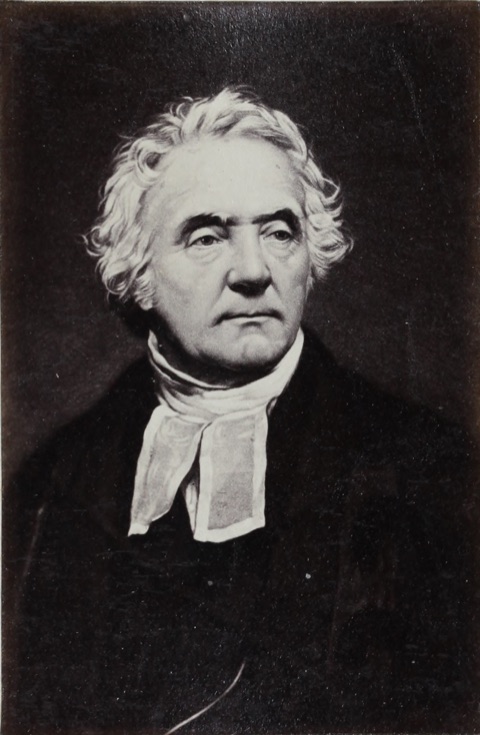
About the author
Thomas Chalmers
Thomas Chalmers (1780 to 1847 AD) was born in Anstruther, Fife, and entered the University of St Andrews at eleven, where mathematics drew him more than divinity. Ordained to the parish of Kilmany in 1803, he turned to evangelical religion after illness between 1809 and 1811. He was called to the Tron Church in Glasgow in 1815, published his astronomical discourses in 1817, and from 1819 ran a church-based scheme of poor relief in the parish of St John's. He became professor of moral philosophy at St Andrews in 1823 and of divinity at Edinburgh in 1828, and wrote one of the Bridgewater Treatises in 1833. In 1843 he led the Disruption and became first Moderator of the Free Church of Scotland. He died at Edinburgh in 1847.