Modernized edition · Full text · Free PDF/EPUB
Lectures in Systematic Theology: Volume 1 in Modern English
Want the file? The PDF/EPUB is free with an account.
Summary
- Author
- Robert Lewis Dabney (1820 to 1898 AD), professor of systematic and polemic theology at Union Theological Seminary in Virginia
- Published
- 1878 AD, second edition of the Syllabus and Notes of the Course of Systematic and Polemic Theology
- Source edition
- Lectures 1 to 25 in modern English, with the students' Note to the Reader, the Preface to the Second Edition and the appendix on geology
- Type
- Seminary lectures, each opening with a syllabus of questions and readings
- Length
- 132,000 words · 9 hours
What is Lectures in Systematic Theology: Volume 1 about?
Lectures in Systematic Theology: Volume 1 holds the first 25 of Robert Lewis Dabney's seminary lectures, printed in a second edition in 1878. It argues from reason to God's existence and attributes, surveys psychology and ethics, then turns to Scripture for God's attributes, the Trinity, the divinity of Christ and the Spirit, the decrees, predestination, creation, angels and providence.
Read the full summary (8 points, key themes)Show less
How the argument unfolds
- 01
The existence of God (Lectures 1 and 2). Howe's demonstration, Paley's design argument and conscience prove a personal First Cause; an eternal series and pantheism are refuted.
- 02
Evolution and materialism (Lectures 3 and 6). Darwin's natural selection and Huxley's protoplasm cannot account for design, life or mind.
- 03
What reason knows (Lectures 4, 5 and 7). God's natural and moral attributes and the soul's immortality, but no assured pardon.
- 04
Mind and morals (Lectures 8 to 12). First truths, intrinsic right, free agency, responsibility for belief and the office of reason.
- 05
God and the Trinity (Lectures 13 to 16). The names and attributes of God from Scripture, and one essence in three persons.
- 06
The Son and the Spirit (Lectures 17 to 19). The deity of Christ and the Spirit, eternal generation and procession.
- 07
Decrees and predestination (Lectures 20 to 22). God's single eternal purpose, personal election and the passing by of the rest.
- 08
Creation, angels and providence (Lectures 23 to 25). Creation out of nothing, the limits of geological inference, good and evil angels, and God's government of all things.
Key themes
- Causation as the key to nature. The law of cause is known by reason at the first instance: “Experience does not teach us that every effect has a cause; a priori reason does.”
- Right is intrinsic. Moral distinctions rest neither on utility nor on bare command: “Rather, God commanded them, and formed these relations to them, because they are right.”
- Mystery without contradiction. Of the Trinity Dabney says, “I am trying to convince you that it cannot be explained, and because it cannot be explained, it cannot be rationally refuted.”
- Sovereignty and free agency. God secures every free act through the agent's own dispositions and circumstances, without forcing the will, so the act and its guilt remain the creature's.
Reader questions (10)Hide the questions
Questions about Lectures in Systematic Theology: Volume 1
Is there a modern English version of Lectures in Systematic Theology: Volume 1?
Yes. This is Lectures in Systematic Theology: Volume 1 by Robert Lewis Dabney in modern English. The language is modernized and the author's order and argument are kept. The full modernized text is free to read on this page.
Can I read Lectures in Systematic Theology: Volume 1 online for free?
Yes. The complete text of this modern English edition is on this page, with no sign-up or paywall.
Is there a free PDF of Lectures in Systematic Theology: Volume 1?
Yes. The PDF and EPUB of this edition are free with an Updated Works account. Sign in with Google or an email link; no card is needed.
What is Lectures in Systematic Theology: Volume 1 by Robert Lewis Dabney about?
It is the first part of Dabney's seminary course. It argues from reason to God's existence and attributes and examines the psychology and ethics theology relies on, then turns to Scripture for the doctrine of God, the Trinity, the decrees, creation, angels and providence.
How does this volume relate to the rest of the set?
It is the first of three volumes. Later lectures take up the rest of the course, and Dabney points ahead to them here, for instance to Christ's satisfaction and effectual calling.
How did these lectures come to be printed?
His students at Union Theological Seminary printed them when he gave his manuscript to the class instead of reading it aloud. They used them beside the Confession of Faith and Turretin. Dabney enlarged the work for the 1878 edition.
What does Dabney say about Darwin?
He judges the theory unverified and unverifiable, and adds a rule from the law courts: circumstantial reasoning gives way before a credible eyewitness, and Scripture is the testimony of the Creator.
Is Dabney supralapsarian or sublapsarian?
He holds that God's decree has no succession, so neither order is strictly true, but judges the sublapsarian view far more scriptural, since election is mercy and preterition is justice, and both presuppose the fall.
What does Dabney say about the age of the earth?
He prefers an interval before Genesis 1:2 to symbolic days, notes that both schemes contradict the Westminster Standards, and holds that the geologist must prove his theory is the only possible one.
Does Dabney make God the author of sin?
No. God's decree concerning sin is permissive, and the sinner chooses freely. Dabney rejects God's physical concurrence in every act because it comes too near making God the cause of sin.
Lectures in Systematic Theology: Volume 1 in Modern English · Full text
Note to the Reader
Accompanying the First Edition
Our professor of theology has given his classes the course of lectures he delivered to earlier students, leaving us free to use them in whatever way best helps our studies. We have printed them here for private circulation among ourselves and among our predecessors and successors at the seminary. Our reasons are simple. So far in the course, these lectures have greatly helped us understand our textbooks. When Dr. Dabney announced a change in his teaching method, ending the oral delivery of these lectures from his chair and placing his manuscript at the students’ disposal, we wanted to keep benefiting from them. The easiest and most practical way to furnish ourselves with copies and pass them on to future fellow students was to print them. The students of 1878 have paid for this printing, and a small number of extra copies beyond our own needs have been printed.
A few words of explanation will clarify the method of study to which these notes belong. Our system combines recitations on textbook lessons (chiefly the Confession of Faith and Turretin’s Elenctic Theology), the professor’s oral instruction and explanations, the writing and reading of student theses on the topics under discussion, and final review recitations covering the whole. The goal is to unite the help of a living teacher with the student’s own independent research, training memory, comparison, judgment, reasoning, and expression, and fixing what we learn through repeated review.
When we begin a “head,” or major topic, of theology, our professor first writes a short, comprehensive syllabus of questions on the blackboard, preceded by an assigned textbook lesson. Our first duty is to master and recite that lesson. Once we have gained a reliable outline of the subject from our standard author, we investigate the same topic as time permits in other writers, both friendly and hostile, before composing a thesis.
The syllabus, with its many book references, guides this research. The professor has carefully chosen these references to point us to the ablest and most thorough accessible authors on both sides of the truth. In many cases, the citations are far more numerous than a seminary student can read at once alongside the work of other departments. To guide our choices, the most important authority under each question (whether from our textbook or another work) is listed first, the next in value second, and finally those a student may profitably consult at greater leisure. We find this syllabus and its references one of the most valuable parts of our course. It guides not only our first studies, but also our later years, when the demands of pastoral ministry require deeper research into the same subjects. It directs our inquiries wisely and spares us the drudgery of wading through heaps of literary rubbish to locate truly influential thinkers, giving us the benefit of an older scholar whose duty has been to examine many works in theology and related fields.
After we present the results of our own research, Dr. Dabney customarily gives his own judgment on the whole subject. Those lectures form the bulk of what is printed below. Accordingly, they take the form of summaries of the discussions already found in our books. They often restate even the textbook’s own arguments in plainer or fresher form whenever recitation has shown that the class struggled to grasp them, and they frequently reproduce the views found in the other syllabus readings. Clearly, the professor made no claim to originality except in how he connected, harmonized, or refuted the positions under review. Indeed, his constant aim seemed to be teaching us how to discover on our own, before his help, everything he later aided us with in his concluding lecture. Placed in the hands of the classes, these lectures will now serve as a subordinate textbook alongside the others, freeing the time formerly spent in oral delivery for sharing the fruits of newer research beyond the existing course.
It remains only to note the order of topics. It follows, for the most part, the arrangement of the Confession of Faith. The course opens, however, with Natural Theology, followed by a brief survey of the doctrines of psychology and ethics most closely tied to theological study. From there the lectures proceed to Revealed Theology, assuming as a postulate already established by another department in the seminary the inspiration and infallibility of the Scriptures.
The format in which these lectures reach our fellow students was dictated by the need to issue them weekly from the press to meet our immediate classroom needs. It remains only to add that this printing is done with Dr. Dabney’s consent.
Committee of Printing
Preface to the Second Edition
The Note to the Reader prefixed by the students to the first edition they printed sufficiently explains the origin and character of this course in theology. Several years of teaching from it have revealed both its usefulness and its defects. Much labor has gone into correcting those defects and conducting further research on every important point. The syllabus has been expanded with many additional references, and 260 pages of new material have been added. A full table of contents and index now fit the volume for ready reference. Numerous typographical errors have been corrected, and the larger type and better materials will, it is hoped, make the book not only more attractive, but also more durable and useful.
Next to establishing divine truth, the main goal has been to give divinity students, pastors, and thoughtful lay Christians a survey of the entire field of Christian theology without making the volume too bulky and expensive for instructional use. Every major topic of theology receives at least brief treatment, and the discussion is generally compact. Readers should bear in mind that the book is styled simply “Syllabus and Notes” of a theology course. It does not promise exhaustive expansion or full illustration of every subject. Unless a reader already brings considerable prior study to these questions, he should not expect to master the arguments through a casual reading. He is frankly warned that many parts will be only partially appreciated unless he either reads enough of the authorities cited in the syllabus to gain the right vantage point, or else works through the outlines with mature, vigorous thought of his own to flesh out the full discussion.
The work is now humbly offered once more to the people of God, in the hope that it may help establish them in the old, orthodox doctrines that have been the power and glory of the Reformed churches.
Robert L. Dabney
Union Theological Seminary, Virginia, August 15, 1878
Part 1: Natural Theology
Lecture 1: Prefatory and Existence of God
Syllabus
1. What is theology, and what are its divisions? Prove that there is a science of natural theology.
References: Turretin, Topic 1, Questions 2–3; Thornwell, Collected Works, Vol. 1, Lecture 1, pp. 25–36.
2. What two lines of argument prove the existence of a God? What are the a priori arguments, and are they valid?
References: Stillingfleet, Origines Sacrae, Book 3, Chapter 1; Thornwell, Lecture 2, p. 51 ff.; Dr. Samuel Clarke, Discourse of the Being and Attributes of God, Chapters 1–12; Chalmers, Natural Theology, Lecture 3; Dick, Lecture 16; Cudworth, Intellectual System.
3. State the arguments of Clarke and of Howe. Are they sound? Are they a priori?
References: Dr. Samuel Clarke, as above; John Howe, The Living Temple, Chapter 2, § 9 to the end; Locke, Essay Concerning Human Understanding, Book 4, Chapter 10.
4. State the argument of Breckinridge’s Theology. Is it valid?
References: Knowledge of God Objective, Book 1, Chapter 5; Review of Breckinridge’s Theology in the Central Presbyterian, March to April 1858.
5. Give an outline of the argument from design.
References: Paley, Natural Theology, Chapters 1–3; Xenophon, Memorabilia, Book 1, Chapter 5; Cicero, De Natura Deorum, Book 2, §§ 2–8; Turretin, Topic 3, Question 1; theological treatises generally.
What Theology Is and Its Divisions
It has been rightly said that every science should begin by defining its terms to avoid verbal fallacies. The word theology (from the Greek theou logos, meaning “discourse or science of God”) has undergone unusual shifts in the history of knowledge. The ancient Greeks often used it for their accounts of the origin of the gods and the cosmos. Aristotle gave it a broader sense, equating it with all metaphysics when he divided theoretical philosophy into physical, mathematical, and theological branches. Many early Christian fathers used it more narrowly for the doctrine of Christ’s divinity (for example, calling the apostle John “the Theologian”). Today, however, it commonly denotes the whole science of God’s being, nature, and relations to his creatures. The name “science of God” is fitting. As Thomas Aquinas observed, “Theology is taught by God, teaches God, and leads to God”: God is its author, its subject, and its end.
The division of theology into didactic, polemic, and practical branches is well known. Every didactic presentation of truth is already an indirect refutation of the opposing error. Polemic theology has been defined as the direct refutation of error. Its supposed advantage is that error can be refuted most easily and thoroughly by organizing it around its first principle, or fundamental falsehood.
Yet the attempt to build a science of polemics separate from didactic theology fails, because error has no true method. Confusion is its defining mark. A system of inquiry built on a false method cannot be truly scientific. For that reason, separate treatises on polemics have usually slipped back into the methods of didactic theology, or else ended in confusion. Moreover, indirect refutation is more effective than direct attack. Accordingly, this course includes no separate polemic branch; instead, what must be said against errors is divided between historical and didactic theology.
Is There a Science of Natural Theology?
Theology is also divided into natural and revealed, according to the source of our knowledge: natural reason or divine revelation. What is a science? It is knowledge demonstrated and arranged in an orderly method. That a science of natural theology exists, consisting of at least some certain and connected truths (though limited and completely insufficient for salvation), is soundly argued from Scripture (Psalm 19:1-7; Acts 14:15; Acts 17:23; Romans 1:19; Romans 2:14) and from the fact that nearly all pagan peoples hold religious ideas and practice rites of worship. Religious ideas are not themselves innate, yet the capacity to establish certain religious truths from natural evidence is innate.
Consider a further question. Is this not implied in humanity’s very capacity to receive a revealed theology? Does revelation prove God’s existence, or does it assume it? Does it rest its foundational truths on bare assertion, or on evidence that the human mind can grasp? Clearly the latter, which presupposes that man has some natural capacity to apprehend such truths. If nature reflects any light concerning God, as Scripture affirms, then man can derive some genuine theology from nature.
Some older theologians used to deny that any science of natural theology exists, claiming that without revelation man would never naturally discover its first truth. They credited the grains of truth scattered through various polytheisms to surviving traditions passed down from Noah’s family. They argued that some isolated tribes, such as the Khoikhoi and native Australians, lack religious ideas; that some individuals become sincere atheists after reflection; and that the pagan schools exhibit the wildest diversity and even outright contradiction. These theologians seemed afraid that admitting a natural theology would concede too much to human reason. That fear is groundless and extreme. It exposes them to a far worse danger: lowering man’s capacity for divine truth so far that the rational skeptic can turn on them and say, “Then so inept a creature cannot reliably apprehend even the credentials of a true revelation.”
To answer these objections in detail, I readily grant the great influence of primeval traditions, a fascinating subject learnedly examined in Theophilus Gale’s Court of the Gentiles. Yet the very fact that so unstable a channel could preserve fixed convictions about the unseen world proves that man possesses a natural religious capacity.
The existence of atheistic individuals and tribes proves nothing against this. Some tribes develop no science of geometry, statics, or even basic arithmetic, yet this does not prove man is non-logical. Some philosophers profess to reject basic axioms, as Hume rejected causation, yet this hardly proves man incapable of inductive science. Besides, the alleged atheism of those tribes is doubtful; such tribesmen are shrewd, suspicious, and fond of fooling inquisitive strangers with feigned stupidity. Finally, the differences in natural theology among polytheists represent diversity within unity. All of them involve the foundational truths: a single first cause, moral responsibility, guilt, a future life, and future rewards and punishments.
How the Existence of God Is Known
The first truth of theology is the existence of God. Our first question is how man comes to know that God exists. Dr. Charles Hodge (Systematic Theology, Part 1, Chapter 1) argues that this knowledge is “innate,” explaining that by innate he means “intuitive.” Notice, however, that he uses intuitive in a special sense of his own. For him, any truth immediately perceived by the mind is intuitive. He departs from the standard philosophical definition (held by writers such as Sir William Hamilton), which requires simplicity or primariness as the mark of an intuitive judgment. Hodge illustrates his view by saying that to Newton, all the theorems of Euclid’s first book were seen as immediately as the axioms, and were therefore intuitions to him.
We will see the dangers of this view in a later lecture. With the mainstream of philosophers, I hold that an intuitive truth is one that is (a) seen to be true without any prior premise, (b) seen thus by every mind that understands its terms, and (c) necessarily seen to be true. Strictly speaking, no intuitive truth is itself innate; rather, the power of perceiving it is innate.
Newton’s case, and others like it, is easily explained. In his vigorous mind, the step from an intuitive premise to a nearby conclusion was so quick and effortless that it escaped notice. Yet the step was taken. When Dr. Hodge calls human knowledge of God’s existence innate, meaning “intuitive,” his mistake lies in confusing a single, short, clear deduction of common sense with a bare intuition. He rightly places the moral evidence first. Yet what does it amount to? “The sentiment of responsibility (which is immediate) is intuitive.” That sentiment implies someone to whom we are obligated. True. Yet drawing out that implication is nothing other than a short, easy, obvious step of reasoning.
When theologians and Christian philosophers try to explain humanity’s universal belief in God as a rational process, they reduce it to one of two modes of argument: the a priori and the a posteriori. The a posteriori argument infers God by reasoning backward from effects to their cause. Strictly speaking, a priori should mean reasoning downward from cause to effect, the sense given to the phrase by Aristotle and his followers. In this discussion, however, a priori reasoning refers to a conclusion reached without the aid of experience, solely from primary judgments, and especially to the attempt to infer the reality of an idea directly from its nature or place in the mind.
The A Priori Argument and Its Defect
Recent writers, such as Dick and Chalmers in his Natural Theology, commonly treat Dr. Samuel Clarke as the leading English champion of the a priori argument. That is a mistake. The argument was first hinted at by Epicurus (whose atomic theory ruled out the a posteriori route), as a curious passage in Cicero’s De Natura Deorum (Book 1, Chapter 16) shows. It was stated more accurately by Descartes in his Meditations, and introduced to English thought by Bishop Stillingfleet rather than Dr. Clarke. You can read a clear statement of it in Stillingfleet’s Origines Sacrae (Book 3, Chapter 1, § 14), whereas Dr. Clarke explicitly states in § 8 of his Discourse that God’s personal intelligence must be proved a posteriori, not a priori.
Descartes built his psychology on two claims: first, “I think, therefore I am,” and second, the ego is spirit, not matter. He then asked how we can distinguish true ideas from false ones in consciousness, since our ideas are clearly not all consistent. For primary ideas, he answered, we know them by the clarity with which they present themselves to consciousness as immediate truths. Among all our ideas, none is clearer or more unique than that of an eternal, infinite First Cause. Therefore, he reasoned, we may accept it immediately as true. Furthermore, our very possession of this idea proves that God must exist; if he did not, the appearance of his idea in our minds could not be explained, just as the idea of triangles implies that some triangle exists.
Stillingfleet’s a priori argument simply applies Descartes’s method. Whenever we think of God, he says, we must think of him as eternal, self-existent, and necessarily existent. Because we indisputably do conceive of a God, it is impossible that God should not exist. Necessary existence is unavoidably bound up in our idea of God, so his actual existence must necessarily be granted.
This line of reasoning is not automatically flawed merely because it is a priori. There are valid processes by which we establish the truth of an idea simply by examining its contents and conditions. Stillingfleet’s error lies in misrepresenting how our thought actually works. Look closely at the two propositions forming his compressed syllogism, or enthymeme. Its conclusion rests on an unstated major premise: that we can have no idea in consciousness without a corresponding objective reality. That must be the assumed major premise, because without it the enthymeme yields only a conditional conclusion: if a God exists, he exists necessarily. Yet that assumed major premise is notoriously false as a general rule.
Samuel Clarke’s Cosmological Argument
Rather than calling Dr. Clarke’s method in his Discourse of the Being and Attributes of God an a priori proof, it is more accurate (following Hamilton’s edition of Reid) to classify it as an a posteriori argument, or with Kant as the cosmological argument. It infers God’s existence from his effects, though it is marred in one or two places by needless Cartesian additions. Clarke’s steps run as follows:
1. Since something exists now, something has existed from eternity. You will find this to be the starting point of every sound reasoner, and it is rock solid. If at any point in past eternity there had been absolutely nothing, then because nothing cannot cause anything to exist, time and space would have remained blank forever.
2. Therefore, some immutable and independent being has existed from eternity, because an eternal chain of dependent beings without an independent first cause is impossible.
3. Because this being is eternally independent, it must be self-existent, meaning necessarily existent. Its eternal independence proves that the causative source of its existence cannot lie outside itself, so that source must lie within itself forever. The only true meaning of such self-existence is that supposing its non-existence involves a direct contradiction. Here Dr. Clarke needlessly adds that our notion of its necessary existence proves it cannot fail to exist. He also reasons that our concepts of infinite time and infinite space are necessary, since we cannot avoid thinking them. Because time and space are not substances but merely modes of substance, they could not exist or be thought unless an infinite, eternal substance existed to sustain them.
4. Although this being’s substance is beyond our comprehension, that does not lessen the certainty of its existence.
5. Several of its attributes can be demonstrated.
6. It must be infinite and omnipresent.
7. It must be one.
8. It must be intelligent, free, and so on.
The conclusion is that this being must be the Creator and God, unless the universe itself can fulfill the conditions of eternity, necessary self-existence, infinity, intelligence, and free choice. That alternative is pantheism, which Clarke proceeds to refute.
Evaluating Clarke’s argument as a whole, I note that it is largely valid precisely because it is largely a posteriori. It appeals to our intuitive judgment of causation to infer an infinite first cause from finite effects. The Cartesian elements tacked onto the third proposition are an unnecessary growth; cut them away, and the logical chain remains unbreakable. We prune them not for Dr. Chalmers’s reasons, which in several respects are as flawed as Clarke’s, but for the reason explained in our discussion of Stillingfleet above. I add only one point about Clarke’s remark on time and space. He argues that we can conceive of time and space only as modes of substance, requiring an infinite and eternal substance. The actual truth is quite different: we cannot conceive of finite substances or events without placing them in time and space. That is not at all the proposition Clarke needed.
John Howe’s Demonstration
In my judgment, the great Puritan theologian John Howe stated the metaphysical proof for God’s existence in a form free from these defects. Howe flourished around 1650, before Dr. Clarke; see Chapter 2 of his The Living Temple. He argues in seven steps:
1. Since we now exist, something has existed from eternity.
2. Therefore, at least one uncaused being exists, for what is eternal has nothing prior to it.
3. Therefore, some independent being exists.
4. Therefore, that being exists necessarily, because its eternal, independent, inward spring of existence cannot be conceived as ever failing to operate.
5. This being must be self-active. It must be active, because if other beings did not spring from its activity, they would all have to be eternal, independent, and necessary, which is impossible for changeable, variously organized creatures. It must be self-active, because in eternity nothing existed before it to prompt its action.
6. This being is living, for self-prompted activity is our very idea of life.
7. It possesses boundless intelligence, power, freedom, and the other divine attributes.
Every link in Howe’s argument is tightly forged. Yet it is plainly a posteriori, because everything rests on a straightforward deduction from a universe of effects back to their cause, and the cause’s attributes are inferred in the same way.
The only point needing further support is the fifth step. Up to that point, the proof that some eternal, uncaused, necessary being exists is complete. How do we prove, however, that this one being created all other beings? Every other being must be either eternal or temporal. Could all things be eternal and one? Then all would be uncaused, independent, self-existent, and necessary. As we will see, that is pantheism. If the remaining beings are temporal, then they were all caused. By what? Either by the one uncaused, eternal being, or by other similar temporal beings producing them. That second option is the theory of an infinite, independent series of finite organisms, each one dependent. Once we close those two gaps by refuting pantheism and the hypothesis of an infinite series, Howe’s demonstration is airtight.
Kant’s Objection to the Cosmological Argument
Kant chose this cosmological argument as one of his “antinomies” to illustrate the supposed invalidity of a priori reason when applied to the world of experience. His objection comes down to this: the statement “Nothing can exist without a cause outside itself” cannot be an absolute rule, for if it were, we would have to assign a cause to the First Cause himself.
State the intuitive principle accurately, however, and Kant’s quibble vanishes at once: “Nothing can begin to exist without a cause outside itself.” A moment’s reflection makes this clear. The mind’s necessary step from created things up to a Creator is now properly stated. “Every effect must have a cause.” True. An effect is an existence or phenomenon that has a beginning, as every created thing obviously does. Therefore, it must have come from a cause that had no beginning, namely God.
Moreover, I cannot protest too soon against Kant’s broader claim that our regulative, intuitive principles of reason are merely subjective guides, compelling to us yet lacking objective validity. If that were true, human intelligence itself would be a delusion. On the contrary, every law of thought is also a law of existence and reality. Every mind grasps this truth as soon as it begins to think. It is as intuitive as any other principle of reason, and it is an indispensable condition of all other knowledge. Furthermore, the whole course of humanity’s a posteriori knowledge continually confirms it, proving its trustworthiness by the exact harmony between our inward rational intuitions and empirical facts.
The Platonic Theory of Eternal Matter
Platonism taught that all substance is uncaused and eternal in its basic being. All finite rational spirits, according to this view, are emanations of the Eternal Being, the eternal intelligence; and all matter has existed from eternity as inert, passive, chaotic raw material. Platonism attributed all organization, all shaping (the only kind of creation it recognized), and all change, directly or indirectly, to the intelligent First Cause.
This scheme is not easily refuted by unaided human reason. Suppose we argue that the very concept of a First Cause implies singleness, or more solidly, that the unity of plan and operation in nature points to one single ultimate cause. Plato could reply that he posits only one First Cause, the Eternal Being, because primordial matter is completely inert and merely receives causation. Suppose we urge Hamilton’s “law of parsimony,” that explanations should assume nothing beyond what is needed to account for the effects. Plato could answer that reason demands the assumption of pre-existing material just as much as an almighty Workman, because even omnipotence cannot work with nothing to work on.
Indeed, so far as I know, every human philosophical system (Plato, Epicurus, Zeno, Pythagoras, and the Peripatetics) shared one common assumption: that it is self-evident that substance cannot rise out of nothing into being, and that nothing comes from nothing. We will also see how stubbornly philosophy slides back into this maxim in Spinoza’s pantheism and in Kant’s and Hamilton’s theories of causation. One may well doubt whether the human mind, without revelation, would ever have moved beyond it. Drawing on an accurate knowledge of philosophy’s history, the apostle declared that the doctrine of almighty creation out of nothing is a truth of pure faith (Hebrews 11:3).
As you saw, Dr. Clarke did attempt a rational proof that eternal matter is impossible. Whatever is eternal must be necessary; therefore, an eternal cause must exist necessarily. Therefore, whatever can possibly be thought of as existing without being necessary cannot be eternal. Such is Clarke’s logic. Close inspection exposes a double flaw. First, as we saw above, the opening enthymeme is inconclusive. Second, even if it held, the second step merely infers the converse, which does not logically follow.
Howe offers a more plausible argument, at which Clarke also glances. If matter were eternal, it would have to be necessary. Then it would also have to be everywhere present, uniform, and unchangeable, like God’s own substance, because an inward eternal necessity of being must act always and everywhere the same. Yet we see matter diverse, changing, and occupying only parts of space. I doubt whether even this argument is solid, or whether mere necessary existence lets us infer anything beyond Spinoza’s claim: that eternal matter could exist only in the exact structures and sequences of change in which it actually exists. Our surest refutation of this part of Platonism is God’s word. On this point, Plato’s pagan theology comes closer to Christianity than any other, and is less offensive than any rival to human reason and God’s honor.
Robert J. Breckinridge’s Argument
Dr. R. J. Breckinridge (Knowledge of God Objective, Vol. 1, p. 56 ff.) constructs what he assures us is an original argument for God’s existence. Examining it briefly will shed light on the whole subject. His steps are:
1. Because something exists now (at least the mind that is reasoning), something eternal exists.
2. All known substance is either matter or spirit.
3. Therefore, only three possibilities exist: (1) some matter is eternal and is the source of all spirit and all other matter; (2) some being composed of matter and spirit is eternal and is the source of all other matter and spirit; or (3) some spirit is eternal and produced all other spirit and matter.
Breckinridge concludes that the third option must be true. The second fails because we ourselves are composed of matter and spirit, know by consciousness that we cannot create, and know the First Cause must be single. The first fails because matter is inferior to mind, and the inferior cannot produce the superior.
The flaws in this argument begin at the second step, where Breckinridge departs from the established forms of Howe and Clarke:
1. The argument has no force with a pure idealist or a materialist.
2. It is not strictly proved that no substance can exist besides matter and spirit; we can only say negatively that we know of no other.
3. The three alternatives do not exhaust the possibilities. Pantheism, Aristotle’s theory of eternal organization, and Platonism all show that other schemes are conceivable.
4. The fact that we, being composed of matter and spirit, consciously cannot create falls short of proving that no higher being so constituted could create. Christ could create if he pleased, and he is so constituted.
5. Finally, an argument aiming to be so grounded in experience is weakened by having the analogy of natural experience run directly against it. We observe human spirits producing effects only while embodied. Once disembodied at death, they completely cease to be observed causes of anything.
The Teleological Argument and Its Value
The teleological argument for God’s existence and attributes has been presented so ably by William Paley in his Natural Theology that, although it is as old as Job and Socrates, it is commonly called Paley’s argument. I refer you especially to his first three chapters.
Paley begins with a peasant who finds a watch lying on a common. Even though the peasant has no idea how it got there, he concludes that an intelligent maker built it. Paley then applies the same reasoning with great clarity and force to show that humanity and the universe have a Maker. Everywhere we observe intelligent arrangement: the eye designed for seeing, the ear for hearing, and countless other examples. Nor is the peasant’s inference to a watchmaker weakened because he never saw or heard of one, nor because he does not understand every part of the watch, nor because some adjustments seem imperfect. Even if you showed him a set of wheels inside the watch designed to manufacture new watches, he would not conclude there was no watchmaker, for he would see that a reproductive mechanism cannot invent intelligent design. Still less would he accept a “law of nature” or a “physical principle of order” as the sole cause.
Curiously, the metaphysical and teleological arguments have each attracted exclusive champions in modern times. Admirers of Paley join Dr. Thomas Brown in dismissing the metaphysical proof as shadowy and inconclusive. Defenders of the metaphysical theologians disparage Paley’s proof as rising no higher than a finite Demiurge.
In truth, both lines of reasoning are valid, and each needs the other. Dr. Brown, when he pushes Paley’s argument toward its highest conclusions, must quietly borrow the very metaphysics he claims to scorn. Without that support, Paley’s argument stays incomplete. It yields at most a world-craftsman whose existence extends merely before human experience, and whose being, power, and wisdom are proved only as far as human inquiry has reached. It can never assure us that he is eternal, immutable, independent, immense, or infinite in power and wisdom. Granted, as you followed Paley’s reasoning, your mind leaped to the conclusion that nature’s architect is the Being of “eternal power and godhead” (Romans 1:20). Yet it did so only because you passed, perhaps almost unconsciously, through the metaphysical deduction Howe describes so precisely.
Howe gives us the comprehensive display of the a posteriori argument; Paley gives a partial, though remarkably clear, display of it. Paley’s premise, that every contrivance requires an intelligent contriver, is simply one case under the broader principle that every effect requires a cause. Paley’s limitation appears in his assumption that a peasant finding a stone instead of a watch could not reach the same conclusion. In reality, a pebble points to a cause just as truly as an organized machine, though less vividly. Even a pebble should lead us to see that either it holds the ground of its present existence in itself (and is thus eternal, self-existent, and necessary), or else it had a Maker who possesses those attributes.
On the other hand, the argument from design holds immense value for several reasons. It is plain and accessible to everyone. It helps establish the unity of the First Cause through the unity of purpose and converging outcomes across creation. It helps prove God’s personality as a being of intelligence and will. Finally, it powerfully reinforces our case against pantheism by showing that unless a personal, divine First Cause existed prior to the universe, the universe itself would have to be not only uncaused, eternal, independent, and necessarily existent, but also endowed with intelligence.
Lecture 2: Existence of God Continued
Syllabus
1. Show in a few instances how the argument from design is drawn from animal organisms, from man’s mental and emotional structure, and from the adaptation of matter to our mental faculties.
References: Paley, Natural Theology, Book 4, Chapters 3, 16; Chalmers, Natural Theology, Book 4, Chapters 1, 2–5.
2. Can the being of God be argued from the existence of conscience?
References: Turretin, Locus 3, Question 1, §§ 14–15; Hodge, Systematic Theology, Part 1, Chapter 2, § 5; Alexander, Moral Science, Chapter 12; Chalmers, Natural Theology, Book 3, Chapter 2; Charnock, Discourses upon the Existence and Attributes of God, Discourse 1, § 3; Kant, Critique of Practical Reason; Thornwell, Lecture 2.
3. What is the value of the argument from the universal consent of mankind?
References: Turretin, Locus 3, Question 1, §§ 16–18; Dick, Lecture 17; Cicero, De Natura Deorum, Book 1; Charnock, Discourse 1, § 1.
4. Refute Hume’s evasion that the universe is a singular effect.
References: Alexander, Moral Science, Chapter 28; Chalmers, Natural Theology, Book 1, Chapter 4; Watson, Theological Institutes, Part 2, Chapter 1; Hodge, Part 1, Chapter 2, § 4; Duke of Argyll, The Reign of Law, Chapter 3.
5. Can the universe be accounted for without a Creator as an infinite series of temporal effects?
References: Alexander, Moral Science, Chapter 28; Turretin, as above, §§ 6–7; Dr. Samuel Clarke, Discourse, § 2; Kant, Critique of Pure Reason, First Antinomy.
6. Refute the pantheistic scheme of the universe.
References: Thornwell, Lecture 9; Alexander, Moral Science, Chapter 28; Dr. Samuel Clarke, Discourse, §§ 3, 7, 9, etc.; Chalmers, Natural Theology, Book 1, Chapter 5; Hodge, Part 1, Chapter 3, § 5; Thornwell, “Personality of God,” in Collected Works, Vol. 1, p. 490.
Instances of Design in Nature and Humanity
To resume: a single instance of intelligent design in creation would prove an intelligent Creator. Still, it is wise to multiply these proofs generously. Doing so gives us a broader base for deduction, deeper views of the range of creative wisdom and power, and stronger evidence of God’s unity. Consider four domains showing how the argument works.
Animal organs. Where the purpose is to produce the physical side of sight, the eye is unmistakably an optical instrument. It is built with lenses to refract light, features to correct color distortion, mechanisms to adjust for distance and brightness, and layered protection through its recessed position, bony socket, brow, eyelids, lubricating tears, and, in birds, a third transparent eyelid. Different creatures also have eyes tailored to their habits and surroundings, as in birds, cats, owls, and fish. Likewise, the ear is an acoustic instrument: an outer shell gathers sound waves into a canal, an eardrum transmits vibrations, and three tiny bones (the hammer, stirrup, and anvil) poised in delicate balance carry those vibrations to the brain’s sensory center.
Human mental and emotional structure. The spiritual realm is just as full of clear design. Consider the laws of habit and imitation, precisely fitted to educate and shape character, along with the faculties of memory, association, and aesthetic taste. The evidence of design is, if possible, even more striking in our emotional nature: parental love, sympathy, resentment paired with its natural limits, sexual attraction balanced by its natural check of modesty, and above all conscience, with its self-approval and remorse. Every one of these is fitted to clear ends.
Compensating arrangements. We see marks of still subtler design in how nature compensates for unavoidable limitations. The elephant’s short neck is balanced by a flexible trunk. Birds’ heads cannot support the weight of teeth, so they are equipped with a gizzard. Insects with immovable heads have multiple eyes to see all around them. Animals have less reason, yet stronger instinct.
Mutual adaptations across nature. The fitting of one realm of nature to another demonstrates design, purposeful choice, and unity of mind all at once. The physical media of light and air and the organs of sense are made for each other. The shapes and colors of natural objects correspond to human taste. The earth’s measured fertility answers to humanity’s need for labor. The stability of physical laws matches the necessary judgments of human reason concerning them. Thus all of nature, material and spiritual, animal, plant, and mineral, on earth and across the starry skies, overflows with wise design.
The Argument from Conscience
The moral facts of conscience furnish a twofold proof for God’s existence that deserves fuller treatment than space allows. First, conscience is a remarkable spiritual instrument shaped for a beneficial purpose: encouraging virtuous actions and restraining wicked ones. Simply as an adaptation to an end, it proves a Designer just as any bodily organ does.
Second, as we will see later in the course, our moral judgments are intuitive, primary, and necessary; they are among the most inescapable operations of reason. Whenever we judge an act to be right, that judgment unavoidably carries a sense of obligation. Obligation implies someone who obligates us. That authority is not always any known creature; therefore, it must be the Creator. Likewise, the awareness of wrongdoing unavoidably awakens dread, and dread implies an avenger. Even the secret sinner, and even the tyrant who stands above all human power, feels this fear.
Someone might object that this argument fails unless we hold that God’s bare will is the sole source of moral distinctions, a view we reject since even an atheist is rationally compelled to recognize moral distinctions. That objection misses the mark. We must accept a primary law of reason as valid regardless of its origin. Consider a parallel: examining our intuitive belief in causation reveals the truth that “there is a First Cause.” For that conclusion to stand, we do not need to claim that God arbitrarily implanted the intuition. It is intrinsically true to the nature of things, which makes the inference to a First Cause all the stronger.
Because this moral argument for God’s existence is both immediate and strictly logical, it is surely the most practical of all. Its power shows itself in the fact that theoretical atheists, facing danger and death, usually acknowledge God when remorse awakens.
The Argument from Universal Consent
Your assigned authors develop the argument from the universal consent of mankind at length. In my view, it provides strong probable evidence for God’s existence. Because the truth of God’s being is abstract, belief in it would never have become so nearly universal, nor so clearly vital to human social life, unless a solid ground for it existed in the laws of human thought. Neither fear, nor statecraft, nor self-interest can explain it away.
Does Contrivance Imply Limitation?
From positive proofs we turn now to evasions. One objection claims that the design argument, even if valid, proves only a Creator of limited power. Contrivance, the objector says, is the resort of weakness: a builder constructs a crane only because he lacks a Samson’s strength to lift the weight directly. If the Creator possesses eternal power and godhead, why did he not reach his goals immediately without using means, as when he spoke and it was done (Psalm 33:9)?
I give three answers:
1. Design still proves a designer, even when part of the purpose lies beyond our grasp.
2. It is not unworthy of the Almighty to work through ordered means in order to stamp his signature on creation for humanity to read.
3. Most importantly, if God used no secondary means to accomplish his ends, he would remain the sole active agent. There would be no organized nature at all, only one lone supernatural agent.
Hume’s Objection That the World Is a Singular Effect
David Hume tries to undercut the inference from creation to a Creator by arguing that experience alone teaches us the uniform tie between cause and effect, so we have no right to apply causation beyond our experience. Nobody has ever watched a world being made, as we watch craftsmen making tools. The universe, if it is an effect at all, is completely singular: the only one anyone has ever known, standing substantially as it is from the dawn of human experience. Therefore, Hume claims, reasoning empirically to a First Cause is unauthorized.
Notice first that this objection comes from the same mold as Hume’s argument against miracles. Creation is simply the first miracle, and the same objection is raised against both: that no evidence can outweigh uniform experience to prove a unique event occurred.
Dr. Alexander’s answer. To rebut Hume, Dr. Archibald Alexander uses an illustration. Show a steam frigate to a country boy who has seen only plows and horse carts, and he instantly infers a builder. That is true in fact, yet it does not complete the philosophical analysis. Granted, the frigate is vastly larger and more complex than a cart, just as the universe dwarfs any human machine. Still, Hume could reply that the boy would spot a thousand familiar marks of human work: timbers showing plane marks like his plow-beam, cables twisted of hemp like his plow-lines, and a huge anchor bearing hammer dents like his plowshare. Astonishing as the ship is compared to a plow, experience shows it to be manufactured rather than natural, unlike the universe.
Dr. Chalmers’s answer. In a chapter full of contradictions, Dr. Thomas Chalmers seems to concede that experience alone teaches us causation, yet denies that the universe is a “singular effect.” Starting with Paley’s peasant and the watch, Chalmers strips away details step by step: the logical basis for inferring a maker is not that the watch is gold or silver, large or small, good or bad, or even a timepiece at all, but simply that it exhibits clear design for an end. Thus the effect is no longer singular, and the inference to an adequate cause still holds.
Against this clever move, Hume could answer that experience alone guides those abstractions separating accidental features from essential ones, a point Chalmers himself admits. Since we have no experience of world-making, we cannot legitimately abstract the universe into the class of ordinary effects. Besides, Hume has not even granted that the world is an effect. Finally, he could insist on the difference between the world, which is native, and watches, plows, or ships, which show even the simplest observer empirical marks of having been made.
The true answer. We should never try to refute Hume on his own premises, because his premises are false. Experience does not teach us that every effect has a cause; a priori reason does. (Chalmers first affirms this and then unwisely gives it up.) Neither child nor adult trusts the law of causation on the hundredth case because he experienced it ninety-nine times; he believed it instinctively on the very first case. It is false logic to claim that the bond of cause and effect can be affirmed only where experience has already witnessed it. If that were true, could induction ever teach us anything new? Could inductive science even exist? Away with such nonsense! Grant that the world is a “singular effect.” It is still a phenomenon, and it could not exist without a cause of its being, either outside itself or within itself. We know this not from experience, but from one of those primary judgments of reason that alone make experience intelligible and reliable.
Can the Universe Be an Infinite Series of Organisms?
Could the universe, however, hold the ground of its own being within itself? Here is another evasion of the atheists. Grant, they say, that nothing cannot produce something. Theists look outside the universe for its cause, and once they claim to find it in God, they must describe him as externally uncaused, eternal, self-existent, and necessary. How much simpler, they suggest, to suppose that the visible universe itself is that uncaused, eternal, self-existent, necessary being! Since we must end at the mystery of some uncaused eternal reality anyway, why not accept the plain evidence of nature and experience and conclude that the universe is it? Because the living organisms adorning the earth are temporal, and because the earth and stars move in temporal cycles, we would simply suppose that past eternity consisted of an infinite chain of organisms and cycles, each producing the next, just like the infinite future ahead of us. What is absurd in that?
Inadequate metaphysical answers. I will not reply, with Dr. Clarke and others, that an eternal universe would have to be necessary, and therefore uniform and unchangeable across all space and time. An opponent could plausibly retort that the very drive toward finite, ordered organisms might be matter’s own inherent necessity.
Nor do I find it solid to argue, with Robert Hall, Turretin, and others, that an eternal series of finite intervals is impossible because, if every part had a beginning while the whole had none, the chain would stretch back farther than its first link. That misses the premise, which assumes the series had no first link. Is a past eternity made of an infinite number of finite intervals any more impossible than an abstract infinite future? Surely not. Indeed, such an infinite future really awaits us: your immortality and mine, though not measured by solar days and years, will certainly consist of successive moments of time multiplied without end. Someone could make the exact parallel objection against future eternity: if every link ends while the whole is endless, the chain extends forward past its last link. The answer is the same: by supposition, there is no last link, since their number is infinite. In short, what mathematician does not know that infinity can arise from finite units repeated infinitely?
Turretin’s argument from unequal infinities. Among many clever arguments, Turretin offers a more formidable one. If the universe has no Creator, its past duration must be a true, absolute infinity. Yet created bodies move in finite cycles. Consider, for instance, the heavenly bodies: the sun revolves on its axis daily and around its orbit annually. If this has gone on eternally, there have been an infinite number of days and also an infinite number of years. Yet since 365 days make a year, we face two true, absolute temporal infinities where one is 365 times as large as the other! Mathematicians reply that true infinities can be unequal: an infinite plane contains infinitely many infinite lines, and an infinite solid contains infinitely many stacked planes. Yet it is doubtful whether that reply answers Turretin. Those geometric infinities occupy different dimensions (length, breadth, and thickness). Can two lines in the very same dimension both be infinite in length, yet one be 365 times as long as the other?
Turretin also tries to answer the objection drawn from future eternity. The atheist asks: if a finite soul’s immortality forms an infinite future made of finite units repeated endlessly, why could there not be a similar infinite duration extending into the past? Our textbook answers that what has already happened and is past cannot fairly be compared with a future that will never be finished. Again, something destined never to end may still have a beginning, whereas it is impossible to believe that something which has actually ended never had a beginning, because coming to an end proves its cause lay outside itself.
The decisive refutation from causation. That final point brings us out of the misty realm of infinity onto the solid ground of causation. It restates the grand, unanswerable refutation of this atheistic theory: a series composed wholly of contingent parts must be contingent as a whole. Yet what is contingent cannot be eternal, because it is not self-existent. Five points unfold this argument:
1. Take any chain of reproducing organisms, such as oak trees bearing acorns and acorns growing into oaks. Each individual in the series requires an adequate cause. Pushing the question back one step to the parent that seemingly produced it leaves the exact same difficulty unanswered. No matter how far back we trace the line, we come no closer to an adequate cause for the series or for the earliest member we consider. Adding infinity to the chain does nothing to supply an adequate cause; we merely deceive ourselves with a vague idea. Paley’s illustration is as accurate as it is striking: two parallel straight lines, followed ever so far, draw no closer together and will never meet, even if extended to infinity.
2. Every effect requires an adequate cause present at the moment the effect arises, because an absent cause is no cause at all. When a particular oak sprouted, every earlier oak and acorn in its line except one or two had already perished. Was that single acorn, even with its parent oak, an adequate cause for the entire structure and intricate design of the young tree? Surely not. And the earlier dead oaks and acorns cannot help, because they no longer exist. The true originating cause of this oak is not inside the series at all.
3. Even if we let the sheer infinity of the chain dazzle us into imagining it could somehow explain its own productive power, an obvious rule blocks that escape: in a series of transmitted causes, the whole causal power must reside successively in each link. Each member can pass on only what it received from its immediate predecessor; if any causal power were missing at any stage, every later stage would lack it. Clearly, no single generation of acorns ever possessed the power or intelligence to invent the intricate structures of plant life in its offspring. Supposing that all generations did merely multiplies the absurdity.
4. Let us judge this question on the atheist’s own scientific terms. Science always prefers testimony over mere hypothesis. We possess a testimony, that of the Mosaic Scriptures backed by universal human tradition, declaring that all series of living things began in the creative act of an intelligent First Cause. The atheist may object that human beings, as creatures themselves, could not give eyewitness testimony to origins they were not present to see. Such a tradition would depend on some prior superhuman Being who witnessed man’s creation and revealed it to him, which assumes the very point in dispute. True enough; yet the existence of that universal testimony is an undeniable fact that demands explanation. Is not the only sound explanation that the universe truly had an intelligent Cause who taught early humanity where they came from? Otherwise, both the universe and the universal tradition remain unexplained.
5. Science ranks direct observation even higher than testimony, and the whole condition of our world looks recent. The recent discovery of new continents, the rapid rise of new arts within recorded history, and the still-partial human population of the globe all contradict an eternal human race. Stronger still, geology’s fossil record proves that race after race of animals came into being in time, and that humanity appeared comparatively recently. Fossils demonstrate the absolute beginning of biological genera. Attempts to explain them away by the development theory of Chambers or Darwin are flatly rejected even by the abler irreligious scientists. If natural history has established anything, it is that organic life is separated from inorganic forces (mechanical, chemical, electrical, or any other) by impassable boundaries, and that genera may begin or end, but never transmute themselves into other genera.
Pantheism and Its Forms
As I noted earlier, only two hypotheses try to escape the proof of an eternal, intelligent, personal First Cause. We have just examined the first; the second is pantheism. Pantheism claims we need no separate First Cause because the universe itself is God. The First Cause and all creation are treated as a single world-god substance possessing the attributes of both. As extremes often meet, pantheism produces the same practical results as atheism. Aristotle, perhaps the sharpest of pagan thinkers, was willing to assume an eternal past series of organisms, yet he still taught the existence of a God who, though in one sense a World-Soul, remained an intelligent, active, infinite Cause.
Peripatetic pantheism. The ancient form of pantheism, likely drawing from Peripatetic thought, admitted that dead, senseless, divisible matter cannot be the seat of indivisible intelligence and choice. Since the universe overflows with signs of intelligent design, it conceded that a World-Soul, an intelligent Principle, must dwell within the universe.
Yes, I reply, such a Principle must exist, and it must be personal. It plainly displays intelligence, choice, and will, and how else can personality be defined? Nor can it inhabit the universe as a soul inhabits a body, because it is neither confined to the universe in time or space nor related to it in that way. Not in time, because as an eternal being it existed through a whole past eternity before the universe, which we have proved is temporal. Not in space, because this Intelligence existed for eternal ages without holding its location in space through a body, and no reason exists to think it is now restricted to the space bodies occupy. Nor is it bound to matter by any tie of living animation, since by far the greater part of matter is completely lifeless.
The pantheism of Spinoza. Modern pantheism takes two main forms: the system of the Jewish philosopher Spinoza, and that of the later German idealists. Both recognize that the physical universe teems with intelligent design, and even more, that the noblest realm of all, known most directly through consciousness, is the world of thought and feeling in human hearts. Therefore, intelligence and will must be explained alongside matter. Spinoza builds his system in five steps:
1. No true substance can exist unless it is self-existent and therefore eternal; it is unthinkable that any real substance could pass from nothing into being.
2. All that is self-existent must be one, a conclusion forced by the unity of its defining attribute.
3. This sole real substance must therefore be eternal, infinite, and necessarily existent.
4. Consequently, all other seeming beings are not real substances, but merely modes of existence of this one being.
5. All possible attributes, however different they appear, must be direct or remote modes of this same being. We must therefore discard the prejudice that modes of thought and will cannot belong to the same substance as modes of physical extension.
On this account, all so-called material bodies are simply varying modes of extension through which the necessary substance projects itself, while all so-called personal spirits are simply modes of thought and will through which the same being pulses.
Notice at once that Spinoza’s entire structure rests on two unproved, preposterous assumptions: that a real substance can exist only if it is self-existent, and that only one self-existent being can exist. The human mind cannot prove either claim.
The pantheism of the modern idealist. The modern idealist urges the mind to take nothing for granted unless demonstrated, claiming it will then discover it really knows nothing except its own states of consciousness. Of what is the mind conscious? Only of its own subjective states. People imagine these states must belong to an underlying subject called mind, spirit, or self. Likewise, they imagine finding external sources for their sensations and external limits on their choices. Yet if the mind thinks it knows either one, it does so only through subjective consciousness, which remains its sole real possession.
Therefore, says the idealist, the mind has no right to affirm either a real substantive self or an external material world; it knows only a stream of self-conscious states. Our thinking and willing constitute our entire being, and the whole apparent external world is drawn out of nothing simply as we think it. The final remainder is an impersonal power of thought, existing only as it exercises self-consciousness in the various beings of the universe (if a universe exists) and in God. Its subjective states constitute what we call spiritual substance (self, fellow human beings, and God), while its objective states form the apparent physical bodies of the universe.
Refutation of Pantheism
Against both of these modern forms of pantheism, I offer a sevenfold refutation:
1. Intuition must be trusted as valid. If the mind cannot trust the intuition that refers all attributes and states to their substances, and assigns real external sources to our sensations, then it cannot trust its own intuitive self-consciousness either. Nor can it trust the intuition of causation on which Spinoza bases his belief in one substance. False in one thing, false in all: all coherent thought collapses. That these intuitions are primary and necessary is proved by one plain fact: every person, the idealist included, unavoidably relies on them.
2. Consciousness proves our personality. Each of us is directly conscious of personal identity. You cannot even utter the words “self,” “ego,” or “self-consciousness” without assuming it. Following the laws of our own minds, we cannot conceive of another intelligence and will without attributing personality to it, least of all to the supreme intelligence and will. Denying personality to God is claiming to be higher and more perfect than God. Worse still, if I am not a person, my own nature is a lie and thinking ends. If I am a person, and as the pantheist claims I am God and God is I, then God is a person, and pantheism contradicts itself again.
3. Extension and thought cannot belong to the same substance. Matter is divisible, whereas consciousness, thought, and feeling are not; therefore, the thinking substance is indivisible. Matter has spatial extension, shape, bulk, and weight. None of these properties can even be applied coherently to the activities of spirit. Who can imagine a thought pulverized into tiny grains like sand, a resentment cut in half, an idea a fraction of an inch longer or thicker than another, a triangular or circular emotion, or the top and bottom of a choice?
4. On Spinoza’s premises, the All cannot vary. If only one substance exists (the All, eternal, self-existent, and necessary), then it must be uniform and indivisible. Here, at least, is a decisive argument against Spinoza on his own premises. Did he not infer the necessary unity of all substance from its single defining attribute of necessary self-existence? If that inward necessity is strict enough to exclude plurality, must it not also exclude diversity, or at least direct contradiction? How can this one unchangeable substance exist at the same moment in opposite, contradictory states: motion and rest, heat and cold, attraction and repulsion? How can it, in its modes of thought and will, simultaneously love an object in one person and hate it in another, or believe and disbelieve the exact same proposition?
5. Pantheism destroys moral good and evil. Under this system, there can be no moral responsibility, no real good or evil, no guilt, no reward, no righteous penalty, and no moral government of the world. Every feeling and every choice belongs to the All. Satan’s wicked choices are simply God willing, and his crimes are God acting. On what basis could the divine will ever be upheld as a moral standard when everything any creature wills is already God’s will?
6. Pantheism is stark fatalism. This moral ruin follows because pantheism is a system of rigid necessity. Such necessity destroys accountability and directly contradicts our consciousness of free agency. Consciousness assures us that in many matters we act freely: we do what we do because we choose it, knowing our souls determine themselves. If pantheism were true, every choice, like every physical event, would be locked in iron fate. Ancient Stoicism, the pantheism of the classical world, admitted this, and so does Spinoza. Both are consistent: an impersonal All unfolding by eternal inner necessity must pass through the exact thoughts and physical forms that necessity dictates, and no others. God’s own acts would be just as fated as ours.
7. Pantheism saddles God with all sin and misery. I turn back against the pantheist the glowing, poetic picture he loves to paint. By deifying nature, he boasts, pantheism clothes everything sweet and grand with the immediate radiance of divinity and ennobles us by keeping us in literal contact with God. Do we gaze out upon a lovely landscape? Its beauty is a beam of the many-sided smile upon his face. The sun’s splendor is the flash of his eye. The heaving of the restless sea is the throbbing of the divine breast, and the countless stars are sparkles of his eternal light. Looking within, we recognize in every noble emotion warming our hearts (every aspiration, love, and gratitude blessing our lives) the very pulse of God’s own heart beating through us.
No, I answer: are all manifestations of this universal Being lovely and good? If pantheism is true, must we not equally view everything terrifying in nature (the splitting thunder, the sweeping tornado, the devastating earthquake and volcanoes, the raging sea smashing helpless ships to splinters) as spasms of disorder and ruin inside God?
Look also at the scenes of sin and woe darkening humanity: the secret remorse of the villain, the dark orgies of crime and cruelty hidden by night, and despairing deathbeds. Look at the horrors of battlefields, the cries of nations growing pale before the plague, the roar of burning and sacked cities, and the entire realm of eternal despair itself. In all of these, we behold nothing less than the agony and crime of the divine substance. Would such a being be better named Devil or God? Given how widespread suffering and sin are in this world, we might far more accurately call this system Pan-diabolism than pantheism. Saying that pain and evil are necessary and merely apparent brings no relief from this abhorrent conclusion. Consciousness declares them real.
Lecture 3: Evolution
Syllabus
1. State the evolution theory of man’s origin in its recent form, and show its relation to the argument for God’s existence.
2. Show the defects in the pretended argument for this descent of man by evolution.
3. Does the theory weaken the teleological argument for the existence of a personal God?
See Origin of Species and Descent of Man by Dr. Charles Darwin; Lay Sermons by Dr. Thomas Huxley; Physical Basis of Life by Dr. Stirling; posthumous Lectures of Prof. Louis Agassiz; What Is Darwinism? by Dr. Charles Hodge; and Reign of Law by the Duke of Argyll.
Relation of Evolution to the Teleological Argument
In the previous lecture, I concluded our brief examination of the atheistic theory that explains the universe as an eternal series with these words: “Genera may begin or end, but never transmute themselves into other genera.” We found the fatal objections to an uncaused, self-existent, infinite series in two facts. First, no immediate antecedent is an adequate cause for its immediate successor. Second, earlier links in the series cannot serve as cause because they are wholly absent when the later effect arises. That exposed the utter fallacy of trying to deceive our minds with the vague infinity of the series as a whole. No series composed solely of contingent effects can be self-existent as a whole. That evasion of the atheist perished.
If anyone hopes to revive that evasion, he must try to show that the law “like produces like” does not explain the whole series. Under that law, as we proved, the series cannot be self-existent. The best remaining hope of atheism, then, is to argue that like does not produce only like, and that the series contains within itself a power to differentiate its effects, however slightly. Driven either by deliberate design or by a kind of logical instinct, materialists and atheists in our day have tried to construct an “evolution theory.” Examining this attempt is therefore necessary to complete our argument for God’s existence at this last conceivable point of attack.
No Novelty
The evolution hypothesis is no novelty. Despite all its claims of modern experiment, it merely revives the “atomic theory” of the Greek atheist Democritus, which the Epicurean school adopted. Many have tried to apply it to man’s descent from some lower animal, such as Lord Monboddo, who almost exactly anticipated Dr. Charles Darwin’s conclusion. In the eyes of some modern physicists, it gained fresh plausibility from the sharper speculations of the naturalist Lamarck and from Vestiges of Creation, ascribed to Mr. Robert Chambers. Yet it appears in its fullest form in the ingenious works of Dr. Charles Darwin, Origin of Species and Descent of Man. I therefore take his presentation as the object of our inquiry.
Natural Selection and Survival
Darwin believes he has found the law of reproduction in living nature, “like produces like,” modified by two further laws: “natural selection” and “survival of the fittest.” By natural selection, unintelligent nature tends in all reproductive processes to select the pairings best suited to each other. By survival of the fittest, nature ordains, equally without intelligence, that the ablest offspring survive at the expense of the weaker. Darwin illustrates these supposed laws by the striking breed variations that bird-fanciers and stock-breeders have produced within genera and species whose original unity everyone admits.
Modified by these laws, the great law of reproduction would yield a slight difference between successors and predecessors in any living line. At any single step, the difference might be almost infinitesimal. Because nature’s striving toward evolution is wholly blind and works at haphazard, it might produce nothing across a myriad of trials and advance beyond its predecessors only in the ten-thousandth case. Yet if we assume a sufficiently vast stretch of time for this blind law to operate, the outcome might be the evolution of man, the highest animal, from the lowest form of protoplasmic life.
Defects in the Evolution Argument
1. The Scheme Is Atheistic. Some advocates of evolution may disclaim this consequence and profess their belief in a God and Creator, sincerely we hope. Yet the unmistakable tendency of the theory leads its candid followers to the blank materialism and atheism avowed by Dr. Leopold Büchner.
(1) The scheme attempts to evolve what theists call creation without a Creator. As we shall see, its whole drift works toward wiping out the teleological argument.
(2) By assigning man a brute origin, it encourages ordinary people to regard themselves as still brutes. Do brutes have any religion?
(3) The scheme erases every real distinction between spirit and matter by deriving spirit from mere animal functions. If there is no soul in man, there is practically no religion for him.
2. Selection Implies Mind. The favorite phrase “natural selection” hides a fallacy in its very name. Selection belongs to free agency and requires intelligent choice. Yet the “nature” of the evolutionist has no intelligence. The cause he imagines in natural selection, if it is a cause at all, acts blindly and at haphazard. Whenever we apply the idea of selection, or any other term of free agency, to blind effects, we know we are speaking loosely and using a mere figure of speech. How much more fallacious is it to ascribe the force of a steady, regular law selecting effects to what is only chance? This offers metaphor in place of induction.
Agassiz observes further that the principle of life in animated nature notoriously and frequently produces the same results under diverse conditions, and diverse results under the same conditions. Those facts prove that life is not the variable kind of cause Darwin pictures, and does not differentiate its effects by his supposed law of natural selection.
3. Fossil Failures and Geographical Diffusion. Evolutionists not only concede but claim that evolving man from the lowest living form by blind natural selection, working through tiny changes at each step, demands vast spans of time. Since this blind cause must have made ten thousand fruitless trials for every single advance, fossil remains of all those trials, the countless failed genera as well as the few successful ones, ought to lie buried in immense bulk. Fossil natural history should lay out both sides of that blind process, displaying degraded genera alongside the “fittest” and “surviving” ones. Indeed, the fossil record of failures ought to be ten thousand times fuller. Yet faced with such a record, how absurd would a theory of evolution look? The very heart of the theory is continual advancement and improvement in nature.
The evolution theory also clashes with the wide geographical spread of species, especially higher species. If species resulted from the “survival of the fittest” under local conditions of life and reproduction, why are higher species, and man above all, always found across the most varied conditions and contrasting climates? Turn to lower species, such as mollusks and crustaceans, and the difficulty is just as great. They lack adequate means of travel to migrate out from the local spots where their development supposedly occurred.
4. No Improvement Without Rational Control. Where improved breed varieties have actually arisen, we may well question whether the selection of parents was ever “natural” in the evolutionist’s sense. The striking cases Darwin relies on, such as Durham cattle, come from the breeder’s art, that is, from rational oversight. Whenever we hand individuals of those varieties back to the rule of “nature,” the steady drift is toward decline. What more miserable cattle and swine exist, and what creatures are less fitted to “survive” in the struggle for life, than the neglected offspring of marvelously bred English livestock left to fend for themselves beside native stock in poorly farmed districts?
Many naturalists add that when some incidental cause produces variations in a species and its offspring, the change is largest at first and grows smaller afterward. The conclusion seems irresistible that such variations have fixed, narrow limits. Naturalists also know well that varieties formed artificially by crossing different parents tend to revert to one ancestral type or the other. Stock-breeders recognize how readily improved breeds “fly to pieces,” and they know that only constant, skillful vigilance in choosing parents prevents it. Without that watchful control, traits from one original stock or the other reappear so strongly that they shatter the improved type, leaving a mixed crowd that varies wildly from the desired form and often falls below either original stock.
Strongest Do Not Naturally Survive. Again, is the “survival of the fittest” even a natural fact? I answer no. The natural effect of violence by the strongest is, on the whole, to worsen the conditions under which the entire species and every individual must survive. Look no further than humanity itself. Savage anarchy bred by the violence of the strong reduces whole tribes to poverty and destitution. Why else are savages poorer and worse supplied than civilized men? Combine that fact with another: the most pampered individuals in any species are not the most fertile. Together they show that animal life naturally tends toward the survival of the inferior. Thus the average wild Pampa horse, or “mustang” pony, is far inferior to the Andalusian steed from which it descended. This powerfully confirms the conclusion Hugh Miller drew from the “testimony of the rocks,” that the natural trend of fossil genera has been toward degradation rather than development.
Dr. Stirling remarks well on this point: “Natural conjecture is always equivocal, insecure, and many-sided. It may be said that ancient warfare, for instance, giving victory always to the personally ablest and bravest, must have resulted in the improvement of the race. Or, that the weakest being left at home, the improvement was balanced by deterioration. Or, that the ablest were necessarily most exposed to danger. And so, according to ingenuity, without end. Trustworthy conclusions are not possible to this method.”
5. The Argument from Hybrids. I have seen no reason to surrender the rule long held by naturalists, that true hybrids in the animal world are infertile. The familiar case is the mule. The donkey and the horse can produce a mule, but that mule can produce nothing. Any apparent exceptions still fit the rule that hybrids cannot perpetuate a hybrid kind. If they have offspring at all, those offspring are either completely sterile or revert to one of the original types.
Curiously, Dr. Huxley himself appeals to this law as valid, even though its validity destroys his own conclusions. In Lay Sermons (p. 295), when it suits him to claim that natural variation established a genuine new species, he points to the alleged fact that this new form reproduced its kind, proving it a true and permanent species. That assumes hybrids cannot reproduce their kind, since that law distinguishes them from permanent species. Yet if new varieties truly arose from natural selection on the scale evolutionists claim, would they not fall too decisively into the hybrid class ever to perpetuate their type permanently?
6. Evolution Cannot Account for Mind. The process Dr. Darwin imagines, even if it existed, would be purely an animal process produced by physical laws alone. Under such a law, animal instincts and bodily organs ought to grow stronger in higher species. Yet the opposite is true. Man stands highest, and compared with other mammals he is a feebler creature. A human infant has far less instinct and mobility than a young fowl. An adult man has less instinct, less physical capacity, less strength, and blunter senses than an eagle or an elephant, and a shorter lifespan than a goose. What makes him a nobler creature is his superior intelligence, with his weaker animal instincts fitted to serve it. He rules other animals and stands as “Lord of Creation” through his mind.
7. Mind Cannot Evolve from Animal Instinct. Dr. Darwin must therefore explain mind as an evolution from animal instincts and appetites, just as he explains the human hand as evolving from an ape’s forepaw. All the wonders of consciousness, intellect, taste, conscience, and religious belief must be reduced to animal outgrowths of herd instincts and habits formed through them. To anyone with the faintest grasp of how to read the facts of consciousness, this is simply monstrous. It denies any thinking substance distinct from living matter. It erases the divide between instinctive and rational motives in human action, making free agency, moral accountability, and ethics impossible.
The impossibility of this origin stands out clearly in one fact: it requires all these mental acts and habits to emerge by degrees. In some early human generation, responsibility, free agency, reason, and conscience would have to be half or one-quarter animal instinct and the rest mental! Yet anyone who has ever observed his own acts of soul knows intuitively that every mental act stands in stark contrast to mere animal impulse, at every stage and in every degree of strength or weakness. A weak conscience is no closer in kind to physical appetite than the conscience of a Washington or a Lee.
In short, consciousness has facts as real as those of physics. Those facts show that man belongs to a distinct genus spiritually even more than physically. Consciousness separates that genus by a great gulf from all mere animal nature. It cannot evolve from it.
8. The Theory Is Unproved at Best. Even if every argument of its defenders were valid, the most anyone could make of evolution is a hypothesis that might possibly be true. In reality, it falls far short of even that. Careful readers of these books find extensive curious facts and fanciful ingenuity alongside yawning chasms between claimed facts and conclusions, and constant slides from “may be” to “must be.” Even setting all that aside, the theory remains unverified and incapable of verification.
No one states the need for actual verification better than Dr. Huxley in Lay Sermons (pp. 85–86). Until actual experiment or observation verifies a hypothesis, and shows clearly that the result followed its antecedent as a true cause-and-effect sequence rather than a mere sequence in time, the hypothesis remains unproved, however plausible it seems. Has Dr. Darwin’s theory been verified in a single real case? Has anyone ever watched a marsupial ape breed a man? Darwin himself knows that verification is impossible by the nature of the case. On his own scheme, the supposed evolutions occurred vast ages before the earliest rational human experience. The steps were far too slight and gradual to fall within the memory of any era of human history, and the connecting links are lost forever. Even if we granted all their assumptions, naturalists could claim at most a curious possibility.
Dangerous to Morals. These speculations still do real mischief, because they hand minds already degraded, and in love with their degradation, an excuse for materialism, godlessness, and sensuality. Yet the scheme can never win general acceptance among mankind. Human self-respect, conscience, and inner awareness will ordinarily raise a sufficient protest and refutation. The world will not permanently tolerate the slander and absurdity that this wondrous creature, man, “so noble in reason, so infinite in faculties, in form and moving so express and admirable, in action so like an angel, in apprehension so like a God,” is merely the distant descendant of a mollusk or a tadpole!
Circumstantial Evidence Refuted by Direct Testimony. The emptiness of mere plausibilities about the universe’s origin becomes even clearer beside the inspired testimony that revealed theology will soon bring before us. Hypothetical evidence, even at its best, is only circumstantial evidence. Legal science, sharpened by society’s vital interest in human rights and life, has clearly defined how circumstantial proof stands against competent eyewitness testimony. To overturn a credible witness, circumstantial evidence must amount to an exclusive demonstration. It must prove not merely that the act might have happened in the suggested way by the accused, but that it could not possibly have happened any other way. Even without eyewitness testimony, every wise judge instructs a jury that the defense may test the prosecution’s theory this way: if any other hypothesis, even an imaginary one, fits all the admitted facts, the accusing theory fails.
Suppose a crime occurs with no known eyewitnesses. Prosecutors inspect every detail with care and build a theory that A committed the crime in secret. They show that their theory fits every known fact, arguing so skillfully that every mind leans toward convicting A. Then an honest man steps forward and testifies that he saw the crime himself, and knows for certain that B committed it, not A. Inquiry confirms that B was physically able to commit it at that time. Unless the prosecutors can impeach the witness’s credibility, their case collapses before his word. Their ingenuity and plausibility count for nothing. They had shown only that, given the known facts, A might have done it. The witness proves that in fact B did it. The lawyers’ cleverness remains unchanged, yet direct eyewitness testimony completely supersedes it.
I take pains to spell out this rule of evidence because naturalists routinely ignore it and even theologians neglect it. The parallel with the evolution argument is exact. Does revelation offer the testimony of the divine Eyewitness, the actual Agent of the universe’s creation? Do its literary, internal, moral, prophetic, and miraculous evidences sustain revelation as a credible witness? If so, even if the evolution hypothesis were scientifically probable on all known physical facts and laws, it must give way before this competent witness. Evolution claims that, naturally speaking, organisms might have arisen in this way. God, the Agent, tells us that in fact they arose otherwise. Since omnipotence is admittedly able to produce any effect whatsoever, once the witness is credible, the debate is over.
Does Evolution Overthrow the Teleological Argument?
I close this lecture by turning to a consequence many of Darwin’s followers draw from his scheme, which is really its most important feature. Dr. Huxley declares that Origin of Species deals a deathblow to the great teleological argument for God’s existence, an argument that has commanded the assent of mankind’s common sense and true philosophy alike. He cites Prof. Kölliker of Germany as saying that although Darwin retains teleological language, his own research proves it mistaken. As the German scholar puts it, “Varieties arise irrespectively of the notion of purpose or utility, according to the general laws of nature, and may be either useful or hurtful, or indifferent.”
We must admit that these men read the implications of evolution rightly, and the fact that it strikes against the unshakable evidence of design in God’s creation clearly proves it false. On this scheme, physical causation is wholly blind. Yet it stumbles onto a lucky adaptation here and there without knowing or intending it, through an endless stream of haphazard trials so numerous that it cannot miss every time. That is the blind result of nature’s constant tendency toward structural variation. When nature rarely hits a helpful variation, that better fit allows the organism to survive and multiply while others perish. Where, then, is the proof of mind and design in an accidental fit?
Mr. Herbert Spencer argues that reading nature teleologically is mere “anthropomorphism.” When we fit something to an end, we design and plan it. Assuming that the Great Unknowable works by similar thoughts, he claims, is as absurd as imagining the watch in Dr. Paley’s famous illustration gaining consciousness and concluding that its unknown maker’s consciousness must consist of ticking, springs, and cogs simply because those are its own workings.
Some of these writers also harp on the supposed mistake of mixing “final causes” with efficient causes in studying nature, claiming that Lord Bacon condemns this in his De Augmentis. That claim is false. Bacon objects only to mixing the search for final causes into the search for physical causes, noting that the first belongs to metaphysics and the second to physics. Take his question: “Why do hairs grow around the eyebrows?” That “why” has two senses. Asking for the final cause brings the answer: “For the protection of the precious and tender organ beneath the brow.” Asking for the physical cause brings Bacon’s answer that the follicular texture of that patch of skin “breeds a hairy growth.” In his metaphysics, Bacon clearly affirms that seeking final causes is right and proper. Like Newton and every other great mind of those ages, he firmly believed the teleological argument.
Is Our Argument Suspicious Because It Is Anthropomorphic?
Let us clear the ground for exposing these fallacies by examining Spencer’s objection to the anthropomorphism of natural theology. He wants us to view all natural theology as tainted because it rests on the unproved claim that human thought and planning mirror the mind of God. To show this, he imagines Paley’s watch having consciousness. That comparison exposes his fallacy immediately. The supposition is impossible! If a watch had consciousness, it would not be a material machine, but a rational spirit. And then there would be nothing absurd in its comparing its own rational consciousness to that of its rational maker.
What is the complaint that all our natural theology is “anthropomorphic” except a complaint that our knowledge is human? Any knowledge I possess must be my knowledge, the knowledge of a man, shaped by the forms of human intelligence. All human knowledge must be anthropomorphic simply to be human knowledge. Complaining about any branch of knowledge on that score demands that man know nothing at all!
Herbert Spencer himself confirms this. On that very ground he teaches that God may be conceived and honored only as “The Unknowable.” He forbids us to assign God any definite attribute or offer him any specific service, for fear we might insult him by making him altogether like ourselves. In passing, I note that this view is both logically absurd and practically atheistic. The mind knows substance only through its properties. If an object’s essence is completely unknown, its existence is even less known. How can anyone be more completely “without God in the world” (Ephesians 2:12) than a person who knows only of a divine Being to whom he dares assign no attribute, feel no definite affection, and offer no service?
Why should we distrust our knowledge of a higher spiritual Being simply because it is human? Only if we suspect that knowledge is distorted in becoming ours. Suppose, however, that the great First Cause created our spirits “in his likeness, after his image” (Genesis 1:26). Then the ground for suspicion vanishes. Thinking in human forms means thinking like God, because God made us to think like himself. Our ideas of the divine are then limited, not distorted, as they enter our kindred yet finite minds, and they stay valid as far as they reach.
Someone may object: “That is the very point in debate, whether a Creator formed our spirits in his likeness. Theists must not assume it at the outset.” Quite true, and neither may their opponents assume the opposite! They have no more right to beg the question than we do. When natural theology leads us to see that in this respect “we are God’s offspring” (Acts 17:29), he is no longer the “Unknown God” (Acts 17:23). And when revealed theology sets before us the “image of the invisible God” (Colossians 1:15) in the “man Christ Jesus” (1 Timothy 2:5), the difficulty disappears completely.
Chance Cannot Evolve Design
To strengthen the teleological argument further against this philosophy of blind chance, I make two points.
1. This scheme is no more reasonable than the old pagan theory that attributed all the skillful arrangements of creation to a “fortuitous concourse of atoms.” It is the exact same wretched philosophy, patched up and repainted, that drew the scorn of Socrates and was tossed aside by educated pagans. You cannot persuade human common sense that blind chance, whose sole trait is chaotic disorder, produced the admirable order of this universal cosmos. Something does not come from nothing.
Opponents ask: since blind chance may hit any result at all across endless trials, why might it not sometimes stumble onto results that look like orderly design? That question misstates the case. Sometimes? No, always! The fact to explain is that nature’s works always display orderly adaptation. I press this crushing question again: why do we see orderly adaptation in every work of nature, in every organ of every living or fossil creature whose structure we understand? Where are nature’s failures? Where are the massive remains of her endless haphazard, orderless trials? On the evolution theory, they should outnumber orderly structures ten thousand to one.
In reality, none exist, except a few apparent exceptions that puzzle us solely because our knowledge is still incomplete. Across every level of fossil life, wherever we understand a creature’s remains at all, we see an admirable fit to its conditions of life. This holds as much for the simplest forms as for the most complex. A genus may now be wholly extinct because its proper living conditions vanished during changes on the earth’s surface, yet while those conditions lasted, they suited it beautifully. Likewise, whenever we cannot yet see the purpose of a structure in a living creature, the lack lies in our own knowledge.
True science agrees. Anatomists before Dr. Harvey saw the valve membranes in arteries and veins opening in opposite directions. In the spirit of true science, that great man assumed they must serve an orderly purpose, and that conviction led him to the grand discovery of the circulation of the blood. That same assumption still guides humble, genuine science toward every structure; it is the pole-star of sound induction.
Furthermore, adaptation to an end is not confined to living organisms reproducing after their kind, the one realm where evolutionists claim “natural selection.” Permanent inorganic bodies display the teleological argument just as clearly as living ones. Sun, moon, and stars do not breed! Design shines as plainly in planetary orbits and ocean tides as in an animal’s eye. “The undevout astronomer is mad.” In his enduring works, Commodore Maury has revealed a system of adaptations across the vast atmosphere and its currents as beautiful as anything the naturalist finds in the realm of life.
Who Designed the Capacity to Evolve?
2. Even if we conceded the evolutionist’s entire theory, the argument from design would not be destroyed; it would only move one step further back. Suppose we were wrong to believe that God made every living creature that moves after its kind, and suppose all higher kinds really developed from the lowest. The question immediately returns: who planned and fitted these wondrous powers of development? Who endowed the cell organs of the first living protoplasm with such fitness to unfold into all the varied marvels of animal life and function, every one of them an orderly adaptation? That would display creative wisdom and power at least equal to the Mosaic account of creation.
Two facts confirm this point. First, philosophers who concede the theory of “creation by law” (unphilosophically and needlessly, in my view) do not think they have weakened the teleological argument in the least. Second, the language of evolutionists themselves betrays them. As they describe the supposed results of their system, phrases like “beautiful contrivance of nature” and “wise adjustment” slip from them involuntarily. Their own reason testifies in spite of a perverse and shallow theory.
Finally, whenever we inspect any supposed product of chance, the accident turns out to be only the occasion, never the efficient cause. One evolutionist suggests that a hurricane might transplant a tree so that it grows. Wind might drop a torn-up sapling with its heavier roots downward into a hole left where the same storm uprooted a forest tree. I ask: who ordained the atmospheric laws that drive hurricanes? Who fixed the law of gravity? Who endowed the sapling’s roots, and not its twigs, with the power to draw nourishment from moist soil? Did the blind hurricane do all that? Every time evolutionists try to explain a result by natural selection, they quietly borrow a prior adaptation already built into nature. Who gave that prior adaptation and power? “If they had not plowed with our heifer, they had not found out our riddle” (Judges 14:18).
You may wonder why I introduce this discussion into the venerable and stable science of theology when I am sure recent evolutionary speculation will prove as short-lived as it is shallow. My answer is simple. “Darwinism” happens to be the current fashion worn by sinful man’s permanent anti-theistic impulse. As long as men do not like to retain God in their knowledge, objections to his existence will keep reappearing in related forms. Indeed, this recent evolution theory drifts closer every year to the old pagan atomic theory. By examining it in its present dress, I aim to give you guidance directly to the point as you deal with unbelieving minds today, along with principles that apply to every form of anti-theistic argument.
Lecture 4: Divine Attributes
Syllabus
1. How much can reason infer of the attributes of God? His eternity? How?
References: Turretin, Topic 3, Question 10; Dick, Lecture 17; Dr. Samuel Clarke, Sections 1, 2, 5; Charnock, Attributes, Vol. 1, Discourse 5.
2. His unity? How?
References: Turretin, Question 3; Paley, Natural Theology; Dr. Dick, Lecture 18; Dr. Samuel Clarke, Section 7; Maury, Physical Geography of the Sea, p. 71.
3. His spirituality and simplicity? How?
References: Turretin, Question 7; Dick, Lecture 17; Dr. Samuel Clarke, Section 8; Rev. Robert Hall, Sermon 1, Vol. 3; Thornwell, Lecture 6, pp. 162–166, and Lecture 7, pp. 186 ff.
4. His immensity and infinitude? How?
References: Turretin, Questions 8 and 9; Dick, Lecture 19; Dr. Samuel Clarke, Section 6; Charnock, Vol. 1, Discourse 7; Thornwell, Lecture 8.
5. His immutability?
References: Turretin, Question 11; Thornwell, Lecture 8, Section 5; Dick, Lecture 20; Dr. Samuel Clarke, Section 2; Charnock, Vol. 1, Discourse 6.
Traditional and Rational Knowledge of God’s Attributes
It is exceedingly hard to give an exact answer to the question of how much reason can infer about the attributes of God. Shall we say, “As much as the wisest pagans, like Plato, discovered about them”? Even then, we cannot be sure how much unacknowledged help Plato drew from Hebrew sources. Many think Plato gained much through Pythagoras and his travels in Egypt and Mesopotamia.
Or suppose we try to test how far our own minds can go without drawing on Scripture. We still cannot be certain of the answer. Once conclusions are handed to us, it is far easier to trace the logical link back to their premises than to discover both proofs and conclusions unaided. After Euclid tells us that the square on the hypotenuse equals the sum of the squares on the other two sides of any right triangle, finding a proof is much easier than discovering that great relation by original analysis. In the same way, when we approach natural theology, we cannot erase from our minds the attributes Scripture ascribes to God.
1. God’s Eternity
Yet some truths are as clear as God’s existence. The first and most obvious of these attributes is that he has no beginning and no end. By God’s eternity, theologians also mean a third point: his existence without succession. These three points form their definition of his eternity as existence unrelated to time.
First, his being never had a beginning. If there had ever been a moment when the First Cause did not exist, nothing could ever have come into being. Second, natural reason shows that his being will never end, as reflected in the fact that all pagans and philosophers regard their gods as immortal. This conclusion flows from God’s independence, self-existence, and necessary existence. Together they prove that no external cause can bring God’s being to an end. The First Cause’s immortality is therefore certain, unless we imagine he has both the power and the wish to annihilate himself.
Neither is possible. What could ever move God’s will to such a choice? Moreover, his simplicity of substance (which we will prove shortly) makes self-destruction impossible, since the only destruction known in the universe occurs by pulling parts apart. Finally, the necessity of God’s existence proves it can never end. The intrinsic ground of his existence must always operate. Had it failed to operate at any moment in the infinite past, God and the universe would have been impossible forever after.
Is God’s Eternity Without Succession?
That God exists without succession is not nearly so clear to natural reason. Turretin argues: “God is immense. But if his existence were measured by parts of duration, it would not be immeasurable.” That argument is illogical. Do not the scholastics themselves say that essence and existence are distinct? Measuring the continuance of God’s existence by successive parts of time does not measure his essence.
A similar distinction exposes the weakness of Turretin’s second argument: “Because God is simple and immutable, he cannot exist in succession, for the passage of being from past to present and present to future would be change, and even a change of composition.” I reply that God’s substance is what is simple and immutable. That his ongoing life continues through succession does not imply any change in his substance. Nor is it sound metaphysics to claim that continuing through succession makes a being composite, compounded of its essence and the successive moments of time through which it endures. (See Kant here.)
Dr. Dick’s argument is no stronger. He argues that God’s being in past eternity must lack succession because an infinite past made of successive parts is impossible, and God’s mode of existence never changes. Yet Dick admits that an infinite future composed of infinitely many finite parts is possible. An infinite past composed the same way is equally possible; neither can be fully grasped by our finite minds.
If Turretin or Charnock meant only that God’s existence is not marked off by changes in his essence or inner states, their arguments would succeed. If they mean that God’s awareness of his own existence bears no relation to successive duration, I regard that claim as unproved and beyond our power to prove.
1. Does not the whole appeal of this idea stem from analyzing our awareness of duration as merely the sequence of our own thoughts, an analysis Locke popularized in his attack on innate ideas? From that premise, theologians infer that since all God’s thoughts and acts are equally present to him, he has no sequence of thoughts and therefore no relation to successive time. Yet Locke’s analysis is false (see Lecture 8), and even if it were true, it would not prove the point about God. Even if a creature’s consciousness were one simultaneous act like God’s, that would not prove the creature’s awareness was unrelated to duration.
2. In all the acts and changes of creatures, succession is real and true. Although God’s knowledge of them, as it exists in him, is simultaneous rather than sequential, it must be true to the objective facts. Those facts contain real succession, so the idea of successive duration must exist in God’s mind. Does he not possess every idea we have, and infinitely more? If God continually thinks of successive duration when knowing created things, can we be sure his awareness of his own existence has no relation to succession in time? The question is too high for us. Debating it only breeds the kind of paradoxes that arise whenever we try to comprehend the incomprehensible.
2. God’s Unity
Does reason show the First Cause to be one or many? If one, why has mankind shown so strong a bent toward polytheism? Part of the answer lies in the ordinary mind’s craving for concrete images. We may add the causes Turretin lists: man’s sense of weakness and danger drives him to lean on higher powers; gratitude and admiration tempt him to deify human heroes and benefactors after death; and the rich variety of God’s works suggests a plurality of agents to careless observers. Hodge (Systematic Theology, Part 1, Chapter 3) treats pantheism as the chief root of polytheism, judging pantheistic views of the universe to have been more persistent and widespread across history than any other. As he writes, “Polytheism has its origin in nature-worship, and nature-worship rests on the assumption that nature is God.”
Yet I am convinced an even stronger impulse toward polytheism comes from two natural forces working together wherever men lack the knowledge of God in Christ. One is a sense of weakness and dependence, longing for a higher power to lean upon. The other is the shrinking of a guilty conscience from infinite holiness and power. The creature needs a God; the sinner fears a God. The resulting compromise is to invent lesser, mediating gods who are stronger than man to help, yet less awe-inspiring than the infinite God. That notably explains the rise of saint-worship in the system of baptized polytheism called Romanism. Here too we see the divine fitness of Christianity, which gives us Christ: truly man, our brother, and truly God, our Redeemer.
Reason does declare God to be one, though here again I reject weak arguments. Turretin argues that if there are several equal beings, neither is God, and if they are unequal, only the highest is God. Exclusive supremacy is certainly vital to religious trust, yet has our argument so far proved it essential to the idea of a First Cause? If two or more independent eternal beings existed, neither would be an infallible object of trust. Have we proved yet that we are entitled to expect such a being?
Again, Dr. Samuel Clarke argues that the First Cause exists necessarily, that this necessity must act everywhere and always the same, and that this absolute sameness must produce oneness. Does that not savor of Spinozism? Examine it closely. From necessary existence we can infer only that the First Cause cannot help being whatever it is. Whether it is singular, dual, or plural is the very question under debate. Nor does sameness of operation require numerical oneness of effect. Are two nails stamped in a row by the same machine numerically the same nail?
Others argue that we must ascribe every conceivable perfection to God, because otherwise we could imagine a more perfect being, who would then be God. I reply: yes, if he actually existed. It is poor reasoning to make our power of imagination the test of what actually exists outside our minds.
One argument is much sounder. If we can show that the eternal, self-existent Cause must be absolute and infinite in essence, his exclusive unity follows at once. Whatever is infinite encompasses all being of its kind, leaving no room for any equal beside it. Just as defining a universe leaves no creature outside it, so if God is infinite, there can be only one. We will examine his infinitude shortly.
Argued from the Interdependence of All His Effects
The solid, practical proof of God’s unity, however, lies in the converging design and interdependence of all his works. Dualists from Zoroaster to Manes have always appealed to nature’s clashing effects as signs of clashing wills. One set of causes ripens a rich harvest; just as it is ready to gladden the reaper, atmospheric forces beat it into the mud with hail. Everywhere poisons confront food, evil confronts good, and death confronts life. Do two rival wills rule nature?
It is a weak reply, especially to a mind wrestling with the solemn mystery of evil or a heart crushed by disaster, to say with Paley that we see similar designs across nature. Two warring kings can fight to the death using the exact same weapons and tools.
The true answer goes deeper. Search nature across every realm, animal, mineral, and celestial, from the tiniest details under a microscope to the grandest sights through a telescope. Every second cause depends on others, and all designs converge as far as we can trace them, so each effect hangs directly or indirectly on the rest. Look again at the harvest and the hail. Warm showers and sunshine grew the grain, and hail smashed it. Look deeper: both belong to one single weather system. The same force drew up the vapor that formed both the gentle rain and the harsh hail. More still, the air currents that dropped the hail formed part of a global system bringing blessing somewhere else at that very instant.
Nature is one machine moved by one mind. Suppose you saw a huge mill delivering flour to the hungry at one end while crushing a playful child between its iron gears at another. You would be rash to say, “Surely two rival operators run this mill!” On inspecting it, you find one single waterwheel, and not one smaller gear fails to interlock closely or remotely with it. This also exposes dualism as unworkable. Is Ormusd stronger than Ahriman? Then Ormusd will triumph. Are both equal in power? Then neither would let the other run the machinery. Instead of mixed cross-effects, the wheels of nature would grind to a total deadlock.
3. God Is a Spirit
We know substance only through its properties, yet reason intuitively compels us to refer known properties to an underlying subject, a ground of real being or substance. We thus know two kinds of substance: spiritual substance, which is conscious and thinks, feels, and wills; and material substance, which is unconscious, thoughtless, lifeless, and inert. To all material substance we must assign properties of spatial extension; to spiritual substance we cannot assign any of them.
If the First Cause belongs to any class of substance known to us, it must belong to one of these two. Even if someone imagined a third, unknown class to which the First Cause belonged, once we prove (as we are about to do) that the First Cause belongs with spirits, all created spirits would have to belong to that third class as species within a genus. For we know the traits of thought and will that God and finite spirits share; only the distinguishing feature would remain unknown.
Must the First Cause be classed among spirits? Yes, because it possesses in the highest degree every trait by which we recognize spirit.
1. It thinks, as two signs prove. It produced us, who think, and an effect cannot hold more than its cause. It has also filled the universe with skillful designs, which are products of thought.
2. It chooses, for selecting these designs requires choice. Besides, where do creatures get the power of choice if not from their Cause?
3. It is the First Cause of life, and full life belongs clearly to spirit, since we never see full life without signs of spirit beside it.
4. It is the source of force and motion. Matter in any form shows no power to start motion; inertia is its normal state.
5. God’s power and presence penetrate and inhabit all material bodies, whereas matter displaces all other matter. What is impenetrable cannot be everywhere present.
Could God be a union of matter and spirit in one person, like us? I answer no. That would make him an organized composite, and an organized body can be neither eternal nor unchanging. Again, if he were material, why can no physical sense ever detect him? We know he surrounds us always, yet he is never seen, heard, or touched. Finally, he could no longer penetrate all other matter or be everywhere present.
Simplicity of God’s Substance
Theologians customarily ascribe absolute simplicity to the divine substance. If this means that God is uncompounded, that his substance is unspeakably uniform, that it is not built from assembled atoms, and that it cannot be divided into parts, the claim is true. All this follows plainly from his true spirituality and eternity. We must think of spiritual substance this way, because all the acts, states, and thoughts of spirits require a simple, uncompounded substance. His eternity and independence confirm it. Every kind of making or construction we observe joins parts together, and the only death we know comes from pulling parts apart. What has neither beginning nor end must therefore be uncompounded.
As for the further claim that God is simpler than finite spirits in this sense, that in him substance and attribute are identical as they are not in us, I know nothing of it. The argument runs that because God is unchangeably what he is without succession, his essence does not move from state to state or act to act as ours does, but always is every mode and performs every act; hence his modes and acts are himself. God’s thought is God; he is not active, he is activity itself.
I reply that if this means anything more than what is true of a human soul, namely, that its thought is not a separate thing apart from the thinking soul, and that thought viewed apart from the soul is a mere abstraction rather than an object, then the claim is plainly false. It leads straight into the pantheistic notion that God has no real being beyond the infinite stream of his own thoughts and acts. From there we stand only one step from the other consequence of that destructive theory: that everything that exists is God. Anyone who identifies God’s acts with his very being will soon identify their effects, the existence of creatures, with God as well.
4. God’s Immensity and Infinitude
Infinitude means the completely limitless character of God’s essence. Immensity means the completely limitless being of his substance. As eternal, his being is bounded by no time; as immense, it is bounded by no space. Yet we must not picture this as filling infinite space by spreading out particles, like an expanding gas released in a vacuum. The scholastic formula put it this way: “The whole substance, in its whole essence, is simultaneously present in every point of infinite space, yet without multiplication of itself.” That statement is beyond our comprehension, as is his immensity itself, yet it helps shut out the false image of physical extension. God’s omnipresence is this same presence throughout all the space of the universe.
Now, several common proofs of his immensity fail to convince me. Saying that the necessity of his nature must operate everywhere because it is free from limits does not establish the inference. Saying that our minds impel us to ascribe every perfection to God, and that exclusion from any space would be a limit, cannot prove realities outside our minds. Nor does it suffice to say God must be everywhere because his action and knowledge are everywhere and these are simply his essence acting and knowing. Even if true, that would prove only his omnipresence, not his immensity beyond the universe.
As far as reason grasps his immensity, it seems to me a deduction from his omnipresence. We infer his omnipresence from his simultaneous action and knowledge everywhere and always throughout his universe. We need not say that God is nothing but his acts, nor lean on the maxim of medieval physics, “Substance cannot act except where it is present.” God, as First Cause, is the source of all force, and he is pure spirit. We may grant that the sun acts by gravity on distant parts of the solar system millions of miles away without inventing an elastic ether to carry its pull. Someone might ask: if the sun’s action across the solar system does not prove its presence everywhere in it, how does God’s universal action prove his omnipresence?
The answer lies in the truths already established. Matter holds no force originally of its own. All power lodged in matter comes from the First Cause and operates under his constant oversight. His, not matter’s, is the memory, intelligence, and purpose that guide every movement. Since we know from our own awareness that intelligence acts only where it is present and perceives, this view of providence compels us to ascribe omnipresence to the universal Cause. The power of the cause must be where the effect occurs.
Having traced God’s being across the full expanse of the universe, which is already practically boundless to us, why stop there? Can the mind avoid inferring that his being reaches further? If we stood at the outer rim of creation and an angel told us, “Here is the edge of the divine substance,” would that not strike us as self-contradictory? A Spirit already known to be omnipresent has no outer boundary. Again, we watch God ruling so vast a realm with absolute sovereignty that we must believe his power and resources are absolute inside the universe. To succeed unfailingly across so boundless a system, he must command so vast a web of relations that we naturally conclude nothing exists outside his universe to rival or limit him. And if his power excludes every rival across all infinite space, we can scarcely avoid concluding that his substance fills all space.
God Is Infinite
By examining God’s attributes one by one and finding each of them boundless, we finally establish the infinitude of his essence or nature. It is an induction built from its several parts.
5. God’s Immutability
By God’s immutability we mean that he cannot change. In his attributes, his nature, and his purposes, he stays the same from eternity to eternity. Creation and his other works in time imply no change in him, because his purpose to perform those acts at their appointed times was always in him, just as when he carried them out.
This attribute follows from four truths. First, it follows from his necessary existence, by which he cannot be anything other than what he is. Second, it follows from his self-existence and independence, since no one exists who could alter him. Third, it follows from his simplicity, for how can change occur where there is no composition to rearrange? Fourth, it follows from his perfection: being infinite, he cannot change for the better, and he will not change for the worse. Scarcely any attribute shines more clearly to reason than God’s immutability.
Lecture 5: Divine Attributes Continued
Syllabus
1. Can reason infer God’s omnipotence? How?
References: Turretin, Topic 3, Question 21; Dr. Samuel Clarke, Proposition 10; Dick, Lecture 23; Charnock, Discourse 10.
2. His omniscience? How?
References: Turretin, Question 12; Dr. Samuel Clarke, Propositions 8 and 11; Dick, Lectures 21–22; Charnock, Discourse 8, Section 2.
3. His righteousness? How?
References: Turretin, Question 19; Dr. Samuel Clarke, Proposition 12; Dick, Lecture 25; Chalmers, Natural Theology, Book 3, Chapter 2; Hodge, Systematic Theology, Part 1, Chapter 5, Section 12.
4. His goodness? How?
References: Turretin, Question 20; Dr. Samuel Clarke, as above; Leibniz, Théodicée Abrégée; Chalmers, Natural Theology, Book 4, Chapter 2; Hodge, Part 1, Chapter 5, Section 13; Charnock, Discourse 12.
5. Does reason show that man bears moral relations to God? What are they? And what are the natural duties deduced?
References: Butler, Analogy, Part 1, Chapters 2–5; Howe, Living Temple, Part 1, Chapter 6; Dr. Samuel Clarke, Discourse, Vol. 2, Propositions 1–4; Turretin, Question 22.
1. God Is All-Powerful
When we ask about God’s power here, we do not mean his authority (potestas or exousia), but his effective might (potentia or dynamis). Saying he can do all things does not mean he can suffer, change, or be harmed. Passive capacity for those things is not power, but weakness and defect. We ascribe no passive power to God.
When we call God’s power omnipotence, we mean its object is everything possible, not the absolutely impossible. Here we must define our terms carefully. By the absolutely impossible, we do not mean the physically impossible. We see God do manythings above nature, beyond what material, human, or angelic power can accomplish. We mean doing what involves an unavoidable contradiction.
Some thinkers, such as older Lutherans who claimed God can make Christ’s physical body present everywhere at once, argue that limiting omnipotence by self-contradiction diminishes God’s power. We answer with four objections.
1. Popularly defined, God’s omnipotence is his ability to do all things. Yet two contradictory things cannot both exist together, because by definition the existence of one cancels the other. Since both cannot be real things at once, the ability to do all things does not include doing mutually incompatible things.
2. More decisively, if even omnipotence could make both halves of a contradiction true, the self-contradictory would become true, which the human mind cannot possibly believe.
3. That claim would shatter the foundational principle of all truth: a thing cannot be both true and not true in the same sense at the same time.
4. Power is what produces an effect, and every effect is a change. Whatever cannot change is not an object of power, finite or infinite. Here is an example no thoughtful person will dispute: an event that has actually occurred in the past is irrevocable. Even omnipotence cannot undo the fact that it happened. In the same way, once a given effect stands in place, the opposite effect is completely barred from that same time and place. Where there is no room for change, there is no room for power.
Within those boundaries, however, we hold that God is omnipotent: his power over all being is absolute. Five proofs establish this.
1. He clearly has vast power, enough to produce every effect in the universe. Cause implies power, and he is the universal First Cause.
2. His power equals at least the combined total of every force in the universe, because all forces sprang from him at first. A mechanic builds a machine far stronger than himself only by borrowing nature’s forces. God had no outside source to borrow from. He had to produce all natural forces himself, and he sustains them still.
3. God is one, and everything else is his creation. Because every other force depends on him, nothing outside him can limit his power. It is therefore completely unlimited except by his own nature. The display of his power already visible in creation is so vast and varied, spanning probably the very existence of matter, certainly its whole order, the existence and powers of finite spirits, and the governance of everything, that to us his power is practically boundless.
4. We have already seen that God is immutable. Whatever he once did, he can do again. He is just as able to go on creating universes like ours endlessly as he was to create this one.
5. He does not exist in succession, so he can make two or more universes at once as easily as one after another. It is hard to imagine how power could be more infinite than that.
God’s Power Is Immediate
We must also think of God’s power as primarily immediate. His simple act of will is its own execution, with no instruments standing between his will and its effect. Our wills act on the outside world through our bodily limbs, and often through tools beyond them. God has no bodily limbs, so his will must act directly on its objects, as immediately as our wills move our own limbs. Furthermore, God’s first act of power had to be immediate, since nothing else existed yet to serve as an instrument. His immutability assures us he has never lost that power. Affirming his immediate power does not deny, of course, that he also works through “second causes.”
2. God’s Omniscience and Wisdom
Wisdom Distinguished from Knowledge
No one who believes in God has ever denied him knowledge and wisdom. Wisdom is the use of what one knows with sound judgment toward proper ends. God is Spirit, and thinking, knowing, and choosing are the very faculties of spirit. The universe overflows with skillful designs, displaying knowledge, wisdom, and choice matching the scale of creation itself.
Two Kinds of Divine Knowledge
Before going further, I should explain the standard theological distinctions regarding God’s knowledge. His knowledge of vision (scientia visionis, or free knowledge, libera) is his knowledge of everything that actually comes before his view: all that is, has been, or is decreed to be. His knowledge of simple intelligence (scientia intelligentiae, or simple knowledge, scientia simplex, uncompounded with any act of will) is his infinite grasp of everything possible that he does not choose to bring about.
Others add a third kind, middle knowledge (scientia media), meaning God’s supposed knowledge of contingent events, chiefly the future free and responsible acts of moral agents. They call it “mediate” because they imagine God foreknows such acts only indirectly, by inferring them from his knowledge of each person’s character and circumstances. Calvinists, however, place all this under God’s knowledge of vision. Let us examine whether God’s knowledge is limitless in every direction.
Proved from God’s Will
I begin with the plain truth that God is the spiritual and omnipotent First Cause. Every being besides himself is the offspring of his will. Grant a God, and providence becomes nearly self-evident to reason. Providence traces not merely acts of original creation, but every event, back to God’s will. If anything or event exists, it exists because he willed it.
Can a rational spirit form a volition without knowledge prior to it? Surely not. Two conclusions follow at once.
1. God must possess knowledge prior to and coextensive with his whole purpose. Since the purpose of the almighty First Cause spans everything that has been, is, and shall be, and since willing a thing fixes rather than blurs the mind’s awareness of it, God possesses a knowledge of vision covering everything actual.
2. Willing implies selection, so prior knowledge must reach wider than actual volition. Therefore God’s simple knowledge of the possible reaches even wider than his knowledge of actualities. Notice how this settles the dispute between us and Arminians: does God purpose the acts of free agents because he foresees they will certainly occur, or is their future occurrence certain because he has purposed them? Look closely and see.
Knowledge and Wisdom Seen in His Works
More popularly, all God’s works display marks of knowledge, thought, and wisdom. Because those works are so vast, varied, and full of skillful design, they reveal knowledge practically without bounds. His infinite power implies omniscience, for “knowledge is power.” Guaranteed success requires complete knowledge of means and effects. We also saw that God is omnipresent and is Spirit; he therefore knows everything present to him, since knowing is the nature of spirit.
A parallel proof comes from God’s providence, which reason unavoidably infers. The ends achieved show as much knowledge and wisdom as the design of the creatures used, proving complete knowledge of all second causes, including rational agents and their actions. Cause is tied so closely to cause that only complete knowledge of the whole can guarantee results from any single part.
This also shows that God knows past and future as perfectly as the present. Carrying out far-reaching plans from distant causes requires retaining all the past and foreseeing all the future. Indeed, what guarantees any future event except God’s purpose? His omnipotence proves complete foreknowledge, because whatever will come to pass is nothing other than what he purposes.
God’s immutability likewise proves his perfect knowledge of past, present, and future. If he learned anything new, that discovery might prompt new purposes or choices, and his will would no longer be unchanging. All his moral attributes imply omniscience as well, since acts performed without full understanding deserve no praise. Finally, our own consciences hold an intuitive awareness of God’s infinite knowledge. Our fears recognize him as watching our most secret deeds as plainly as our public ones. Conscience points especially to his unfading knowledge of the past: whenever conscience remembers a sin, it assumes God remembers it too. Thus God’s knowledge of vision is a perfect grasp of past, present, and future for every being and every act, including those of moral agents.
Simple Knowledge of the Possible Inferred
How do we infer God’s knowledge of the possible? A rational maker must conceive a plan before creating. He cannot make anything unless he first holds an idea to make it by. Before creating the universe, God must have held in his mind a complete conception of everything he meant to produce, down to every detail.
Let me pause here to point out a sharp contrast between human and divine imagination. You all know the principle of psychology that human imagination cannot invent original elements of thought, but only recombine them. The basic elements it weaves into new images must first reach the mind from outside through sense perception. In human thought, therefore, the object must precede the idea. In God’s mind, the idea had to precede the object, because nothing could come into existence except through God’s conception prior to any external perception. Clearly, then, the divine mind holds a creative power impossible to human imagination, marking the gap between the independent, infinite Spirit and the dependent, finite spirit. Yet even in this contrast, imagination stands out as one of man’s noblest and most godlike faculties.
Returning to our proof: everything that now exists in reality must have been conceived by God while it was only possible, before it ever existed. How long before? Since God never changes, from eternity. Thus he always possessed knowledge of the possible. Was this actual universe the only possibility before God’s mind? Sovereignty involves choice, and choice requires two or more options to choose among. Unless God held before him the ideas of all possible universes, he might have missed the one that would have pleased him best had he known more, which would limit his power.
Finally, God’s power implies the infallibility of his knowledge. Ordinarily he chooses to work only through regular second causes. Because causes and effects interlock so tightly, uncertainty at any link endangers everything that follows. Yet we see that God possesses a sure way of fulfilling his whole will. He must therefore know every cause infallibly, and every effect becomes a cause in its turn.
God’s Knowledge Is Intuitive and Underived
We must also hold that God knows all things intuitively, not by deduction. Deduction is a process of discovery, and discovering something implies earlier ignorance. Moreover, God’s knowledge is simultaneous rather than step-by-step like ours. Drawing an inference requires sequence, because a conclusion comes after its premise.
3. God’s Righteousness
God’s righteousness, as reason can discover it, means broadly his moral rectitude rather than his distributive justice alone. Is he a moral Being? Does right govern his will? Reason answers yes: justice, faithfulness, goodness, and holiness all govern it.
God’s Rectitude Proved by Bishop Butler
First, this moral character shines through the natural order God has established. No one states this proof better than Bishop Butler.
1. God rules as Governor over man, as shown by the many ways he answers our conduct with pleasure and pain. Whether God maintains the order of nature by his ongoing providence or stamped it on creation at the start, it is his work, and its rewards are his rewarding.
(1) These consequences bear the clear marks of real rewards, and especially of punishments: they follow deeds that felt pleasant while being done; they often wait a long time before striking suddenly; and once people go past certain bounds, repentance and reform cannot undo them.
(2) Society’s rewards and penalties confirm this conclusion, because society itself is God’s ordinance.
2. God’s rule is moral, because virtuous conduct brings well-being and sinful conduct brings ruin. True, remedial processes like repentance and reform carry their own pain, yet that pain belongs to the sin rather than to the cure. The wicked sometimes prosper, true enough, yet natural reason views that as an exception that future judgment will set straight. Furthermore, human society (which God ordained) generally rewards virtue and punishes vice. Desire for approval is instinctive, and through it God teaches people broadly to approve what is right. Most clearly of all, nature reveals God’s favor toward righteousness in this lasting fact: virtuous societies tend to endure over time, while vicious ones tend to destroy themselves.
3. Life abounds with trials of testing and preparation, such as seedtime for harvest and youth for old age, pointing strongly to the truth that man stands under moral probation here.
God’s Rectitude Argued from Conscience
An even stronger proof of God’s rectitude comes from human conscience. Its voice is universal. Some deny its intuitive authority, calling it a mere product of habit or social policy. Even so, it appears universally, proving that God built an intentional foundation for it into our nature.
Whatever people disagree on in moral details, conscience has one constant trait: it always commands what the person believes to be right. A man may defy it, yet if he thinks at all, he knows he did wrong. A forbidden act may bring pleasure, yet the wickedness of the act, if felt at all, brings only pain. Conscience is the commanding faculty.
If God had never conceived the distinction between right and wrong, he could not have stamped it on us. Yet is his own will governed by it? After all, from eternity he knows spatial extension as a trait of matter and sin as a trait of rebellious creatures, yet he is neither extended nor evil. I answer with two points. First, since God has held the idea of moral distinction from eternity, where could it come from except his own perfection? In what being could it be displayed except himself? Second, conscience is God’s command inside the human soul, which sets it apart from every other judgment of reason. Because God planted conscience there, its command directly expresses his will that man act righteously. To say that every known expression of a being’s will stands for the right is virtually to say he always wills righteously. A king’s character shows itself in his laws.
The same proofs establish God’s truth and faithfulness, backed by two more. The design of our senses and mind, and the fit of the outer world to them, are his handiwork. Whenever we use our senses and reason properly, their reports match reality wherever we can test them. One sense confirms another; the senses verify our reasoning, and reasoning verifies our senses. Finally, unless we can trust God’s truthfulness, no truth exists anywhere. Because our laws of perception and thought bear his stamp, if his truth cannot be relied on, neither can theirs, and total skepticism follows.
4. God’s Goodness and Benevolence
“The world is full of the goodness of the Lord” (Psalm 33:5). Here I aim only to group the main proofs that God is benevolent.
1. Broadly speaking, because God is the original Cause of all things, all happiness across his creation is his doing and proves his benevolence.
2. More specifically, the natures of every rank of sentient creatures, when left unharmed, are built mainly to secure their proper well-being. Look at the insect, the fish, the bird, the ox, and man.
3. Many events in God’s special providence display his goodness, such as providing healing medicines for pain and timely rescues in danger.
4. Consistently with justice, God could have fitted the outer world to our senses and minds merely to keep us alive and informed, fulfilling our basic purpose without making it pleasant. Food and drink could have nourished us, and sight and hearing could have guided us, without food tasting sweet, light looking beautiful, or sounds ringing melodiously. Appetite alone could have driven us to eat and use our senses. Such is God’s goodness, however, that he steps aside to scatter extra delights along our path. The less necessary these pleasures are to his main purpose, the stronger the proof of his kindness.
5. God made all kindly emotions, such as love, sympathy, goodwill, and forgiveness, pleasant to feel, while making all hostile ones, such as resentment, envy, and revenge, painful to those who harbor them. In doing so, he teaches us to spread happiness and reduce pain.
6. Conscience, God’s inner command, requires benevolence from us as a duty whenever other duties allow it. Benevolence is therefore God’s will, and surely the one who wills us to be kind is benevolent himself.
No pagan theist has ever doubted God’s providence. You might mention the famous case of the Epicureans, yet they were practical atheists. Their notion that caring for earthly affairs would weary the gods and mar their bliss betrays a false idea of divine perfection. Fatigue, confusion, and worry come from weakness and limits. To infinite knowledge and power, full activity is effortless and joyful.
Common sense infers from God’s perfection that he upholds and directs all things by his providence. His wisdom and power equip him for it. His goodness and justice move him to it, because having called sentient beings into life, neglecting their welfare, rights, and guilt would be neither kind nor just. His wisdom certainly pursues the worthy ends for which he made the universe by overseeing it. Making a world with no goal, or making it for a goal and then ignoring it, would never reflect a wise being. The creature’s obvious dependence confirms the point.
The Existence of Evil: How Explained
Yet the great fact of widespread suffering in God’s universe confronts us, and reason asks: “If God is almighty, all-wise, sovereign, and benevolent, why did he allow any suffering in his world? Has he not chosen it because it pleases him for its own sake?”
It does not solve the puzzle to say God uses suffering as a means to good, choosing it for its results rather than for itself. Being omnipotent and all-wise, he could have produced the same measure of good by other means without the suffering. Suppose someone replies that virtues like sympathy, forgiveness, patience, and submission could never exist without suffering. I answer that without suffering, lacking those virtues would be no flaw in human character. Sympathy with suffering is valuable only because suffering exists.
What if someone answers, “All physical evil is the just penalty of moral evil,” and thus required by God’s justice? That only pushes the problem one step back. Once sin enters, punishment rightly follows, yet the question returns: why did the Almighty permit sin, unless he lacks holiness as well as goodness? Nor is it any valid theodicy to claim God cannot always prevent sin without violating free agency. Against all Pelagians from Celestius onward, I prove God can do so by his pledge to keep elect angels and redeemed humans forever unable to fall.
Does God, then, choose sin? Here stands the mighty question where so many attempted theodicies have failed. The most plausible theory is that of the optimist: God saw that this actual universe, despite its evil, is on the whole the most beneficent universe possible in the nature of things. Optimists argue that an infinitely good and wise God cannot bring from possibility into actual existence a universe less beneficent overall than some other possible universe.
Two clear objections overturn this best-possible-world scheme. First, it assumes without proof that maximizing the natural happiness of creation is God’s supreme goal in creating and governing the world. Later in this course we will see how grave an error that assumption is; in the hands of Leibniz’s followers and the optimists, it corrupts their whole doctrine of ethics and the atonement. Second, it limits God’s power. Being infinite, he could have created a universe containing an equal measure of happiness without any of our evils.
The Optimist Theory Modified
There is, however, a more solid and defensible hypothesis. We have no right to declare that maximizing created happiness is, or ought to be, God’s chief ultimate aim in creation and providence. It is one of his worthy ends, and that is all we should claim. Yet may we not reasonably hold that there is a collective set of ends (though no human dare claim to list every part of it) that God eternally sees to be the most fitting aims of his creation and providence? I think we safely may. Those ends surely match all God’s perfections, and the sound inference from his perfections is that he is shaping and governing the exact universe that will, as a whole, serve those ends most perfectly. In that sense, and no other, I am an optimist.
Now note this vital point. When anyone asks whether an infinitely powerful God can remain benevolent while permitting natural evil, and holy while permitting moral evil, the burden of proof rests on the doubter. Those of us who affirm his goodness hold the presumption in our favor, because every arrangement of creation and providence we understand is beneficent. Even the physical and moral evils in the world are clearly overruled to bring good out of evil. Here lies the real value of the optimist’s examples: suffering calls out courage, sympathy, and similar virtues, and even man’s apostasy opened the way for the glories of redemption.
All these striking instances show that, as far as finite minds can trace them, even evils bend toward good. The reasonable presumption therefore favors a solution to the mystery fully consistent with God’s infinite perfections. To defend that presumption against any challenger, we need only propose this hypothesis: for reasons hidden from us, God saw it was impossible to separate the existing evils from the system that, as a whole, fulfilled his own most fitting ends.
Now let the skeptic disprove that hypothesis! To do so, he would need omniscience. Do you object that I cannot prove it either? Quite true, for I am not omniscient. Yet I have shown that reasonable presumption stands on the side of my hypothesis: it may well be true, even though we cannot explain how it is true.
5. Man’s Moral Relations and Duties to God
Once God’s existence and moral perfections are admitted, no one disputes that man stands in moral relations to him. That follows simply from the fact that man is a moral being related to God as his Maker and providential Ruler. It follows also from the clear signs of probation and moral government woven into the course of nature. And it is sounded unmistakably by the native authority of conscience, commanding us to obey.
Both rational deists and natural theologians have drawn out the duties man owes his Creator. On grounds plain enough to all, they are usually summed up under four heads:
1. Love, joined with reverence and gratitude.
2. Obedience.
3. Penitence.
4. Worship.
In natural religion, the rule of obedience is, of course, the law of nature written in the conscience.
Lecture 6: Materialism
Syllabus
1. What use do recent materialists attempt to make of the physical doctrine of the “correlation of forces”?
2. State and refute the theory that seeks to identify animal life with vegetable life in protoplasm.
3. Show the connection between materialism and atheism, and the moral results of atheism.
References: Hodge, Systematic Theology, Vol. 1, pp. 246–299; Turretin, Locus 5, Question 14; Dr. Thomas Huxley, Lay Sermons; Dr. Stirling on Physical Basis of Life; Dr. Thomas Brown, Lectures, Lecture 96.
The Soul’s Immateriality Involves Its Immortality
Dr. Thomas Brown, in his Lectures, very properly remarks that the question of man’s immortality is bound up with the immateriality of his soul. There is, indeed, a small class of materialists who could affirm man’s immortality without contradicting themselves. Like Thomas Jefferson, they believe that while the soul is distinct from the body and forms an independent, personal substance and indivisible unit, it is still some refined species of matter. They are willing to recognize only one kind of substance.
Modern materialists, however, usually deny that any separate substance called a soul exists at all. They regard all its functions, whether of intelligence, feeling, or volition, as mere results of organized matter. Consequently, they believe that when death dissolves the body into its elements, what men call the soul is as completely obliterated as the color, fragrance, or shape of a rose once its substance has moldered into dust.
We utterly reject both forms of materialism. My purpose in this lecture is to examine a class of arguments, now current once again, that may be called the physical arguments concerning the nature of life and spirit. The psychological arguments, if I may call them that, will follow afterward.
Does the Correlation of Forces Prove the Soul Is Only a Force?
We have already seen how evolutionists try to identify human life with animal life by supposing that man slowly evolved from the lowest forms of animated creatures. If that claim were granted, only one step would remain: to identify animal life with vegetable life. That step would remove all evidence of any separate living substance. Dr. Huxley, for instance, attempts to supply this final step in his Physical Basis of Life. Before stating his theory, however, we must clear the ground by exposing how materialists misuse the modern physical doctrine of the “correlation of forces.”
Sound reflection indicates that when a given physical force appears, it does not arise out of nothing, nor does it suffer annihilation when it seems to end. Instead, it is converted into some other form of force. In the boiler of a steam engine, for example, so many degrees of heat absorbed into a given volume of water produce so many pounds of lifting force. In the same way, physicists now suppose that light, heat, electricity, and chemical affinity are all correlated. If we knew enough of physics, we would supposedly find that each of these forces can always be measured in terms of the others. When one seems to disappear, it has simply changed into another.
Many Christian physicists hold the doctrine in this sense. In that form, theology has no reason either to affirm or to deny it. Recent materialists, however, seize upon it for an anti-theological purpose. From this principle they want us to infer that all physical causes are identical. By analogy, they argue, we should draw the same conclusion about what have always been called vital causes. In short, they claim there is only one cause in nature, namely force, and that all effects are simply forms of material motion, whether molecular or in large masses. Thus, they say, the converging lines of science point to a single central Force as the only God a rational man will accept. The entire universe is reduced to one substance, matter, if it can even be called a substance.
All Physical Forces Are Not Proved to Be Correlated
It is obvious that this sweeping conclusion is at best a vague speculation. I deny that its basis in physical science has been solidly established, even if we could overlook how recklessly materialists misuse it. Has the force of gravity ever been correlated with heat, light, and electricity? One plain fact seems fatal to such a claim: a mass retains the exact same gravity even while its thermal and electrical states undergo the most violent changes. We may also doubt whether mechanical cohesion between the atoms of homogeneous solids is identical with chemical affinity, electricity, or heat. Heat weakens the atomic cohesion of solid iron or gold, melting it into a liquid. At the very same time, heat increases the cohesion of clay.
Moreover, this extreme hypothesis is far from proved, because we can easily propose a counter-hypothesis that physicists cannot rule out. Suppose that material forces are permanent properties of the distinct kinds of matter in which they severally inhere. Suppose further that these forces remain truly distinct from one another and are always present in the sense of being ever ready to act. On that view, all that is needed to bring a given force into action is to release it from the counteraction of another force that had held it in balance, producing for a time an inactivity that looked like rest. Every physical effect would then result from the concurrence of two or more forces, while each force would preserve its own distinct integrity forever. This counter-hypothesis enjoys very plausible support from many physical facts, and it accords strictly with the metaphysics of causation.
Yet we do not need to intrude into physics. Even if we granted the identity of all forces in dead matter, we would still deny that they are correlated with life. No one has ever converted any physical force into vital causation, or measured vitality in terms of any such force. Saying that every thought and volition is accompanied by muscular contractions and oscillations of nerve matter in the brain does not come close to proving that those motions constitute thought or volition. Suppose it were proved that nerve force in a human muscle is electrical. Notice, too, that surprise, shame, fear, or physical exertion increases body heat, and that the heat in a blush on a young cheek is just as literally heat as the heat in a steam-engine boiler.
What does all of that prove? Who or what uses these bodily changes? The living spirit does. That muscular action lies quiet at one moment and springs into motion at another at the bidding of the spirit. The eyes and ears may carry to the spirit the external sensations that serve as occasions of emotion, yet the emotion itself always arises from within. Change the state of the living spirit, and the external occasion has no more power to bring a flush of hot blood or brace the arm than it has in a stone.
As a Christian writer has well replied, one simple example explodes every attempt to equate vital or spiritual causation with material force. Address insulting words to an ordinary Briton in the French language, and no pulse quickens, nor does a single nerve tighten. Now translate the insult into English. At once his cheek burns, and his arm tenses to strike. Why? The French words were just as audible as the English ones, and they vibrated with equal force upon his auditory nerves. Yet to the Briton’s spirit they carried no meaning. A mere idea made the entire difference. The real cause lay solely in a mental act, for which the physical phenomenon was nothing more than the occasion. Even Tyndall confesses that this materialist argument comes to nothing. Even if materialists proved everything they claim to prove, he admits, an unbridged chasm still yawns between physical force and life.
Physical Force and Vital Causation Are Heterogeneous
In the next place, physical force and vital causation are fundamentally different in kind. Physical force, in all its forms, is unintelligent and involuntary. It can be measured by weight, velocity, and the quantity of matter affected. It produces mechanical or molecular motion, and it always tends toward equilibrium.
All animal life, by contrast, possesses some degree of spontaneity. Spirit, as a cause, possesses the unique attribute of free agency. It is self-active and directive, the exact opposite of inertia. Mind and its states cannot be measured in any physical terms or quantities, and therefore they cannot be correlated with physical forces. Volition controls and directs force; it is never converted into force.
Even when we descend to the lowest forms of animal life, we still meet a gulf between vitality and dead matter that science has never crossed. No one has ever produced life without the agency of an already living germ. Furthermore, this vital cause actively resists material forces. Once life departs, heat and chemical affinities resume their sway over the formerly living body just as they do over any similar dead matter. As long as the vital cause remains present, however, it acts in direct opposition to them.
Is There a Physical Basis of Life?
Although Huxley himself admits that life never arises from dead matter, he very inconsistently tries to find a physical basis of life common to animals and plants in a chemically organized substance he calls protoplasm. However varied it may appear, he asserts that protoplasm always displays a threefold unity of faculty, form, and substance:
1. Its faculties are alike in all living things: contractility, nutrition, and reproduction. All plants would prove to be sensitive plants if we only knew them well enough, and the difference between these functions in the lowest plant and the highest animal is supposedly one of degree alone.
2. Protoplasm is everywhere identical in molecular form.
3. Its substance always consists of oxygen, hydrogen, nitrogen, and carbon.
According to Huxley, the fate of all protoplasm is death, meaning dissolution into those four elements, and its origin is simply the chemical union of the same elements. Does the compound show properties very different from its elements? So does water display properties very unlike a mixture of oxygen and hydrogen gas. Yet an electric spark flashed through the gases awakens the chemical affinity that forms water. In the same way, Huxley claims, a tiny speck of preexisting protoplasm causes those dead elements to arrange themselves into new protoplasm.
On this view, we have no more reason to assume a mysterious cause above chemical affinity in a living organism, and call it vitality, than to invent an imaginary property called “aquosity” to explain water. Since a certain chemical arrangement of those four elements supposedly forms protoplasm, the basis of all life, Huxley concludes that all higher vital functions, including those of mind, must be explained by the same force acting in a more complex way.
No Basis of Life Except the Living Cell
For the facts that demolish this theory, we naturally rely on physiologists. The most experienced among them declare that the simplest living organism revealed by the microscope is not Dr. Huxley’s protoplasm, but a living tissue cell endowed with its own vital powers of nutrition and reproduction. They report that protoplasm, or living protein, is neither uniform in structure nor identical in its constituent elements. The differences are so marked that microscopists can identify the distinct sources of these varieties of protein simply by looking at them.
They further report that different kinds of life build different forms of protein out of the same chemical elements. Some forms are completely incapable of nourishing other forms, which could not happen if all protoplasm were the same. Moreover, while plant life can assimilate inorganic matter, animal life can assimilate matter only after plant or animal life has first prepared it. Finally, not all protoplasm possesses contractility, so the supposed physical basis for animal motion does not even exist throughout it.
Life Is Not Explained by Chemical Affinity
The most plausible point in this chemical theory of life is its attempted parallel between the formation of water and the formation of protoplasm. Huxley asks: “Why postulate an imaginary cause, ‘vitality,’ in this case, rather than ‘aquosity,’ over and above chemical affinity, in the other?”
The answer is that his analogy is false with respect to both causes and effects. First, compare the causes. When water is formed from oxygen and hydrogen, the electric spark is merely the occasion; the real, efficient cause is the chemical affinity of oxygen for hydrogen. In the reproduction of living tissue, however, the efficient cause is a preexisting portion of living tissue of the same kind. The proof is decisive: without that living tissue, all the chemical affinities and electric currents in the world accomplish nothing. The elements of living tissue are held together not by chemical affinities, but by a cause wholly different from them and even opposed to them. The moment that vital cause departs, chemical affinities begin their work, and their work is to break down the tissue.
Next, compare the effects. In the formation of water, the electric spark releases a chemical affinity that produces a compound substance. In a living organism, there is an effect over and above chemical composition: that effect is life. Here, I repeat, is an effect wholly beyond anything in the former case, an effect chemical affinity cannot imitate. Dead protoplasm, left to the decomposing work of chemical affinities just as water is decomposed by metals, is the true analogue of water.
The Theory Has No Verification
This theory also suffers from another fatal defect, one Huxley himself has pointed out: it lacks all actual verification. No human being has ever imparted life to dead, compounded matter. Let the materialist manufacture a living animal in his chemical laboratory; only then will his hypothesis begin to rise out of the realm of mere dreams.
In reality, there are four spheres or worlds of created existence: the inorganic or mineral, the vegetable, the animal, and the human or spiritual. Despite the analogies among them, which are exactly what reason expects in the varied works of one divine Architect, they are separated by fixed boundaries. No one has ever turned mineral matter into a plant structure without a preexisting living plant germ. No one has ever turned plant matter into animal tissue without a living animal germ. Nor has anyone ever turned animal life into spiritual life except through the birth of a rational soul.
The scientific conclusion is just as clear as the theological one. Plant structures contain a distinct, permanent cause beyond the forces that combine mineral bodies. Animal life contains another cause distinct from both mineral and vegetable nature. Human spiritual life contains yet another cause distinct from all three. This inference reasons from observed effects to their causes, and it satisfies every rule of sound induction.
All Life Displays Design
This brings us to our next reply. Living tissue exhibits something far beyond the physical causes that organize it: design. We see diverse and ingenious organs wonderfully fitted for their essential functions. Now, design is a thought! Even more, intentional adaptation reveals a personal will. Even if molecular and chemical affinities could assemble “protoplasm,” could they produce design, thought, wisdom, and choice?
Dr. Stirling admirably exposes this reckless assumption of Huxley, building on Paley’s famous illustration of a watch found on the ground:
“Protoplasm breaks up into carbon, hydrogen, oxygen, nitrogen? True. The watch breaks up similarly into brass, steel, gold, and glass. The loose materials of the watch (even its chemical materials, if you will) replace its weight quite as accurately as the constituents, carbon, etc., replace the weight of the ‘protoplasm.’ But neither these nor those replace the vanished idea, which was the important element. Mr. Huxley saw no break in the series of steps in molecular complication; but, though not molecular, it is difficult to understand what more striking, what more absolute break could be desired, than the break into an idea. It is of that break alone that we think in the watch; and it is of that break alone that we should think, in the protoplasm, which, far more cunningly, far more rationally, constructs a heart, or an eye, or an ear. That is the break of breaks; and explain it as we may, we shall never explain it by molecules.”
Here, then, is a fatal chasm in the materialistic scheme. It falsely assumes not only that chemical affinities and cohesion can account for living substance, but also that this blind, unintelligent, involuntary force of “protoplasm” has exercised thought, wisdom, and rational choice in selecting ends and adapting means. Furthermore, even if all the powers claimed for “protoplasm” were granted, a Creator would still be just as necessary as ever to provide the first protoplasm at the beginning. The scientific fact remains untouched: only living structures reproduce living structures.
The Scheme Is Openly Materialistic
Finally, listen to Huxley’s own words (Lay Sermons, p. 38):
“But I bid you beware that, in accepting these conclusions” (as to “protoplasm”) “you are placing your feet on the first rung of a ladder which, in most people’s estimation, is the reverse of Jacob’s, and leads to the antipodes of heaven. It may seem a small thing to admit, that the dull, vital actions of a fungus or a foraminifer are the properties” (meaning chemical and molecular) “of their protoplasm, and are the direct results of the nature of the matter of which they are composed.
“But if, as I have endeavored to prove to you, their protoplasm is identical with, and most readily converted into, that of any animal, I can discover no logical halting place between the admission that such is the case, and the concession that all vital action may, with equal propriety, be said to be the result of the molecular forces of the protoplasm which displays it. And if so, it must be true, in the same sense, and to the same extent, that the thoughts to which I am now giving utterance, and your thoughts regarding them, are expressions of molecular changes in that matter of life, which is the source of other vital phenomena.”
I set this pretended reasoning before you as a specimen of the absurd and reckless methods used to overthrow both the near-universal convictions of rational humanity and the declarations of God’s word. I utterly deny his conclusions, even if his premises were granted. Even if someone proved, which no one has, that plant life is nothing more than cohesion and chemical affinity, that would fall completely short of equating animal life with plant life. Even if rudimentary animal life were reduced to chemical action, that would fall completely short of proving that mental action is identical with either.
The chasm between animal life and spiritual activity remains as impassable as ever. As we have seen, even an unconscious plant bears, in its adaptation to its purpose, an unmistakable mark of thought about it. An intelligent being, however, also has thought within it. That confronts the materialist with a double and insurmountable difficulty. Thought and rational choice cannot possibly belong to a substance that is extended, inert, passive, and involuntary. These spiritual functions differ in kind from all physical forces, cannot be measured by them, and cannot be converted into them. With this point, we stand on the threshold of the psychological argument against materialism.
Materialism Leads Directly to Atheism
The drift of Dr. Darwin’s speculations is to erase the distinction between man and the brutes, virtually reducing man to a beast. Huxley would push us even further, reducing both beast and man to the level of a clod of earth. Why does any mind with enough learning to construct such theories not resent the unspeakable degradation they inflict on mankind? Men would never outrage their own nature in this way without a self-interested motive.
That motive is probably the desire to escape moral obligation to God and avoid the eternal accountability that remorse foreshadows. To the sinful mind, it seems attractive to have no omniscient Master, to throw off the stern restraints of moral law, and to answer to no judge hereafter for conscious guilt. If there is no spirit in man, we have no valid evidence that there is a Spirit anywhere in the universe. God and immortality are blotted out together. Let us examine, however, whether even the sinner has any true self-interest in saying in his heart, “There is no God” (Psalm 14:1; Psalm 53:1), and whether atheism is not at least as horrible as hell.
Materialism Offers No Hope Beyond Annihilation
The highest hope materialism can offer is annihilation. Even to man as he now is, conscious of guilt and afraid of his future, extinction is a terrible destiny. Does the materialist argue that if annihilation ends all happiness, it at least shields us completely from all misery?
I answer with two points. First, the destruction of a person’s being is a real evil to him in exact proportion to all the good he has ever experienced or hoped for in his existence. How strong is the love of life? Just so real and great is the evil of extinction.
Second, apart from guilt and dread, every living person would welcome future immortality as an infinite blessing. Annihilation would rob us of that blessing. How base and degraded is a philosophy of existence that forces a rational free agent to cling to the hope of an infinite loss merely as a shelter from his own folly and sin! Nothing can disguise the enormity of that self-robbery when a soul has played the fool and traitor to its own birthright so badly that it prefers total extinction to an alternative still worse.
The Materialist Theory Is Miserable
Even worse, materialism and atheism cannot even guarantee annihilation. A conscious identity that has already persisted through so many stages and bodily changes may persist in spite of death. Some materialists themselves have firmly believed in immortality. Yet if man is immortal and has no God, that condition is eternal despair.
Nor can any materialistic theory drive out of the soul those enduring realities of sin, guilt, accountability, remorse, and misery. Our own intuitions testify to them far more directly than to any physical fact men try to use as a foundation for this soulless philosophy. When death arrives, at least, that “most wise, mighty, and eloquent orator” scatters the empty fog of materialism. It brings the sinner face to face with these realities, compelling him to know them as solidly as his own conscious existence.
Yet if his theory were true, there would be no remedy for these miseries of the soul. There would be no almighty God to cleanse and deliver. There would be no Redeemer in whom divine wisdom, power, love, and truth dwell for man’s rescue. The blessed Bible, the only book that has ever even claimed to announce an adequate salvation for fallen humanity, would stand discredited. Providence and grace would be banished from the life of helpless, sinful man. There would be no one to whom we could lift a prayer in our darkest hour.
Think of what we would lose. We would lose a personal God and Father in Christ, the fountain and pattern of all love and goodness. We would have no one to cry to in prayer, no one to lean on in weakness and anguish, no one able and willing to heal our corruption and wash away our guilt, and no one suited to be our satisfying portion forever. In his place, we would be left facing an infinite, material, impersonal, mindless, heartless nature. There would be no supreme, rational, or righteous government. When the noblest convictions of the soul are crushed by wrongs so intolerable that their permanent triumph feels as hateful as death, there would never be, to all eternity, any appeal to a justice that sets things right.
Instead, our sole master and ruler would be an irresistible, blind machine revolving forever by mechanical necessity. The grain crushed between its upper and lower millstones would be this multitude of living, beating human hearts, alive with priceless hopes, fears, affections, and sensibilities, writhing and bleeding forever under the remorseless grind. The picture is as dark as hell itself. Whoever is “without God in the world” is “without hope” (Ephesians 2:12). Atheism is despair.
Materialism and Atheism Are Short-Lived
Materialism and atheism will never win a lasting victory over the human mind. At most, they can betray a multitude of unstable souls to ruin by flattering them with hopes of sinning without future judgment, and visit occasional spasms of anarchy and crime upon Christendom. Among large populations, that very anarchy will always force these schemes to work their own rapid cure.
On materialistic premises, there can be no moral distinction, no right or wrong, no rational binding duty, no rational end beyond immediate, selfish, animal gratification, and no rational restraint upon human wickedness. Worked out consistently, materialism would turn all people into beasts of prey and turn the earth into pandemonium. Even its partial triumph quickly produces evils so unbearable that human society refuses to endure them.
Beyond this social check, the human soul is incapable of lasting materialism and atheism because of the inescapable working of those original, foundational laws of thought and feeling that define it as a rational spirit. No conclusions produced by those laws can ever abolish the laws themselves, for the same reason that streams cannot alter their own fountains. The religious impulse proves unconquerable in the end. We may rest assured of its victory even without appealing to the work of the Holy Spirit, whom Christianity promises as the almighty helper of the truth.
While irreligious men search natural history for fancied proofs of a creation by evolution without a Creator, the heralds of Christ will keep laying their hands upon the heartstrings of immortal people and finding there the very forces that overwhelm unbelief. Does the materialist sneer that the theologian deals only with things spiritual? Spiritual realities in human consciousness are more enduring than all his material masses, more enduring than his bedrock granite. Centuries from now, if the human race continues in its present state that long, these fashionable theories of unbelief will have been cast into the same limbo where polytheism, Ptolemaic astronomy, alchemy, and judicial astrology lie despised. Christianity will move steadily on its gracious path.
The Atheist as the Enemy of His Kind
We may close this discussion with strict justice by turning the materialist’s own premises against him. If materialism is true, then the supposed philosopher who teaches it is simply a beast, and all of us are beasts. Brute animals are not subject to moral law, and even if they were, killing a beast is not murder. Yet animals act quite consistently on instincts of self-interest, and even they learn from experience.
Experience teaches us that the teacher of atheistic ideas causes intolerable harm, because wherever those ideas have prevailed, they have unleashed a flood of misery. On his own principles, then, the promoter of such ideas is a venomous creature. The consistent course for the rest of us animals who are not beasts of prey would be to destroy him the moment he lifts his head, just as deer slash a rattlesnake to pieces with lightning thrusts of their sharp hooves whenever they spot it.
Why is that conclusion not perfectly logical on his own terms? The only principle that restrains us is the very Christianity that commands, “Thou shalt not kill” (Exodus 20:13), the faith the atheist mocks. The sole reason we do not treat atheists in that way is that we are not, like them, atheists.
Lecture 7: Immortality of the Soul and Defects of Natural Religion
Syllabus
1. Show the testimony of consciousness, reason, and conscience to the soul’s spirituality.
References: Butler, Analogy, Part 1, Chapters 1–2; Turretin, Locus 5, Question 14; Hodge, Systematic Theology, Vol. 1, Chapter 3, Section 4, E; Dr. Samuel Clarke, Discourse, Vol. 2, Proposition 4; Dr. Thomas Brown, Lectures, Lectures 96–97; Breckinridge, Theology, Vol. 1, pp. 58–70; Chalmers, Natural Theology, Book 3, Chapter 3.
2. Does natural theology show the immortality of the soul?
References: Same authorities as above.
3. Does reason hold out any sure prospect of the pardon of our sins?
References: Butler, Analogy, Part 2, Chapter 5; University Lectures on Evidences, Dr. Van Zandt, pp. 43–51; Dr. Samuel Clarke, as above, Proposition 6.
4. Can natural theology be sufficient for man’s religious welfare? How much evidence does the answer supply for the inspiration of the Bible?
References: Turretin, Locus 1, Question 4; University Lecture by Van Zandt; Chalmers, Natural Theology, Book 5, Chapter 1; Dr. Samuel Clarke, as above, Propositions 5–8; Leland, Necessity of Revelation, at large.
1. The Psychological Argument for Spirit
In turning to the solemn question of our immortality, I remind you of the opening remark of our last lecture: practically speaking, this question is bound up with the spirituality of the soul. In that lecture I sought to refute the attempts made to deny the soul’s spirituality on the basis of physical theories. What remains is the argument from psychological facts given directly in our own consciousness, and this is plainly the proper and decisive argument.
Once we raise the question whether man possesses a distinct, immaterial spirit, sensory evidence for or against it is automatically beside the point. By definition, spirit is a simple, single, unextended, indivisible substance devoid of all sensory qualities. Only the spiritual data of consciousness can possibly yield conclusive evidence for or against its existence.
When a physicist says that “science,” meaning solely the science of sensory phenomena, “tells him nothing of spirit,” I answer: of course it does not. Yet if he uses that admission to argue that spirit does not exist, he is just as absurd as someone trying to decide whether a crystal vase contains air by observing that his eyesight detects no color inside the vase. Of course his eyes see nothing, because air is by definition a gas that is completely transparent and colorless in small volumes. Other faculties besides eyesight must settle that question of fact.
In the same way, other faculties besides the physical senses must decide whether there is a spirit in man, since our very claim is that spiritual substance lies wholly beyond the senses. Our only quarrel with physicists who say “their science tells them of no spirit” is with the implied suggestion that the science of sensory objects is the only valid science. Let physics show proper modesty as only one branch of real knowledge. Let her acknowledge her elder sisters in the realm beyond the senses, and we are quite content to let her announce her own limited findings.
Consciousness Belongs Only to Spirit
When closely examined, the primary proof of the soul’s spirituality turns out to be intuitive. A person knows anything only through his own ideas, recognized in consciousness. The very consciousness of those ideas implies a real being, a substance that is conscious. Thus a person’s knowledge of himself as a conscious, thinking substance is logically prior to all his other thoughts, even though it is implicitly present in every one of them. He knows his own thinking self first, and only through knowing it can he know anything else.
Every sound mind must accept this self-evident truth: my having any idea, sensory or otherwise, implies the self that has it. I can perceive the external world only by assuming beforehand the reality of the inner subject. I cannot conceive any mental state in thought without presupposing a real being, a thinking subject, to which that state belongs. At the same time, this thinking self is impressed from outside with states called sensations, which we are equally compelled to refer to external substance, the world outside the self.
When we compare our conviction of the self with our conviction of the external world, a sharp contrast in attributes immediately emerges. The first truth revealed by careful inspection of consciousness is the singleness of the mind. The mind learns the qualities of external objects through different senses, yet it inevitably refers every sensation to the same knowing subject. The self that knows by touching is always identical with the self that knows by tasting, smelling, seeing, and hearing. The self that receives sensations is identical with the self that reflects on them. The self that forms the idea of an object of emotion is the same self that feels toward that object. Amid the conscious variety of all these mental states, there abides an inescapable awareness of the singleness of the mind experiencing them. External matter, by contrast, always confronts us in plurality.
Consciousness Reveals an Indivisible Substance
Next, sense perception teaches us that everything material is composite. Even the simplest material body consists of an aggregation of parts and can be conceived as divided. The lightest has some weight, the smallest has some spatial extension, and all have some shape. Our consciousness tells us intuitively, however, that whatever thinks, feels, and wills within us is completely simple.
Not only does this intuition refer all our varied mental acts and states to one and the same thinking subject; we know that they coexist in that subject without plurality or division. We are conscious that the agent who forms a concept is the exact same agent who is moved with emotion upon forming it. The agent who hates one object and loves its opposite is one and the same being, despite the contrast between those states.
Moreover, every mental state and act possesses absolute unity. We cannot even imagine applying spatial extension to it. Anyone who tries to picture a concept that has color or weight (considered as a mental act), a feeling that is triangular rather than circular, a judgment with a top and a bottom, or a volition that a knife or wedge could split into halves and quarters instantly feels the utter absurdity of the attempt. Every attribute of spatial extension is completely irrelevant to the mind and its acts.
This truth is especially fatal to the claim that mental states are mere functions of organized matter. While we know that every mental state has absolute unity, our senses show us that every quality and state of a material organism is an aggregate of the qualities of its parts. The whiteness of a wall is the combined whiteness of countless separate points on its surface. The magnetism of a metal rod is the sum of the magnetism of countless metal molecules. Such physical properties can literally be divided right along with the masses.
This materialistic view collapses even more completely when we consider the vast multitude of distinct ideas stored in our consciousness. If the soul were material, it would have spatial dimensions, smaller in any case than the outer surface of our bodies. Think of the countless ideas recorded in our unconscious memory. How could they all be distinctly inscribed on so narrow a surface? Remember that if materialism is true, recalling those ideas in thought is a form of sensory perception. How many distinct lines can the senses distinguish within a single square inch? Geometry settles that limit with exactness! How, then, could those countless distinct impressions be preserved on a surface of sixty square inches, or perhaps a fraction of one inch?
Contrasted Attributes Imply Contrasted Substances
The law of our reason compels us to refer this absolute contrast of attributes to a real difference of substance. Since we call the thinking self spirit, we must call the external object something else: matter. A person cannot think at all without implicitly basing his thought on the recognition of a thinking substance essentially distinct from external matter, a spiritual unit. We can know matter only because we have already known mind.
It is impossible, my brethren, for me to impress upon you too strongly the unshakable strength of this position against the materialist. It is our “Gibraltar.” Whoever thinks consistently must always be more certain that mind exists than that matter exists. Every valid act of intelligence implies an intelligent subject, and recognizing the knowing self is logically prior to perceiving any object it knows. If the existence of mind were uncertain, the existence of anything external would inevitably be even more uncertain.
Does sense perception seem to give the materialist his clearest, most solid knowledge of external matter? He can interpret that perception as valid knowledge at all only by first trusting the intuition of consciousness, which reveals the perceiving agent as distinct from the object perceived. How unfair and unscientific it is to accept intuition in its less direct testimony while rejecting it in its more direct testimony! If intuition is to be trusted when it interprets external sensation, it must be trusted even more in its direct self-consciousness.
Substance Can Be Known Only by Admitting Spirit
For this reason, pure idealism is less unphilosophical than materialism. Idealism violates one class of valid intuitions; materialism violates two. The sheer force of the argument I have just presented shows up in a curious way in the admissions of several modern materialists.
Huxley, for example, after abolishing spirit, finds himself in such difficulty that he feels forced to spiritualize matter. His materialism dissolves into a form of idealism that he tries unsuccessfully to link to the metaphysics of Descartes. First we are told that no such substance as spirit exists, and that its supposed functions are merely phenomena of Force, the only cause materialism allows in nature. Then, to rescue us from the absurdities of that doctrine, we are told that no such substance as matter exists either, and that matter is only an ideal something, a mere possibility of force! Reason was first destroyed to exalt sense perception alone, and then sense perception is destroyed in turn, leaving us with nothing but nihilism.
Free Agency Refutes Materialism
Next, I argue that materialism contradicts our intuition of our own free agency. Experience sets before us two rival classes of effects: bodily events on the one hand, and thought, feeling, and volition on the other. We cannot conceive of an effect without an adequate cause. Yet when reason examines the causes behind these two classes, it recognizes an inescapable contrast. Bodily effects are necessary; spiritual acts are free. The first class springs from blind force; the second expresses free agency. Here stand two wholly different causes, matter and spirit, the one acting by force and the other by free agency.
Moral Responsibility Refutes Materialism
Materialism also contradicts the testimony of our moral consciousness. It teaches that matter, if it acts as a cause at all, is an involuntary and unintelligent cause. Yet we know that we are morally responsible, and responsibility unavoidably requires rational freedom in acting. Holding a blind material force morally accountable is absurd.
This conviction of moral responsibility in conscience is universal, foundational, inescapable, and intuitive. No person can rid his mind of it. He cannot regard an acknowledged wrong as equal to the right, nor can he treat an admitted wrongdoer as morally blameless like a rolling stone, a wave, or a flame. These facts of consciousness compel us to acknowledge a substance completely different from matter. If man had no spirit, there would be nothing to be held accountable. If he had no God, there would be no one to whom he was accountable. If either claim were true, our very nature would be a lie, and all knowledge would become impossible.
Consciousness Is Trustworthy
Modern materialists make feeble attempts to meet these arguments. First, they claim that consciousness cannot be trusted because it is incomplete. It gives no account of the inner acts and states of infancy, they say, and no accurate account of the mentally ill. Usually it tells us nothing of the vast hidden stores of memory. Above all, it stays completely silent about any interaction between the nervous system and the spirit, though there must be constant interaction if a spirit exists.
What does all of this amount to? Suppose consciousness does not tell us everything, and suppose it sometimes misleads us. Even if that were granted, the stubborn truth would remain: if we cannot trust consciousness, we can have no ideas at all. The faculty materialists want to exalt above consciousness is sensation. Do the physical senses tell us everything? Are they never deceived? Can sense deliver a single perception except as consciousness mediates it to the understanding? Enough of such special pleading!
In fact, the silence of consciousness regarding the direct interaction of spirit and nerves happens precisely because spirit and matter are such wholly different causes. Far from helping materialism, this fact supplies one of the strongest proofs against it. If conscious intelligence were merely a function of nerve structures, it would be quite natural for intelligence to take in and represent every step of the material nerve force. Instead, conscious intelligence is not a material, organic function. It is the free activity of spirit, a substance wholly unlike matter. Therefore, a gulf of mystery naturally stands at both points of connection: between nerve activity in the sensory center and an idea in the mind, and between volition in the rational agent and contraction in the voluntary nerves. Only the omniscient Spirit could institute such a relation. The senses cannot detect it because the interaction is no longer merely material; conscious intelligence cannot picture it to itself because it is not merely spiritual.
Consciousness Cannot Be the Brain
Materialists raise a second objection: “Grant that there must be some entity within us to serve as the subject of consciousness. Why could that entity not be the brain?”
One answer has already been given. The properties and functions of brain matter are material and marked by spatial extension, whereas those of consciousness are spiritual, simple, and indivisible. A second answer is equally clear: consciousness testifies that my own brain, like all other matter, is an external object distinct from the self that thinks. How do I even know that I have a brain? By reasonable analogy from the reports of anatomists concerning the skulls of other living people like me. Yet that testimony comes from sense perception, from the external observation the anatomist made when opening those skulls. Therefore I know my brain only as an object distinct from the knowing agent. Any valid conclusion I hold about the brain is that this organ is the instrument by which I think, not the self who thinks.
Materialists have also objected that physical phenomena can appear unified to our minds, such as a musical tone produced by a rapid series of vibrations along a divisible string. I reply that the unity exists only in our perception of it. Only when the signal becomes a mental experience does it take on unity. As we trace the physical event from the vibrating string through the air, the eardrum, the chain of tiny bones, the fluid of the inner ear, and the branching auditory nerve, the process remains a sequence of successive parts. Only when we pass from the material organ to the mind does the phenomenon cease to be a series of pulses and become a single unified sensation. This very example powerfully proves the unifying capacity that belongs to the mind alone. In the same way, whenever an extended object produces a sensation, the object perceived is divisible, yet the perception itself, as a mental act, is indivisible.
2. The Immortality of the Soul
Once we recognize that the soul is a substance distinct from the body, it becomes clear at once that the body’s dissolution does not necessarily imply the dissolution of the soul. Indeed, if we look past surface impressions, the presumption points the other way. We have already passed from one stage of existence to another, from fetus to infant, to child, to adult. That continuity suggests that another stage may await us, unless solid evidence proves that the soul depends on the body for its very existence, and not merely for contact with the external world.
No such dependence exists. Experience shows this in amputations, the constant replacement of bodily particles, severe wasting from disease, and the like. In none of these cases does the spirit diminish in proportion to the bodily loss. The soul’s independence appears even in sensation, where the bodily organ acts merely as the soul’s instrument; the eye, for example, is simply its optical lens. It appears in sleep, when the soul can remain active while the body lies passive. Above all, it appears in the higher activities of the soul, such as memory, conception, imagination, and reasoning, which operate independently of the body.
Even if we adopted the crudest representational theory of perception and thought, such as that of Hartley or Hobbes, our point would still hold. Suppose mental images or sensory impressions derived through the senses were the direct objects of perception. The decisive question would still return: how does the soul acquire its general concepts of time, space, God, and self? Here, surely, it acts independently of the body.
The Argument Stands Even If Brain Action Accompanies All Thought
In recent days, critics have raised a loud objection against this great argument of Bishop Butler, claiming that modern brain physiology has discredited it. Anatomists, they say, have now established that molecular actions in the brain accompany what were once thought to be abstract, independent acts of mind, or as the materialist would put it, actually constitute them, just as regularly as other molecular actions accompany sensory functions.
The student will find this very point thoroughly anticipated two hundred years before it was raised, by Turretin in the question cited in the syllabus. Suppose it is true that a certain activity of brain matter accompanies the abstract processes of the mind and the acts of its original spontaneity. Is it any less certain that in such cases the activity of nerve matter is the effect, while the exercise of the spirit’s spontaneity is the cause? Surely not. Just as in external perception the arrival of a new sensory idea follows the stimulation of nerve matter in the order of causation, the reverse happens here. In spontaneous thought, feeling, and volition, the spiritual act precedes the activity of nerve matter, if any occurs, in the order of causation. Thus, in the exact sense of Bishop Butler’s argument, these acts of the soul remain independent of bodily action.
The clamor materialists have raised on this point is a striking display of modern ignorance or forgetfulness of the history of thought. Suppose the recent doctrine of the physiological “cerebration of ideas” were proved universal across every act of the soul. What would we have beyond the old hypothesis of Hartley, which turned sensations into “vibrations” and concepts into “vibratiuncles” in nervous substance? No competent philosopher of the past ever regarded that hypothesis, whether accepted or refuted, as a sufficient explanation of the facts of consciousness. The attempt to use it in that way has long been a laughingstock of true science.
Does Mental Disease Imply the Soul’s Mortality?
Here again, materialists object that mental feebleness in infancy and extreme old age, along with mania and insanity, seems to prove a strict dependence of soul on body, if not their outright identity. In senility, is not the mind tottering toward extinction right along with the body? If our theory of a simple, indivisible spirit were true, could mental disease even occur?
I answer that, strictly speaking, spirit is not essentially or organically diseased. Rather, the bodily organ through which it acts is damaged or weakened. Remember that although the mind clearly performs acts of thought independent of the body, sensations still supply the greater part of the materials for our thought and volition. Remember also that the soul operates under the law of habit. We can then easily see how disease in the bodily organs, by distorting most of the materials the mind handles, can disturb the balance of its working while the substance of the soul itself remains untouched.
What happens in dreams confirms this explanation. In dreaming, the mind’s activity becomes abnormal simply because the absence of ordinary sensations alters the balance of its working. Let the body wake and let the usual stream of sensations resume, and the mind is instantly itself again. Moreover, in insanity and old age, ideas the mind acquired before bodily illness or decline set in are commonly recalled and used accurately, while recent impressions are distorted or vanish quickly. Finally, while it is contradictory to attribute an organic disease to a being that has no physical organs, a functional disturbance is not entirely impossible.
The Only Known Death Is Dissolution, and the Soul Is Simple
It follows, then, that the thinking spirit does not depend on the body for its existence. Impressive as the changes of bodily decay appear, they give us no philosophical ground to overturn the conclusion drawn from our experience of the soul enduring through countless moments and bodily changes.
In fact, the phenomenon of death itself suggests a powerful analogy showing that the soul will not perish. What is death? It is simply the separation of parts. When we examine every seemingly destructive process in nature, such as burning or decay, we find not a single atom of matter annihilated; atoms merely change their arrangements. There is no proof that God ever annihilates an atom. The soul is a spiritual atom; why suppose that it is destroyed? The only death we know is dissolution, and a simple soul cannot dissolve. This is my conception of the soul’s immortality: not a self-existent or necessary existence, but the absence of any inner principle of decay and the absence of any purpose in its Maker to extinguish its being.
Would This Argument Prove Brutes Immortal?
The materialist objects that the same reasoning would prove brute animals immortal. Animals, he points out, display memory, association, and volition, which would imply the presence of a simple, spiritual substance in them as well. They too might distinguish between inner subject and outer object in their consciousness, and they display a form of spontaneity.
I answer that this is merely an appeal to ignorance. Where is the logical contradiction if brutes do possess some kind of immaterial spirit? That idea might offend many prejudices, yet I do not see what established principle of truth it contradicts. It is poor logic to object that our premises might or might not entail some unknown conclusion when the real question is whether they entail this known and unavoidable conclusion: the spirituality of man.
The mental processes of the higher animals, in particular, remain very mysterious. Most probably their animating spirits differ from the human soul chiefly in two respects: the total absence of moral ideas and feelings, and the inability to reflect rationally on the contents of their own consciousness. Those two traits are the very essence of rational personality. Consequently, the moral arguments for immortality, which are the strongest ones in man’s case, along with the argument from the limitless capacity for mental growth, are completely absent in the brute.
Natural theology cannot tell us what God chooses to do at bodily death with this animal principle, the seat of instinct, appetite, perception, memory, emotion, and perhaps basic judgment. Only when we turn to revelation do we learn that “the spirit of the brute goeth downward, while the spirit of man goeth upward” (Ecclesiastes 3:21). Ignorance in one area is no argument against positive knowledge in another.
Equal Justice Requires a Future Existence
The well-known argument for a future life drawn from God’s righteousness, compared with the unequal distribution of rewards and punishments in this world, needs little elaboration here. All your textbooks state it, and it is decisive.
Critics have objected that if earthly outcomes are so unequal, no proof remains of God’s perfect righteousness, and thus the first premise collapses. I offer three replies. First, the course of earthly providence is neither the only nor the primary proof of God’s righteousness; conscience establishes that attribute even apart from external observation. Second, while earthly rewards and penalties are not exact, they approximate exactness closely enough to show that God’s nature is strictly just in the end. Third, the temporary inequalities of this life are consistent with God’s righteousness because they provide room for human courage and sympathy, and for God’s patient forbearance.
The Testimony of Conscience
Conscience, recognizing God’s justice, supplies a distinct and instinctive proof of a future existence. Remorse for sin does not fade away as death draws near; instead, it gathers fresh fury. If the soul truly believed that this life was its entire existence, remorse would loosen its grip at the approach of death and release the criminal at his final breath as one who had paid justice in full. Instead, we see in the dying conscience a universal and inescapable acknowledgment of its own immortality.
Does the Longing for Existence Prove Immortality?
Ancient moralists, along with some modern ones, placed great weight on man’s longing to exist, his dread of extinction, and his hopes for the future. With Dr. Brown, I cannot help feeling that these arguments lack force. Cannot that dread of extinction be traced simply to the love of life we share with animals? Hope certainly flies ahead of us to the very end. Yet is it not just as much a hope for earthly or sensory good as for spiritual good? If we inferred from those feelings that the earthly existence of either a brute or a human being will last forever, we would clearly err.
Man’s Spiritual Capacities Are Formed for Immortality
I find a far more solid argument in man’s capacity to know and serve God, and in his capacity for limitless mental and moral growth. God’s motive in creating must have come from himself, because when he began to create, nothing else existed to supply a motive. In creation, therefore, he must have aimed to satisfy and glorify his own perfections.
Natural theology knows of no rational creatures except human beings. If a time ever came when no rational creatures existed in the universe, there would be no recipients of God’s spiritual goodness and no one to behold his glory. Having no eyes to see the light is practically the same as quenching it. Can we believe that the only creature capable of knowing and enjoying him will perish so soon, and for the vast majority of our race perish before understanding him at all?
Moreover, unlike every other sentient creature, man is capable of limitless advancement. The ox, the elephant, and the horse quickly reach the narrow ceiling of their intelligence, the exact same limit set by common instinct for all their ancestors. The very first bee built its honeycomb cells with as much skill as the bees of this “enlightened century.” Human beings, however, can advance almost without bound. Even after spanning the vast distance between a naked Australian and a Newton or a Washington, nothing except the brief span of mortal life restricts further progress.
Notice, too, that this open horizon for growth lies precisely in our mental and moral faculties. Muscular strength soon hits a peak beyond which it rarely rises. Our physical senses can be trained only to a fixed keenness, where both the very vast and the very tiny halt them. Yet memory, reason, conscience, affections, and character habits can be cultivated to ever higher levels without visible end.
Look now at human earthly pursuits: our vanity, disappointments, follies, and the trivialities that consume most lives. How utterly small! How unworthy of so grand an endowment! If this life were all, we might well cry out with the Hebrew poet, “Wherefore hast thou made all men in vain?” (Psalm 89:47). Because we see that God is unspeakably wise in every work we do understand, we must conclude that he has not invested so much for nothing, and that these seeds of immortality will reach their fitting growth. Suppose a gardener plants young shoots only a few inches apart in a nursery, and I learn they are trees that require forty feet for full growth. If the man knows what he is doing, I conclude he intends to transplant them.
Reason Discovers No Bodily Resurrection
For all these reasons, we may look across the gulf of death with confident expectation of a future spiritual existence. I say spiritual, because the resurrection of the body is a doctrine of pure revelation, for which natural reason offers only the faintest analogies, if any at all. It is the glory of the Bible that it alone reveals the immortality of man, the whole united person who lives, hopes, fears, sins, and dies here.
Yet proving the immortality of the soul lays a sufficient foundation for most of the moral forces that enforce our accountability. The essential point is to establish the proper identity of the being who acts here and is rewarded or judged hereafter. It is mental identity, rather than full body-and-soul personal identity, that lays this indispensable basis for moral responsibility. The spirit is what understands, feels, chooses, and recognizes its own continuous identity in consciousness. Therefore, it is the spirit that stands responsible.
Future Existence Must Be Endless and Accountable
Once existence continues past the grave, nothing checks the conclusion that it will continue forever. Picture a soul that has just passed through the momentous upheaval of bodily death. It must repeat every line of reasoning we have just traced, and with redoubled force: having survived so many changes already, with even stronger reason it will survive all others.
If human conscious existence is continuous and endless, few will wish or dare to deny that our moral relations to God are endless as well. Those obligations flow directly from the basic relation of creature to Creator. Bishop Butler has set forth with unmatched precision the startling evidence that this life is a testing ground for that endless existence, the youth of that immortal adulthood. The student needs no further guidance on that point than to study him carefully.
3. Does Reason Offer Hope of Pardon?
Conscience convinces every person that he is a sinner and that God is just. Does natural reason discover any reliable proof that God will be merciful on any terms, or is his righteousness as unyielding as that conscience that serves as his deputy within us? This is the question of deepest personal concern in all of natural religion.
Some point us to the abundant evidences of God’s kindness in nature and tell us that mercy is simply kindness shown to the guilty. Alas, nature is nearly as full of evidences of his severity. Others point to a hopeful feature in God’s providence, which is simply the regular working of his will: nature often offers remedial processes by which people can escape the natural consequences of their mistakes and sins. Does a person make himself sick through excess? Nature supplies healing medicine and stops the death his indulgence provoked. Does a prodigal bring poverty upon himself? Repentance and hard work may rebuild his ruined estate.
Reliefs of this kind seem scattered everywhere, stepping in mercifully between human offenses and their natural penalties. May we take them as proof that God’s mercy will somehow halt our final retribution? Such hints may carry just enough weight to prepare us to welcome Christ’s atoning satisfaction with confidence once the gospel reveals it. Apart from revelation, however, I maintain that all these faint hints of possible mercy are far too heavily outweighed by the signs of severity to give any solid hope or comfort to a guilty heart.
Consider the testimony of conscience. Does conscience accept the pangs of regret, or the earthly hardships brought on by sin, as a sufficient atonement? On the contrary, even after a long train of earthly calamities, the approach of death only sharpens its lash. As the trembling offender leaves his sufferings in this world, the final act of mounting remorse is to hand him over to a just and far more fearful doom beyond the grave.
What do conscience and experience say about the atoning power of our repentance and reform? They repair the consequences of our faults only in part. The sense of guilt remains. Indeed, the very nature of repentance is to renew its confession of ill desert with every sigh and tear of sorrow. No matter how genuine our grief for sin may be, it has zero power to undo the results of a wrong act and make it as though it had never happened.
Above all, every relief from natural penalty, every remedy offered by nature or mediated through the self-sacrifice of friends, is strictly temporary. After all is done, death comes to everyone. It comes to the most penitent, the most thoroughly reformed, the restored offender most shielded by the self-sacrificing love of his fellow men, just as surely as it comes to the most reckless profligate. Death is the terrible sum of all natural penalties. That one universal fact undoes everything the more hopeful analogies began, and forces us to admit that the utmost reason can infer about God’s mercy is a temporary postponement of doom.
4. Is Natural Theology Sufficient?
The final question we will consider in natural theology is whether it is sufficient to bring a soul to eternal blessedness. I have strenuously argued that a genuine science of natural theology exists. We have seen that it clearly teaches our own spirituality and future existence, God’s existence and several of his attributes, his righteousness and goodness, our accountability to him, his providential rule over all his works, and our endless relation to the demands of his moral character.
Yet humanity needs far more than this for the soul’s welfare, and we affirm that natural theology fails fatally at the most essential points. We could prove this practically by pointing to the ordinary condition of all Gentile nations: the darkness of their minds, the absurdities of their beliefs, the grotesque corruptions of their worship, the blackness of their general morals, their troubled consciences through life, and their deathbeds marked by apathy or despair.
If someone protests that I have picked unfavorable examples, I can make the same practical case from the brightest achievements of pagan philosophy. Even alongside the seeds of truth mixed into their systems, we find grave errors. Their virtues lacked balance and completeness, and their own confessions of uncertainty and darkness usually grew louder in proportion to their wisdom.
Natural Theology Cannot Atone or Regenerate
Let us be specific. One fatal defect of natural theology has already been shown: a person knows himself to be a sinner in the hands of righteous omnipotence, yet possesses no assurance whatever of any plan of mercy.
An equally fatal defect, one that can be proved far more clearly than theologians have usually done, is its complete lack of regenerating power. Even if we knew nothing of the tragic history of Adam’s probation and fall, sound reasoning would still show that man is a morally corrupt being. One massive fact stands out plainly: the human will is stubbornly set against the commands of its own conscience on at least some points. Every person’s will displays this bent in some respects with a certainty as unfailing as any law of nature.
No system of moral persuasion can overturn such a settled bent of the will. The reason is decisive: the power of any external motive to persuade depends on the existing state of the will, and therefore cannot transform it. An effect cannot renew its own cause. Yet natural theology offers no spiritual power higher than moral persuasion. Can a creature who remains a sinner forever ever enjoy eternal well-being?
Natural Theology Lacks Authority Over the Conscience
Another striking defect of natural theology is its lack of authority over the conscience. One might expect that whenever the conclusions of natural reason seemed solid and brought knowledge of God to the mind, people would recognize God speaking through those clear truths and bow their hearts and consciences just as completely as when he speaks in his word.
In practice, however, that never happens. People are already far too ready to hold revealed truth in unrighteousness, and natural theology has always exercised even less authority, even over minds that openly professed its truths. Perhaps the reason is that every mind dimly and half-consciously senses a deep metaphysical flaw running beneath almost all its reasonings.
Ask yourself how we first come to know spirit. We know it through our own consciousness, which presents to us the thinking self. How do we know thought, volition, and power? Only as we first experience them within ourselves. Where do we gain our first awareness of right and wrong? In the commands of our own consciences. Consequently, we form our concept of the infinite Spirit, with his thought, will, power, and righteousness, by projecting outward our self-derived concept of that essence and those attributes, stripped of our own limits.
Since God and his character are to such a large extent our own selves projected outward, lifted above our known flaws and freed from our finite boundaries, how can we ever be sure that the objective reality accurately matches our mental picture? It is as though our self-consciousness were the sole mirror in which we can view the reflected image of the great Invisible. How can we ever tell how far the flaws of that reflecting glass have magnified, warped, or tinted the image, when natural theology can never let us turn around and look at the great Original face to face?
Our laws of thought forbid us to doubt that something is really there, something vast, grand, and real. Nor can we doubt that it bears a general likeness to the reflected image; otherwise, what cast that mighty image upon the disk of our reason? Yet reason alone can never clear away the vagueness of outline and detail, nor verify his true features. When revealed theology arrives, it gives us that very verification, above all when we behold “God manifest in the flesh” (1 Timothy 3:16), “the brightness of the Father’s glory, and express image of his person” (Hebrews 1:3).
Why Study Natural Theology?
Someone may ask: if natural theology cannot save us, why study it at all? I give four answers:
1. It teaches real truths, and no truth is worthless.
2. Once revelation comes, natural theology gives deep satisfaction to the mind by showing us two independent lines of proof for many great truths.
3. It awakens the soul’s longing for a divine revelation.
4. When that revelation arrives, natural theology helps us verify it, because revelation answers the very needs natural theology has uncovered.
A Revelation May Be Expected
Finally, if revelation is absolutely necessary for salvation, there is the strongest probability that God has given one:
1. This probability flows from God’s own goodness and wisdom.
2. It is confirmed by the concessions of deism itself, whose argument always takes on the burden of trying to prove the proposition, “Revelation is not necessary.”
3. It appears from the widespread expectation and longing among pagan nations for a message from heaven.
4. Once we see, as will be demonstrated in another place, that receiving infallible communication from the infinite Mind is the natural condition of life for all rational spirits, the argument becomes conclusive that God has surely sent a message to humanity.
Now, no other book besides the Bible presents even a plausible claim to be that revelation.
Lecture 8: Sources of Our Thinking
Syllabus
1. Does man have any “innate ideas”?
References: Locke’s Essay, Book 1, Chapter 2; Morell, History of Modern Philosophy, pp. 76–95 (Carter’s ed.); Cousin, The True, the Beautiful, and the Good, Lectures 1 and 2; Dugald Stewart on the Mind, Chapters 1, 3, and 4.
2. Must all thinking proceed from intuitive beliefs? Why? If they are unproved, why are they received as valid? What is the answer to the skeptical conclusion of Montaigne or Hume?
References: Morell, pp. 252–254; Jouffroy, Introduction to Ethics, Vol. 1, Lectures 8–10; Cousin, The True, the Beautiful, and the Good, Lectures 3 and 4.
3. What are the tests of intuitive beliefs? Show that our belief in our own consciousness, in our spiritual existence, in our identity, in the reality of the external world, and in established axioms belongs to this class.
References: Cousin, as above; Sensualistic Philosophy of the Nineteenth Century, Chapter 11; Mill’s Logic, Book 2, Chapter 5.
4. Prove, especially, that our belief in causation and power is intuitive. Show the relation between this doctrine, natural theology, and all science (Section 7).
References: Same authorities; Mill, Book 2, Chapter 5, and Book 3, Chapters 5 and 21; Dr. Thomas Brown, Lecture 7; Morell, pp. 186, 187, 254, 382, and following; Chalmers’s Natural Theology, Book 1, Chapter 4; Thornwell, Vol. 1, p. 499, and following.
Studying the Mind’s Powers Before Theology
Many think, with Locke, that the inquiry into the powers of the human mind should precede every other science, because a person should know his instrument before he uses it. Yet what instrument of knowing can man employ to examine his own mind? Only his own mind. It follows that the mind’s native laws of thinking must be taken on trust, at least to some extent, at the very outset, no matter where we begin.
This is the less regrettable because the correct use of the mind’s powers depends on nature, not on our success in analyzing them. Men formed syllogisms before Aristotle, and they generalized before Bacon. I have therefore not felt obliged to begin with these inquiries into the sources of our thinking. Instead, I gave you a short sketch of natural theology first to familiarize your minds with your work.
You may ask a fair question here. Every science must employ our mental powers, yet teachers of chemistry, mathematics, and mechanics do not preface their instruction with inquiries into the laws and facts of psychology. Why, then, should the theologian do so?
One answer is that thoroughness in theology is far more important. Another is that experience shows theological speculation to be far more closely bound to a sound psychology than physical science is. The great English mathematicians of Newton’s school have usually held sound views of philosophy. The French mathematicians of Laplace’s school have usually been sensationalist ideologues of the lowest sort. In mathematics and astronomy, both groups have agreed well enough. In theology, they have stood as far apart as Christianity and atheism.
The reason is plain. Theology and ethics have little to do with physical observation, and very much to do with abstract ideas and judgments. For these reasons, the theologian must reach sound views on the great facts of mental science, even though we do not stake the validity of theological truths on any mere psychological arguments. My purpose here is not to give even a complete synopsis of mental science. I aim only to settle your judgment on those fundamental facts and laws of the human spirit on which theological questions chiefly turn.
1. The Question of Innate Ideas
Locke’s Theory and Its Fatal Consequences
First, I take up this question: Does the mind have any innate ideas? The right answer is no. Yet the mind does have innate powers, which dictate certain laws of thought and sensibility a priori whenever we gain ideas through sensory experience.
Locke, famous for refuting the doctrine of innate ideas, went too far. He taught that we derive all our ideas from sensation, defining an idea as whatever we have in our minds as the object of thought. Sensation, he held, is a passive process. All that the active processes of reflection can do is recall, group, compare, combine, or abstract those sensory materials. Before sensation, the mind is a blank slate, without any imprint of its own, passively awaiting whatever is projected onto it from outside.
To prove that no ideas are innate, Locke examined two classes previously considered most clearly innate: abstract ideas such as space, time, identity, and infinity, together with axioms. He assumed that if these could be explained as derived rather than innate, no innate ideas exist. He taught that we gain the idea of space only by seeing two bodies separated by it, the idea of time from the succession of mental impressions, and the idea of identity from remembered states of consciousness. Axioms, he argued, are clearly derived truths, because untutored minds do not believe them, as they would if they were intuitive, until they see them in concrete instances through sensation.
Consider how far this flawed analysis can lead. In the hands of Condillac, Comte, and Mill, it leads straight to sensationalism, and finally to materialism and atheism. If no first truth has a higher source than an inference from experience, then none can be safely affirmed beyond experience. As a result, the argument for a God and belief in anything supernatural become invalid. Witness Hume’s evasion that the world is a “singular effect.” How can sensation show us a God?
Another consequence, equally logical though very different in appearance, is the skepticism of Bishop Berkeley. Yet another is the adoption of some artificial scheme of ethics that reduces the highest law of conscience to a calculation of self-interest or some similar wretched theory. For if there is nothing in the mind except what enters through the senses, where do the notions of right and obligation come from?
Reason as the Efficient Cause of Abstract Ideas
Locke’s great analytical error was mistaking the occasional cause, sensation, for the efficient cause of abstract ideas, which is reason itself. Take an example. We first develop the idea of space when we see bodies in space, yet the idea of space is implied a priori in the very perception of anything extended, rather than learned derivatively from it. Likewise, our most natural conception of time is time measured in our successive states of consciousness. Yet the moment we speak the word “succession,” time is already conceived.
In other words, when reason perceives an extended thing, it intuitively places it in space; when it perceives an event, it places it in time. Sense furnishes the occasion, while reason furnishes the abstract notion, or form, for the concrete perception. The same holds in every other case.
To the attempt to derive axioms from sense, we give the same answer. The sensory experience of a particular instance is the occasion, but the intuition of reason is the efficient cause of these primitive, necessary judgments. Our experiences of their truth are few and partial; how could experience ever tell us that they are universally true? As for the objection that axioms do not universally and necessarily command the assent of untutored minds, I boldly reply that this happens only when the language expressing them is not understood. More on that shortly.
To see how shallow any analysis is that traces all our thinking to sense, ask yourselves this question. When the “reflective” process of comparison gives us the perception of a relation between two sensory objects, such as a ratio between two dimensions, is not that relation a new idea? Where did it come from?
In short, the simplest, highest, and most sweeping refutation of sensationalist philosophy lies in a single fact. The mind is an intelligent agent. Does it have attributes? Does it have a knowable, permanent essence? Surely it does. Must not those essential qualities imply powers? And will anyone claim that those powers are purely passive, while still calling the mind an agent? Surely not. Therefore, although the mind is not furnished with innate ideas, it must possess innate powers that determine its own acts of intelligence.
It is reported that when Locke’s Essay Concerning Human Understanding was first described to his great contemporary, Leibniz, someone remarked that Locke’s psychology was built on a literal reading of the old scholastic maxim, “Nothing is in the intellect that was not first in the senses.” Leibniz answered, “Yes, except the intellect itself!” Those words hold the key to the entire discussion.
2. Why Not All Beliefs Can Be Proved
There is a plausible temptation to deny this and treat all our notions and beliefs as derived. It arises from the feeling that it is more philosophical to take nothing on trust and to demand proof for everything. Yet does not a derived truth imply something from which it is derived?
If primitive judgments are treated as derived, the problem is merely pushed back one step. Where did the truths come from that produced these deductions? Are they primary or derived? Proving every postulate is therefore impossible, because the very first proof requires a premise from which to prove. Unless some things are seen to be true intuitively, there can be no reasoning at all. These unproved truths are the foundations of everything we prove.
The Grounds of Metaphysical Skepticism
This raises a deeper question. If these primary beliefs are unproved, how can we know that any of our thinking built on them is true? I have now brought you to the very center of the skeptical objections raised by the school of Montaigne and Hume against the certainty of all human knowledge. Let us examine their less radical grounds as well. They argue as follows.
1. Knowledge must remain uncertain as long as it is incomplete, because discovering unknown related parts may overturn our view of the parts we thought we knew. Moreover, people in every age have held conflicting beliefs with equal confidence.
2. Perception shows us only qualities, never substances. Thus we have nothing but the mind’s unproved and undemonstrable inference for the existence and essence of substances.
3. Our sense organs, the instruments of all perception, constantly change their atomic structure and often deceive us. The meaning we attach to sensations depends on habit, knowledge, and education. As for memory, we must take the accuracy of its reproductions entirely on trust.
4. Our general and abstract ideas, such as causation, space, identity, and substance, lack even the uncertain testimony of sensation. They arise from the mind’s own a priori forms of thought, leaving us no proof for them except that nature leads us to think this way.
5. Finally comes the sweeping objection: man knows only his own subjective states. He can never step outside that charmed circle to compare those states with objective reality. Since we have no reason to trust objective perception except that our nature makes us do so, we need only suppose a different mental structure to make everything now seen as true appear false.
Refutation of Skepticism
Such are the sweeping objections of skepticism. To the first three special objections, there is one general and completely valid answer. Sensation, memory, and reason are not proved untrustworthy simply because they are sometimes misinterpreted or because people sometimes disagree about them. The mind knows that it possesses criteria for verifying apparent perceptions, recollections, and inferences. When applicable and faithfully applied, those criteria yield certain results. If no such criteria existed, how did the skeptic ever discover the falsehood of so many apparent pronouncements of these faculties?
As for the primary and radical plea, that primitive judgments are by nature unproved and that man can know nothing beyond his own subjective states, I freely grant that a direct logical refutation is impossible by the very terms of the claim. Yet a valid indirect refutation stands firm on five facts.
1. The skeptic holds these primary beliefs just as fully and necessarily as we do. Because they are implied in the validity of every other belief, they must be accepted as true, or all thinking must stop and we cease to be intelligent beings. Yet the skeptic insists on thinking; his very argument against us is an act of thought, however erroneous.
2. We cannot conceive of any intelligent being against whose primary beliefs the same objections would not apply. In fact, they would lie most heavily of all against God himself!
3. The fact that primitive beliefs are unproved is the very glory of their certainty, not their weakness. They admit no proof only because they are completely immediate. The skeptic’s perversity is like that of a man pressing right against a tree or a post who declares it impossible to know whether it is near or far, simply because he is so close that he cannot fit a measuring rod between himself and the post!
4. Chiefly, we apply Pascal’s argument turning the skeptic’s own claim against him. If no knowledge can be certain, the skeptic has no right to affirm his unbelief, since that affirmation, if accepted, would itself be a true proposition. The very mental operations displayed in his objections presuppose many of the primary beliefs he attacks. If nothing can be proved, what right has he to go about proving that nothing can be proved?
5. Finally, truth is intrinsic, not a mere byproduct of our mental structure.
3. Identifying Primitive Judgments
Three Tests of Intuitive Truth
The best writers have established three tests for an intuitive or primary truth.
1. They are primary. This is what Hamilton ambiguously calls “incomprehensible,” meaning not capable of being subsumed under some broader, prior judgment and explained by it. They are primary because they are not derived or inferred from any truth prior in order of proof. Instead, they are seen to be true without depending on any premise.
2. They are necessary. The mind sees not only that they are true, but that they must be true. It perceives that denying them leads directly to a contradiction.
3. They are universal. The mind is compelled to believe them just as firmly in every relevant case as in the first. Every sane person the world over, once the terms stating them are fairly understood and dispassionately considered, is certain to accept them as true.
Our opponents, the sensationalists, freely admit that if the mind possesses judgments that pass these three tests, they are indeed immediate intuitions. The most practical way to settle their validity, therefore, is to test specific classes of supposed intuitions.
Axioms as Intuitive Truths
Are axiomatic propositions immediate intuitions, or are they derived truths? Sensationalists claim they are derived from experience. As we saw Locke argue, no one holds axioms until he learns them through sensory trial and observation. Announcing an axiom to an untutored mind often draws nothing more than a blank stare rather than immediate assent.
We have already shown that the concrete case is merely the occasion, not the source, of an axiomatic judgment. As for the untutored mind, it fails to assent only because it does not understand the terms or grasp the relations involved in the statement. Grant that presenting a concrete instance is first needed to help that mind understand the terms and relations. The decisive fact remains: once they are understood, acceptance of the proposition is inevitable.
How absurd it is to argue that an object is invisible simply because the mind could not see it while the view was blocked! One might just as fairly say that my child has no faculty of immediate eyesight because he will not say which of “two pigs in a poke” is larger!
I argue further on this point that several axioms cannot possibly be inferred from experience, because they can never fall under the senses. Take the axiom, “Divergent straight lines will never meet, even if extended to infinity.” No one will ever inspect an infinite line with his eyes or hands!
Mill replies that a person forms a mental diagram of an infinite pair of lines and learns the truth by inspecting it. On that strange evasion, we might remark that it is more refreshing to us than consistent for sensationalists to admit that abstract mental ideas can be subjects of empirical reasoning. We were told all along that true science deals only with observable phenomena. It is also news to us that sensationalism grants the mind power to conceive infinite lines! What are those except those forbidden things, absolute ideas, which the mind has no right to possess if sensation did not supply them?
Chiefly, however, Mill’s evasion collapses before one question. What guides and compels the mind in forming the infinite portion of this mental diagram so that it corresponds to the visible portion? Surely not sense, for no eye can ever see that infinite part. It is precisely the a priori power of judgment that Mill denies. My argument stands.
Once more, axioms cannot be derived from experience because they are universal truths, whereas every person’s experience is partial. The first time a child divides an apple, he immediately grasps that the whole is greater than either of its parts. From that single illustration, he believes it of all divided apples in the universe just as firmly as if he had spent an age cutting millions of apples as an experiment.
How can a universal truth come from a single case? If experience were the source of the belief, no number of trials could ever demonstrate a universal proposition. The proportion of similar possible cases still untried in the universe would remain infinitely larger. Experience of the past can never, by itself, determine the future.
Moreover, the sensationalist contradicts himself. He claims that axioms are learned from sensory experience and that pure reason has no primary judgments. Yet how does the mind know that sensory experience is true, or that perception has any validity? Only by a primary judgment! Here, then, is the axiomatic truth that what sense gives us in experience is trustworthy. That truth is surely not derived! Trying to build a system of knowledge while denying primary ideas and judgments is always as absurd as trying to hang a chain on nothing.
Next, consider the second test, necessity. Sensationalists ask what a necessary truth really is. If someone answers, with Whewell, that it is a truth whose negation is inconceivable, they reply that this is no test of primary truth, or of any truth at all. Our ability to conceive things as possible or impossible notoriously depends on mental habits, associations, and education. For instance, the king of Guinea could not conceive that cold could freeze water solid in northern latitudes.
This objection is a mere verbal quibble, owing all its plausibility to a vague word chosen by defenders of the true theory. A truth is not necessary simply because we negatively fail to imagine how its opposite could exist. A truth is necessary when we positively perceive that its denial involves an inevitable contradiction. It is not that we fail to see how the opposite could be true; it is that we clearly see the opposite cannot possibly be true. Let anyone consult his own consciousness. Does not reason view the statement “a whole is greater than its parts” in a light of necessity totally different from the statement “the people of Guinea are generally black, and those of England generally white”? Yet the second statement is just as true as the first!
Finally, on the third test, sensationalists repeat that axiomatic beliefs are not held uniformly by all people. They point out that people debate what counts as an axiom, and that some maxims long treated as necessary truths have turned out to be neither axioms nor true at all, such as “nothing comes from nothing,” “nature abhors a vacuum,” and “one body cannot act without a medium on another body at a distance.”
I reply that all of this proves only that the human mind is an imperfect instrument in its primary judgments, not that it has none. The same style of objection would prove, with equal fairness or unfairness, that derived truths have no inferential validity, since disputes over them have been far wider. People are often careless in their thinking, unconsciously blinded by theory, habit, and prejudice. As a result, they have sometimes, though not so very often after all, failed to apply the tests of axiomatic truth carefully. Yet the fact stands: there are first truths, completely universal in their acceptance, on which every sane mind acts, and has always acted since Adam’s day, with unflinching confidence. On that fact I stand.
Spiritual Existence, Personal Identity, and the External World
The remarks I made when introducing the immateriality of the soul have already shown why we claim our belief in our own spiritual existence as an intuition. In his proposition “I think, therefore I am,” Descartes pointed to an undeniable truth: the very consciousness of thinking implies an intuitive perception of an existing substance that thinks. And what better definition can there be of spirit, instinctively contrasted with matter, than a substance that thinks?
Locke treated even our belief in our own personal identity as a derived notion, the mere result of remembered states of consciousness. It may be true that a second state of consciousness following a first provides the occasion for our notion of identity to arise. Yet it cannot be the cause, because the identity of the thinking being who experiences both states is implied a priori in those states. Our thought cannot even grasp the word “self” without grasping the notion of identity inside it.
As others have well noted, our belief in personal identity cannot be a deduction, because it must already be presupposed in our ability to see any relation between premises and a conclusion. If grasping the premises is not felt to be the act of the very same thinking subject who grasps the conclusion, no logical dependence between them could ever be perceived.
Again, we maintain against Berkeley and all other idealists that referring our sensations to an external world as their cause, a world of substances supporting the qualities that sensation alone perceives, is a valid intuition. It is primary, as proved by the notorious failure of every attempt to reduce it to something simpler, from Aristotle to Reid. It is necessary, for even the purest idealist cannot shake off the practical conviction that an objective reality, rather than a merely subjective idea of pain, made him feel he had struck his head against a post. And it is universal; every mind recognizes it.
If we analyze the mental element in sensation, we find that perception is, by its very nature, the perception of a relation between a perceiving mind and outward matter. Grant the idealist even his claim that the mind immediately knows only its own subjective states. Still, when the mind is conscious of the subjective side of perception, it knows by that very consciousness that an effect occurred which it did not produce in itself. Surely subjective consciousness includes awareness of its own volitions, and therefore awareness of the absence of any volition of its own. Knowing intuitively and necessarily that no effect can exist without a cause, the mind must refer this subjective perception, consciously uncaused from within, to some real thing outside itself.
4. The Intuitive Belief in Causation and Power
The Nature of Causation and the Sensationalist Denial
The intuition most fiercely debated, and most fundamental to theologians, is our notion of causation. The doctrine of common sense here is plain. Whenever the mind sees an effect, it intuitively refers it to some cause that produced its occurrence. Moreover, that preceding reality is intuitively apprehended as having power to produce the event; otherwise the event would not have occurred.
The mind is compelled by its own nature to judge that without something adequate to bring an occurrence into being, it would never have happened. Nothing can produce only nothing. Nor can a thing produce its own beginning, for then it would have to act before it existed. From this follows an immediate deduction: that same power will always produce the same result whenever applied under the same conditions. As Morell and many other writers observe, the occasion on which this notion of power first arises is no doubt the consciousness of our own volitions.
Sensationalist psychologists, led here by Hume, deny all of this. They claim that our belief that similar causes will produce like effects is only a probable induction from experience. Mill adds that this probability grows into practical certainty as one induction reinforces another. According to them, the mind merely presumes a sequence will repeat because it has appeared so often. Since the mind has no right to any idea beyond what perception provides, and the senses perceive only the two terms of a sequence with no tie of power between them, they call the notion of such a tie baseless and declare power in causation to be nothing.
Dr. Thomas Brown asserts the intuitive origin of our expectation that like causes produce like effects, and argues for it with great sharpness. Yet he still falls into Hume’s second error, denying that the mind has any ground for a notion of power beyond “immediate, invariable antecedence,” since perception gives us nothing more.
Our first reply in defense of the true doctrine is that this objection carries weight only for pure sensationalists. When perception supplies the occasion, namely a sequence, reason by its innate power supplies the notion of cause in it. Perception never shows us souls, not even our own, yet reason compels us to supply the notion of a soul as the subject of perceptions and all other mental states. Perception never shows us material substance, only a bundle of qualities, yet reason compels us to supply the notion of substance.
Such an objection is especially inconsistent coming from Brown, who admits that our belief in the recurrence of causal sequences is intuitive. Reason cannot escape a simple question: What except power in the antecedent can make the sequence immediate and invariable? That very something which makes it so is precisely what we mean by power.
Why Causation Does Not Come from Association or Experience
Having answered objections to the true view, let us show that the opposing view is unreasonable and absurd. Heterodox metaphysicians deny that we intuitively know every effect must have its proper cause, and vice versa. Their most plausible explanation is that this expectation grows in our minds through the faculty of association. Because our minds tend to repeat sequences of thought previously experienced side by side, we form the habit of thinking of the same consequent whenever we see the same antecedent, and thus learn to expect it.
I will show that belief in cause is not the result of association, but its ground and origin. Everyone knows perfectly well that some sequences recur before us constantly and regularly without being causal, such as light following darkness. Yet we believe other sequences, such as light following the rising of the sun, are causal. If associative habit had generated the idea of causation, it would have done so equally in both cases, for both sequences recur with exactly the same uniformity.
I remark further that no amount of experience showing a given antecedent followed by a given consequent could logically convince us that it must happen everywhere and in all future time, unless supported by an intuitive grasp of cause and effect. Experience of the past proves only the past. Without an intuitive principle, no logical bridge lets us project it onto the future.
How many experiences of a regular sequence entitle us to extend our expectation into the future? One hundred? Five hundred? What makes the 500th case different from the 499th, so that adding it to past experience suddenly authorizes us to declare that case 501, still in the future, must turn out the same way? There is no reasonable answer. By itself, experiencing a mere sequence generates no confidence whatever in its future causal certainty.
You may ask whether mere empirical induction, what Bacon calls induction by simple enumeration, does not at least create a probable expectation that an observed sequence will recur. I answer yes, in certain kinds of cases, yet even that probable expectation rests on intuition. We know intuitively that the consequent must have some producing cause, though we have not yet proved we have identified it among the visible antecedents. Two conclusions follow: this visible antecedent may be the true cause, since it has preceded so often; and if it is indeed the cause, we are certain the effect will always follow it.
Because we have not yet ruled out some hidden antecedent intervening in each observed case, our expectation regarding the visible antecedent remains only probable. Thus it is not the sheer number of past instances that produces our expectation of future recurrence. It is the probability the mind sees that this visible antecedent may be the real cause. And if that probability rises to certainty in just one or two instances, our conviction is as strong as after ten thousand cases.
This point was cleverly, perhaps unintentionally, illustrated by the calculating machine built by the famous Babbage. The mechanism could be set so that an opening in its dial plate displayed a series of numbers following a fixed ratio all the way into the millions. Then, without any new adjustment by the maker, the machine would change the ratio and start a new series, continuing with perfect regularity until observers grew tired of watching. If regular empirical induction, however long continued, could prove a law, it would have done so there. Yet just when the observer felt sure the first ratio expressed the machine’s necessary law, suddenly a change occurred and another ratio replaced it without visible cause.
This leads directly to another argument: habit born of repeated experience cannot be what produces belief in the regular connection of cause and effect, because in many cases that belief arises in full strength after a single trial. A child thrusts his finger into a flame and feels sharp pain. From that moment, he is just as certain that the same act will produce the same pain as after ten thousand trials. His mind compels him to hold the primitive judgment, “Effect follows cause,” and the singleness of the antecedent lets him identify it as the cause.
Take another case. A schoolboy, completely ignorant of the explosive properties of gunpowder, shuts himself in a room with a portion of it for his experiments. After finding it passive under several trials, he applies fire, and it explodes immediately. At that same instant, however, the tongs also fell onto the powder, so it is not yet clear which of the two simultaneous antecedents was the cause. He resolves to settle the doubt with a second trial in which the tongs will not fall. Excluding every other change, he applies fire again, and again an explosion follows. That boy is now just as certain that fire will inevitably explode any gunpowder exactly like this, under identical conditions, as a million experiments could make him. He has found the tie of cause.
In truth, as Dr. Chalmers well observes, experience is so far from creating our belief in the regularity of causation that its real role is to limit and correct that belief. A small child strikes his spoon on the table, and it makes a noise. At first he expects the same result when he strikes the bed or the carpet, and he is frustrated when it fails. Experience corrects his expectation, not by adding anything to his intuitive judgment of “like cause, like effect,” but by teaching him that the cause of the noise was complex rather than simple: it required both the blow of the spoon and the elasticity of the surface struck.
Kant’s Argument Against Mere Sequence
The subtle yet simple reasoning by which Kant, in the Critique of Pure Reason (Book 2, Chapter 2, Section 3), exposes the absurdity of reducing cause and effect to mere sequence deserves your attention here. He offers two examples. In the first, I look successively at different parts of a large house across the way, seeing its front first and then its side. Yet do I imagine for a moment that the existence of the side follows in time after the existence of the front? Never. I know they exist simultaneously.
In the second case, I see a ship in the river directly opposite me, and a moment later I see it farther downstream. My perceptions are no more successive than those of the front and side of the house. Yet can I possibly believe that the ship’s presence in those two positions is simultaneous? Impossible. Why? The only answer is that the law of reason intuitively discerns effect and dependence in the second pair of perceptions, which were absent in the first. The same ship has moved. Motion is an effect, so its cause must precede it.
This brings up the second part of Kant’s argument. In a causal sequence, the time interval is often completely imperceptible to the senses; cause A and effect B appear to arrive together. Why, then, does the mind always refuse to think that B brings about A, insisting instead that A brings about B? Why do you not suppose that the loud crack of the blow caused the hammer’s impact just as often as you judge that the impact caused the sound? Clearly a law of reason governs this judgment. And that something which fixes the order of the sequence is power.
Causation as the Necessary Premise of Induction
Finally, it is only because our judgment of cause is a priori and intuitive that any process of induction, whether practical or scientific, can be valid or demonstrative. Bacon shows, and even John Stuart Mill admits, that mere empirical induction can never yield certain expectation of future recurrence. To achieve certainty, we must apply some canon of induction that separates what merely follows an event from what happens because of it.
Does not Mill himself teach the necessity of such canons? Examine any instance where those canons are applied to an observed sequence, and you will see that every single step rests on the intuitive law of cause as its premise. Every step is a syllogism whose major premise is that intuitive truth.
Take a simple example under what Mill calls his Method of Agreement; the student will find my claim equally true of every other method. Our schoolboy with his parcel of gunpowder is searching among the antecedents for the true cause of the explosion, which we will call D. At first he cannot identify it, because he cannot isolate a single antecedent. In his first experiment, he excludes every antecedent except two, A and B, and the explosion D follows. He still does not know whether A, or B, or both together caused it.
He therefore designs a second experiment, excluding B, while another antecedent event C occurs alongside A, and again D follows. Now we can reach the truth. We reason as follows: “In the first experiment, the cause of D must have been either A or B, or both combined.” Why? Because the effect D must have had some immediate, present cause, and we know no other immediate antecedents were present besides A and B. That is our a priori intuition.
Next, in the second experiment, either A or C, or both combined, must have caused D. Why? The same intuition supplies the only answer. Yet the first experiment proved that C had nothing to do with producing D, and the second proved that B had nothing to do with it, since C was absent in the first and B in the second. Therefore A was the true cause all along. Why? Why might B not have been the cause when it was present? Because every effect has its own regular cause whenever it occurs. The premise is still the same intuition: “Like causes produce like effects.”
It thus appears that this intuitive belief is needed beforehand in order to turn an empirical induction into a demonstrated general law. Could anything prove more clearly that the original intuition itself cannot be an empirical induction? It defies human wit to explain how a logical process can prove its own premise when that very premise is what validates the process.
Yet Mill gravely attempts to defend this absurdity. His solution is that we may trust the law of cause as a general premise because it is “an empirical law, co-extensive with all human experience.” Are we to conclude, then, that a person is entitled to use the law of cause as a valid premise only after he has acquired “all human experience”? That single question dissolves his sophistry into thin air.
Experience itself proves that this is not how the mind arrives at belief in the law of cause. No person, to the day he dies, ever acquires all human experience; each acquires only a tiny fraction of the whole. Yet every person believes the law of cause to be universal from the very start of his experience. The sound doctrine, therefore, is that empirical instances are merely the occasions on which the mind’s own intuitive power supplies the self-evident law.
This argument, young gentlemen, also illustrates the soundness of Archbishop Whately’s logical doctrine that inductive argument is, after all, a branch of syllogistic reasoning. As you know, the answers given to the question “What is inductive argument?” are confused and contradictory. Some logicians and many scientists think that gathering a large number of similar sequences constitutes inductive demonstration. Yet, as I cited to you from Lord Bacon, if induction stops there, it falls completely short of demonstration. It can only raise a presumption of a law of sequence, always open to overthrow by contrary instances.
This mistake accounts for the loose state of much that passes today for physical science. An almost limitless license for inventing plausible hypotheses now prevails, claiming the noble name of “science” for what are, by Bacon’s sound rule, mere guesses. Other logicians see the obvious flaw in that definition, yet assume they must find some essential gulf between inductive and syllogistic logic, and so invent all manner of untenable definitions of induction.
In fact, inductive reasoning is simply that branch of syllogistic reasoning which takes the intuition “Like causes, like effects” as its major premise and seeks as its conclusion to separate mere temporal sequence from true causal law in nature. You may, if you wish, use the word induction for gathering similar sequences. Yet inductive demonstration is another and far higher matter that must follow.
Inductive demonstration is the logical application of an established canon that infallibly identifies the immediate causal antecedent of an effect amid apparent antecedents. Its great value is that once this discovery is clearly made, even in a single sequence, we possess a particular law of nature, a principle that serves as a permanent guide for knowledge and practice. Why does that discovery reveal a law of nature? Because we know that the great truth “Like causes, like effects” reigns throughout nature, or in other words, because reason has grasped the intuitive idea of efficient power in causes. As I have shown you, applying those canons validly is at every step a syllogism, with the great primary law of causation as its first premise.
Causation, Natural Theology, and Final Cause
This exposition shows you that the law of cause is the very key to nature. To change the metaphor, it is the cornerstone of all the natural and physical sciences. If its primary and intuitive character is essential to its validity, as I have argued, then in defending this thesis we have defended the very existence of all natural science as well as the citadel of natural theology.
It follows that sensationalist metaphysics is just as destructive to true physical science as to theology. In the hands of scientists who grounded it substantially in the philosophy of common sense, the metaphysics of Turretin, Dr. Clarke, and Reid, the inductive method gave us the splendid achievements of the Newtonian era. In the hands of Auguste Comte, John Stuart Mill, and other sensationalists, that same method is giving us the modern corruptions and license of Darwinism and materialism. The unhallowed touch of this school poisons not only theology, which they would gladly poison, but also the physical sciences, which they claim as their special domain.
Few words are needed to show the close bond between the true doctrine of causation and natural theology. It is on his error about causation that Hume builds his famous argument against miracles. On the very same error he builds his objection to the teleological argument for God’s existence, calling the world a “singular effect.” As you have already seen, that argument for God’s existence rests directly on this great law of cause.
I think we are now ready to evaluate fairly the outcry of sensationalists against postulating final causes. I assert that only by postulating final causes can we have any foundation whatever for inductive science. We have seen that the sole task of inductive demonstration is to discover, among the apparent antecedents in any sequence of changes, the one that is the efficient cause.
Once that is infallibly determined, we possess a law of nature. Yet how can a relation observed in one or a few cases be taken as a universal natural law? Because reason tells us that the true efficient antecedent in a sequence will and must produce the same consequent every time that sequence recurs under identical conditions, throughout nature, in all ages and places. That belief is a priori and intuitive; otherwise, as we saw, experience could never validate it, and demonstrating regular natural law, and thus science itself, would be impossible.
On what condition, however, can that belief remain rational? If nothing actually corresponds to our a priori idea of power in the antecedent, if the mind may assume nothing beyond mere invariable sequence, and if efficient power must be excluded because sense perception cannot see it, is that belief valid? Obviously not.
Again, suppose cause is only material necessity, a mere relation within blind, senseless, involuntary, endlessly changeable matter. Is there any possible basis for universal and invariable relations in such sequences? Is any intellect authorized a priori to expect it? Obviously not.
Only when we recognize that there is a Creator over creation, an immutable intellect and will establishing and governing these sequences of physical change, can the mind find any valid basis for expecting law in them. And that means there is a basis for law in nature because, and only because, this ruling intelligence and will has an end in view. We may not know what that end is, yet we know there is an end, or there would be no law. His constancy to that purpose is the ground and explanation of nature’s invariability.
That is precisely the doctrine of final cause! Take it away, and inductive logic has nothing left to stand on. You remember the familiar line:
“The undevout astronomer is mad.”
In the very same sense, we may assert that the logic of the atheistic scientist is mad. Do we not see in the spread of positivist and sensationalist philosophy in our day the natural explanation for the deplorable license now corrupting and deforming so much of the natural sciences, sciences that ran so splendid and beneficial a course in the hands of sound theistic scientists like Newton, Davy, and Brewster?
Lecture 9: Sources of Our Thinking Continued
Syllabus
1. Is the intuitional reason a different faculty from, and of higher authority than, the logical understanding? See Locke’s Essay, Book 4, Chapter 2, Section 7; Mosheim, Ecclesiastical History, 17th Century, Section 1, § 24; Morell, p. 125, pp. 161–168.
2. To ascertain the origin of moral distinctions in our minds, state and refute the selfish system of morals, as held by Hobbes and others. See Jouffroy’s Introduction to Ethics, Lecture 2; Dr. Thomas Brown, Lectures 78 and 79; Cousin, The True, the Beautiful, and the Good, Lecture 12; Morell, pp. 71–75.
3. State and refute the utilitarian theory, as held by Hume and Bentham. See “Crimes of Philanthropy,” in The Land We Love, December 1866; Jouffroy, Lectures 13 and 14; Brown, Lectures 77 and 78; Cousin, The True, the Beautiful, and the Good, Lecture 13; Morell, p. 215, and following; Thornwell, Discourses on Truth, 1 and 2; Bishop Butler’s Sermons, 11 through 14; Jonathan Edwards’s Essay on the Nature of Virtue, Chapters 1 and 2.
4. State and refute Paley’s form of the selfish system. See Paley’s Moral Philosophy, pp. 24–60 (octavo ed.); Jouffroy, Chapter 15; Brown, Lectures 79 and 80; Alexander, Moral Science, Chapters 1–3; Cousin, The True, the Beautiful, and the Good, as above.
5. State and discuss the sentimental theory of Dr. Adam Smith. See Jouffroy, Lectures 16–18; Brown, Lectures 80 and 81; Turretin, Topic 11, Question 1.
1. Intuitional Reason and the Logical Understanding
The Transcendentalist Claim and Its Refutation
Several analysts of the laws of thought, such as Hobbes and Locke, set out with the appealing idea of taking nothing on trust and testing everything by empirical proof. The miserable sensationalism and materialism to which this led in the hands of Priestley in England and Condillac in France forced thinkers to recognize that without some starting primary judgments, there can be no beginning at all. Some truths must therefore carry an authority prior to proof.
By what faculty, then, are those truths perceived? Transcendentalists, from Spinoza to the moderns, have all answered: by the intuitive reason, whose vision is direct intellection and whose conclusions stand above logic, immune to logical refutation. The appalling license in dogmatizing to which these schools have gone reveals their real motive: they want freedom from the logical duty of proving their dogmas.
Suppose we tell them, “Your assertions do not seem true to us, and we disprove them in this way.” They reply, “Ah, that is merely your plodding logical understanding. Intuitions of pure reason are not subject to it. If you fail to see that our opinion is necessarily true despite objections, it is only because reason is less developed in you.” That is where the dispute now stands. Clearly, the next advance mental science needs is a proper settlement of the relationship between intuitions and valid deductions.
In practice, we can call the transcendentalist to account in three ways.
1. They always claim the authority of the logical understanding whenever it suits their convenience. In fact, their very evasion just quoted is itself a single-step deduction from false premises! Consistency therefore requires them to submit to logic everywhere.
2. We can apply the established tests of a true intuition to their pretended ones: primariness, truth, and universality. This shows that when they claim to behold dogmas by pure reason that contradict or soar beyond the common sense of mankind, they are only spinning wild hypotheses.
3. Most decisively, I am convinced that the radical overthrow of their system rests on a single truth: the mind sees the truth of a valid deduction by the very same faculty, and with the very same authority, as an axiom or any other first truth. When a major and minor premise stand in a conclusive relation and that relation is fairly understood, reason sees the conclusion just as immediately, necessarily, intuitively, and authoritatively as when it beholds a primary truth.
To my mind, the simplest and most sufficient proof of this view lies in a few plain questions. What is human intelligence except the faculty of seeing truth? Just as the eye sees only by looking, and all looking is direct, immediate sensory intuition, how else can the mind see except by looking, that is, by rational intuition?
Whether the object of bodily sight is seen directly or by reflection, whether an object itself or its reflected image, it remains equally true that the eye sees only by looking immediately. In the second case, the reflected image is simply its immediate object. In the same way, the mind sees only by looking, and all its looking is intuition. If its grasp is not immediate, it is not its own grasp at all; it is nothing.
One of the earliest great English-speaking psychologists, Locke, inconsistently agrees with one of the latest, McGuffey, in affirming the very view I adopted before consulting either of them. Locke’s proof in the passage cited seems completely sound. He argues that if the mind’s perception of a valid relation between a proposition and its immediate premise were not direct, some other proposition would have to stand between them to mediate our view. Yet between a proposition and its immediate premise, no other proposition can possibly intervene.
Answering Objections
Even many sound philosophers would probably object strongly to this view. They would argue that the first great mark of intuitive authority, primariness, is missing; that widespread disagreements over deductions completely overthrow this claim, since first truths command universal agreement; and that it clashes with the fact that many derived conclusions rest on merely probable evidence.
To the first objection, I reply that reason’s act in seeing a deduced truth is indeed not a primary judgment. Yet seeing a truth through its relation to premises does not make that act of intellect any less immediate or necessary. Just as truly as a first truth is seen to be necessarily true, a deduced truth is seen to be necessarily true given those premises. Several of our recognized intuitions are intuitions of relations. Why should it seem strange that these perceptions of logical relations are intuitive as well?
To the second objection, even propositions called axioms have not always commanded universal agreement, and we explain that by misunderstanding of terms or ignorance of the relations involved. That exact same explanation accounts for human disagreements in deduction. Disagreements are more numerous in deductions simply because axioms are few while deductions are countless, and every deduction involves more terms and more propositions open to misunderstanding. Yet I firmly maintain that in any valid syllogism, if both premises are known to be true and all terms are fairly understood, the hearer’s belief in the conclusion is just as inevitable, necessary, and universal as when an axiom is stated.
Third, even when a deduction yields only probable evidence, the fact that such probable evidence exists is admitted just as necessarily as an intuitive, positive truth.
2. The Origin of Moral Judgments and the Selfish System
We now approach, young gentlemen, that great class of judgments of supreme importance in theology as well as practical life: our moral judgments. Every sane person is conscious of acts of the soul that pronounce rational agents right or wrong in specific actions. With these right or wrong acts, our souls unavoidably connect notions and feelings of obligation, merit, demerit, approval or disapproval, and desert of reward or penalty.
This distinctive class of mental states forms the subject matter of ethics, or morals. Every question about the nature and validity of moral judgments comes down to the fundamental question of their origin. Are they the product of a basic, intuitive law of reason? Or are they artificial products of other natural principles, shaped by habit, association, or training into a form that only appears distinct? To answer this all-important question, I will first clear away the false analyses until we arrive at the true one.
The selfish system appears in many forms, from Hobbes (who makes the natural desire for enjoyment the sole motive) through Mandeville (who makes the desire for applause the moral motive) down to Paley. Yet it always shares one defining trait: it reduces our idea of virtue to self-interest. Its most refined version argues that because acts of benevolence, sympathy, and justice bring an immediate inward pleasure, namely self-approval, that pleasure is the real motive behind our moral acts. We will examine these versions together.
Five Refutations of the Selfish System
1. Refuted by intuitive beliefs of right and free agency. On the selfish system, the ideas of right, duty, obligation, and free agency could never have arisen in the mind, and they lose all relevance and meaning. Let someone state the proposition, “Whatever advances self-interest is right.” The very use of the word “right” betrays that the mind recognizes a standard distinct from self-interest. Any honest analysis shows that the concept of right is completely violated and falsified when equated with self-interest.
Thus Hobbes claims that every person’s natural right is to pursue his own self-interest supremely. Yet on Hobbes’s own terms, this “right” in person A implies no corresponding duty in him, no obligation in his neighbor B to respect it, and no recognition by anyone else. Anyone else has an equal “right” to stop A from enjoying his “right.” What a strange sort of right!
If self-interest is the entire motive, then whenever I ask whether to perform or omit an action, you cannot consistently expect me to consider anything except whether doing it advances my own advantage in the form I happen to prefer. Once I say, “This result will gratify me most,” the argument is over. My proposed act is, for me, right. Every uniform standard of moral distinction vanishes.
The same point destroys all basis for moral obligation. Try applying any of the arguments Epicureanism uses to place an “ought not” between a man and some natural indulgence. Suppose you say, “This sensual pleasure will satisfy animal appetite, but it will hinder intellectual pleasure, which is higher; since pleasure is the rational chief good, you ought to prefer the greater to the lesser.” He simply replies, “Animal joys feel larger to me than intellectual ones,” and every ground of obligation disappears. If no indulgence is inherently more or less virtuous than another, no argument of obligation can ever override an existing preference.
Furthermore, if the sensationalist psychology underlying selfish ethics is true, then desire for natural good, their sole moral motive, is merely a passive affection of the soul. Once an attractive object is presented, desire is no more voluntary than pain when you are struck or a chill when drenched with cold water. Where, then, is that free agency which we intuitively recognize as foundational to all moral action and responsibility? Man is no longer self-directed by rational inward motives, but pulled back and forth like a puppet by external forces. If he is not free, he cannot be a moral agent. Naturally, all basis for merit, demerit, and just punishment disappears as well. Penalties become mere tools of the stronger to protect their own selfishness. Since the same holds for the future life, all religious sanctions come to an end!
2. Refuted by the precedence of instinctive desire over calculation. This theory claims that the selfish pleasure anticipated in gaining an object must always be the motive for seeking it. That psychology is false. Desire must be instinctive; otherwise a person could never make his first choice until after a prior choice had already let him taste the pleasant outcome! Many desires, such as curiosity, are plainly instinctive. Since self-pleasing cannot be the original element of desire, it cannot be proved to be the standard of rightness by which we classify our desires.
Notice also how this analysis makes the effect cause its own cause. Person A performs an unselfish act. The awareness of having acted unselfishly gives A an inward pleasure. Then the theorist claims that this after-pleasure, which sprang from knowing the act was unselfish, is what prompted the act in the first place! Thus the effect caused its own cause! The absurdity grows clearer still: if the fact that an unselfish act yields inward satisfaction proves the act was selfish, then the fact that a selfish act usually yields inward pain to its perpetrator must prove that the selfish act was unselfish in its motive.
3. Refuted by the intuitive difference between advantage and merit. If the selfish theory were true, another person’s ability to confer personal benefit on us would be identical with moral merit in our eyes. The villain who shares his stolen loot to bribe us into helping or applauding him would inspire the same gratitude as the mother who blesses us with her virtuous self-sacrifice. There would be no essential difference between the hollow flattery a courtier offers the tyrant on whose favors he grows fat and the admiration good people feel for patriotism or benevolence.
4. Refuted by the vividness of unsophisticated moral sentiments. If our idea of good acts were merely a generalization about what promotes our self-interest, then whoever had the most practical experience of human affairs, whoever was most hardened in the ways of the world, would hold the clearest and strongest moral convictions, because he would best understand how actions affect self-interest. The completely inexperienced could have no moral distinctions at all. Is that what we find? On the contrary, the most unsophisticated people have the most vivid moral sympathies. The innocent child in the nursery feels them far more keenly than the jaded man of the world.
5. Refuted by consciousness: there is no merit where self reigns. The crowning absurdity of this theory appears right here. Consciousness always tells us that our pleasure in doing good depends entirely on knowing that the virtuous act had no selfish aim. The instant we realize self-pleasing was our primary motive, our moral pleasure in the act is completely ruined.
Indeed, perhaps the best and sufficient refutation of this wretched theory is the instinctive loathing and rejection uttered against it by every rightly ordered soul. An honest man knows by immediate consciousness that when he does right, selfishness is not his motive, and that if it were, he would stand utterly self-condemned. As Cousin forcefully remarks, consciousness tells us that our approval of disinterested virtue is itself wholly disinterested, and we cannot feel it unless we believe the agent acted unselfishly.
A thousand realities in human conduct, language, and consciousness clash irreconcilably with this hateful analysis, showing it to be as unphilosophical as it is degrading. Our crowning objection lies in its effect on our view of the divine character. Whatever constitutes finite virtue in man must be conceived infinitely as the virtue of God, if there is a God. On this theory, his holiness would be nothing more than sovereign self-interest!
3. Utilitarian and Benevolence Theories of Ethics
Edwards’s Theory of Virtue and Its Drift to Utilitarianism
Next, I group together three theories of the nature of virtue that practically amount to the same thing. First is David Hume’s view that an act is virtuous because it is seen to be useful to mankind. Second is Jeremy Bentham’s view that whatever promotes the greatest good of the greatest number is right. Third is the view of certain New England theologians and philosophers that virtue consists in benevolence.
The third view is practically identical with the first two, because the practical expression of benevolence is beneficence, or doing good. This benevolence theory is a natural offshoot of Jonathan Edwards’s theory of virtue. That great and good man would probably be shocked to see his inquiry into “the nature of true virtue” grouped with the infidel utilitarian school. Yet its historical development since his death proves the charge just. Moreover, it offers such an illuminating picture of the inevitable drift of the benevolence theory, and relates so directly to current theological errors, that I must ask you to pause and examine Edwards’s view.
As the Rev. Robert Hall suggested, Edwards was probably drawn into this flawed analysis by his passion for simplifying, wanting to unify the ultimate principles of the rational spirit as far as possible. Instead of treating virtuous acts and states of soul as an ultimate, independent category, he teaches that all true virtue essentially consists in “benevolence to being in general,” meaning rational being, or “love to being in general.”
Edwards explicitly defines this love, the essence of all virtue, as the love of benevolence alone, distinct from the love of moral delight. That distinction is vital to his system. As he argues, the love of moral delight presupposes moral beauty in its object, and perceiving that beauty generates the delight. If the love that constitutes moral beauty were itself that moral delight, Edwards argues, we would make a thing its own parent. More on that shortly.
He then proceeds: “The first object of virtuous benevolence is being, simply considered,” and therefore “being in general is its object.” Its ultimate inclination aims at “the highest good of being in general.” From this conclusion, Edwards draws a corollary. Benevolence toward a particular being can be virtuous because that being belongs to the whole of general being, provided the affection agrees with “the highest good of being in general.”
Again, whichever being possesses the greatest measure of existence must attract the largest share of this benevolence. Hence we must love God more than all creatures because he is infinite in the dimensions of his existence, and among creatures we ought to love a great and good person proportionally more than one less able and full of being.
Edwards appears to rest his case on three proofs. First, every judgment of beauty reduces to a perception of order and harmony, and the loftiest rational harmony is this consent or benevolence of an intelligent being toward all like being. Second, Scripture says “God is love” (1 John 4:8) and “love is the fulfilling of the whole law” between a person and his neighbor. Third, this theory accounts neatly for God’s superior claim to our love over that of creatures.
The bridge from this plausible yet deeply sophistical speculation to the utilitarian scheme and ethics of expediency underlying today’s New England theology is found in the writings of Dr. Samuel Hopkins and the younger Edwards. In their hands, “love to being in general” became simply the affection of benevolence, and the theory became this: benevolence is all virtue, and all virtue is benevolence.
I have already pointed out this theory’s kinship with utilitarianism, since beneficence is the practical expression of benevolence. Once someone defines virtue as benevolence and applies it practically, he turns it into nothing other than Jeremy Bentham’s “greatest good of the greatest number.” Indeed, we find Dr. Hopkins embracing both this and even the most thoroughly selfish theory of virtue while working out his benevolence scheme, with an amusing candor, simplicity, and inconsistency.
Refutation of Edwards’s Benevolence Theory
In refuting Edwards’s scheme, I begin with his appeal to Scripture. The same logic that deduces his theory from “God is love” (1 John 4:8) would deduce from “God is light” (1 John 1:5) that he is nothing but pure intelligence, and from “Our God is a consuming fire” (Hebrews 12:29) that he is nothing but retributive justice. All Scripture must be interpreted consistently.
Nor can we stretch the words of our Savior and the apostle, that love fulfills the whole law between people, into a theory that benevolence is the entire essence of virtue. That biblical statement affirms a beautiful practical fact: the virtue of love, which in biblical usage includes far more than benevolence, prompts us to every other virtue. I rule out the overstrained inference simply by citing passages that explicitly name distinct virtues alongside love. “Now abideth faith, hope, love: these three: but the greatest of these is love” (1 Corinthians 13:13). “Add to your faith virtue, and to virtue knowledge, and to knowledge temperance, and to temperance patience, and to patience godliness, and to godliness brotherly kindness, and to brotherly kindness love” (2 Peter 1:5-7).
When Scripture declares love to God the great commandment, it means something very different from Edwards’s benevolence to being, “a propensity to its highest good.” The supreme object of holy love in Scripture is always God’s holiness. That affection differs from mere benevolence as sharply as adoration differs from kindness. Biblical love, in which all human holiness centers, is the attraction of the whole soul, in all its active powers, toward everything pure, venerable, righteous, true, and good in the divine character.
To Edwards’s philosophical arguments, I offer five replies.
1. Moral beauty is unique. Grounding moral virtue in perceived harmony or order gives no support to his theory unless he claims that aesthetic beauty, logical soundness, and moral praiseworthiness are all the same kind of beauty, differing only in degree. If they are not, then the order and harmony whose perception produces a sense of virtue belong to a distinct kind. Edwards is just as bound as I am to answer the question: How does moral beauty differ from aesthetic and logical beauty? I can answer consistently: by its conformity to a unique, original intuition, that of conscience. Indeed, the fact that every sane mind intuitively sees that difference is by itself enough to refute Edwards’s theory and every other false analysis of moral sentiment.
2. Edwards’s paradoxes regarding love of virtue and gratitude. As we saw, Edwards makes the love of benevolence, rather than the love of moral delight, the primary essence of virtue, and I showed the argument that drove him to that conclusion. Love of moral delight, then, is love toward a rational agent because of his benevolence, and it is not primarily of the essence of virtue. That means it is not virtuous to love virtue!
True, on a later page Edwards backs away from this absurdity, relying practically on a theory of sympathy between the virtuous agent and the approving observer to argue what he had just disproved. That merely anticipates Adam Smith’s flawed analysis.
By the same logic, Edwards’s principles force him to deny that unselfish gratitude is virtuous. He says, “the first benevolence cannot be gratitude.” Naturally, since this first benevolence must regard its object simply as being, not as a benefactor. Thus, loving someone because he has done good to me is not virtue! In a later chapter, Edwards reduces gratitude to self-love, though without meaning to demean gratitude, since in that very same chapter he reduces the judgments and emotions of conscience to the same self-love!
3. It makes an abstraction the object of virtue. Another fatal objection to defining virtue as “love to being in general” is that it gives every virtuous affection a mere abstraction, a general idea, as its object. Yet if consciousness tells you anything clearly about your moral sentiments, it is that their objects must be personal. Only a person can bind us to a duty. Only a person can hold a right. Pantheism, as we saw, destroys morality by erasing God’s personality. Edwards’s speculation destroys it just as effectively by another route.
Edwards adds that love to a particular being fits his definition provided that particular affection agrees with the highest good of being in general. I object again: ordinary moral agents cannot practically verify that condition in one case out of ten thousand when called to act morally toward a particular person. A peasant mother’s motive in leaving useful work that benefits the public to nurse her own sick and dying child would be virtuous only if she had first calculated that the general benefit of nursing outweighed that of her labor!
I object further that this theory could require someone to violate a nearer, more binding duty for the sake of a remoter, lesser one. A son would be bound to rescue a brilliant, gifted stranger from fire or flood rather than his own father, simply because the great man presented a larger measure of existence to his love.
Again, on Edwards’s theory, it would be impossible to explain why we ought to honor a dead person for his virtues. He is beyond the reach of our benevolence; our praise can neither benefit nor please him.
Most seriously, this theory makes it impossible to include God directly in our virtuous affections. Remember that for Edwards, the essence of all virtue is simple benevolence, an inclination to promote the highest good of being in general. Yet God is already infinitely blessed; creatures cannot increase his good. Does this not obviously place him outside our benevolence? Edwards tries laboriously to escape by arguing that our homage promotes God’s declarative glory, since Scripture commands us to love, adore, and praise him. That is true, yet Scripture grounds those duties of love and adoration explicitly on God’s moral perfections. Those perfections, not bare existence, make him the object of our moral homage. That single fact overturns Edwards’s entire speculation.
4. All benevolence schemes assume the moral intuition they reject. Suppose an advocate of the sensual selfish system asks a defender of benevolence or utilitarianism, “Why is it my duty to make the greatest good of the greatest number my chief end instead of my own personal good?” The defender cannot answer without appealing to the original distinction between advantage and right, and to our moral obligation to choose the right.
5. The scheme degrades conscience into self-love. The most mischievous part of Edwards’s system, in my view, is his derivation of the judgments and emotions of conscience itself from general self-love. Just as simple benevolence, the essence of virtue, is consent and harmony with general being simply as being, so self-love, according to Edwards, is an inclination toward the consent, harmony, or unity of one’s own being.
Because benevolence tends to unite the individual with general being, becoming conscious of an affection that breaks that benevolent union disunites the person within himself. Self-love then produces the judgment and pain of remorse, which is nothing more than sensing the breach of that self-unity which self-love seeks.
It follows that the sentiments of conscience, like gratitude, occupy only a secondary rank in ethics! By this ill-fated logical sleight of hand, that imperial faculty whose intuitions and affections are the true wellspring of all human ethical life is demoted into an inferior byproduct of virtue, a consequence of its failure, and a mere modification of self-love. On this reasoning, a perfect person might be too virtuous to have any conscience at all.
Even simpler is the conclusion many of Edwards’s followers have drawn from his premises: since simple benevolence is virtue, self-love is sin. Out of this comes one of the latest marvels of New England theology, which in expounding Genesis 3:22 claims that Adam and Eve gained knowledge of moral distinctions only by falling into sin. After all, if conscience develops out of self-love, as Edwards teaches, and self-love is the essence of sin, as his modern followers teach, then man acquires his moral nature only through immorality!
Edwards himself was too shrewd to embrace these foolish absurdities. He does not teach, as his premises should have forced him to, that self-love is sin. In part of his treatise, he actually adopts Bishop Butler’s sound analysis of this affection. Study that analysis for yourselves in Butler’s Sermons 11 through 14.
With his usual profound simplicity, Butler sets forth the true witness of consciousness. Benevolence and self-love are distinct affections of the soul, not opposites as popular speech often assumes. Rather than always clashing, they frequently cooperate as motives to the same act, and the resulting act may be either virtuous or vicious depending on its circumstances.
In fact, benevolence and self-love stand in the same moral category. Clearly, some acts of simple self-love, such as pursuing one’s own lawful or obligatory personal good, and many acts of benevolence are virtuous. Equally clearly, many acts of self-love, such as indulging harmful animal appetite, and many disinterested acts, such as deliberately harming oneself for the sake of revenge, are vicious. From these clear truths it follows that benevolence cannot be elevated into the universal essence of virtue, nor self-love into the universal essence of sin.
Why Benevolence Schemes Seem Plausible
These benevolence and utilitarian theories owe all the plausibility of their sophistry to three facts.
1. People have said “Honesty is the best policy” so often that they begin to think the goodness of the policy is what makes it honest.
2. Promoting utility, or doing acts of kindness to mankind, is in countless cases right and praiseworthy. Duties of benevolence are real duties, and a very wide class of them, yet they do not exhaust all duties.
3. In legislation, expediency plays a major role, and crimes are punished largely according to how badly they harm society’s welfare. This easily misled a thinker like Bentham, who was far more a legislator than a philosopher, into imagining that he had found the essence of virtue in the beneficial results of actions. He forgot that human laws aim only at the immediate goal of protecting human welfare in this world, not at the exact final distribution of moral deserts. That belongs to God alone.
Three Refutations of Utilitarianism
Utilitarian ethics claims to stand in contrast to the selfish system by making the welfare of mankind, rather than the agent’s private advantage, the essence and test of virtue. Yet three fatal objections refute it.
1. It is selfish in fact. As Jouffroy argues, utilitarianism consistently carried out collapses into the very vice of the selfish systems. Ask why people should treat the useful as the right. The answer must be that well-being, or natural enjoyment, is man’s proper end. From that it follows that the desire for natural good is man’s proper motive for action.
Thus the distinctly moral motive is left out just as completely as in Hobbes’s system. The same absurd psychology is assumed, making desire for natural good the product of experienced good, when desire must act first or the good would never be experienced.
Worse still, if desire for natural good is man’s proper motive, his own personal good must always be his proper end, because it is always the nearest and most immediate object of natural desire. These schemes turn collective humanity into the supreme object of moral action, the true God. Yet the individual agent is part of that collective, a part of his own God! Since he is the closest part, the only part whose natural welfare he can effectually secure, I cannot see how he can avoid the practical conclusion that he himself is his own supreme end. We are thus led straight back to the worst consequences of the selfish system. Experience confirms this practical drift: while utilitarian schemes boast of grand benevolence, they make their followers supremely calculating and selfish.
2. Utility is not the conscious rule of obligation. This scheme misstates the plain facts of consciousness. The mind does not feel that obligation to an act always consists in its utility or benefit, nor that an agent’s merit springs from the advantage his act produces. How often do questions arise about the duty of telling the truth where utility alone would impose no obligation, yet the mind would feel deeply guilty if it told a lie?
Again, if utility were the essence of virtue, we could recognize right or wrong only to the extent that experience taught us whether an act’s effects were beneficial or harmful. Is that true? Does not conscience lash us for secret sins that cost us no reputation, health, or ability, and lash us all the more quickly and sharply the less experienced we are in crime and its bitter consequences?
Further, if this theory were true, every genuinely useful thing ought to stir similar feelings of moral approval: a handy dresser or a good dairy cow just as truly as a loyal friend or a benevolent rescuer. Does Hume try to escape by saying that only a rational, voluntary useful act stirs moral approval? Then he has surrendered his case, for plainly the act’s morality lies not in its utility, but in its rational motive.
Once more, if utility is the sole essence of virtue, then the degree of utility must measure the degree of moral merit. We should always consider the most useful acts the most virtuous. Do we? Which ennobles Daniel more in our eyes: the heroism that refused to bow his conscience to an impious royal edict at the risk of the lions’ den, or the administrative diligence that maintained order and prosperity across a hundred and twenty provinces? Accept utilitarianism, and you must accept William Godwin’s outrageous conclusion that duties must be ranked by a person’s public importance, so that a son could be obligated to let his own father drown in order to save a more valuable stranger.
3. It justifies doing evil that good may come. If utilitarianism were true, in many cases it would be impossible to convince anyone that it is immoral to “do evil that good might come” (Romans 3:8). Whenever the foreseen consequences of an evil act seemed beneficial, doing it would become right.
Nor could the claims of retributive justice be upheld in many cases. A criminal whose repentance gave solid assurance that he would never offend again could not be made to pay his debt of guilt without committing an immorality. Above all, eternal punishment would be completely indefensible in a God of infinite wisdom and power. How could eternal suffering benefit the universe, including the sufferers, as much as pardoning and thoroughly converting them without harming anyone else?
4. William Paley’s Selfish Scheme
Refuting Paley’s Objections to Moral Intuitions
Paley’s version of the selfish system is equally clear and equally false. That such a display of philosophical weakness and sophistry should come from a mind capable of such sound and clear reasoning in the empirical field of natural theology is one of the strangest facts in the history of thought. I will first refute the objections he hints against the intuitive origin of moral perceptions, and then critique his own theory.
1. His attack on the originality of moral judgments. Paley first proposes to test whether moral distinctions are originally and intuitively perceived by imagining a case of vile filial treachery described to a mind wholly untutored by human society, example, and instruction. He asks whether that person would immediately feel its wickedness as we do. We answer, of course not.
Yet to expose how absurdly unfair this test is, we need not dwell, as Dr. Alexander does, on the complexity of the moral case. The simple answer is that such a mind would lack the moral feeling because it would not understand the relationships creating the violated duties, or even the words used to describe them. In no meaningful sense could that untutored mind be said to see the case at all. What a cheap trick it is to argue that a mind lacks the power of comparison because it cannot compare objects it does not even see!
2. His appeal to association and imitation. Paley insinuates, since he never states his objections to moral intuitions boldly, that all our moral notions can be explained by association and imitation. Thus, “having noticed that certain actions produced, or tended to produce, good consequences, whenever those actions are spoken of, they suggest, by the law of association, the pleasing idea of the good they are accustomed to produce. What association begins, imitation strengthens; this habit of connecting a feeling of pleasure with classes of acts is confirmed by similar habits of thought and feeling around us, and we dub it the sentiment of moral approbation.” This argument is borrowed from Hume.
A single truth exposes this analysis as worthless. The law of association does not transform mental states; it only reproduces the states it connects. How, then, can a feeling of pleasure arising from an act’s tendency to produce natural benefit ever be transformed by association into the feeling of moral approval? They are entirely distinct to begin with. Again, on this scheme, how could people ever feel pangs of conscience over sins that are naturally pleasant and carry no direct natural harm? And how could it ever explain why we often feel remorse for doing something in complete compliance with prevailing social habits and imitation?
3. His objection that moral right cannot be reduced to a simpler type. Another objection points out that we have no innate idea of the abstract element of moral right, and that moralists defending the intuitive origin of moral judgments have never identified one single simpler element, such as truthfulness, into which all moral acts can be resolved.
After our critique of Locke, the first part needs no further answer. The second part, on examination, is a bald begging of the question. The very point at issue is whether the rightness of actions is an original perception of human reason. If it is, then naturally it cannot be reduced to some broader type of perception. Can the general idea of “truth” be analyzed into simpler elements? Why not? Because it is already simple and primary. Who would dream of arguing that human reason has no original ability to recognize truth in propositions simply because there is no broader abstract category under which all kinds of truth can be subsumed? The same holds for the idea of rightness.
4. His appeal to the variety of moral opinions. Paley also borrows the familiar objection drawn from the wide variety, and even contradiction, of moral opinions across ages and nations. In one land, filial duty consists in caring for an aged parent; in another, in eating him, and so on.
Several clear answers meet this objection. First, no one ever claimed that any human faculty works flawlessly, however original it may be. Habit, association, example, and passion strongly pervert every faculty.
Second, as Dr. Alexander rightly observes, many supposed contradictions in moral judgment are fully explained when a conscience that is sound in its general principle is misled by ignorance or error in the understanding. The Christian mother feels bound to cherish her infant’s life, while the Hindu mother feels bound to drown hers in the sacred Ganges! True, yet both act on the same dictate of conscience: a mother must seek her infant’s highest good. The Hindu mother has been taught by her false religion that she accomplishes this by sending her child to heaven in infancy.
Third, it is a grave mistake to assume that because people in some lands commit what we regard as vile vices openly and casually, their underlying moral sense must differ from ours. An educated Hindu may lie for a penny and laugh when caught as though he were clever, and a Khoikhoi woman may appear shameless in immodesty. Yet we are told that the Hindu respects and admires the truthfulness of a Christian Briton, and that the Khoikhoi woman scorns an unchaste European missionary just as any woman here would. The sum of the matter is that evil surroundings can greatly dull or drown out conscience, yet its general dictates, wherever heard, are infallibly uniform.
Critique of Paley’s Definition of Virtue and Obligation
Having convinced himself that no solid evidence supports moral intuitions in the human soul, Paley offers his own definition: “Virtue is doing good to mankind, according to the will of God, for the sake of everlasting happiness.” Moral obligation he defines as nothing more than a forcible motive arising from the command of another.
Why has this scheme ever looked plausible to Christians? Only because once we rightly apprehend God, we intuitively sense that his will is a perfect rule of right and that obeying all his commands is moral. Yet when we ask why, the answer is that his will, like his character, is holy. Doing his will is not obligatory merely because an Almighty power commanded it; rather, he commanded it because it is obligatory. The distinction between right and wrong is intrinsic.
Three obvious objections overthrow Paley’s system.
1. The system is thoroughly selfish. Paley himself asks how virtue, by his definition, differs from prudent self-love in earthly matters. His answer is that prudence considers only this life, while virtue considers immortal well-being as well. Dr. Brown rightly remarks that this is merely a more odious refinement of the selfish system. It pollutes human piety itself by turning it into a selfish bargain with God for personal gain, fostering a moral egotism as much more gigantic as eternity is longer than mortal life. Every objection I brought against the selfish system therefore hits Paley with full force. His scheme equally contradicts consciousness, which tells us that in all duties toward others we are most praiseworthy when we act with the least regard for self.
2. Force may justify sin. On Paley’s definition of obligation, it is hard to see how he could deny that in some situations there is as real a moral obligation to do wrong as to do right. Suppose a band of violent men overpowers me and orders me, on pain of instant death, to burn down my neighbor’s house. Here is “a forcible motive arising from the command of another.” Why does it not create a moral obligation to commit the crime? Paley would answer that God commands me not to burn the house, on pain of eternal death, and God’s obligation overrides the other because his motive is vastly more forcible. In God’s case, then, it turns out that might makes right.
3. No obligation without revelation, and no virtue in God. On Paley’s scheme, there could be no morality or moral obligation wherever God has given no revelation, because neither the rule, nor the motive, nor the obligation of virtue would exist. Paley might reply that while they do not exist as revealed theology, they are present in the teachings and evidences of natural theology: “The heathen which have not the law are a law unto themselves, their conscience also bearing witness” (Romans 2:14-15). Yet if God has placed no authoritative intuitions of moral distinctions inside the human soul, natural theology has no adequate argument whatever to prove that God is a moral being, or that he wills us to perform moral acts. Look closely and see.
And finally, what could God’s own morality be? There is no higher being’s will to govern his actions, and no greater being above him to hold out the motive of eternal rewards for his obedience!
5. Adam Smith’s Sentimental Theory
The clever scheme of Dr. Adam Smith, in his Theory of Moral Sentiments, is very clearly presented in Jouffroy. This theory is nowhere near as harmful and degrading as those of Hobbes, Hume, or Paley. Yet it is still wrong, and two fatal objections refute it.
1. It begs the question at every step. Its fundamental flaw is that at every step it presupposes the prior existence of moral sentiment in order to explain it. For example, Smith claims that we feel approval for an action when we feel a sympathetic emotion matching the feelings that prompted the agent. Yet sympathy only reproduces the same emotion; it never transforms it into a new kind. Unless the agent’s original motive were already moral, sympathy could never generate a moral feeling in us.
Smith explains conscience in a similar way. We picture an ideal observer watching our act, imagine the feelings he has toward us, and then sympathize with him. Yet how do we determine what feelings this ideal observer has as he watches our conduct? He is nothing more than a projection of our own moral sentiments. At every step, then, Dr. Smith has to assume as already present the very phenomenon whose origin he is trying to explain.
2. Sympathetic feelings are fainter than direct ones, while conscience is stronger. Another fatal objection to Dr. Smith’s theory is that a sympathetic feeling in an onlooker is always fainter than the direct emotion in the person observed. Yet conscience visits far stronger emotions upon us than we feel when watching another person’s moral acts and approving or blaming them. On Dr. Smith’s theory, the feelings of conscience ought to be weaker still, because they are merely the reflection of a reflection.
Lecture 10: Ethical Theories Concluded
Syllabus
1. What is the true theory of the moral distinction and obligation? Compare it with that of Jouffroy. Is the moral distinction seen by reason, or by a distinct faculty? Readings: Bishop Butler’s Sermons, Preface and Sermon on Romans 12:4-5; Cousin, The True, the Beautiful, and the Good, Lecture 14; Alexander’s Moral Science, Chapters 2–7 inclusive, and Chapter 10; Jouffroy, Introduction to Ethics, Lectures 1–3; Thornwell, Discourses on Truth, Discourses 1 and 2.
2. Explain the moral emotion involved with the moral judgment, and in that connection criticize the schemes of Hutcheson and Brown. Readings: Cousin as above; Alexander, Moral Science, Chapters 6–11; Dr. Thomas Brown, Lectures 81 and 82; Jouffroy, Lectures 19 and 20.
3. State the true doctrine of the supremacy and authority of conscience. Readings: Butler’s Sermon on Romans 2:14; Alexander, Chapters 8 and 9.
4. What qualities are necessary to moral agency and responsibility? Readings: Alexander, Chapters 13 and 14; Dr. Thomas Brown, Lecture 73.
1. Moral Judgments Are Intuitive
Are moral distinctions intrinsic, and are they intuitively perceived? We have now reviewed every theory that answers no, and we have found them all untenable. That fact alone gives us a strong probability that the affirmative answer is true. Suppose all chemists try in vain to break down a given material substance into some other known element, and they fail. Scientists therefore assume that the substance is simple and original.
We must assume the same thing about the moral sentiment. Otherwise, we cannot explain how humanity ever acquired the moral idea. For every original and simple idea in our souls, whether sensory or rational, we find an appropriate original power. Without that power, human beings could never have entertained the idea. Without eyes, we would never have known light and colors. Without ears, we could never have known melody. Without taste, we would forever have lacked the idea of beauty.
So if the idea of rightness in actions is not identical with truth, utility, benevolence, self-love, love of applause, sympathetic harmony, or any other original sentiment, then it must come directly through an original moral power in the soul. Consciousness confirms this conclusion. Anyone who calmly and fully examines his own mental processes sees that his view and feeling of the rightness of certain acts arise immediately in his mind. They require no intermediary except understanding the real relations of the act. Their rise is unavoidable, and everyone would immediately judge their absence to be a fundamental defect in his soul.
There is indeed wide disagreement over the more complex details of moral questions. Human intuition of moral distinctions is often disturbed by three causes, which Dr. Brown stated well: complexity of elements, habits of association, and prevailing passion. Yet once we allow for these disturbances, we find the same universal, immediate agreement across all sane minds that we expect for necessary first truths. On fundamental and simple moral ideas, human beings agree. We must make the very same allowance for disturbing causes in every other kind of intuition. Together with my earlier refutation of Paley’s objections, these considerations sustain the true theory on this point.
Illustrated from Logical Judgments
I hold, then, that certain propositions contain the element of truth or falsehood. Not all propositions do, since some are truisms, many are meaningless, and some are too unknown to be affirmed or denied. Yet where truth or falsehood is present, it is original, simple, incapable of analysis or definition in simpler terms, and known by the mind’s intellect. In the same way, moral actions contain an intrinsic quality of rightness or wrongness. This quality is equally simple, original, and incapable of analysis. Like simple truth, it is perceived immediately by the inspection of reason.
This moral quality is intrinsic. Right actions are not right merely because God commanded them, or because he formed souls to think so, or because he linked them to utility, beneficence, or self-interest. Rather, God commanded them, and formed these relations to them, because they are right. In the same way, a proposition is not true because our minds are built to see it as true; rather, our minds were made by God to see it as true because it is true.
Deductive Moral Judgments
Understand me carefully: I do not claim that every moral distinction in particular acts is seen intuitively or necessarily. Just as some propositions have primary truth and others deductive truth, some are seen without premises and others only through premises. So it is with moral actions. We see the rightness or wrongness of some acts immediately, and of others deductively.
In deductive cases, the agent’s moral relation is not immediately obvious. The moral judgment is reached only through knowing certain other truths. If those truths are unknown, the moral quality of the act remains unclear. From this simple observation, a clear consequence follows. If the mind holds false beliefs about the truths that serve as premises for a moral judgment, the moral judgment itself will err. Just as in logic, false premises used validly lead to false conclusions. Here lies the true explanation for the conflicting moral judgments that have so confused the study of ethics.
2. Departures from the True Theory
Several eminent writers substantially and nobly uphold the originality and excellence of human moral distinctions, yet err, in my judgment, in the details of their analysis. Briefly examining their departures from my theory will best define and establish the truth.
The Moral Distinction Perceived by Reason
First, granted that the moral distinction is intrinsic, what faculty of the soul apprehends it? Bear in mind that a faculty is not a limb of the mind, but simply a name for one phase or kind of its processes. Does the soul apprehend moral distinctions by its reason, or by a distinct moral faculty? Dr. Hutcheson, an English writer, answers that we apprehend it by a distinct yet rational perceptive faculty, which he calls the moral sense. He describes it as an internal sense, meaning a class of processes that both perceive and feel.
Dr. Alexander answers differently. In his view, the perceptive part of our moral processes is simply a judgment of reason. It is an act of the understanding, like any other judgment of relations, except that it immediately awakens a distinct emotion: the moral emotion. One might plausibly object that reason deals only with judging truth, and we have firmly rejected reducing moral distinctions to mere truth. Yet the proper field of reason is judging relations in general; truth in propositions is only one class of relations.
There seems to be no solid ground for treating the purely intellectual part of a moral judgment as anything other than a simple judgment of reason. Three considerations support this view.
1. As far as we know, moral judgments exist wherever reason exists, and nowhere else.
2. If reason and a moral sense were two distinct faculties, we might reasonably expect one occasionally to convict the other of error, just as memory corrects reason and reason corrects memory.
3. The identity of the two processes appears strongly in the fact that whenever reason is misled by a false view, the moral sentiment is infallibly perverted to the exact same extent.
The moral motive is always a rational motive. Some rational perception of the truth of a proposition stating a relation is always required as the occasion for its action and the object of a moral judgment. Animals lack moral ideas precisely because they lack reason. In short, I see nothing gained by inventing an inward perceptive faculty called a moral sense distinct from reason itself.
Jouffroy’s Scheme
Next, consider this question: at what stage in perceiving the relations of actions does reason see the moral distinction? Does it see it immediately in each separate case, as soon as the soul develops enough to grasp that particular act’s relations? Théodore Jouffroy answers no. He claims reason sees it only after completing a final generalization. His theory proceeds in three stages.
1. In the merely animal stage of existence, the infant acts from direct, uncalculating instinct alone. The rational idea of its own natural good is the consequence, not the origin, of the pleasure felt when instinct is satisfied.
2. Experience then furnishes the occasions on which reason forms the general idea of personal good, and motives of self-calculation begin to operate.
3. The child also observes similar instincts producing natural enjoyment in fellow human beings. Having formed the general idea of its own natural good, namely the greatest attainable satisfaction of its whole circle of instincts, as its proper personal end, reason sees a broader truth. A similar personal end exists for this person, that person, and every fellow human being. Out of this arises a still higher generalization: the greatest attainable natural good of all beings together, called the “absolute good” or “universal order.” As soon as reason reaches this idea, it intuitively pronounces it the moral good. Living for it is now seen as humanity’s proper end, and rightness in acts means their rational tendency toward that end.
This scheme is a subtle and ingenious generalization of the result of our moral judgments, rather than a true account of their origin. When the developing mind forms this broad concept, it might see symmetry or utility in the “absolute order.” Surely, however, the idea of obligation is an independent element of rational perception. If rightness and obligation had never attached to any specific act tending toward natural good, how could the mind suddenly see universal order as a morally obligatory end once it formed that abstraction? The element of moral judgment must already be presupposed to explain the result.
Furthermore, Jouffroy’s account contradicts the true nature of generalization. Generalizing does not transform facts; it only gathers together the facts it classifies. The general attributes that define a general term are the very attributes already recognized as common to all the particular cases grouped under it. If reason had not already seen moral order in specific acts, merely contemplating universal order would never create the conviction of morality. On his theory, wider experience would also steadily strengthen the moral sense. Yet in reality, the freshest, least jaded minds usually feel it most vividly. Even so, despite this flaw in his theory, Jouffroy deserves deep admiration for the beauty of his analyses and the noble elevation of his views.
The Sentimental Scheme of Dr. Thomas Brown
The ethical lectures of Dr. Thomas Brown of Edinburgh show great acuteness and nobility of tone, and he rendered gallant service in refuting grosser errors. He holds that moral distinctions are original and authoritative, yet he grants reason only a secondary role in them. His analysis comes down to this: when certain actions are presented, an action being nothing other than the agent acting, an emotion arises immediately. For lack of a livelier term, he calls it moral approbation. It arises without any prior self-calculation or rational judgment of relations.
According to Brown, this immediate emotion makes up our whole sense of the agent’s rightness, obligation, and merit. As experience gathers and recalls successive acts that stir this moral emotion, reason generalizes them into a class and derivatively forms the general idea of virtue. Human moral capacity, therefore, is strictly not an intellectual power, but a sensibility. Reason merely classifies the acts that immediately affect this sensibility in the same way. Brown’s theory deserves to be called the Sentimental System even more than Adam Smith’s, which Brown so ably refutes. For Brown, moral sentiment is strictly an instinctive emotion.
I do not think Jouffroy’s objection against Brown is valid. Jouffroy objects that Brown turns the moral emotion into just one natural instinct among others, leaving no reason why it should rule over taste, resentment, or appetite outside its own sphere. Brown could rightly reply that the very nature of this moral instinct is to claim authority over every other susceptibility that carries a moral quality, placing them all inside its domain.
Objections to Brown’s Theory
The truer objections against Brown’s system are three.
1. The soul always sees in order to feel. Brown’s theory does not match the analogies of the human soul. In every case, our emotions arise out of an act of intellect. In a lower sense, this holds even for our animal instincts. Perception awakens appetite, and conceiving an intent to injure triggers resentment, even toward a nonmoral agent. In all higher intellectual emotions, such as taste, love, and moral delight, the understanding’s view alone normally calls forth the emotion. The soul feels because it has seen. Otherwise, how could reason govern our emotions? One of our vital distinctions from animals is that our emotions are not blind instincts, but rational affections. Notice too that if moral sentiments had no root in rational judgment, we could never explain why they never clash with reason as all other instinctive emotions do.
2. There is no virtue without a rational, impersonal motive. In refuting selfish ethical systems, Dr. Brown rightly showed that our instincts are not prompted by self-interest. He then seems to assume that making moral emotion an instinctive sensibility is enough to make it disinterested. Yet an action is not morally disinterested merely because it is not self-interested. Otherwise, our very animal appetites in infancy would count as virtues. In instinctive choices, the motive is personal to the agent, though not consciously so. In selfish choices, the motive is personal to the agent, and he knows it. Only when the motive is impersonal, and the agent knows it, do we have true disinterestedness or virtue.
3. Brown’s system destroys any uniform moral standard. If Brown were right, moral good would be relative only to each person’s sensibility, leaving no uniform standard. One act could be good to one person and bad to another, depending solely on how it struck his feelings, just as with natural taste: one person calls oysters good, and another considers them bad. The true doctrine is that moral distinctions are as intrinsic to certain acts as truth is to certain propositions, and just as eternal and immutable. Even God sees and calls the right to be right because it is so, not the reverse.
Dr. Brown foresaw this objection, and his attempt to answer it plunges him into striking absurdity. Why, he asks, does perceiving moral distinctions by rational judgment give them any more intrinsic reality in actions than perceiving them through a natural sensibility? The capacity for intuitive judgment, he claims, is itself only a kind of rational sensibility affected in a certain way. In either case, he argues, we have no basis to believe in an intrinsic, permanent quality except that our Maker constructed us to be affected that way.
With this move, Brown surrenders the entire foundation of both morals and truth to sweeping skepticism. Does intuition not compel us to believe that reason forms its judgments precisely because their grounds are actual and intrinsic in the objects? Dr. Brown goes to the absurd length of asserting that even relations discovered by reason are not intrinsic, existing nowhere outside the perceiving mind. Consider the geometric relation of the square on the hypotenuse of a right triangle. Brown claims that if no perceiving mind existed to grasp that relation, the relation would not exist at all, no matter how many right-angled triangles existed. Is this not absolute skepticism? It amounts to claiming that no perception of reason, and thus no human belief, has objective validity. No stronger refutation of Brown’s theory is needed than his own admission that it drives him to such a conclusion.
The Complex Moral State Illustrated by Taste
The correct view is undoubtedly that our simplest moral states consist of two elements: a judgment of the understanding, or rational perception of the moral quality in the act, and an immediate, distinct emotion called approbation arising upon it and giving warmth to the judgment. In more complex moral cases, just as in studying derived intellectual truths, the process becomes more inferential and layered.
Writers have often and rightly noted how instructive the parallel is between the soul’s rational aesthetic functions and its moral functions. Psychology shows that rational taste, such as enjoying literary beauty while reading a fine passage, consists of a judgment or cluster of judgments followed immediately by a distinct emotion. The sentiment of taste is therefore complex: an act of intelligence paired with a movement of sensibility. The former is the cause; the latter is the consequence. After the emotional excitement wholly fades, the judgment that aroused it remains fixed and unchanged.
So it is with our moral sentiments. A rational judgment of an act’s intrinsic rightness or wrongness immediately produces an original, distinct emotion of approbation or disapprobation. The vividness of the feeling may pass away, yet the rational judgment remains as permanent as any judgment of truth in propositions. The great difference between aesthetic and ethical acts of the soul is that ethical acts carry the practical and sacred perception of obligation.
3. Conscience, Obligation, and Its Authority
Conscience, as I understand it, is simply the moral faculty just described, acting with reference to our own moral deeds, whether contemplated as future, currently performed, or remembered as past. When we see the wrongness of an act done by ourselves, that judgment and emotion take the form of self-blame or remorse. Here the emotion becomes sharper than ordinary disapprobation, intensified by our instinctive self-love, our calculating self-love, or both. The same holds in the opposite case of self-approval.
Similarly, the merit of a past action is this judgment and feeling of its rightness intuitively linking a title to reward with the agent. Our ideas of merit and demerit are intuitions arising immediately from conceiving the rightness or wrongness of acts, binding natural good or evil directly to moral good or evil. Thus, our ideas of deserving reward or punishment are not identical with our sense of rightness and wrongness, as Dr. Brown claims, but follow intuitively from it.
Dr. Brown and Dr. Alexander also assert that our notion of obligation is simply our intuitive judgment of rightness in acts viewed prospectively. Hence it is pointless and foolish to ask, “Why am I morally obliged to do what is right?” That is like debating why one should believe an axiom. This is substantially right. Yet when they claim that whatever is right is obligatory, and conversely, they fall into a partial error. There is a limited class of acts whose rightness is not proportional to the obligation to perform them. On the contrary, the less the obligation, the more admirable is the virtue of doing them freely.
Examples include acts of generosity toward unworthy enemies, and supremely God’s mercy toward rebellious humanity. The very fact that God was under no obligation to give his Son to die for rebels makes his grace in doing so all the more admirable. Obligation, therefore, does not always correspond merely to rightness in the act, but always corresponds to a right in the object. This distinction has been overlooked. Many of our acts have a personal object: God, ourselves, another person, or humanity. Often conscience perceives not only that an act would be right, but that our relation to that person gives him a moral title to have it done. Withholding the act, not merely doing its opposite, would be wrong. In every such case, the sense of obligation arises, stronger or weaker according to whether the object’s right is perfect or imperfect.
The Intuitive Imperative of Conscience
The most important point for us to note is that every sane mind intuitively recognizes this moral obligation. The judgment and emotion we call conscience holds a unique distinction over every other state of reason or instinct: it contains the imperative element. It issues a command whose rightness the understanding is compelled to admit.
Other motives, whether rational or instinctive, may, sadly, often overpower conscience in sheer force. Yet none of them can dispute its authority. After giving preference to competing motives, it is as impossible for the mind to think its choice right as to think any other intuition false. Conscience is the Maker’s imperative in the soul.
Must a Misguided Conscience Be Obeyed?
It follows that the dictate of conscience must always be obeyed, or sin results. Yet conscience is not infallible, because it is guided by our fallible understanding. Both experience and reason show that its verdict can be misdirected. When that happens, is the act innocent or wrong? If you say it is wrong, you seem trapped in a glaring paradox: obeying conscience would be wrong, yet disobeying it would also be wrong. How can both be true?
On the other hand, if you call the act innocent, grave absurdities follow.
1. Truth would seem irrelevant to right conduct. As far as any individual is concerned, conscience might just as well remain uninformed as informed.
2. Every person’s view of duty would be valid for himself. There could be as many clashing codes of duty as there are human beings, each valid on its own terms. We would reach absurdities like this: person A has a right to a given object, while person B has an equal right to stop him from having it. Person B would then have a moral right to do to person A what is for A a moral wrong.
3. Many of the most odious crimes in history, condemned by all posterity, such as the persecutions carried out by a Saul or a Dominic, would be justified simply because their perpetrators believed they were doing God service.
Solution to the Paradox
The solution to this seeming paradox lies in one vital fact: God has not given human beings a conscience capable of misleading them when lawfully and innocently used. We may often lack the knowledge needed to see our full duty, and in such cases it is always innocent to pause before acting. Positive error in moral judgment, however, arises only from guilty haste, heedlessness, laziness, or sinful passion and prejudice.
Therefore, when a person sincerely believes in his conscience that it is right to do what is intrinsically wrong, the guilt does not lie in obeying conscience, which abstractly is right. The guilt lies in the fact that beforehand, and at that very moment, he had perverted his conscience through sinful means.
4. What Constitutes Moral Agency
We intuitively recognize that not every agent is a proper subject of moral approval or blame. We must therefore determine what elements are essential to moral responsibility. This can be settled only by appealing to our intuitions. Take an act whose outward form would have moral quality if done by a moral agent, such as inflicting causeless bodily pain. By attributing it to successive kinds of agents from lower to higher, we can discover what elements confer responsibility.
Suppose we walk through a grove and a dead branch falls on our heads. We feel that resentment would be absurd, and moral blame even more so; the branch is lifeless. Next, we walk near our horse, and it wantonly kicks or bites us. A flash of anger may arise, yet not moral disapprobation; we still feel moral blame would be absurd. The animal has feeling and will, yet no conscience or reason.
Again, we walk with a friend who steps on our corns and causes intense pain, yet plainly by accident. Or we pass through a lunatic asylum, where a maniac tries to kill us. Here are feeling, free will, and intention, yet reason is dethroned. In neither case do we feel moral disapprobation. Finally, a stronger man grabs our friend and by brute force makes him strike us. We feel no anger toward our friend, because he acts under external coercion. From these concrete cases, we learn that free agency, intention, and rationality are all necessary to make a person a responsible moral agent.
Lecture 11: Free Agency and the Will
Syllabus
1. Are human actions under a fatal necessity? Readings: Alexander’s Moral Science, Chapters 15 and 16; Cousin, The True, the Beautiful, and the Good, Lecture 14; Jouffroy, Lectures 4 and 5; Morell, History of Modern Philosophy, on Hobbes and Sensationalism, p. 74 and following, p. 299 and following.
2. What constitutes free agency? State the theory of indifference of the will and power of contrary choice. State, on the other hand, the theory of certainty and efficiency of motives. Readings: Turretin, Topic 10, Question 1, and Question 3, Sections 1–4; Alexander, Chapters 16, 18, and 19; Edwards On the Will, Introduction and Part 1; Morell, p. 299 and following; Reid’s Philosophy of Mind; McCosh, Divine and Moral Government, p. 273 and following; Watson’s Theological Institutes, Vol. 2, pp. 304, 435 and following.
3. Sustain the true doctrine and answer objections. Readings: Turretin, Topic 10, Question 2; Edwards On the Will, Part 3; Alexander, as above; Bledsoe On the Will and Theodicy, Part 1; Aristotle, Nicomachean Ethics, Book 6, Section 23; Dr. William Cunningham, Historical Theology, Chapter 20, Sections 1–3; Anselm, Why God Became Man, Part 2, Chapter 10.
1. Two Denials of Human Free Agency
Is man truly a free agent? Many have denied it. They fall into two camps: Theological Fatalists and Sensualistic Necessitarians. The first group argues from God’s foreknowledge and providence. The second argues from the certainty, or as it has unfortunately been termed, the necessity of the will.
The Theological Fatalists argue as follows. God has foreknown and foreordained everything done by rational human beings as well as by irrational forces, and his almighty providence infallibly brings it all to pass. Therefore, they claim, human will is only seemingly free. Man must be a machine compelled by God to carry out his eternal purpose, for without efficacious means to compel, God could not certainly have foreknown the outcome. Thus, man has never had any real choice and is merely the slave of a divine fate.
The Sensualistic Necessitarians, headed by Hobbes, take another route. They argue that all human volitions are effects following with physical necessity from the strongest desires. What, then, are desires? They claim the soul is intrinsically passive, its attributes being nothing more than susceptibilities to outward impressions. Nothing enters the mind, neither thought nor feeling, except what sensation produces; all inward states are merely modified sensations. Desire is thus the mere reflex of perceiving a desirable object, and resentment is simply a reaction to impact. Emotions are physical results of outward impressions, and volitions are necessary effects of emotions. Consequently, all human choices are causally determined from outside. While imagining himself free, man is the slave of circumstances, or of blind fate if those circumstances arise by chance.
Replies to Both Parties
To refute all this, it would really be enough to appeal to consciousness, which directly contradicts it. No evidence can stand higher than consciousness. Every person knows immediately that whenever he has power to do what he wills, he acts freely. As Cousin rightly observes, this uniform, immediate testimony of consciousness must, in a sense, supersede all other evidence of our free agency, because every premise of any such argument depends on the testimony of consciousness itself.
We may also argue validly that man must be a free agent because free agency is necessarily implied in moral responsibility. Conscience testifies that we are responsible for our moral acts, and reason intuitively pronounces responsibility absurd if we were not free agents. When we turn to revealed theology, we find that Scripture, which constantly affirms God’s decree and providence, affirms and assumes human free agency with equal frequency. The king of Babylon (Isaiah 14) fulfills God’s purpose in capturing the sinful Jews, yet he also fulfills the purpose of his own heart.
We can do more than rebut fatalism by consciousness; we can expose the sophistry of both camps. God does not accomplish his purposes regarding free agents by forcing their acts or wills against their preferences and dispositions, either secretly or openly. He works through their own dispositions.
As for the Sensualistic argument from the certainty of the will, we reject the entire sensationalist philosophy behind it. True, volitions are effects, yet not effects of the external objects toward which they move. Perceiving an external object is only the occasion for desire to rise, not its cause. When desire fastens on an external object and issues in choice, the entire activity and power reside in the mind, not in the object. The immediate cause of volition is the mind’s own prior view and feeling, which in turn spring from the mind’s spontaneity guided by its own prevailing attributes and habits.
2. Freedom and Moral Necessity Defined
What, then, constitutes man a free agent? One side, representing Semi-Pelagianism, answers: the self-determining power of the will. The other side, representing Calvinism, answers: the self-determining power of the soul.
The first side claims that acts of volition are uncaused events. Even after every preliminary condition of intellectual judgment and native emotional disposition is fulfilled, the will supposedly remains poised in even balance. The act of choice is then determined solely by the will itself, not by the soul’s preceding states tending toward it. On this view, every volition is more or less contingent.
The Reformed position likewise repudiates the old sensationalist dogma of a physical link binding external objects to our judgments and feelings. It attributes every act of will to the soul’s own spontaneity as its efficient source. Yet it maintains that this spontaneity, like every other force in the universe, operates according to law. That law is the connection between the soul’s own states and its own choices, the former being just as truly part of its spontaneity as the latter. Volitions are therefore never uncaused. They always follow the actual state of judgment and feeling, whether simple or complex, at the moment of choice. This connection is not contingent, but efficient and certain. This certainty is all that Reformed thinkers mean by moral necessity.
3. Arguments That Subjective Motive Determines the Will
The Reformed doctrine is clearly the true one, as the following ten arguments demonstrate.
1. Consciousness confirms it. Every person feels that when he acts as a thinking being, he has a motive for acting, and that without it he would not have acted. He knows he determines himself, otherwise he would not be free. Yet he is equally conscious that it is himself judging and desiring that determines himself choosing.
2. Character and permanent principles require it. Otherwise, we could never recognize character or settled principles in anyone. A person’s principles would exercise no efficient control over his actions, even though actions are our only way of knowing his principles. His principles could have one character while his actions had an opposite character, or no character at all.
3. Education and moral government depend on it. Without this certainty, human influence over character and conduct would produce no dependable result. We could educate a person’s principles and still fail to shape his actions and habits. Yet daily experience proves we can lead our fellow human beings to make specific choices, often with foreseen certainty, while still knowing those choices are completely free and responsible.
4. Reason and morality require it. Otherwise, man might be neither a reasonable nor a moral being. He would not be reasonable, because his choices could break loose from his entire understanding. He would not be moral, because the merit of an act depends on its motive, whereas his choices would be motiveless. Advocates of a self-determining will place its freedom essentially in being caused by no motive. That would mean no acts are free and virtuous except those done for no reason at all. Is that good sense? Does the virtue of an act not depend on the kind of reason that moved the agent?
5. The choice of our highest good is certain yet free. In choosing his own highest good, a rational being’s will is certainly not contingent. Can a sane person choose his own misery, recognized as misery, and reject his own happiness for its own sake? Yet that choice is genuinely free. If certainty is compatible with free agency in this supreme case, why not in every other?
6. Holy beings and confirmed sinners confirm it. God, elect angels, saints in glory, and the human nature of Jesus Christ are certainly determined to right choices by the holiness of their own natures, and in every case except God himself, by indwelling grace and God’s fixed purpose. On the opposite side, devils, lost souls, and those on earth who have sinned away their day of grace are certainly determined to evil by their decisive evil natures and habits. Yet in both classes, their choice remains genuinely free.
7. Divine foreknowledge requires it. If the will were contingent, there could be no middle knowledge. We would be driven down to the low and profane position of the Socinians, who claim God does not certainly foreknow all things and inherently cannot. Middle knowledge is defined as God’s knowledge of what free agents would do in given foreseen circumstances, derived from his infinite insight into their dispositions. Yet if the will can decide directly against that foreseen disposition, no certain knowledge of its decision is possible.
Nor does the modern Arminian evasion help, such as that suggested in Mansel’s Limits of Religious Thought, claiming our finite minds cannot deny middle knowledge to God merely because we cannot see how he has it. This is not merely incomprehensible; it is impossible. If an event is certainly foreseen, it must be certain to occur, or else the foreknowledge is false. If it is certain to occur, there must be an antecedent efficiently connected with it as its cause. God could gain inferential middle knowledge only by knowing that causal link. In short, this Semi-Pelagian theory first attributes inferential knowledge of free acts to God, and then, by denying the certain influence of motives, destroys the only ground for inference.
8. Divine providence and prophecy require it. On the contingent-will theory, God would have no effective means of governing free agents. Unforeseen events would continually erupt through their arbitrary choices and cut across his purposes. His government would resemble human government, reduced to sorry expedients to patch up failures. Nor could he guarantee any answer to prayer, whether for protection from temptation and wrong choice, or from the evil deeds of other free agents.
Every Scripture prophecy involving the free moral acts of rational creatures as second causes refutes the contingency of the will. Striking examples appear in the history of Joseph, the Assyrians, Cyrus, and above all the Jews who rejected their Lord. From this standpoint, Jonathan Edwards’s celebrated argument from divine foreknowledge becomes crystal clear. The answer to all quibbles against it is simple: the principle “no event without a cause,” which is a universal and necessary first truth for us, is also a truth to the divine mind. When God certainly foresees an act, he foresees it rising certainly from its cause. If the foresight is certain, the causation must be efficient.
9. God’s sovereignty proves the certainty of the will. As I indicated while discussing fatalism and middle knowledge, God’s sovereignty itself establishes this truth. If God is the universal First Cause, then nothing is uncaused. The argument is as simple as it is comprehensive. You cannot hold that volitions are uncaused without turning every free agent into a little god independent of Jehovah’s control. If God’s providence extends to the acts of free agents, their volitions cannot be uncaused, for providence includes control, and control implies power.
Indeed, this argument from God’s sovereignty is so conclusive that thoughtful minds struggle not to admit it, but to avoid pushing it to an extreme. The real challenge is seeing how, under this universal, absolute sovereignty, human beings retain genuine spontaneity. As I stated at the outset, while the will is not self-determining, the soul is. A free, rational person genuinely originates effects and acts as a real fountain of spontaneity, directing his own powers from within toward new results. This is a glorious part of the image of God in which he was created. This is free agency. How, then, can this fact be reconciled with God as absolute First Cause? We shall address that immediately after one final proof.
10. The self-determining will collapses into absurdity. We may close the proof with the famous reduction to absurdity that Edwards borrowed from the scholastics. If the will is not determined to choose by motives, but determines itself, it must determine itself by an act of choice, since choosing is the will’s only function. That means the will must choose to choose. Yet our opponents must also hold that this prior choice is self-determined. Therefore it too must be determined by an earlier choice, meaning the will must choose to choose to choose. Thus we are trapped in a ridiculous, endless regression.
4. Objections Answered
I now turn to the objections usually raised against our doctrine, beginning with the most formidable: the supposed incompatibility between God’s sovereignty as universal First Cause and human freedom.
God’s Sovereignty and Human Freedom
The reconciliation of these two truths may well transcend our comprehension, and yet remain neither unreasonable nor incredible. The exact point where the little circle of creature volition interlocks with the immense circle of the divine will lies beyond human sight. When we remember that God’s wisdom, power, and resources are infinite, it is not hard to see that he can direct our spontaneity omnipotently without violating its reality.
Sufficient proof lies close at hand: even finite creatures like ourselves can often direct the free wills of our fellow human beings effectively without infringing their freedom. Someone may ask whether the other person, if truly free toward us, still retains power to do the opposite of what we persuade him to do. True, he has the physical power. Yet the causal efficacy of our means is certain, as proven by our ability to predict our success with certainty. Perfect certainty resulting from God’s infinitely wise and powerful providence over the creature’s will is all we mean by moral necessity. We assert no other kind of necessity over the free will.
Deeper reflection reveals that God’s sovereignty and providence do not infringe human free agency at all; they are its necessary conditions. Consider what the power of choice would be worth if the laws of nature had no stability and its powers no uniformity. No natural means for carrying out our choices would have any certainty. Choice would become impotent, and motives would lose all reasonable weight. Could you intelligently choose to sow seed if no fixed ordinance of nature guaranteed seedtime and harvest? What, then, gives nature that stability? A blind, mechanical necessity? That leads straight to fatalism. The only other answer is the intelligent purpose of an almighty, personal God.
Justice of Blame and Punishment
The leading Arminian objection against the certainty of the will is that if man is not free from every constraint, whether of motive or external coercion, it is unjust for God to blame him, to command acts against which his will is certainly set, or to punish him for failure.
We reply practically that human beings are held blamable and punishable for acts to which their wills are certainly determined, both among men and before God, and every conscience approves. This is undeniable in the case of people mastered by malignant hatred, as with Joseph’s brothers (Genesis 37:4), as well as devils, lost souls, and those who have sinned away their day of grace.
The Arminian answers, as Richard Watson does (Theological Institutes, Vol. 2, p. 438), that such offenders are justly held responsible despite their inability of will because they sinned away the contingency of their own wills by their own free personal acts after becoming intelligent agents. By contrast, since mankind is born in this inability through a covenant arrangement with Adam to which we had no chance to dissent, God would supposedly be unjust to hold us responsible unless he restored contingency of will through common sufficient grace in Christ.
This distinction is worthless for three reasons.
1. On this reasoning, God would have been obligated in justice to provide a plan of redemption, whereas Scripture everywhere presents redemption as purely gracious.
2. All the guilt of the later sins committed by those who threw away their will’s contingency would belong exclusively to the earlier act by which they lost it. That act would indeed have been enormously guilty, a kind of moral suicide. Yet afterward the person would be morally dead, and the dead cannot work.
3. By exact parity of reasoning, the Arminian would have to conclude that whenever any will is certainly determined to holiness, its acts carry no merit unless that determination came from the being’s own voluntary self-cultivation of good dispositions. Therefore God’s own will, which has been eternally and certainly determined to good, would do nothing meritorious.
The antiquity of this objection, and its proper refutation, appear in Anselm’s Why God Became Man (Part 2, Chapter 10), where the subject is Christ’s inability to sin.
Boso asks: “I say, then, if he cannot sin, because, as you say, he cannot wish to, he obeys from necessity; therefore he is not righteous from the freedom of his will. Then what favor will be due him for his righteousness? For we are accustomed to say that God made angels and men such that they could sin, because, since they could forsake righteousness and could keep righteousness out of the freedom of their will, they would deserve approbation and favor, which would not be due to them were they righteous from necessity.”
Anselm replies: “Are the elect angels, who now cannot sin, to be approved or not?”
Boso answers: “Of course they are, because they earned this gift (that they cannot sin) in this way: by not choosing to sin when they could.”
Anselm presses: “Well, what do you say about God, who is not able to sin, and yet did not earn that state by not choosing to sin while he had power to do it? Is he not to be praised for his righteousness?”
Boso concedes: “I wish you would answer for me there; for if I say he is not to be praised for it, I know I am lying; but if I say he is, I am afraid I shall spoil that argument of mine about the angels.”
Accepting this virtual confession of defeat, Anselm explains that the praiseworthiness of the angels’ conduct depends not on how they came by the dispositions that prompt them to obey, but on whether they actually possess such dispositions and act them out of their own accord. When God created them with free agency, intelligence, and holy dispositions, he conferred his own image on them. Their spontaneity, though conferred, is as real and truly moral as God’s own eternal, necessary spontaneity. If Boso’s objection had any force against morally necessitated righteousness in creatures, it would strike far harder against God himself, whose holiness is the most strictly necessitated of all because it is absolutely eternal.
Beyond this historical rebuttal, our deeper analytical answer to the Arminian objection is straightforward. Certainty of disobedience in the sinner’s will gives him no excuse, because it springs from a voluntary cause: his own moral disposition. Just as volition is simply the person willing, motive is simply the person feeling; it is the person himself. He lacks none of the required capacities if only he would use them rightly. No one can plead as an excuse an obstacle that consists purely of his own spontaneous opposition.
Four Specific Objections
Four additional objections are commonly pressed with great confidence.
1. The charge of mechanism. Critics claim our view turns man into a machine, an intelligent one perhaps, yet still a machine in which choice follows motive by a physical tie. I reply that if one insists on so inappropriate an illustration, man resembles a machine in one narrow sense: his spontaneous power of action follows regular laws. Yet he is not a machine in the essential point, because the moving power is not outside him, but within himself.
2. Acting against better judgment. Critics object that our doctrine cannot explain choices where a person acts against his own better judgment and prevailing feelings, such as a drunkard breaking anxious resolutions of sobriety to take a drink. I reply that even here the person chooses according to the prevailing view of his judgment and feelings as a whole at that moment. The drunkard does judge sobriety preferable in the end and on the whole. Yet on the question of this present glass, the sole immediate object of choice, strong craving and a delusive hope of later reform distort his understanding. Combining the lure of present indulgence with hoped-for future safety, his judgment decides that this one glass is preferable to immediate self-denial.
3. Repentance and contrary choice. Critics argue that repenting of a wrong choice always implies feeling that we could have chosen otherwise had we pleased. I reply: yes, we could have chosen otherwise had we pleased, yet not unless that choice had been preceded at the time by a different view of what was preferable. What a person truly blames himself for is not having had those different feelings and views.
4. Choosing between equal objects. Critics object that our theory cannot account for choosing between two equally accessible and desirable objects, since desire for each is supposedly equal and the will has no self-determining power. The answer is that equality in external objects does not imply equality in subjective desires. The human mind never remains in the exact same state of feeling toward external objects for two minutes together, but constantly ebbs and flows. Even when objects remain equal, the mind easily creates a difference, perhaps an imaginary one.
Moreover, when two objects are equal, any resistance of the will to choosing a specific one is infinitesimally small, so an infinitesimally small tilt in subjective motive suffices to settle it. Remember too that there is already a strong general motive to choose one of them. A favorite illustration is a rich man holding two or three golden guineas of equal value in his palm and telling a beggar to take any one. The beggar already has a very positive motive to take a guinea, because he desires its value. The slightest imaginative impulse in his mind is enough to decide a difference that is virtually zero.
5. Motive, Inducement, and Disposition
Motive Distinguished from Inducement
Important light falls on this whole subject when we properly answer the question: what is a motive? Since the will is not self-moved, what precedes volition and acts as its true cause? I answer by distinguishing between motive and inducement. The inducement is the external object toward which desire moves in rising to choice.
Thus, the gold seen by a thief is the inducement to his choice to steal. Yet perceiving the gold is not his motive. His motive is the greed of his own soul projecting itself onto the gold. Like most motives, this greed combines conceptions of the intellect with desires of the heart: thoughts of the various uses of the gold paired with craving for the pleasures it can buy.
The inducement is objective; the motive is subjective. The inducement is merely the occasion; the motive is the true cause of the resulting choice. The external object projects no force into the thief’s soul. On the contrary, it is the passive target of a force projected outward from the soul. Moral power moves entirely from within outward. The action belongs solely to the thief’s soul; the inducement is merely acted upon.
One plain example proves this vital truth. Two men see the exact same purse of gold under identical conditions of opportunity and privacy. The second man is induced to steal it; on the first, the gold has no such effect. Why the difference? Since the outward circumstances are identical, the difference must be subjective, inside the two men. Common sense naturally explains the different outcomes by their differing characters: “The first man was honest, and the second was covetous.” In each case, the causal power dictating the choice came from within the man’s soul, not from the gold. Besides, material objects are inert, dead, senseless, and devoid of will. Treating them as emitters of moral force is simply foolish. The thief is the only agent in the case.
Refuting the Sensualistic View of Necessity
This clear distinction illuminates the entire doctrine of the will. Every volition has a cause, namely the subjective motive. That cause is efficient, otherwise the effect, volition, would not follow. Yet the motive is subjective: it is the agent judging and desiring, just as truly as volition is the agent choosing.
This subjective desire that causes choice belongs to the agent’s activity, not his passivity. Desire belongs to the agent’s spontaneity, or self-action, just as much as choosing does. This corrects the monstrous error of those who deduced a necessity of the will from sensationalist psychology. If volition were caused by desire, and desire were merely the passive reflex of external perception, then man truly would be a mere machine. His seeming free agency would be an illusion, his choices dictated from outside, and the Semi-Pelagian outcry against such necessity would be fully justified. Because inducement is not motive, however, and desire is an activity rather than a passivity of our souls, our own subjective judgments and active desires cause our choices.
Inducement Depends on Subjective Disposition
It is equally clear that any object’s fitness to serve as an inducement depends on a subjective capacity for desire already present in the agent. This state of desire exists prior to the inducement. It is not created by the external object, but instead gives the object its entire fitness to attract.
Whenever we try to call forth a choice by presenting an inducement as an occasion or means, we always presuppose some active inclination in the person we address. No one tries to lure a hungry horse with bacon, or a hungry man with hay. Why? Common sense recognizes in each an antecedent appetite that has already settled whether bacon or hay can attract it. The exact same rule governs spiritual desires, such as love of applause, power, or justice.
From this follows a crucial consequence: external inducement has no power whatsoever to revolutionize an agent’s natural subjective inclinations. The effect cannot determine its own cause. This also validates the common-sense principle with which we began: everyone treats a person’s free acts as indicators of an abiding, permanent character. That is true precisely because the soul’s abiding inclinations decide which objects will, and which will not, serve as inducements to choice.
Why “Free Agency” Is Better Than “Freedom of the Will”
The student will notice that I have avoided the phrase “freedom of the will.” I exclude it because I am convinced it is inaccurate and has caused endless confusion and error. Freedom is properly attributed to a person, not to a faculty. John Locke saw this clearly, writing (Essay Concerning Human Understanding, Book 2, Chapter 21, Section 10), “Liberty is not an idea belonging to volition, or preferring, but to the person having the power.” This is too obviously true to need argument. I have therefore preferred phrases that are both clear and exact: “free agency” and “free agent.” Turretin (Topic 10, Question 1) recognized this same flaw in the traditional Latin phrase liberum arbitrium (“free choice”) and hesitated to use it. After careful definition, he yielded to custom and allowed its cautious use in the agreed sense of the freedom of the agent who wills. It would have been safer to change the term.
I have also chosen to state and argue the classic question of free agency in its historic theological form before complicating the discussion with later modifications. Following the sensationalist definition, Locke wrote that “liberty is the idea of a power in any agent to do or forbear any particular action, according to the determination or thought of the mind.” Deeper analysts like Thomas Reid and Victor Cousin saw that freedom involves more than the mere outward privilege of executing what we have willed. Consciousness insists that I am also a free agent in forming that volition itself.
There lies the essential feature of choice, where rational preference first appears. Rational psychologists therefore rightly affirm the central truth that the soul is self-determining. They see clearly that the soul, not the external inducement, is the true cause of its choices, making man justly responsible. Yet in trying to defend this truth, they drift toward the old Semi-Pelagian absurdity that not only the person, but the separate faculty of will itself, is self-determined. They fail to grasp the real nature and power of subjective motive, which is the exercise of other faculties within the same soul.
Edwards’s Definition of Motive
Jonathan Edwards saw much more clearly. Teaching that motive effectively determines the will, he defined motive as everything that together moves the will to choice. It is always a complex of two elements: some view or judgment of the understanding, and some movement of active desire or aversion toward an object.
Both elements must be present, at least virtually and implicitly, in the preceding state of the soul, or choice will not occur. The intellect sees an object in the category of the true, or thinks it sees it so, and active desire moves toward it as desirable. Without both, no deliberate affirmative choice occurs. The mere presence and perception of the object is the occasion; the soul’s own judgment and active desire form the cause of choice.
Desire Is Active, Not Passive
What, then, is this active desire? If we confuse it with passive passion, or mere impressions on natural sensibilities, we fall back into the fatal error of sensationalism. Sir William Hamilton rendered valuable service to truth by clarifying this difference, though he claimed more credit than he deserved for originating it. He separates the passive powers of “sensibility” from the active powers of “conation.”
This is simply the older and sounder Calvinistic classification of the soul’s powers into “understanding,” “affections,” and “will.” Notice that here, as in several places in our Confession, the word “will” carries a much broader meaning than the narrow faculty of choice. “Will” in this wider sense encompasses all the active powers of the soul, corresponding to Hamilton’s “conative” powers. When we say that the human soul is self-determining, we mean that in forming a specific choice, the soul choosing is determined by a combination of prior acts of the same soul seeing and desiring. In that sense, the soul is genuinely free.
Disposition as the Regulative Law of the Soul
As noted earlier, no cause in the universe acts lawlessly. “Order is heaven’s first law.” The regulative law governing souls when they produce volitions is their disposition. This all-important factor in free agency is what the scholastic theologians called habitus (a settled inward disposition, not consuetudo, mere acquired custom). In everyday speech, we express the same idea with the word character.
We know that human beings possess such an abiding disposition, far more permanent than any single outburst or brief series of desires. We judge that a dishonest person’s evil disposition remains present even while he is eating, laughing, sleeping, or thinking of anything other than his schemes. On reflection, we see that we intuitively ascribe some abiding disposition, good or bad, to every rational free agent. We cannot even conceive of God, an angel, a demon, or a human being without it.
In this disposition we find the regulative principle of free agency: every volition arises according to subjective motive, and subjective motive arises freely according to the ruling subjective disposition. Disposition itself is spontaneous; its very nature is to act freely. Here we reach the two ultimate factors of free agency: spontaneity and disposition. Beyond this, analysis cannot go. Asking “Why am I disposed this way?” is as pointless as hunting for a prior root behind my spontaneity. My responsibility as a free agent does not hinge on that question. It hinges on the fact that this disposition is actually my own, freely regulating the very subjective motives I entertain. If the student ponders the main argument presented earlier in this lecture, he will see that the free agency of God, angels, and sinners can be understood in no other way.
6. Criticisms of Modified Theories of the Will
Dr. McCosh’s View of the Will
Dr. James McCosh, in his Divine and Moral Government, distorts the true doctrine to some degree. He calls the will the “optative faculty,” rightly distinguishing desire from passive sensibility, which he calls emotion. Yet he wrongly merges desire and volition as identical functions of a single power. One brief question disproves this: can the soul not experience two competing desires and choose between them? With the great body of philosophers, we must maintain that the power of decision or choice is distinct and cannot be confused even with subjective desires. It is the soul’s executive faculty.
Dr. McCosh concedes that motive, as Edwards defined it, effectively decides the will. Yet he then claims, along with Coleridge, that the will determines motives. By making that concession, he virtually surrenders to Arminianism and circles back to a literal self-determination of the will. He appears misled by an imprecise glimpse of the truth I stated earlier, that disposition determines beforehand which objects will serve as inducements.
This involves a twofold confusion of a profound truth. First, disposition is not the will; it is the regulative principle of our desires, controlling the will through them. Second, it is one thing to say that disposition decides which external objects act as inducements (the mere occasions of choice), and quite another to say with Dr. McCosh that the will chooses among the soul’s own subjective motives, which are the true causes of choice itself.
Dr. Isaac Watts’s View
Dr. Isaac Watts, as is often noted, tried to modify the doctrine of the will by reversing cause and effect. He held that we do not choose an object because we desired it, but rather desire it because we chose it. In his view, desire is the result, not the forerunner, of choice. This scheme obviously leaves unanswered the basic question of how volitions arise in the first place. By seemingly leaving choices uncaused, Watts plays into the hands of the Arminian error. Carefully examined, no one’s consciousness supports his view. Do we not often feel genuine desires that, owing to competing considerations in the mind, produce no volition at all? That single question settles the matter decisively.
Dr. Albert Taylor Bledsoe’s View
Dr. Albert Taylor Bledsoe, in his Reply to Edwards, his Theodicy, and other essays, tries to modify Arminianism without abandoning it. He is too perceptive to join the mass of Semi-Pelagians in calling volitions uncaused mental events. He knows too well the universal, necessary intuition that nothing comes from nothing. Yet while denying that motives, even subjective ones, cause acts of choice, he claims that the mind is their immediate cause.
At first glance, he seems to come very close to the orthodox view. Even Dr. Archibald Alexander, while rejecting self-determination of the will, was willing to speak of the self-determination of the mind. Yet Dr. Bledsoe’s concession does not bring him onto sound ground. It leaves completely unexplained how the mind is determined from within to make a choice. It still rejects the efficient influence of subjective motive and insists that any volition remains contingent in its exercise, retaining the core features of Arminianism. Above all, it overlooks or denies the most fundamental fact of all: the original disposition that regulates every being’s desires and choices. The theological conclusions Dr. Bledsoe draws from his modified theory confirm its thoroughgoing Arminianism.
In conclusion, I need only add one brief word at this point. The disposition found in every natural human being toward God and godliness is depravity. Therefore, according to the doctrine set forth in this lecture, his will is in the Scriptural sense bound to sin, while he remains truly a free and responsible agent.
Lecture 12: Responsibility and the Province of Reason
Syllabus
1. Do dispositions and desires that exist prior to volition possess a moral character? Readings: Turretin, Topic 9, Question 2; Dick, Lecture 105, on the Tenth Commandment; Dr. Julius Müller, Christian Doctrine of Sin; Hodge, Systematic Theology, Part 2, Chapter 5; Alexander’s Moral Science, Chapters 20, 22, 23, and 27; Edwards On the Will, Part 4, Section 1.
2. Is man responsible for his beliefs? Readings: Alexander’s Moral Science, Chapter 9; Lectures on the Evidences of Christianity, University of Virginia, Lecture 1; review of the same by Dr. C. R. Vaughan, Southern Literary Messenger, 1851.
3. What is the proper province of reason in revealed theology? Readings: Turretin, Topic 1, Vol. 1, Questions 8–10; Thornwell’s Lectures, Vol. 1, Lecture 1; Hodge’s Outlines of Theology, Chapter 2; Hodge’s Systematic Theology, Part 1, Chapter 3; Milner’s The End of Religious Controversy; Hill’s Lectures in Divinity, Book 2, Chapter 5.
1. Are Sinful Dispositions and Desires Sin?
Wide disagreement has long existed over whether human beings are responsible for the dispositions, habits, and desires (concupiscence) that lead to moral choices. Pelagians and Semi-Pelagians argue that since responsibility cannot extend beyond freedom of the will, no praise or blame can attach to dispositions, which they consider involuntary. They claim Calvinists cannot deny this, because Calvinists treat dispositions as causes preceding volition. From this flows the Pelagian definition of sin and holiness as consisting solely in right or wrong acts of the soul.
Evangelical Arminians typically take a middle position, holding that moral responsibility attaches only to those dispositions, habits, and desires formed by a prior series of free choices. Reformed theology, by contrast, maintains that human beings are praiseworthy or blameworthy for their dispositions, principles, and habits as well as for their choices. Responsibility depends on the nature, not the origin, of the disposition a person spontaneously and intelligently entertains. Five arguments establish this truth.
1. Consciousness testifies to it. We feel genuine shame and self-reproach for evil inclinations that never ripen into overt choices. Likewise, we would feel real resentment toward someone who harbored wicked dispositions against us and our rights, even if he never formed an overt plan to harm us.
2. The moral character of an act resides in its motives. Every jury investigating a criminal charge operates on this intuitive principle. Considered nakedly by itself, an act of volition is merely a natural event with no more moral quality than the muscle movements that follow it. The volition that extends a hand to give alms to an enemy or to hand a bribe to an accomplice is the exact same physical volition. We must look behind it to its causing motive to determine its moral quality. Moral character does not lie in the bare volition; the Pelagian denies it lies in prior motives; on his theory, it lies nowhere at all.
3. Our settled concept of character demands it. Suppose we call someone a dishonest person. We recognize that character through his actions, meaning he has committed a series of dishonest deeds. Nothing comes from nothing; some cause must explain that consistent dishonesty. That cause is his prevailing disposition to steal, distinct from and prior to each separate theft. The evil cause cannot reside in the bare faculty of will, a notion especially offensive to Pelagians. That disposition is precisely what we mean by calling his character bad. Does the word “bad” carry no real moral meaning here? Does the family of daughters, the separate dishonest deeds, bear no moral kinship to their mother?
4. Sins of omission become inexplicable on Pelagian terms. In many sins of omission, there is literally no volition at all, and that absence is the heart of the sin. A passerby sees an innocent child drowning in the water. The thought of rescue crosses his mind, yet he reaches no decision, does nothing, and while he hesitates, the child sinks and drowns. Is that man innocent? Every conscience declares he is not. We can easily explain his guilt: it lies in his selfish, indolent feelings. The Pelagian has no explanation. Since no volition occurred, his theory forces him to declare the neglect guiltless, a verdict every sound conscience rejects.
5. Impulsive, unpremeditated acts confirm it. People often act on sudden impulse before having a moment for reflection, and we rightly praise or blame such deeds depending on whether they are generous or malicious. Yet no deliberate, reflective choice occurred. Viewed purely as an isolated act, it looks as unthinking as animal instinct. The moral quality of such acts must therefore reside in the dispositions and principles that prompted them.
Refuting the Arminian Restriction
These arguments rest on the conscience and consciousness of all humanity. Nor can their conclusion be narrowed in the way Arminians propose. If original or congenital dispositions carried no moral quality unless created by a prior series of free choices, four untenable consequences would follow.
1. God could never deserve moral praise, because his holy disposition is not only original and eternal, but necessary.
2. Neither holy Adam nor the holy angels could have been morally approvable, though completely innocent, because their holy dispositions were created in them by God. That contradicts both conscience and Scripture.
3. When people observe an inherited trait shaping conduct, such as the traditional bravery of the Briton or the congenital vengefulness of the American Indian, they still praise or blame the agents so long as they are sane and exercise spontaneous agency shaped by those traits. Common sense clearly judges responsibility by what the disposition is, not where it came from.
4. On the Arminian theory, a free agent could never build a righteous disposition through his own free acts. Everyone accepts the practical rule that an act’s moral character depends on the agent’s intention. A soul still lacking positively righteous principles could harbor no positively moral intentions. Consequently, the very first choice supposed to start building a righteous habit would have no moral motive and therefore no moral quality. It could contribute nothing toward forming a moral habit. This simple proof settles the debate: on either Pelagian or Arminian grounds, no created being could ever possess a positively righteous character or perform a righteous deed.
Answering the Objection That the Involuntary Cannot Be Sin
Our opponents insist that what is involuntary cannot be sin, imagining they have fortified themselves behind the clearest of moral intuitions. Yet this objection is a sophism built on an ambiguous word. Human moral dispositions are “involuntary” in the narrow sense that they do not immediately result from a prior volition as their next cause. That is not, however, the sense in which conscience requires voluntariness for responsibility.
We use “involuntary” in a completely different sense when an event occurs against the choice of the will. When a man slips over a cliff while struggling desperately to cling to the rock edge, his fall is involuntary, and self-evidently he is blameless for falling. Our opponents sophistically confuse this meaning with the real issue: whether a disposition is spontaneous. If a disposition operates spontaneously, not forced upon a person against his choice by a stronger power, then in the sense required for free agency it is voluntary. It is spontaneous, as truly a function of self-love as volition itself.
The proof is near and plain. Does any outside force compel us to feel our dispositions? No. By their very nature, that is impossible; a compelled tendency would not be our disposition at all, but violence done to it. Put the main question to a practical test. Could a disposition toward a wicked act exist even for an instant in a perfectly holy soul like Gabriel’s, though never consented to or turned into a plan? It would die at the very instant of its birth. Trying to inject sinful desire into such a soul would be like striking sparks from flint and steel in a perfect vacuum: the fire would expire in being born. Since holiness of nature excludes the very birth of wrong desire, the very birth of wrong desire is itself wrong.
Answering the Objection About the Soul’s Essence
Another objection claims that calling evil dispositions immoral implies altering the soul’s essence, turning depravity into a change in the soul’s substance. That, critics argue, would make God the author of sin and turn man into a tragic, feeling puppet. They assert that nothing exists except the soul and its acts; if morality does not reside solely in acts, part of it must reside in the soul’s very substance.
This sophism collapses as soon as we ask what a moral act actually is. Unless you treat it as a mere mental abstraction, is a moral act anything other than the soul acting? In the very same sense, our moral dispositions are simply our souls feeling.
More decisively still, moral evil is negative in its essence: as Scripture declares, “sin is lawlessness” (1 John 3:4). Sin consists in a lack of conformity to God’s will. All we need to affirm is the negative absence of active conformity. Any notion that depravity requires a physical or substantial change in the soul is therefore completely beside the point.
Finally, to the challenge whether anything exists besides the soul and its acts, we answer yes. There is the soul’s essence, distinguishable from its substance, along with its disposition, capacities, affections, and desires. This objection is nothing more than a verbal quibble. What genuine philosopher ever doubted that qualities can characterize a spiritual being without decomposing or altering its simple substance? If a spirit can possess qualities at all, it can possess moral qualities.
2. Human Responsibility for Beliefs
Closely tied to the question of dispositions is whether man is responsible for his beliefs. Many modern writers claim he is not, arguing that belief is the necessary, involuntary result of evidence perceived by the mind. They further warn that holding people responsible for their beliefs opens the door to the horror of religious persecution: if false beliefs are both harmful and criminal, society would seem obliged to punish them.
To the first objection, I reply that while accepting demonstrative proof once fairly weighed is involuntary, our voluntary powers heavily govern whether we weigh evidence fairly at all. Inattention, prejudice against the truth or its advocate, carelessness, and wicked habits of twisting the mind’s faculties are all voluntary. I fearlessly assert that no false belief on any vital moral question can arise in a sane mind except through one or more of these voluntary causes. There lies the guilt of false moral beliefs. To the second objection, I reply that being responsible for one’s beliefs does not make one responsible to fellow human beings. Abundant reasons establish freedom of thought from human coercion, though this is not the place to detail them.
The Analogy of Nature and Providence
On the positive side, first observe that every analogy of nature shows Providence holding human beings responsible for their beliefs. If prejudice, passion, haste, or carelessness keeps a person from weighing testimony or evidence that a substance is poison, he suffers its deadly effects just as surely as if he had swallowed it on purpose. The same principle holds across all of life.
Conscience Condemns Acts Based on Sincere Moral Error
Second, conscience plainly condemns many actions resting directly on beliefs sincerely held at the moment of acting. If the belief had been innocent, the act inevitably dictated by it could not have been blameworthy. Consider the apostle Paul confessing the guilt of his earlier persecutions.
Indeed, since moral belief must guide conduct if man is a rational free agent, each person’s belief serves as his immediate guide. If erroneous belief were blameless, an act could be right for one person and wrong for another at the very same time. Person A would have a right to an object simply because he believed so, while person B also had a right to it; thus B would have a moral right to inflict on A what is to A a moral wrong. Even worse, since whatever anyone sincerely believed would be right for him, truth itself would lose all essential value.
That consequence is monstrous. We must therefore hold human beings responsible for their moral beliefs. Otherwise God could not govern a world of rational free agents. Since each agent’s sincere conviction must guide his conduct, God could not justly condemn him for a crime he believed at the time was right, once he was cleared of all guilt for the belief that unavoidably produced the crime. Is anyone rash enough to excuse every atrocity committed under heartfelt moral error? Then the vilest crimes that have scourged humanity, from the retaliatory murders of savages driven by tribal honor to inquisitors persecuting God’s saints while genuinely thinking they did God service, would all become completely innocent.
Resolving the Seeming Paradox
A few additional words will relieve any lingering paradox here. If we mentally isolate the single aspect of conformity to one’s current opinion of right from every other feature of the concrete sin, we attach no guilt to that isolated feature. Yet we must push back to the prior question: how did a creature endowed with reason and conscience come to believe wrong was right?
Could that outcome have been reached innocently? To say so would accuse God his Maker. I can readily understand how a finite rational soul may remain ignorant of many truths known to higher minds. I cannot admit, however, that it can be betrayed into positive moral error by the normal, lawful use of its powers. There is always a prior story of mental perversion: sinful laziness in examining evidence, unrighteous self-interest, guilty prejudice against the truth or its speaker, or some other cluster of evil affections. To these specifically belongs the guilt of the false conclusion.
In any practical moral question, therefore, belief is not a passive, involuntary effect of evidence. The will, in its broader sense of the soul’s active powers, plays a decisive role by inclining or disinclining the mind to give honest heed to available evidence. So weighty is this fact that the profound Descartes, who nearly deserves to be called the founder of modern philosophy, actually classified belief as an act of will rather than understanding. Here, then, is my settled position: whenever an act of the soul is spontaneous, to that exact extent it is justly held responsible.
3. The Province of Reason in Revealed Religion
We close this brief survey of human primary judgments with a question that has always been fundamental in the church: “What is the legitimate province of reason in revealed theology?” The pretended war between reason and faith has been waged chiefly by those seeking a pretext for believing unreasonably and wickedly. On one extreme, people can exalt church authority or human theology, as Rome does, so far as to violate the very faculty of reason to which religion appeals. On the other extreme, it is all too easy to give reason improper sway and let in the virus of rationalism in one of its forms.
Two Forms of Rationalism
All varieties of rationalism that still profess to accept revelation as true or desirable fall into two classes.
1. Those who hold the fundamental fallacy of the Socinians: that a person must consider nothing credible in religion unless he can comprehend it.
2. Those who, like modern German rationalists, bend the interpretation of Scripture to fit human philosophy, instead of bending their philosophy to fit the plain meaning of revelation. In this second group belong writers like Hugh Miller, who argued in The Testimony of the Rocks that interpreting the Pentateuch on creation must be shaped chiefly by geological theories rather than settled independently by fair exegesis. Here too belong writers like Albert Barnes, who insist that the Bible must not be allowed to mean anything that would legitimate American slavery because his ethical arguments convince him it cannot be right, along with all others of that sort.
Comprehension Is Not the Measure of Truth
We will expose the full absurdity of the first class when we examine Socinian theology later. For now, it is enough to note that reason herself rejects such a boast as preposterous. Human reason does not fully comprehend anything: neither the complete nature and physiology of a blade of grass under our feet, nor the manner of union between body and soul that consciousness forces us to accept. Every line of human knowledge leads us to an outer boundary of darkness where comprehension ends. The more a person knows, the more often he must stop humbly at that border and admit his ignorance. Thus the truly wisest person is the one who knows and believes the most things he does not comprehend. As the story goes, when the famous Dr. Samuel Parr heard a young Socinian flippantly declare he would believe nothing he could not comprehend, Parr replied, “Then, sir, you will have the shortest creed of any young gentleman in the kingdom.”
A second proof shows that human comprehension is not the measure of truth. Truth is one and unchanging, whereas the extent of any person’s comprehension depends on his education and knowledge. Thirty years ago, how a message could travel along a wire by galvanism would have been wholly incomprehensible to a field hand. Yet it was not incomprehensible to Dr. Joseph Henry, who actually instructed Morse, the nominal inventor, how it could be done. On the Socinian rule, truth itself would contradict itself across different minds. One person’s valid body of truth would rightly be falsehood and absurdity to a less educated neighbor. That is plainly preposterous.
Does This Countenance Implicit Faith?
Someone may ask: do Protestants not insist, against the papist, that faith must be intelligent to have any value? Do we not reject the “implicit faith” of Rome?
A simple and vital distinction completely resolves this question. Every belief takes the form of a proposition, which grammatically contains a subject, a predicate, and a linking verb or copula. Rational belief requires that the mind intelligently perceive valid supporting evidence for the copula, that is, for the truth of the connection affirmed. Claiming to believe without that evidence is unreasonable. Yet comprehending the full nature of the predicate is a completely different matter, and is not necessary for rational faith at all.
Suppose a farmer holds a sound grain of corn and a pebble on his palm and says, “This is dead, but that is alive.” Can I rationally join him in believing that the grain is alive? Yes, because we both see solid experiential evidence supporting the affirmation. Now suppose I turn to the predicate “alive” and demand a complete definition of plant vitality. The greatest scientist alive cannot give it. Neither the farmer nor I comprehend the inner nature of vegetable life. We know from its effects that such a force exists, yet the force itself remains mysterious. Let the student hold fast to this simple law: rational belief requires an intelligent view of evidence supporting the copula, even where there is no comprehension of the predicate’s inner nature.
If this rule is sound across all natural knowledge, how much more must it hold in the things of the infinite God? By trying to make God completely comprehensible, Socinians have constructed a system filled with far worse incomprehensibilities, indeed outright impossibilities, than the mysteries they reject.
Under Rationalism, There Is No Revealed Rule of Faith
To the second class of rationalists, reason itself gives a simple answer: the kind of “revelation” they admit is practically no revelation at all. It serves as no authoritative standard of belief for anyone on any point where he already holds an opinion drawn from outside the Bible. Every person’s speculative conclusions count as his philosophy, and if one person has the right to bend the Bible to fit his philosophy, everyone else has the exact same right. Moreover, everyone knows that philosophical deductions are fallible.
The complete contradiction between rationalism and honestly accepting revelation appears most clearly in a favorite rationalist boast. Rationalists pride themselves that human science is progressive and that our generation stands far ahead of our fathers. May our children not advance just as far beyond us? Views now celebrated as scientific truth will likely be discarded, while things not yet dreamed of will be discovered and explained.
On rationalist principles, whenever that happens, Scripture’s interpretation must be rewritten to match those new lights of reason. Propositions we now accept as Scripture’s meaning will then be branded false by newer human science. What, then, can we reasonably do right now with those passages of Scripture? Will anyone say, “Suspend judgment on them until fuller light arrives”? Alas, we have no way of knowing which passages in the Bible those will be! We must interpret the whole Bible as faithfully as we can today. Will anyone claim that our interpretation is true for us, yet will become false for our more scientific children? Hardly.
If the Bible is truly a revelation from the infallible God, reason herself declares that whenever human deductions clash with Scripture’s plain teaching, the deductions must be presumed wrong. Unless revelation carries that supreme authority, it is practically worthless. Rationalism is the wolf of infidelity wearing the sheep’s clothing of faith. Reason, therefore, is neither the measure nor the ground of the doctrines of revealed theology.
Five Principles Governing Reason and Revelation
On the other hand, reason holds an essential and honored place, defined by five clear principles.
1. Revelation does not violate reason. The laws of thought that govern the human soul were established by the very same God who gave the Bible. When revelation comes from him and those laws are rightly used, reason and Scripture must stand in complete harmony. Yet human beings know they are fallible and seldom use their reasoning powers with perfect accuracy. By contrast, the very concept of divine revelation implies infallible truth and authority. Reason itself therefore demands that human opinion always stand ready to be corrected by revelation.
2. Revelation respects our necessary laws of thought. Scripture always addresses us as rational creatures and presupposes the validity of our native, fundamental laws of thought. If we think at all, we must think by those laws. Requiring us fundamentally to violate or ignore them would reduce us to unreasoning animals, rendering us as incapable of religion as they are.
3. The authenticity of revelation is addressed to reason. The Bible’s claim to be the one authentic, authoritative revelation from God appeals directly to our reason. That is obvious from the simple fact that more than one professed revelation has been presented to humanity, and none can serve as an authoritative witness to its own authority before that authority is established. Furthermore, God requires us not merely to obey the Bible, but to believe and love it, which no one can do without evidence. The proofs of inspiration must therefore be laid before human reason, exercised impartially, humbly, and in the fear of God. Anyone who claims to believe when he sees no proof is either pretending or speaking empty words.
4. Revelation cannot authorize self-contradictions, subject to three safeguards. While examining those evidences, reason must ask whether anything asserted in a purported revelation inevitably contradicts reason or contradicts something else in the same revelation. If a book clearly contained such contradictions, that would prove it did not come from God. The God who created our laws of reason will not contradict himself by teaching incompatible things in his works and his word. Moreover, demanding sincere, intelligent faith in genuine contradictions would demand an impossibility. If I clearly see that something cannot be true, I cannot believe it.
Yet we must carefully guard this principle against abuse by three strict limitations.
(1) The reason entitled to pass such a judgment on Scripture must be a right, humble, and holy reason acting in the fear and love of God, never an unsanctified, hostile, and blind reason.
(2) The alleged contradiction must appear in the direct, unquestioned language of Scripture itself, not merely in some human inference drawn from it.
(3) The truth supposedly contradicted must likewise be either an express statement of God’s word or a necessary, axiomatic truth universally held by humanity. Whenever someone objects that an inference he drew from Scripture clashes with another inference or with a deduction of human logic, we may always reply that since his thinking is admittedly fallible, it is always more probable that he reasoned wrongly than that Scripture spoke inconsistently.
5. Reason and human knowledge serve as handmaids to revelation. Reason must also be used to interpret and illustrate Scripture, and for this task the entire range of human natural knowledge may be drawn upon. Interpretation must never make reason the judge or measure of belief, but only the humble servant of Scripture. Its proper method is comparing Scripture with Scripture according to the legitimate laws of language. Scripture must remain its own standard of interpretation, independent of every rival human science. Otherwise, as already shown, it would cease to function as a practical rule of faith. A Bible that had to wait for philosophy’s permission to speak, changing its message whenever philosophy changed its mind, would be no Bible for any sensible person.
Faith Rests on Evidence, Not Dictation
The prelatic system of church authority stands squarely opposed to this Protestant principle of private judgment. Prelatists defend their slavish system by an analogy: a child begins all elementary education by taking things on trust as he is told. Human knowledge, they say, begins in dogma rather than reasoning, and divine knowledge should do the same.
This analogy fails in two vital respects. First, the only secular knowledge that begins purely in dogma is knowledge of signs, not of realities and ultimate truths. A child must indeed take on authority that a certain rafter-shaped mark on paper is the accepted sign for the vowel sound A. The truths of God, however, are not arbitrary signs, but essential realities. Second, receiving divine truth is not an infantile exercise, but an adult work. God calls us to receive his truth with mature intelligence, and to be infants only in guilelessness.
Distinguishing Private Judgment from Rationalism
Prelatists and papists love to charge that Protestant private judgment is simply rationalism in disguise. Making revelation wait on reason to verify its credentials, they argue, reduces revealed truth to the mere authority of reason. “The stream can rise no higher than its fountain,” they say, so on Protestant grounds revelation gains no more authority than reason can bestow.
All the plausibility of this objection rests on a misleading figure of speech. Critics claim that Protestants make revelation “submit its credentials to reason.” Suppose I use the truer figure instead: we hold that revelation imposes its credentials upon a healthy reason. Consider what happens when the human eye looks at the sun. The organ performs real activities to produce vision, adjusting the axes of both eyeballs, directing them, and refracting light rays. Yet the light comes from the sun, not from the eye. Just so, when the mind recognizes the validity of the Bible’s credentials, the light comes from revelation, not from the mind. The mind’s activity in grasping the evidence is purely receptive, not productive.
The simplest key to the entire answer is this. The question Protestants bring to human reason, “Is this book God speaking?” is a single, sharply defined question properly within reason’s reach. The question the rationalist wants reason to answer, “What things are proper for God to say about himself and religion?” is actually a vast multitude of questions lying mostly far beyond reason’s reach.
The case of a royal ambassador illustrates the difference perfectly. The foreign court receiving him is fully competent to examine his credentials; indeed, that is assumed if it is to negotiate with him at all. Checking credentials is one definite question settled by plain criteria, such as a signature and the imprint of a royal seal. Determining the secret will of his sovereign, however, is an entirely different matter. Substituting one’s own guesses there, and attaching the sovereign’s authority to them, would be impertinent folly. Once the credentials are verified, the ambassador’s messages carry all the authority of the recognized signature and seal.
Remember also that human life in this world is a state of probation. There is an intrinsic difference between truth and error, and between sound reasoning and sophistry. God’s purpose in giving revelation is not to replace reason, but to test human beings on probation for their faithful use of it.
No Strife Between Reason and Faith
Finally, let the student discard from the very start all the false and harmful notions bred by popular talk of a “contest between reason and faith,” or debates over whether “reason should conquer faith, or faith conquer reason.” No such contest exists. The highest exercise of reason is to believe implicitly what God’s word declares once it is clearly established to be God’s word. Reason herself commands us to believe, because she sees the evidence to be reasonable. (For the true nature of belief, as distinguished from intuition or deduction, see The Sensualistic Philosophy of the Nineteenth Century Considered, Chapter 10, end.)
I need only add that I hold the Scriptures to be, in all their parts, of plenary inspiration. From this point forward, we shall assume this truth as already proved by the inquiries of another department.
Part 2: Revealed Theology
Lecture 13: God and His Attributes
Syllabus
1. Give the derivation and meaning of the names applied to God in the Scriptures. Turretin, Locus 3, Question 4; Breckinridge, Theology, Vol. 1, p. 199; concordances and lexicons.
2. What is the meaning of the term “God’s attributes”? And what are the most common classifications of them? Turretin, Locus 3, Question 5 and following; Dick, Lecture 21; Breckinridge, Vol. 1, p. 260 and following; Hodge, Systematic Theology, Vol. 1, pp. 369–372; Thornwell, Lecture 6, pp. 162–166, 167 and following.
3. What are the Scriptural evidences of God’s unity, spirituality, and simplicity? Turretin, Locus 3, Questions 3 and 7; Dick, Lectures 17 and 18.
4. What are the Bible proofs of God’s immensity? Turretin, Locus 3, Question 9; Dick, Lecture 19.
5. What is the Scriptural proof of God’s eternity? Turretin, Locus 3, Question 10; Dick, Lecture 17.
6. Prove from Scripture that God is immutable. Turretin, Locus 3, Question 11; Dick, Lecture 20. See on the whole subject, Charnock, On the Attributes.
Infallibility of the Scriptures Assumed
In approaching Revealed Theology, the first question concerns the inspiration of the Scriptures. Once that question is settled, we may assume them as inspired and infallible. Our business now is simply to ascertain and collect their teachings, systematize them, and show how they relate to one another.
The task of the student of Revealed Theology is therefore primarily exegetical. Having discovered the teachings of revelation through sound exposition and arranged them, the student must add nothing except what follows “by good and necessary consequence.” Consequently, there is no study in which it is more vital to remember that “with the lowly is wisdom.”
1. God’s Names Reveal Him
The New Testament, and still more the Old, offers an illuminating field of study in the names and titles of God. Scripture uses these names to give our feeble minds a conception of his manifold perfections. The Hebrew names Jehovah, Jah, El, Adonai, Eloah, Elohim, Shaddai, and Jehovah Sabaoth, along with the Greek names Theos (God), Kyrios (Lord), Hypsistos (Most High), and Pantokrator (Almighty), provide an extensive description of his nature by themselves. According to the genius of ancient languages, each name signifies a specific quality. Rightly interpreted, they serve as proof texts sustaining several divine attributes.
Jehovah, with its shortened form Jah (which appears most often in the doxology Hallelujah, “Praise Jah”), has always been esteemed by the church as the most distinctive and sacred name because it is the incommunicable name of God. The student knows the somewhat superstitious reverence with which the later Hebrews regarded it. They never pronounced it aloud, substituting Adonai (“Lord”) when reading the Scriptures.
There seems little doubt that this sacred name shares the same root consonants as yihyeh, the future form of the substantive verb hayah (“to be”). Exodus 3:14 strikingly confirms this. When God reveals his name to Moses, he says that ehyeh asher ehyeh (“I am that I am”) is his name. Here we have the first-person future form of the verb “to be.” Our Savior echoes this very passage when he claims incommunicable deity: “Before Abraham was, I AM” (John 8:58). In Exodus 6:2-3, we also learn that Jehovah was the characteristic name by which God commissioned Moses. Together with its origin, this gives further proof that the name signifies self-existence and independence.
This derivation finds an interesting and plausible, if not conclusive, illustration in the Greek and Latin names of God, Zeus and Jove. From Genesis 24:4 and many other passages, we learn that God was known to Abraham and his family as Jehovah. In Genesis 26:28, we see that the Canaanites under Abimelech of Gerar still retained knowledge of the true God under the same name. Phoenician mythology is the parent of Greek mythology, just as the Phoenician alphabet is the parent of the Greek alphabet.
Modern students of comparative philology trace Zeus (by changing Z to its cognate D) to the Sanskrit root Dis, supposedly meaning splendor, and to that same source they trace Theos, Deus, Divus, Dies, and similar words. That root may plausibly explain those latter terms. Yet as to Zeus and Jove, another etymology acknowledged by some of the best Greek scholars may be more probable. On this view, Zeus comes from the Greek verb zeo (whose primary meaning is “to boil” or “glow”), closely related to zao (“I live”) and zoe (“life”). Notice also the remarkable resemblance, almost an identity, between “Jehovah” and “Jove.” Joined with pater (“father”), Jove forms the Latin nominative Jupiter (Jov-Pater, “Father Jove”). If this origin is correct, the Greek name of the chief god, Zeus, carries the same core idea: “The Living One,” the self-existent source of life. That explains the early myths calling Jove the “Father of gods and men” far better than the supposed Sanskrit root.
The Incommunicable Name
Such a meaning would lead us to expect that Jehovah and its kindred derivatives are never applied to anyone except the one true God. No other being possesses the attribute it signifies. Scripture confirms this, for it never applies Jehovah as a proper name to any other being. The angel who appeared to Abraham, Moses, and Joshua was evidently Jehovah-Christ (Genesis 18:1; Exodus 3:2-4; Joshua 5:13; Joshua 6:3). When Moses named an altar Jehovah-nissi (Exodus 17:15), he no more dreamed of calling the altar Jehovah than Abram did when he named a place Jehovah-jireh (Genesis 22:14). And when Aaron said concerning the worship of the calf, “Tomorrow is the feast of Jehovah,” he plainly viewed the image only as a symbol representing the true God.
The final and crowning evidence that this name is always distinctive is that God expressly reserves it for himself (Exodus 3:15; Exodus 15:3; Exodus 20:2; Psalm 83:18; Isaiah 42:8; Isaiah 48:2; Amos 5:8; Amos 9:6). The chief value of this fact is twofold. It not only secures the attribute of self-existence exclusively for God, but also greatly strengthens the argument for the deity of Christ. When we find this incommunicable name given to him, it provides the strongest proof that he is very God.
Other Names of God
Adonai (“Lord”) corresponds to the Greek Kyrios. It denotes possession and dominion, expressed by the Latin Dominus in the Vulgate throughout both the Old and New Testaments. Unfortunately, the Vulgate also uses Dominus as the usual translation of Jehovah. That practice led to the suppression of the name Jehovah in our English Bible, where both names are translated “Lord” and Jehovah is distinguished only by being printed in capital letters (LORD).
Shaddai is a plural of excellence expressing omnipotence. Sometimes it stands alone, as in Job 5:17. At other times it is joined with El, as in Genesis 17:1, where it is rendered “God Almighty.” This appears to be the name under which God entered into special covenant with Abram. It reappears in the New Testament in its Greek equivalent Pantokrator (“Almighty,” Revelation 1:8).
Elyon is said to be a verbal form of alah (“to ascend”). It is rendered “Most High” in Psalm 9:2 and Psalm 21:7. This name signifies the supreme exaltation of God’s character.
Sabaoth (“hosts”) frequently qualifies one of the other names of God, as in Jehovah Sabaoth, “Jehovah of hosts” (meaning “of armies”). In this title, all ranks and orders of creatures, animate and inanimate, are pictured as subject to God, just as the divisions of an army obey their commander.
Communicable Names
We come next to what may be called the communicable names of God. These same words are used for false and imaginary gods, or for mighty men, as well as for the true God. Strikingly, only these names take Hebrew grammatical inflections such as the construct state and pronominal suffixes. They are El, expressing might, and Eloah and Elohim, the singular and plural forms of the same root, probably derived from the verb ul (“to be strong”). The singular form Eloah appears chiefly in poetic books. The plural form Elohim (a plural of majesty) is the ordinary word for God, answering to Greek Theos and Latin Deus. It expresses the basic idea of his eternity as our Maker, the God of creation and providence.
If we gather these names together and grasp their combined force according to the genius of ancient Eastern languages, they form by themselves an extensive revelation of God’s nature. They clearly present him as self-existent, independent, immutable, and eternal. They show him to be infinite in perfections, exalted in majesty, almighty in power, and universal in dominion. All of God is implicitly contained in these traits.
Scripture also gives God many expressive metaphorical titles, such as “King,” “Lawgiver,” “Judge,” “Rock,” “Tower,” “Deliverer,” “Shepherd,” “Husbandman,” and “Father.” Some writers inaccurately and needlessly classify these as his “metaphorical attributes.” In reality, they express relations rather than attributes, and they cannot properly be called his names.
2. God’s Attributes: Meaning and Classification
God’s attributes are those permanent, essential qualities of his nature that he has revealed in his word. When we call them essential qualities, we do not mean that they compose his substance as parts making up a whole. Still less do we mean that they are attached organs or members through which God acts. They are traits that permanently qualify his nature and make it the nature it is.
The question whether God’s attributes are parts of his essence has divided scholastics, Socinians, orthodox theologians, and even Muslim thinkers, because it directly affects how we conceive of his unity and simplicity. We must reject the crude idea that attributes are parts of his substance or appendages attached to it. If they were, God would be divisible and therefore capable of destruction. His substance is a single unit, a monad. God’s omniscience, for example, is not an instrument attached to his substance by which he knows. It is simply the power or quality of knowing that characterizes his infinite substance itself.
To avoid that crude error, the scholastics (including many Protestants) asserted that God’s essence and each of his attributes are strictly identical. They claimed that his whole essence is identical with every single attribute. They were accustomed to say that God’s knowing is God, God’s willing is God, and the whole God is in every act, supposing this necessary to defend his simplicity. They pressed this claim so far as to deny not only any composition of parts in God’s essence, but even any logical distinction between substance and essence, or between existence and essential nature. In doing so, they identified God’s essence and each attribute absolutely, in a manner completely different from finite spirits.
Objections to the Scholastic Extreme
As I noted earlier (Lecture 4 on Natural Theology), if this scholastic claim means anything beyond what we have already conceded, it leads to pantheism. This charge is confirmed by a direct consequence. If the divine essence is literally identical with each attribute, then all the attributes are also identical with one another. There remains no real or virtual difference, but only a verbal one, between God’s intellect and his will. From this it must follow that God brings into existence everything he conceives. That destroys the vital distinction between his simple knowledge (scientia simplex) and his free knowledge (scientia visionis). It also strips God of his freedom as a personal agent. Worse still, since his omniscience is infinite, it implies that creation, his work, must also be infinite. Here we have two of the unmistakable hallmarks of pantheism.
Furthermore, collapsing the distinct functions of intelligence and will contradicts our rational consciousness. There is a real, virtual distinction between intellection, volition, and feeling. Every person knows this in his own experience, yet still affirms the unity of his spirit. The same is equally true, and even more profoundly true, of God. His being an infinite spiritual unity does not undermine this distinction. On the contrary, his infinity accounts for the exercise of manifold powers far better than our finite spirituality does.
Finally, the basic law of human reason prevents us from genuinely adopting this scholastic subtlety. We can know a substance only through its attributes, and we can believe an attribute exists only by referring it to its substance. That relation is the only way the human mind can think of either. If anyone seriously collapsed substance and attribute into one, the result would be completely unknowable to the human intellect.
God is infinite, and his essence is therefore incomprehensible to our minds (Job 11:7-9). Since we know his essence only through the attributes that (to use our limited human speech) compose it, every divine attribute and act contains an element of mystery beyond our grasp (Job 26:14; Psalm 139:5-6; Isaiah 40:28; Romans 11:33). One of the most important lessons you can master is to rid your minds once and for all of the notion that you do or can comprehend the whole of any divine attribute.
Yet there is solid truth in our apprehension of them up to our limited measure. When shaped by Scripture, our conception of God’s attributes is incomplete, not essentially false. We have a twofold warrant for this confidence. First, God has told us that we are created in his image in our rational and moral faculties, so his infinite qualities are the true standards of our finite ones. Second, God has chosen ordinary human words such as wisdom, righteousness, and knowledge to reveal these divine attributes. The Bible does not use words dishonestly.
Are God’s Distinct Attributes Infinite in Number?
Some orthodox theologians (for example, Breckinridge) have raised another question. Since God’s essence is infinite, must we suppose it possesses an infinite number of distinct attributes? On that view, regardless of how many glorious attributes God has revealed in his word and works, an infinite number of other attributes remain, completely unimagined by his wisest creatures.
The root of this idea clearly lies in Spinozism, which tried to identify the varied universe with God by treating every diverse kind of thing as a mode of his attributes. Now, if someone asks whether a finite mind can prove that the circle of attributes revealed in Scripture, presenting a God so complete and well-rounded, exhausts every distinct essential attribute of his being, I freely answer no. Because his essence is infinite and incomprehensible, a finite mind can never prove it has numbered every distinct quality of his nature, any more than it can fully comprehend a single one. Yet if someone claims that the infinity of God’s essence requires an infinite number of distinct attributes, I again answer no. Would not a single infinite attribute already prove the essence to be infinite? Human reason cannot settle such speculations. One attribute, however, can display countless varied acts.
Classification of the Attributes
In most sciences, classifying the objects of study is crucial for two reasons. First, studying similarities and differences helps us understand each individual item more accurately. Second, when objects are overwhelmingly numerous, grouping them into general classes prevents memory from collapsing and keeps scientific inquiry from becoming endless. The second reason carries little weight in studying God’s attributes because their known number is small. The first reason, however, applies well. Several classifications have been proposed, and I will summarize the main ones.
1. Communicable and Incommunicable. The older orthodox theology divided God’s attributes into communicable and incommunicable. Omniscience was called communicable because God grants angels and human beings a lower likeness of knowledge, though neither his omniscience itself nor a piece of it. Eternity was called incommunicable because human beings possess nothing like it, even in a finite measure. For a few attributes, such as self-existence and independence, this distinction holds up well. Yet for many others to which it is commonly applied, it proves imprecise. God’s eternity, for example, may be described as his infinite relation to duration. Human temporal life is our finite relation to duration. The analogy between them seems just as close as the analogy between our small knowledge and God’s omniscience.
2. Absolute and Relative. Others divide the attributes into absolute and relative. God’s immensity, for instance, is his absolute attribute, while his omnipresence is the corresponding relative attribute. This distinction works fairly well in that single case, but it cannot be carried consistently through the whole list of attributes.
3. Natural and Moral. A third classification divides the attributes into natural and moral. Natural attributes are those that qualify God simply as an infinite spirit, such as omniscience, power, and omnipresence. Moral attributes qualify him as a moral being, namely righteousness, truth, goodness, and holiness. The distinction itself is sound and accurate, but the labels are clumsy. God’s moral attributes are just as truly natural, or original to his being, as the others.
Two other schemes need only brief mention: the division into negative and positive attributes, and the Cartesian division into internal attributes (intellect and will) and external ones. Dr. Breckinridge proposed a more elaborate fivefold scheme: primary (belonging to God simply as being), essential (qualifying him as pure spirit), natural (constituting him a free and intelligent spirit), moral (constituting him a righteous being), and consummate (perfections belonging to him as the combined result of all the rest).
The overarching objection to Breckinridge’s scheme is that it is too artificial and complicated. Moreover, distinguishing primary from essential attributes has no real foundation. Common sense tells us we cannot know God as being except as we know him as spiritual being. Sound logic likewise observes that the consideration of essential nature (essentia) must precede that of actual existence (esse). Beyond that, his arrangement of specific attributes under each heading is confused.
The Best Classification
The classification I prefer follows the third plan most closely, dividing the attributes into moral and nonmoral. Here, as in so many matters, the Westminster Assembly gave us the truest and most scientific summary in its Shorter Catechism: “God is a spirit, infinite, eternal, and unchangeable, in his being, wisdom, power, holiness, justice, goodness, and truth.”
This definition recognizes a real principle of order toward which the other tentative schemes were dimly groping. One group of attributes (wisdom, power, purity, justice, goodness, and truth) specifically and directly qualifies God’s being. Another group (infinity, eternity, and immutability) collectively qualifies all his other attributes as well as his being. These may properly be called his consummate attributes. God is therefore infinite, eternal, and immutable in every one of his perfections. In a somewhat similar way, all his moral attributes are crowned and qualified by his consummate moral attribute, holiness, which is the supreme glory of the divine character.
3. God’s Unity, Spirituality, and Simplicity
Unity of God
We presented what we consider the best rational proofs of God’s unity and simplicity in an earlier lecture on Natural Theology, giving first place to the convergent harmony of creation. Theologians also argue for unity from the necessity of his excellence (which is inconclusive) and from his infinity (which is far more solid). Yet our best proof is Scripture itself, which asserts both his exclusive unity and his numerical unity (Deuteronomy 6:4; 1 Kings 8:60; Isaiah 44:6; Mark 12:29-32; 1 Corinthians 8:4; Ephesians 4:6; Galatians 3:20; 1 Timothy 2:5; Deuteronomy 32:39; Isaiah 43:10-11; Isaiah 37:16).
Spirituality of God
We argued rationally for God’s spirituality first from the fact that he is an intelligent and voluntary first cause. Our minds cannot properly ascribe intelligence and will to anything other than spiritual substance. The same conclusion followed inevitably from God’s being the ultimate source of all force. It is implied in his immensity and omnipresence, and he is Spirit because he is the fountain of life.
Scripture confirms this emphatically (Deuteronomy 4:15-18; Psalm 139:7; Isaiah 31:3; John 4:24; 2 Corinthians 3:17). This evidence is greatly strengthened by the fact that not only the Father, but also the divine nature in Christ (Romans 1:4; Hebrews 9:14) and the Holy Spirit are repeatedly called Spirit. The very title Holy Spirit appears everywhere in the New Testament and even in the Old. To these we may add all those passages declaring that God, though always intimately present, remains beyond the reach of all our physical senses (Colossians 1:15; 1 Timothy 1:17; Hebrews 11:27).
Simplicity of God
God’s simplicity, as theology defines it, is not stated in so many words in the Bible, but it follows necessarily from his spirituality. Consciousness compels us to conceive of our own spirits as completely simple. Our awareness is always undivided, and the whole conscious self is indivisibly present in every conscious state. The very idea of mechanically splitting a thought, an emotion, a volition, or a sensation into parts is meaningless and impossible. Because God tells us our spirits are made in the image of his own, and because he uses the word pneuma (“spirit”) to describe his substance, we have strong warrant to conceive of his substance as simple.
There are still stronger reasons for affirming God’s simplicity:
1. Otherwise God’s absolute unity would be destroyed.
2. He would no longer be incapable of change.
3. He could be broken apart and thus destroyed.
We are well aware that Scripture often speaks of God in language suggesting a material form (as in the theophanies) or bodily parts such as hands and a face. Those expressions are plainly figures adapted to our finite capacities to depict the various modes of God’s activity. Likewise, the visible angelic or human forms in which he appeared to the patriarchs were simply outward symbols of his presence.
4. God’s Immensity and Omnipresence
The distinction between God’s immensity and his omnipresence has already been explained. Scripture asserts both. It declares his immensity in 1 Kings 8:27 (and its parallel in Chronicles) and in Isaiah 66:1. It declares his omnipresence in Psalm 139:7-10, Acts 17:27-28, Jeremiah 23:24, and Hebrews 1:3. Both truths also follow directly from what Scripture teaches about God’s works of creation and providence, as well as his infinite knowledge. (See Natural Theology, Lecture 4.)
5. God’s Eternity
God’s eternity has already been defined as an existence wholly without beginning, without end, and without succession, and its rational proofs have been examined. When we discussed in Natural Theology whether God’s thoughts and purposes are completely detached from all successive duration, we found solid reasons to doubt that claim, and those grounds need not be repeated here.
There is, however, a broader sense in which an unchanging present (punctum stans) may be affirmed of God’s existence: past and future stand as distinctly and immutably before the divine mind as the present. This truth is probably suggested by the striking language of Isaiah 57:15, and more certainly by Exodus 3:14 compared with John 8:58, as well as Psalm 90:4 and 2 Peter 3:8. Scripture repeatedly declares that God’s being has neither beginning nor end (Genesis 21:33; Psalm 90:1-2; Psalm 102:26-28; Isaiah 41:4; 1 Timothy 1:17; Hebrews 1:12; Revelation 1:8).
6. God’s Immutability
We have already argued that God is immutable in his essence, thoughts, volitions, and all his perfections from his perfection itself, his independence and sovereignty, his simplicity, and his blessedness. This unchangeableness means more than freedom from decay, growth, or alteration in his substance. It also means that his knowledge, thoughts, plans, moral principles, and volitions remain forever the same.
The immutability of his knowledge and thoughts follows from their infinity. Because his knowledge has been complete from eternity, nothing new can ever be added to it. Since his nature never changes and all objects remain perpetually before his mind, his active principles and purposes must also remain forever constant. Nothing new can ever arise to awaken or provoke fresh feelings or new intentions in him.
Our Confession states that God has “neither parts nor passions.” Clearly he has something analogous to what we call active principles in man, for he wills and acts, and therefore must feel. Yet these active principles must not be imagined as human emotions, rising and falling in waves of feeling. They have none of the agitation, sudden rush, or swings from cold to hot and hot to cold that mark passion in us. In God, though they are the real springs of his will, they exist in an indescribable, settled, peaceful, and unchangeable calm.
Even though such calm affections surpass our comprehension, human experience gives us a faint hint of them. In the wisest and most sanctified creatures, active principles carry the least agitation and passion, yet lose none of their force as motives for action. Consider, for instance, the steady moral indignation of a holy and wise parent or ruler.
This view of the calm immutability of God’s active principles is unavoidable for three reasons. First, the turmoil of literal passions is incompatible with his perfect blessedness. Second, the objects of his affections are equally present to his mind at every moment, leaving nothing to cause ebb or flow. Third, any such ebb and flow would constitute a real change in God. Therefore, when Scripture speaks of God becoming angry, repenting, or pouring out his fury against adversaries at specific moments in time, we must understand this language anthropopathically. It means that the outward expressions of his settled principles look to us as if those feelings had just arisen.
Scripture abundantly asserts God’s immutability as thus defined (Numbers 23:19; Psalm 102:26; Psalm 33:11; Psalm 110:4; Isaiah 46:10; Malachi 3:6; James 1:17; Hebrews 6:17; Hebrews 13:8).
Objections Answered
Some have claimed that immutability conflicts with the incarnation of God in Christ, with God’s works performed in time (especially creation), and with his reconciliation to sinners when they repent. Each objection has a clear answer.
1. In the incarnation, God’s substance did not change, for there was no confusion of the divine and human natures in the person of Christ. Nor did his plan change, because he always foresaw and intended it.
2. In creation, God’s eternal purpose was to create precisely all that exists and to do so at the exact moment he did. Had he failed to carry out that purpose when the appointed time arrived, that would have been a change.
3. In reconciliation with repentant sinners, the change is not in God, but in the sinner. For God to alter his treatment as the sinner’s character changes is precisely what his unchangeable righteousness demands.
Lecture 14: Divine Attributes Continued
Syllabus
1. What is the Scriptural account of God’s knowledge and wisdom? What is the meaning of his simple, his free, and his mediate knowledge? Does God’s free knowledge extend to the future acts of free agents? Review of Breckinridge’s Theology by the author; Turretin, Locus 3, Questions 12, 13; Dick, Lectures 21, 22; Watson, Theological Institutes, Part 2, Chapter 4 and Chapter 28, Section 3; Dr. Chr. Knapp, Section 22.
2. Do the Scriptures teach God to be a voluntary being? What limitation, if any, is on his will? Prove that he is omnipotent. Does God govern free agents omnipotently? Turretin, Locus 3, Questions 14, 21, 22; Dick, Lecture 23; Watson, Theological Institutes, Part 2, Chapter 28, Sections 3, 4; Knapp, Section 21.
3. What is the distinction between God’s decretive and preceptive will? Is it just? Between his antecedent and consequent will? Are his volitions ever conditioned on anything outside himself? Turretin, Locus 3, Questions 15, 16, 17; Knapp, Sections 25 and 26.
4. Is God’s will the sole source of moral distinctions? Turretin, Locus 3, Question 18.
1. God’s Knowledge and Wisdom
We have already defined the difference between knowledge and wisdom. Knowledge is the simple awareness of things; wisdom is selecting and ordering them as means toward an end. To be true wisdom, it must select and order means not merely to any end, but to a worthy end. Wisdom is therefore a higher attribute than knowledge, involving God’s moral perfections. Choosing an end involves moral choice, bringing moral character into play.
Together, wisdom and knowledge characterize God as pure mind, a being of infinite and essential intelligence. We have argued for the vastness of God’s knowledge from his spirituality, his creation of other minds (Psalm 94:7-10), his work of creation in general, his omnipresence (Psalm 139:1-12), and his other perfections of power and especially of goodness, truth, and righteousness, all of which constantly require knowledge for their exercise. The chief natural proof of his wisdom is the marvelous, varied, and benevolent design displayed throughout creation (Psalm 104:24) and providence.
From the perfection of God’s knowledge, it follows that his knowledge is always distinct and intuitive, never deductive. We know substances only indirectly through their attributes, whereas God knows every substance in its true inner nature because his own creative wisdom clothed it with its essential qualities. We learn many truths only by inferring conclusions from premises. God knows all things intuitively, because there is no step-by-step succession in his knowledge that moves from premise to conclusion.
God’s Omniscience
We can trace the infinite extent of God’s knowledge by viewing it under several headings. First, he knows himself perfectly (1 Corinthians 2:11). Second, he holds the entire past clearly before his mind, leaving no need for recollection (Isaiah 41:22; Isaiah 43:9). The doctrine of a universal final judgment proves the same truth (Ecclesiastes 12:14; Luke 8:17; Romans 2:16; Romans 3:6; Romans 14:10; Matthew 12:36; Psalm 56:8; Malachi 3:16; Revelation 20:12; Jeremiah 17:1).
Third, every act and thought of every creature happening in the present is known to him as it occurs (Genesis 16:13; Proverbs 15:3; Psalm 147:4-5; Psalm 34:15; Zechariah 4:10; Proverbs 5:21; Job 34:22; Luke 12:6; Hebrews 4:13). Scripture lays special stress on God’s complete knowledge of human thoughts, feelings, and motives, no matter how deeply hidden in the soul (Job 34:21; Psalm 139:4; Jeremiah 17:10; John 2:25; Psalm 44:21).
Fourth, God knows, and has always known, everything that will ever take place in the future (Isaiah 42:9; Acts 15:18). All of God’s prophecies confirm this clearly. For a thorough defense of the particularity of God’s foreknowledge, extending even to the smallest details, see Turretin, Locus 3, Question 12, Sections 4–6.
Simple Knowledge and Free Knowledge
Using another classification, we may say that God knows both all that is possible and all that is actual. His knowledge of the possible is called by the scholastics scientia simplicis intelligentiae (knowledge of simple intelligence, or simple knowledge). Its object is not what God has decided to bring to pass, which belongs to his “free” knowledge or scientia visionis (knowledge of vision). Rather, its object is whatever his infinite intelligence sees could be produced if he chose to will it. The scholastics called this his knowledge of things having essential nature (essentia) without actual existence (esse).
No one who reflects on the richness of God’s mind as displayed in his actual works can doubt that he possesses an infinite knowledge of possibilities beyond what he chose to actualize. Could his created works have exhausted every conception of the divine mind? Moreover, God’s wise choice of ends and means implies that other possible plans existed in his mind besides those he embodied in creation, and that he chose from among them.
The Wolffian Theodicy Examined
The formalist theologians of Wolff’s school (represented by Stapfer, Bulfinger, and others) leaned heavily on this distinction between the possible and the actual to defend God’s holiness and benevolence in permitting evil. They argued that simple knowledge (scientia simplicis intelligentiae) is not free in God. Metaphysical necessity compels him to conceive of every possibility according to truth. God’s conception generates a thing’s essential nature (essentia), they said, without any voluntary and therefore moral act of his will. God’s will enters only in moving the thing from possibility (posse) into actual existence (esse). Since actual existence alters nothing in the thing’s essential nature or moral quality, they concluded that God’s will bears no moral responsibility for any evil that arises.
This specious argument scarcely needs refutation. Its entire framework rests on philosophical Realism. The plain reply is that a thing or event existing only in possibility does not exist at all, and neither do its evils. God’s will is undeniably active in bringing it out of mere possibility into actual existence. Unless God is bound by fate, his will in doing so is free. It is entirely right, however, to say that the objects of God’s free knowledge owe their future existence primarily to his will. Had he not purposed to produce them, they would never have come to be, for he is the sovereign First Cause. And because he willed them, he naturally foreknew them.
God’s Knowledge of Free Acts and Mediate Knowledge
This brings us to the often-debated question whether contingent acts, especially the acts of rational free agents, belong to God’s knowledge of vision (scientia visionis) or to a middle knowledge (scientia media). The Jesuit Molina is credited with inventing scientia media to support the Semi-Pelagian doctrine of a self-determining will and conditional election. By mediate foreknowledge, its advocates mean a category standing halfway between God’s knowledge of the possible (since these acts actually become future) and his knowledge of vision (since they deny that the certainty and foreknowledge of such acts flow from God’s will, attributing them instead to the contingent second cause).
They also call it mediate because they suppose God learns of these acts indirectly rather than directly from his own decree. On their view, he reaches this knowledge through his infinite insight into how a contingent second cause will choose under specific outward circumstances that God foresees or arranges. Calvinists reject the existence of such a class of knowledge completely. To clear the ground for this discussion, I make the following preliminary observations.
First, God possesses a perfect and universal foreknowledge of every volition of every free agent. Scripture explicitly affirms this (Ezekiel 11:5; Isaiah 48:8; Psalm 139:3-4; 1 Samuel 23:12; John 21:18; 1 John 3:20; Acts 15:18). It is equally implied in the heart-searching knowledge God claims for himself (Revelation 2:23, and throughout Scripture).
Such foreknowledge is indispensable if God is to know and govern any part of the future in which a creature’s choice plays an immediate or distant causal role. That portion of the future is so vast and central to God’s government that, if he could neither foreknow nor control it, he would be among the most baffled, confused, and harassed of all beings. His rule would become an endless series of uncertainties, failures, and stopgap measures.
Finally, God’s positive prophecies of his creatures’ free acts, and his weaving of those acts into his decrees, prove beyond dispute that he has a sure way of foreknowing them. Consider every prophecy in Scripture involving human or angelic choices. Whenever a prediction is definite and comes true, the foreknowledge behind it must have been certain. For these reasons, we must utterly reject the impiety of the early Socinians, who denied God even a universal mediate knowledge.
The Error of Mediate Knowledge
In asking whether God’s foreknowledge of future free acts is mediate in the sense just defined, please notice where the theological poison of the theory lies. Its core error is placing God’s foreknowledge of the act before his purpose concerning it. Its advocates claim God decrees because he foresees, instead of saying with us that he foresees only because he purposes to permit it.
Against this central claim, Turretin’s argument is sound and decisive. Setting aside his unnecessary subtleties, his argument comes down to four points:
1. Future free acts are either merely possible or actually future. Therefore they cannot be pulled outside the two established classes of God’s knowledge, his simple knowledge and his actual knowledge.
2. God cannot foreknow an act with certainty unless its future occurrence is already certain. If God’s foreknowing it makes it certain, then his knowledge includes foreordination. If its connection with the second cause producing it makes it certain, then it is not a contingent event at all. And because that causal connection is certain, when God foreordained the existence of the second cause, he equally ordained its effect. Yet there are no other sources from which the certainty of its future occurrence could arise.
3. This theory makes God’s knowledge and power dependent on the contingent choices of his creatures, violating both his perfections and his sovereignty.
4. It forces God’s election of human beings to be conditioned in every case on his foresight of their conduct, which is exactly what Semi-Pelagians want. Yet Scripture makes clear that in at least one supreme case, God’s election is unconditional: his election of sinners to redemption (Romans 9:16).
Nothing Is Contingent to God
From a metaphysical standpoint, however, I believe Turretin made unnecessary and mistaken concessions. He accepted the definition that future acts of free agents belong to the class of “contingent effects,” meaning effects where the cause may be present and yet the effect may or may not follow. For example, when a dice box is shaken and turned over, the dice may or may not land with their first faces uppermost. He adopted this definition to support his scholastic doctrine of immediate physical concurrence (concursus), which we will examine when we take up the doctrine of Providence.
Let me ask, however: does this category of “contingent effects” have any place in God’s mind at all? Is it not a distinction that applies solely to our ignorance? An effect looks contingent to us only because our partial blindness prevents us from seeing every concurring cause at work, promoting or hindering the result, or from knowing whether the supposed causes are truly operative under the given conditions.
I maintain that wherever a genuine causal link exists, its connection with its effect is certain and metaphysically necessary. If it were not, it would not be a true cause at all. Strictly speaking, then, there is no such thing as a contingent effect to God. Contingency, or what ordinary speech calls uncertainty, does not concern whether an adequate cause will act surely once present, but whether that cause is certainly present. To God, whose knowledge is perfect, literally nothing is a contingent effect.
This holds emphatically for the acts of free agents. They are genuine effects. Their second cause is the agent’s own desires responding to the outward inducements arranged by Providence. That causal tie is certain in many cases even to our eyes, and in all cases to God’s. Is this not Turretin’s own doctrine of the will? The acts of free agents, therefore, arise through second causes.
The True Distinction in God’s Free Knowledge
The truer account of the matter is this. The objects of God’s free knowledge (scientia visionis) fall into two great classes:
1. Things God brings about directly by himself, without any second cause.
2. Things he brings about through their natural second causes. Many of these are physical, such as raising plants through seeds. To this second class also belong all natural volitions of free agents, produced by the inward dispositions of their nature acting upon the outward circumstances of their providential setting.
Now, in every effect God produces through second causes, his foreknowledge, which always involves foreordination, is in a real sense relative. That is, it embraces the second causes as means along with the effects ordained through them. In this very way, “the liberty or contingency of second causes is not taken away, but rather established.”
Furthermore, a foreknowledge that plans to bring about a given effect through a specific second cause must thoroughly understand the nature and power of that cause. The fact that the cause received its nature from another part of God’s purpose creates no difficulty here. Here, then, is a sound sense in which God’s foresight of an effect may be called relative: he foresees it through his knowledge of the nature, power, and presence of its natural second cause. Can relative knowledge not be intuitive and positive? Several of our own axioms are truths of relation. Yet it does not follow, as the Semi-Pelagian wishes, that this foreknowledge precedes God’s foreordination. Because God foreordains the presence and action of the natural cause according to his knowledge of its nature, he thereby efficaciously foreordains the effect as well.
Relative Foreknowledge Properly Understood
When someone says that God’s foreknowledge of free agents’ volitions is relative in this sense, meaning through his infinite insight into how their dispositions will naturally act under the circumstances arranged by his purposeful providence, the Calvinist should not scorn the idea. Properly bounded, we should accept it. Still, the term mediate is inaccurate for this orthodox truth, because it suggests that God derives part of his knowledge afterward from the independent will of the creature.
In fact, the Calvinist is the only one who can hold this view of relative foreknowledge consistently. On the Semi-Pelagian theory, foreknowledge by insight is impossible because they claim volitions are uncaused. On our theory, it is completely reasonable because volitions are the certain and necessary effects of inward dispositions.
I repeat that we need feel no hyper-orthodox fear that this view weakens the perfection of God’s knowledge or sovereignty over free creatures. On the contrary, it is the very way to uphold both his sovereignty and human responsibility. Because God sees that the causal link between the second cause and its effect is certain, in decreeing the presence of the cause and the external conditions of its action, he decrees the effect itself. That volitions are certain effects, not uncaused contingencies, is the exact point a consistent Calvinist must defend. The history of the controversy over scientia media illustrates a familiar rule: dangerous errors usually carry a grain of genuine truth. Without it, they would lack the strength to spread and do harm.
2. God’s Will and Omnipotence
We should draw no real division between God’s will and his power. In our own spirits, willing is identical with putting forth power, and Scripture depicts all of God’s works as accomplished by a simple act of his will (Psalm 33:9; Genesis 1:3). We already inferred that God is a free, voluntary being from his choosing both his ends and the means designed to reach them, since selection is an act of choice. He is the Universal Cause and he is Spirit. What is volition if not a spirit’s causation?
The works of creation and providence stand as ample proof of his vast power. The displays of power brought before us have been so numerous and immense that reason itself sees every likelihood that his power is infinite. Where so much is continually poured forth, there must be an inexhaustible reserve. Finally, if he were not omnipotent, he would not be truly God. Whatever being could defy his power would stand as his rival.
Scripture repeatedly asserts God’s omnipotence (Genesis 17:1; Revelation 1:8; Jeremiah 32:17; Matthew 19:26; Luke 1:37; Revelation 19:6; Matthew 6:13). With equal emphasis, it teaches that God exercises full sovereignty over free agents. He ensures that everything he pleases is carried out by them and upon them, yet always in harmony with their freedom and responsibility (Daniel 4:35; Proverbs 21:1; Psalm 76:10; Philippians 2:13; Romans 9:19; Ephesians 1:11).
The same truth is proved by every prophecy in which God positively foretold what free agents would do. Had he possessed no sure means of securing the outcome, he could never have predicted it with certainty. Think of the histories of Pharaoh (Exodus 4:21; Exodus 6:1), Joseph (Genesis 45:5), the Assyrian king (Isaiah 10:5-7), Cyrus (Isaiah 45:1), and Judas (Acts 2:23).
Those with Pelagian leanings object that a few such instances of control do not prove universal sovereignty over all free agents. Perhaps, they suggest, these were fortunate cases where God found some clever device to bend them to his will. Leaving aside the explicit texts cited above, the reply is straightforward. These examples, along with many others, are far too numerous, far-reaching, and decisive to be explained away as lucky expedients. Besides, if God could govern one human heart, he can govern any other, since no different kind of power stands in his way. One could hardly find prouder or more stubborn subjects than Pharaoh or Nebuchadnezzar. The exact same reply answers the attempt to evade the argument from prophecy for God’s foreknowledge of human choices.
Once more, if God is not sovereign over free agents, he cannot be sovereign over any event that depends on their choices, whether simultaneous or earlier. Yet such events form an enormous share of history and embrace all the affairs of God’s government that most closely touch our lives and concern his providence. Without this power, God would be a weak refuge for the Christian, and prayer for his protection would be worth very little.
Of course, the familiar objection immediately arises: if God rules human beings sovereignly, they cannot be free agents. We will postpone a full discussion of that question until we reach the doctrine of Providence. For now, it is enough to say we have undeniable evidence for both truths: for human freedom from consciousness, and for divine sovereignty from Scripture and reason. That these agents remained guilty and accountable is equally plain (Isaiah 10:12; Acts 1:25). Reconciling the two may rise above reason, but it does not contradict reason. Even one human being can often influence another so decisively as to count on the outcome, while the other person’s act remains completely free and responsible.
Omnipotence and Self-Contradiction
We saw in Natural Theology that Scripture’s sweeping statements that all things are possible with God do not mean a power to perform self-contradictions. Theologians have also commonly said that God’s will is limited not only by logical contradiction, but also by his own perfections. The intended meaning is right, though the wording is inaccurate. God’s will is not limited at all, because his own perfections ensure that he will never wish to do incompatible things, just as surely as they ensure he will never do them. He accomplishes absolutely everything he wills. Understood in this sense, the qualification has full Scriptural support (2 Timothy 2:13; Titus 1:2; Hebrews 6:18; James 1:13).
3. God’s Secret and Revealed Will
I have argued that God’s will is completely carried out over all free agents, yet Scripture is filled with statements that sinful men and demons disobey his will. We must therefore distinguish between God’s secret will and his revealed will, or between his decretive will and his preceptive will. In reality, God’s will is a single, eternal, immutable act. This distinction is required solely by the limits of our understanding and concerns only how different aspects of his will are made known to creatures.
By God’s decretive will, we mean the will by which he foreordains whatever comes to pass. By his preceptive will, we mean the will by which he commands creatures to do what is right and fitting for them. We call the decretive will his secret will because, apart from certain prophecies and the unfolding of events, he keeps it hidden in his own counsel. We call the preceptive will his revealed will because he publishes it to humanity as the rule of conduct.
Although plausible quibbles are raised against this distinction, every thoughtful person is forced to adopt it. Reject either half, and you land in something odious and absurd. Deny that God has a secret decretive will, claiming he wills only what he commands and nothing more, and you picture a God whose desires are constantly thwarted, baffled, and trampled underfoot, the most harassed, frustrated, and helpless being in the universe. Deny his preceptive will, and you picture God as approving all the wickedness committed on earth and in hell.
Scripture itself clearly establishes this distinction. Every text already cited to prove God’s sovereignty overruling human actions confirms it. Add to them Romans 11:33-36, Proverbs 16:4, and Deuteronomy 29:29. Scripture even gives striking cases where God’s decretive will differed from his preceptive will regarding the very same individuals (Exodus 4:21-23; Ezekiel 3:7, compared with Ezekiel 18:31). These clear instances form an unshakable bulwark against Arminian objections and prove that inspired Scripture, not merely Calvinism, teaches this distinction.
Objections Answered
Critics object that this distinction makes God either insincere in his commands or internally divided against himself. They also charge that making his secret will decree sinful acts as well as holy ones portrays him as unholy. Several considerations clear away this apparent contradiction.
First, in the phrase “God’s preceptive will,” the word will carries a distinct sense. While God genuinely wills the giving of the commands, the specific obedient acts commanded are not objects of his efficacious volition except where they are also included in his decretive will. Second, every purpose God achieves by permitting and overruling the evil deeds of his creatures is infinitely holy and worthy of him. It may be entirely right for him to permit what would be wrong for us to do, and therefore wrong for him to command us to do.
Third, it is not only right for an infinite Sovereign to withhold part of his wise designs from foolish creatures, it is unavoidable. Because our minds are finite, we could never comprehend his vast plan. Since he could not hand us his entire eternal decree as our rule of duty, what rule was most fitting for his goodness and holiness to reveal? Plainly the moral law, requiring what is right and good for us.
There is no insincerity in God’s giving this law, even when he secretly determines in certain cases not to grant undeserved grace to constrain sinners to obey it. Remember too that even in those cases, if people chose to keep the law, God would never fail to reward them as he promised. Foreknowing that they will freely choose disobedience, God for wise reasons decides to leave them to their perverse choice and overrule it for his holy ends. I freely grant that the divine nature is inscrutable and that mystery will always surround his decrees. Yet even a wise and upright human ruler can sincerely wish that a subject would not break the law, while foreseeing the subject’s stubbornness, choosing to permit it, and weaving it into a just purpose. Cannot the same hold true of God in a far higher sense?
Antecedent and Consequent Will
There is a legitimate sense in which some aspects of God’s will may be called antecedent and others consequent relative to his foresight of human actions, simply because our finite minds must think of them in sequence. Although God wills by a single, eternal, all-embracing act, we cannot conceive of his purpose to permit the fall except as following his purpose to create humanity, for without created beings there could be none to fall. Likewise, we conceive of his decree to provide a Redeemer as consequent upon his foresight of the fall.
Arminian scholastics, however, distorted this straightforward distinction. They made the antecedent act of God’s will precede his view of the creature’s conduct, and made the consequent act follow from and be produced by that foresight. For example, they treated the purpose to create man as antecedent and the purpose to punish his sin as consequent.
I reject this Arminian scheme on three grounds:
1. It genuinely violates the unity and eternity of God’s volition.
2. It detracts from the independence of God’s will, making it determined by the creature’s conduct rather than determining it.
3. It overlooks the fact that every link in the chain, means as well as ends, second causes as well as consequences, is equally and just as early included in God’s single comprehensive plan.
Regarding order and dependence among the parts of God’s decree, the truth, as far as the human mind can grasp it, is this: in God’s mind the decree is one and has no succession. Yet because we can apprehend it only piece by piece, we must conceive of God in one part of his eternal plan as taking account of a state of affairs he himself destined to flow from another part of that same plan. This observation will carry real weight when we come to examine supralapsarianism.
God’s Will Is Absolute
All of God’s purposes are independent of any external condition, meaning they are never caused by anything outside himself. Individual events decreed may indeed depend on other parts of his own purpose, insofar as his decree links necessary means to their appointed ends. And while his purposes have no cause outside himself, they undoubtedly all rest upon wise and sufficient reasons known to God.
4. Is God’s Will the First Rule of Right?
Judging from their disagreements, even some Calvinists have found this question tangled. Let us define our terms clearly at the outset. By God’s “will” here, we mean his volition in the strict sense, not will in the broad sense covering all his active inclinations. The question is then clearly posed: are God’s commands right merely because he commands them, or does he command them because they are right in themselves? The second answer is the true one.
Let us keep two safeguards firmly in view. First, God’s precepts are for us an actual, perfect, and supreme rule of right. No Christian disputes this. God’s moral right as our Maker, Owner, and Redeemer, joined with the spotless holiness of his nature, guarantees that our righteousness always consists in being and doing precisely what he requires.
Second, in denying that God’s act of commanding is the sole original source of right, we never imagine some higher personal will older and more authoritative than God, instructing or compelling him to command what is right. Nobody holds such an absurdity. God is the first, eternal authority, and he is absolutely supreme. If someone asks where moral distinctions resided before God ever expressed them in time through legislative commands, the answer is clear: in the eternal principles of his own moral essence, which, like his natural essence, is self-existent and eternally necessary.
Having cleared the ground, I support this conclusion with six proofs:
1. God holds an eternal and inalienable moral claim over his rational creatures that does not arise from any legislative decree, but springs directly from the relationship of creature to Creator and of property to its absolute Owner. Elect angels, for instance, owed love and honor to God before he ever entered into a covenant of works with them. This right is as inescapable and indestructible as the very bond between Creator and rational creature. Moral dependence is as original as natural dependence of being. Clearly, then, there is a moral claim more basic than any preceptive act of God’s will.
2. We cannot help recognizing that two foundational axioms of ethics apply to God’s righteousness just as truly as to ours:
(1) God’s moral volitions are not uncaused, but proceed from subjective motives.
(2) The moral quality of volitions is the moral quality of their intentions.
We must therefore ask of God what we ask of any rational agent: what regulates those righteous volitions? There is only one possible answer: God’s eternally holy dispositions, his necessary moral perfections. If a given command of God is right, his act of will in issuing it must be right and possess moral character. And if that act of will is morally right, its inward motives must already possess right moral quality. By necessity, then, we must recognize moral qualities in something logically prior to God’s preceptive will, namely his own moral perfections.
3. Otherwise a conclusion follows that outrages practical reason: God’s preceptive will could conceivably have been the exact opposite of what it is, making the vilest deeds right and the holiest deeds vile.
4. There would be no basis left for distinguishing “perpetual moral” commands from “temporary positive” ones. Every command would be merely positive. Yet practical reason cannot fail to see a real difference between forbidding lying and forbidding the eating of bacon!
5. No argument could be built to show that satisfaction for guilt is necessary for righteous pardon. As we shall see later, that would drag our doctrine of redemption down to the level of Socinian error.
6. Finally, God’s sovereignty would cease to be moral. His “might would make his right.”
Lecture 15: God’s Moral Attributes
Syllabus
1. Define and prove from Scripture God’s absolute and relative, and his distributive and punitive justice. Turretin, Locus 3, Question 19; Dick, Lecture 25; Ridgeley, Body of Divinity, Question 7, p. 164; Watson, Theological Institutes, Part 2, Chapter 7, Section 1; Chr. Knapp, Sections 30, 31.
2. What is God’s goodness? What is its relation to his love, his grace, and his mercy? What is the Scriptural proof that he possesses these attributes? Turretin, Locus 3, Question 20; Dick, Lecture 24; Ridgeley, Question 7, p. 168 and following; Charnock, Discourse 12, Sections 2, 3 (pp. 255–287); Watson, Theological Institutes, Part 2, Chapter 6; Knapp, Section 28, Part 2.
3. Define and prove God’s truth and faithfulness, and defend them from objections. Dick, Lecture 26; Ridgeley, Question 7, p. 186 and following; Watson, Theological Institutes, Part 2, Chapter 7, Section 2.
4. What is the holiness of God? Prove it. Dick, Lecture 27; Charnock, Discourse 11, Section 1 (pp. 135–144); Ridgeley, Question 7, p. 160 and following.
5. Prove God’s infinitude. Turretin, Locus 3, Questions 8, 9; Thornwell, Vol. 1, Lecture 4.
Moral Attributes as God’s Chief Glory
We have now reached the most glorious and important class of God’s attributes, those that qualify him as an infinitely perfect moral Being. Because they regulate his will, they are, so to speak, his practical perfections. Without them, his infinite presence, power, and wisdom would inspire terror and dread rather than love and trust.
Indeed, nothing could strike deeper horror into a rational mind than the thought of wicked omnipotence wielding boundless power over our dearest interests, unchecked by any created force or moral restraint. The forlorn despair of a castaway left alone in the solitude of the ocean to battle its countless waves would be only a faint shadow of the gloom settling over a universe ruled by such a God.
Blessed be his name, however, both his works and his word declare him to be a God of complete moral perfection. On this ground Scripture builds its most frequent and compelling calls for his creatures’ praise and love. His power, knowledge, wisdom, and immutability are glorious, yet the glory and loveliness of his moral attributes excels them all.
God’s distinct moral attributes may be numbered as three: his justice, his goodness, and his truth. These three meet and concur in his consummate moral attribute, holiness.
1. God’s Justice
Theologians define God’s absolute justice as the general rectitude of character inherent in his own will. His relative justice is the expression of that rectitude in his dealings with creatures. His distributive justice is the specific quality we usually mean when we call him a just God, prompting him to give everyone his due. His punitive justice is that aspect of distributive justice that moves him always to allot sin its deserved punishment.
No Christian theologian denies God absolute justice, or relative justice in his general governance of creatures. As we have seen, even reason infers it clearly from four sources: the authority of human conscience, the instinctive pleasure joined to doing right and the pain joined to doing wrong, the general providential order by which virtue normally promotes personal and social well-being while vice ruins them, and the many providential retributions in which crimes become their own avengers. Scripture likewise proclaims God’s rectitude in far too many passages and forms to be disputed (Psalm 71:15; Ezra 9:15; Psalm 19:9; Psalm 145:17; Revelation 16:7; Psalm 89:14; Habakkuk 1:13).
Is God’s Punitive Justice Essential?
Controversy centers on God’s punitive justice. Since proving punitive justice establishes the general righteousness of God’s dealings all the more decisively, we will focus our inquiry here.
Socinians deny that retributive justice is an essential or immutable attribute of God. They do not deny that God punishes sin, nor that it would be right for him to punish every sin if he chose to. They deny, however, that anything in his perfections ensures he will always choose to punish every sin. Instead of holding that God’s righteous character unchangeably moves him to display his displeasure against sin through penalty, they claim that whenever he punishes sin, he does so solely to reform the sinner or to serve the welfare of his government.
New School theologians similarly teach that while God’s resolve to punish sin is uniform and unchanging, its only aim is to deter the harms of sin for the good of the universe. They regard his law not as the transcript of his essence, but as a policy invented by his wisdom.
Both theories share one basic flaw: they reduce God’s justice to benevolence or utility. I will examine this principle more fully in the Senior Course when we study Christ’s satisfaction. For now, let me note that this view of divine justice inherits every absurdity of utilitarian ethics among human beings, plus several more. It contradicts God’s independence by making the creature, rather than himself and the honor of his own perfections, his ultimate end. It also outrages conscience, which insists that inflicting judicial suffering on an innocent person for mere utility would be a heinous wrong, and that all sin carries an intrinsic desert of punishment for its own sake. It reduces righteousness to prudence and right to mere advantage.
The Reformed View and Its Scriptural Proofs
Calvinists hold that God is immutably determined by his own eternal, essential justice to visit every sin with the punishment it deserves. This does not mean he is forced or that his freedom is bound, for nothing moves him except his own perfection. Nor do we imagine his unchangeableness as a blind physical necessity working mechanically under all circumstances like gravity. It is the perfectly consistent operation of a rational perfection coexisting with his mercy, wisdom, and other attributes. It therefore responds fittingly to its object, approving and even demanding the pardon of the repentant, believing sinner for whose sins penal satisfaction has been made and applied, just as truly as it previously demanded his punishment.
In this sense, I argue that God’s retributive justice is not a mere device of benevolent policy, but a distinct essential attribute, supported by four Scriptural proofs:
1. Scripture declares God to be a just and inflexible judge. This is affirmed throughout the Bible (Exodus 34:7; Psalm 5:5; Genesis 18:25; Psalm 94:2; Psalm 50:6; Isaiah 50:3-4; Psalm 96:13).
2. Scripture declares that God hates sin. Many passages state this plainly (Psalm 7:11; Psalm 5:4; Psalm 5:6; Psalm 45:7; Deuteronomy 4:24; Proverbs 11:20; Jeremiah 44:4; Isaiah 61:8). If the Socinian or New England view were true, God could not be said to hate sin itself, but only its painful consequences. Now, God has no turbulent passions. Strip away the human figure in which this truth is dressed, and the very least God’s settled hatred of sin can mean is his fixed purpose to treat sin as hateful.
3. Both God’s moral law and his ceremonial law prove it. The moral law is the transcript of God’s own essential perfections, and its penal sanction is always an integral part of it (Romans 10:5; Galatians 3:12; Romans 5:12; Exodus 20:7).
Such settled opposition to sin is inseparable from a pure being. Moral good and evil are like two opposite poles acting on the magnet of rectitude. The very force that draws one pole toward the magnet drives the other pole away. The northern tip of a compass needle can point toward the North Pole only by turning away from the South. Because sin and holiness in creatures are just such opposites, the moral act by which an upright conscience approves the one is the exact counterpart of its repulsion toward the other. Claiming that God’s approval of good is essential to his perfection while his disapproval of evil is not makes no more sense than talking of a magnet that infallibly points one end to the North Star without turning its opposite end to the South. Socinians, like all legalists, insist that God’s approval of good works is essential in him.
Moreover, if this essential opposition to sin exists in God, it must express itself in consistent penal action, because he is the sovereign, almighty, and Supreme Ruler. If he failed to treat sin as guilty and punishable, his government would blur moral distinctions. Scripture’s regular portrayal of God’s justice matches this completely (Romans 2:6-11; Proverbs 17:15).
The ceremonial law proves the same truth. The grand purpose of all its bloody sacrifices was to display the vital theological principle that there is no pardon for the sinner without the punishment of sin in a substitute (Hebrews 9:22).
4. The death of Christ proves it. Christ was a sinless being with no guilt of his own to atone for. Yet Scripture tells us that “our sins were laid upon” Christ, that “he was made sin,” that “he suffered the just for the unjust,” “that God might be just, and yet the justifier of the ungodly,” and that “the chastisement of our peace was upon him” (Isaiah 53:5-11; Romans 3:24-26; Galatians 3:13-14; 1 Peter 3:18).
If Christ suffered only to stage a governmental display of the harmful results of sin, then sin itself was never punished in him, and all the sins of pardoned believers remain forever unpunished, flatly contradicting these Scriptures. Worse yet, the cross of Calvary, instead of being a sublime display of God’s righteousness, becomes an immoral farce. Worst of all, God not only fails to be immutably just, he becomes actively unjust, because the only innocent man since Adam was made to suffer more than any other!
Objection: Human Magistrates Pardon Offenders
The specific argument from God’s rectoral justice, his moral relationship to the rational universe as its Ruler, along with most Socinian objections, belongs more properly to our later study of the atonement. One objection, however, is so obvious that it calls for a brief reply here. Critics point out that the righteousness of human magistrates, parents, masters, and teachers does not prevent them from occasionally relaxing punishment. Why, then, should that be impossible for our Heavenly Father, who is infinitely benevolent and is the God of love?
The answer is that God’s government differs from human authority in three decisive ways:
1. Human rulers are not the appointed supreme avengers of every crime (Romans 12:19). While their penalties rest on retributive justice, they are guided chiefly by the practical aim of restraining evil and maintaining social order.
2. Human rulers are not immutable, either in fact or by profession. When they turn threats into pardons without full satisfaction, their very natures are not necessarily dishonored.
3. Human rulers are not omniscient. They cannot see every hidden motive of an offender or every piece of evidence in doubtful cases so as to measure the degree and certainty of guilt with precision.
Once these three differences are accounted for, it would be just as wrong for any human authority to pardon without satisfaction as it would be for God.
2. God’s Goodness, Love, Grace, and Mercy
To creatures, goodness is one of God’s loveliest attributes, because every drop of happiness anyone enjoys flows from it as water from a spring. Goodness is the generic attribute. Love of benevolence, grace, pity, mercy, and forgiveness are simply specific exercises of it, distinguished by the condition of their objects rather than by any difference in the inward principle.
Goodness is God’s infinite will to impart well-being, in harmony with his wisdom, righteousness, and other attributes, to every order of creatures according to their natures and rights. Love is God’s active yet passionless affection by which he delights in his creatures and their well-being, and therefore delights to bless them. Love is commonly divided into the love of complacency and the love of benevolence. The love of complacency is a moral affection (though passionless in God), consisting in his holy delight in holy qualities within his creatures, working alongside his simple goodness to them as creatures. The love of benevolence is simply his goodness going forth in action. The first loves a holy being because of his excellence; the second loves a sinner in spite of his wickedness. Comparing passages like Psalm 7:11 and Romans 5:8 shows why this distinction is essential.
Grace is the exercise of goodness where it is wholly undeserved, as when God grants confirmed eternal blessedness to elect angels or redemption to hell-deserving sinners. Because every spiritual and holy quality in believers is freely bestowed by God without merit on their part, those qualities are also called their graces. Pity, or simple compassion, is goodness reaching out to a suffering creature and moving to relieve its pain. Mercy is pity shown toward one suffering because of guilt. Since all suffering among God’s rational creatures stems from guilt, his compassion toward them is always mercy. Thus all mercy is grace, though not all grace is mercy.
Are All Moral Attributes Only Phases of Goodness?
Many theologians of the Socinian, New England, and Universalist schools overstretch God’s goodness by turning it into his one supreme moral attribute. In their system, his justice becomes merely a penal policy guided by goodness, and his truth a prudent measure of his benevolence. They lean mainly on the supposed conflict between goodness and retributive justice, along with statements like “God is love.”
The answer to that textual claim is plain. If we force an exclusive meaning on “God is love” so that it teaches God has no attribute except benevolence, then when Paul and Moses declare, “Our God is a consuming fire,” we would have to conclude he has no quality except justice. And when John declares, “God is light,” we would have to conclude he is pure intellect without will or moral character. All such statements must be interpreted in harmony with one another.
We utterly reject the supposed clash between goodness and justice. They are two aspects of one unified, perfect character. God is not good up to a point and then just for the rest of the way, as if patched together. He is infinitely good and infinitely just at the same time, throughout his whole character and all his ways. Indeed, he would not be truly good if he were not just. This is proved by the intimate tie between holiness and happiness, a bond so close that moralists have often confused virtue with benevolence. God’s wise goodness, perfectly harmonized with his wisdom and holiness, moves him to be divinely just. And his justice, though it does not compel his goodness, fully approves it.
Rational and Scriptural Proofs of God’s Goodness
We have already presented the rational proofs of God’s goodness, drawn from the design of our sensory, social, and moral nature and the way the physical world is fitted to it (see Natural Theology, Lecture 4). I might add that the very act of creating a universe where sentient beings of every order are supplied with their natural good proclaims a benevolent Creator. Because God is completely self-sufficient, only a desire to share his own blessedness could have moved him to create beings capable of receiving it.
Does someone object that we teach God made all things for his own glory, and that this makes his motive selfish rather than benevolent? I reply: what must be the character of a Being who considers his own glory most fittingly displayed in bestowing joy? The very fact that God makes doing good his glory proves him benevolent in the deepest and noblest sense.
When we turn to Scripture, we find goodness in all its forms abundantly ascribed to God (Psalm 145:8-9; 1 John 4:8; Exodus 34:6; Psalm 33:5; Psalm 52:1; Psalm 103:8; Psalm 103:17; Psalm 136:1-26; James 5:11; 2 Peter 3:15).
The Crowning Proof from Redemption
The supreme proof of God’s goodness in Scripture is the redemption of sinners (Romans 5:8; John 3:16; 1 John 3:1; 1 John 4:10). Six features heighten this astonishing display of grace:
1. Humanity’s misery was wholly self-inflicted, and the sin that caused it is unspeakably hateful to God’s infinite holiness.
2. The misery from which he rescues us is immense and terrible, while the blessedness he bestows is complete, exalted, and everlasting.
3. Ruined humanity was utterly unnecessary to God, and tiny and insignificant compared with him.
4. Throughout his whole plan of mercy, our persistent posture toward him up to our conversion is one of worsening ingratitude, hostility, and rebellion.
5. God paid an unthinkable price for such wretched and hostile rebels: the humiliation of his own Son and the gracious, self-lowering work of the Holy Spirit.
6. God exerted the highest wisdom ever revealed in any of his counsels, together with the noblest energies of his power, to harmonize his truth and justice with his goodness in redeeming us.
Each of these six truths has rightly inspired eloquent preaching and reflection. Here lies the inexhaustible proof of God’s goodness. The work of redemption displays a love, compassion, and gracious humility so vast that nothing short of eternity will suffice to fathom it.
The chief recurring objection against divine goodness has already been briefly addressed in Lecture 5, Section 4.
3. God’s Truth and Faithfulness
Truth may be viewed as an attribute characterizing all of God’s other moral and intellectual perfections. The idea of truth is so basic that it almost resists definition, though we may call it agreement with the reality of things. God’s knowledge is perfectly true, corresponding exactly to the reality of its objects. His wisdom is true, untainted by ignorance, bias, or passion. His justice is true, judging and acting strictly according to real character and facts. His goodness is true, completely sincere and directed in full accord with his perfect knowledge of the real state of its objects and with his justice.
In a more specific sense, God’s truth characterizes all his communications to his creatures. When those communications take the form of promises or warnings, this attribute is called his faithfulness. God has displayed it to us in two ways: through the testimony of our senses and rational faculties, and through the testimony of Revelation.
Undermining confidence in God’s truth would bring universal ruin. Not only would Scripture, with all its doctrines, promises, warnings, commands, and prophecies, become worthless, but every foundation for trusting our own faculties would collapse. Universal skepticism would paralyze all action. A person could trust neither his fellow human beings, nor his experience, senses, reason, conscience, or consciousness if he could not trust his God.
Evidences from Reason
The proofs of God’s truth and truthfulness are twofold. First, from reason, we find that he deals honestly with us through the reports our senses and faculties are designed to give whenever we use them properly. We briefly examined the grounds for trusting them in our discussion of metaphysical skepticism. God has framed our minds so that we cannot help trusting the legitimate reports of our senses, consciousness, and intuitions.
Subsequent experience continually confirms this unavoidable trust. The witness of one sense is steadily corroborated by the others whenever we test it. When the eye reports an object before us, touch confirms it. Likewise, the expectations raised by intuitive reason, such as the conviction that like causes produce like effects, are constantly verified as events unfold. A steady verification goes on every day, much like checking an arithmetic answer. Either the clear reports of our senses are genuinely true, or else the flawless harmony of the supposed errors they report would itself be an ongoing miracle.
Evidences from Scripture and Objections Answered
The second class of proofs comes from Scripture, which ascribes truth and faithfulness to God in the most unqualified terms (2 Corinthians 1:18; Revelation 3:7; Revelation 6:10; Revelation 15:3; Revelation 16:7; Deuteronomy 7:9; Hebrews 10:23; Titus 1:2).
Every statement and doctrine of Scripture that falls within the reach of human consciousness and intuition proves infallibly true, such as that “the carnal mind is enmity against God” and that we “go astray as soon as we be born, speaking lies.” Furthermore, Scripture furnishes countless specific proofs of his truth and faithfulness in its promises, warnings, and predictions. Every one of them has been fulfilled as soon as its appointed time arrived.
The alleged exceptions, where divine warnings went unexecuted (such as Jonah’s threat against Nineveh), are easily explained. In every such case, an explicit or implied condition governed whether the threat would be carried out.
A more plausible objection points to the apparent insincerity of God’s offering mercy and commanding repentance and obedience to sinners to whom he secretly intends to give no grace to comply. We have already dismantled that objection in our discussion of God’s secret decretive will as distinguished from his revealed preceptive will. I will return to it more closely when we take up effectual calling.
4. God’s Holiness
When places such as Mount Zion, or utensils, oils, foods, altars, and days are called holy in Scripture, the plain meaning is that they are consecrated, set apart for the religious service of God. That same idea stands foremost when God’s priests, prophets, and professed people are called holy.
When applied to God, however, the word clearly carries a spiritual rather than a ceremonial sense. Most often it expresses the broad idea of his spotless moral purity (Leviticus 11:44; Psalm 145:17; 1 Peter 1:15-16). At other times it highlights his exalted majesty, not excluding his moral perfections, but embracing his power, knowledge, and wisdom as well (Psalm 22:3; Psalm 98:1; Isaiah 6:3; Revelation 4:8).
Holiness should therefore be understood not as a separate attribute alongside the others, but as the combined result of all God’s moral attributes together. Because justice, goodness, and truth belong only to a being endowed with intellect and will, and would mean nothing in an unintelligent or involuntary thing, God’s holiness also implies his intellect and will. His moral attributes are the radiant crown; his intelligence and will are the brow that wears it. Holiness is the collective and consummate glory of his nature as an infinite, morally pure, active, and intelligent Spirit.
5. God’s Infinity and Supremacy
We have now completed the august circle of the divine attributes so far as they are revealed to us. In another sense, summing them all up brings us to God’s other consummate attribute: his infinity. This idea can be defined only negatively. By it we mean that God’s being and attributes are completely without limits.
Some modern thinkers deny that the word carries any real meaning, claiming the human mind cannot form the idea of infinity at all. They rely on Sir William Hamilton’s well-known argument that “the finite mind cannot think the unconditioned, because to think it is to limit it.” To me, the plain truth has always seemed to be that the human mind genuinely apprehends the idea of infinity (otherwise, where did the word come from?), even though it cannot comprehend it. (See my Sensualistic Philosophy of the Nineteenth Century, Chapter 10; and Schuyler’s Logic, final part.) The mind knows that the infinite exists, though it cannot fully know what it is. God’s nature is utterly boundless in his substance (immensity), his duration (eternity), his knowledge (omniscience), his will (omnipotence), and his moral perfections (holiness). His is an infinite essence.
Consequences: God’s Sovereignty and Claim to Supreme Love
First, one great consequence flowing from these perfections is God’s absolute sovereignty, which Scripture asserts again and again (Daniel 4:35; Revelation 19:16; Romans 9:15-23; 1 Timothy 6:15; Revelation 4:11). By sovereignty we do not mean a bare power to do anything whatsoever, such as punishing an innocent creature in contradiction to his own perfections. We mean a righteous title to do all things and to govern every creature, unconstrained by anything outside his own will, yet always acting in harmony with his voluntary perfections.
When we call this sovereignty a righteous title, we mean it is not merely raw power (dynamis in Greek, physical potentia in Latin), but rightful authority (exousia in Greek, moral potestas in Latin). This righteous authority rests on three foundations: first, God’s infinite perfections; second, his creating all creatures out of nothing; and third, his preserving and blessing them. Naturally, this sovereignty lays upon us the corresponding duty of implicit obedience.
Second, another consequence of God’s infinite perfections is that he has every right not only to direct us and our service for his own glory, but also to receive our highest and most sincere affections. In exact proportion as the hearts of his intelligent creatures are right, they will admire, revere, and love God above every creature, singly or all together.
Lecture 16: The Trinity
Syllabus
1. Explain the origin and meaning of the terms Trinity, essence, substance, subsistence, person, and homoousion (of identical substance). Turretin, Locus 3, Question 23; Hill’s Lectures in Divinity, Book 3, Chapter 10, Sections 2, 3; Knapp, Sections 42, 3; 43, 2; Dick, Lecture 28; Dr. William Cunningham, Historical Theology, Chapter 9, Section 2.
2. Give the history of opinions concerning the Trinity, especially the Patripassian, Sabellian, and Arian views. Knapp, Sections 42 and 43; Hill, Book 3, Chapter 10; Dick, Lecture 29; Hagenbach, History of Doctrines; Mosheim, Commentaries on Affairs Before Constantine, Vol. 1, Section 68, Vol. 2, Sections 32 and 33; Dr. William Cunningham, Historical Theology, Chapter 9, Section 1.
3. Define the doctrine of the Trinity as held by the orthodox, and state the propositions included in it. Turretin, Locus 3, Question 25, Sections 1–3, and Question 27; Hill and Dick, as above; John Howe, Calm and Sober Inquiry Concerning the Possibility of a Trinity.
4. What rationalistic explanations of the doctrine were attempted by the Origenists, and what by the medieval scholastics? Are they of any value? Thomas Aquinas, Summa; Hill, as above; Neander, Church History, 2nd American ed., Boston, Vol. 2, p. 360 and following, Vol. 4, p. 457 and following; Mosheim, Commentaries, Vol. 2, Sections 27 and 31; Knapp, Section 42; Watson, Theological Institutes, Part 2, Chapter 8, Section 1 (1), 2.
5. Present the general Bible evidence of a Trinity from the Old Testament and from the New. Turretin, Locus 3, Questions 25 and 26; Dick, Lecture 28; Knapp, Sections 34, 35.
1. Theological Nomenclature
Some of the terms introduced by the scholastics to define this doctrine are useful. Others, however, show in a striking way how easily thinkers substitute words for ideas, cheating themselves into thinking they have enlarged their concepts simply by inventing new vocabulary.
The Greek Fathers, like the theologians of our own country, usually make no distinction between essence and substance. They represent both by the word ousia (“being”). The Latin scholastics, however, distinguish between essentia, esse, and substantia. By essentia, they mean what constitutes a substance, the kind of thing it is, or its nature if it is a created thing. By esse, they mean the state of being in existence. By substantia, they mean the existing subject itself, to which the essence belongs.
Subsistence differs from substance as a mode differs from that of which it is the mode. Calling a thing a substance only affirms that it exists. Its subsistence marks the mode in which it exists. Matter and spirit, for example, are both substances of different kinds, yet they subsist very differently. The infinite Spirit exists as a simple, indivisible substance, yet subsists as three persons. This is perhaps the clearest account we can give of these two terms. Still, the student will see, upon analyzing his own ideas, that they bring him no closer to a positive, clear conception of the personal distinction.
The word person (prosopon in Greek, persona in Latin, and sometimes hypostasis in later Greek) means more than the Latin notion of a temporary role. Yet it means less than the popular modern sense, which equates a person with a separate individual. Its meaning will be defined more fully below. Homoousios means “of identical substance.” The Greek Fathers also used the word emperichoresis (“intercomprehension”) to signify that the personal distinction implies no separation of substance. On the contrary, there is the most intimate mutual indwelling of each person in each, which we would call an interpenetration if the substance were material.
2. Three Tendencies of Opinion on the Trinity
The subsistence of the three persons in the Godhead was the earliest subject of widespread schism in the early church. Passing over the early Gnostic and Manichaean sects, three tendencies or schools of opinion stand out in the earliest ages and in every age since: the Orthodox (or Trinitarian), the Monarchian, and the Arian. The orthodox view will be expounded in its place.
The same mental impulse prompted both of the other schools, and indeed has prevailed ever since. It is the desire to evade the inscrutable mystery of three in one by explaining away the second and third persons so as to secure an absolute unity of both person and substance in the self-existent God, a mone arche (“sole principle”). For this reason, Arianism and even Socinianism are just as truly monarchian theories as the view of Noetus, to whom that title was considered most fitting.
Patripassianism
Noetus, an obscure clergyman (if he was a clergyman) of Smyrna, is said to have founded a sect on the doctrine that there is only one substance and one person in the Godhead. On this view, the names Father, Son, and Holy Spirit are merely labels for distinct phases of action, or roles, that God assumes in succession. Christ was that one person, the Godhead or Father, united to a holy man, Jesus, by a true hypostatic union. The Holy Spirit is still this same person, the Father, acting his part as revealer and sanctifier.
Hence it follows literally that the Father suffered, in that qualified sense in which the Godhead was concerned in the sufferings experienced by the human nature in the mediatorial person. While this theory does violence to Scripture and disrupts our theology in many ways, it is far less fatal than the views of Arians and Socinians. At least it preserves the true divinity of the Messiah and of the Holy Spirit.
Sabellianism
The Sabellian theory, introduced by Sabellius of Pentapolis in Libya Cyrenaica around AD 268, has been described by some as barely distinguishable from Patripassianism. They represent him as making Father, Son, and Holy Spirit mere titles for three modes of action assumed successively by the one Godhead. Others depict his view as a kind of high Socinianism, as if he taught that the Holy Spirit was an influence emanating from God, and Christ was a holy man upon whom a similar influence had been projected.
Mosheim has shown, I think, in his Commentaries on Affairs Before Constantine, that both accounts are wrong. The theory of Sabellius was even more abstruse than either. The term he seems to have used was that the Father, Son, and Holy Spirit are three forms (schemata) of the Godhead, presenting real portions of his substance extended into them by a sort of spiritual division. Thus the Son and Holy Spirit are not parts of the Father; rather, all three are parts or forms of a deeper, hidden Godhead. On this scheme, the Son and Holy Spirit are just as divine as the Father, yet the attentive student will rightly question whether the true deity of all three is not undermined.
Arianism
The theory of Arius is so fully stated and well known that, despite its importance, it requires few words. Arius depicts the Son, before his incarnation, as an infinitely exalted creature produced or generated by God out of nothing. He was endowed with the nearest possible likeness to God’s own perfections, adopted into sonship, clothed with a kind of delegated divinity, and used by God as his glorious agent in all his works of creation and redemption. The Holy Spirit is merely a “creature of a creature,” produced by the Son.
Error Either Obliterates or Widens Personal Distinctions
Dr. Hill has well observed that there can be only three schemes in substance: the orthodox, the Patripassian, and the subordinationist. Every effort to carve out another path has effectively collapsed into one of these two errors. Either the personal distinctions are erased, or they are widened until the Son becomes another and inferior substance. We will adequately refute the subordinationist schemes if we succeed in the next lecture in establishing the true divinity and identical substance of the Son.
Refutation of the Patripassian Scheme
We refute the Patripassian class of theories by showing that Scripture predicates a real, definite distinction of persons of the Father, Son, and Holy Spirit. This distinction appears in so many places, is asserted in so many forms, and is so woven into the very fabric of Scripture that denying it destroys the integrity of biblical language.
1. Consider the numerous passages where one person acts upon or acts through another (Exodus 23:20; Psalm 2:6; Psalm 110; Isaiah 42:1; Isaiah 53:12; John 15:26; John 20:21). Here God the Father sends, enthrones, appoints to the priestly office, upholds, and rewards the Son, while the Son and the Father send the Holy Spirit.
2. Consider the passages where mutual affections subsist between the persons (Isaiah 42:1; John 10:17-18).
3. Look at the multitude of texts where the several persons, as distinct persons, exercise voluntary dispositions and acts of will toward inferior, external objects (Exodus 23:21; Ephesians 4:30; Revelation 6:16). In the Exodus passage, the subject is the Messiah, as we will prove. Yet because these dispositions are completely harmonious across the three persons, there is no clash of will, no breach in unity of counsel, and no divergence of perfections.
4. Look at the still larger body of texts that attribute distinct actions and agencies toward inferior, external objects to the persons as such (John 5:19; 1 Corinthians 12:11).
If the personal names Father, Son, and Holy Spirit meant nothing more than three influences, three energies, three phases of action in one person, or three forms of one substance, could Scripture credibly assert all these personal properties of them? Choosing, loving, hating, sending and being sent, understanding, and acting are attributes of true persons. To apply them to mere modes would be the wildest abuse of language ever imagined.
3. Definition of the Trinity
The doctrine of the Trinity, as held by the universal church, cannot be better defined than in the words of our Confession. (Recite Westminster Confession of Faith, chapter 2, section 3.) It embraces four propositions:
1. The true unity, indivisibility, and simplicity of God.
2. The subsistence of a threefold personal distinction, marked by certain properties of distinct personality (in some inscrutable way wholly compatible with true unity), such as intelligence, active dispositions, volition, and action.
3. Identity of substance, so that the entire Godhead is truly in each person, without confusion or division, and the whole essence belongs alike to all three persons.
4. The distinction of the three persons, each by his own personal property, incommunicable from one person to another, and the resulting existence of eternal relations between them.
Inscrutable, Yet Not Impossible
We freely admit that how these things can be is inscrutable. If they involved a necessary self-contradiction, we would also admit that the human mind could not hold them together. We do not, however, hold that the persons are three in the same sense in which they are one. If anyone asks for the exact meaning of the phrase “person in the Godhead,” we freely answer that we know only in part.
Notice that all the Socinian and rationalist objections mentioned in your textbooks either misrepresent our view or argue from ignorance. Sometimes they accuse us of making three equal to one in the same sense. That is the notorious Socinian formula: let a, b, and c represent the persons, and x the Godhead; then a = x, b = x, and c = x; add them together, and a + b + c = 3x = x. Otherwise, their objections rest merely on what we do not know.
Yet should we not expect that when God reveals something about the mode of his own being, it will be wholly inscrutable to us? Remember that the human mind has no direct grasp of substance at all, except as the existing ground to which our intuitions compel us to refer properties. We truly conceive only of properties. That is true of material substance; how much more is it true of spiritual substance, and more still of the infinite? When God reveals himself to natural reason, he reveals only his existence and his attributes. His substance remains as invisible as ever.
Look back, I urge you, over the entire knowledge of God we have acquired so far. You will see that it is nothing more than a knowledge of attributes. Concerning the substance to which those attributes belong, we have learned only that it is. What it is remains impenetrable. We have called it simple spirit, yet is that anything more than a name and the affirmation of a fact unknown to our understanding?
Examine your own concept of spirit, and you will find it is merely a negation of material qualities. Even after we define spirit primarily as the opposite of matter, our attempts to imagine its substance remain trapped inside a materialistic circle of notions. We name it pneuma, spiritus, “breath,” as if it were only a gaseous, transparent kind of matter differing from solid, opaque bodies only in density. This stubborn materialistic boundary arises, I suppose, because our concepts normally grow out of sensory perceptions, which give us only material ideas.
You can test this stubborn incapacity of our minds by asking a simple question: What is our actual mental picture of God’s immensity? Whenever we try to answer, do we not catch ourselves picturing a transparent body stretching beyond assignable limits? Nothing more! Yet reason compels us to hold that God’s substance is not extended at all, neither as a vast solid, nor as a measureless ocean of liquid, nor as a boundless cloud of hydrogen gas. Extension in any of those forms is completely irrelevant to spirit.
Even more directly to the point, every plausible Socinian objection assumes that a trinity of persons must divide God’s substance into three parts. Yet we know that divisibility is not a property of spirit at all. The whole concept belongs solely to matter and has no relevance to spirit.
Materialistic Objections Answered
Here the Socinian would reply: “Precisely so, and from that we argue the impossibility of a trinity in unity. If divisibility is totally irrelevant to infinite Spirit, then it is indivisible, and so it can admit no trinity.”
Inspect that reply carefully, and you will expose a mere verbal fallacy. The Socinian fools himself into thinking he knows something about the divine substance that he does not know. By indivisible, he means the mechanical power of resisting physical division, like the hardness attributed to an atom of matter. Does spirit possess that material property? To think so is still to move inside the charmed circle of material ideas.
The true point is not that the divine substance is materially atomic. It is that the whole notion of parts and spatial separation is irrelevant to spiritual substance, whether affirmed or denied. Saying that spirit is indivisible in that material sense is just as false as saying it is divisible. Thus the stock Socinian argument against the possibility of a Trinity collapses into a fallacy. It is one more proof of our inability to comprehend the actual substance of spirit, and of the confusion that always follows when we try. We can no more disprove the Trinity by our own reasoning than we can prove it, because the subject lies beyond human cognition.
I urge the student to keep in mind that I am not attempting to explain the Trinity. Quite the opposite: I am trying to convince you that it cannot be explained, and because it cannot be explained, it cannot be rationally refuted. I want to show you that we ought to expect this doctrine to be inexplicable and leave it so. All our difficulties on this subject spring from the vain conceit that we comprehend something of how God’s substance subsists, when in fact we only apprehend it. If people could be brought to see that they comprehend nothing of it, every supposed impossibility would vanish, leaving a profound and majestic mystery.
4. Rationalistic Explanations of the Trinity
The mint from which every attempted rationale of the Trinity was coined was Neoplatonism. The chief channels by which these notions entered Christian theology were Clement of Alexandria and Origen. They adopted the trinitarian scheme that the Neoplatonists attributed (on insufficient grounds) to Plato: To On (“Being”), Nous (“Intellect”), and Psyche (“Soul”). On this model, they usually depict God the Father as the eternally active intelligent substance. The Nous is the idea of self eternally generated by God’s self-knowledge, and the Psyche is the active loving delight arising from it.
The Platonizing Fathers who called themselves orthodox were quick to hurl the charge of monarchianism against all Patripassians. I level that same charge against the Arians as well, since both arrive by different roads at a single divine person. The modern student will likely suspect that the rationalism of these Fathers betrays the very same impulse. It reflects an unwillingness to bow the intellect before the deep mystery of a real three in one, and a persistent attempt to evade it by dissolving the distinct personality of the second and third persons.
Thomas Aquinas and the Latin Scholastics
After the Aristotelians modified the Platonic system, this attempted explanation reappeared with fuller elaboration among the Latin scholastics. Thomas Aquinas, for example, states the matter roughly as follows. Infinite activity of thought is the very essence of the divine substance. From eternity, this intellect had only a twofold object to think upon: God himself and his decree. Because man is made intellectually in God’s image, we can conceive of God’s thinking only by viewing our own acts of thought as the finite type of which his is the infinite antitype.
When a human being thinks or conceives, he does so only by means of an image or mental representation (species) of the object present before his mind. In the same way, God’s very act of thinking of himself and his decree generates a representation of them within the divine mind. It generates them eternally, because God is eternally and necessarily active in thought. This representation or idea is therefore as eternal as God, yet generated by God. It is of the same essence, because it is a non-corporeal, spiritual entity, and God’s essence is pure intellection. It is one with God, because it is God’s idea of himself and his own eternal purpose, which is simply himself purposing. This is the Logos (“Word”), the second person.
Again, in our own souls, the mental presence of a moral object awakens moral feeling, and the presence of a plan awakens approval or disapproval. In the same way, God’s contemplation of this idea of himself and his decree begets a moral delight and a volition to carry out the decree when the fullness of time arrives. This delight and volition are the Spirit, the third or practical person of the Godhead, proceeding from the Father and the Idea, or Logos.
Objections to These Explanations
Ingenious as this rationale may be, we can only regard it as worthless.
1. Scripture warns us in advance that God is inscrutable and that we should not expect to explain the mode of his subsistence (Job 11:7).
2. On this explanation, both the Nous and the Psyche would be compounded: the former out of two mental representations (God’s being and his decree), and the latter out of two affections (God’s moral delight in himself and his will to execute his decree).
3. Neither the second nor the third person would be a substance at all. They would be mere idea and feeling, which have no existence of their own except as states of the Father’s substance. This objection seems so obvious and decisive to our minds that the student may scarcely believe acute thinkers seriously advanced a theory so open to it. The explanation is that Platonic and Aristotelian metaphysics ignored, in a way astonishing to the modern Christian mind, the distinction between substance and its states or affections. Between those two kinds of reality they drew no fundamental line. Yet is this not one of the very marks of modern transcendental idealism from Spinoza onward?
4. On this scheme of a Trinity, I do not see how we could avoid concluding that every intelligent free agent is just as much a finite trinity in unity as God is an infinite one. Let us therefore attempt no explanation where explanation is impossible.
5. Proof of the Trinity Wholly from Revelation
Having defined the doctrine, we now turn to its proof. That the evidence for the Trinity must come entirely from revelation is sufficiently clear from the weakness of scholastic attempts to establish some proof or probability by the light of reason.
Perhaps the most plausible of these rational arguments is the one Neander reports Raymond Lull used against the Unitarian Muslims of Barbary, an argument not discarded even by the great Aquinas or the modern theologian Christlieb. They argue that God is immutable from eternity, and that he now exists in a state of active benevolence. Therefore, there must always have been, from eternity, some sense in which God had an object of his benevolence distinct in some measure from himself. Otherwise, active benevolence would have been impossible, and the creation of the angels (or the earliest holy creatures) would have introduced an era of change in God.
One simple test exposes the unsoundness of this reasoning. God is now actively righteous and punitive as well as benevolent. A parallel argument would therefore prove, with equal force, the eternity of a devil. The real solution to the sophism lies in the same principle by which we defended God’s immutability against the objection that creating the universe changed him. Creation did not change God, because his purpose to create when his chosen time arrived was unchangeably present with him from eternity. Creation brings change in the creature, not in God.
The argument would sound more plausible if left in its simpler, undeveloped form: that eternal, absolute solitude is incompatible with absolute blessedness and perfection. Even then, the answer is clear. We have no way of knowing that this holds true of an infinite essence.
General Direct Scripture Proofs
Scripture’s evidence for a Trinity takes two forms. The broadest and most decisive may be called the indirect and inferential proof. It emerges when we put two biblical facts together: first, that God is one; second, that not only the Father, but also the Son and the Holy Spirit, are truly God. This testimony spreads across the entire Bible. The two propositions are woven into its whole warp and woof. The other line of evidence is the general direct testimony, where a plurality in the one God is either stated or directly implied. We will present this direct evidence now. The indirect proof will become clear as we establish the divinity of the second and third persons.
The assigned textbooks gather and analyze these passages so thoroughly that I will not waste time repeating them. I will simply list the passages I consider solid and add a few brief remarks on key points. The student may reliably advance the following texts, as cited and expounded in the textbooks.
From the Old Testament:
1. Passages linking God, his Spirit, and his Wisdom in creation (Genesis 1:2 with Psalm 104:30; Proverbs 8:22 and following).
2. Passages where God speaks in the plural (Genesis 1:26; Genesis 3:22; Genesis 11:7; Isaiah 6:8).
3. The Aaronic blessing (Numbers 6:24-26), which may carry some minor weight when compared with the threefold song of the seraphim (Isaiah 6:3) and the apostolic benediction (2 Corinthians 13:14).
4. Distinct personal references to God within the Godhead (Hosea 1:7; Isaiah 63:7-14; Psalm 45:6).
The argument from the plural Hebrew forms Elohim (“God”) and Adonim (“Lord”), it seems to me, should be surrendered in light of the objections raised by Calvin and Buxtorf.
In the New Testament, a very clear argument arises from the baptismal formula (Matthew 28:19). The only objection with any plausibility comes from Paul’s phrase “baptized unto Moses” (1 Corinthians 10:2). Beyond Turretin’s replies, it is surely enough to observe that this is an altogether different case from one where the names of the second and third persons are joined with that of God the Father in the very same sentence and grammatical construction.
Another indisputable argument comes from the apostolic benediction (2 Corinthians 13:14; see also Revelation 1:4-5; 1 Corinthians 12:4-6).
The argument from the baptism of Christ also carries real force once the meaning of the Father’s declaration and the Spirit’s descent is understood in the light of Scripture.
As for the heavily disputed passage in John’s first epistle (1 John 5:7), its textual genuineness is certainly too doubtful to be used polemically against opponents of the Trinity, even though we believe the tenor of its teaching agrees with Scripture elsewhere.
Lecture 17: Divinity of Christ
Syllabus
1. Prove that Christ is very God from what the Scriptures say of his pre-existence. Turretin, Locus 3, Question 28; Hill, Book 3, Chapters 3 and 4; Dick, Lecture 30; Watson’s Theological Institutes, Part 2, Chapter 10.
2. What is the doctrine of the Old Testament concerning the proper divinity of the Messiah? And was he the person revealed in the theophanies? Hill’s Lectures in Divinity, Book 3, Chapter 5; Hengstenberg’s Christology, Vol. 1, Chapter 3; Dick, Lecture 31; Watson, Part 2, Chapter 11.
3. Are the divine names ascribed to Christ? Turretin, as above; Hill’s Lectures in Divinity, Book 3, Chapter 7, Section 1; Dick, Lectures 30, 31; Watson, Part 2, Chapter 12.
4. Are the divine attributes given to Christ? Turretin, as above; Hill, as above, Section 2; Dick, Lecture 31; Watson, as above, Chapter 13.
5. Are the divine works ascribed to Christ? Same authorities; Watson, as above, Chapter 14.
6. Is divine worship rendered to Christ in the Scriptures? Turretin, as above; Hill, as above, Section 3; Dick, Lecture 32; Watson, as above, Chapter 15. See on the whole: Abbadie, on the Trinity; Wardlaw’s Socinian Controversy; Moses Stuart against Channing. Evasions and objections are to be argued under their appropriate heads.
A Prime Article of Revealed Theology
This doctrine is a prime article of revealed theology. It determines not only how we understand the subsistence of the Godhead, but also whether Christ is to be trusted, obeyed, and worshiped as God. It shapes the nature and power of his atoning offices, the constitution of the church, and all its ordinances. Whoever believes in the divinity of Jesus Christ is a Christian; whoever does not, whatever he professes, is a mere Deist. Without Christ’s divinity, the Bible is “the drama of Hamlet, with the part of Hamlet omitted.”
Five Heads of Scriptural Proof
We have already established a Trinity of persons in the Godhead. If validly proved, that truth alone would point directly to the divinity of Jesus Christ. Where else in revelation, if not in Christ and the Holy Spirit, could the other two persons possibly be found? Even without pressing that point, the whole drift of Old and New Testament language leaves an overwhelming impression that Scripture means to present the Messiah as divine.
Consider the stark contrast between how Scripture speaks of Christ and how it speaks of Moses, the greatest of men. Note also that Jewish readers have almost uniformly understood the New Testament as teaching Christ’s deity and rejected it as idolatrous on that account. Think of the labored evasions to which Socinians are forced to resort, and the fact that the vast majority of both friends and enemies have read the text the same way. If the apostles did not intend to teach this doctrine, they had the remarkable misfortune of creating the exact impression they should have avoided, especially in a book written to overthrow idolatry.
As already noted, a general testimony to this truth runs through the entire texture of Scripture. Because it is so pervasive, it cannot be captured in a handful of proof texts; it can be fully felt only through long, familiar study of the whole Bible. Still, the more specific arguments for the divinity of Jesus Christ have traditionally been arranged under five heads: his pre-existence, names, attributes, works, and worship. That arrangement is sound. In the limited space I can give to so vast an argument, my aim is twofold: first, to give you a reasonably complete syllabus of the evidence; second, to illustrate several of the weightiest passages, showing how they apply and how exegetical evasions are to be met.
1. Christ’s Pre-Existence
If Jesus Christ existed before he was born of the virgin, that fact immediately settles, as Hill observes, that he is not a mere man. And if his pre-existence was marked by eternity, independence, or divine works of creation and providence, that further settles that he is no creature. The Old Testament theophanies of a second divine person (once identified with Jesus Christ), along with the works of creation ascribed to him, belong to this proof of his pre-existence even as they also fall under later heads.
We also have more direct testimony to his pre-existence in numerous passages where Christ is said to have been “sent,” to have “come from heaven,” to “come into the world,” and to be “made flesh” (John 3:31; John 6:38; John 16:28; John 13:3; John 6:62; 1 John 4:2-3; John 1:14; Hebrews 2:7, 9, 14, 16). In loose everyday speech, we might say that one of us came into existence or came into the world, yet phrases like coming from heaven or being made flesh cannot properly be spoken of someone who only then began to exist. Consult also the further testimonies to his pre-existent glory and eternity (John 1:1-17; John 1:15; John 1:30; John 3:13; John 8:58; John 17:5; 1 Corinthians 15:47; 2 Corinthians 8:9; Hebrews 1:10-11; Revelation 1:8, 17; Revelation 2:8; Revelation 3:14).
In the prologue of John’s Gospel (John 1:1-17), only two evasions have even a show of plausibility: first, to deny the personality of the Logos (“Word”); second, to deny that the phrase en arche (“in the beginning”) teaches his pre-existence. The first evasion collapses when we trace the text. The Logos is the Creator of all things. In verse 4, he is identified with the Phos (“Light”). That Phos, in verses 6 and 7, was the object of John the Baptist’s preparatory ministry. That same Phos was rejected by the world in verses 10 and 11. This Phos, identical with the Logos, became incarnate (verse 14), was testified to by John the Baptist (verse 15), and is finally identified (verse 17) with Jesus Christ, the giver of grace and truth.
That en arche (“in the beginning”) truly asserts his pre-existence is proved by its echo of the Septuagint opening of Genesis (Genesis 1:1). It is confirmed by John’s choice of en (“was”) rather than egeneto (“came into being”), by the Word’s association with God in verse 2 (showing a pre-existence like God’s own), and by his creation of all things in verse 3. It is further confirmed by the sheer absurdity of the rival gloss, which would reduce the evangelist to telling us that Jesus Christ was already alive when his public ministry began.
Why John used the distinctive philosophical titles Logos (“Word”) and Phos (“Light”) for Jesus Christ is best explained by the theological climate when he wrote. The Chaldean Paraphrase, along with the Platonizing leanings of Philo and his school, had made speculative Jews familiar with these terms for the second person. Meanwhile, the impious speculations of Judaizing Gnostics, represented by Cerinthus, tried to identify Jesus Christ with one of the Aeons of their dreams, a kind of luminous emanation from the divine intellect. To rescue the truth from such folly, John adopts the terms Logos and Phos in this forceful declaration of the Messiah’s true deity (see also 1 John 1:1; Revelation 19:13).
2. The Divinity of Christ in the Old Testament
That the Messiah would be human was revealed so clearly in the Old Testament that no Jew missed it. He was to be the Son of David according to the flesh. It might seem puzzling, then, that the Jewish mind remained so stubbornly closed to his true divinity if it was revealed with similar clarity. Yet the Old Testament proofs of his deity are so powerful that we must explain the unbelieving Jews’ rejection of it by stubborn prejudice and spiritual death in sin.
Messianic prophecy in the Old Testament has filled entire volumes. I can do little more here than list the most decisive testimonies to his divinity, giving priority to passages expressly interpreted and applied to Jesus Christ by the infallible exposition of the New Testament.
Compare Israel’s tempting of the Lord in the wilderness (Numbers 14:22; Numbers 21:5-6; Psalm 95:9) with Paul’s statement (1 Corinthians 10:9). Paul calls that tempting of the Lord tempting Christ, for which the people were destroyed by serpents. The psalmist ascribes immutable eternity to God (Psalm 102:26), yet the epistle to the Hebrews applies those very words to Jesus Christ (Hebrews 1:10-11). In Isaiah’s temple vision (Isaiah 6), the prophet beholds Jehovah surrounded by every mark of divine majesty, yet John explains: “These things said Esaias, when he saw his glory, and spake of him” (John 12:41). In Isaiah’s prophecy, Jehovah says, “Look unto me, and be ye saved, all ye ends of the earth” (Isaiah 45:22-23), yet Paul clearly applies the context to Jesus Christ (Romans 14:11; 1 Corinthians 1:30).
Compare these further Old and New Testament pairings as well: the ascending Lord (Psalm 68:18 with Ephesians 4:8-9); calling on the name of the Lord (Joel 2:32 with Romans 10:13); the virgin-born child (Isaiah 7:14 with Matthew 1:22-23); the eternal ruler from Bethlehem (Micah 5:2 with Matthew 2:6); and the messenger preparing the Lord’s way (Malachi 3:1 with Mark 1:2; Luke 1:76).
The last three pairs carry a strikingly clear proof. In Isaiah (Isaiah 7:14), the child born of a virgin is to be named “God with us.” In Matthew (Matthew 1:22-23), the child Jesus Christ is born of a virgin and receives by divine command, through an angel’s mouth, that very name “God with us,” because he was conceived by the Holy Spirit and would save his people from their sins. In Micah (Micah 5:2), Bethlehem is granted the honor of bringing forth a ruler whose attribute is eternity; Matthew (Matthew 2:6) declares that Jesus Christ fulfills this prophecy. In Malachi (Malachi 3:1), the Angel of the Covenant is foretold. He is identified with Jesus Christ through his forerunner, John, who is expressly named as the predicted herald (Luke 1:76). That this Angel is divine is plain from his ownership of the temple (“his temple”), which is God’s house, and from the divine offices of Judge and heart-searcher he exercises there.
In the psalm of the enthroned Messiah (Psalm 110:1), David calls the Messiah Adoni (“my Lord”), even though the Messiah is his own descendant according to the flesh. Christ himself applies this text to the Messiah, asking, “What think ye of Christ? Whose son is he?” and challenges his hearers in effect to explain David’s words without granting the Messiah’s deity (Matthew 22:45). That same 110th Psalm then attributes to this Being an eternal priesthood (verse 4), which Hebrews expounds as having “neither beginning of days, nor end of life” (Hebrews 7:3), together with supreme authority and judgment over all mankind.
The second psalm (Psalm 2) depicts God setting his King on his holy hill of Zion. This King is declared to be his eternal Son (verse 7), ruler of the whole earth (verse 8), sovereign avenger of his foes (verse 9), and the appointed object of religious trust. These are unmistakably divine prerogatives (compare Jeremiah 17:5). Yet the apostles attribute the entire prediction to Jesus Christ (Acts 4:25-28). Likewise, the royal psalm calls the king God, Elohim, and gives him an everlasting throne (Psalm 45:6), words that Hebrews applies directly to the Son, afterward defined as Jesus Christ (Hebrews 1:8).
Time will not permit me to expound every text, so let the student compare the following passages for himself: the pierced Lord (Zechariah 12:10 with John 19:37) and the anointed speaker who calls himself “I, the LORD” in verse 8 (Isaiah 61:1 with Luke 4:18-21). Examine also the further Messianic prophecies (Isaiah 4:2; Isaiah 9:5-7; Isaiah 11:4, 10; Psalm 72:5, 17; Daniel 7:13-14; Zechariah 13:7 compared with Zechariah 11:13 and Zechariah 12:10; Jeremiah 23:5-6; and Psalm 97:7 with Hebrews 1:6).
The Theophanies and the Angel of the Covenant
A second major class of Old Testament evidence emerges when we ask who appeared to the patriarchs in the theophanies. God’s own nature points toward a personal distinction by which the Father could disclose himself to man through another divine person. God the Father is called the invisible God (1 Timothy 1:17; Hebrews 11:27). Scripture declares that no man can see him and live (Exodus 33:20), and in several theophanies those favored with the vision were stunned to survive the awe-inspiring encounter (Genesis 32:30; Judges 6:22-23).
Alongside this hidden person, who is everywhere present yet rarely makes himself directly perceived and never visible to mortals, the New Testament especially reveals another person of the exact same essence. Ever since God has had a church, his office has been to serve as its mediating messenger and teacher, bringing human beings into providential and gracious fellowship with the inaccessible God. Christ has fulfilled this office both before and since his incarnation. In this way he is the Word, the Light, and the visible image to mankind of the invisible Godhead (John 14:8-9; John 1:18; 1 John 1:1-2; 2 Corinthians 4:4; Hebrews 1:3).
We must not push this distinction so far as to claim the Father never communicates directly with men as the first person. Some of the very passages cited for the Son’s deity show the Father himself testifying to the Son (Psalm 2; Psalm 110). In Exodus (Exodus 23:20; Exodus 32:34), one divine person speaks about another divine person under the title of angel; the two cannot be collapsed into one person, yet both are divine. It would therefore be a serious mistake, throwing the entire argument into confusion, to exclude Jehovah the Father completely from Old Testament revelations and ascribe every message directly to the Son.
It happens that Moses received theophanies where we must recognize the personal presence of the first person in himself, as well as the second. May not this explain why Moses was honored as the Mediator of the Old Testament church in a way no other mere man ever was, namely that he spoke directly with the person of the Father (Exodus 33:11; Numbers 12:6-8; Deuteronomy 34:10)? After all, did not Jehovah-Christ also speak face to face with Jacob, Abraham, Manoah, and others?
Augustine’s Difficulty
Another apparent difficulty, said to have been pressed confidently by Augustine and other Fathers, arises from the opening chapters of Hebrews (Hebrews 1:1-2; Hebrews 2:2-3). The apostle seems to contrast the Old Testament with the New as if the former were delivered not through God the Son, but through created agents.
I reply that straining those verses into that sense contradicts their own context. The theophanies and other direct divine revelations must still be ascribed to a divine person, to the Father if not to the Son. On Augustine’s premises, that would undercut the apostle’s own argument that the New Testament carries higher authority because it was delivered by a divine minister. The apostle’s true contrast is simpler. Under the Old Testament, the Messiah did not appear as an incarnate prophet publicly and ordinarily preaching his own message among the people; his theophanic revelations were usually private, given to a single human messenger. Under the New Testament, he did. Nor can the Angel of Jehovah who appeared in those theophanies be identified with the word “spoken by angels” (Hebrews 2:2). He was an altogether different Being. Created angels merely attended and assisted at Sinai (see Stephen’s speech in Acts 7:53; also Psalm 68:17).
Instances of Old Testament Theophanies
The second person appears to be identified in the following Old Testament encounters.
In Hagar’s flight, the Angel of Jehovah finds her (Genesis 16:7), promises to exert divine power (verse 10), claims to have heard her distress (verse 11), and leaves Hagar amazed that she survived the divine vision (verse 13). At Mamre, three men visit Abraham (Genesis 18), identified later as angels (Genesis 19:1). The chief angel among them makes himself known as Jehovah and receives Abraham’s worship (Genesis 18:1, 14, 17 and following). Later, Jacob calls this very Jehovah “the Angel which redeemed me from all evil” and invokes him to bless Joseph’s sons, a strictly divine work (Genesis 48:15-16).
Again, the Angel of God speaks to Hagar and promises a divine act of power (Genesis 21:17-18). On Mount Moriah, Elohim (“God”) commands Abraham to offer his son Isaac (Genesis 22:1). When Abraham is about to strike, the Angel of Jehovah stops him (verse 11) and says, “Thou hast not withheld thy son from me” (verse 12); Abraham then names the place Jehovah-jireh (verse 14). The Angel of Jehovah appears to Jacob in a dream (Genesis 31:11) and identifies himself (verse 13) as the God of Bethel, who had earlier revealed himself as Jehovah (Genesis 28:11-22). At the Jabbok, Jacob wrestles with an angel, seeks his blessing, and names the place Peniel (Genesis 32:25, 30). The narrative calls this Angel Elohim, and Hosea, recalling the same event, calls him Elohim, the Angel, and Jehovah of Hosts (Hosea 12:4-6).
Apply the same method to these further passages: the burning bush (Exodus 3:2 with Exodus 3:4, 6, 14-16); the pillar at the Red Sea (Exodus 14:19 with Exodus 14:24); the Angel leading Israel (Exodus 23:20 with the following verse; Exodus 32:34 with Exodus 33:3-4, 14-15); Balaam’s encounter (Numbers 22:22 with Numbers 22:32-35); the Captain of the Lord’s host (Joshua 5:13-6:2); the Angel at Bochim (Judges 2:1-4); the call of Gideon (Judges 6:11 with Judges 6:14-15, 18, 21-22); and the appearance to Manoah (Judges 13:3 with Judges 13:21-22). Compare also the prophetic and psalm testimonies (Isaiah 63:9; Zechariah 1:12-15 with Zechariah 6:15; Zechariah 3:2 with Zechariah 3:1; Psalm 34:7; Psalm 35:5).
Conclusions from the Theophanies
What these citations prove is unmistakable. Two persons appear on the stage, both possessing unquestionable divine attributes and sometimes sharing the incommunicable divine name. Yet they are clearly distinguished by personal acts of willing, acting, and feeling. One is the Sender; the other is the Sent, the malak (“messenger” or “sent one”). The one usually acts with reserve and invisibility; the other is called the “Angel of his countenance” (Isaiah 63:9; compare Colossians 1:15; Hebrews 1:3). The title Angel of Jehovah is applied to this second person so consistently that it eventually becomes a proper name.
Malachi and Isaiah supply the completing link of the proof (Malachi 3:1-3; Isaiah 40:3). Isaiah foretells a forerunner as the “voice of him that crieth in the wilderness, prepare ye the way of Jehovah.” Malachi declares that a forerunner will go before the Lord whom the Jews are expecting, the Angel of the Covenant, who will suddenly come to his temple. This Being is plainly divine, proved both by his ownership of the temple and by the sovereign judicial work he performs there.
When we turn to the New Testament, we find that the forerunner was John the Baptist, and the person he introduced was our Lord Jesus Christ (Matthew 11:10; Mark 1:2; Luke 1:76; Luke 7:27). Jesus Christ was therefore the Angel of the Covenant, the owner of the temple, and the Jehovah of Isaiah whose glory John came to herald (Isaiah 40:3, 5). Thus these theophanies not only reveal a personal distinction within the Godhead, but also prove the pre-existence and true divinity of Christ. For objections and attempts to evade this evidence, see Hengstenberg.
3. Divine Names Ascribed to Christ
The argument from the divine names applied to Jesus Christ has already been partly anticipated under the previous head. To grasp its full weight, remember the evidence by which we proved that Jehovah, in particular, is God’s incommunicable name. In the New Testament, however, Jehovah has no distinctive Greek rendering beyond Kyrios (“Lord”), which also translates Adonai and Adoni (the latter applied to human masters).
One might therefore expect the Socinian evasion to damage every argument drawn from New Testament passages that call Jesus Christ Kyrios (“Lord”) and Theos (“God”). That evasion, as you know, claims that biblical language applies the titles God and Lord to rulers, magistrates, and angels, so applying them to Jesus Christ proves only his high dignity, not true deity. Keep one crucial fact in mind, however. If New Testament Greek lacks separate words to distinguish God’s communicable from his incommunicable titles, it also lacks the Old Testament habit of giving God’s titles to exalted creatures. There is not a single instance of that usage in the New Testament outside direct quotations from the Septuagint. Therefore, when the New Testament calls Christ Lord and God, the fair conclusion is that it ascribes true divinity to him.
The Title “Son of God”
We argue first from his title as God’s Son. To show that this means far more than when angels or believers are called sons of God, Scripture calls him the beloved Son, God’s own Son, and God’s only-begotten Son (Psalm 2:7; Matthew 3:17; Matthew 17:5; Daniel 3:25; Matthew 4:3; Matthew 26:63; Matthew 27:43, 54; Luke 1:35; John 3:18; John 10:36; John 9:35-37; Revelation 2:18; compare Revelation 2:8). Here he is called Son because he works divine miracles and because he was begotten by the Holy Spirit. His enemies understood his claim to be the Son as a claim to true deity, and he chose to die rather than repudiate it.
Attempts to evade the force of the title Only-begotten are remarkably feeble.
1. Some argue that he is called Only-begotten, though merely a man, because he was conceived by the Holy Spirit without a human father. Adam would deserve that title even more, having had neither human father nor human mother, yet Adam is never called only-begotten.
2. Others claim Christ is called Son because of his prophetic commission and inspiration. On that basis, Moses, Elijah, and the other prophets would belong to the same class, yet Scripture expressly sets Christ above Moses as Son over his own house (Hebrews 3:1-6).
3. A third evasion holds that he is called God’s only-begotten Son because he enjoyed the privilege of a resurrection. Yet the dead man raised by Elisha’s bones (2 Kings 13:21), the son of the Shunammite woman, and the saints who rose when Christ died all experienced resurrection earlier; and Enoch and Elijah received a still more glorious privilege, translation without death.
For full replies to the remaining Socinian evasions under this head, I must refer the student to the textbooks and commentaries. The following proof texts will be found solidly applicable (John 1:1-2; John 10:30; John 20:31; Acts 20:28, though somewhat doubtful textually; Romans 9:5; 1 Timothy 3:16; Philippians 2:6; Hebrews 1:8; 1 John 5:20).
Texts Added by Granville Sharp’s and Dr. Middleton’s Rule
A grammatical principle asserted by Granville Sharp and Dr. Wordsworth of the Church of England, and later subjected to a rigorous test by Dr. Middleton in his work on the Greek article, substantially enlarges this list of divine names given to Christ. Dr. Middleton states the rule as follows: “When two or more attributives (that is, adjectives, participles, descriptive substantives) joined by a copulative or copulatives are assumed of the same person or thing, before the first attributive the article is inserted, before the remaining ones omitted.”
For example, Plutarch writes Roskios, ho huios kai kleronomos tou tethnekotos (“Roscius, the son and heir of the deceased”), where huios (“son”) and kleronomos (“heir”) describe the single person Roscius. (Proper names, abstract nouns, and simple names of substances without descriptive connotation are exempt from this rule.) The rule’s soundness is established by its consistent logic grounded in the nature of the Greek article, by numerous classical examples, and by the uniform way the Greek Fathers cite these New Testament texts. Surely they knew their own native idiom best.
In Ephesians (Ephesians 5:5), for instance, we read en te basileia tou Christou kai Theou. Instead of rendering this “kingdom of Christ and of God,” we should read “kingdom of him who is Christ and God.” In Titus (Titus 2:13), tou megalou Theou kai Soteros hemon Iesou Christou is rendered “of the great God and (of) our Savior Jesus Christ.” It should be rendered “of our great God and Savior, Jesus Christ.”
Winer (Grammar of New Testament Greek, Article § 19, 5) challenges this conclusion, backed by Tholuck and other prominent German scholars. He raises two objections. First, he claims that in Titus (Titus 2:13) Soteros (“Savior”) is sufficiently defined by the possessive genitive hemon (“our”), so that even without an article it can designate a separate person. Second, he claims that calling Christ “the great God” does not fit Paul’s doctrinal system.
To his second objection we reply that it is not a grammatical argument at all (as Winer admits), but a doctrinal assumption, and a false one at that, as Paul’s own words elsewhere prove (Romans 9:5). Importing such an assumption into the exegesis of Paul simply begs the question. The emptiness of his first ground becomes clear when we compare Peter’s opening greeting (2 Peter 1:2). There, when the writer wants to distinguish Christ from the Father as a separate object of thought, he uses not only the possessive genitive, but also a second article: en epignosei tou Theou kai Iesou tou kyriou hemon (“in the knowledge of God, and of Jesus our Lord”). Compare also the end of Jude’s fourth verse (Jude 1:4).
4. Divine Attributes Given to Christ
Someone might still claim that divine names are not strictly incommunicable and could therefore be ambiguous. When Scripture assigns the incommunicable attributes of God to Jesus Christ, however, the proof that he is very God becomes irresistible. This proof is doubly decisive when qualities that God expressly reserves to himself alone are ascribed to Christ.
Eternity. Eternity is clearly ascribed to Christ across both Testaments (Psalm 102:26 as interpreted in Hebrews 1:11-12; Proverbs 8:23 and following; Isaiah 9:6; Micah 5:2; John 1:2; 1 John 1:2; Revelation 1:7-8, 17; Revelation 3:14; Revelation 22:13). Notice that the last three passages use the exact wording in which God declares his own eternity in Isaiah (Isaiah 43:10; Isaiah 44:6).
Immutability. This kindred attribute, the necessary corollary of eternity, is equally assigned to Christ (Psalm 102:26; Hebrews 13:8).
Immensity and omnipresence. Scripture directly attributes omnipresence to him (Matthew 18:20; Matthew 28:20; John 3:13; Colossians 1:17).
Omniscience. Christ possesses infinite knowledge (Matthew 11:27; John 2:24-25; Hebrews 4:12-13; Luke 6:8; John 16:30; John 21:17; Revelation 2:23, compared with 1 Kings 8:39; Jeremiah 17:10). Here Christ knows the most inscrutable of all Beings, God himself, and searches the human heart, a power God claims as uniquely his own.
Sovereignty and power. Divine dominion and omnipotence belong to him (John 5:17; Matthew 28:18; Hebrews 1:3; Revelation 1:8; Revelation 11:15-17). Finally, consider Paul’s sweeping declarations of the fullness dwelling in him (Colossians 2:9; Colossians 1:19).
This last point leads naturally into our next head, his divine works. Taking these attributes together, they leave no room for evasion. In the very nature of things, a finite nature cannot receive infinite endowments. Even omnipotence cannot make a part contain the whole.
5. Divine Works Ascribed to Christ
Divine works are likewise ascribed to Christ. Dr. Hill, with a show of philosophical fairness that he sometimes carries too far, appears to concede part of the Arian claim. God has endowed different orders of creatures with vastly varying degrees of power. Hill therefore suggests that God might have granted an exalted creature powers that seem boundless to us. In his view, enabling a creature to create a world by filling him with divine power does not appear necessarily absurd.
Yet there is surely a clear, fixed boundary between works that finite, dependent power could perform if greatly enlarged, and works for which every measure of created power is utterly incompetent. Many deeds are superhuman without being superangelic. Satan may perhaps possess power to stir up a storm before which humanity and its mightiest structures are like stubble. Yet Satan is just as powerless to create a fly out of nothing as any human being is. No increase of finite strength can fit a creature to perform creation by delegation.
Furthermore, creating a world like ours, governing it by a controlling providence, and judging its rational inhabitants so as to apportion to every person according to his works requires omnipresence, infinite knowledge, boundless memory, and universal attention. A creature can no more exercise those than infinite power.
In any case, Scripture always treats creation as an exclusively divine work. It does so directly in explicit declarations (Jeremiah 10:10-12; Psalm 95; Psalm 104; Revelation 4:10-11), and indirectly in every passage that bids us read God’s greatness and character in the created world (Psalm 19:1-7). If God used some subordinate rational agent to make the world, why is Creator so emphatically his own title, and why are we constantly pointed to his works to learn his attributes? Better still, the foremost texts that credit creation to the Son (John 1:1-3) pair that claim with emphatic assertions that he shares the divine essence. Clearly the writer saw the work itself as divine.
Space does not allow me to unravel the winding, varied Socinian evasions of each text. Dr. Hill handles the main ones with great skill (book 3, chapters 3 and 4). Four classes of divine works are plainly ascribed to Jesus Christ:
Creation of the world. Creating the universe and upholding all things are directly credited to him (Proverbs 8:23, 27 and following; John 1:1-3; Colossians 1:15-17; Hebrews 1:1, 3, 10).
Miracles. He works miracles not by delegated authority, but by sovereign, self-derived power (John 5:21; John 6:40; Acts 4:7, 10; Acts 9:34; compare John 5:36; Mark 2:8-11; John 2:19; John 10:18; Romans 1:4).
Forgiving sin. He exercises the divine prerogative of forgiving sins (Mark 2:10).
Judging men and angels. Final judgment over humanity and angels belongs to him (Matthew 25:31-32; 2 Corinthians 5:10; Romans 14:10; Acts 17:31; John 5:22). Scripture does say that the Twelve will sit on twelve thrones judging the twelve tribes of Israel (Matthew 19:28), and that the saints will judge angels, yet other texts clarify that they serve merely as associate judges under Jesus Christ.
6. Divine Worship Rendered to Christ
Finally, the worship that belongs solely to God is rendered to Christ (Matthew 28:19; Luke 24:52; John 5:23; Acts 7:59-60; John 14:1; Psalm 2:12 compared with Jeremiah 17:5; Acts 10:25-26; 1 Corinthians 1:2; Philippians 2:10; Hebrews 1:6; Revelation 1:5-6; Revelation 7:10; Revelation 5:13).
Weigh alongside these texts the passages showing how unthinkable it would be for Scripture, or for Christ himself, to permit such worship if he were not truly God (Isaiah 42:8; Matthew 4:10; Luke 4:8; Mark 12:29; Acts 14:14-15; Revelation 19:10; Revelation 22:9). Never forget that the great aim of Scripture is to reclaim the world from idolatry.
The Arian and Socinian evasions on this point are well stated and refuted by Hill (book 3, chapter 7, section 3).
Lecture 18: Divinity of the Holy Spirit and of the Son
Syllabus
1. What is the doctrine of the Socinians, the Arians, and the Orthodox concerning the Holy Spirit? See Hagenbach, History of Doctrines, on Arianism; Hill, Book 3, Chapter 9; Turretin, Locus 3, Question 30; Dr. William Cunningham, Historical Theology, Chapter 9, Section 4.
2. Prove the personality of the Holy Spirit. Turretin, Locus 3, Question 30, Sections 1–11; Owen on the Holy Spirit, Book 1, Chapters 2–3; Dick, Lecture 33; Hill, as above; Dwight’s Theology, Sermon 70; Knapp, Section 39.
3. Prove from the Scriptures the divinity of this person. Turretin, Locus 3, Question 30, Section 12 to the end; Dick, Hill, and Dwight, as above; Knapp, Section 40.
4. State the controversy between the Greek and Latin Churches on the procession of the Holy Spirit. Which party is right, and why? Turretin, Locus 3, Question 31; Dick and Hill, as above.
5. Show how the offices of the second and third persons in redemption imply that they possess true divinity. Turretin, Locus 3, Question 24; Locus 13, Question 3; Dick, Lecture 32; Hill, Book 2, Chapter 8, end; Anselm, Why God Became Man.
1. History of the Doctrine of the Holy Spirit
The Arian controversy raged so fiercely over the divinity of the second person that both sides almost overlooked the third. Arius is said to have held that the Holy Spirit is a person, yet still a creature. Specifically, he taught that the Spirit was the first creature the Son brought into existence by the Father’s instruction after the Son’s own creation. On that view, the Spirit was a creature of a creature.
On the other hand, few among the orthodox besides Athanasius, perhaps, clearly saw the necessity of extending to the Spirit the same essence with the Father, and of attributing proper divine attributes to him in the work of redemption. Most of them, such as the great anti-Arian writer Hilary of Arles, stopped short. They contented themselves with saying that the Spirit is a person, spoken of in Scripture as a divine Spirit and God’s beneficent Agent in sanctification. Beyond this, Hilary thought, the Scriptures did not bear him out.
Shortly after the middle of the fourth century, Macedonius, primate of Constantinople, was led by his semi-Arian views to a different error. He taught that “Holy Spirit” is merely a name for the divine power and influences diffused from the Father through the Son. This error, along with others, prompted the second Ecumenical Council at Constantinople to revise the Nicene Creed. The council attributed to the Spirit a procession from the Father, equal worship and glory with the Father and the Son, and the title “Life-giving Lord.” Even so, it still did not expressly apply to him the phrase homoousion to Patri (of the same essence with the Father).
Nevertheless, the consubstantial divinity of the Holy Spirit remained the practical faith of the universal church. In the sixteenth century, when the Socinians sought to overthrow the Trinity, they took another path. They treated everything Scripture says about the Holy Spirit as a mere parallel expression for the Godhead itself, or as a personification of God’s power, energy, wisdom, or general influence on created souls. For them, “Holy Spirit” is not the name of a person, but of an abstraction.
2. Personality of the Holy Spirit
Our first task, therefore, is to learn what the Scriptures teach about the personality of this Being. We may note at the outset, with Dick, why Scripture says less to prove the personality and divinity of the Holy Spirit than of the Son. In the order of divine revelation in redemption, the Son is naturally and properly revealed first. The purchase of redemption precedes its application. Once a plurality within the unity of God was established, it became far easier to receive the doctrine of a Trinity.
We may freely admit that in several places, such as the psalmist’s question (Psalm 139:7), the word “Spirit” is a simple parallelism for God himself. We may also admit that if Scripture contained only passages speaking of the Spirit as poured out (Isaiah 32:15), those texts alone would not disprove the claim that the phrase meant only God’s influences. Yet many other passages admit of no such explanation.
1. Personal acts are attributed to the Holy Spirit. Scripture ascribes creation to him (Genesis 1:2; Psalm 104:30) and the formation of Christ’s human body and soul (Matthew 1:18; Luke 1:35). He teaches and reveals truth (John 14:26; John 15:25-26; Galatians 4:6; Romans 8:16; 1 Timothy 4:1; 1 Peter 1:11; 2 Peter 1:21; Isaiah 11:2-3). He searches the deep counsels of God (1 Corinthians 2:10), sets men apart to the ministry (Isaiah 61:1; Acts 13:2; Acts 20:28), and intercedes as Advocate (John 16:7; Romans 8:27).
He likewise exercises sovereign choice (1 Corinthians 12:11) and regenerates and sanctifies believers (John 3:6; 2 Corinthians 3:6; Ephesians 2:22). To these we may add many other texts that display the personal agency of the Holy Spirit (Luke 12:12; Acts 5:32; Acts 15:28; Acts 16:6; Acts 28:25; Romans 15:16; 1 Corinthians 2:13; Hebrews 2:4; Hebrews 3:7).
2. The Holy Spirit exercises the active affections of a person. Scripture speaks of him as being tested (Acts 5:9), vexed (Isaiah 63:10), and grieved (Ephesians 4:30).
Here we must meet the well-known evasion of the Socinians. They argue that such expressions are merely instances of the rhetorical figure of personification, like other vivid figures in Scripture (Romans 7:11; Romans 3:19; 1 Corinthians 13:7; Genesis 4:10; Hebrews 12:24). We will not argue, as Turretin does, that personification cannot apply to the Holy Spirit because Scripture usually personifies bodily and inanimate things, such as Abel’s crying blood. Paul’s words on love (1 Corinthians 13:7) prove that Scripture does not limit this figure to physical objects, for it sometimes personifies abstractions.
The true answers are twofold. First, the Socinian explanation fails because no honest writer uses personification without signaling it. Either the context makes the figure plain, or the writer drops it afterward so the reader sees unmistakably that only a figure was meant. The force of this reply appears when we gather the multitude of passages that speak of the Holy Spirit as a person and find no qualifying clue anywhere.
Second, the explanation is impossible because Scripture repeatedly distinguishes the Holy Spirit from the Godhead, whose personified attribute he would have to be on the Socinian view. When Scripture says, “charity suffereth long and is kind” (1 Corinthians 13:4), the only possible meaning is that the charitable person acts this way. Likewise, if “God’s Spirit will guide us into all truth” were mere personification, it would have to mean that God, who is spiritual, will guide us. Yet in that very passage, the Spirit who guides is distinguished from God: “Whatsoever he shall hear” (that is, from the Father and the Son), “that shall he speak” (John 16:13).
3. The Holy Spirit is clearly distinguished from the Father and the Son. If he were an abstraction, he would simply be a quality or influence of the Father. Instead, Scripture distinguishes him sharply from the Father, and in several places from both the Father and the Son. He is sent by both (John 14:16; John 15:26; John 16:7). Although the Greek noun pneuma (spirit) is grammatically neuter, Scripture pairs it with masculine pronouns (John 16:13; Ephesians 1:13-14). He also concurs with the Father and the Son in acts and honors that are unquestionably personal for them, and therefore personal for him as well (Matthew 28:19; 2 Corinthians 13:14).
4. His presence is represented by visible symbols. Nowhere else in Scripture is a mere abstraction represented by a visible symbol, and the idea is logically absurd. The fitness of a material symbol depends entirely on some metaphorical likeness between the properties of the physical object and the attributes of the Being it symbolizes. For example, the Shekinah represents God. Its brightness reflects his glory, its purity his holiness, and its fierce heat his jealousy.
Now suppose the dove (Matthew 3:16) and the tongues of fire (Acts 2:3) symbolize the Holy Spirit, and suppose he is an abstraction. We would then have to hunt for an analogy between the physical qualities of a dove or fire and the attributes of an abstraction! (Why do you laugh?) Moreover, at Christ’s baptism (Matthew 3:16), all three persons attest their presence at once. The Father speaks from heaven, the Son stands in his human person, and the Spirit descends as a dove. Surely the dove does not personify an abstract attribute of the Father or the Son. That would represent them as possessing that attribute at the very moment when both already have their own distinct personal representations.
5. Sinning against the Holy Spirit plainly implies his personality. Scripture records such sin committed by Ananias (Acts 5:3), by Israel (Isaiah 63:10), and by the Pharisees (Matthew 12:31-32). Someone may object that Paul speaks of blaspheming God’s name and doctrine (1 Timothy 6:1). That comparison breaks down in the passages just cited, especially in Christ’s warning to the Pharisees (Matthew 12:31-32). If the Holy Spirit merely stood for an attribute of God, blaspheming that attribute would simply be blaspheming God. Yet here, blaspheming the Father and the Son is expressly distinguished from blaspheming the Holy Spirit, with different degrees of guilt assigned to each.
6. Scripture distinguishes the Holy Spirit both from his gifts and from the power of God. Paul clearly distinguishes the Spirit from his gifts (1 Corinthians 12:4; 1 Corinthians 12:8). If the Holy Spirit were only an influence or an exertion of God’s power upon creatures, as Socinians must claim here, he would virtually become the gift of a gift!
This brings us to a class of texts where the Socinian theory becomes utterly ridiculous. These are the passages that distinguish the Holy Spirit from the power of God. If the Spirit were merely a name for God’s influences and energies upon human souls, the general word “power” ought to express the idea with substantial accuracy. Let us test that substitution. When Luke says Christ returned from the wilderness to Galilee “in the power of the Spirit” (Luke 4:14), it would mean “in the power of the power.” The promise of Pentecost (Acts 1:8) would read, “But ye shall receive power, after that the holy power is come unto you.” Paul’s testimony (1 Corinthians 2:4) would read, “And my speech and my preaching were not with enticing words of man’s wisdom, but in demonstration of the power, and of power.” Compare also other texts linking the Spirit and power (Acts 10:38; Romans 15:13; Romans 15:19).
The Holy Spirit, therefore, is neither an abstraction nor a bare influence. He is a person in the full sense in which that word applies to the Father and the Son, possessing will, active faculties, intelligence, and agency.
3. Proper Divinity of the Holy Spirit
Our next step is to prove the proper divinity of the Holy Spirit, which has now become comparatively easy. We follow the familiar order, showing that Scripture assigns to him the names, attributes, works, and worship of God. The principles underlying this argument are the same ones already unfolded in the proof of Christ’s divinity.
1. Divine names are applied to the Spirit. We find the name Jehovah applied to him by comparing Israel’s testing of the Lord at Massah (Exodus 17:7) with the warning in Hebrews (Hebrews 3:9), in David’s last words (2 Samuel 23:2), by comparing Isaiah’s vision (Isaiah 6:9) with Paul’s citation of it (Acts 28:25), and possibly by comparing Jeremiah’s new-covenant promise (Jeremiah 31:31) with Hebrews (Hebrews 10:15). The name God is clearly ascribed to him by implication in Peter’s rebuke of Ananias (Acts 5:3-4) and by comparing Paul’s two declarations that believers are God’s temple (1 Corinthians 3:16; 1 Corinthians 6:19). The title “the Highest” also appears to be given to him at the Annunciation (Luke 1:35).
2. Divine attributes are ascribed to him. Omnipresence is implied by his indwelling of believers (1 Corinthians 3:16) and by the promise of the Holy Spirit to countless Christians simultaneously. Omniscience is taught by Paul (1 Corinthians 2:10-11), and omnipresence again in his teaching on the church (1 Corinthians 12:13). The same perfection appears in the Spirit’s agency in inspiration and prophecy (John 16:13; 2 Peter 1:21). Divine sovereignty is explicitly attributed to him in his distribution of spiritual gifts (1 Corinthians 12:11).
3. Divine works are performed by him. Scripture ascribes to the Spirit the work of creation (Genesis 1:2), preservation (Psalm 104:30), and miracles (Matthew 12:28; 1 Corinthians 12:4). He also accomplishes regeneration and sanctification (John 3:5; 1 Corinthians 6:11; 2 Thessalonians 2:13; 1 Peter 1:2) and the resurrection of the dead (Romans 8:11).
4. Divine worship is rendered to him. He receives the worship due to God in the formula of baptism, in the apostolic benediction, and in the prayer of John’s greeting (Revelation 1:4). Other passages sometimes cited under this head seem to me of very questionable application.
Objections Answered
Against the Spirit’s personality, opponents urge that it is absurd to speak of a person as shed forth, poured out, or serving as the substance of an anointing (1 John 2:27). If “Holy Spirit” were merely a name for God’s influences, they say, such imagery would be fitting. The answer is simple: the giver is named for his gifts, which is one of the most common and natural figures of speech. These expressions are certainly no harder to reconcile with personality than speaking of “putting on Christ” or being “baptized into Christ” (Ephesians 5:30; Romans 13:14; Galatians 3:27).
Against the proper divinity of the Holy Spirit, opponents object that he is evidently subordinate. He is sent by the Father and the Son, and his messages are limited to what they commit to him (John 16:7; John 16:13). The obvious answer is that this subordination is purely economical. It belongs to the official work to which the divine Spirit graciously stoops for human redemption. It no more proves his inferiority than the humiliation of the Son proves his.
4. Procession of the Holy Spirit
History of the Controversy
The Nicene Creed, as settled in AD 381 by the Council of Constantinople, stated that the Holy Spirit proceeds from the Father. It said nothing of any procession from the Son. Yet the Western doctors, especially Augustine, leaned more and more toward a fuller view. They held that the Spirit’s personal relation connects him in the same inscrutable way with both the Father and the Son.
Later, the Arian Christians of the Gothic nations, who had occupied the Western provinces of the empire, began entering the orthodox catholic church. Western leaders then felt a sharper need to assert the Spirit’s procession from the Son equally with the Father. They wanted to uproot any lingering notion of an essential subordination in the Son that converts from Arianism might still harbor.
Accordingly, we are told, a provincial council at Toledo in AD 458 first added the word filioque (“and from the Son”) to the Latin creed. Although popular in Spain and France, this addition was still not adopted in Rome as late as AD 809, when Charlemagne tried in vain to persuade the bishop of Rome to accept it. Western Christians nonetheless used it more and more widely, to the indignation of the Greeks. This unauthorized addition became a major bone of contention throughout the ninth and following centuries.
The bishop of Rome seems to have formally sanctioned the addition around the eleventh century. He acted on the principle of general doctrinal consent, which the Latin Church had long treated as the voice of inspiration according to the maxim of Vincent of Lérins. At the great Council of Lyons in AD 1374, the Greeks, eager for compromise under pressure from the Muslims, submitted to the Latin doctrine. They soon returned to their older views with renewed vigor. Again in 1439, as the empire of Constantinople tottered toward its fall, the Greeks accepted a partial compromise to secure Western support. At the Council of Florence (adjourned to Pisa), it was agreed to say that the Holy Spirit proceeds from the Father through the Son. Even this formula the Greeks soon repudiated, and both churches have remained in opposition ever since.
Why the Argument Is Inconclusive
To a dispassionate mind, this dispute can only appear of minor importance, and the grounds claimed by both sides remain uncertain. Indeed, the basis for the idea of an eternal and necessary relation of procession seems to me scarcely solid enough without the analogy of the Son. It rests on two facts: the Holy Spirit is called the Spirit (pneuma, from pneo, to breathe) of the Father, and in one solitary passage it is said that he “proceedeth from the Father” (John 15:26). All parties agree that if there is such an eternal relation as procession, it is completely inscrutable.
On the one hand, the Greeks rely on the fact that Scripture never says the Spirit proceeds from the Son. They also appeal to the ancient view of the Greek scholastic fathers that the Father alone is the source or fountain of deity. On the other hand, the Latins urge that Scripture relates the Holy Spirit to the Son in every respect except the word “procession,” just as it relates him to the Father. He is the “Spirit of the Son” as well as the Spirit of the Father, and they suppose that the very name “Spirit” expresses his eternal relation as much as the word “procession.” He is sent by the Son just as he is sent by the Father. He declares the things of the Son as fully as those of the Father, for Christ says, “All things that the Father hath are mine” (John 16:15).
Yet as Dick shrewdly observes, the proof remains incomplete unless one can show that spiration, mission, and speaking the things of Christ exhaust the entire meaning of procession. Since human minds cannot fathom the full meaning of procession, we could know that equivalence only through an express declaration from God himself. Such an express word we lack. It therefore seems to me that we ought not to dogmatize on this question. Even if the Son did not share with the Father in the eternal spiration of the Spirit, that would no more imply essential inferiority in the second person than his own sonship does. The divine essence is common to all three persons; the personal relations are incommunicable.
It is enough for us to know a far more blessed truth. Under the Covenant of Grace, the divine Spirit stoops economically to place the dispensation of his saving influences in the hands of the Son as our King. In keeping with that covenant, he comes at the Son’s bidding to subdue, sanctify, and save us. Just as there is a distinct point of view from which the grace, humility, and majesty of the Father and the Son shine forth to summon our gratitude and reverence, so it is with the Holy Spirit. The Father stoops in grace by giving his Son. The Son stoops by assuming our nature and guilt. The Spirit stoops by making his immediate dwelling in our guilty hearts, purging out the very depravity that his majesty and justice as true God would rather prompt him to avenge.
5. Divinity of the Son and the Holy Spirit Proved by Their Offices in Redemption
The very nature of the offices performed by the second and third persons in redemption implies and demands true divinity. This argument requires us to anticipate some truths about Christ’s mediatorial offices and the doctrines of redemption. Still, I trust that well-informed young Christians already possess enough general knowledge to follow the discussion. The argument is unusually important and compelling, though too seldom pressed by theologians, ancient or modern. It shows that the high mystery of the Trinity carries immense practical weight. The Socinian system does not merely attack a mystery; it wrecks the Christian’s most practical hopes.
Christ accomplishes our redemption in three offices: prophet, priest, and king. In applying redemption, the offices of the Holy Spirit connect with the first by enlightening and guiding us, and with the third by converting us. I shall therefore join the evidence of the Spirit’s divinity from those two offices with what I say of the Son under the same heads.
1. As prophetic guides, Christ and the Holy Spirit must be divine. Christ and his Spirit cannot be sufficient guides for an immortal soul unless they possess a truly infinite understanding. Even if we looked no further than the preparation of the Bible, leaving out all constant, varied, endless inward guidance, a deep wonder would remain. How could one moderate volume contain principles sufficient for an infinite variety of applications? No human book achieves this. To design, select topics for, and organize such a code required omniscience.
Yet that is not all. We receive daily inward guidance as the Holy Spirit and providence apply the word. The trials and choices of even a single soul are endlessly varied and novel, and eternal consequences may hang on a single act. Leading just one soul infallibly through mortal life to eternal safety requires an infinite understanding. How much more to lead all Christians at once!
Even this is not all. Saints will still live under moral duty in heaven. Through ages of holy action and strengthening habits, they will advance indefinitely in moral stability and wisdom. Yet they will never become omniscient or absolutely immutable, for those perfections belong to God alone. For a fallible creature, every command and duty implies a possible error and transgression, just as a right fork in a road implies a left. Since a saint’s existence extends to immortality, the number and variety of these moral tests become literally infinite.
Suppose a glorified believer had only finite wisdom and holiness to guide him through them. The bare possibility of error, sin, and a fall at some test would soon become a probability, growing steadily toward certainty. Yet the gospel promises that the saint’s glorified state will be everlasting and infallible. Only the guidance of infinite perfections can guarantee that outcome. When Scripture assures us that “the Lamb is their light,” we see at once that his light can be nothing less than omniscience.
2. As a priest, Christ must be divine. None but a truly divine being could undertake Christ’s priestly work. First, had he been the noblest creature in heaven, his life and powers would already have belonged to God, our offended Judge. Our Advocate could never have claimed, as he does in John’s Gospel (John 10:18), that he had rightful authority to lay down his life and take it up again. Second, unless he stood above the law, he could render no active obedience capable of being imputed to others.
Third, unless sustained by inward omnipotence, he could never have endured the wrath of the Almighty for the sins of the world; it would have sunk him into perdition. Fourth, without a divine nature to confer infinite dignity upon his person, his suffering the curse of sin for a few years could never have satisfied God’s justice for the sins of a world.
After the sacrifice comes intercession. Christ’s petitioners and their needs are countless. To hear and answer so many varied cries wisely and graciously, he must possess sleepless attention, tireless omnipotence, infinite understanding, omnipresence, and exhaustless kindness. Here we see how worthless Roman Catholic intercessors are, since they are merely creatures.
3. As our king, Christ must be divine, and so must the Spirit through whom he rules. Christ begins his kingly work in us through the Holy Spirit by “subduing us to himself.” This takes place in regeneration, which we shall see, when we study effectual calling, is a directly almighty work. Our sanctification also demands omniscience. Whoever would cure an ulcer must probe it, and the human heart is deceitful beyond all created comprehension.
If the Holy Spirit, the practical and indwelling Agent of these works, were merely a creature, we would have only a creature’s redemption, no matter how divine the Beings who send him. Because the channel conveying grace to our souls would be finite, the supply itself would be limited. If you connect the entire Atlantic Ocean to your reservoir by a one-inch pipe, you can draw only an inch of water at a time. The vastness of the source does you no good beyond the caliber of the connecting pipe.
Moreover, Christ has all power committed to his hand for the church’s good. Comprehending that charge requires omniscience, and wielding it requires omnipotence, especially when we remember the strength of our spiritual enemies (Romans 8:38-39; Ephesians 6:12). Finally, every point gains weight when we remember that our stake is the soul, our all, whose loss is irreparable. We can have no lasting comfort unless we rest on an infallible ground of dependence.
Lecture 19: Personal Distinctions in the Trinity
Syllabus
1. State the opinions of Socinians, Arians, and the Orthodox concerning the generation and filiation of the Son. Turretin, Topic 3, Questions 27 and 29; Hill’s Divinity, Book 3, Chapter 10; Dr. Samuel Hopkins’s System, Volume 1, pages 362 and following; Dick, Lecture 29; Cunningham’s Historical Theology, Chapter 9, section 3; Knapp, section 43; Alexander Campbell, Christian System, Chapter 4.
2. What were the opinions of the ante-Nicene Fathers concerning the subordination of the second and third Persons, the threefold generation of the Son, and the distinction between Logos endiathetos (internal Word) and Logos prophorikos (expressed Word)? The same citations; Knapp, Lecture 42; Neander, Church History, Volume 1, page 585.
3. Prove the eternal generation of the Son, refute the common objections, and overthrow the Socinian and Arian explanations of it. Same citations; Dr. Samuel Miller, Letters on the Eternal Sonship of Christ, 3–4; Watson’s Theological Institutes, Part 2, Chapter 12, section 5.
4. What is the difference between the generation of the Son and the procession of the Spirit? Can the latter be proved eternal? Same citations.
1. Nature of the Personal Distinctions and Personal Properties
The discussions and definitions of the more formal, scholastic theologians concerning personal distinctions in the Godhead have always struck me as telling. They show how reluctant the human mind is to confess its own weakness. Read them with the closest care, and you will see that you have gained little more than a set of abstruse terms whose complexity conceals their practical lack of meaning.
Scholars debate whether the personal distinction is real, formal, virtual, personal, or modal. Turretin concludes that it is best called modal, meaning a distinction in the mode of subsistence. Yet what those modes of subsistence are remains no less inscrutable. The main reason the word “modal” is least objectionable seems to be that it is the most general.
In the end, the mind must rest content with five revealed facts, whose truth we can apprehend even though we cannot comprehend their full depth. First, there is an eternal and necessary distinction between the divine essence and the persons, the essence being absolute and the persons relative. Second, the whole essence truly exists in each person with all its attributes. Third, that essence is never divided or distributed among them, remaining single and indivisible. Fourth, the distinction of persons truly subsists eternally by the very necessity of the divine nature, not merely in relation to our way of viewing God. Fifth, the persons are not convertible one into another, nor are the personal properties of one predicable of another.
Personal Properties
Each person possesses a unique property that does not constitute the person, but distinguishes it. The property of the Father is to be unbegotten; of the Son, generation; and of the Spirit, procession. From these arise three characteristic relations: paternity in the Father, filiation in the Son, and spiration in the Holy Spirit. That such properties and relations exist, we know; what they are in themselves, we do not know.
2. Order of the Persons and Ante-Nicene Views
We find ourselves speaking almost inevitably of first, second, and third Persons, which implies some order among them. No orthodox Christian, of course, takes this order to mean a priority of time or of essential dignity. To what, then, does it refer, and is there any solid reason for assigning such an order at all?
There must be. Whenever Scripture mentions the three Persons together, as in the baptismal commission (Matthew 28:19), it usually names them as Father, Son, and Holy Spirit, not in reverse order. In every allusion to their properties and relations, the Father receives a name or trait implying primary rank, such as the word “Father.” The other two receive terms implying secondariness: Christ is his Son, the Holy Spirit is his Spirit, and they are sent while he is the Sender. Likewise, in their outward working, there is always a reference to the Father’s “primariness” (if I may coin a word) directing their operation (John 5:26; John 10:38; John 14:11; John 17:21; Hebrews 1:3).
View of the Ante-Nicene and Greek Fathers
If we ask what this primariness consists in, the answer is not so easy. The usual answer of the ante-Nicene, and especially the Greek, Fathers was that it marks an order of derivation. The personality of the Son is from that of the Father, not the Father’s from the Son, and the same holds for the Holy Spirit. So far, we must grant, the fair weight of the Scriptural facts just cited supports them well enough.
These Fathers regarded the Father as uncaused, the fountain or origin of Godhead. By contrast, they spoke of the Son and Holy Spirit as derived, “God of God.” They held that both receive their personal subsistence from the Father’s eternal act of communicating the divine essence to them in those modes of subsistence. Both versions of the Nicene Creed (AD 325 and 381) embodied this view, calling the Son “God of God, Light of Light, and very God of very God.” Such language is never applied to the Father as it is to the Son.
Their conception was that the Father, as the original Godhead, eternally generates the person (not the substance) of the Son, and produces by procession the person (not the substance) of the Holy Spirit. He does this by inscrutably communicating the whole indivisible divine substance, essentially identical with himself, in these two additional modes of subsistence. Thus he eternally causes the two persons by causing those modes. They thought this view was virtually implied in the very correlation of terms: Father and his Son, Father and his Spirit. They saw it confirmed by the primary order always assigned to the Father and the distinct order of divine working.
They also relied on this account to defend the Trinity against the charge of tritheism. You will probably agree with me that its value for that purpose is questionable. Because the modes of subsistence are wholly inscrutable, our real answer to the charge of tritheism lies in that very inscrutability, paired with Scripture’s plain teaching that God is one as truly as the persons are three. Explaining one subsistence as derived from another brings us no closer to the secret of how God is both one and three.
Still, the answers offered by advocates of this patristic view to common objections seem to me much more consistent than Dick suggests.
1. Did they make the second and third Persons begin to exist, robbing them of self-existence and eternity? These Fathers could fairly reply: No. The processes of personal derivation are eternal, immanent acts, so the Father holds a personal priority not in time, but solely in causation. The sun’s rays have existed precisely as long as the sun itself, yet the rays come from the sun and not the sun from the rays. In the same way, the second Person may be derived in his personality (“God of God”) and yet be self-existent God. His essence is the one self-existent essence; only his personality is derived. They treated self-existence as an attribute of essence, not of person.
2. Were these derived personalities unequal to the first Person? They answered: No, because the Father placed his whole essence in the two other modes of subsistence.
3. Did this make the personal subsistence of the Son and Spirit dependent on the Father’s good pleasure, and thus revocable at will? They replied that generation and procession are not free, contingent acts. Rather, they are necessary and essential acts, free indeed, yet necessitated by the very perfection of the eternal substance.
You will notice that I have used the word “derivation,” not “subordination,” to describe this personal relation. If you ask whether I adopt this cleared patristic view as my own, I answer that I see nothing in it contrary to revealed truth. Yet it appears to me rather a rational explanation of revealed facts than a revealed fact itself. On such a subject, therefore, no one should dogmatize.
The Rationalizing Fathers and the Threefold Generation
We should also note how the rationalizing Fathers linked their theory of the Trinity to the generation of the Son. Trying to fathom the divine essence through the analogy of the human spirit and Platonic metaphysics, they offered a speculative scheme. They described the Son, or Logos (Word), as God’s reason or intellective activity, and the Holy Spirit as God’s soul, or emotive and vital activity.
In the ages of eternity, they said, the Son was the Logos endiathetos, the internal or inherent Word, God’s reason acting solely in self-comprehension (Proverbs 8:22; John 1:2). When God began in time to carry out his decree in creation and providence, the Son became the Logos prophorikos, the expressed or spoken Word. Finally, when born in the flesh for human redemption, he became the Logos ensarkikos, the incarnate Word. Thus, on their view, the Father made three productions of the Son: one from eternity, one when the Son went forth in time as the Agent of God’s works, and one when he was born of the Virgin.
3. Eternal Generation of the Son
This brings us to the transition point that explains how the Arians viewed Christ’s generation. Those heretics usually accepted the metaphysical account of God’s immanent acts. Yet they argued that just as the human mind forms not one, but a whole series of distinct acts of thought, so with even greater force does the infinite mind of God. There is, they allowed, some primary conception, which is the eternal, immanent Word of John’s prologue (John 1:2). Alongside it exist other conceptions in the divine mind, and one of these was embodied in time in the creation of the Son, “by whom he made the worlds” (Hebrews 1:2). In this way they tried to reconcile the creation of the Son out of nothing with the eternity of a divine Word. How worthless all of this is, I need not say.
Scriptural Evidence of Christ’s Unique Sonship
The Arians, like everyone else, heterodox and orthodox alike, find in Scripture ascriptions of a unique Sonship to Christ that require explanation. We may as well assemble the main Scriptural representations here, and then test the Arian, Socinian, and orthodox explanations against them.
The Messiah is called the Son of God, directly or indirectly, once in the Old Testament and about 116 times in the New Testament. The Father receives that title 220 times. No creature is ever called “the Son of God” in the singular except Adam (Luke 3:38). That exception is easily explained: Luke intended to show that Adam, like Christ, had no human father.
Christ is God’s beloved Son (Matthew 3:17; Matthew 17:5; Mark 1:11). He is the Son who alone knows the Father and reveals him (Luke 10:22; John 10:15). He claims God as “his own Father” in such a sense that the Jews understood him to make himself equal with God (John 5:17-19). He is a Son to be honored just as the Father is honored (John 5:23), and he does whatever he sees the Father do (John 5:19). He is one with the Father (John 10:30) and remains in the bosom of the Father even while incarnate (John 1:18). He is the only-begotten of the Father (John 1:14) and the firstborn of every creature (Colossians 1:15). Surely this reveals a unique relationship far beyond that shared by God’s rational, or even his holy, creatures in general.
Three Rival Explanations of Christ’s Sonship
1. The Arian explanation. The Arian says this divine Creature is called the Son and “only-begotten” because he is the first creature the Father ever produced out of nothing, and the only one the Father produced directly by his own agency. All subsequent productions, including the Holy Spirit, came through the agency of this Son. He is further called Son because he received a special adoption, serves as deputized God to other creatures, and shines as a splendid creature-image of divine glory. He is also called Son as miraculously born of a virgin, appointed God’s Messenger to fallen humanity, and made Heir by adoption of God’s throne and glory.
2. The Socinian explanation. The Socinian makes Jesus Christ merely a holy man. In Socinian eyes, his unique Sonship means only four things. First, he was born of a virgin without a human father. Second, he was adopted by God and endowed with extraordinary spiritual gifts. Third, he was sent forth as God’s chosen mouthpiece to call a fallen race to repentance and obedience. Fourth, he received the privilege of immediate glorification through his resurrection, ascension, and exaltation to God’s throne.
3. The temporal-sonship view among some Trinitarians. Even among Trinitarians, some give Christ’s Sonship a purely temporal meaning. They hold the second and third Persons to be just as truly divine as we do, and they agree that an eternal personal distinction exists in the Godhead. Yet they deny that Scripture uses “generation” and “procession” to denote that eternal relation. Instead, they suppose those terms merely signify the temporal offices the Persons assume for human redemption. This appears to have been the view of the Dutch theologian Roell, of Dr. Ridgeley in England, of Emmons and Moses Stuart in New England, and of the notorious Alexander Campbell.
Failure of the Socinian and Arian Explanations
To begin with the lowest scheme, the Socinian explanation breaks down at the very outset. It fails to explain why Christ is called “the Son,” while all other creatures are called “sons” only in the plural. It cannot account for why he is the beloved Son, why he comprehends and reveals the Father, or why he possesses equal honor and identical substance above all other holy creatures. It fails completely to explain why he is “only-begotten,” for Adam was brought into being by God’s direct power without either father or mother. On Socinian premises, Christ’s endowments and mission differed only in degree from those of other prophets, who would therefore be sons in the same sense. Finally, his resurrection and glorification would still leave him behind Enoch and Elijah, who were translated directly to heaven.
The Arian scheme likewise fails. It cannot explain how Christ’s Sonship makes him one with the Father and worthy of equal honor. Nor can it explain how it qualifies him to be the revealer and exact image of the Father’s person and glory in a way generically different from all creatures, or how it proves him only-begotten. It leaves unsatisfied Paul’s declaration (Colossians 1:15) that while all other things were ktisis (creation), he was prototokos (firstborn), begotten before every creature. On the Arian scheme, he would be produced in a wholly different way from, and prior to, the entire class of creatures to which Arians assign him! Finally, like Socinianism, Arianism leaves wholly unexplained how a finite creature could perform all the works he sees the Father do and share divine glory.
Proof That Only Eternal Generation Meets the Scriptural Texts
Against the third view, I urge first the general force of the passages gathered above. At the very least, if Scripture did not intend to teach that the permanent personal distinction is that of filiation, its choice of language has been singularly misleading. Yet I shall now present more decisive proofs. In doing so, I also overthrow Arianism and Socinianism with an even stronger argument. If a temporal-sonship theory that admits an eternal personal distinction and full deity still fails to satisfy Scripture, far less can one that denies Christ’s eternity and divinity.
1. Christ was already the Son when sent into the world. Many passages declare that God “sent” or “gave” his Son, as Paul writes, “God sending his own Son in the likeness of sinful flesh” (Romans 8:3). The same language recurs across the New Testament (John 3:16; 1 John 3:8; 1 John 4:9; Galatians 4:4; Acts 3:26). Who would ever imagine that when God sends the Son in the flesh, he was not his Son beforehand, but only became Son by being sent? Compare also the testimony of Paul and John on his manifestation (1 Timothy 3:16; 1 John 3:8).
2. Old Testament passages point to his preexistent Sonship. Turretin advances three Old Testament texts with great subtlety and force (Psalm 2:7; Proverbs 8:22-23; Micah 5:2). For the first, he favors interpreting “this day” (“have I begotten thee”) as the stationary point, or eternal now, of the divine decree. The decisive objection is that the idiom and usage of the Psalms do not support that reading. It is better, with Calvin and Hengstenberg, to take the verb “have begotten” according to a frequent Hebrew usage as meaning the declaration or manifestation of his generation. That manifestation occurred when Christ was revealed to his church. The psalm, then, neither proves nor disproves the eternity of his generation. In both the psalm (Psalm 2:7) and the wisdom passage (Proverbs 8:22-23), Turretin argues powerfully for identifying the subject with Jesus Christ.
In Micah’s prophecy (Micah 5:2), the reference to Jesus Christ is indisputable, being fixed by Matthew’s Gospel (Matthew 2:6). Its bearing on eternal generation turns on two questions. First, does the Hebrew noun motsaoth (“going forth”) mean generation or origin, rather than mere manifestation in action? Second, does “from of old, from days of forever” mean eternity, rather than mere antiquity? On the first question, usage forces us to the meaning of generation (Gesenius gives only “origin, descent”), and Christ’s outward manifestation in action has not been eternal. On the second question, proper eternity is certainly the most natural sense. The only plausible alternative to Turretin’s view is the one hinted by Gesenius, “whose descent is from antiquity,” referring to Christ’s ancient human lineage. Manifestly, however, that twists the noun into meaning channels of descent rather than its proper sense, the act of origin or production.
3. The Father is eternally Father, and “Father” and “Son” are reciprocal terms. This appears across a series of passages, including the baptismal formula, the apostolic benediction, and several declarations of Christ and Paul (Matthew 11:27; Luke 10:22; John 5:22; John 10:33-37; Romans 8:32). In every case, “Son” stands in immediate correlation with “Father.” We cannot escape the conclusion that the two terms are reciprocal: the Son is Son in a sense answering directly to that in which the Father is Father.
Can we possibly believe that the first Person bears the name “Father” in these passages merely because he framed a human nature to clothe the Son? The first two formulas list the three divine Persons as constituting the Godhead, presented in its most distinctive divine character and receiving the highest acts of worship. All the other texts describe acts and honors in which the Father and the Son mutually share essentially divine prerogatives. Clearly, paternity here denotes something characteristic and permanent; therefore, so does filiation.
4. Paul’s opening of Romans ties Christ’s Sonship directly to his divine nature. We read that the Son of God was “made of the seed of David according to the flesh,” and “declared with power” (marked out) “to be the Son of God according to the spirit of holiness” (Romans 1:3-4). Here we find once more the proof from our first point, that the Son was made flesh and was therefore Son beforehand. Yet we also see a sharp antithesis between “the flesh” and “the spirit of holiness,” that is, his divine nature. That contrast compels us to read that his resurrection powerfully manifested him to be God’s Son in his divine nature, just as he was David’s son in his human nature. Once his filiation to God is shown to belong to his divine nature as contrasted with his human nature, the question is settled.
5. Christ is represented as Son in the work of creation. Two closely parallel passages may be grouped together, one from Colossians (Colossians 1:14-17) and one from Hebrews (Hebrews 1:3-6). Sonship is surely not mere incarnation when it is described as a begetting before every creature! In both passages, the Son as Son, and not merely as incarnate, performs divine works and reflects the Father’s nature and glory. We must therefore infer that his Sonship belongs to his divinity, not merely to his humanity. In the fifth chapter of Hebrews (Hebrews 5:5-6), the apostle seems explicitly intent on setting Christ’s Sonship apart from all others as divine and unique. Consider also his other appeals to Christ’s Sonship in the same epistle (Hebrews 1:2; Hebrews 3:5-6; Hebrews 7:3; Hebrews 7:28).
In short, however mysterious the generation of the Son and the procession of the Spirit may be, they are unavoidable corollaries of two revealed facts: the essence of the Godhead is one, and the persons are three. If both are true, there must be some mode by which the Godhead multiplies its personal modes of subsistence without multiplying or dividing its substance. Scripture calls one of these modes a generation and the other a procession. From this we learn two truths. The second and third subsistences are eternally propagated in dissimilar modes, and the inscrutable mode of the second subsistence bears some mysterious analogy to the generation of human sons.
Objections Answered
Opponents claim that several passages contradict our view by giving Christ’s filiation a temporal origin in his incarnation and mediatorial exaltation.
1. Texts linking Sonship with Messiahship. Several confessions and announcements (Matthew 16:16; Luke 1:35; John 1:49) are said to imply that Christ’s Sonship is simply his Messiahship. Likewise, in Christ’s reply to the Jews (John 10:35-36), he is thought to call himself Son because the Father sanctified and sent him into the world. The answer is that this objection confuses the traits that identify him as the Son with what constitutes him the Son. Saying that the Messiah, the Sent One, is the Son falls far short of saying that those offices make him the Son.
2. Texts allegedly tying Sonship to the resurrection. It is claimed that Paul’s sermon at Antioch (Acts 13:33) and his letter to the Colossians (Colossians 1:18) trace Christ’s Sonship to his resurrection, especially since Acts cites the second Psalm (Psalm 2:7). I reply that only a mistranslation makes Paul’s words at Antioch (Acts 13:33) refer to the resurrection at all. We should read it as “in that God has set up (as Messiah) Jesus,” as it is written in the second Psalm: “Thou art my Son, this day have I begotten thee” (Psalm 2:7). This strikingly confirms the sense already given to that psalm, namely that Christ’s Sonship was declaratively manifested by his installation as Messiah.
In Colossians (Colossians 1:18), Christ is called “the firstborn from the dead.” Yet the closing words clearly explain Paul’s meaning: “that in all things he might have the preeminence.” He holds first place in the resurrection of New Testament saints, just as he does in eternal generation.
3. The Annunciation and the incarnation. Once more, opponents claim that Gabriel’s words to Mary (Luke 1:35) plainly make the incarnation the ground of Christ’s Sonship. The simplest reply is that the divine nature (compare Romans 1:4) was never born of the Virgin; only the human nature was. That humanity, united in the mediatorial Person, was called God’s Son because of its miraculous conception. Thus the whole mediatorial Person in both natures is Son of God: what is eternal is eternally Son, and what is temporal is temporally Son. Moreover, if the opposing reading held, two absurdities would follow. First, the Holy Spirit, rather than the first Person, would be the Father of Christ. Second, Christ’s Sonship would be no higher than Adam’s.
General Force of the Terms Father and Son
Finally, a broad argument for the eternal generation of the Son rests on a simple fact. Scripture chose this plainest and most weighty pair of words to express the relation between the first and second Persons. There must be a reason for that choice. Something real must answer to the familiar meaning of “Father” and “Son,” or eternal Truth would never have used them.
That meaning must of course accord with God’s immateriality and eternity, stripped of everything belonging to human bodily, finite, and temporal existence. It is neither physical generation nor generation in time. Yet once we strip away all creaturely limits, do we not inevitably reach this core meaning: that the personal subsistence of the Son is derivative, though eternal, and constitutes his nature the same as the Father’s?
4. Personal Relation and Eternal Procession of the Holy Spirit
It is a striking fact that while Scripture applies so many terms and traits of generation to the second Person, it never applies a single one of them to the third. The Spirit is indeed “sent,” just as the Son is “sent,” yet in both cases that term is official, not modal. The distinct personality of the third Person is always represented by the word “breath,” and his production is called only a “proceeding out.” The fair inference is that his mode of personal subsistence and his personal relation differ from those of the Son. Since both are inscrutable, however, we cannot explain how they differ. See Turretin, Topic 3, Question 31, section 3.
Is the Spirit’s Procession Eternal?
The direct evidence for the eternity of this personal relation between the Spirit and the other two Persons is much scantier than the evidence for the Son’s eternal filiation. In only one passage is the Holy Spirit said to proceed from the Father (John 15:26). If that text stood alone, we could never determine from it whether our Savior meant to define the eternal mode of subsistence of the third Person, or merely to describe his official mission in time.
Yet by the analogy of the Son’s relation, we may infer with reasonable certainty that it intends an eternal relation. Just as the Son’s generation is no mere commissioning in time, so the Spirit’s procession is no mere sending or temporal office. Otherwise the symmetry of the doctrine of the Trinity would be fatally broken. Scripture sets before us three coordinate Persons, eternally subsisting and eternally related as Persons to one another. To deny eternal procession would leave us guilty of representing the third Person as bearing no permanent relation to the other two.
Lecture 20: Decrees of God
Syllabus
1. How do theologians classify the acts of God? Turretin, Topic 4, Question 1; Dick, Lecture 34.
2. What is God’s decree? How does it differ from fate? What is the distinction between permissive and efficacious decrees? Confession of Faith, Chapter 3; Turretin, as above, and Topic 6, Question 2; Dick, as above; Calvin’s Institutes, Book 3, Chapter 21.
3. Establish the following properties of the decree: (a) unity, (b) eternity, (c) universality, embracing especially the future acts of free agents, (d) efficiency, (e) absoluteness from conditions, (f) freedom, and (g) wisdom. Turretin, Topic 4, Questions 2, 3, and 4; Hill, Book 4, Chapter 7, sections 1–3; Dick, as above; Watson’s Theological Institutes, Chapter 26, section 1; Knapp, section 32; Witsius on the Covenants, Book 3, Chapter 4; Dr. S. Hopkins’s System, Volume 1, pages 136–153.
4. How may these objections be answered: (a) that the decree destroys free agency and responsibility, (b) that it supersedes the use of means, and (c) that it makes God the author of sin? Turretin, as above; Dick, Lectures 34 and 36.
1. How God’s Acts Are Classified
Our study now moves from God’s nature to his acts. Theologians have usually classified these acts under three heads.
1. God’s immanent, eternal acts that are wholly internal to himself. These are the generation of the Son and the procession of the Holy Spirit.
2. God’s immanent and eternal acts that refer to objects outside himself. This class includes his decree. It is an unchangeable, eternal act of God that never passes out of him so as to cease being his act, yet it relates to his creatures.
3. God’s transient acts toward the universe outside himself. These include all his works of creation and providence performed in time.
2. The Nature and Proof of God’s Decree
“The decrees of God are his eternal purpose, according to the counsel of his will, by which, for his own glory, he has foreordained whatever comes to pass.”
Proved from God’s Intelligence
Nature and revelation agree in teaching that God is a Being of infinite intelligence and will. As we saw when studying his omniscience, the eternal object of his knowledge is nothing less than everything that is possible. The wisdom and selection displayed in creating the actual universe prove that more lay before the divine mind than what he brought into being.
When we ask what distinguishes God’s natural knowledge from his voluntary knowledge, we find only one ground: his will. The only way any event could pass from God’s vision of the possible into his foreknowledge of the actual is through his purpose. Either he purposed to bring it about himself, or he intentionally purposed to permit its execution by another agent whom he expressly chose to create.
This conclusion follows from a plain principle. An effect conceived merely as possible rises into actuality only through an efficient cause or causes. Looking forward from his original infinite foreknowledge, God was the only cause. If any other cause or agent was ever to arise, it had to arise by God’s agency. Even when other agents produce effects embraced in God’s foreknowledge, God virtually purposed all those effects in willing those agents into existence with full foresight. Scripture repeatedly affirms that this foreknowledge is all-embracing (Acts 15:18; Isaiah 42:9; Isaiah 46:10; Psalm 147:5; John 21:17). Therefore, his purpose must extend to everything that exists or will ever come to pass.
Proved from God’s Power and Sovereignty
A more popular line of reasoning reaches the same conclusion from God’s power. His power extends to all beings and events and is the source of all existence. We cannot conceive how an intelligent Being could set about producing anything without having the concept in his mind and the intention in his will. Least of all can we attribute unintelligent, aimless working to God.
Since God is involved in producing all things and holds an intelligent purpose regarding everything he produces, he has a decree. As we shall see, his perfections forbid us to assign any beginning to it. Likewise, God’s sovereignty governing the entire universe, the biblical doctrine of his providence, and his concurring perfections of knowledge and wisdom all prove that he has a purpose for all things (Ephesians 1:11; Psalm 33:11). Other passages that extend this purpose to specific classes of events, especially the most contested ones, will be cited in later sections and apply equally here.
Is the Decree Essential or Accidental to God?
The question of whether God’s decrees abide in him essentially or accidentally is the same issue we met when studying the simplicity of the divine essence. To defend their metaphysical notion of simplicity, scholastic theologians said that God knows, feels, and wills by his essence, meaning that God’s knowledge is simply his essence knowing.
As I concluded regarding his knowledge, so I say now regarding his purpose. If this only means that God’s purpose is God purposing, and that abstracted from him it is merely an abstraction rather than a separate existing thing, I fully agree. In the same sense, a human soul’s purpose is simply that soul purposing. The difference is that God’s purpose is immanent and unchangeable, while a human purpose is fleeting and changeable.
To make the decree part of God’s essence in any stronger sense gives it essence and turns it into a mode of the divine being. That comes perilously close to pantheism. If the decree were a mode of divine being, its realization in created things would carry the same essence. All creatures would then be mere modes of God, and their acts would be God’s acts. Yet the decrees are not accidents in God either. Because they flow from his immutable perfections, they can never change or fail, and they are as permanent as his essence.
How God’s Decree Differs from Stoic Fate
Critics have often attacked the doctrine of God’s decree as no better than Stoic fate. Both ancient and modern interpreters differ on what the Stoics meant by fate. Some, like Seneca, seem to describe fate simply as the intelligent, eternal purpose of the Almighty. Others describe it as a self-existent physical necessity embedded in the links of causation themselves. Under that view, every effect unfolds from its cause by an eternal, necessary law inherent in the universe and all its parts, binding gods and humans alike.
This second definition is more likely the true one, since it fits the pantheistic system of Stoicism. Clearly, such fate compels God as much as it compels humanity, not through his own intelligence and perfections, but through a physical, despotic force. Our view of God’s purpose, by contrast, presents it as his entirely free, sovereign, wise, and holy choice. Stoic fate is blind necessity; God’s decree is intelligent, just, wise, and benevolent. Fate was a necessity that destroyed human spontaneity. God’s decree, by purposing to create and preserve human beings as free agents, first established their freedom and then protects its exercise.
Effective and Permissive Decrees
God’s decree “foreordains whatever comes to pass.” No event lay in the womb of the future whose coming to pass was not made certain to God by his decree. Yet we believe this certainty is brought about in different ways, matching the different natures of his creatures.
One class of effects God produces by his own immediate agency, such as creation, regeneration, and inspiration, as well as by physical causes continually and directly energized by his power. This latter division covers what we call the laws of material nature. Toward all these, God’s purpose is called effective, because he brings about the results himself without the agency of other intelligent beings.
The other class of effects consists of the spontaneous acts of rational free agents other than God. Their existence and faculties derive from God and depend on him. Yet he has been pleased to grant them a rational spontaneity of choice. In their small, dependent sphere, this makes them genuine agents and sources of self-determined action, just as truly as if no sovereign stood over them.
In my theory of the will, I affirmed as a foundational truth of human consciousness that human action is spontaneous. In every free act, the soul itself (though not the isolated faculty of willing) is self-determined. The fountain of volition lies within the soul itself, while the external object serves only as the occasional cause of choice.
Still, God has ways of directing these spontaneous acts, though they are only partially known to us. These acts are the objects of his permissive decree. Calling the decree permissive does not mean their occurrence is uncertain to God or left unfixed by him. It means he effectively brings them about simply by leaving the spontaneity of free agents, upheld by his providence, to work of itself. He does so within the incitements, occasions, bounds, and limits set by his wisdom and power. To this class belong all acts of rational free agents except those produced by God’s own grace, and above all, all their sinful acts.
3. The Properties of God’s Decree
1. Unity
The first property of God’s decree is unity. It is one act of the divine mind, not many. Scripture at least suggests this by usually speaking of it in the singular as a “purpose” or a “counsel.”
Unity also follows directly from God’s nature. His natural knowledge is completely immediate and simultaneous, never successive like ours, and his grasp of it is always infinitely complete. A purpose grounded in such knowledge must therefore be a single, all-comprehensive, simultaneous act. Moreover, the entire decree is eternal and immutable, so every part must always coexist together in God’s mind.
Finally, the execution of God’s plan shows it to be one. Cause links to effect, and each effect becomes a new cause. Events interlace with one another and flow in widening streams into later events, weaving the whole complex outcome into a single fabric. Astronomers suppose that removing one planet from our solar system would disturb the balance and orbits of all the rest. In the same way, the failure of a single event in God’s plan would directly or indirectly derail the whole. God never brings about a result apart from its own cause, but always through it. Since the plan is one in execution, it must have been one in conception. Most errors surrounding this doctrine stem from projecting onto God the piecemeal, successive way our finite minds must grasp his purpose.
2. Eternity
The second property of the decree is eternity. Before arguing for it positively, we must answer four objections.
1. Someone may object that God must exist before his decree, just as any subject must exist before its act. I reply that he precedes it only in the order of production, not in time. Intellection is his essential state, so his grasp of his purpose can be as eternal as himself. Sunlight comes from the sun, yet in duration there were rays as soon as there was a sun.
2. Others object that some parts of the decree follow from other parts and therefore cannot be equally early. I reply that the actual sequence lies only in the events as they occur in time, not in God’s decree of them. With God, the decree is a coexisting unit, and any sequence of parts exists only in our limited minds.
3. Some say God must first have surveyed everything possible before choosing to enact the portion that commended itself to his wisdom. I reply that God does not learn deductively or inspect things piecemeal in sequence. His infinite mind grasps everything simultaneously by immediate intuition, and in seeing, he concludes.
4. The most plausible objection is that many divine purposes must be formed in time because they depend on the future acts of free agents (Deuteronomy 28:2; Deuteronomy 28:15; Jeremiah 18:10). The answer is that all such acts, though contingent from a human perspective, were certainly foreknown by God.
With these objections cleared away, the positive argument is straightforward. If God had an intention before each act, when was that intention formed? No answer holds up until we trace it back to eternity. God’s knowledge was always perfect, so he never discovers anything new to prompt a new plan. His wisdom was always perfect, giving him the same unerring guidance in choosing means and ends. His power was always infinite, preventing any failure or resistance that could force him into fresh expedients. His character is unchangeable, so he will never alter his mind without cause. Nothing exists, then, to explain any later addition to his original plan.
We can also put the argument more comprehensively. As we saw, only God’s purpose moves part of the possible into the actual. Because the entirety of his natural knowledge of possibilities stood present before him from eternity, no reason whatever existed in him to form one part of the decree later than another.
Scripture agrees fully with this conclusion (Isaiah 46:10; Matthew 25:34; 1 Corinthians 2:7; Ephesians 1:4; 2 Thessalonians 2:13; 2 Timothy 1:9; 1 Peter 1:20). Two observations belong here. First, while these verses do not explicitly state the eternity of every decree, several of them affirm the eternity of the very decrees most often disputed, namely those involving the acts of free agents. Second, in biblical language, to say something happened “before the formation of the world” means it is from eternity, because successive duration began with the creation of the universe. Everything prior to creation is measureless eternity. To conclude, I add the explicit statement of Scripture in Acts (Acts 15:18).
3. Universality
The third property is universality: the decree embraces absolutely all creatures and all their actions. No nominal Christians deny this except concerning the acts of free agents. Arminians exclude those acts from God’s sovereign decree, and Socinians exclude them from both his decree and his foreknowledge.
We have already shown that God’s foreknowledge rests on his foreordination. If we prove that God perfectly foreknows all future events, we will have virtually proved that he foreordained them. Here the Socinians are more consistent than the Arminians, because they deny both. They define omniscience as knowing everything that is knowable. Future acts of free agents cannot be foreknown, they argue, because many are purely contingent volitions springing from a will poised in neutral equilibrium. To them, God’s not knowing those acts detracts no more from his mind than failing to see what does not yet exist detracts from a healthy eye. When free agents perform unforeseen acts, they claim, God’s wisdom draws on vast resources to overrule the outcome and keep events substantially, though not absolutely, aligned with his good plans.
Against this view, we have already proved that no future choices of free agents are unknowable, because none are contingent to God. We argue further that God must have foreordained, and thus foreknown, all events including these choices for three reasons.
1. Otherwise, God’s providence would not be sovereign, and his independence and omnipotence would be undermined. The course of history is a single chain in which every link connects directly or remotely to every other. Human choices enter as partial causes into countless physical events. Without control over all those choices, God could not secure the events depending on them, and his government would become a capricious patchwork of new improvisations. Unable to control everything, he could not be completely sure of controlling anything, since all events depend on one another.
2. God’s knowledge would constantly receive new additions. His feelings and plans would have to shift with every new event, destroying his immutability.
3. Prophecy concerning the acts of free agents would be impossible. Unless every collateral link of causation lies under God’s control, he might be unable to ensure a single predicted outcome. Yet Scripture accurately and confidently predicted countless deeds of the proudest, most arrogant, and most rebellious rulers, such as Nebuchadnezzar, Pharaoh, and Cyrus.
Scripture confirms this universal decree (Ephesians 1:10-11; Romans 11:33; Hebrews 4:13; Romans 9:15; Romans 9:18; Acts 15:18; Acts 17:26; Job 14:5; Isaiah 46:10). It specifically extends to human choices, including evil ones (Ephesians 2:10; Acts 2:23; Acts 4:27-28; Psalm 76:10; Proverbs 16:4; Proverbs 16:33; Daniel 4:34-35; Genesis 45:5; Isaiah 10:5; Isaiah 10:15; Joshua 11:20; Proverbs 20:24; Isaiah 45:7; Amos 3:6; Psalm 107:17; 1 Samuel 2:25; 2 Samuel 16:10; 1 Kings 12:15; 1 Kings 12:24; 2 Kings 24:2-3; 2 Kings 24:20). To these we must add every text affirming God’s universal providential rule, because providence is simply the execution of the decree.
4. Efficiency
Closely related to universality is the fourth property: the decree is efficient. By this I mean that God’s purpose is guaranteed to be accomplished in every single case. Nearly every argument from the previous section applies here as well. God’s sovereignty, wisdom, and independence, along with the dependence of all creatures on him, demand this conclusion. The “immutability of his counsel” (Hebrews 6:17), the unchangeableness of his attributes, and the certainty of his predictions all confirm that “his counsel shall stand, and he shall do all his pleasure” (Isaiah 46:10). Scripture confirms that even the smallest, most voluntary, and seemingly most random events are effectively governed by God (Matthew 26:54; Luke 22:22; Acts 4:28; Proverbs 16:33; Matthew 10:29-30).
Arminians have too much reverence for God’s perfections to limit his foreknowledge of free human acts. Yet they want to evade an absolute decree and preserve their favorite theory of conditional purposes. To do so, they limit God’s role in human acts, especially sins, to mere foreknowledge, permission, and an intention to use the permitted act as a condition for part of his decree.
I maintain that those who concede this much cannot consistently stop there. Granting the smallest possible concession to the Calvinist, suppose a free agent’s sinful act was certainly foreseen by God from eternity. Then its occurrence must be certain. In this universe, nothing happens without a cause, so some ground must account for that certainty, and God’s foreknowledge rests on that ground.
If you ask what that ground is, I answer with another question: how does God’s knowledge of the possible become his knowledge of the actual? Only by his decision to secure the occurrence of the actual. Picture God about to create a free agent according to his plan and send him out on his path of freedom. If God foreknows everything that agent will choose to do once created, does he not purpose the occurrence of all those acts when he creates him? Denying this is a flat contradiction.
We may not fully understand how God ensures that free agents perform such acts while leaving them to act from pure spontaneity. Still, we cannot deny that he does so without overthrowing his sovereignty and foreknowledge. Such events may be completely contingent to us, but none can be contingent to God. Otherwise, every part of his decree linked to them as effects to causes would become equally contingent.
Take the supreme example. Suppose Christ had not been “taken, and by wicked hands crucified and slain” (Acts 2:23). Unless God tore apart the natural bonds of cause and effect, every natural and historical consequence of Christ’s sacrifice would also fail, down to the end of time and through eternity. If God can prevent that failure, we must credit him with power to ensure by his determinate counsel and foreknowledge that those wicked hands would not fail to seize and slay the victim. The same reasoning extends to every sinful act from which God’s adorable wisdom has drawn good results. Because moral causes interlace and multiply across history, unless God’s decree makes sinful acts certain too, by our own day God would be stripped of nearly all his providential power over free agents and his foreknowledge of their deeds.
Because Arminians and Cumberland Presbyterians attack this branch of the decree most fiercely, let us fortify it with four classes of additional Scriptures.
1. Scripture states that God’s purpose was directly involved in specific sins: those of Eli’s sons (1 Samuel 2:25), Shimei (2 Samuel 16:10-11), Ahithophel (2 Samuel 17:14), the Chaldeans (2 Kings 24:2-3; 2 Kings 24:20), Jeroboam (1 Kings 12:15; 1 Kings 12:24), Amaziah (2 Chronicles 25:20), Nebuchadnezzar (Jeremiah 25:9; Jeremiah 51:20), and Pilate and Herod (Acts 3:17-18).
2. Scripture says that God in some way moves men to specific actions: Hadad the Edomite and Rezon son of Eliada against Solomon (1 Kings 11:14; 1 Kings 11:23), David to number Israel (2 Samuel 24:1), Pul and Tiglath-pileser (1 Chronicles 5:26), the Medes against Babylon (Isaiah 13:17), the Egyptians (Psalm 105:25), and the secular papal princes (Revelation 17:17).
3. The Bible represents God as involved, through his purpose and providence, in men’s self-deceptions (Job 12:16; Ezekiel 14:9; 2 Thessalonians 2:11-12).
4. God is described as “hardening” sinners’ hearts to carry out righteous purposes (Isaiah 6:9-10; Isaiah 29:10; Romans 11:7-8; Exodus 4:21, and elsewhere; Romans 9:18).
How can all these statements be explained away? We certainly do not cite them to make God the author of sin. Yet they can mean nothing less than that his purpose determines, and his providence superintends, the occurrence of sins for his own holy ends.
5. Unconditionality
We are now ready to consider the fifth property: God’s act in forming his decree is not conditioned on anything his creatures will do. In another sense, of course, countless things decreed are conditional. God’s entire plan is a wise unit joining means to ends and causes to effects. The occurrence of each effect depends on the presence of its cause, and God’s decree itself establishes that dependence.
Yet while the events decreed are conditional, God’s act in decreeing them is never conditioned on anything that happens in time. For every dependent event, his decree determined the cause just as certainly as the effect. This holds equally for events that depend on the free acts of free agents. No better illustration exists of how God unconditionally decrees conditioned events by decreeing their conditions than Acts 27:22 compared with Acts 27:31.
The Arminian grants that God eternally foresaw all these intermediate human acts and included them in his plan as conditions, yet denies they were foreordained. We reply: if they were certainly foreseen, their occurrence was certain. If their occurrence was certain, something had to establish that certainty. That ground must be either God’s wise foreordination or blind physical fate. Let the Arminian choose.
Refutation of Middle Knowledge
Here the theory of middle knowledge enters, revealing one of the main reasons it was invented. I refer you to our earlier demonstration of its falsehood in the lecture on God’s omniscience. If the free acts of moral agents were genuinely contingent to God, the Socinian would be right: even an infinite mind could not certainly know them.
Arminians who shrink from that irreverent conclusion appeal to the infinitude of God’s mind to explain how he can have certain foreknowledge of contingent acts, even though we cannot conceive it. I reply that this is worse than inconceivable; it is flatly contradictory. What does the Arminian offer as the middle premise of this inferential knowledge in God? They suppose God’s insight into every creature’s disposition lets him infer how each will act under the circumstances he foresees around them.
Clearly, however, that assumes the very efficient, causative link between disposition and choice that the Calvinist affirms and the Arminian denies. If choices are truly contingent, that middle premise vanishes. Does mental perfection lead a rational being to draw a certain inference once its sole necessary premise is gone? Does infinitude empower a mind to perform baseless logic? Is that a tribute to the divine intellect or an insult to it? Every clear thinker can see that whether an intellect is finite or infinite, inferring without a ground of inference is a defect, not a glory.
The eternity of the decree, already proved, thus refutes any conditional decree. Since middle knowledge of a contingent creaturely act is impossible, any decree hanging on such an act as a second cause would force God to wait until the creature acted before forming a settled purpose. Because his purpose was eternal, the creature’s act was never contingent to him, and he foreordained the effect by foreordaining its condition.
The immutability of the decree argues the same way. If the condition on which God’s results depended were genuinely contingent, it could turn out in any of several ways, leaving open the constant possibility that God would have to revise his plans. His sovereignty would likewise no longer be complete. God would depend on his creatures to accomplish many of his purposes, and some might fail despite everything he could do. Furthermore, as I noted, God’s foreknowledge of those conditions and their outcomes could not be certain. To expect an uncertain event with certainty is to be mistaken. Consistency should therefore drive the Arminian to the Socinian conclusion that limits God’s knowledge.
Arminians love to claim that absolute decrees are a metaphysical invention unsupported by Scripture and demanded only by unhallowed human speculation. For that reason, I take care here, as elsewhere, to show that this is the express teaching of Scripture. Every passage proving that the decree is universal and efficacious applies here too. Our exact position is that events are conditioned on other events, while the decree itself is not, because it embraces the conditions as effectively as the results (Isaiah 46:10-11; Romans 9:11; Matthew 11:25-26; Ephesians 1:5; Ephesians 1:11; Isaiah 40:13; Romans 9:15-18; Acts 2:23; Acts 3:18; Genesis 50:20). Scripture also confirms that his decree includes both means and conditions (2 Thessalonians 2:13; 1 Peter 1:2; Philippians 2:13; Ephesians 2:8; 2 Timothy 2:25).
Objection: Does This Make God the Author of Sin?
Two objections are pressed against unconditional decrees with great clamor and confidence. First, critics charge that absolute decrees make God the author of sin. Second, they argue that Scripture contradicts us with conditional threats and promises (Ezekiel 18:21; Psalm 81:13-14), as well as cases where decrees seem to be revoked because of human conduct (1 Samuel 13:13; Luke 7:30).
That God is not, and cannot be, the author of sin is unmistakable. Express Scripture declares it (James 1:13; James 1:17; 1 John 1:5; Ecclesiastes 7:29; Psalm 92:15). God’s law forbids all sin, his holy nature is incapable of it, and the very nature of sin requires that it be a creature’s own free act, or it carries no responsibility or guilt. Beyond this, four points answer the objection.
1. Insofar as the deep mystery of God’s permission of sin enters this objection, our minds cannot give a complete explanation. Yet that limitation belongs equally to every system unless we strip God of complete foreknowledge and power.
2. The bare fact that God clearly foresaw every sin the creature would commit, and created him anyway, carries every bit of the difficulty charged against our view. The Arminian admits this foresight. By deciding to create a being whom he foreknew would sin, God plainly determined that sin would occur through the creature’s free agency, since at the very least he could have refrained from creating him. That involves everything our view involves.
3. The Arminian replies that God decided to create a being who would sin not for the sake of the sin, but for the good and holy ends connected with it. That exact plea works just as well for us. We can say with complete consistency that God purposed to create free agents, uphold their untrammeled freedom, and surround them with specific outward circumstances. He purposed to permit their free agency, moved by those circumstances as occasional causes, to produce many acts, including sinful ones. He did this not for the sake of sin, but for the good and holy results his infinite wisdom chose to link with them.
4. In every sinful act, the agency and choice belong to the sinner alone. Whatever inscrutable methods God uses to make the sinner’s choices certain, they never cramp or override human spontaneity, as our own consciousness confirms.
Objection: Conditional Threats, Promises, and Seemingly Revoked Decrees
Arminians advance their second objection with equal confidence. Unless we charge God with insincerity, they argue, his conditional promise or threat must reveal his actual, conditional purpose.
Let us test this with a favorite passage of our opponents: “If ye be willing and obedient, ye shall eat the good of the land” (Isaiah 1:19). When God spoke those words, did he not already know Israel would refuse to be willing and obedient (Isaiah 6:10-12)? Was it not his fixed intention at that very moment to strip them of the good of the land because of their clearly foreseen disobedience? The Arminian faces the exact same supposed charge of divine insincerity.
The truth is that God’s preceptive threats and promises do not disclose his secret purpose. Every thoughtful mind must distinguish between God’s secret will and his revealed will; this distinction is unavoidable unless the human mind becomes as vast as God’s (Deuteronomy 29:29). Nor does it cast any shadow on God’s sincerity.
Here the Arminian falls into the same fallacy already exposed: confusing the conditionality of decreed events with conditionality in God’s decree. God purposed that one event, Israel’s punishment, should depend on another event, their disobedience. His conditional promise was therefore completely truthful. At the same time, he secretly purposed to withhold the undeserved, constraining grace that could have prevented their disobedience, so that both the condition and its consequence would come to pass.
Likewise, the idea of revocable decrees clashes just as sharply with God’s foreknowledge of free human acts as with his foreordination of them. When Scripture says the Pharisees rejected the counsel of God for themselves (Luke 7:30), the word “counsel” simply means God’s precept or command (compare Psalm 107:11; Proverbs 1:25; Proverbs 1:30; Revelation 3:18).
6. Freedom
The sixth property, the freedom of God’s decree, follows from everything already established. Because it was eternal, no being existed outside God when it was formed to constrain or motivate him. Because it is absolute, no act of any creature moved him to form it; only his own perfections did. Saying the decree is free does not mean God acted in disregard of his perfections. It means he acted under the guidance of his own perfections alone (Ephesians 1:5; Romans 11:34).
7. Wisdom
The seventh property, the wisdom of God’s decree, is evident from the wisdom of the part of his plan already unfolded before us. Although much remains beyond our reach, we see enough to be convinced that the entire plan is wise (Romans 11:33-34).
4. Remaining General Objections to the Decree
Two of the general objections listed in the syllabus remain to be answered.
Does the Decree Supersede the Use of Means?
The first objection claims that if God’s decree were true, it would make all effort pointless: “If what is to be will be, why trouble ourselves with the useless and vain attempt either to procure or prevent it?”
This popular objection is remarkably shallow. Wherever free agents are involved, the use of means is included in the decree just as much as the final outcome. God’s purpose to establish and uphold the laws of cause and effect in nature is the very thing that makes means effective instead of taking their effectiveness away. Moreover, both Scripture and consciousness assure us that when God uses human actions as means, his infinite skill always does so without impairing human freedom in the slightest.
Is the Decree Inconsistent with Free Agency?
The second objection claims that if an absolute decree existed, human beings could not be free and therefore could not be responsible, whereas both consciousness and God’s word assure us that we are free. Four points answer this charge.
1. Absolute decrees and human freedom cannot be incompatible, because Scripture unmistakably asserts both, and asserts them side by side (Isaiah 10:5-15; Acts 2:23).
2. Even weak human beings routinely obtain free actions from their fellows by using circumstances as inducements appealing to known dispositions. Yet the one who arranges those circumstances still regards the actor as free and responsible, and the actor views himself the same way. If a human being can do this sometimes, why cannot an infinite God do it always?
3. If absolute decrees infringed on human freedom of choice, the infringement would have to occur in how they are executed. God’s merely holding a purpose in his secret mind could not restrict anyone. Yet Scripture and consciousness testify that God carries out his purpose regarding human deeds not against human free will, but through and with it. When producing spiritually good acts, he “worketh in man to will and to do” (Philippians 2:13) and ensures that his people “shall be willing in the day of his power” (Psalm 110:3). When bringing about evil acts, he simply leaves the sinner in circumstances where the sinner freely, of himself alone, yet certainly chooses the wrong.
4. This objection assumes that human choices cannot be free unless they are uncaused and purely contingent. As we have already seen, that theory of the will is false, foolish, and deeply destructive of rational liberty.
Lecture 21: Predestination
Syllabus
1. How are the terms predestination and election distinguished from God’s decree? What are the usage and meaning of the original Greek words prognosis (foreknowledge), ekloge (election), and their cognates? Turretin, Topic 4, Question 7; Dick, Lecture 35; Confession of Faith, Chapter 3.
2. Prove that there is a definite election of individual human beings to salvation, whose number can neither be increased nor diminished. Turretin, Topic 4, Questions 12, 16; Confession of Faith, Chapter 3; Calvin’s Institutes, Book 3, Chapters 21, 22; Witsius, Book 3, Chapter 4; Dick, Lecture 35; Hill’s Divinity, Book 4, Chapter 7; Burnet on the 39 Articles, Article 17; Knapp, section 32; Watson’s Theological Institutes, Chapter 26, sections 1, 2.
3. Does the decree of predestination share the qualities attributed to the whole decree? Dick, Lecture 35.
4. Does predestination embrace angels as well as human beings, and under the same kind of decree? Turretin, Topic 4, Question 8.
5. State the differences between the Sublapsarian and Supralapsarian schemes. Which is correct? Dick, Lecture 35; Turretin, Topic 4, Questions 9, 14, and 18, sections 1–5; Burnet, as above.
1. Definitions and Biblical Terms
While God’s decree is his purpose concerning all things, his predestination may be defined as his purpose concerning the everlasting destiny of his rational creatures. His election is his purpose to save eternally certain human beings and angels. Predestination thus includes both election and reprobation.
The Greek noun proorismos (predestination), the exact original term for the doctrine, does not appear in this sense in the New Testament. Its related verb and participle, however, occur in several passages describing God’s foreordination of people’s spiritual state or actions (Acts 4:28; Romans 8:29-30; Ephesians 1:5; Luke 22:22). That God’s predetermination of human privileges and destinies covers the reprobation of the wicked as well as the election of the saints will be established more fully in the next lecture.
When applied to this subject, the Greek words prognosis (foreknowledge) and proginosko (to foreknow) mean more than passive awareness of people’s future state. They signify positive, active selection. The Hebraistic usage of such terms proves this (1 Thessalonians 5:12; John 10:14; Psalm 1:6; 2 Timothy 2:19), as do passages where active selection is indisputable (Romans 11:2; 1 Peter 1:20). This makes complete sense once we recall that in the logical order of God’s acts, his foreknowledge flows from his foreordination.
The words ekloge (election) and eklego (to choose) are used for various kinds of selection, such as appointment to office, and once by metonymy for the body of the elect (Romans 11:7). When applied to God’s call to religious privilege or salvation, they sometimes include effectual calling (John 15:16; John 15:19). Some try to reduce all of election to effectual calling, yet Scripture clearly distinguishes a prior selection (Matthew 20:16; 2 Thessalonians 2:13). Likewise, prothesis (purpose) (Romans 8:28; Romans 9:11; Ephesians 1:11) and tasso (to appoint or ordain) (Acts 13:48) unmistakably express God’s foreordination of a person’s spiritual state.
2. Proof of the Definite Election of Individuals
Our confessional propositions state the doctrine with precision:
“By the decree of God, for the manifestation of his own glory, some men and angels are predestinated to everlasting life, and others foreordained to everlasting death.”
“These angels and men, thus predestinated and foreordained, are particularly and unchangeably designed; and their number is so certain and definite, that it cannot be either increased or diminished.”
Let us examine this thesis first with respect to human beings through five lines of proof.
1. From the General Doctrine of the Decree
God’s decree is universal. If God plays any part in a sinner’s redemption, that work must be included in his decree. Yet Scripture everywhere attributes salvation to God as his own work. He calls, he justifies, he regenerates, he keeps us by faith for salvation, and he sanctifies. Every argument from God’s wisdom, infinite knowledge, omnipotence, and immutability that supports his eternal decree proves equally that his agency in saving every redeemed sinner is purposed, and that this purpose is eternal (Psalm 33:11; Numbers 23:19; Malachi 3:6; James 1:17; Hebrews 6:17).
2. From Original Sin
The same conclusion follows from what Scripture and observation teach about the human heart. By nature we are ungodly, hostile to God and his law, blind in mind, and firmly inclined by native disposition toward worldliness rather than godliness. Therefore, no one comes to Christ unless the Father who sent him draws him. Unless a power above humanity created the difference between believer and unbeliever, that difference would never truly appear. Since God makes the difference, he does so on purpose, and his purpose must be eternal. For that reason, no consistent thinker who admits original sin denies election. The two doctrines stand or fall together.
3. From Explicit Scripture Testimonies
Numerous passages affirm God’s election of individuals in language too clear to evade (Matthew 24:24; John 15:16; Acts 13:48; Romans 8:29-30; Romans 9:11; Romans 9:16; Romans 9:22; Romans 9:24; Romans 11:5; Romans 11:7; Ephesians 1:4; Ephesians 1:11; Philippians 4:3; 2 Timothy 1:9; 2 Timothy 2:19). Your textbooks expound most of these passages thoroughly enough to expose the evasions of opponents.
4. From the Book of Life
Scripture also declares that the saints have their names “written in the book of life,” in “the Lamb’s book,” or “in heaven” (Philippians 4:3; Hebrews 12:23; Revelation 13:8). The Bible speaks of the book of life in three senses:
1. The book of natural life, as when Moses intercedes for Israel and asks God to remove him from this earthly life rather than let him witness the destruction of his people (Exodus 32:32).
2. The book of visible, covenant church membership, as when lying prophets “shall not be written in the writing of the house of Israel” (Ezekiel 13:9).
3. The book of eternal life, as in the passages cited first. This is the roll of the elect.
Election Selects Persons, Not Mere Character Traits
This class of passages is especially decisive against the error that reduces election to a general rule that whoever believes and repents will be saved, as though God merely selected a desirable quality or character trait to reward. Several facts refute that feeble notion.
First, all biblical language about predestination is personal, using pronouns and modifiers that point to individuals rather than abstract classes. Scripture says, “whom he foreknew, them he also did predestinate” (using masculine personal pronouns) (Romans 8:29), and “As many as were ordained to eternal life, believed” (again masculine in Greek) (Acts 13:48). The verb proorizo (to predetermine) denotes a definite decision (compare the root verb in Acts 17:31; Acts 10:42). Christ tells his disciples that their names are written in heaven, not merely the general conditions of salvation (Luke 10:20). Paul states that the names of Clement and his coworkers are in the book of life (Philippians 4:3). The condition of salvation is one, yet multitudes of names are written in that book.
Second, a bare decision to favor people who possess certain traits would remain passive regarding how those traits arise, whereas God’s election actively produces them (Romans 9:11; Romans 9:18; Romans 9:22-23; Ephesians 1:4-5; 2 Thessalonians 2:13). As Paul writes, “He hath chosen us to salvation through…” (2 Thessalonians 2:13).
Third, if election meant nothing more than deciding to reward faith and repentance, no one would ever possess those graces. Because all human hearts are wholly bent on evil, everyone would remain impenitent unless God, out of his gracious purpose, effectively persuaded some to come to him. The very qualities supposedly elected are themselves the fruits of election.
5. From God’s Observed Providence
A highly practical and convincing proof arises from the actual course of God’s providence. Providence sovereignly fixes the boundaries of every person’s outward privileges, lifespan, and opportunities. It decides whether someone is born and lives in a pagan or a Christian land, how long he enjoys the means of grace, how effective those means are, and when and where he dies.
By sovereignly settling these outward facts, God practically decides the salvation or loss of the soul, for without time, means, and opportunity, no one will be saved. This argument presses with special force regarding two groups: pagans and infants.
Arminians admit a sovereign election of whole nations to religious privileges, or their exclusion from them. Yet fixing a nation’s outward condition virtually seals the eternal outcome of its people. What practical chance of reaching heaven did a man have whom God caused to be born, live, and die in sixteenth-century Tahiti? Did not placing his life there virtually settle his eternal destiny? In a mind like God’s, sovereignly electing whole nations to privilege necessarily entails an intelligent, intentional decision regarding the individuals whose fate is thereby fixed. Is God’s mind not infinite, and are his perceptions not exact? Does he, like a feeble hunter, “shoot at the covey, without perceiving the individual birds?”
As for infants, Arminians maintain that every child who dies in infancy is redeemed. Whenever God’s providence determines that a particular human being will die as an infant, he infallibly determines that child’s salvation. Here, at least, the decision cannot rest on foreseen faith, repentance, or good works, because the little soul possesses none until after its redemption. This point is doubly decisive against Arminians precisely because they insist so firmly that all who die in infancy are saved.
Answering Arminian Evasions of Romans 9 and 11
The declarations of the Holy Spirit in Romans 9 and 11 are so decisively on our side that they would end the debate for everyone who reveres divine authority, were it not for one evasion. Arminians, such as Richard Watson in his Theological Institutes, usually try to escape by claiming Paul teaches a national or corporate election to outward privileges rather than a personal election to salvation.
My first and main objection is that this reading clashes head-on with Paul’s entire purpose in the passage. What is Paul doing? He is defending his great thesis of “justification by free grace through faith,” shared equally by Jew and Gentile, against a Pharisaic objection that looked unanswerable: “If Paul’s doctrine is true, then God’s covenant of election with Abraham has been falsified.”
How does the apostle reply? With irresistible clarity, he answers that the covenant was never meant to embrace all of Abraham’s physical descendants as an undifferentiated group: “Not as though the word of God had taken none effect” (that is, his covenant), “For they are not all Israel, which are of Israel” (Romans 9:6). He proves this decisive point immediately. In the very first generation, one of Abraham’s sons was excluded and the other chosen. In the next generation, where both father and mother were the same and the boys were even twins of one birth, presenting the closest possible identity of lineage, one was again sovereignly excluded. So it continued down the entire line: some physical Hebrews were excluded and some were chosen. Paul’s whole argument requires breaking up supposed national groups and forces us to deal with individuals instead of masses.
According to Watson, when Paul speaks of Esau’s rejection and Jacob’s selection, and of the other choices in Romans 9 and 11, he merely uses the two patriarchs’ names to represent the nations of Israel and Edom, citing Malachi and Genesis (Malachi 1:2-3; Genesis 25:23). Yet as Calvin rightly observes, the birthright typified the blessing of true redemption, so Jacob’s election to the birthright represented his election to salvation.
Let the personal lives of the two brothers settle the point. Did not the scheming, grasping Jacob become a humble, repentant saint, while the generous, dashing Esau sank into a reckless, pagan nomad chief? The selection of their two posterities, one for church privileges and the other for pagan apostasy, resulted from the personal election and rejection of the two fathers. The Arminian reading reverses every law of Hebrew thought and religious usage. In Scripture, descendants follow the status of their ancestor; under the Arminian view, the ancestors would follow the status of their descendants.
Furthermore, the entire argument of these chapters is personal. God deals here with individuals. Election cannot refer to whole groups chosen for outward privilege, because the elect are explicitly singled out from the ecclesiastical bodies to which they belonged (Romans 9:6-7; Romans 9:15; Romans 9:23-24; Romans 11:2; Romans 11:4-5; Romans 11:7). As Paul puts it, “The election hath obtained it, and the rest were blinded” (Romans 11:7). The passage also moves beyond Hebrews and Edomites to Pharaoh, an individual unbeliever. Finally, the blessings bestowed in this election are strictly personal (Romans 8:29; Ephesians 1:5; 2 Thessalonians 2:13).
3. Properties of the Decree of Predestination
We found that God’s decree possesses unity, universality, eternity, efficiency, immutability, sovereignty, absoluteness, and wisdom. Because predestination is, to our human apprehension, a part of that decree, it shares all those properties as a part shares the nature of the whole, and rests on the same general evidence. Of course, a part is not universal like the whole. Everything else we should expect holds true: predestination is eternal, immutably efficacious, and wise.
Eternity
Predestination is eternal. Scripture states that “He hath chosen us in Christ before the foundation of the world” (Ephesians 1:4), “from the beginning” (2 Thessalonians 2:13), and “before the world began” (2 Timothy 1:9; see the previous lecture).
Immutable Efficacy
Predestination is also immutably efficacious. There is no reason this part of the decree should be any less effective than the rest, since we have already established God’s foreknowledge and control over every creature’s acts. God has no more difficulty ensuring every human or demonic volition needed for the certain redemption of the elect than in managing any other realm of his almighty providence. Why should this part of the decree be excluded from Scripture’s emphatic claims of universal, absolute efficacy (Numbers 23:19; Psalm 33:11; Isaiah 46:10)?
Moreover, unless God’s purpose to save each elect sinner were immutable and efficacious, Christ would have no sure guarantee that he would ever see the fruit of the travail of his soul. The same temptations that ruin one sinner could ruin every other.
Again, no sinner is saved without special, almighty grace, because human depravity is total and the heart is wholly turned away from God. Unless God provided in his eternal plan resources of gracious power sufficient to subdue and sustain every sinner he intends to save, there is no likelihood that anyone would be saved at all. Our proneness to apostasy is so strong that without God’s effectual care, even the best believers would backslide and miss heaven.
The efficacy of election is further proved by the fact that God has prearranged all the means required to accomplish it (Romans 8:29-30). Finally, a host of Scriptures confirms this precious truth (Matthew 24:24; John 10:28-30; John 17:6; John 17:12; Hebrews 6:17; 2 Timothy 2:19).
Objections to Efficacious Predestination
Objections against this gracious truth are almost countless, as if one of the most comforting doctrines in Scripture were oppressive and cruel.
Objection 1: Security Guarantees Only Against Involuntary Assaults
Some claim that the texts guaranteeing the safety of the elect in Christ (Matthew 24:24; John 10:28) protect believers only against external assaults to which their free will refuses to consent. These passages, they say, imply nothing about God’s purpose to keep his favored ones from straying on their own.
Passing over more detailed replies, the simple answer is that this reading strips away every real guarantee and turns these gracious Scriptures into mockeries of our hope. Everyone knows that a believer’s spiritual safety can be harmed only through the consent of his own free will, because only then does responsibility or guilt exist.
Objection 2: Saints Are Warned Against Falling Away
Others object that election cannot be immutably efficacious because Scripture warns saints against forfeiting salvation, depicts believers feeling a wholesome fear of falling, and records God’s threats to blot names from his book of life for certain sins (Romans 14:15; 1 Corinthians 9:27; Psalm 69:28; Revelation 22:19; 2 Peter 1:10). Four considerations answer every passage of this sort.
1. In Peter’s exhortation to make our election sure (2 Peter 1:10), the command manifestly concerns the believer’s own awareness of election and comfort from it, not the certainty of God’s secret purpose. The means Peter specifies, diligence in holy living, proves this. Because holy fruits are the result and not the cause of God’s grace, it would be absurd to try to strengthen God’s secret decree by producing them. All they can do is strengthen our own assurance that such a purpose exists.
2. When the persecuted psalmist prays that God would “blot his enemies out of the book of the living” (Psalm 69:28), he may well mean nothing more than removing them from earthly life. Even granting the eternal sense here, as we do in Revelation (Revelation 22:19), the explanation is plain: God addresses people according to their outward appearance and profession, speaking to them on their own terms. Such warnings do not decide whether God holds a secret immutable purpose of love for them, or whether anyone truly elected and effectually called can perish. They simply declare the practical truth that wickedness forfeits the standing in grace that such people professed to hold.
3. Several other passages are partly explained by the fact that the Christians addressed had not yet reached full, settled assurance of their election. They could therefore rightly feel wholesome fears that the partial, uncertain hope they held might prove spurious.
4. The broadest and most thorough answer covers every single case. Even when God holds a secret purpose to save a particular soul infallibly, that purpose includes means as fully as ends. Those means suit a rational free agent, including reasonable appeals to hope and fear, awareness of danger, and similar motives. Considered solely in his own strength, an elect believer is naturally capable of falling away completely. When God presses that soul with warnings and fears of falling, it never proves he holds a secret intention to let the believer perish. Those very fears may be the exact means God designed to keep him from falling.
Wisdom of Predestination
God’s predestination is wise. While it does not rest on any foreseen excellence in the elect, it undoubtedly rests on sound reasons fully worthy of divine wisdom. Paul’s closing doxology in Romans 11 was written with direct reference to this very aspect of the decree (Romans 11:33-36). I will postpone examining the sovereignty and unconditionality of predestination until we take up the Arminian view in detail.
4. The Predestination of Angels
There is undoubtedly a predestination of angels. Angels belong to God’s creation and moral government. If his decree is universal, it must fix their destiny and foresee all their acts just as it does ours. God’s sovereignty, wisdom, infinite foreknowledge, and power all require this.
Scripture confirms it explicitly. It speaks of “elect angels” (1 Timothy 5:21) and of “holy angels” (Matthew 25:31, and elsewhere) in contrast with wicked angels. It declares that “God spared not the angels that sinned, but cast them down to hell, and delivered them into chains of darkness, to be reserved unto judgment” (2 Peter 2:4), and speaks of “everlasting fire prepared for the devil and his angels” (Matthew 25:41). Jude writes of “angels which kept not their first estate, but left their own habitation, whom God hath reserved under darkness, in everlasting chains unto the judgment of the great day” (Jude 1:6), and Revelation contrasts “Michael and his angels” with “the Dragon and his angels” (Revelation 12:7).
Putting these passages together, we clearly learn several truths. There are two kinds of spirits in that order: holy angels who serve Christ and sinful angels who serve Satan. All were created in a state of holiness and happiness and dwelt in heaven, as God’s holiness and goodness alone would guarantee. The evil angels voluntarily forfeited their state by sinning and were excluded forever from heaven and holiness. Those who kept their integrity were elected to that standing by God, and their holiness and blessedness are now eternally secure.
The most natural inference from these biblical facts is that God carried out his predestination of angels under a covenant of works. Such a covenant best explains why those who sinned fell immediately into irreparable condemnation. It also fits the fact that the elect angels received permanent confirmation in life after maintaining their holiness for a season. That their probation under this covenant was temporary is implied by the fact that the two groups are already separated, one known as elect and the other as condemned. The first are finally justified and confirmed; the second are finally reprobated.
Two Differences from the Predestination of Humans
Clearly, God foreordained from eternity all these gracious and righteous dealings with angels in time. He must have permissively ordained the fall of those who sinned, and eternally selected for confirmation those who stood. Yet the election of angels differs from human election in two major respects.
1. Innocence and Permissive Decree Versus Depravity and Efficacious Grace. God’s predestination viewed human beings as lying together in one mass of total depravity and condemnation, and he made a distinction among them in pure mercy, unmoved by any foreseen good in the saints. By contrast, God’s predestination viewed angels as standing alike in innocence at the start, entrusted to wills that still had full ability to keep his law perfectly.
In human election, though the decree itself is unconditional, its execution depends on the elect sinner’s believing and repenting. Likewise, for angels, though the decree was unconditional, its execution appears to have been conditioned on the elect angel’s keeping the law perfectly for an appointed time. Here lies the crucial difference. In an elect human being, the ability of will to fulfill the condition of salvation is wrought directly by God’s power, executing his efficacious decree through sovereign, almighty regeneration of a dead soul (see the previous lecture). In an elect angel, the condition was fulfilled by his own natural strength and was ordained by God solely through his permissive decree. Similarly, the reprobation of the non-elect angels depended on their voluntary disobedience, which was likewise determined only by God’s permissive decree.
Some ask how, if all angels were equally innocent and capable of sinning, with full ability to obey yet freedom to sin, the trial did not end the same way for all. Why did like causes not produce like effects? Must not a cause outside their wills, in God’s own agency, explain the divergence?
The answer is that no two creatures can ever stand in identical outward relations to every circumstance and being around them. Those differing circumstances supplied occasional causes sufficient to draw different choices from wills that began in similar moral states. By providentially ordering those outward relations and circumstances, God could permissively determine the outcomes, while the choices of both good and evil angels remained wholly their own.
2. Angels Were Not Chosen in a Mediator. The second difference is that angels were not elected in a mediator. They needed none, because they were not chosen out of guilt and had never arrayed God’s moral attributes against themselves.
Some have supposed that Jesus Christ mediates confirming grace to the holy angels, citing passages about Christ’s supremacy over angelic powers (Colossians 2:10; 1 Peter 1:12; Hebrews 1:6; Philippians 2:10; 1 Peter 3:22; Ephesians 1:10; Colossians 1:14-15; Colossians 1:20). These texts certainly teach that the Son was the immediate agent of creation for angels as for all other creatures, and that the God-man now includes angels in his mediatorial kingdom in the same sense in which he includes the rest of the universe apart from the saints. Yet three facts show he is not a mediator for angels. First, Scripture never calls him their mediator, while emphatically naming him “the Mediator between God and man” (1 Timothy 2:5). Second, he assumed no shared nature with angels. Third, Scripture expressly denies it in the Greek text of Hebrews (Hebrews 2:16-17).
5. Supralapsarian and Sublapsarian Schemes
All who call themselves Calvinists agree that in God’s own mind the decree is a single, simultaneous unit. Yet attempts to assign a logical order to its parts have produced three schemes of predestination: the Supralapsarian, the Sublapsarian, and the Hypothetical Universalist.
The Supralapsarian Scheme
Supralapsarians assume that in any rational mind, the ultimate end comes first in design, so planning works backward from the end to the means. On this reasoning, God first intended his own glory through the salvation of a definite number of human beings conceived merely as possible, and the reprobation of another definite number. Next, he purposed to create them, then to permit their fall, and finally to provide the rest of the plan of redemption for the elect.
I do not mean that Supralapsarians imagine a literal sequence of time in God’s eternal mind. Rather, they portray God as planning humanity’s creation and fall as means to carry out predestination, instead of planning election as a means to repair the fall.
The Sublapsarian Scheme
The Sublapsarian assigns the reverse order. God determined to create humanity in his own image, place them under a covenant of works, and permit their fall. Then, viewing the fallen and guilty race thus produced, he elected some in sovereign mercy to be saved, passed over the rest in righteous judgment on their sins, and further decreed to send Jesus Christ to redeem the elect.
Supralapsarians charge that this milder scheme falls into the Arminian error of making the decree conditional, since predestination appears to depend on how humanity used free will under the covenant of works. They also claim greater symmetry because their scheme preserves the rational sequence from ultimate end to intermediate means.
Why Both Schemes Err on Logical Succession in God
In my judgment, this question never should have been raised. Both schemes are illogical and untrue to the actual facts. Nevertheless, the Sublapsarian view is far more scriptural in its tendencies and far more honorable to God in its whole spirit. Under a pretense of greater symmetry, the Supralapsarian scheme is actually the more illogical of the two and misrepresents both the divine character and Scripture in a repulsive way.
The principle on which Supralapsarianism builds, that the ultimate end must be designed first and intermediate means afterward, holds true only for a finite mind. God’s decree has no succession and no sequential ordering of parts, because it is a simultaneous unit grasped all at once by one infinite intuition. On that point, the statements of both parties fail to match God’s actual thought.
The true statement is that within this single, simultaneous plan, God devised one part with reference to a state of facts he intended to arise from another part. Yet every part stood equally present and equally primary before his mind. Neither his decree to create humanity, nor his decree to permit the fall, nor his decree to elect some to life preceded any other in God. Yet his purpose to elect had direct reference to the fallen condition that would arise from his purpose to create and permit the fall.
Nor does the Sublapsarian scheme make the decree conditional. True, one decreed outcome depends on another decreed outcome, yet that is an entirely different matter. No system can avoid that dependence, not even Supralapsarianism, unless it erases all agency except God’s and makes him the direct author of sin.
Specific Objections to the Supralapsarian Scheme
Beyond that general flaw, four specific objections weigh decisively against Supralapsarianism.
1. It errs by portraying God as predestining human beings conceived merely as possible, and by treating creation as a mere means toward their salvation or damnation. An object must be conceived as existing before a destiny can be assigned to it. Creation cannot properly be called a means for executing predestination toward creatures; it is a prerequisite for any such decree.
2. It contradicts Scripture, which teaches that God chose his elect “out of the world” (John 15:19) and out of the “same lump” as the vessels of dishonor (Romans 9:21). God therefore viewed the elect, alongside the non-elect, as already standing in the common state of sin and misery.
3. Our election is in Christ our Redeemer (Ephesians 1:4; Ephesians 3:11), which proves we are viewed as fallen and needing a Redeemer in that very act. Moreover, we are elected to the exercise of saving graces wrought in us by Christ (1 Peter 1:2; 2 Thessalonians 2:13).
4. Scripture declares election to be an act of mercy (Romans 9:15-16; Romans 11:5-6) and passing over to be an act of justice (Romans 9:22). Just as mercy and compassion presuppose guilt and misery in their object, so justice presupposes ill-desert. Humanity is therefore predestined as fallen, not permitted to fall because predestined.
I will close this subject in the words of Turretin (Topic 4, Question 18, section 5):
(1) “By this hypothesis, the first act of God’s will toward some of his creatures is conceived to be an act of hatred, insofar as he willed to demonstrate his righteousness in their damnation, and indeed before they were considered as in sin, and consequently before they were deserving of hatred. Even more, this occurs while they were conceived as still innocent, and so rather the objects of love. This does not seem compatible with God’s ineffable goodness.
(2) “It is likewise harsh that, according to this scheme, God is supposed to have imparted to them by far the greatest effects of love out of a principle of hatred, in that he determines to create them in a state of integrity to this end, that he may illustrate his righteousness in their damnation. This seems to express him neither as supremely good nor as supremely wise and just.
(3) “It is erroneously supposed that God exercised an act of mercy and justice toward his creatures in his foreordination of their salvation and destruction, when they are conceived as neither wretched nor even existing as yet. Since those virtues (mercy and justice) are relative, they presuppose their object and do not create it.
(4) “It is also asserted without warrant that creation and the fall are means of election and reprobation, since they are antecedent to them. Otherwise sin would exist for the sake of damnation, whereas damnation exists on account of sin, and God would be said to have created men so that he might destroy them.”
Lecture 22: Predestination Concluded
Syllabus
1. State the doctrine as taught by the Hypothetical Universalists, Amyraut and Camero. Turretin, Topic 4, Questions 17 and 18, sections 13–20; Watson, Theological Institutes, Chapter 28, sections 1–2; Richard Baxter, Universal Redemption.
2. State and refute the Arminian scheme of predestination. Turretin, Topic 4, Questions 10, 11, 12, and 17; Hill, Lectures in Divinity, Book 4, Chapter 7, sections 2–3; Dick, Lecture 35; Watson, as cited above.
3. What is God’s decree of preterition as to those finally lost? What is its ground? How is it proved? And how does God harden such? Turretin, Topic 4, Questions 14–15; Hill, as above; Dick, Lecture 36; Wesley, Sermons.
4. Is predestination consistent with God’s justice? With his holiness? With his benevolence and sincerity in the offer of mercy to all? Calvin, Institutes, Book 3, Chapter 23; Hill, as above; Dick, Lecture 36; John Howe, Letter to Robert Boyle; Turretin, Sources of Solutions, Topic 4, Question 17.
5. What should be the mode of preaching and practical effect of the doctrine of predestination on the Christian life? Turretin, Topic 4, Question 6; Dick, Lecture 36; Westminster Confession of Faith, Chapter 3.
1. The Hypothetical Universalist Scheme
Certain French Presbyterian theologians of Saumur, writing around 1630 to 1650, devised yet another scheme for ordering the parts of the divine decree. In this view, God first purposed (in logical order, not in time) to create man. Second, he purposed to place man under a covenant of works and to permit his fall. Third, out of his general compassion for all the fallen, he purposed to send Christ to provide and offer satisfaction for all.
Fourth, foreseeing that every sinner would surely reject this offer because of total depravity, God purposed to select some out of the rebellious mass. In his sovereign mercy, he resolved to grant these chosen ones effectual calling. The Saumur divines supposed that this theory would remove the difficulties surrounding the extent of Christ’s sacrifice. They also hoped it would reconcile the Scripture passages declaring God’s universal compassion for sinners with his reprobation of the non-elect.
Why the Hypothetical Scheme Is Untenable
This scheme escapes many of the objections that lie against Arminianism. It holds fast to the truth of original sin, and it avoids the absurdity of conditioning God’s decree of election on a foresight of the saints’ faith and repentance. Yet it remains untenable in two decisive respects.
1. Once we relinquish the idea of a real succession in time among the parts of the divine decree, as we must, this scheme becomes completely illusory. It depicts God as decreeing, out of general compassion, to send Christ to provide a redemption offered to all on condition of faith. Yet at the very same moment, God foresees the certain rejection of all and sovereignly purposes to withhold from some the grace that works faith in the soul. In God’s purpose, therefore, this scheme relates Christ to the non-elect no more closely or beneficially than stricter Calvinism does.
2. More importantly still, this view represents Christ as not purchasing for his people the grace of effectual calling, by which they are persuaded and enabled to embrace redemption. Instead, God’s purpose to confer effectual calling is disconnected from Christ and his purchase. It appears logically subsequent to Christ’s work and to the foresight of its rejection by sinners. Scripture teaches the opposite: this gift, together with every other grace of redemption, is given to us in Christ, having been purchased for his people by him (Ephesians 1:3; Philippians 1:29; Hebrews 12:2).
2. The Arminian Scheme
I have postponed to the last the fourth scheme for arranging the parts of the divine decree, namely the Arminian view. Unwilling to strip God openly of his infinite perfection as the Socinians do, Arminians admit that he possesses some means of foreseeing the contingent acts of free agents. Yet they insist that he neither can nor does exercise any direct foreordination over those acts consistently with human free agency. Such contingent acts, they say, would be unknowable to a finite mind, but that does not prove God lacks some inscrutable way of foreknowing them with certainty without foreordaining them.
According to Arminianism, this foresight combines with God’s eternal purpose in the following order.
1. God decreed to create man holy and happy and to place him under a covenant of works.
2. Foreseeing man’s fall into total depravity and condemnation, God decreed to send Jesus Christ to provide redemption for all. This redemption included the purchase of common, sufficient grace for all sinners. In the same connection, God established the general principle that faith would be the condition of an actual share in this redemption.
3. Next, God foresaw that some would make good use of their common grace, come to Christ, turn from sin, and persevere in holiness to the end of life. These he eternally purposed to save. Others, he foresaw, would neglect their privileges, either rejecting Christ outright or forsaking him after embracing him. These he eternally purposed to leave in their guilt and ruin. Thus God’s purpose concerning individuals, though eternal, is conditioned wholly on their foreseen conduct.
Refutation of the Arminian Scheme
At first glance, this plausible scheme seems to offer several advantages for reconciling God’s goodness and sincerity with the sinner’s damnation. Those advantages, however, are only apparent. Five decisive objections overthrow the Arminian view.
1. God’s decree cannot be conditional. Every reason that already proved God’s decrees in general cannot be conditional overthrows this scheme (as shown in our earlier lecture on the decrees). Three considerations press with special weight.
(1) Every creaturely act on which a part of the decree is supposedly conditioned is itself foreordained.
(2) All future events into which these contingent acts enter, directly or indirectly, as causes would also have to be contingent. That would cast uncertainty and the possibility of failure over God’s entire plan of redemption, his moral government, and much of his broader providence.
(3) God would no longer be absolute sovereign. Instead of creatures depending on him alone, he would depend on the creature.
2. Paul does not answer objections the way Arminians do. One can scarcely believe that Paul would have answered the standard objections against God’s sovereign decree as he does in Romans 9 if he had taught the Arminian view. In Romans 9:14 and Romans 9:19, he anticipates two objections: first, that God would be unjust, and second, that he would destroy human free agency. Paul offers no other answer than to reaffirm God’s absolute sovereignty in the matter and to reject the objections as sinful quibbles.
How different this is from the Arminian reply to the same complaints! The Arminian always politely sidesteps them by claiming that all of God’s dealings with men depend on how they choose to use the common mercy offered to them. That stark contrast convinces us that Paul was no Arminian.
3. Faith, repentance, and perseverance are consequences of electing grace. God could never foresee a believer’s faith, repentance, and perseverance in holiness as the condition moving him to bestow salvation. No child of Adam ever possesses true faith or holiness except as fruits of grace bestowed in election. Scripture demonstrates this truth in four distinct ways.
(1) Man is too depraved ever to exercise these graces unless God moves him to do so (Romans 8:7; 2 Corinthians 3:5; Romans 7:18; Genesis 6:5).
(2) The elect are explicitly declared to be chosen to the enjoyment of these graces, not on account of exercising them (Romans 8:29; 2 Thessalonians 2:13-14; Ephesians 1:4; Ephesians 2:10).
(3) The very faith, repentance, and perseverance that Arminians treat as conditions moving God to elect are presented in Scripture as gifts of grace wrought by God in the elect as consequences of election (Ephesians 2:8; Acts 5:31; 2 Timothy 2:25; Philippians 1:6; 2 Peter 1:3).
(4) All the elect believe in Christ (John 10:16; John 10:27-29; John 6:37; John 6:39; John 17:2; John 17:9; John 17:24), and no one else does (John 10:26; Acts 13:48; Acts 2:47). Taken together, these two facts furnish compelling proof that faith is the consequence, and therefore not the cause, of election.
4. Express texts exclude foreseen goodness. Scripture declares in the most explicit and emphatic terms that no goodness in the elect moved God to choose them. His electing love found them lying in the same mass of corruption and wrath as the reprobate, fully deserving the same fate. He chose them out of that mass for reasons commending themselves to his own good pleasure and out of sovereign benevolence.
We see this in the case of Jacob and Esau (Romans 9:11-13) and in God’s choice of Israel (Ezekiel 16:3-6). We see the same principle applied to all sinners (Romans 9:15-16; Romans 9:18; Romans 9:21; Romans 11:4-7; Romans 8:28). Arminians claim that in Romans 8:28-29 God’s foreknowledge precedes and prompts his foreordination, but we have already shown that this foreknowledge itself implies selection. Additional passages confirm this truth beyond dispute (2 Timothy 1:9; Matthew 11:26; John 15:16-19).
5. Conditional election refutes itself through perseverance. From the Arminian doctrine of conditional election flows a distinction admitted by many Wesleyans. Those whom God foresaw would believe and repent, he elected to adoption. Yet all Arminians hold that an adopted believer may “fall from grace.” Consequently, the smaller number whom God foresaw would persevere in gospel grace until death were elected to eternal life. The persons elected to eternal life on foresight of their perseverance are therefore not identical with those elected to adoption on foresight of their faith.
Now observe what follows. If this smaller group is elected to eternal life in God’s omniscience on the certain foresight of their perseverance, then they are certain to persevere. Here, unavoidably, we have the doctrine of the perseverance of this class of the elect. Three consequences immediately follow.
(1) Both Calvinists and Arminians generally concede that the doctrine of perseverance is consistent only with unconditional election and refutes conditional election.
(2) In every instance of the perseverance of those elected to eternal life on certain foresight of their perseverance, we have volitions that are free and responsible yet occur with absolute certainty. Arminians themselves claim that such certainty infringes human freedom.
(3) No effect occurs without a cause. There must be an efficient cause for this certain perseverance. Where can we find it? Only two sources are known: a contingent will or efficacious grace. It cannot reside in a contingent will, for that is a contradiction in terms. It must therefore reside in efficacious grace, which, when dispensed by omniscience, can be nothing other than the proof and result of unconditional electing grace.
3. The Decree of Preterition
So far as I know, Scripture never applies the word reprobate (adokimos) to the subject of predestination. Its etymology and usage suggest something rejected after undergoing a test or trial, and hence something condemned or disapproved. Thus Romans 1:28 speaks of a reprobate mind (adokimon noun), a mind given over to condemnation and desertion because of great sin. In 2 Timothy 3:8, false teachers are described as reprobate concerning the faith (adokimoi peri tēn pistin), finally condemned and given over to apostasy regarding the Christian system.
In 1 Corinthians 9:27, Paul writes, “Lest after I have preached to others, I myself should be adokimos,” meaning rejected at the final test, Judgment Day. From this arises the more general sense of “worthless” (Titus 1:16; Hebrews 6:8).
Why the Word “Reprobate” Is Ill-Chosen
Applying this term to the negative side of predestination has unquestionably prejudiced our cause. It easily misrepresents and misleads, because it suggests too strongly the outcome of a comparative judicial test. Readers naturally ask: if the elect and the non-elect were tested for their deserts in the divine mind, why are the elect acquitted when they are just as guilty, and the non-elect condemned when they are no worse? Is that not partiality?
The truth is that in election God acted as a sovereign as well as a judge. The elect are not chosen because they prove less guilty upon trial, but because God had other secret yet sufficient reasons. If we must still speak of the negative part of predestination as a decree of reprobation, we must understand the word in a carefully modified sense.
Does Reprobation Include Both Preterition and Predamnation?
While affirming the strict unity of God’s decree, theologians often divide reprobation, as apprehended by our minds, into two elements: preterition (passing by) and predamnation. Were these Calvinists consistent, they would apply the same analysis to election and divide it into selection and prejustification. That would yield the doctrine of eternal justification, which they rightly reject as erroneous. Therefore, we should consistently drop this twofold division when explaining God’s negative predestination.
I prefer to say that it consists simply of a sovereign yet righteous purpose to leave out the non-elect, a preterition foreseen and intended to result in their final, righteous condemnation. In its essence, then, the decree of reprobation is simple preterition. In God, this act is indeed intelligent and intentional. He leaves the non-elect out of his efficacious plan of mercy not through general inattention or oversight, but knowingly and sovereignly.
Objectively, however, this act is purely negative. God does nothing to those passed by to make their condition worse or to add any extra momentum to their downward course. He simply leaves them as they are. Indeed, incidentally he shows them many kindnesses. He extends to multitudes of them the calls of his Word and even the restraining strivings of his Spirit, keeping them from becoming as wicked as they otherwise would be. The practical, efficacious content of his decree is simply that he will not “make them willing in the day of his power.”
Proof of Preterition
Understood in this way, a decree of preterition rests on abundant proof. It is inevitably implied by the decree of election combined with the fact that not all are elected or saved. If salvation is of God, if God is a being of infinite intelligence, and if he has eternally purposed to save some, then by that very fact he has equally purposed from eternity to leave the rest in their ruin. Scripture fully agrees with this conclusion (Romans 9:13; Romans 9:17-18; Romans 9:21-22; Matthew 11:25; Romans 11:7; 2 Timothy 2:20; Jude 1:4; 1 Peter 2:8).
Objections to Preterition Answered
No part of God’s Word has faced fiercer attacks than this. Critics depict it as portraying a God who created unfortunate immortals and endowed them with capacities for sin and suffering solely so that he might damn them forever. According to this caricature, an iron decree shuts them up to that wretched fate regardless of any penitent efforts or cries for mercy they might raise. Meanwhile, equally or more guilty objects of divine caprice and favoritism are admitted to a heaven they cannot forfeit, no matter how vilely they live.
Small wonder that a John Wesley should denounce the doctrine, when thus misrepresented, as worthy only of Satan! There is certainly enough in the actual truth of this subject to fill every thoughtful mind with solemn awe and holy fear before the God who holds the issues of redemption in his sovereign hand. Yet how differently his dealings appear when we remember the true facts!
God created all his creatures at first in holiness and happiness, giving them an adequate opportunity to stand. He has done nothing to make the condition of the non-elect worse than their own choice makes it. On the contrary, he sincerely and mercifully warns them through conscience and his Word against that wicked choice. It is a monstrous fantasy to imagine one of the non-elect seeking heaven in true repentance and being barred by an inexorable decree. Every one of them surely yet voluntarily prefers impenitence, so God merely leaves them to their chosen paths. And the only way God secures the elect from the destruction due their sins is by securing their repentance, faith, and diligent striving in a holy life to the end.
Is Preterition Grounded on the Sin of Those Passed By?
Still, we must confess that part of the odium attached to this doctrine comes from unwise statements made by orthodox writers. Out of fondness for neat hypotheses, they sometimes go beyond what God’s majesty, sovereignty, and Word require. Thus theologians dispute what constitutes the ground of this righteous preterition of the non-elect.
Any honest reader of the Bible would naturally suppose that the ground is their guilt and wickedness, foreseen by God and permissively decreed by him for wise reasons. As we saw earlier, everyone except Supralapsarians admits this in substance. Scripture everywhere presents election as an act of mercy and preterition as an act of righteous anger against sin. The elect are vessels of mercy, and the non-elect are vessels of wrath (Romans 9:22). God shows anger at nothing except sin. Everywhere in Scripture, sin, and sin alone, shuts men out of his favor.
Some argue, with an affected over-refinement, that the sin of the non-elect cannot be the ground of preterition. Since all of Adam’s descendants are viewed as equally depraved, they say, if sin were the ground, all would have been passed by. I reply: yes, if sin had been the only consideration, for or against, present in God’s mind. The ill-desert of all was indeed a sufficient ground for passing by all.
When God’s sovereign wisdom supplied another reason, unconnected with the relative merit or guilt of sinners, that reason was sufficient to move him to choose a part. Yet this left the same original ground, ill-desert, operating as to the remainder. God’s sovereignty certainly concerns preterition as well as election, because the separate reason grounding election is sovereign. Still, how can that secret sovereign reason be called the ground of preterition, when the very point of the case is that it did not apply to the non-elect, only to the elect? For the elect, it overruled the common ill-desert that would otherwise have left them passed by. For the non-elect, it did not apply, leaving their ill-desert in full force.
If every sinful human being had been included in a decree of preterition, no one would have doubted that God passed them by simply because of their ill-desert. How, then, does a secret sovereign motive that counterbalances ill-desert in choosing some alter the ground for passing by the rest? Suppose three traitors are justly condemned to death for confessed capital crimes. The king learns that two of them are sons of a noble citizen who died for the commonwealth, and this consideration moves the supreme judge to spare their lives. Why is the third criminal hanged? No one hesitates to answer: “For his treason.” The original cause of death remains in force against him because no countervailing fact existed in his case.
Others object that if we make the sin of the non-elect the ground of their rejection, then by parity of reasoning we must make the foreseen piety of the elect the ground of their election, returning to conditional decrees. This argument perversely overlooks the crucial difference: the elect have no piety originating from themselves to be foreseen, whereas the non-elect have an impiety of their own. Reviewing our arguments against conditional election shows that this is the key to the whole issue. Election cannot rest on foreseen piety because no one possesses any piety to foresee except as the result of grace bestowed through election.
With sin, the exact opposite holds true. Sin is the very condition in which God foresees all men standing, since all except Supralapsarians grant that in predestination God views man as fallen. Foreseen sin can serve as the ground of preterition because it is not the effect of preterition, but of another part of God’s eternal purpose, namely his purpose to permit the fall. As we have repeatedly taught, while the decree itself is absolute, the decreed outcomes are conditioned. We cannot help conceiving of God as basing one part of his eternal purpose on a state of affairs destined to arise from another part of it.
A third objection appeals directly to Scripture to deny that the sin of the non-elect is the ground of preterition. Critics raise three textual points. First, in John 10:26, continued unbelief appears as the consequence, and therefore not the ground, of the Pharisees’ preterition. Second, passages like Matthew 11:25, Romans 9:11, and Romans 9:18 supposedly teach that God’s will, not the sinner’s sin, is the ground of his purpose to harden. Third, they claim Esau was rejected without regard to his evil, just as Jacob was elected without regard to his good deeds.
1. To the first point I reply that withholding God’s grace is only the negative occasion of a sinner’s unbelief. It functions just as a physician’s absence from a sick man is the occasion, not the cause, of his death. People often say casually that a man “died because he failed to receive medical help,” yet everyone knows the disease, not the physician, killed him. Similarly, our Savior teaches in John 10:26 that God’s withholding of renewing grace occasioned the Pharisees’ stubborn unbelief. He never denies that their own depravity, left uninfluenced by the Spirit, was its actual cause.
Even Turretin, though inconsistently adopting the Supralapsarian extreme on this point, distinguishes between a non-elect person’s original unbelief and his acquired unbelief (Topic 4, Question 15, section 3). He denies only that acquired unbelief is a ground of preterition, since it results from preterition. He admits that original unbelief may be a ground, and that concession virtually settles the debate.
2. To the second point we reply that God’s decree of preterition, like all his decrees, is guided by his sovereign good pleasure. Yet is that sovereign good pleasure motiveless or irrational caprice? Certainly not. It is the purpose of a sovereign who is as rational, just, holy, and good as he is absolute. Such a being would never pass by in righteous displeasure a creature in whom he saw nothing deserving displeasure.
3. The third point appeals to the oft-cited case of the twins, Esau and Jacob. The Supralapsarian stretches the text to mean that Esau’s preterition was no more grounded in his ill-desert than Jacob’s election was in his merit, because “the children had not done good nor evil.” Yet that reading lands him in a conclusion as unacceptable to himself as to me. He makes the apostle teach that these children had no original sin and stood before divine foreknowledge in that impossible state of moral neutrality about which Pelagians talk idly. We are forced to interpret the passage just as Turretin does elsewhere: Paul is speaking only of relative guilt and innocence between Esau and Jacob. In reality, both “were by nature children of wrath, even as others.”
What Does God’s Hardening Mean?
When Scripture says that God hardens the non-elect, it does not and cannot mean that he exerts a positive influence upon them to make them worse. We proved this when asking whether God can be the author of sin (see especially James 1:13). God is only the negative cause of hardening; the positive depravation arises solely from the sinner’s own voluntary feelings and acts.
God gives place to, or permits, this self-inflicted work in two ways. First, he righteously withholds his restraining Word and Spirit. Second, through his permissive providence, he surrounds the sinner with occasions and opportunities that the guilty person’s perverse heart voluntarily abuses to deepen his guilt and hardness. Such dealing, though wrong in men, is righteous in God.
Even when God’s decree and providence regarding sin are explained this carefully, opponents still object. They point out that the rule of holiness binding on us requires not only that we commit no sin, but that we prevent all the sin in others that we righteously can. They insist the same rule binds God. They accuse us of depicting him like a bystander who witnesses a crime with both the right and the power to stop it, yet stands idly by, and they cite texts such as Proverbs 24:11-12. When we reply that God permissively ordains those sins not for the sake of their evil, but for the excellent and holy ends he will bring out of them, they retort that we represent him as “doing evil that good may come.”
All the plausibility of these objections vanishes once we remember that we are creatures and servants of God, whereas he is the supreme Judge. Judicial retribution for sin is not our office; God claims it exclusively as his own (Romans 12:19). It is a recognized principle of his moral government to make permitted sins the punishment of prior sins. Therefore, the rules that bind us do not automatically bind him. It does not follow that a sovereign owner may deal with his possessions only in the ways fellow servants may properly treat one another. Making guilty souls, in part, the executors of their own righteous punishment would be an unlawful intrusion for us, yet it is altogether righteous and holy for him.
4. Consistency with God’s Justice, Holiness, and Sincerity
Let us now address briefly the standing objections to predestination drawn from the divine attributes.
1. Is Predestination Unjustly Partial?
Predestination, as we have defined it, does not conflict with God’s justice or impartiality. His agency in the fall of angels and men was purely permissive; the act and choice were theirs. Having broken God’s laws and depraved themselves, all could have been justly left under condemnation. How, then, can it be unjust for God to punish only a part?
The charge of partiality is absurdly raised here, as though any creature held a claim of right upon God’s mercy. Critics quote several texts against us (Acts 10:34; Leviticus 19:15; Deuteronomy 1:17; 2 Samuel 14:14; Romans 2:11). As Calvin acutely observes on the first of these passages, a person’s outward standing or “person” (prosōpon, Latin persona) in these texts does not mean moral character as judicially deserving or undeserving. It means one’s external social position, whether Jew or Gentile, rich or poor, commoner or nobleman. In that exact sense, it is literally true that in election God respects no one’s persona, choosing sinners regardless of all such artificial advantages or disadvantages.
Matthew 20:15 gives a sufficient reply to this foolish charge. God’s sovereignty must also be brought into the answer. Within the bounds of his own righteousness, truth, and benevolence, God has the right to do as he pleases with what is his own, and men are his property (Romans 9:20-21). Paul does not imply here that God could wrong an innocent creature merely to display sovereignty. Rather, in a case like predestination, where condemning everyone would have been no more than they deserved, God may exercise his sovereignty in sparing and punishing whom he pleases without a shred of injustice.
2. Is Predestination Contrary to God’s Holiness and Benevolence?
Critics next object that God’s holiness forbids such predestination. How can God’s hatred of sin be reconciled with his constructing an arrangement, when he had full power to bring about a different one, by which he voluntarily and intentionally leaves multitudes of his creatures in increasing and everlasting wickedness? The very same objection is urged from his benevolence.
The answer is straightforward: this is simply the difficulty of the origin of evil, and it presses on the Arminian, and even the Socinian, with just as much force as on the Calvinist. Grant God universal, perfect foreknowledge, as the Arminian does, and the exact same problem confronts you. How could an almighty God knowingly adopt a system for the universe that would produce such outcomes? Even if one adopted the crudest Pelagian claim, that God is literally unable to prevent wicked free choices without destroying human freedom, the difficulty remains. God certainly had the power to refrain from creating those whom he foresaw would make a miserable immortality for themselves despite his grace.
The Arminian is forced to say, “There are no doubt inscrutable reasons, unknown to us yet seen by God to be sufficient, why he should permit it.” That exact appeal to our ignorance is equally available to the Calvinist. Even on the lowest Socinian ground, which denies God universal foreknowledge of free volitions, one of two things must follow. Either God possesses less wisdom than many of his creatures, or he created men and angels knowing in general that vast immortal misery would result.
No one can evade this difficulty except by stripping God of his perfections so completely as practically to dethrone him. Calvinism does not create the mystery. It arises from the bare fact that sin and misery exist, never to be wholly extinguished, under the government of an almighty and omniscient God. Whoever imagines he can master this mystery by his own theory only displays his folly.
3. How Can Predestination Be Reconciled with the Universal Gospel Offer?
Finally, critics object that predestination contradicts God’s goodness and sincerity in offering the gospel to all. God declares that he “hath no pleasure in the death of him that dieth,” that he would have all men to be saved, and Christ expressed his longing to save reprobate Jerusalem. How can these statements, along with his universal invitation, “Whosoever will, let him come,” agree with a fixed determination that the non-elect will never be saved?
I reply first that this difficulty, which cannot be fully solved by our minds, is not created by predestination. It presses with equal weight against every theology that leaves God his divine attributes. Consider this plain set of facts. Here stands a company of sinners. God could convert every one of them by the same power by which he converts one. He offers salvation to all and assures them of his general benevolence. He knows with certainty that some will neglect the offer, and yet, knowing this, he intentionally refrains from exerting the power he possesses to overcome their reluctance.
This is merely a statement of stubborn facts. No one can evade them without denying God’s omniscience, his omnipotence, or both. Yet the entire difficulty is already contained in those facts. Every evangelical Christian, therefore, has just as much reason to seek a solution as the Calvinist does.
The solution is to be sought along the following lines. God’s involvement in the sin and impenitence of those whom he allows to neglect his warnings and invitations is solely permissive. He simply leaves them to their own sinful choice. Furthermore, his invitations are always explicitly or implicitly conditional, suspended upon the sinner’s turning. He has never said that he desires the salvation of a sinner while remaining impenitent. He says only that if the sinner turns, he is welcome to salvation. That promise is always literally true; if it were within the realm of possibility for a non-elect sinner to turn, he would find it true in his own case.
All that we have to reconcile, therefore, are three facts. First, God sees a valid reason why it is not fitting in certain cases to put forth his almighty grace to overcome a sinner’s reluctance. Second, he is nonetheless able to do so if he chose. Third, he remains benevolent and compassionate toward all his creatures. Scripture tells us that God truly pities lost sinners and could save them if he pleased, while both Scripture and providence show that some are permitted to perish.
In a wise and good human ruler, we easily understand how the power to pardon, genuine compassion for a guilty criminal, and a fixed purpose to punish can coexist. Wisdom simply overrules both power and compassion. Why may something analogous not hold true in God, in a manner consistent with his immutable nature?
Some object that this implies an inner struggle between competing motives, incompatible with God’s calm blessedness. I reply that all of God’s revelations of his wrath, love, pity, and repentance are framed in human emotional terms. The difficulty here is no greater than in every other such case. Others insist that nothing except a lack of will or a lack of power could keep God from making every sinner both holy and happy. I answer that it is extreme presumption to imagine that because we cannot see a sufficient reason, none can be known to God!
5. How Predestination Should Be Taught and Its Practical Effects
“The doctrine of this high mystery of predestination is to be handled with special prudence and care.” In preaching it, ministers should observe the same proportion that appears in the Bible. No polemical zeal against opponents of the doctrine should tempt a preacher to thrust it forward more often than Scripture does. It is unsuitable and imprudent to press it prominently upon anxious inquirers, upon those already troubled by heretical quibbles or satanic suggestions, upon those inclined toward skepticism, or upon those lacking sufficient Christian knowledge, experience, and humility. When it is taught, it should generally follow the method prevailing in Scripture, reasoning backward from effect to cause and inferring election from its fruit in effectual calling.
When taught in this manner, the doctrine of predestination is rich in spiritual edification. It lays a deep foundation for humility, stripping away every ground for claiming credit for either beginning or continuing our salvation. It establishes confident hope, showing that “the gifts and calling of God are without repentance.” It opens the fountains of love and gratitude by revealing God’s eternal, undeserved love for the undeserving. (See the eloquent passage on this point in Witsius, Book 3, Chapter 4, section 30.)
We should learn to view and teach this doctrine not from an exclusive standpoint, but from an inclusive one. Sin is what shuts men out of God’s favor and brings ruin. God’s decree is what calls back, restores, and saves every soul that is saved. Whatever sin, guilt, misery, and despair the universe displays arises wholly from the transgression of man and Satan. Whatever redemption, hope, comfort, holiness, and bliss relieves this dark scene flows entirely from the decree of God. The decree is the fountain of universal benevolence; voluntary sin is the fountain of woe. Shall we malign the fountain of mercy because, though it sends forth all the happiness in the universe, its streams have a limit?
Lecture 23: Creation
Syllabus
1. What is the usage and meaning of the word create in Scripture? Turretin, Topic 5, Question 1; lexicons; Dick, Lecture 37.
2. How else have philosophers accounted for the existence of the universe, apart from creation out of nothing? Turretin, as cited above; Dick, as above; Brucker, History of Philosophy; British Encyclopaedia, articles “Atomic Philosophy” and “Platonism.”
3. Prove that God created the world out of nothing: first from Scripture, and second from reason and the objections to the eternity of the universe and matter. Turretin, Topic 5, Question 3; Dr. Samuel Clarke, Discourses on the Being and Attributes of God; Dick, as above; Hodge, Systematic Theology, Volume 1, pages 558 and following; Thornwell, Lecture 9, pages 206–207; Christlieb, Modern Doubt and Christian Belief, Lecture 3.
4. Can a creature receive the power of creating by delegation from God? Turretin, Topic 5, Question 2.
5. What was each day’s work of creation in the Mosaic week? Genesis 1; Turretin, Topic 5, Questions 5–6. On this and the previous questions, see Knapp, Christian Theology, Article 5, sections 45–50.
6. What are the theories of modern geologists concerning the age of the earth, their grounds, and the several modes proposed for reconciling them with the Mosaic history? Hitchcock, Religion and Geology; University Lectures, Dr. Lewis Green; Hugh Miller, Testimony of the Rocks; Tayler Lewis, Symbol Days; David N. Lord on Geology; Sir Charles Lyell, System of Geology; Dr. Gerald Molloy; Wiseman, Lectures, and others.
1. Scriptural Terms for Creation Defined
In their etymology and general usage, the biblical words translated to create do not by themselves sharply define the nature of the creative act. Lexical authorities give the Hebrew verb bara the primary sense of “to cut or carve,” arising from the idea of splitting off parts or separating. From that comes the sense “to fashion,” then “to create,” and finally the more derivative meanings of producing, generating, or regenerating the heart.
According to the lexicons, the Hebrew verb asah carries more of the sense of the Greek verb poieō, “to do or to make.” It is used for fashioning, manufacturing, performing a task or office, acquiring property, and similar actions. The Hebrew verb yatsar seems to me to convey more distinctively the idea of shaping something out of preexisting materials, as a potter (yotser) works with clay. Notice that whenever this verb is applied in Genesis to the making of man or animals, the material used is either stated or implied, as in Genesis 2:7, where God fashioned man (vayyitser) out of the dust of the earth.
The Greek verb ordinarily used in the Septuagint and the New Testament to express creating, as distinguished from begetting or generating, is ktizō. Authorities state that it means primarily “to found” or “to build,” and from that “to make” or “to create.”
2. Proof That Creation Was Out of Nothing
Clearly, then, the mere force of these individual words gives only a faint definition of the creative act. Yet Scripture does not lack passages explicitly teaching that God produced the whole universe out of nothing by his almighty power. That is, his first creative work did not consist merely of shaping preexisting materials, but of bringing all substance other than his own out of nonexistence into existence.
How impossible this concept appeared to the ancient mind is evident from the fact that its opposite (“nothing comes from nothing”) was treated as an axiom at the base of every human philosophical system. With exact insight, therefore, the author of Hebrews declares that the true doctrine of creation is apprehended purely by faith (Hebrews 11:3). This stands as our most emphatic proof text. We may add to it Romans 4:17, perhaps 1 Corinthians 1:28, and also 2 Corinthians 4:6, Acts 17:28, and Colossians 1:17.
The same absolute sense may be fairly argued for the verb bara in Genesis 1:1. There its meaning is completely unqualified by any preceding statement or reference to prior material. Genesis 1:2 confirms this: the work of the first verse, expressed by bara, left the earth an unformed chaos. Therefore it cannot signify orderly fashioning. If you deny it the sense of absolute production out of nothing, you appear to empty it of meaning altogether.
This truth also shines brightly in the contrast Scripture repeatedly draws between God’s eternity and the temporal origin of creation (Psalm 90:2; Matthew 25:34; 2 Timothy 1:9; Revelation 1:11). Proverbs 8:23-26 speaks with special force: “nor the highest part of the dust of the world.” It is hard to imagine how language could assert more strongly that not only the earth’s organization, but its very material, did not yet exist.
Inscrutable, Yet Not Impossible
Our minds cannot conceive how almighty power calls substance into being out of absolute nonentity. Like so many other questions of ontology, this lies beyond the grasp of human understanding. As we have already seen, the mind never perceives or conceives substance directly, not even material substance. It perceives only attributes, and is intuitively impelled to refer those perceived attributes to some underlying substratum in which they inhere. Since substance itself is mysterious to us, we should not be surprised that its rise out of nonentity is mysterious as well.
Critics object that creation out of nothing is self-contradictory, claiming it turns “nothing” into a material to act upon and thus into a real thing. We reply that this is a mere verbal quibble over a preposition. We do not mean that “nothing” is a raw material from which things are shaped, but the starting point from which existence absolutely begins. God created a world where nothing existed before.
Others object that in all our experiential knowledge of causation, an object to receive power is just as necessary as an agent to exert it. That is true of our experience, yet our idea of causal power is not derived from experience; it is an intuitive, rational notion. Even in the most ordinary effect we observe, the exercise of power is just as inscrutable to perception and imagination as the causation of a brand-new existence. Bringing substance out of nothing exceeds our finite power, yet we are certainly incompetent to declare it beyond the reach of infinite power. All the transcendental objections pantheists raise against creation out of nothing share one fatal flaw: they attempt to drag the relations of the Infinite down to the limits of our conceptual thought, which those relations inevitably transcend.
3. Alternative Philosophical Theories of the Universe
Three other schemes present themselves as alternatives to absolute creation: those of the atomic philosophers, the Platonists, and the pantheists.
The Atomic Theory and Its Refutation
The atomic theory of the universe, proposed by Democritus and Leucippus, adopted by Epicurus, and vigorously opposed by Socrates and the Platonists, could be stated (once stripped of Greek mechanical technicalities) with perhaps as few absurdities as any anti-Christian system allows. That is, it enjoys the usual advantage of atheism: assuming two or three gigantic falsehoods at the outset dispenses with a whole train of lesser absurdities.
Grant, say the atomists, the eternal existence of matter in the form of ultimate atoms, endowed by natural necessity with three eternal properties: motion, a perpetual tendency toward aggregation, and diversity of ultimate shape. Grant those, they claim, and you have everything needed to account for the entire organization of the universe. Without pausing over the questionable metaphysical objection that necessary existence conflicts with diversity of shape, three plain reasons show that these postulates are not only unproved (I have never seen a proof even attempted) but impossible.
1. Motion is not a necessary attribute of matter. On the contrary, matter is indifferent to rest or motion and requires external power to move it from either state into the other.
2. Intelligent design could never arise from blind, necessary, mechanical collisions of material atoms. Under this theory, design remains an effect without a cause.
3. The materialistic account of human and other spirits demanded by this theory is impossible.
The Pantheistic and Platonic Schemes Refuted
We have already refuted the pantheistic theory as fully as space allowed in Lecture 2, to which I refer you. The Platonic scheme certainly involves the fewest absurdities and best met the intellectual needs of thoughtful minds lacking revelation. Starting from the maxim that nothing comes from nothing, Platonism posits two eternal substances as the sources of all existence: the spiritual God and chaotic matter. The spirits of demigods and humans are emanations from God, while the material universe was shaped in time out of chaotic matter through the agency of the divine Mind or Demiurge.
We already weighed the standard arguments against the eternity of unorganized matter in Lecture 2 and found many of them inadequate. Here I aim only to add the considerations that human reason can solidly advance against this Platonic doctrine. Remember that in Lecture 2 I argued against the eternity of the world’s organized state from two facts: 1. the testimony of the human race itself, and 2. the recent origin of human population, history, traditions, and arts on earth. To these we now add three further arguments against the eternity of unorganized matter.
3. If unorganized matter were eternal, it would have to be self-existent, and every attribute it possessed from eternity would be absolutely necessary. This would impose a necessary limit on God’s power in working with such material. He might not have made what he preferred to make, but only done the best he could under the constraints. Indeed, knowing nothing of Adam’s fall, the Platonist explained all the world’s disorders and defects by the stubborn nature of eternal matter. The Creator excuses himself like a skilled smith who turns out a flawed blade because he had nothing to work with except bad steel. If this were true, two ruinous consequences would follow.
(1) God as Creator would not be infinite. Necessary, eternal limitations would bind his power just as eternally as his own attributes, obstructing both his creative and his providential work. He would cease to be an object of religious trust and absolute confidence, becoming merely a clever craftsman.
(2) God’s knowledge of this self-existent matter external to himself would have to be gained through experience, fatally undermining his omniscience.
4. The elementary properties of matter, which this theory makes eternal and necessary, exhibit an adaptation to God’s creative purposes that displays intelligent design just as clearly as any organized creature does. Matter itself is unintelligent, so this design must have an intelligent cause.
5. Producing spiritual substance out of nothing is presumably just as hard to explain as producing material substance. If even one instance of spiritual creation out of nothing exists, the doctrine of an eternal universe might as well be abandoned. Each of our souls presents such an instance. Neither consciousness nor memory yields a shred of evidence that our souls preexisted, and every sound reason opposes the idea that they are sparks broken off from God’s substance. They began to exist. At the very least, humanity has no knowledge of any prior origin, and by the sound logical rule that things unknown stand on the same footing as things nonexistent, any other origin falls out of the debate. Our souls were produced out of nothing.
In conclusion, once we recognize that creating something out of nothing is not impossible, positing an Almighty Creator gives us a sufficient cause for everything. Positing a second eternal substance becomes wholly unnecessary.
4. Can a Creature Receive Delegated Creative Power?
Whether a creature could receive delegated creative power if God chose to grant it has been debated between orthodox theologians and two opposing groups. On one side stand certain Roman Catholic writers, eager to defend the priest’s supposed making of a Savior in the pretended miracle of the Mass. On the other stand the ancient Arians and Socinians, who tried to evade the proof of Christ’s true deity drawn from Scripture’s clear ascription of creation to him.
We hold that the noblest finite creature is incapable not only of exercising true creative power on its own initiative, but even of receiving it by delegation from God. Delegating creative power belongs among those natural impossibilities whose performance would imply imperfection rather than perfection in omnipotence. Three reasons establish this conclusion.
1. In numerous passages, God claims creation as his distinctive work, manifesting his Godhead and demonstrating his supremacy over all false gods and idols (Isaiah 44:7; Isaiah 44:24; Isaiah 40:12-13; Isaiah 40:18; Isaiah 40:28; Job 9:8; Jeremiah 10:11-12; Isaiah 37:16; Psalm 96:5). Thus Creator becomes one of God’s proper names.
2. Bringing anything, however small, out of nonexistence lies so far above human capacity that we cannot even conceive how it is done. For any work to be conceivable or feasible for us, there must be both an agent and an object to act upon. Man possesses no faculty that can be directed upon nonentity to draw anything out of it. Indeed, producing even the smallest thing out of nothing demands an exertion of infinite power. The gulf between nonexistence and existence is fathomless to every finite mind.
3. Creating even a single limited object would require infinite understanding. However simple that object might seem, a host of natural laws would enter into its structure. Constructing it successfully would require perfect mastery of those laws in their infinite particularity and in all their possible combinations, as well as direct knowledge of both substance and attributes. Examine any product of human craft, where we merely shape and combine materials God has already provided, and you will see how true this is.
Nor do miracles worked by prophets and apostles offer any counterexample. In every such case, God himself works the miracle; the human messenger merely announces it and appeals to the intervention of divine power (Acts 3:12).
5. The Six Days of the Creative Week
If we suppose that Genesis 1:1 describes a previous production, at an unspecified time, of the heavens and the matter of the earth, then the work of the first of the six days is the production of light. At first glance, it may seem strange that light was created and measured out three days before the sun, its great present source, was formed. Yet modern optical research increasingly overthrows the older view that light is a material substance emitted from the sun. What light actually is, whether a distinct substance or a property and state of another substance, remains unknown. It is therefore quite reasonable that light existed before the sun and that God regulated it into alternating cycles of day and night.
On the second day, the atmosphere (the expanse) appears to have been created, or else separated from chaos, and assigned its place around the earth’s surface. By sustaining the clouds, it divided the waters above from the waters below.
The work of the third day was to separate the terrestrial waters from the dry land, assign each its boundaries, and stock the plant kingdom with its kinds of trees and vegetation.
The fourth day was devoted to creating the sun, moon, and stars, or else assigning them to their present offices. From that point onward, they became the primary reservoirs or transmitters of natural light.
The fifth day witnessed the creation of all egg-laying creatures, encompassing the three classes of fish, reptiles, and birds.
On the sixth day, God created the higher terrestrial animals, now classed as mammals, and finally man, his crowning work.
6. Modern Geological Theories and Modes of Reconciliation
As you know, modern geologists teach with wide unanimity that the rock formations composing the earth’s crust prove our planet to be vastly older than 6,000 years. To explain their supposed evidence, I may assume your familiarity with the broad classes into which they divide the rocks and soils as far down as humans have penetrated. Lowest and oldest are the azoic rocks, many of them crystalline in texture and all devoid of fossils. Above these lie rocks once called secondary and tertiary, now termed Paleozoic, Mesozoic, and Cenozoic. Above all lie alluvial deposits, the most recent of which contain remains of existing genera. Only this bare outline is needed for our purpose.
Geologists theorize that the materials of stratified rocks were derived by erosion and disintegration from older rock masses, and that natural processes of deposition rearranged all this material after the globe was created. Consequently, they conclude that creation occurred thousands of ages before Adam. They rest this conclusion on six main grounds.
1. The crystalline rocks thought to have supplied material for all later formations appear to have formed by gradual cooling. Because they are extremely hard, they disintegrate very slowly.
2. The resulting sedimentary rocks and soils are immense, averaging six to ten miles in thickness. Disintegrating so much hard rock would have required a vast expanse of time.
3. The arrangement of these sedimentary strata points to long sequences of subsequent changes, including upheavals, dislocations, depressions, and later re-dissolving.
4. These layers contain more than 30,000 species of fossilized animals, besides plants. Whole genera not only are extinct today, but became completely extinct ages before another set of now-extinct genera was even created. The sheer volume of these fossils, such as shells packed into limestone and plant matter compressed into huge coal beds, seems to require long ages for gradual accumulation.
5. No human fossils appear alongside these remains of earlier life, leading geologists to classify them as pre-Adamic.
6. Since the last major geological shifts in these strata, gradual natural forces have produced changes that could not have occurred within 6,000 years. Examples include entire alluvial deltas like Louisiana, deep river gorges such as the Niagara gorge cut from Lake Ontario to the falls, and water-worn sea caves along current and ancient rock-bound coastlines like those of Great Britain.
The First Reconciliation Scheme: A Primeval Interval
Modern theologians usually concede this case as demonstrated and offer one of two solutions to rescue Moses from apparent error. The first scheme, held by Drs. Pye Smith, Chalmers, Hitchcock, Hodge, and others, treats Genesis 1:1 and the opening clause of verse 2 as describing God’s primeval creative act, separated perhaps by thousands of ages from Adam’s day. During that vast interval occurred all the pre-Adamic changes described by geologists, and during it lived and died all those extinct genera of plants and animals. That earlier scene had closed, perhaps ages before, through convulsions leaving the earth’s surface void, formless, and dark. Moses passes over all of it in a single sentence because a religious revelation to mankind had no concern with it. Verse 2 then begins the account of how God took the earth in hand at that point and, in six days, gave it its present order, its living plants and animals, and finally the human race.
Hugh Miller, the ablest Christian critic of this scheme, raises a geological objection that boils down to one point. Fossils indicate, he says, that there was no clean sweep cutting off all pre-Adamic genera followed by a fresh restocking with modern genera. Many existing genera already appear alongside prevailing Pliocene genera in tertiary rocks, and many of those in turn overlap with older genera in Paleozoic rocks. Yet this objection seems far from conclusive. At the close of the pre-Adamic period, God may have permitted every existing form to perish and then created, alongside wholly new genera, some creatures so similar to extinct ones as to be indistinguishable in their fossils.
Two exegetical difficulties carry greater weight against this scheme.
1. According to Genesis 1, light, the sun, and the moon were created only during the Adamic week. Without them, neither plant nor animal life could have existed earlier.
2. Passages such as Genesis 1:31, Genesis 3:17-19, Romans 5:12, and Romans 8:19-22 seem to teach that all animal suffering and death entered our world as a punishment for human sin, a conclusion that appears to harmonize with God’s justice and benevolence.
Advocates of this scheme answer the first difficulty by proposing that the chaotic state into which the earth fell just before the Adamic week shut out all light from the heavenly bodies. The “making” and ordaining of sun, moon, and stars as lights would then signify only their apparent creation, that is, their reappearance to the earth. To the second difficulty they reply that the texts linking earthly disorder and suffering to Adam’s fall apply properly only to the earth as contemporary with man. We know far too little of God’s plan, and of what sin by rational free agents might or might not have occurred on a pre-Adamic earth, to dogmatize on the point. These replies appear plausible and may be tenable. Among attempts to reconcile geology with Moses, this first scheme is certainly the least objectionable and most respectable.
The Second Reconciliation Scheme: Six Symbolic Days
The second mode of reconciliation, made fashionable by Hugh Miller, Tayler Lewis, and others, proposes that the Hebrew word yom (“day”) in the creation account does not signify a natural 24-hour day. Instead, they treat it as symbolic of a vast epoch during which God carried forward changes in the earth and its inhabitants through natural laws. They view Genesis 1 as the record of a symbolic vision in which God showed Moses six successive scenes depicting these immense geological and creative eras. Borrowing the fanciful phrase of Dr. Kurtz of Dorpat, the chapter becomes a kind of “prophecy of the past,” to be interpreted by the rules of prophetic symbolism.
Proponents support this view with three claims. First, Moses records three days before mentioning any sun or moon to mark them. Second, Genesis 2:4 uses day for something other than a natural day. Third, Hebrew frequently uses yom loosely for an indefinite season or period. Miller further argues that geology reveals the exact sequence of fossils Moses describes: first plants, next giant fish, reptiles, and birds (all egg-laying), then quadrupeds and mammals, and finally man.
Objections to the Symbolic-Day Scheme
Six serious objections stand against this theory.
1. Geologists themselves do not agree that the fossil record follows the sequence Miller claims. Some of the weightiest authorities state that plants (assigned by this scheme to the third day as the earliest organic life) are not the earliest fossils. Crustaceans, and even vertebrates, precede plants in the record.
2. The narrative reads as straightforward history, not symbolism. The strong initial presumption, therefore, is that all its parts should be taken in their plain, obvious sense. Advocates of symbolic days, such as Dr. Gerald Molloy, lay great stress on their claim that this view is no modern afterthought forced by geology, but was taught by many of the early church fathers. Yet after examining their citations, we must reply that the vague remarks of various fathers yield them no real support, because those fathers never adopted this geological theory of interpretation.
3. The sacred writer seems to lock us into the literal sense by defining each day through its natural parts, “evening and morning.” Critics try to blunt this point by noting that “evening and morning” do not strictly fill a 24-hour civil day, and that these terms differ from the words “day” and “night” used immediately before and ordinarily afterward for the full natural day. We reply that while evening and morning do not literally fill all 24 hours, they mark the two boundary points beginning the two periods, night and day, that do fill the 24 hours.
What could any writer possibly mean by saying that evening and morning made a first or second “day,” except to designate the span containing exactly one of each recurring boundary: one onset of night and one onset of day? The symbolic-day theorists cannot construe this phrase naturally at all. The plain reader has no difficulty with it. Once we have passed through one evening and one morning, we know we have completed one civil day, because the intervening hours make up exactly that span of time.
4. In Genesis 2:2-3 and Exodus 20:11, God’s creating the world and its creatures in six days and resting on the seventh is given as the explicit ground for sanctifying the Sabbath day. The Sabbath is unquestionably a natural day; why not the six days of creation? Every attempt to evade this parallel appears remarkably weak.
5. We freely admit that the word day is often used in both the Hebrew and Greek Scriptures, as in ordinary English, for an epoch, season, or period. Yet that usage is admittedly derivative. The natural day is its literal, primary meaning. When interpreting any document, we adopt a derived or figurative sense whenever the context demands it, but we hold to the primary sense whenever no contextual demand requires a shift.
6. Finally, attributing each day’s work to the slow operation of natural causes, as Miller’s theory does, tramples on the very purpose of the passage and the meaning of the word “create.” Genesis aims to teach this exact truth: these things were brought into being not by natural law at all, but by a direct supernatural exertion of divine power operating apart from natural process (Genesis 2:5). If Moses does not mean to teach us that during the six “days” (whatever their length) God was engaged in miraculously creating a world rather than naturally “growing” one, I do not see how human language can be interpreted at all. This decisive objection stands wholly apart from the debate over the word “day.”
Appendix: Geologic Theories and Chronology
Without presuming to teach technical geology, I wish in closing this topic to offer several cautions and principles concerning its relation to revealed theology. I claim no qualification in technical geology, and it lies wholly outside the office of a teacher of the church.
1. Why Geology Must Concern Theologians
Church teachers will always have a legitimate reason to examine this subject. Geology, as is often asserted, is virtually a theory of cosmogony. Cosmogony is simply the doctrine of creation, which is one of the primary ways God reveals himself to humanity and a foundational article of every revealed theology. Were not all ancient cosmogonies essentially natural theologies?
Not a few modern geologists resent the criticisms of theologians as the meddling of an incompetent and ignorant class. I freely grant that it is improper for either a minister or a geologist to pretend to know what he does not know. Yet logic is simply logic everywhere. Once specialists in any science have stated their premises in their own chosen terms, it is absurd to forbid other educated thinkers from understanding and testing their deductions. What else is the purpose of publishing their books? Do they intend to practice the bare dogmatism they so bitterly scorn in religious teachers? When geologists routinely teach their systems to college undergraduates, it is far too late to refuse inspection by educated minds. When Mr. Hugh Miller undertook in a single evening lecture to convince a crowd of London mechanics of his favorite theory of seven geological ages, it is surely too late to brush off the scrutiny of theologians trained in philosophy!
2. Inconsistency with the Westminster Standards
I urge you to notice how plainly both of the current geological reconciliation theories contradict the standards of our church (Westminster Confession of Faith, Chapter 4, section 1; Larger Catechism, Questions 15 and 120). Our Confession is not inspired; if it is false on this point, it ought to be refuted. Yet if you make up your minds to adopt either of these theories, simple honesty requires two steps of you. First, notify your presbyteries when you apply for licensure and ordination that you disbelieve these articles, so that they may judge whether those points are essential to our system of doctrine. Second, once you become church rulers, use your legitimate influence to have these articles removed from our standards as erroneous.
3. A Deliberate and Steady Temper Urged
Let me urge upon you a wiser attitude and temper toward this new science than many ministers have displayed. Some have betrayed a nervousness and anxiety unworthy of the stable dignity of inspired Scripture. These seeming geological difficulties are just the sort of challenges science has repeatedly paraded against the Bible. Yet God’s Word has always stood firm, and every genuine advance of science has only redounded to its honor. Christians can therefore afford to meet these apparent assaults with complete composure.
Other professed theologians have rushed to propose, and just as quickly retract, novel schemes of exegesis to match every fresh geological hypothesis. The Bible has often had reason to cry, “Save me from my friends!” Hardly has such a theologian announced that he has finally discovered the right way to harmonize revelation with the reigning geological hypothesis than those changeable scientists abandon their hypothesis. The obsequious theologian exclaims, “Well, I was mistaken before, but now I surely have the right exposition to reconcile Moses with the geologists.” And once again the fickle science shifts its ground!
What could possibly degrade the authority of revelation more than this? As I noted in an earlier lecture, unless the Bible possesses its own ascertainable and dependable rules of interpretation, it cannot serve as our rule of faith; our religion collapses into rationalism. I repeat: if any portion of Scripture must wait to have its true meaning dictated from outside by a human science, that portion becomes meaningless and worthless to our souls. Scripture must interpret itself independently, treating other sciences as servants rather than masters over it.
4. Popular Language in Scripture Does Not Apply to Creation
We should freely concede that God did not give the Bible to foreshadow the scientific rationale of natural phenomena. Its aim is theological, and in that respect it is a strictly practical book. Accordingly, it properly describes natural phenomena as they appear to human observers, using ordinary phrases like “the sun rises,” “the sun sets,” and “the sun stood still,” just as any astronomer who is not a pedant speaks when not formally teaching astronomy.
We readily admit, therefore, that the attempt by Rome and the Reformers to pit the Bible against the Copernican system was simply foolish. Scripture claimed only to describe the apparent aspect of the facts; the astronomer’s theory aimed to explain the hidden scientific mechanism behind them. Whenever geology stays within those same bounds, we have no quarrel with it.
How far, however, does this concession reach? When Moses declares that God created the world and its inhabitants out of nothing, are we free to treat his words as we treat Joshua’s statement that the sun stood still? I think not, for two clear reasons.
1. Moses’ account of creation is not an incidental reference to a natural event embedded in a human history, as Joshua’s astronomical remark is. It sets forth a foundational theological doctrine as much as a natural fact, introduced expressly for its own theological purpose.
2. Joshua’s language is justified because it faithfully reflects the visible appearance of the event. Creation, however, had no visible appearance to human eyes, for the simple reason that no human spectators were present. There is no popular idiom for world-making shaped by outward appearances, comparable to our daily talk of rising and setting suns, because no human being of any generation ever witnessed the outward process of world-making. Consequently, we have no warrant to place Moses’ declarations about creation in the same category as those oft-cited astronomical expressions.
5. The Burden of Proof Rests on Geologists
One point is of supreme importance: whenever conflict arises between a geological hypothesis and the fair, natural meaning of Scripture regarding creation, the burden of proof rests on the geologist. We have every right to insist on this. The inspiration of Scripture already holds the field by virtue of its own independent historical, prophetic, internal, and spiritual proofs, together with the immense and irreparable stake every awakened soul has in its truth.
A geologist therefore cannot dislodge the Bible until he produces independent, exclusive, and demonstrative proof that his hypothesis not only may be true, but must be the only true explanation. Has geology ever accomplished this? Geologists perpetually forget this logical duty. They constantly substitute a “may be” for a “must be.” The moment they devise a hypothesis that appears to fit the known facts, they leap to the conclusion that it is obviously the only true one.
Our position, however, is not even threatened until such a complete and exclusive demonstration is achieved. To defend our ground, we are under no obligation to construct a rival geological theory. Our defense is complete once we show by sound reasoning that their hypothesis falls short of an exclusive, airtight demonstration.
Even today, it takes very little knowledge to show this. Leading geologists still disagree among themselves over igneous versus aqueous agencies and gradual versus catastrophic systems. Effects are hastily and confidently assigned to one natural cause when any of several other agencies could just as easily have produced them. We see eminent authorities building major deductions on assumptions later corrected by the practical observations of plain men. Crucial questions about the consistency and feasibility of their cosmogonies with observed facts are overlooked. And finally, the most genuinely scientific minds are always the most cautious about asserting any such scheme with dogmatism.
6. The Limit of Inferring Natural Origins from Natural Traits
I have saved the most vital point for last. Under any sound theistic view, the natural traits of the structures around us can never furnish a universally demonstrative proof of a natural rather than a supernatural origin. If a Creator supernaturally brings any structure or creature into being, he must endow his first created things with traits of naturalness. Therefore, if the Creator has given his own testimony to the supernatural origin of observed things, that testimony cuts across and supersedes all arguments from natural analogies to a natural origin.
Many geologists observe that water currently deposits sediment to form certain stratified rocks. From this similarity of effects, they claim the right to attribute all stratified rocks to sedimentary action. This, they argue, simply applies the axiom “like causes produce like effects,” the cornerstone of all inductive science. Yet the proposition they actually use is its converse: that like effects always imply like causes. Five rigorous considerations expose the fallacy of that leap.
1. It is as trite as it is true that proving a proposition never proves its converse.
2. Every theist has explicitly acknowledged another cause, namely an infinite, personal Creator, admittedly capable of producing any effect he chooses to create. Every theist must therefore admit that reasoning backward from observed natural traits cannot hold universally regarding the origin of things.
Once you admit a Creator, then in every case where positive nonphysical evidence does not prove his absence, such reasoning collapses into an invalid form of induction. Francis Bacon refuted it under the name of induction by simple enumeration (Novum Organum, Book 1, section 105). As he wrote, “For the induction which proceeds by simple enumeration is a childish thing; it reaches precarious conclusions and is exposed to peril from a contradictory instance.” Any natural structure directly created by God constitutes just such a contradictory instance. Unless divine agency is ruled out by evidence other than physical appearances, this induction can never be universally valid.
3. A wise God always acts with a guiding final cause. We must not presumptuously guess his final cause in every detail, yet when his own subsequent action reveals it, we stand on solid ground. We may safely conclude that the use to which he actually puts a thing is the use for which he designed it. Seeing, then, that he subjects all physical structures to natural law, we know he designed the structures he created directly to operate under natural law. He must therefore have created them just as natural in structure as if their origin had been natural.
4. For any theist, this reasoning becomes unmistakable in the case of living organisms. Granting a Creator, the first pair or specimen of each species must have received from his supernatural hand every trait of naturalness; otherwise it could not fulfill its intended end of serving as the parent of a species. What attributes does the name of any biological species signify? Natural history answers: precisely those traits regularly transmitted through natural reproduction. To serve as the parent of a natural species, the first organism, though supernatural in origin, had to be thoroughly natural in every essential trait.
5. If we deny this, we must posit a natural parent preceding the first-created parent of every species of reproducing organisms. That plunges us into countless infinite chains without any external cause, an absurdity science itself repudiates. Suppose, then, that a scientist happened to examine the actual remains of a directly created organism, such as a bone from Adam’s body. He would naturally find in it all the normal traits of biological growth. Yet he could not rightly infer a natural origin for it, since by hypothesis it belonged to a first-created being. With mathematical rigor, therefore, once we grant an omnipotent Creator anywhere in the past, arguing from natural traits to a natural origin ceases to be universally conclusive.
Illustrated by Circumstantial Evidence
This logical principle is illustrated exactly by what lawyers call “circumstantial evidence” in a court of justice. Charged with solemn issues of life and death, the science of law has defined the strict rules governing such proof. Before a defendant may be convicted on circumstantial evidence, the prosecution must demonstrate not merely that its theory of guilt fits all known facts, but that it is the only possible theory. An enlightened judge will rule that the defense may test that claim even by imagination. If the defense can propose another hypothesis, unsupported by a single piece of positive evidence, showing that the prosecution’s theory is not the only possible explanation, the accused must be acquitted.
Now suppose that just as the circumstantial chain of guilt appears complete, an eyewitness steps forward and swears he saw the crime committed by someone else, an agent physically capable of the act. The judge will immediately rule that the entire remaining inquiry turns on the competency and credibility of that witness. He will tell the prosecutors: if you have valid grounds to impeach the witness’s competency or credibility, present them; otherwise, in the presence of direct testimony, your circumstantial case, however ingenious and plausible, has completely collapsed.
The geologists’ backward inference from rock traits is just such a circumstantial argument. The Bible is the direct eyewitness testimony. If its competency and trustworthiness stand, their circumstantial case collapses before it.
Again, why should a theistic philosopher be so eager to push God’s creative act back into the remotest possible past? Why strive to shrink his direct agency to the smallest possible minimum, as these speculations constantly do? What is gained by it? Instead of granting that God created an ordered world, some strain continually to show that he created only the crude germs of a world. They credit as little as possible to God and as much as possible to natural law.
To what end, unless one is secretly hankering after atheism? Is a finished world any harder for infinite power to produce than a germinal one? And what is natural law, and where does it come from? It originated in creative power and is upheld, energized, and governed by God’s perpetual providence. Do you long to push God as far away as possible? Saying that natural law formed a mass of marble rather than supernatural creation brings you no relief. God is just as near and just as infinite in his ordinary natural working as in his initial supernatural creation.
Illustrated by the Nebular Hypothesis
Moreover, if you insist on recognizing only natural forces wherever you spot a natural analogy, I will show you that consistency drives you straight to absolute atheism. Suppose the nebular hypothesis of the solar system’s origin were true, the theory the anti-Christian Laplace suggested as possible and so many nominal Christians have embraced without proof as fact. Imagine a scientifically trained observer arriving from another star system at the stage when our system consists solely of a vast mass of incandescent vapor rotating from west to east around an axis.
Using the confident logic of our geologists, he would have to reason thus: “Matter is naturally inert, and momentum must come from an impulse; therefore, this rotary motion I see must result from some prior mechanical, electrical, or other force. Again, I observe vapor. Vapor implies evaporation, and sensible heat suggests latent heat released by electrical action, chemical reaction, or compression. There must therefore have been an earlier, different natural state of this matter before it became vaporized, heated, and rotating. The geologists of the nineteenth century will therefore be wrong in calling this the primitive state of the system.”
Before every first state, there must always stand another earlier state. That is the eternity of naturalism; in plain words, it is atheism.
The Argument Does Not Subvert Natural Science
Geologists usually dismiss this argument with summary contempt or a loud outcry of protest. It cuts deeply into the seductive pride of their science, sweeping away at a single stroke that most alluring playground, the infinite past. They protest that my principle would undermine the foundations of all natural science, exclaiming that to concede it would surrender the entire instrument of scientific discovery.
I answer: no. Within the domain of recorded time, the known past of human history where human testimony establishes the absence of supernatural creation, analogical induction remains completely valid. That is the proper sphere of natural science. Within that field, their method of reasoning is a useful and legitimate instrument; let them use it to the fullest for the good of humanity. In the unknown eternity of the past prior to human history, however, it has no place. It is like a mariner’s compass carried out into interstellar space. That compass responds to a known attraction from the poles of our globe, making it a priceless guide on earth. Out in the neighborhood of Sirius, where we have no idea whether the spheres have poles or magnetism, it is worthless. Anyone who steered by it there would be a madman.
The Objection from Fossils Answered
Another objection, supposed to be overwhelming, is drawn from fossilized remains of life. Geologists declare triumphantly that even if someone granted my principle for bare rock strata, it becomes preposterous when applied to plant and animal remains buried inside those strata, creatures that plainly lived thousands of ages ago. They flatly assert that to apply my argument at all, I must defend an absurd claim: that all fossilized plants and animals from pre-Adamic ages are mere stones that never lived. In other words, they claim we must refuse the evidence of our senses and accuse the Creator of planting a deception.
We expressly repudiate that alleged consequence, and it is easy to show that it does not follow. In trying to determine the relative age and sequence of strata and fossils, geology reasons in a circle. Sir Charles Lyell states that stratigraphic order has been inferred from three classes of data: (1) the observed order of strata where actually found stacked together, (2) the kinds of organic life contained in different strata, and (3) the material and structure of the strata themselves.
Such inferences are plainly invalid on three grounds.
1. Geologists have not proved that the azoic stratified rocks, a massive class by their own reckoning, did not have an immediate supernatural origin. I have already shown that naturalness of structure alone cannot disprove this. If these stratified rocks are actually as old as the igneous rocks, a huge chasm opens in their system.
2. They reason in a circle: they deduce the relative age of certain fossils from the strata containing them, and then deduce the age of other strata from the assumed age of those fossils. For example, they conclude that non-fossiliferous clay-slate is a very old stratified rock because it lacks fossils. Next, they conclude that a given fossil species is very old because it appears in a stratum close to that ancient slate. Then they infer that some distant stratum is very old because that same fossil appears in it!
3. Concede once, wherever you please in the unknown past, an almighty Creator of infinite understanding (as you must unless you are an atheist), and both the power and the motive for producing these living structures at and after a supernatural creation become entirely possible. It would be an insane intellectual pride to conclude that because our finite minds cannot fathom the motive for the creation, death, and burial of those creatures under such circumstances, the Infinite Mind could have no wise motive for it. My same logical formula applies here as well. Once you grant an Infinite Creator, every inference asserting the necessarily natural origin of all observed structures is fatally severed.
Creation Had a Moral End
Finally, if theology’s account of the universe’s origin deserves any hearing at all, one conception of creation stands out as the most philosophical. In producing a world meant to pass immediately under the governance of natural laws, God would create it already endowed with the very properties those laws maintain and develop.
Here emerges a truth that brings theology and cosmogony into full harmony. What was God’s true purpose in creating a material universe? Both reason and Scripture answer: to provide a stage for the existence and activity of moral, rational creatures. The earth was made for man to inhabit. Just as light would be mere darkness if there were no eye to see it, so the moral design of the world would be pointless without a human mind to grasp it and praise its Maker. Given that this was God’s end in creation, it is far more reasonable to suppose that he produced at once the world he needed for his purpose, rather than spending hundreds of thousands of years slowly growing it.
Lecture 24: Angels
Syllabus
1. Prove the existence and personality of angels, and show the probable time of their creation. Turretin, Topic 7, Questions 2, 3, 5, 6, and 7; Calvin’s Institutes, Book 1, Chapter 14; Dick, Lecture 38; Knapp, sections 58–59.
2. What is revealed of their numbers, nature, powers, and ranks? Turretin, as above; Dick and Calvin, as above; Knapp, as above, and section 61.
3. In what moral state were they created, and under what covenant were they placed? How did this probation result? Turretin, Topic 7, Question 4; Topic 9, Question 5; Topic 4, Question 8, sections 1–8; Dick, Lecture 39; Calvin, as above.
4. What are the offices of the good angels? Do the saints have individual guardian angels? Turretin, Topic 7, Question 8; Dick, Lecture 38; Calvin, as above; Knapp, section 60.
5. Prove the personality and headship of Satan, and the personal existence of his angels. Calvin, as above; Dick, as above; Knapp, sections 62–63.
6. What do the Scriptures teach regarding the powers of evil angels over natural elements and animal bodies, over the minds and hearts of men, in demoniacal possessions of ancient and modern times, and in witchcraft and magic? What is the degree of guilt attached to wizards and the like? Turretin, Topic 7, Question 5; Topic 9, Question 5; Topic 4, Question 8, section 18; Calvin’s Institutes, Book 1, Chapter 14, sections 13–20; Ridgeley, Question 19; Knapp, sections 64–66; Commentaries.
7. What personal Christian duties result from this exposure to the assaults of evil angels?
1. The Personality and Creation of Angels
Ancient Sadducees taught neither resurrection, angel, nor spirit (Acts 23:8), reducing angels to mere good thoughts and impulses visiting human hearts. Modern Sadducees among Rationalists, Socinians, and Universalists likewise treat them as personifications of divine energies, good and evil principles, diseases, or natural influences. Against all such views, we prove the real, personal existence of angels directly from Scripture.
The Bible speaks of angels as possessing every act and property that characterizes real persons. They were created by God through the agency of the Son (Colossians 1:16; Genesis 2:1; Exodus 20:11). They have a distinct nature, for Christ did not assume it (Hebrews 2:16). They are holy or unholy (Revelation 14:10). They love and rejoice (Luke 15:10), desire (1 Peter 1:12), contend (Revelation 12:7), and worship (Hebrews 1:6).
Furthermore, angels come and go (Genesis 19:1; Luke 9:26) and speak (Zechariah 1:9; Luke 1:13). They possess finite knowledge and wisdom (2 Samuel 14:20; Matthew 24:36). They minister in a variety of acts (Matthew 13:39, 49; Luke 16:22; Acts 5:19), and they dwell in heaven with saints who resemble them (Matthew 22:30). If all this language was not meant to assure us of their personal existence, then we can place no reliance on the Word of God or the rules of its interpretation.
The word angel (messenger) is indeed applied to ordinary messengers (Job 1:14; Luke 7:24), to prophets (Isaiah 42:19; Malachi 3:1), to priests (Malachi 2:7), to ministers of the church (Revelation 1:20), and to the Messiah (Malachi 3:1; Isaiah 63:9). Yet its use for personal spiritual beings remains no less clear. They are called angels in general because they carry out missions for God.
The Possibility of Spiritual Creatures
The invisible, spiritual nature of these beings does not make their existence less credible to anyone except atheists and materialists. We have no sensory experience of their existence, it is true, yet we have no direct sensory experience of our own souls or of God either. If pure finite spirits cannot exist, then man cannot be immortal, and the death of the body must be the death of the whole person. Indeed, analogy would rather lead us to infer the existence of angels from the almost countless gradations of creatures below man. Is the whole vast span between man and God an empty blank?
The Time of Their Creation
Fixing the date of the creation of angels is more difficult. The older opinion of the orthodox Reformers held that their creation formed part of the first day’s work. They offered two reasons for this view. First, since angels are the inhabitants or hosts of heaven (Psalm 103:21; Psalm 148:2), they were created when the heavens were made (Genesis 1:1; Genesis 2:1; Exodus 20:11). Second, Scripture seems to treat all past eternity “before the foundation of the world” as an unbroken infinity in which nothing existed except the uncreated. Describing any being as existing before that point therefore represents him as uncreated (Proverbs 8:22; Psalm 90:2; John 1:1).
I concede that including angels with the heavens under the term hosts is correct. Three considerations, however, weigh against fixing their creation to the first day.
1. The angels were certainly already in existence when this earth was begun (Job 38:7).
2. The “beginning” in which God made the heavens and the earth (Genesis 1:1) is by no means necessarily the first of the six creative days. Nor does Genesis 2:1 prove it, since “Thus were finished” is an unnecessarily strong rendering of the Hebrew wayekullu (“and were finished”).
3. Consequently, we may grant that the beginning of God’s created universe marks the dividing point between unsuccessive eternity and successive time, and between the solitary existence of the Uncreated and the existence of creatures. Even so, it does not follow that this point was the first of the Mosaic days. It is best to say, with Calvin, that the age of the angels is unrevealed, except that they are older than the earth and humanity.
2. The Number, Nature, Powers, and Ranks of Angels
Number and Spiritual Nature
The angels are exceedingly numerous (Genesis 32:2; Daniel 7:10; Luke 2:13; Luke 8:30; Matthew 26:53; Hebrews 12:22). Their nature is undoubtedly spiritual, belonging in general to the same class of substances as the rational human soul. Scripture explicitly calls them spirits (Hebrews 1:7, 13-14; Luke 20:36; Luke 24:39; Colossians 1:16). This also follows from everything revealed about their traits. They are intelligent and voluntary beings, invisible except when temporarily assuming bodies, and inexpressibly swift in motion. They are also penetrable, able to occupy the same space as matter without displacing it or being displaced by it.
Several objections have been raised against their purely spiritual nature, each of which admits a clear reply.
1. Some object that angels possess great physical power. The answer is that the ultimate source of all force lies in spirits; even our own limbs exert force only as they are moved by the volitions of our spirit.
2. Others object that if angels were pure spirits, they would have to be ubiquitous. They assume that possessing locality requires extension and spatial boundaries, whereas extension cannot belong to spirit. I reply that a spirit must be capable of having locality “definitely,” though not “circumscriptively.” Our own consciousness assures us that our spirits dwell within the bounds of our bodies in a real sense in which they are not elsewhere. Yet we cannot attribute physical dimensions either to our spirits or to our thoughts. Just as truly as our spirits pass through space when our bodies move, so angels change their locality, though far more swiftly, by genuine motion through space without implying extension in the spirit moved.
3. Still others object that Scripture speaks of angels as having wings, form, and often human shape, in which they were not only visible but tangible and performed material acts such as eating and drinking (Genesis 18:2, 5, 8; Genesis 19:10, 16). On this point, notice first that Scripture expressly assigns wings to no orders except cherubim and seraphim. Although Daniel 9:21 and Revelation 14:6 speak of other angels as “flying,” the term may signify rapid motion in general rather than flight with wings.
The Nature of Angelic Apparitions
The purpose of angelic appearances is plain: to bring the presence and ministry of the heavenly visitor within range of the senses of God’s servants for some specific end of mercy. Angelic apparitions occurred under three circumstances: in dreams, in states of inspired ecstasy, and when the observer was in the ordinary exercise of his senses. Only the third case requires explanation, since the first two are accounted for by an ideal impression made by God on the dreaming or ecstatic mind.
In cases like Genesis 18 and Genesis 19, however, we are bound to believe that these heavenly spirits temporarily occupied real, material bodies. Any other view does violence both to the principles of scriptural interpretation and to the reliability of our senses as channels of truthful perception.
Where did those bodies come from? Several theories have been offered. Some say they were the actual bodies of living men, occupied by angels who temporarily suppressed the human soul’s consciousness and personality. Others suggest they were material yet glorified bodies kept in heaven for occasional use on missions, as we keep a Sunday coat in a wardrobe. Still others propose aerial bodies formed from compacted atmosphere by divine power and then dissolved back into air, or bodies newly created out of matter like Adam’s and afterward laid aside. Where God has not seen fit to inform us, I think it best to hold no opinion on so mysterious a point. Scripture makes clear, at least, that this embodiment is temporary.
Intelligence and Knowledge
Angels are intelligent and voluntary agents. This is unmistakable from their work of praising, worshiping, instructing prophets, and ministering to saints, as well as from their spirituality itself, for thought is the defining attribute of spirit. Because angels are incorporeal, we naturally infer that they have neither bodily senses, nor sensation, nor literal spoken language.
Since our senses are the inlets of all our objective knowledge and the occasional causes of all mental action, we have neither experience nor conception of knowledge without senses. Yet it is not unreasonable to suppose that our bodies actually limit our souls’ perceptions, much as solid walls restrict a prisoner’s communication with others. Our five senses would then serve as windows pierced through that barrier to let in partial knowledge, while a disembodied spirit perceives and knows with vastly greater freedom and fullness by direct spiritual apprehension.
Even so, not all angelic knowledge is direct intuition. Much of it is no doubt mediate and deductive, like much of ours, for purely intuitive cognition can be universal only in an infinite mind. Clearly, too, angelic knowledge is finite and capable of growth (Mark 13:32; Ephesians 3:10; 1 Peter 1:12; Daniel 8:16). Turretin’s four classes of angelic knowledge (natural, experiential, supernatural, and revealed) might be better arranged as concreated, acquired, and revealed knowledge. In short, their knowledge and wisdom are great. They appear in Daniel and Revelation as teachers of men, they are glorious and splendid creatures, and they enjoy closer favor and communion with God (2 Samuel 14:20).
Power
Angels are also beings of great power. They traverse vast distances with almost incredible speed (Daniel 9:23) and exercise formidable physical force (2 Kings 19:35; Zechariah 12:8; Acts 12:7, 10; Matthew 28:2). Scripture frequently describes them as mighty beings (Psalm 103:20; Revelation 10:1; Revelation 5:2) and calls them powers, principalities, and the like (Ephesians 6:12; 2 Thessalonians 1:7). This power is always strictly under God’s control. Though superhuman, it is never truly supernatural. By God’s permission, it has extended at times to human bodies, diseases, the atmosphere, and other natural elements.
Ranks and Orders
The fanciful arrangement of angels into a hierarchy of three classes and nine orders, borrowed by Pseudo-Dionysius from Platonizing Jews, needs no refutation here. Many Protestants, however, suppose that differences of rank exist among angels, though we do not know what they are. Four considerations favor this view.
1. Paul uses several distinct titles to describe them (Colossians 1:16).
2. At least one superior leader exists among the evil angels.
3. Scripture speaks of an archangel, Michael.
4. God’s earthly works display gradations of rank everywhere.
Is Michael the Angel of the Covenant?
If, as some maintain, Michael is identical with the Angel of the Covenant, the third consideration above disappears. Advocates of this identification point out that Michael is called the Archangel and is the only being given that title. They note that he is called the Prince and great Prince who stood for Israel (Daniel 10:21; Daniel 12:1), and that he leads the heavenly war against Satan and his kingdom (Revelation 12:7), a role suited to none so well as the Messiah.
Yet weighty objections stand against this view. His name (“Who is like God?”) is no more distinctive of the Messiah than Michaiah, and it occurs several times as the name of ordinary men. Moreover, he is called “one of the chief princes” (Daniel 10:13). In Jude, he acts under authority during his dispute over the body of Moses. Finally, he is plainly distinguished from Christ in 1 Thessalonians 4:16, where Christ descends from heaven with the voice of the archangel and the trump of God.
The Nature of the Cherubim
A harder question concerns the cherubim mentioned in Genesis 3:24, Exodus 25:18, 1 Kings 6:23, Psalm 18:10, and Ezekiel 10:5, 7, and most probably referred to as seraphim in Isaiah 6:2. Evidently, the “living creatures” of Ezekiel’s vision (Ezekiel 1:5), who accompany the wheels and uphold the divine throne, are the same beings. Dr. Fairbairn, the most widely cited modern interpreter of types and symbols, teaches that the cherubim are not real beings at all, but pure ideal symbols representing redeemed and glorified humanity. Passing over several fanciful points drawn from their fourfold form and wings, his chief argument is simple. He claims they are manifestly identical with the “living creatures” of Revelation 4:6-8, which in Revelation 5:8-10 clearly symbolize the ransomed church in some sense.
Strong objections overturn Fairbairn’s theory. First, the identification is uncertain, since John’s living creatures had only one face each. Second, it is unfitting to represent God’s heavenly throne and providence as resting on glorified humanity as his immediate attendants. Most decisively, while ideal symbols might fit a prophetic vision, treating the cherubim that way does utter violence to the plain historical narrative of Genesis 3:24. The task assigned to the cherubim there, barring sinful man from the tree of life with a flaming sword as the emblem of justice, is completely unsuitable to redeemed and glorified humanity.
I therefore agree with the mainstream of older theologians that the cherubim are not identical with John’s “living creatures,” but are angels like the rest: real, spiritual, intelligent beings. When God was pleased to appear to Isaiah and Ezekiel in prophetic vision, these angels temporarily assumed composite forms. Those forms symbolized the obedience, intelligence, strength, and swiftness they display as ministers of God’s providence and worshipers in his heavenly sanctuary. (The etymology of the word cherub remains completely obscure.)
3. The Angels’ Original State, Probation, and Outcome
That all these spiritual beings were created holy and happy is clear from God’s character, which cannot produce sin or misery (Genesis 1:31). It is also clear from the frequent phrase holy angels and from everything revealed about their pure, blessed, and joyful affections and employments. The same truth is implied in 2 Peter 2:4, which speaks of “angels that sinned” and were not spared but cast down to hell, and in Jude 1:6, which speaks of “angels that kept not their first estate.” That original state was undoubtedly one of holiness and happiness for all.
Regarding the change that occurred in that state, God’s Word leaves us chiefly to inference. Still, this inference rests so firmly on God’s attributes and the analogy of humanity’s case that I draw it with real confidence. By its natural relation to God, a holy intelligent creature owes him service, love, and worship. While God would be under no obligation to preserve its existence or grant it a blessed immortality, his own righteousness and goodness would forbid him from inflicting external suffering on it while it remained holy.
The natural relationship between such a creature and God would therefore be this: God would bestow perfect happiness just as long as the creature rendered perfect obedience, and no longer. Both the natural and the legal consequence of sin would be spiritual death. Yet Scripture shows that some angels are elect and are now confirmed in everlasting holiness and bliss. Holiness is their distinctive trait, their blessedness appears complete, and they share the heavenly mansions with glorified saints, from which we know no one will ever fall. Another class of angels, by contrast, has fallen finally and irrevocably into spiritual death.
The natural inference from these facts is that angels, like the human race, passed through the probation of a covenant of works. The elect kept it, and the non-elect broke it. So far as God was the author of the difference between them, it came not by his efficacious active decree and grace, but by his permissive decree. Under that decree, both classes were left wholly to the freedom of their own wills. God simply determined by his providence the surrounding circumstances that became the occasional causes of their differing choices, while setting bounds to their conduct.
Upon those who kept their probation through the efficacy of this permissive decree, God graciously bestowed confirmation in holiness, adoption, and an inheritance of everlasting life. Because this reward exceeded anything temporary obedience could merit, it was of pure grace, yet not through a Mediator, for innocent angels needed none.
When this probation began, what specific test it involved, and when it ended, we do not know, except that the fall of Satan, and most likely of his angels, preceded Adam’s fall. Nor is the exact nature of their sin revealed. Some infer from Mark 3:29 that it was blasphemy against the Holy Spirit, while others infer from 1 Timothy 3:6 that it was pride. Neither passage is conclusive, and guessing is futile where we have no key to a solution. Pride may very well have been the sin, as it is one to which Satan’s spiritual nature and exalted station might have been exposed. The deepest difficulty is how the very first wrong volition could arise in a predominantly holy will, unswayed by even innocent bodily appetites, when not a single creature in the universe existed to entice it to sin. At the proper place I will attempt to shed whatever light I can on that question.
4. The Offices of Good Angels
Good angels are engaged, first, in the worship and adoration of God (Matthew 18:10; Revelation 5:11). Second, God employs them in administering his gracious and providential government over the world. Under this second head we may note six distinct functions.
1. They assisted in delivering revelation, including the Law (Acts 7:53; Galatians 3:19) and many prophetic messages and disclosures (Daniel 10).
2. They appear to have a role in social and national affairs, bringing about the execution of God’s purposes (Daniel 10:13).
3. They serve as instruments of God’s righteous vengeance to punish his enemies (2 Kings 19:35; Acts 12:23; 1 Chronicles 21:16).
4. They are sent forth to minister to those who will inherit salvation (Hebrews 1:14; Acts 12:7; Psalm 91:10-12).
5. They escort the departing souls of Christians home to their mansions in heaven (Luke 16:22).
6. Finally, they act as Christ’s agents in the general resurrection and final judgment (Matthew 13:39; Matthew 24:31; 1 Thessalonians 4:17-18).
How Angelic Ministry Is Exercised and the Question of Guardian Angels
Christians are perhaps neither well informed nor agreed regarding the exact manner in which ministering angels act for the saints. A generation ago, it was widely believed that angels conveyed practical guidance for duty or safety through dreams, presentiments, or inner impressions. Many Christians today view such claims with skepticism. It seems more certain that they exercise an invisible oversight over our welfare within and under the laws of nature. Whether they influence our waking minds unconsciously by suggesting thoughts and feelings through the law of associated ideas is much debated. I see nothing incredible in the possibility.
The pleasing and fanciful notion of individual guardian angels rests on three texts (Daniel 10:13, 20; Matthew 18:10; Acts 12:15). The most these passages can prove is twofold. First, provinces and nations may have their affairs entrusted in some measure to the special care of higher ranks of angels. Second, superstitious Jews imagined Peter had a personal guardian angel capable of borrowing his bodily likeness for an apparition. The notion finds far more support in Neoplatonism than in Scripture.
5. The Personality and Headship of Satan
The personality of Satan and his angels is proved by an argument identical to that used for good angels. Almost every conceivable act and attribute of personality is ascribed to them. Indeed, Scripture provides scarcely more proof of the existence of a personal God than of a personal Devil. He speaks, goes, comes, reasons, hates, is judged, and is punished (Matthew 4:1-11; John 8:44; Job 1:6-2:7). On no subject may we more fittingly recall the maxim, “There are more things in heaven and earth than are dreamed of in our philosophy.”
The Two Rival Kingdoms in Biblical History
Scripture plainly intends to attach great weight to Satan and his work. From beginning to end, the Bible’s prevailing representation of world history is that of an arena for conflict between two rival kingdoms: Christ’s and Satan’s. Christ leads the kingdom of the good, and Satan leads that of the evil, though with vastly different authority and power.
Satan’s headship over his demons is implied whenever they are called “his angels.” He is also called the Prince of Devils (Ephesians 2:2; Matthew 25:41; Matthew 9:34), the Prince of the power of the air, and the ruler of darkness (Ephesians 6:12). He no doubt gained this preeminence partly by seducing them at the first, and probably cemented it through superior abilities. His dominion is bound together by fear and hatred of God and by shared purposes of malice. It is through this coordinated concert of action that evil spirits seem to approach ubiquity in their influence.
That Satan is also the tyrant and head of sinful humanity is equally clear. This pervasive biblical portrait of the two kingdoms unfolds in three particulars.
1. Satan originated sin (Genesis 3:1; Revelation 12:9-10; Revelation 20:2, 10; 1 John 3:8; John 8:44; 2 Corinthians 11:3).
2. Satan remains the commander of the human and angelic hosts he seduced into rebellion, deploying them in desperate resistance to Christ and his Father. He is called the “god of this world” (2 Corinthians 4:4) and “the spirit that worketh in the children of this world” (Ephesians 2:2). Wicked men are his captives (2 Timothy 2:26). He is “the Adversary” (Satan), “the Accuser” (Diabolos), and “the Destroyer” (Apollyon).
3. Christ’s advance toward the final overthrow of this kingdom is the one great business of all time; the history of this conflict is the history of humanity and redemption (Genesis 3:15; John 12:31; 1 John 3:8-10; 1 Peter 5:8; Ephesians 6:11; John 8:44; Mark 3:23-27; Romans 16:20; Acts 26:18; Luke 10:18). The single fact that ungodly men compose Satan’s kingdom until the end of the world proves that he exercises, and will continue to exercise, real power and influence over their souls.
6. The Powers of Evil Angels
Two general limits govern all the powers of Satan and his angels. First, they remain always and in every form strictly subject to God’s control, permissive decree, and providence. Second, while their powers may often be superhuman, they are never supernatural. When evil spirits accomplish what humans cannot, they act not through omniscience or omnipotence, but by natural law. In the same way, a son of Anak could lift more than an ordinary man, and a Humphry Davy or David Brewster could harness more of nature’s forces than a peasant.
There is also a plausible supposition that as the plan of redemption advances, the scope of Satan’s activity is progressively narrowed. He resembles a defeated general cut off from one resource after another and hemmed into a shrinking theater of war before final capture. Thus his power to afflict human bodies, disturb physical elements, communicate with wizards, and cause mania through possession may have been successively curtailed, until the millennium removes even his remaining power of ordinary temptation (Luke 10:18; Mark 3:27; Revelation 20:3).
1. Power Over Nature
Yet Satan once possessed, and for all that anyone can prove may still possess, extensive power over the atmosphere and natural elements. That he once held such power is proved by the opening chapters of Job (Job 1; Job 2). Influence over human bodily health would naturally follow from it. No one can prove that some pestilences, droughts, tempests, and earthquakes are not his work even today.
2. Power Over Human Minds and Witchcraft
Satan also once held at least an occasional power to inject thoughts and emotions directly into human minds, independent of bodily senses and natural associations (Matthew 4:3). This forms the dark counterpart to the power of good angels seen in Daniel 9:22 and Matthew 2:13.
It is this power that makes the crime of witchcraft possible. A wizard was a man, and a witch a woman, believed to commune with an evil angel. At some profane and damnable price, they supposedly obtained power to perform superhuman feats or uncover secrets beyond human reach. Its criminality lay in its profanity in allying with God’s enemy, and in its malice in employing the arch-murderer, always for wicked or harmful ends against others.
In Exodus 22:18, witchcraft is made a capital offense, and in Galatians 5:20, it is still listed as a “work of the flesh.” Some nevertheless suppose that the sin could never actually be committed, explaining Moses’ statute on the ground that impostors existed and God justly punished them for their wicked intent. I consider that view hardly tenable.
Others hold that the sin was real in ancient times, but that under a progressive restriction of Satan’s power, God no longer permits it, so that all modern wizards are impostors. No doubt a large measure of imposture has always accompanied the practice. Still others believe that God occasionally permits it even now, relaxing his curb on Satan in judicial anger against men as in the age of Moses. Nothing in Scripture contradicts that view. I decline to admit the reality of any modern case of witchcraft simply because I have seen no evidence that survives judicial examination.
3. Demonic Possession
Evil spirits also exercised power over human bodies and souls by usurping violent control over a person’s thoughts, emotions, and volitions. They thus violated rational personality and turned the victim’s bodily members temporarily into their own tools. This must have produced unspeakable horror and inward turmoil in the sufferer.
Possession has been a favorite target of rationalist skepticism. Skeptics argue that the Evangelists did not mean to teach actual demonic indwelling. Because their aim was theological rather than medical or psychological, they allegedly adopted the popular idiom of their day without endorsing its scientific accuracy, since any other language would have seemed pedantic and useless. Critics cite Joshua 10:12 as a parallel. They point out that Matthew 4:24 mentions lunatics (selēniazomenoi, literally “moonstruck”), without implying that the writer thought them struck by the moon. They point to similar cases of mania now treated with opiates or blisters, claim that “possessions” belong only to dark and superstitious ages, and argue from Jude 1:6 that demons are kept in chains.
In this case, however, the accommodation theory is incompatible with the honesty of the sacred writers, for six clear reasons.
1. They explicitly distinguish demonic possessions from physiological diseases by listing both separately (Mark 1:32; Luke 6:17-18; Matthew 4:24).
2. The demons, as distinct from the possessed person, speak and are spoken to; our Savior addresses, commands, and rebukes them, and they plead against his wrath (Mark 1:25, 34; Mark 9:25; Matthew 8:32; Matthew 17:18).
3. They retain personal existence after leaving the human sufferer, whereas a disease has no separate entity apart from the body it afflicts (Luke 8:32).
4. A definite number of demons possessed one man (Mark 5:9) and one woman (Mark 16:9).
5. A specific moral character is ascribed to them.
6. The victories of Christ and his apostles over them heralded the triumph of a spiritual kingdom over Satan’s (Mark 3:27; Luke 11:20).
Do demonic possessions occur today? Many answer no. Some rely on the idea of a progressive restriction of Satan’s license. Others suggest that during the age of miracles, Providence granted special latitude to demonic malice so that Christ and his messengers might vividly demonstrate the power of his kingdom and display pledges of Satan’s overthrow. That demonstration was certainly one purpose of Christ’s victories over possession (Mark 3:27; Luke 11:20; Luke 10:17-20), which also supplies an independent proof of their genuinely spiritual nature. Whether possessions still occur today, I do not feel qualified to affirm or deny.
4. Temptations and Psychological Influence
The fourth power of Satan and his demons is undoubtedly ordinary and will continue until the millennium: tempting men to sin. They may still carry this on by directly injecting thoughts or stirring desires without relying on the natural laws of perception or mental association, and they certainly carry it on through the cooperation of those natural laws.
Consider how mental association works. Any given mental state naturally tends to call up other ideas linked with it, so that any one of several associated thoughts might naturally follow next. Evil spirits seem able to lend a commanding vividness, and thus pull over attention and feeling, to whichever associated thought best serves their malicious aim. When a man sees a wine cup, will it recall most vividly the merriment and pleasure of the past, or the nausea and remorse that followed? If the latter, his mind inclines toward sobriety; if the former, he is drawn into sin. Here lies both the subtlety and the peril of Satan’s tactics: because his agency flows through natural channels, our consciousness cannot distinguish his suggestions from our own ordinary thoughts.
The mutual influence between the physiological state of the nerves and sensory organs on one hand, and the mind on the other, remains an obscure subject. We know at least that a large body of important truth lies here, as yet only partly explored. Many believe, for instance, that a vivid mental image actually impresses the retina of the eye almost as if the physical object’s visual image stood upon it. Everyone has felt how strong emotions color sense perceptions, and physical states of the nerves and sense organs likewise shape both our perceptions and our ideas. If evil spirits can produce a physical effect on our nervous sensibility, they possess a mysterious avenue for acting upon our souls.
We must also consider a settled psychological law: vivid impressions recurring too often invariably produce a morbid condition of the soul. Recalling the same cause of anxiety too frequently breeds exaggerated dread; the “one-idea man” becomes a monomaniac. We can readily see, then, how Satan may cause various forms of mental derangement even now, and often does, though this must not be confused with actual possession.
From this source arise, in part, religious melancholies, the most frightful of all mental afflictions. Even a raving maniac experiences intervals of relief, or bouts of wild glee that feel like real joy while they last. The sufferer of religious melancholy knows no respite, crushed beneath a perpetual nightmare. You can see how Satan, especially when bodily illness cooperates, can deepen this affliction by forcing subjects of spiritual doubt and dread to recur without ceasing. You can also see that the only effective way to help victims of such assaults is to break and divert those fixed trains of thought and feeling.
7. Christian Duties in View of Satanic Assaults
How strong a motive all this gives us for prayer, and for gratitude whenever we are spared such calamitous spiritual assaults, against which we have no adequate defense in ourselves! The duty of watchfulness against temptations and their occasions is equally plain.
It also becomes a clear Christian duty to guard the health of the nervous system, abstaining from habits and stimulants whose effects on our nervous constitution we cannot fully foresee. Likewise, every believer ought to avoid overwhelming and uncontrolled emotions toward any object, and to refrain from an obsessive pursuit of any earthly thing, so that Satan will not gain an advantage over us through it. Finally, this whole discussion shows how gracious and beneficial is the Sabbath’s weekly interruption of secular cares.
Lecture 25: Providence
Syllabus
1. Define God’s providence. State the other theories of his practical relation to the universe. What concern does providence have in physical causes and laws? Westminster Confession of Faith, Chapter 5; Turretin, Topic 6, Questions 1, 2, and 4; Dick, Lectures 41–42; Calvin’s Institutes, Book 1, Chapters 16–18; Duke of Argyll, The Reign of Law; Southern Presbyterian Review, January 1870, Article 1; Knapp, Christian Theology, Article 8; McCosh, The Method of the Divine Government, Book 2, Chapter 1.
2. Argue the doctrine of a special providence from that of a general providence. Turretin, Topic 6, Question 3; Dick and Calvin, as above.
3. Prove the doctrine of providence: (1) from God’s perfections; (2) from man’s moral intuition; (3) from the observed course of nature and human history; (4) from the dependence of creatures. Turretin, Topic 6, Question 1; Calvin and Dick, as above; Knapp, Article 8, section 68.
4. Present the scriptural argument: (1) from prophecies; (2) from express testimonies. Answer objections. Same authorities, and Dick, Lecture 43.
5. Does God’s providence extend to all acts of rational free agents? What is his concern in the gracious acts of saints? What is his concern in the evil acts of sinners? Discuss the doctrine of an immediate concurrence (concursus) in the latter. Turretin, Topic 6, Questions 4–8; Calvin, Institutes, Book 1, Chapter 18; Witsius, Economy of the Covenants, Book 1, Chapter 8, sections 13–29; Dick, Lectures 42–43; Hill’s Divinity, Book 4, Chapter 9, section 3; Knapp, Article 8, sections 70–72; Hodge’s Outlines of Theology, Chapter 13; Hodge, Systematic Theology, Volume 1, Chapter 11, sections 1, 3, and 4.
1 and 2. Definition of Providence, Rival Theories, and Special Providence
Providence (providentia; Greek pronoia, “forethought” or “provision”) is the execution in successive time of God’s eternal, unsuccessive purpose. We believe Scripture teaches not only that God originated the whole universe, but that he sustains a perpetual, active relation to it. In the words of the Catechism, his works of providence are “his most holy, wise, and powerful preserving and governing all his creatures, and all their actions.”
Besides this biblical doctrine, three other theories describe God’s relation to the universe.
1. The Epicurean theory admits an intelligent deity, yet imagines it beneath his blessedness and perfection to feel any preference or anger, or to take any care or concern in the varied affairs of the world.
2. The theory of Rational Deists, Socinians, and many rationalists holds that God’s care for the universe is not universal, special, and perpetual, but merely general. On this view, God initially endowed creation with general laws of action and left individual beings entirely to their operation, exercising only a broad oversight of the laws rather than of particular agents.
3. The Pantheistic theory identifies all apparent substances with God by reducing them to mere modes of his own self-development. On this view there is no providential relation at all, only literal identity, so that every event and act in the universe is simply God acting.
General Providence Unreasonable Without Special Providence
The first theory is, as we shall see, practical atheism and stands contradicted by any sound view of God’s attributes. The third has already been refuted as fully as our time and ability allowed. Against the second, or Deistical, theory I urge four objections.
1. The analogy that suggests this view is false. Deists clearly borrow it from human rulers, such as an army commander who sets general regulations and oversees major movements without attending to every minor detail. They also borrow it from machinists who build a machine and set it running through many specific motions without guiding each one personally. The crucial difference is that a human ruler employs a host of intelligent subordinates, independent of him for existence, whose own minds attend to the details. Deists, however, suppose God governs inanimate nature without any such intermediaries. The Platonist notion of a providence administered over particulars by subordinate spirits actually fits that analogy far better. Likewise, the machinist merely harnesses some motive force supplied by God’s own providence, such as water turning a wheel or the tension of a spring, to keep his machine running in his absence. For the universal machine, God’s providence itself must supply the motive power.
2. Under this Deistical scheme, particular outcomes are either accidental to God, which strips him of sovereignty and omnipotence and lands us in practical atheism, or else he determines them through a chain of physically necessary causes, which lands us in Stoic fate.
3. It is a sheer illusion to speak of governing a general class without governing its particulars. Separated from the individual cases that compose it, a general class is nothing more than a mental abstraction. Practically, the general is brought about only by bringing about all the particulars within it. If the agents or instruments used in a general oversight are contingent and fallible, the resulting providence must be contingent and fallible as well. Because God’s providence is efficient and almighty, it must be special, or else all its instruments would have to be gods.
4. God’s providence unfolds events by employing second causes according to their own natures. Yet all events are linked, closely or remotely, as causes and effects, and the smallest occurrences often determine the grandest. A stray spark burns down a city; an errant arrow overthrows King Ahab’s dynasty. Given the ordinary method we see God using, unless his care reached every event specifically, he could bring no event about with certainty. Exercising a general providence without a special one would be like trying to forge a chain without forging its links.
The Catechism’s definition divides providence into two works: sustentation and government.
The Scholastic Conception of Sustentation
According to the Augustinian scholastics, the Cartesians, and many of the stricter Calvinistic Reformers, God sustains creatures in being through a perpetual, active outflow or concurrence (concursus) of divine power at every successive instant. They regard this act as identical with the creative act of will and power that first called creatures out of nothing into being. If God ceased this act toward any creature for a single instant, they suppose it would drop immediately back into nonexistence. For them, it is no figure of speech to say, “Sustentation is a perpetual re-creation.”
They support this position with three arguments. First, God alone is self-existent; therefore creatures, whose existence is dependent, cannot hold within themselves the ground of their continued existence. Second, all creatures exist in successive time, whose individual instants have no substantial bond enabling one instant to produce the next. Because the instants merely follow one another, successive existence is constantly lapsing toward nothingness and is kept out of it only by continuous re-creation. Third, they appeal to Scriptures such as Nehemiah 9:6, Job 10:12, Psalm 104:27-30, Acts 17:28, Hebrews 1:3, Colossians 1:17, and Isaiah 10:15.
Critique of Continuous Re-Creation
This speculation has always seemed to me baseless, and its proof, to say the least, beyond the reach of the human understanding. Let me clearly state my premises first. Both the existence and the essence, the being and the properties, of every created thing originated out of nothing solely by the will and power of God. Every creature remains absolutely subject to his sovereign power at every instant of its existence. All its actions are governed by his special providence, and he could reduce it to nothing as easily as he created it.
Yet when asked to believe that sustentation is a literal, moment-by-moment reproduction out of nothing, I remember that the human mind knows substance only as the unknown substratum of properties and has no insight into how it subsists. We are therefore unqualified to pronounce that its subsistence must be maintained in this way. Moreover, the scholastic arguments appear invalid.
1. If human reason holds any necessary ontological judgment at all, it is that substance involves reality, continuity of existence, and permanence. That is, in brief, the account given by the best mental philosophy of this concept so central to our perception. Denying self-existence to creatures means denying that the cause originating their being lies within themselves. It falls far short of proving that God, in creating them, could not confer existence as a permanent gift that endures as long as he permits. Motion, for instance, is never originated by matter itself, yet once imparted from without, it never stops of itself.
2. Saying that finite creatures exist in successive time, or have their duration measured by it, is quite different from proving that succession constitutes their being. What is time but an abstract concept our minds project onto the finite existence we observe or contemplate? Let anyone examine his own thought, and he will find that existence itself is conceived as genuinely continuous; it is the mental measure of time that lacks continuity.
3. Those broad scriptural declarations simply affirm the practical, utter dependence of creatures upon God. Their inspired authors would no doubt be greatly surprised to hear them stretched into such metaphysical subtleties.
Notice further that the imagery driving this doctrine of perpetual re-creation is usually drawn from organized material bodies. People forget that the existence of an organism depends on God in a very different way from that of a simple substance, such as an ultimate material atom or a pure spirit. An organized body’s existence consists simply in the continuance of its organization, the arrangement of its parts in specific relations. That arrangement depends on natural causes operating under God’s perpetual, active superintendence. It is therefore literally true that a complex organism like the human body exists only through God’s continual providential activity, and the cessation of that activity would end the organism. The same cannot be proved of simple, monadic substances.
Natural Causes and Laws
What, then, are natural causes and laws? This question bears directly on providence because natural causes are the instruments through which providence works. The much-abused phrase law of nature has been loosely used in several senses. The Duke of Argyll observes that the word law is employed in five distinct ways.
1. For an observed order of facts.
2. For the unknown force implied in that order.
3. For the ascertained limit of a force.
4. For combinations of force arranged for a “final cause.”
5. For the order of thought reason supplies to explain observed effects, as in mechanics with the “first law of motion.”
The list could be extended, yet properly speaking a law of nature is the observed regular mode or rule according to which a given cause, or class of causes, operates under given conditions. This definition immediately exposes the absurdity of citing a law of nature to explain why anything exists. Nature is merely an abstraction, and a law is only the regular way a cause acts; far from explaining anything, the law itself requires explanation. The fact that an event happens regularly again and again does not explain how it is produced.
The real question at the root of the matter concerns the actual power present in natural causes. We say natural causes are things that, under suitable conditions, have power to produce certain effects. Where, then, does that power reside? People answer that it resides in some property of the causing object when brought into specific relation with the properties of another object. Still the deeper question returns. Is that active power a genuine property of the creature acting as cause? Or is the power really God’s own force, with the meeting of cause and effect serving merely as the appointed occasion for him to exert it?
Before reviewing the answers, let me restrict this question to material nature and physical causes. All sound philosophy recognizes intelligent spirits as genuine fountains of causation in themselves, because they possess true spontaneity and self-determination. They are not emancipated from God’s sovereign control, of course, yet they are genuinely and intrinsically active as he permits and governs them.
First View: God as the Only Physical Force
Regarding physical causes, orthodox theologians and philosophers divide into two camps. One group, including Dick, holds that matter is purely passive. The coming together of a cause’s properties in suitable relation to an effect is merely the occasion, while the true agency belongs immediately to God alone. All physical force is God exerting himself directly through passive matter, and natural law is simply the regular manner he chooses for those exertions of his power.
On this view, the only real difference between natural and miraculous power is that the former is customary under given conditions, while the latter is unusual under those same conditions. When a weary man feels his limbs pulled earthward by what we call gravity, it is just as directly God drawing them down as it was God miraculously lifting the body of Elijah or Christ against gravity. Advocates of this view argue that matter is inert and negative, capable only of receiving power, and lacks the intelligence, memory, and will required to obey a uniform law.
Second View: Intrinsic Physical Properties and McCosh’s Theory
Others, such as McCosh and Hodge, reply that stripping material things of all active properties reduces them to practical nonentity, leaving God as the only agent and the only real existence in the physical world. On their view, when God created and organized material bodies, he endowed them with genuine properties, which he sustains through his continual support and oversight. These properties are specific capacities to act or be acted upon when brought into fitting relation with the properties of other bodies. Thus, while power genuinely resides in the physical cause, it originated in and is upheld by God’s power.
A pressing question immediately follows: if power resides intrinsically in the physical cause, where does God exercise any special providence in individual cases of causation? Does this view banish God’s providential control from the realm of natural law and confine it to the initial act of creation?
McCosh answers that nothing acts as a cause by itself. A mere capacity to produce an effect makes nothing a cause until it is placed in a specific relation with an appropriate property of something else. Here, he says, lies God’s special, present providence: in arranging those fitting collocations for interaction through his superintendence.
An obvious flaw in this reply seems to have escaped notice. Those very juxtapositions and relations are themselves always brought about, apart from the agency of free beings, by prior natural causes. Consequently, this view reduces God’s providence to nothing more than the pre-established harmony of Leibniz, from whom McCosh’s scheme seems derived. That concept certainly magnifies the wisdom, power, and sovereignty displayed in designing so vast a plan, yet it leaves God with no actual providential work to perform in time beyond the questionable task of sustaining simple being. Remember that since an organism’s continued cohesion results from natural laws acting among its elementary parts, God’s role in sustaining compound bodies would be nothing beyond the operation of those laws. This explanation is therefore clearly defective.
Amending the Explanation: Rational Combination of Laws
Let us see how far this defect can be repaired. The problem the rationalist imagines is how God’s effective providence can intervene without violating the uniformity of natural laws. Now, natural laws are invariable only in the sense already defined: when a law expresses the mode in which a real natural cause acts, the same power under identical conditions will always produce the same effect.
Crucially, however, effects in nature are never produced by a single force acting alone. Every effect arises from a combination of natural powers. Our account of God’s providence over nature must be, in a sound sense, “anthropopathic.” How does a human personal will employ the forces of nature? Man cannot alter, and does not try to alter, the invariability of any natural power he borrows. Instead, knowing the fixed law of one cause, he combines it with other powers, each acting strictly by its own law, so as to control the conditions under which they interact. In this way he modifies the outcome without infringing the regularity of any natural law. That is rational contrivance for an end.
Even in human hands, then, while each force obeys an unchanging law, rational guidance makes their combined uses remarkably flexible. Must this not be infinitely more possible in God’s hands? Consider how a craftsman builds a clock to keep time. He relies on one unchangeable law, the gravitation of a suspended metal weight. Through gears and an “escapement,” he combines it with a second unchanging law, the regular swing of a thirty-nine-inch pendulum. By combining them, he creates a clock he can adjust to keep sidereal or solar time, or to run faster or slower. He achieves these varied results not by breaking the regularity of the two forces, but precisely because of their regularity. Through rational direction, fixed forces are made to perform a new function.
Is Special Providence Supernatural?
Human agency in such work is supramaterial, because it is personal, intelligent, and voluntary. Is all of God’s working in special providence therefore supernatural? The answer is that it is supraphysical, being personal, yet not properly supernatural, any more than man’s parallel agency is. Whatever a personal will accomplishes through the regular laws of second causes is properly natural. The supernatural is what God accomplishes by power above those causes.
An objector may reply that because we can watch the clockmaker shaping and adjusting his parts to combine fixed forces, we ought likewise to have direct observational knowledge of God’s methods in providence. I answer: is the machinist’s product any less natural if he chooses to work behind closed doors? That reply gains vastly greater force when we remember that the Agent of providence is an invisible Spirit. It is also plainly part of his wise design that his hand remain unseen in his ordinary working, as his moral purposes require. We must therefore accept that while the reality and possibility of special providence can be rationally demonstrated, its exact method remains hidden from us. Here faith must perform her humble office. Once we show that infinite wisdom and power can execute such a providence, we have done everything needed to silence rationalism.
Miracles and Higher Natural Law
Because I have cited the Duke of Argyll’s reflections with approval above, I must explicitly dissent from his view of miracles. Apparently wishing to appease the rationalist quibble that invariable natural law makes miracles impossible and unbelievable, he proposes a new definition. He calls a miracle an event that stands above all laws currently known to man, yet will someday be found, perhaps in the light of heaven, to express some higher and more hidden natural law.
From this definition I wholly dissent. It contradicts the primary purpose for which God performs miracles: to serve as divine attestations to mankind of God’s messages. On Argyll’s view, we need only imagine physical science advancing to higher stages, and events that seemed miraculous to an earlier age would become ordinary natural phenomena. Every miracle would cease to be a sign the moment it was understood, whereas it is the very glory of a true miracle that the more thoroughly it is understood, the more undeniably it stands as a sign. By Argyll’s rule, the electric telegraph, a purely human invention to us, would have been a genuine miracle to Peter and Paul, and would still count as one to Hottentot Christians today. His definition thus virtually destroys Christian miracles.
We must hold fast to the old doctrine. A miracle is a visible effect above all the powers of nature, produced directly by supernatural power. That is, it comes from God’s immediate power, which he has not regularly lodged in any second causes, lower or higher. Advocates of the newer definition may retort that by denying miracles to be expressions of some hidden natural law, I render them lawless. Should we not claim for miracles, as for all God’s works, a clear method and rational order? I answer: by all means, yes. Miracles are no chaotic breaches of nature’s order. Yet these writers confuse the law of the divine purpose, which is the infinite thought governing God’s own will and actions, with a hidden law of nature. Every miracle conforms strictly to God’s decree. That decree resides in God himself, whereas natural law is impressed upon the constitution of second causes.
We see, therefore, that all general providence is special, and that special providence is just as truly natural as general providence. The natural arose out of the supernatural and, in that sense, rests upon it at all times. The divine will is perpetually present beneath all natural order. Otherwise, God is shut back at the beginning of creation, with no present action or rule in his own empire. For even if someone allows God occasional present interventions at great crises or turning points, those very interventions are found, as events, to be no less natural than all others, coming about through natural law.
3. Rational Proofs of Providence
Four lines of rational evidence establish the doctrine of providence.
1. From God’s perfections. God’s infinite essence, immensity, omniscience, and omnipotence enable him to sustain such oversight over his universe if he chooses. We know it is his will to do so for three reasons. First, his wisdom would never have allowed him to create a universe without a purpose, and having made it, the same wisdom will surely employ suitable means to reach that end. Second, his goodness would never permit him to abandon the welfare of the many orders of sentient creatures he has formed with capacities for suffering. Third, his righteousness guarantees that once he has brought moral relations into being between himself and moral creatures by creating them, he cannot desert or neglect those relations.
2. From man’s moral intuitions. Our moral nature compels us to believe that God is just, good, true, and holy, and that the broad connection we observe in this life between practicing those virtues and human well-being is intentional and retributive. If so, God’s providence must be active throughout that course of nature. The universal human instinct to pray argues the same conclusion.
3. From the order of nature and human history. The intelligent order visible throughout material nature displays providence with splendor. Countless elements and bodies interact through immensely varied forces, yet the complex system moves steadily on and never goes awry. A guiding hand is at work! The same truth shines in the constancy of all laws of reproduction across the plant and animal kingdoms, and in the sensory, emotional, and intellectual nature of animals and humans. Like never fails to produce like. Why? We see this order strikingly in the balanced ratio of the sexes in human births and in the endless diversity of human faces. Furthermore, human history occasionally reveals clear traces of wise design, such as the shaping of Washington’s character or the spread of the Greek language at the dawn of the Christian era. Such moments show that history moves under God’s continual superintendence.
4. From man’s conscious dependence. Human experience confirms the same truth. Man does not control a single law of nature so securely as to guarantee from it anything essential to his well-being. If no sovereign Mind governs those laws on his behalf, he is left the helpless child of blind mechanical fate or fickle chance.
4. The Scriptural Argument for Providence
A preliminary doctrinal argument flows directly from God’s eternal decree. Once the decree is proved, providence is proved with it, for the one is the counterpart of the other. Beyond this, Scripture proves providence in three decisive ways.
1. From prophecies, promises, and warnings. Many biblical predictions, promises, and threats have been strikingly explicit and detailed, and were fulfilled with exact accuracy long afterward. Compare Exodus 12:46 with John 19:36; Psalm 22:18 with John 19:24; 1 Kings 20:13 with 1 Kings 20:34-38; and Micah 5:2 with Matthew 2:5. See also Isaiah 14:23, Jeremiah 50:23-46, Jeremiah 49:17, and Ezekiel 26:4-5. Without an efficacious control over particular events, God could never speak with such certainty (Psalm 91).
2. From the duty and privilege of prayer. Prayer, as practiced by inspired saints and commanded in divine precepts, presupposes providence. Otherwise, God would have no sure means of answering it. To deny providence is practical atheism.
3. From express testimonies of Scripture. A host of explicit passages affirm every dimension of God’s providence.
Universal: Psalm 103:17-19; Daniel 4:34-35; Psalm 22:28-29; Job 12:10; Job 38-41; Colossians 1:17; Hebrews 1:3; Acts 17:28.
Efficacious and sovereign: Job 23:13; Psalm 33:11; Psalm 135:6; 2 Samuel 17:14.
The unfolding of his eternal purpose: Psalm 104:24; Isaiah 28:29; Acts 15:18; Ephesians 1:11.
Special and particular: Matthew 10:29-31; Luke 12:6-7; Nehemiah 9:6; Matthew 6:26; Psalm 36:6; Psalm 145:15-16; Genesis 22:13-14; Jonah 4:6-8.
Over the material world: Job 38-41; Psalm 104:14; Psalm 135:5-7; Psalm 147:8-18; Psalm 148:7-8; Acts 14:17; Matthew 6:30; Matthew 6:26.
Over events that appear accidental to us (those whose natural causes we cannot trace because they remain undiscovered, subtle, or complex): Genesis 24:12-13; Exodus 21:12-13; Deuteronomy 19:4; Psalm 75:6-7; Job 5:6; Proverbs 16:33; Proverbs 21:31.
Finally, over the good and evil acts of free agents: Reason itself demands this, since otherwise God could not govern any physical events into which human choices enter as modifying causes, directly or remotely. Prophecy, warnings, promises, and the duty of prayer all prove it (as shown under the Decrees), and Scripture expressly affirms it (Proverbs 16:9; Proverbs 20:24; Proverbs 21:1; Jeremiah 10:23; Psalm 33:14-15; Genesis 45:8; Exodus 12:36; Psalm 25:9-15; Philippians 2:13; Acts 2:23; 2 Samuel 16:10; 2 Samuel 24:1; Psalm 76:10; Romans 11:36; Acts 4:28; Romans 9:18; 2 Samuel 12:11; 1 Kings 22:23; Psalm 105:25).
Objections to the Biblical Doctrine
All objections raised against the biblical doctrine of providence may be reduced to five heads.
1. The Epicurean objection, that God would be wearied by so many cares.
2. That it is beneath his dignity to concern himself with trifles.
3. That the disorders in material nature and human affairs contradict his goodness and righteousness.
4. That the doctrine destroys the efficacy of second causes and the free agency of rational creatures.
5. Finally, that it makes God the author of sin.
For answers to these objections, see the discussions above and below, along with Dick, Lecture 43.
5. Providence Over the Acts of Rational Free Agents
When we turn to providence over the acts of intelligent free agents, we must keep clearly in mind the essential difference between them and physical bodies. A physical body is not intrinsically a cause; causation occurs only when God’s providence brings specific properties of two bodies into a given relation (see Section 1 above). A soul, by contrast, is a fountain of spontaneity. It possesses the capacity to will within itself and determines itself to will according to its own prevailing dispositions. The soul is a genuine cause.
God’s Agency in the Gracious Acts of Saints
Scripture attributes all spiritually good acts of believers to God (Romans 7:18; Philippians 2:13; Philippians 4:13; 2 Corinthians 12:9-10; Ephesians 2:10; Galatians 5:22-25). God’s agency in such acts consists of three elements.
1. He continually protects and sustains the human person together with its natural capacities.
2. By his immediate, almighty will, he graciously renews the soul’s dispositions and keeps them inclined by the Holy Spirit toward what is spiritually good.
3. In providence, he arranges objects and truths before the renewed soul so that they serve as occasional causes of holy volitions freely put forth by the sanctified will.
In this way, God is in an efficient sense the intentional author both of the holy acts of his saints and of the holiness of those acts.
God’s Agency in Sinful Acts and the Theory of Physical Concurrence
God’s relation to the evil acts of free agents, as well as to morally neutral acts, presents a harder question. The Dominican scholastics, or Thomists, followed by several Calvinistic Reformers, sought to uphold the efficiency and certainty of God’s control over sinful deeds. To do so, they felt compelled to teach a physical concurrence (concursus) of God in every such act, just as in good acts and physical causation.
This concursus means far more than God’s sustaining the creature’s being and faculties. It means more than a moral influence exerted through truths or motives placed before the mind, and more than an infusion of general power to act which the creature then directs by its own choice. In addition to all this, they teach a direct, immediate physical energizing of the creature’s active power. This energizing efficaciously disposes and predetermines the creature to the specific act, enables it to perform that act, and passes directly into the action alongside the creature’s agency. It is thus an immediate, physical, predisposing, specific, and concurrent impulse to act.
Their arguments may be grouped under three heads.
1. They claim that Scriptures such as Genesis 45:7, Isaiah 10:15, Acts 17:28, Philippians 2:13, and Colossians 1:13 require this divine concurrence to satisfy their full force.
2. They argue that just as a creature’s being depends on a perpetual re-creative outflow of God’s power, so its acting must continually depend on God’s concursus. Every creature, they insist, must act in keeping with its mode of being. Following Aquinas, Witsius reasons that only a First Cause can act without the aid and influence of a prior cause. If the human will could produce any action of which God was not the efficient cause, it would stand as a First Cause. Likewise, because all action flows from powers and those powers flow from a creature’s essence, derived essence must imply derived action.
3. They contend that without this concursus, God’s providence over human deeds could not be sovereign and efficacious, as Scripture teaches and as both the divine decree and the certain fulfillment of prophecy demand.
Turretin clearly assumes in his argument that a rational creature’s will, like a material second cause, is indeterminate toward any specific effect. A cause that is thus indeterminate or indifferent, he argues, must receive its determination to a particular effect from an active external cause above itself (Topic 6, Question 5, section 8).
Notice here how vital is the distinction I drew earlier, both in our previous lecture and in distinguishing permissive from efficacious decrees, between material and rational second causes. Notice also whether Turretin does not abandon a cornerstone of his own doctrine of the will. That cornerstone is that the rational will is not in equilibrium; volitions are not uncaused contingencies, but regular effects. Effects of what? Sound metaphysics replies: of subjective motive. The soul, not the bare faculty of choice, is self-determining, that is, spontaneous, yet it acts according to a fixed subjective law.
Critique of Physical Concurrence
Beyond this initial observation, I offer five decisive objections to the scholastic doctrine of physical concurrence.
1. Physical concurrence is not revealed by consciousness. We have already seen that the theory of sustentation by a perpetual active outflow of creative power is unproved regarding spirits, which unlike material bodies possess true unity and simplicity of being. That theory applies, if at all, only to organized bodies, which are not simple beings but structured collections of many separate atoms. My own consciousness testifies that I possess an active power that operates by the laws of my nature. Though dependent on God and always under his control, that power is personally my own and springs from my own spontaneity. Regarding the hidden link between personal power in us and the power of the First Cause, we know nothing, for neither Scripture nor consciousness reveals it.
2. Physical concurrence is not required by God’s sovereignty. Every scriptural passage cited, along with the full demands of God’s attributes and government, is amply satisfied when two truths are secured. First, God is not the author of sin. Second, his control over every act of every creature is certain, sovereign, efficacious, and eternally decreed. If we can show how God secures sinful acts in this way without physical concursus, all the remaining arguments for it lose their force. (If a soul is not a spontaneous cause, it is not responsible. If its spontaneity stands above providence, it is a god!)
Can we trace such a mode of divine control? Consider the matter carefully. God’s eternal purpose regarding evil acts is more than bare permission, and his foreknowledge of them is more than an uncertain middle knowledge (scientia media) of events contingent to himself. It is a determinate purpose carried out in providence by means that are efficient and, to him, completely certain in their effect on free agents.
What are those means? Volitions are caused. Their efficient causes are the soul’s own dispositions, and their occasional causes are the objects providentially set before those dispositions. Even human beings often know another person’s character well enough to predict, and reliably elicit, specific choices by presenting fitting objective motives. An infinite understanding knows every disposition and all its intricate workings so exhaustively that he can foretell and secure choices in every case, just as we can in many. Add omnipotent providential power, able to surround any soul with circumstances perfectly matched to its known dispositions so as to prove the infallible occasion of specific choices.
Moreover, the presentation of an outward inducement to do wrong is itself brought about, under God’s permissive decree, through the free deeds of other permissively ordained sinners. When the Ishmaelite merchants offered to buy Joseph (Genesis 37:25), their offer provided a sufficient outward occasion for his brothers’ spite and greed. Those inward passions in the brothers formed the efficient motive of their crime in selling him. God did not immediately inject that inducement by a direct act of his own; he permissively ordained its presentation through the merchants. Here are means ample enough for God to purpose and efficaciously secure a free agent’s act, with no special concursus in the deed itself beyond whatever providential power sustains the soul’s being and faculties.
This, then, is my view of how providence unfolds God’s purpose concerning sinful deeds. By his manifold wisdom and power, God arranges and groups events and objects around free agents at every step. He places each soul before circumstances he knows will furnish sufficient objective inducement for it to do, of its own native free activity, the very thing called for by his plan. The act is thus man’s alone, even though its occurrence is efficaciously secured by God, and the sin belongs solely to man. God’s role in it remains completely holy, first because every personal act of his in arranging the circumstances is holy, and second because his ends are holy. God never wills the sin for the sake of its sinfulness, but only wills the righteous result to which the act serves as a means.
Consider an illustration. A righteous king besieged by wicked rebels may plan a sortie to achieve their just defeat and the glorious deliverance of his loyal citizens. He knows full well that the rebels will kill some of his soldiers during the battle. That killing is sin. The good king efficaciously determines to permit it, not for the sake of the slaughter, but for the sake of the righteous victory to which it belongs as part of the means. The death of those brave soldiers is the rebels’ sin. The righteousness of the end belongs to the king.
Someone may object that this view still represents God as governing free agents by a kind of middle knowledge (scientia media). I reply: let us not be frightened by unpopular names. It is indeed a knowledge conditioned on God’s own almighty purpose and his infallible insight into creaturely dispositions, and in that sense it is relative. Yet there is nothing dangerous in that sense. Once you establish the true doctrine that volitions are efficiently determined by dispositions, not a shadow of contingency remains in God’s foreknowledge, and that contingency was the real flaw in the concept. As I showed when explaining middle knowledge, in the hands of one who holds to an indeterminate, contingent will it is illogical; in the hands of the Calvinist, it becomes thoroughly consistent.
3. Physical concurrence confuses physical causation with free agency. This theory blurs the essential line between causation in physical bodies and causation in free agents. It also commits the fatal error of making God’s agency in sinful acts nearly as immediate, efficacious, and identical in kind as his agency in good acts. It pictures the soul, like a physical object, as undecided between action and inaction until God’s prior impulse (praecursus) moves it to act. On that premise, an unholy will could just as easily be moved by that impulse to a holy act as to an unholy one! Hyper-Calvinism thus betrays its own cause into the hands of opponents who teach the equilibrium of the will. At the same time, it contradicts Scripture, which always claims far greater credit for God, and an essentially different kind of agency, in the creature’s good deeds than in its evil ones.
4. Physical concurrence tends toward pantheism. This doctrine brings us far too close to the perilous brink of pantheism. Notice how easily it slides into one of the very forms of Idealistic Pantheism recently prevalent in parts of Europe. If God’s efficient praecursus is required for every act of a creature, it must be required for every act of perception as well. Yet if God, rather than the external world, is the efficient cause of perceptions in our minds, what ground remains for asserting an external world at all? Real evidence for it vanishes, and under the “law of parsimony” the hypothesis of an objective world ought to be discarded. And if the mind is not the efficient cause of its own acts, why affirm its distinct personality either?
Put even more simply, the road to pantheism is plain: if such a universal praecursus exists, God is the only real agent in the universe. Turretin himself concedes that on this scheme God’s concursus is the efficient cause of every act, while the creature’s volition is merely the formal cause. How short a step it is from that claim to making the creature’s very existence a mere outflow of God’s being! Do these writers not insist that the mode of action must match the mode of being? Here we see once more the justice of the charge that Scholastic Realism paved the way for modern pantheism.
5. Physical concurrence comes too near making God the author of sin. Like every form of pantheism, this theory approaches making God the author of sin, because it makes him the immediate, intentional efficient cause of sinful actions. The scholastics try to escape this conclusion by distinguishing between the physical entity of an act and its moral quality. God, they say, is the efficient cause of the act’s physical entity, not of the moral evil that qualifies it.
To illustrate this, they say that when a musician strikes an untuned harp, the sound comes from him, while the discord comes from the out-of-tune strings. When a partially paralyzed man attempts to move his limbs, the motion comes from his will, while the halting and jerking come from his disease. Both illustrations fail. The musician intends to produce not bare sound, but harmonious sound; the paralyzed man intends not bare motion, but orderly motion. Likewise, God’s intention covers not merely the physical entity of the deed, but its moral quality as well. It is not merely the act in the abstract, but the act as sinful, that God intends to permit, for how often are his holy ends bound up with the very sinfulness of the deed!
We can demonstrate the falsity of this distinction practically: the very same distinction would just as readily justify the Jesuit doctrine of intention. Examine it and see. I see no escape from the terrible consequence of making God the author of sin except by recognizing sinful acts as immediately the deeds of the sinner alone. This is certainly the verdict of the sinner’s own conscience: he knows he moved himself wholly to the deed, and therefore feels personal guilt for it.
The failure of this evasion becomes unmistakable when Turretin (Question 5, section 17) admits it forces him to hold the deplorable dogma that no moral act has any intrinsic moral quality in itself. He even quibbles that a sinner’s hatred of God is not evil by its intrinsic nature as a simple act of will, but only through its accompanying circumstances. The answer is plain: stripped of those accompanying circumstances, the act is either no act at all, or an intrinsically different act.
A false analysis lies at the root of this error. Turretin is misled here by familiar maxims: not all killing is murder, not all striking is malice, not all taking is theft, and so on. The fallacy is that these are outward deeds carried out through bodily limbs. Regarding the bare physical phenomenon of volitions moving bodily limbs, we freely grant and argue that, abstracted from its mental antecedents and accompanying circumstances, it has no moral quality. That is easy to prove. Strictly speaking, however, the physical execution of a volition in striking a blow is not the act of the soul, only its outward result. The act of the soul is the intention of the will, and in that act the right or wrong moral relation is intrinsic. Surely Turretin himself would insist that the concursus he teaches incites and directs the act of the soul, not merely the movement of the body. His distinction and evasion therefore break down.
Put the point another way. No Calvinist will deny that the morality of an act is determined by its intention. Yet intention is an act of the soul just as truly as volition. If a physical concursus is necessary to every act, it must be necessary to intention as well, making God’s own action decisive of the act’s morality. In short, in their zeal for this praecursus, these Calvinists undermine that very doctrine of the essential originality of moral distinctions which they had already established (see Lecture 14, section 4, and Turretin, Topic 3, Question 18). Yet we shall find that very doctrine indispensable when defending against Socinians the necessity of satisfaction for guilt.
Finis
Keep this book
Free PDF/EPUB
It stays free to read here. Choose how you would like to take it with you.
One free account opens 400+ books and saves your place on every device. Google sign-in or an email link. No card.
Theme
Typeface
Size
Save your place
A free account remembers where you stopped, on your phone or at your desk, and adds the PDF/EPUB to your library.
Create a free accountAlready have one? Log in
Readers like you keep these books free
Every edition takes real work to modernize and record. One gift funds the next classic, with no subscription.
Supporters receive
All 153 audiobooks, now and future
The whole ebook library as one download
Support the work Copied words
Take the whole book with you
Your passage is on your clipboard. If you want the full text to quote, print or read offline, the PDF/EPUB is free with an account.
Get the free PDF/EPUBGoogle sign-in or an email link. No card.
You are reading Systematic Theology, Vol. 1, free
Readers like you keep these books free
Every edition takes real work to modernize and record. One gift funds the next classic. No subscription.
- All 153 audiobooks, now and future
- The whole ebook library as one download
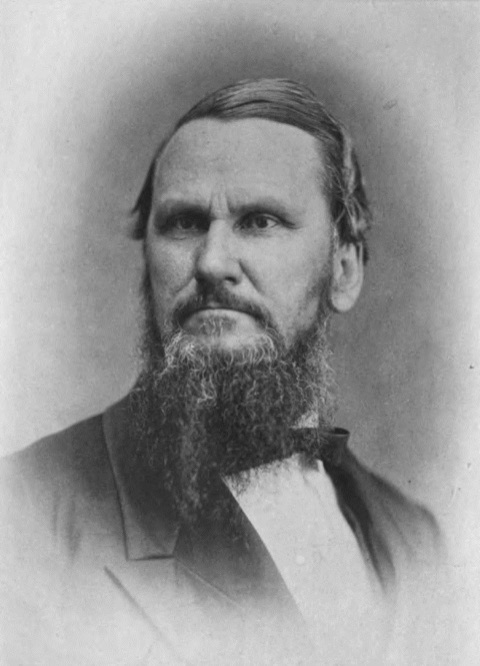
About the author
Robert Lewis Dabney
Robert Lewis Dabney (1820 to 1898 AD) was born in Louisa County, Virginia, studied at Hampden-Sydney College and the University of Virginia, and trained for the ministry at Union Theological Seminary. He became pastor of the Tinkling Spring congregation in 1847, joined the Union faculty in 1853, and in 1859 took its chair of systematic and polemic theology, where he gave the lectures in this book. In 1862 he served as chief of staff to Thomas J. Jackson and later wrote the general's biography. After the war he defended slavery in A Defence of Virginia (1867) and opposed reunion of the Northern and Southern churches. In 1883 he became professor of mental and moral philosophy at the University of Texas. He died in Victoria, Texas, in 1898.