Modernized edition · Full text · Free PDF/EPUB
Astronomical Discourses in Modern English
Want the file? The PDF/EPUB is free with an account.
Summary
- Author
- Thomas Chalmers (1780 to 1847 AD), Scottish minister and later first Moderator of the Free Church of Scotland
- Published
- 1817 AD, as A Series of Discourses on the Christian Revelation, Viewed in Connection with the Modern Astronomy
- Source edition
- Glasgow, 1822 (Chalmers & Collins), in modern English
- Type
- Sermons in Christian apologetics
- Length
- 45,000 words · 3 hours
What is Astronomical Discourses about?
Astronomical Discourses is Thomas Chalmers's 1817 series of seven sermons on the Christian revelation viewed in connection with modern astronomy. Preached in Glasgow, they answer the objection that so small a world could not be the object of God's redemption, arguing from the limits of science, God's care for small things, and what Scripture says of angels.
Read the full summary (8 points, key themes)Show less
How the argument unfolds
- 01
A Sketch of Modern Astronomy. Planets like the earth, fixed stars that are suns, and a universe in which our world is among the smallest; then the objection itself.
- 02
The Modesty of True Science. Newton's rule of believing only on evidence exposes the claim that Christianity belongs to earth alone as a guess about worlds no one has observed.
- 03
The Extent of Divine Condescension. God's attention to each person, the profusion of design in nature, and the microscope show that nothing is too small for his care.
- 04
Man's Moral History in Distant Creation. Scripture shows that redemption is known among other orders of beings, and that the size of the earth has no bearing on the meaning of what God did there.
- 05
Heaven's Sympathy for Humanity. Like the shepherd seeking one lost sheep, heaven turns its love toward the one world that has strayed.
- 06
The Contest for Humanity. The earth is the scene of a struggle between Christ and the prince of a wider rebellion, a struggle that still goes on in every human heart.
- 07
Mere Taste in Religion. Delight in grand themes, music and eloquence is not religion; only hearing and obeying is.
- 08
Appendix: Scriptural Authorities. Passages of Scripture gathered under each discourse to confirm its argument.
Key themes
- The limits of observation. Science is strong because it stops where evidence stops, and the counsels of God lie beyond that line: “I have never heard of a moral telescope”.
- Greatness that attends to detail. Chalmers holds that God's ability to govern countless worlds while caring for each sparrow and each person is a higher perfection than size alone.
- Redemption on a universal stage. The rescue of one world displays God's character to every order of intelligent beings, so its importance is not measured by the planet's bulk.
- Taste against obedience. Wonder at God's works can coexist with complete ungodliness: “The man may feast on the magnificence of God while he neither loves God, nor believes God, nor obeys God.”
Reader questions (9)Hide the questions
Questions about Astronomical Discourses
Is there a modern English version of Astronomical Discourses?
Yes. This is Astronomical Discourses by Thomas Chalmers in modern English. The language is modernized and the author's order and argument are kept. The full modernized text is free to read on this page.
Can I read Astronomical Discourses online for free?
Yes. The complete text of this modern English edition is on this page, with no sign-up or paywall.
Is there a free PDF of Astronomical Discourses?
Yes. The PDF and EPUB of this edition are free with an Updated Works account. Sign in with Google or an email link; no card is needed.
What is Astronomical Discourses by Thomas Chalmers about?
It answers the objection that God would not give such care to one small planet among millions of worlds. Chalmers argues that the objection assumes what no one can know, misjudges the character of God, and ignores what the Bible says of the wider creation.
Where were the discourses first preached?
In Glasgow. Chalmers notes in his Preface: “These discourses were chiefly delivered as the weekday sermon preached in rotation by the ministers of Glasgow.”
Does Chalmers think other planets are inhabited?
Yes, as a strong probability drawn from the planets' rotation, seasons, atmospheres and clouds. He even imagines future telescopes showing a great city on another planet.
Does Chalmers claim that Christ died for other worlds?
No. He says the Bible does not speak clearly on whether redemption directly reaches other worlds, though it does say other orders of beings know of it, and he will not go beyond what is written.
Why does Chalmers praise Isaac Newton?
For refusing every claim that lacked proof, which also kept him attached to the Bible on its evidence. The Preface adds that Chalmers praises this feature only, not all of Newton's readings of Scripture.
What is in the appendix?
Passages of Scripture grouped under each of the seven discourses, meant to help readers who know little of the Bible and to reassure Christians who fear all philosophy.
Astronomical Discourses in Modern English · Full text
Preface
The astronomical objection against the truth of the gospel does not occupy a prominent place in any of the formal treatises of unbelief. Yet it often comes up in conversation. We have known it to cause serious perplexity and alarm in minds eager to establish their religious faith on solid ground.
The science of astronomy carries an imposing splendor. It is no surprise if the light it casts, or seems to cast, across fields of inquiry beyond its own domain sometimes dazzles and misleads an inquirer. For this reason, we think it would serve what we consider a true and righteous cause if we can dispel this illusion. Doing so would strip unbelief of its claims to intellectual breadth and its air of philosophical greatness. Those very pretensions have often made it destructively alluring to the young, the passionate, and the ambitious.
In my first discourse, I have offered a sketch of modern astronomy. I have not tried to disguise the comparative smallness of our planet, which gives the argument of freethinkers all its plausibility.
That argument rests on an assertion and an inference. The assertion is that Christianity claims to be designed for the sole benefit of our world. The inference is that God cannot be the author of this religion, because he would not lavish on so insignificant a field the special, distinguishing care attributed to him in the Old and New Testaments.
Christianity makes no such claim. The idea that it exists for the sole benefit of our world is entirely an assumption of the unbeliever himself. This is not the only instance of rashness that can be charged against the enemies of our faith. Accordingly, I have devoted my second discourse to showing how completely such a spirit clashes with the cautious and enlightened philosophy of modern times.
In that sermon, I paid tribute to the theology of Sir Isaac Newton in terms that might be misunderstood without further explanation. The greatest quality to admire in the character of this great man is that all the magnificence of his own discoveries never led him astray. He had a steadiness of mind that could resist their fascination. It kept him firmly attached to that book whose general evidence stamped it as a genuine message from heaven. This was the only feature of his theology I had in view when I ventured to praise it. I do not think that, amid the distraction and absorbing demands of his other pursuits, he always succeeded in interpreting that book. Otherwise, in my judgment, he would never have supported the leading doctrine of a sect or system that has now nearly faded from public view.
In my third discourse, I leave the assertion aside and challenge the inference built upon it. I insist that, by every analogy of nature and providence, we can place no limit on God’s willingness to stoop in care. Nor can we limit the countless ways he attends to even the humblest parts of creation. All around us, we see evidence of divine wisdom and care poured out in inexhaustible abundance. It is not for us to say that God would not lavish all the wealth of his wondrous attributes on the salvation of even our single species.
At this point, I trust the thoughtful reader can see how the gospel’s opponents abandon the maxims of Baconian philosophy in two ways. First, the assertion forming the groundwork of their argument is drawn without warrant from an unknown realm. There, the light of experience completely deserts them. Second, the inference they press from that assertion contradicts many undeniable truths. All of those truths lie within the safe and accessible field of human observation.
In the discourses that follow, I turn to the testimony of the biblical record. By that stage, the unbeliever’s objection from astronomy may be considered answered. If we have succeeded in clearing it away, we free Christian testimony from all discredit on this ground. Then, on the strength of other evidence, we may submit to be guided by what it tells us. We will learn that Christianity has a far wider bearing on the other orders of creation than the unbeliever is willing to grant. Whether he acknowledges the authority of this testimony or not, he will at least have to admit one thing. The subject matter of the Bible itself is not open to the objection he has tried to fasten upon it.
If my only goal had been to refute the unbeliever’s argument, I could have omitted the final discourses of this volume altogether. Yet the paths of scriptural insight they opened to me seemed worth pursuing for their own sake. I truly believe that much can be gathered from these less observed parts of the field of revelation to cheer, elevate, and guide the believer.
Handling a subject like this can delight the mind’s taste and give the understanding the most enjoyable exercise. Achieving that effect in full, of course, would require a far higher style than I can sustain. Yet intellectual delight is quite different from the conscience feeling the force of a personal application. I could neither bring this argument to a close in the pulpit nor offer it to the public without turning, in the final discourse, to a certain delusion. I fear it is carrying thousands, and tens of thousands, onward to a ruined eternity.
I have closed the volume with an appendix of scriptural authorities. I found that I could not easily weave them into the fabric of the work, so I thought it best to present them separately. I hope this collection will bring a twofold benefit. First, it may help general readers who know little of the Scriptures and of the richness and variety that abound in them. Second, it speaks to those narrow and intolerant professing Christians who take alarm at the very sound or appearance of philosophy. They feel as if an utterly irreconcilable hostility exists between its lessons on one hand and the soundness and piety of the Bible on the other.
It would serve our cause well, I think, if that second group could become a little more open-minded on this subject. They would do well to let go of some of those ancient, inherited prejudices that do so much to cramp and enslave them. They should allow theology to take the wide range of argument and illustration that belongs to her. Less anxiously fearful that the Sabbath or the pulpit might be desecrated, they should allow her freely to declare every truth that serves to protect Christianity from the contempt of science. They should also allow her to declare every truth that serves to protect the teachers of Christianity from the intrusions practiced against both the sacredness of their office and the solitude of their devotional and intellectual labors.
I will add only one note for readers at a distance. These discourses were chiefly delivered as the weekday sermon preached in rotation by the ministers of Glasgow.
Discourse 1: A Sketch of Modern Astronomy
“When I consider thy heavens, the work of thy fingers, the moon and the stars, which thou hast ordained; What is man, that thou art mindful of him? and the son of man, that thou visitest him?” (Psalm 8:3-4)
In the reasonings of the apostle Paul, we cannot fail to notice how carefully he adapts his arguments to the pursuits, principles, or prejudices of his audience. He often took a favorite opinion of theirs as the starting point of his explanation. Drawing a skillful and irresistible line of argument from a principle both sides already shared, he drove them out of their opposition with a weapon of their own choosing. Nor did he hesitate to make use of a Jewish custom, a pagan superstition, or a line of Greek poetry to win the attention of those he labored to convince. Through the skillful use of such means, he sought to “shut them up unto the faith.”
When Paul addressed one group in a gathering or congregation, another group might, for the time being, have received no direct benefit or personal application from his arguments. Writing an epistle to a mixed congregation of Christianized Jews and Gentiles, he often had to direct to the Jews a line of reasoning that the Gentiles neither needed nor understood. How should the Gentiles have responded when hearing the part of the epistle aimed almost exclusively at the Jews? Should they have grown impatient at hearing something they neither enjoyed nor understood? Should they have felt fretful disappointment because not everything said was meant for their own edification? Should they have resented the apostle for leaving them in the dark and offering nothing for them across so many consecutive chapters?
Some of them may have felt that way. Yet it would have been far more Christian to sit in meek, sincere patience, rejoicing that the great apostle had taken on those stubborn prejudices that kept so many human beings from sharing in the gospel. And if Paul had reason to rejoice that his arguments had won even one Jew, or many Jews, to Christianity, then the Gentiles, though gaining no direct or personal benefit from those arguments, ought to have blessed God and rejoiced with him.
Imagine that Paul were alive at this moment, zealously urging the Christian faith upon every class of society. Would he not still act on the principle of becoming all things to all people? Would he not adapt his discourse to the prevailing taste, literature, and philosophy of the age? Would he not meet the people he addressed on some favorite principle of their own? And in following that principle, might he not move completely beyond the grasp of a large number of zealous, humble, and devoted Christians?
Now, the question is not how such Christians would behave in those circumstances, but how should they behave? Would it be right for them to sit in impatience because the apostle’s argument offered nothing directly for their own comfort or edification? Should not the love of the gospel guide their feelings in a better direction? Instead of that narrow, exclusive, monopolizing spirit that I fear marks too many who openly profess the truth in Jesus, ought they not to be patient and rejoice? Should they not be glad when philosophers, literary thinkers, and those who shape public taste in the upper circles of society hear arguments suited to bring home to them as well “the words of this life”?
Moved by these considerations, I have, with some hesitation, resolved to attempt an argument designed to soften and overcome the prejudices that lie beneath what may be called the unbelief of natural science. I hope, if possible, to draw toward the humility of the gospel those who delight in exploring the wonders and grandeur of creation. I want to convince them that a wisdom loftier still than all their high and honorable learning belongs to the one who resolves to know nothing except Jesus Christ and him crucified.
It is truly a Christian exercise to draw devotion from the works and beauty of nature. It carries the authority of the biblical writers, and our Savior himself lends it the weight and solemnity of his own example. “Behold the lilies of the field; they toil not, neither do they spin, yet your heavenly Father careth for them.” He dwells on the beauty of a single flower and draws from it a joyful argument for trusting God. He shows us that refined taste can walk hand in hand with piety. The same heart can engage with all that is serious in religion while staying deeply alive to the charm and loveliness of nature.
The psalmist takes an even loftier flight. He leaves the earth behind and lifts his imagination to the vast expanse spreading above and around it. He wings his way through space, wandering in thought across its immeasurable regions. Instead of a dark, unpeopled solitude, he sees it crowded with splendor and filled with the active energy of the divine presence. Creation rises before him in all its vastness, and the world, with everything it holds, shrinks into smallness before so overwhelming a vision. He marvels that he is not overlooked amid the grandeur and variety on every side. Rising from the majesty of nature to the majesty of nature’s Architect, he cries out, “What is man that thou art mindful of him, or the son of man that thou shouldest deign to visit him?”
It is not for us to say whether divine inspiration revealed the wonders of modern astronomy to the psalmist. Yet even when the mind knows nothing of the science of these enlightened times, the heavens still offer a grand and uplifting sight. They form an immense dome resting on the circular rim of the world, across whose face countless lights move with solemn regularity. The psalmist’s devotion seems to have awakened at night, when the moon and stars stood visible, rather than when the sun had risen in his strength and poured out a brightness that drowned and eclipsed every lesser glory of the sky.
There is much in the scenery of a night sky to lift the soul to worship. That moon and those stars, what are they? They hang detached from the earth, and they lift you above it. You feel drawn away from the ground, rising in quiet reflection above this small stage of human passions and human anxieties. The mind gives itself over to wonder and travels in the ecstasy of thought to distant, unexplored realms. It beholds nature in the simplicity of her grand elements, and it beholds the God of nature clothed in the high attributes of wisdom and majesty.
Yet what can these lights be? Human curiosity is insatiable, and the workings of these marvelous heavens have occupied our minds in every age. It was reserved for these modern times to answer that great and compelling question. The highest powers of human inquiry have been summoned to the task, and astronomy may now be regarded as the most certain and best-established of all the sciences.
We all know that every visible object looks smaller as it moves farther from the eye. A tall ship sailing away from the coast shrinks into insignificance until it appears as a tiny speck on the edge of the horizon. An eagle with outstretched wings is a noble sight. Yet when it climbs into the upper reaches of the air, it dwindles before our eyes and looks like a dark dot against the vault of the sky.
The same holds true for all size and distance. The heavenly bodies look small to someone standing on earth solely because of their immense distance. When we speak of hundreds of millions of miles, you must not dismiss it as unbelievable. Remember that we are speaking of bodies scattered across the vastness of space, and space has no boundary. The thought is grand and hard to grasp, yet the truth of it is beyond dispute.
By a method of measurement we need not explain here, astronomers have determined first the distance and then the size of several bodies rolling across the sky. The sun, which looks so modest to our eyes, is actually a globe thousands of times larger than the earth we inhabit. The moon itself has the dimensions of a world. Even a few of those stars that look like bright pinpoints to the unaided eye expand into large disks under a telescope, and some of them are far larger than the globe we walk upon and proudly call the universe.
What, then, is the fair and obvious inference? Our world is a round sphere of definite size, occupying its own place in the heavens. Yet when we explore the boundless reaches of space around us, we encounter other spheres of equal or far greater size. From those worlds, our earth would either vanish from sight or look no larger than one of the twinkling stars on our night canopy. Why, then, suppose that this tiny spot, tiny at least amid the vastness surrounding it, should be the sole home of life and intelligence? What reason is there to think that those mightier globes rolling through other regions of creation, which we know to be worlds in size, are not also worlds in purpose and dignity? Why imagine that the great Architect of nature, supreme in wisdom as in power, would summon such stately mansions into being only to leave them empty?
When we gaze across a wide sea toward a distant shore, we see nothing but a strip of blue land stretching dimly along the horizon. We stand too far away to make out the richness of its scenery or to hear the hum of its population. Why not apply that same principle to the far more distant regions of the universe? What if, from our remote vantage point, we can make out nothing beyond the bare round outline of those planetary spheres? Should we therefore declare them vast, unpeopled deserts? Should we conclude that emptiness reigns everywhere in the universe except here? Must we think that the whole energy of the divine attributes is spent on one tiny corner of these mighty works? Does earth alone enjoy the bloom of vegetation, the gift of life, and the dignity of rational, immortal existence?
Nor is size our only argument. We have far more than the sheer bulk of the planets to support the belief that they are inhabited. We know that our earth rotates on its own axis, and we observe the very same rotation in every celestial body we can examine closely enough. We know that our earth makes a yearly orbit around the sun, and we detect the same kind of orbit, under the same conditions, in every planet of our solar system. They share the same rhythm of day and night. They share the same welcome cycle of the seasons. For them, light and darkness follow each other in turn, and the brightness of summer gives way to the bleakness of winter. Above each of them, the skies unfold just as varied and magnificent a display. And this earth, whose circumference would take one of its frail inhabitants years to circle, is merely one of the lesser lights sparkling in their sky.
For them, as well as for us, God has divided the light from the darkness. He has called the light day, and the darkness he has called night. He has said, let there be lights in the expanse of their heaven to divide the day from the night, and let them be for signs, and for seasons, and for days, and for years. Let them be for lights in the expanse of heaven to give light upon their earth. And it was so. God has also made great lights for them. To all of them he has given the sun to rule the day, and to many of them he has given moons to rule the night. For them he has made the stars also. God has set them in the expanse of heaven to give light upon their earth, to rule over the day and over the night, and to divide the light from the darkness. And God has seen that it was good.
In all these grand arrangements of divine wisdom, we see that God has made the same provisions for the planets as he has made for the earth we inhabit. Shall we claim that the likeness ends there simply because we are not positioned to observe the rest? Shall we imagine that this magnificent display was called into being merely to entertain a handful of astronomers? Shall we measure the counsels of heaven by the narrow weakness of human senses? Shall we believe that silence and solitude reign across the vast empire of nature, that most of creation is an empty show, and that not a single worshiper of God exists across the breadth of those immeasurable realms?
Our argument gains delightful confirmation whenever improved instruments reveal a new likeness between our earth and the other bodies of the planetary system. We now know far more than that all of them have day and night, changing seasons, and in some cases moons to rule their nights and soften their darkness. On one planet, we can see an uneven surface rising into mountains and stretching into valleys. Around another, we detect an atmosphere capable of supporting animal breath. Above a third, we observe clouds forming and hanging in the sky, ready to nourish the bloom and lushness of plant life.
On a fourth planet, a white expanse spreads over its northern regions as winter advances, then fades away as summer returns. This gives us strong reason to suppose that water abounds there, rising by evaporation into its atmosphere, freezing in the cold, and falling as snow to blanket the ground in a fleecy coat that melts away beneath the warmth of a higher sun. It also gives us reason to suppose that other worlds resemble our own in this same yearly round of life-giving and remarkable changes.
Who can set a limit to the discoveries of future ages? Who can draw borders for science or confine the active, insatiable curiosity of humanity within the circle of our current knowledge? We may reasonably guess at what we cannot yet predict with certainty. The day may come when our observational instruments grow inconceivably more powerful. They may uncover still more decisive resemblances. They may settle by direct sight the very question that analogy already makes so deeply convincing. They may reveal to us unmistakable traces of art, industry, and intelligence.
We may yet watch summer spread its green mantle across those vast landscapes and see them left bare and colorless once the flush of growth fades. Over the course of years or centuries, we may trace the hand of cultivation reshaping some part of a planetary surface. Perhaps a great city, the capital of a mighty empire, will expand into a visible mark through the lens of some future telescope. Perhaps the instrument of an observer in a distant age will enable him to draw the map of another world and chart its surface in all its fine local detail. Yet conjecture knows no end. To future generations we leave full proof of what we can already affirm with the highest probability: those planetary spheres are worlds teeming with life, where the mighty Being who rules over this scene of wonder and majesty has planted worshipers of his glory.
Even if scientific discovery stopped right here, we would already have enough to justify the psalmist’s cry: “What is man that thou art mindful of him, or the son of man that thou shouldest deign to visit him?” These discoveries widen the empire of creation far beyond the boundaries once assigned to it. They show us that our sun, enthroned at the center of his planetary system, pours light, warmth, and changing seasons over a combined surface area hundreds of times greater than our earth. They reveal a family of worlds rolling in their orbits around this vast luminary.
They also prove that the globe we walk upon, with all its mighty burden of oceans and continents, is not set apart above the others, but ranks among the smallest of them. From some of the outer planets, earth would not even fill a visible point in the dome of their sky. These discoveries teach us that if our mighty earth, with all its millions of people, were to vanish into nothingness, there are worlds where an event so catastrophic to us would pass unnoticed and unknown. On others, it would amount to nothing more than a tiny star ceasing to twinkle.
This true yet humbling picture ought to inspire a spirit of modesty. We should learn not to mistake our earth for the whole universe of God, but to see it as one tiny, insignificant fraction of it. It is merely one of the many mansions the Supreme Being has built for his worshipers, and only one of the many worlds rolling through the flood of light that our sun pours out to the farthest borders of the planetary system.
Yet is there nothing beyond those borders? The planetary system has its limits, but space has none. If our imagination takes flight beyond our system, do we travel only through dark, empty voids? Only five, or at most six, of the planetary spheres can be seen with the naked eye. What, then, is that multitude of other lights sparkling in our sky and filling the whole dome of heaven with countless splendors? The planets all belong to the sun. In circling around him, they pay homage to the force that holds them in constant attendance on this great luminary.
The other stars acknowledge no such rule. They do not circle around our sun. To ordinary observation, they remain immovable. Each stands like an independent sovereign over its own territory, holding an unchanging position in the depths of immensity. What are we to make of them? Shall we launch out in bold thought to explore these dark, untraveled realms? What is the meaning of these countless fires kindled in the distant reaches of the universe? Were they made merely to shed a faint glimmer upon this little speck in nature’s kingdom, or do they serve a purpose far worthier of them: lighting other worlds and giving life to other systems?
The first thing that strikes a scientific observer of the fixed stars is their immeasurable distance. If our entire planetary system were lit up into one solid globe of fire, it would surpass the size of our earth many millions of times over, yet from the nearest fixed star it would look like nothing more than a tiny luminous point. If an object were launched from the sun at the speed of a cannonball, it would need hundreds of thousands of years to cross the vast gulf separating our sun and system from the nearest fixed star. Think of our own earth, which hurtles through space at the staggering speed of more than a million and a half miles a day. Even if it were flung out of its orbit to race across that expanse, it would not yet have reached its destination after all the time since the creation of the world.
These are immense numbers and immense calculations, and the mind feels its own helplessness in trying to grasp them. We can state them in words. We can write them out in figures. We can prove them through the powers of a strict, unerring geometry. Yet no human imagination can summon up a vivid or adequate picture of them. No mind can fly in thought across this boundless expanse, take in this mighty space in all its grandeur and immensity, sweep the outer borders of such a creation, or rise to the majesty of that great invisible arm on which the whole universe hangs.
What, then, can those stars be that sit so far beyond the limits of our planetary system? They must be bodies of immense size, or they could never be seen across such distances. Moreover, the light they send us must come from themselves. A faint reflection of light borrowed from somewhere else could never cross such vast tracts to reach an observer’s eye.
A body can be visible in two ways. It may shine by its own light, like the flame of a candle, the glow of a fire, or the brilliance of the glorious sun that illuminates everything below and serves as the lamp of our world. Or it may be visible by light falling upon it from outside. Think of an object lit by a nearby lamp, or the whole landscape of earth visible only when daylight rests upon it. Think of the moon, which reflects a silvery whiteness from the side facing the sun while its other side merges into dark, invisible space. Think of the planets, which shine only because the sun shines on them, each showing a dark shadow on the side turned away from him.
Now apply this test to the fixed stars. Do they shine by their own light, or do they borrow their brightness from our sun, like the planets of our system? Consider their immense distance, and the answer becomes obvious. Like any other object, our sun shrinks in apparent size the farther you move away from it. At the vast distance of even the very nearest fixed star, our sun would dwindle to a tiny indivisible point. In short, it would become a star itself, shedding no more light than a single member of those glimmering hosts whose combined brightness cannot scatter, and barely softens, the midnight darkness of our world. These stars are visible to us not because our sun shines on them, but because they shine on their own. They are countless luminous globes scattered across the tracts of immensity. In a word, they are suns, each enthroned at the center of its own domain, pouring a flood of light across its own share of these boundless realms.
At so vast a distance for observation, we could hardly expect to gather many points of likeness between the fixed stars and the solar star at the center of our planetary system. Yet one striking resemblance has not escaped the sharp eye of our astronomers. We know that our sun completes a rotation on his axis in a regular period of time. We also know that dark spots lie scattered across his surface. Though invisible to the naked eye, they are easily detected through our instruments. If these spots gather in greater numbers on one side than on the other, that side becomes dimmer overall, so the sun’s rotation naturally presents a brighter and a fainter side in regular turns.
Now, several fixed stars show this very behavior. They display periodic shifts in brightness. From the brilliance of a first- or second-magnitude star, they fade down into fainter magnitudes. One even disappears from naked-eye view, making it look as though we had lost it completely. Yet our telescopes still track it, until at last it returns to sight in its proper place and, after a regular span of days and hours, regains its original brightness. The fair conclusion is clear. Just as the fixed stars resemble our sun in being immense luminous bodies, they resemble him in this as well: each rotates on its own axis. Whenever one side of a star is brighter than another, that rotation reveals itself through the steady, regular variations in its light.
Shall we say, then, that these vast luminaries were created in vain? Were they called into being for no higher purpose than to pour a tide of wasted splendor across empty solitudes? Our sun is simply one of these luminaries, and we know he carries worlds in his train. Why strip the rest of such royal attendance? Why might not each of them stand at the center of his own system and pour light upon his own worlds?
True, we cannot see those worlds. Yet if a human eye could take flight into those distant regions, it would lose sight of our little earth before even reaching the outer edge of our solar system. The larger planets would vanish one by one in turn. Long before crossing even a small fraction of the abyss separating us from the fixed stars, our sun would dwindle to a tiny spot, and all his splendid retinue of worlds would fade into the obscurity of distance. At last our sun would shrink to an indivisible speck, and everything visible of this magnificent system would be reduced to the faint glimmer of a little star.
Why resist the grand and compelling conclusion any longer? Each of those stars may mark a system as vast and splendid as our own. Worlds roll through those distant regions, and those worlds must be mansions of life and intelligence. In that gilded canopy of heaven, we behold the sweeping scale of the universe, where every shining point reveals a sun and every sun rules a system of worlds. There God reigns in all the grandeur of his attributes. There he peoples immensity with his wonders and travels in the greatness of his strength across the realms of one vast, unlimited monarchy.
This contemplation has no boundary. If we ask how many suns and systems exist, the unaided human eye can take in a thousand, and the finest telescope human genius has built can take in eighty million. Yet why confine the dominions of the universe to human sight or to the reach of human skill? Imagination can fly far beyond the grasp of eye or telescope. It can roam through the outer realms beyond everything visible.
Dare we boast that nothing exists out there? Dare we claim that the wonders of the Almighty end simply because we can no longer trace his footsteps? Shall we say that his omnipotence is exhausted because human instruments can follow him no farther? Shall we imagine that God’s creative power has sunk into rest merely because our imagination grows weary from the scale of its effort? Our minds cannot stay on the wing across those mighty tracts. They stretch far beyond what eye has seen or the human heart has conceived, sweeping endlessly onward into an awe-inspiring and mysterious infinity.
Before closing this brief and imperfect sketch of modern astronomy, we should notice two fascinating lines of thought. Both expand our vision of the universe and, naturally, deepen our sense of how small our own world really is.
The first begins with a simple principle of mechanics. If a body is struck directly toward its center, the blow gives it forward motion without making it spin. It moves straight ahead, without turning on itself. If, however, the blow does not aim straight at the center, so that the line joining the point of impact to the center meets the line of force at an angle, then the body both moves forward through space and spins upon its axis. In this way, each of our planets may have received both of its motions from one single impulse. Conversely, whenever a single blow produces rotation, forward motion must accompany it. To produce spin without forward travel requires two opposite forces applied to the body, setting it in motion like a spinning top that turns around its axis while staying in one spot.
Our planets have both motions and may therefore have received them from one and the same impulse. Of the sun, we know for certain that he has one of these motions: he rotates on his axis. If spun by two opposite forces, one on each side, he could keep this rotation while staying fixed in space. Yet if that rotation came from a single stroke, he must have forward motion along with his spin. In other words, he is moving forward, tracing a path through space, and carrying all his planets and all their moons along with him.
At this point in the reasoning, the idea remains pure conjecture. The sun’s rotation could have come from a pure spinning impulse. Or, without appealing to secondary causes at all, his rotation may be as old as his existence, both his being and his motion springing directly from the Creator’s command. Yet an actual observed phenomenon in the heavens lifts this conjecture into probability. Over the course of ages, the stars in one quarter of the sky appear to spread farther apart from one another, while in the opposite quarter they appear to draw closer together.
If our sun is moving toward the first quarter and receding from the second, this phenomenon has a straightforward explanation, and we gain a magnificent new tier in the scale of the Creator’s workmanship. Just as the planets with their satellites revolve around the sun, so the sun with all his attendants may move, together with other stars, around some distant center whose force binds and governs them all. Centrifugal force may hold them back from crashing together. Without it, the laws of gravity might collapse every distinct globe in the universe into one stupendous mass.
Our sun may therefore be just one member of a higher family, joining millions of others in a loftier system of order governed by one law and one design. Together they may sweep an orbit through space, completing their vast revolution across a span of time so immense that it reduces our planetary seasons and planetary motions to a humble, tiny fraction on the scale of a higher astronomy. Immensity has ample room for this. Actual records of observation even offer evidence for it. And from this whole line of thought we draw fresh emphasis for our lesson: how tiny is the place, and how secondary the importance, of our world amid the glories of such surrounding magnificence.
A second fascinating field of inquiry has opened before us through the more recent observations of astronomy: the discovery of the nebulae. Admittedly, this discovery sheds only a dim and indistinct light on the structure of the universe. Even so, it opens before the mind’s eye a vast and lofty landscape for reflection. Before this discovery, the universe might have seemed composed of an indefinite number of suns spaced roughly at equal distances, scattered evenly across space, each surrounded by a family of planets like our own.
We now have reason to believe that instead of lying evenly spaced from one another, the stars are gathered into distinct clusters. Just as the distance between the nearest fixed stars, unimaginably greater than the spaces between our planets, marks the separation of solar systems, so the distance between two neighboring clusters may unimaginably exceed the spacing of stars within the same cluster. That vast interval would set each cluster apart as an individual member of some higher and wider arrangement.
This lifts us up yet another ascending step on the ladder of magnificence, leaving us bewildered in uncertainty over whether the marvelous progression even ends here. At all events, it seals one sure conclusion in our minds: to an eye capable of taking in the whole, the dwelling that houses our species might be so tiny as to lie hidden in microscopic obscurity. Thinking of the only Being who possesses that universal eye, we may well exclaim, “What is man that thou art mindful of him, or the son of man that thou shouldest deign to visit him?”
After all, mighty and difficult as this thought may be, who can question it? What is seen may be nothing compared with what is unseen. What is seen is bounded by the reach of our instruments. What is unseen has no limit. Even if everything the human eye can behold or the human imagination can grasp were swept away, there might still remain just as vast a realm across which God may work and which he may have filled with countless worlds. If the entire visible creation were to vanish, it would leave a void behind. Yet to the Infinite Mind that embraces the whole system of nature, that void might amount to nothing: a tiny empty dot in the surrounding immensity that he may have filled with the wonders of his omnipotence.
Even if this earth were burned up, the trumpet of its end sounded, the sky rolled away like a scroll, and every visible glory inscribed upon it by the finger of God extinguished forever, what would it be? To us, and to every world in our neighborhood, such an event would be catastrophic, snuffing out so many suns and sweeping so many rich scenes of life and population into oblivion. Yet on the high scale of the Almighty’s workmanship, what is it? A mere shred. Scattered into nothingness, it would still leave the universe of God an unbroken scene of greatness and majesty. Even if our earth and skies disappeared, other worlds roll afar. The light of other suns shines upon them, and the sky wrapping them is decked with other stars.
Is it presumptuous to suppose that the moral world extends into those distant, unknown regions? May we not think that they are inhabited by people, where the warm affections of home and neighborhood flourish? Might God’s praises rise there, and his goodness be rejoiced in? May not devotion have its temples and its offerings there, where intelligent worshipers feel and admire the richness of the divine attributes?
And what is this world amid an immensity teeming with such realms? Who are we who occupy it? The universe at large would lose no more of its splendor and variety by our planet’s destruction than the green majesty of a great forest would lose by the fall of a single leaf. The leaf trembles on the branch that holds it, lying at the mercy of the slightest accident. A breath of wind tears it from its stem and drops it onto the stream flowing below. In an instant, the teeming life that the microscope shows us inhabits that leaf is wiped out. An event so trivial to human eyes, and on our scale of observation, brings to the myriads living on that little leaf a catastrophe as terrible and final as the destruction of a world.
On the grand scale of the universe, we who inhabit this sphere making its little round among the suns and systems astronomy has revealed may feel that very same smallness and insecurity. We differ from the leaf in only one respect: it takes larger forces to destroy us. Yet those forces exist. The fire raging inside our planet could lift its devouring power to the surface and turn earth into one vast, devastating volcano. The sudden buildup of expanding gases deep within the earth, well within the power of known substances, could shatter it into fragments. Poisonous vapors rising from below could taint the air around us, disturb the delicate balance of its elements, and cause all living things to wither and die beneath a corrupted atmosphere.
A blazing comet could cross this fated planet in its orbit and fulfill every terror superstition ever imagined. We cannot predict the exact outcome of an event that every astronomer knows lies within the bounds of chance and probability. It could hurl our globe toward the sun, drag it out to the far edges of the planetary system, or shift its axis of rotation. The result of that last change, which I will simply state without explaining, would be to displace the ocean and unleash another mighty flood across our islands and continents.
Any of these upheavals could strike in a single instant, and nothing known in the present order of nature gives us any safeguard against them. They might not annihilate the earth, yet they would empty it of people. We who stride across its surface with such firm, confident footsteps stand at the mercy of devouring forces. If released upon us by the hand of the Almighty, they would spread solitude, silence, and death across every realm of the world.
Yet it is this very smallness and this very insecurity that make the Almighty’s protection so precious to us, pressing home to every devout heart the holy lessons of humility and gratitude. The God who sits above and rules in high authority over all worlds is mindful of humanity. Though at this very moment his power acts across the farthest provinces of creation, we may rest as securely in his providence as if we were the sole objects of his undivided care.
We cannot stretch our minds to fathom that mysterious working. Yet the astonishing fact remains: the same Being whose eye surveys the entire universe gives growth to every blade of grass and keeps every drop of blood moving through the veins of the tiniest creature. Though his mind encompasses immensity and all its wonders, I am known to him as completely as if I were the single focus of his attention. He observes all my thoughts. He gives rise to every feeling and movement within me. With a power I can neither describe nor comprehend, the same God who sits in the highest heaven and reigns over the glories of the firmament stands at my right hand to give me every breath I draw and every comfort I enjoy.
Yet this very reflection has been seized for the cause of unbelief. Even the words of our text have been twisted into an attack against the faith: “What is man, that God should be mindful of him, or the son of man, that he should deign to visit him?” Is it likely, asks the unbeliever, that God would send his eternal Son to die for the puny inhabitants of so insignificant a province in the vast field of his creation? Are we fitting recipients of so great and remarkable an intervention? Does not the sheer scale of the universe modern astronomy reveals cast doubt over the truth of the gospel story? How can we reconcile the greatness of that marvelous work undertaken in heaven to redeem fallen humanity with the comparative smallness and obscurity of our race?
This is a popular objection against Christianity. It is not often argued at length in books, yet I believe it is frequently hinted at in conversation and carries no small sway over dabblers in a superficial philosophy. In any case, every such objection ought to be met and faced courageously. I know of no more shameful surrender of our religion than acting as though it had anything to fear from the cleverness of its most accomplished opponents.
The author of this work takes up his task fully convinced that an answer can be found to confront unbelief in all its forms. The truth of God and his message can shine forth boldly and decisively through every mist that human pride, prejudice, or sophistry may cast around it. High indeed is the wisdom of the thinker who climbs the heights of science and sheds the light of proof over nature’s deepest mysteries. Yet even on his own principles, it can be proved how much higher is the wisdom of the person who sits before the Bible with the teachable spirit of a little child and lays down all his lofty imaginations before its authority.
Discourse 2: The Modesty of True Science
“And if any man think that he knoweth any thing, he knoweth nothing yet as he ought to know.” (1 Corinthians 8:2)
There is profound and important wisdom in Solomon’s proverb that the heart knows its own bitterness. That saying belongs to a still broader truth: every person knows his own personal feelings, difficulties, and trials far better than he can ever make his neighbors perceive them. It is natural for all of us to crave the fullest sympathy of others for whatever pains our deepest sensibilities and weighs most heavily in our own circumstances.
Yet work as hard as we may, no power of expression lets us transfer all our inner sensations and circumstances intact into another person’s mind. Something in the intimacy of personal experience refuses to pass whole into the heart and understanding even of our closest companion. Because of that, a man is often disappointed when he tries to win full, heartfelt sympathy. He feels hurt and bewildered by the dullness of the people around him. He cannot understand why they fail to grasp the justice of his complaints, miss the core reason behind his protests, withhold keen attention from his distinctive wrongs, or refuse to catch fire with generous indignation alongside him.
All the while, he forgets a simple fact about every human being he addresses. Inside each one lives an inner self, a theater of passions and concerns every bit as busy, crowded, and absorbing as his own. Each heart alone understands its own bitterness and accurately weighs the burden of its own afflictions. Every person we meet carries, in the unseen solitude of his chest, a private little world of his own. We are just as blind, insensitive, and dull in perception and sympathy toward his absorbing concerns as he is toward ours.
If we allowed this truth its full weight, it would make us far more fair-minded and considerate of others. It would curb the self-absorption of our nature. It would soften the resentment born of envious glances at the imagined ease and prosperity around us. It would reconcile each person to his own lot and incline him to carry his own burden with gratitude.
Follow this reflection with calmness, firmness, and fairness, and it leads to a clear conclusion. Every calling in life carries its own distinct pains and recurring hardships. From the very bottom of society to the golden pinnacle gleaming at its summit, care and suffering abound. Across every conceivable human condition lie trials that can neither be fully told on one side nor fully grasped on the other. In this, as in every department of his governance, God’s ways with humanity are evenhanded. Wherever we turn in human experience, we find he has provided enough to train the patience and fulfill the wise, wholesome discipline of all his children.
I have introduced this first observation to prepare the way for a second. Perhaps no two groups of people understand each other’s inner lives, cares, and labors less than the wide, busy public on one side and men of quiet, studious seclusion on the other. The world scarcely hears of such scholars until some splendid discovery emerges from their thoughtful solitude and holds society in awe.
When that happens, the brilliance of superior genius draws every eye. The homage paid to intellect places its hero on a higher peak than wealth or titles could ever confer. The successful scientist’s name travels across civilized society in his own age and passes down to posterity in enduring remembrance. Look back to the days of Newton, and we attach a mysterious greatness to the man who rose, by pure force of mind, to such a towering height above ordinary mortals. Kings and warriors of earlier eras shrink into insignificance beside him. Today he stands before the public eye in a prouder glory than surrounds the memory of all who lived in past generations. While the worldly grandeur of former ages molders into oblivion, our great astronomer’s achievements stay fresh in his countrymen’s reverence. They carry him forward on the stream of time with a still-gathering reputation and a distinction that will never die.
Now here is the point I want to press home to you. This very public, so dazzled and overwhelmed by the luster of Newton’s greatness, remains completely in the dark about what gives his philosophy its chief merit. People see the results of his labors, but they have no idea how to gauge their difficulty or extent. They admire the stately building he raised, yet they know nothing of his work in laying the foundation that gives it stability. They do not realize what painful struggles he fought against the natural leanings of his own heart and the prejudices of others while setting its imperishable stones in place.
They have never heard of the controversies this peaceful, unambitious, modest man endured against everything proud and intolerant in the science of his age. In thought, they have never stepped into the private study where he carried out his patient, profound work. They never sat beside him as he spent his silent midnight hours at the tireless task to which the charm of lofty contemplation had drawn him. They never traced the inner workings of that extraordinary mind, a laboratory from which gleams and chains of thought poured forth to shed radiance across the full breadth of nature.
The public has done none of this. Even among educated, well-read people, the vast majority are utterly unable to follow him there. For that very reason, they need to be told where the true distinction of Newton’s philosophy lies. Only then, when working in other fields of inquiry, can they borrow from his safe example and profit by the superior wisdom that governed his entire mind.
Understand, then, that in the eyes of a superficial public, Newton owes his whole fame to his positive discoveries. He uncovered the mechanism of the planetary system. He uncovered the composition of light. He uncovered the cause of the alternating rise and fall of ocean tides. These are his tangible, visible achievements, the monuments the world gazes upon as proof of his greatness. Through these doctrines he enriched science. People naturally assume his entire merit lay in the keen insight to perceive these truths and the vigor to grasp the proofs that established them with rigid, conclusive certainty.
Yet while Newton wins full credit and admiration for the scientific articles he added to the philosopher’s creed, he deserves equal credit and admiration for the articles he kept out. His mind held firmly to every claim backed by proof. Equally defining, however, and setting the true spirit and style of all his inquiries, was his determined refusal to admit any claim that lacked proof.
He would not accept the astronomical theories of his predecessors because they had no proof. He would not give in to their notions about planets wheeling around in whirlpools of ether. He did not see this ether, and he had no proof that it existed. Besides, even if it did exist, it could never have produced the heavenly motions he actually observed. He would not surrender his judgment to reigning systems that had authority behind them but lacked evidence. Thus he displayed the strength and soundness of his philosophy just as much in the scientific claims he rejected as in the discoveries he first proved, even though those discoveries alone now stand to posterity as monuments to his intellect.
Newton asked for only one credential for any scientific claim: evidence. Armed with evidence, a claim found the door of his mind wide open, even when authority scowled at it, taste recoiled from it, and fashion felt ashamed of it. Though this new announcement of a sounder science shattered the lovely speculations of earlier days and scattered them like fragments of an airy dream in which past generations had slept in pleasing reverie, he welcomed it anyway.
On the other hand, if a claim lacked evidence, he barred every entrance of his understanding against it. All antiquity might lend it support. All eloquence might wrap it in dazzling brilliance. Long habit might weave it into every curriculum of every academy in Europe. Imagination might clothe it in the most tempting charm. Yet Newton’s steady, unbending mind stayed immune to that whole weight of authority and allure. Casting a cold, unwelcome look upon deceptive plausibility, he dismissed it from his presence.
The strength of his philosophy lay as much in turning away whatever lacked evidence as in making room for whatever possessed it. As his intellect marched forward through the rich, magnificent field of his discoveries, he weighed every single step. Wherever the light of evidence guided him, he advanced with firm assurance. Yet he never allowed the glare of imagination or prejudice to lure him off his path.
I am certain that throughout his remarkable career, temptations pressed in on every side. He did not merely face the entrenched tastes and theories of his era. He ranged across a lofty height where, dizzy with triumph, countless ideas might have seduced his imagination into wayward speculation. Had he been like most people, he would have shaken off the restraints of a sober, disciplined mind and let his imagination soar. He would have done what many thinkers have done after him: chased some bright meteor of his own invention, amused himself with private mental pictures, or passed off loose, confident plausibilities on the world.
Instead, Newton stood faithful to his rule. He would accept nothing without evidence, sticking closely to demonstrations, measurements, and proofs. If it is true that he who rules his own spirit is greater than one who takes a city, then Newton won repeated quiet victories over himself in the solitude of his study. Those hidden triumphs should shed a brighter luster on his name than all his conquests in discovery or all the splendor of his positive achievements.
I trust you see the two essential maxims of true science. Never shrink from a doctrine that has evidence on its side, and never harbor a doctrine where evidence is missing. Hold those two maxims together, and you can readily explain the trait that, above all others, characterizes and ennobles Newton’s philosophy: its precious union of strength and modesty.
On one side, what finer proof of strength could exist than completing that mighty enterprise that claimed the heavens and brought the machinery of countless worlds within human grasp? All of that was won by walking in the light of sound, reliable evidence. It came through patient, strenuous, unfaltering use of the legitimate tools of discovery. It came by touching what is tangible, observing what is visible, and calculating what is measurable. In short, it came by making wise, reasonable use of all the proof nature lays within reach of sensory observation. On this arena modern science has won all its victories, performed its wonders, built its lasting monuments, and gathered magnificent trophies to the power of intellect with which generous heaven has gifted our race.
Step beyond the boundary of sensory observation, however, and everything changes. At that instant, true disciples of this enlightened school lay down all their confidence and boldness. Keep them on the solid ground of experiment, and no one speaks more boldly or decisively about what evidence proves. Take them off that ground, and no one grows humbler or more cautious about making positive claims.
Where evidence is missing, they choose neither to know, nor to believe, nor to assert. Like patient students at their desks, they wait until proof arrives. They are complete strangers to the haughty confidence with which certain thinkers of our day parade unauthorized speculations. Such thinkers ignore the frontier dividing observation from conjecture and charge blindly and rashly into territory that does not belong to them.
No landmark is more familiar to the trained mind of a genuine Newtonian than this boundary. It shapes, limits, and governs every enterprise of his science. Everything inside that border he cultivates to the utmost. Through such steady labors, every passing year brings fresh gains to experimental science and adds solidity and stature to its magnificent structure.
Yet if they stay true to their own principle, these very men behave differently toward the forbidden territory outside that border. On warranted ground they show the courage and vigor of mature intellect. Yet on any subject where evidence is withheld, they display the modesty of children. They offer a positive opinion only when indisputable proof stands behind it. Without proof, they hold no such opinion. One single principle, respect for truth, commands their homage wherever evidence is present and creates complete restraint wherever evidence is absent.
Now you can understand how the greatest master of science the world ever saw sat before the book of nature as its humble student and interpreter. Teachable humility cast a gentle, softening glow around even his most brilliant discoveries. A handful of shallow attainments is enough to lift a modern thinker onto an imagined pedestal and tempt him to claim lordship over all natural and revealed knowledge. Beside such arrogance, I cannot help honoring the unpretending greatness of Newton. I doubt whether anyone has ever appeared on earth whose admirable genius blended such power and such humility more attractively.
Let me now lead you forward, through a few simple illustrations, directly to today’s argument. All the sublime truths of modern astronomy lie inside the field of actual observation, resting on the firm evidence brought to us through our senses. Sir Isaac Newton never stepped past this boundary without feeling a reverent awareness of how uncertain the ground had become. Out there he never risked a positive assertion. Laying aside the lofty tone of demonstration and putting on the modesty of conscious ignorance, he offered everything he had to say as a humble doubt, a conjecture, or a question.
What Newton lacked the boldness to do, other thinkers have done since. They have flown audaciously into forbidden regions, crossed the circle that encloses observation, and debated and dogmatized there with proud, intolerant certainty.
Now, purely for illustration, imagine an invented case. Picture one of these thinkers breaking so completely from the sobriety of experimental science that he leaves planetary astronomy behind and tries to write the natural history of the plants and animals on other worlds. He might seize on vague general analogies to lend his guesswork an air of plausibility. Moving from earth’s botany across our different climates, he might apply loose, confident rules to every other planet based on its distance from the sun and the tilt of its axis to its orbital plane. Out of such flimsy material, he could spin an entertaining scientific fantasy, full of ingenuity and painted with the colors of truth and consistency.
I can easily picture a shallow public delighted by the eloquence of such a book and even impressed by its arguments. Yet suppose someone asked me which person, across all nations and centuries, would hold the least respect for this treatise on the plants growing on Jupiter. I would answer without hesitation. It would be the very man who calculated Jupiter’s orbit, measured its size and density, determined its periods, and with watchful eye and patient math traced Jupiter’s moons through all their intricate, winding paths.
He would see instantly that the subject lay hopelessly beyond legitimate observation. The mere fact that it sat beyond his telescope’s reach would settle the matter. On that ground alone, he would dismiss it as one of childhood’s silliest fancies. To a mind like Newton’s, it would carry no more truth or weight than a poetic daydream. From his intellectual throne, he would cast one piercing glance at the whole speculation and wave its showy emptiness away.
Now let us move to a second case, equally imaginary yet equally useful for illustration.
Suppose this same adventurous thinker shifts his guesswork from another world’s plants to the character of its inhabitants. He leans on flimsy correspondences between solar heat and the moral temperament of the people living under it. Once again, he crafts a theory wearing a sleek surface of plausibility.
Surely we do not need Newton’s genius to expose the folly of such an undertaking. Any person of plain common sense sees that this ambitious inquirer has stepped beyond his reach. He has left the field of experience to roam the field of imagination. He has wandered into a dark unknown where the wisest philosophy is silence, and where admitting ignorance is the surest proof of a sound mind. If he thinks he knows anything on a subject like this, he knows nothing yet as he ought to know.
He lacks the very awareness Newton held steadily in view through all his sublime inquiries: the limit of his own faculties. He has vaulted over the wall that bounds all human attainment. He has recklessly leaped off the firm, safe ground of observation onto undiscoverable terrain. Every step he takes there carries him farther from true science, and every assertion he makes rebels against all its rules.
I can sense what every one of you must be thinking right now. You may feel I have spent too much effort proving the obvious. It is entirely natural for you to ask, “What is the exact target toward which you are aiming all this abundant, seemingly unnecessary illustration?”
In the astronomical objection that unbelief raises against Christian revelation, there is first an assertion and then an argument. The assertion claims that Christianity was established exclusively for our tiny, solitary world. The argument claims that God would not lavish such immense attention on so insignificant a spot. Even if the assertion were granted, I would still dispute the argument. Yet we do not expose the full emptiness of this objection until we uncover the utter lack of proof even for its opening assertion.
How do unbelievers know that Christianity was created for the sole benefit of earth and its inhabitants? How can they assure us that if you traveled to other planets, the person and religion of Jesus would be unknown there? We demand their proof. In this objection we spot the exact same rash, groundless leap we just exposed in both earlier illustrations. We see the exact same glaring violation of the spirit and rules of the very science they claim to idolize.
They build their case against us on a claim that rests on not one verified fact. They have no means of checking it. Its truth or falsehood could only come through a supernatural message, because it lies totally beyond human observation. Everyone readily agrees that trying to write the botany of other worlds tramples true scientific method. That topic sits outside actual observation, so every book on it consists of assertions without proof. Everyone equally agrees that attempting the civil and political history of those worlds would violate true science just as outrageously. That subject too lies beyond observation and yields only assertions without proof.
The theology of those planets is every bit as unreachable as their politics or natural history. Unbelieving astronomers confidently assume that Christianity belongs to earth alone, or that other worlds do not share our Christianity. Yet any objection built on that claim carries no weight with a mind trained in Newton’s pure, rigorous school. That entire assertion is just as glaringly devoid of proof as the previous two.
Imagine someone foolish enough to theorize about another world’s botany or its people’s natural and moral history. He commits no wilder departure from sense, science, and sobriety than when he presumes to pronounce on the details or methods of God’s rule among its rational, accountable inhabitants. He launches his imagination into just as perilous a realm, straining to peer through equally thick darkness. Every fact needed for such a theory is hidden from him.
For all he knows, sin has found its way into those other worlds. For all he knows, their peoples have exiled themselves from fellowship with God. For all he knows, commissioned messengers from the throne of the Eternal have paid many visits to every one of them concerning our common Christianity. For all he knows, the redemption proclaimed to us is neither a solitary case nor the entire redemption accomplished by the Son of God. It may be simply our share in a plan of mercy as vast as everything astronomy has opened to human sight.
For all he knows, the moral plague stalking across our earth has spread its devastation across every planet in every system the telescope reveals. For all he knows, heaven has devised a mighty redemption equal to the full scale and virulence of that disaster. For all he knows, the wonder-working God who scattered so many worlds across immensity and stretched the shelter of his omnipotence over them has sent a message of love to each. He may have reassured its despairing people with an overwhelming display of tenderness.
For all he knows, angels from paradise have sped on their appointed errand to every planet and sung a joyful announcement from each blue sky: “Peace be to this dwelling, and goodwill to all its families. Glory to him in the highest, who from the height of his throne has issued an act of grace so magnificent as to bring the tidings of life and acceptance to the unnumbered orbs of a sinful creation.” For all he knows, the eternal Son, through whom the worlds were made, has borne the government of many sinful worlds upon his shoulders. By the power of his mysterious word, he may have awakened them all from spiritual death, a lethargy as deep as the sleep of nonexistence.
For all he knows, the one Spirit who moved upon the face of the waters is working even now amid the wreckage of another chaos. Long ago, his presiding presence hushed the wild war of nature’s elements and drew a beautiful system from disjointed materials. Today he may be bringing order, obedience, and harmony out of a moral rebellion that reaches across all those spheres and spreads disorder to the farthest boundaries of our astronomy.
Yet here I stop. I will not grope a single inch farther through such sublime, mysterious secrets. It is not I who try to lift this curtain. It is not I who launch an audacious flight toward the secret things that belong to God, turning away from the revealed things that belong to me and my children. That role belongs to the champion of the very unbelief I am opposing.
It is he who props up his anti-Christian argument with assumptions dragged out of untraveled darkness beyond a barrier I call impassable. It is he who crosses boundaries Newton refused to cross, because Newton, with the soundness governing all his work, recognized the limit of his mind and refused to step past it. It is he who borrows a few dazzling ideas from that great man’s science only to be bewildered by them, pushing daring, ignorant guesswork far past its rightful borders as an utter stranger to its true spirit.
It is he who attacks the truths of the gospel, truths grounded in evidence within reach of his faculties, using an objection backed by no evidence at all. It is he who pushes aside a teaching supported by solid, familiar human testimony and puts in its place a claim backed by nothing except a daydream of his own imagination. It is he who turns away from the safe, reliable argument provided by this world’s history, about which he knows something, and loses himself theorizing about other worlds whose moral and theological history he knows nothing about.
On him, not on us, falls the folly of charging past the boundary of observation. It is he who sets his imagination adrift across distant, mysterious unknowns. In an act as impious as it is unscientific, he tries to pull back the veil that hides the purposes of the Eternal from human eyes until a messenger from heaven draws it aside.
If you have followed these reflections, you can see how completely they strip the sting and force from Voltaire’s famous flippancy. Offering examples of the human mind’s decline into senility, Voltaire points out that Bacon believed in witchcraft and that Sir Isaac Newton wrote a commentary on the Book of Revelation. We will not defend the first instance. In the second, however, we spot something this brilliant, plausible, yet shallow apostle of unbelief either missed or refused to admit.
In Newton’s biblical scholarship we watch the very same principles at work that guided his deepest, most triumphant scientific discoveries. Here he stood with sacred consistency by the exact maxims whose authority he honored in the full prime of his powers. Newton’s theology breathes the identical spirit and rule that gave his science all its stability and certainty. We see the same firm grip on every truth supported by valid proof from human experience. And we see the same steady resistance to every claim backed by nothing better than clever theories spun by human minds roaming unseen realms from which no credible messenger has ever brought word.
Acting on the first of those two principles, Newton held firmly to his Bible as the record of an actual message from God to earth’s people. When he turned to that book, he brought a mind trained in the philosophy of facts. Examining its credentials, he recognized the clear stamp of that philosophy on every single one.
He saw the fact that Christ came as heaven’s messenger in the audible voice spoken from heaven’s sky to human ears. He saw the fact that Christ was God’s approved ambassador in miracles carrying irresistible proof to human eyes. He saw the truth of the entire history delivered to his conviction through a sound, substantial chain of human testimony. He saw the reality of the supernatural light behind the prophecies he himself expounded, confirmed by their match with diverse, distant future events open to human observation. And he saw God’s wisdom permeating the entire written message, fitting human life and the secret depths of our thoughts, affections, spiritual needs, and moral sensibilities in ways that even an ordinary, uneducated peasant can confirm through personal consciousness.
Those solid facts formed the bedrock on which our experimental scientist stood. Nothing in the entire sweep of his astronomy could dazzle him off it. He understood the border between what he knew and what he did not know too clearly to be lured from his footing by those splendors that have since led so many lesser successors down the path of unbelief.
Newton had measured the distances of the planets. He had calculated their orbital periods. He had determined their shapes, sizes, and densities, unifying all their intricate movements under one simple, sublime governing law. Yet he carried too much ballast of solid judgment to be swept adrift by success into reckless, unauthorized speculation. He knew the boundary that hemmed him in. He knew he had not cast a single ray of light on the moral or religious history of those planetary worlds, nor learned what messages they received from the God who sustains them. Yet he knew equally well that the fact of a real visitation to this planet rested on proof no airy daydream could dislodge.
When I look at the steady, unshaken Christianity of this extraordinary man, I see no trace of senility, mental decay, or forgetfulness of the rules that support the whole edifice of his science. On the contrary, by sitting down to write as a Bible commentator, Newton gave us their finest and most consistent illustration.
I did not expect to spend so much time and illustration at this stage of my argument. Still, I will not regret it if I have grounded my readers in the governing principle of this discourse. We are strongly convinced that this principle applies to every argument of every unbeliever, serving as an antidote not merely to the unbelief of astronomers, but to all unbelief.
We know well how many different faces unbelief puts on. It looks one way in the cultured person of science and broad learning. It looks another way in the refined pleasure-seeker. It looks different still in the ordinary scoffer railing against schemes of priestly domination. It takes another form in the dark, restless spirit whose every thought is tinged with bitterness, scowling with envy and malice at everything tied to the established order of society.
It wears yet another look in the prosperous businessman who has neither time nor patience to examine the details of Christian evidence. Amid the rush of his affairs, he picks up enough flippant jabs from unbelieving writers to catch a contemptuous tone toward the New Testament. That attitude frees him from the proprieties of religious observance and wraps him in smug self-satisfaction as he looks down on what he regards as crude superstition. Finally, unbelief has now reached even the humblest walks of life. Occasionally it scowls on the brow of the tough, resolute craftsman who raises a threatening voice against the clergy, dismisses the Bible as their trickery, and boldly defies all its warnings.
Beneath every one of these varieties, we believe, hides the same universal flaw we have exposed. Whatever stripped these people of their Christianity sits inside their minds as an assumption they treat as true, yet have never proved by legitimate evidence. It lodges within them as a willful fancy or presumption of their own, unable to survive the test of that wise, solid rule by which Newton’s followers put observation ahead of theory. This principle is thoroughly worth pressing home. Applied faithfully and consistently across all these varieties, it has the power to dismantle all the unbelief in the world.
Yet this principle leads us to one more vital conclusion. It brings us to the Bible with the teachable humility of children, placing us in unreserved surrender of mind and understanding to its authoritative word.
Without the testimony of an authentic messenger from heaven, I know nothing of heaven’s counsels. I have never heard of a moral telescope that can bring before my eyes the deeds or deliberations taking place in the sanctuary of the Eternal. I may enter into the register of my beliefs everything reaching me through the senses of the outer person or the awareness of the inner person.
Yet neither one can tell me the purposes of God. Neither can tell me the affairs or designs of his sublime kingdom. Neither can tell me the ways of him who is from everlasting to everlasting. Neither can tell me the sweep and movement of that vast governance embracing every world and spanning the mighty roll of countless ages. My imagination can certainly charge rashly into that lofty, unreachable realm. Through the many devices of my heart, visions of an ever-shifting theology may take turns ruling over me. Yet the counsel of the Lord alone will stand.
I repeat it: if we remain true to the guiding rule of the science that poured such a flood of light across nature’s mysteries, we will dismiss every self-made notion of our own. We will wait in the humility of conscious ignorance until the Lord himself breaks his silence and makes his counsel known by an act of communication.
Now that a professed communication stands before me, backed by all the solidity of empirical evidence and opposed by nothing except the daydreams of daring speculation, what is the consistent, rational, scientific use to make of this document? Simply to sit down like a schoolboy, turn its pages, study its lessons, and submit every exercise of my judgment to its information and testimony.
We know a shallow philosophy exists that wraps itself in a dazzling, seductive glare. It pushes aside the Bible with all its doctrine and piety and has poured the spirit of Antichrist into many centers of learning in our age. Yet that is not the solid, profound, cautious spirit of the true science that has done so much to ennoble the modern era. The more deeply that true spirit is cultivated and understood, the more closely it will stand allied with the spirit of the gospel. Under that spirit, everything that exalts itself against the knowledge of God is humbled, every lofty imagination is cast down, and every thought of the heart is brought into captivity to the obedience of Christ.
Discourse 3: The Extent of Divine Condescension
“Who is like unto the Lord our God, who dwelleth on high? Who humbleth himself to behold the things that are in heaven, and in the earth!” (Psalm 113:5-6)
In our last discourse, we exposed the complete lack of evidence for the unbelieving astronomer’s claim. That leaves our remaining debate with him as nothing more than arguing against a bare possibility. Still, our answer is not yet as complete as it can be. We must test the soundness of his reasoning as well as the credibility of his claim. Let us grant his claim for the sake of argument and examine the case he has built upon it.
We have already laid before you the vast expanse of space, teeming with unnumbered worlds, that modern science has brought into view. We even ventured along those tracks of infinity that lie beyond all that eye or telescope has revealed. We ranged far into outer regions past the borders of our astronomy. We did so to show how rash it is to imagine that God’s creative energy sank exhausted by the greatness of its efforts at the very line that human skill, for all its labor in perfecting instruments of vision, has not yet been able to cross.
Building on this, we dared to make a bold claim. Suppose all these visible heavens rushed into nothingness, and the broom of the Almighty’s wrath swept from the universe those millions upon millions of suns and systems within our observation. To our eyes, that event would leave behind a wide and dismal emptiness. Yet to him who can take in the whole, it might be nothing more than the vanishing of a tiny speck from that field of created things his omnipotent hand has scattered around him.
Still, we do not need to stretch the imagination beyond our actual discoveries to drive home the truth of our text. We need only measure this world and all who inhabit it against the mighty assembly of worlds already open to human eyes, aided by human genius. That alone is enough to impress us with our insignificance. Think back to those eighty million suns, each holding its own territory in space and governing a cluster of tributary worlds. Beside all the scale and variety around it, this earth could not help shrinking into littleness.
We gave you only a weak picture of our comparative smallness when we compared our universe to a vast forest. A forest loses no more from the fall of a single leaf than this vast universe would lose if the globe we walk on, “and all that it inherit, should dissolve.” Now lift your mind to him who has filled immensity with all these wonders. He sits enthroned on the splendor of his own works. In one sublime thought, he embraces the entire expanse of that boundless realm filled with the monuments of his divinity. Before him, we cannot help surrendering our whole heart to the psalmist’s cry: “What is man that thou art mindful of him, or the son of man, that thou shouldest deign to visit him!” (Psalm 8:4).
Now notice the use to which the ingenuity of unbelief has turned all this. So humble a corner of the universe as ours, it argues, could never receive the high, special attention Christianity claims for it. God would never appear in the flesh to save so paltry a world. The monarch of an entire continent would never leave his capital or lay aside royal splendor. He would never endure perils, poverty, and persecution for months or years. Still less would he settle on some tiny island of his empire that an earthquake could swallow without being missed, all to win back the lost loyalty of a few families on its shore.
Neither, says the objector, would the eternal Son of God act this way. Scripture reveals him as the maker of all worlds, ruling an empire so splendid that our globe fades into insignificance beside it. Surely he would never strip himself of the glory he shared with the Father before the world began. He would never descend to this lower realm for the purpose the New Testament assigns to him. It is impossible, they say, that the affairs of this puny ball, spinning its little circle amid an infinity of larger worlds, should carry such weight in the plans of the Eternal. Could earth really stir so astonishing a movement in heaven? Could it bring the Son of God to take on the form of our fallen race, live among us, share all our weaknesses, and crown that humiliation with the shame and agony of a cruel martyrdom?
This objection has been raised as a stumbling block in the path of Christian revelation. Many philosophical unbelievers boast that the light of modern discovery has eclipsed and overwhelmed the light of the New Testament. Nor has the damage stayed among philosophers. The argument has passed into other hands. Popular presentations of the highest truths of science have spread far and wide the deism grafted onto them. Today, a lofty tone of settled contempt for the gospel walks hand in hand with the flippancy of shallow learning.
Meanwhile, consider the venerable Newton, whose genius threw open those vast fields of contemplation. He found a worthy use for his powers in interpreting the Bible. Yet today there are thousands and tens of thousands who walk in the light he holds out to them while falling prey to a self-satisfaction he never felt. Inflated by a pride that never entered his devout and philosophical mind, they notice the Bible only to belittle, mock, and reject it.
Before giving what we believe to be the right answer to this objection, let us make one preliminary observation. The objection actually strips God of an attribute that adds wonderfully to the glory of his incomprehensible character. It is mighty proof of the strength of his arm that so many millions of worlds hang upon it. Yet his power shines even brighter if, at the very same instant it ranges across the suns and systems of astronomy, it also drives and directs every tiny wheel of the machinery working endlessly around us.
It is a noble display of his wisdom that he keeps in constant motion the laws upholding the stability of this vast universe. Yet that wisdom would rise unimaginably higher if, while equal to the grand task of maintaining the order and harmony of the heavens, he poured out endless resources on the beauty, variety, and design of every single scene, however humble, and every field, however narrow, of the creation he has formed.
It is cheering proof of his delight in giving happiness that all of immensity is strewn with homes of life and intelligence. Yet that proof comes home to every heart with a closer and more moving force when we know one more truth. Even as his gracious eye takes in the vast circle of created beings, not a single family escapes his notice. Every individual in every corner of his domain is cared for as thoroughly as if that person were the sole and undivided object of his concern.
It is our own limitation that we cannot give our attention to more than one thing at the same instant. Surely, then, it lifts every thought we hold of God’s perfection to know he has no such limit. While his all-embracing mind grasps the full breadth of nature to its farthest edge, his watchful eye still rests on its humblest object. He weighs every thought of my heart, notices every step of my path, and keeps in his memory every turn and movement of my life.
Finally, let us apply this line of thought to the question before us. Suppose one world among countless myriads is struck by a moral plague. That plague spreads through all its people and brings them under the sentence of an unrelenting, unchangeable law. It would be no blot on God’s character if, in righteous indignation, he swept that offense away from the universe it defaced. Countless other worlds still delight his ear with songs of praise, sending the incense of pure worship up to his throne. We could hardly be surprised if he left that one stray, solitary world to perish in the guilt of its rebellion.
Yet tell me, oh, tell me: would it not cast an exquisite tenderness over God’s character to see him use every means to win back his wandering children? Few as they were beside the vast host of his obedient worshipers, would it not give his compassion the true infinity of the Godhead if, rather than lose the one world that had turned to its own way, he sent messengers of peace to woo and welcome it home? Suppose justice demanded a mighty sacrifice, and the law had to be magnified and made honorable. Would it not cast a moral sublimity over God’s goodness if he laid the burden of its atonement on his own Son? By that sacrifice, he could smile on this world once more and hold out the scepter of invitation to all its families.
We state openly, therefore, that this argument of unbelief tries to erase a perfection from the character of God. The more we learn of the scale of nature, should we not form a loftier view of him who rules so vast a universe? Surely it enriches the bright roster of his attributes to say that magnitude does not overpower him, smallness cannot escape him, and variety cannot confuse him. Even while the mind of God sweeps across the whole expanse of creation, nothing slips from his notice. Not one particle of matter, not one rational or living creature, and not one solitary world in all that crowded expanse escapes his care. His eye sees each one as steadily, his hand guides it as unerringly, and his spirit watches over it as vigilantly as if it were the single, exclusive object of his attention.
This is unthinkable to us because our minds are so easily distracted by multiple objects. Right here lies the hidden root of all the unbelief I am addressing. To pull God down to the level of our own understanding, we clothe him in human weakness. We project onto his marvelous mind all the limits of our own faculties. Astronomy teaches us that he has millions of worlds to govern, expanding his glory in one direction. Yet we strip that glory away in another by claiming that each world must be governed less carefully. A discovery that ought to raise every thought of God and humble us before his unfathomable height instead tempts us to sit in judgment over him. Yes, we pass a verdict that degrades him and shrinks him to the measure of our own paltry imagination!
Modern science introduces us to countless other suns and systems. Yet we twist the truth that God can spread his power and goodness across so many worlds into a perverse conclusion. We claim he cannot, or will not, lavish as much goodness on one of those worlds as a revelation from heaven announces. While we widen the provinces of his empire, we dim all the glory of that expansion. We say he has so much to manage that his care for any single province must grow less thorough, less watchful, and less effective. Through modern science we multiply the places of creation, yet we weaken the truth that his eye is in every place, beholding the evil and the good. We magnify one perfection only at the cost of another. To force him within the grasp of our feeble minds, we mar one of the glories of a character we ought to adore as higher than all thought and greater than all comprehension.
Let me restate the objection we are examining in a single sentence. Because astronomy has revealed so many worlds, it is unlikely that God would pay such close attention to this one world and make such extraordinary provisions for it as Christian revelation announces. That objection is answered if we can establish one counter-position. God does not merely possess the bare ability to attend to many objects at the same time. He holds that ability in astonishing perfection. He can attend as fully, provide as richly, and display all his attributes as brilliantly on each single object as if the rest did not exist and held no place in his rule or his thoughts.
For proof of this position, we appeal first to the personal history of every individual among you. Grant only that God never loses sight of anything he has made, and that no created thing can keep existing or acting apart from him. Then even on the surface of this world, humble as it is on the grand scale of astronomy, look how richly varied is the attention of God! It multiplies into thousands of distinct acts every moment. His eye rests on every hour of my life. His Spirit is intimately present with every thought of my heart. His prompting gives rise to every purpose within me. His hand guides every step I take. Every breath I draw is powered by strength that God supplies to me.
At the slightest breakdown, this body would fall prey to death or woeful suffering. Yet it stays at ease right now because he is warding off a thousand dangers and sustaining the thousand motions of its intricate, delicate frame. His guiding presence stays beside me through the whole stream of my restless, ever-changing life. When I walk along the road, he is with me. When I enter company and forget him altogether, he never forgets me. In the silent hours of the night, when my eyes close and my mind sinks into unconsciousness, the watchful eye of him who never slumbers stays upon me. I cannot flee from his presence. Wherever I go, he tends me, watches me, and cares for me. The very Being now at work in the farthest reaches of nature and providence also stands at my right hand. He sustains every moment of my existence and upholds me in every feeling and faculty I possess.
Now, what God is doing for me, he is doing for every single person in this world’s population. His intimate presence, attention, and care reach every last one of them. Unburdened by the sheer scale of all his other concerns, he carries on without distraction the rule and guardianship of every son and daughter of our race. In the face of all this lived experience, should we ungratefully draw limits around the perfections of God? Should we claim that the multitude of other worlds has drained away some share of his kindness from the world we inhabit? Or should we deny that he whose eye rests on every separate family on earth would pour out the riches of his unsearchable attributes in a noble plan of pardon and immortality for its countless generations?
Second, suppose God’s mind were as worn down and crowded by the care of other worlds as this objection assumes. Would we not see some trace of neglect or carelessness in his management of ours? Would we not spot, in field after field of observation, signs of a master overwhelmed by the variety of his other tasks? A person crushed by too much business simplifies and cuts back the work on any new responsibility placed in his hands. Now point to a single sign that God is burdened like that. Astronomy has opened up so many once-unheard-of realms of creation that the world we inhabit shrinks into one distant, solitary province of his vast monarchy.
Tell me, then: in any corner of this province open to human eyes, do you find a single hint of God sparing himself? Do you see God worn down to weariness by the weight of his other duties, or sinking under the load of his vast oversight? Do you see him drained, as one of us would be, by any number or variety of concerns, however vast and manifold? Look instead at the lavish wealth of wisdom and goodness scattered everywhere around us. Do you not see in it that the thoughts of this unsearchable Being are not our thoughts, nor are his ways our ways?
Time does not allow me to linger on this point, because before I finish I must move quickly to one more illustration. Yet look out for a moment at the wondrous scene right in front of me. In every direction, it is alive with varied, unwearied activity. Take in the beauty of the rich adornment clothing it and all the marks of design and kindness that fill it. Consider who is at work here. The very God who holds the universe, with all its systems, in the hollow of his hand also paints every flower, feeds every blade of grass, and powers the motion of every living creature. The weight of his other cares never keeps him from enriching this humble corner of nature with beauties and provisions of boundless variety.
Suppose, then, that a message bearing every mark of authenticity claims to come to me from God and tells me of his mighty works for the happiness of our race. In the face of all this evidence, I have no right to dismiss it as a fraud simply because astronomers tell me he governs so many other worlds and orders of beings. To imagine that even a single sparrow could fall to the ground without his will would be to depose him from his rule over the creatures he has made. Let science and clever sophistry try to rob me of my comfort as they please. I will not let go of the anchor of my trust in God. I will not be afraid, for I am of more value than many sparrows.
Third, it was the telescope that pierced the darkness between us and distant worlds and handed unbelief the argument we are now answering. Yet around the time of its invention, another instrument appeared. It opened a scene no less astonishing and rewarded human curiosity with a discovery that neutralizes the entire objection. That instrument was the microscope. The one led me to see a system in every star. The other leads me to see a world in every atom. The one taught me that this mighty globe, with all its peoples and nations, is only a grain of sand on the high field of immensity. The other teaches me that every grain of sand may harbor the tribes and families of a busy population.
The one told me of the insignificance of the world I walk on. The other redeems it from all its insignificance. It tells me that in the leaves of every forest, the flowers of every garden, and the waters of every stream, worlds teem with life as countless as the glories of the firmament.
The one suggested that beyond and above everything visible to human eyes, fields of creation may stretch immeasurably onward, carrying the stamp of the Almighty’s hand to the farthest corners of the universe. The other suggests that within and beneath all the minuteness the aided human eye has explored, there may lie a whole realm of unseen things. Could we pull back the mysterious curtain hiding it from our senses, we might behold a theater of as many wonders as astronomy has unveiled. A whole universe may lie within a point too tiny for any microscope to detect. Even there, the wonder-working God finds room to exercise all his attributes, construct another system of worlds, and fill and animate them all with proofs of his glory.
Now watch how all this meets the argument of our unbelieving astronomers. Through the telescope they discovered that no scale, however vast, lies beyond the grasp of God. Yet through the microscope we have also discovered that no smallness, however hidden from human sight, falls beneath the condescension of his care. Every advance in the power of the first instrument pushes back the borders of his visible empire. Every advance in the power of the second shows each corner of that empire even more crowded than before with the wonders of his tireless hand. The one steadily widens the circle of his domain. The other just as steadily fills its separate parts with all that is rich, varied, and exquisite.
In short, the first instrument tells me that the Almighty is at work in regions farther than geometry has ever measured and among worlds more numerous than numbers have ever reached. The second tells me that along with a mind able to embrace the whole in all its sweeping vastness, he also has a mind able to focus close, separate attention on every single detail. The same God who sends his sustaining power across the orbs and orbits of astronomy can fill the recesses of every atom with his intimate presence. He can bring the full greatness of his undiminished attributes to bear on every spot and corner of the universe he has made.
Those, then, who think God will not show this world the power, goodness, and condescension described in the New Testament simply because he governs so many other worlds are thinking of him as a mere human being. They narrow their sight to the findings of the telescope and forget the findings of the other instrument altogether. Their minds make room only for his one attribute of sweeping, universal governance. They shut out the equally compelling proof of his other attribute: a minute, multiplied attention to every diverse operation in which he works all in all.
One instrument of science has deepened every impression of the first attribute, and another instrument has equally deepened our impression of the second. When I reflect on that, I can no longer resist the conclusion. Drawing a boundary around the works of this unsearchable God is both bad reasoning and bold impiety. Suppose a revelation claiming to come from heaven tells me of an astonishing act of condescension toward one particular world. Suppose angels longed to look into it, and the eternal Son stepped down from his throne of glory to carry it out. All I ask for is the evidence of that revelation.
However much it tells me of God stooping down for the good of a single province of his empire, it tells me nothing beyond what I already see scattered in countless examples before me. That same truth runs through all my memories and meets me along every path of observation I can explore. Now that the microscope has unveiled the wonders of another realm, the proof lies strewn around me in a richness that overwhelms my understanding. No part of God’s universe is too small for his notice or too humble for the visits of his care.
To bring all these illustrations to a point, let me set out briefly what I take to be the exact state of this argument.
It is a wonderful thing that God is so unburdened by an entire universe that he can give constant attention to every moment of every person on earth. Yet wonderful as it is, you do not hesitate to accept it as true on the evidence of your own memory. It is a wonderful thing that he whose eye rests every instant on so many worlds should fill our world with such varied marks of design and goodness. Yet great as the wonder is, you do not let even a shadow of improbability fall across it. You witness its reality firsthand and never think of doubting the evidence of observation.
It is wonderful, wonderfully beyond words, that the God whose presence fills immensity and who spreads the wide canopy of his rule over all its dwellings should turn to the neighborhood around us. He comes to it with energy as fresh and unspent as if he had just begun creating. On every handbreadth of it he pours out his overflowing goodness and crowds it with thousands of forms of conscious life.
Incomprehensible as this wonder may be, you do not allow a single doubt about it to linger in your mind, because you trust the report of the microscope. You do not reject its findings or dismiss it as an unreliable channel of evidence. To bring the point even closer to the issue before us, many people have never looked through a microscope, yet they place complete faith in all it reveals. On what evidence, I ask? On the evidence of testimony. They trust the authors of the books they have read and believe the record of those observations.
Right here I take my stand. It is wonderful that God cared so deeply about redeeming a single world that he sent his beloved Son on that mission. It is wonderful that the Son, mighty to save, put forth all his strength and labored in its greatness to accomplish it. Yet wonders like these have already multiplied all around you. Whenever solid evidence proved them true, you set aside your own assumptions about the unsearchable God and rested in believing them. In the name of sound and consistent philosophy, I demand that you do the same here. Treat this as a question of evidence. Examine the channel of testimony through which the miracles and message of the gospel have reached your door. Do not allow an argument here that would never be accepted in any other field of nature and observation. Carry into this inquiry the lesson you should already have learned elsewhere: the depth of the riches both of the wisdom and of the knowledge of God, whose judgments are unsearchable and whose ways are past finding out.
I am not entering here into the positive evidence for the truth of Christian revelation. My only aim right now is to clear away one objection thought to stand in its path. Suppose, then, that this has been done to a thoughtful inquirer’s satisfaction, and that the positive evidence stands firm. Imagine a mind already familiar with all the splendors of natural science, long accustomed to contemplating God amid all the grandeur around him, now bringing its thoughts into captivity to the teaching of Christ. Oh, with what reverence, gratitude, and wonder should he look upon the descent into this lower world of the one who made all these things, and without whom nothing was made that has been made!
What grandeur it casts over every step in the redemption of a fallen world to know who carried it out! It was the very ruler who laid aside the robes of so vast a monarchy and came to this humblest of its provinces in the disguise of a servant. He took on the form of our fallen race and lowered himself to sorrow, suffering, and death for us. In this love of a dying Savior for those on whose behalf he poured out his soul in agony, there is a height, depth, length, and breadth far beyond my grasp. May I never, never from this moment neglect so great a salvation! May I never lose my grip on an atonement secured by him who cried that it was finished and brought in an everlasting righteousness!
His visit to us was no empty show. He came to achieve a real and lasting purpose. That purpose is clearly declared: he died, the righteous for the unrighteous, to bring us to God. Let us never doubt our welcome along the way to our Father in heaven that he has opened and revealed to us. As we walk that path, let us follow his every command with the humility that such astonishing condescension ought to inspire. Let us leave behind everything he tells us to forsake. Let us do everything he calls us to do. Let us yield ourselves to his guidance with the teachable trust of children overwhelmed by a kindness we never earned, and by a love that surpasses all the stubbornness and ingratitude of our wayward nature. For what can we give back to him for such mysterious mercies, to him who has been so mindful of us, to him who has stooped to visit us?
Yet this argument is not finished. We have barely touched the defense usually offered against the case unbelief builds on the vast scale of God’s universe and the smallness of our allotted corner of it. So far, we have met that case by pointing to the evidence all around us. God combines two marvels at once. Alongside a vast governance that reaches the outer edges of creation and spans all its breadths, he also devotes undivided care to every small part. He can bestow as much attention, display as complete and varied a wisdom, and pour out as lavish and inexhaustible a goodness on each of his humblest domains as if it made up his entire realm.
Throughout this argument, we have treated the earth as though it were completely cut off from the rest of the universe. In the way the astronomical objection is usually answered, however, earth is not viewed in isolation from the other worlds and other orders of beings God has called into existence. Instead, it is seen as part of a wider system, joined to the grandeur of a moral empire as vast as the realm of nature itself.
Nor does this answer stop at what we already established in our last discourse. There we showed that for all human reason can know, the plan of redemption may extend its reach and influence to creatures living in other regions of God’s boundless domain. On that ground alone, assuming the plan was meant solely for the world we inhabit and the race we belong to is merely the unbeliever’s own guesswork. Once that empty assumption is exposed, the objection built on it falls to the ground. Yet the Christian apologist believes he can go further still. He can do more than show the total baselessness of the unbeliever’s claim. He has positive grounds for setting an opposing, direct claim in its place. Having neutralized his opponents’ position by showing it lacks all observational support, he can turn to the clear, affirmative testimony of the Bible.
We believe this opens a fascinating line of thought, not wild or fanciful, but completely legitimate and sober-minded. We are eager to examine everything that touches the Christian case from every angle, and we have no fear of subjecting it to the most thorough scrutiny. We consider it an intolerable disgrace that some pygmy philosopher of the hour should whisper his vague skepticism to a crowd of giddy, uninformed admirers, or that a half-educated, shallow public should link Christian clergy with the blindness and bigotry of a losing cause. With these convictions, we have no desire to dodge a single question raised about the evidence for Christianity. Not one part or aspect of it needs to hide behind a veil.
Let the priests of other faiths rely on cautious tricks and look wise and wary as they play them. Christianity stands on higher, firmer ground. The defensive armor of a timid, shrinking policy does not fit her. Hers is the naked majesty of truth. Carrying all the dignity of age with none of its frailty, she has come down to us gathering fresh strength from every battle won across the controversies of many generations. With a faith like this, there is nothing to conceal. Everything should be aboveboard, and the full light of day should stream freely through every corner of her supposed secrets. Yet secrets she has none. Hers are the openness and simplicity of conscious greatness. Whether she faces the pride of philosophy or stands head-on against the prejudices of the crowd, she stands on her own strength and spurns all the props and aids of superstition.
Discourse 4: Man’s Moral History in Distant Creation
“Which things the angels desire to look into.” (1 Peter 1:12)
There is a boundary across which humanity cannot carry a single perception. From beyond that line, we cannot gather one observation to guide or inform us. As long as we stay among nearby objects, several senses deliver knowledge of them to our minds. We can touch a solid object within reach of our hand. We can smell a flower held before us. We can taste the food set on our table, and we can hear a sound of a given pitch and volume. Hearing widens our contact with the outer world so much that, even from miles away, it can bring us an occasional signal.
Yet among all the channels God has opened between the human mind and the vast stage around us, none works like the eye. Nothing else multiplies our acquaintance with this rich, varied creation so swiftly. Sight gives us our highest command over the scenery of nature. It opens before us an astonishing sweep of observation. In a single instant, the eye sends an exploring glance across a broad landscape. It fills the mind with the whole gathering of objects there, flooding our vision with the countless colors that enrich and adorn it.
The eye carries us outward across all the majesty of immense distance. It sets us, as it were, on an elevated platform from which we survey an arena of countless worlds. It spreads before us so vast a realm of contemplation that our earth seems merely a pedestal. From this footing, we behold the wonders of the splendor God has poured so richly around us. Through the narrow opening of the eye, the human mind takes sweeping flight along golden pathways. Scattered along those tracks, in inexhaustible creative wealth, lie the suns and systems of astronomy.
Yet how right and fitting it is for the thinker to remain humble! Even amid the proudest march of human discovery and the loftiest triumphs of the mind, humility belongs to us. Let the philosopher consider that unscaled barrier beyond which no power of eye or telescope will ever carry him. On its farther side stretches a height and depth, a length and breadth, past all measuring. Beside it, the entire visible dome of our sky shrinks to the insignificance of an atom.
Above all, how quick he should be to cast away every proud boast when he thinks of God! On the simple foundation of his word, God built this entire stately architecture. By the power of his preserving hand, he continues to uphold it. Yes, if he spoke the word again, this earth would pass away. A portion of the surrounding heavens would fall back into the nothingness from which he first summoned them. What a sobering rebuke that brings to the swelling vanity of science! The entire field of its boldest ambitions could be swept away completely. Even then, before the eye of him who sits on the throne, an untraveled immensity would remain. He has filled it with countless splendors, and across its whole expanse he has inscribed the evidence of his mighty attributes in all their power and glory.
Humanity has far more to keep our understanding humble than the mere outer boundary rimming the material field of our study. Even within that boundary, the vast majority of things remains mysterious and unknown to us. Inside the private chamber of our own consciousness, where so much stays hidden from other eyes, each of us carries a small world of mysteries we cannot fathom ourselves. Step just beyond this familiar inner home to the members of our own family. Even there, much in the character and cast of every mind lies beyond our powers of insight.
As we move outward from the center of personal experience, a cloud of ignorance and secrecy spreads and thickens. It throws a deep, impenetrable veil over the intricacies of every field of human thought. Of all that surrounds us, our knowledge is bare and superficial. It stays limited to a few obvious features that strike our senses. The whole face of nature and society confronts us with riddles we cannot solve. It reminds us that beneath the surface of everything the eye can rest on lies an unfathomable hidden depth.
Suppose, then, that someone is baffled by the mysteries meeting every step on earth. In some bold venture of thought, he leaves this world and flies far down the pathways of speculation that astronomy has opened. Let him go, but let a reverent, philosophical modesty travel with him. Let him never forget what happens the moment his mind rises just a few short miles above the ground he walks on. Every sense abandons him except one. Number, motion, size, and shape make up the whole bare sum of its basic reports. Those distant orbs send him scarcely any message beyond the simple fact of their existence, told by a faint glimmer on his eye. He cannot see the landscapes of other worlds. He knows nothing of the moral order of any one of them. Across the long, trackless void between us, no hum of their mighty populations ever reaches his listening ear.
Still, what our senses cannot draw out from that wondrous, untraveled expanse could be brought to us by a qualified messenger. Imagine a native of one of those planetary homes arriving on our earth. All we would ask is solid proof of his credentials so that we could trust every piece of information he offered. Aside from the bare facts gathered by astronomical instruments, we have no way to contradict a single report he brings from his native world. Once he stood before us bearing the clear marks of truth, we would never think of doing anything other than receiving his whole testimony just as he delivered it.
It would be well if sound philosophy had trained its professed disciples to show the same humble acceptance toward another message that has actually reached our world. That message tells us of realities even farther beyond unaided observation. It has been sent from a more sublime and mysterious distance, even from that God of whom it is said that “clouds and darkness are the habitation of his throne” (Psalm 97:2). It addresses a theme as lofty and inaccessible as the counsels of that eternal Spirit “whose goings forth are of old, even from everlasting” (Micah 5:2). By right of its source, it calls on humanity to submit every thought to the authority of this high communication.
Oh, if the thinkers of our day had known as well as their great Master how to draw the firm boundary that borders legitimate discovery! Then they would have seen when philosophy becomes empty and science is falsely so called. They would have understood where true philosophy leads when it stays faithful to its own principles. It leaves its devoted follower nowhere to turn except the Bible. It makes him willing to count everything as loss for the knowledge of Jesus Christ and him crucified.
Let us notice carefully, however, that this message was not sent to inform us about the condition of other planetary regions. That is not its subject. It is a message from the throne of God to this rebellious province of his empire. Its purpose is to reveal the fearful extent of our guilt and danger, and to lay before us the terms of reconciliation.
Suppose a similar proclamation were sent from the capital of a vast empire to one of its distant, rebellious districts. We would not expect much detail about the condition or government of the provinces lying in between. That would wander from the matter at hand. Even so, the proclamation might include a few passing hints. It could mention the size and resources of the monarchy, a similar spirit of rebellion elsewhere, or the broad loyalty prevailing across the realm. Such casual references might appear in the message, or they might not.
That is precisely the realistic expectation we bring as we open the record of heaven’s embassy. We look to see what we can learn there about other parts of creation to answer the skeptical astronomer. Yet as we search, let us take care never to push speculation beyond the written testimony. Let us keep a steady eye on the real boundary of our knowledge. At every step of our argument, we must preserve that disciplined, modest spirit. It is the very spirit that marked the thinker who explored these distant heavens and, by the force of his genius, unraveled the secret of the wondrous mechanism upholding them.
The Bible’s testimony on this subject falls into two kinds. First, there is evidence from which we can confidently conclude that the story of human redemption is known in other, distant places of creation. Second, there are hints from which we can faintly glimpse that redemption itself may extend beyond the borders of the world we inhabit.
Here we should briefly note an important point. We know little or nothing of the moral and spiritual order of other planets. Even so, we must not assume their inhabitants know little of ours, even if they are no higher than we are in intelligence. Before our first parents committed the act that plunged them and their descendants into the need for redemption, they enjoyed frequent, familiar fellowship with God. He walked with them in the garden of paradise. Angels kept up regular communion there as well.
Now suppose that same unstained innocence, which drew those superior beings to the scenes of Eden, has endured on every planet except our own. Then every one of those worlds could be the site of high and heavenly fellowship. An open highway for God’s messengers could link them all. Their inhabitants could share in the themes and meditations of angels. Their spirits could engage with the very realities we are told the angels desire to look into.
We speak of the public mind of a city or the public mind of an empire. In the same way, through well-traveled avenues of free and ready communication, a public mind could take shape across the whole expanse of God’s sinless, intelligent creation. We often read of all Europe turning its eyes toward one spot where some momentous event is unfolding. Just so, the eyes of an entire universe could turn toward this one world where rebellion raised its banner against the Majesty of heaven. Here, God was putting forth all his might to bring our world back within the circle of his fellowship. Though his justice was unbending, by a plan of mysterious wisdom he made his mercy triumph over it, laboring in the full greatness of his attributes.
To grasp this argument fully, we must recognize a sharp contrast. In our exiled home, where darkness, rebellion, and hostility reign, created things absorb every heart. When our affections shift at all, they merely wander from one fleeting vanity to another. It is not so in the homes of the unfallen. There, every desire and every action submits to God. They see him in all that is shaped and spread around them. They roam with full delight over everything good and lovely in this wondrous universe. Yet the living charm behind all their contemplation is seeing on every visible object the imprint of the mind that conceived it and the hand that made and upholds it.
Here, God is banished from the thoughts of natural human beings. Through a stubborn, ongoing usurpation, the things of sense and time hold total sway. There, God is all in all. They walk in his light and rejoice in the blessings of his presence. The veil is lifted from their eyes. They recognize the character of a presiding God in every scene and in every event he brings to pass. This is what stamps glory and weight on the whole range of their thoughts. Whenever they witness a new unfolding in the history of created things, they bend an attentive eye toward it. They know it reveals to their understanding a new unfolding of God’s purposes, a new display of his high attributes, and a new, momentous step in his sublime reign.
We should admit that this fact weakens the felt force of our argument, though not its actual weight. That deep devotion to God reigning in other parts of creation cannot find an echo in our corrupt, darkened world. We struggle to relate to a life where God is the constant, essential source of all joy. We barely grasp what it means to care passionately for his untainted glory or to find pure delight in surveying his perfections and deeds.
Yet however little we can enter into that spirit, the Bible intimates in many places that among unfallen creatures who have never departed from the living God, God is their all. Love for him sits enthroned in their hearts, filling them with the ecstasy of overwhelming affection. No sense of grandeur elevates their souls like gazing on the might and majesty of the Eternal. No cloudless expanse enchants them with such blissful visions as bowing in rapt adoration before his infinite, spotless holiness. No beauty captivates and draws them like the moral beauty that casts a softening luster over the awe-inspiring majesty of God. In a word, the image of his character stays ever before their minds. The unceasing joy of their sinless existence lies in knowing and admiring him.
Let us make a deliberate effort to hold this truth steadily. The dullness of our earthly imaginations makes that effort necessary. Once we do, we will see that even if our world were the sole stage of redemption, redemption itself is suited to draw the gaze of a breathless universe. Surely, where delight in God is constant joy, nothing else can compare. Where earnest, intelligent contemplation of him is constant occupation, nothing in nature or history can fix the gaze of his adoring multitudes like a new and wondrous unfolding of his character.
That unfolding appears in the plan of our redemption. I cannot see how, in any dealing between the great Father of existence and the children who have sprung from him, the moral attributes of God could, if I may put it that way, face a more severe or delicate test. True, the mighty themes of sin and salvation fall without impact on the dull ears of a listless, alienated world. Yet those who, in the Bible’s words, are light in the Lord look at these matters very differently. They see sin in all its deadliness and salvation in all its mysterious greatness.
Indeed, it must have stretched every faculty they possessed when they saw rebellion raise its banner against the Majesty of heaven. They saw God’s truth and justice pledged to the warnings he had spoken against all evildoers. They saw the honor of that august throne, resting on the firm pillars of immutability, bound up with fulfilling the law that had gone out from it. Nothing else seemed possible except an act of wrath. They could only expect God to carry out every sentence, vindicate the unbending rigor of his government, and assert his sovereignty before all his creatures in one sweeping stroke of judgment.
Oh, with what eager longing they must have pondered his ways! Amid demands that seemed so towering and inescapable, they watched the attribute of mercy unfold. They saw the Supreme Lawgiver turn an eye of tenderness upon his guilty creatures. They watched him devise, in his deep and unsearchable wisdom, a plan for their restoration. They saw the eternal Son leave his heavenly dwelling to carry that plan forward through every obstacle surrounding it. By the power of his mysterious sacrifice, he magnified the glory of every other divine perfection and made mercy triumph over them all. He opened a way for us, sinful and stained wanderers, to be welcomed back into fellowship with God. With the full luster of the divine character left completely untarnished, we are brought home again into his loyal, loving family.
Now, the essential nature of such a transaction, viewed as a revelation of God, does not depend on the number of worlds it covers. Sin and salvation may have spread over one world or many. We know that over this one world such a plan of wisdom and mercy has been established. Even if earth is the only world it embraces, the moral display of God is essentially the same as if it reached across the whole habitable expanse revealed by astronomy.
Through this one world’s disobedience, God’s law was trampled underfoot. Bringing truth and mercy together to reach a harmonious fulfillment for the people of this earth put God’s dignity to the same trial. His justice appeared to raise the same immovable barrier. His wisdom had to clear a path through the same obstacles. His forgiveness had to find the same mysterious channel to reach the sinners of a single world as it would for the sinners of half a universe. Consider a battlefield where some great political conflict is decided. Its shape or dimensions have no bearing on the importance or moral principles of the struggle fought there. In just the same way, the physical size of the stage has no effect on the moral meaning of what was settled upon it.
This objection about the smallness of the stage carries all the crudeness of materialism. In the eyes of spiritual, intelligent beings, it amounts to nothing. To them, the redemption of a sinful world draws its supreme significance from how it displays the mind and purposes of God. Suppose our world is only a single speck amid the immensity of God’s works. That fact changes their estimate of him in only one way: it magnifies his loving-kindness. Rather than lose one solitary world out of the myriads he has made, he lavished all the riches of his goodness and wisdom on recovering its guilty population.
We must grant that the Bible does not speak clearly or decisively about whether the direct effect of redemption extends to other worlds. Yet it speaks with complete clarity and decision about the knowledge of redemption spreading among other orders of created beings besides our own. If contemplating God is their supreme joy, then the bare fact that they know of our redemption transforms its reach. Even as the rescue of one solitary world, it gains an importance as wide as the universe itself. It spreads across the hosts of immensity a fresh illustration of the character of him who is all their praise. Looking toward him, every power within them rises in deep, delighted admiration. The scene of the transaction may be tiny in material scale, yet the transaction itself carries immense moral majesty. It displays the perfections of God across the face of creation. From the revealed glory of the Eternal, it sends a wave of ecstasy and joyful acclaim through all his dependent provinces.
I will not list every quotation that could be gathered to prove that the story of our redemption is known in distant places of creation and stirs deep feeling among other intelligent beings. Yet consider one striking scene. When Moses and Elijah visited our Savior on the Mount of Transfiguration, appearing in glory from heaven, they brought one absorbing subject with them. They spoke of the death he was about to accomplish at Jerusalem. However dull the realities of salvation may seem to an earthly mind, we are told that the sufferings of Christ and the glory that would follow capture the gaze of heavenly spirits. These are the very things, says the Bible, that angels desire to look into.
We, the dull and earthbound children of an exiled family, may feel listless about God’s perfections and their display in the plan of the gospel. Yet Scripture intimates that creation has its districts and provinces. We read of thrones, dominions, principalities, and powers. These titles may denote distinct realms of rule, or they may name the beings who sit in delegated authority over them by commission from heaven’s sanctuary. Either way, even in their eyes the mystery of Christ shines with unsearchable riches. We are explicitly told why this mystery was revealed. It was so that through the church the manifold wisdom of God might be made known to the principalities and powers in heavenly places.
Our vision stops at the narrow edges of our tiny corner, so we treat God’s dealings here as an insignificant provincial affair. God himself thinks otherwise. His eye reaches realms our eyes have never seen, our ears have never heard, and our hearts have never imagined. He stamps a universal significance on Christian salvation through declarations like these. He reveals that he will gather together in one all things in Christ, both those in heaven and those on earth, even in him. He declares that at the name of Jesus every knee should bow, of things in heaven, on earth, and under the earth. He proclaims that through Christ God reconciled all things to himself, whether things on earth or things in heaven.
We will not claim to know how far some of these passages extend the direct effect of Christ’s redemption to other quarters of God’s universe. At the very least, they establish a wide knowledge of this event among other orders of created intelligence. They also give us a distant glimpse of something broader still. They open a faint window through which we catch a few traces of a wider, nobler order. They hold before us a dim transparency behind which shapes of obscure magnificence gleam faintly on the eye. They assure us that the plan of redemption possesses a grandeur equal to all we know of the Eternal’s other works and purposes.
These passages offer no details. Humanity must never strive for wisdom beyond what is written. We should never, never lay a hand on the folds of that impenetrable curtain God in his mysterious wisdom has drawn over ways of which we know only the smallest fraction. Still, this much is certain. We know so much from the Bible, and the skeptic with all his boasted astronomy knows so little through observation, that his baseless argument cannot stand. That objection, on which we have lingered so long, collapses before the abundant positive evidence God has poured around his own testimony. It falls even before Scripture’s quieter, passing hints.
God has chosen to withhold the fine, varied details of how this wondrous plan extends. Yet more than once he has given us a broad, general declaration of its dignity. He does not tell us whether the fountain opened in the house of Judah for sin and uncleanness sends its healing streams to worlds beyond our own. He does not tell us the full reach of the atonement.
What he does tell us is that the atonement itself, known among the heavenly hosts, forms the high song of eternity. The Lamb who was slain is surrounded by the acclaim of one vast, universal empire. The power of his wondrous victory sends a tide of rejoicing across the multitudes gathered around his throne. From the worshipers of him who washed us from our sins in his blood rises a ceaseless chorus. It sounds loud as from numbers without number, sweet as from blessed voices uttering joy, when heaven rings jubilee and loud hosannas fill the eternal realms.
“And I beheld, and I heard the voice of many angels round about the throne, and the number of them was ten thousand times ten thousand, and thousands of thousands. Saying with a loud voice, Worthy is the Lamb that was slain, to receive power, and riches, and wisdom, and strength, and glory, and honor, and blessing. And every creature which is in heaven, and on the earth, and under the earth, and such as are in the sea, and all that are in them, heard I saying, Blessing, and honor, and glory, and power, be unto him that sitteth on the throne, and unto the Lamb, for ever and ever.” (Revelation 5:11-13)
Imagine a king whose entire reign is crowded with glorious achievements. Through military might and wise statecraft, he wins top renown among the rulers of the earth. Across all his provinces, people idolize him for the wealth and security he has spread among them. Yet suppose that through a single day’s action on behalf of a single family, he does something quieter. Think of a tender, comforting visit to a poor, lonely cottage. Picture a deed of compassion that brings freedom and relief to one despairing sufferer, or a gracious response of feeling to a story of misery. Imagine a noble act of self-denial in which he masters every impulse for revenge. He throws a cloak of generous forgetfulness over the offense of someone who insulted and wronged him. Above all, picture a pardon administered with such wisdom that it never leaves him defenseless against future wrongs. Instead, it clothes him in deeper sacredness and stamps a more unassailable dignity than ever upon his person and character.
Indeed, my brothers and sisters, think of the power of one such deed. Performed in a single hour, directly touching only one household or one individual, it could draw around the greatest monarch on earth a luster eclipsing all his public triumphs. A display of greatness of soul and moral worth shining from the privacy of an unguarded moment could awaken deeper, more heartfelt reverence in every breast than all the splendor of his public record. It could pass down to future generations as a more lasting monument of greatness, lifting him by its moral height far above ordinary praise. Whenever he passes in review before people of distant ages, that modest, gentle, unobtrusive act of virtue would always be cited as the most sublime and touching memorial of his name.
In the same way, the King eternal, immortal, and invisible turned toward our humble home. Though surrounded by the splendors of a vast, everlasting kingdom, he bent his way to us. The footsteps of God manifest in the flesh have walked on the narrow patch of ground we occupy. Small as our dwelling is amid the orbs and systems of immensity, here the King of glory came on his mysterious path. He entered the dwelling of humanity and lived for years in the guise of a servant beneath the roof that canopies our obscure, solitary world. Yes, earth is only a twinkling atom in the peopled infinity of worlds around it. Yet look to the moral grandeur of the deed, not the physical size of the stage on which it took place. From the quiet obscurity of our dwelling can issue a display of God that will spread the glories of his name among all his worshipers.
Here sin entered. Here the kind, unwearied goodness of a Father was repaid by the ingratitude of a whole family. Here God’s law was dishonored in the very face of its proclaimed, unalterable sanctions. Here the mighty contest of divine attributes reached its resolution. Justice pressed its demands. Truth called for the fulfillment of its warnings. God’s immutability would not yield a single iota from any of its positions. Every severity he had ever spoken against the children of wickedness seemed to gather into one storm cloud of threatening judgment over the humble house that held us. Then the visit of the only begotten Son swept away every barrier to the triumph of mercy. Humble as our dwelling may be, deeply shadowed in obscurity among the statelier mansions on every side, the recall of its exiled family will never be forgotten. The display given here of God’s mingled grace and majesty will never lose its place among the themes and songs of eternity.
We may add another observation here. The earthly king who gains moral elevation through one day’s act still has many years left to gather the triumphs of a long reign. In the same way, the King who sits on high, with whom one day is like a thousand years and a thousand years like one day, will find ample room once this special season ends. After the administration that brings this strayed world back into his favored creation has finished its work, the vast expanse of eternity lies open. Along that endless track, he has room enough to gather a glory as wide and universal as his entire dominion.
You gladly allow the most illustrious earthly ruler to give one hour of his private life to a deed of humble or family tenderness. Every time you recall that moving story, you feel how sweetly and gracefully its memory blends with the fame of his public triumphs. Yet you still feel there would not have been room for those public triumphs if he had spent much of his life among the homes of the poor or in the quiet of his own household. You assume he could combine private moral worth with public brilliance for one clear reason. A single day forms such a tiny fraction of his whole career that it still left him room to stand in history as an august and mighty sovereign.
Now apply this reasoning to the question before us. Had the story of our redemption lasted only a single day, the objection unbelief draws from the multitude of other worlds would never have been raised. Our planet is indeed a tiny corner of God’s territory. Yet if the special care he gave it had taken just one day, no one would have thought of it as a noticeable withdrawal of the divine mind from his vast, universal government. What startles everyone impressed by this objection is the length of time our salvation requires. It is the span of time devoted to this paltry world that seems to them out of proportion to the number of other worlds and the immensity of surrounding creation.
To answer this impression, I will not even press what I have already argued. We already know that God, whose ways are not our ways, can fix his eye on every place at once and divide his attention across endless distinct tasks. What I point out now is simpler. The skeptic urging the astronomical objection against Christianity is looking with only half an eye at the principle behind it. Carry that principle all the way through, and the objection disappears.
The skeptic gazes across the immensity of space and tells us it is impossible for this narrow corner to receive such special care from God. Why does he not also gaze across the magnificence of eternity? Then he would see the whole period of these special dealings in its true scale. The entire span between humanity’s fall and the completion of our recovery is only the twinkling of an eye against the mighty roll of endless ages.
Consider the whole interval from the moment Jesus Christ left his Father’s home to dwell among us until the day he puts all his enemies under his feet. Look forward to the hour when he hands the kingdom to God his Father, so that God may be all in all. That entire interval bears as tiny a ratio to the whole reign of the Almighty as this solitary world bears to the universe around it. In fact, it bears an infinitely smaller ratio than any brief moment an earthly monarch spends on private kindness bears to the full span of his public, recorded history.
Why, then, does the thinker who launches his imagination so grandly across a boundless expanse of space stop short of time? Why does he not also launch his thoughts forward down the vista of an eternity that flows on without pause or end? He has broken past the boundaries of our home in space, and from the territory beyond it he has gathered an argument against the truth of revelation. I feel I need only break past the boundaries of this world’s history in time. Out of the eternity stretching beyond it, I can draw an answer that shatters his argument to pieces and exposes it as a narrow, partial, mistaken calculation.
The day is coming when this entire wondrous story will be viewed in hindsight as a single episode in the vast annals of creation. With all the light and glory it has cast upon God’s character, it will appear as one step in the unfolding of his designs. The span may seem long from the first act of our redemption to its final completion, and God’s care over it may look close and exclusive to us. Yet it will prove to have left him room enough for all his concerns. On the high scale of eternity, it is simply one of those brief, passing transactions that crowd the history of a never-ending reign.
Discourse 5: Heaven’s Sympathy for Humanity
“I say unto you, that likewise joy shall be in heaven over one sinner that repenteth, more than over ninety and nine just persons which need no repentance.” (Luke 15:7)
I have already argued at length that the skeptical objection drawn from astronomy strips a natural perfection from God. It denies his wondrous power to focus close, careful attention on countless objects at the same instant. It denies his ability to diffuse his intimate power and presence from the greatest of his works to the smallest and most insignificant of them all. I also touched briefly on a second flaw in that objection. It undermines a moral attribute of God: it diminishes the benevolence of his nature.
It says much for the benevolence of God that a single world or star system is not enough for it. His goodness demands a vaster realm across which to pour out overflowing abundance through every province. As far as our sight can carry us, it has scattered floating homes of life across immensity. Over each world it has stretched the canopy of a sky like the one that wraps our own. Even from distances far beyond human vision, songs of gratitude and praise may now be rising to the one God, who sits surrounded by the love of his one great, universal family.
That says much for God’s benevolence. It sends wide, distant streams of goodness across a domain so vast that earth, nestled amid such grandeur, shrinks to a point almost invisible to a universal eye. Yet does it not add to the power and perfection of that universal eye that it sees both the whole and the part at once? In the very moment it surveys the vast whole, it locks a steady, undistracted gaze on each tiny, separate piece. While it looks across all worlds, it looks sharply and knowingly into each one. As it sweeps the field of immensity, it focuses all its earnest attention on every distinct handbreadth of that field. As it embraces the entirety of existence, it sends a thorough, penetrating gaze into every detail and every one of its endless varieties. Anyone can see how much this adds to the power of the all-seeing eye.
Tell me, then, does it not add just as much perfection to the benevolence of God? While his goodness ranges over the vast field of creation, not a single corner is overlooked. While it scatters blessings across an infinite span, it pours them down in a shower of plenty on every separate dwelling. While his arm remains underneath and around all worlds, he enters the threshold of every one of them. He gives personal care and tenderness to each individual in its teeming population.
Does not the God who is called love give this attribute its finest display right here? He sits in the highest heaven and pours his fullness across the whole subordinate realm of nature and providence. Yet he bends a compassionate look on the humblest of his children. He sends his reviving Spirit into every heart, cheers every home with his presence, and provides for the needs of every family. He watches beside every sickbed and listens to the cries of every sufferer. His wondrous mind bears the weight of universal government. Is it not more wondrous and noble still that he feels for every sorrow and keeps an ear open to every prayer?
“It doth not yet appear what we shall be,” says the apostle John, “but we know that when he shall appear, we shall be like him, for we shall see him as he is” (1 John 3:2). Already, angels hold the privilege of beholding the face of our Father in heaven. It would seem that this vision forms and perpetuates his moral likeness within them, so they reflect his own image back to him. In this way, a shared resemblance to God lives on among all those adoring worshipers who dwell in close, joyful contemplation of him. Notice how that special, endearing quality of God’s goodness shines down upon us in the revealed posture of angels. From the high places of heaven, they bend a watchful gaze over the people of this sinful world. The repentance of every single person spreads joy and bright celebration through all heaven’s dwelling places.
Set this angelic trait beside the dark, brooding spirit of the unbeliever. Told about the multitude of other worlds, he feels a stirring grandeur in the thought. Yet he is seduced by a height he cannot sustain. From that airy summit he looks down on the smallness of our world. He declares it unworthy of the visits and care we read of in the New Testament. He cannot climb the scale of either moral or natural perfection. When the vast expanse of divine generosity opens before him, he stops, loses his bearings, and misses an essential truth.
God’s power and perfection shine no less in exquisite, detailed care than in sheer scale. Nothing is left neglected. God stamps his fullness on the smallest corner of creation. Every wildflower in the trackless desert, no less than every orb in immensity, proves that this unsearchable Being can care for all and provide for all. Enthroned in mystery too high for us, he keeps an attentive eye at every instant on each separate thing he has made. Through his thoughtful, presiding intelligence, he constantly embraces all.
Yet God, wrapped in unapproachable light and full of glory, stands far beyond the reach of our faculties. The human spirit sinks exhausted when trying to comprehend him. If the direct image of the Supreme Being stood before the mind’s eye, that flood of splendor forever streaming from him upon all who have the privilege of beholding him would not merely dazzle us. It would overwhelm us. That is why I invite you to look at the reflection of that image instead. View its softened glories and trace the features of God in the faces of righteous angels who have never cast off the likeness in which they were created. You cannot endure the grace and majesty of the countenance before which prophets and seers of old fell down like dead men. Before we close this argument, then, let us learn one lesson about the one who sits on the throne from the look and revealed deeds of those who surround it.
As the unbeliever widens the field of his thought, he lets each separate object fade into forgetfulness. Angels range across a far loftier universe, yet Scripture portrays them as fully awake to the history of every distinct, subordinate province. With his mind adrift among suns and star systems, the unbeliever finds no room in his crowded thoughts for the humble planet that houses our race. Angels stand on a higher summit with a grander view of creation before them. Still they look down on this single world and attentively mark every feeling and need of all its families. By shrinking us to unnoticeable smallness, the unbeliever loses sight of our home altogether and throws a dark shroud of oblivion over every human concern. Angels will never abandon us like that. Undazzled by all the surpassing grandeur around them, they turn their full regard toward our dwelling place. They cast a longing, kindly gaze on us and our children.
The unbeliever tells us of distant rolling worlds whose numbers outrun human arithmetic. Then, with cold, unfeeling calculation, he condemns our world and all its guilty generations to despair. Yet he who counts the number of the stars looks upon every single person among the millions of our species. Through the word of the gospel he beckons with an open hand of invitation. At the very first step of a sinner’s return, he moves toward him with all the eagerness of the prodigal’s father, ready to welcome him back into the presence from which he wandered.
Toward this world, for which the scowling skeptic will not allow one solitary gesture of care, all heaven is astir for its restoration. Not a single son or daughter can be called back from sin to righteousness without a shout of joy among the hosts of paradise. Yes, I can say it of the humblest and most unworthy person here. The eyes of angels are upon him, and his repentance would at this very moment send a wave of delighted feeling through their mighty, countless legions.
Here is the single question I have to ask. On which side of this contrast do we see more of the stamp of heaven? Which side brings greater glory to God? Which carries stronger proof of a truly heavenly character? If the unbeliever is right, then all our hopes die the moment that fatal verdict is sealed, dooming our world by its smallness to permanent exile from God’s care. I have long been knocking at the door of your understanding, seeking admission for argument after argument. Now I appeal to the sensibilities of your heart. Tell me which side wins the readiest testimony from the moral feeling within you. Is it the unbeliever who would let our world vanish into abandonment, or the angels who ring out joyful hosannas through all their mansions over every single person who repents?
Here I must use the opening the Savior gives us in the parables of this chapter. Through them he admits us into a familiar view of the principle that makes heaven’s inhabitants so eager for the rescue and restoration of our race. To picture the difference in reach of knowledge and affection between a human being and an angel, think of the difference in reach between one person and another. You often see a man who feels neither tenderness nor care beyond the walls of his own family. Drawn by the natural affections planted in his heart, he may still earn a good name. He can be a warm father, a kind husband, and a bright example of everything gentle and endearing in domestic life.
Now picture him carrying his affections beyond his home without cooling their intensity toward those inside it. Stepping past the bounds of his own house, he cares genuinely for neighboring families. He lends his service to the town or district where he lives. He gives part of his time to the thoughtful work of a humane, public-spirited citizen. By enlarging his sphere of attention, he has extended his reach. Of course, he must not do so at the expense of the care owed to his own family, a mistake our narrow, limited minds are very apt to make. Provided he keeps that balance, I ask you: by widening his vision and affections, has he not widened his moral worth and stature along with them?
Yet I can imagine a still wider enlargement. Picture a man whose wakeful sympathy overflows his immediate neighborhood. The name of his country moves his heart with irresistible power and lays a righteous, compelling claim upon his service. He never hears the name of Britain spoken without feeling all his passion stirred for the virtue and welfare of its people. He devotes himself wholeheartedly to the finest, purest aims of patriotism. Rejecting the petty rivalries of partisan ambition, he dedicates his life and labor to advancing the knowledge, virtue, or lasting prosperity of his nation. Suppose such a man keeps all his tenderness and fulfills every duty that home and neighborhood require, while exercising his untiring powers across so wide a field of goodwill. Would not that wider reach raise him still higher on the scale of moral and intellectual greatness? Would it not earn him a brighter, more enduring name in the records of human excellence?
Finally, I can imagine a still loftier flight of humanity. Picture a man whose heart’s longing for human good knows no boundaries. His desires and vision leap over every barrier of geography. Seeing himself as a brother to the whole species, he links every spare energy he possesses to the cause of lifting humanity up. Within his generous heart he embraces the entire human family. Obeying a heaven-born principle within him, he dedicates himself to some bold, demanding venture meant to shape the moral destiny of the world.
Now suppose such a man blends the gentleness of private virtue with that soaring vision. Amid magnificent ventures of thought and action, his kindly gaze still cheers his family retreat and spreads the warmth and reverence of faith among them. He still enters with a gentle, smiling heart into the playfulness of his children. He still finds strength to shed the blessings of his presence and counsel across his own neighborhood. Would not that blend of grace and loftiness ennoble him all the more? Would not each quality illuminate and heighten the other? Would you not call him the finest specimen of our nature, winning all your tenderness while commanding all your deepest respect?
At this point in my argument, I cannot help noting how this widest kind of benevolence is exemplified in our own country. Here the spirit of the gospel has given many enlightened disciples a philanthropy that carries their wishes and efforts to the very edges of human population. If you asked about the extent or boundary of its field, we would answer in the words of Scripture that the field is the world. It is a philanthropy that looks past all distinctions of caste and color, spreading its ample care over the whole brotherhood of our race. It binds itself to humanity in general, through all its varieties, as sharers of one common nature. In whatever climate or latitude you meet a fellow human being, you find someone who breathes the same sympathies and possesses the same high capacities for both happiness and growth.
True, this subject often produces grand, unfocused sentiment that yields nothing but empty speculation. The men I am referring to, however, have not left their vision as a vague, shapeless dream. They have given it a local habitation. They have clothed it in real deeds and lasting accomplishment, turning the dream into reality. In them, soaring vision finds its happiest balance in principle, perseverance, and all the humbling, steadying virtues of the New Testament. I have been insisting on a rare union of grace and greatness, where an enlightened Christian holds room in one heart both for universal humanity and for everyday kindness toward each individual he meets. If I were searching for that union, nowhere would I expect to find it more readily than among the noble figures of our own land.
Think of Howard in an earlier generation, traveling across Europe in search of the unseen misery that abounds there. Think of men in our own time as well. Think of Wilberforce, who lifted his untiring voice against the greatest outrage ever practiced on human nature until he achieved its abolition. Think of Clarkson, who worked tirelessly to assemble the compelling materials of its history and at last won the mind of Parliament to that righteous cause. Think of Carey, from whose hand the peoples of the East are now receiving the seeds of their moral renewal.
Think, finally, of those holy, devoted men who do not count their lives dear to themselves. Going out every year from our island home, they carry heaven’s message across the face of the earth. Facing fierce scorn, they labor now in the remotest lands. They reclaim patch after patch from the wasteland of dark, fallen humanity and widen the realm of gospel light and gospel principle. Wherever they pitch their humble shelter, they spread a moral beauty around them. At last, the very success of their noble work compels even their critics to look and bear witness. The startled, delighted traveler pauses in wonder as he sees the gentle colors now spreading across the wilderness and hears the sound of the chapel bell. Where only half a generation ago fierce, hostile inhabitants would have scowled across his path, he now delights in the hum of missionary schools and the lovely sight of peaceful Christian villages.
Such, then, is the benevolence, at once so gentle and so lofty, of men sanctified by faith in Jesus. Their hearts have been touched from heaven by a beam of warmth and holiness. What, then, I want to know, must the benevolence of heaven itself be like, the very place where such an influence comes from? How wide is the sweep of this virtue there? How exquisite is its tenderness? How pure and fervent are its longings among those unfallen beings who have no inner darkness and no heavy weight of corruption to fight against?
Angels possess a mightier reach of thought. They look upon this world and all who inhabit it as part of a larger family. They were already in the full exercise of their powers at the very infancy of our race. They shared in the rejoicings of that hour when humanity was born, when all intelligent creation felt a gladdening impulse and the morning stars sang together for joy. They loved us with the love an earthly family bears toward a younger sister. The very childhood of our smaller powers only made us dearer to them. Though we were born at a later hour in creation’s history, they saw us as heirs of the same destiny. We were called to rise alongside them in moral stature and bow at the same footstool. We were meant to share in the fatherly kindness and care forever flowing from the throne of the Eternal upon every member of a loyal, loving family.
Picture the reach of an angel’s mind, and set the fiery warmth of an angel’s love beside it. From the high vantage where he stands, he can keep an eye on many worlds and remember the origin and unfolding concerns of every single one. He feels the full pull of tender kinship with the inhabitants of each world as offspring of one common Father. Our own fallenness leaves us unable to enter into these pure, generous passions of a heavenly spirit. That inability is both the effect and the proof of our corruption. Yet it harmonizes completely with an angel’s lofty comprehension and ceaseless love that he can both send goodwill abroad over a vast expanse of planets and star systems and lavish a flood of tenderness on every individual in their teeming populations.
Keep all this in view, and you will clearly see how the principle so richly illustrated in this chapter answers the unbelief we have been confronting. It was simply human nature, and every heart confirms it. The shepherd left his ninety-nine sheep forgotten and alone in the wilderness, headed into the mountains, and gave all his labor and concern to searching for one stray wanderer.
It was nature again, and our passage tells us it belongs not only to humans but to angels, in the parable of the woman and her silver coins. Leaving her nine safe coins out of mind, she turned all her anxiety toward the one lost piece. For that single coin she lit a lamp, swept the house, and searched diligently until she found it. It was natural for her to rejoice more over that piece than over all the rest, and to spread the news among friends and neighbors so they could rejoice with her. Sadly scarred as humanity is in all its original features, this impulse remains part of our nature. Its very stirrings are felt in heaven, “where there is more joy over one sinner that repenteth, than over ninety and nine just persons who need no repentance” (Luke 15:7).
For all I know, every other planet rolling through the immensity around me may be a realm of righteousness. Each may be a member of God’s household, dwelling safely within the broad embrace of his great, universal family. Yet I know of at least one wanderer. I know how woefully earth has strayed from peace and purity. In dreary alienation from her Maker, she has lost her way along winding tracks that have carried her far from the path of immortality. How sadly tarnished are all those beauties and joys that once promised so richly to bless and adorn her on the morning of her existence, when God looked upon her and saw that all was very good. Before the eyes of the entire unfallen creation, she has renounced all that splendor and is drifting rapidly away from them into guilt, wretchedness, and shame.
If there is any truth in this chapter, and any sweet, touching reality in the principle running through all its parables, then let us stop wondering why those who surround the throne of love look so intently toward us. Let us not marvel if, in singling us out, all the other orbs of space seem forgotten for one brief season on the scale of eternity. Let us not marvel if every step of earth’s recovery, and every individual returned to the fold from which he strayed, sends fresh tidings of triumph circulating among the hosts of paradise. Lost as we are, and sunk in corruption as we are, we should not be amazed that all the sympathies of heaven are now awake to the mission of him who labored in the greatness of his strength to seek and to save us.
Here I must point out the remarkable harmony between the law of sympathetic nature in heaven and its most moving displays on earth. When one member of a large household weakens under the power of disease, is that not the very one toward whom all tenderness turns? Does he not absorb the inquiries of the neighborhood and the care of the whole family? When the sighing of a midnight storm sends a dark dread into a mother’s heart, toward which of her children do her thoughts and anxieties wander? Is it not toward her sailor boy, whom her imagination sees tossed amid the fierce, angry waves of the ocean? Does not this hour of feared danger focus the full force of her waking thoughts on him alone? Does he not claim, for a season, every feeling and every prayer?
We sometimes hear of shipwrecked travelers cast onto a hostile shore. Seized by its prowling inhabitants, they are hurried across a bleak, unknown wilderness, sold into captivity, and loaded with the chains of hopeless bondage. Stripped of every freedom except the freedom of thought, they feel even that as another ingredient of misery. What can they think of except home? As all its warm, tender memories return to them, how can they think of it without the bitterness of despair? Tell me, when news of this disaster reaches a captive’s family, which member receives the full tide of their grief and sympathy? Who absorbs their every feeling for weeks and months, draws out their largest sacrifices, and drives them to their most urgent plans for bringing him back? Who makes them forget themselves and everything around them? Tell me if you can set a limit to the toil, effort, and sacrifice that grieving parents and weeping sisters would offer to seek and to save him.
Now picture, as the parables of this chapter give us every right to do, the principle of all these earthly scenes operating in full force around the throne of God. Picture the universe as one safe, rejoicing family, with this alienated world as its one straying or captive member. Then we will stop wondering why heaven has been so deeply stirred from the first hour of human captivity to the final climax of our history in time. We will not marvel that angels have so often hurried on commissioned errands for our recovery. We will not marvel that the Son of God bowed himself beneath the burden of our mysterious atonement. Nor will we marvel that the Spirit of God now works through a rich variety of mighty influences to carry forward the grace that makes us fit to reenter the mansions of heaven.
Simply think of love as the reigning principle there. Think of love sending out its energy and longing toward the quarter where its object stands most in danger of being lost forever. Think of love summoned by that single fact to its utmost exertion and its most exquisite tenderness. Then we arrive at a clear, familiar explanation of this entire mystery. Unbelief can no longer make us resist the gospel message, even though it tells us that throughout this world’s whole history, long in our eyes yet only a brief month in the vast ages of immortality, heaven has poured out immense watchfulness and earnestness to recover its guilty people.
One more touching trait of human nature heightens this principle and shows even more vividly how it applies to our argument. As long as King David’s dying child remained alive, David stayed stretched on the rack of anxiety and suffering. The moment the child died, he rose and comforted himself. This story of King David harmonizes with everything we know of our own hearts and feelings.
It is the power of uncertainty that gives our emotions such vivid, absorbing play within us. Uncertainty heightens all our care to a tenfold pitch of feeling and action. It anchors our watchfulness beside a dying infant’s bed and keeps us painfully alert to every turn and symptom in the progress of the illness. It draws out our love to a degree of intensity beyond words. It urges us to press every effort and try every remedy until the last lingering beam of hope fades, or until death closes our loved one’s eyes in long and final rest.
I do not know which of you have your names written in the book of life, nor can I tell whether this is known to the angels in heaven. While you remain in the land of the living, you are under the power and reach of a remedy. Taken as the gospel prescribes, it will renew the soul and fit it completely for the bloom and vigor of immortality. Do not wonder, then, that with this principle of uncertainty in full operation, ministers feel deeply for you and angels feel deeply for you. Do not wonder that all heaven’s sympathies stay awake to every sign of grace and renewal in you. Do not wonder that the eyes of those on heaven’s high places stay earnestly fixed on every step and new turn of your moral history.
A truth like this should do far more than silence the skeptic’s objection. It should give practical force to the call to repent. How deeply will it sharpen the guilt of our refusal to repent if we hold out against the power and tenderness of so many appeals! The voice of a pleading God calls to us. The word of salvation stands at our very door. The free offer of strength and acceptance rings in our hearing. The Spirit stands ready with his active power to meet every longing and every inquiry. Angels beckon us into their company, and the very first stirrings of our awakened conscience draw upon us all their watchful care and earnestness.
Discourse 6: The Contest for Humanity
“And having spoiled principalities and powers, he made a show of them openly, triumphing over them in it.” (Colossians 2:15)
These discourses are now drawing to a close. That is not because I feel little more could be said on the subject, either by way of argument or illustration. The entire skeptical objection rests on a single assumption: that Christianity bears exclusively on the people of our earth. It assumes that this solitary planet is in no way bound up with the concerns of a wider order. It supposes that God’s revealed dealings in this corner of his empire do not fit into and serve a system of moral government as vast as his whole kingdom.
Put plainly, because unbelievers lack access to the whole truth, will they refuse a part of it, no matter how well attested or thoroughly proven? Deep obscurity veils the government of God in its eternity and completeness. Will they therefore shut their eyes to the measure of light that has come down to our world through partial disclosures over time? Until they learn what share other planets have in these messages of mercy, will they turn away from the actual message that has reached their own door? Will they refuse to examine its credentials, ignore its warnings, and resist the tenderness of its invitations?
On the day when the secrets of all hearts are revealed, this attitude will be exposed for what it is. It will stand revealed as a willful duplicity and darkening of the mind, bringing down the weight of a righteous condemnation. Even now, it lies open to the rebuke of sound philosophy whenever its consistent principles are faithfully applied. If the true character of modern science were rightly understood, we would see the real secret of its strength. What gave such force and certainty to all its conclusions was its humility of spirit.
Modern science proclaims everything that is positively known. At the same time, it maintains strict silence and modesty about everything unknown. It gratefully accepts evidence wherever evidence can be found. It never spurns even the humblest piece of truth witnessed by human observation or attested by human truthfulness. Yet with all this openness, it holds out firmly against the power of eloquence and imagination, which so often cast a bewitching charm over plausible, ingenious speculation.
Truth is the sole object of its reverence. Suppose thinkers always held fast to that commitment, rather than throwing it away when theology presents its proofs and claims. Then we would not despair of seeing a revolution in the prevailing habits of thought about Christianity across our centers of learning. That revolution would rival the one that has already transformed the study of external nature.
External nature was the first field where the experimental lessons of Francis Bacon were successfully practiced. Those familiar with these subjects know how wide a consensus of doctrine now prevails in astronomy, mechanics, chemistry, and nearly every other branch of the physical sciences. That consensus stands in striking contrast to the diversity of our moral systems. Look at the restless shifts of both language and opinion in the philosophy of mind. Every new course of lectures on this subject brings new tenets or new explanations to set itself apart. All this stems not from genuine progress in the field, not from growth, but from an alternating back-and-forth movement. It is not a record of continual additions, but of continual swings.
I do not mean to call moral philosophy futile. Nor do I deny its importance or declare its advancement hopeless. The Baconian method will probably not push the discoveries of moral philosophy forward as rapidly or as far as many of its optimistic followers have expected. Still, if the spirit and maxims of the Baconian philosophy were consistently followed, they would check that rash, endless theorizing. No longer would almost every new course present a new system, nor would every new teacher cultivate some distinctive peculiarity. Moral philosophy can certainly produce an exact account of the workings of the mind. In doing so, it makes a vital contribution to human knowledge.
Yet look at what happens when moral philosophy tries to grope blindly through the counsels of God and the future workings of his government. It pays not one passing acknowledgment to the embassy that claims to come from him, nor to the facts and testimonies that have so brightly vindicated it. Instead, it launches its own speculations on the character of God and the destiny of humanity. Neither the records of history nor the brief experience of any single life can supply a single observation to enlighten it on such matters. Even so, it puts forth its own plausible conjectures, not merely in contemptuous neglect of the Bible, but in direct opposition to it.
When that happens, it is high time to draw a clear distinction. We must remind philosophy of the gulf between the daydream of someone who has never seen God and the well-attested declaration of him who was in the beginning with God, and was God. We must tell philosophy that this appeal is no argument of ignoble fanaticism. On the contrary, it agrees completely with the very principle on which experimental science was built. That is the principle that finally freed science from the tyranny of bare theory and purged it of all its empty, visionary splendors.
In my previous discourses, I have tried to gather from God’s actual communication to the world the traces of relationship between other orders of beings and the great human family. Together, they prove that Christianity is not the petty, provincial system unbelief presumes it to be. As I said before, I have not exhausted all that may rightly be drawn from Scripture on this subject.
I have already pointed to the knowledge of our moral history that exists across other provinces of intelligent creation. I have asserted the universal importance this can confer on the events of even one planet, since it may spread an honorable display of the Godhead throughout all the mansions of infinity. I have elaborated on the argument that an event small in itself may be so rich in revealing character that it gives all the worshipers of heaven a theme of praise for eternity. Nothing holds greatness in their eyes except what endears the Father of their spirits to them or adds luster to the glory of his incomprehensible attributes. In this way, from the redemption of even our solitary species, a display of God may go forth that carries the triumphs of his name to the farthest outskirts of the universe.
I have also pointed to another distinct scriptural teaching. The fallen condition of humanity was not merely known to other orders of creation, but was a matter of deep regret and affectionate sympathy. In keeping with the laws of sympathy most familiar even to human experience, our very wretchedness naturally focused upon us the feelings, attention, and service of heavenly beings. It singled us out for a time for their most earnest, unceasing watchfulness. It drew out all that was kind and tender within them. In direct proportion to the need and helplessness of us miserable exiles from God’s family, it multiplied their concern for us and called forth the tender, eager efforts of those who had never wandered away from him.
Scripture shows this to be the character of the benevolence that glows and circulates around the throne of heaven. It is the very benevolence that flows from the throne itself, whose care has for so many thousand years singled out the inhabitants of our world.
That may seem a long span of time for so small a world. Yet how did unbelievers arrive at the idea that our world is so small? They looked out across the countless systems of vast space. Why, then, have they missed the parallel truth? The duration of these special visitations, which strikes them as disproportionate to earth’s size, is just as fleeting as earth itself is insignificant. Why do they not look out across the countless ages of eternity?
Doing so leads us back to a clear conclusion. The redemption of our species is, after all, only a brief episode in the history of intelligent life. It leaves its Author ample room for every achievement of a wise and impartial government. Even while it unfolds, it does not withdraw a single thought or a single ounce of his energy from other realms of creation. And he still has time enough to carry visitations of equally striking and special tenderness across the entire extent of his great, universal kingdom.
We can weave the affairs of our planet even more closely into the broader history of moral and intelligent beings. Beyond the knowledge they have of us and the compassionate concern they feel for us, another reality gives our world weight. Earth is the actual theater of a fierce, ambitious contest among the higher orders of creation. You know how, for the possession of a tiny, isolated territory, the mightiest empires on earth have mobilized all their resources. On some gathering field of rivalry, monarchs have met and staked for victory all the pride of a nation’s talent and all the flower and strength of its people.
Consider the solitary island surrounded by hovering fleets, whose shores receive descending armies as an arena of war. It might well marvel at its unexpected prominence. Yet deeper motives animate the battle. National glory is at stake. Each side aims at a far higher result than gaining the humble prize that originally sparked the war. Honor, dearer to many hearts than life itself, becomes the cause for which so much blood and treasure are spent. The stirring spirit of rivalry grips the combatants. Despite the trivial material origin of the conflict, both its intensity and its scale find a full, satisfying explanation in the very makeup of human nature.
Now suppose this same principle operates among higher natures. Suppose on the one hand that God is jealous of his honor, while on the other there are proud, exalted spirits who scowl defiance at him and his reign. On heaven’s side, an angelic host rallies around the banner of loyalty. They fly eagerly at the Almighty’s command, devoted to his glory and rejoicing in the unfolding of his purposes. On hell’s side stands a sullen front of resistance, an unquenchable hatred and malice. There burns an unbroken, vengeful daring to baffle the wisdom of the Eternal and to hold back the hand and defeat the purposes of Omnipotence. If this is true, let the material prize of victory be as small as it may. Victory itself fuels the momentum of this fierce, heightened rivalry.
Suppose that by the cunning of one infernal mind, a single planet has been seduced from its loyalty and brought under the sway of the one Scripture calls “the god of this world” (2 Corinthians 4:4). Suppose, too, that our Redeemer came on an errand to destroy the works of the devil. Then grant this planet all the smallness astronomy has assigned to it. Call it what it is: one of the smaller islets floating on the ocean of empty space. Even so, it has become the theater of a competition that may engage all the desires and energies of a divided universe. It involves far more than the rescue of our species alone. It settles higher questions. It stands linked with the supremacy of God, and will at last display how he brings judgment and overthrow upon all his enemies.
I do not know whether our rebellious world is the only stronghold Satan possesses, or merely a single outpost in a wider war now raging between the powers of light and darkness. Either way, the forces are drawn up in battle array. The spirit of the conflict is in full energy, and the honor of mighty combatants is at stake. Let us stop wondering, then, that our humble home has been made the stage of so intense an operation. Let us not marvel that the ambition of loftier natures has poured out all its longing and effort here.
This reveals another high, far-reaching connection between our globe’s moral history and God’s universal government. Imagine an enemy touching the shore of this proud country and seizing even one of its humblest villages. Imagine him seducing the inhabitants from their loyalty and digging in beside them in entrenched defiance against all the threats and preparations of an insulted empire. Oh, how the cry of wounded pride would resound through every rank and class of our great population! That surge of indignation would reach the king upon his throne and spread among the noble leaders standing in grandeur around him.
It would thrill through the eloquence of Parliament, sending an irresistible appeal to national honor and patriotism. The trumpet of war would summon all the spirit and willing energy of our kingdom. Rather than sit patiently under the burning disgrace of such a violation, the nation would commit its entire strength and resources to the contest. Never, never would we slacken our efforts and sacrifices until our deluded countrymen were won back, or until the whole offense was swept cleanly away, by one righteous stroke of vengeance, from the territory it disfigured.
The Bible is always fullest and clearest on those truths of revelation that concern human beings personally. Yet at times it opens a dim veil through which we catch a partial view of designs and ventures underway among the higher orders of intelligence. It tells us of a mighty struggle now going on for moral mastery over the hearts of this world’s population. It tells us our race was seduced from its allegiance to God by the scheming cunning of one who stands foremost against him among the hosts of a vast, far-reaching rebellion.
It tells us also of the Captain of Salvation, who undertook to strip him of this triumph. Throughout the whole magnificent chain of prophecy pointing to him, Scripture portrays his work as a conflict. Strength had to be put forth, painful suffering endured, fury poured out on enemies, and principalities dethroned. Every toil, danger, and hardship had to be borne along the steadfast path that would carry him to victory.
It is a contest of skill, too, as well as of strength and influence. An earnest clash of angelic faculties is committed to this struggle for mastery. The Bible records, faintly and partially we admit, the deep and insidious strategy practiced on one side. Yet it also tells us that all the riches of an unsearchable wisdom are lavished on the plan of our world’s restoration on the other.
To accomplish his purpose, the great enemy of God and humanity apparently deployed every calculation. He brought all the schemes of his deep, settled malice to bear on our species. He thought that if he could involve us in sin, every attribute of God would stand pledged to banish our race beyond the borders of the kingdom of righteousness. So he carried out his raids into the moral territory of the unfallen. Exulting in his success, he imagined and felt he had forged a permanent separation between the God who sits in heaven and at least one of the planetary mansions he had built.
The Savior’s errand was to restore this sinful world and have its people readmitted into heaven’s pure, righteous family. Yet in heaven’s government, just as in earthly government, certain principles cannot be compromised. Certain maxims of rule must never be abandoned. There is a character of majesty and truth on which even the slightest taint of violation can never be permitted. There is an authority that must be upheld by the unchangeableness of its sanctions and the unerring fulfillment of all its wise and righteous decrees.
All of this was in the mind of the fallen archangel. A gleam of malicious joy flashed across him as he devised his scheme to trap our unfortunate race inside an inescapable dilemma. Sin and holiness could never enter into fellowship. Just as surely, he believed, if humanity were seduced into disobedience, the truth, justice, and unchangeableness of God would lay impassable barriers across the path of our future acceptance.
Only in that plan of recovery of which Jesus Christ was the author and finisher did the great adversary of our species meet a wisdom that outmatched him. True, in the guilt to which he had seduced us, he had raised a mighty obstacle in the way of this lofty undertaking. Then the grand remedy was announced. The blood of the atonement, by which sinners are brought near, was willingly offered to be shed for us. To carry this mystery into fulfillment, the eternal Son took on our nature. At once, the prince of that mighty rebellion, in which the fate and history of our world are so deeply bound up, fell into visible alarm for the safety of all his gains.
Nor can the record of this wondrous history tell its story without giving us fleeting glimpses of a sublime, higher warfare. In that conflict, the prize is spiritual dominion over our species. We dimly perceive a contest of the loftiest intellects. All the designs of heaven on behalf of humanity are met, at every step of their unfolding, by the countermoves of a rival strength and a rival cunning.
In that record we read of a struggle the Captain of our salvation had to endure when the luster of the Godhead lay veiled and the strength of its omnipotence was mysteriously weighed down under human weakness. Satan singled him out and challenged him to the combat of the wilderness. Every wile and every influence was resisted, and the adversary left our Savior in all the triumph of unbroken loyalty. Every step of this mighty achievement bears the marks of conflict. Many of the gospel miracles were direct assaults on the power and empire of a great spiritual rebellion.
In one precious moment of gladness, among the few that brightened the dark course of our Savior’s humiliation, he rejoiced in spirit. He gave his disciples the reason: that “he saw Satan fall like lightning from heaven” (Luke 10:18). Even the momentary advantages gained over him are traced to the agency of this infernal being, who entered the heart of Judas and tempted the disciple to betray his Master and his Friend.
I know I am treading on the borders of mystery. I cannot tell what battle he fought. I cannot measure the terror or the strength of his enemies. I cannot say, because I have not been told, how they stood in marshaled and hideous array against him. Nor can I fathom the steadfast daring of his soul when he drank that cup in all its bitterness, the cup he had prayed might pass from him. I cannot measure what it cost when, feeling forsaken by his God, he trod the winepress alone. Single-handed, he entered that dark season of agony, insult, and death, bearing from the garden to the cross the burden of a world’s atonement.
I cannot speak in my own words, yet I can speak in the language of the Bible about the days and nights of this great undertaking. It was the season of the anguish of his soul. It was the hour and the power of darkness. The work of our redemption was marked by the strain, violence, and fury of combat. It carried all the hardship of a battle as it raged, and all the glory of a victory at its close. Then he cried out that it was finished. He was freed from the prison house of the grave, and he ascended on high. After that, Scripture says he led captivity captive, disarmed principalities and powers, looked in triumph upon his enemies, and made a public spectacle of them.
I will not pretend to a wisdom beyond what is written by inventing details of this warfare that the Bible has not laid before me. Yet surely it is no more than being wise up to what is written to affirm that achieving our world’s redemption required a real warfare. Across the higher provinces of creation, there was a fierce, intense clash of opposing interests. Its outcome involved something grander and more moving than even the fate of this world’s population. It settled a question of rivalry between the righteous, everlasting Monarch of all being and the prince of a vast, far-reaching rebellion whose full scale and important, varied consequences I cannot know. From this truth we gather another distinct argument explaining why so much attention appears focused, and so much energy expended, on the salvation of our solitary species.
Yet it appears from the inspired Scriptures that the contest is not over. On the one hand, the Spirit of God works to bring the truths of Christianity into the human heart with all the power of an effective demonstration. On the other, a spirit is now abroad who works in the children of disobedience. On the one hand, the Holy Spirit calls people out of darkness into the marvelous light of the gospel. On the other, the one called the god of this world blinds their hearts so that the light of the glorious gospel of Christ will not enter them. Those under the rule of the first are said to have overcome, because greater is he who is in them than he who is in the world. Those under the rule of the second are called children of the devil, caught in his snare and taken captive by him to do his will.
How these rival powers operate is one question. The fact of their operation is another. We leave the first question aside and hold fast to the second. From it we learn that the prince of darkness still walks abroad among us. He is still pursuing his insidious strategy, if not with the vigorous drive of hope, at least with the frantic energy of despair. While offers of reconciliation circulate through the world, he uses every device to dull and extinguish their impression. In other words, heaven sends out a campaign of invitation and persuasion to win people back to their loyalty. Yet it is resisted at every point by one who deploys every tactic and wields a mysterious power to seduce and enslave them.
To an unbelieving ear, all this sounds wild and visionary. Yet although it is known only through revelation, once known, who can fail to recognize its harmony with the broad outlines of human experience? Who has not felt a rivalry working within, between the power of conscience and the power of temptation? Who does not remember quiet seasons of solitude when the realities of eternity briefly commanded the heart? In those moments, time, with all its concerns and troubles, shrank to insignificance before them.
And who does not remember what happened the moment we reentered the affairs of time? They reclaimed a control as vast and absolute as if all the importance of eternity belonged to them. They pressed upon our feelings so strongly that they fixed and fascinated the whole person into submission to their sway. Yet every turn of life drives home the lesson of their worthlessness. We see it in the swift passing of the seasons, the shifting fortunes of life, and the steady march of our own earthly course. We see it in the visible ravages of death among our acquaintances, the losses in our families, and the constant breaking up of our circle of friendships. We see it in the solemn spectacle of everything that lives and moves, withering and hurrying toward the grave. Oh, how is it that, in the face of all this experience, every high resolve formed in our wiser hour vanishes and is forgotten?
Where do the might and mystery of that spell come from, which binds us to the world and leaves us infatuated with it? What drives us to pour our entire eagerness and desire into pursuits we know a few short years will bring to utter nothingness? Who gives them all the charm and color of unfailing permanence? Who throws such an air of stability over these temporary earthly dwellings that they look to our captivated eyes like resting places for eternity? Who paints the things of sense so vividly, magnifies the promise of future pleasure, and dazzles our foolish, deceived imagination so thoroughly that, looking ahead along our earthly life, it appears like a vista of countless ages?
He who is called the god of this world. He who can dress the emptiness of its waking dreams in the garb of reality. He who can pour a seductive brilliance over the panorama of its fleeting pleasures and vain hopes. He who can turn the world into an instrument of deceit, making it wield such absolute mastery over every affection that a person becomes the wretched slave of its idols and charms. Under that spell, a person casts aside the authority of conscience, the warnings of the Word of God, and the offered promptings of the Spirit of God. He pushes away every lesson of sober calculation and even the wisdom of his own sound experience.
Yet this wondrous contest will come to a close. Some will return to their loyalty, and others will persist in their rebellion. On the day when the drama of this world’s history winds up, both the mercy and the vindicated majesty of the Eternal will be made clear before the countless hosts of every order of creation. Oh, on that day, how hollow the presumption of unbelieving astronomy will appear! Human affairs will be examined before an innumerable company. Beings of the loftiest nature will crowd around the judgment seat. The Savior will appear in our sky with a heavenly retinue who have come with him from afar to witness all his acts and take a deep, solemn interest in all his dealings.
Then the destiny of our species, whom the unbeliever would detach in lonely insignificance from the rest of the universe, will be found to merge and mingle with higher destinies. The good will spend their eternity with angels. The wicked will spend their eternity with angels. The former will be welcomed back into the universal family of God’s obedient worshipers. The latter will share the everlasting pain and disgrace of the defeated rebel hosts. The people of this planet will be bound up, throughout the whole course of their never-ending history, with the higher ranks and wider orders of intelligent beings. Thus the special administration we now live under will be seen to harmonize in its reach, and match in its grandeur, all that vast expanse of nature and its realms that modern science has unfolded.
Discourse 7: Mere Taste in Religion
“And, lo! thou art unto them as a very lovely song of one who hath a pleasant voice, and can play well on an instrument: for they hear thy words, but they do them not.” (Ezekiel 33:32)
You easily understand that a taste for music is one thing, and real submission to religion is another. The ear may delight in sweet melody while the heart refuses the meaning it carries. People of the world, with every affection fixed on its passing vanities, may sit in a crowded hall around a deep, solemn oratorio and drink in every delight of rapturous fervor.
The words of the performance may breathe the humility of repentance or the rapture of gratitude. They may express the grandeur of contemplative piety or the longing of pure, holy resolve. Those themes give the music all its spirit and expression. Yet the moral, rational, active person may never let a single one of those truths enter his heart. Still, the charm of the singing can overpower him. He feels deep emotion, weeps with tenderness, kindles with rapture, and glows with exaltation. Every one of those feelings wears the outward likeness of sacredness.
Could that likeness not deceive him? Have you never heard someone tell, with quiet self-satisfaction, how powerfully an oratorio awakened his devotion? His heart, melted and subdued by harmony, seemed to pay homage to all the religion the music carried. He felt so moved and overcome that he shed tears of contrition. He trembled before the terrors of judgment and felt deep awe at God’s greatness and majesty. Lifted to the lofty height of eternity, he looked down on the world in one sweeping glance and pronounced all its concerns small and empty.
All of this can easily thrill a person’s ears and send solemn, moving images across his imagination. Yet the central principle of his nature, on which practical Christianity turns, may never have been reached or subdued. He leaves the hall as dead in trespasses and sins as when he entered. Conscience has not awakened within him. Repentance has not turned him. Faith has lodged none of its great, constraining realities in his soul.
He hurries back to his business and his family. There he acts out the old self in the full strength of his uncrucified temper and his stubborn worldliness. All the earthly, unsanctified desires cling to him as tightly as ever. In reality and in lived experience, he is the exact same man as before. All those feelings that seemed to carry the air and fragrance of heaven soon evaporate. They are forgotten along with the loveliness of the song.
Amid the illusion cast by these brief visits of seriousness and sentiment, never lose sight of the test: “by their fruits ye shall know them” (Matthew 7:20). Meeting this test does not mean you hear and feel delighted. It means you hear and obey. That is the ground on which the reality of your religion is distinguished now. On the day of reckoning, it is the ground on which your religion will be judged then. On that day, the verdict will be passed that fixes your destiny forever.
You have a taste for music. That no more proves religion holds mastery over you than a taste for fine scenery, painting, or even the sensual luxuries of fine living. Music, you may say, can express the warmth and stir of devotion. Surely it means something when a rapt listener’s heart beats in harmony with that devotion throughout the performance? No, it means nothing to the point.
Music can lift the stirring note of patriotism, and that inspiration can be genuinely felt. It can thrill the depths of the soul and rally all its energies. It can sustain steady nerve and fearless resolve right to the final note of the song. Yet all of this can happen in a man who, on the day of battle, actually collides with danger and turns out to be a coward.
In the same way, music can lull the feelings into harmony with piety and stir the inner self to noble resolves. For a moment it engages a person’s affections so deeply that they seem weaned from the dust. They promise an immediate start on some great, elevated course that will carry him through his pilgrimage above every sordid, groveling temptation. Yet he turns back to the world, and the glow leaves him. He does not do the words he heard. In the hour of temptation, he deserts the law of allegiance. The test I have named looks squarely at him. Amid all the hollow show of his fine but fleeting emotions, it exposes him as a subject of both present guilt and coming judgment.
Applying this test faithfully would scatter a host of other delusions. We can carry it across every trait of human character where something associated with religion appears, yet is not religion itself. A refined relish for music is no test of Christianity’s power. Neither are many other tender sensitivities of our nature.
When a loving mother closes the eyes of her dying infant, she is swept into a flood of feeling. The sympathy and prayers of an attending minister soothe her heart. When a neighborhood gathers for an acquaintance’s funeral, one shared sense of sorrow and tenderness settles over every face. The deep silence, broken only by the solemn voice of the minister, brings a pleasing air of religion with it. The sacredness of the hallowed day and all the fitting habits of its observance may win the affection of someone who loves to walk in his father’s footsteps. Every returning Sabbath brings his heart the charm of its order and quiet.
Religion has its accompaniments, and they hold much to soothe and fascinate even when religion’s true power is absent. The deep, tender grief of a family bereavement is not religion. A love of respected customs is not religion. The charm of all the sentiment linked with solemn, moving services is not religion. These things may form the familiar folds of religion’s outward drapery. Yet neither any one of them, nor all of them together, make up the substance of the thing itself.
A mother’s tenderness may flow gracefully over the grave of her departed little one. She may speak all the while of the heaven where its spirit has risen. A man whom death has robbed of his friend may yield to a grief that rules him for a season. Amid his many reflections, he may love to hear of an eternity where sorrow and parting are unknown. Someone trained from childhood to remember the Sabbath may love its holy atmosphere. He may join in all its observances and take real delight in the rhythm of its forms.
Yet let none of these people imagine that such feelings prove religion’s strength or even its presence within them. The tastes and emotions absorbing them may be blended with religion, and still fall short of it. I return to the test. I press its uncompromising demands on you. I call for fruit, and I demand the lasting impact of religion on your habits and your life.
How many people apply a flattering balm to their souls when they think of their warm feelings and proper observances! Yet this severe touchstone would, like the head of Medusa, scatter all their self-satisfaction. The painful loss is forgotten, and the one who suffered it becomes as practically indifferent to God and eternity as before. The Sabbath services close, and the same routine of weekday worldliness follows as before. In neither case do we see any more of the radical power of Christianity than in the lofty, melting spell of sacred music on the soul. The entire tide of emotion ebbs from the heart like the pathos or the loveliness of a song.
Such examples could be multiplied without end. A person may have a taste for eloquence, and the most touching or sublime eloquence may lift its pleading voice on the side of religion. Another may love having his mind sharpened by the cleverness or compelling force of an argument. The deepest, most commanding reasoning may exert all its driving energy on behalf of religion. Still another may feel a surge of conscious elevation when a grand scene is set before his mind. Where are such scenes found more readily than when we roam in thought across eternity, survey the wonders of creation, or weigh the vast, universal concerns within the compass of religion?
Another listener may be riveted and delighted by vivid, lifelike description that brings his own memories back before him. It lays open a faithful analysis of his own heart. It puts into words those intimate observations and feelings that have often passed before his eyes or played within his heart, yet were never so truly or skillfully pictured to his memory. All of this can happen while pressing the duties of religion and illustrating its applications. It can happen while making pointed references to daily life and conduct that bring truth home to the conscience and plant the conviction of sin that forms the groundwork of a sinner’s religion.
Yet in all these cases, I see other human faculties set in motion. They may operate with the greatest energy and vigor while remaining completely separate from true religion. On the strength of these examples, I will venture to say that as much delight can flow from a pulpit to a captivated audience beneath it as ever flowed from the stage of a theater. In the one case just as much as the other, the mind may remain wholly cut off from the essence or the practice of religion.
I return to the test. I appeal to experience, and I ask you all whether your own findings do not confirm my claim. A person may weep and marvel, stretching many of his faculties to their keenest enjoyment. His judgment is settled, his imagination enlivened, his feelings overpowered, and his ears charmed as if by accents of heavenly persuasion. Everything within him feasts on the rich, varied luxuries of an intellectual banquet. It feels cruel to break in rudely with a frown amid so much enjoyment.
Still, I must not forget that truth has her authority as well as her sternness. She compels me to declare that after all this has been felt and experienced, not one principle at the turning point of conversion may have stirred. Not one of its purposes may be conceived. Not one of its deeds may be done. Not a single step of that repentance, without which we perish, may have been taken. Not one truth of that saving faith may have entered into real, living possession of the inner person. He has enjoyed his hour’s entertainment. He gladly pays this tribute to the speaker, that he has a pleasant voice and can play well on an instrument. Yet in another hour it slips from his memory and comes to nothing, like the loveliness of a song.
Now, as I bring these discourses to a close, I feel bound to address this trait of human character. The sublime and compelling subject that has engaged us carries a charm of its own. That holds true however weakly it has been handled, and however inadequately its worth and scale have been set before you. It holds true however far the speaker’s words or the hearers’ thoughts have fallen short of its richness, greatness, and loftiness. Of itself, this subject can fix the attention, delight the imagination, and hush the whole person into pleased reverence. It can create a solemnity of thought and feeling that fills and enlarges the soul for hours. It can lift the mind away from the coarseness of ordinary life into an elevated calm above all its pettiness and frustrations.
Tell me now: could this entire effect on the feelings not happen without the presence of religion? A person may have a cast of mind that wholly lacks the principle by which Christian doctrines enter belief and Christian duties govern conduct. Yet at the very same time, he can gaze across a scene of magnificence and rise into ecstasy over the glories through which his thoughts roam. I want you to see the distinction between these two traits of human character clearly. In truth, they are as different from each other as a taste for grand, graceful scenery is from the appetite of hunger. The one can exist and act with intense power inside the very person who wholly rejects and dislikes the other.
What! Must a person be converted before he can stand on the highest peak of an Alpine wilderness and feel the majesty of nature? Look at the great outlines spread around him: precipice and mountain, the wave of mighty forests, and the rush of thundering waterfalls. Look at the distant glimpses of human territory, the pinnacles of everlasting snow, and the sweep of the circling horizon folding that entire noble amphitheater in its vast embrace.
Without the help of Christianity, can a person not kindle at such a sight into all the raptures of poetic elevation? He may lack a single particle of reverence for the only name given under heaven by which people can be saved. Yet he can still capture all that sublime, beautiful imagery in the language of poetry. As if treading on the borders of a sanctuary he has never entered, he weaves sacred echoes into the enchantment of his description. He speaks of the presiding spirit of the scene, the quiet yet animating presence of the solitude, or the speaking silence of some mysterious power reigning across the landscape.
In short, he may invoke that eternal Spirit who sits behind the elements he has formed and combines them into all the varieties of a wide and wondrous creation. All of this can be spoken and sung with moving force. It spreads the color of piety over the pages of one who performs so well on his instrument. Yet the performer himself may keep a conscience unmoved by a single warning of God’s actual word. His judgment stays unconvinced, his fears unawakened, and his life unreformed.
What is true of a scene on earth is equally true of that wider, loftier scene stretching across the immensity around us into a dark, distant unknown. Who does not feel his thoughts and faculties expand when he looks out across the vastness of creation? Placed on the vantage point of the telescope, his aided eye finds a pathway to countless worlds. That wondrous field, veiled for many ages in deep obscurity, opens before him. Instead of a bleak, empty solitude, he sees across its whole expanse a vast array of rich and noble dwelling places.
Even the atheist, who tells us the universe is self-existent and indestructible, feels this spell. Instead of seeing traces of manifold wisdom in its countless varieties, he sees only the intricate structures and vast dimensions of materialism. Yet even he, who would rob creation of its God, cannot look on its golden suns and their circling systems without a solemn sense of magnificence that arrests and overpowers him.
Now imagine such a belief in God as you all profess dawning on his understanding. Let him become like one of you, ready to rise from the grandeur of matter to the grandeur of mind. Let him learn to place this whole mechanism under the design and authority of a great presiding Intelligence. Let him reassemble all the members of the universe, however distant, into one family. Into his earlier sense of cosmic grandeur, let him blend the thought of that eternal Spirit who sits enthroned on the immensity of his own wonders. This Spirit holds everything he has made within the sweep of one great administration.
Then images and impressions of sublimity will flow into him from a new direction. Another avenue will open through which a sense of grandeur enters his soul, exerting a mightier force than ever to fill, elevate, and expand it. A new and noble association will take hold. Everything he once saw as fair will appear lovelier, and everything he once saw as great will appear more magnificent.
Yet will you believe me when I say he may still stand as far from the habit and character of godliness as when he atheistically denied God? That remains true even with this fresh store of thoughts drawn from contemplating the Divine. It remains true even with the pleasing glow that steals over his imagination when he thinks of God’s majesty. It remains true even with as much of what you call piety as I fear is enough to soothe and satisfy many of you. Such feeling stirs and kindles within you whenever you hear the works of the Supreme portrayed in lofty terms.
Look at the conduct of his life and the current of his affections. You may see little trace of loyalty to God or reverence for any of his authenticated commands. You may see no more of it than in someone who offers poetic incense to classical guardian spirits, or weeps in rapture over the visions of a beautiful mythology. The sublimity of God has lifted his soul to a height of conscious, pleasing elevation. Yet this no more proves that God’s will holds practical authority over him than the elevation caught from gazing at the grandeur of bare materialism. Both have their brief hour of sway over him. When he turns back to the rough, ordinary world, both vanish alike from his feelings, just like the loveliness of a song.
To kindle and feel lifted by a sense of God’s majesty is one thing. It is something completely different to feel an impulse of obedience to God’s will, moved by his rightful authority over all the creatures he has formed. A person’s imagination may be fully alive to the first while the second never prompts him to a single act of obedience. It never leads him to measure his life against the requirements of the Lawgiver, nor carries him from that examination to the conviction of sin. It never whispers an accusation to his conscience that makes him mourn and grieve over the guilt of his hourly, habitual rebellion.
It never corners him into recognizing his need for a Savior. It never humbles him into accepting the teaching of a revelation that arrives at his door with a host of evidence even his own philosophy cannot dismiss. It never wrings from him a single believing prayer in the name of Christ, nor directs one look of trust or reverence toward his atonement. It never stirs any genuine movement of conversion. It never sends an eager longing into his heart for the help of that Spirit who alone can wake him from his lethargy. Only that Spirit, by the anointing that remains, can anchor and make real in his daily life those noble emotions that until now have only visited him deceptively for a moment and then fickly abandoned him.
The mere majesty of God’s power and greatness, when brought before your notice, lays hold of one faculty within you. God’s holiness, with his righteous claim to legislate, lays hold of another. The difference between them is so great that the first may be absorbed and fully engaged while the second stays untouched in total sleep. Nor does it matter what delights that first faculty. If the second is not awakened and set to its proper work, you are making no approach whatever to the true habit and character of religion.
There are a thousand ways we can delight your taste for what is beautiful and majestic. It may find pleasure in the loveliness of a valley, the freer and bolder outlines of high country, or the terror of a storm. It may delight in the lofty reflections of astronomy, or in the magnificent thought of a God who sends his watchful, all-seeing eye and his strong, upholding hand across every realm of nature and providence. Mere human taste can gain rich enjoyment from any of these objects, or from a vivid portrayal of them. Nor does it make any real difference whether that portrayal comes from the stanzas of a poem, the speeches of a theater, or the sermons and demonstrations of a pulpit.
That is how, moved by that one principle alone, people can flock in crowds to the house of God. They share eagerly in all the warmth and stir of a packed congregation. They keep every eye fixed on the speaker, feel an answering stir in their hearts to his many appeals and arguments, and carry away a solemn, overpowering impression of the entire service. Yet through all of this impressive display, not one effective knock may have landed on the door of conscience.
The other faculty may remain as deeply asleep as if hushed in the numbness of death. There is a spirit of deep slumber, it seems, that no music of words can ever charm away, even when tuned to a theme as lofty as the greatness and majesty of God. Oh, it may have been a piece of hollow show from start to finish! The minister plays on his favorite instrument, while the people fritter away their time on the charm and idle luxury of theatrical emotion.
The religion of taste is one thing. The religion of conscience is another. I return to the test. What is the plain, practical action that ought to flow from our whole argument? If one lesson emerges from it more clearly or authoritatively than any other, it is the supremacy of the Bible. If it is suited to produce one posture above all others, it is humble teachableness. Sensing that he has everything to learn, a person takes the place of a little child before the book of the unsearchable God. This is the God who has condescended to break his silence and pass down, even to our age of the world, a faithful record of his own word.
What progress, then, are you making in this direction? Are you, or are you not, like newborn babies longing for the pure milk of the word so that you may grow by it? How are you progressing in casting down your lofty imaginations? True science has a modesty that here agrees completely with the humblest, most penitent spirit Christianity can awaken. With that modesty, are you bending an earnest eye on the Bible? Are you taking in its instruction and molding every conviction by its doctrines and its testimonies?
How long, I urge you, has this been your regular habit? By now, do you feel the darkness and inadequacy of human nature? Have you found your way to the need for an atonement? Have you learned the power and effectiveness given to faith, and longed with all your energy to make it real in your life? Have you broken free from the obvious sins of your past? Are you convinced of your utter shortfall in the spiritual obedience of the heart’s affections?
Have you read of the Holy Spirit, who renews the entire desire and character of your mind and leads you to run eagerly in the way of the commandments? Have you put into practical use the vital truth that he is given to the believing prayers of all who genuinely want to be freed from both secret and visible sin? I demand more than the tribute you have paid to the pleasant voice sounding in your ears. What I urge on you now is the command of that voice: to read, to reform, and to pray. Take your consistent step from the heights of philosophy to all those habits of doing and believing that mark the earnest, devoted, humbled, and aspiring Christian.
This brings before us a deeply striking exhibition of human nature often seen among the educated classes of society. A teacher of Christianity may appeal to that sense of justice within us by which we recognize God’s authority as a right that truly belongs to him. When he does, he speaks the proper language of religion and advances its bare, rightful claim over human obedience. He presses the one direct, powerful consideration by which he can ever hope to win practical mastery over human aims and conduct. Only by insisting on God’s moral claim to govern his creatures can he gain their loyal submission to God’s will.
Let him hold to this single argument and press it on the conscience. Without any of the other trappings of so-called Christian oratory, he can bring home with conviction every part of Christian doctrine. He can establish in his hearers’ minds the rule of everything essential in New Testament faith. Carrying this principle of God’s authority into all its applications, he can convict them of sin. He can lead them to compare the loftiness and spirituality of God’s law with the stubborn grip of their own worldly affections. He can awaken them to the need of a Savior and urge them to a faithful, submissive reading of God’s own word.
From there he can press on them the truth and unchangeableness of their Sovereign. He can stamp on their hearts the forceful saying that God is not to be mocked, and that his law must be upheld in the full force of its decrees. Either its penalties must be discharged on the guilty, or an adequate provision must be found for its outraged dignity and broken sanctions. In this way he can lead them to flee for refuge to the blood of the atonement.
He can press his hearers further still. So great is the evil of sin that finding an atonement for it is not enough. Its power and presence must be uprooted from the hearts of all who are to spend eternity in the mansions of heaven. For this purpose, the New Testament makes known a remedy: a process must be lived out on earth rightly named sanctification. At the very start of every genuine course of discipleship, a person enters this process with a settled resolve to forsake everything.
Nothing short of single-minded devotion to God’s will can carry us through the successive stages of this holy, elevated path. To help the weaknesses of our nature, the Spirit is always ready to be given to those who ask. Thus every Christian’s life becomes a life of entire dedication to him who died for us. It is a life of prayer, vigilance, and close dependence on the grace of God. As the unfailing result of the Bible’s plain yet powerful and distinctive teaching, it becomes a life of vigorous, unwearied activity in keeping all the commandments.
This is what I call the essential business of Christianity. This is the truth as it is in Jesus, in its bare and unmixed simplicity. Urging it may involve nothing more than presenting certain views that strike with equal clarity and freshness in a peasant’s mind and a philosopher’s. They can take full possession of both alike. There is a sense of God and of the rightful allegiance owed to him. There are plain, practical appeals to the conscience. There is a comparison of the heart’s state with the demands of a law that claims obedience from the heart itself.
There is an inward awareness of the heart’s coldness toward God, its unconcern about duty and eternity, and its devotion to forbidden objects of the senses. A person discovers its constant bent to harbor the very seed and principle of rebellion within its depths. Out of that core flows an hourly, mounting stream of disobedience across all the outward actions that make up a person’s visible life in the world.
An earnest, overpowering impression of all this fixes a person on the single aim of deliverance. It makes him awake only to the realities that bear directly and decisively on the crisis absorbing him. It makes him recoil from all the empty distractions of tasteful, ambitious rhetoric. It binds him to the truth in its simplicity and fastens all his attention on the Bible. If he perseveres in honest inquiry there, he soon sees how closely its statements match what passes inside his own heart: his fear, his guilt, his deeply felt need, and his conscious darkness, spiritual numbness, and apathy toward salvation. In short, it endears to him the plain speech that sets his own experience clearly before him. It endears to him the plain language of Scripture, which is best suited to bring home the doctrine of redemption in all its truth and precious power.
This entire work can go forward in the wisest and most effective way without offering a single grain of incense to any lesser faculty of human nature. There may be no charms of style, no grandeur of description, and no sharp edge of irresistible argument. Yet there may be riveted attention from those whom the Spirit of God has awakened to seriousness about the plain, moving realities of conversion. Their conscience is stricken, and their appetite is stirred for a settled mind on the issues where they feel restless and uncertain. People like these are far too absorbed in the urgent needs of their condition to be turned away by the plainness of unadorned truth.
That is why, while the loveliness of the song has done so little to advance the gospel, men of simplicity and prayer have done so much for it. Deeply and earnestly gripped by the truth themselves, they have made that truth plain to the consciences of others. Missionaries have gone out with no other preparation than the simple word of testimony. Thousands have acknowledged its power by becoming both hearers of the word and doers as well. They have given us the experiment in unmixed simplicity. Their noble example teaches us that without a single human device to charm the ear, the bare instrument of God’s word is enough. Pressed plainly on those who feel the deceit and emptiness of their own hearts, it wins the heart to complete surrender to God’s revealed way and stamps on it the genuine character of godliness.
If the sense of what is owed to God could be effectively awakened in the human heart, it would lead to practicing all the lessons of Christianity. To awaken this moral sense, certain simple relations between creature and Creator must be clearly grasped and brought home with power to the conscience. Philosophers may talk as much as they like about the relative ease of forming simple concepts. Yet if they are genuinely in earnest about standing right with God, they will soon discover in their own minds all the darkness and inability regarding spiritual things that the New Testament states so plainly.
What a deeply striking sight it is to watch a man who can take a masterly, commanding survey of some field of human thought! He can trace a clear, disciplined path through every turn and subtlety of a human argument. By the march of a mighty, irresistible proof, he can scale the heights of science with steady footing. From his firm stand on the summit he has won, he can survey a wondrous range of natural or intellectual truth spread out in order before him. Yet this very man, when it comes to the moral and authoritative claims of God, may live in utter apathy and blindness!
All his efforts to reach spiritual discernment or feel the practical force of this doctrine may be halted and baffled by some great, inexplicable helplessness. A person of modest gifts and even more modest education may see what he cannot see and feel what he cannot feel. Wise and prudent as he is, a stubborn, impenetrable barrier of concealment may lie between his accomplished mind and the things revealed to little children.
Yet while his mind completely lacks what may be called the main, foundational principle of theology, it may still respond sharply to what may be called the surroundings of theology. He may grasp those surroundings far more quickly, and feel his taste and emotions far more powerfully stirred by them, than the simple Christian beside him. He can cast a wider, swifter glance over the magnitudes of creation. He can be more finely alive to the beauties and grandeurs filling it. When the idea of a presiding God is suggested to him, he can feel a warmer sense of God’s natural majesty. Both in imagination and in words, he can surround the divine throne with a richer splendor of great, brilliant, uplifting images.
Still, with all those powers of thought he possesses, he may lack the one thing on which practical Christianity hinges. The moral relationship between himself and God may be neither genuinely perceived nor faithfully acted upon. Conscience may lie in total sleep. The man may feast on the magnificence of God while he neither loves God, nor believes God, nor obeys God.
Here I cannot help noting how closely power and simplicity go together in the history of the Moravians. The men of this truly remarkable denomination address themselves exclusively to that faculty of our nature on which the proper influence of Christianity turns. In other words, they take up the gospel message itself. It is the message devised by him who knew what was in man, and who therefore knew how to make the exact, fitting appeal to man. They press the plain word of testimony and pray for a blessing from on high.
The god of this world throws a thick, unseen veil over the hearts of unbelievers to keep the light of the glorious gospel of Christ from shining into them. No power of philosophy can draw that veil aside, yet it gives way to the demonstration of the Spirit. As a result, a clear grasp of scriptural truth, along with all the freshness and permanence of its moral power, appears among people who have just emerged from the roughest and deepest barbarism.
Look at the number and scale of their achievements. Consider the change they have worked in materials so rough and unpromising. View the villages they have built, and look across that engaging landscape where they have brightened and broken the bleak solitude of the desert. There you witness the love and listen to the piety of people reclaimed from savagery. Who would not long to possess the secret power by which they have worked this wondrous transformation? Who would not gladly trade for it all the show of human eloquence and all the confidence of human argument? And for the wisdom of winning souls, who would not rejoice to cast aside the loveliness of the song and all the triviality of its passing charms?
Even so, it is right that every objection against Christianity should be met and every argument for it set forth. All the grace and grandeur of its doctrine should be held out for the admiration it deserves. Yet it is undeniably true that through this entire process a person may be carried happily along by mere indulgence of taste and the sheer exercise of intellect. All the while, conscience stays untouched, and the supremacy of moral claims over heart and conduct is practically rejected. Because that is true, it is equally right to expose this danger.
This tragic disorder in human nature must be laid wide open. A person must be driven out of the seductive self-satisfaction he is so quick to nurse simply because he delights in the loveliness of the song. He must be pressed with the urgent demand that still stands unanswered: to turn from the corrupt indifference of his natural state and himself become a person of true religion. He must be assured that all the enjoyment he felt in listening to words about the kingdom of God will avail him nothing unless that kingdom comes to him in power. It will only deepen the perversity of his character. Rather than excusing his real, practical ungodliness, it will serve most fearfully to heighten his condemnation.
With a religion as firmly grounded in reason as ours, it is easy to gather from it a feast for the human intellect. With a religion as magnificent as ours, it is easy to gather from it a feast for the human imagination. Yet with a religion so humbling, so strict, and so spiritual, it is not easy to put pride to death, quell the deep hostility of our nature, or redirect the current of our affections. It is not easy to turn our ingrained habits, give a new character to our moral life, or stem the dominating influence of visible, tangible things. It is not easy to invest faith with practical supremacy. Nor is it easy to give its unseen realities such vivid force that they overpower the near, hourly impressions constantly pressing on us from a tempting world.
Here a person feels himself standing at the edge of his own helplessness. Here he sees where natural strength ends. The power of grace must step in, or leave him groping his way in the dark without a single inch of progress toward the life and substance of Christianity. Here a barrier rises before the inquirer: the dividing wall between the flesh and the Spirit. Against that wall he may idly waste every ounce of his energy trying to climb over it.
Here, after walking the full round of natural learning, lavishing all his ingenuity on the truth, and surveying every visible mark of its grace and majesty, he still finds himself on the same level as the simplest, most untutored human being. He needs the power of a living manifestation. He needs the anointing that remains. He needs what fixes and sustains a lasting revolution in character, lifting him from one who hears and is delighted to one who hears and obeys. How strikingly the experience of even the strongest, most accomplished minds agrees here with the announcements of revelation! To work this change requires a distinctive divine agency. Often withheld from the exercise of the loftiest talent, it descends on a moved congregation through the humblest of instruments, with the demonstration of the Spirit and with power.
Do not think it enough that you carry in your heart an expanding sense of the magnificence of creation. Pray instead for a subduing sense of the authority of the Creator. Do not think it enough that, with sound philosophical discernment, you have traced the boundary that hems in all human attainment and found that everything beyond it is a dark, fathomless unknown. Carry that modesty of science, as consistency demands, to the question of revelation. School all the natural resistance of your heart into willing acceptance of the authentic testimonies of the Bible.
Do not think it enough that you have looked with feeling and wonder at the portrait of God enthroned in immensity. You have seen him combine the vastness of his universal oversight with a thorough inspection of all the minute, countless details of existence. Think of your own heart as one of those details. Remember that he ponders all its tendencies, keeps his eye on all its movements, and marks all its waywardness. As the God of judgment, he records its every secret and every sin in the book of his remembrance.
Do not think it enough that you have linked a sense of grandeur with New Testament salvation when you learned that it draws the attention of a captivated universe. How is it captivating your own mind? How earnest has your personal response to it been? Tell me, have you not rejected all its faith, all its repentance, and all its holiness? Do not think it enough that you felt a sentimental charm when angels were pictured to your imagination as beckoning you to their mansions and watching eagerly for every sign of grace and reformation in you. Let the power of all that tenderness constrain you. Yield yourself in practical obedience to the call of the Lord God, merciful and gracious.
Do not think it enough that you shared for a moment in the deep, absorbing interest of that fierce conflict now underway for moral mastery over humanity. Remember that the conflict is for each of you individually. Let that rouse you to watchfulness against the power of every temptation, and to a clinging dependence on him through whom alone you will be more than conquerors.
Above all, do not forget that as long as you only hear and are delighted, you remain under nature’s powerlessness and nature’s condemnation. The foundation is not laid. The mighty, essential change is not accomplished. The passage from death to life is not undergone. Saving faith is not formed, nor have you crossed from darkness into the marvelous light of the gospel, until you are both hearers of the word and doers also. “For if any be a hearer of the word and not a doer, he is like unto a man beholding his natural face in a glass: For he beholdeth himself, and goeth his way, and straightway forgetteth what manner of man he was” (James 1:23-24).
Finis
Keep this book
Free PDF/EPUB
It stays free to read here. Choose how you would like to take it with you.
One free account opens 400+ books and saves your place on every device. Google sign-in or an email link. No card.
Theme
Typeface
Size
Save your place
A free account remembers where you stopped, on your phone or at your desk, and adds the PDF/EPUB to your library.
Create a free accountAlready have one? Log in
Readers like you keep these books free
Every edition takes real work to modernize and record. One gift funds the next classic, with no subscription.
Supporters receive
All 153 audiobooks, now and future
The whole ebook library as one download
Support the work Copied words
Take the whole book with you
Your passage is on your clipboard. If you want the full text to quote, print or read offline, the PDF/EPUB is free with an account.
Get the free PDF/EPUBGoogle sign-in or an email link. No card.

You are reading Astronomical Discourses, free
Readers like you keep these books free
Every edition takes real work to modernize and record. One gift funds the next classic. No subscription.
- All 153 audiobooks, now and future
- The whole ebook library as one download
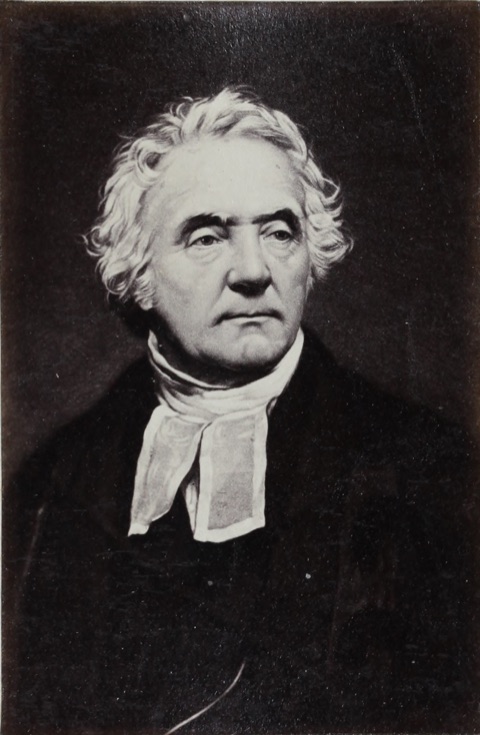
About the author
Thomas Chalmers
Thomas Chalmers (1780 to 1847 AD) was born in Anstruther, on the Fife coast of Scotland, and entered the University of St Andrews at eleven, where mathematics drew him more than divinity. In 1803 he became minister of Kilmany in Fife. Serious illness between 1809 and 1811 turned him to evangelical religion, and in 1815 he was called to the Tron Church in Glasgow. These discourses, published in 1817, sold roughly twenty thousand copies within a year. He later led the poor-relief experiment in the parish of St John's, taught moral philosophy at St Andrews and divinity at Edinburgh, and wrote a Bridgewater Treatise. In 1843 he led the Disruption and became the first Moderator of the Free Church of Scotland. He died at Edinburgh in 1847.