Volume 2 of 2 · Full text in modern English · Free PDF/EPUB
On Natural Theology: Volume 2 in Modern English
Want the file? The PDF/EPUB is free with an account.
This volume
- Vol. 1 · Preliminary Views, Matter and Mind
- Vol. 2 · Adaptation and the Limits of Nature
What is in On Natural Theology, Volume 2?
On Natural Theology is Thomas Chalmers's account of what nature and conscience teach about God, first published in 1835. This second of its two volumes holds Books 4 and 5; Books 1 to 3 are in Volume 1. Book 4, in six chapters, traces how external nature, including other minds, is fitted to the moral and intellectual constitution of man: conscience in society, the special affections of anger, modesty and family love, the origin of property, the English tithe and poor laws, free trade and population, speech, science and the mind, and the bearing of human misery and virtue on God's character and on immortality. Book 5, in four chapters, marks the limits of natural theology: the narrow reach of human knowledge, Leibniz's hypothesis on the origin of evil, special providence and prayer, and the defects and uses of natural theology as a forerunner of the gospel.
- 01
Conscience in society. Book 4 opens with other minds keeping conscience awake, then the special affections of anger and modesty.
Jump to it ↓ - 02
Family, rank and property. The affections behind civil order, and the origin of property in occupancy and labor before any law.
Jump to it ↓ - 03
Economic life. The tithe, the poor laws, free trade and population, where law that departs from nature does harm.
Jump to it ↓ - 04
Mind, matter and immortality. Speech, science and the mind's fit with nature, then what happiness and misery show of God's character and a future state.
Jump to it ↓ - 05
The limits of natural light. Book 5: the narrow reach of knowledge, Leibniz on evil, special providence and prayer, and the defects and uses of natural theology.
Jump to it ↓
Read the full summary of Volume 2Show less
On Natural Theology: Volume 2 holds Books 4 and 5 of Thomas Chalmers's treatise, first published in 1835. Book 4 traces how society, property, economic life, speech and science are fitted to the human mind and show God's righteousness. Book 5 marks the limits of natural theology and presents it as a forerunner of the gospel.
How the argument unfolds
- 01
General Adaptation to Our Moral Nature. Other minds revive each conscience and multiply the joys of virtue and the miseries of vice; education can turn habit toward reform of the race.
- 02
Special Adaptations to Our Moral Nature. Anger, limited but not created by morality, keeps peace through fear of it; modesty checks sexual appetite and guards the family.
- 03
Affections for Civil and Political Well-Being. Family love, respect for rank and the sense of property arise before human policy, and justice arbitrates between claims it did not create.
- 04
Affections for Economic Well-Being. The tithe and the poor laws violate possessory feeling and free compassion; free trade and capital show a wisdom above any legislature.
- 05
The Material World and the Human Mind. Speech, music, trust in nature's constancy, deduction, soil fertility and varied talents fit mind and matter to each other.
- 06
Happiness, God's Character, and Immortality. Misery traced to moral causes reveals God's righteousness, and unsettled accounts and unused faculties point beyond death.
- 07
Limited Knowledge and Leibniz on Evil. Theology must keep within what can be observed; Leibniz's optimism cannot be proved, but it disarms the objection drawn from evil.
- 08
Special Providence and the Power of Prayer. God answers prayer as a person, acting on hidden links of the causal chain without breaking any visible sequence.
- 09
The Defects and Uses of Natural Theology. Conscience shows God's holiness and wakes the sense of guilt, which only the atonement answers.
Key themes
- Nature anticipates human wisdom. Hunger, parental love and the possessory feeling were implanted before anyone could calculate their uses, and laws that override them do harm.
- Righteousness as well as goodness. A God of mere benevolence leaves suffering a riddle; a God who loves virtue more than pleasure explains why misery follows vice.
- The border of the known. A hypothesis that can be neither proved nor disproved may still cancel an objection drawn from the same unknown region.
- Devotion with diligence. Faith in God's rule and in nature's order belong together, so the believer works as if all depended on himself and prays as if all depended on God.
Reader questions (9)Hide the questions
Questions about On Natural Theology: Volume 2
Is there a modern English version of On Natural Theology: Volume 2?
Yes. This is On Natural Theology: Volume 2 by Thomas Chalmers in modern English. The language is modernized and the author's order and argument are kept. The full modernized text is free to read on this page.
Can I read On Natural Theology: Volume 2 online for free?
Yes. The complete text of this modern English edition is on this page, with no sign-up or paywall.
Is there a free PDF of On Natural Theology: Volume 2?
Yes. The PDF and EPUB of this edition are free with an Updated Works account. Sign in with Google or an email link; no card is needed.
What is On Natural Theology: Volume 2 by Thomas Chalmers about?
It completes Chalmers's case that nature and conscience show a wise and righteous God. Book 4 examines how other people and the material world are fitted to human nature; Book 5 shows the limits of natural reason and how it prepares for revelation.
How does this volume relate to Volume 1?
Volume 1 holds Books 1 to 3. This volume refers back to their arguments on the supremacy of conscience, the pleasures of virtue, the law of habit, and the preference for the argument from design over a priori proofs.
How does Chalmers explain the origin of property?
From two feelings seen in early childhood: a right to what one has long occupied and to the fruit of one's labor. Law comes afterward to restrain and confirm them, so he rejects Paley's view that property is created by law.
Why does Chalmers oppose the English poor laws?
They give the poor a legal claim against the owner's possessory feeling and turn charity into compulsion, which destroys the giver's kindness, the receiver's gratitude and the duties of family.
How can prayer be answered if nature never varies?
Prayer and its answer form one more sequence in God's order. Every causal chain passes out of sight, and God may act there, through wind, weather or the body's hidden processes. Chalmers lists several possible methods without choosing one.
Why does Chalmers say natural theology cannot stand alone?
It shows God's law and man's guilt but not how a just God can pardon. He quotes a passage on the need for atonement from the first edition of Adam Smith's Theory of Moral Sentiments, which Smith later removed.
On Natural Theology: Volume 2 in Modern English · Full text
Book 4: External Nature Adapted to the Human Mind
Chapter 1
General Adaptation to Our Moral Nature
Even a brief look at human life shows that humanity was not endowed with a conscience only to be placed where it had nothing to do. Instead, we have been set in a vast theater that gives conscience abundant scope and constant occasion for exercise. Surrounded by fellow beings and bound by a wide variety of social and family ties, we face an ongoing demand on our sense of right and wrong. One or the other of those moral judgments applies to our actions during every waking hour.
It would look like a serious flaw in our design if we possessed a wasted feeling or an unused faculty that lay dormant for lack of matching objects. God’s wisdom stands gloriously vindicated against any such charge in the physical side of our nature, where the outer world and our inner senses harmonize marvelously. The material creation offers sights of endlessly varied beauty, sounds of equally varied melody, thousands of tastes and odors of exquisite pleasure, and countless distinctions of touch and feeling. Together they match the full range and diversity of the human senses. They endlessly multiply both the impressions we receive from external things and the enjoyment we draw from them.
Nor is any faculty in the moral side of our nature, least of all the great master faculty of conscience, left to wither for lack of work. All of life is crowded with opportunities for its use. Rather than viewing conscience as the target of scattered, recurring calls, we may rightly view it as the constant guide and guardian of human life. To fulfill that high office, it is kept perpetually on the alert.
The creature whom conscience binds to refrain from all harm and to render society every possible good lives under a responsibility that is never suspended for a single moment. Such a person has a continuous moral existence, and morality, whether good or evil, colors the entire stream of life. It is marked by constancy as well as frequency. Even when not expressed in outward action, it does not sleep. It holds the mind as a cherished purpose or principle, or, as the Romans put it, as a perpetual will toward either good or evil.
Beyond this inward constancy, the calls to outward action are countless. They meet us in the needs of others, in their capacity for joy, and in their claims on our fairness, protection, and kindness. They meet us in the many avenues of usefulness and in the services that even the humblest person can offer to family, household, or country. In applying that comprehensive rule to do good to all people as we have opportunity, we see a vast number and variety of occasions for exercising moral principle.
A school’s lessons might sometimes be too easy or too narrow for a learner’s capacity. No one can say that of the demanding, unremitting school of discipline into which the great Author of our being has brought us. Along with our moral capacity, he has given us a richly furnished training ground for its exercises and trials. There we may gain, if not the full triumphs of virtue, at least sweet foretastes of our final blessedness. The schooling of human life, with all its varied duties and engagements, is clearly suited to prepare us for that complete reward.
Let us now briefly trace the adaptation of external nature to our moral constitution in light of the threefold general argument already set forth. We have considered the supremacy of conscience, the inherent pleasures and pains of virtue and vice, and the law and operation of habit. Together these form three distinct arguments for the moral goodness of the one who framed our nature. By its inner workings alone, humanity is clearly and powerfully warned toward a life of righteousness, richly rewarded with the immediate joys of integrity, and carried forward into confirmed good or confirmed evil. That settled character offers one of nature’s strongest forecasts of immortality beyond the grave. There we will reap the full harvest of our present deeds, either in the happiness of established virtue or in the utter misery of ingrained depravity.
Until now, however, we have viewed human nature mostly as an isolated individual constitution rather than as a mechanism acted upon by outside forces. From this point on, we must examine it in that outward relation. The proper goal of this book is to set forth the adaptations of the objective to the subjective, or of external nature to the mental constitution of humanity. Keep in mind, though, that by external nature we do not mean merely what lies outside the world of mind, which would confine us to interactions between mind and matter. We also include everything external to any single mind, and therefore all the other minds around it. Rich with evidence of divine wisdom, our task now is to unfold the actions and reactions that take place between one human being and another in society.
Conscience Awakened and Sustained by Society
First, with respect to the power and sensitivity of conscience, fellow human beings bring a vital influence to bear on each individual from outside. We can understand this better by reflecting on a familiar experience common to everyone. A slight remark, often just a single word from a companion, can recall a past scene or event that had long vanished from memory. Without that prompt, it would have stayed buried in oblivion to the end of our days.
The laws of mental association easily explain this phenomenon. Our ordinary trains of thought might never have led us back to that forgotten event. Yet at the slightest hint, all the connected details spring into vivid view. We are carried back to the departed realities of earlier years. They had lain dormant within us for so long, and might have stayed extinct forever, had an outside spark not rekindled them.
How many days since early boyhood have left not a single trace in our memory! Yet perhaps not one of those days is beyond recall if some outside help prompts us. Imagine that a daily companion had, without our knowing, kept a detailed, thorough journal of every event we shared. If we read that record even half a lifetime later, our memory would likely testify to thousands of incidents that would otherwise have vanished beyond recovery.
It is truly remarkable that a brief word from someone else can make old stories reappear, as if in glowing letters, on a tablet from which they had completely faded. Mentioning one detail, if it is a single link in a chain, can summon a whole host of sleeping recollections back to life. In every fellow human being, we may thus find a remembrancer who revives our awareness of long-past scenes and dealings. Left to itself in a solitary mind, that history would have disappeared forever.
In the same way, one person can instantly transfer not only memory but also insight into another’s mind. A sharp observer of the human heart, uncovering its hidden workings, mentions things that strike us at first as completely new. Almost in the same instant, however, we feel and recognize them as true. We do not accept them merely on the speaker’s authority, but on our own independent grasp of their evidence.
The speaker’s words have called out from prison cells of forgetfulness memories that might never have woken on their own. Once summoned into view, those memories vouch for the wisdom and truth of what we hear. A thousand subtleties of life and character, unnoticed until that moment, no sooner reach our ears for the first time than they shine before the mind’s eye with the force of clear proof. The materials of that proof were already stored inside us by years of experience, tucked away in chambers of oblivion. At the speaker’s voice, as if by a magic touch, they rush forward. The moment the statement is uttered, it awakens the personal memories that confirm it.
The pages of a novelist, a preacher, or a moral essayist may consist entirely of assertions without formal proof, yet still carry full conviction. Each speaks directly to the reader’s consciousness, unlocking a storehouse of dormant memories that spring to life as witnesses to the writer’s insight and good sense. It is like holding up a mirror, or hearing an echo answer a voice. What the author brings to light, the reader immediately sees. One speaks new things, while the sudden light in which the other beholds them strikes out of old materials long since gathered. Laid away in a silent chamber, those memories might have slept forever without a voice to wake them. That alone explains how we instantly recognize truths we have never heard before: their proof lies wrapped inside earlier memories, brought back to attention by the power of association.
This is really an example of intellectual rather than moral adaptation, introduced here as an illustration. For a decayed conscience can be revived in much the same way as a decayed memory. When discussing habit, we noted how conscience gradually weakens as a person persists in vice. At first, however ineffective its protests may be, conscience still has a place in the train of thought and feeling that begins with temptation and ends in guilt. Yet the more often its voice is hushed, overridden, or refused a hearing, the fainter and feebler it speaks afterward. Eventually it goes unheard, and its warnings either pass unnoticed or drop out of the sequence altogether.
That is how a person can eventually commit foul and horrific wrongs without feeling their enormity. Repeatedly stifled, conscience may stand on the brink of extinction and cease to act. This moral numbness forms a major source of criminal boldness. Conscience is lulled into a stupor, and the hardened wrongdoer pursues secret vices with no inward hesitation and no remaining dread except the fear of being discovered by others.
It is precisely at the moment of discovery that we see the awakening in question. When the guilt to which the offender had grown so numb is finally exposed in the light of other minds, the scales fall from the offender’s eyes. As if suddenly jolted out of a deep sleep, the wrongdoer stands horrified before the sight of personal worthlessness. Shame at being caught and fear of the consequences do not account for the whole of this anguish. They worsen the suffering, certainly, but they do not make up all of it.
Often there is a genuine resurrection of moral feeling inside the unhappy offender, rekindled by contact with the spoken judgments and feelings of others. Because their consciences are unwarped and free from the delusions clouding the culprit’s mind, they pronounce a righteous verdict. In doing so, they enlist the offender’s own conscience on their side, and it reclaims its throne to speak once more in a voice of thunder. Once that smooth sequence between guilty desire and final indulgence is broken, conscience shakes off the spell that bound it. It delivers its own reproaches, far more terrifying to the sinner’s heart than all the curses of society.
Anything that forcibly interrupts the habitual indulgence can break that familiar chain of thoughts, aims, and passions and end this entrenched moral blindness. The confinement of a prison cell can do it; the confinement of a deathbed can do it. On such occasions, conscience emerges from what proves to be not death but suspended animation, returning with the power of an avenger to press its outraged claims.
Yet this influence, shown in bold relief through rare and dramatic examples, operates steadily and quietly across all of society. Its larger work is to prevent crime rather than punish it, keeping conscience fresh and intact rather than reviving it from decay or correcting its extremes. Its restorative power is far more striking, but neither as constant nor on the whole as beneficial as its preventive power. We cannot move through ordinary human friendships without seeing moral judgments constantly circulating back and forth. People have no more favorite or familiar pastime than discussing one another’s conduct and passing verdict on what each deserves.
In this way, every individual, always liable to be misled or blinded in personal affairs by self-interest and passion, lives under the watchful guardianship of peers. Free from that person’s particular bias, they speak a righteous judgment and make it heard. A clear moral light is thus kept burning in society, made up of people whose thoughts are continually engaged in “accusing or else excusing one another” (Rom 2:15). Every individual conscience receives fresh energy and direction through contact with the consciences around it.
Love of praise certainly enters here as a distinct supporting motive, yet the primary influence remains moral. Every person lives aware of alert, discerning witnesses on every side. Kept awake and aligned with theirs, one’s conscience acts with greater strength and purity than if left to decay and self-deception in withering solitude. A lamp that might have grown dim on its own revives its fading flame through contact with brighter lamps burning in other hearts. This law of exchange between mind and mind forms a vital adaptation in the framework of human society.
Let us return for a moment to the revival of a dormant conscience reawakened by contact with others’ moral judgments. This phenomenon also gives us a glimpse of the life to come. It shows how effortlessly the Being who commands infinite resources could inflict the keenest anguish on the children of disobedience through a purely mental operation. God has only to reopen the fountains of memory and conscience, and bitter waters will at once well up inside the soul.
Earthly remembrancers and earthly judges clearly carry tremendous power to awaken sleeping guilt. We may therefore expect not merely the possibility, but the strong likelihood, of a far more vivid awakening when the offended Lawgiver takes judgment into his own hands. If the rebuke of human tongues and human eyes can revive such dormant agony within us, what will we feel when the verdict sounds from God’s throne before a universal theater? In this brief life, we already find the condemnation of a thousand smaller, reflected lights unbearable. What must it be when he whose hand kindled them turns the full force of his own face toward us and, with a look of condemnation, sends trouble and dismay across the ranks of the rebellious? (In his engaging work on the intellectual powers, Dr. Abercrombie records striking cases of revived and expanded memory. They recall Coleridge’s explanation of the opening of the books on judgment day: when the book of conscience opens, the sinner feels the truth and justice of condemnation.)
Moral Happiness and Misery in Human Society
Besides the pleasures and pains of conscience, there is a direct pleasure or pain in the very taste and experience of moral qualities themselves. This formed our second general argument for God’s righteous governance, and even a single human mind supplies enough material to build it. Yet the argument grows vastly stronger when we look at how external nature adapts to it, especially through the mutual exchanges between minds in society. The effect of this adaptation is to multiply both the joys of virtue and the miseries of vice.
Consider the chain of happiness created by kindness. First comes the original pleasure felt by the virtuous person, such as the benevolent heart experiencing the warmth of the kindness that moves it. Second is the pleasure felt by the recipient, for simply knowing that someone else bears you goodwill brings a deep, distinct joy. Third, the benefactor’s active kindness awakens gratitude in the recipient’s heart, which is itself a highly pleasant emotion. Finally, that gratitude returns like sweet incense to the benefactor who inspired it.
Through the purely mental exchange of these affections, an enormous amount of happiness is generated. That happiness stands completely apart from the material benefits of the gifts given on one side or the practical services of gratitude returned on the other. We have only to picture a reign of perfect virtue to see this truth. Despite the physical ills unavoidably tied to our earthly state, we would feel we had come very close to perfect enjoyment. In other words, the bliss of paradise would be almost completely realized on earth if the moral graces and loving affections of paradise were firmly established and active here.
Imagine honest, universal goodwill filling every heart and answered by honest gratitude from all who receive it. Let kindness pass back and forth from heart to heart and face to face in all its varied expressions. Let universal courtesy fill our streets, and let loyalty, affection, and every domestic virtue take up a secure, lasting home in every family. Let the ready help and sympathy of a willing neighborhood rise to meet and overcome every human need and hardship. Let truth, honor, and unbreakable friendship banish treachery and injustice from the world. In the sphere of trade, let unfailing integrity on one side receive the tribute of complete trust on the other. When every person rests safely in a neighbor’s uprightness and rejoices as deeply in a friend’s prosperity as in personal success, suspicion, resentment, and envy will vanish completely.
Who can miss, in a society so built and harmonized, the unmistakable proof of a nature designed so that the world’s happiness keeps pace with the world’s righteousness? Above all, notice that both the quality and the volume of this happiness consist chiefly of moral elements. Every giver who feels rightly experiences a joy in generosity that repays every sacrifice a hundredfold. Every receiver who feels rightly delights far more in sensing the benefactor’s kindness than in the physical gift or practical relief it brings.
It speaks volumes for the moral excellence of our Maker that our highest joy can spring apart from bodily pleasures, solely from the refined interplay of good affections. Simply through cordiality exchanged between human beings, with one kind emotion echoing another, human hearts receive genuine, substantial happiness. If justice, love, and holiness came down from heaven to take complete possession of our race, the happiness of heaven would surely come down with them. Suppose anyone could point to a world where universal vice produced the same blissful, secure enjoyment that virtue would bring to ours. We would conclude that its ruler was a friend and patron of vice. Assured by actual experience that in our world perfect morality would usher in nearly perfect joy apart from physical calamities, we hold an unanswerable proof of the moral goodness of our actual Deity.
Although virtue’s chief blessings are moral and spiritual, we should not overlook how it also serves the physical comforts of life, obvious though that may be. The clearest example is how benevolence spreads provision among the needy and eases the hardships of poverty. That is too plain to need lengthy elaboration. Yet we should notice one vital adaptation linked to this virtue. Realized only partially while virtue holds limited sway in society, it is destined, we hope, to reach its full beauty when virtue becomes universal.
Everyone knows that careless, impulsive, and indiscriminate charity brings serious collateral harm. It can actually increase and deepen the poverty it tries to relieve, while undermining the character of the poorer classes by feeding recklessness and idleness. That process injures both the material welfare of one group and the moral welfare of the other. Such damage is unavoidable as long as thoughtless giving by the rich meets endless greed and opportunism among the poor.
Yet this evil shrinks and eventually disappears as moral principle grows across humanity, especially when it shapes both classes instead of only one. Let the wealthy be as generous as they should be in their deeds, and let the poor be as moderate as they should be in their expectations and desires. Then the problem that has so baffled England’s politicians and economists will find its own natural, ideal solution. Let abundant yet wisely guided generosity on one side meet delicate self-respect on the other, rather than shameless, bottomless craving. Let it meet the noble independence of people who choose to work with their own hands rather than burden others.
Then the generosity of the wealthy will not merely meet the needs of the poor, but surpass them. The willingness of one group to give will exceed the willingness of the other to take. An evil that threatens to tear society apart, and that laws have only worsened in trying to cure, will finally yield to the unmatched power of moral causes. This single example among many shows vividly that God designed humanity for virtue. Society’s deepest maladies can be healed through no other means than the morality of its people. The helplessness of human statecraft and political schemes whenever virtue decays proves that virtue was the aim of our creation. We could hardly ask for a clearer demonstration of a virtuous God than finding society built by his hands so that virtue is the indispensable foundation of lasting national prosperity. For any human community to be healthy physically and economically, the one essential and completely effective requirement is that it be right morally.
Nothing illustrates God’s character more clearly than comparing the effects of universal virtue and universal vice on human society. That comparison decisively settles which one he favors in the very society he ordained and crafted by his own wisdom and hands. Explaining how our species fell into its present moral disorder may not be easy. Still, picturing the contrast between a commonwealth of vice and a commonwealth of virtue leaves no doubt about what humanity was made for. We have already said enough about the clear tie between a nation’s righteousness and the happiness of its homes. We need not dwell at length on the equally obvious link between widespread depravity and widespread misery and chaos.
Here too, the counterpart truth holds: just as the joys of a virtuous society consist mainly of moral elements, so do the sufferings of a vicious one. In the former, knowing another’s kindness brings deeper heartfelt joy than all the gifts and favors it prompts. In the latter, the agony of simply sensing another’s malice often outweighs any physical injury to body or property we might suffer at that person’s hands. A loss caused by someone’s dishonesty stings far more bitterly than a tenfold loss from accident or misfortune. Put simply, the moral provocation proves much sharper and harder to bear than the material calamity.
Beyond the obvious physical damage that vice and violence inflict on society, we must weigh the soreness of spirit, the sheer mental distress and turmoil that follow in their wake. We have already seen how much misery brews inside a single corrupt mind. It inflames infinitely further when hostile minds act and react upon one another, hating and hated on every side. Mere inward hatred, especially when sharpened by close contact and constant chances to express itself, yields sensations of intense bitterness. Even when hostile feelings never break out into physical violence, their sheer collision produces deep wretchedness.
That misery lives in bare displays of malice apart from deeds, in a war of words, glares, and fierce gestures where no blow is struck or received. To make the aggressor intensely miserable in these purely mental conflicts, it is enough to carry the churnings and fires of a resentful heart. To make the target intensely miserable, it is enough to meet the venomous glare of a resentful eye. If we reflected properly on the power resting in the emotions alone, we would see how tightly linked, almost identical, wickedness and wretchedness truly are.
To experience the miseries of war, people do not need contests of physical strength; contests of feeling alone will do. Picture mutual rage and mutual insults, outbursts of fierce exasperation, the constant dripping of peevishness and discontent, and scorn answered with equal scorn. Imagine even the slights and contemptuous jabs of people who are themselves utterly contemptible, along with arrogant defiance, spiteful mockery, and the sting of wounded, irritated pride. The upheavals of such a scene, though purely mental, would suffice to create a hell of assembled madmen or criminals. The very presence and churning of those passions would be their own worst punishment. To carry them constantly inside us is to bear a hell in the heart. To encounter them constantly in others is to live surrounded by fiends, beset by the miseries of a pandemonium.
Whether we look at the individual or the social constitution of humanity, we see abundant proof of the mind and intention of our Maker. He assembled both our private nature and the elements of society. We could not imagine a clearer sign of his favor toward moral good and his displeasure against moral evil than seeing virtue inseparably allied with happiness, and vice with wretchedness, in both spheres. Such laws of nature declare the character of the one who established them as plainly as legal statutes reveal the character of the monarch who enacted them. Nor must we wait for distant consequences to learn this lesson. We feel God’s verdict at once in the immediate sensations attached to each. Those feelings turn the hearts they occupy into seats of either wild anarchy or serene, blissful joy.
Habit, Education, and the Moral Future of Humanity
The law and operation of habit in a single mind formed our third general argument. Here we need notice only one adaptation to it in the structure of society: the continual turnover of successive generations. Through that cycle, the tender, impressionable years of childhood are placed under the guiding influence of the older generation that precedes them. At first glance, this arrangement might seem to cut equally both ways, passing down and multiplying either vice or virtue across the world. Yet virtue possesses one decisive advantage that bids us look forward hopefully to the eventual triumph of good over evil.
We are well aware of the poisonous force with which criminal and corrupt parents shape the habits of their children. We know how deadly contagion descends swiftly from older youths to younger ones along the links of companionship in crowded cities. We even know of those secret, monstrous societies, rare we trust, that in various lands and ages held wicked rites to initiate the inexperienced into the dark ways of vice. Yet even after making full allowance for all of these, the balance tips overwhelmingly toward moral education. Systematic, sustained effort, broad public enterprise, and organized action carried out in broad daylight with public approval all fight on its side.
The very selfishness of vice and the outward-reaching nature of virtue create this difference between them. Vice turns inward on its own personal gratifications. With rare exceptions, it cares little about other people’s principles and does not organize campaigns to win converts. Virtue, by its very nature, longs for the good of the entire human race and strives to spread its own likeness until righteousness and truth prevail everywhere. Accordingly, all open backing and organized effort in education, whether by governments or private associations, stand on the side of virtue. No one would dare stand before the public eye with a formal curriculum for teaching fraud or debauchery.
The clear tendency, then, is to point the mighty engine of education in the right direction. Bring this force to bear more systematically and widely than ever before on impressionable youth across the land. Then the law of habit guarantees progressive advances and, in time, the universal victory of good over evil in society. Our confidence grows even stronger when we see what a single mind, wisely and zealously devoted to moral and practical improvement, can accomplish among hundreds in a single neighborhood. Set in motion that most fruitful of all philanthropies, working through education on the earliest seeds of character, and we enlist the strongest agency for the most promising outcome. Viewed in its early flexibility, the law of habit opens a mighty doorway to a new era in human moral history. Viewed in its mature permanence once established, the same law encourages hope for a lasting as well as universal reign of virtue.
Even in the chaotic, unfinished state of the present world, we can already see the forces working toward that goal. What gives virtue an overwhelming advantage is that parents, even those sunk deepest in vice themselves, welcome the offers of Christian and moral philanthropy and gratefully accept its help for their families. However bleak the outlook may seem for reforming adults whose bad habits have hardened beyond reach, we enjoy wide, unobstructed access to the young whose habits are still forming. That places education on firm vantage ground: if it cannot always reclaim every fallen individual, it can reclaim the species across a few generations.
Many schemes and projects in this highest branch of charity have failed so far, yet the visible, growing commitment to the cause opens a bright moral horizon for coming ages. What a few dedicated people have accomplished locally justifies bright hopes for what may yet be achieved universally. We need only understand this simple yet mighty tool better and apply it diligently to the most malleable stage of human life across the entire land. Our defective national institutions and our neglect of populations left to drift as they please fully explain the vice of crowded cities and the decay of forgotten districts. Yet we can also feel confident that a sound system of wise, principled instruction holds within our reach the power for a great and glorious renewal.
We may not know why so many ages of moral darkness and depravity have been allowed to pass in human history. In the same way, we do not know why forest trees do not spring full-grown into stately maturity all at once, instead of growing slowly through storms, alternately drooping and expanding with changing seasons. Though unable to trace every cycle of the moral or natural order, we can still recognize forces already at work that, once multiplied and fully developed, are amply able to renew the world. One of the most promising of these is the power of education, to whose improvement so many minds are now earnestly devoted. Its broad welcome in society is guaranteed by the deepest affections and fondest hopes of fathers and mothers everywhere.
Chapter 2
Special Adaptations to Our Moral Nature
Until now, we have confined our attention to a few great, simple features of our moral nature. They provide a different kind of evidence for God’s existence than the intricate organic structures of the material world. Still, once a Deity is granted, they prove decisively that he prefers virtue to vice and possesses a righteous character. Consider what he has built into us. He placed a master faculty in every human heart whose verdicts always favor justice, benevolence, and truth while condemning their opposites. He armed this conscience with swift powers of inner reward and punishment, granting immediate quiet delight to the good and sharp remorse to the evil. Beyond this, he distinguished virtue from vice so that the feelings and actions of virtue bring innate pleasure to the inner self, while those of vice bring innate pain. Finally, he arranged our constitution so that through the law of habit, virtuous and vicious lives settle into fixed, permanent character.
(In Part 1, Chapter 3 of his Analogy, Butler draws an admirable distinction between actions themselves and the moral quality we call virtuous or vicious: “An action by which any natural passion is gratified, or fortune acquired, procures delight or advantage, abstracted from all consideration of the morality of such action; consequently the pleasure or advantage in this case is gained by the action itself, not by the morality, the virtuousness, or viciousness of it, though it be, perhaps, virtuous or vicious. Thus to say, such an action or course of behavior, procured such pleasure or advantage, or brought on such inconvenience and pain, is quite a different thing from saying that such good or bad effect was owing to the virtue or vice of such action or behavior. In one case, an action abstracted from all moral consideration, produced its effect. In the other case, for it will appear that there are such cases, the morality of the action, the action under a moral consideration, i.e., the virtuousness or viciousness of it, produced the effect.”)
These truths form the great general outlines of our moral nature. While they immediately give us a present witness in favor of virtue, they also point toward a coming consummation. Once the moral training of this present life is complete, the great Ruler of humanity will reveal the eternal divide he places between good and evil.
These few simple laws strongly and unmistakably display the character of a God already proved or presupposed. Yet they do not offer the same concentrated proof of intricate design that comes from many distinct parts or principles working together in a complex combination. Still, our moral constitution does not lack that kind of evidence, even though it is neither as abundant nor as visually obvious in the mind as in human anatomy. There is a mechanism in mind as well as in body, containing a diversity of principles, if not physical parts. Even if they are simply diverse laws operating within a single indivisible spirit, their harmonious cooperation provides no small proof of the wisdom and goodness of the one who made us.
Nor does it matter, as we have noted before, whether all these principles are original laws or whether some are secondary laws derived from simpler ones, as analysts of the mind have labored to show. If they are original, we have evidence resting on the beneficial union of a larger number of independent laws. If they are derived, we have fewer independent laws, yet each becomes far richer in useful applications. Every such application rests on a beneficial adaptation of specific circumstances through which a primary law turns into a secondary one. (Besides, does it not show even greater wisdom in a human craftsman when a single device or principle accomplishes many distinct and useful ends instead of only a few? Likewise, divine skill shines all the brighter in nature’s workmanship when one law serves a vast, varied range of vital purposes.)
Either way, these principles display distinct sides of human nature beyond what we have examined so far. They form a set of special affections, each with its own name and its own separate object. All of them play vital supporting roles for the moral good of the individual and the species, supplying fresh evidence of moral and benevolent design in our creation.
Look at the beauty spread across nature and the deep pleasure it gives our senses. We cannot doubt the love of beauty in the eternal Mind that produced such grace, nor the benevolence that gave humanity a matching taste and capacity to enjoy it. That conclusion, however, like our moral conclusions so far about God’s character and purposes, rests on broad generalities: the general abundance of beauty in the world and our general delight in admiring it. Yet we can also draw supporting evidence from special mechanisms. Consider a plant’s calyx protecting the delicate blossom before it opens, or the apparatus that scatters seeds so the earth stays clothed in rich, varied splendor.
A blight has visibly swept across the moral world and marred many of its original features, while leaving nature’s physical scenery largely unspoiled. Even so, natural theology has much the same kind of material when reasoning about virtue as when reasoning about beauty. First, we have the broad general arguments already unfolded at length. Alongside them, we also have the evidence now to be examined: special provisions for protecting and nurturing virtue, that immortal plant. Studying these will reveal more intricate mechanism than we have yet observed, and therefore more of that distinctive argument for design found in varied means cooperating toward a single beneficial end.
Before proceeding, we must lay down an observation that applies widely in the study of the mind. Whenever we notice that a mental feeling or principle clearly serves a useful purpose, we are tempted to assume it arose from thinking about that purpose. We suppose that instead of being a distinct, original part of human nature, it developed from an earlier process of human calculation, as people reflected on what was best for themselves or for society. In this view, humanity becomes in some measure the maker of its own mental constitution. Parts of our nature that would point directly to God’s wisdom if recognized as primary instincts are treated as secondary inventions and credited to human wisdom instead. Many writers on the origin and rights of property do just this. Refusing to recognize an instinct of ownership, they insist that the urge to acquire property sprang from human intelligence after experience proved how convenient and useful it was.
On this point, we can learn a lesson from the physical constitution of the human body. To keep our bodily system alive, food must enter the stomach at regular intervals. Yet despite all the power attributed to self-preservation, and all the reverence professed for human foresight, the Author of our constitution did not leave this vital need to our deliberation. He did not trust us to ourselves. Instead, he planted among our other desires the appetite of hunger, a strong, urgent, recurring craving for food that operates completely apart from any thought about bodily nourishment. Clearly we need not merely to be reminded of this essential duty at proper intervals, but to be driven to it.
Suppose analysts of human nature had shown that hunger grew out of human reflection on the need for food. It might then have been cited as proof of how well humanity cares for itself. Evidently, however, we could not be trusted either with our own survival or with the survival of our species. To secure both goals, we had to be given powerful appetites that cannot be reduced to higher reasoning and that stand forth unmistakably as proof of God’s care for us.
While this does not prove we will find matching provisions in the mind, it prepares us to expect them. The intricate, elaborate system that the great Architect of nature built for our bodies should warn theorists who, charmed by sweeping simplifications, try to reduce all mental phenomena to one or two principles. The examples that anatomy and physiology place before our eyes offer no support for such reductionism. Even if we do not treat bodily complexity as proof of moral complexity, it should at least clear away the intellectual bias that makes us resist or dislike such evidence when we encounter it.
The same Being who supplemented human prudence with distinct bodily appetites for individual and species survival has likely done the same in the mind. He has supplemented the limits of human wisdom and principle with distinct mental affections and desires for both personal and social good. Humanity could not be left to its own guidance even in matters requiring a few hours’ foresight, needing so forceful a prompter as hunger to escape decay and death. Why, then, should we be surprised if nature assumed we cannot plan wisely or act reliably toward distant consequences amid the tangled relationships of society? On one hand, nature may have implanted motivating forces where merely seeing good results would never have moved us. On the other, it may have implanted restraining checks where merely seeing bad results would never have stopped us.
Still, because good is secured and evil avoided through these impulses, we easily imagine that some of our most useful traits are products of human making. We ascribe them to quick mental calculations judging the outcomes of our actions and wisely providing for or against them. Anger, shame, emulation, parental love, compassion, regard for reputation, the sense of property, and conscience are all forces in a balanced mechanism. Without them in proper proportion, human life would fall into ruinous disorder for both individual and species. For reasons already noted, whether these built-in tendencies are original or secondary laws matters little to natural theology. Either way, it is enough for our argument that human wisdom did not invent them, and they therefore testify to the wisdom and goodness of God.
The Instinctive Nature of Anger
The usual philosophical definition of anger shows how eager thinkers are to trace our emotions back to higher, prior principles of human nature. Dr. Reid tells us that the proper object of resentment is an injury. Since “no man can have the notion of injustice, without having the notion of justice,” he argues, “if resentment be natural to man, the notion of justice must be no less natural.” (In glaring contradiction to this stands Dr. Reid’s own claim about animals. He states “that conscience is peculiar to man, we see no vestige of it in the brute animals. It is one of those prerogatives by which we are raised above them.” Yet animals are abundantly capable of anger, even by the common definition calling it an emotion triggered by a sense of injury. If a sense of injury implies a sense of justice, that would force us to conclude that animals possess moral understanding and a conscience.)
Similarly, Dr. Brown defines anger as “that emotion of instant displeasure, which arises from the feeling of injury done or the discovery of injury intended, or, in many cases, from the discovery of the mere omission of good offices to which we conceived ourselves entitled, though this very omission may, of itself, be regarded as a species of injury.” Now a sense of injury implies a sense of its opposite: a sense of justice, or a moral standard from which the offending act is felt to deviate. A definition should include nothing that is not essential to the thing defined. Both philosophers thus imply that everyone capable of anger must also possess some capacity for moral judgment or moral feeling. On that view, resenting a hurt inflicted on us would always reveal an awareness of what is morally fair between ourselves and others.
Yet the claim that moral reasoning is essential to anger admits of an obvious, decisive refutation. Infants feel anger well before the first dawnings of a moral nature. Even people whose mental and moral faculties are severely impaired feel it, and still more clearly, so do the lower animals, who lack a moral nature altogether. A sense of annoyance is certainly needed to trigger anger. Yet a sense of moral injury, implying moral judgment or sensitivity, cannot be essential to an emotion displayed in full fury by sentient creatures showing not even the faintest beginnings of moral awareness.
Two dogs fighting over a bone display anger as clearly and unmistakably as two human beings arguing over the boundary between adjacent fields. The emotion flashes just as plainly from lower creatures as from the only rational and moral species on earth. We see it in the fierce glare of an enraged bull, or in a lioness robbed of her cubs, proclaiming her loss with deep, repeated roars echoing through the wilderness. Anger seems to extend as far as physical sensation itself, not merely as far as moral nature. If we can trust the natural signs by which nonrational creatures reveal what passes inside them, this passion is unmistakable. It rings out as vividly in cries of mutual fury across wild, solitary nature as in the conflicts of civilized humanity.
The truth, then, is that the moral faculty does not originate anger; rather, it confines, qualifies, and regulates it. If we examine how anger actually appears and operates, we find it is the primary, natural response to any hurt, harm, or annoyance inflicted on us by others. Left to itself, it can be sweeping, unrestrained, and ready to flare up from any direction, before and apart from any thought of justice or whether the offender intended to violate our rights.
Infants are fully capable of this feeling long before they grasp fairness or distinguish what rightfully belongs to them from what belongs to another. The anger of animals likewise lacks the moral ingredient that those definitions treat as essential. Yet the sounds they make carry the exact note of fierceness we hear so often among our own kind. Provocation, resentment, the flashing look of hostility, rising fury, violent collision, and sated satisfaction in a rival’s flight or death all reveal kindred inner workings. They find outward expression in kindred signs, linking the creature called the lord of creation with the animals beneath his feet, who otherwise stand almost beyond comparison with him.
Even mature human beings, with rational and moral faculties fully developed, frequently experience outbreaks of purely physical anger. Take one instance among many: the wrath a farmer vents on animals when, completely unaware of doing him wrong, they wander into his fields and damage the fruit of his labor. Just resentment toward others aims at intentional injustice, and animals not only fail to intend injustice, they lack the faculty even to conceive of it.
Moral judgment, therefore, is not an essential ingredient of all resentment. It is an added quality that marks one specific kind of anger. It does not define all anger, only a particular sort. We can rightly call one burst of anger just and say another has nothing to do with morality, just as we call one blow of the hand rightful and another purely nonmoral. Morality can sometimes characterize both the mental emotion and the physical act, yet it should be identified with neither. However often analysts of the mind succeed in reducing apparently distinct traits to a single source, anger certainly cannot be derived from higher moral principles. It is a distinct, original element of our constitution. Morality may guide it whenever morality exists and rules, without being essential to its existence or action. Far from needing morality, anger appears nowhere more vividly than in creatures possessing only an animal nature, without the slightest germ of a moral sense.
Anger, then, can rage and boil inside a heart that has never entertained a single moral idea. To rouse it, nothing more is needed than blocking a desire, however unreasonable, or disappointing any wish the heart happens to cling to. Far from requiring a sense of justice to spark it, the person most devoid of justice, who would gladly claim everything within sight, is the most prone to its outbursts. No one is more vulnerable to fury from every quarter than the person who treats the universe as made for himself alone and stays blind to the rights and interests of others. Precisely because he lacks ideas of justice, his resentment knows no bounds.
Justice views the world and all its interests as already divided among the members of the human family, with each occupying a rightful domain. Rather than letting anger roam wildly across the whole face of things, justice checks and governs its outbursts in every heart until an actual trespass crosses into a person’s own proper territory. In short, the role of justice is not to inspire anger, but to set boundaries and limits around it. Far from being born of high moral principle, anger is an instinctive propensity held in check and kept within bounds at principle’s command.
This distinction between reflective and unreflective anger did not escape the perceptive Bishop Butler, as shown in these passages from his sermon on resentment:
“Resentment is of two kinds: hasty and sudden, or settled and deliberate. The former is called anger and often passion, which, though a general word, is frequently appropriated and confined to the particular feeling, sudden anger, as distinct from deliberate resentment, malice, and revenge.”
“Sudden anger upon certain occasions is mere instinct, as merely so, as the disposition to close our eyes upon the apprehension of something falling into them, and no more necessarily implies any degree of reason. I say necessarily, for, to be sure, hasty as well as deliberate anger, may be occasioned by injury or contempt, in which cases reason suggests to our thoughts the injury and contempt which is the occasion of the emotion; but I am speaking of the former, only in so far as it is to be distinguished from the latter.
“The only way in which our reason and understanding can raise anger, is by representing to our mind an injustice or injury of some kind or other. Now momentary anger is frequently raised, not only without any rule, but without any reason; that is, without any appearance of injury as distinct from hurt or pain. It cannot, I suppose, be thought that this passion in infants and the lower species of animals, and which is often seen in man toward them, it cannot, I say, be imagined that these instances of this emotion are the effect of reason: no, they are occasioned by mere sensation and feeling. It is opposition, sudden hurt, violence which naturally excites this passion; and the real demerit or fault of him who offers that violence, or is the cause of that opposition or hurt, does not in many cases so much as come into thought.”
“The reason and end for which man was made thus liable to this emotion, is that he might be better qualified to prevent, and likewise or perhaps chiefly to resist and defeat sudden force, violence, and opposition, considered merely as such, and without regard to the fault or demerit of him who is the author of them; yet since violence may be considered in this other and further view, as implying fault, and since injury as distinct from harm may raise sudden anger, sudden anger may likewise accidentally serve to prevent or remedy such fault and injury. But considered as distinct from settled anger, it stands in our nature for self-defense, and not for the administration of justice. There are plainly cases, and in the uncultivated parts of the world, and where regular governments are not formed they frequently happen, in which there is no time for considering, and yet to be passive is certain destruction, in which sudden resistance is the only security.”
Bishop Butler gives an excellent example of the difference between instinctive and rational anger when he points to the anger we often feel toward lower animals. Properly speaking, no moral injury occurs where none is intended, and a creature incapable of understanding an injury cannot rightly be the target of moral resentment. Yet the reality of physical alongside moral resentment is plain from the sheer fury people feel whenever irrational creatures do something troublesome or harmful. People who use animals as beasts of burden often unleash outrageous wrath on them, acting like ferocious tyrants toward the helpless victims of their cruelty. When a human fights a wild animal, the human feels a resentment just as fierce and persistent as in a struggle between two human rivals. This makes it unmistakably clear that anger exists without any sense of deliberate injustice in its target. Even children, those with severe mental impairment, and the insane can become objects of such resentment.
How Anger Preserves Peace and Order
The purpose of this emotion in lower animals is abundantly clear. It sparks and sustains resistance to violence that, if left unopposed, would often end in the victim’s destruction. Probably even more often, it serves prevention rather than defense. When a threat of violence meets the readiness and counter-menace of rising anger, it often beats back aggression already begun. Still more frequently, it triggers fear in the would-be attacker and stops the assault before it starts.
Stout, formidable rivals eye each other with a kind of natural respect and, as if by unspoken agreement, wisely refrain from attack and go their separate ways without a fight. Countless bloody contests are thus averted that would surely have broken out without anger on one side and fear on the other. Through a balanced machinery of mutual checks and counterforces, in which mental instincts act as essential powers, the animal world avoids the endless war of extermination that might otherwise have emptied the earth.
Notice too that in studying this balance of powers and protective influences even among nonrational creatures, the purpose of a mental arrangement is just as unmistakable as that of a physical one. The anger that drives an animal to resist aggression is as clearly built in by a Designer’s hand as the horns, bristles, or other defensive weapons arming its body. The fear that gives wings to a fleeing animal’s flight is as clearly designed for its safety as its muscular build or capacity for speed. A mother’s affection for her young points as plainly to a Creator’s care for preserving the species as the physical apparatus that nourishes them. A mother’s fondness supplies just as strong and clear an argument as a mother’s milk. In short, a mental constitution can be as full of evidence for God as a physical one.
Let us return now to anger as it operates in our own species, where we can observe it more closely and clearly. We know well the pain of feeling resentment burn and fester in our own hearts, and we also know the pain of being the target of someone else’s resentment. We do not fear only the physical results of another’s anger; we fear the anger itself, even bare angry looks and words, though we may be completely safe from physical harm. Another person’s simple displeasure is formidable even when no punishment follows.
We are so made that we shrink before the frown of an offended face almost as quickly as before the threat of a raised arm. We will often make as great a sacrifice to avoid the emotional discomfort of someone’s wrath as to avoid any physical blow that wrath might provoke. Where physical strength for retaliation is lacking, an indignant eye or voice still supplies a real power of correction. This goes far toward evening out differences in muscular strength among people, forming a vital bulwark against outbreaks of brute violence in society.
We can scarcely calculate how much we owe to this influence for the peace and courtesy found in every neighborhood. The most obvious role of anger is as a weapon of defense against violent or unjust aggression, keeping it from laying waste to society. Yet it works not only to correct actual outrages, but also to prevent them. We cannot measure how far the dread of provoking anger softens and tames human interaction into the thousands of daily courtesies, forbearances, and polite habits that brighten and grace social life.
Every heart instinctively recoils from anger directed against itself. Many people would be too proud to yield an inch once anger has thrown down the gauntlet of hostility. Yet they continually adjust their tone, manner, and conduct so it will never wake from sleep. We can hardly measure how much of the gentleness and pleasantness of human company rests on knowing so many sleeping fires lie ready to blaze at the slightest provocation. In military circles, in polite society, and in every walk of life, it acts as a strong check on offensive behavior. The bullying arrogance of those who try to dominate others through anger is halted most effectively when met by a counter-anger that turns fear back upon them, quieting and restraining their violence.
In this way, a balance is kept without which human society might collapse into chaos and even the animal creation might lose its stability and perish. Anger carries a moral force of its own, separate from the bodily strength it mobilizes. That force equips with authority, or at least defensive armor, those who would otherwise be the most helpless among us. Frail old age or gentle womanhood has made the boldest heart tremble by the sheer rebuke of an angry face. It is a moral power that evens out physical inequalities. Though a firebrand and destroyer in itself, by the very dread of the havoc it would spread if let loose across the world, it helps uphold peaceful virtues among humanity.
When one person’s temper terrifies an entire household, that person can become the petty tyrant of the home. Often the weakest member in physical strength exercises a domestic despotism that overpowers the strongest. Yet when that person’s anger fortunately meets the spirit and resolve of another, it is held at bay by its own weapon and rendered harmless. The two sides need never reach the extreme of open, declared conflict for this to happen. A mutual awareness of each other’s passion and resolve suffices to produce mutual respect and mutual restraint.
Through these reciprocal checks inside a family, peace and order can be securely maintained. We have seen how much a willful, explosive temper softens simply from sharing a house with someone who will answer back and refuse to bow to unreasonable fury; the violence subsides. We can scarcely measure how much of society’s gentleness and mutual courtesy stems from a quiet dread of provoking one another’s irritation. Put bluntly, we little know how far the smiles, politeness, and refinement of civilized life, which look so much like genuine benevolence, actually spring from the fears of human selfishness.
Pursuing that thought might yield a humbling estimate of individual virtue. Yet we cannot help admiring the wisdom of an arrangement by which, even without true virtue, individuals are shaped through the push and pull of their emotions into a society that holds together. Anger does in private life what the dread of criminal law does in the wider community. It brings a healthy restraint to countless situations that no statute could possibly cover, reaching where legal penalties, whether corrective or preventive, cannot go.
The benefit of criminal law extends far beyond the cases where punishment is actually carried out. Many peaceful habits in a neighborhood owe less to the citizens’ peaceful virtues than to their dread of the penalties that follow breaking the law. The same holds true of anger in the frequent, close interactions of private life. The good it accomplishes through fear of its outbursts far exceeds anything accomplished by the outbursts themselves. Yet whatever service is performed in this way for humanity as a whole must be subtracted from the credit due to individual human beings. We have already noted how moralists tend to credit human wisdom with benefits born not of our planning, but of built-in instincts. Those benefits belong more properly and directly to the wisdom of God. In the same way, moralists tend to credit human wisdom with effects arising not from conscious moral principle, but still from constitutional instincts. Those effects belong more properly and immediately to the goodness of God.
One of the chief purposes behind planting anger in our nature is well illustrated by an extract from Dr. Brown:
“What human wants required, that all-foreseeing Power, who is the guardian of our infirmities, has supplied to human weakness. There is a principle in our mind, which is to us like a constant protector, which may slumber, indeed, but which slumbers only at seasons when its vigilance would be useless, which awakes therefore, at the first appearance of unjust intention, and which becomes more watchful and more vigorous, in proportion to the violence of the attack which it has to dread. What should we think of the providence of nature, if, when aggression was threatened against the weak and unarmed, at a distance from the aid of others, there were instantly and uniformly, by the intervention of some wonder-working power, to rush into the hand of the defenseless a sword or other weapon of defense? And yet this would be but a feeble assistance, if compared with that which we receive from the simple emotions which Heaven has caused to rush, as it were, into our mind for repelling every attack.
“What would be a sword in the trembling hand of the infirm, of the aged, of him whose pusillanimous spirit shrinks at the very appearance, not of danger merely, but even of the arms by the use of which danger might be averted, and to whom consequently, the very sword, which he scarcely knew how to grasp, would be an additional cause of terror, not an instrument of defense and safety? The instant anger which arises does more than many such weapons. It gives the spirit, which knows how to make a weapon of everything, or, which of itself does, without a weapon, what even a thunderbolt would be powerless to do, in the shuddering grasp of the coward. When anger arises, fear is gone; there is no coward, for all are brave. Even bodily infirmity seems to yield to it, like the very infirmities of the mind. The old are, for the moment, young again; the weakest, vigorous.”
Natural Modesty and the Preservation of the Family
Another special affection deserves particular notice for its unmistakable role in restraining one of nature’s strongest appetites. Its place in our mental system recalls the obvious pairing of opposing muscles in human anatomy. We refer to the working of shame between the sexes, acting as a check and counterweight to sexual passion. This is as clear an instance of moral adaptation as paired muscles are of physical adaptation.
In the balance between these two impulses, we see an exquisite proportion that reveals a master’s hand. It recalls someone performing a delicate, demanding task by steering between opposite extremes and balancing competing needs. We can better grasp the design of this remarkable mechanism by imagining either instinct pushed into excess or reduced to deficiency. If built-in modesty prevailed beyond a certain point, it could depopulate the world. If physical appetite overwhelmed it, on the other hand, the world would sink into an anarchy of shameless, universal licentiousness. That would shatter our present blessed arrangement of separate families. Domestic cares give purpose to our efforts, while family affections continually refresh the heart amid anxiety and toil, keeping humanity both most usefully active and most genuinely happy.
We could hardly imagine a more skillful, delicate, and deft adjustment than the one actually established. First, an appetite strong enough ensures the survival of the species. Second, restraining that same appetite keeps intact those sacred decencies of life that are indispensable to all social order and moral grace. We have only to picture the grim face society would wear if unbridled licentiousness roamed freely as a destroyer, plundering every home of the virtues that both guard and adorn it. Viewed alongside the moral force implanted in our nature to achieve it, this beautiful outcome testifies powerfully to a presiding Intellect. In crafting the human mind, he aimed at what was healthiest and best for human society.
How good it is that human beings are shaped so deeply by a constitution and by circumstances that came long before our own wisdom and will! A creature so shortsighted, with so brief and narrow a field of view, could never have been trusted to design its own guiding principles or its own place in the external world. That would have demanded far broader comprehension than we possess. That innate shame, that quick, trembling delicacy appearing even in early childhood, certainly does not spring from our calculating distant consequences.
Even conscience itself does not condemn this transgression as loudly or sharply as it condemns lying, harming a neighbor’s property, or committing physical violence. Forces beyond human prudence or moral principle were evidently needed to resist so powerful and destructive an allure. Never indulged without corroding the entire moral character, once allowed to master our habits it often ends in the cruel shattering of families and the lasting ruin and disgrace of the offender. This natural modesty, serving as a strong safeguard against tremendous evils we are far too heedless to foresee, was not established by our own forward planning. It was planted directly by one who sees the end from the beginning. It gives us one more unmistakable reason to be thankful that human well-being, instead of being abandoned to ourselves, has been placed so directly under the care of better and higher hands.
Many other special affections belong to our nature, and the principal ones will come before us in the chapters ahead. The interests they serve provide a natural way to organize our discussion. Some of these affections serve the civil well-being of society, while others serve its economic well-being, and each of those roles will form the subject of a separate argument.
Chapter 3
Affections for Civil and Political Well-Being
The first step toward gathering human beings into a community is the patriarchal arrangement of the family. It marks the first departure from complete isolation, if such a state could ever have lasted a single day. No sooner is a newborn infant ushered into the world than it is met by the care and caresses of those around it, who have attended or welcomed its arrival. Nature seems to have matched the depth of the child’s helplessness with an equally strong safeguard in the human constitution. That safeguard secures both the protection of its weakness and the supply of all its little needs.
Hands ready to receive and care for this fragile newcomer are an obvious benevolent adaptation. Equally obvious are hearts ready to sympathize with its cries of helplessness or distress. Maternal affection is just as clear an instance of benevolent design as maternal nourishment. Some thinkers try to show that a mother’s universal fondness is not an original instinct, but a derived or secondary law of our nature. Even if they succeeded, the argument for design would remain completely intact.
Suppose that the analysis reducing every mental phenomenon to the single principle of association were clear and convincing, rather than doubtful and obscure. Even then, our argument would stand. A secondary law may not prove a distinct original principle, yet it still requires distinct, specific circumstances for its development. Ordering those circumstances rightly to produce a beneficial result is just as decisive a proof of a plan as the physical arrangements of anatomy.
Preparing a child’s nourishment in its mother’s breast may not have required endowing matter with any brand-new property. Yet consider the remarkable structure by which milk is secreted, and how the infant’s mouth is provided with a channel to draw it out. Its many harmonies of time, place, and intricate arrangement overflow with evidence of a designer’s contrivance and care. Now apply the same reasoning to maternal love. Suppose someone proved that a mother’s love from the moment of birth is not an independent instinct. Suppose instead it is the accumulated product of memories and feelings gathered during pregnancy and fixed, amid the agonies of childbirth, into her strongest earthly attachment. The argument for design remains just as complete. Instead of linking it to the special character of an original law, we link it to the special character of the circumstances that foster this maternal feeling as a secondary law.
There is an infinity of conceivable ways in which successive generations of human beings might have come into existence. Our argument stands whole if, out of all those possibilities, the method chosen produces an intense affection in mothers for their offspring. It makes no difference whether this universal tendency is a primary instinct of nature or a resulting habit. Even if it traces back to the process mothers undergo and the circumstances around them, the conclusion holds. Ordaining that process, and commanding the assembly and arrangement of those circumstances, points just as decisively to an ordaining mind as establishing any special law would. Let this statement stand once and for all. If we paused at every turn to debate whether each beneficial tendency is an original or a secondary principle of nature, we would constantly plunge uninvited into mists of obscurity. Worse, we would fasten onto our case an element of doubt and weakness that does not belong to it at all.
The other affections that make up, or rather cement, a family are more clearly derivative and less clearly instinctive than that powerful maternal bond. Maternal love meets the extreme helplessness of infants at the exact moment of need. Without the help and sympathy of those who delight to cherish and sustain them, infants would perish at the very start of life. However doubtful the analysis that tries to trace a mother’s universal fondness to something earlier, the affections of father, child, and sibling stand on surer grounds. Open to everyday observation, they appear to be originated rather than original feelings.
Inquirers, following their own tastes and habits of mind, have strayed on both sides of the evidence. Some push toward an excessive, hypothetical simplification of nature. Others unduly multiply her first principles. Certainly, some speak of mystic ties that bind everyone of the same kindred and blood into a domestic community, as if by some special force of attraction. Such talk reminds us of the occult qualities that once entertained medieval scholastics in the physics of both matter and mind.
With settling that philosophical debate, however, we have no real concern. It does not matter to our argument whether this result comes from the force of instincts or from the force of circumstances. In the physical world, too, it makes no difference whether a beneficial outcome comes from apt, special laws or from apt, special arrangements. Through one of these causes, or both together, individuals of our species live grouped in clusters. Put another way, the great mass of humanity is divided into distinct families, living apart in separate homes under their own roofs. Within every little commonwealth, affections and mutual obligations link the members closely together. Each feels almost as keenly for the needs and sufferings of the rest as for his own. Each works as strenuously for the support of all as he would for his own sustenance. Very often there is a union of hearts, and even more often a union of hands, for the common interests and provision of the household.
The benefits of such an arrangement are too obvious to list in full. The law of self-preservation might suffice whenever a person has the wisdom to plan and the strength to earn his own living. By itself, however, it could never suffice when that wisdom and strength are absent. Inside the shelter of families, under the touch and impulse of family affections, helpless infancy is nurtured to maturity. There, too, helpless illness and old age receive their kindest and most effective care.
Even when the strength to work is shared among several members of a household rather than confined to one, pooling their efforts and sharing their gains brings an incalculable advantage. We see this while a group of brothers growing toward maturity continue living under one roof, guided by one authority and moving under one will. We need not dwell on the happiness found under such a domestic arrangement while it lasts, in the sweetness of mutual affection. Nor need we trace in detail how, after the household breaks up and its members go their separate ways into the world, the duties and friendships of home survive that dispersion. Under the strong influence of felt and acknowledged kinship, family ties spread and multiply far beyond their original walls. They vastly increase mutual sympathy, aid, and kindness throughout wider society.
No one, we suppose, will dispute that far more good is done through the help of others under the family system than if that system were dissolved. Nor is that help ever so readily available as when nature’s strong affections prompt us toward family life. The remarkable point, however, is that these affections had to be supplied as driving forces. They guide human beings into an arrangement most fruitful of benefit for the whole race. Yet no deliberate calculation of the general good would ever have moved people to build it.
This provision for the needs of the social order closely parallels what we have already observed in the physical body. Neither interest was entrusted to any cold generality of principle or prudence. In the body, the strong appetite of hunger makes up for the weakness of rational self-preservation. In society, strong family affections make up for the weakness of general moral benevolence. Without hunger, people would not take the regular steps needed to sustain the individual. Without family affections, they would not take the steps needed to sustain the wider community.
Cosmopolitanism and Artificial Charity
Such is the mechanism of human society as it comes directly from the hand of nature, or of nature’s God. Yet human wisdom has made many attempts to mend and meddle with it. Cosmopolitanism, in particular, has tried to put a kind of universal citizenship in place of family affections. Its advocates treat domestic ties as disturbing forces. Because those ties prompt only partial and particular kindness, cosmopolitans claim they divert us from the goal of every enlightened philanthropist: the general and greatest good of the whole.
On this basis, certain lofty theorists would sever every special tie of our nature. Once cut loose from the bonds and duties of home, people might supposedly pursue a grander, more godlike career of virtue. In every single act, they would aim not at the welfare of an individual, but at the welfare of the entire species. In the same spirit, friendship and patriotism have been branded alongside family affection as narrow-minded virtues. Their distracting pull, it is claimed, seduces people away from an all-embracing virtue focused solely on the good of the world. Some naively imagine that if this universal virtue prevailed everywhere, a happy and regenerated earth would follow.
Fortunately, nature is too strong for this theory. As a result, it exists in full only in the daydreams and pages of writers who might well be called the philosophical novelists of our race. Yet even apart from the living power of special tendencies in the human heart, which no abstract theory can overrule, human schemes cannot carry this hollow, heartless generalization into effect.
It is easy enough to set up the greatest-happiness principle as a moral axiom. On its strength, one can easily denounce all special affections and propose a universal affection in their place. Yet when people try to pursue the goal of this universal affection, what concrete, intelligible action are they supposed to take? How are they to go about it? Suppose human beings have broken loose from their own little homes and cast off the intense attachments that worked with such concentrated force there. What invented scheme will they hit upon next to produce the maximum of utility?
No one has ever clearly shown how the grand simplifications of these cosmopolitans could work in practice. Would they rely on a coordinated plan that all humanity might never agree upon? Or would each person sally forth quixotically from his own dwelling, doing his best alone to carry out the splendid vision that fires his imagination? Those who strive to root out the special affections never notice a basic truth. All conceivable happiness lies in exercising those very affections. Stripped of them, we would be stripped of all the means and materials of enjoyment.
There is also the greatest difference, both in practical effect and in feeling, between two kinds of love. On one side stands the strong love nature gives us for a few particular people. On the other stands the general love philosophers would inspire in us for humanity in the abstract. The first kind of philanthropy builds a devoted, steady habit of well-directed effort, supplying the needs and multiplying the joys of every separate household. The second is vague in its aim and elusive in its objects. It overlooks every actual person precisely because it takes upon itself the oversight of everyone.
Nature provides for the happiness of the world by adding up the particular benefits that each person, moved by his own particular affections, contributes to the common good. Yet ambitious, aspiring humanity would take charge of the world’s happiness on its own. Its first step would be to empty the heart of all special affections. In doing so, it would unsettle the moral dynamics nature planted there, while having no other moral dynamics of clear direction or working force to set in their place. Having paralyzed all the ordinary springs of human action, our reformer could install no active principle at all in his newly remodeled system of humanity. When human wisdom opposes the wisdom of nature like this, it is completely powerless to guide. Yet in seasons of delusion, when mere abstractions and empty names gain a brief sway, it can prove terribly powerful to destroy.
Nothing sets off the superior skill of a master artist so vividly as the complete failure of every rival who tries to improve upon his work. In the same way, every philanthropic or political experiment that distrusts nature’s strong, urgent, universal affections ends in failure. That failure stands as an impressive, practical proof of the matchless wisdom of nature’s God. Look at the miscarried projects of wild yet well-meaning utopianism. Look at the feeble, harmful schemes of artificial charity crowding the cities and parishes of our land. Look at destructive legislation that injures instead of healing whenever it meddles with an older and better mechanism than its own. All of them have failed for one reason. Instead of working with nature, they tried to turn her from her course, thwarting and cutting across her strongest implanted tendencies.
Thus every attempt to dismantle the actual framework of society, wholly or in part, and rebuild it on new principles yields no good at all. Often it brings the gravest harm to both the happiness and the virtue of the nation. Take the scheme that would have broken up the family system altogether. People were to gather into planned, regulated villages, labor for the common stock, and surrender their children, wholly detached from home life, to a communal upbringing. Such a system could never work without crushing parental affection and other powerful tendencies of human nature. Consequently, it was stifled in the cradle by nature’s immediate revolt against it.
Legislation that does not crush nature outright, but merely seduces her away from her principles, may last for generations. Even so, it spreads a disorder through society that can eventually end in complete breakdown. This is precisely the harm England’s system of public pauperism has inflicted on English families. Through the most corrupting kind of bribery, it has loosened the bonds and duties of kinship. On one side, it excuses parents from caring for and supporting their own children. On the other, it tempts children to cast off the parents who gave them life. Rather than a refuge warmed by the memories and sympathies of home, aged parents are consigned for their final years of weakness and decline to the dreary confinement of a poorhouse.
Had nature’s beautiful arrangements been left undisturbed, the family affections she implanted would have proved strong enough, as in other countries, to provide for both young and old through domestic care alone. Such care would have harmonized far better with both the comfort and the virtue of households. England’s corrupt, demoralizing system should warn philanthropists and statesmen alike. It exposes the danger, indeed the certain and positive harm, waiting for humanity’s best interests whenever reformers cut across a better mechanism established by God’s wisdom and replace it with one devised by their own.
Reverence for Rank and Civil Order
Those family relationships in which everyone begins life also strengthen, if they do not originate, wider affections that bear powerfully on the stability and safety of the state. Every home serves as a preparatory school where a boy learns habits of subordination, dependence, and respect for superiors. Because of those early habits, he adapts much more readily in later life to the useful gradations of rank, authority, and wealth in general society.
A cosmopolitan spirit also seeks to unsettle the principles binding together the larger commonwealth of the state. In fact, it attacks those civic principles with even greater force and frequency than the affections binding together the smaller commonwealth of the family. It is easier to erode subjects’ respect for rank and station than to dissolve the ties of parenthood and brotherhood or strip children’s hearts of natural affection. We can recall seasons when a spirit of lawlessness swept across the land like a moral epidemic. Minds broke loose from that habit of respect and deference which, in calmer times, people willingly give without cowardice, and almost in spite of themselves, to family standing, fortune, or public office.
We recognize that in particular cases people are too often given ample cause to cast off their natural, habitual respect for rank. This happens individually when a prince or nobleman, however exalted, disgraces himself by tyranny or vice. It happens more broadly when the ruling orders of a state conspire through force and fraud against human liberty. Outraged nature then rises in a generous, healthy reaction against the oppressors of humanity. That is simply the revolt of one natural principle against the abuse of another.
The case is very different when hostility no longer rests on practical grounds or abuses of power. Sometimes a theoretical yet bitter and inflamed hostility spreads across the land against the principle of rank itself. Wealth and station, without having abused their privileges, become targets in themselves of jealous, resentful malice. People, made restless and excited as the dupes of scheming, tireless agitators, learn to view every person of wealth or standing as their natural enemy. With the bulk of the community standing in stubborn, sullen defiance, authority weakens and all the natural influences of rank and wealth are suspended.
Nature never proves her wisdom more forcefully than through the mischief that follows when her principles are renounced. That lesson is never clearer or more convincing than when respect for station and respect for office stop operating in society. We are fully aware that great wealth and the honors of an illustrious lineage can exist apart from personal talent or character. They may even meet in someone so weak or worthless that our respect for his external advantages is completely swept away by contempt for his feebleness of mind or the moral corruption that disfigures him.
Yet that is simply a contest between two principles, ending in the victory of the higher over the lower. Because one principle is subordinate, we must not lose sight of its existence. It shows a poor grasp of the human mind to deny the reality of any principle merely because another principle can modify it, check it, or temporarily render it powerless.
Rank can indeed be so divorced from righteousness that it forfeits every claim to respect. Yet we can also see that those claims rest on a natural, universal acknowledgment built into human nature. Consider what happens when high rank and high, or even fair and ordinary, righteousness meet in the same person. The impression this combination makes on human feeling proves a clear point. Respect for righteousness, which everyone admits, enters as one ingredient; respect for rank has its own distinct, real existence as another ingredient.
We see the first ingredient standing alone, and feel its presence most clearly, when we look upon a virtuous private citizen. We distinctly sense the addition of the second ingredient when, instead of a virtuous citizen, we look upon a virtuous monarch. This second element becomes clearer still when it too stands on its own. Consider a monarch who is neither hateful for his vices nor remarkable for his virtues, possessing simply the average morality and intellect of everyday humanity.
Even such a monarch has only to appear among his subjects, and in ordinary times they will greet him with honest, heartfelt loyalty. Any rare public tour through his dominions is met across the land with cheers of generous enthusiasm. Even the sturdiest demagogue, stepping into the royal presence, cannot resist catching the shared sentiment around him. As if struck with a moral helplessness, he too is swept along by the spell and compelled to feel and acknowledge its power.
Some may pretend to despise human nature for such a display and exclaim indignantly that human beings are born to be slaves. In truth, however, there is nothing groveling or servile in the emotion at all. On the contrary, it is a lofty, chivalrous feeling to which the noblest spirits respond most readily. Anyone may feel it without surrendering native or fitting dignity.
We do not claim that this respect for the sovereignty of an empire or the leadership of a province is an original, built-in part of our nature. It is enough for our argument if it arises universally wherever gradations of power and property exist. In short, it is the work of nature, not of human invention. Suppose humanity, in the proud and presumptuous exercise of its own wisdom, lifts a rebel hand against the wisdom of nature and tries to uproot this principle from human hearts. It will discover that this cannot be done without tearing apart one of the strongest ligaments binding society into a harmonious, well-adjusted whole.
Then, once human wisdom’s desperate experiment has been tried and found wanting, the wisdom that made nature proves its vast superiority over the wisdom that would mend it. Certain restraining forces, and respect for rank and station is one of them, never prove their vital importance so forcefully as in seasons of popular frenzy when they are loosened or suspended. For then the ship of state, as if slipped from its moorings, drifts headlong into the breakers of insurrectionary violence.
At last, as the fruit of that great national upheaval, the land mourns over ravaged fields and broken families. When the sweeping anarchy has passed and the bitter chastisement has been endured, a humbled people seek refuge once again in the very principles they had slandered and thrown away. They will be fortunate if, as they settle back into their much-needed and long-desired peace, those conservative forces they so recklessly flung aside in their hour of folly do not rebound too fiercely. Too violent a reaction can turn whips into scorpions, and a mild, well-balanced monarchy into a grinding despotism.
The Natural Origin of Property
Next to the wisdom nature displays in dividing society into separate families is the wisdom she displays in dividing a nation’s territory, and everything on it capable of division, into separate properties. Analysts of the human mind, along with metaphysical jurists and political thinkers, have produced much obscure, unsatisfactory speculation on this topic. They debate at length about the principles, simple or complex, by which property begins and is upheld.
We do not need any subtle analysis to uncover what gives birth to an owner’s sense of possession, or what produces such universal recognition and respect for his rights in society. It is enough to show that neither is an artificial invention. Neither was designed by the wisdom or created by the authority of patriots and lawmakers deliberating on what would best serve public order. Both are the work of an earlier wisdom, employed not in framing a constitution for a state, but in framing a constitution for human nature.
We can demonstrate this sufficiently by looking at very early childhood. Even then, both a sense of property and a respect for the property of others take root. They emerge long before children receive any artificial instruction on the subject, and long before they can foresee, or even wish for, the collective welfare of the country at large. A mother’s love is wholly particular, centering on her infant without any calculation about the superiority of the family system over cosmopolitan theories. Hunger drives us to eat without our giving a thought at the moment to sustaining the body. In the very same way, the desires and notions of property, along with the principles that limit them, spring up in children’s hearts without their having the slightest awareness of how vital property is to the social order of the world. It is the provision not of man, but of God.
My property is whatever I am free to use and enjoy without asking anyone else’s permission, in a way no one else is free to do. It is mine and mine alone insofar as that use and enjoyment belong strictly to me. Others, unless I grant them leave, are barred from the same use and enjoyment. Now a child’s first tendency is not to single out only certain things for its own exclusive use. Instead, it treats itself as equally entitled to use and enjoy everything. We might say it treats all external nature as a vast common, except for one crucial difference: rather than treating nature as free to everyone, it treats nature as free to itself alone.
When others meddle with anything in a way that crosses its whim or pleasure, the child storms, protests, and cries out like someone robbed of his rights. Rather than seeing the universe as a common, the child treats the whole world as its own property. It acts as the universal owner of everything on which it casts a pleased or wishful eye. Whatever it grabs feels as much its own as the fingers grasping it. Its claims reach not only to everything within reach, but to everything within sight. It will even stretch out its hands toward the moon in the sky and vent its anger on its nurse for not putting that splendid toy into its hands.
At this early stage, we should not say the child lacks the ability to claim anything as its own. It is truer to say that, like a universal tyrant and monopolist, it tries to claim and appropriate everything. It demands that all of nature bow to its whims. Acting as the little despot of its household, it issues signals and commands expecting, and often wielding the real power to obtain, instant obedience. We noted earlier that a child’s anger extends as wide as its capacity to feel. We now add that, whatever its later, corrected idea of property becomes, it begins with an unlimited range over which it alone expects to roam without hindrance or contradiction. It views itself as the self-appointed owner of a domain as broad as its desires, where no one may interfere against its will without waking a sense of wrongful intrusion.
(From what we have already said about resentment, it appears that the instinctive feeling of property and instinctive anger stand in direct correlation. Offending the first calls forth the second. Before we develop a sense of justice, our impulse is to claim everything, leaving us open to anger from every point of the compass. At that early stage, let someone meddle to our annoyance with anything at all. We feel the very same anger that, at a higher stage of moral and mental growth, is roused only when someone meddles with what truly and rightfully belongs to us. The sense of justice does not create either anger or the sense of property; instead, it limits and restrains them both.)
It is instructive to watch how this raw original notion of property is gradually corrected into the form it takes in adult society. To trace that change, we must ask what circumstances narrow a sense of ownership that was once general and unrestricted. What confines it to certain particular things that the child learns to feel are uniquely its own, distinct from everything else it does not feel to be its own? Earlier, the child was blind to any such boundary, since its first habit was to claim and monopolize everything. We want to know what circumstances single out specific objects toward which its feelings of ownership, now pulled back from boundless generality, are exclusively directed. Our argument will be decisively proved if even this later, corrected sense of property turns out to be the work of nature operating in children’s hearts, rather than the work of adults devising, in mature political wisdom, a regulated system best suited for social order and well-being.
We can illustrate this point from the disputes of very young children, and from how those disputes settle to everyone’s quiet acceptance. Even a quarrel over something as small as their right to particular chairs in a room teaches us a lesson. Suppose one child has sat on a chair for only a few minutes and steps away for a moment. Returning to find another child sitting there, it feels wronged.
That brief occupancy gives the child a feeling of right to keep occupying the chair. When an intruder keeps it out, it feels wrongfully dispossessed. That particular chair becomes the object of a special possessory feeling that the child attaches to no other chair. In its own mind, it stands as the only rightful occupant for the time being. Here we see a very early sign of the possessory feeling that later exerts such wide power in social life. That feeling is often strong enough by itself to establish a proprietor’s right, both in the claimant’s own eyes and in the general judgment of the community.
A second primitive ingredient also enters into this feeling of property. We call it primitive because it exists before the sanctions or enforcement of law. Suppose that besides pleading recent occupancy, the child can argue that it moved the chair beside the fire with its own hands, adding extra value to sitting there. Both the child itself and other children, even at a very tender age, admit this reason as strengthening its claim. It illustrates the second great principle on which the natural right of property rests. Every person owns the fruit of his own labor, and to whatever extent he adds value to an object by the work of his own hands, to that extent at least he should be held its owner.
Equity, Law, and the Stability of Possession
This explains how the sense of right to a particular thing arises in the claimant’s heart. More must be said, however, to explain why his companions defer to that right. We have accounted for how the possessory feeling arises in every child placed in similar circumstances. That does not yet explain why each child’s possessory feeling is respected by his fellows, allowing him to remain in secure, unmolested possession of what he rightfully claims.
The circumstances that generate a sense of property explain one fact: the presence of a possessory feeling in each person so situated. The deference others show to that feeling is a separate, distinct fact. To explain it, we must appeal to a distinct principle beyond the bare sense of property. That new principle is a sense of equity. It prompts us to keep likeness or equality between the treatment I claim from others and the treatment I give them. Because of it, I count it unrighteous and unfair to trample on another’s claim when I know that, in his place, I would have felt and urged that exact claim myself.
Had I been occupying that chair like the little claimant now insisting on keeping it, I would have felt and claimed exactly as he does. Still more, had I placed it beside the fire as he did, I would have felt what he is now expressing: an even clearer, stronger right to it. Once I recognize that another person and I share the same feeling in the same circumstances, and once my moral nature has developed enough to feel that truth, equity moves me to honor the very claim I would have pressed myself.
It is marvelous how early children’s hearts grow sensitive to this truth and capable of obeying its power. In fact, this principle settles a thousand nursery quarrels and prevents many thousands more. Without it, life would be a constant scramble of rival, ravenous greed. Once the sense of justice enters the scene, that scramble is softened and curbed to an immense, though immeasurable, degree.
It is worth noting carefully, however, that the sense of property comes before the sense of justice and springs from an earlier, distinct source in our nature. Justice does not create the feeling of ownership in any individual’s heart. It only arbitrates between the ownership claims and feelings of different individuals after those feelings have already arisen from other principles in the human constitution. Legal theorists who imagine that justice presided over the earliest assignments of property fall into hopeless confusion. They cannot possibly find any rule that could have guided her first steps.
Justice did not create property; she found it already created. Her sole office is to decide between the pre-existing claims of one person and another. In doing so, she weighs the rights each can plead, grounded either in long, undisputed, unyielded possession or in the value each has added to the disputed object by personal labor. In other words, she honors those two primitive ingredients that formed property long before she ever turned her attention to it or handed down a ruling.
We can clarify this through the special relation each person bears to his own body, which in one key respect mirrors his relation to his own property. A person’s bodily sensibilities are wounded when a neighbor inflicts violence on his person. His proprietary feelings are wounded when a neighbor encroaches on his property. Yet justice no more created his feelings of ownership than it created his bodily sensations. It no more gave me my special attachment to the property I occupy as mine than it gave me my special attachment to the body I occupy as mine.
Justice condemns any harmful blow we inflict on another’s body, since we would resent that same blow on our own body, to which we stand in the same relation. In just the same way, justice condemns the unfairness and wrong of any harmful encroachment on another’s property, since we would feel and resent that same encroachment on our own. A person feels one kind of pain when someone strikes the hand that belongs to him. He feels another kind of pain when someone wrenches from that hand an object he counts as his own. Yet justice instituted neither the physical frame in the first case nor the system of property in the second. Justice found them both already established. Property is not the creation of justice, but an earlier creation. Justice did not form this material or call it into being. Rather, when misunderstandings and disputes arise between people, property, as an already existing reality, supplies many of the questions placed in her hands.
Returning to the children’s dispute we imagined earlier, there is a third way to settle it conclusively and permanently. The parents can step in with their authority and assign each member of the household his own particular chair. The immediate power of such a decree to fix and separate each child’s chair for all time has, we believe, fostered a misconception about the real origin of property. People draw a vague analogy between parents acting as lawmakers over a household and rulers acting as lawmakers over the larger family of a nation.
Yet parents hold two clear advantages over civil magistrates. First, the property they divide already belongs to them. Second, within a home there exists both a power of enforcement and a readiness to comply that are immeasurably weaker across a kingdom. Even with all that advantage, wise household lawmakers would still conform their decree as closely as possible to the natural feelings and principles of ownership already active among their children. In assigning the chairs, they would honor both previous habits of sitting and any extra value a child added to a favorite seat through whatever small crafts of upholstery or carpentry it could manage.
A wise domestic ruler defers to the claims and expectations nature already laid down, rather than thwarting them. Still more will a national lawmaker or statesman show his highest wisdom by respecting the natural constitution of property rather than cutting across it. He will defer deeply to the sense of ownership born of long, unquestioned occupancy. He will defer equally to the principle that the fruit of each person’s labor rightfully belongs to him, and therefore should legally belong to him. A government can cut across these principles, and often does at the close of a revolutionary storm. Yet it never does so without stirring up a thousand bitter resentments and raising a strong counterforce against its own authority in the heart of its realm.
Sound policy dictates that the natural order and the legal or political order should align as closely as possible. Therefore, we should not say with Dr. Paley that property owes its constitution and existence to the law of the land. Instead, law never understands its true place and role better than when, building on materials already supplied, it acts as an auxiliary to ratify the prior constitution nature has placed in its hands.
In offering this account of the origin and rights of property, we are not blind to the mighty value of law. Through its power of enforcement, law preserves and guards against violation the existing order it has established, or rather ratified. Even when its earliest decrees violated the natural principles underlying property, those very principles reappear in time on the side of the new order. With every passing day, they give that order firmer and stronger support.
Whatever fraud or violence may have attended the historical beginning of the present distribution of property, the new owners eventually grow old in possession. Under the shelter and protection of law, natural rights become layered over artificial or political ones. Law guarantees each owner long-continued occupancy until a strong, deep-rooted feeling of ownership takes hold in every heart. Secure in that occupancy, each owner over the years weaves countless improvements of his own skill and labor into estates that first fell to him through anarchy or victorious invasion. Thus the first and second principles of natural justice, however badly violated when a former regime was overthrown, grow back to their full original force under the continuance of the new one.
So strong is this process that suppose, after half a century, the outcasts of a great revolutionary upheaval, the descendants of a dispossessed nobility, rallied together to reclaim their ancient estates. They would face far more than the armed force of the existing government. They would face the outraged, resentful resistance of the current owners. Those owners’ long occupancy and prescriptive rights, now matured into full establishment, would enlist not only self-interest but even the sense of justice on their side. Setting physical strength aside and weighing only the moral forces in such a clash, the advantage will often lie with the actual occupants.
Feelings bound to the memory of departed ancestors and their violated rights prove weak when pitted against the power nature attaches to actual possession. Viewed simply as a clash of sentiments, the urge to recover is not nearly as strong as the urge to retain. Remembering that these were once my family’s acres, wrested from distant ancestors by anarchists and marauders, cannot muster as strong or practical a moral force on the attacking side of a new conflict. Far stronger on the defensive side is the knowledge that these are my own possessed acres, left by my immediate parents and called mine from childhood.
Across generations, the stabilizing forces that protect the present order grow stronger and stronger. Meanwhile, the unsettling forces that push to restore an ancient order grow weaker and weaker. At last humanity stops taking on a task infinitely beyond its strength: sorting out the quarrels and piled-up wrongs of vanished centuries. Put another way, human property law may sometimes sanction and even encourage atrocities committed by armed force. By contrast, the constitution of the human mind regarding property, which is the work of nature, is framed with a conservative power wholly on the side of stability and peace.
Suppose a lawmaker of supreme wisdom and absolute power had been free to design the best scheme for multiplying the wealth and comforts of society. He could have invented nothing more effective than the constitution of property prevailing across the world today. Under it, every person stands secure within his recognized holdings and claims as rightfully his the fruit of all the labor he expends upon them. Yet this arrangement was not left for humanity to discover, nor to enact after discovering it. People were not led to it by calculating its benefits from experience. They were prompted to it by feelings as prior to experience as hunger is prior to learning the nutritional uses of food.
Here again, the wisdom of nature anticipated human wisdom by supplying original principles of her own. Humanity was not left to figure out where benevolence would yield the most happiness for others. Instead, people are irresistibly and, so far as their own foresight goes, blindly driven to it by family affection. By concentrating each person’s care on a few individuals, family affection yields a hundred times more benefit for mankind than if everyone tried vaguely to provide for the whole race without a definite impulse toward anyone.
In the exact same way, people were not left to calculate where their industry would produce the richest abundance of material comforts. A special possessory affection concentrates each person’s effort on a specific piece of land. Total production is therefore incalculably greater than under a confused system with no distinction of ownership, where every field lies open to everyone and therefore remains an uncultivated wilderness, unless one person consents to toil at planting while another reaps the harvest.
It is good that humanity was not left to untangle that chaos alone. A natural jurisprudence built into the human mind prepares and eases the task of the artificial jurisprudence that writes human legal codes. Nature has wisely linked past and present possession with a strong sense of right to continued possession. She has reinforced it with another principle just as deeply and universally felt: every person has a right to own the fruit of his own labor.
The human lawmaker has little left to do except confirm, or rather announce and enforce, his commitment to principles already felt and recognized by everyone. Without them, he could have fixed nothing and preserved nothing. The legal constitution of every state, in its finished form, comes from human hands. Yet the great natural principles that win whole communities to accept those constitutions, implanted from birth or clearly active in very early childhood, bespeak the immediate hand of God.
Strongly conservative as these principles are on behalf of existing property, they do not prevent revolution at all times, though revolutions far more often overturn political power than property. Even when social violence rises so high that property itself is redistributed, this certainly does not happen because possessory feelings fade or pause. It happens because other turbulent forces erupt and overpower them. Once such a revolution has done its work and driven out the old line of owners, their loss may be completely irreversible. It is as final as if their estates had been swallowed by a tidal surge, shattered by an earthquake, or swept away by some other irresistible natural disaster.
The moral world has its upheavals and transitions just like the physical world. During those storms, ordinary laws are not abolished, only temporarily overpowered. That never prevents their return and full restoration during the long eras of calm that follow. It is marvelous how quickly and surely these conservative influences gather around a new order, no matter how violently or unjustly it was ushered in. Under the shelter of the ruling powers, those bonds of natural jurisprudence, torn beyond recovery from the former owners, transfer with all their old tenacity to the current owners. They rivet each person to his own property and establish a present order just as solid and secure as the forgotten order before it.
It is well that nature has attached so potent a spell to actual possession, a spell that grows stronger with every day and year it lasts. This does not blot out the historical disgrace of many ancient usurpations. Yet the world cannot live in permanent upheaval. As the thousands of past wrongs, along with the dead who suffered them, sink into deep oblivion, living generations need peace. Through the strong possessory feelings nature raises in existing owners and awakens sympathy for in everyone else, those who hold property in fact come at last to receive the homage paid to those who hold it by right. They stand secure both in their own sense of right and in the recognition of all their contemporaries.
How Special Affections Strengthen Justice
Before completing our look at this subject, we must pause briefly over a moral principle of very wide reach. It offers a striking example of how beautifully and benevolently the human mind is adapted to the needs and welfare of society. Stated briefly and generally, it is this: however strong our special affections may be, if a principle of equity also dwells in the mind, those affections will not trap us in selfish concern for our own objects to the neglect and injury of others. Instead, they will heighten our respect and sympathy for those same affections in other people.
We see this first in the equity people observe toward one another’s bodies, endowed as we all are with equal, or at least comparable, capacities for pain from external violence. Inflicting on someone else the very pain I would resent or shrink from in agony myself strikes every sense of justice as a clear wrong. Now imagine that the physical sensitivity of both people were doubled, making each twice as alive to pain and sharp feeling as before.
In one sense, each person would become twice as selfish. Each would have twice the incentive to fend off external violence and would be twice as anxious for his own safety. Yet with the exact same moral nature as before, each person now knows his neighbors share that heightened sensitivity. Each would therefore feel twice as restrained from laying a violent hand on another. Grant him only a sense of equity, and in exact proportion as he becomes tender toward himself, he becomes tender toward others too.
If the heightened delicacy of his own body gives what we might call his self-interest a sharper focus, the equal delicacy of another person’s body gives his sense of justice an equally sharper focus. We see this whenever people of very keen sensibilities associate together. Precisely for that reason, each shows a finer, more delicate regard for the feelings of the rest. Only among people of tougher skin and coarser fiber do bluntness and rough liberties prevail, because there such roughness causes no offense.
Grant only a sense of equity, and the very keenness of feeling that makes me guard my own body will restrain me all the more from harming a fellow human being once I imagine the same keenness in him. Suppose I have any compassion at all, or any horror at doing to another what I would count as cruelty if done to me. I will recoil in deeper sympathy from a blow aimed at a fresh wound on someone else, just as I would feel keener agony from such a blow myself. Nothing in the quickness of my physical feelings, which makes me alert to guard my own body, dulls or extinguishes my feelings for other people. On the contrary, it can give a finer moral delicacy to all my sympathies for them. Above all, the more sensitive I am to the hurts and annoyances others inflict on me, the more scrupulous I may become never to cause hurt or annoyance to anyone else.
The same holds true between one person and another not only for the bodies they wear, but also for the families that belong to them. By nature, every parent has a strong affection for his own children, the young he has raised. Daily life together under one roof deepens every original bond between them. Yet one parent knows that another parent feels those exact same affections toward his own children. Graft neighborly sympathy onto these separate, special affections in each, and mutual respect for one another’s family ties follows at once.
Once matters reach this point, the connection is unmistakable. The stronger each parent’s love for his own children, the stronger his fellow-feeling with another parent’s love. The person who carries the deepest tenderness for his own children will recoil most strongly from an act of cruelty toward the children of his friend. It works in exactly the same way with the separate, original sense of property in two neighbors once a sense of justice is grafted onto it, just as neighborly sympathy is grafted onto separate family affections.
One owner, bound by many ties to what he has possessed, used, and managed for years, knows another owner feels that very same attachment to what belongs to him. Justice did not bind him to his own property, any more than sympathy with his neighbor bound him to his own children. Yet justice gives him a respectful regard for his neighbor’s rights, just as sympathy gives him tenderness for his neighbor’s children. Far from the strength of the possessive impulse weakening this deference to a neighbor’s rights, the second principle may actually grow with the growth and strengthen with the strength of the first.
To maintain equitable regard and fair conduct toward others, we have no need to shrink or root out our special affections. That would make no more sense than purging our hearts of all self-love to make room for loving someone else. On the contrary, the affection we feel for ourselves, and for the objects our nature equips us to seek and delight in, sets the measure of our duty to others. It is the standard for the dutiful respect we owe all their rights and interests.
The highest command of social morality, and its most comprehensive rule, is that we should love our neighbor as ourselves. Love for our neighbor is what this rule measures out; love for ourselves is the standard it measures by. These two, the social and the self-regarding affections, too often stand inversely opposed, yet under a virtuous discipline they can grow in direct proportion to each other. In any case, the way to enlarge the one is certainly not to weaken or shrink the other. The strength of prior affections we naturally possess sets the standard for the later affections morality tells us we ought to possess. Morality neither planted these earlier affections nor commands us to uproot them. Nature placed them in us for the most useful purposes. Rather than tearing down nature’s work, morality applies her rule and compass to it in order to build her own.
Justice did not preside over the original distribution of property. She no more assigned each person his separate field than she assigned each person his separate family. Nature did both by giving great power to earlier circumstances of habit and occupancy. Those circumstances produced first the special love each parent bears to his own children, and second the special love each owner bears to his own acres.
Suppose no earlier processes had focused each person’s parental care on the household under his roof, and his proprietary care on the land history placed in his hands. Or suppose each person sat loose to his own children, feeling only a random, indiscriminate fondness for any children at all. Suppose likewise he sat loose to his own lands, clinging indiscriminately to any piece of ground. Had nature handed humanity such a raw chaos for its mature faculties to sort out, neither its morality nor its wisdom could ever have unraveled it.
Nature prepared a far easier task. When justice rose to her work, she found the land already largely divided, with each owner linked by a strong, distinct tie to the portion he occupied. She found this to be the land one person was accustomed to hold and cultivate, and that to be the land another person was accustomed to hold and cultivate. That assignment came originally from circumstance rather than from justice. Even so, justice’s role is not to overturn it, but to confirm it.
We count it a beautiful feature of our constitution that, once justice takes her place in our nature, the more firmly the first person clings to his own, the more promptly he recognizes the second person’s right to his own. If each sat more loosely to his own share, each would look more lightly on his neighbor’s right to the other share. The sense of property comes before justice and lives in every heart. The principle of justice comes after property, not to uproot these special attachments, but to arbitrate between them. In exact proportion to the felt strength of the proprietary affection in each heart will be the deference each person, insofar as justice rules him, pays to his neighbor’s rights and property.
These are the principles of the reasoned history that has played out more or less in every country on earth, and could still play out in the settling of a desert island. Without nature’s prior, specific determinations, justice would have found the work of dividing property an insoluble problem. Without justice, with every person following only his own impulses and blind to the matching impulses of others, humanity would have been locked in endless, unceasing war. Guided by nature and justice together, the whole earth could have been parceled out without conflict or interference.
The True Office of Justice and Law
Strong self-interest in one’s own body can not only coexist with restraint against injuring others; guided by the moral sense, it fosters an equally strong restraint. Why should the very same law not hold for property as for person? The fondness with which a person nourishes and cherishes his own flesh can, as we have seen, heighten his sympathy and sense of justice for the flesh of others. We claim the same is true of the fondness with which a person nourishes and cherishes his own field.
The bond each person has with his own body came before the first dawnings of his moral nature. His instinctive pain and suffering under violence came earlier too. Yet as his moral awareness expands, he notices others around him bound to their bodies in the same way. These very sensitivities then do more than make him recoil from violence against himself; they restrain him from offering violence to anyone else. They may wear an appearance of selfishness at first, yet far from obstructing justice, they are indispensable aids to it.
In the exact same way, each person stands linked to property as well as to his person by ties formed before he ever thought of his neighbor’s property. Those instinctive affections worked before a sense of justice entered his heart. Yet far from thwarting his justice toward others, they give fresh force to all his observance of it. He knows what stirs within his own heart toward the field he has held, worked, and seen society respect as his. He recognizes that exact same feeling in his neighbor’s heart toward another field. In direct proportion to the strength of his own feeling, he honors that of his fellow.
At this point the sense of justice begins its work. It does not act to make him claim his own, which he has already done, but to lead him to respect the property of others. Justice did not give either neighbor his initial feeling of ownership over his own ground, any more than it gave either of them his affection for his own children. Only after those feelings form does justice step in with her golden rule: not to do to others what we would not want others to do to us. Since we are fully aware of the dislike and resentment we would feel if someone invaded our property, justice teaches us to respect the same dislike and resentment in other people.
Far from weakening equitable regard for others’ property, this original, instinctive attachment to what is mine actually sharpens it once the moral sense comes into play. It is the same with me as an owner as with me as a parent. My love for my own family does not tempt me to take away someone else’s family; it deepens my sympathetic regard for the tenderness and devotion of their own parent. My love for my own field does not incline me to seize another person’s field; it deepens my equitable respect for all the attachments and claims its owner holds upon it. The strength of the instinct binding me to my own children measures the sympathy I feel for the tenderness of other parents. The strength of the instinct binding me to my own property measures the sense of equity I feel toward the rights of all other owners. Justice created neither instinct. Rather, justice teaches each person to honor in another the instinct he feels working so powerfully in his own breast.
Through my physical nature, I am so sharply alive to violence inflicted on my own body that I recoil from suffering it. Through my moral nature, alive to pain in bodies other than my own, I refrain from inflicting it on them. Justice does not create bodily sensations; it simply declares the equal respect owed to the sensations of all. Nor does justice create the feelings of property. It finds them already there and declares the respect each person owes to the feelings of everyone else.
Justice did not produce personal feeling, nor did it produce possessory feeling. Justice had nothing to do with how this body became mine. Today, at least in the civilized world, almost every piece of property may have passed to its current owner through a chain of purchases overseen by justice. Even so, there was a time when justice had nothing to do with how this garden became mine. Yet then, just as now, it would have expressed a genuine feeling to say that whoever touches this garden touches the apple of my eye. Justice requires us to honor the one feeling just as much as the other. Indeed, whoever feels most keenly about either his own body or his own property will, given an equal sense of justice, feel the deepest sympathy for both the personal and the property rights of others.
This view clears away all the impractical mysticism that has gathered around theories imagining justice as presiding over the earliest allocations of property. Those thinkers fall into a very common error: they try to credit human wisdom and principle with what was actually supplied by the wisdom of nature. Justice may have had no hand whatever in the earliest allocations of property. They were wholly accidental. One person settled down, perhaps on richer soil than his neighbor, and marked out a wider tract when no one interfered or asked to share it. As a result, he developed just as strong a possessory attachment to his broader domain as the other formed to his smaller one.
Metaphysical jurists are sorely puzzled to explain the original inequalities of property and humanity’s practical acceptance of so unequal a division. Their puzzlement forces them back onto visionary fictions such as an original social compact. Yet if our theory holds true, the explanation is simple. A modest landowner no more thinks of claiming acres from his rich neighbor’s estate because it is larger than his own than he thinks of claiming children from his neighbor’s larger family, or parts of his neighbor’s larger body. He knows his own nature well enough to realize that, if their places were reversed, he would feel exactly as his wealthy neighbor feels, and he respects that feeling accordingly. Were he at the head of a larger estate, he would feel the same attachment to all its fields that its present owner feels. Were he at the head of a larger family, he would feel the same love for all its children that their parent feels.
Placing justice where it actually enters, after these strong natural affections rather than before them, dissolves the puzzles of this inquiry. The standard by which justice arbitrates is not the comparative size of estates, but the actual feeling of each owner toward his actual holding. Finding those feelings in every case to be the very ones anyone would have in those circumstances, justice attempts no redistribution. Instead, she gives her full sanction to the distribution already before her. Here lies the true origin and pillar of that conservative influence binding rich and poor together in society, ensuring that property is respected across all its gradations.
All the obscurity surrounding this subject stems from treating an original affection as if it were a derived one. It is just as impossible to draw the feeling of property out of a prior sense of justice or respect for law as to draw parental love out of a prior, broad concern for humanity. There is no doubt that the general good is best served by the working of special family affections, yet that is the work of nature, not of man. Likewise, society’s wealth and comfort are immeasurably enlarged by the attachments that bind each person nearly as closely to his own property as to his own children.
In both cases, instinctive attachments came first, and the office of justice came afterward. Her role is not to implant those attachments in anyone’s heart, but to award equal deference to the attachments of all. Consider a vast domain passed down from generation to generation through a long ancestral line, whose feet stand upon the earth while its summit reaches the clouds and vanishes into distant, dim antiquity. To the last inch of its border, that estate rests under a guardianship of justice just as inviolable as that protecting the humble owner of a single solitary acre.
The right of property commands no less respect because its shares are unequal or its beginnings are lost to memory. Even when history tells us an estate began in some wicked usurpation, continued possession carries a power that outweighs our sharpest indignation over the villainy of earlier days. It speaks volumes for the strength of the possessory feeling that in less than half a century, provided legal challenges are withheld, it wipes out all the deeds and even all the crimes surrounding a property’s origin. At last prescriptive right sweeps everything before it, as under the established custom of English law and the custom and usage of Scottish law. Once again, instead of saying with Dr. Paley that the law of the land forms the basis of property, we see law’s highest wisdom elsewhere. Law is wisest when she builds upon the foundation that nature and the common sense of humanity have already laid before her.
Dr. Thomas Brown was, in our judgment, partly right and partly wrong on this subject. He shows true insight into what we might call the pedigree of our feelings about property when he writes admirably well: “Justice is not what constitutes property; it is a virtue which presupposes property and respects it however constituted.” He adds that “justice as a moral virtue is not the creation of property, but the conformity of our actions to those views of property, which vary in the various states of society.”
Yet Brown errs in claiming that what gives moral character, or virtuousness, to our respect for another person’s property is our moral regard for obeying a legal system that manifestly serves the public good. This is the familiar mistake of moralists who trace every useful human habit to humanity’s own broad prior calculation of individual or social welfare. Instead, we should recognize such a habit as the fruit of a special tendency impressed directly by nature’s hand out of the broad prior foresight of nature’s Author. It bears on its face a clear sign of both the goodness and the wisdom of nature’s God, just as hunger arises involuntarily from our physical constitution rather than from our reflection on the uses of food.
In truth, when we honor another person’s property rights, we do not think of the public good at all. First, each of us is simply glad to hold, use, and improve everything we can without interference, whether that freedom is guarded by law or merely by circumstance. Through principles owing nothing to mature foresight or universal philanthropy, since they unfold in early childhood long before we can be philanthropists or lawmakers, we form a strong bond of ownership with what we have held, used, and improved. We know that another person standing in the same relation to another property feels toward it in the very same way. Then our sense of justice, or by its even clearer and more instructive name, equity, points to this equality between us. Just as I would count his encroachment on me as an injury, it would be an equal injury for me to encroach on my neighbor.
We have dwelt this long on the origin and rights of property because on no other subject have writers on jurisprudence poured out so much doubtful, unsatisfactory metaphysics. They labor in deep perplexity to explain even how the feeling or desire for property first arises in the mind. They argue as if the very idea of property could never have entered the human heart without an earlier sense of justice. In this, we hold that they have put the sequence backward.
The concept of property is original to us from the start. Justice’s office is not to put that concept into anyone’s head, but to arbitrate among rival impulses of greed and the grasping, overreaching claims apt to rise in every head. Her task is not to introduce humanity to the idea of property, but to limit and restrain it. She does not teach creatures who begin by thinking they own nothing what they may call their own. She teaches creatures whose earliest impulse is to call everything their own what they must leave alone and concede to others.
When justice rises to authority among human beings, her office is not to bind each person by ties of ownership to what he previously thought he had no right to use or hold. Her office is to separate each person from what he has no right to use or hold, confining everyone to his own rightful share. Her work, in fact, is to restrict, not to bestow. Her purpose is not to supply the first notion of property to people who lack it, but to curb and narrow that notion among people in whom it naturally overflows. In short, the role of law, the great interpreter and enforcer of property, is not to instruct people who without her lessons would claim nothing. Her role is to restrain people who without her checks and prohibitions would monopolize everything.
Such, then, appears to have been nature’s purpose in framing our mental constitution. We not only lay claim to things from the start, but each of us feels the full force of the circumstances that bound one person’s holdings and separate them from another’s. As a result, people sit side by side as if by practical common consent, without conflict or interference, each on his own share of the land, however unequal those shares may be. We need not dwell here on the indispensable uses of such an arrangement (which we have treated at greater length in our work on Political Economy). The hundredfold superiority in human subsistence that a settled, appropriated country produces over an equally fertile but unappropriated and unreclaimed wilderness is too obvious to need explanation. Yet it is worth stating plainly. Without this beneficial economy, not even a handful of stragglers could live in comfort, and a population far smaller than the one that now inhabits the globe could not be supported at all. When we view how this arrangement multiplies human food to an almost inconceivable degree alongside the prior mental tendencies that gave it birth, we must regard the whole as one of the strongest proofs possible that external nature has been adapted to the mental constitution given us by the Author of nature.
Chapter 4
Affections for Economic Well-Being
We now turn to the economic well-being of society, as distinct from its civil and political well-being, insofar as it depends on certain tendencies of the human mind. We need not settle whether analysis can prove these tendencies to be secondary results or original, simple elements of human nature. In fact, we have already touched on this part of our argument when we examined the origin and rights of property. Certain possessory affections appear even in early childhood, anticipating the exercise of human wisdom by many years. They produce a far better distribution of the earth and all its valuables than human wisdom could ever have devised. At the very least, they achieve more than human power could ever have carried out without their help.
A useful economic order might be sanctioned by law, yet law could never have securely established it without a foundation in nature. Even the mightiest despotism faces limits in this respect. The most absolute monarch on earth must still conform to the indelible human nature of the subjects he proudly rules. Otherwise, their outraged principles and feelings would react and hurl him from his throne.
It is therefore fortunate that across the nations of the world, law has generally followed where nature had already pointed the way. It has respected and enforced both the possessory and the acquired rights of property. Rather than charting an arbitrary path or inventing a jurisprudence out of mere whim, law has largely ratified an earlier jurisprudence. That prior order rests on the original, or at least universal, affections of humanity.
Few studies are more instructive than examining the harmful effects that follow whenever law departs from this path. We will present two striking examples. Whenever law contradicts deeply seated principles of the human mind, the resulting evils display all the more vividly the superior wisdom of the nature it has forsaken. The original perfection of a fine mechanism is never shown more clearly than by repeated failed attempts to alter it. Every supposed improvement only disrupts or degrades the instrument’s working. Thus we can gather a lesson of sound theology even from the errors and accompanying evils of unsound legislation, whenever human wisdom collides with the wisdom of God.
Of our two examples in which law has departed from nature and caused immense harm, the first is the tithe system of England. We do not think the support provided for England’s established clergy is at all too generous; quite the reverse. Still, it is deeply unfortunate that this support has been collected in a way that does wholly unnecessary violence to the possessory feeling of landowners and tenant farmers across the country.
Had the tithe been converted, like certain other public burdens, into an annual monetary tax on landowners, the possessory feeling would not have been thwarted so directly or painfully. What makes this strong natural affection suffer intolerable annoyance is the constant intrusion of tithe agents or proctors into the fields. They enter within the boundaries of the estate to claim the actual crops themselves.
By far the best way to reconcile the law with principles of ownership that predate law, and that all its authority cannot extinguish, would be to commute the tithe into land. Separate the church’s property in each parish from the rest of the territory. Then legal right and possessory feeling would agree on both the lay and the ecclesiastical estates. Because the two are now in such painful conflict, England suffers intense bitterness over the support and maintenance of her clergy.
No doubt law can enforce its own arrangements, however arbitrary and unnatural they may be. Yet it has always struck us as a remarkable triumph of possessory feeling over legal claim that in contests between the two sides, the clergy have steadily lost ground. Despite all the abuse heaped upon them, we affirm that they have shown an almost heroic self-restraint. In actual practice, they have forgone, on average, at least half of what they could legally claim.
The truth is that the public resentment clinging to this system should never have fallen on the clergy. It is an unavoidable result of the arrangement itself. Through it, law contradicts nature and constantly rubs against one of humanity’s strongest instincts. Few reforms would do more to sweeten the atmosphere of English society than removing this sore irritation. It is a festering source of resentment that keeps an unappeasable conflict alive between the landed interest and the realm’s most important class of public servants.
Saddest of all is the perverse position into which the clergy are forced. Their very calling is to train the people through the gentle persuasions of Christianity in love, peace, and righteousness. Yet the demands of a system many of them deplore force them into the posture of extortioners. They are swept into a current where popular hatred and reproach become completely unavoidable.
(There is often extreme injustice in casting professional hatred on an entire order. No group has suffered more from this than England’s clergy at the hands of demagogues who level sweeping, indiscriminate charges against them. Nothing has given sharper edge or wider currency to these attacks than the unfortunate way their livelihood has been funded. For many kindly and accomplished clergymen, it is a source of downright agony.)
Even under the Jewish theocracy, the tithe system was maintained only with difficulty. Israel’s gifted prophets repeatedly rebuked the people for bringing lame and diseased animals as offerings. So great is the violence this system does to possessory feelings that conscientious submission to its demands becomes a decisive test of religious obedience. Even under the Hebrew commonwealth, that obedience was poorly kept, despite temporal penalties and the miracles and visible manifestations of a presiding Deity to enforce it.
Without heaven’s express appointment, this yoke of Judaism should never have been carried over into Christian times, stripped as it now is of the special supernatural sanctions of that earlier dispensation. There are distinct and, in our view, valid reasons for a nation to support a body of religious instructors for the people. Yet supporting them in a way so offensive to nature harms both sound civil policy and sound Christian policy. Both religion and loyalty have suffered from it. Confiscating the church’s wealth would deal a deadly blow to England’s highest and best interests. Yet few measures would do more for the nation’s strength and peace than a fair and proper commutation of that system.
The English Poor Laws and Compassion
Our second flagrant example of a harmful collision between legal claims and possessory feeling is the English system of poor laws. By law, every person who can prove need has a claim to relief from the owners or occupiers of land and houses. Yet until the end of time, all the authority and enactments of the statute book will never rid those owners of the feeling that their property is being invaded. Law can never override the strong possessory instinct enough to reconcile England’s landowners to this legalized outrage, or free them from the sense of ongoing violation.
This mismatch between the voice of nature on property rights and the voice of arbitrary law produces more than painful insecurity about the stability of one’s holdings. It also breeds a real and entirely natural irritation. Every owner is bound to his own land as its rightful proprietor by a strong possessory instinct. That instinct is just as much a part of his original constitution as the parental instinct that binds him to his family as its natural protector; he can no more help the one than the other. Under the present system, that possessory feeling suffers constant and painful provocation throughout England.
Accordingly, we find extreme bitterness of tone and temper among England’s upper classes toward their poor. Indeed, many of them seem to feel little difference between the poor and poachers. The law stands on the side of the pauper and against the poacher. Yet the very fact that paupers are likened to poachers at all in the public mind, and that the inroads of both upon property are resented alike as trespass and invasion, proves most strikingly that law cannot win the heart’s consent when it violates the primary and urgent affections of nature.
It is equally instructive to observe the effect of this unnatural system on the paupers themselves. Even in their bearing, we can read an unconscious tribute to the possessory right. Defenders of the poor rate have argued that, far from degrading the peasantry, it fosters an independent spirit. On their view, it turns what would have been beggary into a manly assertion of right. Yet anyone who has attended parish vestry meetings will readily admit the vast gulf between claiming a right to support there and asserting any other right on the field of war or patriotism.
There may be plenty of the insolence of beggary at those meetings, yet it is unmistakably mixed with mean, crouching, ignoble sordidness. Nothing links the noisy demands of this degraded and reckless crowd to the noble battle cry “for our altars and our hearths.” Even the humblest citizens join that cry when ancestral lands or any genuinely held property are threatened.
For all his bluster and defiance, the pauper still harbors a quiet sense that his plea lacks firm ground. He is not entirely sure of the footing on which he stands. Despite everything the law has done to warp his mind, the possessory right of those from whom he presses his claim stares him in the face. It shakes the confidence with which a person urges a demand of unquestionable justice. In spite of himself, he cannot avoid carrying something of the look and self-consciousness of a poacher.
Thus England’s grave blunder has produced a double ruin. On the one hand, it has alienated her rich from her poor; on the other, it has debased a large and ever-growing share of her population into the spirit and sordidness of beggary. There is only one cure for this severe disorder of the body politic, and we can never stop affirming it. The law of property must be brought into harmony with the strong, universal instincts of nature, making possessory rights at least as inviolable as human common sense deems them. As for the poor, England must completely reverse her error. She turned into legal compulsion what ought always to remain a matter of love and liberty. By separating the cause of humanity from willing generosity and spontaneous sympathy, she multiplied the dependence and misery of the lower classes tenfold.
This brings into view another of our special affections: compassion for the distress of others, and especially for their destitution. We have already seen how nature provides through an implanted affection for the establishment of property and for society’s respect for it amid all its inequalities. Yet helpless destitution stands at one extreme of that inequality. A bare system of property appears to leave it unprovided for. If the wisdom of nature had not addressed it within the human mind, human wisdom might have been justified in trying to address it through human law.
We pass over for now certain other safeguards established by nature. Left unweakened by needless legislation, they would by themselves prevent widespread want in society. These are the urgent law of self-preservation, which prompts both industry and thrift, and the strong law of family affection. Had the poor laws not tampered with and undermined their force, these two laws would not merely have relieved poverty. Far better, they would have prevented the vast majority of cases that now fill England’s workhouses and crowd around its parish vestries.
Still, those safeguards would not have prevented every case of poverty. A few instances, like those so quietly, manageably, and effectively met in Scotland’s country parishes, would still arise in every small community, however virtuous or well ordered. For those cases, nature has made special provision through another law of our mental frame: the beautiful law of compassion. Witnessing another person in agony, and above all in the agony of gnawing hunger, creates a distress in the observer’s heart if that suffering goes unrelieved. That pain is scarcely less intense than if the suffering were his own.
In England, however, the state ignored every indicator nature had planted in the human constitution and took the management of this matter into its own hands. First, through its poor laws, it granted the poor a legal stake in the soil. Running directly against the strong possessory affection, it did violence to the natural distribution of land and weakened every owner’s secure hold on what belongs to him.
Second, distrusting the power of compassion and hoping to prop up its supposedly weak energies, the state applied the heavy hand of force to it. Yet nothing stifles compassion or drives it away more thoroughly than such meddling. The spirit of kindness utterly rejects the commands of legal authority. By taking the work of charity upon itself, English law did not supplement nature’s prior provision. Instead, it nearly destroyed that provision, leaving poverty to be handled chiefly by the state’s own methods and machinery.
The proper function of law is to enforce the rights of justice and defend against their violation. Law never commits a more flagrant or damaging trespass beyond its rightful borders than when it confuses humanity with justice and applies the same coercion to both virtues. It should have learned from the clear, strong distinction nature drew between these two virtues in our moral constitution. Law should have mirrored that distinction: punishing violations of justice, while leaving humanity to the free exchange of goodwill on the giver’s side and gratitude on the receiver’s.
When law, distrusting the compassion in human hearts, enacted compulsory relief for fear our neglect would leave the destitute to starve, it acted far worse than if it had distrusted the appetite of hunger and legislated fixed meal times and portions for fear we might neglect our bodies and perish. Nature has provided far better than law for both needs. Yet legal interference has done far more harm to compassion than it ever could have done to hunger. No official meddling could extinguish hunger, which would still drive us to eat and sustain our physical life. Legal compulsion, however, has gone far toward stifling and overriding compassion, that reliable natural impulse that moves free hearts to deeds of charity for the health of the social order.
The resulting evils are too stark and urgent to need detailed description. They have trapped England in a severe dilemma. She can escape it only by reshaping this portion of her statute book and bringing it closer to the principles of natural jurisprudence. Meanwhile, these very evils offer an emphatic proof of nature’s superior wisdom. That wisdom is never attested more decisively or triumphantly than by the havoc that follows whenever its processes are blocked or its principles violated.
(Without insisting on the exact phrasing of our older moralists, the distinction they meant to draw between virtues of perfect and imperfect obligation rests on reality and the nature of things. In justice, an obligation on one side implies a corresponding right on the other. In benevolence, whatever obligation rests on the giver, there is no corresponding right on the part of the recipient. Law’s proper task is to enforce the first class of virtues. When it tries to enforce the second, it pushes harmfully past its legitimate limits.)
Justice, Truth, and the Theory of Utility
We are aware of a certain ethical theory that would erase the distinction between justice and humanity by folding one into the other. It claims in particular that all the virtue of justice rests on its usefulness. On this view, justice, and truth along with it, are virtues only insofar as they bring good to humanity. Both truth and justice become mere branches or forms of benevolence.
As we have already stated, however, our direct concern is not with the abstract theory of morals, but with the actual moral constitution of human beings. It is entirely certain that people feel the moral rightness of both justice and truth completely apart from their consequences. At the very least, they feel it without any conscious thought of those consequences at the time.
We have a physical appetite that aims simply at food, without considering all its later benefits to the bodily system. In the same way, we have a moral appetite for doing what is right that aims simply at virtue itself. It pays just as little regard to usefulness, whether for oneself or for society. A person who recoils in restlessness from a temptation to do something dishonorable has no further goal in resisting it than simply to keep his integrity intact. That is his stopping point; he looks no further.
Countless blessings for humanity may indeed flow from obeying moral uprightness. Yet the pure and simple desire for uprightness rests on uprightness itself as its object, without looking ahead to its consequences. This single fact suffices to overturn the system of utility as inaccurate both in its philosophical conception and in its expression. If a person can act virtuously without aiming at usefulness, or even thinking of it, then designing and carrying out what is useful is certainly a virtue, yet it is not the whole of virtue.
(If our moral judgment tells us that a particular act is right without our considering its usefulness, then utility is not the mind’s criterion for judging it right, even if observation proves that everything morally right yields the greatest utility. God has given us a sense of what is right. He has also ordered the world so that what is right is generally most useful. Yet in many cases, it is not perceived usefulness that leads us to recognize an act as right. We also agree with Bishop Butler in refusing to assume that God’s sole purpose in creation was producing the greatest happiness.)
There is one refuge a theorist may try to claim against this conclusion. Obviously, a person often feels that he is acting virtuously while having no awareness of the useful results that follow. Yet a theorist may insist that he really is thinking of those results, only without realizing it.
Little doubt exists that the world is actually arranged so that virtue and happiness are closely linked. That link holds just as strongly when the resulting happiness never enters the agent’s mind as when happiness is the direct, stated aim of the virtuous act. Who can doubt that truth and justice serve the good of our species in ways just as varied and vital as beneficence does? Yet only in beneficence is that good the immediate focus of our thoughts.
The theorist then argues that whenever two things are constantly paired in nature, they become just as constantly paired in the observer’s mind. Eventually, the association grows so habitual and rapid that we become completely unconscious of it. Familiar, everyday activities offer analogies for this. In reading, every individual letter must come before the mind. Yet thousands of letters pass in rapid succession during a single hour without leaving a single recalled moment of conscious awareness. The same happens when we listen to a friend: we grasp the full meaning and impact of his speech without separately noticing many of the individual words essential to that meaning.
Human nature holds even deeper mysteries. They involve not only thoughts we form without noticing them, but even acts of the will of which we remain just as unaware. Think of the number and complexity of the muscles put to work in simply writing, walking, or keeping our balance upright. We understand that each muscle carries out its specific task at the command of the will. Yet among the countless volitions playing their part in these intricate yet effortless everyday actions, how many completely escape conscious awareness!
By appealing to such analogies, a theorist may imagine hidden mental associations too swift to be felt at the moment and too fleeting to be remembered afterward. On that basis, he may ask: how do we know that the usefulness of truth and justice is not present to a person’s mind when he fulfills those duties? How do we know that an undetectable thought of utility is not the driving force behind an undetectable act of the will moving him to perform them?
We can reply only by pointing out that a theory depending on such an argument draws all its materials from pure conjecture. It claims to know what takes place in uncharted territory where we have no means of meeting it with a flat contradiction. Yet we can at least insist that a mere argument from ignorance is no proper foundation for a philosophical theory. Pulling a hypothesis out of the inscrutable depths of the mind, and positing processes so swift and fleeting that consciousness cannot detect them, builds a structure not on facts within the boundary of the known, but on fancies lying outside it.
Establishing an assertion takes far more than showing that an opponent cannot disprove it. Thousands of possibilities can be proposed that admit neither proof nor disproof. Surely it is the worst kind of logic to accept the mere impossibility of disproof as proof. Such claims lie equally beyond both; they belong among the inventions of imagination rather than the findings of experience.
How do we know that within the vast expanses of our planetary system there are not tiny bodies circling the sun in elliptical orbits, far too small for our telescopes to detect? For all we know, the wide spaces between the known planets might not be empty voids at all. They might be filled with miniature worlds teeming, like ours, with busy and cheerful life. Given the limits of our present telescopes, we cannot prove it is not so. Yet we will not believe it until a telescope powerful enough to reveal that scene of wonders is invented.
The same holds for the moral theory before us. It rests not on what it discovers in the hidden recesses of the human spirit, but on what it imagines to be there. Those fancies are ones we cannot disprove, yet we will not accept them until some sharper power of inner observation turns them into real findings. We are directly aware of the virtuousness of truth. We have never been made aware that we recognize its virtuousness only through a brief glimpse of its usefulness, too tiny and microscopic for the naked eye of consciousness to notice.
We can go no further on this question than the light of evidence carries us. Both in our own hearts and in the testimony of those around us, we recognize the moral reverence due to truth and justice. Yet we have never detected it to be the same feeling as the reverence we pay to benevolence. In other words, we revere and honor truth and justice as virtues while, for all we know, their usefulness is nowhere in our thoughts.
We agree with Dugald Stewart in thinking that “considerations of utility do not seem to us the only ground of the approbation we bestow on this disposition.” He further observes that “abstracting from all regard to consequences, there is something pleasing and amiable in sincerity, openness, and truth; something disagreeable and disgusting in duplicity, equivocation, and falsehood. Dr. Hutcheson himself, the great patron of that theory which resolves all moral qualities into benevolence, confesses this, for he speaks of a sense which leads us to approve of veracity, distinct from the sense which approves of qualities useful to mankind.”
Why Law Cannot Compel Beneficence
It may be hard to settle the objective question of what constitutes virtue in itself. On the subjective question of how the human mind is made, however, we must acknowledge a broad, unmistakable distinction. The Author of our moral frame separated justice and truth on one side from beneficence on the other. It would have been well had lawmakers distinguished between justice and humanity just as nature has done. Even so, the harm caused by their unfortunate mistake only proves more vividly how finely our moral constitution is adapted to the needs of human society.
The poor law has treated beneficence as if it were justice. It enacts charity by statute just as it enacts justice, backing its decree with penalties. Yet beneficence completely loses its true, original character when it moves under legal compulsion from without rather than springing from spontaneous kindness within.
Suppose the law specifies the yearly sum that must pass from my hands to the destitute around me. Beneficence then has nothing to do with the transaction. What I must hand over, the law has already declared to be another’s property. In giving it up, I perform an act of justice, not an act of generosity. To practice beneficence at all, I must give beyond the amount fixed by law. Thus, by trying to seize beneficence and bring it under legal rule, law has only driven it back into a narrower sphere. That remaining space is the only ground left where it can display its free, native character.
Law, in fact, with all possible ingenuity, can never gain a commanding grip on beneficence at all, because its very touch transforms that virtue into another. Suppose law sets out to arrest beneficence on her own domain and impose authoritative decrees upon her. It would find that beneficence had slipped away. All law could ever accomplish is to strip away the portion of her territory it occupied and place it under the jurisdiction of justice.
When law imagined it was legislating beneficence, it really enacted only a new division of property. In doing so, it contradicted the possessory instinct, one of nature’s special affections. At the same time, its effort to compel what should have remained free compassion went far toward displacing or extinguishing another. Law pushed the boundary forward, widening the territory justice calls its own and shrinking the territory left to beneficence.
Yet law will never take beneficence captive or place her under personal arrest. It may shrink and restrict her resources, or even starve her into utter extinction, but it can never hold her as a living prisoner. Legislating the duties of beneficence is an altogether futile endeavor. The very essence of this virtue is doing good freely and willingly with what is one’s own. The moment law steps in and claims any portion of a person’s property, to that extent it ceases to be his own, and any good done with it is no longer done freely. The force of law and the freedom of love cannot merge. Like water and oil, they cannot mix. We cannot write beneficence into the statute book of law without erasing it from the statute book of the heart. To whatever degree we make it compulsory, to that same degree we destroy it.
And to the exact extent that beneficence is driven away, gratitude is driven away alongside it. The proper object of gratitude is another person’s goodwill. Yet I do not view as an expression of goodwill what the law allows me to claim as my own right, and even to demand with bold, defiant insistence. That is why law treads on the most delicate and dangerous of all ground whenever it tries to regulate beneficence or lay its coercive hand on a virtue whose freedom is essential to its very existence.
Not only does legal compulsion extinguish the virtue itself; it silences all the warm, grateful responses awakened in society by charity’s presence, smile, and freewill offerings. It halts all the music of living fellowship. It silences those lovely, welcome echoes that rise from every family gladdened by the footsteps of unforced mercy. Worse still, it replaces them with the harsh, jarring discord of demands, conflict, and angry disputes.
We see, then, that there is a province in human affairs that law must never enter. It is a realm of virtue where moral impulses must be left to move freely, or else they will freeze into utter apathy. It is a field sacred to liberty and goodwill that should always remain beyond the reach of jurisprudence. If law once sets foot there, it will strip the ground of all the unbought and unbidden graces that naturally adorn it.
We gladly entrust to law the defense of society against violence and the strict, stern guardianship of justice. Yet we should tremble for humanity, fearing it might wither and die in the grip of so rough a protector. Before a face as solemn as a judge’s and as grim as a bailiff’s, this frail yet loveliest of virtues could be turned, as if by the head of Medusa, into stone.
Yet this unfortunate perversion breeds further moral ills beyond extinguishing goodwill in the hearts of the wealthy and gratitude in the hearts of the poor. Breaking the bond of kindliness between those two classes is itself no small calamity for any community. Charity, so rich in life’s finest graces when left spontaneous, turns into a bitter battle of rights. By its very nature, that battle can never be settled. Both those encroached upon and those turned away are left with a constant sense of violation.
Over and above this, the system has afflicted England’s social order with other disorders that every English observer can vividly recall. There is the reckless yet completely natural improvidence of people whom the state has undertaken to support, once law proclaims their release from the cares and duties of self-preservation. Headlong dissipation follows. Family ties dissolve, because the same public, advertised charity that absolves a person from caring for himself absolves him from caring for his relatives as well. Sympathy decays and breaks down across every small neighborhood in town and country. Under a system of guaranteed universal relief, each person feels absolved from caring for his neighbors too. All these social and economic disorders spring from a single root. Their excess over what occurs in a natural state of society traces directly to the unfortunate departure of human law from the constitution of human nature.
In tracing the rise of the possessory affection and the sense of property, we found no foundation in nature for a claim often urged fiercely by defenders of the poor-law system: that every person has a right to the means of subsistence. Nature does not tie property rights to mere existence. It ties them to continued occupancy and to another principle that carries nature’s full sanction: every person is the legitimate owner of the fruits of his own labor.
On those two principles, nature has drawn its landmarks across every inhabited and cultivated land. The actual distribution of property grows partly from a person’s own deliberate effort and acquisition, and partly from circumstances beyond his control. The claim that a person has a right to the means of existence simply because he exists has been loudly and passionately asserted. Yet it remains an artificial notion. It blurs nature’s clear landmarks and undermines the very arrangements by which nature has provided far better for society’s peace and comfort, and even for the surer, more generous support of all its members.
It is true that in setting the rules by which people hold a right to the earth’s fruits and the means of subsistence, nature leaves out certain members of the human family. Some stranded outcasts hold neither right nor property under either of nature’s principles. For their sake, human law has stepped in across some countries, creating a legal right for them in an attempt to supply nature’s supposed gap.
Yet if justice alone could have ensured a proper distribution to meet human want, and if the destitute had to receive their support through a legal right, there would have been no need for another prominent principle in our nature. Compassion would have been a superfluous piece of our human constitution.
It is through this additional principle that nature provides for the unprovided. Nature does not unsettle the boundaries its earlier training planted in every mind, nor does it extend a right to everyone. Instead, it cares for those whom accident, hard necessity, or even their own misconduct has left without a right by planting a compassionate regard in the hearts of their fellow human beings. They have no advocate to plead for them at the bar of justice. Nature has therefore furnished them with a gentler, more persuasive advocate to plead for them at the bar of mercy. For their express benefit, it has given most people an ear for pity, and many a hand open as day for melting charity.
Nature has not entrusted the relief of their needs to some rare or romantic generosity. It has made compassion one of the strongest and, despite every corruption to which humanity is exposed, one of the steadiest of our universal instincts. Even prisoners in a felon’s cell would find it an intolerable sight to watch one of their fellows suffer the agonies of hunger. Rather than endure it, they would share their own meager meal with him.
(The certainty of this impulse is beautifully illustrated in a passage from Mr. Buxton’s absorbing book on prisons. In the jail at Bristol, debtors receive no food allowance, while criminals receive a very poor one. Debtors must live on their own means or the occasional charity of kind donors. When both sources failed, starvation would have followed had the criminals, unable to bear the closeness of such suffering, not shared their own meager rations with them. This offers an even stronger proof of how powerfully compassion operates throughout the land, since it survived even the hardening path that leads to a criminal’s cell.)
Such suffering would be far more intolerable to the householders of any neighborhood. Wherever law has not tried to replace nature, every instance of distress or destitution, in town or country alike, calls forth an immediate, local response of charity within each small community. The harm law has caused by trying to improve on nature’s superior mechanism stands as an impressive witness to nature’s wisdom. The perfection of nature’s arrangements is never shown more strikingly than by the evils that follow when society disturbs them. England’s wretched poor law overrode the law written in the heart and brought in its wake a tenfold rise in both poverty and crime.
It is instructive to trace the full consequences of such a system and see whether nature vindicates its wisdom through the painful results of human departure from its guidance. If it does, we gain another proof and another glimpse of the exquisite adaptation established between the moral and physical realms, between the worlds of mind and matter.
Certain parishes in England have already come very close to showing the final state toward which every one of them is heading. That crisis arrives when poor taxes take so large a share from the rents of the land that keeping the land in cultivation is no longer worthwhile.
(An extract from the 1817 Select Committee report on the poor law makes this plain: “The consequences which are likely to result from this state of things, are clearly set forth in the petition from the parish of Wombridge in Salop, which is fast approaching to this state. The petitioners state ‘that the annual value of lands, mines and houses in this parish, is not sufficient to maintain the numerous and increasing poor, even if the same were set free of rent; and that these circumstances will inevitably compel the occupiers of lands and mines to relinquish them; and the poor will be without relief, or any known mode of obtaining it, unless some assistance be speedily afforded to them.’ And your committee apprehend, from the petition before them, that this is one of many parishes that are fast approaching to a state of dereliction.” The inquiries of the current Poor Law Commission have revealed an even worse and more confirmed picture of the system’s evils.)
Thus whole tracts of countryside stand on the verge of being abandoned by their owners. Since others who hold no right of management cannot step into their place, entire estates could be lost to the nation’s wealth and resources. They would be lost as completely as if an earthquake had sunk them underwater, or a natural blight had swept across them and stripped them of all fertility.
We doubt whether all of world history offers a more striking demonstration of the damage caused by putting a theoretical scheme into practice. Under the guise and even with the sincere intention of benevolence, this scheme has the appealing aim of equalizing among all humanity the blessings and fruits of a single common inheritance. In truth, no artificial legislative design ever brought us to our present property rights and arrangements. The distribution of property we actually inhabit arose from a natural process. Whatever a person earns by his own labor is recognized as his. Where the original acquisition lies out of sight, whatever a person holds through long, undisturbed possession is felt and recognized as his as well.
Legislation should do nothing more than recognize these principles and defend citizens against their violation. Yet sometimes it attempts more than this, tampering with nature’s great arrangements and placing property rights on an unnatural footing. As in England’s poor laws, it may do so under the pretense, and no doubt also with the honest aim, of bringing rich and poor closer to equal enjoyment. Violated nature could hardly inflict a clearer or more instructive chastisement. The entire territory of this plausible yet presumptuous experiment droops and withers as if struck by a judgment from heaven. At last the very earth from which the rich draw all their wealth and the poor all their livelihood refuses to feed the children who have forsaken it. Both classes are swept together into one common, overwhelming ruin.
Free Trade, Capital, and Moral Progress
We read the very same lesson across all the laws and movements of political economy. Nature’s superior wisdom is proven by the harm that follows every departure from it, whenever human policy meddles with or disrupts its processes. The philosophy of free trade rests on a simple principle: society grows richest and is best served when commerce is left to unfold on its own. It thrives when trade is neither propped up by artificial incentives nor shackled by artificial restraints.
The community receives its greatest economic benefit when every individual is left free to consult and labor for his own particular good. The spontaneous interplay and active competition of thousands of wills, each pursuing its own self-interest, yield a far more prosperous result than anxious government oversight. Officials try in vain to cure nature’s imagined flaws or improve upon its prior, superior mechanism.
Precisely when each person is left to pursue his own individual advantage with focused, single-minded energy, markets are best supplied. Goods reach the public in the highest quality, greatest abundance, and lowest price. The comforts of life multiply most rapidly, and the wealth and resources of the nation expand most freely. Yet not a single participant in this vast, intricate web of trade intends or cares for that collective outcome, because each cares only for himself. Such a result points powerfully to a higher Agent, whose transcendent wisdom causes all these separate efforts to harmonize so smoothly and end so beneficially.
In vast coordinated human enterprises, such as a battle, a revolution, or a peaceful plan of universal education, we naturally see no higher wisdom than that of humanity. Every participant either understands the shared goal or obeys a master mind who planned and directs the whole. Political economy presents a very different spectacle. Here a grand, beneficial outcome, neither sought nor striven for, arises without any shared plan or collective purpose among the thousands involved. Instead, it emerges as the combined effect of each person working separately, in strenuous pursuit of private gain, toward a distinct goal of his own.
When we watch a complex inanimate machine turn out useful products, the very unconsciousness of its parts leads us to infer a planning, presiding mind behind its construction. That conclusion is no less obvious, and in fact far more striking, when we look at one of the living machines of human society: the busy world of trade. There an optimal public and economic benefit is produced by the free actions of a vast multitude, not one of whom had the public good in mind.
When good comes from a combination of unconscious parts incapable of any aim, we credit an intellect that designed and built the system. The same holds even more strikingly when good comes from conscious agents who do have aims, yet whose individual aims differ completely from the combined result of their united activity. This points to a higher will and a higher wisdom than any motive guiding the individuals separately. Looking at each person striving to better his own condition, we see only human selfishness. Looking at the overall effect of that universal drive, we see every comfort of life cheapened and multiplied, and thousands of ties of mutual interest woven across the globe. In that outcome, we see the benevolence and comprehensive wisdom of God.
A legislature often guards some public interest anxiously, bending all its skill to secure or expand it. We make a gratifying discovery whenever we learn that the spontaneous workings of human nature have already provided for that very object completely and perfectly. In such cases, a higher wisdom has anticipated the wisdom of the state. The wisdom that ordained the laws of the human constitution has anticipated the wisdom presiding over human governments.
Political economy abounds with examples. Rulers once felt misplaced anxiety about maintaining and increasing population. Today people feel a similar misplaced anxiety about preserving and growing capital, and an equally misplaced alarm over its possible decline or disappearance. Both population and capital are actually self-regulating interests. They arise so reliably from checks and principles nature has already put in place that all public or patriotic regulation becomes unnecessary.
This truth has long been understood regarding population, and it holds equally true for capital. Throughout society, there is enough desire for enjoyment to protect us against needless excess of capital, and enough desire for gain to protect us against a harmful shortage. A law of oscillation as beautiful as the one governing the planetary system governs capital as well. Just as the planets are kept steady in their mean state amid every disturbance, capital constantly tends toward an optimal level. It never strays far from it, despite every fluctuation of shortage or surplus.
When capital falls short, high prices almost immediately pull it back up. When it runs to excess, low profits, or losing ventures, almost immediately reduce it to a proper balance. In a shortage, the incentive is to trade rather than spend, so capital quickly accumulates. In a surplus, the incentive is to spend rather than trade, so capital quickly contracts. Thus capital continually adapts itself in the best possible way to a country’s circumstances. No economic regulation by human wisdom is needed, precisely because a prior moral and mental regulation was already ordained by the wisdom of God.
Yet if anything demonstrates the hand of a righteous Deity in the workings of this remarkable mechanism of trade, it is the healthy impulse given to all its movements wherever sobriety and virtue reign in a nation. This ensures an inseparable connection between the moral worth and the economic comfort of a people. If we studied political economy with the express goal of tracking these connections, we would find countless proofs of it.
One striking example is the power that frugality and foresight among workers would have to steady and smooth the ups and downs of commerce. Acting like a flywheel in mechanics, these habits would prevent, or at least greatly shorten, those dreary stretches of lost work and miserable wages. Such slumps now recur with almost rhythmic regularity in the trading world.
What bitterly aggravates such downturns is the workers’ pressure to overwork, trying to make up by longer hours for falling pay. Ironically, this only increases and prolongs the glut of overproduction that caused the crisis in the first place. Such a spiral would not happen among a workforce lifted above the grip of immediate necessity. Nothing can raise and shield workers in that way except their own accumulated savings, the fruit of steady thrift and good management during prosperous times.
If only workers would save during high wages what they could spend during low wages, everything would change when a downturn struck. Instead of adding to their labor, they could ease off, or even pause work altogether. If they could afford to live through the months of a slump on their carefully saved resources, the surplus goods clogging the market would soon clear out. With brisk demand returning to empty warehouses, a few weeks rather than long months would restore workers to standing and prosperity in the nation.
This is only one illustration among many of the wider prosperity waiting for the laboring classes once they earn their way to it through their own intelligence and virtue. Given wisdom and goodness among ordinary people, the entire economic machinery would work to their immense benefit. Here is a moral ordering that offers direct evidence for the wisdom and goodness of the Being whose hands framed and established this system. As Preserver and Governor, as well as Creator of his works, he presides with sovereign authority over all its movements.
Indeed, this single example reflects a universal feature found throughout almost all the facts and principles of political economy. From start to finish, political economy is one grand demonstration of a divine alliance. A righteous God has joined prudence and moral principle on the one side to material comfort on the other.
Mr. Malthus’s modern doctrine of population may have been, and still is, deeply offensive to weak and narrow sentimentalists. Yet despite the harsh, persistent outcry raised against it, it is the one truth that sheds the brightest light over humanity’s earthly prospects. Here is a pure case of adaptation between the external nature of the world we inhabit and the moral nature of humanity, its chief occupant.
All the material resources the earth can supply are demonstrably inadequate to meet the growing needs of a recklessly multiplying species. Over against that limit, however, humanity is endowed with moral and mental power fully able to counterbalance it. By restraining and regulating its numbers, our species can be sustained on earth in generous, stable sufficiency even to the most distant ages.
The true starting point of this happy outcome lies in the virtue of the people. Yet the laws of political economy carry it into sure, lasting effect through the unbreakable link between wages and the supply of labor. In every stage of commerce and civilization, the share of industrial and agricultural produce that falls to workers rests virtually in the workers’ own hands. By steady prudence joined with steady moral principle, they can rise to an indefinitely higher level of comfort and independence in society than they now hold.
This opens a cheering prospect to all who love humanity. That prospect is no less cheering because it comes into view only through popular intelligence and virtue, the sole path by which it can ever be reached. It also reveals something not only about human destiny, but about the character of God. He instituted this palpable alliance between the moral and the physical, matching the economy of outward nature so closely to the economy of human principles and passions.
The light of modern science has helped us see more clearly the steps by which the material condition and the moral character of ordinary people rise and fall together. On the one hand, widespread destitution is the inevitable consequence of widespread moral degradation. On the other hand, through wisdom and moral strength, the working people cannot enlarge indefinitely the total produce of the earth or of human industry, yet they can expand indefinitely the proportion of both that falls to their own share. Their economic rise is sure to follow step by step in the path of their moral elevation. Nor do we think it impossible, or even unlikely, that they will gain ground in every generation across the distance now separating them from the upper classes. In both decent sufficiency and dignified leisure, they may draw steadily closer to the fellowship and enjoyments of cultivated life.
Chapter 5
The Material World and the Human Mind
If “external nature” means everything outside mind itself, then the proper subject of this Fourth Book would be the adaptation of the material world to the mental world. Yet if “external nature” means everything outside a single individual mind, the subject widens greatly. Besides the mutual influence between that individual mind and all perceptible, material things, we must also consider its mutual influence with all other minds.
By narrowing the focus from the mental world as a whole to one individual member of it, we expand our view of external nature. It now includes not only the material creation, but the entire living and inanimate creation surrounding any single person. This opens to us more than the action and reaction between mind and matter. It brings into view something far richer in evidence for God: the action and reaction between mind and mind. That is how we have proceeded so far in this work. As a result, we gained access to a much larger territory that would otherwise have gone unexplored. We have traced the marks of divine intelligence in the mechanism of human society. We have seen them too in the social and economic order that arises when people heed the light and follow the affections God has placed within them.
Over and above these adaptations of the external mental world, however, we also find adaptations of the external material world to the moral and intellectual constitution of humanity. These will occupy our main attention in this chapter. Before turning to them, we may briefly repair one omission regarding our mutual sympathies with one another. There is a law of affection by which love’s strength is proportioned to the helplessness of its object. Affection flows downward. It descends with far greater force from parents to children than it ascends from children back to parents.
There is one apparent exception: when aging parents slip back into a second infancy, and devoted daughters attend them faithfully through the long ailments and frailty of their declining years. Yet this is no exception at all; it confirms the law. So does a mother’s stronger attachment to the youngest child in the family. More impressive still is her special, concentrated tenderness toward a sickly, frail, or intellectually disabled boy. In this beautiful design of nature, we cannot fail to recognize the benevolence of nature’s God.
We now hasten to instances of a different kind. We seize on them all the more gladly because they are cases of the purest, strictest adaptation, not of the external mental world, but of the external material world to our moral constitution.
Speech, Music, and the Moral World
The power of speech is precisely such an adaptation. Whether we look at the human organs of utterance and hearing or at the air that carries sound, we see the material world serving the mental world directly. Its great purpose, of course, is the exchange between mind and mind. Nor can we value that purpose too highly when we consider the immense power of language over both our moral and intellectual life. Yet this pathway from one heart and understanding to another has been built out of an elaborate material structure.
Communication by words possesses remarkable power and flexibility. Through it, we secure the countless benefits of human fellowship and turn every store of thought and feeling into a common treasury for humanity. For this reason, speech ranks among the highest examples we are seeking. It stands as one of the most illustrious adaptations of external, material nature to our moral and intellectual constitution.
We know nothing of how disembodied spirits converse. For human beings encased in physical bodies, however, material channels seem indispensable for exchanging thought and feeling from mind to mind. Look at the exquisite provision made for this in our organs of speech and hearing, and in the surrounding air whose pulsations carry ideas like winged messengers from one intellect to another. Perhaps more strikingly than any other phenomenon in nature, this bespeaks the design of a supreme Craftsman, the contrivance and finger of God. (The same observations clearly extend to written language and to the physical materials that enable the wide, rapid spread of human thought. We could multiply such examples indefinitely, but we have judged it better to stay with foundational, general instances, leaving fuller detail and development of the argument to future workers in the field.)
Articulate, conventional speech is not the only vehicle of meaning or feeling. Alongside artificial language stands a natural language, made chiefly of expressive tones and strongly reinforced by looks and gestures. By its intonations alone, the human voice powerfully spreads sympathy from person to person. The natural signs of emotions like anger, fear, grief, and cheerfulness are also much alike in us and in the lower animals. That likeness extends sympathy beyond our own species across much of the sentient creation.
Through experience and association, we learn the meaning of vocal sound apart from spoken words. Almost every shade of meaning, or at least every distinct feeling, has its own fitting tone. Without catching a single syllable, we can often tell from the melody of a voice what is stirring in the heart and even in the mind. That is why music, wholly apart from words, can so powerfully represent and awaken mental states. Without a single spoken word, it impressively tells stories of deep human interest and forcefully conveys noble or tender feelings.
It speaks volumes for the original, intended supremacy of virtue that our finest music is always linked with the highest principles. We hear it breathing in sacred prayers or kindling the resolve and struggles of steadfast patriotism. And never does music fall with a sweeter cadence on a delighted ear than when, attuned to nature’s household sympathies, it speaks in accents of love or pity about the sorrows and longings of all humanity.
The power and expressiveness of music may rightly be viewed as a lovely adaptation of external, material nature to our moral constitution. What could fit our moral nature better than an art so deeply helpful to moral growth? Its sweetest notes are those of kind affection. Its grandest notes express moral heroism, solemnize the heart’s devotions, and stir the aspirations and resolves of deep piety.
A philosophy of taste has been built on this insight. Some thinkers have argued that both the beauty and the sublimity of sounds spring solely from their association with moral qualities. Even without claiming that association is the sole or universal cause, we must grant that it exercises a vast influence over these feelings. Every emotion has its own fitting vocal tone, and similar tones sound out from inanimate nature and from lower animals. Because of this, we live surrounded by sounds that suggest human passions. Those sounds daily awaken memories that touch and move the heart.
To a poet’s ear, all nature speaks with feeling. He can imagine a presiding spirit in the ocean, the storm, or the rushing waterfall. He hears it in the stream whose gentle murmurs lull him to rest. He hears it in the great forest as the wind draws a collective sigh from countless rustling leaves, catching from its shifting swells a deep, mysterious soliloquy. The notes and cries of animals stir the imagination even more readily. We feel it when a teeming grove wakes in chorus. We feel it too when we picture a lioness robbed of her cubs in the vast, lonely wilderness, rousing its echoes until it rings with the outcry of her wrongs.
Yet we need not imagine rare poetic sensitivity to see the point. Everyone shares a common, everyday delight in the sounds of nature. Whenever those sounds awaken sympathy with human feeling and feed our pleasure, they offer another fine example of the external world fitted to the minds of those who inhabit it.
The same philosophy extends to sights as well as sounds. The exchange between mind and mind is not limited to speech. We communicate through looks as well. The shifting moods of the mind appear not only in the color of the face and the set of its features, but also in the posture and gestures of the body. (Just as air is the medium that carries sound, light serves the same role for the natural signs of color, gesture, and posture addressed to the eye. Much could be said about how light fits our moral constitution, since the mere presence of other people’s observation restrains indecency and crime whenever we are in view. Wicked deeds are rightly called works of darkness.)
In this way, human feeling and passion can be expressed through the color, form, and even the motion of visible things. We see it in the similar expressions of lower animals for shared emotions, and even in a certain aspect or shape belonging to mute, unconscious matter. A moral aura thus rests upon the purely physical world. We naturally speak of the modest violet, the innocent lily, the commanding mountain, and the smiling landscape.
As Mr. Alison has richly shown in his fine illustrations, every material object carries its own character. To the poet’s eye, the whole panorama of nature becomes one grand personification, lit throughout with consciousness and feeling. That is why every human language blends physical imagery with moral qualities. The law of association links the two worlds of sense and sentiment. Sublimity in nature answers to moral greatness in character; beauty in nature answers to moral delicacy. Both the graceful and the grand in human character are embodied as vividly in natural scenery as in the immortal statues handed down by sculptors for distant ages to admire.
It is a noble testimony to the righteousness of God that moral loveliness and outward loveliness harmonize so closely. It testifies just as clearly to the wisdom that fitted the moral and material worlds together, making supreme virtue and supreme beauty one.
“Mind, mind alone, bear witness earth and heaven!
The living fountain, in itself contains
Of beauteous and sublime.
There hand in hand sit paramount the graces;
There enthroned, celestial Venus with divinest airs
Invites the soul to never fading joy.”
Akenside
Here we should notice a certain disregard for outward things and external influences. However enlightened or loftily rational this attitude may appear, it conflicts with true principle and sound philosophy. Take, for example, the habit of undervaluing natural signs in public speaking. Those very signs create the vast difference in power and impression between spoken and written words. Added to articulate speech, the eye, the voice’s tones, and the speaker’s gestures all act as signals carrying feeling from one mind to another.
In the same way, indifference to manners or even to dress can violate the true philosophy of social life, just as indifference to posture and drapery would violate the philosophy of the fine arts. Both mistakes forget the adaptation by which the material world is charged throughout with moral meaning and expresses it powerfully through color and form.
On this same ground, we affirm that neither state ceremonial nor professional dress is trivial. Anyone who, in a spirit of rash and restless innovation, tries to sweep them away as relics of a crude, barbaric age may do violence to more than ancient custom. He may do violence to the far older, more venerable constitution of human nature itself. By discarding influences that the great Author of our nature meant to strengthen social cohesion and good order, he weakens the bonds of society. Such dismissal disagrees with the philosophy of Butler, who wrote on the “use of externals in matters of religion.” It also disagrees with all who prefer the plain findings of experience, even when they resist neat reduction to a system, over the clever simplifications of unsupported theory. (Reading works that examine the fine arts carefully, such as Sir Joshua Reynolds’s Discourses, is an excellent corrective to our tendency to hold all sensory accompaniments in low esteem.)
Before leaving this topic, let us note one further point. Our aesthetic feelings can be vivid and strong even when our moral principles are too weak to govern our conduct. Yet that fact does not disprove the theory that taste springs from morality. Such a split is a familiar feature of our mysterious nature. The world pays a general homage to virtue, yet it is more the homage of a dilettante than of an obedient, practical follower. A man of dissolute habits may still admire sacred paintings and sacred music with refined taste. A coward may still catch a passing thrill of inspiration from the music of war and patriotism.
This inward split between taste and principle looks like the result and proof of some deep moral disorder. The same evidence reappears in the outer world around us, in the gulf between the external mental world and the external material world. We only have to open our eyes to see how sharply the moral and physical scenes contrast in loveliness. The material world comes straight from the hand of God. The moral world has been tainted and twisted by the spirit of man.
We agree with Alison and others that much of the beauty of visible things rests heavily on association. Association gives every tree, lake, and waterfall its prevailing character and imbues the entire landscape with expression. Why, then, in the midst of living human society, where we might expect the originals of all this charm, do we meet little more than a flat, dull, sordid, ordinary level? Meanwhile, inanimate scenery offers only a faint, secondary reflection of moral qualities, yet bears so vivid an imprint of loveliness and glory on every line and feature.
No one can step out of a crowded city into the fresh beauty of the countryside without feeling this contrast. In the moral scene, so much thwarts, revolts, and irritates us. In the natural scene, all is grace and harmony. It recalls the contrast sometimes seen between the soft, flowery lawn of a well-kept estate and the dark, angry spirit of its owner. We can almost picture him scowling from his castle battlements at every uninvited visitor.
Again we may ask: why does the moral beauty of the physical world, beaming from woods, hills, clear streams, and sunlit meadows, give us such unmixed delight? Why, meanwhile, are the primary moral qualities those scenes merely reflect so blotted out or woefully deformed in the world of human spirits? It looks as if a blight has fallen over our earthly creation, leaving its material frame largely untouched while striking humanity with a grievous, withering leprosy. Do not the very openness and kindness written across the face of nature reproach us for the cold, narrow, creeping jealousies in our selfish, suspicious hearts? Surely they declare with unmistakable force the gap between what we are and what we ought to be.
Other adaptations exist, though we will not linger over them. The relation between food and hunger, between the object and the appetite, adapts external nature to our physical constitution. Yet the regular return of hunger, with its urgent demand to be satisfied, also acts as a powerful spur to even the most tiring and severe labor. In this way, it strongly shapes both individual character and the order of society. Likewise, the surface of the human body, made acutely sensitive to pain at every pore, serves as nature’s protective shield against outside dangers that might injure or destroy it. That is purely a physical adaptation, yet it carries a moral adaptation too. Our instinctive flinching at the first touch of pain helps guard us against dangers from within, such as self-harm in a reckless mood or even self-destruction in a moment of despair.
Association and Instinctive Faith in Nature’s Constancy
We now turn to the main instances in which external nature is adapted to the human intellect.
First, the law with the widest sway over the mind’s workings is the law of association, or, as Dr. Thomas Brown called it, the law of suggestion. If two objects have once been seen together or in immediate succession, seeing or thinking of one afterward tends to call up the thought of the other. The same holds true for every sense. When a smell, sound, or taste returns, it often recalls the object that produced it before, along with the occasion and surrounding details tied to it.
A single scent can instantly bring back a like fragrance met months or years earlier: the rosebush it came from, the garden where it grew, the friend who walked beside us, his face, his talk, his family, and his whole story. Once two ideas have stood side by side, they tend to reappear together. The more often they occur together, the stronger that bond becomes, until with almost irresistible force the first thought brings its companion along. In this way we can explain not only single pairs of ideas, but long, connected trains of thought.
These mental steps move with such speed and ease that many intermediate links, though certainly present to the mind, flash by unnoticed. This happens even more readily when earlier links serve only to introduce what follows. Our attention settles on the final result, and the intervening steps drop out of memory. In reading, our aim is to grasp the author’s meaning. Every word, and still more every letter, must pass before the mind, yet all memory of them vanishes beyond recall. In the same way, we pass through the opening steps of many mental processes unconsciously. Our focus rests not on the fleeting means, but on the important conclusion they reach.
Thus we seem to judge distances instantaneously, as if guided by immediate instinct rather than a learned sequence. We simply miss the swift chain of inference behind our judgment. Absorbed in the message itself, the mind does not look back to trace the faint, shadowy footsteps of the messenger who delivered it. Tracing them would be hard or impossible, and practical life gives us no reason to try. Likewise, when we gaze intently at a beautiful natural scene, our delight absorbs us completely. We overlook the swift, unbidden train of associations connecting the sight before us with the keen pleasure we feel.
Thinkers have drawn heavily on this principle to explain how our senses are educated, especially how sight and touch continually correct and refine each other. They have also used it effectively to build a philosophy of taste. Yet these rapid, fleeting associations form a real but unseen process. Alongside many solid explanations, therefore, it is no surprise that they have occasionally given rise to subtle, fanciful theories.
Our proper business here, however, is with results rather than hidden processes. Deeper technical puzzles in mental philosophy may lead to interesting or even satisfying conclusions. Yet our task is simpler: to highlight the plain, practical benefits of our intellectual makeup that unmistakably reveal the benevolent purpose of our Maker.
Some mental philosophers have theorized and oversimplified beyond the evidence of the facts before us. Our argument must stay clear of their uncertain or mistaken speculations, because it does not depend on them. Recently, for instance, some have treated the law of association as the sole source of every mental phenomenon. Yet however strongly association influences memory, it does not explain memory. When one chance idea recalls a whole past scene or event, association brings that piece of our former life back to mind. Still, association cannot explain why we recognize it as real, historical fact, or what turns a mere mental picture into an act of remembering.
Association explains how earlier thoughts bring later thoughts into consciousness. Yet added to the mere presence of those ideas is a perception that their real-world originals actually existed. That perception separates memory from imagination. Beyond merely conceiving certain objects, we hold a settled conviction of their real existence at the time we attach to them. The law of association alone cannot account for that conviction. It cannot explain why we trust memory not as a conjurer of visions in a chamber of mental images, but as a witness to stable, objective realities that truly occurred in the world of experience.
What we have just said about our trusting looks back at the past applies equally to our trusting expectations of the future. Some philosophers have tried to reduce our confidence that future sequences will match past experience entirely to association. When we have seen one event regularly followed by another, association fully explains why thinking of the first calls up the thought of the second. It gives no reason at all, however, why the actual recurrence of the first event should make us believe that the second will actually occur again.
For the thought of an antecedent to suggest the thought of its consequent is one mental event. For the knowledge that the antecedent has happened again to produce certainty that the consequent will happen too is quite another. We cannot confuse the two without slipping into the idealism of Hume or Berkeley. If we only needed to explain the bare thought of the consequent, the law of association would suffice. Yet when belief in the reality of the thing itself joins that thought, a distinct mental fact appears. Association cannot explain it. As far as analysts of the mind have been able to trace, it stands as an ultimate principle of human understanding.
This belief, then, is one side of the picture. To prove an adaptation, however, we need at least two matching things, and both lie ready to hand. Alongside this belief inside the subjective mind stands a matching reality in objective nature. Once we have seen a given antecedent followed by a certain consequent, not only does the idea of the first call up the idea of the second, but we also believe that whenever the first actually recurs, the second will follow again. And it does follow. In other words, our instinctive faith meets an unfailing fulfillment in the actual course and constancy of nature.
The law of association by itself brings a broad practical benefit: it aligns the pathways of our thought with the order of the outer world. For the effective guidance of the mind, as in memory, nothing could be better arranged than having thought follow thought in the same order that objects and events are linked in nature. Yet what we are focusing on now is our belief in the certainty and uniformity of that order, paired with its exact confirmation in the real world. This forms our first instance, and perhaps the most striking and marvelous of all, of external nature’s adaptation to the human intellect.
This readiness to rely on nature’s uniformity, expecting the same results from the same causes, is not the product of experience. It comes before experience, or at least before the earliest lessons we can trace in an infant’s mind. As Dr. Thomas Brown well observed, no observation of nature’s past constancy, and no amount of experience, could ever teach us its future constancy. Having seen A followed immediately by B a thousand times creates no tighter logical link to the claim that A will always be followed by B than having seen A followed by B just once.
At whatever point in experience we draw that conclusion, whether after many observations or a few, turning the past into a prediction of the future requires a distinct, independent principle of belief. To all appearances, that principle works just as vigorously in childhood as in mature adulthood. The infant who strikes the table with a spoon for the first time and delights in the noise strikes it again, expecting the same sound as confidently as if he had known the sequence for years. The expectation comes before any experience of nature’s steadiness. And our lasting cause for wonder and gratitude is that objective nature answers this universal, instinctive faith in the human heart with one wide, universal fulfillment.
The true role of experience in this matter is widely misunderstood, which has clouded the real philosophy of the subject. Experience does not teach us, or reassure us, that nature is constant. Its job is to show us what the actual terms of nature’s unchanging sequences are. From the very first dawn of understanding, before experience has given a single lesson, the human mind is constitutionally primed to count on nature’s steadiness. At that point, however, it knows nothing of the specific sequences themselves. Supplying that knowledge is the proper work of experience, and it may take many lessons before its pupils clearly grasp the exact terms of even a single sequence.
Nature presents her phenomena in tangled clusters. Disentangling her separate chains is often difficult, as we try to pick out the true causal antecedent and its real effect from a crowd of incidental, surrounding circumstances. We never doubt that nature’s sequences are invariable. Our only uncertainty concerns the exact steps in each sequence, and discovering those steps is the distinct achievement of experience. Along the way, we make many mistakes because we confuse resemblances with true identities. Our broad confidence that the same cause produces the same effect never wavers, yet we often mistake a superficial likeness for the real cause and meet disappointment in our expectations.
This explains why our confidence grows stronger the more often we observe a given event under the same apparent conditions, such as high tide roughly twice a day or sunrise every morning. We do not need fresh reassurance that nature is constant, in the sense that every effect follows its true causal antecedent without fail. What we need is assurance that the true causal antecedent is actually present within that familiar bundle of surrounding conditions. Every fresh repetition of the event in the same apparent circumstances satisfies us more fully on that point.
This is also our true purpose in repeating scientific experiments. We do not suspect that nature might suddenly abandon her steadiness; if one decisive experiment could isolate the exact terms of a sequence, that single trial would serve as well as a thousand. Because every natural sequence can be masked and tangled by competing influences, however, we must make sure we have cleanly separated her distinct threads before announcing a new discovery.
To do that, we must question nature in many ways. We combine and apply her elements in varied arrangements, removing one ingredient, adding another, or changing the proportions of a third. We do all this not to prove that nature is invariable, for we have held an instinctive certainty of that from the start. We do it to trace the actual steps of her progressions, linking each event in nature’s history to its strict, true cause.
Meanwhile, through all the suspense and frequent setbacks of scientific inquiry, our trust in the rigid, unbroken uniformity of nature stays unshaken. Experience did not create that trust, yet experience richly confirms and honors it. Throughout the entire history of research, this instinctive expectation has never once been proved false. Even when stretched on the rack and cross-examined by the inquisitors of science, nature never swerves from her immutability. Unseduced and unwearied, she returns the same answer to the same question, producing by a spark, an explosion, an effervescence, or some other definite effect the exact same result from the exact same conditions. The expectations of infancy find glorious verification in all the discoveries of adulthood. A truth so vast it seems to call for omniscience, reaching across all nature and all history, has been placed by the hand of God inside the small compass of a nursing infant’s earliest thoughts.
Nature’s Constancy Against Fatalism and Skepticism
Still, nature’s immutability has fed the atheism of some minds. To them, it stamps the universe with blind necessity rather than the freedom that might signal a willing, living God. To refute this notion of unintelligent fate as the sole ruler of all things, people usually appeal to the countless marks of exquisite skill across nature’s adaptations. Yet to attack unbelief in its own stronghold and drive it out, a sharper weapon lies right at hand: the very adaptation we have just examined. Nature’s unchanging order is paired with the universal sense and expectation of it planted in every human mind from earliest childhood. That pairing is itself one of the most marvelous and beneficial of all adaptations.
Rightly viewed, this fact leads to a far wiser, sounder conclusion than fatalism. In our instinctive, universal faith in nature’s constancy, we see a promise. In nature’s actual constancy, we see its fulfillment. Viewed together, the truth that nature never departs from her steadiness means that the God of nature never departs from his faithfulness. If not by a spoken whisper, then by the direct impress of his hand, he has placed a silent expectation in every heart. Then he makes all nature and all history work together to fulfill it. He has enabled us to store a faithful record of the past in memory. Through this inborn tendency, this instinct of the understanding, he also enables us to look with a prophetic eye upon the future.
It is the link joining experience to anticipation. This mental power is active from the earliest dawn of consciousness and observation, for it clearly underlies our early, rock-solid trust in the reports of our senses. Our first original perceptions of distance and size come from touch. Only because of the invariable tie between the same sensations of touch and the same sensations of sight do we gain secondary, acquired perceptions of distance and size through the eye. Clearly, without faith in nature’s uniformity, this basic education of the senses could never happen. From the assurance with which young children rely on their eyes, we can see how powerfully this principle was already at work in still earlier infancy.
Bishop Berkeley’s lucid, satisfying proof of this in his delightful little book, The Theory of Vision, has never been superseded because no later writer has improved on it. The theology he built on the beautiful process he uncovered is tinged somewhat with the mysticism of the doctrine that we see all things in God. Yet one point remains certain. The process could never have progressed or reached completion without an inborn faith in nature’s uniform sequences, expecting the same consequents from the same antecedents. Even in early childhood, the mind makes this inference so swiftly and confidently that everyone blends acquired perceptions with original ones. It takes careful analysis to separate the two. Without adopting Berkeley’s metaphysics, we fully share the force and certainty of the theistic conclusions he states in The Minute Philosopher:
“Something there is of divine and admirable in this language addressed to our eyes, that may well awaken the mind, and deserve its utmost attention; it is learned with so little pains, it expresses the difference of things so clearly and aptly, it instructs with such facility and dispatch, by one glance of the eye conveying a greater variety of advices, and a more distinct knowledge of things, than could be got by a discourse of several hours: and, while it informs, it amuses and entertains the mind with such singular pleasure and delight; it is of such excellent use in giving a stability and permanency to human discourse, in recording sounds and bestowing life on dead languages, enabling us to converse with men of remote ages and countries; and it answers so apposite to the uses and necessities of mankind, informing us more distinctly of those objects, whose nearness or magnitude qualify them to be of greatest detriment or benefit to our bodies, and less exactly in proportion as their littleness or distance make them of less concern to us.“But these things are not strange, they are familiar, and that makes them to be overlooked. Things which rarely happen strike; whereas frequency lessens the admiration of things, though in themselves ever so admirable. Hence a common man who is not used to think and make reflections, would probably be more convinced of the being of a God by one single sentence heard once in his life from the sky, than by all the experience he has had of this visual language, contrived with such exquisite skill, so constantly addressed to his eyes, and so plainly declaring the nearness, wisdom, and providence of him with whom we have to do.”
This readiness to count on nature’s constancy begins with the birth of thought and stays with us through life. It allows the mind to turn the stores of memory into treasures of science and wisdom. From memories of the past, we draw both the broad principles of philosophy and the lessons of everyday conduct, guided by signs that never fail. In her steadfast uniformity, nature never disappoints us, which means the Author of nature never deceives us.
The regularity of nature’s laws is essential both for building any system of knowledge and for guiding daily action. Before we can use that regularity, however, the sense and confident expectation of it must already live in our minds. Consider the convergence, the contingent harmony, of those two elements. On one side stands the fine adjustment of the outer world to the inner mind, with all the practical benefits it serves. On the other stands the unmistakable fitness between this human intellectual bent and every process of the surrounding universe. Together they give incontestable proof of a single, unifying design that fitted mind and matter to each other. They speak decisively for both the truthfulness and the wisdom of God.
We have long viewed this close, unbroken, yet contingent harmony between nature’s constancy and our faith in it as a powerful defense against skepticism. Skepticism claims that our entire system of thought and perception rests on illusion. Beyond the countless truths our minds accept as conclusions of longer or shorter proofs, there are truths grasped without proof by an immediate act of intuition. They are not results of reasoning. They are the first principles of all reasoning. At every step of an argument, we affirm one truth because of its logical connection with another truth already known. Since this chain of derivation cannot stretch back forever, at least some chains must begin with truths that borrow no evidence from anything earlier. Those truths announce themselves directly to the mind on their own independent authority.
Now these primary convictions of the understanding, these beliefs held without prior argument, fuel philosophical skepticism. Thinkers who claim to reject all instinctive faith actually sweep away all truth, demonstrated and undemonstrated alike, because unreasoned, foundational truths form both the base and the binding cement of every chain of reasoning. Skeptics challenge us to account for these native convictions. They insist our primary beliefs might spring merely from an arbitrary structure of our perceiving faculties rather than from any objective truth in the things perceived.
We cannot rule out that abstract possibility. We cannot prove by reasoning the very truths that stand not down in the stream of argument, but at the fountainhead of all reasoning. Nor can we deny that beings might have been made differently, with intuitions opposite to ours. Such beings might recognize as true what we instantly reject as false, or treat our foremost first principles as absurdities.
Once that suspicion takes hold and shakes our trust in intellectual judgment, consistency demands extending it to morality and taste as well. Our sense of what is virtuous or beautiful would seem just as accidental and arbitrary as our sense of what is true. It would point only to the wiring of our own minds, and to no objective reality in the things we contemplate. On that view, the absolutely true, good, and beautiful would have no solid, independent reality in nature. Cut loose from every fixed principle, the mind would drift into total, universal skepticism.
Fortunately, human nature is too strong for that speculation. Even so, it brings real comfort to vindicate the confidence nature inspires whenever one of her original principles can be clearly, decisively tested. That is exactly what happens with our faith in nature’s constancy, answered across all her realms by nature’s actual constancy. One is the expectation. The other is its strict, unvarying fulfillment. This is perhaps the plainest example we can cite of a belief prior to experience that experience verifies everywhere without exception. It proves that at least one of our implanted instincts is unerring. Facing a subjective tendency in the mind stands a vast objective reality in the surrounding world answering directly to it. That may well assure us that we live not in a world of fancies, but in a world of realities.
Here is a noble example of the harmony between the original makeup of the human spirit and the structure of external things. It nobly confirms the faithfulness of the Creator of both, who ordained this marvelous adaptation. The monstrous suspicion of the skeptics is that we lie in the hands of a deceiving God. They imagine a Creator who planted falsehoods inside human nature and amuses himself by playing an elaborate trick on the creatures he made. Nature’s unvarying order, joined with the inward grasp of that order in every human heart, refutes that degrading charge in triumph. This universal expectation and its universal fulfillment prove that we do not inhabit a shifting illusion, but a world built on solid realities.
Because our instinctive belief in nature’s uniformity never misleads us, we see how safely we may trust the guidance of our original principles, both intellectual and moral. Far from wandering in a land of shadows or a realm of endless doubt and mockery, we are dealing with the unshakable foundations of everlasting truth and everlasting righteousness.
Every fresh instance of adaptation we uncover between external nature and our moral or intellectual constitution adds its own clear confirmation to this lesson.
Observation, Deduction, and Scientific Discovery
To understand our second intellectual adaptation, we must look at the difference between two kinds of truth. Some truths are so distinct and independent that each can be learned only by its own separate act of observation. Others are logically or mathematically wrapped up in one another.
This distinction is admirably explained in Whately’s Logic, a work of deep judgment. Since Bacon’s day, or more accurately since the rise of his exaggerated, exclusive authority, it has become too fashionable to disparage logic. Whately effectively restores its honor. If I may use the expression without irreverence, he has given to Bacon the things that are Bacon’s, and to Aristotle the things that are Aristotle’s. He strengthened the claims of logic by narrowing them. Instead of placing every mental operation under its control, he assigned it its true domain: the art of deduction alone.
He also drew an exact line between induction and logic. By respecting each field’s proper territory, we see why bare logic cannot achieve discovery in the strict sense. His whole chapter on discovery is especially valuable, helping us distinguish clearly between what logic can and cannot do. Logic is an instrument not for uncovering brand-new facts, but for bringing out truths already folded inside propositions we know. It clarifies without adding outside information. In a syllogism, it has nothing to do with whether the premises are true, only with whether the conclusion follows validly from them.
To illustrate this distinction, there is no link between a flower’s color and its fragrance that lets us deduce one from the other. For every new specimen, knowing both color and scent requires two separate observations. By contrast, take the principle that self-preservation is the strongest, widest law of our nature. From it we can deduce that no one will starve if able and in a position to work for a living, just as a conclusion follows from the premises of an argument.
Stronger still is the link between a planet’s elliptical orbit around the sun, with the sun’s center at one focus, and a thousand further truths about its motion. We do not need a separate observation for each of those truths; we can deduce them all from the first. In the same way, an endless series of properties can be proved about a geometric curve from its bare definition, without fresh observation.
We are not claiming that in any field we can establish a principle or make a discovery wholly apart from observation. In a syllogism, we still rely on observation for the truth of our premises. Both major and minor premises are ordinarily verified that way, while logic deals strictly with the link joining premises to conclusion. In no science can logic alone produce discovery. It contributes to discovery only when supplied with sound data whose accuracy rests on observation alone. This holds especially true in applied mathematics, where conclusions are sound only if the initial premises are sound, and those premises are observed truths, not reasoned ones. Even in pure mathematics, some faint initial act of observation may have been needed before the mind formed its first ideas of quantity or number.
Yet one great truth stands firm. Across all the sciences, however dependent we remain on observation for our starting data, reasoning on those data enables us to establish countless distinct, weighty, and useful truths. If they are solidly proved, observation will confirm them afterward. Even before that test is applied, however, the mind’s own reasoning gives them a rightful claim to our conviction.
On the one hand, therefore, sound logical inference lets us uncover across endless fields what would have remained hidden forever had we relied on direct observation alone. On the other hand, even where observation could never have made the discovery by itself, it never fails to confirm it. Dreamers may look down on the humble patience and drudgery of observers. Ignorant practical men, in business or in lawmaking, may raise a blind, noisy outcry against theorists and reasoners. Yet anyone who can tell an imaginative hypothesis from an experience-based theory sees how helpless reason and observation each are without the other. Such a person will know how to assign each its proper role and honor the true rights of both.
When the mind withdraws from direct contact with the external world and brings into its own inner chamber of thought the materials it has collected there, it gives itself up to its own processes. First it ascends analytically from observed phenomena to general principles. Then it descends synthetically from those principles to phenomena not yet observed. We cannot help recognizing an exquisite adaptation between the subjective and the objective, between the mental and the material systems. The results of abstract intellectual reasoning harmonize strikingly with the realities of external nature.
Sir John Herschel offers fine remarks on this point in his Preliminary Discourse on the Study of Natural Philosophy. He reflects on the adaptation of abstract ideas to concrete realities, and of discoveries made in pure thought to the facts of actual nature. The properties of conic sections, proved by laborious analysis, remained without practical use until they were found embodied in the real masses and movements of astronomy. “These marvelous computations might almost seem to have been devised on purpose to show how closely the extremes of speculative refinement and practical utility can be brought to approximate.”
He adds, “They show how large a part pure reason has to perform in the examination of nature, and how implicit our reliance ought to be on that powerful and methodical system of rules and processes, which constitute the modern mathematical analysis, in all the more difficult applications of exact calculation to her phenomena.” And again: “Almost all the great combinations of modern mechanism and many of its refinements and nicer improvements, are creations of pure intellect, grounding its exertion upon a very moderate number of elementary propositions, in theoretical mechanics and geometry.” Speaking of the discovery of the principle behind the achromatic telescope, Sir John calls it “a memorable case in science, though not a singular one, where the speculative geometer in his chamber, apart from the world, and existing among abstractions, has originated views of the noblest practical application.”
This harmony appears in all the sciences, whether economic, mental, or physical, and most of all in mathematical physics. Through the calculations and profound meditations of his solitude, Newton predicted the oblate spheroidal shape of the earth. Measurements by the academicians in both the polar and equatorial regions later confirmed that prediction. Again, giving himself up to the methods and diagrams of his own construction, he scanned the cycles of the firmament. From the scroll of enigmatic symbols he himself had framed, he drew out the secrets of a sublime astronomy. That lofty field is filled with wonders, yet it is surpassed by the greatest wonder of all: the intellectual mastery man holds over it.
That so feeble a creature should make such a conquest demands an explanation. A light struck in the little cell of his own thoughts has led to a disclosure so magnificent. By a calculus of his own making, as if by the power of a talisman, the heavens with their stupendous masses and untrodden distances have opened to his gaze. Only one explanation suffices: a Being supreme over all has adjusted the laws of matter and the properties of mind to each other. Only in this way can we understand how man, by the sheer workings of his spirit, has penetrated so far into the workmanship of nature. Though confined to a tiny spot of earth, he still tells of distant suns and systems. He speaks as though he had traveled with line and plummet to the outskirts of creation, or carried the torch of discovery around the universe.
Remote Phenomena and Practical Use
Our next adaptation appears most strikingly when an isolated, distant phenomenon with no obvious bearing on human affairs is turned to immense practical account. The flexible, productive human intellect converts it into an application of mighty effect on the interests of the world. One example is the use of the occultations and emersions of Jupiter’s satellites to compute longitude, and thus to perfect navigation. When we contemplate so useful a service fetched from so far away, it is hard not to see it as the fruit of special design. It must have entered into the purpose of him who, in constructing the vast mechanism of nature, did not overlook its humblest parts. Instead, he wove the good of our species into the wider laws of a universal system.
The author of Natural History of Enthusiasm, in his edition of Edwards’s treatise on the will, makes this point with great force: “Every branch of modern science abounds with instances of remote correspondences between the great system of the world, and the artificial (the truly natural) condition to which knowledge raises him. If these correspondences were single or rare they might be deemed merely fortuitous; like the drifting of a plank athwart the track of one who is swimming from a wreck. But when they meet us on all sides and invariably, we must be resolute in atheism not to confess that they are emanations from one and the same center of wisdom and goodness.
“Is it nothing more than a lucky accommodation which makes the polarity of the needle to subserve the purposes of the mariner? Or may it not safely be affirmed, both that the magnetic influence (whatever its primary intention may be) had reference to the business of navigation, a reference incalculably important to the spread and improvement of the human race; and that the discovery and the application of this influence arrived at the destined moment in the revolution of human affairs, when in combination with other events, it would produce the greatest effect? Nor should we scruple to affirm that the relation between the inclination of the earth’s axis and the conspicuous star which, without a near rival, attracts even the eye of the vulgar, and shows the north to the wanderer on the wilderness or on the ocean, is in like manner a beneficent arrangement.
“Those who would spurn the supposition that the celestial locality of a sun immeasurably remote from our system, should have reference to the accommodation of the inhabitants of a planet so inconsiderable as our own, forget the style of the Divine Works, which is, to serve some great or principal end, compatibly with ten thousand lesser and remote interests. Man if he would secure the greater, must neglect or sacrifice the less; not so the Omnipotent Contriver.
“It is a fact full of meaning, that those astronomical phenomena (and so others) which offer themselves as available for the purposes of art, as for instance of navigation, or geography, do not fully or effectively yield the end they promise, until after long and elaborate processes of calculation have disentangled them from variations, disturbing forces and apparent irregularities. To the rude fact, if so we might designate it, a mass of recondite science must be appended, before it can be brought to bear with precision upon the arts of life.
“Thus the polarity of the needle or the eclipses of Jupiter’s moons are as nothing to the mariner, or the geographer, without the voluminous commentary furnished by the mathematics of astronomy. The fact of the expansive force of steam must employ the intelligence and energy of the mechanicians of an empire, during a century, before the whole of its beneficial powers can be put in activity. Chemical, medical, and botanical science is filled with parallel instances; and they all affirm, in an articulate manner, the twofold purpose of the Creator: to benefit man and to educate him.”
This conclusion is strengthened rather than weakened by the seemingly accidental way the telescope was discovered. Observing the polarity of the magnet gives another example of the same kind, yielding the same result. It expands commerce, multiplies the comforts of life, and speeds science and civilization across the globe. No purer instance of adaptation between external nature and the human mind can be given. A material that would stay forever useless in unthinking hands is transformed by the fertility and power of human understanding. It becomes an instrument for extending our knowledge or enriching our enjoyment.
Consider a few more examples. Convex lenses, shaped from a substance both transparent and colorless, prolong the eyesight of the aged. The force of steam lends itself to manifold and ever-growing applications. The discovery of platinum, resistant to the fiercest heat, proves invaluable in advancing the deeper researches of chemistry.
As Sir John Herschel observes in his Preliminary Discourse, “This among many such lessons will teach us that the most important uses of natural objects are not those which offer themselves to us most obviously. The chief use of the moon for man’s immediate purposes remained unknown to him for five thousand years from his creation. And since it cannot but be that innumerable and most important uses remain to be discovered among the materials and objects already known to us, as well as among those which the progress of science must hereafter disclose, we may here conceive a well grounded expectation, not only of constant increase in the physical resources of mankind, and the consequent improvement of their condition, but of continual accessions to our power of penetrating into the arcana of nature, and becoming acquainted with her highest laws.”
Think even of the abundance and portability of the materials used to multiply written characters. Through them, human thought circulates swiftly and widely. Mind acts rapidly upon mind across an entire hemisphere. Ideas, information, and arguments, pure products of the intellect, travel across the world through material substances. These examples are only a few picked at random from a multitude of clear specimens of adaptation between mind and matter. Yet they are enough to show deliberate contrivance and skill in fitting the two systems together.
Enough has already been shown to prove that the mind, with its varied powers, is the fittest agent that could have been chosen to work upon matter. Equally, matter, with its varied properties and combinations, is the fittest instrument that could have been placed at the mind’s disposal. Every new triumph of human intellect over external nature, whether in discovery or in practical skill, makes this proof more brilliant. In the ongoing progress of science and invention, human mastery over the surrounding elements grows more visible every year. That mastery is the pure result of adaptation, of the way mind and matter have been shaped for one another. The Creator endowed mind with the powers that fit it to command. No less clearly, he endowed matter with the corresponding responsiveness that causes it to obey.
Soil Fertility and Surplus Wealth
To prepare for our next example, let us bring forward one special adaptation. We introduce it all the more willingly because, besides being vital in itself, it is an instance of adaptation in the strictest, purest sense of the term. It shows how a purely physical condition shapes the moral state of human society in every civilized nation, and indeed in every land where property is established. We refer to the actual fertility of the soil, and to the purely physical factors that determine its degree.
Expositors of geology have well explained that the topsoil on the earth’s surface suffers constant loss from wind and water. They blow it away as dust or wash it down rivers to the ocean. Yet that same loss is continually repaired by the action of those very agents on the uplands. Dust and debris, produced by the steady weathering of even the hardest rocks, are scattered by the air or carried down as enriching sediment by mountain streams to the lands below. It has rightly been argued, as clear evidence of benevolent design, that these opposing forces of loss and renewal are balanced so finely as to ensure the permanence of our soils.
As Playfair writes in his Illustrations of the Huttonian Theory, “It is highly interesting to trace up, in this manner, the action of causes with which we are familiar, to the production of effects, which at first seem to require the introduction of unknown and extraordinary powers; and it is no less interesting to observe, how skillfully nature has balanced the action of all the minute causes of waste, and rendered them conducive to the general good. Of this we have a most remarkable instance, in the provision made for preserving the soil, or the coat of vegetable mold, spread out over the surface of the earth.
“This coat, as it consists of loose materials, is easily washed away by the rains, and is continually carried down by the rivers into the sea. This effect is visible to everyone; the earth is removed not only in the form of sand and gravel, but its finer particles suspended in the waters, tinge those of some rivers continually, and those of all occasionally, that is, when they are flooded or swollen with rains. The quantity of earth thus carried down, varies according to circumstances; it has been computed in some instances, that the water of a river in a flood, contains earthy matter suspended in it, amounting to more than the two hundred and fiftieth part of its own bulk. The soil therefore, is continually diminished, its parts being delivered from higher to lower levels, and finally delivered into the sea.
“But it is a fact, that the soil, notwithstanding, remains the same in quantity, or at least nearly the same, and must have done so, ever since the earth was the receptacle of animal or vegetable life. The soil therefore is augmented from other causes, just as much at an average, as it is diminished by those now mentioned; and this augmentation evidently can proceed from nothing but the constant and slow disintegration of the rocks. In the permanence, therefore, of a coat of vegetable mold on the surface of the earth, we have a demonstrative proof of the continual destruction of the rocks; and cannot but admire the skill, with which the powers of the many chemical and mechanical agents employed in this complicated work, are so adjusted, as to make the supply and the waste of the soil exactly equal to one another.”
Yet even if these opposing forces had been balanced somewhat differently, we might still have had permanent, stable soils, only far less fertile than those we now enjoy. Suppose erosion had stayed just as active and powerful, while harder rocks made renewal slower and weaker. A slight change in the makeup of the rocks, or in the natural forces acting on them, could have altered everything. Adjust the cohesion that resists wear, or alter the driving impact, atmospheric deposits, grinding frosts, and undermining torrents that break down and carry away rock. A small shift in any of these causes might have dropped every soil on earth to a much lower level of productivity. Think of how powerfully this single factor governs the state and welfare of human society. Depending as it does on so many converging causes, their assortment clearly reveals a deliberate adaptation of the material and mental worlds to each other.
Consider what would have happened if soil fertility had been set so low that even the best land barely repaid the hardest human toil. The food laboriously raised would barely keep the laborers alive. Obviously, any fertility below that threshold would have kept the entire earth barren and desolate. Though still orbiting in the heavens as it does today, it would have been a lifeless planet, or at least unfit to house and feed the rational generations that now occupy it.
Even right at that threshold, a human race might have survived, yet every person’s hold on life would necessarily have meant unremitting drudgery. We would have seen the entire species locked in a constant struggle of poverty and pain simply to meet bodily needs. Instead, fertility rises above that mark across vast tracts of land in most countries. Many extensive soils yield a large surplus beyond what is needed to support everyone directly or indirectly involved in farming them. On one side, strong feelings of ownership produce property rights that all people recognize and accept. On the other side, those rights vest single individuals with ownership of lands that yield a surplus at their free disposal. Together, this moral constitution and this material constitution demonstrate that gradations of wealth in human society rest on a deep, lasting foundation in the nature of things.
Deep Science and Social Stability
The way is now prepared for our next adaptation. It hinges on this fact: the highest exertions of intellect, which few people can perform and which demand deep abstraction and leisure, are often indispensable to practical discoveries whose value everyone later feels and recognizes. The most arduous mathematics had to be enlisted to establish the lunar theory. Without that theory, lunar observations would have been useless for determining longitude. This dependence of popular, practical work on deeper prior science runs through much of everyday life, in the mechanics and chemistry of manufacturing as well as in navigation. Indeed, it appears so widely, almost universally, across every branch of industry and craft that it greatly promotes the ascendancy of mind over muscular force in society. At the same time, it wins for intellectual gifts the willing, respectful deference of the multitude.
This distinctive influence interlocks with many other arrangements. Such a multifaceted combination speaks all the more emphatically for a presiding mind that planned and calculated the whole. We have already seen how a particular quality of the soil frees a portion of humanity from manual labor. Without that exemption, all science and civilization would have been impossible. We have also partly explained the principle that both originated existing property arrangements and led people to accept them. Yet that acceptance remains fragile, exposed to many sources of distress and discontent in society.
Alongside the forces that uphold the established order, opposing forces of resentment and revolt work against it. In time, they can sweep away people’s natural respect for rank and station. As poverty and moral decline spread among the population, and as growing numbers outgrow the means of education and press harder on the resources of the land, people feel the pinch of narrow circumstances and long vehemently for relief. In that condition, nothing is easier than to give them an artificial sense of grievance. They can be filled with bitter suspicion that their wealthy superiors look on them with cold, haughty indifference. They may even be taught to regard wealth itself as a monopoly whose overthrow would be an act of generous patriotism.
Against these gathering forces of popular revolution, the surest safeguard would certainly be the moral virtue of the upper classes: that our great people should be good people. Yet a powerful ally to virtue, and next to it in importance, would be adding the power of knowledge to the power of wealth. The crude superiority of mere affluence and rank would then be reinforced in a way that commands the willing respect of every mind. It would be strengthened by the intellectual excellence made possible by extended, rigorous education.
By a wise ordering of nature, those who possess rank and fortune hold a certain natural ascendancy over their neighbors. By the same ordering, those who possess learning hold an ascendancy as well. Combining these two influences would greatly strengthen and stabilize the commonwealth. In other words, society thrives when the scale of wealth harmonizes with the scale of intelligence, insofar as intelligence rests on scholarly cultivation.
The very structure of science, the way the objects of knowledge match our knowing faculties, strongly favors this alliance. Plumbing the depths of philosophy requires time, independence, and freedom from the daily cares and labor of making a living. On the other hand, profound discoveries, or a deep mastery of them, inevitably earn ready deference even from the general public. People yield that respect both from their natural regard for superior understanding and from the tangible benefits that even the loftiest, most abstract science brings in an interconnected world.
In a ship, the captain’s skilled navigation secures the crew’s prompt obedience to every command. In an army, the commander’s masterful generalship subordinates the movements of an immense host to one controlling will. On the same principle, wealth in society should maintain a close partnership with wisdom and sound philosophy through thorough scholarship among the upper classes. If it did, the resulting intellectual leadership would exercise the same stabilizing power. It would prove immensely effective in consolidating and maintaining all the varied ranks of the commonwealth.
Sir John Herschel illustrates this naval example in his Preliminary Discourse: “We have before us an anecdote communicated to us by a naval officer (Captain Basil Hall), distinguished for the extent and variety of his attainments, which shows how impressive such results may become in practice. He sailed from San Blas on the west coast of Mexico, and, after a voyage of 8,000 miles, occupying eighty-nine days, arrived off Rio Janeiro, having in this interval passed through the Pacific Ocean, rounded Cape Horn, and crossed the South Atlantic, without making land, or even seeing a single sail, with the exception of an American whaler off Cape Horn.
“Arrived within a week’s sail of Rio, he set seriously about determining, by lunar observations, the precise line of the ship’s course, and its situation in it at a determinate moment, and having ascertained this within from five to ten miles, ran the rest of the way by those more ready and compendious methods, known to navigators, which can be safely employed for short trips between one known point and another, but which cannot be trusted in long voyages, where the moon is their only guide. The rest of the tale we are enabled by his kindness to state in his own words:
“‘We steered toward Rio Janeiro for some days after taking the lunars above described, and having arrived within fifteen or twenty miles of the coast, I hove-to till four in the morning, when the day should break, and then bore up; for although it was very hazy, we could see before us a couple of miles or so. About eight o’clock it became so foggy that I did not like to stand in farther, and was just bringing the ship to the wind again before sending the people to breakfast, when it suddenly cleared off, and I had the satisfaction of seeing the great sugar-loaf peak, which stands on one side of the harbor’s mouth, so nearly right ahead that we had not to alter our course above a point, in order to hit the entrance of Rio. This was the first land we had seen for three months, after crossing so many seas, and being set backward and forward by innumerable currents and foul winds.’
“The effect on all on board might well be conceived to have been electric; and it is needless to remark how essentially the authority of a commanding officer over his crew may be strengthened by the occurrence of such incidents, indicative of a degree of knowledge and consequent power beyond their reach.”
An extreme instance of this link between mental power and civil or political ascendancy, though one often verified in world history, is that military science has frequently led to military despotism.
Thus a vain and frivolous aristocracy, allergic to rigorous intellectual discipline and trapped in the narrow prejudices of its class, throws away the high vantage ground fortune gave it. Had its members used the advantages of the station into which they were born, they might have held their ground firmly for generations. If all truth lay right on the surface, equally accessible to everyone, external nature’s match with the human mind would have given them no such special advantage. Much vital, practical truth lies hidden deep beneath the surface. It can be claimed only by those who combine ample leisure with disciplined, strenuous mental effort. Precisely because of this adaptation, the propertied class has been given the means, if it will use them, to achieve real intellectual leadership over the rest of society.
People feel a strong natural respect for wealth, and an equally strong natural respect for wisdom. Uniting the two could forever spare a nation the horrors of revolutionary violence. Suppose that for every ten high-born children of affluence who merely lounge in softness and fashion, or chase sport, pleasure, and display, the upper class produced just one devoted to a higher athletics: the athletics of the mind. Suppose that one trained himself for the work and debates of parliament through deep, wide-ranging mastery of the true sciences of a statesman: government, politics, commerce, economics, history, and human nature. A few intellectual giants like this, equipped for patriotic service, could save a nation. They could arrest the headlong descent into which popular impulse might otherwise drive it, sliding from one fair but treacherous promise, and one ruinous plausibility, to the next.
What we should dread most is hasty, superficial legislation, pushed through as waves of public impatience and popular outcry rush a government along. What we need most to counter this evil is a thoroughly intellectual parliament. There, vigorous good sense trained for practical action by rigorous study would prevail. There, the foolish watchword of “theory” would no longer be used, as it has been, to dismiss the lessons of soundly generalized truth merely because they cannot be seen at a glance, being drawn from deep philosophical observation or lit from afar by the accumulated experience of the ages. In our present crisis, we have far more to fear from demagogues than from doctrinaires. Saving ourselves from the crudities of blindfold legislation will demand far deeper attention to the principles of every question than many think necessary, or than almost anyone currently gives.
It bodes darkly for our country’s future that the current craze for cutting public expenses has wrought such indiscriminate havoc. Pensions and endowments honoring or supporting science have received the same death sentence as worthless sinecures. The sheer difficulty of our loftiest, and often our most useful, knowledge puts it out of reach for anyone not freed from the daily struggle for subsistence. Unless a modest, indeed truly tiny, share of the nation’s wealth is spent in this way, all advanced, abstract inquiry will vanish from the land, vital as it often is to a nation’s strength and glory.
Sometimes wealthy individuals neglect this calling out of laziness or love of pleasure, falling short of the mental culture their means place within reach. Then we can only reproach their unworthy choice and grieve that coarse, animal appetites have triumphed over their higher nature. Yet when the state itself does as deliberate policy what individuals do in slavish surrender to laziness and appetite, the offense is far worse. Instead of dedicating new wealth to science, it breaks apart that noble alliance by ruthlessly raiding the endowments of wiser, better days. Such barbarous plunder, carried out not by lawless greed but by legislative decree, directly contravenes the wisdom of nature and the laws of the order nature has instituted.
Such an outrage grossly breaks the adaptation between the external universe and the human intellect. Nature resents that violence and answers it with the kind of striking chastisement history records so often. Viewed as a display of popular will raging against everything that once commanded society’s honor and admiration, and strong enough to enforce its demands, it is one of the deadliest signs of a nation ripening for anarchy. Yet even anarchy is that dread crisis through which a diseased society is at last cleansed and renewed, like the air after a storm that sweeps away the dregs and decay of an iron age. (The same outcome is even more likely to follow the plunder and secularization of church property.)
Diverse Sciences and Human Talents
We will do little more than state two further adaptations, though more could be named and all deserve fuller treatment than we can give them here. First, corresponding to the countless variety of sciences is an equal variety in human tastes and talents. This creates a highly beneficial match between the objects of human knowledge and the powers of human inquiry. Even within a single science, many subdivisions exist. Each calls for a distinct mental aptitude in those who choose it as their favorite field, the one they love best and where they are most fitted to excel.
In most physical sciences, the work of observation is quite distinct from the work of philosophical theory. Progress depends heavily on having people of matching abilities and habits for each specific task. Carrying out their separate roles, they vastly multiply and expand the fruits of the mind, just as the division of labor multiplies the material products of human industry. As Sir John Herschel remarks in his Preliminary Discourse, “There is no accounting for the difference of minds or inclinations, which leads one man to observe with interest the development of phenomena, another to speculate on their causes; but were it not for this happy disagreement, it may be doubted whether the higher sciences could ever have attained even their present degree of perfection.”
To explore all the hidden corners of so varied and intricate an external world, it is fortunate that an equal variety of intellectual leanings and abilities is scattered across our species. This fit between the world of mind and the world of matter is vital both for perfecting practical arts and for advancing science. Yet these varied workers exhibit a remarkable blind spot. Even though they labor side by side and directly aid each other’s work, they often show little sympathy, respect, or appreciation for any branch of the vast encyclopedia of learning outside the single patch that absorbs their own attention.
We can scarcely imagine two pursuits more unlike or less congenial than a mathematician absorbed in proofs and diagrams, and a collector or antiquarian equally absorbed, even delighted, by faded manuscripts and ancient uncial scripts. Yet out of all these varied labors emerges a rich, enduring harmony between scientific practitioners and theorists, and between literary pioneers and masters. It resembles a well-ordered household. Even when the various servants have no direct communication with one another, a single presiding wisdom directs and animates the whole. Viewed as the combined work of countless minds of every type across all ages, the noble system of human knowledge points to the same truth. The universe itself is a spacious household under the one consistent direction of him who is both Parent and Master of a universal family.
(The value of specialization in science should lead us to multiply professorships in our academic institutions. At the very least, it should prevent the stingy elimination of chairs or the stingy merging of two or more posts into one.)
Here it is worth noting that the very perfection of God’s workmanship leads every researcher to see surpassing worth, grace, and dignity in his own chosen branch of it. It is a well-known fact that to gain a deep sense of the importance of any science, and of the value and beauty of its objects, nothing more is needed than close, patient attention to them. Whatever field of inquiry a person enters becomes, in his eyes, the richest of all. He sees it overflowing with everything fitted to engage the intellect and captivate the devoted scholar.
Consider the astronomer unraveling the mechanism of the heavens, or the chemist tracing the atomic processes of earthly matter. Think of the metaphysician mapping the laws of human thought, or the grammarian distinguishing the subtleties of language. Picture the naturalist classifying the flowers, birds, shells, minerals, and insects that teem in this world of wonders. Each of these inquirers tends to become a worshiper of his own subject, looking at the paths of his fellow laborers with an indifference bordering on contempt.
Each is right in admiring the grace and grandeur of the field he has explored. All are wrong in the distaste or dismissal they cast on fields they have never entered. We should accept each person’s witness to the value of what he knows, and reject his dismissal of what he does not know. The inescapable conclusion is that we live in a rich and gorgeous universe. Still more glorious is the Eternal Mind from whose conception it sprang, and whose creative word called it into being in all its vastness and variety.
Rather than saying the temple of science has been built by human hands, it would be truer to say that the temple of nature has been unveiled. The universe itself is the original pattern of science. Science advances step by step simply by uncovering successive parts of it. It does not construct a new architecture of its own, but gradually reveals an architecture as old as creation. Workers in philosophy create nothing; they only bring into view what was already created. The harmony emerging from their labors, however far apart they worked, does not exist because they fitted one piece to another, but because the adjustment was already made before they began. Their work reveals a magnificent harmony, yet not one they invented, only a pre-existing harmony they have made visible. Whenever we are tempted to idolize philosophy, let us transfer our homage to him who both formed the philosopher’s mind and supplied his philosophy with all its materials.
Balanced Faculties and Mutual Need
For introducing our next adaptation here, we should offer a brief apology. It is chiefly an adaptation of mind to mind, resting on a prior adjustment of the mental faculties within each individual. For the mind to work well, it is not enough that each separate power be strong; the powers must be blended in the right proportion. Serious trouble can arise not only from a deficiency in a faculty, but from its excess. We have heard of overly acute hearing growing so excessive as to become an ailment, subjecting the sufferer to the pain and distraction of countless sounds so faint that most people never hear them.
In the same way, we can picture an excess in a purely mental quality, such as memory, turning into an intellectual handicap. It would afflict its owner with the crowding and confusion of too many ideas, including trivial ones that would lighten and relieve the mind if they had no place there at all. (It has been said of Sir James Mackintosh that his overly retentive memory felt like an encumbrance when he wrote history, because it made selection harder. On the same principle, an abundance of ideas and words can hinder extemporaneous speaking, as Dean Swift illustrated by comparing it to a thin church emptying faster than a crowded one.)
Certainly, the fuller and more detailed a memory is, the heavier the burden it lays on judgment. Judgment’s proper task of selecting and comparing grows more oppressive as irrelevant details multiply and distract it. It would have been better if those trifles had never entered the chamber of recollection at all, and only matters of real importance had left a lasting mark on its tablet. In other words, it is often better for memory to be less impressionable or less retentive than it might be. This reveals the exquisite balance required in constructing the human mind, where the very limitation of one faculty aids and prepares the way for another. He who alone knows the secrets of human spirits formed them with a wisdom beyond our searching.
What is certain, however, is that differing proportions among the faculties are a chief cause of the variety among human minds. Whichever single power stands out well above the rest in an individual becomes the trait that defines him. Thus he is described as a person of judgment, learning, imagination, wit, or eloquence. This diversity of gifts creates a beautiful interdependence and exchange of services among people, especially when a shared enterprise or joint counsel calls for the cooperation of many.
No one combines every ingredient of mental power, and no one lacks them all. While no one is wholly independent of others, everyone holds some real value in the community. Even the highest minds have gaps that must be filled by the complementary strengths of minds far below them in other respects. In this way, the pride of solitary superiority is humbled. The respect owed to our common humanity spreads more widely and evenly through every rank of society. Nature has distributed her gifts among her children so as to foster mutual helpfulness and, what is perhaps even more precious, mutual humility.
In almost every case of intellectual distinction, a person rises above the average in just one area, through the dominance of a single faculty over the rest. This pattern is so common that when someone richly gifted excels in two major powers of the mind at once, his reputation for one actually hinders recognition of the other. A striking example comes to mind of the injustice done by people of one faculty to those who suffer the misfortune of having two.
In the writings of Edmund Burke, readers have at last uncovered a rich mine of profound, remarkably sound reflection on the philosophy of public affairs. Yet Burke felt as deeply as he thought, and saw the greatness and beauty of things as clearly as their logical relations. He could both pierce the depths and light up the surface of whatever subject he examined. The light he cast reached the innermost recesses of his theme. Yet because it glowed with the colors of his brilliant imagination, many who stared at the splendor missed the weight and wisdom underneath.
They called him superficial only because their own gaze stopped at the surface. Possessing emotion without judgment, or judgment without emotion, they suffered from the meagerness and imbalance of their own powers. That limitation left them unable to render the complex respect due to a complex work blending both beauty and truth. Thus the very richness of Burke’s genius harmed him in the eyes of the pygmies around him, and the splendor of his imagination undercut the credit of his wisdom. Fox had the insight to see this, and posterity sees it now. Fixed in the literary sky through his published works rather than flashing past like a meteor, Burke can now be studied at leisure. Readers can delight in his poetry while learning from the depth of his remarkable writings.
Conservative and Progressive Forces
Before leaving this branch of our subject, we may turn from individual traits to two broader classes of intellect. Let us examine their distinct characters and see how their mutual action and reaction shape the progress of opinion in the world.
The first intellectual tendency appears in those who cling warmly and tenaciously to established philosophy and resist any change in it. Letting go of settled habits of thought feels painful to them, as if the mind suffered violence in leaving its old paths and unlearning the views of earlier days. A love of ease undoubtedly plays a large part in this dislike for new theories and this firm attachment to the doctrines of their education. People shrink from the mental labor needed even to grasp a new system, or at least to weigh its proofs fairly. Yet ties of taste and reverence also contribute greatly to the result.
For this reason, older people are generally less open to change, and schools and learned institutions have special motives for offering the stoutest resistance. Facing down the entrenched majority within the walls of any venerable institution is a daunting task for every new idea at its start. The challenge grows even steeper if the idea threatens to disrupt university methods or unsettle the long-established habits of its teachers. This explains the stubborn force of long possession. Working both in individual minds and inside colleges, it forms and strengthens what may be called the conservative party in science and the world of letters. That party wages a sustained, resolute struggle against every new opinion, yielding only when overpowered by decisive proof and the force of public conviction.
Standing against this fortress of established principles is the constant activity of what may be called the movement party in science and letters. Some in its ranks are driven merely by a fondness for novelty and change, and others by a genuine love of truth. Many more are moved by an ardent, boundless vision of unreached heights in philosophy. They look forward to fresh triumphs awaiting the human mind in its endless march from one brilliant discovery to the next.
We have often thought that a kind of beneficial optimism, the best practical outcome, actually results from the steady interplay and collision of these two rival parties in the world of learning. On one hand, philosophy should not stay frozen forever; it ought eventually to yield to the mounting weight of evidence. On the other hand, it is right that philosophy should demand a substantial weight of evidence before abandoning its current ground or surrendering its established position. Better that it look with stern, forbidding authority upon mere speculative guesses than that, easily excited by every clever plausibility, it open its classrooms to a restless parade of half-baked theories.
One can certainly hold out too stubbornly and too long. Still, a healthy balance is needed between the clinging and the advancing forces in the realm of thought. The public mind should carry enough calming restraint in its makeup to shield it from violent upheaval or the sudden inroads of rash adventurers in originality. To that end, each new idea should be held at bay for a while and placed under proper probation. It should be forced to prove its claims thoroughly before being welcomed alongside the philosophy recognized by established authorities and taught in the institutions of the land.
The very same principles, rightly blended, work just as beneficially in politics as in philosophy. No impulse needs stronger restraint than a reckless urge to legislate. Far from resenting the reluctance to change that characterizes established authorities, we should view it as a healthy counterweight that checks the excesses of wild, erratic innovators. Society is well served by the natural law that large bodies move slowly.
It would never do for a government to veer and waver with every passing breeze of theory, easily pulled off a steady course by every lure or hopeful prospect held out by optimistic schemers. A governing body ought to possess a solid core of resistance against which glowing fantasies and hollow plausibilities spend their force and dissolve. Rather than complaining of it as a clumsy engine hard to set in motion, we should value its very unwieldiness as a safeguard. Without it, we would be tossed to and fro by every wind of doctrine on a troubled sea that never rests. For these reasons, we prefer that the ship of state carry more ballast than sail. That this is indeed the case may be credited to that practical optimism which, with some qualifications, prevails widely across the framework and workings of human society.
Yet this built-in resistance in the machinery of government does not rule out the steady, sober improvement that is all that is truly desirable. It simply keeps reformers from driving too fast. It does not halt their advance; it only slows it through a series of defeats and disappointments. If their cause is genuinely sound, those setbacks become the stepping-stones to final victory. Before winning, they must run the gauntlet of many reverses and humiliations. They must not expect entrenched abuses and long-standing customs to fall at a single blow, but only under repeated, persistent strikes of the catapult.
In this way, every weak cause is driven back into the nothingness from which it sprang, while every cause of genuine worth eventually prevails. Like a weak proposal, a good cause is rejected at its first hearing. Unlike a weak one, however, it returns again and again with fresh backing of public feeling and public proof. Consider the abolition of the slave trade or the removal of commercial restrictions, causes that endured long years of arduous struggle. At last, such a cause receives the decisive seal of the highest authority in the land. That seal certifies its merits far more reliably than if the legislature swung back and forth at every new, attractive-sounding proposal.
We therefore have no quarrel with a measure of inertia in a legislature. So long as it is not an immovable fixture, perseverance keeps alive the hope of achieving every truly important and worthwhile reform. The slowness often blamed on great institutions is, in this respect, a good and desirable quality. It separates the wheat from the chaff among all the proposals pouring in upon representatives from every corner of the land. Far from resenting the delay that even the best measures undergo, we should accept it patiently and cheerfully. Delay is the very process through which a good cause matures toward lasting success and proves its full worth and excellence.
What turns destructive is not the proper working of this mechanism, but its grievous perversion. That happens when corrupt stubbornness blocks needed reform for so long that, before change can finally be won, the attacking force builds up a dangerous momentum. That gathered energy can turn harmful once the obstacle that provoked it has been cleared away. It is then that the ship of state, which might have been carried safely and prosperously onward through the ages by a steady breeze and a sufficient measure of ballast, breaks loose from its moorings, drifts uncontrollably along, and plunges from change to change with the violence of a hurricane.
Chapter 6
Happiness, God’s Character, and Immortality
We will now attempt to unfold the most general and comprehensive of all our adaptations. At the same time, we consider it the most decisive of all in establishing the righteousness of the divine character.
We have already drawn a distinction between two kinds of theology. One makes divine goodness consist of all moral excellence, while the other reduces it to benevolence alone. Thinkers have tried to simplify moral science by collapsing its various duties and obligations into a single element. On this view, every distinct virtue is reduced to benevolence, which becomes the central master virtue encompassing all the rest. That idea has a certain theoretical elegance. Yet no amount of moral or mental analysis can convincingly establish it.
We cannot shake the stubborn conviction that truth and justice possess a distinct, native virtue of their own, quite apart from their usefulness for human welfare. Accordingly, in the ethical systems of all our soundest expounders, truth and justice receive separate homage. They stand forth in their own independent character. They hold independent claims on both the reverence and obedience of humanity.
Closely related to this effort to collapse all virtue into one quality is the effort to collapse God’s character into a single moral perfection. Truth and justice receive the same treatment in theology as in ethics. They are viewed more as offshoots of benevolence than as distinct, primary attributes in themselves. A love of philosophical simplicity may have prompted this shift in abstract ethics. Yet something far stronger has operated in theology. It aligns with an urge deeper than human aesthetic taste. It aligns with our hopes and personal self-interest to push God’s truth and justice into the background of our view.
Accordingly, this urge to soften or suppress the sterner perfections of righteousness and holiness appears everywhere. We see it not only in the pleasing, poetic effusions of sentimental writers, but also in the formal expositions of academic theism. That is why Paley, who is so thorough, effective, and able in demonstrating God’s natural attributes, is so meager in demonstrating his moral attributes. In truth, this is not a defect of natural theology itself. It is a defect of natural theology as taught in the schools or tacked onto the end of ethics courses.
In this respect, the natural theology of the heart stands at odds with the natural theology of popular literature. The theology of the heart takes its lesson directly from conscience. Conscience testifies to the authority of truth and justice as distinct from benevolence. It carries that lesson upward, from the tablet of virtue read in human nature below to the higher tablet of God’s character above.
The looser, more adventurous speculation of popular literature takes a different path. It tries to merge all the qualities of the Godhead into one, reducing them to an undiscriminating tenderness. It tries to dissolve the venerable and awe-inspiring into the merely lovely. It does so not only for theoretical simplicity, but to quiet the alarms of human nature. It seeks to soothe the dread and distress sinners feel when they look up to their Sovereign in heaven as a God of judgment and spotless holiness.
Yet the same conscience that teaches sound ethics constantly reminds us of sound theology. It tells us that we have to do with a God of truth and a God of righteousness. No imagery, however pleasing, can ever fully erase that lesson from the human heart. It survives even the comforting picture of a universal parent enthroned in soft, smiling radiance, whose supreme delight is to scatter countless blessings across a universal family. Even if we wish to, we cannot forget that justice and judgment are the habitation of his throne. His dwelling place is not a mere blissful paradise of sweets, but an august and inviolable sanctuary.
It is indeed a paradise, yet only for the spirits of the holy. As we have said, that sacredness is pressed directly upon every human conscience by the moral sense within. Sinners may recoil from it in fear, and philosophy may treat it with reticence. Yet the sense of heaven’s sacredness is no superstitious dread. It is the immediate prompting of our moral nature. Whatever conscience understands virtue to be in itself, it will understand virtue to be in the Author of conscience. If truth and justice are essential elements of virtue, conscience will recognize them as essential elements of God as well.
By learning directly of God from human conscience, we take what conscience declares to be virtues in themselves as the actual, living virtues of the Godhead. In this way we escape the illusion of poetic religionists. While burning incense to the gentle virtues of the parent, they easily overlook the virtues of the Lawgiver and Judge.
When we take this fuller view of God’s moral nature, we account for righteousness alongside benevolence. We yield to the testimony of our own hearts that God holds the sovereign authority, and when necessary the severity, of the lawgiver, together with the warm affection of the parent. By ascribing to him a character that embraces every virtue rather than only one, we gain much firmer ground. On that ground we can build a natural theology in harmony with both conscience and the external world.
Many academic theists have badly weakened their own argument by focusing on only one feature of the divine character. They speak as if God’s sole wish for his creatures were their happiness. They treat human beings as the pampered nurslings of his tenderness rather than subjects of a righteous moral government. They have banished everything resembling moral law and justice from the relation between God and humanity. By giving foremost place in their proofs to bare divine beneficence, they have made the subject far more perplexing and unsolvable than it ever needed to be.
With benevolence alone, we cannot even soften, much less solve, the puzzle of physical suffering. Sentient creatures everywhere, as far as our knowledge extends, remain exposed to pain. Only by admitting the sanctities alongside what we may call the humanities of the divine character can that enigma be relieved at all. Set aside the equities of moral government, and look at God only as aesthetic, sentimental religionists do, as a mild and indulgent father whose sole delight is his family’s pleasure. Immediately, stubborn anomalies block that fragile vision and turn the whole subject into a hopeless, intractable mystery.
We see a clear sample of this weakness whenever advocates of a benevolence-only natural theology try to explain away the world’s countless ills. They turn to arithmetic, balancing facts on each side of the question like columns in a ledger. They tally up the good and the evil, and by claiming the good outweighs the evil, they consider the problem solved. That calculation is neither reliable nor easy. Even if we grant its accuracy, an insoluble puzzle remains: under a Being of infinite power and infinite benevolence, why should suffering exist at all? Benevolence alone cannot solve that riddle; in fact, it creates it. We cannot even approach a solution without bringing in other divine attributes.
Under the pressure of these difficulties, thinkers take refuge in the idea of a future state. There, they assume, every disorder of the present scene will be repaired and full compensation paid for earthly suffering. They affirm that though the body dies, the soul is imperishable. Once freed from the prison of its earthly body, it will range forever in the full energy and delight of its liberated powers. A winged insect bursts from the split shell of a lifeless chrysalis, rising in expanded beauty into fields of light and open air above. Just so, they say, the human spirit passes through the opening death makes in its bodily frame into the glories of a heavenly paradise.
This immortality is supposed to untangle every difficulty of our present condition. It turns earthly evil into the instrument of an infinitely greater good. It gives the imagination a resting place where every troubling anomaly will be set right. From that wider vantage point over human destiny, God’s ways to his creatures will supposedly shine in full and noble vindication.
Yet the excess of happiness over misery in this world cannot prove God’s benevolence, so long as God is conceived under the partial view that benevolence is his only moral attribute. When a weakly supported benevolence is used to prove a further doctrine of natural theology, it passes its own inconclusiveness along. The proof and the thing proved must be equally strong or equally weak. The surplus of enjoyment over suffering in this present life is far too uncertain a calculation to support a confident inference of divine benevolence. Left with no other prop to lean on, that benevolence is far too shaky a premise from which to infer immortality.
To rescue the argument, many shallow, sentimental theists end up assuming the very point they must prove. Allowing God no moral attribute beyond paternal affection, they reason in a circle. The bare balance of earthly pleasures and pains is far too uncertain to provide a starting point. So they assume a future life in which all present disorders will be repaired. That assumption reconciles God’s benevolence with the stumbling fact of the massive wretchedness we see today. Combining observed life with an assumed immortality yields a passable case for that attractive attribute. Clearly, however, immortality already sits inside the premises of this first argument.
How, then, do they prove immortality itself? Not from the facts of earthly life alone, but from those facts joined with God’s benevolence. Thus divine benevolence sits inside the premises of the second argument. In the first argument, immortality is required to prove God’s benevolence. In the second, God’s benevolence is required to prove immortality. Each acts as an assumption to establish the other, and that circularity destroys the proof for both.
Either proposition, divine benevolence or a future state compensating for present wrongs, could plausibly support the other if established independently. Yet oscillating back and forth between the two makes poor reasoning. First we assume God is benevolent, concluding that so dark and disordered a life cannot be the full and final unfolding of his designs for humanity. Then, sensing that this present scene fails to prove his benevolence, we try to widen the foundation. We claim that we infer a benevolent Deity not from a fragment of his ways, but from their complete whole spanning time and eternity.
There is no real progress in such reasoning. We merely swing back and forth between two assumptions. It resembles an indeterminate problem in geometry that lacks enough data for a solution. The only genuine way out of this impasse is solid assurance either of God’s benevolence independent of immortality, or of immortality independent of God’s benevolence.
Virtue, Misery, and God’s Character
We should remember, however, that our one-sided view of the evidence alone cripples the entire argument. A sickly religion of aesthetic taste clings exclusively to God’s parental benevolence. It neither will nor can face his righteousness. That makes its reasoning as feeble as its sentiment is flimsy. Arguing for immortality from a doubtful assumption of supreme benevolence, and then arguing back to benevolence from that immortality, leaves natural theology groundless. Stripped of logical strength, the whole structure is ready to collapse under unresolved difficulties.
Surrounding phenomena do not teach God’s bare benevolence plainly or decisively enough to ground a solid inference about God’s character or human destiny. To receive the full lesson, we must read all that these facts can teach when examined fairly and carefully. We must place the present signs of God’s righteousness alongside the present signs of his benevolence. Together, those combined traits supply materials for an argument of far firmer texture.
The usual argument is weak because it leaves out data lying right within reach of observation. Used rightly, all the evidence in our possession can be woven into the solid groundwork of a compelling proof. Our squeamish avoidance of part of the picture weakens the cause. Give present realities a fair and complete reading, and we find a stable foundation. Both the course of nature and the laws of human moral life reveal not only God’s benevolence, but also his love of righteousness and hatred of iniquity.
Even if it did not solve every mystery, it would greatly ease the mystery of things to gather direct evidence of this truth. We need signs not only of a God who delights in his creatures’ physical happiness, but of a God who cares deeply for their virtue. The foremost evidence for that attribute lies close at hand, woven into the familiar realities of our own inner nature. We need not fetch it from afar by imagination, for every person carries it within.
The supremacy of conscience is an undeniable fact of our moral makeup. From this law written on the heart, we pass by direct and legitimate inference to the character of the one who placed it there. In every law we read the character of its lawgiver, whether that law is felt within or written down. Conscience teaches us that, however much God wills his creatures’ happiness, his supreme and nonnegotiable demand is for their virtue. He is the moral Governor of a kingdom as well as the Father of a family. Our view of him remains distorted unless we recognize his authority as Sovereign and Judge alongside his parental kindness. We carry direct testimony to this inside our own breasts, in conscience’s constant stand for virtue and in the unease and remorse that follow its violation.
Conscience is our primary and chief instructor in the righteousness of God. Yet the very same lesson can be learned in another way. It emerges from the facts of human life itself. Ironically, these are the very facts that deeply perplex the mind whenever it searches for only one divine attribute and refuses to consider any other, clinging to a narrow and prejudiced view of God. Theists in that camp try to strike a balance between sentient pleasures and pains to ground a shaky inference of divine benevolence. Yet they almost never connect those pleasures and pains with the moral causes that directly or indirectly produce them. Ignoring those causes, they rest their case on an alleged surplus of physical enjoyments over physical sufferings, however poorly demonstrated.
We consider it vital to this argument that, in our own species at least, human enjoyments and sufferings trace largely to moral causes. In the vast majority of cases, every departure from happiness can be traced to an earlier departure from virtue. Apart from death, accidents, and unavoidable disease, human wretchedness springs from a corrupt and badly governed moral character.
Looking at the immediate origin of life’s ills may not completely dissolve the mystery of their existence. Yet it goes far toward reducing and even explaining it. The evils that torment and agitate human beings pour mostly from the fountain of their own hearts. They arise not from a disordered physical world, but from a disordered moral economy. Trace each separate unhappiness back to its source, and we generally arrive at some moral flaw of affection or temper. Without that moral flaw, the unhappiness would never have occurred.
Admittedly, almost every distress our nature feels can be linked to some external trigger. Yet that is only an outward cause acting upon an inward sensibility. In every calculation of suffering or enjoyment, we must weigh the state of the receiving mind alongside external influences. What we maintain is clear: for a rightly ordered mind, misery would shrink and happiness would multiply tenfold.
Disappointment torments the heart. A slight, perhaps unintentional neglect ignites fierce resentment. Coldness, disdain, and mutual glances of contempt and hatred spread a vast mass of misery across the world. None of these troubles come from harsh outward circumstances. They belong to the perversity of human nature itself and are the fruits of a disordered spiritual life. The same holds for poverty born of laziness or reckless living, disgrace following misconduct, and the festering misery of hearts enslaved by sensual or malicious passions. In short, it holds for the restless unhingement of every spirit cut loose from moral principle. Lacking any inner wellspring of peace, such a spirit swings precariously with every chance shift of outward fortune.
Certainly, purely physical sufferings exist, belonging to our bodily rather than our moral nature. Childhood diseases and accidental injuries rack the physical frame. Even so, the overwhelming bulk of human misery traces directly to the wayward, unhealthy condition of the human will. It stems from human character rather than from the outward world we inhabit.
What, then, is the proper inference about God’s character from misery with this moral origin? Bare wretchedness might cast doubt or suspicion on God’s benevolence. Yet wretchedness resulting from wickedness does not signal the absence of benevolence. It simply reveals the real presence of another attribute. Senseless suffering with no cause and no purpose might reflect a malevolent being. Suffering bound up with sin points to a very different conclusion. Viewed in that light, it casts no reproach on God’s benevolence and instead declares his righteousness. It tells us that however dearly he loves his creatures’ happiness, he loves their virtue even more. Rather than erasing evidence of one divine perfection, it leaves that evidence intact while bringing a second perfection of the Godhead into plain view.
To judge God’s character fairly from the world around us, we should not look merely at the actual miseries of a corrupted race. We should look at the world’s built-in fitness to make a virtuous race happy. Picture how human life would look if perfect virtue returned to earth and dwelt in every home. The real question is simple: are we so designed, and is our world so arranged, that in the vast majority of cases we would be physically happy if we were morally right? We should ask which way nature’s laws truly lean, whether they minister enjoyment to the good or to the wicked. It gives a strong, nearly unmistakable witness to the Creator’s righteousness if the system of things harmonizes human virtue with happiness and peace, while persistently obstructing the prosperity or inner peace of the reckless and lawless.
An honest survey of human life settles that question. We can easily picture what would happen to society if perfect integrity, sympathy, and goodwill prevailed everywhere. Imagine every person viewing his neighbor with a brother’s eye. Imagine universal courtesy reigning in our streets, homes, and marketplaces, flowing naturally from genuine goodwill. Imagine every person’s welfare and reputation being as safe in another’s keeping as he now tries to keep them by anxious self-defense.
Imagine an eager generosity among the rich, ever watchful to meet and even exceed every human need. Alongside it, imagine an honest moderation and self-reliance among the poor, guarding the wealthy against deceit and greed. Imagine generosity moving freely through society and pure, untroubled love settling in every home. Imagine that moral sunshine rising in every breast, kindled effortlessly by purity, innocence, and warm affection. Even when some outward blow jarred painfully against that inner harmony, a thousand comforts would immediately be poured into the cup of sorrow by the sympathy and friendship of good neighbors all around.
Does not the whole difference between a pandemonium and a paradise turn on this single shift from vice to virtue? If those moral elements were fully active among us, would we still fester in misery for lack of physical blessings? Is it not true instead that all nature already smiles in beauty and overflows with lavish bounty for our enjoyment? We need only that the sickness of our spirits be healed and moral soundness restored to the human heart.
What, then, must be the character of the Being who fashioned such a world? He has tuned the moral and physical orders together so closely that universal virtue would bring ten thousand blessings and turn our earth into a paradise. By contrast, nothing so poisons the human spirit or multiplies social distress as the vice, violence, and moral corruption now infesting it. Would a God who loved iniquity and hated righteousness ever have created such a world?
Would such a God have tuned the human spirit so that a sense of moral worth flows through all its depths like the oil of gladness? Would he have built human society so that it can prosper for the common good only through truth, philanthropy, and uprightness? Would the friend and patron of falsehood ever have released such a world from his hands? Would an unholy creator have shaped the human heart so that, wayward and unstable as we are, we feel most ennobled when firm resolve thrusts every base sensual temptation aside? We never breathe in purer air than when guarding a chastity of spirit that recoils from even one impure thought. We never rise to such grandeur and godlike elevation as when moral principle takes command over disciplined, well-ordered passions.
Only one conclusion follows from these patterns. Our moral Architect loves the virtue he rewards with high, generous satisfaction, and abhors the vice he follows with disgust and degradation. Looking at isolated misery alone might make us doubt God’s benevolence. Surely, however, our conclusion must change once we see that misery would retreat from the world in exact proportion as virtue entered it. Misery with that origin does nothing to rob God of his benevolence. Leaving his benevolence untouched, it joins another attribute to it: he is not merely benevolent, but both benevolent and holy.
Once we uncover the moral cause of human unhappiness, we see that God remains benevolent still. He wills his creatures’ happiness, yet with one reservation: the only genuine, lasting happiness he awards them comes through virtue. He remains ready to bestow solid, unfading joy, yet never apart from moral excellence. He loves the delight of his children, but he loves their righteousness more. Their happiness is dear to him, yet their moral worth is dearer still. Therefore, as moral Governor, he directs his empire so that virtue stays joined with happiness, and vice stays joined with misery.
We noted earlier that examining a mechanism reveals both its maker’s original design and any later breakdown. Inspecting a watch, we see from the commanding position of its regulator that it was built to keep regular time, whatever disrepair or error it has fallen into. Likewise, from the rightful supremacy conscience holds in our moral makeup, we infer that virtue was the primary purpose of our creation. That remains true despite the actual sway of lower impulses over human habit and history.
Connect that fact with the grand adaptation of external nature we have been establishing: the world’s built-in capacity to make a virtuous species happy. Surely it is far more reasonable to judge God’s character by the happiness our original design is fitted to produce than by the misery we suffer when that design is perverted. We judge a maker’s intent from the natural, proper tendency of what he built, not from the failed outcome when an outside disturbing force derails an otherwise sound mechanism.
The Creator’s original design shines through the natural, universal tendency of things. Nothing secures society’s general happiness so effectively as the general virtue of its members, and that speaks powerfully for both God’s benevolence and his righteousness. When instead we see a troubled world full of bitterness and unrest, the fair conclusion is clear. The beneficial tendencies God built into creation out of his benevolence have been thwarted by human moral perversity. The combined lesson is unmistakable: God is the friend of human happiness and the enemy of human vice. He set up an order in which happiness would have flourished everywhere had vice not stepped in and overwhelmed it.
Arguments for Human Immortality
We now stand on much firmer ground for building an argument in favor of human immortality. Only by taking this wider view of God’s character and the actual state of the world do we gain solid evidence for both his benevolence and his righteousness. Together, they supply logical premises for the inference of a future state.
We have already shown that the great bulk of life’s miseries spring from moral causes. If every person suffered here in exact proportion to his own sins, there might be less reason to expect another life after death. Yet on this side of the grave, that proportion is perhaps never realized in a single individual. The sufferings of good people still stem from moral perversity, only it is the perversity of others rather than their own. A good person suffers from the injustice, slander, violence, and cruel tempers of those around him. On the wide public stage of the world, oppression often triumphs. Inside family walls, the gentlest and most innocent members of a household often endure lifelong suffering under a harsh, unseen tyranny.
This imbalance of fortune, or rather of enjoyment, between the good and the wicked forms the most popular proof for the soul’s immortality. At the very least, it is a vital part of the strongest argument nature supplies. We cannot believe that a righteous God will leave any question of justice permanently unsettled. Nothing presses the expectation of a coming life more forcibly upon conscience than seeing how many questions of justice remain open here. They remain unsettled first between person and person, and second between humanity and its Maker.
The power of the first consideration lies in the sheer number, and often the appalling cruelty, of unredressed wrongs committed every day by human beings against their fellows. Human history overflows with them. An unappeased cry for vengeance or redress rises continually to heaven. We might dwell on the monstrous, wholesale atrocities inflicted by the strong upon the defenseless. Long custom has almost legalized them, and they have stood their ground for ages against the outrage of upright people.
Perhaps the most gigantic example in our guilty world’s dark history appears when we look toward injured Africa. In that doomed region, the lust for gain has staged its fiercest and cruelest display of brazen audacity. Weeping families are torn apart by the thousands every year so that the families of Europe may enjoy greater delicacies and luxury. Consider the contrast. On one side sits the wealth of the lordly oppressor, wrung from a captive, subjugated people. On the other rise the tears and untold agony of hundreds beneath him, whose dreary lives of hard labor are embittered tenfold by memories of the dear, distant homeland from which they have been forever torn. It forms a vivid and seemingly irresistible argument for a future day of reckoning.
Yet even inside civilized society, abundant evidence feeds the same argument. Countless cruelties and wrongs occur in commerce, and countless more inside family walls. We watch injustice triumph. Deep-laid, malicious schemes succeed on one side while unprotected weakness is ruined and crushed on the other. Apart from midnight violence or highway robbery, a moral violence operates even under the cover of law and behind the smooth veneer of polite society. It carries iniquity just as grievous and real. Through it, friendless, trusting simplicity is stripped of its rights at a stroke, while the cunning predator grows rich on the plunder.
Have we never seen a fraudulent bankrupt rise again in undiminished splendor amid the ruin and despair of the families he destroyed? Or, more hidden though no less cruel, have we never seen members of a wretched household condemned to a hopeless life beneath the scowl of a domestic tyrant? Sufferings abound for which earth offers no redress or remedy. Inequalities between person and person find no settlement here. For that very reason, our nature holds the deepest longing, and even expectation, for a settlement hereafter. In our hearts’ unsatisfied hunger for justice lies all the force of an appeal to the Being who planted that hunger within us. If death suddenly broke off all these unfinished cases and left them unresolved forever, it would violate both our own moral constitution and the high justice of our Creator.
Beyond this, unfinished accounts also remain in this life between human beings and their Maker. The very conscience that asserts its supremacy inside the breast points to the God and Moral Governor who placed it there. Thus a person does not merely recognize his own offenses. He links them with the thought of a Lawgiver to whom he is accountable. In one swift inference, he passes from sensing a judge within to fearing a Judge enthroned in supreme authority above him. Alongside the sense of a ruling principle in his own makeup stands the sense of a ruling power in the universe. The one claims the rights of moral law; the other avenges their violation.
Even the most hardened offenders are not immune to this conviction. They feel it, as Catiline and the worst Roman emperors did, in the horrors of remorse. In spite of themselves, they carry the impression of an avenging God. That impression rests no less truly on reasoning simply because it takes only a single step. It moves directly from something intimately known to something immediately concluded. It passes from the verdict of a present, felt conscience within to the far more solemn reckoning of the God who authored conscience and knows all things.
In this way, people are driven irresistibly to anticipate a future state, not by their hopes, we think, but by their fears. They are led there not by unfulfilled promises, but by the dread of unexecuted penalties. They sense a judgment not yet carried out and a wrath not yet discharged upon them. Hence arises the universal sense of a coming eternity to which unfinished moral accounts are carried forward. Everything about this moral jurisdiction shows that it reaches no full and final settlement on this side of death.
Consider the prosperity of many wicked people who spend their days in stubborn, contemptuous irreligion. Consider their daily defiance of conscience alongside that conscience’s warning voice, which they can never wholly silence. Consider all those emphatic condemnations, not thundered audibly from the sky, but whispered with unmistakable force within. All of these point to open accounts between God and his creatures that remain unfinished.
If there is no future life, the grand moral issue between heaven and earth breaks off in the middle and collapses into a degrading mockery. Violence is done to the continuity of things. Humanity’s moral constitution loses its meaning, and its Author loses his wisdom, authority, and honor. The steady progression we see across every cycle and development of the natural world would come to an abrupt, shattered halt in the moral world if death annihilated a person instead of merely transforming him. Only the doctrine of human immortality can adjust and harmonize the whole. (As Mr. Davison well observes in his profound and original work on prophecy, “Conscience and the present constitution of things are not corresponding terms. The one is not the object of perception to the other. It is conscience and the issue of things which go together.”)
There is also a second proof for the soul’s immortality, distinct from the moral argument just presented, yet likewise built on adaptation. For every desire and every faculty, whether in humans or in lower animals, external nature supplies a matching object. Whether it is an appetite or an ability, and whether it belongs to the physical, intellectual, or moral realm, something outside the creature fits it and seems expressly designed to satisfy it.
There is light for the eye, air for the lungs, food for the recurring appetite of hunger, and water for thirst. There is society for the desire for honor or companionship. There is a boundless field across all the sciences for the exercise of curiosity. In short, not a single impulse in any living creature seems to lack a fitting counterpart in the surrounding creation.
This correspondence forms an important class of the adaptations on which the argument for a Deity rests. The fitting of internal organs to one another inside a living body differs from the fitting of the whole organism to its surrounding environment. Paley develops that outward fit well in a separate chapter on the relation of inanimate bodies to living nature. Yet he also includes another chapter, on prospective contrivances, that brings us even closer to our argument.
These prospective designs consist of embryonic arrangements or organs that have no immediate use, yet are built for future use. They are preparations quietly taking shape in the animal body whose full benefit arrives only at a later, often distant stage of development. Think of teeth buried in an infant’s gums. They would be a hindrance during the first months of nursing, yet they emerge when the child is ready for a new kind of nourishment. Think of all the intricate preparations formed before birth, useless to the fetus in the womb yet indispensable in a larger, freer life to come. Think too of instinctive urges to act that appear even before the tools exist, such as a day-old calf trying to butt with its head before its horns have grown.
Nature abounds not only in present provisions for immediate needs, but in forward-looking provisions for future needs. As far as our observation reaches, we have no reason to believe that either kind ever fails to match a real object now or fails to reach its intended result later.
Here we glimpse an argument for the soul’s immortality. We can enter into the analogy stated by Dr. Ferguson: “Whoever considers the anatomy of the fetus will find, in the strength of bones and muscles, in the organs of respiration and digestion, sufficient indications of a design to remove his being into a different state. The observant and the intelligent may perhaps find in the mind of man parallel signs of his future destination.”
Dr. Ferguson develops this reasoning even more fully:
“If the human fetus,” he observes, “were qualified to reason of his prospects in the womb of his parent, as he may afterward do in his range on this terrestrial globe, he might no doubt apprehend in the breach of his umbilical cord, and in his separation from the womb, a total extinction of life, for how could he conceive it to continue after his only supply of nourishment from the vital stock of his parent had ceased? He might indeed observe many parts of his organization and frame which should seem to have no relation to his state in the womb. For what purpose, he might say, this duct which leads from the mouth to the intestines? Why these bones that each apart become hard and stiff, while they are separated from one another by so many flexures or joints? Why these joints in particular made to move upon hinges, and these germs of teeth, which are pushing to be felt above the surface of the gums? Why the stomach through which nothing is made to pass? And these spongy lungs, so well fitted to drink up the fluids, but into which the blood that passes everywhere else is scarcely permitted to enter?
“To these queries, which the fetus was neither qualified to make nor to answer, we are now well apprised the proper answer would be: the life which you now enjoy is but temporary; and those particulars which now seem to you so preposterous are a provision which nature has made for a future course of life which you have to run, and in which their use and propriety will appear sufficiently evident.
“Such are the prognostics of a future destination that might be collected from the state of the fetus; and similar prognostics of a destination still future might be collected from present appearances in the life and condition of man.”
What conclusion, then, should we draw from this striking law of nature? Nothing is wasted and nothing is meaningless in the desires and powers given to living creatures. Every desire has its matching object. Every faculty has room and occasion for exercise, either in the present or in a coming future. Without immortality, humanity alone would violate that law. Man would stand out as an anomaly in creation. He would carry aspirations in his heart to which the universe offers no counterpart, and possess capacities of understanding never matched by objects of equal greatness across his entire existence. That would shatter the harmony of things in a way unmatched anywhere else. To the extent that this harmony proves the Creator’s wisdom, such a mismatch would cast doubt on one of the conceived, if not ascertained, attributes of God.
To feel the force of this argument, look at how plainly human powers are fitted for a larger, more enduring theater. Consider our dormant capacities to master all the sciences, contrasted with the partial ignorance of all of them, and total ignorance of many, in which we spend our brief mortal years. Consider the vast, unopened powers stored within us to grasp truths that never once cross our path on this side of death, and to enjoy moral and intellectual beauties that never unfold here before our gaze. An entire mortal lifetime of labor cannot exhaust even a single branch of science. Yet a person may hold an undeveloped taste and talent for them all. He cannot overtake even one, for every science, though definite at its start, stretches outward into the infinite and eternal.
Within every human being lives a restless ambition. We carry an unending longing for nobler, higher things that nothing less than immortality and its greatness can satisfy. We feel a deep discontent with the present that everything the world offers fails to quiet. We grow impatient with the felt smallness of all we find here, driven by an unfulfilled craving for something larger and better pictured on the horizon ahead.
Nothing like this exists among the lower animals. In them, we see a neat, exact fit between each desire and its matching satisfaction. Each appetite meets its counterpart evenly, yielding a full and definite enjoyment up to the exact limit of the creature’s capacity. Not so with humanity. Both from the vastness of our desires and the vastness of our powers, we feel cramped and hemmed in on a field too narrow for us. Humanity alone suffers from a mismatch between its circumstances and its powers. Unless new circumstances await us in a higher state of being, man, the noblest of nature’s works here below, would turn out to be the greatest of her failures.
Moral Science as Cumulative Proof
We are reluctant to leave this branch of our proof without pointing to one further field rich in adaptations. It comes from the history of moral science, and we have long thought it provides materials for a very strong, comprehensive argument.
We have already distinguished between the objective nature of virtue and the subjective nature of humanity as two completely separate subjects of study. It is the latter, not the former, that reveals God’s moral character. A bare system of ethical doctrine can no more prove God’s character than a system of geometry can. Abstract geometry does not declare the skill of the Artificer; geometry embodied in the heavens and in the exquisite structures of earthly physics does.
In the same way, abstract moral science does not prove God’s righteousness. What declares it is the moral makeup of living beings so designed and placed that virtue is the sole element in which their lasting personal or social happiness can be realized. That real arrangement reveals the great Parent of humanity to be himself the lover and model of righteousness. In short, we learn about God’s character, which is a fact, not from an abstraction, but from the real facts of creation. Keeping that distinction in view gives us a vital help for turning the very conflict and diversity of ethical theories into a clear, cumulative proof of God’s virtuous nature.
When we watch moral philosophers fall into confusion and dispute over the basic principles of ethics, a painful suspicion easily creeps in. We begin to wonder whether virtue has any real substance or stability at all. To calm that fear, notice first that despite all the perplexity over what virtue is in the abstract, or what single quality defines it, moralists largely agree on what the specific virtues of human character actually are. Under the selfish system, temperance counts as a virtue because it serves the individual’s own good. Under the utilitarian system, temperance counts as a virtue because practicing it keeps our powers and services intact for the good of society.
Besides this debate over the nature of virtue itself, which we may call the objective question in morals, there is a subjective or psychological question. It concerns not the existence of virtue, but how the idea or feeling of virtue originates and forms in the human mind. Whether moral judgment is a matter of reason or of sentiment belongs to this class. Yet in all disputes over the origin and pedigree of our moral judgments, we must remember one crucial fact. While the debaters clash over origins, they nearly all agree that morality itself is felt by the mind as a matter of supreme obligation.
Philosophers dispute about the moral sense in man, or about how the court of conscience originated and took shape. Yet they do not dispute the supreme authority of conscience. Similarly, in civil government and law, people may agree completely on a court’s rightful authority while antiquarians debate its ancient origin and formation. Dr. Smith, for example, holds his own distinctive views on how our moral principles arise, yet he never questions their authority. He differs from others over the underlying mechanism or earlier steps of the mental process that ends in a judgment on an action’s merit or demerit. Yet he never doubts for a moment the rightness and supremacy of that judgment.
A metaphysical debate over how we reach moral judgment can coexist with full agreement on using that judgment to guide human conduct. Just so, anatomists may argue about the exact structure of the eye or the endings of the optic nerve while all sides trust completely what the eye reports about the position and visible qualities of surrounding objects. Recognizing this gives us a second key for drawing, from the diversity of ethical theories, a cumulative argument for the virtuous character of God.
When the clash of opposing ethical theories seems to cast unsettling doubt over moral science, remember why the conflict arose. The very abundance of props and safeguards upholding virtue created it. Skepticism rarely targets the worth or solid reality of morality; it targets which single principle sustains it. Precisely because so much sustains morality, because it rests on so many distinct and sturdy supports, ethical controversy has raged so widely.
Many battles have been fought by many combatants, not because morality lacks a foundation, but because it stands on so many noble pillars and displays such rich utility and beauty in its grand design. Controversy flourishes because each narrow disputant stays wedded to his own exclusive view of an edifice too vast and majestic for his grasp. He either picks out one supporting pillar and declares it the sole prop of the architecture, or focuses on one grace or benefit and insists it is the sole purpose of the magnificent building.
When rightly understood, every theorist’s argument, whether about virtue’s foundation or its nature, becomes a separate tribute to virtue’s worth. Each thinker can point to some undeniable excellence or good effect of virtue to support his own system. Each may have magnified his chosen feature so much that the features chosen by others were cast into the shadow, or admitted only as minor attendants in the train of his favorite principle.
Thus the debate is not over whether morality is a solidly built structure. It is over what makes it solid and which stone deserves to be singled out as its keystone. Each champion seizes on a different keystone and presses his advantage against his opponent by proving its firmness. Put differently, virtue is hedged around with so many safeguards and possesses such an overflow of strength that it invites the old question once asked about Samson: where does its great strength lie?
It resembles the argument that sometimes breaks out over a building of flawless symmetry. Sides form and competing explanations are offered to identify the one feature or charm that gives the whole structure its grace. So it is with morality. Every partisan has promoted his own system, and in doing so has displayed more clearly some distinct quality or perfection of moral uprightness.
Far from canceling morality out, this clash of witnesses makes her rise in statelier dignity and firmer security above the foam and turbulence churning around her base. For virtue, this conflict yields not a balance of offsets, but a summation of testimonies. Instead of a weakened proof, a powerful cumulative argument emerges from the very controversies morality has sparked.
When one party asserts that the foundation of all morality is God’s right to his creatures’ obedience, let us freely concede God’s absolute right. When others reply that, apart from such right, morality possesses a native, essential rightness of its own, let us concede that too. Such rightness does indeed exist. Anterior to all law, it has dwelt forever in the character of the Godhead, prompting him to issue a law whose every command bears the stamp of purest morality.
When advocates of the selfish system claim that personal welfare is virtue’s sole aim and principle, we reject their theory. Yet we should at least acknowledge the fact that makes it plausible: nothing leads more surely to happiness than faithfully observing the recognized duties of human conduct. When a fourth party claims that only what is useful is virtuous, they support their view by pointing out how consistently virtue promotes humanity’s highest good. Let us readily grant the truth behind their claim. The same God who unites in himself both the rightness of morality and the right of law has arranged and directed the world so that peace and prosperity follow in the train of righteousness.
When the maxim that virtue is its own reward is tossed into the whirlpool of debate, let us warmly concede it. The God who delights in moral excellence himself has made it a direct source of joy to the creature formed in his image who delights in it too. Others dwell on the beauty of virtue, almost placing it among objects of aesthetic taste rather than duty. Let us add the matching testimony that virtue does indeed display a supreme gracefulness in all its expressions. Rich and varied in every witness to his regard for virtue, God has endowed his creatures so that moral worth yields the delights of taste as well as the delights of conscience.
Some philosophers argue that morality rests entirely on human emotions. Let us at least grant that the hand which framed our inner mechanism tuned it in exact, delicate harmony with every moral duty human nature can practice. Other philosophers affirm that morality has a real, independent existence in the nature of things. They treat it as an object of judgment separate from the mind that judges, like the eternal, unchanging truths of geometry. Let us gratefully acknowledge that the mind is built to grasp moral relations just as firmly as mathematical ones. If that proves nothing else, it at least proves that our Maker has stamped a clear, legible mark inside us on the side of virtue.
We should not even leave out the degrading systems of Hobbes and Mandeville. Hobbes presents virtue as a creation of political policy, while Mandeville reduces its sole principle to the love of human praise. Even they testify this much: the first concedes that virtue is linked with the community’s welfare, and the second concedes that virtue has an echo in every human breast.
We should not pull these testimonies apart, but bind them together into the full strength of a cumulative proof. The controversialists have lost their way, yet they have wandered into a wilderness of sweets. From it, materials could be gathered for an incense at the shrine of morality that would be altogether overpowering. Each side has singled out one of virtue’s claims and, eager to exalt it, cast a comparative shadow over the rest. Their contest is not over whether morality lacks claims, but over which of her many claims deserves humanity’s foremost homage. Their dispute may never be settled. Yet to let the cause of virtue suffer on that account would be to make her suffer from the very abundance and force of her own recommendations.
This reflection yields a second inference alongside the worth of virtue: the righteous character of the Being who brought so many converging factors together to uphold it. When we look at the systems of utility and self-interest, let us look upward to the one by whose design alone virtue has such power to bless human life and society. When told that virtue is its own reward, let us not forget the one who shaped our moral nature so that both possessing and beholding virtue carry an exquisite charm. When the theory of a moral sense comes before us, let us bear in mind the God who built that inner organ and gave it all its perceptions and feelings.
Look at the practical benefits with which he has backed up moral obedience, and the keen relish he has infused into uprightness itself. Look at the law of duty he has written on every human heart, and the aspect of eternal, unchanging rightness under which he has revealed it to every conscience. In these we see the raw material of many controversies over the nature of virtue. Viewed rightly, however, we also see a glorious harmony of witnesses to the nature of God. The puzzles that tangle the question when virtue is treated as a purely earthly thing vanish once we lift our inquiry to heaven. There they find their solution. They shed radiance over the character of him who has not only established his throne in righteousness, but through rich and varied adaptations has lavished across his universe the graces that adorn virtue and the blessings that reward it.
Obviously we cannot exhaust this subject, but only exemplify it with a few illustrations. One further adaptation deserves mention, suggested by the famous debate over the freedom of the human will. Consider how deeply humanity’s design would have been degraded, and one of its noblest, most essential parts destroyed, under either extreme. It would have been ruined if we were not accountable for our actions. It would have been equally ruined if our actions were free in the sense one party argues, meaning random events with no parentage in prior influences and no place in a chain of causation.
Among thinkers on opposite sides of this fiercely contested issue, one side contends for moral freedom and the other for the causal necessity of human actions. Clearly, many hold the two to be mutually destructive. Yet what human wisdom cannot reconcile through argument in the realm of theory, God’s power and wisdom have reconciled in practice in the realm of reality. On one hand, every person irresistibly feels himself to be an accountable creature. On the other hand, human actions remain as open to calculation and scientific study as many classes of physical events. Like those physical events, our choices are fixed and certain in themselves, appearing uncertain to us not because they are causeless, but because they are complex.
We are not sure that the movements of the human will are any further beyond prediction than the movements of the weather. This union of moral accountability with the historical certainty of our choices has puzzled many controversialists. Yet the harder we find it to adjust these two elements in theory, the deeper should be our admiration for the profound, exquisite skill that mastered the apparent contradiction. Every voluntary human action stands under a moral law in point of reckoning, and no less truly under a causal law in point of result.
Virtue Prior to Divine Law
Constructing a theory of ethics is not our main purpose here. Still, we may take this occasion to dissent from those who trace virtue solely to the will of the one who has a right to all our service, denying it any native, independent rightness of its own. Without diminishing the Supreme Being in the least, it is not his law that creates virtue. It pays far higher honor to him and to his law to recognize that his law derives all its authority and existence from a virtue dwelling beforehand in God’s own character.
No law standing over God explains why truth, justice, goodness, and every other perfection of supreme moral excellence have dwelt forever in his person. He possessed a moral nature before he ever voiced it in a law. Before creation existed, his mind already held all those conceptions of greatness and grace that he later embodied in a magnificent universe. Every rugged grandeur of the wilderness and every fair, smiling landscape gives vivid expression to them.
In the same way, before any government existed, his mind already held those principles of righteousness that he later proclaimed as law with the right of an absolute Sovereign. The virtues we now read on the tablet of his law were all copied directly from the prior tablet of the divine character. The law is simply a reflection of that character. In framing his law, God pictured himself; in keeping his law, we simply conform ourselves to his likeness. There, in God’s own nature, lies the original seat of moral goodness. In other words, virtue has an inherent character of its own, apart from law and prior to all jurisdiction.
Still, God’s right to command and the rightness of his commandments are distinct ideas and should never be merged into one. We should not lose sight of each one’s separate identity or collapse them together merely because, far from opposing each other, they stand side by side and work together in friendly cooperation. Two influences joined in action need not be confused in thought. Their union does not erase their distinction. Human conscience approves all uprightness, and divine law binds all uprightness upon human conduct as an obligation. Even so, the approval of our moral nature remains one thing, and the obligation of God’s authority remains another.
The character of God himself gives eternal, unchangeable proof that rectitude is approved apart from legal sanctions or legal obligations. God stands under no law and answers to no superior. He is moved not by the force of sanctions, but by the force of his own holy inclinations. With him, morality is not a matter of statute, but of spontaneous principle alone. He acts virtuously not because he is commanded to, but because virtue has its inherent, eternal home in his own nature.
Rather than deriving morality from law, we should derive law, even the law of God, from the primeval morality of his own character. We do not look up to his law as the ultimate fountain of morality. Instead, we hold his law to be a stream flowing from a higher fountain seated in the depths of his unchanging essence, eternal as the nature of the Godhead itself.
The moral precedes the legal. God acts righteously not because he answers to another’s jurisdiction, but because of a primary, independent justice within himself. Law did not originate the moral qualities of the divine character; those qualities are as self-existent and eternal as the being of God. All the virtues had their home in the constitution of the Deity before he ever stamped their likeness upon a tablet of law. Inherent morality existed before commanded morality. Righteousness, goodness, and truth, which all stand as binding enactments of law, were all prior traits in the underived, uncreated excellence of the Lawgiver.
Book 5: Natural Theology as Precursor to Christianity
Chapter 1
Our Limited Knowledge of Divine Things
True modern philosophy never reveals its character more clearly than at the boundary between the known and the unknown. At that border we see it wearing a twofold aspect. Inside the boundary, it shows the deepest deference and respect for every finding of experience. Beyond the boundary, it shows the strongest reluctance and distrust toward every clever or plausible fancy of speculation in the realm of mere imagination.
To borrow a distinction from Latin, a language that far surpasses English in expressive brevity, the office of true philosophy is indagare rather than divinare, to track down facts by careful inquiry rather than to guess them by divination. Its products are copies, not creations. It may discover a system of nature, but it may not invent one. It begins by observing individual facts. If those facts are ever harmonized into a system, that harmony comes only through wider observation.
In building a system, this philosophy never strays beyond the territory of actual nature. The actual phenomena of nature supply its raw materials. The actual likenesses among those phenomena supply the cementing principle that gives the noble structures of modern science all their solidity and endurance. This above all separates the philosophy of our day from that of bygone ages. The older philosophy was mainly an exercise in speculative invention. The newer philosophy is mainly a process of description, yet a description that extends to the likenesses of things as well as to their distinct traits. By means of those observed likenesses alone, it often achieves a more glorious and magnificent harmony than all the imaginations of all the theorists ever pictured.
In the mental character of this philosophy, the strength of a mature understanding blends with the modesty of a child. The imagined is sacrificed to the actual. No matter how splendid or deeply cherished a hypothesis may be, if even a single phenomenon in the real course of nature stands in its way, that hypothesis is promptly and decisively abandoned. To some, that renunciation may feel as painful as cutting off a right hand or plucking out a right eye. Yet anyone loyal to the great principle of the Baconian school must submit to it. For its hardy disciples, one solid proof outweighs a thousand plausibilities. The firm resolve with which they dismiss the speculations of fancy is matched only by the childlike readiness with which they submit to the lessons of experience.
The very same principle that guides us to a sound philosophy within the circle of human discovery also teaches an unassuming, restrained modesty toward everything beyond it. Suppose new light should dawn upon that outer region. Suppose information about its once-hidden mysteries should reach us from some quarter previously inaccessible. Assuming that light is genuine and not an illusion, who of all people should pay the most unqualified respect to its disclosures? Clearly, the followers of Bacon and Newton.
In their case, that light meets minds free from prejudice, because, by the defining principle of modern science, they are minds free from prior assumptions. Any report brought back by an instrument of clearer or wider vision has the authority to correct, or even replace, all our earlier notions of the region whose mysteries it reveals. In the mind of a true Baconian, however, no such preconceptions hold sway, or at least none that will not yield to the smallest genuine evidence. His strong confidence in the established facts of known territory stands in complete harmony with his humble diffidence toward the plausible guesses of unknown territory.
Toward that unknown territory, his mind, free of innate or prior notions, has often been compared to a blank sheet of paper. It remains passive, or at most expectant, ready to receive whatever characters a credible and competent informant may write upon it. This habit of mind, so valuable in every science, is priceless in theology. Twofold in its application yet single and simple in its source, this habit of firmness toward all that is known and teachableness toward all that is unknown would give both steadfastness to our philosophy and soundness to our faith.
We should also notice that the self-denial required by Bacon’s philosophy, like all self-denial in the cause of truth or virtue, brings its own reward. When we place ourselves under its guidance, we often have to surrender the attractions of a beautiful theory. Yet in return we are eventually delighted by the higher, solid beauties of actual nature. Facts have a stubbornness before which clever imagination must give way. Perhaps the mind never suffers a sharper wound than when it tries in vain to force nature into its own grand generalizations, only to encounter some stubborn, unyielding phenomenon. It must then do violence to itself and watch its handsome speculation give way to plain, unwelcome experience.
At first it seemed a cruel sacrifice to abandon the world of speculation, with all its neat and appealing simplicity. When we became students of observation, the sheer variety of the real world made us feel bewildered, almost lost in the tangle of a chaos. That was the hardest season of trial, yet it ended in triumph. In return for the diligence given to studying nature, nature has revealed her charms far more abundantly. Order has risen out of confusion. In the verified structure of the universe, we now discover a majesty and sublimity surpassing anything the mind ever pictured in the days of its bold, untethered imagination.
Even judged simply as a noble and captivating spectacle for the imagination, who would ever compare Newton’s system with Descartes’s celestial machinery driven by whirlpools of ether, or with that still clunkier planetarium of cycles and epicycles inherited from an earlier age? At the start of observational inquiry, beauty seems to be renounced. Soon, however, it reappears in another form, grows brighter as we advance, and at last rises on a firm foundation as a fairer and grander system than ever floated in airy romance before the eye of genius.
John Sheppard, in his recently published Essays, writes with deep Christian intelligence, feeling, and beauty of thought. Drawing on his manuscript notes of Playfair’s lectures, he records this passage: “It was impressively stated in a preliminary lecture by a late eminent Scottish professor of natural philosophy, that the actual physical wonders of creation far transcend the boldest and most hyperbolic imaginings of poetic minds; ‘that the reason of Newton and Galileo took a sublimer flight than the fancy of Milton and Ariosto.’ That this is quite true I need only refer you to a few astronomical facts glanced at in subsequent pages of this volume in order to evince.”
The reason for this is not hard to see. What we discover by observation is the product of the divine imagination, given stable and enduring reality by creative power. What we invent by our own ingenuity is merely the product of human imagination. The one is the solid embodiment of the conceptions in the mind of God. The other is a shadowy reflection of conceptions in the mind of man. Picture a laborer clearing away the rubble that buries some noble piece of architecture. He does far more to gratify our taste than if, with an unpracticed hand, he tried to entertain us with plans and sketches of his own.
In the same way, the patient drudgery of experimental science has exchanged the seductive beauty it resisted at the start for a surpassing beauty drawn from the realities of truth and nature. The pain of that first sacrifice is nobly repaid in the end. The vistas opened through observation prove not only accurate, but filled with a grace and grandeur far beyond every vision seen through fancy, or ever enjoyed by the most rapt visionary along the enchanted paths of speculation and poetry.
Yet neither grace nor grandeur alone, without evidence, could ever win acceptance for an opinion. Every claim must first undergo, without ceremony, the sharpest scrutiny from human eyes and human hands. At one time it is stretched on the rack of an experiment. At another it passes through a fiery trial in the bottom of a crucible. At still another it endures a long interrogation amid the fumes, the filtrations, and the intense heat of a laboratory. Only after it has endured and survived all this searching ordeal is it granted a place in the temple of truth and admitted among the laws and lessons of a sound philosophy.
Applying Baconian Humility to Theology
If there is one science to which the maxims of Baconian philosophy apply with special force, that science is theology. Leaving aside the book of revelation for the moment, consider how tiny a portion of the book of nature is open to human view. Just as Christian theology warns us not to be wise above what is written, natural theology requires us not to speak with confidence or vain conjecture beyond what is clearly and distinctly legible to human eyes.
There is certainly enough in the visible order of things to impress upon us the conviction of design, and therefore of a Designer: a reigning mind with the intelligence to plan and the power to execute its purposes. Yet how short a distance the light of experience carries us when we try to guess what those purposes mainly and ultimately are!
We can recognize many specific aims in nature. No one can mistake the Creator’s intention in the placement of animal teeth. Clearly they were fixed where they are, rather than pushed out by blind physical force as useless growths on other parts of the body, for the express purpose of preparing food for the further processes that sustain a living organism. Yet even though we see a specific purpose in this and a thousand other adaptations, nothing in them enables us to grasp the great overarching meaning of the whole. We cannot fathom the grand moving purpose of a creation that teems with countless births and runs its repeated rounds of growth, decay, dissolution, and renewal.
We see plainly enough the function of the arrangements by which one generation of living creatures advances from infancy to death and leaves another generation behind to carry on the same cycle of activities and enjoyments during its brief existence. We may trace the clearest marks of mind in the arrangements that complete a single cycle. Still, to the eyes of natural reason, there remains hopeless, unfathomable mystery as to the originating motive that established these cycles or the final goal in which they will end.
We may clearly observe a thousand specific contrivances serving a thousand specific needs, while remaining wholly ignorant of the grand, comprehensive secret that explains what we might call the policy of creation. We are lost amid the countless ingenuities of a vast mechanism of which we form a part, every piece giving unmistakable proof of the wisdom that produced it. Yet the moment we try, with no resources beyond our own imagination, to guess the drift of the entire mechanism or name the mighty consummation its Author intended, our effort fails. Baffled in the attempt, we feel the full force of that striking phrase, “the mystery of God.”
In the science of theology, more than in any other, it is our duty to abandon all unwarranted speculations of our own and confine ourselves to the findings of evidence and experience. Here, if anywhere, the roaming human spirit meets a strong, impassable barrier between the known and the unknown. Two obvious reasons account for this. First, the narrow range of our observation compared with the vastness of creation. Second, the fleeting span of our life compared with the eternity of the Creator. In both directions we find ourselves surrounded by a vast unknown territory, filled with depths and mysteries beyond our reach.
In such a position, true wisdom refuses to imagine where it has not found, and refuses to pronounce where it does not know. Should any light break through that darkness, wisdom submits to its guidance and is content to learn. “It ought to be inculcated upon all men,” says De Luc, “that, next to the positive knowledge of things which may be known, the most important science is to know how to be ignorant. ‘I don’t know’ ought to be a frequent answer of all teachers to their pupils, to accustom them to make the same answer without feeling ashamed.”
This saying from Granville Penn seems to us a golden maxim. It is of priceless value in what might be called the general logic or metaphysics of theology. “To know that we cannot know certain things is in itself positive knowledge and a knowledge of the most safe and valuable nature; and to abide by that cautionary knowledge, is infinitely more conducive to our advancement in truth, than to exchange it for any quality of conjecture or speculation.”
Few services benefit the cause of knowledge more than clearly marking its boundaries. Doing so spares us all the exhaustion and wasted effort of straying among the phantoms of an unknown land. Above all, it extinguishes every false light that might overpower the light of real evidence. The labor of genuine discovery shrinks considerably once our search is focused within the borders of what can actually be discovered. Humanity has learned far faster ever since Lord Bacon showed how little we can know, calling us back from the wasteland of impossible speculation and concentrating our efforts within the frontier that encloses attainable knowledge. That habit is deeply valuable in every science. In theology it is priceless.
Let us return for a moment to those two great reasons why the humility that is so philosophical in every field of inquiry is especially necessary in theology. First, the sphere of human certainty is tiny in space. Second, it is tiny in time. Each is merely an infinitesimal speck when measured against immensity on the one hand and eternity on the other.
The sweep of modern discovery has not weakened the first of these reasons; instead, it has sharpened and intensified it. The telescope that has opened our view to countless suns and star systems leaves the moral government connected with them in deepest secrecy. It has shown us the bare existence of other worlds. Yet it would take an altogether different instrument of discovery to understand how they relate to us as works of the same almighty hand, or as members of one family under the same fatherly care.
This wider survey of the material universe only reveals how little we know of the moral or spiritual universe. Of the worlds rolling through space, it shows us nothing beyond the bare elements of motion, size, and number. Thus it leaves us even further from the secret of divine government than in older days. Back then, people thought of Earth as the whole universe, and of humanity as the sole rational family God had joined to physical bodies within a material system.
The affairs of a single household bear a larger proportion to those of an empire than what, in God’s jurisprudence, we might call the affairs of one world bear to those of the entire universe. Discovering the scale of creation has only cast a deeper shadow over the counsels of the Creator. It has made the problem of his government darker and more difficult than before. As our sense of the vastness of his dominion grows, so does our sense of inadequacy to grasp the measures or mysteries of his rule. The question has widened immeasurably, because it is intertwined with countless other relationships of which we know nothing.
We might once have hoped to solve the mystery of a single isolated world, but not when it is bound up in a plan encompassing all worlds. We know only in part. Every new revelation astronomy gives us of the vast expanse around us shows how tiny that part is, and how slight our knowledge is beside the mighty whole. It delivers a solemn rebuke to human presumption. Deeply ignorant as we are of the supreme government that embraces and directs all things, our true wisdom is plain. We must lay aside every groundless fancy of our own and receive with humility whatever information is offered to us.
It is important to note here that the growth of knowledge across all the natural sciences, far from feeding our presumption, should deepen our sense of natural incapacity and ignorance in theology. Imagine studying the statecraft of some earthly monarch and suddenly discovering that he ruled many other empires and distant territories of which we knew nothing beyond their existence and names. That discovery would complicate our study without making his policies any easier to comprehend.
The same holds true for every new wonder science lays open to inquiry. It gives us a wider view of creation than before, yet actually casts a deeper veil of obscurity over the counsels and ways of the Creator. We may gain sharper insight into the secrets of his workmanship while legitimately feeling that the secret purposes of him who works all in all lie even further beyond our reach. Every newly discovered addition to the greatness of his works brings an addition to the unsearchableness of his ways.
This explains why thinkers who combine soundness with talent, two very different traits, just as judgment and genius differ, find that every increase in knowledge brings an increase not in pride, but in modesty. Every discovery they make in the volume of God’s works, instead of solving the moral riddle of the Almighty’s government, only deepens it, leading them to inquire all the more reverently into the volume of his Word. Here we catch a glimpse of the secret behind the unshaken, indeed strengthened, Christian faith of men like Newton and Boyle, standing in such striking and admirable contrast to the arrogant unbelief of later and lesser minds. Here we see the difference between first-rate and second-rate philosophy, and how completely the soundest philosophy agrees with the soundest faith.
An equally powerful argument to the same effect arises from our littleness in time, even when we look beyond our individual lives back to the farthest edge of recorded history. All that we know is, at most, one brief chapter in the unfolding designs of the God who is from everlasting. We can see only a short distance, and through a dim mist, into the duration that is past, and a still shorter distance, through an even deeper mist, into the duration that lies ahead. Would it not be staggering presumption to sit in judgment on the counsels of him who unites in his wondrous being and his wondrous plans both extremes of eternity?
We can inspect only one or two middle links in an endless chain. We can pronounce neither on the wisdom and effectiveness of present means nor on the nature of the final outcome toward which everything moves. Even in the changes happening right before our eyes, nothing apart from experience allows us to predict from the first seed or embryo what its full development will be. How then could we, from our fleeting observation of a few passing ages, reason confidently about the closing scene of the universal drama, or the full and final unfolding of all things?
We watch a butterfly of radiant beauty emerge from a deathlike chrysalis. We watch a lush flowering of glory spread across the whole landscape from soil enriched by foul decay. In the moral world we see the noblest virtues ripened into strength by dark misfortune, or even by the darker vices close beside them. Of old, a fair world is said to have risen out of chaos. In the same way, we cannot tell what beauty and blessedness may yet emerge from the births of this laboring creation, out of the clashing elements that now surround us and seem so hopelessly tangled.
Humanity is simply a learner amid surrounding mysteries, and our proper posture is the teachableness of a learner. Whether we consider the smallness of our narrow sphere or the brevity of our passing day, we are hemmed in on every side by the boundary dividing the known from the unknown. True philosophy recognizes our utter inability to pierce the darkness beyond that line. Should the light of any genuine revelation appear in the midst of that gloom, its disclosures should be as much more precious to us as the solid realities of truth and nature surpass every self-willed and speculative fancy.
Staying on the path of sober investigation has given us a more graceful and magnificent science than we could ever have invented. We have every reason to hope that a similar self-denial will bring a similar reward in theology. Let us seek truth first, and all other things will be added to us. What we carve our way toward through thorny and laborious study will possess a beauty and greatness never approached by the grandest theories of conjecture.
In exchange for the easy charms we give up at the start, charms that would have lured us off the right road, we will at last reach a magnificent system that humanity can discover but could never have devised. The fluid, airy inventions of our imagination fall immeasurably short, even in sublimity and grace, of what bears the genuine stamp of God. His real order is illuminated by his all-comprehending mind. Though only in part, it discloses the counsels of a government spanning all worlds and reaching its full and final completion in eternity.
Even if a person wished only to refresh the imagination with noble and beautiful visions, he should become an empirical inquirer in theology as well. The labor of the spirit must come first; the delight of the spirit will follow. Let him first learn, and then let him luxuriate. Both in theology and in science, it is the humble disciple who will be exalted in due time. There may be no dazzling visions at the start of this empirical road, yet an imperishable glory will follow as its rear guard.
The most direct application of this principle arrives when we move from natural theology to Christian theology, stepping from the modest, limited findings of the first into the wider disclosures of the second. We trust it will then become unmistakable how consistent sound philosophy is. In studying the volume of nature, it demands complete submission to the lessons of experience. In studying the volume of revelation, it demands an equal submission to the lessons of careful interpretation. Just as we must yield to the actual phenomena of nature, even at the cost of every preconception, we must yield with an equal sacrifice to the actual statements of Scripture.
It will then be easy to demonstrate that the exact same habits of mind lead in one sphere to sound science and in the other to sound faith. What experimental knowledge is in science, biblical knowledge is in divinity. Yet before we finish our study of natural theism, it is right to state this principle clearly. We cannot place ourselves under its guidance too soon. Neglecting it has carried natural theology, or rather the academic theology of the schools, far beyond the borders of truth and safety.
We pass now from the argument for the existence of God to the argument concerning his attributes and ways. Here we cannot miss a bold spirit of speculation that, in our judgment, crosses far over the line between the known and the unknown. We consider it vital to display natural theism in its true proportions. Many, on the one hand, credit it with such fullness and power as would make a gospel unnecessary. A few, on the other hand, dismiss it as little more than a baseless dream. In our view, it possesses a real foundation along with fragments of a modest superstructure, though marred, misshapen, and ruined. Yet we also believe its champions are far too ambitious, stretching its claims well beyond its actual powers.
Complex Means and Gradual Progression
As an example of this rashness, consider one of the popular maxims of natural theology: that wisdom always achieves its goals by the simplest possible means. In the workmanship of God, who possesses perfect wisdom, we should therefore expect the utmost simplicity, and in particular the fewest possible causes, with no more agencies set in motion than are necessary or fitting to produce a given result.
That is certainly how we judge human craftsmanship. We most admire the inventor who simplifies a machine by removing unneeded parts while keeping its performance just as effective. The greater the result and the simpler the apparatus, the higher tribute we pay to the maker’s skill. We might therefore expect the most striking displays of combined simplicity and power in the works of the Supreme Artificer, who unites consummate skill with infinite resources.
In some regions of creation we do find noble examples of this. Yet in far the greater number of cases, we encounter what looks like needless complexity. It is not needless within the actual constitution of things, to be sure. Yet it seems needless relative to the power of him who ordained that constitution. We are tempted to suppose he might have chosen a far simpler order to accomplish the great ends of creation.
Astronomy certainly provides the finest examples of simplicity joined with grandeur, especially in our solar system. Set in motion by a single impulse and governed by one simple force, it stands in glorious contrast to the ethereal whirlpools and tangled cycles and epicycles of human invention. We cannot pause to list all the great and beneficial results flowing from the single law of gravitation. Beyond the main orbits of the planets, we might note each planet’s power to hold attendant moons in orbit, those lamps hung on the roof of night that offer so lovely a supplement to daylight. Those moons in turn not only give light but stir the oceans and atmospheres of their planets with healthy tides of water and air.
Another splendid instance of a mighty result springing from a simple cause is the mere tilt of a planet’s axis to its orbital plane. That simple inclination produces the gracious cycle of the seasons, a stately procession in the heavens shedding countless blessings of delight and usefulness upon our world at every step.
When we descend from heaven to earth, however, we seem to lose sight of all that spare geometry. Instead of one condition serving as the fertile source of a thousand benefits, we find a thousand conditions required to produce a single benefit. Look at organic structures in animal or plant physiology. What an intricate network of means has been constructed to fulfill the purpose of their creation!
When we join infinite power to infinite wisdom, one thought naturally occurs. Had God seen fit, he could have attached the feeling, intelligence, mental faculties, and capacity for joy of a rational, accountable creature to a single elementary atom. Instead, what an elaborate apparatus upholds the functions and powers of a human being! What a convergence of parts and processes must work together so that a person can move, think, reason, and fulfill the duties for which his Maker designed him!
It feels like a roundabout way to produce an intelligent creature, equipping him with so intricate a framework for the exercise of his powers. One is tempted to think all the great ends of human life could have been secured with far less contrivance and laborious workmanship. It looks almost as though the Great Artificer had encountered an unyielding material and exerted his wisdom and power to graft life, feeling, and intelligence onto sluggish, stubborn matter through an astonishingly intricate mechanism.
That impression would picture God as hemmed in by necessity, forced to rely on makeshift devices and laborious expedients to overcome resistance, as though matter and its essential properties obstructed the divine will. Such a notion clearly clashes with the doctrine that God created matter itself and gave it all its properties. Yet some impression of this kind may have fostered the ancient theory of eternal, uncreated matter existing alongside an eternal, uncreated Mind, a step toward the Manichean system of opposing good and evil principles.
Dr. Paley remarks somewhere in his Natural Theology on a problem taking the essential properties of matter as its given terms and the production of life as its goal. Stated in the usual form, it runs like this: given a substance possessing extension, divisibility, impenetrability, and passiveness, graft vitality upon it. Still, the deeper puzzle remains: why would God, by his own free choice, first bring into existence such a massive resistance to a desirable outcome, and then deploy countless intricate devices to overcome it?
It looks like taking the long way around, a remarkably indirect and circuitous route to the goal. There is an astonishing display of skill and power in conquering the difficulty, yet the supreme marvel is that the difficulty was one God himself created. Every living organism appears to violate the expectation that infinite wisdom achieves the greatest ends by the simplest means. That confident maxim, claiming such simplicity best befits supreme intelligence, would thus seem to cast doubt upon the attributes of God.
Nothing in this line of thought, however, weakens the argument for the existence of a God of matchless skill and power, who has stamped those attributes on the exquisite structures all around us. All the achievements of human art cannot even faintly imitate the mechanisms we see multiplied across thousands of distinct species in both the animal and plant kingdoms. By their countless coordinated arrangements, they testify that they were planned in the counsels and shaped by the fingers of an Artificer whose thoughts are not our thoughts, and whose ways are not our ways.
It remains a deep enigma to us why the actual matter of our world requires such elaborate treatment before it can be brought to life as an animal or a plant. Yet this arrangement produces an unmistakable good: it yields an irresistible inference to the existence of God, however deeply it shrouds the nature of his being and his policy. If achieving a goal through the fewest possible means proves high wisdom, achieving it even through a heavy apparatus of means proves no less wisdom when the work must be wrought out of unlikely and unpromising materials.
Still, why the materials should be of that kind remains a mystery we cannot unravel. Visible nature is like an impenetrable canvas behind which its Author has withdrawn from mortal sight. Yet he has worked upon it such intricate, masterly embroidery as declares a mighty force of intelligence and power behind the veil. We can give no final answer to why God thus conceals himself, or why the matter he created demands such laborious treatment to serve his purposes. Turn whichever way we will, we find ourselves walking along the edge of darkness. We may move in daylight or twilight through what the book of Job calls “parts of his ways” (Job 26:14). Very soon, however, we reach a realm of deepest secrecy, an impassable border beyond which lie depths and mysteries we cannot comprehend.
We observed earlier that the expansion of astronomical discovery, while enlarging our view of divine greatness, made the divine counsels more incomprehensible than ever. We now say the same of living nature. Countless conditions must converge to achieve a single beneficial result; if even one fails, the intricate adjustments of structure and function in physiology collapse, and neither animal nor plant can survive. While these arrangements give even stronger proof of an intelligence that framed the entire exquisite mechanism, they cast a deeper mystery than before over that intelligence’s designs and methods.
They prove God’s existence more clearly, yet make his policy more inscrutable. While they declare far more forcibly than a simpler material system would that God exists, they wrap the governing principle of his creation in deeper obscurity and heighten the unsearchableness of his ways. Thus no imaginable advance in natural science could ever replace revelation; rather, it deepens the need for revelation. None of science’s discoveries, however forcefully they demonstrate the existence and intelligence of God, can solve, or even approach solving, the moral riddle of the principle and purpose behind divine government.
Our point is straightforward. Under the present order, if ten independent conditions must coincide to produce a helpful result instead of six, the actual occurrence of that combination offers all the stronger proof of God’s existence. Yet the very complexity that gives a brighter proof of his being deepens the mystery of his conduct. The question remains unanswered: why does the Almighty, who we assume could accomplish every purpose by speaking a single word, choose instead to work through methods so complex and roundabout?
If someone replies that he does so precisely to prove his existence more clearly and convincingly, another question immediately follows. Why was that not achieved by direct vision? Why leave to inference what could have been shown by an immediate, unmistakable manifestation? Why does the unseen God hide himself behind an impenetrable veil of matter from the eyes of his creatures? In short, we walk along a borderland of mysteries. For all the light we have assuring us that God is real, nothing in nature helps us unravel the secret of his counsels and ways.
We do well to realize how quickly human reason gets beyond its depth. Our constant, ambitious urge is to move from investigating the what to investigating the how. We would be far wiser to recognize the point where inquiry should stop. Nothing marks both a sound theologian and a sound philosopher more clearly than knowing how to distinguish the sphere of accessible knowledge from the further realm that is both unknowable and unknown. Theology, like every other science, has its proper questions and its improper questions. We should always observe the line between them, separating questions we may legitimately pursue from those to which our best possible answer is simply that we cannot tell.
We have pointed out one of the difficulties belonging to theism not to stir up a spirit of daring speculation, but to restrain it. Admittedly, instead of quieting restless inquiry, such difficulties have often provoked ambitious curiosity. Our aim is to show how short the safe and certain path is for an inquiring mind on this lofty subject. Surrounded by countless unresolved and unresolvable questions about the methods of divine government, we should be content to stay within the borders of accessible knowledge, diligently exploring the truth within our reach rather than straining uselessly after truth beyond it.
At most, like Sir Isaac Newton in natural philosophy, if we approach the outer border of mystery at all, we should go no further than its edge. There, instead of laying down confident assertions, we should place humble confessions of ignorance in the form of queries or modest statements of what remains unknown. For a well-ordered mind, the darkness beyond acts not as a goad, but as a calming restraint. It quiets our cravings for the hopeless and unattainable, leaving all our energies intact for useful and discoverable truth.
Unassuming modesty toward the unknown territory of human understanding harmonizes completely with tireless diligence, even boldness, in exploring and extending the territory we can know. In physics, the very thinker who was most cautious about pronouncing on hidden mysteries beyond the veil made the freest, most fearless investigations within the field of accessible knowledge, outstripping everyone else in his additions to science. Theology should follow the same rule. We need utmost reserve toward everything beyond our reach, paired with utmost diligence in examining both the world around us and the world close within us. We should busy ourselves studying all that lies within our faculties, while resting in peaceful contentment with the light we have and maintaining, at most, a humble openness to receive more.
This habit of mind was beautifully exemplified by Robert Hall, and no less beautifully described by his friend John Foster. The following are a few extracts from Foster’s observations on Hall’s character as a preacher:
“Perhaps it would not have been expected from Mr. Hall’s great capacity, that he should be habitually indisposed to dwell or expatiate long near the borders of the remoter, darker tracts of the regions of religious contemplation. Such, however, appears to have been the fact.”
“He was amply informed and warned, by his knowledge of the history of philosophy and theology, of the mischiefs of a restless, presumptuous, interminable speculation, a projection of thought, beyond the limits of ascertainable truth.”
“The speculative process lost its interest with him if carried into a direction, or if exceeding the limit, where it could no longer be subjected to the methods of proof; in other words, where it ceased to comprehend and reason, and turned into conjecture, sentiment, and fancy. He seemed to have no ambition to stretch out his intellectual domain to an extent which he could not occupy and traverse, with some certainty of his movements and measurements. His sphere was very wide, expanded to one circle beyond another, at each of which in succession he left many other men behind him, arrested by their respective limits; but he was willing to perceive, and even desirous to verify, his own ultimate boundary; and when he came to the line where it was signified to him ‘Thus far and no further,’ he stopped, with apparently much less of an impulse than might have been expected in so strong a spirit, to seek an outlet, and attempt an irruption into the dubious territory beyond.
“With a mind so constituted and governed, he was less given than many other men of genius have been to those visionary modes of thought; those musings exempt from all regulation; that impatience of aspiration to reach the vast and remote; that fascination of the mysterious, captivating by the very circumstance of eluding; that fearful adventuring on the dark, the unknown, the awe-inspiring; ‘those thoughts that wander through eternity,’ which have often been at once the luxury and the pain of imaginative and highly endowed spirits, discontented with their assigned lot in this shadowy world.
“No doubt, in his case, piety would have interfered to restrain such impatience of curiosity, or audacity of ambitious thinking, or indignant strife against the confines of our present allotment, as would have risen to a spirit of insubordination to the divine appointment. And possibly there were times when this interference was required; but still the structure of his faculties, and the manner of employing them to which it determined him, contributed much to exempt him from that passion to go beyond the mortal sphere which would irreligiously murmur at the limitation. His acquiescence did not seem at least to cost him a strong effort of repression.
“This distinction of his intellectual character was obvious in his preaching. He was eminently successful on subjects of an elevated order, which he would expand and illustrate in a manner which sustained them to the high level of their dignity. This carried him near some point on the border of that awe-inspiring darkness which encompasses, on all sides, our little glimmering field of knowledge; and then it might be seen how aware he was of its approach, how cautiously, or shall I say instinctively, he was held aloof, how sure not to abandon the ground of evidence, by a hazardous incursion of conjecture or imagination into the unknown. He would indicate how near, and in what direction lay the shaded frontier; but dared not, did not seem even tempted, to invade ‘its majesty of darkness.’”
We cannot explain why, under a God of infinite power, complex means are used to reach a desirable end. Neither can we explain why a long process in time is required for the same end. We might imagine that God could will the greatest possible good into instant existence. Yet he does not. Even within our own small field of observation, we see the slow passage of years before things reach their highest perfection. For all we know, vast stretches of centuries, or even grander and longer cycles, may be needed before many of the plans now underway in the universe reach their full consummation.
Everything seems to move forward by gradual stages. A full-grown tree does not spring up in one instant of creation, already dressed in full foliage and fruit. Before it reaches its present height and strength, it must weather long seasons of exposure and undergo a slow process of nourishment and growth. A person of mature powers does not leap into full being at the sound of a voice. He reaches the peak of his strength and usefulness only through the delays, hardships, and dangers of a long journey from birth, advancing stage by stage.
Consider humanity’s collective progress from age to age across the great epochs of world history. Even setting that aside, our race is not prepared for the joys and activities of a perfected society in heaven except through the birth, passage, and successive departure of many generations. With all the resources of omnipotence, and a goodness so complete and boundless that he is called a God of love, he could, we naively imagine, have willed a full and finished paradise into instant existence. There, every rejoicing inhabitant, filled with blessedness to the utmost of his capacity, might have delighted from the very first moment of his life in flawless happiness lasting forever.
Yet that goal, too, is reached through a progression of unknown length and scale. Meanwhile, we live amid the imperfections of an early, unfinished state: the struggles, the sighs, and, we must add, the sinfulness of a creation that seems to labor in childbirth, heavy with the pains and signs of a coming renewal. We ought to be content to know this as an observed fact, even without knowing the underlying principle behind it. When we cannot discover how a thing is, it is no small gain to rest assured that so it is.
The end is certainly more valuable than the means, and one might suppose that creative power would have ordained the end without the stepping-stone of means. Yet the world is not ordered that way. Creative power has dispensed neither with a complex, extended apparatus in space nor with a lengthy process in time. Human life is more valuable than lungs, a heart, or any other organ whose functions are vital under our present makeup. God, we might imagine, could have willed human life into direct activity and enjoyment without any such elaborate physical machinery.
In the same way, since the same principle governs both cases, the mature virtue and spotless joy of heaven are more valuable than the toils and sufferings of an earthly pilgrimage. Armed with power no obstacle can resist and a benevolence as wide as all possibility, God might have willed that complete happiness at once, without slow preparation. Yet since all our efforts fail to grasp the underlying rationale, we should accept the facts like true disciples of the philosophy of observation. Rather than losing ourselves in the abstract puzzles of an airy, speculative theology, we should halt at the boundary beyond which we leave everything sure and sound behind.
In short, theology should be studied not by the method of synthesis, but by the method of analysis. We should not work downward a priori from assumed principles, but upward a posteriori from observed phenomena. In that way we treasure up established facts without valuing them any less because their hidden reasons lie beyond our sight. We remain satisfied with the light of evidence that tells us the what, however dim the light of theory may be regarding the why. Once we make this our habit, we will learn to wait and hold our curiosity in check across countless questions to which our best and surest answer is that we cannot tell.
Suspending the Problem of Evil
Before we begin our brief overview of the attributes of God as seen in the light of natural theology, let us apply this humble spirit to several difficulties surrounding his character and ways. Our goal, we repeat, is not to encourage reckless speculation, but to curb it. Abstaining from matters too high for us, we wish to stay on the humbler track where there is both a steady light and a firm footpath.
All the difficulties we have in mind stem from the assumption that a Creator uniting infinite power with infinite goodness ought to produce a creation of instant and universal blessedness. The apparent exceptions to this have caused endless perplexity among speculative theologians. Those exceptions seem to cast doubt on either the omnipotence or the benevolence of God. Trying to reconcile what we see with one attribute or the other has launched many bold flights into the realm of lofty abstractions.
Without attempting any positive reconciliation, we believe we can say enough to hold the entire question in abeyance. Without pretending to shed new light on the problem, we accomplish enough if we simply neutralize it. There are many conceivable subjects of human thought on which we have no evidence on either side. In such cases, if an unknown matter cannot strengthen our conviction on other subjects that are illuminated by accessible evidence, neither should it disturb or weaken that conviction.
A thing may lie far off in utter darkness, like a heavenly body beyond the reach of our telescopes. Because of its position, we can gain no positive knowledge of it. Yet we should remember just as clearly that, by that very same position, it is completely powerless to overturn our conclusions about things close at hand and within our field of observation. Imagining what might lie beyond the telescope cannot alter the facts actually revealed to us by the telescope.
The same is true of a great many questions in theology. They lie beyond the borders of natural theology, which covers all that the mind’s naked eye can discern. They lie even beyond the borders of Christian theology, that wider domain opened to us by the spiritual telescope of revelation. Trying to master such a topic by the light of nature attempts a task above natural power. Trying to master it by the light of revelation attempts to be wise above what is written.
Yet the very obscurity that keeps a speculative question from ever becoming an affirmative doctrine also strips it of any power to weaken or alter our belief in other established doctrines. Rightly applied, this principle guards us against countless traps of sophistry and skepticism. Theology may raise an endless stream of unresolvable questions from which the friends of religion can draw no argument for a single article of faith. By the exact same token, however, the enemies of religion can draw from them no argument to dislodge or diminish the authority of a single article that rests on real evidence. We would count it victory enough if the origin of evil were placed in that class of questions. We offer no positive solution to the problem. We are fully satisfied if it is simply removed from the field of dispute. Even if it remains unresolved throughout this life, we are left free to embrace the truth within our reach and walk in the light of the evidence all around us.
To achieve that end, we do not need to solve the problem. It is enough for the present to suspend it and put it to rest. The surest way to do that is to show good reason why, with our current measure of light, it must still be treated as a question far too high for us.
Nothing inclines us more strongly to leave the question on that footing than the unwarranted presumption displayed by both religious and irreligious thinkers alike. When rival debaters draw their arguments alike from an unfathomable realm of mystery beyond their sight, they shed no real light on the controversy. Even so, much is gained if we can show that both sides rest on equally risky and uncertain assumptions. In that way their claims cancel each other out. Their wisest course is to withdraw together from the field, agreeing that a dispute no one can settle is best left alone.
On the one hand, then, we think it far better for believers to attempt no confident, positive solution to the problem of evil. On the other hand, three distinct considerations serve to neutralize the argument by which unbelievers have tried to turn this difficulty into a weapon for skepticism.
First, when skeptics appeal to God’s omnipotence as a reason to expect no evil in the universe, arguing that God could have arranged things otherwise if he had wished, they rely on a principle that requires clear qualification. It does not diminish God’s dignity, but rather exalts it, to affirm that there are certain things God cannot do. We read in a book whose authority we hope to demonstrate later that he cannot lie. Here is one limit on the sweeping claim of skeptics, yet it is no limit on God’s perfection; quite the opposite.
It is a moral necessity, not a physical one, that makes it impossible for God to utter a falsehood. He does not lack the power to speak the words; rather, the very strength of his character bars him from doing so, placing falsehood outside the realm of what is possible for him. God is unable to lie not because he falls short of omnipotence, for there is all the force of omnipotence in his recoil from violating his own moral nature. He cannot because he will not. If anyone chooses to call this an inability, it is an inability that glorifies God and enthrones him in a character commanding even deeper, more awe-filled reverence.
Second, it violates the proper philosophical order of thought, reversing the true priority of things, to treat the divine will as the ultimate first source of everything. God did not will himself into existence, nor did he will the character or constitution of his own divine nature. One almost feels a weight of awe pressing on the spirit when lifting one’s thoughts to the primal fountainhead of being. Yet it is surely more logical to say that God wills according to his nature than to say he willed his nature into being.
In other words, God’s nature is a higher fountainhead than his will. Are we qualified to fathom the secrets of that underived, uncreated nature? Can we judge whether deep-laid necessities exist within it under which a God even of boundless perfection saw reason to call such a universe as ours into being? Can we climb those mysterious heights leading back to the first origin of all things? From there, could we predict the course and character of the streams flowing out of the lofty recesses of eternity past toward their final consummation in eternity to come?
Third, some speculative writers on theism have said a great deal about certain powers or attributes that are incommunicable and therefore cannot, in the nature of things, be conferred upon any creature. We confess we have little taste for this style of speculation at all. Still, as a sample, let us mention a few things commonly held to lie outside the exercise of creative power.
God cannot, it is said, bring into actual existence anything that involves a logical or mathematical contradiction. He could not, for example, make a thing both exist and not exist at the same time, nor make a circle whose circumference is exactly three times its diameter. Along similar lines, some imagine there may be certain physical necessities that even omnipotence, operating within the bounds of the possible, cannot override.
It seems clear enough that God cannot bestow certain of his own attributes on a creature, such as his eternity, self-existence, and independence. From this, theorists go on to argue that he cannot impart certain other perfections either: not his omnipresence, not his omniscience, not his infinite moral perfection, and therefore not his inability to sin.
We have no desire to press further with these strained leaps into inscrutable secrets, these guesses into the hidden mystery of things. Instead, we simply ask a question. Do we truly know enough about the act of creation, and the laws or limits that govern it, to assert confidently that the existence of evil contradicts the existence of a Being possessing complete moral and natural perfection? Which is safer: to risk staggering presumption by meddling in such high speculation, or to walk in the light we already have and wait for the disclosures of that day emphatically called the “Day of the Manifestation of God”? (There are some striking views on the divine omnipotence in a recent volume of essays and sermons by the Rev. Henry Woodward of Ireland, a work full of originality and rich in the seeds of high thought.)
Against that unqualified notion of God’s omnipotence, which leads some to assume there should be no shortfall from perfect blessedness and still less any positive suffering in creation, let us plead human ignorance. Rightly applied, the argument from ignorance protects us from countless errors across every branch of human thought. There is a brief phrase Butler often uses in his reasoning, and when rightly brought in it is of priceless value in both theology and science: “for aught we know.”
For all we know, there may be reasons, or even necessities, requiring both a complex system of means and a lengthy process before the best and worthiest consummation of all things can be reached. For all we know, suffering, and even sin, may serve as stepping-stones to a greater and nobler outcome than could have been achieved in any other way. On this ground we set aside the question of the origin of evil. We attempt no positive solution of it.
We cannot agree with Leibniz and others in the confident pronouncements they have offered on the subject. Yet if Leibniz’s view is taken not as a decisive solution, but as a plausible or even a doubtful hypothesis, it may still serve the cause in that humbler role. For this purpose it is enough that the theory be plausible enough to justify, not the certainty that it is true, but at least the conjecture that it may be true. If we can merely say of Leibniz’s optimism that, for all we know, it may be true, that alone neutralizes the origin of evil as an objection. Though it may not satisfy the unbeliever, it achieves a great practical good if it puts him to silence.
Chapter 2
Hypotheses in Theology and Leibniz on Evil
Leibniz is rightly regarded as the most philosophical defender of Christianity in its more distinctive, evangelical form. We would not call him its most effective defender, an honor we would rather give to Jonathan Edwards. Still, Leibniz had more science and breadth of mind. There is something deeply pleasing in the union of his orthodoxy with the academic spirit and language of a scholar who stood among the highest of his day in the great republic of letters. He even shared with Sir Isaac Newton in the glory of his immortal discoveries.
He has far more eloquence, feeling, and sweep of generalization than Edwards. Yet he is also a more adventurous speculator, and therefore less safe to trust, especially when he puts forward as a settled pronouncement what is at best a hypothesis. Even so, a hypothesis can serve a great logical purpose in theology. The hypothesis Leibniz framed concerning the origin of evil, even if granted no higher standing than an unsupported conjecture, may still have the power to nullify every objection thought to spring from this subject. In doing so, it leaves all the positive proofs on which theology rests in their undiminished strength.
It is worth stating the leading ideas that enter into Leibniz’s theory. He is an optimist, and he conceives the actual universe to be what it is because, of all possible systems, it produces the greatest amount of good. He holds that God is not the author of evil as evil. Evil is not the ultimate aim of his creation. That aim was the production of the maximum of good. Evil has a place in the existing order of things only because it serves the perfectly benevolent and holy end God had in view. Of that end alone can God properly be called the author.
Leibniz supposes that all possible forms of a universe have been present to the divine mind from eternity. There must be an infinity of such forms, yet all of them must have stood before the infinite understanding of God. Only one of them has been realized, or brought into actual existence by an exercise of creative power. Of this one alone is God the author. He willed the actual universe into existence, but he did not will the other possible forms of universes into possibility. They were objects of his understanding from all eternity, just as number and geometric figure were, and he is no more the author of them than he is the author of his own understanding.
God is the author only of that one universe he chose out of all possible varieties. He chose it because, by producing it rather than any other, he gave being to the maximum of good. It may be that, among all possible forms, the one that yields the greatest amount of good carries within it a certain amount of evil. It was not for the evil, however, but for the good that this universe was called out of the realm of possibilities into reality. In choosing it despite the evil, God did what was wisest and best.
A brief extract from his essay on the goodness of God, the freedom of humanity, and the origin of evil may help make this part of his system clear: “Evil comes rather from the abstract forms themselves, that is to say, from ideas which God has not produced by an act of his will, any more than numbers and figures, and any more, in short, than all possible essences, which should be reckoned eternal and necessary. For they are found in the ideal region of the possibles, that is to say, in the divine understanding. God, then, is not the author of the essences so long as they are only possibilities, but there is nothing actual which he has not decreed and given existence to, and he has permitted evil because it is enveloped in the best plan which is found in the region of possibles, and which divine wisdom could not fail to have chosen.”
It would be rash for a creature of such limited observation and faculties as humanity to deny that, for all we know, this may be true. We have no wish to force anyone into adopting Leibniz’s theory, and we think he advances it with a positive confidence we cannot share. We must treat it as an unproved hypothesis. Still, so long as it is not a disproved hypothesis, we hold that it can render a precious service to theology.
We think Leibniz took on more than any human mind can bear when he assumed the burden of proving his theory. Yet we also think that any opponent of Leibniz would take on more than any human mind can bear by assuming the burden of disproving it. To accomplish either task, we would need a power of discovery reaching back to the first origin of things in the eternity behind us and forward to their final consummation in the eternity before us. Under these conditions, all we can say of Leibniz’s optimism is that we do not know.
That admission, however, amounts to saying that we do not know the evil in the universe to be inconsistent with the goodness and absolute perfection of its Author. Hypothesis though it is, it adds no new positive truth to religion. Yet hypothesis though it is, it completely disarms the objections that unbelief has drawn from this quarter, by which it tries to blame the sin and misery abounding in nature on the nonexistence of nature’s God.
At the close of his essay, Leibniz offers a vivid and fitting illustration of his system. It is deeply characteristic of him, displaying all the vigor and range of his genius and rich with the language and concepts of lofty science. He casts it as a dialogue in which the inquirer is finally referred to the goddess Minerva for the resolution of the doubts and mysteries troubling his mind. The puzzle was how to reconcile the wisdom and goodness of Jupiter with the appearance in our world of such a monster as Sextus Tarquinius, the last of the Roman kings.
The inquirer is led into a palace where he is shown the pictures, or rather allowed to read the history, of all possible worlds as they would have unfolded had they been realized. He had already been reasoned into the conviction that Tarquin was justly responsible for the guilt of his own wickedness, despite the foreknowledge of Apollo and the absolute preordination of Jupiter and the Fates. The remaining argument aims to reconcile the existence of such enormous crimes with the claim that the world in which they were committed is actually the best.
At this point in the dialogue, Tarquin is imagined as not yet having entered on his guilty career. Instead, he has consulted the oracle about his future destiny and been forewarned that if he returned to Rome, he would be raised to its throne and swept into the most odious and disgraceful crimes. If, on the other hand, he renounced Rome, the Fates would weave other destinies for him, and he would become wise and happy. The actual Tarquin did not resist the temptation of a crown. Yet there were other possible worlds, each with a Tarquin whose history matched the real one up to the moment he consulted the oracle, and diverged from it afterward. The design of the scene is to show that the actual world is the best, despite the disfigurement it suffered from the atrocities of the actual Tarquin.
“‘You have learned geometry in your youth,’ said Minerva to Theodore, ‘like all other well-educated Greeks. You know, then, that when the conditions of a required point are not enough to determine it, this gives rise to an infinity of points, all of which fall into what the geometers term a locus; and this locus at least, which is often a line, will be determinate. It is thus that you might picture a regular series of worlds, all of them containing the case in question, but with circumstances and effects which vary in each different world.
“‘But if you suppose a world which differs from the actual one only in one definite thing and its consequences, there is a certain determinate world that will answer the supposition. These worlds are all here, at least in ideal representation. I will show you some where you shall find not quite the same Sextus that you have seen (that is impossible, for he always carries with him that which is to make him what he shall be), but approximate Sextuses, who have all that you already know of the true Sextus, though not all which is already in him that you do not perceive, nor of course all that shall afterward happen to him. You will find in one world a very happy and exalted Sextus, in another a Sextus contented with a moderate fortune: Sextuses, in short, of every species, and in an infinity of fashions.’
“Upon this, the goddess conducted Theodore into one of the apartments. When there, it was no longer an apartment, but a world: ‘It knew its own sun, its own stars.’ By the order of Pallas, Dodona, the place of the oracle, was made to appear with the temple of Jupiter, and Sextus coming forth from it professing that he would obey the god. He went from there to a city like Corinth, placed between two seas. There he bought a garden; in cultivating it he found a treasure, became rich, was loved and respected, and at length died at a great age, the idol of the whole city. Theodore saw his whole life as if at a single glance, in theatrical representation.
“There was a volume of writings in this apartment. Theodore could not refrain from asking its contents. ‘It is the history,’ replied the goddess, ‘of the world that we are now visiting. It is the book of its destinies. You have seen a number on the forehead of Sextus. Search in that book for the place which is marked by it.’ Theodore searched, and found the history of Sextus in greater fullness than he had seen it in the panorama. ‘Put your finger on whatever line you please,’ said Pallas, ‘and you shall see represented effectually in all its detail what this line only describes in outline.’ He obeyed, and all the particulars in that portion of the life of Sextus were made to appear.
“They then passed into another apartment, and there saw another world, another book, another Sextus, who, coming out of the apartment and resolved to obey Jupiter, went into Thrace. There he married the daughter of the king, his only child, and succeeded him. He is adored by his subjects. They went into other chambers and always saw new scenes.
“The apartments were so arranged as to form a pyramid. They became always finer toward the summit, and represented finer worlds. They came at last to the highest, which terminated the pyramid and was the finest of all. For the pyramid had a beginning, but no end. It had a summit, but not a base, for it went downward to infinity. This was, as the goddess explained it, because in an infinity of worlds there is one the best of all (otherwise God would not have been determined to create any of them), and there is none below it which is not less perfect. Therefore it descends to infinity.
“Theodore, on entering this highest apartment, was thrown into ecstasy; he required succor from the goddess. A drop of divine liquid on his tongue restored him. He was transported with joy. ‘We are now in the true and actual world,’ said the goddess, ‘and you are at the acme of happiness. See what Jupiter has prepared for you, if you continue faithful in his service. Behold Sextus such as he is, and such as he actually shall be. He sallies forth from the temple in a rage, despising the counsel of the gods. He goes to Rome, there puts all into disorder, and violates the wife of his friend. See him banished with his father, beaten, miserable.
“‘Had Jupiter put in at this place a happy Sextus at Corinth, or a king in Thrace, it would no longer have been this world. And meanwhile, he could not but have chosen this world, which surpasses in perfection all the rest and forms the apex of the pyramid, else Jupiter would have renounced his wisdom and banished me, me who am his daughter.
“‘You see that my father has not made Sextus wicked; he was so from all eternity, and he was always so freely. He has done nothing but award him existence, which his wisdom could not refuse to that world in which he was included. He has made him pass from the region of the possible to that of actual being. The crimes of Sextus serve great events. They make Rome free; there springs from them a great empire which will give great examples. But that is nothing to the total value of the world, of which you will admire the perfection when, after a happy passage from this mortal state to a better, the gods have rendered you capable of knowing it.’”
Leibniz and others seem to think they have achieved a positive reconciliation of evil with optimism, or with the perfection of God’s character. We are satisfied with their effort, even though we believe they have achieved no more than a hypothetical reconciliation. On Leibniz’s view, God is not properly the author of evil, any more than he is the author of his own understanding or of the necessary, eternal, and immutable truths that reside there and stand forever before its gaze. He did not will the properties of geometric figure or the relations of quantity and number. In the same way, Leibniz conceives that God did not will that countless infinity of objects whose only being lies in the realm of possibilities.
In that realm all possible universes exist in idea. By an act of voluntary, creative power, God is said to have brought into reality the one universe that is best. Evil, it is further supposed, is inextricably bound up even in this best form of a universe. Suppose that evil were removed or turned into its opposite good for the sake of some imagined improvement. That change would throw us back onto some other possible form, a different system yielding less good on the whole than the actual order of things.
This plainly assumes that besides the logical, mathematical, and moral necessities God cannot annul, there are also physical necessities he likewise cannot annul. By this hypothesis, he could not remove the evil in our actual universe except at the cost of falling short of the maximum of good it yields. We cannot positively affirm this to be true, yet we can at least say that, for all we know, it may be true. If we cannot establish it, neither can we overturn it by any reasoning or knowledge of our own. It belongs to those doctrines that lie equally beyond confident assertion and confident denial. We cannot refute the claim that certain uncontrollable necessities exist by which, if one event occurs, a lesser good must follow on the whole or a maximum of good become impossible. And if we cannot refute that claim, neither can we refute the optimism of Leibniz.
It is easy to see how optimists can use this theory to soften everything that seems harsh or offensive in doctrines that appear to charge God with being the author of evil. God did not will the infinite possible forms of a universe into possibility, any more than he willed the properties of figure or quantity into truth. He willed only one of those forms into actual existence, and he did so on the ground that it was the system under which the greatest good could be produced on the whole. Only in that creative act, by which he called our present universe from the possible into the actual, was there an exercise of divine will. God is not the author of the possible, which exists only in idea, but solely of the actual, which he has brought into real and positive being.
For the vindication of God’s character, one point here is of prime importance. In choosing the best possible form of a universe, God did not choose the evil contained in that form. The thing he chose was the maximum of good, the highest good of a creation that, among all possible creations, was the best. This points us to an object wholly distinct from, and indeed directly opposite to, the evil in nature as the proper and ultimate aim on which the Almighty’s will laid hold in creating.
Had God created our universe because of the evil in it, that would have fixed one character upon the Maker of all things. If, however, he created it because, despite the evil in it, it is the best of all the possible systems present to his infinite understanding, that attaches to him a wholly contrary character. He must be judged not by the evil belonging to our universe, but by the maximum of good belonging to it. Indeed, the evil may properly be said not to have sprung from his will at all. It exists actually only because it existed possibly. It passed from the possible to the actual not for its own sake, but solely for the sake of that highest good with which it lay intertwined in the best possible form of a universe.
On this view, evil is not chargeable to God at all, but properly to the form he translated from possibility into reality in the exercise of supreme goodness, for the production of the greatest good. With this distinction in mind, we can better understand Leibniz when he has Minerva say, “My father has not made Sextus wicked; he was so from all eternity. He has done nothing but award him existence, which his wisdom could not refuse to that world in which he was included.” Elsewhere, Leibniz draws a distinction between the permissive and the productive will of God. Here, the object of the productive will is the maximum of good, while the permissive will relates to evil. God’s character must be judged by his productive will, not his permissive will. As Leibniz writes, “And the proper object of the permissive will is not that which is permitted, but the permission itself,” a permission granted not for the sake of the evil, but for the sake of its accompanying good.
All of this applies directly to the defense of the common theological system. The doctrine of God’s complete and universal sovereignty might seem to make him more directly responsible for both the moral and the physical evil that abound in the universe. Before that objection can be sustained as conclusive, however, our opponents must prove that this evil is not essentially bound up in a universe of the best possible form. We do not assert this as an established truth. We put it forward as a probability that, even in that humble and modest role, is strong enough to silence the objection and leave theology to stand on its own proper evidence.
Evil as Privation and the Duty to Resist It
There is another idea involved in Leibniz’s theory that we consider even better suited to remove everything harsh or revolting from the appearance of our theological creed. Just as before, we do not need to vouch positively for this opinion. It is enough that it lies beyond the reach of any positive refutation. In that case, it performs the only service we ask of it: not supplying a new dogma of its own, but laying to rest a difficulty attached to another dogma.
This idea goes back to a concept devised by the medieval Scholastics, one that has at least a very striking, if not wholly satisfying, illustration to commend it. We mean the privative character of evil, the view that the formal cause of evil has no active causal power of its own. They held that evil consists in privation, and therefore called the cause of evil a “deficient” cause. On this view, we must look for the origin of evil in the essential defect of the creature, arising from the necessary limitation to which every creature, simply as a creature, is subject.
In short, evil is in morals what cold is in physics: a purely negative thing. Just as cold is not a positive agent with properties opposite to heat, but simply the absence or negation of heat, so sin is viewed simply as the negation of virtue or righteousness. “Everything,” says Leibniz, “that is purely positive or absolute is a perfection, and every imperfection proceeds from limitation, that is to say, is of a privative character.” On this view, God is the cause of all perfections, while limitations or privations stem from an original imperfection in creatures that bounds what is called their receptivity.
This is finely illustrated by the force of inertia in matter and its effect on a loaded boat carried down a river. The river moves the vessel more or less slowly in proportion to the weight it carries. Its speed comes from the river, while the drag that limits that speed comes from the cargo. In the same way, the creature is pictured as the cause of sin, though only as a deficient cause, with its errors and wicked inclinations springing from privation.
This agrees with Augustine’s view that God hardens the soul not by imparting anything positively evil to it, but because the effect of his good influence is limited by the soul’s resistance and the circumstances that feed that resistance. Thus he does not give it all the good that could overcome its evil. “Nor,” Augustine says, “is anything bestowed by him by which a man becomes worse, but only that by which he becomes better is not bestowed.” Had God wished to do more, he would have had either to make creatures of a different nature or to work miracles to change their nature, neither of which the actual plan of things, being the best, allowed. That would be like demanding that a river’s current run faster than its slope permits, or that the boats carry less cargo so they could move with greater speed.
Because of this limitation, or original imperfection in creatures, even the best plan of a universe is not free from certain evils, though those evils serve a greater good. Certain disorders in the parts throw the beauty of the whole into striking relief, just as certain dissonances in music, when rightly placed, make the harmony more exquisite.
By now we can at least grasp Leibniz’s theory, even if we do not say we must be convinced by it. It harmonizes closely with the views of Augustine and other ancient church fathers. It is impossible, too, not to recall these verses in James: “Let no man say when he is tempted, I am tempted of God. Every man is tempted, when he is drawn away of his own lust and enticed. Every good gift, and every perfect gift is from above, and cometh down from the Father of lights with whom is no variableness neither shadow of turning” (Jas 1:13-14, 17).
Sin is thus traced not to any positive quality imparted by the Creator, but to the defect that necessarily clings to the creature and can be supplied only by good influences descending from above. On this view, God is no more the author of sin than the sun in the sky is the author of the cold in ice. That cold, too, is merely a matter of privation. It implies neither a force actively opposing heat nor even the total absence of heat, but only a deficient supply of it. Far from owing its coldness to the sun, the ice owes it to the sun that it is not far colder. From the sun it has received all the heat that lifts it above absolute zero, and from the sun alone can it receive those further supplies by which its heart of stone may be taken out of it and its stubborn rigidity wholly melted away. Here lies an exact analogy to the view we have just tried to explain of moral evil in its relation to God.
At the close of Leibniz’s Essays on the Goodness of God, the Freedom of Man, and the Origin of Evil, we find an admirable summary of his system entitled Abrégé de la controverse réduite à des arguments en forme (Abridgment of the Controversy Formally Reduced into Its Arguments). Let us conclude our exposition of his theory with a short extract from another treatise of his, written in Latin, where he has given his system all the crisp distinctness and vigor characteristic of that language. It is entitled Causa Dei asserta per justitiam ejus, cum ceteris ejus perfectionibus, cunctisque actionibus conciliatam (The Cause of God Vindicated by the Reconciliation of His Justice with His Other Perfections, and with All His Actions).
The following passage gives a concise statement of his theory on the origin of evil: “Certainly (that we may use an easy example), when a river carries ships along with it, it impresses a velocity upon them, but a velocity that is limited by their own inertia, so that (all else being equal) those that are laden are borne down more slowly. The thing is so, that the velocity comes from the river, the slowness from the cargo; what is positive from the power of the impelling force, what is privative from the inertia of the thing impelled.
“In the same manner, plainly, it is to be said that God bestows perfection upon his creatures, but a perfection limited by their receptivity, so that what is good comes from the strength of God, what is evil from the torpor of the creature.”
Such is the constitution of the creature. For all we can say to the contrary, it is his necessary constitution, and equally, for all we can say to the contrary, the constitution best adapted to the general good. God may have called it into being not because he willed the imperfection arising from it, but because he willed the best possible universe in which that imperfection was included. God chose the actual universe not for the evil in it, but for the maximum of good accomplished by creating it despite that evil.
The object of his choice, of what Leibniz calls his inclining will, was the good, the greatest good, not the collateral evil that lay inextricably bound up with that one universe. Among all the possible universes that could have been conceived or created, this one alone could yield the highest good, the maximum of good that God could not fail to prefer without forfeiting his moral perfection. His decreeing will, by which he determined to create a universe like ours, may stand in complete harmony with the deepest abhorrence of evil. Evil in itself he could never have desired; he only permitted it because of its connection with what a being of supreme benevolence could not help desiring, namely, the greatest possible amount of good.
Thus the decreeing will, under which evil exists, is wholly compatible with the inclining will. By that inclining will, God desires that evil be fought, overcome, and destroyed, and that every energy of our moral nature be roused to the uttermost against it. Our business, whether as ministers or as ordinary human beings, is not with God’s decreeing will. Our business is to carry out the designs of his inclining will. In other words, we are to wage a war of extermination against all evil, physical and moral, relieving suffering to the uttermost and resisting sin to the uttermost.
Under Leibniz’s system, which for all we know may be true, there is room both for a decreeing will that has permitted evil and for an earnest inclining will bent on wiping it out. How earnest he believes this inclining will to be, Leibniz expresses in the following sentence: “How sincere this will is, God himself has declared when he said with such solemn assurance that he willed not the death of sinners, that he willed all men to be saved, that he hated sin!”
Our calling, then, is to act as fellow workers with God as ministers of his inclining will, and to know that we enlist in his cause whenever we enlist against moral evil. For this work we should bring every moral force within our reach to bear against the native apathy of the human spirit. Knowing too that only a good and perfect influence from above can rouse us from our sluggishness, we should join earnest prayer to earnest effort.
A plain path lies before us that human beings are able to walk, and instruments are placed in our hands that we are able to wield. A Christian’s task should neither confuse nor paralyze him when he is told that without God he can do nothing, while being told at the same time that with God working in him he can do all things. That truth simply leads him to add devotion to diligence, to seek light and strength from the sanctuary above, and with that given light and strength to walk in the obedience God commands.
The obscurities of the lofty speculation now before us are much like the clouds spreading across the sky above. Though they hide the sun from sight, they still let the light of day circulate freely around our humble dwellings below. Just so, while the Father of lights is himself shrouded in mystery, enough radiance has descended from his throne to illuminate all the actions and duties of our earthly pilgrimage. It is not enough to uncover the secrets of heaven, yet it is enough to guide the steps of the humble traveler toward home.
The Defensive Value of Hypotheses
We do not ask anyone to adopt Leibniz’s theory. On the other hand, we ask whether anyone is able to overturn it. It may lack the proofs and marks of truth that would entitle it to be accepted as fact. Yet it may equally lack the marks of falsehood that would require it to be rejected. Many a hypothesis stands in this middle ground, capable of neither proof nor disproof, and yet logically, we believe, of vital use in theology.
We freely confess that this bold speculation has charmed and impressed us. Still, it runs directly against our whole philosophy of evidence, whether in theology or in any other field, to treat the beauty of a speculation as a substitute for tested and verified truth. Our respect for the findings of experience far outweighs our taste for the inventions of human ingenuity. We feel deeply the sacredness of the boundary separating the knowable from the unknowable. We sense how rash and illegitimate it is to cross into that forbidden territory where, lacking observation or testimony, we can populate the void at best with plausible fancies of our own. For all these reasons, the very last aim we have in presenting Leibniz’s views on so transcendent a subject as the origin of evil is to produce any positive conviction in their favor.
We have brought his theory forward for a purpose quite different from pressing anyone to adopt his opinion. We do not ask readers to weigh its proofs and pronounce it true. It is quite enough for us that no one can dispose of its plausibilities and pronounce it false. Even in that undecided state, it proves far from useless; though in itself only a plausible hypothesis, it can render substantial service to our cause.
A conjecture, then, a mere conjecture that is at once unproved, unrefuted, and incapable of either proof or refutation, can still carry decisive weight in argument. It may have no power to establish a position, yet it can be all-powerful in neutralizing an adversary’s objection to it. Unbelievers have long wielded the origin of evil against religion as an argument that tells against the justice or benevolence of God. Defenders of religion may be unable to offer a positive solution to the difficulty. Yet if, out of many possibilities, there is even one likely solution, or even one that cannot be disproved, that is enough to lift from religion the discredit its opponents seek to cast upon it.
Such a hypothesis may rest on nothing more than an assumption for which we can cite neither reason nor experience. Even so, by every rule of sound logic, it suffices for defense if no one can cite reason or experience against it. A conjecture is proposed which, if true, would reconcile a given fact with the character of God. We may be unable to prove it true, yet our opponents are just as unable to prove it false. In that position, we cannot say we know the conjecture to be true, but we can say that for all we know it may be true. That is not enough to establish a doctrine, but it is enough to dislodge an objection. Thus even a far less imposing hypothesis than Leibniz’s, though insufficient to yield a final verdict on the origin of evil, can strip this mysterious subject of every hostile weapon turned against the faith.
The truth is that an assertion from an enemy and the counterassertion from a friend that meets it may both concern a region lying beyond the line between our known and our unknown. The one cancels the other. Both may be struck from the account. As in mathematics, when equals are taken from unequals, the remainders stay unequal. In other words, once such a contest ends, the proper evidences of religion remain in all their original superiority and force.
One side has conjured up a hostile argument from the dim, shadowy realm of unseen things. The other has laid it to rest with a defensive argument of its own kind, drawn from the same quarter and built of the same materials. A hypothetical argument on the side of religion, though it yields no positive proof, can still match and extinguish the hypothetical argument arrayed against it. At best, it is an aerial contest over uncharted ground. Once settled, it leaves all the supports of our faith that stand on solid, known ground as firm and unshaken as before.
Such is the nature and outcome of the controversy over the origin of evil. It is altogether a battle of shadows, stirred up by one airy element and dispersed by another. When it passes, the real and tangible evidences of religion stand forth in all the uninjured strength that natively belongs to them. Natural religion still rests, as at first, on the clear marks of design within us and around us. Christian religion remains firmly seated on the testimony of our fellow human beings and on the still more familiar witness of our own consciousness.
This is why conjectures, even bare conjectures, are valuable in theology so long as they remain beyond positive refutation. When offered as proofs, they may rightly be dismissed as idle speculations. When used defensively, however, they deserve to be kept, if for no other reason than to neutralize the idle speculations of unbelief. That is their proper office, and they are completely equal to it. Like meets like, and the clash of opposing yet matched elements puts both out of action.
The final result of this ferment is to clear the entire speculative dispute out of theology and leave the discipline unburdened by it. What is sound and substantial endures, while the arguments on both sides of some misty speculation that once absorbed every mind and dominated the schools fade into oblivion among the fleeting shadows and unworkable subtleties of a bygone age.
We do not share all of Leibniz’s own confidence in his solution to the darkest enigma that has ever exercised human thought. We believe that in our present state it cannot be resolved. Yet while we cannot call his explanation complete, we consider it valuable, deferring to the wisdom and soundness of his own remarks.
“We have explained enough when we have shown that there are cases where some disorder in a part is necessary to the production of the greatest order on the whole. But Monsieur Bayle, it appears, demands a little too much. He wishes that we should show him in detail how evil is linked with the best possible plan of a universe. This would be a perfect explanation of the phenomenon. But we do not undertake to give it, and what is more, we are not obliged to give it, a thing impossible in our present state. It is enough for us to make the observation that nothing prevents a certain particular evil from being linked with that which, viewed in its totality, is the best. This imperfect explanation, which leaves something to be discovered in another life, is sufficient for a solution of objections, but not for a comprehension of the thing.”
Leibniz offers a striking illustration on this point almost in passing, tucked within a single parenthesis or sentence. He speaks of our observational handicap in seeing only a fragment rather than the whole universe. Whenever we are permitted to inspect an individual piece of mechanism not in isolated pieces but as a whole, we discover a contrivance and beauty beyond imagination. We have empirical proof of this in living organisms, such as a bird, a four-footed animal, or a plant. Restricted to a single small part or process, like a bone, the barb of a feather, or a scrap of membrane, nail, muscle, tendon, or root, how meaningless it would appear! How utterly devoid of any visible use or grace! Yet what purpose and meaning shine through every one of those parts once we take in the whole and see them joined into one intricate, symmetrical frame.
So it is with the universe, that stupendous machine. We glimpse only a tiny, microscopic speck of it, lost both in the vastness of its scale and in the infinite variety of its objects and their relations. When we add the brevity of our observation in time to the smallness of our observation in space, the lesson grows stronger still. Rise from the orbit of the planets around the sun to the revolution of whole planetary systems around a common center. We see at once that we live amid vast cosmic cycles beside which a single human life, and indeed the whole known history of our race, is a humble and fleeting fraction.
We do not know what objects or scenes fill the mighty untraveled distances around us, nor what developments await in the boundless future ahead. Mystery and magnitude hem us in on every side. We are infinitesimals in the midst of undefined vastness, walking across a territory without borders and tracing an interval of time that merges at both ends into the darkness of eternity.
Apparent disorder and derangement exist in the universe, but only to us, with our partial and fleeting view of it. To the eye of him who holds it in the hollow of his hand and sees its end from its beginning, there may be no disorder at all. He sees it in all its completeness, and he alone is a competent witness to all its harmony. It is surely a weighty fact of experience that every completed thing we are allowed to examine displays a complete harmony within itself. Every part fits the whole so closely that nothing can be altered to improve it without injuring and disturbing an otherwise admirable mechanism. Is it not our wisdom, then, to suspend judgment on a problem we are so clearly unequipped to solve? Should we not wait with humble contentment and trust for the final outcome and unfolding of all things, for that day of revelation when we shall see God as he is and know even as we are known?
Even without waiting for the consummation of all things, our brief experience already shows that evil is often the parent and forerunner of good. Just as weariness gives rest its sweetness, so adversity gives virtue its elevation. Prosperity brings deeper satisfaction because of the earlier hardships and trials that often usher it in. Above all, through painful struggle with physical hardship, our moral nature is nursed to maturity, gaining in both nations and individuals a luster and strength that no other discipline produces.
We need only imagine that this same law operates and finds fulfillment across the grand history of the universe, just as we see it working in so many of its smaller parts. Then we may view the sufferings of our present life as the birth pangs and heralds of some great coming deliverance, preparing and working out a far greater weight of happiness and glory for those trained by them. We do not claim that our observation can establish a hypothesis giving nature full, positive assurance of an abundant compensation for evil in the present order of things. Still, it is at least a hypothesis capable of suspending, if not solving, the unbeliever’s objections, leaving the proper evidences of religion, both natural and revealed, with all the native strength that rightfully belongs to them.
We cannot leave this subject without pausing briefly over the writings of Leibniz and the distinctive charm and interest they hold for theology. Some of his philosophical speculations show an extravagance we deeply regret, since it has brought on him a general discredit that extends even to his sounder and better views. It has been said of Thomson that he looked at everything with the eye of a poet. We would say of Leibniz that he looked at everything with the eye of a lofty scholar. In doing so, he does not offer us an orthodoxy substantially different from that of the Fathers of the Reformation. Rather, he commends that orthodoxy to minds of a certain cast by presenting it in the character and clothing it in the language of general science.
We know nothing more delightful than the respectful notices this distinguished scholar makes of the Augsburg Confession, of Luther, Calvin, and even our own Samuel Rutherford. What a refreshing contrast this forms to the whole tone and spirit of our more recent philosophy! In this age of little men, who look down on our theology as a wholly ignoble speculation, we feel amply repaid for their contempt when we behold the homage paid to it by the colossal intellects of former days.
Chapter 3
Special Providence and the Power of Prayer
The purpose of a hypothesis in theology is not to establish a proposition, but to perform a very different service: to vindicate it. The proposition itself may rest entirely on its own appropriate evidence. A hypothesis devised in its defense may add no affirmative proof to that evidence. Yet even if it adds nothing to the number or weight of the proofs, it still achieves a great deal by throwing a shield of protection over them. It does this whenever it displaces or neutralizes a hostile argument designed to overthrow them.
A hypothesis can perform this vital role in intellectual debate even when, taken by itself, it amounts to nothing more than an unsupported conjecture. It can do so far more widely in theology than people commonly suppose. We have already offered one example of its power in repelling an objection brought against the theological system as a whole. We now turn to another example, where a hypothesis proves equally effective in defending a specific teaching. More accurately, it defends two closely related doctrines: special providence and the efficacy of prayer.
We choose these doctrines all the more gladly because defending them effectively will counteract a widespread habit of mind. That habit appears chiefly among speculative and philosophical thinkers, and countering it will set right the whole character of their theism. The tendency we have in view is that of regarding God as a principle rather than as a person. Such thinkers view him more as a physical energy than as a living agent. They imagine a pervading force that moves, upholds, and regulates the whole order of nature across its countless varied operations. They do not picture someone who thinks, wills, and purposes, or who responds, as our minds do, with emotions suited to the objects before him.
When we look upward to the supreme and eternal Spirit, the thought of a vast, all-encompassing agency easily crowds out every personal trait. It obscures the features that individualize his character or give him any likeness to ourselves. Long after we have grown familiar with the idea of God as a power, we may still remain complete strangers to the habit of viewing him as a person. That remains true even long after the doctrines and proofs of theism have fortified our belief in his power. Thus, while offering the Godhead the full tribute of our theoretical recognition, we may live in a state of real and practical atheism.
Ranking God among the great physical powers and principles of the universe, even at their very summit, produces one obvious result. Whatever we judge to be the right and rational way of dealing with those lesser powers, we will judge to be the right and rational way of dealing with God. Take the power of gravitation as an example. We admire its universality. We look out with delight, and with a certain elevation of spirit, upon the vast and beneficial reach of its influence through nature. With genuine ecstasy, though an ecstasy wholly philosophical, we watch the magnificent train of phenomena flowing from the fountainhead of this simple yet sublime principle.
We have given gravitation the name of a law. We feel something of the deference owed to a mighty jurisdiction as it sends its mandates to the farthest outskirts of the universe. Distant and innumerable worlds lie within the sweep of its vast operation. Yet while we picture it seated on a throne of ideal majesty, we would never dream of addressing it as a conscious, living agent. We would call it idolatry to offer it the worship of adoration, and an even more abject superstition to lift up the voice of supplication at its shrine. We would never ask gravitation to alter one of its processes, or to suspend, for some whim or convenience of ours, a constancy that has until now remained unbroken and unalterable.
Now imagine transferring this way of viewing the principle of gravitation to the principle of a Deity. We could readily credit God with a power of the same force and unity. We might ascribe to him the same pervading agency, simple perhaps in its origin yet generous and prolific in its beneficial effects. We might grant him the same mathematical certainty guiding and directing every process of nature, along with the same unfailing necessity of movement that human desire could never hope to alter or halt. Both principles would then appear alike in their absolute control over every subordinate phenomenon. They would seem alike in the certainty of those phenomena, and alike in the inflexibility of the moving force behind them.
We can easily see how naturally God comes to be viewed as a principle rather than a person. Our admiration may even rise into a kind of intellectual adoration. The delight someone feels in contemplating the usefulness of a natural law may, when we think of God as nature’s supreme law, blend with a still, contemplative gratitude. Yet going any further would be judged a monstrous violation of all philosophy. To expect any special intervention on our behalf in an unchangeable process would seem absurd. Equally absurd would be any attempt, through human desire, to deflect an operation of the vast mechanism animated throughout by an unchangeable Deity. Hence arises the widespread notion that our role in such a universe is to submit to God, not to entreat him. We are to ponder, not to pray.
Here the extreme of superstition stands in sharp contrast to the extreme of philosophical impiety. Superstition personifies all of nature. It treats nature’s elements and powers as so many distinct living agents, offering incense to imagined spirits dwelling in the air, the ocean, the thunder, and the lights of heaven. It fancies those spirits yielding to the entreaties of their worshipers. Treating them as beings with a will who can be swayed by urgent pleading, superstition imagines they will swerve from their courses at the mere request of those who have courted their favor.
In our enlightened age, we stand centuries removed from such a groveling imagination. Nature has been swept clean of the mythologies once thought to populate every corner of it. The torch of philosophy has put those specters to flight. As the students of modern science push their inquiries deeper into the workings of the universe, they find more and more evidence of unfaltering constancy. In dealing with secondary causes, which are the proper business of science, they have rightly unlearned the entire superstition of former ages. Yet here lies their fatal mistake: in ascending from secondary causes to the First Cause, they have also unlearned the entire religion of former ages.
They may grant this supreme ruling power both an intellect and a will, yet in the main they still regard him as a physical energy. They assume that the Supreme Principle must be just as inflexible and automatic as the subordinate principles they have uniformly observed. On that view, he is no more suited to be addressed with a petition or an expressed wish than some imaginary spirit in a volcano, a storm, or any other part of nature’s vast machinery. Urgent cries of distress, they suppose, avail no more when lifted to the one who wields the world’s elements than if cried out to the elements themselves. The same unchangeableness that pervades all nature, they conclude, characterizes nature’s God as well. Consequently, they dismiss both the doctrine of a special providence and the observance of prayer as departures from sound philosophy.
This is to regard God as a principle, not to regard or treat him as a person. It helps to consider the different ways we enlist a principle and a person to serve an end we have at heart. We can harness gravitation to accomplish our goals and put it to work as a moving force. We place a piece of machinery in its path, and without any request on our part, gravitation drives it forward. We bring a waterwheel to a flowing stream. We do not speak a command to the current, yet the impulse turns the wheel, not in obedience to our voice, but in obedience to the uniformity of nature’s secondary causes.
We proceed quite differently when, instead of using a principle, we enlist a person to turn the wheel for us. Here we may issue an authoritative command, make an earnest request, or lift up the imploring cry of a humble petition to prevail on that person to render a needed service. We see at once the difference between the two approaches. In one way we act upon inanimate things to bend them to our service. In another way we act upon our fellow human beings in society. Nor should we any longer be at a loss to understand the difference between merely viewing God as a principle and viewing and treating him as a person.
It is obvious, moreover, that we can never put God to use as a principle in the way we use the secondary, subordinate principles around us. We cannot harness him as we harness the energy of gravitation. If I may dare put it this way, we cannot manipulate the powers and processes of the Divinity. We cannot lay our hands on him as we do on surrounding matter. Those physical energies of God, which are all that those who view him merely as a principle allow him, cannot be turned by us to mechanical account.
If, then, we are also barred from the other approach and unable to win him over to any of our aims or desires, our situation becomes bleak indeed. Suppose we can bring no persuasion, supplication, or entreaty to bear upon him as we do upon our fellow human beings in society. Suppose that, just as he lies beyond any mechanical control, he also lies beyond any moral appeal we could ever direct to him. Then a hopeless, impassable barrier stands between us and the one called the Father of our spirits. Cut off both from using him as a principle and from seeking direct help from him as a person, the Parent of the human family stands at a cheerless, unreachable distance from all his children. Viewed as a physical energy, they can turn him to no account. Viewed as a living being, they can enjoy no fellowship with him.
Nevertheless, whatever the antipathies of philosophy may be, we maintain that there is no contradiction between the soundest principles of philosophy and the simple trust of humble, unlettered piety on this question.
Prayer and the Constancy of Nature
According to the common, and we may even say the natural, understanding of the matter, prayer and its answer are straightforward. Prayer is presenting a request on one side, and the answer is compliance with that request on the other. Humanity applies; God complies. We ask a favor; God bestows it. These are understood to be the two terms of a real exchange between two parties. They form a genuine sequence in which the antecedent is a prayer lifted up from earth, and the consequent is the fulfillment of that prayer by a mandate from heaven.
We must not disguise the fact that this view of prayer provokes strong philosophical antipathy. It appears to imply a perpetual intrusion upon the established, general laws of nature that are held to be unchangeable. To a mind trained in tracing causes, any fitful or capricious departure from the steady march of those magnificent progressions is deeply offensive. In its view, those regular progressions make up the very history of the universe. Such a mind cannot bear to see the certainties of nature and science meddled with. It delights in a noble mechanism where efficient principles produce strictly dependent phenomena traceable to fixed, invariable laws. What would mar that philosophical contemplation more grievously than human wishes thwarting its harmonies at every turn, summoning special divine interventions through prayer?
No idea clings more tightly to the mind of a philosopher than the unbroken, if not unalterable, constancy of nature. By that he means the invariable order in which, as surely as necessity itself, the same antecedents always bring the same consequents. He cannot make room in his creed for the efficacy of specific prayer, because he has never seen, and can scarcely imagine, the firm chain of nature’s sequences broken in a single instance. He will readily accept a doctrine of general providence, if that means only the original framing of a vast cosmic system left thereafter to run its own course. He will even allow prayer some meaning, if it is taken merely as a gesture of acknowledged dependence. On that view, prayer is uttered for its inward effect on the petitioner’s own mind, never for any direct influence on the mind of God.
Prayer in its plain sense, however, is another matter. Prayer as asking on one side and receiving on the other unsettles the devoted student of nature’s regularities. Prayer invested with real influence over the processes of nature and history, prayer acting as a means of shifting or modifying the succession of events, seems to disturb the visible creation. He resents it as a breach or act of violence against everything that has delighted his imagination and intellect. Thus, among the disciples of modern science, whether they study the physics of matter or the physics of the mind, these doctrines clash with every habit of their thought. Both special providence and the efficacy of prayer strike them as wholly discordant.
Even at the outset of our argument, we may as well state plainly that our own understanding of prayer is the plain, popular one. We hold that prayer involves a real interchange between earth and heaven. When requests of faith and piety ascend from human dwellings below, actual returns come down from the upper sanctuary. Asking on the one side is met by consent, and therefore by giving or action, on the other. No vision of philosophy, however attractive, could tempt us to take such liberties with the plain statements of Scripture as to rationalize and explain prayer away, reducing it in effect to nothing.
Yet while we must resist the seductions of philosophy in such a cause, it is also our duty, as far as we can, to soften and, if possible, remove its prejudices. That is an important goal in its own right. What draws us to pursue it with special eagerness here is the prospect of uncovering, along the way, the harmony between the spirit of active effort and the spirit of devotion. We hope to show that neither replaces the other. While labor without prayer may prove utterly fruitless, prayer does not supersede labor but should rather stimulate it.
Let us therefore meet the preconceptions of philosophy on this subject as best we can. We hope to reconcile its disciples to what is in fact the most natural, characteristic expression of piety, and certainly the most powerful instrument of religious growth.
Everything has its philosophy, which is simply the rationale or true account of how that thing works. Speaking of the philosophy of prayer may sound rather bold. Yet like every other subject of serious thought, prayer admits of academic treatment. That treatment is entirely fitting when, on the principle of becoming all things to all people so that we might win some, our aim is to soften the antipathies of academic minds.
First of all, observe that the doctrine of the efficacy of prayer simply introduces a new sequence to our notice. Philosophy quarrels with it on the assumption that it disrupts and upsets the regularity of all sequences. Prayer may add another law of nature to those already observed, yet that can surely happen without violating nature’s constancy. The general truth remains intact that the same result always follows under the same circumstances. That holds true even if we discover that prayer is one of the influential circumstances capable of modifying the result.
The law of magnetism does not repeal, or even interrupt, the law of gravitation, even though a magnet holds an iron weight suspended beneath it and keeps it from falling. A definite, invariable effect still follows from the combined action of two forces, each of which is itself definite and invariable. Nothing here disrupts the actual mechanism of nature. It only makes that mechanism more complex. After this discovery, nature appears more intricate, not more capricious. Observation simply uncovers a new train of sequences that occasionally intersects with other trains, modifying without ever deranging the workings of a sure and orderly system. What, then, if prayer and the fulfillment of prayer are simply the two terms of a sequence? Like every other sequence, it complicates nature’s processes without handing them over to fitful, wayward chance. In that case, the efficacy of prayer conflicts no more with the steadfastness of nature and a harmonious universe than does the doctrine of the composition of forces.
In fact, there is one kind of prayer whose efficacy we experience every day. It is the request, or as we may call it, the prayer, that people continually make to their fellow human beings in business and everyday life. When we press our urgent appeals upon a fellow human being, we do not infringe on the constancy of nature. We actually rely on that constancy. We count on nature continuing in her accustomed order whenever we test the effect of human entreaty on human feeling. We make use of one of nature’s most familiar sequences, grounding our expectations of the future on our memories and experience of the past.
When we apply physical or mechanical forces to matter, we conduct an experiment in natural philosophy. When we apply the forces of persuasion or entreaty to the mind, we may be said to conduct an experiment in moral philosophy. Both processes equally recognize the uniformity of nature. The influence of one person’s wish upon another person’s will is simply one law of the moral constitution God has ordained, and many of life’s daily exchanges turn upon it. Individual fortunes often hang on it. Indeed, if we could peer into the inner secrets of royal courts and government cabinets, we would find something striking. The link connecting one person’s requests with another’s compliances is the very hinge on which the greatest movements and turns of history depend.
Yet history keeps its steady march, and an actual philosophy has been built out of its materials. The efficacy of requests between one human being and another is one of the component parts of that philosophy. It holds its place among the other laws and processes of the moral system. It is just as firmly established in the world of mind as the law of gravitation is in the world of matter. A person does no more violence to nature’s unchanging laws by making effective appeals to the responsive spirit of a fellow human being than by putting his hand effectively to the processes of chemistry.
Prayer and compliance with prayer form the two terms of a sequence in human society. This sequence is no more likely to introduce disorder into that system than any other of its laws. It fits the regularity and certainty of our mental constitution that one person’s petition should move another to consent. It is just as regular as kindness moving someone to gratitude, injustice to resentment, wit to laughter, virtue to esteem, or genius to admiration. These are all laws of human nature. That particular law by which one person’s desire, presented as a request, moves another to generosity or compassion does not invade the regularities of our mental system. It is itself one of those regularities.
It serves as one of the vehicles carrying forward the history of the human race. It acts as a moving force within a vast, intricate mechanism whose evolutions depend as surely on its own principles as planetary motions depend on the few simple laws of astronomy. When one person asks and another gives, an established sequence is at work, preserving the moral order of creation in steady regularity. These sequences multiply without number across every walk of society, mingling and combining constantly with other laws. Yet taken together, they still yield a steadfast progression and a harmonious whole. There is positively nothing in this sequence of prayer as antecedent and returning favor as consequent that introduces anarchy or violates nature’s harmonies any more than any other succession in the mental or material creation.
Now turn from the requests circulating continually between human beings in society. Consider instead the prayers that ascend directly to the throne of heaven, addressed to the ear and immediate awareness of the one who sits upon it. God has ordained a system in which this very influence operates busily and constantly among his creatures. Instead of disturbing nature’s constancy, he has made it one of the laws that uphold that constancy. Is it unlikely, then, that he would allow that same influence to pass back and forth between the Father above and the family beneath him? After all, it already travels in a thousand kindly sympathies from one member of that family to another.
When human beings are both the askers and the givers, God still upholds the regularities of both the moral and natural order amid all the whims of human appetite and fancy. Will his wisdom suddenly fail him when he himself is called upon to be the Giver? Shall the immutability of his perfections or of his works erect a barrier he cannot cross between the urgent pleas of his children and the generosity of his own nature? Surely he knows how to answer kindly and mercifully the petitions that rise to his heavenly pavilion. He can do so without bringing disorder and mismanagement into nature, or disrupting the well-arranged successions of the universe he has made.
We recognize a difficulty here touching the metaphysics of the divine nature. To our present faculties, that subject is wrapped in impenetrable obscurity. Yet thinkers often invoke it to speculate away the very mental acts and exercises toward God that form the essence of religion. One reason people recoil from the plain, ordinary view of prayer is what it seems to imply about God. It appears to suggest a state of mind in the Deity arising as a consequent to a state of mind in the creature who addresses him. On that inaccessible mystery we will not dogmatize. We will not presume to speak of God’s affections as bound to time or succession at all.
Surely, however, we may speak of the palpable acts of God, and regard those acts as expressions of his mind and character. We dare not lift the curtain hanging over the inner thoughts and processes of the Supreme Intelligence. Yet we are fully entitled to observe and reason about the visible operations of divine power, and to read them as indications of the divine character. When God causes a certain consequent to follow a certain antecedent, he shows how he stands disposed toward that antecedent. Suppose prayer and its fulfillment form a general sequence in the divine government. Without prying into the hidden depths of intellect or feeling in the heart of God, that fact alone justifies our speaking of him as a God who acts at least in the very way he would have acted had he yielded on the spot to his children’s entreaties.
In fact, such sequences, and the language built upon them, are woven into the very concept of moral government. Do we not say that one person’s righteousness calls forth God’s love, and another’s iniquity calls forth his hatred? Does not the misery of a suffering creature call forth his compassion, and the bold, defiant rebellion of an offender call forth his wrath and purposes of judgment? What else is the efficacy of prayer? A certain posture of mind in the creature is followed, if not by a corresponding change of mood in God, at least by a corresponding act on the Creator’s part. It is an act that in ourselves would express delighted approval or pity. “Be a virtuous disciple, and I will reward you” invades the simplicities of the universe no more and no less than “Be a humble suppliant, and I will give to you.”
The same point holds for any sequence we can name in either the moral or the natural order. That a request from humanity should be followed by a fulfillment from God implies no greater lowering or degradation of the Supreme Being than that any antecedent in creation should be followed by its consequent. It is a mistake to portray this as a subservient concession by the Creator to the creature. It is simply the Creator carrying out his own established processes. Present God with certain conditions, and he is sure to act in a certain way. This is not because those conditions overrule him, but because he rules over them. As an unchanging God, he rules over them in a settled way.
When heat acts on a liquid, he follows it with evaporation. When heat acts on a solid, he follows it with melting. When the kindness of one heart acts on another, he follows it with gratitude. When the imploring cry of a sufferer touches the feelings of a fellow human being, he follows it with the sympathy and response of the person addressed. And when that imploring cry is lifted directly to God himself, he follows it with some wise and gracious ministry. He does so by a sequence as firmly established, and as deeply woven into the general system of the universe, as any other train of causes in its vast machinery.
Divine Intervention Behind the Veil of Observation
Thus the doctrine of the efficacy of prayer simply introduces another sequence into the universe. It is just as uniform as any of the countless sequences that make up the history of the moral and material worlds. The whole order of things remains as fully governed by general laws as before, or rather by the guidance of an unchanging God. The magnificent spectacle so pleasing to a philosophical eye stands wholly intact. Throughout its vast expanse, creation maintains an unfaltering constancy in its phenomena, where the same consequents invariably follow the same antecedents. In this way, without any unworthy compromise, a great religious truth becomes far less offensive to the taste of scientific inquirers.
Yet their more serious objection remains: they claim this doctrine does not square with experience. They maintain that they can never detect any trace of nature’s ordinary, visible sequences being modified by an added sequence linked to prayer. Grant that a newly discovered sequence enters into combination with those already known. Surely it must affect the final outcome of some complex process, making it different from what it otherwise would have been. The philosopher insists that he has never once observed any alteration in nature’s sequences caused by the addition of prayer.
He will admit that he has seen this repeatedly with requests made from one human being to another. He asks a companion to lift a weight from the ground, and it is done in counteraction to the law of gravitation. He asks someone to chase down a light but valuable object blowing away in the wind, and it is done in counteraction to the law of impulse. He asks someone to put out a flame, and it is done in counteraction to the law of combustion. All of this happens without violating the generality of nature’s laws, simply through one sequence combining with others already at work.
Never once, however, close observers of nature insist, have they witnessed in experience a familiar natural sequence thwarted or halted through prayer to the unseen God. They have seen it done a thousand times by the visible hands of human beings, but never once, they claim, by the invisible hand of the Almighty. They did not expect to see his hand, of course. Yet if prayer to him really works, they would expect to see the effects of his intervention. Instead, all their experience testifies to a steady course in visible nature from which, so far as observation reaches, she never deviates.
Never, they point out, does the imploring cry of every family in a valley reverse a law of nature to halt the loosened avalanche burying their village. Never does the prayer of trapped occupants arrest a house fire by reversing another law and stripping flame of its natural power. Never are sailors rescued by the suspension of a law governing how wind drives waves, or how waves shatter a vessel too frail for the mighty tempest assailing it.
In all these cases, and every other, there is no visible sign of any interference with nature’s processes. She moves on in her accustomed order without swerving. Even the most careful, searching experiments detect no trace of an unseen power tampering with the regular march of her sequences. All successions in mind and matter, so far as we have observed and classified them, appear completely invariable, the same consequents visibly emerging from the same antecedents. In the face of all this observation, the objector asks, how can we expect to alter the course of events by our prayers, or trust in prayer’s efficacy?
After all the general principles we have advanced so far, this remains a concrete, stubborn fact that must be answered if possible. Prayer and its fulfillment could rightly be accepted as one of nature’s countless sequences if only we had evidence of its reality. If it were a genuine sequence, the objector reasons, we ought to spot its traces whenever it combines with other sequences to modify or redirect their outcome. It is easy to imagine prayer and its fulfillment forming one of nature’s many laws while nature on the whole preserves her constancy.
The stubborn difficulty standing in the way of prayer’s efficacy is different. Despite this supposed additional law, visible nature keeps her constancy in precisely the way she would if no such law existed. We see no evidence, it is claimed, of visible nature’s regularity yielding to the invisible agency that prayer expressly seeks to enlist. If such an agency ever went to work, its effect would be to overrule other established processes in the world. The whole force of the objection lies in this: we never witness any such overruling.
In reply, let us ask whether there is any possible or hypothetical way in which prayer can be effectively answered without infringing on any known regularity of nature. Those regularities consist in the invariableness of certain successions, where each link is the consequent of the one before it and the antecedent of the one after it. Grant that the adjoining links of any chain, as far upward as we can trace them, follow one another in precisely the same order. Yet we must remember a crucial fact about the chief earthly processes going on around us: the chain does not end where our observation ends. Somewhere along the upward path of inquiry, the mechanism ceases to be clear and grows dim, until at last it disappears from our sight altogether, as if behind an impenetrable veil. Though we can trace a causal chain a certain distance back, it eventually loses itself in the hidden depths of the mechanism.
Now it makes no difference to the final outcome whether the answer to prayer comes through a responsive touch from the finger of the Almighty higher up or lower down in the chain. A change introduced at any link, wherever it sits, controls every link that follows it. Let the change be made far enough back, and a sequence is indeed altered, yet without violating any ascertained law, because the altered sequence lies beyond the reach of all our science. Prayer can receive its fulfillment without any visible reversal of nature’s constancies, provided its first effect touches some hidden interior spring of the mechanism rather than its visible workings. Suppose the point of contact between God and his works, when he moves to answer a creature’s request, lies behind or beneath the farthest boundary of human discovery. Then countless special requests can receive equally special answers without disturbing a single succession that the human eye or our finest instruments can ever detect.
Since it is not easy to make this idea clear in abstract terms alone, let us illustrate it with concrete examples.
Take first a prayer for a prosperous voyage. There is no reason an answer could not be given while every established sequence in our world continues in its usual order as far back as science can trace it. Instead of bypassing secondary causes when he answers our prayers, God may use those very causes as the instruments of his answer. When he hears our pleas for a safe, prosperous voyage, he might answer in two ways: either without a favorable wind or by means of one. If he answers by means of a favorable wind, then so far as this nearest link is concerned, there has been no miracle. He has not pushed the ship forward by a miraculous force. He has simply caused the very wind to arise that, by the laws of motion, carries her onward to her destined harbor.
Look one step higher in the chain, and the regularities of nature may still hold unbroken. The wind could have arisen without the condensation of vapor, or by means of it. If by condensation, there is still no miracle. The wind has not sprung up against any known law, but from the prior state of air and vapor that, by the laws of pneumatics, ought to produce the very breeze needed for the voyage. The same holds at the next step upward. The vapor could have been raised without the action of heat, or by that action. If without heat, the prayer was answered miraculously. If by heat, we still detect no break in nature’s processes. The prosperous voyage flows straight out of the prior conditions of air, vapor, and heat that, by the combined laws of impulse, pneumatics, and chemistry, ought to have produced it.
Push these backward explanations as far as they can go. Right up to the uttermost limits of science and the farthest reach of possible observation, everything may not only appear to move, but may actually move, in strictly undeviating order. Yet beyond that boundary lies a hidden intermediate process. It stretches between the farthest edge of what human eyes can see in nature and the throne from which the Author of nature issues his mandates, connecting the purposes of the divine mind with the visible phenomena of his creation. The answer does not originate out in the open realm of observation. It begins among the secret things buried in the deep, dark expanse between the farthest reach of human discovery and the direct workings of God’s will. There the finger of the Almighty can apply the responsive touch that steers the world’s mechanism without thwarting a single known law.
The limit of our investigation is not the beginning of the series. Earlier steps lie still undiscovered, and perhaps undiscoverable by us, deep within the mysteries of meteorology. There, rather than among nature’s visible regularities, the answer to prayer may take root. It can secure a prosperous voyage without a single alteration that science, with all her instruments, can detect in the established successions of the universe. To accomplish this, God moves the springs behind the curtain of sense and observation. Before that curtain, in full view of us as spectators of nature’s workings, the air, the vapor, and the heat act as God’s ministers fulfilling his word. They perform their proper operations in full exercise of their natural properties, without the slightest change in their behavior or effects.
Consider a second example: a prayer for a bountiful harvest can likewise be effectively answered without a miracle. The ripened grain does not spring into existence at a spoken word. Nor does it mature amid fierce storms, harsh seasons, and the absence of the gentle, kindly influences that ordinarily foster growth. The prayer is answered not by making crops flourish in tempests where crops have never flourished before, but by making them flourish as usual under warm sunshine and peaceful skies. The plentiful harvest arrives not without the normal antecedent of favorable weather, but with it, or rather through it.
As before, the responsive touch falls upon earlier steps hidden among the secrets of meteorology. From there, at his bidding, the Almighty summons the needed weather and guides every subsequent chain of causes to its final outcome in an abundant crop. Not a single sequence open to human eyes on the stage of visible nature is reversed. By setting his answer in motion early enough along the chain of causation, he can bring into being not the first antecedents of all, but the first antecedents that are perceptible to us. From that point forward, the entire succession unfolds in complete harmony with the laws of nature and the lessons of experience.
Through an intervening touch in the hidden depths of nature’s laboratory, God can bring a favorable combination of elements to bear on the fields from outside. Or through the same touch among the inaccessible laws of plant physiology, he can produce a healthier, more abundant crop. In neither realm need there be any shift in the known successions of natural phenomena. While nothing but steadfast uniformity appears across the entire panorama we observe, the all-working God acts underneath. Without doing violence to nature’s regularities, he secures real fulfillment for the prayers of his dependent family.
Further illustration is scarcely needed, yet we cannot pass over the prayer for the preservation or recovery of health. We appeal to those most familiar with the diagnosis and prognosis of disease: how short a distance back into the processes of animal physiology can their science actually carry them! To answer such a prayer, God has no need to interfere with the constancies of visible nature. The primary source of the influences that heal or disorder the human body lies in a region of the deepest mystery. Here, if anywhere, he can work in secret and direct the processes of the bodily machine without disturbing any of its known, accustomed sequences.
The hand of God may have reached out to heal or to strike, yet human eyes, strained to the utmost limit of observation, see nothing unusual. They see only nature walking her established paths and never faltering in her steady march. So far as the physician’s knowledge reaches, everything may look like an unbroken system of general laws and invariable sequences, from the earliest antecedent he can trace down to the immediate condition before his eyes. Beyond that antecedent, however, lie recesses he has never explored. There the unseen, presiding agency of God can originate the very processes whose closing footsteps alone the scientist observes in all their uniformity. From those depths God can answer prayer. However proudly science may scorn the claim, nothing in all the laws and sequences she has ever discovered can disprove it.
The most compelling application of this whole argument, however, lies in the laws and sequences of the mental world. Perhaps no prayer rises more often to heaven than a prayer for a right and wholesome state of mind, whether intellectual, moral, or spiritual. Apart from being the natural cry of a soul earnest about its eternal good, Scripture abounds with examples of such prayers. For a right intellectual state, we read, “Open thou mine eyes that I may behold the wondrous things contained in thy law” (Ps 119:18). For a right moral state, “Uphold my goings in thy paths that my footsteps slip not” (Ps 17:5). And for a right spiritual state, “Create a clean heart and renew a right spirit within me” (Ps 51:10).
Meanwhile, mind has its laws just as matter does: its regular successions of antecedents and consequents, and its chains of phenomena bound together by invariable order. There is genuine room for a science in this realm too, and without likeness among objects and constancy in the order of events, no science could exist. Accordingly, in this field of inquiry we have our own established principles and laws. These include the laws of suggestion, the laws of emotion, and the mutual influences working through the faculty of attention between the understanding and the will. Many other processes of thought and feeling share the same uniformity, and by virtue of that uniformity alone they admit of classification and philosophical study.
Here, perhaps with even greater confidence than in our earlier examples, we affirm the complete harmony between the strict uniformity of these mental sequences and the efficacy of prayer. We can trace a few steps immediately preceding the final state of mind and find them following their accustomed order without anomaly or variation. One step higher, however, brings us to the antecedent within the veil. Unseen itself, it can be directed by an immediate divine hand and thus govern the whole visible succession flowing from it, without violating a single law of mental philosophy. The answer arrives at a point beyond the cognizance of science. From that hidden point, the mandates of divine power move out to their accomplishment without infringing on the certainties of human experience. If a miracle means the violation of a known natural sequence, then what have been called the miracles of grace may truly be achieved, and yet not achieved miraculously.
Reconciling Experience, Hypothesis, and Piety
Notice further that if prayer works at all in its plain, natural sense, meaning that a specific request actually receives a specific answer, there is great practical wisdom in fulfilling it without breaking nature’s regularities. In this way we keep the chief practical benefit of a world governed by general laws. Without such a system, we could learn nothing from experience. Only because nature’s sequences remain constant can we observe certain antecedents and confidently expect certain consequents and no others. Only in this way do our memories of the past guide us into the future, enabling science and practical wisdom to rest on what experience teaches.
For this purpose, it is enough that there be no interference with nature’s visible sequences. Their constancy must remain unbroken not merely as far as casual, superficial eyes can see, but as far as the searching eye of science can ever penetrate. To keep human experience stable, we do not need to banish all divine interventions from creation. We need only recognize that those interventions occur in the inscrutable recesses behind the curtain, not among the palpable events unfolding before it.
In this way we establish real harmony between the voice of experience, proclaiming the regularity of visible nature, and the voice of revelation, proclaiming the efficacy of prayer. We reconcile reliance on the constancy of nature with reliance on the kindness and help of nature’s God. It is a precious blessing that in the antecedents before our eyes we can read the signs of what is coming. It is a blessing far more precious still that, through hidden antecedents, God can direct, modify, or overrule those visible ones, and that he is a God open to our prayers.
Thus philosophy can meet piety and be at one with it. Each school teaches its own distinct yet compatible lessons. The same person can learn in both, blending the foresight of experience with the hopes and practices of religion. Even on the stage of perceptible things, where every sequence runs unbroken, he lives under the canopy of a special providence. He knows at one and the same time that he rests under the care of a presiding God and walks amid the regularities of a harmonious universe.
Yet while we argue that God can answer prayer behind the scenes without disturbing nature’s visible sequences, we do not claim to know which specific method he uses. We can clearly see several ways it might happen without being able to single out the actual one. One person may conceive it as carried out through the ministry of angels. Another may imagine that the effect of prayer on some hidden link leading to the desired outcome is itself one of nature’s regular sequences. Prior to experience, that is surely no more mysterious or unlikely than the pull one particle of matter exerts on the most distant matter in the universe.
A third may argue for the direct intervention of a command from the throne of heaven. That decree would act first on some hidden antecedent high in the causal chain, sending its effects downward in regular order through many visible steps to the final result. Finally, some may favor a pre-established harmony. On that view, the God who foresaw every prayer built every answer into his original framing of the great cosmic system.
To these we may add a distinct hypothesis proposed by the author of The Natural History of Enthusiasm in his chapter on the fanatical abuses of the doctrine of a particular providence, an idea with real strengths of its own. He pictures the history of nature and society as woven from countless progressions running along lines that continually cross one another. At each point of intersection, a line takes a new direction through the lateral impulse it receives. When someone receives an answer to prayer, the intervention might occur not along the line that person is currently traveling, but along another line destined to intersect his path. Even if the visible constancy of nature were broken at that distant point, it happens outside the petitioner’s field of view and therefore remains invisible to him.
In one respect, that hypothesis holds an advantage over the one we have proposed. Because our view places the intervention at an earlier point in the causal chain, God would sometimes have to act before the prayer was offered, in anticipation of it. On the intersecting-lines view, an intervention made even a short distance before the point of junction could occur both after the prayer is uttered and outside the direct notice of the person praying. This fits closely with how answered prayers often feel in life, when relief arrives from an unexpected quarter. It also agrees with biblical statements such as “God being a very present help in time of trouble” (Ps 46:1). Under either hypothesis, however, God answers effectively without any breach of nature’s constancy noticeable to us. Every benefit of experience, along with our duty to live by its lessons, remains completely intact.
We declare no preference among any of these suppositions, nor do we need to. We are answering a single objection to the efficacy of prayer, one grounded on the constancy of nature’s visible sequences. That objection is fully met once we see that there are one, two, or any number of ways to reconcile this doctrine of faith with the facts of experience. In sound logic, that settles the issue between us and our opponents. A thousand possibilities do not authorize a positive dogmatic claim on our side, yet a single possibility suffices to overturn and nullify the objection on theirs. Sound philosophy forbids us to pick out one certain method from the many that are conceivable. Yet it would be a far greater violation of philosophy to limit the eternal, inscrutable Spirit who works unseen through the intricacies of his own creation. Who could reasonably assert that, in the infinity of his resources, he could find no way to uphold nature’s visible uniformities while still hearing and answering our prayers?
We regret the length of this argument, though for the argument itself we make no apology. An eager student fresh from the schools of philosophy, trained to investigate nature’s laws, acquires both a taste and a body of experience that tempt him to regard those laws as unalterable. Any interference with their uniformity offends his instincts and is easily mocked as superstitious fantasy. Science has claimed it as her glory to have banished specters from the universe. In offering unqualified homage to nature’s supremacy and unchangeableness, men have poured equal scorn on the myths of ancient paganism and the pieties of the gospel of Jesus Christ.
Human beings begin to picture themselves hemmed in by the blind necessities of an unconscious machine, rather than walking through life under the watchful eye and care of a living Governor. God may still be acknowledged, yet more as a principle than as a person. While his name stays on our lips, our hearts sink into virtual atheism. He may still hold rank in our minds as the Supreme Power of the universe, the Cause of causes, differing from secondary causes as an original differs from its derivatives. Yet by being treated as a physical rather than a moral agent, he is reduced to their level, just as deaf to our prayers and offerings as they are.
In this way, philosophy can sometimes act like a blighting spirit, withering the very life and essence of religion out of our souls. That makes it all the more vital to mark off the proper provinces of both. Philosophy holds for its domain the entire realm of visible sequences in nature. Apart from miracles, those exceedingly rare events that we will examine later, we gladly concede that within this domain accessible to human eyes and instruments, nature moves on an inflexible course. Religion holds for its province a transcendent realm lying beyond that boundary. There is full room in that realm for every influence that governs nature’s processes without ever causing discoverable nature to waver from her constancy.
To the unseen Power who presides over these higher, hidden influences, humanity lifts up its prayers. The believer does not trespass on philosophy’s territory. Leaving philosophy free to observe and classify every sequence within her reach, he speaks to the Being who turns at his own pleasure the first link of every chain science can trace. Through fellowship with his God, he moves the hand that moves the universe.
In the letter to the Hebrews, it is said of God that he “maketh his angels spirits and his ministers a flame of fire” (Heb 1:7). Or, as better translated by Campbell, he makes the winds his messengers and the flaming fire his ministers. What God could have accomplished without messenger or minister, he chooses to accomplish through them. Thus at the point where the wind connects directly with its immediate result in a storm or a shipwreck, there is no miracle. Step back one link further in the causal chain. The wind could have been raised without vapor, or by means of vapor. Yet Scripture also tells us of God that he “causeth vapors to ascend from the ends of the earth” (Ps 135:7). If he raises the wind through vapor, there is still no miracle.
The vapor, in turn, might have been lifted without heat or by heat. Suppose God makes heat his servant in this process, just as he makes flaming fire his servant. Throughout the entire intermediate chain linking the final outcome to the Almighty’s command, we still detect no departure of visible nature from her usual constancy, and still there is no miracle. We need only suppose that across all the visible secondary causes standing between us and God, he never acts without them, but always by them. Then countless special requests can receive special answers without doing violence to a single observed regularity of nature.
Let philosophy devote all her strength to investigating those causes. Let her trace the ascending series upward by as many links as the light of observation allows. She will enlarge the domain of human knowledge, yet she will always leave beyond it a realm wide enough for all the hopes and longings of piety. It is enough that an unknown interval always remains between the highest cause science has uncovered and the mysterious working of the Cause of causes. It is enough that everything God does in sight of human eyes he does through visible instruments, the Creator acting through creatures while each retains its own powers and properties. Every succession between observed antecedent and observed consequent then stays intact in the exact order science investigates. Yet every moment it remains under the controlling hand of the one who, as he gave birth to all things, gives them movement and continuance as well.
Devotion, Diligence, and the Study of Scripture
There is more at stake in this discussion than a speculative reconciliation. It carries a practical lesson that runs through the whole life of religion, especially guiding everyone who is genuinely earnest about doing right. Once we have reconciled God’s special agency with the generality of nature’s observable laws, another reconciliation becomes far easier. We can unite the deepest devotion in our hearts with the greatest diligence in our habits and daily lives. We begin to see how the most strenuous effort does not replace prayer, and how the most confident, earnest prayer does not replace effort. In truth, we should work as diligently as if the desired outcome depended wholly on ourselves, and pray as humbly and helplessly as if it depended wholly on God.
On the one hand, we should look to God as the sovereign agent at whose command every event comes into being. Even when an event arrives through a chain of secondary causes, those causes lie in his hand and serve as the instruments of his will. Guided by the lessons of piety, therefore, our part is to pray. On the other hand, we must shape our conduct by the reliability of those secondary causes once they are set in motion. They unfold in their settled order from the first visible link down to the final outcome. Guided by the lessons of experience, therefore, our part is to act.
There is no clash between faith in the supremacy of God and faith in the uniformity of visible nature. By faith in God’s supremacy, we pray to the one who can ordain any desired outcome along with the causes and conditions that ordinarily precede it. By faith in nature’s uniformity, we learn how to act within the existing causes and actual circumstances around us. When we pray for a safe, successful voyage, we may hope for a favorable breeze in the end, yet we steer and manage the ship according to the winds actually blowing. When we pray for an abundant harvest, we may look for good weather, yet all the work and management of the farm proceed according to the actual weather. When we pray for the recovery of health, we may hope for better signs ahead, yet we follow the treatment of a physician who prescribes on the basis of actual symptoms.
The same principle holds when we pray for the light of Christianity in our minds or the love of Christianity in our hearts. We may expect the desired answer, yet we must not expect it to override the known sequences of mental philosophy. When genuine faith is formed within us, the normal link between evidence and belief is not dissolved. We come to faith not without evidence, but through evidence, in the act of seeking it and attending to it. When genuine love is formed within us, the normal link between an object and its fitting emotion is not dissolved. The emotion arises in the very act of gazing on the object. When God shows us what is good, he does not excuse us from testing all things and holding fast to what is good once we have found it.
In short, all our mental processes, so far as we can trace them, may run on as usual without violating a single known law of human thought. Yet at the very head of those sequences, a purifying, empowering influence may be applied. It puts the intellect into its best state, giving sharper vision to the mind and deeper responsiveness to the heart. That awakening touch takes place behind our ordinary mental processes, which therefore must never be cast aside. Those processes stand between the answer to prayer and its final goal, so the entire work of inquiry proceeds just as before. Power has indeed been granted, not a power that bypasses the ordinary workings of the understanding and the heart, but a power that works through them. It makes them effective now where before they were powerless to produce right belief, right feeling, or right purpose.
The conclusion we have reached harmonizes completely with the respective roles of the Spirit and the Word. The Spirit reveals truth to the mind, yet it is only the truth already contained in the Bible, and no other. He opens the understanding, but it is in order to understand the Scriptures. Think of a telescope placed between an observer and a distant shore: it reveals no objects or features other than those actually resting on the landscape. In the same way, the Holy Spirit standing between a reader and the Bible reveals no truths or letters other than those literally written on its pages.
The telescope does not replace careful observation by the eye looking through it across nature. Nor does it replace the ordinary mathematics needed to calculate the positions and bearings of what it sees. In the very same way, the light shining from the upper sanctuary upon the field of revelation does not replace the earnest focus of the mind. It never excuses us from making diligent use of every scholarly tool that gives us a more accurate, systematic grasp of Scripture’s contents. It is a valuable insight merely to see this truth; it is the highest practical wisdom to live by it. We can unite the wisdom of the letter with the wisdom of the Spirit. For the one, we must enter into study with the full engagement of our natural and acquired faculties, laboriously plying the lexicon, the commentary, and every art and resource of scholarship. For the other, we must pray.
The divine intervention that answers prayer is thus, first, effective, and second, out of sight. It is effective because it acts upon a real link in the causal chain. It is out of sight because it falls far enough back to lie behind the farthest boundary of our observation. In this way philosophy can widen her domain indefinitely without banishing God from his universe. The world can display throughout all its expanse the harmonies of a general system, while also serving as a theater for the finest adaptations and fulfillments of a special providence.
The twofold lesson to draw from this reflection is the deepest respect for experience combined with the deepest dependence of a reverent, childlike piety. Combining the two is what we should strive to achieve. Only by acting on both will we reach that rare and priceless union: the union of high scholarship with high sacredness. We have no right, in the first instance, to expect a miraculous reversal of nature’s processes on our behalf, and therefore no right to aim at any outcome except by nature’s ordinary stepping-stones.
In the whole work of mental discipline, therefore, we must proceed on the certainty that the known sequences of mental philosophy are never broken. Belief never comes except in the train of evidence. Knowledge never comes except through conversation, observation, reading, and the active exercise of all our intellectual powers. Right affections are never sustained in the heart except through steady attention to the corresponding objects suited to awaken them. We must carry these maxims of sound experience into the study of our Bibles. We must employ all the arts and methods of ordinary scholarship, walking through the same processes of criticism and classification used in other inquiries.
In the course of that sustained, diligent work, we may pass out of darkness into the marvelous light of the gospel. Yet even the subtlest philosopher will be unable to detect the breach of a single sequence in mental physiology, right up to the farthest edge of everything we know about the mind. Beyond that edge, however, sits a Power that works in the secret places of the machinery. It guides the final outcome without disturbing the settled order of the visible steps leading up to it. To him we pray, asking that from the unseen fountainhead of influence he would direct and prosper the machine without disrupting any of its visible harmonies. All success is owed to a presiding touch from his omniscience. The power and the glory are his, yet the care and painstaking effort, the work and labor of Christian scholarship, are all our own.
We must not linger too long on this theme, yet we do not want to omit an observation that has often struck us regarding our Savior’s temptation. Both of the principles we have been urging appear to enter into the moral of that celebrated episode in his life. Acting in opposition to experience, he withstood the trial that would have lured him from his trust in God. He rested on the maxim that “man liveth not by bread alone but by every word that proceedeth out of God’s mouth” (Matt 4:4). Guided by that truth, he did not fear the death that, after so long a fast, every sequence of nature and history declared inevitable.
Yet out of respect for experience, or rather for the established order of God, he refused to comply with another suggestion and throw himself down from the pinnacle of the temple. He would not commit his body to an antecedent that, by every parallel and sequence of past experience, could only end in its destruction. In that scene the wisdom of experience and the wisdom of piety are finely blended. We have no right to presume upon a miracle in our favor by recklessly placing ourselves in a situation that all observation shows to be one of danger or certain ruin. Yet if a chain of uncontrollable events places us there, we ought still to trust in God with unshaken firmness. Sacred wisdom attends to the unfolding of providence; secular wisdom attends to the lessons of experience. There is a genuine harmony between them. Under no circumstances should we ever cease to act upon the constancy of nature.
Chapter 4
The Defects and Uses of Natural Theology
Natural theology has not received fair treatment at the hands of some of its defenders. This failure has deepened the skepticism of many who regard it as weak and blind. The unwarranted metaphysics enlisted to support this high argument have obscured the reasoning for both the existence and the character of God.
We have already weighed a style of demonstration for the divine existence that carries no conviction for us. We strongly prefer the a posteriori argument to the a priori argument. Yet the same a priori method has been applied just as confidently to the divine attributes. In the works of Dr. Clarke and others, those attributes are expounded synthetically, though Clarke admits that the intelligence of God cannot be strictly demonstrated a priori. For that attribute, he appeals to the existing order and structure of things. Once he grounds even one perfection of the Godhead on observed evidence, his resumed synthetic reasoning walks on firmer ground, because stronger and more tangible material now enters the argument.
Consider, for instance, the claim that the highest intelligence not only uses the fittest means but also chooses the best and worthiest ends. Or consider that a Being of all power, raised above rivalry and fear, faces no temptation to malice or envy, and thus encounters no adverse influence that could mar the wholeness of his goodness. Even if these considerations are not wholly irresistible, they lie far more within ordinary comprehension than earlier passages in Clarke’s demonstrations of the divine attributes.
We cannot, however, follow his argument for the immensity of God. He reasons that if God could be absent from one place without contradiction, he could be absent from all places without contradiction, and so would not be a necessary or self-existent Being. He uses the same argument for the ubiquity of God, which he treats as distinct from immensity: the one being the infinity of his immensity, the other the infinity of his fullness. He reasons in the same way for the unity of God, alleging that “to suppose two (or more) distinct beings existing of themselves necessarily and independent of each other, implies this plain contradiction; that each of them being independent of the other, they may either of them be supposed to exist alone, so that it will be no contradiction to imagine the other not to exist; and consequently neither of them will be necessarily existing.” This specimen suffices. The whole stretch of this a priori reasoning seems equally obscure, except at the transition just mentioned, from the natural to the moral attributes.
The natural attributes of God are his self-existence, eternity, omnipresence, unity, power, omniscience, and wisdom. We bring no charge against the accounts commonly offered in this branch of natural theology by its most approved writers. It is on the moral attributes that we are most exposed to meager and imperfect views of the Deity. With the natural attributes, the proof rests mainly on observed facts, on what we see and know of the actual universe. Dr. Thomas Brown is brief in the theistic part of his course, and we judge his view of God’s moral character slender, like that of almost all his peers. Even so, he sums up in a few sound metaphysical sentences everything we wish to impress before turning to God’s moral attributes: his justice, truth, righteousness, holiness, and goodness.
“The manifest order of the universe, in the relation of parts to parts, and of their joint results to other joint results of other parts, is a proof then of some designing power, from which all this magnificent order took its rise; and the great Being, to whom, in discovering design, we ascribe the designing power, is the Being whom we denominate God. The harmony which is the proof of design, is itself a proof of the relative unity of that design.
“This designing power is one then, in the only sense in which we are entitled to speak either of divine unity or plurality, as indicated by the forms of nature before us; for it is only from the phenomena of the universe, that we are capable of inferring the existence of any higher being whatever; and, therefore, as we have no traces of any other being, than the universe, directly or indirectly, exhibits to us, the designing power is not to our reason more than one; since in everything which we behold, there is that unity of design, from which alone we have any reason to infer a designer.
“The laws of motion which prevail on our earth, prevail equally, wherever we are capable of discovering motion. On our own earth, where our observation is so ample, in the infinity of objects around us, there is no irregularity or opposition of contrivances, but all have proportions or analogies which mark them as the result of one harmonious design.
“There may be many spiritual beings of greater or less excellence, though there is no evidence of them in nature; for where there is no evidence whatever, it is as absurd to deny absolutely, as to affirm. But there is, as I have said, no evidence of any such beings; and the designing power then, as marked to us by all which we perceive in nature, is one, in the only sense in which the unity of the Supreme Being can be demonstrable or even at all conceivable by us. The power of which we speak, exists to our reason, only as the author of the design which we trace; and the design which we trace, various as it may be in the parts to which it extends, is all one harmonious contrivance.
“This designing unity, that is relative to what we see, is all, however, which we are logically entitled to infer from the phenomena; for the absolute and necessary unity of the Divine Power, as attempted to be proved by metaphysical arguments a priori that are at best only a laborious trifling with words, which either signify nothing or prove nothing, is more than, in our state of ignorance, independently of revelation, we are entitled to assert. The unity, which alone, from the light of nature, we can with confidence assert, is hence not strictly exclusive, but wholly relative to that one design, which we are capable of tracing in the frame of the universe.
“This one designing power, we are accustomed to say, is omniscient, and, in the only sense in which that phrase can have any meaning, when used by creatures so ignorant as ourselves, to signify our impossibility of discovering any limits to the wisdom which formed the magnificent design of the world, the phrase may be used, as expressive only of admiration, that is justly due to wisdom so sublime. He who formed the universe, and adapted it, in all its parts, for those gracious purposes, to which it is subservient, must, of course, have known the relations which he established; and knowing every relation of everything existing, he may truly be said to be omniscient, in his relation to everything which exists.
“But it is in this definite sense only, that the phrase has any meaning, as used by creatures, whose knowledge is itself so very limited. Beyond this universe, it is presumptuous for man to venture, even in the homage which he offers. The absolute wisdom of the Deity, transcendent as it may be, when compared, even with that noble display of it which is within us, and without us, wherever we turn our eyes, we are incapable even of conceiving; and admiring what we know, an awe-filled veneration of what is unknown, is all that remains for us. Our only meaning of the term omniscience then, does not arrogate to us, any knowledge of those infinite relations, which we assert the Deity to know. It is merely that the Supreme Being knows every relation of every existing thing, and that it is impossible for us to conceive any limit to his knowledge.
“His omnipotence, in like manner, as conceived by us, whatever it may be in reality, is not a power extending to circumstances, of which, from our own ignorance, we must be incapable of forming a conception; but a power which has produced whatever exists, and to which we cannot discover any limit. It may be capable of producing wonders, as far surpassing those which we perceive, as the whole fabric of the universe surpasses the little workmanship of mortal hands; but the relation of the Deity to these unexisting or unknown objects, is beyond the feebleness of our praise, as it is beyond the arrogance of our conception.
“God, then, the Author of the universe, exists. He exists, with a wisdom, which could comprehend everything that fills infinity, in one great design, and with a power, which could fill infinity itself, with the splendid wonders that are, wherever we endeavor to extend our search. We know no limit to his wisdom, for all the knowledge which we are capable of acquiring, flows from him, as from its source; we know nothing which can limit his power, for everything of which we know the existence, is the work of his hand.”
Natural and Moral Attributes
It is easy to show that the proof of the moral attributes rests on a different footing from that of the natural attributes. Adapting means to an end demonstrates intelligence by itself, and demonstrates power too when the means succeed. To be sure of goodness in the adaptation, however, we must examine what the end actually is. We must look at the adaptation of means to the end. The proof of intelligence and power can be just as complete with one set of ends as with the exact opposite.
Skill and energy can leave just as clear a stamp on an engine of torture as on a gentle, beneficent device that spreads blessing wherever it operates. They appear as plainly in the structure of a serpent’s venomous fang as in the structure of the teeth that prepare food for digestion and serve one of the most useful functions in the animal body. A wicked and malignant spirit could thus give a decisive, terrible demonstration of its natural attributes. Those attributes might stand out clearly and unmistakably, while the moral attributes remained wrapped in the mystery of nature’s conflicting appearances, which human wisdom has tried in vain to unravel.
Adapting parts to an end proves the intelligence and power of a creative mind without asking what that end happens to be. Asking about the end leads to further conclusions and sheds light on the Creator’s moral character. Adaptation for an end may display all the natural attributes: the power, skill, unity, and omnipresence of God. Adaptation for the end might reveal a God of benevolence or of cruelty, of virtue or of vice, a God who loves righteousness and hates iniquity, or one who favors the wicked and delights in thwarting and discouraging the good. Even after the natural attributes are fully established, the moral attributes may remain in the deepest ambiguity.
From adaptations in general, without looking at their specific aim, we can infer the power, wisdom, and virtual presence of God throughout creation. We can infer his complete awareness of everything occurring across its vast expanses, his unity so far as unity of counsel implies it, and finally his eternity, which the simplest elements of thought force upon us. From general adaptations, then, we can complete one list of divine perfections.
There is, however, another list: his goodness, his justice, his truth, and his august, inviolable sacredness, that immediate and determined recoil from evil that earns him the name of Holy. General adaptation cannot establish these as the traits of the universe’s Maker and Ruler. To ascertain them, we must examine the aims of all this varied adaptation. Skillful and effective adaptation of means to an end shows power and wisdom whether the end pleases a good spirit or an evil one. It fits a spirit who delights in a world filled with happiness and virtue, or one who takes fiendish pleasure in the agonies of sentient creatures and the triumph of wickedness over them.
Exquisite ingenuity and resistless power could operate through a system that endlessly multiplies disease, depravity, and death. Even the coordinated workings of such a system would prove supreme skill and energy in its Author. In short, from the mere working of the instruments he has made, we gather his natural attributes. To settle our belief in his moral attributes, we must look at the result of their working.
The untenable metaphysics used to prove God’s being and natural attributes have draped natural theology in a mysticism neither necessary nor native to it. Nor is that the only injury it has suffered from its advocates. If one style of reasoning has obscured its treatment of the natural attributes, another has weakened and endangered its case for the moral attributes. The chief flaw, as we have already suggested, is restricting the argument to fewer facts than nature actually sets before us. Too many writers look only at external nature, and even then only partially, ignoring our own moral nature and the lessons of human conscience.
Even observations on the outer field of society could yield far richer instruction about God’s character than many theists draw from them. This is especially true of those who focus on a single moral perfection of God and dwell on his benevolence alone. That narrow focus has not only limited their conclusions but greatly weakened them. Looking simply at the good and evil in life, we can argue for divine benevolence only from the surplus of good over evil. Looking at that good and evil in connection with their moral causes, however, changes everything. We not only establish divine benevolence far more firmly, but also uncover striking evidence for the righteousness of the Governor and Parent of the human family. We do not repeat here the arguments from an earlier chapter on the world’s capacity to make a virtuous species happy. Our sole motive in returning to the subject is to expose the weakness of views that reduce natural theology to a far more meager and precarious system than its own inherent evidence warrants.
When the good and ill of life are viewed by themselves, apart from their moral causes, they seem unable to support any dependable theological conclusion. First, we must admit that life’s joys are countless, and trying to list them all would be an impossible task. Who can recount the endless varieties of pleasure delivered through the eye, the ear, and the other senses, or rather offered to us by external objects through those inlets of delight? Add to these the pleasures of taste, affection, and intellect, and together they make up an immense sum and variety of happiness.
Since a full inventory of nature’s joys is impossible, suppose we name just a few at random. First come the cheerfulness of light and the countless lovely hues into which it breaks as it reflects from the face of our world. Next come the glories of nature’s panorama, at every sight of which finely tuned souls send back an answering ecstasy across the landscape. Moving higher in the scale, we find the delights of rewarding study: the calm, intense satisfaction with which the mind takes in its proper nourishment. Think especially of the zest of a young mind opening and advancing toward maturity, hurrying from one vista to another in the field of contemplation. There is a charm known only to scholars in the march of successful inquiry, not only in the truths attained but in the very course and exercise of the reasoning that leads to them.
Since the philosophers of our world are few, however, let us point instead to joys accessible to everyone. Setting aside the pleasures of the senses, consider those rooted in human sympathy, whether in cheerful companionship or in the tender, serious ties of family life. A warm pleasure glows even in casual exchanges of courtesy in a busy marketplace or along crowded city streets, showing goodwill acting and reacting between neighbors. When that mutual attraction grows closer and deeper, it strengthens into friendship, love, or family bonds. Rising from the cheer of the dinner table, it ascends to vows of constancy and faithful, devoted care. Under one parental roof, the steadiness of age, the bright energy of youth, and the playful simplicity of childhood blend into one delightful harmony. There the heart delights in the affections of home, and we witness humanity in one of its most blissful states, exquisitely and richly alive to happiness.
Indeed, the whole picture of family life shines with the promise of enjoyment. Add to this what meets our eyes in a wider survey of human society: the warm greetings of a festive gathering, the songs of merry companions, and human irrepressible gaiety answered by the frolic and gambols of the lower creatures. All these seem to announce a world built for happiness. They paint a scene of jubilee lit by the glorious sun suspended above it, displaying at once creation’s blessings and the bounty of its Maker.
Against this list, however, another must be placed. Life has its ills as well as its pleasures, and many theologians have tried to strike a balance between these rival elements. They apply their arithmetic to the problem, arguing not only for God’s benevolence but for its infinity from the surplus of good over evil. Yet this seems a weak proof of infinite goodness when it rests not on creation’s unmixed happiness, but merely on an alleged margin over its misery. One naturally asks why infinite power did not overrule every tendency to suffering on earth and maintain full, unbroken blessedness within its borders.
Sentient nature presents a perplexity that we fear cannot be untangled by considering power and goodness alone. Amid the vast capacities for enjoyment in both the human mind and the outer world around it, unmistakable symptoms and effects of a deep disorder spread across the entire sentient creation we know. We need not dwell on the menacing face worn by inanimate nature. Beside her smiles, her greenery, and her grace in gentler moods, we could speak of her angry tempests, destructive volcanoes, sweeping hurricanes and floods, and the dreaded thunder with which she overawes a prostrate world.
It is enough to record faithfully the moral perversities that trouble and agitate human society. Distrust, selfishness, and the restless rivalries of pride and self-interest constantly pour bitterness into human dealings. We refer not merely to open outbursts of resentment across society, but to the hidden resentments festering inside families: sad estrangements under the same roof among people whose tastes and tempers clash. Gloom, discontent, and bitterness spoil the enchanting scenes sentimentalists love to paint, turning the domestic retreat they fondly compare to the bowers of Elysium into a house haunted by the demonic passions of hatred, malice, and revenge.
At the very least, the picture that looks so flattering and fair when we attend to only one set of facts is darkly shaded and interrupted by another set now actively at work. Human life becomes either a drab or a deeply checkered story. If materials lie within reach to build a lovely, inviting paradise, other materials are actually poured out upon our world that, if left unmixed and unmitigated, would turn it into a dire and dreadful Pandemonium.
The puzzle, then, is how to reach any clear or satisfying conclusion amid this war of good and evil, and what to make of the character of the one who willed so enigmatic a world into being. It would be an enigma indeed if we had nothing to judge God’s moral character by except the bare balance of pleasures and pains. We would have no idea how to run such a calculation, and amid the vast tangle of data we could never confidently strike a numerical difference between good and evil.
Even if both totals could be accurately tallied, one question would always force itself back: why any evil at all? If we truly live under the rule of a God whose goodness and power are both perfect, why should there be even the faintest trace of evil under his administration? Why must we weigh opposite ingredients against each other at all? A mere majority of good will never satisfy a mind troubled by the bare existence of evil.
Even that predominance of good is deeply questionable. How could we take an inventory of all the blessings of earthly life, and then of all its curses? What arithmetic could settle the difference between them, or what single argument could bypass that reckoning and lead us straight to the right conclusion? We know that the love of life has been offered as such an argument. Yet the love of life is not the result of a prior calculation of life’s value. It is an instinct. We believe it holds far more horror at the pains of that dreadful, unknown transition carrying us out of life than regret at losing any or all of life’s positive joys.
Surely it is plain that the sharpest and most powerful emotion tied to our view of death is the recoil with which nature shrinks from its imagined agonies and terrors. Every sentient creature capable of foresight feels this dread. Every member of the human family must carry on their spirit the weight of that grim prospect, exposed at every turn to its dampening shadow. Often our passage through the world stays bearable only by steeping our senses in utter forgetfulness of its painful, heartbreaking end. Such a condition makes it hard indeed to infer the goodness of its Author. Look at the pain, the shrinking, the gasping, and the unbearable exhaustion or sickness that herald the last messenger. Look at the grim spectacle death leaves behind after delivering the once living body to the decay of the grave. Seeing all this, we cannot miss the vast gulf between the harsh lessons of experience and the lessons of a poetic, sentimental theism.
Conscience and God’s Holiness
Viewed merely as so much happiness on one side and so much misery on the other, life’s good and ill provide wholly inadequate data to establish even one moral attribute of God. Viewed alongside their moral causes, however, as we argued in an earlier chapter, they yield strong probabilities for both the benevolence and the righteousness of God. Beyond that, we have an even stronger argument in the supremacy of conscience, the moral sense in man, which goes far toward proving God to be a Being who unites all the virtues in his character.
Whatever an enlightened conscience judges right, whatever the Creator has made the creature recognize with universal consent as binding above all else, we naturally read as the expression and proof of a matching virtue in the divine nature. Otherwise, a contradiction opens between what our highest and best faculties revere as virtuous and the actual character of God. He would have designed us so that the supreme homage of the moral nature he himself constructed must be paid to traits different from, or even opposed to, his own.
It is deeply improbable that a God of falsehood would shape and tune his creatures so that their highest inward faculties testify to the worth of truth, and thereby to the baseness of the Being who made them. It is equally unlikely that a God of cruelty would plant in the hearts of his own making a like witness on the side of benevolence, or that a God of injustice would do the same for uprightness and honesty. Despite a watch’s flaws and irregular ticking, no one can inspect its mechanism, especially the controlling office of its regulator, without knowing its primary purpose is to measure time, and that the watchmaker aimed supremely, even solely, at that end.
In the same way, whatever humanity’s actual failings may be, no one can inspect man’s moral nature without reaching a clear conviction. Notice especially that commanding sense of obligation attached to every awareness of what we ought to be or do. We see at once that conscience was given to govern all our lower impulses and secure for virtue the practical rule that forms our species’ healthy state. Reading the natural tablet of morality in our own hearts, we read an imprint or reflection of that original tablet of all moral and spiritual excellence: the character of the one from whom we came. The book of conscience may be seen as a transcript written by his hand from the primeval virtue that belongs eternally and essentially to himself. Every line we trace there gives evidence of a matching line in the image of God.
In this way we read the moral character of God in the book of our own consciences. From the structure of our moral nature, we directly infer the mind and disposition of the one who framed it. Local or accidental influences, it is true, have caused slight and occasional differences in human moral judgments. Yet set those aside, and consider what humanity’s universal sense has enthroned as a virtue belonging on earth. Through the organ of conscience, that virtue announces its eternal dwelling place in heaven, seated among the lovely and venerable traits of our Maker. Truth, purity, integrity, and kindness are virtues in man, acknowledged as supremely binding. The very fact that man was framed to recognize them is the strongest argument within our natural sight for the truth, righteousness, goodness, and holiness of God.
When ethical philosophers examine the origin and basis of our moral ideas, they sometimes pose imaginary cases to bring out a principle, separating or recombining the elements of their inquiry. They suppose, for example, that human beings had been made with a moral nature wholly opposite to our present one, so that all our moral judgments on virtue and vice were completely reversed. One can imagine and reason about such a case: a species organized so that what we now honor as righteous duties we would detest as crimes, and what we now recoil from as moral abominations we would revere as humanity’s finest achievements.
However startling the supposition, we can certainly imagine a race cast in so different a mold from ours that they condemn honor, generosity, and truth as blameworthy practices, while enshrining deceit, murder, and licentiousness as virtues in their inverted hearts. We all know the debate over whether virtue has an independent, substantive nature of its own or rests merely on the arbitrary will of our Maker, and this thought experiment has sometimes been used in that debate. Whatever value it may have for settling that abstract question about virtue, it certainly offers a clear argument for discerning the moral character of God.
Imagine a superior being who creates a planet and peoples it with creatures whose entire moral judgment works in reverse. They yield the homage not merely of their lower impulses, but of their highest faculties, indeed of conscience itself, to what we consider the worst atrocities of human guilt. Suppose our vices were deified into virtues there. What would we infer about the character of that world’s maker? From a law written in the heart so different from our own, would we not infer a lawgiver equally different?
If our present Ten Commandments came from God, they reveal a Sovereign who opposes all falsehood, greed, and violence. Another decalogue, reversing every command, would reveal a sovereign hostile to all we now revere as good, and a friend and patron of all we now abhor as evil. The argument holds equally whether those decrees are engraved on a legal tablet or on the tablet of our moral nature. A law of conscience opposite to our actual law would point to an opposite moral character in our Maker, just as surely as an authoritative code proclaimed from heaven that reversed every commandment of Sinai.
Had our species been designed to render moral homage to vice, we would rightly infer a God of wickedness. That inference is sound, yet no sounder than the conclusion we draw about what God actually is from the conscience he has actually given us. Amid all the obstructions and cloudings of our lower faculties in a disordered nature, conscience speaks loudly for moral rectitude and against its violation. It therefore testifies to a God who, amid the turmoil of lower elements in this lower world, still declares with overriding voice that he loves righteousness and hates iniquity.
Let us pause here to clarify a term that seldom appears in works of natural theology: the holiness of the Godhead. Holiness is sometimes understood merely as virtue in its highest possible degree of exaltation. That, however, is not its exact definition. It is not virtue considered by itself, but virtue in relation to its opposite. Holiness conveys not simply the idea of perfect virtue, but the distinct attitude with which a Being of perfect virtue regards moral evil. So precise is this meaning that if evil had never been either real or conceivable in the universe, there could have been no holiness. There would have been perfect truth and perfect righteousness, yet not holiness. The word names neither a single virtue nor the sum of all virtues, but their recoil and repulsion from their opposite vices. Such a recoil could never be felt if vice were so utter a nonentity as to exist neither in reality nor in thought.
Rather than a separate or added attribute in God’s moral nature, holiness may be viewed as a distinct quality running through all his attributes. It marks the intensity of their repugnance toward their opposites, and by that very intensity shows what we might call the force of his character. Such is the holiness of God that he not only does no evil, but evil cannot dwell in his presence. He not only commits no iniquity, but he is of purer eyes than to look upon it without abhorrence. He not only does not lie, but he cannot lie, so that heaven and earth must pass away before any of his words can pass away.
Holiness is not virtue simply, but virtue viewed in its antipathy to vice, resolutely shrinking from all contact and contamination with its opposite. Mere descriptions of God’s virtues do not convey the impression of his holiness. Those virtues must be seen over against moral evil, and by their holiness we mean the moral impossibility of any fellowship with it. The word expresses strict and guarded separation, just as the temple vessels were called holy because they were set apart from all common use by a law whose breach was sacrilege.
Such too is the impression of heaven’s high sacredness: not a fleeting sentiment, but a deep conviction of our moral and rational nature. Though poetic religionists seldom acknowledge it, it finds an unmistakable echo in every conscience. That commanding, peremptory voice inside the heart is felt to come from a Being intolerant of evil who resents its approach as profanation. It is this uncompromising purity of God that makes him so overwhelming to the awakened sinner. He sees God as a God of unappeased, perhaps unappeasable, jealousy, and feels held back from approaching him by the dread that, if he dared to draw near, fire would break forth from the sanctuary to burn and destroy. At this point, we believe, natural theology becomes the seed of great and solemn preparations. Our faint or lofty grasp of God as Judge, as righteous Sovereign and Lawgiver, will determine whether Christianity is welcomed as a Savior or brushed aside as something worthless.
The Ethics of Natural Theology
Natural theology is often dismissed as useless because its evidence is incomplete. On this point, however, we must not forget the distinction between the ethics of the science and the objects of the science. Varying degrees of obscurity may rest upon the objects of theology without casting the slightest obscurity upon its ethics. However veiled the objects of theology remain, the mind still sees the ethics of theology promptly and vividly by intuition. Even if God’s very existence requires a chain of inference to establish, the duty we owe to God, supposing he exists, is grasped clearly and immediately.
The evidence for the one is as distinct from the evidence for the other as moral truth is from historical truth. Asking what actually exists in the spiritual or material world is worlds apart from assuming those things exist and examining the relations between them. We have a mathematics that determines the mutual actions of the earth and the heavenly bodies. That mathematics would yield the exact same conclusions even if no planets existed and none of the facts of our actual astronomy were real.
Likewise, we have a moral science that determines the duties binding a creature to the Creator who gave him life and sustains him. What is purely ethical in that principle is neither brightened nor dimmed by stronger or fainter evidence for an existing Deity. Mathematical truth is no more distinct from observational truth in physics than moral truth is from observational truth in theology. When we hear of the dimness of nature’s light and how imperfectly humanity grasps the things of God, we should distinguish things that differ. However much we must grope toward the substantive facts of theology, the moment a God is made known, our moral nature recognizes at once the gratitude and obedience we owe him.
Even when the objects of theology lie under the deepest shadow, the ethics of theology still address us with a clear, urgent call. Naturally that call grows louder as the shadow lifts and as we make headway in our search for God. Yet we do not need to measure the exact strength of natural theology’s evidence beforehand for this duty to apply. Practically, the clearer and stronger that evidence becomes, the more forcefully it requires us to give respectful attention to any message that bears even a likelihood of coming from the sanctuary above.
However thick the haze resting on the objects of theology, its ethics remain distinct enough to hold their ground. No stage of human thought lies too far back to be reached by its righteous demand that we stir ourselves up to lay hold of God. We owe a duty to a certain Deity, but we also owe a duty to a likely, even a possible, Deity. Whenever the human spirit is touched by even the bare thought of a Maker, that thought ought to sober and arrest him. It should commit him to an active search for this unknown Benefactor, moving him to seize every faint promise of fuller light regarding his character and ways.
The Athenians had a moral duty to listen to Paul when he spoke to them of the unknown God. That duty spans from the most cultivated to the simplest of nature’s children; all humanity stands within its circle. Even where nature’s light glimmers faintly on the outer margins of our race, its dim gleam remains visible to the last of men and ought to recall them to seriousness. An early voice sounds even in the farthest corners of the earth, reaching to the root and seed of religion. It calls for attention, perhaps not yet to inform a person, but to awaken him. Whoever watches for traces or disclosures of God obeys that call. When a missionary lands on his shore, that person will be the first to listen, or at least the first to feel the message’s mark of honesty and sacredness.
This principle can serve to justify foreign missions, yet our most direct concern is its application at home among the most unlettered of our own working people. It is immensely valuable to have starting ground from which our ministry can gain firm entry among the untaught. Just as the church bell summons their attendance, there must be a moral summons calling for their attention. That is the vital role of their own natural theology, the theology of conscience, which claims authority within them and gives them the sense of a supreme Judge and Ruler over them.
That inward impression secures our opening. There is at least the idea of a God, and however dim that idea may be, the principle that a claimed message from him must not be ignored, unless it plainly contradicts itself, carries felt clarity and certainty. The idea of God may be dim because it belongs to the objects of theology; the duty to listen is clear because it belongs to the ethics of theology. Felt and recognized wherever conscience exists, this ethical principle is the handle by which the fishers of men can draw people up from the lowest depths of ignorance or depravity.
It matters greatly to recognize that the process of Christianization has a clear starting point in the moral and rational principles of our nature. Ordinary people already possess a natural theology that can serve as a forerunner for the higher lessons of the gospel. Through this natural theology the first steps are taken: a hearing is won, and attention turns to the plausible marks of truth in the Christian revelation. Then the evidence of the gospel itself brightens those probabilities into certainties. Natural theology accomplishes the first stage; the proper evidence of Christianity accomplishes the second.
That second stage works chiefly through internal evidence. Most of our people have no access to the other kind. They are strangers to the scholarship, criticism, and historical research that display the book’s outward credentials. Yet they need not be strangers to the book’s contents. Without detailing here how they discern the signatures of divinity within it, we know that from the simple combination of a Bible and a conscience, a light is struck that guides the humblest cottager safely to heaven. It speaks volumes for natural theology that it helps produce so glorious a result. Let us stop speaking of nature’s light as though it were wholly extinguished, when in fact the two great instruments behind the Christianity of all our cottages are the light of nature and the self-evidencing power of the Bible.
Having said this much in praise of natural theology, we feel less hesitation in admitting that it leaves us in difficulties from which it cannot rescue us. Yet it is a great service that it uncovers them. It makes us aware of our disease, and thus moves us to look for a remedy. It exposes our fearful dilemma, inclining us to welcome any sign or promise of deliverance. However dark our minds may be regarding God as an object, enough ethical awareness belongs to us by nature to make us feel we have not done right by this unknown God. Conscience gives us light to understand what sin is; self-awareness gives us light to know we are sinners. Thus every person is placed in a state of readiness for the offers of Christian revelation. Even without examining the problem with strict precision, it is enough if a person shares, however broadly, in nature’s perplexities: in her undefined terrors strangely mingled with vague, uncertain hopes, in her unresolved doubts, and in her longing yet fruitless aspirations.
Death and Unfinished Longings
We have already noted how hard pressed natural theism is to explain life’s ills. By recognizing the undeniable fact that most of them trace to moral causes, we have at least drawn nearer to their true meaning. The most appalling of all these mysteries in our strange world is the mystery of death. Even if someone could prove that happiness overwhelmingly outweighs misery here, that fact would not solve the puzzle; it would deepen it. Make the brief years of our earthly journey as bright and lovely as you please, and still what explanation can be given for that universal plague with which every breathing creature on earth is hopelessly and incurably infected?
What good are the smiles and sunshine of our brief existence when they only sharpen its closing horrors and make the desolation that ends it all the more revolting? Paint the joys that gladden the family circle as movingly as words allow: death, universal and unsparing death, turns it all into cruel mockery. Even without a single other bitter drop in life’s cup, this fatality alone would transform the face of our world, changing it from a pleasant home for the children of men into a vast graveyard of moldering generations.
Even that argument assumes the best possible case. It pretends that, apart from death, everything within and around us flourishes in unbroken happiness. In reality it is nothing of the kind. Nature clearly labors under a grave malady. She gives plain symptoms of it not only in volcanoes, earthquakes, and storms, but in the broad resistance of all her elements. Against that resistance, human beings must battle and wear themselves out for a lifetime just to wring out a living and keep footing through a story that amounts to little more than drudging and dying.
If we try to solve the riddle, one of the likeliest explanations is that nature was once whole and healthy, until a universal blight fell upon her, leaving her the wreck of what she was. She remains lovely in many aspects, yet deeply distressed; majestic and venerable, yet a venerable ruin. She appears out of joint, signaling through her vast deserts, her gloomy unpeopled wastes, her wintry frown, and her many alarms and fitful convulsions that some mysterious ailment has struck her.
Nature, we believe, has been thrown into thorough disorder. All her elements are steeped in disease, and hurricanes, plagues, and sweeping floods regularly act as agents of ruin. Even mute, inanimate things lie under decay, under which many of the loveliest objects in nature sicken and die, mirroring the mortality of creatures just above them in the scale of being. The lower animals likewise stand under the law of death, and many also obey a fierce organic appetite that drives them to prey upon and destroy one another.
In man as well, the seeds of mortality lie inside a tainted frame. They are born with him, sleeping undeveloped in mysterious embryo within the delicate chambers of an infant’s body. Across all her realms, in short, nature has taken on a sickly hue, and the very elements carry disease. Even the ground that might have spread a soft, flowery carpet beneath gentle footsteps has hardened into a rugged, stubborn temper. Above all, man himself is sentenced by the very nobility of his gifts, by his wider foresight and finer sensibilities, to a deeper share and higher prominence in the general distress.
Yet one relief remains, felt even in hearts where revelation’s light has never entered. A strange, indefinable hope mingles with all this helplessness. A vague impression rests, we believe, upon all human spirits of some great unfolding beyond our present order. Men look toward and long for immortality. Inside every breast stirs a mysterious yet powerful sense that our present state is one of confinement and bondage, and that a day of light, spaciousness, and liberty is coming.
We cannot suppose that those living outside Christianity hold precise or confident expectations on this point. Still, even among them floats a dim, distant vision of better days, of a brighter and gentler era glimpsed obscurely through the gloom surrounding humanity. Perhaps this lingering anticipation grows out of lived experience, from feeling the cramped narrowness of an oppressed, limited condition, as though we were still enduring the toils and struggles of an embryonic stage of life.
It is striking how memory and hope mirror each other across the world. Nations everywhere preserve a wide memory of a primeval state of virtue and blessedness from which we fell. Alongside it runs an equally wide expectation that humanity will one day regain its original excellence, and the world recover its former health, harmony, and beauty. The memory of a golden age in remote antiquity travels alongside the vision of a grand, universal renewal of all things. Even apart from revelation, there floats before the world’s eyes the bright prospect of an earth at last filled with a righteous, renewed human family.
Even philosophy indulges its own captivating dreams on this theme. Philanthropists in our own day who reject Christianity still throw themselves into labor under the charm and energy of so lovely a hope. They do not think of death. They think only of the moral and political glories of a renewed world, picturing those glories as unfading. It is an immortality, after all, that they are imagining. While they dismiss as a fable the gospel that brought life and immortality to light, they discover that their spirits cannot be satisfied unless they feast on an immortality of their own making. Nothing less will content them. Whether we look at thinkers who dream of human perfectibility or at theorists who hope to build lasting national happiness through economics, we see humanity chafing at the narrowness of its present state and waiting eagerly for a nobler unveiling.
Still, death remains the heaviest subtraction from the completeness of a world so often cited as ample proof of God’s goodness. Death stamps the mark of vanity of vanities upon all who lie beneath it. Throughout life, man walks in a vain show and troubles himself in vain; even if his days flowed in one clear, untroubled stream of joy, how surely and sadly that stream dwindles to its end. Death mocks all the splendor and fullness of this world.
The grave swallows and erases everything. One generation makes room for the next, and the people of today are carried out by the people of tomorrow. Seen in this light, the history of our race, and indeed of all living tribes across this laboring earth, looks like nothing so much as a series of cut-short, unfinished lives. Youth brims with the promise of immortality; mature manhood carries its seeming vigor; even old age shows a stubborn image of endurance as it clings tightly to worldly schemes, eager pursuits, and castles of fame or hoarded wealth. Old age grips those possessions on the very edge of the tomb. The closer the hour draws when its deeds, documents, and legal securities must be torn away, the tighter avarice holds them. The whole spectacle looks so farcical, if we may use the word, that life even in its brightest dress and liveliest prosperity proves altogether subject to vanity.
Yet, as we have noted, strangely and mysteriously blended with this undeniable helplessness is a vague hope in the human heart for some coming enlargement. The thirst for immortal fame among orators, philosophers, and poets illustrates it. So do the grand visions of a prouder, better day floating before optimistic economists. So does every effort to cast off ancient restraints and hurry forward, with an innovator’s hand, the improvement of our race. So too do the lovely visions of a world renewed in benevolence, purity, and peace that uninspired prophets love to contemplate. Each has a millennium of his own on which he dotes with eager imagination. Whether we read of virtue’s future triumph through the march of intellect or see it sketched in planned and regulated villages, it all springs from the deep craving and strong expectancy in human hearts for some bright, glorious turn in human affairs.
Put these two facts together: the actual state of humanity, and the high hopes that lighten and lift the human heart even in the shadow of death. We are left picturing a world in deep and general distress, giving signs of some pregnant, undisclosed mystery within it, heaving across all its borders with the birth pangs and portents of its coming renewal.
Such seems the broad aspect of things. The world is not at ease. The atmosphere in which it moves is far from peaceful or joyful. Somehow it has slipped out of alignment, knocked off the steady balance we wish it had kept forever. Like a stray child from a safe, happy home, it has become a wayward, comfortless, troubled thing that still brims with memories of its high origin and gleams wildly with hope for its coming renewal.
It now shows every mark of a transitional state, displaying the same restlessness a brooding insect undergoes before entering the deathlike chrysalis and emerging in bright, airy beauty into the sunlit sky. Meanwhile it is in painful labor. The sighing tempest, the flashing meteor, and the war of the elements match the inner conflict and agony weighing on all spirits. Gnawing care, fevered ambition, and fierce rivalry abound. A battle cry rises among wild creatures across empty wildernesses and breaks just as loudly from the clash of civilized nations. Above all stands sweeping, irresistible death, cutting down every rank of living nature and carrying off its successive generations as with a flood. These are the overhanging evils of a world groping in darkness for its God.
Inklings That Prompt Inquiry
There are topics in natural theology we prefer to touch lightly like this rather than parade one by one as formal, airtight proofs. A cause suffers harm when heavy, showy weight is laid on what is merely conjectural. Too much has been built on nature’s surmisings, longings, and presentiments. We would hesitate, for instance, to press nature’s dread of annihilation, its hunger for posthumous fame (a shadow of survival through living in the memory of unborn generations), or its towering desires and capacities beyond anything earth and time can satisfy. We would not insist anxiously or confidently on these as proofs of immortality.
Not that they lack all force. They gain some weight by analogy with the general fact that every craving in man, mental or bodily, corresponds to a real object in external nature. It would look like a strange anomaly, a wasted feeling or faculty in our makeup, if the soul reached upward toward eternity while no actual eternity existed to meet and satisfy its longing. Even so, we treat these signs not as solid proofs, but as slender presumptions. They are not full disclosures of truth; to borrow a homely yet expressive word we believe peculiar to Scotland, they are only inklings of the truth.
Natural theology abounds in such faint, distant hints that may aptly be called inklings. Yet if we have conveyed the weight of the principle we have urged throughout, these hints are far from practically worthless. They may not command belief, yet they rightfully command attention. They cannot produce settled conviction, yet they ought to prompt and stir inquiry. They do not unveil objective truth, yet they bring our ethical duty into play. They do not flood the spirit with light, yet they test whether it loves light or darkness.
They do not supply proof strong enough to give the mind certainty. Yet they furnish the material for a preliminary inquiry that should launch the mind on an earnest search for its own immortality and make it welcome any offered revelation from whatever quarter. Nature’s theology does not hold enough light to satisfy and instruct the human spirit, yet it holds more than enough to condemn the spirit’s apathy. It cannot bring down the secret of heaven’s government to earth, yet it ripens the earth to respond to heaven’s revelation.
The first impulse of a young mind is often to credit natural theology with a strength and sufficiency it does not possess. At that stage, mere plausibilities are easily accepted as proofs, and pleasant essays like Addison’s in The Spectator, on humanity’s soaring, boundless capacity for progress, seem enough to guarantee confident hope of immortality. Later, once we enter stricter habits of thought and trade imagination for empirical or historical rigor, we swing the other way. We are tempted to throw aside the speculations of natural theism altogether and rest our firm, exclusive faith on the sound testimony that gives observational force to the statements and revelations of the gospel.
The truer view is that natural theology, however unreliable as a final informer, is of priceless service as an inquirer, or rather as a prompter to inquiry. That is a noble office: unable to satisfy the search, it drives us to begin the search. We tend to undervalue or dismiss it when we compare its dim, fragmentary hints with the brilliance and fullness of revelation. We do so because we overlook the moral power of probabilities: their power either to arrest our attention or to condemn our lack of it.
This, we hold, is the exact office of natural theology. It performs this office not merely as the theology of science in university lecture halls, but with strong, practical force as the theology of conscience across every rank of society. This opening work makes it intensely useful, indeed indispensable, as a prelude to the gospel. Those who call natural theology the foundation of the building vastly overrate it. It is not the foundation; it is the candle by which we grope our way to the building.
No structure is steadier than what it rests on. To portray revelation as leaning on natural theism the way a theorem leans on mathematical axioms would taint revelation with an underlying weakness. Christianity rests on its own proper evidence; if forced to lean on a prior natural religion, it turns weak throughout because weak at its base. In theology, the natural does precede the revealed, just as a cry of weakness or distress precedes the relief it longs for and seeks. It comes first not logically in the order of proof, but historically in the inquirer’s experience. Natural religion is not the premise from which Christianity follows as the conclusion. Rather, natural religion awakens an appetite it cannot satisfy, driving the seeker to look for rest and fulfillment where alone they are found, in the fullness of the gospel. Natural theology has been called the basis of Christianity. It fits its true place and high purpose far better to call it the basis of Christianization.
Guilt, Justice, and Acceptance
The clearest example of how natural religion bears on Christianity is the question of a sinner’s acceptance with God. Natural religion can awaken a person to his guilt, for however dim its view of God as an object, its ethical sense of what is owed even to an uncertain God is not dim at all. Without ever having settled the question of God’s existence, we can stand self-convicted of hardened, habitual neglect of that question.
Suppose we have spent our entire lives surrounded by created things without making any serious, sustained effort to seek a Creator. Suppose, as our consciences testify, the full drift and earnestness of our thoughts flow toward the gifts, with only rare, passing concern for the Giver. Suppose the sense of him touches our spirits only lightly, while our constant lapses from sacred to worldly concerns prove that our natural pull is toward earth and that our favorite atmosphere is practical atheism. Suppose the hints of God all around us, dim as they may be, merely disturb us briefly without steering the main course of our lives. The light of nature can judge all this. Because of these failures and their felt unworthiness, nature visits us with the pangs of both remorse and dread. It has ample evidence to prove and press home our unworthiness, leaving a widespread sense of insecurity among human spirits, a secret but powerful fear that all is not right between them and God.
Nor do we need to draw the lesson of our guilt from the hidden depths of inward ungodliness. It shines plainly from the open misdeeds of daily, visible conduct. We need not probe the hidden corners of our hearts to discover the moral perversity announced so loudly by everyday behavior. Even leaving aside the frauds and vices of society’s worst offenders, the failures, weaknesses, and omissions of the best fully explain the sense of sinfulness found beneath every disguise in the purest hearts. In fact, wherever genuine moral excellence grows, conscience grows more delicate as well, becoming quicker to feel what many brush off as minor lapses from right.
A sense of guilt and shortfall is therefore nearly universal across our species. It is a vivid, familiar conviction everywhere, not merely the product of Christian upbringing, but an immediate prompting of conscience in every region of the inhabited earth. Missionaries confirm this everywhere. They do not need to prove human sinfulness; even the dark rituals of superstition show that the ground is already prepared for them. A misgiving sense of condemnation lurks in every heart, a distrust born of fearing heaven’s provoked displeasure, and the sense of that displeasure alienates the world from its God still further.
Here a distinction between two principles in natural theology governs a corresponding distinction between two systems in Christianity. If we view the Supreme Being as a God of boundless indulgence, we think the barrier sin placed between God and his creatures can easily be crossed. If we view him as a God of inflexible justice, that barrier looks impassable, or at least poses a grave problem: how can mercy reach a guilty world while preserving justice’s honor? Thus the divide between Christian denominations hangs on an earlier question in natural theism. Seeing God only as an affectionate parent suggests he might call straying children home by overlooking their offense. Seeing him only as a judge and moral governor suggests his government’s dignity requires they remain permanent outcasts from a kingdom whose laws they broke. Resolving this dilemma is wholly worthy of a revelation from heaven. Depending on whether we hold the sentimental or the sacred view of God, we either dismiss redemption as worthless or welcome the good news that a Savior has been born to us.
This conviction of guilt and condemnation is no mere popular emotion; it accords strictly with calm, intelligent jurisprudence. Our very concept of moral government requires real sanctions. Those sanctions would collapse if there were no distribution of rewards and punishments, or if penalties proclaimed with all the solemnity of law were never carried out. Conscience does not teach that God, out of mere parental fondness for his creatures, would lay aside his sovereign authority or withhold punishment from soft, timid shrinking at the pain it would bring to the objects of his displeasure.
Nothing in history or nature supports imagining that God, melting in mere tenderness, would stoop to a weak or unworthy compromise with guilt. Life’s actual sufferings speak loudly from lived experience against that notion. Disease, anguish of spirit, and hideous, unsparing death, with its painful struggles and dark forebodings, spread over the whole earth. Seeing them, we cannot help recognizing that the God presiding over such an order will not flinch from imposing whatever severity serves the ends of a high government. Otherwise all steadiness of purpose and principle would collapse. God would stand before his own creatures as a spectacle of outraged dignity. The Being we picture dwelling in an inviolable sanctuary, the august Monarch of heaven and earth, with his law dishonored by subjects and left unavenged by the Sovereign, would hold only the hollow mockery of a throne.
That sentimental notion not only violates nature’s deepest instincts; at times academic theists themselves have admitted it violates sound philosophy. The most striking witness to this came from Dr. Adam Smith in the first edition of his Theory of Moral Sentiments. Its interest and weight are not lessened by the fact that he later removed it from subsequent editions.
“All our natural sentiments,” he says, “prompt us to believe, that as perfect virtue is supposed necessarily to appear to the Deity as it does to us, as for its own sake and without any further view, the natural and proper object of love and reward, so must vice of hatred and punishment. That the gods neither resent nor hurt, was the general maxim of all the different sects of the ancient philosophy; and if by resenting be understood that violent and disorderly perturbation which often distracts and confounds the human heart; or if by hurting be understood the doing of mischief wantonly, and without regard to propriety or justice, such weakness is undoubtedly unworthy of the divine perfection.
“But if it be meant that vice does not appear to the Deity to be for its own sake the object of abhorrence and aversion, and what, for its own sake, it is fit and reasonable should be punished, the truth of this maxim can by no means be so easily admitted. If we consult our natural sentiments, we are apt to fear that before the holiness of God vice should appear to be more worthy of punishment, than the weakness and imperfection of human virtue can ever seem to be of reward.
“Man, when about to appear before a Being of infinite perfection, can feel but little confidence in his own merit, or in the imperfect propriety of his own conduct. In the presence of his fellow creatures he may often justly elevate himself, and may often have reason to think highly of his own character and conduct, compared to the still greater imperfection of theirs. But the case is quite different, when about to appear before his infinite Creator. To such a Being, he can scarcely imagine, that his littleness and weakness should ever appear to be the proper objects either of esteem or of reward. But he can easily conceive how the numberless violations of duty of which he has been guilty, should render him the proper object of aversion and punishment; neither can he see any reason why the divine indignation should not be let loose, without any restraint, upon so vile an insect as he is aware that he himself must appear to be.
“If he would still hope for happiness, he is conscious that he cannot demand it from the justice, but he must entreat it from the mercy of God. Repentance, sorrow, humiliation, contrition at the thought of his past misconduct, are upon this account the sentiments which become him, and seem to be the only means which he has left for appeasing that wrath which he knows he has justly provoked. He even distrusts the efficacy of all these, and naturally fears that the wisdom of God should not, like the weakness of man, be prevailed upon to spare the crime by the most importunate lamentations of the criminal.
“Some other intercession, some other sacrifice, some other atonement, he imagines must be made for him, beyond what he himself is capable of making, before the purity of the divine justice can be reconciled to his manifold offenses. The doctrines of revelation coincide in every respect with these original anticipations of nature; and as they teach us how little we can depend upon the imperfection of our own virtue, so they show us at the same time that the most powerful intercession has been made, and that the most dreadful atonement has been paid, for our manifold transgressions and iniquities.”
Adam Smith clearly wrote this remarkable passage under a true grasp of the world’s dilemma. He acknowledges a moral government on God’s part and universal wrongdoing on man’s part. He senses that a bare pardon, paying no honor to violated justice or trampled law, would nullify that government. Looking around for a resolution, he ventures a conjecture about what provision under a new order could repair a breach clearly beyond natural theism’s resources. In doing so, he arrives at the very expedient of Christian revelation to solve an otherwise hopeless difficulty.
It is a sad fact that this noble witness to the need for a gospel vanished from later editions of his work, revised and corrected by his own hand. It is not for human beings to sit in judgment, and we should never feel deeper awe or tenderness than when reflecting on the lapses of departed genius. Yet compare what he once wrote with the memoir he published many years later of David Hume, the ablest champion of unbelief. One cannot help fearing that a close, withering friendship with Hume infused a kindred poison into his spirit, until he grew ashamed of the tribute he had once paid to the worth and necessity of Christianity.
Even so, this passage remains one of the finest examples of how natural theology bears upon Christian theology, and of the paths by which the one leads to a landing place in the other. Many such paths exist. At the outer edge of natural theology stands a felt need, and in exact counterpart Christianity offers something fitted precisely to it. The great fault of academic theism as commonly taught is that it voices no need. It rests in fancied self-sufficiency, placing all its landing places within its own borders.
We do not fault moral philosophers for staying inside the borders of their own proper domain without stepping into another field. Our rightful complaint is that when they dismiss their students, they do not warn them that they are still at the beginning or middle of a journey rather than at its end. They leave them stranded on an open highway where they should have erected a signpost pointing to the country beyond. The passage we just quoted was precisely such a signpost, though taken down, we deeply regret to say, by the very hand that raised it. Respect for his name must not keep us from saying that in removing it, he undid the finest service a professor of moral science can render to humanity. All along the borders of moral philosophy, distress signals should be flying. Its students must not be lulled into thinking they may settle down there as in splendid, secure mansions. Instead, they should be taught to see those borders only as watchtowers, looking out for further guidance and further supplies in the neighboring territory of revealed theology.
The Atonement and Revelation
Here stands a difficulty in natural theism that finds no solution anywhere within its own boundaries. Stating the way of escape provided by Christian theism gives at least one specimen of how the two relate. The great moral problem left unsolved by natural theism is how those who have defied God’s justice and insulted the authority of his law can find acceptance in his mercy without any compromise of truth or dignity.
Through the New Testament’s offered solution, a high mediatorship between God and man opens a channel for overflowing grace and mercy to descend on a guilty world. Through it, offers of reconciliation go out to all. A scepter of forgiveness, consecrated by the blood of a great atonement, is stretched out even to the most stained and worthless outcasts of the human family. God’s goodness receives its fullest vindication, yet never at the expense of justice. The insult done to an outraged law is amply repaired by the homage paid to its authority by an illustrious Sufferer who took upon himself the full weight of the penalties we should have borne. In the spectacle of his deep, mysterious sacrifice, God’s hatred of moral evil stands out in its sharpest demonstration. Instead of a clash or collision between these two essential attributes of his nature, a way has been found that magnifies both to the utmost and pours abundant, convincing light upon each.
This example shows better than anything else that moral philosophy, even at its most complete, is not a final science. At best it is a transitional science, and its lessons belong to a preparatory school. It holds only the beginnings of a higher learning. Its best teacher is not the one who satisfies the student’s hunger, but the one who awakens that hunger and leaves it wholly unappeased. That flows from the true character of the discipline: it is a science less of settled doctrines than of deeply felt needs. At most it leaves its students in twilight. When taught honestly, it unavoidably leaves the sense that instead of reaching a safe harbor, we have stopped halfway through an unfinished proof.
Indeed, the correspondence between moral philosophy and Christian theology, shown by the unresolved difficulties of the one and their resolution in the other, is deeply striking. Its chief instance is the doctrine of the atonement, that sublime mystery in which all the divine attributes harmonize. It opens the widest channel for mercy to the offender while upholding the Lawgiver’s truth, justice, and every safeguard of his moral government.
Human disloyalty puts the principles of heaven’s jurisprudence to the most delicate test. No other choice seems possible except that humanity perish under overwhelming wrath or that God become a degraded sovereign. Strip moral government of the force of its sanctions, and you destroy it. Even “angels desired to look into” the problem of how the breach caused by this world’s rebellion could be healed without tarnishing the honor of heaven’s high Sovereign.
Moral philosophy lands us in the dilemma; revealed theology alone rescues us. The one lays out the case; to solve it, we must turn to a higher calculus, an instrument of fuller discovery and clearer revelation. The one raises a knot it cannot untie; the other supplies the satisfying answer. The unmet need of the one meets the doctrine of the other. This repeated fit, like a mold matching its counterpart die, this close, manifold adaptation between nature’s needs and revelation’s offers, this laying of a heavenly remedy directly upon our earthly wound, speaks powerfully. Above all, the healing of the rupture between heaven and earth, repairing the dreadful chasm sin tore in human prospects for all who will receive the completeness of an offered Savior, displays a harmony between the lesser and greater lights. It gives evidence that the same hand kindled both, and that the one who placed the dim candle glimmering inside my heart is also the one who poured the full noonday radiance of Christianity around me.
It lies outside our present aim to sketch, even briefly, the credentials of Christianity. We simply note that among its many shining proofs stands one closely akin, indeed identical in principle, to a leading argument of natural theology. Just as we recognize God as the Author of external nature through its rich adaptations to the moral and intellectual constitution of man, the exact same evidence appears in the book of external revelation. What shows itself in the building of a world can show itself just as plainly in the building of a book, whose objective truths display as clear and skillful an adaptation to our mental makeup as the physical objects of creation.
Nor does it weaken this mark of a divine origin that nature, as the original system, abounds in adaptations suited to the human mind in health, while Christianity, as a restorative system, abounds in adaptations suited to that same mind in disease. By its very design, the gospel may well yield even more delicate and decisive proofs of a Designer than nature itself. Certainly the wisdom, goodness, and power of a moral Architect shine as brightly in repairing a moral nature as in first establishing it.
Both the Uses and the Defects
Our conclusion on the whole is that no alleged shortage of evidence in natural theology can wipe out its value. That value survives under every conceivable degree of dimness or clarity. Even faint, distant probabilities lay upon us the duty of careful, earnest investigation, long before we reach full certainty. The likely clues of the question serve as guideposts; following their hints leads us at last to established truths. Even if natural theology fails to illuminate fully, its moral hold on our attention still gives it full power to impel us forward. Even the slenderest evidence should place us at least in the posture of inquirers, and the stronger the evidence grows, the more watchful and earnest our search should become.
Natural theology thus fulfills a great practical purpose. It leads us to conceive, conjecture, or know enough of God that when a claimed message arrives bearing plausible marks of coming from him, though we are not bound to surrender at once, we are strictly bound to investigate. It may not yet earn a place in our creed, but it earns a place at the threshold of our understanding, awaiting a full, fair hearing of its credentials.
We may not easily measure the exact brightness of nature’s light, yet it is enough if obeying its hints would guide us on to fuller disclosures of God. If natural theology simply fixes and directs our inquiries in this way, it plays a vital role as revelation’s forerunner. It is not the temple itself, yet it does much by leading the way to the temple. Even in our darkest initial ignorance, a voice calls us to go out in search of God. As we advance, that voice grows louder and more urgent, calling us onward to further light. It speaks highly for natural theology that it starts at the very beginning and carries us part of the way. It discharges a crucial office if, where its guesses and discoveries stop, it leaves us with enough light either to make us wide awake to further disclosures of God or to render our indifference completely inexcusable.
Many harbor a confused notion that every gain in evidence or doctrine for natural theology diminishes the claims or weakens the importance of Christian theology. They assume that since revelation was meant to supply what natural theology lacks, strengthening natural theology’s arguments or multiplying its truths makes Christianity’s lessons less necessary. Reason’s discoveries are thus viewed as crowding out, overshadowing, or even discrediting the discoveries of revelation. Some humble Christians feel a quiet dread or jealousy toward the tribute human science offers at God’s shrine. They fear that the more brilliant science’s foray into theology becomes, the more it feeds the proud independence of the unbeliever and alarms the pious believer.
To calm this unease, remember first what happens if Christianity possesses real, independent evidence of being a message from God. We will bow to it all the more humbly when a prior natural theology has already convinced us of God’s existence and shed clear light over his perfections. However strong the gospel’s credentials might be, we would take little interest in its announcements or offers if we doubted the reality of the Being from whom it claims to come. Precisely in proportion as we are filled with the conviction of a throne in heaven and of a God seated upon it, we will receive an embassy bearing his seal with solemn reverence.
There is a second consideration even more decisive for Christianity’s place and necessity, no matter what the light of nature may achieve. Many discoveries, far from easing our difficulties, actually sharpen them. Science, for instance, has revealed the staggering scale of the universe, yet it has not taken a single step closer to the secret of God’s moral government. In fact, it has pushed that problem farther out of reach by making it more complex and unmanageable than before. Multiplying the facts of a problem does not always bring its solution nearer; often it makes the tangle tighter.
That is precisely how every discovery of natural theology affects the problem Christianity exists to solve. Every new argument by which philosophy magnifies the goodness and greatness of the Supreme Being deepens the guilt and ingratitude of those who have rebelled against him. The more forcefully it proves God’s care and benevolence, the more forcefully it exposes human unworthiness. The same light that illuminates the perfections of the divine nature exposes, with sharper terror than ever, the moral disease and ruin into which humanity has fallen.
Had natural theology been wholly dead, leaving no sense of a law or lawgiver among men, we would have felt no trouble needing redress and no dilemma needing escape. Yet the theology of nature and conscience confronts us with a law. The more it multiplies the claims of the Lawgiver in heaven, the heavier it makes the guilt of his subjects on earth. Standing before the stark fact of a rebellious, fallen race, every fresh discovery of God only deepens the riddle of humanity’s state in time and prospects in eternity. Each new glimpse raises a louder cry for the remedial system Christianity was sent into the world to bring.
Natural theology, we maintain, sheds strong light on God’s existence, and even by its own unaided reasoning we can reach substantial probability for both his natural and his moral attributes. When it tackles the issue between God and man, however, it meets an impossible barrier. Here lies nature’s chief helplessness. It is completely baffled when trying to read the condition and future of man as an offending subject standing before an offended sovereign. Its deepest darkness, which it cannot scatter at all, hangs over the hopes and destiny of our race.
Natural theology reveals enough to awaken the fears of guilt, but not enough to calm them. It sounds a clear note of alarm, yet we listen in vain to all its oracles for a single reliable word of comfort. It sees the danger, not the deliverance. It stirs the human spirit’s forebodings, yet cannot quiet them, knowing just enough to rouse our perplexity but not enough to set it to rest. It can state the difficulty without unraveling it, possessing just enough knowledge to pose the problem, not enough to solve it. It does shed a measure of light, we grant, yet like the lurid glare of a volcano, it bewilders and terrifies rather than guides. It raises the question without being able to frame an answer. Natural theology can see far enough to wring out the anxious cry, “What shall I do to be saved?” The answer must come from a higher theology.
On these grounds we affirm the insufficiency of an academic theism sometimes presented with such an air of completeness and certainty as to make revelation or a gospel look unnecessary. Many gloss over the problem’s real difficulties. Even amid the plain outrage sinful creatures have committed against God’s truth, holiness, and justice, they melt all the divine attributes into a placid, undiscriminating tenderness, clinging to heaven as at least a splendid dream to brighten human destiny. An airy, unsupported romance is thus offered as the vessel on which to stake all the hopes and hazards of eternity.
We will not hide how thin such a system is. We will not teach the lessons of natural theology without also stating its limits. We reject the cruelty of a sentimentalism that, to soothe guilty fears, strips the Deity of his perfections and turns his law into a degrading mockery. While expounding natural theology’s arguments and the truths it dimly shadows forth, we must also speak of the difficulties it raises but cannot settle. We must acknowledge the shadows into which it runs without being able to dispel them, its unresolved doubts, the mysteries through which it gropes its uncertain way, its weary and fruitless struggles, and its unutterable longings. Human ingenuity’s speculations and a well-attested revelation’s certainties both step forward to light this darkened scene. We must never so idolize nature’s light or sufficiency as to turn away from the noonday blaze of heaven just to admire the tiny glimmer of a glowworm.
Both positions fit together without conflict: first, the insufficiency of natural religion, and second, its great real importance. As D’Alembert wisely and profoundly remarked, “man has too little sagacity to resolve an infinity of questions, which he has yet sagacity enough to make.” That marks the exact measure of natural theology’s insight. From its own resources it can frame many cases it cannot solve. Those cases must be handed up to a higher calculus.
Thus the theology of nature and of the schools, the theology of the ethics classroom, fails completely when treated as a finished science, yet becomes deeply valuable, the seed of precious and joyful developments, when treated as an introductory one. It is a science not so much of settled pronouncements as of unmet needs. When we compare those needs with the answering doctrines of the gospel, a powerful and deeply satisfying light of evidence breaks out between them. It is the evidence of a mold fitting its counterpart form, for just such a fit appears between the questions of natural theology and the answers of revealed theology.
The exact problem natural theology cannot solve, the difficulty it is utterly powerless to meet or overcome, is restoring sinners to acceptance and favor with a God of justice. All the resources and devices of natural theology fail before this task; it is the great need it cannot supply. Yet it plays a vital part in making us keenly aware of that need. It reveals our sin, though it cannot reveal our salvation. Let us not overlook the worth of what it does because of its utter helplessness regarding what it cannot do. It asks the question, though it cannot answer the question. Nowhere more clearly than at this turning point do both the uses and the defects of natural theology stand blended together.
Finis
Keep this book
Free PDF/EPUB
It stays free to read here. Choose how you would like to take it with you.
One free account opens 450+ books and saves your place on every device. Google sign-in or an email link. No card.
Theme
Typeface
Size
Save your place
A free account remembers where you stopped, on your phone or at your desk, and adds the PDF/EPUB to your library.
Create a free accountAlready have one? Log in
Readers like you keep these books free
Every edition takes real work to modernize and record. One gift funds the next classic, with no subscription.
Supporters receive
All 153 audiobooks, now and future
The whole ebook library as one download
Support the work Copied words
Take the whole book with you
Your passage is on your clipboard. If you want the full text to quote, print or read offline, the PDF/EPUB is free with an account.
Get the free PDF/EPUBGoogle sign-in or an email link. No card.
You are reading Natural Theology, Vol. 2, free
Readers like you keep these books free
Every edition takes real work to modernize and record. One gift funds the next classic. No subscription.
- All 153 audiobooks, now and future
- The whole ebook library as one download
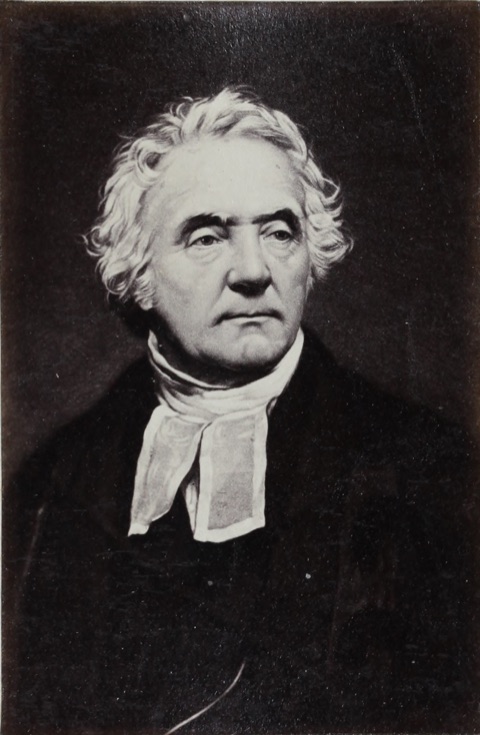
About the author
Thomas Chalmers
Thomas Chalmers (1780 to 1847 AD) was born in Anstruther, Fife, and entered the University of St Andrews at eleven, where mathematics drew him more than divinity. Minister of Kilmany from 1803, he turned to evangelical religion after a serious illness between 1809 and 1811. Called to the Tron Church in Glasgow in 1815, he became one of the most sought-after preachers in Britain, and from 1819 tried to relieve poverty in the parish of St John's through visitation and voluntary giving. He held the chair of moral philosophy at St Andrews from 1823 and of divinity at Edinburgh from 1828, and wrote on political economy. In 1843 he led the Disruption and became first Moderator of the Free Church of Scotland. He died at Edinburgh in 1847.