
Full text in modern English · Free PDF/EPUB
National Churches
Want the file? The PDF/EPUB is free with an account.
Summary
- Author
- Thomas Chalmers (1780 to 1847 AD), Scottish minister and political economist
- Published
- 1838 AD · delivered in London, April 25 to May 12
- Source edition
- Second edition, William Collins (Glasgow) and Hamilton, Adams, and Co. (London), 1838
- Type
- Public lectures on church and state
- Length
- 41,000 words · 3 hours
What is National Churches about?
National Churches is Thomas Chalmers's 1838 case that only an endowed parish church can reach a whole nation. In six lectures he argues that the market and voluntary giving always miss the people who most need Christianity, so government should support one denomination, with a minister answerable for every household.
How the argument unfolds
- 01
Lecture 1: grace needs channels. Some think church machinery distrusts God. Chalmers answers from farming: rain comes from above, yet someone must plow. "We must cut the channels; God must fill them."
- 02
Lecture 1: keep the machine, change the workers. Medieval corruption came from superstition, not from paying parish clergy. Knox left the old pulpits standing: "he took possession of them." Those who would now abolish church funds are machine-breakers.
- 03
Lecture 2: the market leaves the poor behind. Shops keep pace with a growing town; churches fall behind. Chalmers counts eighty thousand regular non-attenders in Glasgow and at least half a million in London. Nor did Christianity ever run on free trade: Paul's tentmaking paid for his preaching, and Tahiti did not fund its first missionaries.
Read the full summary (8 points, key themes)Show less
- 04
Lecture 3: why government should pay. Parliament funds museums, botanic gardens and a voyage to rescue ships trapped off Greenland, so why not churches? Even a crude utilitarian should agree: crime, poor relief and police cost more than ten times what religious training would.
- 05
Lecture 3: the Scottish campaign. His church-extension campaign has raised £200,000 for 180 churches, and every shilling of a grant would lower seat rents. He approaches government as a donor: "This is our contribution; what is yours?"
- 06
Lecture 4: Protestant, not Catholic. Tolerating Catholicism is right; endowing it is not. Ireland's Protestant clergy failed through corrupt patronage and a refusal to approach Catholics, but that condemns the workers, not the machine.
- 07
Lecture 5: one minister, 2,000 people. Take the worst district in London and give a minister a task for life: "to fill this church from that district." He visits first. A hundred hearers in the first year would satisfy Chalmers. Many of the old will never return, so his best hopes rest on the parish school.
- 08
Lecture 6: why only one denomination. Endow every sect and each minister tends his own hearers, while people who belong nowhere fall between them. So government picks one scriptural church for the parish work, "not because we hold the others to be in error."
Key themes
- Need does not create demand. The whole case rests on one reversal of economics: "There is no natural hunger or thirst for righteousness."
- Paid, not ruled. The Church of Scotland, he says, has "no other communication with the state than that of being maintained by it."
- Justice to families. Dissenters may complain of unequal treatment. Government's defense is "doing equal justice to every family in the entire population."
National Churches · Full text
Lecture 1: What a National Church Means
1. The Objection to Human Arrangements
Some religious people feel an aversion to the question of an established church because they see it merely as a matter of institutional machinery. At best, they consider it a human means of spreading Christianity and establishing it in the world. To them, it seems to imply distrust in the power of divine grace. They cannot make room in their thinking for the respective parts that belong to God’s agency and human instruments in the great work of providing religious education for the people.
These people, whose piety is strong but unintelligent, would pay this homage to the supremacy of the Being who rules, moves, and determines all things. Because they depend entirely on him, they would do nothing themselves, as though human skill and activity were equally unnecessary in sacred matters, especially in the affairs of the church on earth.
2. Human Work and Divine Dependence
To answer their objection in this general form, it might be enough to say that putting it into practice would violate every analogy of nature and providence. In agriculture, for example, as in navigation and the practical arts, we see processes devised by human beings and adapted to powers whose principles and operation often lie entirely beyond human understanding. Certainly, the dependence we ought to feel on the Sovereign of our world for rain, sunshine, and the various influences of the sky does not replace our diligent labor, or the plans we devise and carry out in well-ordered farming. Here an influence from above, in God’s hands, works together with an earthly system in human hands.
If nature withholds its part, fields cultivated with the greatest skill and effort may yield no valuable produce. If we withhold our part, those same fields, lying waste and neglected, may yield a hundred times less valuable produce, however favorable the seasons and however kindly the year has treated us. Instead, in ordinary farming, human beings work with nature, and nature works with them. They contribute unremitting labor through processes that are visible and understood; nature contributes ceaseless and mysterious activity whose workings are hidden and unknown.
We cannot fathom or predict nature’s course. The secrets of our restless atmosphere and the depths of plant physiology each contain a laboratory we have never entered, whose inner movements lie beyond both our knowledge and our control. Yet this does not diminish the confidence with which we cultivate and manage the soil. Our visible work, added to nature’s inscrutable work, or rather to the work of nature’s Author, supplies food for millions from territory that, left to nature alone, would barely support wild animals and a few scattered savages.
3. The Work of Spiritual Cultivation
All this applies equally to what we may call spiritual cultivation. It may be, indeed it is, through an influence descending from above that every human spirit is reclaimed from the barrenness and deadly blight of its natural condition and made fruitful in righteousness. But our entire dependence on God, “who giveth the increase,” does not replace the complete diligence with which ministers of the gospel should devote themselves to planting and watering, each in his allotted part of the vineyard. Far from replacing that labor, our dependence should stimulate it and provides its strongest warrant and defense.
There is a region in South Africa where the soil has excellent potential, but where the complete absence of rain throughout the year makes vegetation almost unknown. At least, no amount of human labor can obtain a return through any increase it might make in the soil’s produce. Here it is the absence, rather than the presence, of nourishment from above that makes all earthly labor hopeless and useless. If some physical change restored that nourishment, or rain fell as in other countries, then, and only then, would human activity and skill have a purpose and a justification. Productive agriculture, at last made possible, would find room and encouragement for its various processes.
The same is true of spiritual cultivation. We are taught that this work can prosper only through living water descending from the sanctuary above. Yet its descent does not replace preparation of the earth that receives it; rather, it calls for that preparation. God’s part in the work does not cancel the part we ought to take. The overflowing Nile gave rise to Egypt’s artificial irrigation, which distributes its waters. Likewise, the doctrine of a sanctifying and fertilizing grace from heaven does nothing to release us from what we may call spiritual irrigation here below. Quite the opposite.
It is not enough for this nourishment to descend; it must also be distributed. Through places of worship and parishes, channels must carry its blessings to all the homes and families of a country. Nothing in the doctrine of the Spirit’s agency therefore closes the question of the best government or organization for a church on earth. That question retains all its importance. While acknowledging the heavenly descent, we must not neglect the earthly distribution.
The expression that people are fellow workers with God is enough to show this cooperation. But the principle does not rest on a single incidental testimony. It runs through the whole system of divine administration, and neglecting it is a fundamental and pervasive error in Christianity. Machinery is no less essential on earth because the power that guides and animates it comes from heaven.
None of this diminishes or removes the supreme necessity of spiritual influence, whatever the fears of a mistaken, I would even say a foolishly feeble, though sincere piety. Such piety greatly underrates the importance of visible, material arrangements in church affairs and dismisses them as merely earthly means and expedients. Yet these arrangements may, in the order of cause and effect, be an essential step toward the salvation of millions, without the slightest weakening of our essential dependence on God.
After preparing his field, the farmer looks for the early and the later rain, without which the cultivated ground would be a dreary waste. After marking out parishes and planting churches in them, the Christian ruler looks for a blessing from above, without which the country will remain as hopeless a moral wilderness as before. However skillfully its distribution channels are drawn, if they remain dry and forsaken by heaven, they will convey nothing to human souls. The impressive apparatus of a densely spread establishment will neither prevent nor relieve the curse of the country’s spiritual barrenness.
4. Scripture and Human Messengers
To strengthen this conclusion, remember also that when the Spirit enlightens or impresses a human soul, he generally does so through the Word. In other words, the Bible forms the material pathway for his communications. This doctrine therefore does nothing to diminish, and everything to increase, the importance of multiplying copies of the Scriptures and circulating them throughout the world.
Its bearing on our argument becomes still clearer when we remember that, from Christianity’s beginning through all its succeeding ages, the Spirit has always been the great agent of conversion, yet chooses his own means. He has always attached special effectiveness or given special honor to human instruments. Through one heavenly visitor, the whole substance and truth of Christianity might have been powerfully conveyed to Cornelius’s mind. But two supernatural messages were employed: one sent to Peter to tell him to go to Cornelius, and another to Cornelius himself, not to deliver the gospel, but to prepare him for a visit from a fellow mortal, from whose lips he would receive it. Thus it was while Peter spoke to Cornelius and the other members of his household that the Holy Spirit fell upon them.
The same mysterious agent who gives power to the Word when read also gives power to the Word when preached. But it is preached by human beings to human beings, not by beings of a higher order to those of a lower. The divine Spirit alone sends the message effectively into the heart, but human messengers carry it to the ear. Bibles and ministers, in other words, form the two great parts of his principal and chosen means.
As fellow workers with God, we must set these means in motion. We must see that every home has a Bible and every family is accessible to a minister. These are our plain, tangible actions for advancing and distributing Christianity on earth, though without a heavenly influence descending from above, Christianity could have no existence in the world. We must cut the channels; God must fill them.
Our work in this spiritual cultivation is as visible as planting and watering in ordinary farming. God’s work of giving the increase lies, in both cases, beyond the sight and investigation of all our faculties. It is wholly inscrutable in the mysteries of grace. Nor is it fully understood in the mysteries of the changeable weather above us, or in the still deeper mysteries of vegetation.
5. Bringing the Gospel to Every Door
The doctrine of the Spirit therefore does nothing to diminish, and everything to increase, the importance of preaching the gospel. It likewise increases the importance of asking what can best secure its being preached to every creature. If under one system, even with all our effort and care, we will in all likelihood miss more than half the population, while under another we may be able to ensure that Christianity’s calls and lessons reach every door, then, other things being equal, that difference alone gives strong grounds for preferring the second system.
Our purpose is to demonstrate that this invaluable quality of full and universal reach belongs only to a national establishment. We also intend to show clearly, from history and human nature, that it never is, and never can be, achieved through the voluntary system, or what has been called free trade in Christianity. First, however, we must explain what a national establishment of religion means: precisely what creates or constitutes such an establishment in a country.
6. What Makes a Church Established
We should take secure legal provision for the expense of religious ministry as the basis of our definition, the essential characteristic of a religious establishment. At present, this is merely a question of terminology and definition, not doctrine. For the moment, we are trying to settle our language rather than state our beliefs, so that the terms used in the argument will have a clear and common meaning.
We are not yet saying whether legally establishing religion is good or bad. We are only explaining what we specifically understand an establishment to be. Wherever there is secure legal provision for Christian ministry, there is an establishment of Christianity in the country. This is its essence and must be distinguished from all the incidental features that may accompany it.
This understanding may or may not imply what people usually mean by a connection between church and state. If the state maintains the church, we admit that such a connection exists, whether the support is an ancient original gift or a grant renewed each year that the civil government may or may not withdraw. But the support may have originated elsewhere: in individual bequests or numerous private gifts, prompted by pious affection for the Christian good of the whole community or of particular districts. In our view, this makes it no less an establishment than if it received a direct allowance from the national treasury.
Our definition requires only legal security that certain funds will be applied to maintaining Christian worship or instruction in a country, however those funds originated. If the church owes its revenues to the gifts of rich and religious people in earlier days, its connection with the state may be no greater than that of any other charitable endowment in the kingdom. Property has been assigned to certain ends, and the state’s only task is to uphold that assignment, ensuring that the original donors’ intentions are fulfilled.
It is chiefly in this sense that we understand Oxford and Cambridge to be national or established institutions for education. Their character as such does not depend on the distant historical origins of their property, most of which they happen to owe to the piety and patriotism of individuals rather than to the generosity of civil rulers. It depends on the security of the property’s application, rather than its origin. The nation’s justice, or the authority of the state and its laws, is pledged to defend that application, both against encroachment and against diverting the property to purposes other than those it now serves.
7. Support Without Doctrinal Control
Even if the state wholly supported the church in material matters, establishing a connection to that extent, the connection need not go any further. Complete dependence on the state for material support could exist without even a shadow of dependence in church affairs. Receiving all its maintenance from the civil power does not mean the church must receive its theology from the same source, or that its theology must acquire the slightest worldly taint.
The state supplies material things, and the church, in return, supplies spiritual things. Yet those spiritual things may remain entirely spiritual and be ministered by the clergy to the people without adulteration or any worldly ingredient. The church receives support for its clergy from the state; the clergy in return give the state’s subjects a Christian education. But they may, and do, reserve the whole power and privilege of deciding what that education will be.
They may owe their food, clothing, churches, and even private homes to the state, while their creed, discipline, ritual, articles of faith, and forms of doctrine and devotion remain entirely their own. The boundary between civil and ecclesiastical authority may be drawn so that the state maintains religious teachers without interfering with their teaching. It may establish a system of schools while leaving an educational board entirely free to determine what is taught. Or it may establish a church while leaving the church equally free to determine its own teaching, without civil dictation or control.
Endowed schools might bring education into hundreds of districts that otherwise would have remained in illiterate ignorance, and the education could still be right and pure. Endowed churches might bring public worship and religious instruction into hundreds of districts that otherwise would have remained in the grossest heathenism, while nothing but pure, scriptural Christianity was observed or taught. An endowment need not diminish the quality of either general or Christian education, even as it increases immeasurably the spread and quantity of both.
8. Supporters and Ministers Can Differ
This point needs particular emphasis because people so often try to suggest that the church must be contaminated whenever it approaches the state, even if its only object is to secure support for its clergy. The church might accept that support and remain as spiritual, holy, and independent as before, while gaining the means to distribute the water of life more abundantly, and just as purely, among the people.
When a West Indian planter sends for a Moravian missionary and supports him while he instructs the laborers on the estate, we have a small model of an establishment. The planter maintains the missionary, and the missionary teaches on the planter’s estate in return. Yet he teaches only his own Christianity. The Bible remains his fountainhead; truth and holiness remain the objects of his resolute allegiance. The whole effect of the relationship is to bring the gospel into contact with hundreds of immortal beings who, without this miniature establishment, might have lived in guilt and died in darkness.
A spiritual impulse may or may not have prompted the planter’s proposal. He may have been concerned for his fellow human beings’ eternal welfare, or he may have taken an enlightened view of his own safety and advantage. He may have reasoned that religious training would make his laborers submissive, orderly, and industrious. For him, it may have been merely a calculation of profit and loss. But whatever opened the door, it remained a door to the highest Christian usefulness for the missionary. The missionary’s motives for accepting the proposal may have been of the purest and highest kind.
What is true of this small model on a single plantation may remain true when expanded into a great national establishment of Christianity throughout an empire. Whether policy or piety moved Constantine is uncertain. But whatever worldly motive prompted the offer on one side, it may have been accepted on the other out of the purest love for human souls, without surrendering or compromising the smallest part of heaven’s sacred claims.
When the great ruler of the Roman Empire changed from a persecutor into a nursing father, the church might have raised prayers of gratitude to him who turns kings’ hearts wherever he wills. With a way now open to the abundant harvest of so great a population, the church might have entered its enlarged field with zeal for its Master’s work as holy, and independence in all its pulpits as lofty, as in the days of martyrdom.
As I wrote earlier:
“Now this very opening was presented to the ministers of Christ when the Roman Emperor, whether by a movement of faith or a movement of philanthropy and patriotism, made territorial distribution of them over his kingdoms and provinces; and, assigning a territorial revenue for the labourers of this extensive vineyard, enabled each to set himself down in his own little vicinity, the families of which he could assemble to the exercises of Christian piety on the Sabbath, and among whom he could move freely through the week in all the offices and attentions of Christian kindness. Such an offer, whether made in a Christian spirit or merely politically upon the one side, could be accepted and rejoiced in by the other in the most Christian spirit. It extended inconceivably the powers and the opportunities of usefulness. It brought the gospel of Jesus Christ into contact with myriads more of imperishable spirits; and, with as holy a fervour as ever gladdened the breast of the devoted missionary, when the means of an ample service to the Redeemer’s cause were put into his hands, might the church in those days have raised to Heaven its prayers of purest gratitude, that kings at length had become its nursing fathers, and opened up to it the plenteous harvest of all their population. There is just as little of the essentially corrupt in this connection between the church and the state, as there is in the connection between a missionary board and its pecuniary supporters. Each is a case of the earth helping the woman; but whatever of earthliness may be upon the one side, there might be none, and there needs be none, upon the other. The one may assist in things temporal; while the other may continue to assert its untouched and entire jurisdiction, as heretofore, in things spiritual. There might thus be an alliance between the altar and the throne, yet without the impurity of any earthly intermixture being at all engendered by it. The state avails itself of the church’s services, and the church gives back again no other than the purest services of the sanctuary. Its single aim, as heretofore, is the preparation of citizens for heaven; but in virtue of the blessings which Christianity scatters in its way, do the princes of this world find that these are the best citizens of earth; and that the cheap defence of nations, the best safeguard of their prosperity and their power, is a universal Christian education. There needs be nothing, we repeat, of contamination in this. The state pays the church; yet the church, in the entire possession of all those privileges and powers which are strictly ecclesiastical, maintains the integrity of her faith and worship notwithstanding. She might be the same hallowed church as when the fires of martyrdom were blazing around her: the same spirituality among her ministers, the same lofty independence in all her pulpits. The effect of an establishment is not necessarily to corrupt Christianity, but to extend it; not necessarily to vitiate the ministrations of the gospel, but certainly to disseminate these ministrations more intimately among, as well as to bear them more diffusively abroad, over the families of the land.”
9. The Causes of Church Corruption
We know that the establishment of Christianity in Constantine’s day coincided with the progress, rather than the birth, of a great and general corruption. That corruption had begun from other causes two centuries earlier. Simply distributing church workers across the Roman Empire, each pursuing his proper calling in return for a fair, regulated income, cannot explain the church’s fearful degeneration. It began even in the first century; establishment early in the fourth did not originate it and, as the actual history shows, could not arrest it.
The essence of that corruption did not lie in the civil power gaining supremacy through establishment and thereby exercising undue influence over church affairs. On the contrary, it was the supremacy that the superstition and ignorance of princes and people gave the ecclesiastical power. The church used that power most unworthily to aggrandize itself enormously in material affairs. It displaced God’s rightful authority in his Scriptures and substituted doctrines and discipline of its own to blind people’s souls and subject them to its rule.
Had emperors and kings understood their own position and resisted every encroachment by the hierarchy on their legitimate functions, nothing in a system of endowed churches for spreading Christian education everywhere could have produced priestly despotism. It could no more have done so than endowed schools for spreading ordinary literary education could have produced a despotism of schoolmasters.
The truth is that influences were at work which, with or without an establishment, would have brought Christendom to the terrifying Catholicism of the Middle Ages. This was not the product of the system we defend, under which ministers, in return for legal maintenance, would each have taught the gospel and performed its services for the population of his district. It was the product of an enslaving superstition that allowed an ambitious priesthood to run riot over the consciences and fears of its deluded followers.
Its enormous wealth came from voluntary offerings by the people. Its enormous power, at least in its beginnings, came from voluntary concessions by princes who shared the degrading fanaticism of the times. A regulated establishment might have regulated and restrained that period’s characteristic excesses.
Some people cannot distinguish the accompaniments or accidents of great, complex events from their causes and therefore always confuse them. We would ask them to consider the religious condition of Presbyterian Scotland on one hand and Catholic Ireland on the other. The first has an establishment; the second is entirely under the voluntary principle. In which country, then, is a corrupt and domineering priesthood doing more to spoil the apostles’ pure doctrine or injure the peace and virtue of the commonwealth?
10. Reform the Teaching, Keep the Means
Fortunately, the Reformers knew how to distinguish the machinery from the people operating it. Instead of destroying the establishment’s machinery in their respective countries, they put it into other, better hands and had it operated by people with different doctrines and principles. An establishment, with its universities and parishes, might indeed be a country’s best and most effective means of conveying either good or evil, either corrupt or scriptural theology.
They therefore worked intelligently. They did not demolish the old distribution apparatus with blind, headlong zeal. They substituted the true gospel for a false one and sent its corrected, purified lessons along the old channels. Under Catholicism, the establishment had secured a pulpit and minister in every small district of the country. The Reformation did not destroy that arrangement. It retained the same fountainhead in the colleges and the same streams through the parishes and churches. Knox and all enlightened Reformers everywhere insisted strenuously on settled provision for Christian teachers. The system was changed and remodeled only in what it taught.
Whatever learning you wish to impart to a country’s population, whether ordinary or general, if you want it spread universally, you must want effective means of distributing it fully and readily. The lessons may be good or bad. Suppose they are bad. Should we change the lessons, or dismantle and demolish the machinery? Surely the obvious course is the Reformers’ course: change the lessons. If they then teach a pure and wholesome theology, we ask in the name of common sense, where is the wisdom in destroying the machinery? Apparently it was maintained as long as it helped spread corruption and error, but now that the evil has become good, it is to be dismantled just when it might help spread righteousness and truth.
Is this how a country’s government should treat good and evil? If the government is popular and follows the collective mind or will of the community, is this how that society ought to treat them? For ages, evil has been given every facility for moving rapidly and circulating fully among the country’s families. Once the evil has been made good, is that the moment to remove those facilities?
As long as the religion taught was a moral poison corrupting people’s hearts and habits, it enjoyed the privilege of an establishment, which opened access to every district and every door. How strange if, once that deadly poison has become the water of life, we should dispense with the aqueducts that could distribute it for the nation’s healing! Fortunately, the venerable fathers of our Protestant church distinguished things that differ and judged otherwise than today’s headlong innovators. They healed the quality of what circulated but left its circulation apparatus alone.
Their achievement shows the wisdom and principle of genuine reform. The other achievement belongs to people of a different spirit. It may be done in reform’s name, but it marks the very crisis of revolution and bears all its characteristics. That is true whether it is the work of a legislature serving the nobles’ greed or the crowd’s outcry, or the plunder of a crowd that has broken loose from the old restraints of authority and is swept waywardly and uncontrollably along amid the tumultuous waves of insurrectionary violence.
11. Two Kinds of Church Reform
Here we may pause over the instructive contrast between the church reformers of the past and present. The former worked on the high ground of theology and conviction. They aimed to animate the established church with another spirit, giving it different doctrines and principles rather than destroying it.
Today’s reformers are occupied differently. Their chief concern is external rather than internal: what we may call the church’s economics, its rights and revenues, and the number and pay of its officers. If their sole aim were to distribute its wealth better, rather than reduce it or divert it elsewhere, their undertaking, though humble, might be harmless and even beneficial.
The real object of Luther and his contemporaries in the first reform was to mend the church’s faith. The professed object of the second is to mend its framework, though the obvious effect of the proposed changes, as in Ireland, would often be to mutilate and weaken it, and ultimately destroy it.
In earlier times, the conflict was a great struggle of intellect and principle, engaging many of England’s finest minds and noblest hearts. The learning of its deepest students, the testimony of its saintly martyrs, and the outraged moral sense of a newly awakened community were all enlisted for Scripture and a pure, scriptural ministry throughout the kingdom’s parishes. Altogether, it was a nobler controversy, fought on nobler ground, than the one now summoning champions among clergy and members of Parliament.
Then the struggle concerned the quality of the nourishment to be given to people’s souls. Its noble result was that they should receive the pure bread and water of life, drawn directly from the stores and fountainheads of inspiration, without the adulteration formerly introduced by corrupt and superstitious Catholicism. Now the struggle concerns the apparatus for distributing this spiritual nourishment, rather than its kind or quality. The question concerns machinery rather than theology or morals, and many of our age’s economic and calculating reformers feel abundantly qualified to discuss it.
The difference in character and aim between these two reformations is complete. If one was doctrinal or moral, the other might be called mechanical. Or, since its sure effect would be to demolish the establishment’s framework altogether rather than mend it, it might best be called a machine-breaking reformation. Its advocates, or rather its instigators and agents, are today’s machine-breaking reformers. In their higher sphere they are far more harmful, but, we think, scarcely more intelligent, whether in Parliament or outside it, than the machine-breakers of Kent, the frame-breakers of Leicestershire, or the arsonists of a few years ago in England’s southern and midland counties.
The venerable fathers of nearly three centuries ago accomplished their reformation through strength of principle and argument. The coarse utilitarians of our generation will only ever accomplish theirs through brute force, a kind of sledgehammer energy: either in a period of frenzied popular delusion or through a legislature’s wayward exercise of ignorant, uncomprehending power.
If the hallowed title of reformation is to serve them in this conflict, if they are to use it like a magical watchword to enlist people’s passions and prejudices, then never has the power of mere words or sounds over human understanding been more fully shown. Never have conjurers, whether in politics or fortune-telling, worked more successfully on the world’s credulity or practiced a grosser deception by using and prostituting a venerable name.
12. Knox and the Existing Churches
In this age of fevered speculation, we gladly look back with affection to our forefathers’ better way. Knox remodeled the faith. Despite all the violence attributed to him, he did not demolish the Catholic establishment’s pulpits. He did something infinitely better: he took possession of them. He did not destroy good machinery because it had been badly operated. More wisely, he dismissed the workers and put it into other hands.
Fury is often blind. If anything could provoke its wildest excesses, it was the situation then, when the accumulated wrongs of many ages had finally roused an indignant community against the immoral, persecuting clergy who had so long lorded over it. Between the nobles’ greed and the crowd’s indiscriminate rage, the establishment itself might have been swept from the country as a moral nuisance.
But our great Reformer intervened to defend it. He stood resolutely for the churches and clergy stipends, transmitting the material framework for future generations’ use. It suffered damaging interference, but he preserved it as whole and uninjured as he could. Without this apparatus, he could not have spread his Reformation’s doctrines with such speed and ease. They flashed like lightning across the country, not over the establishment’s ruins, but through the many pathways it still kept open wherever it had been preserved and maintained.
Without it, he might have gained a foothold on the bare shore where he landed but found the country beyond an impenetrable forest. He entered and reached it through the old channels, now sending the pure water of life, the lessons of his sound, scriptural theology, through their many intersecting streams into all the parishes. Accordingly, all that remains of Catholicism in Scotland is in those Highland strongholds where there could be said to have been no parishes, or where they were so large and inaccessible that they lacked the benefits of an establishment.
Amid that period’s stormy upheavals, when every spirit was agitated, his views remained calm, broad, and philosophical. He may have looked indulgently on the destruction of buildings that housed the most corrupt and powerful members of the old hierarchy. But he protested against the violence inflicted, all too effectively, on every part of the establishment that was truly useful or could be made useful for educating either clergy or people. He denounced the shameful seizure of wealth that should have provided better and more numerous endowments for churches and colleges. He was inspired by lofty principle, but his mind had a regulating as well as a driving power. The deepest wisdom guided it.
13. Purify Rather Than Destroy
The fact that an establishment has spread corruption and error is no more an argument for destroying it than the printing of unbelief and licentiousness is an argument for destroying printing presses. The proper course is to preserve and extend both: use printing to distribute Bibles fully, and establishment to spread biblical preaching and conviction throughout the country.
To do otherwise would be like a physician trying to cure a disease in a patient’s blood by mangling the apparatus that carries it through the body until circulation stops, instead of treating the blood’s quality. If London’s water became harmful through contamination, surely the answer would be to purify it, or if possible prevent the impurity from entering, rather than senselessly attack the underground machinery that distributes it through the streets and into people’s homes.
Yet that is the style of our modern reformers. They would suppress parishes, or at least partly destroy the system and so withhold the water of life from parts of the country. Or they would abolish church rates, no longer requiring the contributions from the wealthy that provide access and accommodation for gospel instruction to poor families.
Their war is not against any system of theology. On that subject they are largely indifferent, as though all systems were alike. They attack the machinery set up in earlier days and preserved into our own for circulating its lessons. Once it effectively spread a deadly superstition and subjected every spirit to its rule. Now it might be equally effective in spreading pure, undefiled Christianity for the nation’s healing.
There was a time “when a man was famous, according as he had lifted up axes upon the thick trees,” or according to what he gave in materials or money to build and endow churches. “But now they would break down the carved work thereof at once with axes and hammers. They have said in their hearts, Let us destroy them together: they would burn up all the synagogues of God in the land.”
14. Strengthen the Church and Its Ministry
The church reform we should desire for England or Scotland is certainly not the destruction of the machinery. We should not even mutilate or reduce it, but rather repair, strengthen, and greatly extend it, as we will explain later. Other external or even financial changes may deserve to be called improvements. But the great reform would chiefly leave the establishment’s framework intact while infusing it with another spirit, making it the vehicle of a more powerful, scriptural ministry than before.
What we need, in short, is internal reform. To achieve it, we need no change in the theology of either church, none at all in their creeds, and perhaps very little in their service books. Yet the effectiveness of any church, even one with the best and purest theology on earth, always depends essentially and vitally on conscientious, disinterested, principled use of its power to appoint ministers. Good machinery is not enough; we must have good people to operate it.
Even when the Reformers of earlier days faced the worst of people, they preserved the machinery with a wisdom and discrimination that do them infinite credit. Only after substituting Protestant for Catholic doctrine did they put its operation into other hands. Their example emphatically condemns today’s headlong reformers. These face no clergy more corrupt or incompetent than before. On the contrary, the clergy’s general worth, devotion, and personal Christianity have visibly improved in all three kingdoms. Yet they would choose this moment to destroy the most effective instrument for our people’s religious education and wrest it from the clergy’s hands.
In our own Scotland, no wider contrast could be imagined than that between the distant past’s reformation and the one now proposed. The former was secured by the martyrs’ resolutions and prayers and finally sealed with their blood. They fought for the free use of Scripture and a pure ministry within their churches, rather than for those churches’ demolition.
If the latter reformation, the one proposed in our own time, were allowed to take effect, it would assuredly sweep along in a wild course of destructive violence, amid the cheers of a crowd as unlike those holy worshipers as east is distant from west. Those worshipers gathered around their pastors in lonely mountain places to escape their persecutors and sat down to their sacraments under the open sky.
Such were the reformers of those golden days. They bear no resemblance to today’s impetuous, bustling agitators, in whose hearts politics has taken the place of piety. These people are resolved on change at any cost and prepared to greet with exultant shouts the overthrow of the altars that sustained our forefathers’ faith and devotion in holier, better times.
Though I risk keeping you far too long, I cannot resist asking your indulgence for ten minutes while I read a few extracts from a writer marked by both great powers and great prejudices. In discussing the Church of England, he clearly distinguished the machinery from its operation, valuing the first as highly as possible while holding the worst possible opinion of the second. I mean William Cobbett, whose shrewd discernment at least everyone will admit. Speaking of the church as machinery or apparatus, he writes:
“An Established Church, a church established upon Christian principles, is this: that it provides an edifice sufficiently spacious for the assembling of the people in every parish; that it provides a spot for the interment of the dead; that it provides a priest, or teacher of religion, to officiate in the edifice, to go to the houses of the inhabitants, to administer comfort to the distressed, to counsel the wayward, to teach the children their duty towards God, their parents, and their country; to perform the duties of marrying, baptizing, and burying, and, particularly, to initiate children in the first principles of religion and morality; and to cause them to communicate, that is to say, by an outward act of theirs, to become members of the spiritual church of Christ: all which things are to be provided for by those who are the proprietors of the houses and the lands of the parish; and, when so provided, are to be deemed the property or the uses belonging to the poorest man in the parish as well as to the richest.”
Next comes his opinion of how this church actually works in the hands of its present clergy. I do not share that opinion and will try to qualify his conclusion with a few closing sentences of my own.
“This is an Established Christian Church; and this you, the parsons, will tell the people that they actually have; and you will tell the people who have no house and land, that, in calling for the abolition of tithes, they are in fact calling upon the rich to take from them, the poor, the only property that they have in the country. Alas! you will tell them this in vain. They know that the church is not this thing now to them; they know that you do not visit their houses and comfort them when they are sick, except in instances so very rare that they hardly ever hear of them; they know that you do not teach their children, and that, though the churchwardens annually certify the bishop that the children communicate, hardly a workman in the kingdom ever saw or heard of such a thing being done; they know that you are frequently on the bench, perched up as justices of the peace; they know that you frequently sentence them to punishment without trial by jury, and sentence to transportation for what is called poaching. This is the capacity in which they now know you; and to induce them to stir hand, foot, or tongue, in defence of this Establishment, is no more possible than it is to induce a Jew to give up a farthing of his interest.” … “I was a sincere Churchman” … “because it was reasonable and just, that those who had neither house nor land, and who were the millions of the country, and who performed all its useful labours, should have a church, a churchyard, a minister of religion, and all religious services performed for them, at the expense of those who did possess the houses and the land. In a word, in the church and its possessions, I saw the patrimony of the working people, who had neither house nor land of their own private property. For these reasons I was a friend, and a very sincere friend, and able to be a very powerful friend of the Church Establishment.”
“But,” etc.
“Ought we to have any Establishment at all? In answering which for ourselves, it is our own opinion, that this nation has been much more religious and happy under the influence of the Protestant Established Church, than it is ever likely to be in case that church were abolished. To make the question still more close, let it be this, whether it be reasonable that any one should be called upon to contribute towards the maintenance of a church, the tenets of which he dissents from? This is making the question as home as it can well be. And we do not hesitate to say, that there is to us nothing so outrageously unreasonable in the idea. One thing is certain, that if all are not to remain liable to pay for the church, it is no established, or at least no national, church. Reasons are not wanting, to show the benefits of a national religion, or a mode of worship, or some religious establishment, the peculiarities of which are under the especial patronage and peculiar favour of the government. In judging of such a matter, we can only be guided by experience; and experience is not less wisdom here than in all other things.” … “It does not follow that because an institution has been abused it should be done away with, if the institution itself be necessary or beneficial. Even kings may require now and then to be driven from their thrones; but that does not prove the necessity of doing away with the throne.” … “If it be allowed (and we think it ought to be), that an establishment is desirable for such a purpose, the dissenters cannot well object to paying the clergy of a different persuasion. An establishment cannot consist of all creeds, or the Quakers themselves would have a right to form a part of it. As we have before said, the church is not national unless all be taxed towards its support; and, for the sake alone of preserving decency for religion, it appears to us to be no more unjust than it is impolitic towards the community in general, to require the aid of all in maintaining that in which all are equally interested.”
“But then come the just and charitable principles of the Christian religion; and they say this to the owners of the land and the houses, ‘The land and the houses are yours, but not in such absolute right as to exclude your working and poorer brethren from all share. There shall be a church in each parish, and a priest for the teaching of religion; there shall be a church-yard for the burial of the dead; there shall be sermons, and prayers, and marriages, and baptisms; and these shall form the possessions of the inhabitants, the property of those who labour.’ ”
“Go upon a hill, if you can find one, in Suffolk or Norfolk; and you can find plenty in Hampshire, and Devonshire, and Wiltshire; look to the church steeples, one in about every four square miles at the most on an average; imagine a man, of small learning at the least, to be living in a genteel and commodious house, by the side of every one of these steeples, almost always with a wife and family; always with servants, natives of the parish, gardener, groom at the least, and all other servants. A large farm-yard, barns, stables, threshers, a carter or two, more or less of glebe and of farming. Imagine this gentleman having an interest, an immediate and pressing interest in the productiveness of every field in his parish, being probably the largest corn-seller in the parish, and the largest rate-payer, more deeply interested than any other man can possibly be in the happiness, harmony, morals, industry, and sobriety of the people in his parish. Imagine his innumerable occasions for doing acts of kindness; his immense power in preventing the strong from oppressing the weak; his salutary influence coming between the hard farmer, if there be one in his parish, and the feeble or simple-minded labourer. Imagine all this to exist close alongside of every one of these steeples, and you will at once say to yourself, hurricanes and earthquakes must destroy the island before that church can be overthrown. And when you add to all this, that this gentleman, besides the example of good manners, of mildness, and of justice, that his life and conduct are constantly keeping before the eye of his parishioners; when you add to all this, that one day in every week he has them assembled together to sit in silence; to receive his advice, his admonitions, his interpretation of the will of God as applicable to their conduct and their affairs; and that, too, in an edifice rendered sacred in their eyes, from their knowing that their forefathers assembled there in ages passed, and from its being surrounded by the graves of their kindred; when this is added, and when it is recollected that the children pass through his hands at their baptism, that it is he alone who celebrates the marriages, and performs the last sad service over the graves of the dead; when you think of all this, it is too much to believe that such a church can fall. Yet fall it will,” etc.
“This settles the matter as to the church as it now stands; and then the next question is, Can it be restored to what it ought to be? If it could be, that is the thing that ought to be done, because, though people in great towns do not perceive it, it is a serious change to the country; a serious change to the 465 parishes of Devonshire, for instance, to the 629 parishes of Lincoln, the 731 parishes of Norfolk, the 411 parishes of Kent; a serious change to take away one little gentleman out of every one of these parishes.”
Our specific purpose is to demonstrate the powers and properties of a national religious establishment considered as machinery. As for its operation, we can at least express our triumphant confidence that, despite its enemies’ exaggerations, the evidence of its vast practical importance to our nation’s moral welfare grows daily.
If it is unquestionably true that the clergy of the Church of Scotland have distinctly and decidedly improved; if in England this mighty instrument is passing into the hands of a more effective clergy; if in Ireland persecution, with its usual effect, is producing a resolute and exalted spirituality in the devoted ministers of that deeply injured hierarchy: is this the moment, we ask, to wrest from these now more faithful and energetic workers the instrument that would enable them to work with tenfold effect among the country’s families?
Reformation was pursued more wisely in earlier days. Even when confronted with a grossly immoral and tyrannical priesthood, the Reformers changed the workers and preserved the instrument. With our present workers, I trust that heaven’s blessing will enable us not only to preserve but to perfect it. Given sufficient energy, conscientiousness, and devoted zeal among their ministers, all the threats and agitation surrounding them will only establish the three churches more firmly on their foundations and rally our nation’s wise and good more closely around their common cause.
Lecture 2: Church Support and the Market
Before beginning the positive, direct argument for a national religious establishment, I tried in my last lecture to remove an initial objection, or rather an initial prejudice. It assumes that the connection between church and state involved in an establishment exposes Christianity to more secular influence than any other method of spreading or maintaining the gospel. In these days of fierce partisanship, we cannot expect much calm, clear discrimination. People are swept along by a kind of herd impulse under the influence of a popular, prevailing cry.
A few years ago in Edinburgh, an American Presbyterian clergyman who happened to be an acquaintance of mine spoke at a public meeting. It was one of those meetings where the mere mention of a connection between church and state immediately arouses intense hostility among the assembled thousands. Everyone in the crowd was delighted to hear him say that any such connection was regarded with utter abhorrence throughout America.
Afterward I ventured to discuss the whole controversy with him. My first question was this: Suppose a Christian philanthropist developed a strong affection for a district in Maryland and left ten thousand pounds to build a church and a minister’s residence and to support a clergyman. Suppose he stipulated that the clergyman must be Presbyterian and, in church matters, entirely subject to his own Presbyterian church courts in America. Would their General Assembly, or supreme governing court, reject such an endowment as unscriptural and unchristian? Or would the body accept it as an addition to its resources for religious service?
There could be only one answer. An endowment devoted to this purpose and placed under the guardianship of what he considered a pure, scriptural church would be welcomed and encouraged to the fullest extent.
I then asked what would happen if these endowments were multiplied until they covered the whole state of Maryland. We still supposed that the theology of all these Maryland clergymen was in no way subject to the wishes of those who left the money, but only to their ecclesiastical superiors: the presbyteries, synods and General Assembly of America. He admitted that the arrangement would be good and desirable for one small territory. Would its character or effect change if the benefit were multiplied several hundred times and spread throughout Maryland?
Of course he readily admitted that multiplying one apple by 750 gives you 750 apples, not 750 oranges. In the same way, multiplying one moral and religious benefit by that number gives you 750 unquestionable and desirable benefits, not 750 evils.
From this it was an easy step to move from Maryland to the whole United States. Only one question remained between us. Such a great, general endowment would have delighted them all if it had come from many thousands of generous individuals. What if it had instead come down to them from an endowment founded many hundreds of years earlier? Suppose it rested so firmly on its own distinct property right that no individual could honestly say its existence injured anything belonging to him. If he and his brethren would rejoice to see such an endowment introduced, would they willingly consent to its removal at the clamorous demand of people who described it as a curse and burden on the commonwealth, and even as an unchristian abomination in their land?
His reply was memorable: “If all you mean by an Establishment is an organized provision for a clergy, we should rejoice in it. If this be the whole amount of the connection between church and state; if maintenance and nothing else come from the one quarter, and an unfettered theology from the other, without contamination from the authority of man, but subject only to an ecclesiastical judgment, grounded on a principle of deference to the Word of God, a simple arrangement of this sort is truly a different thing from what we understand by a Religious Establishment. The thing we deprecate is the authority of the civil magistrate in matters of religion; but we should be thankful to him or to anyone else, for giving us an organized provision for clergymen.”
Now this organized provision is precisely all we contend for. In other words, it is a legal provision for supporting a Christian ministry. Such an arrangement could be made, and actually is made, without the slightest infringement of the church’s spiritual prerogatives or its ministers’ ecclesiastical independence. Our transatlantic friend’s indignation was therefore directed at the wrong object. He had failed to distinguish between a government feeding and clothing ministers and a government assuming authority over their creed and consciences.
But we can hardly expect people to distinguish clearly between different things amid the noise and uproar of public applause. When an orator denounces the connection between church and state, the effect is immediate on everyone who is swept along without reasoning or discrimination. An assembly’s deafening cries and equally deafening applause create a noise and excitement that drown out the small, still voice of truth.
As for this ecclesiastical independence, I am unaware of any serious practical obstacle to its exercise in England. In any event, as I wrote in an earlier sermon:
“We know of nothing more perfect in this respect than the constitution of the Church of Scotland. There is, to each of its members, an independent voice from within; and from without, there is no power or authority whatever in matters ecclesiastical. They who feel dislike to an establishment do so, in general, because of their recoil from all contact and communication with the state. We have no other communication with the state than that of being maintained by it, after which we are left to regulate the proceedings of our great home mission with all the purity, and the piety, and the independence of any missionary board. We are exposed to nothing from without which can violate the sanctity of the apostolic character, if we ourselves do not violate it. And neither are we exposed to anything which can encroach on the authority of the apostolic office, if we ourselves make no surrender of it. In things ecclesiastical we decide all. Some of these things may be done wrong, but still they are our majorities which do it. They are not, they cannot, be forced upon us from without. We own no head of the Church but the Lord Jesus Christ. Whatever is done ecclesiastically, is done by our ministers acting in His name, and in perfect submission to His authority.
“Implicated as the church and the state are imagined to be, they are not so implicated that, without the concurrence of the ecclesiastical courts, a full and final effect can be given to any proceeding by which the good of Christianity and the religion of our people may be effected. There is not a clerical appointment which can take place in any one of our parishes till we have sustained it. Even the law of patronage, right or wrong, is in force, not by the power of the state, but by the permission of the church, and with all its fancied omnipotence, has no other basis than that of our majorities to rest upon. It should never be forgotten that, in things ecclesiastical, the highest power of our church is answerable to no higher power on earth for its decisions. It can exclude, it can deprive, it can depose, at pleasure. External force might make an obnoxious individual the holder of a benefice; but there is no external force in these realms that could make him a minister of the Church of Scotland. There is not one thing which the state can do to our independent and indestructible church but strip her of her temporal possessions. Yet it was not consumed; she would remain a church notwithstanding, as strong as ever in the props of her own moral and inherent greatness; and, though shriveled in all her dimensions by the moral injury inflicted on many thousands of families, she would be at least as strong as ever in the reverence of her country’s population.
“She was as much a church in her days of suffering as in her days of outward security and triumph; when a wandering outcast, with nothing but the mountain breezes to play around her, and nothing but the caves of the earth to shelter her, as now, when admitted to the bowers of an establishment. The magistrate might withdraw his protection, and she cease to be an establishment any longer; but in all the high matters of sacred and spiritual jurisdiction, she would be the same as before. With or without an establishment, she, in these, is the unfettered mistress of her doings. The King by himself, or by his representative, might be the spectator of our proceedings; but what Lord Chatham said of the poor man’s house, is true in all its parts of the church to which I have the honor to belong: ‘In England every man’s house is his castle; not that it is surrounded with walls and battlements. It may be a straw-built shed. Every wind of heaven may whistle round it; every element of heaven may enter it, but the King cannot; the King dare not.’”
But we must now turn to this lecture’s proper subject: the defense of a national religious establishment against the reasoning and views of the economists.
1. How Free Trade Works
Under a system of free trade, commercial exchanges are left entirely to the operation of demand and supply. These two forces, it is argued, should be allowed to regulate and modify each other without interference. When demand for a particular commodity increases, dealers have an interest in providing a larger quantity. When demand falls, they take care to reduce supply accordingly, so that the market is not stocked beyond the amount people want.
We believe it can be demonstrated with the greatest clarity that interference with this law of action and reaction is unwise. It may be called a natural law of political economy. Supply rises and falls as demand rises and falls. Government should neither restrict supply below this level by prohibitions nor encourage it above this level by subsidies. All wise, enlightened economists object to such interference. They resent it as a disturbing force that would disrupt the harmony of a beautiful, smoothly working mechanism.
2. Applying the Market to Religion
This prepares us to understand what is meant by free trade in Christianity. It treats religious instruction like ordinary merchandise and subjects it to the same laws. Christian instruction would be provided for a community in larger or smaller amounts according to the demand for it. In other words, the laws of the market would regulate it, and the extent of the market would limit it.
Under this arrangement, both the total supply and its distribution among different places would be adapted to the customers’ tastes. Instruction would move to places where there was what economists call effective demand: enough wealth and enough willingness to ensure a price that repaid the cost of providing it. Commercial free trade seeks only places where business can be profitable. It avoids or abandons places where weak demand or the inhabitants’ poverty would make business unprofitable.
Let gospel teaching follow the same course under free trade in Christianity, and it would cease wherever people lacked either a liking for it or money to buy it. A religion whose great, original characteristic was that it should be preached to the poor would have to be withheld from those too poor to support its teachers. The teachers of this religion have the duty, following its great founder, to seek and save those who are lost. Yet under this rule they would be required to make no attempt to awaken those who put no value on their ministry and would therefore pay nothing for it. These very people are lost in deep, settled apathy and sunk in the indifference of spiritual death.
3. Why the Analogy Needs Testing
One might think this brief, bare account of free trade in Christianity would be enough to condemn a system that seems so plainly to refute itself. But we must understand the precise distinction between commerce and Christianity that calls for the different treatment we advocate. Commerce flourishes most under free trade and through it spreads its benefits as widely as possible throughout the world. Christianity, under the same system, would contract and be confined to a small fraction of humanity.
If the cases differ, there must be a reason that can be clearly stated and clearly understood. Turgot, Smith and others proposed treating the two alike, leaving both entirely to demand and supply without artificial encouragement through subsidies or endowments. If these economists were mistaken, some false analogy must have misled them, and surely it can be exposed. There must, in other words, be an intelligible principle we can put into words to explain why free trade, so well suited to one case, is not equally suited to the other.
4. Demand for Material Goods
Here, then, is our explanation. Generally speaking, our nature itself gives us a strong enough desire for the goods of commerce, and consequently a strong enough demand, to call forth an adequate supply. The supply meets all the needs of human society. No comparable strength of desire or demand exists for Christian instruction.
When we say ordinary merchandise can safely be left to demand and supply, we always assume that the first force is strong enough to stimulate the second. Usually it is. The longer a person goes without food, the sharper his hunger becomes, until he will pay any price or make any sacrifice to obtain it. Other sensations similarly drive him to seek life’s other necessities. Cold makes clothing and shelter, as well as food, indispensable to his comfort.
Even when necessities are refined into elaborate, exquisite luxuries, a spontaneous and widespread desire ensures sufficient demand for them. Physical taste draws people to the pleasures of the table. Vanity, or the natural love of distinction, draws them to adorn their persons, carriages and households, even at the cost of everything they can spare. Their natural liking for these things sufficiently guarantees the labor they are willing to perform or the wealth they are willing to surrender to obtain them.
With the love of gain on one side and the love of enjoyment on the other, there is no danger that the wheels of commerce will turn too slowly. They will also move in the direction best suited both to customers’ needs and to dealers’ prosperity. Commerce asks the legislature for no other help than the enforcement of justice between people. Subsidies through which a mistaken government tries to encourage it merely displace or obstruct its movements. All experience and sound inquiry testify that those movements can safely and most advantageously be left to their own self-operating mechanism.
5. Need Does Not Create Demand
The reverse holds for Christianity, or rather for Christian instruction considered as something beneficial to humanity. It should therefore be distributed throughout society as widely as human good requires. But our intellectual and moral nature does not operate like our physical nature. The longer a person goes without food, the hungrier he becomes and the more urgently he wants it. Yet the more ignorant a person is, generally speaking, the less he wants knowledge, rather than the more.
This opposite relationship is even clearer in moral than in intellectual needs. The more deeply someone is immersed in vice or sensual indulgence, the less, beyond doubt, he desires virtue or holiness. There is no natural hunger or thirst for righteousness. Before a person will seek to have the need supplied, the appetite must first be created. The less religion or righteousness he has, the less he cares about them and the less he seeks them. Human nature therefore does not go out in search of Christianity; Christianity must go out in search of human nature.
Everything turns on the contrast between strong physical appetites and weak spiritual, moral or intellectual appetites. The law governing our moral and intellectual needs differs from, and indeed reverses, the law governing physical needs. With physical needs, desire grows directly with deprivation. With intellectual and moral needs, it moves in the opposite direction: the less a person has, the less he cares about it.
The strength of our natural cravings guarantees effective demand for food, clothing and everything that provides shelter and comfort in our homes. Rather than go without them, a person will, if he can, travel to the most distant market with their full price in his hand. We may trust this natural longing for the goods found in a market. There is no comparable natural or universal longing for the good found in a church, a college or even a school.
Our economists could scarcely have made a more unfortunate generalization than to place ordinary merchandise on the same footing as either general or Christian education. Because they had demonstrated that subsidies for merchandise were unnecessary or even harmful, they argued that educational endowments must likewise be harmful or unnecessary.
As far back as 1817, I published a sermon I had preached on Princess Charlotte’s death. In it I referred to Glasgow’s shortage of churches, and I added an appendix containing my first explanation of this argument. Here is a brief extract:
“Dr. Adam Smith, in his Treatise on the Wealth of Nations, argues against religious establishments, on the ground that the article of religious instruction should be left to the pure operation of demand and supply, like any article of ordinary merchandise. He seems to have overlooked one most material circumstance of distinction. The native and untaught propensities of the human constitution will always of themselves secure a demand for the commodities of trade, sufficiently effective to bring forward a supply equal to the real needs of the population, and to their power of purchasing. But the appetite for religious instruction is neither so strong nor so universal as to secure such an effective demand for it. Had the people been left in this matter to themselves, there would, in point of fact, have been large tracts of country without a place of worship, and without a minister. The legislature have met the population halfway, by providing them with a church and a religious teacher in every little district of the land; and by this arrangement have increased, to a very great degree, the quantity of attendance and the quantity of actual ministration. In point of fact, a much greater number of people do come to church, and do come within the application of Christian influence, when the church and the preacher are provided for them, than if they had been left to build a meeting-house, and to maintain a preacher themselves. There is a far surer and more abundant supply of this wholesome influence dealt out among the population under the former arrangement than under the latter one; and it is this excess of moral and religious good which forms the only argument for a national establishment that I shall now insist upon.
“The argument of Dr. Smith goes to demonstrate the folly of a national establishment, either of meal-sellers or of butchers, or of any national establishment for supplying the people with the necessities and the comforts of life. But the peculiarity already referred to renders it totally inapplicable to the question of a national establishment for supplying the people with the lessons of Christianity.”
Since then I have repeated this argument incessantly, on countless occasions and in many forms. Yet for at least fifteen years, whatever testimony I offered on the subject was like a voice crying in the wilderness. This strikingly illustrates how slowly a previously unheard principle makes its way through society. The argument is now more familiar in Scotland, since extending our church has become a living, practical concern rather than merely a subject of talk or speculation.
I believe that in this part of the world its circulation owes chiefly to an important circumstance: Lord Brougham adopted it some years ago. In a speech in the House of Peers, he used this very consideration and expressed it in almost the very words you have now heard from me. After that it became widely known. This particular reason for an established church ceased to lie hidden in paragraphs by an obscure author. Under the far more influential title of the Lord Chancellor’s argument, it went out throughout England.
6. Who Pays for Instruction
These principles agree fully with both historical facts and present experience. Many people vaguely imagine that before Christianity was established, the entire gospel ministry operated on a free trade system. A closer look, with proper attention to the distinctions involved, shows that precisely the reverse occurred.
Of course gospel teaching has always had to be paid for by someone, because gospel teachers have always had to be supported. But the whole question turns on who paid for the teaching. We know who usually pays in ordinary business exchanges under free trade. The customers, or users of the purchased commodity, generally pay its price, and its whole price.
If government paid part of that price as a subsidy, it would violate the free trade system. The violation would be the same whatever the source of the subsidy: the state, an association of philanthropists or private individuals. Economists teach, and we consider the doctrine sound, that a commodity should cease to be brought to market if the price purchasers are willing to pay does not cover the cost of providing it. The same applies if someone other than the purchasers must advance money to supplement that price. Such a trade loses money, and the argument is that the country’s capital would be wasted on an unprofitable or harmful investment.
A leading article of our modern and, we believe, enlightened creed is that goods should cease to be supplied when there is no effective demand covering the entire cost of bringing them to market. Demand and supply should find their own balance through the free choice of the two parties concerned. Everything should depend exclusively on the price one party is willing to give and the profit the other is willing to accept.
Let these two forces act and react freely upon each other, creating a self-operating mechanism between them. Interference by a third party, whether to help or hinder, would only throw it out of order like a violent, disturbing force. Economists therefore contend, with our entire agreement, for complete freedom in trade. Under this condition the best and most beneficial result is achieved, the greatest commercial prosperity: dealers gain the most, and customers are most satisfied.
7. Christianity Was Supported by Others
Now let us ask whether the world has ever received, or ever can receive, Christian instruction on this basis in the way best suited to humanity’s moral interests. It did not receive it this way at Christianity’s first introduction. That came through a movement from heaven to earth, rather than from earth to heaven. Throughout the Savior’s infancy and boyhood, its expenses certainly were not paid by those for whose welfare the mission was undertaken.
Nor was this the arrangement during His public ministry. Three or four women supported Him from their own resources as He traveled through Judea. The few paid for His support for the benefit of the many. Nor was it so when His disciples traveled two by two among their countrymen. On entering a city, they settled in a particular house, where one individual’s hospitality supported them for the good of the general population.
Nor was it so when the apostles went out after the resurrection. People such as Simon the tanner, Lydia the seller of purple, Stephanas, Fortunatus and Achaicus supported them. These and other worthy figures of Scripture sheltered and entertained the men of God while they offered the bread of life, without money and without price, to the multitude at large.
Nor was it so when the last, but not the least, of the apostles provided for his own needs by his own hands. Paul the tentmaker’s wages enabled Paul the apostle to work without wages in his sacred calling. Nor was it so when he received support from other, separate churches so that the gospel would cost no one in the church at Corinth anything. He would allow no one to take this boast from him in the regions of Achaia.
Moving beyond the New Testament age, a free trade arrangement generally could not have governed Christianity’s spread during its first three centuries. People who were not yet Christians did not send to the apostolic body for men to teach them the gospel. The process ran the other way. Teachers went out among the world’s still-darkened countries. At least at first, their expenses had to be met through a subsidy from those providing the benefit, rather than through a price paid by those receiving it.
In all these cases, contrary to the laws and character of pure trade, one party bore all or part of the expense for another party’s good. This was unlike an ordinary commercial exchange. The recipients were not purchasers. What they received was given to them, rather than bought by them.
It is a complete misconception to suppose that Christianity had prospered under free trade until Constantine first disrupted that system by establishing it nationally in his dominions. From the beginning, Christianity had owed almost every step of its progress to a directly opposite system and policy. With his great imperial subsidy or benefaction, he merely did on a large scale what thousands of benefactors had done on a small scale for hundreds of years before him.
When he became the church’s friend and nurturing father, he did for his whole territory what friends of the church had already done countless times and in countless ways. Each had supported the little district where he lived, or introduced and maintained Christian worship in some chosen locality. Constantine’s great national endowment followed the path of the private, particular endowments, some temporary and some permanent, that had multiplied beyond counting in earlier Christian ages.
Those endowments had raised innumerable churches and formed congregations, chiefly in the Roman Empire’s large, flourishing cities. The great majority of peasants, the people living in the countryside and villages and hence called pagans, remained unconverted. Thus paganism in those days became synonymous with heathenism. Despite the strenuous, apostolic efforts of many thousands of Christian missionaries over about three centuries, most country people still adhered to their ancestors’ old superstition and idolatry.
The universal endowment provided a ministry for every small section of the territory, dividing the whole into parishes. It opened a way into the moral strongholds still occupied by countless millions whom the efforts of earlier generations had failed to reach. It brought a whole host of gospel workers into contact with the general population’s wide and abundant harvest.
8. Missionary Support Today
Rather than looking to the distant past, whose history is far from complete, we can draw the same lesson from modern experience. Certainly Christianity enters a new land by a very different method from ordinary merchandise. Commercial adventurers expect the local inhabitants’ payments to repay their expenses. Missionary adventurers are supported, generally entirely and almost always partly, by a subsidy rather than a price. The subsidy comes from those who employ them and send them out fully equipped for their great work of charity.
The law of equal, reciprocal exchange between those giving and those receiving the benefit, on which free trade’s advocates insist, is altogether absent from this process. Rather than go without China’s teas, British families in effect send for them halfway around the globe. They pay the full cost of the expensive, distant voyage that brings the tea to our shores.
But who paid to equip the first missionary vessel that carried the gospel to the remote island of Tahiti, and who paid all its other charges? Certainly not the inhabitants themselves. They would have gone without Christianity’s blessings forever if we had waited for their effective demand, or acted only in the expectation of a safe, profitable return from them for the cost of this great undertaking. We originated the undertaking and paid every last farthing from a missionary fund raised among the benevolent people of our own land.
Missionary work is generally supported this way. It is paid for and provided by those dispensing Christianity, or rather those supporting its dispensers, instead of by those receiving it. At least in extending Christianity, therefore, we offer the gospel rather than sell it. Instead of counting on a price, as commerce does, we turn to a subsidy, the very thing all economists dread and condemn. Without it, whatever might happen to Christianity’s continued existence in old countries, its spread in new countries would be utterly hopeless. Some may argue that free trade principles could perpetuate Christianity wherever it is already planted. Few will dare to claim that these principles could have established it in any land in the first place.
9. Could Converts Support Themselves?
Even if Christianity owed every step of its progress from one region to another to subsidies, this would be far from settling the controversy. Strictly speaking, the question concerns how Christianity can be maintained in a country, rather than how it can be introduced.
It may well be true that a taste for this religion, and consequently a demand for it, must first be created among people who do not yet know it. Before that happens, we cannot wait for them to seek it. It must be offered to them, brought to their doors and taught to their families at the expense of others rather than themselves.
Commerce itself sometimes gains a foothold in particular countries this way. Before the inhabitants can develop a liking for certain goods, they must see and try them. There are cases of dealers venturing into places where they had to create a market rather than find one. At first they acted at their own risk, or even at their own expense, rather than at their customers’ expense.
But although this may explain the beginning of a trade, it cannot explain its continuation. The same people who would not originally send for a commodity might, once they knew and enjoyed it, become very willing to pay rather than go without it. Could Christianity not advance in the same way? Although introduced at someone else’s expense, could it not afterward be maintained by the people themselves once an appetite for its teaching had been awakened? And could this support come entirely and exclusively from the beneficiaries, rather than from some of the nation for everyone else’s benefit?
Missionaries may indeed have to be employed at Christians’ expense and direction to convert non-Christians. But once these people have been converted, could a local demand not begin to operate? Could they then employ ministers at their own expense and direction to maintain this religion from generation to generation?
10. What Self-Supporting Churches Achieve
Much that we see both in our own land and in other Christian countries makes this seem highly plausible. Britain has many hundreds of large, flourishing congregations whose hearers meet every expense of the service. These are pure examples of free trade, exchanges as complete and equal as any between a market’s buyers and sellers. One party supplies Christian instruction; the other supplies its price, and its whole price. Not one farthing of endowment supplements the minister’s support. Those enjoying the fruits of his labor fully provide his payment, often an adequate and respectable amount.
Demand and supply operate this way in many successful chapels and prosperous meetinghouses, both inside and outside the Church of England. A large or wealthy attendance makes the income from seat rents sufficient to pay the minister and every other expense.
We certainly have no quarrel with such institutions, provided they deliver a pure gospel and accomplish Christian good. Every honest disciple should rejoice wherever Christ is faithfully and effectively preached. No one can question the contributions to religion made in the privately owned chapels of churchmen such as Newton, Cecil, Howell and Daniel Wilson, or of dissenters such as Watts, Doddridge, Andrew Fuller and Robert Hall.
But their ability to supplement the Establishment does not prove their sufficiency to replace it. An arrangement that succeeds among many selected, separate groups of worshipers need not be the right model for a larger arrangement intended to spread the blessings of Christian knowledge throughout a whole country.
11. Outside Help for Congregations
A closer, more specific examination of these unendowed chapels shows that a very large proportion could not possibly survive on strict principles of reciprocal trade. In many cases, the occupiers’ seat rents, even when supplemented by their voluntary offerings, do not cover the year’s expenses.
Subscriptions must therefore be sought beyond the hearers themselves. Or collections for chapel funds are advertised to the general public. Or creditors, whether out of necessity or generosity, must turn loans into gifts by abandoning their claims altogether. Or people must travel to raise money in various ways, either to complete chapels under construction or to rescue existing chapels from severe financial difficulties.
The countless other expedients and difficulties of these heavily indebted enterprises are familiar to their managers. All demonstrate that Christian instruction differs from other goods brought to market. Those goods continue to be supplied only because their price adequately repays their cost. The returns for Christian instruction, by contrast, very often fall below its original cost of provision.
In thousands of cases, we may venture to say, inadequate seat-rent income must be supplemented by generosity or subsidies from elsewhere. In other words, those who receive the whole benefit of the ministry do not pay its whole price. Others who receive no share of the benefit cover the deficit.
What the minister gives his people and what he receives from them are therefore not equivalents in a commercial exchange. His payment has two ingredients: a price and a gift. When individuals supply the gift, it may be called a charitable contribution. If the state supplied it, it would be called an endowment.
12. The Limits of Seat-Rent Funding
The strongest argument for the necessity of such contributions from the Christian public, or such an endowment from the state, still remains.
We may find a few, though very few, wealthy congregations whose golden seat rents support their ministers in affluence. Their high social standing is immediately apparent from the assembled worshipers. A traveler passing at the right hour can also infer it from the number and splendor of the vehicles crowding the chapel doors.
Below these there may perhaps be some hundreds more independent, self-supporting congregations in our land. They can show a favorable balance at year’s end and can be cited as examples of free trade in Christianity working successfully. Wealthy merchants, prosperous tradespeople and occasionally, though rarely, a small proportion of the most comfortably situated workers in the cheapest or outermost pews form these congregations. They can fairly be said to pay in full for their own and their families’ spiritual provision without outside help.
Beyond these are as many thousands of places of worship that would have failed without private or public charity. Their continued existence depends on help entirely honorable to both giver and receiver. Yet because this help departs from free trade, it at least demonstrates that the system cannot supply any country with gospel teaching.
Free trade falls short of maintaining these congregations because their membership is much more working class than that of the congregations just described. They may be situated in poorer country districts, or, in towns, admit a larger proportion of artisans and laborers. Free trade does something for them, but it does not and cannot do everything. It deserves credit for the total paid by hearers as seat rents. But these payments have to be supplemented by gifts from people who do not hear the ministry, contrary to a free trade system that rejects all subsidies.
These congregations therefore do not demonstrate the system’s sufficiency. Their difficulties, their struggles to stay afloat and the many expedients by which they draw on individual and public charity demonstrate the opposite. Commerce may thrive because its goods themselves attract customers and call forth full payment. Christianity cannot advance this way or ever reach the full extent of a country’s population on this basis.
13. The Population Still Unreached
As we have already said, the strongest argument of all still remains. We have followed unendowed chapels down the social scale. Among the great majority of those we encounter at the lower end, we find that they could not survive as purely commercial enterprises. In all probability they would never have been built without the prospect of income beyond the market price of seats. Certainly they could never have been maintained without it.
When these chapels have been pushed to their furthest limit, an examination of those attending shows that they mainly serve the lower middle class, mixed to some extent with domestic servants and the more comfortably situated working people. Beyond this limit, however, lies the decisive fact. The chapel founders have never ventured farther, deterred by the certainty of a complete financial loss. Across that vast, untrodden territory live thousands upon thousands more, often the great mass and majority of ordinary people. An inadequate Establishment has necessarily left them out. All the energies of Dissent, with everything free trade can do and everything Christian charity adds, have failed to reach them.
Apparently they cannot be attracted as customers into the houses dissenters have provided. Nor are there houses provided by the Establishment to admit them as members of the public. The Establishment has fallen short of its proper purpose: to offer Christianity freely to the poor, as a common good and benefit for every family in the whole population.
In this territory left over, whether in town or country, the great majority of ordinary workers attend neither church nor chapel. This is a statistical question, capable of being settled by calculation and investigation. Every ecclesiastical survey made where church provision is far below the population, and where free trade has exerted all its energies to supply the deficit, bears out our assertion.
Thus eighty thousand people in Glasgow who ought to attend divine worship regularly go nowhere as a regular habit. The figure is fifty thousand in Edinburgh, at least half a million in London and uncounted multitudes in the manufacturing districts of Yorkshire and Lancashire.
Observation can decisively test this. Any individual investigator can verify it for himself. Let him visit a district, urban or rural, in the same or similar circumstances as the places we have named, chiefly inhabited by artisans and manual laborers. Let him choose at random a contiguous population of a thousand such people. At least half should be in God’s house every Sabbath. Yet he will often find fewer than one hundred, or a tenth of the whole, with seats in any place of worship, whether the parish church or meetinghouses of all denominations. Much more often he will find fewer than one hundred and twenty-five, or an eighth of the whole. Very seldom indeed will he find one hundred and fifty, or between a sixth and a seventh of the whole.
The population in the area he investigates may have doubled or tripled. Perhaps it occupies territory where, a century earlier, there was not a single human dwelling. It is deeply interesting to discover what free trade accomplishes, and what it leaves undone, in these new and growing settlements.
We will invariably find that shops, markets and the numbers of food sellers and clothiers keep full pace with the growing population and its increasing demand for food and clothing. Churches, chapels and even schools, and consequently the numbers of teachers of religion or learning, have notoriously failed to keep pace. Dealers in life’s necessities maintain a constant proportion to the growing number of families. Dealers in the necessities of godliness fall behind that proportion, very often to a fifth, not infrequently to a tenth, sometimes to a twentieth or even lower. A vast moral wilderness is left wherever people have been allowed to multiply while being left to themselves.
Dealers naturally adapt their goods to their customers’ tastes and inclinations. Interference with this process would violate the principle and reasoning of free trade. And it is true that we may safely entrust the supply of our physical needs to this process alone. Open a market for provisions, and hunger’s powerful, recurring call will bring the multitude flocking daily to its doors. They will come with enough money in their hands to repay all its expenses.
Make the institution a church instead, distributing the bread of life and supplying moral and religious needs. Its presence among them, with the weekly invitations of its Sabbath bell, will fail to attract more than the merest handful of the surrounding population, especially if they are expected to pay the market price for their seats and the service. It may or may not be filled to overflowing by hearers from far and wide who have both the wealth and the willingness to pay for attendance. Yet often hundreds of families live so near this temple of piety that its psalms can be heard in their homes without awakening them from the insensibility of spiritual death.
Surrounded by opportunities, they remain in their strongholds. And precisely because they are left to their own inclinations, as free trade leaves everyone, thousands, indeed millions, in our land are abandoned to themselves. Willingly estranged from the gospel’s light, they are left to live in guilt and die in the deepest darkness.
14. Why Education Needs Outside Support
Such is the melancholy result of the rash, unfortunate generalizations philosophers often indulge in the privacy of their studies. Sometimes these ideas reach the cabinet and are put into effect, with disastrous consequences for the nation subjected to them. They are implemented by vain, misguided statesmen who worship learning in error and aspire to its honors, but have drunk only shallowly, rather than deeply, from its spring.
In commerce it may be right to let markets find their own natural level, allowing demand and supply to adjust themselves without interference. It is not right to leave Christianity this way. Under that rule, no attempt would be made either to instruct the poor or to reclaim the immoral. Left to their natural indifference toward spiritual things, people would fall into a habit of irreligion; or rather, they would never be raised or freed from it.
Commerce’s benefits are all provided at the recipients’ expense rather than the providers’. If Christianity’s benefits are supplied on the same basis, how can we possibly reach either the depraved or the destitute, those unwilling to receive its moral and spiritual blessings or those without the wealth to buy them?
Indeed, every enlightened philanthropist devoted to humanity’s highest interests, and every enlightened patriot or statesman devoted to his country’s chief good, would consider it a most profitable and glorious achievement if the great majority of people in these realms would simply agree to receive Christianity’s teaching for nothing. They would welcome having the people taught the gospel’s doctrine and morality at others’ expense, without advancing a single farthing of the purchase price themselves.
These cold, secular utilitarian calculations have debased the sacred subject of educating the people, especially moral education. There has never been a greater departure from principle and truth than to compare this highest good of the community to ordinary merchandise. The error is the same whether it is a scholar’s mistaken theory or a prosperous citizen’s crude fancy.
The citizen points to the comfortable prosperity of his own thriving chapel. Because it is filled to the door with wealthy seat payers like himself, he presents it as the representative model for supplying a whole country’s religion. Human society’s best and greatest interests must not be treated so lightly.
After all, these crude commercial calculators are guilty of false arithmetic as well as false sentiment. The education for everyone that we advocate would, if achieved, truly be our nation’s cheapest defense, whether paid for through generous gifts from private individuals or an endowment from the public treasury.
On this subject of cheapness, let us confess once for all what I have written before: “That we have no sympathy with what has been called the spirit of the age. The very worst effects are to be dreaded from it. Everything now is made a question of finance; and science, with all that can grace or dignify a nation, is vulgarized and brought down to a common standard: the standard of the market and of the counting-house. It does look menacing, to take an example out of the thousand which may be specified, that it hinged on one solitary vote, whether the trigonometric survey of our island should be permitted to go on; a work which like the Doomsday-Book of England might, after the lapse of a millennium, still survive, as a great national index for the guidance of our most distant posterity. It makes one tremble for some fearful resurrection of the old Gothic spirit among us, when one thinks that we were within a hairbreadth of this noble enterprise being quashed. And this is the spirit of the age! An age of unsparing retrenchment; a regime of hard and hunger-bitten economy, before whose remorseless pruning-hook lie withering and severed from their stem, the noblest interests of the commonwealth; a vehement outrageous parsimony, which, under the guise of patriotism, so reigns and ravens over the whole length and breadth of the land, and cares not though both religion and philosophy should expire, if but some wretched item of shred and of candle-end should be gained by the sacrifice; this, though now the ascendant policy of our nation, elevated into power by the decisions of the legislature, and blown into popularity by the hosannahs of the multitude, will be looked back upon by posterity as an inglorious feature of the worst and most inglorious period in the annals of Britain; the befitting policy for an age of little measures and little men.”
15. What Remains to Be Proved
We have not yet established that a national religious establishment is the best and most suitable means of providing the general population with Christian instruction. Yet we trust it may soon be apparent that the free trade principle, the principle of leaving things alone, cannot secure this great interest most effectively.
We may have crossed this option off the list, but other methods of religious education besides an Establishment may still require examination. Having now presented our views on the economists’ scheme, we will explain and assess another scheme in our next lecture. Although generally considered identical with the first, it differs materially from it in some respects. We mean the scheme of voluntary support.
Lecture 3: Limits of Voluntary Support
The principle of voluntary support partly agrees with the doctrine of free trade in Christianity, but the two are far from identical. Our undiscriminating opponents generally imagine otherwise. In conducting this controversy, they have so confused things that differ that they attack the system of endowments sometimes with one argument and sometimes with the other. All the while, they fail to notice that the two reasons they use sometimes conflict so sharply that one completely neutralizes the other.
We would have addressed the voluntary principle as an argument against an established church sooner, except that the other principle, free trade in Christianity, has become the favorite expression of our legislators and economists. Although less familiar to the general public in this controversy, it better expresses the idea that leads many of them to consider a national establishment of Christianity unnecessary. Under this name, the argument has more of an air of science, or of profound and enlightened statesmanship. It comes recommended by such names as Smith and Turgot and other eminent scholars in France and England. Its whole character, or its claim to philosophical standing, makes it much more seductive to minds enamored of the generalizations in which a lofty and comprehensive intellect delights.
Even sound ideas first developed in the study gain practical effect in the legislature only through a slow and laborious process, after many severe encounters with the prejudices of the age. It has been said that half a century passed before Smith’s enlightened political economy found its way into the statute book. But a great and unfortunate error has become entangled with a theory otherwise unobjectionable. Must another half century pass before the necessary distinction is made and the error removed from the minds of legislators who have absorbed this great economist’s entire system and philosophy? Meanwhile, because free trade in commerce has become an article of the prevailing popular creed, must we be condemned throughout that period to hear the doctrine of free trade in Christianity as well? Never did two distinct questions stand further apart or have less of a common principle on which to rest. If our religious establishments are abolished because both questions receive the same answer, the best and greatest of our national institutions will have been sacrificed to the wizard power of a phantom, to the mere deception and sorcery of a name.
We now come to the proper subject of today’s lecture.
1. The Ambiguity of Voluntary Support
When people appeal in argument to the voluntary principle, they are unaware of an ambiguity in the phrase. Though generally overlooked by those engaged in the controversy, exposing and removing it would do much to simplify, if not settle, the whole dispute. When we ask our opponents what they propose in place of a national establishment of religion, we hear at one time of free trade in Christianity and at another of the voluntary principle, both from the same speaker. Yet in one sense the voluntary principle differs completely from the free trade system. Only in its other sense are the two analogous, or rather identical.
If this matter were thoroughly clarified, we believe it would dispel some of the mist hanging over the whole question. In many instances the dispute has been a battle in the dark. Intellectual warfare has often ended when the champions on each side have been brought to understand both themselves and one another.
2. What Missionary Work Assumes
There now seems to be a strong practical recognition on all sides, even if not explicitly acknowledged, that the free trade system cannot supply the world with Christian instruction. This has long been acknowledged, or at least acted upon, in foreign missions, in the work of bringing knowledge of the gospel to other lands. Those who spread Christianity do not wait for demand to arise spontaneously among people ready to pay enough to cover or reward the expense of bringing it to their shores. Instead, they set out on their missionary voyages in search of people to whom they can offer this pearl of greatest value, urging them to accept it without money and without price.
This process does not follow the methods of ordinary trade. It reverses all its principles. More directly relevant to our question, the same reversal occurs in missionary work at home as abroad. Accordingly, we have institutions for both. We have the Home Missionary Society, which would never have been thought necessary without practical experience of destitution and depravity at our own doors requiring the same treatment as the heathenism of distant lands. This society is composed, moreover, of the very people who demonstrate by their actions that the free trade system is insufficient, yet can still speak of it as the great remedy that would enable them to dispense altogether with a national establishment of religion.
In truth, their operations bear no analogy to commerce conducted under free trade, commerce neither supported nor restricted by artificial regulations. The society’s agents, the people working under its direction in our city streets or rural villages, are not maintained on market principles. Their necessary wages do not come as payment from those who benefit from their work. They come as a subsidy from those who employ them.
We say that everyone who has joined such an institution has committed himself, if not in favor of a national establishment, at least against one favorite proposed substitute for it: the system of free trade in Christianity. Their own conduct emphatically tells us that something else, something additional, must be attempted beyond the mere operation of supply and demand as in ordinary merchandise. That operation may suffice for the upper and middle classes, who, if they have the will, also have the wealth to purchase gospel instruction for themselves. But it has long proved glaringly insufficient for the great mass of ordinary people, that mighty host of immortal and accountable beings who form the bulk and body of every commonwealth.
3. Another Alternative to Establishment
Still, we may have disposed of the free trade system and effectively demonstrated that some other means of Christian instruction must supplement it, if not replace it, without proving that this means should be a secure legal provision for maintaining an established clergy. The doctrine of an establishment may have rivals or opponents besides the free trade system. In recent years, just such an opponent has appeared under the name of the voluntary principle. Although our opponents identify it in their imagination with free trade in Christianity, it is not identical with that system in its full extent.
Had it been exactly the same, we would have regarded it as already fought and defeated. But the two differ in certain respects, and each requires a distinct argument. The undiscriminating advocates of the voluntary principle confuse them, showing themselves equally unaware of the strength and the weakness of their own cause.
4. Two Kinds of Voluntary Support
There are, then, two kinds of voluntary support. They are almost never noticed, yet distinguishing them is of the greatest importance to the argument. A person may make a voluntary payment, as a price or equivalent, for the Christian ministry provided to himself or his family. Or he may make a voluntary donation to establish or support a Christian ministry for people and families other than his own. One payment may be just as voluntary as the other. He may be no more willing to pay for his own share of Christian instruction than to contribute so that others can share it with him.
Both actions, however different in their effects and objects, have been attributed to the voluntary principle. The result has been to obscure or confuse much of the controversy. Things so different in their nature should be distinguished and given different names. When a congregation supports its own minister from its own contributions, whether through seat rents or otherwise, we will call this internal voluntary support. The members raise enough among themselves to meet all their expenses. To the extent that contributions from people outside the congregation help them do so, we will call this external voluntary support, because it comes from beyond the congregation’s membership. In other words, one is voluntary support from within, the other voluntary support from outside. We regret the academic character of these labels, but can find none more expressive.
5. Why Outside Support Is a Subsidy
We can now see how far the voluntary principle agrees with free trade in Christianity and how far it conflicts with it. Internal voluntary support is plainly just another name for the free trade system. It must therefore share all the defects and the powerlessness under which we have shown that system to labor. Under free trade, trade neither compelled nor assisted by any subsidy, each congregation is left to pay for its own ministry from its own resources. We have already demonstrated that this principle leaves millions upon millions of our British population in a state of heathenism: all, in fact, who have neither the wealth nor the will to purchase a Christian education for themselves.
But any shortfall in the price these people are willing to pay for religious instruction may be supplied by contributions that others outside are willing to make. Together, these can provide the remuneration needed to keep the chapel and its services going. Whatever comes from this source comes from the willingness to give of people who receive no benefit from those services. In other words, it is the product of external voluntary support. Yet this brings us to what is, for all practical purposes, a subsidy. The moment you draw on external voluntary support, you acknowledge in practice that the free trade system cannot supply a population with gospel instruction.
We hear that the voluntary principle is sufficient to supply all the moral and religious needs of a population. But if, to establish that claim, internal voluntary support ever draws on external support to make up its deficiencies, let us at least hear no more about the sufficiency of free trade. Nor let us hear the same objection to subsidies for Christianity that the followers of our modern and enlightened school of political economy raise against subsidies for commerce.
If internal support ever needs external assistance, what becomes of the claim that free trade is sufficient? And if advocates of voluntary support themselves gratefully receive outside offerings when struggling with the shortcomings of their internal support, what becomes of the economic argument against a national establishment of Christianity? When the voluntary principle in its full extent, embracing both internal and external support, becomes your remedy for Christianizing a country, free trade ceases to be that remedy. It is set aside whenever internal support requires external assistance, or, to put it differently, whenever a subsidy must repair the deficiencies of the market price.
At all events, let us no longer hear the voluntary principle and free trade in Christianity placed in the same category or confused as though they were equivalent. In truth, the branch of the voluntary principle we have called external support violates the economists’ system in this matter just as much as does a national establishment, a definite legal provision for maintaining a Christian ministry in a country. Free trade in Christianity and external voluntary support are as distinct in the church question as a market price and a subsidy are in the economic question.
6. Who Should Fund Religious Education?
After these explanations, let us understand the real state of the controversy. Our opponents, who think a national establishment of Christianity should be replaced, tell us that the voluntary principle is sufficient. They cannot mean that internal voluntary support is sufficient. That is simply free trade under another name, and its shortcomings have been made abundantly clear.
To repair those shortcomings, to provide a gospel ministry for the millions upon millions whom free trade or internal voluntary support fails to reach, would be an achievement worthy of the highest efforts of philanthropy and patriotism. Viewed as an act of patriotism, however, it is the proper work of statesmen, or of the government whose affairs they administer. This brings us directly to a legal or national religious establishment. Yet this is resisted, still on the alleged sufficiency of the voluntary principle. Surely this cannot mean internal support, a claim already disposed of. It must mean external support, the claim that it can compensate for every defect of internal support.
Perhaps, viewing the undertaking as an act of philanthropy, our opponents regard it as the proper and exclusive work of philanthropists, in which government should have no share. At any rate, the question has now narrowed. We presume both sides agree that the outcast millions should be reclaimed from the ignorance and irreligion of heathenism. The only difference concerns who should pay for this great achievement. Should it be private Christians, moved by religious benevolence, or an enlightened government, moved by a fatherly concern for the highest welfare of the population under its care?
We advocates of a national establishment hold that it is both the duty and the wisdom of every state to undertake the education of the great family in its charge and provide the necessary funds. This does not discourage individual generosity; quite the contrary. Individuals may choose to use their own means to build more churches and maintain more ministers, thus adding to the country’s provision of Christian instruction. Our opponents, on the other hand, hold that this is the proper work of individuals alone, whether acting separately or in associations. It is their concern exclusively, and the government should have nothing to do with it.
7. Testing Voluntary Support in Practice
We do not object to these supplementary efforts by private Christians, which may repair the shortcomings of an establishment to a greater or lesser degree. But before entrusting our people’s religion to the growth and multiplication of these churches, we would like to know how far they have filled the gaps our national churches have left as the population has increased. The deficiencies of our existing provision have given the voluntary principle ample room to test its energies. We want to understand whether the spontaneous and expansive powers attributed to it have indeed reached the mighty surplus of our unprovided millions.
In this land of complete religious toleration, there has been no lack of freedom for the great experiment. Chapels have been free to establish themselves in every vacant part of the territory for at least a century. Now let us be told whether all the national and voluntary churches together are adequate to the needs of our enlarged population. When we counted the outcast multitude who gather nowhere because no affordable and accessible places of worship can take them in, we appealed to them as evidence that free trade in religion is insufficient. In truth, they provide evidence of more than this.
Free trade is equivalent only to internal voluntary support. But the existing number of voluntary chapels represents everything accomplished by internal and external support together. Besides places of worship sustained entirely by the seat rents of their congregations, it includes those sustained entirely by Christian generosity and the still larger number partly assisted by it. The unprovided millions of Britain measure more than the deficiency of free trade, or internal voluntary support. They measure the deficiency of that system after every addition made to it by external voluntary support.
They tell us that after both have done their utmost, a task of the first social and national importance remains undone: the Christian education of thousands upon thousands more of our British families. They reveal much more than the powerlessness of the economists’ great remedy, free trade in Christianity. They also reveal the powerlessness of the dissenters’ great remedy, the voluntary principle.
If voluntary support has such power to fill and fertilize, why do we see these mighty wastes of barrenness and moral desolation in all the overcrowded towns and all the new and still churchless villages of our empire? How is it that shops and markets supplying physical necessities keep full pace with the rising tide of population, while chapels and churches supplying spiritual necessities fall so immeasurably short? This shows more than the weakness of spontaneous demand among people who should be willing to pay for Christian instruction for themselves. It also shows the weakness of Christian charity among people who should be willing to give it to others without money and without price.
We confess that we value experience more than experiments. Despite all the talent and energy of our dissenting brothers, we see defects, difficulties, and grievous destitution beyond the reach of our national establishment, a field open to their efforts for several generations. We see myriads of unreclaimed wanderers whom they have never reached, much less brought within their care. We therefore fear that if this venerable institution were overthrown, the same evils now so widely displayed in the unprovided parts of the country would be reproduced and multiplied throughout the land. Before we can consent to surrender the whole territory into their hands, we must first see the moral triumphs of voluntary support in the many hundreds of localities still awaiting provision before our eyes. We do think that people who have shown so little power to rebuild should be somewhat less fiery and hasty in their zeal to destroy.
8. Schools and Churches as Public Duties
Suppose that, on examining a country’s moral condition, we found a large proportion of its rural population without any sound education, despite all the voluntary efforts of individuals and societies to spread learning. We would see nothing incongruous in looking to the national treasury to fund schools and provide the necessary endowments for teachers in every small district. On the contrary, a state-funded educational establishment adequate to the need would fit perfectly with our conception of government exercising its best and highest functions.
What is true of general education, we hold to be equally true of Christian education. Suppose that, despite all the strenuous zeal of our religious philanthropists, we see millions upon millions without virtue as well as knowledge, with as little sense of immortality as the beasts that perish. Reckless of their obligations to God and humanity alike, they live in a guilty abandonment of all principle, ruinous to their own eternal prospects and dangerous to the peace and order of the commonwealth. If the rulers of a state have authority to guard against the harm of a population untaught in letters, they have still more authority, and we should say a still more imperative obligation, to guard against the more harmful and intolerable evil of a population untaught in morality and religion.
If it is lawful and obligatory for the civil magistrate to achieve one object through national schools and schoolmasters, what objection is there to achieving the other through national churches and clergy? In other words, we see no greater reason for an educational establishment than for a church establishment. Rather, we see a more urgent call for the latter than the former. What is true of the smaller family in a household is true of the greater family in an empire. A parent in the one case, and a ruler in the other, would be guilty of indifference if they allowed their respective families to remain unschooled. Their guilt is deeper still if their indifference or neglect allows those families to remain without Christianity.
9. The Objection to Government Religion
We recognize both a feeling and a theory in our day that are strongly and strangely opposed to this conclusion. The nature and grounds of the aversion are extremely difficult to describe. But there is undoubtedly a sensitive notion now widely current that a government exceeds its proper and legitimate functions whenever it takes any responsibility for the people’s religion. On this subject, the magistrate is thought to display the very perfection of enlightened patriotism when, like Gallio, he cares for none of these things.
The followers of a certain cold and abstract utilitarianism therefore consider it among the chief duties of government to be entirely unconcerned, indeed unaware, of its subjects’ religion. They treat it as though, stripped of all vitality and feeling, it had become a mechanical automaton with other functions to perform. To go beyond those functions, especially to educate the people in the faith and principles of any theological system, would, on this view, utterly confuse the characteristics and categories of things.
Such is one theory of our day. To conform to it, a government, as a government, should be dead to any regard for sacred things. Maintaining a calm and philosophical indifference to every form of religious belief, it should refuse to consider which of them the people ought to be taught. Or rather, it should leave entirely to the people themselves the question of whether they are to have any religion at all, a matter in which government has no business interfering in any form.
10. The Moral Character of Government
We protest entirely against this view of government, against what may be called this artificial inversion of its very idea. We plead for its moral responsibilities and rights. Nor can we forget the human principles and feelings of the individuals who compose it. There is the humanity glowing in the king’s breast upon the throne, and the humanity that moves the feelings of a Parliament and does, and should, influence its votes.
A righteous and religious monarch, or righteous and religious legislators, must impress their character on their actions. We cannot understand the distinction, or rather the separation, now asserted between Christian governors and a Christian government. We do not conceive of moral chemistry as we do of physical chemistry, whose compounds may alter or eliminate the properties of their ingredients. The corporate body of a state cannot thus be stripped of its nature and reduced to a lifeless residue, emptied of all soul and feeling, as if constitutions could be manufactured in a laboratory’s crucibles.
The cold, abstract conception produced by this process may exist in the realm of ideas. It does not exist in actuality, or even among the possibilities. People do not forget that they are human because they assemble in a legislative hall. Nor will they think they must renounce all concern for the highest well-being of families when called to deliberate on a nation’s well-being.
11. Public Spending and Public Values
Accordingly, we find that, unchecked by any chilling restriction of this kind, a Parliament or National Assembly collectively acts on the same principles, tastes, and feelings that move its members individually. They desire, for example, that at least basic and accessible learning should spread throughout the community. Without hindrance, they therefore vote the nation’s money to establish and support schools, for the sake of general education throughout the nation.
Or, with a still loftier intellectual aim, they seek to encourage science. With the same freedom, they grant national funds to learned societies, universities, museums, and botanic gardens, all for the sake of higher learning or the nation’s intellectual advancement. Or, in their love and appreciation of the arts, they draw again on the same source, the nation’s revenue, produced by burdensome taxation. They purchase and open a magnificent park for public health and recreation, or a gallery of fine pictures to improve the nation’s taste.
Or, moved by the same impulse that enters the heart of the humblest individual, they listen to a tale of suffering. They undertake its relief from the state’s funds rather than their own. Thus they provided relief for the destitution of the Highlands. Thus, in response to the nation’s humanity, they resolved on a benevolent voyage at national expense to find and rescue missing ships detained through the winter in Greenland.
Amid so many such proceedings, we have yet to learn why an assembly of legislators might not establish national churches from national resources. They might do so from their own religious convictions, from a desire for society’s moral and Christian education, or in response to the nation’s piety. For other purposes they establish national schools, national universities, and public or national institutions of various kinds. Why not national churches to accomplish this high purpose?
We cannot help imagining the difficulty of our opponents’ position. They would leave government free to provide for the people’s health, learning, taste, and even amusement, yet tie its hands against any provision for the community’s moral needs, or for training our country’s families in the best and highest of all education: the education of principle and piety.
12. Religion and the Cost of Government
Far from there being a special argument against this use of public funds, we believe all sound reasoning applies with still greater force in its favor. To establish our conclusion, we do not even need a Parliament of spiritually minded people, however desirable that might be on other grounds. Let its members be utilitarians only, even in the crudest and merely material sense of the term. Training the people in religious principles and habits would still greatly advance all their objects. Neither the nation’s taste nor its learning can make government’s work so much easier, or reduce its expenditure so enormously, as the nation’s Christianity would.
It is of this latter education that Burke’s celebrated aphorism is most emphatically true: it would be the commonwealth’s inexpensive defense. Universal Christianity would eliminate crime. Although the poor would still be with us, although poverty would remain in the land, it would at least eliminate dependence on poor relief. What universal Christianity could accomplish fully, universal Christian education would accomplish in great part. It might not eliminate these two great and expensive evils, but it would at least reduce them to an indefinite extent.
Preventing crime rather than punishing it would save an incalculable amount of the nation’s wealth and, still more, its happiness. A similar saving would come from preventing dependence on poor relief instead of administering relief to meet its needs or demands. At one time in England, those demands amounted to three times the revenue of the national church. The matter could be calculated numerically, and an argument drawn from it to suit even the most arithmetical of our statesmen.
Consider the outlays on our civil and criminal justice systems, the still more enormous expenditure on parish poor relief, and, not yet mentioned, the maintenance of military and police forces to subdue an untrained and therefore turbulent community. Together they exceed, by more than ten times, all the outlays needed for a system of religious training that would form a manageable population of peaceful, industrious, and orderly families. After all, these latter outlays should not be viewed as an expense the advocates of voluntary support want to save. They are the present use of long-established property that those advocates want to seize.
Without dwelling further on this injustice, suppose we were only beginning the work. Suppose we still had to establish a new national church or extend an inadequate establishment, and the object could be provided for only by a treasury grant. We contend that such a use of public money could be justified not only on the high ground of religious principle, but even on the infinitely lower ground taken by those who see it merely as a question of public policy and economics.
The chief object of the Christian who desires an establishment is the people’s godliness, that they may secure the promise of the life which is to come. But providing such an establishment is also wise for the statesman, even if his chief or only object is the interest of the life that now is. When a Christian labors for an establishment of churches, it is first and foremost for the kingdom of God and His righteousness. But the patriot and statesman should also labor for an establishment of churches, even if only for the sake of the “all other things which are added” to them.
13. Public Giving Through Government
We can now see a harmony, perhaps neither seen nor even suspected before, between the doctrine of a national establishment and at least one great branch of the voluntary principle. That doctrine is undoubtedly the complete opposite of the maxim that everyone should pay his own minister, if this is made a universal rule admitting no exceptions. Such a rule would exclude not only state payment but also private charitable contributions toward building churches or maintaining clergy.
But this complete abandonment of the great mass of the people to their own resources, this assertion that internal voluntary support is sufficient to supply the country with religious instruction, has now been largely given up, at least in practice. Dissenters of all denominations have given it up, as have members of the established church. Advocates of voluntary support themselves make innumerable appeals to public generosity on behalf of their congregations struggling to support their ministry. Thousands respond, feeling that giving for the people’s religious education is the best and most fruitful form of benevolence. Whether prompted by piety or patriotism, the gifts are no more willingly made by one party than welcomed by the other.
We think it shows little discrimination to welcome the generosity of private individuals, yet reject it as improper or wrong when their gifts are brought together in one great gift from the state. In truth, the very spirit prompting individual gifts need only become strong and widespread enough to call forth a gift from the treasury. This would be one among many examples of a country’s voice exercising an influential control over its government’s actions.
Let the conviction prevail that it is good to pay for Christian instruction for those who either cannot or will not pay for it themselves. A government that adds its own great national subscription to those of the many individuals who preceded it and showed the way does not thwart their conviction. It merely gives that conviction further expression, or a larger and more lasting effect.
There is no danger that a popular government like ours will grant funds to build or endow churches before it anticipates that a preponderance of favorable public feeling will effectively ratify its action. It will wait for encouragement, if not from a majority of taxpayers as a whole, then at least from the class whose larger payments supply the overwhelming share of the much larger part of our national revenue. So far as these taxpayers are concerned, a state provision for the church is an example of external voluntary support: a willing public contributing its wealth to the Christian instruction of ordinary people through a willing government.
It differs from a separate personal contribution only in the channel through which it passes. It is like the difference between a small gift handed to an individual in need and a small gift put into a fund opened for that person and all others in similar need. When we see, in place of local establishments created by individual generosity for particular districts, a great national establishment endowed by the state for the whole country’s benefit, we see only the final development of an earlier tendency. That tendency was already working in the minds of many thousands of private Christians. Their collective mind finds its outlet, its ultimate expression and effect, in an act of government.
A parliamentary vote in aid of religious education is therefore, in both principle and effect, simply an example of external voluntary support. Perhaps you will now see that there was room here for a distinction between things that differ but are liable to be confused, even if you disliked the academic and somewhat off-putting terms we used to express it. Only internal voluntary support, or rather the assertion of its sufficiency, conflicts with the principle of a national establishment. The moment internal support draws on or seeks help from external support, as it does throughout the kingdom, our case is practically and substantially won. Far from conflicting with a national establishment, external voluntary support agrees with it perfectly and precisely.
14. Scotland’s Unprovided Population
Recent events in Scotland illustrate all this. It is only a moderate estimate of the lack of church provision there to say that at least half a million inhabitants who ought to be churchgoers have no entitlement to a place in any house of worship, whether in the established church or in dissenting meetinghouses. The population has greatly outgrown the original provision for supplying it with gospel instruction. Since the days of John Knox, it has increased from one million to two and a half million.
Until four years ago, the enormous deficiency was left chiefly to the energies and efforts of internal voluntary support. The result is that certainly no more than one-third of the population outside the original provision has been reached by that means. At any rate, the number still needing provision corresponds to a total population of one million. These are mainly ordinary people, the most helpless because they are least able to help themselves and, once irreligion becomes habitual, also least willing.
We cannot insist too strongly that those attending the meetinghouses are not the poorest in the community, but people of a higher social level. Perhaps most, though of course with many exceptions, belong to the lower middle class, such as shopkeepers and master tradesmen. In certain places there are considerable numbers of farmers, and undoubtedly a small proportion of the better-off among our artisans and even laborers. It is chiefly upon artisans and laborers that the evils of our lack of church provision have fallen. The working classes and their families have consequently been burdened with a great moral calamity.
The church extension scheme was formed for their relief, to widen their opportunities. We have been represented as seeking a benefit for the church. The true spirit and purpose of our undertaking is to obtain, from the public and the government together, a benefit for ordinary people.
15. Private Giving and Public Endowment
In pursuing this undertaking, we have initially drawn heavily on external voluntary support. Through repeated appeals to the country’s Christian generosity, we have undertaken to build 180 churches. Considerably more than half are now in the course of construction, and nearly half have been completed and indeed opened for regular worship. It was highly instructive when our friends who advocate voluntary support thought, at the outset of this great undertaking, that they saw in it the triumph of their own cause. They said we had finally accepted their principle and become advocates of voluntary support ourselves.
It is quite true that their internal voluntary support, their free trade system, had proved utterly inadequate. After a century of complete freedom for the enterprise and the most strenuous efforts to carry it forward, it had left half a million people who ought to have been churchgoers, and a total population of one million, without the blessings of a gospel ministry. In these circumstances, it is quite true that we are trying, through the generosity of others, to do for our unprovided thousands and tens of thousands what their own poverty and indifference together have prevented them from doing for themselves.
We are glad to learn that the advocates of voluntary support approve, that there is anything on which our sentiments agree. We can bear to be told that we too have resorted to the voluntary principle in trying to repair our church’s deficiencies. So far as our own use of it is concerned, we hold it to be very sound. Indeed, we would have rejoiced most heartily if their internal voluntary support had met our countrymen’s moral and religious needs. We would wish it Godspeed in the full extent of its abilities and efforts.
Only because these have fallen short have we taken a further step to external voluntary support. We would also rejoice if experience proved this means sufficient and showed that no additional exertion was needed. But that is not our experience. We therefore take another step. Having drawn all we can from a pious or philanthropic public, we now seek as much more as we can from a patriotic or fatherly government.
We see no inconsistency between these two appeals. They are not conflicting but cooperating movements, one step following naturally upon another along a continuous line. We have obtained £200,000 from the goodwill of our countrymen to build places of worship for people unable to build churches for themselves. We now knock at our rulers’ door, hoping to win their goodwill toward a grant for the same people, who are equally unable to maintain their clergy for themselves.
We stand before the ministers of the Crown less as petitioners, for we ask nothing for our personal advantage, than as donors. We tell them what we have contributed to the community’s religious education and ask what they will contribute. This cause is dear to us as Christians and should be equally dear to them as statesmen. We have contradicted no position we ever defended on this subject.
Our friends and most vigilant guardians, the advocates of voluntary support in Scotland, allege that by appealing to the Christian public’s generosity we have come over to their principle. In truth, from the first moment they made the same appeal themselves, they abandoned their own principle and came over to ours. They did so when they sought from generous contributors, as they always have, what they could not obtain from their own congregations’ seat rents. We cannot blame them. We believe that without generosity from outside, Christian instruction for the people has never been provided, and perhaps never will be.
Meanwhile, we maintain that there is no conflict or contradiction, but the fullest harmony of principle, between the legal and voluntary parts of our combined undertaking. A willing Christian community in Scotland has given us one sum. We expect, sooner or later, to receive another from a willing House of Commons in London. Once we have obtained the willing support of both, our combative opponents are welcome to call us advocates of voluntary support if they please. We only hope the discovery will correct their ideas. The voluntary principle, which they have so far imagined entirely opposed to our cause, actually supports a national establishment for the people’s Christian education when viewed comprehensively and in all its implications.
16. Building Support for Church Extension
We have so little doubt of the perfect harmony between a contribution from external voluntary support and a grant from the state that we are entirely confident one will eventually become a stepping-stone to the other. In the very proportion that we enlarge the first, we strengthen and multiply our claims and give greater momentum to all our efforts for the second.
Our conviction is so thorough that the discouragement we recently received from our rulers will only redouble our exertions throughout the country. We believe that if the voices of 180 congregations lack the force needed to secure an endowment, the voices of 250 or 300 will at least come closer. Moreover, we are resolved not to stop until we have done our utmost for working-class families and enlisted the friendly and approving support of the great mass of Scotland’s common people for our great purpose.
Yet we are told that this is merely the cry of people without the vote, who therefore carry no weight in Parliament. On the contrary, we believe that the cause of the unprotected and poor, whenever thoroughly understood, has mighty influence there. Besides, we began our enterprise with the approval and support of the country’s highest social ranks. We are also making noticeable progress every year among the class that supplies the greatest numbers of Scotland’s electorate: voters meeting the ten-pound property qualification, and those somewhat above it. Their prejudices were strongest against us at first.
We have no doubt that if we persevere and are adequately sustained by generous contributions, we will be able to raise a still louder appeal. With authentic proof of a continued, or rather greatly increasing, interest in our cause among the British public, the British legislature will finally yield.
17. An Appeal for Working Families
We trust this will both explain and justify the efforts our church’s friends, mostly clergymen from Scotland, are now making in London. They seek not merely to replenish our exhausted treasury, but also, if possible, to demonstrate visibly to government the growing strength and popularity of our cause. Government is soon to hear a fresh presentation on the subject. The names of those who contribute to our object, and the sums they give, will provide the most authentic demonstration of all.
The best recommendation I can give their mission is to describe the people for whom they labor. These people are now excluded from the benefits of moral and religious instruction because our country’s population has increased while the establishment has not increased with it. On whom does the burden of this calamity chiefly fall? What is the social position of these sufferers, left without a church to humanize and elevate their spirits, without a clergyman to serve as both friend and adviser to their families?
They are the people who find no provision for themselves within the church and are either unable or unwilling to provide a ministry of their own. This requires both wealth and will. Those lacking either, or more generally both together, form the great class unhappily exiled from the habits and observances of a Christian land. In other words, we seek to reclaim the depraved and destitute. For their cause, for the relief of their moral needs, we labor to interest the government of these lands in enlarging and further endowing the Church of Scotland.
Not one of our existing clergymen will benefit from the measure. We seek no increase in any of our clerical incomes. Since we have no clergy holding multiple church posts, each new church must have a distinct additional minister. Let the government itself determine what his income should be. Then, for every shilling it contributes by a treasury grant, let that shilling reduce the seat rents we are currently forced to charge the general population, rather than increase his income.
We repeat that our proposal’s ultimate aim is no personal object of our own. It is the public object of affordable Christian education for the community at large. We knock at the government’s door in the firm and upright posture of donors, rather than crouching as petitioners for ourselves. We bring £200,000, or 180 new churches, as an offering to a cause of the highest patriotism, and say, “This is our contribution; what is yours?”
It is untrue, as has been alleged, that we stand before government as so many fawning and pampered clergy intent on further enriching or advancing ourselves or our order. We appear for the families of our peasants, artisans, craftspeople, and laborers. We are the tribunes of the people, the representatives of a class to which the law has given no other representatives of its own: the multitude without the vote, who have neither a vote nor a voice in the House of Commons. Our sacred object is the moral well-being of that mighty host who crowd and spread over the ground floor of the fabric of our commonwealth. Once the mists of prejudice and misconception clear, our ultimate hope of success, under Heaven, rests on the inherent and essential popularity of our cause.
You will therefore not be surprised that we look for support from those who regard the poor’s moral well-being as the highest benefit that can possibly be conferred upon them. We also look to those who see our present struggle as a contest between a higher and a lower element in society, and who, with all the better and finer spirits of our nation, earnestly desire the higher of the two to prevail.
For you cannot fail to notice a certain crude utilitarianism gaining ground even in high places, threatening to debase and vulgarize the whole conduct of our affairs. There is a growing distrust of moral means and a substitution of tangible, material, or merely economic means in their place. There is a tendency to deal only with the grosser principles of our nature, as though mind, conscience, and the higher faculties were too shadowy and ethereal for a legislature to work upon.
Hence the harsh and scanty provision even for the general education of the working classes, and still more for their Christian education. There is a universal cry for cheapness. Perhaps it saves money immediately, but remember that it sacrifices the value the money would buy. Ultimately it brings a tenfold greater cost that timely expenditure could have prevented. Burke’s memorable aphorism, that “Education was the cheap defense of nations,” has now become obsolete and old-fashioned amid this headlong scramble for every other kind of cheapness.
People seem to have forgotten how much cheaper it is to deal with an intelligent and well-trained rural population than with a population adrift from the restraints of principle. As the community grows, each generation is less adequately provided with the means of instruction than the last, and so grows up in still more reckless defiance of all life’s duties and decencies. This misguided and miscalculating economy will defeat its own object and eventually be filled with the fruit of its own ways.
Unless the soothing influences of Christian kindness and Christian instruction are brought to bear on the turbulence of the popular mind, a smoldering fire now lying beneath the social and political structure will eventually burst forth and blow it into fragments. A day of fearful recompense for the moral wrongs of a long-neglected population will then be the sure result, the reaction to a process by which our rulers lead us onward, step by step, along the path of deterioration, until we reach the very dregs and degeneracy of an iron age.
Lecture 4: Choosing a National Church
1. Rulers and People Acting Together
It seems a clear and indisputable principle that nothing can be better for a nation than a shared commitment to what is good among its rulers and its people. One and the same principle, itself a right one, then brings them into harmony and moves them both. Some agreement between these two parties is always essential to a state’s internal peace. At times in history, their unanimity becomes so strong, warm, and sympathetic that it produces a general enthusiasm throughout the country. There is a kind of moral jubilee in the land, when high and low rejoice together, and the king’s heart on the throne beats in time with the people’s acclamations.
On such occasions, the distinction between legal provision and voluntary support is forgotten. Both are often blended in one common offering at the altar of charity, patriotism, or religion. When the hostile Armada approached England’s shores, the people answered their sovereign’s appeal with willing contributions as well as willing service from every rank in the land. When the family of a public benefactor receives a reward, the public not only welcomes a Treasury grant but follows it with subscriptions honoring the worth or patriotism of the deceased. More than once within the memory of us all, famine, pestilence, or some great calamity has engulfed thousands of families. The same moving account that opened the hearts and purses of the wealthy also unlocked the state’s coffers.
There have been many other episodes in our nation’s history when rulers and people, if asked for money to achieve their common purpose, would have trampled down this dividing line. Without the wretched controversy of the present day, we might never have heard of it. This union of elements now at war might have appeared even in the days of the cruel and capricious despot who first broke away from Rome’s spiritual tyranny. Still more might it have appeared during the brief and gentle rule of his religious successor. And still more when the imprisoned bishops, those venerable fathers of the English Church, emerged from confinement to the loud and joyful acclamations of a newly liberated nation. They were men who could have laid down their lives in defense of the pure faith and the sacred rights of conscience.
Such developments, brilliant though brief, give us a passing glimpse of a community at its best and happiest. One feeling moves through every class. With the pulse of one mighty heart, the breath of one guiding and ruling spirit, everyone’s wealth and efforts are devoted to a common purpose, and all jealousies are forgotten.
2. Public and Voluntary Religious Support
Religion has often been the occasion for this generous and widespread rejoicing in the history of nations. In Old Testament days, it accompanied the restoration of long-forgotten ordinances. In modern times, it has celebrated some victory for truth or liberty. These are the brightest and sunniest periods in the otherwise dark history of Israel’s kings, when the monarch assembled with his people and both rejoiced in restoring their forefathers’ worship.
There was no conflict between legal and voluntary support in those days. Under the authority of the former, the people dutifully and faithfully paid their tithes; under the impulse of the latter, they added their freewill offerings. The king imposed levies or issued generous grants from the royal treasury, while the people contributed abundantly and without restraint to the temple treasury. Now, apparently, these two principles are engaged in a war of extermination, as though one destroyed the other and there were no room for both to work at once.
Under the best Jewish monarchs, and in the best periods of Jewish history, each supported and strengthened the other. We need only look over the reigns of David and Solomon, Joash and Jehoshaphat, Hezekiah and Josiah, to see that the commonwealth was happiest when both worked in harmony.
3. The Question Under Christianity
But these were Jewish kings. They and their subjects lived under an unmistakable and openly declared theocracy. They had prophets authorized by Heaven to guide and correct them, and God’s law had established a priesthood and prescribed support for the priests’ families. Under that earlier order, there was clear and explicit authorization for an established religion.
Our question concerns Christian kings and Christian communities. The New Testament lacks the distinct and definite authority for an established church that stands out so clearly in almost every book of the Old. We must therefore ask what circumstances, under our present religious order, brought about legislation providing for a national clergy. We must also ask why those circumstances justified it, as we believe they did. This clergy would teach the gospel and conduct its services among the people at large.
4. Constantine’s Motives and the Church’s Response
The causes that led to Christianity’s first establishment as a national religion, so far as we know them, can be stated briefly. For centuries after the gospel was first proclaimed, it was a persecuted as well as an unprotected faith. This severe treatment nurtured it into strength. Year after year, it took deeper and firmer root, as though cradled by the storms amid which it grew to maturity. Each new decree intended to uproot it only fed and fostered it further.
Eventually, converts became so numerous and public opinion moved so far in Christianity’s favor that we cannot be certain whether Constantine embraced it from piety or policy. Either might have led him to spread over it the shield of imperial patronage as well as imperial protection. If the first explanation is true, if his change of religious profession arose from the power of truth and principle, then on his throne he simply did what a Christian parent does within a family. Each put the wishes of a Christian heart into effect, one within a larger sphere, the other within a smaller one.
By the arrangements of Providence, each had received a measure of influence over other minds and consciences. One had influence over an empire, the other over a household. In each case, we see a gift devoted to honoring the universal Giver. They now believed him to be the author of Christianity, sent down from heaven to govern and regenerate the world. In fulfilling this great duty as fellow workers with God, the monarch did for his subjects what the parent does for his children: he provided a Christian education, the best gift a religious monarch can confer on his people.
If the monarch himself was a Christian, this explains his action and, we believe, also justifies it. He provided support for teachers of the gospel and asked them in return to carry its teaching and services throughout his population. But he may not have been a Christian. Policy, rather than principle, may after all explain his conduct. In that case, we must judge him by another standard. If we cannot justify him as a religious man, we may at least justify him as a wise ruler. The ground for doing so is not that he yielded to the majority’s religion, but that he agreed to place his subjects under the best moral training for producing a virtuous and orderly commonwealth.
If even pagans in those days could say of Christians, “Behold how they love each other,” and if their superiority was so evident that they were generally acknowledged to make the empire’s best citizens and best soldiers, then Constantine may have seen that establishing universal Christian education would best serve both his people’s economic welfare and the successful administration of his civil and political affairs. If we cannot affirm the sincerity of his principles as a man, we may at least affirm the soundness of his policy as a monarch.
This defense would leave the stain of ungodliness and political hypocrisy on Constantine’s memory. It would leave no stain, however, on the other party to this great transaction: the church, which accepted his proposals. We read of the earth helping the woman. But nowhere do we read that the woman has a duty to refuse this help, or to forgo the opportunities Providence opens for multiplying her converts. He who can make human wrath praise him can also make the ambition of monarchs serve the honor and expansion of his spiritual kingdom in the world. When the church pursues this opportunity and strives to make the most of it for the salvation of human souls, she is simply fulfilling the duty entrusted to her of preaching the gospel to every creature. She is doing good to all people as she has opportunity.
5. Religious Change at the Reformation
Our first example, then, of a government choosing a faith to distinguish and support as the national religion is Constantine’s. His motive and determination appear all the stronger because, in creating this new establishment, he displaced or overthrew an old one. This makes his action all the more revealing, whether its source was religious feeling or policy. Adopting the measure meant overcoming the prejudices attached to an ancient and hereditary worship. The struggle and determined resistance he encountered bring at least one, if not all, of the influences behind the change more plainly into view.
The second example of anything similar in history occurred at the Reformation. The national religious establishments of several European countries then underwent a change. It was not, as before, a change from paganism to Christianity, but from Catholicism to Protestantism, or from one Christian denomination to another. Choosing one kind of faith for the national church became all the more striking and noticeable because another was rejected. This gives us a better chance of identifying the principle behind so great a revolution. Nor is it difficult to find in the history of a period so much nearer our own.
There may have been reasons for this great movement beyond those that can justify it, reasons arising from neither conscience nor patriotism, such as those that moved our capricious and tyrannical Henry. But we are speaking only of reasons that justify the change, rather than reasons that explain it. Perhaps their best historical example is the Elector of Saxony, who established the Protestant religion in his kingdom because of his own Protestant faith, his sincere Protestant convictions. The monarch’s faith justified his part in proposing the change. His subjects’ faith justified their part in accepting it.
Without both elements, a monarch might attempt the change yet fail to accomplish it. James, for instance, was driven from his throne for trying to impose a national establishment of his own faith on an opposed and unwilling kingdom. We will not pause to ask whether the conviction itself was right or wrong. Nor can we now spare the time to demonstrate a proposition we nevertheless regard as unassailable: wherever people have access to the light and opportunities of our own day yet hold a wrong religious belief, some element of moral evil could be detected in the process that led to it.
But without tracing the matter so far back, let us grant the ruler’s sincerity: James in his Catholicism, Charles in his commitment to episcopal church government, and the Elector of Saxony in his Lutheran Protestantism. Of the one who succeeded, and of the two who failed to establish their own doctrine as the national faith, we may say that all three were equally conscientious in their attempts. This might justify the men themselves. It would likewise justify five hundred men if power, instead of being concentrated in one person, rested in such an assembly, and they collectively voted for an establishment corresponding to the majority’s faith.
The only other reason we can accept as a justification is patriotism, just as the first was piety. This second reason concerns the people’s temporal welfare, while the first concerns their spiritual welfare. We can imagine a monarch without religious principle but with a sound and enlightened policy. By this we mean a policy directed toward his kingdom’s prosperity and the present welfare of its families, rather than toward preserving or increasing his own power. One motive is justified by a heavenly standard, the other by an earthly one.
Both influences, which we may call religious and philanthropic, may have acted together on the Elector of Saxony’s mind. He may have felt the truth of Protestantism with a deep sense of its sacredness. He may also have recognized its earthly blessings: the virtue, intelligence, and industrious habits that followed its education and principles. Establishing Protestantism in his dominions may have been the act of a sincere Christian and a sound patriot at once.
6. Parliament’s Present Responsibility
We may now move forward in history, from what governments did in former ages to what governments might or should do today. At this moment, no legislative body in Europe has greater reason than England’s Parliament to be fully prepared on the principles of this great question. There is an urgent call for a wise and righteous decision.
We cannot imagine a heavier misfortune for our beloved land than that a measure so full of consequences for present and future generations should emerge by chance, or from the swirling currents of party and political maneuvering. It should instead emerge as the free but carefully weighed judgment of intelligent and principled men. Best of all would be a decision based on the greatest consideration, which ought to come first: “What is truth?” If they are unwilling to consider this question, the next best basis is to ask what training will most effectively teach successive generations the virtues of good citizenship, and will be most likely to secure for the commonwealth the blessings of a moral and religious population.
On either ground, we would have no fear for our Protestantism. Though the two considerations are distinct, they are truly harmonious in practice and effect. Conscience and learning should suffice to decide the first question in any principled and well-educated assembly. To decide the second, it will be enough to consult history and economic science.
7. Two Grounds for a Public Decision
It is good that the question of a religious establishment can rest on either of two entirely right and legitimate principles. Whatever legislators’ inability to decide the first question, the theological truth of a given system of belief, the other remains available as a ground for their decision. This is the moral and economic principle: how well a system, through its influence and instruction, can civilize a population and impart the habits best suited to families’ comfort and virtue.
Yet we see nothing incongruous or extravagant in supposing that an assembly of legislators is fully competent to decide on the first principle. Quite the contrary. They may vote to maintain a particular national creed on the ground of the divine authority that prescribes our education for heaven, as well as on the ground of the human judgment or experience that identifies the best education for good citizenship on earth.
We know that this proposition may receive a curt and contemptuous dismissal. It will be said to turn the legislative chamber into an arena of theological conflict, and legislators into wrangling controversialists. To qualify for their task, they would have to grapple with whole libraries and the great volumes of earlier theological disputants. Or at least, it may be thought, they would need extensive reading in both the fathers of the Christian church and the fathers of our own Reformation.
8. What Legislators Can Judge
This is an exaggeration. It would be true if we proposed to give civil rulers or Parliament the task of settling the national creed down to its smallest articles. It would be true if we asked them to frame the church’s entire government, from its highest to its lowest officeholders, and everything from its most solemn rites to its smallest ceremonial observances and forms. Settling these matters is properly the work of churchmen.
But the great general question between Protestantism and Catholicism does not depend on these details. Public opinion in many European countries, especially our own, was thoroughly awake to that question and, we may add, understood it. The representative mind of the legislature was equally aware of it, and surely ought to have been equally informed; indeed, it actually was. This was no question that could be resolved only in an assembly of priests or academic theologians. Any assembly of well-educated Englishmen could properly consider it and decide it rightly.
We can imagine no more telling evidence of an incompetent and debased Parliament than its inability to judge the respective merits of Protestantism and Catholicism. Which system deserves to be upheld as this realm’s national faith, judged by absolute truth and sacred obligation rather than by policy? This is neither a controversy over minute details nor a many-sided one. It is one great and simple question, illuminated by the clearest moral and historical evidence. Are the Scriptures, as divinely authoritative, the only rule of religious faith and practice? Or should the decisions of church councils or rulers after the apostles’ days be placed alongside them, with equal or superior authority over human consciences?
Of all European countries, this should hardly be the land where it is difficult to find hundreds, or even thousands, among society’s upper and middle classes with enough information and learning to judge this question intelligently. Our country is the richest in Christendom in literature on the evidence for Christianity, literature accessible to every reader. It is the land of the Stillingfleets, the Clarkes, the Butlers, the Lardners, and the Paleys. Or, if anyone recoils from these churchmen’s names, it is the land of philosophy’s deepest thinkers: Bacon, Newton, Milton, Locke, Boyle, Sir Gilbert West, and Lord Lyttelton. All paid the profoundest homage to Christianity. Many argued with irresistible force that the voice in Scripture is a voice speaking to us from heaven.
In this nation above all others, anyone with a gentleman’s ordinary education could become thoroughly informed on this great question by a few weeks’ reading. He could then judge between the Bible’s authority and that of Rome’s apostolic church; between the gospel’s miracles, performed openly before the civilized world of their day, and the empty performances of papal superstition, handed down to us in barbarous legends. Those legends were the products of the cells and convents that overspread Europe during the dark and dreary thousand years of the Middle Ages.
We owe it to England’s church and universities together that this knowledge is so widespread, familiar as household words in so many educated circles and ancestral halls. This comes not from a professional interest in theology as a science, but simply from a complete and thorough education. Thus we have abundant material for a Parliament able to decide the question on its high and proper merits. We need only a Parliament composed of England’s most principled and best-educated men.
But suppose we are less fortunate. Suppose the disaster befalls us of vulgar, upstart politicians gaining the upper hand, and a government of unbelief or partial unbelief directing this mighty empire’s destiny for a time. Suppose they are willing to sacrifice, at the shrine of their own wretched partisanship, those great and hallowed institutions our ancestors dedicated to maintaining religious truth and liberty. Suppose, in particular, that they entertain the monstrous proposal to endow Catholicism. Tolerating it is entirely right; endowing it is the issue. They might not abolish the legal funds supporting Protestantism, but they would at least reduce them. In any event, they would uphold an unscriptural faith, with the added wrong of doing so at the expense and to the diminution of a scriptural one.
Should this happen, let us hope the land still has enough calm, resolute, and enlightened principle to resent the outrage. We look for this rather than fiery zeal. Let us hope the country’s outraged judgment still has enough energy and power of resistance to meet and overcome it.
As we wrote earlier:
“Speaking of the competence of men not ecclesiastical to decide a question which hinges on the evidence and authority of the Bible, there is, we have long thought, a striking contrast between the lay mind of France and that of England in this respect. One of its most remarkable displays is when Voltaire, in the examples which he has quoted of the aberrations of the human understanding, along with the case of Roger Bacon having written upon witchcraft, brings forward also that of Sir Isaac Newton having, in his declining years, written a commentary on the book of Revelation. Now, as to our great philosopher, who transferred his mighty intellect from the study of the works of God to the study of his word, this may have taken place at the decline of his years, but not, most certainly, at the decline of his understanding.
“The truth is that he felt a kinship between his old and his new contemplations; that, after having seen farther than all who went before him into the godlike harmonies of the world, he was tempted to search, and at length did behold the traces of a wisdom no less marvelous in the godlike harmonies of the word; that, after having looked, and with steadfastness, for years on the mazy face of heaven, and drawn from it the magnificent cycles of astronomy, he then turned to Scripture, and found, in the midst of its now unraveled obscurities, that its cycles of prophecy were equally magnificent. And whether he cast his regards on the book of Revelation or on the book of Daniel (who, placed on the eminence of a sublime antiquity, looked through the vista of many descending ages, and eyed from afar the structure and the society of modern Europe), he whose capacious mind had so long been conversant with the orbits and the periods of the natural order could not but acknowledge the footsteps of the same presiding Divinity in the still higher orbits of that spiritual order which is unfolded in the Bible.
“And while we cannot but lament the deadly mischief which the second-rate philosophy of unbelievers has done to the lesser spirits of our world, we feel it almost a proud thing for Christianity that all the giants and the men of might in other days, the Newtons, and the Boyles, and the Lockes, and the Bacons of high England, have worshiped so profoundly at its shrine. But chief of these is our great Sir Isaac, who, enthroned although he is by universal acclaim as the very prince of philosophers, is still the most attractive specimen of humanity which the world ever saw, and just because the meekness of his Christian worth so softens while it illuminates the majesty of his genius. Never was there realized in the character of man so rare and so beautiful a harmony, that he who stands forth to a wondering human race with the loftiest achievement in science should nevertheless move so gently and so gracefully among his fellow men. He is not more revered for the glory he won on the field of discovery than loved by all for the milder glories of his name: his are the modest, the unpretending graces of a childlike nature; his is the pious simplicity of a cottage patriarch.”
9. The Argument from Public Welfare
Let us imagine for a moment that we concede something we consider neither right nor necessary: that deciding between Catholicism and Protestantism on the ground of their truth is too theological a task for Parliament. Another argument remains, and surely even the most secular assembly on earth is competent to consider it. It rests on plain and glaring experience, evidence too clear to resist, showing under which of the two systems we can best provide for a population’s moral and economic welfare.
I will not dwell on France’s unwise expulsion of the Huguenots, who carried to other countries the skills and habits that could have enriched their own. I will not dwell on the contrast every traveler sees between Switzerland’s Catholic and Protestant cantons. Nor will I dwell on the moral and industrious population of the United Provinces, or describe their immeasurable superiority in virtue, freedom, and everything that makes a nation superior or prosperous to the people of Spain. Spain was at once a land of superstition and despotism, the land of their proud oppressors, against whom they revolted nobly and triumphed just as nobly.
We can learn the lesson nearer home. In Ireland, literally, he who runs may read it, even from a passing glance in a few days of rapid travel. It is as plain as daylight that the same geography separating the two faiths also separates two conditions of life. On one side is a land of industry and peace, populated by thriving families. On the other is a land teeming with moral and political disorder, a land of begging and midnight disturbances. Violence roams its streets and highways. At home, in its miserable hovels, one finds almost invariably the filth and squalid poverty of perhaps the worst-off peasantry in Europe.
Give us only the names of the Catholic and Protestant counties, and we could learn from the map which region suffers severe and general distress, unchecked disorder, and fierce, incessant agitation. We could likewise identify the region of prosperous industry, peaceful and orderly habits, and decent, respectable sufficiency, extending even to the humblest farm laborers. This truth reaches us through many channels and statistics: the amount of crime and number of people committed to prison in Ulster compared with the rest of Ireland; the proportion of troops required in these two broad regions to prevent violence and maintain governmental authority; the vagrancy encountered everywhere in one territory and comparatively rarely in the other.
These things speak for themselves. If our statesmen fear the theological question, we ask them to consider it as a question of public policy. In the name of everything dear to patriotism, tell us whether it would be better for that unhappy land to have a nation of Catholics or a nation of Protestants.
We know the utter heartlessness possible in negotiations over national policy. Ambassadors meet and, if the balance of power requires it, would barter away or bargain for whole countries’ faith, just as they would their trade’s protection and encouragement. A balance of power must also be adjusted at home, not only on the great stage of European politics. What happens in the struggle between states may also happen in the struggle between parties. The same temptation to make an unprincipled sacrifice may arise. In that case, ambition for office leads men to disregard a whole nation’s moral interests and cast its families’ comfort and character to the winds.
If anything can make this atrocity worse, it is to commit it not simply by adopting evil, but by turning good into evil. Existing rights of possession are defied. The proposal is not merely to plant a corrupt establishment, but to replace a better one with a worse: to clear out Protestantism and make room for Catholicism, or at least to reduce the former and then introduce church or educational institutions certain to extend and perpetuate the latter.
Nothing could more completely reveal public men’s abandonment of all public virtue than knowingly taking this course. Observe that it is not merely persisting in what is bad, but the far worse course of going backward into it. They would lavish the nation’s resources on maintaining a faith that, even if the sacred consideration of immortality must be left aside, all history and experience identify as the form of religion most fitted to blind and corrupt a population.
10. Failures of the Irish Clergy
When considering the state’s action in Constantine’s days, we referred to the clergy. We observed that they could accept a national provision and undertake the people’s Christian education in return without surrendering their principles. Indeed, they would be following both the soundest principles and the soundest, most upright policy. We would speak in the same way of the part belonging to the clergy of Ireland’s Protestant establishment.
They did, in effect, undertake the Christian education of the families in their respective parishes. Yet, speaking only of past generations, they did not fulfill that undertaking. We acknowledge this in a spirit of evenhanded justice. It can never justify the attitude of many of our statesmen toward our sister kingdom’s church, but it at least explains, and perhaps partly excuses, their indifference and, we believe in some cases, their hostility to the point of seeking its destruction.
It cannot be concealed that, with many illustrious and honorable exceptions, the clergy as a body did not do what they could and should have done throughout the whole of the last century. The state entrusted a vineyard to their care. In return for their maintenance, they should by now have brought it into good order and be keeping it so. But the bad operation of a machine must not make us lose sight of the goodness of the machine itself.
We must identify where the failure lies. It does not lie in the size of those revenues that today’s wayward politicians are working so hard to reduce, if not destroy. It does not lie in the number of Protestant workers they are doing their utmost to diminish, in a strange reversal of all sound policy. It does not lie in the establishment’s institutional framework, which they are tinkering with through all sorts of petty cost-cutting reforms. The great substance of the evil has been the careless and corrupt exercise of church patronage in former times.
The church itself, regarded as a machine, is well suited to its work, provided it has good and able workers. A few hundred of these, with the spirit and apostolic zeal of good Bishop Bedell, could have made this as clear as day through their many converts and the great moral changes in their neighborhoods. Had this establishment been what it should have been, a great mission at home, with ministers acting as devoted missionaries, we would by now have been free of all our difficulties. There would have been no Catholic question to trouble us, because there might have been few or no Catholics.
But matters were not arranged in this way. We need hardly speak of clergy holding multiple offices, paid posts without active duties, or all the evils of absent ministers. These are the more obvious corruptions of Ireland’s Protestant hierarchy, perhaps the only ones the public notices. Beyond them, however, lay a mistaken policy, maintained and openly defended even by its best clergymen. They held it as an honest principle, though a grievously mistaken one, that they would exceed their proper sphere if they concerned themselves at all with the Catholic population. By that reasoning, the first Christians would have exceeded their proper sphere when they concerned themselves with the pagans of the Roman Empire.
Even one of their most revered bishops, Bishop Jebb, proclaims this in his published letters, as though it were a rule of proper conduct for a Protestant minister in Ireland. We do not say that this maxim was universally followed. But it was far too common to regard an attempt to convert a Catholic as entering another man’s field. There was supposed to be something of the same kind of irregularity or even wrongdoing in this, if not the same degree, as in invading another man’s property.
Because of this false principle, or false delicacy, truth suffered even in the hands of conscientious ministers. Add to these the many ministers who were corrupt, incompetent, or utterly neglectful of their charges, and we need not wonder that Protestantism stood still, or that Ireland’s Catholicism remained almost wholly unbroken. We now inherit the consequences of earlier generations’ misgovernment and moral corruption. They can be traced to the lack of principle and public virtue in the men of a bygone age.
Reckless statesmen made the Irish Church’s patronage merely a tool serving the low game of politics. Uncaring clergymen treated their parishes as paid posts without duties and lived in lordly indifference to their people’s condition and interests. Even after we make full allowance for the share of responsibility belonging to today’s demagogues and agitators, these are still the parties most deeply responsible for that unhappy land’s miseries and crimes.
11. Reform the Church’s Administration
Here again we meet the distinction so often emphasized between a good machine and its good operation. If the operation has been at fault, that is no reason to condemn the machine or give it over to destruction. The remedy is not to abolish Ireland’s Protestant establishment, but to exercise its patronage rightly in appointing ministers.
I can imagine no wider contrast than that between the wise and moderate reformers from Catholicism three hundred years ago and today’s reformers. Despite that system’s enormities, the earlier reformers left the material machinery of its establishment intact and simply entrusted it to other and better hands. Today’s reformers have reduced the Protestant Church and would destroy it. They do this in the face of an evident revival of zeal, character, devotion, and missionary spirit among its clergy.
These men are unlike their predecessors, for whose errors, or rather whose crimes, they bear no responsibility. They devote all their time, talent, and unrewarded labor to their country’s moral interests. They are the martyrs of its present misdirected and inflamed violence, yet, we trust, the agents of its coming regeneration. The truth is that, in the vital and spiritual sense, Ireland’s established church is the most flourishing of the three in our empire. “While its outward man perisheth, its inward man is renewed day by day.”
Political power may strip it of its possessions and revenues. But we trust that its indomitable spirit in the cause of a pure and scriptural faith will not be so easily subdued. Though deprived of their rights, its clergy will not abandon their duties. Like Christians before Constantine’s day, they may perhaps have to win the ground again. Then the church, purified by adversity’s discipline, will rise once more in strength. Repeating truth’s conquest over the errors of a degrading superstition, it will add another victory to the triumphs of earlier generations.
12. Reform Without Destroying
Under the order in which we live, the greatest moral and spiritual good often comes out of evil. That gives us no reason to do evil so that good may come. It would be better if the injustice of stripping away resources to reduce or abolish Ireland’s Protestant establishment were never committed. It would be better to sustain a scriptural church’s ministry than suspend it, even in hope of a great revival resulting afterward. The present generation should not suffer or be sacrificed for the sake of future ages.
God’s hidden purposes are not the standard by which we measure our plain human duties and obligations. Our part is to act on what is revealed, rather than what is hidden: to shun everything plainly evil in the present and to do all the good we have a present opportunity to do.
There is nothing more instructive in the study of public affairs than to observe what happens when government is weak and the country’s temper is headstrong and powerful. Pressure from outside then overcomes the will or principle within. Rulers and people may be said to change places. In such seasons, nothing teaches a sounder lesson in political wisdom than the almost constant misdirection of popular zeal, and thus the misuse of the power temporarily placed in the people’s hands.
However good a country’s institutions may be, the country can receive their full benefit only if able and upright officials manage them. Otherwise, those institutions may have become instruments of evil through the fault of the men, rather than the machinery. In these circumstances, we ask in the name of common sense, what reform should we desire? On what should reformers set their hearts? Strange though the question may seem, should they seek to destroy the machine or appoint the right men to operate it?
There may be energy, irresistible momentum, and the impulse of good feeling and honest intentions. But the masses lack discernment. One thinks how beneficially their influence might be brought to bear on rulers, compelling them to exercise their patronage virtuously. Every good institution in the country, including its churches, would then have a fair opportunity to develop its qualities and power. Yet popular will is almost never put to this use. Let loose upon the commonwealth, unable either to purify or guide, it proves powerful only to destroy.
Lecture 5: Reaching Every Parish Household
1. Choosing Among Protestant Churches
It may well seem easier to explain why Protestantism should receive national support rather than Roman Catholicism, even where, as in Ireland, it is not yet the national faith. We might judge it the worthier of the two, and support it not merely to maintain it but to spread it throughout the land. The wide and obvious differences between the two systems, both in principle and in effect, may make it easier to choose one and pass over the other than to single out, from the many denominations of evangelical Protestantism, the one most entitled to the privileges and honors of an established church.
In substance, they all have the same theology. And experience shows that they have all contributed to educating the people soundly in Christian habits and principles. Who can question, for example, the wholesome effect of the active and widespread ministry of the Wesleyan Methodists? Their work has reached precisely those families who most need the inexpensive or free services that an established church has as one of its chief purposes to provide. These are the families of poor men and laborers, who face the greatest risk if left to take their chances or abandoned to that frailest and most fluctuating of safeguards, the operation of voluntary support.
Nor can we deny the pure and effective ministry of Baptists, Congregationalists, Presbyterians, and many other dissenting groups. They differ in secondary matters from the Church of England and from one another, yet in substance and effect they teach the same Christianity. In our judgment, it would be a grievous offense against truth as well as charity to deny that the education given in many dissenting chapels is a good education for heaven. In both countries, their cooperation accounts for much of the religion found in our families.
But does this not make it all the more puzzling to explain why they should be excluded, we do not say from the honors, but from the substantial benefits of an established church? Why should national support be withheld from the ministers of these Protestant denominations any more than from the Protestant Episcopalians of England? It may be easy to explain why we should exclude Catholicism and admit Protestantism. It seems harder to explain why, when there is so little to distinguish them, we should admit one form of Protestantism and exclude all the rest. The closer their forms of faith approach one another, it may well seem, the harder the choice becomes. Why should one alone hold a monopoly over the income of a great national institution? Why should its favored followers be admitted to the sheltered gardens of the establishment, while all the rest remain in the outlying fields of denominations without endowments?
2. A Territorial Principle Before Selection
At first these may seem formidable questions, increasingly so as the dissenting denominations draw closer in doctrine to the Church, or as their differences become less significant. We happen to think, however, that where there is substantial agreement and only secondary variation, settling the matter becomes easier for that very reason.
The principle on which we would admit Protestantism and exclude Catholicism is different from the principle on which we would admit Episcopalians and exclude Presbyterians and every other denomination from the established church in England. By the latter principle we would also do something that might seem strange: admit one group of Presbyterians to the northern establishment in our country while excluding all the other Presbyterian groups and denominations, and even the Episcopalians of the southern establishment. Still, we believe there is a substantial principle that can justify these apparent anomalies in our present church system, or allow us to leave them undisturbed.
Before proceeding, however, we must introduce a preliminary proposition as a stepping-stone to the argument that follows. Every party to this controversy has largely overlooked it, or at least failed to recognize its importance for deciding the question. We mean the immense benefit of organizing a religious establishment on the territorial principle. Explaining what this principle means and why it is effective will require a whole lecture.
3. What Territorial Ministry Means
First, what do we mean by a territorial establishment? Being an establishment means that it provides legal support for the clergyman. Suppose, in addition, that in return for this support the clergyman is assigned a particular geographical district, whether in town or country. He is expected to exercise pastoral care over all the families within its boundaries.
To complete the arrangement, those families must have a preferential right to seats in his church over all families who live outside the parish. He, in turn, should have such a relationship to his parish that, even if he has no right to enter every house, he is at least duty-bound to offer his services to every householder willing to receive him. As far as his time permits, he should offer pastoral attention and services that may promote the Christian good of that householder and his family. In other words, as far as the people will allow him, he must add weekday ministry in their homes to his Sunday ministry in the pulpit. He is not merely the minister of a congregation, as the great majority of our ministers without endowments are. He is the minister both of a congregation and of a parish.
4. Endowed but Not Territorial
To illustrate further the difference between parish ministers and ministers who serve only congregations, consider the few instances that embody what we have defined as the essential principle of an establishment without being territorial. Presbyterian ministers in the north of Ireland receive a certain amount of legal support through a royal grant. This enables them to gather their hearers at lower seat rents than would otherwise be possible. But no defined territory is assigned to them within which they can exercise pastoral oversight and guardianship over every family.
The minister can thus overcome to some extent the obstacle created by the people’s lack of money. But this arrangement provides no guarantee of overcoming the other obstacle, their lack of willingness to attend. He serves those who hear him, but nothing in the system requires him to serve those who do not. They may attend if they choose. If they do not, they may accumulate in any numbers beyond his observation, or at least beyond his moral influence and guidance. If they do not come to him, nothing in this congregational system, even though it is endowed, ensures that he will go to them.
In this way, it is clear that whole communities of irreligion could develop among neighboring families as they lapse into their natural worldliness and infect one another with habits of irreligion. We can see how, under such circumstances, the people might fall into rapid and fearful moral decay, while a system so incomplete contains no means of bringing them back.
The same arrangement once existed in the United States of America. There, however, legal support was not confined to one denomination but extended to all those strong enough to form one or more congregations. Yet here too, it does not appear that any minister had responsibility for overseeing all the families within a given district. They preached to those who came. But the state that supported them did not understand them to be under any obligation to take notice of, or seek out, all those within an assigned territory who did not come.
The Presbyterian establishment in Ireland is denominational but not territorial. In the northern states of America, while the establishment existed, it embraced a collection of denominations and might perhaps on that account also be called denominational. Yet it too was not territorial. In Scotland’s Presbyterian establishment, England’s Episcopalian establishment, and, we believe, all the religious establishments of Europe, ministers have responsibility for parishes as well as congregations. These establishments are therefore both denominational and territorial.
5. Why Territory Matters
Our present aim is to demonstrate that the great strength of an establishment lies in the territorial principle. Through voluntary support, or through an establishment that serves only congregations, we may slow the progress of irreligion in a country to some extent. But only a territorial establishment, through the distinctive powers and adaptations of its parish system, can stop this melancholy process. More than that, only in this way can we recover a people from the moral decay into which they have fallen.
6. Testing the Proposed Remedy
It is fortunate that both the reality of the disease and the operation of our proposed remedy can be established by such strictly experimental methods. We might almost dispense henceforth with general reasoning to prove either the powerlessness of voluntary support or the effectiveness of a territorial establishment properly put to work. In studying this important question, we might perhaps gain a clearer and more compelling view of the truth by confining our attention to a single locality. From its present condition and its future treatment, we could learn the whole principle and philosophy of the subject.
7. Surveying a Neglected District
In any large town whose population has greatly outgrown the capacity of its established churches, there will be no difficulty finding a suitable example of religious neglect. After establishing by experience that all existing methods are inadequate, we could use this district to demonstrate the operation of our proposed remedy.
For this purpose, let us take a working-class district of no more than 2,000 people. Let us thoroughly investigate the condition and habits of its families, especially their church attendance, and the number of seats they have provided for themselves in chapels of every denomination to make up for the lack of legal provision. The inquiry should begin from door to door, with the householders themselves. Their answers should be carefully examined and, if necessary, corrected by various tests that need not be specified here. They will then provide melancholy proof of the powerlessness, the glaring powerlessness, of the voluntary system. Yet that system arrogantly boasts of its sufficiency and would replace every other method of spreading Christian education throughout the whole community with its own alone.
A vast field has lain open to its efforts for several generations. What has been the result? We need not guess or speculate about probabilities; we can lay our hands directly on the facts. If our recommended survey of a single locality agrees at all with the numerous surveys already made of other similar localities, we can be sure of what we will find. At the very most, no more than one in five or six of the total population has a seat in any place of worship, whether a church or a meetinghouse. Far more usually the proportion is no more than one in eight, often one in ten, and in some cases one in twelve, fifteen, or twenty.
Such is the feebleness of demand when people are left to themselves. Such is the certain consequence of abandoning them either to the voluntary principle or to a system of free trade in Christianity. This conclusion has not been devised from theoretical speculation of ours about the laws of human nature. You could verify it yourselves less than half a mile from your own doors. It rests on the firm basis of induction, on evidence that in every other field of inquiry is respected as by far the most authoritative and most consistent with the spirit and philosophy of modern science.
8. Filling the Church from Its District
The question now is how we are to bring this estranged population back to the habit of churchgoing. How should we set about it? Remember that they live within one locality: neighboring households occupying no more than a few streets, alleys, or lanes. Of the assumed total of 2,000 people, the likelihood, often realized in London and elsewhere, is that fewer than 200 attend any place of worship. This implies a general population of 1,600, or 800 people, suitable for regular public ministry of the gospel. [The basis of these figures is unclear.] They await recovery from a habit of irreligion that may have been confirmed by the practice of an entire lifetime. Indeed, the people of that district may have sunk into it and settled there for several generations.
A voluntary chapel might be established among them and even filled to overflowing. But observe carefully: it would be filled by hearers coming from all distances, rather than by these residents. Those hearers would already be inclined toward worship and would have both the means and the willingness to pay for it. The residents probably lack the means. In any event, and this is a still more serious obstacle, they certainly lack the willingness. An inclination toward regular Sunday attendance has either never been felt among them or has long since died out. Merely having a chapel nearby can do nothing to awaken it when its minister serves his hearers alone and takes no responsibility for other families.
This weakness belongs to a minister without an endowment. It also remains, to a great extent, a defect in the ministry of an endowed clergyman if he has been assigned no territorial responsibility. His endowment may enable him to serve the people at low seat rents, helping him across the first barrier to attendance: their inability to pay for seats in church. But it does not help him across the second barrier, by far the more difficult of the two, their lack of willingness. Those already inclined to attend may come to him, just as they come to the other minister, from scattered parts of the city. Yet the people in his immediate neighborhood, or just outside his place of worship, may attend scarcely more than they attended the minister without an endowment before him.
The particular work we would like to entrust to a Christian minister is more demanding than filling his church by whatever means he can. He might do that through the superior attraction of his preaching, drawing people away from existing congregations without making any advance against the community’s practical heathenism. What we want is to place his church in the middle of a territory such as we have described, and assign him a task for which we would allow the labor and perseverance of an entire lifetime. His task is not merely to fill his church, but to fill this church from that district.
We would give him responsibility for every one of its families. Instead of seeking hearers from outside, he should direct and regulate his efforts so that, as far as possible, all the seats in his church are occupied by hearers from within. This particular relationship between his church and its neighboring households, all within defined geographical boundaries, distinguishes him from the others as a territorial minister. Let the entire country be divided into districts and parishes of this kind, each with an endowed clergyman assigned to it, and each small enough to receive one clergyman’s attention. As far as its institutional machinery is concerned, we would then have a complete example of a territorial establishment.
9. Putting the System to Work
But good machinery, even the best in the world, can accomplish nothing by itself unless it is properly worked. The all-important question remains: how are we to put the machinery of a territorial establishment to work?
In answering, we will continue to concentrate your attention on our hypothetical territory of 2,000 inhabitants. For the very purpose of making a decisive test, we would like it to be in the worst possible circumstances for such an undertaking. Let it be part of a town, even, if you wish, one of the deepest and most depraved recesses of the vast metropolis, where the actual present rate of church attendance is the lowest to be found anywhere.
You will observe, then, that our aim is more difficult than keeping people in attendance at the ordinances of the gospel. It is to bring them back from nonattendance. We seek more than to perpetuate a good habit: we seek to change a bad one and restore a people from the moral decay into which they have fallen, sunk among the lowest depths in the abyss of irreligion. How is a territorial minister to address so immense a moral undertaking? Where does the power of the territorial system lie, on which we rely for so immense a result?
10. The Minister Must Take the First Step
He would, of course, begin with very few people attending. Few, very few, would initially feel inclined to go to him on Sunday. That is precisely why he should make the most of every opening and opportunity to go to them during the week.
Of the two parties, the minister and the people, the people are left to make the first move under a general congregational system, whether unendowed or even endowed. No such movement can ever be counted on from those who have lost the taste and habit of attending worship. Once estranged from the services of the gospel, they might remain estranged forever, for all the influence that is brought to bear on them. They have no spontaneous tendency to draw closer. These families will remain in their natural spiritual inactivity until an influence from outside acts upon them.
The minister will never draw them to his church merely by his power of attraction. He must therefore take another course: he must take the initiative and visit their homes. In short, although his field is narrowly bounded, he must fill it with the labor and movement of a missionary if he is ever to succeed there. The movement will never begin with them. It must therefore begin with him, or there will be no movement at all. His general weekday attentions provide the first impulse. Their general Sunday attendance will be the final result, reached gradually over a greater or smaller number of years, perhaps only after the patience and painstaking labor of his entire time in office.
11. The Objection of Utopianism
But someone will ask what reason we have, either from experience or from our knowledge of human nature, to expect so great a practical effect, even over an entire generation. We are well aware of the worldly, supposedly shrewd skepticism that has opposed all our expectations on this subject.
A very common opinion holds that the families of a city’s working class are such stubborn and unpromising material that expecting to make any appreciable impression on them is simply an overconfident fantasy. According to this view, it could never possibly be realized; all good sense and observation speak against it. However admirable as a picture, a beautiful imaginary picture of hopeful, richly colored, and thoroughly amiable utopianism, we must not expect to see it fulfilled in the actual everyday world.
In this way, our proposal to subdivide city parishes has been put in the same category as another benevolent project, Owen’s parallelograms. Or it has been likened to one of the many well-intentioned but visionary and speculative philanthropic schemes that pass rapidly before the public eye, have their day, and are forgotten. We therefore have all the more reason to demonstrate the likelihood of our proposed undertaking’s success. We must show how it differs from a pastoral romance of Arcadia, and prove that it shares nothing with a mere picture or fiction of airy sentimentalism.
12. The Welcome Given to Visitors
Our first experience is the householders’ warm and cordial welcome when a Christian minister visits. We cite it with greater confidence because it is so general; we had almost said constant and unexpected. Anyone can verify it for themselves. This is what all who make the attempt actually find. Once it has become their finding, surely it should no longer be dismissed as our fancy. Town or country makes no difference. Everywhere there is an open door, and this greatly encourages at least the first steps of our undertaking.
Because our city parishes have grown so immensely, household visits by the clergy have fallen out of practice. But when they are now tried in small experimental plots of these huge territories, the result is universal: goodwill shown on one side draws out honest, heartfelt gratitude on the other. In this respect, human nature retains a vigorous identity that survives every change in circumstances or exposure. Ministers transferred into cities from the country’s most remote rural parishes have been astonished to find their visits welcomed by manufacturing families with the same respect and kindness they knew among cottage dwellers and agricultural families. Human nature in England is the same as in Scotland.
In 1822, I made a small household survey in the worst part of the parish of St. Giles in London, accompanied by Joseph Butterworth. He then lived in Russell Square, little more than a stone’s throw from the wretched hovels we explored. Our stated purpose was to inquire into the education of their children, rather than to distribute money. In other words, we appealed to a higher and more generous part of their nature rather than to their appetite for material gain.
Without a single exception, our reception was cordial, not merely civil. This did not surprise me. Many years earlier I had learned with what complete confidence, and indeed with what pleasure in the exercise of kindly feelings, one could enter homes and converse with families even in a city’s poorest and most neglected districts. Butterworth, on the other hand, remarked that only a few months earlier they had discovered they could go among the people in this way without endangering their personal safety.
In other words, rich and poor had known so little about one another that suspicion or fear had raised a barrier on one side. On the other there had most likely, because most naturally, been a corresponding distrust or defiance. When one party finally crossed the moral distance that had separated them, it was an entirely unexpected discovery that the other welcomed their approach. They found that the poor could share, with warm and intelligent sympathy, concerns belonging to the brotherhood of our common nature.
If this was indeed a discovery, every one of you has the opportunity to make it for yourselves. I shall be glad if this first experience disposes you to wait and become willing students of whatever further experiences may follow. Otherwise, while denouncing other people’s theoretical imaginings, you may be rejecting the authority of facts and showing yourselves to be the most unsound and hasty theorists of all.
13. The Power of Practical Kindness
Far from being a theory, this is among the most familiar and deeply felt experiences we know: the power to win and subdue human hearts that lies in simple attentions and acts of kindness, rather than gifts. However small these acts may be, they have this power if they authentically express genuine and unmistakable goodwill on the part of those who perform them.
When we read of the moral triumphs achieved in prisons through the philanthropy of Howard and Fry, we are dealing with solid history, not a romance. We are simply carrying their experience from prisons back to parishes. We are merely arguing from the more remarkable achievement to the less remarkable when we say that the same charity which won such victories in the criminal’s cell, before which the desperadoes of the jail softened and yielded, will win a still greater and more enduring victory among the men and women of everyday life in their own homes.
If Christian benevolence has such might and mastery, if its spell is all-powerful even among society’s guilty outcasts in the final stages of depravity, what might we not expect from the same force at an earlier stage? A man of God goes out in a spirit of zeal and love and, among their family groups, speaks to fathers and mothers with the earnestness of an affectionate heart. What might follow?
But why make an inference of something that should be, and is, a matter of direct observation? Let a parish minister go out to visit households. The kindness of his reception, especially among working-class families, is almost universal. However rough and unaccustomed to polite society they may be, whatever even their depravity, they almost never shut the door against him. If he ventures across their threshold, he can expect a courteous reception, and in by far the greater number of cases a friendly one.
When a new parish begins, with a new church intended specifically for the people assigned to his care, he must make the first move toward them. Left to themselves, they will never move toward him. Nor need he lack subjects with which to introduce himself to these parish families. Simply announcing himself as their minister will secure a favorable beginning with most householders.
There are so many kindly errands through which he can weave himself and his work into the strongest and tenderest natural affections. He can inquire about the children’s education and tell the parents of schools open to them, schools he himself visits as their official guardian. His services may be required for marriages, baptisms, and funerals. He can offer frequent visits to the bedsides of the sick and dying. With kind and judicious advice he can help people in their quarrels, misfortunes, and difficulties. When a serious calamity strikes a household and awakens the neighbors’ sympathy, he can join in that spreading feeling. On every such occasion, shared feeling and shared effort for the sufferers’ good between himself and the parish community under his care will strengthen and confirm his moral influence over them.
To dismiss all this as utopianism betrays the greatest ignorance and inexperience of our common humanity. We are not picturing a fairyland. We are describing our own ordinary, everyday nature. We appeal to anyone with an ordinary understanding of the feelings and fellowships of social life. We ask him to assess the prospects of the enterprise before him soundly and soberly, rather than to indulge hopeful imaginings.
A Christian minister takes responsibility for a manageable vineyard in the heart of a crowded metropolis, say 2,000 people, and makes it his daily round close to home. Day after day he carries out the attentions and acts of charity belonging to his sacred office. To the personal influence that comes from a gentleman’s bearing and education, he adds the weight of his own character. Still more irresistible is the weight of his proven and visible friendship, glowing in his heart and pouring out, as from a fountain, the most gracious and endearing warmth toward everyone around him.
We do not ask that he possess the eloquence, talent, or rare and surpassing brilliance that distinguishes the few. We ask only for principle, worth, and kind Christian affection, qualities that, through the power of the divine word and the operation of the divine Spirit, can be spread among all. We look for the result in question on the strength of high moral qualities rather than high intellectual gifts.
Let him go out, endowed with these qualities, into a territory such as we have ventured to mark out for him. Especially if he lives within it or on its boundary, not a month will pass before his presence and labor shed a moral sunshine through nearly all its homes. We are not so extravagant or visionary as to suppose that, as though by waving a magic wand, his weekday attentions will bring everyone to his Sunday services, even over half his time in office.
If he gathers just a hundred hearers from among them in his first twelve months of labor, that is enough for us. It shows the seed of a most hopeful experiment and, ultimately, a most triumphant completion. Without magic or miracle, he will have gathered the residents of his little domain into a parish family. As the fruit of sustained effort, diligent attention, and prayer, he will leave them to the next generation’s minister as a people who now attend and love their church.
14. Slow Progress and the Next Generation
We would not overstate our prospects of success in this great undertaking. We know it will be slow and difficult. We fully recognize that many who have reached adulthood and spent their whole lives estranged from the ordinances of the gospel have habits of neglect and nonattendance so obstinate that they are almost impossible to reclaim. We therefore expect adults from a newly assigned parish to join its infant congregation only very gradually.
Yet all experience tells us that we can confidently expect a good number even of these adults. Perhaps a small fraction of the whole will come at first and draw others after them. Each year the tendency to follow one another will come more fully into play, until regular and respectful churchgoing finally becomes one of the established standards of proper conduct in the little neighborhood chosen for this momentous experiment. We think that, of all experiments, it holds the deepest interest for both the church and the commonwealth. However confident we may be of the final result, we ask for time and patience through each successive step.
In the midst of all these bright expectations, we hold a melancholy conviction. Many of the old and middle-aged in a population so long neglected may never be brought back even to the outward decencies of Sunday observance. The locality in which this apostolic enterprise proceeds will be freed from the spectacle of their profanity or vice through their death rather than their conversion.
Our best hopes, we confess, rest with the rise of another generation. They rest on properly guiding the impressionable and responsive young, gathered in parish schools and trained from earliest boyhood to attend the parish clergyman’s services punctually. If he is given a complete parish organization, he has an immense advantage. He is, of course, always a welcome visitor in these dependent schools. They have been established expressly to facilitate his work and form an integral part of the machinery entrusted to his hands.
He need not take responsibility for the practical details of their weekday education. Yet by the encouragement of his presence, and by noticing their attendance and behavior, he can gain the most wholesome influence over the hearts and habits of his young people. Through the young, his influence also enters their families. Beyond this, the schools become direct nurseries of the church, feeding, as it were, that great reservoir. The church in turn becomes the center and fountainhead of a rich flow of moral benefits to the surrounding neighborhood. Each year it produces more blessings as it grows from its slender beginnings, until it overflows, even before the present generation ends or the next begins.
15. Reaching Resistant Households
But let us not lose sight of the good influences that could thus be carried into the most private and secluded homes of this assigned vineyard, as well as into its public schools. Even the most reckless people, the most resolute in their moral defiance, are not beyond their reach. Suppose they go so far as to barricade their houses, as their hearts are barricaded, against this apostolic clergyman’s first approaches. He need not yet give them up in despair. He has only to watch for an opportunity, and Providence will work for him.
The hand of death may finally open a door, even to the worst home of people estranged from parish life. Let him always be ready with his services. In the hour of family disaster or bereavement, even the most sullen and otherwise unapproachable people, who have cast off all the decencies and humane feelings of either Christian or civilized life, may at last yield. When he gains entry, it will not be against their will, but with their consent, their will softened and subdued by the power of that tireless, invincible charity which they find themselves unable any longer to resist.
A man who can win such a victory, fully within the possibilities of nature and experience though it is, needs only to be freed from the labors and cares of a general congregation. He can then concentrate his efforts within a given territory and work perseveringly among its neighboring households, building a local congregation from them through successive additions over time.
Imagine this repeated often enough from one manageable locality to another. In other words, imagine an establishment with a sufficiently close network of parishes, in the hands of diligent and conscientious ministers, each working within his own domain on the territorial principle. In this way we could accomplish the moral transformation of a city, a vast metropolis, or a widely extended province, and finally carry it across the length and breadth of an entire empire.
16. The Need for Good Ministers
It is true that although we can create the right machinery, we cannot create the right men. Without them, the machinery may be badly worked or not worked at all, and so become an instrument of evil rather than good. We can admit this without destroying the importance, the vast importance, of our proposition: there is a certain machinery, a certain system of moral and spiritual tactics, through which one man’s Christian worth could be made ten times more effective in bringing Christianity to 2,000 people than we ever find it under a haphazard arrangement. Through this system, therefore, the well-directed labor of five hundred zealous and devoted clergymen could act upon a population of a million people with an effectiveness far surpassing anything yet achieved.
We fully recognize that the difficulty lies in our lack of the men. But why not make those we have as effective as possible, as far as their numbers will allow? Why not give them the greatest possible means of achieving the greatest possible result? If we could establish just a few examples of the power and fruitfulness of this territorial cultivation, would they not demonstrate the value of an establishment and also give a powerful impulse and direction toward appointing clergy on pure and principled grounds?
Lecture 6: Why Endow One Denomination
1. Reaching Every Household
We trust that, however hurried or imperfect our description of a territorial establishment has been, it will now be clear that this is the only system that can reach an entire community. Its power to reach everyone is, in fact, its great and distinctive recommendation. It includes all; if it does not actually engage everyone in conversation, it at least offers to do so. It may not bring Christianity inside every family, but it brings the offer of Christianity, or Christian instruction, to every family’s door. It carries the lessons of the gospel to every door. Our experience is that, once they have been brought this far, entry is permitted in the vast majority of cases. In this way these lessons cross almost every threshold.
Our further experience is that, when a clergyman maintains this active outreach to the households of a newly assigned parish, it does more than secure private weekday ministry to the residents. Eventually it draws them into attending public Sabbath services, an act that in time develops into a habit. In less than half a generation, a parish of people estranged from the church may become, generally and on the whole, a parish of churchgoers. Even if they are not all converted to religion in its full life and power, almost all undergo a visible reform of the utmost importance to society’s well-being. Even if they are not all transformed into citizens of heaven, they become better citizens of earth. In the courtesies, proprieties and companionable virtues of our present life, almost all become far more humane.
2. A Wider Influence on Public Morals
Perhaps our expectation of so widespread a result will seem less utopian and more grounded in experience if we ask you to consider Wilberforce’s sound observation about Christianity’s influence beyond the circle of its true and genuine disciples. It raises the general standard of morals in every country or neighborhood it enters. Even if it gives spiritual life only to the few, it civilizes the many. Beyond its direct influence on those it converts, it has an indirect or secondary influence, through their example and virtues, on the families in each small neighborhood around them. The holiness and exceptional graces of a few act upon the general population like a purifying and preserving salt. They exert a certain restraining authority over dissolute behavior and so raise society’s general standard of decency and morals.
This will be especially evident in any parish being reclaimed from the outlying fields of heathenism, provided the experiment is conducted well and vigorously. We do not say that the minister will make everyone Christian, or introduce the worship of God and the sound of psalms into every family. But the melody heard in the homes of the righteous will have a certain softening and calming effect on the residents of other homes.
Nor is it fanciful to expect the minister to soften, to a very great degree, the general character of the parish community over which he presides. This accords strictly with the realities of human nature. His schools and other parish institutions contribute to it. So, and by no small amount, do his own frequent and varied dealings with the people, the dignity that all householders gain from knowing the clergyman personally, and his personal attention to them and their families. By these means he may leave his successors a far gentler and better generation than the one he himself encountered at the beginning of his great undertaking.
3. The Teacher Must Take the First Step
It will now be clear that a territorial establishment is indispensable to these blessed ends. An establishment is needed so that people may receive the ministry of the gospel either free of charge or at a price they can afford. It must be territorial so that, instead of leaving people to come to its services of their own accord, it first brings those services to them. It brings them with all the power to win goodwill and draw people out that lies in the frequent, persistent, yet well-timed attentions of a wise and benevolent clergyman.
The secret of its great strength will also be clear. It places responsibility for the first move on the right party. Teacher and learner must be brought together. The question is which of the two should begin to draw near. If we wait for the learners to seek the teacher, we will wait forever. Among the great mass and majority of a parish estranged from the church, there is no taste or inclination for the lessons of the gospel, and therefore nothing to set the people moving in the right direction. The only remaining course is for the teacher to seek the learners. He is, or ought to be, prompted to this by a sense of his official duty and by the active benevolence of the gospel.
We will look in vain for a spontaneous first move arising from a desire on one side to receive the moral benefit. We can look for it only in a desire on the other side to confer that benefit. In other words, the work of making people Christian, right down to its last and smallest subdivision, is always and essentially missionary work. The missionary spirit and missionary effort are needed over short distances as well as long ones. They are needed to reclaim a parish as well as a continent. Only through a system of active outreach to the households of a given territory will we ever be able to retain a parish congregation, much less recover one.
4. The Problem with Dividing Parishes among Sects
The immense moral importance of this territorial method will now be evident. We cannot imagine a higher object of true and enlightened patriotism than applying it, district by district, to every part of a town and every section of the country. But consider how impossible it is to combine the full benefit and effectiveness of this method with the endowment of different denominations.
First, under such a system, how are we to divide the territory so as to ensure thorough pastoral oversight extending to every family in any given part of it? Are we to say, first, to the Baptist minister, “You take charge of these adjoining streets in one part of the city and the 2,000 people who occupy them”? Second, to the Independent minister, “Here are the boundaries of your vineyard, in another part of the city, including this number of its courts, lanes and alleys”? Third, to the Episcopalian, “We assign you this square and its various connecting streets, extending outward until the number of families reaches as many as you can still care for”?
And if we extend this system from town to country, are we to divide the country geographically in the same way? Would this secure both the general endowment intended to give equal justice to all denominations and the territorial work that alone can penetrate and reach the whole community? Under this arrangement we would have a Presbyterian village here, a Methodist township there, and somewhere else a rural district marked off by natural or artificial boundaries. Within each district, the paid instructor’s task would be, as circumstances happened to determine, to make everyone Baptist, or everyone Methodist, or everyone Episcopalian, or everyone Presbyterian. Each shade of opinion would have its own boundaries and localities; each locality, whether urban or rural, would in turn have its own theological designation.
Our island’s fair face would then resemble the hide of one of Jacob’s cattle, spotted, speckled and ring-streaked with all the colors and varieties of sectarianism. At present, people of every party can arrange themselves into congregations conveniently enough. But government will not find it so convenient if, in trying to deal evenly with all denominations while providing Christian education for all the people, it also attempts to arrange them into parishes.
5. Congregations Leave Nonattenders Unprovided For
Clearly, people cannot be handed over in this way at the arbitrary will of either civil or ecclesiastical authorities. Groups of adjoining households cannot be assigned to one denomination or another simply according to where they happen to live. Suppose, to avoid this difficulty, everyone is left to choose a denomination, while government endows them all without regard to the territorial principle. Under this system, all who choose to be Methodists may have their minister supported by the state; all who choose to be Presbyterians may have theirs; all who choose to be Episcopalians may have theirs. All who choose to be Baptists, Independents or members of any other denomination within the bounds of scriptural and evangelical Protestantism may likewise have theirs.
But what meanwhile becomes of those who give up churchgoing, or never acquired the habit, and choose to belong to nothing at all? This system leaves them entirely without oversight or attention. Their number is therefore sure to increase every year, whether or not the population increases. There are no territorial ministers to look after them or take responsibility for them. Each minister is occupied with the hearers of his own denomination. As for everyone else, he may assume they belong to the minister of another denomination and, in any case, fall outside the scope of his own care or attention.
Both the nature of this arrangement and experience make the result clear. This was the experience of America when it had endowed ministers of various denominations, and of Britain when its parishes became too populous for territorial pastoral care. Families were left to retreat into the outlying fields of complete heathenism, and did so in greater numbers every year. Under this arrangement, those who want Christian instruction may find a minister who shares their particular beliefs, whose services they can attend. Those who do not want it remain excluded from every ministry, with no dependable provision for bringing them back. No counteracting force is established to resist the tendency of the human will to gravitate, as if by an inborn necessity, toward its natural estrangement and lethargy.
The whole system is infected with the disease and powerlessness of voluntaryism. It leaves people, if they wish, in voluntary exile from the ordinances of the gospel. It exercises no active outreach either to hold them back or to recover them. In every neighborhood there might be people laboring for the souls of those who answer the weekly bell by going to one assembly of worshipers or another. Yet in every neighborhood a growing number of human beings pay no heed to that summons. Although they stand in particular need of moral oversight, no one has the specific duty of caring for their souls. Only a territorial minister is suited to their particular condition. Among the congregational ministers laboring on every side of them, they fall through or between the gaps into their natural irreligion.
In these circumstances, the community’s rapid degeneration seems unavoidable. The only adequate remedy is a territorial establishment conducted well. On the one hand, government cannot set this machinery in motion through the complicated process of dealing with people from different bodies and denominations, instead of providing Christian education through a single channel of communication and the simplicity of a single administration. On the other hand, people cannot be handed over in geographical groups and divisions, each to its own variety among the many denominations into which Protestantism has divided.
To avoid these two difficulties, the attempt to combine the territorial principle with equal treatment of every denomination must be abandoned as impracticable. One denomination must be singled out for an establishment whose ministers are charged with the Christian education of the whole country. Each minister, within his own sphere, must have oversight and a measure of responsibility for the religious knowledge and habits of every family.
6. The Difficulty of Choosing among Protestants
A government is entirely right to wish its people to live under an effective system of Christian education. If this can be achieved only through a territorial establishment, government must resolve to create such an establishment and ensure that it is territorial. Again, if this cannot be done well except through a church of one denomination, government is further bound to select one. It must entrust that denomination’s ministers with this high office and maintain them in return for the great service of teaching morality and religion to the people of the land.
At this point we face the question: On what principle should the selection be made? We have already seen that there is a very obvious principle for rejecting the church that would subordinate the authority of Scripture to human authority, or even place the decisions of its own sovereign pontiff on the same level as the declarations of the Bible. Even statesmen, if they have had a broad and liberal education, should have no difficulty with this principle.
But there are other churches and religious bodies that have all renounced this corruption and are equally free from any share in it. Many Protestant denominations, we should say the great majority, hold the authority of Scripture above every other authority. They agree enough in its interpretation to hold the same fundamental beliefs. Although they differ on incidental matters, they are united on all the great and essential articles of faith. Government may have no difficulty finding reasons to reject Catholicism, yet have great difficulty finding reasons to prefer one shade or variety of Protestantism to all the rest. Indeed, that difficulty may increase in proportion to the closeness of their agreement.
The difficulty grows when this is treated as a question of fairness between one denomination and another. When there is substantial unity of doctrine among them, it is not readily clear on what principle one should be sheltered within an establishment while all the others remain outcasts from its income and honors.
7. Public Benefit Determines the Choice
Perplexing as this question may seem, we think it can be settled easily, rightly and on a clear principle. Our first observation is that those who treat it as a question of fairness between denominations entirely misunderstand the great and primary purpose of an establishment. Its object is something wholly different: to provide Christian education for the people. What moves, or ought to move, a government to adopt such a system is not a wish to prefer one church or class of clergymen to another. It is the wish to secure a good and effective instrument for distributing the lessons of sound morality and religion among the families of the land.
Suppose either of two denominations, or any one of twelve if you wish, is equally qualified for this great task. That may sufficiently justify government in employing whichever one it chooses, but it supplies no reason to employ them all. Indeed, government is morally bound to employ only one if this preserves the territorial principle, rather than employ all if this requires abandoning that principle and so inflicting the deepest injury on the population.
There may be no clear superiority in the merits of any one of these rivals to guide the government’s choice. It may be difficult to assert, and still more difficult to defend, the superiority of one denomination over all the rest. In that case, government should not postpone an immediate measure for sound Christian education among the families of the commonwealth until this question is settled. In acting, it singles out one of these various denominations for the national establishment. This of course excludes all the others. From one perspective, this may appear an injury to them; from another, it should be regarded as a benefit to society. The so-called injury to the denominations is a side effect that government does not desire and perhaps does not even contemplate. Benefit to the country at large is its motive and the single object it pursues wholeheartedly.
We cannot accept that a great national object, indeed the greatest of all, should be obstructed because minor theological differences have arisen and theologians and their followers have chosen to quarrel over them. The nation’s moral well-being must not be held in suspense until controversies that remain unsettled, and may be incapable of settlement, have been resolved. Government acts rightly in deciding on a territorial establishment and selecting the ministers of one denomination to operate it. If this brings complaints that it has failed to do equal justice to all denominations, it can defend itself on the far higher ground of doing equal justice to every family in the entire population. It does this by adapting the church it pays and employs to the country, so that it can reach and include everyone.
Government confines its offer to one denomination neither to exalt that denomination nor to stigmatize all the others. It does so because this is the most thorough and complete way to accomplish the work of general Christian education. Differences that have broken out in the Christian world must not divert government from this object of the highest and most comprehensive policy. Despite those differences, it acts rightly in retaining the ministers of one particular denomination, provided they are right in vital and essential matters. In doing so, it passes over ministers of other denominations who are also right in vital and essential matters, but have chosen to isolate their body in a separate communion and insist on certain incidental peculiarities of their own. Nevertheless, government’s duty remains firm and unchanged: to establish a sound system of good and effective education for its subjects and leave the denominations to settle their differences as they can.
8. Minor Differences and the Common Good
Consider the two parties. On one side is government, which has established and endowed ministers of a certain denomination who hold sound beliefs. On the other are ministers of other denominations who may be just as sound on all the leading articles of faith and weightier matters of the law. They may complain that, although as sound and scriptural as the clergy of the national church, they have been treated very unequally by the ruling power of the state. Between these two parties, the state and the dissenting denominations, the state should have less difficulty justifying itself.
It is true that, for the sake of a great moral blessing to the community, government has selected one group of ministers. It has entrusted them, in districts or parishes, with the Christian care and oversight of the entire population. In doing so, let us suppose, it has left out five other groups of ministers, all equally deserving of such preference, who may therefore complain of partiality. Yet government cannot dismantle the territorial principle for their sake. It is the great barrier against the inroads of heathenism. On the other side, we ask in the name of Christian charity whether their minor differences are a worthy or sufficient reason to take down that barrier.
Must the practical arrangements for so mighty an object as the Christian education of the people be trampled underfoot on this account? Would it not be far more beautiful and good to offer these distinctions between denominations as a sacrifice on the altar of one common faith, for the well-being of our common humanity? Is that not better than throwing away a cause so dear to both piety and patriotism: universal schooling in the lessons of sound principle for all the people of the land? To do the latter would truly be straining at a gnat and swallowing a camel.
9. Theology and Practical Arrangement
We are not speaking of the sin of schism in the abstract. Certain domineering churchmen say much on this subject, claiming a mystical superiority for themselves while consigning everyone else outside the bounds of Christianity. We cannot sympathize with this at all. We would not defend the establishment of either the Scottish or the English church on any such claim. Nor do we think it necessary, for that purpose, to place the creed or church government of other denominations immeasurably beneath our own.
We most willingly concede that some dissenting denominations we could name agree with us in everything vital and differ only in certain small and insignificant peculiarities. Yet we think the establishment, the single and exclusive establishment, of our existing churches in their respective countries can rest on a firmer because more rational basis. It can rest on a far clearer principle than that alleged by those who claim for their ministers an untainted line of descent through pure and apostolic ordination. We disclaim all help from such an artificial argument. It could have been of no use against the Catholicism we rejected, and should be of as little use against those Protestant denominations left unendowed.
We oppose Catholicism as unscriptural. We do not oppose every Protestant denomination besides our own as unapostolic. Our argument is something quite different: endowing more than one denomination in a country is impractical and ill-suited to the great object that makes endowment desirable, namely the general Christian education of the people of the land. In arguing against Catholicism, the greater its error, or the wider its difference from us, the easier it is to dispose of its case. In arguing, we repeat, not against Protestant dissenters but against extending endowment beyond one denomination, the less their error, or the closer they are to us, the easier it is to dispose of their case. If people attend to the distinction between these two questions, they will see that there is no paradox here.
It was on theological principles that we stripped Catholicism of its endowments. It is on principles of sound financial or practical organization that, while recognizing the substantial unity of two, three or more Protestant bodies, we endow only one and leave the others out. A question thought likely to stump us is, “When the difference between the church and the dissenting denominations is so insignificant, why treat them so unequally?” Our reply is, “When the difference is so insignificant, why maintain it at all? Why do dissenters keep apart from the church on grounds admitted to be insignificant and petty?”
We hear of their common faith, meaning their agreement with the church on all vital and essential matters. In opposition to bigots within the establishment, we heartily acknowledge this agreement in the great majority of Dissenters in both parts of the island. But if they agree in everything essential, what is the character of the matters on which they differ? There can be only one answer: these must be the nonessentials of Christianity, the ordinary trifles, if not difficult ones, of doctrine or church government. They must be the caprices or whimsical peculiarities in which people have chosen to amuse themselves, through the sheer indulgence of freedom in this land of perfect toleration. Thus they have broken out into their many-colored varieties, each with a creed of its own, or rather, I should say, each with its own costume and designation. For, substantially speaking, nine-tenths of the people in Britain have the same creed.
Meanwhile, suppose it is granted that the four, five or six denominations are all right in the main and in substance. Given the character of their differences, we grant this most cordially. Government, having done what was theologically right in rejecting Catholicism, would still be theologically right in transferring the national church’s endowment to any one of these denominations. And if it is theologically right to settle on one, then on a different ground it would be financially or practically right to retain that one: the territorial principle, with all its mighty benefits to the population.
We see no escape from this conclusion except by denying that the Church of England is Christian. In that case, bigots outside the establishment would become as outrageous in their way as those within it who deny that Dissenters are Christian. It is enough for government that it has taken a scriptural church into its service. It is sufficient justification for not taking more that one such servant can do its work better than several. To the protest of the excluded denominations, “When we differ so little, why do you not take us in?” it may well reply, “When you differ so little, why do you keep yourselves out?” Truly, it is not for government to make the adjustment here. Nor can that adjustment be brought about except through greater understanding and greater charity, both in the church and among the dissenters themselves.
10. Why Close Agreement Supports One Endowment
We trust the point is now clear. It has been thought that the closer the endowed church and the unendowed denominations are to each other, the harder it becomes to justify selecting one and excluding all the rest. In truth, it is entirely the other way around. Let us set aside their incidental peculiarities for a moment and grant that they are all equally well fitted to teach the families of our population the lessons of sound and scriptural Christianity. Theologically, government could not be wrong in adopting any one of them as the national establishment. But financially and practically, it would be wrong to adopt more than one. That would hamper the territorial principle in operation and so endanger the great object of universal Christian education.
If you tell me that twenty denominations are all very nearly right, you are simply telling me that government, in employing one of them for the service of a national church, is not very far wrong. You may thus make it an insignificant question which denomination is chosen. But there is nothing insignificant about some one of them receiving this distinction. The weightiest and most momentous of all national interests is involved. Having made its choice and thereby discharged the greatest duty it owes to the commonwealth, government leaves the entire charge of insignificance and folly to rest on those who quarrel and fall out among themselves over petty and insignificant differences.
11. Respect for Dissenters’ Principles
We have no wish to wound the feelings of our dissenting brethren, whose services to our common Christianity cannot be valued too highly. It is true that we venerate the Church of England as a Christian church. But this is far from casting a stigma on dissenters. There are several dissenting bodies, comprising a very large majority of the Nonconformists throughout England, whose theology seems to us so close to that of the Establishment that we ourselves cannot identify a substantive principle in any of the differences that keep them outside it. Yet we do not deny them the credit of acting on principle.
We argue for endowing one denomination and only one, not because we hold the others to be in error, but because we desire effective Christian oversight for every family in the nation. This can never be achieved unless responsibility and care are entrusted to the ministers of one denomination alone, rather than to the ministers of all. That denomination must at the same time be scriptural and sound. This, and this alone, is our reason.
On this subject we agree entirely with dissenters of an earlier age, such as Baxter and many others. They would have felt that abandoning national support for the clergy meant the nation’s abandonment of Christianity. Without ever dreaming of such support for themselves, they demanded no more than liberty and toleration and would have been fully satisfied with them.
12. Unity without Overriding Conscience
I will not give up the hope of an end to all these differences. I still hope that some high achievement of charity, some great and noble sacrifice at the shrine of true Christian patriotism, awaits us. Once the Christian world forms the habit of thinking more about its points of agreement and less about its points of difference, it will be thinking more about what is great and less about what is small. Once principles on one side and minor points on the other hold their proper relative place and proportion in people’s judgment, the gravitational force that unites bodies around a common center will overcome the forces driving them apart. Almost all these repulsions are associated with the wrongs of earlier generations, wrongs now rapidly fading and, we trust, soon to be forgotten.
Let the Church of England abandon all that is beyond ordinary understanding or mysterious in her claims. Let her give up the claim of an exclusively apostolic descent and rest more on the real sources of her great strength: the purity of her doctrines; her mighty deeds and championship in the battles of the faith; the noble contributions of her scholars and sons to the Christian literature that is both the glory and defense of Protestantism; the existing framework of her churches and parishes; the unbroken hold she still retains, as an establishment, on the mass of society; and her right of possession, which she has not forfeited, to be recognized and respected as an establishment still. As these true elements of her legitimacy and power become better understood, she will increasingly be recognized as the great standard and rallying point for everyone who would unite their efforts and sacrifices in that mighty cause. Its object is to send more abundantly among our families those waters of life that alone can heal the nation.
But the best and highest sacrifice of all would come from the Dissenters of England, those representatives and descendants of the excellent ones of the earth, the Owens, Flavels, Howes, Baxters and Henrys of an earlier age. Those earlier men rejoiced to hear of all the Christianity within the Church, and to see all that the Church did, provided it was done for the Christian good of the people.
We are not speaking of the sin of schism, which we have sometimes heard described in language far too strong for us either to sympathize with or even understand. We speak instead of the blessings of unity. We confess that unity has become much dearer to us since we came to see that only an undivided church, only the ministers of one denomination, can reach an entire community, filling a territory and thoroughly covering it with the lessons of the gospel.
Tell us which matters more: maintaining minor differences or providing universal Christian education for our families? In truth, however, these minor differences can coexist with the work of an effective establishment. We do not want to override dissenters’ consciences. We want, if possible, to disarm their hostility to an institution whose overthrow, we honestly believe, would amount to surrendering the great bulk and body of our nation’s Christianity.
13. Parish Schools for the Whole Population
The question that has occupied us so long concerns justice to the population, a matter of far higher importance than justice between one denomination and another. It is always deplorable when a greater question is turned into a lesser one. The moral interests of the community should not be held in suspense until a matter affecting only the personal feelings or worldly advantage of one or more classes of clergy has been settled. We fear that this is why the great blessing of a parish system of education has been withheld for so long from the people of England. Is it right or fitting that difficulties in reaching a harmonious settlement between churchmen and dissenters should stand in the way of a great national blessing for working-class families?
We trust that the legislature is now awakening to the truth that no education for the people can serve the community’s well-being unless it is based on religion. As for the question, “What religion?” we need not repeat the argument of principle that leads us to prefer Protestantism to Catholicism. Nor should we have to repeat the other argument, concerning practical convenience and effectiveness rather than principle, that leads us to select one Protestant denomination instead of employing them all for the territorial responsibility of educating the people, whether on the Sabbath or during the week.
Insofar as parish schools are placed under church oversight, that oversight should belong to the ministers of the established church, while the schools remain open to the entire population. There is little or no resistance to this arrangement in Scotland. Despite ample jealousy and ill feeling between the church and the dissenting denominations, there is, on the whole, a general practical acceptance of our school system. Our schools have nurtured Christianity. Yet, so far as we are aware, they have never been complained of as giving an undue advantage to the Established Church. Nor, although dissenters generally send their children to these parish schools, have we ever heard them described as nurseries of a proselytism that benefits one side alone while injuring every other denomination.
Must religion be excluded from education for the sake of harmony? Or must education be held back for the sake of the minor differences separating the Church from at least nine-tenths of Protestant dissenters? Let us hope that Christian philanthropy will overcome all these difficulties and that England’s families will soon have a sufficiently dense network of established schools. Let them be Protestant, in obedience to the high demands of principle and truth; and parochial, and therefore connected with the Church, so that education as well as religion may receive the full benefit of the territorial principle.
The attempt to bring Catholics and Protestants into harmony through a common habit of attending unscriptural schools, in the vain hope that the experiment will produce a great moral regeneration, entirely reverses the apostolic order. It is an attempt to be first peaceable and then pure. The attempt to bring English churchmen and dissenters into harmony through a common habit of attending schools where the theology of the Establishment is taught follows directly in the footsteps of that order, being “first pure, and then peaceable.”
Finis
Keep this book
Free PDF/EPUB · audiobook
It stays free to read here. Choose how you would like to take it with you.
One free account opens 400+ books and saves your place on every device. Google sign-in or an email link. No card.
Listen in the Updated Works app on any device, in the same place you read.
National Churches: questions
Can I read National Churches online for free?
Yes. The complete text of this modern English edition is on this page, with no sign-up or paywall.
Is there a free PDF of National Churches?
Yes. The PDF and EPUB of this edition are free with an Updated Works account. Sign in with Google or an email link; no card is needed.
What is the full title of National Churches?
Lectures on the Establishment and Extension of National Churches. An unsigned notice says the lectures were undertaken and published at the request of the Christian Influence Society.
Did Chalmers want the state to control the church?
No. He wanted the state to pay ministers and stay out of doctrine and worship. Of his own church he writes, "In things ecclesiastical we decide all."
What is the voluntary principle?
The dissenters' position that churches should live on willing support, with no legal provision. Chalmers splits a congregation's own payments from outside gifts, calls the second a subsidy, and treats a grant from Parliament as one more gift.
What is the territorial principle?
An endowed minister receives a defined district, offers his care to every household willing to receive him, and gives its residents first right to seats in his church.
Did Chalmers later leave the established church?
Yes. In 1843 AD he led the Disruption and helped found the Free Church of Scotland, after a conflict between the church and the civil courts over patronage.
Is this the complete text?
Yes. All six lectures are here in modern English, with Chalmers's notes worked into the text. The titles and section headings are supplied for this edition.
Theme
Typeface
Size
Save your place
A free account remembers where you stopped, on your phone or at your desk, and adds the PDF/EPUB to your library.
Create a free accountAlready have one? Log in
Readers like you keep these books free
Every edition takes months to modernize and record. One gift funds the next classic, with no subscription.
Supporters receive
All 153 audiobooks, now and future
The whole ebook library as one download
Support the work Copied words
Take the whole book with you
Your passage is on your clipboard. If you want the full text to quote, print or read offline, the PDF/EPUB is free with an account.
Get the free PDF/EPUBGoogle sign-in or an email link. No card.
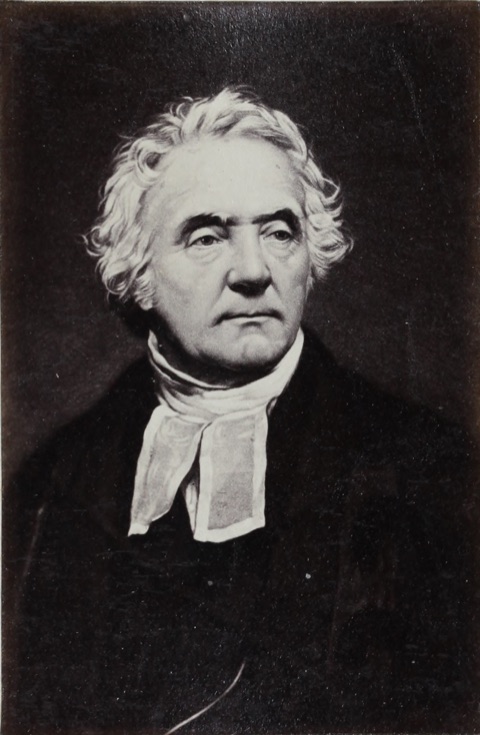
About the author
Thomas Chalmers
Thomas Chalmers (1780 to 1847 AD) was a Scottish minister, mathematician and political economist, born in Anstruther, Fife. He entered the University of St Andrews at eleven and became minister of Kilmany in 1803. A period of serious illness between 1809 and 1811 turned him toward evangelical religion. Called to the Tron Church in Glasgow in 1815, he became one of the most sought-after preachers in Britain, and from 1819 he ran an experiment at St John's, in one of the city's poorest districts, meeting poverty through church visitation and voluntary giving. He took the chair of moral philosophy at St Andrews in 1823 and became professor of divinity at Edinburgh in 1828. In May 1843 he led about 450 ministers out of the established church in the Disruption and became first Moderator of the Free Church of Scotland.
More in the free library
All 400+ books →
A Learned Discourse of Justification
Richard Hooker · Free
 Audio
A Treatise on Good Works
Martin Luther · Free
The Apology of the Church of England
John Jewel · Free
Commentary on Galatians
Martin Luther · Free
 Audio
Commercial Discourses
Thomas Chalmers · Free

The Covenant of Life Opened
Samuel Rutherford · Free