Volume 2 of 3 · Full text in modern English · Free PDF/EPUB
Lectures in Systematic Theology: Volume 2 in Modern English
Want the file? The PDF/EPUB is free with an account.
This volume
- Vol. 1 · Natural Theology and the Doctrine of God
- Vol. 2 · The Fall, the Law and Redemption
- Vol. 3 · Salvation, Sacraments and Last Things
What is in Lectures in Systematic Theology, Volume 2?
Lectures in Systematic Theology: Volume 2 holds Lectures 26 to 49 of the course in systematic and polemic theology that Robert Lewis Dabney taught at Union Theological Seminary in Virginia, following the 1878 second edition of his Syllabus and Notes. It is the middle of three volumes: Volume 1 holds Lectures 1 to 25 and Volume 3 holds Lectures 50 to 74. These lectures run from man's original holiness and the covenant of works through the fall, original sin and imputation; then the moral law and all Ten Commandments; then the covenant of grace, the person and offices of Christ, the necessity, nature, extent and results of his satisfaction, and his humiliation and exaltation; and finally effectual calling and an examination of the Arminian scheme. Each lecture opens with Dabney's syllabus of questions and reading.
- 01
Man's first estate and the fall. Adam created holy under the covenant of works, the first sin, and original sin with the imputation of Adam's guilt.
Jump to it ↓ - 02
The law. The moral law as the rule of life, then the Ten Commandments one by one, with the longest lecture given to the Sabbath.
Jump to it ↓ - 03
The covenant of grace and the Mediator. One covenant of grace in every age, and Christ as God and man in one person, prophet, priest and king.
Jump to it ↓ - 04
Christ's satisfaction. The nature, extent and results of his sacrifice, then his humiliation and exaltation.
Jump to it ↓ - 05
Effectual calling. The Spirit's renewal of the will, and a full answer to the Arminian theory of redemption.
Jump to it ↓
Read the full summary of Volume 2Show less
Lectures in Systematic Theology: Volume 2 holds Lectures 26 to 49 of Robert Lewis Dabney's seminary course in Reformed theology, from the 1878 second edition. It moves from man's creation and fall through original sin, the Ten Commandments, the covenant of grace, the person and atonement of Christ, and effectual calling, ending with a refutation of Arminianism.
How the argument unfolds
- 01
Man's first estate. Adam was created holy and placed under a gracious covenant of works as head of his race.
- 02
The fall. Adam's first sin began in unbelief, and one act wrecked his moral nature.
- 03
Original sin. His posterity inherit total depravity and the imputed guilt of his first sin.
- 04
The law. The moral law expresses God's own character and remains the believer's rule of life.
- 05
The Ten Commandments. Six lectures expound the Decalogue, dwelling on images, the Sabbath, war, marriage, property and truth.
- 06
The covenant of grace. An eternal compact between Father and Son underlies one gospel covenant in every age.
- 07
The Mediator. Christ is God and man in one person, the only mediator, serving as prophet, priest and king.
- 08
The satisfaction. Christ's death was a penal substitution, followed by his resurrection, intercession and reign.
- 09
Effectual calling. The Spirit renews the will by direct power through the Word.
Key themes
- The disease determines the remedy. Each doctrine of grace answers a doctrine of sin, so one's view of the fall shapes the whole system: “the disease determines the remedy.”
- Justice essential to God. Punishment answers to ill desert, not expediency, and theories of penalty built on benevolence collapse into selfish utility.
- Sufficient for all, efficient for the elect. He holds particular redemption while insisting the offer is real: “Even Judas, had he come in earnest, would not have been cast out.”
- Grace that renews the will. Regeneration reaches behind choice to the dispositions that govern it: “Conviction may be resisted; regeneration is invincible.”
Reader questions (10)Hide the questions
Questions about Lectures in Systematic Theology: Volume 2
Is there a modern English version of Lectures in Systematic Theology: Volume 2?
Yes. This is Lectures in Systematic Theology: Volume 2 by Robert Lewis Dabney in modern English. The language is modernized and the author's order and argument are kept. The full modernized text is free to read on this page.
Can I read Lectures in Systematic Theology: Volume 2 online for free?
Yes. The complete text of this modern English edition is on this page, with no sign-up or paywall.
Is there a free PDF of Lectures in Systematic Theology: Volume 2?
Yes. The PDF and EPUB of this edition are free with an Updated Works account. Sign in with Google or an email link; no card is needed.
What is Lectures in Systematic Theology: Volume 2 by Robert Lewis Dabney about?
It covers the middle of Dabney's course: man's creation and fall, original sin, the moral law and each commandment, the covenant of grace, the person and atoning work of Christ, and effectual calling, closing with an answer to Arminian theology.
How does this volume relate to the other two?
Volume 1 holds Lectures 1 to 25, including those on the will and providence to which Dabney refers back. Volume 3 holds Lectures 50 to 74, from faith and justification to the civil magistrate.
Where does Dabney stand on mediate and immediate imputation?
He rejects both. Placaeus made condemnation follow depravity and the Princeton theologians made depravity follow condemnation, but Dabney holds that Adam's children begin existence guilty and depraved together.
Why is the lecture on the Fourth Commandment so long?
Dabney traced Protestant laxity to Reformation churches, Calvin's included, that called the Sabbath ceremonial, and he argues at length that one day in seven is a perpetual moral duty.
Does Dabney think every sin deserves eternal punishment?
Yes. God judges not an isolated act but a sinner whose sin multiplies without end: “One reason God punishes forever is that the culprit sins forever.”
Does Dabney teach that Christ died only for the elect?
Christ's redeeming design was for the elect, but Dabney grants that he died for all in a real sense, securing every hearer a reprieve and a sincere offer of mercy.
What does he say about the heathen?
Scripture promises them no salvation apart from the gospel, though he will not pronounce on every soul, so the church must labor at missions as if no other means existed.
Lectures in Systematic Theology: Volume 2 in Modern English · Full text
Lecture 26: Man’s Estate of Holiness and the Covenant of Works
Syllabus
1. Was man’s person constituted of matter and spirit? In what did the “image of God” consist in which man was created? In what did his original righteousness consist? See Turrettin, Locus 5, Question 10; Dick, Lecture 40; Witsius, Economy of the Covenants, Book 1, Chapter 2; Watson, Theological Institutes, Chapter 18; Knapp, Christian Theology, §§ 51–53.
2. Was Adam’s original righteousness concreated, or was it acquired by acting? State the answers of Calvinists and Pelagians, and establish the true one. See Turrettin, Locus 5, Questions 9 and 11; Locus 8, Questions 1 and 2; Locus 9, Question 2; Hill, Book 4, Chapter 1, Section 2; Dick, Lecture 40; Watson, Chapter 18, Section 1 (2); Knapp, § 54; Thornwell, Lecture 14, pages 394 to the end.
3. What was Adam’s natural relation to God’s law? See Turrettin, Locus 5, Question 12; Thornwell, Lectures 11 and 12; Witsius, Book 1, Chapter 5, Section 22, and Book 1, Chapter 4, Sections 1–5; Dick, Lecture 44; Watson, Chapter 18, Section 1.
4. Did God place man under a covenant of works? Did Adam represent his posterity in it? See Turrettin, Locus 8, Questions 3 and 6; Witsius, Book 1, Chapter 2, Section 14 and following, and Chapter 8, Section 31 and following; Hill, Book 4, Chapter 1, Sections 1 and 2; Dick, Lectures 44 and 45; Watson, Chapter 18, Section 3; Thornwell, Lecture 12, page 284 and following.
5. What was the condition, and what was the seal, of that covenant? See Turrettin, Locus 8, Questions 4, 5, and 7; Witsius, Book 1, Chapter 3; Dick and Hill as above.
1. Man’s Origin from One Pair
The first three chapters of Genesis supply a vital need that no human writing has ever met. They give a simple, natural, yet authentic account of man’s origin. The statement that God created man’s body from pre-existent matter and imparted his soul to that body solves a thousand questions that mythology and philosophy cannot answer. From this first father, together with the helper of the opposite sex formed from his side, the entire human race has proceeded by successive generation.
Half-scholars in natural science in our day have often challenged the unity of the human family, yet Christian scholars have triumphantly defended it. For the full scientific discussion, I refer you to their works. Among accessible and popular books, I may mention Cabell, the University Lectures, and the work of Dr. Bachman of Charleston.
Here I wish simply to note the theological importance of this natural fact. If there are human beings on earth not descended from Adam’s race, their federal connection with him is broken. Even more, their inheritance in the first gospel promise, that the “seed of the woman shall bruise the serpent’s head,” is cut off. The church would have no warrant to carry the gospel to such people, and all ordinary human relations with them would be disrupted.
Finally, the integrity of the Bible as the Word of God is fatally affected. The unity of the race is woven into its entire system, into the whole record of God’s dealings with mankind, and into all its histories. Scripture also asserts it in express terms (Acts 17:26). See Breckinridge’s Theology, Volume 1, Chapter 3, Section 1. For additional Scriptures, see Genesis 3:20; Genesis 7:23; Genesis 9:1, 19; and Genesis 10:32. Unity of race is essential to our relation to the Redeemer.
Man as Body and Spirit
A still more precious feature of this Scripture passage is how it explains man’s present condition. We now find humanity sunk in universal sin, self-condemnation, and vanity, which seems so hard to reconcile with God’s attributes. The simple yet far-reaching solution is that man is not in the state in which his Creator made him.
The record tells us that God “formed man of the dust of the ground, and breathed into his nostrils the breath of life, and man became a living soul.” In the simple language of a primeval people, this asserts man’s twofold nature as matter and spirit. Across languages, popular speech has chosen the word for breath (ruach in Hebrew, pneuma in Greek, and spiritus in Latin) to signify that inscrutable substance, a thinking spirit. In the same way, the narrative describes the imparting of the soul to the body by the act of breathing.
The view to which reason led us regarding the spirituality of man’s thinking part is confirmed by all Scripture. In Genesis 2:7, the body is first formed from one source, and then the spirit is imparted to it from a different source. God is thus the Father of our spirits (Hebrews 12:9). At death, the two substances separate and meet different fates (Ecclesiastes 12:7, 2 Corinthians 5:1-8, Philippians 1:22-23). Throughout Scripture, body and soul are distinguished as different substances capable of existing apart (Matthew 10:28, Luke 8:55). Twice, the terms body, soul, and spirit are used as an exhaustive enumeration of the whole man (1 Thessalonians 5:23, Hebrews 4:12).
What Is the Image of God?
Next, we learn that man, unlike all lower creatures, was formed in the “image of God” and “after his likeness.” The general idea is plainly that man bears a resemblance to God. This does not mean sameness of essence, because God’s essence is incommunicable. Nor does it mean likeness of bodily shape, because God has no body, being immense.
This image was lost in the fall and is regained in redemption. Therefore, it could not have consisted in anything strictly essential to human nature, since losing an essential attribute would destroy man’s nature as man. The likeness that was lost and restored must therefore consist in a non-essential quality.
The old Pelagians and Socinians represented the image as grounded in man’s rationality and consisting chiefly in his dominion over animals and the world. The Reformed divines, by contrast, represent it as grounded on man’s rationality and immortality, which make him a humble reflection of God’s spiritual essence, while consisting especially in the righteousness and true holiness in which Adam was created. The dominion granted to man is the fitting result of his moral likeness to his Maker.
As Witsius puts it, the image consisted foundationally in man’s spiritual and immortal nature, formally in his holiness, and consequently in his dominion. The first was the precious tablet, the second was the image drawn on it, and the third was the ray shining from it.
We confirm each part of this definition from Scripture. For the first element, Genesis 9:6 teaches that murder owes its enormity chiefly to the fact that it destroys God’s image. See also James 3:9. Since the fall, man has lost his original righteousness, so his remaining likeness to God consists only in his intelligent, spiritual nature.
Dominion over the earth and its animals was plainly conferred (Genesis 1:26-27, Psalm 8). From the way the two ideas are linked in Genesis 1:26-27, this dominion clearly made man, in a humble sense, God’s representative on earth. The same principle is implied in 1 Corinthians 11:7, where the authority God gave man over the other sex makes him God’s representative.
Yet the likeness consists chiefly in man’s original moral perfection, meaning the intelligence and rectitude of his conscience. We argue this first from the fact that man, like every other work of creation, was declared “very good” (Genesis 1:31). In fairness, this “goodness” means that every created thing possessed in perfection the qualities suited to its designed relations. Man is an intelligent being, created to know, enjoy, and glorify God as such, so his moral state must have been perfect. See also Ecclesiastes 7:29.
That this moral perfection was the chief feature of God’s likeness is clear because it is precisely the likeness man regains in the new creation (Romans 12:2, Colossians 3:10, Ephesians 4:24). It is also the likeness toward which believers aspire, hoping to attain it when they recover Adam’s original perfection (Psalm 17:15, 1 John 3:2).
Why Our Theology Is Necessarily Anthropomorphic
This all-important likeness of man to his God justifies a feature of all natural theology that many now attack, namely, that it is necessarily anthropomorphic. In Lecture 7, we admitted this trait and pointed out why it renders any merely natural theology insufficient for sanctification and redemption. Yet our opponents try to use that concession to overthrow both natural and revealed theology.
Our rational self-consciousness is the medium through which we conceive of God and his attributes. We first know power and causation in our own conscious volitions, and from there we step to a First Cause. We first know spirit, in contrast with matter, as the subject of conscious activity, and from there we know that God, the cause of all intelligence and the all-knowing One, must also be spirit.
We conceive of his knowledge and wisdom, as revealed in his works, after the pattern of our own purposeful thinking, though without the limits of our thoughts. Our conscience reveals God’s rectitude to us. Only through our own method of controlling natural forces could we understand God’s providence. In this way arose all our natural knowledge of God.
Anthropomorphic Knowledge Is Not Untrue
Critics charge that this anthropomorphic character makes all our theology worthless. That charge is simply preposterous. Ask yourself: is it not an unavoidable condition of human knowledge that it must be anthropomorphic? What else does that say, except that man’s knowledge must be human in order to be his? If man is to know anything at all, he must know it according to the forms of his own intelligence.
This unreasonable objection rests on an illusion. It assumes that any conformity of divine truth to our forms of thought must amount to a distortion, as if translating divine propositions into human modes of knowing automatically renders them invalid. If we knew that human intelligence were completely alien to divine intelligence, that suspicion would have some basis.
Suppose, however, that human intelligence is, in its lower sphere, genuinely akin to divine intelligence. Then a conformity of form implies no corruption of truth. Does the opponent object that we must not “beg the question” by assuming this kinship? We reply that neither may he beg the question by denying it.
Then comes the inspired witness of the Bible, attested by miracles, prophecies, and other proofs perfectly suited to the human understanding. It assures us that our spirits were made in the likeness of God’s own spirit. That removes every fear that anthropomorphism invalidates our theology. Above all, when we behold the Messiah as the image of the invisible God and hear him reason, we have complete verification. This simple primeval narrative seems framed specifically to answer a subtle modern objection and resolve a foundational difficulty. (See a similar view in the recently published Lectures of Dr. Thornwell, Volume 1, pages 112–113.)
Adam’s Original Righteousness Defined
To define the original righteousness of man’s nature, we must note two elements. First, it implies that Adam possessed the capacities of understanding and conscience, along with the knowledge needed to comprehend all his moral relations rightly. This rules out two extremes: the extravagant claim that he was endowed by nature with all the knowledge ever gained by his descendants, and the opposite claim that his soul began existence in an infantile state.
Second, man’s righteousness consisted in the perfectly harmonious agreement of all his soul’s dispositions, and therefore all the volitions they prompted, with the judgments of his conscience, which in turn was rightly guided by God’s holy will. His righteousness was therefore a natural and complete conformity, both in inward principle and in volition, to God’s law.
Adam certainly possessed free will (Confession of Faith, Chapter 4, Section 2; Chapter 9, Section 2) in the only sense proper to a rational free agent. In all his responsible moral acts, his soul was self-determined in its choices: he chose according to his own understanding and dispositions, free from external compulsion. Yet his will was no more self-determining, or balanced in neutral equilibrium, than man’s will is now. As we have already seen, such a state would be neither free, rational, nor moral.
Just as fallen man’s dispositions now decisively incline his will toward ungodliness in a state of nature, Adam’s dispositions then inclined his will toward holiness. That inclination was dominant and complete for the time, yet it was not unchangeable, as the outcome proved. Still, this mutability of will did not mark any moral weakness peculiar to man as compared with angels.
The fall of the non-elect angels shows that mutability is an unavoidable consequence of being finite. Impeccability belongs to the Infinite One alone, and to those to whom he imparts it by his indwelling wisdom and grace. How a creature’s soul could be completely and prevalently holy in its dispositions and yet mutable is a deeply difficult problem, to which we will return in its proper place.
2. Adam’s Righteousness Was Concreated
Was Adam’s righteousness in his estate of blessedness native or acquired? The Calvinist answers that it was native. God conferred it upon him as the original settled disposition of his will by the very creative act that made him an intelligent creature. His holy choices were the natural fruit of the inward principles God gave him. This is the plain and simple meaning of our doctrine. We do not claim that righteousness was so essential an attribute of human nature that losing it would stop man from being truly human.
Views of Pelagians and Socinians
The Pelagians of the fifth century, followed by modern Socinians and many of the New England school, claim that Adam could receive from his Maker only a negative innocence. Positive righteousness, they argue, could come only from his own voluntary acts of choice. Their foundational dogma is that nothing has moral quality unless it is voluntary, meaning the result of an act of choosing.
From this premise they infer that nothing is sin or holiness except acts of volition. A concreated uprightness of will, they say, would be no righteousness at all and would have no merit, because it did not arise from the person’s own choice. Likewise, they argue that prior dispositions have no moral quality unless they are habits acquired through voluntary acts. Adam’s holy character, they claim, was of this acquired sort. On the same principle, they dismiss talk of being made righteous or receiving a holy heart in conversion; man must instead act righteousness and choose himself into a holy heart.
The Intermediate Roman Catholic Position
This question is the most important issue in the entire study of man’s original state and relation to God’s law. Before arguing the case, however, we should note the evasive middle ground taken by the Roman Catholic Church. Wishing to hold a semi-Pelagian position without openly endorsing those offensive principles, Rome teaches that the first man was holy from the beginning, yet denies that original righteousness was a natural disposition of his own will. Instead, they call it a supernatural grace temporarily granted by God.
According to Rome, concupiscence is not sin, and it existed even in holy Adam. Yet it constantly tends to overrun the bounds of conscience and thereby become sin. As long as God granted Adam the supernatural grace of original righteousness, he stood firm. The moment God saw fit to withdraw it, natural concupiscence grew unruly, sin was born, and man fell.
We will refute this view below by proving both that concupiscence is sin and that man was made holy by nature. Furthermore, Scripture implies that if Adam had not sinned, he would have transmitted that holy nature to his posterity. Surely supernatural grace does not “run in the blood.” The theory also dishonors God’s wisdom and holiness. It depicts him as creating a moral being whose nature was inherently inadequate for the purpose of its existence, with impulses so arranged that sin would be the normal, certain, and immediate result of letting them act freely. It makes God a creator of defects.
Proof of the Reformed View
1. The Pelagian argument is ambiguous. Against the Pelagians, we maintain that man was positively holy by nature as he came from God’s hand. Their claim that nothing involuntary can have moral quality is ambiguous and misleading. What happens or exists against a man’s positive choice can bring him neither praise nor blame. Common sense readily agrees with that proposition.
It is a very different proposition, however, to say there can be no moral desert simply because no positive choice was made about it. That is the Pelagian claim. Yet if it were true, there could be no sins of omission, where a man’s guilt rests precisely on the fact that he failed to choose when he ought to have chosen.
In truth, man’s original dispositions are spontaneous. They exist and act within him freely, without compulsion, solely by their own inward motion. That is enough to make them responsible and worthy of praise or blame. A person always feels good or ill desert according to whether his spontaneous feelings are right or wrong, not according to the process by which they first entered his soul.
People strangely forget that free agency can spontaneously prefer an original condition, and thus make a man responsible for it, just as fully as if his choice had originated it. Consider a man born with carroty hair who is absurdly proud of its supposed beauty and prefers it to any other color. Everyone agrees that he shows the exact same bad taste as if, having been born with the finest brown hair, he had dyed it that unsightly shade himself. In the same way, a person who naturally has a perverse disposition, yet delights in, prefers, and nurtures it, is just as spontaneous and responsible as if he had acquired it in the impossible manner Pelagians imagine.
Dr. Thornwell (Lecture 19, page 395) seems to teach that inability of the will, if truly natural in the sense of belonging to man’s original nature, would destroy responsibility. He defends the sinner’s responsibility, despite thorough inability of will, solely on the ground that man brought it on himself. This statement must be considered incautious.
Of course, a holy God cannot create any rational creature with an evil disposition. Yet to fallen man today, his evil disposition and inability of will are natural: they are innate and a regular accompaniment of human nature. In what sense can an individual today say that his inability of will is self-procured? Only as he fell in Adam. It is hard to see how Dr. Thornwell can defend his own sound claim that sinners remain responsible despite total inability of will without implying a personal identity between each sinner and Adam. His statement is also unfortunate because it blurs a vital distinction (Confession of Faith, Chapter 9). Removing a constitutive faculty would destroy man’s essential nature and end his responsibility. Total “aversion” from the right, however, produces complete inability while leaving the sinning agent his inalienable spontaneity.
2. Scripture teaches our view. We have already seen from Genesis 1:26-27, Genesis 1:31, and Ecclesiastes 7:29 that man was made in God’s image, and that this image consisted essentially in original righteousness. God’s Word therefore establishes our view.
The same truth appears in Scripture’s language about the new creation, or regeneration. The Bible expressly calls it a “creation unto righteousness” (Ephesians 4:24, Ephesians 2:10, Romans 8:29, Ephesians 1:4). It is a supernatural change of disposition wrought not merely by persuasion, but by almighty power (Ephesians 1:19-20, Ephesians 2:1-5). It governs not only the outward acts, but the will itself (Psalm 110:3, Philippians 2:13).
God himself supplies the analogy behind our argument by naming regeneration a “new creation.” Just as the newborn soul is made holy rather than merely acting out a holiness, so the first man was made righteous. Ancient and modern Pelagians virtually concede the force of this point by denying any such regeneration by grace on the exact same grounds: they claim a holiness not first chosen by the will could have no moral worth. On their theory, even the human soul of Christ could not have possessed positive righteousness by nature. Yet see Luke 1:35.
3. No natural moral neutrality is possible. Common sense contradicts the Pelagian theory. Moral neutrality in a being who possesses rational faculties and knows the moral facts of a situation is impossible, and if it were possible, it would be criminal. By the very nature of conscience, once the moral relations of a case are understood, its verdict is immediate, unavoidable, and absolute.
Dispositions, likewise, must actively incline one way or the other, or they are not dispositions at all. They can no more rest in neutral equilibrium than motion can be motionless. Does not every sane conscience agree that if Adam, upon grasping his moral relation to his infinitely good, kind, glorious, and holy Father, had failed to choose his love and service immediately, even a single moment of hesitation would itself have been a moral defect and a sin?
4. No principle of right choice would have been present. Suppose Adam’s will had stood in that supposed equilibrium, with an initially neutral moral character. Then nothing within him would have prompted a holy choice. Even if he had selected an action formally right, there would have been nothing morally good in it, because the intention behind a choice gives it all its moral quality. Since his initial motive would have been non-moral, he could never have chosen righteousness or begun a moral habit.
5. The corruption of infants refutes Pelagianism. These false principles inevitably lead, as Pelagians openly admit, to denying original depravity in infants. Whatever does not come from intelligent choice, they say, can have no moral quality; therefore, there can be no sin of nature any more than a natural righteousness. Yet universal experience proves that man has a sinful nature, Scripture explicitly asserts it, and the facts demonstrate it: all are “by nature the children of wrath,” and even from infancy suffer and die under God’s hand.
6. Pelagianism makes infant redemption impossible. If a being cannot be made righteous without his own choice, then infants who die cannot be redeemed. They cannot yet perform intelligent acts of moral choice to convert themselves to God’s service. The Pelagian tries to escape by picturing infants as needing no redemption because they have no sin of nature. Yet both the Bible and experience prove they do need redemption. On Pelagian principles, therefore, the damnation of all who die in infancy becomes unavoidable.
7. Their theory has no basis in experience. Finally, the Pelagian theory is thoroughly unphilosophical because it has zero experiential grounding. It is pure speculation. No human being has ever consciously existed in the state of moral neutrality they imagine, nor been conscious of some initial act of choice that created his moral character. Surely every scientific proposition ought to rest on some basis of empirical proof. Ethics should be an inductive science.
3. The Creature’s Natural Relation to God’s Law
Every intelligent moral creature of God is naturally bound to love him with all his heart and serve him with all his strength. This duty is not created solely by a positive command. It rises out of God’s own perfections and the creature’s standing as God’s property, deriving all his being and abilities from God’s hand. Adam’s holy soul undoubtedly recognized this obligation with joy. His mind was also equipped with all the knowledge of God’s will needed for his duties at that time, though it is hard for us to specify just how broad that knowledge was.
Theologians commonly say that a creature can merit nothing from God. Because this statement strikes many minds as doubtful or unfair, we need to distinguish carefully. When we deny that a creature can merit anything from God, we do not mean that holy obedience lacks good moral character before God. Holy obedience is genuinely praiseworthy and certainly receives full recognition from God. The fact that we owe it naturally to him does not strip it of its moral goodness.
The real question is: what does that goodness entitle the creature to? Plainly, it ensures that the natural bond between holiness and happiness will not be broken while the holiness continues. Because the obedience grows out of the creature’s natural relation to his Creator’s will, the desert it carries is simply the natural well-being suited to the creature’s capacities. Apart from any positive covenant from God, the creature’s sole guarantee of this well-being is God’s own goodness and righteousness, which forbid him from treating a holy being worse than this. The creature remains God’s property.
The Creature Cannot Merit Anything from God
It is equally clear, however, that a creature’s obedience can never put God in his debt. It cannot obligate God to stoop to him, to impart himself as a source of supernatural blessedness, to confirm him permanently in holiness, or to guarantee his natural well-being any longer than his voluntary, mutable obedience continues.
The reasons are simple. First, a creature can never perform obedience beyond his duty, since he already owes God his utmost. Second, all his being and capacities were given by God and remain God’s property. I cannot put my benefactor in my debt by handing him something he lent me; I am only returning what is his. This is the point taught in the Confession of Faith, Chapter 7, Section 1, and clearly supported by Scripture (Psalm 16:2, Job 35:7-8, Acts 17:24-25, Psalm 50:9-12, Luke 17:7-10).
Death Would Not Have Entered Without Sin
It is just as clear that mortality and the related miseries of life could not have been man’s natural lot apart from sin and the fall, despite what Pelagians and Socinians claim. Their motive for adopting this repulsive view is to evade the proof of original sin found in the suffering and death of infants who have committed no overt transgression.
They argue that decay is as natural and unavoidable for an organized animal body as the falling of autumn leaves. Only simple, indivisible beings, they claim, can escape dissolution, which is the natural counterpart of reproduction and nutrition. I reply that if they used these arguments merely to prove that animal bodies are not self-existent, they would be right.
We must remember, however, that the human person whose dissolution is at issue is not a vegetable, but a responsible moral agent whose destiny a righteous God decides judicially. Viewed in that light, it scarcely needs proof that the same almighty power which formed Adam’s body could easily sustain its organic life indefinitely. We need not speculate about the mechanism. God would only have to suspend the molecular forces that now war against the vital principle, and a holy man’s body could endure as permanently as a diamond or a lump of gold.
The central point is that for a moral person, dissolution is not merely a chemical event, but a penal misery. Could such misery strike a responsible agent who is completely guiltless? That claim outrages both the justice and the goodness of God. Physical evil is the appointed consequence of moral evil and the penalty threatened for breaking God’s law. To imagine it assigned to an obedient moral being without guilt destroys either God’s moral character or his providence, and confounds heaven with earth.
Second, natural mortality contradicts the image of God and the perfection in which man was created. God pronounced his workmanship “very good,” which surely excluded the seeds of its own ruin. Man was made in God’s image, and that image included immortality.
Finally, Scripture plainly implies that man would never have suffered or died had he not sinned, because it sets death as the threat against transgression. While that threat meant far more than bodily death, it certainly included bodily death, as Genesis 3:17-19 makes unmistakable. See also Genesis 2:17; Romans 5:12; Romans 6:23; Matthew 19:17; and Galatians 3:12. These last passages clearly refer to the covenant of works made with Adam, explicitly declaring that if perfect obedience were possible, as it was for Adam before his fall, it would secure eternal life.
The Covenant of Works Was Gracious
Once we establish that God entered into a covenant with Adam, we see that it was an act of pure grace and condescension. God could justly have kept Adam forever under his bare natural relationship. No matter how long Adam obeyed, his obedience would never have put God in his debt for the future. Because his holiness was mutable, his blessedness would always have hung in suspense.
Moved by pure grace, therefore, God stooped to establish a covenant with his holy creature. Under its terms, a temporary period of obedience would be graciously accepted as the ground for God’s imparting himself to man and securing his holiness, happiness, and fellowship with God forever.
Here, then, is the meeting point between the covenant of works and the covenant of grace, between the law and the gospel. Both set forth a plan of free justification in which a righteousness is accepted in covenant to win for the creature far more than he could strictly claim from God, granting him everlasting life. In the covenant of grace, everything is “ordained in the hand of a mediator,” because man’s sin would otherwise bar him from approaching God’s holiness. In the covenant of works, no mediator was needed, because man was innocent and God’s purity did not forbid direct condescension to him. Yet in both covenants there was free grace, in both a justification to life, and in both a gracious gift far beyond what man earned.
Under man’s natural relation to law, there was room neither for mercy after sin nor for guaranteed eternal blessedness. The covenant of works modified that natural relation in three ways.
1. A temporary probation took the place of endless exposure to falling under perpetual legal demand.
2. The principle of representation was introduced, confining the risks of probation to one man acting for all rather than repeating them endlessly in the conduct of every individual.
3. A reward was promised for probationary obedience that, though granted for right works, was far more generous than those works strictly merited. It was an adoption of life, raising man from the standing of a servant to that of a son and surrounding him forever with the safeguards of divine wisdom and faithfulness, making his holiness unfailing. Thus God’s motive in this covenant was the very same infinite, gratuitous goodness that moved him to establish the covenant of grace.
4. The Covenant of Works: Nature and Proof of Its Institution
The standard Reformed authors present strong proof that God placed Adam under a covenant of works. According to Turrettin, a covenant in its stricter technical sense requires two conditions: first, two equal parties; second, prior liberty to do or omit the covenanted acts before entering the agreement. In that narrow sense, there could never be a covenant between God and man.
In the broader sense of a conditional promise, however, such a transaction plainly took place between God and Adam, as recorded in Genesis 2:16-17. All three elements of a covenant were present.
1. Two parties. God proposed a specific blessing and penalty on fixed conditions, and man came under those conditions. Some object that this was no covenant because Adam had no option to refuse; God’s terms were a command laid on him, not a proposal offered to him. I reply that even if Adam lacked the right to decline, he entered the arrangement voluntarily, for his holy will no doubt concurred joyfully in God’s gracious plan. Compacts of this kind between rulers and subjects are neither rare nor unnatural, as seen whenever masters or teachers promise rewards for tasks performed on stated conditions.
2. A condition. The condition was keeping God’s command.
3. A conditional promise and threat. Life was promised for obedience, and death was threatened for disobedience. Five clear arguments prove that the promise of life was truly implied.
(1) Life is the direct opposite of the death threatened in the covenant. For the soul not to live is to die; not to die is to live.
(2) The natural law of conscience expects life for obedience just as it expects death for transgression. Did this fatherly arrangement with Adam suspend the encouraging half of that universal law and leave him worse off rather than more hopeful? Hebrews 11:6 tells us, “he that cometh unto God must believe that he is, and that he is the rewarder of them that diligently seek him.” Here is a universal principle of serving God; surely Adam’s placement in Paradise did not cancel it.
(3) During his uprightness, Adam clearly enjoyed the use of the “Tree of Life,” which served as a sacramental pledge of the promised reward. Once he broke the covenant, he was barred from that seal as wholly unfit for his fallen state. Unless Adam had had the promise of life for obedience set before him, that tree would have been meaningless.
(4) The parallel between Adam and Christ, the second Adam, confirms the implied promise of life. Both stood as representative heads. The covenant that failed in Adam’s weak hands was successfully fulfilled in Christ’s, and the outcome through him was a “justification of life.” Moreover, whenever Paul contrasts justification by works with justification by faith, he never hints that justification by works is impossible because of any flaw in the covenant of works itself, but solely because of man’s sin and lost condition (Romans 8:3-4).
(5) Finally, when Scripture expounds the covenant of works, it explicitly affirms that perfect obedience would have resulted in life. Consult Leviticus 18:5; Deuteronomy 30:15; Ezekiel 20:11; Matthew 19:17; Romans 2:6-7; Romans 7:10; Romans 10:5; and Galatians 3:12. In some of these passages, the offer of life through the covenant of works is raised to argue with self-righteous Jews from their own premises, yet that does not weaken the proof. Life cannot now be gained by that covenant, not because God failed to promise it in good faith, but because man has become morally incapable of meeting its terms through the fall. Nor is our proof weakened by the fact that the apostle cites this promise of life for obedience in order to shut up lawbreakers under condemnation.
Adam as Representative Head
In this transaction, Adam represented his posterity as well as himself. Four proofs establish this.
1. Scripture draws a direct parallel between Christ and Adam (Romans 5:12-19; 1 Corinthians 15:22, 47). In nearly every respect they are contrasted, yet Christ is called the second Adam. Their sole point of likeness is that both acted as representative persons.
2. Actual history proves it, because the penalty pronounced on Adam has fallen upon every one of his descendants (Genesis 5:3).
3. The Bible expressly declares that sin, death, and all penal evil entered the world through Adam (Romans 5:12, 1 Corinthians 15:22).
4. Although the other communications in the first three chapters of Genesis appear to address Adam alone, we know they applied equally to his posterity. This includes the permission to eat the fruits of the earth, the command to multiply and fill the earth, the threatened pains of childbearing, the curse on the ground, and the sentence of toil.
5. The Condition and Seal of the Covenant
Everyone knows the Bible’s account of the covenant’s test: eating or refraining from the fruit of a tree called the “tree of knowledge of good and evil.” This prohibition was plainly a “positive command.” Reformed theologians reasonably argue that when God intends to apply a pure test of obedience itself, a positive command fits the purpose better than a perpetual moral law. Moral laws usually carry visible reasons grounded in human interests and affections, whereas a positive command rests solely on God’s rightful authority.
A harder question is whether this single positive command replaced the entire moral law during Adam’s probation. In other words, was this the only command Adam then had to keep, and the only one whose breach could bring his fall? Presbyterians answer no. We hold that all the moral law known to Adam was summed up in this command as the decisive test of his obedience to the whole.
The true condition of Adam’s covenant was perfect compliance, in heart and deed, with all of God’s revealed law. Three considerations make this clear. First, no moral creature can reasonably be exempted from God’s immutable law. Second, every passage quoted above that describes the covenant of works requires obedience to the entire law. Third, only a consistent sense of moral obligation could have given Adam’s observance of the positive prohibition any real moral meaning or worth.
The seal of the covenant is generally understood to be the tree of life. Its excellent fruit did not confer immortality on Adam’s body through medicinal power. Rather, God appointed it as a symbol, pledge, and seal of immortality. Consequently, once Adam forfeited the promise, he was barred from the sign. The words of Genesis 3:22 are to be understood sacramentally.
The Probation Was Temporary
Why do we conclude that obedience for a limited period would have brought the covenant trial to a close? Because a covenant with an endless probation would have been no covenant of life at all. The creature’s state would have remained forever mutable, no different from the state in which creation originally placed him under his natural duty to his Maker.
In fact, man’s condition would then have been desperate. Being finite and mutable, and held forever under the curse of a law he might break on any day, the probability that he would eventually fall would climb over an endless future into a moral certainty.
The Redeemer clearly implies a temporary probation when he tells the young ruler, “If thou wilt enter into life, keep the commandments.” If the probation had no end, keeping the commandments could never bring a man to enter into life.
Adam’s representative role likewise requires a limited probation. His personal conduct under trial was to determine whether his descendants would be born heirs of wrath or adopted sons of God. Had his trial stretched on without end, their standing would have remained permanently unsettled. A moment’s thought reveals the absurd confusion that would follow. Suppose Adam’s trial were still underway thousands of years after Seth’s birth, and even after Seth’s glorification. If the father then fell, the son’s glorification would have to be revoked.
Lecture 27: The Fall and Original Sin
Syllabus
1. What is sin? Is guilt its essence or an adjunct? See Confession of Faith, Chapter 6; Shorter Catechism, Question 14; Turrettin, Locus 9, Questions 1 and 3; Knapp, § 73; Müller, Christian Doctrine of Sin, Chapters 2 and 3; Bishop Butler, Sermons, 11–14; Thornwell, Lecture 14, pages 347 and 389; Dr. William Cunningham, Historical Theology, Chapter 19, Section 5.
2. What was Adam’s first sin? How did it affect his own moral state and his relations to God? How could a will prevalently holy form its first unholy volition? See Turrettin, Locus 11, Questions 6, 7, and 8; Hill, Book 4, Chapter 1; Dick, Lecture 47; Knapp, § 85; Watson, Chapter 18, Section 2; Witsius, Book 1, Chapter 8, Sections 1 and 13; Thornwell, Lecture 10, pages 240–247; Butler, Analogy; Müller, Christian Doctrine of Sin, Book 2.
3. Who was the tempter? What was the sentence pronounced on him? See Turrettin, Locus 9, Question 7, Section 9 and following; Dick, Lecture 44; Hill and Watson as above.
4. What were the effects of Adam’s fall on his posterity, (1) according to the Pelagian theory, (2) the lower Arminian theory, (3) the Wesleyan theory, and (4) the Calvinistic theory? See Augustine, Volume 2, Epistle 89, etc., and Volume 8, On Nature and Grace and Two Books Against Pelagius and Caelestius; Hill as above; Turrettin, Locus 9, Questions 9 and 10; Dick, Lectures 46 and 47; Cunningham, Historical Theology, Chapter 10, Section 12, and Chapter 19, Section 3; Thornwell, Lecture 13; Whitby, Five Points; Knapp, §§ 79–80; Watson, Theological Institutes, Chapter 18, Sections 3 and 4; Wesley on Original Sin.
5. Are the souls of Adam’s posterity directly created or generated? How is depravity propagated in them? See Turrettin, Locus 9, Question 12, and Locus 5, Question 13; Baird, Elohim Revealed, Chapter 11; Sampson on Hebrews, Chapter 12, Verse 9; Literary and Evangelical Magazine of Dr. John H. Rice, Volume 4, page 285 and following; Watson, Chapter 18, Section 4; Augustine, On the Origin of the Soul.
1. What Is Sin?
We have now reached the disastrous point in our studies where sin first entered our race. Let us pause and define its nature with complete clarity.
The most characteristic Hebrew word for sin is chatta’ah, which carries the basic idea of missing the mark. The Greek hamartia is strikingly similar, expressing nearly the same idea of failing to reach an intended target. Some trace the Latin peccatum to pecuatum, meaning brutishness, while others derive it from pellicatum, meaning moral adultery.
These words point toward a truth that careful analysis confirms: the common abstract element in all sin is privative, a lack of conformity to a standard. It follows further that sin can be understood only as the opposite of that standard, a law of right, and of the righteousness conformed to it.
In passing, I should remind you of a speculation that some Reformed divines borrowed from the Latin Scholastics, who defined sin as a mere negation. Their reasoning ran mainly like this. God, as universal First Cause, must be the agent of everything that has real being, so every real thing must be good in itself. Therefore sin, being evil, can have no real being and must be a negation. They pushed this claim so far as to say that even in adultery or murder, the action itself, simply as action, is good, while only its negative moral quality is evil.
Here we see the mint from which those same divines coined the dangerous distinction used to defend God’s efficacious prior impulse in the sinful acts of creatures (see Lecture 25, end). For a plain mind, escaping this confusion is easy. Sins are indeed not independent entities, except as acts or states of creatures who are personal entities. When we speak of sin in the abstract, we mean the quality shared by concrete sinful acts, namely, sinfulness. What is a quality abstracted from the entities it qualifies? Not necessarily a negation, but simply an abstraction. As for the quibble that God is the agent of every real entity, we reply: recognize the real free agency of the sinning creature, and you will have no philosophical trouble with the common-sense truth that the actor, not God, is the agent of his own sinful deed.
Some have supposed that the valid distinction between “sins of commission and omission” disproves the claim that sinfulness is always a privative quality. That may hold for sins of omission, they say, but not for sins of commission, which are positive acts. The objection fails because that distinction rests on a different basis.
Both classes of sin are equally privative and equally real. Sins of commission break prohibitory commands, while sins of omission neglect positive commands. In both cases, sinfulness springs from an evil motive, which is positive in either case, while the shared quality of both is discrepancy from the standard of right.
If our definition needs any proof beyond its own consistency, we find it in 1 John 3:4. Arguing against any Antinomian impulse to excuse believers’ sins as minor, the apostle gives his exact definition of sin, insisting that all sin is lawless: he hamartia estin he anomia, “The sin is the discrepancy from law” (namely, the law of God).
In his important work, The Christian Doctrine of Sin, Dr. Julius Müller revives in a new form Jonathan Edwards’s mistaken view that reduces all sin to selfishness. Seizing on our Savior’s statement that love to God is the first and great commandment on which the whole law hangs, Müller appeals to the admitted fact that sin is the opposite of righteousness. From this he concludes that sin must be love of self. Why not conclude by the same logic that since all duty is summed up in love of God, all sin is summed up in hatred of God rather than love of self? That would at least give a more exact antithesis.
More seriously, I refer you to my remarks on Edwards’s theory in Lecture 9 and to Bishop Butler’s Sermons. With special reference to Müller’s speculation, I add three objections.
1. If all sin reduces to self-love as its essence, is not all self-love sinful? If Müller answers no, then there must be both a sinful self-love and a righteous self-love. He must admit this. I then demand that he name the distinguishing element that makes sinful self-love morally evil unlike lawful self-love. Can he name self-love as that distinguishing element? That is merely arguing in a circle.
2. If some self-love is lawful, yet self-love is the essence of all sin, then self-love must become sin simply by growing too strong. In that case, sin and holiness would differ only in degree.
3. Carried out consistently, this theory requires that any act aiming at my own well-being can be virtuous only if I pursue my well-being from purely impersonal, disinterested motives. To act rightly for my own welfare, I must act not at all for my own sake, but solely for the sake of God and my neighbors insofar as they care about my welfare. Leaving aside whether any human being ever seeks his own good from so rarefied a motive, consider the resulting absurdity: all of a man’s neighbors, acting in pure disinterestedness, directly seek his welfare, and that is their virtue. How can it always be sinful for him to seek that very same end?
If anyone asks into what common category all sin can be resolved, we answer: into sin. We have no simpler definition than this: sin is sin. Or, sin is the opposite of holiness, a discrepancy from an absolutely holy law. Because the idea of moral good is ultimately simple and cannot be defined in simpler terms, we must accept the same truth about sin. Every attempt to reduce it to some simpler element, whether prompted by a pretense of excessive profundity or by an exaggerated urge to unify the soul’s powers, has ended only in confusion and error.
The next question concerning the nature of sin is whether it is limited to acts of will or also includes settled states of moral propensity and habit. The Calvinist answer is familiar to you: “Sin is not being, or not doing what God requires.” Not only are intentional acts contrary to God’s law sinful, but also the native disposition toward those acts and the desires to commit them before they mature into settled choices.
This raises the often-debated question of whether “concupiscence is sin.” We have already argued this from reason in Lecture 12, Section 1, and its companion question in Lecture 26, Section 2. Here I need only summarize the scriptural proof.
In many places, the Bible applies moral terms to the abiding dispositions of the soul, both native and acquired (Psalm 51:5, Psalm 58:3, Matthew 12:35, Matthew 12:33, Matthew 7:17). James 1:15 says, “Then when concupiscence hath conceived, it bringeth forth sin.” Rome indeed quotes this verse to argue that concupiscence is not itself sin, since it must “conceive” and take another form to become sin.
Yet James plainly uses the word sin here for outward sins of act. In the same way, he uses “death,” the mature outcome of “sin when it is finished,” to mean final spiritual death, or the second death. He does so even though many other Scriptures teach that a state of sin is already a state of death. Far from excusing concupiscence, James teaches that concupiscence and actual sin are mother and daughter, far too closely related not to share the same moral nature.
The most decisive text, however, is the Tenth Commandment, as Paul expounds it in Romans 7:7. Paul says he would not have known coveting unless the law had said, “Thou shalt not covet,” and it was through this very law that he came to know sin. How could he call concupiscence sin more plainly?
One careful distinction is needed here to establish this doctrine consistently. Coveting is often defined as “desiring the possession of another.” Yet clearly some such thoughts and desires are not the sin of concupiscence. Mentally recognizing an attainable natural good that I do not yet possess cannot always be sinful, or I could never make a normal, rational effort for any good. A measured desire for that good must also be innocent, or I could never have a lawful motive for improving my own welfare.
A practical example makes this clear. A godly minister needs a useful horse. He sees that his neighbor owns a horse suited to his work, and he honestly offers to buy it. As a reasonable free agent, he could never propose to pay a fair price for that horse unless he first judged the animal fit for his needs and second desired to enjoy its usefulness. He held both thoughts while the horse still belonged to another man. Must a person break the Tenth Commandment in order to make an honest horse trade?
The answer is that these feelings in the good man have not reached the level of evil concupiscence. Sinful concupiscence is not mere desire for an attainable good. It is desire for an attainment tied to wrongful conditions, a desire still harbored, even before hardening into a deliberate purpose of will, while conscience recognizes it as unlawfully conditioned. The instant that good man’s desire for the useful horse slipped into a craving to obtain it unfairly, such as by paying with counterfeit money or deceitfully talking down its market value, concupiscence would be born.
This distinction answers every fair objection to Scripture’s teaching. It also helps explain how an impeccable Redeemer could be “tempted of the devil” and yet remain wholly without sin. Had his holy soul been completely incapable of mentally recognizing attainable good, or of feeling the natural inclination that follows such recognition, he could not have been tempted at all. Because he possessed those normal human traits, he could genuinely face temptation without ever feeling the first pulse of evil concupiscence.
What Is Guilt?
What Turrettin calls potential guilt is the intrinsic moral ill-desert of an act or state. This belongs to the very essence of sin and is an inseparable part of its sinfulness. Actual guilt, by contrast, is obligation to punishment. That is the established technical sense of the word among theologians.
Defined this way, actual guilt is clearly not part of the essence of sin. It is a relation, namely, a relation to the penal sanction of law. If we imagined a disregard of moral duty with no penal sanction attached to it, sin would still exist, though guilt would not. This distinction will prove highly important.
2. Man’s First Sin
The first sin of our first father is narrated in Genesis 3:1-7 in words familiar to everyone. The account naturally shows some of the vivid, pictorial character of a primeval age, when language had fewer abstract and technical terms. Yet it is a blatant abuse to treat it as mere allegory depicting man’s gradual self-corruption under a figure.
The passages both before and after it are unmistakably plain history, as a hundred later biblical references confirm. Moreover, the New Testament twice cites the exact events of this passage as literal facts (2 Corinthians 11:3, 1 Timothy 2:14), and the narrative gives these events as the explanation for the distinctive chastisement laid upon the daughters of Eve.
Unbelief as Its First Element
Adam’s sin consisted essentially not in the outward bodily act, of course, but in his inward intentions. Roman Catholic theologians usually argue that the first element of sin in his heart was pride, roused by the serpent’s taunting reference to his dependence and subjection, and supposedly natural in so exalted a being.
Protestants, following Turrettin, generally hold that the first element was unbelief. Four reasons support this view. First, pride could not naturally suggest itself to a creature’s soul unless unbelief had already blurred his awareness of his true relation to an infinite God. Second, the mind’s belief ordinarily directs feeling and action in the will. Third, the temptation in Genesis 3:1 appears aimed first at producing unbelief through the creature’s heedlessness. Fourth, since the will was still holy, the initial error had to enter through the understanding.
How Could a Holy Being Have His First Wrong Volition?
How a holy will could form its very first unholy choice is an extraordinarily difficult question. It is even harder in the case of Satan’s first sin than Adam’s. Until that moment, the angel was perfectly holy, had no external tempter to mislead him, and did not even possess the bodily appetites for natural good that were so easily twisted into concupiscence in Adam.
Concupiscence cannot be called the prior cause before sin, because concupiscence is itself sin and would equally need explaining in a holy heart. Neither can the mutability of man or Satan be the efficient cause, since it is only an indispensable condition. Nor does it solve the difficulty to say with Turrettin that the proper cause was a free will voluntarily perverting itself. True enough, yet how did a right will come to pervert itself while it was still right?
Here, let me say, lies by far the strongest objection against the certainty of the will, one that Arminians and others could press far more sharply than, to my surprise, they actually do. If a fallen sinner’s evil dispositions so govern his choices as to ensure he will never choose spiritual good, why did the holy dispositions of Adam and Satan not ensure they would never make a spiritually evil choice? And if they somehow chose sin against their prevailing bent, why may a depraved man not sometimes choose good?
Answer to the Objection
We cannot completely solve the mystery of how the first evil choice arose voluntarily in a holy soul. Still, we can clearly show that reasoning from the certainty of a depraved will to the certainty of a finite holy will is unsound.
1. A finite creature can be kept from falling only through the continual indwelling and supervision of infinite wisdom and grace, guarding the soul’s finite and fallible attention against sin. God righteously withheld that preserving grace from Satan and Adam.
2. Righteousness is a positive attribute, whereas incipient sin is a privative defect in conduct. The mere absence of active regard for God’s will makes a disposition or choice wrong. While a positive effect demands a positive cause, it does not follow that a negative defect equally requires a positive cause. To make a candle burn, someone must light it; to make it go out, you need only leave it alone.
The most probable account of how sin first entered a holy heart is this. An object was perceived as naturally desirable in itself, not yet as unlawful. Up to that point, there was no sin. Then the soul, finite and fallible in its attention, allowed an excessive focus and desire for the object’s natural power to give pleasure to crowd out the sense of its unlawfulness. Thus concupiscence was born.
The element that first turned an innocent sense of natural goodness into evil concupiscence was privative: the failure to keep God’s will in view and prefer it above mere natural good. In that way, natural desire passed into sinful selfishness, the root of all evil. We therefore have only a privative element to account for.
When we assert the certainty of ungodly choice in an evil will, we simply affirm that a moral state marked by defect and negation cannot produce positive righteousness. When we assert the mutability of a finite holy will, we simply affirm that a finite positive righteousness can admit a negative defect. The two cases are not parallel, and the outcome, though mysterious, is not impossible. To make a candle give light, it must be lit; to let it sink into darkness, you need only leave it alone, for its length is finite and it burns out.
Effects of Sin in Adam: Self-Depravation
Adam’s fall produced two changes, one physical and one moral. God’s providence brought the physical change upon him, cursing the ground for his sake and subjecting him to a life of toil and weakness ending in bodily death. The moral change followed more immediately as the natural and necessary result of his own deed. We can readily conceive of God acting directly to punish sin, but we cannot conceive of him acting to produce it.
Some have thought it unreasonable that a single momentary act, breaking a seemingly minor positive command, should overturn a man’s whole moral character, destroy his original righteousness, and render him depraved. One act, they say, cannot form a habit.
We will not answer this by claiming with Turrettin that Adam’s act virtually broke every commandment of the Decalogue or was a “universal sin,” nor even solely by stressing how aggravated it was. Undoubtedly it was a great sin: it defied divine authority plainly and directly stated, yielded to a tiny temptation, and sinned against immense motives, privileges, and restraints.
There is also real truth in Turrettin’s further observations. By this deliberate, open sin, the creature shifted his chief end from God to self, and the chief end governs the entire stream of moral life directed toward it. Breaking this one command shattered the authority on which all godliness rests. Shame and remorse inevitably sprang up in the soul, and fellowship with God was severed. Yet this terrible truth, that any sin is fatal to the soul’s spiritual life, deserves further illustration.
How One Sin Accounted for Complete Depravation
1. God’s perfections require him to be the righteous enemy and punisher of transgression. Man, as an intelligent moral being, necessarily possesses conscience and moral feelings. One unavoidable effect of the first sin, therefore, was that God became righteously angry and moved toward just punishment; otherwise he would not be a holy ruler. Consequently, he had to withdraw his favor and fellowship immediately, since there was no Mediator to satisfy his justice.
Another unavoidable effect was the birth of remorse in the creature, guaranteed by the healthy working of conscience. That remorse necessarily brought a dread of God’s anger and fear of his punishment. Yet human nature always mirrors, by a kind of dark sympathy, the hostility of which it knows itself to be the object. How many men have learned to hate an innocent neighbor simply because they know they have given that neighbor good reason to resent them?
This hostility toward God, however, is hostility against him for doing what he ought to do; it is hostility against righteousness itself. Thus the very first open sin necessarily contained in seed form every element of corruption and alienation from God, who is the sole pattern of excellence and fountain of grace. See how vividly these results unfolded in Adam and Eve (Genesis 3:8 and following).
2. Every moral act tends to strengthen the impulse it indulges. Do you object that one act can weave only a very thin thread of habit, a single strand? Not always. Even if the scale is tipped only slightly, it is tipped. The downhill course has begun by at least one step, and momentum will steadily and surely grow. Inordinate self-love has now become a ruling principle, and it will press on to establish its dominion.
3. Finally, we must weigh the impact of physical evil on a heart already turning corrupt, since God’s justice required him to inflict the bodily penalties due to sin. Desire for happiness is instinctive. Once the joys of innocence are lost, the soul seeks replacement and relief in carnal pleasures. Misery breeds the bitter passions of envy, petulance, impatience, selfishness, and revenge. Nothing depraves the heart more deeply than despair (Jeremiah 2:25, Jeremiah 18:12).
What a dreadful evil sin is! The sentence, “In the day thou eatest thereof, thou shalt surely die,” carried out its own execution. Sin, by its very nature, kills the spiritual life of the soul.
3. Satan the Tempter
The true tempter of Adam and Eve was undoubtedly the evil angel Satan, even though the narrative does not explicitly name him. A serpent has no power of speech, and still less does it have the intelligence to grasp man’s moral relations and interests, or the refined spiritual malice needed to plot the ruin of a soul.
Scripture says “the serpent was more subtle than any beast of the field,” as if superior animal cunning enabled it to carry out the deed. Yet a moment’s reflection shows a deeper meaning. Writing here simply as a historian, Moses describes events as they appeared to Eve. The serpent’s well-known cunning made it a fitting instrument for Satan and helped him conceal himself behind it with less risk of detection.
Our grounds for recognizing Satan as the true agent are the unmistakable allusions throughout Scripture (John 8:44, 2 Corinthians 11:3, 1 Thessalonians 3:5, 1 John 3:8, Revelation 12:9, Revelation 20:2). Likewise, the sentence pronounced upon the serpent is applied by allusion to Christ’s triumph over Satan (Colossians 2:15, Romans 16:20, Hebrews 2:14, Isaiah 65:25).
Dr. Hill adds in confirmation that this was the traditional Jewish interpretation, reflected in Wisdom 2:23–24, Ecclesiasticus 25:24, and the Chaldee Targum on Job 20:4, 6. Turrettin suggests that God’s providence permitted Satan to use an animal instrument so that mankind would always have before their eyes a visible reminder of their sin and fall.
4. Effect of Adam’s Sin on His Posterity
The Pelagian Theory
I intend to state the Pelagian theory somewhat fully, and more systematically than you might find it in the writings of its own early defenders, in order to show you the vital connection between original sin and the whole plan of redemption.
1. The Pelagian holds that Adam’s fall did not directly affect his descendants at all. Infants are born in the exact state in which Adam was created: innocent, yet without positive righteousness. There was no federal covenant and no imputation, which Pelagians consider unjust in every case. There is no transmission of hereditary depravity, since that would require the generation of souls from parents, which they reject. Man’s will is free not only from external compulsion, but also from moral certainty; his choices are not decisively caused, or else, they claim, he would cease to be a free agent.
2. If this is true, why do all adults sin? Pelagianism answers that universal transgression comes from concupiscence, which exists in everyone just as it did in sinless Adam and is not sinful in itself, together with widespread bad example.
3. If man has no moral character and no guilt prior to intelligent choice, why do infants who have never sinned suffer and die? Pelagians are forced to reply that these natural evils are not penalties and would have come upon Adam even if he had never sinned. They treat suffering and death as mere natural limits of human nature, just as lack of reason limits animals, implying no guilt as their cause.
4. On this view, those who die in infancy have nothing from which they need to be redeemed. Why, then, should they be baptized? Pelagianism replied that infants who die are not redeemed from anything. If they die unbaptized, they enter a state called Paradise, a condition of natural good flowing from natural innocence, where innocent pagans also go. Baptism, however, gives them a share in Christ’s gracious purchase, so that if they die in infancy, they inherit a higher, more assured blessedness called the Kingdom of Heaven.
5. Since all people are born innocent with a balanced, neutral will, it is both physically and morally possible for anyone to live out a holy character and reach Paradise, or “eternal life,” without any gospel grace at all. The odds may be poor because of bad example and temptation surrounding the trial. Yet Pelagians insist there have been sinless lives both under revealed law, such as Enoch, Job, Abel, and Noah (who had no first gospel promise), and among pagans, such as Numa, Aristides, and Socrates, and there may be more again. Otherwise, they argue, God would not be just in punishing man for falling short of perfection.
6. Their doctrine of redemption follows the same lines. Since Adam’s guilt cannot be imputed to his descendants, neither can believers’ guilt be imputed to Christ nor Christ’s righteousness to them. God forgives sins by bare mercy in Christ, without penal satisfaction, on condition of trust, repentance, and reformation. The believer’s title to complete justification must therefore be his own sinless obedience.
Yet Pelagians make this obedience far easier than Calvinists understand it. Concupiscence is not sin. Moral quality belongs only to actual volitions, not to the feelings prompting them. Thus, if an act is formally right, it is completely right; a blend of selfish and unselfish motives does not taint it, because volition is an all-or-nothing decision. A steady, uniform obedience is therefore a perfect one, and nothing less can justify, since justification is by works and the law is perfect. Moreover, because neutral equilibrium of will is essential to responsibility, any shortcoming forced by natural weakness, ignorance, thoughtlessness, or a sudden gust of temptation against the soul’s general bent is no sin at all. Here we see the seed of both the Wesleyan doctrine of sinless perfection and the Jesuit system of morals.
Because a concreated righteousness would not be real righteousness, not having been chosen first, neither would a righteousness produced by supernatural regeneration. The only grace possible is cooperative grace, or moral persuasion. Regeneration is simply a person’s own change of purpose regarding sin and holiness under the influence of motives. Faith and repentance are therefore purely natural acts.
7. A soul’s continuance in justification is necessarily uncertain. Any grace that morally ensured continued holy choices would destroy free agency.
8. God’s purpose of election, though eternal because of his infinite and unchangeable wisdom, knowledge, and power, is conditioned on his foresight of how men will use their free will. He chose those whom he foresaw would persevere in good.
The whole system forms a tightly connected body of error growing directly out of its fundamental falsehood.
The Lower Arminian Theory
Under the broad label of Arminians, two distinct systems have been put forward: one represented by Whitby, and the other by Wesley and his church.
The lower Arminians admit that both Adam and his race were badly damaged by the fall. Man has not lost his neutral equilibrium of will toward spiritual good, yet he has become deeply alienated from God and fallen under the penal curse of physical evil and death. He has also grown more sensual, so that concupiscence is sharply inflamed and far more likely to erupt into actual sin.
The miseries, fears, remorse, and troubles of mortal life worsen this condition, pushing man further from God and sharpening envious, sensual, and discontented feelings. Together with constant bad example, these influences explain why everyone becomes a sinner in practice. This is the state into which Adam plunged himself. His descendants share it not through any federal relationship or imputation of Adam’s guilt, but through the universal physical law that like produces like. In that sense, man is born a ruined creature.
The Wesleyan Theory
The Wesleyans, by contrast, begin by granting everything a moderate Calvinist could ask regarding Adam’s loss of original righteousness in the fall, bondage to evil desires, and total depravity. Although they misunderstand and then reject the debate between mediate and immediate imputation, they keep the orthodox core of imputation, acknowledging that the legal consequences of Adam’s act fall upon his descendants along with himself.
Then, however, they claim that charges of harshness and injustice against this arrangement cannot be answered unless we view the whole plan together, including man’s gracious union with the second Adam. Through the covenant of grace in Christ, they say, self-determining willpower and moral ability are bought back for every member of the human family and actually imparted to all through common sufficient grace. That grace repairs the fall enough for every person to possess moral ability for spiritual good if he chooses to use it.
Thus they give us the true doctrine with one hand and take it back with the other, ending in a semi-Pelagian position. The obvious flaw in this scheme is devastating. Suppose the effects of Adam’s fall on his posterity would have been unjust unless repaired by a redeeming plan built into the same system. Then God’s gift of a Redeemer was not pure grace, as Scripture everywhere declares, but a debt he was obligated to pay.
The Calvinistic Theory
I will now state the Calvinistic view in the comprehensive, natural form in which all sound Calvinists agree. Looking at both the Bible and the actual world, we observe a stark contrast. Adam was created righteous, endowed with full ability of will for all good, and placed in actual blessedness. Ever since his fall, however, his descendants begin existence in a completely different state.
They all display universal ungodliness, clearly proving a native, dominant, and universal bent toward it. They are born spiritually dead, just as Adam made himself. They are also plainly natural heirs of the physical evils and death pronounced on him for his sin.
Those are the grand facts. Calvinists maintain that our doctrine is no invented theory, but simply a connected statement and unavoidable interpretation of those facts. In them we see a clear divine arrangement. For wise, gracious, and righteous reasons, God joined the destiny of Adam’s posterity to his probationary acts. He made Adam their representative so that whatever moral and legal standing he earned for himself during probation would be the exact standing in which his descendants would begin life. This is nothing more than the explanation already demanded by the facts themselves.
5. Origin of Souls: History of Opinions
Before we examine this doctrine in detail, a preliminary question of great intricacy and interest arises. How is this connection transmitted? What is the real tie of nature between parents and children regarding their more essential part, the soul? Are human souls generated naturally by their parents, or does God create each soul directly and unite it with the young body when it gains independent life?
The first view is called Traducianism, meaning the transmission of the soul from parents; the second is called Creationism. After Origen’s doctrine of pre-existent human souls was broadly rejected as heretical (around the time of Chrysostom, about 403), the early church studied this question eagerly. Tertullian, who seems to have been the first to state Adam’s federal headship formally, also championed Traducianism.
Yet it won few supporters among the Fathers and met strong resistance from those leaning toward what was later called Pelagianism, because it favored original sin. Among prominent Greek Fathers, Gregory of Nyssa appears to have stood almost alone in holding it, and perhaps Ambrose did among the Latins. When Jerome claimed that the Traducian view prevailed generally among Western Christians, he was probably mistaken. Augustine, the great defender of original sin, admitted to the end of his life that he remained undecided on the point.
Speaking broadly, however, history shows that Traducianism has been viewed as more favorable to original sin and was usually linked with it until modern times, whereas Pelagians vigorously promoted Creationism. If Traducianism can be proved, it clearly offers the cleanest explanation of how sin is transmitted. I will lay out the standard arguments for and against it, noting my own judgment of their weight as we go.
1. Arguments of Traducianists
From Scripture. Traducianists maintain that by an inscrutable yet genuine law of generation, parents propagate souls as truly as bodies, and are therefore the true parents of their children’s whole persons. From Scripture they first cite Genesis 2:2, which states that “on the seventh day God ended the work which he had made, and he rested on the seventh day from all his work.” From this they infer that God performs no further work of direct creation on earth. That argument seems weak, since the text is easily satisfied by the meaning that God now creates no new species.
They argue with far greater force from Genesis 1:25-28 compared with Genesis 5:3. In the first passage, God creates man in his own image, after his own likeness, an image we have proved is not bodily at all, but consists in spirituality, intelligence, immortality, and righteousness. Then in Genesis 5:3, “Adam begat a son in his own likeness, after his image.” How could that be true if Adam’s parental agency did not produce the soul, in which alone that image resides? Surely “image” and “likeness” refer to the same qualities in both places. See also Psalm 51:5, Job 14:4, John 3:6, and similar passages. The purity or impurity described in all these verses belongs to the soul. By declaring so plainly that impurity of soul is propagated, they imply the propagation of souls themselves.
From Experience and Imputation. Traducianists also appeal to common sense and everyday belief, which plainly view parents as parents of the whole child. Inherited mental peculiarities and family traits, often just as unmistakable as physical likenesses, point in the same direction. Education cannot explain these traits, since they frequently appear even when parents died before raising the child.
Nor can we blame them on the body and its animal appetites shaping the soul housed within it. The sounder view is that souls shape bodies in these matters, not bodies souls; besides, inherited resemblances are often intellectual as well as emotional. Cases of congenital mental derangement reinforce the point. Insanity can plausibly be viewed as a loss of mental balance caused by the excessive dominance of one trait. Such congenital cases occur most often among the offspring of cousins: where parental traits already closely match, “breeding in and in” amplifies the family trait too far, leading to derangement.
The strongest arguments from reason, however, turn on the propagation of depravity. If God creates each soul directly, just as he created Adam or Gabriel, then every soul must leave his hand morally pure, for God cannot create wickedness. How then can depravity be propagated? Creationism seems to contradict both Scripture, which clearly speaks of depravity as propagated, and reason, which tells us that uniting a holy soul to a body cannot defile it, because a bare body has no moral character.
Creationists reply that the federal union established between Adam and the race justifies God in ordaining that a young immortal spirit’s union with the body, and thus with a fallen race, should become the occasion of its depravation in consequence of imputed sin.
Traducianists offer a sharp threefold rebuttal. First, you cannot explain the federal relation at all if each child’s soul, which alone is the true moral agent, began with an independent holy existence apart from any human father. Why is that soul not just as independent of Adam’s fall as Gabriel was, and why would binding it to Adam’s fate be any less arbitrary than binding Gabriel to it? Second, if God’s own act of plunging a pure spirit into an impure body immediately occasions its corruption, that comes perilously close to making God the author of its fall. Third, a mere body has no moral character; claiming that matter pollutes the soul is simple Gnosticism.
Hence, they conclude, children’s souls must come from their parents. The mode of spiritual propagation is indeed inscrutable, yet that is no disproof. Hundreds of undeniable operations of natural law are equally inscrutable. Above all, since the very nature of spiritual substance eludes our grasp, we should expect the manner of its production to do so as well.
2. Arguments of Creationists
On the other hand, advocates of the direct creation of souls appeal to texts such as Ecclesiastes 12:7, Isaiah 57:16, Zechariah 12:1, and Hebrews 12:9, where our souls are described as God’s special workmanship. Traducianists reply, and their answer seems to me sufficient, that these passages are fully satisfied by three truths. First, God originally created man’s soul directly out of nothing in his own image. Second, the ongoing propagation of souls operates under laws his providence sustains and directs. Third, God claims this agency as a special honor, as in Isaiah 57:16, because human souls are the noblest part of his earthly kingdom, being intelligent, moral, and able to apprehend his glory.
We can see that Ecclesiastes 12:7 should not be pressed any further by looking at its two halves. If its wording proved that every modern person’s soul comes immediately from God’s hand like Adam’s, the parallel clause would equally prove that our bodies come straight from the dust as immediately as Adam’s did.
The same principles answer passages like Isaiah 57:16 and Zechariah 12:1, along with two further facts. First, Scripture just as often speaks of our parents as authors of our existence in broad terms that include the spirit (Genesis 46:26-27, Proverbs 17:21, Proverbs 23:24, Isaiah 45:10). If one group of texts is pressed literally, the other must be too, setting Scripture directly against Scripture. Second, God is called the Creator of animals (Psalm 104:30) and the adorner of lilies (Matthew 6:30), even though both are plainly produced by natural propagation.
In Hebrews 12:9, the pronoun “our” in “Father of our spirits” is unauthorized. The verse simply contrasts the general ideas of “earthly fathers” and “heavenly father.” If you force “Father of spirits” to mean direct Creator of our souls, then by contrast the earlier phrase would have to mean “fathers of our bodies.” Neither the apostle’s argument nor the Greek word sarx (“flesh”) allows that, for in his usage sarx usually means not our bodies as opposed to our souls, but our natural condition of soul as opposed to our gracious condition.
Turrettin raises another objection: if Adam’s soul was created while ours are propagated, we neither truly bear his image (1 Corinthians 15:49) nor belong to his species. The obvious answer is that the exact same logic would bar us from belonging to Adam’s bodily species as well. Furthermore, the very meaning of a species is a propagated identity of nature.
The strongest rational objections from Creationists turn on the nature of generation. Generation, they argue, involves separating parts of parent substances and combining them into a new organism, whereas the souls of parents and offspring alike are simple, indivisible, and uncompounded substances. Traducianism is therefore fiercely accused of tending toward materialism.
To me, all of this is merely an argument from ignorance. Of course spirits cannot be generated by dividing substance and recombining parts. Whether spiritual substances can undergo some process of propagation involving none of that is the very question at issue. We can neither prove nor disprove it, because we do not comprehend the true nature of spiritual substance.
The Gravest Objection Against Traducianism
Opponents could have pressed a far more formidable objection against Traducianism, and this is the real difficulty of the theory. In every case of biological generation, creaturely parents never produce a genuinely new substance; they only reorganize pre-existing material particles. Yet we believe a soul is a simple spiritual unit brought into being out of non-existence. Do human parents possess this supreme creative power?
With such heavy difficulties facing both sides, it is perhaps best to leave the question as an insoluble mystery. What a rebuke to the pride of human philosophy that it cannot answer the very first and nearest question about its own origin!
A humble mind may find peace in this clear biblical truth. Whatever shares of agency belong to the First Cause and to second causes in originating an immortal human soul, one fact stands certain, however unexplained: parents and children are genuinely united into one federal body by a real tie of race. That tie embraces spiritual substance as well as bodily substance, and it is genuine, not fictitious or imaginary (Confession of Faith, Chapter 6, Section 3, “Root of all mankind”).
Since we have no direct perception of spiritual substance and know it only through its acts and effects, we should not be surprised by our ignorance of the exact agency that produces it or how that agency works. Though unexplained, it may well be true that divine power, bringing substance out of nothing into being, and human causation both act together in originating the being and qualities of an infant’s soul.
May not this insoluble question also teach us to apprehend a great truth we cannot comprehend: that spiritual generation is a real phenomenon, seen both in the eternal generation of the Word within the infinite Spirit and in the generation of human souls from finite spirits? The analogy is necessarily partial, the lower standing beneath the higher as the earth stands beneath the heavens. In eternal generation, the generating Spirit is sole; in human generation, the parents are two. In eternal generation, the subsistence produced is not an individual numerically separate from the Producer, as in human birth.
Yet we may add that, familiar and fundamental as our sense of the unity of the human race is, we know only in part all that it entails. Perhaps when “we know even as also we are known,” we shall discover that Adam’s creation “in the image and likeness” of God holds still another meaning we never grasped before: that omnipotence endowed man with a lower, inscrutable reflection of that power by which the eternal Father forever generates the eternal Son.
Lecture 28: Original Sin Continued
Syllabus
6. What is original sin? What is meant by total depravity? Does it affect the whole person, in all faculties and capacities?
Confession of Faith, ch. 6, § 3; Catechism, Q. 18; Turrettin, Locus 9, Q. 8, 10, 11; Dick, Lectures 46, 47; Hill, Book 4, ch. 1; Watson, Theological Institutes, ch. 18; Thornwell, Lecture 17.
7. How is the existence of this total depravity proved, (a) from facts, and (b) from Scripture? Are any of the secular virtues of the unrenewed genuine?
Turrettin, Q. 10; Dick and Hill as above; Edwards, On Original Sin, Part 1, ch. 1, 2; Part 2, ch. 2, 3; Part 3, ch. 1, 2; Müller, The Christian Doctrine of Sin, Book 4, ch. 1, 2; Dorner, History of Protestant Theology, Vol. 1, § 2, ch. 1.
8. Define and prove the imputation of the guilt of Adam’s first sin to his posterity.
Turrettin, Q. 9, 12, 15; Dick and Hill as above; Edwards, On Original Sin, Part 2, ch. 1, 4; Part 3, ch. 1, 3; Wines, Adam and Christ; Dr. William Cunningham, Historical Theology, ch. 19, § 2; Knapp, § 76; Watson as above; Calvin and Hodge on Romans 5.
6. The Nature of Original Sin and Total Depravity
“The sinfulness of that state into which man fell consists of the guilt of Adam’s first sin, the lack of original righteousness, and the corruption of his whole nature, which is commonly called original sin, together with all actual transgressions which proceed from it.”
Here, as in the Larger Catechism, original sin (so called because it is native and because it is the fountain of all other sin) is the general term expressing both elements: imputed guilt and total depravity. Many theologians often use it especially for the latter. I will discuss total depravity first.
Original Sin Is an Active Bent to Wrong
Turrettin asserts that total depravity is not merely or negatively a lack of original righteousness, but positively an active principle of evil. Yet this does not contradict the definition that presents the essence of sin as departure from law. The essential nature of virtue is that it positively or affirmatively requires something, making a given state or act positively obligatory on the human heart. Virtue admits no moral neutrality. Simply not being or not doing what God requires is sin.
The soul, however, is essentially active. Consequently, in a sinful state or act, the activity or positivity of sin comes from the essential nature of the soul, while its wrongness comes from the mere absence of conformity to law. Depravity, as President Edwards says, is a defective or privative quality, yet it takes a positive form. I prefer to say that depravity is active as opposed to mere negation. Turrettin proves its activity from texts that attribute active effects to it, such as binding, deceiving, and slaying.
Yet we must also distinguish that depravity is privative in its origin, not the infusion of some positive quality of evil into the soul. This distinction acquits God of the charge of being the author of sin. The biblical term for sin (hamartia) pictures an arrow swerving from its proper target. The swerving is privative. Yet this arrow does not stand still or lie in the quiver. It flies, perhaps with as much momentum and velocity as the arrow that hits the mark.
Not a Corruption of the Soul’s Substance
The same reason compels us to believe that native depravity is not a substantial corruption of the soul. It does not alter or destroy any part of the soul’s substance. As to their substance, souls remain what God made them, and his perfections guarantee that he made nothing that was not good. Nor has humanity lost any of the capacities or faculties that make up the soul’s essence. In these respects, a person remains essentially what the Creator made him.
In the language of metaphysics, therefore, depravity is not an essential attribute, but an accidental property (accidens) of the human soul now. This is confirmed by the fact that Jesus Christ assumed our very nature at his incarnation, without which he could not be our Mediator. Surely he did not assume moral corruption! Finally, Scripture clearly distinguishes between sin and the soul when it speaks of sin as defiling the soul and easily entangling it (Hebrews 12:1-2).
If someone asks what native depravity is, given that it is neither a faculty, nor the loss of one, nor part of human essence, nor a change of substance, my answer is direct. It is a corrupt moral disposition qualifying humanity’s active powers of feeling and will. Though we may not be able to describe it exhaustively, we all recognize the idea of natural bents that qualify the active powers of things.
Total Defilement of All Faculties
The Confession states that the first man “became wholly defiled in all the faculties and parts of soul and body.” Strictly speaking, the seat of this corrupt moral disposition lies in the moral inclinations. Yet because these inclinations direct every faculty and part of soul and body in all morally significant actions, we may properly say, by an extended use of language, that all of them are morally defiled.
Conscience, the highest department of rational intuition, is not destroyed. Even so, evil desire greatly disturbs the accuracy of its verdicts, and neglect so sears the instinctive moral emotions that should accompany those verdicts that they appear practically feeble or dead for a time. The understanding’s views on every moral subject are twisted by the heart’s wrong inclinations, so that it calls good evil and evil good. The result is “blindness of mind” on all moral subjects.
Memory becomes a storehouse of corrupt images and recollections, supplying material for the imagination and defiling both. Bodily appetites, stirred by the soul’s lusts, by a defiled memory and imagination, and by unbridled indulgence, grow tyrannical and excessive. Bodily limbs and sense organs are pressed into service as instruments of unrighteousness. In this way, what cannot be literally unholy is put to unholy uses.
When we distinguish these faculties, however, we must never forget the unity and simplicity of the human spirit. It is a single, indivisible unity (a monad). Just as we do not imagine the soul to be regenerated or sanctified in patches, neither do we regard it as depraved in patches. Original corruption is not merely the perversion of one faculty within the soul, but the perversion of the soul itself.
In What Sense Depravity Is Total, and Whether Natural Virtues Are Genuine
In calling native depravity total, we never mean that conscience is destroyed. A person’s guilt is proved by the very fact that his heart prefers what his conscience condemns. Neither do we mean that all people are equally bad, or that everyone is as bad as he can possibly be. Nor do we deny the genuineness and unselfishness of social virtues and kindnesses among the ungodly. Far be it from us to claim that all the civic integrity of an Aristides or a Fabricius, all the warmth of family love, and all the nobility of selfless friendship among worldly people are merely selfishness in disguise.
If we grant that many of these actions share in the true nature of virtue, how can humanity still be called totally depraved? We mean three things.
1. With respect to the soul’s chief responsibility, to love God, every natural soul is utterly unfaithful. No unrenewed person has any true love for God as a spiritual, holy, true, good, and righteous Sovereign. Because this duty stands preeminently above all other duties combined, utter failure here throws every smaller, partial virtue wholly into the shade.
2. Many secular actions and feelings of the unrenewed contain a genuine element of virtue that deserves the sincere approval and gratitude of fellow human beings. Yet between the person and God, those very actions and feelings carry a fatal defect that places them on the wrong side of the moral dividing line. That defect is that they are not prompted by any moral regard for God’s will requiring them. “God is not in all their thoughts” (Psalm 10:4). Let any worldly person examine his motives, and he will find this true of his finest secular deeds.
In every action, the supreme motive ought to be the desire to please God. Although secular virtues are far less wrong than their opposite vices, they still fall short of right in God’s sight, and in the most crucial point of all. A practical illustration brings out this deficiency clearly. The sphere of relationships in which unbelievers practice their secular virtues is temporary. As children, husbands, wives, parents, neighbors, and businesspeople, they perform many selfless moral acts prompted by natural social principles. In the next world, all those relationships are abolished. Where then will the uprightness of such people be, who for all their social excellencies had no godliness, once God stands as the only good and the immediate object of duty and fellowship?
3. Native depravity is total in the sense that, so far as human self-recovery is concerned, it is decisive and final. Original sin sets in motion a direct tendency toward progressive, and at last utter, depravity. In a word, it is spiritual death.
Physical death may leave its victim more or less ghastly. A corpse may be scarcely emaciated, still warm, and still supple. It may keep a tinge of color in the cheek and a smile on its lips, and it may still appear precious and beautiful to those who loved it. Yet it is dead, and loathsome decay approaches sooner or later. It is only a question of time.
7. Proofs of Native and Total Depravity
Unfortunately, the proofs of native and total depravity toward God are so numerous that a single lecture can scarcely do more than outline their main headings. They fall under two broad categories: human experience, and the statements and facts of Scripture.
1. The Law of Reproduction
Adam’s sin reduced him to total depravity, as a previous lecture has shown. Throughout the plant and animal worlds, wherever reproduction operates, one great law reigns: like begets like. Scripture confirms this principle in the human race (Genesis 5:3, Job 14:4). Adam’s ruin therefore gives us an a priori ground for expecting his descendants to be born depraved.
Some writers, such as Dr. Thornwell (Review of Breckinridge, January 1858), deny that this natural law applies here. They attribute Adam’s sinful posterity exclusively to the positive federal connection God appointed for them. They argue that natural generation transmits only the essential attributes of a species, not its accidents. Otherwise, they say, any intermediate ancestor between Adam and us would be just as much the source of our depravity as Adam. They add that if the accident of Adam’s fall is transmitted by generation, then the regenerate nature produced in Adam and in godly parents by grace ought to be transmitted as well.
This position clearly opposes the Confession (ch. 6, § 3) and, in my judgment, the texts just cited. It confuses accidents in the popular sense with accidens in the logician’s sense. Certainly a man who loses an arm in an accident does not father one-armed children. In the logical sense, however, no one would call the red color of Devon cattle an essential attribute rather than an accidens of horned cattle, or call the fierce and unruly temper of the wild boar an essential attribute of the swine species. Yet both are regularly transmitted by generation.
As I have noted before, the properties that define a species, whether essential attributes or accidental qualities, are precisely the properties transmitted within it. That is the very idea of a species. At the very least, our ancestors since Adam have certainly been channels transmitting depravity to us, acting just as Adam did toward Seth. Regenerate character does not define the human species as a species, so it is not transmitted by generation, especially since it remains only begun in parents during this life. Above all, regenerate character is not passed down by parents because it is not a natural property, but a supernatural one.
2. Universal Sinfulness in Fact
We argue for native depravity from the universal sinfulness of humanity as observed in fact. First, remember that we should judge the force of this argument not merely by how prevalent ungodliness appears today, but by what it would become if unrestrained by God’s grace and providence.
What, then, are the facts? We see all people, under all circumstances, doing much that is wrong. We see the world filled with wickedness, much of it enormous. We watch parents, employers, magistrates, and teachers laboring with multitudes of rules and laws, backed by a vast apparatus of prisons, police, armies, and penalties, striving with very modest success to curb wickedness.
It does not soften this picture to point out that many virtues also exist in the world, and that more decent people live quietly without leaving a record in history than make a noise through open sin. Taking the world as a whole, the majority of people are comparatively wicked, and even a truly honorable secular character is the exception. Moreover, as we have already seen, all secular virtues carry a fatal defect: they are not performed for God’s honor and pleasure. That defect is so decisive that it throws every element of human goodness wholly into the shade.
Take the divine standard: “Thou shalt love the Lord thy God with all thy heart.” Clearly the best natural person in the world never measures up to it in a single act. How then can he claim good deeds to balance against his bad ones, when none of his deeds rest wholly in the right scale, and none rest there in the weightiest matter of all?
3. Early Apostasy of Children from the Right
Consider next the universal pattern of human development. As soon as children are old enough to display any moral quality in intelligent action, they display wrong ones. From that point on, doing wrong is a constant occurrence, not a rare slip. More than that, infants display wicked tempers such as selfishness, anger, spite, and revenge before they are even old enough to understand their own tempers. Scripture testifies to this very fact (Psalm 58:3, Genesis 8:21).
4. Opposition to God and Redemption
Once again, we find universally a stubborn blindness, spiritual dullness, and hostility toward the things of God (Romans 8:7). People are so averse to God’s spiritual service that, if left to themselves, all of them postpone and refuse it. They do so against the clear voice of reason and conscience, which they partially obey in other matters, and against motives of infinite weight. So massive is the power of this opposition that it usually overrides all such motives and influences without even an apparent struggle.
This universal reign of sin has persisted throughout human history despite immense barriers raised to restrain it. Beyond human legislation and punishment, it has survived divine chastisements, the Flood, religious dispensations, miracles, theophanies, prophecies, and the incarnation of Christ himself.
5. Direct Scripture Testimony to Universal Sinfulness
This is a fair and restrained portrait of human experience. Scripture confirms it, repeatedly asserting the universal and prevailing sinfulness of humanity (Genesis 6:5, 1 Kings 8:46, Ecclesiastes 7:20, Psalm 143:2, Galatians 3:22, Romans 3:10-18, James 3:1-2, Ecclesiastes 9:3, Psalm 14:2-3, Jeremiah 17:9).
Universal Effects Require an Innate Cause
Every effect requires a cause. Here is an effect occurring under every variety of outward condition and influence: universal, constantly recurring, and appearing the instant a human life reaches the stage that permits it. There must be a universal cause, and that cause must lie within human beings themselves.
We may not fully grasp how a moral disposition resides in an undeveloped reason and conscience. Still, we are just as certain that an innate seed exists within human moral nature producing all these results as we are that an innate cause exists in young apes explaining why no upbringing or outward environment will ever turn one of them into a Newton. Scripture confirms this intuitive reasoning (Luke 6:43-45, Psalm 58:3-4).
6. Prevalence of the Curse
The universal reign of physical death, along with its warning ills of bodily weakness, a cursed ground, toil, and hardship, shows that human depravity is both total and native. These calamities formed part of the great threat spoken to Adam, and when they fell upon him, they came in immediate union with spiritual death. Why should anyone suppose they are separated in any other case?
It is useless to argue that these sufferings are no longer the curse of sin, but merely wholesome discipline and restraint, and therefore a blessing in disguise. If humanity were not depraved, it would not need such a harsh lesson. Why does God no longer judge Paradise to be humanity’s most wholesome home, as it was for Adam? From Genesis 2:17 onward, death is consistently presented as the punishment for sin. Wherever death goes, therefore, sin must have gone before it (Romans 5:12, 1 Corinthians 15:22).
The death of infants proves this with special force, because infants cannot comprehend any disciplinary purpose in suffering and death. Consider especially the infants of Sodom, of Canaan, and of Jerusalem (Ezekiel 9:6). Nor can anyone claim that infants die solely because of the imputed guilt of Adam’s sin, since imputed guilt and actual depravity are never found apart in the natural person.
7. Universal Need of Redemption
The fact that all people need the redemption of Jesus Christ, and that some from every class share in it, proves that all possess a sin of nature. If they were not sinners, they could not be subjects of redemption. Among the redeemed are “elect infants dying in infancy,” as Scripture proves (Luke 18:16, Matthew 21:16). Yet infants have no actual transgressions from which to be redeemed!
Socinians and Pelagians speak of a redemption for infants that involves neither regeneration nor forgiveness, but merely their resurrection and gracious gift of assured blessedness. Calling such a process Christ’s redeeming work for any human being is a flat misuse of Scripture. His very name and mission arose from his work of saving his people from their sins (Matthew 1:21, 1 Timothy 1:15, Mark 2:17, Galatians 2:21, Galatians 3:21). Christ was sent to save people from perishing (John 3:16). His redemption is always by blood, because blood symbolizes atonement for sin. Sin is therefore coextensive with redemption.
8. The Necessity of Regeneration and the Sacraments
The application of redemption in effectual calling also proves native depravity. Scripture repeatedly declares that if Christ is to become ours, we must be born again. This regeneration is a radical moral change. It is not merely a shift in life’s purpose chosen by an act of will, but a revolution in the underlying inclinations that prompt our choices.
This is proved by the names Scripture gives to the change: a new birth, a new creation, a bringing to life from death, and a resurrection. It is proved equally by the Agent who works it, who is not truth or persuasive motive, but almighty God (John 3:5, Ephesians 1:19-23, Ephesians 2:1-10). If a person needs this moral renovation of nature, he must be naturally sinful.
Our Savior himself states this exact argument (John 3:5-6). The context shows that Christ offers the sixth verse as the ground and reason for the fifth, not as an explanation of the objection Nicodemus raised in the fourth. Moreover, by established Scripture usage, the word “flesh” (sarx) means neither the physical body nor the natural human constitution considered simply as a nature, but human nature as morally depraved (Romans 7:14, Romans 7:18, Romans 8:4, Romans 8:7-9, Colossians 2:18, Galatians 5:16-24, Genesis 6:3).
In addition, one purpose of circumcision and baptism was to symbolize this regeneration, while another was to represent cleansing from guilt through atonement. Sin is therefore recognized in everyone to whom God commands these sacraments to be applied. Because both sacraments were administered to infants who had committed no intelligent acts of sin, the only explanation is that infants possess a sin of nature.
9. Express Scripture Proofs of Original Sin
We have seen how the Bible asserts universal sinfulness in practice and supports tracing that universal sin to its source in a sin of nature. We close this section with a few specimens of texts that expressly assert original sin (Job 14:4, Job 15:14-16, Proverbs 22:15, Psalm 51:5, Ephesians 2:3). The evasions that deniers of original sin invent to escape these plain statements are too numerous and self-contradictory to recite or refute here. Study these texts carefully in their full scope and context.
One objection, however, deserves brief notice. Opponents argue that Scripture seems to affirm the innocence of children in passages such as Psalm 106:38, Jonah 4:11, John 9:3, and Romans 9:11. I answer that this is only a relative innocence. The sacred writers recognize children’s freedom from the guilt of actual transgressions and their harmlessness toward fellow human beings during that helpless stage of life. Those traits, joined with their winning simplicity, dependence, and childish charm, have made infants emblems of innocence in every language. That is all these Scriptures mean.
8. The Imputation of Adam’s First Sin
Imputation Defined
The Hebrew word chashab and the Greek word logizomai both mean primarily to think, then to deem or judge, and then to impute or credit. The Hebrew term appears in this sense in the Psalms (Psalm 32:2), and the Greek term translates it in Romans (Romans 4:6-8). Similar usage appears throughout Scripture (2 Samuel 19:19, 2 Corinthians 5:19, Galatians 3:6, James 2:23).
Without entering here into the disputed question whether Scripture ever speaks of imputing anything to someone other than its own agent, I define the doctrine carefully. What is imputed to us is not Adam’s sinful act itself, but the guilt (the legal obligation to punishment) of his first sin. This widely misunderstood doctrine does not teach that Adam’s act was literally made our act. Consciousness repudiates that notion; we know we did not personally will it.
Nor does it mean that we must feel personally defiled and blameworthy with the vileness and moral demerit of Adam’s deed. Trying to repent of Adam’s act in that sense would be just as absurd as feeling personal pride for the moral excellence of Christ’s righteousness imputed to us. Rather, we are so united with Adam in the legal consequences of the sin that closed his probation, and ours in him, that we are treated as he is treated on account of his act.
We hold that this legal union rests on two grounds:
1. Our natural union with Adam as the root of all humanity.
2. The federal relationship God instituted in him through his covenant with Adam.
We do not claim that Scripture uses the exact phrase “the guilt of Adam’s sin was imputed to us.” We do claim that the truth is plainly implied in the historical transactions themselves and substantially taught in other parts of Scripture.
Imputation Proved from Genesis
If Adam stood under the covenant of works as a public representative, acting not for himself alone but federally for his descendants, then the imputation of his act’s legal consequences to them follows directly. The proof that Adam acted as a federal head is as clear as so brief a narrative could possibly make it (Genesis 1:22, Genesis 1:28, Genesis 3:15-19, Genesis 9:3).
In granting dominion over the animals, commanding humanity to multiply, permitting the use of earth’s fruits, and hallowing the Sabbath, God spoke outwardly only to the first pair. Yet his words indisputably embraced their descendants as well. We rightly infer that their descendants were likewise included in the threat of death for disobedience and the implied promise of life (Genesis 2:17). To feel the force of this inference, remember that this is the established pattern throughout Genesis (Genesis 9:25-27, Genesis 15:7, Genesis 16:12, Genesis 17:20). In each case, the patriarch stands for both himself and his descendants in the scope of the promise.
This becomes even clearer when God pronounces sentence according to the broken covenant’s threat (Genesis 3:15-19). The serpent is placed at war with the woman’s seed. The ground is cursed for Adam’s sin, and that curse plainly falls on his descendants just as it did on him (Genesis 5:29). Adam must eat his bread in the sweat of his face, and that labor passes over to his posterity. The woman receives her distinct punishment, shared equally by all her daughters. And in the closing sentence, dust to dust, we all read the doom of our mortality. All this is so evident that even Pelagians admit God acted judicially here. Because Adam’s descendants are included in the sentence, no clearer description of imputation could be asked.
Imputation Confirmed by Providence and Experience
Many facts in God’s providence create a strong presumption in favor of this doctrine. God regularly links a people with their head, and children with their parents, in the consequences of a representative’s conduct. Wherever such a corporate or political union exists, these consequences follow, nor is the consent of the represented parties always obtained to justify the arrangement.
Examples appear in the Ten Commandments (Exodus 20:5), the sparing of Rahab’s household through her faith (Joshua 6:25), and the destruction of Achan’s household through his sin (Joshua 7:24-25). We see the same principle in the judgment on Amalek’s descendants for their forefathers’ sins (1 Samuel 15:2) and in the punishment of Saul’s descendants for his broken treaty with the Gibeonites (2 Samuel 21:1-9). Further instances appear in the ruin of Jeroboam’s house (1 Kings 14:9-10) and the judgment falling on the generation of Jews contemporary with Christ (Matthew 23:35). In the same way, nations suffer with their rulers and children with their parents.
We do not claim that Adam’s relation to humanity is identical to these cases in every detail. Still, cases sharing these principles show that representation is not inherently unreasonable. Because God actually ordains countless such cases and cannot do wrong, they cannot contain the intrinsic injustice critics charge against Adam’s headship.
Imputation Implied in Humanity’s Fallen Condition
The mere facts of human existence, admitted by everyone except Pelagians and Socinians, demand the explanation offered by imputation. Humanity is a spiritually dead and condemned race (Ephesians 2:1-5, and throughout Scripture). Every human being obviously stands under a curse for something from the very beginning of life, as the native depravity of infants and their inheritance of suffering and death testify.
Now either humanity was tested and fell in Adam, or humanity has been condemned without a trial. Either the curse rests on a person at the start of life for Adam’s guilt, or it rests on him for no guilt at all. Judge which view honors God more: a doctrine that, though deeply mysterious, presents God as giving humanity a fair and highly favored probation in its federal head, or one that makes God condemn human beings untried, even before they exist.
Not Explained by the Mere Law of Reproduction
Notice here that the lower Arminian view, which attributes our fallen natural state simply to the law that “like must beget like,” does not solve the problem. Who ordained that law? Who placed the human race under it with respect to their souls as well as their bodies? Could not God have appointed a different law of reproduction for humanity on this point, or populated the earth by another plan, such as successive direct creations?
By ordaining this law for a man whom he purposed to permit to fall, God virtually ordained a federal bond between Adam and his race, and decided in advance the virtual imputation of Adam’s guilt to them. A human being is neither a plant nor a mere animal, but a rational, responsible person. In the case of Adam and his descendants, the effects of this reproductive law are clearly penal when applied to rational agents.
The moral question therefore remains: why does God subject souls possessing personal liberty and eternal destiny to a law that operates elsewhere only in plant and animal life? Simply stating that such is the fact solves nothing; it only pushes the difficulty forward as if it were the answer. If extending the law of reproduction to human souls was not a righteous judicial act grounded in Adam’s guilt, then it was an arbitrary act lacking any foundation in justice.
The Biblical Parallel Between Adam and Christ
The great biblical proof of the imputation of Adam’s sin is the parallel drawn between Adam and Christ in 1 Corinthians 15 (1 Corinthians 15:21-22, 1 Corinthians 15:45-49) and Romans 5 (Romans 5:12-19). Romans 5 in particular has suffered severe exegetical twisting. For the approach of immediate imputationists, see Hodge on Romans; for moderate Calvinists, see Baird’s Elohim Revealed, ch. 14, and Calvin on the passage. Time does not permit a full exegetical review here, which belongs more properly to another department, so I will summarize the clearly established doctrinal results.
In 1 Corinthians 15, Adam and Christ are compared as the first and second Adam. In almost every detail they stand in contrast: one is earthy, the other heavenly; one is the source of death, the other of life. Yet they hold something essential in common. What can that be except their representative headship? In verse 22 (1 Corinthians 15:22), Adam is connected with the death of his represented body, and Christ is connected in the same way (“just as … so”) with the life of his body. Because Christ redeems his people by imputing his righteousness to them, must not Adam have ruined his people by imputing his guilt to them?
Exposition of Romans 5
1. In Romans 5 (Romans 5:12-19), all Calvinistic interpreters agree that the doctrine being illustrated is justification through faith, the central theme of the letter, which Jews of that day denied. The reality used as the illustration is Adam’s federal headship and our sin and death in him, which Jews generally acknowledged. The passage rests on the statement in verse 14 that Adam is the “figure” or type (typos) of Christ. Clearly Paul begins a comparison in verse 12, suspends it with parenthetical explanations until verse 18, and resumes and completes it there. The core of the comparison is unmistakable: just as we fell in Adam, we are justified in Christ. From this follows our general argument for the imputation of Adam’s sin, since justification is indisputably by imputation.
2. Paul asserts in verse 12, and proves in verses 13 and 14, that all people sinned and came under condemnation in Adam. Death, the established penalty of sin, passed upon all through his sin, as verse 14 proves by pointing to the death of those who had committed no actual transgression of their own.
3. Even the exceptions in verses 15 through 17, where Paul notes points where the parallel does not hold, confirm that Adam’s sin is imputed. Our federal union with Adam, says the apostle, resulted in condemnation and death; our union with Christ results in abounding grace. In the first case, one sin condemned all; in the second, one man’s righteousness justifies all. These very contrasts show that humanity stands condemned for Adam’s sin.
4. In verses 18 and 19, Paul resumes and completes the comparison, declaring emphatically that just as in Christ many are constituted righteous, so in Adam many were constituted sinners. Scriptural usage of the phrase “to be constituted righteous” (kathistasthai dikaioi), together with Scripture’s teaching on our justification in Christ and the defining phrase “justification of life” (dikaiosis zoes) in verse 18, proves that a forensic change is meant. It follows that Adam likewise determined our legal standing. That is imputation.
Lecture 29: Original Sin Concluded
Syllabus
9. Refute the evasions of the Pelagians and others from the argument for native depravity.
Turrettin, Locus 9, Q. 10; Edwards, On Original Sin, Part 1, ch. 1, § 9.
10. Answer the objections to imputation: (1) from the Scriptures (Deuteronomy 24:16, Ezekiel 18:20); (2) from the absence of consent by us to Adam’s representation; (3) from its supposed injustice; and (4) from God’s goodness.
Turrettin, Q. 9; Edwards, Part 4; Stapfer, Polemical Theology, Vol. 4, ch. 17, § 78; Thornwell, Lecture 13; Knapp, § 76; Hodge, Systematic Theology, Part 2, ch. 8, § 13.
11. Explain the theories of mediate and immediate imputation, and show the correct view.
Turrettin, Q. 9; Edwards, Part 4, ch. 3; Stapfer, Polemical Theology, Vol. 1, ch. 3, § 856–857; Vol. 4, ch. 16, and as above; Southern Presbyterian Review, April 1873, Art. 1, and April 1875, Art. 6; Breckinridge, Theology, Vol. 1, ch. 32; Review of Dr. Thornwell’s Collected Works, Vol. 1, p. 445 and following; Hodge, Part 2, ch. 8; Baird, Elohim Revealed, ch. 14; Calvin, Institutes, Book 1, ch. 2, and Commentary on Romans 5; Chalmers, Theological Institutes; Princeton Review, 1830, pp. 481–503.
12. What is the importance of the doctrine of original sin, given its connections with the other doctrines of redemption?
9. Objections to Native Depravity Answered
We now gather together the standard objections raised by opponents against our argument for native depravity.
Adam Sinned Without Original Corruption
Opponents urge that if human sinning today proves native depravity, then Adam’s sinning would prove that he too was originally depraved, since the universality of an effect does not change its nature. I reply that this fallacy obscures the difference between Adam’s habitual sinning after he fell and the single first sin by which he fell.
If we had only observed Adam’s settled habit of sinning without knowing his origin, the natural and reasonable inference, as far as human reason could reach, would indeed be that he was originally depraved. That proof would remain incomplete only because observation could not trace his habit back to the beginning of his life, as it can with infants. Revelation, not inference, tells us how Adam became a habitual sinner. When we compare Adam’s first sin with his descendants’ perpetual sinning, the true distinction is simple: an occasional effect requires an occasional cause, while a constant effect requires a constant cause.
A Self-Determined, Contingent Will
Some Pelagians argue that a self-determined, contingent will is enough to explain why all people sin. We reply: how can a purely contingent force always produce uniform effects? When a fair die is thrown, it lands on different faces because its fall is contingent. If it always lands the same way, every gambler knows it is loaded.
The Power of Evil Example
Pelagians also propose the widespread power of evil example as a sufficient reason why all people grow up sinners. Calvinists give three answers.
1. How did human example become universally evil in the first place? That universal evil example is itself the very effect needing explanation.
2. If there were no innate bent toward evil, bad example would normally repel and disgust a holy soul.
3. Not every young immortal has faced equally bad examples. Consider the godly households of Adam, Seth, Noah, Abraham, and pious families today, and above all the spotless example of Jesus Christ. If example were the decisive cause, good examples approaching perfection would at least sometimes have produced an effective upward trend in certain families.
The Earlier Development of Sense and Appetite
Others claim that bodily sense develops before reason, betraying children into the power of appetite before their moral faculties grow strong enough to guide them. I answer first that mere animal appetite, apart from any moral element, has no moral quality. The heart imparts the evil character to bodily appetite, not vice versa.
More importantly, because this result is uniform and certain, it would be the direct product of God’s own natural law. That theory is therefore even more exposed to the charge of making God the author of sin than the Calvinistic doctrine.
10. Objections to Imputation Answered
The Charge of Equal Severity Against Infants, Adam, and Satan
Turning to the second element of original sin, the imputed guilt of Adam’s first sin, critics raise another charge. They argue that it cannot be true because it makes God treat helpless infants with the same severity as Adam, the voluntary sinner, and Satan with his angels. On the Calvinist view, they say, infants have no guilt beyond a depravity never yet expressed in a single overt act against God’s law.
We reply: no. All infinites are not equal. Pascal and Sir Isaac Newton have demonstrated that of two genuine infinites, one may be infinitely larger than the other. Even if an infant, Adam, and Satan were all punished eternally, they would not be punished equally. Furthermore, has anyone ever proved that any infant dying in infancy, without overt sin, is eternally lost? The real question remains: are infants depraved by nature, and is an inclination of the will toward evil morally evil? If so, God has every right to punish it as it deserves.
The Objection from Deuteronomy 24:16
Critics raise a scriptural objection from the Mosaic law forbidding children to be put to death for their fathers’ sins (Deuteronomy 24:16). They argue confidently that the principle Calvinists attribute to God, the pure and good heavenly Father, is here shown to be so wicked that even imperfect human magistrates are forbidden to act upon it.
1. I reply first that an act is not necessarily wicked in God simply because it would be wicked in a human being. Human beings may not kill, yet God righteously takes millions of lives every year.
2. Second, the purpose of civil government differs sharply from the purpose of God’s moral government. The civil magistrate does not punish crime to repay its absolute moral ill-desert (a function belonging to God alone). Rather, he preserves public order and safety by making an example of offenders. Of that civil guilt against society, a murderer’s or thief’s children are clear. For a magistrate to shed their blood for that offense would be to shed innocent blood, innocent with respect to the civil guilt the magistrate is charged to punish. Notice too that the punishment of the children of Achan, Saul, and others for their fathers’ sins was God’s direct act, not the magistrate’s, and those cases were exceptional.
The Objection from Ezekiel 18
Critics also insist loudly that in Ezekiel 18 (Ezekiel 18:1-23), God explicitly rejects the imputation of fathers’ sins to their children for himself as well as for magistrates, declaring as the great law of his kingdom: “The soul that sinneth, it shall die.” We reply that God does not mean here to disclaim the imputation of Adam’s sin to the human race, for four reasons.
1. God does not even disclaim all principles of imputation in his providence between parents and children after Adam. Forcing that sense upon Ezekiel’s words merely creates an irreconcilable conflict between this passage, the Second Commandment (Exodus 20:5), and plain facts of divine providence.
2. Even if Ezekiel’s statement applied universally to all parents after Adam, it still would not apply to Adam’s first sin. There is a clear difference between that act of Adam and every sin of later parents. Adam alone served as federal head under a covenant of works. The moment he fell, the race fell in him and its apostasy was accomplished; the deed was done and could never be repeated. From that hour, a covenant of works became inapplicable to humanity, and neither parents nor children have held any probation under it for themselves or for one another. Adam’s first sin therefore stands on entirely different ground from all later parental sins.
3. The covenant addressed throughout Ezekiel 18 was not the original covenant of works, whose probation had long since ended, but the political, theocratic covenant between God and Israel. Israel as a nation was then suffering providential judgments for breaking that national covenant, exactly according to its stated threats in Deuteronomy 28. Although this was undeniable, the exiled Jews comforted their pride by blaming their fathers’ breach of the national covenant for their own suffering. God meets that excuse and exposes it as false. Under the terms of the theocracy, a father’s covenant-breaking would never be visited on a son who thoroughly rejected it and lived righteously. How far removed is this from original sin!
4. Finally, even if we granted that Ezekiel 18 referred to original sin, we could still refute the objector. God promises that the son who truly rejects and reverses his father’s ways shall live. Show us a single child of Adam who meets that condition in his own strength, and we will gladly grant that the guilt of Adam’s sin has not touched him.
Adam’s Representation as a Humane Arrangement
In defending Adam’s federal representation against the charge of cruelty, let one point be crystal clear. We do not attempt to prove the arrangement just merely by pleading that it was benevolent and designed for the creature’s benefit. If an arrangement were intrinsically unjust, calling it wise and kind would never excuse it. God does not “do evil, that good may come,” nor does he hold that “the end sanctifies the means.”
Still, because critics level a distinct charge of cruelty and harshness against federal headship, we can decisively meet that charge by showing that the plan was deeply benevolent, harmonizing it with God’s goodness. Moreover, while benevolence alone cannot establish justice, it clearly softens the charge of injustice and creates a presumption in favor of the arrangement’s fairness. If a transaction were unjust, one element of its injustice would be that it worked harm to the happiness of the parties involved.
Its Benevolence Proved by Comparison
The federal arrangement was wholly consistent with God’s goodness. Recall what we established earlier about the natural rights and standing of a holy creature before his Creator. By natural justice, a creature could never earn a claim to anything more than fair treatment matching his natural well-being, for as long as he obeyed perfectly or until God chose to end his existence. If God stooped to grant fuller happiness or any promise of eternal life, it had to be an act of free grace. The covenant of works was just such an act of grace.
Once a human race was created holy and happy, only four plans were conceivable for them. First, they might be left forever under their natural relation to God. Second, each person might receive a gracious covenant of works on his own behalf. Under it, successful obedience for a limited time, say seventy years, would be kindly accepted for his justification and adoption into eternal life. Third, God might enter such a limited covenant of works federally with the head of the race for himself and his descendants. If Adam stood the test, justification and adoption would be graciously bestowed on him and all his posterity; if he failed, all would be condemned in him. God chose this third plan. Let us compare the three and see whether it was not by far the most benevolent.
The first plan would have ended, sooner or later, in the sin and fall of every member of the race with moral certainty. (This may explain why God has stooped to make a covenant with each order of rational creatures after creating them.) However holy creatures may be, they remain finite in every faculty and habit. In an endless existence under law, demanding unbroken, perfect obedience throughout immortality, the number and variety of moral trials would become infinite. The likelihood of error as finite holiness passed through infinite trials would grow into an overwhelming probability, approaching moral certainty.
Whenever sin occurred, the soul’s mere natural relation to God would require him to punish it. One after another would stumble until all were lost. If innocent creatures had to sustain and steer themselves forever in exact orbits around God’s throne, one after another would, across eternity, stray from the path, build outward momentum, and fly off into outer darkness, leaving God at last a sun without a planet. This first plan would have been the least benevolent of all.
Consider next the second plan: granting each individual a covenant of works for a limited period, say seventy years, starting with a perfectly innocent nature, to win adoption into eternal life by perfect obedience. How would that work? Is this not the exact state of affairs Socinians and Pelagians claim exists right now? Let human experience, even as these heretics interpret it, answer how it works. Do they not admit that through evil example nearly everyone falls? Can they deny that the earth is filled with misery and wickedness, and that no one stays perfectly innocent?
Suppose our present state were consistently viewed as a probation under a covenant of works, where any single sin forfeits the prize. Suppose Pelagians also stayed consistent instead of importing the absurd notion of pardon where it has no place. Even they would then have to admit this second plan fails completely. Under it, all perish. It therefore possesses no more benevolence than the first. That is an ad hominem argument, I grant, yet a sound one. Even setting Pelagian premises aside, we reach the same conclusion: the first man’s actual failure settles the case for him. The next person would face the same risk, worsened by the first man’s evil example and enticement, until the tide of evil grew so general that everyone would be swept along.
Advantage of a Covenant of Works with a Representative
Now examine the third plan. Critics ask whether everyone did not die under it as well, putting it on the same level as the first two. I answer no, because the likelihood of a favorable outcome was as high as could be imagined while leaving the creature mutable at all. Instead of repeating the risk millions of times under steadily worsening conditions, God allowed only a single risk under the most favorable conditions possible.
The representative faced no bad human company. He stood in the full maturity of his powers and knowledge, whereas his descendants would have begun their trial in inexperienced youth. He possessed the noblest imaginable motives to stand firm. Had his probation succeeded, so that we all entered life secured against sin and misery as adopted heirs of eternal life, how deeply we would have praised God’s goodness! The grace given through the first Adam would have stood second in glory only to the grace we now adore in the second Adam.
The failure was not God’s fault; his goodness in the plan remains the same as if it had succeeded. Nor is it any objection that God foreknew how tragically it would turn out and even chose to permit it. That objection is simply the broader mystery of the permission of evil, which no human mind can solve. It merely asks again why God did not immediately impart himself to every rational creature, so as absolutely to confirm his will against sin without any covenant or probation at all. To that question there is no answer except our Lord’s own words (Matthew 11:26). Because this fourth and only remaining plan was excluded, as stubborn fact proves, the federal covenant made with Adam for his posterity was the most generous arrangement possible.
The Grand Objection Against the Justice of Imputation
Yet Pelagians and skeptics still press their strongest objection. How can it be just, they ask, for me to be punished so terribly for another man’s deed? I never consented to the federal arrangement, was not present when Adam sinned, and had no share in his act except in a purely fictitious, imaginary sense. This looks like the intrinsic injustice of punishing an innocent person for the fault of the guilty. God might as well have invented a legal fiction uniting Gabriel and Satan, and then, when Satan sinned, dragged an innocent and unsuspecting Gabriel down to hell. Against such a scheme, humanity’s moral instincts rebel; they simply cannot accept it as righteous.
I have stated this objection in its full force. To my knowledge, five different expedients have been proposed to answer it.
1. The Wesleyan Answer Is Inadequate
The Wesleyan replies that the arrangement would indeed appear unjust if it were not remedied in the second Adam. In Christ, they say, Adam’s imputed guilt and original sin are sufficiently repaired to grant common sufficient grace to every child of Adam. Viewed together, the two dispensations balance out, and what seems harsh in one is compensated in the other.
This answer fails for many reasons. Chiefly, there is no such thing as common sufficient grace. Moreover, if this solution were accepted, the gospel would become a payment of debt rather than an act of free grace.
2. President Edwards’s Answer Is Inadequate
President Edwards tries to deflect the objection with a bolder claim. He argues that our federal oneness with Adam is no more arbitrary, as an act of God’s fiat, than our own personal identity, which he claims also rests solely on God’s sovereign appointment. If asked why it is just to punish me today for a sin I committed last year, our moral instincts reply: because I am the same person who sinned. The Pelagian objects that we are not one with Adam in any real sense and therefore cannot justly bear guilt for his sin.
Edwards counters by asking what personal identity is, and whether it is any less arbitrary than our federal identity with Adam. Not at all, he answers. Because our existence is dependent and unfolds across successive moments, its preservation is a perpetual re-creation. One moment’s existence cannot cause the next moment’s existence, because cause and effect must be coexistent. Our continuing identity, therefore, is simply the sovereign will of God restoring our existence out of nothing at each new moment and producing a memory-consciousness that creates the sense of sameness.
I venture to say that no one, not even Edwards himself, was ever truly convinced by this reasoning that his own being lacks a real, intrinsic continuity and necessary identity. Whenever a philosophical theory collides head-on with universal common sense, it is usually sophistical. Here, sounder metaphysics vindicates common sense. Our belief in our own identity is not derived from remembered consciousness; it is already presupposed by it. Belief in identity is an a priori and necessary conception. If we reject it as invalid, no valid law of thought remains. When I speak of the I, a true, intrinsic continuity of being is necessarily implied.
Nor does it follow that because successive moments of time are distinct, the existence we conceive as flowing through time is broken into disconnected fragments. We have already seen that the theory of perpetual re-creation in God’s providential support of dependent being is unproved. We therefore reject this Edwardean speculation as worthless and contradicted by our own intuitions.
3. Dr. S. J. Baird’s Theory Is Unsound
Another group of theologians, represented by Dr. S. J. Baird in Elohim Revealed and claiming St. Augustine as their ally, attempts to establish a real identity between Adam and his descendants as the basis for imputation. They argue that we are guilty of Adam’s sin because “we sinned in him and fell with him,” not merely in a representative and federal sense, but literally and truly. We bear genuine responsibility for Adam’s sin because we were actually present in him seminally as our root.
On their view, we became sinners in him because “the Nature” sinned in him, became guilty in him, and became depraved in him, and we possess that same nature. They define human nature as the sum of forces or attributes that make the human race what it is. Abstracted from individual people, they say, this nature is not a mere mental concept, but an objective reality: not a substance, yet a real entity. Having sinned and become guilty and depraved in Adam’s act, this nature passes down as a real germ to every human being, carrying depravity and guilt with it.
Although not identical to medieval Realism, this theory is closely related to it, and it falls to the same objections.
1. It is untrue that the phrase “human nature,” abstracted from every individual human person, denotes anything more than a complex conception of our minds. They call this nature the sum of all forces characterizing humanity. Yet does any one of those forces exist separately from the individual people it characterizes? Does the capacity for laughter, for example, exist apart from every individual being who laughs? Obviously not. How then can the sum of those attributes exist apart from them?
2. We cannot attach sin, morality, responsibility, or guilt to anything except a personal being. If the transmitted nature lacks personality, the theory solves nothing. If you assign personality to it, have you not returned to the single common soul of Averroes, the halfway house to pantheism?
3. If the imputation of Adam’s guilt rests solely on the fact that the human nature we share sinned and was corrupted in him, must it not follow that Christ’s human nature is also corrupt because it was made guilty? Indeed, on this theory, would not our obeying and atoning in Christ, through sharing the human nature that obeyed and atoned, be just as literal and intrinsic as our sinning and corrupting ourselves in Adam?
For these reasons, we must reject this explanation as untrue whenever it claims more than an emphatic way of stating the vital truth that imputation rests partly on Adam’s natural headship of the race.
11. Mediate and Immediate Imputation
Mediate Imputation (Placaeus)
The fourth attempted solution to the great objection brings us to the eleventh syllabus question: the scheme of mediate imputation. Turrettin gives a full account of its author and history. Placaeus taught that the imputation of Adam’s sin is only mediate and follows upon our sharing in total native depravity, which we inherit by the natural law that like begets like. Because we are naturally depraved and, so to speak, endorse Adam’s sin by displaying the same spirit and committing similar deeds, God justly involves us in the same punishments.
Note first that the charge brought before the National Synod of Charenton was that Placaeus had denied all imputation of Adam’s guilt and reduced original sin solely to subjective depravity. That is precisely what the Synod condemned. To escape this censure, Placaeus invented the distinction between “antecedent and immediate imputation” of Adam’s guilt, which he denied, and “mediate and subsequent imputation,” which he claimed to hold.
This invention formed no part of Reformed theology and had never been heard of before, as Dr. Archibald Alexander observed (Princeton Review, October 1839). It appears to have been a tactical device to shield Placaeus from censure while laying a trap for his accusers. Unfortunately, his opponents, led by Andrew Rivet, stepped straight into it by defending “antecedent and immediate imputation” as the sole orthodox position. Those who have labored with Rivet to prove this the teaching of the Reformed confessions have not established their case. Like the dispute between supralapsarianism and infralapsarianism, this distinction was an over-refinement that should never have been made, explained nothing, and multiplied the difficulties of the subject.
Turrettin and other defenders of antecedent immediate imputation charge that Placaeus’s scheme is merely Arminianism in disguise. They argue it eliminates any true imputation of Adam’s guilt, leaving the child’s own subjective corruption as the sole real ground for every penalty incurred in original sin. While these criticisms are partly valid, I add two further objections.
1. Like the lower Arminian, Placaeus offers God’s extension of the law “like begets like” to human moral nature as if it explained original sin. As I argued earlier, this merely puts forward the fact itself as its own explanation. Extending a biological law to responsible persons is an act of God. The real question is: on what judicial basis does that act rest?
2. Placaeus’s scheme is false to the facts. It depicts Adam’s descendants as having, in God’s view, an actual, prior, depraved existence for at least an instant before coming under condemnation because of it. Scripture, however, represents humanity as entering existence condemned as well as depraved (Ephesians 2:3).
Immediate Imputation (Turrettin and the Princeton School)
In opposition to Placaeus, Turrettin articulated the doctrine of immediate imputation, which the Princeton school has since defined and defended in its sharpest form. This view boldly rejects every sense in which we really or actually sinned in Adam, allowing only the representative sense of a positive covenant. It teaches that the guilt of Adam’s first sin, personally nobody’s except Adam’s own, is sovereignly imputed to his descendants. Native depravity is part of the penalty of death owed for Adam’s sin, visited upon his children solely as the penal result of the imputed guilt they bear, since sin may serve as the punishment of sin. Once depravity becomes personally theirs, it adds personal guilt for which they are also punished, alongside their actual transgressions.
Advocates rest this position mainly on two arguments.
1. They argue that Romans 5 (Romans 5:12-20) teaches an exact parallel between our federal relation to Adam and to Christ. In salvation, Christ’s righteousness is imputed to us while we are personally unrighteous, securing our justification. Sanctifying grace then follows to produce personal holiness as purchased by Christ’s righteousness. Therefore, they say, we must conceive of Adam’s guilt as imputed to us while we are first viewed as personally guiltless apart from that guilt. Depravity is then inflicted upon us to produce personal sin and guilt as the bitter consequence of Adam’s federal act. Because the parallel must be exact, rejecting this view of original sin would force us to alter justification. It would make justification begin with an infusion of personal righteousness, followed by Christ’s righteousness being credited to us, which is the Roman Catholic view.
2. The bond between the second Adam and his believing people in the covenant of grace includes an imputation mirroring the first Adam’s guilt. This is the twofold imputation of our sins to Christ and of his righteousness to us. The first is strictly an imputation of another’s sin to Christ, and the second is an immediate imputation of his righteousness to us. Denying antecedent, immediate imputation, they argue, forces us to abandon salvation by imputed righteousness and leaves sinners with no escape.
Why the Distinction Is Unsound and False to Fact
I plan to examine this issue somewhat more fully than its own intrinsic importance merits. Having called the distinction useless and mistaken, I might be expected to pass over it briefly. Yet it gains real importance from the weighty doctrines tied to it: the justice of imputing Adam’s guilt, the nature of imputation generally, justification, union with Christ, God’s providence in visiting parents’ sins upon children (Exodus 20:5), and how ethical reason should be addressed when it objects to revealed truth.
I maintain that the distinction between “mediate” and “immediate” imputation should never have been drawn. It needlessly deepens the difficulties of the solemn doctrine of original sin, sharpening the rough edges of a truth already mysterious enough. Furthermore, the arguments required to defend immediate imputation distort the doctrines of spiritual union and justification.
Above all, immediate imputation is false to the facts in exact mirror image to Placaeus’s error. It depicts Adam’s child as having a separate, undepraved personal existence, at least for an instant, until from an innocent state the child becomes depraved by God’s act as a penal result of Adam’s guilt imputed solely as another’s sin. (That the drift of this scheme makes the infant soul initially pure may be seen in Hodge on Romans 5:13 and Systematic Theology, Vol. 2, pp. 203, 210; Thornwell, Vol. 1, pp. 346, 347, 349; and Chalmers, Theological Institutes, Vol. 1, pp. 485, 497.)
In reality, human beings now never have any personal existence apart from a depraved existence. Just as a person enters being condemned, he enters being depraved. This over-refinement thus produces a factual error matching that of the opposite theory. Does this not clearly show that the distinction should never have been invented? After applauding the refutation of Placaeus by this very argument, how can advocates of “immediate, prior imputation” fairly shrink from its application to themselves?
Differences Between Imputation in Adam and in Christ
Advocates argue that because our guilt is immediately imputed to Christ as another’s sin on the ground of his shared nature with his people, the parallel forces us to accept an identical imputation of Adam’s guilt to us. I reply that the two cases undeniably differ in two vital respects. Both covenants certainly rest on the principle of imputation, meaning that God may justly transfer guilt from one moral agent to another under certain conditions. Yet it does not follow that he will do so under any conditions whatever. (See Hodge, Systematic Theology, Vol. 2, p. 196; Turrettin, Locus 9, Q. 9.) Would anyone imagine that God would condemn holy Gabriel for Satan’s sin without any consent, complicity, or knowledge on Gabriel’s part?
The cases of Adam and Christ are conditioned differently in two crucial ways.
1. Christ’s bearing our imputed guilt rested on his own prior, voluntary consent (John 10:18). Every theologian I know treats this consent as essential to the just direct imputation of another’s sin to him. Dr. Thornwell states it clearly in his Mission Sermon of 1856: “It” (Christ’s covenant with the Father) “binds not by virtue of a right to command, but by virtue of a consent to obey.” (See also Butler’s Analogy, Part 2, ch. 5, § 7; Owen, On Justification, p. 194; Chalmers, Theological Institutes, Vol. 1, p. 498.) If anyone claimed the Father would have laid another’s guilt on his Son had the Son exercised his rightful sovereignty to refuse it, I would consider that person beyond reasoning with. Adam’s infant children, however, receive imputation while incapable of any rational choice or consent.
2. The second difference, which it is astonishing anyone could overlook, is highlighted by Paul himself (Romans 5:16-19, Romans 6:23): “For the judgment was by one to condemnation; but the free gift” (verse 15, “gift by grace”) “is of many offenses unto justification.” The imputation of Adam’s sin was a transaction of strict judicial righteousness; the other was a transaction of glorious free grace.
Can anyone imagine a righteous judge claiming the same freedom in issuing criminal convictions that he claims in giving voluntary gifts? Would not a just magistrate reply that in condemning he is strictly bound by the exact deserts of the accused, whereas in giving he is free to go beyond merit and bestow whatever generosity prompts? Dispensing blessings above a recipient’s deserts can be praiseworthy; dispensing penalties beyond a culprit’s deserts can never be anything but injustice. Thus the imputation from Adam to us and the imputation from us to Christ are unavoidably conditioned differently in part, even while analogous in other respects.
Community of Nature, Spiritual Union, and the Order of Justification
Our next argument starts from an admission on which we all agree: the imputation of Adam’s guilt to us rests partly and essentially on community of nature. Yet with which nature of Adam are we joined by the tie of race, his fallen nature or his unfallen nature? Adam had no children until after he became a sinner. Only then did he father even Seth, ancestor of the holy line, “in his own likeness, after his image” (Genesis 5:3). From Job to Christ, Scripture assures us that what is born of the flesh is flesh. Race union clearly joins us to Adam fallen, in his corrupted nature. If this race union is one essential ground of imputation, then imputation cannot precede the subjective corruption of nature on which it partly rests.
This reasoning has proved so forceful that advocates of immediate imputation have felt compelled to devise escapes. One escape argues that our federal union was with Adam’s unfallen nature because the covenant of works was abolished the instant he fell. I reply: not so. If that covenant was abolished then, it is strange indeed that we are still suffering the penalty for breaking it! The truth is that the broken covenant remains in force as a rule of condemnation against all who are not in the second Adam; our representative’s breach only rendered it powerless as a rule of life.
Another escape claims that “our Nature” had its representation and trial in Adam before any of us existed personally, while the nature in him was still unfallen. I ask in reply: what do the words “our Nature” mean here? Are we discussing the imputation of Adam’s guilt to an abstract nature, or to actual persons? Speaking of a real relationship between two beings while one of them (Adam’s descendant) does not yet exist is merely a figure of speech. Only existing beings sustain actual relations.
The only sense in which a relation between Adam and me existed before I lived was in God’s eternal decree. The counterpart doctrine of justification illustrates this cleanly. The Confession (ch. 11, § 4) states: “God did from all eternity decree to justify all the elect … nevertheless they are not justified until the Holy Spirit does, in due time, actually apply Christ to them.” By the same reasoning, God decreed from all eternity to condemn all people federally united to Adam in his fall, yet they are not actually condemned until they actually begin to exist in natural and federal union with their fallen head. That is practically self-evident.
This brings us to a parallel argument from the dependence of the actual imputation of Christ’s righteousness upon a real union between him and us. Everyone again admits this. What kind of union is it? Spiritual union. That single question and answer, like a touchstone, expose the flaw in the opposing logic.
Recall how the immediate imputationist argues. Because Adam’s guilt and Christ’s righteousness must run in an exact parallel, Adam’s first sin must be imputed immediately and beforehand solely as another’s sin to offspring viewed as personally innocent. Subjective depravity then follows as its penal result. Otherwise, symmetry from Placaeus’s position would force us to view justification as God finding inherent righteousness in the sinner first, which then mediates Christ’s righteousness for full acceptance, the flawed Roman Catholic view.
True, I reply: that argument demolishes Placaeus, but it demolishes their own scheme just as thoroughly. If we force justification into an exact symmetry with “immediate, antecedent imputation,” we arrive at an untenable sequence. The sinner, while still dead in depravity, first receives Christ’s righteousness directly, freely, and beforehand. Then, as part of the reward purchased by that imputed merit, he receives regeneration infusing his redeeming Head’s holy nature into his soul.
Because faith is required for justification, that theory produces the following order:
1. The convicted sinner, while still unrenewed, exercises initial saving faith.
2. He is thereupon justified.
3. As one fruit of reconciliation, he then receives a holy heart like his Savior’s.
Even a modest acquaintance with theology shows that this is precisely the Arminian theory of justification. A moment’s thought confirms that anyone who places faith before regeneration in the order of causation must, if consistent, be a synergist. Thus this scheme destroys the Calvinistic doctrine of justification just as surely as it destroys Placaeus.
As no one has stated more clearly than Dr. Hodge (Systematic Theology, Vol. 2, p. 195), Reformed doctrine distinguishes between inherent righteousness and legal righteousness. No justified sinner ever possesses legal righteousness of his own, either at the moment of justification or afterward. Yet every believer shares in inherent righteousness through the grace of effectual calling, in order to exercise the faith by which he receives justification. Every informed Calvinist teaches that the application of redemption begins with effectual calling in this order: first, regeneration, implanting Christ’s spiritual life so the sinner can believe; second, faith; and then justification. In short, the believer is not first justified in order to become a partaker of Christ’s nature. He is made a partaker of Christ’s nature in order to be justified. Vital union with Christ is both legal and spiritual: sharing in Christ’s righteousness is one fruit, and holy living is the other.
Once more, all Calvinists agree with Dr. Hodge (Systematic Theology, Vol. 2, pp. 196, 211) that because the imputation of Adam’s guilt rests on union of nature, the fall’s consequences reach us in the same order they came upon Adam. Ask, then: was Adam’s own depravity purely a penal consequence of his first transgression? Surely not! Unless a depraved motive had already prompted his act, the act would not have carried guilt. Criminal intent is what makes an act criminal. In Adam’s case, self-induced subjective corruption and guilt were simultaneous and mutually intertwined. By their own concession, therefore, immediate, prior imputation collapses.
We return to the consistent statement with which our study of original sin began. The federal and representative union between Adam and his offspring under the covenant of works had one plain design. Whatever legal status and whatever moral character Adam won for himself during probation, each of his children by nature would inherit upon entering existence.
I have not appealed to providential cases where God visits parents’ sins on their children, because I do not view them as strictly parallel to our federal union with Adam. Parents today do not act for us under a covenant of works and are not federal representatives as Adam was. Yet because opponents try to turn these cases against my view, I gladly meet them.
They argue, for instance, that Achan’s infant children, incapable of political treason or sacrilege, were put to death for their father’s guilt. Does anyone imagine they would have died by God’s command had they been as pure before him as the humanity of the infant Jesus? Hardly! God’s own teaching (Deuteronomy 5:9, Matthew 23:32-35) is that he now visits the guilt of sinful parents on sinful children. The Pharisees’ filling up the measure of their fathers by their own sins was the condition on which they inherited the penalty for all the righteous blood shed from Abel to Zechariah. Turrettin himself teaches this (Locus 9, Q. 9), against the logic of his own rigid theory. These providential dealings are indeed cases of genuine imputation, as Dr. Hodge rightly observes, yet their conditions do not match what he claims for Adam’s case.
Witness of the Older Reformed Theology and Romans 5
I have stated that the efforts of Rivet and later theologians to claim immediate, prior imputation as the doctrine of the Reformed churches and confessions fail. My conviction is that this scheme, like supralapsarianism, is a later novelty and over-refinement foreign to the mainstream of early Reformed theology. Several theologians in Placaeus’s day were drawn into this exaggeration by the snare his cleverness set and by their own over-zeal to expose him.
Let me call several witnesses. Stapfer, though wrongly cited on Placaeus’s side, writes (Vol. 4, ch. 17, § 78, Note): “The whole controversy they” (critics of the justice of imputation) “have with us about this matter evidently arises from this: that they suppose the mediate and the immediate imputation are distinguished one from the other, not only in the manner of conception, but in reality. And so indeed they consider imputation only as immediate, and abstractedly from the mediate, when yet our divines suppose that neither ought to be considered separately from the other. Therefore I choose not to use any such distinction … While I have been writing this note, I have consulted all the systems of divinity which I have by me, that I might see what was the true and genuine opinion of our chief divines in this affair, and I found they were of the same mind with me.”
Marckius, cited in De Moor, writes that if Placaeus meant nothing more by mediate imputation than that “the actual further punishment of born human beings does not occur on the bare sight of Adam’s transgression, without their own intervening corruption and the various sins flowing from it,” then “no orthodox theologian could object.” De Moor also quotes Vogelsang (Commentary, Vol. 3, p. 275): “Certainly no one undergoes eternal punishment on account of the disobedience of the first man, except through the mediation of innate perversity.”
Calvin teaches this exact view in his Institutes, and even more clearly in his exposition of Romans 5 (Romans 5:12-19). That heavily debated passage is often claimed as explicit proof of immediate, antecedent imputation. Dr. Hodge assumes this, insisting that a right interpretation requires an exact identity between the two imputations in the covenants of works and grace. Then, reasoning in a circle, he defends his exegesis largely from that assumed identity. The details of his exposition resemble Socinian commentators and Whitby more closely than the older Reformed theologians.
To my mind, Calvin displays far deeper insight into the apostle’s line of thought and offers far more satisfying explanations of its specific phrases. Critics ask: since Paul illustrates justification through original sin, must we not assume an exact parallel between the illustration and the truth illustrated? I answer that we must assume enough genuine resemblance to make the illustration fair, not an exact one-to-one parallel. Very few biblical illustrations are exact parallels. I have shown that Dr. Hodge’s attempt to force one here is misleading, and if carried out consistently would land us in Arminianism, where Whitby stood. Paul himself notes exceptions to the exactness of his own parallel (Romans 5:13-17)! Given these facts, and our Confession’s silence on the exaggerated scheme, we treat the charge that preferring the older Calvinistic doctrine over Princeton’s newer one is a departure from Calvinism with the complete indifference it deserves.
Answering the Rationalistic Objection to the Justice of Imputation
It is time now to return to the rationalistic objection against the justice of imputation that sparked all these theories. Dr. Hodge seems to brush it aside by simply ignoring it. All the answer he offers to protesting reason is that God makes this immediate imputation, so it must be right, whatever reason says. Whether that is wise, prudent, or sound logic, we shall see.
Every other writer I have read who leans toward the extreme view reveals a deep sense of this difficulty by reaching for uneasy escapes. We have already examined those of Wesley and Edwards, who belong to different schools from Turrettin and from each other. Even if these escapes satisfy their authors, they fail to satisfy one another.
The expedient Dr. Hodge borrows from Turrettin (Turrettin, Locus 9, Q. 9, § 14; Hodge, Systematic Theology, Vol. 2, p. 211) divides the penalty of Adam’s imputed guilt into two parts: privative and positive. The privative penalty, simply the lack of original righteousness, falls upon us by immediate, prior imputation. The positive penalty, bringing spiritual death and all positive miseries, is imputed mediately. Though the second inseparably follows the first, they claim the two must still be distinguished.
Dr. Thornwell thoroughly dismantles this escape (Works, Vol. 1, p. 333). First, he asks: if Adam’s child is initially pure, is there any less difficulty in a just and holy God treating him as a sinner than in causing him to be a sinner? And if this penal treatment, based on imputing another’s sin, actually causes him to become a sinner, do we not end up with both difficulties on our hands?
Second, distinguishing between privative and positive corruption is completely inconsistent for a Calvinist. Arguing against Pelagians and Roman Catholics, Turrettin himself proved that lacking original righteousness is, ipso facto, positive depravity. Common sense agrees. For a rational creature who knows God’s perfections and his own accountability to fail to love and revere God is itself to stand in a positively unholy state.
Third, I add that even if the distinction were granted, if positive depravity follows unavoidably and naturally from the privative loss, then the judicial act inflicting the first inflicts the second as well. The executioner who drops the condemned criminal from the gallows platform thereby chokes him to death.
Dr. Thornwell himself, after staring immediate, prior imputation squarely in the face, finds himself forced to seek relief in the very direction from which he had tried to call Dr. S. J. Baird back a few years earlier. In his Lectures (pp. 349–350), he writes: “On these grounds I am free to confess that I cannot escape from the doctrine, however mysterious, of a generic unity in man, as the true basis of the representative economy in the covenant of works. The human race is not an aggregate of independent atoms, but constitutes an organic whole, with a common life springing from a common ground … There is in man what we may call a common nature. That common nature is not a mere generalization of logic, but a substantive reality.”
The pressure of the rationalistic objection weighs so heavily on him that it drives him back to the very solution he had earlier refuted. For the reasons I stated against Baird, this retreat is invalid. Adam was indeed “the root of all mankind,” and as our Confession teaches, this race unity is a crucial condition of the federal union. Yet apart from individual human persons, we find in race unity no moral entity, and still less any personal entity, capable of bearing responsibility.
The difficulty therefore returns: does the doctrine of original sin rest on what appears to natural conscience an intrinsic injustice, punishing innocent persons without their consent for another man’s sin? Keep in mind that we have no intention of denying the mystery of our race’s fall in its first father. It is an inscrutable providence. Yet while the view I defend leaves the doctrine wrapped in mystery, a mystery the wisest and best among us know will never be solved in this world, it holds one decisive advantage. It places the doctrine where no one can convict it of injustice.
This advantage appears in two ways.
1. Human reasoning operates mainly through parallel cases; our reasoning is comparison. In a wholly unique case with no true parallel, human reason may not comprehend it, yet cannot convict it of injustice. The matter lies beyond our reach; we have no scales of experience in which to weigh it.
2. Properly stated, our fall in Adam lacks the very element in which the objector’s supposed parallel locates intrinsic injustice. Upon careful thought, immediate imputation surrenders that essential point to the critic: it concedes that an innocent person is punished without his consent for the guilty.
Consider the standard illustration: a peaceful citizen charged under human law with the imputed guilt of a murder to which he never consented. The injustice is undeniable. Yet examine what personal innocence actually means in this illustration, because our moral judgment rests right there. It means that this peaceful citizen has obeyed the laws of his country by refraining from harming others’ lives. A law backed by penalties functions as a covenant with citizens. By actually keeping the law, this man has earned his covenanted title to immunity. That is what his plea of innocence means. The covenant of the law itself clothed him with that title to immunity before the murder occurred, and only his own transgression can righteously strip it away. Imputing another’s crime to him strips him of a pre-existing, rightful title to immunity. That is the unshakable ground on which he resists the charge.
Now present imputation as Scripture presents it, and the sinner fallen in Adam has no such plea. He does not come before God’s bar clothed in a pre-existing personal title to favor earned by previous personal obedience under a covenant of works. Prior to his condemnation in Adam, he had no personal, innocent existence, not for a single instant, not even in any sound order of thought, because he had no actual existence at all. He enters existence depraved as he enters it guilty; he enters it guilty as he enters it depraved.
This is the sum of his federal union with Adam: from the very beginning, the descendant shares the same legal standing and moral nature that his head determined for himself under probation. This statement matches every fact revealed in Scripture and confirmed in experience. Its great strength is that it leaves the fallen sinner no pretext to complain that imputed guilt stripped him of any rightful personal title to immunity. He possessed no such title to lose, having had no personal existence prior to depravity and guilt.
This divine dispensation therefore remains unique, without parallel in human law. It is solemn, mysterious, and awe-inspiring, yet it stands where no one can convict God of injustice. We have ample proof that God’s exercise of sovereignty in this strange providence is holy, righteous, benevolent, and wise: in free grace he gave his own Son to repair the ruin human sin brought under it. Remember too that the covenant of Eden was generous, fair, and splendidly benevolent in itself. Its failure was solely humanity’s and Satan’s fault. God has never been the efficient cause of any person’s sin or corruption, only its permissive Disposer; the sole efficient causes of both evils have been human beings and their spiritual tempters. In the great gospel remedy, God himself is the real efficient cause.
12. The Doctrinal Importance of Original Sin
A person’s view of original sin inevitably shapes his entire theological system, following the familiar truth that the disease determines the remedy. As the diagnosis goes, so goes the medical treatment.
If the Pelagian view of human nature prevails, the corresponding view of regeneration must prevail as well. Faith, repentance, and the other essential graces of the new life will be traced to the human will as their source. The office and work of the Spirit will then be lowered, leading naturally to the Socinian error that denies his personality. Analysis of Nestorianism likewise shows how the same view of human nature and free agency reshapes the doctrine of the hypostatic union, paving the way for belief in a merely human Christ.
If, on the other hand, we hold firmly to the biblical doctrines of native depravity and federal representation, every point of the Calvinistic or Augustinian system follows as a reasonable corollary. From them flow supernatural regeneration, unconditional election, perseverance in grace, the deity of Christ, and the personality and deity of the Holy Spirit.
Lecture 30: The Law
Syllabus
1. In what senses is the word “law” used in Scripture? See concordances and lexicons.
2. Is the law of God written on the natural conscience intuitively? What is the authority of this natural law? Is the Decalogue of moral or of positive obligation? See Turrettin, Institutes, Locus 11, Questions 1–2; Sensualistic Philosophy of the Nineteenth Century, chapter 12; Dick, Lecture 102.
3. If the covenant of works is now inapplicable for us, what uses does the law have in a plan of salvation by grace? See Turrettin, Questions 22, 25; Calvin, Institutes, book 2, chapter 7; Ridgely, Questions 94–97.
4. Recite the origin of the Decalogue. How is it divided? What are the principles on which it is to be interpreted? See Calvin, Institutes, book 2, chapter 8; Turrettin, Questions 5–6; Dick, Lectures 102–103; Ridgely, Questions 98–99.
5. Is the Decalogue a perfect rule of life? Did Christ abrogate or amend any part of it? See Turrettin, Questions 3–4; Dick, as above; Dr. Ashbel Green, Lectures 34–36 on the Shorter Catechism.
1. Definitions
The word “law” is used in Scripture with some range of meaning, yet it always carries the core idea of a regulating principle. First, it sometimes expresses the whole of revelation (Psalm 1:2). Second, it can mean the whole Old Testament (John 10:34). Third, it frequently designates the Pentateuch (Luke 24:44). Fourth, it refers to the preceptive moral law (Proverbs 28:4; Romans 2:14).
Fifth, it denotes the ceremonial code (Hebrews 10:1). Sixth, it signifies the Decalogue (Matthew 22:36-40). Seventh, it describes a ruling power in our nature (Romans 7:23). Eighth, it means the covenant of works (Romans 6:14). In the following discussions, by “the law” we mean the preceptive moral law as summarized in the Decalogue.
2. Moral Distinctions Are Intrinsic
From what has already been taught about the eternity of moral distinctions, the student will anticipate my answer to the second question. Moral distinctions are intrinsic to that class of acts. They are not created solely by the positive will of God. Rather, God’s will commands them because his infinite mind sees them to be intrinsic and eternal.
In a word, duties are not right and binding merely because God commanded them. He commanded them because they are right. We therefore confidently expect to find the natural powers of reason and conscience in man stamped with this moral distinction and pronouncing it intuitively.
1. Scripture represents God himself, at least in one respect, as bound by this distinction between right and wrong. “God cannot lie.” That is, the eternal perfections of his own mind regulate his volitions so that his will certainly, yet freely, refuses all error (2 Timothy 2:13).
2. The very nature of a creature implies rightful subjection to a Creator. To deny this would be a flat contradiction. The law of our reason therefore teaches us that, once a creature exists, these moral relations necessarily exist, whether God has published them in positive precepts or not.
3. If moral distinctions owed their origin solely to God’s positive will, no difference could be drawn between moral and positive precepts. The command, “Thou shalt not bear false witness,” would stand on the exact same footing as, “Thou shalt not seethe a kid in its mother’s milk.” Yet both God and our reason recognize a real difference between these two classes. “Judgment, mercy, and truth” are pronounced “weightier matters of the law” when compared with tithing mint, anise, and cummin.
4. If there were no cause beyond God’s bare will for moral distinctions being what they are, he could have made treachery a virtue and truth a crime. Every moral intuition revolts against that thought. Why could God not have done this? The only answer is that his own unchangeable moral perfections make it impossible. Exactly so. That admits that the ground of moral distinction lies prior to every act of God’s will, which is substantially my proposition.
Finally, and most conclusively, suppose God’s mere positive volition made an act of the creature morally right. Then God himself would of course have to be morally right in forming that volition. Yet the moral character of any volition depends entirely on the principles that prompt it. Thus, if no moral distinction existed prior to God’s bare will, God could have no moral character in the acts of his will.
Consequences of Intrinsic Moral Law
Because the moral distinction is intrinsic and eternal, the intuitive grasp and sense of its obligation must be a natural endowment of the rational creature made in God’s image. Man’s conscience must recognize this obligation as natural and moral, not merely positive. Scripture agrees with this (Romans 1:19-21; Romans 2:14-15; Acts 14:17).
These declarations are confirmed by the universal consent of mankind regarding moral obligation and its main outlines, by a multitude of facts in our consciousness, and by the admissions of pagans. Here, however, we must note the clear distinction between moral first principles and derived conclusions. In some cases of moral obligation, the perception and verdict of conscience are immediate. In other cases, they are deductive.
Should a creature obey its Creator? Sane reason answers intuitively, yes. Should a borrower pay interest for the use of money? The mind can answer that only by deduction. Certain premises must first be known to the understanding, and from them the moral answer must be logically drawn.
If the moral distinction is thus eternal in acts, unchangeable in God, and natural in man, the preceptive law gains a fresh dignity, immutability, and sacredness. It also follows that natural conscience is God’s deputy in man, and its dictates must be obeyed or guilt follows. Yet when we remember that the light in man’s conscience is imperfect, we see that this faculty is not a sufficient rule of duty. That rule is found in God’s precepts alone. The seeming paradox arising from the dictates of an ill-informed conscience has already been examined in Lecture 10.
3. Uses of the Law Under the Covenant of Grace
It has been asked: if the law can no longer serve as a covenant of life for fallen sinners, what proper place and use can it have in a plan of salvation by grace? You know that there have been teachers of error in the church called Antinomians. They sought to banish the law from their system altogether. Because the law is no longer a condition of life, they argued, it can have no binding force on the believer and no application to him. After all, the believer’s divine Substitute has already satisfied both its preceptive and its penal demands.
Yet the view I have established of the law, as the necessary and unchanging expression of God’s rectitude, proves that its authority over moral creatures is unavoidable. If God reveals himself to them, he cannot but reveal himself as he is. These very precepts are the inevitable expression of a will governed by immutable perfections. No dispensation of mercy or grace could possibly abolish righteous obligation over God’s saints. God’s mercy through a Redeemer who satisfies justice can lift the curse of the law for transgression, but it can never abolish rightful authority. Under every dispensation, then, the law must remain the authoritative declaration of God’s character.
The Law Convicts Us of Our Need for Christ and Serves Other Vital Ends
A second essential use of the law under the new covenant is stated in Galatians 3:24: “The Law was our schoolmaster to bring us unto Christ.” By revealing our penal debt and the lofty terms of the covenant of works, which a sinner can no longer fulfill, the law prepares his soul to submit to the righteousness of the Redeemer.
A third and equally essential use belongs to the believer after his adoption. He is “chosen in Christ that he should be holy,” and “redeemed from all iniquity to be Christ’s peculiar people, zealous of good works.” In practice, this great goal of sanctification can be reached only by giving the believer a holy rule of conduct. The law provides that rule. It must be observed just as diligently, as the guide to the holiness that flows from adoption, as if keeping it could earn adoption.
A fourth important purpose of publishing the law in the church is that its precepts restrain the spread of sin. They partly instruct the consciences even of the unregenerate. They guide civil legislation and thus lay a foundation for a healthy civil society.
Finally, the publication of the law prepares for the use God will make of it on the Day of Judgment to convict his enemies. In every proclamation of the law today, he is preparing to stop the mouths of the disobedient in that day. For all these reasons, the preaching and expounding of the law must be diligently maintained in every gospel church.
4. The Decalogue Is God’s Summary of Duty
The complete Decalogue is written out in full in two places in the Bible, Exodus 20:2-17 and Deuteronomy 5:6-21, in addition to many other passages where individual precepts are cited. The Catechism teaches that these “Ten Words” were intended to summarize the whole of human duty. Why, someone may ask, do we make so much of them? Why not give equal weight to a few verses from Proverbs or the Sermon on the Mount?
We reply that the manner of their publication clearly shows that God intended to give them the unique importance we assign to them. He spoke them to his church in an audible voice, by the disposition of angels (Acts 7:53), amid the awesome accompaniments of clouds, thunder, lightning, and the blast of a trumpet. They were the only parts of revelation spoken in this way. “These words Jehovah spake unto all your assembly in the mount, out of the midst of the fire, of the cloud, and the thick darkness; with a great voice; and he added no more” (Deuteronomy 5:22).
None of the ceremonial or civil statutes received such distinction. God himself then engraved these ten precepts on two tablets of stone, the imperishable material signifying the permanence of the laws. Those tablets were preserved among the most sacred objects of Israel’s religion.
Moreover, when Christ summarized human duty in the two commands of love to God and love to neighbor, he was plainly abridging the Decalogue. He declared that on these two abridged commands hang all the Law and the Prophets. Therefore, the entire Old Testament hangs on the Decalogue, of which those two commands are the summary. On these grounds, together with the evident comprehensiveness and perfection of the ten precepts (which their exposition will demonstrate), both the Jewish and Christian churches have always regarded the Decalogue as the summary of the whole law.
How the Decalogue Is Divided
Expositors have not fully agreed on how to divide the Decalogue. Some argue that five precepts belonged to the first tablet and five to the second. That view seems driven merely by a fondness for mechanical symmetry.
It is now generally held that four precepts made up the first tablet and six the second. This is the natural division. In the duties commanded by the first four, God is the direct object. In those taught by the last six, man is the direct object. This division matches our Savior’s summary: love to God and love to man. Some have also seen evidence for it in Paul’s words when he calls the fifth the “first commandment with promise.” Because it is not the first command containing a promise if the first tablet is included, they infer that the apostle calls it first in relation to the second tablet, at the head of which it stood.
Rules of Interpretation
We must now settle the principles on which the Decalogue is to be interpreted and applied. Because it is a summary of duty, it naturally contains more than the brief verbal propositions in which it is expressed.
1. The precepts are spiritual. The first and most important principle is stated by Paul in Romans 7: “The Law is spiritual.” It claims authority not only over outward actions, but over desires and thoughts, governing the inner man as well as the outer. For further proof, observe that Christ in his exposition (Matthew 5) expressly extends the prohibitions to the secret movements of the heart toward sin. Causeless anger is declared to be the soul’s murder, lust the soul’s adultery, and coveting, as Paul indicates, the soul’s theft.
I prove the same rule from the fact that Christ resolves all duties into love, which is an inward state of affection. Finally, this rule follows from the spiritual nature of the God whose law it is. He claims to be the “Searcher of Hearts.” He does not judge by outward appearance. “He requireth truth in the inward parts.” As reason itself approves, the law of such a Being must apply chiefly to the inward affections.
2. The sin or duty named is representative. In each precept, the chief duty or sin stands as representative of all lesser duties or sins in that class. Likewise, the overt act represents all related affections, so that all of them are commanded or forbidden under it. Thus our Savior teaches that under murder, angry thoughts and abusive words are also forbidden. Examples like this authorize us to conclude that under the single precept, “Thou shalt not kill,” every offense against the life, safety, and personal welfare of our fellow human beings is forbidden. The same holds true for the other commandments, because the Decalogue is a summary.
3. A commandment is implied in every prohibition, and vice versa. To command a given class of duties plainly implies a prohibition of the opposite class of sins, and the reverse is equally true. Injuries against the life and person of our neighbors are forbidden. That implies the duty to make active efforts to protect them as we have opportunity.
This follows from the practical goal of the law. What is the purpose of the Sixth Commandment? Clearly, to secure for our neighbors the enjoyment of life and safety. If our obligation is to match that practical goal, it must include active efforts to promote their safety, not merely refraining from harming them. Our Savior’s summary confirms this: “Thou shalt love thy neighbor as thyself.” Thus, while the Sixth Commandment says, “Thou shalt not kill,” it also means, “You shall protect your neighbor from being killed.”
4. Means and reciprocal duties are included. Whenever anything is commanded or forbidden, the regular and necessary means and incitements to it are also commanded or forbidden. Likewise, whenever a duty is required of one party toward another, the corresponding disposition or duty is also required of the second party toward the first.
5. Duties to God come before duties to man; moral precepts come before positive ones. The precepts of the first tablet, containing duties toward God, stand higher in obligation than those of the second tablet, toward man (Luke 14:26; Matthew 10:37; Acts 4:19; Ephesians 6:1). Whenever human authority clashes with God’s authority, human authority must give way. Yet moral duties, even when they belong to the second tablet, take precedence over merely positive or ceremonial duties of the first tablet (Matthew 12:7; Proverbs 21:3).
6. Prohibitions bind perpetually; positive commands bind when their objects are present. Prohibitory precepts bind us equally at every moment. Mandatory precepts bind us only when the proper objects and occasions of the duty are present. The command, “Thou shalt not kill,” binds at every instant. The command, “Honor thy father and mother,” binds only when we stand in a proper relation to some superior.
5. The Law Is Perfect and Immutable
To support favorite prejudices, many Socinians, Abolitionists, and some Papists strenuously claim that the moral law given to the Jews was an imperfect rule that Jesus Christ had to complete and perfect. We grant, of course, that Christ freed the law from the corrupt glosses of tradition and displayed the true reach of its application. We deny, however, that he made any change or substantial addition to it. We admit that he carried it further in detail, but we deny that he corrected any of its principles.
1. These teachers of error pretend to claim this as an honor to Jesus Christ and his mission, as proof of his superiority over Moses. In reality, they dishonor him. The Decalogue is just as much Christ’s law as the Sermon on the Mount. He was the authoritative agent who gave both. For it was “with the Angel which spake unto him in Mount Sinai” (Christ, Acts 7:38) that Moses “received these lively oracles to give unto us.”
2. It would dishonor a perfect God to suppose that he gave his chosen people, as their rule of righteousness, a law that permitted sin. On that view, all the holiness produced under that law would have been spurious.
3. God expressly forbade adding anything to the law (Deuteronomy 4:2; Deuteronomy 12:32).
4. Christ honored this law, declared it everlasting and unchangeable, and said that he came not to destroy it, but to fulfill it.
5. Christ states that all the Law and the Prophets hang on his abridgments of this very law.
6. Finally, Paul resolves the precepts of the Decalogue into the single principle of love (Romans 13:9) and says in verse 10, “Love is the fulfilling of the law.” That testimony comes from an apostle of the new dispensation. Both the Old and New Testaments assert the perfection of this Old Testament law (Psalm 19:7; Romans 7:12; Psalm 119:96).
New Testament Precepts Were Already in the Old Testament
In further support of this position, consider the very points where Jesus is claimed to have amended, softened, and completed the moral law. Moses and the prophets stated every one of them just as clearly in their expositions of the Decalogue, though perhaps not always as forcefully.
Look at the love of enemies in Matthew 5:44; it is already taught in Exodus 23:4-5 and Leviticus 19:18. Look at the great laws of love in Matthew 22:37 and following; see Deuteronomy 6:4-5 and Leviticus 19:18. Look at the command of kindness to strangers in Luke 10:36-37; see Leviticus 24:22, Leviticus 25:35, and Deuteronomy 10:19. Look at the spiritual interpretation of the law as embracing not only outward acts but the thoughts and desires of the heart; see Leviticus 19:17-18, Deuteronomy 11:13, Psalm 24:4, and Psalm 51:6.
Christ’s “new commandment” (John 13:34) was only “the old command renewed,” a re-enactment enforced by an additional motive: Christ’s love for us. In the Sermon on the Mount and elsewhere, Christ rebukes and corrects neither the law itself nor the Old Testament expositions of it, but the wicked corruptions forced onto it by tradition and Pharisaic glosses. The moral law could not be perfected, because it is already as perfect as God, whose character it reflects and transcribes. It cannot be repealed or relaxed, because it is as unchangeable as he is.
Lecture 31: The First Table (Commandments 1–3)
Syllabus
1. What does the First Commandment enjoin? What does it forbid?
2. Discuss, against Papists, the worship of saints, angels, and relics.
3. What does the Second Commandment forbid and enjoin?
4. Discuss, against Papists, the lawfulness of image-worship.
5. What does the Third Commandment forbid and enjoin? Are religious vows and oaths imposed by magistrates lawful?
See Shorter Catechism, Questions 44–56; Larger Catechism, Questions 100–114; Turrettin, Institutes, Locus 11, Questions 7–12; Dick, Lecture 103; Calvin, Institutes, book 2, chapter 8, sections 13–27; Dr. Ashbel Green, Lectures 37–41 on the Shorter Catechism; Council of Trent Decree, Session 25 (Streitwolf, vol. 1, p. 93); Catechismus Romanus of Pius V, part 3, chapter 2, questions 3–14, and part 4, chapter 6, on the second question; Dr. William Cunningham, Historical Theology, chapter 12.
Introductory Note
In expounding these precepts, I do not intend to detain you with the ordinary particulars you can find in your catechisms and textbooks. Once and for all, I refer you to those authorities, especially for detailed answers on what each commandment requires and forbids. In the brief, selective discussions our time allows, my main purpose is to address a few of the more disputed and weighty questions of morals and church practice that now agitate society and the church.
1. Scope of the First Commandment
The positive and negative obligations of the First Commandment all rest on the great truth of God’s exclusive unity, which we have proved from reason and Scripture. The duty of “having him for our God” summarizes nearly every command of love, reverence, and obedience that abounds in Scripture. Under the general idea of giving him all the affection and service that our nature, his character, and our relation to him require, it includes the following duties:
1. Loving him supremely (Matthew 22:37).
2. Regulating all our moral actions by his revealed will (Matthew 28:20).
3. Owning and acknowledging him publicly (Joshua 24:22).
4. Promoting his cause and glory in all suitable ways (1 Corinthians 10:31).
5. Rendering to him such acts of religious worship as he sees fit to demand (Psalm 29:2).
6. Thanking him for his benefits (Psalm 106:1).
7. Trusting in his promises (Isaiah 26:4).
8. Submitting to his chastisements (1 Peter 5:6).
9. Fearing his anger (Psalm 86:11).
10. Repenting of having sinned against him (Acts 17:30).
11. In short, choosing him as the portion and eternal inheritance of our souls (Psalm 73:25; Psalm 17:15).
The Sin of Idolatrous Affections
In nominally Christian communities, the most common breach of this commandment is undoubtedly the sin of inordinate affections. Scripture brands these as idolatry, the worship of another besides the true God, especially in the case of covetousness (Ephesians 5:5; Colossians 3:5; Job 31:24-28). Parity of reasoning extends that verdict to every other inordinate desire.
We view formal idolatry, such as that of the Hindu, as foolish and flagrant, while we excuse this spiritual idolatry of the passions. God classes them together to expose the enormity of the latter. What, then, does it mean to “have God for our God”? It includes four things: loving him more strongly than all other objects, trusting him as our highest portion and source of happiness, obeying and serving him supremely, and worshiping him as he requires. Whatever receives that devotion and service is our god, whether it be gold, fame, power, pleasure, or friends.
2. Romish Idolatry Founded on Creature Mediation
Rome’s worship of saints and angels rests on her claim that they mediate for us in heaven, a claim she maintains directly against 1 Timothy 2:5. You will find this error discussed and refuted in your senior year, when we treat and defend the sole mediation of the Lord Jesus Christ. I will anticipate that conclusion now as the foundation for my rejection of creature-worship. If you are curious about Rome’s defense of it, you may inspect her arguments in the passages cited from the documents of the Council of Trent.
Arguments Against Saint and Angel Worship
Because angels and saints exercise no heavenly mediation, we argue all the more strongly that no intelligent worship can be paid to them without idolatry.
1. There are neither examples nor precepts for it in the Bible. The honor owed to superiors is social and civil, and between that and religious worship there is a fundamental difference. In every instance Rome cites of supposed worship offered to created angels, there was only hospitable, deferential bowing to visitors thought to be dignified human strangers. Wherever true religious worship occurred, the recipient was always the Angel of the Covenant, the Son of God.
Compare Genesis 18:2 and Genesis 19:1 with Genesis 18:22-23. We learn that among the visitors to whom Abraham showed social courtesy as honorable human guests, the one to whom he actually prayed was Jehovah-Christ, while the others were created angels in human form. I refer the student to the argument on the pre-existence of Christ in Lecture 17, where it is proved that all these cases of worshiping “the angel” were acts of homage offered to Christ.
2. In every case where religious worship was attempted toward inspired saints or created angels, they rejected it with holy abhorrence (Matthew 4:10; Acts 14:13-15; Revelation 19:10; Revelation 22:9).
Secondary Religious Service (Douleia) Is Also Idolatrous
Rome herself acknowledges (in the Roman Catechism, part 3, chapter 2, question 4, and part 4, chapter 6, question 3) that it would be idolatry to offer creatures the same worship paid to God. To justify themselves, her theologians introduce a distinction between latreia (supreme worship due to God alone) and douleia (secondary religious service paid to saints and angels). This distinction is utterly empty.
1. Neither classical Greek, biblical Greek, nor the primitive Fathers justify this distinction. Both words are used equally for the worship belonging exclusively to God (Matthew 6:24; 1 Thessalonians 1:9). Paul rebukes the Galatians for having served those who by nature are no gods (Galatians 4:8), using the verb edouleusate, drawn from the very root of douleia. If the douleia of the New Testament is the douleia of Rome, the case is settled.
2. Even if we grant Rome’s definition of douleia, it is still religious worship. This is proved by the fact that it is offered in church (God’s house), at the altar, in the middle of their liturgies, on God’s holy day, and blended with God’s own worship. That confusion alone is unpardonable.
3. In practice, Roman Catholics do not limit themselves to douleia. They ask of the saints, and especially of Mary, gifts that are essentially divine: not mere intercession, but protection, pardon, sanctification, and victory over death. See the Roman Breviaries throughout, the Stabat Mater, Daniel’s Thesaurus Hymnologicus, and Streitwolf’s Libri Symbolici.
4. Even if only intercession were requested, douleia would still attribute to the saints omnipresence, omniscience, infinite goodness, and similar divine attributes. To escape this crushing objection, some Romish theologians invented their fiction of the “mirror of the Trinity.” They imagine that the saints, blessed with the beatific vision of God, see reflected in his omniscience whatever he sees, at least regarding the needs and petitions of the church.
Besides lacking any scriptural warrant, this fiction is absurd. Seeing an overwhelming multitude of objects at once reflected in a mirror would confound a finite mind just as much as seeing them directly. Moreover, the notion contradicts Scripture (Matthew 24:36; John 15:15; 1 Corinthians 2:11).
Moral Effects of Creature-Worship
Rome’s worship of saints and angels is simply baptized paganism, and like all idolatry, it degrades its worshipers. This reveals the deep importance of God’s ban on idolatry. Nothing less than infinite perfection should ever be the object of religious worship.
The reverence and admiration involved in worship invest every quality of the worshiped object with sanctity. Its blemishes are always reproduced in its devotees. To worship an imperfect being is therefore to deify defects (Romans 1:25-26; Psalm 115:8). Furthermore, the more corrupted the worshiper becomes, the more degraded will be the deities he fashions out of his defiled heart, until he reaches the vile descent Paul describes in Romans 1:22-23.
3. Scope of the Second Commandment
Just as the First Commandment fixes the object of religious worship, the Second Commandment fixes its mode. Under image-worship, the most extreme corruption of mode, all erroneous ways of honoring even the true God are prohibited. In general, this commandment requires the acts and modes of worship for the true God that he has appointed in his Word, and forbids all others.
What Protestants call “will-worship” is forbidden on clear grounds. God is infinite and, in large part, inscrutable to created minds. It is his prerogative to reveal himself to us, as he has done. If we guess on our own how to honor him, our guesses will be partly wrong, because error belongs to man. Consequently, as history too plainly confirms, offering God worship of human invention has always dishonored him and corrupted the worshipers. Our Savior therefore expressly condemns it (Matthew 15:9).
4. Image-Worship
Rome’s doctrine on the use of images in worship, along with her defense of it, may be found in the Roman Catechism (part 3, chapter 2, questions 9–14). There you will notice the curious arrangement that absorbs our Second Commandment into the First as an appendix, usually printed in small type. Though this claims a sliver of patristic precedent, its real aim is undoubtedly to downplay this command. Because the number of ten precepts is too firmly established to question, Rome makes up the count by splitting the Tenth Commandment, without a shadow of valid reason, as we shall later see.
Romish Excuses
Rome concedes in Question 12 that the Deity must not be represented by any visible shape, because he is immense and inconceivable. To concede that much was unavoidable; the scriptural prohibitions are too plain. Yet to excuse her image-worship, Question 13 teaches that making images of the Persons of the Trinity is no sin. Properly understood, it claims, this does not attempt to portray the divine essence, but only expresses the properties and actions Scripture attributes to the Persons.
Thus, supposedly following Daniel 7:9, the Father is depicted as a gray-haired old man, the Son in human form, and the Holy Spirit, after Matthew 3:16, as a dove. The Trinity in unity is commonly pictured as a luminous triangle.
To this evasion I reply: are not the three Persons truly God? Is not their essence one and properly divine? How, then, can it be right to picture them and wrong to picture the Deity? If we may use an image of a divine Person because it represents some act or property of that Person, why not an image of the Deity? Indeed, the luminous triangle is an outright attempt to represent the Deity itself.
God’s Example Is No Rule for Us
Rome also argues that picturing objects of worship cannot be wrong because God himself has done it. He appears as a man in Genesis 18 and Genesis 32:24, as an angel in Exodus 3:2, and as a cloud of glory in 2 Chronicles 7:1. The Holy Spirit appears as a dove in Matthew 3:16. God also commanded cherubim to be placed in the most sacred part of the sanctuary, the very direction toward which the high priest turned in worship. He likewise directed Moses to make a bronze serpent and raise it on a pole (Numbers 21:8).
The general and sufficient answer is that God’s doing something himself gives us no warrant to presume to imitate him. May we kill people at will because he takes some thirty million lives every year? His precepts are our rule, not the acts of his own sovereignty, which his incommunicable attributes render unique and inimitable.
The visual appearances God chose to grant to one prophet or another were temporary, not permanent. They were occasional, even rare, presented privately to the prophet’s own eyes rather than routinely to the church. After all, they were visionary appearances impressed on the prophet’s mind in ecstatic vision, not material objects crafted like human idols. Above all, as visions they were true, because they symbolized a real, special presence of God right then and there. When Papists use images, those figures symbolize no such truth, because God has never authorized them to expect any special presence wherever they display images. Their images are therefore false, whereas God’s visions were true.
No Image-Worship in Scripture
The carved cherubim over the mercy seat were not idols at all. They were purely architectural ornaments with symbolic fitness, no more objects of worship than the ornamental buds and lilies carved beside them. The bronze serpent was likewise a type, not an object of worship (John 3:14). A Papist might just as well cite the fact that God represents Christ by bread and wine. Especially now that the antitype has come, this example holds not a shred of force to excuse idolatry.
That worshiping the bronze serpent was never permitted is proved beyond doubt by 2 Kings 18:4. There good King Hezekiah, catching the Jews in this very error, had the actual serpent smashed to pieces, calling it “brazen,” meaning “it is nothing but brass.”
As for picturing and worshiping the man Jesus, depicting his human person has slightly more surface plausibility because he is incarnate. Yet no authentic portrait or description of Christ exists. Even if one existed, he is now glorified and completely unlike it. Most importantly, an image could portray only his humanity apart from his divinity, and his humanity, abstracted in that way, is not a proper object of worship. Using a crucifix in worship therefore leads to evil.
All Idolaters Profess to Look Above the Idol
Next, the Council of Trent argues that the image itself is not regarded as divine. It serves only as a visible representation to help people, especially the unlearned, grasp the real presence of the invisible God.
To this I reply that this is the exact distinction made by all pagans except the most ignorant. Does anyone suppose that an intelligent Hindu mistakes the lump of clay or wood, which yesterday was a clod or a stick and which he watched helpless in the craftsman’s hands, for a true god? Charged with such folly, he gives the Papist’s exact answer: he worships the invisible deity through the help of a visible representation. Ancient idolaters gave that very answer to the early Christians. By adopting it, the Papist places himself right where he belongs, in the pagan category.
Moreover, this is the exact sin Scripture forbids. Examine the sin of Aaron’s calf (Exodus 32), Micah’s idolatry (Judges 17:3-13), and the sin of Jeroboam (1 Kings 12:28 and following). In every single case, the criminal attempt was to worship the true Jehovah, unmistakably named by his incommunicable name or as the God who brought Israel out of Egypt, through an image thought to be fitting.
The Biblical Definition of Idolatry: God Is Inimitable
Worshiping the true God through an image is thus the very thing forbidden, because every such representation is necessarily false. Because God is a spiritual, immense, and invisible Being, representing him in a limited material form is a lie. Clothing him in the form of any creature, whether angelic, human, or animal, is a heinous insult to his majesty.
God is a Spirit, beyond the reach of any physical sense; depicting him by a visible, tangible statue or painting misrepresents him. He is omnipresent; drawing or carving him inside an outline and confining him to a local shape denies that attribute. He is self-existent and has no beginning; portraying him by something his puny creature made, something that did not exist yesterday, denies his self-existence and eternity. He declares himself utterly unlike all creatures and incomprehensible to them; likening him to any creature is both a falsehood and an insult.
Any material image of the Godhead, or of any Person in it, is therefore a flat lie. Papists used to say, “Images are the books of the unlearned.” We reply: then they are books that teach nothing but lies. The crowning argument against them is that Scripture expressly forbids them and plainly grounds that prohibition in the fact that no image can truly represent God (Deuteronomy 4:15-16; Isaiah 40:12-18; Acts 17:29). “Take ye therefore good heed unto yourselves (for ye saw no manner of similitude on the day that the Lord spake unto you in Horeb, out of the midst of the fire), lest you corrupt yourselves, and make you a graven image,” and so on.
5. Scope of the Third Commandment
You already know the catechism’s answer to our final topic. It teaches that the Third Commandment “requires the holy and reverent use of God’s name, titles, attributes, ordinances, word, and works,” and “forbids all profaning or abusing of anything by which God makes himself known.” The aim of this precept is to secure reverent treatment of God, and of everything that points to him, in our speech and in every other means of human communication.
Its practical importance is confirmed by what the apostle James teaches about the power and responsibility of human speech. Read his words and notice how fully experience bears them out. Reflect on how large a place the power to communicate ideas fills in society. You will then see why God gave the sanctification of the tongue a place among the Ten Words.
Sins Forbidden in This Commandment
Every Christian knows that this precept prohibits profane cursing and swearing in every form. Alongside those sins belong all irreverent uses of Scripture, all heartless and merely formal worship in prayer or song, all irreverence and levity in the house of God during worship or the sacraments, all heedless exclamations of his name and attributes, and most flagrantly, perjury.
Perjury, the crowning crime of this class, breaks both the Third and the Ninth Commandments. It violates both the duty of truth and, in the most outrageous way, the duty of reverence. An oath is a solemn appeal to God to confirm the truth of a declaration. It formally calls upon all his attributes to act as judge between the parties and, if the statement is false, to witness and avenge the lie. Taking a false oath is a heaven-daring attempt to enlist the Almighty to back a creature’s falsehood. It is therefore either the grossest recklessness or the grossest impiety a human being can commit.
Lawful Oaths and Vows Are Not Forbidden
We do not hold, however, that the reverent, occasional use of religious vows, or the serious taking of an oath before a civil magistrate, violates this commandment. You know that Quakers and some other Christians regard all oaths as unlawful. We ground our position on the following reasons.
1. Moses expressly commands Israel to swear by the name of Jehovah whenever they take an oath (Deuteronomy 6:13). That surely implies there is a right and proper time to swear. The Israelites were carefully instructed how to swear (Leviticus 19:12), and divine authority appointed oaths to be administered in specific cases (Exodus 22:11; Numbers 5:19). Surely God would not command his people to sin.
2. We read that God himself swore, and “because he could swear by no greater, he sware by himself.” His example deserves notice here, even though we do not claim a right to make his actions our rule in every case.
3. The apostles, and especially Paul, repeatedly appealed to God in oaths (Romans 1:9; 2 Corinthians 1:23; Galatians 1:20). Those statements contain every essential element of an oath.
4. We have an even more indisputable example. Jesus Christ himself took an oath when Caiaphas the high priest, acting as an authorized though wicked magistrate of his people, put him under oath (Matthew 26:63-64). When the high priest said, “I adjure thee” (that is, “I put you under oath”) “by the living God,” Christ, who had previously refused to answer, immediately responded in the affirmative, thereby accepting the oath administered to him. Notice too that he acted here in his human capacity.
These New Testament examples also decisively refute the claim, untenable in every case, that Christ corrected the law of Moses by turning into sins what Moses had allowed. Every one of these examples took place under the new dispensation, or at least after Christ spoke the commands on which the Quakers build their argument.
The Supposed Prohibition in the New Testament
Those commands appear in Matthew 5:34, 37 and James 5:12. Quakers claim that these texts forbid oaths under every conceivable circumstance, insisting that the language is absolute and that we have no right to qualify it. I reply that pressing this reading achieves nothing except painting Christ and Paul as open violators of the new law.
Understanding the historical context resolves the difficulty at once. The Jewish elders had corrupted the Third Commandment by teaching that a man might sprinkle his everyday conversation with oaths as long as he did not swear falsely. They also taught that one might swear by anything other than God’s name, such as one’s own head or Jerusalem. Our Savior aimed his command directly at those corruptions.
In ordinary conversation we are not to swear at all, because the solemn occasion is absent. When a solemn occasion does arise, what could be more reasonable than appealing to God, who by his omniscience and providence is already the actual witness and judge of every such declaration? In closing, however, it remains a serious abuse for civil magistrates to multiply oaths on trivial occasions.
Lecture 32: The First Table (Fourth Commandment)
Syllabus
1. What is required and forbidden in the Fourth Commandment? See Shorter Catechism, Questions 57–62; Larger Catechism, Questions 115–121.
2. How is the Sabbath to be sanctified? See Larger Catechism, Questions 117–120; Ridgely, Questions 117–118.
3. Give the practical reasons for the careful observance of the Sabbath. See Larger Catechism, Questions 120–121; Justin Edwards, Sabbath Manual.
4. Is the observance of the Lord’s Day now binding by divine right? Consider: (1) the Sabbath was in force before Moses; (2) the commandment is moral and perpetual, not merely positive; (3) the New Testament teaches this when properly explained; (4) the first day was substituted for the seventh by divine authority; (5) the history of opinions and usages. See Jonathan Edwards, Sermons 13–15, vol. 6; Turrettin, Institutes, Locus 11, Questions 13–14; Calvin, Institutes, book 2, chapter 8, sections 28–34; commentaries on Matthew 12 and Colossians 2:16-17; Appendix to Fairbairn’s Typology, 2nd edition; Dr. Ashbel Green, Lectures 42–43; Neander, Planting and Training, vol. 1, chapter 5; Augsburg Confession and Luther’s Catechism; Calvin’s Genevan Catechism; Racovian Catechism; Dr. Nicholas Bound, Sabbatum Veteris et Novi Testamenti; Hodge, Systematic Theology, vol. 3, chapter 19, section 8.
Diversity of Practice Accounted For
There is perhaps no subject of Christian practice where sincere believers show more practical diversity and laxity of conscience than Sabbath observance. In theory, almost all Protestants now profess the views once distinctive of Presbyterians and other Puritans. Yet in actual life, good people display a wide range of habits, from a looseness that would nearly have pleased Archbishop Laud’s party to the strict reverence of the “Sabbatarians” whom he and his followers mocked and persecuted.
It is an intriguing question how the consciences of devout, sincere Christians have allowed them such freedom to neglect an acknowledged, weighty duty, while on other equally undisputed duties the Christian world at least tries to keep up uniform obedience. Part of the answer lies in a historical fact that many informed Christians overlook. The churches founded at the Reformation were widely and openly divided over whether the Sabbath obligation remained perpetual.
Several Reformation churches, including some of the purest, declared that they saw no biblical command requiring any distinctive Sabbath observance. For them, neglecting everything beyond public worship and the halt to work enforced by civil law was at least consistent with their doctrine. Today, the descendants of those churches live mingled in this country with the descendants of Presbyterians and Puritans. Though they no longer defend their forefathers’ looser theory, they retain their traditional habits on the sacred day. Through example and the blending of denominations, a lax practice spreads that falls far below the professed theology of Protestant Christendom. It will therefore be both interesting and profitable to survey the history of opinions on this subject before presenting a full defense of our belief and practice.
1. Two Prevalent Opinions
Broadly speaking, two different views have prevailed in the Christian world since early times. The first is the view adopted by the Roman Catholic, Lutheran, and most continental European communions, including, it must be confessed, those founded by Calvin. According to this theory, keeping one day in seven holy was a ceremonial, typical, Jewish institution introduced with the Levitical law and repealed by the better dispensation alongside the other typical shadows.
On this view, the Lord’s Day is indeed worthy of honor as a Christian festival, because it is the weekly memorial of the blessed resurrection and is commended by early church example, not because it binds us by divine right. Resting from worldly work is a humane civil arrangement that good citizens naturally follow while magistrates require it. Public worship is also a Christian duty, and united worship requires an agreed day and hour. What day could be better than the one already honored by the great event of the gospel and set aside from business by civil law? Yet that is all. To keep the whole day as a religious rest out of a sense of divine duty would be to Judaize and return to the bondage of the older, darker dispensation.
The second opinion is embodied in the Westminster standards. To the honor of Presbyterianism, that party in England was the first among modern Protestants to avow it clearly. According to this view, setting aside a stated portion of our time exclusively for the worship of God is a perpetual moral duty, distinct from merely positive or ceremonial rules. From creation, and again at Sinai, our Maker appointed that portion for all peoples and ages to be one day in seven.
When the ceremonial law of Levi was added to this and the other ordinances of original patriarchal religion, the seventh day also took on the role of a type and a Levitical holy day. This theory grants that this ceremonial feature passed away with the Jewish ritual. After Christ’s resurrection, however, the perpetual divine obligation of a religious rest was transferred to the first day of the week. From then until the end of the world, the Lord’s Day is the Christian Sabbath by divine and apostolic appointment. It is to be kept in the same religious spirit commanded to the patriarchs and Israelites, minus only those features that belonged to Jewish ceremonies and their theocratic state.
Papal Opinion
Among supporters of the first view, the Roman Catholic communion must be mentioned first, though with a qualification. Pope Pius V’s Roman Catechism, embodying the Council of Trent’s teaching (part 3, chapter 4), treats the Lord’s Day more scripturally in some respects than many Protestants do. Yet this sound teaching is badly spoiled by the claim that other church holidays rest on the exact same authority as the Lord’s Day: the binding tradition of the church.
Bellarmine likewise argues that the true church must have authority to bind consciences to humanly appointed holy days, because otherwise the church would have no sacred days at all, since none are commanded in the New Testament. That reasoning plainly assumes the Lord’s Day carries no higher obligation than a church festival. The well-known behavior of Roman Catholics across all Popish countries, left unrebuked by their priests, reflects the exact theory described above. Once confession and morning mass are finished, the rest of the holy day is freely given over to idleness, amusements, or outright vice.
Lutheran Opinion
The Lutheran communion, guided by Luther, Melanchthon, and their colleagues, held that church authorities may lawfully appoint days and rites not contrary to the letter or spirit of Scripture, even though additional to what Scripture commands. To their lasting honor, one of their noblest testimonies against Rome was that no church authority, however legitimate, may command anything contrary to Scripture or force any human ordinance, however harmless, upon Christian consciences as necessary for acceptance with God.
Yet they taught that church rulers may lawfully institute rites, ordinances, and holy days agreeable to God’s Word, though not prescribed in it, and may alter them from time to time as convenience and propriety suggest. Rulers could only invite compliance, never compel it, and believers should comply not out of necessity, but for Christian harmony, peace, and good order. When such extra-scriptural days or rules were appointed and observed in that spirit, Lutherans considered them proper and praiseworthy for both rulers and people.
The Lutheran confessions expressly state that the Lord’s Day arose among Christians by this kind of church authority, not by divine right. Therefore, it can no more be bound on Christian consciences from Scripture than Easter, Christmas, or any other day newly appointed by a church council for edification and convenience. They also teach that the Sabbath, with its strict observance, was purely a Levitical ordinance.
In Article 28 of the Augsburg Confession, treating “the power of the bishops or clergy,” we read the following (we will take the liberty of italicizing the phrases we wish to be carefully weighed):
“‘What, then, should be held concerning Sunday and other similar Church ordinances and ceremonies?’ To this our party makes the following reply: that the bishops or pastors may make regulations in order that things may be carried on orderly in the Church, not in order to obtain the grace of God, nor yet in order to atone for sins, or to bind the consciences of men with them, to hold them as necessary services of God, and to regard them as if they commit sin if they break them without offense to others. Thus St. Paul, in Corinthians, ordains that the women in the congregation should cover their heads (1 Corinthians 11:5). …
“In like manner is the regulation concerning Sunday, concerning Easter, concerning Pentecost, and the like holy days and rites. Those, then, who are of opinion that the regulation of Sunday instead of the Sabbath was established as a thing necessary, err very much. For the Holy Scripture has abolished the Sabbath, and it teaches that all ceremonies of the old law, since the revelation of the Gospel, may be discontinued. And yet, as it was of need to ordain a certain day, so that the people might know when they should assemble, the Christian Church ordained Sunday for that very purpose, and possessed rather more inclination and willingness for this alteration, in order that the people might have an example of Christian liberty, that they might know that neither the observance of the Sabbath, nor of any other day, is indispensable.”
Melanchthon, in Article 8 of his Apology (Of Human Ordinances in the Church), states the same view briefly: “Further, the most ancient ordinances however in the Church, as the three chief festivals, Sundays, and the like, which were established for the sake of order, union, and tranquility, we observe with willingness. And with regard to these, our teachers preach to the people in the most commendatory manner; in the meantime, however, holding forth the view that they do not justify before God.”
Evangelical Christians in Germany now seem to recognize the vital need for stricter Sabbath observance for the sake of piety and have recently banded together to promote it. Yet it will be useless for them to graft such a reform onto this Lutheran doctrinal framework. No clever tinkering with a doctrine so fundamentally flawed will work. The link between false theory and corrupt practice is too strong. If their reform is to succeed, its foundation must be the retraction of these errors and the clear adoption of the Presbyterian doctrine of the Lord’s Day.
We may add that the Mennonite Church, in both Europe and America, holds substantially the Lutheran view of the Sabbath, and its practice shows the same influence. When Menno Simons led this body away from the disgrace of fanatical Anabaptism, they took care to adopt as much of the surrounding Protestant theology as their distinctive tenets allowed, proving they were no longer a radical political sect but an evangelical denomination. Because Lutheranism prevailed in those regions, Mennonite theology and Sabbath views became largely Lutheran. The articles of their most common confession are silent on keeping the Lord’s Day.
Socinian Opinion
Next we should note the view of the Socinian sect. The Racovian Catechism, their recognized sixteenth-century confession, states their error with unmistakable clarity and brevity. Under the Fourth Commandment appear the following questions and answers:
“What is the fourth commandment?”
“Remember the Sabbath day to keep it holy.”
“What do you believe concerning this commandment?”
“I believe that it is removed under the new covenant, in the way in which other ceremonies, as they are called, are taken away.”
“Why, then, was it inserted in the decalogue?”
“So that it might be manifest that the most absolute part of the Mosaic law was not perfect, and that some indication might exist of this fact, that a law was to succeed the Mosaic law, by far more perfect, namely, the law of our Lord Jesus Christ.”
“Did, or did not, Christ ordain that we should observe the day which they call Lord’s day, in place of the Sabbath?”
“Not at all; since the religion of Christ entirely removes the distinction of days, just as it does the other ceremonies, as they are called, as the Apostle clearly writes in Colossians 2:16. But since we see that the Lord’s day has been celebrated from of old time by Christians, we permit the same liberty to all Christians.”
According to the Socinians, then, a day of religious rest is completely abolished by Christ along with the rest of the Levitical ceremonies.
Opinion of the Anglican Church
Regarding the authority of the Lord’s Day, the standards of the Anglican Church are indecisive. It agrees with the Augsburg Confession that the church has power to ordain rites, ceremonies, and holy days additional to, though not contrary to, Scripture. Yet it has never matched the scriptural moderation of the Lutherans in enforcing uniform compliance with these human rules. While its stated theory is scarcely more extreme than the Augsburg Confession, its practice has been unspeakably more tyrannical.
Article 20 of the Thirty-Nine Articles (Of the Authority of the Church) says: “The Church has power to decree rites or ceremonies, and authority in controversies of faith; and yet it is not lawful for the Church to ordain anything that is contrary to God’s Word written,” and so on. Article 34 says: “Whoever, through his private judgment, willingly and purposely does openly break the traditions and ceremonies of the Church, which are not repugnant to the Word of God, and are ordained and approved by common authority, ought to be rebuked openly (that others may fear to do the like), as he that offends against the common order of the Church, and hurts the authority of the magistrate, and wounds the consciences of the weak brethren.”
The Articles contain no closer reference to the Lord’s Day. Our reason for quoting them becomes clear when we compare Canon 13 of the Ecclesiastical Canons and Constitutions, headed “Due celebration of Sundays and holy days”: “All manner of persons within the Church of England shall from now on celebrate and keep the Lord’s day, commonly called Sunday, and other holy days, according to God’s holy will and pleasure, and the orders of the Church of England prescribed in that behalf,” and so on.
By her standards, then, the Church of England is not explicitly committed to the loose theory we have described. Yet placing Sundays and holy days on the same level of claim and authority is telling. According to these articles, the church has power to appoint days beyond Scripture, so long as Scripture does not forbid them, and to enforce them with church censures. It is clearly implied that the duty to keep Sunday has the exact same basis as the duty to keep Epiphany or Good Friday. Both reflect God’s will not as spoken in Scripture, but as decreed by the church. The early church introduced Epiphany and other festivals, and the same authority introduced Sunday. Since Article 34 claims that the church authority that made these appointments can also alter or unmake them, even the Lord’s Day would seem subject to change by human power.
Opinion of Calvin
We turn now to the views of Calvin and several Reformed churches. Consulting Calvin’s Institutes (book 2, chapter 8) shows that his views on Sabbath observance are substantially those of Luther. He explains that Israel had three reasons for keeping the seventh day: first, as a type of the believer’s rest from works of self-righteousness; second, as a fixed day for public worship; and third, as a merciful break from bodily toil for servants and domestic animals. According to Calvin, only the last two grounds continue under the New Testament.
Hence he writes (chapter 8, section 33): “We celebrate it not with scrupulous rigor, as a ceremony which we conceive to be a figure of some spiritual mystery, but only use it as a remedy necessary to the preservation of order in the Church.” In the previous section he writes: “Though the Sabbath is abrogated, yet it is still customary among us to assemble on stated days, for hearing the Word, for breaking the mystic bread, and for public prayers; and also to allow servants and laborers a remission from their labor.”
In section 34 he adds: “Thus vanish all the dreams of false prophets, who in past ages have infected the people with a Jewish notion, affirming that nothing but the ceremonial part of this commandment, which, according to them, is the appointment of the seventh day, has been abrogated; but that the moral part of it, that is, the observance of one day in seven, still remains. But this is only changing the day in contempt of the Jews, while they retain the same opinion of the holiness of a day; for, on this principle, the same mysterious signification would be attributed to particular days, which formerly obtained among the Jews.”
In the same spirit, commenting on Colossians 2:16 (“Let no man, therefore, judge you in meat or in drink, or in respect of a holy-day, or of the new moon, or of the Sabbath-days”), Calvin writes: “Such a distinction (of days) suited the Jews, to observe sacredly the appointed days, by separating them from other days. Among Christians, such a distinction has ceased. But somebody will say that we still retain some observance of days. I answer, that we by no means observe them as if there were any religion in holy days, or as if it were not right to labor then; but the regard is paid to polity and good order, not to the days.”
Arminian Opinion
Anyone aware of the close kinship between Socinianism and Arminianism will not be surprised that Arminianism, from its birth, adopted a view of the Lord’s Day only slightly less lax than the Socinian one. We need not multiply quotations. A single passage from Limborch, one of the eminent heads of their seminary in Amsterdam, in his commentary on Romans 14:5, is both clear and authoritative.
Commenting on “Another esteemeth every day alike,” Limborch explains: “The converts to Christ from among the Gentiles, on whom the burden of the ritual law was never imposed, did not recognize this distinction of days, but esteemed all days equal, and one no more noble than another. It is true, indeed, that the apostles and primitive Church were already accustomed to assemble in sacred meetings the first day of the week; but not because they believed that day more eminent than any other, nor because they believed the rest of that day to be a part of divine worship, as the rest of the seventh day had been under the law; nor that it must be observed with rigor, as formerly, under the law.
“By no means: but because it was convenient to designate some time for sacred exercises; and that a man might the better be at leisure for them, rest also from daily labor was required. The first day of the week, on which the Lord rose from the dead (which is thus called the Lord’s day, Revelation 1:10), seemed most fitting to be destined to these services; but not because it was judged more holy, or because a rigid rest and cessation of all work in observing that day was a part of divine worship. For thus, it would have been not a taking off of the yoke, but a shifting of it.”
Continental Usage
Overall, the Protestant churches of continental Europe have all stood on this ground regarding the Lord’s Day. Strictly speaking, those churches have never had a Sabbath. To them it has been merely a holiday ranking no higher than Christmas or Easter, a day set aside by civil statute, or a handy schedule for public worship, rather than a sacred day of divine appointment.
The routine desecration of Sunday across the Protestant states of Europe shocks the convictions and habits of strict American Protestants, seeming to come far too close to the license of Popery. Yet we have now seen that this desecration is no accidental lapse. It is the natural fruit of the doctrine in which those churches have been trained since the Reformation.
It should not surprise us that even the greatest and best Reformers failed to grasp the full truth about the Lord’s Day. Men stepping at a single leap from the deep darkness of Popery into gospel light could hardly be expected to see every point rightly at once. That they saw so many truths “eye to eye” and erred in so few is a marvel explainable only by the presence of the Spirit of truth. Knowing and refuting their few errors is healthy, for it curbs the partisan pride that tempts Christians to name themselves after men, like those who said, “I am of Paul, and I of Apollos, and I of Cephas.”
Still, we may rightly ask whether part of the spiritual decline that has nearly quenched the true light in the historic centers of Luther, Calvin, Witsius, and De Moor stems from this misunderstanding and resulting neglect of the Sabbath. Keeping one day in seven holy is God’s appointed means for cultivating piety. When piety dies, orthodoxy inevitably follows in time.
Dr. Bound and the English Puritans
As already noted, the first successful modern defense of a Christian Sabbath after the Reformation arose among the English Puritans. Around the year 1595, a dissenting minister of Suffolk, Dr. Nicholas Bound, published Sabbatum Veteris et Novi Testamenti, or The True Doctrine of the Sabbath, advocating the position later adopted by the Westminster Assembly. The book circulated widely among devout dissenters and evangelical churchmen. It sparked a controversy that continued despite repeated attempts by high-church leaders to suppress it, until Puritan convictions became the consensus of most sincere Christians across Great Britain and the American colonies.
Archbishop Whitgift ordered Dr. Bound’s book suppressed. King James I issued his Declaration of Sports, encouraging dancing, archery contests, Maypoles, and other amusements during any hours of the Lord’s Day not spent in public worship. The resulting flood of immorality grew so offensive that civil magistrates, urged by the people themselves, banned the Sunday sports. Under Charles I, Archbishop Laud enlisted his clergy to revive them. England then witnessed the astonishing sight of the laity petitioning against the profaning of the Lord’s Day while their spiritual leaders forced them to profane it (Neal, History of the Puritans, vol. 1, ch. 8; vol. 2, chs. 2–5).
The Westminster Assembly
The first great synod in modern times to state the true doctrine of the Lord’s Day was the Westminster Assembly. Its Confession of Faith, now the standard of Scottish, Irish, and American Presbyterians as well as many independent churches, expresses the truth so clearly (chapter 21, sections 7–8) that we will quote its familiar words as the best statement and text for our discussion:
“Section 7. As it is of the law of nature that, in general, a due proportion of time be set apart for the worship of God; so in his Word, by a positive, moral, and perpetual commandment, binding all men, in all ages, he has particularly appointed one day in seven for a Sabbath, to be kept holy to him; which from the beginning of the world to the resurrection of Christ, was the last day of the week; and, from the resurrection of Christ, was changed into the first day of the week, which in Scripture is called the Lord’s day, and is to be continued to the end of the world as the Christian Sabbath.
“Section 8. This Sabbath is then kept holy to the Lord, when men, after a due preparing of their hearts, and ordering of their common affairs beforehand, do not only observe a holy rest all the day from their own works, words, and thoughts about their worldly employments and recreations, but also are taken up the whole time in the public and private exercises of his worship, and in the duties of necessity and mercy.”
Because the Calvinistic dissenters of England and America broadly adopted the Westminster doctrinal articles, they embraced this view of the Sabbath as well. From this historical survey, the reader can easily understand the differing positions of the denominations and trace the true source of the diversity, vagueness, and laxity seen in American Sabbath practices today. Naming specific groups further is unnecessary and might appear offensive.
2. The Sabbath Command Is Moral and Perpetual
We now turn to a full yet concise statement of the grounds on which Presbyterians affirm the Christian Sabbath as set forth in their Confession.
First, if the Sabbath law in the Decalogue is “a positive, moral, and perpetual commandment, binding all men, in all ages,” rather than a merely positive ceremony like Jewish food laws, new moons, and sacrifices, then it cannot have passed away with the temporary shadows of Judaism. If it was not first introduced by the Levitical system, but existed earlier and bound all humanity rather than Jews alone, then repealing the Levitical system could not repeal what it never established.
Paul supports this logic with an exact parallel in Galatians 3:17: “The covenant that was confirmed before of God in Christ, the law which was four hundred and thirty years after cannot disannul.” The church fathers were divided over whether the Fourth Commandment began with Moses or earlier, a division that is simply one more proof of their thin acquaintance with Hebrew literature and antiquities.
We argue that the command is positive, moral, and perpetual because a reason rooted in the nature of things makes such an ordinance necessary for human spiritual welfare, and that need remains the same across every age and nation. No one disputes that man owes worship to God. Nor will anyone deny that part of this worship must be corporate, because man is a social being with social duties, and one major purpose of worship is to display God’s glory before our fellow creatures.
Corporate worship cannot be held without an appointed day. What could be more reasonable than for God, the object of that worship, to meet this need by fixing the day for all mankind himself? Even for cultivating personal devotion, a recurring season is indispensable for finite creatures of habit like us. What is not done regularly is soon dropped, because regular recurrence is the very foundation of habit. Unless spiritual thoughts and exercises are anchored to a set season, the cares of this world will inevitably crowd them out of the minds of carnal, sense-bound creatures like us.
Whenever we have a duty to perform a task, we also have a duty to use the necessary means to do it. The question of whether the Sabbath command is moral or positive therefore has a very simple answer. Whether one day in six or one in eight might have seemed suitable to divine wisdom, which day of the seven (first or last) should be consecrated, and what external ceremonies should accompany it: all these details, we freely admit, are merely positive enactments that the divine Lawgiver may change.
Yet that man must keep some stated, recurring time for religious worship is as direct a dictate of natural reason and conscience, and as immediate a consequence of man’s natural relation to God, as the duty to worship God at all. No reason can be given why that original moral obligation was any stronger or weaker for Israelites under Moses than for people before or after them. Since the moral foundation of the Sabbath in our natural relations to God is universal and permanent, it is entirely reasonable to expect the command itself to be universal and permanent.
The Sabbath Command Is Primeval
We argue further that the Sabbath law did not begin with Moses, but is as old as the human race. It is one of the two original ordinances of Paradise. God sanctified the seventh day at the very close of creation week (Genesis 2:3). For whose observance was that day set apart, if not for man’s? Not for God’s, because the glorious paradox is forever true of him that his unspeakable rest is as unbroken as his ever-active providence. Surely not for the angels, but for Adam. No doubt Eden witnessed the sacred rest of Adam and his wife from
“The toil
Of their sweet gardening labor, which sufficed
To recommend cool zephyr, and made ease
More easy, wholesome thirst and appetite
More grateful.”
From that point onward, Genesis and Exodus contain brief but clear traces, as numerous as we could expect in so concise a history, showing that the Sabbath remained an institution of patriarchal religion. One modest hint appears in the fact that seven has always been a sacred, symbolic number among patriarchs, Israelites, and pagans alike. In Genesis we read of the “seven clean beasts,” the “seven well-favored” and “seven lean kine,” and the “seven ears of corn, rank and good.” No natural phenomenon suggests this number, for no major heavenly body or natural cycle revolves in exactly seven hours, days, weeks, or months. Where did this universal aura around the number seven come from, if not from the week instituted for our first parents?
Let us move to firmer evidence. It is at least probable that the “end of days” (Genesis 4:3), translated “process of time” in our version, when Cain and Abel brought their offerings, meant the end of the week, the seventh or Sabbath day. In Genesis 7:10, God himself observes the seven-day interval while preparing the flood. We see another clear trace of the weekly cycle kept by Noah and his family in their floating shelter (Genesis 8:10-12), where the patriarch twice waited seven days before sending out his dove.
From Genesis 29:27 we learn that in Laban’s day the patriarchs of Mesopotamia customarily celebrated a wedding feast for one week, and Jacob’s seven-year terms of service for his two wives reflect seven as the standard span for a domestic service contract. Genesis 50:10 shows that at Jacob’s death, a week was also the duration of the most honorable mourning rites. In Exodus 12:3-20, the Passover is first instituted before any Mosaic code existed, and it too is appointed to last a week.
In Exodus 16:22-30, in the first account of the manna, we find the Sabbath already in force. No candid reader will claim that this passage records its first enactment. It is spoken of as a rest the people ought already to have known. Yet Israel had not even reached Sinai, and none of the Sinai ceremonies had been given. Here, then, the Sabbath rest is enforced on Israel before the ceremonial law was established, and God works two weekly variations in the standing miracle of the manna to support it. When we finally reach the formal command in the Decalogue, its wording clearly assumes a known ordinance whose obligation is now reaffirmed.
Proved by Its Place in the Decalogue
The very fact that this precept holds a place in the awe-inspiring “Ten Words” is itself strong proof that it is not a positive ceremony, but a moral and perpetual statute. By common consent, nothing else in the Decalogue is ceremonial. As we saw in Lecture 30, God gave these ten commands supreme distinction by the manner in which he delivered them. How could anyone suppose that one lonely ceremonial rule was thrust into a code where every other command is as old and universal as humanity?
This conclusion is strengthened by the reason first stated in Genesis and repeated at Sinai. That reason is in no sense Jewish or national. God’s work of creation in six days and his rest on the seventh relate equally to every branch of Adam’s family. Contrast that with ceremonial Jewish ordinances like the Passover, which regularly point to a national event such as the exodus from Egypt as their ground.
Confirmed by Ancient Tradition
The claim that the Sabbath was as old as humanity and meant for all people receives supporting confirmation from early pagan literature. We can scarcely imagine that Homer and Hesiod borrowed from Moses Sabbath references that would have puzzled their Greek audiences. These must be remnants of primeval patriarchal tradition carried by Japheth’s descendants to the coasts of Chittim.
We may illustrate these early allusions to a sacred seventh day from a collection in Eusebius’s Preparatio Evangelica (book 13, section 13), quoted from the Stromata of Clement of Alexandria. Clement writes: “That the seventh day is sacred, not the Hebrews only, but the Gentiles also acknowledge, according to which the whole universe of animals and vegetables revolves.”
Hesiod, for instance, writes (Days, line 6): “The first, the fourth also, and the seventh is a sacred day.” And again: “The seventh day once more, the splendid dawn of the sun.”
Homer writes: “The seventh day then arrived, the sacred day.” Again: “The seventh was sacred.” And: “The seventh dawn was at hand, and with this all the series is completed.” And once more: “On the seventh day, we left the stream of Acheron.”
Callimachus the poet writes: “It was now the Sabbath day: and with this all was accomplished.” Again: “The seventh day is among the fortunate; indeed, the seventh is the parent-day.” Again: “The seventh day is first, and the seventh day is the complement.” And: “All things in the starry sky are found in sevens; and shine in their ordained cycles.” Clement adds: “And this day, the elegies of Solon also proclaim as more sacred, in a wonderful mode.”
So far Clement and Eusebius. Josephus, in the final book of Against Apion, asserts that “there could be found no city, either of the Grecians or Barbarians, who owned not a seventh day’s rest from labor.” That is of course overstated. Yet Philo, a contemporary of Josephus, likewise calls the Sabbath a universal festival.
Enforced on Foreigners
We argue once more that the Sabbath was never a Levitical ordinance because God required both Jews and Gentiles to observe it under the very laws of Moses: “In it thou shalt not do any work, thou, nor thy son, nor thy daughter, thy manservant, nor thy maidservant, nor thy cattle, nor thy stranger that is within thy gates.”
To feel the weight of this fact, contrast it with the jealous care that barred “the stranger” (the pagan foreigner living in an Israelite community) from every share in Israel’s ritual worship. No foreigner could eat the Passover; doing so was sacrilege. He was forbidden on pain of death even to enter the temple court where sacrifices were offered. When this same foreigner is commanded to share the Sabbath rest alongside the Israelite, does that not prove the Sabbath was no ceremonial type like Passover or the altar, but a universal moral ordinance meant for Jew and Gentile alike?
Conclusion on the Perpetual Moral Obligation
We have established this point on an unshakable foundation, because the inference from it is direct and decisive. If the Sabbath command was in full force before Moses, the passing of Moses’ law does not end it. If it always bound every nation on grounds as broad as humanity, dissolving God’s special covenant with Jacob’s descendants did not repeal it. If its nature is moral and practical, replacing shadows with the reality does not abolish it.
Ceremonial laws were temporary because the need for them was temporary; they ended once they were no longer needed. The practical need for a Sabbath, however, stays the same in every age. Once we see that this day is the bulwark of living religion in the world, that its faithful observance everywhere goes hand in hand with true piety and worship, and that where there is no Sabbath there is no Christianity, it becomes unthinkable that God made it temporary.
Because the need for the Sabbath has not ceased, the Sabbath has not been abolished. In both nature and necessity, it is a permanent moral command. Every such law is as unchangeable as the God in whose character it is grounded. Unlike merely positive or ceremonial rules, whose force ends whenever God chooses to revoke them, moral precepts can never be repealed. Repealing them would imply change in the unchangeable God and corruption in his perfect character.
3. The New Testament Does Not Abrogate the Sabbath
In the second main part of our argument, we examine the New Testament passages often cited to prove that the Sabbath obligation has been repealed, along with the issues they raise. In refuting the arguments of those who claim the Sabbath was abolished, we will not pause to assign each rejected interpretation to a particular author or clutter our discussion with a parade of scholarly names. Let it suffice to note once at the outset that Calvin’s mistaken expositions are by far the least objectionable, as well as the subtlest and sharpest, while Neander’s stand in sharp contrast to his in both respects.
Matthew 12:1–8, Mark 2:23–28, and Luke 6:1–5
The first passage appears, with minor variations, in Matthew 12:1-8, Mark 2:23-28, and Luke 6:1-5. Reading these three accounts together and supplying from the second and third evangelists what the first omits, we find our Lord advancing five distinct points.
His hungry, tired disciples, walking with him through fields of ripe grain, had used the permission of Deuteronomy 23:25 to pluck, rub out, and eat a few kernels of wheat for light refreshment. The Pharisees seized the chance to quibble that he had let them break the Sabbath by preparing food on sacred time, objecting to the tiny effort of rubbing out and blowing the chaff off a handful of wheat as they walked.
Our Savior defends them and himself with five answers. First, the necessity of hunger justified departing from the bare letter of the rule, just as David’s necessity when fleeing for his life innocently justified eating the showbread. Second, the example of the priests, who performed necessary manual labor around the temple on the Sabbath without blame, justified what his disciples had done. Third, God prefers obedience to the spirit of his law, which requires humanity and mercy, over bare conformity to outward rites. Fourth, God’s purpose in establishing the Sabbath was wholly humane: he designed it not as a harsh ritual to chafe human necks for no benevolent end, but to promote the true welfare of mankind. Finally, Christ himself, as Messiah, held supreme divine authority over the Sabbath law as over every other law, so his word sufficed to declare his disciples guiltless.
Our Savior Here Defines the Jewish Sabbath
The first broad claim anti-Sabbatarians build on this passage is that Christ here introduces, by his messianic authority, a freer, gentler law for the new dispensation to replace the stricter Mosaic law. The short, decisive answer is that our Savior is here expounding the Sabbath as Jews ought to keep it under the Mosaic law. The new dispensation had not yet arrived; it would not begin until Pentecost. Even after this debate, Christ fulfilled every requirement of the Levitical law right up to his death. If anything were being relaxed here, it would be the Mosaic Sabbath as Jews were bound to keep it.
More importantly, keep in mind for this point and all that follows that our Savior claims no relaxation for his disciples at all. His entire argument aims to show that when the Mosaic Sabbath law is properly understood (as Jews themselves should practice it), his disciples have not broken it. They complied with it and needed no lowering of its standard to escape condemnation.
With that in view, consider the second flawed inference. Opponents argue that because Christ illustrates the Sabbath law by two purely ceremonial laws (the showbread and the Sabbath sacrifices), the Sabbath itself must be purely ceremonial. Anyone who notices how little the Hebrew Scriptures pause in practical discussions of duty to separate “moral” from “positive” will see this inference is worthless. The Hebrew mind did not separate those categories in practical lists of duties. Look at how Moses mixes bans on idolatry with rules against hewing altar stones, or bans on eating flesh torn by wild beasts with bans on bearing false witness. Look at how Ezekiel 18 places eating on the mountains and charging interest on loans right beside idolatry and oppression in listing his contemporaries’ sins.
Furthermore, we have already granted that the external, formal details of Sabbath observance may be merely positive while the duty to keep a stated sacred season is moral. Comparing incidental works of necessity and mercy, which are fully consistent with Sabbath-keeping, to ceremonial rules does not in the least prove that keeping a stated day is not a perpetual moral duty.
Opponents argue next from our Savior’s third point that Sabbath-keeping must be merely ceremonial while mercy is moral, because when the two clash, the Sabbath gives way: “The positive gives way to the moral.” This objection collapses as soon as we recall that Christ is not excusing a breach of the Sabbath by subordinating a positive rule to a moral one. He is defending an incidental act of necessity that is entirely compatible with keeping the Sabbath. There was no breach at all.
Besides, it is false to assume that whenever one duty yields to the higher claim of another, the first must be merely positive and the second moral. Worshiping God is a natural, moral, perpetual duty, yet it can become our duty to pause any number of worship acts to meet an urgent call for compassion. Solomon expresses the exact sense of our Savior’s words in Proverbs 21:3: “To do justice and judgment is more acceptable to the Lord than sacrifice.” The meaning is that outward acts of worship, even when required by nature and reason, weigh less with God than direct acts expressing the inner spirit of holiness that is the heart of religion. Both there and in Christ’s citation from Samuel, “sacrifice” represents the whole category of outward religious worship. It ranks below mercy and justice not because “sacrifice” is merely ceremonial, but because it is external and can become merely formal. Religious worship, denoted here by the more specific term “sacrifice,” is surely not a merely ceremonial and positive duty in its obligations, even though it is external. By comparing the Sabbath to sacrifice, then, our Savior never implies that the Sabbath is purely ceremonial.
The distorted reading of the fourth point, “The Sabbath is made for man,” is almost too shallow to need refuting. People quote it as if it meant that the Sabbath should never restrict man, but should bend to his convenience and pleasure. Yet because the Sabbath’s purpose is humane, namely promoting man’s true welfare, we must first ask what that welfare is and how it is best served before assuming we may do whatever we please with the holy day. If man’s true welfare urgently requires a Sabbath strictly kept and guarded by divine authority, then the kindness of God’s motive in giving it argues for anything but the license opponents infer from it.
Christ Does Not Remit the Sabbath
Matthew’s closing words have suggested a somewhat more plausible objection. Calvin paraphrases them this way: “The Son of man, agreeably to his authority, is able to relax the Sabbath-day just as the other legal ceremonies.” Just earlier he writes: “Here he says that power is given to him to release his people from the necessity of observing the Sabbath.” If that is Christ’s point, the inference is obvious: the Sabbath would have to be purely ceremonial, since we ourselves have argued that moral laws rest on God’s unchanging nature and can never be altered.
This exposition, however, is clearly mistaken. First, modern textual editors unanimously reject the conjunction that Calvin and our English version render “even” or “also” in “the Son of man is Lord even (or also) of the Sabbath-day.” Calvin naturally links that word to the ceremonies just mentioned: “The Son of Man is Lord of the Sabbath also,” alongside showbread and sacrifice. Almost certainly we should read the sentence without that conjunction: “If ye had known what this means, ‘I prefer mercy rather than sacrifice,’ ye would not have condemned the innocent. For the Son of Man is Lord of the Sabbath.”
What sense can we give to the logical connective “for,” which Calvin completely ignores? The only reasonable explanation is that it states the ground for asserting the disciples’ innocence: “These men you blame are innocent; my defense of them settles it, for I am Lord of the Sabbath. This law is my law. Mine is the authority behind it, and if I am satisfied, that itself proves my subjects innocent.”
Even setting that textual point aside, a decisive reason proves Calvin’s paraphrase wrong. As we have seen, Christ’s whole goal is not to excuse his disciples, but to defend them. He does not argue that the Jewish Sabbath law had to be relaxed to allow their conduct; he argues that the law itself justified them. He ends his defense by telling their accusers, “you have condemned the innocent.” Representing him as shielding them by claiming a power to relax the Sabbath law forces him to adopt a closing argument that flatly contradicts and undermines every argument he just made.
As a matter of historical fact, did Christ ever use his divine authority at that time to relax any Mosaic ordinance for his disciples? On the contrary, it is well known that he taught them exemplary compliance in every point until the proper time arrived after his resurrection. Whatever view one takes of the details, Christ’s unmistakable aim here is to clarify the true meaning of the Mosaic Sabbath for Jews still living under the ceremonial law, as he acknowledged himself and his disciples to be, not to define the Christian Sabbath. As our opponents themselves admit, the Christian Sabbath did not begin until months later. That simple observation settles the passage by itself.
Is Jewish Strictness Still Required?
Here we should answer a supposed difficulty raised against our argument. Objectors say: “If you deny that Christ promises any relaxation of the strict Levitical Sabbath as a ceremonial yoke, then to be consistent you must demand from Christians today the same meticulous observance required of ancient Jews in every detail. You should refuse to light a fire in your homes on the Sabbath. You should seek to restore the severe law of Numbers 15:35, which punished a man with death for gathering a few sticks.”
This is merely clever sophistry. We have never claimed that every Sabbath detail in the books of Moses is of perpetual moral obligation, nor have we denied that some details were ceremonial. The only two plausible examples cited against us do not come from the Decalogue, but from later parts of the ceremonial books. We explicitly distinguished the Sabbath precept in the Ten Words from those later regulations with respect to its perpetual moral nature.
The Decalogue’s command contains only two elements: rest from secular labor and the sanctification of the day, meaning its dedication to sacred duties. What is perpetually moral in the Sabbath law is simply that a finite, sense-bound, social being like man must have a recurring stated season consecrated to religious worship, whichever season God sees fit to appoint. All details of form that do not conflict with that great end are merely positive rules, which the Lawgiver who enacted them may alter or repeal.
We can also give three clear, consistent reasons why the ceremonial details added to the Decalogue’s moral law by later Levitical statutes were stricter and carried heavier penalties than apply to us.
1. To the Israelite, the Sabbath served not only as a moral religious institution, but also as a type, standing alongside the new moon and the Passover, as we will discuss shortly. The very purpose of a symbolic ritual demands technical precision in its observance.
2. Israel’s government was a theocracy, where no boundary separated civil and sacred statutes. Under such a government, offenses naturally drew very different civil penalties, especially an offense aimed directly against the divine Chief Magistrate like Sabbath labor.
3. Hebrew houses had no hearths or chimneys except for cooking. In that warm climate, forbidding people to light a fire on the Sabbath was simply forbidding them to cook food on the holy day. Even if that ban stood in the Decalogue, forcing people in our wintry climate to go without a fire needed hourly for health and comfort would be an absurd sacrifice of the law’s spirit to its letter.
Yet in keeping with the spirit of that ban, we freely admit that for us, as for the Jews, all cooking labor should pause on the Sabbath except what necessity, mercy, or the different nature of modern diets requires. Granting ourselves greater license would trifle with what we have carefully identified as the perpetual core of the Sabbath law: ceasing from work and devoting one full day in seven, not a fraction of a day, to religious pursuits. When the Confession of Faith states that we must rest “all the day” from our own employments and amusements and “take up the whole time” in religious exercises, it simply assumes that “a day” in the Decalogue means a day.
Romans 14:5–6, Galatians 4:9–11, and Colossians 2:16–17
The second group of passages used against our doctrine of Sabbath obligation consists of Romans 14:5-6, Galatians 4:9-11, and Colossians 2:16-17. To save the reader trouble, we quote them in full.
“One man esteemeth one day above another; another esteemeth every day alike. Let every man be fully persuaded in his own mind. He that regardeth the day, regardeth it unto the Lord; and he that regardeth not the day, to the Lord he doth not regard it. He that eateth, eateth to the Lord, for he giveth God thanks; and he that eateth not, to the Lord he eateth not, and giveth God thanks” (Romans 14:5-6).
“But now, after that ye have known God, or rather are known of God, how turn ye again to the weak and beggarly elements, whereunto ye desire again to be in bondage? Ye observe days, and months, and times, and years. I am afraid of you, lest I have bestowed upon you labor in vain” (Galatians 4:9-11).
“Let no man therefore judge you in meat, or in drink, or in respect of an holy-day, or of the new-moon, or of the Sabbath-days: which are a shadow of things to come; but the body is of Christ” (Colossians 2:16-17).
All parties agree on the historical facts that explain Paul’s meaning here. After the new dispensation began, Jewish converts to Christianity generally combined Jewish practices with Christian ordinances. They observed the Lord’s Day, baptism, and the Lord’s Supper, while continuing to keep the seventh day, Passover, and circumcision. At first they proposed imposing this double system on all Gentile Christians, a move rebuked by the council of apostles and elders at Jerusalem (Acts 15).
A large portion of Jewish Christians, from whom the Ebionite sect later developed, kept following the forms of both dispensations. Restless individuals in the mixed Jewish-Gentile churches Paul planted continued trying to force these practices on Gentiles too, some pairing this Ebionite scheme with the deeper heresy of justification by ritual observance.
Thus, in the mixed churches of Asia Minor and the West, some believers attended synagogue on Saturday and church on Sunday, keeping both days religiously, while others kept only Sunday. Some felt bound to observe every Jewish festival and fast, while others ignored them. Those who lacked enough Christian light to recognize these Jewish practices as non-essentials found their consciences deeply burdened or offended by the disagreement. Paul wrote these passages to settle that controversy. Up to this point, everyone agrees.
We maintain further, however, that by the “beggarly elements” of “days,” “months,” “times,” “years,” “holy-days,” “new-moons,” and “Sabbath-days,” Paul means Jewish festivals and those alone. The Christian festival, Sunday, is not in view at all, because there was neither dispute nor division over it in the churches. Jewish and Gentile Christians alike agreed completely in keeping it holy.
When Paul states that observing or not observing a day is a non-essential, like eating or abstaining from certain foods, the natural and fair reading is that he refers to the days under debate and no others. When he indicates that some innocently “regarded every day alike,” we should understand every one of the disputed days, not the Christian Sunday, about which no disagreement existed.
The Anti-Sabbatarian View and Our Reply
Our opponents, however, give Paul’s words a much more sweeping meaning. They suppose him to teach that the new dispensation has severed the service of God from all ties to set seasons. In their view, all days, whether Sabbath or Sunday, Passover or Easter, ought to look identical to the Christian spirit. Anyone who dropped Jewish days only to transfer Sabbath duties, stated devotions, and special religious rest onto Christian days remained a Judaizer in spirit, keeping Jewish bondage under a new label.
According to this reading, the true liberty Paul taught was to treat no day as more closely linked to Christian faith than any other, making every day a rest from sin by doing all daily labor to God’s glory. That supposedly was the high, thorough ground to which Paul summoned believers. Opposition to Judaism and reverence for Christ’s resurrection, they say, led Christians to meet on Sunday instead of Saturday, and a modest allowance of set days (including Easter and Whitsuntide) was granted to Christian weakness, because ordinary believers had not yet climbed to Paul’s level of making every day equally a Lord’s Day. This concession supposedly arose very early, perhaps with Paul’s quiet tolerance, and proved a useful human arrangement. (See Neander, Church History, vol. 1, sec. 3; vol. 2, sec. 3; and Planting and Training, vol. 1, book 3, ch. 5, sec. 2.)
Neander’s main proof is a distortion of the glowing, figurative language found in the few and not always clear writings of Christians immediately after the apostles. There those writers speak warmly of the Christian’s entire life belonging to God through redemption, and of every day’s duties as an offering to his honor. Neander argues that the grateful spirit of the new dispensation, unlike the Jewish spirit, felt moved by redemption to consecrate its whole life to God. Every Christian calling, secular or religious, was done alike to God’s glory. Everything was consecrated; every day was holy because all of life was holy; every Christian was a perpetual priest. Consequently, he claims, there was no room left for a Sabbath.
How strange that so learned and kindly a historian forgot that every bit of this was just as true of godly Hebrews before Christ as of Christians after him, as true of Isaiah as of Paul! If Isaiah was redeemed at all, he was redeemed by the same blood as Paul, owed the same debt of gratitude, and felt the same self-consecration as a true saint. The spirit of “Do all to the glory of God” moved the pious Israelite just as it moves the pious Christian. Compare Deuteronomy 6:4-5 with Matthew 22:37. Neander’s argument would prove that there should have been no Sabbath distinction of days under the Old Testament any more than under the New. Unfortunately for his inference, the plain language of the books of Moses stands squarely in its way.
Neander also concedes that Paul’s supposed ideal proved too lofty for most believers, so a non-binding observance of set days had to be permitted. To this I make three replies. First, it reflects a low view of Paul’s inspiration to imagine him setting up a standard so impractical that it had to be patched up by a human workaround. Second, this admitted fact goes far toward proving that a Sabbath is grounded, as a permanent moral precept, in human nature and need. Third, Neander’s theory reduces the Lord’s Day to a piece of mere will-worship.
Is the Sabbath a Type?
In the rest of our discussion of these Epistle texts, we may focus on Colossians 2:16-17, because it presents every apparent problem for the Sabbatarian, and every supposed weapon for his opponent, in its strongest form.
Calvin’s point on the words, “Sabbath-days, … are a shadow of things to come, but the body is of Christ,” is by far the most plausible objection and the only one of serious weight. In substance, it runs like this: even if we grant that early Christians never applied the word sabbata to the Lord’s Day, and that Paul here condemns Jewish holy days alone, the fact remains that the Jewish Sabbath was a shadow. That means it was a typical rather than a perpetual moral ordinance, so it had to pass away with all other types once Christ the reality came, unless some positive New Testament command re-enacted it. Yet no such command exists.
We answer that for the Jews, the Sabbath was both a perpetual moral institution and a type. We already proved the first point in our opening section. The Sabbath was as old as humanity, given to the whole race for a universal reason to meet a universal human need, grounded in man’s natural relation to his Maker, and observed before the typical system began. It was re-enacted in the Decalogue, where every precept is perpetual, and enjoined on foreigners in the Holy Land even while foreigners were strictly barred from every ceremonial type.
That it also served the Jews as a type, we readily grant. Like the new moons, it was marked by extra sacrifices. For Israel, it served as a memorial of their deliverance from Egypt and their covenant of obedience (Deuteronomy 5:15; Exodus 31:13; Ezekiel 20:12). For a time it foreshadowed the rest of Canaan (Hebrews 4:4-11). For them, as for us, it shadowed the eternal rest of heaven (Hebrews 4:9). Calvin adds (Institutes, book 2, chapter 8, section 29) that its chief typical meaning was ceasing from self-righteous works to rest in Christ’s justifying and sanctifying grace, though his proofs for that seem very thin.
When Colossians calls Sabbaths, along with holy days and new moons, a shadow, the simplest explanation is that they formed a shadow in their sacrificial character, as special days of sacrifice. The sacrifices that formed so prominent a part of their Levitical observance pointed forward to Christ, the reality. That agrees completely with the whole teaching of the Epistles.
Thus the seventh day was to the Jews both a moral ordinance and a ritual type. In its ritual role, Christ’s coming naturally ended it. In its moral role, all its duties and obligations had recently been transferred to the Lord’s Day. Consequently, the seventh day as distinct from Sunday, along with the new moons, was now nothing left but an obsolete type. Viewed in that light, Paul could rightly warn that clinging to it signaled a Judaizing spirit.
The Excluded Days Are Jewish
We strengthen our case by reaffirming that a fair reading of all three passages limits “days,” “times,” and “holy-days” to the days then disputed among the Christians Paul addressed. When he implies that some innocently “regarded every day alike,” fairness requires understanding “every day” as each of the disputed days. Historically, we know there was no division among these believers over the Lord’s Day; all observed it.
If we insist uncritically on taking “every day” in an absolute, universal sense, we make Paul contradict himself. We make him tell converts that the Lord’s Day may be treated like any ordinary day, when we know that neither Paul nor his converts treated it that way. All of them observed it as a sacred day, with the clear backing of inspired example, as we shall soon prove.
Furthermore, remember carefully that New Testament language never applies the word “Sabbath” to the Lord’s Day. It always uses it for the seventh day and other Jewish festivals, in contrast to the Christian Sunday. We have the testimony of Suidas, Theophylact, and Caesarius, along with Leviticus 23:24, that the Jews called any of their stated religious festivals sabbata. We might even argue that Colossians does not refer to the seventh day at all, only to annual Jewish feasts, though we waive that point as coming too close to special pleading.
With far greater confidence we argue that because all parties agree the passages in Romans, Galatians, and Colossians share the same occasion and doctrine, the clearest of the three, Colossians, should explain the other two. By the established usage of the word sabbata in that era, Sundays were definitely excluded from Paul’s statement. When he writes “holy-days,” “new-moons,” and “Sabbath-days,” he expressly leaves out the Lord’s Days. We may therefore conclude that they are equally excluded when he writes “every day” in Romans and “days, and months, and times, and years” in Galatians. The sacredness of the Lord’s Day was not under debate; it stood outside the dispute as a truth known and accepted by all. It is the Jewish holy days from which Christian consciences are freed.
Without a Sabbath, the New Dispensation Would Be Worse Off
Let us return to the necessity of a Sabbath institution in some form. It meets no temporary or ceremonial need, but a need grounded in human nature and our relation to God. Where there is no stated sacred day, there will be no religion. Shall we interpret Paul’s words so as to leave the New Testament church with no Sabbath in any shape?
After the experience of every previous age showed that a Sabbath rest was the natural, indispensable safeguard of spiritual health, was the New Testament church stripped poorer than every earlier dispensation? Paradise had its Sabbath, though it needed it less. The patriarchal saints had it. Abraham had it. Israel, even under the heavy guardianship of the law, had it. Now that the final, fullest, most gracious dispensation has come, is this one of the two ordinances of Eden taken away? We cannot accept such an interpretation of the apostle’s words.
4. The Lord’s Day Is the Christian Sabbath
In the third branch of our argument, we show the grounds on which we affirm that the Sabbath, “from the resurrection of Christ, was changed into the first day of the week, which in Scripture is called the Lord’s day, and is to be continued to the end of the world as the Christian Sabbath.” This proof is mainly historical and falls into two parts: first, the inspired history of the New Testament; second, the authentic though uninspired testimony of the early church.
The second part might have appeared in our earlier survey of opinions, but we saved it for this place because it forms an important piece of our proof. Let us state once and for all, however, that we do not appeal to patristic testimony in any Popish or prelatical spirit of dependence. In our judgment, all the uninspired church testimony in the world, however ancient, could never make it our duty to keep Sunday as a Sabbath. We call these Fathers solely as historical witnesses. Their entire value in our eyes rests on one factual point: whether the apostles left in the churches an established practice, backed by their own example, of observing Sunday in place of the Jewish Sabbath.
Inferred from the Abrogation of the Seventh Day
Our first, preliminary proof for observing Sunday as the Sabbath is the one implied in the second Scripture reference our Confession attaches to the sentence quoted above. If we have succeeded in proving that the Sabbath is a perpetual ordinance, this proof is airtight. The perpetual law of the Decalogue commands all people in every age to keep a Sabbath day, and “till heaven and earth pass, one jot or tittle shall not pass from the law of God till all be fulfilled.”
Yet in Colossians 2:16-17, Paul tells us plainly that the seventh day is no longer our Sabbath. Which day, then, is it? Some day must have been put in its place, and what day could possibly be the true substitute except the Lord’s Day? The law is not repealed; it cannot be. Yet Paul shows that the day has changed. To what day is the Sabbath changed if not to the first? No other day of the week has a shadow of a claim. It must be this day or none; it cannot be none; therefore, it must be this day.
Proved by Apostolic Precedent
Our other main argument rests on the fact that the disciples, the inspired apostles, and their Christian companions actually observed the Lord’s Day as a sacred festival. To see its full weight, view this fact alongside our first argument. We see them immediately beginning and steadily continuing to observe the Lord’s Day, while openly stating they are no longer bound to the seventh day. When we pair that with the truth that they, like everyone else, were still commanded by God to keep his Sabbath, the conclusion becomes overwhelming: they observed the Lord’s Day by God’s authority, even where they did not explicitly state it. What is inferred from Scripture “by good and necessary consequence” is just as binding as what is set down in express words.
When we examine the record, we find that the disciples began observing the Lord’s Day in corporate worship the very week after the resurrection. From John 20:19 we learn that on the evening of resurrection day itself, the disciples were gathered behind closed doors, all except Thomas Didymus. Can we doubt they met for worship? In John 20:26 we read: “And after eight days again his disciples were within, and Thomas with them: then came Jesus, the doors being shut, and stood in the midst, and said, ‘Peace be unto you.’” No one will doubt that this too was a meeting for worship, and the wording implies it was their second such gathering. In Jewish reckoning of time, both the opening and closing days are included in the count, so “after eight days” indisputably means exactly one full week later.
Pentecost Fell on the First Day
Consulting Leviticus 23:15-16 and Deuteronomy 16:9 shows how the day of Pentecost was calculated. On the day after the seventh-day Sabbath falling within Passover week, a sheaf of the earliest ripe grain was cut, brought fresh into the sanctuary, and offered to God in thanksgiving. That ceremony always fell on the first day of the week, our Sunday, which for Israel was an ordinary workday. From that day they counted seven full weeks, and the fiftieth day was Pentecost, the Feast of Ingathering.
Thus we arrive at the striking fact that the day God chose for the Pentecostal outpouring and the launch of the gospel dispensation was the Lord’s Day, a splendid testimony to the honor and importance it was meant to hold in the Christian world. Moreover, Acts 1:14 and Acts 2:1 show that the disciples observed this day as a day of corporate worship. The first day of the week thus received a second august witness as the weekly solemnity of our faith. It was honored both by the gathered worship of the entire new church and by the baptism of fire and the Holy Spirit, a witness second only to Christ’s triumph over death and hell. On that day the first public preaching of the gospel under the new dispensation began. Surely, when every step of divine providence was foundational and formative, God did not pick the first day of the week without purpose.
Acts 20:7: The Lord’s Day at Troas
New Testament history makes clear that the apostles and early church uniformly held their worship on the first day of the week. The clues are not numerous, but they are unmistakable. The next clear example appears in Acts 20:7. Returning from his great mission in Macedonia and Achaia with captivity in Jerusalem ahead of him, Paul stops at the little church in Troas to spend time with his converts there: “And upon the first day of the week when the disciples came together to break bread, Paul preached unto them, (ready to depart on the morrow,) and continued his speech until midnight.”
Here we have double evidence for our point. First, Paul preached to the disciples on this specific day, even though Acts 20:6 tells us he stayed an entire week in Troas, including the Jewish Sabbath. Why did he wait nearly a full week to give his solemn public farewell discourse unless a fixed weekly practice existed? Second, the words “when the disciples came together to break bread” plainly show that the first day of the week was their habitual day for celebrating the Lord’s Supper. Clearly, this church at Troas, planted and trained by Paul, regularly dedicated the first day of the week to public worship, and the inspired apostle joined in their habit.
Neander tries to evade this evidence in order to support his claim that no proof exists of Sunday being specially sanctified during Paul’s lifetime. He suggests the believers probably picked that day simply because Paul could not stay longer (“ready to depart on the morrow”), leaving no safe ground to infer a regular weekly custom. Yet verse 6 tells us Paul had already waited seven full days and could have chosen any day of the week for his meeting! Not another word is needed to demolish that excuse.
1 Corinthians 16:1–2
The next clear instance is 1 Corinthians 16:1-2: “Now concerning the collection for the saints; as I have given order to the Churches of Galatia, even so do ye. Upon the first day of the week let every one of you lay by him in store as God hath prospered him, that there be no gatherings when I come.” Two facts stand out here: weekly charitable giving was fixed for the Lord’s Day, and Paul enacted this rule for Corinth and for all the churches of Galatia. The inference is overwhelming that the apostle established this uniform practice in every church he trained.
Neander again tries to neutralize this proof by arguing that it does not show a public worship meeting on Sunday. He suggests the money was probably set aside privately at home, pointing to Paul’s phrase, “let every one of you lay by him in store.” Even if we grant that reading against the unanimous testimony of the earliest Christians, who speak with one voice that weekly almsgiving took place in the church assembly, Neander still does not win his point. In New Testament teaching, such giving was itself an act of worship (Philippians 4:18), and early tradition unanimously confirms that the first Christians viewed it that way. Whether done publicly or privately, then, we have an indisputable case of an act of worship appointed by apostolic authority to be performed regularly on the Lord’s Day across the churches. That is ample proof that the first day of the week was already recognized and set apart for weekly rather than daily acts of worship.
John Observes the First Day on Patmos
Only one passage remains to be cited: Revelation 1:10. John introduces the visions of Patmos by saying, “I was in the spirit on the Lord’s day.” This is the sole occurrence of that title for the first day of the week in Scripture, yet ancient and modern expositors alike agree without hesitation that it means Sunday. From the first century onward, the church has had only one understanding of this phrase.
The apostle evidently means to tell us that on Sunday he was occupied in a devout, spiritual state of heart and mind. The inspired application of the name “Lord’s day” to Sunday almost suffices by itself to establish its claim to sanctification without another text or example. What honest meaning can it carry except a day consecrated to the Lord? Compare Isaiah 58:13, where God calls the Sabbath “my holy day.” If the Sabbath is God’s day, then the Lord’s Day must mean a Christian Sabbath. John’s engagement in special spiritual exercises on that day further confirms that New Testament Christians kept it as a day of devotion.
Early Christian Testimony to the Lord’s Day
We now turn to the second branch of our historical proof: the testimony of early, uninspired writers. The very earliest witness is not even a Christian. In his famous letter to Emperor Trajan asking how to handle people accused of Christianity, the pagan governor Pliny the Younger reports that Christians were accustomed “to meet on a stated day before light, to sing a hymn to Christ as God, and bind each other in an oath (not to some crime, but) to refrain from theft, robbery, and adultery, not to break faith, and not to betray trusts.” Written only a few years after the apostle John’s death, this letter leaves no doubt that the stated day Pliny discovered was the Lord’s Day.
Ignatius, the celebrated martyr-bishop of Antioch, writes in his epistle to the Magnesians (about A.D. 107 or 116) that this is “the Lord’s day, the day consecrated to the resurrection, the queen and chief of all the days.”
Justin Martyr, who died around A.D. 160, states that Christians “neither celebrated the Jewish festivals, nor observed their Sabbaths, nor practiced circumcision” (Dialogue with Trypho). Elsewhere he writes: “They, both those who lived in the city and those who lived in the country, were all accustomed to meet on the day which is denominated Sunday, for the reading of the Scriptures, prayer, exhortation, and communion. The assembly met on Sunday, because this is the first day on which God, having changed the darkness and the elements, created the world; and because Jesus our Lord on this day rose from the dead.”
The epistle attributed to Barnabas, though not written by the apostolic companion of Paul, is undoubtedly very early. Its unknown author represents the Lord as saying: “The Sabbaths which you now keep are not acceptable to me; but those which I have made when resting from all things, I shall begin the eighth day, that is, the beginning of the other world.” He adds: “For which cause, we (Christians) observe the eighth day with gladness, in which Jesus rose from the dead,” and so on (chapter 15).
Tertullian, at the close of the second century, writes: “We celebrate Sunday as a joyful day. On the Lord’s day we think it wrong to fast, or to kneel in prayer.” Clement of Alexandria, a contemporary of Tertullian, says: “A true Christian, according to the commands of the Gospel, observes the Lord’s day by casting out all bad thoughts, and cherishing all goodness, honoring the resurrection of the Lord, which took place on that day.”
Perhaps our weightiest witness, because he is both the most learned and the most explicit, is Eusebius, the famous bishop of Caesarea, who was at his literary peak around the Council of Nicaea in A.D. 325. In his commentary on Psalm 92, which is titled “a psalm or song for the Sabbath-day,” he writes:
“The Word (Christ), by the new covenant, translated and transferred the feast of the Sabbath to the morning light, and gave us the symbol of true rest, the saving Lord’s day, the first (day) of light, in which the Savior gained the victory over death,” and so on. “On this day, which is the first of the Light, and the true Sun, we assemble after the interval of six days, and celebrate holy and spiritual Sabbath; even all nations redeemed by him throughout the world assemble, and do those things according to the spiritual law, which were decreed for the priests to do on the Sabbath. All things which it was duty to do on the Sabbath, these we have transferred to the Lord’s day as more appropriately belonging to it, because it has the precedence, and is first in rank, and more honorable than the Jewish Sabbath. It is delivered to us that we should meet together on this day, and it is evidence that we should do these things announced in the psalm.”
The first church council to formally require cessation of work on the Lord’s Day was the provincial Synod of Laodicea, held shortly after the middle of the fourth century. Its twenty-ninth canon directed that only necessary secular work be carried on upon Sunday. Constantine the Great, upon adopting Christianity as the religion of the state, had already decreed that courts of justice, civil and military officials, and handicraft trades should suspend work on the Lord’s Day and devote it to prayer and public worship. He did not extend that suspension to farmers, supposing they had to seize favorable weather for planting and harvesting regardless of sacred days. Emperor Leo, who took the throne in A.D. 457, finally extended the law to all classes of people.
Christian Nomenclature
For several centuries, Christians did not apply the word “Sabbath” to the first day of the week, reserving it distinctly for the Jewish seventh day. They called their own sacred first day “the Lord’s day,” because, as they explained, it was dedicated to Christ’s honor and stood as the head, crown, and chief of all days. They also called it “Sunday,” a name frequent among Latin Christians as Dies Solis (the day of the sun). They did so because on their reading of Genesis 1:3 the sun was created on the first day of the week, and even more because on that day the brighter Sun of Righteousness rose from the dead with healing in his beams.
The objection often raised by overly scrupulous people that saying “Sunday” smacks of pagan or Scandinavian profanity, because the word reflects a heathen dedication to the sun, is therefore more Quakerish than sensible. We willingly confess that we have always loved the good old name “Sunday.” It is a fitting name for the day that should always shine brightest in a Christian’s mind throughout the week. On this day, the glorious work of natural creation first began to display the Creator’s glory, and the newer, more divine creation of redeeming grace was completed by the resurrection of Jesus Christ.
At the same time, the Westminster Assembly had a clear and truthful purpose in calling the first day the “Christian Sabbath,” even though the early church had not used that title. They meant to express the vital heart of their doctrine: that the Old Testament Sabbath, which began with humanity and was meant to continue through every dispensation, was never repealed. It still exists in substance, and Christians now find it in the Lord’s Day. To the Christian, the Lord’s Day is the Sabbath. That is the meaning of the name: it carries divine authority and calls, in substance, for the same sanctification formerly attached to the seventh day.
5. The Practical Argument
One final line of proof for the Sabbath remains: its practical necessity for securing human physical and mental health, morality, temporal prosperity, and spiritual well-being. This side of the subject has been thoroughly developed in the Permanent Sabbath Documents, published under the direction of Dr. Justin Edwards, and more recently in the remarkable essays on the Sabbath written by British workingmen. Because this part of the case is now so widely understood, we would not bring it up at all except that it forms an essential stone in the arch of our proof that human nature itself requires a Sabbath rest.
The Creator who appointed the Sabbath also designed the human constitution, and every thoughtful observer now agrees that the one was fitted to the other. Both body and mind accomplish more work by resting one day in seven than by laboring all seven days. Neither body nor mind can maintain health and steady vigor without its appointed rest. Even the physical makeup of working animals obeys the same law.
As a moral and social ordinance, a weekly rest is likewise priceless. It provides a quiet family reunion for hard-working laborers. It enforces a needed pause from turbulent earthly anxieties and ambitions that would otherwise grow excessive and unhealthy. It brings a recurring season of cleanliness and order, when the dust of the week’s toil is laid aside and neighbors meet amid the dignity of the sanctuary to renew their social bonds.
Above all, a Sabbath is indispensable for man’s moral and religious welfare. Even in Paradise, in his state of innocence, man needed a stated season resolutely devoted to religious exercises in order to flourish as a religious being. A finite creature governed by habit, required by his very existence to divide his attention and work between secular and sacred duties, cannot fulfill that calling without a regular division of time between the two realms. That is literally a law of his created nature.
When we add that man is now fallen, with earthly, depraved affections constantly pulling his gaze away from heaven toward earth, the need becomes plainer still. Man does nothing regularly unless he has a regular time for it. Anyone who values the public preaching of truth and morality, quiet time for family religious instruction of the young, and space for private self-examination and prayer can see immediately how indispensable the Sabbath is.
Common sense then draws the next conclusion: if such a stated season is necessary, it ought to be ordained and set apart by divine authority, not left to human custom. To neglect the regular keeping of a sacred rest is to neglect religion itself. With so much worldly affection and eager, restless bustle tempting us to encroach on this sacred rest, it will surely be neglected unless guarded by the highest sanction of God’s own command. Indeed, do we not see that even this divine sanction fails to hold back some who admit its authority?
Finally, if a stated rest is necessary, its boundaries and limits must be fixed by the same authority that commands the rest itself. Otherwise, the freedom people take in deciding how long the season lasts, and how much or how little counts as observing it, will effectively destroy the rest altogether. If human nature truly requires a Sabbath, it is hard to see how God could have ordained less than we believe he did: requiring the whole of a definite span of time to be faithfully devoted to religious exercises, and making that command clear and absolute.
Lecture 33: The Second Table (Commandments 5–6)
Syllabus
1. What is the general scope of the 5th Commandment?
2. Show that, under the names “Father and Mother,” all superiors in family, Church, and State are included.
3. What is the meaning of the promise attached?
4. What is required and forbidden in the 6th Commandment?
5. Does it prohibit the slaying of animals for food?
6. Does it prohibit defensive war, or forcible self-defense by individuals?
7. Are capital punishments righteous?
8. What is the moral character of dueling?
References: Shorter Catechism, Questions 63–69; Larger Catechism, Questions 123–136; Calvin’s Institutes, Book 2, Chapter 8, Sections 35–40; Turretin, Topic 11, Questions 16–17; Green’s Lectures, 46–50; Ridgeley’s Divinity, Questions 123–136; Hopkins on the Ten Commandments; Hodge’s Systematic Theology, Volume 3, Chapter 19, Sections 9–10; “American Peace Society” Publications.
Introduction to the Second Table
We enter now upon the study of the Second Table. The immediate objects of these duties are our fellow human beings. Yet breaking any of them is also a sin against God, because he commanded them and placed us in the relationships from which these duties arise.
1. Scope of the Fifth Commandment: Parents Represent All Superiors
The First Table began with what is foundational to all religion, identifying the only proper object of worship. In the same way, the Second Table begins with the duty foundational to all social duties, and the most important of all: submission to domestic authority.
Here I must remind you of the rule of interpretation we laid down at the outset. Under one prominent example, a whole class of duties is commanded and a whole class of sins is forbidden. Under the example of filial duty, therefore, we understand this commandment to include all relative duties between superiors and inferiors in the family, the Church, and the commonwealth.
Not only the duties of children to parents are implied here, but also those of servants to masters, pupils to teachers, and people to rulers in Church and State. If these vital social duties are not included in this precept, then they appear nowhere in the Decalogue, for no other commandment can fairly embrace them. Can we believe that this summary of the law omits what later Scriptures so often enforce in detail?
Including all these duties under the Fifth Commandment seems far more natural when we remember the original forms of government in the ancient world. They were all patriarchal, with the father serving as head, priest, and prince over all his descendants and servants. The family was surely the seed from which civil institutions and the organized Church grew.
Israel was only just beginning to move beyond this patriarchal structure, and the Mosaic government kept many of its features. How natural it was, then, for an ancient Israelite to group civil and ecclesiastical superiors under the term “parents.” In ancient society, servants, who were usually slaves, stood on much the same footing as children. Kings were called “fathers” (1 Samuel 24:11). Prophets were routinely addressed as “fathers” by the young men entrusted to their religious instruction, who in turn were called “sons of the prophets” (2 Kings 2:3, 12).
Reciprocal Obligations
Many duties are reciprocal in nature. An obligation on one side implies a corresponding obligation on the other. Thus the duties of inferiors imply the reciprocal duties of superiors. Under this commandment, then, fall the duties of parents toward their children, masters toward their servants, rulers toward their subjects, and church teachers toward those in their care.
So we find the apostle Paul doing the same in the first part of Ephesians 6, which may fairly be read as his exposition of the Fifth Commandment. He begins with the duties of children toward parents, but immediately follows with the duties of parents toward their children. After instructing servants, he proceeds at once to instruct their masters.
We are therefore fully justified in giving the Fifth Commandment the broad scope assigned to it in the Catechism: “The general scope of the fifth commandment is the performance of those duties which we mutually owe in our several relations, as superiors, inferiors, or equals.”
2. The Civil Magistrate and Detailed Relative Duties
Under this heading of the Decalogue falls the important Scriptural doctrine of the civil magistrate and the duty of citizens, which is the subject of Chapter 23 of our Confession. That topic is so important, however, that I reserve it for separate discussion in the Senior course. As for the detailed duties of inferiors and superiors, they are stated so fully in your catechisms that repeating them here would be unnecessary.
3. Extent of the Promise
The Fifth Commandment is unique in closing with a promise to encourage obedience: “That thy days may be long upon the land which the Lord thy God giveth thee.” The first recipient of this promise was the nation of Israel, and it may pledge national permanence. Yet the apostle applies it to Christian children after Israel was cast out (Ephesians 6:2). That authorizes us to give it a personal application as well.
Because a long life spent in misery would be no blessing, this promise is rightly understood as one of “long life and prosperity.” It offers us the same encouragement seen in the settled order of cause and effect in God’s providence. When inferiors and superiors, and especially parents and children, faithfully fulfill their duties, society enjoys general health, peace, prosperity, and earthly welfare as far as earthly means can secure them. On the other hand, lawless neglect of these duties, especially between parents and children, plunges every society into violence, disease, disorder, misery, and premature death.
We do not take God’s promise in this commandment as absolute and universal in every individual case. To claim that would be to demand that God work a continual miracle for dutiful sons, suspending the ways human beings affect one another’s welfare. In a fallen world, the virtuous, especially when they are few, often share in the calamities brought on by the widespread crimes of the wicked.
The promise was given first to a society, such as Israel, as a whole. General faithfulness to the duty is required to secure the happy result. When a society broadly neglects these duties, as in our own day, calamities must follow. In the general disorder, some of the most dutiful of our sons may fall in the prime of life, just as many a virtuous Confederate soldier fell.
4. Scope of the Sixth Commandment
The Sixth Commandment consists of four terse words: “Thou shalt not kill.” Its obvious scope is the preservation of life. It forbids everything that unrighteously attacks our own life or the lives of others, and it commands all fitting means to preserve both.
This command rests on two great truths. First, life is God’s gift, and therefore may be shortened or taken away only at his command. Second, life is of supreme value to every human being. To rob a person of life is virtually to rob him of every good thing that life contains. It commits against a fellow human being every kind of robbery at once.
Scripture also grounds the prohibition against taking human life on our likeness to God: “For in the image of God made he man” (Genesis 9:6). James also bases the lesser sin of slander and reviling partly on the same fact (James 3:9). Humanity’s rational, moral, and immortal nature is the chief glory of our being, reflecting the glory of God’s own nature. To assault that life is therefore at once the gravest wrong against a fellow creature and an act of impiety against God.
Here we see another example of the deeply logical order that infinite wisdom has given the Decalogue. After establishing the relative duties from which society itself emerges, the Second Table moves first to protect what is of supreme value to every person: earthly existence. Next, it guards what stands second in essential importance: personal purity and the sanctity of marriage, the foundation of the home. Finally, it addresses the duties of fair dealing in property and truth, which form the outer bonds of society.
5. Taking Animal Life for Food
When God says, “Thou shalt not kill,” what lives are protected by this prohibition? A small group of fanatics in Christian lands, and a larger group in some pagan nations, answer that we may kill nothing that has animal life. They therefore forbid eating the flesh of mammals, birds, and fish. In America this group is known as Grahamites.
Their tendency leans toward unbelief, for the Bible speaks too plainly on this subject to be questioned by any devout believer. We read that God gave Adam and his family only the plant world for food, assigning him the animals as his servants. Accordingly, the skins with which God clothed Adam and Eve after the fall must have come either from the religious sacrifices he taught them to offer, which is the more likely view, or from animals that died by violence among themselves or by disease.
After the flood, however, when the earth’s fruitfulness had probably been reduced for all future ages, God expressly granted Noah and his family the right to eat animal flesh. He reserved only the blood, with which they were to “make atonement for their souls upon the altar.” That permission remains valid today. It was expressly continued to the Hebrews in the distinction of clean beasts, and it was certainly not revoked after Christ came. Even after his resurrection, we find Christ eating fish and encouraging his followers to do the same (Luke 24:43; John 21:9). See also Paul’s teaching in Romans and 1 Corinthians (Romans 14:3; 1 Corinthians 10:25).
Reason confirms this conclusion. The sanctity of human life rests exactly where Scripture places it, in human rational responsibility and immortality (Genesis 9:6). The life of an animal, “whose spirit goeth downward,” is no such inviolable blessing to it. While we grant that the duty of kindness extends to animals, as God’s own kindness does, using animals for food has on the whole greatly improved their welfare. It gives human beings a strong motive to care for them attentively, whereas otherwise they would treat them as nuisances.
6. Capital Punishment, Self-Defense, and Defensive War Not Forbidden
Still another and larger class of fanatics holds that human life may never be lawfully taken under any circumstances. Seizing on our own admission that life is God’s loan to humanity, they argue that no creature can ever assume authority to take it from a fellow human being. From this they conclude that personal self-defense against unjust aggression, defensive wars by nations, and capital punishment even for the worst criminals are all unlawful. This is the theory of the “non-resistance” and “peace” parties.
The Magistrate Acts by Delegated Authority
I must make the same observation about these movements: they are virtually unbelieving parties. Once the authority of Scripture is granted, their conclusions are clearly false. They are also clearly illogical.
It is true that human life is God’s loan to his creatures, and no one may take it without the authority of the divine Giver. The issue is therefore simply a question of revealed testimony: has God in any cases delegated to individuals or to society the authority to take life? If he has, then it is God’s own authority that recalls the gift in those cases, and the human agent acts merely as God’s executioner. Everything therefore turns on the plain facts of Scripture’s teaching.
Self-Defense Is Lawful
If life is sacred as God’s gift and is a person’s one possession of supreme value, then taking it without right is a monstrous outrage. Suppose an aggressor is clearly about to commit that outrage against an innocent person. Suppose also that the protection of the law is absent and cannot be invoked in time. What should the victim do? Is it his duty to remain passive and surrender his life, or to defend himself by force, even taking the assailant’s life if necessary?
Both human law and conscience agree on the second answer. Remember that the aggressor unrighteously creates the dilemma, making it unavoidable that at least one life must be lost. Which life should it be? Obviously the criminal’s life rather than the innocent person’s.
Look at the case another way. If the law afterward takes its just course, the murderer, after succeeding in his crime, will have to die for it anyway. That makes the case even stronger. The passive theory sacrifices two lives, including an innocent one, while the right of self-defense saves the righteous life and sacrifices only the guilty one.
Our conclusion is further confirmed by the emotion of righteous anger, which the Savior allows within its proper limits (Matthew 5:22; Ephesians 4:26). If forcible self-defense against wrong were never permitted, there would be no reasonable place for that God-given emotion.
Scripture expressly confirms this right. The permission to slay a nighttime housebreaker clearly implies a right of self-defense (Exodus 22:2). The law of the cities of refuge rests on the same principle (Numbers 35:22). Some try to evade this testimony by pretending that Moses’ legislation was crude and barbarous and was corrected by the milder teaching of our Savior (Matthew 5:39). I have already shown you the falsehood of that notion and proved that the Old Testament teaches the very same morality as the New.
Capital Punishment in Scripture
Regarding the delegated right of capital punishment for flagrant crimes, some have made a weak attempt to treat the command in Genesis as a prediction rather than a precept (Genesis 9:6). They claim it does not state God’s instruction about what ought to be done to a murderer, but merely prophesies what human vengeance will do. The context completely refutes that reading. Because this command for the capital punishment of murderers was given to Noah, the second father of humanity, before any chosen nation existed, it is obviously universal.
Look also at the express command of capital punishment for several crimes in the Pentateuch: for murder (Numbers 35:31), for striking a parent (Exodus 21:15), for adultery (Leviticus 20:10), and for religious imposture (Deuteronomy 13:5), among others. In Numbers, God gives a reason that, on general moral principles, requires the capital punishment of murder: “For blood, it defileth a land, and the land cannot be cleansed of the blood that is shed therein, but by the blood of him that shed it” (Numbers 35:33).
Capital punishment is authorized in the New Testament as well. Romans 13 assures us that the magistrate “beareth not the sword in vain,” because in bearing it he acts as God’s minister to execute wrath upon the evildoer (Romans 13:4).
7. Defensive War Is Lawful
Unprovoked war is the most monstrous secular crime that can be committed. It is at once the greatest of evils and includes the worst forms of robbery and murder. Whenever war is driven by petty spite, greed for expansion, or ambition for fame and power, it deserves every condemnation that the most zealous advocates of peace can heap upon its cruelty and guilt. Nothing can clear a nation waging war from this guilt except the fact that taking up arms is necessary to defend just and vital rights.
Yet while Scripture teaches this, it gives no support to the weak fanaticism that commands governments to practice passive non-resistance in a fallen world. Nations are often unjust and unscrupulous. Because they are politically sovereign, no umpire stands between them except divine providence. A passive posture usually provokes attack rather than disarming it. Its only result would be to bring all the horrors and ruin of invasion upon an innocent people while the guilty went unpunished.
God has therefore both permitted and instructed rulers, when unjustly attacked, to turn those miseries back upon the aggressors who brought them on. The very fact that war is such a terrible scourge, and aggressive war such an enormous crime, makes it all the clearer that the injured nation has a right to redress. It is justified in inflicting on the aggressors whatever chastisement is needed to force a return to justice, even bringing upon them the death and ruin they prepared for their peaceful neighbors.
Sacred Scripture clearly sanctions such defensive war. Abram, Moses, Joshua, Samuel, David, Josiah, and the Maccabees were all warriors of this kind, and they were God’s chosen saints. It was “through faith they waxed valiant in fight, turned to flight the armies of the aliens” (Hebrews 11:34). God fought for them and with them, answering their prayers in battle and giving miraculous aid to their arms.
Under the New Testament, when Christ’s forerunner preached the baptism of repentance, he did not tell soldiers to abandon their profession as sinful, but only to keep within its lawful duties. The New Testament speaks of a centurion warmly commended by our Redeemer for having “great faith,” and of Cornelius, who was “accepted with God, as fearing him and working righteousness” (Luke 3:14; Luke 7:9; Acts 10:35).
The apostle Paul likewise tells us that the magistrate “beareth not the sword in vain; for he is the minister of God, a revenger to execute wrath upon him that doeth evil” (Romans 13:4). It would be strange indeed if a ruler armed by God with the power of capital punishment against a domestic murderer could not justly inflict the same doom on a foreign criminal who invades our soil unprovoked to shed blood. The protection of life and property that the magistrate’s punishing power is meant to secure would be hollow if it could be used only against individual criminals, while the far wider and more destructive crimes of organized armies went unpunished. Aggressive war is wholesale murder. When a government sends out its army to repel and punish an invader, it simply carries out summary execution on a murderer caught in the act.
8. Dueling Is Murder
The modern duel is a strange custom handed down to us from a perversion of a medieval institution of chivalry: trial by battle. Ignorant medieval societies adopted that ordeal to appeal to God’s judgment whenever a question of right seemed too obscure for their crude courts to settle. It rested on a misuse of the doctrine of providence. Because Scripture teaches that God’s providence governs all events, the Middle Ages leaped to the conclusion that providence would always decide combat in favor of justice.
No argument is needed to expose that fallacy. Since modern understanding has exploded the idea of a divine ordeal, the duel remains a barbarous relic of the Middle Ages without even a shadow of reason in its favor.
The Arguments for Dueling Are Futile
In refuting the arguments used to defend dueling, I will not claim that a sense of personal honor is irrational or unchristian. Nor will I pretend that wounding a person’s honor is no real injury. My position is simply that the duel is no proper remedy for that injury.
First, when a person’s honor is wounded, the only lawful aim is self-defense, never revenge. Revenge is expressly forbidden in every case. Yet for defending one’s honor and good name, a duel is utterly useless. Where malicious passions are absent, a challenger is most often driven by the fear that enduring an insult passively will make others think him a coward. He therefore exposes himself to deadly combat to prove he is not a coward and thus recover his reputation.
Dueling, however, does not prove courage. Notoriously, while some brave men have fought duels, so have many cowards. It proves only a form of moral cowardice that shrinks from the path of duty and cowers before the finger of scorn. Still more plainly, the outcome of a duel proves nothing about the truth or falsehood of the accusation behind the insult. If someone calls me a liar and I kill him for it, that proves nothing at all about whether I am truthful or dishonest. The proper and reasonable remedy is to require the accuser either to prove his charge or to admit its injustice. If he refuses to do either, he puts himself so completely in the wrong that no further vindication is needed.
Duels Are Unfair
Another objection to the duel is that it usually destroys, in the deadliest way, the very fairness and equality it boasts of securing. Its defenders plead that it makes the weak man equal to the strong by appealing from brute muscle to weapons and skill. Yet under its own rules, the duel authorizes an inequality of skill far more fatal.
Suppose I know nothing about using a pistol. A violent, malicious man who knows he is a dead shot insults me so outrageously that the code of honor pushes me to challenge him. Exercising the challenged party’s right, he chooses pistols. He then holds me at a far greater disadvantage than if he were a champion prizefighter and I were an infant. And the outcome is not a few bruises, but my death. Judged even by its own claims, the system is flagrantly unfair.
Jeopardizing the Injured Party Is Unjust
The duel is also absurdly unequal in another respect. If its proceedings have any justice at all, it places the innocent victim and the guilty offender on the same footing. Unless the challenger is committing a monstrous wrong, he must believe that the person he challenges deserves death, since he claims the right to expose him to a capital penalty.
Why, then, should an innocent man who has already been grievously wronged give the offender an equal chance to kill him while carrying out a supposedly just sentence? Does a magistrate, when executing a condemned felon, politely invite the criminal to take an equal shot at killing the magistrate? What could be more absurd? If the offender truly deserves to die and his guilt has been properly established, let him be put to death without giving him a chance to commit another unprovoked crime. (If his guilt is not established, the challenger is guilty of murder in trying to kill an innocent man.) When someone has to kill a rabid dog, he does not feel obliged to give the dog a fair chance to bite him!
The Interested Party Is Made Judge and Executioner
Finally, the dueling code is monstrous because it makes the person who believes himself wronged the accuser, judge, and executioner in his own case. The statute laws of the commonwealth therefore rightly treat a duelist who kills his opponent as a murderer acting with premeditated malice.
Other Pleas for Dueling Refuted
One plea for dueling claims that it provides necessary punishment for offenses, such as attacks on one’s good name or the purity of one’s family, for which the courts offer either no remedy or one that no person of refinement can seek. The answer is plain: if those claims are true, they are arguments for improving the criminal laws, not for the wickedness of dueling.
Another argument insists that only the code of honor preserves chivalrous manners, because everyone knows that rudeness risks a challenge. There are two answers to this. First, courtesy coerced merely by fear has very little claim to be called chivalrous. Second, the facts disprove the claim, for societies where the dueling code holds greatest sway are sometimes the coarsest and most debauched.
Lecture 34: The Second Table (Commandments 7–8)
Syllabus
1. What are the scope and extent of the 7th Commandment, and what sins are forbidden under it?
2. What is the degree of guilt in adultery, and what are its grounds?
3. Was polygamy ever lawful? Explain Moses’ law of divorce. Is celibacy meritorious?
References: Turretin, Topic 11, Question 18; Hodge’s Systematic Theology, Part 3, Chapter 19, Section 11; Dr. C. C. Jones’s History of the Israelitish Nation; Michaelis’s Commentaries on the Laws of Moses.
4. Ought this precept to be publicly preached?
5. What is the scope of the 8th Commandment, and what are the particular duties and sins embraced under it?
6. What is the origin of the right of private property?
7. Is usury lawful?
8. What rule should govern the Christian regarding profiting from a neighbor’s necessities?
References: Turretin, Topic 11, Question 19; Hodge as above, Section 12. See, on the whole, Larger Catechism, Questions 137–142; Calvin’s Institutes, Book 2, Chapter 8, Sections 41–46; Ridgeley’s Divinity, Questions 137–142; Bishop Hopkins on the 7th and 8th Commandments; Green’s Lectures, 51–53.
1. Scope of the Seventh Commandment
As we have already noted, the scope of the Seventh Commandment is to govern relations between the sexes along with all the virtues of purity connected with them. These virtues form the basis of family life. Because the family is the foundation of human society, this class of duties ranks second in importance only to the duties that preserve human life itself.
We should also note that sins against personal purity are uniquely flagrant. They drag into sensual bestiality the body that serves as the dwelling of a rational, responsible soul and the temple of the Holy Spirit (1 Corinthians 6:15). Experience likewise shows that unchastity has a uniquely brutalizing and degrading effect on both sexes, and especially on the sex that ought to be the purer. It lures offenders into hypocrisy, lying, treachery, cruelty, drunkenness, gluttony, and shamelessness. For the usual details of the sins grouped under the chief example of adultery, I refer you to your catechisms.
2. The Criminality of Adultery
Strictly speaking, adultery is the sin of illicit sexual union by a married person. Its extreme criminality stems from two features beyond its impurity. First, it breaks the marriage covenant with all the treachery that involves. Second, by corrupting family lineage, it tears up the entire foundation of domestic society.
Adultery and causeless divorce strike directly against the family. They are deadly blows against all home affections, against the upbringing of children, and against every basic element of social order. If everyone took the license of the adulterer, humanity would in time sink to the degradation of wild beasts. The sin of the adulterer is therefore scarcely less heinous than that of the murderer. The murderer destroys earthly existence; the adulterer destroys everything that makes existence a blessing.
Judge the crime of adultery by its effects on the family it invades. Either the husband and wife possess the modesty, rightful jealousy, purity, and sense of shame expected in virtuous people, or they do not. If they lack those feelings, that very lack shows a degradation fit only to make them parents of reprobates, and the spread of such character would dissolve family life into moral decay.
If, however, the parents do possess those virtuous feelings, the seducer’s success plunges the husband into agonies of vengeance, despair, and wounded love. It plunges the guilty wife into a shame and remorse deeper than the grave, deprives the children of their mother, and casts everyone involved into a bereavement as irreparable as death and far more bitter. In some respects, it would have been a lesser crime to murder the mother while she was still innocent.
The Proper Punishment of Adultery
The law of Moses therefore very properly made adultery a capital crime. Nor did our Savior, in the incident of the woman taken in adultery, repeal that statute or deny its justice. The laws of modern, nominally Christian nations draw more from pagan coarseness than from biblical principles.
English common law, along with the statutes and customs our own commonwealth has inherited from it, presents a glaring inconsistency. There is no statute at all punishing adultery as a crime! Yet a custom as fully recognized in both England and Virginia as any rule of common law allows juries to acquit an injured husband of murder if he kills the violator of his marriage bed in the heat of passion. That seems to acknowledge the capital guilt of adultery while permitting, in this one instance, the barbarous principle of private blood vengeance that the law strictly forbids everywhere else.
Here, too, lies a monstrous inconsistency. If the adultery has been going on for a long time and is discovered gradually, no matter how certain the guilt, the husband is barred from inflicting the just penalty because he is no longer acting in the heat of passion. The only remaining legal remedy is a civil suit for damages against the seducer. In that suit, the injured husband is forced to reduce all his wrongs to the sordid financial claim that this interference deprived him of his wife’s household services. Juries are then instructed, once they find an unjust interruption of the wife’s domestic services, to assess damages not at their commercial value, but at whatever arbitrary sum the seducer’s wealth enables him to pay. Such is the wretched legal fiction the law offers an outraged spouse as satisfaction for his wrongs.
3. Divorce and Polygamy in the Pentateuch
It has always seemed to me that expositors engage in much needless doubt and debate, and make many unnecessary concessions, concerning the true standing of polygamy and divorce in the Old Testament. Because so much misunderstanding surrounds both issues, the cause of truth calls for a brief separate discussion of each.
The two passages on divorce that appear to pose the sharpest contradiction are Moses’ statute in Deuteronomy and Christ’s words in Matthew (Deuteronomy 24:1-4; Matthew 19:3-9). Please keep both texts open before you. The Pharisees’ question to Christ, “Is it lawful for a man to put away his wife for every cause?” agrees with Josephus’s testimony that a monstrous perversion of Moses’ law prevailed at that time. The licentious yet self-righteous Pharisee claimed, as an unquestioned privilege, the right to dismiss a wife after years of marriage and the birth of children for any whim whatsoever.
The trap they laid for Christ was meant to force him either to incur the hatred of attacking a jealously guarded custom or to endorse their reading of the statute. Clearly Christ does not grant that they interpreted Moses rightly. Instead, he indignantly clears that holy lawgiver’s legislation from their licentious perversions and then, because of their abuse of it, repeals the statute by his full authority. He appeals to the original design of marriage, which preceded Moses and was already binding when Moses wrote, to show that Moses could never have enacted what they claimed.
What, then, did Moses actually enact? Let us explain it. In ancient Eastern society, women were raised in relative seclusion and marriages were arranged through intermediaries. As a result, a bridegroom had little chance for close acquaintance even with the person of his bride. When she was brought to him at the wedding, he might discover some physical deformity or disease (undoubtedly the meaning of the phrase “some uncleanness”) that turned desire into disgust. Feeling cheated in the arrangement, he was apt to send the rejected bride back in disgrace to her father’s house.
There she was reluctantly received. Left in the awkward position of a wife in name yet without a husband, she lived a miserable existence, unable to marry and viewed by her parents and brothers as a shameful burden. Moses framed his law to relieve the wretched condition of such a woman. She was empowered to require from her prospective husband a formal annulment of the unconsummated contract so that she could resume the status of a single woman eligible for another marriage.
Clearly, Moses’ law envisions only cases where no consummation of marriage occurred. She finds no favor in the eyes of the bridegroom. He is so indignant and repulsed that disgust drives out desire. The same point appears in the law’s condition that she must never return to the first man “after she is defiled,” that is, after actual sexual union with another man has made her unapproachable by the first without moral defilement.
Such was the narrow scope of this statute. The act it regulated was divorce only in name, because the consent that actually constitutes marriage, to use the legal maxim, had never been completed. The social customs of the Hebrews, combined with the harshness of parents and brothers toward an unfortunate daughter or sister, made Moses’ law necessary and righteous for that time. Yet “a greater than Moses” had now arrived. After defending the inspired lawgiver from the Pharisees’ vile distortion, Christ repealed the statute because it had been so abused and because changing social conditions had removed its rightful grounds.
Under the New Testament, true divorce can occur on only two grounds: adultery and permanent desertion (Matthew 19:9; Matthew 5:32; 1 Corinthians 7:15). Careful study of these passages establishes three truths. First, marriage is a permanent, exclusive union of one woman to one man, and can therefore be innocently dissolved only by death. Second, extreme guilt and breach of contract by one spouse destroys the bond, so that the offender becomes as though dead to the other. Third, the only sins against the marriage bond with this effect are those utterly incompatible with the relationship: adultery and willful, final desertion.
In such cases, because the bond has been destroyed for the innocent party, that spouse is as completely single as if the other had died. Some states have added many other trivial grounds for divorce, sinning grievously against God and the purity of the people. The Church may not recognize, through her officers or actions, any of these unscriptural grounds or the pretended divorces based on them.
The case against polygamy is clearer still, for we maintain that the entire legislation of the Pentateuch and the whole Old Testament opposes polygamy. Because some Christian theologians have taught otherwise, I ask for your patient attention to a brief proof. Polygamy is indeed recorded of Abraham, Jacob, Gideon, Elkanah, David, and Solomon. Yet other sins of several of these men are recorded too. As every thoughtful reader knows, the honest narrative of Holy Scripture exposes the sins of good men for our warning just as often as it records their virtues for our imitation.
Anyone who notices how polygamy brings domestic strife, sin, and disaster in every biblical account will scarcely doubt that the Holy Spirit quietly holds up these cases for our warning, not our approval. More positively, God made only one wife for Adam and taught him the great law of the perpetual union of the two, exactly as Jesus Christ later expounded it (Genesis 2:23-24; Matthew 19:4-6). God preserved only one wife each for Noah and his sons. In every statute and precept of the Holy Spirit, the text always speaks of a wife, never wives. The prophets everywhere teach how to treat a wife, not wives.
In the code governing marriage, Moses expressly forbids taking a second wife during the lifetime of the first, thus commanding monogamy in terms as clear as Christ’s (Leviticus 18:18). Our English version reads: “Neither shalt thou take a wife to her sister, to vex her, to uncover her nakedness, besides the other, in her lifetime.” Many insist on reading “sister” literally here, forcing the law to mean that a man who wishes to practice polygamy may do so as long as he does not marry two daughters of the same parents, since two sisters sharing his bed would quarrel more fiercely, like Rachel and Leah, than two unrelated women.
The word “sister” here, however, must undoubtedly be taken in the sense of “mate” or “fellow,” a meaning it carries in several other passages (Exodus 26:3, 5, 6, 17; Ezekiel 1:9; Ezekiel 3:13). Two decisive reasons prove this. First, the literal reading makes Moses speak foolishness in the very reason attached to his prohibition. It makes him argue that two sisters sharing one man’s bed will quarrel, whereas two unrelated women will not. That contradicts both fact and human nature. Did Leah and Rachel show more jealousy than Sarah and Hagar, or Hannah and Peninnah?
Take the law in its plain sense, however: a husband must not divide his bed with a second mate while the first still lives, because such a wrong always wounds and outrages the deepest instincts God planted in a woman’s heart. Read that way, Moses speaks with the truth and logic worthy of a wise lawgiver. Second, the literal reading places verse 18 in irreconcilable contradiction with verse 16. Verse 16 forbids a woman from marrying her deceased sister’s husband, whereas verse 18, under the false reading, would permit it.
Once more, when Malachi rebukes the corruptions of the Jews, he clearly includes polygamy (Malachi 2:14-15). He argues for monogamy, as well as against causeless divorce, from the fact that God, “who had the residue of the Spirit” and could as easily have created a thousand women for each man as one, made the sexes equal in number from the beginning. He states God’s purpose: “that he might seek a godly seed.” In other words, God’s design in marriage is the proper upbringing of children, which polygamy notoriously hinders.
Now an Old Testament prophet was not commissioned to legislate a new dispensation, for the laws of Moses were in full force. The prophet’s office was to expound those laws. We therefore conclude that the Mosaic law on polygamy had always been what Malachi declared it to be. He was simply applying Moses’ own principles.
Against the claim that the Old Testament law opposed polygamy as genuinely as the New, several objections have been raised. First, some object that men too devout to persist in breaking an explicit command practiced polygamy, such as David, the “king after God’s own heart.” Yet did not David also commit murder and adultery? Surely no one doubts whether Moses forbade those sins! Sadly, the history of good men shows all too plainly how widespread evil example, custom, temptation, and self-love can blind an otherwise honest conscience.
Second, others object that polygamy was so widely practiced and cherished that Moses would never have dared try to abolish it. When will people learn that the author of the Old Testament law was not Moses, but God? Is God timid? Is he afraid to deal firmly with his creatures? Besides, we deny there is any evidence that polygamy was widespread among the Hebrews. Even if it had been, it is easy to show that Moses was bold enough to confront entrenched customs. What could be bolder than his laws on the sabbatical year or his war against idolatry?
Third, some object that requiring a man to marry his brother’s childless widow to raise up offspring for the deceased actually commanded polygamy. We answer that no one can show that the kinsman was permitted, much less required, to enter such a marriage if he already had a wife. The renowned J. D. Michaelis, a learned witness who is hardly biased in our favor, says of this statute in his Commentaries on the Laws of Moses (Book 3, Chapter 6, Section 98): “Nor did it affect a brother having already a wife of his own.”
Fourth, some object that polygamy is recognized as a permitted status in Deuteronomy, where a polygamist is forbidden to transfer the birthright from the eldest son to a younger son born to a favored wife (Deuteronomy 21:15-17), and in Exodus, where a husband is forbidden to deprive a less-favored wife of her marital rights and support (Exodus 21:9-10). Both cases are explained by the accepted principle that a relationship may be sinful to form and yet sinful to break once formed. No one doubts that the New Testament forbids polygamy, yet the apostles probably gave similar instructions to men with multiple wives who entered the Christian Church. There is, then, no evidence that Moses’ law ever allowed polygamy.
The light of nature, reflected in the moral sense of nearly all humanity, teaches that certain degrees of kinship make marriage unnatural and monstrous. Accordingly, most commonwealths make incest a crime. The only place in Scripture where these forbidden degrees are laid out is Leviticus 18. Two important questions arise about this passage:
1. Is this law still binding?
2. How is it to be interpreted?
We hold that this law, though found in the Hebrew code, has not passed away. It is neither ceremonial nor typical, and it rests on traits of human nature and society common to all peoples and ages. We also argue presumptively that if this law were dead, Scripture would contain no clear legislation anywhere against the grave crime of incest.
We have even stronger positive proof. Within the law itself, it is extended to foreigners living in Israel (Leviticus 18:26) and to all pagan nations equally with the Hebrews (Leviticus 18:24-27). In the New Testament, we find the apostle Paul enforcing the very same statute (1 Corinthians 5:1). The incestuous member at Corinth had evidently taken his stepmother as his wife. Unless this Levitical law is the standard condemning him, there is no other.
The permanent, rational grounds for forbidding marriage within these degrees appear to be three. First, marital affection is unique and cannot rightly be directed toward more than one person. Virtuous family affections toward near relatives, however, embrace all of them with similar love, differing only in degree. The two kinds of affection are incompatible: brotherly love, for example, excludes marital love.
Second, if romantic and marital unions were lawfully in view between relatives who must first live together in the daily intimacy of the same home, the temptation created by that privacy and opportunity would corrupt the family and reduce it to bestial coarseness.
Third, human physical nature itself protests through the physical decline and inherited infirmities that usually afflict the unfortunate children of marriages within prohibited degrees. Naturalists now teach that among lower animals, whether inbreeding harms offspring depends on whether the parents’ stock is of one pure variety. When it is, they say, no decline appears; when the parents come from mixed stock, inbreeding produces rapid degeneration in the offspring.
This striking fact may shed some light on the difficult question of where Adam’s sons got their wives without committing incest. Those of us who hold to the unity of the human race must answer that they married their own sisters. Must we then admit that an act monstrous today was lawful back then? Does that admission reduce the law against incest to a merely positive and temporary rule?
The only answer is that the familiar saying, “Circumstances alter cases,” has legitimate application even in essentially moral questions. The unique condition of the earliest human family may have made proper at first what became morally wrong under changed conditions. Among those conditions was the purity and uniformity of blood. There was only a single variety of humanity, so physical law could not cause degeneration in the offspring. Now, however, after the dispersions and migrations of humanity, every people is of mixed stock, and close intermarriage becomes a crime against the children.
Still, we know too little of the brief history of the earliest human beings to speculate safely here. The command to fill the earth was given to Adam and Eve in their unfallen state, where incest, like every other sin, would have been impossible. Who can prove that marriages between the sons and daughters of our first parents after the fall were not sinful in God’s sight? It is not unreasonable to suppose that the very propagation of our fallen race, to which its present earthly survival under God’s mercy is due, began in sin and shame, so that humanity’s very continuation is the tolerated consequence of a grievous transgression.
Every Christian Church and commonwealth has acted on the conviction that this Levitical law establishes, for all future ages, the degrees within which marriage is lawful. That brings us to our second question: how should the law be interpreted? We must assume either that every single prohibited relationship is listed explicitly, or that the listed prohibitions stand as representatives of whole classes.
The first view is ruled out by a plain fact: it would allow cases of incest every bit as unnatural and monstrous as those sternly forbidden. Why should it be a crime for a man to marry his deceased brother’s widow, yet lawful for a woman to marry her deceased sister’s husband? All sound interpreters therefore agree on this rule: when marriage within a given relationship is forbidden, all corresponding relationships of the same closeness are forbidden as well. In some cases, as in Leviticus 18:10, the law itself applies this very principle, confirming our interpretation.
Rome and several other corrupt churches, while allowing marriage for laypeople, exalt celibacy as a state of higher purity and merit. Rome tries to ground this claim in passages from Matthew and 1 Corinthians (Matthew 19:11-13; 1 Corinthians 7:34). We refute her claim by showing that the New Testament recommends celibacy solely as a matter of practical prudence, not higher sanctity, during times of persecution and distress.
Rome’s doctrine actually traces back to the philosophy of the Gnostics and Manichaeans, who viewed physical flesh as the source of all evil and therefore regarded reproduction as unholy. That same error led them to deny Christ’s true physical humanity and the resurrection of the body, and it requires no detailed refutation here. That “marriage is honorable in all” we prove from humanity’s very nature as male and female, from God’s institution of marriage in Paradise, from the example of the holiest prophets, from its choice as the emblem of Christ’s union with his Church, and from its necessity for humanity’s highest social affections, such as maternal love.
4. Rebuking Sins Against the Seventh Commandment with Purity
A supposed duty of propriety and delicacy has usually kept our pulpits silent about sins of unchastity. That silence largely explains the shocking callousness and corruption of public opinion regarding breaches of this commandment. In my judgment, pastors ought to correct this omission.
When I say this, I do not mean to encourage ministers to disregard genuine feelings of modesty or propriety. On the contrary, pastors should honor every wholesome sense of delicacy and serve as models of purity in all their conduct. Yet there is a guarded, holy way of addressing these topics that clearly displays chastity rather than prurience as its spirit, and purity as its goal. That is the manner in which a pastor ought to speak on these delicate subjects.
5. Scope of the Eighth Commandment
Moving to the Eighth Commandment, we pass from duties of purity to duties of fair dealing in property. The scope of this command is to protect property rights. Under the simple heading of “stealing,” it “forbids whatever does or may unjustly hinder our own or our neighbor’s wealth and outward estate,” and “requires the lawful procuring and furtherance of the wealth of ourselves and others.”
This summary implies that there is a sense in which a person can steal from himself. In one sense our property belongs to us and not to our neighbor, and his belongs to him and not to us. Yet we are all stewards of God, and in the highest sense all property belongs to him. Clearly, then, God’s ownership is outraged just as truly when we misuse what he has lawfully placed in our stewardship as when we meddle with what he has entrusted to another.
The ways our neighbor’s worldly estate may be wronged are countless. The essence of theft is breaking the Golden Rule regarding our neighbor’s property. Put plainly, the essence of stealing is obtaining our neighbor’s goods without his willing consent and without returning fair market value. No matter how it is done, whenever we take something for nothing from our neighbor without his consent, that is theft.
Special Sins and Duties Under the Eighth Commandment
With respect to our own worldly estate, this commandment requires us to practice the industry needed to provide a decent living for ourselves and those dependent on us. It requires us to shun idleness, which is a form of robbery committed against the common hive by the drone, to avoid wasteful extravagance, and to apply our own resources in proper proportion to their right uses.
As it guards our neighbor’s wealth, the commandment forbids robbery (taking by force), theft (taking by stealth), all swindling and obtaining property under false pretenses, cornering the market and reselling necessities at inflated prices during scarcity, wastefulness that breeds greed for others’ possessions, extortion, and embezzlement of public funds. It also forbids dishonest weights and measures, taking on debts beyond any known ability to pay, oppressive usury, gambling, unfaithfulness in wage labor or in the quality of manufactured goods sold, and using legal loopholes to evade morally binding obligations, along with many similar wrongs.
6. The Origin of the Right of Private Property
Where do the moral rights of ownership come from? The distinction between “mine” and “yours” is one of the earliest rational ideas to develop in us, and it remains one of the strongest. Yet its ethical foundation has been widely debated.
Some have argued that in a state of nature, ownership arose from first possession. Yet is not being the first to find and claim a natural object a mere accident? If human beings are naturally equal in rights, as these thinkers always assume, how can a mere accident create a moral right?
Others therefore abandon that view and claim that ownership in a state of nature arises from mixing one’s labor with the object claimed. This theory also fails to explain many situations where no labor has been spent and yet the right of ownership is undeniable, and it is unreasonable besides. Legal theorists often treat property as the mere creation of civil law. That is clearly wrong, because the right of property must precede civil society, being one of the very foundations on which society is built.
These fruitless guesses expose the folly and failure of a philosophy that insists on reasoning from purely naturalistic assumptions. Such thinkers leave out God, the most essential and in the truest sense the most “natural” term in the equation, and invent a “state of nature” in which no creature ever rightfully lived. Small wonder their explanation fails.
The truth is that there is only one perfect ground for a right of property: creation out of nothing. Consequently, there is only one natural proprietor: God the Maker. The only rational explanation of human property rights is also the biblical one found in Genesis 2 and 9: God’s gift of the earth and its resources to humanity as his tenants. Our individual shares in that gift then rest on the Golden Rule and are properly regulated in detail by civil law. This foundation is vital for our security. On any lower theory of rights, seizing private property can easily be justified whenever a majority convinces itself that doing so is convenient.
7. Moderate Usury Is Not Unlawful
Medieval moralists heavily debated whether all usury, or charging interest for the use of money, is unrighteous. Their usual argument against it was that coined money has no power to multiply itself. A box of coins, these Scholastics said, is unlike a measure of grain, which can sprout and multiply. Left to itself, money is as barren as the gravel of the Sahara. Only labor or nature multiplies wealth. To charge interest on money, they concluded, is to take something for nothing, which is essentially theft. They then misunderstood Moses’ law forbidding interest on loans to fellow Hebrews and cited it to support their claim.
If their premises were true, their conclusion would follow. Money, however, is not barren or devoid of productive power. Comparing a box of coins to a box of barren gravel is an illusion. Money represents real value; its purchasing power, not its bare metallic substance, makes it money. And values are productive. Capital possesses a genuine power of increase.
Wealth multiplies through the combination of capital and labor. If labor makes capital productive, it is equally true that capital equips labor to succeed. It is therefore just as fair for loaned capital to earn its rightful hire as for labor to earn its wages.
It is worth noting that the Bible never commits itself to any false philosophy, however popular it may be. Properly understood, the Hebrew laws do not condemn all interest as sinful. They allow taking reasonable interest from Gentiles while forbidding it from fellow Israelites. Nor did that permission regarding Gentiles express hostility toward them. Moses’ system harbored no such spirit, but taught the Hebrews to treat Gentiles, apart from the doomed Canaanite nations such as the Amorites, as neighbors.
Instead, charging fair interest on loaned money, lawful and reasonable in itself, was forbidden among Hebrew brothers as one feature of the special brotherhood and mutual aid God required of them as dependents living upon his land. It stood on the same footing as the rules forbidding farmers to glean their fields completely, beat their olive trees twice, or pick up a sheaf accidentally dropped along the road. These were special contributions required for their poorer brethren. The law on this matter may be seen in Scripture (Exodus 22:25; Leviticus 25:36-37; Deuteronomy 23:19-20; Nehemiah 5:7-8; Matthew 25:27).
8. Buying and Selling Under the Law of Love
When we exploit a neighbor’s urgent need in buying or selling, we sin against both honesty and charity. If your neighbor is forced by hardship to sell an item for whatever he can get, his desperation does not make that item worth less than market value to you as the buyer. Likewise, if he urgently needs a commodity at once, whatever it costs, his distress does not make it worth more than market value to you as the seller.
If you therefore exploit his distress to force him to sell his goods for less than you would willingly pay without that leverage, you rob him of the difference. Worse still, it is fraud committed under uniquely base circumstances. His distress ought to stir your compassion, not your greed. Instead of exploiting his need, you should charitably help relieve it.
I know people excuse such practices by saying the seller enters the bargain voluntarily, or that his desperation makes your low payment genuinely worth to him, in his situation, what he gave up. One rule touches those heartless excuses and exposes their worthlessness at once: “Do unto others as ye would they should do unto you.” How would you like to have your own emergency abused that way? Yet how many people watch like harpies for such chances to strike what they call a good bargain!
There is great reason to fear that a defining mark of modern civilization is its inventiveness in finding ways to commit theft without facing social or legal penalties. The Wise Man observed that “money answereth all things.” Its purchasing power commands every material good and many intellectual ones as well. Hence greed, the love of money, is a shape-shifting, all-embracing passion. Money feeds ambition, pride, and every sensual appetite. In short, it gratifies all the cravings that make up the “carnal mind.”
Consequently, the Eighth Commandment is under constant attack in the daily lives of worldly people. As methods and corporate schemes for generating wealth multiply, opportunities for shrewd operators to strip others of their property without returning fair value multiply enormously. Consider the complexities of finance, corporate boards meeting in secret to inflate or depress the values entrusted to them, and the vast, tangled obligations of great corporations that owe money to crowds of private citizens, leaving those creditors unable to fathom the corporations’ true creditworthiness. Unscrupulous schemes to ruin the credit of securities, along with a thousand similar arts, allow skilled manipulators to steal vast sums from their neighbors.
All these schemes are simply disguised thefts, and sadly they make up a large share of modern business practices. The sudden piling up of a massive speculative fortune is rarely innocent and should never be the goal of any Christian.
In the same way, hiding from a seller a recent rise in the value of his goods so you can buy them below their worth is an injustice exactly parallel to hiding a defect in goods you sell to get more than they are worth. Defenders of this practice argue that their special information is private property they have a right to use for their own gain. The answer is that knowledge bearing directly on a shared transaction like a sale, where both parties’ rights are equitably involved, is not private property and cannot be monopolized without breaking the law of love.
Admittedly, when merchants invest their capital and labor to gather useful commercial intelligence, fair compensation for that investment belongs among the lawful profits of trade. When that advantage of knowledge is pushed past that fair limit, however, it breaks this commandment. One fears that the main practical obstacle to preaching this truth plainly is the realization that it would “cut too deep” and unsparingly condemn much of what nominal Christians routinely practice.
Lecture 35: The Second Table (Commandments 9–10)
Syllabus
1. What is the general scope of the 9th Commandment, and what are the duties required and sins forbidden under it? See Thornwell on Truth; Pascal’s Provincial Letters.
2. On what is the duty of speaking truth grounded, and how does its practical importance appear?
3. Define the sin of speaking evil of one’s neighbor, and argue against it.
4. Is it ever lawful to deceive?
5. What are the scope and meaning of the 10th Commandment, and what are the duties required and sins forbidden under it?
6. What evidence of the divine mission of Moses appears in the character of the Decalogue?
7. What does every sin deserve at God’s hands? See Anselm, Cur Deus Homo, Part 1, Chapter 21. See, on the whole, Larger Catechism, Questions 143–152; Ridgeley (same questions); Turretin, Topic 11, Questions 20–23 and Question 26; Green’s Lectures, 54–58; Calvin’s Institutes, Book 2, Chapter 8, Sections 47–51; Hodge’s Systematic Theology, Part 3, Chapter 19, Sections 13–14; Bishop Hopkins on the 9th and 10th Commandments.
1. Scope of the Ninth Commandment
We hold that the general scope of the Ninth Commandment is to command the virtue of truth, represented, in the usual manner of the Decalogue, by the chief duty of faithfulness in public testimony. This precept “requires the maintaining and promoting of truth between man and man, and of our own and our neighbor’s good name, especially in witness-bearing.” It “forbids whatever is prejudicial to truth, or injurious to our own or our neighbor’s good name.”
2. Grounds and Importance of the Duty of Truthfulness
The duty of truthfulness rests on the nature and authority of God’s will commanding truth. Truth in speech may be defined as using the signs by which we express or assert anything in agreement with our belief about the real state of what we describe.
Only Truthful Communication Is Useful
All the practical business of human life deals with the real state of things. False reports are worthless to us, or worse than worthless. They can betray us into fatal mistakes, and they can never provide a basis for helpful or successful action. A merchant’s profit depends on the actual state of the markets. A physician’s success and a patient’s recovery depend on the real power of the medicine. A farmer’s harvest depends on the real laws of plant growth.
In every conceivable human concern, only truth, communication matching reality, is useful. Accordingly, our Maker has endowed us with a mental appetite whose natural food is truth. A statement we cannot trust gives no satisfaction to the mind. True, another faculty besides the understanding, the imagination, finds its proper pleasure in fiction. Yet even there, fiction pays tribute to truth, for a story cannot even please the imagination unless it stays true to life.
Almost All Human Knowledge Is Derived from Communication
Truthfulness is the practice of truth in what we communicate. Its vast importance appears from the fact that nearly everything we know comes from communication. The entire worth of the reports we receive lies in their truth; if they are false, they are worthless or harmful. The usefulness of communicated knowledge therefore depends completely on our confidence that it is true.
Every lie helps destroy that confidence. To the exact degree that lies prevail, the value of communicated knowledge collapses. If we ever reached a point where we could trust no fellow human being’s word, all such knowledge would practically vanish for us.
Consider what condition that would reduce us to. We call animals “dumb,” showing that the gift of speech is what chiefly separates us from beasts. Speech enables us to receive facts and ideas beyond our own narrow experience. The wise instruct the ignorant. Each generation’s skill does not die with it, but passes on to the next. Knowledge accumulates until our generation inherits the gathered experience of every age before us. That is what builds civilization.
Destroy all reliance on communicated knowledge, however, and we sink to savage ignorance, barely above the higher animals. We would know nothing beyond what we had personally seen and experienced, because we could trust nothing else. Education would become impossible, for how can knowledge be taught when truth is banished? We would remain trapped in the helpless ignorance of infancy, except for what our own unaided trial and error might teach us at the cost of suffering or even death.
Whatever small progress an individual achieved would die completely with him. His son would start life just as he did, an ignorant savage, repeating the same narrow circle of feeble, misdirected effort before carrying his own knowledge to the grave. The last generation would live in the same primitive darkness as the first. Religion would be as impossible as education, and all its blessings and comforts would vanish, because religion cannot exist without trust. Each person would become an isolated, helpless wretch, cut off from society even more completely than herding beasts. Every liar does all he can to drag humanity down to that degraded, miserable state. If everyone lied as he does in all communication, humanity would actually arrive there.
Lies Destroy Mutual Confidence
We can see the liar as the enemy of God and humanity in another light by tracing how his vice ruins mutual trust. Everyday human business is an endless chain of implied agreements. Unless we can rely on the faithfulness of those we employ, cooperation ends. If you cannot trust the mail carrier who agrees to deliver your letters, the conductor who guides the train you ride, the pilot who steers your ship, the agent who handles your affairs, or the cook who prepares your food, you can neither correspond, travel, sail, eat, nor carry on any trade.
Government itself would collapse, because rulers could not trust their officers and agents, limiting a ruler’s authority to his own physical presence. In short, destroy trust and every bond uniting human beings falls apart. Each person would have to struggle alone without help, like the last forlorn survivor of a dying race. Trust is just as vital to the social affections that bring joy to the heart as it is to the practical needs of outward life. It is the foundation of friendship and love. To distrust is to despise. To trust, and to be trusted with unshaken faith, is the very charm of love within the home.
Falsehood Overturns Social Affection
Without truth, every neighbor would become your enemy. You would be cut off from your own kind, and every social affection would flee from the earth. Humanity would sink into solitary, miserable savagery, each person one “whose hand would be against every man and every man’s hand against him.” Even animals must keep a certain faith with one another to live in herds. Even uncivilized tribes must preserve truthfulness within narrow limits, or their fragile existence would quickly end in extermination.
Indeed, the state of savage societies proves these conclusions directly. When you ask why uncivilized peoples are, compared with civilized nations, few, poor, wretched, insecure, and deprived of the comforts that ease human life, you discover the reason: falsehood and injustice have made trust, mutual aid, and instruction nearly impossible among them. They remain in that state simply because they cannot trust one another. Savagery is simply sin, and above all the sin of lying.
Truth Is Essential to All Morality
Truthfulness is not merely one virtue among others; in a real sense, truth is the necessary condition of every other virtue. That is why the Bible often uses “truth” almost as a synonym for righteousness. The “man that doeth truth” is the person who does his duty. The godly person is “he that speaketh the truth in his heart.” To “execute the judgment of truth” is to administer righteous judgment.
This biblical language is profoundly accurate. The motive behind every genuinely moral act must be a reasonable one, and truth is the appointed light of the understanding. No one performs a truly virtuous act without an intelligent reason for doing so, and how can the mind grasp a reason unless it finds it in some truth? Consider further that every motive to right action rests on truth, while every enticement to sin rests on falsehood. Error and sin are twin evils, just as truth and holiness are inseparable companions.
Truth is the very instrument by which the Holy Spirit sanctifies the soul (John 17:17). Here we see its highest worth: it is the means of redemption for a ruined world. Truth is as life-giving as falsehood is destructive. One guides us to heaven; the other leads to hell.
There already exists a world exactly like the one a liar would make of ours, a place where falsehood reigns and trust is unknown. There, in its lake of fire, all liars have their portion. Its ruler is the one who “was a liar from the beginning and the father of it.” There, deceiving and being deceived is the universal rule, so suspicion broods over every heart and scowls on every face. Each inhabitant looks on every other with fear and contempt, and despises himself just as deeply because he knows he is just as false as they are. Surrounded by multitudes, every suffering heart stands utterly alone, finding no other heart it can rest upon. Hostility and solitude divide every wretch from his companions, and their only fellowship consists of trading accusations and injuries. Hell is simply the total, universal reign of falsehood, and every lie pushes our world in that direction.
When we weigh these facts, we see why truthfulness is the foundation of all sound character. As the French proverb says, “Call a man a liar, and you call him a thief as well.” A more infallible proverb declares: “If any man offend not in word, the same is a perfect man” (James 3:2). A sacred reverence for truth ought therefore to be instilled especially in the young, who should be taught to view lying as the gateway to every vice and corruption.
In illustrating the usefulness and necessity of truthfulness, however, I do not mean to base our moral obligation on mere usefulness. These practical effects are secondary to the deeper ground; they illustrate the duty, but they do not create it. Even in that role, their main value is pointing us back to a broader principle: truth is natural to the human soul. It is the appointed food of the soul. Just as the eye craves light, the mind loves truth.
Before being corrupted by bitter experience, the mind naturally believes what a rational fellow creature tells it. Only repeated, painful encounters with deception curb that instinct. Within the bounds of philosophy and natural theology, then, we find the obligation to speak truth in these basic facts, which reveal the Creator’s will stamped upon the structure of the soul. “To those, therefore, who would ask, ‘Why am I bound to speak the truth?’ I would briefly answer: ‘Because it is the law of our nature; it is the fundamental datum of conscience, a command of God impressed upon the moral structure of the soul.’” From this it follows that the duty is universal, not dependent, as Paley suggests, on some implied promise made by the speaker.
When we move from philosophy to divine revelation, we find an even broader and deeper foundation for truthfulness in the very character of the God “who cannot lie,” the “God of truth.” His commands are the sure and sufficient rule of our duty. He has declared that “every liar is abomination in his sight,” and he commands us to speak truth to one another.
Every right habit of outward action implies a right inward disposition of the will. That general law should convince us of another great truth often missed in ethical discussions of this duty: behind the outward practice of truthful speech lies an inward virtue of truthfulness that we are bound to possess. That virtue is the love of truth for its own sake.
In its deepest analysis, this virtue is not merely a habit shaping words and deeds, but an active principle governing the will itself. Just as with every other class of moral actions, an act is virtuous only because of the active principle directing it. Merely stating this principle refutes at a stroke the hollow claim that the intellect works by mechanical rules of logic and therefore owes no accountability to conscience. On the contrary, the intellect always operates under strict accountability to conscience, and human beings are morally responsible for what they believe.
3. What Is Evil Speaking?
Everyone understands the sin of slander or backbiting when the evil claims spread about a neighbor are false. Its malice is grave because it strikes a person in something deeply precious, his good name, and it is usually paired with the vile companions of secrecy and treachery (James 3:6-7).
What is not so well understood is that repeating true accusations against a neighbor is often also the sin of evil speaking. There are times when the cause of righteousness demands that misconduct be exposed, and when those moments come, a virtuous person will not hesitate to speak out. Yet it is a sin against an erring neighbor to spread his faults needlessly. “Charity rejoiceth not in iniquity.” The fact that our neighbor has genuinely sinned does not place him outside the reach of Christian love, nor does it give us a right to cause him unnecessary pain or harm.
Moreover, recounting evil, whether true or false, naturally accustoms the soul to it, stains the memory and imagination, and dulls the mind and conscience toward sin. For the young especially, hearing about what is morally foul is a real misfortune. We should never inflict that harm without necessity by broadcasting others’ sins, no matter how true the report may be.
4. Are All Deceptions Lies?
The Negative Argument: Some Deceptions Are Lawful
Many Christian moralists have argued that certain intentional deceptions do not break the Ninth Commandment and are innocent in God’s sight. They define these as cases where the person deceived has no right to the truth and where the outcome of the deception is righteous and beneficial, such as misleading a robber or murderer away from his victim, or a defensive army using military stratagems against an invader.
Their main arguments are these. First, those deceived in such cases are engaged in a wicked scheme and have forfeited any claim to truthfulness between human beings. Second, the noblest leaders, such as Joshua and Washington, skillfully used stratagems when commanding armies, and universal human conscience approves, viewing a refusal to use such defensive measures as a morbid scruple and absurd idealism.
Third, Scripture records many cases of godly saints, such as Abraham, Moses, and Joshua, who successfully used concealment and stratagems (Joshua 8:3). They even claim instances where God or Christ appears to act similarly, as in assuming human form when visiting Abraham (Genesis 18:2) or seeming ready to travel further on the road to Emmaus (Luke 24:28). Finally, they add that consistently enforcing the opposite rule would often prove suicidal and absurd.
The Affirmative Argument: No Deception Is Lawful
Others, however, maintain without exception that “no lie is of the truth.” They grant that when someone has no right to demand information from us, we are free to stay silent or conceal the facts. Yet they insist that if we use any signs ordinarily understood to convey information, we must use them strictly according to reality, and that we can never intentionally create a false impression without committing the sin of lying.
They argue broadly that permitting exceptions rests on a utilitarian theory of moral duty. That theory is false. Because no finite mind can accurately trace all the distant good or harm of any statement, utilitarianism destroys every reliable rule of duty.
To the examples of wartime deception by great patriots and public approval of them, they answer that even good people are imperfect and make mistakes, and that public conscience is often unhealthy. To the examples of biblical saints, they rightly reply that Scripture often records the faults of good men for our instruction without approving them.
As for the examples drawn from Christ’s actions, concealment is not deception. Appearing in human form without immediately revealing his deity was not a false representation, but merely withholding his full nature until the fitting moment. Likewise, appearing ready to walk further past Emmaus was simply an unspoken test put to the disciples. Regarding the sometimes extreme hardships of absolute truthfulness, they point to the duty laid upon the martyrs, reminding us that Christ often requires obedience even at the cost of life. Finally, they argue that on any ground other than theirs, no consistent moral standard survives, leaving only a shifting “point of honor” that tells us to speak truth under certain conditions rather than a fixed moral law.
The Solution
One must admit that the reasoning of this stricter side brings greater honor to God’s authority and is more elevating and safer than the other. Several of their replies to opposing arguments are also solid. I would add that it is dangerous and plainly false to treat our duty to speak truth as depending solely on the listener’s right to hear it.
Human beings could never safely be trusted to decide for themselves when a neighbor holds that right. On that basis, human speech would become practically worthless. A listener would always have to remember that a speaker’s words are reliable only if the speaker privately considers him entitled to the truth, and no reassurance about that condition could escape the same fatal uncertainty.
Moreover, it is far from generally true that our duties depend solely on the rights of the people who receive them. I may stand under a high obligation to God to give alms to an undeserving enemy. That points to an even stronger answer: God, not the human listener, is the ultimate person to whom every duty of truthfulness is owed. God always has the right to require truth from me, no matter how unworthy the person I address.
Still, a sober mind cannot help sensing that there is an extreme to which this stricter position cannot reasonably be pushed. I suppose no one would feel guilty for luring a rabid dog to its destruction, or for misleading an assassin away from his victim when helpless to stop a murder in any other way. More importantly, in at least a few cases, such as the ambush at Ai, God himself authorized an intentional deception to punish the guilty (Joshua 8:2). Just as God’s command authorizing Joshua to destroy the Amorites proves that not all killing is murder, does not his authorizing Joshua to deceive them prove that not all deception is lying?
With due caution, therefore, I offer another way of framing the issue that may resolve the difficulty. Under what circumstances is killing by a human being not murder? Is not human life sacred and the sole property of the Creator? God’s law answers: a human being may kill when a guilty life has been forfeited to God and he authorizes another to take it as his agent.
In the same way, I believe that extreme, unjust, malicious aggression aimed at our very existence forfeits the guilty assailant’s rights. While his active malice holds sway, it places him outside normal human standing toward his intended victim. His life is forfeited to the higher right of self-defense. That right takes effect, and the person under attack may innocently slay the assailant. By the rule that the greater includes the less, may he not also deceive the assailant for a righteous end?
One advantage of this view is that it restricts any right of deception to the extreme case where life itself is maliciously attacked. Nor does this repeat the argument we rejected, which tied truthfulness merely to the listener’s right to truth. My point is stronger: such an assailant not only lacks a right to truth, he has stepped outside the class of beings to whom truth applies for the time being. He is acting not as a rational human being, but as a beast.
One may ask with real force: does this temporary outlaw retain a right to truth after he has forfeited his right to life? Does not the greater forfeiture include the lesser? Is he not, for the time being, in the same category as a beast of prey? Yet the moment he is disabled from attacking, or turns back to a right mind, his rights to truth immediately revive, along with his claims on our love and restraint. Thus, while a righteous commander may lawfully deceive an invading enemy with military stratagems, the moment a flag of truce appears, or the enemy is disabled and captured, he must deal with him as sincerely as with his closest friend.
To guard this narrow concession carefully, I add one firm boundary. If an innocent person makes a vow, promise, or agreement with an unjust assailant, under whatever violent threat or pressure, he is bound to keep that agreement faithfully unless the thing promised is sinful in itself. The agreement was voluntary; he had the choice either to make it or to endure the threatened harm. The righteous person is one who “sweareth to his own hurt, and changeth not” (Psalm 15:4).
5. Rome’s Division of the Tenth Commandment
As we saw earlier, Rome suppressed the Second Commandment and then split the Tenth in two to keep the count at ten. Her Ninth Commandment is “Thou shalt not covet thy neighbor’s house,” and her Tenth is “Neither shalt thou desire his wife,” and so on. She defends this division by claiming that houses represent property, while wives represent objects of sensual desire. Thus her Ninth Commandment supposedly forbids greed for possessions, while her Tenth forbids lust and appetite.
Unfortunately for that theory, the “ox and ass,” which are obviously property, appear in the second half. Even more decisively, when Moses repeats the Decalogue verbatim in Deuteronomy, he puts the wife first and the property second (Deuteronomy 5:21). There is no foundation whatever for Rome’s distinction. After all, why do sinners crave property in the first place? Only as a means to satisfy some appetite or sensual desire. Besides, the unity of the subject proves that the entire prohibition forms a single commandment.
The Scope of the Tenth Commandment
In brief, the keynote of this commandment is found in the proverb: “Keep thy heart with all diligence; for out of it are the issues of life.” The previous five commandments of the Second Table cut off the outward streams of transgression; this one strikes at the fountainhead. The earlier commandments forbid wrongful choices of the will; this one forbids sinful desire (concupiscence) itself, because it leads toward them. In the Tenth Commandment, then, we reach the crowning spirituality of the law, rendering it complete, wholly worthy of God, and perfectly suited to humanity as rational, free moral agents.
6. The Decalogue Could Only Come from God
In closing this study, I offer two final observations. The first concerns the remarkable breadth, wisdom, and order of the Decalogue. Here we have ten simple, brief commands, each commending itself to the natural conscience of even the most unlearned person. They are plain in wording, few in number, and unpretentious in structure.
At first glance, we are tempted to think that while they are true and good, there is nothing extraordinary about them. They look like obvious maxims any good person could have spoken, and many more than ten besides. Yet when we examine them closely, we discover that they form the headings of every branch of human duty, arranged in the clearest logical order. Nothing in them is superfluous, and yet for all their brevity they omit nothing across the vast circle of moral obligation!
How clear is their purity and justice! How astonishing their breadth! What completeness! Let human ingenuity try to hunt out a single branch of duty left out; it cannot. In these ten words we possess a moral system wiser and more complete than human philosophy has ever produced.
Now ask yourself: where did Moses get these ten words? Here was a man from an unlettered pastoral people, educated in the learned follies of Egypt. As Herodotus and modern decipherers of Egyptian monuments reveal, Egypt’s religion and morals displayed an impurity and childishness utterly opposite to the Bible. Yet Moses goes out into a barren desert, and after forty years he returns with this astonishingly wise and perfect law! Where did he get it? There is only one rational explanation, the one the Bible itself gives: it was written for him by the finger of God. Unless Moses was inspired by God, he accomplished a miracle of wisdom far harder to believe than any difficulty critics find in inspiration.
7. What Every Sin Deserves
While our Catechism recognizes that some sins are more serious than others because of their aggravating circumstances, it teaches that “every sin deserves God’s wrath and curse, both in this life and that which is to come.” The doctrine of the immense guilt of sin, and of the grievous, eternal punishment it deserves, meets stubborn resistance from sinners. Objectors claim that assigning such guilt to every sin revives the old Stoic absurdity that all sins are equal, arguing that if a smaller sin receives eternal and therefore infinite punishment, a greater sin cannot be punished more severely. The answer is that infinities are by no means all equal, as we have already shown.
To clear this solemn truth about what sin deserves from the objections of unbelief, let me first observe that sinful human beings are in the worst possible position to judge fairly between themselves and God on this point. They naturally want to break the law, and our desires always blind our judgment toward anything that opposes their pull. They stand condemned by God’s law, which breeds a natural resentment toward it. Their moral judgment has been dulled by the universal habit and example of sinning all around them. Under such conditions, it would be nearly a miracle if human moral judgment on this point were not twisted.
Grounds for the Infinite Guilt of Sin
Positively, the guilt of sin is infinite for six reasons. First, it breaks a law of supreme excellence, universal reach, and vital practical worth. Second, sin carries an inherent destructiveness to the sinner himself, as I illustrated when discussing Adam’s first transgression. Third, every transgression assaults the majesty and perfections of the infinite Lawgiver. Fourth, sin is committed against mercies and blessings of immeasurable greatness. Fifth, it violates the most absolute claim to our service, God’s right as Creator out of nothing. Finally, sin continually multiplies itself in an ongoing chain of further transgressions.
People deny the deep guilt of sin because they habitually try to measure transgression the way a civil magistrate does, isolated from all its causes and consequences. When a court indicts a man for murder, it examines that single act by itself. It does not weigh his previous character or future results, except as they bear on intent or evidence.
People mislead themselves with this courtroom analogy, imagining that an omniscient God could or would judge sins against himself in that partial, fragmentary way. When they deny the gravity of sin against God, they picture an unreal test case: a single sinful act judged by God as revealing no prior moral condition in the sinner, destined to produce no repetitions, exerting no power to form a wicked habit in the soul, and carrying no lasting impact into the sinner’s immortal character or the lives of others.
The objector seems to think the question is whether God has declared a single act, isolated in that artificial way, worthy of eternal punishment. My reply is that neither the objector nor I know anything about such a case, because God can never have such a case to judge. It can never exist.
Every case God judges is the case of a sinner, not an isolated sin. In weighing any single act, the omniscient mind necessarily sees it as it actually occurs, with all its roots, connections, and consequences. Suppose the sin is a profane oath. God sees in it, first, a specific breach of the Third Commandment. Second, he sees an expression of preexisting attitudes of willfulness, irreverence, flippancy, or malice in the profane person. Third, he sees a corrupting influence on listeners, spreading onward forever unless grace intervenes. Fourth, he sees a hardening effect that deepens the sinner’s wicked disposition and habit. Finally, he sees a natural trajectory leading into an endless series of worsening profanities.
In short, as final and omniscient Judge, God must judge each sinner as a concrete whole. He sees every transgression as symptom, part, cause, and fruit of a deadly disease, a consuming spiritual cancer whose trajectory ends in one immense evil: eternal death. Judged in this true light, sin is an infinite evil and justly deserves an eternal penalty. One reason God punishes forever is that the culprit sins forever. From God’s point of view, that everlasting chain of sins is the fruit of the first rebellion.
Lecture 36: The Covenant of Grace
Syllabus
1. What are the Scriptural uses of the terms berith and diatheke? What are the theological uses of the terms “Covenant of Redemption” and “Covenant of Grace”? See Westminster Confession of Faith, Chapter 7; Shorter Catechism, Question 20; Larger Catechism, Question 31; lexicons under those words; Sampson on Hebrews 9:16; Southern Presbyterian Review, January 1876; Hodge’s Theology, Volume 2, Part 2, Chapter 2; Hill’s Divinity, Book 5, Chapter 5, Section 1; Turretin, Topic 12, Question 1; Dick, Lecture 48.
2. Prove the existence of a Covenant of Redemption. How is it related to the Covenant of Grace and to the biblical covenants (diathekai)? See Turretin, Topic 12, Question 2; Dick, Lecture 48; Hodge, as above; Witsius, Book 2, Chapter 2.
3. Who are the original parties to the Covenant of Redemption? What were their motives? For whom is Christ surety? See the same authorities.
4. What conditions were stipulated between the parties? Is any condition required of the believer? If so, what is it? Is it faith alone, or also repentance? See Dick, Lectures 48 and 49; Hodge, as above; Turretin, Questions 3 and 2.
5. What is the date and duration of the covenant? Explain, then, the terms “new” and “old” in Hebrews 8:8 and Hebrews 12:24. See Turretin and Dick, as above; Hodge, Commentary on 1 Corinthians 15:24-28; and, on the whole subject, Witsius, Book 2, Chapters 2 and 3.
1. The Covenant of Grace as God’s Remedy
God created humanity upright, yet humanity sought out many schemes and fell into sin. Our next inquiry must therefore examine the remedy that God’s love and mercy provided for this fall.
In its historical display, of course, this remedy came after the ruin. Yet when we consider its origin in the divine mind, we must go back into the depths of eternity past. God has always foreknown all things, and all his works to the end follow his original, eternal plan. Because our finite minds can only conceive of God’s eternal decree in parts, we must examine the part of his eternal plan implied in his purpose to permit humanity’s fall and ruin. This remedial part of God’s decree is what more recent Calvinistic theologians, such as Dick, call the Covenant of Grace.
Identical with the Eternal Decree
Viewing it this way, as a part of the decree, lets us condense much of the discussion and proof given by theologians. In brief, because the Covenant of Grace is part of the decree, it must share the same general properties we established for the decree, and for the same reasons. Those properties are eternity, immutability, wisdom, freedom, absoluteness, and graciousness.
In Scripture, we frequently find the words rendered “covenant” and “testament” in our English version applied to God’s transactions with humanity through their surety, Jesus Christ. Before we trace this subject further, we must examine the proper meaning of these two terms: berith and diatheke. Both etymology and usage show that the Hebrew word berith means “covenant” or “agreement.” Theologically, it often expresses God’s covenants with humanity, and in ordinary life it denotes compacts between individuals. In some cases it also means a settled arrangement or disposition of matters, as in Exodus 34:28 and Jeremiah 33:20.
The word regularly used by the Septuagint to translate berith is diatheke. This fact naturally leads us to give diatheke the same meaning of disposition or covenant in the New Testament. Admittedly, the sense of “testament” or will, so often given to it by our English version, is its primary etymological meaning in classical Greek. Yet there is only one passage, Hebrews 9:16, where that meaning can be sustained.
For instance, when our English version calls Christ “a surety of a better testament” (Hebrews 7:22), there is an obvious mismatch between the office and the document. Wills do not have sureties. Likewise, when the same version says, “This is my blood of the New Testament” (1 Corinthians 11:25), the words kaines diathekes (“new covenant”) imply the old, to which the character of a will does not fit.
In Hebrews 9:16-17, however, the meaning “testament” must be retained, contrary to McKnight, Hill, and others. If we try their rendering and treat the passage as referring to a covenant ratified by an animal sacrifice, three insuperable critical difficulties arise. First, if diatheke means covenant, then diathemenon would have to mean the “covenanter,” namely God the Father, with Christ as the ratifying sacrifice. Yet the Father did not die. Second, nekrois (“dead bodies” or “dead persons”) cannot properly describe sacrificed animals. Third, the passage would then claim too much, since it is not universally true that ancient compacts took effect only after a sacrificial victim died to solemnize them. See Sampson’s Commentary on this passage.
We therefore affirm that the statement of our Confession of Faith is substantially correct. Scripture does present the dispensation of God’s grace to humanity under the idea of “a testament,” though perhaps not “often,” as the Confession says. Its statement reflects the English version.
In their general or theological sense, then, these terms are used in four ways. First, theologians and probably Scripture (Hosea 6:7) apply them to the Covenant of Works with Adam. Second, they apply them to the Abrahamic dispensation. Third, they apply them to the Mosaic dispensation. Fourth, they apply them to the new or Christian dispensation. Properly speaking, these last three are not separate covenants but dispensations, for we will show that there is only one covenant besides the Covenant of Works.
2. In What Respects Is It a Covenant?
If there is any gospel remedy for sin, then such a remedial plan must have existed from eternity in the divine mind. The real question, however, is whether this part of the eternal decree is in any proper sense a covenant. Does it truly have the form of an eternal compact between persons of the Trinity?
This is purely a question of revelation. It must be settled not merely by finding the words “covenant,” “compact,” or “agreement” applied to it in Scripture, but by seeing the substance of the thing itself taught there. Calvinists hold that the Trinity is one in essence and attributes, and completely harmonious in will and thought. Within the one eternal decree of this triune God, this remedial purpose has from eternity taken the form of a concert or agreement between the Father and the Son for the redemption of believers.
Here we must carefully avoid confusing the subject by forcing every technical feature of a human covenant onto this internal transaction of the Trinity. Some theologians have made this mistake, especially those of the Cocceian school. Obviously, we must not imagine that one party created in the other a willingness he did not already have by offering some new reward or compensation. Nor must we imagine that the second party, by fulfilling conditions, produced a fixed purpose to grant the reward when that purpose had previously been uncertain.
In short, there is no contingency on either side holding either party’s purpose in suspense pending the promises or actions of the other. From all eternity it has been certain that the conditions would be performed and the resulting reward bestowed. There has always been an ineffable and perfect accord among the persons of the Trinity on these points, an accord sharing all the absoluteness of every other part of the decree. Our finite minds cannot fully grasp the inner workings of the triune God, whose being is beyond our search. This is perhaps as close as we can come to the conception Scripture intends to give us.
Scriptural Proofs of a Covenant of Redemption
The Scriptural proof for such an internal, eternal transaction between the Father and the Son rests on two lines of evidence.
1. We argue by clear inference. Eternal life was not merely purposed, but “promised, before the world began” (Titus 1:2). To whom was it promised, since humanity did not yet exist? To Christ, on behalf of believers. Compare Ephesians 1:4. Again, Scripture clearly implies that Christ holds a federal relationship, as in 1 Corinthians 15:22, 47, 45 and Romans 5:17-18. Our first federal head entered into a covenant on our behalf, so we infer that our second federal head did as well. Otherwise he would not fulfill the very idea of a federal representative. Again, Christ is expressly called the surety of a diatheke (Hebrews 7:22). A surety is one who voluntarily takes on the obligations of a compact on behalf of another. Many other passages support a similar inference, and the student now has enough examples to apply them. Notice also all the conditional promises made to believers and to Christ. By their very nature, these are covenantal.
2. Many explicit passages describe such an eternal agreement in substance, even when they do not always use the word “covenant” or similar terms. See Isaiah 42:6, Isaiah 49:8, Malachi 3:1, and especially Psalm 40:7-8, as quoted in Hebrews 10:5. Other Scriptures unfold this covenant with Christ under the specific headings of his three offices. For his prophetic office, see Isaiah 61:1-2. For his priestly office, see Isaiah 53:10-11, Psalm 110:4, and John 10:17-18. For his kingly office, see Psalm 2:7-8, Psalm 110:6, Luke 22:29, and Zechariah 6:13. Witsius also argues, somewhat fancifully, that Christ’s participation in the Old Testament sacraments could have had no other purpose than to seal his Covenant of Redemption with the Father.
Relation to the Covenant of Grace
I hold that we cannot treat this subject clearly unless we distinguish two transactions. We must separate the eternal covenant between the Father and the Son from the gospel promise of salvation offered to sinners through Christ on terms of true faith. Many of our theologians have agreed to keep this distinction. For convenience, they call the former the “Covenant of Redemption” and the gospel promise to believers the “Covenant of Grace.” I heartily agree with them.
The Covenant of Redemption between the Father and the Son is, in my judgment, the true covenant transaction. It is a free and optional compact between two equals. It contains a stipulation turning on a genuine, causative condition, and it stands outside of time, including no mutable contingency or condition dependent on the uncertain will of creatures. The so-called Covenant of Grace, by contrast, is a dispensation of promise to humanity, flowing out of and resting upon the Covenant of Redemption.
Dr. John Dick seems to use the phrase “Covenant of Grace” to cover both transactions and claims there is no need for the distinction. Turretin, Witsius, and our Confession use the same phrase to mean the gospel promise made to believing sinners through Christ as surety. See the Confession of Faith, Chapter 7, Section 3, and the Shorter Catechism, Question 20. The Larger Catechism, Question 31, comes closer to the distinction and recognizes a prior Covenant of Redemption with Christ when it says, “This covenant of grace was made with Christ as the second Adam, and in him…”
I repeat that the distinction Dick rejects, and so many others blur, is essential. True, the covenant with believing people is the consequence and sequel of the covenant eternally made with Christ. The promises published in the former are the fruit of Christ’s work in fulfilling the latter. In that sense, the two transactions are closely bound together.
Yet the value and necessity of the distinction can be easily shown against Dr. Dick by asking two simple questions. First, is Christ a party to the Covenant of Grace, or is the believer the second party? Here Dr. Dick faces a fatal dilemma. In the Covenant of Grace with humanity, Christ is not a contracting party, but the surety. True enough. Yet unless there is some party to the transaction less changeable, weak, and guilty than believing sinners, our prospect of deliverance is bleak indeed. Still, it seems inconsistent to make the same person both a principal party and a surety in the very same transaction. My distinction solves what Dick cannot: in the eternal Covenant of Redemption, Christ is a principal party; in the Covenant of Grace, he is the surety.
Second, is the covenant conditioned or unconditioned? Here again Dick is fatally entangled. If he says it is conditioned, does he not ascribe efficient merit to the sinner’s faith? If he says it is unconditioned, does he not rob us of hope with an unpurchased redemption? Again I can answer clearly: the Covenant of Redemption was conditioned on Christ’s meritorious work, whereas the Covenant of Grace is unconditioned, offering its benefits to believers without price.
Turretin virtually supports my view, though somewhat inconsistently. He begins with a single definition of the Covenant of Grace as eternal yet made with humanity through a surety. Then, in Question 2, Section 12, he asks whether this Covenant of Grace was made by the Father with Christ as the other contracting party for our benefit, or with the body of believers as the second party in Christ as a “middle party.” He replies that “the debate is superfluous, because the thing comes to the same.” Yet right after this he adds, “It is certain that a twofold compact must necessarily be recognized here, or two parts and stages of one and the same compact. The first compact is that which takes place between the Father and the Son for carrying out the work of redemption. The second is that which God makes with the elect in Christ.”
Witsius is clearer and more consistent. After stating that God’s Covenant of Grace with humanity is the remedy for the broken Covenant of Works, he pauses and opens his second chapter, “On the Compact Between God the Father and the Son,” with these words: “In order that the nature of the Covenant of Grace may be more deeply understood, two things above all must be considered distinctly. First, the compact that takes place between God the Father and Christ the Mediator. Second, that testamentary arrangement by which God assigns eternal salvation and everything pertaining to it to the elect by an immutable covenant. The former is God’s agreement with the Mediator; the latter is God’s agreement with the elect. The latter presupposes the former and is founded upon it.”
3. Original Parties to the Covenant
The original parties to the Covenant of Redemption are the Father and the Son. Dick plausibly argues that in this transaction the Father acted not only for himself as one person of the Trinity. He also acted for the entire Godhead as representative of the offended majesty of all three persons equally. Because all three persons share the same attributes and dignity, all alike are offended by human sin and guilt. All alike require the reconciling mediation of an arbiter, the Holy Spirit just as much as the Father. We must admit that Dick offers no direct Scriptural proof for this view, yet it appears reasonable. The Father, then, acts on one side as representative of the Godhead, while Christ acts on the other as representative of the elect.
Dick also raises another question: is Christ surety only for humanity to God, or also for God to believers? He answers that Christ is not surety for God to believers. To say otherwise, he thinks, would dishonor God by implying that his faithfulness and mercy need or allow any higher guarantee than his own word. Compare Turretin in the place cited, Section 16.
Yet does not God make known his mercy and his faithfulness as the promiser of pardon and life precisely through this surety, as the prophet of the covenant? Could humanity otherwise have any warrant to hope for mercy at all? Moreover, the fact that God’s goodness to us requires and receives confirmation through a surety reflects no flaw in God, but a flaw in us: our guilty distrust. God deserves to be trusted on his word alone. That he stoops to give us assurance of his faithfulness in the message, death, and sacraments of his Son displays his amazing grace and goodness (1 Timothy 1:16). Are not the sacraments seals? And in them, does not Christ act as surety for God to us?
As to whether believers are also parties in the Covenant of Grace, no better answer can be given than Turretin’s in Section 12. In the eternal sense of the covenant, they were not parties. In its historical administration in time, they are parties, namely in their surety.
The Covenant Is Eternal
Because the Covenant of Redemption between the Father and the Son is part of God’s single eternal decree, it must be as eternal as that decree. It began in the counsels of eternity past. In one sense, its administration will also extend into eternity future, if not in the mediatorial offices of the surety, at least in the ongoing bestowals of grace. For proof of its eternity, see Hebrews 13:20 and 1 Peter 1:20. Therefore the covenant can only be one. Scripture speaks of it as “first” and “second” (Hebrews 8:7), or “old” and “new” (Hebrews 8:8; Hebrews 12:24), only with reference to its outward forms of administration.
God’s Motives for the Covenant: The Father Not Persuaded by the Son
Having considered the Godhead (represented in the Father) and Christ as the original parties to this covenant, a natural question arises. What motive moved them to this dispensation of amazing love and mercy? The only consistent answer is their own will, moved by their own intrinsic benevolence, compassion, and other attributes.
All the passages of Scripture that describe God’s electing love as free and unprocured by anything in humanity agree with this (Romans 9:11, 16). Our election is simply God’s embracing us in the Covenant of Grace (Ephesians 1:4). Furthermore, God could not be moved by foreseen good in us to include us in this covenant. The only foreseen good in us is the fruit of the grace administered by that very covenant. Even human misery was nothing more than the occasion of God’s purpose to form the Covenant of Grace. If misery were its procuring or efficient cause, then the misery of non-elect humans and fallen angels would equally have procured a Covenant of Grace for them as well.
Some have misrepresented the truth on this point by teaching that Christ’s undertaking to satisfy the law in our place is the procuring cause of God’s merciful purpose toward us. The error of this view is obvious once we see what it implies: Christ would then be originally more benevolent and merciful than the Father. Yet they are originally equal and completely harmonious in mercy, as in every other perfection. The true statement is that Christ’s promise of a vicarious righteousness was necessary so that the Father’s purpose of mercy could be carried out consistently with his other attributes. That merciful purpose is just as original and uncaused in the Father as in the Son.
4. Conditions Stipulated in the Covenant
Conditions Pledged by Christ: Exactly What Humanity Owed
Dick (Lecture 49) has very helpfully simplified the question: “What were the conditions pledged by the Son to the Godhead on behalf of his people?” He answers by viewing Christ as placed squarely in his people’s place. Christ pledged to do precisely what they ought to have done, to supply precisely “their lack of service.” The rules laid on humanity in the Covenant of Works were intrinsically righteous and exactly what they ought to have been. Together with the immutability of God’s nature, this shows what any surety had to expect. Whoever stepped forward as humanity’s surety had to undertake the very obligations resting upon them under that covenant.
1. Perfect obedience. The first part of this obligation was a life of perfect obedience, which Christ rendered (Matthew 17:5). A certain school of theologians has rejected the idea that Christ’s active obedience was vicarious and is imputed to his people. That question will arise more naturally when we discuss satisfaction and justification, so we need only note here that the reasoning just given strongly favors the Calvinistic view. Besides, when the Messiah says, “A body hast thou prepared me,” and so on (Psalm 40:6, 8, as quoted in Hebrews 10:5, 10), it is surely a narrow and perverse interpretation to suppose he took on human nature solely for his one final act. Nor can the broad statement, “I come to do thy will,” be restricted to the single act of offering his body. See also Galatians 4:4-5.
2. Bearing the penalty. Humanity, while still bound to perpetual obedience, had already fallen under the law’s penalty by failing to obey. Therefore our surety pledged to bear that penalty in his people’s place. Nothing could state this more clearly than Isaiah 53:5-6 and 2 Corinthians 5:21.
Some have supposed that the first and second conditions contradict each other. They argue that once the penalty for neglected obedience is paid, the law has no further claim to that obedience. This misunderstands the relation between law and penalty. God does not accept penalty as an equivalent substitute for obedience, as though either one satisfied the demands of the law and his nature equally well. His relationship to his rational creatures inevitably and perpetually demands perfect obedience. When obedience fails, it demands penalty as well. Even setting that aside, once a believer’s past guilt has been paid by his surety, does he not still owe perpetual and perfect obedience for the future? Can he render it in his fallen flesh? Therefore his surety must render that obedience for him, as well as pay the penalty.
3. The offices of Mediator. We may say on Scriptural grounds that Christ pledged, among all his other compliances with the Father’s will, to perform as Mediator everything belonging to his prophetic and kingly offices necessary for the salvation of the elect. He undertook their instruction, guidance, protection, and conquest to himself. Weigh John 17:12-14, for instance, where our Savior speaks of his work in teaching and keeping his disciples as the fulfillment of a compact. See also Psalm 22:22.
Conditions Pledged by the Father
Turning to the other side of the compact, the Godhead, represented in the Father, pledged to the Son to clothe him with human nature for his task (Psalm 40:6), to endow him abundantly with gifts and graces for it (Isaiah 49:2; Isaiah 61:1-2), and to uphold him under his heavy work (Isaiah 42:1-7). The Father also pledged to give him an elect seed as the sure reward of his labors (Isaiah 49:6; Isaiah 53:10), and to bestow his royal exaltation with all its glory (Psalm 2:6; Philippians 2:9-10).
Because there is also a secondary sense in which God, in unfolding his eternal Covenant of Grace, enters into covenant terms with humanity, there are terms proposed between God and believers as well. Speaking generally, part of the benefits promised to Christ are promised through him to his people, while part of the blessings covenanted to his people serve as honors and rewards to him. His mediatorial graces are their gain, and their redemption is his glory. For that reason, we cannot draw an absolute line dividing the benefits covenanted to Christ from those covenanted to his people.
The Instrumental Condition Required of Believers
When we consider the covenant as it stands between God and believers, however, terms are clearly agreed upon between them. They are summarized in words repeated so often and so emphatically in Scripture: “I will be their God, and they shall be my people” (Genesis 17:7; Jeremiah 31:33; Revelation 21:3).
In this covenant, God pledges on his part to be reconciled to believers and to give himself to them as their guide, light, consolation, and chief good. They, on their part, are bound to a corresponding reconciliation: laying down their weapons of rebellion, exercising the spirit of adoption, living a life of self-consecration and obedience, separating from the world of his enemies, and conforming heart and life to God’s will. True, the transaction in Genesis 17 is primarily ecclesiastical rather than purely spiritual, yet the spiritual reality is always included and represented in the outward ordinance.
We will not grasp the full, blessed meaning of this formula unless we notice that Scripture does not use it merely once. It repeats it whenever the Covenant of Grace is announced or renewed. Compare not only Genesis 17:7-8, but also Exodus 20:2, Exodus 29:45, Deuteronomy 5:2-3, 6, Jeremiah 24:7, Jeremiah 30:22, Jeremiah 31:33, Ezekiel 11:20, and Zechariah 13:9. In the New Testament, compare 2 Corinthians 6:16, Hebrews 8:10, and Revelation 21:3.
This emphatic repetition shows that these words summarize all the blessings and duties arising from the gospel relation. They belong to both dispensations. They return like a grand refrain whenever the prophets sing most triumphantly of covenant blessings, until we hear them one last time as the song of the ransomed and glorified church. We must therefore understand this relation not as the general relation of Creator and creature, or sovereign proprietor and servant, but as the special, gracious relation established in the Mediator by the gospel. In it, God promises to be to believers everything implied in their redemption and eternal adoption, while the believer is bound to everything implied in faith and repentance.
Faith as the Only Condition
The question then arises whether all the graces and duties of the Christian life count as conditions of the Covenant of Grace. If they do, is it not reduced once more to a Covenant of Works?
The answer is that a Christian’s holy life can be called a condition of his share in grace only in a very loose and improper sense. It is a condition only in order of sequence, since a holy life on earth must precede completed redemption in heaven. Far from being a meritorious condition of receiving grace or a procuring cause of it, a holy life is itself the fruit and result of grace.
When we examine the gracious transaction foreshadowed in the ecclesiastical covenant of Genesis 17 and stated more simply earlier in Genesis 15, we find that Abraham’s faith alone was counted to him for righteousness (Genesis 15:6; Romans 4:9-10). That settles the matter decisively. Our position is further confirmed by the fact that Scripture everywhere presents all Christian graces and holy living as God’s own gifts, prayed for by biblical saints and bestowed as fruits of the Covenant of Grace. Citations on so plain a point are unnecessary.
May Faith Properly Be Called a Condition?
Calvinists have debated sharply whether faith itself should be called a condition of the covenant. One side has denied it, fearing that speaking of a sinner performing a condition for salvation would open a door to human merit.
Yet there is an unmistakable sense in which faith is the condition in passages such as John 3:16, Acts 8:37, John 11:26, and Mark 16:16. No human ingenuity can evade the fact that God here sets something before the sinner to do: if done, it secures redemption; if neglected, it ensures condemnation. In one real sense, that is a condition.
What kind of condition is it, however? Paul everywhere contrasts the condition of works with the condition of faith. This contrast becomes completely clear, and every danger of smuggling in human merit disappears, once we see that faith is only the appointed instrument for receiving free grace purchased by our surety. Faith owes its instrumental function solely to God’s appointment, not to any inherent power of its own.
In the Covenant of Works, fulfilling the condition earned justification by its own moral merit. In the Covenant of Grace, the condition has no moral merit to earn promised grace; it is purely an act of reception. Moreover, in the Covenant of Works, humanity had to fulfill the condition in its own strength. In the Covenant of Grace, God himself gives the strength to believe.
No Other Condition: Evasions Answered
One question remains: in this instrumental sense, is anything besides faith a condition of the Covenant of Grace? See Shorter Catechism, Question 33: “received by faith alone.”
There are two evasions of this truth. The first makes repentance a co-condition alongside faith, appealing to Luke 13:3, Acts 2:38, and similar passages. Contrast these with John 3:16-18 and Acts 16:30-31. The second evasion is shared by Roman Catholics (who teach the congruous merit of faith formed by love), certain groups of New England theologians (who treat justifying faith as the generative principle of holiness, inclusive of that holiness), and the Campbellites (who teach justification by the “obedience of faith,” meaning immersion). Here lies a subtle doorway back to works.
All these perversions share one common feature: they abandon the Scriptural doctrine that faith is the instrument of justification solely through its receptive action, and instead claim for faith a purchasing power or merit that earns the result. As for the first evasion, which makes repentance a joint condition of the covenant alongside faith, we will do no more here than refer the student to Turretin’s careful distinctions in Question 3, Sections 15–17. We will take up this question again when we reach the doctrine of justification.
Lecture 37: The Covenant of Grace Continued
Syllabus
1. Has God ever had more than one covenant with humanity since the fall? What is the opinion of the Socinians on this point? Of the Anabaptists? Of the Remonstrants? See Turretin, Topic 12, Question 5, Sections 1–4 for statements, and Section 5 to the end for arguments; the Racovian Catechism; Witsius, Book 3, Chapters 1 and 2; Hodge’s Theology, Part 3, Chapter 2, Section 6.
2. Under how many dispensations has the covenant been administered, and why so many? See Turretin, Question 7; Witsius, Book 3, Chapter 3; Ridgeley, Questions 30 and 33; Hodge, as above, Section 7.
3. How much of the covenant was revealed to the antediluvians? Was a Mediator revealed? Were sacrificial types revealed? Prove that Genesis 3:15 is a first gospel promise. See Turretin, Question 7, Sections 11–17; Hebrews 11:4; Witsius, Book 4, Chapters 1 and 2; Dick, Lecture 50; Knapp, Sections 89–91; Ridgeley, Questions 30 and 33; Discourses of Redemption, by Dr. S. Robinson.
4. What additional revelations were given from Abraham to Moses? Prove that Abraham’s covenant was also a Covenant of Grace. Does the Pentateuch reveal a promise of eternal life? See Turretin, Question 7, Section 18 to the end; Calvin’s Institutes, Book 2, Chapter 10; Warburton’s Divine Legation of Moses; Knapp and Ridgeley, as above.
Tracing the Development of Grace
Because the curriculum of our seminary directs the teacher of systematic theology to highlight the successive developments of revealed truth from the patriarchal to the Mosaic and then to the Christian ages, we devote further lectures to the subject announced above. In discussing it briefly, we will follow the order of topics laid out in the syllabus questions.
1. The Covenant Is One in All Ages: Opposing Views
Has God ever had more than one Covenant of Grace with humanity since the fall? Is the covenant made with the patriarchs and with Israel substantially the same spiritual covenant as that of the New Testament?
The Socinians and Anabaptists answer no, relying on passages represented by John 1:17. They claim that the covenant with Abraham and Israel was purely national and temporal, promising only material blessings. In their view, Old Testament saints who were saved were saved without any revealed promise, solely through the common natural religion supposedly known to virtuous pagans as well, which teaches people to hope in the mercy and benevolence of a universal Father. The European Arminians partly agreed with these views, teaching that the gospel through a mediator is present in the Old Testament only implicitly and generally, with no specific promise through Christ.
Motives of the Socinians and Anabaptists
The Socinians have a twofold motive. First, they must escape an insurmountable difficulty. If Christ’s redeeming work in the New Testament is only what they teach (that of a prophet and moral example rather than a vicarious substitute), then there is no sense in which he could have redeemed Old Testament saints. Second, by making the gap in light and grace between the Old and New Testaments as wide as possible, they can plausibly give Christ a task in the New Testament worthy of such a deliverer, without any atoning work.
The Anabaptists, whose early sympathies with Socinianism were strong, adopt the same view of the Old Testament for another reason. They want to eliminate the doctrine that a gospel church, substantially identical to that of the New Testament, already existed in the Old Testament with infant church members.
This discussion will prove equally important when we examine the Roman Catholic theory of sacramental grace. Rome claims for her New Testament sacraments an automatic efficacy through the mere performance of the rite. She does not claim this for Old Testament sacraments, because the Apostle Paul and other inspired writers expressly deny it, as in Romans 2:25-29 and 1 Corinthians 10:1-5. Now, if we establish that the substance of the Covenant of Grace is the same under both Testaments, we build at least a very strong probable argument that the sacraments of both Testaments were means of grace of the same kind. All the explicit Scriptural denials of automatic efficacy in Old Testament sacraments then become decisive against the same claim for Christian sacraments.
The Unity of the Covenant Argued from First Principles
We have already argued for the unity of the covenant from first principles, based on its eternity. We may press that reasoning further. If humanity’s fall inevitably exposed us to certain immutable attributes of God, and if human sin everywhere raises the same definite obstacle between the sinner and redemption because of those unchangeable attributes, then a clear conclusion follows. Whatever plan God adopts to reconcile one sinner (if any plan is possible), substantially that same plan must be adopted to reconcile every other sinner of Adam’s race, everywhere and always.
To the Socinian, of course, this reasoning from first principles carries no weight, because he denies God’s essential retributive justice and related truths. Let us therefore turn to the surer word of Scripture. There we will see whether the Covenant of Grace in the Old Testament is not substantially identical to that in the New, in its promises, parties, conditions, and mediator, while readily granting a difference in clarity and outward mode.
The Unity of the Covenant Argued from Scripture
This Scriptural argument cannot be organized better than under the five headings given by Turretin (Question 5, Sections 7–23).
1. From direct testimony. Scripture substantially affirms the identity of the covenant in general terms, for example in Luke 1:68-73, Acts 2:16, 38-39, Acts 3:25, John 8:56, Romans 4:16, and Galatians 3:8, 16-17, especially the last. Notice also that the very words in which the covenant was established with Abraham’s descendants (Genesis 17:7), and formally repeated throughout later parts of the Old Testament, are the exact terms of the compact in the new dispensation, repeated there with emphasis. See Jeremiah 31:33, 2 Corinthians 6:16, and Revelation 21:3.
2. From the sameness of the Mediator. The Mediator is the same in both Testaments. See 1 Timothy 2:5-6, Galatians 3:16, Malachi 3:1, Acts 4:12, Acts 10:43, Acts 15:10-11, Luke 24:27, 1 Peter 1:9-12, Romans 3:25, and Hebrews 9:15, along with many passages already cited. We do not need to rely on passages like Hebrews 13:8 and Revelation 13:8. Although applying them to prove Christ’s mediatorial office under the Old Testament is probably valid, plausible evasions exist.
3. From its condition. The condition assigned to humanity is the same in both Testaments, namely faith. It is useless for Socinians and others to argue that Old Testament faith was not specific faith in the Son, the Messiah revealed in the New Testament, but only a general trust in God as the universal Father. Their claim is false. Even if it were true, Old Testament faith and New Testament faith would still share the same essential character. Look at the striking fact that Hebrews 11, which is certainly teaching Christian faith, draws its illustrations exclusively from the Old Testament. See also Genesis 15:6 compared with Romans 4:3, Psalm 2:12 (is this not specifically faith in the Son?), Acts 10:43, Psalm 32:10, and many other passages throughout Scripture.
4. From its promise. To this faith of Old Testament saints, redemption in the full New Testament sense was held out in all its parts. This included justification (Psalm 32; Isaiah 1:18), regeneration (Deuteronomy 30:6; Psalm 51:10), and spiritual gifts throughout the Old Testament, such as Joel 2:28, 32 as expounded by Peter in Acts 2, and Isaiah 40:31. It also included eternal life, which we will argue more fully under a later heading, noting for now Hebrews 4:9, Hebrews 11:10, and Exodus 3:6 as expounded by Christ in Matthew 22:31-32. This eternal life even included the resurrection of the body, as seen in Psalm 16:10-11 (applied in Acts 13:34), Job 19:25, and Daniel 12:1-2. Facing such an array of proofs, how weak is the notion that nothing more than the land of Canaan and its material joys was offered to Israel’s faith! We will say more on this shortly.
5. From the types. Another powerful argument can be built from all the Old Testament types proved to carry an evangelical meaning. The Promised Land itself, the deliverance from Egypt with its meaningful events, circumcision and the Passover (“seals of the righteousness of faith”), and the entire tabernacle ritual are shown by various parts of the New Testament to carry this gospel meaning. The argument is too vast to summarize briefly, yet every thoughtful Bible reader knows its materials, and its very breadth is its strength. Take the Epistle to the Hebrews as a single specimen. Interpreting the Levitical ritual, the apostle demonstrates that it all prefigured the gospel, the New Testament Messiah, and redemption. Old Testament times were therefore simply a dispensation of this same Covenant of Grace.
More broadly, all the gospel elements sown so thickly across the Old Testament, especially in Psalms and Isaiah, prove our point. We are well aware of passages such as Romans 16:25, Galatians 4:24, and 1 Peter 1:12. We will show how they harmonize with the truth just demonstrated when we examine the similarities and differences between the two dispensations.
2. Two Dispensations Only
We believe the familiar, established division is correct in recognizing only two dispensations: the Old Testament and the New. There seems to be no adequate reason to treat the patriarchal era, from Adam to Moses, as essentially a different dispensation from the Mosaic.
Certainly that view is mistaken which portrays the patriarchal age as a free and gracious dispensation while treating the Mosaic age alone as burdened with the condemning weight of moral and ritual law. The substance of the moral law was already in force from Adam to Moses. Sacrifices already smoked on altars, and the knife already fell on innocent victims as a symbol of wrath. Conversely, gracious promises are at least as thickly scattered through the Scriptures of the Mosaic period as through those of the patriarchal period. We scarcely need to list examples.
True, passages such as Galatians 3:17-19 and Deuteronomy 5:2-3 speak of a ritual burden and a law ministering only condemnation as added in the Mosaic era. Yet a moral law impossible for depraved people to fulfill, along with a ritual signifying only wrath to anyone who ignored the Mediator and the Covenant of Grace, were already present in patriarchal religion. The history of Cain establishes these features of the patriarchal age all too clearly. Moses only reaffirmed them. If someone objects that Moses brought them forward with far greater prominence and clarity, I answer that at the same time he brought the gospel elements forward to true believers with equally increased clarity.
When the apostles highlight the condemning burden of the Mosaic law so strongly, they are addressing only one side of the subject for the moment. They are confronting Jews who persisted in seeking justification from that law, which apart from Christ is solely a ministry of condemnation. Those opponents stubbornly appealed to “Moses, Moses” to authorize their self-righteous distortions of law and gospel. Theologians constantly forget how necessarily the apostles had to turn those opponents’ own premises against them.
That the patriarchal and Mosaic eras properly form a single dispensation is clear from their shared character. Both are marked by types. Both looked forward through prefiguring symbols rather than backward through commemorative ones like the New Testament. Both had sacrifices, circumcision, and priests. The difference between them is one of degree, not of contrast. When we reach the New Testament, however, there is a genuine contrast. Human priests, animal sacrifices, and circumcision cease. Types give way to their fulfillment, and foreshadowing ordinances give way to commemorative ones.
Why Two Dispensations of the Same Covenant?
To the question of why God administered the Covenant of Grace under two different dispensations, no complete answer can be given except that of Matthew 11:26. The real difficulty lies further back in a prior question: why did God choose to delay the incarnation of the Mediator so long after the fall?
Once that prior question is accepted, we can see good reasons why delaying the actual accomplishment of the Covenant of Grace required different administrations before and after the surety came. Before Christ came, everything looked forward. By the nature of things, every promise had to be a prediction, and to finite minds prediction before fulfillment is necessarily less clear than history and experience after the event. Every symbolic ordinance (and both dispensations have good reasons for using symbols) had to be a foreshadowing type. Afterward, it becomes a commemoration looking back. Perhaps the greater number and variety of symbolic ordinances under the Old Testament resulted from their necessarily lower clarity: God compensated in number for what was lacking in distinctness.
Yet as to why Christ’s mission was postponed nearly four thousand years, we have no adequate explanation. Church historians have pointed out the historical conditions that made that era “the fullness of time.” Still, the web of influences and causes in human affairs is far too vast and intricate for human speculation here.
The reasons suggested by Turretin (Question 7, Sections 2–6) do show an analogy with God’s other ways of working. God achieves all his grand results by gradual stages. Childhood and tutelage precede maturity and independence. So majestic a light as the Sun of Righteousness might be expected to rise gradually, sending his dawn ahead of him. That is true, yet these considerations only soften the difficulty; they do not solve it.
3. The Gospel Preached to Adam and the Patriarchs
To measure accurately the gospel light possessed in the patriarchal and even the Mosaic ages, we must remember an often overlooked fact. Through Adam, the human race had just enjoyed direct personal communion with God in the fullest divine appearances. Adam’s unspoiled faculties of manhood, together with the long lifespans of the early patriarchs, fitted them admirably to pass this knowledge down faithfully. Adam lived alongside Methuselah for 243 years. Methuselah lived alongside Noah for 600 years, dying in the year of the flood. Noah lived alongside Abram for 58 years. Thus Abraham received the revelations of paradise through only two handoffs.
We must not assume that this traditional knowledge of God was sparse simply because the hints recorded in early Genesis are brief. God’s purpose in giving us revelation through Moses did not require a full inventory of antediluvian religious knowledge. The Bible is always a practical book that sticks to its aim; it concedes nothing to mere idle curiosity. God’s goal in giving later ages this concise history of early humanity was simply to supply the foundational facts needed to connect the Covenants of Works and Grace and to interpret the spiritual history of our race.
We have already seen how briefly yet sufficiently Genesis gives the cardinal facts of humanity’s creation in holiness, its home in paradise, the Sabbath, the family, the unity of the race, the federal principle by which God dealt with it from the start, the Covenant of Works, its breach, and its far-reaching results. Next, God gives us the main facts about the changes in religion required to adapt it for sinners. Those main features were all God’s purpose needed, and they contain the entire substance of the Covenant of Grace.
Humanity’s basic relation to God rests on the nature of God and his creature, and it is essentially permanent. Accordingly, the worship of God established in paradise remained unchanged, together with the Sabbath rest as its necessary support. Likewise, human society under family government grounded in monogamy remained intact, along with the whole code of moral duty.
Yet human sin and depravity altered our standing before God in vital ways. Because duty had been broken, a new and previously unneeded obligation emerged: repentance. God taught humanity this essential truth of the religion of sinners by turning life from ease and bliss into sorrow and discipline. Humanity’s home changed from a paradise to a penitentiary.
Furthermore, because guilt had been incurred, God’s moral attributes created an absolute necessity of satisfaction before any sinner could be pardoned. Unhappily, this central truth of the religion of sinners, which also points to the central promise of the Covenant of Grace, was the very truth to which human corruption made people most blind. Selfish depravity always tempts sinners to ignore the rights of God’s moral attributes in reconciliation. Meanwhile, selfish fear drives them to crave escape from punishment rather than righteous justification.
In his wisdom, therefore, God’s most striking addition to outward worship was designed specifically to teach the necessity of propitiation and hold out its promise. Indeed, this is the only ritual fact that needed to be recorded. God instituted bloody sacrifice and made it the constant companion of a sinner’s worship. In the most vivid way possible, he taught both the great need and the great promise of the Covenant of Grace.
That bloody animal sacrifice was divinely instituted at this point can be argued on several compelling grounds. First, we argue presumptively from the fact that natural reason would never have invented it as a fitting offering to God. The doctrine of substitution, however honoring to God once revealed, is not and cannot be deduced by unaided reason. Whether the Sovereign Creditor will accept a substitutionary payment of a penal debt is a question he alone can answer.
Moreover, the natural reason of Adam and his family surely recognized the obvious truth stated as self-evident in Hebrews: “the blood of bulls and goats cannot take away sins.” A mere animal possesses neither the dignity nor the shared nature that could even suggest its life as an equivalent for an immortal soul. We therefore cannot believe human reason, left to itself, would ever have devised such a way to appease God.
Cain’s rationalistic self-invented worship illustrates this clearly. Lacking genuine conviction of guilt, respect for God’s rights requiring satisfaction for pardon, and faith in the future, undescribed sacrifice of the “Woman’s Seed,” Cain did what all self-styled worshipers have done ever since. He consulted his own rationalistic notions of what was fitting and his own aesthetic tastes to design a different offering. Bleeding, burning flesh probably struck him as offensive to natural sensibility, instinct, sight, and smell. Could God take pleasure in the death agonies of an innocent living creature? How much more fitting seemed the bloodless fruits of his bounty: bright flowers, ripe fruit, and nodding grain, all suggesting peace, abundance, and fragrance. Yet Genesis tells us it was precisely this rationalism that caused God to reject his offering. Here we have strong proof that Abel’s offering was not self-invented worship, but obedience to a divine command.
The language of Hebrews 11:4 strongly confirms this conclusion. It tells us that Abel’s offering was more acceptable because he “offered it by faith.” Faith requires a revealed warrant; without that warrant, it is mere presumption. This verse virtually proves that animal sacrifice rested on divine appointment.
Another piece of evidence strengthens the same conclusion. As Genesis 9:3-4 clearly implies, God’s people did not kill animals for food until after the flood. Yet in Genesis 3:21, God clothed Adam and Eve in animal skins instead of the fragile fig-leaf coverings they had stitched together to hide their shame. Where did those skins come from? Possibly they were taken from animals that died naturally or were killed by predators, yet it is far more likely they came from the sacrifices Adam was taught to offer right then and there.
Humanity’s freedom from any need for clothing in paradise was no doubt an emblem of original holiness and innocence, just as newly felt shame was an emblem of guilt and corruption. How natural, then, is the conclusion that this first effective clothing of fallen humanity came directly from sacrifice! Adam wore sacrificial garments, introducing right here the great biblical concept of kaphar (“covering” and “propitiation”), so richly developed later.
Once more, when Noah’s family was finally permitted to eat meat, blood was explicitly forbidden because, as God explains, he had reserved it to make atonement for their souls. Does this not imply that God had ordained this reservation from the very beginning? Animal sacrifice, then, was God’s own appointment. Its purpose was to signify the need for satisfaction for guilt and to promise and foreshadow a worthy substitute whom God would later provide.
Seen in this light, the survival of bloody sacrifice among pagans down to our own day is a ritual distortion exactly parallel to what nominal Christians do with New Testament sacraments. Both rely on automatic efficacy from the mere performance of the rite rather than on the divine grace it symbolizes. The Council of Trent itself could not define its doctrine of automatic sacramental efficacy more plainly than the Maori of New Zealand and the classical pagans practiced it in their bloody rites.
The third and final essential truth of the Covenant of Grace taught to primeval humanity was the first gospel promise of Genesis 3:15. By rebelling against God, humanity had become subject to Satan, represented by the serpent. See Lecture 27, Question 3. The human race had become Satan’s kingdom instead of the “kingdom of heaven.” Bitter experience was already teaching them that sin had become a ruling power rather than a passing incident, just as outward misery was now a settled state of chastisement.
No doubt the urgent question pressing on those first sinners was, “Is this final? Or is there to be a deliverance?” The Covenant of Grace answers, “Yes, there shall be a deliverance.” Satan’s conquest would be reversed, to Satan’s own destruction, by the “Seed of the Woman.” The promise is brief, yet remarkably instructive. Read consistently by faith, it pointed to a Mediator and Deliverer, human yet more than human, miraculously raised up, who would be the true fulfillment of the bleeding lamb already placed before them. In carrying out his work of deliverance, he would suffer bloodshed at the adversary’s hands like the slaughtered lamb, yet not suffer final destruction. He would survive to crush the evil angel and free the captives.
Four arguments prove that this promise is genuinely a first gospel promise.
1. We argue presumptively from the triviality of the alternative reading. Would God go out of his way on this momentous occasion merely to describe the animal instinct that makes a farmer kill a snake?
2. Properly weighed, the phrase “woman’s seed” promises something supernatural. Everywhere else in Hebrew usage, seed is attributed to the male, which is physiologically accurate. Compare Genesis 21:13, where Ishmael is carefully called Abraham’s “seed” while he is called “son of the bond-woman.” Eve knew that she could have a “seed” only supernaturally.
3. The very nature of the promised victory requires a Deliverer greater than Satan, who had proved stronger than Adam.
4. Later Scriptures clearly allude to this promise and depict the conflict as warfare between Satan and the Messiah. In John 12:31, Jesus says, “Now shall the prince of this world be cast out.” In Luke 10:17-19, commenting on his apostles’ success in subduing “devils,” Christ declares, “I beheld Satan as lightning fall from heaven,” and then promises them further victory over “serpents and scorpions” and “over all the power of the enemy.” Here is the ancient warfare of Genesis 3:15 between the Messiah and Satan with his angels, not only symbolized by “scorpions and serpents” but named outright.
Christ saw this advance of the incoming kingdom of heaven strike Satan such a blow that he looked like one hurled violently from his throne, falling thunder-struck and ruined to the earth. In Romans 16:20, Paul promises that God “shall bruise Satan under your feet shortly.” The allusion is unmistakable. In Hebrews 2:14, the woman’s seed “through death destroys him that had the power of death, that is, the devil,” reproducing the bruised heel and crushed head exactly. Finally, Revelation 12:9 and Revelation 20:2 show the Messiah’s ultimate triumph in chaining and imprisoning Satan the dragon.
The brief record of Genesis supplies further evidence of a gospel dispensation before the flood. It notes the two distinct groups, “sons of God” and “sons of men” (Genesis 6:2). The preaching of repentance by Enoch and Noah, together with the strivings of the Holy Spirit with carnal minds (Genesis 6:3), all imply a Covenant of Grace. In conclusion, we know the antediluvian patriarchs possessed a gospel promise because Hebrews 11 assures us they had faith.
4. From Abraham to Moses
The second major epoch of the old dispensation began with the calling of Abraham, recorded in Genesis 12–17. Here a major development occurred. Everything previously given to believers remained in force: the “church in the house,” the Sabbath, the sacrifices, the moral law, and the promise.
The most significant additions at Abraham’s call were two. First, God separated the “sons of God” from the mass of humanity as a distinct people, organizing a visible church-state in Abraham’s family line. Second, he instituted a sealing ordinance, circumcision, as a badge of membership and a “seal of the righteousness of faith.” Humanity’s repeated drift toward apostasy and idolatry, despite warnings and judgments, had finally made a visible church separation necessary. It remained the only human means to preserve a people to serve God. In that era, every organized society naturally took a patriarchal form. Abraham’s family or clan therefore became the visible church, and family lineage served roughly as the boundary between the church and the world.
Abraham and his descendants certainly received a promise of the temporal possession of Canaan, as in Genesis 12:3, Genesis 15:5, and Genesis 17:7. Yet the spiritual, gospel element is visible in some of the promises themselves and is made unmistakable by later Scripture. The clearest exposition of the Abrahamic covenant appears in Romans 3–4 and Galatians 3. There we are expressly taught that the seed in whom the promise was made is Christ, that Abraham’s central blessing was gospel salvation through faith, and that circumcision was a gospel sacrament sealing the righteousness of faith. We learn as well that the promise of Canaan typified heaven, that Abraham is the model and father of all gospel believers, and that the society founded in his household was, and still is, the visible church of Christ, reformed and enlarged under the new dispensation.
The original meaning of the bleeding lamb was vividly clarified for Abraham in the commanded sacrifice of Isaac. This taught, first, that the lamb was insufficient; a far more precious substitute was needed. At the very crisis, as the patriarch prepared to offer his only son, a rational human victim, God stayed his hand and substituted the ram he had provided, which was again a mere type. Abraham named the place Yehovah yireh, “Jehovah has chosen.” By doing so, he acknowledged that when he answered Isaac’s question in Genesis 22:8 with the words Elohim yireh, “God will provide himself a lamb,” he had spoken, perhaps unwittingly, a profound gospel truth. The sinner’s true substitute would come in the unknown future, provided by God rather than by the believer. Salvation is therefore wholly free, yet achieved only through a divinely appointed substitute, and our part is to embrace it by faith.
Finally, God’s compact with Abraham was summed up in the words, “I will be a God unto thee and to thy seed after thee.” We have already seen that this is the defining formula of the Covenant of Grace. Such, then, was God’s covenant with the father of the faithful.
Eternal Life Revealed to the Patriarchs
Here we must pause to examine a question famously answered in the negative by writers such as Warburton in his Divine Legation of Moses: did the patriarchal ages have any revealed promise of future eternal life?
First, the relative scarcity of explicit statements on this point should not surprise us, because Scripture treats this foundational truth more as an assumption than as a lesson to be argued. As has been well noted, the Bible never sets out to prove the existence of God. We may fairly assume that the traditional religion handed down from Adam left the immortality of the soul and future rewards so clear that little needed to be added.
The existence of God and the immortality of the soul are the two essential postulates of all religion. The natural and proper course for inspiration in revealing a religion is to presuppose both truths rather than spend time proving them. The soul’s immortality is just as necessary to religion as the existence of God. Experience confirms this, for materialists are virtually always without religion. Logic confirms it too. Both experience and revelation show that in this life “the wicked flourish like the bay tree.” Deny the life to come, and no basis remains for the moral sanctions of any religion.
Let us see, however, whether this doctrine was not in fact made clear enough to the patriarchs. Calvin argues this sharply in his Institutes, Book 2, Chapter 10, which we mainly follow.
1. They had promises, and the New Testament explicitly declares that those promises were the gospel. See Luke 1:69-73, Luke 10:24, and Romans 4:13.
2. The patriarchs embraced whatever promises they had with genuine religious faith. Who can deny this, when Hebrews 11 declares it so explicitly? Yet both Testaments teach that faith is a principle of eternal life (Habakkuk 2:4; Hebrews 10:38).
3. God’s covenant with Abraham in Genesis 17:7, promising to be a God to him and to his seed, implies the patriarch’s continued existence. All those promises of a prosperous line and of God’s continuing patronage would have meant nothing to Abraham, and brought him no blessing, if he were doomed to extinction. Moreover, as both the Pentateuch and later Scriptures expound this promise, it is God’s own eternity that makes the covenant so great a privilege. See Deuteronomy 33:27, Psalm 16:5, 11, and Psalm 48:14. What value would a benefactor’s eternity hold for someone doomed to quick extinction?
4. Our Savior’s argument in Matthew 22:32-34 rests directly on Exodus 3:6: “God is not the God of the dead, but of the living.” The special power of this refutation of Sadduceeism lies in the fact that the Sadducees reportedly accepted only the Pentateuch as inspired. Christ therefore draws his proof-text from that code rather than from any later revelation. Materialists though they were, the Sadducees openly boasted in the national covenant with God as securing earthly privilege. Christ points them to the familiar words of that very covenant as sufficient in themselves to show that immortality is its foundation.
It is as though he told them there was no need to argue over the later prophets, who admittedly speak often of immortality. He could refute them thoroughly from the most familiar formula on everyone’s lips. The survival in Moses’ day of a living covenant relation with Abraham, Isaac, and Jacob implies their continued existence. Moreover, they were not disembodied spirits, but embodied men when the everlasting God covenanted with them. It therefore follows that his power, of which the Sadducees had no proper conception, would restore them to that embodied state through resurrection.
5. If the promise to the patriarchs concerned only earthly blessings, it was never fulfilled, for they lived as strangers and pilgrims in the very land promised to them.
6. Their dying hopes and words pointed unmistakably to immortality. Hebrews 11:16 tells us they sought a better country, a heavenly one. This fact is borne out by passages such as Genesis 49:18, 33 and Numbers 23:10.
When we turn to the New Testament, we find abundant evidence that its writers viewed the Old Testament as containing the Covenant of Grace and the doctrine of immortality throughout. Two passages serve as clear examples. In John 5:39, our Lord tells the Jews, “Search the Scriptures” (meaning the Old Testament), “for in them ye think ye have eternal life, and they are they which testify of me.” And in Acts 24:14-15, Paul testifies before Felix that he believed “all things which are written in the law and in the prophets, and had hope toward God, which they themselves also allow, that there shall be a resurrection of the dead.”
Lecture 38: The Covenant of Grace Concluded
Syllabus
5. What further developments of the covenant of grace were made by the Mosaic economy?
Turretin, Topic 12, Question 7, Sections 24–26. Witsius, Book 3, Chapter 3; Book 4, Chapter 4. Ridgeley, Questions 33, 34, Section 1. Knapp, Sections 90, 91.
6. What was the true nature of the covenant made by God with Israel at Sinai through Moses?
Turretin, Question 12. Calvin, Book 2, Chapters 7, 10. Witsius, as above, and Book 4, Chapter 10. Ridgeley, Questions 34, 35.
7. How do the Old and New Dispensations differ from each other?
Turretin, Question 7, Section 27 to the end, and Question 28. Calvin, Book 2, Chapters 10, 11. Witsius, Book 4, Chapters 12, 13. Ridgeley, Questions 34, 35.
8. Do the Scriptures teach a limbo of the fathers? And were Old Testament believers glorified at their death or not?
Turretin, Questions 10, 11; Question 9, Sections 1–11. Knapp, Section 150. Roman Catechism, Part 1, Chapter 6, Questions 1–6. Knapp, Section 96. Witsius, Book 4, Chapter 12. On the whole, Fairbairn’s Typology.
5. Additions at Sinai
Coming now to the last stage of the old dispensation, the Covenant of Sinai, we find several marked and impressive additions to earlier revelations. Yet these will all prove to be developments of existing gospel features rather than brand-new elements. Chief among them were the republication of the moral law with every mark of majesty and authority, and the establishment of a theocratic state-church with detailed civic institutions in place of simpler patriarchal forms. God also added the Passover as a new sacrament and greatly expanded the sacrificial ritual.
The Covenant of Sinai Is Not a Covenant of Works
To many readers, the Covenant of Sinai has worn such a legal appearance that they felt forced to treat it as a kind of covenant of works. On that view, it was a step backward from the Abrahamic covenant, which Scripture expressly tells us contained the gospel (John 8:56; Galatians 3:8). One serious objection immediately arises against making two distinct dispensations between Adam and Christ, with the first being a covenant of grace and the later one a covenant of works. On general principles, that view is unreasonable.
It is unreasonable because it turns revelation into a regression instead of an advance, whereas every consistent view of God’s plan sees revelation as progressive. It is also unreasonable because both the Old and New Testaments present the Sinai covenant as a high honor and privilege for Israel. At the same time, they present the covenant of works as inevitably a covenant of death to fallen humanity. If the transaction at Sinai had stepped back from the “Gospel preached before unto Abraham” to a covenant of works, it would have been a terrible curse poured out on God’s chosen people.
Some try to evade this difficulty by saying that eternal life was indeed suspended on a covenant of works for the Hebrews, but only on ritual works requiring exact formal compliance. That evasion is untenable. It contradicts God’s spiritual and unchangeable character and his honor. Furthermore, the Mosaic Scriptures are just as plain as the New Testament in rejecting exact ritual righteousness as sufficient for eternal life and in demanding perfect spiritual obedience.
Besides, if God accepted ritual obedience in place of spiritual obedience, that very concession was an act of grace, a remission of the law’s claims. The Mosaic economy then turns out to be a dispensation of grace after all. Yet grace had already been preached to Abel, Noah, and Abraham in an earlier dispensation through a Mediator to come. Through what channel, then, was this gracious remission of law granted to Israel at Sinai?
Our answer is so consistent that it looks almost self-evident. It was granted through the very same Christ to come, already preached to the patriarchs and now foreshadowed in the Levitical sacrifices. Thus the theory I oppose collapses in spite of itself into the true view. The promise contained in the Covenant of Sinai came through the Mediator typified in the Levitical sacrifices. The condition for enjoying that promise was not legal compliance or exact ritual obedience, but gospel faith in the Christ whom those types represented.
The French theologians Cameron and Amyraut proposed a clever modification of the legal theory of Moses’ covenant. They suggested that Moses’ covenant offered a certain kind of life as a reward for exact obedience, just as in the covenant of works, except that the life was temporal prosperity in Canaan and the obedience was ritual. This holds true so far as outward standing in the visible church depended on ritual obedience. To the faithful Hebrew, however, temporal life in a prosperous Canaan was a type of heaven, and heaven was promised to faith, not to exact moral obedience. If their theory were adjusted to treat the Hebrew’s outward church-standing under ritual obedience simply as a type and emblem of the law’s spiritual work as a “schoolmaster to lead us to Christ,” it could stand.
Summary of the Additions at Sinai
Let us examine the matter more closely. The transactions at Sinai included four main developments:
1. A republication of the moral law with the highest majesty and authority.
2. An expansion of the ritual of typical worship, together with a second sacrament, the Passover.
3. The transformation of the visible church established in Genesis 17 into a theocratic commonwealth and church combined in one.
4. More burdensome and exacting legal conditions for maintaining outward good standing. This last feature was not entirely new (see Genesis 17:14), but it became much more stringent.
The Purposes of These Additions
Can we explain the purposes behind these changes consistently with our view? Yes. First, the theocratic state became necessary because the church had outgrown the family structure. It needed civil institutions capable of supporting further growth into a great nation. Second, the expanded ritual was designed to foreshadow the coming Christ and the covenant promises more fully.
Third, the legal conditions for keeping outward ecclesiastical privileges were tightened so that the law might carry out more forcefully the purpose Paul assigns to it: serving as a pedagogue to lead sinners to Christ (see Galatians 3:19, 22). This strictness served as a constant reminder to the Israelite of the law that had been Adam’s condition of life, a law now broken whose wrath was already incurred. It hedged up the awakened conscience to flee to Christ. This sharper urgency was required by the church’s own sinfulness, its proneness to apostasy, and the allure of paganism now widespread across the rest of the world.
Fourth, the Passover was added as a distinctively gospel sacrament to illustrate salvation by faith on the occasion of the exodus and the sparing of the firstborn. Captivity in Egypt pictured human bondage under the curse, and the dreadful death of the firstborn pictured the execution of the sentence. The Hebrews escaped that doom by substituting a sacrifice that typified Christ (see John 1:36; 1 Corinthians 5:7). The rescued family then ate the sacrificed lamb, signifying the appropriating act of faith, much as believers do today in the commemorative sacrament of the Lord’s Supper.
6. The Mosaic and Abrahamic Dispensations Are the Same in Substance
The followers of Cocceius and his school appeal to texts that, we admit, seem at first to weigh against identifying the Mosaic and Abrahamic dispensations. They point first to the many passages in the Pentateuch that appear to say “Do, and live” (Leviticus 18:5). They also appeal to Jeremiah, which seems to say that the covenant of grace is not according to the covenant made with the fathers in the day God took them by the hand to bring them out of the land of Egypt (Jeremiah 31:32). They also press several New Testament passages (John 1:17; Galatians 3:12; Romans 10:5; Galatians 4:25; Hebrews 8:7-13; Hebrews 9:8; Hebrews 2:3; Hebrews 7:18). Because Hebrews states that the new covenant “began to be spoken by the Lord” (Hebrews 2:3), they conclude it cannot predate the Christian era.
Despite this array of texts, far stronger and even irresistible arguments support our side:
1. The Bible never speaks of more than two covenants: the covenant of law, or works, and the covenant of grace. Likewise, the dispensations are only two, “the first and the second,” the “new and the old.” If Moses’ dispensation were essentially legal, we would have three dispensations, since Abraham’s was unmistakably gracious. Moreover, Scripture knows only two conceivable ways for a soul to obtain life: “grace” and “works.” After the fall, Scripture declares works utterly impossible. Because the Israelites were fallen people, a non-gracious covenant could only condemn and destroy them.
2. That destructive conclusion flatly contradicts the fact that God covenanted with Israel at Sinai in mercy, not in judicial wrath. He came as their redeemer and deliverer, not as their destroyer. Whatever that transaction was, God offered it and Israel received it as a privilege, not a curse (Exodus 19:5; Exodus 20:2; Exodus 34:6-7; Psalm 78:35).
3. The Sinai covenant included all the essential parties and features of the covenant of grace, and it adopted its very formula. On one side stood God, dealing with them not merely as Proprietor and Judge, but as a gracious Father. On the other side stood the people, a mass chosen in their sin and unworthiness (Ezekiel 16:3-6; Psalm 109:21; Isaiah 37:35). Between them stood Moses as mediator, the greatest type of Christ in all history. The bond was ratified in the exact language of the covenant of grace: “I will be your God, and ye shall be my people” (see Leviticus 26:12; Jeremiah 11:4; Jeremiah 30:22).
4. I borrow the apostle’s own argument in Galatians (Galatians 3:17). God’s faithfulness to the bond already made with Abraham and his offspring forbade making a contradictory compact with them later. In law, a later will overrides an earlier one, but an earlier binding contract excludes later agreements of an inconsistent tenor. Moses confirms this decisively when renewing the Sinai covenant with Israel, reminding them repeatedly that they enter it as Abraham’s seed (Deuteronomy 7:8, 9, 12; Exodus 3:6-7; compare Psalm 105:6; Isaiah 41:8). Whatever the covenant with Abraham was, the covenant with Israel was a renewal of it.
5. The very “book of the testimony” and every vessel of the sanctuary were purified with blood, as Hebrews teaches (Hebrews 9:18-23). Why? The apostle explains that this foreshadowed the truth that Christ’s blood must be the real propitiation carried for sinners into the heavenly sanctuary. Our opponents agree that the altar sacrifices were the most prominent feature of the Levitical economy, yet Scripture teaches that they all pointed to Christ, the true priest and victim. Hebrews tells us that this central rule, that “without the shedding of blood was no remission” (Hebrews 9:22-23), held up the grand truth that guilt must be satisfied by Christ’s blood. The more Levitical sacrifices we find, the more gospel we find.
6. Opponents say the re-enactment of the law forces them to their conclusion. Yet both the moral law and a ritual law were already in force under Abraham (see Romans 5:13-14; Genesis 17:14).
7. Both the moral law and a less burdensome ritual law remain binding in the same sense under the New Testament dispensation (see Matthew 5:17; John 3:5; Mark 16:16). Surely no one would claim that the New Testament is therefore a covenant of works.
8. Finally, Christ explicitly declares that Moses taught of him (Luke 24:27; John 5:46). Moses must therefore have taught the gospel. In Romans, when Paul sets forth salvation by grace through faith in direct contrast to the covenant of works (as stated in Leviticus 18:5), the inspired expositor borrows the very words of Moses’ covenant with Israel from Deuteronomy (Romans 10:6; Deuteronomy 30:11). Did Paul twist Moses’ meaning?
Answering the Objection from Jeremiah 31:32
Answering every single objection drawn from each opposing text in detail would take too much space, and it is unnecessary. Examining one of the strongest texts will give us the key to all the rest. The most plausible objection comes from Jeremiah (Jeremiah 31:32), where the prophet appears to draw a sharp contrast between the new covenant, which Hebrews indisputably identifies as the covenant of grace (Hebrews 8), and the covenant made with Israel at the exodus.
A real contrast is certainly drawn here, and it is the contrast between law and grace. Yet Jeremiah sets only one limited aspect of the Sinai covenant in opposition to the covenant of grace. He is referring to the secular, theocratic covenant, which promised political and temporal prosperity in Canaan and threatened national calamity based on Israel’s outward obedience or rebellion.
We can see the justice and point of both Jeremiah’s and the apostle’s logic in isolating this aspect of Sinai to highlight the grace of the new covenant. Self-righteous Jews had cast away all the gracious features of their national covenant, twisting its real nature and resting all their pride and hope on this outward, secular arrangement. Jeremiah shows them that under that theocratic bond, the nation’s history had ended in disaster and ruin. The people had always been too perverse to keep its legal terms, especially when left to their own strength.
The spiritual covenant, by contrast, differed as it always had in one vital respect. While covenanting with his people for their obedience, God took it upon himself to write his law on their hearts. He would graciously ensure their perseverance in faith and obedience. Witsius confirms this insight well. Wherever the secular, theocratic bond is stated in the form of a covenant of works, we find no pledge from God that he “will circumcise their hearts,” as we do in Deuteronomy (Deuteronomy 30:6). Paul interprets that ensuing covenant as the covenant of grace (Romans 10:6).
In the same way, God pledges in Jeremiah to work in his elect people the holy affections and principles that will embrace and hold fast to the promise (Jeremiah 31:33-34). In passages such as Leviticus, Jeremiah’s proverb, and Ezekiel (Leviticus 18:5; Jeremiah 31:29; Ezekiel 18), the required duties are civic and outward, and the good won or lost is national.
In truth, God’s covenant with Israel was twofold. It had its shell and its kernel, its body and its spirit, its type and its antitype. The corporate, political theocracy was the shell; the elect seed were the kernel (see Romans 10-11). The temporal promise was the type; the spiritual promise of redemption through Christ was the antitype. The law was added as “a schoolmaster” to bring God’s true people, the spiritual seed mingled within the outward nation, to Christ. Unspiritual Israelites abused that law, just as carnal people do today, by trying to establish their own righteousness under it.
7. Differences Between the Old and New Dispensations
We can gain a clear view of how the covenant of grace appeared under the Old Dispensation by comparing it with the New. All orthodox writers agree that the Old Testament Scriptures contain both law and gospel. If someone means by “the Old Testament covenant” only that legal arrangement of moral and ceremonial works, then there is indeed basis for the stark contrast some writers draw between the severity and terror of the Old and the grace of the New.
In our comparison, however, we are comparing the Old Dispensation and the New Dispensation as two complete wholes, taking all their features together. Turretin (Question 8, Sections 18, 25) notes that they differ in time, clarity, ease of observance, mildness, perfection, liberty, breadth, and permanence. Calvin (Book 2, Chapter 11) identifies five differences: the Old Testament promises eternal life typically under the figures of Canaan, is mainly typical, is literal while the New is spiritual, produced bondage, and limited its benefits to a single nation.
The Old Dispensation Has Been Depreciated Too Much
I am convinced that any careful reader will find these sharp depictions inaccurate. Both these writers and most who follow them, pushed even further by the Cocceian school, overstate the bondage, terror, literalness, and unbearable weight of Old Testament institutions. The recorded spiritual experience of Old Testament saints does not fit that theory. It shows them enjoying a dispensation that was free, spiritual, gracious, and deeply comforting.
I ask pointedly: do not New Testament Christians of every age turn to the recorded experiences of those very Old Testament saints for the happiest and most glowing words to express their own hope, gratitude, and spiritual joy? Someone might say these were eminent saints who enjoyed such fullness not because their revealed truth matched ours, but because they had higher spiritual discernment. I reply that by nature they were just like “us, sinners of the Gentiles.” If they had greater spiritual discernment, it could only come from a freer and fuller outpouring of the Holy Spirit upon them than upon us, far fuller, in fact, to make up for any lack of outward means and even lift them above our level. That concedes away Calvin’s view that theirs was a less generous dispensation.
Or will someone argue that these were only inspired, and therefore exceptional, cases in the Old Testament church? I answer: did not God give those inspired experiences as fitting models for the rest of their fellow believers?
These distorted pictures arose from misreading the apparent force of several New Testament passages (John 1:17; 2 Corinthians 3:6-7; Galatians 3:19, 23; Galatians 4:1, 4, 24-26; Hebrews 8:8; Acts 15:10). Interpreters too often overlook the apostles’ immediate aim and circumstances in writing those words. They were defending the gospel against self-righteous Jews who had perversely stripped the gospel meaning out of the Mosaic institutions to which they clung. Those Jews kept only the condemning side of those ordinances, hoping in vain to build a righteousness out of a law whose whole design was to prove they could build none for themselves. We must always remember that the apostles were arguing, to a degree, on their opponents’ own premises. They described the Mosaic institutions under the Jewish misconception of them, addressing the lone legal aspect that the stubborn legalist insisted on keeping. Here is the key.
Explaining the New Testament Language: The New Testament Also Condemns the Ritualist
The truth is that both dispensations are exactly alike in having two sides: a law that condemns all who cling to self-righteous schemes, and a gospel that rescues the humble believer from condemnation. The obligation of the covenant of works, reenacted in the Decalogue, rests permanently on every human being by virtue of our very relation to God, except for those exempted by the Mediator’s substitutionary righteousness. It remains in force today on everyone else. It thunders just as loudly now as it did in Eden and on Sinai.
Notice also that the Old Testament is not unique in commanding a ritual law. That law becomes “the letter that killeth,” a “carnal ordinance,” and a “ministration of death” to those who refuse to let it point them to the Messiah and try to build their own righteousness from it. The New Testament has its sacraments too. All are commanded to partake, yet whoever eats and drinks without discerning the Lord’s body “eateth and drinketh damnation to himself.” Whoever receives the water of baptism self-righteously sees in it only a terrible symbol of his need for a cleansing he does not possess.
Picture an evangelical Christian instructing and refuting a modern ritualist of the school of Rome or the Tractarians. He would have to argue on the ritualist’s own premises just as Paul argued against the Pharisees. He would distinguish between the legal, condemning side and the gospel side of our own sacraments. He would show that by trying to earn righteousness from those sacraments, the modern Pharisee is crawling back under a dispensation of condemnation and bondage, discarding “the spirit which giveth life” and clinging only to the “letter that killeth.”
The New Testament also has its sacrifice, the one sacrifice of Christ. To anyone who rejects the pardon it purchased, that sacrifice becomes a ministry of condemnation far more solemn than all the blood of animals could ever speak. Both dispensations have their “letter that killeth” and their “spirit that giveth life,” their Sinai and their Zion. In fact, in the very text cited against us, Paul is speaking of the killing letter of the New Testament (2 Corinthians 3:6). Besides, nothing in the Old Testament ritual could crush an unrenewed sinner more heavily than the moral commandment, “exceeding broad,” still enforced in the New Testament (see Matthew 5:17-20).
Furthermore, the Old Testament itself drew this exact distinction between the killing letter and the life-giving spirit in both its word and its ordinances (Deuteronomy 10:12; Psalm 50:16-17, 22-23; Proverbs 21:3; 1 Samuel 15:22; Psalm 51:16-17; Isaiah 1:13-20).
Just as a Christian minister today would reason with a nominal Christian who insists on making a righteousness out of the sacraments, so the apostles reasoned with Jews who insisted on making a righteousness out of their ritual. Abused in that way, both the Old Testament ritual and the New lose their gracious side and keep only their condemning force. Peter says in Acts that the ritual was a yoke neither the Jews nor their fathers could bear (Acts 15:10). Did God showcase his favor to his chosen people by laying an unbearable ritual on them? Is it even true that devout Jews found it unbearable (see Luke 1:6; Philippians 3:6)?
No. Peter is speaking of the ritual used in the self-righteous way the Judaizers viewed it when they tried to force it on Gentile believers. As a rule for justification, it would indeed be unbearable. Likewise, the Decalogue would be a ministry of death to anyone who insisted on using it as those Jews did (2 Corinthians 3:7). Yet Moses gave it as only one part of his dispensation, “to be a schoolmaster to lead us to Christ.” Galatians speaks of a law given 430 years after the covenant of grace that seems contrasted with it, yet that law “could not disannul it” (Galatians 3:17). Did not Abraham’s covenant of grace survive alongside that law just as truly before Christ came as after?
Galatians 3 and 4 Explained
Calvin says, misreading Galatians 4 in my judgment, that the time of bondage in which “the heir differed nothing from the slave” was the Jewish dispensation, while the time of liberation was the Christian dispensation. Not so. That holds true for the visible church collectively in its outward ecclesiastical privileges, but not for individual believers within that church. This distinction satisfies the apostle’s argument in Galatians 3 and 4 and in Hebrews (Hebrews 8:7-8), and it harmonizes with the passages we are about to cite (compare Turretin on Hebrews 9:8, Question 11, Section 14).
Was David still in bondage, “differing nothing from that of a slave,” when he sang his psalms of forgiven joy (Psalm 32:1-2; Psalm 116:16)? For each individual soul, the time of tutelage is the period of self-righteous, unbelieving, convicted, yet unhumbled struggle. The time of liberty begins when that soul flees to Christ, whether as an Israelite or as a Christian.
Another writer says that Isaac symbolized the gospel believer while Ishmael symbolized the Hebrew. Yet were not Isaac and Ishmael contemporaries? Let us interpret the allegory consistently. Was not Isaac himself literally and historically the Hebrew, living under an Old Testament, ritual, and typical dispensation that differed from Moses’ only in detail? If Paul meant to prove that the Old Dispensation itself was bondage, choosing a man who lived under that very dispensation as his emblem of freedom would be clumsy allegory indeed. It would be equally clumsy logic to represent the spiritual liberty he wanted for his readers as sonship to Abraham, if Abraham were the very covenant head under whom the dispensation of bondage began.
Paul warns the foolish Galatians who “desired to be under the law”: “Do ye not hear the law?” (Galatians 4:21). What the law says to such self-righteous fools appears earlier in the epistle: “As many as are of the works of the law are under the curse” (Galatians 3:10). In Paul’s allegory, Ishmael’s mother, the type of the soul in bondage, represents Sinai, and Sinai corresponds to “The Jerusalem which now is.” What, then, does Sarah represent? “The Jerusalem which is above, and is free.”
Which of those two answers to King David’s Zion, “the city of the great King, in whose palaces God is known as a Refuge” (Psalm 48:2-3)? Obviously Sarah and her children. Yet the Pharisees of Paul’s day claimed to be the heirs of that very Zion and literally lived inside its walls. How could that be? In outward form they were the free woman’s heirs, but in fact they were illegitimate. They had disinherited themselves by throwing away the gospel and clinging solely to the legal side of Sinai. The Sinai that answers to the slave woman is not the Sinai of Moses, Jehovah, and Abraham, but the Sinai of the legalist, the Sinai the Pharisee insisted on keeping.
Yet the Old Dispensation Was Necessarily Inferior
Do not misunderstand me as claiming that the Old Testament dispensation was as well suited to the aims of redemption as the New. That would fly in the face of Hebrews (Hebrews 8:7). Its lower clarity, fullness, and breadth followed inevitably from the fact that it came before Christ’s coming in the flesh. Collectively, the visible church stood in a state of minority and pupilage with respect to its outward means and privileges.
Every true believer within it, however, looked forward by faith through that inferior outward state to the blessings covenanted in the coming Messiah. Individually, his soul did not live in minority or bondage, but in full adoption and freedom. Still, the outward state of the Old Testament church compared with the church today vividly illustrates the contrast between an elect soul before conversion, convicted and self-righteous, and after conversion, rejoicing in hope. That observation helps explain Paul’s language in Galatians 3 and 4.
The Real Points of Difference
Setting aside exaggerated accounts of unbearable harshness, bondage, literalness, and spiritual poverty in the old dispensation, I offer this corrected summary of the real differences:
1. The old dispensation preceded the actual accomplishment of Christ’s substitutionary work; the new dispensation follows it.
2. Consequently, the ritual instruction of the old dispensation (though not all its instruction) was typical, whereas New Testament ordinances are commemorative symbols. A type is a symbolic prediction. For the same reason that prophecy before an event is less clear than history afterward, the old dispensation had less clarity and fullness of disclosure (see 1 Peter 1:12). Furthermore, under the Old Testament the divine sacrifice that removes guilt was still future. Even while the sacrificial types foreshadowed pardoning grace alongside condemning justice, they kept guilt more prominently and repeatedly in view than the gospel does now that the sacrifice is finished (Hebrews 10:3). Looking ahead to the true propitiation was harder than looking back at it today. God therefore graciously made the voice of the law, the pedagogue pointing eyes to Christ, louder and more frequent then than now.
3. Because clarity is easier in commemorating than in predicting, the ritual instructions of the former dispensation were more numerous, varied, and laborious.
4. In his inscrutable wisdom, God chose to limit the old dispensation to one nation, at least so far as requiring any sinner who embraced it to become an Israelite and making its essential ritual local and territorial. Under the New Testament, all nations are received on equal footing.
5. The earlier dispensation was temporary; the New Testament will endure until the end of all things.
8. Old Testament Saints Were Redeemed at Death
Regarding the state of Old Testament saints in the next world, we reject the entire Romanist fable of a limbo of the fathers and the claim that redemption was withheld from them until Christ’s death. Christ’s suretyship releases the believer the moment the covenant condition is met. As Turretin distinguishes, Christ is not merely a secondary guarantor who pays only if the debtor defaults, but a primary surety who assumes the debt directly. Because Christ is an unchangeable, almighty, and faithful surety, his undertaking to satisfy the law was as good as accomplished in the eyes of the God to whom a thousand years are as one day. (Incidentally, this provides strong evidence that the primary necessity of the atonement was to satisfy God’s own attributes, not merely to stage a governmental display.)
Scripture confirms this abundance of truth across both Testaments (Romans 3:25; Hebrews 9:15; Psalm 32:1-2; Psalm 51:2, 10-13; Psalm 103:12; Isaiah 44:22; Luke 16:22-23; compare Matthew 8:11; Luke 9:31; Psalm 73:24; 1 Peter 3:19; Hebrews 11:16; Hebrews 12:23). These passages prove beyond doubt that Christ’s sacrifice covered the guilt of Old Testament believers as well as New Testament believers. His anticipated satisfaction was credited to ancient saints the moment they believed, and at death they entered glory in God’s presence. What else could we possibly make of the translations of Enoch and Elijah, and the appearance of Moses in glory before Christ died?
No Limbo of the Fathers
The strength of the Roman Catholic scriptural case rests on the last two texts I cited, to which we may add Revelation (Revelation 14:13). Romanists read that verse as if the starting point of blessedness for the believing dead were the date of John’s vision, implying that until then those dying in the Lord did not immediately enter blessedness. A glaring objection destroys that reading. Revelation was written a full generation after Christ’s resurrection, the very time when Romanists claim dying saints began going to heaven. The starting point in the verse is clearly the moment of each saint’s own death.
Your textbook, Turretin, has already answered the appeal to Hebrews (Hebrews 9:8). The apostle’s overall argument shows that his words must not be twisted to mean that redemption was never applied until after Christ died. He is proving that the Levitical temple and ritual were meant to be replaced. He argues this with remarkable skill from the nature of the services themselves. At the Holy Spirit’s direction, the priests offered sacrifices continually and the high priest entered every year. By this God showed that the ritual was never meant to be permanent; had it been sufficient, it would have finished its work and stopped. Its constant repetition proved that redemption was not yet completed and never would be until a more effective dispensation arrived.
That is the author’s drift. In such a context, the words “the way into the sanctuary was not yet manifested” fall far short of claiming that no believing soul could enter heaven at death. Does it not mean rather that until Christ completed his sacrifice, the human priest still stood between worshipers and the mercy seat?
Especially Not in 1 Peter 3:19
The chief proof text of Romanists for a limbo of the fathers is 1 Peter (1 Peter 3:19). On this difficult passage you may consult commentaries, including Calvin on this passage, as well as Knapp’s Christian Theology (Section 96) and Turretin (Topic 12, Question 11, Section 15; Topic 13, Question 15, Section 12). Here again, our safest guide is the apostle’s main purpose.
Peter is presenting Christ as our example in submitting patiently to undeserved suffering. Christ’s own people killed him, though he deserved no harm at their hands. On the contrary, this Savior had offered gospel mercy in every age to them and their ancestors, including the most hardened rebels of all, the people before the flood. Yet the very divine nature in which Christ had once carried a spurned gospel to that ancient generation (who are now shut up in the prison of hell for their unbelief) gloriously raised him from the dead after their equally rebellious descendants had unjustly murdered him.
Here lies our encouragement when we suffer innocently in the footsteps of our Head. The resurrection that exalted him over all his ancient and recent enemies will save us too. We are redeemed by the same grace symbolized for ancient believers by the ark and for us by baptism. By that grace we will emerge victorious from a hostile and persecuting world, just as Christ’s tiny church in Noah’s day, despised in unbelievers’ eyes, came safely out of an unbelieving world.
Once we grasp this simple and consistent view of Peter’s argument, the entire fantasy of a descent into Hades to release the patriarchs from limbo becomes unnecessary and therefore unreasonable.
Lecture 39: Mediator of the Covenant of Grace
Syllabus
1. What is the meaning of the word Mediator? Why is a Mediator needed in the covenant of grace?
Lexicons. Turretin, Topic 13, Question 3. Dick, Lecture 51.
2. Is Jesus of Nazareth the promised Mediator? (Against the Jews.)
Turretin, Questions 1, 2. Horne’s Introduction, Volume 1 (American Edition), Appendix, Section 6.
3. What is the constitution of Christ’s person? State the doctrine of the Gnostics, Eutychians, Nestorians, and Chalcedon on this point. What are the results of this hypostatic union in his mediatorial person and acts?
Hill’s Divinity, Book 3, Chapter 8. Turretin, Questions 6, 7, 8. Church Histories, especially Gieseler’s, Volume 1, Sections 42–45 and 86–88. Neander’s, Volume 2, page 434 and following, Torrey’s Translation. Dick, Lecture 53. Confession of Faith, Chapter 8. Ridgeley, Question 37. Dr. William Cunningham’s Historical Theology, Chapter 10.
4. Was Christ’s human nature peccable?
Plumer, Person and Sinless Character of Christ. Hodge, Theology, Volume 2, page 457. Schaff’s Person of Christ. Dorner’s History of Protestant Theology.
5. Does Christ perform his mediatorial offices in both natures? Why was each necessary?
Turretin, Question 3, and Topic 14, Question 2. Calvin’s Institutes, Book 2, Chapter 12. Dick, Lectures 51, 53. Ridgeley, Questions 38–40. Turretin, Topic 13, Question 9.
6. What is the Socinian view of the necessity of Christ’s prophetic work?
Turretin, Topic 1, Question 4. Stapfer, Chapter 12, Sections 18–25, and 122 and following.
1. What Does “Mediator” Mean?
The New Testament word for mediator is mesites, meaning a middleman. The word does not appear in the Old Testament except in the Septuagint translation of Job (Job 9:33; English Version: “days-man”), and even there it carries the sense of an umpire rather than a mediator. In the New Testament, it clearly denotes someone who steps in to act between two parties who for some reason cannot deal directly with each other. In that way, Moses was the mediator of the theocratic covenant (Galatians 3:19), though he served as nothing more than a messenger between the parties. Christ’s mediation includes far more, as will become clear when we establish his three offices of prophet, priest, and king, which we assume here.
Why a Mediator Is Needed in the Covenant of Grace
No mediator was needed in the covenant of works between God and angels or between God and Adam. In unfallen creatures, nothing stood in the way of direct fellowship with God. Consequently, Scripture gives no evidence that Christ ever performed a mediatorial role for unfallen beings. On the contrary, the Bible always implies that Christ undertook his offices because human beings were sinners (Matthew 1:21; Isaiah 53; John 3:16).
Once humanity fell, however, every moral attribute of God demanded Christ’s mediation. His truth was pledged to punish sin, and his justice was righteously and necessarily bound to repay it. His goodness was concerned for the wholesome order of his kingdom, and his holiness inherently recoils from sinners. Human enmity, an evil conscience, and guilty fear awakened by sin also call for a mediator, though not with the same absolute necessity.
Some object that this argument places God’s will under constraint, asking what else prevented him from saving humanity by a bare act of will. They also claim it dishonors his wisdom by making him take a roundabout route that subjected his Son to humiliation and suffering. The answer is that the necessity was a moral one, flowing freely from God’s own perfections. Note that to uphold this argument, we must maintain that God’s bare will is not the sole origin of moral distinctions (see Lecture 10 on that point).
2. Jesus Is the Promised Mediator of the Old Testament
Against the Jews, we affirm that Jesus of Nazareth is the Messiah and Mediator of this covenant. Because the argument is so comprehensive and detailed, we can outline only its general framework here. First, we take as our shared authoritative standard the Old Testament, which orthodox Jews acknowledge to be inspired. (Rationalistic Jews must first be addressed like other skeptics.) Second, we claim no authority for the New Testament in advance beyond that of an authentic historical narrative, a standing confirmed by secular and Jewish history alike. We then divide the proof under two main headings.
The Appointed Time Has Already Passed
The promised Mediator of the Old Testament must already have come, because the appointed time has passed (see Genesis 49:10; Daniel 9:24-27). He was to come while the second temple was still standing (Haggai 2:6-9; Malachi 3:1-3). He was to appear while the Jewish state still existed (Genesis 49:10) and while Jerusalem remained the capital of that theocracy (Haggai 2:6-9; Isaiah 2:3; Isaiah 62:1).
That state and city have now lain in ruins for nearly 1,800 years. Even the ability to prove anyone’s genealogical descent from David’s line has completely vanished. Furthermore, the Messiah’s arrival was to be marked by the end of the sacrificial types (Daniel 9:27) and by the turning of multitudes of Gentiles to the religion of the Old Testament (see Isaiah 2:3; Isaiah 42:1-6; Isaiah 49:6; Isaiah 60:3).
Jesus Matches Every Appointed Trait
Jesus of Nazareth is that promised Person, because all the qualities and events foretold in the Old Testament match him and his life with astonishing precision (see Acts 3:18). The power of this proof lies in the completeness of that match. To weigh it fairly, we must apply the principle of probabilities.
The appearance of a single predicted trait in one person would prove nothing. Even two coinciding traits would not be decisive, since coincidence could explain them. When three independent predicted traits concur, however, the proof grows much stronger, because the chance of accident drops in a multiplying ratio. As the number of coinciding predictions grows, the evidence climbs in a multiplying ratio toward absolute certainty.
Jesus matches the prophetic portrait in the time of his birth (as shown above), its place (Micah 5:2), his virgin birth (Isaiah 7:14), his forerunner (Malachi 3:1), and his lineage (Genesis 3:15; Genesis 18:18; Genesis 49:10; Isaiah 11:1; Psalm 132:11; Isaiah 9:7). He fulfills it in his preaching (Isaiah 61:1-3), his miracles (Isaiah 35:5-6), and his tenderness and meekness (Isaiah 42:3).
He fulfills it equally in the events of his passion: his entry into Jerusalem (Zechariah 9:9), his betrayal (Zechariah 11:12-13), his rejection and contempt (Isaiah 53:3), and his death (Isaiah 53:8). Prophecy foretold the mocking he endured (Psalm 22:8), the vinegar given him (Psalm 69:21), his piercing (Zechariah 12:10), and yet not a bone broken (Psalm 34:20). It foretold his death among criminals (Isaiah 53:9), his honorable burial (Isaiah 53:9), his resurrection (Psalm 16:9-10; Psalm 68:18), and the outpouring of the Spirit (Joel 2:28).
Moreover, the Old Testament Messiah was to unite natures, offices, and destinies that seemed mysterious to Old Testament saints and absurd to modern Jews, yet all were wonderfully realized in Jesus. He was to be God (Psalm 2:7; Isaiah 9:6) and yet man (Isaiah 9:6); the history and words of Jesus reveal him as both human and divine. He was to be both priest and victim (Psalm 110; Isaiah 53), both an outcast (Isaiah 53) and a king (Psalm 2), and so was Jesus. He was to conquer all nations (Psalm 45; Psalm 72) and yet do so without violence (Isaiah 42:3; Psalm 45:4). He was to unite the sharpest contrasts of humiliation and glory. These contrasts appear so impossible to reconcile in a single person that to unbelieving Israel they look absurd. Finding them all united in Jesus gives powerful proof that he is the promised Mediator.
3. The Hypostatic Union
The doctrine of the constitution of Christ’s person rests purely on revelation and involves a mystery (1 Timothy 3:16) perhaps as deep as the Trinity itself. Though beyond explanation, it is not beyond belief. The scriptural proof for two natures in one person works just like the proof for the Trinity. No single verse defines the doctrine as fully as our creeds state it, yet it follows necessarily from three groups of biblical statements:
1. Jesus Christ was truly and literally human (see, for example, John 1:14; Galatians 4:4; John 1:51; Isaiah 9:6; Hebrews 2:17; Matthew 4:2; Luke 2:40, 52; Matthew 8:24; Mark 13:32; John 11:35; Matthew 26:37).
2. Christ is also truly and literally divine (see, for example, John 1:1; Romans 9:5; 1 John 5:20; Isaiah 9:6; Philippians 2:6; Colossians 2:9; Hebrews 1:3; 1 Timothy 3:16).
3. Yet this God-man is one and the same person. Every passage that speaks of him either states or implies a single person with personal attributes. Many texts assert both natures of the one person in the very same sentence (for example, John 3:13; 1 Timothy 3:16).
To Socinians and other teachers of error, these texts seem contradictory because they refuse to admit the “incarnate mystery” and try to explain away one class of verses. The true resolution is that both classes are true because of the hypostatic union. This union resolves seeming paradoxes such as Mark compared with John and Matthew (Mark 13:32; John 5:20; Matthew 11:27). Mark states that even the Son does not know the day or hour when heaven and earth will pass away, while the other texts ascribe omniscience to him. The only consistent explanation is that Christ has limited knowledge in his human nature and infinite knowledge in his divine nature.
The Gnostic Theory of Christ’s Person
Hill recounts the opinions of the Gnostics well enough in the passage already cited. Since their views have no following today, I will simply remind you of the difference between the Docetists and the other Gnostics. Both groups regarded physical matter as the source of all moral evil, so neither could accept the resurrection and glorification of the saints or of Jesus’ body.
The Docetists therefore taught that Christ never had a real human body, only a phantom appearance on which his persecutors spent their malice in vain. The other Gnostics taught that the Aeon forming Christ’s higher nature merely dwelt for a time inside the man Jesus, an ordinary holy Jew. At the crucifixion, they claimed, this Aeon flew back to heaven and left the man Jesus to suffer alone.
The Nestorian View
I will not review the historical events of the Nestorian controversy or the personal character of Nestorius. Orthodox Christians recognized the system later called Nestorianism as no trivial matter and no mere verbal dispute over the title “Mother of God.” Its real doctrinal architect was Theodore of Mopsuestia, Nestorius’s teacher, rather than Nestorius himself.
In Theodore’s hands, the system grew out of Pelagianism, which it followed in date, applying the false idea of human native innocence to Christ’s person. Theodore began by opposing Apollinaris, who taught that the divine Reason in Christ took the place of a rational human soul, leaving Christ only a physical and animal human nature. According to Theodore, Christ serves as a personified emblem of humanity, first striving successfully against trial and then receiving glory as the reward for his struggle.
Theodore supposed that the man Christ exercised a self-determining power of will, which he considered necessary for moral merit in any human being. The man Christ thus began his earthly career with the Word joined alongside him to strengthen his human nature. As the man Christ resisted temptation and proved his devotion to duty through self-determination, he was rewarded with fuller and closer measures of divine indwelling. Finally, his last act of devotion earned his ascension and full sharing in the Godhead.
In this scheme, God’s work in every believer provides a smaller parallel. The indwelling of God the Word in Jesus does not differ in kind from the indwelling of the Holy Spirit in a saint, only in closeness and degree. Theodore recognized three levels of this single kind of union: first, the Spirit’s indwelling in sanctification; second, the Spirit’s indwelling in inspiration; and third, the Word’s indwelling in Christ. For this reason, Nestorians preferred to describe the union in Christ as a synapheia (conjunction) rather than a henosis (unification), Cyril’s preferred term.
Doctrinal Consequences of Nestorianism
This view involved two Pelagian errors. First, it treated grace as a reward for right use of human moral powers in a self-determined will, rather than as the free cause of holiness. Second, because the man Jesus’ human purity came first and earned divine indwelling, it implied that any other human being is naturally capable of perfection before receiving grace.
Moreover, loosening the bond between the two natures necessarily obscured the communication of attributes. Christ’s sacrifice would no longer carry the divine worth required to cover infinite guilt, destroying the very foundation of his substitution for us. The whole system turns the incarnate Christ into a symbolic model of God’s work in a believer rather than the actual redeeming purchaser and agent of salvation. Its drift, therefore, is Socinian.
The Eutychian View
The Alexandrian theologians generally leaned to the opposite extreme. Cyril loved to quote the great Athanasius to the effect that “he allowed Christ was the Son of God, and God, according to the spirit, but son of man, according to the flesh; but not two natures and one son; the one to be worshiped and the other not; but one nature of God the Word incarnated, and to be worshiped by single worship along with his flesh.”
They delighted to assert the henosis (unification) of the natures rather than Theodore’s synapheia (conjunction). They pictured Christ as clothing himself with human nature in a way that absorbed and subsumed it into his divinity. That prepared the way for the error of Eutyches: although the mediatorial person was formed out of two natures, after the incarnation it existed in only one, the divine.
This error ruins Christ’s mediatorial work just as completely as Nestorianism. By effectively destroying Christ’s humanity from the moment of his birth, it leaves us with a Redeemer who shares no genuine nature with us. Such a Redeemer can neither render a human obedience nor pay the human penalty in our place. Standing between these two extremes, the Creed of Chalcedon sets forth the scriptural truth adopted by all orthodox churches, ancient and modern, and forms the basis of the Westminster Assembly’s statements on this doctrine. Since those standards are readily available to you, I will not repeat them here.
The Orthodox View
For the orthodox Creed of Chalcedon, see Mosheim (Volume 1, page 366); for our own standard, see the Confession of Faith (Chapter 8, Section 2). Mysterious as this doctrine is, it is not unbelievable. It is no more mysterious than the union of two distinct substances, spirit and body, into one human person within ourselves, and yet no one doubts his own personal unity.
Since the infinite Creator already sustains intimate relations to all his creation, such as upholding everything in providence, it is not impossible for him to enter a unique relation with one part of that creation, the man Jesus. In fact, an infinite spirit entering personal union with a human being is less mysterious than a finite spirit forming a personal union with a physical body. The infinite and almighty God possesses, so to speak, greater capacity for such union, and the union of spirit with spirit is less baffling than the union of spirit with matter. (Of course, we do not claim this analogy is exact.)
The Hypostatic Union as the Ground of the Efficacy of Christ’s Work
This hypostatic union is the cornerstone of our redemption. The fitness of the mediatorial person for his entire work depends on it, as we will show under points 5 and 6. The Confession of Faith states the general result of this union clearly in the closing part of Chapter 8, Section 7. This is the communication of attributes that we affirm with the early Fathers, while rejecting the Lutheran notion that divine attributes are literally transferred to Christ’s human nature, which is absurd and impossible.
Clear biblical instances of this communication of attributes appear throughout the New Testament (John 3:13; Acts 3:15; Acts 20:28; Acts 17:31; Mark 2:10; Galatians 4:4; Romans 1:17; Romans 3:21; 1 Corinthians 2:8). Because of this union, mediatorial acts performed through either nature carry all the dignity and worth of the one mediatorial person who possesses both natures.
Socinians object that since only a creature can by nature be subject to law and penalty, Christ’s active and passive obedience can have only a creature’s worth. They call it a legal fiction to credit those acts with the infinite worth of a divine nature that did not itself render them.
Our answer is straightforward: the person who possessed the divine nature rendered them. If the Socinian would honestly admit that the personal union, though inscrutable, is real and literal, his objection would vanish. Many analogies from human personhood, while not perfect, apply fairly enough to show that this sharing of personal worth is not even unnatural.
Human common sense and conscience always measure the acts and sufferings of a united person composed of two natures by the dignity of the higher nature, whichever nature directly experiences them. Consider three examples. First, bodily sensations like appetite and pain belong distinctly to the body, yet without a soul inside the body, those sensations could not occur at all. Why, then, should it seem unbelievable that the divine nature in the mediatorial person grounds a unique worth in that person’s human sufferings, even though the divine nature itself cannot be the seat of pain?
Second, the physical sufferings of martyrs hold a moral value that comes solely from the fact that the sufferers are moral, spiritual beings rather than brute animals, even when spiritual joy makes the soul barely aware of bodily pain. Third, purely physical human acts gain moral character from the will that directs them. Did not the will of the divine Word prompt every act of active and passive obedience performed by Christ’s human nature?
Suppose the bones and muscles of my arm go through the exact same physical motions with the same stick, once to beat off a dangerous dog and once to beat my friend. One physical act is morally lawful and the physically identical act is sinful, purely because of the volition behind it. Why, then, should anyone think it incredible that Christ’s human sufferings carry divine value when prompted by the will of the divine nature in his person? After all, is not the bodily pain of a human being weightier than that of a dog?
In the end, it is enough that Scripture itself points to the infinite dignity of Christ’s divine nature as the ground of the infinite value of his redemptive work (see Hebrews 9:13-14; Hebrews 7:16, 24; John 3:16; 1 Peter 1:18-19; Psalm 40:6; Hebrews 10:5-14).
4. The Impeccability of Christ’s Human Nature
The historic doctrine of the Reformed churches affirmed not only Christ’s actual sinlessness, which only aggressive unbelievers attack, but also his impeccability. In recent times, some writers from whom we might have expected better have denied his impeccability. They grant the God-man the ability not to sin, yet deny to him, or at least to his human nature, the inability to sin.
Their argument is essentially that a being must be capable of sinning in order to feel real temptation, to earn merit by resisting it, and to serve as an example and encouragement to us when we are tempted. Ullmann, Farrar, the author of Ecce Deus, Dr. Schaff, and even Dr. Hodge argue along these lines. Dr. Dorner, in his History of Protestant Theology, revives the Nestorian and Pelagian notion of a meritorious growth in Christ’s humanity from peccability to impeccability through the holy exercise of an initially undecided, self-determining will.
No one claims that the second Person of the Trinity, as the eternal Word, ever was or is capable of sinning. Peccability could only be asserted of his human nature. Against that claim, five decisive arguments stand:
1. Both the unanimous testimony of the apostles and the creed of the church affirm that Christ’s human nature never had a separate personality of its own. It never existed, and never will exist for a single instant, apart from personal union with the Word. Two conclusions follow immediately:
(1) Since only a person can sin, asking whether an impersonal nature could sin is irrelevant.
(2) Since Christ’s human nature never actually existed by itself, asking whether it would have been able to sin like Adam if it had stood alone is an idle speculation.
2. A person constituted in union with the eternal and unchangeable Word cannot possibly sin. That union is an absolute shield protecting the lower nature from every moral error. In the God-man “dwells the fullness of the Godhead bodily” (Colossians 2:9; see also Colossians 1:19).
3. From its union with the Word, Christ’s human nature was filled with the full measure of the Holy Spirit (Psalm 45:7; Isaiah 11:2-3; Isaiah 61:1, 3; Luke 4:21; Luke 4:1; John 1:32; John 3:34).
4. Christ himself appears to affirm his own impeccability: “Satan cometh and hath nothing in me” (John 14:30). Paul states that Christ “knew no sin” (2 Corinthians 5:21), and Hebrews declares, “Jesus Christ is the same yesterday, today, and forever” (Hebrews 13:8). John also records that “The Father hath sanctified and sent him in the world” (John 10:36).
5. If Christ’s person rose no higher than an ability not to sin, God’s entire plan of redemption could have failed. Everyone agrees that a sinning sacrifice and intercessor could redeem no one. At the very least, then, there had to be a necessity grounded in God’s decree ensuring that every act of Christ would be infallibly holy.
Answering the Objection About Temptation
We have stated our opponents’ reason for attributing peccability to the Redeemer; now let us show it is groundless. Christ was certainly subjected to temptation and was, in a sense, thereby fitted to be our perfect example and sympathetic helper in our earthly struggle. Yet that is completely consistent with his impeccability.
These writers seem to suppose that unless Jesus’ previously sinless will remained open and undecided when temptation struck, he could have had no genuine experience of spiritual assault and no real victory. Does that not imply that at least a seed of “concupiscence” in him was necessary for victory and merit? If so, we would have to side with Pelagius and deny that concupiscence is sin in itself, because nothing essential to righteous action under a test appointed by God’s providence can be inherently sinful.
In reality, the entire difficulty dissolves once we distinguish clearly between mentally perceiving the natural appeal of an object and feeling a spontaneous desire for it when known to be unlawful. Only the second is the sin of concupiscence. The first occurs in any intelligent mind simply as an act of understanding, in proportion to its cognitive power. It occurs most completely of all, as a pure act of intelligence regarding every possible object, in the infinite mind of the holy God.
No one understands more accurately than God exactly how “the pleasures of sin which are but for a season” look to a fallible creature’s mind. Yet suggesting that God feels the sin of “concupiscence” would be blasphemy. This distinction explains how an impeccable being can be tempted. Although the indwelling Godhead and his own holy constitution rendered Jesus’ human will completely incapable of sinful desire, he could mentally grasp with total clarity how a forbidden object pulls on the mind and heart of his imperfect people. Does that not fully equip him to sympathize with them and come to their aid? And is his triumph over temptation any less worthy of praise because it was total?
Let me illustrate. Suppose the thought of a forbidden object is suggested to a Christian’s mind, perhaps by an evil spirit. One of two things may happen. Because of indwelling sin, entertaining that idea may spark a conscious glow of desire for the object, yet a watchful and strong sanctified conscience quenches the heat before it flares into a sinful choice. That is probably the ordinary case among Christians. There, our opponents exclaim, is wholesome self-discipline, the noble and praiseworthy warfare against sin.
Now picture the second outcome, which surely occurs at times in the happiest seasons of mature saints. When the tempting thought is presented, the conscience is so alert and holy desires so fill the mind that the thought is cast out before it can even strike a first spark of sinful desire. The heart’s immediate, undivided answer is no. Is that not far more praiseworthy than the first case? Surely it is. If we commend the believer whose soul’s moral atmosphere snuffs out an evil spark before it ignites action, we should commend even more the believer whose soul’s atmosphere keeps the spark from lighting at all. Would anyone say there was no temptation here? That would be like saying there was no battle because the victory was complete and the victor came away unscathed.
Free Agency and Moral Certainty
Those who raise this objection against Christ’s impeccability also discard another cornerstone of our theology: real free agency is fully consistent with absolute certainty of the will. They argue that unless Jesus rejected temptation freely, he won no moral victory. That much is true. From this, however, they want us to infer that because his will was free, it must have been capable of changing toward sin.
Only a Pelagian can consistently draw that inference. Every Calvinist knows that a holy will can be completely free and yet fixed with absolute certainty on the right. God’s own will is like that. “He cannot lie,” yet he speaks the truth freely. The hardened sinner displays the dark mirror image when “his eyes are full of adultery, and he cannot cease from sin,” yet he remains fully free in continuing his sin and ignoring the warnings of duty.
That contrast explains Jesus’ impeccability clearly. He possessed every natural human faculty that Adam misused in committing his first sin, yet in Christ those faculties were infallibly governed by what Adam lacked: a certain, yet completely free, orientation of his dispositions toward holiness alone. Asking whether Jesus could have sinned if he had chosen to is pointless. It was infallibly certain that he would never choose to sin. That is the impeccability we uphold.
5. Does Christ Mediate in Both Natures?
The question of whether Christ performs his mediatorial work in both natures is fundamental. Romanists restrict his mediation to his human nature to make room for human mediators alongside him. They appeal to passages like Philippians and 1 Timothy (Philippians 2:7-8; 1 Timothy 2:5), along with the logical claim that since the Godhead is the offended party, it is absurd to think of the divine nature mediating between the offender and itself.
We must make a careful distinction here. Even after the incarnation, the Word continues to perform acts of incommunicable deity that belong permanently to him as the unchangeable God, such as ruling from the throne of the universe and possessing divine attributes. His human nature can have no more share in those acts than in the work of creation he performed before becoming flesh. Conversely, his human nature performed ordinary physical acts, such as eating, sleeping, and drinking, in which we need not suppose the Word had any part beyond general providential care. Neither class belongs strictly to his mediatorial office.
In all strictly mediatorial acts, however, we affirm that both natures in the one God-man person act together, each according to its own distinctive properties. Two proofs establish this:
1. In Christ’s priestly work, his divine nature operated and still operates alongside his human nature (see 1 Corinthians 2:8; Hebrews 9:14; John 10:18). Even in his suffering and death, the concurrent working of his divinity was indispensable. Without it, he would have lacked the sovereign authority over his own life needed for a substitutionary sacrifice, as well as the strength to bear an infinite penalty in a single day. Moreover, only an omniscient Mediator can intercede for all his people. With even stronger reason, if Christ’s divinity concurred in his priestly office, the part most often thought furthest removed from deity, it concurs all the more in his prophetic and kingly offices (see Matthew 11:27; Matthew 28:18).
2. If Christ did not perform his mediatorial work in his divine nature as well as his human nature, he could not have been the Mediator of Old Testament saints in any sense, because their redemption was completed before he took flesh.
Had Romanists paid attention to the fact that the covenant of grace is designed for the persons of the Trinity to act “economically” in their distinct roles of redemption, they would never have raised the self-defeating objection about God propitiating God. Having become humanity’s surety, the Son acts officially and economically in our place, propitiating the Father, who officially represents the majesty of the offended Trinity. Besides, Romanists face the very same difficulty on their own scheme unless they claim that Christ has two wills opposed to each other. Otherwise, the divine will of God the Son must still have participated in propitiating God. One further truth holds across all his mediatorial work: the will of both natures concurred in every act.
Why the Mediator Must Be Human
The requirements of Christ’s mediatorial work demanded that he be truly and fully human for five reasons:
1. Humanity had fallen and stood guilt-ridden, hostile, and terrified before God. It was therefore fitting that the Mediator appear in our own nature as our brother, to inspire confidence, invite us to draw near without dread, and quiet our guilty fears. To sinful human beings, direct dealings with God would have been unbearably terrifying (Genesis 3:8; Exodus 20:19), and even an angel would have seemed too terrifying for our fears.
2. Scripture assures us that one purpose of the incarnation was to give us fuller assurance of Christ’s sympathy through his personal, lived experience of all the sorrows of our fallen state (Hebrews 2:17-18; Hebrews 4:15-5:2). Every afflicted Christian confirms the power of this truth by the comfort drawn from Christ’s true humanity. Of course, as the omniscient God, the Son already forms conceptions of every human trial just as exact as experience itself. Yet his having actually walked through those trials in human flesh helps our weak faith lay hold of that comfort far more firmly.
3. God also clothed our Redeemer with human nature to leave us a perfect human example. We hardly need to explain here the power and value of teaching by example (see 1 Peter 2:21; Hebrews 12:2).
4. Christ’s incarnation was necessary to lay a proper foundation for the legal union between him and his elect, making him the bearer of their imputed guilt and them sharers in his imputed righteousness and exaltation (see 1 Corinthians 15:21). Human sin needed to be punished in human nature so that the substitution would be natural and fitting (Romans 8:3). Had deity been united with an angelic or some other created nature, imputing human sin to that person and punishing it in a foreign nature would have seemed far less reasonable (see Hebrews 2:14-16). Likewise, obedience rendered in a non-human nature would have been a less fitting basis for lifting the human race into the Mediator’s blessedness.
5. Finally, a created nature was absolutely essential to the Mediator’s twin tasks of obeying in our place and suffering for our guilt. For obedience, no nature could be as fitting as humanity, and only a creature can come under law, take a subordinate place, and work out an active righteousness. God himself is above law as the supreme Lawgiver. For the other substitutionary task, enduring the penalty, not only a created nature but a bodily one was needed. Angels cannot experience bodily death, and brute animals cannot experience spiritual death, yet both belong to the penalty of sin. The divine nature cannot suffer and remains unchangeably blessed. Hence Scripture emphasizes Christ’s prepared body and shed blood (Hebrews 10:5; Hebrews 9:22).
Why the Mediator Must Be God
It is of the highest importance to prove that the mediatorial offices could not be carried out without a truly divine nature (see Isaiah 45:22; Jeremiah 17:5-7; Jeremiah 23:6). This stands among the most crushing arguments against Arians and Socinians. Once we suppose God’s purpose to save elect sinners through a mediator, the very demands of that work require the Mediator to be truly and properly God. Since we already argued this point thoroughly in Lecture 18 when proving the deity of the Son and the Holy Spirit, I refer the student to that lecture.
6. Is Christ’s Prophetic Work Essential, or Only Useful?
The sixth question of our syllabus raises a related point that calls for fuller explanation. The whole aim of the Socinian system is to construct a minimal common religion with the fewest possible essentials. Socinians therefore like to claim that virtuous pagans already belong to this common religion through the truths of natural theology. As a result, while paying many polite compliments to Jesus Christ as a messenger from God, Socinians join Deists and other unbelievers in downplaying the necessity of revelation. They claim the Scriptures are helpful, but not essential. This brings us back to the classic question of why revelation is necessary.
Correcting Partial Grounds for the Argument
Let us not defend the necessity of revelation on the usual narrow grounds. Our friends too often argue as if the fall alone made revelation necessary, speaking almost exclusively of how sin blinds the mind and conscience. That approach quietly concedes that revelation is an unusual rescue measure forced upon God when his original plan broke down.
That concession hands Socinians and other enemies of inspiration an objection they eagerly exploit, an objection even many believers feel as if revelation were unnatural and therefore unlikely. Their objection appeals to the pattern of all creation. In creating every order of living creatures, our wise and good God surrounded each with all the natural conditions needed for its well-being. Having made fish for the water, he made water for the fish. Grass is fitted for oxen, and oxen for grass; birds for the air, and air for the birds. Every order reaches its appointed end simply by living within the natural environment provided for it.
Yet according to the orthodox, they object, humanity, the noblest and rational creature, cannot reach its intended end of immortal blessedness by natural means. A supernatural rescue must be invented against the pattern of all nature, or human existence ends in dreadful failure. This, they claim, is unnatural, unworthy of God, and improbable.
Revelation Is Necessary Even for Holy Creatures
I answer this objection by asserting that depending on a revelation from God for spiritual well-being is neither unnatural nor extraordinary for a rational creature. On the contrary, for all spiritual creatures, it is the universal and strictly natural condition. This need does not stem from human sin alone. It applies equally to angels and to any other rational creatures that may exist.
We must remember that no creature originally held God in its debt to guarantee its permanent holiness and happiness. By nature, every creature stood bound to obey him forever, safe from evil while obedient, yet exposed to his wrath the instant it sinned. Holy creatures, however, were neither infallible nor omniscient. Their wills were upright and free, yet not incapable of failing. Bound to an endless path of perfect obedience, they would have remained open throughout eternity to mistake, sin, and death.
Consider what happens when finite wisdom and finite righteousness face an endless series of duties and choices. Each choice carries some real possibility of error, so over eternity that possibility grows from a probability into a moral certainty that all would someday fall. How, then, could an angel or unfallen Adam ever inherit unchanging blessedness forever? Only by receiving direct guidance from the infallible, infinite Mind.
Receiving its proper revelation is therefore the indispensable condition of well-being for every order of rational creatures, a condition as natural, original, and universal as its own moral nature and duty. Without his revelation, Gabriel would not be an “elect angel.” Do I mean a written book of parchment and ink? No. I mean the essence of revelation itself: direct communication from the infinite Mind to instruct the finite.
Revelation Is Not an Anomaly
We may therefore gladly accept the very analogy the Socinian proposes and turn it completely against him. Our Bible is not an unusual patch or exception in providence. It matches God’s settled method toward all rational creatures. If the human race had no revelation, that absence would be the fatal anomaly against us.
Lecture 40: The Mediator Continued
Syllabus
7. Is there any other mediator between God and man than Jesus Christ? (Against Roman Catholics.)
For the Roman Catholic view, see Council of Trent, Session 25; Roman Catechism, Part 3, Chapter 2, Questions 4–7, and Part 4, Chapter 6; Bellarmine’s Controversies; Dens’s Theology; Daniel’s Thesaurus Hymnologicus, Volume 1, page 241, and Volume 2, page 133; and the Roman Missal throughout. For Reformed treatments, see Turretin, Topic 14, Question 4; Ridgeley, Question 36; Essays on Romanism, Essay 15 (Presbyterian Board); and Dick, Lecture 59.
8. How was Christ inducted into his office?
See Dick, Lecture 54; Turretin, Topic 14, Question 6, and Topic 13, Question 12; and Ridgeley, Questions 41 and 42.
9. How many offices does Christ fulfill as Mediator, and why these?
See Turretin, Topic 14, Question 5; Dick, Lecture 54; Calvin, Institutes, Book 2, Chapter 15; Ridgeley, Question 43; and the Westminster Confession of Faith, Chapter 8.
10. Prove that Christ is Prophet. Under how many periods and modes did he fulfill this office?
See Turretin, Topic 14, Question 7; Dick, Lectures 54 and 55; and Ridgeley, Question 43.
7. Christ the Only Mediator: Rome’s Arguments to the Contrary
The Apostle Paul teaches us that just as there is only one God, there is only “one mediator between God and man, the man Christ Jesus” (1 Timothy 2:5). Rome tries to evade this and similar testimonies by distinguishing between a primary and a secondary mediation, reserving the first exclusively to Christ.
1. Rome argues for the activity of angels and dead saints as secondary mediators from the benevolence and affection of these pure spirits. We experience this kindness daily from living saints, and the Savior seems to ascribe similar feelings to the angels (Luke 15:7). The Roman Church believes that dead saints keep a local concern for the places and people they loved while alive. She also thinks Scripture teaches that angels, as ministers of God’s providence, are assigned their own districts (Daniel 10:13) and even their own individuals whom they serve and watch over (Matthew 18:10).
2. Rome urges that the Bible contains numerous examples of one saint intervening as a mediator for another. The most obvious instance is requesting the prayers of fellow believers (1 Thessalonians 5:25; 2 Thessalonians 3:1). Rome thinks this case alone refutes the Protestant objection that such intercession interferes with the mediatorial honors of Christ.
Beyond this, Roman Catholic writers claim there are many instances of more definite intervention. In these cases, they say, a saint’s merit expressly availed for other men, or pardon depended on the efforts of some eminently meritorious saint on their behalf (Genesis 20:7; Genesis 26:5; 1 Kings 11:12 and elsewhere; Job 42:8; Luke 7:3-6). They further assert that Scripture teaches the actual intercession of angels in heaven (Genesis 48:16; Revelation 5:8; Revelation 8:3).
3. Rome argues reciprocally that the worship of saints and angels implies their mediation, since the only thing we can ask of them consistently with theism is their intercession. Consequently, every rational and scriptural argument for venerating saints becomes, by inference, an argument for their mediation.
Consider the reasoning and texts Rome invokes. God commands appropriate reverence toward teachers, magistrates, parents, and kings. Can we believe he intends no proportional honor for these more beneficent and majestic beings? Can it be wrong to seek their help with Christ when we consider it pious to ask the help of Christian friends on earth? Surely these glorified creatures have not become less benevolent toward us, or less acceptable to Christ, by reaching heaven. Rome then points to scriptural instances of angelic veneration (Genesis 18:2-23; Genesis 19:1; Genesis 32:26; Joshua 5:14).
Rome’s closing argument appeals to church tradition and the Apocrypha.
Replies to Rome’s Arguments
1. One valid reply, though the least weighty, is that all appeals to the mediation of saints or angels in heaven are superstitious. Scripture represents dead saints as completely severed from all earthly relationships and finished with all earthly concerns. They “rest from their labors” (Revelation 14:13). “For we brought nothing into this world, and it is certain we can carry nothing out” (1 Timothy 6:7). “He shall enter into peace; they shall rest in their beds” (Isaiah 57:2). “Neither have they any more a portion forever in anything that is done under the sun” (Ecclesiastes 9:6). “There the weary be at rest” (Job 3:17). “His sons come to honor, and he knoweth it not; and they are brought low, but he perceiveth it not of them” (Job 14:21).
Even if the Roman Catholic doctrine meant nothing more than asking dead friends for a share in their prayers, these passages would prove it foolish and superstitious. Because we know we have no access to them, our words are thrown away.
Some may object that while this holds true of dead saints, it does not apply to angels, who interact with earth as spirits “sent forth to minister to them who shall be heirs of salvation.” Our answer is that Scripture teaches only one-way interaction. Angels may know some of our deeds and needs, yet we know nothing of their presence or absence. With angels too, therefore, attempting to communicate with them has no warrant in Scripture and is pure superstition.
2. Because we do not know whether saints or angels are near or absent, we can never know that they hear our plea for intercession without attributing divine qualities to them. As we briefly noted in Lecture 31, the doctrine of their intercession tends toward idolatry and robs God of his glory.
This is especially clear with the more popular gods and goddesses of the Roman pantheon, such as the Virgin Mary, Peter, and Gabriel, to whom Roman Catholics around the world pray constantly. To answer such prayers, they would need omnipresence to be with their devotees in different lands at once. They would need omniscience to sort out, understand, and judge wisely among countless varied requests. They would need omnipotence to carry the burden of care laid upon them, and infinite benevolence to be willing to shoulder so much trouble for others. Finally, they would need immutability to serve as a secure anchor for the needs of a priceless soul. The weak evasion that saints see all earthly affairs in the mirror of the Trinity has already been exposed. Even on its own terms, it pretends to address only one of the points made here.
3. If Roman Catholics merely wanted fellowship in the prayers of dead saints and angels, the practice would be only superstitious and idolatrous. That, however, does not satisfy them at all. The essential feature of their doctrine is that the mediatorial access of these holy creatures rests on their own merits before God. Their theologians expressly teach this, and the hymns cited in our syllabus expressly assert it.
This claim is directly injurious to Christ, utterly false, and truly impious. No one who understands the basic principles of either the Covenant of Works or the Covenant of Grace would ever dream of making the surplus merit of an unfallen creature, much less a fallen one, the basis for an imputed righteousness. In that sense, no creature can merit anything.
Consider the case of Abraham (Genesis 20:7). The Roman Catholic argument collapses before the fact that Abraham was himself “justified by faith.” If he was a sinner accepted only in the righteousness of another, how could he have surplus merit to spare for a fellow sinner?
Job is mentioned as sacrificing for his erring friends because he was righteous (Job 42:8). Yet look at verse 6, where Job confesses his utter sinfulness (Job 42:6). Clearly, he was not righteous in any sense that made him a meritorious mediator. What was Job told to offer for his friends? Himself? No, bullocks and rams, which pointed forward to the “Lamb of God that taketh away the sin of the world.” That tells the whole story: his intervention was ministerial, not mediatorial.
As for King David (1 Kings 11:12), compare David’s own words in the Psalms (Psalm 32:1-2). God showed favor to Solomon out of regard for his own gracious covenant with David and his own faithfulness. Though David was a relatively faithful ruler, he depended on God’s mercy in both his personal and official capacities to escape condemnation.
If Christ made full expiation for our sins, how can other intercessors be thrust in without insulting the sufficiency of his sacrifice and intercession? Do opponents plead that Christ intercedes with the Father while lower mediators intercede with Christ? I reply: why may we not directly obey his gracious command, “Come unto me, all ye that labor”?
Does the same logic that urges us to go to the Virgin Mary, asking her to ask her Son to ask his Father to save us, also require an intermediary between us and Mary? If the Romanist answers yes, the same logic demands a second intermediary between us and whoever commends us to Mary. That creates an absurd, endless regression: we would have to circle the entire world just to reach Christ. If the Romanist answers no, he must explain why Mary needs an intermediary between us and her less than Jesus does. That implies she is more benevolent and approachable than Christ himself! Yet “greater love hath no man than this that he lay down his life for his friends.”
The student should recognize that this theory of creature-mediation is not condemned merely by the utter silence of Scripture and by truths incompatible with it. It was explicitly examined and rejected in Scripture itself. That inspired refutation in the Epistle to the Colossians gives us our strongest argument, and it is essentially our third point.
Judaizing Gnostics were infecting the Colossian church with this exact theory, teaching that Christ’s saving work had to be supplemented by the intercession of super-angelic beings (Colossians 2:18) and by ascetic practices (Colossians 2:21). With remarkable wisdom, the Apostle meets the first innovation by setting down a few indisputable gospel truths.
Christ, the eternal Son of God, has already offered a sacrifice in his blood so complete that it secures for believers full justification and an actual transfer into God’s family (Colossians 1:13, 15, 22). This Priest of ours is the eternal image of God, the creator and active ruler of all creatures, including the very thrones and dominions proposed as angelic intercessors (Colossians 1:16-17). Rather than guiding him, they are governed by him, and they owe their own heavenly standing not to his sacrifice, of course, but to his governing providence (Colossians 1:20).
This divine Christ is also human (Colossians 2:3-10). He is as closely related to us as any advocate could be, just as truly our kinsman, as near by blood, as approachable, and as tender as Peter, Paul, or Mary could ever be. Whatever love and kindness those saints possess, they received from him. Thus Christ holds in himself every qualification for intercession, all the loftier divine ones (Colossians 2:3, 9) and all the softer, gentler human ones.
Therefore, the believer is “complete in him” (Colossians 2:10). Christ so fully meets every requirement of intercession that no room remains for another intercessor, just as his righteousness so completely satisfies the law that no room remains for ritual or ascetic merit to secure a fuller adoption. In short, Paul argues that Christ’s priestly work makes any other intercessory agency impossible to need or to add.
Some plead that Paul rejected the intercession of Gnostic aeons only because they were imaginary beings. That excuse fails completely, because Paul deliberately shapes his argument (Colossians 1:16) so that it holds whether the beings invoked are real or imaginary. To close this point, remember that the core of the Roman Catholic theory is that creature-mediators have imputable merit of their own to plead for us. Consequently, the texts they cite where Christians ask for a share in one another’s prayers do not apply at all, and citing them is disingenuous.
No Created Angel Mediated
4. The question of angelic mediation is easily settled. The only scriptural instances in which an angel is worshiped are instances of worshiping the Angel of the Covenant, the eternal Word. Let the student examine every case of angel-worship claimed by Romanists, and he will find that each one is worship offered to that divine Person.
Opponents point us to Revelation for examples of angelic mediation (Revelation 5:8; Revelation 8:3). In the first passage, the fragrant incense presented by the four living creatures and the twenty-four elders is their own. Beyond doubt, both groups symbolize the ransomed church (Revelation 5:9), and the prayers they offer are simply their own.
In the second passage (Revelation 8:3), we maintain that the great Angel who takes the golden censer and offers the incense is Christ, the Angel of the Covenant once more. Some object that the Redeemer has already appeared in the same vision as “the Lamb in the midst of the throne.” That is no valid objection to our interpretation. Christ’s natures and functions are so rich and glorious that no single symbol can exhaust them. Multiplying symbols for the same divine Figure, even within one scene, is common in the prophets. The Lamb represents Christ’s humanity as the victim of justice, while the Angel portrays Christ as prophet, intercessor, and king, a priest upon his throne. There is no exegetical difficulty in taking this angel as a symbol of Christ, and its harmony with the passage and with all of Scripture strongly commends it.
Finally, Scripture’s decisive condemnation of creature worship is the strongest proof against creature mediation, because if creatures mediated for us, they would have to be worshiped.
Scripture’s Testimony to One Mediator
5. The direct testimony of Scripture holds the fifth and crowning place. We have heard Paul assert that just as there is one God, there is one Mediator between God and men, namely the Being who gave himself as a ransom for all (1 Timothy 2:5). Just as the words “one God” unmistakably express God’s exclusive unity, we must construe the parallel words “one Mediator” in the same exclusive sense. Moreover, the verse implies that whoever mediates must have paid the adequate ransom on which his plea rests.
In the same spirit, our Savior declares, “No man cometh to the Father but by me” (John 14:6), and Peter testifies, “There is none other name under heaven, given among men, whereby ye must be saved” (Acts 4:12). Likewise, Christ’s promise, “Him that cometh to me, I will in no wise cast out” (John 6:37), proves at the very least that any other intercessor is unnecessary. Critics say that positive affirmations do not prove the corresponding negative. Yet when Scripture abounds with emphatic declarations that the Lord Jesus Christ is our Mediator (Romans 8:34; Hebrews 7:25; 1 John 2:1-2), and remains completely silent from cover to cover about any other, even that proof is complete.
Feeble efforts are made to blunt the force of this testimony. To prove that saints produce imputable merit for their brethren, Roman Catholics point to Paul’s claim that “he is filling up that which is behind of the sufferings of Christ, for his body’s sake, which is the church” (Colossians 1:24). We reply that this interpretation makes Paul teach the very thing he flatly repudiates elsewhere: “Was Paul crucified for you?” (1 Corinthians 1:13).
The logic of Paul’s question in Corinthians requires us to read it as asking: Was Paul a propitiation for you? Does Christ have any rival who shares his credit or claim as the sole propitiation? No. Paul was afterward beheaded and Peter was crucified. Should we force so absurd a meaning on Paul’s words that an opponent, after those events, could answer the Apostle’s negative with a flippant “Yes”? He could say, “Yes, both Paul and Peter have died for the Church, and so Christ is now divided, and the threefold faction is legitimate.” In Colossians, Paul claims a share only in the ministerial and exemplary side of Christ’s sufferings. In that sense, every faithful laborer and martyr still advances the work Christ began. Christ’s sufferings alone could be vicarious.
Opponents also try to escape the texts that declare Christ’s sole intercession by claiming he is the only Mediator of Redemption, while saints and angels are Mediators of Intercession. To this evasion I offer three replies.
(1) Paul asserts the singleness of Christ’s intercessory work first, and at least as pointedly as his ransoming work (1 Timothy 2:5).
(2) Because intercession rests solely on redemption by satisfaction, the two kinds of mediators must be one and the same.
(3) Romanists themselves destroy their own distinction by impiously attributing to their creature-intercessors an imputable merit as the necessary basis of their influence with Christ.
The practical consequences of this doctrinal error provide our strongest practical argument against it. It has thrust Christ out of the thoughts and affections of Roman Catholics until Mary and the saints attract a larger share of worship than the Son of God. Because the concept of creature-mediators is virtually pagan, it has cast an almost pagan character over Roman Catholic countries.
8. Christ’s Anointing and Induction into Office
The words Messiah and Christ mean “Anointed,” alluding to the spiritual unction bestowed upon Christ. This anointing fitted all of his offices, as seen in the anointing of Aaron, Saul, David, Solomon, and Elisha. The oil symbolized spiritual endowment, which was poured out on Christ without measure (Psalm 45:2; Isaiah 11:2; Isaiah 42:1; Isaiah 61:1; Matthew 3:16; John 3:34; Acts 10:38).
The occasions of this anointing were not some journey into heaven during the forty days’ temptation, a notion unknown to Scripture and refuted by Christ’s early wisdom in the temple (Luke 2:46-47). Rather, his anointing took place especially at his birth and his baptism.
The immediate seat of these spiritual influences was his humanity. His divinity was already infinite, perfect, and immutable; as God, he is himself a source of the Holy Spirit. The result was not to make his humanity infinite or incapable of growth, but to render him perfectly holy, wise, pure, zealous, and faithful above all others. Every grace suited to a perfect man operated in him in ways fitting his Person.
9. Christ’s Three Offices and Their Necessity
We prove that Christ fulfills the three offices of Prophet, Priest, and King as Mediator by the following argument. Scripture specifically and pointedly ascribes these three offices to him, while all other titles of service applied to him, such as “Servant,” “Elect,” and “Messenger,” are general designations.
For his prophetic office, see the clear scriptural testimonies (Hebrews 1:1; Isaiah 11:2; Isaiah 42:1-2; Isaiah 61:1; Deuteronomy 18:15 with Acts 3:22-26; Isaiah 49:6; John 4:25). For his priestly office, see the corresponding proofs (Psalm 110:4; Hebrews 8:1 and throughout; 1 John 2:1). For his kingly office, see the royal promises (Psalm 2:6; Isaiah 9:6-7; Psalm 110:1; Zechariah 6:12-14). One single verse displays all three offices together (1 Corinthians 1:30).
We confirm that Christ’s offices are precisely these three by showing in detail that all his mediatorial works fall under one or more of these three categories. Everything he does is instructing, atoning, interceding, or conquering and ruling, or several of these combined. The necessity for these offices proves the same point. Humanity lay under three evils: ignorance, guilt, and rebellion. Redemption accordingly consists of three parts: announcing, purchasing, and applying salvation.
10. Christ’s Prophetic Office and Its Three Stages
We have already presented the proof that Christ performs the office of a Prophet. A prophet is God’s spokesman, appointed either to enforce known truth, reveal new truth, or predict the future. In the highest sense, Christ did all three. For a clear definition of his prophetic work, see the Westminster Shorter Catechism, Question 24.
Our Savior’s prophetic work unfolded in three distinct stages. The first ran from the Fall to his baptism by John. The second covered his personal ministry until his ascension. The third extends from his ascension to the final consummation. Throughout all three stages, he carried on his prophetic work through agencies common to them all. These are his revelation delivered by prophets and apostles, his Spirit applying that revelation to give understanding and love, and his providence directing our conduct and the events of our lives. This providential direction includes a constant, universal, and particular control over both our mental laws and states and our physical circumstances, which overlaps with his kingly power.
During the first stage, Christ also acted as Prophet through his theophanies (see Hengstenberg’s Christology, volume 1, pages 164–170) and through his prophets (1 Peter 1:10-11). During the second stage, Christ literally fulfilled the work of a Prophet in his own person by enforcing known truths, revealing new truths, and predicting future events. During the third stage, he poured out his Holy Spirit on the Apostles and Evangelists, clothing their teaching with his own authority (John 16:12-15; Acts 1:8; Acts 15:28; Acts 2:4; 1 Thessalonians 1:5).
How Christ’s Prophetic Work Surpasses Human Prophets
Dick contrasts Christ’s prophetic work with that of all other prophets in five respects. First is its fullness. Second is its clarity, arising from his fuller endowments and knowledge as well as a clearer dispensation. Third is its delivery of realities instead of types. Fourth is its authority, rooted in his divinity. Fifth is its efficacy, stemming from his divine power to send spiritual influences alongside his word.
When we say Christ was a fuller revealer, however, let us avoid the Socinian error. Because Socinians deny Christ’s vicarious work, they look for a crisis worthy of divine intervention by claiming Christ not only developed the Old Testament moral law, but made substantial additions to it and alterations in it. A perfect and holy God could never reveal a faulty moral code (Matthew 5:17; Mark 12:31; Romans 13:9). Whenever their alleged examples of alteration are examined closely, every one turns out to be supported by the Old Testament itself.
Lecture 41: The Mediator Concluded
Syllabus
11. Prove that Christ is truly a Priest. What are the several parts of a priest’s functions? What are the distinctive features of Christ’s priesthood?
See Turretin, Topic 14, Questions 8 and 9; Dick, Lecture 56; Anselm, Cur Deus Homo, Part 1, Chapters 12 and 13; Ridgeley, Question 44, Sections 1 and 2; Hugh Martin, The Atonement, Chapter 3; and Charles Hodge, Systematic Theology, Volume 2, Part 3, Chapter 6.
12. Prove against Socinians and others the necessity of satisfaction for the remission of sin.
See Turretin, Topic 14, Question 10, with Topic 3, Question 19; Thornwell, Volume 2, Article 5; Dick, Lecture 56; Hill, Book 4, Chapter 3, Section 1; Charles Hodge, Systematic Theology, Volume 2, Part 3, Chapter 7; Ridgeley, Question 44, Section 3; Magee, On the Atonement; A. A. Hodge, The Atonement, Chapters 5 and 6; and Watson, Theological Institutes, Chapter 19, Book 2, Chapter 8.
11. Christ the True Priest
The proof that Christ is a true and real Priest begins with direct scriptural declarations (Psalm 110:4; Hebrews 5:5; Hebrews 8:1 and throughout). Were it not for Socinian evasions, these texts would settle the debate at once.
Socinians object, however, that Peter (1 Peter 2:9) and John (Revelation 1:6) call Christians generally “priests.” Because the title is applied to people who only offer God the thanksgiving of service and devotion, Socinians claim its application to Christ proves nothing more. They argue that Calvinists quote texts calling Christ a priest in vain if they hope to prove he was a priest in the strict sense of the Hebrew kohen or the Greek hiereus.
They press this evasion further by claiming Christ is a priest only in heaven, where he performs the work of intercession. If they can win assent to that claim, they effectively exclude Christ’s real sacrifice and expiatory work, since there is no suffering in heaven. To defeat these cunning evasions, we must go further and show that Christ is called Priest in a completely different sense from believers, and that he literally performs both distinctive functions of the office: sacrifice and intercession.
This argument anticipates the evidence showing that Christ’s sufferings were truly vicarious, so we will state the points briefly here. Hebrews gives an exact definition of a priest as a person “ordained for men, from among whom he is taken, in things pertaining to God, that he may offer both gifts and sacrifices for sins” (Hebrews 5:1). We may add that this is the exact meaning attached to the word by all people, including pagans.
The priestly office is a mediatorial office. Its necessity grows out of human sin and guilt, which bar sinners from immediate access to a holy God. The priest is the intermediary who approaches God on the sinner’s behalf. Consequently, he must bring a sacrifice to expiate sin and propitiate God, and he must ground his plea for his people on that ransom price. No Jew, pagan, or Christian untouched by Socinian views ever conceived of a priest as anything else.
More decisively still, immediately after defining a priest, the Epistle to the Hebrews asserts that Christ was made our high priest. The following chapters state that he was formally and solemnly ordained to the office, that he acted for others rather than for himself, that he transacted for us with God, and that he offered a vicarious sacrifice. Together, these traits conclusively establish his real priesthood.
Christ was appointed priest with special emphasis (Hebrews 7:20). He made his soul a sacrifice for sin by dying, whereas Christians, when called priests metaphorically, make their service a thank-offering by living (Romans 12:1). Paul signals that the Christian’s offering is purely metaphorical through a striking paradox: the believer is a “living sacrifice.” Yet a literal sacrifice is something that dies!
It is also powerful evidence that although the official title priest was completely familiar to Jews, the New Testament never once applies it to gospel ministers. They are called “teachers,” “presbyters,” “ministers,” “angels of the Churches,” “ambassadors,” and “servants,” but never sacrificing priests!
Finally, Christ is the reality prefigured by a long line of typical priests (Hebrews 8:4-5; Hebrews 9:11). Every feature of the Levitical service demonstrates that those officers represented the strict idea of priesthood in type. The animals they slew died as substitutes. Every act was mediatorial, and their whole ministry began and continued with expiation. By the rule that the body must be more substantial than the shadow it casts ahead of itself, Christ’s work as the antitype must be at least as truly priestly as the symbols that foreshadowed him.
The distinctive features of Christ’s priesthood are seven:
1. The dignity of his person.
2. The solemnity of his appointment by a divine oath.
3. His union of royalty and priesthood, like Melchizedek.
4. His having, like Melchizedek, neither predecessor nor successor.
5. The infinite value and complete efficacy of his offering.
6. The everlasting and all-prevailing intercession immediately grounded on that offering.
7. The scope of his priesthood, exercised not for one individual or one nation, but for all the elect.
12. The Necessity of Satisfaction Argued from God’s Perfections
The argument for the necessity of an atonement turns primarily on one question: is distributive justice an essential moral attribute of God? Or, as Socinians claim, is there nothing in God’s nature making it less natural or proper for him to forgive guilt without satisfaction than to create or leave uncreated a given thing? As we have seen, Socinians deny both the necessity of a vicarious atonement and God’s essential justice in order to evade the doctrine of the cross.
Remember throughout this entire argument that we attribute to God all the perfections that make him an immutable and infinite Being. We will not pause to prove those attributes against Socinians here, since we covered them earlier in our theology course.
Moral, Not Physical, Necessity
The necessity we assert for God’s punishment of guilt is purely moral. It is not a physical necessity, like the law by which fire must burn fuel or water must wet whatever it touches.
This distinction destroys the quibble of Socinus, who argued that if retributive justice is an essential attribute of God, then God’s immutability would make its exercise inevitable in every case, rendering mercy impossible. Divine immutability does not mean God must always act in mechanically identical ways. It means his actions must always harmonize with the same set of essential attributes. When circumstances change, his very immutability requires a change in his outward dealings.
Likewise, when God carries out part of his eternal decrees of mercy at the moment in time when the conditions for doing so arrive, there is no change of purpose in him. When God passes from wrath to reconciliation toward a particular sinner, the change is not in God. The change is in the sinner. The very same attributes that previously demanded wrath now demand peace, because the sinner’s guilt is gone. A right understanding of God’s immutable perfections therefore shows that without an atonement, pardon would be absolutely and universally impossible; yet once an atonement is provided, those perfections place no barrier in the way of pardon.
Satisfaction Does Not Compel God
It is another distortion to push the analogy of financial debt so far in thinking about guilt that we treat vicarious atonement as legal tender. When a guarantor steps forward and offers to pay the full debt of a bankrupt prisoner in jail, including principal, interest, costs, and charges, the creditor must accept the payment. If he refuses it, he cannot demand payment later, and the debtor can claim his release as a matter of right.
Guilt is not a mere financial debt in that sense. It is a personal obligation to undergo penalty, because the moral responsibility violated was strictly personal. Strict justice would entitle the ruler to require the guilty person to bear that penalty himself. Therefore, when the ruler waives that personal claim of law and accepts a substitute, he performs an act of pure grace and mercy.
This answers the objection: “If the necessity of the atonement be asserted, God the Father performs no act of grace, and deserves no thanks for letting the transgressor go free. He has exacted the last penny, and the release is a mere act of justice.” To our Surety, the release is indeed an act of justice, but not to us. Besides, was there no grace in giving us the Surety to pay for us?
Answering Socinian Objections Through Four Distinctions
Socinians loudly complain that those who teach the necessity of an atonement strip God of the qualities most noble, generous, and admirable in others. Specifically, they point to a willingness to lay aside resentment and magnanimously forgive an injury without payment whenever the offender repents. They accuse us of portraying God as an odious, cruel being who would rather see his erring creatures damned, however penitent, than give up his wounded pride. According to them, we imagine a God who insists on venting his revenge somewhere, if not on the sinner then on a substitute, before he will be appeased.
Our reasoning above has already answered these charges. For a private individual to act in that way would indeed be harsh, because he is a sinner himself. God has told him, “Vengeance is mine,” and the supreme rule of human life is to do everything, including forgiving personal injuries, for God’s pleasure and honor. God, however, is himself the supreme End of all his works as well as the Chief Magistrate of the universe.
Turretin, Hill, and other theologians also use four distinctions to answer these objections. Four elements appear in a transgression committed against a human ruler: the personal debt of wrong contracted, the wrath or indignation provoked, the moral defilement incurred by the offender in the eyes of the injured party, and the guilt, or obligation to legal penalty.
The entire plausibility of the Socinian objection comes from focusing on the first three elements of sin while deliberately turning away from the fourth. Insofar as the injury done to me as a magistrate is a personal debt, kindness may move me to release it without payment, because it is mine to surrender. Insofar as the wrong stirs personal anger and resentment in me, it may be generous and right to suppress that feeling out of compassion for the offender. Insofar as his evil deed brings moral defilement upon him, sincere repentance and reform remove that obstacle to an unbought pardon.
It is wholly different, however, with the debt of guilt owed to the law of which I am the guardian. That debt is not personal to me. As a lawgiver, I have no right to cancel it without satisfaction; doing so violates my trust as guardian of the laws.
That reasoning is sound, and it applies to God in his dealings with sinful creatures far more powerfully than to human rulers. Moreover, the very reasons that show a human ruler ought to overlook the first three elements of an offense to grant pardon do not apply to God. A human lawgiver is just a man, and the offender is also a man, his brother and nearly his equal in God’s sight. In sin against God, the offended party is infinite, and the offender is his tiny, absolute property, whom God may and ought to dispose of for the sovereign satisfaction of his own admirable and excellent perfections.
God’s Glory Is His Own Proper Ultimate End
We will not say, as Hill incautiously does in one place, that God’s role as Lawgiver is the primary principle on which the doctrine of satisfaction rests, though we will give it proper weight in its place. Protecting God’s justice does not matter only, or even chiefly, because the order of his universal empire depends on it. God himself, not the well-being of his creatures, is the proper ultimate end of his own actions as well as of our acts of piety. That doctrine offends every Socinian and rationalistic system, yet it rests firmly on both reason and Scripture.
1. If God’s perfections and rights make it right for all other beings to love and serve him supremely, by what argument can anyone prove he should not value himself supremely as well?
2. Because God existed before all things and formed all his motives and purposes for creation from eternity when nothing else existed, he had to find those motives solely in himself. Being the only reality in existence, there was nowhere else to find them.
3. If creatures ought to render the supreme homage of their powers and being to God, ought he not to receive it (1 Corinthians 10:31)?
4. Finally, making anything else the ultimate end of the universe dethrones God and elevates that other thing to the place of deity, reducing God to an almighty convenience. Let human pride be brought low. Scripture confirms this explicitly (Proverbs 16:4; Isaiah 61:3; Romans 11:36).
Satisfying His Own Justice Is His Chief Motive
God must therefore view transgression, which outrages his holy attributes and provokes his wrath, very differently from how we sinful creatures view offenses from our fellow sinners. It may be good and noble for one of us to forgive a personal injury without satisfaction and lay aside anger to spare a fellow creature from suffering. That reasoning does not hold when applied to the Supreme Being.
Fulfilling his good pleasure and displaying his perfections are far higher ends for God than securing the continued well-being of any or all sinful worlds at the cost of his attributes. It is far more proper and noble for God to delight himself by acting in harmony with his infinitely holy and excellent attributes than to please his whole creation by letting guilty creatures go unpunished. Accordingly, not only reasons arising from God’s moral relations as Ruler of his creatures, but still deeper reasons rooted directly in his own supremacy and righteousness, require him to punish guilt without fail.
God’s Holiness, Justice, and Truth
1. Scripture ascribes holiness, righteousness, and justice to God in ways that prove they are essential attributes (Isaiah 6:3; Psalm 89:14; Psalm 5:4; Genesis 18:25; Exodus 34:7; Habakkuk 1:13; Romans 1:18-32; Romans 2:6-11; Romans 3:6). Some of these passages highlight his universal justice, the general rectitude of his nature, while others display his administrative justice in dealing with moral creatures.
From his universal rectitude we argue that because God is immutable and this perfection is essential, he will not, and by moral necessity cannot, regard moral evil the same way he regards good. His feeling and will can never blur the two or fail to oppose sin and favor righteousness. While his will is governed by his own perfections, God is completely free, so his conduct will certainly follow his will.
We naturally understand God’s distributive justice as moving him to give every person his due. Just as naturally as well-being is the fitting equivalent of obedience, suffering is the fitting equivalent of sin. Justice requires the punishment of sin just as much as it requires the reward of merit. Failing to give either its due is genuine injustice. Does God not declare that his ways are equal? Will not the same standard guide him that he lays upon us (Proverbs 17:15; Romans 2:6-11)?
Furthermore, God has pledged his truth to carry out his penal warnings. He has solemnly threatened judgment (Numbers 23:19). The repetitions, force, and oaths with which he has declared and sworn that the wicked shall not enter his rest heighten this proof. His essential attribute of truth is therefore bound to require satisfaction for guilt.
God’s Actual Government and Perpetual Sacrifice
2. God’s actual administration toward humanity confirms this argument from his moral perfections. In the very first revelation given to man in paradise, justice stood out as clearly as grace. Goodness shone in the bounties given to man and in the offer of eternal life on easy terms, yet justice added the warning: “In the day thou eatest thereof, thou shalt surely die.”
The moment innocent man fell and a religion for sinners had to be revealed, its foremost truth was that sin must be punished to satisfy divine justice, truth, and holiness. Obviously, God’s chief aim in every ordinance of Old Testament religion was to stamp this prime truth on the minds of sinners.
What was the great addition made to the worship of paradise? Bloody sacrifice, unmistakably ordained by God, as we have already seen. That remained the defining feature of true religion for sinners until the “Lamb of God” came to meet the great demand for satisfaction. Wherever the patriarchs approached the throne of grace, an altar had to rise, from the day Abel worshiped outside the gates of lost Eden until Christ tore the veil of the sanctuary. The prayers of faith and repentance had to be joined with the streaming blood of the victim and the avenging fire of the altar. Prayer could ascend to heaven only as the smoke of sacrifice opened its way. Through all those ages, God was teaching this foundational truth of redemption: “without the shedding of blood, there was no remission.” This brings us directly to the Levitical argument.
The Argument from Sacrifices
All Old Testament sacrifices teach the necessity of atonement, just as pagan sacrifices testify to the same truth in human conscience. As noted above, Paul draws a grand summary from the entire ritual system of the Old Testament: “And without shedding of blood was no remission” (Hebrews 9:22). It is literally true that the ceremonial law forgave no trespass, sin, or uncleanness without the substitutionary death of an animal, except in the single provision for the destitute (Leviticus 5:11). Search the law and see for yourself.
The theological principle set forth here is our exact thesis: satisfaction is necessary for pardon. No other idea in all of revelation is taught so early, so constantly, and so carefully. It was the very first truth of redemption taught to Adam’s family. Its solemn, bloody symbol stood continually before the Old Testament church in all its worship.
In God’s mind, this truth is always first and strongest; in man’s unbelieving mind, it is always last and least. The contrast is startling. Humanity’s dullness in grasping this elementary truth is one of the clearest proofs of our natural deadness in sin. God’s example in continually pressing the vivid symbol of sacrifice upon sinners ought to instruct pastors: they must constantly urge the necessity of satisfaction.
The Obstinate Errors of Sinners
Both the crude notions of ordinary people and the subtle theories of scholars reveal this stubborn blindness. Even a convicted sinner remains strangely oblivious to God’s judicial claims against his sins. He offers anything as the ground of his pardon except the true one: his repentance, his reformation, or his anxious distress. Even when those “refuges of lies” are swept away and his soul cowers desperately before its righteous doom, the blindness remains. A pastor may hold up the gospel doctrine of satisfaction, yet the convicted man will turn away dull and blind until God shines into his heart.
Worldly philosophy shares the same prejudice. It invents any incoherent theory rather than the true one to explain the punishment of sin and the need for Christ’s sacrifice. One theorist tells us that suffering has no penal meaning, claiming it is simply the regular, unavoidable effect of natural law on finite, organized creatures. He speaks as if natural law were anything other than the expression of God’s moral will, and as if God had not told us that “death came by sin.”
Another claims that punitive justice is nothing more than “benevolence guided by wisdom.” Because he treats love as God’s only moral attribute, he insists that every purpose of penalty must be philanthropic, a prudent device to shield humanity from the miseries of sin.
Consequently, when such thinkers explain the sacrifice of Calvary, they offer every account except the right one. One says it was meant to certify the divine mercy promised in the gospel. Another says it set a noble example of patience. Another claims it was meant to melt our hearts with the spectacle of dying love. Still others say it gave a wholesome demonstration of the evil of sin. Scripture says it did all these things, precisely because it did something more: it was designed first and foremost to make satisfaction for our guilt.
Refutation of False Theories of Penalty
3. Many thinkers, like the great jurist Grotius, have misled themselves by comparing God’s penal government to that of a civil magistrate, which largely serves as an expedient to restrain the harms of crime. They assume no higher purpose belongs to divine justice. The parallel, however, is incomplete. God has reserved the supreme work of retribution to himself, delegating to earthly rulers only the temporary, lower purposes of law. Even a civil magistrate, if he loses sight of the true ground of punishment in the moral ill-desert of crime, degrades his penalties from righteous expediency into a hateful, unprincipled trick.
A single fact quickly disproves the claim that the offender’s own benefit is the real purpose of penalty: many of God’s most striking judgments summarily destroyed their targets, including the Flood, the doom of Sodom, and the torments of hell. Clearly God did in those cases what he intended to do.
Opponents reply that once God saw those sinners were beyond reform and were inevitably bringing the worst miseries of sin upon themselves, he made examples of them for the good of others. Thus his sole motive remained benevolence, overruling the unavoidable ruin of the few for “the greatest good of the greatest number.”
Having put a fragment of truth in place of the whole, these critics sometimes turn on us with arrogant pride, contrasting the supposed gentleness of their scheme with what they call the vengeful harshness of ours. “Our God,” they boast, “is the God of love. Yours is the theology of ancient barbarians, who sanctified their vindictive malice under the name of vindicatory justice and imagined a God like themselves, pleased with the fumes of his enemies’ blood.” They sneer at our doctrine as “the theology of the shambles.”
Let us test this rhetoric by reason and Scripture. Is God better pleased with a holy creature than with a transgressor? Of course he is. Why is he better pleased with the holy creature? Because of his righteousness. Is it right, then, for God to love righteousness? Of course; if he did not, he would be unrighteous himself.
Yet righteousness and sin are opposite moral poles. Just as a magnet’s attraction of one end toward the North Pole is the very same force that repels the other end toward the South, loving holiness is hating sin. The same perfection that moves God to the gracious work of rewarding good desert consistently moves him to punish ill desert.
Listen to Anselm of Canterbury reasoning with his imaginary opponent, Boso:
Anselm: “To remit sin” (without satisfaction) “is nothing else than not to punish it. And since nothing else than punishment is the right adjustment of the sin that has not been satisfied for, if it is not punished, it is left unadjusted.”
Boso: “What you say is reasonable.”
Anselm: “But it is not becoming for God to leave anything in his kingdom unadjusted.”
Boso: “If I wish to assert otherwise, I fear to sin.”
Anselm: “So then it does not become God to leave sin thus unpunished.”
Boso: “So it follows.”
Anselm: “And there is another thing that follows: that if sin is thus left unpunished, it will be just the same with God whether one sins or does not sin; and that does not befit God.”
Boso: “I cannot deny it.”
Anselm: “Look at this too. Nobody is ignorant that the righteousness of men is under the law, so that the measure of its recompense is dispensed by God according to its quantity.”
Boso: “So we believe.”
Anselm: “But if sin is neither paid for nor punished, it is subject to no law.”
Boso: “I cannot understand it otherwise.”
Anselm: “Then unrighteousness, if it be remitted by mere mercy, is freer than righteousness? And that seems extremely unsuitable. This absurdity also is attached to it: that it makes unrighteousness like God, in that, just as God is subject to no law, so unrighteousness is not.”
This attempt to reduce punitive justice to benevolent expediency turns out to be both impious toward God and practically identical to a selfish system of ethics. We have already seen that “man’s chief end is to glorify God, and enjoy him forever.” This humanitarian theory complains that such a view makes God the supreme egotist. As a better supreme end, it proposes not self, but humanity: the advantage of the greatest number. This, its advocates boast, is true disinterestedness.
Yet does not making anything our highest ultimate end turn that thing into our god? Swapping labels politely, still calling humanity the creature and Jehovah God, changes nothing. In reality, collective humanity becomes our deity by becoming our moral end, while Jehovah is kept, if kept at all, as a sort of omnipotent convenience and servant to this creature-god.
Go one step further. Because the benevolent man is himself part of this collective humanity that serves as his moral end, he is at least partly his own supreme end! Here the deep selfishness hidden inside this boasted disinterestedness begins to surface.
Within collective humanity, I am one whole unit, “by nature equal” to any other. What could be more reasonable, then, than treating the humanity embodied in myself as my nearest and most reachable moral end? Natural self-love points straight there, reinforced by three plain facts: my finite nature prevents me from helping everyone, I am more directly responsible for my own welfare, and I have far better means to promote my own welfare with certainty than anyone else’s. Therefore, the most proper way to promote “the greatest good of the greatest number” is for each person to make his own personal advantage his supreme end!
That completes the hateful logic of utilitarian premises. Dr. Samuel Hopkins, the great American architect of this system, followed his own theory to this exact conclusion with a candor amusing in its simplicity (volume 1, page 475):
“As every person is nearest to himself, and is most in his own view, has opportunities to be better acquainted with his own circumstances, and to know his own wants, his mercies and enjoyments, etc., and has a more particular care of his own interest than of that of others; is under greater advantage to promote his own happiness than others; his disinterested universal benevolence will attend more to his own interest, and he will have more and stronger exercises of it respecting his own circumstances and happiness than those of others, all things being equal: not because it is his own interest, but for the reason just given.”
In other words, his virtue consists in practicing supreme selfishness, provided he is not selfish while doing so! Thus this vaunted scheme collapses into selfish expediency.
The Effective Expedient Would Be Just
This theory of penalty faces another decisive refutation. If punishment is merely a benevolent device for reforming sinners and deterring sin, then whichever expedient works best must be the most just. If a situation arises in which a criminal and others like him would be deterred more effectively by punishing an innocent person than the guilty one, it would be more just to do so.
Such a situation can easily happen in real life. Picture an outlaw hardened in crime, desperate, immune to shame, and sick of living, whom the law wants to restrain by punishment. None of the usual penalties touch him. Shame holds no deeper humiliation for him. Prison is less miserable than his wandering, starving life. Bodily pain barely frightens someone accustomed to suffering, and death looks more like a welcome escape than a terror. Expediency hits a wall.
Now a policeman steps forward and points out one remaining soft spot in this dried-up, hardened heart: the desperado has an only child, an innocent, tender daughter untouched by his wickedness. Beat her with lashes. Make him stand there, watch her tender flesh torn by the whip, and hear her screams, and his rugged heart will break. He will promise anything to save his beloved child. Does the success of that experiment make it righteous? Every healthy heart cries out with horror, “No!” Punishing the guiltless like that would be a monstrous crime. Therefore, we must reject the expediency theory of penalty.
Inconsistent with Omnipotence
Further still, expedients are the tool of the weak. Omnipotence has no need of indirect devices, because it can march straight to its goals. If love makes up the whole of God’s moral rectitude, then as an infinite Being he must be infinitely benevolent. Why, then, did he not adopt the far simpler plan well within his almighty power: shutting out all the miseries of sin by making and keeping all his creatures holy?
Why does he not convert Satan instead of damning him? That would yield a huge surplus of happiness, combining all the joy of Satan’s restored innocence with the removal of his torment. Besides, punishment has proved only a partial and imperfect deterrent; despite it, earth and hell are full of sin, and God certainly foresaw the failure of a merely repressive policy. On these utilitarian principles, benevolence would have led God to adopt universal efficacious grace rather than a system of penal sanctions.
Eternal Punishments Inexplicable
Above all, the expediency theory cannot explain everlasting punishment under an almighty God. The reformatory theory is clearly out of the question, since the condemned person sins and suffers forever.
Nor does the other excuse work, that eternal punishment serves as a warning to benefit others. That punishment continues for endless ages after all the redeemed have been perfected and safely enclosed within the walls of heaven. Endowed there with perfect love and holiness, the blessed need no terrifying example to keep them from sinning. Anyone who holds this theory of punishment, if he thinks consistently, must either embrace modern Universalism or deny God’s almighty power over free agents.
The Affirmative Argument from Conscience
4. Returning to our positive argument, I appeal first to human conscience. Every person who believes in God believes that God’s justice is the same in essence as the justice stamped on his own conscience. Two facts require this belief: we are created in God’s rational image, and Governor and governed must live under the same standard of justice if they are to understand one another.
Let anyone ask himself honestly why he approves of a just punishment. Reason gives one plain answer: because the sin deserves it. Our judgment of right and wrong carries an intuitive conviction of good and ill desert. Desert of what? Reason replies: of reward or penalty, of well-being or suffering. The title to one is the exact counterpart of the title to the other.
Three familiar facts show that this moral judgment is intuitive.
(1) Ask any reverent, fair-minded person how so much suffering in the world can be reconciled with God’s benevolence. Reason turns instinctively to one answer: because so much sin is here. The presence of sin justifies the presence of suffering.
(2) Every sane human being who lives in sin dreads meeting God. Why? Look at the moral fear of death and the certainty with which even the most reckless people foresee their doom and its justice when the solemn final hour strips away empty illusions and calls the soul back from chasing vanities. The same conviction appears in the guilty conscience of pagans and their universal longing for expiatory sacrifice. Ovid said, “Fear made the gods.” To that shallow claim Edmund Burke replied, “Who made the fear?” Belief in God and conviction of his punitive justice must come prior to the fear of them.
(3) When any right-minded person sees a flagrant criminal escape justice, he feels genuine indignation. He says, “The gallows is cheated,” expressing a real complaint and moral grievance. If the escaped criminal accused him of a cruel thirst for his ruin, the spectator would indignantly reject the charge. He would reply, “My sentiments are not cruelty, but justice,” and he would rightly insist that such indignation is fully compatible with sincere sorrow over the pain of a justly punished offender.
Title to Penalty Correlative to Title to Reward
We have seen that the guilty person’s title to penalty corresponds directly to the righteous person’s title to reward. If a benevolent policy may rightly suspend the first, why may it not suspend the second as well?
Yet suppose a consciously righteous person were stripped of his protection for the public good, against his consent. No glowing picture of the good results would ever reconcile his soul to that intrinsic injustice. Let the student reflect on the clear scriptural witness to this principle (Proverbs 17:15; Romans 2:9-11; 2 Thessalonians 1:6).
This loose theory of punishment is especially foolish and self-defeating for its advocates because, with their Socinian leanings, they rely more or less on their own merits for acceptance with God. Yet if sin carries the same merit of penalty that righteousness carries of reward, and if they insist God may break the first link whenever expediency dictates, they must be ready to find the second link just as uncertain.
The Law Immutable
The moral law is the transcript of God’s own essential perfections. That prepares us to expect the permanence our Savior claims for it (Matthew 5:18). Is not the penal sanction a substantive part of any statute? Common sense answers yes without hesitation.
What is the purpose of a penal sanction? To uphold the law. If the law itself must be immutable, the penal sanction upholding it must be immutable as well. Human legislators give striking evidence that they view the penalty as a substantive part of law: in prohibitory statutes, the penalty is usually the only part they publish at all! Therefore, if the moral law is irrevocable, its penalty is inevitable.
Otherwise God’s Requirement of Us Is Unfair
We can put this entire argument in a very practical light. Is judicial impartiality not “a matter of principle” with God? An upright human judge would feel insulted if a convicted criminal or his lawyer begged him to act the way Socinians expect God to act in pardoning sin.
How does God command us to act in matters of principle? He literally commands us to die rather than compromise our principles. He requires us to face martyrdom rather than surrender them. Does God first command us to pursue moral perfection by imitating him, and then act opposite to his own command? Surely not. By insisting that the need for satisfaction is so high that it required the infinite sacrifice of Christ’s death to make sin pardonable, we align perfectly with the moral standard Scripture urges on us. In this respect, the influence of Calvinism is thoroughly wholesome.
The Opposite Doctrine Is Corrupting
On the other hand, the looser theory corrupts humanity as deeply as it dishonors God. Its advocates mock the obligation to penalty inherent in every sin. They accuse Calvinism of deifying revenge and call substitution and imputation immoral fictions.
The student should be forewarned: when he hears one of these “advanced thinkers” speaking this way, unless that thinker is merely babbling idly, the student had best shun him as a man not to be trusted. Such talk confesses indifference to moral obligation. Someone so quick to strip God of his judicial rights will likely not hesitate to rob his fellow man of his rights. In adopting this theory of guilt and penalty, he has embraced the creed of expediency. Will he not act on it whenever his own interests tempt him?
Worse still, he has fashioned for himself a god of expediency. As the Psalmist says, “They that make them are like unto them; so is every one that trusteth in them” (Psalm 115:8). Because people never rise above their model, a corrupt idol always drags its worshiper down to an even lower degradation.
God could not undo that corrupting effect by any strictness in his commands. Would he forbid us to trade principle for expediency even to save our lives? Would he demand martyrdom itself rather than letting us tamper with truth and right, all under threat of his eternal wrath? Would he tell us that our holiness consists in imitating him, and then adopt for himself the very standard of expediency he sternly forbade to us? The only result would be to turn men into hypocrites.
The Argument from God’s Rectoral Justice
5. Moreover, does God not stand in moral relations to his creatures just as they do to him (Genesis 18:25)? Surely he does. As Ruler, and especially as Almighty Ruler with nothing to block him from doing his will, he is bound to his own perfections to govern his creatures rightly, just as truly as they are bound to serve him rightly.
Seen in this light, retributive justice flows necessarily from God’s holiness and righteousness. By those attributes, God necessarily and intrinsically approves and delights in all that is right. Wrong is the direct opposite of right. A moral middle ground is impossible, just as the mere absence of light is darkness; there is no moral neutrality. Consequently, God must hate wrong for the exact same reason he approves right. If a person feels moral delight at filial affection, will he not automatically feel revulsion at ingratitude? I do not see how God could be holy at all unless his justice were necessary.
Again, if justice were not necessary, God would be unjust to his innocent creatures. Sin is destructive, contagious to every fallible being, and universally harmful. God chose a system of moral sanctions to shield the universe from sin. Those creatures who kept their covenant with God hold a claim upon him, graciously granted by his own condescension, to be protected effectively.
His righteousness must therefore lead him to enforce penal sanctions with exactness. Everyone knows that uncertainty in punishment encourages crime, blurs moral distinctions, and weakens government. If God acted carelessly here, he would sacrifice the welfare and rights of those who deserved well of him to a weak pity for those who deserved nothing.
God’s essential justice is the bedrock of the rights and order of the entire universe. Unless its exercise is certain and regular, we are all at the mercy of an unprincipled Omnipotence. Even the damned gain nothing by making God’s justice uncertain, because his justice is the sole guarantee that they will never be punished beyond what they deserve. And the vaster God’s dominion, the greater the force of these arguments, compelling as they already are within the small spheres of family, school, and state.
Pardons by Magistrates Are No Precedent
The comparison drawn from human rulers who safely and usefully grant pardons without satisfaction is misleading, because earthly rulers lack omnipotence, immutability, and omniscience. Modifying his decisions brings no dishonor to a human magistrate, who never claimed to be perfectly wise or unchanging.
Convictions sometimes occur where evidence of guilt is uncertain or criminal intent is doubtful. In those cases, and those alone, the pardoning power serves a healthy purpose. No such cases ever occur under the rule of an omniscient God. Furthermore, human rulers possess limited power and authority; they must govern as they can, not always as they would. God can do all things.
In short, God’s moral government must ultimately be as absolute and perfect as his own nature. Because he is supreme and almighty, he is accountable to no one except his own perfections. If he is a Being of infinite perfection, his government must yield absolutely righteous final results. It will mirror him exactly, because he orders it precisely as he pleases. Any moral flaw in the final outcome could be traced only to a flaw in God himself. Because it is the free work of an infinite Being, its moral result must be absolute.
The Argument from the Death of Christ
6. The death of Christ itself proves the necessity of satisfaction. Even Socinus admits that Christ was an innocent man and God’s adopted Son. Surely God would never have made him suffer under imputed guilt, when he had none of his own, unless it had been morally necessary. Seen rightly, the atonement does not dim God’s love and mercy; it magnifies them immensely. Even though God knew the price of pardon had to be the blood of his own Son, his compassion did not fail.
The Tacit Admission of Adversaries
7. Finally, the necessity of satisfaction is quietly conceded by Socinians themselves when they admit that God could not consistently pardon a sinner without repentance and reform. That admission gives away the core point: some kind of satisfaction to the divine honor must be required.
Yet, first, repentance and reform are not satisfactions. Second, as we will prove later, repentance is the consequence and fruit of pardon, so it cannot be the cause that procures pardon. We granted earlier that an injured human being might treat repentance as removing the third element of a wrong, the offender’s subjective moral corruption. With God, however, that cannot happen, because God must bestow the repentance just as truly as the pardon, and he bestows it as a result of pardon (Acts 5:31; Jeremiah 31:18-19).
We close with these general biblical testimonies to the necessity of satisfaction (Hebrews 7:27; Hebrews 8:3; Hebrews 9:7, 12, 22, 23, 28; Hebrews 10:9, 10, 26, 27-29; Hebrews 2:10, 14, 17).
Lecture 42: Nature of Christ’s Sacrifice
Syllabus
1. What analogies to redemption appear in the course of nature and providence? Why is vicarious satisfaction not more widely admitted among men?
References: Butler’s Analogy, Part 2, Chapter 5; Hill, Book 4, Chapter 3, Section 1; Watson’s Theological Institutes, Chapter 20, Section 8.
2. Define the terms satisfaction, expiation, vicarious, atonement, and related words used in this doctrine.
References: Turretin, Locus 14, Question 10, Sections 1–16; Charles Hodge’s Systematic Theology, Part 3, Chapter 6, Section 3; A. A. Hodge, The Atonement, Part 1, Chapter 3; lexicons; Knapp, Section 110.
3. Give the direct refutation of the Socinian theory of Christ’s death, and of the moral influence and governmental theories.
References: Turretin, Locus 14, Question 11; Hill, Book 4, Chapter 2, Sections 1–2; Dr. Charles Hodge, Review of Beman; Dick, Lecture 57; A. A. Hodge, The Atonement, Part 1, Chapter 21.
4. Prove Christ’s proper substitution and vicarious sacrifice: (1) from the phraseology of Scripture, (2) from his personal innocence, (3) from the meaning of the Gentile sacrifices, (4) from the meaning of the Levitical sacrifices, and (5) from the biblical terms describing Christ’s death.
References: Turretin, Locus 14, Question 11; Charles Hodge’s Systematic Theology, Part 3, Chapter 7; Hill, Book 4, Chapter 3, Sections 2, 3, and 5; Dick, Lectures 57–58; A. A. Hodge, The Atonement, Part 1, Chapters 8–12; Ridgley, Question 44, Sections 4–5; Watson’s Theological Institutes, Chapter 20; Knapp, Section 111.
5. On what features do the value and efficacy of Christ’s satisfaction depend?
References: Symington, On the Atonement, Section 2; Turretin, Question 10, Sections 6–16; Hill, Book 4, Chapter 3, Section 1.
Redemption Foreshadowed in Providence
Natural theology gives no certain answer to the question of how a person can be just with God. Unless we deceive ourselves by attributing to natural light discoveries actually borrowed from revelation, natural theology teaches us clearly that God is just and humanity is condemned. Having shut us up under wrath, its light deserts us. It leaves only an uncertain twilight shining toward the gate of mercy and hope.
When reason examines the analogies in what unbelief calls the course of nature, which is really the course of providence, it sees specific evils following specific faults. Sickness follows intemperance, poverty follows idleness, and bodily death follows reckless carelessness. Yet reason also sees remedial provisions in nature that allow people to break the link between a fault and its natural penalty. This fact hints that God’s eternal government may include a way of mercy. Still, the analogical evidence remains very faint. Natural remedies for the evils brought on by our misconduct are postponements rather than acquittals. Despite every expedient, inexorable death comes at last to sinful humanity.
Intervention Usually Costs a Penalty
The most striking feature of this faint analogy is how those partial releases usually arrive. We most often receive relief from the natural consequences of our faults through a mediator. Friends typically exert that agency at real cost to themselves. Often they suffer part or all of the very evils our faults naturally incurred.
Consider a man guilty of intemperance. Its natural result is sickness and death. Left without intervention, that outcome becomes certain, because the foolish wretch is too sick to care for himself. Yet providence permits a faithful wife, parent, or friend to step in with remedies and nursing that save his life. At what cost does this friendly mediator save him? Clearly, at the cost of many of the very pains the sick man brought upon himself: confinement, sleepless watching, lost time, and the anxieties of the sickroom.
Or consider a prodigal who wastes his estate and faces inevitable poverty. His friend steps in with his own wealth, pays the debts, and relieves his needs. Yet the friend pays part of the very penalty caused by the prodigal’s waste: a loss of his own wealth and resulting hardship.
More broadly, most of the relief providence brings to human misery, from the cradle to the grave, comes through others. From the mother’s love that shields our infancy to the friendship that receives our dying sighs, help arrives through someone else’s sacrifice and effort. Here we have a general analogy pointing to a vicarious rescue from guilt and to sacrifice by a Mediator on our behalf. We called these evils natural consequences of our faults, yet they are no less ordained by God and penal. What is the course of nature but God ordering all things? Natural conscience itself testifies that under the almighty providence of a just and good God, suffering can occur only as the penal consequence of ill-desert.
Rationalists have made the revealed idea of satisfaction for sin, or a vicarious arrangement to deliver sinners from guilt, the target of constant objections. This analogy silences those objections by showing that the idea, however mysterious, is not unnatural.
Why Substitution Is Rare in Civil Law
Rationalists object that civilized human law does not allow vicarious punishment. They argue that if courts adopted it, our moral judgment would reject it as wrong and unreasonable. In reply, we may note that ancient societies often used such arrangements, as seen in hostages and voluntary life-for-life substitutes. Modern law still retains them at least in suretyships for debt. Beyond that, four solid reasons separate human governments from God’s government.
1. God is a sovereign Legislator. In my view, it is unreasonable and harmful to defend the morality of substitution (whether Christ’s or Adam’s) by appealing to a divine sovereignty that ignores intrinsic principles of right. That would claim God may be unjust simply because he is the almighty Owner. Does might make right?
It is quite another thing, and entirely proper, to say that God regulates every act by the same moral principles he commands his creatures to obey, yet exercises a wider discretion in applying them. He does not grant that same discretion to human magistrates when he delegates a small share of his authority to them (Deuteronomy 24:16). God’s sovereignty makes this difference right. I may righteously ride my own horse to exhaustion, or even to death, to rescue my child’s life, whereas doing so would be cruel for someone who merely hired the horse for a day’s journey. God’s infinite knowledge and wisdom also weigh every result of a substitution as no creature can. Thus, vicarious penalties may be improper among men yet entirely right between God and humanity, with no conflict in moral principles. If I delegate part of my parental authority to a distant teacher, telling him to act in the place of a parent on strict parental principles, he would still be wrong to claim every kind of discretion that belongs properly to me.
2. Human punishment aims at reform; God’s eternal penalty is vindicatory. When human courts impose penalties less than death, one goal is to reform the offender. Personal endurance of the pain is necessary for that purpose. When God inflicts the eternal penalty of sin, however, he has no intention of reforming the sufferer by it.
3. No human substitute owns his own life. Where human courts punish by loss of life or liberty, substitution cannot be used because no human being owns his own life and well-being. No one may pay away as another’s ransom what he has no right to surrender.
4. The civil magistrate cannot sanctify. As we noted earlier, one element of wrongdoing is moral corruption. Removing that corruption through genuine repentance is a necessary condition for pardoning any offender. Vicarious satisfaction cannot work in human courts because a human magistrate has no power to produce genuine repentance in a criminal, even if an atonement were offered. Without repentance, neither God nor man could rightly pardon guilt, however adequate the satisfaction to justice might be. God, however, can work and guarantee genuine repentance in his pardoned criminals through the Holy Spirit (Acts 5:31). Therefore, he can rightly use the principle of vicarious penalty.
Even if a human being owned his own life, time, and social ties completely, and willingly died for a murderer, he could not rise again once slain. He would be permanently lost to society. Even if the magistrate had God’s power to regenerate the criminal, society would merely lose a citizen who had always been good and gain one who was only beginning to become good. No magistrate would feel justified in approving such an exchange, however generous the friend’s offer might be.
Definitions of Key Terms
The word atonement appears often in the Old Testament and once in the New (Romans 5:11). The Hebrew word is usually kopher, literally “covering,” because atonement is conceived as covering guilt from the eye of justice. The Greek word is katallage, meaning reconciliation, as it and its related forms are translated elsewhere. It is plausibly supposed that the English word atonement means “at-one-ment,” that is, reconciliation.
By etymology, then, these words are general and do not specify the exact means of reconciliation. The term I prefer is the one sanctioned by constant Reformed usage: satisfaction. This word expresses accurately and specifically what Christ did for believers. It points directly to God’s law and perfections, whose demand for satisfaction creates the great barrier to pardon. It also includes both Christ’s active obedience to the law’s commands and his voluntary endurance of its penal curse on our behalf. This established term, carefully tested and approved by the church, should by all means be retained. Atonement, or reconciliation, relates to satisfaction as effect relates to cause.
Satisfaction Is Not Commercial
Reformed theologians also distinguish between penal, moral satisfaction on the one hand and commercial payment of a money debt on the other. In a simple monetary debt, the claim rests on the money owed rather than on the person who owes it. The sum is measured numerically. Therefore, a surety paying the debt must pay the exact number of coins due.
Once he does that, he has automatically satisfied the debt. His offer of full payment is legal tender, leaving the creditor no discretion to accept or refuse. If the creditor refuses it, his claim is canceled once and for all.
The law’s claim on us for obedience and penalty, however, is personal. It looks not only at what is paid, but also at who pays it. Christ’s satisfaction is not idem facere (doing the identical thing required of the sinner), but satis facere (doing enough to provide a just moral equivalent for what the sinner owes). Two consequences follow. First, Christ’s satisfaction cannot be forced upon God the Creditor as legal tender; it does not release us automatically. Second, God has sovereign discretion to decline the offer if he chooses (before binding himself by his own covenant) or to accept it. Thus, the extent and terms on which Christ’s vicarious work actually satisfies the law depend solely on the covenant stipulations agreed between the Father and the Son in the covenant of redemption.
Yet Not by Mere Waiver
At the same time, we firmly reject the view of the Scotists and early Remonstrants, who deny that Christ made a real, equivalent satisfaction for sinners’ debts. They argue that his sacrifice was not truly equivalent because he did not suffer what sinners actually owed. He felt no remorse or absolute despair, he did not suffer eternally, and only his humanity suffered. Therefore, they claim God accepted his inadequate sufferings as a ransom per acceptilationem, that is, by a gracious waiver of his real legal claims. On their view, any sacrifice God pleased to accept in this way would on that basis become adequate.
An illustration from financial debt fairly clarifies the difference between their view and the Reformed doctrine. Suppose a craftsman rightly owes a landowner one hundred pounds and has no money to pay.
1. Commercial legal tender. If a wealthy brother offers the landowner the full hundred pounds in coin of the realm, that offer is legal tender. It automatically cancels the debt, even if the creditor stubbornly rejects it. Christ’s satisfaction is not automatic in this commercial sense.
2. True moral satisfaction. Now suppose the kind brother is not rich, but is himself a skilled builder. Seeing that the landowner is constructing a building, he offers to work for him two hundred days at ten shillings a day, a fair wage, to cancel his poor brother’s debt. This offer is not legal tender and does not compel the creditor. The landowner might already have enough builders paid in advance and decline the offer. If he chooses to accept it, however, he receives no coin, yet he receives a genuine and fair equivalent for his claim. This is true satisfactio. The debtor gains a valid release on terms freely agreed between the surety and the creditor.
3. Payment by waiver. Now consider a third plan. The brother holds stock scrip in some company whose face value is nominally one hundred pounds, though everyone knows it is worth very little. He says to the creditor, “My brother and I take pride in having the reputation of paying our debts in full. Take this scrip at its nominal value of one hundred pounds and give us a receipt stating that you received full payment.” If the creditor agrees, that is payment per acceptilationem.
Does Christ’s satisfaction amount to no more than this? We answer emphatically that it is far more. Many passages of Scripture refute that belittling view (Isaiah 42:21; Isaiah 53:6). It dishonors God by portraying him as conniving at a legal fiction and throwing every standard of truth and justice into confusion. On such a low scheme, it is impossible to see why any real satisfaction was needed at all.
Christ Suffered the Very Penalty
The Reformed therefore affirm that Christ made penal satisfaction by suffering the very penalty the law demanded of sinners. In this sense, we even say idem fecit, that he did the identical thing. The identity we affirm is not numerical, of course, but generic.
Someone may ask how this can be true when Christ was not held forever by death and experienced none of the remorse, wicked despair, or personal corruption that accompany a lost sinner’s second death. We reply that when the same penalty fell on him, it could not produce all those detailed effects because of his divine nature and unchangeable holiness. Put a stick of wood and an ingot of gold into the same fire. The wood is permanently consumed, while the gold is only melted. Because gold is a precious metal incapable of natural oxidation, it is recovered undiminished from the ashes of the furnace. Yet the fire was the same! Moreover, the infinite dignity of Christ’s person gives his temporal sufferings a moral value equal to the weight of all the guilt of the world.
Other Biblical Terms
Scripture also calls Christ, or his work, lytron, a ransom-price, and calls the transaction apolytrosis, a redeeming. The obvious idea here is purchase out of bondage by paying a price or equivalent. Christ is also called our hilasmos or exilasmos, making propitiation (hilasterion) for us. Expiation is the sacrificial and satisfactory act that makes the offended Judge propitious toward the offender.
These terms, applied to Christ’s suffering work, fully justify describing his sacrifice as the vicarious endurance of the penalties due our sins, in order to satisfy God’s justice and reconcile him to us.
The Socinian Theory Stated and Refuted
Before refuting the Socinian theory of the atonement, let us state it briefly. Socinians hold that the sufferings of Jesus were not penal, but merely natural, such as unfallen Adam would have experienced in Paradise. Yet they say God permitted and appointed his sufferings for four purposes. First, they were meant as an example to teach us patience, courage, and submission. Second, they were to serve as a confirmation of the honesty and truth of his teaching about gaining life by imitating him. Third, they were to make him a compassionate Teacher, Friend, and Patron to his brothers. Fourth, they were to prepare the way for his resurrection, which they treat as the crucial evidence and guarantee that we may hope for eternal life through repentance and moral reform. In this broad sense, they say he suffered and died for our benefit and acts as our Savior and Redeemer, without making any penal satisfaction for sin.
We have already given a decisive indirect refutation of this theory in proving the necessity of a proper vicarious penalty. Another indirect refutation will follow when we prove directly that Christ’s sufferings were vicarious. For direct refutation, consider five points.
1. A guiltless sufferer suggests an unjust God. There is little reasonable encouragement in the example of someone who suffered so bitterly without deserving any of it. Far from shedding light, hope, and patience on believers’ sorrows, such a spectacle only deepens darkness and anguish. It raises grave doubts about God’s justice and goodness and stirs a torturing question: “Can any angel or saint in heaven feel secure in blessedness, or can I trust God’s justice and goodness to deliver me from present suffering, when a creature as holy as Jesus suffered like this? He triumphed at last, yes, but why did God make him suffer at all when he was wholly innocent? I am not innocent, so I may never be released after suffering!”
2. Martyrdom proves only a martyr’s sincerity. Treating Christ’s death as the chief proof that his teachings are true contradicts both common sense and Scripture. A martyr’s death can prove only that he sincerely believes the creed for which he dies. False religions have had their martyrs too. Nowhere does Scripture point to Christ’s death as the proof of his truthfulness; it points uniformly to his works (John 14:11; John 5:36; John 10:25-38; John 15:24).
3. Christ’s death, not his resurrection, purchases salvation. The Socinian scheme places the chief weight on Christ’s resurrection rather than his death as the means by which “life and immortality were brought to light.” On this view, his death was merely a preliminary step to make his resurrection possible, so that his rising might serve as the crowning proof of our future life. Did God really kill Jesus just to have an occasion to raise him? Since a resurrection merely repairs a death, the whole event inspires at least as much terror as hope. God appointed the death of one who deserved to live, displaying a severity, if not injustice, that fully offsets the goodness shown in raising him. Scripture also contradicts the Socinian view, for it consistently traces our chief benefit from Christ to his death (Hebrews 2:14). His resurrection was indeed a glorious proof, but it proved the sufficiency of his death as a satisfaction to the law and an adequate purchase of our deliverance.
Furthermore, the fact of Christ’s pre-existence destroys all plausibility in the Socinian view of his death and resurrection. For a mere human being like Lazarus to rise after dying encourages mortal men. The rising of a Being who already possessed a glorious pre-existent life apart from his humanity offers no analogy on the Socinian view to encourage us to expect resurrection. The obvious reply would be that Jesus rose because of his glorious, pre-existent nature. Humans possess no such nature and therefore have no reason to expect the same result. A log of wood might as well conclude that because a living animal stands up after being laid on its back, logs may hope to stand up too.
4. The Socinian view cannot explain Christ’s royal exaltation. We are not even speaking here of the fact that his kingly offices require true deity (Matthew 28:18; Matthew 25:31-32; Ephesians 1:22). Even on Socinian grounds, he should have no kingly offices at all. He has not earned them, and he does not need them. If sinners regenerate themselves, and their own repentance and reform constitute their righteousness, then the work of a royal Priest interceding and reigning on his throne is useless and groundless.
5. On this scheme, Christ did not redeem Old Testament saints. Under Socinianism, Christ could not have been the Mediator or Redeemer of Old Testament believers in any sense. Their sins could not have been forgiven on the basis of his future satisfaction, because Socinians deny there was any satisfaction to come. Nor could those saints have benefited from Christ’s example, teachings, or resurrection, since they were already in heaven long before he appeared on earth. Yet Scripture explicitly teaches that his redemption availed for them (Hebrews 9:15; Romans 3:25; John 8:56).
The Middle Scheme
Against Dr. Price’s view, which Hill calls the Middle Scheme (see Hill, p. 422), clear objections stand. It portrays Christ as acquiring his authority to forgive sins only through his death. Yet Scripture states that the Son of Man already had authority on earth to forgive sins before his death (Matthew 9:6). This theory speaks grandly of Christ suffering to obtain the right to pardon, yet it gives no intelligible explanation of how his sufferings secured that right. In that respect, it is just as vague as Socinianism.
The Governmental Theory Stated and Refuted
The theory of the atonement that most concerns us today as defenders of truth is the governmental scheme. It reduces Christ’s sufferings and death to a moral expedient. On this view, God simply joins a public display of his justice and hatred of sin to his acts of pardon, preventing the disorder that would follow from waiving the strict penalty of the law.
This view grows out of the ethical theory that reduces all virtue to benevolence. That theory claims an action is right solely because it tends on the whole to promote the welfare of creatures, and wrong for the opposite reason. We cannot stop here to debate that ethical system, though we should notice how deeply ethics and metaphysics shape theology. Because of this premise, governmental theologians hold that God has no intrinsic, essential justice apart from benevolence. His sole motive in punishing sin, they say, is to protect his moral empire from the harm unchecked sin would cause.
Consequently, the only need for an atonement they acknowledge is the need to repair the deterrent against disorder that would collapse if God simply waived the penalty. They therefore deny that Christ was properly substituted under the believer’s guilt, that he bore imputed sin, that he made a real satisfaction to God’s justice, or that his justifying righteousness is imputed to believers. In New England, the younger President Edwards, son of Jonathan Edwards, seems to have originated this system, and Dr. Taylor of New Haven became its chief promoter. Known in the North as the New School system, it was championed in works on the atonement by Albert Barnes and Nathan Beman. Remarkably, nearly all the arguments Jonathan Edwards Jr. used to overturn the old Calvinistic doctrine were unconsciously Socinian.
Refutation of the Governmental Theory
First, if we have already proved the necessity of satisfaction from God’s essential justice, the governmental theory is false. Second, if we succeed in proving that Christ’s death was a proper vicarious sacrifice, that proof likewise overthrows it. Third, this New England system rests on the claim that a policy of deterring sin is the sole ground of God’s justice, reducing all morality to mere utility. We have already exposed the intolerable consequences of that ethical principle; they prove it cannot be true. We may add that our intuitive moral judgment recognizes sin as wrong in itself, not merely because it harms welfare. Indeed, the very wording of that claim presupposes a standard of right and wrong distinct from utility. When the ethical foundation collapses, the theological scheme falls with it.
Two further direct refutations are decisive.
1. It leaves us with no imputed righteousness. This plan of atonement places us practically on Socinian ground regarding the believer’s justifying righteousness. If imputation is denied, and Christ worked out no proper satisfaction to justice to be credited to the believer’s account, only one alternative remains. Proponents of this scheme are forced into the Arminian view of justification, which holds that God counts the believer’s own faith, along with the repentance and holy living that flow from it, as the ground of his acceptance and as his righteousness. Indeed, Barnes and others openly adopt this position. As we will show in its proper place, such a view of justification is unscriptural. Justification is no longer truly through Christ. Saving faith is no longer that direct coming to Christ which Scripture describes. The whole tenor of biblical language about Christ’s divine righteousness and his role as the immediate object of faith is violated.
2. It collapses on its own premises. The overwhelming objection to the governmental theory is that, on its own definition, Christ’s sufferings would make no governmental display of the evil of sin or of God’s resolve to punish it. These theologians affirm that Christ is a divine, pre-existent, holy, and supreme Person, not merely guiltless, but above law. They affirm that his humanity was pure and sinless, placed under law solely by his voluntary consent for a redeeming purpose. His mediatorial person stood before all creation as the flawless model of purity in both natures and every relation. Scripture attested his sinlessness. The Father’s own voice declared his approval from heaven. Even his enemies gave reluctant testimony: the haughty pagan judge who condemned him, and the very traitor who betrayed him, scorched by the fires of his own remorse before plunging into hell, confessed that he had “betrayed the innocent blood.” All heaven and earth testified to the universe that the Son of Man was “holy, harmless, undefiled, and separate from sinners.”
And yet the universe is invited to gaze upon this Being, the only innocent Man who had lived since Adam, handed over to torments more cruel than any of Adam’s guilty children had ever endured, “delivered by the determinate counsel” of his Father, while carrying no guilt at all, neither personal nor imputed! Is that a glorious display of justice? Does that reveal the evil of sin and the unbreakable link God’s benevolence must keep between sin and punishment? Does it not instead confuse every moral distinction, displaying the danger of holiness and the cruelty and injustice of the Hand that rules the world? No explanation of Christ’s suffering innocence avoids an insurmountable contradiction except the orthodox doctrine, even though we freely admit it contains a great mystery.
The Orthodox View Includes What Is True in the Others
Each false scheme tries to express a real truth. The orthodox doctrine actually includes everything true in their claims while retaining the vital element they leave out: vicarious penal satisfaction.
Notice further that only when we affirm vicarious satisfaction do the moral influences claimed by those defective theories truly take hold. The Socinian says Christ’s suffering is not vicarious, only exemplary, instructive, and confirming. The modern liberal Christian says it was meant for those ends and also to present a spectacle of infinite tenderness and mercy to melt transgressors’ hearts. The New Haven theologian says it served those ends and also made a dramatic display of God’s opposition to sin. We reply that unless Christ’s suffering was a vicarious satisfaction for imputed guilt, it could not consistently achieve any of those goals. When it is vicarious satisfaction for guilt, however, it admirably serves all those lesser ends as well.
Biblical Proofs of Christ’s Vicarious Sacrifice
We now reach the heart of the subject: establishing what we have anticipated throughout, that Christ truly suffered as a substitute for imputed guilt.
1. The varied language of Scripture. Scripture uses many diverse families of expressions to teach this truth, of which we present only representative examples.
(1) Christ died for us and for our sins. Scripture says Christ suffered and died “for us,” “for the ungodly” (Romans 5:6, 8), and “for our sins” (1 Peter 3:18, peri hamartion). Socinians reply, “True, he died for us in a general sense, because his death was part of his effort to rescue us; he died to do us good, not for himself alone.” The answer is that in almost every case, the context proves his death was a vicarious dying for our guilt. In Romans 5, Paul states, “We are justified by his blood.” Peter writes, “The just for the unjust” (hyper adikon, 1 Peter 3:18). Moreover, Christ is called a ransom for many, lytron anti pollon (Matthew 20:28). The preposition anti properly denotes substitution; see Matthew 2:22 for an example.
(2) Christ bore our sins. Scripture repeatedly says Christ bore our sins and uses equivalent expressions (1 Peter 2:24; Hebrews 9:28; Isaiah 53:6). Old Testament usage defines this phrase unmistakably in our sense (Numbers 9:13). Opponents try to evade this by citing Matthew’s statement (Matthew 8:17), arguing that bearing human sorrows there meant removing them rather than enduring them in his own person. We reply that Matthew quotes Isaiah’s fourth verse (Isaiah 53:4), not the sixth (Isaiah 53:6). And Peter’s words leave no escape: “He bore our sins in his body on the tree.” The language is unmistakable.
(3) Christ was made sin and a curse for us. Another clear class of passages says Christ was made sin for us, while we are made righteousness in him (1 Corinthians 1:30; 2 Corinthians 5:21). Even more decisive is Paul’s declaration that Christ was made a curse for us (Galatians 3:13). In context, the orthodox meaning is unavoidable.
(4) Christ is our Ransom. Many texts call Christ our Redeemer, that is, our Ransomer, and call him or his death our ransom (Matthew 20:28; 1 Peter 1:19; 1 Timothy 2:6; 1 Corinthians 6:20). It is pointless to reply that God is often said to redeem his people simply by delivering them, or that Moses is called Israel’s redeemer from Egypt without paying a vicarious penalty. Christ’s death is a literal ransom because Scripture names the very price paid.
2. Christ bore imputed guilt because he was personally innocent. We have already anticipated this argument, so we pause only to clear away the Pelagian evasion and press the point further. Pelagians see clearly that if an innocent Christ suffered any punishment, it had to be vicarious. They therefore deny that life’s providential evils are penal at all. They claim those evils are purely natural, so that Adam would have suffered them in Paradise and the innocent Christ bore them as a natural matter of course. Yet what is the course of nature but the will of God? Reason teaches that a good and just God imposes suffering only where there is guilt. Scripture agrees, tracing “death by sin.”
Moreover, Christ suffered in a way completely unlike ordinary good men. We do not refer mainly to the severe combination of poverty, malice, treachery, destitution, slander, reproach, and murder heaped upon him. We refer to his horror, dread, sense of spiritual death, the weight of God’s wrath and abandonment, and the satanic assaults unleashed against him (Luke 22:53; Matthew 26:38; Matthew 27:46). Notice how bravely Christ advances toward his martyrdom, yet how deeply he sinks beneath it when the hour arrives! Had he endured nothing more than natural suffering, he would have shown less fortitude than merely human heroes. Instead of agreeing with Rousseau’s famous exclamation, “Socrates died like a philosopher; but Jesus Christ as a God,” we would have to award the palm of superior courage to the Greek sage. Christ’s crushing agony can be explained only by his bearing God’s wrath for the sins of the world.
3. The pagan understanding of sacrifice. Another strong argument comes from the universal belief of the pagan world, especially at the dawn of the Christian era, about the meaning of bloody sacrifices. No one doubts that, however misguided pagans were, they always viewed bloody sacrifices as proper offerings for guilt. We use this fact in two ways. First, it supplies the testimony of humanity’s universal conscience to the need for satisfaction for guilt. Second, the biblical writers knew that the entire world understood sacrifice in this exact sense. Why, then, did they describe Jesus Christ as a sacrifice in so many phrases? Did they intend to deceive their readers?
4. The Jewish meaning of the Levitical sacrifices. Another powerful biblical proof rests on the meaning of the Levitical sacrifices. This argument stands on two propositions. First, the theological truth symbolized by the Levitical sacrifices was the substitution of a victim and its vicarious suffering in place of the offerer for his guilt (Leviticus 17:11; Leviticus 1:4, and throughout the book; Leviticus 16:21). Second, Christ is the antitype of which all those ceremonies were shadows (John 1:29; 1 Corinthians 15:3; 2 Corinthians 5:21; Hebrews 8:3; Hebrews 9:11-14). Surely the central meaning of the types is not absent from the antitype! Surely the substance is not less real than its shadow! Standard theological works such as Dick and Ridgley, treatises on the atonement especially by Magee, and works on Hebrew sacred archaeology such as Outram and Fairbairn develop this vital argument with great learning and accuracy. For that reason, we need only summarize it briefly here.
Conditions of the Efficacy of Christ’s Atonement
The value and efficacy of Christ’s work depend on seven conditions:
1. The infinite dignity of his person (see Lecture 39).
2. His possession of the human nature of his redeemed people.
3. His freedom from any prior personal obligation to obey and suffer.
4. His authority over his own life, to lay it down as he pleased.
5. His voluntary willingness in undertaking the task.
6. His explicit acceptance by the Father as our Priest. (These first six points have already been explained.)
7. His union with his people.
Lecture 43: Nature of Christ’s Sacrifice Continued
Syllabus
6. Refute the Socinian and semi-Pelagian objections to the doctrine of vicarious satisfaction, namely: (1) that satisfaction and remission are inconsistent, (2) that our theory portrays the Father as a vindictive being, (3) that gratitude is owed only to Christ, (4) that either the divine nature itself had to suffer or else Christ’s suffering had to be eternal, and (5) that imputation is immoral and a legal fiction.
References: Turretin, Locus 14, Question 11, and Volume 4, Disputationes 20–21, De Satisfactione Christi; A. A. Hodge, The Atonement, Part 1, Chapter 20; Dr. Charles Hodge, Systematic Theology, Part 3, Chapter 7, Section 7; Dick, Lecture 58; Ridgley, Question 44, Section 5; Watson’s Theological Institutes, Chapter 20.
7. What was God’s design in Christ’s satisfaction, and what is the extent of that design? State on this point: (1) the Pelagian view, (2) the Wesleyan view, (3) the Hypothetical Universalist or Amyraut view, and (4) the Calvinist view.
References: Turretin, Question 14; A. A. Hodge, The Atonement, Part 2; Hill, Book 4, Chapter 6; Whitby’s Five Points; Charles Hodge’s Systematic Theology, Part 3, Chapter 8; Cunningham’s Historical Theology, Chapter 20, Section 4; Watson’s Theological Institutes, especially Chapters 25–28; Bellamy’s Works, Volume 1, pages 382 and following; Baxter’s Works.
Objections to Vicarious Atonement Refuted
Objections to our doctrine of vicarious atonement come chiefly from Socinian and Pelagian sources.
1. That satisfaction portrays the Father as vindictive and destroys grace in pardon. Critics object that we paint the Father in an ugly light, refusing to forgive anything until his vindictiveness is satisfied. They add that if the law’s penal demands are fully paid, no grace remains in the forgiveness of sin; pardon becomes a matter of debt, not grace.
We already suggested the answer to the first charge in our lecture on the necessity of the atonement. Add to it that Christ’s atoning work did not persuade an unwilling Father to become merciful. Rather, the Father sent him to make atonement because the Father was eternally merciful. The objection is really tritheistic. There is no mercy in the Son that was not equally in the Father.
The answer to the second charge is equally plain. Satisfaction to law conflicts with gracious forgiveness only when the same person pays the debt who receives the pardon. If the Socinian insists that once a debt is fully paid by anyone, it cannot be forgiven, we give a threefold reply.
(1) The Father’s grace shines in his mercifully sending his own Son to make the satisfaction.
(2) The distinctions we established in the previous lecture when defining satisfaction dismantle the whole objection. Because moral satisfaction does not release the sinner automatically, the Creditor’s grace also appears in his free decision to accept it.
(3) Finally, the Father’s grace on our view is infinitely greater than on the Socinian or semi-Pelagian view. According to them, redemption merely opens the door so the sinner can save himself. He may thank God and Christ a little for kindly opening the door, and thank himself much more for doing the work! On our view, however, God is moved from the first by his own infinite mercy to give us Christ, reconciling his divine attributes with our pardon through a substitute. In Christ, he gives us complete justification, a new heart, sanctification, perseverance, resurrection, and eternal life.
2. That gratitude is owed only to Christ. Socinians object that since Christ pays the Father in full and the Father waives nothing, the redeemed have only Christ to thank. The preceding reply completely answers this charge.
3. That Christ cannot placate himself. A favorite Socinian objection is that if Christ is God, Calvinists depict him as appeasing himself by his own offering. That seems absurd, as if he were angry enough to demand a penalty and merciful enough to pay it in the same breath. We answer in four ways.
(1) This supposed tension in God’s wrath exists only when we view his wrath in human emotional terms.
(2) Even among people, such a mindset would contradict itself only in a private individual acting on personal feeling, not in a public ruler who must uphold governmental justice while showing mercy.
(3) It is Christ’s humanity that suffers the penal satisfaction, and his deity that demands it.
(4) The objection is an argument from ignorance. We cannot fathom the full mystery of the persons in the Trinity, yet we have solid biblical grounds to hold that in the covenant of grace the Son acts economically as humanity’s representative, while the Father represents the whole Godhead.
4. How temporal suffering could satisfy for infinite guilt. Socinians object that since an infinite number of sins must be atoned, Christ had to pay an infinite penalty. Therefore, they say, we must either claim his humanity suffers forever or claim his divine nature itself suffered. The second option brings two absurdities: God cannot suffer, and if he could, a single pang of divine pain would carry infinite value on Calvinistic premises, making all his remaining agony needless cruelty on God’s part.
We give two answers. First, infinite guilt requires an infinite punishment, not necessarily an everlasting one, provided the sufferer can bear an infinite penalty in a limited time. We do not treat the atoning worth of Christ’s sacrifice as a material quantity weighed out by the pound. We do not claim an arithmetic ratio between the amount of suffering and the number or size of the sins forgiven. Nor do we concede that if the sins of the elect had been greater, Christ’s sufferings would have had to increase, as a merchant pays more coins for more pounds of goods. The compensation paid to justice is moral, not commercial. A coin in a king’s hand buys no more than a coin in a servant’s hand, yet the penal sufferings of a king carry far greater weight. One captive king exchanges for many captive soldiers. Thus, Christ paid not the exact sum of our sufferings, but like sufferings, infinite not in amount, but in dignity.
Christ’s sufferings were indeed vast, and the capacity to feel and endure granted to his humanity by its union with his deity enabled him to bear immense wrath within a single lifetime. Second, the great doctrine of the hypostatic union grounds the infinite value of Christ’s sufferings (Hebrews 9:14; see Lecture 39). Just as the infinite majesty of God makes sin against him an infinite evil, though committed by a finite creature, so the sufferings of Christ’s human nature possess infinite worth because of the dignity of his divine person. As for the claim that a single pang or drop of blood would have been enough, we answer that the law demanded a penalty of the same kind humanity had incurred: both bodily death and spiritual death.
5. That imputation is immoral and a legal fiction. The fifth and most radical objection claims that imputation is at best a legal fiction and that vicarious punishment is intrinsically immoral. Critics argue that God himself condemned it (Deuteronomy 24:16; Ezekiel 18:4, 20), as has the moral sense of civilized nations in abolishing laws about hostages and life-for-life substitutes. They reason that the immorality of an act belongs solely to the agent, and that desert of punishment is simply our moral judgment of the agent’s wickedness viewed in relation to law. Therefore, they conclude, separating penalty from personal wickedness destroys all moral propriety, making guilt as untransferable as moral character itself.
God Is Not Measured by Human Courts
To the scriptural objection, we reply that God forbids human magistrates to impute capital guilt, and on special occasions (Ezekiel 18) he temporarily refrained from exercising it himself. Yet Scripture shows that he customarily claims the right to exercise it in his own government (Joshua 7:15; Matthew 23:35). The differences between God’s government and human courts explain why.
Human magistrates stand under the law alongside those they govern; God stands above the law, and his holy will is law. Human judges are shortsighted; God is infinitely wise. Human courts can find no one entitled to give his life for his neighbor, because no person owns his own life; God’s Substitute had full authority to lay down his own life (John 10:18). Even if a willing human substitute were found, human courts could never guarantee the repentance and reform of the released criminal, without which his release would be wrong; God does guarantee it (Acts 5:31). Once a human substitute gave his life, he could never take it up again. His loss to society would be permanent, trading a righteous and useful citizen for a harmful one. Christ, however, takes up the life he laid down and resumes his glorious work in the universe. For all these reasons, substitution for capital guilt may be improper in human government yet entirely proper in God’s. Of course, it requires the substitute’s free consent, which Christ willingly gave.
Answering the Rational Objection to Imputation
To the philosophical argument against imputation, I offer five replies.
(1) If the objection is true, then pardon itself is immoral. The argument proves too much, because it makes any forgiveness in God’s government impossible. Even on the Socinian and rationalist view of pardon, guilt and personal badness are separated. Guilt is removed from the sinner while his past bad character remains his own as far as the act of pardon is concerned. Does his remorse disappear? Not at all. Repentance rests on it, and human reason agrees that nothing fits a pardoned sinner better than heartfelt confession of his ill-desert.
We have already proved beyond refutation that God’s rectoral justice includes the disposition to punish sin appropriately just as truly as it includes the disposition to reward obedience. The two are exact counterparts. If one kind of legal sanction cannot rightly be separated from the agent’s personal quality, even with his consent, neither can the other. Yet when God treats the holy Surety as guilty (though never personally wicked), he makes a separation of elements. It is the exact same separation made on the rationalist plan without vicarious satisfaction. There, God treats a guilty sinner as guiltless (though not personally holy) by waiving a penalty the sinner still confesses he deserves, and God knows he deserves.
(2) Unmerited suffering without imputation is even worse. If imputing guilt to Christ without personal sin is unjust even with his own consent, then with even stronger reason laying suffering on him without any imputed guilt at all is far more unjust. That refutes the Socinian directly.
(3) Providence and society routinely transfer penal consequences. In his providential government of humanity, God often separates personal bad character from penal consequences. Natural penalties caused by vice pass down to descendants. Far from charging those children with personal unworthiness, God counts their patient, holy endurance of such hardships an admirable virtue. Likewise, the law of Christian sympathy (Romans 12:15; Galatians 6:2) causes the compassionate person to share the sufferer’s burden. Yet instead of viewing the helper as morally tainted, God honors his sacrifice as high virtue.
(4) Practical human judgment accepts this separation. Everyday moral judgment regularly separates personal character from legal liability, and we feel that this separation is right. When a voluntary cosigner rescues a bankrupt debtor, he pays a real monetary penalty, the exact penalty of the debtor’s recklessness. We recognize that the cosigner is rightly required to pay. Yet far from viewing him as morally guilty in the matter, we admire him as generous and noble. Similarly, society sometimes maintains civil disabilities on children resulting from their parents’ crimes, even while approving those children as personally upright citizens.
By this indirect refutation, we prove that the rationalist’s objection to imputation, and the analysis behind it, cannot be true, whether or not we pinpoint its exact logical flaw.
(5) The distinction between potential and actual guilt exposes the fallacy. I believe we can pinpoint the exact flaw. The objector ignores the broad distinction theologians draw between potential guilt and actual guilt, that is, between the quality of ill-desert and the obligation to bear punishment. Look closely at the objector’s reasoning as we fairly stated it. He argues that our judgment of a bad person’s ill-desert is simply our judgment of his wickedness viewed in relation to law. Therefore, he concludes, his guilt (his obligation to penalty) must be as personal and inseparable from him as his wickedness itself. That is a fallacy. Here is the true analysis.
The badness of an act is indeed the badness of the agent; it is his personal attribute. Our judgment of ill-desert arises immediately when that quality is viewed in relation to law. True enough. Yet what is law? Moral law is rooted in God’s will as its source and standard. The moment our judgment of badness becomes a judgment of ill-desert, it shifts into a judgment of relation between two persons: the sinner and God. Even potential guilt is therefore more a relation than a personal attribute. When we move to actual guilt, which is simply obligation to punishment (a moral obligation, I grant, not mere physical force), it is not an attribute of the sinner at all. It is purely a relation. Although the sinner’s personal wickedness triggered it, actual guilt is not an abstract tie to his character; it is a relation between his person and the willing God. God’s sovereign, moral will imposes that obligation.
I do not claim that God’s will creates moral distinctions arbitrarily, nor do I retract anything I have argued against that error. Yet the objection gives far too little weight to one crucial fact: the obligation to penalty we call guilt is imposed by the sovereign, almighty will of our Maker and Owner. Once the mind grasps that truth, the rashness of the objection becomes clear. How dare anyone claim that even God cannot morally transfer this legal relation from a wicked person to a willing substitute, when the substitute freely consents and the entire transaction serves holy ends?
To return to the logic of the case: the sinner’s wickedness is his attribute, while his guilt is his relation to another Person and will. Those two elements belong to different logical categories! No sound mind has ever accepted a universal law of logic saying that relations are as untransferable as attributes or as inseparable from the things related. That is not true in geometry, and even better, we can show it is not true in ethics.
Suppose Person A shows his benevolence toward me through kind deeds, creating a personal relation of obligation to gratitude from me to him. When A dies and his son succeeds him, part of that obligation rightly transfers to the son before the son has ever done a single kind deed for me.
Consider an even closer parallel that forms a direct argument: the obligation to reward resting on me because of A’s faithful service. This title to reward from the beneficiary of good deeds is the exact counterpart to the obligation to bear penalty from the ruler injured by bad deeds. In Scripture (2 Samuel 19:31-38), was it morally improper for Barzillai the Gileadite to ask King David to transfer the king’s debt of gratitude to Barzillai’s son Chimham on the basis of Barzillai’s own loyalty? Did David’s conscience not recognize his moral right to make that transfer? Yet David transferred the reward without transferring Barzillai’s personal loyalty to his son, which was obviously impossible. Here is the exact separation we affirm in imputation: between the sinner’s personal attribute (wickedness) and his legal relation to God’s sovereign will arising from it (guilt).
This distinction is equally foundational for the doctrines of original sin and justification.
Theories of the Extent of the Atonement
The question of the “extent of the atonement,” as it is awkwardly named, is one of the hardest in the whole range of Calvinistic theology. Anyone who claims to see no force in the objections against our view only betrays the shallowness of his mind and knowledge. Besides the strict Calvinistic view, there are three main grades of opinion on this subject.
1. The Semi-Pelagian Theory
The semi-Pelagian denies any true imputation of any individual’s sins to Christ. He treats Christ’s suffering as a mere general display of God’s wrath against sin, bearing no specific relation to any individual’s guilt. Consistently with that premise, he makes the atonement completely general and indefinite.
This view has already been refuted by what we proved earlier: Christ acted as a true substitute, suffered a real vicarious penalty, and purchased for the redeemed the very graces that apply redemption to them.
2. The Wesleyan Theory
The Wesleyan view affirms substitution and imputation, holding that Christ made a penal satisfaction for every individual of the human race, making his sins forgivable if he believes in Christ. It adds that Christ also purchased for every person the forgiveness of original sin and the gift of common grace. According to this view, common grace restores a self-determining power of will, enabling anyone to believe and repent if he chooses to use that repaired free will rightly. God’s election is then conditioned on his foresight of how each sinner will use that grace.
Fatal objections overthrow this scheme. Above all, it is destroyed by unconditional election, which we have already proved, and both Scripture and experience contradict its claim of universal enabling grace. We will discuss this further in a later lecture.
3. The Hypothetical Universalist (Amyraut) Theory
Hypothetical Universalism was professedly Calvinistic and has been sincerely held in substance by many able and honest Calvinists, such as Richard Baxter, Robert Hall, and Joseph Bellamy, though Turretin and Dr. Charles Hodge condemn it as little better than Arminianism in disguise. It outlines God’s redemptive plan in this order: from eternity, God decreed to create humanity and permit the fall; then, moved by infinite compassion, he decreed to send Christ to atone for every human being’s sins on the condition of faith. Foreseeing, however, that total depravity and the bondage of the will would cause everyone to reject this mercy if left to themselves, God chose a definite number of elect out of the whole race. To them, in sovereign love, he also gave effectual grace to “make them willing in the day of his power.” The non-elect, never receiving this persuasive grace, infallibly choose to reject the provided atonement. Because its application depends on faith, they fail to receive its benefit and perish.
If this theory were modified to say that God sent his Son to provide vicarious satisfaction for all whom his providence intended to place under the gospel offer, it would be open to less objection than the other schemes. Even so, three major objections refute it.
1. Its supposed advantage is illusory. Proponents hoped this view would answer the Arminian charge that God lacks sincerity in offering Christ’s sacrifice to people for whom he never designed it. Yet that objection is not resolved in the least by Amyraut’s proposal. Saying God designed Christ’s sacrifice to satisfy a non-elect sinner’s guilt on condition of true faith solves nothing, when God’s omniscience showed him that the sinner’s total depravity would infallibly reject faith and God firmly resolved not to remove that depravity by effectual grace. To claim that God purposed, even conditionally, to reconcile that sinner by Christ’s sacrifice while firmly resolving not to supply the grace needed to fulfill the condition is self-contradictory. On this scheme, Christ’s sacrifice stands in no more beneficial relation to the non-elect sinner than on the strict Calvinist view.
2. It imposes a false sequence on God’s eternal decree. Amyraut’s scheme shares the same flaw of arrangement we noticed in the supralapsarian and sublapsarian debates: it assigns a step-by-step sequence to the parts of God’s decree in the divine mind. God thinks and purposes his decree as one contemporaneous, mutually connected whole. The student should review our earlier remarks on this error.
3. Most importantly, it separates effectual calling from Christ’s purchase. Amyraut must represent the graces that produce effectual calling as a free gift of the Father’s electing love apart from Christ’s purchase, because Christ’s purchase is portrayed as made equally for all. Thus, effectual calling would not be mediated to the elect through Christ’s sacrifice. Since Christ’s intercession is explicitly grounded on his sacrifice, effectual calling would not be mediated through his intercession either. Yet all of this contradicts Scripture, which presents Christ as the channel of every saving blessing and treats the very graces that fulfill the conditions of salvation as part of what he purchased for his people (Acts 5:31; Romans 8:32; Ephesians 1:3-4; 2 Timothy 1:9; Titus 2:14; 2 Peter 1:2-3).
4. The Strict Calvinistic Theory
The strict Calvinistic view states the matter as follows. God decreed to create the human race and permit the fall. Then, in infinite compassion, he elected out of fallen humanity an innumerable multitude, chosen in Christ to be delivered from ruin. For them Christ was sent to make full penal satisfaction for their unrighteousness, and by his righteousness and intercession grounded upon it, to purchase for them every grace of effectual calling, spiritual life, and bodily resurrection that makes up complete redemption.
This view holds that the atonement is limited only by God’s secret intention in its application, not in its intrinsic sufficiency for all or its suitability to all. It is a symmetrical doctrine, though attended by real difficulties.
Inconclusive Arguments for Particular Redemption
In proving the general truth of this Reformed view of the extent of the atonement, we should give only partial weight to some arguments urged by Symington, others, and even Turretin. For example, texts stating that Christ died “for his sheep,” for “his Church,” or for “his friends” are not conclusive by themselves. Proving a positive statement does not disprove its broader counterpart. The only legitimate force in such texts is the probability created by their frequent and emphatic repetition of a definite object.
Nor should we place any weight on the argument that if Christ made penal satisfaction for everyone’s sins, justice would forbid punishing anyone. Pressing that argument abandons the very ground on which we refuted the first Socinian objection. It also conflicts with the plain facts that God disciplines justified believers and holds elect unbelievers under wrath until they believe. Christ’s satisfaction is not a commercial coin payment; it is a moral satisfaction that enables the Father, consistently with his attributes, to pardon whenever his mercy chooses. All its benefit to any individual depends on his faith. No injustice would be done to an unbeliever if, persisting in unbelief, his guilt were punished first in a Savior he rejects and then in himself (see A. A. Hodge, The Atonement, page 369).
Real Proofs of Particular Redemption
The unshakable grounds on which we prove that redemption is particular are sixfold.
1. From God’s eternal decree and the covenant of grace. These form one argument, since the covenant of grace is simply one aspect of election. Scripture teaches that those to be saved in Christ are a definite company elected and given to him from eternity to be redeemed by his mediation. Nothing could prove more plainly that God had a purpose in the atonement for them that he did not have for the rest of humanity.
2. From God’s immutability and power. God’s counsel stands firm (Isaiah 46:10; 2 Timothy 2:19). If God ever intended to save any soul in Christ (and he has a definite intention either to save or not to save every soul), that soul will certainly be saved (John 10:27-28; John 6:37-40). Therefore, everyone God ever intended to save in Christ will be saved. Yet some souls will never be saved. Consequently, there are some souls God never intended to save by Christ’s atonement. The force of this argument can scarcely be overstated. We must recognize a limit in the intention of the atonement in order to uphold God’s power, purpose, and wisdom.
3. From Christ’s limited intercession. Scripture clearly teaches that Christ’s intercession is limited (John 17:9, 20). We also know that his intercession always prevails (Romans 8:34; John 11:42). If he interceded for everyone, everyone would be saved. Since not everyone will be saved, there are some for whom he does not plead the merit of his atonement. Yet Christ is the “same yesterday, today, and forever.” Therefore, when he made atonement, there were some for whom he never intended to plead it.
4. From the facts of effectual calling. Some sinners, the elect, receive from God the gifts of conviction, regeneration, and faith, persuading and enabling them to embrace Christ and make his atonement effective for themselves, while other sinners do not. Yet as we saw above, these very graces belong to the redemption Christ purchased and bestows. Therefore, his redemption was designed to affect some people in a way it was not designed to affect others.
5. From human experience. A vast portion of the human race was already in hell before the atonement took place. Another vast portion never hears of it. Yet “faith cometh by hearing” (Romans 10), and faith is the condition of applying the atonement. Because God’s own providence intentionally orders their circumstances, he could not have intended the atonement to avail for them in the same sense as for those who hear and believe. This fact is especially fatal to the Arminian scheme.
6. From the greatness of Christ’s love. “Greater love hath no man than this, that a man lay down his life for his friends.” The greater includes the less. If God the Father and Christ cherished for a given soul the definite electing love strong enough to pay the sacrifice of Calvary for him, it is unbelievable that such love would then withhold the less costly gifts of effectual calling and sustaining grace. That is Paul’s exact argument (Romans 5:10; Romans 8:31-39). This inference would not be decisive if drawn merely from the general benevolence of God’s nature, which Scripture sometimes calls “his love,” yet for his definite electing love it is completely airtight.
Therefore, it is impossible for us to hold the dogma that Christ died in design equally for all. We must hold that he died for Peter and Paul in a sense in which he did not die for Judas. No consistent thinker can affirm the Calvinistic doctrines of total depravity, bondage of the will, God’s eternal decree, and God’s unchangeable sovereignty, omnipotence over free agents, omniscience, and wisdom, and stop short of this conclusion. Every intelligent opponent admits this and always attacks those connected truths alongside particular redemption.
In short, Christ’s work for the elect does not merely place them in a condition where they might be saved. It purchases for them a complete and assured salvation. To anyone who truly knows the depravity and bondage of his own heart, any smaller redemption brings no comfort.
Objections to Particular Redemption
Still, the difficulties surrounding this subject are heavy. Unless you differ from me, you will feel that the way some Calvinistic writers handle them is unsatisfactory. The objections fall into two classes: those arising from the universal gospel offer, and those arising from specific texts of Scripture.
Difficulties from the Universal Offer of the Gospel
No one can doubt that God makes the gospel offer literally universal, nor may we ever insinuate that he is insincere in doing so (Matthew 28:19; Mark 16:16-17). Rigid Calvinists usually reply that God can sincerely offer salvation to every creature because, though not designed for all, Christ’s sacrifice is inherently sufficient for all and suited to all. Christ’s sacrifice has infinite value, adequate to cover the sins of every sinner in the universe as easily as one. Christ also shares the common human nature of all sinners, and God’s revealed will rather than his secret decree is the rule of human duty. On these grounds, they argue that satisfaction may be candidly offered to everyone.
Arminians respond with three sharp counterarguments. First, they claim this answer quietly adopts their own view of the atonement as a general satisfaction for human guilt as a whole. Second, they argue that punishing gospel-hardened sinners for unbelief (which we affirm) would be unjust on our view, since they would be punished for failing to believe something that would not have been true even if they had believed it. Third, since a non-elect sinner’s believing is morally rather than physically impossible, we may suppose the case for argument’s sake; and on that supposition, God could not be sincere unless such a sinner would actually be saved in Christ if he came.
An honest mind feels real force in these difficulties. When defining Christ’s vicarious work, Calvinists affirm a real substitution and imputation of individuals’ sins. On the strict view, the sins of the non-elect were never imputed to Christ. The mere fact that an infinite satisfaction was made for someone else’s imputed guilt does not easily explain why its benefits can be offered to those whose sins were never imputed.
Students should also understand how persistently opponents reinforce this argument from three additional angles: the universal command to believe, the alleged impossibility of reaching appropriating faith under Calvinism, and Scripture’s warnings against apostasy.
First, opponents argue that God commands every person to believe in Christ. Since only appropriating faith saves, and God certainly commands saving faith rather than the faith of demons, God commands every person to claim Christ for himself. Yet someone for whom Christ did not die has no right to claim him; doing so would be false presumption, not faith.
Second, both Romanists and Arminians charge that strict Calvinism traps the sinner in circular reasoning before he can believe. Joseph Bellamy states this objection with great skill in the passage cited above. He argues: if Christ died only for the elect, I must know I am elect before I can be sure he died for me. Yet God’s election is secret, and claiming direct revelation of it is sheer fanaticism. My name is written nowhere in the Bible. Scripture directs me to learn my election from its effects, by seeing Christian graces in my own life. Thus, to obey God’s command to believe, I am forced into a logical circle: I must assume without proof that I am elect in order to gain through faith the very traits by which alone I can infer I am elect.
Third, opponents point to biblical warnings against apostasy. Paul warns strong Christians “not to destroy, with their meat, those for whom Christ died” (Romans 14:15). The apostate “counts the blood of the covenant wherewith he was sanctified, an unholy thing” (Hebrews 10:29). Heretics “even deny the Lord that bought them” (2 Peter 2:1). Opponents press the dilemma: Calvinists must admit either that some of the elect perish, or that Christ died for others besides the elect.
Difficulties from Texts of Seeming Universality
The second class of objections comes from Scripture passages that speak of Christ having compassion for or dying for “the whole world,” “all,” “all men,” and “every man” (John 1:29; John 3:16; John 4:42; John 6:51; 2 Corinthians 5:19; 1 John 2:1-2; John 12:32; 1 Corinthians 15:22; 2 Corinthians 5:14-15; 1 Timothy 2:6; 1 Timothy 4:10; Hebrews 2:9).
Strict Calvinists usually explain these texts by noting that universal terms are often limited by context to a defined group (Matthew 3:5). Especially in New Testament times, when the gospel expanded from one small nation to all nations, writers naturally used sweeping terms to show that people from every nation on earth were given to Christ. On that reading, “the world” and “all the world” simply mean people of every nation without distinction.
There is real merit in this explanation, and it adequately accounts for many passages (1 Corinthians 15:22; John 1:29; John 12:32). The point is further strengthened by a truth Calvinists emphasize too little: in the end, the vast majority of the entire human race across all generations will actually be redeemed by Christ. A day is coming, blessed be God, when literally all the world then living will be saved by Christ, when the world will be lifted finally and completely out of ruin to sink no more. In a completely legitimate sense, then, Christ is the prospective Savior of the world.
Yet a candid reader must admit that this explanation does not fit several of these passages. If we take “the world” that God loved (John 3:16) to mean “the elect world,” we reach the absurdity that some of the elect may fail to believe and perish. If we make the “all” for whom Christ died (2 Corinthians 5:15) mean only the elect who live for him, the verse would imply that only part of those elect will actually live for Christ.
Likewise, it is at least doubtful whether the express phrase “whole world” (1 John 2:2) can be narrowed to the world of the elect, including Gentiles as well as Jews. Clearly, the apostle extends Christ’s propitiation beyond the group he calls “we” in the first verse. The restrictive reading assumes that “we” refers strictly to Jewish believers. Can that be proved? Was this general epistle addressed solely to Jews? That is more than doubtful. Rather, John’s aim appears to be consoling sinning believers. Since Christ made expiation for every person, believers who turn back to him in sincere repentance from fresh sins need never fear he will fail to be a propitiation for them.
Answers to the Objections
Having made these candid admissions, I now return to examine the objections listed above in reverse order.
1. Warnings against apostasy. The language of Peter (2 Peter 2:1) and of Hebrews (Hebrews 10:29) can be answered cleanly without claiming Christ actually “bought” or “sanctified” any apostate. First, the apostles argue directly from the opponent’s own profession. A heretic’s guilt is rightly deepened because he now outrages the very Christ he claims as his gracious Redeemer. It is always fair to hold a person to the consequences of his own claims. He professes that Christ placed him under a vast debt of gratitude; so much the worse that he turns against his professed Benefactor.
Second, issuing conditional warnings of apostasy or destruction to believers agrees completely with the efficacy of Christ’s work and the unchangeableness of God’s decree for them. God carries out his decree in believers through moral and rational means, chief among them the power of truth. Knowing that professed believers who grow careless and disobedient may fall is wisely fitted to produce vigilance. Naturally speaking, they could fall; the impossibility of the elect perishing is a moral certainty flowing from God’s secret purpose. We will develop and defend this important principle more fully when we examine the perseverance of the saints.
2. The universal command and appropriating faith. The first and second objections receive the same solution. We freely admit that the sequence Dr. Bellamy describes would be circular reasoning. Yet Calvinists deny that it describes how a believer’s mind actually works. Turretin (Locus 14, Question 14, Section 45 and following) thoroughly solved both this difficulty and its twin by distinguishing the direct act of faith from the reflex act of faith.
Assurance of our personal share in God’s saving mercy is reached only after the fact, through this reflex act of faith. The reflex act cannot logically occur until the direct act has taken root in the soul. What objective truth is every sinner commanded to believe first? Not “Christ designed his death expressly for me,” but “whosoever believeth shall be saved.” That warrant is both broad and specific enough to authorize any sinner to cast himself on Christ. The very act of coming to Christ brings that soul within the “whosoever.” Only willful unbelief excludes anyone from that invitation, so no one who truly wishes to come to Christ can ever lack warrant to come.
Once the soul believes the promise, “whosoever believeth shall be saved,” and becomes conscious of its own sincere trust, it then draws the valid reflex conclusion: “Since I believe, I am saved.” Until a sinner first trusts the general invitation, we deny he has any right or duty to draw that inference. God never commands a sinner to believe himself elect or saved as the first act of faith. If the Arminian asks whether God requires the sinner to exercise every part of saving faith, I reply: yes, but in their proper order. God calls the lost sinner first to embrace the general warrant, “whosoever will,” and through it to reach the conclusion, “Since I have accepted it, I am saved.” Thus, no sinner has to presume his election before coming to Christ. After embracing Christ, he learns his election in the biblical way Peter teaches, from his calling.
A Resolution of the Extent of the Atonement
This, then, seems to be the candid conclusion. No passage in the Bible asserts that God and Christ intended to apply redemption to anyone other than the elect. At the same time, certain passages imply that Christ died for all sinners in some real sense, as Dr. Charles Hodge expressly acknowledged. Certainly, Christ’s expiation stands in such a relation to all humanity, apart from election, that God can sincerely invite everyone to receive its benefits. Every soul on earth who desires salvation is warranted to claim it. Even Judas, had he come in earnest, would not have been cast out.
Yet the arguments we presented earlier prove decisively that Christ’s redeeming work was limited in intention to the elect. The Arminian claim that he performed the exact same redeeming work in every respect for everyone is preposterous and unscriptural. At the same time, when some strain the Calvinistic view too rigidly, Arminian objections gain a measure of real force against them. Here, the safest path lies in the middle. The classic Calvinistic formula, “Christ died sufficiently for all, efficaciously for the elect,” must be held in a sense that harmonizes with all the Scripture passages cited above.
I will offer four remarks to help settle this intricate question as clearly as we can.
1. The Difficulty Is the Same as in the Decree
Part of the difficulty in this solemn subject is undoubtedly beyond finite minds. In truth, it is not a new problem at all. It is the exact same tension between God’s election and human free agency reappearing in another form, because redemption is limited solely by God’s decree and by nothing else.
We come as close to a solution as human minds can reach by applying the same principles that resolve the apparent paradox of election. Scripture contains two classes of truths: practical rules guiding our own free action, and deep, non-practical explanations of God’s sovereign action toward us. For example, John 5:40 gives the one and John 6:44 the other; John 3:36 gives the one and 2 Thessalonians 2:13 the other; Revelation 22:17 gives the one and Romans 9:16 the other. Placed side by side, these two classes often look paradoxical. Once we remember, however, that God’s secret sovereignty is not the revealed rule for our conduct, and that our inability to obey without sovereign grace stems purely from our voluntary depravity, we see there is no real contradiction.
2. Christ’s Satisfaction Is Not Commercial
Christ is a true substitute. His sufferings were penal and vicarious, making genuine satisfaction for all who actually embrace him by faith. Yet opponents often caricature our view as if Christ’s expiation were a bolt of cloth to be cut into measured strips and handed out, so much to each elect person. On that caricature, the cloth would have a fixed total length, and if God chose to add more people to the elect, he would have to weave extra cloth.
That picture is completely wrong. Satisfaction was Christ’s single, indivisible act and inseparable vicarious merit, infinite in moral worth. It is imputed in its undivided wholeness to every believing elect person without numerical division, subtraction, or exhaustion. Had there been only one elect sinner, Christ’s vicarious satisfaction would have been essentially the same. Had God elected every sinner, Christ’s atoning sufferings would not have needed to be essentially different. Remember, the limitation lies strictly in the decree and nowhere else.
Much of the confusion in this debate arises from the vagueness of the modern word atonement. Not classical in older Reformed theology, it is used sometimes for satisfaction for guilt and sometimes for the resulting reconciliation, until writers on both sides lose sight of the difference. One is cause; the other is effect. The only New Testament sense of atonement is katallage, reconciliation. Expiation is a distinct concept. Katallage is personal; exilasmos is impersonal. Katallage is multiplied, repeated each time a sinner comes to the expiatory blood; exilasmos is single, unique, complete, and considered in itself has no more relation to one person’s sins than to another’s. When applied in effectual calling, it becomes personal and receives a limit, yet in itself limitation does not even apply to it. Therefore, when people use atonement in the sense of expiation, phrases like “limited atonement” and “particular atonement” lose clear meaning. Redemption is limited, that is, particular to true believers. Expiation itself is not limited.
3. God’s Design and Result Are Exactly Coextensive
No safer guide leads the student through this tangled question than a truth every Calvinist must treat as nearly self-evident: Christ’s design in his vicarious work was to accomplish exactly what it does accomplish, and everything it accomplishes, when proclaimed in the world. That simply affirms that Christ’s purpose is unchangeable and almighty.
What, then, does his sacrifice actually accomplish? “We know only in part,” yet five results are certain.
(1) The purchase of the complete and assured redemption of all the elect, that is, of all believers.
(2) A reprieve from immediate doom for every child of Adam who does not die at birth (for infants dying at birth, we believe it purchased heaven). This reprieve brings all people many solid temporal blessings, which unbelievers of all people are the last to dismiss as worthless, including the delay of death and judgment, earthly well-being, and the daily bounties of life.
(3) A real display of God’s mercy to many of the non-elect, namely all who live under the gospel, through sincere offers of salvation on terms of faith. A sincere offer is a genuine kindness, not an empty illusion, because only the recipient’s own stubbornness defeats it.
(4) A justly heightened condemnation of those who reject the gospel, displaying more clearly to all worlds God’s righteousness and reasonableness in judging them.
(5) A revelation to all rational creatures of the infinite tenderness and glory of God’s compassion united with purity, truth, and justice.
Apart from Christ’s mediation, we have not a shred of reason to think the doom of our fallen race would have been delayed one hour longer than that of the fallen angels. Consequently, Christ is the one who secures for non-elect sinners every temporal good they enjoy beyond their deserts, including the sincere offer of mercy. In light of this, the scorn Dr. William Cunningham pours on distinguishing a special and a general design in Christ’s satisfaction is thoroughly shortsighted. Every wise being, unless God alone were the exception, regularly frames plans to achieve multiple results through the same means. Doing so is the hallmark of wisdom and skill. Why should anyone suppose God incapable of acting so wisely and fruitfully? I repeat: the design of Christ’s sacrifice must have been to accomplish exactly what it accomplishes. Along with the actual redemption of the elect, it achieves several subordinate ends. In that sense, Christ truly “died for” all those ends and for the people affected by them.
4. God’s Volitions Arise from a Complex of Motives
How an eternal volition exists in the infinite mind is undoubtedly mysterious to us in many respects. Yet because God tells us we are made in his image, we may safely follow Scripture when it portrays God’s volitions as rationally related to subjective motive, somewhat like a righteous human will. A motiveless volition would strike us as devoid of both character and wisdom. Although God “has no parts nor passions,” he reveals that he possesses active moral principles. Free from all agitation, fluctuation, or change, they correspond on an infinite plane to our rational affections. These active principles, or passionless affections in God, are wholly good and holy, and infinite wisdom governs his will.
In human beings, every rational choice springs from a complex motive involving both an active desire of the will and a governing judgment of the mind. Every wise choice results from weighing one element of motive against another, letting the higher judgment prevail and direct the decision. Consequently, a wise person’s final choice often does not enact every feeling present in his consciousness. Instead, he holds one genuine impulse in check at the command of a higher principle.
Suppose a generous man meets someone in desperate poverty. The good man clearly feels genuine sympathy moving him to give the sufferer money. Yet he remembers that he promised all the cash he currently holds to a rightful creditor due that very day. Reminding himself that he “ought to be just before he is generous,” his conscience and wisdom restrain his impulse of sympathy so he does not give the alms. Yet his sympathy is completely real, and nothing makes it inconsistent for him to express it in another way.
Of course, we must never attribute to God, whose omniscience is one eternal, all-embracing intuition and whose will is as eternal as his being, any passage of time in deliberating, any hesitation or uncertainty, or any inner turmoil of competing feelings. Still, once we guard against overly human imagery, Scripture’s descriptions of God’s affections must retain a real core of meaning. We should therefore believe that in some transcendent way, God’s supremely wise and holy volitions stand in harmonious relation to all his subjective motives, ordered by wisdom and holiness into one consistent purpose whose finite reflection is human moral wisdom.
With the humility due so sacred a theme, I claim this conclusion proves at least this much: as in a wise human being, so far more in an all-wise God, an executive volition reflects the combined weight of every relevant principle, not merely one. Therefore, God may truly possess an active principle of compassion yet not enact it in a particular executive decree, because other motives that his holy omniscience judges more decisive outweigh it. Why, then, may God not consistently express this genuine, sincere compassion in another way, even when sovereign wisdom judges it wrong to enact it in saving volition?
Return to our earlier illustration. Surely it is completely natural and reasonable for the generous man to tell the destitute beggar, “I am truly sorry for you, even though I give you no money.” Someone will immediately object that the parallel fails because the man is not almighty, whereas God could create extra money at will. That objection is quicker than it is solid. It assumes God’s omniscience could see no reason, apart from lack of physical power, why creating extra money would not be best overall. Examine the objection closely, and you will find that arrogant assumption hidden at its root.
In fact, the parallel holds at its decisive point. No physical force stops the generous man from giving alms. Even if he diverted part of the money, the creditor would impose no legal penalty. His conscience alone restrains him: higher principles of reason and justice outweigh the genuine but less urgent impulse of sympathy. Still, his spoken sympathy is completely sincere and fitting. Likewise, no lack of physical power keeps God from creating extra money on the spot, yet decisive considerations known to his omniscience may show that doing so is not best on the whole. In an all-wise mind, a rational moral reason is just as rightly decisive as physical inability is in a human mind.
A Motive Not Enacted May Still Be Sincerely Expressed
This principle is so vital here, and so useful elsewhere, that it deserves a second illustration. History relates that the great George Washington expressed profound grief and sympathy when signing the death warrant of the likable but misguided Major John André. Imagine a hostile critic standing by and accusing Washington: “By authority of Congress, you are commander-in-chief with full power here. If you felt any of the generous sorrow you claim, you would throw that pen into the fire instead of signing the fatal order. Signing it proves you have not a trace of sympathy and that your words are pure hypocrisy.”
Everyone sees how insolent and absurd that accusation is. Physically, Washington had both the authority and the muscular power to throw the pen into the fire. Yet motives of justice and patriotism rationally restrained him, functioning as decisively as any physical barrier.
Will the objector still insist that God’s case differs because omnipotence could have overruled every harmful consequence in British and American minds from letting a spy caught red-handed go unpunished? On that basis, he claims God could not express infinite benevolence while signing a death warrant without hypocrisy. That fallacy is almost as brazen as the first. Washington possessed physical power and legal authority to burn the warrant, yet saw decisive moral reasons restraining him. In the same way, God possesses full sovereignty and omnipotence to renew the heart of a sinner whose ruin he pities, yet is rationally restrained by decisive reasons seen in his omniscience. What is it but logical arrogance run wild for a puny creature to declare that God’s infinite mind cannot see such decisive reasons across the countless relations of a universal government spanning from creation to eternity?
Scripture Ascribes Real Pity to God Toward the Lost
The immense value of this view is that it lets us receive in their plain, natural sense those precious scriptures that declare God’s pity even toward lost sinners. Their glory is that they reveal God’s benevolence as an infinite attribute, like every other divine perfection. Even where wisdom restrains its execution, the attribute still exists in full measure. The existence of fallen angels and of non-elect sinners passed over by God’s decree does not stem from any limit or shortage in his infinite benevolence. Considered as a perfection of his nature, his benevolence is just as infinite as if he had chosen to save every fallen angel and every lost human being.
We can therefore accept without weakening them such blessed declarations as Psalm 81:13, Ezekiel 18:32, and Luke 19:41-42. We have no need for the strained and risky exegesis that even Calvin and Turretin felt forced to apply to that last passage. They feared that allowing any divine compassion (as distinct from a saving decree) toward non-elect sinners might spoil the neatness of their logic. So they claimed it was not Messiah the God-man and Mediator who wept over reprobate Jerusalem, but only the human nature of Jesus acting as our example. I ask: could a mere human nature say, “How often would I have gathered your children,” or pronounce final doom, “Your house is left unto you desolate”?
The Calvinist should have stopped short when he found himself twisting these texts from the exact same assumption used by the extreme Arminian. Once again, “extremes meet.” Listen to the Arminian: “Since God is sovereign and almighty, any inclination he feels he naturally carries out in will and action. Because he declares an inclination of pity toward stubborn Israel, I conclude he also willed to redeem them and did all omnipotence could against their stubborn free wills. That proves even omnipotence cannot infallibly determine a free will.”
Now listen to the extreme Calvinist: “Since God is sovereign and almighty, any inclination he feels he naturally carries out in will and action. Had he willed to convert reprobate Israel, he would infallibly have succeeded. Therefore, he never felt any inclination of pity toward them at all.” And so this reasoner proceeds to explain away, through forced exegesis, some of the most precious revelations of God’s character!
When two opposite conclusions spring from the exact same premise, should that not alert us to an error in the premise? Both extremes make the exact same mistake. It is simply false that whenever God possesses an active moral disposition toward an object, he must always execute it in volition and action. As we have shown, that is no truer of God than of a wise and righteous person. Consider again the good man touched by poverty yet bound by duty not to give away money owed to another. He may sincerely express his genuine pity in a kind word. In the same way, God consistently reveals true compassion toward those whom, for wise reasons, he has determined not to save.
We know God’s omnipotence infallibly accomplishes every saving purpose of his grace. Hence we know he did not specifically design Christ’s sacrifice to secure the actual redemption of anyone except the elect. Yet we hold it wholly consistent with this truth that Christ’s expiation for sin, infinite in worth and universal in fitness, should be held out to the entire world, elect and non-elect alike, as a revelation of God’s benevolent nature. God displays a provision so suited to the sin of the race that through it every legal barrier between any sinner and God’s love is ready to be removed. In every sinner, however, a second class of barriers exists, arising from his own depraved will. For the elect, God removes these barriers as well through effectual calling, fulfilling the covenant of redemption made with their Mediator. For the non-elect, God has judged it wise not to remove this second class of barriers, so they freely persist in neglecting or rejecting Christ.
Two Further Objections Answered
Someone will object: if God foreknew that non-elect sinners would reject the offer and that neglecting gospel mercy would inevitably worsen their final doom (both of which I admit), then the gospel offer was no kindness to them at all. I give three answers. First, the offer is a genuine blessing in itself, as these sinners themselves recognize in their sober moments; its character as a kindness is not erased merely because they abuse it, even though that abuse is foreseen. Second, God accompanies the offer with earnest appeals pleading with them not to abuse it. Third, God’s benevolence is vindicated before all other rational creatures, even when stubborn recipients rob themselves of the lasting benefit.
This brings us to the second objection: that such a ministry toward non-elect sinners is pointless and unworthy of God’s wisdom. I reply that it is far from pointless, because it achieves real results for the non-elect, for God, and for holy creatures. For the non-elect, it brings many temporal restraints and blessings in this life, whose earthly benefits at least they value highly, together with a sincere offer of eternal life that they, not God, frustrate. For God, it yields a rich harvest of glory, displaying both his kindness toward stubborn enemies and his transparent justice in their final judgment. For holy angels and redeemed saints, it brings not only this fresh display of God’s glory, but a deeper grasp of the stubbornness and evil of sin.
Some recoil from portraying God, like other wise agents, as planning several ends, one primary and others subordinate, through a single course of action. They worry this might imply uncertainty, wavering, or change in God’s purpose. No such consequence follows for God. It would follow for a finite human pursuing alternative plans. A military commander, for instance, might order a subordinate to attack a section of the enemy line, thinking to himself, “I will treat this either as a feint while I strike elsewhere, or as my main attack if the enemy proves weak there.” That implies incomplete foreknowledge; if the feint becomes the main assault, that decision begins only after the battle starts.
We must never ascribe such doubt or change to God. For that reason, I avoid calling these “alternative objects” of God’s plan, so that no one will misunderstand. We “cannot find out the Almighty unto perfection.” Yet when dealing with finite creatures for the instruction of finite minds, God certainly can and does pursue a plurality of ends in one unified course of action, with subordinate ends serving higher ones. Thus God consistently makes the same gospel dispensation first a display of his goodness, and then, when the sinner perverts it, a display of his justice. God is neither disappointed nor forced to alter his secret purpose. The change occurs solely in the creature’s relation to his providence. God’s glory is that, seeing the end from the beginning, he brings good even out of the stubborn sinner’s evil.
Christ’s Own Explanation
Perhaps no passage of Scripture explains the design and results of Christ’s sacrifice more thoroughly than Christ’s own words in John’s Gospel (John 3:16-19). His parable of the wedding feast supplies a vivid parallel (Matthew 22:4). There the king sends this invitation to guests he foresees will reject it and never taste the banquet: “My oxen and my fatlings are killed: come, for all things are now ready.” Only the guests were unready.
I have already stated one reason for rejecting the reading of John’s famous verse (John 3:16) that restricts “the world” God loved to the elect alone. In closing, I will simply trace our Redeemer’s line of thought through a free paraphrase, trusting that the principles already explained, together with the coherence of the passage itself, will confirm its soundness.
Verse 16. Christ’s mission to make expiation for sin manifests unspeakable benevolence toward the whole world, toward humanity as fallen sinners, while specifically designed to secure the actual salvation of believers. Does this imply that the same mission, when rejected by others, will become the occasion (not the cause) of their perishing even more surely? It does.
Verse 17. Yet Christ denies that this condemning outcome was the primary purpose of his mission. He repeats his opening truth: his primary design was to reveal God in Christ’s sacrifice as compassionate toward all. How, then, is this apparent paradox resolved? Not by taking back either statement.
Verse 18. The resolution lies in the fact that people, exercising their own free agency, give opposite responses to his mission. To those who accept it as offered, it brings eternal life. To those who choose to reject it, it becomes the occasion (not the cause) of condemnation.
Verse 19. For the true cause of that tragic outcome is the wicked choice of unbelievers, who reject the provision offered in divine benevolence from an evil motive: their refusal to confess and forsake their sins.
Here, then, is the sum of the matter. To the whole human race, Christ’s mission is a genuine manifestation of God’s mercy. To believers, it is the effective means of salvation through the effectual calling Christ had just explained in the preceding verses. To unbelievers, it becomes a subsequent, secondary occasion of heightened judgment. While included in God’s permissive decree, that tragic perversion is caused solely by their own stubbornness. The efficient cause of the happy outcome is effectual calling; the efficient cause of the tragic outcome is humanity’s own evil will. In both outcomes, God’s benevolence stands completely cleared, and both were, of course, foreseen by him and embraced within his eternal purpose.
Lecture 44: Results of Christ’s Sacrifice
Syllabus
1. What results flow from Christ’s sacrifice with respect to God’s glory and other worlds? Turretin, Locus 14, Questions 3 and 4; Symington, On the Atonement, section 4; Hill, Book 4, Chapter 6; Hodge, The Atonement, Part 2.
2. Is Christ’s satisfaction for believers so complete as to leave no room for penance and purgatory? State the Roman Catholic doctrines, with their arguments and replies. Turretin, Locus 14, Question 12; Calvin, Institutes, Book 3, Chapter 5; Council of Trent, Session 25; Bellarmine, Controversies, Volume 2, pages 285 and following; Peter Dens, Moral Theology, Berg’s Abridgment, page 502; Dick, Lecture 81; Essays on Romanism, Presbyterian Board, Philadelphia, 19; Mosheim, Commentaries on the Affairs of the Christians Before Constantine, Volume 2, page 38; Neander, Church History, Volume 1, pages 217 and following, and Volume 2, page 675 (Torrey).
1. Results of Christ’s Sacrifice for God’s Glory and Other Worlds
Before turning to the chief topic of this lecture, the exclusion of penance and purgatory by the completeness of Christ’s satisfaction, let us consider the question raised at the close of the last lecture. That question concerned the effects of the atonement on God’s glory and on creatures other than the elect.
Angels Not Redeemed, but Instructed and Cheered
The Scriptures tell us that Christ “took not on him the nature of angels.” Together with similar declarations, this assures us that he is not the Mediator of angels, for they need no express mediation. Yet many passages show that angels have a real concern in the work of Christ (1 Peter 1:12; Ephesians 1:10; Colossians 1:20; Ephesians 3:10; Philippians 2:10; Hebrews 1:6).
We would greatly err if we understood Paul’s statement (Colossians 1:20) as teaching that the Messiah has “reconciled” any angels to God by suffering penal satisfaction and interceding for them. The elect angels never had any sins to suffer for, and we are assured that Satan and his angels will never be reconciled to God. What, then, is the concern of the heavenly orders with Christ’s mediatorial work?
God’s Condescension Seen and Felt by Angels
First, the Scriptures abundantly teach that this work enhances the declarative glory of God. The Mediator is set before us, and before all creatures alike, as “the image of the invisible God” and “the brightness of his glory and the express image of his person.” Christ’s mission and character display unspeakable benevolence, pity, love, and tenderness, along with purity, devotion, magnanimity, and righteousness.
In his incarnation and work, therefore, all creatures receive a revelation of God’s character that is uniquely dear to them, to the holy as truly as to the unholy. The holy angels now know, love, trust, and serve their Jehovah as they would not have done had they not learned these lovely perfections better in the person and work of Christ. By taking on himself the nature of one creature, man, God has drawn nearer to all creatures and opened new channels of communion with them.
All rational creatures share important traits in common: a dependent nature, intellect, conscience and will, responsibility, and an immortal destiny to win or lose. In uniting himself to one nature, God has in a real sense united himself to the whole class. His condescension does not avail for man alone, but brings God nearer to every order of being. Humanity thus becomes a kind of nexus, or point of contact, between God and all holy creatures.
We see, then, that the scale and grandeur of the incarnation’s blessings cannot be measured by the comparative smallness of earth and man within creation. It was altogether worthy of God to choose the most insignificant of his rational creatures, as well as the guilty ones, for this hypostatic union with himself. Through that choice, his intended condescension to all creatures, and their unification in heavenly communion and love, became far more complete and glorious.
The lowest nature best served those purposes. When Mrs. Elizabeth Fry was moved by God’s grace to display the beauty of Christian philanthropy, she went to the female felons in Newgate prison. By descending to the very bottom of moral degradation, she manifested a love of complete beauty and condescension. Her love was shown to be the highest precisely because its objects were the lowest.
This view of our Redeemer’s choice also gives the strongest answer to the objection discussed in Dr. Chalmers’s Astronomical Discourses. Skeptics had argued that the Christian plan seemed plausible only under the old Ptolemaic astronomy, which placed earth at the center of the heavens. Once earth was discovered to be a tiny planet in our system, they claimed it seemed absurd for the Lord of so many worlds to die for one small speck among them. Dr. Chalmers replied that before God’s immensity no world is truly great, and all are infinitesimally small. The more complete answer is the one just given.
The doctrine of Christ’s sacrifice, united with his true divinity, also completes our “theodicy” regarding the permission of evil. At the end of Lecture 5, we noted the dimensions of this solemn question: why a holy, sovereign, omnipotent, and benevolent God should permit natural and moral evil, so repugnant to his pure and good nature, to enter his dominions. We also noted why the Pelagian and optimistic answers fail.
Christ’s sacrifice gives the humble believer not a full theoretical solution, but a satisfying answer. There must have been a reason, and a good one, implying no limit or defect in God’s holiness or benevolence. Had there been the slightest defect of either in God, he could never have found it in his heart to send his infinite Son, greater and more important than all worlds, to redeem anyone. Note that the Unitarian, who makes Christ a mere creature, cannot use this theodicy! The same argument proves that the secret reason for Esau’s passing over must have been both righteous and benevolent, since Christ’s sacrifice for sinful Jacob alone proves a nature of infinite goodness.
God Glorified in All His Attributes
God does not merely enhance the display of his benevolence through the incarnation of the Son. All his other moral perfections, together with his wisdom, are equally exalted. His justice, impartiality, holiness, and resolve to punish guilt appear far more vividly in Christ’s penal sufferings than in the damnation of Satan and wicked men.
Fallen angels and wicked men are mere creatures, easily replaced by God’s creative power, insignificant to his well-being, and personally injurious to his rights and character. It was easy and natural to punish them as they deserved. Fault-finding spirits might plausibly suggest that resentment alone, rather than pure justice and holiness, prompted God to doom them.
When the Father proceeds with equal inflexibility to exact the penalty from his own Son, however, every such insinuation vanishes. Here is a being infinitely glorious, united by identity of nature and eternal love to the Judge. He is personally marked by infinite moral loveliness, made only lovelier by this act of splendid devotion, and connected with sinners’ guilt solely by voluntary substitution. Here is a display of pure, unquestionable justice that cannot be carried any further.
In the same way, God’s faithfulness to his covenants is displayed in the highest and most wondrous degree. When God’s truth shines forth so unmistakably in his threats, it stands revealed as an equally infallible ground for trusting his promises. Just as these perfections form the basis of the ransomed sinner’s hope, they are also the source of trust and confidence for all the heavenly orders. Their bliss was not purchased by the cross, yet it rests securely on the divine perfections displayed at the cross.
2. Penance and Purgatory Refuted
Purgatorial Ideas Common to All False Religions
The general idea of a purgatory, meaning temporary penal and purifying pains beyond the grave followed by eternal blessedness, is a common mark of all false religions. Almost every mind uncorrected by revelation adopts it in some form: Pythagoreans, Platonists, the Jewish Mishnaic doctors (2 Maccabees 12; Josephus and Philo), the Romans borrowing from the Greeks (Virgil, Aeneid, Book 6: “Therefore they are disciplined with punishments and pay the penalties of their past evils”), Muslims, Brahmins, and others.
This tendency springs from two powerful and natural sources. First, our affections prompt us to follow our dead friends with efforts for their welfare and with lingering hope. Second, a heart both guilty and in love with sin stubbornly resists being shut up to the sharp alternatives of present repentance or final damnation. The notion of purgatory offers a third alternative, allowing the deceitful heart to comfort itself in sin for a while longer.
How Purgatory Entered the Early Church
The idea entered the Christian church early through two channels: a Jewish channel, through their perversion of the doctrine of Hades, and a Platonic channel, through Origen’s universal restorationism. Most of the church, however, rejected Origen’s claim that all the wicked, and even Satan, would finally be restored as an extravagance.
We are told that prayers for the dead appear in the earliest liturgies, such as Basil’s, and throughout the Fathers from the so-called Apostolic Constitutions and Pseudo-Dionysius onward. Once a priestly view of the Christian ministry intruded (traceable as early as AD 200), the sacrament of the Mass came to be regarded as a sacrifice, as shown by their giving it to infants. Soon they borrowed the notion that it availed for the dead as well.
As Calvin observes in his Institutes, the custom of praying for the dead had prevailed almost universally in the Latin church for thirteen hundred years before his time. Even Augustine tolerated it. Aerius, the so-called heretic, seems to have been the only noted dissenter in the early ages. Yet prayers for the dead necessarily imply that their state is not yet fixed or perfectly blessed, and that it can still be improved. The fully developed doctrine was finally embodied in the Roman creed by the Second Council of Lyons and the Council of Florence.
The Roman Doctrine: Purgatory as the Complement of Penance
The student will find an explicit and full statement of the Roman doctrine in the twenty-fifth session of the Council of Trent. To understand it, along with the distinction between liability to temporal penalty and guilt of fault on which it rests, we must trace how it grew out of the primitive church’s simple practices regarding penitents.
When a church member had scandalized the church, especially by idolatry, he was required after repentance to undergo a strict penance. This was viewed as satisfaction offered to the wounded reputation of the Christian brotherhood. Out of that simple usage arose the distinction between penitential and theological guilt, or temporal and spiritual guilt.
Rome teaches that Christ’s divine blood expiates spiritual guilt, the guilt of fault. For temporal, penitential guilt, the liability to punishment, the believer must make satisfaction himself, partly through the sacrament of penance and self-mortification, and partly in purgatory. The two forms of punishment are therefore complementary: the more one pays in penance, the less remains to be demanded in purgatory.
Venial sins, according to Rome, incur only the liability to temporal penalty, while mortal sins carry both forms of guilt. The church teaches that baptism removes all previous guilt, both original and actual. Thus an infant dying immediately after baptism incurs neither hell nor purgatory. All other believers, including the highest clergy and even popes, except Christian martyrs, must enter purgatory for a longer or shorter time to pay the temporal penalty for their post-baptismal sins. The martyr’s baptism of fire is treated as a sufficient purgation that takes the place of purgatorial suffering.
Bellarmine’s Arguments from the Apocrypha and Old Testament
Rome’s arguments on this subject are stated so fully and learnedly by Cardinal Bellarmine (Controversies, Vol. 2, Book 1, On Purgatory, pages 285 and following) that nothing can be added after him. He arranges his arguments under three heads: from the Scriptures, from the Fathers, and from reason.
From the Apocrypha, Rome quotes 2 Maccabees 12, which states that Judas Maccabeus sent twelve thousand drachmas to Jerusalem for sacrifices for the dead. The passage adds the sentiment: “Therefore it is holy and wholesome to pray for the dead, that they may be loosed from their sins.” The answer is simple: that book is not canonical, nor is the translation clear. The same answer disposes of Tobit 4, which recommends giving a funeral feast to the pious poor so they will pray for the souls of the departed.
From the Old Testament Scriptures, they quote Malachi’s prophecy of the refiner’s fire (Malachi 3:2-3), applying it to Christ’s second coming rather than his first. On the final day, they claim, the final conflagration will briefly exert a purgatorial effect on the souls of those then living, thereby establishing the principle of a purgatory. The answer is that the New Testament proves this and similar passages refer to Christ’s first coming (John 1:23; Luke 1:17; Luke 3:4; Luke 3:16). The trying fire is the searching judgment of God’s convicting Spirit, then poured out in special measure.
To see how hard-pressed they are for biblical proof, notice the array of Old Testament texts they cite (1 Samuel 31:13; 2 Samuel 1:12; 2 Samuel 3:35; Genesis 50:25; Psalm 66:12; Isaiah 4:4; Isaiah 9:18; Micah 7:8; Zechariah 9:11). Only through some preposterous application by the Fathers, or a mistranslation in the Vulgate, can any of these passages appear to mention purgatory.
Texts from the Gospels
From the New Testament, Rome quotes our Lord’s warning about blasphemy against the Holy Spirit (Matthew 12:31-32), claiming it plainly implies that some sins are forgiven in the next world. Four replies overthrow this inference.
1. Asserting a proposition does not prove its converse.
2. If the passage implied that any sins are pardonable after death, it would imply that blasphemy against the Father and the Son is forgiven there. Yet Rome herself classifies those as mortal sins.
3. Our Savior’s words simply amplify the solemn truth that this sin “hath never forgiveness,” exactly as he states it in the parallel passage (Mark 3:29).
4. The Greek phrase translated “the world to come” (aiōn mellōn) never means anything other than either the Christian dispensation contrasted with the Mosaic, or the state after the final judgment.
First Corinthians 3:10–15 Expounded
Bellarmine also cites Paul’s figure of builders on Christ’s foundation (1 Corinthians 3:10-15). He argues that “the foundation is Christ, the founders are the apostles, the good builders are Catholic clergy, their successors; the ‘gold, silver, and precious stones’ are true Catholic doctrine; the ‘wood, hay, and stubble’ are erroneous, but not damnably heretical doctrines: and the inference is, that these heedless Catholic teachers shall be punished in purgatory for their careless teaching.” If clergy need a purgatory, he concludes, the principle is established. Other Romanists draw the same conclusion even more directly.
The true interpretation of this passage, strangely overlooked by most Protestants, identifies the “gold, silver, and precious stones” as genuine converts united to the church Christ founded, while the “wood, hay, and stubble” represent spurious professing believers. The coherence of the whole passage proves this meaning, confirmed by the immediate context (1 Corinthians 3:16) and parallel Scriptures (Isaiah 28:16; 1 Peter 2:4-6).
Next, “the day” that will test every man’s work is clearly the judgment day. Compare Paul’s later statement (1 Corinthians 4:3), where “man’s judgment” is literally “man’s day.” Yet even according to Rome, the judgment day comes after all purgatory has ended.
Moreover, the fire that tests each man’s work is figurative, representing divine judgment and the Spirit (Hebrews 12:29). Treating the fire in the concluding verse (1 Corinthians 3:15) as literal purgatorial fire forces a shift in meaning within the same passage. The trial is not by literal fire, as Romanists depict purgatory, but figuratively, “so as” by fire.
Other New Testament Texts and the Church Fathers
From our Lord’s parable of the adversary and the judge (Matthew 5:25-26), Romanists infer that the debtor may pay divine justice the last farthing and “come out.” That is not implied at all. If the debt is ten thousand talents and the debtor has nothing to pay, he will never come out (Matthew 18:24-25).
They also quote our Lord’s warning about anger (Matthew 5:22) as implying different degrees of punishment, arguing that no distinction could be made if all were sent together to an eternal hell. We reply that this does not follow, because not all infinities are equal. Their remaining appeals to baptism for the dead and knees bowing under the earth (1 Corinthians 15:29; Philippians 2:10) scarcely deserve an argument.
As for the opinions of the Church Fathers, we easily set them aside by denying the church’s infallibility.
Bellarmine’s Rational Arguments: Venial Sins and Believers’ Afflictions
Bellarmine presents four arguments from reason. First, he contends that some sins are venial, and since they do not deserve infinite punishment, a just God must punish them temporally. The answer is that the Bible knows nothing of venial sins. Some sins are certainly less heinous than others, yet God knows how to apportion their just penalties without inventing a purgatory.
Second, this sharp polemicist argues that Christ’s satisfaction does not remove all forms of guilt and sin’s consequences from believers, because God still chastises all of them with bodily death and varying degrees of affliction. Protestants, he says, cannot evade this by calling such chastisements merely disciplinary. They belong to the same class as other penal evils, form part of the curse, and are notoriously the consequences of sin. God’s fatherly love would never lead him to use such means to glorify sinless creatures.
Bellarmine claims two cases prove these sufferings are actually penal. One is David’s bereavement of his child by Bathsheba, which God explicitly linked to David’s sin (2 Samuel 12:14). The other is the baptized, elect infant who suffers and dies in infancy. Here is an heir of redemption who still endures the curse, and the Protestant cannot call those pangs merely disciplinary, because an infant cannot understand or profit from his own pain.
Bellarmine presses his point further, exposing what he calls Protestant folly in citing texts that declare Christ’s atonement an absolute satisfaction for all guilt (Romans 10:4; Romans 8:1; Psalm 103:12-14; Hebrews 7:25; Hebrews 10:14). Taken in the Protestant sense, he insists, those texts contradict the stubborn facts of believers’ afflictions and deaths. How do Protestants reconcile them? They appeal to the very definition of vicarious satisfaction that all sound Christians use to answer Socinian objections: satisfaction is not a legal tender, but an optional, moral equivalent for the sinner’s own punishment.
As Protestants themselves teach, Christ’s offering of an adequate equivalent does not automatically compel the Father to release the condemned debtor. Tendering full cash in a financial debt forces a creditor to release his debtor or forfeit his claim forever, but moral satisfaction does not work that way. The Father’s sovereign option is still required to validate the transaction; he could have withheld it had he chosen. Therefore, Protestants themselves conclude that the extent and terms on which vicarious satisfaction avails depend on the Father’s actual sovereign pleasure.
From this Bellarmine infers that Protestants argue foolishly when they claim Christ’s perfect righteousness bars God from exacting any penal debt from the believer. That claim, he insists, is neither theoretically true nor true in fact. How much of the penal debt God remits, and how much he still requires of the believer, must be decided purely by revealed testimony. Furthermore, suppose a true believer dies before receiving his fair share of penance and chastisement. Being justified, he cannot go to hell. Must there not be a purgatory where his unpaid debt of penitential guilt can be settled? Otherwise, compared with an aged, ripened saint who committed fewer venial sins yet endured far more penances and afflictions, there would be flagrant partiality.
Refutation of Bellarmine’s Argument from Afflictions
In refuting this clever argument, I expressly admit the view of vicarious satisfaction he describes as the true one, and I gladly accept his appeal to revealed testimony. Setting aside the Apocrypha and the Fathers as having no divine authority, I stand firmly on one decisive fact. The Scriptures are completely silent about any penitential guilt remaining after the guilt of fault is removed. They are equally silent about any purgatorial punishment. Search the Bible and see. This was the very consideration that decided Luther against every prejudice of his upbringing.
Next, God explicitly represents the chastisements of justified believers as purely disciplinary, not punitive: “Whom the Lord loveth” … “But he for our profit” (Hebrews 12:6-10). Neither David’s case nor the dying elect infant overturns this blessed truth. All Nathan says is that one reason God sent the chastisement of the child’s death was that the manner of its birth had given God’s enemies great occasion to blaspheme. That purpose of the bereavement was still disciplinary, not vindicatory!
As for the dying infant, an argument plausible at first glance turns out to be a complete sophism. Its entire plausibility rests on the false dogma of baptismal regeneration. For Bellarmine’s argument to hold, he must show that the suffering infant is not merely elect, but already justified. He assumes justification occurred in baptismal regeneration, which we know is a fiction. It is not a prior baptism that redeems the infant, but the blood and Spirit of Christ applied only when he dies. During his infantile sufferings, therefore, he is not yet justified, remains under wrath, and suffers for his birth-guilt.
Perfect Sanctification of Believers at Death
Again, let us grant that vicarious satisfaction is not a legal tender. Let us go directly to the law and the testimony to learn whether God, in his sovereign acceptance of Christ’s equivalent righteousness, reserved any form of guilt to exact from the justified. Let it be settled purely as a question of revealed fact.
I argue that no cleansing sufferings can be exacted of believers after death, because God declares that they are then pure and have no taint of sin left to purge away. Look at the Westminster Shorter Catechism, Question 37. If God teaches that “the souls of believers are at their death made perfect in holiness,” then by the Romanist’s own logic there is no room left for purgatorial cleansing.
This, then, is the decisive question. John declares that we are like Christ when we see him as he is (1 John 3:2), and Paul speaks of the church presented spotless without blemish (Ephesians 5:27). Compare what Scripture says of departing to be with Christ (2 Corinthians 5:1-8; Philippians 1:21-23) with the rule that nothing unclean can enter his presence (Revelation 21:27; Hebrews 12:14), together with the clear promises of immediate rest at death (Revelation 14:13; Isaiah 57:1-2; 2 Kings 22:20).
From this vantage point, I return and claim every one of those precious texts declaring the completeness of Christ’s justifying righteousness. Once God has established the perfect sanctification of the believer at death, his further declarations become directly applicable and conclusive. There is no condemnation to those in Christ (Romans 8:1), and his blood cleanses from all sin (1 John 1:7). Furthermore, “by one offering he hath perfected (them) forever” (Hebrews 10:14), and “he will cast all their sins into the depths of the sea” (Micah 7:19).
Bellarmine’s Arguments from Popular Consent and Apparitions
Before continuing our affirmative proof, let us note Bellarmine’s third and fourth rational arguments. His third argues for purgatory just as we argue for God’s existence, from the universal consent of peoples. The answer is clear. Universal human testimony to God’s existence runs directly against the leanings of a guilty conscience and self-interest, which makes it valuable because it is disinterested. The popularity of purgatory among sinners proves nothing in its favor, because that invention is prompted directly by the desires of a guilty heart.
Bellarmine’s fourth argument is that purgatory must certainly exist, because several popish ghosts have come back from there and testified to the fact! That, of course, is unanswerable!
Refutation from Biblical Instances
Continuing our positive argument, I cite the case of the penitent thief (Luke 23:43), which Turretin has argued so effectively. I will only add that if ever a justified believer needed purgatory, this man, plucked at his dying hour out of the foulest sins, was the one. Rome tries to evade this by claiming that martyrs are exempt from purgatory.
Two replies ruin that evasion. First, the thief was no martyr; he did not die for the truth, but for robbery. Second, the exemption of martyrs is both unreasonable and unscriptural. Their dying pangs are often fewer and shorter than those of many saints who die in their beds, and their devotion is often less meritorious.
We may also cite Stephen, who spoke by immediate revelation and committed his soul directly to Christ in glory. Likewise, the apostle Paul, who on Roman principles had every reason at the time he wrote to expect purgatory, clearly believed the exact opposite. He held that to be absent from the body was to be present with the Lord.
Next, the entire notion of making “satisfaction” to divine justice through temporary suffering is unscriptural. Equally unreasonable is the idea that penal suffering possesses any inherent power to sanctify the soul.
Why the Soul Would Contract New Debt in Purgatory
Once more, according to the Roman theory, the soul in purgatory is still morally imperfect. If it is still imperfect, it must still be sinning, accumulating new guilt even while paying off the old. It could never get out, and purgatory would collapse into an endless hell.
Bellarmine explicitly admits that this consequence would follow unless prevented. To escape it, Romanists lay down the rule that souls after death can neither merit reward nor incur new penalty. Their only show of proof is a perversion of Scripture passages teaching that man’s earthly probation ends at death (Ecclesiastes 9:10; John 9:4). Yet the truth that probation ends at death fits our doctrine far better, because there is no purgatory. Their reasoning is therefore a vicious circle.
Moreover, the claim that souls after death cease to be morally accountable is both absurd and unscriptural. Angels can, did, and still do act as accountable moral beings while disembodied spirits. Moral responsibility rests directly on the natural relationship between Creator and rational creature, and it can never end unless either the creature’s nature or God’s nature changes. Passing into a state of punishment or reward does nothing to suspend moral responsibility. Obligation does not rest on covenant alone, as Romanists and Arminians assert, so that breaking the covenant by sin cancels obligation. It rests on God’s intrinsic rights and the creature’s nature. The contrary view leads to the absurdity of letting the sinner profit by his own sin.
The Cruelty of Priestcraft and the Believer’s Blessed Hope
This dogma vividly illustrates the cunning of Rome. She may well say, “By this craft we have our wealth.” It extends the grip of priestcraft over the guilty fears and hopes of men indefinitely beyond death, where it otherwise would have ended. Men would never pay money to escape a misery admitted to be inevitable, since the expense would seem pointless. The cruelty of priestcraft in trafficking upon the remorse of immortal souls, and upon the tenderest affections of the bereaved for their departed loved ones, is as impious as it is heartless.
How blessed, by contrast, is the creed of the Bible concerning the believer’s death! With the end of that final struggle, all our trials cease and our everlasting rest begins. With the grave and all its grim accompaniments, the Christian truly has no concern. When the senseless body is laid in its darkness, the soul, the true self, the only part that fears, hopes, rejoices, and suffers, has already soared away to the bosom of its Redeemer and the general assembly of the glorified.
Lecture 45: Christ’s Humiliation and Exaltation
Syllabus
1. In what did Christ’s humiliation consist? Did it include a descent into hell? Westminster Shorter Catechism, Questions 26–28; Turretin, Locus 13, Questions 9 and 16; Calvin, Institutes, Book 2, Chapter 16, sections 8–13; Knapp, sections 92 and 96.
2. In what does Christ’s exaltation consist? What is meant by his session at his Father’s right hand? Turretin, Locus 13, Question 19; Dick, Lecture 62; Knapp, sections 97 and 99; Ridgley, Questions 51–54.
3. How is Christ’s resurrection essential to his mediatorial work? Calvin, Institutes, Book 2, Chapter 16, section 13; John 16; Dick, Lecture 61; Ridgley, Question 52. Prove the fact. Turretin, Locus 13, Question 17; Bishop Sherlock, Trial of the Witnesses; West, On the Resurrection; Horne, Introduction, Vol. 1, Chapter 4, Section 2, paragraph 9.
4. What are the grounds, objects, and mode of Christ’s priestly intercession? Turretin, Locus 14, Question 15; Dick, Lecture 59.
5. How does Christ execute the office of King? As God, or as the God-man? What is his kingdom, and what is the extent of his powers? Westminster Confession of Faith, Chapter 25; Book of Government, Chapter 2; Turretin, Locus 14, Question 16; Dick, Lecture 64; Ridgley, Question 45; Knapp, sections 98 and 99.
6. What is the duration of Christ’s kingdom? Turretin, Locus 14, Question 17; Dick, Lecture 64; Hodge on 1 Corinthians 15:24–28.
1. Christ’s Humiliation and the Descent into Hell
In what did Christ’s humiliation consist? See Westminster Shorter Catechism, Question 27. Christ needed to fulfill the work of a Redeemer in both estates, humiliation and exaltation, to accomplish both the purchase and the application of salvation.
There is apparent biblical authority for the clause in the Apostles’ Creed (inserted later than the main body) stating that “he went into hell.” See the psalmist’s prophecy (Psalm 16:10) as quoted by Peter and Paul in Acts 2 and 13. The Hades into which Christ is there said to have gone has received four main explanations.
1. The grave. Yet it was not the grave into which his “soul” went.
2. The limbo of the fathers, the Romanist view. They also cite Christ’s preaching to the spirits in prison (1 Peter 3:19), applying it to Old Testament saints, and explain the saints rising after the resurrection (Matthew 27:53) in the same way. We have already shown, however, that no limbo of the fathers exists.
3. The hell of the damned. Some earlier Lutherans understood those same passages (Psalm 16:10; 1 Peter 3:19) to mean that Christ entered the hell of the damned to display his triumph over death and seal their doom, making it part of his exaltation. Both this view and the Romanist view are directly contradicted by Christ’s promise to the penitent thief (Luke 23:43).
4. The invisible spirit world. Protestants now generally understand the Hades of the psalm (Psalm 16:10) to mean simply the invisible world of spirits, to which Christ’s soul went while disembodied.
Calvin interprets the creed’s phrase “descended into hell” as referring to the torments of spiritual death that Christ suffered while dying, not afterward. In Calvin’s view, the creed simply affirmed that Christ truly tasted the pangs of spiritual death alongside bodily death, enduring the torments of hell for sinners so far as a sinless being could feel them. Calvin expressly states that the Redeemer tasted all that torment before his soul left his body, for at death his soul went straight to rest in the Father’s bosom.
Calvin even raises and tries to answer an obvious question: if this is what the creed means, why is the descent into hell placed after Christ’s death and burial when the event occurred before them? His answer is unsatisfactory, yet it at least shows that I have not misunderstood his distinctive view. This is the sole basis for the charge often repeated by people claiming far more familiarity with Calvin than they possess, that he taught Christ’s literal descent into the world of damned spirits!
2. Christ’s Exaltation and Session at the Father’s Right Hand
For Christ’s exaltation, see Westminster Shorter Catechism, Question 28, together with the classic Scripture passages (Philippians 2:6-11; Isaiah 53:10-12; Psalm 22, and others). In what sense can a divine Savior be exalted? There are three respects.
1. By removing the veil that the incarnation threw over his divine glory.
2. By receiving an economical reward as Mediator for his humiliation (Philippians 2:10).
3. By the glorious exaltation of his human nature (Matthew 17:2; Revelation 1:12-16).
With respect to Christ’s humanity, this exaltation undoubtedly occurs in a real place, called the third heaven, to which he ascended by literal local motion from our earth. Sitting at God’s right hand signifies simply the place of supreme honor and power. Being an immense spirit, God has no literal hand.
The Lutheran argument for the ubiquity of Christ’s human body, drawn from this phrase, is foolish. In the sense in which Christ’s humanity sits at God’s right hand, that right hand is not ubiquitous. The argument is a sophism built on shifting the meaning of terms. Among all elements of Christ’s exaltation, his kingship is the most permanent feature.
3. Christ’s Resurrection Proved and Its Importance
Scripture everywhere treats Christ’s resurrection as a pivotal point of the believer’s salvation and hope (Romans 4:25; Romans 1:4; John 14:19; 1 Corinthians 15:14; 1 Corinthians 15:17; 1 Corinthians 15:20; Acts 1:21-22; 1 Peter 1:3). The apostles continually put it forward as the prime article of their message and the chief point of their witness. Why does it hold such supreme importance?
Proofs of the Fact of the Resurrection
Before answering that question, we should review the evidences assuring us that this cardinal and wonderful event truly happened. If called to prove the authenticity of the fact, you may establish it on five grounds.
1. Old Testament predictions foretold it, such as the psalmist’s promise that the Holy One would not see corruption (Psalm 16:10). Resurrection is one of the predicted criteria of the Messiah. Once you prove that Jesus of Nazareth is the Messiah, you have every reason to expect his resurrection.
2. Christ explicitly predicted his own resurrection (Matthew 20:19; Matthew 27:63; John 10:18). Unless he was a monstrous impostor, which his spotless character completely refutes, we must expect his prediction to be true.
3. We have the testimony of numerous eyewitnesses who saw him alive after his rising: the eleven apostles, more than four hundred brethren, and finally Paul. They were competent, honest, and credible witnesses. They knew Christ personally by sight, yet they were initially skeptical. They had everything to lose and nothing to gain by bearing false witness. The convincing arguments of Christian apologists on this point are already familiar from your reading.
4. The miracles wrought to confirm the apostles’ testimony prove the fact (Hebrews 2:4). When invoking God’s miraculous power, the apostles explicitly appealed to the miracle as proof that their witness to the resurrection was true (Acts 3:16). To imagine God answering such an appeal with his own almighty power if the claim were false would make God an accomplice to fraud. The outpouring of the Spirit at Pentecost, and every subsequent effusion of grace, likewise confirm it as direct fruits of his ascension (Acts 2:33; Acts 5:32).
5. The change of the Sabbath provides perpetual monumental evidence of the resurrection. For four thousand years the Sabbath had been observed on the seventh day of the week, yet Christians now universally observe it on the first day. Why the change? The church has always testified that it was changed to commemorate its Redeemer’s rising from the dead.
A public memorial observance cannot be established among men to commemorate an imaginary event. Introducing it would immediately provoke scrutiny, and the fraud would be exposed at once. Americans celebrate the Fourth of July to commemorate American independence. Had no Declaration of Independence ever been issued on July 4, 1776, that celebration could never have gained universal acceptance among Americans afterward. The false reason given would have triggered instant exposure. Multitudes of informed citizens would have objected, “But, historically, there has been no such event to remember!” That protest would have halted the proposal on the spot.
Rome has indeed instituted memorials for legendary and probably imaginary saints. Yet that could only happen through the prevalence of widespread superstition and ignorance, many centuries after the pretended events, and only partially among local devotees who profit financially from the deception.
The Importance of Christ’s Resurrection
Let us now return to our earlier question: why is this cardinal fact so vital to the doctrine of our redemption? Five reasons explain its importance.
1. It was necessary to clear Christ’s memory from the charge of religious imposture under which he died, and to vindicate him as God’s well-approved Son (Romans 1:4).
2. It proved the adequacy of his satisfaction for human guilt. When our Surety walks out of prison in triumph, we know our entire debt has been paid.
3. It was necessary to demonstrate his power, as the Captain of our salvation, to conquer our most dreaded enemies (Hebrews 2:14-15).
4. The resurrection was necessary to enable Christ to act as our Sanctifier, Advocate, and King (John 16:7; Romans 8:11; 1 Corinthians 6:15; 1 Thessalonians 4:14).
5. Christ’s resurrection is the pledge and proof of our own (1 Corinthians 15:20; 1 Corinthians 15:24; Philippians 3:21).
4. Christ’s Priestly Intercession
Its Ground and Mode
The ground of Christ’s intercession is his vicarious righteousness, which he pleads before the Father (Isaiah 53:12). The mode of his intercession is petition, as seen in John 17. Some have imagined that this suppliant posture implies an inferiority incompatible with the Son’s true divinity. Mediating does indeed imply an economical subordination of office, but nothing more.
Others see in Christ’s words, “Father, I will” (John 17:24), proof of a more commanding intervention. That overstrains the Greek verb thelō (“I desire” or “I will”); compare its use in John’s Gospel (John 5:6) and throughout. Still, Christ’s petitions clearly rest on a more authoritative foundation than ours, because he urges them on the basis of his covenant and his perfect purchase (1 John 2:1).
A more plausible difficulty is sometimes raised: “If all power is given into Christ’s hands (Matthew 28:18; Ephesians 1:22; Colossians 2:9-10), why does he need to intercede at all? Why not do by himself, without interceding, everything his people need?” The answer is that Christ is a royal Priest (Zechariah 6:13), not Aaronic, but Melchizedekian. His intercession is a continual presenting of his own righteousness on behalf of his people, so that on that ground he may exercise his viceroyal power to relieve all their needs. As a royal Priest, he holds up his righteousness to the Father as the plea for admitting each of the elect into his kingdom, the body to which the Father has authorized him to dispense his fullness.
Its Objects
The objects of Christ’s intercession are specifically the elect (John 17:9). Moreover, his official intercession always prevails. If he interceded for everyone, everyone would be saved; yet not all are saved.
Accordingly, his prayer for the pardon of his murderers (Luke 23:34) must be understood as limited by its own terms to those persecutors who sinned in ignorance. We conclude that every one of those was among the “great company of the priests” who became “obedient to the faith” (Acts 6:7). A less satisfactory alternative claims this prayer was not officially mediatorial, but merely an expression of Christian meekness by our human pattern, Jesus. Attempting to separate the divine and human wills in Christ within a single ethical and spiritual act is perilous.
Christ must also have interceded officially for Old Testament saints, for three reasons.
1. The Old Testament theophanies are understood to have been interventions of the Son, which implies that he had already sought and obtained leave to bless his people.
2. Without an intercessor, how could a holy and righteous God show favor to sinners?
3. We have an explicit instance in Zechariah’s vision of Joshua the high priest (Zechariah 3:1-6).
Yet while Christ’s saving mediation is limited to the elect, he intervenes in a broader sense for the entire human race. Undoubtedly, it is his work for man that kept final doom from following the Fall as swiftly as it fell on Satan, and that secures for the world every instance of God’s long-suffering.
Its Duration
Opinions differ regarding how long Christ’s intercession will last. Some believe he will plead forever, and that his pleading will secure an everlasting suspension of wrath and an endless supply of renewed graces and gifts (Hebrews 7:25). Others think that phrase is only relatively endless compared with the brief ministry of an Aaronic priest. Once the whole church is completely reconciled to God and established in holiness and favor, they suppose, no further need for an advocate will remain. On this view, God can then bestow his blessings directly, unasked by an advocate, just as he does on the holy angels.
I lean toward the first view. Scripture speaks of Christ’s priesthood as everlasting (Psalm 110; Hebrews 7:3; Hebrews 7:24). Since his sacrifice is finished “once for all,” in what sense does his priesthood continue forever if his intercession ceases? Furthermore, even after the church’s full glorification, Christ still appears as the medium through whom the redeemed receive the blessings of salvation (Revelation 7:17). This presents by far the most consistent and heartening view of the glorified church’s eternal relation to God.
5. Christ’s Mediatorial Kingdom
See Westminster Shorter Catechism, Question 26. As the eternal Son, the second person of the Trinity certainly shares forever in the natural, infinite dominion of the Godhead. His mediatorial kingdom, however, is conferred and economical, exercised not merely in his divine nature, but by him as the God-man. His whole person receives this exaltation.
The extent of his kingdom is universal (Philippians 2:10-11, along with the texts already cited). The church is his immediate domain, its members are his citizens, and he wields all his powers for their good. Yet his authority reaches over the entire human race, all ranks of angels both good and evil, and all the forces of nature. This exaltation clearly demonstrates our Savior’s deity, because no finite wisdom or strength could ever sustain such a rule.
The nature of this gracious kingdom is vividly portrayed in Psalms 2, 45, 110, and 72, in Isaiah 9, and in the passages already cited. The New Testament uses phrases like “the kingdom of God” and “the kingdom of heaven” in slightly different senses, all pointing to aspects of that one spiritual reign called “the kingdom of Christ.”
1. True religion, or the reign of Christ in the heart (Luke 12:31; Luke 17:21; Mark 10:15; Mark 4:26).
2. The visible church under the new dispensation (Matthew 13:40-41; Matthew 4:17; Mark 1:15).
3. The perfected church in glory (Luke 13:29; 2 Peter 1:11).
It is a purely spiritual kingdom. Our Savior’s own declaration proves this (John 18:36), as do its goal of redeeming souls and its instruments of truth, mercy, and holiness (Psalm 45:3-4). The earthly conduct of Christ and his apostles in paying taxes and submitting to civil magistrates confirms the same truth. All this describes its earthly administration. As for its hidden, superhuman operations, they are genuinely almighty, wielding both physical and spiritual power.
6. Duration of Christ’s Kingdom
Its Beginning
Orthodox theologians are not agreed on the duration of this kingdom. If we seek the date of its beginning, we must make it in some respects as old as Christ’s intercession, beginning with the first gospel promise proclaimed to man. Saints before the incarnation had the exact same need for a divine King to conquer, protect, and govern them as we have today. They also stood under the same obstacle against receiving blessings directly from a holy God bound by justice and truth to punish and destroy sinners.
We also see direct instances in the Old Testament theophanies, where the Son, appearing as the Angel of the Covenant, actively guarded his people. Likewise, Psalm 2 speaks of Christ’s kingdom not merely as promised, but as established alongside the declaration of his sonship, according to the best interpretation of the seventh verse (Psalm 2:7).
At the same time, the God-man was formally inducted into his special, delegated viceroyalty only after his sufferings, and as their reward (Philippians 2). When Christ came to earth, the “kingdom of God” was repeatedly announced as then at hand or then arriving. We conclude, therefore, that while the Son was authorized to intercede and rule before his incarnation on the ground of the work he would accomplish, his kingdom received a far more explicit inauguration after his resurrection.
Its Termination
When we turn to the kingdom’s end, we encounter an even sharper difference of opinion. Some theologians, following Turretin, hold that the delegated mediatorial kingdom over the church will change its mode of administration at the final consummation. Its relation to enemies and the nature of its needs will be greatly altered, yet in other respects it will continue. The God-man will remain the direct medium for guiding and governing the saints forever and ever. Three arguments support this view.
1. Scripture explicitly promises his kingdom an everlasting duration (Psalm 72:17; Isaiah 9:7; Daniel 7:14; Daniel 2:44).
2. His people will need protection and guidance forever, just as they will always need teaching and intercession. Glorification will not make them naturally incapable of sin or infallible. Indeed, as we saw when examining Socinianism, without this continual ruling and teaching, they would eventually go astray again. It is far more natural to suppose that these blessings will continue flowing through Christ their Head, to whom they were spiritually united at conversion. The personal union of Christ’s divine and human natures will endure forever; for what purpose would it continue if the mediatorial bond were severed? Revelation seems to settle the matter, showing the Lamb receiving the homage of the glorified church (Revelation 5:6), still leading and feeding his people (Revelation 7:17), and serving as heaven’s light after the final consummation (Revelation 21:22-23).
3. Scripture portrays the marriage of the church to the Lamb as consummated amid the glories of the final day (Revelation 19:7-8). Everything before that day was, so to speak, only the wooing. It feels deeply unnatural to imagine that this unique union ends at the very moment of the marriage; rather, it then truly begins.
First Corinthians 15:24–28 Explained
Other theologians, such as Dick, attach such decisive weight to Paul’s words on Christ delivering up the kingdom (1 Corinthians 15:24-28) that they adopt another view. Once Christ has restored the church to holiness and God’s favor and subdued all its enemies, they think, the special mediatorial arrangement will no longer be needed. In their view, God will then rule directly over the saints as he ruled over the unfallen universe before man sinned, and Christ will hold only the natural sovereignty belonging to the Godhead.
Answering Turretin’s first argument, they contend that the “everlasting” duration promised to Christ’s kingdom is only relative to the passing generations of earth, meaning simply that it will outlast all generations of earth. They point out that the psalmist even defines “forever” as “as long as the sun” (Psalm 72:17), yet, as they add, “the sun shall be turned into darkness before the great and terrible day of the Lord.” To the second argument, they concede that glorified saints will always need teaching and governance. Yet they suppose that once fully justified and sanctified, believers can receive those graces directly from God, like the elect angels, without a mediator.
These explanations sound plausible, yet they fall short of resolving the whole issue. They leave the force of the passages from Revelation completely unbroken. The entire tenor of Scripture implies that the unique bond between Christ and his people, a bond not only of gratitude and affection but of living spiritual union, is everlasting. He is their “Alpha and Omega.” His life is the spring and guarantee of theirs, and their union with him secures both the resurrection of their bodies and the eternal life of body and spirit (John 14:19). The change introduced into God’s government of the universe by the incarnation will abide in some respects forever as a standing monument to Jesus Christ’s victory and grace.
Nor does Paul’s statement about delivering up the kingdom (1 Corinthians 15:24) present an insurmountable difficulty. Beyond doubt, a striking shift will occur then in the manner of the mediatorial reign. Perhaps it will consist largely in Christ returning his universal dominion outside his body, the church, to the triune Godhead. Restoring the church to the Father as a finished enterprise need not imply severing Christ’s headship; rather, he presents himself together with his church, head and body as one whole. Compare Paul’s words on Christ and his people belonging to God (1 Corinthians 3:23).
Even when the God-man’s dominion over wicked men, angels, and inanimate nature is surrendered to the Godhead so that God may again be “all in all,” Christ’s redeeming headship over his own people need not be dissolved. A viceroy may bring a once-rebellious province back under his father’s supreme and universal authority, and yet the son’s most fitting reward may be to remain the immediate ruler and benefactor of those restored subjects. On the whole, this appears to be the teaching of Scripture. It is at once the most consoling doctrine for believers and the most honoring to Christ.
Lecture 46: Effectual Calling
Syllabus
1. How are we made partakers of the redemption purchased by Christ? See Confession of Faith, Chapter 9; Catechism, Question 29.
2. Why is a call to man necessary? Dick, Lecture 65; Hill, Book 5, Chapter 1.
3. How many calls does God give to men, and what is the difference between common and effectual calling? Shorter Catechism, Question 31; Larger Catechism, Question 68; Turretin, Locus 15, Questions 1 and 4; Hill, Book 5, Chapter 1; Ridgley, Question 67; Knapp, Section 129.
4. What, then, can be God’s true design in the “common call” of non-elect men, and how may his sincerity in it be cleared? Turretin, Locus 15, Question 2; Howe’s Works, “Reconcilableness of God’s Prescience, etc., with the Wisdom and Sincerity of His Counsels”; Works of Andrew Fuller, The Gospel Worthy of All Acceptation, Part 3; Arminian and Socinian Polemics, throughout; Hodge’s Theology, Part 3, Chapter 14.
1. Application of Redemption by the Holy Spirit
“We are made partakers of the redemption purchased by Christ, by the effectual application of it to us by Christ’s Holy Spirit.” We now enter the great branch of theology called the application of redemption. In this work, the kingdom founded by Jesus Christ’s humiliation is established and carried forward. Here Christ exercises his priestly office only in heaven through his intercession. On earth, he exercises his prophetic and kingly offices.
The person of the Trinity now brought into focus is the Holy Spirit, who proceeds from the Father through the Son. Creation, providence, and the law chiefly concerned the Father. Atonement and priesthood chiefly concerned the Son. This branch of doctrine brings into view chiefly the Holy Spirit. This would naturally be the place to examine the Spirit’s personality, nature, and agency. Since you have already studied those topics, I will move straight ahead.
2. Sin Necessitates the Call
The great necessity for the effectual calling of man lies in his original sin. If man were not depraved by nature, with his disposition wholly inclined to ungodliness, the bare announcement of a plan guaranteeing deliverance from guilt and unholiness would be enough. Everyone would flock to embrace it. Because of human depravity, however, redemption must not only be provided. Man must also be effectually persuaded to embrace it.
Since effectual calling is the remedy for original sin, our view of the disease will shape our view of the remedy. In fact, every person’s theology on this subject is determined by his view of original sin. We believe that the unconverted will is certainly determined toward ungodliness by ungodly dispositions. Therefore, we believe in an effectual and supernatural call (John 3:5-6).
3. The Call Is Either Common or Effectual
Calvinists admit only two kinds of gospel call to man: the common and the effectual. They deny that nature and natural theology utter any saving call. Whatever information nature may give about God’s being, government, righteousness, and punishment of sin, it offers no sure warrant that he will be merciful to sinners. Nor does it reveal the terms on which he can show mercy. Where there is no revealed gospel, there is no gospel call. This simply means that natural theology is insufficient for salvation.
The common call consists of the preached word addressed to people’s ears and souls, usually accompanied by the common convincing operations of the Holy Spirit. Scripture issues this call generally to the whole human race, and specifically to every adult whom the gospel reaches. The effectual call, we hold, includes these elements plus a work of the Holy Spirit, “whereby, convincing us of our sin and misery, enlightening our minds in the knowledge of Christ, and renewing our wills, he persuades and enables us to embrace Jesus Christ, freely offered to us in the gospel.”
Arminians claim that, on God’s side, the call is one and the same to everyone under the gospel. They say it differs only in its results, and that man’s free will alone makes that difference. We will refute this more fully when we examine the nature of regeneration. For now, three brief points disprove it:
1. Scripture asserts a difference in the nature of God’s calls (Matthew 20:16; John 6:44-45).
2. Effectual calling is a result of election, yet the outcome proves that not all are elect (see Romans 8:28; Romans 11:29; Romans 8:30; Acts 13:48).
3. If the call differed only in the response of man’s free will, Paul’s plain words (1 Corinthians 4:7; Romans 9:16) would no longer remain true.
4. God’s Threefold Design in the Common Call
God’s design in extending the common call to the unconverted is threefold.
1. To gather the elect. First, it is his appointed and proper means for saving the elect from among them. God had to make the outward call general, or else take one of two other courses. He would either have had to save everyone, or else wholly separate the non-elect from hearing the common call. Had he chosen the latter, those who now complain of partiality would have complained far more loudly. Had he chosen the former, where would be the display of his sovereignty? Where would be the evidence of that regular, customary connection between means and ends, conduct and destiny, on which he has chosen to base his moral government?
2. To express his benevolence. God’s second design in making the common call universal was to exercise the general holiness, goodness, and compassion of his nature toward all his creatures by dissuading them from sin and self-destruction. Because God’s holiness opposes sin everywhere, it is fitting that he dissuade all sinners from sin. Because the gospel dispensation opens the way for his mercy and goodness toward the human race, it is fitting that he dissuade all from ruining themselves.
This benevolence does not merely offer a benefit to sinners generally. It actually confers one: the temporary enjoyment of a dispensation of mercy, a suspension of wrath with all its accompanying blessings, and the offer of salvation itself. That offer is genuinely a benefit. Only human perverseness turns it into a curse. Blessed be God, his Word assures us that this common call expresses sincere benevolence toward all sinners, elect and non-elect alike. Its effective outcome, however, is conditioned in every case on their faith and repentance (Ezekiel 33:11; Psalm 81:13; 1 Timothy 2:4).
3. To clear himself. God’s third design in making the common call universal is that when sinners ruin themselves, as he foresaw they would, his holiness, goodness, compassion, and truth will stand entirely cleared before heaven and earth. Part of his eternal plan was to magnify his goodness by offering human sinners a provision for salvation so complete that it removes every obstacle arising from his justice and law. Thus, in their final condemnation, the whole universe will see how lovely God is and how desperate an evil sin is. Properly speaking, this is God’s highest end.
Is the Common Call Insincere?
Opponents often charge that if God makes an internal difference in sinners’ hearts between the common call and the effectual call, his wisdom or sincerity in extending the common call to all is tarnished.
Before defending God’s sincerity and wisdom here, let us make one preliminary remark. We have rejected the Thomist proposition that God exerts an efficient prior impulse in the sinful acts of men. Recall our reasons in Lecture 25 for freeing the doctrine of providence from that dogma. We therefore do not need to account for any prior divine impulse behind the unbelieving acts by which a sinner resists the gospel’s gracious invitations and commands. All we need to account for is God’s foreknowledge and permission of unbelief and disobedience.
The exact question before us, then, is this: Is God both wise and sincere when he invites and commands sinners to gospel duty, knowing they will neglect it while he has distinctly purposed not to put forth his omnipotent Spirit to make them submit? His wisdom in doing so follows easily from the consistent ends we have already established for his dealings with unbelievers. If the ends he pursues apart from their personal redemption are wise, then the providence is wise.
In reply to the charge of insincerity, we advance five arguments.
1. Scripture orders the universal call. Scripture explicitly directs that the common call be extended to all (Mark 16:15). It also asserts that God efficaciously persuades some, and not others, to embrace it (Romans 9:16; Romans 11:7). At the same time, it declares that God is both wise and sincere in his offers and dealings (Ezekiel 33:11; Luke 19:42; 2 Timothy 2:19). In any science other than theology, once facts are established on valid evidence, they are all accepted whether we can reconcile them or not. Moreover, denying effectual calling does little to ease the difficulty. God’s foreknowledge of the actual outcomes of his universal call raises nearly the same questions about his wisdom and sincerity.
2. Scripture records these very cases. The objector argues that God cannot act as Calvinists describe because it would contradict his sincerity. Yet what if we find God himself stating that he does this very thing? That is exactly what Scripture shows. God represents himself as giving unmistakable warnings and invitations to people whom he expressly declares, at the very same time, he intends to allow to destroy themselves.
Compare Exodus 5:1 with Exodus 7:3-4. In the first text, God commands Pharaoh, “Let my people go.” In the second, he informs Moses, “He will not hearken, that I may lay my hand upon Egypt.” In Isaiah 6:9, the Lord commissions Isaiah to preach to Judah, and the tenor of that preaching appears in the gracious offer of cleansing in Isaiah 1:18. Yet in Isaiah 6:11, Isaiah is told that his preaching will harden his countrymen to their nearly total destruction. Ezekiel presents the exact same pattern (Ezekiel 3:7; Ezekiel 3:11). An even stronger instance, if possible, appears in our Lord’s words to Jerusalem (Matthew 23:33-35; Matthew 23:37).
These cases settle the question of fact. God openly avows doing the very thing Arminians insist he must not do. This proves, at the very least, that their difficulty does not spring from any Calvinistic distortion of God’s plan. We might stop the debate right here and leave them to settle their dispute with God as best they can.
3. Providence involves the same question. God’s providence in the natural world raises the very same issue. He spares sinners. “He sends his rain on the just and unjust; and causeth his sun to rise on the good and evil” (see Acts 14:17). Peter tells us that the “long suffering of our God is salvation” (2 Peter 3:15). Suppose it were insincere for God to extend the gospel call to sinners he foresees are bent on ruin, or suppose the benefit were unreal because he did not purpose to make them repent. Then his providential goodness would not be genuine goodness either. Yet what sinner believes that?
Every single feature where Arminians locate their difficulty appears right here. Earthly blessings are overtures of mercy, intended as such. God foresees that recipients will neglect them and remain impenitent. In terms of sheer power, he could add to these persuasions the other means and the efficacious grace that would certainly bring those sinners to repentance. Yet he does not see fit to add them.
4. God’s infinite goodness is regulated by his wisdom. Fourth, the common call is explained by the principles we set forth when discussing the design of Christ’s sacrifice. We noted then that we would find another application for those important ideas. The two subjects are clearly related. God’s purpose in Christ’s sacrifice and his purpose in offering its benefits must be guided by the same attributes of wisdom, benevolence, and righteousness.
We saw earlier that a wise and good executive will in God, as in a lower way in any righteous creature, springs from comprehensive deliberation. It does not arise from one isolated principle, but from all the right principles of the agent’s nature harmonized under his highest wisdom. We saw how a good man can feel genuine sympathy for a calamity and yet, for wise reasons, freely decide not to relieve it. Since he truly feels that sympathy, why may he not express it candidly in ways other than rescue?
Consider a good, upright human magistrate who offers mercy to a criminal on specific terms. The magistrate knows well that the criminal’s malice and stubborn defiance guarantee he will refuse those terms. At the same time, the magistrate is firmly resolved not to degrade the majesty of the law by pardoning on any lower terms. No one accuses this ruler of insincerity or folly. Why, then, may our God not do the parallel thing?
Both extremes, Arminian and hyper-Calvinist, unite in one common objection here. God, they say, has the power to renew the criminal’s heart so that he will meet the required terms, whereas the human magistrate does not. I answer that while God possesses the spiritual power adequate to renew Satan or Judas, he does not have the approval of his own comprehensive wisdom for doing so. I ask emphatically: Amid the countless relations of his vast kingdom, may God not see many valid reasons we have never guessed for judging it best not to perform an act that lies within his power? To deny this is insane arrogance.
Nor should the Calvinist fear that the Arminian will triumph here by claiming that the creature’s stubborn free will frustrates God’s desires. On my view, God’s desires and actions are regulated only by his own perfections, by all his perfections working in complete harmony.
Some may object further that this picture of God’s active principles working together cannot be right. They claim it portrays his purposes as emerging from an inward struggle, as though competing motives pulled God in opposite directions like a weak mortal. Such a picture, they exclaim, is unworthy of God’s majesty, blessedness, and immutability.
The answer given in the previous lecture is sufficient: God’s active principles are not passions. They are principles of action that exist in him in unchangeable vigor, without agitation and without emotional surge or ebb. Therefore, their joint action in the deliberations of the infinite Mind involves no struggle at all.
Even our limited minds can glimpse this in a small way. We have cited the example of the great Washington contemplating the fate of Major André with deep compassion, yet with a firm, wise resolve to give justice its solemn dues. In Washington’s heart, that naturally involved some inward struggle. Yet it is equally clear that if a weaker nature like Gates or Schuyler, both sincere and honest patriots, had faced that solemn duty, he would have carried it out at far greater cost to his composure. Why? Not because their natures were truly more compassionate than Washington’s, but because his, while capable of deeper compassion, was cast in a grander mold and governed by higher virtue and wisdom. Strength produces composure.
Take that human example, infinitely small beside God’s majesty, and it helps us grasp how his infinite wisdom regulates all the infinite activities of his nature without the slightest struggle. Remember too that my aim is not to drag the workings of the divine Spirit down to human comprehension, for they are beyond words. My aim is to keep others from confining the incomprehensible yet blessed workings of infinite goodness within the narrow limits of their own logic.
5. The common call is always conditioned. When we affirm God’s sincere compassion in his common call to the non-elect, we attribute nothing futile or insincere to him. Every expression of that compassion carries a stated or implied condition: that they turn. Nowhere does God say he desires to see anyone saved while remaining a rebel. Nowhere does he say it is his unconditional purpose to compel all people to turn. Rather, he says he would delight to see all saved, provided they all turned. His will in the universal call therefore stands in full harmony with his foreknowledge.
Finally, God’s invitations and warnings to those he foresees will reject them are the necessary expression of his perfections. Foreseeing a sin does not strip it of its moral guilt. It gives a righteous God no reason to withhold his prohibition or his warning. Why God still permits creatures to commit this sin against his invitations is simply the old question of the permission of evil, not a new one.
Lecture 47: Effectual Calling Continued
Syllabus
5. Who is the agent, and what is the customary instrument, in effectual calling? Turretin, Locus 14, Question 4 (especially Section 23 and following); Hill, Book 5, Chapter 1; Dick, Lecture 65; Knapp, Sections 130, 131.
6. Prove, against Socinians and semi-Pelagians, that in the effectual call, regeneration is not merely by the moral suasion of truth and inducement, but by the supernatural power of the Holy Spirit. Turretin, Locus 14, Question 4 (especially Section 28 to the end), and Question 6; Hodge’s Theology, Part 3, Chapter 14; Hill, Book 5, Chapter 1, and Book 4, Chapter 8; Dick, Lecture 65; Ridgley, Questions 67, 68; Southern Presbyterian Review, Article 1, July and October 1877; Knapp, Sections 132, 133; Aristotle, Nicomachean Ethics, Book 2, Section 1; Watson’s Theological Institutes, Chapter 24; Dr. James Woods, Old and New Theology.
7. Does the Holy Spirit work regeneration immediately, or only mediately through the Word? Turretin, as above; Alexander’s Religious Experience, Letters 5–6; Dick, Lecture 66; Review of Hodge, Southern Presbyterian Review, April 1877; Chaufepié, Historical and Critical Dictionary, article “Pajon.”
5. The Agent and Instrument of Regeneration
Scripture always speaks of the Holy Spirit as the efficacious agent of effectual calling. “Except a man be born of water and of the Spirit” (John 3:5). “It is the Spirit that quickeneth” (John 6:63; see also 2 Corinthians 3:17; Ephesians 4:30). The entire argument that follows will confirm this truth.
Against mystics and fanatics, it is equally vital to affirm the counterpart truth: the Spirit’s customary instrument, in every case except the redemption of infants and those mentally incapable of understanding speech, is the Word. If we allow any standard or instrument of regeneration other than the Word, we lose every barrier against confusing crude impulses of nature or Satan with the work of the Holy Spirit. The work of grace belongs to the divine Spirit. The Word is his as well. Because he is a wise and unchangeable agent, he always works in harmony with his Word and through it.
Scripture teaches this uniformly, and Christian experience confirms it. Believers are “born again, not of the corruptible seed: but of incorruptible, by the word of God, which liveth and abideth forever” (1 Peter 1:23). The Holy Spirit renews the mind’s vision, and the Word of God alone supplies the luminous medium through which that renewed vision sees. Here lies the only safe middle ground between rationalism on one side and fanaticism on the other. Surrender the first truth, and you surrender all the doctrines of grace. Abandon the second, and you open the floodgates to every wild delusion.
6. Pelagian and Semi-Pelagian Views of Regeneration
Two grades of Pelagian error exist concerning the nature and agency of regeneration. Both treat it as nothing more than a change of purpose in the sinner’s mind. Calvinism, by contrast, views regeneration as a revolution of the moral dispositions that govern the mind’s purpose, accompanied by an enlightening of the understanding in spiritual things.
The ancient, thoroughgoing Pelagian taught that regeneration happens in the baldest sense by mere moral suasion, that is, by the natural force of moral inducements acting according to the laws of the mind. In his vocabulary, converting grace meant nothing more than God’s goodness in revealing the inducements of Scripture, endowing man with reason and conscience, and providentially bringing those encouragements before a sane mind (see the histories of doctrine).
The New England Pelagian attributes to the Holy Spirit an indirect role in presenting moral truths to the soul with heightened energy. Even so, he denies any true supernatural agency in the change. He holds that the Spirit’s office is purely persuasive through the truth, never renovating. That makes the Spirit’s work identical in kind, though far stronger in degree, to the work of a minister preaching the gospel to fellow men. Dr. Duffield, for instance, was reported to have said, “The only reason I cannot convert a sinner with gospel truth, like the Holy Spirit, is that I am not as eloquent as he is.”
Some of you will recall the strange account Dr. Woods gives in his Old and New Theology of a geometrical illustration of conversion offered by a famous semi-Pelagian theologian. The cross serves as the center of attraction. During conversion, the sinner moves around it in a semicircle under the persuasive pull of gospel truth. At first, truth finds him traveling down the descending limb of the curve, heading straight toward hell. Inducement gradually deflects him until, at the end of the first quadrant, the downward motion stops and an upward trend is ready to begin. That point marks regeneration. As gospel inducement keeps pulling, the sinner follows an increasingly upward course through the second quadrant, representing sanctification, until at the end he flies off at a tangent to heaven!
Regeneration Properly Defined
If we refute this higher semi-Pelagian theory, the lower Pelagian theory falls with it. We maintain that regeneration is not a mere shift of human purpose in response to external appeals. It is a supernatural renewal of the dispositions that determine moral purpose, together with an enlightening of the understanding to grasp moral and spiritual truth. The result is a permanent, fundamental conversion in how the whole person acts toward sin and holiness, the flesh and God.
To produce such a change, the human will is utterly inadequate and beside the point, because the change reaches behind the will. It is therefore a divine, almighty work of the Father and the Son through the Holy Spirit as their agent. This definition agrees completely with the sound psychology of the will we established earlier. It properly distinguishes motive from inducement: motive is subjective and efficient, while inducement is objective and only the occasion of rational choices. Our view honors the practical reality that subjective disposition decides all rational volitions. A free agent chooses according to his moral nature, because that nature determines how he evaluates every inducement. We likewise agree with the practical truth that subjective character acts as a steady, uniform cause, stamping its own quality on the whole series of moral choices. In the sinner, that character is carnal. To make the conduct spiritual, the character itself must be renewed.
1. Proved by Human Failures in Moral Reform
Our view receives probable confirmation from a striking contrast. Man displays immense power in physical achievements, especially when combining his efforts, yet his moral enterprises are feeble and futile. He can bridge mighty rivers, sail trackless seas, harness the elements, and reshape the face of the globe. Yet how little can all his schemes do to cure moral evil! Where are his reformed drunkards, civilized tribes, or elevated peoples apart from divine grace? If his outward attempts at moral renewal produce so little, we should expect his inward attempts to do no better.
Every lasting change of a hardened sinner into a godly person looks, to an experienced eye, like the work of a power higher than man. Outside Christianity, we see very few people radically change their habits and principles once those are firmly set. Any shrewd observer of human life will tell you that, apart from this distinct power of the gospel, few men alter their course after passing thirty. Those who are lazy at thirty do not become steadily industrious. Those who are intemperate then rarely become sober. The deeply dishonest never become trustworthy. Happily, well-established good habits and principles usually endure to the end of life as well. Because weak human nature slips downward more easily than it climbs, the few exceptions to this rule are changes from better to worse. When I see a hardened sinner permanently changed for the better under the gospel, experience itself points me to a power above mere nature.
2. Proved by the Different Effects of Truth
I argue further that the new birth displays the exceeding greatness of God’s power because gospel preaching produces such different effects in different people, and in the same people at different times. If the power lay solely in the natural influence of truth, these varied results would violate the maxim that “like causes produce like effects.”
The same gospel inducements are set before an entire congregation, and “some believe the things which are spoken and some believe not.” Nor is it always the most teachable, amiable, or serious hearer who yields. Such unbelievers often stay callous to every appeal, while some ignorant, stubborn, hardened sinner is subdued. How can this be? If the whole force lay in the truths preached, effects should correspond regularly to the cause. Truth should win where natural resistance is weakest, if it wins at all. Why does it fail before weaker opposition and triumph over stronger resistance? Because in one case “the exceeding greatness of God’s power” stands behind the truth, and in the other it does not.
Denying the sovereign agency of the Holy Spirit leaves you with an even harder case to explain: the sinner who resists the gospel for twenty, thirty, or fifty years and is subdued by it at last. If truth possessed natural power to persuade that soul, why did it fail at the start? If it lacked that power, how does it succeed at last after so many defeats?
Two great facts deepen this mystery. First, by the well-known law of habit, decades of fruitless gospel hearing must have dulled the soul’s sensibilities and made the story of redemption trite and stale. Anyone who knows human nature must admit this. Repetition makes any neglected story dull. What once stirred some attention and feeling, urged so often in vain, becomes
“Irksome as a twice told tale,
Vexing the dull ear of a drowsy man.”
Familiarity and neglect inevitably blunt our feelings toward such a message. The traveler approaching Niagara for the first time hears nothing but the mighty, sullen roar of waters shaking the very ground beneath his feet. Those who live beside the falls grow so used to the sound that they forget to hear it at all. The tenderhearted boy almost shudders at the first sight of blood, even from a bird he shot in sport. Watch that same youth once frequent scenes of carnage harden him into a seasoned soldier. He becomes numb to the comrade falling beside him and plants his foot with a jest on human corpses as he climbs toward the “imminent, deadly breach.”
Second, while neglect makes the sinner increasingly callous to sacred truth, every active principle of ungodliness within him grows stronger through indulgence. Who does not know that an indulged craving gains strength? Do I need examples to prove it? How else does anyone grow from bad to worse? How does the moderate drinker turn into a drunkard, or the casual card-player into a gambler, except by this law? While the sinner neglects the gospel at the bidding of ungodliness, love of the world, greed, sensual lusts, self-will, pride, ambition, false shame, and every evil outward habit grow to giant strength.
Here, then, is the problem you must solve. The natural force of sacred truth was brought fully to bear on a young heart with every possible advantage: fresh interest, a mother’s tender love, and a father’s gentle, respected authority amid the sweet sanctities of home. It was applied while the soul was still unformed, in the soft gristle of childhood. Yet even in that tender heart, inborn ungodliness proved too strong, and the appeal utterly failed.
Now, after twenty, thirty, or fifty years of vain preaching have drained that truth of all novelty, and after that native ungodliness has hardened through decades of sin into the rugged bone of manhood, suddenly the powerless truth becomes powerful! The stubborn sinner listens, feels, and submits! Natural causes cannot explain this. The finger of God is here.
Suppose a parallel case. Years ago, when the trees shading this seminary were slender saplings and I stood in the vigor of my youth, you saw me grasp one with my bare hands and try to tear it from the soil. Even as a sapling, it was too strong for me. Years roll by. That tree grows into a forest giant, and I return no longer in youthful strength, but as a worn, tottering old man. You, the same onlookers, gather again. You watch me walk up to that very tree and try to wrench it from the ground. You laugh scornfully and say, “Does the old fool think he can pull up that sturdy oak? He could not do it before, when it was a sapling and he was strong.” Yet suppose the oak actually came up in my feeble hand! You would stop laughing. You would stand awestruck and say, “Something greater than nature is here.”
I say the same when I watch a hardened old sinner, stiffened by half a century of sin and resistance, bow before the very gospel story he so often spurned. When a soul dead by nature in trespasses and sins, growing colder and stiffer under human instruction and persuasion, is suddenly made alive when all human zeal, hope, and strength are nearly spent, I know the cause. It is “the exceeding greatness of God’s power (not ours) according to the working of his mighty power which he wrought in Christ when he raised him from the dead.”
Does anyone try to escape this conclusion by crediting the truth’s new power to a preacher’s superior eloquence or to some favorable circumstance? I have two answers. First, no circumstances are more favorable, and no eloquence more persuasive, than what this soul already resisted as an impenitent child. What oratory can rival a Christian mother drawing her beloved son to her knee and telling him the story of Jesus’ love in a voice trembling with unutterable tenderness?
Second, the plain facts and appeals of the gospel are themselves too infinite to gain any measurable weight from clear phrasing or an eloquent tongue. Consider the simple story of the cross, where divine love dies a shameful, bitter death for guilty enemies. Consider the offer of everlasting, unspeakable bliss in heaven and the warning of eternal, hopeless ruin in hell. Even if clearly spoken in the weak voice of a child, those realities carry a weight so immense that beside them all human rhetoric counts as nothing.
Human skill in speech adds nothing where Christ and eternity prove too light. It is as if a vast mountain had been placed on the scale against the heavier weight of ungodliness and failed to tip the balance. Then I step up with my puny hand, toss one tiny pebble at the mountain’s base, and announce, “There; I have added to its weight; it will no longer prove too light.” Expecting human skill to convert a soul is just as foolish. Where the story of the cross has been resisted, nothing can prevail except “the exceeding greatness of his power.”
3. Nature Cannot Revolutionize Itself
When we consider what the new birth actually changes, and what the heart to be changed actually is, we see plainly that the work stands above nature. The human soul has natural laws just as surely as the physical world does. In both realms, we learn those laws from uniform experience. Because everyone has always seen water flow downhill, we call that the law of gravity. When the waters of the Jordan piled up in a heap while the ark of God and Israel crossed the riverbed, people knew it was a miracle. The sun and moon have always moved steadily from rising to setting. When their motion stopped at Joshua’s word, everyone knew it was a miracle.
Universal observation confirms what Scripture declares: ungodliness is the natural law of the human soul. In varying degrees and forms, this heart appears everywhere among natural people, in every race and age, under every religion and civilization, regardless of religious instincts or the pious rituals to which remorse, self-righteousness, or spiritual pride may drive them. We see this disposition show itself in every child as soon as any intelligent moral choice appears. Circumstances may hide it or steer it into new channels, yet it always lies beneath the surface as a universal, governing principle toward God. It holds its evil sway despite light, rational conviction, and appeals drawn from conscience, heaven, and hell that ought to be overwhelming. Such is every person’s inward history until grace reverses his course.
These facts of experience give me every right to call this ungodly disposition natural and fundamental. How do we establish more surely that any other native trait or affection belongs to the soul’s constitution? Clearly, since Adam’s fall, ungodliness is as deeply rooted a native disposition of the human soul as the desire for happiness or the fear of pain (John 3:6).
Now remember this vital fact: no one ever reverses, eradicates, or revolutionizes an essential, fundamental disposition of the soul by his own decision, nor can mere inducement persuade him to do so. Look around and see. Native tendencies may be bent, hidden, or redirected by self-interest, education, or restraint. The same selfishness that drives prodigal spending in reckless youth may breed greed in thrifty old age, yet natural means never uproot it.
Hunger is a natural appetite. Suppose a doctor claimed he had a patient with a dangerous craving for food, and that by eloquently picturing the risks of relapse and death from imprudent eating, he had made the man stop feeling hungry. You would tell him, “Sir, you deceived yourself; you have only persuaded him to curb his hunger; he feels it just as before.” Suppose the doctor next claimed he had argued so well for the usefulness of a nauseating medicine that it actually tasted sweet to the patient. Your common sense would reply, “No, sir. It is in itself as bitter to him as before; you have only induced him by the fear of death, a more bitter thing, to swallow it in spite of its odiousness.”
Test my claim against instinctive tendencies of the mind rather than bodily appetites, and it proves equally true. The distinction between mine and yours is universal in human thought, and the love of one’s own possessions is instinctive in human hearts. Can you argue or persuade someone into genuine, total indifference toward his own property? Monasticism professed to do just that. Monks took three vows: “obedience, chastity, and poverty.” Many devout, superstitious people entered monasteries, gave away all their goods to the church or the poor, and swore off moneymaking forever. Did that uproot the natural love of possession? The notorious answer is no. Every monk guarded his own cell, pallet, robe, cowl, and meager food as fiercely as anyone else. And for the shared wealth of their monastery and order, they fought with a cunning and greed that outdid the world, until they had gathered half the wealth of Europe into their own hands.
The love of applause is also native to man. Can reasoning or persuasion truly extinguish it? They can chasten, redirect, or disguise this passion, nothing more. The hermit claimed to have killed it. He fled human society for deserts and mountains, professing to be dead to human praise and earthly charms, dead to everything except heaven. Yet anyone who tracked down that hermit and talked with him soon uncovered an arrogance and spiritual pride towering above everyone else’s. The chief reason he stayed content in wild solitudes was that imagination carried men’s praise for his holiness across the wastelands to his soul, in music sweeter to his pride than the blare of bugles and the roar of crowds.
I return, then, to my point. There is not, and cannot be, a single case in which mere inducements produce in man a lasting purpose contrary to the native dispositions of his soul. Ungodliness is a native, universal, deep-seated propensity. Therefore, when we witness the revolution that the gospel demands in the new birth, we must recognize a work above nature.
This great change does not merely curb particular vices. It revolutionizes their root, ungodliness itself. It does not merely make the renewed sinner submit to obedience as bitter but necessary medicine for a threatened soul. It makes him prize obedience for its own sake, as his daily bread. It does not merely hold back from a sin still secretly craved, like a man with a weak stomach refusing rich delicacies he longs for so that indulgence will not punish him with painful illness. It hates sin for its own sake. The thorough, holy submission to God’s will that the convert once dreaded and fought, he now loves and approves. Nothing less than this is a saving change. God’s command is, “My son, give me thine heart.” He requires truth in the inward parts, and in the hidden parts he will make us know wisdom. The Savior says, “Either make the tree good and his fruit good, or else make the tree corrupt and his fruit corrupt.” That is the change that makes a real Christian.
Confirmed by a consistent view of the will. This rests on more than experience alone. According to all sound mental philosophy, human moral spontaneity, though genuinely free, operates according to a law. That law lies in the natural state of one’s dispositions: the dispositions direct the will. Man is free. Wherever he is responsible, his soul is self-determined, yet his dispositions determine his will.
It is absurd, then, to expect the will to renovate its own underlying dispositions, for that would mean expecting an effect to determine its own cause. Nor can presenting external inducements alone change those dispositions, because whether an external object works as an inducement depends entirely on the state of the dispositions already there. What would you think of someone trying to make a palate love bitter flavors instead of sweet ones simply by advertising the bitter as attractive? The natural state of the palate itself makes sweet attractive and bitter repulsive. A direct physiological agent must alter the palate first.
4. Proved by Scripture Figures and Statements
We also prove this truth from the whole tenor of Scripture.
1. Figures of man’s natural state. Scripture portrays man’s natural condition as blindness, deadness, helplessness, bondage, and a heart of stone (Revelation 3:17; Ephesians 2:1; Romans 5:6; Acts 8:23; Ezekiel 11:19). These are figures of speech, to be sure. Yet if biblical imagery has any accuracy or fairness at all, it rules out the notion that light alone gives sight to a blind eye, or that truth and persuasion alone stir movement in a dead, bound, helpless soul.
2. Biblical descriptions of regeneration itself. Scripture proves the strictly supernatural nature of regeneration by how it describes the work. It is a new creation (Psalm 51:10; Ephesians 2:10), a new birth (John 3:5; Titus 3:5), a resurrection from death (Ephesians 2:1-5), the replacement of a stony heart with a heart of flesh (Ezekiel 36:26), and the opening of blind eyes (2 Corinthians 4:6).
Here again, no creature creates itself, no child begets itself, no corpse raises itself, no heart of stone softens itself, and darkness does not light itself up at the urging of inducements. An external, almighty power is required. Unless these metaphors are false rhetoric, which no one can charge against the Holy Spirit without profanity, they must mean at least this: an outside power acts upon the soul in a change the soul cannot help originate. In the same way, raw material, however suited to become a living organism, cannot participate as mere material in the initial shaping act.
3. Renewing grace precedes conversion. A third large group of Scriptures presents renewing grace as coming before, and producing, the characteristic acts of conversion (Psalm 119:18; Proverbs 16:1; Jeremiah 31:19; Jeremiah 32:40; Ezekiel 36:27; Acts 13:48; Acts 16:14; John 6:44-45; Philippians 2:13). In the first text, opening the eyes comes before seeing. Therefore the light that enters through sight cannot be the original agent that opens the eyes.
4. The Spirit’s power is distinguished from the Word. Many passages distinguish the inward working power of the Holy Spirit from the Word itself (see 1 Corinthians 2:4-5; 1 Thessalonians 1:5-6; 1 Corinthians 3:6; 1 Corinthians 3:9).
5. Direct divine operation is explicitly asserted. Finally, several passages assert God’s immediate operation in the sharpest language possible (John 1:12-13; Ephesians 1:19-20; Ephesians 2:10). Additional scriptural and logical proofs will appear under our next head, reinforcing this point while establishing their own.
5. Proved by the Absurd Consequences of Moral Suasion
If regeneration worked merely by moral suasion, man would be his own savior in a sense Scripture explicitly excludes (1 Corinthians 4:7). Regenerating grace would always be defeatable, leaving believers with no solid ground to pray to God for salvation. At best, there would only be a probability that God could save anyone. Looking candidly at the vast numbers who have resisted the gospel, that probability would not even look strong.
Furthermore, if moral suasion alone wrought the change, God’s work would differ in no essential kind from a teacher training pupils in good habits or a temperance lecturer persuading listeners away from drink. Can anyone believe that all of Scripture’s majestic claims about divine power in effectual calling mean nothing more than that?
Worse still, this view wipes out any difference in kind between God’s renewing work and the devil’s seductive work. Satan lures people to ruin by the persuasive pull of external inducements. God draws them to salvation by the persuasive pull of opposite inducements. We would thus degrade God’s almighty work of grace into an equal contest between him and his doomed rebel slave, Satan, in which Satan wins at least as often as God!
7. Does the Holy Spirit Work Regeneration Immediately or Only Mediately?
There is a sense in which even Calvinists, not Pelagians, have said that the Holy Spirit works regeneration only mediately through the truth. Dr. Dick represents this view.
To avoid doing anyone an injustice, let us distinguish four grades of opinion among those who explain depravity and regeneration in terms of gospel light.
1. The Pelagian view. The lowest grade denies any evil settled disposition of the will. It views regeneration as a simple self-determination toward a new way of living, produced purely by the moral suasion of truth. This virtually leaves out the Holy Spirit altogether.
2. The semi-Pelagian view. The second grade holds that the will is not truly dead in sin, though deeply corrupted by evil desires, worldly cares, bad example, and acquired habits rather than an underlying sinful disposition. Gospel truth therefore fails to grip the soul’s attention strongly enough to persuade it until the Holy Spirit calms and focuses the mind upon it by a gracious persuasive influence. Once truth gains that hearing, it regenerates the soul.
3. Claude Pajon’s view. The third class disclaims all semi-Pelagianism. They hold that truth ought to govern the will, and would govern it if clearly and fully seen. Because of the natural blindness of the understanding, which they treat as the root of depravity, the soul cannot see the truth until God illuminates the mind. That illumination, a truly gracious, spiritual, efficacious work, is regeneration. Once illumination occurs, the truth spiritually beheld revolutionizes the will by its own natural force, since the will must always follow the prevailing judgment of the understanding. This was most probably the system of Claude Pajon.
4. The view of Alexander, Dick, and Hodge. The fourth class includes Dr. Alexander, Dr. Dick, and, we presume, Dr. Hodge. They hold that the root of depravity lies primarily in the blinded understanding and derivatively in the perverted will. They likewise hold that illumination is regeneration, yet they add that a supernatural operation on the mind itself is needed to produce that illumination, and that this operation is the causative source of conversion.
That addition separates their scheme from Pajon’s and preserves their orthodoxy. Yet, we repeat, it seems to us an inconsistent orthodoxy at one point. We ask them: Is that immediate work of the Holy Spirit, that prerequisite to illumination, the sovereign, immediate revolution of the will’s settled disposition? They answer no, because that would concede our view of the primary seat of moral character in the soul, which they disclaim. What, then, is that operation? They reply that we do not know; it is inscrutable, taking place behind consciousness. Yet to us it seems far more natural and consistent, if illuminating the understanding is the Spirit’s entire direct work in regeneration, to stop where Pajon stops, with a mediate conversion through the truth.
Theological Consequences of This View
This intellectualist view carries further consequences. First, it reshapes the definition of saving faith. If mental blindness is the ultimate core of spiritual death, and illumination the primary element of regeneration, then faith ought to be defined as Dr. Alexander defines it in Religious Experience: simply a hearty mental conviction of the truth.
Second, it dictates the order in which repentance and faith originate. From these same premises, faith must come before repentance, rather than repentance being implicit in the first movement of faith and supplying its motive, as Scripture seems to teach. This debate, then, is no mere war of words or psychological curiosity. It carries weighty doctrinal consequences.
These theologians would never deny that regeneration is a divine, supernatural, invincible work of grace. Still, they locate the essential change in the illumination of the understanding, which God’s Spirit works almightily. To effect that change, they think nothing more is required than securing a true spiritual grasp of truth by the mind. Once the understanding truly grasps the truth, they suppose the renewal of the will follows automatically without further supernatural work. In our Calvinistic psychology, emotions follow the mind’s view of their objects, and the will always follows the latest, most decisive verdict of the understanding.
They appeal to the order of phrases in Shorter Catechism, Question 31. They sometimes describe the alternative doctrine as teaching that depravity sits in the feelings apart from the intellect and that the sinner’s only inability is disinclination to good. In their account, it also teaches that the understanding follows the will rather than the will following the understanding, and that regeneration changes only the feelings, renewing one piece of the soul instead of the whole. They lay heavy stress on the truth that the soul is an indivisible unit, a monad, whose faculties are not detachable parts but modes of action in one undivided spirit, so that both depravity and regeneration affect the whole soul rather than operating in patches.
Our Definition of the Doctrine
Allow us to state our own view in our own words. The soul is indeed a unit, a monad, not pieced together from parts or limbs like a material object, yet endowed with faculties that are distinct modes of its indivisible activity. Following the psychology of both Scripture and common sense, these faculties fall into three classes: intelligence, will, and sensibility, the last being passive powers.
By “will” in this discussion, we do not mean merely the narrow act of choosing. We mean what the Reformed theologians and our Confession mean: the entire active power of human spontaneity, what Sir William Hamilton calls “the conative powers,” namely, the whole faculty of active desire and purpose. The soul is strictly passive only in its sensibilities. Its intellectual operations are self-directed, yet it is through its will, its conative powers, that the soul acts as an agent and puts forth its spontaneity.
Now, the soul is depraved as a soul and regenerated as a soul, not in patches or pieces, since it has no pieces. Yet that obvious truth agrees completely with the claim that sin, or holiness, affects the soul more fundamentally in one faculty than in the others.
Let us point out once for all that Dr. Hodge argues inconsistently here. He objects to our view on the ground of the soul’s simplicity because we say sin affects the soul primarily in the will and consequently in the understanding and sensibility. Yet he himself teaches the reverse: that sin affects the soul primarily in the intelligence and consequently in the will and sensibility. If the unity of the soul refutes us, it equally refutes him. Both views would be ruled out together, and the debate could not even exist.
Again, Dr. Hodge and those who agree with him emphasize how complex the soul’s acts are, involving two or more faculties at once. An act of understanding, they remind us, accompanies every act of desire or choice. That is true. Yet they themselves immediately assert a causal relation between the intellectual element and the conative element in producing that single concrete act. Why, then, may we not assign a causal relation to one element or the other regarding the moral quality of that act?
When these theologians (Chalmers, Archibald Alexander, and Hodge) are hard-pressed to defend their view on this point, they frequently fall back on saying that the soul is a unit, depraved or regenerated as a unit, acting as a unit through distinguishable modes rather than separate limbs. We repeat: all of that is granted, and all of it is beside the point. If it proved anything here, it would rule out both causal orders alike. Saying “the understanding guides the will” would be just as unreasonable as saying “the will sways the understanding.” Keep this firmly in mind.
We have now cleared the real question of clutter. Here it is: In defining depravity, should we place the root of a sinful nature in a blinded understanding that misleads spontaneity and thus renders the whole soul morally evil? That is the view of the theologians just named. Or should we place it primarily in the perverted disposition of the will, which causally corrupts and blinds the understanding and thus renders the whole soul morally evil? That is our understanding of Scripture and Reformed theology.
The Argument from Moral Responsibility and Scripture
To support our view, we offer a simple argument. Through its intelligence the soul sees; through its will it acts. Does common sense not tell us that moral responsibility attaches more directly to acts and states the soul puts forth from itself by its own spontaneity than to impressions caused in it from outside? Consider how countless perceptions and ideas enter our minds with no movement of desire or choice at all, perceptions from outside objects and ideas from the instinctive law of association. That decisive fact forbids common sense from treating bare cognitive acts as the primary bearers of moral character.
Conscience, to be sure, is the faculty that serves as our moral guide. Yet our moral character as persons consists in our conformity or hostility to that guidance. What in us conforms to or resists that guidance? Primarily the will.
This brings the debate to the decisive scriptural test. The Holy Spirit has given us an exact definition of sin: he hamartia estin he anomia, literally that sin is lack of conformity to law (1 John 3:4), a definition our Catechism echoes. The nomos, the standard, is first the law of our moral nature written on our hearts by our Creator, and second his revealed precepts taught to our intellects. According to John, sin consists in failing to conform to that standard.
We ask again: What in sinful man fails to conform to that standard? Every sinner’s consciousness answers: partly the reason, yet chiefly and primarily the will, and through it the bodily appetites and members. One observation confirms this scriptural analysis. Gather all the human actions that Scripture and theologians cite as empirical proofs of native depravity, and every single one falls under one description: in them, the will obstinately opposes the soul’s own moral judgments. In short, that is the exact breakdown of the universal fact in which the moral disorder and ruin of the human soul reveal themselves.
The arguments we are answering seem to rest on an illusion: because man is a rational agent, his spontaneity must be merely a form of his reason. Is that true? Does the very fact Dr. Hodge cites against us not refute it, namely, that other creatures possess spontaneity without possessing reason? In truth, spontaneity is an ultimate fact of human consciousness and an ultimate power of the soul, just as truly as reason is. It stands equal in primacy and simplicity with reason. It possesses its own original settled disposition, which reacts upon reason just as truly as reason acts upon it.
Someone may protest, “Then a man’s spontaneous action would be no more rational than the beating of his heart!” We reply that the comparison is unfair. The will is not a separate organ like the physical muscle we call the heart. It is a mode of activity belonging to the soul, a spiritual unit, and the soul that wills is a rational unit. Every act of will is therefore the act of a rational agent. We readily admit that spontaneity can be unconsciously irrational, which is madness. Very often it is contrary to reason, which is sinfulness. At times, by God’s grace, it truly conforms to reason, and that is holiness.
How Moral Opinions Arise
The favorite plea of the respected writers who differ with us is a recognized maxim of sound philosophy: the will follows the prevailing judgment of the intellect. They say, “Man feels as his mind sees; the view of the mind therefore must direct or govern the feeling; and the prevalent last judgment must decide the will.” From this principle, Dr. Hodge concludes that depravity and holiness must be traced ultimately to the intellect. Dr. Dick concludes that the renewal of the will in effectual calling is the natural effect of true illumination. Dr. Alexander concludes that a faith consisting simply in full conviction of the truth is all we need to make the soul embrace salvation and duty.
We gladly accept that psychological law; it is what defines man as a rational agent. Given that the intellect holds a settled judgment on a particular matter, the soul’s feelings and choices on that matter will naturally match it.
Yet their analysis stops one step too short. Where did the intellect’s view and judgment on that matter come from? Does it always have a purely intellectual origin? They quietly assume so, and they are wrong. Take any subject of a moral nature involving an object of desire or choice, and you will discover that the heart has taught the head. The opinion is the echo of the disposition. The power of spontaneity, standing alongside intelligence, has voiced its own original bent.
Let us illustrate. A child tries candies, confections, honey, and sugar. Each time, his palate is pleased. Observing their shared ability to please his taste, his mind forms a generalization, creates the category of “sweet things,” and reaches a general verdict: “Sweet things are good.” That general judgment is just as genuinely an intellectual process as the arithmetic conclusion that subtracting a larger number leaves a smaller remainder. And in every later desire or plan to get “sweet things,” the child’s will follows that intellectual judgment. True enough. Yet it is equally true that the judgment itself only summarizes a series of appetites. It merely echoes the instinctive verdict of a bodily craving. In the final analysis, the cause of the choice traces back, through the intellect, to a law of spontaneity.
Moral Opinions Follow the Heart
Critics will remind us that our example involves only an animal appetite, an instance of physical spontaneity, whereas our debate concerns moral feeling and choice, which are always rational. We fully admit that, and offer the example strictly as an illustration, perhaps a clumsy one. Yet does the will not possess cravings just as real and original as those of the palate?
When we speak of rational, moral desires, what do we mean? Do we mean that disposition is merely a form of thought? Not at all. We mean that the intellect is the faculty by which we conceive the object of moral craving, just as the sensory nerves are the channel through which we perceive something sweet. Yet within the moral act lies an original disposition of the will that is just as truly a spiritual appetite as bodily hunger is a physical appetite. If that is right, then the mind’s settled judgments about whether moral good or evil is desirable, however purely intellectual they look when viewed in isolation, are really echoes of the will’s original or regenerated appetites.
Now apply this analysis to the sinner’s conversion. Why does the renewed sinner embrace Christ as a Savior from sin through faith, and new obedience instead of sin through repentance? Because his grace-illuminated understanding now clearly judges that salvation and new obedience are not merely obligatory, but the preferable good. That is our brothers’ answer, and we fully agree. Otherwise, the new choice would not be rational, and therefore not spiritual.
Now ask one more question: How did this illuminated intellect come to judge salvation from sin and new obedience to be the preferable good, when the native disposition of the will preferred sin and disliked obedience? Only because the Holy Spirit sovereignly revolutionized the disposition of the will. That was the primary cause; illumination was the immediate consequence; faith and repentance were the practical result.
So writes the profound Pascal (Pensées, Part 1, Section 3): “God alone can put divine truths into the soul, and by the mode which pleases him. I know he has willed them to enter from the heart into the mind, and not from the mind into the heart, in order to humble the proud power of reasoning, which presumes to be judge of the things the will chooses, and in order to heal this infirm will, which has wholly corrupted itself by its unworthy attachments. And hence it results, that while in speaking of human affairs, men say, ‘One must know in order to love,’ which has passed into a proverb, the saints on the contrary say, in speaking of divine things, ‘One must love in order to know.’”
The Argument from Scripture
The decisive appeal, however, must go not to philosophy, but to Scripture. In passage after passage, Scripture supports our view by tracing sin and depravity to an “evil heart” or a “hardened heart,” and holiness to a “pure heart,” while describing regeneration as cleansing the heart or giving a heart of flesh.
Still more, certain passages explicitly state the order of causation in moral matters, and that order runs from the heart to the head. Here we appeal to every text already cited on the relation between repentance and faith. We also cite Mark 3:5, where Jesus rejected the Pharisees’ view of Sabbath observance because he was “grieved at the hardness of their heart.”
Likewise, Paul writes that the Gentiles “have the understanding (dianoia) darkened, being alienated from the life of God through the ignorance that is in them, because of the blindness (or hardness, porosis) of their heart” (Ephesians 4:18). Here the apostle plainly traces sinful ignorance back to the heart as its source.
No one can evade this by claiming that “heart” here simply means “soul” or “mind.” That would be blatantly forced exegesis. The apostle deliberately points to the cognitive faculty using his own sharpest word for it, dianoia, and then clearly turns to the soul’s conative powers using the established word for them, kardia. Will anyone forbid him to teach what he intends to teach? Had he still meant “understanding,” he would surely have repeated dianoia at the end of the verse. Allow that sort of interpretation, and see what happens to us. Whenever we try our hardest to say that in spiritual things “the heart leads the head,” we will be told, “No, you do not mean that; you are using ‘heart’ in the broad sense of ‘soul’; you really mean that the head leads the head!”
Reconciling Other Scriptures
Our brothers also point us to many passages that, as they read them, define regeneration as illumination and depravity as blindness: “To turn them from darkness to light.” “God,” says Paul, “was pleased to reveal his Son in me.” “The eyes of the understanding being enlightened.” “Sanctify them through thy truth.” “Renewed in knowledge after the image,” and so on. “God hath shined in our hearts, to give the light of the knowledge of the glory of God, in the face of Jesus Christ.”
We answer that regeneration certainly includes illumination as an essential and glorious part of the work. Yet saying that regeneration includes illumination is very different from saying that regeneration is only illumination. Forcing Scripture to teach the latter would simply make the Bible contradict itself wherever it describes a life-giving, revolutionizing work of divine grace that comes in order to produce illumination, and therefore stands prior to it in causation.
Applying This Psychology to Immediate Regeneration
This brings us back to the finest illustration and most vital use of our psychology: its bearing on the doctrine that in regeneration the Holy Spirit works not only mediately through the Word, but also immediately and supernaturally.
1. Scripture places renewing power before the saving grasp of truth. Scripture often speaks of a spiritual power coming before the truth, a power on which any saving apprehension of truth depends (Psalm 119:18). Opening the eyes is the prior cause; beholding wonderful things in God’s law is the consequence. An eye clouded by a cataract cannot regain sight simply by pouring bright, concentrated beams of light onto it. In the same way, the soul does not gain spiritual sight merely by bringing truth into contact with it. The surgeon’s knife must go first to remove the obstruction. Then, when light meets the cleared eye, sight follows. Both must work together. Let the student examine other passages in the same light (Luke 24:45; Ephesians 1:17-18; Acts 16:14; 1 Corinthians 3:6-7; 1 Corinthians 3:9; Jeremiah 31:33).
2. The mediate view makes faith precede the renewal of the will. Even in Dr. Dick’s formulation, the intellectualist view puts faith before the regeneration of the will. No matter how carefully he removes any gap in time, if “this gracious knowledge necessarily leads the will from the world to God,” then faith still operates as the cause preceding the will’s first renewal. Scripture, however, makes faith the fruit of renewal. The opposite view is Arminian.
3. Moral suasion presupposes a matching inward disposition. Our critique of the Pelagian doctrine of moral suasion comes down to one core truth: the state of a person’s disposition determines in advance whether any object presented to the soul will act as an inducement at all. Moral suasion refers to the persuasive sway that naturally or morally excellent objects, presented from outside, are supposed to exercise over feeling and choice. Yet not just any object serves as an inducement to any creature. You cannot attract a hungry horse with bacon, nor a hungry man with hay.
Whether an object attracts depends on how it matches the creature’s existing appetite. That appetite clearly stands as cause to the inducement’s role as occasion. Therefore, if the sinner’s will is naturally averse and disabled toward all spiritual good, that good cannot move the will by moral suasion, for the simple reason that an effect cannot reverse its own cause.
That argument is airtight. Yet who fails to see that it rests directly on our view that the will has its own original, distinct disposition? If the will’s disposition were nothing more than a state of the intellect, and if the sinner’s intellect is capable of mere intellectual grasp of moral truth, as it is, we see no reason why moral suasion could not be expected to “lead the will necessarily from the world to God.”
4. Common grace proves that light alone does not subdue enmity. Dr. Hodge expounds with unusual force and fullness the solemn truth of the Holy Spirit’s “common grace” (which is not “common sufficient grace”). It convinces people of sin and misery up to a real point without renewing them. Because this partial spiritual light comes from the Spirit, it must be true light as far as it goes. Yet it does not even partly subdue the unrenewed mind’s hostility toward God and duty. Usually, it inflames that hostility (see Romans 7:8-9). Clearly, then, light without immediate grace revolutionizing the will cannot accomplish the work.
Nor can anyone escape this by claiming that such conviction inflames carnal enmity only because depravity distorts the sinner’s view of duty. We maintain that convicted yet unrenewed souls fight against God and duty not because they misconceive him, but because they begin to conceive him rightly. Some mental distortion remains as long as sin reigns, of course. Yet God is feared and hated not only because of that error of view; rather, he is feared and hated all the more because the sinful soul now begins to see him with less error, as a sovereign, holy, just, and pure Being.
5. Infant regeneration proves renewal does not depend on illumination. We draw the same conclusion about sin and the new birth from the regeneration of infants. Infants cannot be renewed by mental illumination, because their intellects are undeveloped. Yet they are renewed. Admittedly, the circumstances and means of their redemption differ widely from those of adults. Still, they are rescued from a state of original sin identical in kind to ours, and rescued by the same Redeemer and Sanctifier. Must the inward method of that renewing power not be essentially the same (Luke 18:17)?
6. This doctrine explains the natural man’s spiritual blindness. Finally, our view provides a coherent explanation for the natural man’s inability to receive the things of the Spirit of God, which are foolishness to him (1 Corinthians 2:14). That inability plainly exists, yet Dr. Dick cannot define what it consists in (see his Lecture 66). Does it mean the believer receives some new substantive revelation? No, that would be dangerous fanaticism. Does it mean the Word hides an esoteric sense to which only believers hold the key? No, that would be Origenism. Does it mean the fall stripped man of a cognitive faculty? No, that would suspend human responsibility. Where, then, does this inability come from? They have no answer.
We do have an answer. The will has its own settled disposition governing all its fundamental acts. That disposition is not a mere offshoot of intelligence, but its own coordinate, original trait, a simple and ultimate fact of our moral makeup. Hence will and intellect constantly interact. On moral and spiritual questions, the intellect’s practical generalizations rest upon the dictates of the will’s disposition.
Now, those practical judgments of the sinner’s mind, shaped by a carnal disposition, directly contradict key premises behind the most vital gospel conclusions and commands. No wonder such a mind cannot see them as reasonable! Take one example. Taught by a carnal heart, the sinner’s real opinion is that sin itself, stripped of the punishment his self-love fears, would be his preferred good. Now the gospel is explained to him, offering deliverance from this very sin through faith. Yet the whole plan assumes that sin in itself is so great an evil that deliverance from it is a good eagerly to be desired!
No wonder that when this assumption breaks upon the sinner’s mind, he is bewildered, tripped up, and dumbfounded! He is called to act on a belief his carnal heart will not let him believe. For his choice to make sense, he must treat sin as hateful. Yet he loves it! He feels that he naturally loves sin and hates only its consequences. “He cannot know the truth, for it is spiritually discerned.”
Suppose you lure a bright child toward you by promising him “something good,” telling him he will have it the moment he holds out his hand. Suppose he sees, right then, that what you are holding out is a nauseating medicine whose benefit he does not understand. He will instantly be struck with a similar “inability.” In a real sense, he becomes unable even to hold out his hand; he does not know how to do it, and stands there confused. The child has not suddenly lost his mind. His native appetites simply recoil from what you offer as an attraction, making your offer look stubbornly unreasonable to him.
Thus, as it appears to us, the simple psychology assumed throughout the Bible proves to be the truest philosophy, throwing a flood of light on the doctrines held in common by us and by all Calvinists.
Lecture 48: The Arminian Theory of Redemption
Syllabus
1. Give a connected view of the Arminian Five Points.
Articles of the Synod of Dort; Whitby, Five Points; Hill, Divinity, Book 4, Chapter 8; Stapfer, Polemical Theology, Vol. 4, Chapter 17, sections 12–35.
2. Disprove the doctrine of common sufficient grace.
Turretin, Locus 15, Question 3; Hill, Book 4, Chapter 9, section 1; Ridgley, Question 44; Watson, Theological Institutes, Chapters 24–25.
3. Is the grace of God in regeneration invincible? And is the human will active or passive in regeneration?
Turretin, Locus 15, Questions 5–6; Hill, Book 4, Chapter 9; Knapp, sections 130, 132.
4. Can any pagans be saved without the instrumentality of the Scriptures?
Turretin, Locus 1, Question 4, and Locus 10, Question 5; Ridgley, Question 60; Annual Sermon for the Presbyterian Board of Foreign Missions, June 1858.
Sources of Arminian Theology
The subjects now before us bring us to the very center of the debate between Calvinists and Arminians. To shed further light on these points, and because no better occasion presents itself, I propose to examine the Arminian scheme here.
The chief sources of Arminian theology are the Apology of Episcopius, Limborch’s Christian Theology, and Knapp’s Christian Theology. Among English writers, one may consult Daniel Whitby’s Five Points as a low Arminian, and Wesley’s Doctrinal Tracts and Watson’s Theological Institutes as high Arminians. For a refutation of Arminianism, see Stapfer (Vol. 4), Turretin, and Hill (Book 4, Chapter 9).
1. A Connected View of the Arminian Tenets
Ambiguity of the Remonstrants’ Five Points
The five points submitted by the Arminians to the States General of Holland in their celebrated Remonstrance were worded so covertly that they scarcely revealed their true views. Their statements on original sin and free will sounded almost acceptable to Calvinists. Common grace was only dimly hinted at, and the perseverance of the saints was merely questioned. Yet their system soon matured into a polished, tightly knit semi-Pelagianism. Setting aside the order of the five points, I will present their theory in its logical sequence.
1. Logical Source in the Indifference of the Will and Original Sin. The system begins with the indifference of the will and a denial of total depravity as Calvinists teach it. In full agreement with Pelagians and Socinians, Arminians hold that this self-determination of the will is essential to genuine free agency and moral responsibility.
Take Whitby as a representative of the lower Arminians. He thinks Adam was created liable to bodily death, though not subject to it, with his immunity in Paradise secured by access to the Tree of Life. Adam’s sin made death and its attendant pains inevitable, and his descendants inherit this condition under the natural law that like begets like. These circumstances make all people so prone to sin that, practically speaking, no one escapes it. Yet this flows from no moral necessity or certainty of the will.
Human beings have natural desires for natural good, and this natural craving is not sin until it takes shape in a deliberate choice. Still, the sense of guilt and fear drives people from God, earthly troubles breed earthly-mindedness, and pain makes people irritable, envious, and excessive in desire. Above all, a universal evil example misleads them. Thus all people are plunged into sin through adverse circumstances inherited from Adam. In this sense alone is Adam our federal head. The relation is not merely illustrated by, but similar to, the relation between a bad parent and an unfortunate child today, an instance of the same natural law.
Wesleyan View of Original Sin. Wesley and Watson reject Whitby’s view as far too low. Prior to its repair by common grace, they teach a fall in Adam that goes as far as moderate Calvinists go. Watson (Theological Institutes, Vol. 2, pages 53 and following) notes that theologians speak of mediate and immediate imputation. Mediate imputation, he says, is “our mortality of body and corruption of moral nature in virtue of our derivation from Adam.” Immediate imputation means “that Adam’s sin is accounted ours in the sight of God, by virtue of our federal relation.” The student will notice that this distinction differs sharply from the one drawn by Reformed theologians.
Watson rejects the first view as defective and the second as extreme. Here he plainly misunderstands us. Following Dr. Watts, he goes on to say that Adam did act as a public person and our federal head, and that the penal consequences of the sin (not the sin itself) are accounted to us. Those consequences include bodily ills and death, the loss of God’s indwelling (which produces positive depravity), and eternal death. In this sense, Watson says, “we may safely contend for the imputation of Adam’s sin.”
When defending the justice of this divine arrangement against Pelagians and others, however, Watson insists it must be viewed alongside God’s coexisting purpose of redemption for the whole race. By that purpose, God resolved to purchase and bestow common grace on every fallen person, thus repairing the loss incurred in Adam. The fatal objection to this defense is obvious. If it were true, God would have been obligated to provide a Savior, and Christ’s mission would no longer be an act of pure grace.
2. Common Sufficient Grace. This leads directly to their next point. Because God always intended to repair the fall and immediately gave a promise to our first parents, he has ever since granted all mankind a common, prior sufficient grace purchased by Christ’s work. This grace does not accomplish complete redemption by itself. Instead, it enables every person, both naturally and morally, to meet the conditions for obtaining redeeming grace.
This common grace includes several elements: the remaining indifference of the will despite the fall, the light of natural conscience, good impulses enabling unregenerate people to perform deeds of social virtue, an outward call of mercy extended (some Arminians suppose) even to the heathen through reason, and lower forms of universal spiritual influence. The core Arminian argument is that God could not justly punish anyone for unbelief unless he gave both natural and moral ability to believe or refuse. They appeal to passages such as Psalm 81:13, Isaiah 5:4, Luke 19:42, Revelation 3:20, Romans 2:14, and John 1:9.
By a different path, then, we arrive at the old semi-Pelagian conclusion. Man himself decides the entire remaining difference between believing and not believing by how he uses this prior grace through his own free will. God’s purpose to produce different outcomes in different people depends wholly on the use he foresees they will make of their common grace. To those who make good use of it, God stands pledged to grant the crowning graces of regeneration, justification, sanctification, and glorification. Even to the heathen who use their light rightly, however rare unfavorable circumstances may make such cases, Christ will impart gospel light and redeeming grace in some inscrutable way.
3. Grace in Regeneration Is Vincible. Consequently, the operations of grace can be resisted and overcome by the human will at every stage. To be otherwise, Arminians claim, would violate the conditions of moral agency. Even after regeneration, free will may resist grace so successfully as to dethrone it from the soul, leaving the person unrenewed once more.
4. General Redemption. Christ’s redeeming work was equally for every member of the human race. Its purpose was to make every person’s sins pardonable on the condition of faith, to purchase common sufficient grace actually enjoyed by all, and to secure the efficient graces of complete redemption for all who rightly use that common grace by free will. Christ’s intention and provision are therefore identical for all people. Yet because justice requires a pardoned rebel to believe and repent, this provision remains forever ineffective for those who refuse it by their own choice.
5. Justification. On justification, lower and higher Arminians differ slightly, though both define justification simply as pardon. Lower Arminians hold that Christ purchased justification only by securing from God the acceptance of a lower covenant. Under this covenant, faith and the evangelical obedience flowing from it are accepted as righteousness in place of the perfect obedience required by the covenant of works. Higher Arminians hold that our faith itself (apart from the works that flow from it) is credited to us as righteousness, appealing to Romans 4:5. Both camps deny the proper imputation of Christ’s active obedience (as distinct from his passive obedience) and deny any imputation other than the believer’s own faith. Yet in making this denial, higher Arminians seem to confuse imputation with a transfer of moral character.
6. Conditional Personal Election. From all this, their doctrine of election follows naturally. The only absolute and unconditional decree God made from eternity regarding human salvation is his resolve that unbelievers shall perish. That is not a predestination of individuals, but the establishment of a general principle.
God does indeed, as they interpret Romans 9-11, sovereignly elect nations or peoples in providence to enjoy certain privileges. Yet this is not an election to salvation, since free will in any individual of that nation may abuse those privileges and be lost. Insofar as God has an eternal purpose toward individuals, it rests on his eternal foresight of how they will use their common grace. Some he foresaw would believe and repent, and therefore he elected them to justification. Others he foresaw would not only believe and repent, but also persevere to the end, and these he elected to salvation.
It is a thoroughly knit system, once its premises are granted.
2. Refutation of Common Sufficient Grace
Our refutation of several parts of the Arminian system must wait until we reach other topics in theology, such as justification and final perseverance. On the extent of the atonement, enough has already been said. We will now address the remaining points.
Against the claim of a common sufficient grace, we offer the following arguments.
1. No Sufficient Evidence in Scripture. Scripture provides no adequate support for this doctrine. The passages cited earlier do indeed prove that God has done everything needed under the gospel to save all who hear it, provided their own wills were not depraved. They express the truth that God’s general benevolence would save all to whom the gospel comes if they would repent, and that the obstacles to salvation now lie solely in sinners themselves.
Those texts do not say, however, that God secretly purposes to overcome that internal obstacle in their perverse wills. Closer study shows that every one of them refers only to the external call, which we have already shown falls short of the effectual call, or else addresses people who, though falling short or even backsliding, are already regarded as God’s children. Examine them and see for yourself.
2. The Doctrine Is False in Fact. How can grace be sufficient when even the indispensable outward call is missing (Romans 10:14)? Scripture explicitly declares that God has given many people over to evil (Acts 14:16; Romans 1:21; Romans 1:28; Romans 9:18). Moreover, the Arminian theory clashes with the entire biblical teaching on God’s final desertion of those who have grieved away the Holy Spirit (Hosea 4:17; Genesis 6:3; Hebrews 6:1-6). Here is a class of sinners so deserted by grace that their condemnation becomes certain. Are they therefore no longer free, responsible, and blameworthy?
3. Contradicted by Experience. Take the Arminian’s own description of common sufficient grace. Many people possess its elements in abundance: an enlightened conscience, frequent compunctions, sound religious knowledge, amiability, natural virtues, good impulses, and strong resolutions. Yet many such people perish in the end. Meanwhile, others who previously seemed to have very little of these qualities are saved. How can Arminianism explain that?
Again, experience refutes the theory. Observation shows that good intentions are far rarer among people than good opportunities. We see that God’s providence grants vastly greater opportunities to some people than to others. Contrary to that universal pattern, it would be strange indeed if all those given fewer opportunities consistently possessed better intentions than opportunities.
4. Common Grace, if Sufficient, Actually Saves. We have sometimes illustrated the Wesleyan doctrine of common sufficient grace in this way: “All people lie in the ‘Slough of Despond’ because of the fall. Arminians say there is a firm platform elevated an inch or two above the mire, the platform of repentance and faith, to which sinners must struggle by the exercise of common sufficient grace alone. From that platform, it is true, a person could no more climb to heaven without divine grace than his feet could scale the moon. Yet God’s grace stands pledged to lift to heaven all who use their free agency to climb onto that platform and remain there.”
Now we agree with the Arminian that a common sufficient grace that fails to produce faith and repentance is not sufficient in any meaningful sense. Until those graces are exercised, nothing saving has been done (Hebrews 11:6; John 3:36). Yet we further insist that anyone who possesses faith and repentance has already completed the entire passage from death to life. That platform is the platform of eternal life. The whole distinction between the elect and the non-elect is already established (John 3:36; 1 John 5:1; Acts 13:48; 2 Corinthians 5:17; Ephesians 3:17). If sufficient grace exists at all, it is nothing less than the grace that accomplishes redemption. To remain consistent with his false premises, the Arminian ought to say not merely that God enables every person’s free will to meet the conditions for further saving grace, but that God puts it in every person’s free will to save himself.
5. Either Not Common or Not Sufficient. If this doctrine is true, each person’s uninfluenced choice, rather than God’s purpose, determines his eternal destiny. Either common grace accomplishes its saving work in true believers because God adds some essential influence to it, or it does not. If God adds that influence, then grace was neither “common” nor “sufficient” in those who never received the addition. If God adds nothing, then the entire difference in outcome comes from one person’s free will resisting less than another’s. In that case, the fundamental opposition to grace differs from one soul to another.
Scripture flatly contradicts this (Romans 3:12; Romans 3:27; Ecclesiastes 8:11; Ephesians 2:8-9; 1 Corinthians 4:7; Romans 9:16). So does the entire tenor of countless passages in which believers credit their redemption not to their own superior teachableness or penitence, but to distinguishing grace.
The Rational Refutation
To view the rational refutation of “common” sufficient grace from the right vantage point, we need ask only one question: what is the nature of the obstacle grace must remove? Scripture answers in substance that it is inability of will, rooted in an ungodly bent of soul. In other words, what grace has to remove is the soul’s own evil disposition.
The notion that any cause, natural or supernatural, can half-rectify this evil disposition so as to balance it in neutral equilibrium is absurd. It is the very nature of a disposition to be disposed; that is nearly a truism. We cannot even conceive of a moral agent devoid of all disposition. If God produced in a sinful soul, even for a single instant, the condition common sufficient grace is supposed to create, it would be an absurd middle state of moral neutrality.
As we argued against the Pelagian, such a state, even if possible, would itself be immoral, because it implies an indifferent neutrality toward binding moral obligations. Moreover, the initial choices springing from such a state could not be morally right, because they would not flow from positive right motives. Being morally worthless, those acts could never cultivate holy principles or habits.
This dream of common grace clearly springs from the Pelagian confusion of inability of will with external compulsion. Its inventor imagines some dark necessity placing an outward barrier between the sinner and salvation. From that picture comes the dream of a sufficient yet non-efficacious aid that lifts the barrier while leaving the sinner undetermined, though free, to embrace Christ. Remember that the barrier lies inside the will itself, and the dream vanishes. The aid that removes it can be nothing short of the grace that determines the will to Christ.
The Wesleyan’s distinctive inconsistency stands out sharply here. When the Pelagian claims that Adam was created in a state of moral neutrality, the Wesleyan (see Wesley’s Original Sin or Watson’s Theological Institutes, Chapter 18) refutes him with the very same unanswerable logic Calvinists use. He proves that such a state of soul is preposterous and impossible. Yet when he turns to effectual calling, he invents a common grace that produces, at least temporarily, that exact same impossible condition! It is a plain reversion to Pelagius.
3. Invincible Grace and the Passive Will in Regeneration
The Calvinist view of regeneration, which calls God’s grace in it invincible and denies any synergism of the human will in producing it, follows necessarily from our doctrine of original sin. We do not deny that all non-elect sinners under the gospel successfully resist the outward call; they do so because God never imparts renewing grace, as he never intended to do in his secret purpose. Nor do we deny that the elect, while under preliminary conviction, fight against grace as stubbornly as they dare; their depraved nature guarantees that struggle. Yet on all whom God purposes to save, he exerts a power that renews and persuades the will, infallibly ensuring their final, willing submission to Christ.
For this reason, we prefer the word invincible to irresistible. We prove this doctrine from all the passages that describe God’s work in regeneration as a new creation, a birth, or a resurrection. The thought of dead matter, a corpse, or an unborn child successfully resisting such acts is absurd. Conviction may be resisted; regeneration is invincible. We prove it again from the Scriptures that magnify the mighty divine power put forth in this work (Ephesians 1:19-20; Psalm 110:3).
Another decisive proof is that without invincible grace, God could not be sure of converting all whom he purposed to convert. Indeed, he could not be sure of converting a single one, and Christ would have no assurance that he would ever “see of the travail of his soul” in even one case (Isaiah 53:11)! For God to be certain of the outcome, he must exert power adequate to overcome every opposing resistance. Look at all the texts that affirm the security and immutability of God’s gracious purposes (Romans 9:21; Romans 9:23; Ephesians 1:4; John 15:16; Ephesians 2:10).
Mere Foreknowledge Is Inadequate
Here the Arminian replies by appealing to God’s middle knowledge, his foreknowledge of the contingent acts of free agents. This knowledge, they claim, arises not from God’s controlling purpose over those acts, but from his infinite insight into human character and how it will behave under foreseen circumstances. By it, God certainly foreknows who will make good use of common grace and knows that some will do so. Therefore, they argue, his eternal purposes are never frustrated, because from eternity he purposed to save only those people.
The fatal reply is twofold. First, if the acts of free agents are certainly foreseen, even through this middle knowledge, they are no longer contingent, but certain. Second, and even worse for their case, because the human will is in bondage, all the foreknowledge God could gain from infinite insight into human character would be the foreknowledge of stubborn resistance so long as that will remained unsubdued. On that footing, God’s foreknowledge would simply have shown him that every child of Adam would resist and be lost. The only foreknowledge God could have of anyone submitting to Christ was a foreknowledge grounded in his own decisive purpose to make some submit by invincible grace.
Invincible Grace Does Not Destroy Free Agency
The Arminian next objects that our doctrine portrays the sinner as dragged reluctantly into a state of grace, like an angry wild beast into a cage, whereas freedom of will and hearty consent are essential to all service acceptable to God. The answer is plain: the sinner’s will is the very subject of this invincible grace. God so renews the will that it neither can resist nor any longer wishes to resist. This objection reappears in substance in the next part of our question.
The Soul Is Passive in Being Made Alive
Against all synergistic theories, Calvinists also affirm that the human will is not active, but strictly passive, in regeneration. By this statement we mean only that the human will is the subject, not the agent or co-agent, of the decisive change. In that renewing touch that revolutionizes the active powers of the soul, the will is acted upon rather than acting. Activity remains an inalienable attribute of every intelligent being. In conversion, which begins instantaneously with regeneration, the soul is vigorously active in all its responses toward sin, holiness, God, its Savior, and the law.
The natural state of the soul’s active powers proves this point. Human inclinations are wholly and certainly bent toward some form of ungodliness and impenitence. How, then, could a will driven by those inclinations persuade itself to choose anything spiritually good and penitent? That would be expecting a cause to operate in the exact opposite direction to its own nature, as absurd as expecting gravity to lift objects tossed into the air when its nature is to pull them down.
The entire witness of Scripture agrees with this. Does an unborn child cause its own birth? Does a dead body produce its own resurrection? Does unformed matter organize itself in creation? See especially John 1:13. Yet once renewed, this will freely chooses God and practices holiness, just as Lazarus, once brought back to life, put forth the actions of a living man.
Arminian Objection Answered
All the Arminian’s objections here boil down to one point. Sinners are commanded not only to perform the acts of a renewed nature, such as believing, turning from sin, and loving God, but also to perform the very act of giving their hearts to God, which seems to include regeneration itself (Proverbs 23:26; Isaiah 1:16; Ezekiel 18:31; Deuteronomy 10:16).
We answer with three points.
(1) God’s commands are never the measure of our ability of will, but only of our duty. Our Creator gave us capacities to know and love him. The only thing preventing us from doing so is our own depraved will, and that gives God no reason to stop demanding what is rightfully his. If the moral opposition into which creatures plunge themselves by their own fault obliged God to waive his rightful claims, he would soon have no rights left at all.
(2) Even when renewed by grace, the human will needs a rule by which to exercise its new activity. When a surgeon removes darkness from a blind eye, the healed eye still needs light in order to see. We supply light for the restored eye, not because light alone could cure blindness, but so the healed eye can see. In the same way, God applies his commands to the renewed will so that it may have a law by which to exercise its newly given spiritual freedom.
(3) Chiefly and decisively, every one of these objections disappears once we draw a sound distinction between regeneration and conversion. In conversion, the soul is active. Every act commanded in the passages cited above is the act of a soul, now regenerated, turning to God.
4. Can Pagans Be Saved Without the Scriptures?
The Bible Promises No Salvation to the Heathen
We take up the question of whether any heathen can be saved without the gospel here because it sheds clear light on the extent of redeeming grace and our debate with Arminians. We must hold that divine revelation gives us no evidence that pagans can find salvation without scriptural means. They are sinners, and the resources within their reach contain no way of salvation.
(1) All pagans stand self-convicted of sin against the light of nature. “Without the shedding of blood is no remission” (Hebrews 9:22). Yet the gospel is the only offer of atonement ever made to humanity.
(2) Paganism provides nothing to meet the other great need of human nature, an agency for moral renewal. Is anyone more spiritually minded than well-behaved children of the church simply because he is a pagan? Do pagans need the new birth any less than our own beloved children? Then it must be at least as true of the heathen that unless they are born again, they cannot see the kingdom of God. Yet their religions offer no means of regeneration. They do not even know the Word of God. Far from exerting any sanctifying power, their theologies teach immoral ethics, their deities are criminals, and the heaven they long for is a pandemonium of sensual sin made eternal.
God Is No More Unjust to the Heathen Than to the Non-Elect Under the Gospel
Arminians reject this conclusion. They argue that God cannot justly condemn anyone who is not given such means of knowing and loving him as place his eternal destiny completely within his own choice. Where ignorance is invincible, the heathen clearly lack those means. The underlying principle is that God cannot justly hold anyone responsible unless that person enjoys both “natural and moral ability.”
I answer that our view of the heathen places them in the exact same position as those unhappy people in Christian lands who hear the outward Word yet never experience the effectual calling of the Spirit. God requires the latter to obey the clearer light of the law and the gospel they enjoy. The barrier guaranteeing their failure is no physical force, but an inability of will. From the heathen, God requires no more than perfect obedience to the light of nature, and the very same inability of will ensures their failure to render it. As you can see, the doctrine of common sufficient grace and the salvability of the heathen belong to the same theological system. Thus the consistent Calvinist can vindicate God’s justice in condemning adult heathens on the exact principles Paul lays down in Romans 2:12.
On the solemn question of whether every single heathen beyond the reach of the church’s gospel is certainly lost, it does not become us to pronounce a verdict. One truth is certain: “there is none other Name under heaven given among men, whereby we must be saved” (Acts 4:12). Guilt must be atoned for, and depravity must be cleansed, before either a pagan or a nominal Christian can see God. Whether God ever makes Christ savingly known to some by means unknown to the church, we need not decide. We are sure that any soul who “feels after him, if haply he may find him” will not be cast off by God merely because he lives outside Christendom. Yet are there any such souls? That question is not ours to answer. We know only that God in Scripture always commands his church to exert the energy and labor in spreading the gospel that would be required if no other instrument existed besides our own. That is the clear measure of our duty in foreign missions.
Lecture 49: The Arminian Theory of Redemption Concluded
Syllabus
1. Are God’s decrees of personal election conditional or unconditional?
Turretin, Locus 4, Question 3, sections 1–7, and Question 11, sections 10–24; Locus 15, Questions 2–3; Hill, Book 4, Chapters 7, 10; Dick, Lecture 35; Knapp, Christian Theology, section 32 and note; Watson, Theological Institutes, Chapter 26.
2. Show the relations between the orthodox views of effectual calling and election and the true theory of the will and free agency: (1) that the natural will is certainly determined to carnality, and yet free agency exists in it; (2) that the renewed will, after it is sovereignly renewed to godliness and efficaciously preserved in it, is even more free; and therefore responsibility exists in both states.
See Lecture 11 above on the will; Turretin, Locus 10, Question 4; Southern Presbyterian Review, October 1876, July and October 1877, articles on the theory of volition; Alexander, Moral Science, Chapters 16–18; Hill, Book 4, Chapter 9, section 3; Edwards, On the Will, Part 1, Chapter 3, and Part 3; Watson, Theological Institutes, Chapter 28, section 3; Anselm, Why God Became Man, Part 1, Chapter 24.
1. Conditional Decrees Are Implied in Synergism
The favorite Arminian dogma, that God’s decree concerning the salvation of individuals rests on his simple foresight of how they will use common grace in genuine faith, repentance, and holy obedience, is essential to the coherence of their system. If grace is invincible, and true faith and repentance are its fruits, then God’s purpose to produce them must be absolute in that sense. If grace is merely synergistic, and the sinner’s free will alone decides whether to resist or cooperate, then the sovereignty of decision rests in the creature, not in God. God must then be guided in his purpose by what he foresees the creature will choose to do.
Thus, as a corollary from the Arminian doctrine of calling, we arrive at what stands first in order of time: the nature of the divine decree concerning it. I refer the student back to our lecture on the decree. Because this topic illuminates the contrast between the Arminian and orthodox theories of redemption so clearly, however, I will not hesitate to examine it again and restate some of the same arguments.
(1) The Result May Be Conditioned, Not the Decree. Let me begin by reminding you of a plain distinction. By overlooking it, Arminians gain all the plausibility their view possesses. It is one thing to say that, in God’s plan, the purposed outcome is conditioned on the presence of its means. It is quite another to say that God’s purpose itself is conditioned on or dependent upon the presence of those means. The first statement is true; the second is false. The reason is that the presence of the means is itself efficaciously included inside that very divine purpose.
Thus a believer’s salvation certainly depends on his repentance, in the sense that if he does not repent, he will not be saved. Yet God’s purpose to save him does not depend on his choosing to repent, because one of the very things God’s purpose efficaciously determines is that this believer shall receive grace to repent. Remember also that when we deny that God’s election rests on foreseen faith or repentance, we do not portray the divine decree as motiveless caprice. It is without doubt a deeply rational resolve founded on the wisest of reasons. It is simply that the person’s superior faith and repentance could not have been among those reasons beforehand. Unless God had already determined, for higher reasons unknown to us, to grant them, that person would never have had any faith or repentance to foresee.
This is a complete demonstration, both rationally and scripturally. The Arminian opinion makes an effect the cause of its own cause. That faith and repentance are effects of our calling and election is abundantly taught in Scripture (Romans 8:29; Ephesians 1:4-5; 2 Thessalonians 2:13; 1 Corinthians 4:7; John 15:16).
(2) Providence Makes Sovereign Distinctions in Outward Opportunities, Especially for Infants. I may add here the substance of an argument we used against common sufficient grace. In actual fact, vast differences exist in the temperaments, characters, opportunities, and privileges of individuals and nations, differences that practically result in many dying in sin. Humanly speaking, what practical opportunity for redemption through Christ did a person born in Tahiti in the eighteenth century have?
The Arminian himself admits a sovereign election of nations and peoples to such privileges. Does that not imply a similar sovereign disposal of individual destinies? Can an infinite mind dispose of the destiny of a mass without comprehending every individual within it? Look especially at this fact: sovereign providence decides the exact moment of every person’s death. By deciding that sovereignly, God very often practically decides the person’s eternal destiny.
This becomes even more obvious in the case of infants. According to Arminians, all who die in infancy are saved. Therefore God’s purpose to end their earthly life in infancy is his purpose to save them. Yet that purpose cannot possibly rest on any foresight of their faith or repentance, because they have none to foresee and are saved without them.
(3) If Foreseen, Faith Must Be Certain. God’s foresight of believers’ faith and repentance implies the certainty, or “moral necessity,” of those acts just as much as a sovereign decree does. Whatever is certainly foreseen must be certain. The only way to evade this is Adam Clarke’s absurdity that God chooses not to foreknow certain things, or the Socinian impiety that he cannot foreknow them. Against both we need only remark that if faith and repentance are not actually foreknown, they cannot serve as the ground of any divine resolve.
(4) An Immutable Decree Cannot Rest on a Mutable Cause. That any purpose of God should depend on the acts of a creature possessing the indeterminate, contingent will Arminians describe is incompatible with the immutability and eternity of his decrees. Yet all God’s decrees are eternal and immutable (Psalm 33:11; 2 Timothy 2:19; Ephesians 1:4; Isaiah 46:10). In short, the Arminian view places sovereignty in the creature rather than in God and makes the Creator wait on his own servant. It dishonors God.
(5) Scripture Declares Election Uncaused by Foreseen Good. Finally, Scripture repeatedly declares that this very purpose of individual election to salvation is not caused by any foreseen goodness in us (Matthew 11:26; Romans 9:11-16; Romans 11:5-6).
Texts Seeming to Express a Conditioned Purpose
Arminians cite many passages in which they claim God’s resolve toward people depends on their good or evil conduct (1 Samuel 13:13; Psalm 81:13-14; Luke 7:30; Ezekiel 18:21; Luke 19:42). Here our opponents confuse two things that must be carefully distinguished. When God reveals in his precepts a link between two courses of conduct and their respective outcomes, as established by his law or promise, he reveals nothing about whether he purposes to permit or produce that conduct in a given person. This certainly does not mean his decree is contingent or that the outcome is uncertain to him. As we have seen, many outcomes decreed by God depend on human means, yet God’s decree is not dependent, because it secretly includes their performance of those instrumental acts.
The decisive proof that Arminians misread these passages is found in the Bible itself. Scripture contains numerous conditional threats, promises, and expressions of compassion whose actual outcome is explicitly foretold. If explicitly predicted, those outcomes must have been predetermined. Compare Isaiah 1:19-20 with Isaiah 7:17-20, and even more strikingly, compare Acts 27:23-25 with Acts 27:31.
The Arminian Evasion of Romans 9:11–18
Romans 9:11-18 is completely decisive against conditional election. The only escape the Arminian can attempt is to claim that the passage teaches merely a national election of Israel and Edom, represented in their patriarchs Jacob and Esau, to the outward privileges of the gospel.
We reply, first, as before, that Jacob and Esau certainly represented themselves as well, giving us two unmistakable cases of unconditional personal predestination. Second, Paul’s whole argument refutes the Arminian evasion. His aim is to explain how, under his doctrine of justification by grace, many members of Israel were lost despite sharing equal outward privileges. To answer that question, the apostle deliberately sets aside the corporate body in order to examine each individual’s relation to God’s plan and purpose (Romans 9:8; Romans 9:15; Romans 9:24). Moreover, comparing Romans 9:8 with Romans 9:4, Romans 9:21, and Romans 9:24 clearly proves that this election was not merely to outward privilege.
2. The Calvinistic View Agrees with the True Nature of the Will
I must now show that the Calvinistic scheme agrees with the true philosophical theory of the will and free agency, while the Arminian scheme contradicts it. Let me refer you again to Lecture 11, where the true doctrine of the will is stated and defended. If you have not yet mastered the principles presented there, please return to that lecture before going further. Without repeating the full proofs, I will restate the definition itself, because it is vital and has so often been poorly stated even by Calvinists.
The True Theory of the Will Stated
The Arminian says that free agency consists in the self-determining power of the will, treated as a separate faculty inside the soul. The Calvinist says it consists in the self-determining power of the soul itself.
The Arminian says an agent is free only when he can choose whichever way the will determines itself, regardless of the stronger motive. The Calvinist says an agent is free when he has power to act as his own will chooses.
The Arminian says that to be free, the agent must be exempt from the efficient influence of his own motives. The Calvinist says he must be exempt from coercion, or external constraint.
The Arminian says that to be free, the agent must always be capable of an uncaused volition. The Calvinist says that if an agent ever had an uncaused volition, he could not possibly be free in it, because such a choice would be utterly irrational; in it, the agent would act like a mere brute. Every free, rational, responsible choice is free precisely because it is caused by the agent’s own motives. A rational agent is judged morally for his choices according to their motives, or causes.
What Is Motive?
When we ask what constitutes the motive of a rational choice, we must draw a distinction that all Arminians, and many Calvinists, carelessly overlook: the distinction between motive and inducement. The external object presented to the soul as an inducement to choose is not the cause or motive of the choice; it is only the occasion. The true efficient cause lies within the soul itself and is subjective: the soul’s own desire arising from its prevailing subjective disposition. A choice is not efficaciously caused by the outward object that appeals, but by the inward disposition appealed to. Thus the causal spring of a free agent’s action lies within him, not outside him, exactly as our consciousness testifies. The theory that makes the external inducement the true cause of volition stems from that old, mischievous sensationalist psychology that has always been a curse to theology.
Yet this inward, subjective spring of action is neither lawless nor indeterminate. If it were, the agent would possess neither rationality nor character, and his conduct would be blind and brutish. This subjective spring operates by a law of its own; its self-activity has a determinate character of one kind or another. That character is what we mean by the agent’s radical bent, or natural disposition. This subjective disposition imparts a uniform quality to the series of actions by which common sense judges a person’s character. As we saw earlier, that fact alone proves our doctrine, for without it a free agent could never display a settled character. God is an excellent agent because he has a holy original disposition; Satan is a wicked agent because he has an unholy disposition.
What Is Disposition?
This disposition of soul is by no means always completely simple. It is a cluster of active principles, together with mental habits growing out of them and modified by outward circumstances. Toward some kinds of outward inducements, these active principles act with less uniformity and certainty; toward others, with far more. Modifying external influences may redirect some of them. An avaricious man, for example, is occasionally prompted to generous choices.
Yet common sense recognizes that the deepest, most primary active principles forming a being’s disposition are completely determinate and uniform in their action. When happiness and suffering are the alternatives, no being is ever prompted by its own disposition to choose suffering for its own sake. When applause and reproach stand equally within reach, no being is ever prompted to prefer reproach to applause for its own sake.
Finally, while disposition is never the product of specific acts of choice (since it always precedes and causes them), it is thoroughly spontaneous. That is, in exercising its disposition in both thought and choice, the soul is self-prompted. When refuting the Pelagian sophism that people cannot be responsible for their disposition because it is “involuntary,” I pointed out the ambiguity hidden in that word. Naturally, anything like disposition that precedes volition cannot be voluntary in the sense of flowing from a prior volition; what comes before obviously does not follow after the same thing. The real question is whether disposition is self-prompted.
There is a true sense in which we intuitively know a person should not be held responsible for what is “involuntary,” namely, what happens against his will. Does anyone’s own disposition exist against his will? If it did, it would not be his own. Here is a fact of common sense strangely overlooked: a person may most freely prefer what is natural to him, even though it belonged to him before he ever chose it.
Let a simple illustration serve. Imagine a young gentleman to whom nature has given beautiful, silky black hair. He himself thinks it handsome and thoroughly prefers it. Does he not express his taste in hair just as clearly and freely as if he had bought a black wig? If he purchased dye to turn his handsome locks “carroty red,” we would say he showed very poor taste. Now suppose we see another man whom nature endowed with “carroty red hair,” glorying in it with pride and delight. We would surely judge him guilty of the exact same bad taste, and just as free in it as the first man, even though nature rather than his own initial choice determined the color of his hair.
My question is simple: must we not judge moral preference to be just as free in the parallel case as aesthetic preference? Every thoughtful mind will answer yes. Suppose a wicked man makes you the victim of his extortion or malice. You would not accept it as an excuse if he told you he was naturally greedy or malicious. Nor would you be satisfied by his plea that he did not originally plant this evil disposition in his soul by a personal act, if at the same time he admitted he was thoroughly content with it and cherished it gladly. In short, a simple test settles whether a moral agent is free in holding his innate disposition: does another agent force him to feel it, or does he feel it of himself? The obvious answer reveals a vital truth: disposition is the most intimate expression of our selfhood, whether innate or self-induced.
Harmony of Calvinism with This Theory
Is this not the psychology of common sense and consciousness? Merely stating it proves its truth. You have already seen numerous arguments demonstrating it and reducing the rival theory to absurdity. Our claim now is that the Calvinistic doctrine of effectual calling harmonizes with these facts of free agency, while the Arminian doctrine contradicts them.
(1) Grace Cannot Produce an Equilibrium Between Holiness and Sin. First, the equilibrium of will to which Arminians suppose the gospel restores all sinners through common sufficient grace would be an unnatural and absurd state of soul if it existed. Remember that Wesleyans, the Arminian school we chiefly encounter, admit that mankind lost equilibrium of will in the fall. They claim, however, that Christ restores it and that this state is necessary to make sinners truly free and responsible in choosing the Savior.
We have already shown that such a state is impossible for an active agent and wholly irrational. So far as it existed, it would reduce a creature’s conduct to the blind irrationality of beasts. Any evangelical choice arising out of such a state would be as motiveless, reasonless, and devoid of moral virtue as the act of a sleepwalker. Turning the Arminian’s favorite argument back on himself, all the so-called gracious states of repentance and faith growing out of that choice would lack all right moral quality. How can exercises of the soul possess right moral quality? Only when they are voluntary and prompted by right moral motives. Because motive is subjective, the soul’s action cannot gain right moral quality until it springs from a right moral disposition. Therefore, if common sufficient grace were anything real at all, it would be the grace of moral renewal itself, and everyone who received it would be regenerate.
(2) The Natural Will Is Decisively Bent Toward Carnality. Second, we have seen that the idea of a moral agent without a determinate, subjective moral character of some kind is absurd. The ruling, radical disposition always leans decisively in some direction. Is that not simply saying that a disposition is disposed?
The factual question then arises: which way does human natural disposition lean regarding spiritual things? Is it for God or against him? As a matter of fact, is humanity’s natural disposition uniform in one direction, or are some people naturally disposed one way and some the other toward this object?
The answer is clear: all people are naturally disposed in the main the same way, and that way is against the spiritual claims of God and Christ. What are those claims? They require the sinner to choose God’s holy will over his own will, and God’s favor over earthly, sensual, and sinful pleasures in every form. Nothing less than this is evangelical repentance and obedience.
Notice carefully what we do not say. We do not say that natural people never choose any outward act of obedience. We do not say no natural person ever desires what he imagines future blessedness to be. Nor do we claim every unregenerate person is equally bent on every form of rebellion. What we assert, as a plain matter of fact, is that all people naturally prefer self-will to God’s holy will, and earthly, sensual, and sinful joys (in some form) to God’s favor and fellowship. This is the original, fundamental, spontaneous disposition of all humanity. In every essential choice between self and God, the natural person’s disposition is completely determinate and certain. If this is true, then the unconverted person without sovereign grace is at once certain to choose carnally and fully a free agent in doing so.
Proved by Consciousness and Experience. Both experience and Scripture confirm that this is the settled disposition of every natural person. Every renewed believer, looking back over his own heart, knows that before regeneration self-will reigned supreme over all his feelings and aims as against God. No stronger proof of this can be imagined than the conscious fact that the very best religious impulses to which remorse or terror could drive him were merely disguised forms of self-will, namely, self-righteousness.
Every true Christian remembers a time when he was completely unable to find, or even imagine, any spontaneous joy in anything outside carnality. Whenever he looked ahead to a day when the fear of hell might force him to take up God’s service, he could view it only as a burden and a sacrifice.
Looking outward at the world confirms the same truth. We see many unregenerate people partially practicing civic virtues and even offering God certain self-righteous tributes, yet we see none preferring God’s will and favor above self-will and the world. All view such a choice as an evil in itself. All shrink from it stubbornly, even when presented with inducements that ought reasonably to feel immense and overwhelming. The experiential proof that carnality is the original, settled law of their disposition is just as complete as the proof that the desire for happiness is a law of their nature.
All of this holds true of sinners living under the gospel, enlightened sinners, and sinners convicted and awakened by the common operations of the Holy Spirit. That provides complete practical proof that no common sufficient grace exists to place sinners’ wills in equilibrium toward evangelical good. Those are the very elements Arminians say compose that grace, yet where they are present, no equilibrium appears; the old, spontaneous, native bent remains stubbornly dominant.
Proved by Scripture. Scripture affirms the decisiveness of this disposition in the strongest possible terms. All natural people are “servants of sin” (John 8:34; Romans 6:20; 2 Peter 2:19). They are “sold under sin” (Romans 7:14). They are “in the bond of iniquity” (Acts 8:23). They are “dead in sins” (Ephesians 2:1). They are “blind,” indeed “blindness” itself (Ephesians 4:18). Their “hearts are stony” (Ezekiel 36:26). They are “impotent” for evangelical good (2 Corinthians 3:5; John 15:5; Romans 5:6; Matthew 7:18; Matthew 12:34; John 6:44). “The carnal mind is enmity, and cannot be subject to the law of God” (Romans 8:7).
Surely these passages, along with countless similar testimonies, establish our view of human disposition beyond every ingenious evasion. If human free agency is misdirected by active principles so original, uniform, and decisive, it is folly to think the mighty revolution toward holiness can originate within that free agency. It must originate outside it, in almighty grace.
Inability Does Not Supersede Responsibility. Anyone who grasps this philosophy of common sense and experience can easily answer the standard Arminian objection that a person in such a state of will cannot be responsible or blameworthy for continued impenitence. This “inability of will” cancels neither free agency nor responsibility.
Inability Defined. Here lies an obvious distinction from external coercion, which every person’s reason and conscience recognize as a wholly different condition that would indeed cancel responsibility. Calvinists of Jonathan Edwards’s school often use the terms “moral inability” and “natural inability” to express this plain old distinction. Turretin shows us that the terms are not new. In Locus 10, Question 4, sections 39–40, he offers very sensible remarks showing that this pair of terms is thoroughly ambiguous and poorly chosen, however sound the meaning of the Calvinists who adopted them. I never use them.
What they try to describe as “moral inability,” our Confession more accurately calls the loss of all “ability of will” (Westminster Confession of Faith, Chapter 9, section 3). Note that here, and in many similar phrases of our Confession, the word “will” carries a broader sense than the specific faculty of choosing. It refers to what Hamilton calls the “conative powers,” encompassing both the specific power of choice and the entire active power of the soul.
The “inability” we attribute to the natural person does not abolish responsibility, even while it makes his willing continuance in impenitence completely certain and his self-conversion to true holiness impossible. It differs sharply from physical coercion and from a natural lack of essential faculties, either of which would destroy moral obligation. A. A. Hodge’s Outlines defines the ability in question: “Ability consists in the power of the agent to change his own subjective state, to make himself prefer what he does not prefer, and to act in a given case in opposition to the coexistent desires and preferences of the agent’s own heart.”
I will close this definition with a statement I delivered under very solemn responsibility: “All intelligent Calvinists understand very well that ‘inability’ consists not in the extinction of any of the powers which constituted man the creature he was before Adam’s fall, and which made his essence as a religious being, but in the thorough moral perversion of them all. The soul’s essence is not destroyed by the fall; if it were, in any part, man’s responsibility would be to that extent modified. But all his faculties and susceptibilities now have a decisive and uniform, a native and universal, a perpetual and total moral perversion, by reason of the utter revolt of his will from God and holiness to self-will and sin, such that it is impossible for him, in his own free will, to choose spiritual good for its own sake.”
(3) Regeneration Does Not Violate, but Perfects Free Agency. Correspondingly, regeneration does not force a person to choose against his own dispositions; it renews the dispositions themselves. It reverses the diseased, perverse bias of the will and sets right the working of every faculty and affection that bias had twisted. God’s people are “willing in the day of his power” (Psalm 110:3). “He worketh in them both to will and to do of his good pleasure” (Philippians 2:13).
Because believers now form holy choices at the prompting of their own inward principles, free from all external force, they are just as free as they were before when they spontaneously formed sinful choices at the prompting of opposite evil principles. Yet because divine renewal has now rectified, purified, and ennobled their intellect, desires, and conscience, believers are actually far freer than before. “He cannot sin, because the living and incorruptible seed” of which he is born again “liveth and abideth in him.” Thus regeneration, though almighty, does not infringe free agency; it perfects it.
The Arminian Objection Solved. The standing Arminian objection insists that a person cannot deserve praise or blame for anything that does not spring from his own free will. Therefore, if a person does not first choose a new heart, but another works it in him, he has no more moral credit for the change or its fruits than for the natural color of his hair.
As you have seen, this objection comes straight from Pelagianism. By the exact same logic, Adam could never have possessed righteousness created in him from the beginning, yet we have already seen how absurd it is to deny that. By the same reasoning, God himself could receive no moral credit for his holy choices, since he never chose to acquire righteousness, having been eternally and necessarily righteous. We may also reply that the regenerate person truly does choose this new and holy state; once renewed, his will is just as free and self-moved in preferring his own renewal as the will ever was in sinners.
The Spirit Molds Disposition Prior to the Will. To sum up, three points make this clear. First, the life-giving touch of the Holy Spirit does not override any free act of the will; it reshapes the dispositions that lie behind the will. Second, every subsequent right choice of the renewed soul responds to inducements rationally set before it. The Spirit works not against human nature, but in harmony with its true, higher law. Third, the inclinations now governing the renewed will are noble rather than base, harmonious rather than warring and confused, and rational rather than unreasonable.
A human being is most truly free when his soul is most freely yielded to God’s holy will. Consider those glorious passages in John 8:36, 2 Corinthians 3:17, and Romans 8:21. Because this blessed work, like the free agency it restores, stands utterly unique among God’s acts and differs in kind from every physical effect, no earthly illustration can adequately capture it. Any comparison drawn from material or animal causes falls short.
If, for example, I said that the carnal person “in the bonds of iniquity” resembles a helpless victim kept from walking the path of duty and safety by some crushing weight pressing down his strength, the analogy would be flawed. A crushing weight is external, whereas carnality is internal, an evil condition shaping the will itself. Yet even that imperfect picture serves us this far: the fortunate recipient of effectual calling has no more reason to complain of violence done to his free agency than that sufferer would when a deliverer rolled the loathsome load off his body, restoring his limbs to the blessed freedom of motion to flee approaching death.
You must learn to think of the almighty grace exerted in effectual calling as purely reparative, never violative. Augustine calls it a “victorious delight.” It is a secret, omnipotent, silent, and gracious work of God, as gentle yet powerful as the touch that restored the spark of life to the dead body of Lazarus. Such are all God’s gracious works, from launching the worlds into their orbits to the germination of the seed in the soil.
Finis
Keep this book
Free PDF/EPUB
It stays free to read here. Choose how you would like to take it with you.
One free account opens 450+ books and saves your place on every device. Google sign-in or an email link. No card.
Theme
Typeface
Size
Save your place
A free account remembers where you stopped, on your phone or at your desk, and adds the PDF/EPUB to your library.
Create a free accountAlready have one? Log in
Readers like you keep these books free
Every edition takes real work to modernize and record. One gift funds the next classic, with no subscription.
Supporters receive
All 153 audiobooks, now and future
The whole ebook library as one download
Support the work Copied words
Take the whole book with you
Your passage is on your clipboard. If you want the full text to quote, print or read offline, the PDF/EPUB is free with an account.
Get the free PDF/EPUBGoogle sign-in or an email link. No card.
You are reading Systematic Theology, Vol. 2, free
Readers like you keep these books free
Every edition takes real work to modernize and record. One gift funds the next classic. No subscription.
- All 153 audiobooks, now and future
- The whole ebook library as one download
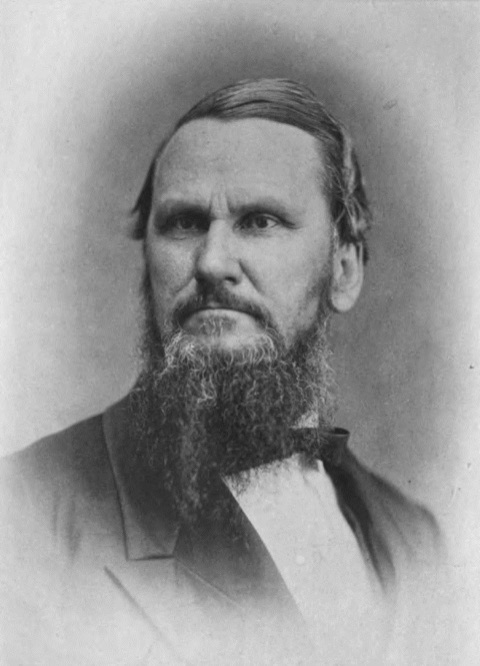
About the author
Robert Lewis Dabney
Robert Lewis Dabney (1820 to 1898 AD) was born in Louisa County, Virginia. He studied at Hampden-Sydney College and the University of Virginia and trained for the ministry at Union Theological Seminary. After serving the Tinkling Spring congregation from 1847, he joined the Union faculty in 1853 and in 1859 took its chair of systematic and polemic theology, the course these lectures record. In 1862 he served as chief of staff to Thomas J. Jackson, whose biography he later wrote. After the war he defended slavery in A Defence of Virginia (1867) and opposed the reunion of the Northern and Southern churches. In 1883 he became professor of mental and moral philosophy at the University of Texas. Blind in his last years, he died in Victoria, Texas.