The complete work in modern English · Free to read
Lectures in Systematic Theology
Dabney's whole seminary course in theology, from the existence of God by reason alone to the last judgment, the civil magistrate and religious liberty. All seventy-four lectures are here in modern English, in three volumes, each free to read in full.
The three volumes
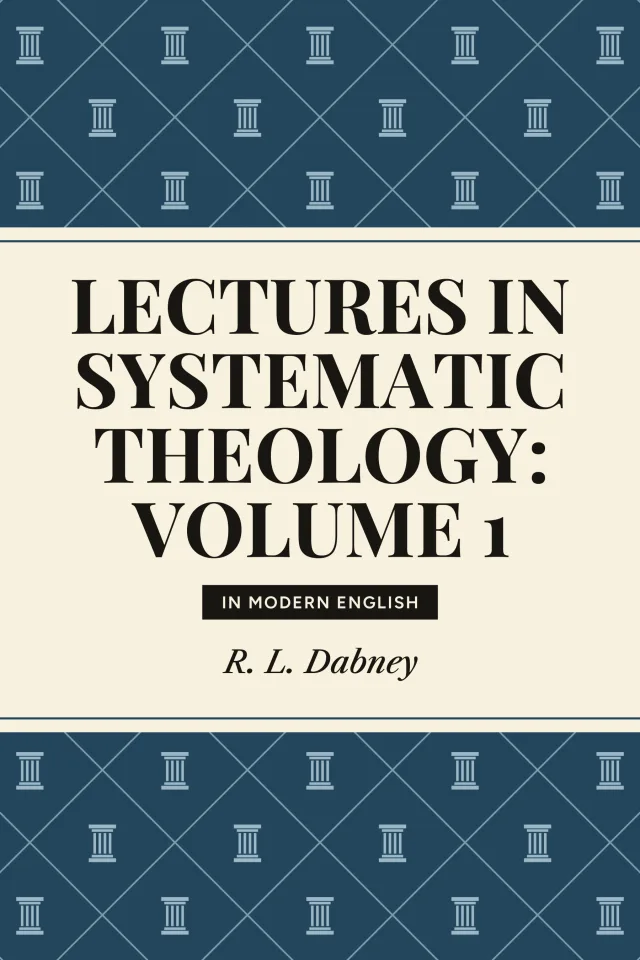
Volume 1
Natural Theology and the Doctrine of God
Lectures 1 to 25: the existence and attributes of God by reason, mind and morals, then the Trinity, the decrees, predestination, creation, angels and providence.
Free to read · about 9 hours
Volume 2
The Fall, the Law and Redemption
Lectures 26 to 49: man's first estate, the fall and original sin, the Ten Commandments, the covenant of grace, the person and satisfaction of Christ, and effectual calling.
Free to read · about 9 hours
Volume 3
Salvation, Sacraments and Last Things
Lectures 50 to 74: faith, justification, sanctification and assurance, baptism and the Lord's Supper, death, judgment, heaven and hell, and religious liberty.
Free to read · about 9 hours
Summary
- Author
- Robert Lewis Dabney (1820 to 1898)
- First published
- 1871, printed by his students
- This text
- The enlarged second edition of 1878
- Type
- Seminary lectures in systematic and polemic theology
- Arrangement
- Seventy-four lectures in two parts, natural and revealed theology
- This edition
- All seventy-four lectures in three volumes, in modern English
What is Lectures in Systematic Theology?
Lectures in Systematic Theology is Robert Lewis Dabney's course in systematic and polemic theology as he taught it at Union Theological Seminary in Virginia, first printed by his students in 1871 and enlarged in a second edition of 1878. Its seventy-four lectures move from natural theology to revealed theology: God and his decrees, man and sin, Christ and his work, salvation, the sacraments and the last things.
How the work is arranged
- 01
Natural theology. What reason can know without Scripture: the existence of God against pantheism, evolution and materialism, his attributes, the immortality of the soul, first truths, the ground of right and wrong, free agency, and the limits of natural religion. Volume 1
- 02
God, his decrees and his works. Revealed theology begins with the names and attributes of God from Scripture, the Trinity, the divinity of the Son and the Spirit, the decrees and predestination, then creation, angels and providence. Volume 1
- 03
Man, sin and the law. Man created holy under the covenant of works, the fall, original sin and the imputation of Adam's guilt, then the moral law and each of the Ten Commandments in turn. Volume 2
- 04
Christ and redemption. The covenant of grace in every age, the person and offices of the Mediator, the nature, extent and results of his satisfaction, his humiliation and exaltation, and effectual calling against the Arminian scheme. Volume 2
- 05
The Christian life and the sacraments. Faith, union to Christ, justification, repentance, sanctification, perseverance, assurance and prayer, then the sacraments, baptism and the Lord's Supper. Volume 3
- 06
The last things, church and state. The death of believers, the resurrection, the general judgment, heaven and hell, and to close, the civil magistrate and religious liberty. Volume 3
How Dabney teaches
Every lecture opens with a syllabus: numbered questions with readings in the Westminster Standards, Turretin, Dick, Hill, Ridgley and others. Dabney then answers each question in his own words, and the course is polemic as well as systematic. He takes on Kant, Hume and Darwin, the Socinians, Rome and the Arminians by name, and he parts company with Reformed writers too where he judges them wrong: with Calvin on assurance and the Supper, and with the Princeton theologians on the imputation of Adam's sin. He holds that reason and Scripture agree, and that right is intrinsic and not made right by command: "Conscience is the Maker's imperative in the soul."
Contents
Every part of the Lectures in order. Each line opens the volume at that section.
- 01Note to the Reader
- 02Preface to the Second Edition
- 03Lecture 1: Prefatory and Existence of God
- 04Lecture 2: Existence of God Continued
- 05Lecture 3: Evolution
- 06Lecture 4: Divine Attributes
- 07Lecture 5: Divine Attributes Continued
- 08Lecture 6: Materialism
- 09Lecture 7: Immortality of the Soul and Defects of Natural Religion
- 10Lecture 8: Sources of Our Thinking
- 11Lecture 9: Sources of Our Thinking Continued
- 12Lecture 10: Ethical Theories Concluded
- 13Lecture 11: Free Agency and the Will
- 14Lecture 12: Responsibility and the Province of Reason
- 15Lecture 13: God and His Attributes
- 16Lecture 14: Divine Attributes Continued
- 17Lecture 15: God’s Moral Attributes
- 18Lecture 16: The Trinity
- 19Lecture 17: Divinity of Christ
- 20Lecture 18: Divinity of the Holy Spirit and of the Son
- 21Lecture 19: Personal Distinctions in the Trinity
- 22Lecture 20: Decrees of God
- 23Lecture 21: Predestination
- 24Lecture 22: Predestination Concluded
- 25Lecture 23: Creation
- 26Appendix: Geologic Theories and Chronology
- 27Lecture 24: Angels
- 28Lecture 25: Providence
- 01Lecture 26: Man’s Estate of Holiness and the Covenant of Works
- 02Lecture 27: The Fall and Original Sin
- 03Lecture 28: Original Sin Continued
- 04Lecture 29: Original Sin Concluded
- 05Lecture 30: The Law
- 06Lecture 31: The First Table (Commandments 1–3)
- 07Lecture 32: The First Table (Fourth Commandment)
- 08Lecture 33: The Second Table (Commandments 5–6)
- 09Lecture 34: The Second Table (Commandments 7–8)
- 10Lecture 35: The Second Table (Commandments 9–10)
- 11Lecture 36: The Covenant of Grace
- 12Lecture 37: The Covenant of Grace Continued
- 13Lecture 38: The Covenant of Grace Concluded
- 14Lecture 39: Mediator of the Covenant of Grace
- 15Lecture 40: The Mediator Continued
- 16Lecture 41: The Mediator Concluded
- 17Lecture 42: Nature of Christ’s Sacrifice
- 18Lecture 43: Nature of Christ’s Sacrifice Continued
- 19Lecture 44: Results of Christ’s Sacrifice
- 20Lecture 45: Christ’s Humiliation and Exaltation
- 21Lecture 46: Effectual Calling
- 22Lecture 47: Effectual Calling Continued
- 23Lecture 48: The Arminian Theory of Redemption
- 24Lecture 49: The Arminian Theory of Redemption Concluded
- 01Lecture 50: Faith
- 02Lecture 51: Union to Christ
- 03Lecture 52: Justification
- 04Lecture 53: Justification Continued
- 05Lecture 54: Justification Concluded
- 06Lecture 55: Repentance
- 07Lecture 56: Sanctification and Good Works
- 08Lecture 57: Sanctification and Good Works Concluded
- 09Lecture 58: Perseverance of the Saints
- 10Lecture 59: Assurance of Grace and Salvation
- 11Lecture 60: Prayer
- 12Lecture 61: The Sacraments
- 13Lecture 62: The Sacraments Continued
- 14Appendix: Apostolic Succession and Sacramental Grace
- 15Lecture 63: Baptism
- 16Lecture 64: Baptism: The Mode
- 17Lecture 65: Subjects of Baptism
- 18Lecture 66: Subjects of Baptism Concluded
- 19Lecture 67: The Lord’s Supper
- 20Lecture 68: The Lord’s Supper Concluded
- 21Lecture 69: Death of Believers
- 22Lecture 70: The Resurrection
- 23Lecture 71: General Judgment and Eternal Life
- 24Lecture 72: Nature and Duration of Hell-Torments
- 25Lecture 73: The Civil Magistrate
- 26Lecture 74: Religious Liberty and Church and State
Support Updated Works
These translations are free. Help fund the next one.
Every volume is free to read. One gift, no subscription, pays for the next translation and recording. Supporters get every audiobook and the whole ebook library as one download.