Ambrose of Milan
Bishop of Milan and one of the four traditional Latin Doctors of the Church, alongside Jerome, Augustine, and Gregory the Great. A Roman governor acclaimed bishop by the crowd while still an unbaptized catechumen, he became the leading churchman of the Latin West in the late fourth century. He carried Greek exegesis into Latin, resisted the Arian court in the basilica crisis of 385 to 386 AD, introduced congregational hymn-singing at Milan, and stood as the human link to Augustine, whom he baptized. His works range across a vast exegetical corpus, the ethical manual On the Duties of the Clergy, and the dogmatic treatises On the Faith and On the Holy Spirit.
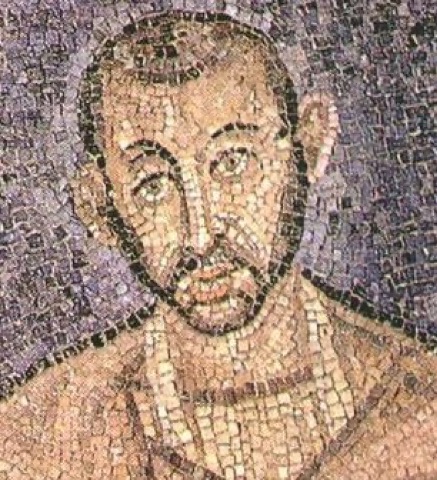
around 339 to 397 AD
Biography
Ambrose of Milan (around 339 to 397 AD) was born at Trier, then the seat of the imperial administration of Gaul, where his father served as praetorian prefect of Gaul. After his father's death the family returned to Rome, and Ambrose was raised there with his brother Satyrus and his sister Marcellina, who was consecrated as a virgin by Pope Liberius and to whom Ambrose later addressed several of his writings on virginity. He received the full literary and legal education of the Roman upper class, learned Greek, and entered public service.
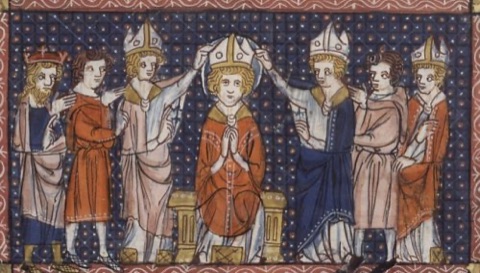
He practiced law and rose through the imperial administration to become consularis, the governor of the province of Aemilia-Liguria, with his seat at Milan. Milan was by then a principal imperial residence and a city divided over the Arian controversy. When its bishop Auxentius, a supporter of the Arian party, died in 374 AD, the election of a successor threatened to break into violence between the Nicene and Arian factions. Ambrose went to the church to keep order and address the crowd. According to the account of his life, a voice called for him as bishop and the assembly took it up. He was still only a catechumen, unbaptized and holding no clerical office, and he tried to refuse; but the choice was confirmed, and within a week, in December 374 AD, he was baptized and passed through the clerical grades to consecration as bishop.
On taking office Ambrose gave his wealth to the poor and to the church and set about acquiring the theological learning his sudden elevation had outrun. He read the Greek theologians closely, drawing on Philo, Origen, and Basil of Caesarea, and reworked their exegesis for Latin congregations in a long series of sermons and treatises. His preaching drew the young rhetorician Augustine, who came to Milan in 384 AD and went to hear Ambrose for his eloquence; in the Confessions Augustine records that he stayed for the substance of what Ambrose taught. Ambrose baptized Augustine at Easter in 387 AD.
The most severe test of his episcopate came in the basilica crisis of 385 to 386 AD, when the court of the young emperor Valentinian II and his mother Justina, who favored the Arians, demanded that Ambrose hand over a basilica in Milan for Arian worship. He refused, and when troops surrounded the church he and his congregation occupied it. In his sermon Against Auxentius, delivered during the standoff, he set out the principle that the emperor is within the church, not above it, and that the churches were not the sovereign's to give away. It was during the siege of the basilica, to sustain the people through the nights, that he introduced the practice of congregational hymn-singing at Milan. His genuine hymns, among them Deus creator omnium and Aeterne rerum conditor, are the foundation of Latin hymnody, written in a simple, memorable meter that a whole congregation could sing. In 386 AD he also directed the finding of the relics of the martyrs Gervasius and Protasius, whose discovery strengthened his standing during the conflict.
Ambrose served as an adviser to a succession of Western emperors, and his dealings with Theodosius drew the sharpest lines of his career. In 388 AD, after a Christian mob at Callinicum on the Euphrates burned a synagogue, Theodosius ordered the local bishop to pay for its rebuilding; Ambrose pressed the emperor by letter and from the pulpit to withdraw the order and not to compel the church to restore a synagogue, and Theodosius gave way. In 390 AD, after imperial troops massacred a large number of the population of Thessalonica in reprisal for a riot, Ambrose required Theodosius to do public penance before he would admit him again to communion, and the emperor submitted. These encounters, together with his counsel to Gratian and Valentinian II, made him the most powerful bishop in the West in his relations with the imperial power.
Ambrose delivered funeral orations for his brother Satyrus, for Valentinian II in 392 AD, and for Theodosius in 395 AD, and these survive among his works. He died at Milan in 397 AD and was succeeded by Simplicianus, who had guided him in his early years as bishop. At the request of Augustine, Ambrose's secretary Paulinus of Milan wrote an account of his life, the Life of Ambrose, which is among the works published in modern English by Updated Works.
Beside his role in church and state, Ambrose left a large body of writing. His exegetical works include the Hexaemeron on the six days of creation, a series of treatises on the patriarchs and other figures of Genesis, expositions of the Psalms, and a commentary on the Gospel of Luke. His moral and ascetic works include On the Duties of the Clergy (De Officiis Ministrorum), the first manual of Christian ethics, modeled on Cicero's On Duties, and On Virgins, addressed to his sister Marcellina. His dogmatic writings, produced largely in the Arian conflict, include On the Faith, On the Holy Spirit, and On the Mystery of the Lord's Incarnation, along with a large collection of letters.
Life & Career
Why Ambrose Matters
Ambrose established a model of the bishop drawn from the governing class and formed by public administration rather than by a clerical career. Elected while still a catechumen, he brought the habits of a Roman magistrate to the office and used them to make the see of Milan a center of authority in the Western church. The pattern of the converted administrator who becomes a churchman of the first rank shaped later expectations of what a bishop in the Latin West could be.
His dealings with the emperors set out a boundary between church and state that carried far into the medieval West. In the basilica crisis he refused to surrender the churches to the Arian court and argued that the emperor stood within the church rather than over it. In the affair of Thessalonica he required a reigning emperor to submit to public penance before returning to communion. Later Western writing on the relation of spiritual and temporal power looked back to these episodes, and to Ambrose's insistence that the imperial office was subject to the church's discipline in matters of faith and conscience, as founding precedents.
A large part of his work was the transmission of Greek theology and exegesis into Latin. Reading Philo, Origen, and Basil, Ambrose reworked their interpretation of Scripture for Latin readers, especially the allegorical reading of the Old Testament, and made available in the West a body of thought that had been developed in the Greek church. His Hexaemeron drew on Basil's homilies on the same subject; his treatments of Genesis and the Psalms carried Alexandrian method into Latin preaching. In this he continued the work of bringing the Eastern debates and methods westward that Hilary of Poitiers had begun.
He is counted the father of Latin hymnody. The hymns securely attributed to him, written in a plain iambic meter arranged in four-line stanzas, were composed to be sung by a whole congregation and became the model for the Latin hymn as a form. Introduced during the basilica siege as a way of holding the people together, congregational hymn-singing spread from Milan through the Western church, and the Ambrosian hymn shaped the liturgical poetry of the Latin Middle Ages.
His most consequential single relationship was with Augustine, whose account in the Confessions has fixed Ambrose's place in the history of Christian thought. It was Ambrose's preaching that helped move Augustine toward the Catholic faith, and Ambrose who baptized him in 387 AD; the allegorical reading of Scripture that Augustine heard from him removed obstacles that had held him back. Through Augustine, and through his own writing, Ambrose stands as one of the four traditional Latin Doctors of the Church, with Jerome, Augustine, and Gregory the Great.
Complete Works in English
Free to readEvery surviving work, translated in full and free to read, from our Patrologia Latina project.