Hilary of Poitiers
Bishop of Poitiers in Gaul and the leading opponent of Arianism in the Latin West during the reign of Constantius II. His twelve books On the Trinity (De Trinitate) were the first large-scale Latin defense of the Nicene faith, written during his exile in Asia Minor, where he also composed On the Councils (De Synodis) to explain the Eastern debates to Western bishops. His Commentary on Matthew is the earliest surviving Latin commentary on that Gospel, and his Homilies on the Psalms carried the exegesis of Origen into Latin.
around 310 to 367 AD
Biography
Hilary of Poitiers (around 310 to 367 AD) was born at Pictavium, the Roman town in western Gaul that became modern Poitiers. He came from a family of the provincial upper class and received the standard literary education of his region, and he was raised a pagan. In the opening of On the Trinity he describes his own path from the worship of the old gods to the Christian faith, presenting it as a search that moved through the philosophers' accounts of the divine before he found in the Scriptures the God who names himself "I am who I am." He was married and had a daughter, known in later tradition as Abra.
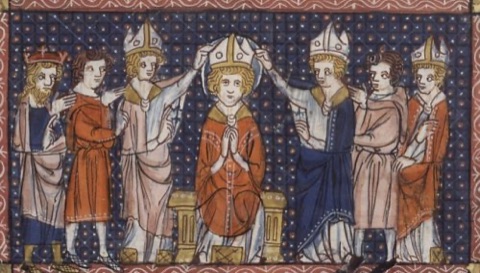
Around 350 AD, while still a married layman, Hilary was elected bishop of Poitiers by the Christians of the town. The choice of a recent convert who was not a career cleric reflects the standing his learning and character had given him. As bishop he was drawn almost at once into the Arian controversy, which under the emperor Constantius II had become a matter of imperial policy. Constantius favored the party that rejected the Nicene term homoousios, "of one substance," and pressed the bishops of the West to condemn Athanasius of Alexandria and to accept the creeds coming out of the Eastern councils.
Hilary refused. He organized the bishops of Gaul against the Arianizing settlement and broke communion with Saturninus of Arles, who supported the imperial line. In 356 AD the synod of Béziers, called by Saturninus, moved against him, and Constantius sentenced him to exile in Phrygia, in Asia Minor. The exile lasted about four years and turned out to be the making of his theology. Removed from Gaul but left free to write, Hilary deepened his engagement with Greek theology well enough to read the Eastern theologians in their own language, and he entered the debates of the Greek church directly.
During these years he wrote On the Trinity, in twelve books, the work for which he is chiefly remembered. He also composed On the Councils, in which he set out the various Eastern creeds for the Western bishops and argued that some of those who used the term homoiousios, "of like substance," were closer to the Nicene position than their language suggested. In 359 AD he was present at the Council of Seleucia, one of the twin assemblies through which Constantius tried to impose a compromise formula, and afterward he went to Constantinople and pressed his case at the imperial court. His requests for a public debate with his opponents made him inconvenient, and the authorities sent him back to Gaul rather than keep him in the East.
Hilary returned to Gaul around 360 AD, in the period when Julian's rise and then his accession loosened Constantius's grip on church affairs. He resumed the leadership of the Nicene party in the West and worked to undo the settlements that had been imposed during his absence. In 364 AD he carried the campaign to Milan, seeking the deposition of its bishop Auxentius, an Arian protected by the new emperor Valentinian I. Hilary pressed for a hearing, but the emperor upheld Auxentius and ordered Hilary to leave the city. He died at Poitiers in 367 AD.
Alongside his doctrinal writing Hilary left a body of exegetical work. His Commentary on Matthew, written before the exile, is the earliest surviving Latin commentary on that Gospel. After his return he produced the Homilies on the Psalms (Tractatus super Psalmos), a large treatment of the Psalter that draws heavily on the exegesis of Origen and helped bring the Alexandrian method of interpretation into Latin. He is also often named as the first Latin hymn-writer, though the attribution of particular surviving hymns to him is debated. Jerome and Augustine both held his writing in high regard, and a later tradition gave him the title "Athanasius of the West" for his part in the Arian struggle. He was declared a Doctor of the Church in 1851 by Pope Pius IX.
Life & Career
Why Hilary Matters
Hilary's central achievement was to carry the pro-Nicene theology of the Greek church into Latin. Before his exile the Western churches had little direct knowledge of the arguments being fought out in the East, and the imperial pressure under Constantius II found them poorly equipped to answer it. Hilary he immersed himself in the Greek theology of the East during the Phrygian exile, read the Eastern theologians, and returned able to translate both the language and the substance of the Nicene case for a Latin readership. In doing so he gave the West the tools to resist the Arianizing settlements that the emperor was trying to impose.
On the Trinity was the first great Latin synthesis of Trinitarian doctrine after the earlier work of Tertullian and Novatian. Where those writers had opened the Latin vocabulary for the relation of Father and Son, Hilary produced a sustained argument across twelve books, moving from the confession of the Son's full divinity through the scriptural texts that the Arians used against it. He read passages that spoke of the Son's subjection or ignorance as belonging to the incarnation rather than to the eternal Word, and he set out the unity of substance between Father and Son as the reading that the whole of Scripture required. The work gave Latin theology a model for treating the Nicene faith as a coherent account rather than a single contested word.
In On the Councils Hilary took an irenic line that set him apart from the harder partisans on his own side. Examining the creeds of the Eastern councils, he argued that many bishops who spoke of the Son as homoiousios, "of like substance," rather than homoousios, "of one substance," meant to confess the same faith and were separated from the Nicene party more by words than by belief. He tried to build a bridge to these homoiousian bishops and to isolate the genuine Arians, a strategy of reconciliation that anticipated the settlement the church would eventually reach.
His influence ran forward into the mainstream of Latin theology. Augustine drew on Hilary and cited him as an authority, and later Latin writing on the Trinity treated On the Trinity as a foundational text. Through Hilary the categories worked out in the Greek controversies became part of the Western inheritance, so that the Latin church entered the later fourth century with a developed Nicene theology of its own.
The Homilies on the Psalms had a parallel effect in exegesis. By working through the Psalter with the methods he had learned from Origen, Hilary brought the Alexandrian tradition of interpretation into Latin and helped establish the allegorical and Christological reading of the Psalms that later Latin commentators would continue. Together with his Commentary on Matthew, the earliest Latin commentary on that Gospel, the Psalms homilies mark him as one of the writers through whom Greek biblical scholarship passed into the Western church.
Complete Works in English
Free to readEvery surviving work, translated in full and free to read, from our Patrologia Latina project.