Alexis de Tocqueville
French magistrate and political thinker, author of Democracy in America (1835, 1840), written after a nine-month tour of the United States in 1831. It remains the most widely cited foreign study of American political life.
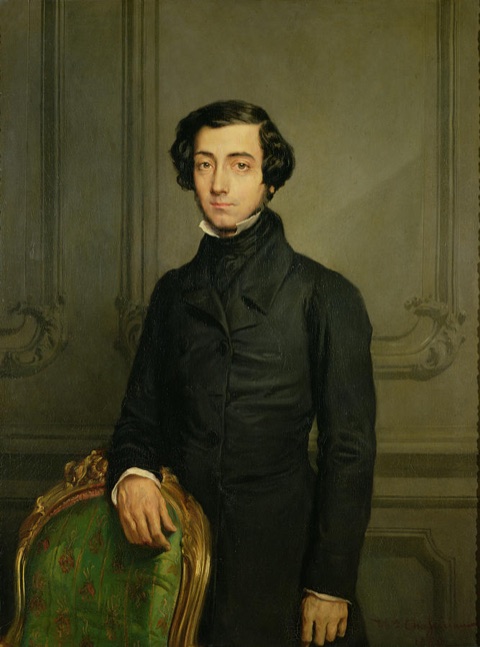
1805–1859
Biography
Alexis-Charles-Henri Clérel de Tocqueville (1805 to 1859) was a French magistrate, political writer, and statesman whose Democracy in America became a founding study of democratic society. He was born on July 29, 1805, in Paris, into a Norman aristocratic family nearly destroyed during the Terror. His maternal great-grandfather, Lamoignon de Malesherbes, had defended Louis XVI at his trial and was guillotined in 1794; Tocqueville's parents narrowly escaped the same fate. He grew up at the family château at Tocqueville in the Cotentin peninsula and was educated at the lycée in Metz, where his father served as prefect under the restored Bourbon monarchy.
He studied law in Paris and in 1827 was appointed juge auditeur, an apprentice magistrate, at the court of Versailles, where he met Gustave de Beaumont. After the July Revolution of 1830 replaced Charles X with Louis-Philippe, the two friends, uneasy about swearing loyalty to the new regime, secured a government commission to study the American penitentiary system. They sailed for New York in April 1831 and spent nine months traveling roughly seven thousand miles through seventeen states, moving from the town meetings of New England to the Mississippi frontier and the plantations of the slave South. Tocqueville filled his notebooks with interviews, ranging from former president John Quincy Adams to Sam Houston and frontier settlers.
The official report, On the Penitentiary System in the United States, appeared in 1833. But the trip's larger yield was Democracy in America: the first volume of De la démocratie en Amérique was published in January 1835 and made Tocqueville famous across Europe at the age of twenty-nine; the second, more abstract and speculative volume followed in 1840. The work treated the United States less as a subject in itself than as the clearest available example of a democratic and egalitarian future that Tocqueville believed was overtaking the entire Western world. He was elected to the Académie des sciences morales et politiques in 1838 and to the Académie française in 1841.
Tocqueville sat as a deputy from Valognes in the Chamber of Deputies from 1839 until the February Revolution of 1848, then served in the Constituent Assembly that drafted the constitution of the Second Republic. From June to October 1849 he was Foreign Minister in the cabinet of Odilon Barrot under President Louis-Napoléon Bonaparte. After Louis-Napoléon's coup of December 2, 1851, Tocqueville was briefly imprisoned at Vincennes for protesting it, and he withdrew from public life entirely, later composing his Recollections of the 1848 revolution, which were published only after his death.
He spent his final years on a new project, The Old Regime and the Revolution, whose first volume appeared in 1856. Drawing on administrative archives, it argued that the centralized French state was not a creation of the Revolution but had been built by the monarchy itself, and that the Revolution had inherited and completed that centralization rather than breaking with it. Tuberculosis, which had troubled Tocqueville for years, killed him at Cannes on April 16, 1859. He was fifty-three, and the second volume of The Old Regime remained unfinished.
Life & Career
Why Tocqueville Matters
Tocqueville's importance rests on his claim that the movement toward social equality was not a passing political fashion but a long, providential trend reshaping every Western society. Writing when representative democracy was still an experiment and monarchy the European norm, he treated the United States as a laboratory for observing where that trend led. Democracy in America is read today less for its reporting on Jacksonian America than for the general propositions Tocqueville drew from it about how equality alters manners, religion, family, ambition, and thought.
His most influential warning was that democratic equality could coexist with new forms of unfreedom. He described the "tyranny of the majority," in which public opinion silences dissent more effectively than any censor, and he sketched a "mild" administrative despotism in which citizens surrender self-government to a benevolent, all-managing state in exchange for comfort. Against these dangers he pointed to the American habits of local self-government, jury service, a free press, religious life, and above all the dense web of voluntary associations through which Americans organized their own affairs. His account of civil society and of "self-interest rightly understood" became a permanent reference point for later thinking about citizenship.
The Old Regime and the Revolution reframed the study of the French Revolution by locating its deepest cause in the administrative centralization of the Bourbon monarchy rather than in a sudden rupture. That thesis, and Tocqueville's method of reading dry administrative records to reconstruct social conditions, anticipated later social history and continues to structure debate among historians of France.
Because he wrote as a liberal who distrusted both reactionary nostalgia and revolutionary enthusiasm, Tocqueville has been claimed across the political spectrum. His analysis of equality, association, centralization, and the psychology of democratic peoples keeps his books on the syllabus in political science, sociology, and history, and phrases he coined, from "individualism" in its modern sense to the "tyranny of the majority," remain part of ordinary political vocabulary.