Volume 2 of Tocqueville's 1835 analysis of America — the political half, including the famous chapter on the tyranny of the majority and the closing survey of Indians, slaves, and whites that predicted the Civil War.
One free account opens 250+ books and saves your place on every device. Google sign-in or an email link. No card.
You’re on the list — we’ll email you if this goes to print.
Included with your free account
This book, and 250+ more, free to read
A free account opens the whole library to read online, on your phone or at your desk. Open a book on one device and it is waiting at the same page on the next. The PDF and EPUB of every book are yours to keep, and audiobooks play in the same app.
250+ modernized editionsNot samples. The whole work, free.
Your place, on every devicePhone, tablet or desktop, same page.
131 audiobooksFrom $4.99 each, or all of them with a $50 gift.
Volume 2 picks up where Volume 1 left off, shifting from the institutional description of townships, courts, and the federal Constitution to the political analysis of how popular sovereignty actually behaves once it is in motion. The ten chapters cover parties, the press, voluntary associations, the salaries of public officers, the conduct of foreign affairs, the unlimited power of the majority, and the customs and habits that keep that power from sliding into despotism.
Three chapters are widely cited on their own. Chapter 7, on the unlimited power of the majority, gave the political vocabulary the phrase "tyranny of the majority" and warned that democratic majorities exert a kind of soft pressure on opinion that no eighteenth-century philosophe had anticipated. Chapter 9 surveys the religious, geographic, and customary "habits of the heart" that hold American democracy together — Tocqueville's argument that the Constitution alone cannot account for what he saw, and that the country's stability rests on Sunday observance, Protestant clergy, the geographic vastness, and the English common law as much as on its written charter. Chapter 10, the longest chapter Tocqueville ever wrote, examines the position of Indians, slaves, and whites and predicts a slavery crisis that arrived almost exactly thirty years after publication.
This volume is the source of much of the political vocabulary still in use — civil society, habits of the heart, the tyranny of the majority — and is drawn on by both critics of democracy, who point to its leveling tendencies, and defenders, who point to its self-correcting mechanisms. The closing chapter on the three races is where Tocqueville's analysis became prophecy.
Introduction
I have so far examined the institutions of the United States, reviewed their legislation, and described the current characteristics of political society in that country. But a sovereign power exists above these institutions and beyond these characteristic features, one that can destroy or modify them at will: the power of the people. It remains to be shown how this power, which ultimately governs the laws, actually operates. Its tendencies and passions remain to be identified, along with the hidden forces that slow, accelerate, or direct its unstoppable course, and the effects of its unlimited authority on the destiny that likely awaits it.
Chapter 1: Why the people may strictly be said to govern in the United States
In America, the people appoints both the legislative and executive power, and provides the jurors who punish all violations of the law. American institutions are democratic not only in their underlying principles but in all their consequences. The people elects its representatives directly, and for the most part annually, to ensure their accountability. The people is therefore the true directing force; and although the form of government is representative, it is clear that the opinions, prejudices, interests, and even the passions of the community face no lasting obstacles to exercising a constant influence on society. In the United States, the majority governs in the name of the people, as is the case in all countries where the people holds supreme power. This majority consists primarily of peaceable citizens who, whether by inclination or self-interest, genuinely desire the welfare of their country. Yet they are surrounded by the relentless activity of parties competing for their cooperation and support.
Chapter 2: Parties in the United States
We need to draw a clear distinction between different kinds of parties. Some countries are so large that the various populations living within them have conflicting interests, even though they all live under the same government. In such cases, these groups may be in a state of permanent opposition. The different factions of the people are better understood as distinct nations than as mere political parties, and if civil war breaks out, the struggle is one between rival peoples rather than competing factions within a single state.
But when citizens hold different opinions on questions that affect the whole country equally, such as the principles on which the government should be run, genuine parties emerge. Parties are a necessary evil in free governments, but they don't always share the same character or the same tendencies.
There are moments when a nation suffers under such unbearable conditions that it begins to imagine a complete overhaul of its political order; at other times the trouble runs even deeper, and the very existence of society is at risk. These are the times of great revolutions and great parties. But between these periods of misery and upheaval, there are quieter stretches when human society seems to rest and humanity seems to catch its breath. This pause, however, is only an illusion; time does not stop for nations any more than it does for individual people. Everyone is moving toward a destination they cannot see, and we only imagine them to be standing still when their progress is too slow for us to notice, much as a person walking at a leisurely pace appears motionless to someone running past.
That said, there are certain eras in which the changes taking place in the social and political life of nations are so gradual and so imperceptible that people come to regard their present condition as a permanent one. The human mind, convinced that it rests on solid ground, stops looking beyond the horizon it can already see. These are the times of small parties and petty scheming.
The political parties I would call great are those that attach themselves to principles rather than to their consequences; to broad ideas rather than specific cases; to ideals rather than to personalities. These parties tend to have a nobler character than the others: more generous passions, more genuine convictions, and a bolder, more transparent way of operating. Within them, private interest, which always plays the leading role in political passion, is more carefully disguised behind the language of the public good, and it may sometimes be hidden even from the very person it drives and motivates.
Minor parties, by contrast, tend to lack genuine political conviction. Without a noble cause to sustain or dignify them, they openly display the self-interest at their core. They burn with manufactured enthusiasm; their language is fierce, but their actions are timid and indecisive. The means they use are as shabby as the ends they pursue. This is why, when calm follows a violent revolution, the leaders of society seem to vanish overnight, and the powers of the human mind appear to go into hiding. Great parties convulse society; minor ones merely agitate it. The former tear it apart; the latter drag it down. And if great parties sometimes save society through a necessary upheaval, minor ones disturb it to no good end.
America has already lost the great parties that once divided the nation, and while this has brought considerable happiness, it has come at a moral cost. When the War of Independence ended and the foundations of the new government had to be laid, the nation was split between two opinions: two opinions as old as the world itself, and ones you will find in every free society under every name it has ever taken. One tended to limit the power of the people; the other to extend it without bound. This conflict never reached the level of violence in America that it has so often reached elsewhere. Both American parties actually agreed on the most essential points, and neither had to demolish an inherited constitution or overturn the structure of society in order to win. Consequently, neither side had a large number of private interests riding on victory or defeat. But moral principles of a high order were at stake in the struggle, among them the love of equality and independence, and those were enough to ignite fierce passions.
The party that wanted to limit the power of the people focused its doctrines especially on the Constitution of the Union, which is where it got the name Federal. The other party, which claimed a more exclusive devotion to the cause of liberty, took the name Republican. America is the land of democracy, and the Federalists were always in the minority; but they counted among their ranks nearly all the great men the War of Independence had produced, and their moral influence was considerable. Their cause was also helped by circumstances. The collapse of the Confederation had left the people deeply afraid of anarchy, and the Federalists were quick to exploit this passing mood. For ten or twelve years they led the country, and managed to put some, though not all, of their principles into practice; but the tide of opposition was growing stronger by the day, too powerful to hold back. In 1801 the Republicans took control of the government: Thomas Jefferson was named President, and he strengthened his party's position through the force of his reputation, the greatness of his abilities, and the enormous breadth of his popularity.
The methods by which the Federalists had held their position were artificial, and their resources were temporary. They had risen to power on the virtues and talents of their leaders alone. When the Republicans reached that same height, their opponents were crushed in total defeat. An overwhelming majority turned against the outgoing party, and the Federalists found themselves reduced to so small a minority that they immediately gave up hope of any future success. From that moment on, the Republican or Democratic party moved from one victory to the next, until it achieved absolute supremacy across the country.
The Federalists, realizing they had been decisively defeated and were isolated within the nation, split into two factions: one joined the victorious Republicans, while the other abandoned its rallying point and its name. Many years have passed since they ceased to exist as a party.
The Federalists' rise to power was, in my view, one of the most fortunate events in the formation of the great American Union. They pushed back against the inevitable tendencies of their age and their country. But whether their theories were sound or flawed, they suffered from one fatal defect: they were simply not applicable, as a governing system, to the society they claimed to lead. What happened under Jefferson was therefore bound to occur sooner or later. Yet their time in government gave the new republic the breathing room it needed to find its footing, and then to absorb the rapid growth of the very doctrines they had fought against. A significant number of their principles were, in practice, absorbed into the political beliefs of their opponents, and the Federal Constitution, which endures to this day, stands as a lasting monument to their patriotism and their wisdom.
Great political parties are not, then, to be found in the United States at the present time. Parties do exist that threaten the future stability of the Union, but none that appear to challenge the current form of government or the current direction of society. The parties that endanger the Union are not built on abstract principles; they rest on material interests. Those interests, spread across the provinces of so vast an empire, might more accurately be described as rival nations than as parties. So it was that, on a recent occasion, the North fought for commercial protectionism while the South took up arms in favor of free trade, simply because the North is a manufacturing region and the South an agricultural one, and the restrictive system that benefited the one was harmful to the other.
In the absence of major parties, the United States overflows with minor controversies, and public opinion splinters into a thousand fine gradations on questions of very little importance. The effort required to manufacture parties is remarkable, and at present it is no easy task. In the United States there is no religious animosity, because all faiths are respected and no single denomination dominates; there is no resentment over rank, because the people are everything and no one can challenge their authority; and finally, there is no widespread poverty to serve as fuel for agitation, because the country's physical circumstances open such a vast field to industry that individuals can accomplish the most extraordinary things through their own native resources. Even so, ambitious men have a stake in creating parties, since it is difficult to remove someone from power on the mere grounds that others want his position. The skill of political actors therefore lies in the art of manufacturing parties. A political aspirant in the United States begins by identifying his own interests and calculating which other interests can be gathered around and merged with them. He then works to find some doctrine or principle that suits the purposes of this new alliance, which he adopts in order to advance his party and secure its popularity: much as a royal seal of approval was once stamped on a book it authorized but had nothing to do with. Once these preliminaries are complete, the new party is launched into the political world.
To a foreign observer, all the domestic controversies of Americans at first seem so baffling and so trivial that he can't decide whether to pity a people that takes such petty matters so seriously, or to envy the happiness that allows them to debate such things at all. But when he begins to study the deeper forces driving American factions, he quickly sees that most of them connect, in one way or another, to one of two divisions that have always existed in free societies. The deeper you look into how these parties actually work, the more clearly you see that one aims to limit popular authority while the other aims to expand it. I'm not claiming that the stated goals, or even the hidden aims, of American parties are to advance aristocracy or democracy as such; but I will say that aristocratic or democratic impulses can easily be detected beneath the surface of every party, and that although they escape casual notice, they are the real driving force behind every faction in the United States.
To take a recent example: when the President attacked the Bank, the country was stirred up and parties quickly formed around the conflict. The educated classes rallied behind the Bank; ordinary people rallied behind the President. But we shouldn't assume that the people had formed any reasoned opinion on a question that challenges even the most experienced statesmen. The Bank is a powerful institution with an independent existence, and the people, accustomed to making and unmaking whatever they please, were unsettled to encounter something that resisted their authority. In the midst of society's constant flux, the public grew irritated by so permanent an institution and moved to attack it, simply to see whether it could be shaken and brought to heel like every other institution in the country.
Remains of the aristocratic party in the United States
It sometimes happens in a society where various opinions compete that the balance between parties collapses, and one of them gains an irresistible advantage, sweeps aside all obstacles, harasses its opponents, and seizes the resources of society for its own ends. The defeated citizens give up hope of success; they bury their dissatisfaction in silence and in a general apathy. The nation appears to be governed by a single principle, and the dominant party takes credit for having restored peace and unity to the country. But this apparent unanimity is nothing more than a mask over deep divisions and persistent opposition.
This is what happened in America. When the democratic party gained the upper hand, it took exclusive control of public affairs, and from that point on, the laws and customs of society were shaped to suit its preferences. Today, the wealthier classes are so thoroughly shut out from political life in the United States that wealth, far from granting any right to power, is more of a barrier than a pathway to it. The affluent members of society withdraw from the contest, unwilling to struggle, and often to struggle in vain, against the poorest of their fellow citizens. They retreat into the privacy of their homes, where they enjoy a social standing that public life no longer affords them, and they form a kind of private society within the state, with its own tastes and its own pleasures. They accept this situation as an unavoidable evil, but they are careful never to let on how much it chafes them. In fact, it's not unusual to hear them publicly praising the virtues of republican government and the benefits of democratic institutions. After hating their enemies, men are most inclined to flatter them.
Take note of that wealthy citizen who is as anxious as a medieval Jew to conceal his fortune. His clothes are plain, his manner unassuming; but the interior of his home glitters with luxury, and none but a few carefully chosen guests, whom he haughtily calls his equals, are allowed to enter this private sanctuary. No European nobleman is more exclusive in his pleasures, or more jealous of the smallest privileges his station confers on him. Yet that very same man crosses the city to reach a dim counting house in the heart of the commercial district, where anyone who pleases may approach him. If he meets his cobbler on the way, the two stop and talk; they discuss the affairs of the state in which they have an equal stake, and they shake hands before parting.
But beneath this artificial enthusiasm, and these obsequious gestures toward the dominant power, it is easy to see that the wealthy members of the community harbor a deep distaste for the democratic institutions of their country. The common people are at once the object of their contempt and their fear. If the mismanagement of democracy ever brings about a revolutionary crisis, and if monarchical institutions ever become viable in the United States, the truth of what I am saying will become obvious.
The two chief weapons that parties use to secure victory are the public press and the formation of associations.
Chapter 3: Liberty of the press in the United States
The influence of a free press extends beyond political opinion alone; it shapes all of human thought and modifies customs just as surely as it modifies laws. In another part of this work, I will try to determine how far a free press has shaped civil society in the United States, and to trace the direction it has given to ideas, as well as the tone it has lent to the character and feelings of Anglo-Americans. For now, however, I intend simply to examine the effects of a free press on political life. I should be honest: I don't hold that firm, wholehearted attachment to press freedom that things supremely good by their very nature tend to inspire. I value it more by remembering the evils it prevents than by counting the advantages it secures.
If anyone could identify a middle ground between complete freedom and complete suppression of public expression, I would be inclined to adopt it. The difficulty lies in finding that position. If your goal is to correct the abuses of an unregulated press and restore civil discourse, you might begin by bringing the offender before a jury. But if the jury acquits him, what was once the opinion of a single individual becomes the opinion of the country at large. Too much has been done to stop there, and too little to achieve anything. If you press forward, you must bring the accused before permanent magistrates. But even then, the case must be heard before it can be decided, and the very principles no book would have dared to state openly are proclaimed in the pleadings. What was obscurely hinted at in one publication is then repeated across many others. The language in which a thought is expressed is merely the shell of that thought, not the idea itself. Courts may condemn the form, but the sense and spirit of the work is too elusive for their authority.
Too much has still been done to turn back, and too little to reach your goal; you must press on. If you establish censorship of the press, the public speaker's voice will still be heard, and you will have only made things worse. The power of ideas does not depend, as physical strength does, on the number of those who carry them, nor can a body of writers be counted like soldiers in an army. On the contrary, the authority of a principle is often strengthened by the small number of people who express it. The words of a forceful mind, cutting through the passions of a listening crowd, carry more weight than the shouting of a thousand orators. And if free speech is permitted in any public place, the effect is the same as if it were permitted everywhere. The freedom of speech must therefore be destroyed along with the freedom of the press. That is the inevitable end of your efforts.
But if your original aim was to curb the abuses of liberty, that path has led you to the feet of a despot. You have traveled from the extreme of independence to the extreme of subjection, without finding a single defensible position to rest on along the way.
There are certain nations that have particular reasons to cherish freedom of the press, beyond the general arguments I have just outlined. In some countries that claim to enjoy the privileges of freedom, individual agents of the government can violate the laws with impunity, because those they oppress have no recourse through the courts of justice.
In such cases, freedom of the press is not merely one guarantee among many; it is the only guarantee of liberty and security that citizens actually possess. If the rulers of these nations proposed to abolish the independence of the press, the people would be entirely justified in saying: Give us the right to prosecute your offenses before the ordinary courts, and perhaps then we will consider giving up our right to appeal to the court of public opinion.
In countries where the principle of popular sovereignty openly prevails, press censorship is not merely dangerous but absurd. When every citizen's right to participate in governing society is recognized, every citizen must be presumed capable of weighing competing opinions and evaluating the facts from which conclusions can be drawn. Popular sovereignty and freedom of the press are therefore complementary institutions; just as press censorship and universal suffrage are fundamentally incompatible, two things that cannot long coexist within the same political system. Not one of the twelve million people living in the United States has yet dared to propose any restrictions on freedom of the press. The first newspaper I picked up on my arrival in America contained the following article: "In all this affair, the language of Jackson has been that of a heartless despot, solely occupied with preserving his own authority. Ambition is his crime, and it will be his punishment too: intrigue is his native element, and intrigue will confound his schemes and strip him of his power. He governs through corruption, and his immoral practices will rebound to his shame and disgrace. His conduct in the political arena has been that of a shameless and lawless gambler. He succeeded for a time, but the hour of reckoning approaches, and he will be forced to disgorge his winnings, cast aside his loaded dice, and retire to some obscure corner where he may curse his own folly at his leisure; for repentance is a virtue his heart seems destined to remain forever without."
It is commonly assumed in France that the ferocity of the press stems from the country's unstable social conditions, its political turmoil, and the widespread sense of harm that follows from both. The assumption, then, is that once society settles into a degree of calm, the press will naturally soften its tone. I am inclined to think that these causes do explain the press's extraordinary hold over the nation, but that they have little influence on the character of its language. The periodical press seems to me to be driven by passions and tendencies that are independent of the circumstances surrounding it, and America's current situation supports this view.
America is perhaps, at this moment, the country in the world with the fewest seeds of revolution; yet its press is no less destructive in its principles than France's, and it displays the same violence without the same reasons for outrage. In America, as in France, the press constitutes a singular power, so strangely composed of mingled good and evil that it is at once indispensable to the existence of freedom and nearly incompatible with the maintenance of public order. Its power is certainly much greater in France than in the United States, though nothing is rarer in the latter country than a prosecution brought against it. The reason is perfectly simple: the Americans, having once accepted the doctrine of the sovereignty of the people, apply it with perfect consistency. They never intended to build a permanent order on elements that undergo daily change, and there is consequently nothing criminal in an attack on existing laws, provided it is not accompanied by a violent breach of them. They also hold that courts of justice are unable to check the abuses of the press, and that since the subtlety of human language perpetually eludes the precision of legal analysis, offenses of this kind tend to slip through the hand that reaches to grasp them. To act effectively on the press, they argue, would require a tribunal not only devoted to the existing order but capable of overcoming the influence of public opinion: one that conducted its proceedings in secret, pronounced its verdicts without explaining its reasoning, and punished an author's intentions even more than his words. Whoever had the power to create and sustain a tribunal of that kind would have no need to bother prosecuting the liberty of the press, for he would already be the supreme master of the whole community, as free to dispose of authors as of their writings. In this question, therefore, there is no middle ground between servitude and extreme license. To enjoy the immense benefits that a free press guarantees, you must accept the inevitable evils it produces. To hope for the first while escaping the second is to cherish one of those illusions that so often mislead nations in their times of sickness, when, worn out by faction and exhausted by effort, they try to reconcile hostile opinions and contrary principles on the same soil.
The limited influence of American newspapers can be traced to several causes, among them the following. The freedom of the press, like all other freedoms, is most powerful when it is new. A people unaccustomed to participating in public affairs will place complete trust in the first public voice that captures their attention. The Anglo-Americans have enjoyed this freedom since the earliest settlements were founded, which means the press has never carried that electric charge of novelty. Beyond this, the press cannot manufacture human passions on its own, however skillfully it may fan the flames where those passions already exist. In America, politics are debated with energy and variety, but they rarely stir the deep emotions that flare up when a significant portion of the community feels its vital interests threatened. In the United States, however, the community's interests are, on the whole, in a flourishing condition.
A single glance at a French and an American newspaper is enough to reveal the difference between the two nations on this point. In France, the space given to commercial advertisements is quite small, the news coverage is modest, and the heart of the paper is its political commentary. In America, three quarters of the enormous sheet spread before the reader are filled with advertisements, and the rest is typically taken up by political news or trivial anecdotes. Only occasionally does one find a corner devoted to the kind of passionate debate that French journalists routinely offer their readers.
Both observation and the instinctive cunning of despots, great and petty alike, have confirmed that a power's influence grows in proportion to how centralized its direction becomes. In France, the press suffers from a double centralization: nearly all its power is concentrated in one place and held in the same hands, since its outlets are far from numerous. The influence such a press can exert over a skeptical nation is virtually unlimited. It is an enemy with which a government may occasionally negotiate a truce, but one that is very difficult to resist over any sustained period.
Neither form of centralization exists in America. The United States has no single metropolis; the country's intelligence and power are spread broadly across the land, and rather than radiating outward from a single point, they intersect in every direction. Americans have established no central authority over the expression of opinion, any more than over the conduct of business. Some of these conditions lie beyond human planning, but it is the laws of the Union that ensure there are no licenses to be granted to printers, no financial guarantees demanded from editors as in France, and no stamp duty as in France and England. The result is that nothing is easier than starting a newspaper, and even a small readership is enough to cover the editor's costs.
The sheer number of periodical and occasional publications in the United States is almost beyond belief. The most clear-eyed Americans attribute the press's limited influence to this very excess of outlets, and it has become an accepted principle of political science in that country that the only way to neutralize the effect of public journalism is to multiply it without limit. I find it hard to understand why a truth so self-evident has not already gained wider acceptance in Europe. One can at least comprehend why those who hope to bring about revolutions through the press would want to concentrate its power in a few influential organs. But it is genuinely baffling that the defenders of the existing order, the natural supporters of the law, would try to reduce the press's influence by consolidating its authority. The governments of Europe seem to treat the press with the chivalrous courtesy of medieval knights: they are eager to hand it the same concentrated power they have found so effective as a weapon, apparently to make their resistance to its attacks all the more glorious.
In America, there is scarcely a town without its own newspaper. It's easy to see that neither discipline nor unified purpose can be imposed on such a sprawling, fragmented press, and each outlet consequently fights under its own banner. All the political journals in the United States are indeed aligned either with the administration or against it, but they attack and defend it in a thousand different ways. They cannot manage to form those great currents of opinion that sweep away even the most solid obstacles. This fragmentation of the press produces a variety of other consequences that are hardly less striking. The ease with which newspapers can be launched draws a multitude of individuals into the business, but since fierce competition makes significant profit nearly impossible, the most distinguished members of society rarely bother with these ventures. And given how many publications there are, even if they were a reliable source of wealth, there simply wouldn't be enough talented writers to run them all. American journalists are typically people of modest standing, with limited education and a coarse sensibility. The will of the majority is the most sweeping of all laws, and it establishes certain habits that define the character of each distinct class in society; it dictates the etiquette of royal courts just as it dictates the etiquette of the courtroom. French journalists are known for a violent but often eloquent and elevated way of discussing the politics of the day, with only occasional departures from that style. American journalists, by contrast, are known for a blunt and crude appeal to popular passions; they routinely abandon the principles of political thought to attack individuals personally, pry into their private lives, and expose every weakness and failing they can find.
Nothing is more troubling than this abuse of the power of thought. I will have occasion later to examine the influence of newspapers on the taste and morality of the American people, but my present subject concerns only the political world. It cannot be denied that the effects of this extreme freedom of the press tend indirectly to the maintenance of public order. Those who already hold a high place in the esteem of their fellow citizens are afraid to write in the newspapers, and they are thus deprived of the most powerful instrument they could use to stir the passions of the public to their own advantage.
The personal opinions of editors carry no weight in the eyes of the public. The only use of a newspaper is that it conveys certain facts, and it is only by altering or distorting those facts that a journalist can advance his own views.
But although the press is limited to these resources, its influence in America is immense. It is the force that drives the circulation of political life through every corner of that vast territory. Its eye is constantly open to detect the hidden workings of political schemes, and to summon the leaders of all parties before the court of public opinion. It rallies the interests of the community around certain principles, and it drafts the creed that factions adopt; for it provides a means of communication between parties who hear and address each other without ever having been in direct contact. When a large number of newspapers adopt the same line of conduct, their combined influence becomes irresistible, and public opinion, when it is relentlessly attacked from the same direction, eventually yields. In the United States each individual newspaper exercises only modest authority, but the power of the periodical press as a whole is second only to that of the people.
The opinions formed in the United States under a free press are often more deeply held than those formed elsewhere under the supervision of a censor.
In the United States, democracy constantly brings new individuals into public office, and as a result, the measures of any given administration are rarely governed by strict consistency or order. Yet the general principles of government are more stable, and the opinions most common in society tend to last longer than in many other countries. Once Americans have taken up an idea, whether well-founded or not, nothing is harder than to dislodge it from their minds. The same stubbornness of opinion has been observed in England, where for the past century there has been greater freedom of conscience alongside more unshakeable prejudices than anywhere else in Europe. I attribute this to a cause that might at first seem to point in the opposite direction: the freedom of the press. Nations that enjoy this freedom are just as likely to cling to their opinions out of pride as out of genuine conviction. They hold those opinions dear because they believe them to be right, and because they chose them freely. They defend them not only because they are true, but because they are their own. Several other reasons point in the same direction.
A man of genius once remarked that "ignorance lies at the two ends of knowledge." It would perhaps have been more accurate to say that absolute conviction is found at both extremes, while doubt lives in the middle. The human intellect can be understood as passing through three distinct stages, each frequently following the other.
A person believes without question when they accept a proposition without looking into it. Doubt sets in once they encounter the objections that genuine inquiry tends to raise. But they often manage to resolve those doubts, and then belief returns: no longer grasping at truth in its vaguest and most uncertain form, they now see it clearly, and move forward by the light it provides.
When freedom of the press acts on people in the first of these three states, it doesn't immediately break their habit of believing without investigation, but it constantly shifts the objects of their instinctive convictions. The human mind still fixes on only one point across the entire intellectual horizon, and that point keeps moving. These are the signs of sudden revolutions and the disasters that inevitably overtake those generations who embrace unconditional freedom of the press all at once.
The flood of new ideas soon runs its course, however; experience tests them, and the doubt and mistrust born of their uncertainty spreads everywhere. We can be confident that most people will either believe without knowing why, or will not know what to believe at all. Very few will ever reach that state of rational, independent conviction that genuine knowledge can produce, even in the face of persistent doubt.
It has been observed that during periods of intense religious feeling, people sometimes abandon their old beliefs for new ones, while in times of widespread skepticism, everyone clings stubbornly to whatever they already believe. The same pattern appears in politics under a free press. In countries where every theory of social science has been challenged at one point or another, citizens who have settled on one of them hold to it not so much because they're convinced it's the best option, but because they're not convinced anything else is better. In our own age, people aren't particularly willing to die for their opinions, but they're rarely inclined to change them either. There are fewer martyrs now, but also fewer converts.
There is another, even stronger reason for this: when no abstract principle can be taken as certain, people fall back on the immediate interests and instincts of their own situation, which are naturally more concrete and more stable than any opinion could ever be.
Whether aristocracy or democracy is better suited to govern a country is no easy question to answer. But it's clear enough that democracy irritates one portion of society while aristocracy oppresses another. Once the debate is reduced to its simplest form, a struggle between poverty and wealth, the position each side will take becomes perfectly obvious without any further argument.
Chapter 4: Political associations in the United States
Daily use which Anglo-Americans make of the right of association; three kinds of political associations; how Americans apply the representative system to associations; dangers this poses to the state; the great convention of 1831 on the tariff; the legislative character of this convention; why the unlimited exercise of the right of association is less dangerous in the United States than elsewhere; why it may be considered necessary; the value of associations in a democratic society.
No country in the world has used the principle of association more successfully, or applied it more broadly to such a wide range of purposes, than America. Beyond the permanent associations established by law under the names of townships, cities, and counties, a vast number of others are formed and maintained through the efforts of private individuals.
American citizens are taught from earliest childhood to rely on their own efforts when facing the hardships and difficulties of life. They look on government authority with suspicion and unease, and call on it for help only when they truly cannot manage on their own. You can trace this habit even in the schools of the younger generation, where children playing games willingly submit to rules they have made themselves and enforce punishments for violations they have defined themselves. The same spirit runs through every aspect of social life. If a road is blocked and traffic is brought to a standstill, the neighbors immediately form a deliberating body; this improvised assembly then creates an executive power that fixes the problem before anyone has thought to appeal to an authority beyond the people directly involved.
If a public celebration is at stake, an association forms to ensure the event is both splendid and well-organized. Societies are created to fight enemies that are purely moral in nature and to reduce the vice of drunkenness. In the United States, associations are established to promote public order, commerce, industry, morality, and religion, because there is no goal that human will, backed by the collective efforts of individuals, considers beyond reach.
I will have occasion later to show how association shapes the course of society, but for now I must confine myself to the political world. Once the right of association is recognized, citizens may use it in several different ways.
An association consists simply in the public agreement that a number of individuals give to certain doctrines, and in the commitment they make to promote the spread of those doctrines through their efforts. The right to associate for these purposes is very similar to the freedom of unlicensed writing, but societies formed this way carry more authority than the press. When an opinion is represented by a society, it necessarily takes on a more precise and explicit form. It counts its supporters and ties their interests to its cause; they, in turn, come to know one another, and their zeal grows with their numbers. An association channels the efforts of minds that would otherwise tend to drift apart, driving them vigorously toward the single goal it has set.
The second level of the right of association is the power of assembly. When an association is permitted to establish centers of action at key points across the country, its activity increases and its influence spreads. People have the opportunity to meet face to face; practical means of execution are more easily coordinated; and opinions are defended with a degree of passion and energy that written language simply cannot match.
Finally, in the exercise of the right of political association, there is a third level: supporters of an opinion may unite in electoral bodies and choose delegates to represent them in a central assembly. This is, properly speaking, the application of the representative system to a political party.
Thus, in the first case, a society forms among individuals who share the same opinion, and the bond holding it together is purely intellectual. In the second case, small assemblies form that represent only a fraction of the party. In the third case, they constitute a separate nation within the nation, a government inside the government. Their delegates, like the actual delegates of the majority, represent the entire collective force of their party, and they enjoy a degree of that national dignity and great influence that belongs to the chosen representatives of the people. It is true that they have no power to make laws; but they can attack the laws already on the books, and draft in advance those they hope to see adopted later.
In a nation where people are not yet fully accustomed to freedom, or where violent political passions run high, placing a deliberating minority alongside the legislative majority creates serious risks to public order. That minority would confine itself to contemplating future laws rather than making them. There is, of course, a real difference between proving that one law is better than another and proving that the first should replace the second. But ordinary people tend to overlook this distinction, even when it seems obvious to more careful thinkers.
Sometimes a nation splits into two nearly equal factions, each claiming to represent the majority. If a second power is established right alongside the governing authority, and that second power commands nearly as much moral weight as the first, it is hard to believe it will remain content to speak without acting, or that it will always restrain itself by the abstract principle that associations are meant to guide opinion rather than enforce it, to suggest laws rather than make them.
The more we examine the independence of the press and trace out its consequences, the more convinced we become that it is the chief element, and in a real sense the defining element, of freedom in the modern world. A nation determined to remain free is therefore right to insist on the unrestricted exercise of that independence.
But the unrestricted freedom of political association cannot be treated as entirely equivalent to freedom of the press. Political association is at once less necessary and more dangerous than the press. A nation may place limits on it without surrendering any part of its self-governance, and may sometimes be compelled to do so in order to maintain its own authority.
In America, the freedom to form political associations is essentially unlimited. An example will show just how far this privilege extends.
The tariff debate, or the question of free trade, produced a striking display of partisan feeling in America. The tariff was not merely a matter of opinion; it had a real and direct impact on several powerful economic interests across the states. The North credited much of its prosperity to this system, while the South blamed it for all its hardships. For a long stretch of time, the tariff was the single greatest source of political bitterness dividing the Union.
In 1831, when the dispute was at its most intense, a private citizen of Massachusetts proposed through the press that all opponents of the Tariff send delegates to Philadelphia to consult on the best ways to advance free trade. Within days, the power of the printing press carried this proposal from Maine to New Orleans. The opponents of the Tariff embraced it with enthusiasm: meetings formed on all sides, and delegates were chosen. Most of these individuals were well known, and some had earned considerable reputations. South Carolina alone, which would later take up arms in the same cause, sent sixty-three delegates.
On October 1, 1831, this assembly, which had adopted the name "Convention" in keeping with American custom, met at Philadelphia with more than two hundred members. Its debates were open to the public and quickly took on a legislative character; the extent of Congress's powers, the principles of free trade, and the various clauses of the Tariff were each examined in turn. After ten days of deliberation, the Convention dissolved, having published an address to the American people in which it declared: I. That Congress had no right to impose a Tariff, and that the existing Tariff was unconstitutional; II. That the prohibition of free trade was harmful to the interests of all nations, and to those of the American people in particular.
The unrestricted freedom of political association has not, so far, produced in the United States the catastrophic consequences one might expect to see elsewhere. The right of association came over from England and has existed in America ever since, so its exercise has become thoroughly woven into the habits and customs of the people.
Today, freedom of association has become an essential safeguard against the tyranny of the majority. In the United States, as soon as one party gains dominance, all public authority falls under its control: its supporters fill every office and command the full force of the government apparatus. Since the most prominent figures on the losing side cannot overcome the barriers that shut them out of power, they need some way to establish themselves on their own footing and to pit the moral authority of the minority against the physical power that rules over it. A dangerous remedy, in other words, is used to counter an even more dangerous threat.
The overwhelming power of the majority strikes me as posing such extreme dangers to the American republics that even the risky measures used to restrain it seem more beneficial than harmful. And here I want to advance a proposition that may remind the reader of what I said earlier about local freedom: there are no countries where associations are more necessary to prevent the tyranny of faction or the arbitrary power of a ruler than those governed democratically. In aristocratic nations, the nobility and the wealthier classes form natural associations in themselves, which serve as checks on the abuse of power. In countries where such associations don't exist, if private individuals are unable to create an artificial and temporary substitute for them, I can see no lasting protection against the most oppressive tyranny. A great people may be crushed by a small faction, or by a single individual, without consequence.
The convening of a major political convention (for there are conventions of every kind) may often be a necessary step, but it is always a serious event, even in America, and one that the country's most thoughtful friends never anticipate without anxiety. This was clearly visible in the Convention of 1831, where the efforts of the assembly's most distinguished members were directed at moderating its language and keeping the subjects it addressed within certain boundaries. In fact, the Convention of 1831 very likely exerted a powerful influence on the minds of those who were dissatisfied, and prepared them for the open revolt against the commercial laws of the Union that broke out in 1832.
The unrestrained freedom to form political associations is, without question, the privilege that a people takes longest to learn how to use wisely. If it doesn't throw the nation into anarchy outright, it constantly raises the odds of that outcome. On one point, however, this dangerous freedom does offer protection against a different kind of threat: in countries where associations are permitted freely, secret societies are unknown. In America there are many factions, but no conspiracies.
Different ways in which the right of association is understood in Europe and in the United States, and the different uses made of it.
The most natural privilege a person has, after the right to act for himself, is the ability to join his efforts with those of others and work toward common goals. I am therefore inclined to conclude that the right of association is almost as fundamental as the right to personal liberty. No legislator can attack it without undermining the very foundations of society. That said, if freedom of association is a rich source of benefits and prosperity for some nations, it can be corrupted or pushed to excess by others, and what gives life to a society can become the thing that destroys it. A comparison of the different approaches that associations take, both in countries where they are managed with care and in those where liberty slides into lawlessness, may prove useful to both governments and political parties alike.
Most Europeans see an association as a weapon to be hastily forged and immediately thrown into battle. A society forms for discussion, but the idea of imminent action dominates the minds of those who make it up: it is, in effect, an army, and the time spent in deliberation serves only to count the troops and steel their courage before they march against the enemy. Legal means may occur to its members as options, but never as the only path to success.
This is not, however, how the right of association is understood in the United States. In America, citizens who form the minority associate primarily to demonstrate their numerical strength, and in doing so to weaken the moral authority of the majority. Their second aim is to sharpen the debate and identify the arguments most likely to persuade that majority, since they always hold out hope of winning their opponents over and eventually wielding supreme power in their name. Political associations in the United States are therefore peaceful in their intentions and strictly legal in their methods, and they are entirely right when they claim to pursue success only through lawful means.
The differences between Americans and Europeans on this point stem from several causes. In Europe, many parties are so fundamentally opposed to the majority that they have no realistic hope of ever winning its support, yet they believe themselves strong enough to fight and defend their cause regardless. When a party of this kind forms an association, its goal is not to win but simply to resist. In America, by contrast, individuals who hold views sharply opposed to those of the majority pose no real threat to its power, and every other party still hopes to eventually bring the majority around to its own principles.
The danger of exercising the right of association grows in direct proportion to how completely certain parties are shut out from ever achieving majority status. In a country like the United States, where differences of opinion are really just differences of degree, the right of association can remain unrestricted without causing serious harm. Many European nations, still inexperienced in the practice of liberty, tend to see the freedom of association as nothing more than a tool for attacking the government. The first instinct of a party, as of an individual, once it becomes conscious of its own strength, is to reach for violence; the idea of persuasion comes later, and only through hard experience. The English, though divided into parties that differ from one another in the most fundamental ways, rarely abuse the right of association, because they have long been accustomed to exercising it. In France, the appetite for conflict runs so deep that there is no enterprise too reckless or too damaging to the public good that a man won't consider it an honor to defend it, even at the cost of his life.
In the United States, perhaps the most powerful force that keeps political associations from going to extremes is universal suffrage. Where universal suffrage exists, the majority is never in doubt, because neither party can credibly claim to represent those who didn't vote. The associations that form know, just as the nation does, that they don't represent the majority. This is, in fact, a condition built into their very existence: if they did represent the dominant power, they would simply change the law rather than petition for its reform. The result is that the moral authority of the government they oppose is greatly strengthened, while their own power is considerably weakened.
In Europe, there are few associations that don't claim to represent the majority, or at least believe that they do. This conviction, or this pretension, enormously amplifies their strength and does just as much to make their methods seem legitimate. Violence can appear justified when it's framed as a defense of rights that have been trampled. And so it is that, within the vast labyrinth of human laws, extreme liberty sometimes corrects the abuses of license, and extreme democracy heads off the dangers of democratic government. In Europe, associations see themselves as something like the legislative and executive councils of a people who cannot speak for themselves. In America, where they represent only a minority of the nation, they argue and they petition.
The methods used by associations in Europe match the goals they pursue. Since the main aim of these groups is to act rather than debate, to fight rather than persuade, they naturally adopt an organizational structure that differs from ordinary civil bodies and instead borrows the habits and principles of military life. They centralize control of their resources as much as possible, and they concentrate the power of the entire party in the hands of a very small number of leaders.
The members of these associations respond to a watchword like soldiers on duty; they embrace the doctrine of passive obedience, or rather, in joining together they immediately surrender their own judgment and free will. The tyrannical control these societies exercise is often far more unbearable than the authority of the very governments they attack. Their moral standing is seriously weakened by these excesses, and they forfeit the powerful sympathy that a struggle between oppressors and the oppressed naturally generates. A man who consents to obey his fellow members with servility, and who surrenders his actions and even his opinions to their control, has no claim to be called a free citizen.
Americans have also developed certain governing structures for their associations, but these are always borrowed from the forms of civil administration. The independence of each individual is formally recognized; the members of an association tend, just as members of the broader community do, toward the same end, but they are not required to follow the same path. No one surrenders the exercise of reason and free will; instead, everyone applies that reason and that will toward a shared purpose.
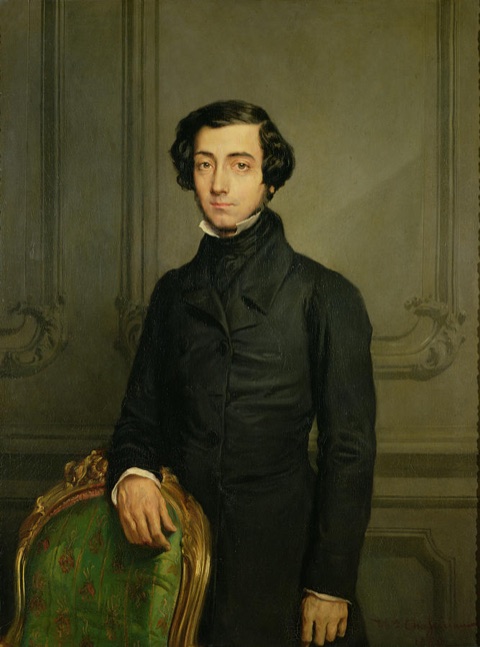
Alexis de Tocqueville (1805-1859), born July 29, 1805 in Paris into a Norman aristocratic family, was the great-grandson of Lamoignon de Malesherbes, who had defended Louis XVI at his trial and was guillotined in 1794. He was educated at the lycée in Metz, studied law in Paris, and in 1827 was appointed juge auditeur at the court of Versailles, where he met Gustave de Beaumont. After the July Revolution of 1830 the two friends secured a government commission to study the American penitentiary system; they sailed for New York in April 1831 and spent nine months traveling roughly seven thousand miles through seventeen states. Volume 1 of De la démocratie en Amérique appeared in January 1835 and Volume 2 in 1840; both were reissued through eight French editions in his lifetime. He was elected to the Académie française in 1841, served in the Chamber of Deputies from 1839 until 1848, and as Foreign Minister under Louis-Napoléon from June to October 1849. After Louis-Napoléon's coup of December 2, 1851 he was briefly imprisoned at Vincennes and withdrew from politics. His last book, The Old Regime and the Revolution, appeared in 1856. He died of tuberculosis in Cannes on April 16, 1859, at the age of forty-three.