Alexander Hamilton
A Founding Father of the United States and its first Secretary of the Treasury, who wrote the majority of The Federalist Papers and built the young republic's financial system. He was killed in an 1804 duel with Vice President Aaron Burr.
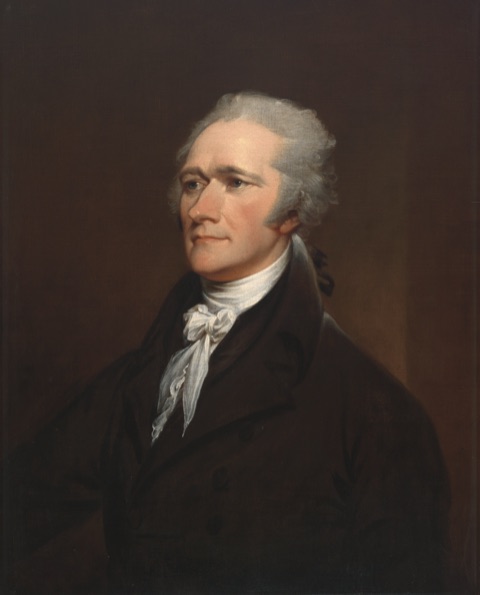
1755–1804
Biography
Alexander Hamilton (1755–1804) was a Founding Father of the United States, a principal author of The Federalist Papers, and the first Secretary of the Treasury. He was born on the island of Nevis in the British West Indies and raised on St. Croix, the illegitimate son of a Scottish trader and a mother of French Huguenot descent. Orphaned in his early teens, he went to work as a clerk for the trading firm of Beekman and Cruger, where he handled cargo manifests, currencies, and correspondence for a Caribbean import-export business.
An essay Hamilton wrote describing a devastating hurricane that struck St. Croix in 1772 circulated among local men who were impressed enough to fund his passage to North America. He arrived in the mainland colonies as a teenager, prepared for college in New Jersey, and enrolled at King's College in New York, now Columbia University. There he began writing political pamphlets defending the colonial cause against Loyalist critics in the years before the Revolution.
When war came, Hamilton raised and captained an artillery company in New York, and in 1777 General George Washington took him on as an aide-de-camp. For most of the war he served at Washington's side, drafting orders and correspondence and handling sensitive negotiations. In December 1780 he married Elizabeth Schuyler, daughter of the New York general and landowner Philip Schuyler, a match that tied him to one of the state's leading families. He returned to field command in time to lead the assault on Redoubt 10 during the Siege of Yorktown in 1781.
After the war Hamilton practiced law in New York, founded the Bank of New York in 1784, and grew convinced that the Articles of Confederation left the national government too weak to govern or pay its debts. He attended the Annapolis Convention of 1786 and the Constitutional Convention in Philadelphia in 1787. To win ratification of the new Constitution in New York, he organized the series of essays published as The Federalist, writing the majority of its eighty-five numbers under the shared pseudonym "Publius" alongside James Madison and John Jay.
In 1789 Washington appointed Hamilton the first Secretary of the Treasury. Over the next six years he produced a sequence of reports to Congress that defined the nation's finances: the Report on Public Credit, which proposed that the federal government assume the states' Revolutionary War debts; the report that led to the chartering of the First Bank of the United States in 1791; and the Report on Manufactures, which argued for tariffs and subsidies to encourage American industry. He established the customs service and the national mint and shaped the machinery for collecting revenue.
Hamilton resigned from the Treasury in 1795 but remained a leader of the Federalist Party and a powerful voice in national politics. His rivalries were as consequential as his alliances. Long conflict with Aaron Burr came to a head in 1804, when the two men met in a duel at Weehawken, New Jersey. Hamilton was shot on the morning of July 11 and died the following day in Manhattan at the age of forty-nine.
Life & Career
Why Hamilton Matters
Hamilton designed the financial architecture of the United States at a moment when the new government had little credit and no reliable revenue. His plan to have the federal government assume the states' war debts, fund them at face value, and service them through a national bank and a customs system converted a bankrupt confederation into a state that creditors would lend to. Much of the apparatus of American public finance, from the mint to the machinery of federal taxation, traces to his years at the Treasury.
His Report on Manufactures set out an argument that recurred throughout American economic history: that a nation should use tariffs, bounties, and public support to build domestic industry rather than remain an exporter of raw materials. This program of active government encouragement of commerce and manufacturing became one pole of a long debate against the agrarian vision associated with Thomas Jefferson, and it informed protectionist and industrial policy for generations.
As a writer, Hamilton contributed the largest share of The Federalist Papers, still among the most cited expositions of the United States Constitution. The essays defend a strong national government, an independent executive, and a judiciary empowered to interpret the law, and courts and scholars continue to read them as evidence of the framers' intentions. His broad reading of federal power under the Constitution shaped a constitutional tradition that persisted well beyond his lifetime.
Hamilton also helped establish the norms of an emerging two-party system and a partisan press, founding the newspaper that became the New York Post. His public career, cut short by the duel with Burr, left a record argued over ever since by those who favor and those who distrust a powerful central government and a close alliance between the state and finance.