Edmund Burke
Anglo-Irish statesman and political thinker whose Reflections on the Revolution in France (1790) argued for tradition, inherited institutions, and gradual reform against the French Revolution. He is commonly named as the founder of modern conservatism.
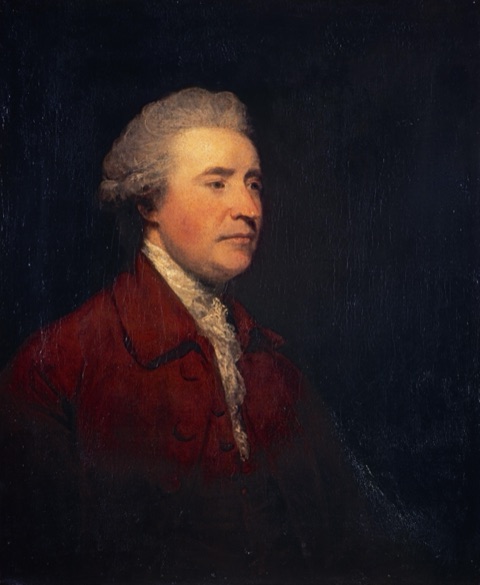
1729–1797
Biography
Edmund Burke (1729 to 1797) was an Anglo-Irish statesman, orator, and political writer who sat in the British House of Commons for nearly thirty years and whose Reflections on the Revolution in France gave later conservative thought much of its vocabulary. He was born in Dublin on 12 January 1729 to a Protestant father, an attorney, and a Catholic mother, and he took his degree at Trinity College Dublin in 1748.
Burke moved to London to study law at the Middle Temple but abandoned it for writing. In 1756 he published A Vindication of Natural Society, a satire on rationalist attacks on established institutions, and in 1757 A Philosophical Enquiry into the Origin of Our Ideas of the Sublime and Beautiful, an aesthetic treatise that drew the attention of readers across Europe. From 1758 he edited the Annual Register, a yearly survey of political and literary events, for many years.
His political career began in 1765, when he became private secretary to the Marquess of Rockingham, leader of a Whig faction, and entered Parliament as member for Wendover. Burke remained closely tied to the Rockingham Whigs and set out their principles in Thoughts on the Cause of the Present Discontents (1770), which defended organized party as a legitimate instrument of government rather than a mere faction.
During the crisis with the American colonies Burke argued against the ministry's course in two of his most studied speeches, On American Taxation (1774) and On Conciliation with the Colonies (1775), urging that Britain govern the colonies by their established liberties rather than by abstract claims of parliamentary right. He was elected member for Bristol in 1774 and told his constituents that a representative owed them his judgment, not merely obedience to their instructions; that stance cost him the seat in 1780, after which he sat for the pocket borough of Malton.
Burke devoted years to the affairs of British India, pressing charges against Warren Hastings, the former governor-general of Bengal, for corruption and misrule. As a manager of the impeachment he opened the case before the House of Lords in 1788; the trial ran until Hastings was acquitted in 1795. Burke also worked for economical reform of the royal household and for the relief of Irish Catholics from the penal laws.
The French Revolution divided Burke from many of his allies. His Reflections on the Revolution in France (1790) predicted that the abolition of the old order would lead to disorder and military dictatorship, and it provoked replies including Thomas Paine's Rights of Man. In 1791 Burke broke publicly with his fellow Whig Charles James Fox over the Revolution and defended his position in An Appeal from the New to the Old Whigs. His last years, marked by the death of his only son Richard in 1794, produced the Letters on a Regicide Peace, which opposed any settlement with revolutionary France. He died at Beaconsfield in Buckinghamshire on 9 July 1797.
Life & Career
Why Burke Matters
Burke is read today less as a systematic philosopher than as the source of a distinct way of thinking about politics. In the Reflections and his speeches he argued that a nation's constitution is an inheritance built up over generations, that established institutions carry practical wisdom that no single reformer can reconstruct from first principles, and that change should proceed by gradual reform rather than by sweeping revolution. These arguments became the founding texts of modern conservatism, and writers from the nineteenth century onward traced the tradition back to him.
His account of political knowledge set him against the rationalism of the Enlightenment radicals. Where they appealed to abstract natural rights and the claims of pure reason, Burke emphasized prescription, prejudice in its older sense of inherited habit, and prudence as the governing virtue of statesmen. This contrast, sharpened by his exchange with Thomas Paine, has structured debates between conservative and progressive thought ever since.
Burke's reputation also rests on his prose and oratory. The speeches on America, the impeachment of Warren Hastings, and the Reflections are landmarks of English political rhetoric, and his phrases have been quoted across the political spectrum. His concern in the Hastings trial with the accountability of imperial officials, and his defense of the American colonists' established liberties, complicate any simple placement of him on a single side of later politics.
Because his practical positions ranged so widely, Burke has been claimed by opposed camps. Nineteenth-century liberals invoked his defense of American and Irish grievances; conservatives invoked his warnings against revolution; and twentieth-century thinkers revived him as a critic of ideological politics. That contested inheritance is itself a measure of how much of the modern political argument runs back through his writing.