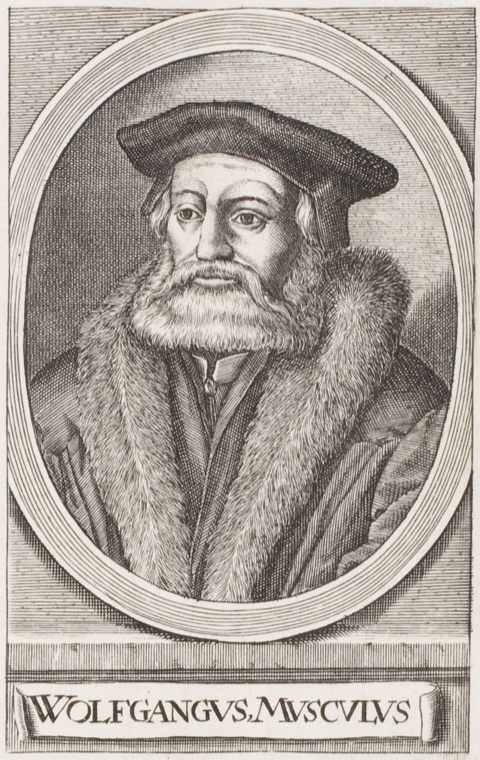
Wolfgang Musculus
A German reformer who led the Reformation in Augsburg for seventeen years and, as professor of theology at Bern, wrote the systematic textbook Loci communes theologiae sacrae (1560). His treatment of the covenant was an early contribution to Reformed federal theology.
1497–1563
Biography
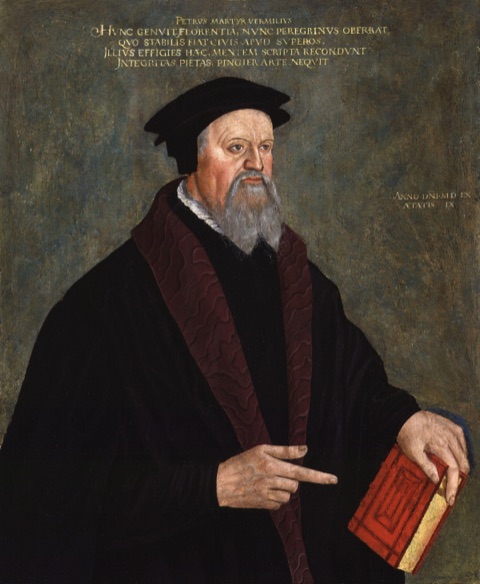
Wolfgang Musculus (1497 to 1563) was a German Reformed theologian and biblical commentator who moved from a Benedictine cloister to the leadership of the Reformation in Augsburg and later held the chair of theology at Bern. Born Wolfgang Müslin in Dieuze, in the duchy of Lorraine, he took the Latinized form of his name — Musculus, "little mouse" — that he used throughout his published work.
He came from a poor family, the son of a cooper, and as a boy earned his keep partly by singing. Around 1512 he entered the Benedictine monastery at Lixheim, in Lorraine, where he learned Latin and rose to preach. His sermons drew on the writings of Martin Luther, and his growing sympathy for reform earned him the nickname "the Lutheran monk." In 1527 he left the monastery, married Margaretha Barth, and made his way to Strasbourg, then a center of the Reformation.
At Strasbourg he supported himself as a weaver before being drawn into church work under Martin Bucer and Wolfgang Capito, the city's leading reformers. In 1531 the city of Augsburg called him to serve as a preacher, and he became the principal architect of its Reformation. For seventeen years he worked to reorganize the city's churches, drafted ordinances, and took part in the inter-confessional discussions of the period, including the negotiations at Wittenberg in 1536 that produced the Wittenberg Concord on the Lord's Supper.
Musculus's tenure at Augsburg ended with the Augsburg Interim of 1548, the settlement imposed by the emperor Charles V after the defeat of the Protestant princes in the Schmalkaldic War. Refusing to conform, he left the city. After a period of uncertainty he was appointed professor of theology at Bern in 1549, a post he held until his death on August 30, 1563.
His years at Bern produced his most influential writing. In 1560 he published the Loci communes theologiae sacrae, a systematic theology arranged as a series of "common places," which was translated into English as the Common Places of Christian Religion and used widely in Reformed circles. He also wrote extensive Latin commentaries on books of Scripture — among them Genesis, the Psalms, Isaiah, Matthew, John, and the letters of Paul — and translated Greek Church Fathers such as Basil the Great and John Chrysostom into Latin. His treatise on usury, distinguishing lawful from unlawful lending among Christians, applied his theology to the commercial questions of a merchant city.
Life & Career
Why Musculus Matters
Musculus matters chiefly for his role in systematizing Reformed theology in the generation after the first reformers. His Loci communes theologiae sacrae was one of the most complete Protestant dogmatic works of the mid-sixteenth century, and its arrangement of doctrine into ordered topics gave later students and pastors a working textbook. Its English translation carried his teaching into the developing Reformed tradition in England.
Within that system, his account of the covenant was an early piece of what became Reformed federal theology. Musculus distinguished between a general covenant that God makes with all people and a special covenant with the elect, giving the idea of the foedus a structured place in dogmatics before it was developed at length by later writers. This makes him one of the bridge figures between the first Reformation and the covenant theology of the seventeenth century.
On the disputed question of the Lord's Supper, Musculus stood on the Reformed rather than the strict Lutheran side, aligning with the position of Bucer and the Swiss churches against a bodily presence in the elements. His refusal to accept the Augsburg Interim in 1548, and his subsequent career at Bern, placed him within the Continental Reformed camp rather than the Lutheran one.
His commentaries and his treatise on usury also mark him as a theologian who worked outward from doctrine into the practical and economic life of the church. By translating the Greek Fathers into Latin, he helped keep patristic sources in circulation among Protestant readers, tying the new movement to the earlier tradition it claimed to recover.