Zacharias Ursinus
Principal author of the Heidelberg Catechism (1563) and its definitive academic commentary — one of the most important catechetical works in Reformed Christianity.
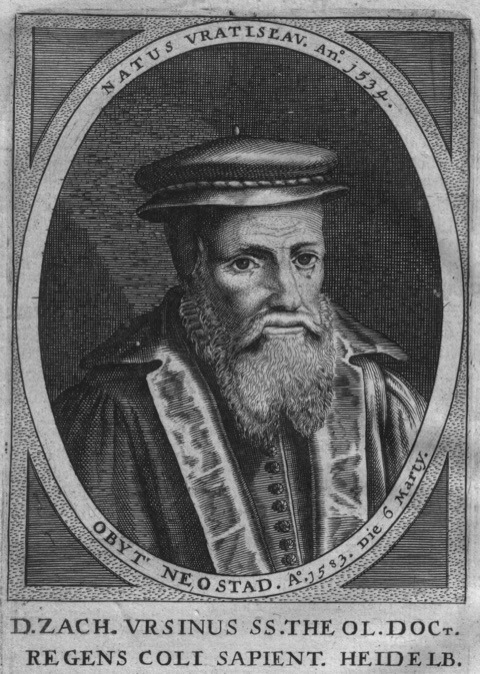
1534–1583
Biography
Zacharias Ursinus was born in Breslau, Silesia (modern Wrocław, Poland) in 1534. A gifted student, he entered the University of Wittenberg at age sixteen and studied under Philip Melanchthon, who became his mentor and lifelong influence. After Melanchthon's death, Ursinus traveled through France, Switzerland, and Italy, studying with leading Reformed theologians including John Calvin and Peter Martyr Vermigli.
In 1561, Elector Frederick III of the Palatinate appointed Ursinus professor of dogmatics at the University of Heidelberg. Frederick commissioned him, along with Caspar Olevianus, to draft a new catechism that could unify the Reformed churches of the Palatinate. The result was the Heidelberg Catechism of 1563, which became one of the most beloved and widely used catechisms in Reformed Christianity. Ursinus is generally recognized as its principal author, responsible for the theological substance and careful structure that made it endure.
Ursinus spent the rest of his career lecturing on the catechism he had written. His detailed commentary, reconstructed from student lecture notes and published posthumously, became the standard academic exposition of the Heidelberg Catechism for centuries. When Frederick III died in 1576 and was succeeded by the Lutheran Ludwig VI, Ursinus was forced to leave Heidelberg. He relocated to the Casimirianum in Neustadt an der Weinstraße, where he continued teaching until his death in 1583 at the age of forty-eight.
Though quiet and scholarly by temperament, Ursinus was one of the most precise and thorough theologians of the Reformation era. His work combined the systematic rigor of Melanchthon's method with the pastoral warmth of the Reformed tradition, producing a body of theological writing that remains a standard reference in Reformed theology.
Life & Career
Why Ursinus Matters
Ursinus occupies a unique position in Reformed theology as both the architect and the interpreter of the Heidelberg Catechism. His commentary on the catechism is not a casual exposition but an exhaustive theological treatise that treats each question as an entry point into the full system of Reformed doctrine. His method was to move from the catechism question to the underlying theological locus, addressing definitions, distinctions, objections, and biblical proofs with a precision that rivaled the best scholastic theology of his era.
What set Ursinus apart was his ability to combine intellectual rigor with pastoral purpose. The Heidelberg Catechism itself is organized around the experience of the believer — moving from human misery, to divine deliverance, to grateful obedience — rather than following the abstract order of a theological system. This pastoral architecture, which Ursinus designed, made the catechism accessible to ordinary Christians while containing enough theological depth to sustain centuries of academic commentary.
Ursinus also played a crucial role in defining the Reformed position on the Lord's Supper, Christology, and the relationship between law and gospel — areas where the Reformed tradition was still working out its distinctive identity in distinction from both Lutheranism and Roman Catholicism. His commentary on these topics became foundational for later Reformed orthodoxy.