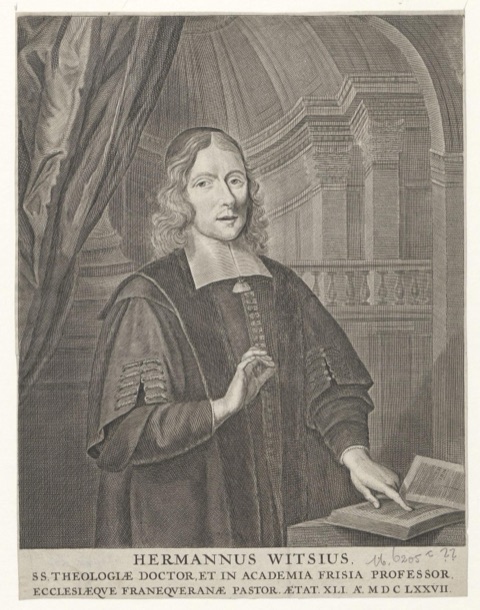
Hermann Witsius
Author of The Economy of the Covenants, the most comprehensive and influential treatment of covenant theology in the Reformed tradition, renowned for its biblical depth and irenic spirit.
1636–1708
Biography
Hermann Witsius was born in Enkhuizen, the Netherlands, in 1636. He showed extraordinary intellectual ability from an early age, entering the University of Utrecht at fifteen and later studying at Groningen and Leiden under some of the leading Reformed theologians of his day, including Gisbertus Voetius and Johannes Hoornbeek.
Witsius served as a pastor in several Dutch congregations before being appointed professor of theology at the University of Franeker in 1675, where he quickly earned a reputation for both learning and piety. He later held professorships at Utrecht (1680) and Leiden (1698), two of the most prestigious theological faculties in Europe. Throughout his academic career, he was known for his irenic spirit and his ability to navigate theological controversies without sacrificing doctrinal precision.
His most important work, The Economy of the Covenants Between God and Man, was first published in 1677 and went through multiple editions during his lifetime. It became the standard treatment of covenant theology in the Reformed tradition, admired for its comprehensive biblical exposition, its careful engagement with opposing views, and its unusual combination of scholarly rigor with pastoral warmth and Christian charity.
Witsius also wrote significant works on the Apostles' Creed, the Lord's Prayer, and other topics in systematic and practical theology. He died in Leiden in 1708, remembered as one of the most learned and peaceable theologians of the Dutch Reformed tradition.
Life & Career
Why Witsius Matters
Witsius's significance lies in his role as a mediating theologian during a period of intense controversy within Dutch Reformed orthodoxy. The late seventeenth century saw bitter disputes over the precise relationship between the covenant of works and the covenant of grace, the nature of the Mosaic economy, and the proper formulation of federal theology. Witsius positioned himself between the contending parties with remarkable skill, affirming the substance of Reformed orthodoxy while charitably engaging with innovative proposals and distinguishing genuine disagreements from mere differences in terminology.
His Economy of the Covenants provided the most systematic and biblically grounded treatment of federal theology available, covering the covenant of works, the covenant of grace, and the various historical administrations of the covenant in exhaustive detail. The work's enduring influence is partly due to its irenic tone: Witsius refused to caricature opposing views and insisted on reading even careless expressions charitably, a practice that earned him respect across theological boundaries.
Witsius also contributed significantly to the development of Reformed piety, consistently connecting doctrinal exposition to the practice of faith and godliness. His work demonstrates that rigorous theological scholarship and warm pastoral concern are not competing interests but natural companions.