Westminster Assembly
The council of divines convened by the English Parliament that produced the Westminster Confession of Faith and the Larger and Shorter Catechisms. These documents became the doctrinal standards of English-speaking Presbyterian and Reformed churches.
1643 to 1649
Biography
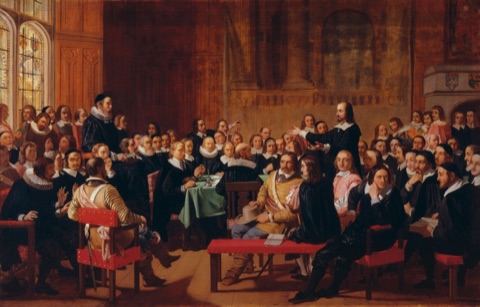
The Westminster Assembly (1643 to 1649) was a council of English clergy and members of Parliament called by the Long Parliament to reform the Church of England along Reformed lines. It first met on 1 July 1643 in the Henry VII Chapel of Westminster Abbey, and later moved its sittings to the Jerusalem Chamber to escape the cold. Parliament had named 121 ministers, or "divines," to the body, together with 30 lay assessors—ten drawn from the House of Lords and twenty from the House of Commons—who represented the civil authority that had summoned it.
The Assembly convened during the First English Civil War, and its early work was shaped by Parliament's alliance with Scotland. In September 1643 Parliament and the Assembly subscribed the Solemn League and Covenant, a treaty that committed England to reform its church in agreement with Scotland's Presbyterian model. Five Scottish commissioners—among them Alexander Henderson, Samuel Rutherford, and George Gillespie—sat with the Assembly and, though they had no formal vote, argued forcefully in its debates. Their presence pushed the body toward a Presbyterian church government based on ruling elders and graded courts of assembly.
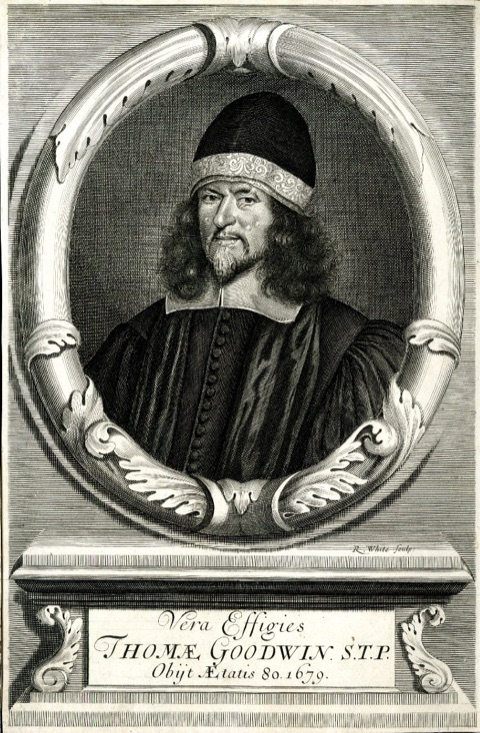
Not every member agreed. A small group known as the Dissenting Brethren, led by Thomas Goodwin and Philip Nye, defended a congregational or Independent polity in which each local church governed itself. Others, including the lawyer John Selden, pressed an Erastian view that placed the final power of church discipline in the civil magistrate rather than in church courts. The debates over church government and the right to excommunicate ran for years and were never fully resolved to Parliament's satisfaction.
The Assembly's lasting achievements were its written standards. In 1645 it completed the Directory for Public Worship, which Parliament substituted for the Book of Common Prayer. It then drafted the Westminster Confession of Faith, presented to Parliament in December 1646 and supplied with scripture proofs the following year, along with the Larger Catechism and the Shorter Catechism, both finished in 1647. The Shorter Catechism, written for instructing children and new believers, opens with the question "What is the chief end of man?" and answers that man's chief end "is to glorify God, and to enjoy him forever."
England's political fortunes overtook the work. The Church of Scotland's General Assembly adopted the Confession in 1647, and the English Parliament approved a version of it in 1648, though it omitted the chapters that gave church synods independent authority. After its last numbered session in 1649 the Assembly continued for a few years only as a committee for examining candidates for the ministry before it faded from public life. In England the standards were set aside at the Restoration of the monarchy in 1660, but in Scotland, Ireland, and later across North America and beyond they became the confessional foundation of Presbyterian and much of Reformed Christianity.
Life & Career
Why Assembly Matters
The Westminster standards gave English-speaking Reformed Christianity its most influential statement of doctrine. The Confession of Faith set out a full system of Calvinist theology—covering Scripture, God's decrees, the covenant of grace, justification, the church, and the sacraments—in careful, tightly worded chapters. For churches in the Presbyterian tradition it became the subordinate standard, the summary of biblical teaching that ministers and elders subscribe, second only to the Bible itself.
The Assembly's two catechisms carried this theology into the pew and the schoolroom. The Larger Catechism served as a fuller guide for preaching and self-examination, while the Shorter Catechism condensed the same doctrine into short questions and answers that generations of children memorized. Through these texts the Assembly's definitions of sin, grace, and the Ten Commandments reached far more people than its formal debates ever could.
The Assembly also settled, for its heirs, the shape of Presbyterian worship and government. The Directory for Public Worship replaced fixed liturgy with guidance for prayer, preaching, and the sacraments, and the Form of Presbyterian Church Government described a system of sessions, presbyteries, and synods. When Presbyterian churches organized in Scotland, Ireland, the American colonies, and later around the world, they took these documents as their pattern.
Its influence outlasted the political cause that produced it. Though the Church of England abandoned the Westminster program after 1660, the Confession and catechisms remained binding standards for Scottish and Irish Presbyterians and were carried across the Atlantic, where they still function as doctrinal touchstones for many Presbyterian and Reformed bodies today.