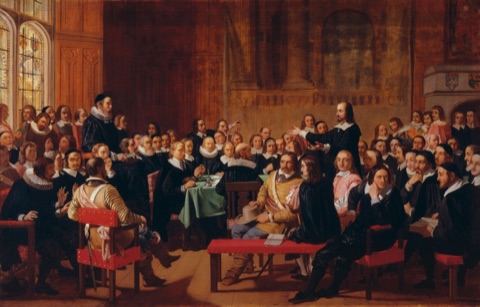
The most influential statement of Reformed Christian belief. Written by 151 theologians during England's Civil War, it systematically explains what Presbyterians and Reformed churches believe.
A free account opens the whole library to read online, on your phone or at your desk. Open a book on one device and it is waiting at the same page on the next. The PDF and EPUB of every book are yours to keep, and audiobooks play in the same app.
250+ modernized editionsNot samples. The whole work, free.
Your place, on every devicePhone, tablet or desktop, same page.
131 audiobooksFrom $4.99 each, or all of them with a $50 gift.
33 chapters · about 16,000 words · 74 pages in print
The Westminster Confession of Faith is a 33-chapter statement of Reformed Christian doctrine drafted by the Westminster Assembly between 1643 and 1646. It moves in order from Scripture and the nature of God through creation, the fall, Christ, salvation, the church and the sacraments, to the last judgment.
How the argument unfolds
01
Scripture first. Nature leaves people "without excuse," yet does "not provide the knowledge of God and his will necessary for salvation." So God put it in writing.
02
God and His decrees. There is only one "living and true God," who "freely and unchangeably ordained everything that comes to pass," yet "is neither the author of sin" nor a coercer of creatures' wills.
03
Creation and the fall. God made the world in six days and it was all very good; our first parents "sinned by eating the forbidden fruit," and the guilt of that sin "was imputed to all their descendants."
04
Christ the mediator. God "was pleased... to choose and ordain the Lord Jesus, his only begotten Son, to be the Mediator," in whom two natures are "inseparably joined together in one Person, without conversion, composition, or confusion."
05
Salvation applied. Effectual calling, justification, adoption, sanctification, and perseverance follow — justification by "pardoning their sins and accounting and accepting them as righteous, rather than by infusing righteousness into them."
06
The church and the sacraments. Chapters on law, liberty, worship, and government lead to the Church and two sacraments: "holy signs and seals of the covenant of grace."
07
Last things. The closing chapters treat the soul after death, the resurrection of the body, and the day God "will judge the world in righteousness through Jesus Christ."
Key themes
Scripture as the final authority. The supreme judge of all religious controversies is "the Holy Spirit speaking in Scripture," above councils, ancient writers, and private spirits.
God's eternal decree. Everything that happens is fixed by God's plan, while "the liberty or contingency of second causes is not taken away, but rather established."
The covenant framework. Two covenants organize the whole: a covenant of works in which life was promised to Adam and his descendants, and, after the fall, the covenant of grace, in which God "freely offers sinners life and salvation."
The church and its ordinances. The invisible Church "consists of the whole number of the elect" gathered "into one under Christ, its head"; the visible Church holds the ministry, Word, and sacraments.
Free audiobook preview
Listen to the first 9 minutes
Westminster Confession of Faith · Audiobook · 1 hr 31 min
0:00 / 9:15
Enjoying it? The full audiobook runs 1 hr 31 min. Listen in the Updated Works app on any device.
1. Although the light of nature and the works of creation and providence reveal God’s goodness, wisdom, and power sufficiently to leave people without excuse (Rom 2:14, 15; Rom 1:19, 20; Ps 19:1, 2, 3; Rom 1:32, compared with Rom 2:1), they do not provide the knowledge of God and his will necessary for salvation (1 Cor 1:21; 1 Cor 2:13, 14). Therefore, the Lord was pleased, at various times and in various ways, to reveal himself and declare his will to his church (Heb 1:1).
Afterward, he was pleased to commit this revelation entirely to writing, to better preserve and spread the truth, and to establish and comfort the church more securely against the corruption of the flesh and the malice of Satan and the world (Prov 22:19, 20, 21; Luke 1:3, 4; Rom 15:4; Matt 4:4, 7, 10; Isa 8:19, 20). This makes Holy Scripture most necessary (2 Tim 3:15; 2 Pet 1:19), since those former ways of God’s revealing his will to his people have now ceased (Heb 1:1, 2).
2. The name Holy Scripture, or the written Word of God, now includes all the books of the Old and New Testaments. They are these:
Old Testament:
Genesis Exodus Leviticus Numbers Deuteronomy Joshua Judges Ruth 1 Samuel 2 Samuel 1 Kings 2 Kings 1 Chronicles 2 Chronicles Ezra Nehemiah Esther Job Psalms Proverbs Ecclesiastes Song of Songs Isaiah Jeremiah Lamentations Ezekiel Daniel Hosea Joel Amos Obadiah Jonah Micah Nahum Habakkuk Zephaniah Haggai Zechariah Malachi
New Testament:
Matthew Mark Luke John The Acts of the Apostles Paul’s letter to the Romans 1 Corinthians 2 Corinthians Galatians Ephesians Philippians Colossians 1 Thessalonians 2 Thessalonians 1 Timothy 2 Timothy Titus Philemon The letter to the Hebrews The letter of James 1 and 2 Peter 1, 2, and 3 John The letter of Jude Revelation
All these books are given by inspiration of God to be the rule of faith and life (Luke 16:29, 31; Eph 2:20; Rev 22:18, 19; 2 Tim 3:16).
3. The books commonly called the Apocrypha are not divinely inspired and are no part of the canon of Scripture. Therefore, they have no authority in the church of God and are to be accepted or used only as other human writings are (Luke 24:27, 44; Rom 3:2; 2 Pet 1:21).
4. The authority of Holy Scripture, on account of which it ought to be believed and obeyed, does not depend on the testimony of any person or church. It depends wholly on God, its author, who is truth itself. Therefore, Scripture is to be received because it is the Word of God (2 Pet 1:19, 21; 2 Tim 3:16; 1 John 5:9; 1 Thess 2:13).
5. The testimony of the church may move and persuade us to hold Holy Scripture in high and reverent esteem (1 Tim 3:15). Its heavenly subject matter, the effectiveness of its doctrine, the majesty of its style, the agreement of all its parts, and the purpose of the whole, which is to give all glory to God, abundantly show it to be the Word of God. So do its full disclosure of the only way of human salvation, its many other incomparable excellences, and its entire perfection. Nevertheless, our full conviction and assurance of its infallible truth and divine authority come from the inward work of the Holy Spirit, bearing witness in our hearts by and with the Word (1 John 2:20, 27; John 16:13, 14; 1 Cor 2:10, 11, 12; Isa 59:21).
6. The whole counsel of God concerning everything necessary for his own glory and for human salvation, faith, and life is either expressly stated in Scripture or may be deduced from Scripture by good and necessary consequence. Nothing is ever to be added to it, whether by new revelations of the Spirit or by human traditions (2 Tim 3:15, 16, 17; Gal 1:8, 9; 2 Thess 2:2). Nevertheless, we acknowledge that the inward illumination of the Spirit of God is necessary for a saving understanding of the things revealed in the Word (John 6:45; 1 Cor 2:9, 10, 12).
We also acknowledge that some circumstances concerning the worship of God and the government of the church are common to human actions and societies. These are to be ordered by the light of nature and Christian prudence, according to the general rules of the Word, which must always be observed (1 Cor 11:13, 14; 1 Cor 14:26, 40).
7. Not everything in Scripture is equally plain in itself or equally clear to everyone (2 Pet 3:16). Yet the things that must be known, believed, and observed for salvation are presented and explained so clearly in one place of Scripture or another that both the learned and the unlearned, through proper use of the ordinary means, may gain a sufficient understanding of them (Ps 119:105, 130).
8. The Old Testament in Hebrew, the native language of God’s people in ancient times, and the New Testament in Greek, the language most widely known among the nations when it was written, were directly inspired by God. By his special care and providence, they have been kept pure in all ages and are therefore authoritative (Matt 5:18). In all religious controversies, the church must ultimately appeal to them (Isa 8:20; Acts 15:15; John 5:39, 46).
But these original languages are not known to all God’s people, who have a right to and an interest in the Scriptures, and who are commanded to read and search them in the fear of God (John 5:39). Therefore, the Scriptures are to be translated into the common language of every nation to which they come (1 Cor 14:6, 9, 11, 12, 24, 27, 28). In this way, with the Word of God dwelling abundantly in all, they may worship him acceptably (Col 3:16) and, through the patience and comfort of the Scriptures, have hope (Rom 15:4).
9. The infallible rule for interpreting Scripture is Scripture itself. Therefore, when there is a question about the true and full meaning of any passage of Scripture, which has one meaning rather than many, that meaning must be sought and understood through other passages that speak more clearly (2 Pet 1:20, 21; Acts 15:15, 16).
10. The supreme judge by whom all religious controversies are to be decided, and all decrees of councils, opinions of ancient writers, human doctrines, and private spirits are to be examined, can be no other than the Holy Spirit speaking in Scripture. We are to rest in his judgment (Matt 22:29, 31; Eph 2:20, compared with Acts 28:25).
2. God and the Holy Trinity
1. There is only one (Deut 6:4; 1 Cor 8:4, 6) living and true God (1 Thess 1:9; Jer 10:10). He is infinite in being and perfection (Job 11:7-9; Job 26:14), a most pure spirit (John 4:24), invisible (1 Tim 1:17), without body or parts (Deut 4:5, 16; John 4:24 with Luke 24:39), or passions (Acts 14:11, 15). He is unchangeable (Jas 1:17; Mal 3:6), unlimited by space (1 Kgs 8:27; Jer 23:23-24), eternal (Ps 90:2; 1 Tim 1:17), incomprehensible (Ps 145:3), almighty (Gen 17:1; Rev 4:8), most wise (Rom 16:27), most holy (Isa 6:3; Rev 4:8), most free (Ps 115:3), and most absolute (Exod 3:14). He works all things according to the counsel of his own unchangeable and most righteous will (Eph 1:11), for his own glory (Prov 16:14; Rom 11:36). He is most loving (1 John 4:8, 16), gracious, merciful, patient, abundant in goodness and truth, forgiving iniquity, transgression, and sin (Exod 34:6-7). He rewards those who diligently seek him (Heb 11:6). At the same time, he is most just and fearsome in his judgments (Neh 9:32-33), hates all sin (Ps 5:5-6), and will by no means clear the guilty (Nah 1:2-3; Exod 34:7).
2. God has all life (John 5:26), glory (Acts 7:2), goodness (Ps 119:68), and blessedness (1 Tim 6:15; Rom 9:5) in and of himself. He alone is all-sufficient in and for himself, needing none of the creatures he has made (Acts 17:24-25) and deriving no glory from them (Job 22:2-3). He only manifests his own glory in, through, to, and upon them. He is the sole fountain of all being; all things are from him, through him, and to him (Rom 11:36). He has supreme dominion over them, to do through them, for them, or upon them whatever he pleases (Rev 4:11; 1 Tim 6:15; Dan 4:25, 35).
All things are open and manifest in his sight (Heb 4:13). His knowledge is infinite, infallible, and independent of the creature (Rom 11:33-34; Ps 147:5), so that nothing is contingent or uncertain to him (Acts 15:18; Ezek 11:5). He is most holy in all his counsels, all his works, and all his commands (Ps 145:17; Rom 7:12). Angels, human beings, and every other creature owe him whatever worship, service, or obedience he is pleased to require of them (Rev 5:12-14).
3. In the unity of the Godhead there are three persons, of one substance, power, and eternity: God the Father, God the Son, and God the Holy Spirit (1 John 5:7; Mark 3:16-17; Matt 28:19; 2 Cor 13:14). The Father is from no one, neither begotten nor proceeding. The Son is eternally begotten of the Father (John 1:14, 18). The Holy Spirit eternally proceeds from the Father and the Son (John 15:26; Gal 4:6).
3. God’s Eternal Decree
1. From all eternity, God freely and unchangeably ordained everything that comes to pass, by the most wise and holy counsel of his own will (Eph 1:11; Rom 11:33; Heb 6:17; Rom 9:15, 18). Yet he did so in such a way that God is neither the author of sin (Jas 1:13, 17; 1 John 1:5), nor is the will of creatures coerced. The liberty or contingency of second causes is not taken away, but rather established (Acts 2:23; Matt 17:12; Acts 4:27-28; Job 19:11; Prov 16:33).
2. Although God knows everything that may or can come to pass under every supposed condition (Acts 15:18; 1 Sam 23:11-12; Matt 11:21, 23), he has not decreed anything because he foresaw it as future, or as something that would come to pass under such conditions (Rom 9:11, 13, 16, 18).
3. By God’s decree, to manifest his glory, some human beings and angels (1 Tim 5:21; Matt 25:41) are predestined to everlasting life, and others are foreordained to everlasting death (Rom 9:22-23; Eph 1:5-6; Prov 16:4).
4. These angels and human beings, thus predestined and foreordained, are individually and unchangeably designated. Their number is so certain and definite that it cannot be either increased or diminished (2 Tim 2:19; John 13:18).
5. Before the foundation of the world was laid, God chose in Christ those human beings who are predestined to life, choosing them for everlasting glory according to his eternal and unchangeable purpose and the secret counsel and good pleasure of his will (Eph 1:4, 9, 11; Rom 8:30; 2 Tim 1:9; 1 Thess 5:9). He did this solely out of his free grace and love, without any foresight of faith, good works, perseverance in either, or anything else in the creature as conditions or causes moving him to do so (Rom 9:11, 13, 16; Eph 1:4, 9). All this is to the praise of his glorious grace (Eph 1:6, 12).
6. As God has appointed the elect to glory, so, by the eternal and most free purpose of his will, he has foreordained all the means to that end (1 Pet 1:2; Eph 1:4-5; Eph 2:10; 2 Thess 2:13). Therefore, those who are elected, having fallen in Adam, are redeemed by Christ (1 Thess 5:9-10; Titus 2:14). They are effectually called to faith in Christ by his Spirit working at the appointed time, and are justified, adopted, and sanctified (Rom 8:30; Eph 1:5; 2 Thess 2:13). They are kept by his power through faith for salvation (1 Pet 1:5). No others are redeemed by Christ, effectually called, justified, adopted, sanctified, and saved, but only the elect (John 17:9; Rom 8:28 to the end; John 6:64-65; John 10:26; John 8:47; 1 John 2:19).
7. God was pleased to pass over the rest of humanity and to ordain them to dishonor and wrath for their sin, to the praise of his glorious justice (Matt 11:25-26; Rom 9:17-18, 21-22; 2 Tim 2:19-20; Jude 4; 1 Pet 2:8). He did this according to the unsearchable counsel of his own will, by which he extends or withholds mercy as he pleases, for the glory of his sovereign power over his creatures.
8. The doctrine of this high mystery of predestination is to be handled with special prudence and care (Rom 9:20; Rom 11:33; Deut 29:29). In this way, people who attend to God’s will revealed in his Word and obey it may, from the certainty of their effectual calling, be assured of their eternal election (2 Pet 1:10). Thus this doctrine will give grounds for praise, reverence, and admiration of God (Eph 1:6; Rom 11:33), and for humility, diligence, and abundant comfort to all who sincerely obey the gospel (Rom 11:5-6, 20; 2 Pet 1:10; Rom 8:33; Luke 10:20).
4. Creation
1. God the Father, Son, and Holy Spirit (Heb 1:2; John 1:2-3; Gen 1:2; Job 26:13; Job 33:4) was pleased, to manifest the glory of his eternal power, wisdom, and goodness (Rom 1:20; Jer 10:12; Ps 104:24; Ps 33:5-6), to create, or make out of nothing, the world and everything in it at the beginning. This included all things, visible or invisible, made in the space of six days, and all very good (Gen 1; Heb 11:3; Col 1:16; Acts 17:24).
2. After God had made all other creatures, he created human beings, male and female (Gen 1:27), with rational and immortal souls (Gen 2:7 with Eccl 12:7; Luke 23:43; Matt 10:28). They were endowed with knowledge, righteousness, and true holiness, in his own image (Gen 1:26; Col 3:10; Eph 4:24). They had God’s law written in their hearts (Rom 2:14-15) and the power to fulfill it (Eccl 7:29). Yet they could transgress, being left to the liberty of their own will, which was subject to change (Gen 3:6; Eccl 7:29). Besides this law written in their hearts, they received a command not to eat from the tree of the knowledge of good and evil. As long as they kept this command, they were happy in their communion with God (Gen 2:27; Gen 3:8-11, 23) and had dominion over the creatures (Gen 1:26, 28).
5. Providence
1. God, the great Creator of all things, upholds (Heb 1:3), directs, orders, and governs all creatures, actions, and things (Dan 4:34, 35; Ps 135:6; Acts 17:25, 26, 28; Job 38, 39, 40, 41), from the greatest to the least (Matt 10:29, 30, 31), by his most wise and holy providence (Prov 15:3; Ps 104:24; Ps 145:17). He does this according to his infallible foreknowledge (Acts 15:18; Ps 94:8, 9, 10, 11) and the free and unchangeable counsel of his own will (Eph 1:11; Ps 33:10, 11), to the praise of the glory of his wisdom, power, justice, goodness, and mercy (Isa 63:14; Eph 3:10; Rom 9:17; Gen 45:7; Ps 145:7).
2. In relation to the foreknowledge and decree of God, the first cause, all things happen unchangeably and infallibly (Acts 2:23). Yet by the same providence, he orders them to occur according to the nature of second causes, either necessarily, freely, or contingently (Gen 8:22; Jer 31:35; Exod 21:13 with Deut 19:5; 1 Kgs 22:28, 34; Isa 10:6, 7).
3. In his ordinary providence, God uses means (Acts 27:31, 44; Isa 55:12, 11; Hos 2:21, 22). Yet he is free to work without them (Hos 1:7; Matt 4:4; Job 34:10), above them (Rom 4:19, 20, 21), and against them, as he pleases (2 Kgs 6:6; Dan 3:27).
4. God’s almighty power, unsearchable wisdom, and infinite goodness are so fully displayed in his providence that it extends even to the first fall and all other sins of angels and human beings (Rom 11:32, 33, 34; 2 Sam 24:1 with 1 Chr 21:1; 1 Kgs 22:22, 23; 1 Chr 10:4, 13, 14; 2 Sam 16:10; Acts 2:23; Acts 4:27, 28). This is not mere permission (Acts 14:16). His permission is joined with a most wise and powerful restraint (Ps 76:10; 2 Kgs 19:28), and with his otherwise ordering and governing these sins in various ways for his own holy purposes (Gen 50:20; Isa 10:6, 7, 12). Yet their sinfulness comes only from the creature, and not from God. Being most holy and righteous, he neither is nor can be the author or approver of sin (Jas 1:13, 14, 17; 1 John 2:16; Ps 50:21).
5. The most wise, righteous, and gracious God often leaves his own children for a time to various temptations and the corruption of their own hearts. He does this to discipline them for their former sins, or to reveal to them the hidden strength of their corruption and the deceitfulness of their hearts, so that they may be humbled (2 Chr 32:25, 26, 31; 2 Sam 24:1). He also does this to bring them into closer and more constant dependence on himself for support, to make them more watchful against every future occasion of sin, and for various other just and holy purposes (2 Cor 12:7, 8, 9; Ps 73 throughout; Ps 77:1, 10, 12; Mark 14:66 to the end, with John 21:15, 16, 17).
6. As for those wicked and ungodly people whom God, as a righteous judge, blinds and hardens because of their former sins (Rom 1:24, 26, 28; Rom 11:7, 8), he not only withholds his grace, by which they might have been enlightened in their understandings and acted upon in their hearts (Deut 29:4). Sometimes he also withdraws the gifts they had (Matt 13:12; Matt 25:29) and exposes them to things that their corruption turns into occasions of sin (Deut 2:30; 2 Kgs 8:12, 13). He also gives them over to their own lusts, the temptations of the world, and the power of Satan (Ps 81:11, 12; 2 Thess 2:10, 11, 12). As a result, they harden themselves even under the means God uses to soften others (Exod 7:3 with Exod 8:15, 32; 2 Cor 2:15, 16; Isa 8:14; 1 Pet 2:7, 8; Isa 6:9, 10 with Acts 28:26, 27).
7. God’s providence extends to all creatures in general. In a most special way, however, it cares for his church and orders all things for its good (1 Tim 4:10; Amos 9:8, 9; Rom 8:28; Isa 43:3, 4, 5, 14).
6. Humanity’s Fall, Sin, and Punishment
1. Our first parents, deceived by Satan’s cunning and temptation, sinned by eating the forbidden fruit (Gen 3:13; 2 Cor 11:3). God was pleased, according to his wise and holy counsel, to permit this sin, having purposed to order it for his own glory (Rom 11:32).
2. By this sin, they fell from their original righteousness and communion with God (Gen 3:6, 7, 8; Eccl 7:29; Rom 3:23). They therefore became dead in sin (Gen 2:17; Eph 2:1) and wholly defiled in all the faculties and parts of soul and body (Titus 1:15; Gen 6:5; Jer 17:9; Rom 3:10-19).
3. Because they were the root of all humanity, the guilt of this sin was imputed to all their descendants born from them by ordinary generation (Gen 1:27, 28; Gen 2:16, 17; Acts 17:13 with Rom 5:12, 15, 16, 17, 18, 19; 1 Cor 15:21, 22, 45). The same death in sin and corrupted nature were also passed on to those descendants (Ps 51:5; Gen 5:3; Job 14:4; Job 15:14).
4. This original corruption makes us utterly unwilling and unable to do any good, and opposed to all good (Rom 5:6; Rom 8:7; Rom 7:18; Col 1:21), and wholly inclined to all evil (Gen 6:5; Gen 8:21; Rom 3:10, 11, 12). All actual transgressions proceed from this corruption (Jas 1:14, 15; Eph 2:2, 3; Matt 15:19).
5. This corruption of nature remains throughout this life in those who are regenerated (1 John 1:8, 10; Rom 7:14, 17, 18, 23; Jas 3:2; Prov 20:9; Eccl 7:20). Although it is pardoned and put to death through Christ, both the corruption itself and all its impulses are truly and properly sin (Rom 7:5, 7, 25; Gal 5:17).
6. Every sin, both original and actual, is a transgression of God’s righteous law and contrary to it (1 John 3:4). By its very nature, it brings guilt upon the sinner (Rom 2:15; Rom 3:9, 19), making the sinner liable to God’s wrath (Eph 2:3) and the curse of the law (Gal 3:10). The sinner is therefore subject to death (Rom 6:23), together with all spiritual (Eph 4:18), temporal (Rom 8:20; Lam 3:39), and eternal miseries (Matt 25:41; 2 Thess 1:9).
7. God’s Covenant with Humanity
1. The distance between God and the creature is so great that, although rational creatures owe him obedience as their Creator, they could never enjoy him as their blessedness and reward without some voluntary condescension on God’s part. He has been pleased to express this condescension through a covenant (Isa 40:13, 14, 15, 16, 17; Job 9:32, 33; 1 Sam 2:25; Ps 113:5, 6; Ps 100:2, 3; Job 22:2, 3; Job 35:7, 8; Luke 17:10; Acts 17:24, 25).
2. The first covenant made with humanity was a covenant of works (Gal 3:12). In it, life was promised to Adam, and in him to his descendants (Rom 10:5; Rom 5:12-20), on the condition of perfect and personal obedience (Gen 2:17; Gal 3:10).
3. By the fall, humanity made itself incapable of obtaining life through that covenant. The Lord was therefore pleased to make a second covenant (Gal 3:21; Rom 8:3; Rom 3:20, 21; Gen 3:15; Isa 42:6), commonly called the covenant of grace. In it, he freely offers sinners life and salvation through Jesus Christ, requiring faith in him so that they may be saved (Mark 16:15, 16; John 3:16; Rom 10:6, 9; Gal 3:11). He also promises to give his Holy Spirit to all those ordained to life, making them willing and able to believe (Ezek 36:26, 27; John 6:44, 45).
4. Scripture frequently presents this covenant of grace as a testament, in reference to the death of Jesus Christ, the testator, and to the everlasting inheritance, together with everything belonging to it, bequeathed in that testament (Heb 9:15, 16, 17; Heb 7:22; Luke 22:20; 1 Cor 11:25).
5. This covenant was administered differently in the time of the law and in the time of the gospel (2 Cor 3:6, 7, 8, 9). Under the law, it was administered through promises, prophecies, sacrifices, circumcision, the Passover lamb, and other types and ordinances given to the Jewish people, all pointing beforehand to Christ’s coming (Heb 8, 9, 10; Rom 4:11; Col 2:11, 12; 1 Cor 5:7). Through the work of the Spirit, these were sufficient and effective for that time to instruct and build up the elect in faith in the promised Messiah (1 Cor 10:1, 2, 3, 4; Heb 11:13; John 8:56). Through him they had full forgiveness of sins and eternal salvation. The covenant under this administration is called the Old Testament (Gal 3:7, 8, 9, 14).
6. Under the gospel, when Christ, the substance, was made manifest (Gal 3:17), the ordinances through which this covenant is administered are the preaching of the Word and the administration of the sacraments of baptism and the Lord’s Supper (Matt 28:19, 20; 1 Cor 11:23, 24, 25). These ordinances are fewer in number and are administered with greater simplicity and less outward glory. Yet through them the covenant is presented with greater fullness, clarity, and spiritual effectiveness (Heb 12:22-28) to all nations, both Jews and Gentiles (Matt 28:19; Eph 2:15, 16, 17, 18, 19). It is called the New Testament (Jer 31:33, 34; Luke 22:20). There are therefore not two covenants of grace differing in substance, but one and the same covenant under various dispensations (Gal 3:14, 16; Rom 3:21, 22, 23, 30; Ps 32:1 with Rom 4:3, 6, 16, 17, 23, 24; Heb 13:8; Acts 15:11).
8. Christ the Mediator
1. God was pleased, in his eternal purpose, to choose and ordain the Lord Jesus, his only begotten Son, to be the Mediator between God and humanity (Isa 42:1; 1 Pet 1:19, 20; John 3:16; 2 Tim 2:5); the Prophet (Acts 3:22), Priest (Heb 5:5, 6), and King (Ps 2:6; Luke 1:33); the Head and Savior of his church (Eph 5:23); the Heir of all things (Heb 1:2); and the Judge of the world (Acts 17:31). From all eternity, God gave him a people to be his offspring (John 17:6; Ps 22:30; Isa 53:10), and to be redeemed, called, justified, sanctified, and glorified by him in time (1 Tim 2:6; Isa 55:4, 5; 1 Cor 1:30).
2. The Son of God, the second Person of the Trinity, is truly and eternally God, of one substance with the Father and equal to him. When the fullness of time came, he took upon himself human nature (John 1:1, 14; 1 John 5:20; Phil 2:6; Gal 4:4), with all its essential properties and common weaknesses, yet without sin (Heb 2:14, 16, 17; Heb 4:15). He was conceived by the power of the Holy Spirit in the womb of the Virgin Mary, from her substance (Luke 1:27, 31, 35; Gal 4:4). Thus, two whole, perfect, and distinct natures, the divine and the human, were inseparably joined together in one Person, without conversion, composition, or confusion (Luke 1:35; Col 2:9; Rom 9:5; 1 Pet 3:1; 1 Tim 3:16). This Person is truly God and truly human, yet one Christ, the only Mediator between God and humanity (Rom 1:3, 4; 1 Tim 2:5).
3. The Lord Jesus, in his human nature thus united to the divine, was sanctified and anointed with the Holy Spirit beyond measure (Ps 45:7; John 3:34). He had in himself all the treasures of wisdom and knowledge (Col 2:3), and the Father was pleased that all fullness should dwell in him (Col 1:19). The purpose was that, being holy, innocent, undefiled, and full of grace and truth (Heb 7:26; John 1:14), he might be thoroughly equipped to carry out the office of Mediator and surety (Acts 10:38; Heb 12:24; Heb 7:22). He did not take this office upon himself, but was called to it by his Father (Heb 5:4, 5). His Father placed all power and judgment in his hands and commanded him to exercise them (John 5:22, 27; Matt 28:18; Acts 2:36).
4. The Lord Jesus undertook this office most willingly (Ps 40:7, 8, compared with Heb 10:5-11; John 10:18; Phil 2:8). To carry it out, he was placed under the law (Gal 4:4) and fulfilled it perfectly (Matt 3:15; Matt 5:17). He endured the most grievous torments directly in his soul (Matt 26:37, 38; Luke 22:44; Matt 27:46) and the most painful sufferings in his body (Matt 26, 27). He was crucified and died (Phil 2:8). He was buried and remained under the power of death, yet his body did not decay (Acts 2:23, 24, 27; Acts 13:37; Rom 6:9). On the third day he rose from the dead (1 Cor 15:3, 4), with the same body in which he had suffered (John 20:25, 27). With that body he also ascended into heaven, where he sits at his Father’s right hand (Mark 16:19), making intercession (Rom 8:34; Heb 9:24; Heb 7:25). He will return to judge human beings and angels at the end of the world (Rom 14:9, 10; Acts 1:11; Acts 10:42; Matt 13:40, 41, 42; Jude 6; 2 Pet 2:4).
5. By his perfect obedience and the sacrifice of himself, which he offered once to God through the eternal Spirit, the Lord Jesus has fully satisfied his Father’s justice (Rom 5:19; Heb 9:14, 16; Heb 10:14; Eph 5:2; Rom 3:25, 26). He has purchased not only reconciliation but also an everlasting inheritance in the kingdom of heaven for all those whom the Father has given him (Dan 9:24, 25; Col 1:19, 20; Eph 1:11, 14; John 17:2; Heb 9:12, 15).
6. Although Christ did not actually accomplish the work of redemption until after his incarnation, its power, effectiveness, and benefits were imparted to the elect in every successive age from the beginning of the world. This was done in and through the promises, types, and sacrifices in which he was revealed and represented as the woman’s offspring who would bruise the serpent’s head, and as the Lamb slain from the beginning of the world. He is the same yesterday, today, and forever (Gal 4:4, 5; Gen 3:15; Rev 13:8; Heb 13:8).
7. In the work of mediation, Christ acts according to both natures, doing through each nature what is proper to that nature (Heb 9:14; 1 Pet 3:18). Yet, because of the unity of his Person, Scripture sometimes attributes what is proper to one nature to the Person named according to the other nature (Acts 20:28; John 3:13; 1 John 3:16).
8. Christ certainly and effectively applies and imparts redemption to all those for whom he has purchased it (John 5:37, 39; John 10:15, 16). He makes intercession for them (1 John 2:1, 2; Rom 8:34) and reveals to them, in and through the Word, the mysteries of salvation (John 15:13, 15; Eph 1:7, 8, 9; John 17:6). By his Spirit he effectively persuades them to believe and obey, and he governs their hearts by his Word and Spirit (John 14:16; Heb 12:2; 2 Cor 4:13; Rom 8:9, 14; Rom 15:18, 19; John 17:17). He overcomes all their enemies by his almighty power and wisdom, in the manner and ways most consistent with his wonderful and unsearchable ordering of all things (Ps 110:1; 1 Cor 15:25, 26; Mal 4:2, 3; Col 2:15).
Questions
What is the Westminster Confession of Faith?+
The Westminster Confession of Faith is a 33-chapter statement of Reformed Christian doctrine completed in 1646. It covers Scripture, God, sin, Christ, salvation, the church, the sacraments, and the last judgment, and remains the standard of Presbyterian and Reformed churches.
Who wrote the Westminster Confession of Faith?+
The Westminster Assembly wrote it — English and Scottish ministers and lay members convened by Parliament. No individual author is named; the text was debated and approved section by section by the Assembly as a whole.
When was the Westminster Confession of Faith written?+
The Assembly drafted the Confession between 1643 and 1646, presenting the finished text to Parliament in December 1646. Scripture proof texts were added the following year, and the Church of Scotland adopted it in 1647.
Why was the Westminster Confession written?+
Parliament convened the Assembly in 1643 to reform the Church of England's doctrine, worship, and government during the English Civil War. The Confession was its doctrinal statement, meant to give England, Scotland, and Ireland one standard.
What does the Westminster Confession of Faith teach?+
The Confession teaches that Scripture is the final authority in faith and life, that God has "freely and unchangeably ordained everything that comes to pass," and that sinners are justified by grace through faith in Christ. Later chapters cover the church, sacraments, civil government, and the last judgment.
How long is the Westminster Confession of Faith?+
The Westminster Confession runs to 33 chapters and about 16,000 words (74 pages in print) in short numbered sections. Most chapters fill only a page or two, and the whole document can be read in about an hour.
The Westminster Assembly was a council of theologians and members of Parliament appointed to restructure the Church of England along Puritan lines. Meeting at Westminster Abbey from 1643 to 1653, the Assembly produced documents that became foundational for Presbyterian and Reformed churches worldwide. The Westminster Confession of Faith articulates Reformed theology with precision and clarity, addressing doctrines from Scripture to eschatology. The Larger and Shorter Catechisms, written in question-and-answer format, have been used for centuries to teach Christian doctrine to adults and children. Though the Assembly's original political goals were not achieved, its theological documents have had lasting influence, shaping Reformed Christianity for over 375 years and remaining standards of faith for millions of Christians today.
“Updated Works has been an incredible blessing to my Christian life and ministry… remarkably faithful to the original authors while making these timeless treasures understandable for modern readers.”