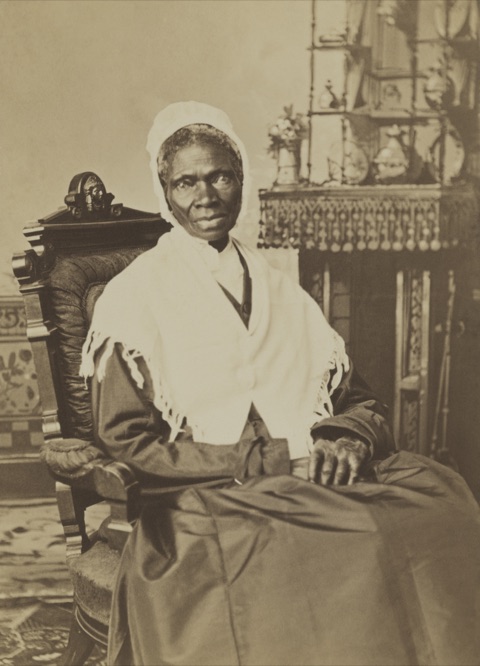
Sojourner Truth
Abolitionist and women's rights speaker who was born enslaved in New York, took the name Sojourner Truth in 1843, and dictated The Narrative of Sojourner Truth. She was among the most widely recognized reformers of nineteenth-century America.
1797 to 1883
Biography
Sojourner Truth (around 1797 to 1883) was an American abolitionist and women's rights speaker who was born into slavery in New York, gained her freedom in the 1820s, and became a traveling preacher and reformer. She was born Isabella Baumfree in Swartekill, a Dutch-speaking district of Ulster County, New York, one of the children of James and Elizabeth Baumfree, who were enslaved by a landowner named Johannes Hardenbergh. Dutch was her first language, and she spoke English with a Dutch accent for the rest of her life.
As a child she was sold several times, passing through the households of several New York owners before she came in 1810 into the possession of John Dumont of New Paltz, where she remained for roughly sixteen years. During those years she married an enslaved man named Thomas and bore five children. New York had enacted a gradual emancipation law, but Dumont delayed the freedom he had promised her. Late in 1826 she walked away from his farm carrying her infant daughter Sophia and took shelter with Isaac and Maria Van Wagenen, a nearby couple who paid Dumont for her remaining service. New York's emancipation statute freed the state's remaining enslaved adults on July 4, 1827.
Soon after leaving Dumont, she learned that her young son Peter had been sold illegally out of state to an owner in Alabama, in violation of New York law. With the help of local Quakers she brought suit and recovered him, a rare instance in that period of a formerly enslaved Black woman winning a court case against a white man. She then moved to New York City, worked as a domestic servant, and became involved for a time with a religious commune led by the self-styled prophet Robert Matthews, known as Matthias.
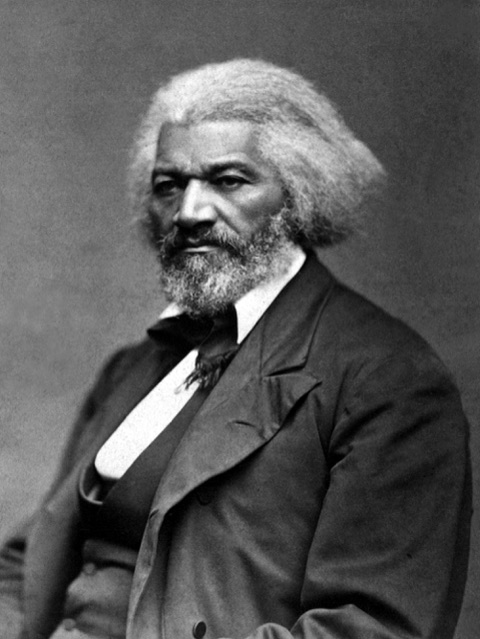
On June 1, 1843, she left New York, took the name Sojourner Truth, and set out as an itinerant preacher, telling audiences that the Spirit had called her to travel and testify. She joined the Northampton Association of Education and Industry, a utopian and abolitionist community in Massachusetts, where she met reformers including William Lloyd Garrison and the abolitionist orator Frederick Douglass. Unable to read or write, she dictated the story of her life to Olive Gilbert; The Narrative of Sojourner Truth was published in 1850 and gave her both a public identity and an income from its sale at meetings.
In 1851 she addressed a women's rights convention in Akron, Ohio. Her remarks there were later reworked by the organizer Frances Dana Gage into the famous "Ain't I a Woman?" speech published in 1863; an earlier report by Marius Robinson recorded a plainer version, and the wording most often quoted today reflects Gage's rendering rather than a verbatim transcript. Truth spent the following years lecturing across the Northern states on abolition, women's suffrage, and temperance, and selling photographic cartes-de-visite of herself printed with the caption "I sell the shadow to support the substance."
During the Civil War she gathered supplies for Black regiments of the Union Army and helped recruit soldiers, including in the regiment her grandson joined. In 1864 she visited Washington and met President Abraham Lincoln, and she worked with the National Freedman's Relief Association aiding people freed from slavery. In Washington she rode segregated streetcars in deliberate challenges to their practice, and she petitioned Congress to grant Western land to freed people, a campaign that did not succeed. She settled in Battle Creek, Michigan, where she died on November 26, 1883.
Life & Career
Why Truth Matters
Truth was one of the small number of nineteenth-century reformers who spoke from direct experience of American slavery and who joined that testimony to the cause of women's rights. Having been enslaved in New York until her late twenties, she could describe bondage as a personal history rather than an argument, and she did so before white and Black audiences across the Northern states at a time when a Black woman speaking in public was itself contested.
Her recovered court case over her son Peter, brought around 1828, is often cited as one of the earliest instances of a Black woman successfully suing a white man in an American court. It established a pattern that ran through her later life: she used the existing legal and political system, from the courts to petitions to Congress, to press claims on behalf of formerly enslaved people.
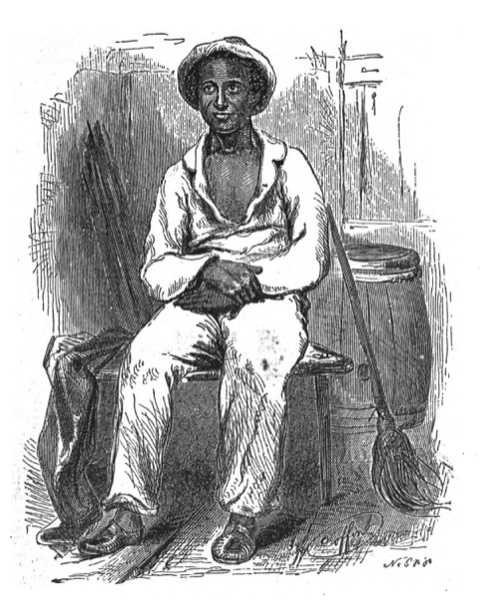
The Narrative of Sojourner Truth placed her among the authors of the slave-narrative tradition alongside Frederick Douglass and Solomon Northup, though hers was dictated rather than written, since she never learned to read. The book, her lecture tours, and the photographs she sold made her one of the most recognizable Black women in the country and gave later movements a documented account of her words and image.
Her Akron address of 1851 became, through Frances Gage's 1863 version, one of the most quoted statements linking racial and gender inequality, and it has been reprinted and debated ever since. The gap between that popular version and the earlier transcript has also made her a case study in how nineteenth-century speeches were recorded, edited, and remembered.