Seneca
Roman Stoic philosopher, statesman, and dramatist who tutored and later advised the emperor Nero. His essays and the Letters to Lucilius made Stoic ethics practical, addressing anger, grief, wealth, and the use of time.
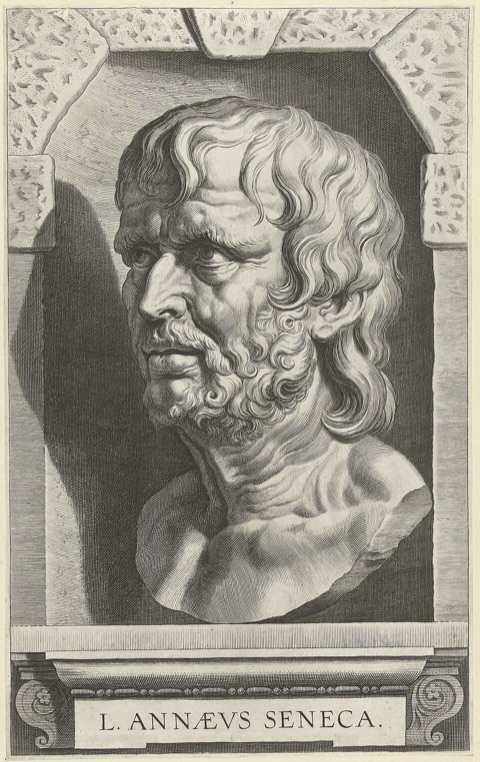
4 BC – 65 AD
Biography
Lucius Annaeus Seneca (4 BC to 65 AD), known as Seneca the Younger, was a Roman Stoic philosopher, statesman, and tragedian who served as tutor and then chief advisor to the emperor Nero. He was born in Corduba (modern Córdoba) in the province of Hispania, into a wealthy provincial family. His father, Seneca the Elder, was a noted teacher of rhetoric, and his nephew was the poet Lucan. Brought to Rome as a boy, Seneca trained in rhetoric and philosophy, drawn especially to Stoicism through teachers connected to the school of the Sextii.
Seneca entered public life under the early emperors and rose in the Senate, but his career was interrupted around 41 AD when the emperor Claudius banished him to the island of Corsica on a charge of adultery involving Julia Livilla, a sister of the late emperor Caligula. He spent roughly eight years in exile, during which he wrote consolatory essays, including one addressed to his mother, Helvia. In 49 AD, Agrippina the Younger, Claudius's new wife, arranged his recall to Rome and appointed him tutor to her young son, the future emperor Nero.
When Nero came to power in 54 AD at the age of sixteen, Seneca and the praetorian prefect Sextus Afranius Burrus became the guiding figures of his government. Seneca held a suffect consulship around 56 AD and wrote De Clementia (On Clemency), a treatise addressed to Nero urging the young ruler toward mercy. The early years of Nero's reign were later remembered as comparatively well governed, a period historians often credited to the influence of Seneca and Burrus. During these years Seneca also accumulated enormous wealth, a fact that his contemporaries and later critics set against his writings on simplicity and the dangers of riches.
Alongside his public duties, Seneca produced a large body of prose. His moral essays include De Brevitate Vitae (On the Shortness of Life), De Ira (On Anger), De Providentia (On Providence), and De Beneficiis (On Benefits), a long study of giving, receiving, and gratitude. His most influential work, the Epistulae Morales ad Lucilium (Moral Letters to Lucilius), gathers 124 surviving letters that treat friendship, death, fear, and daily self-examination in a direct, personal voice. He also wrote the Naturales Quaestiones, an inquiry into natural phenomena, and a set of verse tragedies, among them Medea, Phaedra, Thyestes, and Oedipus, which drew on Greek myth and later shaped European drama.
Seneca's position deteriorated as Nero grew older and more independent. After Burrus died in 62 AD, Seneca lost much of his standing at court and asked the emperor to let him retire, offering to return his wealth. Nero refused the request in form but allowed Seneca to withdraw increasingly from public affairs. In these final years Seneca completed much of the Letters to Lucilius, writing as a man deliberately turning from politics to philosophy.
In 65 AD, a conspiracy to kill Nero, known as the Pisonian conspiracy after its leader Gaius Calpurnius Piso, was uncovered. Seneca was implicated, though the extent of his involvement remains uncertain, and Nero ordered him to take his own life. According to the historian Tacitus, Seneca opened his veins and died slowly, dictating final words and reasoning with those around him. His death became one of the most closely described scenes in Roman historical writing.
Life & Career
Why Seneca Matters
Seneca is the writer who did the most to turn Stoic philosophy into practical guidance for ordinary living. Where earlier Stoics such as Chrysippus wrote technical treatises on logic and physics, Seneca concentrated on ethics and on the reader's inner life. His essays and letters take up concrete problems—losing a friend, wasting years on trivial business, being consumed by anger—and apply Stoic principles to them in plain, vivid Latin. This made him one of the main channels through which Stoic ideas reached later readers who never studied the school's formal doctrines.
His Latin prose style was itself influential. Seneca wrote in short, pointed sentences packed with memorable phrasing, a manner that stood apart from the long periodic style of Cicero and that later writers imitated and debated. The Moral Letters to Lucilius, in particular, established a model of the philosophical letter as a form of ongoing self-examination, addressed to a friend but meant for a wider readership.
Seneca's reception has always carried the tension his contemporaries already noticed: a philosopher who praised poverty and self-control while holding one of the largest fortunes in Rome and serving an increasingly violent emperor. Ancient critics raised this charge in his own lifetime, and it has followed him ever since. Rather than diminishing his readership, the contradiction has kept his work at the center of debates about how philosophy relates to power, money, and compromise.
His influence extended well beyond antiquity. Early Christian writers read him warmly enough that a forged correspondence between Seneca and the apostle Paul circulated in late antiquity. Renaissance humanists prized his essays, and his tragedies supplied plots, rhetoric, and dramatic conventions to Elizabethan playwrights. In the modern period his short, practical treatises have made him one of the most widely read of the ancient philosophers.