Ralph Venning
English Puritan minister ejected from the Church of England in the Great Ejection of 1662, best known for The Plague of Plagues, a treatise on sin later reprinted as The Sinfulness of Sin.
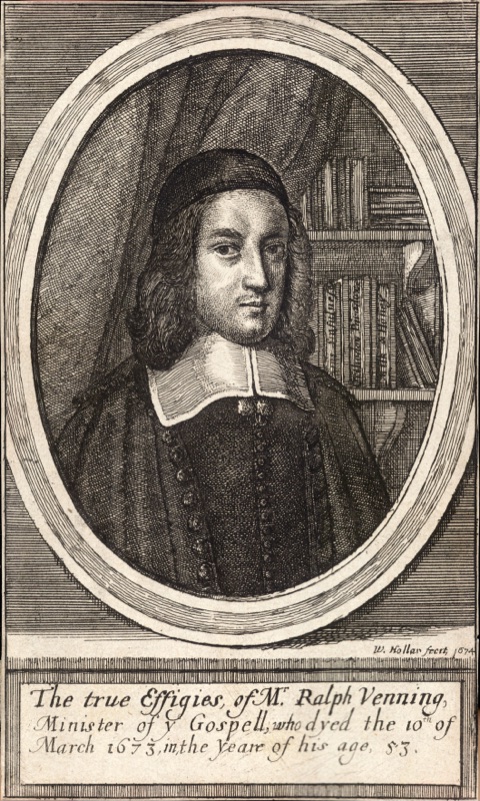
1621–1674
Biography
Ralph Venning (1621 to 1674) was an English Puritan minister who was ejected from the Church of England in 1662 and is best remembered for The Plague of Plagues, a treatise on sin later reprinted as The Sinfulness of Sin. He was born at Tavistock in Devon around 1621 and studied at Emmanuel College, Cambridge, then a leading center of Puritan learning.
Venning built his reputation in London, where he preached at St Olave's, Southwark, and became known for closely argued sermons. He gathered a following among the city's godly congregations during the years of the Commonwealth, when Puritan ministers held wide influence in the capital's pulpits.
The Act of Uniformity of 1662 required ministers to conform fully to the restored Church of England. Venning, like roughly two thousand other clergy in what became known as the Great Ejection, refused and lost his post. He continued to preach outside the established church, serving with Robert Bragge as co-pastor of an Independent congregation that met at Pewterers' Hall in London. He died in March 1674 and was buried at Bunhill Fields, the burial ground used by London's Nonconformists.
His best-known book, The Plague of Plagues, appeared in 1669 and was reissued after his death as The Sinfulness of Sin. Working from the language of Scripture, it argues that sin is the worst of all evils — worse than suffering, disease, or death — because it is an offense against God. The book became a standard work of Puritan devotional reading and has been reprinted in the modern era.
Why Venning Matters
Venning worked within the tradition of Puritan practical divinity, which aimed to bring doctrine to bear on the conscience and conduct of ordinary believers. His main subject was sin itself. Where many writers treated it as one topic among many, Venning gave an entire treatise to defining what sin is, why it is evil, and what it costs.
The Plague of Plagues sets out the case that sin, rather than any external calamity, is the true catastrophe of human life. Venning marshals scriptural texts to argue that sin is exceedingly sinful — a phrase drawn from Paul's letter to the Romans — and that its gravity is measured by the greatness of the God against whom it is committed. The argument is orderly and relentless, in the Puritan manner of dividing a theme into heads and pressing each one on the reader.
Reprinted as The Sinfulness of Sin, the book stayed in circulation among readers in the Reformed and evangelical traditions and was reissued by modern publishers in the twentieth century, keeping Venning's name attached to one of the fullest Puritan statements on the subject.