Matthew Mead
Matthew Mead was a London Nonconformist minister best known for The Almost Christian Discovered (1661), a widely reprinted treatise examining how far a person can travel toward Christianity while falling short of saving faith.
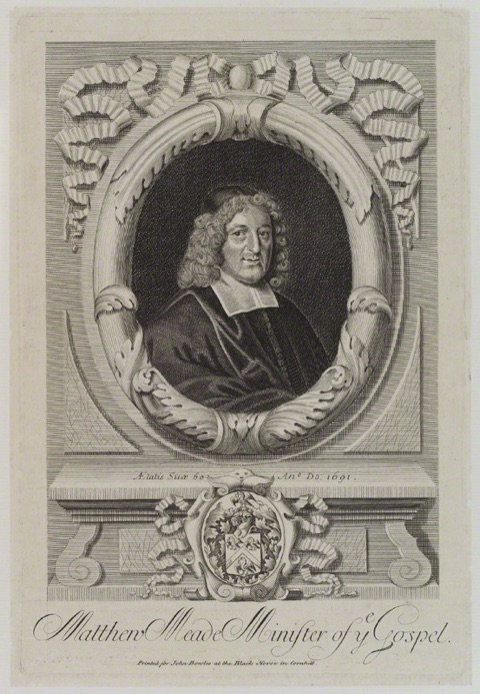
1629–1699
Biography
Matthew Mead (1629 to 1699) was an English Nonconformist minister who pastored an Independent congregation at Stepney in east London and wrote The Almost Christian Discovered, a treatise on the difference between nominal and saving faith. Born at Mursley in Buckinghamshire, he was educated at Cambridge, where he held a place at King's College until the Restoration of the monarchy in 1660 removed men of his convictions from the universities.
Like roughly two thousand ministers across England, Mead lost his public standing under the Act of Uniformity of 1662, which required clergy to give unqualified assent to the Book of Common Prayer. Rather than conform, he continued to preach to Independent, or Congregationalist, gatherings in and around London through years when such assemblies were illegal under the penal laws of the Clarendon Code. His preaching was known for pressing hearers to examine the reality of their own faith rather than resting in outward religion.
The congregation Mead gathered at Stepney grew large, and in 1674 a substantial meeting house was built there for his ministry. The Stepney Meeting House drew hundreds of hearers and became one of the better-known centers of Dissent in the capital, a base from which Mead exercised influence among London's Congregational ministers for the rest of his life.
In 1683 Mead was named in connection with the Rye House Plot, an alleged conspiracy to attack King Charles II and his brother James. He was questioned over the affair and withdrew for a period to the Netherlands before returning to his Stepney pulpit. Such suspicion was an ordinary hazard for prominent Dissenters in the last years of Stuart rule, when Nonconformity and political disaffection were often treated as one.
In 1691 Mead was among the Congregational and Presbyterian ministers who framed the "Heads of Agreement," an attempt to bind the two bodies together in London in what was called the Happy Union. He died in 1699. His son Richard Mead went on to become one of the most sought-after physicians in England.
Mead's reputation rests chiefly on The Almost Christian Discovered, which grew out of sermons on the words of King Agrippa to the apostle Paul in Acts 26:28: "Almost thou persuadest me to be a Christian." First published in 1661, the book catalogs the ways a person may resemble a true believer — in knowledge, profession, spiritual gifts, and outward reform — while stopping short of genuine conversion. It was reprinted through the following centuries and read well beyond Mead's own circle of Dissenters.
Life & Career
Why Mead Matters
Mead belongs to the tradition of English practical divinity, the body of Puritan and Nonconformist writing concerned less with abstract system than with the state of the individual soul. His central subject was self-examination: how a person can be persuaded of Christianity, adopt its language, and reform his conduct, yet remain, in the phrase that titles his book, only an "almost" Christian. He treated assurance as something to be tested rather than assumed.
The Almost Christian Discovered gave that concern its most memorable form. By dividing the marks of nominal religion from the marks of saving faith, Mead supplied later preachers with a working anatomy of false profession. The book was read and recommended within the evangelical revival of the eighteenth century and remained in print as a manual of spiritual diagnosis long after its author's death.
As a pastor, Mead also mattered to the survival of Congregationalism through the hardest years of its history. He held together a major London congregation across the period of the penal laws, endured the suspicion that fell on leading Dissenters after the Rye House Plot, and took part in the 1691 effort to unite Presbyterians and Congregationalists. His career traces the passage of English Dissent from persecution toward the limited toleration that followed the Revolution of 1688.