Matthew Henry
English Nonconformist minister whose Exposition of the Old and New Testaments, begun at Chester in 1704, became one of the most widely read English Bible commentaries of the eighteenth and nineteenth centuries.
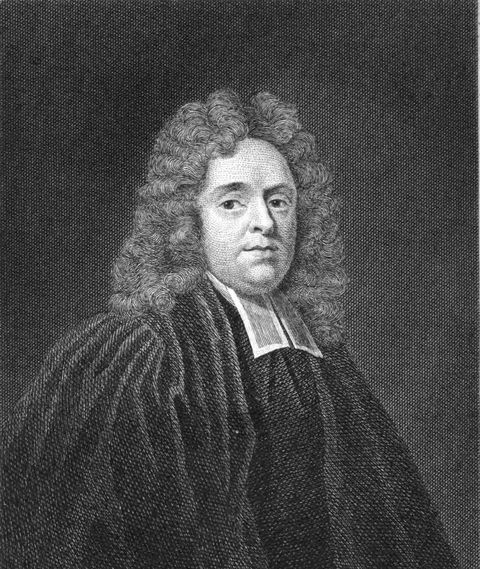
1662–1714
Biography
Matthew Henry (1662 to 1714) was an English Nonconformist minister whose commentary on the whole Bible, begun at Chester in 1704, became one of the most widely read English expositions of Scripture for the next two centuries.
He was born on October 18, 1662, at Broad Oak, a farmhouse at Iscoyd on the border of Flintshire and Shropshire. His father, Philip Henry, had been ejected from his living earlier that year under the Act of Uniformity, and the family lived at Broad Oak on the estate that his mother, Katherine Matthews, had brought to the marriage. Matthew was educated at home by his father and could write Latin and read parts of the Greek New Testament by the age of nine. In 1680 he was sent to Thomas Doolittle's dissenting academy at Islington, and in 1685 he entered Gray's Inn to read law, since the universities were closed to Nonconformists. His intention throughout was the ministry.
He was privately ordained in London on May 9, 1687, and within weeks began his work with the Presbyterian congregation at Chester, where he remained for twenty-five years. The congregation grew, and in 1700 a new chapel was opened for it in Crook Street. Alongside his preaching he catechized, visited the surrounding towns, and kept up a steady output of books: a life of his father (1698), A Discourse Concerning Meekness and Quietness of Spirit (1699), The Communicant's Companion (1704), and A Method for Prayer (1710), which arranged the language of Scripture under the heads of adoration, confession, petition, thanksgiving, and intercession.
In November 1704 he began the Exposition of the Old and New Testaments, publishing it in folio volumes as he went. In 1712 he left Chester for the congregation at Mare Street, Hackney, near London, where he continued the commentary and published Directions for Daily Communion with God. He had carried the Exposition through the Acts of the Apostles when he died on June 22, 1714, at Nantwich, Cheshire, while traveling back from a visit to Chester. He was buried in Trinity Church, Chester. Thirteen Nonconformist ministers completed the remaining epistles and Revelation from his manuscripts and from notes taken by those who heard him preach, and the sixth and final volume appeared in 1721.
Life & Career
Why Henry Matters
Henry was not the most original theologian among the Nonconformists of his generation, and he did not try to be. His importance lies in a different direction: he turned the Puritan habit of close, practical exposition into a single continuous commentary on the whole Bible, written in plain English for ordinary readers, and he did it so well that the book remained in general use for two hundred years.
The Exposition proceeds verse by verse, but its method is the sermon rather than the lecture. Each passage is paraphrased, its sense is stated, and then its application is drawn out in short, balanced sentences that were meant to be remembered. Henry wrote for families reading at home and for ministers preparing to preach, and both groups used him. George Whitefield said he had read the Exposition through four times. Charles Spurgeon, in Commenting and Commentaries, told every minister to read it through at least once. John Wesley drew on it for his Explanatory Notes upon the Old Testament. Few books written by an English Dissenter reached so far across the lines of church party.
His shorter works show the same instincts applied to the Christian life. A Method for Prayer is not a set of prayers to be recited but a framework: it takes the headings of prayer and fills each one with the words of Scripture, so that a person who wanted to pray and did not know how could learn the language of the Bible by using it. A Discourse Concerning Meekness and Quietness of Spirit treats a single Christian virtue at length, defining it, commending it, and closing with rules for attaining and keeping it. Both are available in modern English on this site.
Henry's writing is marked by a preference for the concrete over the abstract and by a fondness for balanced phrases and memorable turns. Those habits made him quotable, and a great deal of what later preachers said about the Bible came to them, knowingly or not, through him.