Isaac Watts
English Congregationalist minister who wrote roughly 750 hymns, among them "When I Survey the Wondrous Cross," "Joy to the World," and "O God, Our Help in Ages Past." He also wrote widely used textbooks on logic and education, including Logick (1724) and The Improvement of the Mind (1741).
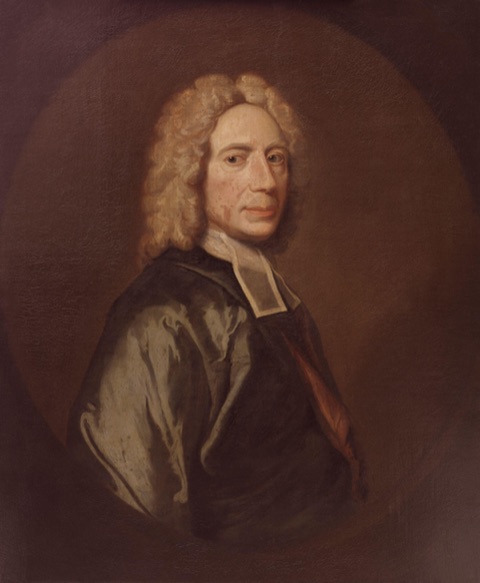
1674–1748
Biography
Isaac Watts (1674 to 1748) was an English Nonconformist minister, hymn writer, and educational author whose congregational songs and school textbooks circulated across the English-speaking world for more than a century. He was born in Southampton on July 17, 1674, the eldest of nine children of Isaac Watts the elder, a clothier and deacon in a dissenting congregation who was imprisoned more than once for refusing to conform to the established Church of England.
Watts showed early aptitude for language and learned Latin, Greek, and Hebrew as a boy. Because Dissenters were barred from Oxford and Cambridge, he declined an offer of university sponsorship that would have required conformity and instead entered the dissenting academy at Stoke Newington in 1690, studying under the tutor Thomas Rowe. After completing his course he returned home for a period of private study, then took a post as tutor to the family of Sir John Hartopp at Stoke Newington.
His hymn writing began at home. Dissatisfied with the plodding metrical psalms sung in his father's congregation, the young Watts was challenged to produce something better, and he began composing hymns in ordinary devotional English rather than close paraphrase of the Psalter. This project matured into Hymns and Spiritual Songs (1707) and The Psalms of David Imitated in the Language of the New Testament (1719), the second of which recast the Hebrew psalms as Christian songs. Together they broke with the long English convention that only scripture set to meter could be sung in worship, and they made freely composed hymnody a normal feature of Protestant services.
In 1702 Watts became pastor of the Independent (Congregational) congregation that met at Mark Lane in London, one of the most prominent dissenting churches in the city. His health, never robust, collapsed under a severe illness around 1712. From that point he lived as a long-term guest of Sir Thomas Abney and his family, first at Theobalds and later at Abney House in Stoke Newington, an arrangement that continued for the rest of his life while he retained his pastoral connection with the help of an assistant.
Alongside his hymns Watts wrote for children and for students. Divine Songs Attempted in Easy Language for the Use of Children (1715) was among the first English hymnbooks written specifically for the young. His textbook Logick: Or, The Right Use of Reason in the Inquiry after Truth (1724) and its companion volume The Improvement of the Mind (1741) were adopted as instructional works at Oxford, Cambridge, and the American colleges, and they remained in classroom use well into the nineteenth century. He also published treatises on prayer, catechesis, astronomy, and theology.
Watts never married and had no children. He received an honorary Doctor of Divinity from the University of Edinburgh in 1728. He died at Stoke Newington on November 25, 1748, and was buried in Bunhill Fields, the burial ground of London's Dissenters. A monument to him was later placed in Westminster Abbey.
Life & Career
Why Watts Matters
Watts changed how English-speaking Protestants sing. Before him, most Reformed and dissenting congregations restricted their singing to metrical versions of the biblical Psalms, on the principle that only inspired words belonged in worship. By writing freely composed hymns in plain devotional language, and by openly "imitating" the Psalms in explicitly Christian terms, he legitimized a new genre and supplied its early canon. Later hymn writers, including John Newton and Charles Wesley, built on the ground he cleared, and he is commonly called the father of English hymnody.
His individual texts had a long reach. "When I Survey the Wondrous Cross," "Joy to the World," "O God, Our Help in Ages Past," and "Jesus Shall Reign Where'er the Sun" entered hymnals across denominational lines and remain in use. In colonial and early national America his psalms and hymns were widely reprinted; Jonathan Edwards introduced Watts's songs into New England worship, where they spread during the revivals of the eighteenth century.
Watts also mattered as a teacher of reasoning. Logick and The Improvement of the Mind presented the rules of clear thinking, study, and self-education in accessible form, engaging the empiricism of John Locke while remaining usable by ordinary students. Their adoption as standard texts at English and American colleges gave Watts an influence on habits of study that extended well beyond the churches.
His work for children marked an early attempt to write serious devotional and moral material in language a child could grasp. Divine Songs for Children stayed in print for generations and helped establish the idea that instruction for the young deserved its own carefully simplified literature.