Justin Martyr
A second-century philosopher who converted to Christianity and defended it in writing before the Roman emperors. His First Apology contains the earliest surviving detailed description of Christian baptism and the Eucharist, and his Dialogue with Trypho is the oldest surviving record of a Christian debate with Judaism.
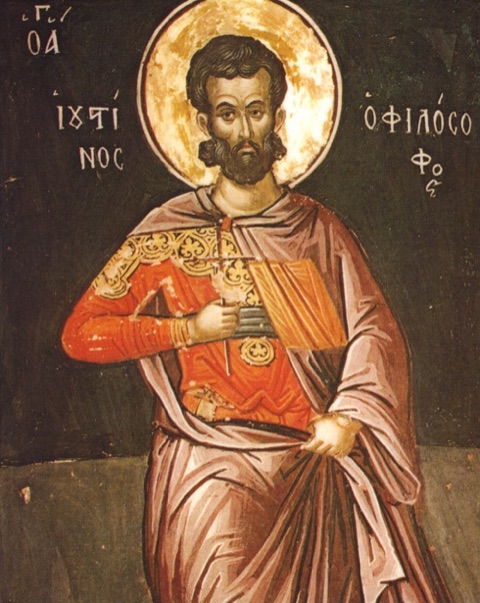
100 to 165 AD
Biography
Justin Martyr (100 to 165 AD) was an early Christian apologist and philosopher who defended the faith before Roman emperors and left the earliest surviving detailed account of Christian worship. He was born in Flavia Neapolis, a Roman colony in Samaria on the site of ancient Shechem, known today as Nablus. His parents were Greek-speaking pagans, and Justin grew up outside both Judaism and the young Christian movement, drawn instead to the philosophical schools that promised knowledge of the divine.
In the opening of his Dialogue with Trypho, Justin describes his search for truth through the leading philosophies of his day. He studied under a Stoic, a Peripatetic, and a Pythagorean before settling for a time on Platonism, which he found the most satisfying. He then recounts a conversation on a seashore with an elderly man who pressed him on the limits of Platonic philosophy and pointed him toward the Hebrew prophets and the figure of Christ. Justin converted around 130 AD and afterward continued to wear the distinctive cloak of a philosopher, presenting Christianity as the true and final philosophy rather than a rejection of reason.
Justin eventually settled in Rome, where he founded a school and taught during the reigns of Antoninus Pius and Marcus Aurelius. Among his pupils was Tatian, who later wrote the Diatessaron, a single continuous narrative woven from the four Gospels. Justin's public teaching and disputation brought him into conflict with rival philosophers, including the Cynic Crescens, whom Justin accused of attacking Christians without understanding their beliefs.
Ancient sources credit Justin with several works, but three survive. The First Apology, addressed to the emperor Antoninus Pius around 155 AD, argues that Christians were being punished for the mere name of Christian rather than for any crime, and answers charges of atheism and disloyalty to Rome. The shorter Second Apology follows as a supplement. The Dialogue with Trypho records an extended debate with a learned Jew over the interpretation of the Hebrew Scriptures, the identity of Christ as the promised Messiah, and the calling of the Gentiles.
The First Apology is valued by historians for its concrete detail. In its closing chapters Justin describes how Christians gathered on the day of the sun, read from the memoirs of the apostles and the writings of the prophets, prayed, and shared bread and wine mixed with water. This is the earliest surviving outside-the-Gospels account of Christian baptism and the Eucharist, written partly to show a suspicious Roman public that these rites concealed nothing criminal.
Justin was arrested in Rome with six companions and brought before Junius Rusticus, the prefect of the city, around 165 AD during the reign of Marcus Aurelius. The court record known as the Acts of Justin preserves his interrogation and his refusal to sacrifice to the gods, after which he was scourged and beheaded. His death gave him the surname Martyr, and he is honored as a saint in the Catholic, Orthodox, Anglican, and Lutheran traditions.
Why Martyr Matters
Justin was the first Christian writer to argue the faith systematically in the language of Greek philosophy, and his approach set the pattern for the apologists who followed. Rather than treating philosophy as an enemy, he claimed it as an incomplete search that Christianity brought to its conclusion, and he addressed his defenses directly to the emperors as reasoned appeals rather than private devotions.
His most influential idea was the doctrine of the Logos, the divine Word or Reason. Justin taught that the Logos who became flesh in Christ had also been at work throughout human history, scattering seeds of truth so that thinkers such as Socrates and Heraclitus who lived according to reason had in a partial sense belonged to the truth before Christ came. This gave later Christians a framework for engaging pagan learning without simply condemning it, and it shaped how figures like Clement of Alexandria and Origen read the relationship between Athens and Jerusalem.
The Dialogue with Trypho is the earliest surviving full-length record of a Christian arguing with a Jewish opponent over the Scriptures. It shows how the second-century church read the Hebrew prophets as pointing to Christ, how it understood the relationship between the old and new covenants, and how it defended the inclusion of Gentiles. For historians of the early church and of Jewish-Christian relations, it is a primary document with few rivals from its century.
Justin also matters as a witness to what Christians actually did. His description of Sunday worship, baptism, and the Eucharist in the First Apology is one of the most important sources for reconstructing the practice of the church roughly a century after the apostles, before the fuller liturgical texts of later centuries. His writings were read and echoed by Irenaeus and Tertullian, and his combination of martyrdom and philosophical defense made him a model for the church's engagement with the wider Roman world.