131 audiobooks, 1,134 hours of narration. Give $50 and every one is yours.
Early Church books
Cover of Dialogue with Trypho

Modern English edition · 160 AD

Dialogue with Trypho

by Justin Martyr

The earliest surviving Christian apologetic work addressing Judaism. Justin Martyr engages in a respectful philosophical dialogue with Trypho, a Jewish scholar, about the identity of Jesus as the Messiah.

Start reading free

One free account opens 250+ books and saves your place on every device. Google sign-in or an email link. No card.

Get the audiobook · $5.99

Listen in the Updated Works app on any device, in the same place you read.

Give $50, get every audiobook

One gift, no subscription. It funds the next modernized classic and the next recording, and includes the whole ebook library as one download.

Listen to the first 9 minutes free

Included with your free account

This book, and 250+ more, free to read

A free account opens the whole library to read online, on your phone or at your desk. Open a book on one device and it is waiting at the same page on the next. The PDF and EPUB of every book are yours to keep, and audiobooks play in the same app.

  • 250+ modernized editions Not samples. The whole work, free.
  • Your place, on every device Phone, tablet or desktop, same page.
  • 131 audiobooks From $4.99 each, or all of them with a $50 gift.
  • PDF and EPUB included Download any book to keep.
Create your free account Google sign-in or an email link. No card.
The in-app reader on a phone, mid-chapter of The Mortification of Sin in modern English
My Library on a phone, with a book to continue reading and the cover grid

About this book

Dialogue with Trypho is the longest and most important of Justin Martyr's surviving works, written around 155-160 AD. It presents an extended conversation between Justin, a Christian philosopher, and Trypho, a learned Jewish man, that reportedly took place in Ephesus. The dialogue represents one of the earliest and most substantial examples of Jewish-Christian dialogue in ancient literature, offering invaluable insight into how early Christians understood their relationship to Judaism and the Hebrew Scriptures.

The work opens with Justin recounting his philosophical journey through Stoicism, Aristotelianism, Pythagoreanism, and Platonism before encountering an old man who introduced him to the Hebrew prophets and ultimately to Christ. This autobiographical preface establishes Justin's credentials as a serious philosopher while demonstrating that Christianity represents the fulfillment rather than the rejection of philosophical inquiry.

The heart of the dialogue centers on Justin's argument that Jesus is the Messiah foretold by the Hebrew prophets. He systematically works through Old Testament passages, arguing that they find their fulfillment in Christ. Justin addresses prophecies concerning the virgin birth, the suffering servant, the new covenant, and the calling of the Gentiles. His interpretive method, while different from modern historical-critical approaches, reflects how early Christians read their Scriptures.

Throughout the conversation, Justin treats Trypho with genuine respect, and Trypho responds in kind. This tone of mutual civility makes the Dialogue remarkable for its era. Justin acknowledges the reasonableness of Jewish objections while presenting his case for Christianity. He addresses difficult questions about why Christians do not observe the Mosaic law and how Gentiles can claim inheritance in Israel's promises.

The work also provides crucial evidence for early Christian beliefs and practices. Justin describes Christian worship, baptism, and the Eucharist, offering some of the earliest detailed accounts of these practices outside the New Testament. His theological arguments reveal how second-century Christians understood Christ's divine nature, the Trinity, and the relationship between the Old and New Testaments.

For modern readers, the Dialogue with Trypho offers a window into the formative period of Christian theology and Jewish-Christian relations. While some arguments may seem foreign to contemporary readers, the work's fundamental questions about scriptural interpretation, religious identity, and interfaith dialogue remain remarkably relevant. It stands as an essential text for understanding early Christianity's emergence from and engagement with its Jewish roots.

Free audiobook preview

Listen to the first 9 minutes

Dialogue with Trypho · Audiobook · 6 hr 20 min

0:00 / 9:17

Enjoying it? The full audiobook runs 6 hr 20 min. Listen in the Updated Works app on any device.

Get the audiobook · $5.99

Meeting Trypho

One morning, while I was walking along the paths of the Xystus, a man accompanied by several others met me and said, “Greetings, philosopher!” Immediately afterward, he turned and walked beside me, and his friends followed.

I greeted him in return and asked, “What brings you here?”

“Corinthus the Socratic, in Argos, taught me not to despise or disregard people who wear this clothing,” he replied. “Instead, I should show them every kindness and spend time with them. Perhaps our conversation might benefit either such a person or me. Besides, it is good for both if either one benefits. That is why I gladly approach anyone I see dressed this way, and why I have willingly approached you now. These men accompany me because they hope to hear something useful from you themselves.”

“But who are you, most excellent man?” I replied jokingly.

He freely told me both his name and his family background. “My name is Trypho,” he said. “I am a circumcised Hebrew. Having escaped the war recently fought there, I am now living in Greece, chiefly at Corinth.”

“In what way,” I asked, “could philosophy benefit you as much as your own lawgiver and the prophets?”

“Why should it not?” he replied. “Do philosophers not direct every discussion toward God? Do questions about His unity and providence not constantly arise among them? Is investigating the Deity not the true task of philosophy?”

“Certainly,” I said. “We too have believed that. But most have given no thought to whether there is one god or more, or whether they care for each of us individually. They act as though this knowledge contributes nothing to our happiness. Indeed, they even try to persuade us that God cares for the universe, with its genera and species, but not for you and me and each individual. Otherwise, they argue, we surely would not need to pray to Him night and day.

“The result is easy to understand. Those who hold these opinions become fearless and unrestricted in their speech. They do and say whatever they please, neither fearing punishment nor hoping for any benefit from God. How could they? They maintain that the same things will always happen, and that you and I will live again in the same way, having become neither better nor worse.

“Others suppose that the soul is immortal and immaterial. They believe that even if they have done evil, they will suffer no punishment, because what is immaterial cannot feel anything. They also believe that, because of its immortality, the soul needs nothing from God.”

Smiling gently, he said, “Tell us your opinion about these matters, what you think about God, and what your philosophy is.”
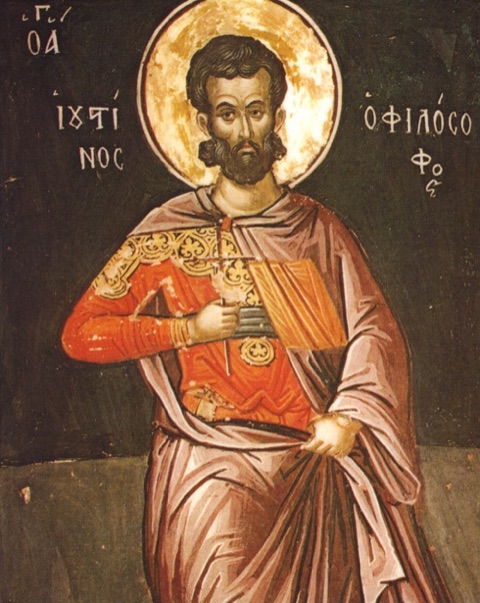

Portrait of Justin Martyr

About the author

Justin Martyr

Justin Martyr (100-165 AD) was one of the most important early Christian apologists and philosophers. Born in Flavia Neapolis (modern Nablus) in Samaria to pagan parents, he pursued philosophical truth through various Greek schools before converting to Christianity around 130 AD. He established a Christian school in Rome where he taught philosophy and defended the faith. Justin wrote numerous works defending Christianity to both Jewish and pagan audiences, though only three survive: two Apologies addressed to Roman emperors and the Dialogue with Trypho. His synthesis of Christian faith with Greek philosophy influenced subsequent Christian thought profoundly. Justin was martyred in Rome around 165 AD during the reign of Marcus Aurelius, earning him the surname "Martyr." He is venerated as a saint in Catholic, Orthodox, Lutheran, and Anglican traditions.

Very easy to understand compared to NewAdvent's

★★★★★  A reader of this edition