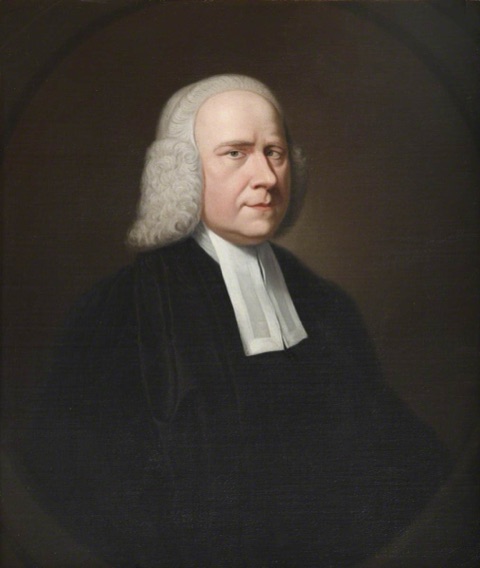
Jonathan Edwards
America's greatest theologian. His preaching helped ignite the Great Awakening, and his works on religious affections, free will, and original sin remain foundational in Reformed thought.

1703–1758
Biography
Jonathan Edwards was born on October 5, 1703, in East Windsor, Connecticut, the only son among eleven children of Timothy Edwards, a Congregational minister. He entered Yale College at thirteen and graduated as valedictorian in 1720. He remained at Yale for two years studying theology and briefly served a Presbyterian church in New York before returning to Yale as a tutor.
In 1727 Edwards became assistant pastor to his grandfather Solomon Stoddard at the Congregational church in Northampton, Massachusetts, succeeding him as sole pastor when Stoddard died in 1729. Edwards inherited the largest and most influential congregation in the Connecticut Valley.
In the mid-1730s, Edwards's preaching on justification by faith sparked a local revival in Northampton that drew international attention. He described these events in A Faithful Narrative of the Surprising Work of God (1737). The revival faded but was followed by the much larger Great Awakening of 1740-1742, during which Edwards preached his most famous sermon, Sinners in the Hands of an Angry God, at Enfield, Connecticut, in July 1741.
Edwards spent the later 1740s defending the revivals against critics and refining his understanding of genuine versus counterfeit religious experience. His Religious Affections (1746) became the definitive treatment of the subject.
In 1750 Edwards was dismissed from Northampton over a dispute about communion qualifications. He moved to Stockbridge, a frontier mission to the Housatonic Indians, where he lived for seven years. Freed from pastoral duties, he wrote his most important philosophical works: Freedom of the Will (1754), Original Sin (1758), and The Nature of True Virtue (published posthumously).
Edwards was elected president of the College of New Jersey (later Princeton) in early 1758. He died on March 22, 1758, from a smallpox inoculation, just weeks after arriving at Princeton.
Life & Career
Why Edwards Matters
Edwards was the most philosophically rigorous theologian America produced. He engaged Enlightenment philosophy on its own terms while defending Reformed orthodoxy, creating a synthesis that remained influential for over a century.
Freedom of the Will provided the definitive Calvinist response to Arminian arguments about human liberty. Edwards argued that the will always chooses according to its strongest inclination, and that this was compatible with moral responsibility. The argument was so formidable that it essentially ended the philosophical debate among New England Calvinists.
Religious Affections developed Edwards's most original contribution: a theology of the emotions. He argued that true religion necessarily involves the affections (the deep inclinations of the heart), and provided twelve signs by which genuine spiritual experience could be distinguished from counterfeits. This framework influenced later evangelical spirituality worldwide.
Edwards also developed an aesthetic theology that emphasized God's beauty and the delight of the saints in perceiving divine glory. This emphasis on beauty as a theological category set Edwards apart from the more austere Reformed tradition and has drawn renewed attention from contemporary theologians.
Modernized Editions by Edwards
Updated English
Charity and Its Fruits
Jonathan Edwards
 Audio
Audio
Freedom of the Will
Jonathan Edwards

On Grace
Jonathan Edwards
 Audio
Audio
Religious Affections
Jonathan Edwards
 Audio
Audio
Sinners in the Hands of an Angry God
Jonathan Edwards

The End for Which God Created the World
Jonathan Edwards
 Audio
Audio
The Preciousness of Time
Jonathan Edwards
Jonathan Edwards on Revival
Jonathan Edwards