John Ball
John Ball was an English Puritan minister and schoolmaster whose widely reprinted catechism and posthumous A Treatise of the Covenant of Grace (1645) helped systematize covenant theology in the years before the Westminster Assembly.
Biography
John Ball (1585 to 1640) was an English Puritan minister and theologian who spent most of his working life as a schoolmaster and preacher at Whitmore in Staffordshire. He was born at Cassington, Oxfordshire, in 1585, entered the University of Oxford at Brasenose College, and afterward moved to St Mary Hall, where he took his bachelor's degree in 1608. Leaving Oxford, he served for a time as a tutor in the household of Lady Cholmondeley in Cheshire, and it was through that connection that he came to Whitmore.
Ball had scruples about subscribing to the ceremonies required for ordination in the Church of England. To enter the ministry without that subscription, he was ordained privately by an Irish bishop, a route several nonconformists of his generation used. Settled at Whitmore, he kept a school and preached in the neighborhood for roughly three decades, remaining within the established church as a moderate nonconformist rather than a separatist. His refusal to conform fully to the required ceremonies brought suspension and periods of trouble with the church authorities, but he continued teaching and writing until his death at Whitmore in 1640.
Ball wrote for both ordinary readers and trained divines. His catechism, A Short Treatise Containing All the Principal Grounds of the Christian Religion, went through many editions and became one of the most-used instructional works of its kind among English Puritans; the nonconformist Richard Baxter was among those who later commended it. Ball also produced A Treatise of Faith, examining the nature of saving faith, and he defended the parish churches against the Brownists and other separatists in works such as A Friendly Trial of the Grounds Tending to Separation, arguing against those who withdrew from the Church of England to form gathered congregations.
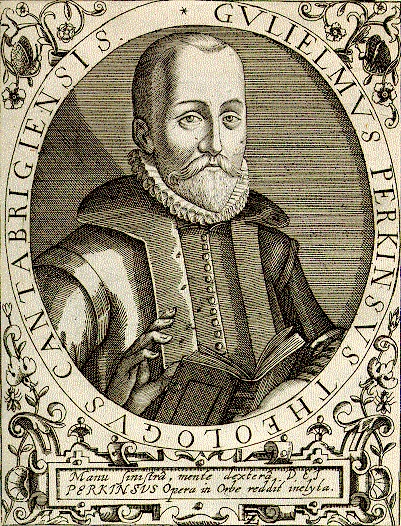
His most influential book appeared only after he died. A Treatise of the Covenant of Grace was published in 1645 and set out the framework of federal, or covenant, theology, distinguishing the covenant of works made with Adam from the covenant of grace fulfilled in Christ, and tracing that covenant through the history of Scripture. The book circulated as the Westminster Assembly was drafting its confession and catechisms, and it stands among the works that carried covenant theology from the Elizabethan Puritanism of William Perkins into the confessional settlement of the 1640s.
Why Ball Matters
Ball's chief contribution was to covenant theology, the framework that organizes God's dealings with humanity around a series of covenants. In A Treatise of the Covenant of Grace he distinguished the covenant of works, made with Adam on condition of obedience, from the covenant of grace, in which salvation is received by faith in Christ, and he worked out how the covenant of grace runs through the Old and New Testaments as a single plan. This federal scheme gave Puritan divines a way to hold together law and gospel, the testaments, and the doctrine of assurance.
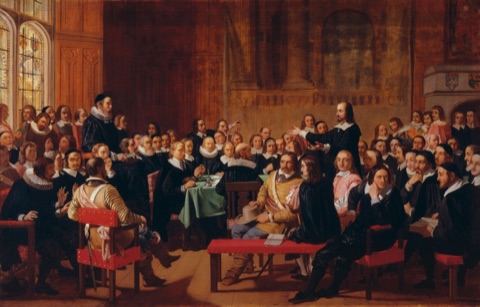
The timing of the book mattered as much as its content. It appeared in 1645, while the Westminster Assembly was producing the Confession of Faith and the Larger and Shorter Catechisms, documents built on the same covenantal structure. Ball's treatise is one of the works that carried covenant theology from earlier writers such as William Perkins into that confessional formulation, and it was read and cited by divines of the assembly's generation.
Beyond the specialists, Ball shaped ordinary religious instruction. His short catechism was reprinted repeatedly and used to teach the basics of the faith to families and congregations, making him one of the most widely read catechists in early seventeenth-century England. Later ministers, including Richard Baxter, pointed to his plain instructional writing as a model.
Ball also represented the moderate wing of Puritanism that stayed inside the Church of England while pressing for further reform. His writings against the separatists defended the lawfulness of the parish churches at a moment when Independency and gathered-church principles were gaining ground, and they document the arguments between conforming Puritans and those who broke away.