Jerome
The translator of the Latin Vulgate, who rendered the Old Testament from the Hebrew and whose letters became the founding literature of Western monasticism and of Latin biblical scholarship.
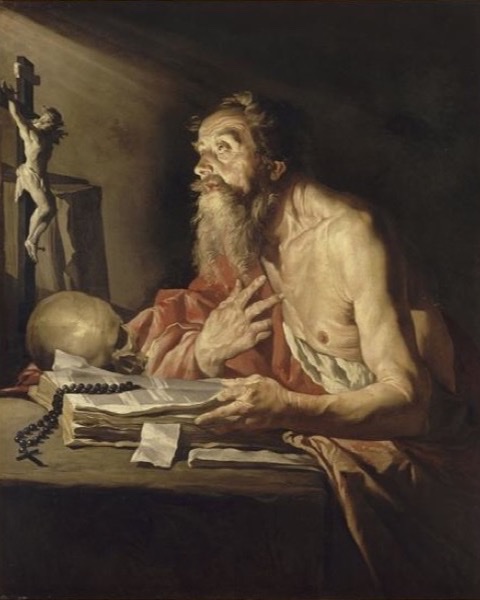
around 347 to 420 AD
Biography
Eusebius Sophronius Hieronymus was born around 347 AD at Stridon, a town on the border of Dalmatia and Pannonia whose exact site is no longer known. His family had property and money enough to send him to Rome for the standard education of a provincial gentleman's son, and there he studied grammar under Aelius Donatus, the most respected teacher of the age, before going on to rhetoric. He read Virgil, Cicero, Terence, and Plautus closely enough that their cadences never left his Latin, and he assembled the beginnings of a private library that he carried with him for the rest of his life. He was baptized at Rome around 366 AD, having delayed the rite in the ordinary manner of the time.
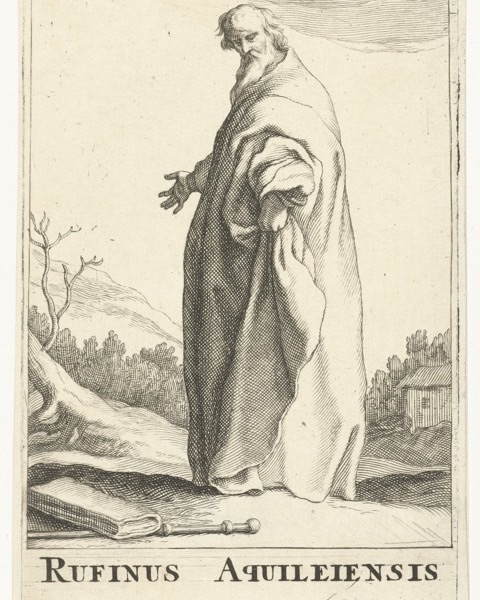
After Rome he moved north and joined a circle of like-minded young men at Aquileia gathered around asceticism and study, among them Rufinus and Chromatius. The group dispersed, and around 372 to 374 AD Jerome traveled east through Asia Minor to Antioch. From there he withdrew to the desert of Chalcis in Syria, where he lived for several years as a hermit, fell ill, quarreled with his neighbors over the doctrinal factions dividing Antioch, and began the work that changed his career: he found a converted Jew willing to teach him Hebrew. He was ordained presbyter at Antioch by Bishop Paulinus, on the condition that he would not be tied to a congregation. At Constantinople in 380 to 381 AD he attached himself to Gregory of Nazianzus, translated Eusebius of Caesarea's Chronicle into Latin with a continuation of his own, and put Origen's homilies on Jeremiah and Ezekiel into Latin as well.
In 382 AD he came to Rome in the company of Paulinus and was taken into the service of Pope Damasus as secretary and consultant on scriptural questions. Damasus commissioned him to revise the Latin text of the Gospels against the Greek, the first stage of what became the Vulgate; for the same patron he translated Origen's homilies on the Song of Songs. During these years he became the teacher and spiritual director of a circle of aristocratic Roman women committed to ascetic life, among them Marcella on the Aventine, Paula, and Paula's daughter Eustochium. Letter 22, written to Eustochium in 384 AD on the preservation of virginity, is the longest and most influential piece of that period and the fullest statement of the ascetic program he was recommending. When Damasus died in 385 AD, the criticism Jerome had drawn from the Roman clergy and from families who resented his influence over their daughters left him without a protector, and he sailed for the East.
He settled at Bethlehem in 386 AD. Paula followed with Eustochium and used her fortune to found monasteries there for men and for women, with a hospice for pilgrims; Jerome directed the men's house and taught. From roughly 390 to 405 AD he carried out the project that defines him, translating the Old Testament into Latin directly from the Hebrew rather than from the Septuagint. He argued for the principle he called Hebraica veritas, the Hebrew truth: the churches should read what the prophets actually wrote in their own language. Alongside the translation he produced commentaries on the prophets, on Matthew, and on Galatians, Ephesians, Titus, and Philemon; the Hebrew Questions on Genesis; a book of biblical place names; De viris illustribus in 392 AD, a catalogue of Christian writers modeled on Suetonius; and short lives of the monks Paul, Hilarion, and Malchus.
He was also, for thirty years, a controversialist. He wrote against Helvidius in 383 AD on the perpetual virginity of Mary, against Jovinian in 393 AD on the comparative merit of marriage and celibacy, against Bishop John of Jerusalem in 397 AD, against Vigilantius in 406 AD on the cult of relics and monastic vows, and a dialogue against the Pelagians in 415 AD. The Origenist controversy of 398 to 402 AD broke his friendship with Rufinus: Rufinus published a translation of Origen's On First Principles with a preface citing Jerome's earlier praise of Origen, Jerome answered with a literal rendering of the same treatise and then with an apology against Rufinus, and each accused the other of misrepresenting what he had held and when. His long correspondence with Augustine, preserved among the letters, turned on Paul's rebuke of Peter in Galatians 2 and on whether translating from the Hebrew would unsettle congregations accustomed to the Greek.
Partisans of Pelagius attacked the Bethlehem monasteries in 416 AD, burning buildings; Jerome and the community took refuge in a tower. He died at Bethlehem on 30 September 420 AD, not long after Eustochium. More than 120 genuine letters survive, arranged in the numbering established by Domenico Vallarsi in the eighteenth century, which Migne reproduced in volume 22 of the Patrologia Latina.
Life & Career
Why Jerome Matters
Jerome's Old Testament from the Hebrew settled what the Latin West would read as Scripture for the next thousand years, and it did so on a contested principle. The Greek Septuagint carried the authority of long church use and of the legend of its inspired production; Jerome held that the translator's obligation ran to the Hebrew text the prophets wrote, and he was prepared to say that passages the churches had sung for generations rested on a Greek rendering rather than on the original. Augustine wrote to him worried about the pastoral cost of changing familiar words. The argument the two conducted by letter is the first sustained Christian discussion of what a translation owes its source and what it owes its readers, and Letter 57 to Pammachius, on the best method of translating, remains the standard early statement that sense rather than word order is what a translator must carry across.
The letters are also the documents in which Latin asceticism acquired its vocabulary. Letter 22 to Eustochium set out a rule of life for consecrated virgins in detail no earlier Latin writer had attempted; Letter 52 to Nepotian described the conduct expected of a clergyman; Letter 108, the epitaph of Paula, and Letter 127, on Marcella and the sack of Rome, shaped the form of the Christian memorial biography. Read together they show a movement organizing itself in real time, with its practical arrangements, its funding by Roman fortunes, and its internal disputes all visible.
He was, further, a chief conduit through which Greek learning reached Latin readers. His translations of Eusebius's Chronicle, of Origen's homilies, and of Didymus on the Holy Spirit, together with the Hebrew Questions and De viris illustribus, gave the West a chronology, an exegetical method, and a literary history it did not otherwise possess. His polemics against Helvidius, Jovinian, John of Jerusalem, Rufinus, Vigilantius, and the Pelagians fixed the terms of debates over Mary, marriage, relics, Origen's orthodoxy, and grace that continued long after the men involved had died, and they preserve, often in extended quotation, the arguments of opponents whose own books are lost.
Complete Works in English
Free to readEvery surviving work, translated in full and free to read, from our Patrologia Latina project.