Pope Damasus I
Bishop of Rome from 366 to 384 AD, whose long episcopate joined a vigorous defense of Nicene orthodoxy to a lasting program of Roman self-presentation. He commissioned his secretary Jerome to revise the Latin text of the Gospels, the first step toward the Vulgate, and he composed the verse epigrams cut in monumental script over the tombs of the Roman martyrs, works that began the tradition of Christian epigraphic poetry and gave the cult of the martyrs a permanent monumental form.
Biography
Damasus (around 305 to 384 AD) was probably of Spanish descent and was raised in Rome, where his father, according to the traditional account, served the church of San Lorenzo. He grew up in the clergy of that church and entered the Roman ministry, rising to the diaconate under Liberius, the bishop of Rome through the middle decades of the fourth century. When Liberius was exiled by the emperor Constantius II, the Roman church was divided over how far to accommodate the imperial religious policy, and Damasus was among the deacons drawn into those tensions before his own election.
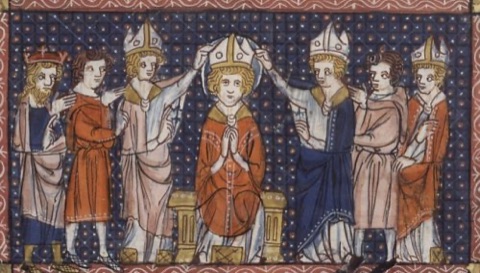
Damasus was elected bishop of Rome in 366 AD after the death of Liberius, in one of the most violently contested episcopal elections of the century. A rival party chose the deacon Ursinus at the same time, and the city split between the two claimants. The historian Ammianus Marcellinus, a pagan writing within living memory of the events, reports that the factions fought in the churches of Rome and that on a single day more than a hundred and thirty bodies were found in the basilica of Sicininus (often identified with the later Santa Maria Maggiore). Damasus prevailed, and the prefect of the city expelled Ursinus, but the schism and the charges arising from the bloodshed shadowed the early years of his episcopate.
Damasus held the see from 366 to 384 AD. He secured imperial backing against the partisans of Ursinus, who continued to press their case and to circulate accusations against him, and he worked through Roman synods to consolidate his position and to define the faith. The synod of Rome in 378 AD sought imperial confirmation of the bishop of Rome's standing in judging other bishops, and successive emperors issued rulings that strengthened his hand against his rivals. Through these years Damasus presented the Roman see with increasing confidence as the apostolic see, the church founded by Peter, and used that language to claim a place of authority among the churches.
In doctrine Damasus was a firm supporter of the Nicene settlement. His synodal and dogmatic letters, gathered under such titles as the Tome of Damasus, condemned the teaching associated with Apollinaris of Laodicea, which denied a full human mind to Christ, along with other positions the Roman synods judged heretical. His episcopate overlapped the reign of Theodosius the Great and the Council of Constantinople of 381 AD, and the Eastern bishops assembled in council afterward addressed a synodical letter to Damasus and the Western bishops; the church he led published its own definitions of the faith against the Arians and their offshoots.
Around 382 AD Damasus took Jerome as his secretary. He set him to revise the existing Latin translation of the Gospels against the Greek, a commission that began the work later carried forward into the complete Latin Bible known as the Vulgate. The association placed Jerome at the center of Roman ecclesiastical life for the remainder of Damasus's life and gave the revision the authority of the Roman see.
Damasus is remembered above all for his epigrams, the verse inscriptions he composed for the tombs of the martyrs in the catacombs of Rome. He had them cut in a distinctive monumental script by the calligrapher Furius Dionysius Filocalus, whose illustrated calendar the Roman church also preserves, and he restored and made accessible the burial places of the martyrs so that pilgrims could visit them. A number of the original inscribed slabs, or fragments of them, still survive in the Roman cemeteries and churches.
Damasus died in 384 AD and was succeeded by Siricius. The body of letters transmitted under his name is mixed: it contains genuine synodal documents together with pieces composed later and falsely attributed to him, and the spurious material is treated separately as Pseudo-Damasus. The authentic core of his writing consists of the dogmatic and synodal letters and the collection of epigrams.
Life & Career
Why I Matters
Damasus's most consequential act was the commission that began the Vulgate. By setting Jerome to revise the Latin Gospels against the Greek around 382 AD, he started the project that would eventually give the Latin West a single authoritative Bible, and he gave that project the standing of the Roman see. The complete Vulgate was Jerome's work of the following decades, but its origin lay in this commission; without Damasus there would have been no Damasan charge to Jerome, and the textual reform of the Latin Scriptures would have taken a different course.
His epigrams mark the beginning of Christian epigraphic poetry and the monumentalizing of the martyr cult. In composing verses for the tombs of the Roman martyrs and having them cut in the elegant monumental lettering of Furius Dionysius Filocalus, Damasus turned the catacombs into a mapped and legible landscape of Christian memory. The inscriptions named the martyrs, told their stories in compressed verse, and fixed the identity of the burial places for the pilgrims who came to them. This program gave the veneration of the martyrs a permanent physical form in the city and set a model for Christian commemorative verse that later writers followed.
Damasus advanced the language of Roman primacy. In his synodal statements and in the acts of the Roman synods under him, the bishop of Rome is presented as the holder of the apostolic see, the church of Peter, and this Petrine claim is used to ground a right to judge in matters of faith and discipline. The synod of 378 AD and the imperial rulings that followed strengthened the practical standing of the Roman bishop, and the theological vocabulary Damasus attached to that standing became part of the tradition on which later claims for the authority of the see of Rome were built.
The contested election of 366 AD, reported in detail by the pagan historian Ammianus Marcellinus, opens a window onto the worldly stakes of the fourth-century episcopate. Ammianus, who admired the office's spiritual purpose while noting the wealth and status that had come to attach to the Roman see, records the street fighting and the heavy loss of life without moralizing partisanship. His account stands as one of the fullest contemporary descriptions of how a great city's church was governed and fought over in the decades after Constantine, and it places Damasus's episcopate within the political realities of the imperial capital.
Complete Works in English
Free to readEvery surviving work, translated in full and free to read, from our Patrologia Latina project.