Jacques-Bénigne Bossuet
Bishop of Meaux, court preacher, and tutor to the heir of Louis XIV, known for his funeral orations, the Discourse on Universal History, and the classic French statement of divine-right monarchy.
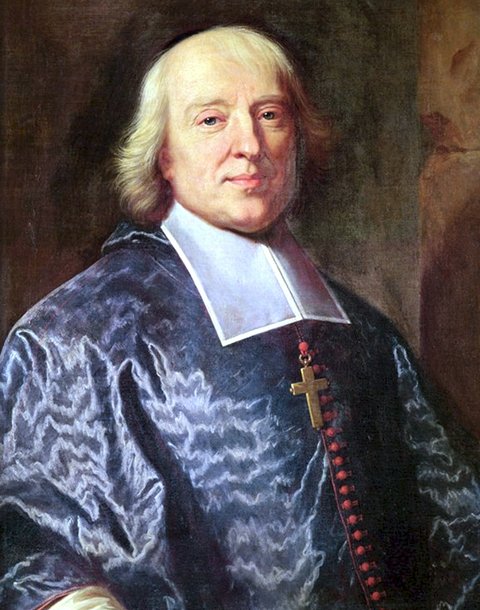
1627-1704
Biography
Jacques-Bénigne Bossuet was born in Dijon on September 27, 1627, into a family of lawyers and magistrates. He was educated by the Jesuits in Dijon and then at the Collège de Navarre in Paris, where he completed his theological studies. He was ordained priest in 1652 and spent several years as a canon at Metz, where he preached widely and engaged Protestants in controversy.
His gifts as a preacher soon brought him to Paris, where he preached before the court of Louis XIV. His funeral orations, including those for Queen Henrietta Maria of England and the Prince of Condé, became models of French prose. In 1669 he was named bishop of Condom, and in 1670 the king appointed him tutor to the Dauphin, his only legitimate son. Bossuet resigned his diocese to devote himself to the prince's education, and for him wrote the Discourse on Universal History, a Treatise on the Knowledge of God and Oneself, and the Politics Drawn from the Very Words of Holy Scripture.
When the tutorship ended, he became bishop of Meaux in 1681, a see he held for the rest of his life. He drafted the Declaration of the Clergy of France of 1682, which defined the liberties of the French Church in relation to Rome, and wrote extensively against Protestantism, most famously in the History of the Variations of the Protestant Churches (1688). In the 1690s he led the opposition to the Quietist spirituality defended by Fénelon.
Bossuet died in Paris on April 12, 1704. His political treatise, which he had continued to revise in his last years, was published in 1709.
Life & Career
Why Bossuet Matters
Bossuet was the leading voice of the French Catholic Church in the age of Louis XIV. As a preacher and writer he joined doctrinal precision with a prose style still studied as a model of classical French, and his controversial works against Protestantism argued that the true Church is known by its unbroken continuity, while the Reformation churches revealed their novelty by their changes. His Discourse on Universal History presented all of history as the work of providence centered on the people of God and the Church.
His Politics Drawn from the Very Words of Holy Scripture gave the monarchy of his day its fullest theological foundation. Bossuet argued that royal authority is sacred, paternal, absolute, and subject to reason, and he distinguished absolute rule, which no human power may coerce, from arbitrary rule, which disregards law and property. Written as instruction for a future king, the work pairs broad royal power with heavy duties toward God, justice, and the people, and it remains a primary source for understanding the political thought of early modern France.