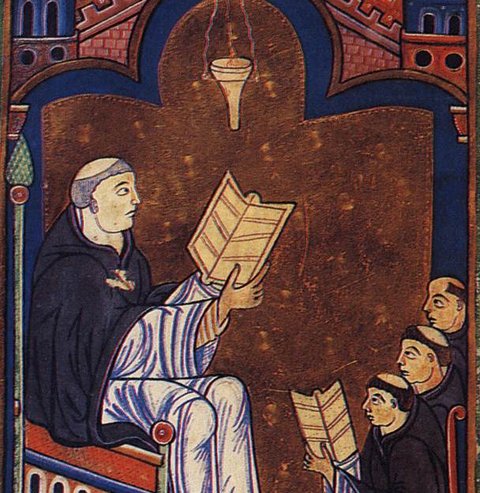
Hugh of Saint Victor
Master of the school of Saint Victor in Paris, known for the Didascalicon, a guide to the order of study, and On the Sacraments of the Christian Faith.
1096 to 1141
Biography
Hugh of Saint Victor was born around 1096. His origins are uncertain: the oldest tradition places his birth in Saxony, while others connect him with Flanders or Lorraine. Little is known of his youth beyond his own remark in the Didascalicon that he had lived in exile since he was a boy.
He came to Paris and entered the Abbey of Saint Victor, a community of Augustinian canons regular that William of Champeaux had founded in 1108 outside the city walls. Hugh spent the rest of his life there. As master of its school he made Saint Victor one of the leading centers of learning in Paris at a time when the city's schools were drawing students from across Europe.
His writings cover nearly every field a twelfth-century teacher could touch: the Didascalicon on the order of study; On the Sacraments of the Christian Faith, among the first attempts to set out Christian doctrine as a single whole; two treatises on Noah's ark as a figure of the Church and the soul; a commentary on the Celestial Hierarchy of Pseudo-Dionysius; works on Scripture, history, geometry, and grammar; and short devotional pieces such as the Soliloquy on the Betrothal Gift of the Soul. He died at Saint Victor on February 11, 1141.
Why Hugh Matters
Hugh joined the learning of the schools to the life of prayer. For him every art, from geometry to farming, had a place in the repair of fallen human nature, and all of them led finally to Scripture, read first for its history, then for its doctrine, then for its moral teaching. This ordered, Augustinian program of study shaped how the medieval schools thought about the relation between secular learning and theology, and later writers honored him as a second Augustine.
His influence ran through his own abbey and far beyond it. Richard of Saint Victor built on his teaching about contemplation, Peter Lombard drew on On the Sacraments when composing the Sentences, the standard theology textbook of the later Middle Ages, and Bonaventure singled Hugh out for combining sound doctrine, preaching, and contemplation. The Didascalicon became a widely copied introduction to study, and its account of reading as a discipline of both mind and life remains the fullest statement of the Victorine ideal.