Benedict of Nursia
Benedict of Nursia founded the monastery of Monte Cassino and wrote the Rule that became the standard code for monastic communities in the Latin West. He is called the father of Western monasticism.
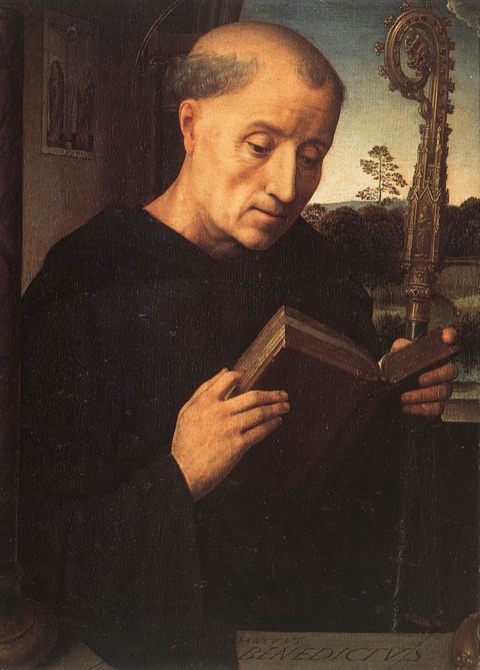
480–547 AD
Biography
Benedict of Nursia (around 480 to 547 AD) was an Italian monk who founded the monastery of Monte Cassino and wrote the Rule that became the governing code for monastic life across the Latin West. Almost everything known about his life comes from a single source: the second book of the Dialogues, written around 593 AD by Pope Gregory I, who drew on the testimony of abbots said to have known him.
He was born at Nursia, the modern Norcia, in the Umbrian hills of central Italy. As a young man he was sent to Rome for the standard liberal education, but Gregory reports that he was repelled by the conduct he saw among his fellow students and abandoned his studies. He withdrew to the wilderness at Subiaco, in the hills east of Rome, and lived alone in a cave for about three years, fed by a monk named Romanus, who lowered bread to him on a rope.
As his reputation for holiness spread, followers gathered around him. Gregory records that the monks of a community at Vicovaro asked Benedict to be their abbot and then tried to poison him when his discipline proved stricter than they wanted. He returned to Subiaco and organized his disciples into twelve small monasteries of about twelve monks each, keeping oversight of them himself. Around 529 AD he moved south and founded Monte Cassino on a height between Rome and Naples, where, according to Gregory, he tore down a shrine to Apollo and built oratories in its place.
At Monte Cassino, Benedict composed the Rule (Regula), a prologue followed by 73 short chapters that set out the daily life of a monastic community: the fixed hours of communal prayer known as the Divine Office, periods of manual labor and reading, arrangements for meals, sleep, and clothing, the election and authority of the abbot, the reception of guests, and the correction of monks who erred. He drew heavily on an earlier anonymous text known as the Rule of the Master, and on the writings of John Cassian and Basil the Great. Compared with the severe asceticism of the Egyptian and Syrian desert, his Rule was moderate and orderly; in the prologue he described the monastery as "a school for the Lord's service."
Benedict died at Monte Cassino, traditionally dated around 547 AD. Gregory's account links him with his sister Scholastica, a consecrated virgin who lived nearby. His Rule was one of several competing monastic codes in the early medieval West until the Carolingian reforms of the ninth century made it the standard for monasteries throughout the Frankish empire. In 1964 Pope Paul VI proclaimed him patron saint of Europe.
Why Benedict Matters
Benedict's importance rests on a short document rather than on any doctrine he formulated. The Rule of Saint Benedict gave a monastic community a workable constitution: a stable, largely self-governing household under an elected abbot, ordered by a written code that divided each day among worship, labor, and reading. Where earlier monasticism often depended on the personal charisma of an individual holy man, the Rule made the community itself durable, capable of outliving its founder and of being copied in new places.
Its moderation was the source of its reach. Benedict rejected extreme fasting and heroic feats of endurance in favor of a measured routine that ordinary people could sustain for a lifetime. This made the Rule adaptable, and over the following centuries it displaced its rivals. By the Carolingian period it had become the near-universal standard for monasteries in Western Europe, and later movements such as Cluny and the Cistercians were reforms carried out within the Benedictine tradition rather than departures from it.
The Rule's insistence on reading and manual work gave the medieval monastery its lasting shape as a center of literacy and production. Benedict directed that books be given out for study during Lent and that monks devote set hours to reading, and monastic scriptoria became the principal places where classical and Christian texts were copied and preserved through the centuries after the fall of the Western Roman Empire. His chapter on receiving guests, which instructed that every visitor be welcomed as Christ, tied hospitality to the monastic vocation.
For these reasons Benedict is remembered as the father of Western monasticism, and the institution he shaped carried much of the administrative, agricultural, and intellectual life of early medieval Europe. The 1964 declaration naming him patron saint of Europe reflected the judgment that the monasteries built on his Rule were among the central structures of the continent's early history.