Boethius
Roman statesman and philosopher who wrote The Consolation of Philosophy while awaiting execution. His translations of Aristotle's logic and his theological tractates shaped medieval learning for centuries.
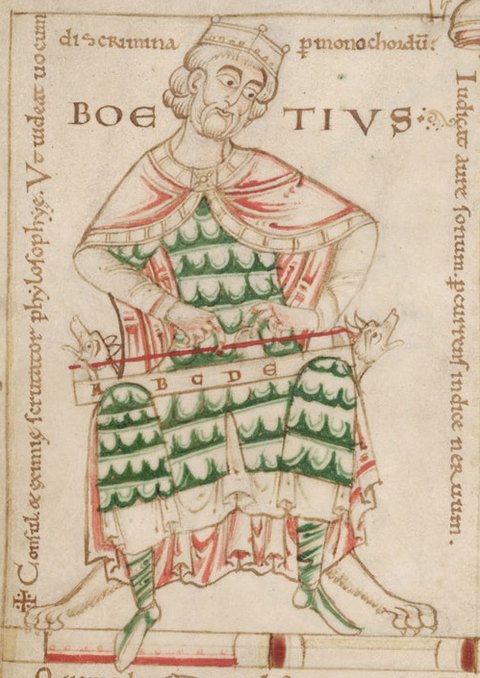
480 to 524 AD
Biography
Anicius Manlius Severinus Boethius was born in Rome around 480 AD into the Anicii, one of the city's oldest and wealthiest senatorial families. His father died when he was a boy, and he was raised in the household of Quintus Aurelius Memmius Symmachus, a leading senator and scholar. Boethius later married Symmachus's daughter Rusticiana, and the two men shared a devotion to Greek learning at a time when knowledge of Greek was fading in the Latin West.
Boethius formed an ambitious plan to translate the works of Plato and Aristotle into Latin, write commentaries on them, and show that the two philosophers agreed on the essentials. He never finished it, but he translated Porphyry's Introduction and much of Aristotle's logic, wrote commentaries and logical treatises, and produced handbooks on arithmetic and music. He also wrote a set of short theological tractates on the Trinity and on the person of Christ.
Italy was then ruled by Theodoric, king of the Ostrogoths, who governed with the cooperation of the Roman senate. Boethius served as sole consul in 510 AD, and in 522 AD his two young sons were made consuls together while he became master of offices, the head of the royal administration. His fall came quickly. When the senator Albinus was accused of treasonable correspondence with the emperor in Constantinople, Boethius defended him and was himself charged with treason and sacrilege. He was condemned without being allowed to answer the charges.
Held in prison far from Rome, Boethius wrote The Consolation of Philosophy, a dialogue in prose and verse in which Philosophy herself comes to heal his grief. He was executed in 524 AD. His father-in-law Symmachus was put to death soon after. Boethius was buried at Pavia, where he has long been honored locally as Saint Severinus.
Why Boethius Matters
Boethius stood at the hinge between the ancient and medieval worlds. For roughly six centuries, his translations and commentaries were the main route by which Western Europe knew Aristotle's logic, and his handbooks on arithmetic and music became school texts. The Consolation of Philosophy was among the most copied and translated books of the Middle Ages: Alfred the Great, Chaucer, and Elizabeth I each rendered it into English, and Dante placed Boethius among the wise in the heaven of the Sun. Its image of Fortune's wheel and its account of happiness as the highest good entered the common imagination of Christian Europe.
His theological tractates were just as formative for the schools. In On the Trinity he applied Aristotle's categories to the doctrine of God, and in his treatise against Eutyches and Nestorius he defined a person as an individual substance of a rational nature, a definition later theologians, including Thomas Aquinas, took as their starting point. His treatise on how things can be good simply by existing, and the Consolation's definition of eternity as the complete possession of unending life all at once, became standard references in medieval debates about God's nature, providence, and human freedom.