Bede
An Anglo-Saxon monk at the monastery of Wearmouth-Jarrow who wrote the Ecclesiastical History of the English People, the earliest connected account of Christianity in Britain. His consistent use of Anno Domini dating helped spread the BC/AD system across medieval Europe.
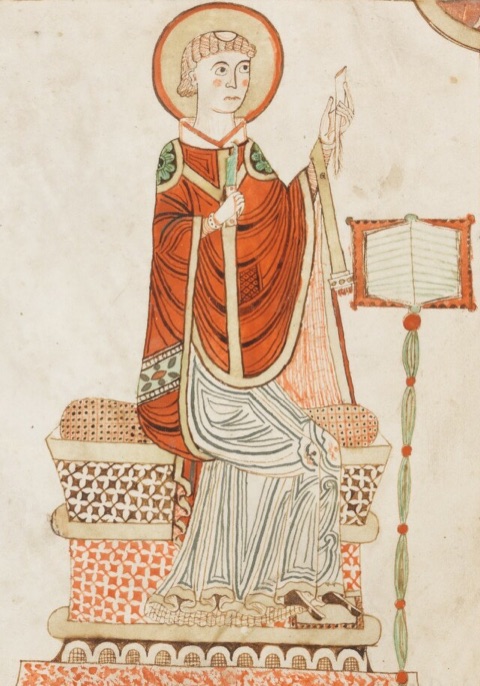
673–735
Biography
Bede (673 to 735), commonly called the Venerable Bede, was an Anglo-Saxon monk, biblical scholar, and historian who spent almost his entire life at the twin monastery of Wearmouth-Jarrow in the Kingdom of Northumbria and wrote the Ecclesiastical History of the English People. He worked in Latin, and his output ranged from Scripture commentary and hymns to treatises on time-reckoning and the natural world.
By his own account, given at the close of the Ecclesiastical History, Bede was placed in the monastery at the age of seven to be educated, first at Monkwearmouth, the house of Saint Peter founded by Benedict Biscop, and then at its sister foundation of Saint Paul at Jarrow. He was ordained deacon at nineteen and priest at thirty, the latter by John of Beverley, bishop of Hexham. From that point, he wrote, he devoted himself to the study of Scripture and, amid the observance of monastic discipline and the daily round of singing in church, took delight in learning, teaching, and writing.
Wearmouth-Jarrow gave Bede one of the best libraries in western Europe. Benedict Biscop and his successor Ceolfrith had made repeated journeys to Rome and returned with books, relics, and paintings, and it was in this collection that Bede absorbed the Latin Fathers, Roman authors, and Church councils he would later quote. He treated the works of Augustine, Jerome, Ambrose, and Gregory the Great as the raw material for his own commentaries on books such as Genesis, the Gospel of Luke, and Acts.
The Ecclesiastical History of the English People, completed in 731 and dedicated to King Ceolwulf of Northumbria, is his most influential book. Its five volumes trace events from Julius Caesar's raids on Britain to Bede's own day, centering on the conversion of the Anglo-Saxons: the mission of Augustine of Canterbury sent by Gregory the Great in 597, the labors of figures like Aidan and Cuthbert, and the Synod of Whitby in 664, which settled the dispute over the dating of Easter in favor of Roman practice. Throughout, Bede dated events from the incarnation of Christ, following the reckoning of Dionysius Exiguus.
Bede's other writings were extensive. His works on time, De temporibus of 703 and the fuller De temporum ratione of 725, explained the calculation of Easter and included a chronicle of the world's ages; De natura rerum treated cosmology and the physical world. He also composed prose and verse lives of Saint Cuthbert, a History of the Abbots of Wearmouth and Jarrow, a martyrology, and, in 734, a Letter to Egbert, bishop of York, urging reform of the Northumbrian church.
Bede died at Jarrow on 26 May 735. His pupil Cuthbert described his last days in a letter, the Epistola de obitu Bedae, reporting that the aged monk continued dictating a translation of the Gospel of John into English until his final hours. He was buried at Jarrow, and his remains were later moved to Durham Cathedral, where they rest in the Galilee Chapel. In 1899 Pope Leo XIII declared him a Doctor of the Church.
Life & Career
Why Bede Matters
Bede's reputation rests first on the Ecclesiastical History of the English People, which remains the principal narrative source for the first centuries of Christianity among the Anglo-Saxons. Where much early medieval writing gathered material without attribution, Bede named his informants and explained where his knowledge came from: in his preface he credits Abbot Albinus of Canterbury and the priest Nothhelm for records drawn from the papal archives in Rome, and elsewhere he distinguishes documented fact from report. This documentary habit gave later historians both a body of evidence and a model of method.
His influence on how the West measures time is equally concrete. Bede adopted the Anno Domini system devised by Dionysius Exiguus and applied it systematically across a major historical narrative, an approach that helped fix the convention in European usage; he is also credited with the corresponding practice of counting years before the incarnation. His computistical treatises, especially De temporum ratione, standardized the calculation of the date of Easter and transmitted the study of the calendar, the tides, and the ages of the world to generations of medieval scholars.
As a churchman, Bede served as a conduit for patristic learning. His scriptural commentaries digested Augustine, Gregory, Jerome, and Ambrose for readers who lacked access to the originals, and they circulated widely in monastic schools long after his death. That role was formally recognized in 1899, when he was named a Doctor of the Church, the only native of Britain to hold the title.
The reach of his work can be measured in its survival and reuse. The Ecclesiastical History comes down in more than 160 manuscripts, was rendered into Old English during the reign of Alfred the Great, and supplied later writers with the framework and much of the detail for the early history of England. Bede's students carried his learning forward as well, among them Egbert, who became archbishop of York and whose school would train Alcuin, a leading scholar of the Carolingian court.