Modernized edition · Full text · Free PDF/EPUB
Sacred Rhetoric in Modern English
Want the file? The PDF/EPUB is free with an account.
Summary
- Author
- Robert Lewis Dabney (1820 to 1898 AD), Southern Presbyterian theologian at Union Theological Seminary in Virginia
- Published
- 1870 AD, as Sacred Rhetoric: Or, A Course of Lectures on Preaching
- Source edition
- Dabney's 1870 text in modern English, with his Preface and all twenty-four lectures
- Type
- Seminary textbook on preaching
- Length
- 86,000 words · 6 hours
What is Sacred Rhetoric about?
Sacred Rhetoric is Robert Lewis Dabney's 1870 course of lectures on preaching, given to students at Union Theological Seminary in Virginia. Dabney argues that a sermon must expound Scripture and move the hearer's will with God's authority, and he teaches the whole craft, from choosing a text to argument, persuasion, style, delivery and public prayer.
Read the full summary (8 points, key themes)Show less
How the argument unfolds
- 01
Introduction. Objections to an art of sacred rhetoric answered, and the history of preaching from Enoch to the Methodist revival.
- 02
The preacher's commission. Eloquence aims at an act of the will, and the sermon presses it with God's authority. The preacher is a herald who may not change his message.
- 03
Subjects and texts. Doctrinal, practical and narrative sermons, the case for expository preaching, and four rules for choosing a text.
- 04
Qualities and parts. Seven qualities of every sermon, and its five members from exordium to conclusion.
- 05
Argument. The sources of conviction, rules for proof and controversy, and the division of the argument, worked out on Romans 3:20.
- 06
Persuasion and character. How to stir moral feeling rightly, and the knowledge, holiness and love the preacher must show.
- 07
Style, delivery and preparation. Pulpit style, the powers of the voice, gesture, and reading, memorizing and extempore preaching compared.
- 08
Public prayer. Faults to avoid and rules for leading a congregation's prayers.
Key themes
- Scripture as the whole matter of preaching. The preacher gives the Holy Spirit's meaning, in the proportions Scripture itself gives, and relies mainly on the Word for proof.
- Doctrine and duty together. “Preaching only doctrine to professed Christians breeds an antinomian spirit, while preaching only duty breeds self-righteousness.”
- Character as the preacher's strength. Hearers judge the man before the sermon: “Eloquence may dazzle and please, but holiness of life convinces.”
- Art that conceals itself. True art perfects nature. Ornament added for display betrays vanity, and only genuine piety produces genuine simplicity.
Reader questions (10)Hide the questions
Questions about Sacred Rhetoric
Is there a modern English version of Sacred Rhetoric?
Yes. This is Sacred Rhetoric by Robert Lewis Dabney in modern English. The language is modernized and the author's order and argument are kept. The full modernized text is free to read on this page.
Can I read Sacred Rhetoric online for free?
Yes. The complete text of this modern English edition is on this page, with no sign-up or paywall.
Is there a free PDF of Sacred Rhetoric?
Yes. The PDF and EPUB of this edition are free with an Updated Works account. Sign in with Google or an email link; no card is needed.
What is Sacred Rhetoric by Robert Lewis Dabney about?
It is a full course in preaching for ministers in training: what a sermon is, how to choose and expound a text, the qualities and parts of a sermon, argument and persuasion, style, delivery, preparation and public prayer.
Why did Dabney write it?
Teaching pulpit rhetoric at Union Theological Seminary, he found no existing book adequate as a classroom text, so he built his own course and printed it at the request of students and fellow ministers.
What does Dabney mean by expository preaching?
Preaching that unfolds God's meaning in a passage with regard to its context. He urges preaching through whole books, and allows a single verse only when it states a central doctrine or sums up a longer argument or parable.
Why does Dabney oppose political preaching?
It turns sacred time to party quarrels and teaches people to dwell on their neighbors' sins. Of the minister he writes: “He is a citizen only at the polls and on a weekday. In the pulpit, he is solely the ambassador of Christ.”
What does Dabney say about funeral sermons?
Preach the gospel at funerals, but avoid eulogies that pronounce the dead in heaven. They flatter families and make salvation look easy, so outside rare cases of recognized holiness he counsels silence about the deceased.
Should a preacher read, memorize or speak extempore?
Dabney rejects reading and reciting from memory. He allows a manuscript used freely once its thought is mastered, and prefers extempore preaching, with the thought fully prepared and the words left to the moment.
Why does the book end with public prayer?
Because a minister's prayers teach his people how to pray, and he must prepare them as carefully as his sermons. Dabney says most of this counsel is drawn from Samuel Miller's book on public prayer.
Sacred Rhetoric in Modern English · Full text
Preface
This little book is the fruit of twenty years of study, reflection, and teaching. It would be risky for anyone to claim originality in a field as rich in great works as sacred rhetoric. The best way to disavow any such claim is to list the books I have read with the greatest profit, which have shaped my knowledge and convictions on this subject. Readers familiar with these treatises will likely find in them either the seeds or the full form of nearly every idea I present.
I have found the following works exceedingly instructive: Aristotle’s Rhetoric; Cicero’s On the Orator; Horace’s Epistle to the Pisos; Quintilian’s Institutes of Oratory; George Campbell’s Philosophy of Rhetoric; Richard Whately’s Rhetoric; and Alexandre Vinet’s Homiletics.
My studies have also included Plato’s Gorgias; Fénelon’s Dialogues on Eloquence; Dr. George Campbell’s Lectures on Pulpit Eloquence; Ebenezer Porter’s Homiletics; Félix Bungener’s Priest and Preacher; Abbé Louis Bautain’s On Extempore Speech; Dr. J. W. Alexander’s Thoughts on Preaching; Franz Theremin’s Eloquence a Virtue; William G. T. Shedd’s Homiletics; and Dr. Samuel Miller’s On Public Prayer.
You may naturally ask why I dare add another volume to so long a list, which could easily be extended even further. My answer is simple. Teaching a course on pulpit rhetoric at Union Theological Seminary soon convinced me that none of these books serves as an adequate classroom textbook. Several contain features of great value, yet every one of them omits elements I consider essential. Early on, therefore, I was forced to build a course of my own that could serve as a sufficient guide for the evangelical Protestant preacher.
The warm approval this course has received from my students and brothers in the ministry, along with their steady requests for its publication, has encouraged me to print it. At the very least, this will accomplish my chief aim: putting my lectures into a form more useful to my students.
If this work has any distinctive merits, they are these two. First, it insists throughout on eminent Christian character as the true foundation of the sacred orator’s power. Second, it argues with all the force I can muster for a theory of preaching that honors God’s inspired Word and binds the preacher strictly to its exclusive use as the sword of the Spirit. If my readers finish this book with two deeper convictions fixed in their souls, my labor will not be in vain: that grace makes the preacher, and that nothing deserves to be called preaching unless it expounds the Scriptures.
I have chosen to publish this volume through the publishing agency of my own denomination. Its principles, however, are not denominational. The theory of preaching taught here applies equally to all evangelical ministers. My hope and prayer are that my work will serve my brothers of every name and help them preach the glorious gospel of the Lord Jesus Christ more directly, more scripturally, and more effectively, so that this divinely ordained instrument may recover its original power in the church.
Lecture 1: Introduction
Objections to Sacred Rhetoric
My young brothers,
Some well-meaning Christians meet us at the very threshold of this subject with objections to applying an art of rhetoric to sacred themes. Their objections sound plausible enough to deserve a clear reply. They do not stop with the worn-out maxims “A poet is born, not made” and “Nature is a better teacher than art.” They also draw special arguments from the sacredness of the preacher’s calling and motives, and even from the Word of God.
They insist that the messenger who brings the gospel of love to humanity ought to be completely natural and sincere. Others who plead lesser causes may perhaps excuse their reliance on art, they say, but the preacher should rise above all art. Against us they cite the apostle Paul’s twice-repeated declaration that his “speech and his preaching was not with enticing words of man’s wisdom, but in demonstration of the Spirit and of power” (1 Cor 2:4, 13).
To the first objection I reply that even if the orator is born, his oration is not. The speech, at least, must be made. Rhetoric does not claim to create a strong mind, deep feeling, refined taste, or native genius. It only teaches how to put those gifts to their most effective use. A master craftsman does not manufacture hands for his apprentice, yet he shows the apprentice how to use the hands nature gave him. Through such training, an ordinary worker can build a better plow or cart than an untrained youth whose physique rivals the Apollo Belvedere.
Some object that we often hear an untaught speaker of rare natural gifts preach with far greater true eloquence than a diligent student of rhetoric. The answer is obvious. Those splendid natural gifts ought to have been refined by sound training, enabling that gifted speaker to surpass trained peers of ordinary ability even further than he did. He owed all that excellence to his God under the command to “love him with all our heart, and soul, and mind, and strength” (Mark 12:30).
Moreover, the clumsiness of a trained rhetorician does not prove that the art is worthless. It may only show that he has mastered it poorly. A genuinely valuable system, when half learned and applied awkwardly through lack of practice, will hinder rather than help us. King Saul’s royal armor was surely of the finest quality, and we do not doubt that David used such armor to great advantage in his later campaigns. Yet when the raw shepherd boy put it on, it only weighed him down, “because he had not proved it” (1 Sam 17:39).
The claim that the preacher’s sacred calling places him above rhetoric betrays ignorance of what true art actually is. Let us therefore gain a clear idea of it right at the start by distinguishing between art and artifice. Art is simply the rational adjustment of means to an end. (The word “art” itself derives from the Latin ars and the Greek root arō, carrying the basic idea of fitting or adjusting.) Art is adaptation. It uses proper means to reach a worthy goal. In short, art is wisdom in action.
Artifice, by contrast, is false. It uses deceitful means to serve a treacherous end. When a compassionate physician compounds a medicine that his learning shows will cure a specific disease, that is art. When a cunning seducer crafts a false allure to trap his victim in a snare, that is artifice.
A popular use of the word “art” has also misled these objectors. People often think of the “fine arts,” where skill aims solely to please the aesthetic taste rather than to move the will to action. As I will show, the art of eloquence stands in sharp contrast to the fine arts, because its aim is always intensely practical. Whenever a preacher lets his aim sink to that of a painter or musician, seeking merely to gratify taste, he flagrantly violates both the rules of his art and his duty to God. Yet because his duty is to carry gospel truth effectively to human souls, and because well-adapted means help accomplish that end, a true art of preaching is not only lawful and honest, it is a sacred obligation.
The objectors we are answering also love to pit art against nature. I maintain, however, that all true art is natural. Humans are by nature creatures of reason and conscience. Duty, foresight, judgment, will, and the desire for rightful success all belong to human nature. Therefore a person does not obey his nature, but violates it, when he discards adapted means for achieving his ends.
True, some gifted souls achieve grander results without the detailed study that ordinary mortals need. Even then, their stronger genius has simply grasped the principles of the art more quickly and intuitively. To reach that height of effectiveness, they climbed the very same staircase, because there is no other. The only difference is that while we climb it step by step, their superior vigor lets them bound up it almost effortlessly.
What is more, these champions of pure nature do not actually abandon art. They are nowhere near as natural as they pretend to be. Rousseau and the unbelieving Encyclopedists liked to call tribal peoples “children of nature,” yet no human being is less simple than a tribal person. He is enslaved to his own conventions, fashions, and artifices. They merely differ from those of civilized society and bind him even more tightly. In the same way, speakers who claim to leave everything to nature are always the most unnatural. They possess not only art, but artifice and mannerism, and they are far more enslaved to them than the true artist is.
Art, I repeat, is simply a well-adapted method. Our real choice is never between art and nature, but between wise art and foolish art, between skillful art and clumsy art. Indeed, the goal of true art is simply to help nature perfect herself and open the path to her highest ends. I therefore turn the conclusion back upon our objector. Unless he insists that human faculties admit no method at all, and that a speaker’s first untaught attempts are always his best, he must grant a legitimate art of sacred rhetoric. Seeking and using it is not merely the preacher’s privilege, it is his sacred duty.
We easily answer the appeal to the great apostle’s seeming disclaimer by asking two questions. First, what kind of rhetoric did Paul reject? Second, did he not employ a method of his own? Christian history answers the first question clearly. The false and unworthy art Paul rejected was that of the Greek Sophists: a system of mere tricks of logic and style, driven by vanity and falsehood and warped by corrupt taste. It was the pretentious rhetoric that Socrates exposed with such biting sarcasm and reasoning in Plato’s Gorgias.
While Paul rejected that counterfeit art, he certainly did not preach without method. He followed an appropriate method of his own. If you reply that his method was honest rather than deceitful like the Greeks, simple rather than showily complex, modest rather than ostentatious, and selfless rather than arrogantly ambitious, I wholeheartedly agree. And I add that those very qualities made Paul’s method a true rhetoric. Let us make the discovery of his method the goal of our study. Let us shape our sacred rhetoric to match his, as it was taught to him first by the Holy Spirit and next by his deep learning and pure devotion.
The objection drawn from Christ’s command against anxious preparation when the apostles stood before persecutors will hardly trouble you for a moment. Our Savior told them, “Settle it in your hearts not to meditate before what you shall answer; for I will give you a mouth and wisdom which all your adversaries shall not be able to gainsay or resist” (Luke 21:14-15). That command clearly rests on the accompanying promise.
We must ask whether that promise was given to them as ordinary ministers or as inspired apostles. The answer is settled by the “signs which should follow” (Mark 16:17): speaking in tongues, healing the sick, and casting out demons. To claim for an uninspired preacher an extraordinary inspiration that removes the need for preparation is simply to twist Scripture. Such inspiration is just as miraculous as the signs that confirmed it.
Besides, our Savior’s prohibition applies even more directly to preparing a specific message than to studying the general art of speaking. Yet who today would claim that a minister should not even think through the passage he is about to expound? Paul himself proves beyond doubt that he did not consider preparation unlawful. He commands Timothy “to give attendance to reading, to exhortation, to doctrine, to meditate upon these things, and give himself wholly to them, that his profiting might appear unto all” (1 Tim 4:13-15).
Whately cites from Aristotle a plain and decisive illustration of the whole debate. Imagine two men who have had the exact same opportunity to watch and understand an event. Each sets out to describe it to friends who were not there. The first tells the story so clearly and vividly that his hearers listen effortlessly and with keen delight. The second tangles his account so badly that it wearies his listeners and fails to convey what actually happened. Do we not see this happen all the time? Now, says Aristotle, the difference between how those two men tell their story is rhetoric. Where exactly does that difference lie? That is precisely what we seek to discover in this course.
I do not claim that a course in sacred rhetoric can match the breadth or the full intellectual and spiritual depth of the other branches of sacred learning taught by my colleagues. In one vital respect, however, it stands toward all your other seminary studies much as Francis Bacon’s “vintage” stands toward the work of scientific induction. Observing, comparing, and classifying facts are all preparatory steps. The final inference from that comparison uncovers the true law of causation and presses out the precious juice for which the clusters were gathered with such care.
In the same way, you have come here to become preachers of the gospel. Proclaiming it from the pulpit will be your primary calling, so every other study is a servant to the one we begin today. Sacred rhetoric is what teaches you to press the rich wine of all your other learning to the lips of perishing people.
A Brief History of Preaching
Next, I want to introduce our subject through a brief sketch of the history of preaching. The gift of speech is the clearest trait that sets human beings apart from animals. Language serves the human mind so intimately in all its work that we cannot even be sure how many hidden capacities we deny to animals simply because they lack this medium. Quintilian makes a similar point: even creatures that build wonders we cannot imitate, such as wax and honey, are called mute and irrational because they lack speech. Since we have received no greater gift than speech, nothing is more worthy of our labor and cultivation, especially because no field rewards effort more richly.
Speech is what makes us genuinely social beings. Without it, our natural pull toward others would give us nothing more than the herding instinct of cattle, not true society. Speech bridges the gulf that isolates one spirit from another. It is the great channel of communication that lets human beings share one another’s experience, reasoning, wisdom, and affections.
I recall these familiar truths to show how naturally, and even necessarily, spoken address enters the service of religion. Considering both our religious and our social nature, we should expect a wise God from the very beginning to consecrate his gift of speech to spreading sacred truth and devotion. And indeed, we find that sustained spoken address has been used for that purpose from the earliest ages.
Even in the brief record we have of the world before the flood, we read that God’s will was preached. “Enoch, the seventh from Adam, prophesied of the ungodly” (Jude 1:14). Noah was “a preacher of righteousness” (2 Pet 2:5).
When we come down to the Hebrew commonwealth, we find three official orders of preachers in addition to the patriarchal heads of households. Fathers were commanded to give constant oral instruction to their children (Deut 6:7). This teaching probably took the plain, familiar form of conversational instruction (the original sense of the word “homiletical”) rather than a formal sermon.
First among the official orders stood the prophets. Though they were occasional officers of the theocracy, they were unmistakably public preachers of revealed truth. We read of public discourses delivered by Moses, Aaron (who was both prophet and priest), Isaiah, Elijah, Elisha, Jonah, Jeremiah, and the prophets of the restoration. Ezekiel vividly pictures the weight of his office through the image of a watchman posted to warn of an approaching enemy (Ezek 33). We also read of schools of the prophets, where young men dedicated to God’s special service gathered under inspired teachers. They did not meet to learn by rote a prophetic gift that only God’s sovereign grace can bestow, but to prepare themselves through habits of devotion and close familiarity with the Scriptures and worship of Israel.
The second order of preachers was the priesthood. Clearly a priest’s regular duties were not purely sacrificial, since altar service took only a few weeks of his year. His duties were also pastoral. When not serving at the sanctuary, the priests and Levites lived scattered throughout Israel and were charged with teaching and preaching. Azariah the son of Oded points to their neglect during the reign of Asa: “Now for a long season Israel hath been without the true God, and without a teaching priest” (2 Chr 15:3). Malachi states this duty even more explicitly: “For the priests’ lips should keep knowledge, and they should seek the law at his mouth, for he is the messenger of the Lord of hosts” (Mal 2:7).
There is also evidence that Israel’s theocratic kings counted preaching among their rightful duties. It is worth noting in passing how early Islam shows how naturally this role belonged to a ruler claiming divine appointment. Muhammad accurately captured several outward forms of ancient Near Eastern religion by presenting himself as both prophet and theocratic head of his new state. He passed the latter office to his successors, and before military conquest turned the early caliphs into mere soldiers, they preached regularly by virtue of their office, especially the first caliph, Abu Bakr.
Returning to Israel, one of Solomon’s own titles was “Preacher” (Eccl 1:1; Eccl 12:9), and the passages cited and others give ample proof that he exercised this office often. We cannot doubt that Asa, Hezekiah, and good King Josiah did the same, at least during seasons of greatest faithfulness to Israel’s covenant institutions.
Under Ezra, however, preaching took on by divine appointment something very close to its modern place as a regular part of worship, along with its modern character as an exposition of written Scripture. Two forces drove this development: the needs of a great spiritual revival, and the fact that the people no longer spoke classical Hebrew as their everyday tongue. Seventy years in Chaldea had taught them a modified dialect. Reading the sacred text therefore had to be accompanied by explanation in the common language. “And Ezra, the priest, brought forth the Law before the congregation. … So they read in the book of the law of God distinctly, and gave the sense, and caused them to understand the reading” (Neh 8:1-8). We will look in vain for a sharper, more scriptural definition of the preacher’s work than those words.
From that time onward, Jewish historians tell us, expository preaching became a regular practice following the Scripture readings in synagogue worship. You already know that custom too well to need a detailed account. The glimpses in the Gospels show that preaching was not restricted to the “ruler of the synagogue,” but could be performed at his invitation by any learned and qualified worshiper (Luke 4:16; Matt 13:54; John 18:20). It usually grew out of the Scripture readings for the day, and while the speaker stood to read from the Law and the Prophets, he sat down to deliver his exposition. These details matter greatly to us: they show our Savior’s approval of preaching as part of divine worship, and they link the preaching of the old covenant directly to that of the new.
The Redeemer, and the apostles after him, were constant preachers of the gospel. Whenever they were permitted, they used Sabbath worship and the synagogues for this work. Yet they preached everywhere: in the temple courts, in private homes, in streets and highways, beside the sea, and on mountainsides. Preaching was the chief instrument of every Christian missionary and teacher, whatever his rank. “It pleased God by the foolishness of preaching to save them that believe” (1 Cor 1:21). Both the commands and the narratives of Acts and the Epistles make clear that preaching remained a steady element in the public worship of all Christian congregations.
Christian literature surviving to us is very scarce until the middle of the second century. Even so, Justin Martyr’s well-known account, Pliny’s letter to Trajan, and every testimony of the Church Fathers confirm that preaching continued unbroken under the church’s uninspired teachers. The sermons of those early pastors were expository rather than built on a single short text, usually based on the Scripture passages just read. They were artless, warm, and practical, rarely read from a manuscript, and often spoken extemporaneously. As in the synagogue, preaching was not confined to bishops or senior pastors. At their invitation, lower clergy, catechists, and even learned laypeople preached. When Origen was filling Caesarea with the fame of his sermons, he was only a reader and catechist.
As the church grew in numbers and worldly standing, moving from private rooms to grand temples and basilicas, the style of preaching became far more ambitious. A bishop sat in his episcopal chair or throne while speaking, or else on the steps of the altar. Meanwhile the congregation stood throughout the sermon, since ancient churches had no pews. Pulpit eloquence was now eagerly cultivated, and many clergy won wide fame as orators, foremost among them Ambrose, Chrysostom, and Augustine.
Judging from Augustine’s surviving sermons, those Fathers remained free from a rigid rule that sometimes harms modern preachers. They did not feel obliged to fill a fixed block of time, but simply stopped when they had finished. Some of Augustine’s sermons seem to have lasted six minutes, others sixty. Very few discourses were read aloud from manuscripts, though stenographers often took them down as they were delivered, which probably explains why most surviving patristic sermons still exist. Congregations frequently claimed the right to applaud openly, and preachers often allowed it. As religion grew more showy and corrupt, churches became scenes of shameful disorder.
The coming of the Dark Ages brought a steep decline in preaching. Gradually, poorly trained clergy substituted ready-made homilies for their own sermons, and then let liturgy crowd out the time once given to preaching. Except when a wave of public excitement moved some clerical demagogue to proclaim a crusade or a fast, public worship contained no sermon at all.
When a more ambitious priest did step up to display his learning, his subject was superstitious, trivial, or outright absurd. He boasted of the powers of a relic, recounted the legend of his patron saint, hawked the value of indulgences, painted the terrors of purgatory, or thundered against the sin of resisting the church and her clergy. One famous preacher in the reign of Philip Augustus of France spent all his eloquence attacking the long pointed toes on fashionable shoes. An earlier preacher seriously debated whether the gold the Magi brought to the infant Savior was minted coins or raw ingots. Another entertained his audience with the edifying inquiry of what weapon Cain used to kill his brother.
The great Reformation was unmistakably a revival of gospel preaching. All the leading Reformers in Germany, Switzerland, England, and Scotland were constant preachers, and their sermons were overwhelmingly expository. As you well know, Luther’s commentary on Galatians and many of Calvin’s learned expositions grew directly out of their series of exegetical sermons. We may safely conclude that the spiritual power of that great movement came above all from restoring scriptural preaching.
In the seventeenth century, the Protestant churches of continental Europe saw another shift in their pulpits. Instead of remaining evangelical, preaching became largely polemical and technical, expounding and defending church confessions more than God’s Word. This change soon brought a decline in the piety of the age, from which the Pietists only partly awakened the Lutheran churches.
Meanwhile, the English clergy, along with the Scottish clergy under the influence of Moderatism, drifted into a style that earned the famous jab: their texts were borrowed from Paul, but their sermons were borrowed from Seneca. They aspired to lecture on ethics rather than Christianity, aiming for literary polish rather than evangelical power. The result was a numbing flood of Socinianism, Deism, cold formality, and vice that swept over the church until the Methodist revival of the eighteenth century rose to stem the tide.
Do not imagine, young gentlemen, that I offer this brief sketch to trespass on the field of church history. My sole aim is to remind you of the historical facts that prepare you to understand the preacher’s warrant and calling. Even this quick survey proves that the condition of the pulpit is always a reliable gauge of the condition of the church. Whenever the pulpit is evangelical, the piety of the people remains in some measure healthy. Whenever the pulpit is corrupted, spiritual apostasy in the church is sure to follow.
It is deeply instructive to observe that preaching has repeatedly passed through three distinct stages with the very same results. In the first stage, scriptural truth is faithfully presented in scriptural dress. Not only are all the true doctrines of redemption proclaimed, they are presented in the very form and connection in which the Holy Spirit revealed them, without borrowing another framework from human philosophy. This condition of the pulpit marks the golden age of the church.
The second is the transition stage. The doctrines taught are still biblical, yet their relationships are reshaped to fit the prevailing philosophical systems of the day. At this point God’s truth is already stripped of part of its power over the soul.
Then the third stage quickly follows. Now not only are the methods and explanations conformed to current philosophy, the doctrines themselves contradict the Word of God. Again and again the clergy have walked down this descending scale, and always with the same disastrous outcome.
We see the first stage in the early church and the Reformation churches of the first and sixteenth centuries. We see the second stage in the scholasticism of Clement of Alexandria and his disciples, and in the confessional, technical discourses that echoed from continental pulpits in the seventeenth century. We see the third stage in the Dark Ages and in modern Rationalism.
This same cycle appears with striking clarity in the history of the New Theology unfolding in our own day in America. When the Protestant churches of this country were planted, the ministry still carried the Reformation impulse and stood in the first stage. The generation unwittingly ushered in by the great and good Jonathan Edwards marks the second stage. During that era the doctrines of grace were not openly denied, yet they were successively stretched onto metaphysical frameworks: the “exercise scheme,” the “light scheme,” and the “greatest benevolence scheme.” These systems captivated people of narrow, partial learning and self-confident temper.
The very next generation witnessed the full apostasy that turned God’s truth into a lie, adopting both the methods and the dogmas of the Socinian and the Pelagian. My brothers, let us reject the ill-fated ambition that turns the body of God’s truth into a mannequin on which to drape the garments of human philosophy. May we always be content to present Bible doctrine in its own Bible dress!
Lecture 2: The Preacher’s Commission
The Nature of True Eloquence
Sacred rhetoric is one branch of eloquence. It is therefore vital that you grasp two things from the outset: first, what eloquence truly is, and second, how our sacred calling differs from secular oratory.
Eloquence is often grouped among the fine arts, yet as I have already warned you, their aims divide them sharply. Music and the visual arts are designed primarily to gratify aesthetic taste. Their immediate target is the sentimental affections of the soul. The immediate end of eloquence, however, is to produce practical volition in the hearer. Its purpose is to call forth an act.
By “action,” you will understand that I do not mean mere physical movement of the body and limbs. I mean the actions of the soul: those settled determinations of the will in which human rational and moral agency reaches its goal. I repeat, whenever a speaker has no direct aim to move the hearer’s will to action, there is no true oration.
Aristotle, for example, incorrectly classifies orations into three kinds: those of the statesman, the advocate, and the eulogist. The statesman always aims to persuade hearers to adopt or reject a course of action. The advocate seeks a verdict of acquittal or condemnation. Even the eulogist, though less obviously active, really aims at a moral verdict by which hearers adopt the praised figure as an approved model of virtue. Aristotle knew nothing of our higher realm, evangelical eloquence. Here the goal is clearer still: it always aims at a decisive action of the hearer’s soul, such as repentance, faith, or some other duty.
Of course, while a true oration moves the soul to action, it may stir much aesthetic pleasure as a side effect. If it elevates that secondary effect into its main purpose, however, it degenerates into a counterfeit poem without meter. Conversely, a poem, especially a stirring lyric like the Marseillaise, may target the will directly. In doing so it ceases to be mere poetry and becomes a true metrical oration. The essay aims at yet a third goal: clarifying and proving truth to the intellect. It seeks to spread opinion, not to spark action.
Let me now call back your studies in ethics and psychology to answer a key question: how is the soul moved to an act of will? You know it is not moved by feeling alone, nor by logical reasoning alone. Volition is not the product of one isolated faculty of the soul, but of the whole soul itself, engaging all its powers, active and passive, of understanding, feeling, and desire. The inner states that directly cause an act of will are always complex, combining both thought and desire. Clearly, then, eloquence engages the hearer’s soul through every one of its faculties.
It is far more important to realize that eloquence operates through all the faculties of the speaker’s soul as well. The orator’s reason must grasp and argue truth clearly. His heart must be deeply stirred by the emotions he hopes to awaken. His taste must vibrate with the sentiments that serve his main purpose. Above all, his own will must surge forcefully toward the very act to which he seeks to persuade his hearers.
That fourth requirement may be the most vital of all. An orator’s power over his hearers is far more than intellectual and far more than emotional. He drives the force of his own will through those other faculties directly onto the will of his audience. A deep sympathy of soul links human beings together, allowing each faculty in the speaker to act on the corresponding faculty in the listener. This never bypasses understanding, of course, yet each faculty carries its own distinct force. Nowhere is this truer than with the will. How often do we see people swayed by the sheer force of another’s resolute will far beyond the mere weight of his logic?
I therefore define eloquence as the emission of the soul’s energy through speech. Seen in this light, eloquence plainly deserves its reputation as one of the noblest exercises of human powers.
To merit the name of true eloquence, however, it needs one more essential quality: the aim of producing a morally good choice in the hearer’s soul. If you have followed my reasoning so far, you see that the faculties an orator uses are even more moral than intellectual. When a speaker twists those powers, which rightly belong to conscience, to fight against conscience, he commits the gravest perversion of his art.
His counterfeit oratory stands to true eloquence as vice stands to virtue. When someone commits a wicked deed, he exercises the very same active powers of desire and choice that produce a righteous deed. The whole difference lies in aiming them at a vicious end instead of a virtuous one. Clever persuasion used to make someone choose evil has no more right to be called true eloquence simply because it borrows the art’s tools than evil choices deserve to be called moral strength merely because they are free acts of the will.
I go even further: all vice is a weakness of human nature. Perverted soul-energies are crippled in strength as well as corrupted in moral quality. A speaker pursuing wicked ends will therefore never display the same power of soul as a righteous speaker of equal native ability.
The decisive reason, however, is that conscience itself is the mightiest power in human nature, and the moral affections are not only the purest but the deepest of all. A speaker who tries to persuade people to violate their conscience weakens the chief forces of his own nature. Worse still, he must work without, and indeed directly against, those very forces inside the souls he wants to move.
Thus I trace true rhetorical power to its root in a noble purpose. There must be clear thought, vivid feeling, ardent emotion, and resolute will, yet highest of all must stand a virtuous goal. Franz Theremin spoke wisely when he laid down his thesis: “Eloquence is a virtue.”
The Distinctive Character of the Sermon
Having defined true eloquence as the soul’s virtuous energy poured forth through speech, I now remind you that the sermon is a distinct species of eloquence. Like all true eloquence, it always aims to produce a definite, practical act of will in the hearer. Its aim is worthy in the highest sense, because the acts it seeks are spiritual.
What sets the sermon apart above all else, however, is that it brings to bear upon the will the authority of God, the sole Lord of the conscience. This alone, I repeat, makes a discourse a gospel sermon. Other orators appeal to human testimony and natural reason to convince the mind, and they press legitimate civic or moral motives upon the heart. The preacher relies exclusively on gospel motives and grounds every conviction of reason ultimately in the testimony of God.
I stress this all-important distinction carefully, because its very simplicity can make it hard to grasp fully. The goal of every oration, I repeat, is to make men do. Yet the deeds a sermon calls people to do are solely the things of God. Therefore it must bring God’s own authority to bear on them. If your message urges hearers merely with admirable arguments that are natural, ethical, social, legal, political, self-interested, or philanthropic, and never brings their wills directly under a “thus saith the Lord,” it is not a sermon. It has sunk into a mere speech (1 Thess 2:13).
If it were necessary, young gentlemen, I would plead earnestly with you to master these two definitions: what eloquence is, and what a sermon is. Anchor them firmly in your minds as the foundation of everything you will learn in this course. As we move forward, you will see many proofs of their soundness, and I trust that by the end you will agree with me completely.
One of the young preacher’s greatest struggles comes from fuzzy thinking about the exact nature and goal of a sermon. Dr. Baxter bore witness to that very difficulty from his own experience. If the true idea of preaching is as high and sacred as I have described, how tragically does a minister drain it of its proper force when he confuses it with a mere moral speech!
The Preacher’s Scriptural Warrant and Office
This brings us directly to a foundational question: what is the preacher’s scriptural standing and warrant? You will see at once how closely my theory connects with the theology of the Protestant churches. We hold that “the Bible alone is the religion of Protestants.” We reject all “will-worship” as forbidden and harmful. We claim no right to introduce anything into the public worship of God except what he has appointed in his Word. Unless we can find biblical warrant for preaching as an instituted part of divine worship, we dare not practice it.
We likewise hold, in the words of the Westminster Confession of Faith, that “to this catholic visible church, Christ has given the ministry, oracles, and ordinances of God, for the gathering and perfecting of the saints, in this life, to the end of the world.” Both Protestants and the Bible itself confess that Scripture is “all given by inspiration of God” (2 Tim 3:16) and stands as our divine, supreme rule of faith and life. As our confession declares, “The whole counsel of God concerning all things necessary … for man’s salvation, faith, and life, is either expressly set down in Scripture, or by good and necessary consequence may be deduced from Scripture; to which nothing at any time is to be added.” Yet this Word becomes effective for calling and sanctifying rational adults only through the almighty inner work of God’s Holy Spirit.
To establish the warrant for our office as preachers, we point first to the example and precedent of the scriptural church, the teachers of both Testaments, and especially the apostles. Because that precedent was set and consistently followed by divine authority, it carries the force of a command for us. Next, we point to the explicit commands of our Savior, “As ye go, preach” (Matt 10:7; Luke 10:1; Acts 10:42), and of the apostle Paul, “Preach the word; be instant, in season, out of season; reprove, rebuke, exhort, with all longsuffering and doctrine” (2 Tim 2:2; 2 Tim 4:2).
The exact nature of the preacher’s work is settled by the title the Holy Spirit uses to describe him. The preacher is a herald, and his task is heralding the King’s message. Once, the apostles also call themselves Christ’s ambassadors (2 Cor 5:20), and in the ancient world ambassadors were simply heralds.
Now a herald does not invent his message; he only delivers and explains it. It is not his place to critique its wisdom or suitability. That belongs to his sovereign alone. On the one hand, he is not a mindless noisemaker like a trumpet or a drum. He is an intelligent envoy sent to the King’s enemies, possessing a mind as well as a voice. He must deliver and clarify his master’s mind so that the listeners grasp not just the bare sounds, but the true meaning of the message.
On the other hand, it completely exceeds his office to alter the terms he carries, either by adding to them or changing them. Listen to God’s commission to an ancient preacher: “Arise; go unto Nineveh, that great city, and preach unto it the preaching that I bid thee” (Jonah 3:2).
We may also describe the preacher’s task as instrumentally stamping the image of Christ onto human souls. The soft material is the human heart. The die placed in the workman’s hand is the revealed Word. The impression to be formed is the divine image of knowledge and true holiness. God, who created the soul and knows it completely, fashioned the die. He obviously knew best how to engrave it to produce the exact imprint he desired.
The workman’s job is not to critique, recarve, or smooth out anything on the die entrusted to him. His job is simply to press it down faithfully onto the surface before him, following the instructions given for his work. Seen in this light, how obvious it is that preaching must simply present Bible truths in Bible proportions! The preacher’s business is to take what God has given him in Scripture, just as it is given, and strive to press it onto human souls. Everything else is God’s work. The die is exactly the size, sharpness, and hardness God intended, bearing the exact “image and superscription” (Matt 22:20) he chose. With this tool, “the man of God is perfect, thoroughly furnished unto all good works” (2 Tim 3:17). That is enough for us.
These are plain truths that no evangelical believer will dare dispute. Yet if I am not mistaken, they directly challenge several habits common among professed Protestant ministers. Not only must biblical themes form the entire substance of our preaching, they must be presented in their biblical shape and balance.
The Bible was written to be food for ordinary people. It is not raw material that a religious philosopher must first digest into new formulas before congregations can absorb it. Unlike the book of nature, Scripture is not a crude mass of unrefined ore that human science must smelt before it can be applied to daily life. A great Protestant principle is that the Bible belongs to the people. That means God, who knows best, has not only revealed the right truths, he has set them in the exact proportions and connections that best fit the human soul under the work of the Holy Spirit. No human system can improve on the forms and connections God himself saw fit to give.
We can therefore be unfaithful to our calling even without preaching heresy. We may preach only true doctrines, yet out of pride and self-will push some truths into the spotlight and push others into the shadows in ways the Bible never does. In this respect our preaching must stay faithful to the “proportion of faith” (Rom 12:6).
Still, many ministers shrink back in fear from what feels to them like too narrow a path. They feel compelled to range more widely than simply showing people what the Bible means and pressing that meaning onto their souls. Their unspoken feeling runs like this: “That would not offer enough variety or interest. It leaves too little room for a preacher to display his own powers. Such plodding simplicity is beneath a deep theological thinker. It does not supply enough mental nourishment for the sharp minds of educated hearers.”
As a result, some pulpits offer grandiloquent lectures on the “moral system of the universe.” Others spend the people’s Sabbaths entirely on apologetic battles meant to defend Christianity’s outer walls against unbelieving philosophy. That is like feeding sheep inside the fold with the sharp weapons meant to be hurled at the wolves outside. Still others serve up scholastic debates over confessional formulas, splitting the “bare bones of their orthodoxy” into splinters as sharp and dry as desert gravel. Others offer abstract metaphysical analyses of religious psychology, as though they meant to feed Christ’s little ones by chemically breaking the pure milk of the Word down into its raw elements instead of offering the living, nourishing food their Savior provided.
What is all this except sheer unbelief and self-seeking? Choosing such styles of discourse is obviously not guided by the humble, self-forgetting heart of a “servant” of the church, but by a single eye to self-display. God places the “sword of the Spirit” (Eph 6:17) in this preacher’s hand and promises him victory with it. He distrusts the weapon and tries to forge something sharper. God declares that the “Word is quick and powerful, and sharper than any two-edged sword, piercing even to the dividing asunder of the soul and spirit, and of the joints and marrow, and is a discerner of the thoughts and intents of the heart” (Heb 4:12). “No,” replies the unbelieving servant, “I can invent truths that cut even deeper.”
My brothers, these are not the men to do the work of the God who “hath chosen the foolish things of the world to confound the wise” (1 Cor 1:27). Their spirit is the spirit of unbelief, and their preaching breeds unbelief.
I have shown you the true goal of the sermon, the nature of eloquence, and the means by which an orator achieves his aim. From these truths I want you to draw the most momentous conclusion of all: the first qualification of the sacred orator is sincere, eminent piety. Think about it. Nothing is a true oration unless it directly moves the hearer to act. The chief action urged in every sermon is to believe and be saved. Eloquence, as we saw, is the pouring out through speech of all the soul’s virtuous energies: thought, feeling, and above all, will. Unless the preacher’s own will burns toward the hearer’s salvation, the chief element of his power is missing. And what is that bent of the will except love for souls? That love is, above everything else, the spirit of Christ.
The Abuse of Political Preaching
The scriptural doctrine of the preacher’s mission and warrant also settles at once a widespread abuse of the pulpit to which clergy have always been tempted. We may accurately call it by its popular name: “political preaching.” Roman Catholics hold a view of church power that, if true, would justify the practice. Though it contradicts Protestant principles completely, Protestants since the Reformation have often been lured into it by clever fallacies. Because this error is so common, we must examine it right here.
Whether among Roman Catholics or Protestants, political preaching has always produced the same bitter fruit. It degrades the standing and character of the ministry, inflames party hatred, provokes bloodshed, and corrupts the hearts of hearers. The reasons are not hard to find.
Edmund Burke remarked in substance that when ministers meddle publicly in state affairs, they usually show nothing of the politician except his rancor. That charge is true. It stems partly from the fact that ministers are accustomed to deference and unused to open contradiction. It also stems from their habit of treating every view they adopt as a matter of conscience. They grow used to sanctifying their own opinions and treating their personal quarrel as God’s cause. Soon their very animosities look holy in their own eyes.
The minister’s proper mission is to preach the gospel for the salvation of souls. A servant who wanders off into an unassigned project that prevents him from doing his appointed duty is plainly guilty of disobedience to his master, if not outright treason to his trust. Now political questions always divide people, because they are settled not by universally accepted standards of truth, but by competing interests and passions. Inevitably, then, any minister who enters public political debates draws party hostility and makes himself offensive to everyone he opposes. How can he then approach those people effectively as a messenger of redemption? By stepping outside his proper calling, he criminally sabotages his God-given work among half the community, when he ought to labor affectionately for the whole.
God has set aside one day in seven for our spiritual concerns. He has appointed one place where nothing should enter except eternal realities. He has ordained a class of officers whose sole charge is to remind their fellow human beings of their duty to God. Surely reserving the time and place God set apart for eternity is a small enough tribute to the infinite weight of eternal things. It is surely none too much to counter our constant drift toward materialism and forgetfulness of the spiritual life.
When the world sees part or all of this sacred time diverted from spiritual concerns to secular agitation, and by the very guardians appointed over sacred things, it witnesses the loudest possible confession of unbelief. It tells the watching world, “Eternity matters no more than time. Heaven is no better than earth. A person really does profit by gaining the world and losing his soul. Look at us, the professed guardians of eternal things, subordinating eternity to time, heaven to earth, and redemption to political victory!”
One great root of political preaching, therefore, is always the preacher’s own practical unbelief, and one of its surest fruits is unbelief among the people. Such a minister is not feeling the true worth of souls, nor the “powers of the world to come” (Heb 6:5), nor “the constraining love of Christ” as he ought. If he did, no political cause, however urgent, could make him want to steal a single hour from the few allotted to him for saving souls. We solemnly warn every minister who feels the urge to bring secular politics into his pulpit: that impulse betrays a decaying faith and spiritual life in his own heart. Let him beware! He is taking the first steps toward backsliding, apostasy, and damnation.
A second motive usually drives ministers to preach politics. The themes of redemption feel dry and distasteful to the unbelieving world, especially when the public mind is gripped by heated social controversies. The minister’s vanity and self-love begin to itch for a share of the acclaim surrounding the exciting debate. He longs to see his views mirrored on the faces of sympathetic crowds and to hear the applause of admiring partisans. To the carnal mind, this feels far easier and more gratifying than the holy, demanding work of calling hearts jaded and corrupted by worldly passions back to peaceful, heavenly themes. Any political preacher who examines his own heart honestly will surely spot this petty, unworthy motive hiding beneath his zeal for social reform.
This abuse of the pulpit directly breeds in hearers a harsh, uncharitable spirit, spiritual pride, faultfinding, hostility, contempt for opponents, and violence, in place of humility, repentance, holy love, and holy living. Notice that a political parson only becomes one when he has an approving faction in front of him, usually the majority in his own congregation. The motives we just uncovered explain why.
When he launches his crusade of social reform, he always aims his oracular denunciations at the sins or errors of people his admiring clique already opposes. Preaching eloquently against the social heresies or crimes of his own party would hardly flatter his self-love. Thus the whole drift of his Sunday sermons invites his listeners to dwell on their neighbors’ sins rather than their own. Everything encourages them to admire their own superior virtue and orthodoxy. The comparison pleasantly feeds their vanity and lets them indulge in the luxury of self-righteous hatred and carping, instead of facing the uncomfortable, old-fashioned duties of self-examination and repentance.
The gospel does the exact opposite. It isolates each sinner, turns his eyes inward upon his own guilt, confronts him with his solemn accountability, calls him to contrition and personal reform, and steadily tells him, “Thou art the man” (2 Sam 12:7). This religion of partisan strife turns people’s eyes away from their own faults, grieving over which might heal their hearts, and fixes them on the faults of others, gloating over which fills them with pride, malice, and hatred.
Whenever the pulpit is perverted in this way, the steady result is an eruption of moral corruption right inside nominal Christianity. The bent of the human heart is always downward. When the appointed restraints of gospel truth are removed and replaced by a ministry of pride and spite, moral decay accelerates at a terrifying pace. Look at the effect on public morals produced by the preaching of the crusades against the Albigenses, by the Roman Catholic clergy in France during the Catholic League, by the Puritans in England against the Royalists, and by the radical clergy in our own country against the Union and the Constitution.
Weak defenses of this abuse have been offered. Some ask, “Is not the minister also a citizen?” The answer is clear: “He is a citizen only at the polls and on a weekday. In the pulpit, he is solely the ambassador of Christ.”
Others argue that Peter, Paul, and the Lord Jesus Christ taught civic duties. We reply: if only these scourges of modern Christianity truly imitated them! If only they drew both their texts and their sermons from Christ and the apostles, rather than drawing their sermons from the newspapers! Let them do what the sacred writers did: teach the duties of civic allegiance purely from the Christian perspective and motive, “that the word of God and his Gospel be not blasphemed” (Titus 2:5; 1 Tim 6:1).
Another plea is that Christianity is meant to bring important secondary benefits to the social order of nations, and that social order in turn affects Christianity. Our answer is twofold. First, those secular results are secondary, while the eternal redemption of souls is God’s chief end in the gospel. Any servant who willfully sacrifices the greater end for the lesser is guilty of a crime. Second, the only innocent way, and also the most effective way, for a minister to promote social renewal is to preach each person’s own sins and redemption so faithfully that individuals become personally holy. When society is purified by cleansing the individual men and women who compose it, then and only then will the social corruptions of nations be truly purged away.
Weighing the example of Christ and his apostles settles the question for every minister. They lived in an era of fierce political agitation. The Jewish nation was torn apart by the most explosive issue that could stir a people’s heart: whether their divinely ordained constitution allowed submission to a pagan empire. That question was fiercely debated everywhere, rapidly building toward the war that ended the Hebrew commonwealth a generation later.
Neither Jesus nor Paul lacked patriotism. Jesus wept over the approaching ruin of his country, and Paul declared himself willing to die for his countrymen. Yet their restraint on this issue in their religious teaching was so complete that an ordinary reader of the New Testament would never even know the controversy existed, except for the one time it was forced on our Savior by a direct trap. Even then, that enormous political question looked so small beside the eternal errand he came to fulfill that he gave only half a sentence to it, turning back before the sentence even ended to the far weightier concerns of the soul (Matt 22:16-21). Let his ministers imitate him.
The history of the church confirms this call to preach redemption exclusively. The pageantry of liturgical drama may draw occasional crowds to the ritualist’s cathedral. Partisan fury may for a season pack the steps of the clerical demagogue. Yet the lasting hold on the minds and hearts of the people belongs to the evangelical preacher. Sooner or later, the mere moralist, the Socinian, the political preacher, the pulpit philosopher, and the choir of ecclesiastical pantomimists all end up performing to empty pews. Meanwhile, from age to age, multitudes of Christians gather around those who preach “Christ and him crucified” (1 Cor 2:2).
Can we not see why? The conceit and self-love of the natural mind convince the would-be pulpit philosopher that his freshly coined ideas are remarkably appealing, simply because they are the offspring of his own invention. He may not fully recognize his motive, yet intellectual vanity leads him to adopt them as his ministerial hobbies. He overlooks one simple fact: his listeners feel not a shred of his pride of paternity toward those favorite topics. They know very well they did not invent them; those ideas belong solely to the preacher. As a result, he is endlessly frustrated to find that he cannot keep the congregation excited about his pet themes. He never tires of them, but his hearers quickly do.
God’s themes are entirely different. The fall, the curse, sin, death, immortality, duty, redemption, faith, hope, judgment, hell, and heaven carry an abiding, universal, overmastering interest. Every human being shares in them simply by being human. Under every circumstance, and despite our natural worldliness, these great realities press upon the human soul with a force matching their vastness. Honor God, then, my young brothers, by urging no other truths than those he has given you, urging them with selfless fidelity, and he will honor your ministry.
In closing, only a few words are needed to show that this unique mission dictates its own rhetorical method, distinct from that of the secular orator. It will infuse your preaching with a special earnestness, tenderness, and authority. Its influence will reach your sermon’s structure, style, delivery, and gesture, making every element more serious, more fatherly, and more elevated than anything found in the speaker who pleads merely earthly affairs.
Lecture 3: Distribution of Subjects
Rhetoric, or the science of the orator, has often been called the art of persuasion. It is usually divided into three parts: invention, disposition, and elocution. Cicero and Quintilian originally listed five parts, adding memory and delivery. Modern writers, despite Quintilian’s protest, fold delivery into elocution and treat memory as an instrument rather than a constituent part of rhetoric. Keep in mind that elocution is used here in a far broader sense than in popular speech. It covers the entire field of diction and style. The first two parts deal with the substance of the discourse. The third examines everything belonging to the verbal medium that carries that substance to the hearer’s mind. Invention discovers and selects the material. Disposition arranges it in its proper place.
Two obvious observations follow from this classification. First, for the sacred orator, invention cannot mean what it means for the secular speaker. As we have already shown, the Scriptures give us the entire substance we are to handle. Even if we limit invention to selection, systematic and pastoral theology, rather than rhetoric, will guide the student. The second observation is Vinet’s: invention is not confined to the material alone. Method, style, diction, and gesture must all be invented as well. He does not mean they should be artificial. Rather, to be fitting, they must be discovered and chosen by the same mental effort that produces the speaker’s thoughts. You will not find me forcing this three-part outline rigidly upon this entire course. Several topics we will soon examine fall partly under invention, while disposition and elocution can be applied more directly.
We must now take up a different question of classification. Are there more kinds of sermons than one, and if so, what are they? One answer divides sermons by the length of the Scripture passage on which they rest, distinguishing topical from expository sermons. Another divides them by their subject matter into doctrinal, practical, and narrative sermons. Let us consider this second classification first.
Doctrinal Preaching
By a doctrinal sermon, I do not mean one of those specialized debates so labeled in the popular usage of the last generation. Those sermons focused on the points that distinguish Calvinism from lower systems of theology, especially predestination. Instead, I mean the treatment of all the doctrines that compose the system of revealed theology, without excluding those just mentioned. Doctrinal preaching aims to instruct people methodically in the truths of the gospel.
It must also be distinguished from “theological preaching.” In theological preaching, the strict methods of science prevail over the demands of rhetoric. It uses analysis and abstraction freely, regardless of how difficult or even forbidding the discussion becomes. Its aim is neither aesthetic pleasure nor immediate movement of the will, but the exact grasp of truth by the intellect. Theological instruction therefore rightly requires laborious attention from its students and demands the effort to master what is abstruse. It aims to be logical and exhaustive. Clearly, this method rarely fits the pulpit. The congregation sitting before you does not think in abstractions; they delight in the concrete. They are unused to scientific rigor, and truth dressed in that form will strike them as unintelligible and forbidding.
President Dwight is said to have delivered his theology in sermons, expounding its plainer doctrines and arguments to his students. Dr. Ashbel Green prepared his lectures on the Shorter Catechism for the advanced catechumens of his congregation, who were educated young people. Unless you address a similarly select audience, you will seldom attempt theological sermons. Your doctrinal preaching should be science made popular. It will set forth definite theses from your theology, and of course it will not lack sound logic. It will appeal with masculine strength to the understanding of your hearers, enriched from the stores of systematic divinity. Yet its form will be popular and concrete rather than abstractly scientific. You will aim for plain arguments and a small number of distinct points, suited to listeners who hear fleeting words rather than study a permanent page.
At first glance, someone might object that if an oration essentially aims to move the will to action, the instructive purpose of a doctrinal sermon clashes with rhetorical treatment. There are two answers to this objection. First, we have never claimed that the pastor must always act strictly as an orator, or that every sermon must be a formal oration. His teaching may sometimes rightly be homiletic rather than rhetorical. Second, a good doctrinal sermon will usually be rhetorical in character, because it closes by applying the truth to a practical result. The preacher’s duty is to establish the doctrines of the faith in the people’s minds so they do not remain abstract formulas, but reveal their direct bearing on daily life. It was a golden maxim of the Protestant fathers that “doctrines must be preached practically and duties doctrinally.”
All the reasons for doctrinal preaching, so defined, trace back to one principle: truth is in order to godliness. Sanctification comes through the truth. Man is a reasoning creature, and the Word and Spirit of God deal with him in keeping with his rational nature. Every emotion and choice with genuine moral character is prompted by intelligent motives. To say that a person has no reason for his choices is to call them either criminal or merely animal. In the things of God, a person feels only as he sees, and because he sees with his mind. A moment’s thought will convince you that creatures have no other way to teach religion and produce right feeling and action than by first informing the understanding. Truth seen in the light of evidence is the only possible object of rational emotion.
Seen from this angle, the complaints of those well-meaning people who decry doctrinal teaching are thoroughly unreasonable. “Such discourses,” they say, “are dry and repulsive. They give us only the bare bones of theology. They puff up the head with conceit without warming the heart. Christianity aims simply to make people feel and act rightly. Let the preacher aim straight at the heart, stir up right feeling, and everything will be accomplished.” Even if I grant their closing statements, one question remains: how can the heart be reached except through the head? How can a rational creature be made to feel intelligently unless his mind grasps something worthy of rational feeling? Any emotion stirred in another way must be either merely animal or sinful. Heat without light is blind, just as light without heat is cold. Like the natural sun, the Sun of Righteousness becomes the fountain of life in his own realm by giving heat through light.
To the charge that doctrinal preaching is dry, I answer that whenever it seems dry, the fault lies in the preacher, not in the truth. If his presentation of doctrine is confused, illogical, repetitive, and tedious, or if he perversely severs the teaching of truth from its practical results, he should not be surprised to find that he, not his subject, is dull. Far from being dry, doctrinal instruction is the only thing truly interesting to a rational nature. Skillful teaching of truth never fails to capture attention, because the mind has an instinctive appetite for knowledge.
Moreover, no rational emotion can stir the heart unless its power rests on some truth, stated or implied, that the mind perceives. That truth may be very plain and obvious; it may be implied rather than forced into the foreground. Yet without effective teaching, there would be no real effect on the feelings. We might also reply that if unskillful doctrinal sermons are dull, nothing on earth is more drearily tiresome than a hortatory appeal built on no clear display of truth, claiming to carry out the very theory I have just exposed.
Turning to the other half of that theory, which treats right action as the sole practical end of preaching, I find another strong argument for doctrinal sermons. Someone may quote the words, “Now are we Christ’s friends, if we do whatsoever he commandeth” (John 15:14). I answer with a question: how can a rational creature act so as to please a spiritual God without understanding a reason for his obedience? Man is a moral creature only because he is a rational one. A moral motive must be intelligent, or it is nothing. Unless the mind grasps a ground of obligation, the conscience remains untouched, and the resulting act is morally neutral, driven by animal instinct, or sinful. Doctrinal instruction is therefore as foundational to right action as it is to right feeling.
The conclusion is unmistakable: no congregation can be shaped into stable, consistent, righteous Christians without abundant doctrinal instruction. The example of Christ and his apostles reinforces this argument. Those inspired preachers were deeply doctrinal. They filled their discourses with explanations of, and proofs for, the great truths and facts of the Christian system. They give us an illustrious model for addressing the human soul, always grounding their appeals to the heart in appeals to the mind. A preacher may amuse his hearers’ curiosity with human speculations or dazzle them with sparkling rhetoric, but if he has not taught them divine truth, he has accomplished nothing. No lasting spiritual effect is possible without it.
In closing this subject, let me add a word about the scope of doctrinal instruction. Should it include every doctrine of Scripture, both popular and unpopular? How much discretion may a pastor use to avoid clashing with his hearers’ prejudices? He must hold back no revealed truth. Scripture leaves no room for debate here. A preacher must be able to call his congregation to witness with the apostle that “he is pure from the blood of all men, for he has not shunned to declare unto them all the counsel of God” (Acts 20:26-27). “All Scripture is given by inspiration of God, and is profitable for doctrine” (2 Tim 3:16). Indeed, this duty follows directly from the nature of the preacher’s commission.
On the other hand, the pastor should be “a scribe instructed unto the kingdom of heaven, who is like unto a man that is a householder which bringeth forth out of his treasure things new and old” (Matt 13:52). Though the most faithful of men, Paul “fed some with milk, and not with strong meat, for hitherto they were not able to bear it” (1 Cor 3:2). Candor will never let a true minister deny any doctrine taught in the Bible when directly pressed to affirm or reject it. Candor will ensure that he teaches the whole circle of revealed truth in its biblical connections and proportions. Yet he will take care to link disputed truths with admitted ones and move from the known to the unknown. In this way he avoids unnecessary prejudice and secures the warmest welcome for the truth.
No rule is safer here than following Scripture’s own models in the space, prominence, and context given to each truth. You will not expect me to list here the specific doctrines that need frequent and full exposition. Systematic and pastoral theology will teach you that. Systematic theology shows you the cardinal doctrines of our faith, while pastoral theology teaches you why human perversity makes their repetition so necessary.
Practical Preaching
The second class of sermons is the practical, or ethical. By this I mean discourses that treat the duties of the Christian life toward God and toward people, examining their nature, limits, obligations, and motives. Such subjects should abound in every pastor’s preaching. Do not misunderstand me as recommending a religion of self-righteous works. I want you to preach the duties of the law, not so people will expect salvation from them, but so they will learn they cannot be saved by them. As Paul says, “the law is our schoolmaster to bring us unto Christ” (Gal 3:24), and “I had not known sin but by the law” (Rom 7:7). “For without the law, sin is dead” (Rom 7:8). People are “alive without the law; but when the commandment comes, sin revives, and they die” (Rom 7:9).
The pastor’s entire strategy lies in seed form in Christ’s saying: “They that be whole need not a physician; but they that be sick” (Matt 9:12). Before people will gladly embrace the gospel, they must know and feel their deep-seated disease. You will never teach them that effectively through vague announcements about depravity and the fall. Bring the claims of the law home to their souls. Make them see clearly how wide those claims reach and how reasonable they are. Let them feel their own innate, deep-rooted hostility to those just demands and their slavery to evil desires. Let them hear the wrath God pronounces against every transgression. Then there is real hope that they will discover they are truly lost and cry out to the Deliverer for rescue.
Second, we have fully accepted the practical definition of Christianity: its goal is holy living (Eph 1:4; Titus 2:14). God’s law is the rule of that holy life. The believer justified in Christ does not look to the law for redeeming merit. Yet he receives it as his guide to the obedience of faith and love just as fully as if he were still under a covenant of works. He needs practical instruction just as much as the unbeliever does. It must spur and guide him in the Christian race, making him a “peculiar person, zealous of good works” (Titus 2:14).
Preaching only doctrine to professed Christians breeds an antinomian spirit, while preaching only duty breeds self-righteousness. Building up the church requires a diligent blend of both. After all, the motives and obligations of every duty are rooted in doctrine, and the best illustrations of doctrine come from applying it to duty. The two are inseparably bound together as grounds and conclusions, as means and end. Systematically separating them in your preaching would leave your hearers unable to grasp either one rightly.
Once again, the crowning argument is the example of Christ and his apostles. Just as they were doctrinal preachers, they were also thoroughly practical preachers. Nothing is more instructive than the structure of the Epistles to the Romans, Galatians, Ephesians, Colossians, and Hebrews. In their opening chapters, they lay a solid foundation of argument and testimony for the cardinal doctrines of redemption. From that foundation, they glide by a seamless transition into the enforcement of Christian duty. Here the pastor has inspired models that match human nature as both rational and moral.
Several important observations remain regarding the manner in which the law should be preached. “We know that the law is spiritual, but we are carnal, sold under sin” (Rom 7:14). Paul tells us he would not have recognized his own sinful desires unless the law had said, “Thou shalt not covet” (Rom 7:7). You must therefore open up God’s law to display its searching demand for right thoughts and affections, not merely right outward deeds. “As a man thinketh in his heart, so is he” (Prov 23:7). “From within, out of the heart of man, proceed evil thoughts, adulteries, fornications, murders” (Mark 7:21). The disease of sin is never probed deeply enough to send the sufferer in earnest to the Great Physician until its seat is exposed in the heart itself. Above all, unveiling the spirituality of the law gives the convicted soul a true grasp of the law’s breadth, his own hostility and helplessness, and the infinite holiness of its Author all at once.
Next, always enforce the claims of the law as evangelical duties, not merely as moral observances. If you think my calling this class of sermons “ethical” meant urging you to base your appeals on the fitness of things or the natural advantages of virtue, you have badly misunderstood me. The Christian pastor must teach only the morality of the cross. He may briefly point out how completely the finest teachings of natural morality agree with the gospel, but his main motives must always come from the gospel itself. Let him teach virtue not like a Seneca, but like a Paul. He should trace every command of the law back to the redeeming love of Christ and draw his incentives to obedience from that source.
Suppose, for instance, a pastor wants to urge Christian faithfulness on parents. He will not settle for appealing to the natural law of parental instinct, the helplessness and loveliness of children, or the comfort dutiful children bring in old age. Those will be his minor points, dispatched briefly. He will crown his argument by turning parents’ hearts above all to the Redeemer who claims their children for his kingdom. He will point them to the divine blood that purchased those immortal souls, and to the eternal glory and joy Christ offers to confer on them chiefly through faithful parenting. In this way, every labor of a father for his child connects directly to the Christian’s constraining principle: the love of Christ.
Finally, it is a rule of prime importance that your appeals to Christian duty and your charges of failure be definite and even specific. In the pulpits of our church, I believe there is no shortage of broad statements about human depravity, transgression, and guilt. Nor are the ungodly at all reluctant to make the general confession that they are sinners. Yet this vague sense of sin and guilt clearly accomplishes nothing. They confess, and go right on sinning. With their lips they admit their need of cleansing and justification, yet they refuse the offered salvation with all the apathy of presumed safety. Dead hearts like these will never be awakened by hurling theological commonplaces at them. Mere general statements of their responsibility and guilt will fall short. Bring their own duties and failures home to them in concrete detail, and with the blessing of the Holy Spirit they will feel precisely where they are sinners and why they stand under the curse.
Let me illustrate this with the same example I just used. Tell an unconverted hearer that he is a parent and owes a duty to his child, and he will readily agree. Charge him with falling short in that duty, and he will agree to that too, remaining just as callous as before. Now suppose instead that you define parental duties clearly and press them home from their high gospel obligations. Picture the cruelty of parental neglect, which ordinarily ruins the child’s soul, in the light of eternity. May we not hope that the negligent parent will gain a sharp conviction of his sin? His eyes may begin to open to the enormity and wickedness of the heart condition Scripture charges against him, which he had so stubbornly refused to believe.
Seen in this light, practical preaching becomes a powerful instrument for leading sinners to the Savior. Only when we become specific, applying the broad principles of gospel duty with sharp discrimination to our hearers’ actual lives, do we make the law their “schoolmaster to lead them unto Christ” (Gal 3:24). While instructing God’s people in the details of their duty, we may at the same time be showing his enemies the number of their sins.
Lecture 4: Subjects of Preaching Continued
Young gentlemen, I now resume the remarks on the proper nature of the practical sermon that the end of my hour cut short. I was protesting against vagueness in applying moral obligations to the conscience. Yet there is an opposite error to avoid. Some kinds of detail do not belong in the pulpit. I do not believe much casuistry should enter practical sermons. That belongs in the pastor’s study rather than the pulpit. When the fine distinctions used to resolve delicate cases of conscience are addressed to a mixed congregation that has no vital stake in the specific dilemma, many listeners will inevitably misunderstand them. Such discussions feed the morbid scruples of some consciences and encourage license in others. Even in private counsel, love is the best casuist. Present the great principles of gospel love with such breadth and warmth that, instead of dissecting the doubt, they dissolve it.
Nor should a preacher, under the pretense of being specific, clutter his sermons with secular details on the technical means of performing a duty once he has established it. Trying to do so will immediately take him out of his proper sphere. He will urge tradesmen to practice Christian honesty and keep their commitments, and he will call the farmer to labor diligently for the glory of God. Yet he must not go on to instruct the craftsman in which materials and techniques produce honest work, or presume to prescribe a crop rotation for the farmer. Doing that would turn him from a minister of religion into a shop foreman among apprentices.
By the same reasoning, minor habits or virtues of very narrow scope or purely secular concern should not become prominent topics of practical sermons. A preacher who spends his hour recommending neatness, or orderliness in small matters, is simply trifling. The Sabbath hours of people bound for immortality in a fleeting world demand far weightier concerns. Press home the solemn truths and duties of the gospel to save their souls in Christ. The living grace that takes hold of them will then, with very few words, set them straight on all these minor morals.
Someone may object that Christ told us, “he that is faithful in the least things is faithful also in the greater” (Luke 16:10). They may point out that Paul commands us, even when “we eat and drink to do all to the glory of God” (1 Cor 10:31). They may add that the Holy Spirit, speaking through Solomon, did not disdain to teach that “he that hateth suretyships is sure” (Prov 11:15), and that “much increase is by the strength of the ox” (Prov 14:4). My answer is simple: let the preacher follow the biblical writers. Teach these truths as clear principles, not in petty detail, and give them the same small proportion of space in your sermons that the all-wise Spirit gave them in the Bible. That rule will guard you against the error I oppose.
Narrative and Historical Sermons
The third class, narrative or historical sermons, does not differ in one respect from the first two. Its distinctive feature is that it teaches in the concrete by using the parables, biographies, and histories of Scripture. The truths it conveys may be either doctrinal or practical. Practical lessons appear more frequently in these narratives, though doctrines are not excluded.
That preachers should use this method often follows from the simple fact that more than half of Scripture consists of narrative or biography. God, who knows what is in the human heart, clearly judged this a fitting way to instruct us. Experience confirms that it is the clearest and most appealing method for ordinary listeners. The reasons are not hard to see. A vivid narrative, with its lifelike characters and unfolding events moving toward a climax, offers the simplest food for curiosity, which is the appetite of the mind. Truths embodied in a story are grasped more vividly. Because they appear in concrete form, they spare us the labor of abstraction and generalization, which ordinary minds find so wearisome.
This method carries all the advantage of illustration over bare argument. Just as a portrait of a human face conveys more than a verbal description, and just as a map gives a clearer view of a region than reading a surveyor’s field notes, a narrative embodying a truth is clearer and more engaging than an abstract statement. Does a preacher wish to define and commend steadfastness in doing right? The story of Daniel does it better than all his definitions and arguments. Does he want to illustrate faith? He has Abraham. In Peter at the crowing of the rooster, he finds true repentance vividly painted. Christ weeping over unrepentant Jerusalem reveals compassion more distinctly than any description ever could.
The fact that a preacher is simply a herald delivering God’s message settles where he must draw the material for narrative sermons: primarily from the Bible. Its parables and histories are his main storehouse. Nowhere else do we have an adequate guarantee that the events are certain and the portraits impartial. Still, I am convinced that authentic, instructive episodes from church history, from the lives of the martyrs, and even from believers of our own day may serve with great effect as subordinate illustrations of truth. When using them, the preacher must ensure two things: first, that the events are beyond question in their authenticity, and second, that they possess fitting seriousness and dignity.
Valuable as the narrative method is, we should not hide its special difficulties. One lies in the retelling itself, by which the preacher sets the scene before his hearers. It must be specific enough to be vivid, for without clear outlines there is no picture. Yet it must also be brief so it does not grow tedious. If the preacher uses the exact words of Scripture, he strikes the congregation not as an orator, but as a mere reciter of a familiar passage. If he paraphrases the story in his own words, he puts himself in dangerous comparison with the inspired narrative sitting open before his hearers. Such is the life, compactness, expressiveness, and eloquence of biblical history that a speaker must be no ordinary artist if his retelling does not suffer by comparison.
For a beginner, however, the chief difficulty of historical sermons is identifying the exact teaching purpose of the biblical narrative and sticking to it. Even certain schools of Protestant preachers have left deplorable examples of error here. They have treated the plain histories of Scripture as riddles for an inventive imagination. They have manufactured allegories where the Holy Spirit gave them no warrant to see any. They have handled biblical history as if any analogy a wandering fancy can invent between a Bible event and a supposed moral proves that the Spirit meant to teach that lesson there. Your own good sense should tell you that an interpretive method cannot be sound when it allows different people to pull wildly conflicting meanings from the same words.
Such allegorizing stands utterly condemned by what we have already established about the preacher’s calling. He has nothing to do except deliver God’s message from Scripture. His sole concern is the Holy Spirit’s intended meaning in the passage he expounds. In a narrative sermon, therefore, the preacher’s first duty is to determine faithfully, from the whole context, the exact purpose of the Spirit in placing these events in the infallible record. What principles of truth or duty did he illustrate here for the church? That must be the preacher’s subject, and nothing else.
When Moses tells us that Jacob made a coat of many colors for his favorite son, we have no warrant to teach our hearers that the coat typified the righteousness of the saints. We have simply an infallible portrait of the mischief caused by parental favoritism. When another prophet tells how the priests of Dagon in Ekron pretended to desire the ark’s return to God’s sanctuary, yet penned up the calves at home away from the unbroken cows pulling the cart, he gives no allegory excluding infants from membership in Zion. He means simply to expose the dishonesty of unbelief. This perverse habit of abusing biblical history stems partly from books like Bunyan’s Temple of Solomon Spiritualized, but even more from a guilty vanity in preachers who want to make the crowd gape with a grand notion of their wisdom.
Overcoming these difficulties demands plenty of good sense, taste, and diligence. A fine narrative sermon is perhaps the highest achievement of sacred oratory and requires the greatest skill. Yet it is also the most attractive kind of sermon.
Occasional and Funeral Sermons
Under this heading falls what modern religious jargon calls the “occasional sermon.” This is a discourse prefaced by a line of Scripture that claims to use some grave or startling current event to press home the religious principle suggested by the text. Thus the death of a popular public figure, a fatal shipwreck, a great fire, or a flood triggers a shower of occasional sermons in some quarters. Defenders of the practice appeal to divine providence governing these instructive events and to the usefulness of turning the public’s stirred emotions to spiritual account.
Sound taste, however, will usually condemn the habit. Experience shows that these sermons rarely direct the apparent awe caused by disasters toward a truly sacred end. More often, they simply gratify curiosity and an unhealthy craving for fresh sensations. The reason is not hard to find: such discourses are almost unavoidably social rather than spiritual in tone. Merely selecting a current event as weighty enough to displace God’s Word and occupy the sermon is itself sycophantic. It seems to say, “So important a people are we that the death of our public servant, the sinking of our ship, or the burning of our town rivals in importance the mighty events of Eden and Calvary.”
The pulpit flatterer rarely fails to mirror this inflated notion throughout his style. His entire effort goes toward magnifying and dramatizing the sensational event. Yet the pulpit’s true duty is to strive, in both word and deed, to sink all human affairs into insignificance beside the sublime facts of redemption. A sharp observer quickly notices that these commemorative sermons mainly inflate the hearers’ self-importance instead of alarming their impenitence. I freely admit that sudden, striking events may and should be used to impress divine truth. Yet that good goal can almost always be reached by bringing the incident in modestly and briefly during the application of an ordinary biblical sermon. In that way, you draw every legitimate lesson from the event while preserving good taste and propriety.
The funeral discourse is also usually placed among narrative sermons, and I must pass the same verdict on it as on the occasional sermon. I have no objection to preaching a gospel sermon at a funeral. That is completely different from a funeral sermon proper, where the preacher is expected to sketch the life and character of the deceased, pronounce a pious eulogy, and certify the soul’s entrance into heaven. Discourses of that kind are usually unmixed evils. There are a few of God’s servants whose holiness is so widely recognized, even by outsiders, and on whom the Redeemer has so visibly stamped his image, that a pastor may rightly hold up their example to the church. If he is wise, however, he will find very few such cases. On all other occasions, he will content himself with preaching some fitting gospel truth at the funeral without praising the dead.
The standard of good taste already stated should be enough to commend this rule. It is sycophantic to place any human character or career habitually in competition with the gospel for people’s attention. The preacher also exposes himself to the ugly charge of prostituting his sacred office to flatter the social standing of the surviving family. If he is honest, he will praise only those he genuinely esteemed as true Christians. Yet when he must bury others of whom he holds a poor opinion, he has to keep total silence. Set beside his usual eulogies, that silence becomes a pointed reproach, and the grieving family feels it as one. It is far better to avoid that dilemma through uniform silence.
Above all, funeral eulogies tend to lower the hearers’ standard of the godliness required to save the soul. A pastor should remember that he is probably more ignorant than anyone else of his congregation’s faults. People are always guarded around him. When he visits their homes, they put on their Sunday clothes and their Sunday manners at once. If he carries himself with the dignity fitting a pastor, the gossip’s tongue that freely broadcasts neighbors’ failings elsewhere falls silent in his presence. As a result, there is usually a real danger that the people harbor well-founded doubts about a deceased person of whom the good pastor knows and speaks only praise.
If the pastor’s mistake is glaring, his reputation for good sense and judgment suffers a fatal blow. If the gap is smaller, his eulogy creates the impression that redemption is an easy matter and heaven is lightly won. After all, has not the preacher just ushered this man into glory? “And yet,” the people tell themselves, “we know what a sorry runner he was in the Christian race.” Let me ask plainly: how few in our churches have a faith and hope so tested and clear that they themselves consider any attitude other than solemn awe and trembling doubts fitting in the face of death? Since courtesy forbids the pastor to echo their own humble estimate of themselves, and honesty forbids him to declare the opposite, wisdom usually lies in saying nothing on the subject.
Hortatory Sermons and Pulpit Variety
You will notice that I have said nothing about hortatory sermons as a separate class. Strictly speaking, there should be none. Action comes only from conviction, and the only legitimate weapon of conviction is truth. A well-ordered, warm, logical argument is indirectly the strongest exhortation you can offer. Direct exhortation without a foundation in argument is empty. Some sermons called hortatory ground their appeals to the conscience and will in simple, obvious truths. In those cases, the direct argument may be very brief: “Life is uncertain; therefore prepare today for its end.” No one disputes the basis of the appeal, so it needs no extended proof. Even so, the exhortation rests on a reason, and it is no less a reason simply because every mind finds it conclusive. There is another true sense, however, in which all sermons are hortatory. Have we not already learned that the defining mark of the orator is to move his hearers to action?
This survey of the three classes of sermons will help the pastor cultivate that variety within scriptural bounds which is so useful for engaging and instructing his people. By preaching doctrinally, practically, and historically in thoughtful alternation, he will show himself “a workman that needeth not to be ashamed, rightly dividing the word of truth” (2 Tim 2:15; see also Matt 13:52). Many young pastors are plagued by the fear of running out of material. They dread, almost in terror, the day when they will have covered every topic of redemption and have nothing left to do except repeat themselves. Sadly, the dullness of too many older ministers seems to confirm that fear.
They even construct an argument to justify their dread: “Is not the circle of revealed truths fixed? Are not the themes important enough to warrant pulpit treatment limited in number? Eventually, then, a pastor must complete that circle. And the more thorough, clear, and memorable his handling of each topic has been, the more completely he shuts himself out from revisiting it. If he said the right things the first time, must he now say the same things again, or say new things that are less accurate?”
The answer to this worry is simple. While the truths composing the circle of gospel theology are limited in number, their applications to the varied phases of human experience and character are infinite. A faithful pastor will find an inexhaustible spring of variety by getting to know his own heart and the hearts of his flock. Honest self-examination under the guidance of the Word, diligent study, and close attention to the spiritual needs of the souls in his care will always supply him out of his treasury with things new and old. He will find his mind so brimming with biblical, timely subjects of instruction that his only problem will be finding enough occasions to preach them.
Lecture 5: The Text
The term “text” is well understood as the portion of Scripture on which a sermon is founded. Before we examine how to use texts, a preliminary question deserves brief attention: is there good reason for preachers to use texts at all? Some prominent critics, Voltaire among them, have denounced the practice as senseless. They argue that no similar custom ever existed among the orators of classical antiquity. They call it artificial and unnatural. They claim it forces the sacred orator into the harmful necessity of weaving his entire discourse out of a single sentence, tempting him into forced and artificial divisions. Worse still, they say, it leads preachers to abuse the true meaning of Scripture, because no explicit text can be found in words for every religious or moral duty to be taught, tempting the preacher to twist a passage to suit his own purpose.
In defending the regular use of texts, I readily admit that many abuses by both Roman Catholic and Protestant clergy justify part of these criticisms. Pastors often follow our unfortunate modern fashion of confining themselves to single-sentence texts instead of explaining Scripture in context. They twist or stretch the meaning to cover their own human speculations. They treat a fragment of the Word as a mere motto. Against those practices, the objections are entirely fair. When I defend the use of texts, I mean their legitimate use, which I will explain shortly.
In reply to this condemnation of the custom, I urge that the preacher’s position differs fundamentally from that of every other speaker. His sole work is to explain and apply an authoritative message from God. That message is far too extensive to unfold in a single sermon, so he must present it in successive parts. What could be more natural, even necessary, than opening the day’s exposition with the very words of the divine message he is about to explain? Some reference to that message, explicit or implicit, is unavoidable. The entire authority of his appeal to the conscience depends on showing that his explanations and conclusions match the infallible Word.
Using texts, then, is no artificial convention. It is a custom required by the very nature of the preacher’s unique mission. Take the closest parallel from secular oratory. Suppose a commonwealth had an order of public officers whose chief duty was to instruct citizens in the state’s constitution, presenting that fundamental law as the sole ground of authority for every other magistrate and statute. We would naturally expect such a teacher to read aloud the section of the constitution he was about to explain, if not at the start, then at some pivotal point in his address. That section would serve as his text, and his speech could not proceed without it. Beyond this, the use of a text is now honored by long custom, and announcing it formally lends weight and authority to the teaching drawn from it. There is no reason to abandon the practice, and every reason to keep it.
Long Texts, Short Texts, and True Exposition
The first and most important distinction among texts, and therefore among sermons, is between the long and the short. When a text spans several verses of Scripture to be explained and applied in their connection, the discourse is called an “expository” sermon. When a text contains only a single statement, or at most a brief passage presenting one point, some call it a “textual” sermon and others call it a “topical” sermon. Both labels are inaccurate here. Every expository sermon ought to be textual in the true sense, and you will learn that many expository and narrative sermons can also be topical. I have no interest in coining a neater name for discourses built on isolated fragments of Scripture, since that kind of preaching should never have gained a footing in the church at all. For convenience, we will simply call them sermons without context.
If you ask me to compare these kinds of sermons, my answer is plain: all sermons should be essentially expository, or else they are not true sermons. A regular, leading practice of the pulpit should be explaining connected passages of Scripture, which our books of church order call “popular lectures” and modern usage calls “expository preaching.” Even when a pastor preaches on a single sentence or proposition, as he often and rightly will, his message must still be a true exposition. It must unfold God’s own meaning in that sentence, with constant and faithful regard for its context.
Only two kinds of single statements are fit subjects for this kind of sermon.
The first kind I call capital texts. These are propositions that hold truths so central to the whole system of redemption that the preacher rightly devotes focused, generous attention to them, matching the large space given to them in the Bible itself. Such are the foundational doctrines of original sin, the new birth, justification by faith, repentance, satisfaction for guilt, and the deity of Christ and of the Holy Spirit. Single sentences, or even clauses of Scripture, that set forth towering truths like these may rightly occupy an entire sermon. Giving them such prominence simply follows the “proportion of faith,” since the Bible itself treats them on the same scale. A sermon on a capital text, when properly handled, is expository in the best sense. It explains whole stretches of biblical teaching that, whether standing close to that text or far from it on the sacred page, find fair representation in it.
The second kind I call epitome texts. Here a single statement sums up the point of an entire argument, or gives the moral of a whole parable or history, condensed for us by the Holy Spirit himself. Thus Romans 6:1, “What shall we say then? Shall we continue in sin that grace may abound?” states the main subject argued throughout the sixth chapter. A pastor may take this single verse as his text. Yet his duty then is to unfold the Holy Spirit’s argument upon it, not one of human invention, so that his sermon is substantially an exposition of the whole passage. In the same way, Luke 18:7-8, “And shall not God avenge his own elect? … I tell you that he will avenge them speedily,” gives us the intended moral of the parable of the persistent widow. Preaching rightly from it expounds the parable itself.
An epitome text may also summarize passages that do not stand right beside it. For example, John 17:21, “As thou, Father, art in me, and I in thee, that they also may be in us,” and so on, states in brief what is unfolded in John 15:1-8, 1 Corinthians 12:11-17, Ephesians 4:16, and elsewhere. Still, if the preacher is faithful in preaching on the Savior’s prayer, he will pursue only a scriptural exposition of it, so that his sermon expounds part or all of those fuller statements. For other examples of epitome texts, compare Genesis 15:6 with Romans 4; the first half of Genesis 6:3 with Hebrews 10:26-29; Titus 3:8 with Titus 2:11-3:7; and Luke 16:9 with Luke 16:1-8.
I repeat this principle: unless a single statement relates to the Word in one of these two ways, it is not fit for a sermon. A discourse cut off from scriptural context is not true preaching. In the sense just defined, there is no genuine kind of preaching other than the expository.
Five Reasons for Expository Preaching
I urge that the expository method, understood as explaining extended passages of Scripture in regular sequence, be restored to the equal standing it held in the early and Reformed churches. Five solid reasons demand it.
1. Expository preaching is plainly the only natural and effective way to fulfill the sole legitimate goal of preaching: delivering the whole message of God to the people. Notice that no one dreams of teaching the textbook of any other discipline in any other way. What would we think of a teacher who claimed to teach a system of geometry or mechanics by offering brilliant comments on one isolated aphorism after another plucked from the author? Recall the biblical theory of preaching we established at the outset. It gives us no other vision of our work than exposition: unfolding to hearers the whole counsel of God for their salvation. Dwelling with lopsided fullness on scattered fragments cannot accomplish this. We must give a continuous presentation of at least those major books of Scripture that lay out the system of redemption, drawing on the rest for illustration.
Consider again the fitting image of a die pressing its portrait and inscription onto soft wax. To produce a clear copy, the craftsman must press the die down evenly and stamp the entire outline into the wax. Continuous exposition of the Bible’s central books does exactly that. Our modern fragmentary habit of preaching without context is like a servant who breaks the die into small pieces. Picking out a few favorite letters of the inscription or features of the carving, he heats them intensely and jams them into the wax with excessive force. Meanwhile, he barely lets the rest touch the surface. What could result except a cluster of crude, shapeless dents instead of the balanced imprint of the Redeemer’s beautiful image on the soul?
You may ask, “Will not an unconnected series of theological lessons still form a complete outline of scriptural doctrine in the end?” I answer that nothing short of steady expository preaching gives any assurance of it. The very impulses that make us prefer fragmentary preaching are sure to narrow our range of topics. Has anyone ever heard of one of these fragmentary preachers who faithfully led his congregation through the Confession of Faith, or any similar teaching summary, in a series of doctrinal sermons? Never. Our whims, our fondness for favorite themes, our lazy reluctance to tackle doctrinal topics we know less thoroughly beforehand, and the constant press of pastoral interruptions always leave our instruction incomplete. Even a full sermon series on the Confession would still fall short of a series on the Bible. Scripture gives us God’s infallible arrangement, natural, historical, and organically unfolding, while a confession gives us man’s.
2. This point suggests a second reason, no less important. The connections among biblical truths are just as essential to the system as the individual statements themselves. No one understands the system until he grasps those relationships. However complete the list of isolated points covered by the faulty modern method might be, it fails to teach people how those truths connect in Scripture. Expository preaching is necessary to show how truth bears on truth and how the parts of their faith fit together.
We have no finer description of the preacher’s work than Nehemiah’s account of Ezra: he “read in the book of the law of the Lord distinctly, and gave the sense, and caused them to understand the reading” (Neh 8:8). A primary goal of pastoral ministry is teaching people how to read the Bible for themselves. A sealed book cannot hold anyone’s interest. Read without the key of understanding, it cannot instruct. In his public sermons, therefore, the preacher must train his congregation by example in the art of interpreting the Word. He should demonstrate in live practice how the true meaning is drawn out. Fragmentary preaching, however brilliant, will never achieve this. The pastor must teach his flock how to expound Scripture for themselves through frequent practice alongside them.
Do these observations not explain much that is flawed in Christian character today? We have an abundance of preaching and public religious meetings, yet far less biblical knowledge among our churchgoers than among our less polished forefathers. The religious views of the church mirror the narrow, lopsided, and exaggerated habits of the pulpit. People are not grounded in the Scriptures. Their Christian character lacks balance and stability. That is why they so easily let the thousand sects of the day twist the Word into seeming support for their errors.
3. The pastor’s own growth in biblical knowledge is closely bound up with that of his people. He must advance in the Scriptures for their benefit, and a minister who seldom preaches expository sermons will rarely become an able, learned interpreter. Pastoral duties are so irregular and demanding that a minister’s studies are inevitably shaped by the immediate pressures of his pulpit. He finds himself forced to study mainly what will prepare him for next Sabbath’s sermon. If that sermon is a discussion of a single isolated proposition, his preparation leads him to theological textbooks, literary sources, and human reasoning. Those are the aids that furnish the artificial outlines and talking points he wants, while pulling him away from direct study of the Word, which ought to be his chief labor. If his preparation is expository, however, his studies must be expository as well. In this way he becomes mighty in the Scriptures, and “his profiting will appear unto all.”
4. The expository method secures several practical conveniences and advantages for the pastor. One advantage not to be brushed aside is relief from the nagging doubt and indecision that often surround choosing a text. Instead of burning a whole day’s mental energy over that question, he moves straight into work already laid out for him in advance.
Another gain is that expository preaching lets the minister use many valuable points that are too brief on their own to supply a full sermon. Every modern preacher encounters passages like these in his Bible reading. They offer a few sharp, suggestive thoughts. At first glance they look like splendid sermon subjects, yet when he tries to develop them, they refuse to stretch any further. If ten-minute sermons were customary, they would fit perfectly. Since they cannot be expanded to forty-five minutes without padding and platitudes, the preacher must either skip them or trifle with his task. For example, I once heard a minister occupy a large country congregation with a refutation of Adam Clarke’s eccentric notion favoring the salvation of Judas. At first the people were interested, but after fifteen minutes the subject was exhausted, leaving them with the blankest look of surprise and dissatisfaction.
In expository preaching, none of this material goes to waste. Held together by the natural thread of the context, these shorter lines of thought weave smoothly into the discourse. Often these smaller topics take on sudden importance, leaving the minister who neglected them to regret his oversight. Few pastors, for instance, would think it fitting to devote the whole morning hour of a large congregation gathered to learn the way of salvation to explaining the command, “Swear not at all” (Matt 5:34). Sensible hearers would think he could spend his time better teaching lost souls how to escape hell. Yet some day an intrusive Dunker or Quaker may trouble the consciences of many good people in his flock who do not know the biblical answer. Had that pastor expounded the Sermon on the Mount in order, he would have found a natural and graceful occasion to offer the few paragraphs needed on that point.
A far weightier advantage is that expository preaching lets the pastor address delicate issues of temptation and duty, as well as unpopular doctrines and rebukes, without giving offense or drawing the resentment that the opposite method provokes. The fragmentary preacher faces an awkward, delicate ordeal if he asks his congregation for the Sabbath hour to discuss polygamy, divorce, or other sins against sexual purity. Many will be disgusted in their sensibilities and ask, “What foul stain does our pastor suspect in us, that he thinks these offensive topics are needed?” Yet good cause may exist, if not now, then later. Some Mormon missionary may lure the more ignorant and unstable into his detestable creed. More thoughtful minds may wrestle with skeptical doubts over the polygamy of Old Testament saints. We know, too, that the pulpit’s awkward silence on the seventh commandment has fed much of the shocking casualness now common regarding its breach.
Now suppose the pastor has committed to preaching through the entire book of Exodus. Everything becomes straightforward. He did not put those subjects there; God did. To remain faithful, he has no right to skip them. Likewise, the doctrine of predestination is so offensive to some minds that bringing it up voluntarily feels to them almost like an assault. Yet if the pastor is expounding the Epistle to the Romans in sequence, even the most unreasonable hearer cannot fault him for addressing it. It stands plainly in the text and leaves him no choice.
Once more, if a pastor on his own initiative denounces a sin common among one group or a few individuals, he risks a loud outcry against personal attacks. People accuse him of singling out targets to inflict malicious pain by putting their fault on public display. No sinner is bold enough to complain openly when God himself rebukes him in his Word. When the condemnation appears in the passage that comes up regularly for exposition, the complaint is silenced. It was not the minister’s choice to denounce those people’s sin; it was their own choice to collide with the unchanging law of God.
5. The longstanding practice of the church commends this method to us. My earlier sketch of the history of preaching showed that preaching among the Hebrews, the apostles, and the early Christians was expository. Historians trace the opposite habit to the Roman Catholic clergy of the Dark Ages. The great Reformation was emphatically a reformation of the pulpit in this very point, bringing a revival of expository preaching. The better Puritans continued to honor the custom. It was left to our own century to imitate the error of the twelfth century and cast the method aside again.
Even our own age, however, has not lacked strong witnesses. Some of the most eminent and useful pastors who have adorned the church have kept up the ancient practice. Among them stands Dr. John M. Mason. His habit was to devote the morning hour to an expository discourse and the evening to a free discussion of some biblical principle or fact drawn from the morning’s explanation. He left an emphatic warning against neglecting exposition in the farewell sermon preached when resigning his charge in New York. Speaking of how they should choose his successor, he said:
“Do not choose a man who always preaches upon isolated texts. I do not care how powerful or eloquent he may be in handling them. The effect of his power and eloquence will be to banish a taste for the word of God, and to substitute the preacher in its place. You have been accustomed to hear that word preached to you in its connection. Never permit that practice to drop. Foreign churches call it lecturing, and, when done with discretion, I can assure you that, while it is of all exercises the most difficult for the preacher, it is, in the same proportion, the most profitable for you. It has this distinctive advantage, that, in going through a book of Scripture, it spreads out before you all sorts of character and all forms of opinion, and gives the preacher an opportunity of striking every kind of evil and error, without subjecting himself to the invidious suspicion of aiming his discourses at individuals.”
Overcoming Obstacles and Objections
Only two real obstacles stand in the way of adopting expository preaching: the fear that it will not interest the people, and the preacher’s own laziness.
To the first fear, I reply that popular whim is no safe guide for a gospel minister in choosing how to teach his flock. If that fawning motive allows him to serve up sermons without context while knowing they are weak tools for edification, why would it not also justify sacred dramatics or any other trick of the clerical charlatan? If expository preaching is essential for the people’s true good, Christ’s faithful servant has no option to drop it. He is bound to use it, making it as engaging as he honestly can.
Although expository preaching carries less glitter and showiness than the fragmentary method, a preacher who does his duty in it will find it rich in solid satisfaction. Good expository preaching is permanently engaging, and always most engaging to the very people it matters most to reach. It satisfies the deepest hunger of the human mind: the desire to know. It genuinely teaches.
Anyone with thoughtful sensitivity toward sacred things cannot help realizing that if the Bible is our authoritative rule of faith, grasping its true meaning is a matter of supreme, infinite importance. Yet ordinary Bible readers keenly feel their own dimness of sight in much of what they read. In many passages they sense that they lack the key of knowledge. Whoever truly opens the meaning of Scripture meets the most serious longing of their religious nature. When this work is done well, free of showy scholarship and wordiness, with a plain, honest mastery obvious to the hearer’s good sense, nothing can attract him more. Once convinced that the preacher has really handed him the key to right understanding, he feels that this is precisely what he needed.
Expository preaching is also naturally suited to hold the attention of ordinary minds because it supplies frequent, easy transitions of subject. Being pinned down to one abstract idea for a long stretch is deeply tiring to most listeners. Keeping the same concepts fixed steadily before the mind for a long period is the final, highest fruit of rigorous philosophical training. It was that rare power that made Isaac Newton’s mind shine like an archangel’s among mortals in the realm of science. Can we expect such a rare capacity in ordinary congregations? Yet the ambitious preacher on isolated texts, if he is a sound logician, holds up his single central proposition from start to finish and works it with a persistence that untrained minds find unbearable. (If he is not a sound logician, the situation is even worse.) When connected subjects follow one another with pleasing variety, however, attention is refreshed and curiosity is pleasantly stirred.
The only real hindrance to the hearer’s interest can be removed by one simple step. It puts too heavy a strain on memory and attention to follow a careful explanation of a long passage heard only once or twice. Grasping an exegetical argument often requires looking directly at the exact words the preacher is explaining. Let every worshiper, then, bring his Bible to church and keep it open before him. Our forefathers, who knew and prized expository preaching, always did this. The church is the school of Christ, and a school without textbooks is a sorry affair. If we understood preaching rightly, nothing would look more absurd than the sight so common among us today: a whole roomful of students without a single Bible except the one in the teacher’s hands! When you become pastors, insist that your people bring their Bibles to church. That one simple measure will work a priceless reform.
A still higher reason guarantees the power of good expository preaching over hearers’ souls. It sets forth divine truth in the exact angles and relationships given to it by the God who knew what was in man. In our self-sufficiency, we detach a foundational truth from its context and define our proposition neatly. We discard the argument the Holy Spirit chose to support it and build another of our own, recasting the proofs in logical or theological patterns drawn from our human science. The results always disappoint us. Our sermons grip the conscience far less than we hoped. The uneducated may gape at what they take for our marvelous learning and logic. The educated may applaud the neatness and skill of our structure. Yet souls remain unawakened.
Now let the preacher humbly take that same gospel truth in its context. Let him put all his human learning to work simply discovering and explaining the argument of the Holy Spirit. Let him absorb the very meaning and spirit of that inspired reasoning, and then place it, without alteration or addition, in direct contact with his hearers’ souls. He will discover with delight that he has found an open road to their hearts. God’s sermons strike home as human sermons never do. Your pride and ambition may tell you that your arrangement is more orderly, more logical, and more complete than his. He knows better, for he is omniscient. Have the faith and humility to trust his truth in his own biblical forms, and you will find your sermons clothed with genuine power and spiritual anointing. Honor his Word in this way, and he will honor your ministry with success.
The second, and I suspect the decisive, obstacle to expository preaching today is the laziness and lack of skill among preachers. Honestly, putting together a human speech on some point of Christian doctrine or ethics is comparatively easy. We simply pack it with ready-made commonplaces from books and dress up platitudes in a neat formal outline. Expounding Scripture rightly demands the highest taste, judgment, experience, and learning.
I admit to you, young gentlemen, it is not easy to gauge the exact mental needs of those you teach so that you give only relevant explanations. It is not easy to grasp the precise aim of the Holy Spirit in a passage and state it clearly to ordinary reason. Nor is it easy to show how your statements match the Spirit’s mind through plain, down-to-earth exegetical logic, free of pedantry and convincing to common sense. It is not easy to apply that truth to heart and conscience, draw out the most useful lessons, uphold the “analogy of the faith” throughout, and infuse the whole with gospel warmth. None of this is easy. Yet when it is well done, it will prove “the power of God and the wisdom of God unto salvation.”
Some raise one further objection against expository preaching: that it fits poorly with the aims of oratory because it lacks unity. Unity, as we will see, is indeed a vital quality of any true oration. If a speaker moves through a long section of Scripture explaining a variety of points, critics say, unity is lost.
This objection rests on a false assumption: that the Scriptures themselves lack rhetorical unity. In reality, they divide naturally into sections, each governed by one dominant purpose. We find such a natural unit sometimes in a narrative crafted by the Holy Spirit to display a virtue or cluster of virtues, sometimes in a parable or series of parables illustrating one central truth, and sometimes in a doctrinal discussion. Why may not the “workman rightly dividing the word of truth” choose one of these sections, marked by its own natural boundaries, as the text of his sermon? Since the passage possesses its own unity, his exposition will be all the more truly rhetorical the more faithful it is.
A few parts of Scripture, such as Psalm 119 and Proverbs, appear to resist this kind of division because each verse presents a separate maxim or reflection. Even in these, closer study uncovers a connecting thread. Dr. Thomas Scott remarked that Psalm 119 is not a golden chain, but a box of separate golden rings. Yet examine its first section, Aleph. Amid rapid shifts, one dominant theme governs the whole: conformity to God’s will. Verses 1 and 2 declare the blessedness and marks of this grace. Verse 4 points to the divine authority from which the duty flows. Verse 5 voices the longing for it that rises from the Christian heart in response to God’s command. Verses 6 and 7 give fuller voice to that sacred longing. And verse 8 brings the section’s thought to a close, with strict rhetorical fitness, in a practical vow of obedience to the divine will and a prayer for God’s help and patience in our imperfect effort.
Finally, has anyone proved that every public instruction a pastor gives must be strictly oratorical? True, the regular sermon is a sacred oration, and I define an oration as a discourse always converging on a practical goal. Yet does a pastor not also have public teaching duties that are instructional rather than strictly oratorical? In that humbler branch of his work, there is a proper place even for expositions that cannot be compressed into strict rhetorical unity.
On this entire subject, you may consult Thoughts on Preaching by Dr. J. W. Alexander. It is gratifying to find nearly all the positions and arguments of this lecture, which I had regularly delivered to my classes several years before that eminent and useful pastor’s death, confirmed in his posthumous book.
Lecture 6: Choosing and Using the Text
Keep in mind what I mean by “the text.” It is the passage of Scripture that introduces and contains the sermon, whether a single statement, a single clause of Scripture, or a passage of many verses to be expounded. Turning now to the rules for selecting texts, our subject divides naturally into two parts: texts for expository sermons and single texts.
Selecting the text for an expository sermon has already been largely settled by what we have said. The reasons for expository preaching will usually lead a pastor to work through an important book of Scripture in continuous sequence. Which books to pick must be guided by pastoral experience and sound judgment. Obviously, they should be rich in gospel facts and doctrines, and chosen so that together they present a complete outline of revealed religion.
Once the book is chosen, little further question about selecting texts might seem to remain, since the preacher’s work lies laid out before him. That is generally true, except for one crucial task: setting the boundaries of the passage for the next sermon. How much Scripture to include depends partly on how rich the content is. A deeply fruitful passage calls for a shorter span. A stretch made up mostly of straightforward narrative or clear detail needing little explanation allows the preacher to cover much more ground. The primary guide here, however, is unity of topic. The preacher should stop where a natural shift in subject introduces independent material. In choosing this stopping point, he will pay little attention to our artificial chapter and verse divisions. As you know, those divisions have no inspired origin and are often far from wise or accurate.
Four Rules for Selecting Single Texts
Selecting single texts calls for more detailed guidance. I hardly need repeat the rule that they must belong either to the class of capital texts or to that of epitome texts. Likewise, the view of the preacher’s office I have defended shows without many words that it is never right to use a text as a mere motto to launch a sermon. That corrupt habit reduces the Bible to a collection of literary sayings. Nor will a faithful minister invent and develop a subject in his own mind first and then go hunting for a text to match it. The sermon must never dictate the choice of a text; the text must shape the whole character of the sermon.
Positively, I lay down four rules.
1. The text must be God’s Word. This rule has not proved as self-evident to every preacher as you might suppose, nor does simply picking a sentence from inside the Bible guarantee that you keep it. A preacher will obviously not take texts from the Apocrypha. Nor will he build a sermon on a faulty rendering in the English translation, or on a corrupt or doubtful reading in the original text. A preacher may honestly believe he can resolve a question about the genuineness of a disputed reading. Even so, he is better off leaving that text unused than inflicting technical textual arguments on an audience unaccustomed to critical debate just to bring them around to his view.
The chief danger of breaking this rule lies in taking statements spoken by mere human beings, and recorded in Scripture, as sermon texts. How thoughtless preachers can be here is shown by the minister mentioned by Dr. George Campbell, who took Satan’s words to Eve, “Ye shall be as gods, knowing good and evil” (Gen 3:5), as his text for a sermon on the future glory of the Christian! Another preacher fell into taking Gamaliel’s words, “If this counsel or this work be of men, it will come to naught” (Acts 5:38), as an infallible scriptural rule.
Notice carefully what inspiration actually guarantees in such passages. It vouches only for the historical fact that this person really spoke those words, and that both the words and their surrounding circumstances are recorded with complete accuracy. When the book of Acts tells us that Festus shouted, “Paul, thou art beside thyself: much learning doth make thee mad” (Acts 26:24), are we to think the inspired historian is vouching for the apostle’s insanity, or for the even falser claim that learning causes madness? That is absurd. Luke’s inspiration guarantees only that this scene took place, and that this wretched pagan Festus was foolish enough to utter such slander and nonsense. I hardly need point out how much more absurd it would be for a Christian minister to twist the sacred story so as to make the Holy Spirit teach either that learning causes lunacy or that Paul was a madman. I chose an extreme case to give you a clear warning against this mistake.
Still, there are two cases in which words spoken or deeds done by uninspired people, and recorded by inspiration, may rightly serve as sermon texts if they meet the other rules.
(1) The context or other parts of Scripture may clearly indicate the Holy Spirit’s approval of the act or statement. Once that divine approval is firmly established, those human words are backed by God’s infallibility and carry authority for us.
(2) An uninspired creature’s words or actions, though neither right nor true, may furnish an instructive example of some biblical truth. A preacher may not use Satan’s lie (Gen 3:5) as authority for teaching the future deification of believers’ minds. Yet he might use it to illustrate the vital truth that those who tempt others to sin, like their father the devil, usually employ a flattering lie. Or the story may teach us, as Eve learned through bitter experience, that arrogant ambition ends in ruin rather than gain.
2. The text must be taken and discussed only in the exact sense it had in the mind of the Spirit when he spoke it. The preacher has no concern with, and no right to, any other meaning. As Richard Cecil forcefully remarked, “the meaning of the Scripture is the Scripture.” The soundness of this law follows directly from the fact that the preacher is a herald entrusted with God’s Word as his instrument for redeeming sinners. If his task is to deliver and commend God’s message, what right has he to alter it or represent it as something other than it is?
Beyond the danger of giving fatally wrong spiritual direction to some soul by twisting a specific statement of Scripture, this habit confuses hearers trying to understand the Word and breeds irreverence toward its authority. Deeply impious is the falsehood of a man who stands openly in a sacred place to declare God’s message to perishing souls, yet claims the Holy Spirit has said what he never said. I want to impress upon you a solemn awe against taking any liberties in expounding the Word. Feel deeply that every meaning of a text other than the one God expressly intended is forbidden fruit, however appealing and plausible it looks. It is fruit you dare not touch on peril of a fearful sin.
Someone may ask, “Am I not justified if the meaning I give, though not actually placed in that text by the Holy Spirit, is still a scriptural truth taught elsewhere in the Word?” I answer, no. That is only a weak excuse. It keeps you from destroying your hearers’ souls on the spot by giving false directions about the way of life, yet the liberty still does real damage. It confuses and misleads people when they read the Scriptures, and it undermines their reverence and trust toward both you and the Bible.
You must therefore determine the exact mind of the Spirit in the text before presuming to preach on it. How to do so belongs to the science of interpretation rather than to sacred rhetoric. It involves grammatical study of the original with every available scholarly aid, along with careful thought on the context and flow of the argument in which God placed the passage. I need only add that a right grasp of the preacher’s mission will make him intensely honest and prayerful in his study.
This second rule is violated in three common ways.
First, it is broken when a text is preached in a sense it only appears to bear when torn from its context. Thus the words of Romans 14:23, “Whatsoever is not of faith is sin,” are often read with no regard for Paul’s actual aim. They have been twisted to teach that a sinner’s obedience cannot be accepted by God until he is a justified believer. That is indeed a scriptural truth, and it may rightly be preached from Hebrews 11:6: “But without faith it is impossible to please him.” Yet when we examine the actual subject of Romans 14:23, we find the apostle addressing a different point. He speaks of the sin of brushing aside positive rules of the old ceremonial law while conscience and judgment remain undecided about whether they still bind Christians. His closing statement therefore means that every act is wrong when it is not prompted by a settled conviction of its lawfulness.
A respected bishop committed a similar error when he chose Ezekiel 37:3, “Son of man, can these bones live?” to preach the resurrection of the body at a Christian’s funeral. Both the death and the resurrection in that vision are symbolic. God’s question is whether a people as hardened and ruined as the Jews then were could ever be restored.
Second, the rule is broken by mistaking a mere illustration for the truth being illustrated. Blair does this when he bases a sermon on “the Sentiments Appropriate to Middle Age” on the words of 1 Corinthians 13:11, “But when I became a man, I put away childish things.” Paul merely borrows that memory from his own youth to illustrate the difference between a Christian’s spiritual knowledge in his earthly struggle and in his glorified state.
Third, the rule is outraged by all the liberties taken in “accommodating” texts, a practice far too common even in our own pulpits. I have heard more than one Presbyterian minister take God’s words to Moses, “Speak unto the children of Israel that they go forward” (Exod 14:15), and draw from them the thesis that the church must make ecclesiastical and spiritual progress. What is that but a solemn pun on the words “Go forward”? All an expositor has a right to draw from that episode for modern Christians is the clear principle illustrated by God’s command to Israel and its outcome: God’s people must “walk by faith and not by sight,” heeding the clear command rather than the apparent obstacle. A very different thought indeed! I have spelled out these familiar examples to guard you against breaking this vital rule.
3. No passage of Scripture is suitable for a text unless it contains a distinct and important point. Even though every sentence belongs to Scripture, which is declared all inspired and all profitable, it does not follow that every sentence offers fit material for a whole sermon. Every continuous piece of writing contains many secondary passages that are not central in themselves, yet are needed to connect those that are.
Compare Romans 1:10, “Making request (if by any means now at length I might have a prosperous journey by the will of God) to come unto you,” with Romans 3:28, “Therefore we conclude that a man is justified by faith, without the deeds of the law.” The first is merely an incidental remark in the letter’s opening. The second is a towering truth that belongs at once among both capital texts and epitome texts, summing up a vital inspired argument and stating a doctrine of first rank in the theology of redemption. Anyone trying to build an entire sermon on the first must either trifle or abandon his text; the second holds weighty matter enough for a whole volume.
That notion held by some Puritan theologians, who wrote a separate sermon on every single verse of a Bible book or Psalm, was therefore nothing more than solemn trifling. Beneath a show of deep reverence and honor for Scripture, it actually misrepresented and distorted its plain meaning. The Holy Spirit did not intend a sermon in every sentence he spoke, and we misrepresent him when we treat him as if he did.
Under this third rule I also include the maxim of Claude in his famous treatise Composition of the Sermon, despite opposition from some respectable writers. He insists that a text must be taken so that it contains not only a distinct, but also a complete, unit of inspired truth. We must not take less of a passage, he teaches, than gives us the author’s whole thought expressed in that place on that single point.
Take 2 Corinthians 1:3-4 as an example. The text is incomplete if we stop at the words, “Blessed be God, the Father of our Lord Jesus Christ, the Father of mercy and the God of all comfort.” Nor does it become complete if we add only the clause, “who comforteth us in all our afflictions.” We must go further and include the purpose as well: “That we may be able to comfort them who are in any trouble, by the comfort wherewith we ourselves are comforted of God.” Since Paul’s topic here is his own gospel comfort, we have not fairly represented his thought until we quote all that he says on that point in that sentence. Completeness is required because otherwise our presentation of the truth is fragmentary and therefore inaccurate.
The common objection to this rule does not hold. Critics argue that it may force a preacher to include more aspects of a topic than his time allows him to cover thoroughly. They claim that as long as his treatment stays faithful to the inspired meaning as far as it goes, that is enough, even if incomplete. Our expository view of the sermon leads to a different answer, since the preacher’s sole duty is to unfold the mind of the Spirit. Moreover, the entire objection disappears with one simple observation. After fairly stating the whole meaning of the passage in paraphrase or summary, we are always free to tell our hearers that for now we will focus our detailed study on one part of what the text sets before us.
4. The text should be clear. The core of this fourth rule is that a pastor should always prefer a passage whose meaning can be made plain through simple exposition over one that demands difficult, long-winded exegesis. When two passages teach substantially the same truth, by all means choose the clearer one as your text.
This rule naturally needs some qualification. The preacher’s calling is to explain the Bible to his congregation, and a few revealed truths well worth occasional teaching appear only in harder passages. Should you rob your people of that instruction simply because introducing them to it requires somewhat painstaking exposition? Surely not. At times it is also wise to stretch your spiritual pupils’ powers to their full capacity in order to strengthen them. Pushing this rule so far that you pass over every text needing explanation would amount to confessing that the calling of a religious teacher is unnecessary, as if people already understood everything they need without his help. Accept this rule, therefore, as general rather than universal.
Far more strictly, however, I urge you never to indulge the affectation of picking odd or curious texts. Some ministers delight in choosing passages from which they can cleverly squeeze far-fetched, unexpected conclusions. Others perversely prefer to base a well-known doctrine, plainly taught in dozens of clear Bible statements, on some unusual text where it can be found, if at all, only as a distant deduction or dim implication. Sensible hearers always chalk up such tricks to the preacher’s vanity and conceit. They suspect his real motive is to make people stare and gape at his cleverness and vast learning. When the strange text is announced, he wants every listener to think, “How on earth will he get anything out of that?” Then, once he has solved the riddle, they are supposed to applaud him as a marvel! Only idle, shallow people enjoy such displays; to well-taught hearers, all such stunts are offensive.
Some plead that a preacher ought to display the richness and harmony of Scripture by uncovering the same foundational truths implied in obscure passages that are plainly declared in clear ones. That is true. Others add that a pastor should not spend forever teaching his people “which be the first principles of the oracles of God” (Heb 5:12), but should train their discernment through practice by opening harder passages for them. That is true as well. Yet the sensible, natural order for each sermon is the same order that governs all education: move from the simple to the complex. Make the clear passage your text, and then apply it to unlock the harder and more obscure ones. You may skillfully bring those harder texts into the course of your sermon once the clearer passage has prepared the way, so its light shines upon them and makes them easy to grasp.
Classical Texts and Pastoral Appropriateness
Certain texts have become almost classics in the Protestant pulpit, serving in every generation as the basis for great sermons on the central themes of Christianity. Should a young pastor attempt them? Good taste will keep him from handling them in any way that suggests to educated hearers either imitation of, or rivalry with, famous masterpieces. On the other hand, it is both his duty and his wisdom to dwell most frequently on these grand themes. Just as they hold the leading place in revelation, so they must in his preaching. Anyone who never wrestles with great subjects will never develop great powers.
In conclusion, a pastor should aim for appropriateness when choosing subjects and texts. A sermon leading into the sacrament of the Lord’s Supper should present a central doctrine of the cross. When God’s providences call people to humble themselves, the preacher should press some divine truth that displays the holiness of the law and the evil of sin. When the people are bowed in genuine repentance, they need the comforts of the gospel. Finally, a minister preaching by invitation to another pastor’s congregation will be cautious about choosing topics of sharp rebuke. When correction is timely, people receive it far more readily from their own spiritual guide.
Lecture 7: Cardinal Requisites of the Sermon
We have now reached a subject that stands between the department of invention and that of disposition. It concerns the general qualities that must mark the structure of every sermon. We may call them the cardinal virtues of this kind of discourse. Some of them belong to all orations, while others are peculiar to the sermon. They are textual fidelity, unity, instructiveness, evangelical tone, movement, point, and order. I will now explain and press home each of them.
Textual Fidelity
You will easily grasp the quality of textual fidelity if you recall the preacher’s role as the bearer of a message. Ordinary people express it roughly but accurately when they speak of “sticking to one’s text.” It is simply strict faithfulness throughout the sermon to the subject and teaching of the passage. The strongest argument for this virtue comes from that same fact: the preacher is a herald. The first quality of a good herald is the faithful delivery of his king’s exact mind.
Our view of our office, and of the revealed Word as an infinitely wise rule for human salvation, allows us to handle the text in no other spirit. Our business with it is to commend God’s own meaning in it, nothing more and nothing less, to every person’s conscience in his sight. Our task is to press God’s own die, just as he has engraved it, upon the impressionable soul, so that we may produce his image.
Textual fidelity also secures important benefits beyond the high and sacred duty of obeying our charge. First, it helps secure unity, which we will soon see is essential to every good discourse. If a text is wisely chosen so that it contains one main subject, and if the sermon stays faithful to that text, unity will not be fatally wounded.
Textual fidelity will also give you something a young pastor often feels he sorely lacks: fruitfulness and variety of material. Inexperienced speakers imagine they gain abundance by allowing themselves to ramble. They are mistaken. It is the steady study of definite truth in its definite relations that fills the mind with instructive thoughts. If you excuse your mind from that labor by letting it wander, your powers will stay barren and unawakened, running the same narrow circle of familiar commonplaces.
This leads to a further point: wandering from your text wastes your own resources in the end. You may fill an empty mind for the moment by bringing in outside material, but you will discover to your cost that you have used up important topics that should have supplied separate sermons of their own. Suppose a beginner has a text that sets forth the great gospel grace of repentance. Instead of studying it deeply and drawing out the rich stores of instruction and appeal that this Christian grace provides, he lazily tries to cover his barrenness with familiar remarks on faith. He excuses himself on the ground that the textbooks say faith and repentance are twin graces. A few weeks later, when he comes to preach on faith, he finds he has preempted himself. Because the basic truths on that subject are familiar, he already spoke them recently, so his new sermon must either repeat itself or remain fragmentary.
It is usually wise to carry this faithfulness not only to the text’s abstract doctrine, but also to its imagery. In general, let the sermon wear the same figurative dress as the passage on which it rests. Just as we trust the infallibility of divine doctrine, we can normally trust the fitness of inspired rhetoric, unless shifts in language and habits of thought have reversed the ancient associations attached to those images.
Besides, a pastor must often present the same central truths again and again. He will frequently have reason to remind his congregation, with the apostle, that “to teach the same things to him indeed is not burdensome, and for them it is safe.” It adds great freshness to his preaching when, following his text, he clothes a familiar subject in the fresh color of a new figure. This is more than a gain in style. Because every sound metaphor highlights real parallels in the thing it represents, the new figure teaches some fresh aspect of the truth.
The great doctrine of the new birth, for example, is also pictured as opening blind eyes and as giving life to dead souls. Each figure shows the truth from a new angle. Let the preacher make full use of their variety and teaching power. Yet he must guard carefully against excess and never stretch a metaphor into a forced allegory. When enforcing the warning of Proverbs 29:1, “He that, being often reproved, hardeneth his neck shall be suddenly destroyed, and that without remedy,” let the preacher not turn the impenitent sinner into an ox throughout his sermon. Here sound judgment and disciplined taste must be his guard.
Unity
Unity is necessary in every work of art: the oration, the drama, the poem, the painting, the building, and the statue. No rule of rhetoric is more universally accepted than the demand for unity in discourse. Yet what is this quality? It is not sameness or the presence of only one bare idea. It does not forbid variety, diversity, or even contrast among the subordinate parts. Nature’s unity is full of variety.
Rhetorical unity is not the bare singleness that the logician calls unicity. Rather, it is the combining of parts into one whole. It is a composite individuality that gives unity to art. Far from being destroyed by bringing several parts together, true unity requires more than one part; otherwise there is no unity at all, only unicity. Unity is what results from union.
Even in its strictest form, then, this requirement does not shut out the widest variety of thought and illustration. In fact, unity is sometimes displayed most strikingly when diverse or even sharply contrasted elements combine to heighten a single effect. In William Hogarth’s painting of a market scene, meant to evoke a sense of the grotesque, he placed a greyhound amid all the angular, ungainly figures his imagination could gather. The animal’s graceful, flowing lines sharpen the main effect by contrast.
The story of Laocoön has been immortalized by two arts: the pen of the classic poet and the chisel of the sculptor. Both aim to leave the reader or viewer with one overriding impression of sympathetic horror. The father’s athletic frame, with its herculean muscles strained in agony, stands in stark contrast to the almost feminine softness of his sons’ limbs. Yet all of them are wrapped in the relentless coils of the serpents, against which manly strength is just as helpless as youthful grace. In the same way, if a preacher wants his hearers to leave with the clearest, deepest sense of the soul’s worth, he may press it home with ideas as far apart as heaven and hell: the priceless joys of the saved and the miseries of the lost.
Positively, rhetorical unity requires two things. First, the speaker must have one main subject of discourse, to which he holds with supreme focus from start to finish. Second, and just as vital, he must aim at one definite impression on the hearer’s soul, bending everything in the sermon toward that mark. As Cicero explains, “When I begin to handle a case, I settle nothing before deciding what that point is to which the whole speech must be referred, the point proper to the question and decision; and next … what is suited to moving the minds of those before whom we speak toward what we desire.” Remember that the defining trait of an oration is that it is always practical. It ends by saying to the hearer, “Do this.” Its endpoint lies in an act of the will, and its purpose is to pass through the understanding into the motives of the soul.
Unity of discourse therefore demands both singleness of dominant subject and singleness of practical impression. To secure the first, make sure the whole sermon can be reduced to a single proposition. To secure the second, keep before your mind throughout your preparation the one practical effect you intend to produce upon the hearer’s will.
With this standard in mind, you can easily judge what fits with unity and what breaks it. Not every digression, episode, or corollary sins against unity. If it draws the hearer’s soul away from the main end of the sermon, dividing or draining attention and feeling from that goal, it is distracting clutter. But if it opens a side channel of thought or feeling whose current turns back and empties into the main stream, adding volume and momentum to it, then it is legitimate. The sermon may gain even greater beauty and force from such an apparent turn in its course.
On the other hand, unity is often broken by bringing in too many explanatory topics. It is spoiled when exposition stretches wider or longer than needed to make the main proposition clear. From my claim that all true preaching must expound the Word, you have rightly concluded that I place great weight on context. Yet your discussion of context should go no further than is needed to set the Holy Spirit’s meaning in the text within its proper train of thought. Keep this rule strictly. Because all sacred truths are connected with one another, there would otherwise be no end to the trespasses against the unity of the text.
It is equally faulty to insert an illustration or story merely because it is clever or striking in itself. What is that but sacrificing the fruit to the foliage, and the end to the means?
Perhaps an even more important caution is that unity is never secured merely by stringing together remarks on the same general topic. Take the proposition, “Faith justifies us.” A preacher may make a series of devout remarks about faith, every one of them scriptural: defining its nature, tracing its source to the grace of the Holy Spirit, discussing its permanence, examining its warrant, and describing its effects on the heart and life. He imagines he is preaching faithfully on faith the whole time. Yet these remarks do not converge at all. They all touch the same subject, yet they point in opposite directions like radii shooting outward from a single center.
The true image of rhetorical unity is not the star, which scatters its rays outward from one point of light to fade away into the darkness of space. It is the lens, which gathers many parallel or even diverging rays into one burning focus. Returning to our example, if every part of the sermon bore directly upon the central affirmation, “Justification is by faith,” then the discourse would have genuine unity.
I need not spend long showing you that the connection of truth with truth and doctrine with doctrine is no excuse for piling them together in one sermon. Regeneration implies original sin. Yet anyone who argues that a full treatment of the new birth must also include a full treatment of our fall in Adam does not grasp the first principle of rhetorical unity. By that logic, since all truth is connected, every sermon would have to be a complete syllabus of theology. Two results would inevitably follow: there could only be one sermon in substance, and that one sermon would remain forever a bare syllabus. Hearers would never gain a full, vivid grasp of any single point of Christian truth; they would get nothing more than a dry smattering of sacred knowledge.
A very devout and respected group of ministers once pressed a more plausible rule that violated unity in another way. They insisted that no sermon was sound unless, whatever its text, it stated the entire plan of salvation in enough detail for a soul hearing the gospel for the first and last time to understand and embrace it with the Spirit’s aid. Their reason was that a preacher never knows whether some uninformed listener in the room will never hear the gospel again.
When I dissent from this devout rule, do not think I am taking back anything I have said about continually holding up the cross. I readily grant that a missionary preaching briefly to uninformed and spiritually destitute people, to whom he will not soon return, should honor the spirit of that rule by consistently choosing texts that contain the very marrow of the gospel. In that way he can explain the way of salvation without breaking unity or taking liberties with the meaning of God’s Word. Textual fidelity will then not only allow, but require, presenting the vital truths suited to a soul enjoying its last opportunity for salvation. Yet the regular pastor who meets his congregation week after week should observe the demands of unity. If he tries to pack the entire system of redemption into every sermon, he will make every sermon thin and meager.
Having defined unity of discourse, I add that the very nature of the human mind demands it. When one unrelated image follows another before our attention, the impression of the second wipes out the first. No cumulative effect can build. But when several points converge toward the same conviction of mind and decision of will, the second deepens the impression begun by the first. The hearer’s soul is carried toward the intended goal by the gathering momentum of the whole, and a powerful effect follows.
Unity is as vital to strength as it is to beauty. A sermon that lacks it can do good only by accident. “The words of the wise,” says Solomon, “are as nails fastened by the masters of assemblies, which are given from one shepherd” (Eccl 12:11). A nail is driven home only by repeated blows on the same spot. The military engineer who wants to breach an enemy’s wall does not scatter his cannon fire. He aims every gun at a single point. In that way he brings an irresistible force to bear that no masonry can withstand, whereas scattering his fire would merely scar the surface of the fortress without breaking through anywhere.
Evangelical Tone
The next quality of a good sermon is what I have called evangelical tone. This is a gracious character suited to proclaiming the gospel, where “mercy and truth meet together, and righteousness and peace kiss each other” (Ps 85:10). It shapes both the content and the manner of the sermon. Trying to force a preacher’s spiritual warmth of style and delivery onto material that is not evangelical would be unnatural and almost impossible. Notice that purely secular oratory, such as the pagan classics, shows no trace of this quality. Conversely, delivering gospel truth in any other spirit does not fit the preacher’s posture as a ransomed sinner honored to serve as the herald of God’s law and mercy to the lost.
First, then, this posture demands that the content of the sermon be thoroughly evangelical. We cannot describe this better than the apostles did when they repeatedly spoke of their work as “preaching Christ” or “preaching Christ crucified.” They certainly did not mean that the only events they ever narrated were those on Calvary, or that they restricted themselves exclusively to the single doctrine of Christ’s substitutionary atonement. The summaries of their sermons preserved in the New Testament prove otherwise.
What they did mean is that those events and that doctrine stood at the center of all their teaching. They returned to them continually with the prominence their importance deserved. More than that, they kept them always close at hand as the focus toward which every beam of divine truth must converge. The whole revealed system, with all its doctrines and duties, was constantly set forth in a gospel light. When they preached the law to convict of sin, it led to the cross. When they preached the law as a rule of obedience, it drew its highest motives from the cross.
Since this was the method of inspired men, I am glad to define evangelical preaching simply as scriptural preaching. Let the preacher set forth every doctrine and duty not in the dim light of human philosophy or mere morality, but in the light of the New Testament. To press this quality upon you, I cannot do better than point to the apostle’s own statement that when he came to preach among the Corinthians, he “determined not to know anything among them, save Jesus Christ and him crucified” (1 Cor 2:2).
We have already noted briefly how both church history and human spiritual instincts testify to the unmatched, lasting power of gospel truth over the soul. All the great preachers from the apostles to our own day whom God has honored to revive and bless his church have been evangelical: Ambrose, Augustine, Chrysostom, the Reformers, the orthodox Puritans, Whitefield, the Wesleys, the Tennents, Davies, Chalmers, Summerfield, and Nettleton. The pure gospel steadily draws the crowd of those who hunger for God. Meanwhile, once the glitter of novelty wears off, the ritualist and the moralizing pulpit philosopher display their wares before empty pews.
Evangelical tone also includes the quality that French theologians aptly call unction. The word comes from the scriptural figure that frequently describes the outpouring of the Holy Spirit as an anointing from God (1 John 2:27). As you can easily see, it denotes that spiritual warmth of thought and delivery which the Spirit of all grace breathes into a heart gripped by the blessed truths of the gospel.
Unction is not the same thing as mere liveliness. Not every strong emotion in a preacher amounts to unction. While it never drives out mental vigor, authority, or strength of will, it infuses all those forceful qualities with the love, pity, tenderness, pure zeal, and seriousness that the truths of redemption ought to awaken in a ransomed and sanctified sinner. Alexandre Vinet defines it as “the general savor of Christianity, a gravity accompanied by tenderness, a severity tempered with sweetness, a majesty associated with intimacy.” Hugh Blair calls it “gravity and warmth united.”
You need no elaborate proof to see why unction is essential to the fullest power of preaching. Simply picture the frame of mind with which a soul deeply filled by the grace of the Holy Spirit undertakes the sacred, merciful task of proclaiming the gospel to guilty fellow sinners. The clearest ideal of this quality is the spirit of Jesus Christ’s own preaching as we see it in the Gospels. To deliver a message like his without any trace of his spirit always feels like a jarring contradiction.
It is clearly impossible to fake unction. It is not merely an intellectual or emotional trait, but a spiritual one. Though not identical with ardent godliness, it flows from ardent godliness alone. Good taste by itself cannot impart it. Rhetoric alone cannot teach it. Imitating other preachers cannot produce it. Rather, the Holy Spirit bestows it upon a cultivated mind and refined taste by filling the prepared soul with ardent zeal for God’s glory and tender compassion for the perishing. Thus we reach the same conclusion from yet another angle: only an eminent Christian can be an eminent preacher of the gospel.
Instructiveness
Continuing this subject, I remark next that every good sermon is instructive. This quality is not limited to doctrinal sermons; it should mark practical and narrative sermons as well. Indeed, I include instructiveness among the general virtues of preaching precisely to press this duty upon those kinds of sermons too.
Instructiveness is not what the affected jargon of our day calls “intellectual preaching.” The odious thing meant by that phrase is a kind of religious-philosophical human speculation that strains after profundity and is puffed up by hidden pedantry. By contrast, an instructive sermon abounds in nourishment for the understanding. It is full of solid thought and genuinely informs the hearer’s mind. Of course it stands opposed to empty, commonplace compositions. It also stands opposed to sermons that try to move the will through flowery ornament and heated sentiment without first establishing rational conviction. An instructive sermon takes up a weighty subject, is rich in substance, and imparts solid knowledge. It displays truth in its logical connections so that the hearer feels built up and settled in a coherent body of faith.
Yet this food for the mind must be strictly scriptural food. Anyone who uses this call for instructiveness as an excuse to bring foreign, secular information into the pulpit grossly abuses my meaning.
Here the question returns: can a preacher who stays strictly within the circle of revealed truth find enough material to make all his sermons rich in substance? Once more I answer with confidence that he can. I do not hide the fact, however, that to do this he must be a man of steady study and mature learning. No one should expect to have this virtue unless he is mighty in the Scriptures and thoroughly grounded in their theology. He must obey Paul’s charge to Timothy: “Give attendance to reading, to exhortation, to doctrine. … Meditate on these things; give thyself wholly to them, that thy profiting may appear unto all” (1 Tim 4:13, 15).
A pastor of that stamp will never lack rich material. In expounding the Scriptures to his people, defending the doctrines and order of his church, and applying those principles to the varied needs of their consciences, he will always have abundant thought to enrich every sermon. If he chooses a subject and fails to find that abundance, let him blame his own ignorance and set about curing it.
The need for instructiveness in every sermon rests on the same reasons I gave for frequent doctrinal preaching. True religion is an intelligent concern that deals with people as reasoning creatures. Sanctification comes through the truth. To move people rightly, we must instruct them. No Christian can be steady and consistent unless he is well informed. Sound instruction alone keeps revivals from turning into harmful waves of excitement and keeps Christian zeal from decaying into fanatical heat.
Consider also that the desire to know, or rational curiosity, is the mind’s natural appetite, and knowledge is its proper food. Knowledge is light to the soul; just as light is sweet to the eye, truth is pleasant to the mind. True, the understanding feels a kind of inertia, so it often takes effort to rouse it to the work of grasping truth. Yet that effort is healthy and invigorating. The desire to know is one of the keenest impulses of the soul, and satisfying it yields one of the purest, most lasting pleasures of our nature. The apostle even counts it among the joys that make up the immortal bliss of heaven (1 Cor 13:12).
You may therefore rely on instructiveness as an unfailing power to bind a congregation to your ministry for the long haul. If you do not want to wear thin once your novelty fades, feed your people’s minds. Young pastors often give in to the fear that ordinary listeners will be put off by the plainness of solid truth. They think they will please popular taste better by sparing people the effort of thinking and entertaining them with rhetorical fireworks.
I will not pause here to speak of how wicked that approach is. Pastoral experience proves it does not even achieve its own low aim. Setting aside those who cater more skillfully to human depravity through outright error, the pastors who truly draw and hold crowds are the instructive ones. People may flock a few times to watch an empty show. When they feel the real need to be fed, however, they go where solid nourishment is set before the mind, even in a plainer setting. Make your people feel that they are gaining lasting knowledge from you, and they will not desert you.
I once asked a sensible, plain man who knew John Randolph’s popular speaking well what gave his oratory such a hold on ordinary people. He did not mention what I expected: Randolph’s magnetic voice, classic grace, pure English, intense passion, force of will, sharp wit, sarcasm, or unmatched gift for illustration. Instead he replied, “It was because Mr. Randolph was so instructive; he taught the people so much which they had not known before.”
Lecture 8: Movement, Point, and Order
Movement
Movement, says Alexandre Vinet, is the royal virtue of style. Yet it belongs to both structure and style, shaping the oration as a whole. In fact, it is no exaggeration to say that movement is what turns speech into true eloquence. Cicero asks in one place, “What else is eloquence than a continuous movement of the soul?” That perceptive question reveals the true nature of this quality.
An oration has movement because the soul that produces it has movement. True eloquence does not merely pass along ideas, opinions, convictions, and facts. It is the communion of the speaker’s soul, in all its living energy, with the souls of his hearers. It is an impulse transmitted from the one to the many. Have we not already defined eloquence as the outflow of the soul’s energy through speech? No other work of the mind comes so close to possessing the marks of life as an oration, because the living soul pours its own energy directly into its words. Motion is the sign and test of life. A form that does not move is dead; it may be shapely, yet it has only the beauty of a corpse.
Remember, too, that the practical goal of an oration is to move hearers toward some action of the soul by stirring their rational affections. That makes the need for movement plain. If a sermon fails to carry the hearer’s soul to a new position or practical decision, or at least to lead it freshly back to ground it once held, it has failed in its work. Bodies move from place to place by motion. The moving body must travel across the intervening distance so that the body it drives forward may do the same.
I have shared these principles to show both the nature and the necessity of movement. Reflection will show you that it is a broad, foundational quality reaching into thought, logic, emotion, and language alike. Clearly, continuity must belong to it. Movement is not a single blow or jolt that gives only an instant shock; it is sustained progress. In short, it is the force cast from the orator’s soul into his speech, urging the hearer’s soul forward in steady, gathering progress toward the intended practical impression.
When any part of a sermon is narrative or descriptive, one incident must follow another as briskly as the hearer can clearly grasp them. When it is explanatory or didactic, the idea must steadily unfold, adding thought to thought. When it is argumentative, each proof should be followed promptly by a stronger one pressing the mind toward conviction. In its emotional sweep, the sermon must sustain and steadily lift the feeling it awakens until it reaches its fitting peak at a turning point or at the close.
Every true oration, moreover, whether narrative, didactic, or argumentative, is also essentially emotional. The speaker must remember that a person feels as he sees, and because he sees: clear mental grasp and conviction open the way to emotion and choice of will. Movement therefore requires that the two elements, the teaching or logical element and the emotional element, however closely woven together as the sermon advances, always stay in their natural order. Defining a duty must come before urging motives to perform it. Winning conviction in the mind must lay the groundwork for appealing to the heart. Reversing that order is unnatural and breaks movement.
For movement to stay continuous, one thought, image, or argument must not only follow the previous one without stalling; it must also cohere with it. Otherwise, instead of carrying forward the impression already begun, it starts a pull in a different direction and jolts the mind. This brings us straight back to the rule of thorough unity. In one sense, the very strength of an unrelated thought that forces its way in makes the offense against movement worse, because it pushes the hearer further off the proper track.
In style, movement calls for economy of words. Amplification has its rightful place, yet it should never go beyond genuine expansion of the thought and the addition of fresh ideas. The surest mark of legitimate amplification is that it carries the thought genuinely forward in a rising, climactic line. Nothing tires listeners faster than amplification that merely spins the same idea in circles, or slips backward from the concrete to the abstract and from the specific to the general in an anticlimactic slide. Throughout its flow, the speaker’s language must keep a vigorous brevity and a well-ordered urgency, like a runner pressing toward the finish line.
Wordiness, therefore, is a sin against movement. Every adjective or phrase that adds nothing to the true rendering of the thought should be trimmed away. Movement is broken, of course, by needless repetition, by digressions and stories that wander off the path of the argument, and by tedious or unnecessary explanations and definitions.
It is also damaged by useless subdivisions and by any formal structural machinery not truly needed to make the sermon’s order clear. That explains the excessive dryness you have probably felt when reading the endless subdivisions of some Puritan preachers. It feels as though the mind’s journey toward its goal were halted every third step for some pointless formality. What could be more tiring to an eager mind than a journey like that?
Even when structure and style are free from these faults, a slow, hesitant delivery can weaken the sense of movement. A speaker should deliver his words neither in a rushed, jumbled scramble nor in a halting crawl, but with a steady readiness that shows his soul is never stumbling for words along its onward course.
Let me add one caution here. Trying to dodge the charge of wordiness or dullness by speaking too fast always backfires. Our sense of how much time has passed depends on how many mental steps we notice ourselves taking during that span. Noticeable haste therefore actually makes a speech feel longer. Worse still, by rushing, the speaker publicly confesses that he thinks he is boring his hearers with unreasonable length, and they will naturally agree with the verdict he passes on himself. When movement is real rather than mechanical, however, and when fitting, pleasing delivery draws the mind away from the effort of listening, the sermon feels shorter than it is, and the hearer is sorry to see it end so soon.
It is hard to overstate the value of movement in public speaking. Among speakers who truly have substance to deliver and who possess the basic virtue of clarity, I am convinced that differences in impact come chiefly from movement. Without it there is neither life, force, nor beauty. Horace placed it first among the virtues of his great epic model, Homer: “He always hurries toward the outcome.”
A sermon should be like a river. At times it flows faster than at others, yet it is never stagnant. Now it glides quietly between grassy banks. Soon it ripples with cheerful music over a pebbly bed. Again it shoots like an arrow, flashing sunlight down a straight channel. At times it clothes its mighty waves in foam as it dashes against opposing rocks. At last it sweeps with deep, silent power through its delta. Always it flows onward, never pausing, toward its destined ocean. If a traveler were anchored at even the loveliest spot along its course, the scene would soon grow tiresome. Yet as he moves down the current, his interest and delight stay ever fresh.
Point
The same thing must be said of the virtue of point: it belongs to both structure and style. Unless the structure is pointed, no skill with words can make the style pointed. Perhaps the single word “point” conveys this excellence as clearly as any definition could. The thought itself must be incisive.
To achieve this, the speaker must first hold a central truth, practical and weighty, grasped distinctly in its bearing on the action of soul he aims to rouse. The entire body of the sermon must then be arranged so that this proposition stands out boldly. Second, the speaker must clearly understand how proposition relates to proof, and how knowledge relates to emotion, so that every means of conviction and appeal is properly subordinated to those ends. With clear language to match, the hearer will both grasp and feel that connection. The central truths and conclusions of the sermon will then strike home with the combined weight of all its proofs and motives.
Let me offer an illustration very different from the river image just used, though only seemingly at odds with it. In its framework, a pointed, incisive sermon resembles an ancient warship. The ship’s offensive weapon was its pointed metal beak. Imagine that the shipbuilder left that heavy mass of pointed metal lying somewhere at random among the ship’s timbers, and left all those timbers tossed together as a disorderly heap drifting like a raft on the sea. When that shapeless pile struck an enemy trireme, it would simply break apart into fragments, and the intended prow would likely sink out of sight without even touching the enemy’s hull.
No shipbuilder commits such folly. He fixes the beak at the very forefront of his vessel. He runs the main beams of the hull forward to converge at its base and frames them solidly into it. He fits the ribs and braces in turn to support those beams, so that not a single timber in the entire vessel fails to lend its strength, directly or indirectly, to hold the prow immovable in place. Then, when the triple banks of rowers raise their chant and pull together on the oars, they drive that pointed beak into the enemy’s side with the full momentum of the whole ship’s weight. In the same way, the impact of an oration depends on its point, and its point depends on making the central truths stand out while clearly subordinating everything else to support them.
The style that best supports such a structure is clear, compact, and vigorous. It singles out the hearer and speaks to him directly in the second person. It prefers the specific statement to the general, and the concrete to the abstract.
Many sermons lack point. Either they contain no weighty, practical truths, or they fail to make those truths stand out clearly to the congregation. No decisive impression can come from such preaching. Nothing lodges in the people’s consciences; they leave with the vague sense that they have merely sat through a stream of goodish but aimless talk.
Sometimes this lack of point comes from a fussy delicacy of style that shrinks from the directness of spoken address and imitates the polite polish of a written essay. More often, however, it springs from weak, muddled thinking. And that, in turn, comes from an indifferent heart. Earnest purpose and real desire are always pointed. A starving beggar needs no textbook on rhetoric to show him how to make the point of his plea unmistakable. The children of this world never fail to press their points plainly when something they naturally want is at stake.
Let the preacher, then, cultivate the faith that makes the ruin and rescue of sinners dread realities to him. Let him feel the constraining love of Christ in its full power, and burn with a consuming zeal to save souls. Then he will never step into the pulpit aimlessly, with the groveling goal of keeping up appearances and filling the allotted hour with expected pious talk. He will carry a definite, absorbing purpose: a message to deliver and a result to win, which he cannot leave undone without grief. That holy passion, and that alone, will give his sermon true point. The real cause of the flat, aimless sermons heard from so many pulpits is that the preachers are not living under the active grip of faith and love for souls. Once again, we see that true, fervent godliness is the supreme qualification for sacred eloquence.
Order
The last of the general qualities of good discourse is order. Order is the fruit of disposition, which brings us to the department that rhetoric textbooks treat as the second major division of their science. Because the order produced by disposition is so important, and the topics belonging to it are so numerous, I must treat it more deliberately and fully than the related qualities we have just covered.
Disposition includes both order and division, and the two cannot be separated. Order is the proper arrangement of the parts in relation to one another; division distinguishes what those parts are. As Quintilian puts it, “Let division, then (as I indicated above), be the breaking up of several things into single ones; partition, the breaking of single things into parts in a distinct order … and disposition, the useful distribution of things and parts into their proper places.” Division therefore serves order as means serve an end: we divide so that we may arrange. Right order can hardly be defined better than in the words of Horace: “This, unless I am mistaken, is the excellence and charm of order: to say right now what ought to be said right now, and to defer most other things, leaving them aside for the present.” It requires that each thing be said in its right place.
Vinet rightly calls order “the character of true discourse,” adding that without it there is no real discourse at all. Everyone knows the English poet’s line, “Order is heaven’s first law.” Those words hold a real truth that bears directly on our subject. Our Creator’s plan and handiwork are methodical in every part. Law governs everywhere. All the powers of nature are framed so that they normally cannot act at all except according to their laws. The same is true of the powers of the human spirit. From this follows an immediate consequence: if we want another person’s soul to grasp and feel a body of thoughts and motives, they must have a method, and that method must fit the laws by which the human spirit works.
Accordingly, the human mind spontaneously demands order in whatever it surveys. Disarray offends it. A heap of stone and timber is not a building, but an unsightly pile of rubble. A jumble of sparkling gems is not a mosaic, but a pile of pebbles; the richer their colors, the darker and more confused the heap appears. A mob of people is not an army. Without orderly connection, the atoms of this vast universe would be nothing more than a sprawling cloud of dust. Both ancient and modern poets have found in chaos their strongest picture of what is repulsive and dreadful in the material world.
More specifically, order aids memory for both preacher and hearer. As Cicero writes of Simonides, “Prompted by this, he is said to have discovered that it is order above all that brings light to memory.” It is deeply important that the preacher recall the parts of his sermon easily while delivering it; for the extemporaneous preacher, it is indispensable. For the hearer, remembering the sermon is almost equally vital for spiritual growth. If he cannot recall what he heard, he gets no lasting profit from it beyond a slight nudge to right habits of feeling from a fleeting impression of the moment.
Now, what we call memory works through mental association. We recall what has slipped out of conscious awareness only because some link connects it to another idea currently in mind. Those links follow regular laws: earlier proximity in time or place, resemblance, contrast, cause and effect, or the tie between premise and proof. Of all these, mere prior proximity is by far the weakest.
Try, for instance, to memorize a hundred names that share no connection except appearing on the same muster roll. You will find it far harder than memorizing a hundred words arranged in sentences that express a clear sequence of facts or ideas. You will even find that alphabetizing the names lightens the drudgery. Why? Because the slight clue of a shared first letter, aided by the familiar sequence of the alphabet, forms a stronger associative link than merely having seen the names side by side before.
When you preach, you lay before your hearers a series of thoughts you want them to remember. Can you not see how every trace of natural order in ranking those thoughts lightens their labor? Memory gathers them up easily because their mutual connections place them within her ready grasp. The more accurately your thoughts are grouped under their proper headings, and the more faithfully their sequence follows nature’s logical path from premise to proof and from conviction to action, the more easily your hearers will regain them.
Richard Cecil gives a down-to-earth but vivid illustration of this in his Remains: “Send your maid into the streets to make a dozen separate purchases, and she will forget a third of them; but give her a clue of arrangement, and she will easily remember all. Thus, you say to her, ‘Betty, remember that tomorrow is washing day, and that this evening your mistress will entertain a few friends at tea; so we wish you to buy, for the first, soap, indigo, and starch, and for the latter, tea, sugar, coffee, crackers, bread, cakes, this and the other fruits, and butter.’ This principle of natural classification so relieves the difficulty of recollection that she easily performs all the commissions exactly.”
That a sermon ought to be clear is too obvious to need proof. If people cannot understand it, why speak it at all? Horace captured the link between order and clarity in a single phrase, “lucid order,” so apt that it can never be forgotten. Part of why method aids clarity has already been shown: it aids memory. Beyond that, the mind naturally grasps thoughts far better when they arrive in relations that match its own laws than when their order is scrambled.
Sound method is also essential to strength. As Horace put it, “So great is the power of sequence and connection.” It is the orderly framing of a ship’s timbers that gives strength to its hull and force to its ramming beak. Without methodical joining, every piece of wood and metal could be on hand and yet possess no more solidity than a drift of loose lumber. An arch stands firm only when its stones rest in their right order. A disorganized crowd is helpless before a disciplined detachment of soldiers in battle array, because the soldiers wield the power of union.
In the same way, a jumbled sermon can never strike a forceful blow. When lines of thought are dropped half-finished and later thrust into the middle of other points, when matters are brought up before the hearer is ready to grasp them, and when the order of time, dependence, and inference is turned upside down, each rising impression cancels out the one before it. Often no impression forms at all, because the hearer cannot even follow the thought.
Order produces strength because it is indispensable to both unity and point. Recall what we saw on those topics. Unity consists in a methodical joining of parts into one whole: the elements may be many and even diverse, yet the resulting effect is one. What besides order can secure that? Likewise, we saw that properly subordinating proofs to central propositions is what makes those propositions stand out and strike home.
The mind also instinctively sees beauty in method, while confusion always strikes it as ugly. Do not dismiss beauty as beneath the dignity of sacred speech. No innocent help is unworthy if it aids, even in a small way, in commending saving truth. More than that, when I observe how our Maker shaped our sense of taste so that intellectual beauty naturally attends the sequences that are most true and just, I cannot belittle it. It is a noble thing to make the truth beautiful!
We have already touched on one great benefit of sound method for the preacher’s own mind: it helps him remember. Yet it brings other valuable rewards as well. First, it strongly promotes accuracy. To arrange, you must analyze; disposition demands careful inspection. Bring a mixed armload of flowers to a botanist to classify. How does he go about it? He examines their reproductive organs closely so he can tell which species each belongs to, and only then groups them by their real resemblances. In a single morning, that botanist gains a far closer knowledge of those flowers than the farmhand who has mowed them down together with his scythe for a lifetime. It is the same with your thoughts. The moment you try to put them in true order, you are forced to be accurate. That same discipline trims and tightens your sermon by exposing whatever is superfluous. Empty repetition is usually the child of mental confusion.
Good method equally increases the fruitfulness of the mind. People are usually better supplied with raw ideas than with clear views of how those ideas connect. Yet seeing a connection often produces a brand-new idea, and sometimes a very valuable one.
When we sit down to treat a subject, our first glance at our mental furniture usually turns up only a handful of thoughts on the theme. On the one hand, we cannot summon forgotten or absent ideas by a direct command of the will; for the will to target an idea directly, that idea must already be present in our conscious thought. On the other hand, impressions once made on the memory are rarely as erased as they seem. This faithful guardian of knowledge stores away in her chambers many a treasure we thought was lost, though she will not bring them to her threshold without a summons. Your own experience can supply plenty of cases where ideas you once learned, though hidden from view, returned to your mind without outside help. That proves your mind still kept them in memory, even though not consciously.
The question, then, is how to recover these stored reserves of our own knowledge when we need them for a particular subject. I answer: take whatever thoughts you already have on the topic and begin thinking systematically. Look closely at the ideas already before you, trace their connections, and arrange them in your mind accordingly. Other related ideas will quickly surface and fall into rank beside them. Once you bring those under the mind’s organizing law, they in turn will call up still others.
Here is why this works. By arranging the thoughts you already hold along lines natural to the mind, you still do not enable your will to grab an absent thought directly while it remains out of sight. What you do is steer your voluntary attention along the tracks of mental association that summon fresh material through suggestion. That puts the mind in the posture where memory can draw most fully on her unconscious stores, bringing the associative faculty to its highest fruitfulness. The materials those faculties supply then stand ready for the endless combinations of imagination, as well as for comparison and judgment. If this explanation is sound, you can easily see how steadily the habit of methodical thinking will multiply the fruitfulness of your mind for all your future work.
Lecture 9: Constituent Members of the Sermon
We see, then, that order in discourse is priceless to the speaker himself. It sharpens and enriches his mind, and it brings clarity, strength, unity, point, and beauty to his sermon. It is equally valuable to the hearer, helping him remember what was spoken. Now that we agree on the value of the end, let us examine its means: division.
Vinet treats this subject under two separate headings: logical disposition and rhetorical disposition. Logical disposition divides and arranges a sermon’s material according to strict connections of thought, aiming solely at mental conviction. Rhetorical disposition divides and arranges for persuasion of the heart, moving from weaker to stronger points, from understanding to feeling, and from motive to action. That is the substance of his distinction.
I do not adopt it. No actual speech ever makes such a split. We never deliver addresses that are purely logical or purely emotional, because every true oration is both at once. Moreover, as Vinet himself shows, the two principles of division can never conflict. Whatever is most truly logical is also most truly rhetorical. Nothing is genuinely rhetorical unless it rests on sound logic. The emotions a preacher appeals to are only rational emotions, and they can be stirred only through the understanding. The warmth that marks them is simply the temperature of logical thought. Finally, whatever needs to be said about handling a hearer’s emotions belongs properly under the topic of persuasion.
Turning to the specific subject of division, our first question concerns the constituent parts of a regular sermon. I count five: the exordium (or introduction), the exposition, the proposition, the main argument, and the conclusion. Classical rhetoricians counted fewer. Aristotle observed that discourse naturally divides into proposition and demonstration, which he subdivided into four parts: proem, proposition, demonstration, and peroration. Cicero and Quintilian likewise named four parts: proem, narration, argument (including the refutation of objections), and peroration. Modern writers on sacred oratory, however, generally agree on the five parts I have just listed.
I will define each of these members, explain why I view them as essential to a sermon, and give practical rules for writing them. Afterward, we will return to the main argument, which is the true body of the sermon, to study its divisions and laws.
Many preachers object to requiring all five parts as standard members of every sermon. They claim the freedom to drop everything except the argument and perhaps the conclusion. Such a rule, they complain, is harmfully rigid and produces a dreary sameness. They dismiss sermons built on this pattern as “casts all run in the same mold.”
Let me answer that objection right away. Their sarcasm rests on a false analogy. Sermons are not dead metal casts poured into a mold, whether fixed or changeable. Even if you built a brand-new mold for every sermon and smashed it after a single use, I would still reject and resent the comparison. Sermons should be living growths, like plants or trees. None should be deformed or maimed, yet each grows according to the basic laws of its nature as shaped by its own conditions. Together they display an endless and delightful variety.
Every natural tree must have certain essential parts: roots, trunk, branches, leaves, and fruit. Yet how endlessly varied is the growth of those parts! None can be wholly missing, but the individual nature of each tree governs their proportions, giving us every graceful variety of shape and height, from the humble shrub to the tall, tapering pine. Still, I am willing to relax this image slightly. Circumstances may at times justify reducing some constituent parts almost to the point of omission. When I call all five essential to the regular sermon, I mean that all five appear in the complete pattern, which is the model toward which every sermon, even the most informal, must tend.
The Exordium, or Introduction
The exordium is the introductory material that precedes the direct business of the sermon. The human mind naturally expects such preparation. Cicero writes, “There is, in short, nothing in all nature that pours itself out wholly and bursts forth all at once. Nature herself prepares all her works, even the most violent, through gentler beginnings.” Elsewhere he adds, “If in that gladiatorial struggle of life, in which men contend with the actual steel, many things are done before they come hand to hand which seem meant not to wound but to make a show, how much more is this to be looked for in the oration, where it is not so much force as delight that is required?”
Aristotle compares the opening to a prelude in music or a prologue in drama. Its purpose is to introduce the main discourse, state its aim, win attention, gain the hearers’ goodwill toward the speaker as kind, well-informed, and honest, and, last and least, give elegance to the beginning.
Consider the gap between speaker and congregation. If a preacher has done his duty to himself and his subject, he has mastered it through study and enters the pulpit with his soul warmed and stirred. He cannot assume his hearers share that eager mood. They may not even know what his topic will be. This gap in feeling works against active sympathy at the outset. When he is all fire and they are still ice, sudden contact between his mind and theirs produces shock and recoil rather than harmony. To their quiet state, his intensity looks like extravagance. He must first lift them partway toward his own level.
Another reason calls for an exordium. A preacher should usually expect some initial misunderstanding, indifference, or prejudice in his listeners. As long as that barrier stays up, they will not give him hearty attention or goodwill. If he announces his main proposition right away and launches straight into his proof, something at the beginning will be lost. Losing the start hurts their grasp of everything that follows, and all the more when the sermon is tightly structured. A student who fails to pay attention while the alphabet is taught cannot keep up when the class moves on to words and sentences. A brief preface is therefore wise: it wakes attention, softens prejudice, and brings hearers closer to the speaker’s level of thought and feeling before the main subject appears. Clearly, however, an exordium stretched beyond that goal becomes a clumsy growth that harms the unity and purpose of the sermon.
Even ordinary conversation rarely begins without some preface, though that opening is often supplied for us before we speak. A remark from the other person, a question, an event happening before us, a gesture, or an action may already have prepared the way. In the same way, if something has already removed your hearers’ apathy or prejudice and connected them with your theme, the purpose of an exordium is already met. The occasion itself, the worship preceding the sermon, or the simple reading of the text may accomplish this. When any of these already secures your congregation’s attention, why not turn it straight to your main subject? A formal exordium should never be insisted on rigidly.
Rules for the Content of the Exordium
1. In content, the exordium must connect directly to the main subject of the sermon. It should grow out of an idea lying right next to your theme. If an opening idea can be lifted out and attached just as easily to a different sermon, it is unfit for either. Whatever does not lead us to our subject is no real introduction to it.
This is the very last place in a sermon to indulge in vague commonplaces. Right here the preacher is making his first impression and trying to rouse sluggish interest. Yet loose, disconnected openings push him into stale generalities until he begins every sermon, no matter how different the texts, with the same tired thoughts.
Some preachers break this rule in another way. They deliberately begin with a topic as far removed from the text as possible, simply to showcase their cleverness by building an unexpected bridge between them. While the congregation wonders how on earth he will ever work his way around to the text, he dazzles them with a spin around his little circle of learning and lands on his point. Every sensible hearer sees vanity behind the performance. Never let an exordium be far-fetched. The porch that leads into a house touches the house.
2. The introduction must not include an idea essential to the main discussion. Inexperienced and impulsive writers fall easily into this structural mistake. Coming to their desk fired up by the subject, they find its central ideas crowding the front of their minds and can hardly stop themselves from pouring one out at the very start. When they later turn in earnest to prove their proposition, they discover they have already spent vital material. That leaves them a poor choice between flat repetition and a broken argument. A stone essential to close the arch has already been laid in the threshold.
3. An exordium should contain only one leading thought. If the first thought you introduce connects to the text, it leads us there already, so why insert a second? If it does not connect, it never belonged in the exordium at all. In that case, the second thought does the real work and the first is wasted. We do not need a porch to enter a porch. We want to step straight from the porch into the house.
4. While the opening thought must never be trivial or dull, neither should it be overly ambitious. It must not rival the splendor of everything that follows, or it will raise expectations too high. The impression people carry home from a sermon usually comes from its closing parts. If your ending fails to fulfill the promise of your start, the pleasant surprise you gave them at the beginning will not make them forgive the disappointment.
From these rules it follows easily that the introduction must be short in proportion to the whole sermon. A long, ambitious exordium ruins everything that comes after it. It wastes time, drains the preacher’s strength, and wears out the congregation’s responsiveness before the point in the sermon where it is needed most. Young writers usually expand their preliminary remarks too far. Eager to be thorough, and still inexperienced in composition, they do not realize how massive the whole sermon will become if built on the same scale. It is far better to trim the opening than to waste time there and be forced to rush or spoil weightier thoughts near the close. For this and other reasons, a young preacher should not try to write his introduction until the body of the sermon is written, or at least fully developed in his mind.
Sources for an Exordium
Without claiming to give an exhaustive list, I suggest the following six sources for an effective exordium.
1. A text is often introduced best by tracing the train of thought in which it stands. Such an opening is always relevant and takes a real step toward unfolding the main subject. It also guards faithfulness to Scripture by setting the text before both speaker and hearers in the exact scope it held in the mind of the inspired writer.
2. Closely related is an opening that can be remarkably fresh and engaging: narrating the events or describing the time and place in which the sacred writer spoke the text. Suppose a preacher plans to speak on the Savior’s compassion for rejected Jerusalem (Luke 19:41-44). He may begin by picturing the city and its surrounding hills as they lay before our Lord from the Mount of Olives on the morning he spoke those unforgettable words. The sketch should be swift, accurate, and vivid, free from pedantic geography. Upon that bright landscape he may then lay the vision of the Roman siege lines and the devastation of the siege, just as they rose before the prophetic eye of Jesus. In one stroke he supplies both exordium and exposition. Or if he wishes to hold up David’s forbearance toward King Saul (1 Sam 24) for our imitation, he may briefly recount the provocations David had endured.
3. A text may be introduced by recounting an event or episode from real life that vividly illustrates the principles to be established. Any such story must carry a dignity and seriousness worthy of the sacred theme it introduces. Use this method under the discipline of strict taste, so that the narrative does not stir an overly romantic curiosity unfitted to the teaching or argument that follows. A New Year’s sermon on the text, “This year thou shalt die” (Jer 28:16), was powerfully introduced by recalling that both Jonathan Edwards and Samuel Davies preached from this very passage at the start of the years in which they were unexpectedly cut off by death.
4. A sound exordium may often be built by setting beside the text a related principle that your hearers already know and accept. If the text states a general truth, a clear example of it in a specific case or group can introduce it. If the text states a specific case, you may introduce it by linking it to its broader principle. This gives the doctrine its proper place in the listeners’ thinking and prepares them to weigh it. You may also bring in a related principle by way of likeness or contrast, helping define the text through comparison.
5. A striking opening can also be drawn from a common custom or opinion among your hearers that contradicts the teaching or command of the text. The apostle Paul reminds us (Acts 20:35) that Christ taught, “It is more blessed to give than to receive.” The world, by contrast, counts the receiver the luckier party. Opening with that clash lends the vividness of paradox. Better still, it frames the issue sharply for discussion, making the opposite affirmation unmistakable.
6. Sometimes an exordium works well as a concrete hypothesis, casting an unexpected doctrine into a living picture. The preacher begins, “Let us picture a man who in the following circumstances acted in the following way,” and sketches the case. Such an opening is not only graphic, but quietly gives the congregation a clear, concrete definition of the sermon’s subject before they even realize it.
Style and Manner of the Exordium
1. In style and wording, the exordium should surpass the rest of the sermon in accuracy and correctness. Remember that you are making your first impression; if it is awkward or sloppy, it will be hard to repair later. At this opening stage, however, accuracy aims more at negative than positive effect. Its goal is to avoid offending good taste through careless expression, rather than unveiling all the speaker’s powers and graces at once. Those should grow steadily toward the end.
2. The opening should therefore remain unambitious so that it does not promise too much. Avoid labored argument and make no show of learning or clever subtlety. Dress your thoughts with quiet restraint, leaving out florid figures and using ornament sparingly. Lean toward short sentences, especially in the first paragraph. Resist the temptation to lay out your brightest treasures in the exordium. Nothing is more fatal to a sermon’s momentum than leaving listeners to remark that none of your later thoughts matched your first.
3. In emotional warmth, the introduction should fit the mood already prevailing among the hearers. It should neither clash sharply with their feelings and break sympathy, nor stay flat, but should signal a steady rise toward deeper emotion. Some rhetoricians lay down a blanket rule that every exordium must be calm. That rule needs qualification. Sometimes the very events that gathered the congregation put them in a stirred and elevated frame of mind from the first moment. Why throw away that advantage for no reason? Why cool down feeling that you must immediately work to kindle again? A chilly opening at such a time sins against your hearers’ sympathies.
Usually, however, people gather in a quiet, even indifferent mood. To open in such circumstances with the soaring intensity that Massillon rightly used in his funeral oration for the King of France, or that Fléchier used in his eulogy for Marshal Turenne, would leap so far past your listeners’ state of mind as to seem extravagant or bizarre.
I have already pressed upon you the law of movement in discourse. By that law, the energy of both speaker and congregation should climb steadily toward its climax at the close or decisive turn of the sermon. Intense emotion cannot be held at its peak for long, nor is it easily roused a second time once it has risen and fallen. Beware, then, of appealing too early to strong feeling in yourself or your audience. The finest tone an exordium can carry is latent, restrained energy. The preacher does not outrun his hearers’ interest, yet they can sense him holding himself in check. Brief flashes of warmth breaking through his calmer opening stir their expectation and waken their sympathy.
4. The exordium should show genuine, unforced modesty. Indeed, I would gladly ask for that measure of humble reserve that produces real initial nervousness. Yet it is not merely the exordium that must be modest, but the preacher himself: humble for himself, bold for his cause.
That reserve must be felt by the congregation, never talked about by the speaker. The moment a preacher begins discussing his own modesty or nervousness, every sensible hearer concludes it is an act. Ministers should never offer personal apologies in the pulpit and should rarely mention their own circumstances. If a preacher begins by announcing that unavoidable events cut short his preparation, or that he is preaching while sick, he creates two regrettable impressions. First, listeners suspect a sly bid for applause at the end for speaking so well under a handicap. Second, whatever his motive, he looks more concerned for his personal reputation than for the glory of his divine Master and the success of his message. A showy claim of inadequacy always betrays hidden pride.
Nor should a preacher ever flatter his congregation like a sycophant. Never tell them how intimidated you feel addressing so large or distinguished a gathering. Intelligent people find such speeches distasteful and insincere. They see clearly that if any real nervousness exists behind them, it comes from inflated self-esteem rather than respect for them or for God.
Genuine reserve, felt rather than advertised, works powerfully for the rest of the sermon. Its effect on the speaker himself is wholesome. It curbs displays of conceit that offend listeners’ taste and reverence, and it wakes his own energies. The effort needed to overcome his nervousness generates warmth through friction and momentum through conquered resistance. Perfect self-possession is always cold.
This unforced modesty also pays the congregation the highest compliment they can receive, because it is spontaneous and honest. Just as a true woman feels deeper quiet pleasure seeing a man of real worth and courage abashed in her presence than hearing smooth compliments from a nonchalant dandy, every congregation is more moved by a speaker’s involuntary deference than by polished claims of respect. It disarms criticism and resistance. It puts hearers at once in sympathy with the preacher. Better than any words, it proves his sincerity and reveals his deep sense of the weight of his message, winning attention and respect from the start.
That such modesty must be real and not pretended goes without saying. Its only true source is God’s grace, working deep humility, reverence, faith, and zeal for souls. Once again we reach a foundational practical truth: the foremost qualification of the pulpit orator is deep, genuine piety.
When to Compose the Exordium
Teachers have long debated when in sermon preparation the exordium should be written. I recommend writing it after the sermon’s material has been chosen and thoroughly digested in your mind, yet before the body of the discourse is actually written down. The first half of this rule ensures that your opening fits the substance of the sermon; the second ensures harmony and forward movement throughout the whole composition.
Lecture 10: Explication and Proposition
Unless an explanation of the text has already served as the exordium (which, as I have noted, is sometimes appropriate), explication forms the second constituent member of the regular sermon. The distinct nature of sacred preaching replaces the narration, which classical orators made their second part, with explication. Still, even in a sermon this part frequently takes a narrative form when the Scripture passage involves an event or historical episode.
Why does a courtroom advocate need a narration before his main argument? The reason is plain and decisive: listeners must know the facts of the case before they can follow a debate over the issue. Teachers of legal oratory often observe that a skillful lawyer can virtually win his case through the way he structures his narration. He sets forth events with clear brevity and vivid force, capturing the listener’s interest. He links facts so that those favoring his claim stand in bright light while unfavorable ones recede into shadow. Like a master general, he wins the battle before the clash of arms by the way he chooses his ground. Thus the narrative often proves the most important part of his speech.
The same general reason calls for explication before the main argument of a sermon. As Vinet notes, every sermon, whatever its kind, resolves into a demonstration, and no demonstration can stand without a formal or indirect explanation beforehand. The hearer must clearly grasp the point to be proved before he moves on to the proof.
An even stronger reason grows out of the office and calling of a Protestant minister. Our Christianity proudly recognizes the laity’s right of private judgment. A minister is not a priestly ruler dictating dogmas to the implicit faith of passive subjects whose “ignorance is the mother of their devotion.” We “have not dominion over their faith, but are helpers of their joy, for by faith they stand” (2 Cor 1:24; see also Matt 23:10-11; 1 John 4:1-3; John 8:32). Unless people’s faith is intelligent, it is worthless. Unless they see evidence compelling conviction in the light of their own minds, they do not truly see at all, and their souls remain in darkness.
A second truth is equally clear: the meaning people place upon the Word is, to them, the substance of the Word. The congregation therefore has a right to more than their pastor’s bare assertion linking the message he asks them to receive with the actual words of Scripture. As you have seen, what sets a sermon apart is that it presses the hearer’s will with the direct authority of God, not merely with human arguments and appeals. To make your message a true sermon, its proposition must be drawn from the language of the text through sound exegesis that gives listeners convincing proof that your stated meaning is indeed God’s intended meaning.
A sermon can rarely exist, then, without explaining the text. Sometimes a passage’s wording is so plain and unmistakable that your statement of its meaning carries immediate conviction without argument. Even then, the explication merely shrinks to a self-evident statement; it still remains in germ as the vital bond tying the hearer’s conscience to the divine authority of the text.
From these principles it follows that explication has a double aim: to define and to prove. It must not only state clearly what you understand the text to mean, but also show why that is its true meaning. Explication will therefore often involve both definition and discussion. Suppose, for example, your text is Psalm 84:11: “No good thing will he withhold from them that walk uprightly.” You must first define what kind of good is promised here, or you cannot sustain the proposition that God gives every good to his true servants. If earthly, natural good were meant, that claim would not be true. The second branch of your explication must then give exegetical reasons proving that your definition is indeed what the sacred writer intended.
Definition in Explication
Your training in logic has taught you the technical meaning of definition: describing an object by its general class and distinguishing mark. For the preacher, however, the broader, everyday idea of definition serves far better, namely, using words that describe an object clearly enough to set it apart from everything else. Preachers should be cautious with technical definitions. They assume a habit of abstract thinking rarely developed in listeners, and they confuse ordinary people far more often than they enlighten them.
When definition is necessary, however, give a real, essential definition. Never deceive a hearer’s mind with a merely verbal one that swaps one phrase for another no clearer than the first. It is no real definition of “atonement,” for instance, to say that it means “satisfaction,” or that satisfaction means atonement, unless you also explain what kind of payment is meant, namely, the discharge of a penal obligation. When you say instead that “atonement” is the payment of our penal debt to God through the actual punishment of our Substitute, you offer an essential definition. From that moment on, the concept of atonement stands sharply defined in the hearer’s mind.
A verbal definition, explaining one term by another, helps only when the second term is already better known in everyday speech with a settled meaning. Thus you may define the “Decalogue” as the “Ten Commandments,” because common usage has attached a clear meaning to that phrase.
I add another rule: never try to define things already familiar or ideas that are completely simple. The natural bond between father and child, for example, is already known far better through experience than any definition could make it. Likewise, the idea of “truth” is simple and cannot be broken down into simpler parts; no words express it better than the word “truth” itself. Defining such things wastes words and clogs the movement of the sermon. Definition in preaching must also be brief. Drawn-out definitions defeat their own purpose by overloading the hearer’s attention and memory.
Notice, too, that feelings and moral truths are often defined far better by concrete illustration than by abstract terms. You may picture them through historical events from Scripture, through one of our Lord’s parables, or through a past or imaginable experience of the hearer that captures the exact idea. When the lawyer in Luke 10:29 asked our Savior to define who his neighbor was, Jesus answered with the parable of the “Good Samaritan.” In doing so, he gave his questioner something far more vivid, engaging, and even more precise than an abstract formula: a living realization of that bond in his own consciousness. Every minister should study and cultivate this gift of concrete definition after our Lord’s beautiful model, for this is how people are truly taught.
Finally, finish all defining during the explication of the text so that when the sermon’s proposition is announced, every term in it is already crystal clear. No further explanation should be needed or allowed. You should be ready to move straight into your argument.
Establishing the Meaning of the Text
The second branch of explication proves the soundness of the definition or interpretation you have assigned to the text. To discover and establish that meaning, a preacher must faithfully use every critical and exegetical tool within his reach. I should not encroach here on the professor of biblical interpretation. Assuming you have profited from his teaching, I offer three rhetorical guidelines for using your exegesis before a congregation.
1. Strict integrity of mind must govern how you choose and handle any Scripture text. Never dare to expound a passage to the people until you are sure you have the meaning intended by the Spirit, and offer them nothing else. Feel bound in your sermon to the exact meaning God placed in those words. If that meaning does not serve your aim, do not presume to use those words as your text. It is never lawful to choose a topic and outline first, and then twist or stretch a passage by accommodation or any exegetical trick to cover it. Putting your own words into God’s mouth is presumption, if not profanity. If your hearers catch you taking liberties with Scripture, they will learn to distrust you, the Word of God, or both. Do you want to teach them to revere the authority of that Word? Show them that you revere it yourself.
2. Your explication of the passage should be plain and convincing. Here a preacher must show the hand of a master workman. Having settled on the meaning after careful study, establish it so clearly that you quiet doubt and quibbling in every attentive mind and win your hearers’ settled agreement. Do this with solid good sense rather than scholastic nitpicking.
Approach the Bible as a book for the people, not a scholarly riddle. It is a book given by God to ordinary men and women. While it holds unfathomable depths of wisdom and knowledge, it yields its teaching on every truth essential to salvation to every honest, earnest seeker. The expositor’s manner should silently say to his hearers, “These Scriptures do not hand over their treasures to lazy carelessness and shallow inattention, but they do open them to the faithful search of every plain mind. Come with me, and through prayer and careful study we will find the clear meaning of the Spirit.”
On the other hand, never flatter your people by implying that they are just as qualified as you to expound the Word, nor allow them to belittle learning and skill as valuable aids in that work. If your congregation really were as able as you to explain Scripture, that would only prove you are unfit for your post. Here the spiritual teacher should “magnify his office” (Rom 11:13), not by pretentious display, but by solid ability and mastery of the Scriptures.
3. Above all, shun every trace of pedantry and scholarly vanity in this work. Do not readily choose a text that requires labored, technical exegesis to prove its meaning; turn instead to a plainer statement of the same truth elsewhere in Scripture. A wise expositor, while never slavishly bound to traditional readings, never hunts for novel or startling meanings in his text. Such quirks are far more likely to earn him a reputation for conceit than for originality or true learning.
Sensible hearers rightly view needless citations of learned authors, displays of original languages, hermeneutical jargon, and the quoting of wrong interpretations just to refute them as designed to show off the preacher rather than the truth. Their good sense tells them none of these are truly needed to unfold the meaning of the Word.
The skilled expositor shows the results of his learning, not its machinery. In his study he uses every tool of scholarship to discern the exact mind of the Spirit. When he presents that meaning to the congregation, however, he leans less on minute technical clues than on the broad light of the passage’s internal consistency, its harmony with the sacred writer’s aim, and its agreement with the analogy of faith. The processes of learned criticism are like the scaffolding that helps build a house. Once the building is finished, the scaffolding can come down, for the structure stands on its own foundations and displays the soundness of its own proportions.
Let me commend to you here, as of prime value for the popular exposition of the Word, historical explanations that place your hearers in the exact standpoint of the sacred writer and his first readers. That vantage point enables them to grasp his aim. Introduce your explanations with a brief, clear summary of the historical background in accessible terms, supported as far as possible by facts drawn from Scripture itself. You will find that this sheds a flood of self-evidencing light over the whole passage. It will spare you the need for dissecting, word-by-word criticism.
Suppose, for instance, that your task is to expound the doctrinal sections of the Epistle to the Colossians. Explain to the people what moved the apostle to write it. While imprisoned in Rome, he had just learned that the Colossian church was infected with a form of Pharisaic Gnosticism. This error combined Jewish asceticism with reliance on the mediation and teaching of supposed super-angelic spirits as the way of salvation. You can prove this historical background from Paul’s own words (Col 2:16, 18), without the pedantic air of citing uninspired scholars of antiquity. Explaining why the apostle wrote immediately reveals the aim of his reasoning. It gives us the key to his masterly argument against adding any creature’s mediation to Christ’s headship and intercession, or any self-imposed worship and asceticism to his righteousness. A plain historical disclosure of the author’s aim is always the best popular exposition.
The most reprehensible pedantry of all is delighting to criticize and amend the received English version. Instead of hunting for chances to point out faults in this precious work of our ancestors, carefully uphold its credit before the people. Do so whenever you can without sacrificing your integrity or the truth of the text. The general excellence of the translation deserves this respect. Its translators brought immense learning and labor to their task. As a result, those most deeply versed in biblical scholarship are the most modest in challenging their accuracy on any point. Even more important, this version is practically the Bible of the common people, the only one to which they have familiar access. If you overthrow their confidence in its faithfulness, you virtually rob them of the written Word of God.
Therefore, if you truly must correct the wording of this version to bring out the truth of your text, do it in a way that does not undermine its credit. When an actual error exists, never parade it needlessly. In most cases, a seeming inaccuracy arises simply because English has shifted since the translators accurately chose the phrase. For example, in Matthew 6:25, they render the Greek command not to be anxious as “Take no thought for your life.” They deserve to be cleared of any apparent contradiction with other Scriptures that command wise foresight. Simply explain that the word “thought” then commonly carried the sense of “morbid anxiety,” a meaning that has since become obsolete. Give the translators the full benefit of such fair explanations. In this way, preserve and strengthen your hearers’ confidence in their English Bibles.
In conclusion, the explication usually calls for the finest exercise of the preacher’s skill, because all these qualities must be paired with brevity. Important as it is, it must not drag on. Normally it is not the body of the sermon, but the introduction to it. If you let this preliminary step keep you from the main argument, your hearers will feel that you are dawdling over your work. The grace and momentum of the discourse will be lost, and weariness will set in. In many expository sermons, of course, a continuous explication woven with reflections and applications rightly forms the body of the discourse. In other cases, however, the explication should be short.
The Proposition
The third member of the regular sermon is the proposition, to which the explication immediately leads. It states explicitly the exact subject or assertion the preacher intends to discuss. Though very short, it is an essential part of the sermon’s structure. Express it, if possible, in a single sentence of the simplest syntax and the most definite terms. After the explication that precedes it, the statement should leave no need for further definitions or qualifications. Weigh every word and every connection of words with care. Whatever other parts of the sermon you leave to find their wording in the moment of delivery, speak this sentence in the exact words you prepared beforehand.
Plain reason demands that you announce your main subject at the outset of the main argument. If you want people to understand what you say, you must tell them in advance what you intend to talk about. Such an announcement serves at once as the necessary key to comprehension and the connecting thread for all that follows. The rule is therefore uniform and imperative.
Regarding how to announce the proposition, I have already said its terms must be brief and unmistakably clear. We sometimes hear preachers state their topics in tedious, tangled sentences overloaded with explanations, repetitions, and supposedly equivalent phrases. By the time they finish, the hearers are more in the dark about the coming discussion than when the text was first read. If the text itself is a single clear proposition, you may recite it as your announcement.
A second observation I commend to you is to use some simple means to capture everyone’s attention when you are about to announce your proposition. Alert your hearers that you are now moving to this pivotal step. You can do this with a deliberate pause, an emphatic repetition of the proposition itself, or a brief prefatory signal at the close of the explication. You might say, “The following, then, brothers and sisters, appears to be the doctrine of the text,” or “This explanation of the text shows that it asserts the following proposition, namely …” In short, as you state your proposition, watch the faces of your hearers and make sure you have their minds as well as their eyes. If you see that some are inattentive, confused, or unsure of your real aim, do not move on. Use suitable repetition until every mind has grasped your intended point.
My third remark is that you may announce the topic of discussion either as a subject or as a logical proposition. I use the latter term in its technical sense: a sentence that, by means of a copula, affirms or denies a predicate of a subject. Suppose the text is a single verse, 1 John 3:3: “And every man that hath this hope in him purifieth himself, even as he is pure.” Your explication, drawing on the context, will plainly and convincingly show three things: the “hope” is redemption through Christ, the “purifying” is spiritual sanctification, and the person who serves as its pattern is the Redeemer. You may then derive your topic in either of two ways. You may frame it as a subject for instructive and illustrative remarks: “The sanctifying effect of the true believer’s hope.” Or you may state it as a proposition to be proved: “The believer’s hope sanctifies all who are entitled to it.”
Suppose, again, that the sermon is expository and treats a longer passage teaching a related truth, Titus 2:9-3:8. First give enough preliminary explanation of the scope and wording to introduce the hearer to the passage’s leading idea. You may then state that idea as a subject: “The connection of the faith and the life.” You would illustrate it through a detailed examination of the verses. Or you may state it as a proposition: “The true believer will be careful to maintain good works.” You would then prove it by the apostle’s arguments and apply it to his specific examples.
The logical proposition is usually the safer form for the young preacher. It is more exact, and it forces him into a convergent discussion. When I defined and urged unity in discourse, I reminded you that a series of remarks may seem linked simply because they refer to one subject. Each remark may be true and edifying in itself, yet together they can diverge like radii issuing from a common center. A preacher in danger of sinning against unity in this way will protect himself by casting his topic as a proposition and his discussion as a demonstration. When he argues the affirmation of his predicate, every part of his proof must converge on that single copula.
Some preachers, however, possess a gift for instructive teaching remarks. They develop their point not so much through a formal demonstration as through a series of explanations and examples. Their skill keeps this flexible method from turning into a real breach of unity. They are less formal than the avowed logician, yet no less genuinely argumentative. Before some audiences, avoiding technical forms of argument is even an advantage. Displaying formal logic provokes certain temperaments into an attitude of mental resistance.
Lecture 11: Argument and Conclusion
The fourth and most extensive part of the regular sermon is the argument. It forms the main body of the discourse. As I have noted more than once, it may often take the shape of didactic instruction rather than formal proof. It may consist of a convergent series of illustrations and explanations, or a sequence of historical examples. Even so, its purpose is always to prove a point. Showing the resemblance in each illustration or example is usually itself a brief step of demonstration. Calling this main body the “argument” is therefore appropriate in every case. Because it makes up the bulk of the sermon, our treatment of it must be thorough. Most of what belongs to arrangement, or disposition, will fall here. I will postpone a full treatment of it until we finish our overview of the sermon’s main parts, so that I do not separate the final part too far from the first four.
That final part is, of course, the conclusion. The same reasons that call for an introduction call for a conclusion as well. Just as plunging into the main subject without preparation feels abrupt and unskillful, dropping it without a proper close feels awkward and incomplete. We need an opening transition to lift the hearer out of ordinary apathy into the tone of the sacred truth before us. In the same way, we need a closing transition to leave him in the state of solemn meditation and conviction the sermon is meant to produce.
Furthermore, every rhetorical discourse aims to move the hearer’s will to practical action. Once the truths have been explained and proved, they must be applied so that their full force strikes with a single effect. “A threefold cord is not quickly broken” (Eccl 4:12). Each main point of the sermon is like a single strand. The conclusion twists them together, uniting their strength to draw the convinced hearer irresistibly to his duty. The separate branches of the argument are parallel rays from the sun of truth. The conclusion is the lens that gathers them into one burning focus.
There is another reason as well. The preacher must present the separate parts of his argument one by one, and the hearers must consider them in sequence. Mixing them together would produce only confusion and obscurity. The speaker sets aside the first point to take up the second, and dismisses the second to introduce the third. To some extent, he must pull his hearers away from each earlier point so they can give undivided attention to the next. Without a conclusion, the final branch of the argument would loom too large in the hearer’s mind, while the force of the earlier points would fade. We therefore need to look back, through either a formal or an informal summary. That review recalls the points temporarily set aside and brings their combined weight to bear on the souls of the people. In short, the conclusion is where the unity of the sermon reveals itself.
In expository sermons especially, there may be continuous application, pressing each truth on the conscience as soon as the exposition uncovers it. In such sermons the final conclusion will naturally be shorter, because part of the work of application is already done. Even here, however, a general conclusion is usually best to gather up the collective force of the whole. Partial applications woven into the sermon press particular truths toward particular ends, whereas the close unites them all.
Five Kinds of Conclusion
A conclusion may take one of five forms.
1. The first form introduces a broader, more general truth that includes the sermon’s main proposition. The specific truth of the text becomes a stepping-stone to a higher and wider vantage point. From there, the hearer sees a more commanding view of the duty at stake and all its connections. Suppose your subject is God’s special providence, which you define and demonstrate in the body of the sermon. In the conclusion, you may show that denying this doctrine amounts in practice to atheism. It shuts God out of all real, active concern with his creatures. It makes reverence, faith, and prayer just as unreasonable as proving there is no God at all. Any appeal to the conscience grounded on providence then gains far greater solemnity and weight. You can rightly urge that disobedience on this point carries with it the grave guilt of practical atheism.
2. A second form introduces a single, specific idea that serves as a representative summary of all the sermon’s main points. This differs from the first form. The closing thought may be a restatement into which the text’s proposition has been transformed by the detailed discussion, setting the text in a sharper and more practical light. Or it may be a final head of argument, the most definite and piercing of all, that implicitly gathers up every point before it.
For example, take John 5:40: “And ye will not come unto me that ye might have life.” Its doctrine is that the sinner’s own perverse will is the real obstacle to his salvation. You might argue this through three points. First, show the sufficiency of Christ’s atonement and renewing grace for all people, together with the sincerity of the gospel offer to all. Second, show that no sinful being can truly block the sinner from coming if he is willing, while no holy being wants to block him. Third, show that the sinner’s inability is rooted in a perverted will. The conclusion can then press one final, intensely practical argument that encloses all the rest. True faith and repentance are of such a nature that whoever genuinely desires to exercise them, assuming a basic grasp of the gospel, begins to exercise them in that very desire. From this, the preacher can confront each sinner’s will with the direct, immediate choice of accepting a present salvation or rejecting it.
3. A third kind of conclusion suits doctrinal and instructional sermons: a set of inferences or corollaries. This gathers the practical harvest of the discussion. It also gives an indirect yet pleasing confirmation of the text’s proposition by showing its harmony with other truths. Still, these closing corollaries require strict taste and disciplined judgment. The theology of redemption is one connected system in which every truth touches every other, directly or remotely. If you gave yourself free rein, you could start from a single doctrine and infer all the rest. Your closing inferences should therefore be closely connected and decisive. They should be serious and practical, and always loyal to the dominant aim of the sermon.
4. The fourth kind of conclusion is the recapitulation, the favorite form of peroration or epilogue among the classical orators. It offers a brief, weighty review of the points already proved, ending with an emphatic restatement of the main proposition. To avoid wearying the audience with dull repetition, it must stay brief. While preserving the same logical substance, it must be fresh in wording or angle of presentation. An orator should never noticeably repeat even himself. It should also surpass what came before in movement, force, and energy, though not necessarily in volume. In this way, the full weight of the argument lands with cumulative power.
Quintilian captured this rule well. Gathering and repeating the main facts refreshes the judge’s memory and places the whole case at once before his eyes. Points that moved him less one by one gain power in their combined mass. Yet this review must be as brief as possible, running swiftly through the main heads. Lingering turns a summary into a second speech. Whatever is worth recapping must be spoken with weight, sharpened by apt thoughts, and varied in phrasing. Nothing is more tiresome than a flat repetition that seems to distrust the judges’ memory. Comparing any of Cicero’s perorations with his main arguments shows how skillfully he obeyed this rule. He recaps the same points, yet always in a fresh light.
A strong recapitulation is also the best way to fix the plan of the sermon in the hearer’s memory. Announcing the outline at the start often strikes the listener as dry, vague, and burdensome. Such a preview of coming heads is truly a “skeleton” of the sermon, offering nothing but bare, sapless, undeveloped bones. A brief recap at the end works very differently. It recalls every part just as the listener has seen it take shape in the speaker’s hands: full in dimension, clothed with flesh and color, and alive with vital warmth.
5. The fifth kind of conclusion is the practical application. It fits ethical and practical sermons best, yet it belongs in doctrinal sermons too. As the wise maxim says, doctrines should be preached practically and duties doctrinally. Its purpose is to bring the truth established in the sermon to bear directly on the conscience and the will. Since all true eloquence aims at a practical decision of the will, this form agrees most strictly with the whole design of preaching.
Application may be either general or specific. A general application presses a duty that binds every class of hearers alike. Thus, the truth that we “know neither the day nor the hour when the Son of man cometh” leads directly to the command, “Watch therefore” (Matt 25:13), a charge suited equally to believer and unbeliever. A specific application divides the hearers into groups and aims the truth at each conscience in the exact form it needs. Its advantage is that it singles out the listener more closely and brings truth into direct contact with his heart. Definiteness is essential to piercing effect. Still, do not multiply classes too far. A long list of heads will turn the sermon technical, tedious, and dry at the very point where spiritual unction and momentum should peak.
General Principles for Every Conclusion
Having surveyed the five kinds of conclusions, I want to add several principles that apply to them all.
First, grouping conclusions by their subject matter into five classes does not forbid combining two of them at once. A peroration may be both a summary and an application. In fact, whatever form the close takes, it should always function in effect as an application.
Second, always prepare your conclusion with care. Our final impression matters every bit as much as our first. The practical sense a hearer carries away of the sermon’s power is what remains on his soul at the end. As Vinet remarks, “He is the conqueror who remains master of the battlefield.” Nothing is worse than leaving the close to the chance impulses of the moment. By then the speaker is tired and has spent his store of thought. Unwilling to sit down yet having nothing left to say, he beats the air with empty declamation. He wears down the force of truths already unfolded by flat repetition, and tries to cover his retreat with noise. Of every part of the sermon, the conclusion ought to be the most sharply defined, incisive, clear, and focused. It would be a far smaller fault to stop abruptly and leave the sermon unfinished than to spoil a real impression with vague platitudes and needless repetition. Never trust this critical moment to the inspiration of chance.
Third, while avoiding stale repetition that adds nothing fresh, never commit the flagrant sin against unity of introducing foreign material at the close. The governing aim of the sermon must rule all the way to the end, even more strictly than in the middle of the discussion. Your closing thoughts and images should not merely duplicate what you have already said. Yet they must carry forward the exact same subject and deepen the same impression.
Fourth, writers on eloquence, ancient and modern alike, agree that the conclusion should excel in persuasion. We will examine the nature and methods of persuasion more fully later, but you already understand how it differs from argument. Persuasion aims its appeals directly at the heart. In the conclusion, if anywhere, the religious affections must be stirred and the power of vivid moral painting brought into play. Here the preacher’s own soul should appear kindled by the truth he has unfolded, glowing with both light and heat. Spiritual unction should fill the close and bathe the truth in evangelical feeling. Yet this emotion must be genuine, never put on. It must be spiritual, born of the zeal of heavenly love rather than the fleshly excitement of mental gymnastics and the thrill of combat. It must well up spontaneously and unannounced, like a spring that cannot be held back. What can produce such warmth except the indwelling of the Holy Spirit? Once more we arrive at that recurring foundational truth: the sacred orator’s first qualification is the grace of Christ.
No speaker can satisfy this call for rising energy and unction by mechanically cranking up his volume and gestures. Picture a preacher whose own soul is untouched by the light and heat of divine truth. When he tries to signal the end by the stale trick of pounding the pulpit cushion and assaulting his listeners’ ears, every sensible hearer is wearied and repelled rather than moved. University students once captured this with a blunt but expressive phrase: “Piling on the agony at the close.” Listeners instinctively brace themselves against so dishonest an attempt to take them by storm. Instead of being swept along as willing captives to the preacher’s light and love, they resist him.
Nor does true fervor always show itself through louder tones and bolder gestures. The close may rightly be calmer than the argument that preceded it. A quiet, solemn, earnest strain often reaches the heart and conscience far more deeply than an animated, forceful delivery. The deepest convictions are often too profound to ruffle the surface. A sermon should resemble a river that never stops moving toward the sea. High in its native mountains, the little stream rushes and foams against immovable rocks. Yet at last it pours its mighty volume of waters calmly into the ocean. At the end it moves with no less power. It simply moves without agitation, because its irresistible current has swept every obstacle from its channel.
Fifth, and perhaps most important of all, is the terse maxim for every conclusion: “Not too much.” Guard the length of your closing remarks with a strict, jealous hand. Their sole aim is to bring the truth already explained or proved into direct contact with the heart and conscience. Every word beyond that is dead weight. Once the truth has gained full entrance into the hearer’s soul, the wisest thing you can do is leave it there to do its own work. Dragging the sermon past that moment only undoes what you have achieved.
One goal of the conclusion is to awaken feeling, and remember that intense emotions never last long. As Quintilian observed, people say with good reason that nothing dries more quickly than tears. Since time softens even real grief, the vivid impression created by speech fades faster still. If we linger over it, the listener grows tired of feeling, settles back down, and returns from that surge of emotion to cool calculation. We must not let the work grow cold. Once feeling reaches its height, we should stop rather than expect anyone to weep long over another’s concerns. Therefore, here even more than in other parts, the speech should keep rising. Whatever fails to add to what came before actually takes away from it, and an emotion that begins to ebb soon dies out altogether.
Once conviction has clothed itself in strong feeling within the hearer’s soul, that is the right moment to release him to his own reflections. Detain him longer, and the feeling quickly fades along with the impression. Above all, know when to stop, and make sure you stop when you are done.
A shrewd, caustic Frenchman once aimed a pointed barb at this very vice. If the image is plain, the sarcasm is no sharper than the folly deserves. He said, “Your American orator is very ingenious and fluent, but his conclusion is too much like that of the pointer dog, who when he wishes to sleep turns around and around, following his own tail, and at last lies down just where he began.”
Lecture 12: Sources of Argument
Our study now brings us back, young gentlemen, to the fourth and central part of the sermon: the argument. Under this name we include all evidence, whether reasoning or testimony, that convinces the mind concerning the subject or proposition being discussed. The preacher’s ultimate goal is always practical. Yet people can feel only as their minds see, and rational choices follow the strongest present judgment of the understanding. Presenting solid evidence must therefore be the foundation of every true effect in preaching.
Our study of the argument divides naturally into two branches: its matter and its form. Under the older rhetorical divisions, the matter belongs to “invention” and the form to “disposition.” You will recall, however, that I stepped outside the strict bounds of that scheme from the start. We must examine the matter of argument, or the sources from which proof is drawn, first. As you will see, the material itself decides the arrangement. The nature of the matter to be organized largely determines the form of the organism.
Earlier Classifications of Argument
Every systematic writer on rhetorical reasoning has proposed a classification of the sources of argument, and their schemes vary widely.
Aristotle, the father of logical science, classifies the sources of argument in his Rhetoric (Book 2, chapters 21 to 25) under three heads: enthymemes, examples, and maxims. Examples include real occurrences as well as imaginary parallel cases such as fables. Maxims fall into two classes: those left unargued (either self-evident and universally admitted, or generally admitted) and those deduced (either major premises of enthymemes or statements implying such premises). Enthymemes are either ostensive, inferring propositions from admitted truths, or refutative, overturning false propositions. Aristotle then lists fourteen topics for ostensive enthymemes and five for refutative ones, separating many of them by shadowy lines. Such a scheme is far better suited to tangle a public speaker in a thorny thicket of distinctions than to teach him how to win the convictions of a popular audience.
Archbishop Whately, who is largely a modern Aristotelian, sorts the sources of argument in his Rhetoric into two grand divisions: a priori and a posteriori. The a priori argument reasons from cause to effect, showing not only that the effect exists, but how it arises. The a posteriori argument reasons backward from effect to cause in two ways. It argues either by sign (drawn from result, consequence, effect, or testimony) or by example (drawn from experience, induction, or analogy).
Dr. George Campbell, in his Philosophy of Rhetoric, offers a classification that comes nearer to combining completeness, accuracy, and practical usefulness than any other I have seen. He traces evidence to three sources. First are intuitions, which include axiomatic beliefs, the findings of self-consciousness, and basic moral judgments. Second is common sense, meaning conclusions so close to intuitions that everyone admits them. Third are deductions, whether carrying strict mathematical certainty or moral, probable force.
Dr. Porter of Andover, in his Homiletics, recommends an arrangement that is neither complete nor sound from any angle. He lists proofs drawn from the Bible, from consciousness, from common sense, or from facts and experience. Alexandre Vinet, in his Homiletics, groups evidence into three classes: arguments from experience, from testimony, and from reasoning.
Each of these systems leaves serious gaps. Aristotle, as a pagan, naturally omits what must always be the right arm of pulpit argument: the testimony of Revelation. Writing mainly for secular speakers, Dr. Campbell not unnaturally makes the same omission. Dr. Porter seems to recognize neither our mental and moral intuitions nor our logical deductions from premises as valid grounds of conviction. Vinet appears to leave out all appeal to consciousness and intuitions. Even Whately overlooks a vital form of popular argument. He fails to include placing a proposition directly under the self-evidencing light of its corresponding intuition or self-consciousness.
None of these classifications is wholly wrong, and several are instructive. Yet even the best falls short of our needs. Some are inaccurate because they fail to separate the elements of proof according to real, fundamental differences in how human reason works. Others are incomplete, offering fragments rather than an exhaustive map of argument. The shared defect of even the best among them is that they are not practical. They do not group kinds of evidence in a way that actually guides and helps the working preacher, because they follow technical dialectical lines rather than practical rhetorical ones.
A solid grasp of logic is certainly useful and necessary for building an argument, yet my task here is not to teach that science. You are assumed to have learned its basics in college, and those basics are enough for our purpose. My duty is to show you how to apply that knowledge to preaching. I will do so by finding a simple, natural principle in the recognized laws of the mind itself, one that yields practical rules for popular argument.
The Two Primary Sources of Conviction
When we examine where our mental convictions come from, we trace all our beliefs ultimately to two fountains: self-consciousness and intuitive judgments. By consciousness we mean the soul’s immediate knowledge of all its own states as states or experiences of itself. It is impossible to doubt these reports of consciousness, and absurd to demand premises to prove them. What we are conscious of within ourselves carries an evidence as direct and authoritative as the evidence of our own existence.
Our intuitions are those basic, necessary judgments whose truth is self-evident. They rest on no prior premises, because alongside the deliverances of consciousness they serve as the first premises of every deduced conclusion. They are necessary truths. As soon as the mind intelligently examines how they are stated, it sees that accepting them is unavoidable, because denying them directly contradicts its own laws. Consequently, they are universally admitted. Every fair mind anywhere in the world believes them the moment it understands the terms. Some intuitions are logical and some are moral. By an equally original judgment of reason, we know that a whole body must be larger than any of its parts, and that no effect can arise without an adequate cause. By that same original judgment, we know that virtuous conduct deserves reward and that sin deserves punishment. When I call the last two moral intuitions, I do not mean they are any less rational. I simply mean they belong to that distinct and highest class of rational judgments with which conscience is concerned.
Careful examination of our mental life shows that self-consciousness and our mental and moral intuitions cover all our primary convictions. Thinking people in every age have also agreed that every other judgment must draw its convincing power, directly or indirectly, from one or more of these primary judgments. Every dependent truth must rest on another truth. The first link in the chain must be a primary judgment resting on no further premise, or else the ultimate ground of every conviction retreats backward forever. As Basil observed, the first principles of every branch of learning must stand unexamined. As Turretin put it, first principles are known in themselves and cannot be proved from outside sources, or else the chain would run back to infinity. Citing modern writers is needless, since all true logicians (that is, all except Positivists) agree on this point.
I believe, young gentlemen, that a true view of our logical powers shows self-consciousness and intuition to be involved even more directly in every deduction than this alone indicates. We see a deduction to be true through a syllogism. We compare a major and a minor premise until the mind perceives a relation between them that proves the conclusion is genuinely contained in them. First, it is the authority of self-consciousness that assures us, as we reason, that the very same perceiving mind and self apprehends both premises. Without that assurance, one mind might hold the major premise and another, unrelated mind might hold the minor premise. In that case, the understanding could perceive no valid link between them and draw no inference. The testimony of self-consciousness is therefore the immediate precondition of every relational judgment we make.
Second, by what power of the soul do we see that the conclusion truly lies inside the premises of a sound syllogism? With self-consciousness cooperating, we see it by a direct inspection of reason. The mental act performed here is itself an act of intuition. It differs in its setting, but not in its nature, from the rational grasp of a first truth. Someone may object that an inference is seen to be true only in relation to its premises. I reply that many axiomatic truths are also judgments of relation. Why should reason’s act be any less direct in the one case than in the other? Someone may say that our primitive grasp of an axiom is inevitable as soon as its terms are understood. I reply that grasping the conclusion of a sound syllogism is just as inevitable once all its terms are understood. The only difference is that a syllogism involves more terms and more relations, bringing greater complexity and more risk of error during inspection.
Reason is the eyesight of the soul, the faculty by which it sees truth and right. When someone sees with his physical eyes, he sees only by looking. Whether he looks directly or through a mirror by reflection, his act is still immediate looking, differing only in outward conditions. Just so, reason, the soul’s eyesight, perceives truth and right only by its own immediate looking. All of its sound acts are intuitions. Every valid judgment takes on virtually the force of a primary judgment, and draws its real validity from that alone. Still, let me remind you that you do not need to adopt my view on this specific point. Even without it, my main principle stands: self-consciousness and intuition are the ultimate sources of all our mental convictions.
Having traced deductive conclusions to these two fountains, as we could likewise trace inductions, let us test the principle against other kinds of evidence. What is the nature of the evidence brought by our bodily senses? Self-consciousness assures us that a perception has arisen within us, and an intuitive judgment compels us to trace that effect to a real object outside us as its cause. Next, consider the evidence of personal experience. First, it consists of remembered perception carried forward from the past. Self-consciousness tells me infallibly that the self remembering today is the same self that had those perceptions earlier. I then apply that remembered experience to a similar case today by appealing to the intuitive judgment that like causes produce like effects.
The evidence of testimony begins in its first stage with our senses. We hear or read the words in which another person makes a statement. Then the same intuitive judgment that every effect requires an adequate cause treats his utterance as an effect and infers that something caused it. That cause must be either the reality of what he reports, or else some delusion or dishonest motive for asserting what is untrue, whether in him or in his informant. To decide which of these caused his statement, reason weighs the witness’s competence and credibility, unless they are already self-evident. In weighing them, the mind again relies on basic intuitive judgments.
Look back at the lists of sources of argument I reviewed from other writers. You will notice that all of them fit inside the seven I have just explained: self-consciousness, intuition, deduction, sensation, experience, induction, and testimony. The last five all borrow their authority from the first two. Every conviction of the understanding traces back in the end to self-consciousness, to some intuition, or to both together. Yet while these are the primary sources, any truth the mind has come to believe through them can serve in turn as a secondary source. Some secondary sources lie closer to our primary judgments and others lie farther away. Their practical usefulness in preaching, however, does not depend merely on how close they are to primitive judgments. It depends rather on their nature and the breadth of their application.
Scripture as the Chief Secondary Source
For the preacher, the supreme secondary source is the testimony of the sacred Scriptures. Their authority as our rule of faith follows immediately from their inspired character. If God is perfect truth (which we must assume, or every search for truth anywhere becomes absurd), and if the Bible is God’s Word, then it is infallible and holds binding authority over the soul. Is the inspiration of the Bible immediately self-evident to its readers? No, the statement “The Bible is inspired” is not a self-evident axiom. Yet it is readily proved true when we bring its internal and external evidences into the light of our self-consciousness and our mental and moral intuitions. God, in revealing himself to humanity, has clothed his revelation with reasonable and moral evidence suited to our nature and sufficient, when examined, to produce complete conviction. Once established, the Word of God takes its rightful place of full authority over the soul in the sphere it teaches: our religious beliefs, duties, and redemption.
Let me draw your attention to two vital observations here. First, the fullest and most submissive faith is supremely reasonable. The very premise from which Scripture’s authority over the soul inevitably follows, namely that the Bible is inspired, has already commended itself irresistibly to reason. Conflict between right reason and true faith is therefore impossible. This is the Protestant, or biblical, system. It does not demand that we accept Scripture as God’s Word before examining rational evidence, on the claimed authority of the church or any similar illogical pretext. Instead, it lays before reason and conscience credentials that decisively establish revelation’s claims. It then sets the Bible on the throne of the soul as God’s authoritative witness, authoritative because proved true. Enlightened reason now delights to bow without reserve to it, finding in that submission the highest harmony with its own nature.
Second, intelligent faith is still not rationalistic in the corrupt sense of that word. The foundation of faith is not human speculation, but God’s infallibility. Someone may ask, “Did we not just require the Scriptures to submit their claim of infallibility to our reason? Is not the authority the Scriptures exercise, then, merely an authority conferred on them by reason?” No. That objection rests on a verbal fallacy. If we need a figure of speech, it is far truer to say that the Scriptures press their irresistible evidence upon reason. The Scriptures exercise the authority that belongs to their own intrinsic truth. Reason does not bestow that authority, but receives it. Here lies the fundamental divide between intelligent faith and rationalism. Faith makes reason the recipient of revealed light, while rationalism makes reason the source. Faith begins by recognizing the infallibility of the Word on reasonable grounds and from then on bows to it without reserve. Rationalism denies that infallibility, questioning the Word at every step and making reason the source and judge of authority in every doctrine.
In the true believer, reason receives the teaching of the Word just as the eye receives sunlight. The eye performs certain actions toward the light: lifting the eyelid, turning its focus, refracting the rays. Yet all those actions are purely receptive. The light comes from the sun, not from the eye. In the same way, the light in the soul comes from the Word. The actions of reason in dealing with it are receptive, not creative. The authority reason acknowledges is God’s authority, not its own.
You can now see that once the inspiration of Scripture is established, the Bible becomes in practice the great storehouse of proofs for pulpit argument. Although its teachings are not as primary in the order of philosophical analysis as self-consciousness and intuition, they are far broader and more useful. Even our primary faculties are not always infallible, whereas the Word always is. Unaided, those faculties can discern only a few religious facts and truths, and none of them are saving truths. Revelation alone discloses the secrets of the divine mind necessary for salvation. Because sin has darkened our minds and consciences and perverted our wills, whenever we try to reason from first truths to moral and theological conclusions, our deductions have little worth unless revelation confirms them. For the preacher, then, the Bible is the great armory of weapons for producing conviction.
This study of the sources of mental conviction brings us to two principles that need no further proof once stated. I give them to you as the foundation of all rules for pulpit argument:
1. Whenever you appeal to reasoning, go back as closely as possible to the primary sources of conviction: self-consciousness and intuitions.
2. Rely mainly on the testimony of the Word.
You will see ahead how naturally these two principles gather up everything of value in the textbooks on the sources and rules of argument. In the next lecture, I will set forth detailed precepts drawn directly from these two guiding maxims.
Lecture 13: Rules of Argument
1. The first precept I shall state, fulfilling the promise of the last lecture, is little more than a repetition of our second maxim. Sermons should always be rich in Scripture. The testimony of the Word should be cited with a boldness and authority that express the preacher’s confidence not in himself, but in God, who speaks there. The way this supreme umpire is introduced should seem to say, “This is necessarily the end of all controversy.”
Some preachers have been accustomed to speak disdainfully of human reason, as though it were the enemy of faith, and to resist the use of its powers in examining religious truth in a way that suggests fear and jealousy. Others, on the contrary, have constantly taken so much pains to make revealed truth appear reasonable to their hearers that they gradually taught them to feel under no obligation to believe unless they could comprehend the reasonableness of what God declared. Both of these errors must be avoided. Let the preacher understand the proper role of reason in revealed theology and the harmony between reason and faith. Let him show his confidence in revelation by cheerfully inviting reason to apply its severest examinations, provided they are done fairly. Let the preacher so summon the mind’s willing obedience to the Word as to show that the most humble and implicit submission is the highest wisdom.
Every proof-text you cite should be pertinent, and you must apply it only in the precise sense the Holy Spirit intended it to bear. Before venturing to use a text, you must discover that sense through diligent, faithful study. I urge the same sacred integrity here that I insisted upon when discussing the use and exposition of the main text. Whoever quotes Scripture in a sophistical spirit will gradually produce an impious result: the people will learn to view the Bible itself as a sophistical book.
Some listeners will always be sharp and observant enough to catch and remember your logical inconsistencies. You will find that you have taught them at the same time to despise your arguments, turn the same tactics against you, and treat God’s word with diminished reverence. Yet the highest reason against a disingenuous use of Scripture is that it offends God. How dare we pretend that we can advance his holy ends by unholy means, or defend truth through falsehood?
When you make an important statement, you may profitably add other proof-texts to the first. One word from God should be enough to silence doubt forever. Still, the agreement of several passages satisfies the mind. It demonstrates a wider harmony between your proposition and Scripture, and it removes any lingering doubt about whether the first testimony was fairly applied. Even so, do not pile up proof-texts to the point of weariness. Doing so weakens the impression rather than strengthening it, and it halts the forward movement of the sermon.
Sometimes the relevance of a proof-text is not obvious without some explanation. Its bearing, though valid, may be inferential, or it may open an interesting side-view of truth related to your main subject. Should the preacher pause to expound, apply, or draw inferences from such texts? Yes, he may pause, but only under strict judgment. He must turn aside no further than is strictly necessary to let the proof-text give full support to his main text. Otherwise, he will fatally spoil the sermon’s unity and momentum, turning it into a crude bundle of little sermons.
Dr. Conrad Speece once compared this kind of preaching to a Christmas hunt in Virginia, where boys took a pack of untrained hound pups into the old fields to chase hares. The pups would soon strike a warm trail and pursue it hotly until another scent crossed their path. At once they would switch to the new trail and follow it until a third, slightly fresher scent appeared. The result was a mighty cry and race all day long, and not a single hare caught by nightfall.
2. My second rule is simply an application of a basic principle: all reasoning should return as closely as possible to the original sources of conviction in self-consciousness and intuition. When you argue in addition to citing proof-texts, frame your propositions so that their truth comes directly before these native powers of the mind. Whenever a conclusion stands only one deductive step from a first truth, you can always do this, and you can often do it even when several steps intervene.
You achieve this by placing the issue in a concrete case, stated so clearly that the true point of the argument stands open to the mind’s immediate judgment. Suppose your proposition is, “The sinner’s inability is no excuse for his irreligion.” You could argue this metaphysically by defining inability, analyzing its elements, and showing that they do not remove human responsibility. I do not say such analysis never belongs in the pulpit. Yet you will prove your point far more plainly and effectively by appealing straight to the sinner’s own consciousness. Compel him to testify against himself that in every act of impenitence, omission, and transgression, which together make up his irreligion, he follows his own preference. In each act he exercises conscious free agency. At the same time, his moral intuition tells him that responsibility exists wherever free agency exists. That argument is self-evident to him, and it actually defines the nature of his inability far more clearly than abstract analysis ever could.
We have all read an excellent illustration of the argument for God’s existence from our intuition of cause and effect. Imagine someone claiming that Paradise Lost came into being when a multitude of printers’ types accidentally fell together. We know intuitively that this is impossible. Chance cannot be the adequate cause of all the varied order and beauty in that poem: its spelling, grammar, meter, harmony of sound, invention, imagination, and reasoning. How, then, could anything less than God be the adequate cause of this wondrous universe?
Consider one more example. The proposition “Concupiscence is sin” may be argued theologically. Yet the most convincing proof appeals directly to the hearer’s self-consciousness and the impartial, intuitive verdict of conscience. Suppose a man harbors an inclination or entertains a temptation to wrong his neighbor, or simply lets unjust resentment brood in his heart. He can truthfully say he has formed no settled act of will to commit the wrong and no definite plan to carry it out. Why, then, does he instinctively shrink from letting his neighbor know about that hostile feeling? Why does he blush at the thought that others might detect it? Those reactions prove the feeling is not innocent. The mind’s immediate moral judgment stands exposed, condemning the desire itself as sin.
Under this second rule I may also commend reasoning from experience. As we have already seen, experiential reasoning brings your proposition directly under the intuition that like causes produce like effects. Ordinary listeners love an argument drawn from experience. To practical minds it feels plain and grounded, bringing the truths you assert within the circle of their own actual, concrete observation. For that reason, you should use it often in the pulpit.
3. When you use deductive reasoning, keep the steps few. The purpose of this rule is to keep your conclusion as close as possible to a first truth. Someone has wisely remarked that a chain of argument longer than two or three links is useless to a public speaker. People rightly distrust long, drawn-out chains of abstract reasoning. No matter how carefully you lead them from start to finish, they remain uneasy about the outcome.
Once the journey is over, listeners want to look back and grasp every step at a single glance. They want to see not only that they moved from the opening premise to the final conclusion, but also how they got there. When the steps are many, holding them all in memory grows exhausting, and only thoroughly trained minds can manage it.
Remembering where logical fallacies usually arise shows how sensible this popular distrust really is. Most fallacies spring from some misunderstanding of a term or a subtle shift in its meaning. Each syllogism presents us with four separate terms, and the mind must distinguish and remember both the terms and their relations. As we multiply syllogisms, we multiply the chances of fallacy at least fourfold. Nor does shortening the argument by omitting a premise solve the problem. Suppressing part of a syllogism to reduce the number of terms only increases the intricacy of the reasoning, because it forces the listener’s mind to supply the missing link.
Now you can understand the common prejudice against “reasoning preachers.” People think of them as dry and tiring. In truth, however, a man who does not reason is no preacher at all, because he establishes no conviction. The dry preacher deserves the exact opposite label from “reasoning preacher,” for he reasons unskillfully and therefore tediously. The engaging preacher is the true reasoner, because he argues skillfully and concisely. He holds interest not by withholding logical grounds from the understanding, but by presenting them rightly. A speaker who offered no logical grounds would make no impression whatever and would be supremely dull.
4. Use many illustrations for your arguments. A brief caution should be enough to remind you that mere illustration is not proof, and anyone who substitutes one for the other is a dishonest logician. I make an exception for those clear cases where the illustration is stated and the argument is implied. In such cases, the illustration makes the argument completely obvious, so no explicit statement is needed. The hearer’s mind grasps the valid reasoning without extra words. Several of our Savior’s illustrated arguments work in this way. Even then, however, illustration does not replace argument. Listeners clearly recognize that its sole value lies in pointing to the reasoning it suggests and explaining it as it does so.
We must also grant that some illustrations are true analogies. They display a real parallel of relations to the argument they illustrate, precisely at the point where the deduction’s force lies. Here we have more than bare illustration. We have an analogical argument, a form of experiential evidence whose force matches the closeness of the parallel. Consider the Christian grace of “adoption.” The very word draws a striking illustration from ancient civic life. When a Roman patrician adopted a child, that child received patrician rank, no matter how lowly his actual birth. This fact not only helps us grasp the truth that the justified believer becomes a co-heir with the Son; because we must believe the term “adoption” reflects a genuine analogy, it also gives us probable evidence that the proposition itself is true.
In all other cases, however, the preacher must remember that illustration is not argument. He must keep strict watch over himself so that he does not cheat his hearers’ minds, or his own, by trading one for the other. Using plausible, clever, attractive illustrations that lack a true analogy is one of the sophist’s most refined tricks. It flatters mental laziness and is remarkably hard to expose. The apparent parallel looks broad and obvious to a careless thinker, while the distinction that exposes the false appearance and deceptive analogy is subtle and demanding. Unmasking it can require even tighter abstract thought than the original logic would have needed without any illustration at all. Illustration is therefore a weapon as dangerous as it is powerful, and using it rightly demands your highest Christian integrity.
The legitimate work of illustration, then, is to help the mind grasp terms and their relations accurately, bringing the logic squarely under reason’s inspection. When a proposition states a first truth, its truth becomes immediately clear to intuition as soon as its terms are fully understood. We no longer need help to see it; in fact, we cannot help seeing it. In the same way, when a relationship between propositions contains a sound deduction, the mind perceives the inference the moment it grasps the terms and their intended connection. Once again, no extra help is needed; we could not miss the conclusion even if we tried.
The only difficulty in feeling the force of genuinely sound logic lies in grasping its terms and relations exactly as the speaker intends them. That requires sustained attention, accurate abstraction, clear concepts, faithful memory, and solid command of words and syntax. Yet sustained attention and abstraction feel tiresome to untrained minds, and most people belong to that group. Illustration effectively relieves that strain by aiding abstraction and attracting attention. By putting terms and relations into concrete form, it guides the listener effortlessly to the intended idea. It offers an indirect yet exact and well-chosen definition of the logical link on which the inference rests, bringing the argument straight into view. The use of illustration is thus supported by our first principle, which traced all mental conviction back to self-consciousness and intuition.
A second advantage comes from the wit of an illustration. When I use the word wit, I trust you know better than to think I mean comedy or joking. Wit is a sudden glimpse of unexpected yet fitting connections, together with the pleasure that insight brings. That pleasure is always vivid, yet it can be elevated and thoroughly serious. A good illustration gains real power from this serious wit: the sudden, pleasing discovery of a fresh and fitting link between the concrete image and the logical step at hand. By association, that pleasure naturally carries over onto the reasoning itself. The hearer blends it with the intellectual satisfaction of seeing the truth, and carries away both argument and conclusion with delight.
Many of our Savior’s illustrations, like those of the great uninspired masters of rhetoric, are rich in this quality. Think of the two debtors (Luke 7:41), the children playing in the marketplace (Luke 7:32), the good Samaritan (Luke 10:33), and the wolf in sheep’s clothing (Matthew 7:15). Some even carry a sharper, biting edge. What could be more stinging, and even humorous, than “the blind guides straining at a gnat and swallowing a camel” (Matthew 23:24)? Only our long familiarity with these images keeps us from feeling their pungent wit.
Some illustrations also possess a third source of power: their influence over the emotions. I will examine that more fully when we turn to the work of persuasion.
Illustration is therefore a potent instrument for the speaker, and every master of rhetoric has excelled in it. Our Savior surpassed all others in the richness, brevity, fitness, beauty, ingenuity, simplicity, and wit of his illustrations. That was part of why people said, “Never man spake like this man” (John 7:46). You should humbly imitate him. Study fitting illustrations and gather material from your reading and daily observation. The narratives of the Bible are your proper treasury. Another rich supply lies in well-known, moving events of your own time collected by an alert mind.
In choosing an illustration, however, you must keep two rules. First, it must be simpler and more familiar than the truth it illustrates, or else it gives the hearer no help. Second, it must be not only fitting and logically fair, but also dignified and serious enough to match the themes of the pulpit. An illustration that degrades a solemn, lofty subject through absurd triviality is a serious blemish. So is one that pulls the emotions out of their sacred channel by calling up the unholy passions and conflicts of the world. In one sense, the more striking and clever such an illustration is, the worse the rhetorical sin.
I trust I will not be accused of that fault if I use a personal incident to illustrate it. One damp, sunny afternoon, as I walked from my house to this classroom to deliver one of these lectures on sacred rhetoric, I noticed the pertest little dog trying intently and anxiously to catch something flitting along the ground ahead of him. Watching more closely, I saw that he was chasing the shadow of a short-lived yellow butterfly fluttering a yard above his head, completely out of his sight. He was wearing himself out to catch the shadow of an insect that could not have satisfied his hunger even if he ate them by the hour. What a picture, I thought, of the sinner “who walketh in a vain show and is disquieted in vain” (Psalm 39:6), chasing the deceptive hopes of sinful pleasures that would still be empty even if won!
Yet would that scene belong in the pulpit? No. Startling as the parallel is, the image is far too petty and farcical to depict anything so weighty and tragic as the folly of a worldly soul.
Although mental conviction, our present subject, is reached through reason, a speaker can never forget that listeners are creatures of affection and prejudice as well as intellect. Those forces powerfully color and obstruct the work of reason. We must therefore deal with the emotions not only directly in persuasion, but also strategically in argument, using logic in a way that bypasses obstructions and places our evidence in the clearest light.
Here we see one great aim of wise arrangement. Arrangement also depends on seeing clearly the exact terms of the issue under debate and the posture of both sides. Just as a military commander’s victory depends on deploying each branch of his army where it will act with greatest force, a reasoner’s triumph often comes from the skillful ordering of his arguments. These principles lead directly to the next two rules.
5. Determine accurately which side rightly bears the “burden of proof.” If the initial presumption stands in your favor, claim it and place the burden of proof on your opponent so that you need only defend your position. That wise choice can mean the difference between defeat and victory. In The Crusaders, Sir Walter Scott depicts Count Raymond Berenger refusing to hold his defensive position inside his castle, which he could easily have kept impregnable against the entire Welsh army. By rashly marching out to attack them in the open field, he suffered defeat and ruin despite all his skill and courage. He fatally threw away his advantage.
The law grants every accused person the presumption of innocence until convicted. His defense attorney must therefore stand on the defensive and leave the burden of proving guilt on the prosecutor. If the defense tried to prove that the accused did not commit the act, it would take on the grueling and often impossible task of proving a negative. The man might truly be innocent, yet proving innocence in that form could prove impossible. By foolishly accepting a logical duty that did not belong to them, the defense would turn a sure acquittal into a failed assault.
Take an example from our own field, theology. In a theodicy, a defense of God’s attributes in view of the evils present among his creatures, those who maintain that God’s perfections are consistent with these troubling appearances hold the presumption. After all, “the earth is full of the goodness of the Lord” (Psalm 33:5). The initial probabilities stand on our side. Let those who claim the opposite shoulder the burden of proof, as fairness requires.
Our defensive task then becomes relatively simple. Our critics must prove a daunting claim: that an infinite mind cannot possibly have any good reason to permit these evils while remaining omniscient, benevolent, and almighty. Once we refute that presumptuous claim, the field is ours. Within the small circle where we can trace God’s providence, we regularly see him bringing good out of evil, and that is enough to rebut the charge. If, however, we took on the burden of fully explaining how God is benevolent in permitting every evil his omniscience foresaw and his omnipotence could have prevented, we would be overwhelmed. That task lies beyond human comprehension. These examples show the practical value of this rule.
6. Take your hearers’ prejudices into account when deciding how to introduce your proposition and proofs. If the truth you aim to establish raises no hostility in your audience, you may be guided entirely by other considerations. If, however, it is vulnerable to misunderstanding and prejudice, choose a form of the proposition that is clear and honest while presenting the truth in its least offensive aspect. Save the features that collide most sharply with their prior views for the conclusion, after explanation and proof have cleared those misconceptions away. In such cases, I also recommend opening with a priori arguments. Because these move from cause to effect, they show both that your proposition is true and how it comes to be true. That removes disbelief and the impression of paradox, clearing the way for your remaining proofs to land with far greater effect.
Lecture 14: Rules of Argument Continued
7. Resuming the same subject, my seventh rule is that your arguments should follow one another in a natural, progressive order. Arrange them so the hearer’s mind moves easily from the first to the second and on to the third, building a cumulative effect across the whole. Most textbooks on rhetoric advise starting with the weakest argument and moving toward the strongest to produce a climax. Richard Whately objects that leading with your least impressive point is unwise, because it risks creating a poor first impression. Listeners, he argues, will assume a cause must be weak if it opens with a trivial reason. He therefore recommends opening with an obvious, forceful argument, placing the weaker pleas in the middle, and saving your remaining strong points for the end to prevent an anticlimax.
We must admit there is real force in Whately’s objection. Cicero made the same point in On the Orator. He criticized speakers who lead with their weakest points, as well as the practice (which never pleased him) of having the weakest lawyer speak first when several advocates are employed. Listeners’ expectations must be met as quickly as possible, he insisted, or the rest of the case becomes a much harder struggle; a case is in a bad way if it does not look stronger the moment speaking begins. Just as the best speaker should open, he therefore advised placing the strongest argument first, keeping outstanding points in reserve for the close, tucking mediocre points into the middle, and leaving faulty ones out altogether.
Still, I think the traditional rule can be kept if we modify it in two ways. First, never elevate any point into a separate main head of your sermon if it is weak enough to risk a trivial first impression. If you mention such secondary proofs at all, compress them into a subordinate place. Second, measure the weight of each argument not by how it strikes the speaker, but by how it will strike the hearers once you have developed it. A scholar’s habits of thought often differ from those of ordinary people. A line of reasoning that looks decisive to the preacher may feel far less compelling to the congregation, even after he explains it. If he places that point last, he will weaken rather than heighten his closing impression. Remember that your aim is to leave a mark on the people’s minds; you are not preaching to convince yourself.
Some suggest settling these questions of order by choosing your single strongest argument and staking the entire case on it alone. One sound proof, they say, is convincing, and a Christian preacher should never use a bad one. They contend that eagerly adding a second and third argument betrays a secret doubt about the strength of the first. That policy would make more sense if you were addressing a single listener, but you preach to many at once. Human minds are differently constituted, so a point that convinces one person may leave another unmoved. An artillery officer firing against a massed formation loads his cannon with clusters of grapeshot, not a single ball. Moreover, no listener feels a second proof is wasted merely because the first already persuaded him. The second confirms what he has seen, assures him its force is not a trick, and delights him by revealing the harmonies and connections among truths.
Scripture’s testimony is our weightiest evidence. Where, then, should we place our proof-texts? Often a particular verse bears directly on one specific head of your argument, and in that case you should cite it to seal that head. In other sermons, it is best to reserve your main body of Scripture proofs for the close of the discussion so they have the honor of ending the debate. Once God’s final verdict has been pronounced, continuing with human arguments feels out of place.
8. Finally, the preacher must make sure his proof is unanswerable. Advance nothing that is not solid, and state every point so clearly and forcefully that it silences every mind except the stubbornly perverse. Every public speaker has reason to argue convincingly, whatever his aim may be, but a far more solemn obligation binds the preacher. He pleads the cause of God’s truth, a system that claims infallible certainty.
Ordinary listeners readily assume that a shaky argument exposes a shaky doctrine. Though not logically valid, that inference is entirely natural. Sophistical preaching makes Christianity itself look sophistical, and the preacher who brings on that profane conclusion through laziness or carelessness commits no small sin. As a logician, therefore, the preacher must be intensely honest. It is his sacred duty to build his arguments with painstaking care and examine every side of a point before voicing it.
Here is another strong reason to avoid logical novelties and long, tangled chains of deduction in the pulpit. No one can safely risk their multiplied openings for fallacy. Stay on solid ground where you can be sure of your footing, and rely on those broad, sturdy views of truth that ordinary minds grasp firmly. To guard that honesty, saturate your study with prayer, asking for guidance from above over the weaknesses and uncertainties of human reason.
Polemic Argumentation
Polemic argumentation stands in somewhat distinct circumstances. In a broad sense, all logical teaching is indirectly polemical, because establishing a true proposition virtually refutes the opposite error. That method is known as indirect refutation. Let me state once for all that this is usually the wisest, safest, and most effective way for a pastor to oppose heresy. Fill your people’s minds so thoroughly with truth in advance that an enemy finds no room to slip in error.
As a rule, avoid a combative tone in the pulpit. Framing your arguments as a running battle with an imaginary opponent is a terrible habit. The pastor’s normal tone should be instructional, like a father teaching willing, teachable children. Yet times come when you must refute error directly. In doctrinal preaching, you will often meet well-known, aggressive objections standing right across the path of the truth you proclaim. There may even be occasions when duty calls for formal warfare against a heresy, though pastoral theology rather than rhetoric must judge when those moments arise. Because all reasoning follows the same basic laws, the principles of polemic argument are no different from any other. Still, four practical questions unique to it deserve clear answers.
1. The first concerns arrangement: where in a sermon affirming truth should objections be addressed? On one side, some argue that if you present your own propositions and proofs before clearing away objections, those objections may completely block your hearers’ minds. You must breach the fortress walls, they say, before sending in the assault troops. On the other side, Whately aptly replies that starting with a full list of objections prejudices your own cause by showing the audience how much can be said against it. He therefore recommends opening with clear, forceful affirmative proofs, handling objections in the middle, and closing with further direct, climactic arguments.
I believe a better rule is this: take up each objection alongside the affirmative head of your argument that most naturally answers it. Almost always, a specific objection connects closely to a specific pillar of the truth you are proving, and that pillar gives you the clearest vantage point for exposing the error. This method offers three advantages. First, scattering objections through the sermon prevents a menacing wall of doubts from piling up in one spot. Second, it saves time, because each objection appears right where your affirmative proof has already prepared a quick, smooth answer. Above all, it leaves the hearer with a vivid sense of the satisfying harmony and consistency of truth.
2. Never waste time raising trivial or unfamiliar objections. Credit your listeners with enough good sense to apply your proof to shallow cavils without your help. Indeed, a masterful affirmative case is always the strongest refutation. Telling your congregation about an objection they were happily unaware of, merely for the glory of knocking it down, is sheer pedantry. It is like a doctor poisoning a patient just to display his skill with antidotes. Because of some quirk or weakness in the patient’s constitution, your antidote might fail, and you will have killed your man for nothing. When an objection is too well known and influential to ignore, however, deal with it thoroughly. Make your refutation unanswerable. Nothing projects weakness more damagingly than wrestling with an objector without clearly defeating him. You teach your own hearers to doubt the soundness of your case.
3. Always treat opponents with fairness and courtesy, unless their own insolence or wickedness demands rebuke. One practical application of this rule is avoiding partisan slogans, party labels, and all the old battle cries of controversy. A preacher should rarely attack a rival Christian denomination by name. Suppose a Presbyterian pastor begins by saying, “Methodists teach that a true believer may totally and finally fall away from a state of grace. This I shall now refute.” Every person of that persuasion in the sanctuary will naturally feel personally attacked.
Suppose instead that this pastor presents the opposite doctrine positively, clearing away offensive caricatures in a calm, instructional spirit, while making only a respectful general reference to an honest difference of judgment among recognized followers of Christ. Every fair-minded follower of Wesley would listen without offense and walk away pleasantly surprised that Christians are not as far apart on this thorny question as he had thought. Keeping this simple rule, without any disloyalty to truth, is largely how wise pastors maintain warm relations with other churches, hold their own ground triumphantly against encroachments, and even win new members without stirring up sectarian strife. Reckless contempt for this easy safeguard is usually what plunges others into ugly, damaging rivalries.
A second lesson of this third rule is that whenever you state an objection, state it fairly and give it all the weight it deserves. You do well to present your opponents’ arguments in an even stronger light than they themselves managed, because visible candor is your own strongest plea. Listeners will see that you are not afraid of the objection, and that alone nearly convinces them you can demolish it. If they catch you dodging its real point, however, they will read that as a quiet admission of defeat. By setting both the objection and its answer in clearer light than your opponent did, you make your hearers feel that you have a command of the whole subject that earns you the right to correct him and instruct them.
Some objections also pose genuine difficulties for the human mind even when the truths they oppose are certain. The only honest course then is to acknowledge the limits of our faculties. Make that admission freely. Define and explain the mystery as far as established truths permit, and then leave the rest to the hearer’s candor.
Once more: whatever your logical strengths or weaknesses may be, make sure you surpass your opponent in Christian charity and self-control. People naturally link a good person with a good cause. Your reasoning may not always be appreciated, but the argument of a patient, forbearing spirit will be understood even by the least educated.
4. My final rule can be summed up in the advice Talleyrand is said to have urged on his diplomats: “Not too much zeal.” By that I do not mean you should defend God’s truth against its attackers with cold indifference. God deserves an ardent, loving zeal. What I mean is that you should be content with a substantial victory for him.
It is enough to prove that an objector is mistaken. Do not also try to brand him as absurd, practically idiotic, and malicious, unless his own depravity has been pushed so far that it outrages truth and righteousness. Suppose your listeners know your opponent as a well-meaning neighbor, a decent Christian, a sensible person in other matters, and someone whom charitable judgment regards as sincere. If your superior grasp of the subject justifies it, they may readily follow you to the conclusion that he is clearly wrong. Once you demand that they also vote him a fool, a rascal, and a deceitful traitor to truth, they will balk. They will ask themselves, “Do we not know this person as, on the whole, a good man?” By pushing your victory too far, you forfeit it altogether and hand error a sympathy it never deserved.
Lecture 15: Division of the Argument
Having examined the nature of argument and laid down specific rules for constructing it, we are now ready to adopt a principle of division. In one sense, the five constituent parts of a regular discourse are divisions of the sermon: the exordium, explication, proposition, argument, and conclusion. Yet among these, the argument forms the main body of the discourse. It is the division of this body that I now address.
You have already seen that method, an orderly arrangement of parts, requires clear distinction. We must divide in order to arrange. An architect sorts and separates his materials before raising his building. A naturalist dissects animals and plants so that he may classify them.
A few eminent authorities, notably Fénelon and Bishop Burnet, reject division as a sin against unity. Fénelon objects that “divisions really clog and mangle a discourse.” He claims that “there remains no true unity after such divisions, seeing they make two or three different discourses, which are joined into one only by an arbitrary connection.” This objection holds against divisions that are merely formal, but not against those that are natural. No discourse can exist without parts. Unity itself implies parts. It does not consist in blending everything into a shapeless mass, but in joining varied materials in orderly fashion into one cohesive whole.
If this objection were pushed to its logical extreme, it would require not only a single head, but a single thought. Every sermon would either shrink to one paragraph or stretch by sheer repetition into a tiresome platitude. In a landscape, unity of impression does not come from flattening the whole scene into a uniform, level plane. It comes from the harmonious combination of swelling hills, smiling open plains, fields, woods, homesteads, and water. A historical painting achieves a single effect by grouping several distinct and even contrasted figures. Uniformity of color would produce no picture at all, only a dingy, neutral expanse of canvas. At the very least, then, the preacher must divide his material in his own mind to achieve sound method.
In fact, Fénelon really explains away his sweeping rejection of divisions. He argues for distinct method and offers a beautiful outline of what it should look like. His objection amounts to nothing more than a rejection of scholastic formality and the habit of announcing heads in advance. Similarly, Dr. J. W. Alexander, in Thoughts on Preaching, recommends composing without a plan under the name of “free writing,” objecting that outlines cramp and impoverish discourse. Such advice can badly mislead a beginner. Dr. Alexander succeeded without a prepared outline only because long mental training and vast experience in both writing and extemporaneous speaking had sharpened his powers. He could work out a sound method smoothly and without conscious pause. Practice had made arrangement so effortless that it kept pace with expression, leaving him no need for a written skeleton beforehand. No novice should imagine he can do the same.
Three Kinds of Division
All divisions of the main argument fall into three classes: Scholastic, Textual, or Topical.
The Scholastic division comes to us from medieval dialectics. It is justly open to the criticism of more rational and natural modern writers like Fénelon. While wearing an appearance of naturalness and fidelity to Scripture, it is often unnatural and unscriptural. Many of the blemishes in Puritan preaching sprang from the sway of this method. It works by first deducing a strict proposition from the text through exposition, and then treating first the subject of that proposition, second its predicate, and third its copula or affirmation. Every sermon therefore had to have exactly three heads, neither more nor less, because, as the scholastics argued, those three elements make up every proposition.
Such a Procrustean bed inevitably cramped or mangled nearly every subject stretched upon it. Take an example as favorable to this method as any major text can offer: “For by grace are ye saved” (Ephesians 2:8). The deduced proposition is, “Salvation is a free gift.” Under the scholastic method, the first head must ask, What is salvation? The second must explain the concept of unmerited favor as applied to God’s salvation. The third must prove the affirmation itself. Yet if a preacher truly intends to preach the proposition of the text, the first two heads belong in the explication. The affirmation of the copula should occupy the entire argument, with its heads presenting the several evidences that prove the free grace of redemption.
Take another example in 1 Timothy 1:15. The proposition is, “The gospel saying deserves universal acceptance.” On the scholastic plan, the first head must treat the gospel saying itself: “That Christ Jesus came into the world to save sinners.” That forces the preacher to bring in the doctrine of Christ’s incarnation and person, the legal and moral standing of man as a sinner, and the nature of salvation. Is that a sermon division, or a volume of theology? The second head must explain the predicate, which is equally complex: the kind of faith Christ claims, and the nature and universal reach of that claim upon the conscience. Before the preacher can even reach the third head, the actual proof of this claim, which is his sole proper task in the main body, he has been forced to roam across the main topics of nearly all revealed theology!
Consider one more example. 1 John 4:8 gives us an exact proposition in its very form: “God is love.” Under the scholastic plan, the first head must define the subject, God. Could any answer be truer than the Catechism’s: “God is a spirit, infinite, eternal, and unchangeable in his being, wisdom, power, holiness, justice, goodness, and truth”? The second head then treats love as simple benevolence, or the love of kindness, distinguished from the love of moral delight, and defined according to the varied conditions of its objects as grace, pity, or mercy. What a vast sweep of topics! All of them are scriptural and deeply sacred, yet they pull us straight away from the single truth that should have been the joyful burden of the entire discourse: God’s benevolence.
The Scholastic division is thus flawed in its very nature. Its characteristic fault is crowding the real sermon, the main argument, into the third head, thereby demoting its main divisions into subdivisions of a single head. You will seldom hear this old method today. If it is ever used at all, it fits only an explanatory sermon in which proving the proposition is deliberately compressed into a subordinate space.
The Textual division, by contrast, is simple, scriptural, and beautiful for the class of texts to which it truly applies. It distributes the discussion along the exact phrases or clauses of the text as they stand in Scripture, altering nothing except perhaps the order of the clauses. Consider 1 Corinthians 1:30: “Who (Christ) of God is made unto us wisdom, and righteousness, and sanctification, and redemption.” The proposition is, “Christ is made of God our salvation.” The heads follow directly: because he is the source (1) of our sufficient illumination, (2) of our justification, (3) of our purification, and (4), summarizing by way of conclusion, of our complete redemption. Other passages well suited to textual division include John 14:6, “I am the way, the truth, and the life,” as well as Romans 8:30, 2 Corinthians 7:11, and 2 Peter 1:5-7. Whenever textual division fairly applies, prefer it. It honors the Word and fixes the text most firmly in the hearer’s mind.
Yet many texts cannot fairly take a textual division. Often the sacred writer did not distribute his clauses as logical parts of an argument, but as rhetorical amplifications or emphatic repetitions. Suppose we are preaching on Romans 2:8-9, where God “will render … indignation and wrath, tribulation and anguish, to every soul of man that doeth evil.” If we divided textually by those four nouns, presenting “indignation” as one kind of penalty for sin, “wrath” as a second, “tribulation” as a third, and “anguish” as a fourth, we would outrageously distort the apostle’s meaning. The passage is intensely impassioned. In the heat of his eloquence, Paul amplifies each side of a single pair of ideas: God’s righteous anger, and the misery it brings upon the guilty.
Many other verses resist textual division because their words, whether few or many, make a single, undivided point. In John 3:7, the sole assertion is the necessity of regeneration. The words themselves suggest nothing about the heads of evidence that prove that necessity.
The same holds for Hebrews 4:13: “Neither is there any creature that is not manifest in his sight; but all things are naked and opened unto the eyes of him with whom we have to do.” The preacher’s sole proposition here is God’s omniscience over our spirits. In the explication, you may briefly touch on what it means to be “manifest in his sight,” how creatures’ spirits are “naked and opened to him,” what God’s eyes signify, and what we “have to do” with him. Making those phrases the heads of the main body, however, would shatter unity and violate the apostle’s aim. His purpose is to impress upon us God’s complete knowledge of all the acts and affections of our spirits. You achieve that aim by illustrating or proving that truth under heads drawn not from the separate phrases, but from the grounds of the truth itself.
That brings us to the Topical division. Recognizing that the biblical author did not intend his phrasing to supply the logical divisions of thought, the preacher looks for those divisions in the logic of the subject itself. He does not look to unscriptural sources or even unscriptural forms of expression. The logic from which he draws his heads is strictly Bible-logic. Having gathered these elements of argument from the whole of Scripture, he divides them according to their real distinctions of thought.
Topical divisions usually fall into two broad classes. First, when the sermon is strictly demonstrative, aiming to prove an asserted proposition, each distinct branch of proof forms a head. Once you collect and arrange your evidences, the division is obvious. Second, in explanatory sermons, you break down the subject by moving from genus to species. You set forth the truth either through the parts that compose it or through a series of distinct relations and aspects. For instance, suppose your text is “Honor thy father and thy mother” (Exodus 20:12), and your goal is to teach filial duty. That duty consists of four parts: respect, material support, obedience, and affection. Or take Romans 12:11, urging believers to be “not slothful in business,” with the goal of commending diligence. You might display its benefits in four relations: to oneself, to one’s family, to society, and to the church. Finally, when a practical sermon enforces a duty, its several grounds or motives furnish the heads, just as proofs do in a demonstrative sermon.
Rules for Forming Divisions
I now set before you five highly practical rules that should always guide you in forming divisions, whether textual or topical.
1. Divisions should not be numerous. Although a sermon differs greatly from a stage play, Horace’s limit on the number of acts in a drama sets a safe upper bound. He forbids more than five. Multiplied divisions are faulty in every way. They overload memory, whereas a primary aim of method is to aid memory. They look impressively exact, yet they are usually inaccurate, because artificial symmetry pressures the preacher into inventing distinctions where no real difference exists. They confuse and hamper the hearer’s mind, kill forward movement, and spread an unbearable dryness across the sermon. It is like reducing a tree, once lovely in the natural proportion of trunk, branches, twigs, and foliage, to an unsightly heap of wood chips.
2. Whenever you state or define a head, follow the same rule given for stating your proposition, and for the same reasons. Choose your words carefully for brevity, clarity, and precision. Every term must be exact, and the words must be few. Loading these pivotal sentences with murky, tangled wording is an unpardonable fault. Just as I urged you to polish the statement of your subject until it is as terse, brief, and true as possible, I repeat that charge for stating your divisions.
If you ever deem it wise to announce all your heads together at the start of the argument, your wording should carry such aptness and expressive brevity that the hearer can scarcely forget them. Once your subject is unfolded, those heads should form a true miniature of the sermon. I recall an admirable instance from an English minister preaching on Matthew 27:4. Announcing his subject as “The Sorrow of Judas,” he promised to treat four points: its origin, its object, its extent, and its result. Its origin he showed to be self-love. Its object was only the shame and penalty of his crime. Its extent covered only one flagrant worldly sin. Its result was damnation. Here are four simple, masterly strokes of the pencil that sketch the entire picture. They are clear, scriptural, natural, and easy to remember, because they draw the essential line between false and genuine repentance.
3. Each head must present a branch of discussion distinct from the others and coordinate with them in relation to the main subject. Never make a “division without a difference.” That always breeds confusion and error. When two divisions follow virtually the same line of thought, the preacher falls into premature overlap and tedious repetition. Nor is mere distinctness enough. The heads must also stand on the same level. If one idea is actually subordinate to what you plan as your second head, promoting it to a first or third main head is a faulty arrangement. Reduce it to a subdivision under the head where it belongs, so it can be treated briskly and accurately in its proper class. A moment’s thought will confirm that trying to expand a subordinate point independently produces either repetition or obscurity.
4. The division should be thorough. By this I mean it must capture the full strength of the proposition you undertake. In topical sermons, that proposition need not exhaust the entire meaning of the text. As I have explicitly allowed, after fairly explaining the text’s full meaning in your explication, you may tell your hearers that it contains too much for a single sermon and undertake to argue only one part. In textual divisions, however, thoroughness means omitting no part of the text. The preacher must press everything the sacred writer presses in the chosen passage.
This rule rests on a plain obligation: you are bound to do justice to God’s truth. Once you undertake to present it, you have no right to betray part of its force by leaving out an essential pillar of its proof. No faithful herald strips his king’s message of any part of its authority. Suppose a preacher undertakes to present the biblical evidence that Christ’s sufferings were penal and made vicarious satisfaction for guilt. He has no right to imply he has finished without giving the weighty proof drawn from the Levitical sacrifices and the Redeemer’s fulfillment of them as their antitype. Leaving that out maims God’s truth.
This rule clearly implies that mere originality must never guide a preacher in selecting his materials. He must “bring forth from his treasury things new and old” (Matthew 13:52). He must be content to serve not as an inventor, but as an expounder, humbly and faithfully teaching the people those familiar, foundational truths that past generations of ministers taught in their own day.
Two objections may occur to you here. First, you may fear this rule will force you to stretch your sermon to an excessive length if you cannot stop until you have displayed the entire biblical case. I answer that every reasoner retains full liberty in deciding how far to expand each point. When time forbids more, you may at least name the remaining heads and indicate their weight to your hearers, or tell the congregation plainly that you have not finished and will complete the truth in a second sermon.
Second, you may object that I seem to demand every minister, however modest his natural gifts, to match the power of the greatest masters. I reply that I do demand competency for his sacred calling from every minister, however modest his endowments. I do not expect him to rival the brilliance, grace, imagination, or splendor of a great genius. I do demand that he substantially master his subject and exercise the diligence needed to declare the whole counsel of God concerning it, in his own plain and straightforward way. Any faithful minister can do that without genius.
5. The parts must be ranked among themselves in an order that is convenient and progressive. I have already pressed the need for forward movement and climax in discussing the structure of argument. In addition, heads must be ordered so that any point preparing the mind to grasp another easily comes first. This yields the greatest economy of words, time, and effort. Better still, rank your divisions in a germinant order, so that the first grows naturally into the second, and the second into the third, by smooth and graceful transitions. That preserves continuity and spares the listener any sudden shock or jolt. Nothing adds more grace to a sermon than pleasing transitions. When the material does not supply them automatically, search for them carefully. A brief, fitting illustration, incident, episode, or contrast often provides the exact stepping-stone needed to cross smoothly from one division to the next.
A Practical Example of Arranging a Sermon
At first, a young preacher may find applying these rules of method and division intricate and taxing. Let me advise you, then, to respect the limits of the human mind and lighten this labor by doing one thing at a time. First, explore the field and gather your materials without worrying about arrangement. Once you are satisfied that you have surveyed the whole ground, examine each item until you know it thoroughly. Only after finishing this work of discovery should you turn to arrangement. In private preparation, feel free to use every practical aid, such as written notes of your points, to help memory and comparison. Finally, once your plan is thoroughly digested, begin the actual writing, if you intend to write the sermon out.
Let me illustrate this process with a concrete example. Suppose I must prepare a doctrinal sermon for next Sunday on Romans 3:20: “Therefore by the deeds of the law there shall no flesh be justified in his sight.” I decide to handle it under a topical division as a major doctrinal text. Such a sermon gives the clearest test of arrangement. The proposition follows quickly and surely: “Justification is not because of the merit of the believer’s works.”
As time permits, I study my authorities, beginning with Holy Scripture and then consulting the soundest theologians, such as Turretin and Owen. With pencil and paper beside me, I jot down every thought that strikes me as a possible point of proof. I keep reading until familiar ideas begin recurring, showing that I have covered the field in all its major outlines. The result, let us suppose, is this unmethodical list, with no numbers yet to suggest any order, showing why the merit of the believer’s works does not justify:
Because by the law is the knowledge of sin.
Because all works are imperfect, while the law is absolute in its claims.
Because Paul excludes both moral and ceremonial works.
Because the Bible says justification is a free gift.
Because remission, a vital part of justification, implies no payment.
Because the Bible says, “justification not of law.”
Because merit would detract from Christ’s honor and inflate human pride.
Because future obedience does not pay past debts.
Because true good works are only effects of justification, and therefore follow it.
Because justification is “by faith,” and faith is purely receptive in its action.
Because direct Scripture testimonies, such as Romans 4:5, Romans 11:6, Galatians 2:16, and Titus 3:5, declare the same doctrine.
Notice that this raw list has no marks or numbers indicating order. It holds eleven separate items, far too many for one sermon. Let us examine them closely. We soon see that the third, sixth, and eleventh items are substantially alike, since all three are direct Scripture testimonies to our proposition. Let us unite them into a single head.
The fourth and tenth items are also closely linked and merge naturally into one proof. Since faith is admittedly the instrument of justification, its purely receptive nature proves that justification is a free gift. The seventh item belongs right beside them as their consequence: boasting is excluded and Christ receives all the glory precisely because salvation is free and our part in it is simply receptive.
Next, the first, fifth, and eighth items belong together. Once we have broken the law, its office is to expose our debt of guilt. Subsequent obedience, however good, cannot pay that debt off. Remission, which every believing sinner seeks, is the release of a debt without payment from the debtor.
After these groupings, five independent heads remain. Written down again in their chance order, they read as follows:
All works are imperfect, while the claims of the law are absolute.
Paul and other Scripture authorities expressly exclude the law and the merit of works.
Justification is declared a free gift, faith’s sole role in it is receptive, no room is left for human boasting, and Christ claims all the glory.
Remission, a leading part of justification, requires no payment; and once the law establishes our debt, future obedience cannot pay it.
True good works are effects of justification, and therefore cannot be its causes.
In this tightened list, no unrelated arguments are forced together. The number of heads is no longer excessive, yet every original point survives in a connection where each supports the others better than it could alone.
Now we examine our five heads once more to fix an order among them that is germinant, logical, and progressive. I see at once that the second item above, the cluster of express proof-texts, belongs last, settling all debate by the sheer authority of God. Assigning it to fifth place simplifies the rest of our task immediately.
I next observe that the fourth item is closest to the first. In explaining how God’s law is absolute, I must show that it demands perpetual as well as perfect obedience, and upon any failure presses an inexorable penal claim. That provides a natural, logical bridge to the idea of a debt that works cannot pay. The fourth item, then, must immediately follow the first. Together they must stand as the first and second heads of the sermon, because neither of the remaining two serves to introduce the others.
The final item in our chance list best closes the chain of reasoning. Its premise, that good works are fruits of justification, is established by what goes before, and it carries a crisp, decisive punch well suited for a climax. I therefore place it fourth. That leaves the one unassigned head for third place, where it fits smoothly with what precedes it.
Our arrangement of the main heads is now complete, yielding this outline: The merit of our works does not justify, because:
1. All works are imperfect, while the claims of the divine law are absolute.
2. Remission excludes payment, and this a condemned man’s obedience cannot make.
3. Hence justification is free, faith’s role in it is receptive, and boasting is excluded.
4. True good works are effects of justification, and therefore cannot be its causes.
5. Paul and other biblical writers confirm this: cite and apply, noting evasions and objections in their proper places.
Does this process strike you as long and painstaking? I do not hide the fact that it is, and ought to be. Yet it wins for us an inestimable gain: thorough method. That essential quality cannot be bought for less.
Pre-Announcing the Heads of a Sermon
One more question about division divides modern authorities: should the preacher announce all the heads of a sermon together before discussing any of them? Scholastic preachers and many Puritans insist on doing so. Philip Doddridge even urges repeating the list a second time. Proponents urge five reasons for the practice. They claim it helps the hearer remember the sermon and enables him to grasp its method and plan. It also clarifies the exact point of the proposition, which hearers otherwise easily mistake. In addition, it eases restlessness by marking off stages so the listener can gauge how much remains. Finally, if his mind wanders briefly, recalling the heads lets him pick up the thread again.
Many others object on strong grounds. The precepts and practice of the classical orators oppose this habit. They did not proclaim their divisions in advance, and Cicero advises keeping them carefully concealed until the proper moment arrives to disclose each one. Masters in other fields of popular oratory likewise reject Doddridge’s rule and never pre-announce their heads. The habit throws an artificial, rehearsed air over the whole sermon, weakening its movement and warmth. It advertises beforehand that all the preacher’s seeming spontaneity and feeling are calculated. It dulls curiosity, producing much the same deadening effect that studying a meager abridgment has on a student of science. Finally, it cramps the speaker’s spirit, which, when stirred by earnest delivery and sympathy with his hearers, might otherwise strike spontaneously upon thoughts far nobler than anything planned in the study.
Between these two sides, the opponents seem clearly right, especially because every point urged by the other side can be met far better in another way. People do display a remarkable, perverse knack for missing the point of even the clearest proposition. Yet the right place to prevent that is in the explication leading up to the proposition. When that is done well, no attentive listener can mistake your aim.
As for restlessness, the preacher must speak so as not to provoke it. Once restlessness sets in, nothing defeats the real purpose of preaching faster than inviting the hearer to count upcoming heads and calculate how much longer he must be bored. I have already insisted that the proposition must be stated forcefully enough to command everyone’s attention. If your method is truly clear, that proposition gives all the clue needed for every stage of the argument. Your plan should unfold naturally as the sermon moves forward, making its parts unmistakably clear. That very unfolding of structure should stir and delight the listener’s attention.
A rhetorical discourse should be a lovely, living organism that sets its full-formed growth before the delighted observer, plain in the harmony and completeness of all its parts. It is not an anatomical exercise that thrusts a ghastly skeleton before us to build some lifeless model upon. Finally, if you want hearers to remember the sermon, help them with a warm, animated review at the close rather than a dry announcement at the start. As we have seen, a closing summary holds the immense advantage of recalling the parts not as dry bones, but as full-formed, warm, and living members. For these reasons, I advise against reciting your heads formally at the outset of the argument, except in rare cases where instructional precision matters more than persuasive impact.
Do not take this as retreating one inch from anything I have urged about sound method. The preacher is strictly bound to possess clear method, first for himself and ultimately for his hearers. His own grasp of his arrangement should be complete when he begins to speak. His hearer’s grasp of it should be accurate when he finishes. Developing his subject must simultaneously reveal his method, and so lucidly that no intelligent listener can miss it. In this way, the hearer carries home the whole substance of the discourse in a compact, memorable order.
Lecture 16: Persuasion
Rhetoric is commonly called the “art of persuasion.” In a broad sense, the orator’s entire work is persuasive, since it aims to move the hearer’s will to a practical decision. Yet man is a creature of both intellect and affections. His soul not only sees, it also feels. Consequently, rhetorical discourse must address both the intellect, to establish conviction, and the affections, to direct motives. Quintilian likewise observes that the power of speaking is perfected by nature, art, and practice (subordinating imitation to art), and that the orator must accomplish three things: to teach, to move, and to delight, which he calls a clearer division than splitting the whole work into subject matter and emotions. We call the first part of our task argument, and the second, in its stricter sense, persuasion. Although the moral emotions to which alone the preacher may lawfully appeal are all rational affections springing from truth seen by the mind, human emotion still follows laws and facts of its own. We must understand and respect those laws to deal with the heart effectively. That is why this branch of our science is indispensable.
When we examine how a person is moved to act, we see that the true cause of choice always rises from within himself. An external inducement is only the occasion. The soul’s own perception and feeling are the active cause of decision. Guided by its own intelligence, our nature reaches out toward its fitting object, and this spontaneous desire is the true motive of choice. The shared root of the words “emotion” and “motive” captures an exact truth: it is the emotions that directly move the will.
To produce decision, then, convincing the intellect is not enough. Affection must be stirred as well. The object placed before the soul must be shown to belong not only to the category of the true, but also to the category of the good. Where the aspect of the good is missing, offering nothing to draw the soul’s desire, the bare truth of an object has no more power to move action than sheer fiction.
No man rises and sets out for the modern Ophir on the most airtight proof that it abounds in barren dirt and stones. Even when admitted as certain fact, that moves him no more than the idlest dream of Utopia. Give him credible testimony, however, that gold lies there, and that “the gold of that land is good” (Genesis 2:12), and he may resolve to go, because gold is by nature an object of desire. If you wish to lead your hearer into a chosen course, you must not only prove to his judgment that it is the right means to an end. You must also show his heart that the end is desirable. Every persuasive discourse, whatever its topic, therefore reduces to two elements: placing the proposition in the category of the true, and showing it in the category of the good. Both are essential. The second may remain implicit, yet unless it is virtually present, you have no true rhetoric.
Answering the Prejudice Against Appeals to Feeling
Obvious as this is, you will still meet widespread prejudice against what people call an “appeal to feeling.” Critics argue that truth, not mere emotion, should govern a righteous person’s actions. Because the intellect is the guiding faculty, they assume its verdicts are always sound while the impulses of feeling are blind. They conclude that whoever appeals to their understanding treats them honorably and well, whereas whoever appeals to their feelings tries to manipulate them. Above all, they deem emotional appeals unworthy of a gospel preacher, whose message is infallible truth and whose professed motive is utter unselfishness.
Let us test this prejudice. Two facts explain how it arose. First, people’s souls are indeed often abused by appeals to irrelevant and corrupt feelings. Hearers are sinners whose emotions suffer from moral disease. Any false orator who inflames that heart-disease to gain his own ends commits a cruel wrong. Yet relevant and righteous feelings also exist. Their strength and sway are not a flaw, but a virtue of the soul. Whoever helps us deepen them is just as clearly our benefactor as whoever enlightens our minds.
Suppose a prosecutor urges judges to convict a defendant because the man was their old personal enemy, appealing to hatred and a thirst for vengeance. That would be criminal. Suppose instead that the advocate proves the accused truly merits moral indignation, and then appeals to that indignation, to love of justice, and to a benevolent concern for public order and the safety of innocent citizens. That appeal is completely legitimate. Truth itself teaches that these are right motives for a magistrate, and their vigor in him is his virtue. When people condemn stirring right emotions simply because wrong emotions can mislead us, they strangely forget that the same logic would condemn every appeal to reason. After all, is reason not continually misled by logical fallacies?
In fact, appeals to logic deserve even sharper vigilance than appeals to feeling once we consider the second fact. A fallacy slipped past the intellect is far less likely to be caught by its victim. Precisely because the deception worked, he never suspects it is a fallacy. He makes no effort to apply the logical tests that would expose its falsehood, because having accepted it as sound proof, he sees no reason to test it. Yet those tests do not apply themselves without his deliberate choice. Conscience, on the other hand, is an intuitive and commanding faculty. It pronounces its unchangeable verdict, and the moment the noise of passion dies down, that voice is heard, calling the heart straight back to what is right. Thus a manipulative appeal to emotion is almost always detected quickly, whereas a subtle fallacy in argument escapes notice in exact proportion to how dangerous it is.
This naturally explains why people distrust appeals to emotion, yet it proves they have even stronger grounds to watch appeals to intellect. Imagine two thieves. The first steals often, but so clumsily that he is repeatedly caught and punished, earning a wretched reputation. The second steals far more often, yet is so skillful a crook that nobody even suspects him. His name stays spotless, yet he is by far the more dangerous rogue of the two.
The whole truth hinges on one simple question. Granting that understanding is the soul’s guiding faculty, I ask: toward what does it guide? You answer: toward man’s proper good. Precisely, and that good is an object of desire. Desire, then, is what understanding has to steer. Without the impulse of right desire, the guiding work of intellect is as useless as a compass needle on a becalmed ship.
Awakening fitting emotions is therefore entirely lawful for the speaker. In fact, every practical argument does so implicitly. You reason with a man, “This course is for your own advantage.” You may claim you stuck strictly to cool evidence, yet in exact proportion to how convincing your proof is, you have appealed to his self-love. You demonstrate, “This step serves our neighbor’s good.” You have appealed to benevolence. You show, “This act is dangerous.” You have appealed to fear. Moreover, every person practices this persuasion upon himself. We constantly sense that our right affections burn too low for their worthy objects. We recognize it as not only permissible but obligatory to use means to strengthen them, and we welcome anyone who helps us do so as a moral benefactor.
Proper Emotions and the Work of the Spirit
Since the legitimacy of persuasion depends on appealing to the right feelings, our first question is plain: to what class of emotions may the preacher appeal? I answer, only to the moral and spiritual. If emotions of aesthetic taste or social life are stirred at all, it must be solely as stepping-stones to reach the moral and spiritual. A single sentence suffices to prove that sensual and malicious passions must never be aroused. Doing so commits real evil under the pretense “that good may come” (Romans 3:8). The condemnation of such teachers is just.
More than that, the one ultimate goal of preaching is the holiness of the hearers. Only moral motive produces moral choice. A preacher who settles for stirring natural feelings of taste and social tenderness has accomplished nothing toward his true work. Worse, he runs the imminent danger of deluding people with a hollow counterfeit of natural sentiment about religion instead of genuine spiritual affection.
In addressing moral and spiritual affections, the preacher faces one supreme disadvantage and enjoys one supreme advantage. His disadvantage is that in fallen humanity every one of these affections is perverted. The capacities for love of God, proper self-love, love of neighbor, love of holiness, repentance, hope, fear, and moral approval are not erased, for they belong to our basic makeup as rational, accountable creatures. Yet every one of them is radically corrupted in its workings. Fallen man’s posture toward God is either open hostility or a deceitful, sentimental admiration for his natural perfections. His desire for well-being turns into disordered self-love. His repentance is guilty remorse. His fear is the fear of hatred. His moral approval decays into pride. His hope becomes selfish delusion.
Conscience alone, God’s witness inside the soul, keeps its integrity, though the lens of its vision is partly clouded and its verdicts are often ignored. The preacher’s primary human opening, then, is to address conscience and rouse it to act. Otherwise, how can he appeal effectively to the remaining affections, which once awakened only pull in perverse directions?
His persuasive labor would indeed be hopeless without his supreme advantage. That advantage is the promised power of the Holy Spirit, giving life to the dead soul and creating anew its diseased affections. Here lies the sacred and glorious gulf between the true gospel minister and the secular orator. This spiritual agency is real and almighty. The objective truth and goodness that the servant of Christ sets before a perverted heart become the very instruments of this promised divine work within. Whenever the Spirit breathes, the icy chains of spiritual death melt away, enabling the hearer’s soul to respond rightly to its proper spiritual motives. All human skill in persuasion must therefore remain strictly subordinate to this divine agency and strictly faithful to its instrument, divine truth.
Rules for Persuasion
1. That truth immediately suggests our most essential rule of persuasion, needing no further proof: study the structure of human religious emotions as the Bible portrays them. No human insight into the heart approaches the value of this divine disclosure of how the soul responds when truth is applied. Surely this is one reason God filled Scripture with so many portraits of religious affections in both renewed and unrenewed people. He intended to train his ministers in how to address those affections. Ponder those portraits. Uncover the springs of motive revealed there. Apply the incentives to feeling shown to work there. Expect men and women to be rightly moved just as Scripture depicts them being moved, and in no other way.
2. Keep steadily in mind two facts: first, an increase in moral emotion cannot be produced by a direct, immediate act of will; second, a lack of right emotion is a moral failure that carries reproach against the person who exhibits it. Taken together, these two facts yield crucial practical rules.
First, a person cannot by a direct act of willpower force himself to love what he does not love, or regret what he does not regret. That is clear because emotions stand to volition as cause stands to effect, and an effect cannot create its own cause. Some measure of love must already exist prior to any decision to pursue its object in love. Only existing regret for a fault can move someone to wish for deeper regret over it.
Making a direct command upon the emotions, the way we summon a listener’s attention, is therefore unreasonable. When proving a proposition to a hearer’s intellect, we directly challenge his attention to our evidence. That makes complete sense, because willpower can immediately direct attention. Emotions, however, operate like the involuntary nerves of the body.
If a laborer swings his tool inaccurately, we properly tell him to aim his blows differently, because his will controls those muscles. Yet if a physician finds a patient’s heart racing and wearing out his life in a nervous fever, it would be sheer folly to command him to slow his pulse by willpower. The nerves driving the heart belong to an involuntary system beyond direct volition. What can the physician do? He directs the patient to use the voluntary muscles of hand, mouth, and throat to take and swallow a dose of veratrum, or some similar medicine, whose therapeutic power calms the racing heart. Only indirectly can the patient employ his will to regulate that organ. In the same way, the beats of man’s spiritual heart do not obey a direct order from his will. He can only turn his attention to those truths and facts which, under the healing touch of the divine Physician, awaken a healthy rhythm in the soul.
The second fact is that lacking or distorted moral emotions rightly invite blame, because they are sins. When a preacher sets out to present proofs for a proposition, he implies a degree of ignorance in his hearer, assuming the listener knows less of this evidence than he does. Yet that carries no offensive slight. It is the preacher’s calling to know sacred truth more thoroughly than his audience; if he does not, he is unfit for his office. Assuming a gap in knowledge and stating plainly that you intend to fill it shows no discourtesy, and directly claiming the audience’s attention is entirely reasonable.
Advertising to your hearer that you intend to make him feel more deeply, however, accuses him of moral delinquency. Telling him you aim to deepen his gratitude charges him with ingratitude. Naturally he resents the implied charge and steels himself against your appeal. While the goal of convincing the understanding may be announced beforehand, the goal of moving the heart must not be. Do not misunderstand me as denying that wrong affections are sinful or that we must testify against them as against any other sin. Whenever your purpose is rebuke, what is wrong must be rebuked plainly, whatever the offense. I am simply pointing out the folly of opening an effort to win and draw out right affections with what inevitably feels like a covert attack.
From these two facts I draw two clear rules. First, never pre-announce your intention to persuade. Do the work without advertising it. As Cicero observed, though an orator wins hearers by teaching, winning goodwill, and stirring emotion, he should openly profess only the first, appearing to seek nothing beyond instruction. Second, never try to produce right feeling by bare exhortation. Instead, present the truths that are the proper objects of moral emotion.
We present the objects of right affection in two ways: by argument and by description. Because the soul sees in order to feel and feels only as it sees, no valid emotional appeal can stand without argument. Often the evidence itself sets the object of emotion before the soul in the clearest, brightest light. Thus there is a kind of moral and spiritual reasoning that, while rigorously logical, stirs intelligent hearers with deep emotion. Such was the preaching of Jonathan Edwards and James Henley Thornwell. That spiritual logic forms the noblest foundation on which to build every other part of sacred eloquence.
In many other cases, however, descriptive painting must set vivid, moving images of truth before the soul. Here above all the preacher must call upon the faculty of imagination. Since I have used this much-abused word, let me immediately warn you against its cheap popular meaning. By imagination I do not mean the pathetic habit of dressing commonplace thoughts in borrowed figures of speech. Far from proving imagination, that habit usually betrays its absence and exposes a mind weak and impoverished in creative power. Nor do I mean “fancy,” a knack for spotting picturesque resemblances between ideas and visible scenes in nature. That likewise shows no real constructive strength.
True imagination is the recreative faculty. It is the power to combine separate elements stored in memory into organic wholes that are genuinely new. By this faculty the soul builds complex images out of distinct parts with truth and precision. The raw elements are old, drawn from prior perception, yet the finished wholes are genuine creations for that mind. Though conceived mentally rather than viewed with bodily eyes, these images appear lifelike to a vigorous imagination. For the consciousness and emotions of the soul that forms them, they carry all the force of actual reality.
Through this representative power, strong and noble souls move themselves, by foresight or by memory, with deep moral feeling. Consider a wise, large-hearted patriot who foresees distant yet certain dangers approaching his country. He feels in advance a zeal, grief, and resolve as intense as duller minds experience only in the midst of actual disaster. This forward-looking passion, kindled by imagination, nerves him to prepare, watch, strive, and bleed in his country’s defense while others remain unconcerned and perhaps mock him as extreme. In the same way, Paul’s vigorous, sanctified imagination pictured the unseen future ruin of souls so vividly that it fired his heart with a love and zeal that looked like madness to smaller, colder spirits (2 Corinthians 5:13; Luke 19:41-43). From this emotional response to absent and future realities flow all our virtuous actions as creatures of foresight. Delighting in beauty when beholding a sunlit landscape is no more directly the aesthetic effect of sight than rational emotion toward unseen things is the effect of imagination.
Such is the nature, worth, and power of this royal faculty of the soul. Descriptive power is simply an application of it, as the poet or orator translates into words the picture already standing before his own mind. This yields an immediate practical rule: to describe well, you must first picture the scene vividly for yourself. To cultivate this power, form first a faithful, exact, and vivid image of what you wish to convey. Hold it steady before your mind’s eye, and simply recount in true, sharp words the essential outlines of what you see. Your role mirrors that of Rebecca the Jewess, standing at the loophole to describe to the wounded knight Ivanhoe the assault unfolding before her eyes. Looking through the window of your own conception, you simply report to listeners outside what the pencil of imagination has drawn there.
Descriptive eloquence must unite three qualities: clarity of imagery, sharpness of outline, and brevity. Tedious wordiness destroys movement and force here faster than anywhere else. Description serves as a substitute for mental vision, and like vision it must be swift, almost instantaneous. Yet a measure of particularity is equally essential. General outlines are always vague, and vagueness cannot stir the heart. A master therefore builds pictures by selecting a few telling details that suggest the entire scene, sketching them with swift, decisive strokes.
That is how the biblical historian depicts the horrors of famine in Samaria (2 Kings 6:24-29). After briefly noting the outrageous prices paid for two repulsive scraps of food, he swiftly recounts the grim pact of the starving mothers to devour their own children, and its breach. Without another word of description, that ghastly episode lays bare all the miseries filling the besieged city. Even more powerfully, he who “spake as never man spake” (John 7:46) unveils in a single sentence the whole siege of Jerusalem under Titus (Luke 19:43-44). We seem to stand on the western slope of Olivet. Below us, the green belt of vineyards ringing the city lies blackened by the Roman siegeworks. The streets echo with the clash of warring factions and the wails of famine and plague. Then come the final assault, the defenders crushed beneath falling ramparts, the foundations torn up by the plowshare, and at last the brooding silence of desolation.
Lecture 17: Persuasion Continued
3. The phenomenon of instinctive sympathy is the orator’s right arm in the work of persuasion. To sympathize is to be moved alongside our fellow human beings simply because we see them moved. It is, as it were, a spiritual contagion by which the speaker imparts his own feeling to others, like the secondary rainbow more faintly reflecting the glow of the first. The effect is immediate and instinctive: we feel simply because we see our fellow creature feeling. If, then, you want to make others feel, you must feel yourself. As Horace wrote, “If you want me to weep, you must first feel grief yourself.” Let the preacher’s own soul be thoroughly penetrated and aroused by sacred emotion. The heavenly flame must be kindled first in your own bosom, so that by this law of sympathy it may radiate from there into the souls of your hearers.
I warn you emphatically, moreover, that this emotion in the speaker’s soul must be genuine and not simulated. The mere appearance of ardent feeling, however artfully imitated, will fail to produce the effect. Every human heart has an unerring intuition that detects whether an appearance of emotion is real or false. Those whose feelings are least hardened by artificial refinement, even children and uneducated people, perhaps possess this insight all the more fully for that very reason.
Sympathy is a kind of spiritual contagion. Seen at a distance, a painted automaton may appear to glitter and move like a living person. When we touch it, however, we perceive at once that it has no life. I am so convinced that only genuine emotion can spark a sympathetic response that I believe the rule holds even for the mimic eloquence of the stage. The consummate actor moves spectators only because he has entered so fully into the sentiments and passions natural to his role that, for the time being, his own personality merges into and gives way to the hero created by the poet’s imagination. He actually feels and lives the story as his own.
Some distinguished actors fight in earnest during stage battles, and one was even known to stab himself in a suicide scene. The charm of Garrick’s acting lay in his complete and sincere realization of his character. For the moment, he was not an actor, but a real agent. It is told that a countryman was taken by his London friends to see Garrick in his favorite role of Hamlet. Curious to hear their unsophisticated friend’s opinion of the performance, they noticed he loudly praised the minor actors but surprised them by saying nothing about the great star. At length they asked if he did not admire the portrayal of Hamlet. “What,” he said, “of the young man whose father was poisoned? I thought nothing strange of his taking on greatly at such a crime, of course.” The plain man had not realized Garrick was acting at all. He supposed Garrick alone was a real person among the mimics, so completely had he assumed the natural passions of the part.
Cicero bears the same witness in On the Orator. “What can be so fictitious as poetry, the stage, or a play?” he writes. “Yet even in this art I have often seen an actor’s eyes seem to blaze through his mask as he spoke those solemn lines: ‘Did you dare to part him from you, or enter Salamis without him, and did you not fear your father’s look?’ He never spoke that word ‘look’ without making me see Telamon raging in anger and grief for his son.”
Bautain, in The Art of Extempore Speech, takes the opposite view. That is not surprising for someone who knew only the intensely shallow, artificial stage of modern Paris. He writes, “The actor, in a word, is obliged to grimace morally as well as physically; and on this account, even when most successful, when most seeming to feel what he impersonates, as he in general feels it not, something of this is perceptible.” That may be true of French actors. If so, it only proves them poor actors. The true power of drama is felt only when the passions of the stage are real for the time.
The great classical authorities with one voice affirm both the possibility and the necessity of this sincere passion. Cicero quotes Democritus and Plato as declaring that no one can be a good poet without ardor of spirit and, as it were, a divine breath of passion. We have already seen Cicero’s own testimony that “this kind of oration which is designed to move the spirits of others moves the orator himself even more than those who listen.”
But the emotions a preacher aims to spread are moral and spiritual. These, then, are the emotions that must possess and animate him. In other words, to wield any true power of persuasion, you must be men of ardent and genuine religious affections. You must be men of faith and prayer. You must live near the cross and feel “the powers of the world to come” (Hebrews 6:5). Once again we learn the great truth that divine grace makes the true minister.
Acting on an audience through the law of sympathy requires several practical cautions. First, the display of your own emotion must not run too far ahead of the congregation’s mood, or else from their cooler vantage point it will look like extravagance. Instead of lifting them to your level, such an impression will only widen the gap between you and your hearers. If the audience is calm at the start, the speaker’s passion must remain restrained.
Second, you may reveal your emotion either by direct display or by involuntary betrayal. The finest effect comes from the second. The orator visibly labors to hold back an ardent tide of feeling, yet it breaks slightly over its banks despite his self-control. That involuntary outbreak immediately convinces listeners both of his sincerity and of the weighty, moving nature of the subject that grips him. They are powerfully prepared to feel its force even before they grasp its full importance.
As the apostle declares concerning an impulse more directly divine, “the spirits of the prophets are subject unto the prophets” (1 Corinthians 14:32). A preacher must never let emotion overpower his faculties. Instead, emotion should elevate and strengthen them. When passion turns into helpless agitation, it shatters the poise and self-command of memory, understanding, and imagination. It plunges the preacher into disorder and mental chaos, replacing the impression of power with one of helplessness. Instead of being moved by him, his hearers begin to pity him or feel disgusted by him. As Bautain warns, “But if sensibility must be strong, it must nevertheless not be excited to excess, for it then renders expression impossible from the agitation of the mind.” He adds, “Christian feeling is never intemperate, never disorderly.” As Hamlet instructs the players, “Therefore use all gently, for in the very torrent, tempest, and, as I may say, whirlwind of your passion, you must acquire and beget a temperance that may give it smoothness.”
The Law of Suggestion
4. The orator’s highest skill appears in using the great law of suggestion in his hearers’ minds. Through it, he extends his power over their emotions and gives warmth to their grasp of sacred truth. Remember that this law covers not only perceptions and ideas, but emotions as well. A perception or idea can call up a separate emotion through association, and one feeling can summon another, just as the sight of a memento calls up the image of an absent friend.
Your own experience supplies striking examples of this fact. Suppose someone recently received painful news that deeply afflicted him, and time has since restored his peace of mind. Then his eye falls on some spot or everyday object, and at once sadness and pain color his thoughts without any conscious cause. At first the feeling baffles him. Then he remembers that his attention rested on that place or object at the very moment calamity struck. A brief overlap in his mind forged a slight tie of association. That tie linked the perception to the emotion so firmly that seeing the object revives the feeling without any thought of the original grief. The power of mementos and familiar places over the soul works by the same law. Seeing our childhood home or playground fills our hearts with a tender, pleasing melancholy even before memory recalls the beloved people who lived there.
This well-established fact implies another on which the later association depends. Whenever an ardent feeling possesses the soul, part of its warmth reflects onto any object present alongside it, however separate or neutral that object might otherwise be. Once heated, the mind becomes a furnace that shares part of its glow with whatever is placed inside it. A masterly orator uses this principle to warm his hearers’ feelings toward truths that would otherwise leave them cold. He finds them callous to the spiritual affections his message ought to awaken. If he leaves them there, no matter how clearly he has explained the truth to their intellects, it will lie cold and fruitless in their minds.
What can he do? He awakens some fitting natural emotion, morally sound in itself and closely akin to the holier feeling he wants to implant. While the soul glows with that natural warmth, he drives home the sacred truth. From that moment on, the truth carries some of the heat that moved the hearer. It draws awakened attention and begins to press upon the soul.
For example, I have seen a skillful orator stir the parental love of a stubborn, ungodly man by painting a vivid scene of family life. When that rugged soul was melted by this one tender feeling native to it, the preacher pressed home the man’s responsibility for his children’s souls and the guilt of parental neglect. In that way he drove sharp conviction of sin deep into a hardened heart. Likewise, natural fear awakened by a graphic picture of the sinner’s danger can lend its force to a timely charge of transgression, turning the sense of its justice into wholesome alarm of conscience. Natural grief stirred by a touching portrait of bereavement can press home the Redeemer’s command that we “lay up our treasures in heaven” (Matthew 6:20), or make us feel how precious gospel comfort and hope truly are.
Do you ask how to find occasions for arousing these fitting natural emotions? The answer lies in the preacher’s descriptive power. The passages that paint these moving scenes often grow naturally out of his subject. Otherwise, they can enter as illustrations of a logical point or definition during his argument.
Here is the final element of value in well-chosen illustrations, which I promised earlier to unfold for you. Illustrations do more than clarify the point of an argument and make it easy to grasp. They do more than pair the light of evidence with the vivid pleasure of an apt and unexpected likeness. They also awaken fitting emotion, from which the truth placed beside it borrows warmth and color. That is the crowning reason why the gift of apt illustration makes its possessor eloquent.
Your own good sense will tell you that descriptive pictures fail completely if they break the thread of your sermon. If you force them abruptly into your argument, or if they stir irrelevant or clashing feelings, you will miss your intended effect entirely. Hearers will sense that they break the sermon’s unity and pull it apart instead of welding it together. Illustrations must enter naturally and easily, without advertising a calculated assault on the hearers’ hearts.
Strict Limits on Natural Emotion
Now it is my duty to set strict limits on this method. I have already taught you to distinguish between moral and spiritual affections on one side, and natural and aesthetic emotions on the other. The preacher’s persuasive work aims exclusively at the first. Spreading those holy affections is what sanctification means. Excitement over social feelings or refined taste is not Christianity, and by itself it has no power to purify the soul. Anyone who substitutes it for real spiritual growth cheats immortal souls with a dangerous illusion.
Note also that a subject truly religious in one aspect can be aimed strictly at natural taste or feeling. Presented that way, the interest it arouses is completely godless and carnal, as though it had nothing to do with sacred truth. Some preachers depict the rational attributes and providence of God, or the glories and terrors of judgment day, in just this way. The feelings they stir are no more Christian than those stirred by a description of a waterfall or a storm at sea. Thoughtless people imagine that because they are talking about religious things, they are speaking true religion.
John Bunyan illustrates this in The Pilgrim’s Progress. Ignorance says, “I am always full of good motions that come into my mind to comfort me as I walk.” Christian asks, “What good motions? Pray tell us.” Ignorance answers, “Why, I think of God and heaven.” “So do the devils and damned souls,” Christian replies. “But I think of them and desire them,” says Ignorance. Christian answers, “So do many that are never likely to come there. ‘The soul of the sluggard desires and hath nothing’” (Proverbs 13:4).
Remember, then, that natural emotions are only means to a higher end. We must use them strictly as stepping-stones to the emotions of conscience. The only purpose that justifies appealing to them in a sermon is to attach them at once to the sacred truth the preacher faithfully sets beside them. If he fails to direct them this way and lets his hearers indulge in the mere luxury of natural sentiment and sympathy, he both deceives and harms their hearts. He helps them fool themselves with a counterfeit of true spiritual affection that is worse than worthless. At the same time, he wears down and dulls their sensitivity through unhealthy, fruitless excitement. The practical result of twisting persuasion this way is always moral corruption.
The destructive error of addressing taste and social feeling rather than the affections of conscience appears clearly in the effects of Roman Catholic worship. Its grand aim is to replace the cultivation of moral principles with excitement of the imagination. We must admit that it achieves this effect with consummate skill. The experience of centuries of paganism and corrupt Christianity has been harnessed with accomplished cunning to stimulate superstitious fancy and intoxicate the senses. All the imposing, alluring charms of architecture, music, and pantomime serve these ends.
Everything in the gospel story that can awe or delight natural sensibilities is displayed in the most dramatic forms. There is the bodily anguish of the Redeemer, and the tender love of woman idealized as the “Mother of God.” There are the stern heroism of apostles, the dread might of miracles and spiritual principalities and powers, and the physical flames of purgatory and hell. Yet the great spiritual truths by which the soul lives or dies, of which this history is only the outer shell, are carefully kept out of sight. Plain facts show what this gorgeous ritual has done to piety and morals. While taste is refined, conscience is plunged into foul delusion. The grandest rites of worship and the blackest vices have lived together under the same consecrated roofs. The communities most accomplished in ceremonial pomp are the most morally corrupt.
Now, a kind of Protestantism exists to some extent across all denominations that is open to the very same charge. Its preachers replace the rites of superstitious worship with the pomp of sentimental eloquence. They hold forth on the facts and doctrines of the Bible, yet leave out everything that awakens and purifies the conscience. They display only what pleases taste, stirs tender pathos, or feels sublime. The sensitivity they awaken is merely human and fanciful. Their preaching is simply a rhetorical imitation of the more open and more impressive machinery of Rome.
No one can deny that the images clothing the sacred truths of spiritual religion can be painted with a splendor and beauty far surpassing every invention of superstition. An ambitious, selfish mind easily overlooks the foundational truth that aesthetic grandeur does not make these pictures doctrines of salvation. Only the moral and spiritual principles within them do.
We are told, for instance, that “it is appointed unto men once to die, and after death the judgment” (Hebrews 9:27). What imaginative portrait could more grip and harrow the mind than a description of a deathbed? A shuddering listener can be made to thrill at the pangs that loose the silver cord, unimagined by living people and beyond mortal words to describe. The preacher pictures the final tearing apart of loving ties that fed the worldly heart, and the spirit’s plunge into the dread mystery of the unseen world. He shows the living person frozen into a ghastly corpse, and the gloom, chill, and decay of the grave with its loathsome worm and dust.
Yet what have you accomplished once you have spellbound your hearer’s imagination with these terrors? You have only stirred the instinctive love of life. At best, that passion is social or selfish. In its dominant element it is merely animal, shared with the beast that writhes and shrieks beneath the hunter’s blade. All of this counts for nothing unless you lead it directly to the truth that “the sting of death is sin, and the strength of sin is the law” (1 Corinthians 15:56). You must press on to the victory over the grave given through our Lord Jesus Christ. That truth alone teaches the rational soul what death really means.
Again, “after death is the judgment” (Hebrews 9:27). To portray the grandeur of that final day, Scripture marshals physical images whose terror and majesty infinitely surpass all natural phenomena and every uninspired human thought. A preacher may assume this gives him license to stretch natural fear and imagination to their utmost limit. He pours out all his descriptive power and draws on his grandest stores of language to depict the vast, astounding events that will usher in that day. He paints the opening graves and gathering hosts of the raised dead, the darkening sun, the blood-red moon, and the falling stars. He shows an ocean of fire flooding continents and vaporizing the seas, and makes listeners hear the echo of the archangel’s trumpet until their blood runs cold with delicious horror. They sit like entranced spectators watching the final act of the world’s drama.
Yet I ask: is this God’s whole purpose in revealing the final consummation? Even if every one of these physical images is fulfilled literally, what are they except symbols of solemn moral facts? They symbolize the awakening of a sleeping conscience and the voice of the accusing Law. They represent the unveiling of divine holiness and glory, before which the world and its vanities shrink to an atom and sin stands unmasked in all its hideous blackness.
A purely physical portrait lacks even poetic truth. It omits the chief elements of that dread event and distorts its true effect on the real participants. God’s justice, like a spirit of burning, will lay hold of the sinner’s awakened conscience. Eternity with all its consequences will stand before the eyes of his resurrection body. In that hour, far greater realities will grip and overpower his mind: sin and righteousness, a broken law and divine satisfaction, and the just sentences of infinite uprightness. All images of physical splendor and terror will be driven from the place they stole. As Natural History of Enthusiasm puts it, “In that day it will be sin, and not a flaming world, which shall appall the soul.”
Awakening the enthusiasm of taste or natural instinct is legitimate, then, only when we use it to bring heat to sacred truth and thereby stir moral emotion. The sacred orator’s ultimate target must be the conscience alone. Unless the natural feelings stirred by his rhetoric are quickly overtaken and eclipsed by the spiritual affections they are meant to serve, they become harmful counterfeits. Both the ambition and vanity of preachers and the temper of hearers tempt ministers into this error. People naturally love excitement for its own sake, and nothing repels them more than a call to abandon their sin. They are grateful, therefore, to the orator who gives them sentimental pleasure while offering it as a substitute for the despised duty of repentance. I trust you will always resist this temptation and keep every appeal to natural, unregenerate feelings in its proper place.
Self-Renunciation in Persuasion
In all this art of persuasion, the greatest master is the one who seems to have no art at all. Make it your aim to persuade people in Christ’s name, not to win praise for your skill in persuading. Many preachers confuse those two distinct goals. As you have seen, power over other hearts depends on your own unselfish, genuine emotion. You must hunger so deeply for the salvation of the souls before you that you long for sacred truth to fill them until you yourself disappear. You must be willing to be nothing in their eyes so that the truth’s effect may be everything.
He is not the true preacher who sends his hearers home exclaiming, “How eloquent the minister was today! How beautiful his imagery, how skillful his arrangement, how masterful his argument and persuasion!” The true sacred orator sends them away so possessed and overpowered by God that they forget the human instrument who carried the truth. The message must hide the messenger. To master the emotions of others, self-seeking must be put to death and self-renunciation must do its full work. Once more, it is divine grace that makes the effective minister.
Lecture 18: The Preacher’s Character
What hearers think of their minister’s character is a vital element in his power to persuade. If someone reminds me that this belongs more to pastoral theology than to rhetoric, I answer that it cannot be separated from the effectiveness of sacred oratory. A pastor’s character speaks louder than his tongue.
This truth carries immeasurably greater weight for the sacred orator than for the secular speaker. In his Rhetoric, Aristotle states a foundational rule for secular orators. A speaker must build a reputation with his audience for three qualities: first, discretion, meaning knowledge and sound judgment; second, probity, or moral integrity; and third, benevolence, or goodwill toward his hearers. If a speaker is suspected of ignorance or weak judgment, his counsel carries no weight and his arguments are dismissed. If he is clearly intelligent and shrewd, yet of questionable integrity, listeners may see the plausibility of his case. Even so, the more ability he shows, the more they will fear trusting his opinions. Without the assurance of moral principle in him, they cannot be sure that he is not using his obvious gifts to trap and harm them rather than help them. Besides, his advice will likely be corrupt, unworthy of a virtuous people, and ultimately foolish because it is immoral, even if kindly meant.
On the other hand, suppose hearers are convinced of a speaker’s discernment, assured of his integrity in using his knowledge rightly, and persuaded of his genuine goodwill and earnest desire for their good. Then, even before examining his arguments, they feel a strong inclination to accept his judgment. In everyday speech, the person known for these three qualities “has the ear of the people.” They are ready to listen favorably before they even hear what he has to say.
Personal glory from success in ministry should be the least of a pastor’s aims, yet he ought to desire success for the gospel’s sake. Among ministers who reach respectable competence and have no glaring flaw of manner, character is the main difference between the welcome, effective pastor and the unsuccessful one. The first succeeds because he has made his people love and trust him. His wise personal conduct, his virtues, his affectionate zeal for their welfare, and above all his sympathy in their sorrows have won their wholehearted confidence.
The doctrines we preach are naturally distasteful to the human heart and foolishness to the natural mind. We are called to spend a lifetime repeating the same truths until every trace of novelty is gone. The most brilliant mind could never hold a congregation’s attention across an entire ministry through intellectual interest alone. The drawing power of love and trust must be added. Without a sacred weight of character, the most dazzling rhetoric wins only brief applause. With it, the plainest biblical teaching becomes eloquent to win souls. Eloquence may dazzle and please, but holiness of life convinces.
The spiritual nature of the preacher’s work multiplies the force of the pagan philosopher’s maxim a thousandfold. Young gentlemen, your professed motive is not mere patriotism, but something unimaginably higher and purer. Your goals are not temporary and finite, but eternal and vast. Your work is indeed humane. The good to which you urge people is so rich and glorious that the soul nearly faints with joy before it can take it in. The evil from which you seek to rescue them is so terrible that the heart shudders at its first glimpse.
Yet your calling is far more than humanitarian. You are messengers of the supreme and infinite God, “of whom and through whom and unto whom are all things, to whom belongs glory for ever and ever” (Romans 11:36). You are the appointed instruments “to make known by the church the manifold wisdom of God unto the principalities and powers in heavenly places” (Ephesians 3:10). Entrusted to you, before humans and angels, is the honor of displaying God’s most sacred moral perfections in redemption. The sword of the Spirit you wield is two-edged: it kills where it does not give life. The restorative you hold to the lips of dying people becomes a “savor of death unto death” if it is not made a savor of “life unto life” (2 Corinthians 2:16).
The time and opportunity given you to rescue the perishing are both fragile and short. Those for whom you labor are “standing in slippery places” (Psalm 73:18), above the flames of perdition. The professed motive of your ministry is the most unselfish, tender, urgent, and sacred force that can ever move a human soul. The coming woes that stir your compassion for your fellow creatures are the most dreadful imaginable, and the divine blood and grace you hold forth are the most hallowed realities any mind can conceive.
Clearly, then, marked incompetence, dishonesty, or callousness in such a ministry involves a monstrous contradiction and guilt. Think of the glaring hypocrisy of a man who fills this office heartlessly for pay or applause, or merely because it is his contracted duty and his reputation will not let him neglect it altogether. Enacting such a lie before your congregation will utterly ruin every good effect of your pretended persuasion. Your office as herald of the gospel demands discretion, integrity, and goodwill in a far higher sense than any secular speaker needs, and for far more solemn reasons.
The Three Qualities of Ministerial Character
1. Your competent knowledge and sound judgment must show a steadiness of mind that commands general respect, paired with real mastery of the theology of redemption. A frivolous, weak, illogical mind will weaken everything you say on behalf of religious truth. Even when a minister displays poor judgment in everyday business, weekday dealings, or casual opinions, it damages the impact of his pulpit labors. You owe it to your divine Master to show sound discretion at all times. When you step into the role of spiritual counselor to someone, give him no excuse to recall childishness in your business affairs, vain posturing or flippancy in company, or crude literary judgments. If you undermine your own message that way, you act as an unfaithful, even treacherous, servant.
Above all, in your own field of biblical history and doctrine, you are solemnly bound to show competence, mature judgment, and faithful, honest study. Every fair-minded hearer should respect your theological judgments. Here you must show the good sense and solid learning that assure even your most educated listener that you are a trustworthy guide in your own calling.
Does anyone object that this is too demanding? Does he complain that I hold him accountable for natural genius and rare talents that only birth can bestow? I admit the charge only so far as to say that a fool has no business in the sacred office, whatever his zeal or educational advantages. Yet plain, sturdy good sense, lifted and dignified by true piety, will always meet my standard. You have no duty to play the universal genius, “the admirable Crichton,” master of every art. You need not pretend to debate agriculture, physics, politics, literature, or the fine arts with specialists in those fields. When those subjects come up, you may candidly admit that mastering them is not your calling and keep silent. That posture always commands respect.
When devotees of those arts and sciences step into the theology of redemption, however, show them that there you are master of them all. To achieve this, you need only steady, faithful study of your own field. That study, I repeat, is your plain duty.
2. The virtue that amounts to political integrity and truthfulness in a secular speaker must rise in the sacred teacher to genuine holiness of character. Naturally, this includes spotless honesty and faithfulness in every earthly relationship and business transaction. “A bishop must be blameless” (1 Timothy 3:2). Yet every ordinary Christian is expected to show basic honesty, and many unconverted people can claim as much. The pastor must rise far higher. He must display a balanced, elevated Christian character, lifted above all worldly ambitions, making him deeply respected and beloved by his flock.
Such a character clothes his teaching with a weight and sweetness that no talent or scholarship can ever produce. Hearers sense that they hold the pledge of a purity it would be both foolish and wrong to question. At the very least, it guarantees that this good man truly believes the truths he speaks, after his most faithful inquiry.
3. The third quality, goodwill, must rise above the kindness and public spirit of a good citizen into an ardent love for souls. A pastor should be known as someone who tenderly hungers for the spiritual good of his congregation. His warnings should reach them as the overflow of a compassion he cannot hold back. He views the worth and peril of their souls in the light of eternity, and his eloquence catches fire from the very altar of God.
Sustaining Character in Life and Pulpit
This character is sustained partly by the pastor’s conduct outside the pulpit, by his steady daily concern to save souls, and by his unflagging work toward that end. If a solemn sermon is followed by an idle, worldly week, people will sense that the preacher’s earnestness is merely professional. The more fervent he grows on Sunday, the more they will simply applaud his skill as an actor, disbelieving him even while they applaud.
Here, let me say, is reason enough for “preaching the gospel from house to house” (Acts 20:20). We sometimes excuse our reluctance for that demanding work by claiming we can say nothing in a family visit or private conversation that we have not already said with greater clarity and force in our sermons. We tell ourselves that bringing up personal religion will only produce an awkward “parlor sermon” repeating what was far better delivered in public. The answer is simple. However stiff, awkward, and halting our private appeals may be, they win one decisive point: they convince people that we truly mean what we say in our pulpit fervor. The gospel appeal we speak to a young unbelieving friend may feel so embarrassing to both of us that it seems to leave only discomfort behind. Yet on the next Sabbath he will listen with new ears, because he now has proof that we meant every word.
Your bearing in the pulpit must also confirm the sincerity of your love for souls. Every tone, look, and gesture from the moment you enter the pulpit until you leave it should show this. So should the structure of every sentence in your sermon. Everything must reveal a soul in which flippancy, self-seeking, and vanity have been swallowed up by an absorbing sense of divine realities. No imitation will work here. Only living faith and spirituality will suffice, cultivated at the throne of grace, in the rooms of the afflicted and dying, and in the study of God’s word.
The power of a preacher’s known character and earnestness over hearers is aptly illustrated by a discriminating writer, Isaac Taylor, in Wesley and Methodism, using the early Methodists: Whitefield, the Wesleys, and Fletcher of Madeley. Taylor argues that the secret of their extraordinary impact lay in its obvious reality. Low as the state of religion was when they burst upon the Christian world, evangelical preaching was not unknown among either the Dissenters or the Anglican clergy. Yet it produced no comparable effect. A few devout men preached the very same truths with apparent sincerity and saw only modest results.
Compare the response of ordinary hearers with that of the vast crowds moved by these great evangelists. The difference resembled what a military recruit feels in a parade-ground mock battle versus a real engagement against an enemy. In the mock battle, troops march and countermarch with all the pomp and ceremony of war. Clouds of sulfurous smoke rise, and the thunder of artillery and rattle of small arms shake the air. The young soldier grows noticeably excited. He pants with exertion, thrills with ardor, and longs to see his side drive back its pretended foes. Yet all along he knows it is only a grand performance.
How different are his feelings when at last he faces a real enemy in battle and recognizes in the opposing lines foes who truly seek his blood! Again he advances and falls back. Columns of troops wheel and maneuver before him. Aides gallop past with orders, cannons roar, and battle smoke wraps him in its stifling folds just as before. Now, however, he sees plain proof that these are no longer blank cartridges. Bullets plow the earth and splinter the trees. Glancing down the line, he sees comrades here and there drop their muskets and either limp away or sink to the ground with a cry of pain. This is war in earnest! Once again he is excited, panting, eager for victory, and swept with passion, yet now it is a terrible reality.
Such was the conviction, and such the awakening, of those who came under the power of Whitefield’s sacred eloquence. His obvious sincerity and earnest living faith made the Law, the curse, and hell dread realities to his hearers. In other preachers’ hands, those same truths had stirred them only like a serious fiction.
In the second book of The Task, the gentle Cowper drew a portrait of what a pastor should be in character and preaching. It is so venerable and lovely that I cannot resist commending it to you as your ideal:
“There stands the messenger of truth: there stands
The legate of the skies! His theme divine,
His office sacred, his credentials clear.
By him the violated law speaks out
Its thunders; and by him, in strains as sweet
As angels use, the gospel whispers peace.
He establishes the strong, restores the weak,
Reclaims the wanderer, binds the broken heart,
And, armed himself in panoply complete
Of heavenly temper, furnishes with arms
Bright as his own, and trains, by every rule
Of holy discipline, to glorious war
The sacramental host of God’s elect.”
“Would I describe a preacher such as Paul,
Were he on earth, would hear, approve and own,
Paul should himself direct me. I would trace
His master-strokes and draw from his design.
I would express him simple, grave, sincere;
In doctrine uncorrupt, in language plain,
And plain in manners; decent, solemn, chaste,
And natural in gesture; much impressed
Himself, as conscious of his awful charge,
And anxious mainly that the flock he feeds
May feel it too; affectionate in look
And tender in address, as well becomes
A messenger of grace to guilty men.
Behold the picture.”
My young brothers, is this your vision of what the pulpit orator should be? A great poet drew this portrait through sanctified culture and taste from living models, a Newton and a Cecil. It will go well for you and for your flocks if it wins your wholehearted approval and fires your highest aims!
Lecture 19: Style
I now approach the third department of our course, called elocution in the standard classical treatises. I remind you again that ancient writers did not limit this word to vocal delivery and gesture, as current American usage tends to do. They used it to cover style, figures of speech, utterance, and gesture. In short, it included everything that belongs to the outward expression of thought and feeling. Let us begin with style.
This word comes from the stylus, or pen, with which writing was done, and it denotes the right use of words as vehicles of thought. I do not intend to repeat the general discussions of this subject, the classifications of figures and tropes, or the rules for their use found in ordinary rhetoric textbooks. I assume you have already learned these in your colleges and academies. My goal is to add practical directions suited to your special work, so that you may form a sound style and use language well. Before I do that, however, bear with me while I recall the cardinal qualities of all good speaking and writing. These are so fundamental that you can never be too familiar with them. They are grammatical purity, clarity (or perspicuity), energy (which Dr. George Campbell calls vivacity), elegance, and number.
Five Cardinal Qualities of Style
Grammatical purity is correctness of syntax conformed to the present, national standard of approved English writers and speakers. It carefully avoids barbarisms, grammatical blunders, obsolete expressions, and newly coined words or constructions. Your rule of usage must not be antiquated. It must be the usage of the best contemporary scholars. It must not be the usage of writers with questionable taste, but of those universally acknowledged as models. Nor should it be a regional dialect, but the standard recognized by educated people across the entire country.
The first requirement for clarity is clear thinking. Next, prefer native, everyday words and avoid unnecessary technical jargon. Use words consistently and accurately in their established meanings. Speakers often violate this rule through sloppy thinking, fuzzy concepts, or ignorance of the exact shades of meaning fixed by standard usage.
Some writers, however, violate clarity out of unhealthy affectation and conceit. They imagine that twisting a familiar word slightly away from its established meaning shows off their cleverness and refinement. You will hear such writers take special pains to speak of the “utterances” of the Holy Spirit when they mean the things uttered. Yet in standard English, “utterance” is an abstract noun denoting a power or quality of speech. In the same way, they speak of “philanthropies” when they mean charitable gifts, even though correct speakers use “philanthropy” for a humane temper or disposition. They delight in substituting the abstract for the concrete, talking of “ruined immortalities” when they mean ruined souls.
This habit is a perverse offense against clarity. Much of this would-be fine writing needs translating into the language of sensible people just as much as if it were written in a foreign tongue. Show your subtle discrimination not by twisting words slightly out of shape, but by preserving the exact shade of meaning given them by good usage.
Clarity also grows out of a well-balanced blend of brevity and fuller explanation. It avoids long, tangled sentences. It shuns ambiguous words and constructions, and it makes the reference of every pronoun unmistakably clear to an attentive listener. Clarity forbids a speaker from leaving the sense of a compound sentence hanging until the very end. Even the periodic sentence, which suspends the grammatical construction rather than the meaning until the close, is poorly suited for spoken address.
Energy, or vivacity, comes from preferring concrete words over abstract ones and specific terms over general ones. Do not praise abstract magnanimity; praise the living, magnanimous person. Do not speak of the human race as depraved or guilty; speak of the people sitting right in front of you. Do not speak about them; speak to them, directly in the second person singular. Say, “Thou art the man” (2 Samuel 12:7).
Energy demands the tightest conciseness that clarity allows. It prefers metaphor to simile, along with judicious synecdoche and personification. When King David wants to describe the venom of his enemies’ slander, he says, “Their teeth are spears and arrows, and their tongue a sharp sword” (Psalm 57:4). Think how weak that would become if expanded into a formal simile describing “the malicious words issuing from their mouths as tearing his good name and peace the way spears, arrows, and swords tear, chafe, and wound an enemy’s body.”
Anyone who wants an energetic style must ruthlessly cut every adjective that is not essential to the thought. Use the plain, everyday words that ordinary people easily grasp. Be suggestive rather than exhaustive when developing an idea. In compound sentences, place the shorter clause last to heighten the punch. In every sentence, put the word that deserves emphasis in the most prominent spot, usually at the beginning, at or near the end, or at the main pause, the caesura.
Aristotle makes a similar point in his Rhetoric, teaching that vivid diction rests on three pillars: metaphor, antithesis, and energy. The true rhetorical metaphor makes its image come alive by giving it qualities of action and feeling, as in Homer’s “arrow longing to strike.” Aristotle also distinguishes written diction from spoken diction. Written language is fuller and more exact, though less energetic. Spoken language should adopt an active, combative style that is faster, more broken and direct, less loaded with fine detail, and vivid like a bold outline sketch. That is an apt description of what I have called the suggestive style.
Elegance of style comes first from careful attention to the qualities just mentioned. Next, consult euphony, or pleasant sound. Avoid repeating the same sounds too closely, which always grates on the ear. Prefer words and syllable patterns that flow smoothly and musically over those that are harsh, guttural, or hissing. Shun every coarse allusion or suggestion. Never admit a figure or illustration, however clever, that lowers the dignity of your subject. Allow no broken metaphors or other disorders of thought and structure.
Still, remember that polish can be too uniform and elegance can turn sickly. Cicero wisely warns public speakers against an overly sweet, cloying refinement. We must choose a style that delights without tiring the ear. The very things that strike our senses with the sharpest pleasure at first are often the quickest to produce weariness and disgust. If a public speaker must err on one side, it is far better to sacrifice elegance to energy than energy to elegance. Just as a musician inserts an occasional discord into a sweet melody so the contrast will heighten the harmony, a speaker may rightly use harsh syllables in phrases that demand strong emphasis. That rescues the style from softness and actually heightens its overall euphony.
The fifth quality of rhetorical style is number, by which I mean prose rhythm in the sense used by prosodists. As Aristotle says, an oration must have rhythm, not meter. Cicero agrees that prose speaking ought to have rhythm, but advises that only two or three identical metrical feet should follow one another before shifting to different feet, so the speaker never slips into an awkward imitation of verse. Slipping into verse always offends the ear because it feels misplaced and half-baked. Modern rhyme in prose is an outright sin against euphony.
When a speech flows in short, constantly varied chains of balanced metrical feet, however, it gains tremendous expressiveness and beauty. Nature itself bears witness to this. Ancient languages like Hebrew naturally lean, through their spelling and accent, toward a regular rise and fall of stress. Many critics believe that every people’s earliest sustained recitations were in meter and that their first composers were poets or bards. In that sense, if they are right, poetry is even more natural than prose. All music depends on rhythm for its melody. Something in the human ear responds naturally to the pulse of a recurring accent. It makes a spoken passage throb with feeling, like the beat of a living heart.
Different metrical feet also convey different emotions. The vigorous iamb breathes energy, haste, and excitement. The spondee suggests thoughtful, solemn reflection. The paean and choriambus, with their rolling cadence, carry a sense of advancing majesty. By giving your prose rhythm, you heighten its expressiveness as well as its pleasant sound.
Aristotle forbids the orator to use the heroic rhythm of spondees, dactyls, and anapests as too stately, and he considers iambs and trochees too lyrical and conversational. He therefore recommends relying mainly on the paean feet and the choriambus. In English, however, iambs and trochees are so deeply woven into the whole language that it is pointless to ban them from oratory. To my mind, the very lyrical energy of these shorter feet makes them well suited to rhetorical rhythm, which, like lyric poetry, must often express animated emotion.
Aristotle also directs that a sentence, and each major clause within it, should close with a long syllable able to carry the falling cadence of the voice. We may modify this rule slightly, as Latin hexameter verse did, by treating the final syllable as long by position even when it is not long by natural quantity. Indeed, English sentences and clauses often end harmoniously, like Latin hexameter, with a dactyl followed by a spondee.
If you examine the most moving passages from great English orators, you will find that the unmistakable rhythm of true eloquence comes from actual sequences of metrical feet with frequent shifts. Take this celebrated passage from Samuel Davies’s great sermon on the Judgment, marked off into feet:
O tre / mendous / doom! / Every / word is / big with / terror, / and shoots / a thun / derbolt / through the / heart. / “Depart: / Away / from my pres / ence! I / cannot / bear so / loathsome a / sight. / I once / invi / ted thee / to come / to me.”
Here we find two trochees and a final long syllable, then three trochees, three iambs, and a final long syllable. Next come two iambs and an anapest, followed by three trochees and a choriambus. After that come five iambs in a row. Notice that this final clause is the one stretch in the passage that loses its epic rhythm and majesty. It confirms Cicero’s rule that no more than three, or at most four, feet of the same kind should run together without a change.
Now consider this admired passage from Robert Hall’s sermon against modern infidelity. Every attentive ear hears a different rhythm, matched to a tone of solemn rebuke, built from a different pattern of feet:
Eter / nal God! / On what / are thine en / emies / intent? / What are / those en / terpris / es of guilt / and hor / ror that / for the / safety / of their perfor / mers, require / to be envel / oped in a dark / ness which / the eye / of heav / en must / not pierce?
The sequence here begins with three iambs, one anapest, and two iambs. Then come one spondee, two iambs, one anapest, two iambs, two trochees, one fourth paean, one anapest, two more fourth paeans, and five iambs. Notice how consistently both masters follow Aristotle’s rule of ending a sentence on a long syllable. Hall’s biographer records an illuminating detail. Hall had originally written “penetrate” instead of “pierce” at the end of this sentence. While reviewing his manuscript, he crossed it out and wrote “pierce,” remarking, “That is too long a word.” His trained ear insisted on that closing long syllable.
These five qualities, then, make up a fine style: grammatical purity, clarity, energy, elegance, and rhythm or number. Let me remind you that most young speakers, when trying to train themselves, need to focus far more than they realize on the basic, foundational qualities. You are in real danger of starting too far ahead. Grammatical accuracy and clarity lie at the foundation and contribute enormously to elegance, yet they are far rarer among English speakers than people suppose.
Until your style possesses these plain, solid virtues, trying to dress it up with lighter ornaments will look cheap and pitiful. It produces the same distaste we feel when we see a beggar decked out in gaudy trinkets while lacking warm, necessary clothing. Where correctness and clarity are present, a style cannot be bad. In fact, a writer marked strongly by these plain excellences will win praise for elegance from most readers even without other ornaments, just as Benjamin Franklin did. Look well to these modest virtues before aiming higher. Lord Chesterfield, no small orator himself, testified in his Letters to His Son that while not every person has genius, anyone with common sense can acquire a correct, clear, and therefore pleasing style. Is not a minister of the gospel genuinely guilty if he neglects to gain this means of commending his Master’s word?
Cultivating a Good Style
The first requirement for good writing or speaking is good thinking. Clear, careful, discriminating thought must come before you try to compose. Once your ideas stand out distinctly in your mind, they will clothe themselves in fitting words, provided your taste and memory have been trained by reading strong models and by steady practice.
After you have settled clearly on the ideas you wish to convey, let them express themselves as naturally as possible. While you are actually composing, focus your mind on the thought itself rather than on its verbal clothing. A clear, accurate conception rarely fails to find clear words. Language is simply a medium for transmitting ideas. The clearest windowpane is the best. We call a pane of glass a perfect medium only when we look straight through it without noticing it, as if the opening were clear, sunlit air. Light passes through without tint or distortion, and we have to touch the pane to be sure it is there. In the same way, the best style is the one that draws the least attention away from the thought to itself. If a perfect orator existed, listeners would walk away without consciously thinking about his style at all. They would feel as if they had witnessed the direct working of a great mind and heart.
It follows that during composition your pen should move as fast as your mind wants to go. I do not claim that only rapid writing can be vigorous, because every mind has its own natural pace. What I urge is that you never stop in the middle of a train of thought to argue with yourself over a word or construction, hunt for figures of speech, or weigh the effect of a phrase. Correctness or elegance gained that way costs far too much. Constant fussing chills the mind’s ardor.
The surge of enthusiasm generated by intense mental focus expands and lifts all your powers. Yield to that favorable wind when it starts to blow. Rest assured that when your mind is glowing with ideas, the words it chooses will be just as effective as its thoughts are fruitful and vigorous. If your study and meditation have been thorough and your training in writing diligent, write as swiftly as the impulse carries you. Do you suspect a loose phrase or clumsy word just slipped from your pen? Ignore it for now and ride the wind. The time to fix it comes later.
That remark points straight to the immense importance of revision. Once the draft is finished, subject it to the most thorough, painstaking scrutiny. This work feels tedious because the creative spark has faded and the thrill of freshness is gone. Yet anyone who wants to become a clear, accurate, polished writer or speaker must force himself to do this unwelcome labor. Reexamine every thought. Test every clause. Dissect your style first for grammatical purity and clarity, and then for elegance, energy, and rhythm.
In one place you will spot a faulty construction; correct it. In another you will find a pronoun with an unclear reference; make it as clear as a sunbeam. Here sits a harsh word; swap it for a smoother synonym. Over there a sentence leaves its meaning suspended or twists its order needlessly; flip it around and state the thought directly. Another sentence packs two independent ideas together; split it in two. Here a figure or illustration triggers an association out of tune with your subject; cut it out. There sits a redundant adjective, wordiness, or needless repetition; erase it. Here a mixed or broken metaphor has crept in; reshape it into harmony. There a genuinely fitting image comes to mind; weave it in.
Remember that the chief goal of this painstaking revision is not merely to polish the single piece in front of you. Your real aim is to build ready accuracy in language for all your future work. In this sense, revision is a kind of literary postmortem. When a physician dissects the body of a deceased patient to check his diagnosis and see how his remedies worked, he does not expect to help that patient. It is too late for him; he is dead. The doctor performs the autopsy to treat future patients more successfully. That should be your main aim when you dissect your own drafts. You will gain lasting mastery over the elements of a good style for every sermon yet to come.
You may have thought I laid contradictory duties on you. First I told you that a fine style depends on careful attention to many delicate details affecting every thought and every word. Then I forbade you to pause over those small details while writing. The labor of revision reconciles both rules. Through steady revision, your faculties become so disciplined that skill feels effortless, and accuracy and elegance become second nature. Your mind is drilled into the habit of right expression. As its warmth and fire rise, the finest qualities of good style will surface spontaneously. A pure style will become the easiest, most natural dress for vigorous thought.
Nothing has crippled young speakers more than the unfortunate notion that public speaking must be fundamentally different from ordinary conversation. Many students of rhetoric suffer the fate of Monsieur Jourdain in Molière’s The Bourgeois Gentleman. He had spoken prose effortlessly from childhood without knowing prose from verse. Once his learned tutor taught him the technical rules, he could only speak it clumsily and with great strain. In the same way, people forget that speaking is really talking. They talk naturally and well until they try to do it by artificial rules.
A person has no trouble explaining or telling, in his own normal way, something he thoroughly understands. Why should public speaking be any harder, apart from the initial nervousness of facing a crowd? Only because of the perverse idea that the moment you stand up to speak, you must adopt stiff phrasing, strange sentence patterns, and unnatural turns of expression you never use elsewhere. I insist that public speaking is simply serious, earnest, accurate, and elevated talking. The easy, direct, unpretentious sentence structure of good conversation is the right structure for an oration.
Your job is not to throw away your natural way of speaking and force yourself into an opposite, unfamiliar mold. Your job is to purify and elevate what is already natural to you. You feel awkward in your pulpit style because you are David wearing King Saul’s armor. The free, agile limbs of the shepherd boy are not used to moving in heavy leg armor. Take your own staff, your sling, and smooth stones from the brook. You will not walk into battle slouching, limping, or playing the clown, because the occasion is solemn and grand. Yet you will move with the same freedom you learned in the fields at home.
When you want to get from one point to another, what is easier than walking? Put on the thick platform boots of ancient Greek tragedy, however, and you will hobble awkwardly and perhaps trip and sprawl absurdly in front of the audience. Take off those tragic boots. Step down from your stilts. Let your mind move the way nature taught it to move, keeping only the dignity and seriousness that belong to someone moving toward a sacred goal in the presence of the great King.
Do not misunderstand me as endorsing a sloppy, overly casual, or coarse style. Natural speech must be purged of loose grammar, casual slang, regional quirks, and cheap allusions. The language of the pulpit must never lack dignity. In fitting places it should rise to elevation, solemnity, and grandeur. Those qualities, however, are the exact opposites of artificial pomp. The noblest passages in English literature are the simplest in structure and the least inflated in wording. Consider, for example, Satan’s speech in Paradise Lost:
“What though the field be lost,
All is not lost. The unconquerable will
And study of revenge, immortal hate,
And courage never to submit or yield,
And what is else not to be overcome;
That glory never shall his wrath or might
Extort from me.”
See an even nobler example in Psalm 89:7-9.
In style, as in character, good examples are the best teachers. Form your taste by studying the great masters of both prose and poetry. In our day there is so much printing and reading, and so much of it is as cheap and crude in style as it is worthless in thought, that our taste stands in constant danger of corruption by contagion. We must spend much time with the great masters so we can breathe a healthier air alongside them. Read them with close attention to both their thought and their wording. Aim not at slavish imitation, but at grasping how to apply the principles of style and catching something of their elevated simplicity, warmth, and strength.
Using the Language of the People
The virtues of style I have explained so far apply to every public speaker. The preacher’s message, however, is unique, and it naturally demands certain special qualities. I call these seriousness (or gravity), scripturalness, and simplicity.
Before I examine those three, let me emphasize the value of popularity, if I may use that word to mean accessibility to ordinary people, a quality the pulpit should share with the courtroom and the senate. Every public speaker should use the everyday language and vocabulary of the people as closely as the dignity of the subject permits.
Every field of study must have some specialized vocabulary of its own, yet the preacher should use technical theological terms as sparingly as possible. A few such terms are essential because the truths they name lie at the very foundation of redemption and ought to belong to every hearer of the gospel. Every preacher should view it as a vital part of his public teaching to give everyone an exact, familiar grasp of their meaning. Such words include guilt, satisfaction, justification, faith, new birth, repentance, and sanctification. I repeat, make these and similar terms the common property of all your listeners until they stop feeling technical.
Beyond those essential terms, avoid scholarly or scientific jargon. There is a deeper reason for this than the simple fact that much of any congregation does not know academic vocabulary. Whenever you accurately translate a technical concept out of scholarly jargon into everyday English without cheapening its dignity, you do a huge favor even to your best-educated listeners. People have a strong habit of mistaking familiarity with the sound of a technical term for genuine understanding of its meaning. Because they recognize the well-worn phrase, they assume they grasp the idea, when in reality their attention is mechanical and their minds are half asleep. When they miss the familiar watchword and hear the truth stated in plain, fresh, accurate everyday words, they are forced to think actively, or at least to realize they never truly understood it. Everyday language also clothes old truths with a freshness that delights both mind and ear.
Lecture 20: Style Continued
Seriousness and Gravity
The style of the pulpit must surpass that of secular speakers in seriousness, or gravity. The moral, spiritual, and divine truths that occupy the preacher exclusively, the sacredness of his professed motive, and the eternal stakes his listeners have in what happens all prove that lightheartedness in thought or manner is an ugly fault here. Comic imagery, satire, and sarcasm are not the sword of the Spirit. They may entertain or sting, but they do not make the heart better.
Someone may argue that humor can wake up a sleepy crowd and satire can rebuke sin. The answer is clear. A trick so foreign to sacred truth as a silly joke disrupts godly feeling far worse than simple inattention does. Satire and sarcasm clash with the compassionate love that ought to drive every appeal from a sinner saved by grace to his doomed fellow creatures. Sarcasm is usually the language of malice.
People point out as exceptions that Isaiah satirizes the folly of idol-worshipers (Isaiah 44:14-17), Elijah mocks the priests of Baal (1 Kings 18:27), and our Savior lashes hypocrisy with sarcasm (Matthew 23:24). That is true, but they were inspired and extraordinary messengers. Our humbler calling should teach us to reach for such weapons very rarely.
You may also remind me that I myself praised the pointed wit of fitting illustrations as an admirable source of power. That, however, is serious wit, not joking; it sharpens attention without flaying the listener. I freely grant that an original, forceful imagination often produces images that brush the border of humor. Even if such a touch brings an involuntary smile, it is not levity. It often lies right beside the fountain of tears and the depths of profound moral feeling. What justifies this kind of serious wit or humor is that it arises involuntarily, even unconsciously. The moment it looks planted in the sermon on purpose, it becomes a glaring sin. As William Cowper wrote in The Task:
“He that negotiates between God and man,
As God’s ambassador, the grand concern
Of judgment and of mercy, should beware
Of lightness in his speech. ’Tis pitiful
To court a grin when you should woo a soul;
To break a jest when pity would inspire
Pathetic exhortation; and to address
The skittish fancy with facetious tales,
When sent with God’s commission to the heart.
So did not Paul. Direct me to a quip
Or merry turn in all he ever wrote,
And I consent you take it for your text,
Your only one, till sides and benches fail.”
Scripturalness
The second distinctive mark of pulpit style is scripturalness. This involves two things: the sermon should be rich in fitting Scripture quotations, and its entire diction should be steeped in the tone and character of our time-honored English Bible.
Every consideration commends this style to the preacher. The literary excellence of the English Bible as a “well of old English undefiled” makes it the finest model for any student of sacred truth. In this venerable book we have preserved the standard speech of our people, at once pure, classic, and accessible. The shared associations and habits of mind gathered around it also recommend it as our standard. Protestants read it more widely than any other religious book, so its language is the most familiar and intelligible to them. Every believer’s deepest, tenderest, most solemn memories are bound up with its words. Its very cadence sounds like sacred music to the ear. The preacher whose style carries its flavor will effortlessly achieve appropriateness.
A scriptural style does not mean slavishly repeating a handful of Bible phrases current in religious circles. That will only make you stale and cloying. Neither does it mean stitching together an elaborate patchwork of quaint figures plucked from the symbolic parts of the biblical prophets and poets. That is merely pious pedantry and solemn trifling.
Instead, read and study the Bible with steady diligence until its tone saturates your whole way of thinking and feeling. You will find it deeply rewarding to memorize long passages of supreme rhetorical beauty. Reciting them to yourself will lift and strengthen your soul and set a higher keynote for your own expression. Every attentive writer has felt the jarring gap when dropping a grand Scripture quotation into a draft: its majesty exposes the poverty of the writer’s own lines right beside it. Here is a helpful exercise. Place such a quotation right in the middle of your draft, then go back and work to raise your surrounding prose closer to the level of the borrowed passage without mimicking it. You will quickly discover what qualities your own style lacks to stand worthily beside Scripture.
Simplicity
The third requirement of pulpit style is simplicity. I use this word in both its moral and its literary sense. In manner, simplicity is the opposite not of art, but of artifice. In motive, it is the opposite of conceit, vanity, selfish ambition, and every impulse at odds with the spiritual sincerity and zeal I urged earlier. Naturally, it rules out bombast, grandiloquence, flashy ornament, affectation, and tangled phrasing.
Simplicity demands plain sentence structure. A speech delivered by voice and caught on the fly by the ear, or else missed entirely, must be far more direct, clear, and concise than an essay a reader can go back and reread. In long, tangled sentences, a speaker’s voice can scarcely manage the inflections needed to express the meaning, and listeners strain their attention trying to track so intricate a structure.
Simplicity also uses an unpretentious vocabulary. I will not tell a preacher, as some have done, to cut out every word the humblest listener might not know, because part of a teacher’s work is to expand people’s vocabulary. Still, there must be no showing off with big words. A minister’s style should ordinarily stay within reach of less educated listeners. Educated people can understand and be saved through a simple style, whereas uneducated listeners cannot profit from an inflated one. Inflated speech reaches only one group; simple speech serves both. In fact, anyone of genuine learning and good taste welcomes a simple style on sacred themes, not only as most useful to the unlearned, but as most pleasing to himself. Finally, simplicity implies a deep singleness, directness, and purity of motive in the sacred speaker.
Unless I am badly mistaken, we must insist forcefully on this holy simplicity, because the opposite vice has spread far and wide. Measured against classic standards, much of what people now hear from the pulpit would have been dismissed as bombast by Addison, Swift, or Pope. Even Dr. Samuel Johnson, famous in his own day for inflated language, sounds natural and terse beside many preachers admired today. Compare ourselves with the great ancient masters in word count, structural clarity, spare adjectives, and restrained ornament. Open that most polished of Latin poets, Horace, as famous for the perfection of his diction as for the rottenness of his morals, and you will see that we lag just as far behind him in true elegance as in simplicity.
The careless rush with which people now write and read the floods of trash pouring from the press feeds the same disease. A person with rich thought uses compact, weighty words. As the art of writing volumes out of thin air spreads, wordiness and tangled phrasing take over. Shallow ideas get stretched thinner and thinner. Real emptiness of thought hides behind wilder and wilder extravagance, chasing cheap applause by trying to outdo itself and its rivals.
A greedy, luxurious, materialistic civilization always degrades public taste. Simplicity of character disappears. That vigor of soul forged through hard labor, struggle against difficulty, and close contact with nature fades away. A shallow, pleasure-seeking generation craves the same gaudy display in its literature that it chases in its physical appetites. We know how, amid the corruption of imperial Rome, the sturdy eloquence of the republic decayed into the childish, tawdry bombast of the Byzantine style. Unless the laws of human nature reverse themselves, the reckless luxury and degrading bondage brought on by the “decline and fall” of the great modern republic will produce the very same result.
I have therefore become deeply convinced that we need to return to what this age of exaggeration will consider a severe simplicity. I wish every faithful minister of the gospel would stand out like a Tacitus amid the self-indulgence of a decadent age. In calling for this, I am not declaring war on rhetoric, ornament, skill, or polish. Do not confuse a simple style with a crude or careless one.
The truest art is art that has become perfect nature. It does not replace or banish nature; it completes it. The finest statue is the one where you never notice the chisel marks and the marble looks like living flesh. The finest painting is the one where the viewer forgets the brush and the clever blend of colors and sees a living person stepping off the canvas. Even looking at preaching purely as an art, the greatest master is the one in whom listeners notice no art at all, but hear nature pouring out its soul in spontaneous simplicity.
One decisive objection to artifice, then, is that it violates true art itself. Much of what wins applause in the pulpit today stands just as thoroughly condemned by ordinary rhetoric, by the pagan Horace’s Epistle to the Pisos, and by the instructions to the players in Hamlet, as by Christian principle and feeling.
Let us turn to even more direct arguments. The human mind works in such a way that all its strongest operations are simple. Complexity weakens every mental act. Too many objects scatter attention, and scattered attention loses force. A single rushing, mighty wind lifts the waves of the deep sea; shifting cross-breezes merely ruffle the surface with tiny ripples.
A brief look at our mental faculties explains why. They work quickly, yet they are finite. There is a strict limit to how many separate images a person can grasp at once. When a listener pays full attention, every single word that hits the ear calls for hearing, perception, memory, and higher acts of comparison, imagination, or both. Think how much the mind must do just to grasp one sentence! Every unnecessary word therefore loads the mind with wasted effort and pulls it off the main point. A wordy speaker builds roadblocks against his own message and practically offers his hearers a premium for tuning out.
That is why brevity is essential to energy. Using any phrase, ornament, or adjective that is not needed to express the core idea sacrifices impact. Every ounce of attention and comprehension spent on that excess is stolen from the force with which the mind should have gripped the central truth. Prune your language with a firm hand. When you want to land a blow that will be felt, you do not pick up a branch loaded with leaves; you pick up a bare club.
I suspect even people with the most corrupted taste feel the truth of this in their own experience. No matter how loudly they praise their literary idol, they cannot hide from themselves that their boredom grows heavier under the brightest bursts of his rhetorical pyrotechnics. The more sparks he throws off, the more weakly they land.
True, there is a large class of listeners so shallow in mind and so blind to real eloquence that they are thrilled by mere verbal gymnastics, watching dazzling strings of fancy words roll off a speaker’s tongue. Their idea of fine speaking is vocal sleight of hand, like a juggler spinning a plate on the end of a rattan cane better than anyone else. In their eyes, skill is measured solely by difficulty, and perfection means stringing together the largest mass of grand-sounding words that still keep a vague semblance of meaning and melody. Among minds that childish, whoever pushes talkativeness to the greatest extreme will naturally draw the loudest cheers. I trust none of you could ever stoop to crave such shallow, ignorant applause.
I would argue even more pointedly that the preacher’s subject and motive demand simplicity of manner and style. He speaks:
“Of man’s first disobedience, and the fruit
Of that forbidden tree whose mortal taste
Brought death unto the world and all our woe;
With loss of Eden, till one greater Man
Restore us and regain the blissful seat.”
He claims to stand between the living and the dead. He deals with the attributes of a jealous and majestic God, the destiny of souls to eternal joy or torment, the grave, the resurrection trumpet, the judgment bar, and the righteous Judge. He speaks of the glories of heaven and the gloom of hell, the glad sound of the gospel, the sacred tears of Gethsemane, the blood of Calvary, and the sweet yet awe-inspiring breathings of the Holy Spirit. His mission is to lay hold of perishing people and, by the love of the Redeemer, pull them from the pit. His only valid motive is selfless zeal. If he harbors any other motive, basic decency forces him to hide it and pretend he has the first.
Now, the first law of good taste is appropriateness. Grand, weighty themes have the least room for dainty ornament. Delicate trim that looks charming around the eaves of a cottage would look cheap tacked onto a towering temple. A temple must be majestic and severe in its simplicity. What a call there is here for deep, sincere feeling as well! How utterly out of place is any trick that betrays an itch for self-display!
To match his calling, the preacher must be filled with earnestness. And who does not know that the eloquence of real emotion is always simple? When a grieving mother’s wail rises beside her dying child’s bed, there is no artifice in it. You have heard that cry and know our finest rhetoric cannot match its power. When the story of his country’s wrongs bursts from an indignant patriot as he dedicates himself on the altar of his homeland, he speaks in plain words. When a desperate soul cries out to the Savior, “God be merciful to me a sinner!” (Luke 18:13), he speaks without pretense.
Let me press this point with all the weight language can carry: a plain, direct, unaffected style is the very first requirement of propriety and good taste for anyone who preaches the gospel. Turning your mind’s eye for even a moment away from these overwhelming realities toward rhetorical tricks is the worst possible sin against rhetoric. It is like a person trying to wake a neighbor asleep in a burning house who stops to admire the musical tone of his voice as he shouts, “Fire!” It is like a warrior fighting for his home and family who wastes thoughts on the gracefulness of his posture.
Am I pleading, then, for a bare simplicity that banishes every figure of speech? Not at all. One whole class of figures is the native language of the human heart, and we should use them in their proper place. Everyone can see at once that these figures serve the subject rather than the speaker. The mind seizes them spontaneously when enlarged and strengthened by deep emotion, fusing them by the heat of its passion into the very substance of its thought. Listeners tell them apart at a glance from the adjectives, metaphors, and similes an artificial mind gathers while keeping one eye fixed on its own applause. Within the strict boundaries of directness and simplicity, there is ample room for genius and imagination. In fact, when strong logic and genuine imagination are fired by intense emotion, the noblest simplicity of style and the grandest imagery unite.
I hold no conviction more firmly than this: a speaker should never try to rescue a dull, lifeless sermon by hunting up deliberate, calculated figures of speech. The instant an ornament feels inserted with premeditated design, it becomes a blemish. Great masters of architecture lay down a rule we would do well to adopt. While every structural part of a building should be shaped so gracefully that it becomes an ornament, no ornament should ever be added unless it serves the structure: no bracket that strengthens nothing, no column that holds nothing up.
Next to true genius, the real springs of rhetorical beauty are the warmth of honest, earnest emotion and a clear, logical grasp of the truth you are preaching. Unless our figures come fresh from that proper mint, they will inevitably ring counterfeit. When a preacher has done everything clear definition, rich knowledge, sound structure, and solid logic can do, and his sermon still feels flat and cold, hunting for artificial imagery is worse than useless. What he needs is Christian feeling. He needs to offer his sacrifice not at the shrine of the Muse of eloquence, but at the altar of the Holy Spirit.
Remember that people possess an intuitive sense of consistency. Education and high culture do not create it; in fact, they can dull it by filling the mind with artificial habits. Whatever is heartless and calculated will always be exposed. The moment a listener detects artifice, he credits it to a selfish motive, and all hope of spiritual impact dies for him. You may protest that your clever device came from a well-meaning desire to recommend the gospel. He will not believe you. He knows instinctively that the natural language of selflessness is simplicity, while the natural uniform of vanity is artifice, and he will keep attributing vanity to you.
Notice, too, that even if bad training has turned an artificial manner into second nature for you, that will not stop the damage. To a listener who never underwent your faulty training, your manner still looks artificial, and he naturally assumes you meant it that way. It is not enough to excuse yourself by saying it is really “your manner,” no longer artificial to you but second nature. Ask how it became “your manner” in the first place. Did it grow out of giving free rein to sincere, burning love for souls, or out of listening to the whispers of conceit and chasing applause during your formative years?
Once a listener’s instinct spots this heartlessness, who is dull enough not to feel the contradiction? If the preacher truly believed what he announced and felt what he claimed to feel for dying souls, how could he find the time or the stomach for self-display? A quiet, perhaps half-conscious, yet powerful conclusion settles into the listener’s mind. Either this speaker does not believe his own words when he warns of hanging over hellfire and of divine love stooping to rescue sinners, or else he believes them and has the heart of a serpent to indulge petty vanity in the presence of truths so sacred and terrifying.
Indeed, my young brothers, how repulsive is the selfishness of someone who genuinely believes these gospel truths yet cheapens them to parade his own rhetorical fame! I once read a story about Parrhasius, the gifted but selfish and unprincipled Greek painter, though I do not know whether it is historically true. While painting one of his masterpieces, Prometheus chained by Vulcan to a crag of Mount Caucasus and torn by an immortal vulture, he bought a noble, elderly Olynthian captive sold by Philip of Macedon to serve as his model. When the painting reached the stage where he was ready to put the finishing touches on the face to capture a mortal yet unending agony, he strapped the old man to a rack beside his easel. There he tortured him to death with meticulous, exacting deliberation so he could catch the exact lines of dying anguish and transfer them to his canvas.
Do you shudder at the cruel, fiendish ambition of that pagan? He could calmly watch, even inflict, mortal agony and scorn the pleas of a helpless, venerable, innocent human being just so the shadows of another’s suffering might perfect the masterpiece on which he built his selfish fame.
How much less heartless is the preacher who deliberately trades in the terrors of eternity to polish his reputation? He gathers the groans and darkness of the pit of eternal torment and dips his brush in the blackness of a fellow creature’s despair to make his self-display more impressive. Worse still, he dares to lay his hands on the glories of the cross and the sacred agony of Calvary, before which guilty sinners should only tremble and weep, and flaunts them before a gaping crowd as showpieces of his skill! Nothing can clear such a person from the charge of cold, cruel impiety except unbelief. His only excuse is that he treats these dread realities as solemn fables.
Can your listeners really believe that a pastor who outside the pulpit is a kind, courteous gentleman, sincerely eager to relieve his neighbors’ earthly troubles, is savagely heartless inside it? No. They will take the other conclusion. Half-consciously, they will decide you are not really in earnest. In this way, artificial preaching hands unbelief an excuse. A preacher who speaks like this will never become the power of God and the wisdom of God for the salvation of those who believe.
The cure for this sin must be sought by cultivating the heart at the throne of grace, strengthening our faith, and rekindling our love. When we believe and feel like a Davies, a Whitefield, an Ambrose, or a Paul, then we may preach like them. Only genuine piety produces genuine simplicity. An artificial simplicity, though more correct by the rules of rhetoric, is in the sight of him who searches the heart merely a subtler and more skillful sin.
Let me guard myself here. Do we pursue simplicity of style, and give up flashy, excessive, poorly blended ornament, only because our more refined taste tells us it is truer art and a surer path to higher praise for eloquence? Is that the only motive behind our disapproval and contempt when we rebuke our less educated, misguided brothers? If so, then even if we are acquitted at the bar of rhetoric, at the bar of conscience we still stand guilty of impiety. Let us fall before our Master and say, “Woe is me, for I am undone, because I am a man of unclean lips, and I dwell among a people of unclean lips” (Isaiah 6:5). Send, O Lord, “a live coal taken from off the altar, and lay it upon my mouth, and say, Lo, this hath touched thy lips, and thine iniquity is taken away and thy sin purged” (Isaiah 6:6-7).
Lecture 21: Action and Delivery
From style we pass to action. By this term we mean all those functions of the body, through its organs and limbs, that convey the speaker’s thoughts and feelings to an audience. I will treat this subject under two headings: utterance and gesture. Utterance deals with managing the voice, while gesture covers bodily posture and the use of limbs and facial expressions as aids to meaning.
You all know the lofty value Demosthenes placed on good delivery. The classical masters agree in making it at least half of an orator’s power. Our own experience has taught us its potent, captivating effect when it serves as the vehicle for truly eloquent thought and feeling.
Do not misunderstand me as encouraging anyone to substitute polished delivery for substance. “As the body without the spirit is dead” (James 2:26), so delivery without sound thought and genuine feeling is an empty counterfeit. Yet just as the spirit without the body would be invisible, intangible to mortals, and incapable of communication or influence, so the most powerful thought without rhetorical action remains ineffective in spoken address.
I do not intend to enter into exhaustive detail on this subject. One reason is the shortness of our remaining time. Another is my conviction that detailed, technical rules on delivery can never make an orator.
In truth, the main foundation for good or bad delivery was laid long before you arrived here. It was shaped by the way you were taught to read in primary school and by the speech habits of the society in which you grew up. The great teachers of proper expression are the mother and the reading-school teacher.
Beyond that, your own ear, taste, heart, and intellect must teach you right emphasis and gesture. Anyone blessed with a natural ear and true sensibility will learn how to speak by listening to good models. No other instruction is effective, and for such a student, none is needed. Even so, careful attention and diligence can do much to correct our faults and refine our taste. With that goal in mind, I will briefly set before you the elements of rhetorical action.
Utterance: Audibility, Distinctness, and Naturalness
I begin with utterance. Speech is addressed to the ear, so its first requirement is audibility. We must speak so as to be heard.
This simple observation suggests a sensible rule for general volume. Your voice should always be loud enough to carry throughout the audience, and except in animated passages, it should not be much louder. To secure this result, direct your eyes generally toward the farthest circle of listeners, since the voice naturally adjusts to the distance of the people we address. This habit also guards you against distraction and keeps you from losing your train of thought by focusing too closely on a single face or some minor incident nearby.
Yet one quality is even more essential to audibility than loudness: distinctness. By distinctness I mean clearness or purity of tone, measured deliberation that separates syllables, and above all careful articulation. A public speaker must never rush so fast that his syllables crowd together. While observing proper accent and emphasis, he must leave room to pronounce clearly both the vowels and the consonants of every unaccented syllable.
A troubling habit is spreading in our material age: a curt, hurried enunciation that threatens to ruin the melody and very identity of spoken English. This fashion ignores the true vowel sounds of every syllable except the accented one, flattening them into the silent e of French or the Hebrew shewa. Speakers who follow it pronounce “capital” as if it were “cáp’tle.” In their mouths, “cardinal” becomes “cárd’nle,” “memory” becomes “mém’ry,” “governor” becomes “gúv’n’r,” and “innocent” becomes “ínnic’nt.” This detestable habit would shrink our noble tongue into a torrent of hissing two-syllable words.
It is the vowels that carry to the ear. They form the real voice of language, while consonants are simply the checks and stops that the tongue, teeth, lips, and palate place upon the stream of sound. Suppressing or clipping vowel sounds replaces the music of a flowing river with the constant gurgle and clatter of mill valves. Rhetorical melody lives in the vowels. If you want this winning grace of speech, every vowel must be distinctly sounded.
Consonants, on the other hand, provide articulation. They give human speech the great distinction that sets it apart from the cries and songs of beasts and birds. Consonants make language capable of symbolizing an infinite variety of thought, whereas the bare vowel sounds of animals express only a few instinctive impulses. Both vowels and consonants, therefore, must receive their full enunciation.
Next to distinctness of utterance, perhaps the most essential requirement is correct pronunciation. The precise sound given to letters and combinations of letters should match the standard established by educated usage. In words of more than one syllable, the accent must fall on the syllable appointed by that same standard. In short, a public speaker’s whole enunciation should mark him as a person of breeding and polish. If your listener is a gentleman, his taste expects this refinement from anyone claiming to instruct him. If he is a peasant, possessing it still gives you real influence over him.
Let me now commend to you the same principle we found so fruitful when studying style: public speaking is simply dignified conversation. Natural utterance is therefore central to good delivery. Notice how intelligent, well-bred people speak in ordinary talk. Observe how they mark the pauses and divisions of their thoughts, how they bring out meaning through emphasis, and how they vary their voices to match changing emotions. There is your lesson.
Of course, you must adapt that conversational model to the demands of public speech. As an orator, you speak continuously, on a grave subject, and to a crowd rather than to one person or a few. You will therefore add gravity and dignity to your delivery, project a fuller volume and breadth of sound, and in animated passages use passionate intonations that rarely belong in casual talk. Above all, be natural. Within these proper limits, speak as unaffected people talk.
Cast aside every affectation of tone and emphasis. Let good models train your ear and taste. Then, once your mind and heart are filled with “thoughts that breathe and words that burn,” let them find their own natural intonations.
Nothing shines more clearly in the natural speech of unaffected people than the beauty and charm of flexibility. Listen to the animated talk of children or young people when they feel completely free. The contour of their voices is as fluid and rippling as the surface of the sea gently stirred by waves. There is no hint of monotony. Their vocal variety is as endless as the shifting play of feeling in their eager hearts.
The Seven Expressive Powers of the Voice
The public speaker must cultivate this flexibility in every direction. To understand its range, you must know the capacities of that wondrous instrument, the human voice, whose design so clearly declares its Creator’s skill. The voice can vary in seven distinct ways, and every one of them powerfully expresses feeling.
First, vocal tones may differ in pitch. People usually describe this difference as “high or low,” while musicians define it by a note’s place on the musical scale. Anyone familiar with music knows that not just any jump in pitch counts as a “tone” on the scale. Instead, the scale uses three fixed intervals: major tones, minor tones, and semitones. The octave, that ladder of seven rising or falling intervals which forms the universal standard of melody, consists of five whole steps (major and minor tones) and two half steps, or semitones.
In speaking, just as in singing, changes of pitch should conform to this natural musical scale. When a speaker raises or lowers his pitch, he should move by a true musical interval, stepping through one or more tones of the octave. This precision is essential to melody.
Nature uses pitch to mirror feeling. To express inquiry, sudden surprise, sharp resolve, and other vivid emotions, she leads us to raise our pitch on the key word or phrase. The higher the rise, the more vivid the expression. In an ordinary question, the rising inflection stays within a musical third, a step made of one major and one minor tone. In amazement or sharp denial, the voice may leap through a fifth or even a full octave.
A drop in pitch through a third marks the close of a sentence. A prevailing low pitch lends a passage gravity and solemnity. Moving by minor intervals (minor tones and semitones) naturally voices pensive, tender, and pleading feelings.
Speaking of inflections implies that a speech, like a musical piece, has a dominant keynote from which the voice rises and falls and to which it returns. In fact, this keynote is even more dominant in speaking than in singing, because a speaker returns to it and rests upon it far more steadily.
Voices are grouped by where their prevailing tone sits on the musical scale: bass, tenor, or falsetto. A bass voice sounds impressive and majestic, yet it slips more easily into monotony, and forcing it to reach a crowd demands exertion that endangers the vocal organs. A falsetto voice sounds both grating and effeminate. A speaker needs remarkable force of thought and emotion to give listeners the pleasure of eloquence with such an instrument.
The tenor voice is therefore usually best for public speaking. The happiest vocal gift belongs to the speaker whose customary pitch rests in this middle range, yet who can reach when needed from the deep thunder of the bass to the clear clarion note of the alto. Tenor tones are purer, more resonant, and more penetrating than bass tones. You can see proof of this whenever someone calls to a person far away: he naturally raises his pitch along with his volume.
Every speaker should cultivate his tenor tones and use them as his standard keynote. He should also project his breath well forward into the front of the throat and mouth cavity, which allows the vocal organs to sustain ten times as much exertion without harming their health. Above all, avoid the mischievous trick of faking solemnity by sinking into a guttural bass and bottling your breath back in the larynx. A preacher who swallows his tones like that will almost tempt a discerning listener to say “Amen!” to the throat disease he is certain to contract.
Second, the voice possesses a dynamic capacity, the variation of force, popularly called “loud and soft.” This quality is distinct from pitch, for a trained vocalist can sound a note both low and loud, or both high and soft. Dynamic change helps create both rhythm and emphasis, since an accented syllable or an emphatic word receives greater force. Loudness naturally expresses anger, triumph, confidence, forceful assertion, earnestness, and animated feelings in general. Softer tones suit quiet narration, straightforward instruction, and gentle emotions.
No warning is more necessary for an ambitious young speaker than this: do not stay high and loud throughout your sermon. What creates the impression of power and energy is not absolute pitch or loudness, but the relative increase in force. A speaker who already shouts during quiet thoughts strips himself of any means to show his rise into stronger feeling.
Let me also urge upon you an all-important rule, one in which Abbé Bautain strongly concurs in The Art of Extempore Speech: begin softly. At the outset, use no more voice than you need to be heard on the back benches. Appropriateness calls for this, because introductory thoughts and feelings are usually calm. Progression demands it too, for if you open at full volume, you have no stronger voice left as you approach your climax.
Above all, protecting your own health and vocal stamina requires this discipline. A sudden, forceful blast of voice immediately roughens the tone, irritates the larynx, and brings on a hoarseness painful to hearer and speaker alike. On the other hand, if you warm the vocal organs gradually until blood circulation quickens, natural lubricating secretions increase, and mental energy braces the whole body, you can steadily build volume and sustain long, powerful exertion with marvelous safety.
At no point, however, should you push loudness to an extravagant extreme. A deafening bawl that tears the speaker’s throat and the listeners’ ears is the natural expression of no moral feeling. It creates only disgust and fatigue and cripples the voice for future service. As Hamlet warns the players: “Oh, it offends me to the soul to hear a robustious periwig-pated fellow tear a passion to tatters, to very rags, to split the ears of the groundlings, who, for the most part, are capable of nothing but inexplicable dumb shows and noise. I would have such a fellow whipped for overdoing Termagant: it out-Herods Herod. Pray you, avoid it.”
Third, the voice varies expression through the greater or lesser time it spends on syllables, a quality writers on prosody call quantity. A long syllable is treated as taking twice as long as a short one, just as a whole note relates to a half note, a half note to a quarter note, or a quarter note to an eighth note. This contrast in quantity produces rhythm, or cadence, and forms the basis of all poetic meters. Quantity also combines with vocal force to give accent and emphasis prominence on key syllables and words.
Variation of time applies not only to single syllables, where short ones move faster than neighboring long ones, but also to the whole stream of delivery. A slow, deliberate pace expresses serious reflection, meditation, and sorrow. A quicker pace gives vivid expression to animated, stirring feelings.
Fourth, the voice has a power by which it marks its strongest emphasis, which I call ictus. It is not the same as loudness, because a syllable can be very loud without ictus. Nor is it the same as brevity, because a strong ictus can fall on a long syllable. Ictus is the sudden, explosive release of breath at the very start of a syllable. It comes from a swift, sharp contraction of the chest and larynx muscles, driving air onto the opening sound like gases fired from a gun. Yet the vowel stream launched so explosively need not cut off just as suddenly; it can continue into a syllable that is both loud and long.
This quality of ictus is extraordinarily expressive. In argument, it conveys the highest authoritative certainty. In emotion, it voices the most vehement, sudden, and resolute passions. An orator must therefore be careful not to waste this rare tool on minor statements or mild feelings. A word struck at once with dynamic force, raised pitch, and ictus is his Olympic thunderbolt. He must beware how he launches it, saving it for a crisis truly worthy of a god’s intervention.
Fifth, the voice possesses an intrinsic quality that is hard to describe in words yet unmistakable to every good ear, which French artists call timbre. It is not dynamic force, pitch, or ictus. Rather, it is the essential character Nature stamps on every kind of musical sound, whether loud or soft, high or low, brief or sustained. It is the distinctive resonance that belongs to each instrument alone.
Suppose a violin and a flute, or a piano and a trombone, sound the exact same note in perfect unison of pitch and loudness. Every ear instantly recognizes two instruments, not one. Why does the sound not blend into a single voice? Because the violin has its own timbre distinct from the flute’s, and the piano’s differs from the trombone’s, even when they match in every other respect.
In the same way, the human voice has a timbre distinct from every other sound in nature. A man’s voice has a different timbre from a woman’s, which is naturally pitched an octave higher. Even if a man raises his pitch to sing in unison with a female contralto, the difference remains unmistakable. More wonderfully still, every individual has a personal timbre by which friends pick out his voice in speech or song among other voices sounding in unison. Wise practice can greatly refine this quality without erasing or altering its core identity.
Sixth, there is another power by which a vocal tone conveys deep emotion, aided greatly by the uniquely human quality just described. This is humanity’s inimitable gift: the soul mysteriously speaking through the physical frame and almost spiritualizing matter itself.
Listen to a mechanical instrument such as a bugle or an organ. Its musical movement, through shifts in force, tempo, accent, and rhythm, can suggest emotion, yet an isolated sound apart from that movement expresses nothing. With the human voice it is different. Even a single note can convey a deep feeling and awaken it in the listener.
This feeling in the human voice springs partly from its timbre, yet it also involves a distinct tremulousness, a quiver or thrill to which the heartstrings never fail to respond. Nature has fitted every person’s vocal organs with delicate nerves that answer unbidden to genuine emotion. Under natural conditions, sincere feeling never fails to impart this tremor to the voice. A child possesses it spontaneously in every cry of delight, grief, or terror.
Artistic speakers and singers spend boundless labor trying to imitate it, yet succeed only in part. When profound feeling is genuine, however, a person of cultivated taste and sincere character finds himself clothed with that magical power without effort. Then the hearts of his hearers will be moved “as the trees of the wood are moved with the wind” (Isaiah 7:2).
Seventh, I call your attention to purity of tone. This quality is vital to vocal resonance, carrying power, smoothness, sweetness, and the health and endurance of the vocal organs. The sound that scrapes the hearer’s ear always scrapes the speaker’s throat. Purity is not pitch, softness, loudness, or timbre, since it can be present or absent across any combination of them. It consists in the regularity and unity of the air waves produced by a given tone.
Every ear recognizes this difference among voices. A good speaker’s tones enter the ear with the roundness, smoothness, and solidity of a polished marble column. An impure voice feels like a ragged timber, spongy and thin at its core, yet swollen and rough all over with a coat of bristling splinters.
To explain this difference, we must turn to the physics of sound. As you know, sound results from tiny atmospheric waves set in motion by a vibrating elastic body touching the air. Higher pitch comes from narrower, faster waves. Because air is a completely mobile, elastic medium, it obeys the vibrating body and transmits the exact number of wavelets, or molecular pulses per second, that the body produces.
A pure tone is clearly one in which these tiny waves are cleanly formed, uniform in size and duration, and free from competing cross-currents of air. In a piano, an intact sounding board fastened firmly at its ends passes to the air the exact series of wavelets received from the vibrating string stretched across it. Because the board is whole and uniform, that series is single and regular, producing a tone of perfect purity.
Now suppose the sounding board cracks. The stronger piece will vibrate faster than the weaker one, sending two mixed sets of wavelets into the air and striking the ear with a cracked, impure tone. A sensitive ear feels the exact same distress when two musical chords sound together out of harmony. We hear the same jarring roughness that spoils a single impure note, which confirms this explanation.
Clearly, then, purity of tone comes from proper control of the larynx and lungs under the guidance of a reliable ear. The vocal cords, those vibrating cartilages of the larynx whose pulses send sound from the throat, are adjusted in tension by exceedingly delicate nerves and muscles that obey the speaker’s will.
One cause of impure tone is failing to hold the vocal cords at a steady, equal tension throughout the note, which creates mixed and colliding air waves. Another cause is forcing too much breath against the cords. Instead of flowing smoothly in step with the musical waves, excess air from the lungs bursts through with a hissing, harsh edge. The whisper proves this, for it is the most impure of all human vocal sounds and also consumes the greatest amount of breath. Purity of voice therefore rests on three things: a true ear and healthy vocal organs, restraint in exhaling breath, and attentive care in managing the throat while speaking.
Purity of tone should normally characterize our speech, yet an impure tone is occasionally very expressive and heightens the surrounding melody by contrast. The feeling suggested by such roughness is, like the sound itself, harsh and startling. A harrowing catastrophe is told in a whisper, while rebuke and stern reproof naturally take a sharp, strident edge. Used in the right places, such tones serve eloquent speech just as occasional discords enrich a musician’s stream of harmony.
Lecture 22: Action and Delivery Continued
Emphasis and Vocal Flexibility
You all know, young gentlemen, how vital right emphasis is to the point and clarity of your delivery. I did not list emphasis as an elementary power of the voice because, as we have seen, stress on an emphatic word combines several elements. It may draw on greater dynamic force, prolonged quantity, raised pitch, and ictus, or explosive impulse. When all four unite, they produce the strongest possible emphasis.
No mechanical rule can show where the stress should fall in a sentence. The plain purpose of emphasis is to make a word or phrase stand out above its neighbors. The governing principle is therefore simple: emphasize the words that are central to the sentence’s meaning.
Thus, in the cry, “Great is Diana of the Ephesians” (Acts 19:28), the emphatic word is great, because the speakers’ main aim is to highlight that attribute of the idol. Likewise, in Luke 24:34, “The Lord is risen indeed,” the emphatic words are is and indeed. The apostles had assumed, “he has not risen,” and now they want to affirm the opposite: “he is risen.” In Romans 10:13, “For whosoever shall call on the name of the Lord shall be saved,” the context proves that whosoever carries the emphasis, since the apostle’s point from the prophet’s words is that the invitation belongs to Jew and Gentile alike.
Only a clear grasp of a sentence’s meaning can guide you in placing emphasis. Does this not prove how essential right emphasis is to pleasing, clear utterance? It is the chief element of true expression. The pleasure it gives the hearer is not merely sensory, like vocal melody, but intellectual and moral as well, because it illuminates the thought of the discourse for both ear and understanding.
No mannerism is uglier or more regrettable, then, than recurring emphasis driven by mechanical habit instead of intelligent sense. Some speakers fall into the routine of stressing a word every eight or twelve words without regard for meaning. Others swing from soft to loud every second or third paragraph out of sheer physical habit. In either case, vocal stress and ictus fall on words or passages where they make no sense at all. An attentive, discerning listener can hardly decide whether the effect is more ridiculous or exhausting. Constant vigilance is the only safeguard of sound delivery.
I trust you now see how to gain that flexibility of utterance which adds so much grace to speech. An animated speaker’s voice should move in constant waves, as varied as the tides of thought and feeling pouring from his soul. It may shift from loud to soft, from brisk to deliberate, from low to high, from instructive to emotional, from sustained to explosive, or from pure to rough. Such variety stays true to nature and to the spirit of oratory. It rests the listeners’ ears and the speaker’s throat while captivating attention and making the audience lose track of time.
Energetic minds are especially prone to one serious mistake: trying to stay brilliant, emphatic, or impassioned from start to finish. No monotony is drearier than a speech that is monotonously boisterous. Take your model from Nature. She does not thunder all year long. She gives us sunshine, gentle breezes, skies dappled with light and shadow, stiffening gales, and only at times the tearing storm.
No listener can endure a nonstop tempest of rhetoric. An air of unbroken, equal intensity rings insincere, because no human soul truly stays at that pitch through an entire address. Ebb and flow govern human feeling as surely as they govern the sea, and in an orator affectation is always the fatal sin.
As I noted earlier, the sense of movement and climax depends not on absolute force, but on relative force. What stirs the listener is the shift from less energy to greater energy. A speaker who climbs to his peak of animation at the very start leaves himself no room to rise further. He strips himself of any means to mark a fresh surge of striking ideas or emotion.
In some mountainous regions, high tablelands sit thousands of feet above sea level. Yet once a traveler climbs onto them, he finds them as flat, tiresome, and sometimes as unhealthy as the marshes along the coast. Picturesque scenery requires varied hills and valleys.
Need I remind you that the sacred orator’s delivery must always show the same deep simplicity we required in his style? The reasons demanding it are identical. Their application is so obvious that I need not repeat them; I simply renew my strong endorsement of them.
Gesture and Physical Bearing
The second branch of action is gesture. Recall the strict etymological sense of this Latin-derived word, and you will see accurately what I include under it: it is the carriage, the whole physical bearing of the speaker.
Do not expect me to hand you a detailed code of rules ordering you to spread your arms on one sentiment, bow your head on another, strike downward with your hands on a third, and frown on a fourth. Borrowed motions practiced by calculation can only turn a man into an insufferable show-off. The essential requirement of gesture is that it be self-prompted, the unpremeditated expression of the speaker’s own impulse.
Still, I gladly concede, and even insist upon, two weighty facts: graceful bearing helps a preacher greatly, and a natural sign language links certain gestures and expressions to particular thoughts and feelings.
Graceful bearing, however, is not gained through deliberate artifice while speaking. It comes from the habits of good society, from self-control, and from cultivating the sincerity, courtesy, modesty, and dignity that make a true gentleman. Graceful bearing in public speaking does not differ in kind from the same quality in a parlor.
Watch a young man who has only reached the stage where he moves, speaks, sits, walks, and bows in stiff, calculated compliance with his dancing master’s rules. Every experienced observer is reminded by every motion of the posture backboard, the restraints, and the drill. Does anyone call his manners graceful? His awkwardness is only exposed and made more grotesque.
He must grow accustomed to good company and rise above raw self-importance and conceit into unaffected modesty and goodwill. Only when ease and propriety of movement become as natural and unstudied for him as a bird’s flight or a squirrel’s playful leaps do people call him graceful. He is graceful precisely because he no longer tries to display himself or act a part.
Graceful bearing in the pulpit is acquired in the exact same way. Until fitting posture and movement are so ingrained that you fall into them without effort, because you could not avoid them without effort, every contrived gesture you practice will only make you more awkward.
At the same time, look at how peoples with no shared language communicate by signs, consider the wonderful art of sign language for the deaf, and observe the power of pantomime. All three prove that facial expressions and gestures correspond naturally to ideas to an astonishing degree. Anyone who commands this sign language wields an almost magical power.
When an orator combines it with spoken words, his expression gains extraordinary vividness. Not only his mouth speaks, but his eyes, features, and fingers as well. Listeners read the coming feeling on his face and limbs almost before his voice reaches their ears. They become spectators as well as listeners, with every sense absorbed in rapt attention.
You may ask whether a preacher should study to acquire this power. I answer yes, by all means, yet the moment of delivering your sermon is the wrong time to study it. Unless your face and hands speak Nature’s unstudied language, their motions are false and displeasing.
The foundation for this expressive power begins with a quick, sound sensibility. Next, a public speaker should study the natural gestures of genuine feeling by watching children, gifted and animated women in conversation, and true orators. When he sees the right motion paired with the right feeling in one of them, his own heart will confirm it and his mind will store it away. The satisfaction and sense of power he experiences in using these natural signs for his own earnest feelings will soon teach him to employ them effortlessly.
When you prepare to preach, then, master your subject so thoroughly through faithful study that you feel completely at ease in commanding it. Master your self-importance, conceit, and craving for applause as well, so that you forget yourself in your sacred task. Throw yourself into your topic without worrying about gesture, and gesture will take care of itself.
Take careful note of my testimony here. Constraint, awkwardness, and exaggeration in delivery usually spring from one or both of two causes: mental discomfort from knowing you have not thoroughly prepared and mastered your subject, or self-conscious discomfort from excessive worry about how you look. Let your heart be right, make your preparation thorough, and your prior social training will supply the right gestures.
Reviewing Your Delivery After Preaching
You will notice a close parallel between this counsel and my advice on style. I urged you to write fluently without chilling your momentum by debating turns of phrase while composing, and then to subject your finished draft to rigorous review. You should review your delivery in the same way after preaching, and for the same reason.
The manner of the sermon you just delivered cannot, of course, be undone. Yet you can devote the period of fatigue and rest that follows the labor of preaching to rigorous recollection and self-criticism for the sake of future sermons. Sitting or resting alone as your strength returns, review your vocal inflections and emphasis, your posture, the movements of your limbs, and the changes of your face. Examine every aspect of your action and pass honest judgment upon it.
You will recognize that in one passage your emphasis missed the mark, in another your volume grew extravagant, and in another your bodily movements were awkward or unfitting. Every such review disciplines your taste and self-control for future preaching.
When you next step into the pulpit, your watchfulness and self-awareness should act strictly as safeguards, never as prompters of artifice. Their role is only to restrain faulty action, not to manufacture gestures, because the heart alone should be the positive prompter of delivery. Let gestures and intonations arise naturally, simply under the quiet watch of your self-awareness.
You may wonder how a speaker can monitor himself so closely while obeying the call to generous self-forgetfulness urged elsewhere. You might even suspect me of contradicting myself. Yet you will discover that sincere, noble excitement in a well-disciplined soul does not cloud self-awareness; it makes it sharper and quicker.
The kind of passion that leaves a speaker unaware of what he is doing is too wild for rhetoric and betrays a weak, confused mind. If you find yourself swept away to that extreme, it is because you have not thoroughly mastered your subject in preparation.
Think of a brave, capable soldier in the heat of battle. The more aroused he becomes, the more self-possessed he grows. The fire of his soul does not scatter his senses; it gathers them, making every faculty tighter and sharper. So it should be with the orator. Even while his soul glows with the white heat of passion, he remains self-poised and steady as the sun in its orbit.
Let me once more cite Shakespeare’s invaluable observation: “He uses all gently, for in the very torrent, tempest, and (as I may say) whirlwind of his passion, he must acquire and beget a temperance that may give it smoothness.”
Just as I required simplicity in utterance, I also require moderation and dignity in gesture. Your pulpit posture should be steady and upright, yet not rigid or immovable. Never allow your delivery to sink into mimicry or theatrical pantomime. Even when animated and expressive, it must always preserve the gravity and earnestness of a gospel herald.
Misguided Rehearsal and True Private Practice
Finally, I want to protest against two common habits of preparation. The first is rehearsing a sermon’s gestures in front of a mirror. Those who do this argue that it is a sensible way to see how their gestures will look to the audience so they can correct awkwardness beforehand.
My objection is simple: the audience is not there. Because they are absent, the speaker cannot genuinely experience what an orator feels before live listeners, so his gestures inevitably turn artificial and false. Its moral influence is unhealthy as well. It nurtures an unmanly preoccupation with manner over matter, and I am convinced its tendency is to degrade a preacher’s delivery.
The second habit is declaiming the coming sermon aloud in solitude. As Cicero observed, it is truly said that people most easily learn to speak badly by practicing bad speaking. Here again, the process is unavoidably artificial. The audience is absent, and the speaker does not feel the unaffected emotion he will experience, if his heart is right before God, during actual delivery.
The outcome of such solitary rehearsal is therefore harmful. The intonations he laboriously attaches to each passage turn out flat, heartless, and lifeless, or else exaggerated and bizarre. When his soul truly enters the current of the sermon during live delivery, if he is to speak well at all, those rehearsed tones will prove wrong and become obstacles he has to push aside at the critical moment. Had he devoted all that effort to preparing his thought and style, trusting his utterance to the impulse of the moment guided by his general training, his tones would have been far fresher and more fitting.
Should a public speaker have no solitary vocal practice at all, then? I answer yes, a great deal of it. Yet he will do far better to use any other text for that practice than the sermon he is about to preach.
At the moment of delivery, both voice and gesture must be unstudied, or they lose the charm of nature. The sole object of private practice is the general cultivation of voice, taste, and manner. If you try through solitary rehearsal to fix in advance exactly how this or that sentence must be delivered, you will surely decide poorly. That is a matter that can be decided well only by the natural impulse of the moment.
Lecture 23: Modes of Preparation
The last subject we need to discuss concerning the sermon is the mode of preparation. Three methods are recognized as allowable: writing, writing and memorizing, and extemporizing. I will take up each of these in turn.
Reading and Using a Manuscript
Reading a manuscript to the people can never, with any justice, be called preaching. Even if the content and style are rhetorical, the delivery cannot be. In fact, it is almost impossible for the structure of either thought or language to be truly rhetorical when the preacher invents the sermon in solitude at a writing desk.
Some men of great genius have indeed acquired, through long practice, the ability to picture the setting of public speech while writing alone, almost overcoming this obstacle. They truly do write as an orator should speak. Yet these men are rare exceptions.
In the actual delivery of the sermon, there can be no exception in favor of the mere reader. How can a man whose eyes are fixed on the paper before him, performing the mechanical task of reciting the exact words written there, possess the inflection, emphasis, look, gesture, flexibility, and fire of oratorical delivery? Mere reading, then, should be sternly banished from the pulpit, except in those rare cases where the instructional purpose overrides the rhetorical one and exact verbal precision matters more than eloquence.
Yet there is a way of using a written sermon in the pulpit that has produced many respectable preachers and some powerful ones. Such men write a manuscript with the utmost care and with true rhetorical structure, making it about two-thirds the length of the intended sermon. After their final verbal edits, they spend many hours of intense labor, not memorizing the written words, but mastering the ideas and their exact order.
They even fix in their memory what I might call the geography of their manuscript. They want to know without searching exactly where on each page any paragraph or thought begins, in case the ardor of delivery carries their eyes and mind away from the paper for a time. To achieve this, they go over their sermon eight, twelve, or even twenty times, until their grasp of the sequence of thought is indelible and their whole soul is possessed and fired by the subject.
Then they take the manuscript into the pulpit and open it before them. Knowing they can glance back at it at any moment frees them from the fear of losing their thread or hesitating for words. Both the train of thought and the layout of the pages are so fixed in their memory that a few quick glances enable them to speak almost the very words they wrote.
Even so, they make no conscious effort either to stick to those words or to depart from them. They know they can use the written phrasing at any instant, since the words lie before them and were chosen with care for their fitness. Yet if an impulse moves them to alter the wording of any passage, they can do that just as easily. They choose with ease whichever alternative their awakened, impassioned mind prefers in the moment.
In many places where nearly the exact wording of the manuscript is retained, the utterance still has the quality of extempore eloquence, because a live act of invention is taking place. They use those words neither by the mechanical dictate of eye and memory nor by rote memorization, but because they consciously sense their fitness right then.
They also yield freely to the impulse to add new thoughts and images, suggested largely during their faithful study of the finished manuscript. Their thorough command of the sermon’s structure, together with the heightened energy of their powers, lets them venture these additions safely. They also feel that ennobling momentum Cicero compares so beautifully to the forward glide of a ship after the oars are stilled.
The impetus gained from delivering the carefully prepared sections carries their minds smoothly through what they add impromptu, giving it coherent elegance and vigor of expression. As a result, a thirty-minute manuscript expands to forty-five minutes. In this use of a manuscript, the preacher’s eyes stay mostly free from the page, leaving him at liberty to keep a living exchange of look and expression with his hearers.
Clearly, this process is not reading. It escapes many of the objections rightly brought against that lazy and slovenly practice. When a preacher gains the freedom of eye, thought, and emotion I have just described, this method comes very close to the merit of the best extempore preaching.
Writing and Memorizing Verbatim
The second method is writing a discourse and committing it to memory word for word to recite in the pulpit. I object to this method on the same ground as the read sermon: its structure and style will seldom be truly rhetorical. Nor can we expect the delivery to be good.
A mind painfully occupied with the toil of recalling exact words cannot enter vividly into the subject or feel the emotions it ought to awaken. The preacher’s bearing is almost unavoidably stiff, and his utterance artificial. The mechanical drudgery of memorizing is sure to breed some mannerism, fixed as firmly in the preacher’s habits as the words are fixed in his mind.
For this reason, preachers who have spoken from memory have all displayed some quirk or foible, from the famous Father Bourdaloue, who always declaimed with his eyes tightly shut, right down to our own day. Like any other method that locks in both matter and wording ahead of time, this one robs the speaker of all the advantages that belong uniquely to extempore speech.
Memorizing the exact words of a long discourse demands immense, wearying, and irksome labor, unless a man possesses an extraordinary verbal memory. Even that gift is one I have never seen sufficient reason to view as a mark of mental vigor. The main objection to this method comes down to a single practical question. How weak must a man’s command of his mother tongue be if he thinks he must replace that basic oratorical skill with a makeshift so toilsome and harmful? No man has a right to call himself a master workman in the rhetorical art until he has made language his ready tool through cultivated, accurate conversation, good reading, and careful writing.
Extempore Preaching: Advantages and Dangers
By that last remark I have already hinted at my conviction that the true method of speaking is the extempore method. Do not misunderstand me as approving the delivery of a sermon without preparation, except in extraordinary emergencies. An extempore sermon is least of all impromptu.
By extempore preaching, I mean a discourse whose thought has been thoroughly prearranged, while the words, apart from key propositions, are left to the free promptings of the moment. A preacher might even prepare his ideas by writing them out regularly, provided he does not force the written words upon his memory. Some have recommended that kind of preparation for the extempore speaker, but in my judgment unwisely. The phrasing of the writing desk, always somewhat unrhetorical, clings to the ideas just closely enough to hamper the speaker as he reaches for the right words at the moment of utterance.
I am so far from recommending extempore preaching to you as a way to save labor that I regard it as demanding the most thorough preparation of all. That is no doubt why educated ministers who address cultivated congregations do not practice it more often.
Yet for the man who holds a true ideal of oratory, the advantages of the extempore method are decisive. I believe no speaker comes as close to that ideal by any other means, except by a method equivalent to it. Only then does his oration become a true living action, which mere reading or recitation can never achieve.
Its chief advantage is that the mind must perform the labor of invention all over again during the actual delivery of the sermon. In doing so, it is aroused and braced. The very condition of success is that the mind must bring the whole thought and emotion of the discourse back to life, recreating it in the act of speaking.
Only a discourse genuinely born in its delivery, even if it is a second birth, a living offspring of the soul, has real movement. The man who reads or recites merely traces the dead outline of what once feebly lived in his mind. Our own unhappy experience teaches all of us that a speaker can do that without letting his message sink any deeper into his own soul than his memory. Consequently, it cannot penetrate the souls of his hearers either, for a speaker can move others with the truth only as he is moved by it himself.
Eloquence is not the mere transfer of a set of dry notions. It is a sympathy, a spiritual contagion, a communion of life and action between two souls. It is the projection of the orator’s thought, conviction, emotion, and will into the mind and heart of his audience. Nothing, therefore, is a true oration unless it is a living spiritual transaction enacted in the very moment of utterance.
From this vantage point, you can easily see why books on rhetoric rightly claim so many benefits for extempore speech. It sets up a living exchange of eye and expression between the speaker and his hearers, through which they mutually stir one another. Roused in this way, and backed by prior meditation and thorough mastery of the subject, the speaker’s mind grasps his theme with greater vigor than it ever achieved in solitude.
Indeed, every faculty of the soul is now heightened: reasoning, memory, imagination, quick association, and feeling. Clearer, brighter views of logical truth flash across the subject like beams of sunlight. Vivid illustrations and images crowd into the imagination. Fitter, more burning words rise unbidden than the preacher could ever have worked out in cold calculation.
The emotions of the hour call forth a delivery that is natural, flexible, and animated. Had the preacher been chained to a manuscript, these fresh words and feelings would have been shut out. Provided he has undergone thorough prior training, speaking from the impulse of the moment will also make his sentence structure simpler and more direct. The natural energy of his mind will save him from monotony, give flexibility to his style, and guard him against tiresome vocal tricks.
The soundness of these views is confirmed by a fact often noted: in the courtroom, the senate, and the popular assembly, only the extempore method is ever attempted. The common sense of mankind rejects the idea of reading or reciting speeches in those arenas as little short of absurd. Another strong reason to cultivate extempore speech is practical necessity. Duty often calls the preacher to proclaim the gospel where written preparation is impossible, and where a manuscript could not be used even if he had one. The minister who remains unable to carry out his appointed work effectively in such settings is simply unfaithful to his calling.
Still, serious obstacles stand in the way of real success in extempore speech. I do not count among those chief obstacles the difficulty of finding words on the spot, the danger of wandering from the line of thought, or the impossibility of maintaining a correct style. Those are not the main hurdles.
You will discover that mere fluency is the easiest and cheapest gift a public speaker can seek. By fluency, I mean not only a plentiful supply of words, but even a fair degree of grammatical connection among them. The orator’s real problem is that it is too easy to be fluent. The hard thing for the extempore speaker is to make his words scarce.
You may not expect this now, yet you will find that wordy verbiage comes to you far more readily in extempore speech than direct, apt, and simple phrasing. Your constant temptation will be to use excess words to hide and pad your shortage of crisp expression. You will be tempted to pour out forty words because you know you ought to state the thought in twelve, yet cannot seize them.
In short, the great obstacle to extempore eloquence is avoiding verbal redundancy and keeping your style compact, vigorous, and clear. To the inexperienced, it may sound paradoxical, yet it is true: a half-trained preacher finds it easier to spin out a long, tangled sentence without glaring grammatical error than to form a short, direct one that states his meaning well. This is his great temptation.
The reason becomes clear upon a moment’s thought. A complex sentence with many clauses gives the speaker many escape routes for stretching it out and bringing it to a close. If he cannot recall the best phrase or structure on the spot, he can stall while hunting for one of those many exits from the maze. A brief, compact, simple sentence, the proper form for oratory, is far more demanding. By its very directness, it demands the exact right phrase at once and insists on ending without delay. The chief obstacle you must conquer to speak extempore, young gentlemen, is redundancy and tangled complexity.
As for the danger of growing confused and losing the thread altogether, diligent preparation and practice can always overcome it. Our self-confident, talkative age hardly errs on the side of timidity. I wish it did! In these days of breezy self-sufficiency, I would hail it as a genuinely good sign to see an overconfident young speaker break down completely and stand speechless before his audience. The great Robert Hall did just that in one of his early attempts.
That is far better than the poised assurance of shallow conceit, which always foretells triviality and weakness. Such a humiliation might cure a young man’s vanity, spur him out of laziness, and teach him something of the solemn humility that belongs to so weighty a calling.
The danger of straying from the right line of thought is also easily cured by diligent preparation and the self-command it brings. An extempore speaker will gladly welcome fresh ideas into his plan, for that is one of the privileges that makes the method valuable. Even so, he will not lose sight of his outline or upset the proper balance among its parts. The unity of his planned sermon already holds the same sway over his own mind and heart that he intends it to gain over his hearers. That unity will reliably draw him back from every digression to his main aim, like a compass needle returning to the pole. If an extempore sermon rambles more than a written one, the sole reason is that the speaker neglected his preparation.
Nor is carelessness of style an impossible fault to conquer. Surely an educated man can gain enough command of his mother tongue to cast his ideas readily into simple, grammatical sentences, especially when the energy of public address sharpens his mind. If you truly master your thoughts, you will not lack accurate words.
The truly great danger facing the extempore preacher is that, after a while, he will abuse his facility. Once a speaker enjoys his first successes, his fluency grows very easily. A pastor’s many competing duties readily supply an excuse for self-indulgence, tempting him to neglect both general study and careful sermon preparation.
For a time, a fluent speaker can mask his shortage of substance with his readiness of tongue. He leans on this unfortunate crutch and sinks deeper into laziness. His mental fertility dies out, his freshness evaporates, and he slides at last into a state where his mind can do nothing but jog around its narrow little track of commonplaces. No matter what the text may be, the sermon is essentially the same.
The church shows us far too many examples of this danger. They are sad sights, and they should be a sobering warning to our souls. Here and there you see clerical drones who have long since stopped holding anyone’s interest or conscience, merely tolerated by churches that are slowly dying under their care. Yet older people can remember how brightly these very men began their ministry.
Fluent, animated, and energetic, they drew admiring crowds. God seemed to bless their preaching, and their friends predicted a splendid career for them. Gradually, however, they learned to trade on their fluency and slacken their studies, and the result is what you see today. A young minister might almost pray, if it were lawful, that an early death would cut him down in his promising spring, rather than let him reach his autumn only to disgrace his early promise by this sin.
One safeguard against abusing the extempore method is the steady use of the pen. Every minister must write a great deal, whether he carries paper into the pulpit or not. Perhaps the best plan for most young ministers is to write out half of their sermons, polishing those manuscripts to the highest standard their ability and care can reach. They can then either leave those manuscripts in the desk or use them in the free way I described first. Let them prepare the other half mentally with the utmost thoroughness, until nothing more can be added to the thought, and preach those extempore.
Yet constant writing is not a foolproof safeguard by itself, for you will soon discover that there can be extempore writing just as surely as extempore speaking. The only certain defense is genuine religious principle: a tender, honest conscience and a devoted heart that keep you faithful to your studies to the very end.
Training for Extempore Speech
It remains for me to set out the means by which extempore skill is acquired. The first means I insist upon is careful writing. Abundant, painstaking work with the pen is necessary to give you accuracy, clarity, and grace of expression, and to make those qualities natural to you.
As Cicero observes, the chief rule of oratory is the one we practice least because it requires hard work from which most of us shrink: writing as much as possible. The pen, he says, is the best and most excellent shaper and teacher of speech, and rightly so. No man ever learns to write a sermon at his desk in truly rhetorical language except by speaking extempore under the living impulse of oratory. Conversely, no man ever learns to speak well extempore except by learning to write well.
Quintilian makes the same point, noting that writing and speaking strengthen one another when both are pursued with care: writing teaches us to speak with greater accuracy, and speaking enables us to write with greater ease. We should write whenever we can, and when we cannot write, we should think carefully. As I have already said, the purpose of this writing is not to manufacture words in the study to recite in the pulpit. Its purpose is to train the mind to clothe its thoughts in fitting words without rehearsing the phrasing ahead of time.
Louis Bautain states this principle forcefully in The Art of Extempore Speech:
“The pen is the scalpel which dissects the thoughts, and never, except when you write down what you behold internally, can you succeed in clearly discerning all that is contained in a conception, or in obtaining its well-marked scope. You should therefore begin by learning to write, in order to give yourself a right account of your own thoughts, before you venture yourself to speak. They who have not learned this first, speak, in general, badly and with difficulty, unless, indeed, they have that fatal facility, a thousand times worse than hesitation or than silence, which drowns thought in floods of words or in a torrent of copiousness.”
You cannot skip this discipline if you hope to speak well extempore.
In a broad sense, your whole education, reading, and social life are a training ground for extempore eloquence. Everything should work together to stock your mind with ideas, refine your literary taste, and make your faculties nimble and versatile. Here let me urge you to turn every sentence you speak, even in your most casual conversation, into a drill in accurate speech.
Quintilian, echoing Cicero, reminds us never to let any of our speech grow careless, insisting that whatever we say in any setting should be well formed in its own measure. Speak always with propriety, so that speaking well becomes as easy and natural to you as breathing. Of course, you will not misunderstand me as urging you to dress up everyday conversation in stiff, bookish phrasing. That would be ridiculous even in the pulpit. Rather, speak clearly and properly at all times, allowing yourself no grammatical blunders and no sloppy, careless habits of expression.
The other great means is constant, untiring practice. A man training for the pulpit should scarcely let a day pass without an exercise in continuous extempore speaking. Do you ask how a student can find an audience every day? Speak without one.
Go out into the woods, pick a cluster of trees as your imaginary listeners, and speak aloud to them in connected order, without a book, on some line of thought already filling your mind. It may be a story you have read, the outline of an argument you just studied in your textbooks, or a train of reflection unfolding in your own mind. Naturally, you will not try in such an exercise to whip yourself into oratorical fire; unless emotion comes spontaneously, leave it alone. Your sole aim is to build readiness in accurate expression.
Drop all showiness and grand phrasing in these drills, and make it your chief goal to be strictly grammatical, clear, and direct. Do not start any sentence that is not plain, simple, and fully under your control. It is far better to begin with accurate, single-clause sentences, like a child’s first efforts at telling a story. Never let yourself utter a tangled sentence in which you lose your way.
Keep your practice always guarded by Cicero’s wise warning: by speaking poorly, men most easily learn to speak poorly. Speak to your trees aloud and without stopping, refusing to hesitate or stall, and paying as much attention to proper delivery as you can. Repeated steadily, these drills will gradually make your powers nimble and supple for their work, like the fingers of a seasoned craftsman.
Indeed, the man who aims to be an orator must drill himself until his command of clean, classic speech is as ready, effortless, and versatile as an accomplished musician’s command of the keyboard. Add to this tireless private drill whatever public opportunities your circumstances allow. Seize every proper chance to speak extempore to a real audience, but do so only after the strictest preparation. Better to have no practice at all than the kind that hardens faults of style and delivery into lifelong habits.
As I have already insisted, an extempore sermon requires no less diligent study of its material than a written one. Collecting and arranging the subject matter proceeds in the exact same way for both. In an earlier discussion, I explained how written notes can help the mind compare and organize its materials.
It is an excellent habit to write out the plan of an extempore sermon in a brief, or full methodical outline. State all the key ideas concisely in their intended order, without writing out the wording to be spoken in the pulpit. Then fix the divisions and subdivisions of that brief indelibly in your memory. Remember that when the moment comes to recall it, you may feel flustered, keyed up, or even momentarily confused. Stamp the outline on your mind so deeply that prompt recall is virtually unshakable.
Above all, grasp clearly how every part serves the central idea and dominant impression of the sermon. Once you have done that, it scarcely matters whether you carry the brief into the pulpit or not. Probably the better habit is to train yourself from the start to do without it, facing your congregation completely free of paper. If you do carry an outline or any other manuscript into the pulpit, however, you will find that your handwriting matters greatly. Write knowing you must read it at a rapid glance. Make the letters large, the ink strokes bold, the words well spaced in clear blocks, and the capital letters starting sentences and paragraphs prominent.
You will find plenty of published books of sermon plans or skeletons pushed upon you as aids in preparation. You may safely treat these as usually rubbish. As one might guess beforehand, they are the work of inferior men, since anyone of real ability would find better use for his talents than building pulpit crutches for lazy and incompetent preachers.
Even if another man’s outline had merit, you could not borrow it. Try it, and you will learn to your sorrow that building a sermon on someone else’s plan is the most barren of follies. The organizing idea of the plan must be your own conception, or it can never come alive for you. Only inventing it in your own mind can breathe spirit and interest into your treatment of it. Worse still, when you consider how these illicit shortcuts weaken your own faculties by putting them out of use, you will agree with me that relying on them habitually is positively sinful.
On the other hand, I warmly recommend studying selected sermons by the great masters, such as Samuel Davies, John M. Mason, and Robert Hall. Examine them from every angle to uncover the sources of their power. After reading a sermon carefully two or three times, it is very useful to draw up an outline of its sections and divisions as training for your own structural work. Drink in their taste, and seek to have your powers infused with their spirit and invigorated by their energy and devotion. Contemplating a noble model ennobles the soul.
I want to close this discussion of modes of preparation with one remark that matters most of all. Whatever method you choose, excellence comes only through strenuous effort. The man who labors hardest on each sermon is usually the best preacher.
Let me press upon you the solemn responsibility of entering the pulpit, and urge you to set a lofty standard for yourself. The man who sets out to sway the souls of a multitude, to be their teacher, to lay his hands upon their heartstrings, and to move them with his own passion and will attempts an audacious thing. Yet nothing less than this is true preaching.
Anyone who takes up this high undertaking must have every power of his soul trained and braced like an athlete. He must perfect his preparation at every point with the painstaking care of a commander about to engage a powerful enemy in battle. He steps into the task with solemn awe and an anxious humility whose trembling only a resolute will can steady.
The great Athenian statesman Pericles was the model on whom Demosthenes shaped himself. He used to say that he regarded the act of public speaking as so solemn that he could never mount the speaker’s platform without an anxious prayer to the immortal gods for their help. Surely the minister of a divine Redeemer should climb his pulpit with a deeper, holier awe, in proportion as he handles a more sacred theme and eternal destinies. To preach a sermon is a great and awe-inspiring task. Woe to the man who slights it with routine preparation and a careless heart!
Lecture 24: Public Prayer
You are aware, young gentlemen, that during the “Dark Ages” the disgraceful incompetence of the clergy led first to the introduction of fixed forms of prayer, and second to the general neglect of the divinely appointed ordinance of preaching. The Reformation reversed both evils. Since then, it has become characteristic of Roman Catholicism to make the liturgical service almost the whole of public worship, while Reformed churches make the sermon the prominent part.
This difference shows up in the everyday speech of the people. The Roman Catholic says, “I go to mass”; the Protestant says, “I go to preaching.” Many uninformed Protestants, however, undervalue the devotional parts of worship far too much. I want to protest against that unseemly and harmful extreme.
That is part of why I lay such strong emphasis on a minister’s duty to prepare thoroughly for public prayer and to lead it with reverence and skill. Please do not measure the relative importance I place on preaching and prayer by the amount of space given to each in these lectures. The same principles that govern pulpit eloquence apply to the devotional parts of worship as well. Take me, once for all, as applying every one of them to this vital branch of your calling.
In my judgment, a minister is just as bound to prepare for praying in public as for preaching. When preachers pour all their strength into their sermons while leaving their prayers to chance, their negligence painfully suggests unbelief toward God and indifference to the spiritual good of their people. When a minister’s sermon is fitting, vigorous, and polished, while his prayers are rambling, aimless, and lifeless, how deeply that grieves every devout heart!
This deplorable carelessness among spiritual leaders largely explains the attitude so plainly betrayed by worldly hearers in our congregations. In their eyes, the sermon is the only part of the service that could possibly interest them. The acts of worship seem like a tiresome “grace before a meal,” an irksome formality delaying their main enjoyment, to be dodged in any way that avoids open rudeness.
Some claim that the spiritual nature of prayer rules out preparation. Because the Holy Spirit teaches us to pray, they argue, we should not try to train ourselves. That argument is a leftover piece of fanaticism. Must we not also preach in the power of the Spirit? Why, then, do they not use the same faulty logic to forbid preparing sermons?
The answer is plain: the help of the Holy Spirit does not suspend the use of our own faculties. He works through them as his instruments, in full harmony with our rational nature. He aids and elevates our powers, and one way he helps us is by moving us to help ourselves.
Stop and consider, my young brothers, that it is no small undertaking to lead an entire congregation to the throne of heavenly grace and serve as their spokesman before God. Speaking for God to people is a sacred and weighty charge. Speaking for people to God is no less weighty, and even more solemn.
A pastor’s public prayers tend to become the pattern for his people’s private devotions; when he leads them in prayer, he is in fact teaching them how to pray. Prayer is the Christian’s vital breath. It is the appointed channel of his whole redemption. How much harm is done by the minister whose coldness, awkwardness, irreverence, vagueness, or unbelief chills the longings of a whole assembly and blocks their access to the mercy seat!
Common Faults in Public Prayer
The many flaws we hear in public prayer trace back to two sources: first, weak piety, and second, weak preparation. It is this failure of duty that hands the advocates of a mandatory liturgy all their plausible arguments against extempore public prayer. Those of us who claim freedom from fixed forms, and who defend the superiority of the free practice of the biblical saints, are bound to back up our conviction by our practice. I will list several faults that most often offend Christian ears and hearts, so that you may guard against them.
It is a serious fault to repeat any stock phrase mechanically: filler interjections, the names and titles of God, or pet expressions. Excessive repetition grates on every ear. Such automatic filler phrases betray either an ugly mannerism or an emptiness of heart in sacred worship that is plainly profane.
Sometimes we hear the name of the majestic Being to whom prayer is offered repeated so thoughtlessly that it becomes a literal “taking of it in vain.” In short, worn devotional clichés are not the dress in which a soul clothes its desires when it has a real errand at the throne of grace. Such a heart will never go hunting for clever novelties or bookish expressions, yet the sincerity of its feeling will naturally bring a quiet freshness to its petitions. Mechanical phrasing is open to every charge of formalism, monotony, and lack of fitting variety that we bring against an unchangeable liturgy, while possessing none of its literary beauty or its dignified, tender associations.
Anyone who speaks to God on behalf of others must avoid regionalisms, grammatical blunders, crude expressions, and errors of syntax. He should never force into the mouths of worshipers clumsy phrases such as asking God to “solemnize their souls” or to “grant to bestow” his grace. Here you must keep a strict guard against copying common pulpit clichés. Habit has blinded even many educated men to ugly blemishes and granted those faults a kind of pious immunity. Why should the worship of people who care about their mother tongue be disrupted by needless abuse of it? Does God take pleasure in bad grammar? He has spoken to us in good Greek, showing clearly that he expects us to address him in good English.
Notice also that earnest desire is always definite, so our petitions should be definite as well. Yet that does not excuse coarse or trivial minuteness of detail. Following the model of “Give us this day our daily bread” (Matthew 6:11), a pastor asking for temporal mercies may fittingly pray for “rain from heaven and fruitful seasons, filling our hearts with food and gladness” (Acts 14:17). Good taste, however, should keep him from descending to petty specifics such as asking that the peach blossoms escape the spring frost.
Praying nominally to God while really aiming at a fellow human being, flattering or attacking others in prayer, slipping in a clever jab or sarcasm, or stirring up party quarrels, political prejudices, and bitter feelings are all disgusting to good taste and true piety alike. A man genuinely filled with the spirit of prayer is incapable of such offenses against propriety. What unbelief and irreverence must dwell in the man who uses an approach to a God so pure, majestic, and good as a stage for displaying his wit or his spite, or for filling the ear of the eternal Judge with flattery of a fellow sinner!
Half-educated or spiritually proud men often indulge in an indecent familiarity with the Most High, excusing it as childlike closeness and bold persistence. It is indeed the amazing privilege of justified believers to call this exalted Being their “Father which is in heaven,” and to draw near to him with childlike trust through their divine Advocate. Yet that joyful affection must always be balanced by adoring reverence and tender contrition.
The fitting language of a forgiven sinner before the mercy seat is therefore one of deep veneration. Above all, every fondling or romantic expression addressed to any person of the Trinity is repulsive to a truly devout heart. Our love for the Author of our redemption should be far too unique, and lifted by its holiness far too high above earthly passion, to borrow its vocabulary. The prophets and apostles surely knew God and knew how to praise him better than we do, yet they never address Jesus Christ, the Father, or the Spirit in such syrupy terms. They speak only the language of holy adoration.
Vague, aimless language clearly exposes an empty mind lacking genuine spiritual affection. Far too often, the prayers offered before the sermon suggest no real purpose beyond fulfilling an expected custom and filling the allotted minutes decently. In the same way, the closing prayer after the sermon is often so pointless that it serves as nothing more than a mechanical signal that the service is over. At other times, prayer lacks any clear order at all, jumbling together a random medley of petitions mixed with thanksgivings, confessions, and praises.
Principles for Leading Public Prayer
Against all these faults, I want to show you the right way to carry out this duty by pointing you to the instruction of our Directory for Public Worship:
1. It seems very proper to begin the public worship of the sanctuary by a short prayer; humbly adoring the infinite majesty of the living God; expressing a sense of our distance from him as creatures, and unworthiness as sinners, and humbly imploring his gracious presence, the assistance of his Holy Spirit in the duties of his worship, and his acceptance of us through the merits of our Lord and Savior Jesus Christ.
2. Then, after singing a psalm, or hymn, it is proper that, before sermon, there should be a full and comprehensive prayer:
First. Adoring the glory and perfections of God as they are made known to us in the works of creation, in the conduct of providence, and in the clear and full revelation he has made of himself in his written Word.
Second. Giving thanks to him for all his mercies of every kind, general and particular, spiritual and temporal, common and special; above all, for Christ Jesus, his unspeakable gift, and the hope of eternal life through him.
Third. Making humble confession of sin, both original and actual; acknowledging and endeavoring to impress the mind of every worshiper with a deep sense of the evil of all sin, as such; as being a departure from the living God; and also taking a particular and affecting view of the various fruits which proceed from this root of bitterness, such as sins against God, our neighbor, and ourselves; sins in thought, in word, and in deed; sins secret and presumptuous; sins accidental and habitual. Also, the aggravations of sin, arising from knowledge, or the means of it; from distinguishing mercies; from valuable privileges; from breach of vows, etc.
Fourth. Making earnest supplication for the pardon of sin, and peace with God, through the blood of the atonement, with all its important and happy fruits; for the Spirit of sanctification, and abundant supplies of the grace that is necessary to the discharge of our duty; for support and comfort under all the trials to which we are liable, as we are sinful and mortal; and for all temporal mercies that may be necessary in our passage through this valley of tears, always remembering to view them as flowing in the channel of covenant love, and intended to be subservient to the preservation and progress of the spiritual life.
Fifth. Pleading from every principle warranted in Scripture; from our own necessity; the all-sufficiency of God; the merit and intercession of our Savior; and the glory of God in the comfort and happiness of his people.
Sixth. Intercession for others, including the whole world of mankind; the kingdom of Christ, or his Church universal; the church or churches with which we are more particularly connected; the interest of human society in general, and in that community to which we immediately belong; all that are invested with civil authority; the ministers of the everlasting gospel; and the rising generation; with whatever else, more particular, may seem necessary, or suitable, to the interest of that congregation where divine worship is celebrated.
3. Prayer after sermon ought generally to have a relation to the subject that has been treated of in the discourse, and all other public prayers, to the circumstances that gave occasion for them.
4. It is easy to perceive that in all the preceding directions there is a very great compass and variety, and it is committed to the judgment and fidelity of the officiating pastor to insist chiefly on such parts, or to take in more or less of the several parts, as he shall be led to by the aspect of Providence; the particular state of the congregation in which he officiates, or the disposition and exercise of his own heart at the time. But we think it necessary to observe, that although we do not approve, as is well known, of confining ministers to set or fixed forms of prayer for public worship, yet it is the indispensable duty of every minister, previously to his entering on his office, to prepare and qualify himself for this part of his duty, as well as for preaching. He ought, by a thorough acquaintance with the Holy Scriptures, by reading the best writers on the subject, by meditation, and by a life of communion with God in secret, to endeavor to acquire both the spirit and the gift of prayer. Not only so, but when he is to enter on particular acts of worship, he should endeavor to compose his spirit, and to digest his thoughts for prayer, that it may be performed with dignity and propriety, as well as to the profit of those who join in it; and that he may not disgrace that important service by mean, irregular, or extravagant effusions.
1. Notice how our Standards here distinguish between the grace, or spirit, of prayer and the gift of prayer. The grace of prayer is a devout, believing, thankful disposition of heart that “hungers and thirsts after righteousness,” produced in us by divine grace. The gift of prayer is the ability to put that inner posture into fitting words. Only the first is needed for faithful private prayer, while both are needed by anyone who leads the devotions of others.
Now the grace of prayer can be gained only through a life of personal, private devotion. A minister who carries a cold heart into the pulpit betrays it not only to God, who inevitably sees it, but almost certainly to his hearers as well. A supposed gift of prayer without the grace of prayer is a body without a spirit.
Displaying such an empty gift only grieves and chills the truly devout, lulls drowsy Christians deeper into sleep, reinforces the prayerless habits of the ungodly, and puts everyone’s mind out of tune with the divine truths about to be preached. Worse still, it forfeits the help of the Holy Spirit and the priceless blessing of Christian intercession. God’s purpose in ordaining public prayer is defeated, and a means of grace is turned into a deadening routine. How heavy is the guilt of a man appointed to be an example to the flock who instead blocks their path to the throne of grace!
A pastor, therefore, stands under sacred obligation to cultivate the spirit of prayer on his knees. Once he possesses that spirit, the same principles of taste and fitness that guide his preaching will teach him the gift of prayer.
2. Next, a pastor must look to his exact position as leader of public prayer to see how it should be conducted. He is the voice of the people, not merely of himself except as he is one among them. He speaks the mind of the gathered church in that place, so he must pray on the church’s behalf as the church ought to pray for itself. Suppose you could find one Christian who fairly embodied what his fellow believers in that congregation ought to be. The pastor should pray just as that representative believer would, simply turning private expressions into shared public ones and singular pronouns into plural ones.
How, then, does a soul properly speak for itself to God? Does it dream of polished rhetoric? Does it hunt for ornate turns of phrase? Does it imagine that literary flourishes have any place before him? You know very well that if you overheard a man using showy verbiage in private prayer, you would conclude at once that he was insincere.
In the exact same way, the moment a minister brings rhetorical showmanship into public prayer, he proves that he is speaking to people rather than to God. He has forgotten what he claims to be doing, and he is mocking the Searcher of hearts! A newspaper is said to have praised the prayer of an ambitious young Socinian by remarking, “The prayer of the reverend gentleman was admitted to have been the most eloquent ever addressed to a Boston audience.” That foolish editor spoke a sharper sarcasm than he realized: your “eloquent” prayers are always addressed to the audience, never to God.
The first rule, then, is that the language of prayer must be completely unpretentious, unaffected, and simple. It must not sound like a teacher lecturing a congregation, but simply like a forgiven sinner speaking to his God.
From this same principle I draw another rule: when the preacher voices the congregation’s intercession for himself, he must avoid exaggerated displays of humility. Doing that amounts to making the people tell God, right in their pastor’s presence, what a terrible sinner they think he is! A pastor may assume that his people heed the apostolic plea, “Brethren, pray for us” (1 Thessalonians 5:25). Yet when he puts their prayer for him into words, he should give them only the kind of language they would naturally use if praying for him to his face. Even then, he must guard against any hint of egotism.
From the same standpoint, a pastor should be cautious about bringing personal details into public worship. He represents the entire church. Neither he, nor his family, nor any other individual or household should monopolize an approach to the throne of grace that belongs to all. Even when a single member faces severe trials that rightly call for the church’s special prayers, the pastor should not linger too long on that one case.
Once more, true prayer is the language of faith. No one genuinely prays until he has begun to feel the life-giving grace of God. It would be unnatural for someone to pray habitually while remaining a complete stranger to a Christian’s childlike love and hope. Prayer, therefore, is normally the language of God’s children, not of his enemies.
The pastor serves as the voice of penitent believers, not of the impenitent. He should certainly use language fitting a sinner turning from his ways, because that suits both the newly awakened sinner and the imperfect, repentant believer who is continually renewing his “first works.” Yet his prevailing tone should be childlike, trusting, and hopeful, as befits God’s reconciled children.
Because you are speaking to God and not to people, your prayers must not be instructional. Doctrinal truths and the facts of redemption are indeed the foundation, arguments, and guides of our petitions. That warrants brief references to them, especially when we plead our requests on their proper grounds. Still, those references must stay secondary and concise, so that we do not seem to preach to God instead of praying to him. There is a painful absurdity in formally explaining God’s doctrines back to him. Teaching us those truths is his part; what he invites us to bring to him are our needs and our praises.
3. It is of fundamental importance that the leader of the church’s prayers present clear, definite petitions, and not too many of them at once. One of our constant sins in prayer is that we are vague, and therefore weak, in our desires. We barely remember what we asked God for, and we neither watch nor work for his answer.
A pastor must carefully avoid feeding this miserable habit in his people’s prayers; he should always place clear, specific objects of desire on their lips. Prayer is the professed voice of need, and need is always specific. The man who truly needs something needs a definite thing.
The leader of prayer should therefore speak like a man who has an errand at the throne, a definite case to press with God. He should shun vague generalities and that endless stream of pious-sounding talk that fills so many prayers, which really expresses nothing except a drowsy faith and a heart empty of desire.
Nor should the feelings and memories of the congregation be overloaded with too many topics in a single prayer. Sincere devotion is the most demanding exercise of the human soul, so it should not be stretched too far at one time. Besides, earnest desire is exclusive by nature, driving out competing concerns and claiming the whole heart for its object at that moment. No one feels deeply stirred over a dozen unrelated, distant topics at once. Consequently, a few well-chosen subjects of petition, arranged in clear order and unfolded with thoughtful fullness until the mind is fixed and the heart engaged, make the most edifying prayers.
4. Whoever leads others in worship must study what fits the occasion. He should ask himself what would be uppermost in Christians’ hearts at that moment if they were in a healthy spiritual state, and make that his theme. Christian charity calls him to assume that God’s children have that right disposition, and at the very least he should aim to nurture it by guiding them to voice the desires it ought to stir.
He must remember that he is the mouthpiece of the church. What right has he to put words into her mouth that she has no proper reason to speak? If God’s people carry one burden on their hearts and you force a different one into their prayers, you do them a real wrong. Assume, then, that the needs most suited to the time and circumstances are the very ones the Holy Spirit has placed upon the people’s hearts, and give voice to those.
Every prayer should be prepared with an eye to the church’s present needs. That practice will also bring fresh variety to your public worship. When the people’s hearts are weighed down by urgent needs, do not spend all their time on the usual round of adoration, thanksgiving, and confession at the expense of their chief errand at the throne of grace. Instead, either shorten those parts or draw their thoughts directly from the pressing concerns of the hour.
5. “Be not rash with thy mouth, and let not thy heart be hasty to utter anything before God; for God is in heaven and thou upon earth; therefore let thy words be few” (Ecclesiastes 5:2). The language of prayer should be orderly and thoughtful. Anyone speaking to the Searcher of hearts must beware of exaggerated claims, so that his tongue does not outrun his heart and end up having “offered the sacrifice of fools.”
Both your words and your manner of delivery should breathe deep yet affectionate reverence. The voice in prayer should be softer, more even, less marked by sharp vocal stress, less forceful, and more subdued. Every tone should carry tenderness and humble pleading. Some ministers have vocal inflections pitched in a quiet, reflective minor key that sounds like the native voice of contrite longing. Study to make those tones your own. It is hard to say which manner is most unfit for this sacred act: a rushed, routine delivery like someone reading dull trivia; a loud, declamatory style as if one dared to scold his Maker; or a headlong, muddled pace.
6. Above all, a minister should enrich his prayers with the language of Scripture. Not every passage of the Bible suits public worship, as some pedantic minds seem to imagine, but the language of its spiritual and devotional sections certainly does. Beyond its unmatched beauty and simplicity, it is cherished and sweet to every devout heart through a thousand sacred memories.
Scriptural language satisfies the taste of every worshiper and effectively shields us from awkward blunders. The Holy Spirit no doubt gave it to serve as a pattern for our devotions. Let it abound, then, in our prayers. A young minister should store his memory richly with these noble passages, fixing the exact words of the English Bible in his mind. He should memorize the finest sections of the Psalms, the Prophets, the Gospels, and the Epistles, and work to make them the natural vehicle of his worship.
At the same time, he must avoid those fanciful, twisted uses of Bible language that certain preachers delight in, bending figurative or metaphorical phrases into quaint meanings they were never meant to carry. In some men, this habit has grown into an unpleasant pedantry: the stranger and more far-fetched the borrowing, the better they like it. Such a quirk can only baffle or amuse the hearer, and it has no place in prayer.
Great beauty, variety, and solemnity come from using the many descriptive titles and attributes Scripture gives us for addressing the persons of the Trinity. Choose these forms of address to match the specific thanksgiving, confession, or petition you are about to offer. For example, a petition or thanksgiving for daily provision may begin: Thou, Father, “which openest thy hand, and satisfieth the desires of every living thing” (Psalm 145:16).
A prayer asking help in self-examination may fittingly begin: “Thou who searchest the hearts, and triest the reins” of the children of men (Jeremiah 17:10). A prayer for rulers, or for deliverance from powerful enemies, may address God as “Judge of all the earth” (Genesis 18:25) or “King of kings and Lord of lords” (Revelation 17:14). A prayer for rescue from war and turmoil naturally appeals to the “Prince of peace” (Isaiah 9:6).
Those parts of our prayers that express adoration or lofty spiritual feeling are best shaped by the rich, unmatched doxologies of Scripture. What human wording could ever equal this? “Now unto the King eternal, immortal, invisible, the only wise God, be honor and glory, for ever and ever, amen!” (1 Timothy 1:17). Or this: “Worthy is the Lamb that was slain to receive power, and riches, and wisdom, and strength, and honor, and glory, and blessing” (Revelation 5:12). Other rich scriptural doxologies appear in Romans 11:33-36, Romans 16:27, Jude 1:25, Revelation 4:8, Revelation 4:11, Revelation 7:12, Isaiah 6:3, Daniel 9:4, Psalm 8:1, Psalm 100:5, and Psalm 72:18-20.
Likewise, the Lord’s Prayer should not only guide the content of our prayers, but also be recited in the words of the Gospels on fitting occasions. It is especially well suited to close a prayer of our own composition.
Finally, public prayer must never be long-winded or tedious. The human soul cannot sustain so lofty an exercise properly for too long. Once weariness sets in, everything that follows becomes a mere exercise in formalism.
From all this, young gentlemen, you can easily see that leading public prayer demands careful, dedicated preparation. A young minister should no more walk into the pulpit with an impromptu prayer than with an impromptu sermon. Even the closing prayer after the sermon, though usually brief, should no more be left to the random impulses of an exhausted moment than the main prayer before it.
Every pastor should practice writing devotional prayers regularly, not so much to recite them in the pulpit as to refine his taste and build a treasury of fitting devotional language. He should also prepare regularly for public worship by thoughtfully noting suitable topics of prayer and praise and choosing sound words ahead of time. Above all, he should seek to bring his own soul into a right spiritual posture through fervent private prayer.
In closing, let me recommend to you Dr. Samuel Miller’s short book on public prayer. You will find that most of the counsel I have offered you is drawn from it. It is a manual of the highest value for both its deep piety and its excellent taste.
Finis
Keep this book
Free PDF/EPUB
It stays free to read here. Choose how you would like to take it with you.
One free account opens 400+ books and saves your place on every device. Google sign-in or an email link. No card.
Theme
Typeface
Size
Save your place
A free account remembers where you stopped, on your phone or at your desk, and adds the PDF/EPUB to your library.
Create a free accountAlready have one? Log in
Readers like you keep these books free
Every edition takes real work to modernize and record. One gift funds the next classic, with no subscription.
Supporters receive
All 153 audiobooks, now and future
The whole ebook library as one download
Support the work Copied words
Take the whole book with you
Your passage is on your clipboard. If you want the full text to quote, print or read offline, the PDF/EPUB is free with an account.
Get the free PDF/EPUBGoogle sign-in or an email link. No card.
You are reading Sacred Rhetoric, free
Readers like you keep these books free
Every edition takes real work to modernize and record. One gift funds the next classic. No subscription.
- All 153 audiobooks, now and future
- The whole ebook library as one download
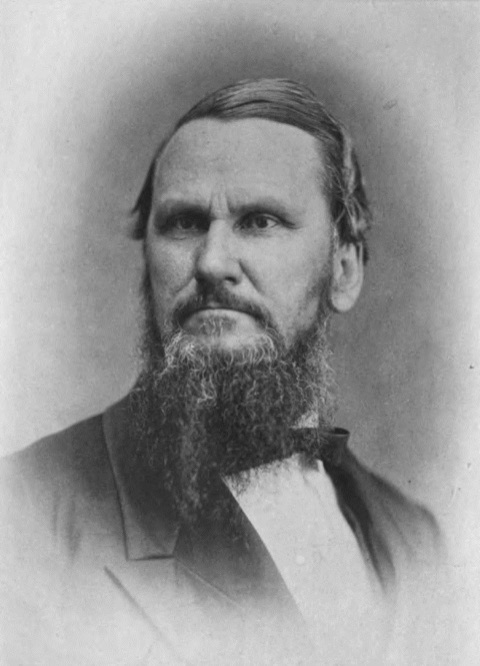
About the author
Robert Lewis Dabney
Robert Lewis Dabney (1820 to 1898 AD) was born in Louisa County, Virginia. He studied at Hampden-Sydney College and the University of Virginia, trained at Union Theological Seminary, and was pastor of the Tinkling Spring congregation from 1847. He joined the Union Seminary faculty in 1853 and took its chair of systematic and polemic theology in 1859, also teaching the course on pulpit rhetoric that became this book. In 1862 he served as chief of staff to Stonewall Jackson, and he later wrote Jackson's biography. After the war he defended slavery in A Defence of Virginia (1867) and opposed reunion with the Northern church. He published Lectures in Systematic Theology in 1871, moved to the University of Texas in 1883, and died in Victoria, Texas, in 1898.