The founding text of literary criticism. Aristotle analyzes what makes great tragedy work—plot, character, reversal, recognition—concepts that still shape storytelling today.
A free account opens the whole library to read online, on your phone or at your desk. Open a book on one device and it is waiting at the same page on the next. The PDF and EPUB of every book are yours to keep, and audiobooks play in the same app.
250+ modernized editionsNot samples. The whole work, free.
Your place, on every devicePhone, tablet or desktop, same page.
131 audiobooksFrom $4.99 each, or all of them with a $50 gift.
Aristotle’s “Poetics” asks what makes a poem or a play work. It treats every art as a form of imitation, traces how tragedy and comedy grew out of improvisation, then defines tragedy and ranks its six parts with plot first. The rest explains how to build a plot that produces pity and fear.
How the argument unfolds
01
All art imitates. Epic, tragedy, comedy, and most music are modes of representation, differing in medium, object, and manner. Two instincts produce them: imitation, present in human beings from childhood, and a feel for harmony and rhythm. Comedy represents people as worse than they are, tragedy as better.
02
How tragedy grew up. Tragedy began with the composers of dithyrambs, comedy with phallic songs, both as improvisation. Aeschylus added a second actor and the leading role for dialogue. Sophocles added a third. Tragedy then found its natural form and stopped.
03
Tragedy defined. “Tragedy, then, is the representation of an action that is serious, complete, and of a certain magnitude.” It works in action, not narration, and “through pity and fear brings about the proper purification of these emotions.”
04
Six parts, plot first. Plot, character, diction, thought, spectacle, and song. Plot leads because tragedy represents action and life, not people. “The plot, then, is the first principle and, as it were, the soul of a tragedy.”
05
One action, one size. “A whole has a beginning, a middle, and an end.” Unity comes from the action, not the hero, since one life holds countless incidents that make no single story.
06
Reversal and recognition. A reversal turns the action toward its opposite. Recognition is “a change from ignorance to knowledge” about who someone is. The strongest plots combine them, as when the messenger sent to calm Oedipus reveals Oedipus’s identity instead.
07
The error, not the vice. The right tragic figure is neither exemplary nor wicked, but renowned and prosperous and undone “by some error or frailty.” “Pity is aroused by undeserved misfortune, and fear by the misfortune of someone like ourselves.”
08
Epic, and the critics. Epic shares tragedy’s parts except song and spectacle, and ranges wider because narration carries several actions at once. Aristotle answers the critics, then argues tragedy is the higher art for reaching its effect in less space.
Key themes
Imitation as learning. We enjoy exact images of things that would disgust us in life, dead bodies included. The pleasure is cognitive. Looking at a likeness, we work out what each thing is.
Probability over fact. The poet’s function “is not to relate what has happened, but what may happen”: what is possible by probability or necessity. That makes poetry “more philosophical and elevated than history,” since it expresses the universal rather than the particular.
The pleasure proper to tragedy. Each art has one effect that belongs to it. Spectacle can startle, but the better poet builds the emotion into the incidents, so a listener who only hears the story will “shudder with fear and melt with pity at what happens.”
Clear without being ordinary. “The perfection of style is to be clear without being ordinary.” Current words keep diction clear. Rare words and metaphor lift it. Too much strangeness turns writing into riddle or jargon.
I will discuss poetry itself and its different kinds, noting the essential quality of each. I will also examine the structure a plot requires if a poem is to be good; the number and nature of the parts that compose a poem; and anything else that belongs to the same inquiry. Following the natural order, let us begin with the first principles.
Epic poetry and tragedy, as well as comedy, dithyrambic poetry, and most forms of music for the flute and lyre, are all, in their general conception, modes of representation. They differ from one another in three respects: each uses a distinct medium, represents distinct objects, or employs a distinct manner or mode of representation.
Some people, whether through deliberate skill or mere habit, represent various objects through color and form, while others do so through the voice. In the arts just mentioned, considered as a whole, representation is produced by rhythm, language, or harmony, used either separately or in combination.
Thus, music for the flute and lyre employs harmony and rhythm alone, as do other essentially similar arts, such as playing the shepherd’s pipe. Dancing uses rhythm alone, without harmony, since dancers represent character, emotion, and action through rhythmic movement.
There is also an art that represents through language alone, whether in prose or verse. Its verse may combine different meters or use only one kind, but this art has so far had no name. We have no common term that applies, on the one hand, to the mimes of Sophron and Xenarchus and to the Socratic dialogues and, on the other, to poetic representations in iambic, elegiac, or any similar meter. People do attach the word “maker” or “poet” to the name of a meter, speaking of elegiac poets or epic, that is, hexameter, poets. They act as though it were not representation that made someone a poet, but verse, which entitled every writer without distinction to that name.
Even when a treatise on medicine or natural science is published in verse, custom calls its author a poet. Yet Homer and Empedocles have nothing in common except their meter, so it would be right to call the first a poet and the second a natural philosopher rather than a poet. By the same principle, even if a writer combined every meter in a poetic representation, as Chaeremon did in his Centaur, a medley composed of meters of every kind, we should still include him under the general term poet. That is enough about these distinctions.
Some arts employ all the means already mentioned: rhythm, melody, and meter. Dithyrambic and Nomic poetry do so, as do tragedy and comedy. The difference is that dithyrambic and Nomic poetry employ all these means together, while tragedy and comedy use one at one point and another elsewhere.
These, then, are the differences among the arts with respect to the medium of representation.
Chapter 2
Since the objects represented are people in action, and since these people must be either of a higher or a lower type, for moral character chiefly follows these divisions, with goodness and badness marking the differences, people must be represented either as better than they are in real life, as worse, or as they are. The same is true in painting. Polygnotus depicted people as nobler than they are, Pauson as less noble, and Dionysius as true to life.
Clearly, each of the modes of representation already mentioned can exhibit these differences and become a distinct kind by representing objects of a distinct type. Such differences may be found even in dancing and in music for the flute and lyre. They also occur in language, whether prose or verse unaccompanied by music. Homer, for example, makes people better than they are; Cleophon presents them as they are; and Hegemon of Thasos, the inventor of parodies, and Nicochares, the author of the Deiliad, make them worse than they are.
The same principle applies to Dithyrambs and Nomes. Here too, different types may be portrayed, as Timotheus and Philoxenus differed in their representations of the Cyclopes. The same distinction separates tragedy from comedy: comedy aims to represent people as worse than they are in actual life, while tragedy represents them as better.
Chapter 3
There remains a third difference: the manner in which each object may be represented. With the same medium and the same objects, the poet may represent through narration. In that case, the poet may either assume another personality, as Homer does, or speak in his own person without changing. Alternatively, the poet may present all the characters as living and acting before us.
As we said at the beginning, artistic representation is distinguished by these three differences: the medium, the objects, and the manner. From one point of view, therefore, Sophocles is the same kind of representative artist as Homer, since both represent people of a higher type. From another point of view, he is the same kind as Aristophanes, since both represent people acting and doing things. Some accordingly say that such poems are called “dramas” because they represent people in action.
For the same reason, the Dorians claim to have invented both tragedy and comedy. The Megarians claim comedy, not only those in Greece proper, who say that it originated under their democracy, but also the Megarians of Sicily, since the poet Epicharmus, who lived much earlier than Chionides and Magnes, came from that country. Certain Dorians of the Peloponnese also claim tragedy.
In both cases, they appeal to linguistic evidence. They say that they call outlying villages κῶμαι (kōmai), while the Athenians call them δῆμοι (dēmoi). They assume that comedians received their name not from κωμάζειν (kōmazein), “to revel,” but because, after being contemptuously excluded from the city, they wandered from village to village, κατὰ κώμας (kata kōmas). They also add that the Dorian word for “doing” is δρᾶν (dran), while the Athenian word is πράττειν (prattein).
This is enough about the number and nature of the various modes of representation.
Chapter 4
Poetry in general seems to have arisen from two causes, each rooted deeply in our nature. First, the instinct for representation is present in human beings from childhood. In this respect, a human being differs from other animals by being the most imitative of living creatures and by learning the earliest lessons through imitation. Equally universal is the pleasure people take in representations.
The facts of experience provide evidence. We enjoy looking at precisely rendered images of objects that would themselves cause us pain to see, such as the forms of the most ignoble animals and of dead bodies. The reason is that learning gives the liveliest pleasure, not only to philosophers but to people generally, though their capacity for learning is more limited. People enjoy seeing a likeness because, as they contemplate it, they find themselves learning or inferring what each thing is and perhaps saying, “Ah, that is the person.” If you have never seen the original, however, the pleasure will come not from the representation as such but from the execution, the coloring, or some other such cause.
Representation, then, is one instinct of our nature. Another is the instinct for harmony and rhythm, and meters are plainly divisions of rhythm. People who began with this natural gift gradually developed their special abilities until their rough improvisations gave birth to poetry.
Poetry then divided into two directions according to the individual character of its writers. The more serious spirits represented noble actions and the actions of good people. Writers of a more trivial kind represented the actions of inferior people, at first composing lampoons, just as the former composed hymns to the gods and praises of famous people.
No poem of the lampooning kind can be attributed to any author earlier than Homer, though there were probably many such writers. From Homer onward, however, examples can be cited, including his own Margites and other similar compositions. The appropriate meter was also introduced here. That is why it is still called the iambic, or lampooning, meter: it was the meter in which people lampooned one another. Thus, the older poets were divided into writers of heroic verse and writers of lampooning verse.
Just as Homer is preeminent among poets in the serious style, since he alone combined dramatic form with excellence of representation, he was also the first to establish the main outlines of comedy by dramatizing the ridiculous instead of composing personal satire. His Margites bears the same relation to comedy that the Iliad and the Odyssey bear to tragedy.
But when tragedy and comedy appeared, the two classes of poets continued to follow their natural inclinations. The writers of lampoons became writers of comedy, while the epic poets were succeeded by tragedians, since drama was a larger and higher form of art.
Whether tragedy has yet perfected its proper types, and whether it should be judged in itself or also in relation to an audience, raises another question. However that may be, tragedy, like comedy, began as mere improvisation. Tragedy originated with the composers of dithyrambs, while comedy originated with those who composed the phallic songs still used in many of our cities. Tragedy advanced gradually, and each new element that appeared was developed in turn. After passing through many changes, it found its natural form and stopped there.
Aeschylus first introduced a second actor. He reduced the importance of the Chorus and gave the leading role to dialogue. Sophocles increased the number of actors to three and added scene painting.
Moreover, only at a late stage was the short plot replaced by one of greater scope, and the grotesque diction of the earlier satyric form replaced by the stately manner of tragedy. The iambic meter then replaced the trochaic tetrameter, which had originally been used when the poetry was satyric in character and more closely related to dancing. Once dialogue had been introduced, nature itself discovered the appropriate meter. Of all meters, the iambic is the most conversational. We can see this because ordinary speech falls into iambic lines more often than into any other kind of verse. It rarely falls into hexameters, and then only when we depart from conversational intonation.
The additions to the number of episodes, or acts, and the other accessories reported by tradition must be treated as already described. To discuss them in detail would undoubtedly be a large undertaking.
Chapter 5
Comedy, as we have said, is a representation of characters of a lower type, though not in the fullest sense bad. The ridiculous is merely one subdivision of the ugly. It consists of some defect or ugliness that is neither painful nor destructive. To take an obvious example, the comic mask is ugly and distorted but does not imply pain.
The successive changes through which tragedy passed, and the authors responsible for them, are well known. Comedy, however, has no recorded history because it was not at first taken seriously. Only at a late stage did the Archon grant a comic Chorus to a poet; until then, the performers were volunteers. Comedy had already taken definite shape before we hear of poets specifically known as comic poets.
Who provided comedy with masks or prologues, who increased the number of actors, and other similar details remain unknown. The use of constructed plots originally came from Sicily. Among Athenian writers, Crates was the first to abandon the iambic, or lampooning, form and to make his themes and plots general rather than personal.
Epic poetry agrees with tragedy insofar as it is a representation in verse of characters of a higher type. They differ because epic poetry uses only one kind of meter and is narrative in form. They also differ in length. Tragedy tries, as far as possible, to confine itself to a single revolution of the sun or to exceed that limit only slightly, while epic action has no fixed limit of time. This, then, is a second point of difference, though at first tragedy was allowed the same freedom as epic poetry.
Some of their constituent parts are common to both, while others are peculiar to tragedy. Anyone, therefore, who knows what makes a tragedy good or bad also understands epic poetry. All the elements of an epic poem are found in tragedy, but not all the elements of a tragedy are found in an epic poem.
Chapter 6
We will discuss later the poetry that represents in hexameter verse, as well as comedy. Let us now discuss tragedy, taking up its formal definition from what has already been said.
Tragedy, then, is the representation of an action that is serious, complete, and of a certain magnitude. It uses language enriched with every kind of artistic ornament, with the different kinds appearing in separate parts of the play. It is presented in the form of action, not narration, and through pity and fear brings about the proper purification of these emotions.
By “enriched language,” I mean language that employs rhythm, harmony, and song. By “the different kinds appearing in separate parts,” I mean that some parts are presented through verse alone and others with the aid of song.
Since tragic representation involves people acting, spectacle must necessarily be one part of tragedy. Song and diction come next, since these are the media of representation. By “diction,” I mean simply the metrical arrangement of the words. As for “song,” everyone understands what that term means.
Again, tragedy is the representation of an action, and an action implies personal agents. These agents necessarily possess distinctive qualities of both character and thought, since it is through these qualities that we describe actions themselves. Thought and character are the two natural causes from which actions arise, and all success or failure depends on actions.
The plot, therefore, is the representation of the action. By “plot,” I mean the arrangement of the incidents. By “character,” I mean that quality by which we attribute certain traits to the agents. Thought is present whenever someone proves a statement or expresses a general truth.
Every tragedy, therefore, must have six parts that determine its quality: plot, character, diction, thought, spectacle, and song. Two of these parts constitute the medium of representation, one constitutes the manner, and three constitute the objects represented. This completes the list. We may say that every poet has employed these elements, since every play contains spectacle as well as character, plot, diction, song, and thought.
The most important element is the structure of the incidents. Tragedy represents not people but action and life, and life consists in action. Its end is a mode of action, not a quality. Character determines people’s qualities, but it is through their actions that they become happy or the opposite. Dramatic action, therefore, does not exist for the sake of representing character. Character is included as secondary to the actions. The incidents and the plot are thus the end of tragedy, and the end is the most important thing of all.
Furthermore, there can be no tragedy without action, though there can be one without character. The tragedies of most of our modern poets fail in their portrayal of character, and the same is often true of poets generally. A similar contrast appears in painting, as shown by the difference between Zeuxis and Polygnotus. Polygnotus portrays character well, while the style of Zeuxis has no ethical quality.
Again, suppose you string together a series of speeches that express character and are polished in diction and thought. You will not produce the essential tragic effect nearly as well as a play that may be deficient in those respects but has a plot and incidents arranged with artistic skill. Moreover, the most powerful sources of emotional interest in tragedy, reversal of the situation and scenes of recognition, are parts of the plot.
Further proof is that beginners in the art achieve polished diction and precise characterization before they can construct a plot. The same is true of almost all the early poets.
The plot, then, is the first principle and, as it were, the soul of a tragedy. Character holds second place. A similar fact can be seen in painting. The most beautiful colors, laid on without order, will not give as much pleasure as the chalk outline of a portrait. Tragedy is therefore the representation of an action, and it represents the agents chiefly for the sake of the action.
Thought comes third. It is the ability to say what is possible and appropriate in given circumstances. In oratory, this is the function of political skill and the art of rhetoric. Accordingly, the older poets make their characters speak the language of civic life, while the poets of our time make them speak the language of rhetoricians.
Character is what reveals moral purpose by showing what kinds of things a person chooses or avoids. Speeches that do not reveal this, or in which the speaker neither chooses nor avoids anything, do not express character. Thought, by contrast, is present where something is proved to be or not to be, or where a general maxim is stated.
Diction is fourth among the elements listed. By this I mean, as already stated, the expression of meaning in words. Its essential nature is the same in verse and prose.
Of the remaining elements, song holds the chief place among the embellishments.
Spectacle certainly has an emotional attraction of its own, but of all the parts it is the least artistic and the least closely connected with the art of poetry. We may be sure that tragedy has its power even without performance and actors. Besides, the production of spectacular effects depends more on the stage machinist’s art than on the poet’s.
Chapter 7
With these principles established, let us now discuss the proper structure of plot, since plot is the first and most important element of tragedy.
According to our definition, tragedy represents an action that is complete, whole, and of a certain magnitude, since a whole may lack magnitude. A whole has a beginning, a middle, and an end. A beginning does not itself follow anything by causal necessity, but something else naturally exists or comes to be after it. An end, by contrast, naturally follows something else, either necessarily or as a rule, but has nothing following it. A middle follows something and has something else follow it. A well-constructed plot, therefore, must neither begin nor end at random, but must conform to these principles.
Again, a beautiful object, whether a living organism or any whole composed of parts, must not only have its parts arranged in an orderly way but must also have a certain magnitude, since beauty depends on magnitude and order. A very small animal cannot be beautiful because our view of it is confused: we see the object in an almost imperceptible moment. Nor can an animal of immense size be beautiful, since the eye cannot take it all in at once, and the spectator loses the unity and sense of the whole. Imagine, for example, an animal a thousand miles long.
Just as living bodies and organisms require a certain magnitude that can easily be taken in at a glance, a plot requires a certain length that the memory can easily grasp. The limit of length imposed by dramatic competitions and sensory presentation is no part of artistic theory. If a hundred tragedies had been required to compete together, their performance would have been regulated by the water clock, as we are told was once the practice.
The nature of drama itself sets this limit: provided that the whole remains clear, the greater its length, the more beautiful the work will be because of its size. To define the matter roughly, the proper magnitude lies within limits that allow the sequence of events, following probability or necessity, to bring about a change from bad fortune to good or from good fortune to bad.
Chapter 8
Unity of plot does not, as some people think, consist in the unity of the hero. A single person’s life contains infinitely many incidents that cannot be reduced to a unity. In the same way, one person performs many actions that cannot be made into one action.
This appears to be the error of all the poets who have composed a Heracleid, a Theseid, or other poems of that kind. They imagine that because Heracles was one man, the story of Heracles must also form a unity. But Homer, whose merit surpasses that of others in every respect, seems here too to have discerned the truth, whether by artistic skill or natural genius. In composing the Odyssey, he did not include every adventure of Odysseus, such as his wound on Parnassus or his feigned madness when the army was mustered, since there was no necessary or probable connection between these incidents. Instead, he centered the Odyssey, and likewise the Iliad, on an action that is one in the sense we have defined.
Therefore, just as a representation in the other representational arts is one when the object represented is one, so the plot, being the representation of an action, must represent one complete action. Its parts must be structurally united so that displacing or removing any one of them would disjoint and disturb the whole. Anything whose presence or absence makes no perceptible difference is not an organic part of the whole.
Chapter 9
It is also evident from what has been said that the poet’s function is not to relate what has happened, but what may happen: what is possible according to probability or necessity. The poet and the historian do not differ because one writes in verse and the other in prose. The work of Herodotus could be put into verse and would still be a kind of history, with meter no less than without it. The true difference is that the historian relates what has happened, while the poet relates what may happen.
Poetry, therefore, is more philosophical and elevated than history, since poetry tends to express the universal, while history expresses the particular. By the universal, I mean how a certain kind of person will probably or necessarily speak or act on a given occasion. Poetry aims at this universality in the names it assigns to its characters. The particular, for example, is what Alcibiades did or suffered.
This distinction is already apparent in comedy. Comic poets first construct their plots according to probability and then insert characteristic names, unlike the writers of lampoons, who write about particular individuals. Tragic poets, however, still retain real names. The reason is that what is possible is credible. We are not immediately sure that something which has never happened is possible, but something that has happened is plainly possible, since otherwise it would not have happened.
Even so, some tragedies contain only one or two well-known names, while the rest are invented. In others, none of the names are well known, as in Agathon’s Antheus, where both the incidents and the names are invented, yet the play gives no less pleasure. We must not, therefore, insist at all costs on keeping to the traditional legends that usually supply the subjects of tragedy. Such an attempt would be absurd, since even familiar subjects are familiar to only a few people but nevertheless give pleasure to everyone.
It clearly follows that the poet, or “maker,” should be a maker of plots rather than verses. The poet is a poet because he represents, and what he represents is action. Even if he happens to take a historical event as his subject, he is no less a poet. Some events that have actually happened may conform to the laws of probability and possibility, and by virtue of that quality he is their poet or maker.
Of all plots and actions, episodic ones are the worst. I call a plot “episodic” when the episodes or acts follow one another without a probable or necessary sequence. Bad poets compose such works through their own fault; good poets do so to please the actors. In writing showpieces for competition, they stretch the plot beyond its capacity and are often forced to break its natural continuity.
But tragedy is a representation not only of a complete action, but also of events that inspire fear or pity. This effect is best produced when events take us by surprise, and it becomes still stronger when they also follow one another as cause and effect. The tragic wonder will then be greater than if the events happened spontaneously or by accident. Even coincidences are most striking when they appear to have been designed.
Consider the statue of Mitys at Argos. It fell upon the man who had murdered Mitys while he was attending a festival and killed him. Such events do not seem to be due to mere chance. Plots constructed on these principles are therefore necessarily the best.
Chapter 10
Plots are either simple or complex, since the real-life actions they represent plainly exhibit the same distinction. I call an action simple when it is one and continuous in the sense already defined, and its change of fortune occurs without a reversal of the situation and without a recognition.
A complex action is one in which the change is accompanied by a reversal, a recognition, or both. These should arise from the plot’s internal structure, so that what follows is the necessary or probable result of the preceding action. It makes all the difference whether an event happens “because of this” or merely “after this.”
Questions
What is Aristotle’s “Poetics” about?+
It is Aristotle’s treatise on the art of poetry, concentrated on tragedy and, at the close, epic. It asks how poems are built rather than what they mean. The promised treatment of comedy never appears.
What is catharsis in Aristotle’s “Poetics”?+
Catharsis is the effect named in the last clause of his definition of tragedy: pity and fear brought to “the proper purification of these emotions.” The treatise never explains the term, which is why it has been argued over ever since.
What makes a good tragic plot according to Aristotle?+
It should be complex rather than simple, built on one action, and long enough to carry a change of fortune while still fitting in the memory. Events must follow by probability or necessity: “Of all plots and actions, episodic ones are the worst.”
Why does Aristotle keep returning to “Oedipus”?+
Sophocles’ play satisfies several rules at once. Its recognition arrives with the reversal, its hero falls by error rather than vice, and its one irrational element lies outside the action.
How long is “Poetics”?+
This modern English edition runs about 14,000 words across 26 short chapters, roughly a one-hour read.
Is “Poetics” hard to read?+
The reasoning is plain. The examples are the obstacle, since Aristotle names dozens of Greek plays that no longer survive. Let the unfamiliar titles pass and the chapters are short and strictly ordered.
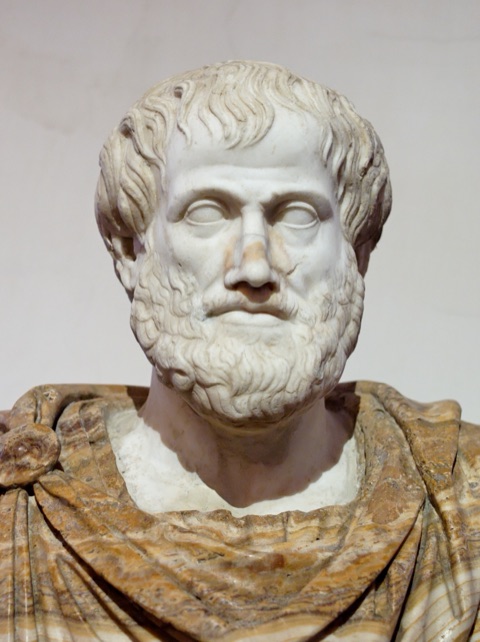
Aristotle was an ancient Greek philosopher and polymath whose writings encompassed virtually every field of knowledge in his time, including logic, physics, biology, ethics, politics, and poetics. A student of Plato and tutor to Alexander the Great, Aristotle founded his own school, the Lyceum, in Athens. His systematic approach to philosophy and his emphasis on observation and logic established foundations for Western scientific thought. The "Nicomachean Ethics" remains one of the most influential works in moral philosophy, presenting virtue as the mean between extremes and happiness (eudaimonia) as the goal of human life. Aristotle's "Politics" and "Poetics" similarly shaped their respective fields for centuries. His influence on medieval philosophy, science, and theology was immense, earning him the simple title "The Philosopher."