Aristotle's opening treatise of the Organon, sorting every simple expression into ten kinds, from substance to affection, and separating individual things from the species and genera said of them.
A free account opens the whole library to read online, on your phone or at your desk. Open a book on one device and it is waiting at the same page on the next. The PDF and EPUB of every book are yours to keep, and audiobooks play in the same app.
250+ modernized editionsNot samples. The whole work, free.
Your place, on every devicePhone, tablet or desktop, same page.
131 audiobooksFrom $4.99 each, or all of them with a $50 gift.
Categories is the opening treatise of Aristotle's Organon, written in the fourth century BC. It sorts every simple expression, every word said on its own, into ten kinds of thing. Its central claim is that the individual thing is substance in the primary sense, and that everything else is either said of an individual or present in one.
How the argument unfolds
01
Three ways of naming. Equivocal names share a word but not its definition, as a living man and a painted figure both count as animal. Univocal names share both, as a man and an ox do. Derivative names bend one word into another, as grammarian comes from grammar.
02
Said of and present in. Everything that exists is then sorted by crossing two relations: being said of a subject and being present in one. Present in does not mean present as a part is in a whole. It means “being incapable of existing apart from the subject in question.”
03
The ten kinds. Chapter 4 gives the list the book is named for. “Expressions that are in no way compound signify substance, quantity, quality, relation, place, time, position, state, action, or affection.” Each is fixed by an example, not a definition.
04
Substance. Substance in the strictest sense is the individual, the particular man or horse that is neither predicated of a subject nor present in one. Species and genera are substance only in a secondary sense. It has no contrary and admits no degrees, since one man is not more a man than another. Its sharpest mark is that one substance can hold contrary qualities in turn.
05
Quantity and relatives. “Quantity is either discrete or continuous.” Number and speech are discrete, lines and time and space continuous. Great and small prove relative rather than quantitative, since they measure against an external standard. Relatives are explained only by reference to something else.
06
Quality. Quality divides into four kinds: habits and the looser dispositions, inborn capacities such as being a good runner, affective qualities like sweetness and color, and figure. Most admit more and less, though nothing is more triangular than anything else.
07
The closing chapters. The last six chapters, later called the postpraedicamenta, settle the terms the ten kinds assume: four senses of opposition, namely correlatives, contraries, privation against possession, and affirmation against negation. Then come five senses of prior, three of simultaneous, and six kinds of movement.
Key themes
Between grammar and metaphysics. The question is what a simple expression signifies, answered by sorting the things expressions pick out. Logic and ontology are worked out together.
The priority of the individual. Species, genera, and every attribute lean on particulars. “If primary substances did not exist, it would be impossible for anything else to exist.”
The distinctive mark. Each category faces the same test. Has it a contrary, does it admit degrees, and what belongs to it alone? Quantity is marked by equality, quality by likeness.
Exactness in correlation. Relatives reciprocate only when named precisely. A wing answers to a winged creature, not to a bird, and where no word exists Aristotle coins one, such as “ruddered” for what has a rudder.
Difficulties left standing. Whether a head or a hand is a substance or a relative is raised and left open, a question worth pressing without a settled answer.
Things are said to be named “equivocally” when they share a name but the definition corresponding to that name differs for each. Thus, a real man and a figure in a picture may both claim the name “animal.” Yet they are named equivocally because, although they share the name, the definition corresponding to it differs in each case. If someone were to define the sense in which each is an animal, the definition given in one case would apply only to that case.
Things are said to be named “univocally,” on the other hand, when they share both the name and the definition corresponding to it. A man and an ox are both “animal,” and they are named univocally because not only the name but also the definition is the same in both cases. If someone were to state the sense in which each is an animal, the statement given in one case would be identical to that given in the other.
Things are said to be named “derivatively” when they derive their name from another name but differ from it in their ending. Thus, the grammarian derives his name from “grammar,” and the courageous man from “courage.”
Chapter 2
Expressions are either simple or compound. Examples of compound expressions are “the man runs” and “the man wins.” Examples of simple expressions are “man,” “ox,” “runs,” and “wins.”
Of things themselves, some are predicable of a subject but are never present in a subject. Thus, “man” is predicable of an individual man but is never present in a subject.
By “present in a subject,” I do not mean present as parts are present in a whole. I mean being incapable of existing apart from the subject in question.
Some things, again, are present in a subject but are never predicable of a subject. For instance, a particular piece of grammatical knowledge is present in the mind but is not predicable of any subject. Or again, a particular whiteness may be present in a body, since color requires a material basis, yet it is never predicable of anything.
Other things are both predicable of a subject and present in a subject. Thus, while knowledge is present in the human mind, it is predicable of grammar.
Finally, some things are neither present in a subject nor predicable of a subject, such as an individual man or an individual horse. More generally, whatever is individual and has the character of a unit is never predicable of a subject. Yet in some cases, nothing prevents such a thing from being present in a subject. Thus, a particular piece of grammatical knowledge is present in a subject.
Chapter 3
When one thing is predicated of another, everything predicable of the predicate will also be predicable of the subject. Thus, “man” is predicated of an individual man, while “animal” is predicated of “man.” Therefore, “animal” will also be predicable of the individual man, for the individual man is both “man” and “animal.”
If genera are different and coordinate, their differentiae are themselves different in kind. Consider the genera “animal” and “knowledge.” “With feet,” “two-footed,” “winged,” and “aquatic” are differentiae of “animal.” The species of knowledge are not distinguished by these same differentiae. One species of knowledge does not differ from another by being “two-footed.”
But when one genus is subordinate to another, nothing prevents them from having the same differentiae. The greater class is predicated of the lesser, so all the differentiae of the predicate will also be differentiae of the subject.
Chapter 4
Expressions that are in no way compound signify substance, quantity, quality, relation, place, time, position, state, action, or affection. To indicate roughly what I mean, examples of substance are “man” and “the horse.” Examples of quantity are “two cubits long” and “three cubits long.” Attributes such as “white” and “grammatical” signify quality. “Double,” “half,” and “greater” fall under relation; “in the marketplace” and “in the Lyceum,” under place; and “yesterday” and “last year,” under time. “Lying” and “sitting” indicate position; “shod” and “armed,” state; “to lance” and “to cauterize,” action; and “to be lanced” and “to be cauterized,” affection.
None of these terms, by itself, involves an affirmation. Positive or negative statements arise through combinations of such terms. Every assertion, as is generally admitted, must be either true or false. Expressions that are not compound, however, such as “man,” “white,” “runs,” and “wins,” can be neither true nor false.
Chapter 5
Substance, in the truest, primary, and most definite sense of the word, is that which is neither predicable of a subject nor present in a subject, such as an individual man or an individual horse. In a secondary sense, those things are called substances within which the primary substances are included as species, as are the genera that include those species. For instance, an individual man is included in the species “man,” and the genus to which that species belongs is “animal.” These, therefore, namely the species “man” and the genus “animal,” are called secondary substances.
It is clear from what has been said that both the name and the definition of a predicate must be predicable of the subject. For instance, “man” is predicated of an individual man. The name of the species “man” is applied to the individual, since we use the term “man” in describing him. The definition of “man” will also be predicated of the individual man, since the individual man is both man and animal. Thus, both the name and the definition of the species are predicable of the individual.
With things present in a subject, on the other hand, it is generally the case that neither their name nor their definition is predicable of that in which they are present. Although the definition is never predicable, in certain cases nothing prevents the name from being used. For instance, “white,” which is present in a body, is predicated of that in which it is present, since a body is called white. The definition of the color “white,” however, is never predicable of the body.
Everything except primary substances is either predicable of a primary substance or present in a primary substance. This becomes clear from particular instances. “Animal” is predicated of the species “man,” and therefore of an individual man. If there were no individual man of whom it could be predicated, it could not be predicated of the species “man” at all. Again, color is present in body and therefore in individual bodies. If there were no individual body in which it was present, it could not be present in body at all. Thus, everything except primary substances is either predicated of primary substances or present in them. If primary substances did not exist, it would be impossible for anything else to exist.
Among secondary substances, the species is more truly substance than the genus because it is more closely related to primary substance. If someone were to give an account of what a primary substance is, he would give a more informative account, and one more appropriate to the subject, by stating the species rather than the genus. Thus, he would give a more informative account of an individual man by stating that he was man rather than that he was animal. The former description is more particular to the individual, while the latter is too general. Again, someone giving an account of the nature of an individual tree will give a more informative account by naming the species “tree” than by naming the genus “plant.”
Moreover, primary substances are most properly called substances because they are the entities underlying everything else, while everything else is either predicated of them or present in them. The same relation that exists between primary substance and everything else also exists between the species and the genus. The species stands to the genus as subject stands to predicate, since the genus is predicated of the species, whereas the species cannot be predicated of the genus. This gives us a second reason for asserting that the species is more truly substance than the genus.
Among species themselves, except for those that are genera, no one species is more truly substance than another. We would not give a more appropriate account of an individual man by stating the species to which he belongs than we would give of an individual horse by using the same method of definition. In the same way, among primary substances, no one is more truly substance than another. An individual man is not more truly substance than an individual ox.
It is therefore with good reason that, after excluding primary substances, we grant the name “secondary substance” only to species and genera. Of all predicates, these alone convey knowledge of primary substance. We appropriately define an individual man by stating his species or genus, and we make the definition more exact by stating the former rather than the latter. All other things we might state, such as that he is white, that he runs, and so on, are irrelevant to the definition. It is therefore just that, apart from primary substances, species and genera alone should be called substances.
Further, primary substances are most properly so called because they underlie and are the subjects of everything else. The same relation that exists between primary substance and everything else also exists between the species and genus to which the primary substance belongs, on the one hand, and every attribute not included within them, on the other. The species and genus are the subjects of all such attributes. If we call an individual man “skilled in grammar,” the same predicate can also be predicated of the species and the genus to which he belongs. This rule holds in every case.
It is a common characteristic of every substance that it is never present in a subject. Primary substance is neither present in a subject nor predicated of a subject. As for secondary substances, it is clear from the following arguments, apart from others, that they are not present in a subject. “Man” is predicated of an individual man but is not present in any subject, for manhood is not present in the individual man. In the same way, “animal” is predicated of the individual man but is not present in him. Again, when a thing is present in a subject, its name may quite properly be applied to that in which it is present, but its definition cannot be applied. Yet in the case of secondary substances, not only the name but also the definition applies to the subject. We use both the definition of the species and that of the genus with reference to the individual man. Thus, substance cannot be present in a subject.
Yet this characteristic is not peculiar to substance, since differentiae also cannot be present in subjects. The characteristics “terrestrial” and “two-footed” are predicated of the species “man” but are not present in it, for they are not in man. Moreover, the definition of a differentia may be predicated of that of which the differentia itself is predicated. For instance, if the characteristic “terrestrial” is predicated of the species “man,” the definition of that characteristic may also be used as a predicate of the species “man,” for man is terrestrial.
The fact that the parts of substances appear to be present in the whole as in a subject should not make us fear that we must admit that such parts are not substances. In explaining the phrase “present in a subject,” we said that we meant present otherwise than as parts are present in a whole.
It is characteristic of substances and differentiae that, in every proposition in which they form the predicate, they are predicated univocally. Every such proposition has either an individual or a species as its subject. It is true that primary substance, since it is not predicable of anything, can never form the predicate of any proposition. Among secondary substances, however, the species is predicated of the individual, while the genus is predicated both of the species and of the individual. Similarly, differentiae are predicated of species and individuals. Moreover, the definitions of the species and the genus apply to the primary substance, and the definition of the genus applies to the species. Everything predicated of the predicate will also be predicated of the subject. Similarly, the definitions of the differentiae apply to the species and to the individuals. But it was stated above that things are called “univocal” when they share both a name and a definition. It is therefore established that, in every proposition in which either a substance or a differentia forms the predicate, it is predicated univocally.
Every substance appears to signify something individual. In the case of primary substance, this is indisputably true, since the thing is a unit. In the case of secondary substances, when we speak, for instance, of “man” or “animal,” our form of speech gives the impression that we are also indicating something individual. But this impression is not strictly true, since a secondary substance is not an individual but a class with a certain qualification. It is not one and single as a primary substance is, for the words “man” and “animal” are predicable of more than one subject.
Yet species and genus do not indicate only quality, as the term “white” does. “White” indicates quality and nothing more, but species and genus determine quality with reference to a substance. They signify substance qualitatively differentiated. The determinate qualification covers a wider field in the case of the genus than in the case of the species. Someone who uses the word “animal” is using a term with a wider extension than someone who uses the word “man.”
Another characteristic of substance is that it has no contrary. What could be the contrary of any primary substance, such as an individual man or animal? It has none. Nor can a species or genus have a contrary. Yet this characteristic is not peculiar to substance; it is also true of many other things, such as quantity. Nothing is the contrary of “two cubits long,” “three cubits long,” “ten,” or any similar term. Someone may contend that “much” is the contrary of “little,” or “great” of “small,” but no definite quantitative term has a contrary.
Again, substance does not appear to admit variation of degree. By this I do not mean that one substance cannot be more or less truly substance than another, for it has already been stated that this is the case. I mean that no single substance admits varying degrees within itself. For instance, one particular substance, “man,” cannot be more or less man, either than himself at another time or than another man. One man cannot be more man than another, as something white may be more or less white than another white object, or as something beautiful may be more or less beautiful than another beautiful object. Moreover, the same quality is said to exist in a thing in varying degrees at different times. A body that is white is said to be whiter at one time than it was before, or a body that is warm is said to be warmer or less warm than it was at another time. But a substance is not said to be more or less what it is. A man is not more truly a man at one time than he was before, nor is anything that is a substance more or less what it is. Substance, then, does not admit variation of degree.
The most distinctive characteristic of substance appears to be that, while remaining numerically one and the same, it can admit contrary qualities. Among things other than substance, we would be unable to identify anything possessing this characteristic. One and the same color, for example, cannot be white and black. Nor can one and the same action be good and bad. This rule holds for everything that is not substance. But one and the same substance, while retaining its identity, can admit contrary qualities. The same individual person is white at one time and black at another, warm at one time and cold at another, good at one time and bad at another. This capacity is found nowhere else, although it might be maintained that a statement or an opinion is an exception to the rule.
It is agreed that the same statement can be both true and false. If the statement “he is sitting” is true, then after the person in question has risen, the same statement will be false. The same applies to opinions. If someone thinks truly that a person is sitting, then after that person has risen, this same opinion, if still held, will be false. Yet even if this exception is allowed, there remains a difference in how this occurs. Substances admit contrary qualities by changing themselves. In this way, what was hot becomes cold because it has entered a different state. Similarly, what was white becomes black, and what was bad becomes good, through a process of change. In all other cases as well, substances admit contrary qualities by changing. Statements and opinions themselves, however, remain wholly unaltered. A contrary quality comes to belong to them because the facts of the case change. The statement “he is sitting” remains unaltered, but it is true at one time and false at another according to the circumstances. What has been said of statements also applies to opinions. Thus, with respect to the way this occurs, it is the peculiar characteristic of substance to admit contrary qualities, since it does so by changing itself.
If, then, someone were to make this exception and contend that statements and opinions can admit contrary qualities, the contention would be unsound. Statements and opinions are said to have this capacity not because they themselves undergo a modification, but because the modification occurs in something else. The truth or falsity of a statement depends on the facts, not on any power in the statement itself to admit contrary qualities. In short, nothing can alter the nature of statements and opinions. Since no change takes place in them, they cannot be said to be capable of admitting contrary qualities.
A substance, however, is said to be capable of admitting contrary qualities because the modification takes place within the substance itself. A substance admits within itself either disease or health, whiteness or blackness. It is in this sense that a substance is said to be capable of admitting contrary qualities.
To sum up, it is a distinctive characteristic of substance that, while remaining numerically one and the same, it can admit contrary qualities through a change taking place in the substance itself.
Let these remarks suffice on the subject of substance.
Chapter 6
Quantity is either discrete or continuous. Moreover, in some quantities, each part of the whole has a position relative to the other parts; in others, the parts have no such relation to one another.
Examples of discrete quantities are number and speech. Examples of continuous quantities are lines, surfaces, solids, and, in addition, time and place.
The parts of a number have no common boundary at which they join. For example, two fives make ten, but the two fives have no common boundary and remain separate. The parts three and seven likewise do not join at any boundary. More generally, the parts of a number could never have a common boundary; they are always separate. Number, therefore, is a discrete quantity.
The same is true of speech. It is evident that speech is a quantity, since it is measured in long and short syllables. Here I mean vocal speech. Moreover, speech is a discrete quantity, since its parts have no common boundary. There is no common boundary at which the syllables join; each is separate and distinct from the rest.
A line, by contrast, is a continuous quantity, since it is possible to find a common boundary at which its parts join. In the case of a line, this common boundary is a point; in the case of a plane, it is a line, since the parts of a plane also have a common boundary. Similarly, one can find a common boundary between the parts of a solid, namely either a line or a plane.
Space and time also belong to this class of quantities. Time, comprising past, present, and future, forms a continuous whole. Space is likewise a continuous quantity. The parts of a solid occupy a certain space and have a common boundary. It follows that the parts of space occupied by the parts of the solid have the same common boundary as those parts of the solid. Thus, not only time but also space is a continuous quantity, since its parts have a common boundary.
Quantities consist either of parts that have positions relative to one another or of parts that do not. The parts of a line have positions relative to one another, since each lies somewhere. It would be possible to distinguish each part, state its position on the plane, and explain what sort of part it adjoins. Similarly, the parts of a plane have position, since one could state the position of each and what sorts of parts adjoin it. The same is true of a solid and of space.
But it would be impossible to show that the parts of a number have positions relative to one another or any particular position, or to state which parts adjoin one another. Nor could this be done in the case of time, since none of the parts of time has an abiding existence, and what does not abide can hardly have position. It would be better to say that such parts have a relative order, because one is prior to another. Similarly, with number, in counting, “one” is prior to “two,” and “two” to “three.” Thus, the parts of number may be said to have a relative order, although it would be impossible to identify a distinct position for each.
This also holds true in the case of speech. None of its parts has an abiding existence. Once a syllable has been pronounced, it cannot be retained. Naturally, since the parts do not abide, they cannot have position. Thus, some quantities consist of parts that have position, while others consist of parts that do not.
Strictly speaking, only the things I have mentioned belong to the category of quantity. Everything else called quantitative is a quantity in a secondary sense. We apply quantitative terms to other things because we have in mind one of these quantities that are properly so called. We call something white large because the surface over which the white extends is large. We call an action or a process lengthy because the time it covers is long. These things cannot claim the quantitative description in their own right.
For instance, if someone were to explain how long an action was, the explanation would be given in terms of the time taken, stating that it lasted a year or something similar. In the same way, the size of a white object would be explained in terms of surface by stating the area it covered. Thus, the things already mentioned, and only those things, are quantities by their intrinsic nature. Nothing else can claim the name in its own right, but only, if at all, in a secondary sense.
Quantities have no contraries. In the case of definite quantities, this is obvious. There is nothing contrary to “two cubits long,” “three cubits long,” a surface, or any other such quantity. Someone might indeed argue that “much” is contrary to “little” and “great” to “small.” But these are not quantitative terms; they are relative. Things are not great or small absolutely but are called so through comparison.
For instance, a mountain is called small and a grain large because the grain is larger than others of its kind, while the mountain is smaller than others of its kind. Thus, these terms refer to an external standard. If “great” and “small” were used absolutely, a mountain would never be called small or a grain large. Again, we say that there are many people in a village and few in Athens, although the people in the city are many times as numerous as those in the village. Or we say that a house has many people in it and a theater few, although those in the theater far outnumber those in the house.
The terms “two cubits long,” “three cubits long,” and so on indicate quantity. The terms “great” and “small” indicate relation, since they refer to an external standard. It is therefore plain that these are to be classified as relative.
Again, whether or not we define them as quantitative, they have no contraries. For how can there be a contrary to an attribute that cannot be understood in or by itself, but only by reference to something external?
Furthermore, if “great” and “small” are contraries, the same subject will be capable of admitting contrary qualities at one and the same time, and things will be contrary to themselves. For the same thing sometimes happens to be both small and great. It may be small in comparison with one thing and great in comparison with another. Thus, the same thing comes to be both small and great at one and the same time and is capable of admitting contrary qualities at the same moment.
Yet it was agreed in the discussion of substance that nothing admits contrary qualities at one and the same moment. Although substance is capable of admitting contrary qualities, no one is both sick and healthy at the same time, and nothing is both white and black at the same time. Nor is anything qualified in contrary ways at one and the same time.
Moreover, if these terms were contraries, they would be contrary to themselves. For if “great” is the contrary of “small,” and the same thing is both great and small at the same time, then “small” or “great” is contrary to itself. But this is impossible. Therefore, “great” is not contrary to “small,” nor “much” to “little.” Even if someone were to call these terms quantitative rather than relative, they would not have contraries.
It is in the case of space that quantity appears most plausibly to admit a contrary. People define “above” as contrary to “below,” meaning by “below” the region at the center. They do so because nothing is farther from the extremities of the universe than the region at the center. Indeed, in defining contraries of every kind, people seem to resort to a spatial metaphor, saying that things are contraries when, within the same class, they are separated by the greatest possible distance.
Quantity does not appear to admit variation of degree. One thing cannot be two cubits long to a greater degree than another. The same holds for number. What is “three” is not more truly three than what is “five” is five, nor is one set of three more truly three than another. Again, one period of time is not said to be more truly time than another. Nor can variation of degree be predicated of any other kind of quantity that has been mentioned. The category of quantity, therefore, does not admit variation of degree.
The most distinctive mark of quantity is that equality and inequality are predicated of it. Each of the quantities mentioned above is said to be equal or unequal. For instance, one solid is said to be equal or unequal to another. These terms can also be applied to number and time, as indeed they can to all the kinds of quantity already mentioned.
What is not a quantity, it would seem, can by no means be called equal or unequal to anything else. One particular disposition or one particular quality, such as whiteness, is not compared with another in terms of equality and inequality, but rather in terms of similarity. Thus, the distinctive mark of quantity is that it can be called equal and unequal.
Questions
What is Aristotle's Categories about?+
Categories is a short treatise on the terms logic needs before it can start. It works out how names attach to things, how one thing is predicated of another, and what kinds of thing there are.
What are Aristotle's ten categories?+
Substance, quantity, quality, relation, place, time, position, state, action, and affection. Aristotle illustrates each instead of defining it: man, two cubits long, white, double, in the Lyceum, yesterday, sitting, shod, to lance, and to be lanced.
What is primary substance in Aristotle?+
Primary substance is the individual thing, this man or this horse, which is neither predicated of a subject nor present in a subject. Species such as man and genera such as animal are secondary substances. The individual is primary because everything else rests on it.
Why does Categories matter for logic?+
It fixes the vocabulary the rest of the Organon assumes: subject and predicate, genus and species, substance and accident, contrary and privation. Boethius carried it into Latin, and it anchored the medieval logic curriculum.
How long is Categories?+
About 13,700 words across fifteen chapters, roughly an hour of reading. Chapter 5, on substance, is by far the longest, while the closing chapters run only a few paragraphs each.
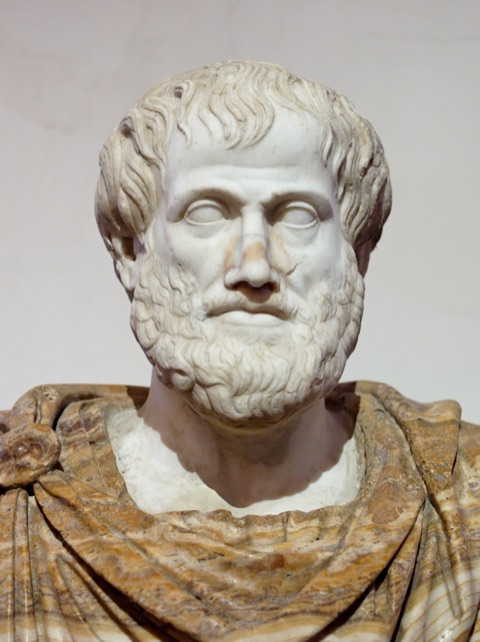
Aristotle was born in 384 BC at Stagira in northern Greece, the son of Nicomachus, a physician to the Macedonian court. He came to Athens at about seventeen and studied in Plato's Academy for twenty years, until Plato's death in 347 BC. From 343 BC he tutored the young Alexander of Macedon, and in 335 BC he returned to Athens and founded his own school at the Lyceum, whose covered walkway gave his followers the name Peripatetics. His surviving works range across logic, physics, biology, ethics, politics, rhetoric, and poetics, and include the Nicomachean Ethics, the Politics, the Poetics, and the six logical treatises later gathered as the Organon. He left Athens for Chalcis on the island of Euboea after Alexander died in 323 BC, and died there the following year.