131 audiobooks, 1,134 hours of narration. Give $50 and every one is yours.
Philosophy books
Cover of Meditations

Modern English edition · 175 AD

Meditations

by Marcus Aurelius

The private journal of a Roman emperor, never meant to be read by others. Marcus Aurelius wrote these reflections on duty, mortality, and inner peace while on campaign. All twelve books, from George Long's 1889 translation.

Start reading free

One free account opens 250+ books and saves your place on every device. Google sign-in or an email link. No card.

Buy the paperback · $12.99

Printed to order. Shipping is calculated at checkout. Read online tonight while it ships.

Get the audiobook · $5.99

Listen in the Updated Works app on any device, in the same place you read.

Give $50, get every audiobook

One gift, no subscription. It funds the next modernized classic and the next recording, and includes the whole ebook library as one download.

Listen to the first 10 minutes free

Included with your free account

This book, and 250+ more, free to read

A free account opens the whole library to read online, on your phone or at your desk. Open a book on one device and it is waiting at the same page on the next. The PDF and EPUB of every book are yours to keep, and audiobooks play in the same app.

  • 250+ modernized editions Not samples. The whole work, free.
  • Your place, on every device Phone, tablet or desktop, same page.
  • 131 audiobooks From $4.99 each, or all of them with a $50 gift.
  • PDF and EPUB included Download any book to keep.
Create your free account Google sign-in or an email link. No card.
The in-app reader on a phone, mid-chapter of The Mortification of Sin in modern English
My Library on a phone, with a book to continue reading and the cover grid

Summary

Written
170 to 180 AD · on military campaign
Type
Private journal
Length
12 books · about 40,000 words · a 3-hour read
Based on
George Long's 1889 English translation

"Meditations" is the private notebook of Marcus Aurelius, the Roman emperor who wrote it for himself between 170 and 180 AD while on military campaign. Across twelve short books he repeats Stoic exercises on judgment, duty, and death, reminding himself that "all is opinion" and that only the present moment is his.

“Time is like a river made up of events, a violent stream. As soon as something is seen, it is carried away.”
From this edition

How the argument unfolds

  1. 01

    Book One: the debts. The journal opens as a ledger of what he owes other people: "From my grandfather Verus [I learned] good character and control of my temper."

  2. 02

    The discipline of perception. Disturbance lives in the judgment, not the event: "If anything external pains you, it is your own judgment about it that disturbs you."

  3. 03

    The discipline of action. Duty is social: "We are made to cooperate, like feet, hands, eyelids, and the rows of upper and lower teeth," so every act should serve the common good.

  4. 04

    The reminder of death. He returns constantly to his own ending: "Soon, very soon, you will be ashes or a skeleton, and either a name or not even a name."

  5. 05

    The inner citadel. One place stays his: "The mind free from passions is therefore a citadel. A person has no safer place of refuge."

  6. 06

    Providence or atoms. A recurring formula closes off worry either way: "if there is a god, all is well. If chance rules, do not let it govern you too."

Key themes

  • What is and isn't yours. External things "do not touch the soul: they are external and remain unmoved. Our disturbances come only from the judgment within us." So the only thing worth guarding is the judgment you attach to them.
  • Life with other people. "People exist for one another. Teach them, then, or bear with them." Anger is repeatedly answered with the reminder that wrongdoers act out of ignorance.
  • The present moment. Because "each person lives only in this present moment, an indivisible point," both the longest and the shortest life lose exactly the same thing.
Meditations paperback

The paperback

Prefer it in print? The same book, done right

$12.99 · 6 × 9 inches · Cream paper · Matte cover

Built to last, not printed cheap

Printed at 6 × 9 inches on cream paper with a matte cover, made to survive years of rereading and underlining.

Type you can actually read

Typeset at a comfortable reading size with generous margins and line spacing, so a long chapter is a pleasure rather than an eye test.

Online reading included

Every paperback comes with the full text in your free account, plus the PDF and EPUB, so you can start reading tonight while the book ships.

Your purchase funds the work

Reading online is free. Buying the paperback direct is what pays for the next modernized classic.

Buy the paperback · $12.99 Printed to order. Includes the ebooks.

Free audiobook preview

Listen to the first 10 minutes

Meditations · Audiobook · 4 hr 25 min

0:00 / 9:33

Enjoying it? The full audiobook runs 4 hr 25 min. Listen in the Updated Works app on any device.

Get the audiobook · $5.99

Book I: Lessons from Family and Teachers

1. From my grandfather Verus [I learned] good character and control of my temper.

2. From my father’s reputation and the memory of him, I learned modesty and a manly character.

3. From my mother, I learned piety, generosity, and restraint not only from evil deeds but even from evil thoughts. I also learned simplicity in my way of life, far removed from the habits of the rich.

4. From my great-grandfather, I learned the value of not attending public schools, of having good teachers at home, and of knowing that a person should spend generously on such things.

5. From my tutor, I learned not to support either the Green or the Blue faction at the Circus games, or either the small-shield or the large-shield fighters in gladiatorial contests. From him I also learned to endure hard work, need little, work with my own hands, keep out of other people’s affairs, and resist listening to slander.

6. From Diognetus, I learned not to occupy myself with trifles or believe what miracle-workers and conjurers said about incantations, driving away daimons, and such things. I learned not to breed quails [for fighting] or become passionately absorbed in such pursuits, and to tolerate frank speech. I became closely acquainted with philosophy and studied first under Bacchius, then under Tandasis and Marcianus. I wrote dialogues in my youth and came to desire a bed of planks with an animal skin, and whatever else belonged to that Greek discipline.

7. From Rusticus, I gained the conviction that my character needed improvement and discipline. I learned not to be drawn into competing with sophists, writing about speculative matters, or delivering little speeches of exhortation. I learned not to show myself off as someone who practices great self-discipline, or to perform generous acts for display. I learned to refrain from rhetoric, poetry, and elaborate writing; not to walk around the house in my outdoor clothes or do similar things; and to write my letters simply, like the letter Rusticus wrote to my mother from Sinuessa. With people who had offended me in words or wronged me, I learned to be readily appeased and reconciled as soon as they showed a willingness to reconcile. I learned to read carefully, not to settle for a superficial understanding of a book, and not to give hasty assent to people who talk too much. I also owe him my acquaintance with the discourses of Epictetus, which he shared with me from his own collection.

8. From Apollonius, I learned freedom of will and unwavering steadiness of purpose. I learned never to look to anything but reason, even for a moment, and to remain the same through sharp pain, the loss of a child, and long illness. In him I saw clearly that the same person could be both deeply resolute and flexible, and could teach without irritability. Before my eyes was a man who plainly considered his experience and his skill in explaining philosophical principles the least of his merits. From him I learned how to receive what people regard as favors from friends, without either feeling humbled by them or letting them pass unnoticed.

9. From Sextus, I learned kindness and saw the example of a household governed in a fatherly way. I learned the idea of living according to nature, seriousness without affectation, careful attention to my friends’ interests, and tolerance of ignorant people and those who form opinions without thinking. † He could readily adapt himself to everyone, so that his company was more pleasing than any flattery. At the same time, those who associated with him held him in the highest reverence. He could discover and organize the principles needed for life intelligently and methodically. He never showed anger or any other passion, but was entirely free from passion while also being deeply affectionate. He could express approval without noisy display, and he possessed great knowledge without showing it off.

10. From Alexander the grammarian, I learned to avoid fault-finding and not to scold people for using an unidiomatic, ungrammatical, or strange-sounding expression. Instead, I learned to introduce the right expression tactfully while answering, confirming what they said, joining an inquiry into the subject itself rather than the word, or making some other suitable suggestion.

11. From Fronto, I learned to recognize the envy, duplicity, and hypocrisy of a tyrant, and that those among us called patricians are generally somewhat deficient in paternal affection.

12. From Alexander the Platonist, I learned not to tell people, or write in a letter, that I have no time, either frequently or without necessity. Nor should I continually plead urgent business to excuse neglecting the duties that arise from my relationships with those around me.

13. From Catulus, I learned not to disregard a friend’s criticism, even when it is unreasonable, but to try to restore his usual disposition. I learned to be ready to speak well of my teachers, as is reported of Domitius and Athenodotus, and to love my children truly.

14. From my brother Severus, I learned to love my family, truth, and justice. Through him I came to know Thrasea, Helvidius, Cato, Dion, and Brutus. From him I gained the idea of a state with the same law for everyone, governed with regard for equal rights and equal freedom of speech, and of a monarchy that respects above all the freedom of those it governs. I also learned from him † consistency and unwavering steadiness in my commitment to philosophy, a willingness to do good and give readily to others, to cherish good hopes, and to believe that my friends love me. I observed that he did not conceal his opinions about those he condemned. His friends never had to guess what he wanted or did not want: it was perfectly clear.

15. From Maximus, I learned self-control, not to be diverted by anything, and cheerfulness in every circumstance, including illness. I learned a proper blend of gentleness and dignity in character, and to do the task before me without complaining. I observed that everyone believed he thought as he spoke and never acted with bad intentions. He never showed amazement or surprise, never hurried or put things off, and was never bewildered or dejected. He never laughed to hide his annoyance, nor was he passionate or suspicious. He habitually did good, readily forgave, and was free from all falsehood. He seemed a man who could not be turned aside from what was right, rather than one who had been reformed. I also observed that no one could ever think Maximus despised him, or venture to think himself a better man. He also knew how to be humorous in a pleasing way. †

16. In my adoptive father, I observed a mild temper and an unchanging resolve in decisions he had reached after careful thought. He took no vain pride in what people call honors. He loved work and persevered, and was ready to listen to anyone with a proposal for the common good. He was unwavering in giving everyone what they deserved, and experience had taught him when to act vigorously and when to ease his efforts. I observed that he had overcome all sexual passion for boys and considered himself no more than any other citizen. He freed his friends from any obligation to dine with him or necessarily accompany him when he went out. Those who had been unable to accompany him because of urgent circumstances always found him unchanged toward them. I also observed his habit of careful inquiry in every matter requiring deliberation, and his persistence. He never stopped investigating because he was satisfied with the first appearances. He kept his friends, neither quickly tiring of them nor being excessive in his affection. He was content and cheerful on every occasion. He foresaw things far ahead and provided for even the smallest matters without display. He immediately checked popular applause and all flattery. He continually watched over what was necessary for governing the empire, managed its spending well, and patiently endured the criticism this brought him. He was neither superstitious about the gods nor eager to win people over with gifts, attempts to please them, or flattery of the populace. He showed moderation and firmness in everything, never any petty thought or action, or love of novelty. Whatever contributed to life’s comfort and fortune supplied abundantly, he used without arrogance or apology. When he had such things, he enjoyed them without affectation; when he lacked them, he did not crave them. No one could ever call him a sophist, a flippant [home-bred] slave, or a pedant. Everyone acknowledged him as mature, complete in character, above flattery, and able to manage both his own affairs and those of others.

He honored true philosophers without reproaching those who pretended to be philosophers, and without being easily led by them. He was easy to talk with and made himself agreeable without offensive affectation. He took reasonable care of his health, neither from an excessive attachment to life nor concern for his appearance, nor carelessly. His own attention meant that he very seldom needed a physician’s skill, medicine, or external treatments. He readily gave way, without envy, to those with particular abilities, whether in eloquence, knowledge of law or morals, or anything else. He helped them so that each could enjoy a reputation matching his merits. He always acted according to his country’s institutions without making a show of it. He was neither fond of change nor unsteady, but preferred to stay in the same places and occupy himself with the same things. After attacks of severe headache, he returned at once to his usual work, fresh and vigorous. He had very few secrets, kept them very rarely, and only concerning public affairs.

He showed prudence and economy in public entertainments, public buildings, gifts to the people, and similar matters. He looked to what ought to be done, rather than the reputation his actions would bring. He did not bathe at unsuitable hours. He was not fond of building houses or particular about his food, the texture and color of his clothes, or the beauty of his slaves. His clothing came from Lorium, his villa on the coast, and generally from Lanuvium. We know how he treated the toll collector at Tusculum who asked his pardon, and this was characteristic of all his behavior. There was nothing harsh, unforgiving, or violent in him, nor anything strained, one might say, to the point of sweating. He examined everything separately, as though he had abundant time, without confusion, in an orderly way, vigorously and consistently. What is recorded of Socrates could also be applied to him: that he was able both to abstain from, and to enjoy, those things which many are too weak to abstain from, and cannot enjoy without excess. To be strong enough both to endure abstinence and to remain temperate in enjoyment marks a person with a complete and invincible soul, such as he showed during the illness of Maximus.

17. To the gods I owe good grandfathers, good parents, a good sister, good teachers, good companions, good relatives and friends: nearly everything good. I also owe it to the gods that I was not swept into offending any of them. My disposition might have led me to do so if the opportunity had arisen, but through the gods’ favor, circumstances never came together to put me to the test. I thank the gods that I was not brought up any longer with my grandfather’s concubine; that I preserved the flower of my youth; and that I did not exercise my sexual maturity before the proper time, but even delayed it. I thank them that I was under a ruler and father who could take away all my pride and teach me that a person can live in a palace without needing guards, embroidered clothes, torches, statues, or similar display. Such a person can live very nearly like a private citizen, without being any less noble in thought or less diligent in doing what the public interest requires, in a manner befitting a ruler. I thank the gods for giving me a brother whose character could stir me to watchfulness over myself, while his respect and affection also pleased me. I thank them that my children have not been unintelligent or physically deformed; that I did not make greater progress in rhetoric, poetry, and the other studies, which might perhaps have absorbed me completely if I had seen myself advancing in them; and that I quickly placed those who brought me up in the positions of honor they seemed to desire. I did not put them off with the hope that I would do it later because they were still young. I thank the gods that I knew Apollonius, Rusticus, and Maximus; that I received clear and frequent impressions of living according to nature and of what that life is like. So far as depended on the gods and their gifts, help, and inspirations, nothing prevented me from immediately living according to nature. I still fall short through my own fault, through failing to heed the gods’ warnings and, I might almost say, their direct instructions.

I thank them that my body has held out so long in such a life; that I never touched either Benedicta or Theodotus; and that, after falling into sexual passions, I was cured. Though I was often annoyed with Rusticus, I never did anything I had cause to regret. Though my mother was destined to die young, she spent her last years with me. Whenever I wished to help someone in need, or on any other occasion, I was never told that I lacked the means, and I myself never faced the same necessity of receiving help from another. I thank the gods that I have such a wife, so obedient, affectionate, and unassuming; that I had an abundance of good teachers for my children; and that remedies were shown to me in dreams, for coughing up blood and dizziness, as well as other remedies ...; and that, when I felt drawn to philosophy, I did not fall into the hands of any sophist. I did not waste my time on writers [of histories], solving syllogisms, or investigating phenomena in the heavens. For all these things require the help of the gods and fortune.

Among the Quadi at the Granua.
Book II: Living with Others and Facing Death

1. Begin the morning by saying to yourself: I will meet people who are meddlesome, ungrateful, arrogant, deceitful, envious, and unsociable. All this happens to them because they do not know what is good and evil. But I have seen that the nature of good is beautiful and the nature of evil is ugly. I have also seen that the person who does wrong is akin to me, not only through the same blood or seed, but through sharing the same intelligence and the same portion of divinity. None of them can harm me, because no one can impose what is ugly on me. Nor can I be angry with my kinsman or hate him. We are made to cooperate, like feet, hands, eyelids, and the rows of upper and lower teeth. To act against one another, then, is contrary to nature. To resent others and turn away from them is to act against them.

2. Whatever this thing I am may be, it is a little flesh and breath, and the ruling faculty. Throw away your books. Stop distracting yourself; it is not allowed. Instead, as though you were dying now, despise the flesh: it is blood and bones, a woven network of nerves, veins, and arteries. Consider the breath, too, and what sort of thing it is: air, never quite the same, but breathed out and drawn in again every moment. The third thing, then, is the ruling faculty. Think of it this way: you are an old man. No longer let this faculty be a slave, pulled by strings like a puppet into unsociable actions. No longer let it be dissatisfied with your present lot or shrink from the future.

3. Everything that comes from the gods is full of providence. What comes from fortune is neither separate from nature nor unconnected with the interwoven things ordered by providence. Everything flows from there. There is also necessity, and what benefits the whole universe, of which you are a part. Whatever the nature of the whole brings, and whatever helps maintain that nature, is good for every part of nature. The universe is preserved both by changes in the elements and by changes in things composed of them. Let these principles be enough for you; hold them always as settled convictions. But cast away your thirst for books, so that you may die without grumbling, cheerfully and sincerely, thankful to the gods from your heart.

4. Remember how long you have been putting these things off, and how often you have received an opportunity from the gods without using it. At last you must recognize what universe you are part of, and from what governor of the universe your existence flows. A limit has been set to your time. If you do not use it to clear the clouds from your mind, it will pass away, and you will pass away, and it will never return.

5. At every moment, think steadily, as a Roman and a man, of doing the task at hand with complete and simple dignity, affection, freedom, and justice. Give yourself relief from all other thoughts. You will find that relief if you perform every act of your life as though it were your last. Set aside all carelessness, passionate resistance to the commands of reason, hypocrisy, self-love, and discontent with the portion you have been given. You see how few things a person needs to grasp to live a life that flows peacefully and resembles the life of the gods. For their part, the gods will require nothing more from someone who observes these things.

6. Wrong yourself, wrong yourself, my soul. But you will not have another opportunity to honor yourself. Every person’s life is sufficient.† Yet yours is nearly over, and your soul does not honor itself, but places your happiness in the souls of others.

7. Do the external things that happen to you distract you? Give yourself time to learn something new and good, and stop being whirled around. But you must also avoid being carried away in the other direction. Those who have worn themselves out with activity in life are also triflers if they have no purpose toward which to direct every movement and, in a word, all their thoughts.

8. A person has seldom been seen to become unhappy through failing to observe what is in another person’s mind. But those who do not observe the movements of their own minds must necessarily be unhappy.

9. Always keep these things in mind: what the nature of the whole is, what your own nature is, how yours relates to the whole, and what kind of part it is of what kind of whole. Remember, too, that no one prevents you from always doing and saying what accords with the nature of which you are a part.

10. In his comparison of bad acts, a comparison made according to the common notions of humanity, Theophrastus says, like a true philosopher, that offenses committed through desire deserve more blame than those committed through anger. Someone stirred by anger seems to turn away from reason with a certain pain and an unconscious contraction. But someone who offends through desire, overpowered by pleasure, seems in a way more intemperate and more effeminate in his offenses. Rightly, then, and in a way worthy of philosophy, he said that an offense committed with pleasure deserves more blame than one committed with pain. On the whole, the angry person is more like someone who has first been wronged and is driven to anger by pain. The other is moved by his own impulse to do wrong, carried toward an action by desire.

11. Since you may leave life this very moment, govern every act and thought accordingly. If there are gods, leaving the company of human beings is nothing to fear, because the gods will not involve you in evil. But if they do not exist, or have no concern for human affairs, what is it to me to live in a universe without gods or providence? In truth, however, they do exist and care about human affairs. They have placed within human power all the means needed to avoid real evils. As for the rest, if anything among them were evil, the gods would have provided for that too, putting it entirely within a person’s power to avoid it. How can something that does not make a person worse make that person’s life worse? The nature of the universe cannot have overlooked these things through ignorance, or through knowing about them but lacking the power to guard against or correct them. Nor can it have made so great a mistake, through lack of power or skill, that good and evil should happen indiscriminately to good and bad people. Yet death and life, honor and dishonor, pain and pleasure all happen equally to good and bad people, making us neither better nor worse. Therefore they are neither good nor evil.

12. How quickly everything disappears: the bodies themselves in the universe, and the memory of them in time. It is the task of the intellect to observe the nature of everything perceived by the senses, especially things that attract us with the bait of pleasure, terrify us through pain, or are loudly celebrated by fame as insubstantial as vapor. Observe how worthless, contemptible, sordid, perishable, and dead they are. Observe, too, who these people are whose opinions and voices confer reputation. Consider what death is. If someone looks at it in itself, and uses reflection to separate out and analyze all the things imagination associates with it, he will regard it as nothing more than an operation of nature. Anyone afraid of an operation of nature is a child. Death, however, is not only an operation of nature; it also serves nature’s purposes. Observe, too, how a person draws near to the Deity, through what part of himself, and when this part of a person is so disposed†.

13. Nothing is more wretched than someone who goes around examining everything, pries into the things beneath the earth, as the poet says, and tries to guess what is in his neighbors’ minds. He fails to see that it is enough to attend to the daimon within him and to honor it sincerely. Honoring the daimon means keeping it free from passion, thoughtlessness, and dissatisfaction with what comes from gods and human beings. Things from the gods deserve reverence for their excellence. Things from human beings should be dear to us because of our kinship. Sometimes, in a way, they even move us to pity because of people’s ignorance of good and evil. This defect is no less serious than one that deprives us of the ability to distinguish white from black.

14. Even if you were to live three thousand years, and ten thousand times that many years, remember that no one loses any life other than the one he is now living, or lives any life other than the one he is now losing. The longest and shortest lives thus come to the same thing. The present is the same for everyone, though what perishes is not the same; † and so what is lost appears to be only a moment. A person cannot lose either the past or the future. How can anyone take from someone what he does not have? Keep these two things in mind. First, everything from eternity has similar forms and comes around in a circle. It makes no difference whether someone sees the same things for a hundred years, two hundred years, or an infinite time. Second, the person who lives longest and the one who dies soonest lose exactly the same thing. The present is the only thing a person can be deprived of, if it is true that this is the only thing he has, and that he cannot lose what he does not have.

15. Remember that all is opinion. What the Cynic Monimus said is clear. Its usefulness is also clear, if a person accepts what can be drawn from it only as far as it is true.

16. The human soul does violence to itself, first of all, when it becomes an abscess and, as it were, a tumor on the universe, as far as it can. Being resentful of anything that happens separates us from nature, within some part of which the natures of all other things are contained. Second, the soul does violence to itself when it turns away from anyone, or even moves against him with the intention of harming him, as angry souls do. Third, it does violence to itself when it is overpowered by pleasure or pain. Fourth, when it plays a part and does or says anything insincerely and falsely. Fifth, when it allows any act or movement of its own to be without an aim, and does anything thoughtlessly, without considering what it is doing. Even the smallest things ought to be done with an end in view. The end of rational beings is to follow the reason and law of the most ancient city and political community.

17. The span of human life is a point; its substance is in flux; its perception is dull; the composition of the whole body is subject to decay. The soul is a whirl, fortune is hard to predict, and fame lacks judgment. In a word, everything belonging to the body is a stream, and everything belonging to the soul is a dream and vapor. Life is warfare and a stranger’s stay, and fame after death is oblivion. What, then, can guide a person? One thing, and only one: philosophy. This consists in keeping the daimon within a person free from violence and unharmed, above pains and pleasures, doing nothing without a purpose, or falsely and hypocritically. It means not feeling the need for another person to do or refrain from doing anything. It also means accepting everything that happens and everything allotted to you as coming from the same source, wherever it may be, from which you yourself came. Finally, it means awaiting death with a cheerful mind, seeing it as nothing more than the dissolution of the elements that compose every living being. If the elements themselves suffer no harm in continually changing into one another, why should anyone fear the change and dissolution of all the elements? It accords with nature, and nothing that accords with nature is evil.

This in Carnuntum.

Questions

What is Meditations by Marcus Aurelius about?
"Meditations" is about how to keep a steady mind under pressure. It collects the private exercises a Roman emperor used on his own judgment, temper, and fear of death, returning again and again to three ideas: control your opinions, do your work, accept change.
Why did Marcus Aurelius write Meditations?
Marcus Aurelius wrote "Meditations" for himself, not for readers. It is a working notebook of reminders he needed to repeat, never prepared for publication, which is why it addresses him in the second person and circles back to the same lessons.
When did Marcus Aurelius write Meditations?
Marcus Aurelius wrote "Meditations" between 170 and 180 AD, in the last decade of his life. He composed it on campaign, and two books end with a location note: "Among the Quadi at the Granua" and "This in Carnuntum."
Which book of Meditations is best to start with?
Book Two is the best place to start. It opens with the morning preparation, "I will meet people who are meddlesome, ungrateful, arrogant, deceitful, envious, and unsociable," and states the core ideas compactly. Book One lists debts to his family and teachers and reads like a preface.
Is Meditations a good introduction to Stoicism?
"Meditations" is a good introduction to Stoic practice but not to Stoic theory. It shows the philosophy being used rather than explained, so readers who want the arguments themselves usually add Epictetus, whom Marcus quotes repeatedly.
How long is Meditations?
"Meditations" runs about 40,000 words across twelve books, roughly a three-hour read. Entries are very short, often a single sentence, so it can be read a page at a time rather than straight through.
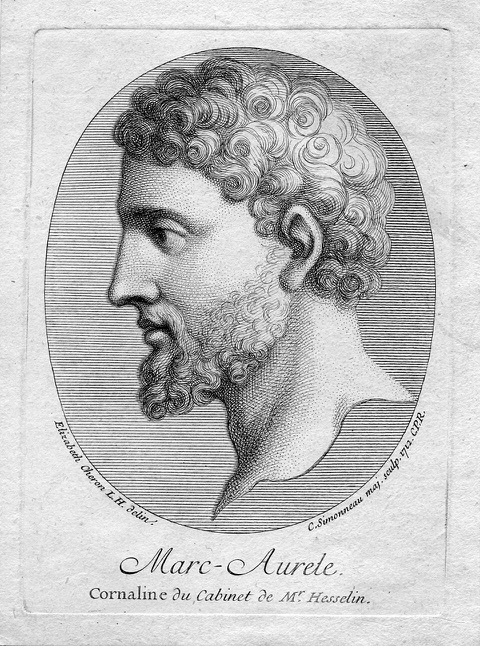
Portrait of Marcus Aurelius

About the author

Marcus Aurelius

Marcus Aurelius was Roman Emperor from 161 to 180 AD and the last of the "Five Good Emperors." He is equally known as a Stoic philosopher whose personal writings, known as "Meditations," provide remarkable insight into ancient Stoic thought. Written during military campaigns as private reflections never intended for publication, the Meditations reveal Marcus's efforts to live according to Stoic principles amid the pressures of ruling an empire. His emphasis on self-discipline, duty, acceptance of fate, and the transience of all things has drawn readers for centuries. Despite being a pagan emperor under whose rule Christians were at times persecuted, Marcus Aurelius's ethical teachings on virtue, reason, and inner peace continue to inspire readers seeking wisdom for daily life.